Cambridge A Level French (A Level only) 9716 — 2024 May/June Paper 3 · Variant 2
9716/32/M/J/24 · 40 marks · ≈45 min
The question paper and its mark scheme, free to read here and free to download. This is Cambridge’s own paper, exactly as it was sat.
Question paper8 pages
Mark scheme3 pages
Answers below. Sit the paper first if you are practising.
Paper as text
Question paper, page 1
This document has 8 pages. [Turn over Cambridge International A Level FRENCH 9716/32 Paper 3 Essay May/June 2024 1 hour 30 minutes You must answer on the question paper. No additional materials are needed. INSTRUCTIONS ● Answer one question in French. ● Use a black or dark blue pen. Do not use an erasable pen or correction fluid. ● Write your name, centre number and candidate number in the boxes at the top of the page. ● Write your answer in the space provided. ● Do not write on any bar codes. ● Dictionaries are not allowed. INFORMATION ● The total mark for this paper is 40. ● Your essay will be marked out of 40 with 16 marks for content and 24 marks for quality of language. INSTRUCTIONS ● Répondez en français à une seule question. ● Utilisez un stylo noir ou bleu foncé. N’utilisez ni stylo effaçable, ni liquide correcteur. ● Écrivez votre nom, le numéro de votre centre et votre numéro de candidat dans les cases situées en haut de cette page. ● Écrivez votre réponse dans l’espace prévu à cet effet. ● N’écrivez pas sur les codes barres. ● Les dictionnaires ne sont pas permis. RENSEIGNEMENTS ● Le nombre maximum de points pour cette épreuve est 40 points. ● 40 points sont attribués, dont 16 pour le contenu et 24 pour la qualité du français. * 7 0 4 6 9 4 5 9 9 1 * DC (SL) 330028/1 © UCLES 2024
Question paper, page 2
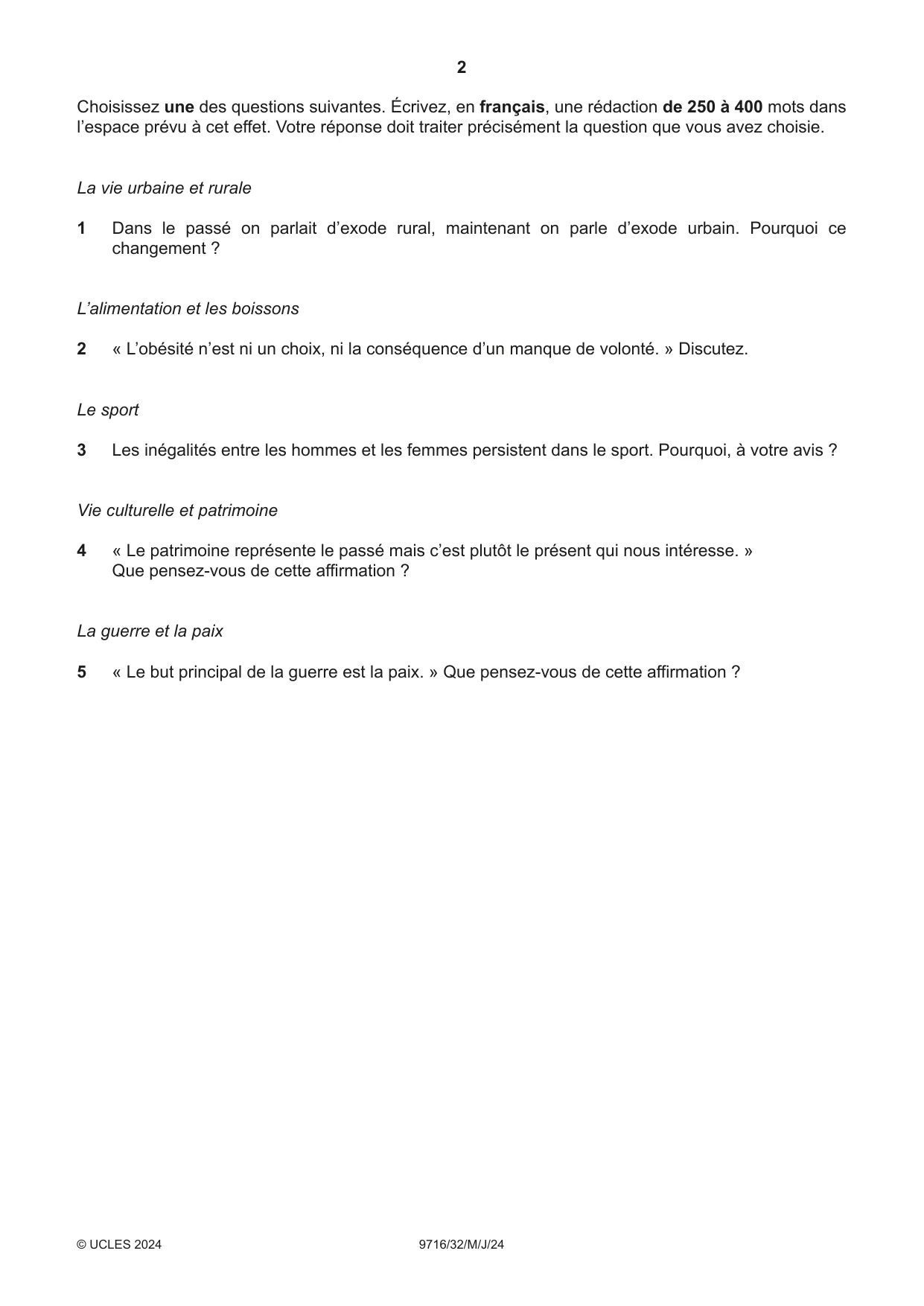
2 9716/32/M/J/24 © UCLES 2024 Choisissez une des questions suivantes. Écrivez, en français, une rédaction de 250 à 400 mots dans l’espace prévu à cet effet. Votre réponse doit traiter précisément la question que vous avez choisie. La vie urbaine et rurale 1 Dans le passé on parlait d’exode rural, maintenant on parle d’exode urbain. Pourquoi ce changement ? L’alimentation et les boissons 2 « L’obésité n’est ni un choix, ni la conséquence d’un manque de volonté. » Discutez. Le sport 3 Les inégalités entre les hommes et les femmes persistent dans le sport. Pourquoi, à votre avis ? Vie culturelle et patrimoine 4 « Le patrimoine représente le passé mais c’est plutôt le présent qui nous intéresse. » Que pensez-vous de cette affirmation ? La guerre et la paix 5 « Le but principal de la guerre est la paix. » Que pensez-vous de cette affirmation ?
Question paper, page 3
3 9716/32/M/J/24 © UCLES 2024 [Turn over Écrivez ici le numéro de la question que vous avez choisie : … … … … … … … … … … … … … … … … … … … … … … … … … … … … …
Question paper, page 4
4 9716/32/M/J/24 © UCLES 2024 … … … … … … … … … … … … … … … … … … … … … … … … … … … …
Question paper, page 5
5 9716/32/M/J/24 © UCLES 2024 [Turn over … … … … … … … … … … … … … … … … … … … … … … … … … … … …
Question paper, page 6
6 9716/32/M/J/24 © UCLES 2024 … … … … … … … … … … … … … … … … … … … … … … … … … … … …
Question paper, page 7
7 9716/32/M/J/24 © UCLES 2024 [Turn over … … … … … … … … … … … … … … … … … … … … … … … … … … … …
Question paper, page 8
8 9716/32/M/J/24 © UCLES 2024 Permission to reproduce items where third-party owned material protected by copyright is included has been sought and cleared where possible. Every reasonable effort has been made by the publisher (UCLES) to trace copyright holders, but if any items requiring clearance have unwittingly been included, the publisher will be pleased to make amends at the earliest possible opportunity. To avoid the issue of disclosure of answer-related information to candidates, all copyright acknowledgements are reproduced online in the Cambridge Assessment International Education Copyright Acknowledgements Booklet. This is produced for each series of examinations and is freely available to download at www.cambridgeinternational.org after the live examination series. Cambridge Assessment International Education is part of Cambridge Assessment. Cambridge Assessment is the brand name of the University of Cambridge Local Examinations Syndicate (UCLES), which is a department of the University of Cambridge. … … … … … … … … … … … … … … … … … … … … … … … …
Mark scheme, page 1
This document consists of 3 printed pages. © Cambridge University Press & Assessment 2024 [Turn over Cambridge International A Level FRENCH 9716/32 Paper 3 Essay May/June 2024 MARK SCHEME Maximum Mark: 40 Published This mark scheme is published as an aid to teachers and candidates, to indicate the requirements of the examination. It shows the basis on which Examiners were instructed to award marks. It does not indicate the details of the discussions that took place at an Examiners’ meeting before marking began, which would have considered the acceptability of alternative answers. Mark schemes should be read in conjunction with the question paper and the Principal Examiner Report for Teachers. Cambridge International will not enter into discussions about these mark schemes. Cambridge International is publishing the mark schemes for the May/June 2024 series for most Cambridge IGCSE, Cambridge International A and AS Level and Cambridge Pre-U components, and some Cambridge O Level components.
Mark scheme, page 2
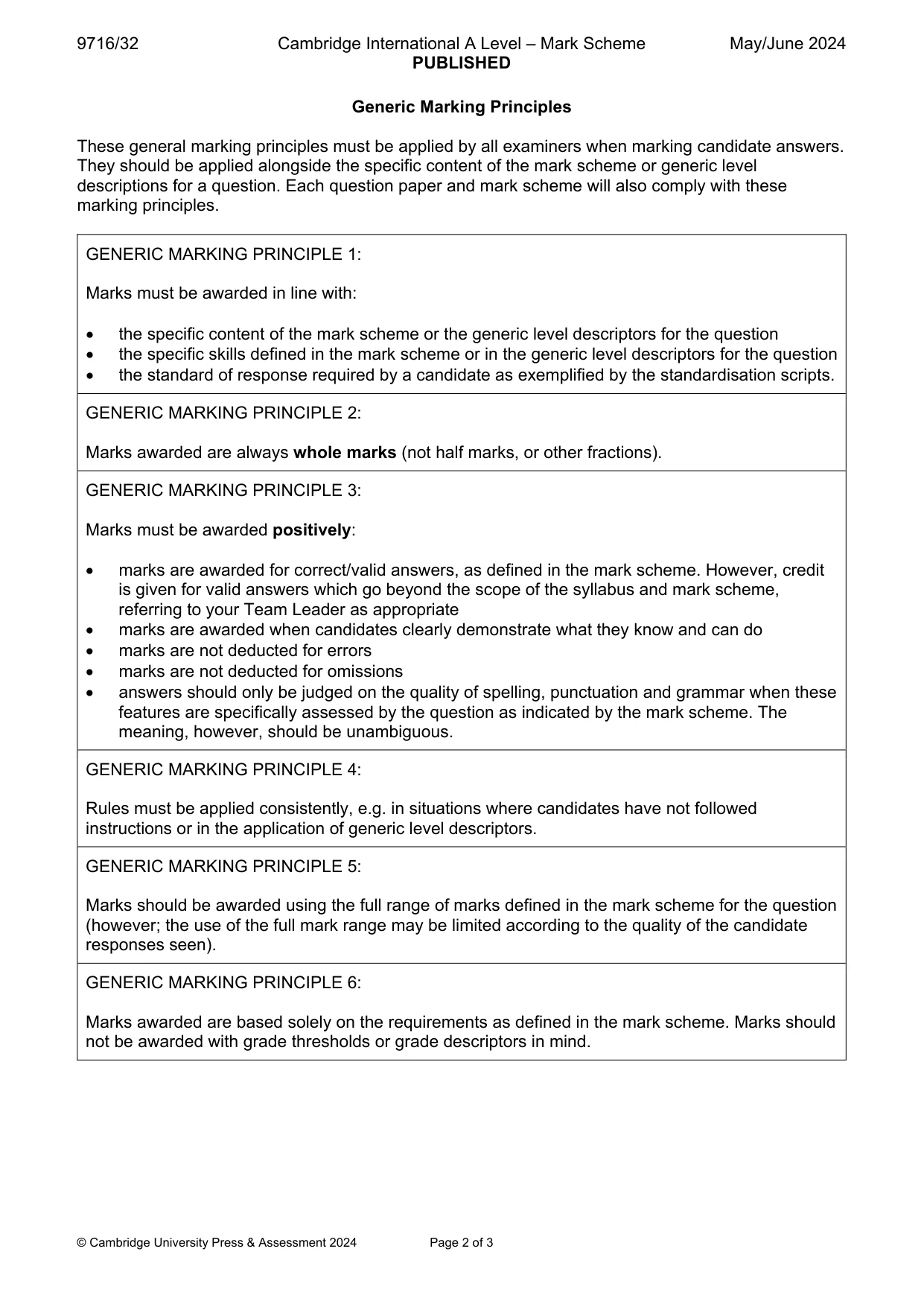
9716/32 Cambridge International A Level – Mark Scheme PUBLISHED May/June 2024 © Cambridge University Press & Assessment 2024 Page 2 of 3 Generic Marking Principles These general marking principles must be applied by all examiners when marking candidate answers. They should be applied alongside the specific content of the mark scheme or generic level descriptions for a question. Each question paper and mark scheme will also comply with these marking principles. GENERIC MARKING PRINCIPLE 1: Marks must be awarded in line with: the specific content of the mark scheme or the generic level descriptors for the question the specific skills defined in the mark scheme or in the generic level descriptors for the question the standard of response required by a candidate as exemplified by the standardisation scripts. GENERIC MARKING PRINCIPLE 2: Marks awarded are always whole marks (not half marks, or other fractions). GENERIC MARKING PRINCIPLE 3: Marks must be awarded positively: marks are awarded for correct/valid answers, as defined in the mark scheme. However, credit is given for valid answers which go beyond the scope of the syllabus and mark scheme, referring to your Team Leader as appropriate marks are awarded when candidates clearly demonstrate what they know and can do marks are not deducted for errors marks are not deducted for omissions answers should only be judged on the quality of spelling, punctuation and grammar when these features are specifically assessed by the question as indicated by the mark scheme. The meaning, however, should be unambiguous. GENERIC MARKING PRINCIPLE 4: Rules must be applied consistently, e.g. in situations where candidates have not followed instructions or in the application of generic level descriptors. GENERIC MARKING PRINCIPLE 5: Marks should be awarded using the full range of marks defined in the mark scheme for the question (however; the use of the full mark range may be limited according to the quality of the candidate responses seen). GENERIC MARKING PRINCIPLE 6: Marks awarded are based solely on the requirements as defined in the mark scheme. Marks should not be awarded with grade thresholds or grade descriptors in mind.
Mark scheme, page 3
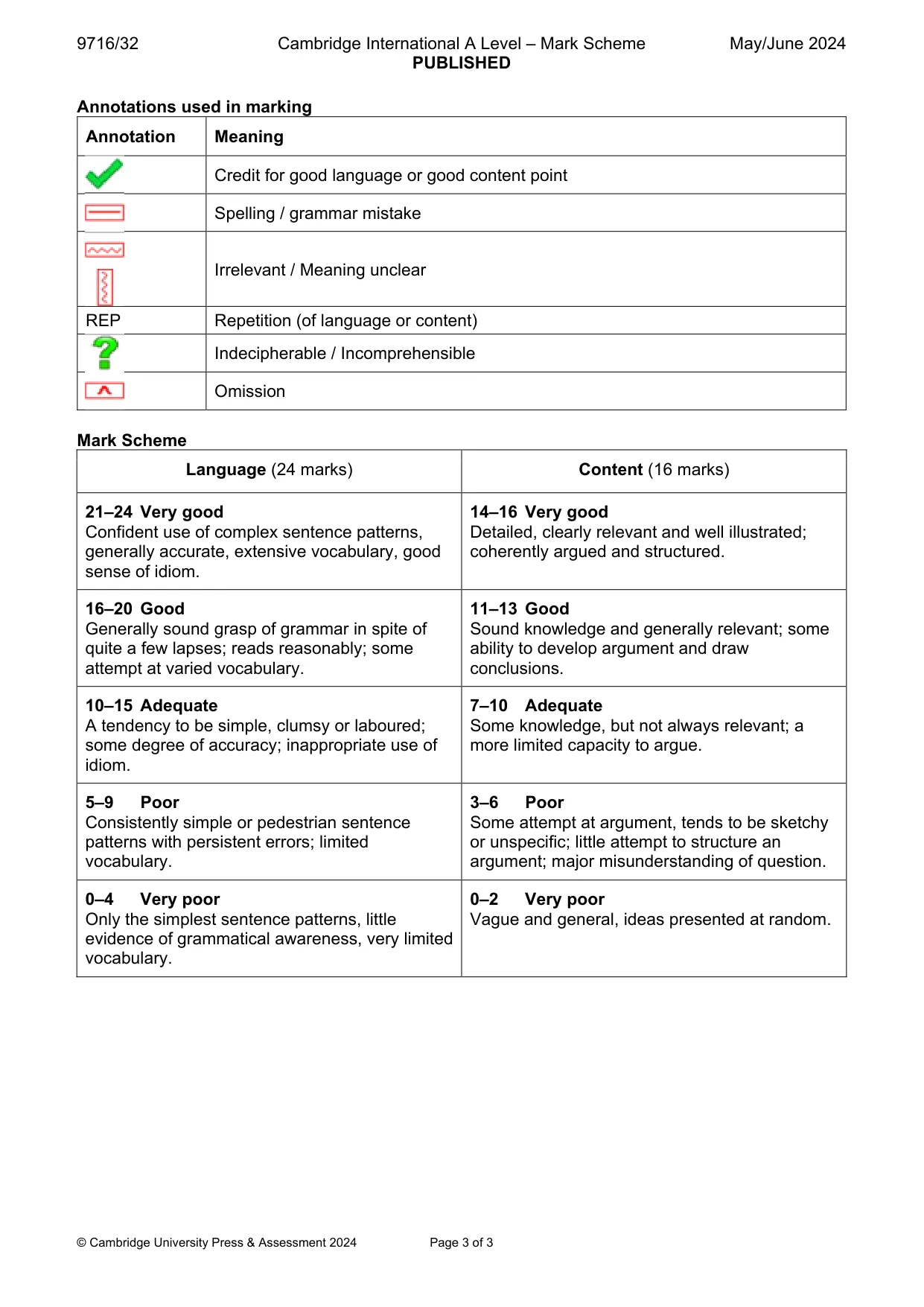
9716/32 Cambridge International A Level – Mark Scheme PUBLISHED May/June 2024 © Cambridge University Press & Assessment 2024 Page 3 of 3 Annotations used in marking Annotation Meaning Credit for good language or good content point Spelling / grammar mistake Irrelevant / Meaning unclear REP Repetition (of language or content) Indecipherable / Incomprehensible Omission Mark Scheme Language (24 marks) Content (16 marks) 21–24 Very good Confident use of complex sentence patterns, generally accurate, extensive vocabulary, good sense of idiom. 14–16 Very good Detailed, clearly relevant and well illustrated; coherently argued and structured. 16–20 Good Generally sound grasp of grammar in spite of quite a few lapses; reads reasonably; some attempt at varied vocabulary. 11–13 Good Sound knowledge and generally relevant; some ability to develop argument and draw conclusions. 10–15 Adequate A tendency to be simple, clumsy or laboured; some degree of accuracy; inappropriate use of idiom. 7–10 Adequate Some knowledge, but not always relevant; a more limited capacity to argue. 5–9 Poor Consistently simple or pedestrian sentence patterns with persistent errors; limited vocabulary. 3–6 Poor Some attempt at argument, tends to be sketchy or unspecific; little attempt to structure an argument; major misunderstanding of question. 0–4 Very poor Only the simplest sentence patterns, little evidence of grammatical awareness, very limited vocabulary. 0–2 Very poor Vague and general, ideas presented at random.
What you needed in this session
Cambridge’s own grade thresholds for 2024 May/June, Paper 3 · Variant 2. A higher threshold means an easier paper — the bar moves with how the cohort did.