Cambridge A Level Economics 9708 — 2013 Oct/Nov Paper 4 · Variant 1
9708/41/O/N/13 · 70 marks · ≈79 min
The question paper and its mark scheme, free to read here and free to download. This is Cambridge’s own paper, exactly as it was sat.
Question paper4 pages
Mark scheme7 pages
Answers below. Sit the paper first if you are practising.
Paper as text
Question paper, page 1
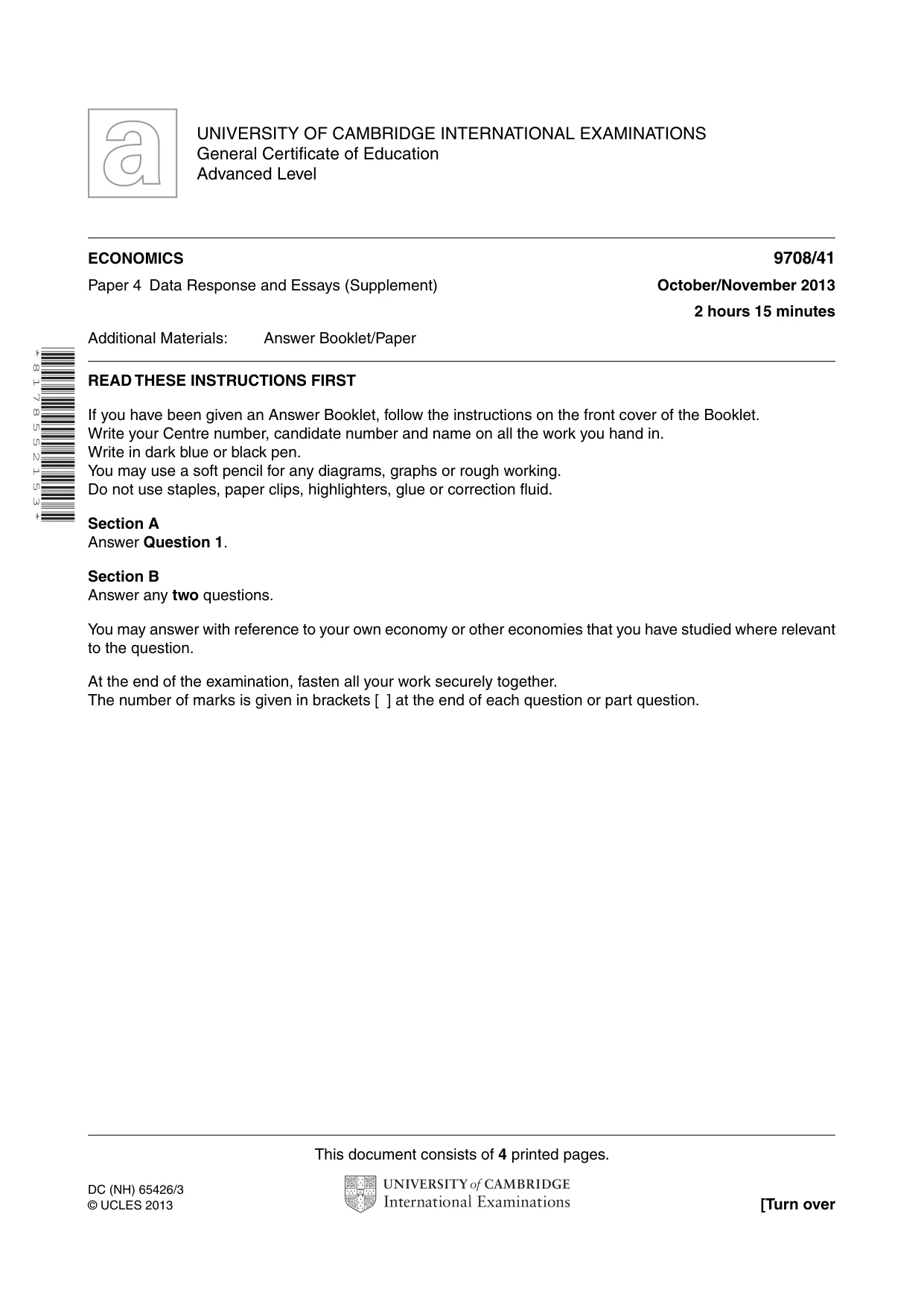
This document consists of 4 printed pages. DC (NH) 65426/3 © UCLES 2013 [Turn over UNIVERSITY OF CAMBRIDGE INTERNATIONAL EXAMINATIONS General Certificate of Education Advanced Level * 8 1 7 8 5 5 2 1 5 3 * ECONOMICS 9708/41 Paper 4 Data Response and Essays (Supplement) October/November 2013 2 hours 15 minutes Additional Materials: Answer Booklet/Paper READ THESE INSTRUCTIONS FIRST If you have been given an Answer Booklet, follow the instructions on the front cover of the Booklet. Write your Centre number, candidate number and name on all the work you hand in. Write in dark blue or black pen. You may use a soft pencil for any diagrams, graphs or rough working. Do not use staples, paper clips, highlighters, glue or correction fluid. Section A Answer Question 1. Section B Answer any two questions. You may answer with reference to your own economy or other economies that you have studied where relevant to the question. At the end of the examination, fasten all your work securely together. The number of marks is given in brackets [ ] at the end of each question or part question.
Question paper, page 2
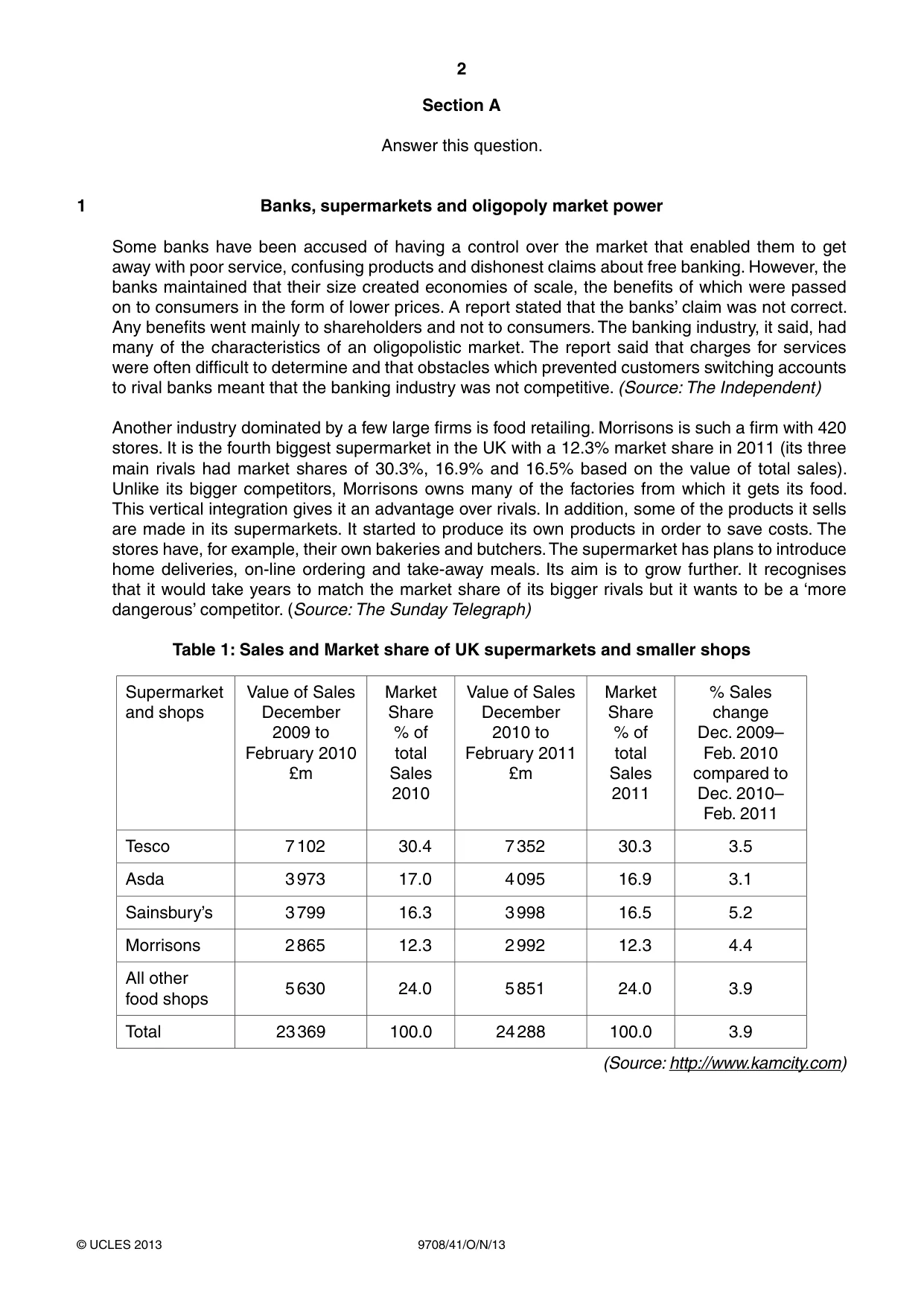
2 9708/41/O/N/13 © UCLES 2013 Section A Answer this question. 1 Banks, supermarkets and oligopoly market power Some banks have been accused of having a control over the market that enabled them to get away with poor service, confusing products and dishonest claims about free banking. However, the banks maintained that their size created economies of scale, the benefits of which were passed on to consumers in the form of lower prices. A report stated that the banks’ claim was not correct. Any benefits went mainly to shareholders and not to consumers. The banking industry, it said, had many of the characteristics of an oligopolistic market. The report said that charges for services were often difficult to determine and that obstacles which prevented customers switching accounts to rival banks meant that the banking industry was not competitive. (Source: The Independent) Another industry dominated by a few large firms is food retailing. Morrisons is such a firm with 420 stores. It is the fourth biggest supermarket in the UK with a 12.3% market share in 2011 (its three main rivals had market shares of 30.3%, 16.9% and 16.5% based on the value of total sales). Unlike its bigger competitors, Morrisons owns many of the factories from which it gets its food. This vertical integration gives it an advantage over rivals. In addition, some of the products it sells are made in its supermarkets. It started to produce its own products in order to save costs. The stores have, for example, their own bakeries and butchers. The supermarket has plans to introduce home deliveries, on-line ordering and take-away meals. Its aim is to grow further. It recognises that it would take years to match the market share of its bigger rivals but it wants to be a ‘more dangerous’ competitor. (Source: The Sunday Telegraph) Table 1: Sales and Market share of UK supermarkets and smaller shops Supermarket and shops Value of Sales December 2009 to February 2010 £m Market Share % of total Sales 2010 Value of Sales December 2010 to February 2011 £m Market Share % of total Sales 2011 % Sales change Dec. 2009– Feb. 2010 compared to Dec. 2010– Feb. 2011 Tesco 7 102 30.4 7 352 30.3 3.5 Asda 3 973 17.0 4 095 16.9 3.1 Sainsbury’s 3 799 16.3 3 998 16.5 5.2 Morrisons 2 865 12.3 2 992 12.3 4.4 All other food shops 5 630 24.0 5 851 24.0 3.9 Total 23 369 100.0 24 288 100.0 3.9 (Source: http://www.kamcity.com)
Question paper, page 3
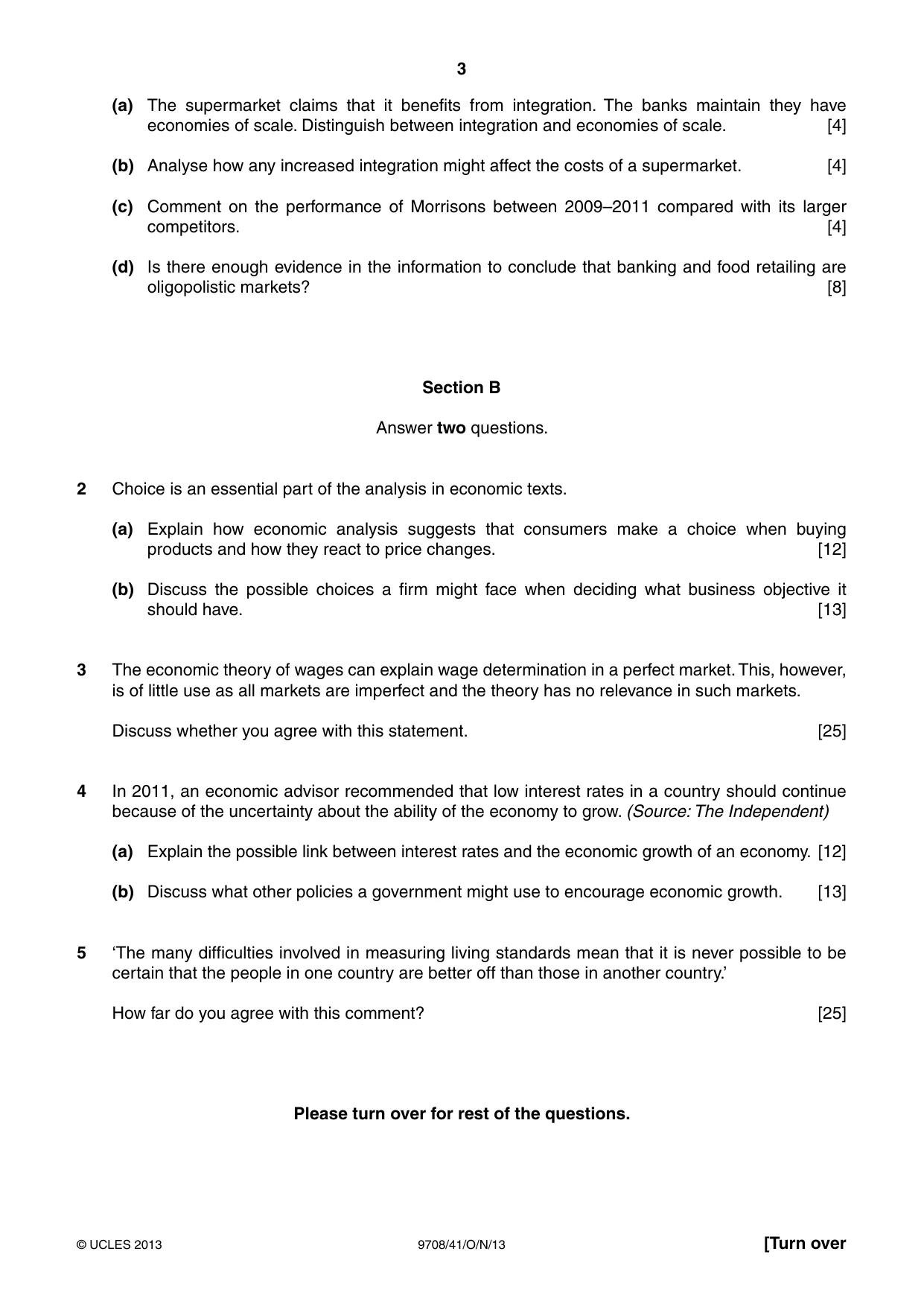
3 9708/41/O/N/13 © UCLES 2013 [Turn over (a) The supermarket claims that it benefits from integration. The banks maintain they have economies of scale. Distinguish between integration and economies of scale. [4] (b) Analyse how any increased integration might affect the costs of a supermarket. [4] (c) Comment on the performance of Morrisons between 2009–2011 compared with its larger competitors. [4] (d) Is there enough evidence in the information to conclude that banking and food retailing are oligopolistic markets? [8] Section B Answer two questions. 2 Choice is an essential part of the analysis in economic texts. (a) Explain how economic analysis suggests that consumers make a choice when buying products and how they react to price changes. [12] (b) Discuss the possible choices a firm might face when deciding what business objective it should have. [13] 3 The economic theory of wages can explain wage determination in a perfect market. This, however, is of little use as all markets are imperfect and the theory has no relevance in such markets. Discuss whether you agree with this statement. [25] 4 In 2011, an economic advisor recommended that low interest rates in a country should continue because of the uncertainty about the ability of the economy to grow. (Source: The Independent) (a) Explain the possible link between interest rates and the economic growth of an economy. [12] (b) Discuss what other policies a government might use to encourage economic growth. [13] 5 ‘The many difficulties involved in measuring living standards mean that it is never possible to be certain that the people in one country are better off than those in another country.’ How far do you agree with this comment? [25] Please turn over for rest of the questions.
Question paper, page 4
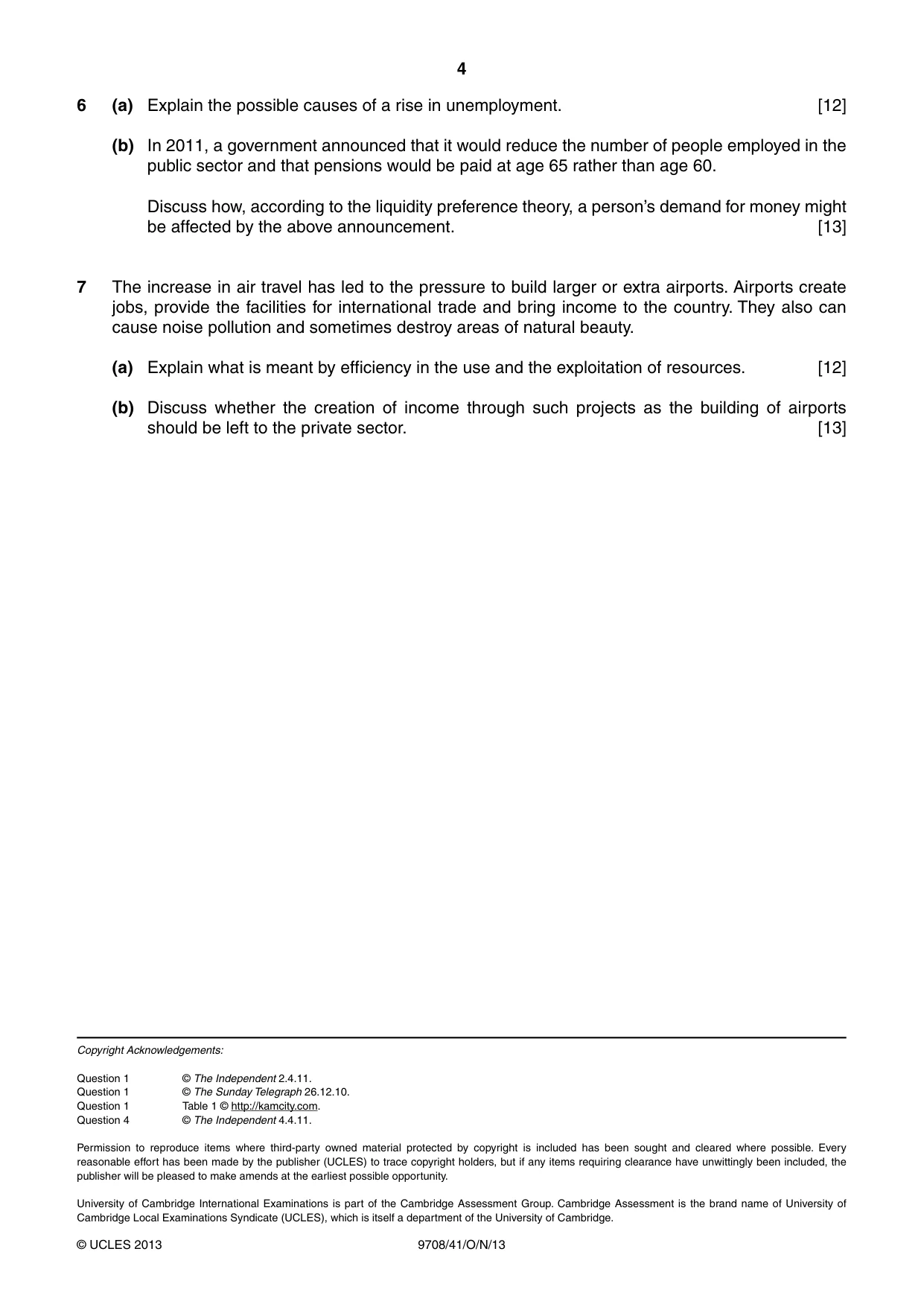
4 9708/41/O/N/13 © UCLES 2013 6 (a) Explain the possible causes of a rise in unemployment. [12] (b) In 2011, a government announced that it would reduce the number of people employed in the public sector and that pensions would be paid at age 65 rather than age 60. Discuss how, according to the liquidity preference theory, a person’s demand for money might be affected by the above announcement. [13] 7 The increase in air travel has led to the pressure to build larger or extra airports. Airports create jobs, provide the facilities for international trade and bring income to the country. They also can cause noise pollution and sometimes destroy areas of natural beauty. (a) Explain what is meant by efficiency in the use and the exploitation of resources. [12] (b) Discuss whether the creation of income through such projects as the building of airports should be left to the private sector. [13] Copyright Acknowledgements: Question 1 © The Independent 2.4.11. Question 1 © The Sunday Telegraph 26.12.10. Question 1 Table 1 © http://kamcity.com. Question 4 © The Independent 4.4.11. Permission to reproduce items where third-party owned material protected by copyright is included has been sought and cleared where possible. Every reasonable effort has been made by the publisher (UCLES) to trace copyright holders, but if any items requiring clearance have unwittingly been included, the publisher will be pleased to make amends at the earliest possible opportunity. University of Cambridge International Examinations is part of the Cambridge Assessment Group. Cambridge Assessment is the brand name of University of Cambridge Local Examinations Syndicate (UCLES), which is itself a department of the University of Cambridge.
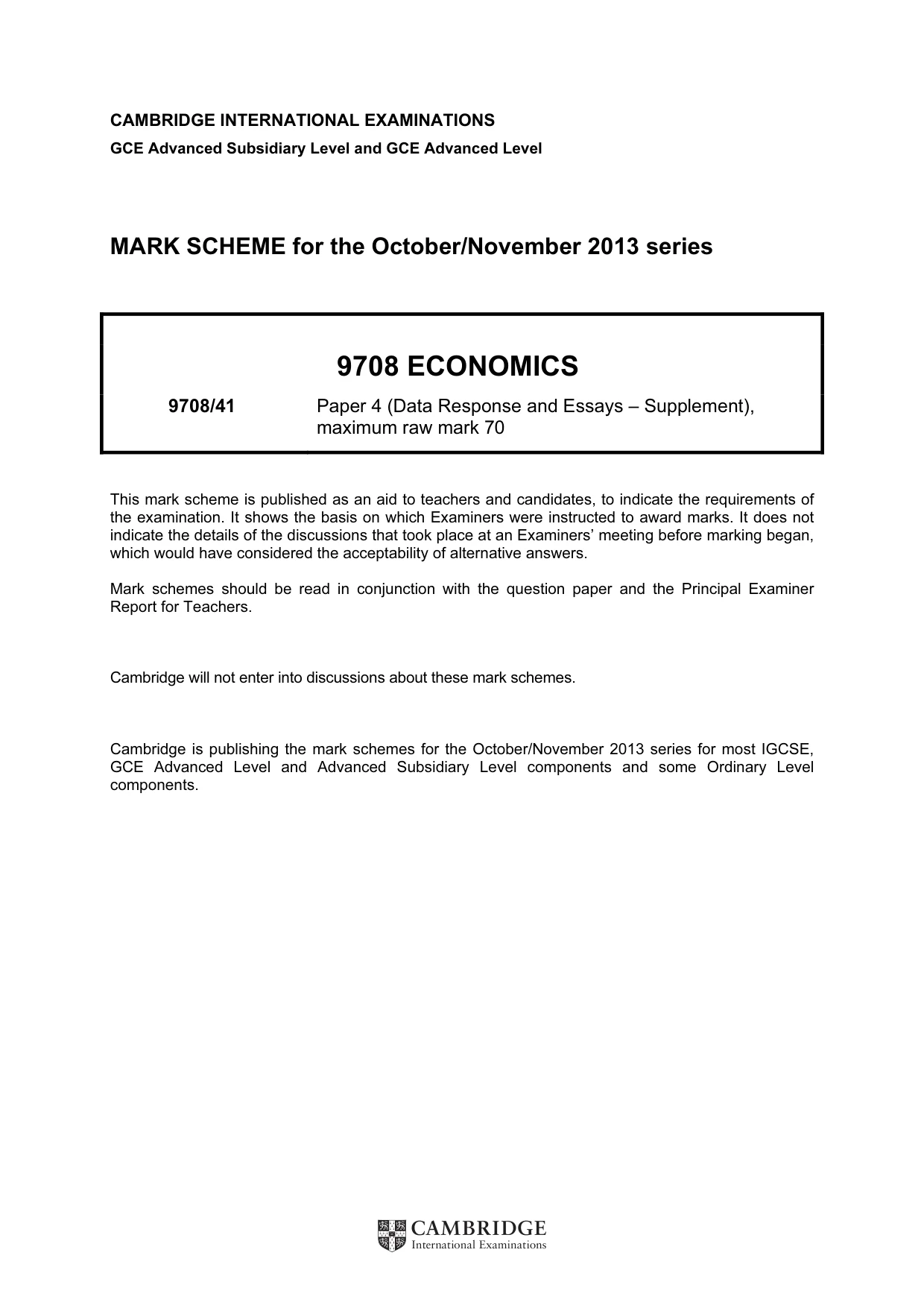
Mark scheme, page 1
CAMBRIDGE INTERNATIONAL EXAMINATIONS GCE Advanced Subsidiary Level and GCE Advanced Level MARK SCHEME for the October/November 2013 series 9708 ECONOMICS 9708/41 Paper 4 (Data Response and Essays – Supplement), maximum raw mark 70 This mark scheme is published as an aid to teachers and candidates, to indicate the requirements of the examination. It shows the basis on which Examiners were instructed to award marks. It does not indicate the details of the discussions that took place at an Examiners’ meeting before marking began, which would have considered the acceptability of alternative answers. Mark schemes should be read in conjunction with the question paper and the Principal Examiner Report for Teachers. Cambridge will not enter into discussions about these mark schemes. Cambridge is publishing the mark schemes for the October/November 2013 series for most IGCSE, GCE Advanced Level and Advanced Subsidiary Level components and some Ordinary Level components.
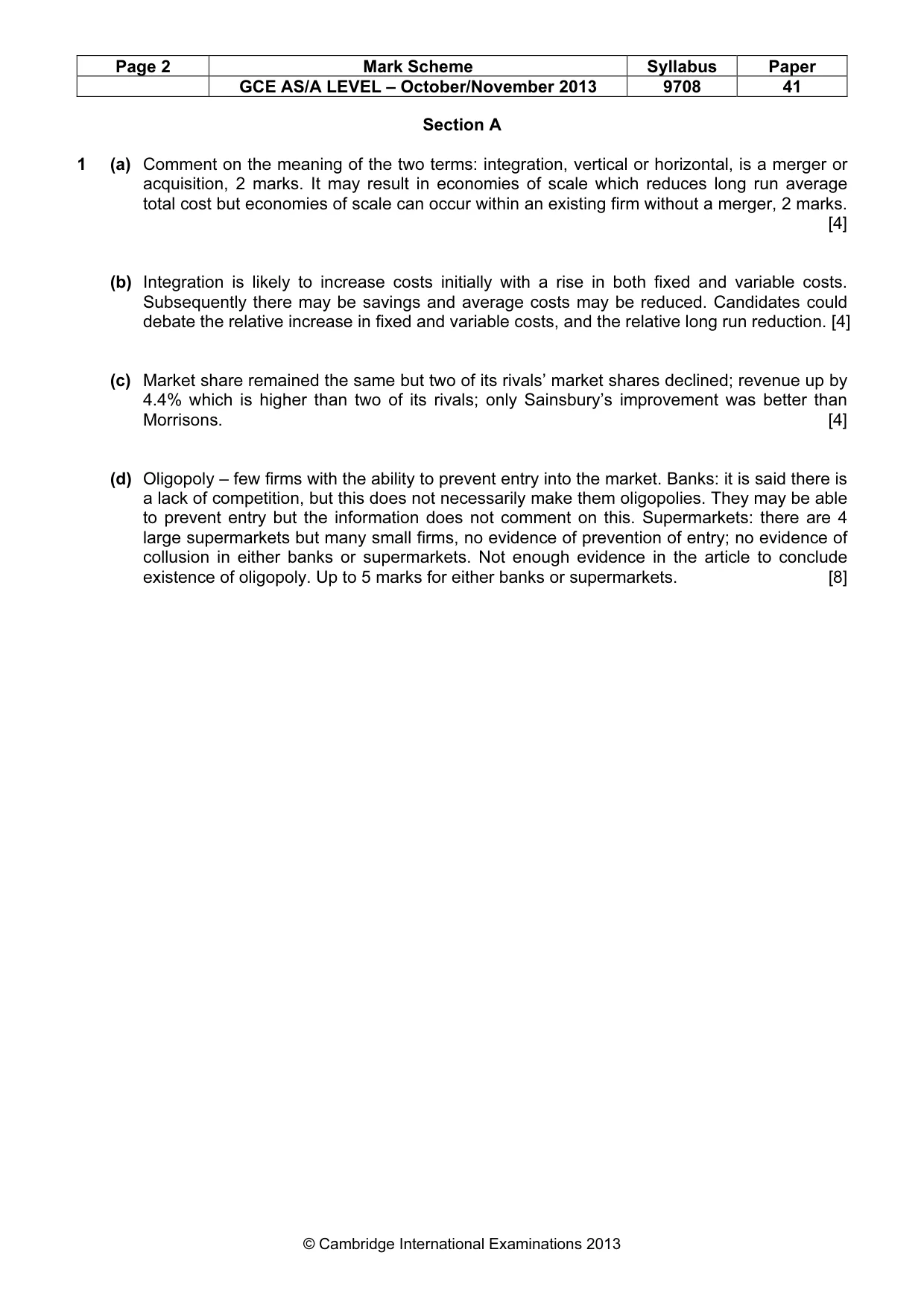
Mark scheme, page 2
Page 2 Mark Scheme Syllabus Paper GCE AS/A LEVEL – October/November 2013 9708 41 © Cambridge International Examinations 2013 Section A 1 (a) Comment on the meaning of the two terms: integration, vertical or horizontal, is a merger or acquisition, 2 marks. It may result in economies of scale which reduces long run average total cost but economies of scale can occur within an existing firm without a merger, 2 marks. [4] (b) Integration is likely to increase costs initially with a rise in both fixed and variable costs. Subsequently there may be savings and average costs may be reduced. Candidates could debate the relative increase in fixed and variable costs, and the relative long run reduction. [4] (c) Market share remained the same but two of its rivals’ market shares declined; revenue up by 4.4% which is higher than two of its rivals; only Sainsbury’s improvement was better than Morrisons. [4] (d) Oligopoly – few firms with the ability to prevent entry into the market. Banks: it is said there is a lack of competition, but this does not necessarily make them oligopolies. They may be able to prevent entry but the information does not comment on this. Supermarkets: there are 4 large supermarkets but many small firms, no evidence of prevention of entry; no evidence of collusion in either banks or supermarkets. Not enough evidence in the article to conclude existence of oligopoly. Up to 5 marks for either banks or supermarkets. [8]
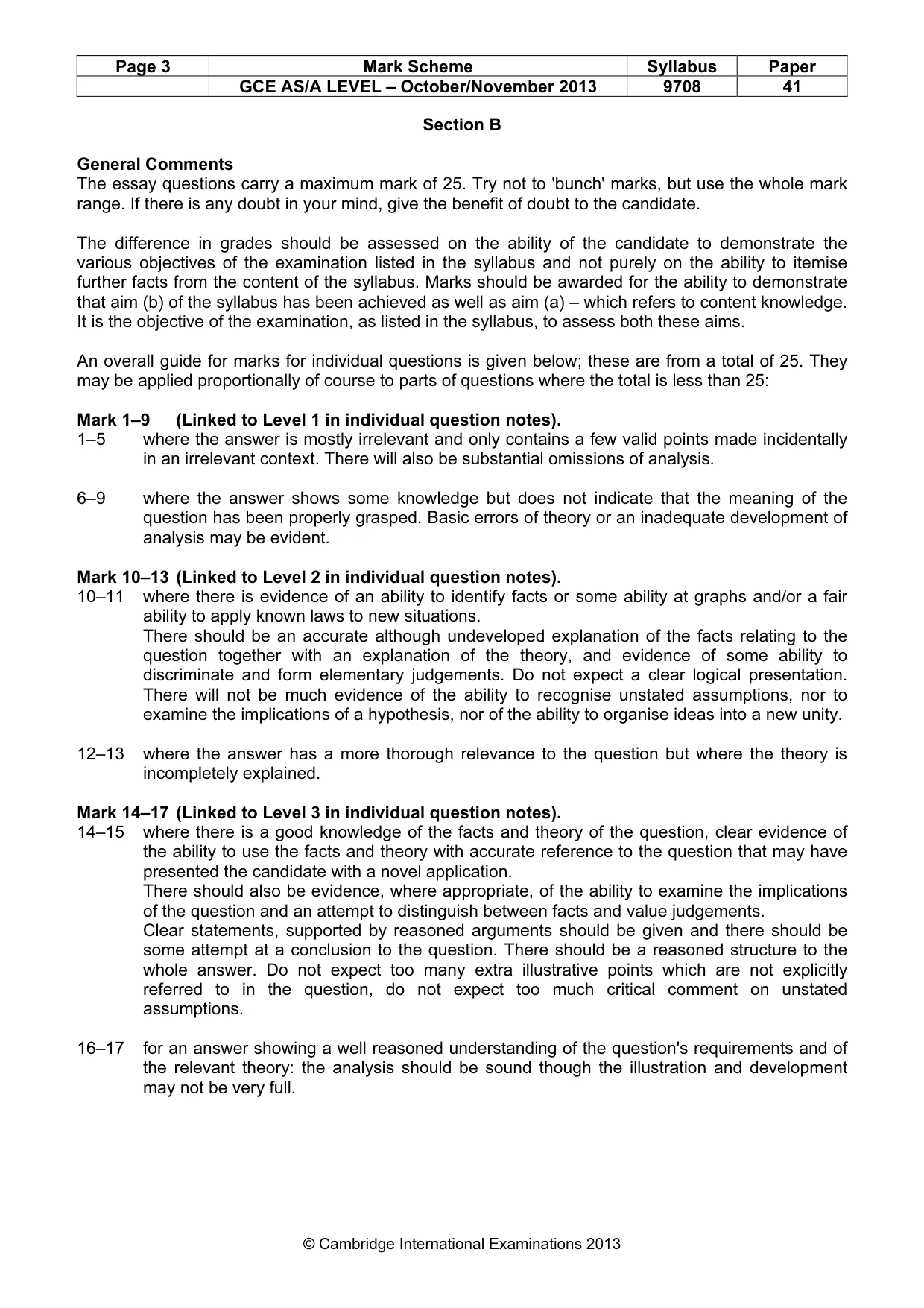
Mark scheme, page 3
Page 3 Mark Scheme Syllabus Paper GCE AS/A LEVEL – October/November 2013 9708 41 © Cambridge International Examinations 2013 Section B General Comments The essay questions carry a maximum mark of 25. Try not to 'bunch' marks, but use the whole mark range. If there is any doubt in your mind, give the benefit of doubt to the candidate. The difference in grades should be assessed on the ability of the candidate to demonstrate the various objectives of the examination listed in the syllabus and not purely on the ability to itemise further facts from the content of the syllabus. Marks should be awarded for the ability to demonstrate that aim (b) of the syllabus has been achieved as well as aim (a) – which refers to content knowledge. It is the objective of the examination, as listed in the syllabus, to assess both these aims. An overall guide for marks for individual questions is given below; these are from a total of 25. They may be applied proportionally of course to parts of questions where the total is less than 25: Mark 1–9 (Linked to Level 1 in individual question notes). 1–5 where the answer is mostly irrelevant and only contains a few valid points made incidentally in an irrelevant context. There will also be substantial omissions of analysis. 6–9 where the answer shows some knowledge but does not indicate that the meaning of the question has been properly grasped. Basic errors of theory or an inadequate development of analysis may be evident. Mark 10–13 (Linked to Level 2 in individual question notes). 10–11 where there is evidence of an ability to identify facts or some ability at graphs and/or a fair ability to apply known laws to new situations. There should be an accurate although undeveloped explanation of the facts relating to the question together with an explanation of the theory, and evidence of some ability to discriminate and form elementary judgements. Do not expect a clear logical presentation. There will not be much evidence of the ability to recognise unstated assumptions, nor to examine the implications of a hypothesis, nor of the ability to organise ideas into a new unity. 12–13 where the answer has a more thorough relevance to the question but where the theory is incompletely explained. Mark 14–17 (Linked to Level 3 in individual question notes). 14–15 where there is a good knowledge of the facts and theory of the question, clear evidence of the ability to use the facts and theory with accurate reference to the question that may have presented the candidate with a novel application. There should also be evidence, where appropriate, of the ability to examine the implications of the question and an attempt to distinguish between facts and value judgements. Clear statements, supported by reasoned arguments should be given and there should be some attempt at a conclusion to the question. There should be a reasoned structure to the whole answer. Do not expect too many extra illustrative points which are not explicitly referred to in the question, do not expect too much critical comment on unstated assumptions. 16–17 for an answer showing a well reasoned understanding of the question's requirements and of the relevant theory: the analysis should be sound though the illustration and development may not be very full.
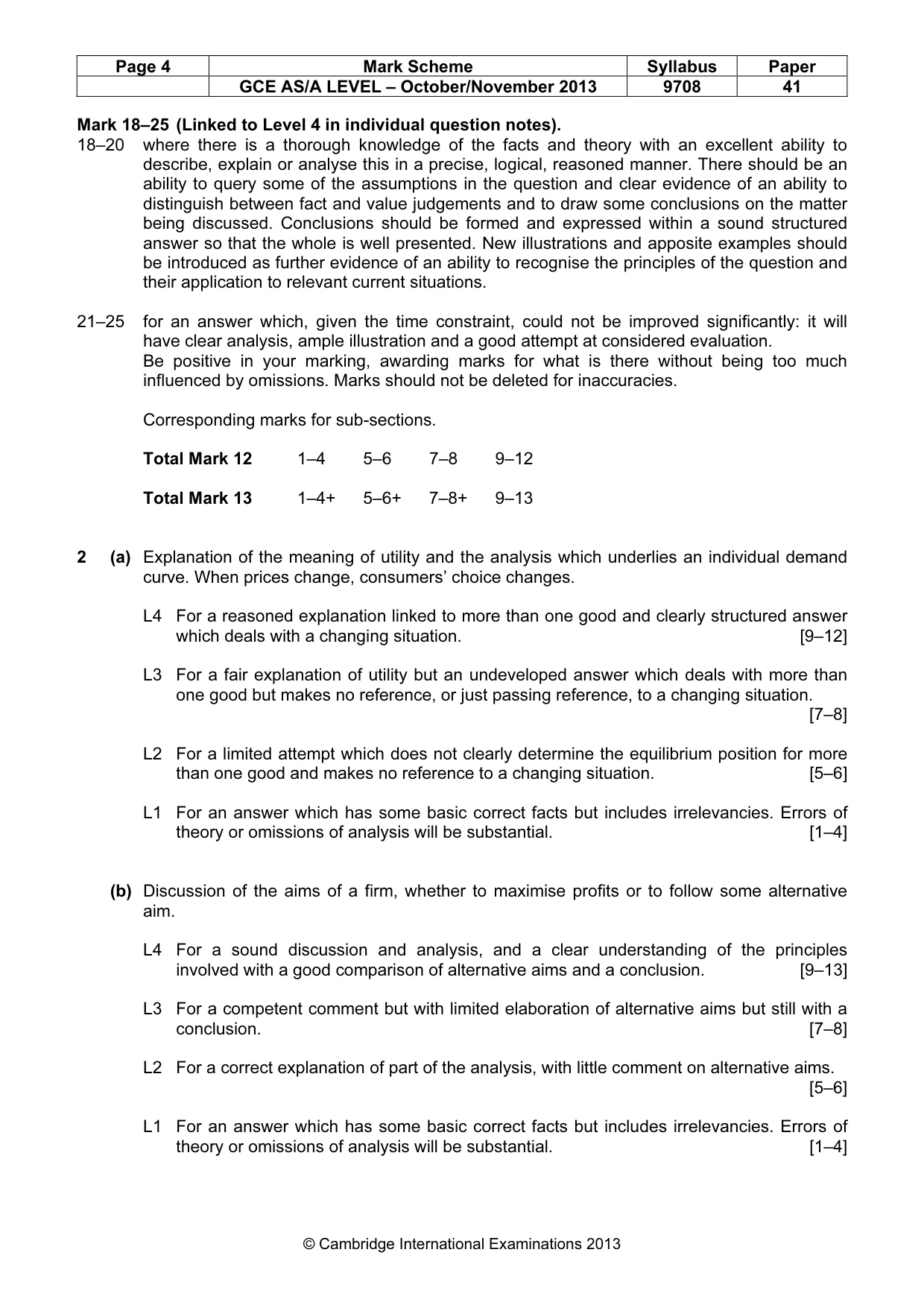
Mark scheme, page 4
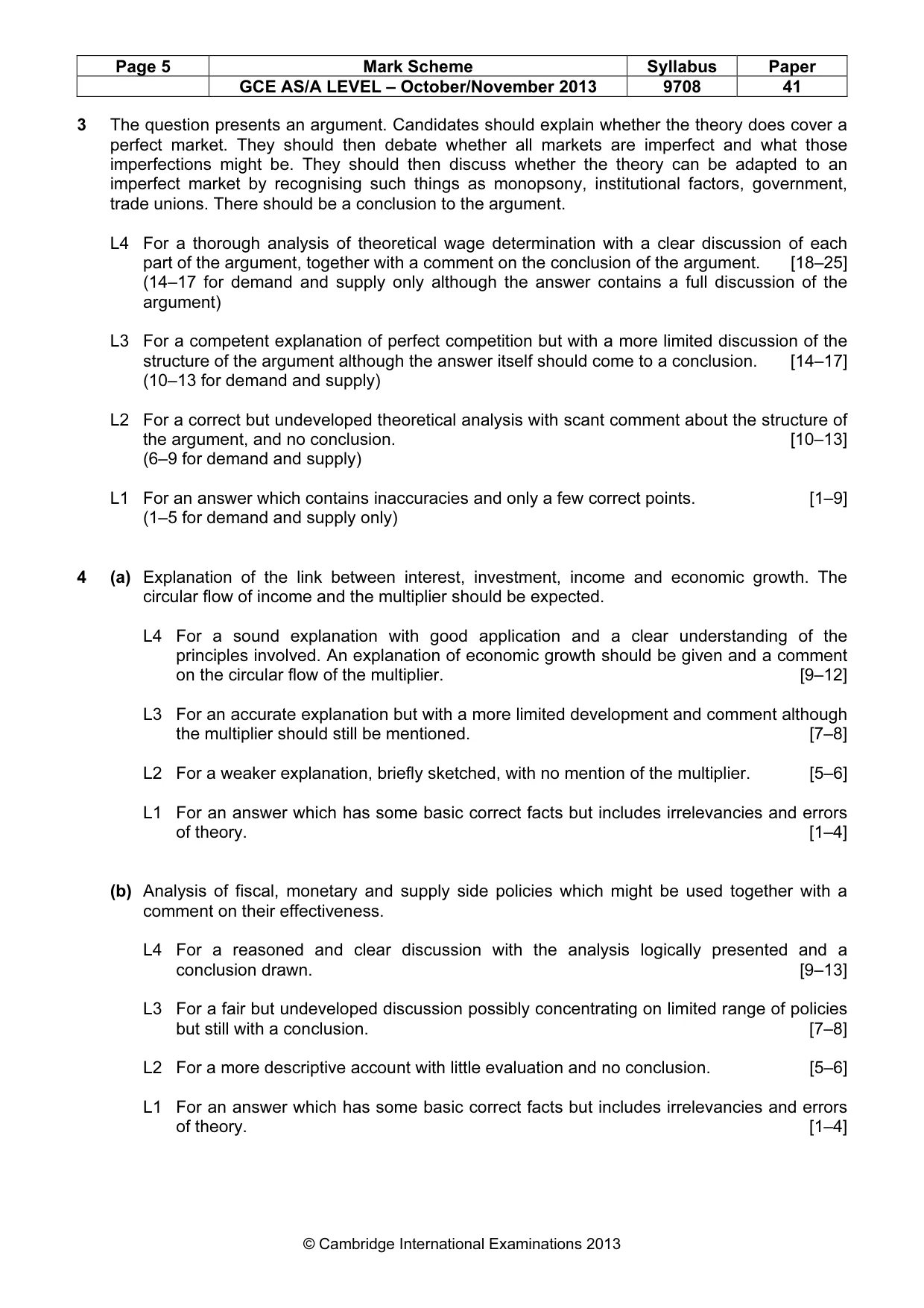
Page 4 Mark Scheme Syllabus Paper GCE AS/A LEVEL – October/November 2013 9708 41 © Cambridge International Examinations 2013 Mark 18–25 (Linked to Level 4 in individual question notes). 18–20 where there is a thorough knowledge of the facts and theory with an excellent ability to describe, explain or analyse this in a precise, logical, reasoned manner. There should be an ability to query some of the assumptions in the question and clear evidence of an ability to distinguish between fact and value judgements and to draw some conclusions on the matter being discussed. Conclusions should be formed and expressed within a sound structured answer so that the whole is well presented. New illustrations and apposite examples should be introduced as further evidence of an ability to recognise the principles of the question and their application to relevant current situations. 21–25 for an answer which, given the time constraint, could not be improved significantly: it will have clear analysis, ample illustration and a good attempt at considered evaluation. Be positive in your marking, awarding marks for what is there without being too much influenced by omissions. Marks should not be deleted for inaccuracies. Corresponding marks for sub-sections. Total Mark 12 1–4 5–6 7–8 9–12 Total Mark 13 1–4+ 5–6+ 7–8+ 9–13 2 (a) Explanation of the meaning of utility and the analysis which underlies an individual demand curve. When prices change, consumers’ choice changes. L4 For a reasoned explanation linked to more than one good and clearly structured answer which deals with a changing situation. [9–12] L3 For a fair explanation of utility but an undeveloped answer which deals with more than one good but makes no reference, or just passing reference, to a changing situation. [7–8] L2 For a limited attempt which does not clearly determine the equilibrium position for more than one good and makes no reference to a changing situation. [5–6] L1 For an answer which has some basic correct facts but includes irrelevancies. Errors of theory or omissions of analysis will be substantial. [1–4] (b) Discussion of the aims of a firm, whether to maximise profits or to follow some alternative aim. L4 For a sound discussion and analysis, and a clear understanding of the principles involved with a good comparison of alternative aims and a conclusion. [9–13] L3 For a competent comment but with limited elaboration of alternative aims but still with a conclusion. [7–8] L2 For a correct explanation of part of the analysis, with little comment on alternative aims. [5–6] L1 For an answer which has some basic correct facts but includes irrelevancies. Errors of theory or omissions of analysis will be substantial. [1–4]
Mark scheme, page 5
Page 5 Mark Scheme Syllabus Paper GCE AS/A LEVEL – October/November 2013 9708 41 © Cambridge International Examinations 2013 3 The question presents an argument. Candidates should explain whether the theory does cover a perfect market. They should then debate whether all markets are imperfect and what those imperfections might be. They should then discuss whether the theory can be adapted to an imperfect market by recognising such things as monopsony, institutional factors, government, trade unions. There should be a conclusion to the argument. L4 For a thorough analysis of theoretical wage determination with a clear discussion of each part of the argument, together with a comment on the conclusion of the argument. [18–25] (14–17 for demand and supply only although the answer contains a full discussion of the argument) L3 For a competent explanation of perfect competition but with a more limited discussion of the structure of the argument although the answer itself should come to a conclusion. [14–17] (10–13 for demand and supply) L2 For a correct but undeveloped theoretical analysis with scant comment about the structure of the argument, and no conclusion. [10–13] (6–9 for demand and supply) L1 For an answer which contains inaccuracies and only a few correct points. [1–9] (1–5 for demand and supply only) 4 (a) Explanation of the link between interest, investment, income and economic growth. The circular flow of income and the multiplier should be expected. L4 For a sound explanation with good application and a clear understanding of the principles involved. An explanation of economic growth should be given and a comment on the circular flow of the multiplier. [9–12] L3 For an accurate explanation but with a more limited development and comment although the multiplier should still be mentioned. [7–8] L2 For a weaker explanation, briefly sketched, with no mention of the multiplier. [5–6] L1 For an answer which has some basic correct facts but includes irrelevancies and errors of theory. [1–4] (b) Analysis of fiscal, monetary and supply side policies which might be used together with a comment on their effectiveness. L4 For a reasoned and clear discussion with the analysis logically presented and a conclusion drawn. [9–13] L3 For a fair but undeveloped discussion possibly concentrating on limited range of policies but still with a conclusion. [7–8] L2 For a more descriptive account with little evaluation and no conclusion. [5–6] L1 For an answer which has some basic correct facts but includes irrelevancies and errors of theory. [1–4]
Mark scheme, page 6
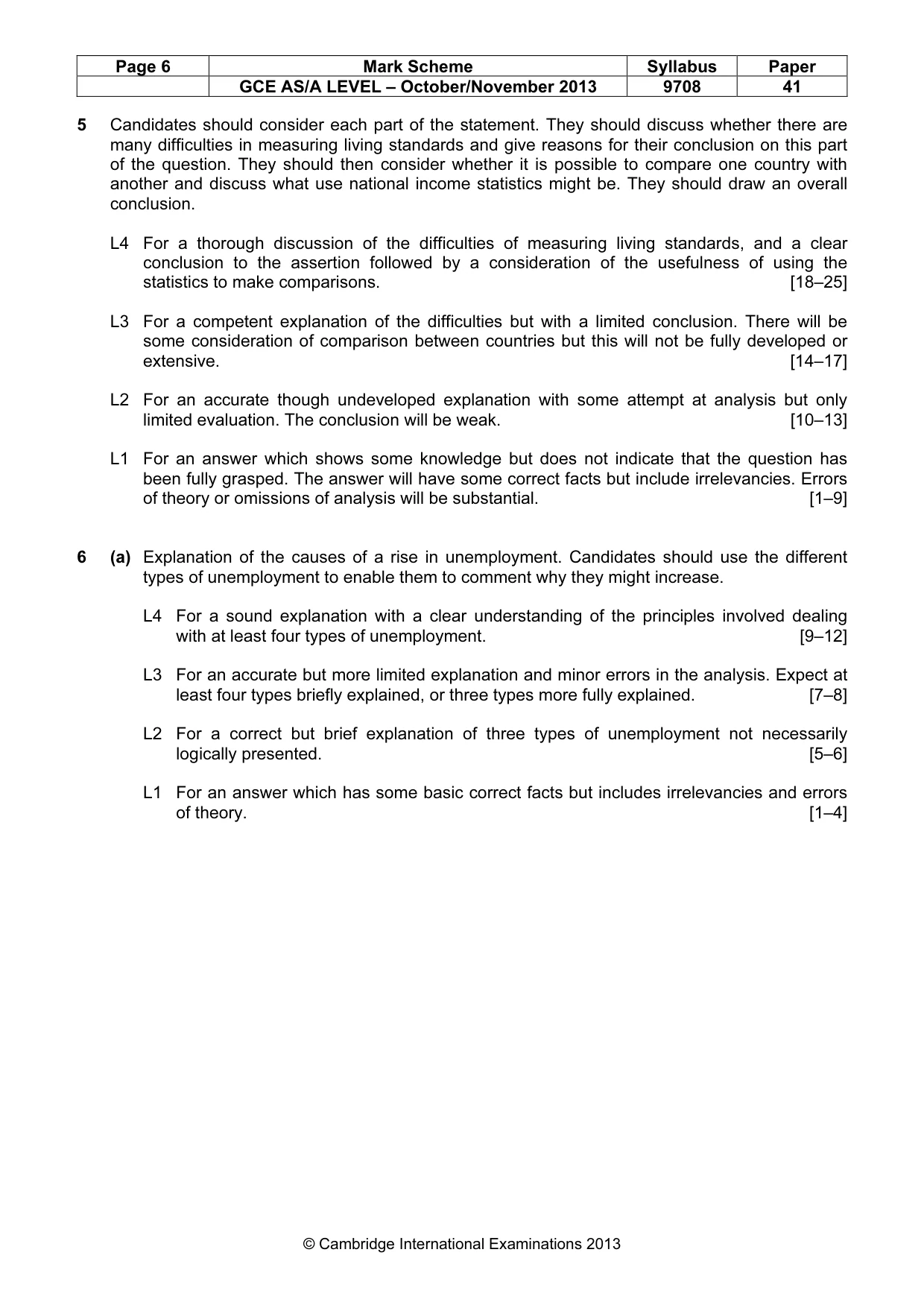
Page 6 Mark Scheme Syllabus Paper GCE AS/A LEVEL – October/November 2013 9708 41 © Cambridge International Examinations 2013 5 Candidates should consider each part of the statement. They should discuss whether there are many difficulties in measuring living standards and give reasons for their conclusion on this part of the question. They should then consider whether it is possible to compare one country with another and discuss what use national income statistics might be. They should draw an overall conclusion. L4 For a thorough discussion of the difficulties of measuring living standards, and a clear conclusion to the assertion followed by a consideration of the usefulness of using the statistics to make comparisons. [18–25] L3 For a competent explanation of the difficulties but with a limited conclusion. There will be some consideration of comparison between countries but this will not be fully developed or extensive. [14–17] L2 For an accurate though undeveloped explanation with some attempt at analysis but only limited evaluation. The conclusion will be weak. [10–13] L1 For an answer which shows some knowledge but does not indicate that the question has been fully grasped. The answer will have some correct facts but include irrelevancies. Errors of theory or omissions of analysis will be substantial. [1–9] 6 (a) Explanation of the causes of a rise in unemployment. Candidates should use the different types of unemployment to enable them to comment why they might increase. L4 For a sound explanation with a clear understanding of the principles involved dealing with at least four types of unemployment. [9–12] L3 For an accurate but more limited explanation and minor errors in the analysis. Expect at least four types briefly explained, or three types more fully explained. [7–8] L2 For a correct but brief explanation of three types of unemployment not necessarily logically presented. [5–6] L1 For an answer which has some basic correct facts but includes irrelevancies and errors of theory. [1–4]
Mark scheme, page 7
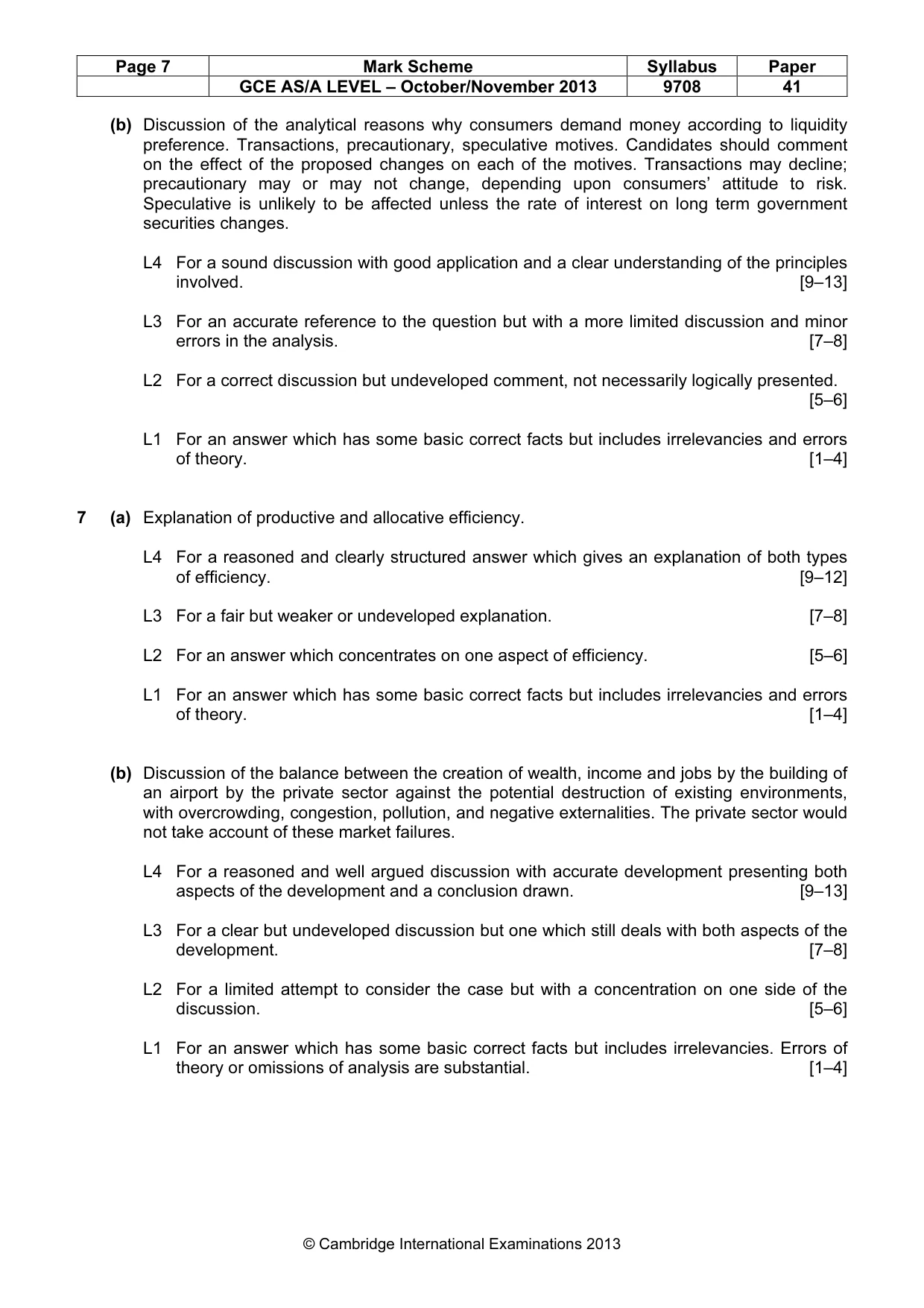
Page 7 Mark Scheme Syllabus Paper GCE AS/A LEVEL – October/November 2013 9708 41 © Cambridge International Examinations 2013 (b) Discussion of the analytical reasons why consumers demand money according to liquidity preference. Transactions, precautionary, speculative motives. Candidates should comment on the effect of the proposed changes on each of the motives. Transactions may decline; precautionary may or may not change, depending upon consumers’ attitude to risk. Speculative is unlikely to be affected unless the rate of interest on long term government securities changes. L4 For a sound discussion with good application and a clear understanding of the principles involved. [9–13] L3 For an accurate reference to the question but with a more limited discussion and minor errors in the analysis. [7–8] L2 For a correct discussion but undeveloped comment, not necessarily logically presented. [5–6] L1 For an answer which has some basic correct facts but includes irrelevancies and errors of theory. [1–4] 7 (a) Explanation of productive and allocative efficiency. L4 For a reasoned and clearly structured answer which gives an explanation of both types of efficiency. [9–12] L3 For a fair but weaker or undeveloped explanation. [7–8] L2 For an answer which concentrates on one aspect of efficiency. [5–6] L1 For an answer which has some basic correct facts but includes irrelevancies and errors of theory. [1–4] (b) Discussion of the balance between the creation of wealth, income and jobs by the building of an airport by the private sector against the potential destruction of existing environments, with overcrowding, congestion, pollution, and negative externalities. The private sector would not take account of these market failures. L4 For a reasoned and well argued discussion with accurate development presenting both aspects of the development and a conclusion drawn. [9–13] L3 For a clear but undeveloped discussion but one which still deals with both aspects of the development. [7–8] L2 For a limited attempt to consider the case but with a concentration on one side of the discussion. [5–6] L1 For an answer which has some basic correct facts but includes irrelevancies. Errors of theory or omissions of analysis are substantial. [1–4]
What you needed in this session
Cambridge’s own grade thresholds for 2013 Oct/Nov, Paper 4 · Variant 1. A higher threshold means an easier paper — the bar moves with how the cohort did.