Cambridge A Level Economics 9708 — 2005 May/June Paper 4 · Variant 1
9708/41/M/J/05
The question paper and its mark scheme, free to read here and free to download. This is Cambridge’s own paper, exactly as it was sat.
Question paper4 pages
Mark scheme10 pages
Answers below. Sit the paper first if you are practising.
Paper as text
Question paper, page 1
This document consists of 3 printed pages and 1 blank page. SP (NH) S77893/2 © UCLES 2005 [Turn over UNIVERSITY OF CAMBRIDGE INTERNATIONAL EXAMINATIONS General Certificate of Education Advanced Level ECONOMICS 9708/04 Paper 4 Data Response and Essay (Supplement) May/June 2005 2 hours 15 minutes Additional Materials: Answer Booklet/Paper READ THESE INSTRUCTIONS FIRST If you have been given an Answer Booklet, follow the instructions on the front cover of the Booklet. Write your Centre number, candidate number and name on all the work you hand in. Write in dark blue or black pen on both sides of the paper. You may use a soft pencil for any diagrams, graphs or rough working. Do not use staples, paper clips, highlighters, glue or correction fluid. Answer Question 1 and any two questions from Section B. At the end of the examination, fasten all your work securely together. The number of marks is given in brackets [ ] at the end of each question or part question. You may answer with reference to your own economy or other economies that you have studied where relevant to the question.
Question paper, page 2
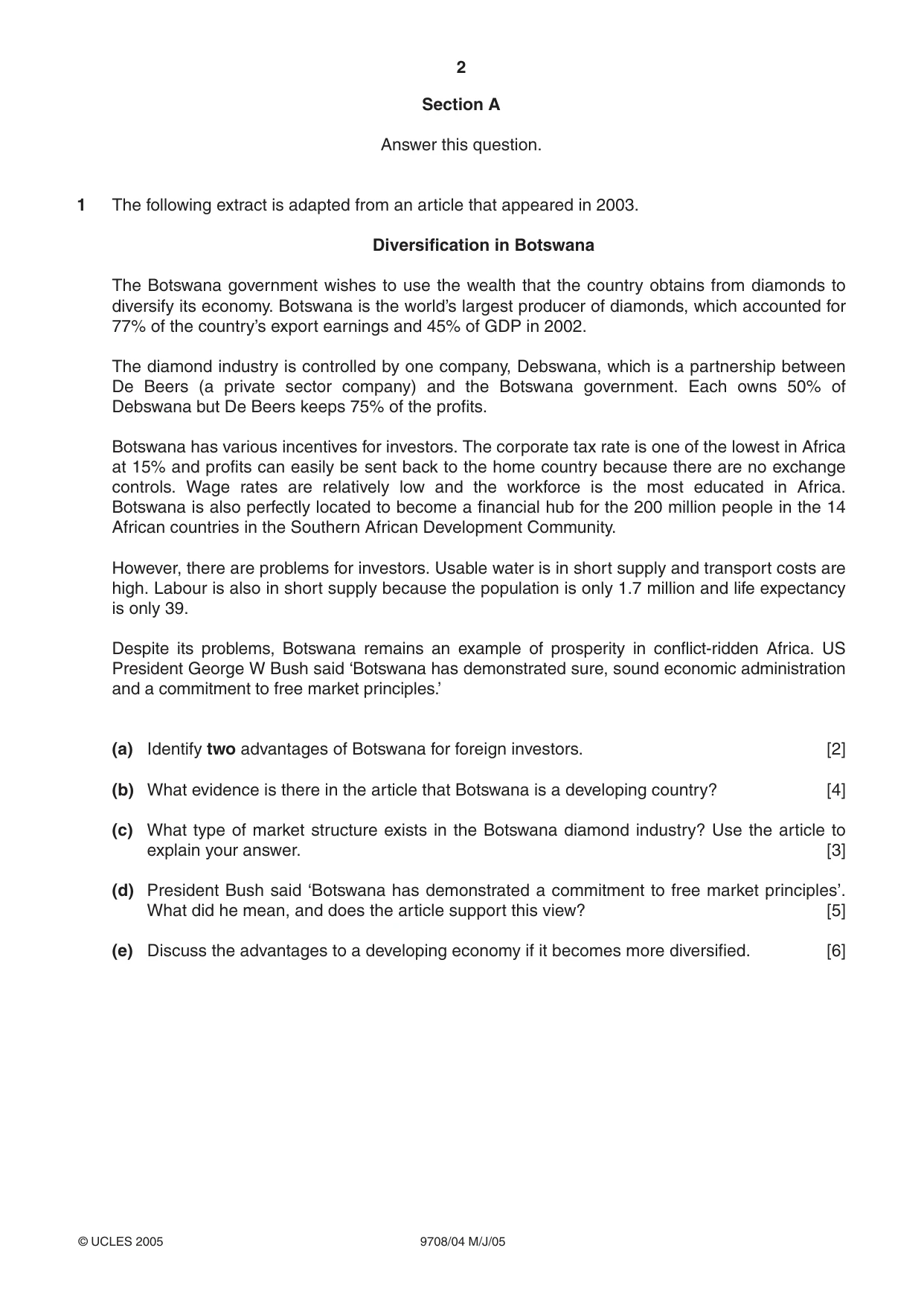
2 © UCLES 2005 9708/04 M/J/05 Section A Answer this question. 1 The following extract is adapted from an article that appeared in 2003. Diversification in Botswana The Botswana government wishes to use the wealth that the country obtains from diamonds to diversify its economy. Botswana is the world’s largest producer of diamonds, which accounted for 77% of the country’s export earnings and 45% of GDP in 2002. The diamond industry is controlled by one company, Debswana, which is a partnership between De Beers (a private sector company) and the Botswana government. Each owns 50% of Debswana but De Beers keeps 75% of the profits. Botswana has various incentives for investors. The corporate tax rate is one of the lowest in Africa at 15% and profits can easily be sent back to the home country because there are no exchange controls. Wage rates are relatively low and the workforce is the most educated in Africa. Botswana is also perfectly located to become a financial hub for the 200 million people in the 14 African countries in the Southern African Development Community. However, there are problems for investors. Usable water is in short supply and transport costs are high. Labour is also in short supply because the population is only 1.7 million and life expectancy is only 39. Despite its problems, Botswana remains an example of prosperity in conflict-ridden Africa. US President George W Bush said ‘Botswana has demonstrated sure, sound economic administration and a commitment to free market principles.’ (a) Identify two advantages of Botswana for foreign investors. [2] (b) What evidence is there in the article that Botswana is a developing country? [4] (c) What type of market structure exists in the Botswana diamond industry? Use the article to explain your answer. [3] (d) President Bush said ‘Botswana has demonstrated a commitment to free market principles’. What did he mean, and does the article support this view? [5] (e) Discuss the advantages to a developing economy if it becomes more diversified. [6]
Question paper, page 3
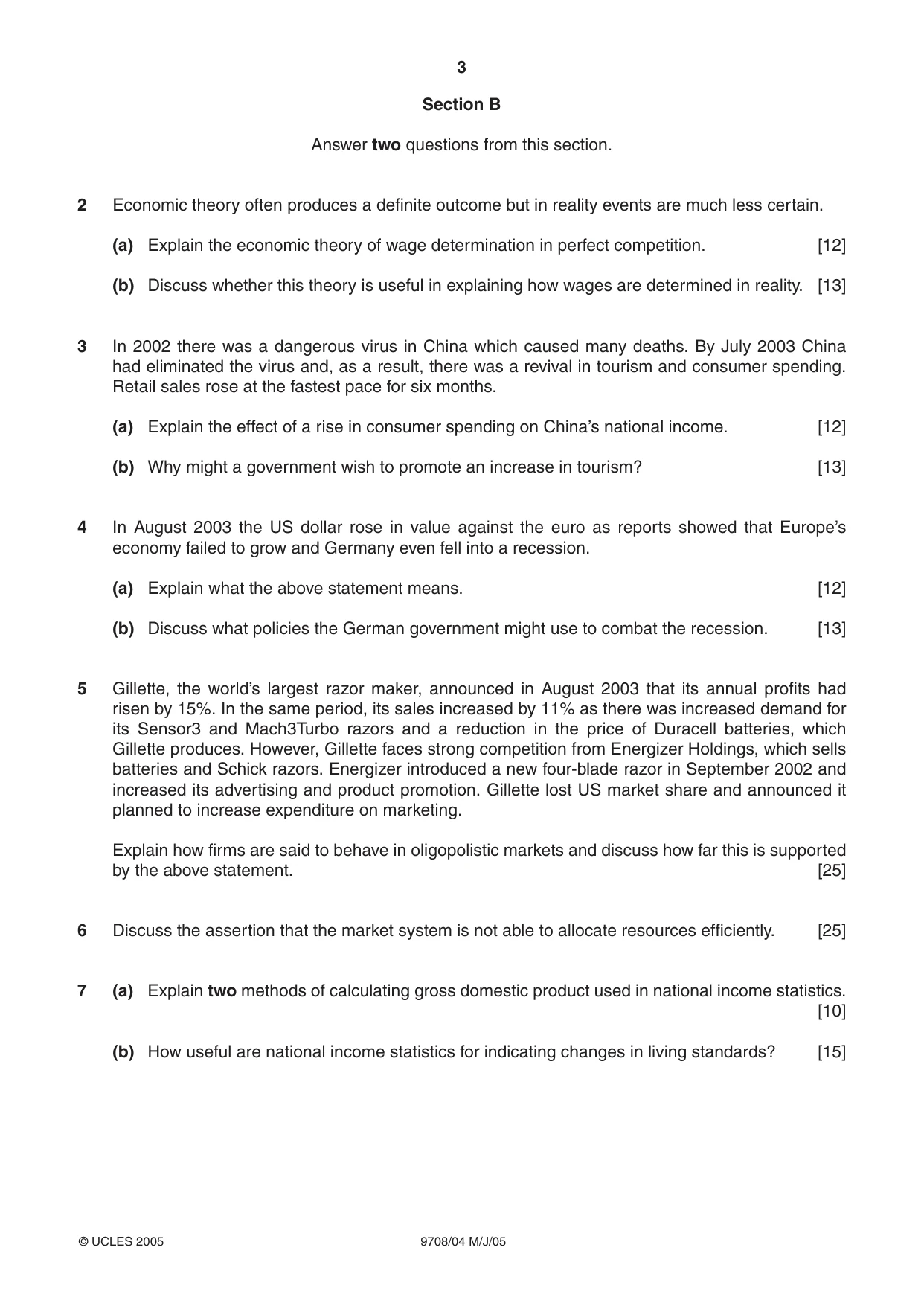
3 © UCLES 2005 9708/04 M/J/05 Section B Answer two questions from this section. 2 Economic theory often produces a definite outcome but in reality events are much less certain. (a) Explain the economic theory of wage determination in perfect competition. [12] (b) Discuss whether this theory is useful in explaining how wages are determined in reality. [13] 3 In 2002 there was a dangerous virus in China which caused many deaths. By July 2003 China had eliminated the virus and, as a result, there was a revival in tourism and consumer spending. Retail sales rose at the fastest pace for six months. (a) Explain the effect of a rise in consumer spending on China’s national income. [12] (b) Why might a government wish to promote an increase in tourism? [13] 4 In August 2003 the US dollar rose in value against the euro as reports showed that Europe’s economy failed to grow and Germany even fell into a recession. (a) Explain what the above statement means. [12] (b) Discuss what policies the German government might use to combat the recession. [13] 5 Gillette, the world’s largest razor maker, announced in August 2003 that its annual profits had risen by 15%. In the same period, its sales increased by 11% as there was increased demand for its Sensor3 and Mach3Turbo razors and a reduction in the price of Duracell batteries, which Gillette produces. However, Gillette faces strong competition from Energizer Holdings, which sells batteries and Schick razors. Energizer introduced a new four-blade razor in September 2002 and increased its advertising and product promotion. Gillette lost US market share and announced it planned to increase expenditure on marketing. Explain how firms are said to behave in oligopolistic markets and discuss how far this is supported by the above statement. [25] 6 Discuss the assertion that the market system is not able to allocate resources efficiently. [25] 7 (a) Explain two methods of calculating gross domestic product used in national income statistics. [10] (b) How useful are national income statistics for indicating changes in living standards? [15]
Question paper, page 4
4 9708/04 M/J/05 BLANK PAGE Copyright Acknowledgements: Question 1 © Republikein, 22 July 2003. Question 5 © International Herald Tribune, 6 August 2003. Permission to reproduce items where third-party owned material protected by copyright is included has been sought and cleared where possible. Every reasonable effort has been made by the publisher (UCLES) to trace copyright holders, but if any items requiring clearance have unwittingly been included, the publisher will be pleased to make amends at the earliest possible opportunity. University of Cambridge International Examinations is part of the University of Cambridge Local Examinations Syndicate (UCLES), which is itself a department of the University of Cambridge.
Mark scheme, page 1
UNIVERSITY OF CAMBRIDGE INTERNATIONAL EXAMINATIONS GCE Advanced Level MARK SCHEME for the June 2005 question paper 9708 ECONOMICS 9708/04 Paper 4 Data Response and Essay (Core), maximum raw mark 70 This mark scheme is published as an aid to teachers and students, to indicate the requirements of the examination. It shows the basis on which Examiners were initially instructed to award marks. It does not indicate the details of the discussions that took place at an Examiners’ meeting before marking began. Any substantial changes to the mark scheme that arose from these discussions will be recorded in the published Report on the Examination. All Examiners are instructed that alternative correct answers and unexpected approaches in candidates’ scripts must be given marks that fairly reflect the relevant knowledge and skills demonstrated. Mark schemes must be read in conjunction with the question papers and the Report on the Examination. • CIE will not enter into discussion or correspondence in connection with these mark schemes. CIE is publishing the mark schemes for the June 2005 question papers for most IGCSE and GCE Advanced Level and Advanced Subsidiary Level syllabuses and some Ordinary Level syllabuses.
Mark scheme, page 2
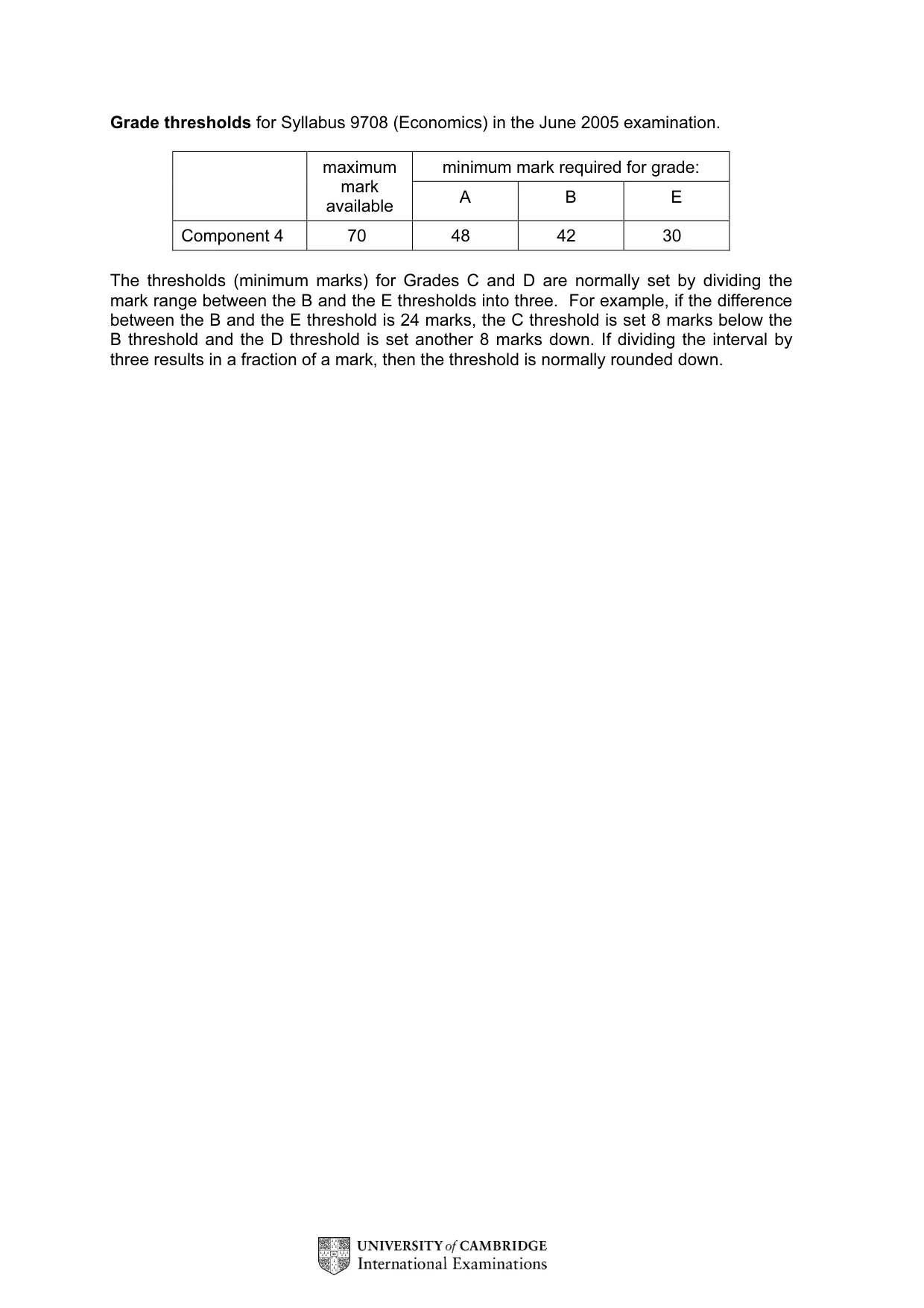
Grade thresholds for Syllabus 9708 (Economics) in the June 2005 examination. minimum mark required for grade: maximum mark available A B E Component 4 70 48 42 30 The thresholds (minimum marks) for Grades C and D are normally set by dividing the mark range between the B and the E thresholds into three. For example, if the difference between the B and the E threshold is 24 marks, the C threshold is set 8 marks below the B threshold and the D threshold is set another 8 marks down. If dividing the interval by three results in a fraction of a mark, then the threshold is normally rounded down.
Mark scheme, page 3
June 2005 GCE A LEVEL MARK SCHEME MAXIMUM MARK: 70 SYLLABUS/COMPONENT: 9708/04 ECONOMICS Paper 4 Data Response and Essay (Supplement)
Mark scheme, page 4
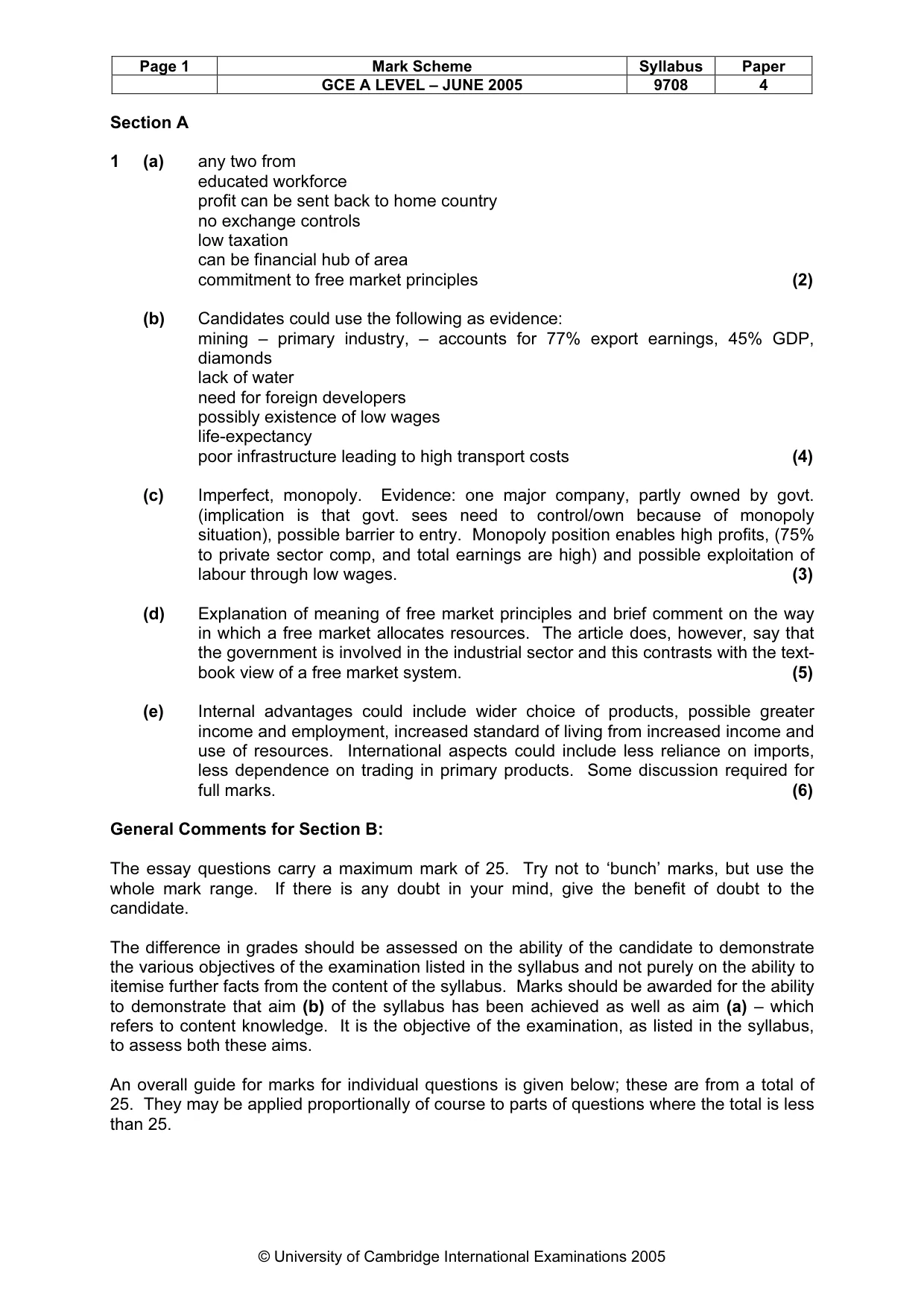
Page 1 Mark Scheme Syllabus Paper GCE A LEVEL – JUNE 2005 9708 4 © University of Cambridge International Examinations 2005 Section A 1 (a) any two from educated workforce profit can be sent back to home country no exchange controls low taxation can be financial hub of area commitment to free market principles (2) (b) Candidates could use the following as evidence: mining – primary industry, – accounts for 77% export earnings, 45% GDP, diamonds lack of water need for foreign developers possibly existence of low wages life-expectancy poor infrastructure leading to high transport costs (4) (c) Imperfect, monopoly. Evidence: one major company, partly owned by govt. (implication is that govt. sees need to control/own because of monopoly situation), possible barrier to entry. Monopoly position enables high profits, (75% to private sector comp, and total earnings are high) and possible exploitation of labour through low wages. (3) (d) Explanation of meaning of free market principles and brief comment on the way in which a free market allocates resources. The article does, however, say that the government is involved in the industrial sector and this contrasts with the text- book view of a free market system. (5) (e) Internal advantages could include wider choice of products, possible greater income and employment, increased standard of living from increased income and use of resources. International aspects could include less reliance on imports, less dependence on trading in primary products. Some discussion required for full marks. (6) General Comments for Section B: The essay questions carry a maximum mark of 25. Try not to ‘bunch’ marks, but use the whole mark range. If there is any doubt in your mind, give the benefit of doubt to the candidate. The difference in grades should be assessed on the ability of the candidate to demonstrate the various objectives of the examination listed in the syllabus and not purely on the ability to itemise further facts from the content of the syllabus. Marks should be awarded for the ability to demonstrate that aim (b) of the syllabus has been achieved as well as aim (a) – which refers to content knowledge. It is the objective of the examination, as listed in the syllabus, to assess both these aims. An overall guide for marks for individual questions is given below; these are from a total of 25. They may be applied proportionally of course to parts of questions where the total is less than 25.
Mark scheme, page 5
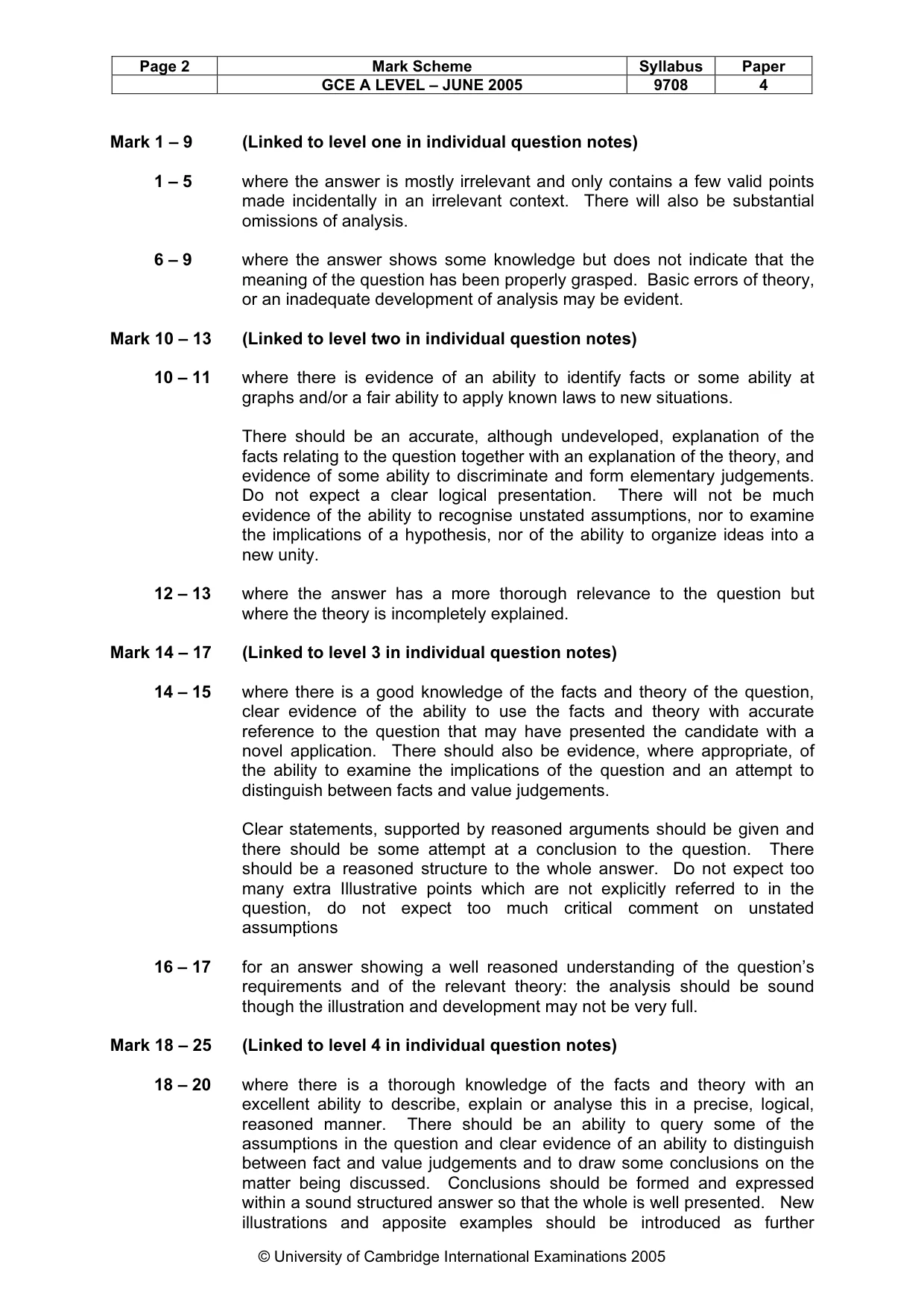
Page 2 Mark Scheme Syllabus Paper GCE A LEVEL – JUNE 2005 9708 4 © University of Cambridge International Examinations 2005 Mark 1 – 9 (Linked to level one in individual question notes) 1 – 5 where the answer is mostly irrelevant and only contains a few valid points made incidentally in an irrelevant context. There will also be substantial omissions of analysis. 6 – 9 where the answer shows some knowledge but does not indicate that the meaning of the question has been properly grasped. Basic errors of theory, or an inadequate development of analysis may be evident. Mark 10 – 13 (Linked to level two in individual question notes) 10 – 11 where there is evidence of an ability to identify facts or some ability at graphs and/or a fair ability to apply known laws to new situations. There should be an accurate, although undeveloped, explanation of the facts relating to the question together with an explanation of the theory, and evidence of some ability to discriminate and form elementary judgements. Do not expect a clear logical presentation. There will not be much evidence of the ability to recognise unstated assumptions, nor to examine the implications of a hypothesis, nor of the ability to organize ideas into a new unity. 12 – 13 where the answer has a more thorough relevance to the question but where the theory is incompletely explained. Mark 14 – 17 (Linked to level 3 in individual question notes) 14 – 15 where there is a good knowledge of the facts and theory of the question, clear evidence of the ability to use the facts and theory with accurate reference to the question that may have presented the candidate with a novel application. There should also be evidence, where appropriate, of the ability to examine the implications of the question and an attempt to distinguish between facts and value judgements. Clear statements, supported by reasoned arguments should be given and there should be some attempt at a conclusion to the question. There should be a reasoned structure to the whole answer. Do not expect too many extra Illustrative points which are not explicitly referred to in the question, do not expect too much critical comment on unstated assumptions 16 – 17 for an answer showing a well reasoned understanding of the question’s requirements and of the relevant theory: the analysis should be sound though the illustration and development may not be very full. Mark 18 – 25 (Linked to level 4 in individual question notes) 18 – 20 where there is a thorough knowledge of the facts and theory with an excellent ability to describe, explain or analyse this in a precise, logical, reasoned manner. There should be an ability to query some of the assumptions in the question and clear evidence of an ability to distinguish between fact and value judgements and to draw some conclusions on the matter being discussed. Conclusions should be formed and expressed within a sound structured answer so that the whole is well presented. New illustrations and apposite examples should be introduced as further
Mark scheme, page 6
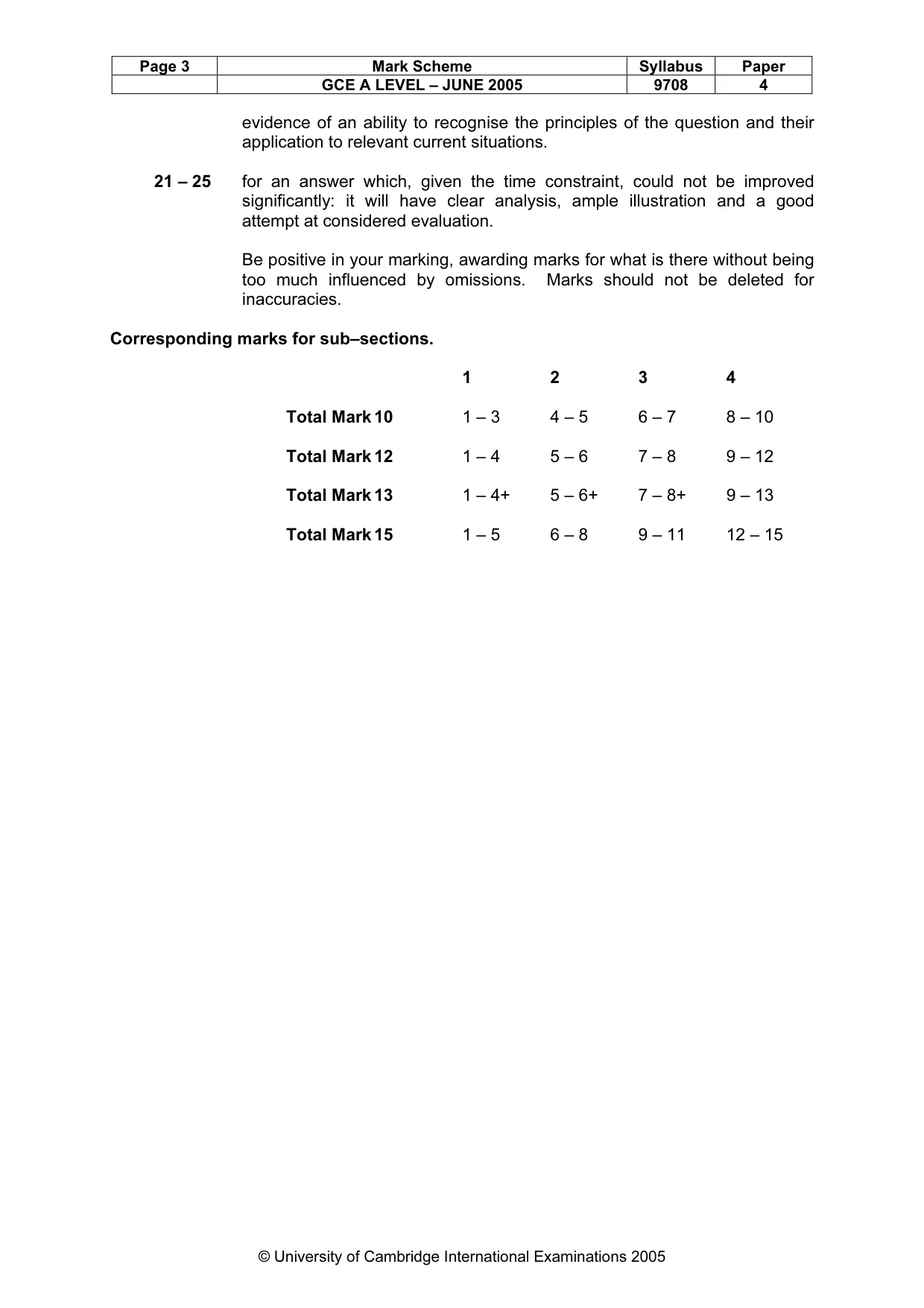
Page 3 Mark Scheme Syllabus Paper GCE A LEVEL – JUNE 2005 9708 4 © University of Cambridge International Examinations 2005 evidence of an ability to recognise the principles of the question and their application to relevant current situations. 21 – 25 for an answer which, given the time constraint, could not be improved significantly: it will have clear analysis, ample illustration and a good attempt at considered evaluation. Be positive in your marking, awarding marks for what is there without being too much influenced by omissions. Marks should not be deleted for inaccuracies. Corresponding marks for sub–sections. 1 2 3 4 Total Mark 10 1 – 3 4 – 5 6 – 7 8 – 10 Total Mark 12 1 – 4 5 – 6 7 – 8 9 – 12 Total Mark 13 1 – 4+ 5 – 6+ 7 – 8+ 9 – 13 Total Mark 15 1 – 5 6 – 8 9 – 11 12 – 15
Mark scheme, page 7
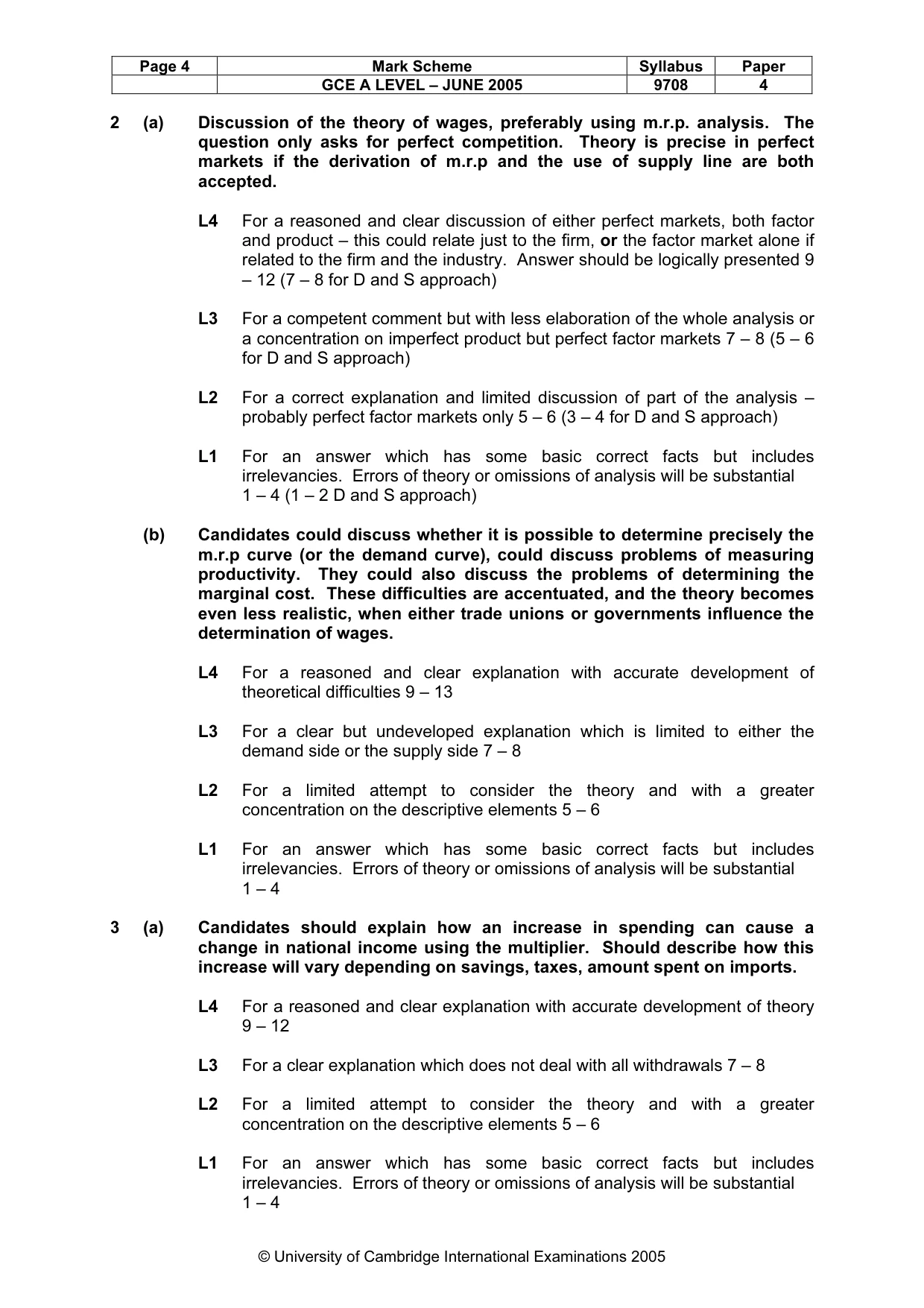
Page 4 Mark Scheme Syllabus Paper GCE A LEVEL – JUNE 2005 9708 4 © University of Cambridge International Examinations 2005 2 (a) Discussion of the theory of wages, preferably using m.r.p. analysis. The question only asks for perfect competition. Theory is precise in perfect markets if the derivation of m.r.p and the use of supply line are both accepted. L4 For a reasoned and clear discussion of either perfect markets, both factor and product – this could relate just to the firm, or the factor market alone if related to the firm and the industry. Answer should be logically presented 9 – 12 (7 – 8 for D and S approach) L3 For a competent comment but with less elaboration of the whole analysis or a concentration on imperfect product but perfect factor markets 7 – 8 (5 – 6 for D and S approach) L2 For a correct explanation and limited discussion of part of the analysis – probably perfect factor markets only 5 – 6 (3 – 4 for D and S approach) L1 For an answer which has some basic correct facts but includes irrelevancies. Errors of theory or omissions of analysis will be substantial 1 – 4 (1 – 2 D and S approach) (b) Candidates could discuss whether it is possible to determine precisely the m.r.p curve (or the demand curve), could discuss problems of measuring productivity. They could also discuss the problems of determining the marginal cost. These difficulties are accentuated, and the theory becomes even less realistic, when either trade unions or governments influence the determination of wages. L4 For a reasoned and clear explanation with accurate development of theoretical difficulties 9 – 13 L3 For a clear but undeveloped explanation which is limited to either the demand side or the supply side 7 – 8 L2 For a limited attempt to consider the theory and with a greater concentration on the descriptive elements 5 – 6 L1 For an answer which has some basic correct facts but includes irrelevancies. Errors of theory or omissions of analysis will be substantial 1 – 4 3 (a) Candidates should explain how an increase in spending can cause a change in national income using the multiplier. Should describe how this increase will vary depending on savings, taxes, amount spent on imports. L4 For a reasoned and clear explanation with accurate development of theory 9 – 12 L3 For a clear explanation which does not deal with all withdrawals 7 – 8 L2 For a limited attempt to consider the theory and with a greater concentration on the descriptive elements 5 – 6 L1 For an answer which has some basic correct facts but includes irrelevancies. Errors of theory or omissions of analysis will be substantial 1 – 4
Mark scheme, page 8
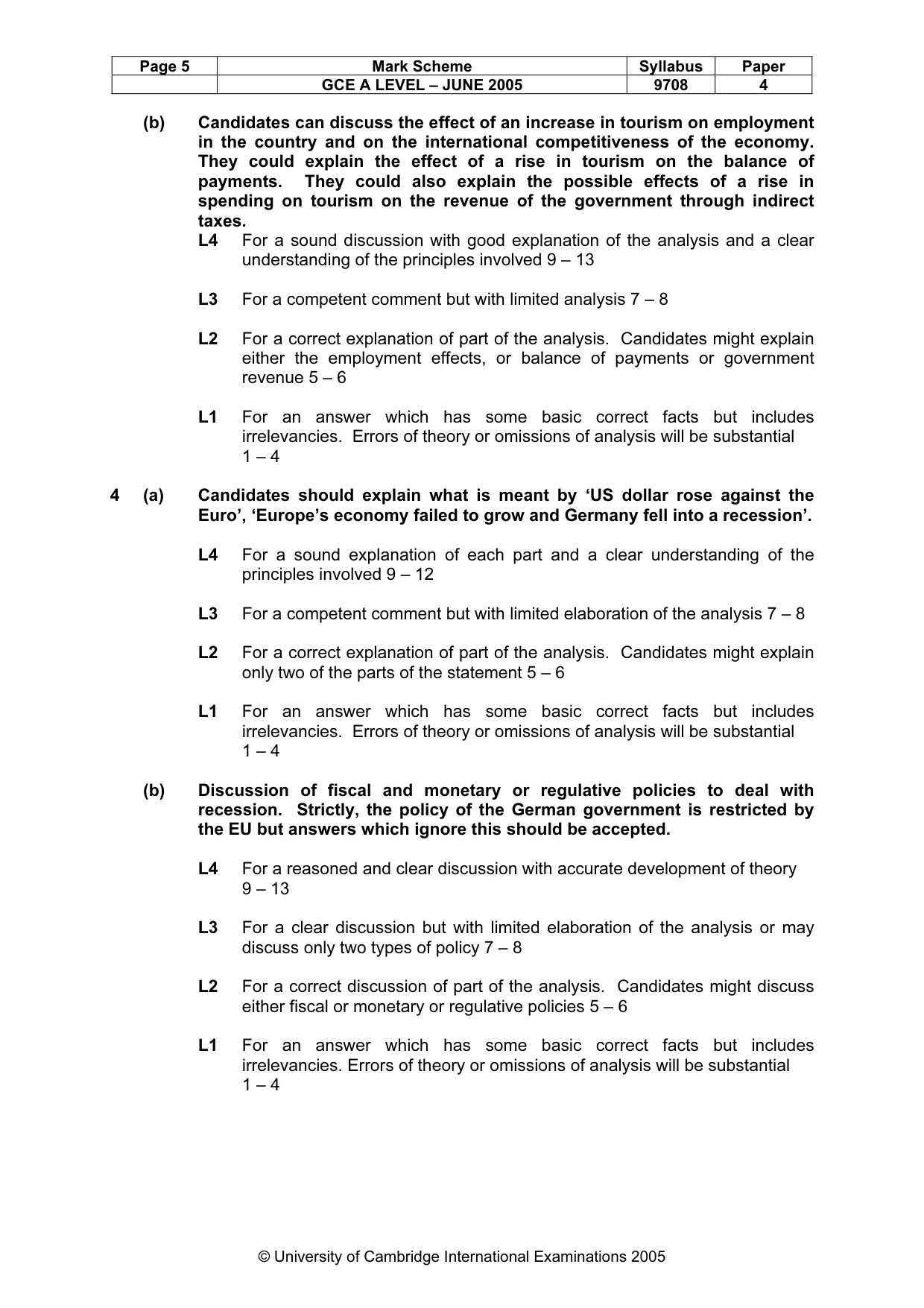
Page 5 Mark Scheme Syllabus Paper GCE A LEVEL – JUNE 2005 9708 4 © University of Cambridge International Examinations 2005 (b) Candidates can discuss the effect of an increase in tourism on employment in the country and on the international competitiveness of the economy. They could explain the effect of a rise in tourism on the balance of payments. They could also explain the possible effects of a rise in spending on tourism on the revenue of the government through indirect taxes. L4 For a sound discussion with good explanation of the analysis and a clear understanding of the principles involved 9 – 13 L3 For a competent comment but with limited analysis 7 – 8 L2 For a correct explanation of part of the analysis. Candidates might explain either the employment effects, or balance of payments or government revenue 5 – 6 L1 For an answer which has some basic correct facts but includes irrelevancies. Errors of theory or omissions of analysis will be substantial 1 – 4 4 (a) Candidates should explain what is meant by ‘US dollar rose against the Euro’, ‘Europe’s economy failed to grow and Germany fell into a recession’. L4 For a sound explanation of each part and a clear understanding of the principles involved 9 – 12 L3 For a competent comment but with limited elaboration of the analysis 7 – 8 L2 For a correct explanation of part of the analysis. Candidates might explain only two of the parts of the statement 5 – 6 L1 For an answer which has some basic correct facts but includes irrelevancies. Errors of theory or omissions of analysis will be substantial 1 – 4 (b) Discussion of fiscal and monetary or regulative policies to deal with recession. Strictly, the policy of the German government is restricted by the EU but answers which ignore this should be accepted. L4 For a reasoned and clear discussion with accurate development of theory 9 – 13 L3 For a clear discussion but with limited elaboration of the analysis or may discuss only two types of policy 7 – 8 L2 For a correct discussion of part of the analysis. Candidates might discuss either fiscal or monetary or regulative policies 5 – 6 L1 For an answer which has some basic correct facts but includes irrelevancies. Errors of theory or omissions of analysis will be substantial 1 – 4
Mark scheme, page 9
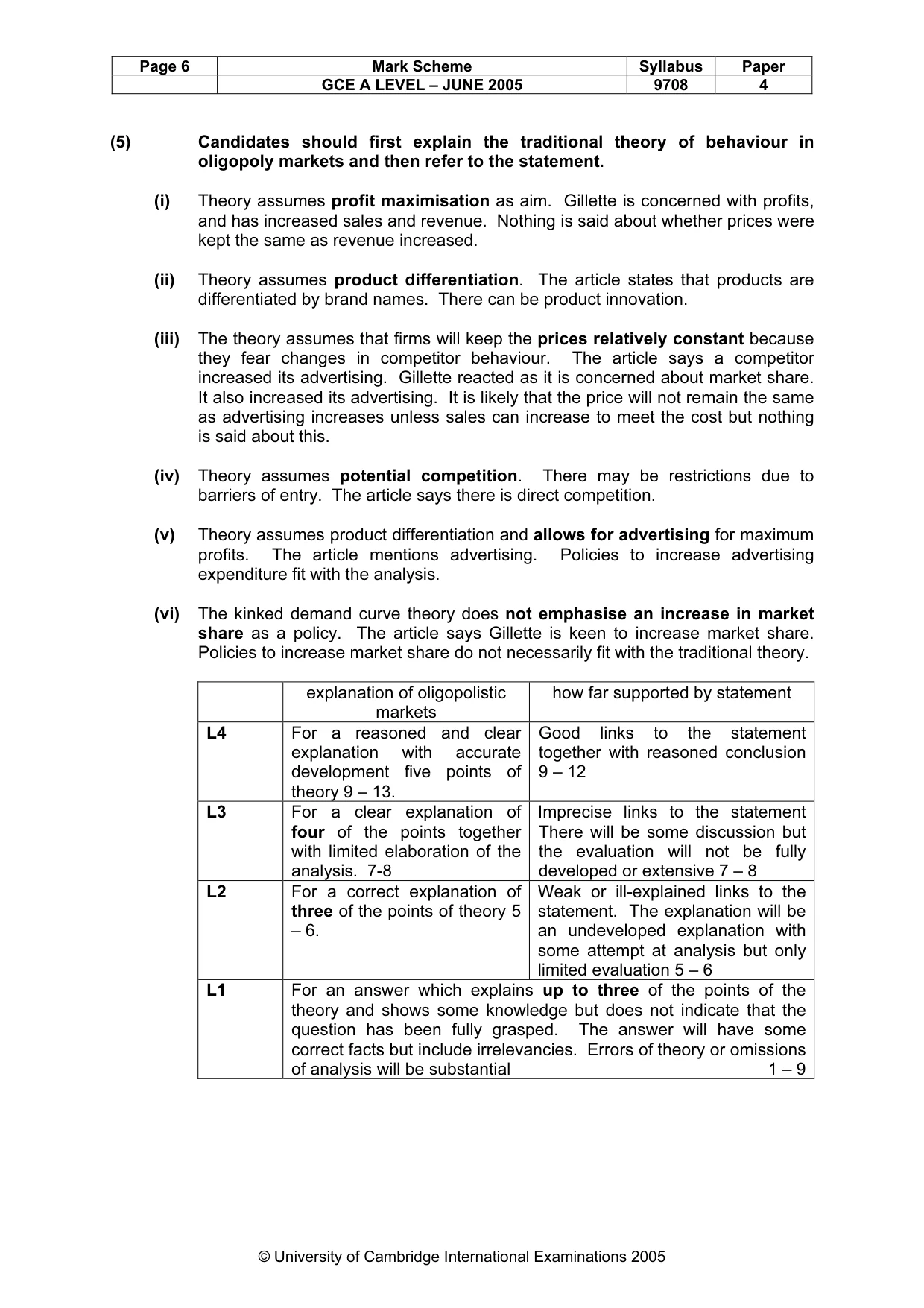
Page 6 Mark Scheme Syllabus Paper GCE A LEVEL – JUNE 2005 9708 4 © University of Cambridge International Examinations 2005 (5) Candidates should first explain the traditional theory of behaviour in oligopoly markets and then refer to the statement. (i) Theory assumes profit maximisation as aim. Gillette is concerned with profits, and has increased sales and revenue. Nothing is said about whether prices were kept the same as revenue increased. (ii) Theory assumes product differentiation. The article states that products are differentiated by brand names. There can be product innovation. (iii) The theory assumes that firms will keep the prices relatively constant because they fear changes in competitor behaviour. The article says a competitor increased its advertising. Gillette reacted as it is concerned about market share. It also increased its advertising. It is likely that the price will not remain the same as advertising increases unless sales can increase to meet the cost but nothing is said about this. (iv) Theory assumes potential competition. There may be restrictions due to barriers of entry. The article says there is direct competition. (v) Theory assumes product differentiation and allows for advertising for maximum profits. The article mentions advertising. Policies to increase advertising expenditure fit with the analysis. (vi) The kinked demand curve theory does not emphasise an increase in market share as a policy. The article says Gillette is keen to increase market share. Policies to increase market share do not necessarily fit with the traditional theory. explanation of oligopolistic markets how far supported by statement L4 For a reasoned and clear explanation with accurate development five points of theory 9 – 13. Good links to the statement together with reasoned conclusion 9 – 12 L3 For a clear explanation of four of the points together with limited elaboration of the analysis. 7-8 Imprecise links to the statement There will be some discussion but the evaluation will not be fully developed or extensive 7 – 8 L2 For a correct explanation of three of the points of theory 5 – 6. Weak or ill-explained links to the statement. The explanation will be an undeveloped explanation with some attempt at analysis but only limited evaluation 5 – 6 L1 For an answer which explains up to three of the points of the theory and shows some knowledge but does not indicate that the question has been fully grasped. The answer will have some correct facts but include irrelevancies. Errors of theory or omissions of analysis will be substantial 1 – 9
Mark scheme, page 10
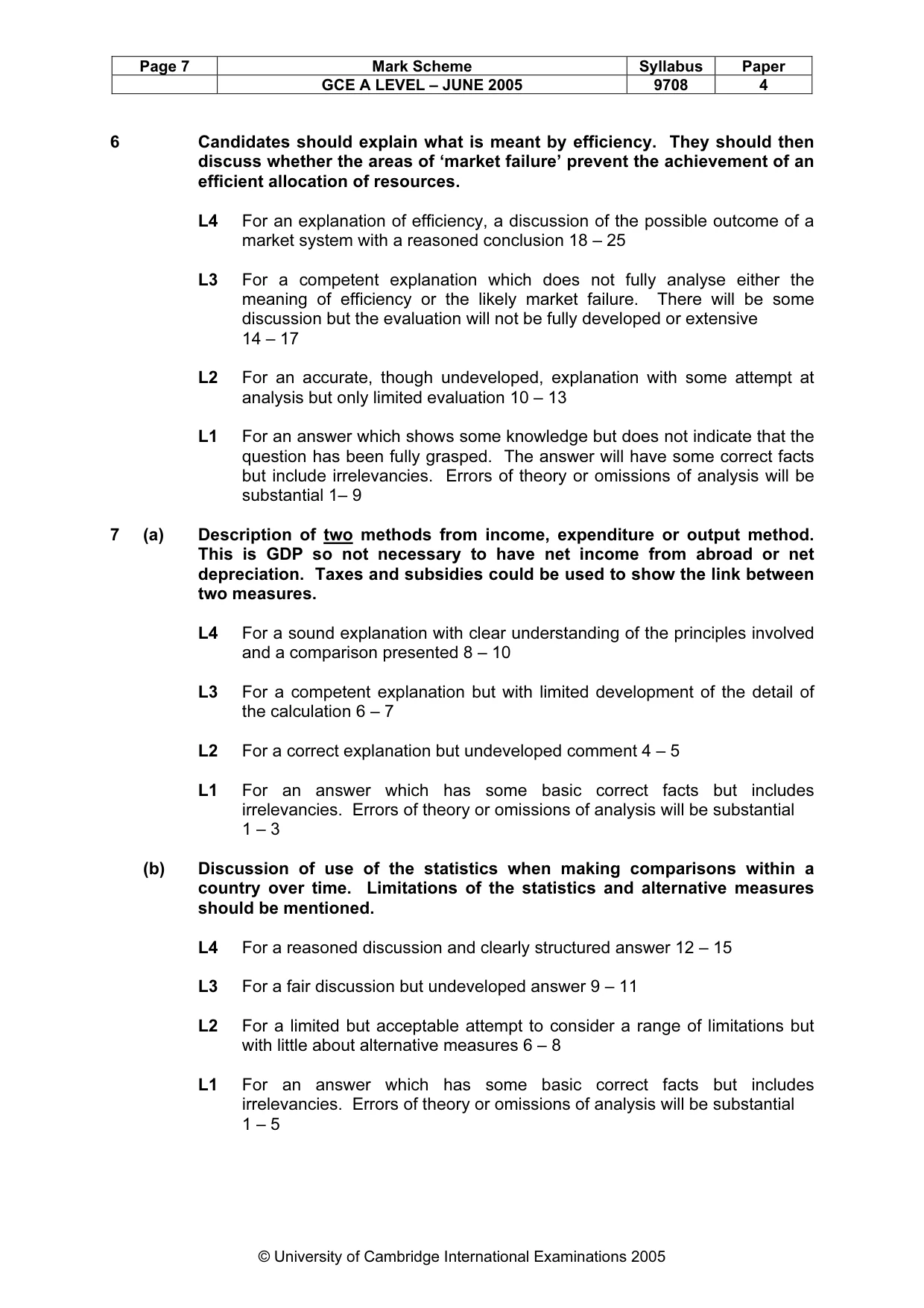
Page 7 Mark Scheme Syllabus Paper GCE A LEVEL – JUNE 2005 9708 4 © University of Cambridge International Examinations 2005 6 Candidates should explain what is meant by efficiency. They should then discuss whether the areas of ‘market failure’ prevent the achievement of an efficient allocation of resources. L4 For an explanation of efficiency, a discussion of the possible outcome of a market system with a reasoned conclusion 18 – 25 L3 For a competent explanation which does not fully analyse either the meaning of efficiency or the likely market failure. There will be some discussion but the evaluation will not be fully developed or extensive 14 – 17 L2 For an accurate, though undeveloped, explanation with some attempt at analysis but only limited evaluation 10 – 13 L1 For an answer which shows some knowledge but does not indicate that the question has been fully grasped. The answer will have some correct facts but include irrelevancies. Errors of theory or omissions of analysis will be substantial 1– 9 7 (a) Description of two methods from income, expenditure or output method. This is GDP so not necessary to have net income from abroad or net depreciation. Taxes and subsidies could be used to show the link between two measures. L4 For a sound explanation with clear understanding of the principles involved and a comparison presented 8 – 10 L3 For a competent explanation but with limited development of the detail of the calculation 6 – 7 L2 For a correct explanation but undeveloped comment 4 – 5 L1 For an answer which has some basic correct facts but includes irrelevancies. Errors of theory or omissions of analysis will be substantial 1 – 3 (b) Discussion of use of the statistics when making comparisons within a country over time. Limitations of the statistics and alternative measures should be mentioned. L4 For a reasoned discussion and clearly structured answer 12 – 15 L3 For a fair discussion but undeveloped answer 9 – 11 L2 For a limited but acceptable attempt to consider a range of limitations but with little about alternative measures 6 – 8 L1 For an answer which has some basic correct facts but includes irrelevancies. Errors of theory or omissions of analysis will be substantial 1 – 5