Cambridge A Level Economics 9708 — 2004 Oct/Nov Paper 4 · Variant 1
9708/41/O/N/04
The question paper and its mark scheme, free to read here and free to download. This is Cambridge’s own paper, exactly as it was sat.
Question paper4 pages


Mark scheme8 pages
Answers below. Sit the paper first if you are practising.
Paper as text
Question paper, page 1
This document consists of 3 printed pages and 1 blank page. SP (NF) S59867/3 © UCLES 2004 [Turn over UNIVERSITY OF CAMBRIDGE INTERNATIONAL EXAMINATIONS General Certificate of Education Advanced Level ECONOMICS 9708/04 Paper 4 Data Response and Essays (Supplement) October/November 2004 2 hours 15 minutes Additional Materials: Answer Booklet/Paper READ THESE INSTRUCTIONS FIRST If you have been given an Answer Booklet, follow the instructions on the front cover of the Booklet. Write your Centre number, candidate number and name on all the work you hand in. Write in dark blue or black pen on both sides of the paper. You may use a soft pencil for any diagrams, graphs or rough working. Do not use staples, paper clips, highlighters, glue or correction fluid. Answer Question 1 and any two questions from Section B. At the end of the examination, fasten all your work securely together. The number of marks is given in brackets [ ] at the end of each question or part question. You may answer with reference to your own economy or other economies that you have studied where relevant to the question.
Question paper, page 2
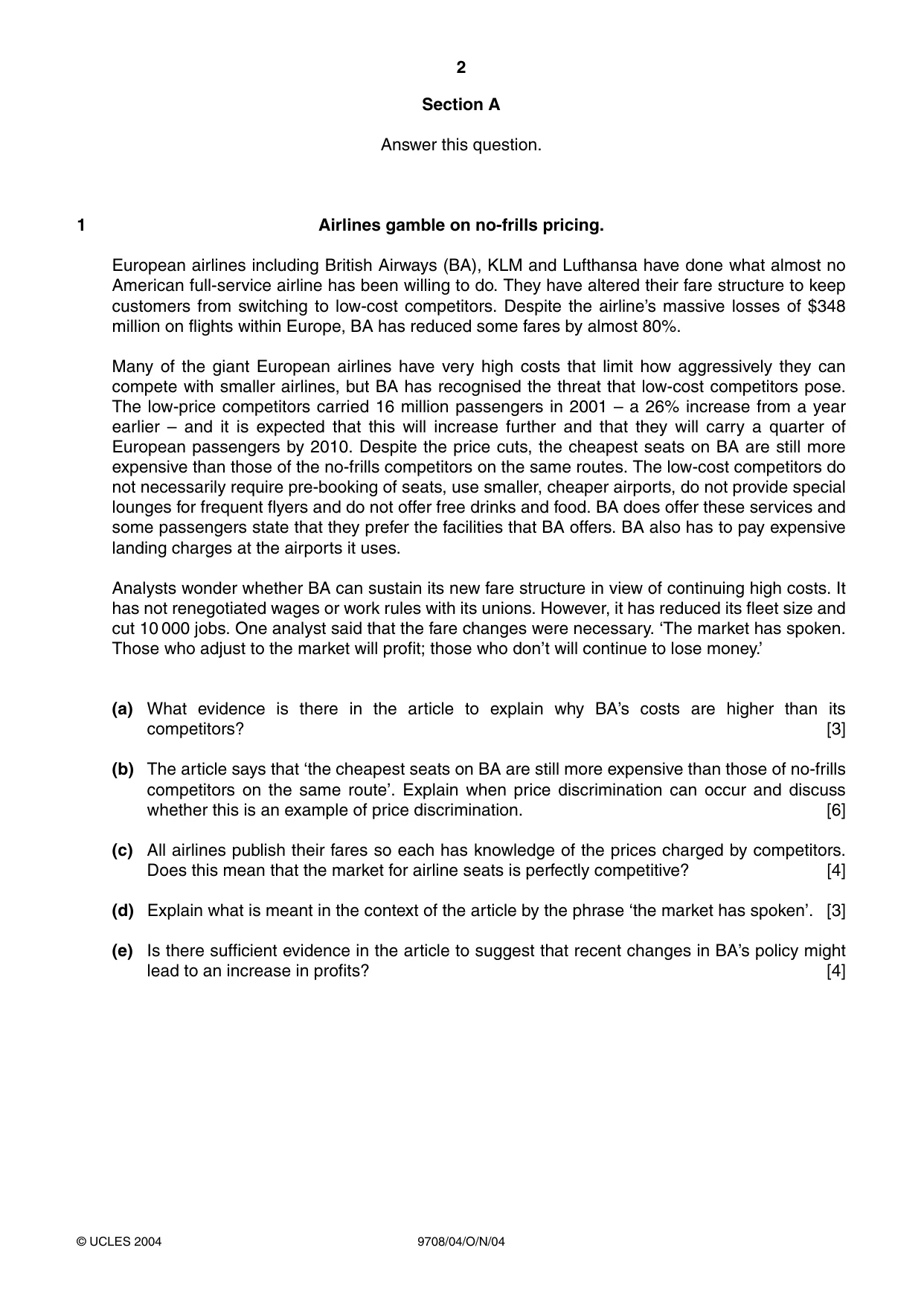
2 9708/04/O/N/04 Section A Answer this question. 1 Airlines gamble on no-frills pricing. European airlines including British Airways (BA), KLM and Lufthansa have done what almost no American full-service airline has been willing to do. They have altered their fare structure to keep customers from switching to low-cost competitors. Despite the airline’s massive losses of $348 million on flights within Europe, BA has reduced some fares by almost 80%. Many of the giant European airlines have very high costs that limit how aggressively they can compete with smaller airlines, but BA has recognised the threat that low-cost competitors pose. The low-price competitors carried 16 million passengers in 2001 – a 26% increase from a year earlier – and it is expected that this will increase further and that they will carry a quarter of European passengers by 2010. Despite the price cuts, the cheapest seats on BA are still more expensive than those of the no-frills competitors on the same routes. The low-cost competitors do not necessarily require pre-booking of seats, use smaller, cheaper airports, do not provide special lounges for frequent flyers and do not offer free drinks and food. BA does offer these services and some passengers state that they prefer the facilities that BA offers. BA also has to pay expensive landing charges at the airports it uses. Analysts wonder whether BA can sustain its new fare structure in view of continuing high costs. It has not renegotiated wages or work rules with its unions. However, it has reduced its fleet size and cut 10 000 jobs. One analyst said that the fare changes were necessary. ‘The market has spoken. Those who adjust to the market will profit; those who don’t will continue to lose money.’ (a) What evidence is there in the article to explain why BA’s costs are higher than its competitors? [3] (b) The article says that ‘the cheapest seats on BA are still more expensive than those of no-frills competitors on the same route’. Explain when price discrimination can occur and discuss whether this is an example of price discrimination. [6] (c) All airlines publish their fares so each has knowledge of the prices charged by competitors. Does this mean that the market for airline seats is perfectly competitive? [4] (d) Explain what is meant in the context of the article by the phrase ‘the market has spoken’. [3] (e) Is there sufficient evidence in the article to suggest that recent changes in BA’s policy might lead to an increase in profits? [4] © UCLES 2004
Question paper, page 3
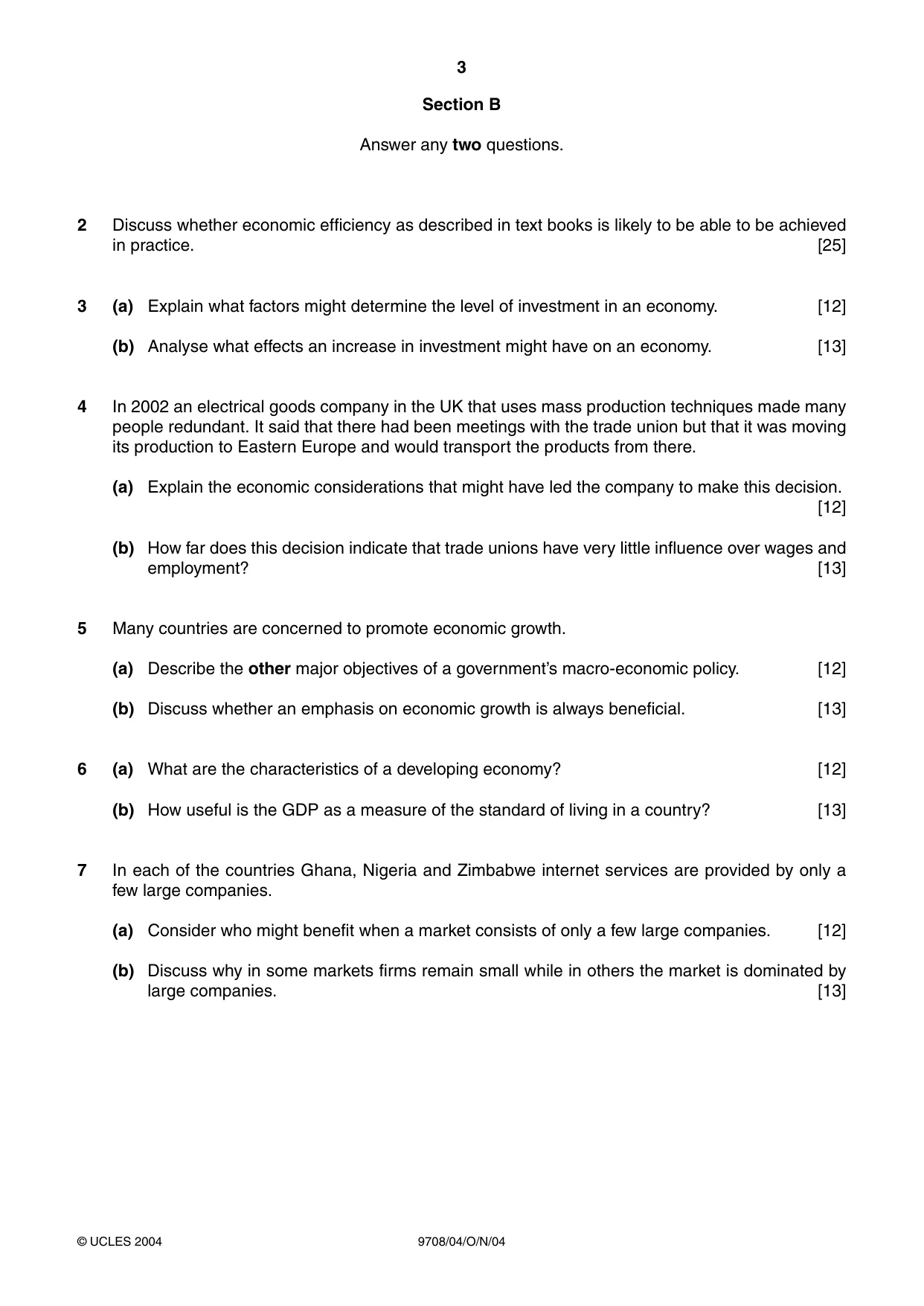
3 9708/04/O/N/04 Section B Answer any two questions. 2 Discuss whether economic efficiency as described in text books is likely to be able to be achieved in practice. [25] 3 (a) Explain what factors might determine the level of investment in an economy. [12] (b) Analyse what effects an increase in investment might have on an economy. [13] 4 In 2002 an electrical goods company in the UK that uses mass production techniques made many people redundant. It said that there had been meetings with the trade union but that it was moving its production to Eastern Europe and would transport the products from there. (a) Explain the economic considerations that might have led the company to make this decision. [12] (b) How far does this decision indicate that trade unions have very little influence over wages and employment? [13] 5 Many countries are concerned to promote economic growth. (a) Describe the other major objectives of a government’s macro-economic policy. [12] (b) Discuss whether an emphasis on economic growth is always beneficial. [13] 6 (a) What are the characteristics of a developing economy? [12] (b) How useful is the GDP as a measure of the standard of living in a country? [13] 7 In each of the countries Ghana, Nigeria and Zimbabwe internet services are provided by only a few large companies. (a) Consider who might benefit when a market consists of only a few large companies. [12] (b) Discuss why in some markets firms remain small while in others the market is dominated by large companies. [13] © UCLES 2004
Question paper, page 4
4 9708/04/O/N/04 BLANK PAGE Copyright Acknowledgements: Question 1 New York Times Every reasonable effort has been made to trace all copyright holders. The publishers would be pleased to hear from anyone whose rights we have unwittingly infringed. University of Cambridge International Examinations is part of the University of Cambridge Local Examinations Syndicate (UCLES), which is itself a department of the University of Cambridge.
Mark scheme, page 1
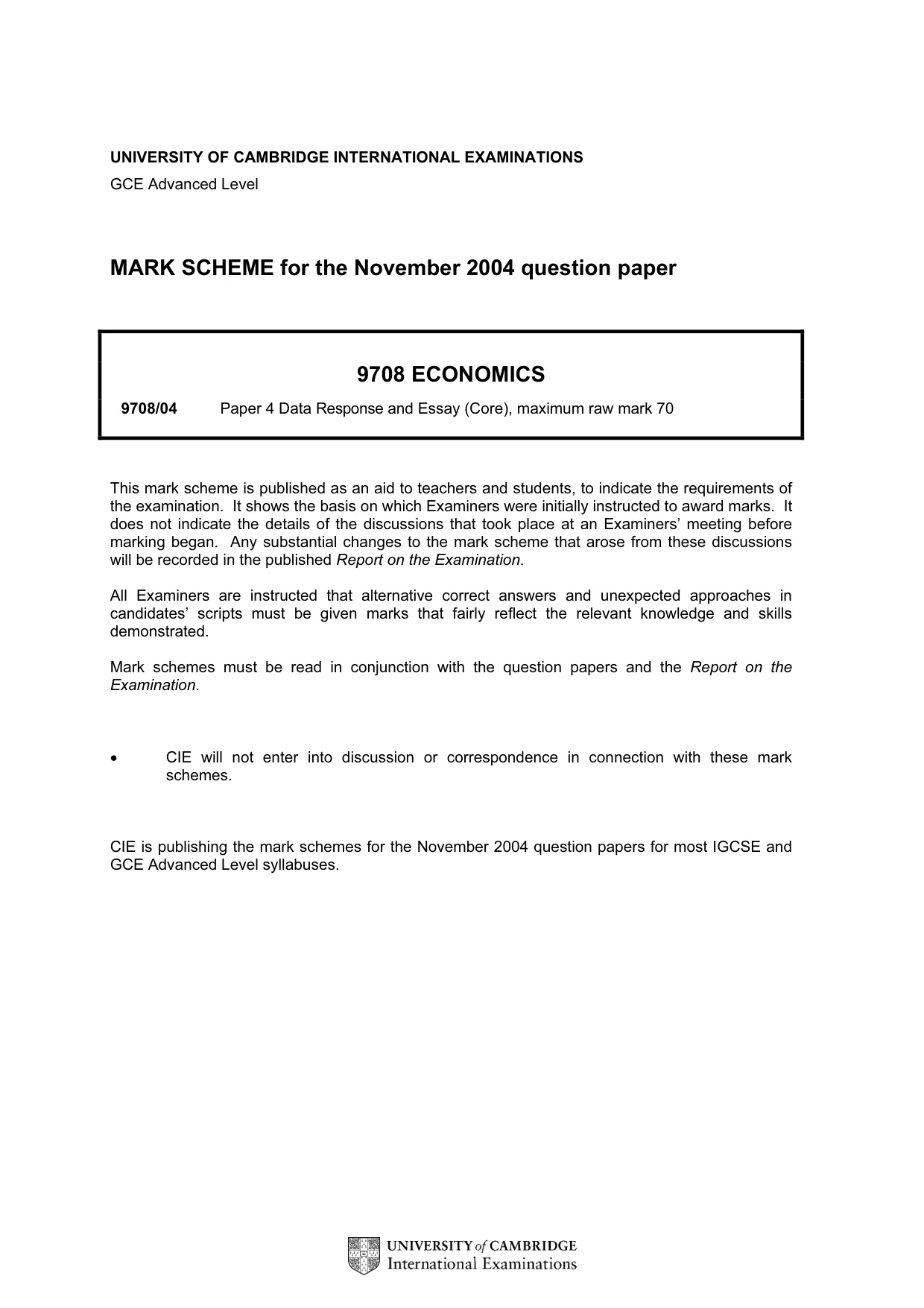
UNIVERSITY OF CAMBRIDGE INTERNATIONAL EXAMINATIONS GCE Advanced Level MARK SCHEME for the November 2004 question paper 9708 ECONOMICS 9708/04 Paper 4 Data Response and Essay (Core), maximum raw mark 70 This mark scheme is published as an aid to teachers and students, to indicate the requirements of the examination. It shows the basis on which Examiners were initially instructed to award marks. It does not indicate the details of the discussions that took place at an Examiners’ meeting before marking began. Any substantial changes to the mark scheme that arose from these discussions will be recorded in the published Report on the Examination. All Examiners are instructed that alternative correct answers and unexpected approaches in candidates’ scripts must be given marks that fairly reflect the relevant knowledge and skills demonstrated. Mark schemes must be read in conjunction with the question papers and the Report on the Examination. • CIE will not enter into discussion or correspondence in connection with these mark schemes. CIE is publishing the mark schemes for the November 2004 question papers for most IGCSE and GCE Advanced Level syllabuses.
Mark scheme, page 2
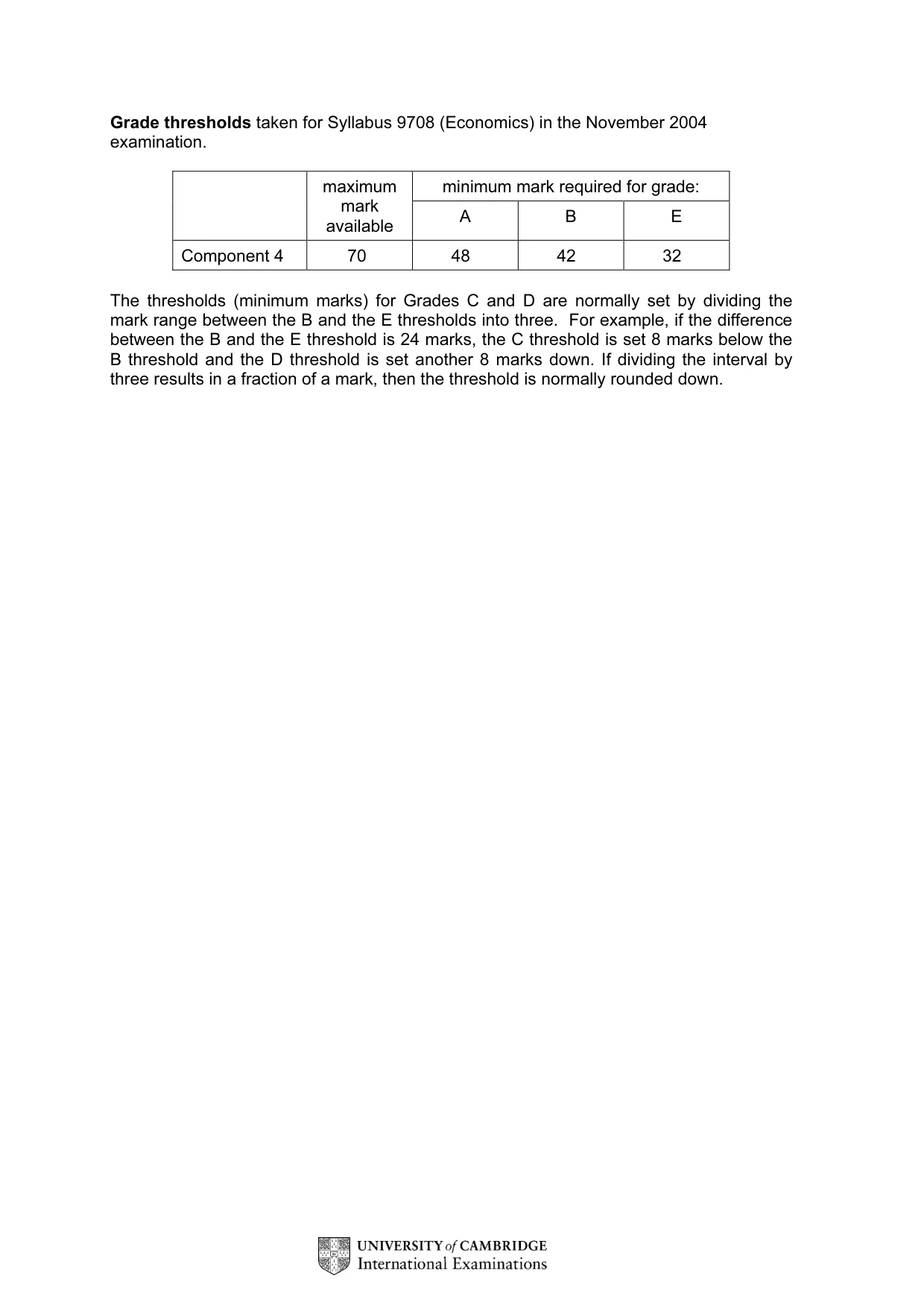
Grade thresholds taken for Syllabus 9708 (Economics) in the November 2004 examination. minimum mark required for grade: maximum mark available A B E Component 4 70 48 42 32 The thresholds (minimum marks) for Grades C and D are normally set by dividing the mark range between the B and the E thresholds into three. For example, if the difference between the B and the E threshold is 24 marks, the C threshold is set 8 marks below the B threshold and the D threshold is set another 8 marks down. If dividing the interval by three results in a fraction of a mark, then the threshold is normally rounded down.
Mark scheme, page 3
November 2004 GCE A LEVEL MARK SCHEME MAXIMUM MARK: 70 SYLLABUS/COMPONENT: 9708/04 ECONOMICS Paper 4 Data Response and Essay (Supplement)
Mark scheme, page 4
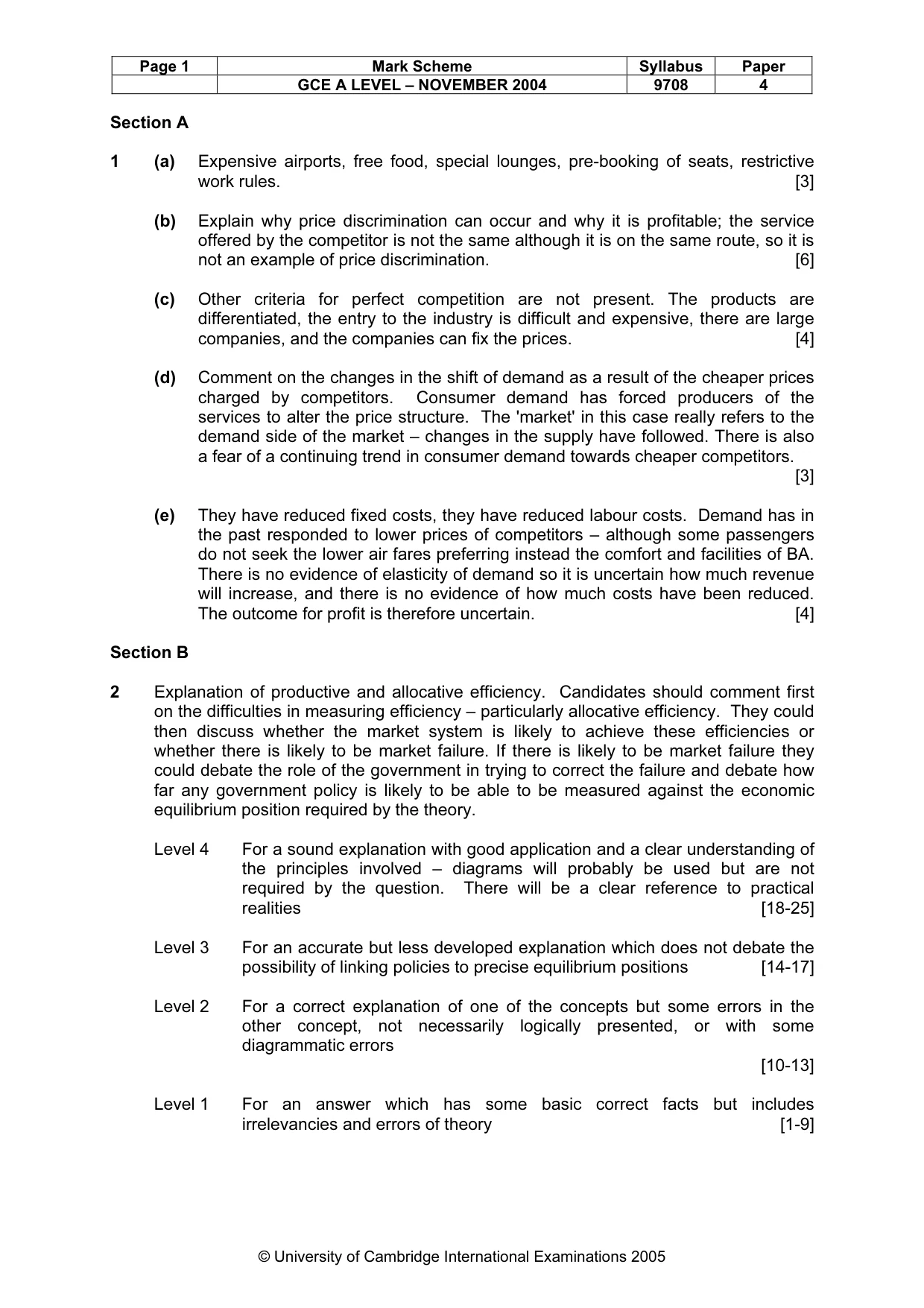
Page 1 Mark Scheme Syllabus Paper GCE A LEVEL – NOVEMBER 2004 9708 4 © University of Cambridge International Examinations 2005 Section A 1 (a) Expensive airports, free food, special lounges, pre-booking of seats, restrictive work rules. [3] (b) Explain why price discrimination can occur and why it is profitable; the service offered by the competitor is not the same although it is on the same route, so it is not an example of price discrimination. [6] (c) Other criteria for perfect competition are not present. The products are differentiated, the entry to the industry is difficult and expensive, there are large companies, and the companies can fix the prices. [4] (d) Comment on the changes in the shift of demand as a result of the cheaper prices charged by competitors. Consumer demand has forced producers of the services to alter the price structure. The 'market' in this case really refers to the demand side of the market – changes in the supply have followed. There is also a fear of a continuing trend in consumer demand towards cheaper competitors. [3] (e) They have reduced fixed costs, they have reduced labour costs. Demand has in the past responded to lower prices of competitors – although some passengers do not seek the lower air fares preferring instead the comfort and facilities of BA. There is no evidence of elasticity of demand so it is uncertain how much revenue will increase, and there is no evidence of how much costs have been reduced. The outcome for profit is therefore uncertain. [4] Section B 2 Explanation of productive and allocative efficiency. Candidates should comment first on the difficulties in measuring efficiency – particularly allocative efficiency. They could then discuss whether the market system is likely to achieve these efficiencies or whether there is likely to be market failure. If there is likely to be market failure they could debate the role of the government in trying to correct the failure and debate how far any government policy is likely to be able to be measured against the economic equilibrium position required by the theory. Level 4 For a sound explanation with good application and a clear understanding of the principles involved – diagrams will probably be used but are not required by the question. There will be a clear reference to practical realities [18-25] Level 3 For an accurate but less developed explanation which does not debate the possibility of linking policies to precise equilibrium positions [14-17] Level 2 For a correct explanation of one of the concepts but some errors in the other concept, not necessarily logically presented, or with some diagrammatic errors [10-13] Level 1 For an answer which has some basic correct facts but includes irrelevancies and errors of theory [1-9]
Mark scheme, page 5
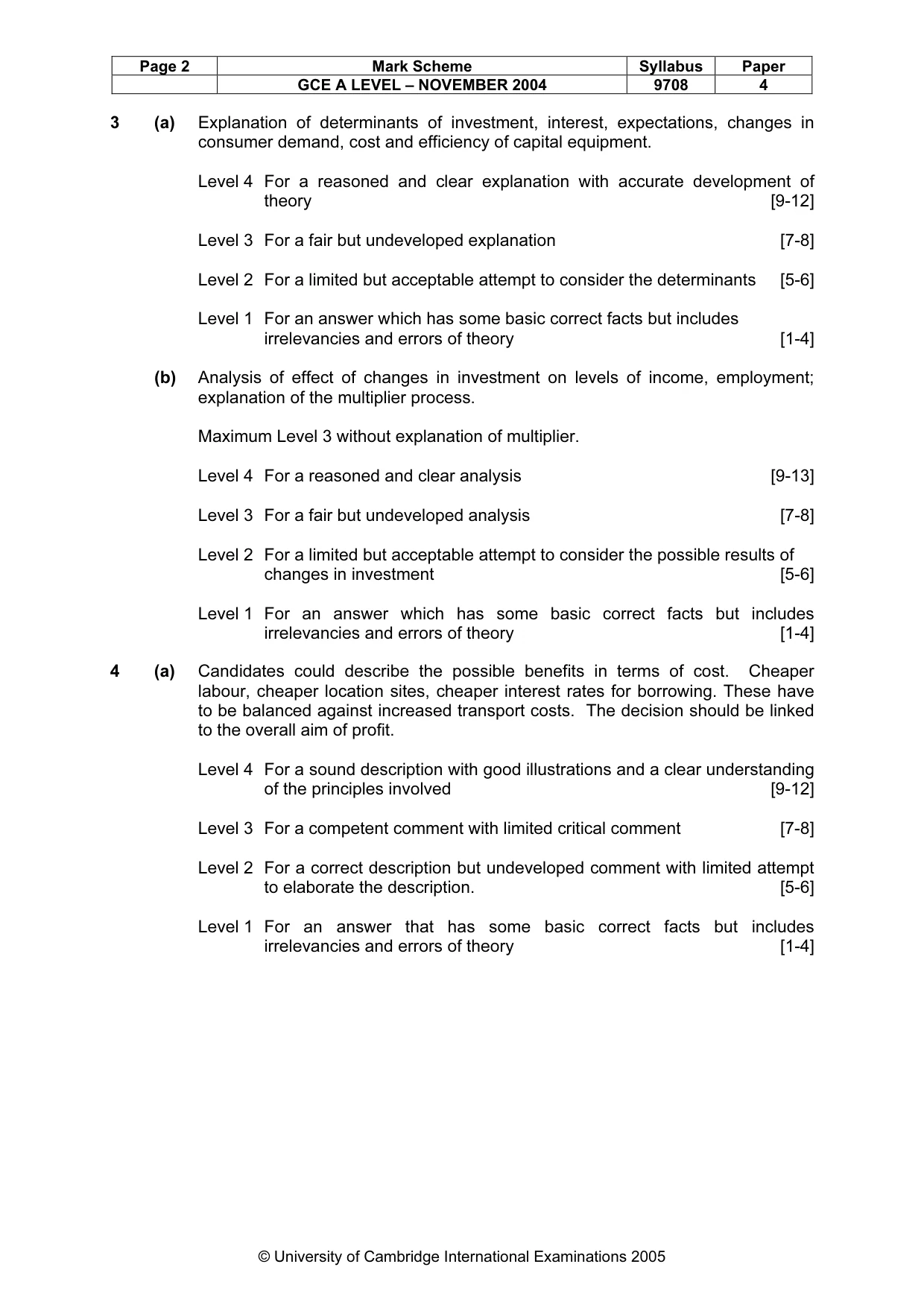
Page 2 Mark Scheme Syllabus Paper GCE A LEVEL – NOVEMBER 2004 9708 4 © University of Cambridge International Examinations 2005 3 (a) Explanation of determinants of investment, interest, expectations, changes in consumer demand, cost and efficiency of capital equipment. Level 4 For a reasoned and clear explanation with accurate development of theory [9-12] Level 3 For a fair but undeveloped explanation [7-8] Level 2 For a limited but acceptable attempt to consider the determinants [5-6] Level 1 For an answer which has some basic correct facts but includes irrelevancies and errors of theory [1-4] (b) Analysis of effect of changes in investment on levels of income, employment; explanation of the multiplier process. Maximum Level 3 without explanation of multiplier. Level 4 For a reasoned and clear analysis [9-13] Level 3 For a fair but undeveloped analysis [7-8] Level 2 For a limited but acceptable attempt to consider the possible results of changes in investment [5-6] Level 1 For an answer which has some basic correct facts but includes irrelevancies and errors of theory [1-4] 4 (a) Candidates could describe the possible benefits in terms of cost. Cheaper labour, cheaper location sites, cheaper interest rates for borrowing. These have to be balanced against increased transport costs. The decision should be linked to the overall aim of profit. Level 4 For a sound description with good illustrations and a clear understanding of the principles involved [9-12] Level 3 For a competent comment with limited critical comment [7-8] Level 2 For a correct description but undeveloped comment with limited attempt to elaborate the description. [5-6] Level 1 For an answer that has some basic correct facts but includes irrelevancies and errors of theory [1-4]
Mark scheme, page 6
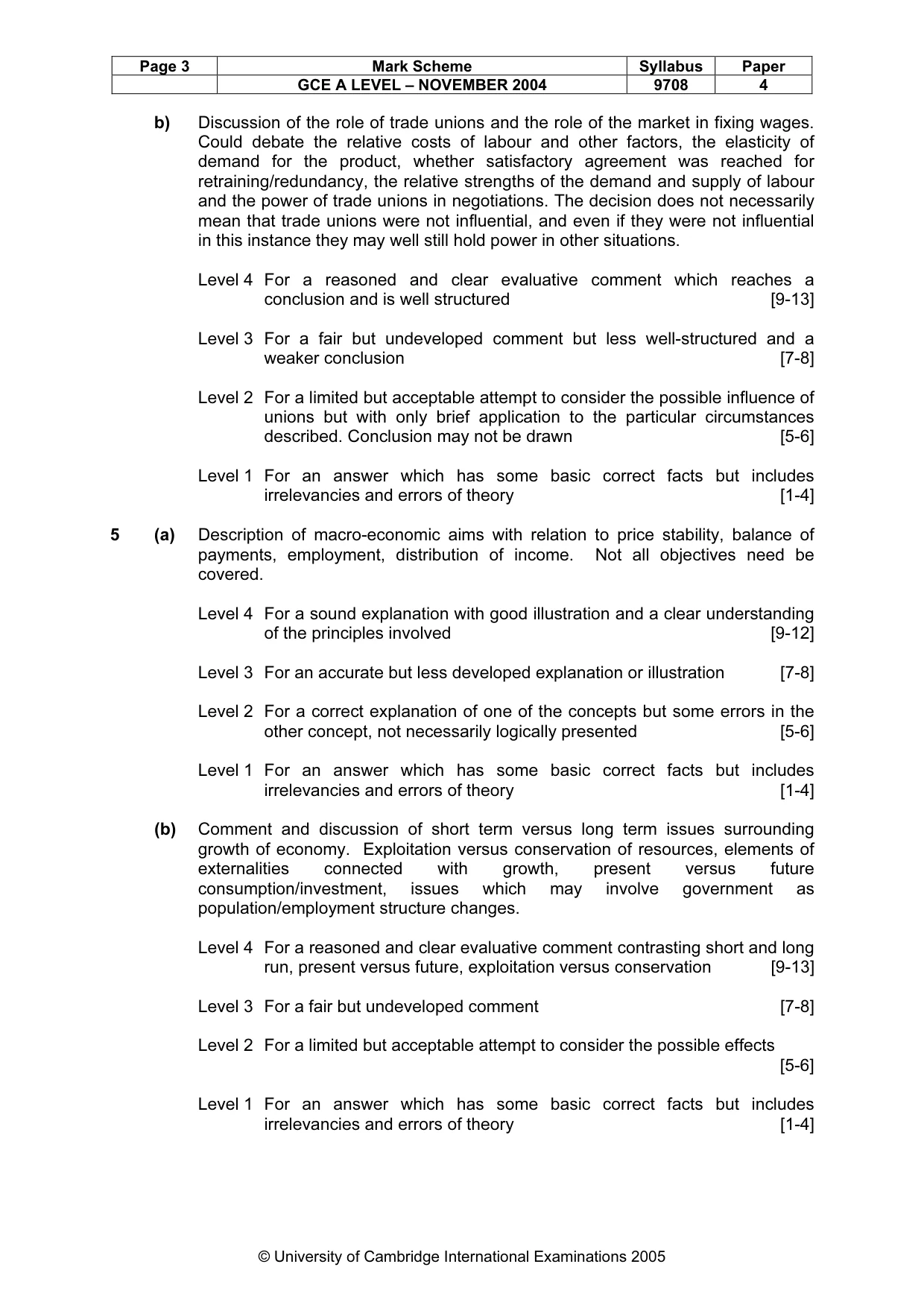
Page 3 Mark Scheme Syllabus Paper GCE A LEVEL – NOVEMBER 2004 9708 4 © University of Cambridge International Examinations 2005 b) Discussion of the role of trade unions and the role of the market in fixing wages. Could debate the relative costs of labour and other factors, the elasticity of demand for the product, whether satisfactory agreement was reached for retraining/redundancy, the relative strengths of the demand and supply of labour and the power of trade unions in negotiations. The decision does not necessarily mean that trade unions were not influential, and even if they were not influential in this instance they may well still hold power in other situations. Level 4 For a reasoned and clear evaluative comment which reaches a conclusion and is well structured [9-13] Level 3 For a fair but undeveloped comment but less well-structured and a weaker conclusion [7-8] Level 2 For a limited but acceptable attempt to consider the possible influence of unions but with only brief application to the particular circumstances described. Conclusion may not be drawn [5-6] Level 1 For an answer which has some basic correct facts but includes irrelevancies and errors of theory [1-4] 5 (a) Description of macro-economic aims with relation to price stability, balance of payments, employment, distribution of income. Not all objectives need be covered. Level 4 For a sound explanation with good illustration and a clear understanding of the principles involved [9-12] Level 3 For an accurate but less developed explanation or illustration [7-8] Level 2 For a correct explanation of one of the concepts but some errors in the other concept, not necessarily logically presented [5-6] Level 1 For an answer which has some basic correct facts but includes irrelevancies and errors of theory [1-4] (b) Comment and discussion of short term versus long term issues surrounding growth of economy. Exploitation versus conservation of resources, elements of externalities connected with growth, present versus future consumption/investment, issues which may involve government as population/employment structure changes. Level 4 For a reasoned and clear evaluative comment contrasting short and long run, present versus future, exploitation versus conservation [9-13] Level 3 For a fair but undeveloped comment [7-8] Level 2 For a limited but acceptable attempt to consider the possible effects [5-6] Level 1 For an answer which has some basic correct facts but includes irrelevancies and errors of theory [1-4]
Mark scheme, page 7
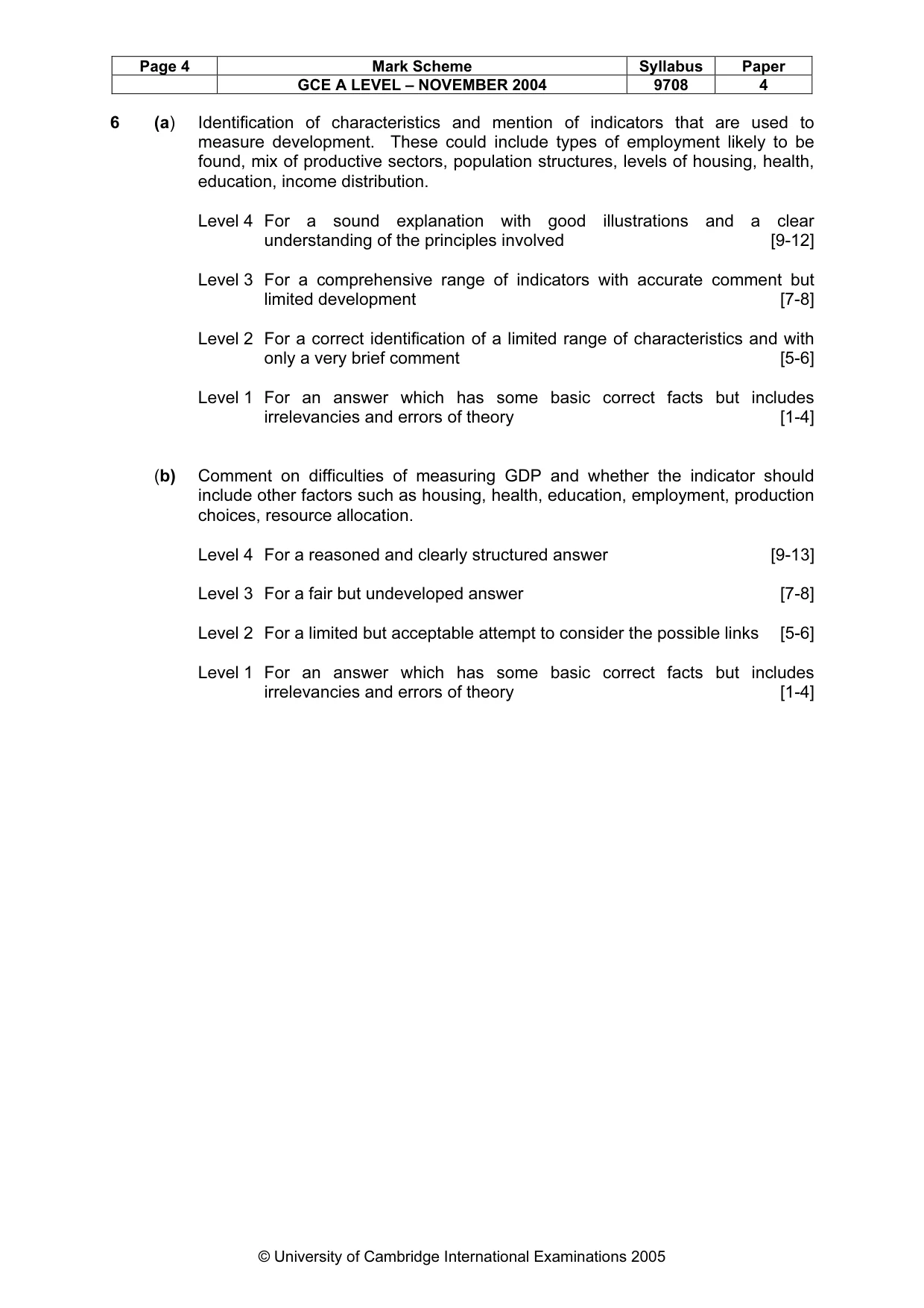
Page 4 Mark Scheme Syllabus Paper GCE A LEVEL – NOVEMBER 2004 9708 4 © University of Cambridge International Examinations 2005 6 (a) Identification of characteristics and mention of indicators that are used to measure development. These could include types of employment likely to be found, mix of productive sectors, population structures, levels of housing, health, education, income distribution. Level 4 For a sound explanation with good illustrations and a clear understanding of the principles involved [9-12] Level 3 For a comprehensive range of indicators with accurate comment but limited development [7-8] Level 2 For a correct identification of a limited range of characteristics and with only a very brief comment [5-6] Level 1 For an answer which has some basic correct facts but includes irrelevancies and errors of theory [1-4] (b) Comment on difficulties of measuring GDP and whether the indicator should include other factors such as housing, health, education, employment, production choices, resource allocation. Level 4 For a reasoned and clearly structured answer [9-13] Level 3 For a fair but undeveloped answer [7-8] Level 2 For a limited but acceptable attempt to consider the possible links [5-6] Level 1 For an answer which has some basic correct facts but includes irrelevancies and errors of theory [1-4]
Mark scheme, page 8
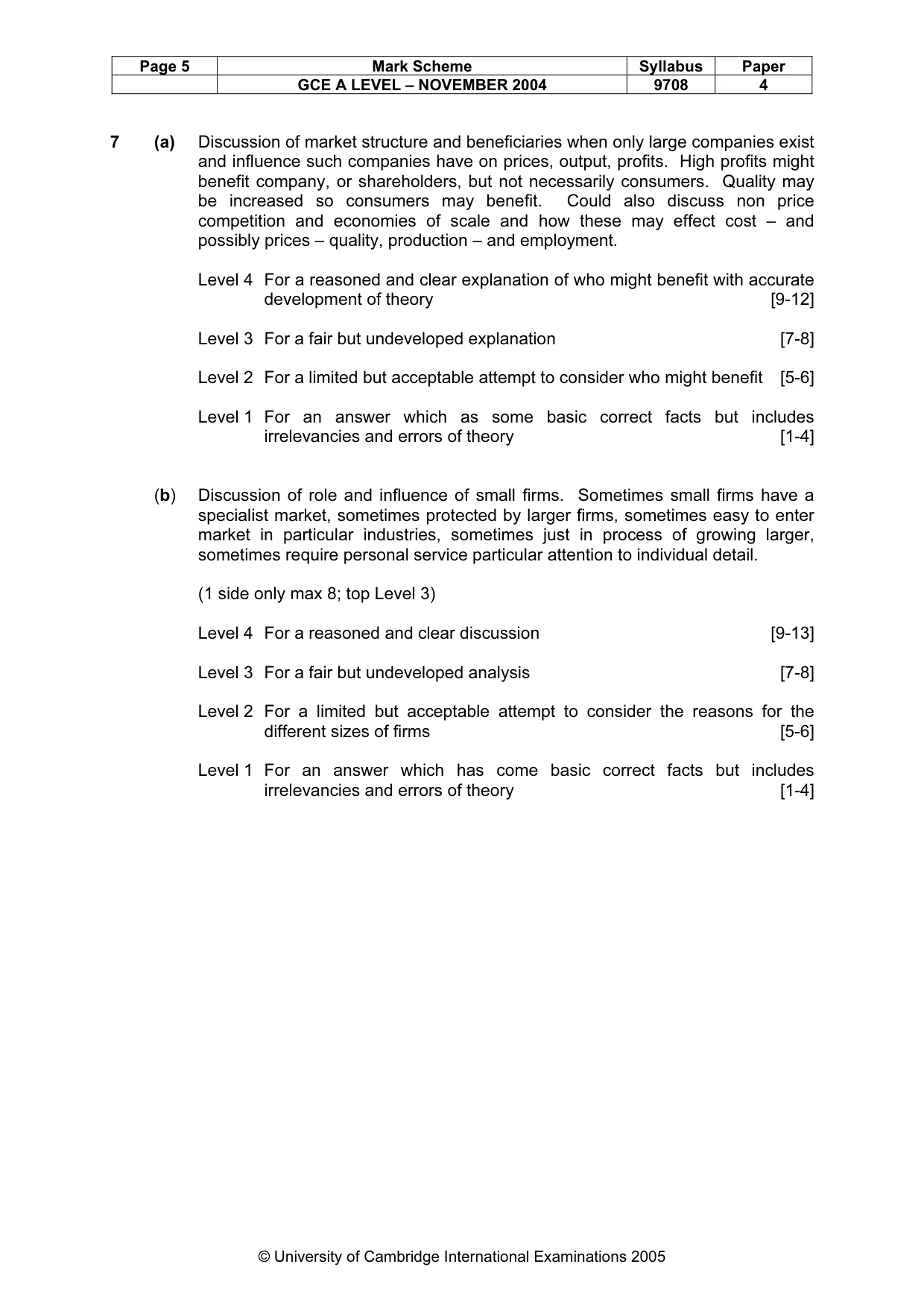
Page 5 Mark Scheme Syllabus Paper GCE A LEVEL – NOVEMBER 2004 9708 4 © University of Cambridge International Examinations 2005 7 (a) Discussion of market structure and beneficiaries when only large companies exist and influence such companies have on prices, output, profits. High profits might benefit company, or shareholders, but not necessarily consumers. Quality may be increased so consumers may benefit. Could also discuss non price competition and economies of scale and how these may effect cost – and possibly prices – quality, production – and employment. Level 4 For a reasoned and clear explanation of who might benefit with accurate development of theory [9-12] Level 3 For a fair but undeveloped explanation [7-8] Level 2 For a limited but acceptable attempt to consider who might benefit [5-6] Level 1 For an answer which as some basic correct facts but includes irrelevancies and errors of theory [1-4] (b) Discussion of role and influence of small firms. Sometimes small firms have a specialist market, sometimes protected by larger firms, sometimes easy to enter market in particular industries, sometimes just in process of growing larger, sometimes require personal service particular attention to individual detail. (1 side only max 8; top Level 3) Level 4 For a reasoned and clear discussion [9-13] Level 3 For a fair but undeveloped analysis [7-8] Level 2 For a limited but acceptable attempt to consider the reasons for the different sizes of firms [5-6] Level 1 For an answer which has come basic correct facts but includes irrelevancies and errors of theory [1-4]