Cambridge A Level Divinity (AS Level only) 8041 — 2021 Oct/Nov Paper 2 · Variant 3
8041/23/O/N/21 · 100 marks · ≈113 min
The question paper and its mark scheme, free to read here and free to download. This is Cambridge’s own paper, exactly as it was sat.
Question paper4 pages
Mark scheme22 pages
Answers below. Sit the paper first if you are practising.

Paper as text
Question paper, page 1
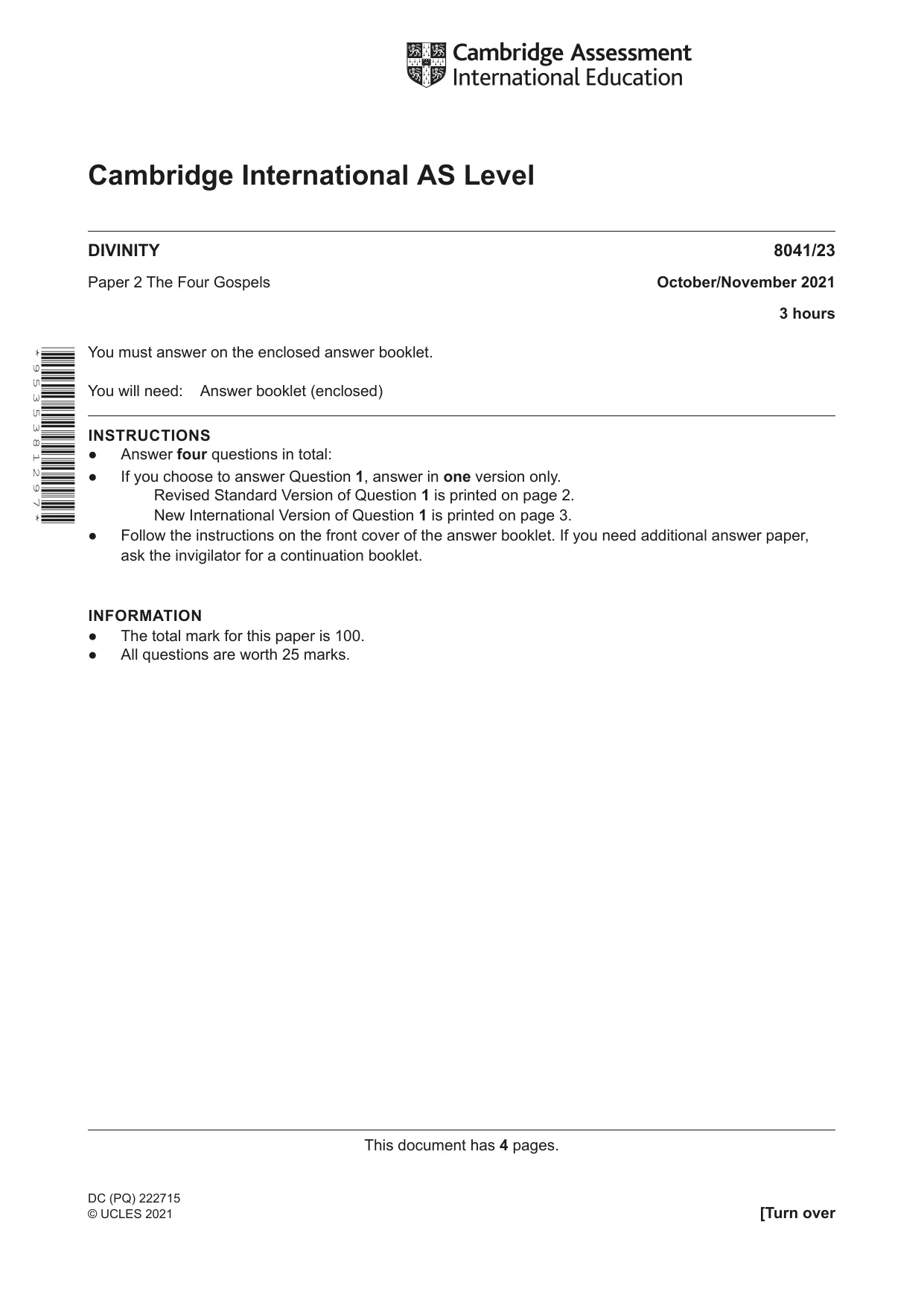
This document has 4 pages. Cambridge International AS Level DC (PQ) 222715 © UCLES 2021 [Turn over * 9 5 3 5 3 8 1 2 9 7 * DIVINITY 8041/23 Paper 2 The Four Gospels October/November 2021 3 hours You must answer on the enclosed answer booklet. You will need: Answer booklet (enclosed) INSTRUCTIONS ● Answer four questions in total: ● If you choose to answer Question 1, answer in one version only. Revised Standard Version of Question 1 is printed on page 2. New International Version of Question 1 is printed on page 3. ● Follow the instructions on the front cover of the answer booklet. If you need additional answer paper, ask the invigilator for a continuation booklet. INFORMATION ● The total mark for this paper is 100. ● All questions are worth 25 marks.
Question paper, page 2
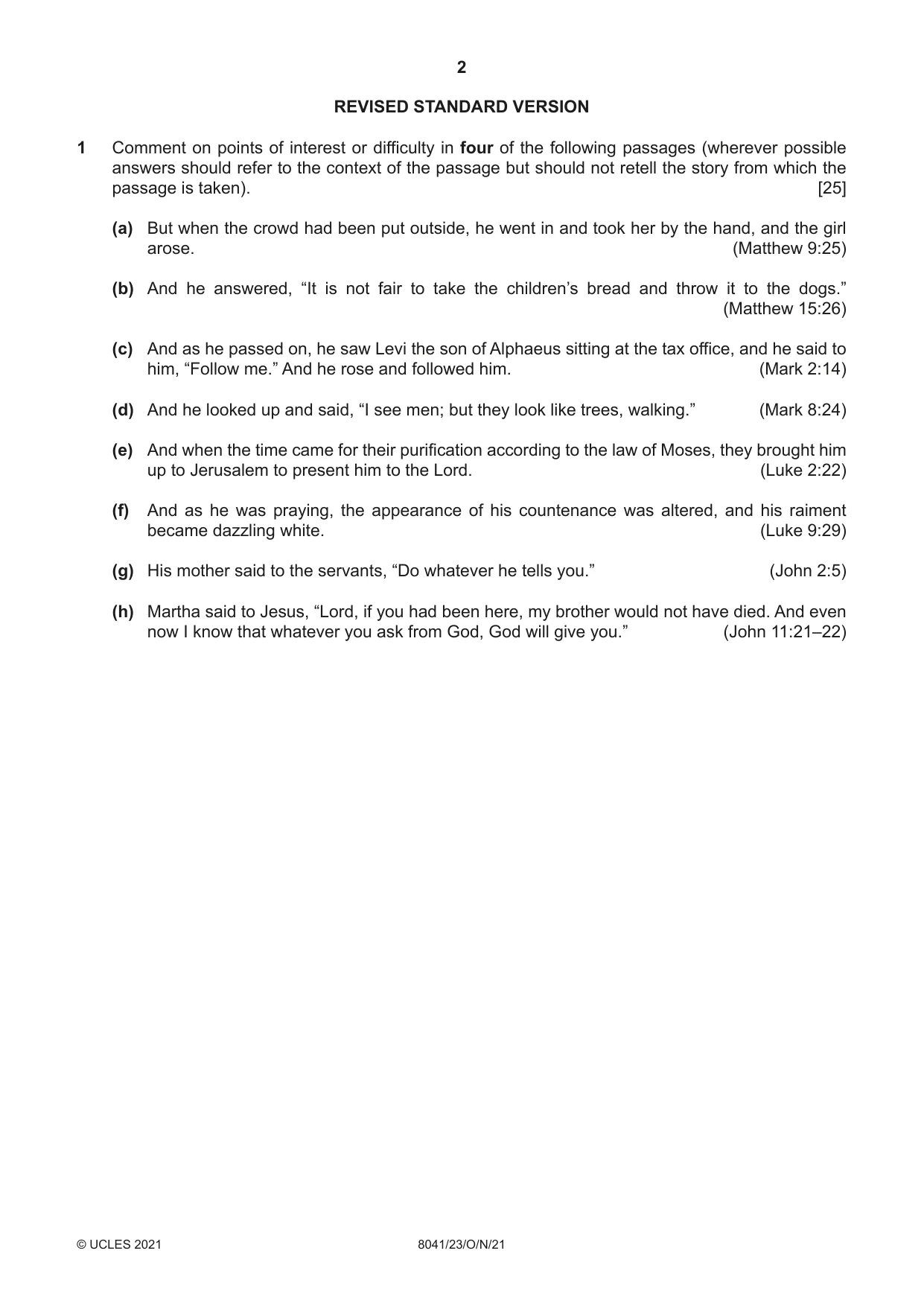
2 8041/23/O/N/21 © UCLES 2021 REVISED STANDARD VERSION 1 Comment on points of interest or difficulty in four of the following passages (wherever possible answers should refer to the context of the passage but should not retell the story from which the passage is taken). [25] (a) But when the crowd had been put outside, he went in and took her by the hand, and the girl arose. (Matthew 9:25) (b) And he answered, “It is not fair to take the children’s bread and throw it to the dogs.” (Matthew 15:26) (c) And as he passed on, he saw Levi the son of Alphaeus sitting at the tax office, and he said to him, “Follow me.” And he rose and followed him. (Mark 2:14) (d) And he looked up and said, “I see men; but they look like trees, walking.” (Mark 8:24) (e) And when the time came for their purification according to the law of Moses, they brought him up to Jerusalem to present him to the Lord. (Luke 2:22) (f) And as he was praying, the appearance of his countenance was altered, and his raiment became dazzling white. (Luke 9:29) (g) His mother said to the servants, “Do whatever he tells you.” (John 2:5) (h) Martha said to Jesus, “Lord, if you had been here, my brother would not have died. And even now I know that whatever you ask from God, God will give you.” (John 11:21–22)
Question paper, page 3
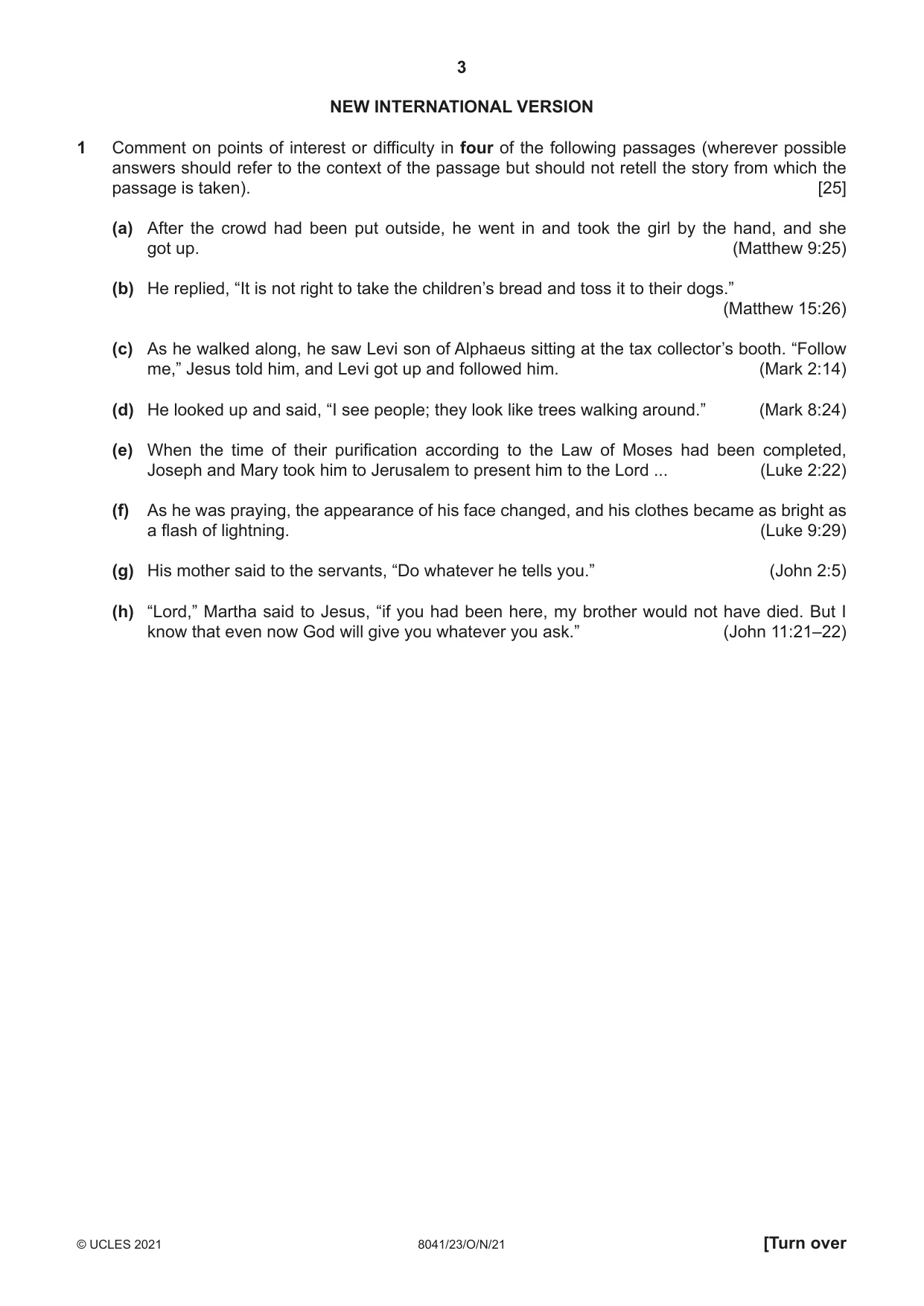
3 8041/23/O/N/21 © UCLES 2021 [Turn over NEW INTERNATIONAL VERSION 1 Comment on points of interest or difficulty in four of the following passages (wherever possible answers should refer to the context of the passage but should not retell the story from which the passage is taken). [25] (a) After the crowd had been put outside, he went in and took the girl by the hand, and she got up. (Matthew 9:25) (b) He replied, “It is not right to take the children’s bread and toss it to their dogs.” (Matthew 15:26) (c) As he walked along, he saw Levi son of Alphaeus sitting at the tax collector’s booth. “Follow me,” Jesus told him, and Levi got up and followed him. (Mark 2:14) (d) He looked up and said, “I see people; they look like trees walking around.” (Mark 8:24) (e) When the time of their purification according to the Law of Moses had been completed, Joseph and Mary took him to Jerusalem to present him to the Lord ... (Luke 2:22) (f) As he was praying, the appearance of his face changed, and his clothes became as bright as a flash of lightning. (Luke 9:29) (g) His mother said to the servants, “Do whatever he tells you.” (John 2:5) (h) “Lord,” Martha said to Jesus, “if you had been here, my brother would not have died. But I know that even now God will give you whatever you ask.” (John 11:21–22)
Question paper, page 4
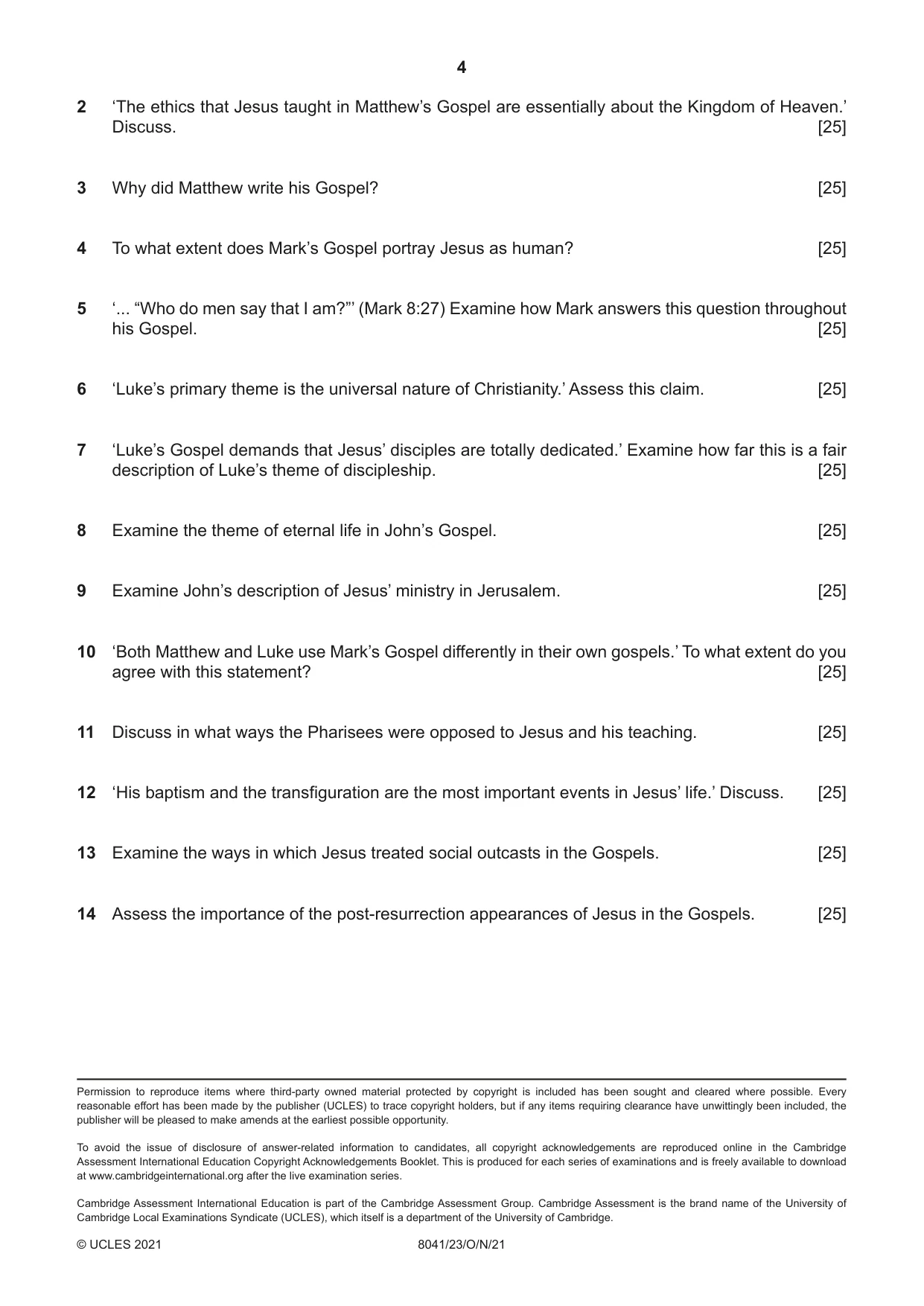
4 8041/23/O/N/21 © UCLES 2021 Permission to reproduce items where third-party owned material protected by copyright is included has been sought and cleared where possible. Every reasonable effort has been made by the publisher (UCLES) to trace copyright holders, but if any items requiring clearance have unwittingly been included, the publisher will be pleased to make amends at the earliest possible opportunity. To avoid the issue of disclosure of answer-related information to candidates, all copyright acknowledgements are reproduced online in the Cambridge Assessment International Education Copyright Acknowledgements Booklet. This is produced for each series of examinations and is freely available to download at www.cambridgeinternational.org after the live examination series. Cambridge Assessment International Education is part of the Cambridge Assessment Group. Cambridge Assessment is the brand name of the University of Cambridge Local Examinations Syndicate (UCLES), which itself is a department of the University of Cambridge. 2 ‘The ethics that Jesus taught in Matthew’s Gospel are essentially about the Kingdom of Heaven.’ Discuss. [25] 3 Why did Matthew write his Gospel? [25] 4 To what extent does Mark’s Gospel portray Jesus as human? [25] 5 ‘... “Who do men say that I am?”’ (Mark 8:27) Examine how Mark answers this question throughout his Gospel. [25] 6 ‘Luke’s primary theme is the universal nature of Christianity.’ Assess this claim. [25] 7 ‘Luke’s Gospel demands that Jesus’ disciples are totally dedicated.’ Examine how far this is a fair description of Luke’s theme of discipleship. [25] 8 Examine the theme of eternal life in John’s Gospel. [25] 9 Examine John’s description of Jesus’ ministry in Jerusalem. [25] 10 ‘Both Matthew and Luke use Mark’s Gospel differently in their own gospels.’ To what extent do you agree with this statement? [25] 11 Discuss in what ways the Pharisees were opposed to Jesus and his teaching. [25] 12 ‘His baptism and the transfiguration are the most important events in Jesus’ life.’ Discuss. [25] 13 Examine the ways in which Jesus treated social outcasts in the Gospels. [25] 14 Assess the importance of the post-resurrection appearances of Jesus in the Gospels. [25]
Mark scheme, page 1
This document consists of 22 printed pages. © UCLES 2021 [Turn over Cambridge International AS Level DIVINITY 8041/23 Paper 2 The Four Gospels October/November 2021 MARK SCHEME Maximum Mark: 100 Published This mark scheme is published as an aid to teachers and candidates, to indicate the requirements of the examination. It shows the basis on which Examiners were instructed to award marks. It does not indicate the details of the discussions that took place at an Examiners’ meeting before marking began, which would have considered the acceptability of alternative answers. Mark schemes should be read in conjunction with the question paper and the Principal Examiner Report for Teachers. Cambridge International will not enter into discussions about these mark schemes. Cambridge International is publishing the mark schemes for the October/November 2021 series for most Cambridge IGCSE™, Cambridge International A and AS Level components and some Cambridge O Level components.
Mark scheme, page 2
8041/23 Cambridge International AS Level – Mark Scheme PUBLISHED October/November 2021 © UCLES 2021 Page 2 of 22 Generic Marking Principles These general marking principles must be applied by all examiners when marking candidate answers. They should be applied alongside the specific content of the mark scheme or generic level descriptors for a question. Each question paper and mark scheme will also comply with these marking principles. GENERIC MARKING PRINCIPLE 1: Marks must be awarded in line with: • the specific content of the mark scheme or the generic level descriptors for the question • the specific skills defined in the mark scheme or in the generic level descriptors for the question • the standard of response required by a candidate as exemplified by the standardisation scripts. GENERIC MARKING PRINCIPLE 2: Marks awarded are always whole marks (not half marks, or other fractions). GENERIC MARKING PRINCIPLE 3: Marks must be awarded positively: • marks are awarded for correct/valid answers, as defined in the mark scheme. However, credit is given for valid answers which go beyond the scope of the syllabus and mark scheme, referring to your Team Leader as appropriate • marks are awarded when candidates clearly demonstrate what they know and can do • marks are not deducted for errors • marks are not deducted for omissions • answers should only be judged on the quality of spelling, punctuation and grammar when these features are specifically assessed by the question as indicated by the mark scheme. The meaning, however, should be unambiguous. GENERIC MARKING PRINCIPLE 4: Rules must be applied consistently, e.g. in situations where candidates have not followed instructions or in the application of generic level descriptors. GENERIC MARKING PRINCIPLE 5: Marks should be awarded using the full range of marks defined in the mark scheme for the question (however; the use of the full mark range may be limited according to the quality of the candidate responses seen). GENERIC MARKING PRINCIPLE 6: Marks awarded are based solely on the requirements as defined in the mark scheme. Marks should not be awarded with grade thresholds or grade descriptors in mind.
Mark scheme, page 3
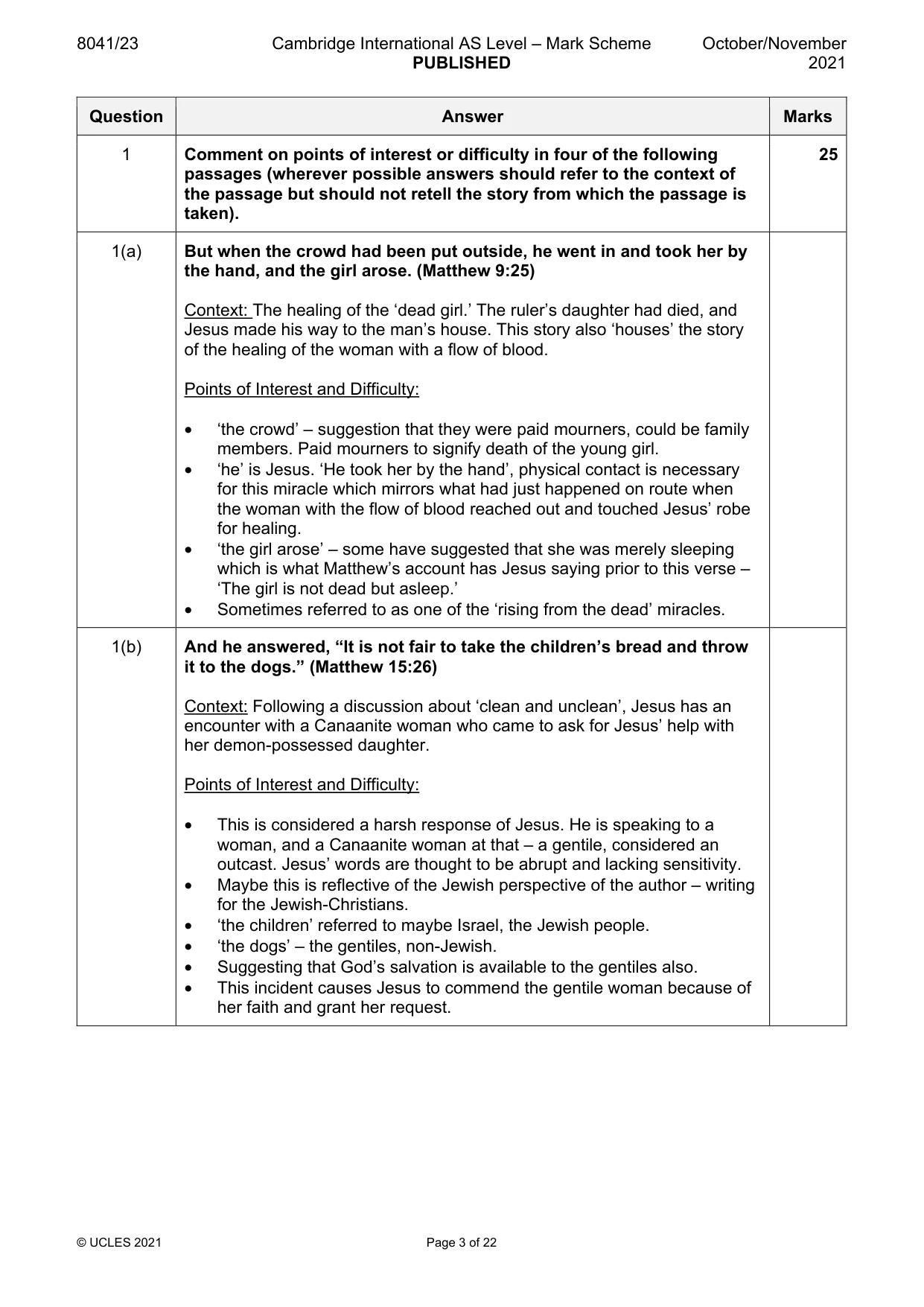
8041/23 Cambridge International AS Level – Mark Scheme PUBLISHED October/November 2021 © UCLES 2021 Page 3 of 22 Question Answer Marks 1 Comment on points of interest or difficulty in four of the following passages (wherever possible answers should refer to the context of the passage but should not retell the story from which the passage is taken). 25 1(a) But when the crowd had been put outside, he went in and took her by the hand, and the girl arose. (Matthew 9:25) Context: The healing of the ‘dead girl.’ The ruler’s daughter had died, and Jesus made his way to the man’s house. This story also ‘houses’ the story of the healing of the woman with a flow of blood. Points of Interest and Difficulty: • ‘the crowd’ – suggestion that they were paid mourners, could be family members. Paid mourners to signify death of the young girl. • ‘he’ is Jesus. ‘He took her by the hand’, physical contact is necessary for this miracle which mirrors what had just happened on route when the woman with the flow of blood reached out and touched Jesus’ robe for healing. • ‘the girl arose’ – some have suggested that she was merely sleeping which is what Matthew’s account has Jesus saying prior to this verse – ‘The girl is not dead but asleep.’ • Sometimes referred to as one of the ‘rising from the dead’ miracles. 1(b) And he answered, “It is not fair to take the children’s bread and throw it to the dogs.” (Matthew 15:26) Context: Following a discussion about ‘clean and unclean’, Jesus has an encounter with a Canaanite woman who came to ask for Jesus’ help with her demon-possessed daughter. Points of Interest and Difficulty: • This is considered a harsh response of Jesus. He is speaking to a woman, and a Canaanite woman at that – a gentile, considered an outcast. Jesus’ words are thought to be abrupt and lacking sensitivity. • Maybe this is reflective of the Jewish perspective of the author – writing for the Jewish-Christians. • ‘the children’ referred to maybe Israel, the Jewish people. • ‘the dogs’ – the gentiles, non-Jewish. • Suggesting that God’s salvation is available to the gentiles also. • This incident causes Jesus to commend the gentile woman because of her faith and grant her request.
Mark scheme, page 4
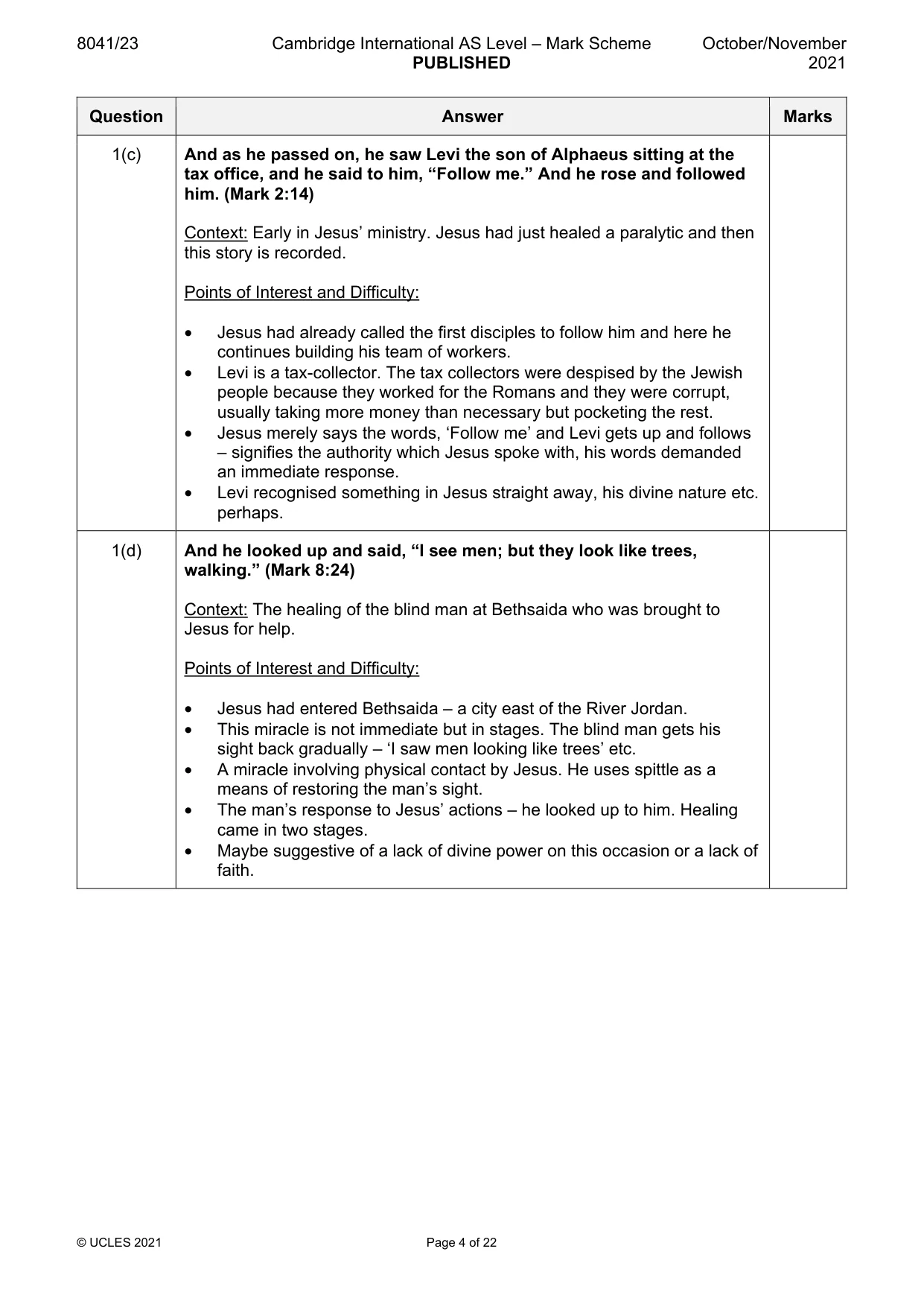
8041/23 Cambridge International AS Level – Mark Scheme PUBLISHED October/November 2021 © UCLES 2021 Page 4 of 22 Question Answer Marks 1(c) And as he passed on, he saw Levi the son of Alphaeus sitting at the tax office, and he said to him, “Follow me.” And he rose and followed him. (Mark 2:14) Context: Early in Jesus’ ministry. Jesus had just healed a paralytic and then this story is recorded. Points of Interest and Difficulty: • Jesus had already called the first disciples to follow him and here he continues building his team of workers. • Levi is a tax-collector. The tax collectors were despised by the Jewish people because they worked for the Romans and they were corrupt, usually taking more money than necessary but pocketing the rest. • Jesus merely says the words, ‘Follow me’ and Levi gets up and follows – signifies the authority which Jesus spoke with, his words demanded an immediate response. • Levi recognised something in Jesus straight away, his divine nature etc. perhaps. 1(d) And he looked up and said, “I see men; but they look like trees, walking.” (Mark 8:24) Context: The healing of the blind man at Bethsaida who was brought to Jesus for help. Points of Interest and Difficulty: • Jesus had entered Bethsaida – a city east of the River Jordan. • This miracle is not immediate but in stages. The blind man gets his sight back gradually – ‘I saw men looking like trees’ etc. • A miracle involving physical contact by Jesus. He uses spittle as a means of restoring the man’s sight. • The man’s response to Jesus’ actions – he looked up to him. Healing came in two stages. • Maybe suggestive of a lack of divine power on this occasion or a lack of faith.
Mark scheme, page 5
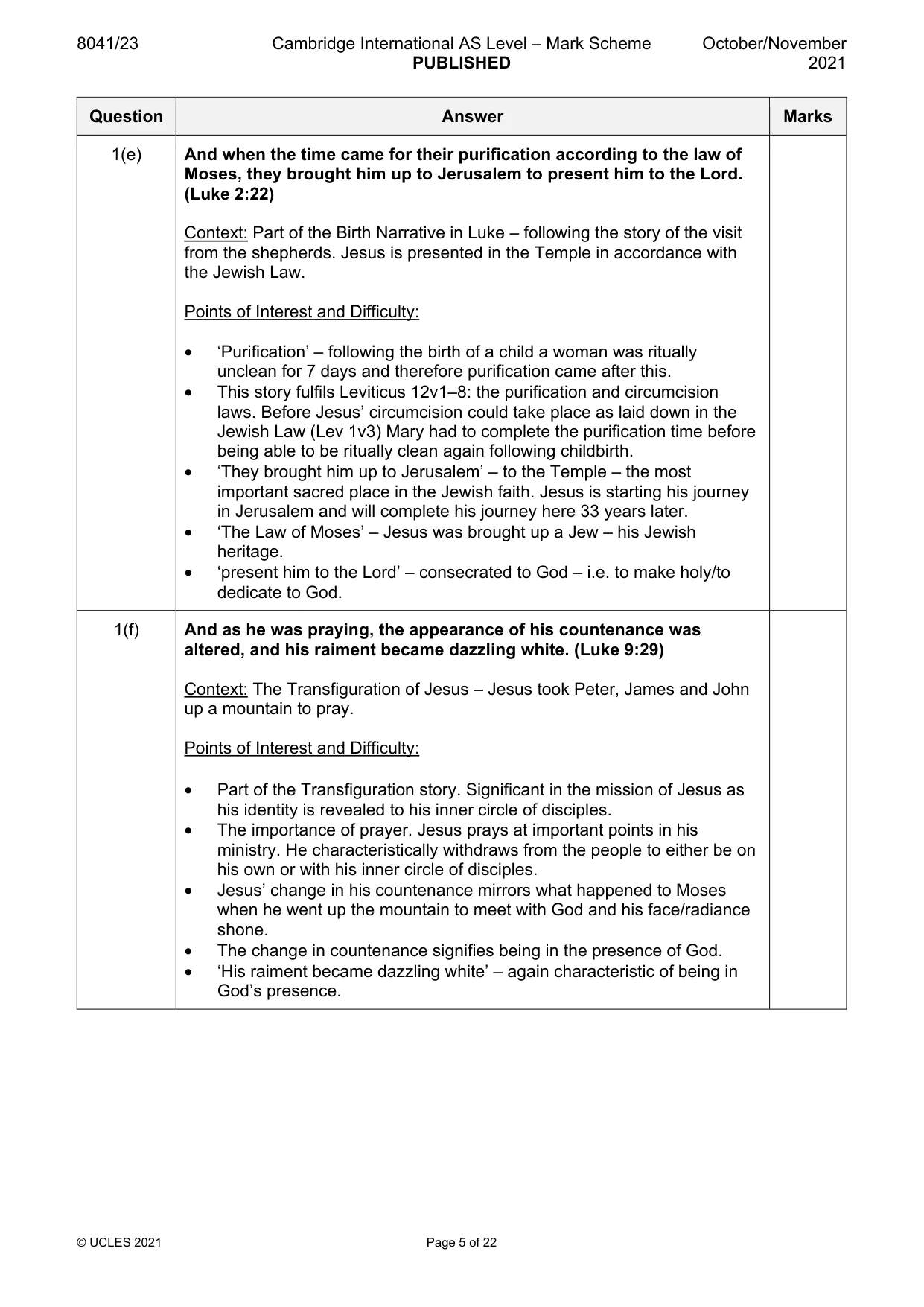
8041/23 Cambridge International AS Level – Mark Scheme PUBLISHED October/November 2021 © UCLES 2021 Page 5 of 22 Question Answer Marks 1(e) And when the time came for their purification according to the law of Moses, they brought him up to Jerusalem to present him to the Lord. (Luke 2:22) Context: Part of the Birth Narrative in Luke – following the story of the visit from the shepherds. Jesus is presented in the Temple in accordance with the Jewish Law. Points of Interest and Difficulty: • ‘Purification’ – following the birth of a child a woman was ritually unclean for 7 days and therefore purification came after this. • This story fulfils Leviticus 12v1–8: the purification and circumcision laws. Before Jesus’ circumcision could take place as laid down in the Jewish Law (Lev 1v3) Mary had to complete the purification time before being able to be ritually clean again following childbirth. • ‘They brought him up to Jerusalem’ – to the Temple – the most important sacred place in the Jewish faith. Jesus is starting his journey in Jerusalem and will complete his journey here 33 years later. • ‘The Law of Moses’ – Jesus was brought up a Jew – his Jewish heritage. • ‘present him to the Lord’ – consecrated to God – i.e. to make holy/to dedicate to God. 1(f) And as he was praying, the appearance of his countenance was altered, and his raiment became dazzling white. (Luke 9:29) Context: The Transfiguration of Jesus – Jesus took Peter, James and John up a mountain to pray. Points of Interest and Difficulty: • Part of the Transfiguration story. Significant in the mission of Jesus as his identity is revealed to his inner circle of disciples. • The importance of prayer. Jesus prays at important points in his ministry. He characteristically withdraws from the people to either be on his own or with his inner circle of disciples. • Jesus’ change in his countenance mirrors what happened to Moses when he went up the mountain to meet with God and his face/radiance shone. • The change in countenance signifies being in the presence of God. • ‘His raiment became dazzling white’ – again characteristic of being in God’s presence.
Mark scheme, page 6
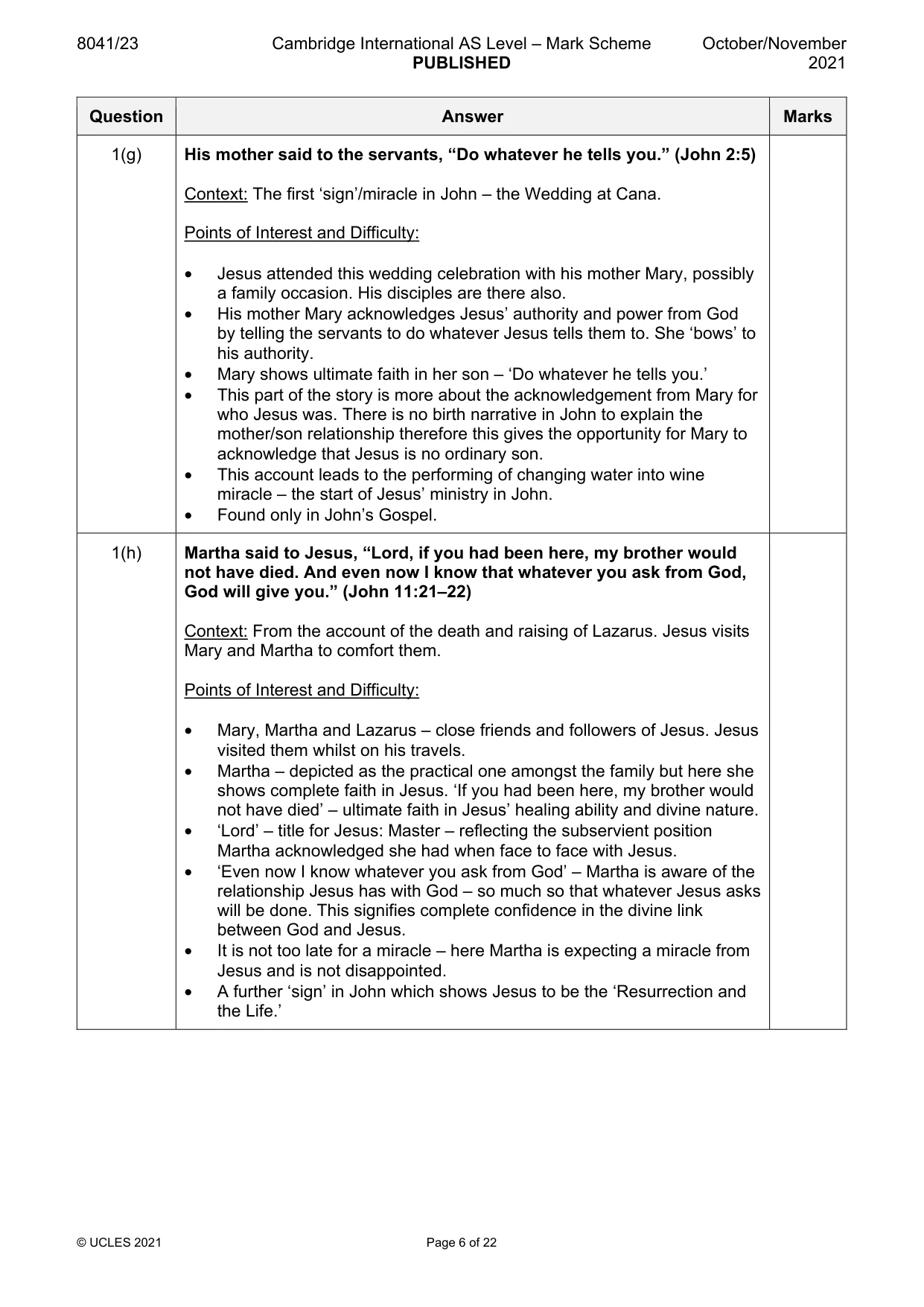
8041/23 Cambridge International AS Level – Mark Scheme PUBLISHED October/November 2021 © UCLES 2021 Page 6 of 22 Question Answer Marks 1(g) His mother said to the servants, “Do whatever he tells you.” (John 2:5) Context: The first ‘sign’/miracle in John – the Wedding at Cana. Points of Interest and Difficulty: • Jesus attended this wedding celebration with his mother Mary, possibly a family occasion. His disciples are there also. • His mother Mary acknowledges Jesus’ authority and power from God by telling the servants to do whatever Jesus tells them to. She ‘bows’ to his authority. • Mary shows ultimate faith in her son – ‘Do whatever he tells you.’ • This part of the story is more about the acknowledgement from Mary for who Jesus was. There is no birth narrative in John to explain the mother/son relationship therefore this gives the opportunity for Mary to acknowledge that Jesus is no ordinary son. • This account leads to the performing of changing water into wine miracle – the start of Jesus’ ministry in John. • Found only in John’s Gospel. 1(h) Martha said to Jesus, “Lord, if you had been here, my brother would not have died. And even now I know that whatever you ask from God, God will give you.” (John 11:21–22) Context: From the account of the death and raising of Lazarus. Jesus visits Mary and Martha to comfort them. Points of Interest and Difficulty: • Mary, Martha and Lazarus – close friends and followers of Jesus. Jesus visited them whilst on his travels. • Martha – depicted as the practical one amongst the family but here she shows complete faith in Jesus. ‘If you had been here, my brother would not have died’ – ultimate faith in Jesus’ healing ability and divine nature. • ‘Lord’ – title for Jesus: Master – reflecting the subservient position Martha acknowledged she had when face to face with Jesus. • ‘Even now I know whatever you ask from God’ – Martha is aware of the relationship Jesus has with God – so much so that whatever Jesus asks will be done. This signifies complete confidence in the divine link between God and Jesus. • It is not too late for a miracle – here Martha is expecting a miracle from Jesus and is not disappointed. • A further ‘sign’ in John which shows Jesus to be the ‘Resurrection and the Life.’
Mark scheme, page 7
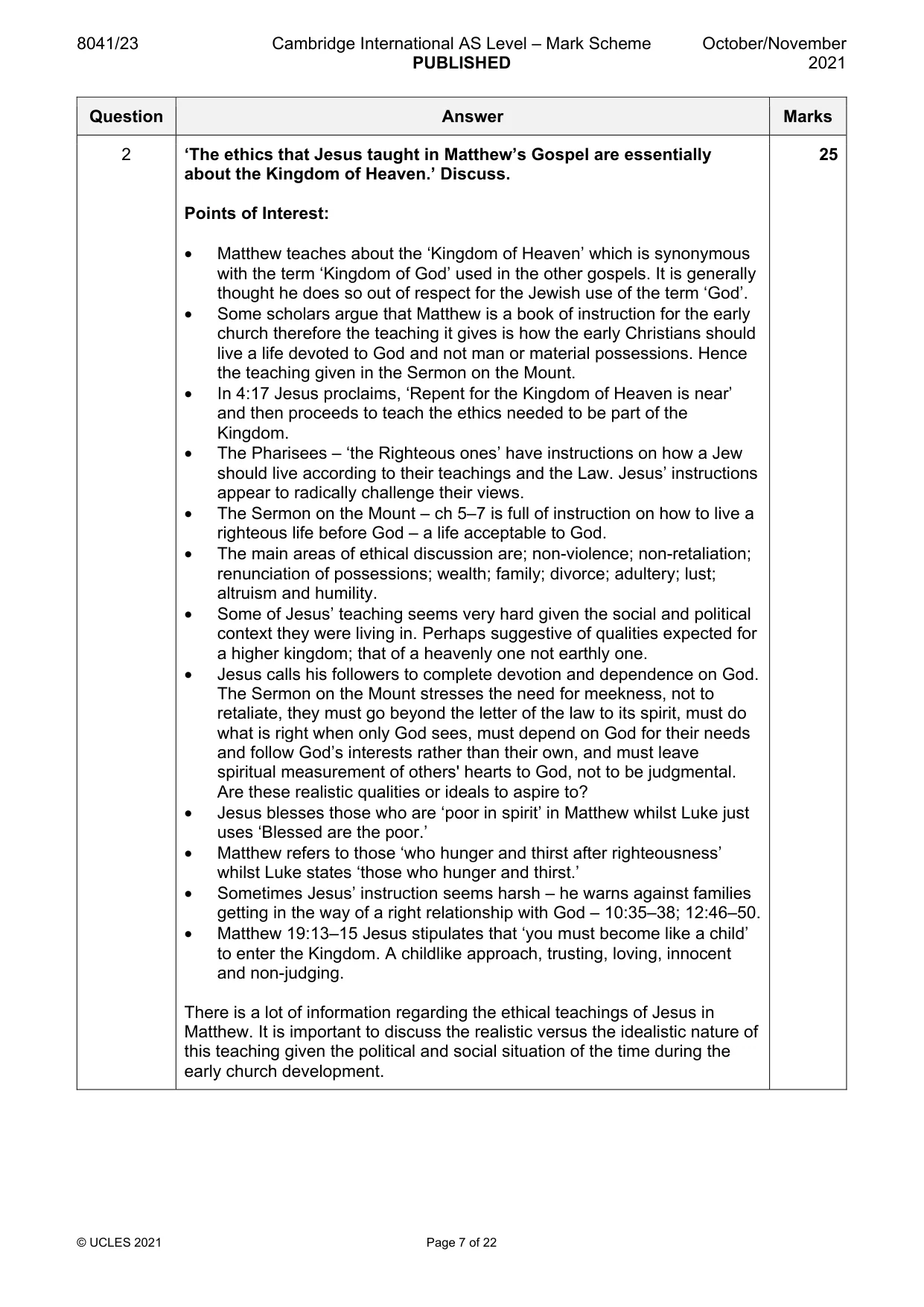
8041/23 Cambridge International AS Level – Mark Scheme PUBLISHED October/November 2021 © UCLES 2021 Page 7 of 22 Question Answer Marks 2 ‘The ethics that Jesus taught in Matthew’s Gospel are essentially about the Kingdom of Heaven.’ Discuss. Points of Interest: • Matthew teaches about the ‘Kingdom of Heaven’ which is synonymous with the term ‘Kingdom of God’ used in the other gospels. It is generally thought he does so out of respect for the Jewish use of the term ‘God’. • Some scholars argue that Matthew is a book of instruction for the early church therefore the teaching it gives is how the early Christians should live a life devoted to God and not man or material possessions. Hence the teaching given in the Sermon on the Mount. • In 4:17 Jesus proclaims, ‘Repent for the Kingdom of Heaven is near’ and then proceeds to teach the ethics needed to be part of the Kingdom. • The Pharisees – ‘the Righteous ones’ have instructions on how a Jew should live according to their teachings and the Law. Jesus’ instructions appear to radically challenge their views. • The Sermon on the Mount – ch 5–7 is full of instruction on how to live a righteous life before God – a life acceptable to God. • The main areas of ethical discussion are; non-violence; non-retaliation; renunciation of possessions; wealth; family; divorce; adultery; lust; altruism and humility. • Some of Jesus’ teaching seems very hard given the social and political context they were living in. Perhaps suggestive of qualities expected for a higher kingdom; that of a heavenly one not earthly one. • Jesus calls his followers to complete devotion and dependence on God. The Sermon on the Mount stresses the need for meekness, not to retaliate, they must go beyond the letter of the law to its spirit, must do what is right when only God sees, must depend on God for their needs and follow God’s interests rather than their own, and must leave spiritual measurement of others' hearts to God, not to be judgmental. Are these realistic qualities or ideals to aspire to? • Jesus blesses those who are ‘poor in spirit’ in Matthew whilst Luke just uses ‘Blessed are the poor.’ • Matthew refers to those ‘who hunger and thirst after righteousness’ whilst Luke states ‘those who hunger and thirst.’ • Sometimes Jesus’ instruction seems harsh – he warns against families getting in the way of a right relationship with God – 10:35–38; 12:46–50. • Matthew 19:13–15 Jesus stipulates that ‘you must become like a child’ to enter the Kingdom. A childlike approach, trusting, loving, innocent and non-judging. There is a lot of information regarding the ethical teachings of Jesus in Matthew. It is important to discuss the realistic versus the idealistic nature of this teaching given the political and social situation of the time during the early church development. 25
Mark scheme, page 8
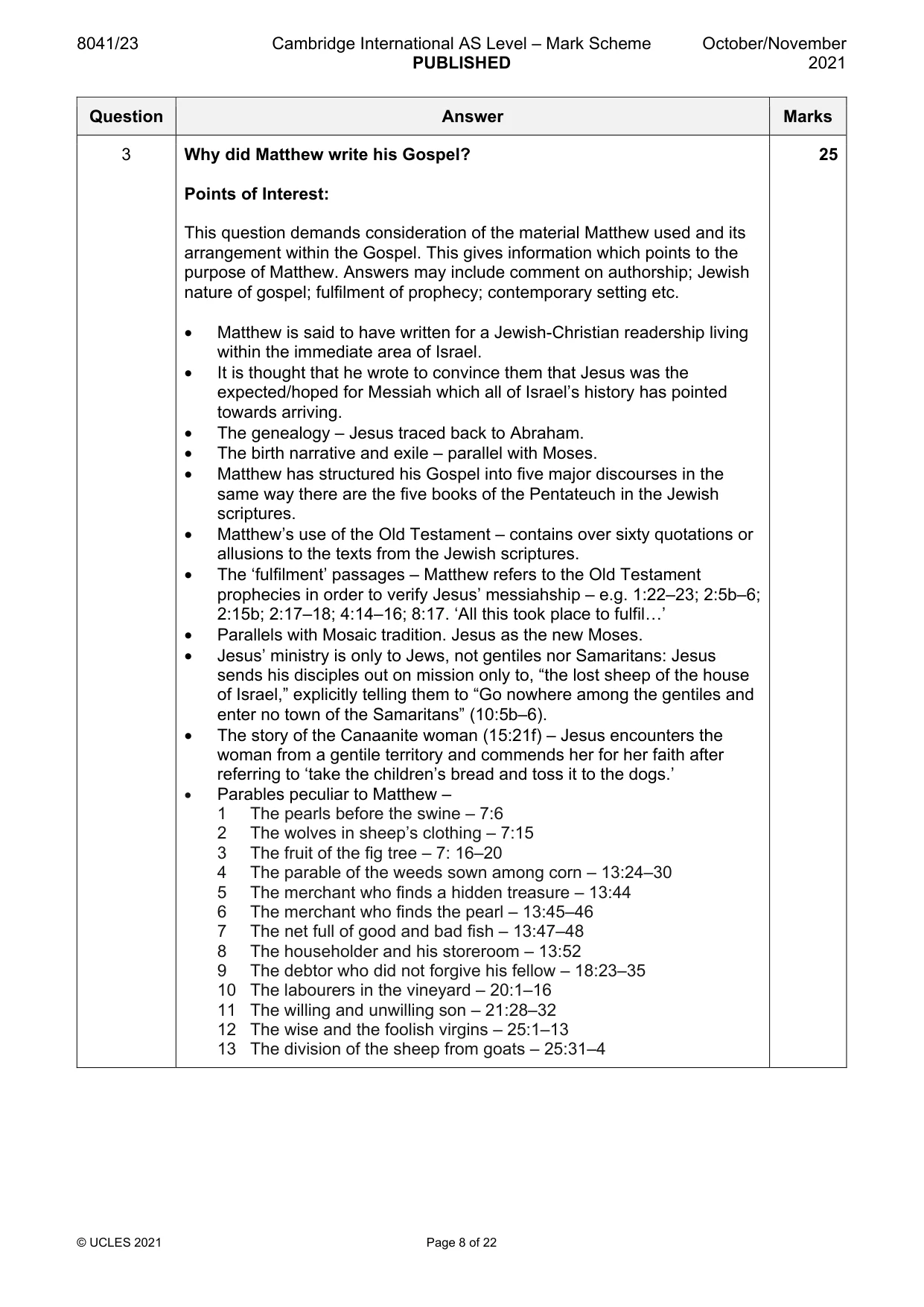
8041/23 Cambridge International AS Level – Mark Scheme PUBLISHED October/November 2021 © UCLES 2021 Page 8 of 22 Question Answer Marks 3 Why did Matthew write his Gospel? Points of Interest: This question demands consideration of the material Matthew used and its arrangement within the Gospel. This gives information which points to the purpose of Matthew. Answers may include comment on authorship; Jewish nature of gospel; fulfilment of prophecy; contemporary setting etc. • Matthew is said to have written for a Jewish-Christian readership living within the immediate area of Israel. • It is thought that he wrote to convince them that Jesus was the expected/hoped for Messiah which all of Israel’s history has pointed towards arriving. • The genealogy – Jesus traced back to Abraham. • The birth narrative and exile – parallel with Moses. • Matthew has structured his Gospel into five major discourses in the same way there are the five books of the Pentateuch in the Jewish scriptures. • Matthew’s use of the Old Testament – contains over sixty quotations or allusions to the texts from the Jewish scriptures. • The ‘fulfilment’ passages – Matthew refers to the Old Testament prophecies in order to verify Jesus’ messiahship – e.g. 1:22–23; 2:5b–6; 2:15b; 2:17–18; 4:14–16; 8:17. ‘All this took place to fulfil…’ • Parallels with Mosaic tradition. Jesus as the new Moses. • Jesus’ ministry is only to Jews, not gentiles nor Samaritans: Jesus sends his disciples out on mission only to, “the lost sheep of the house of Israel,” explicitly telling them to “Go nowhere among the gentiles and enter no town of the Samaritans” (10:5b–6). • The story of the Canaanite woman (15:21f) – Jesus encounters the woman from a gentile territory and commends her for her faith after referring to ‘take the children’s bread and toss it to the dogs.’ • Parables peculiar to Matthew – 1 The pearls before the swine – 7:6 2 The wolves in sheep’s clothing – 7:15 3 The fruit of the fig tree – 7: 16–20 4 The parable of the weeds sown among corn – 13:24–30 5 The merchant who finds a hidden treasure – 13:44 6 The merchant who finds the pearl – 13:45–46 7 The net full of good and bad fish – 13:47–48 8 The householder and his storeroom – 13:52 9 The debtor who did not forgive his fellow – 18:23–35 10 The labourers in the vineyard – 20:1–16 11 The willing and unwilling son – 21:28–32 12 The wise and the foolish virgins – 25:1–13 13 The division of the sheep from goats – 25:31–4 25
Mark scheme, page 9
8041/23 Cambridge International AS Level – Mark Scheme PUBLISHED October/November 2021 © UCLES 2021 Page 9 of 22 Question Answer Marks 3 Some of these parables can be used to show the purpose of the Gospel writer. • Matthew condemns the stringent laws of the Pharisees. He pronounces the seven woes upon them – chapter 23. • Jesus’ conflict with the religious authorities. • The Great Commission – Jesus’ final words to the disciples was to go to all the nations of the world and make then disciples. This gives authenticity to the Gospel being preached to Jews and gentiles, the Kingdom message is no longer exclusively for the Jews.
Mark scheme, page 10
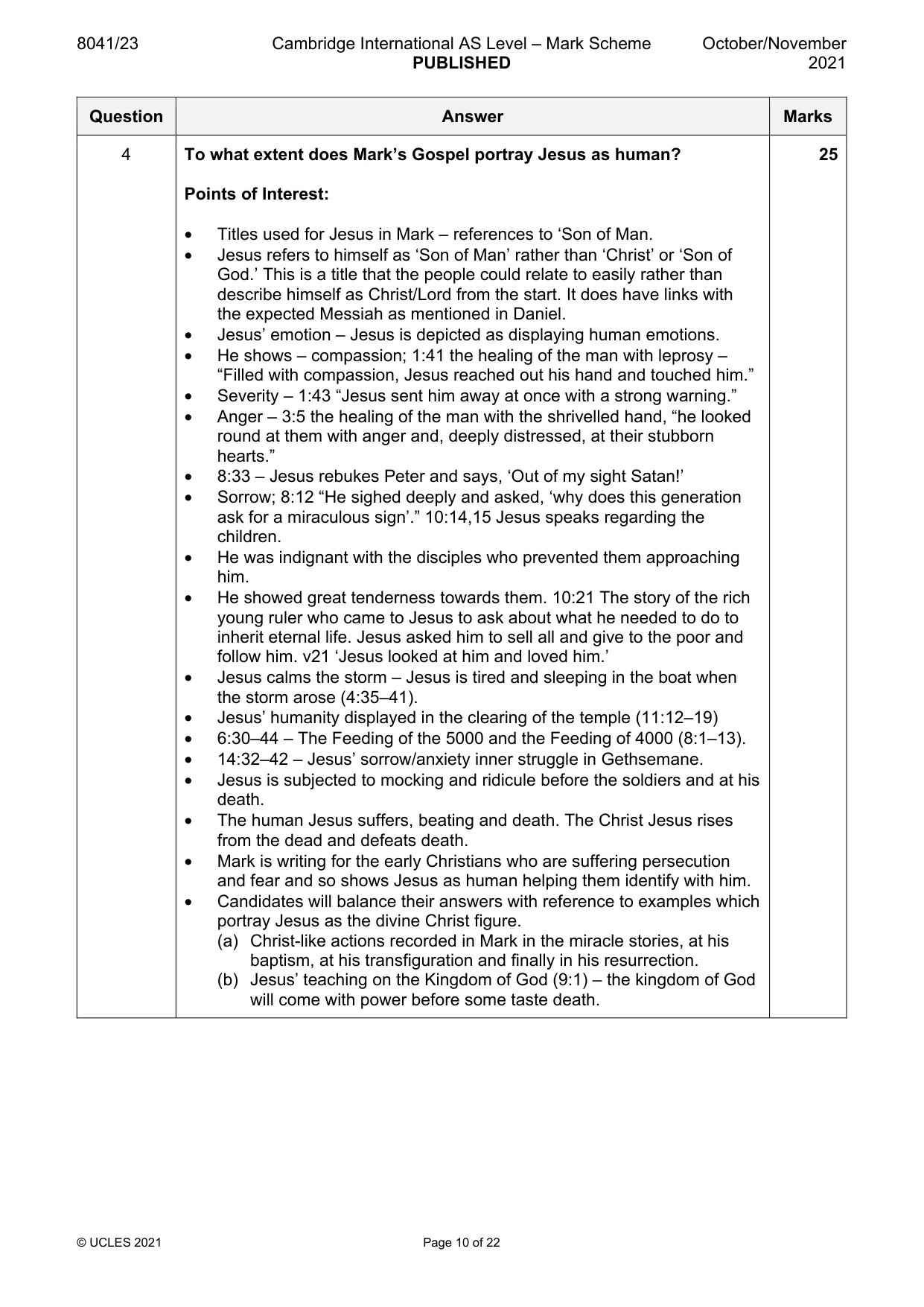
8041/23 Cambridge International AS Level – Mark Scheme PUBLISHED October/November 2021 © UCLES 2021 Page 10 of 22 Question Answer Marks 4 To what extent does Mark’s Gospel portray Jesus as human? Points of Interest: • Titles used for Jesus in Mark – references to ‘Son of Man. • Jesus refers to himself as ‘Son of Man’ rather than ‘Christ’ or ‘Son of God.’ This is a title that the people could relate to easily rather than describe himself as Christ/Lord from the start. It does have links with the expected Messiah as mentioned in Daniel. • Jesus’ emotion – Jesus is depicted as displaying human emotions. • He shows – compassion; 1:41 the healing of the man with leprosy – “Filled with compassion, Jesus reached out his hand and touched him.” • Severity – 1:43 “Jesus sent him away at once with a strong warning.” • Anger – 3:5 the healing of the man with the shrivelled hand, “he looked round at them with anger and, deeply distressed, at their stubborn hearts.” • 8:33 – Jesus rebukes Peter and says, ‘Out of my sight Satan!’ • Sorrow; 8:12 “He sighed deeply and asked, ‘why does this generation ask for a miraculous sign’.” 10:14,15 Jesus speaks regarding the children. • He was indignant with the disciples who prevented them approaching him. • He showed great tenderness towards them. 10:21 The story of the rich young ruler who came to Jesus to ask about what he needed to do to inherit eternal life. Jesus asked him to sell all and give to the poor and follow him. v21 ‘Jesus looked at him and loved him.’ • Jesus calms the storm – Jesus is tired and sleeping in the boat when the storm arose (4:35–41). • Jesus’ humanity displayed in the clearing of the temple (11:12–19) • 6:30–44 – The Feeding of the 5000 and the Feeding of 4000 (8:1–13). • 14:32–42 – Jesus’ sorrow/anxiety inner struggle in Gethsemane. • Jesus is subjected to mocking and ridicule before the soldiers and at his death. • The human Jesus suffers, beating and death. The Christ Jesus rises from the dead and defeats death. • Mark is writing for the early Christians who are suffering persecution and fear and so shows Jesus as human helping them identify with him. • Candidates will balance their answers with reference to examples which portray Jesus as the divine Christ figure. (a) Christ-like actions recorded in Mark in the miracle stories, at his baptism, at his transfiguration and finally in his resurrection. (b) Jesus’ teaching on the Kingdom of God (9:1) – the kingdom of God will come with power before some taste death. 25
Mark scheme, page 11
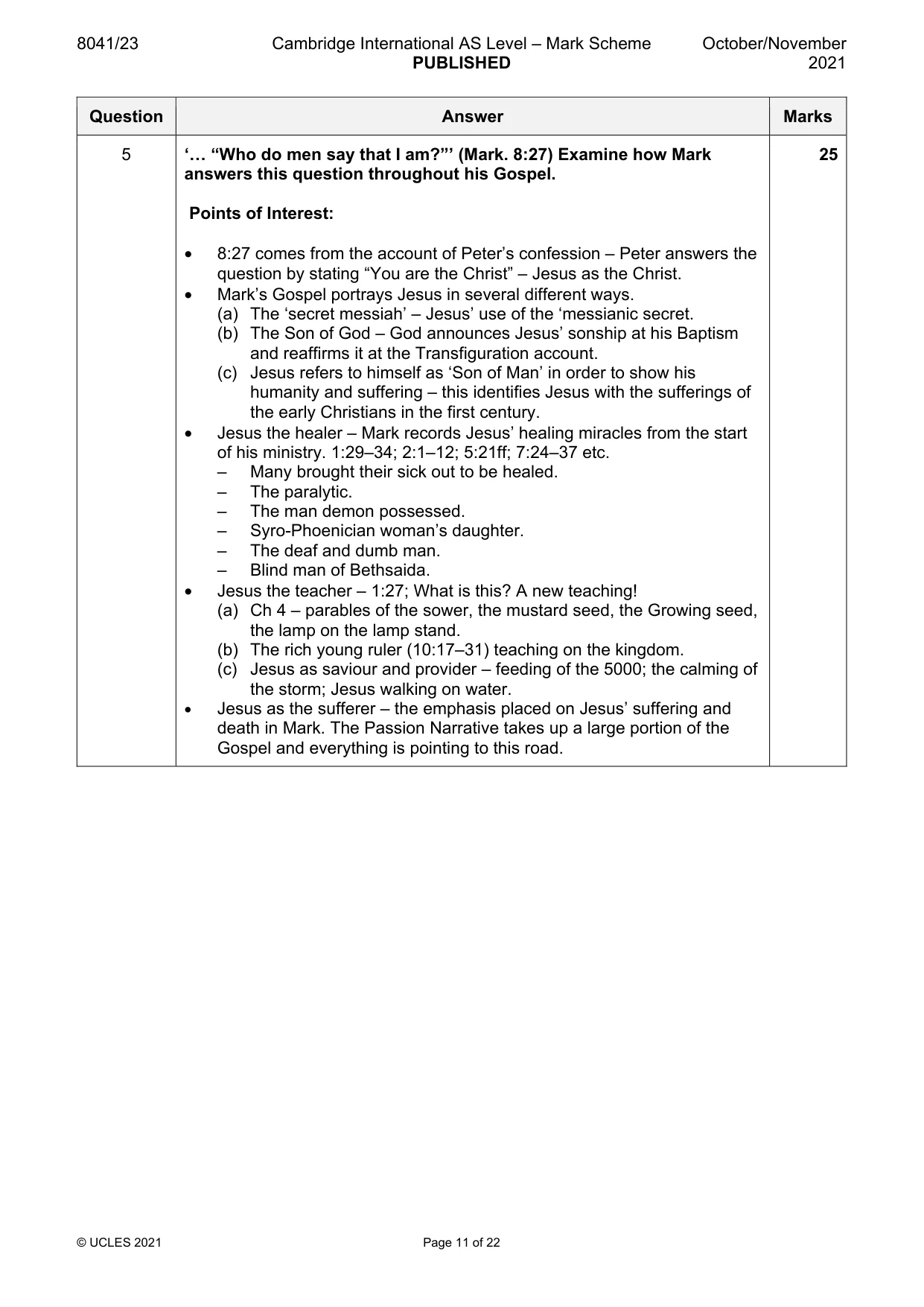
8041/23 Cambridge International AS Level – Mark Scheme PUBLISHED October/November 2021 © UCLES 2021 Page 11 of 22 Question Answer Marks 5 ‘… “Who do men say that I am?”’ (Mark. 8:27) Examine how Mark answers this question throughout his Gospel. Points of Interest: • 8:27 comes from the account of Peter’s confession – Peter answers the question by stating “You are the Christ” – Jesus as the Christ. • Mark’s Gospel portrays Jesus in several different ways. (a) The ‘secret messiah’ – Jesus’ use of the ‘messianic secret. (b) The Son of God – God announces Jesus’ sonship at his Baptism and reaffirms it at the Transfiguration account. (c) Jesus refers to himself as ‘Son of Man’ in order to show his humanity and suffering – this identifies Jesus with the sufferings of the early Christians in the first century. • Jesus the healer – Mark records Jesus’ healing miracles from the start of his ministry. 1:29–34; 2:1–12; 5:21ff; 7:24–37 etc. – Many brought their sick out to be healed. – The paralytic. – The man demon possessed. – Syro-Phoenician woman’s daughter. – The deaf and dumb man. – Blind man of Bethsaida. • Jesus the teacher – 1:27; What is this? A new teaching! (a) Ch 4 – parables of the sower, the mustard seed, the Growing seed, the lamp on the lamp stand. (b) The rich young ruler (10:17–31) teaching on the kingdom. (c) Jesus as saviour and provider – feeding of the 5000; the calming of the storm; Jesus walking on water. • Jesus as the sufferer – the emphasis placed on Jesus’ suffering and death in Mark. The Passion Narrative takes up a large portion of the Gospel and everything is pointing to this road. 25
Mark scheme, page 12
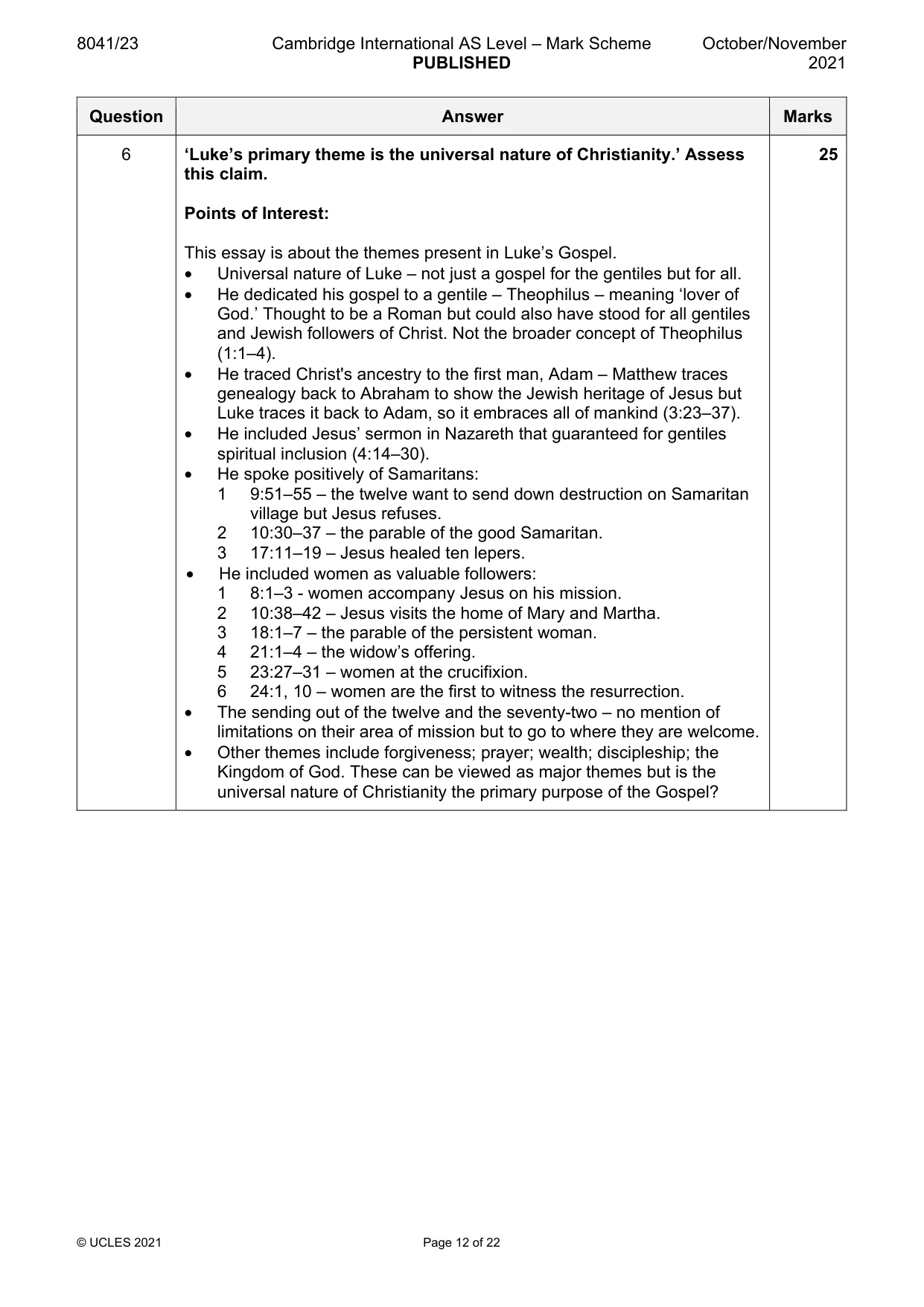
8041/23 Cambridge International AS Level – Mark Scheme PUBLISHED October/November 2021 © UCLES 2021 Page 12 of 22 Question Answer Marks 6 ‘Luke’s primary theme is the universal nature of Christianity.’ Assess this claim. Points of Interest: This essay is about the themes present in Luke’s Gospel. • Universal nature of Luke – not just a gospel for the gentiles but for all. • He dedicated his gospel to a gentile – Theophilus – meaning ‘lover of God.’ Thought to be a Roman but could also have stood for all gentiles and Jewish followers of Christ. Not the broader concept of Theophilus (1:1–4). • He traced Christ's ancestry to the first man, Adam – Matthew traces genealogy back to Abraham to show the Jewish heritage of Jesus but Luke traces it back to Adam, so it embraces all of mankind (3:23–37). • He included Jesus’ sermon in Nazareth that guaranteed for gentiles spiritual inclusion (4:14–30). • He spoke positively of Samaritans: 1 9:51–55 – the twelve want to send down destruction on Samaritan village but Jesus refuses. 2 10:30–37 – the parable of the good Samaritan. 3 17:11–19 – Jesus healed ten lepers. • He included women as valuable followers: 1 8:1–3 - women accompany Jesus on his mission. 2 10:38–42 – Jesus visits the home of Mary and Martha. 3 18:1–7 – the parable of the persistent woman. 4 21:1–4 – the widow’s offering. 5 23:27–31 – women at the crucifixion. 6 24:1, 10 – women are the first to witness the resurrection. • The sending out of the twelve and the seventy-two – no mention of limitations on their area of mission but to go to where they are welcome. • Other themes include forgiveness; prayer; wealth; discipleship; the Kingdom of God. These can be viewed as major themes but is the universal nature of Christianity the primary purpose of the Gospel? 25
Mark scheme, page 13
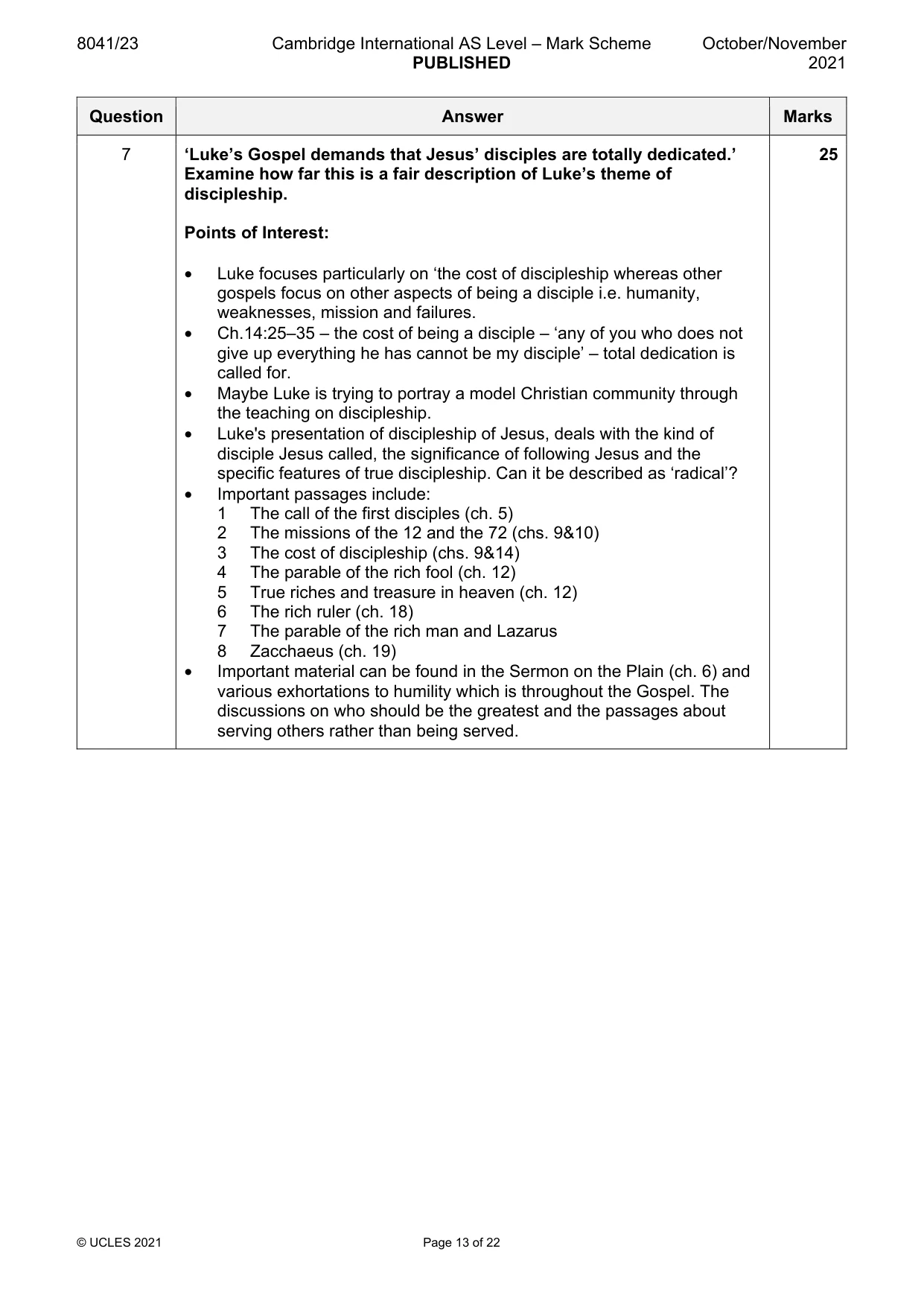
8041/23 Cambridge International AS Level – Mark Scheme PUBLISHED October/November 2021 © UCLES 2021 Page 13 of 22 Question Answer Marks 7 ‘Luke’s Gospel demands that Jesus’ disciples are totally dedicated.’ Examine how far this is a fair description of Luke’s theme of discipleship. Points of Interest: • Luke focuses particularly on ‘the cost of discipleship whereas other gospels focus on other aspects of being a disciple i.e. humanity, weaknesses, mission and failures. • Ch.14:25–35 – the cost of being a disciple – ‘any of you who does not give up everything he has cannot be my disciple’ – total dedication is called for. • Maybe Luke is trying to portray a model Christian community through the teaching on discipleship. • Luke's presentation of discipleship of Jesus, deals with the kind of disciple Jesus called, the significance of following Jesus and the specific features of true discipleship. Can it be described as ‘radical’? • Important passages include: 1 The call of the first disciples (ch. 5) 2 The missions of the 12 and the 72 (chs. 9&10) 3 The cost of discipleship (chs. 9&14) 4 The parable of the rich fool (ch. 12) 5 True riches and treasure in heaven (ch. 12) 6 The rich ruler (ch. 18) 7 The parable of the rich man and Lazarus 8 Zacchaeus (ch. 19) • Important material can be found in the Sermon on the Plain (ch. 6) and various exhortations to humility which is throughout the Gospel. The discussions on who should be the greatest and the passages about serving others rather than being served. 25
Mark scheme, page 14
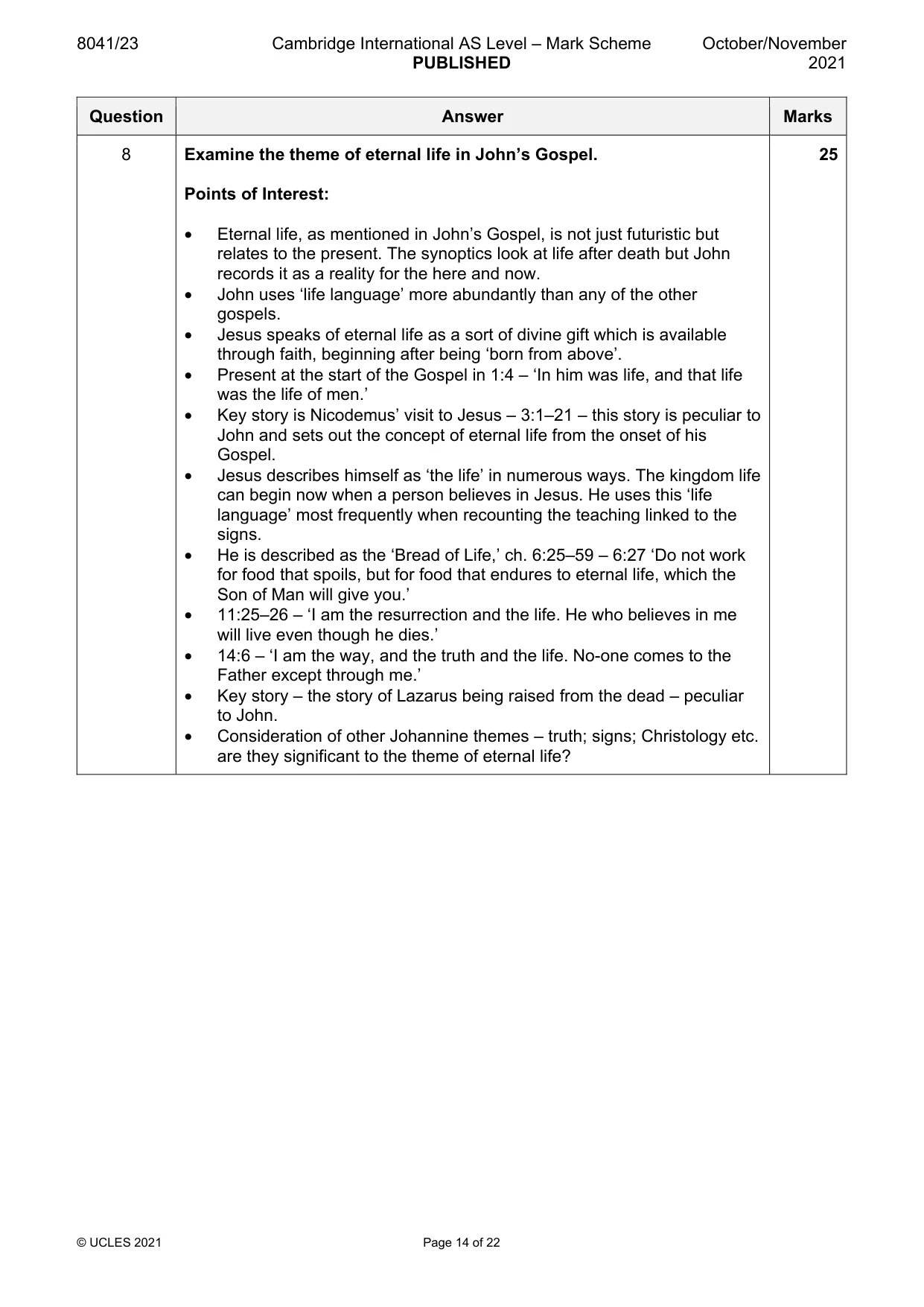
8041/23 Cambridge International AS Level – Mark Scheme PUBLISHED October/November 2021 © UCLES 2021 Page 14 of 22 Question Answer Marks 8 Examine the theme of eternal life in John’s Gospel. Points of Interest: • Eternal life, as mentioned in John’s Gospel, is not just futuristic but relates to the present. The synoptics look at life after death but John records it as a reality for the here and now. • John uses ‘life language’ more abundantly than any of the other gospels. • Jesus speaks of eternal life as a sort of divine gift which is available through faith, beginning after being ‘born from above’. • Present at the start of the Gospel in 1:4 – ‘In him was life, and that life was the life of men.’ • Key story is Nicodemus’ visit to Jesus – 3:1–21 – this story is peculiar to John and sets out the concept of eternal life from the onset of his Gospel. • Jesus describes himself as ‘the life’ in numerous ways. The kingdom life can begin now when a person believes in Jesus. He uses this ‘life language’ most frequently when recounting the teaching linked to the signs. • He is described as the ‘Bread of Life,’ ch. 6:25–59 – 6:27 ‘Do not work for food that spoils, but for food that endures to eternal life, which the Son of Man will give you.’ • 11:25–26 – ‘I am the resurrection and the life. He who believes in me will live even though he dies.’ • 14:6 – ‘I am the way, and the truth and the life. No-one comes to the Father except through me.’ • Key story – the story of Lazarus being raised from the dead – peculiar to John. • Consideration of other Johannine themes – truth; signs; Christology etc. are they significant to the theme of eternal life? 25
Mark scheme, page 15
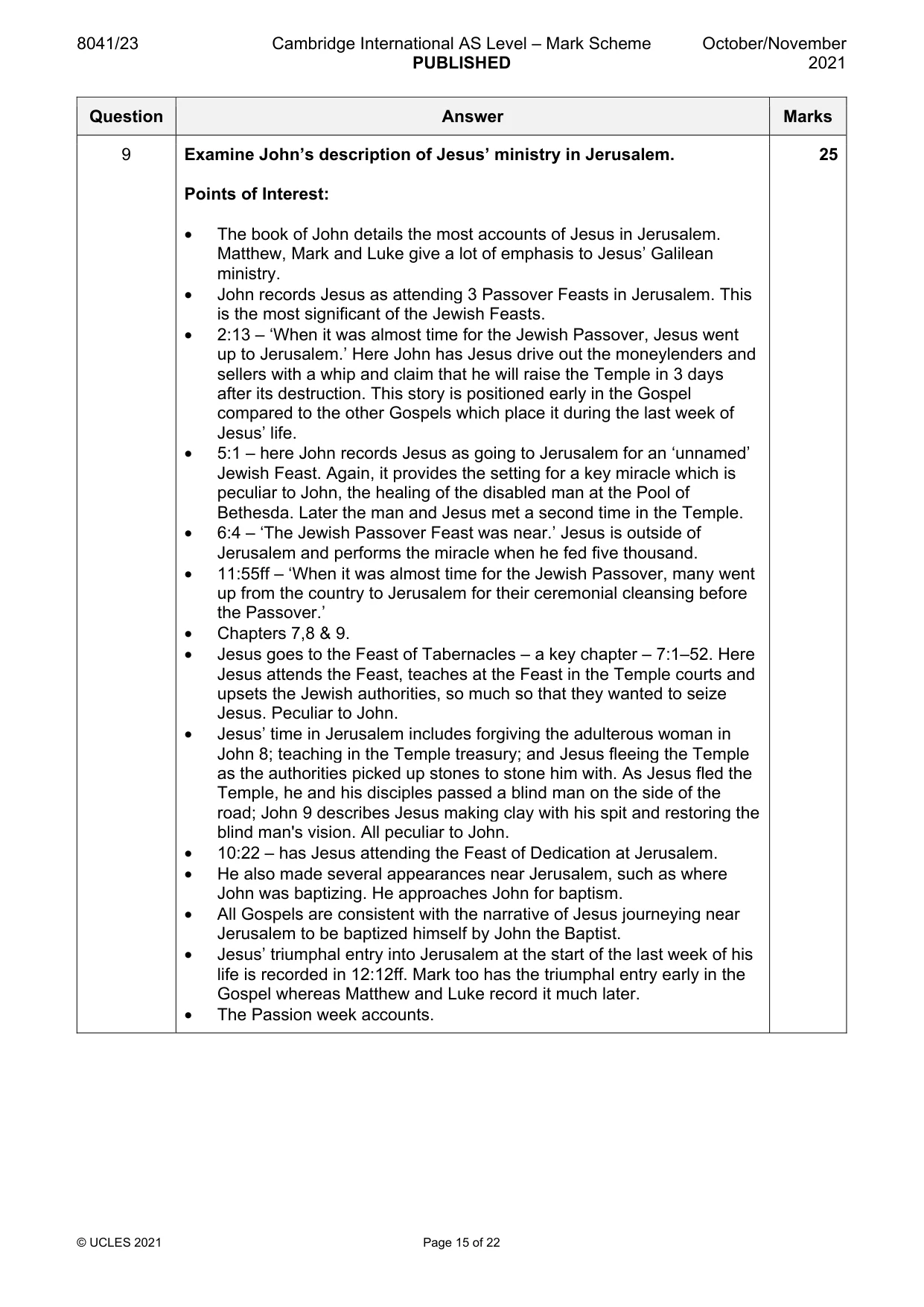
8041/23 Cambridge International AS Level – Mark Scheme PUBLISHED October/November 2021 © UCLES 2021 Page 15 of 22 Question Answer Marks 9 Examine John’s description of Jesus’ ministry in Jerusalem. Points of Interest: • The book of John details the most accounts of Jesus in Jerusalem. Matthew, Mark and Luke give a lot of emphasis to Jesus’ Galilean ministry. • John records Jesus as attending 3 Passover Feasts in Jerusalem. This is the most significant of the Jewish Feasts. • 2:13 – ‘When it was almost time for the Jewish Passover, Jesus went up to Jerusalem.’ Here John has Jesus drive out the moneylenders and sellers with a whip and claim that he will raise the Temple in 3 days after its destruction. This story is positioned early in the Gospel compared to the other Gospels which place it during the last week of Jesus’ life. • 5:1 – here John records Jesus as going to Jerusalem for an ‘unnamed’ Jewish Feast. Again, it provides the setting for a key miracle which is peculiar to John, the healing of the disabled man at the Pool of Bethesda. Later the man and Jesus met a second time in the Temple. • 6:4 – ‘The Jewish Passover Feast was near.’ Jesus is outside of Jerusalem and performs the miracle when he fed five thousand. • 11:55ff – ‘When it was almost time for the Jewish Passover, many went up from the country to Jerusalem for their ceremonial cleansing before the Passover.’ • Chapters 7,8 & 9. • Jesus goes to the Feast of Tabernacles – a key chapter – 7:1–52. Here Jesus attends the Feast, teaches at the Feast in the Temple courts and upsets the Jewish authorities, so much so that they wanted to seize Jesus. Peculiar to John. • Jesus’ time in Jerusalem includes forgiving the adulterous woman in John 8; teaching in the Temple treasury; and Jesus fleeing the Temple as the authorities picked up stones to stone him with. As Jesus fled the Temple, he and his disciples passed a blind man on the side of the road; John 9 describes Jesus making clay with his spit and restoring the blind man's vision. All peculiar to John. • 10:22 – has Jesus attending the Feast of Dedication at Jerusalem. • He also made several appearances near Jerusalem, such as where John was baptizing. He approaches John for baptism. • All Gospels are consistent with the narrative of Jesus journeying near Jerusalem to be baptized himself by John the Baptist. • Jesus’ triumphal entry into Jerusalem at the start of the last week of his life is recorded in 12:12ff. Mark too has the triumphal entry early in the Gospel whereas Matthew and Luke record it much later. • The Passion week accounts. 25
Mark scheme, page 16
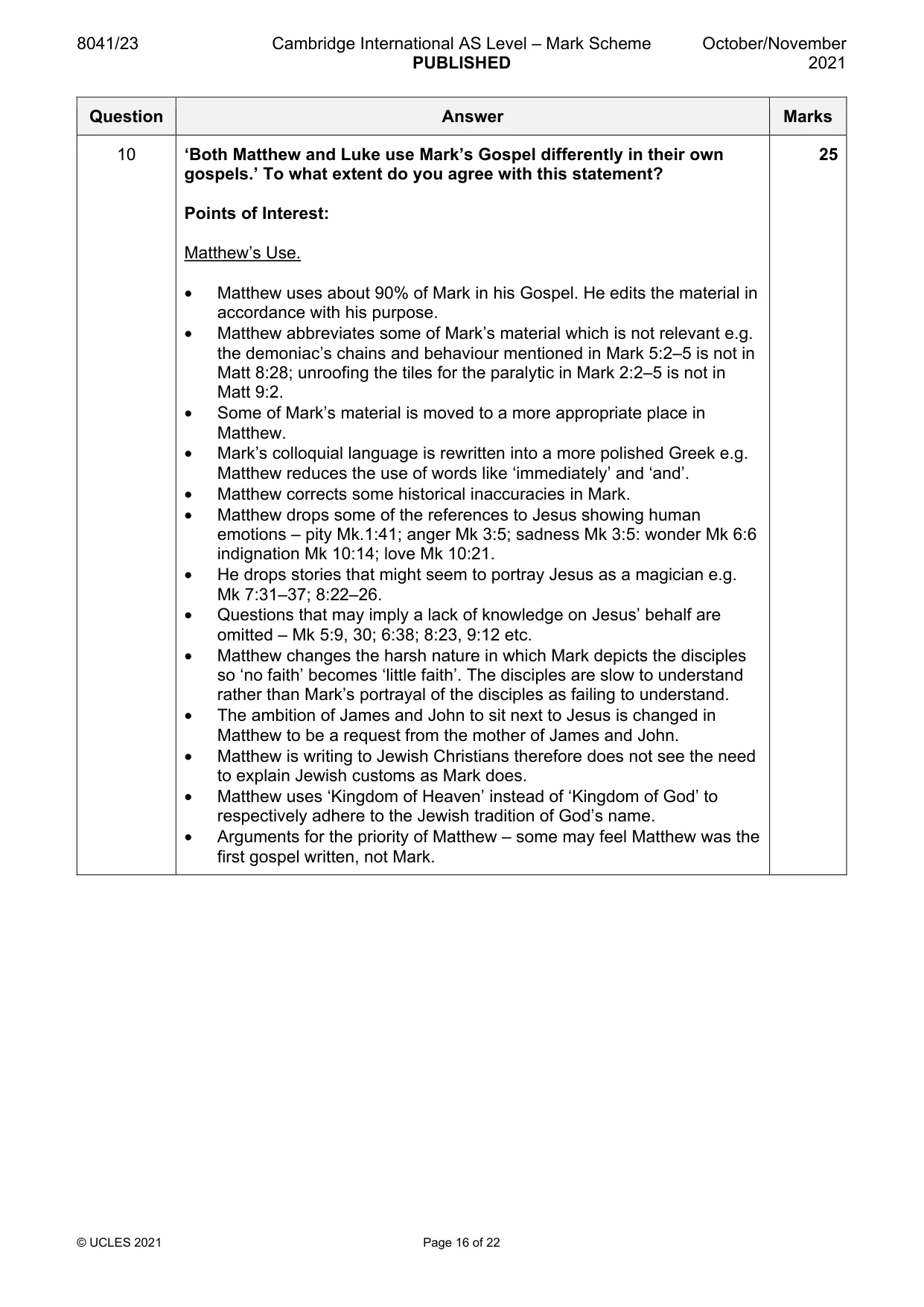
8041/23 Cambridge International AS Level – Mark Scheme PUBLISHED October/November 2021 © UCLES 2021 Page 16 of 22 Question Answer Marks 10 ‘Both Matthew and Luke use Mark’s Gospel differently in their own gospels.’ To what extent do you agree with this statement? Points of Interest: Matthew’s Use. • Matthew uses about 90% of Mark in his Gospel. He edits the material in accordance with his purpose. • Matthew abbreviates some of Mark’s material which is not relevant e.g. the demoniac’s chains and behaviour mentioned in Mark 5:2–5 is not in Matt 8:28; unroofing the tiles for the paralytic in Mark 2:2–5 is not in Matt 9:2. • Some of Mark’s material is moved to a more appropriate place in Matthew. • Mark’s colloquial language is rewritten into a more polished Greek e.g. Matthew reduces the use of words like ‘immediately’ and ‘and’. • Matthew corrects some historical inaccuracies in Mark. • Matthew drops some of the references to Jesus showing human emotions – pity Mk.1:41; anger Mk 3:5; sadness Mk 3:5: wonder Mk 6:6 indignation Mk 10:14; love Mk 10:21. • He drops stories that might seem to portray Jesus as a magician e.g. Mk 7:31–37; 8:22–26. • Questions that may imply a lack of knowledge on Jesus’ behalf are omitted – Mk 5:9, 30; 6:38; 8:23, 9:12 etc. • Matthew changes the harsh nature in which Mark depicts the disciples so ‘no faith’ becomes ‘little faith’. The disciples are slow to understand rather than Mark’s portrayal of the disciples as failing to understand. • The ambition of James and John to sit next to Jesus is changed in Matthew to be a request from the mother of James and John. • Matthew is writing to Jewish Christians therefore does not see the need to explain Jewish customs as Mark does. • Matthew uses ‘Kingdom of Heaven’ instead of ‘Kingdom of God’ to respectively adhere to the Jewish tradition of God’s name. • Arguments for the priority of Matthew – some may feel Matthew was the first gospel written, not Mark. 25
Mark scheme, page 17
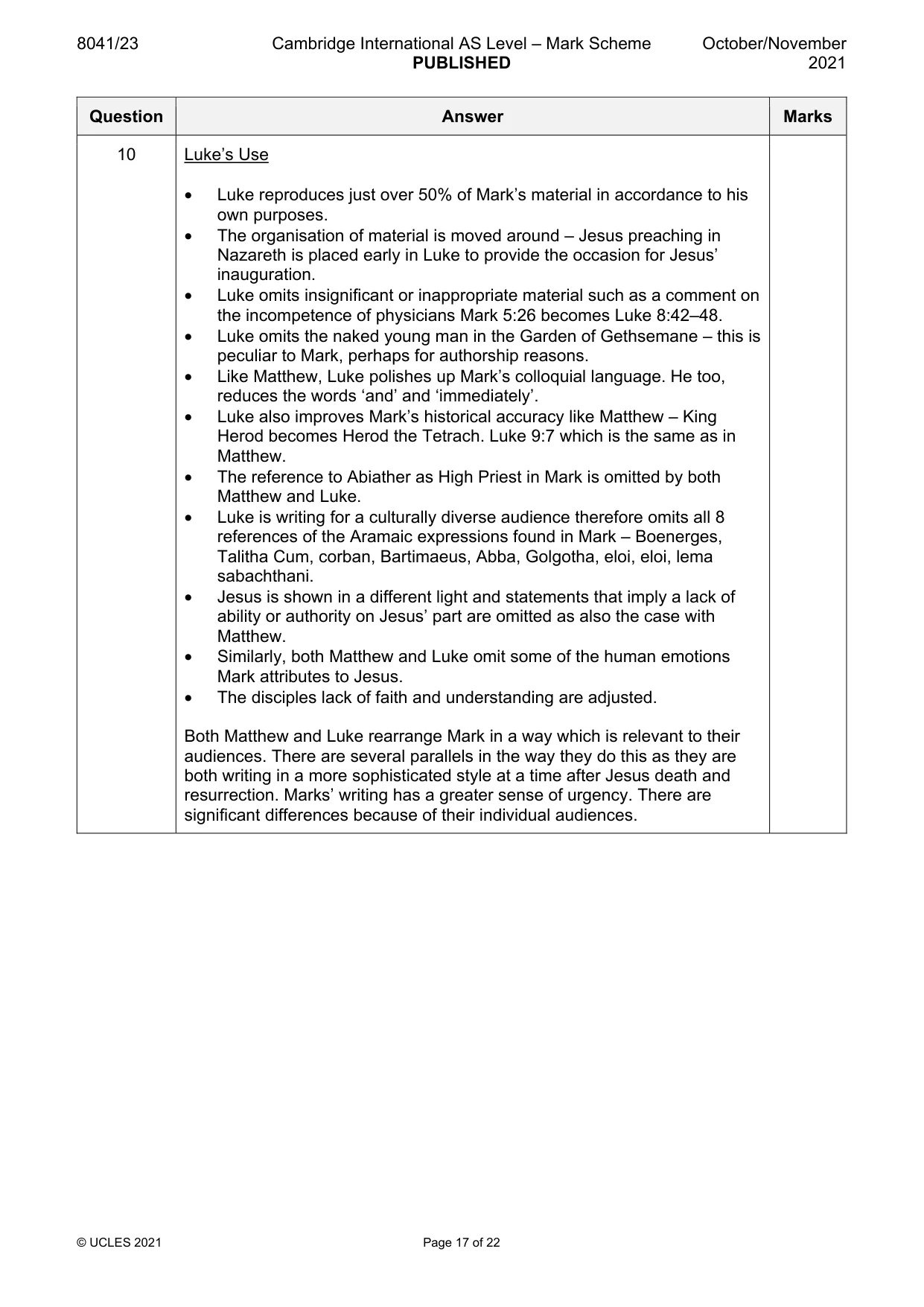
8041/23 Cambridge International AS Level – Mark Scheme PUBLISHED October/November 2021 © UCLES 2021 Page 17 of 22 Question Answer Marks 10 Luke’s Use • Luke reproduces just over 50% of Mark’s material in accordance to his own purposes. • The organisation of material is moved around – Jesus preaching in Nazareth is placed early in Luke to provide the occasion for Jesus’ inauguration. • Luke omits insignificant or inappropriate material such as a comment on the incompetence of physicians Mark 5:26 becomes Luke 8:42–48. • Luke omits the naked young man in the Garden of Gethsemane – this is peculiar to Mark, perhaps for authorship reasons. • Like Matthew, Luke polishes up Mark’s colloquial language. He too, reduces the words ‘and’ and ‘immediately’. • Luke also improves Mark’s historical accuracy like Matthew – King Herod becomes Herod the Tetrach. Luke 9:7 which is the same as in Matthew. • The reference to Abiather as High Priest in Mark is omitted by both Matthew and Luke. • Luke is writing for a culturally diverse audience therefore omits all 8 references of the Aramaic expressions found in Mark – Boenerges, Talitha Cum, corban, Bartimaeus, Abba, Golgotha, eloi, eloi, lema sabachthani. • Jesus is shown in a different light and statements that imply a lack of ability or authority on Jesus’ part are omitted as also the case with Matthew. • Similarly, both Matthew and Luke omit some of the human emotions Mark attributes to Jesus. • The disciples lack of faith and understanding are adjusted. Both Matthew and Luke rearrange Mark in a way which is relevant to their audiences. There are several parallels in the way they do this as they are both writing in a more sophisticated style at a time after Jesus death and resurrection. Marks’ writing has a greater sense of urgency. There are significant differences because of their individual audiences.
Mark scheme, page 18
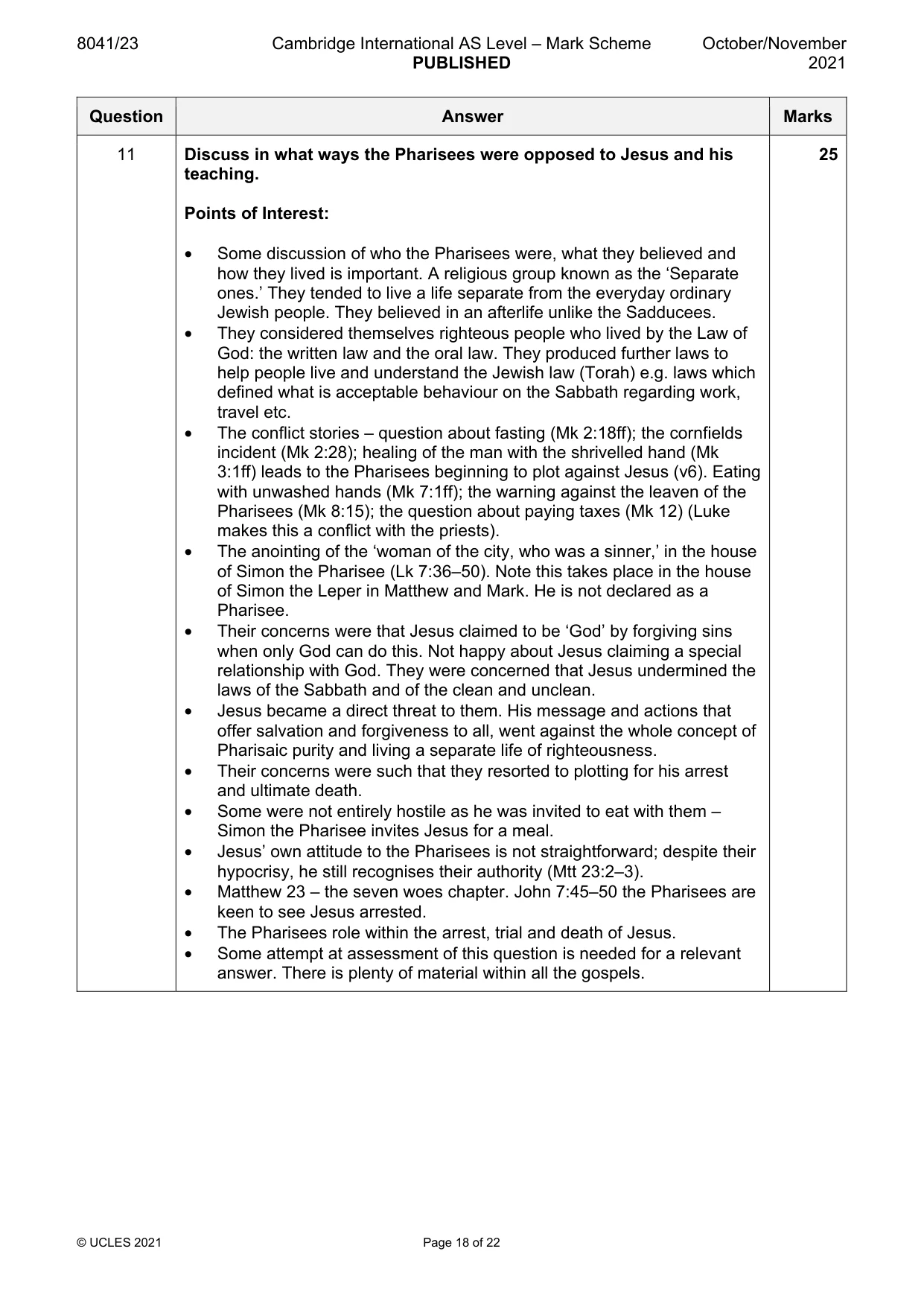
8041/23 Cambridge International AS Level – Mark Scheme PUBLISHED October/November 2021 © UCLES 2021 Page 18 of 22 Question Answer Marks 11 Discuss in what ways the Pharisees were opposed to Jesus and his teaching. Points of Interest: • Some discussion of who the Pharisees were, what they believed and how they lived is important. A religious group known as the ‘Separate ones.’ They tended to live a life separate from the everyday ordinary Jewish people. They believed in an afterlife unlike the Sadducees. • They considered themselves righteous people who lived by the Law of God: the written law and the oral law. They produced further laws to help people live and understand the Jewish law (Torah) e.g. laws which defined what is acceptable behaviour on the Sabbath regarding work, travel etc. • The conflict stories – question about fasting (Mk 2:18ff); the cornfields incident (Mk 2:28); healing of the man with the shrivelled hand (Mk 3:1ff) leads to the Pharisees beginning to plot against Jesus (v6). Eating with unwashed hands (Mk 7:1ff); the warning against the leaven of the Pharisees (Mk 8:15); the question about paying taxes (Mk 12) (Luke makes this a conflict with the priests). • The anointing of the ‘woman of the city, who was a sinner,’ in the house of Simon the Pharisee (Lk 7:36–50). Note this takes place in the house of Simon the Leper in Matthew and Mark. He is not declared as a Pharisee. • Their concerns were that Jesus claimed to be ‘God’ by forgiving sins when only God can do this. Not happy about Jesus claiming a special relationship with God. They were concerned that Jesus undermined the laws of the Sabbath and of the clean and unclean. • Jesus became a direct threat to them. His message and actions that offer salvation and forgiveness to all, went against the whole concept of Pharisaic purity and living a separate life of righteousness. • Their concerns were such that they resorted to plotting for his arrest and ultimate death. • Some were not entirely hostile as he was invited to eat with them – Simon the Pharisee invites Jesus for a meal. • Jesus’ own attitude to the Pharisees is not straightforward; despite their hypocrisy, he still recognises their authority (Mtt 23:2–3). • Matthew 23 – the seven woes chapter. John 7:45–50 the Pharisees are keen to see Jesus arrested. • The Pharisees role within the arrest, trial and death of Jesus. • Some attempt at assessment of this question is needed for a relevant answer. There is plenty of material within all the gospels. 25
Mark scheme, page 19
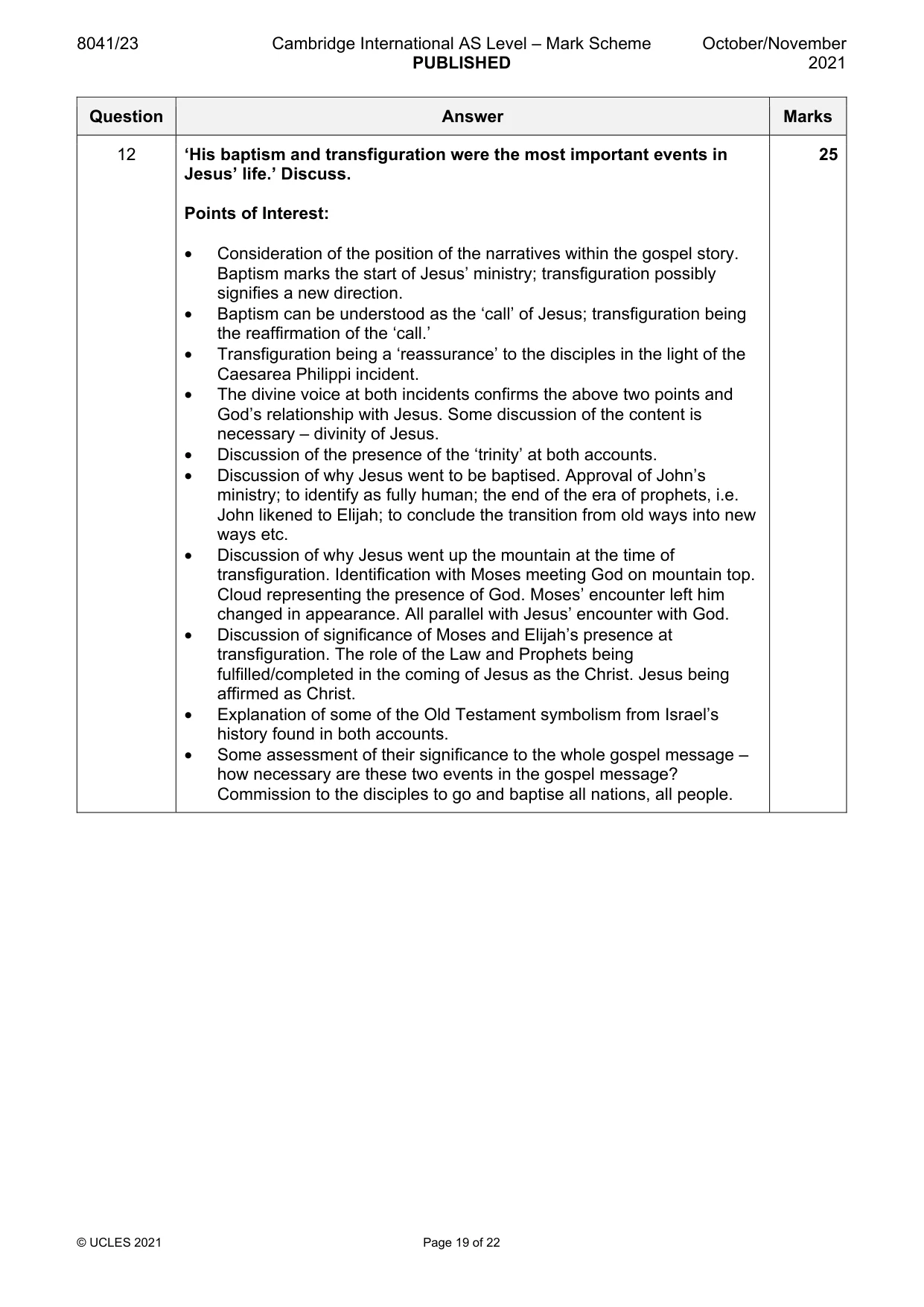
8041/23 Cambridge International AS Level – Mark Scheme PUBLISHED October/November 2021 © UCLES 2021 Page 19 of 22 Question Answer Marks 12 ‘His baptism and transfiguration were the most important events in Jesus’ life.’ Discuss. Points of Interest: • Consideration of the position of the narratives within the gospel story. Baptism marks the start of Jesus’ ministry; transfiguration possibly signifies a new direction. • Baptism can be understood as the ‘call’ of Jesus; transfiguration being the reaffirmation of the ‘call.’ • Transfiguration being a ‘reassurance’ to the disciples in the light of the Caesarea Philippi incident. • The divine voice at both incidents confirms the above two points and God’s relationship with Jesus. Some discussion of the content is necessary – divinity of Jesus. • Discussion of the presence of the ‘trinity’ at both accounts. • Discussion of why Jesus went to be baptised. Approval of John’s ministry; to identify as fully human; the end of the era of prophets, i.e. John likened to Elijah; to conclude the transition from old ways into new ways etc. • Discussion of why Jesus went up the mountain at the time of transfiguration. Identification with Moses meeting God on mountain top. Cloud representing the presence of God. Moses’ encounter left him changed in appearance. All parallel with Jesus’ encounter with God. • Discussion of significance of Moses and Elijah’s presence at transfiguration. The role of the Law and Prophets being fulfilled/completed in the coming of Jesus as the Christ. Jesus being affirmed as Christ. • Explanation of some of the Old Testament symbolism from Israel’s history found in both accounts. • Some assessment of their significance to the whole gospel message – how necessary are these two events in the gospel message? Commission to the disciples to go and baptise all nations, all people. 25
Mark scheme, page 20
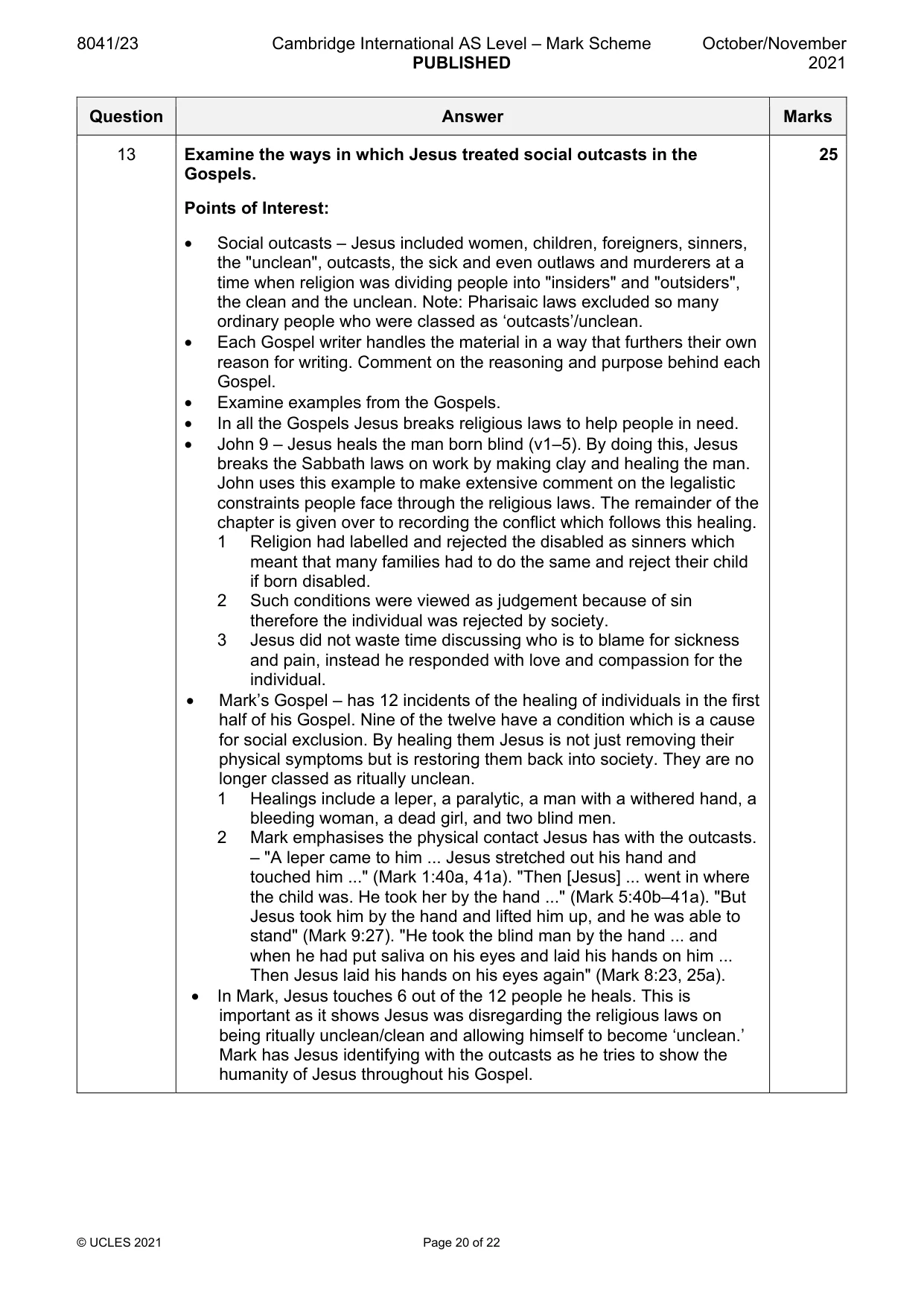
8041/23 Cambridge International AS Level – Mark Scheme PUBLISHED October/November 2021 © UCLES 2021 Page 20 of 22 Question Answer Marks 13 Examine the ways in which Jesus treated social outcasts in the Gospels. Points of Interest: • Social outcasts – Jesus included women, children, foreigners, sinners, the "unclean", outcasts, the sick and even outlaws and murderers at a time when religion was dividing people into "insiders" and "outsiders", the clean and the unclean. Note: Pharisaic laws excluded so many ordinary people who were classed as ‘outcasts’/unclean. • Each Gospel writer handles the material in a way that furthers their own reason for writing. Comment on the reasoning and purpose behind each Gospel. • Examine examples from the Gospels. • In all the Gospels Jesus breaks religious laws to help people in need. • John 9 – Jesus heals the man born blind (v1–5). By doing this, Jesus breaks the Sabbath laws on work by making clay and healing the man. John uses this example to make extensive comment on the legalistic constraints people face through the religious laws. The remainder of the chapter is given over to recording the conflict which follows this healing. 1 Religion had labelled and rejected the disabled as sinners which meant that many families had to do the same and reject their child if born disabled. 2 Such conditions were viewed as judgement because of sin therefore the individual was rejected by society. 3 Jesus did not waste time discussing who is to blame for sickness and pain, instead he responded with love and compassion for the individual. • Mark’s Gospel – has 12 incidents of the healing of individuals in the first half of his Gospel. Nine of the twelve have a condition which is a cause for social exclusion. By healing them Jesus is not just removing their physical symptoms but is restoring them back into society. They are no longer classed as ritually unclean. 1 Healings include a leper, a paralytic, a man with a withered hand, a bleeding woman, a dead girl, and two blind men. 2 Mark emphasises the physical contact Jesus has with the outcasts. – "A leper came to him ... Jesus stretched out his hand and touched him ..." (Mark 1:40a, 41a). "Then [Jesus] ... went in where the child was. He took her by the hand ..." (Mark 5:40b–41a). "But Jesus took him by the hand and lifted him up, and he was able to stand" (Mark 9:27). "He took the blind man by the hand ... and when he had put saliva on his eyes and laid his hands on him ... Then Jesus laid his hands on his eyes again" (Mark 8:23, 25a). • In Mark, Jesus touches 6 out of the 12 people he heals. This is important as it shows Jesus was disregarding the religious laws on being ritually unclean/clean and allowing himself to become ‘unclean.’ Mark has Jesus identifying with the outcasts as he tries to show the humanity of Jesus throughout his Gospel. 25
Mark scheme, page 21
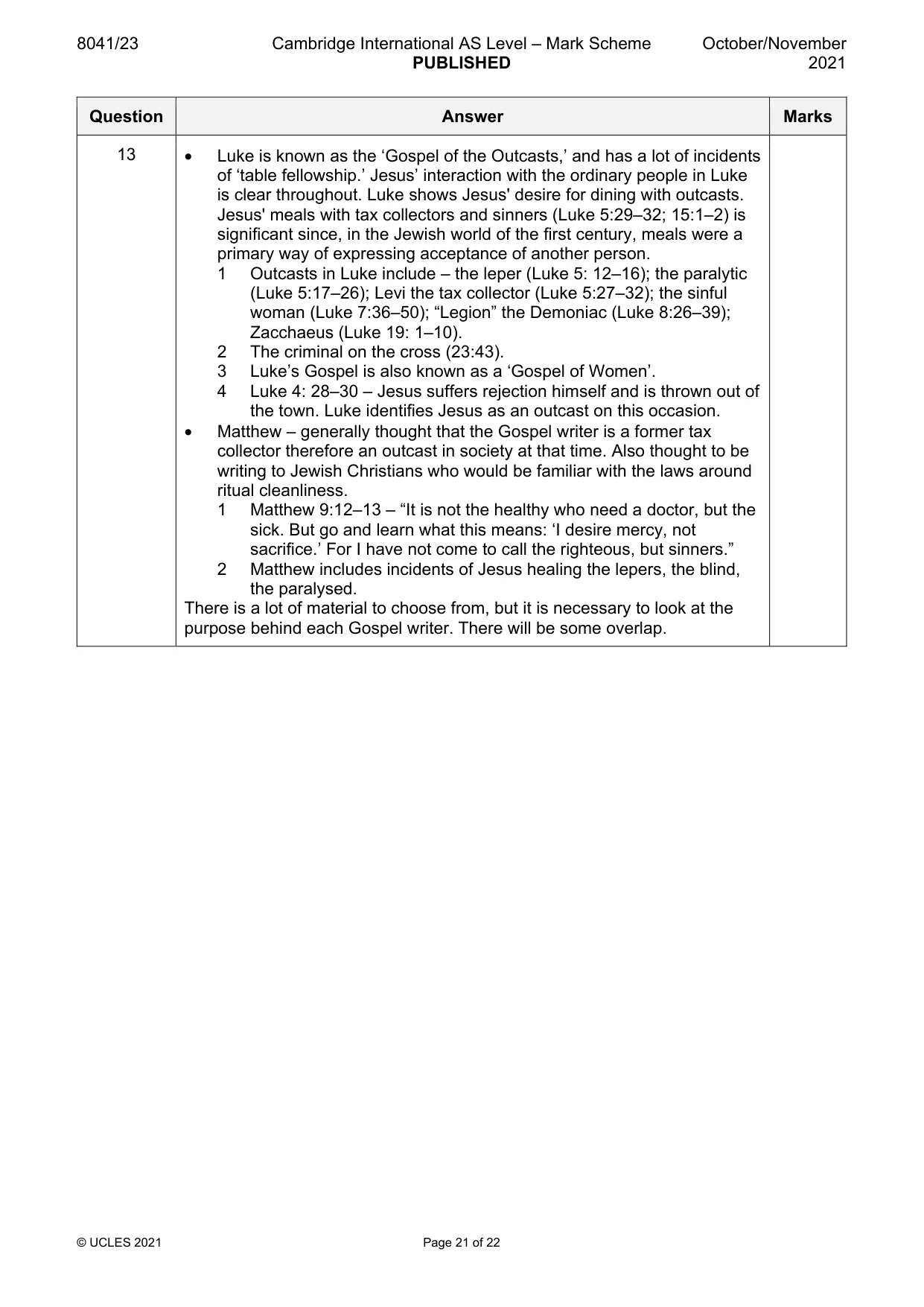
8041/23 Cambridge International AS Level – Mark Scheme PUBLISHED October/November 2021 © UCLES 2021 Page 21 of 22 Question Answer Marks 13 • Luke is known as the ‘Gospel of the Outcasts,’ and has a lot of incidents of ‘table fellowship.’ Jesus’ interaction with the ordinary people in Luke is clear throughout. Luke shows Jesus' desire for dining with outcasts. Jesus' meals with tax collectors and sinners (Luke 5:29–32; 15:1–2) is significant since, in the Jewish world of the first century, meals were a primary way of expressing acceptance of another person. 1 Outcasts in Luke include – the leper (Luke 5: 12–16); the paralytic (Luke 5:17–26); Levi the tax collector (Luke 5:27–32); the sinful woman (Luke 7:36–50); “Legion” the Demoniac (Luke 8:26–39); Zacchaeus (Luke 19: 1–10). 2 The criminal on the cross (23:43). 3 Luke’s Gospel is also known as a ‘Gospel of Women’. 4 Luke 4: 28–30 – Jesus suffers rejection himself and is thrown out of the town. Luke identifies Jesus as an outcast on this occasion. • Matthew – generally thought that the Gospel writer is a former tax collector therefore an outcast in society at that time. Also thought to be writing to Jewish Christians who would be familiar with the laws around ritual cleanliness. 1 Matthew 9:12–13 – “It is not the healthy who need a doctor, but the sick. But go and learn what this means: ‘I desire mercy, not sacrifice.’ For I have not come to call the righteous, but sinners.” 2 Matthew includes incidents of Jesus healing the lepers, the blind, the paralysed. There is a lot of material to choose from, but it is necessary to look at the purpose behind each Gospel writer. There will be some overlap.
Mark scheme, page 22
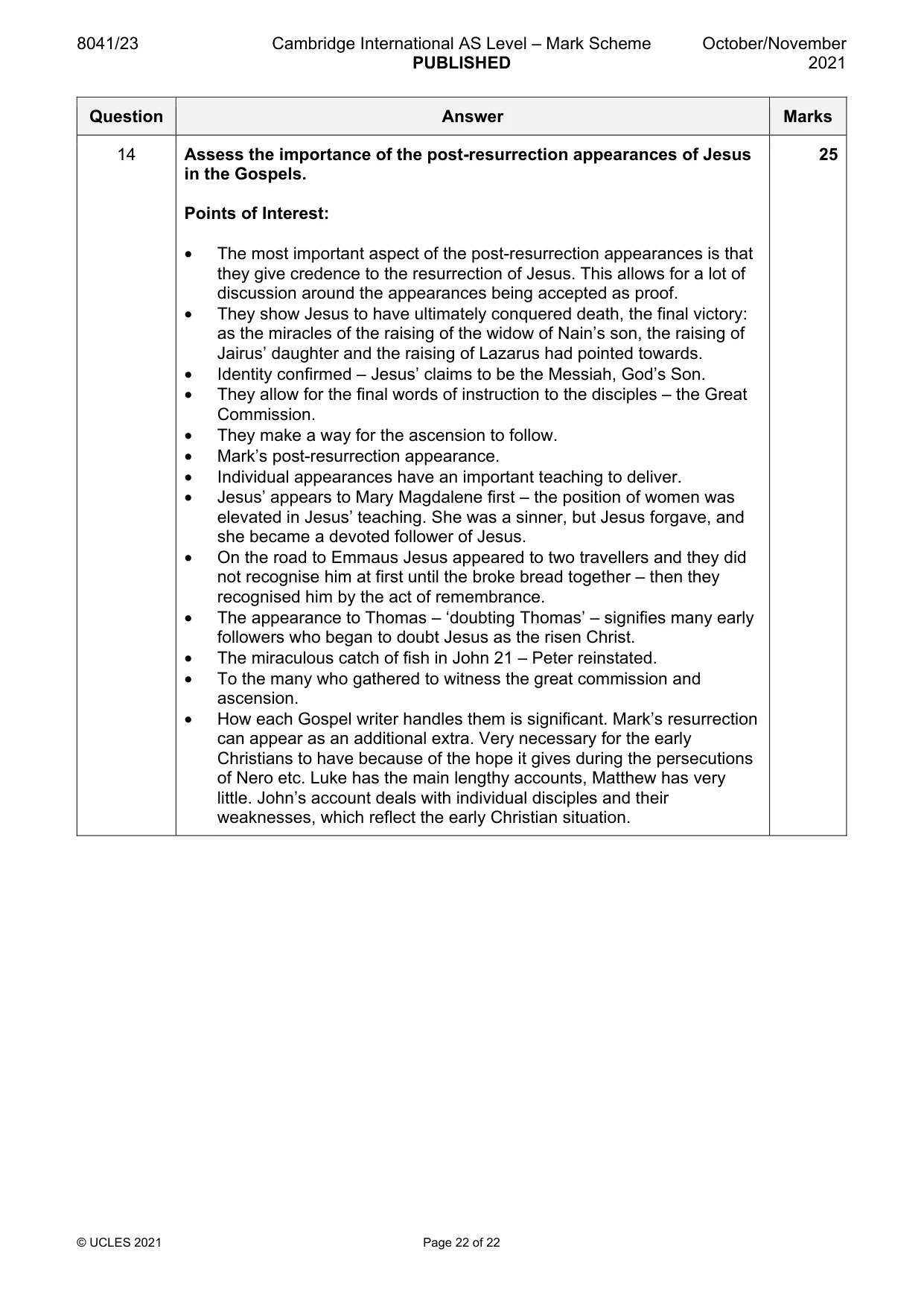
8041/23 Cambridge International AS Level – Mark Scheme PUBLISHED October/November 2021 © UCLES 2021 Page 22 of 22 Question Answer Marks 14 Assess the importance of the post-resurrection appearances of Jesus in the Gospels. Points of Interest: • The most important aspect of the post-resurrection appearances is that they give credence to the resurrection of Jesus. This allows for a lot of discussion around the appearances being accepted as proof. • They show Jesus to have ultimately conquered death, the final victory: as the miracles of the raising of the widow of Nain’s son, the raising of Jairus’ daughter and the raising of Lazarus had pointed towards. • Identity confirmed – Jesus’ claims to be the Messiah, God’s Son. • They allow for the final words of instruction to the disciples – the Great Commission. • They make a way for the ascension to follow. • Mark’s post-resurrection appearance. • Individual appearances have an important teaching to deliver. • Jesus’ appears to Mary Magdalene first – the position of women was elevated in Jesus’ teaching. She was a sinner, but Jesus forgave, and she became a devoted follower of Jesus. • On the road to Emmaus Jesus appeared to two travellers and they did not recognise him at first until the broke bread together – then they recognised him by the act of remembrance. • The appearance to Thomas – ‘doubting Thomas’ – signifies many early followers who began to doubt Jesus as the risen Christ. • The miraculous catch of fish in John 21 – Peter reinstated. • To the many who gathered to witness the great commission and ascension. • How each Gospel writer handles them is significant. Mark’s resurrection can appear as an additional extra. Very necessary for the early Christians to have because of the hope it gives during the persecutions of Nero etc. Luke has the main lengthy accounts, Matthew has very little. John’s account deals with individual disciples and their weaknesses, which reflect the early Christian situation. 25
What you needed in this session
Cambridge’s own grade thresholds for 2021 Oct/Nov, Paper 2 · Variant 3. A higher threshold means an easier paper — the bar moves with how the cohort did.