Cambridge A Level Divinity (AS Level only) 8041 — 2017 Oct/Nov Paper 2 · Variant 1
8041/21/O/N/17 · 100 marks · ≈113 min
The question paper and its mark scheme, free to read here and free to download. This is Cambridge’s own paper, exactly as it was sat.
Question paper4 pages
Mark scheme19 pages
Answers below. Sit the paper first if you are practising.
Paper as text
Question paper, page 1
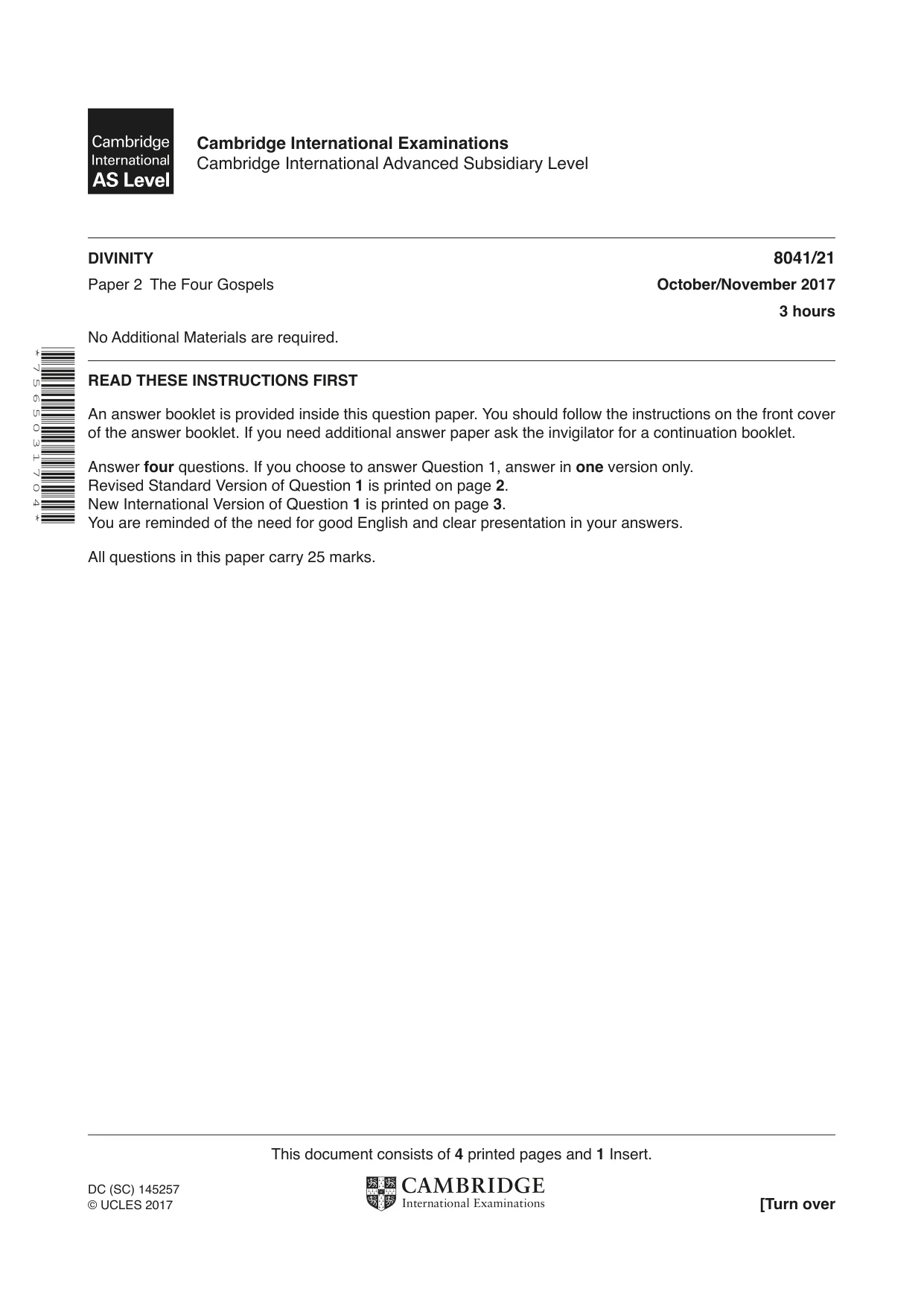
This document consists of 4 printed pages and 1 Insert. DC (SC) 145257 © UCLES 2017 [Turn over Cambridge International Examinations Cambridge International Advanced Subsidiary Level * 7 5 6 5 0 3 1 7 0 4 * DIVINITY 8041/21 Paper 2 The Four Gospels October/November 2017 3 hours No Additional Materials are required. READ THESE INSTRUCTIONS FIRST An answer booklet is provided inside this question paper. You should follow the instructions on the front cover of the answer booklet. If you need additional answer paper ask the invigilator for a continuation booklet. Answer four questions. If you choose to answer Question 1, answer in one version only. Revised Standard Version of Question 1 is printed on page 2. New International Version of Question 1 is printed on page 3. You are reminded of the need for good English and clear presentation in your answers. All questions in this paper carry 25 marks.
Question paper, page 2
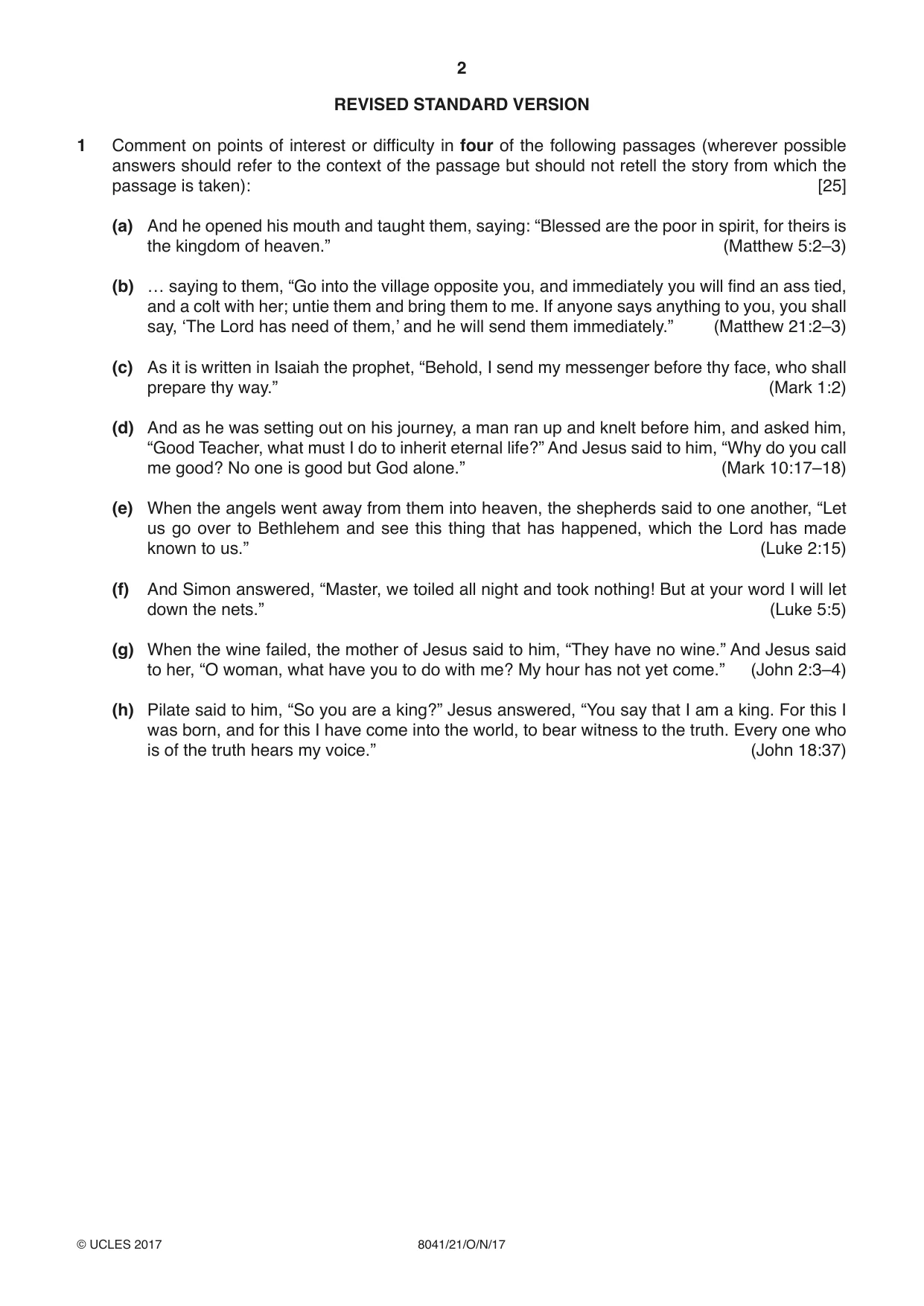
2 8041/21/O/N/17 © UCLES 2017 REVISED STANDARD VERSION 1 Comment on points of interest or difficulty in four of the following passages (wherever possible answers should refer to the context of the passage but should not retell the story from which the passage is taken): [25] (a) And he opened his mouth and taught them, saying: “Blessed are the poor in spirit, for theirs is the kingdom of heaven.” (Matthew 5:2–3) (b) … saying to them, “Go into the village opposite you, and immediately you will find an ass tied, and a colt with her; untie them and bring them to me. If anyone says anything to you, you shall say, ‘The Lord has need of them,’ and he will send them immediately.” (Matthew 21:2–3) (c) As it is written in Isaiah the prophet, “Behold, I send my messenger before thy face, who shall prepare thy way.” (Mark 1:2) (d) And as he was setting out on his journey, a man ran up and knelt before him, and asked him, “Good Teacher, what must I do to inherit eternal life?” And Jesus said to him, “Why do you call me good? No one is good but God alone.” (Mark 10:17–18) (e) When the angels went away from them into heaven, the shepherds said to one another, “Let us go over to Bethlehem and see this thing that has happened, which the Lord has made known to us.” (Luke 2:15) (f) And Simon answered, “Master, we toiled all night and took nothing! But at your word I will let down the nets.” (Luke 5:5) (g) When the wine failed, the mother of Jesus said to him, “They have no wine.” And Jesus said to her, “O woman, what have you to do with me? My hour has not yet come.” (John 2:3–4) (h) Pilate said to him, “So you are a king?” Jesus answered, “You say that I am a king. For this I was born, and for this I have come into the world, to bear witness to the truth. Every one who is of the truth hears my voice.” (John 18:37)
Question paper, page 3
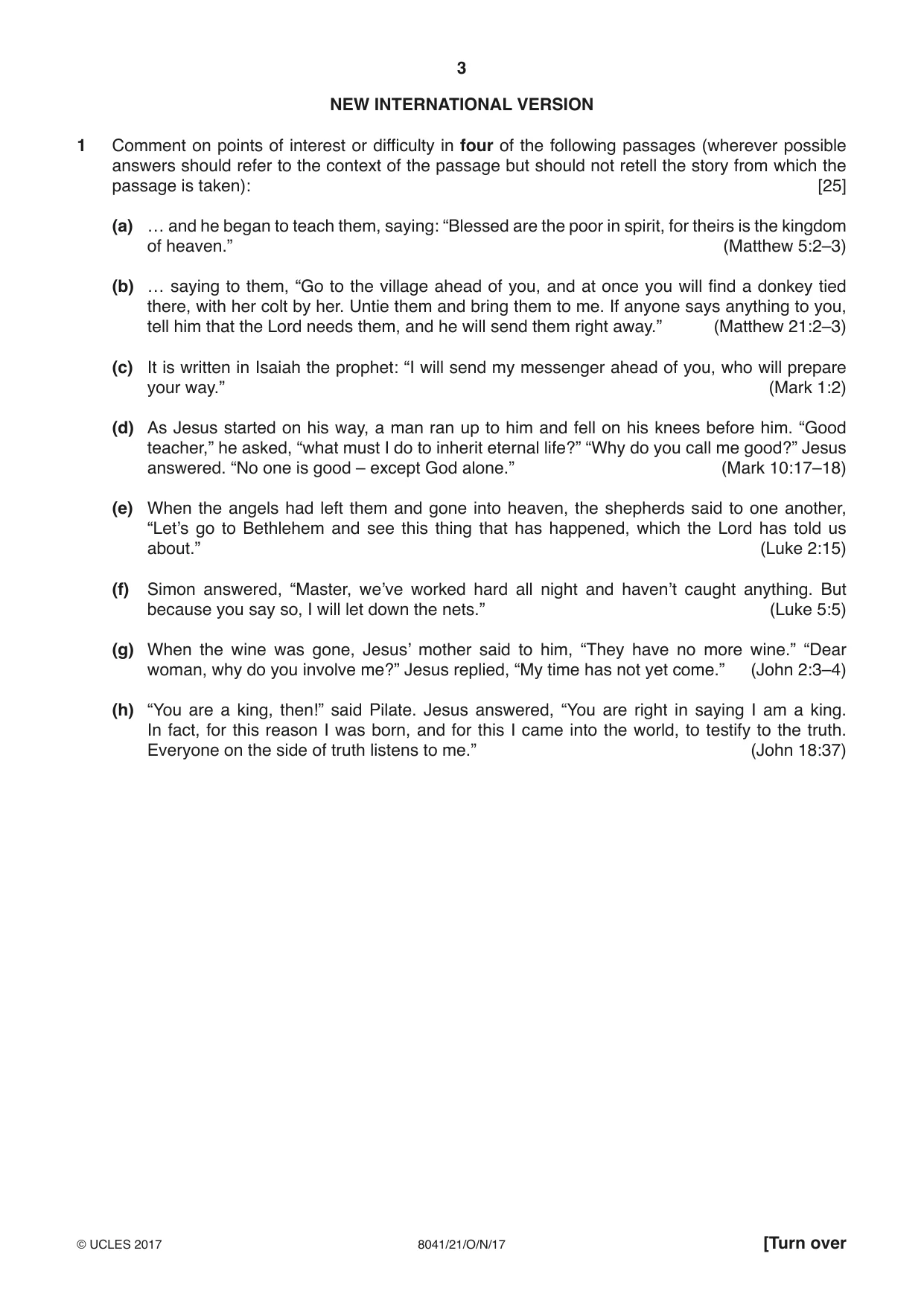
3 8041/21/O/N/17 © UCLES 2017 [Turn over NEW INTERNATIONAL VERSION 1 Comment on points of interest or difficulty in four of the following passages (wherever possible answers should refer to the context of the passage but should not retell the story from which the passage is taken): [25] (a) … and he began to teach them, saying: “Blessed are the poor in spirit, for theirs is the kingdom of heaven.” (Matthew 5:2–3) (b) … saying to them, “Go to the village ahead of you, and at once you will find a donkey tied there, with her colt by her. Untie them and bring them to me. If anyone says anything to you, tell him that the Lord needs them, and he will send them right away.” (Matthew 21:2–3) (c) It is written in Isaiah the prophet: “I will send my messenger ahead of you, who will prepare your way.” (Mark 1:2) (d) As Jesus started on his way, a man ran up to him and fell on his knees before him. “Good teacher,” he asked, “what must I do to inherit eternal life?” “Why do you call me good?” Jesus answered. “No one is good – except God alone.” (Mark 10:17–18) (e) When the angels had left them and gone into heaven, the shepherds said to one another, “Let’s go to Bethlehem and see this thing that has happened, which the Lord has told us about.” (Luke 2:15) (f) Simon answered, “Master, we’ve worked hard all night and haven’t caught anything. But because you say so, I will let down the nets.” (Luke 5:5) (g) When the wine was gone, Jesus’ mother said to him, “They have no more wine.” “Dear woman, why do you involve me?” Jesus replied, “My time has not yet come.” (John 2:3–4) (h) “You are a king, then!” said Pilate. Jesus answered, “You are right in saying I am a king. In fact, for this reason I was born, and for this I came into the world, to testify to the truth. Everyone on the side of truth listens to me.” (John 18:37)
Question paper, page 4
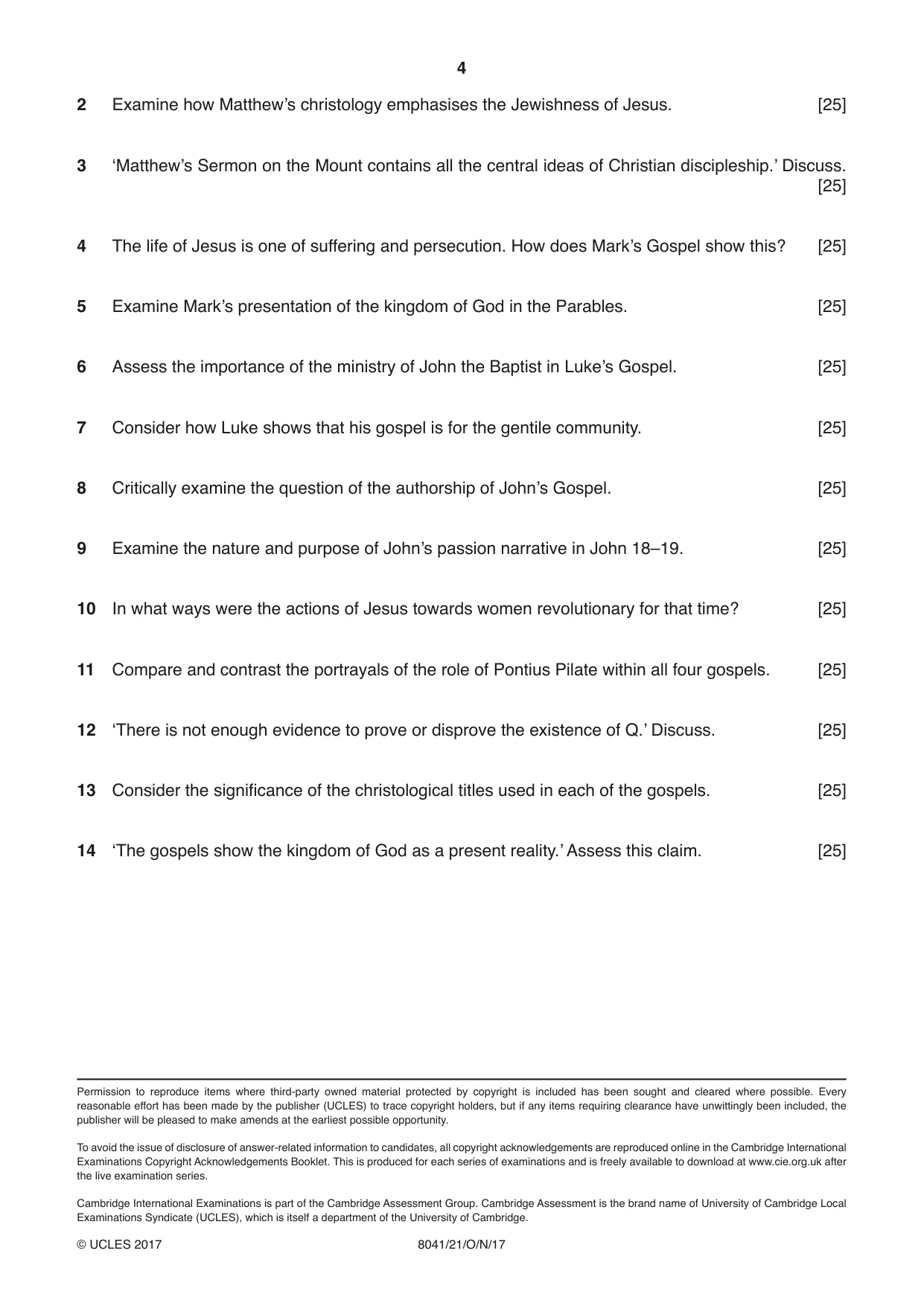
4 8041/21/O/N/17 © UCLES 2017 2 Examine how Matthew’s christology emphasises the Jewishness of Jesus. [25] 3 ‘Matthew’s Sermon on the Mount contains all the central ideas of Christian discipleship.’ Discuss. [25] 4 The life of Jesus is one of suffering and persecution. How does Mark’s Gospel show this? [25] 5 Examine Mark’s presentation of the kingdom of God in the Parables. [25] 6 Assess the importance of the ministry of John the Baptist in Luke’s Gospel. [25] 7 Consider how Luke shows that his gospel is for the gentile community. [25] 8 Critically examine the question of the authorship of John’s Gospel. [25] 9 Examine the nature and purpose of John’s passion narrative in John 18–19. [25] 10 In what ways were the actions of Jesus towards women revolutionary for that time? [25] 11 Compare and contrast the portrayals of the role of Pontius Pilate within all four gospels. [25] 12 ‘There is not enough evidence to prove or disprove the existence of Q.’ Discuss. [25] 13 Consider the significance of the christological titles used in each of the gospels. [25] 14 ‘The gospels show the kingdom of God as a present reality.’ Assess this claim. [25] Permission to reproduce items where third-party owned material protected by copyright is included has been sought and cleared where possible. Every reasonable effort has been made by the publisher (UCLES) to trace copyright holders, but if any items requiring clearance have unwittingly been included, the publisher will be pleased to make amends at the earliest possible opportunity. To avoid the issue of disclosure of answer-related information to candidates, all copyright acknowledgements are reproduced online in the Cambridge International Examinations Copyright Acknowledgements Booklet. This is produced for each series of examinations and is freely available to download at www.cie.org.uk after the live examination series. Cambridge International Examinations is part of the Cambridge Assessment Group. Cambridge Assessment is the brand name of University of Cambridge Local Examinations Syndicate (UCLES), which is itself a department of the University of Cambridge.
Mark scheme, page 1
® IGCSE is a registered trademark. This document consists of 19 printed pages. © UCLES 2017 [Turn over Cambridge Assessment International Education Cambridge International Advanced Subsidiary Level DIVINITY 8041/21 Paper 2 The Four Gospels October/November 2017 MARK SCHEME Maximum Mark: 100 Published This mark scheme is published as an aid to teachers and candidates, to indicate the requirements of the examination. It shows the basis on which Examiners were instructed to award marks. It does not indicate the details of the discussions that took place at an Examiners’ meeting before marking began, which would have considered the acceptability of alternative answers. Mark schemes should be read in conjunction with the question paper and the Principal Examiner Report for Teachers. Cambridge International will not enter into discussions about these mark schemes. Cambridge International is publishing the mark schemes for the October/November 2017 series for most Cambridge IGCSE®, Cambridge International A and AS Level components and some Cambridge O Level components.
Mark scheme, page 2
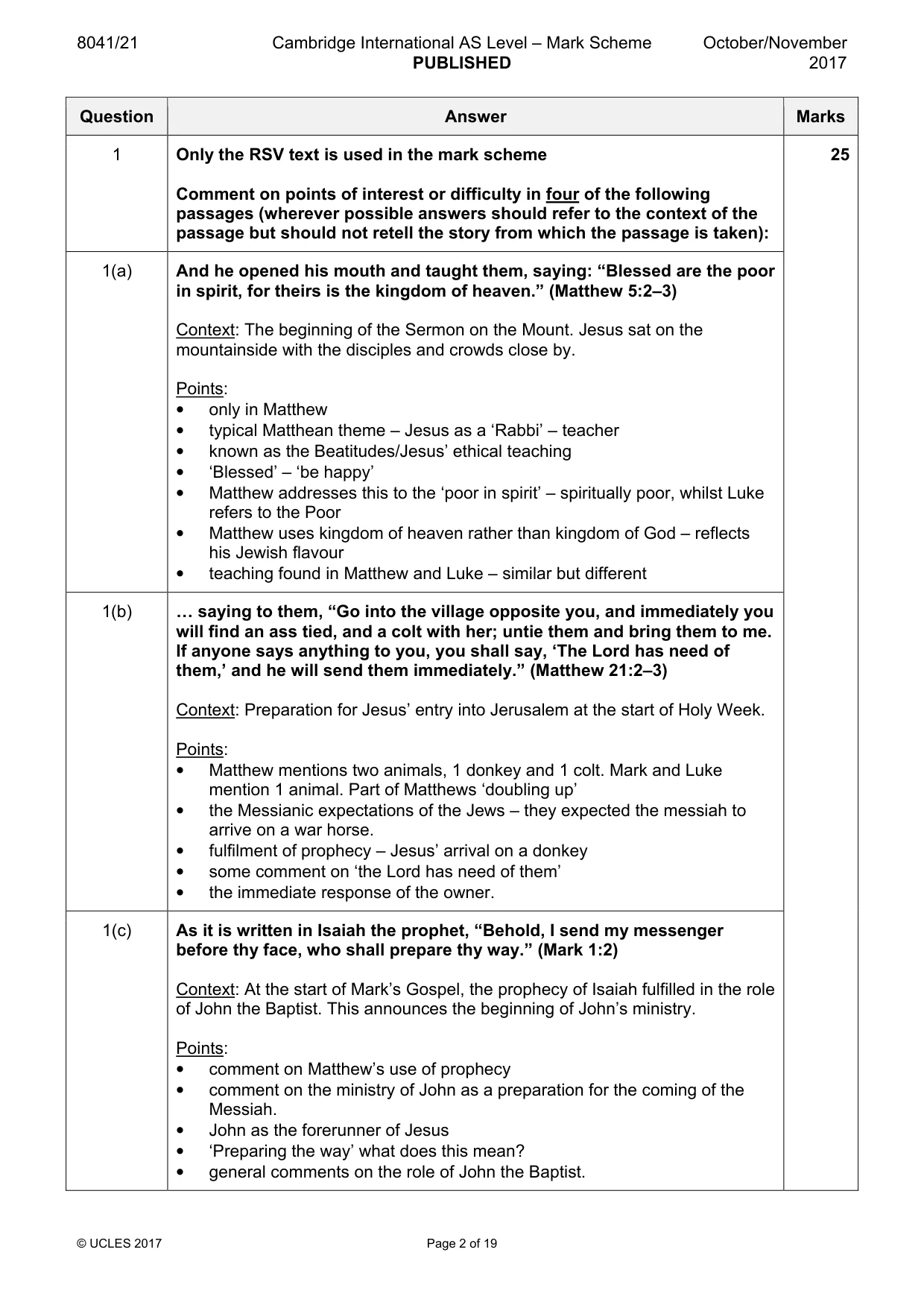
8041/21 Cambridge International AS Level – Mark Scheme PUBLISHED October/November 2017 © UCLES 2017 Page 2 of 19 Question Answer Marks 1 Only the RSV text is used in the mark scheme Comment on points of interest or difficulty in four of the following passages (wherever possible answers should refer to the context of the passage but should not retell the story from which the passage is taken): 25 1(a) And he opened his mouth and taught them, saying: “Blessed are the poor in spirit, for theirs is the kingdom of heaven.” (Matthew 5:2–3) Context: The beginning of the Sermon on the Mount. Jesus sat on the mountainside with the disciples and crowds close by. Points: • only in Matthew • typical Matthean theme – Jesus as a ‘Rabbi’ – teacher • known as the Beatitudes/Jesus’ ethical teaching • ‘Blessed’ – ‘be happy’ • Matthew addresses this to the ‘poor in spirit’ – spiritually poor, whilst Luke refers to the Poor • Matthew uses kingdom of heaven rather than kingdom of God – reflects his Jewish flavour • teaching found in Matthew and Luke – similar but different 1(b) « saying to them, “Go into the village opposite you, and immediately you will find an ass tied, and a colt with her; untie them and bring them to me. If anyone says anything to you, you shall say, ‘The Lord has need of them,’ and he will send them immediately.” (Matthew 21:2–3) Context: Preparation for Jesus’ entry into Jerusalem at the start of Holy Week. Points: • Matthew mentions two animals, 1 donkey and 1 colt. Mark and Luke mention 1 animal. Part of Matthews ‘doubling up’ • the Messianic expectations of the Jews – they expected the messiah to arrive on a war horse. • fulfilment of prophecy – Jesus’ arrival on a donkey • some comment on ‘the Lord has need of them’ • the immediate response of the owner. 1(c) As it is written in Isaiah the prophet, “Behold, I send my messenger before thy face, who shall prepare thy way.” (Mark 1:2) Context: At the start of Mark’s Gospel, the prophecy of Isaiah fulfilled in the role of John the Baptist. This announces the beginning of John’s ministry. Points: • comment on Matthew’s use of prophecy • comment on the ministry of John as a preparation for the coming of the Messiah. • John as the forerunner of Jesus • ‘Preparing the way’ what does this mean? • general comments on the role of John the Baptist.
Mark scheme, page 3
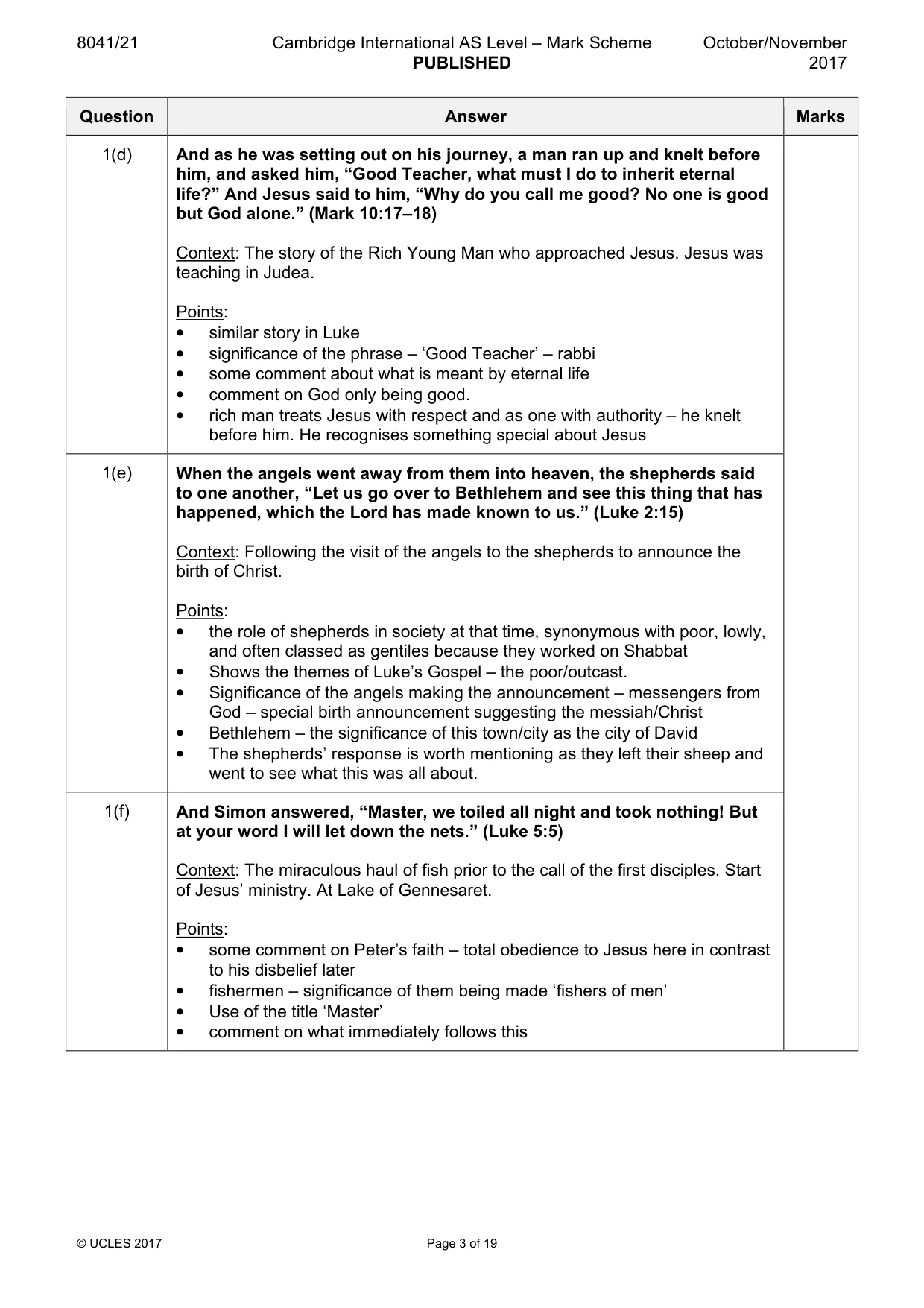
8041/21 Cambridge International AS Level – Mark Scheme PUBLISHED October/November 2017 © UCLES 2017 Page 3 of 19 Question Answer Marks 1(d) And as he was setting out on his journey, a man ran up and knelt before him, and asked him, “Good Teacher, what must I do to inherit eternal life?” And Jesus said to him, “Why do you call me good? No one is good but God alone.” (Mark 10:17–18) Context: The story of the Rich Young Man who approached Jesus. Jesus was teaching in Judea. Points: • similar story in Luke • significance of the phrase – ‘Good Teacher’ – rabbi • some comment about what is meant by eternal life • comment on God only being good. • rich man treats Jesus with respect and as one with authority – he knelt before him. He recognises something special about Jesus 1(e) When the angels went away from them into heaven, the shepherds said to one another, “Let us go over to Bethlehem and see this thing that has happened, which the Lord has made known to us.” (Luke 2:15) Context: Following the visit of the angels to the shepherds to announce the birth of Christ. Points: • the role of shepherds in society at that time, synonymous with poor, lowly, and often classed as gentiles because they worked on Shabbat • Shows the themes of Luke’s Gospel – the poor/outcast. • Significance of the angels making the announcement – messengers from God – special birth announcement suggesting the messiah/Christ • Bethlehem – the significance of this town/city as the city of David • The shepherds’ response is worth mentioning as they left their sheep and went to see what this was all about. 1(f) And Simon answered, “Master, we toiled all night and took nothing! But at your word I will let down the nets.” (Luke 5:5) Context: The miraculous haul of fish prior to the call of the first disciples. Start of Jesus’ ministry. At Lake of Gennesaret. Points: • some comment on Peter’s faith – total obedience to Jesus here in contrast to his disbelief later • fishermen – significance of them being made ‘fishers of men’ • Use of the title ‘Master’ • comment on what immediately follows this
Mark scheme, page 4
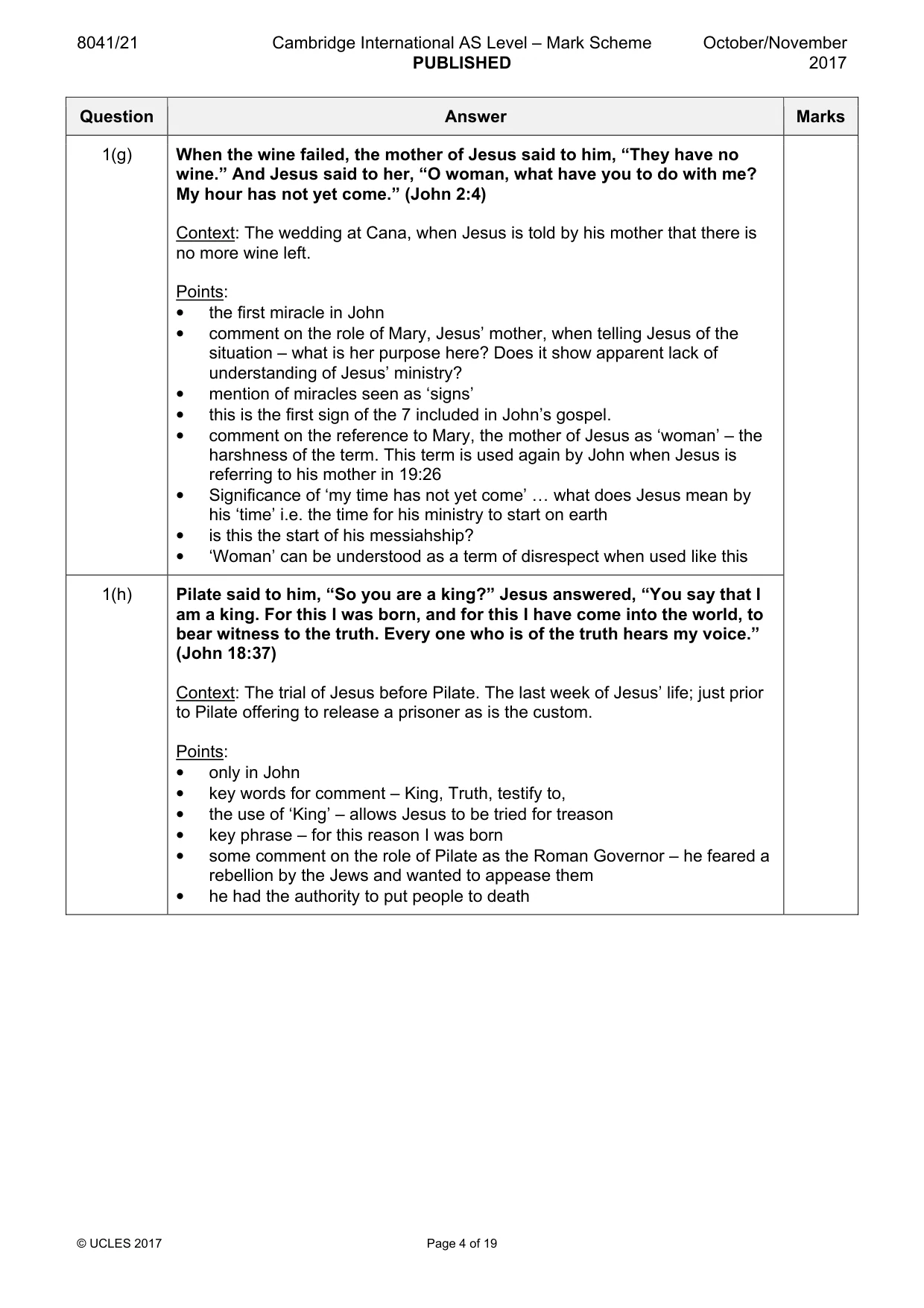
8041/21 Cambridge International AS Level – Mark Scheme PUBLISHED October/November 2017 © UCLES 2017 Page 4 of 19 Question Answer Marks 1(g) When the wine failed, the mother of Jesus said to him, “They have no wine.” And Jesus said to her, “O woman, what have you to do with me? My hour has not yet come.” (John 2:4) Context: The wedding at Cana, when Jesus is told by his mother that there is no more wine left. Points: • the first miracle in John • comment on the role of Mary, Jesus’ mother, when telling Jesus of the situation – what is her purpose here? Does it show apparent lack of understanding of Jesus’ ministry? • mention of miracles seen as ‘signs’ • this is the first sign of the 7 included in John’s gospel. • comment on the reference to Mary, the mother of Jesus as ‘woman’ – the harshness of the term. This term is used again by John when Jesus is referring to his mother in 19:26 • Significance of ‘my time has not yet come’ « what does Jesus mean by his ‘time’ i.e. the time for his ministry to start on earth • is this the start of his messiahship? • ‘Woman’ can be understood as a term of disrespect when used like this 1(h) Pilate said to him, “So you are a king?” Jesus answered, “You say that I am a king. For this I was born, and for this I have come into the world, to bear witness to the truth. Every one who is of the truth hears my voice.” (John 18:37) Context: The trial of Jesus before Pilate. The last week of Jesus’ life; just prior to Pilate offering to release a prisoner as is the custom. Points: • only in John • key words for comment – King, Truth, testify to, • the use of ‘King’ – allows Jesus to be tried for treason • key phrase – for this reason I was born • some comment on the role of Pilate as the Roman Governor – he feared a rebellion by the Jews and wanted to appease them • he had the authority to put people to death
Mark scheme, page 5
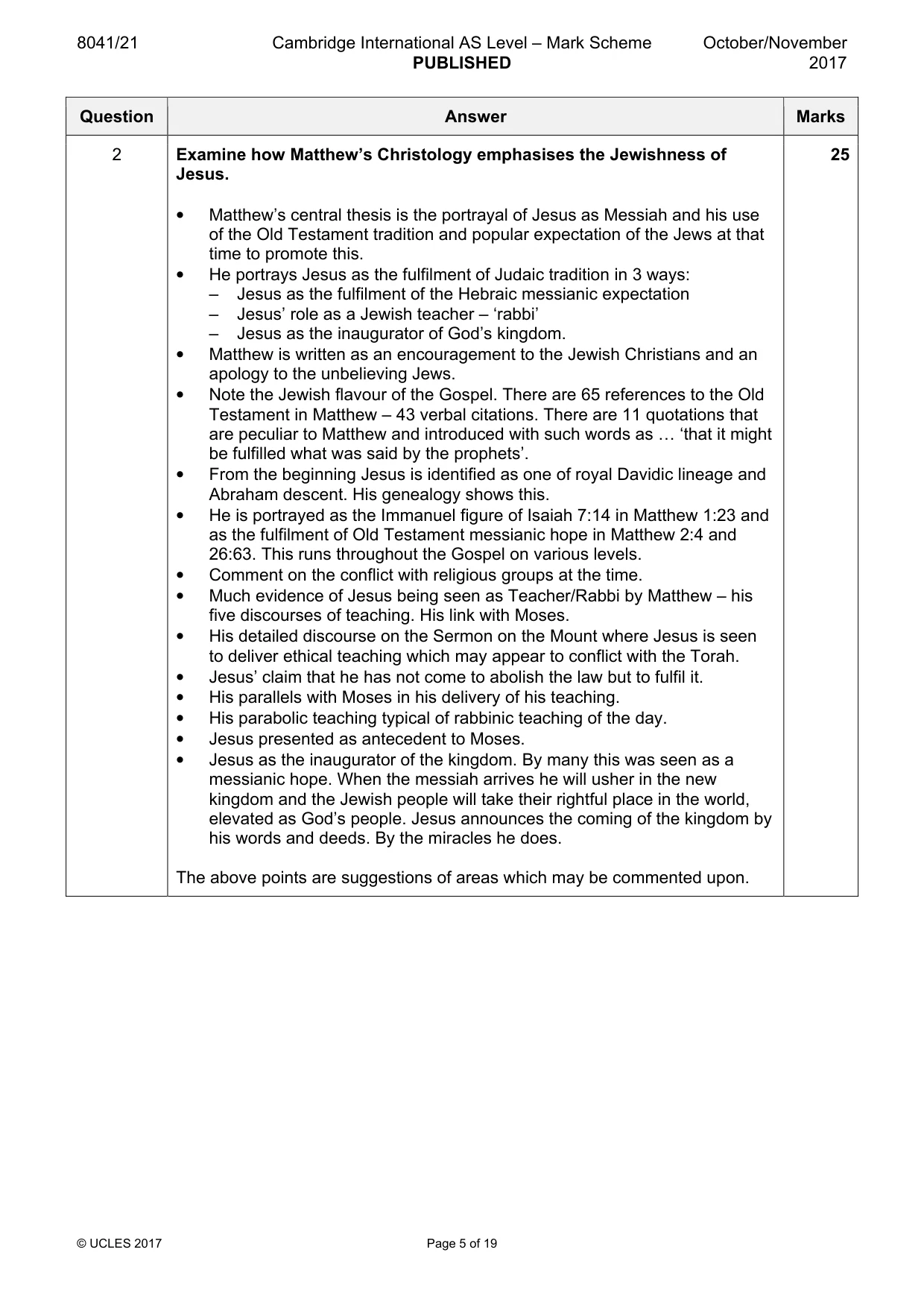
8041/21 Cambridge International AS Level – Mark Scheme PUBLISHED October/November 2017 © UCLES 2017 Page 5 of 19 Question Answer Marks 2 Examine how Matthew’s Christology emphasises the Jewishness of Jesus. • Matthew’s central thesis is the portrayal of Jesus as Messiah and his use of the Old Testament tradition and popular expectation of the Jews at that time to promote this. • He portrays Jesus as the fulfilment of Judaic tradition in 3 ways: – Jesus as the fulfilment of the Hebraic messianic expectation – Jesus’ role as a Jewish teacher – ‘rabbi’ – Jesus as the inaugurator of God’s kingdom. • Matthew is written as an encouragement to the Jewish Christians and an apology to the unbelieving Jews. • Note the Jewish flavour of the Gospel. There are 65 references to the Old Testament in Matthew – 43 verbal citations. There are 11 quotations that are peculiar to Matthew and introduced with such words as « ‘that it might be fulfilled what was said by the prophets’. • From the beginning Jesus is identified as one of royal Davidic lineage and Abraham descent. His genealogy shows this. • He is portrayed as the Immanuel figure of Isaiah 7:14 in Matthew 1:23 and as the fulfilment of Old Testament messianic hope in Matthew 2:4 and 26:63. This runs throughout the Gospel on various levels. • Comment on the conflict with religious groups at the time. • Much evidence of Jesus being seen as Teacher/Rabbi by Matthew – his five discourses of teaching. His link with Moses. • His detailed discourse on the Sermon on the Mount where Jesus is seen to deliver ethical teaching which may appear to conflict with the Torah. • Jesus’ claim that he has not come to abolish the law but to fulfil it. • His parallels with Moses in his delivery of his teaching. • His parabolic teaching typical of rabbinic teaching of the day. • Jesus presented as antecedent to Moses. • Jesus as the inaugurator of the kingdom. By many this was seen as a messianic hope. When the messiah arrives he will usher in the new kingdom and the Jewish people will take their rightful place in the world, elevated as God’s people. Jesus announces the coming of the kingdom by his words and deeds. By the miracles he does. The above points are suggestions of areas which may be commented upon. 25
Mark scheme, page 6
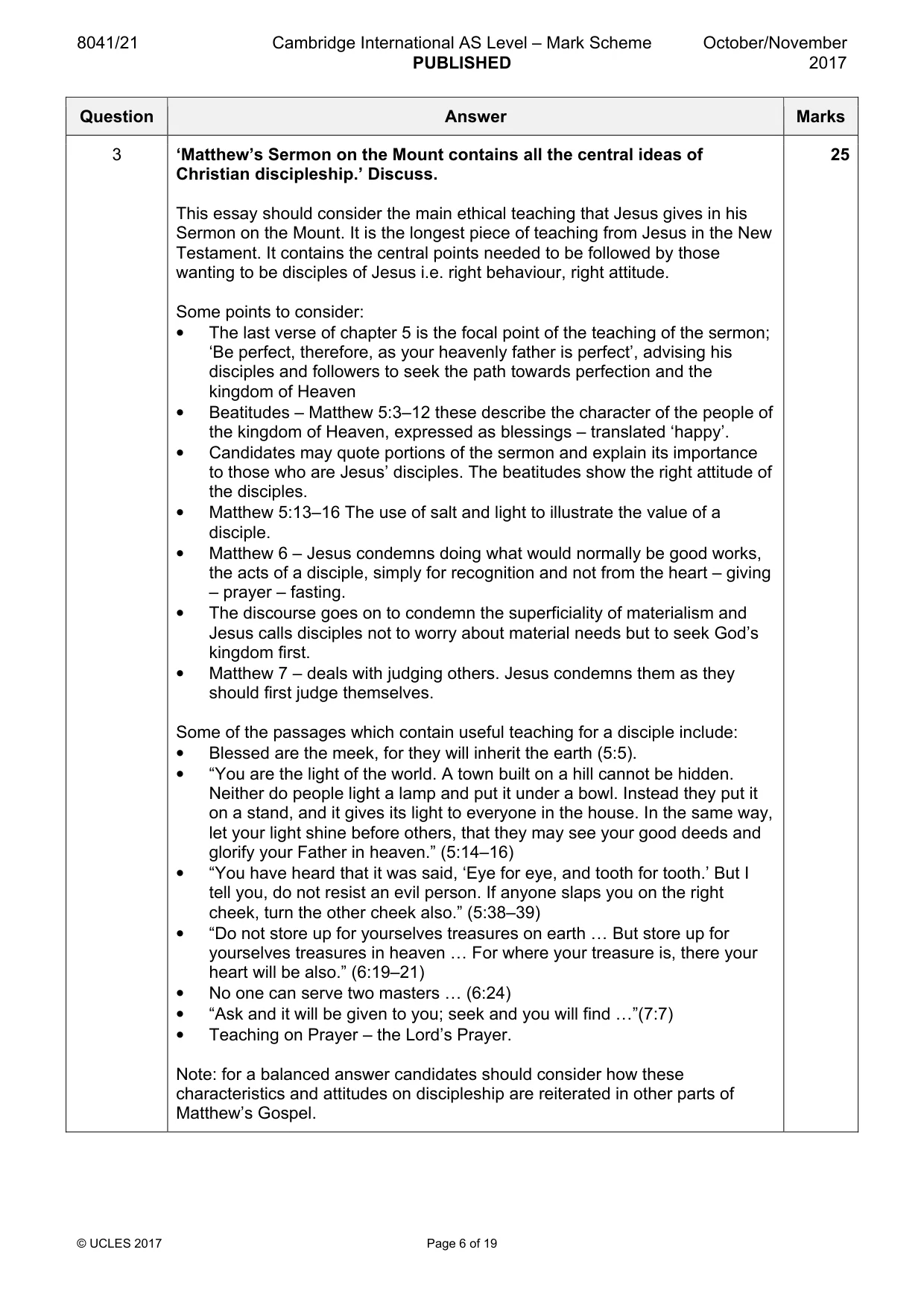
8041/21 Cambridge International AS Level – Mark Scheme PUBLISHED October/November 2017 © UCLES 2017 Page 6 of 19 Question Answer Marks 3 ‘Matthew’s Sermon on the Mount contains all the central ideas of Christian discipleship.’ Discuss. This essay should consider the main ethical teaching that Jesus gives in his Sermon on the Mount. It is the longest piece of teaching from Jesus in the New Testament. It contains the central points needed to be followed by those wanting to be disciples of Jesus i.e. right behaviour, right attitude. Some points to consider: • The last verse of chapter 5 is the focal point of the teaching of the sermon; ‘Be perfect, therefore, as your heavenly father is perfect’, advising his disciples and followers to seek the path towards perfection and the kingdom of Heaven • Beatitudes – Matthew 5:3–12 these describe the character of the people of the kingdom of Heaven, expressed as blessings – translated ‘happy’. • Candidates may quote portions of the sermon and explain its importance to those who are Jesus’ disciples. The beatitudes show the right attitude of the disciples. • Matthew 5:13–16 The use of salt and light to illustrate the value of a disciple. • Matthew 6 – Jesus condemns doing what would normally be good works, the acts of a disciple, simply for recognition and not from the heart – giving – prayer – fasting. • The discourse goes on to condemn the superficiality of materialism and Jesus calls disciples not to worry about material needs but to seek God’s kingdom first. • Matthew 7 – deals with judging others. Jesus condemns them as they should first judge themselves. Some of the passages which contain useful teaching for a disciple include: • Blessed are the meek, for they will inherit the earth (5:5). • “You are the light of the world. A town built on a hill cannot be hidden. Neither do people light a lamp and put it under a bowl. Instead they put it on a stand, and it gives its light to everyone in the house. In the same way, let your light shine before others, that they may see your good deeds and glorify your Father in heaven.” (5:14–16) • “You have heard that it was said, ‘Eye for eye, and tooth for tooth.’ But I tell you, do not resist an evil person. If anyone slaps you on the right cheek, turn the other cheek also.” (5:38–39) • “Do not store up for yourselves treasures on earth « But store up for yourselves treasures in heaven « For where your treasure is, there your heart will be also.” (6:19–21) • No one can serve two masters « (6:24) • “Ask and it will be given to you; seek and you will find «”(7:7) • Teaching on Prayer – the Lord’s Prayer. Note: for a balanced answer candidates should consider how these characteristics and attitudes on discipleship are reiterated in other parts of Matthew’s Gospel. 25
Mark scheme, page 7
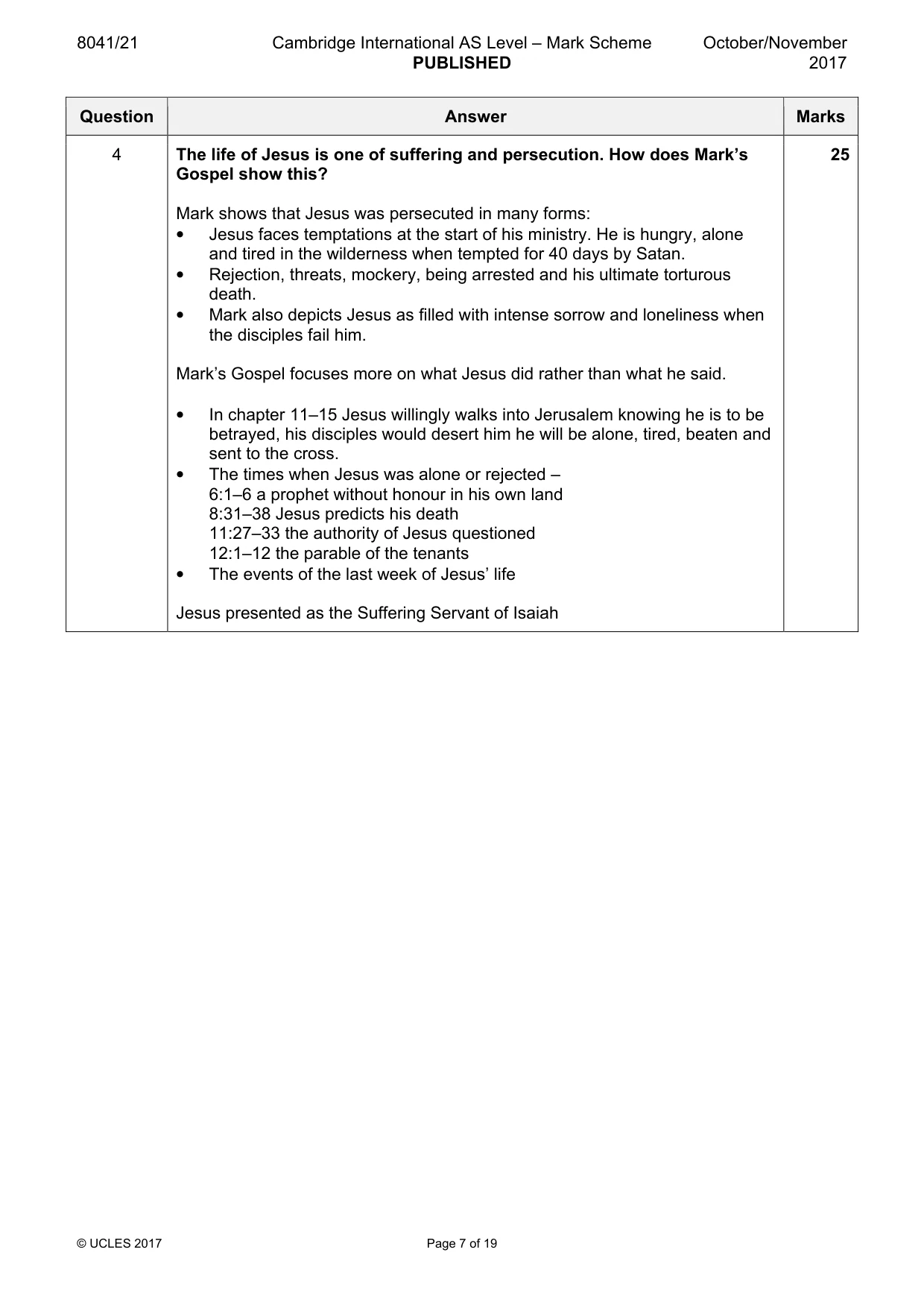
8041/21 Cambridge International AS Level – Mark Scheme PUBLISHED October/November 2017 © UCLES 2017 Page 7 of 19 Question Answer Marks 4 The life of Jesus is one of suffering and persecution. How does Mark’s Gospel show this? Mark shows that Jesus was persecuted in many forms: • Jesus faces temptations at the start of his ministry. He is hungry, alone and tired in the wilderness when tempted for 40 days by Satan. • Rejection, threats, mockery, being arrested and his ultimate torturous death. • Mark also depicts Jesus as filled with intense sorrow and loneliness when the disciples fail him. Mark’s Gospel focuses more on what Jesus did rather than what he said. • In chapter 11–15 Jesus willingly walks into Jerusalem knowing he is to be betrayed, his disciples would desert him he will be alone, tired, beaten and sent to the cross. • The times when Jesus was alone or rejected – 6:1–6 a prophet without honour in his own land 8:31–38 Jesus predicts his death 11:27–33 the authority of Jesus questioned 12:1–12 the parable of the tenants • The events of the last week of Jesus’ life Jesus presented as the Suffering Servant of Isaiah 25
Mark scheme, page 8
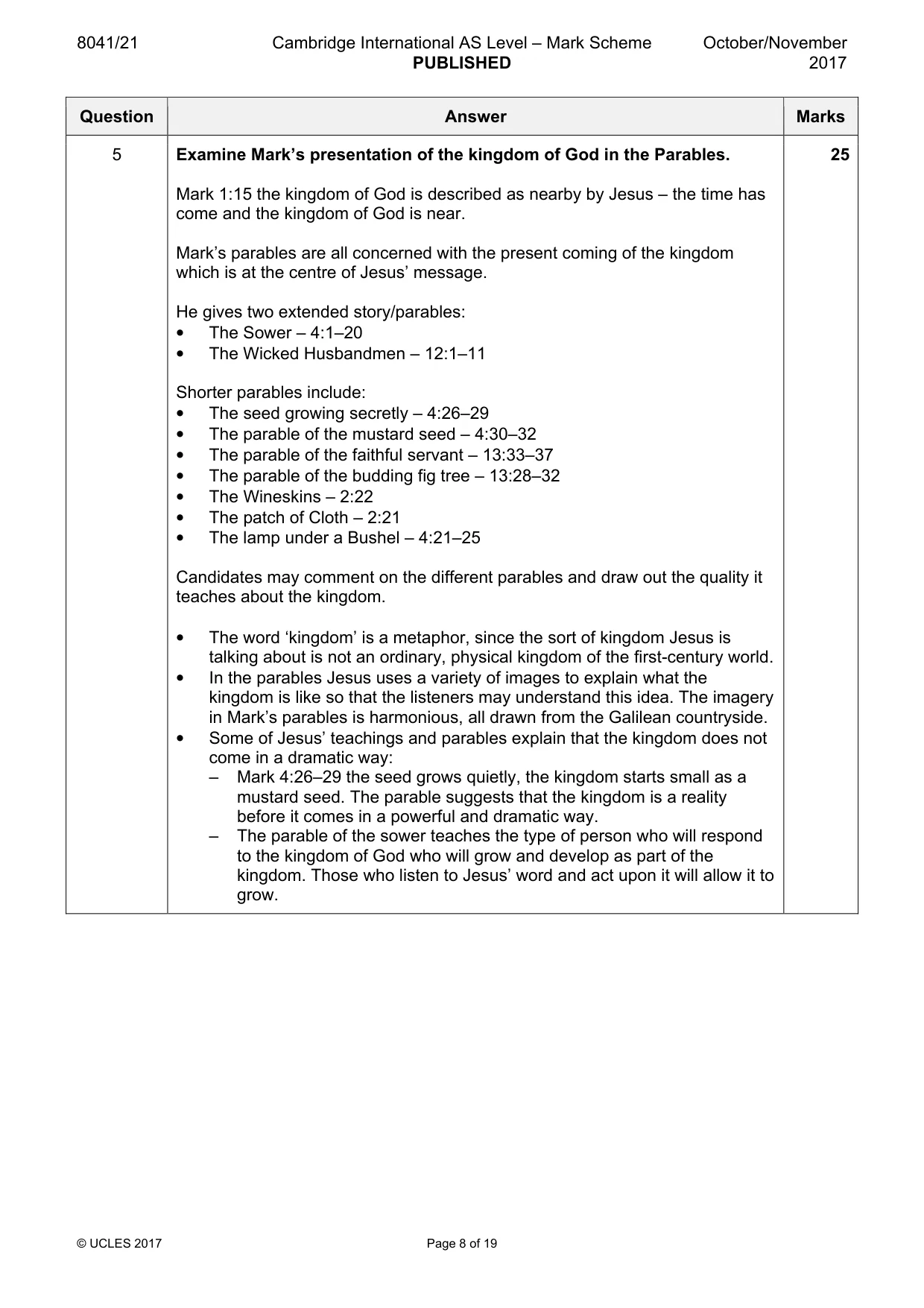
8041/21 Cambridge International AS Level – Mark Scheme PUBLISHED October/November 2017 © UCLES 2017 Page 8 of 19 Question Answer Marks 5 Examine Mark’s presentation of the kingdom of God in the Parables. Mark 1:15 the kingdom of God is described as nearby by Jesus – the time has come and the kingdom of God is near. Mark’s parables are all concerned with the present coming of the kingdom which is at the centre of Jesus’ message. He gives two extended story/parables: • The Sower – 4:1–20 • The Wicked Husbandmen – 12:1–11 Shorter parables include: • The seed growing secretly – 4:26–29 • The parable of the mustard seed – 4:30–32 • The parable of the faithful servant – 13:33–37 • The parable of the budding fig tree – 13:28–32 • The Wineskins – 2:22 • The patch of Cloth – 2:21 • The lamp under a Bushel – 4:21–25 Candidates may comment on the different parables and draw out the quality it teaches about the kingdom. • The word ‘kingdom’ is a metaphor, since the sort of kingdom Jesus is talking about is not an ordinary, physical kingdom of the first-century world. • In the parables Jesus uses a variety of images to explain what the kingdom is like so that the listeners may understand this idea. The imagery in Mark’s parables is harmonious, all drawn from the Galilean countryside. • Some of Jesus’ teachings and parables explain that the kingdom does not come in a dramatic way: – Mark 4:26–29 the seed grows quietly, the kingdom starts small as a mustard seed. The parable suggests that the kingdom is a reality before it comes in a powerful and dramatic way. – The parable of the sower teaches the type of person who will respond to the kingdom of God who will grow and develop as part of the kingdom. Those who listen to Jesus’ word and act upon it will allow it to grow. 25
Mark scheme, page 9
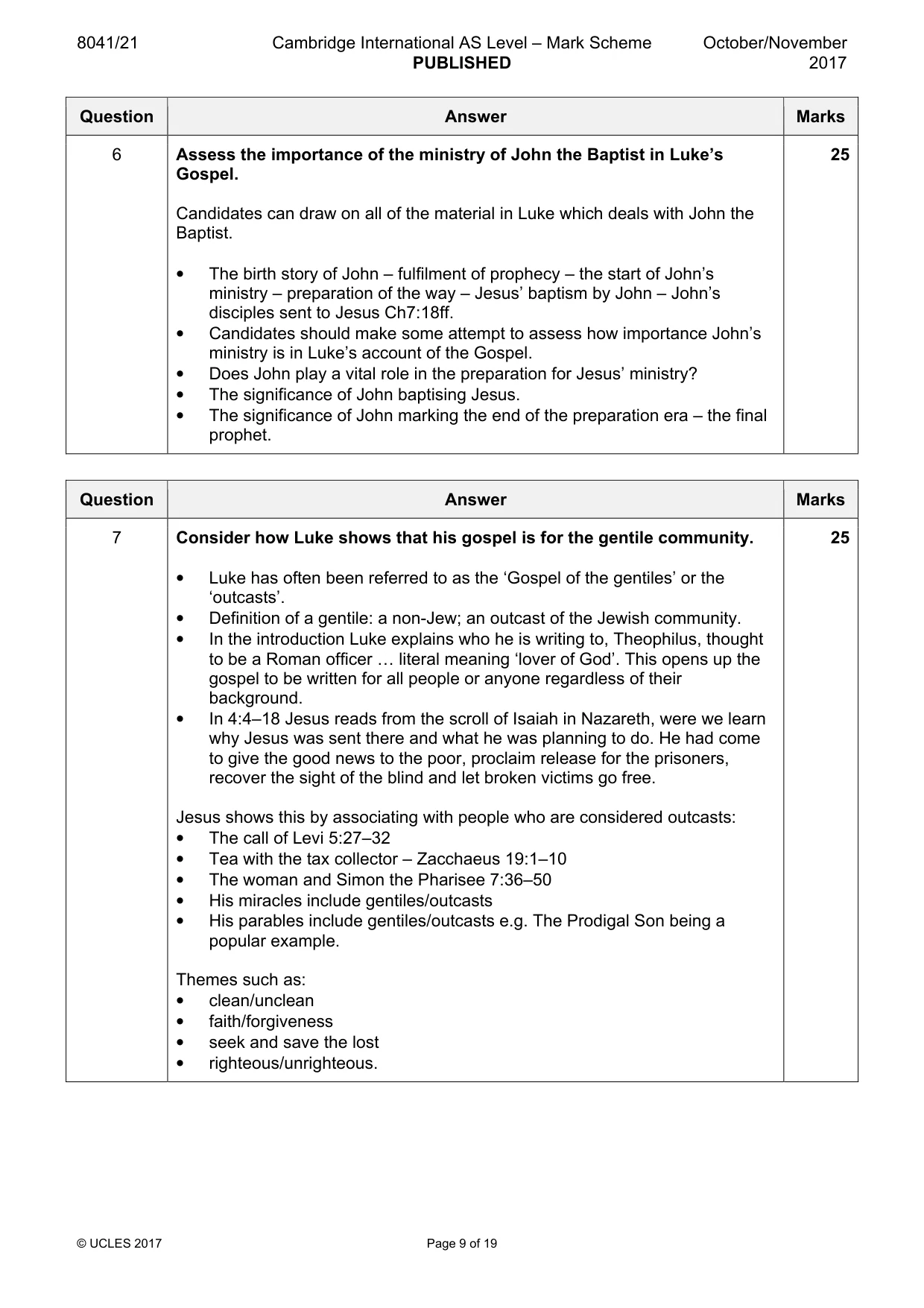
8041/21 Cambridge International AS Level – Mark Scheme PUBLISHED October/November 2017 © UCLES 2017 Page 9 of 19 Question Answer Marks 6 Assess the importance of the ministry of John the Baptist in Luke’s Gospel. Candidates can draw on all of the material in Luke which deals with John the Baptist. • The birth story of John – fulfilment of prophecy – the start of John’s ministry – preparation of the way – Jesus’ baptism by John – John’s disciples sent to Jesus Ch7:18ff. • Candidates should make some attempt to assess how importance John’s ministry is in Luke’s account of the Gospel. • Does John play a vital role in the preparation for Jesus’ ministry? • The significance of John baptising Jesus. • The significance of John marking the end of the preparation era – the final prophet. 25 Question Answer Marks 7 Consider how Luke shows that his gospel is for the gentile community. • Luke has often been referred to as the ‘Gospel of the gentiles’ or the ‘outcasts’. • Definition of a gentile: a non-Jew; an outcast of the Jewish community. • In the introduction Luke explains who he is writing to, Theophilus, thought to be a Roman officer « literal meaning ‘lover of God’. This opens up the gospel to be written for all people or anyone regardless of their background. • In 4:4–18 Jesus reads from the scroll of Isaiah in Nazareth, were we learn why Jesus was sent there and what he was planning to do. He had come to give the good news to the poor, proclaim release for the prisoners, recover the sight of the blind and let broken victims go free. Jesus shows this by associating with people who are considered outcasts: • The call of Levi 5:27–32 • Tea with the tax collector – Zacchaeus 19:1–10 • The woman and Simon the Pharisee 7:36–50 • His miracles include gentiles/outcasts • His parables include gentiles/outcasts e.g. The Prodigal Son being a popular example. Themes such as: • clean/unclean • faith/forgiveness • seek and save the lost • righteous/unrighteous. 25
Mark scheme, page 10
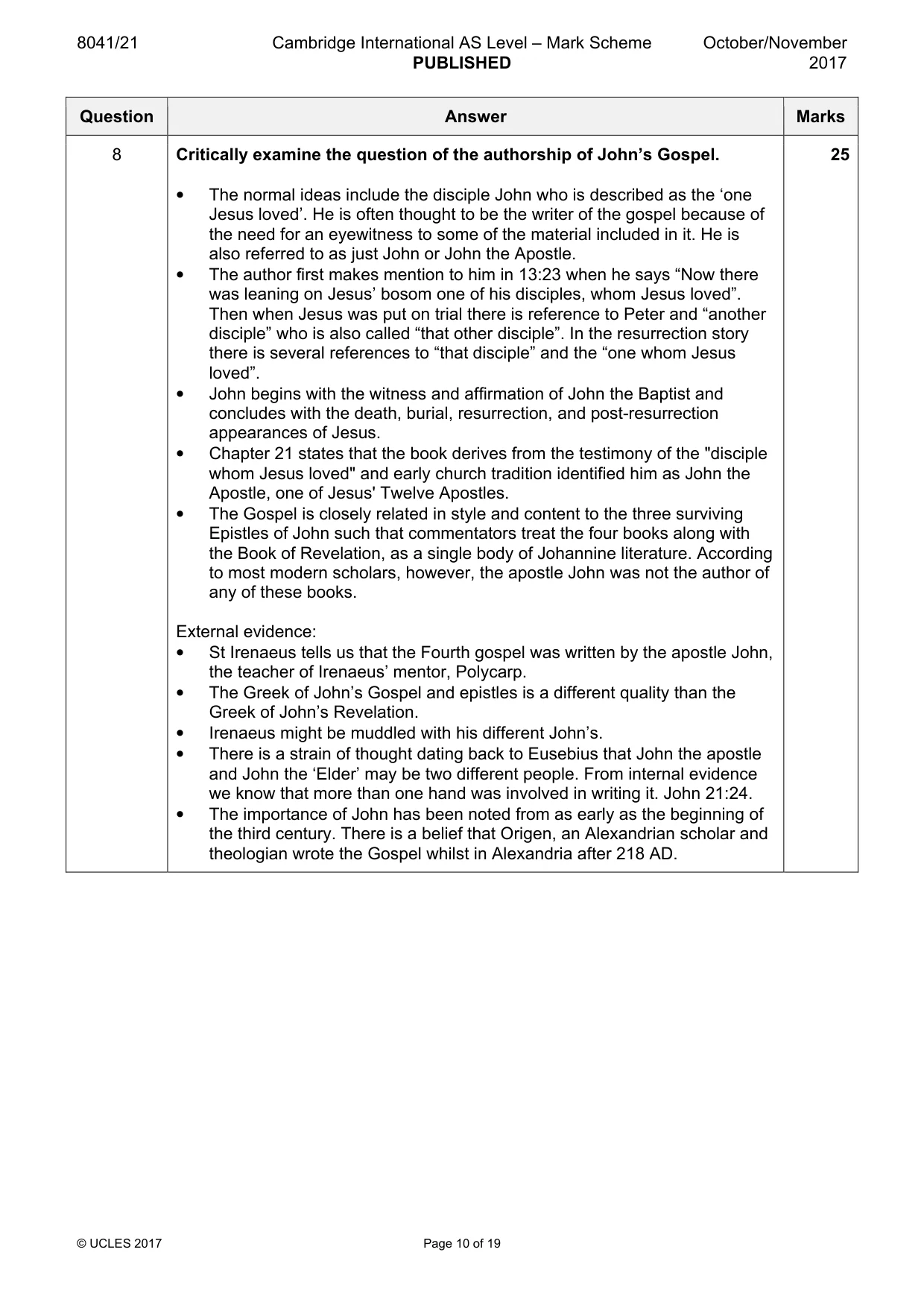
8041/21 Cambridge International AS Level – Mark Scheme PUBLISHED October/November 2017 © UCLES 2017 Page 10 of 19 Question Answer Marks 8 Critically examine the question of the authorship of John’s Gospel. • The normal ideas include the disciple John who is described as the ‘one Jesus loved’. He is often thought to be the writer of the gospel because of the need for an eyewitness to some of the material included in it. He is also referred to as just John or John the Apostle. • The author first makes mention to him in 13:23 when he says “Now there was leaning on Jesus’ bosom one of his disciples, whom Jesus loved”. Then when Jesus was put on trial there is reference to Peter and “another disciple” who is also called “that other disciple”. In the resurrection story there is several references to “that disciple” and the “one whom Jesus loved”. • John begins with the witness and affirmation of John the Baptist and concludes with the death, burial, resurrection, and post-resurrection appearances of Jesus. • Chapter 21 states that the book derives from the testimony of the "disciple whom Jesus loved" and early church tradition identified him as John the Apostle, one of Jesus' Twelve Apostles. • The Gospel is closely related in style and content to the three surviving Epistles of John such that commentators treat the four books along with the Book of Revelation, as a single body of Johannine literature. According to most modern scholars, however, the apostle John was not the author of any of these books. External evidence: • St Irenaeus tells us that the Fourth gospel was written by the apostle John, the teacher of Irenaeus’ mentor, Polycarp. • The Greek of John’s Gospel and epistles is a different quality than the Greek of John’s Revelation. • Irenaeus might be muddled with his different John’s. • There is a strain of thought dating back to Eusebius that John the apostle and John the ‘Elder’ may be two different people. From internal evidence we know that more than one hand was involved in writing it. John 21:24. • The importance of John has been noted from as early as the beginning of the third century. There is a belief that Origen, an Alexandrian scholar and theologian wrote the Gospel whilst in Alexandria after 218 AD. 25
Mark scheme, page 11
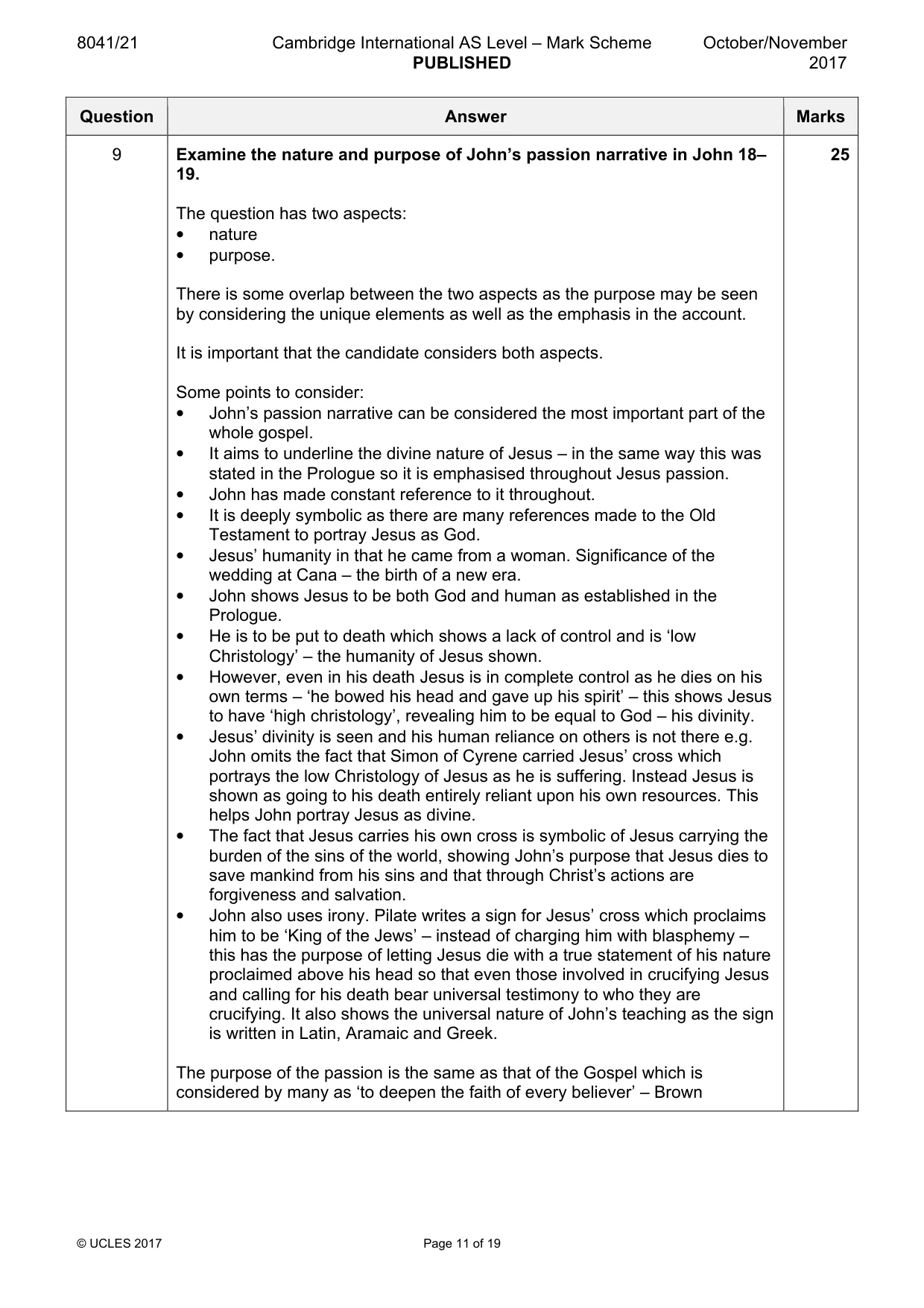
8041/21 Cambridge International AS Level – Mark Scheme PUBLISHED October/November 2017 © UCLES 2017 Page 11 of 19 Question Answer Marks 9 Examine the nature and purpose of John’s passion narrative in John 18– 19. The question has two aspects: • nature • purpose. There is some overlap between the two aspects as the purpose may be seen by considering the unique elements as well as the emphasis in the account. It is important that the candidate considers both aspects. Some points to consider: • John’s passion narrative can be considered the most important part of the whole gospel. • It aims to underline the divine nature of Jesus – in the same way this was stated in the Prologue so it is emphasised throughout Jesus passion. • John has made constant reference to it throughout. • It is deeply symbolic as there are many references made to the Old Testament to portray Jesus as God. • Jesus’ humanity in that he came from a woman. Significance of the wedding at Cana – the birth of a new era. • John shows Jesus to be both God and human as established in the Prologue. • He is to be put to death which shows a lack of control and is ‘low Christology’ – the humanity of Jesus shown. • However, even in his death Jesus is in complete control as he dies on his own terms – ‘he bowed his head and gave up his spirit’ – this shows Jesus to have ‘high christology’, revealing him to be equal to God – his divinity. • Jesus’ divinity is seen and his human reliance on others is not there e.g. John omits the fact that Simon of Cyrene carried Jesus’ cross which portrays the low Christology of Jesus as he is suffering. Instead Jesus is shown as going to his death entirely reliant upon his own resources. This helps John portray Jesus as divine. • The fact that Jesus carries his own cross is symbolic of Jesus carrying the burden of the sins of the world, showing John’s purpose that Jesus dies to save mankind from his sins and that through Christ’s actions are forgiveness and salvation. • John also uses irony. Pilate writes a sign for Jesus’ cross which proclaims him to be ‘King of the Jews’ – instead of charging him with blasphemy – this has the purpose of letting Jesus die with a true statement of his nature proclaimed above his head so that even those involved in crucifying Jesus and calling for his death bear universal testimony to who they are crucifying. It also shows the universal nature of John’s teaching as the sign is written in Latin, Aramaic and Greek. The purpose of the passion is the same as that of the Gospel which is considered by many as ‘to deepen the faith of every believer’ – Brown 25
Mark scheme, page 12
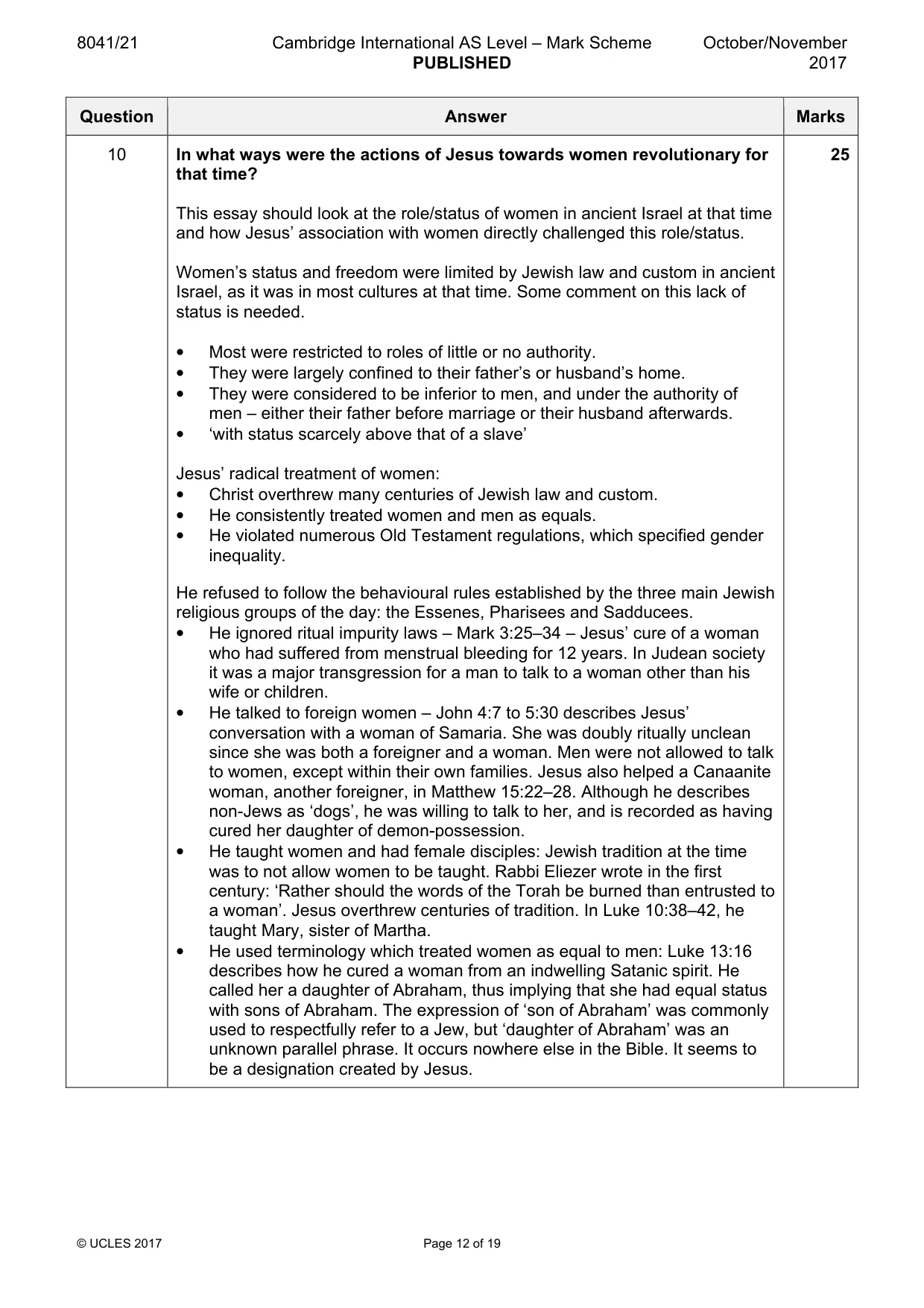
8041/21 Cambridge International AS Level – Mark Scheme PUBLISHED October/November 2017 © UCLES 2017 Page 12 of 19 Question Answer Marks 10 In what ways were the actions of Jesus towards women revolutionary for that time? This essay should look at the role/status of women in ancient Israel at that time and how Jesus’ association with women directly challenged this role/status. Women’s status and freedom were limited by Jewish law and custom in ancient Israel, as it was in most cultures at that time. Some comment on this lack of status is needed. • Most were restricted to roles of little or no authority. • They were largely confined to their father’s or husband’s home. • They were considered to be inferior to men, and under the authority of men – either their father before marriage or their husband afterwards. • ‘with status scarcely above that of a slave’ Jesus’ radical treatment of women: • Christ overthrew many centuries of Jewish law and custom. • He consistently treated women and men as equals. • He violated numerous Old Testament regulations, which specified gender inequality. He refused to follow the behavioural rules established by the three main Jewish religious groups of the day: the Essenes, Pharisees and Sadducees. • He ignored ritual impurity laws – Mark 3:25–34 – Jesus’ cure of a woman who had suffered from menstrual bleeding for 12 years. In Judean society it was a major transgression for a man to talk to a woman other than his wife or children. • He talked to foreign women – John 4:7 to 5:30 describes Jesus’ conversation with a woman of Samaria. She was doubly ritually unclean since she was both a foreigner and a woman. Men were not allowed to talk to women, except within their own families. Jesus also helped a Canaanite woman, another foreigner, in Matthew 15:22–28. Although he describes non-Jews as ‘dogs’, he was willing to talk to her, and is recorded as having cured her daughter of demon-possession. • He taught women and had female disciples: Jewish tradition at the time was to not allow women to be taught. Rabbi Eliezer wrote in the first century: ‘Rather should the words of the Torah be burned than entrusted to a woman’. Jesus overthrew centuries of tradition. In Luke 10:38–42, he taught Mary, sister of Martha. • He used terminology which treated women as equal to men: Luke 13:16 describes how he cured a woman from an indwelling Satanic spirit. He called her a daughter of Abraham, thus implying that she had equal status with sons of Abraham. The expression of ‘son of Abraham’ was commonly used to respectfully refer to a Jew, but ‘daughter of Abraham’ was an unknown parallel phrase. It occurs nowhere else in the Bible. It seems to be a designation created by Jesus. 25
Mark scheme, page 13
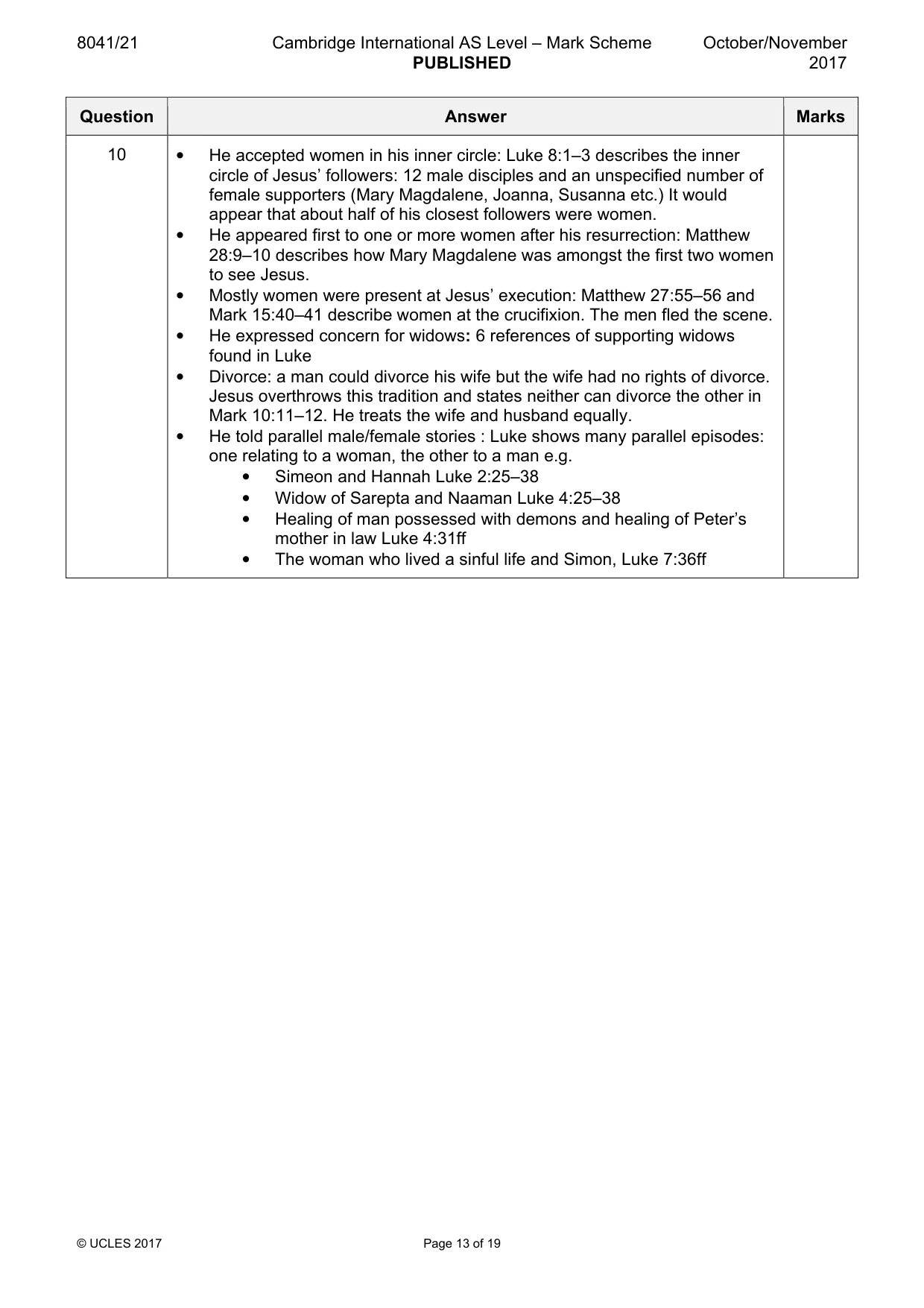
8041/21 Cambridge International AS Level – Mark Scheme PUBLISHED October/November 2017 © UCLES 2017 Page 13 of 19 Question Answer Marks 10 • He accepted women in his inner circle: Luke 8:1–3 describes the inner circle of Jesus’ followers: 12 male disciples and an unspecified number of female supporters (Mary Magdalene, Joanna, Susanna etc.) It would appear that about half of his closest followers were women. • He appeared first to one or more women after his resurrection: Matthew 28:9–10 describes how Mary Magdalene was amongst the first two women to see Jesus. • Mostly women were present at Jesus’ execution: Matthew 27:55–56 and Mark 15:40–41 describe women at the crucifixion. The men fled the scene. • He expressed concern for widows: 6 references of supporting widows found in Luke • Divorce: a man could divorce his wife but the wife had no rights of divorce. Jesus overthrows this tradition and states neither can divorce the other in Mark 10:11–12. He treats the wife and husband equally. • He told parallel male/female stories : Luke shows many parallel episodes: one relating to a woman, the other to a man e.g. • Simeon and Hannah Luke 2:25–38 • Widow of Sarepta and Naaman Luke 4:25–38 • Healing of man possessed with demons and healing of Peter’s mother in law Luke 4:31ff • The woman who lived a sinful life and Simon, Luke 7:36ff
Mark scheme, page 14
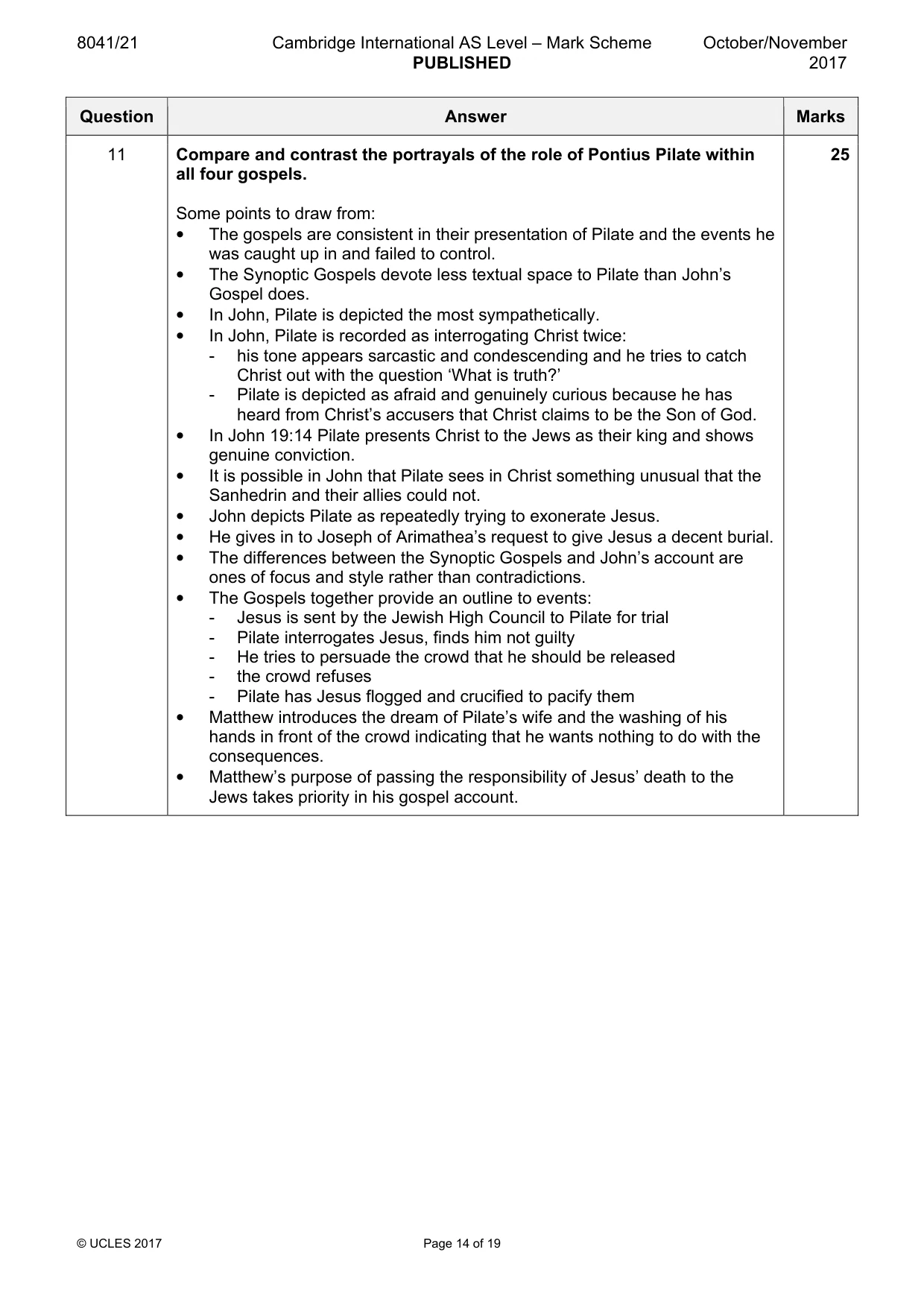
8041/21 Cambridge International AS Level – Mark Scheme PUBLISHED October/November 2017 © UCLES 2017 Page 14 of 19 Question Answer Marks 11 Compare and contrast the portrayals of the role of Pontius Pilate within all four gospels. Some points to draw from: • The gospels are consistent in their presentation of Pilate and the events he was caught up in and failed to control. • The Synoptic Gospels devote less textual space to Pilate than John’s Gospel does. • In John, Pilate is depicted the most sympathetically. • In John, Pilate is recorded as interrogating Christ twice: - his tone appears sarcastic and condescending and he tries to catch Christ out with the question ‘What is truth?’ - Pilate is depicted as afraid and genuinely curious because he has heard from Christ’s accusers that Christ claims to be the Son of God. • In John 19:14 Pilate presents Christ to the Jews as their king and shows genuine conviction. • It is possible in John that Pilate sees in Christ something unusual that the Sanhedrin and their allies could not. • John depicts Pilate as repeatedly trying to exonerate Jesus. • He gives in to Joseph of Arimathea’s request to give Jesus a decent burial. • The differences between the Synoptic Gospels and John’s account are ones of focus and style rather than contradictions. • The Gospels together provide an outline to events: - Jesus is sent by the Jewish High Council to Pilate for trial - Pilate interrogates Jesus, finds him not guilty - He tries to persuade the crowd that he should be released - the crowd refuses - Pilate has Jesus flogged and crucified to pacify them • Matthew introduces the dream of Pilate’s wife and the washing of his hands in front of the crowd indicating that he wants nothing to do with the consequences. • Matthew’s purpose of passing the responsibility of Jesus’ death to the Jews takes priority in his gospel account. 25
Mark scheme, page 15
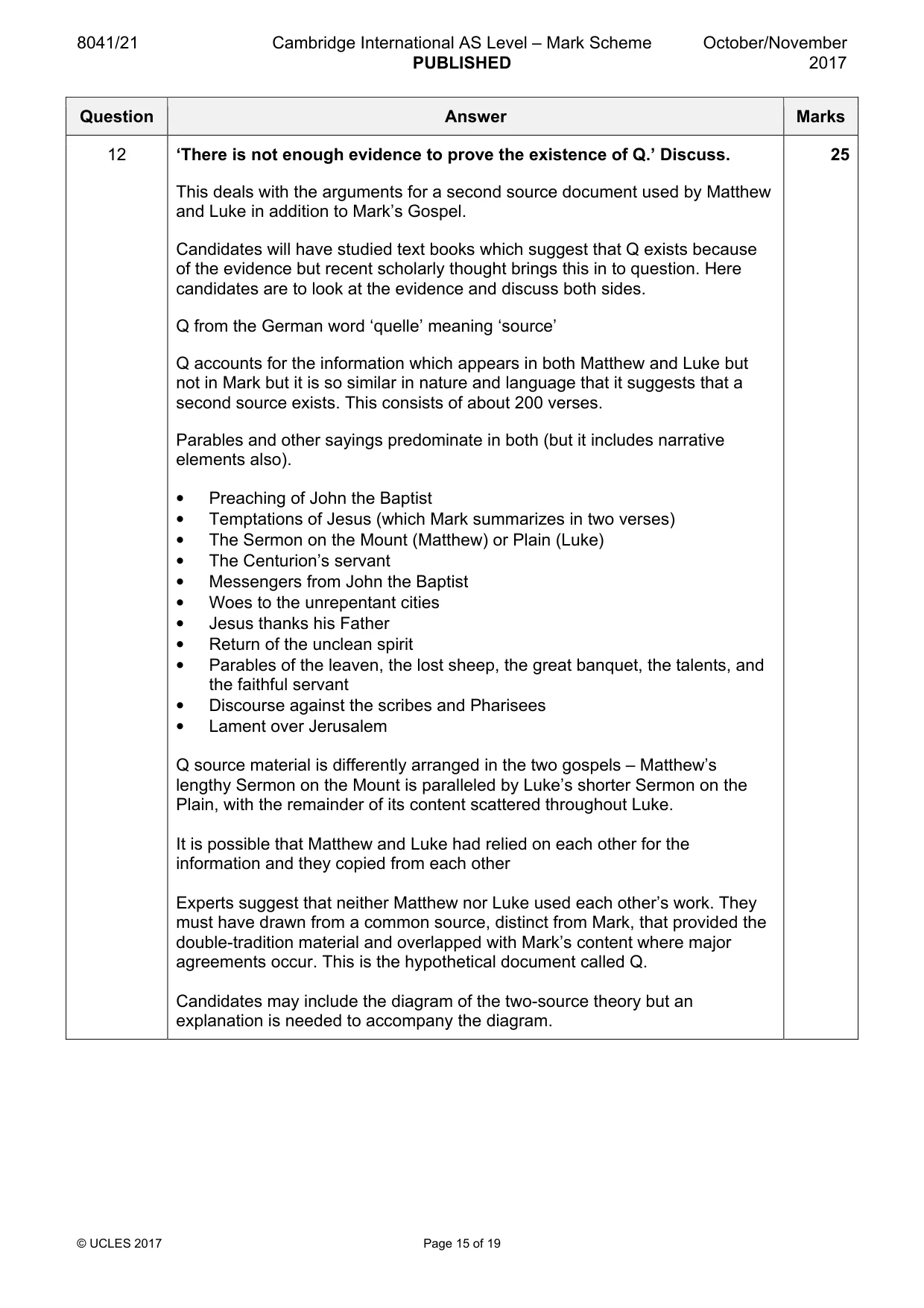
8041/21 Cambridge International AS Level – Mark Scheme PUBLISHED October/November 2017 © UCLES 2017 Page 15 of 19 Question Answer Marks 12 ‘There is not enough evidence to prove the existence of Q.’ Discuss. This deals with the arguments for a second source document used by Matthew and Luke in addition to Mark’s Gospel. Candidates will have studied text books which suggest that Q exists because of the evidence but recent scholarly thought brings this in to question. Here candidates are to look at the evidence and discuss both sides. Q from the German word ‘quelle’ meaning ‘source’ Q accounts for the information which appears in both Matthew and Luke but not in Mark but it is so similar in nature and language that it suggests that a second source exists. This consists of about 200 verses. Parables and other sayings predominate in both (but it includes narrative elements also). • Preaching of John the Baptist • Temptations of Jesus (which Mark summarizes in two verses) • The Sermon on the Mount (Matthew) or Plain (Luke) • The Centurion’s servant • Messengers from John the Baptist • Woes to the unrepentant cities • Jesus thanks his Father • Return of the unclean spirit • Parables of the leaven, the lost sheep, the great banquet, the talents, and the faithful servant • Discourse against the scribes and Pharisees • Lament over Jerusalem Q source material is differently arranged in the two gospels – Matthew’s lengthy Sermon on the Mount is paralleled by Luke’s shorter Sermon on the Plain, with the remainder of its content scattered throughout Luke. It is possible that Matthew and Luke had relied on each other for the information and they copied from each other Experts suggest that neither Matthew nor Luke used each other’s work. They must have drawn from a common source, distinct from Mark, that provided the double-tradition material and overlapped with Mark’s content where major agreements occur. This is the hypothetical document called Q. Candidates may include the diagram of the two-source theory but an explanation is needed to accompany the diagram. 25
Mark scheme, page 16
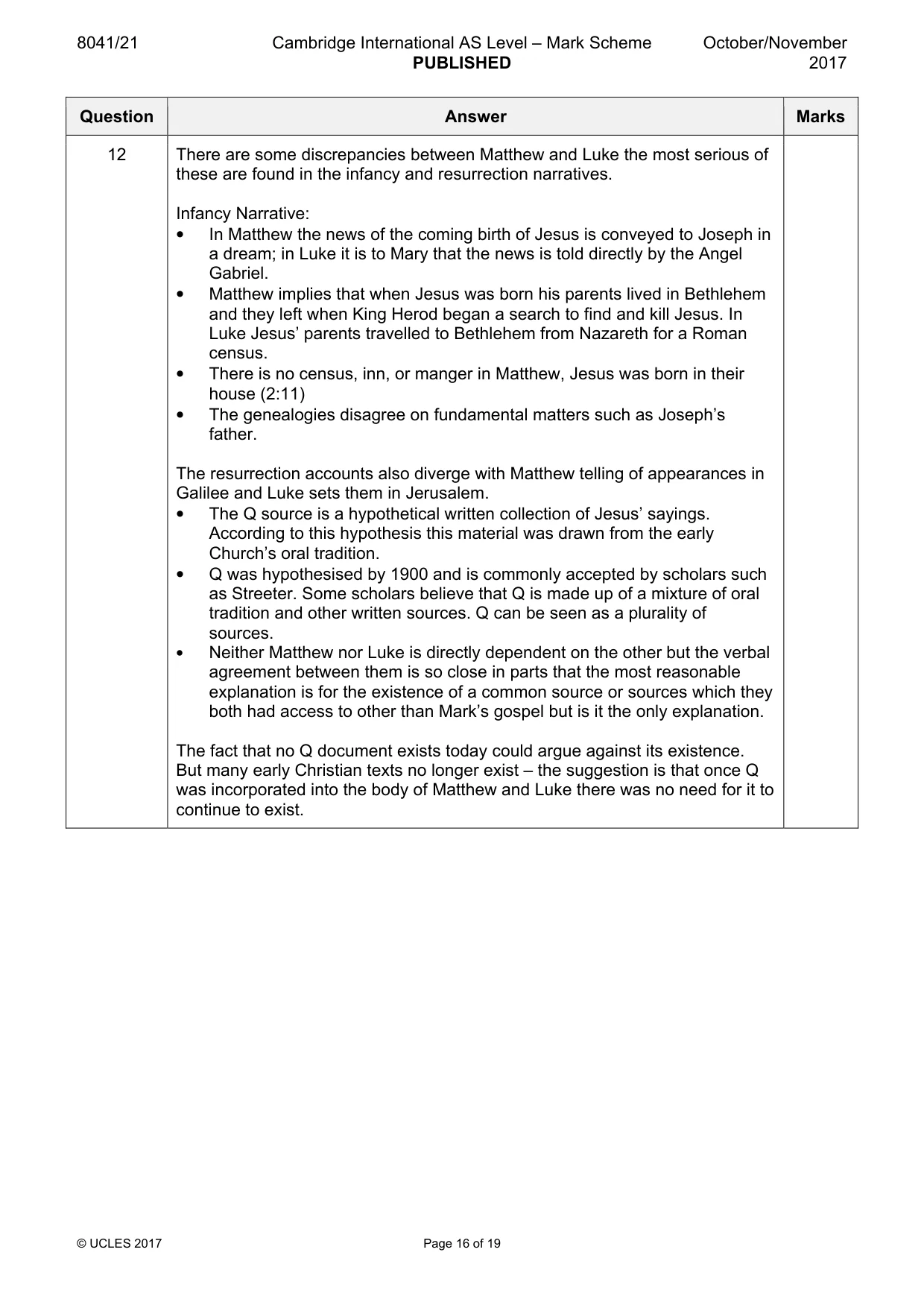
8041/21 Cambridge International AS Level – Mark Scheme PUBLISHED October/November 2017 © UCLES 2017 Page 16 of 19 Question Answer Marks 12 There are some discrepancies between Matthew and Luke the most serious of these are found in the infancy and resurrection narratives. Infancy Narrative: • In Matthew the news of the coming birth of Jesus is conveyed to Joseph in a dream; in Luke it is to Mary that the news is told directly by the Angel Gabriel. • Matthew implies that when Jesus was born his parents lived in Bethlehem and they left when King Herod began a search to find and kill Jesus. In Luke Jesus’ parents travelled to Bethlehem from Nazareth for a Roman census. • There is no census, inn, or manger in Matthew, Jesus was born in their house (2:11) • The genealogies disagree on fundamental matters such as Joseph’s father. The resurrection accounts also diverge with Matthew telling of appearances in Galilee and Luke sets them in Jerusalem. • The Q source is a hypothetical written collection of Jesus’ sayings. According to this hypothesis this material was drawn from the early Church’s oral tradition. • Q was hypothesised by 1900 and is commonly accepted by scholars such as Streeter. Some scholars believe that Q is made up of a mixture of oral tradition and other written sources. Q can be seen as a plurality of sources. • Neither Matthew nor Luke is directly dependent on the other but the verbal agreement between them is so close in parts that the most reasonable explanation is for the existence of a common source or sources which they both had access to other than Mark’s gospel but is it the only explanation. The fact that no Q document exists today could argue against its existence. But many early Christian texts no longer exist – the suggestion is that once Q was incorporated into the body of Matthew and Luke there was no need for it to continue to exist.
Mark scheme, page 17
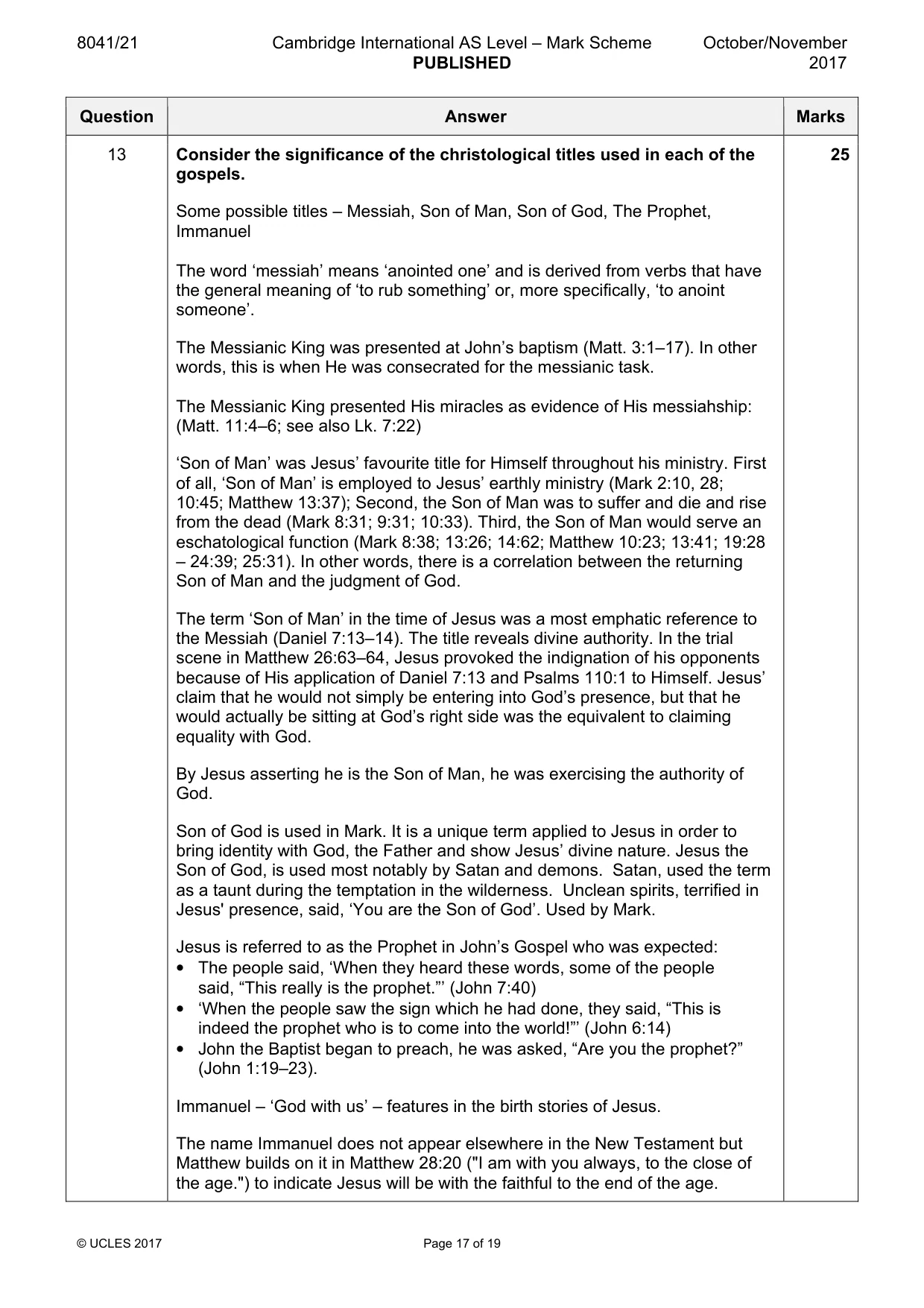
8041/21 Cambridge International AS Level – Mark Scheme PUBLISHED October/November 2017 © UCLES 2017 Page 17 of 19 Question Answer Marks 13 Consider the significance of the christological titles used in each of the gospels. Some possible titles – Messiah, Son of Man, Son of God, The Prophet, Immanuel The word ‘messiah’ means ‘anointed one’ and is derived from verbs that have the general meaning of ‘to rub something’ or, more specifically, ‘to anoint someone’. The Messianic King was presented at John’s baptism (Matt. 3:1–17). In other words, this is when He was consecrated for the messianic task. The Messianic King presented His miracles as evidence of His messiahship: (Matt. 11:4–6; see also Lk. 7:22) ‘Son of Man’ was Jesus’ favourite title for Himself throughout his ministry. First of all, ‘Son of Man’ is employed to Jesus’ earthly ministry (Mark 2:10, 28; 10:45; Matthew 13:37); Second, the Son of Man was to suffer and die and rise from the dead (Mark 8:31; 9:31; 10:33). Third, the Son of Man would serve an eschatological function (Mark 8:38; 13:26; 14:62; Matthew 10:23; 13:41; 19:28 – 24:39; 25:31). In other words, there is a correlation between the returning Son of Man and the judgment of God. The term ‘Son of Man’ in the time of Jesus was a most emphatic reference to the Messiah (Daniel 7:13–14). The title reveals divine authority. In the trial scene in Matthew 26:63–64, Jesus provoked the indignation of his opponents because of His application of Daniel 7:13 and Psalms 110:1 to Himself. Jesus’ claim that he would not simply be entering into God’s presence, but that he would actually be sitting at God’s right side was the equivalent to claiming equality with God. By Jesus asserting he is the Son of Man, he was exercising the authority of God. Son of God is used in Mark. It is a unique term applied to Jesus in order to bring identity with God, the Father and show Jesus’ divine nature. Jesus the Son of God, is used most notably by Satan and demons. Satan, used the term as a taunt during the temptation in the wilderness. Unclean spirits, terrified in Jesus' presence, said, ‘You are the Son of God’. Used by Mark. Jesus is referred to as the Prophet in John’s Gospel who was expected: • The people said, ‘When they heard these words, some of the people said, “This really is the prophet.”’ (John 7:40) • ‘When the people saw the sign which he had done, they said, “This is indeed the prophet who is to come into the world!”’ (John 6:14) • John the Baptist began to preach, he was asked, “Are you the prophet?” (John 1:19–23). Immanuel – ‘God with us’ – features in the birth stories of Jesus. The name Immanuel does not appear elsewhere in the New Testament but Matthew builds on it in Matthew 28:20 ("I am with you always, to the close of the age.") to indicate Jesus will be with the faithful to the end of the age. 25
Mark scheme, page 18
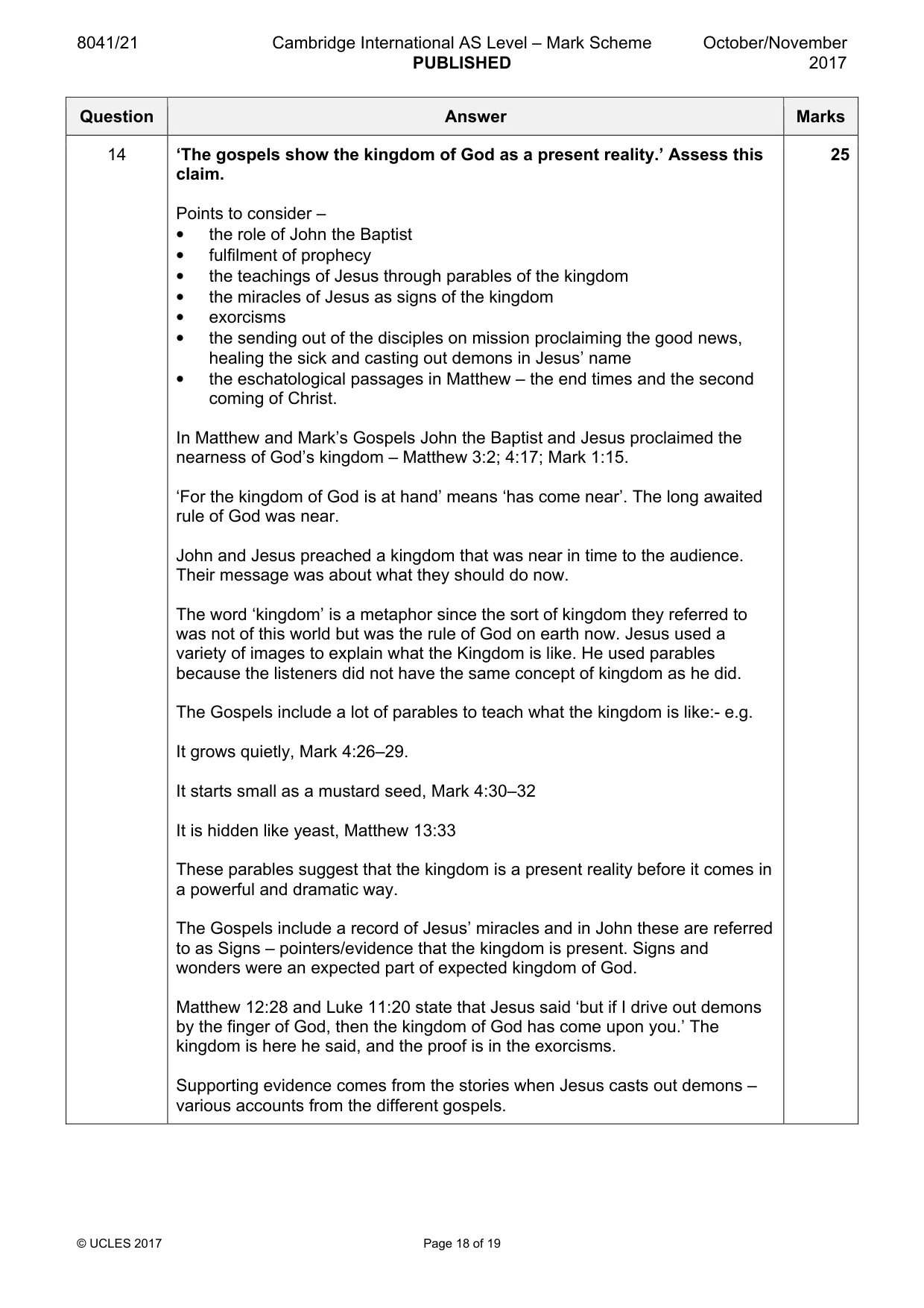
8041/21 Cambridge International AS Level – Mark Scheme PUBLISHED October/November 2017 © UCLES 2017 Page 18 of 19 Question Answer Marks 14 ‘The gospels show the kingdom of God as a present reality.’ Assess this claim. Points to consider – • the role of John the Baptist • fulfilment of prophecy • the teachings of Jesus through parables of the kingdom • the miracles of Jesus as signs of the kingdom • exorcisms • the sending out of the disciples on mission proclaiming the good news, healing the sick and casting out demons in Jesus’ name • the eschatological passages in Matthew – the end times and the second coming of Christ. In Matthew and Mark’s Gospels John the Baptist and Jesus proclaimed the nearness of God’s kingdom – Matthew 3:2; 4:17; Mark 1:15. ‘For the kingdom of God is at hand’ means ‘has come near’. The long awaited rule of God was near. John and Jesus preached a kingdom that was near in time to the audience. Their message was about what they should do now. The word ‘kingdom’ is a metaphor since the sort of kingdom they referred to was not of this world but was the rule of God on earth now. Jesus used a variety of images to explain what the Kingdom is like. He used parables because the listeners did not have the same concept of kingdom as he did. The Gospels include a lot of parables to teach what the kingdom is like:- e.g. It grows quietly, Mark 4:26–29. It starts small as a mustard seed, Mark 4:30–32 It is hidden like yeast, Matthew 13:33 These parables suggest that the kingdom is a present reality before it comes in a powerful and dramatic way. The Gospels include a record of Jesus’ miracles and in John these are referred to as Signs – pointers/evidence that the kingdom is present. Signs and wonders were an expected part of expected kingdom of God. Matthew 12:28 and Luke 11:20 state that Jesus said ‘but if I drive out demons by the finger of God, then the kingdom of God has come upon you.’ The kingdom is here he said, and the proof is in the exorcisms. Supporting evidence comes from the stories when Jesus casts out demons – various accounts from the different gospels. 25
Mark scheme, page 19
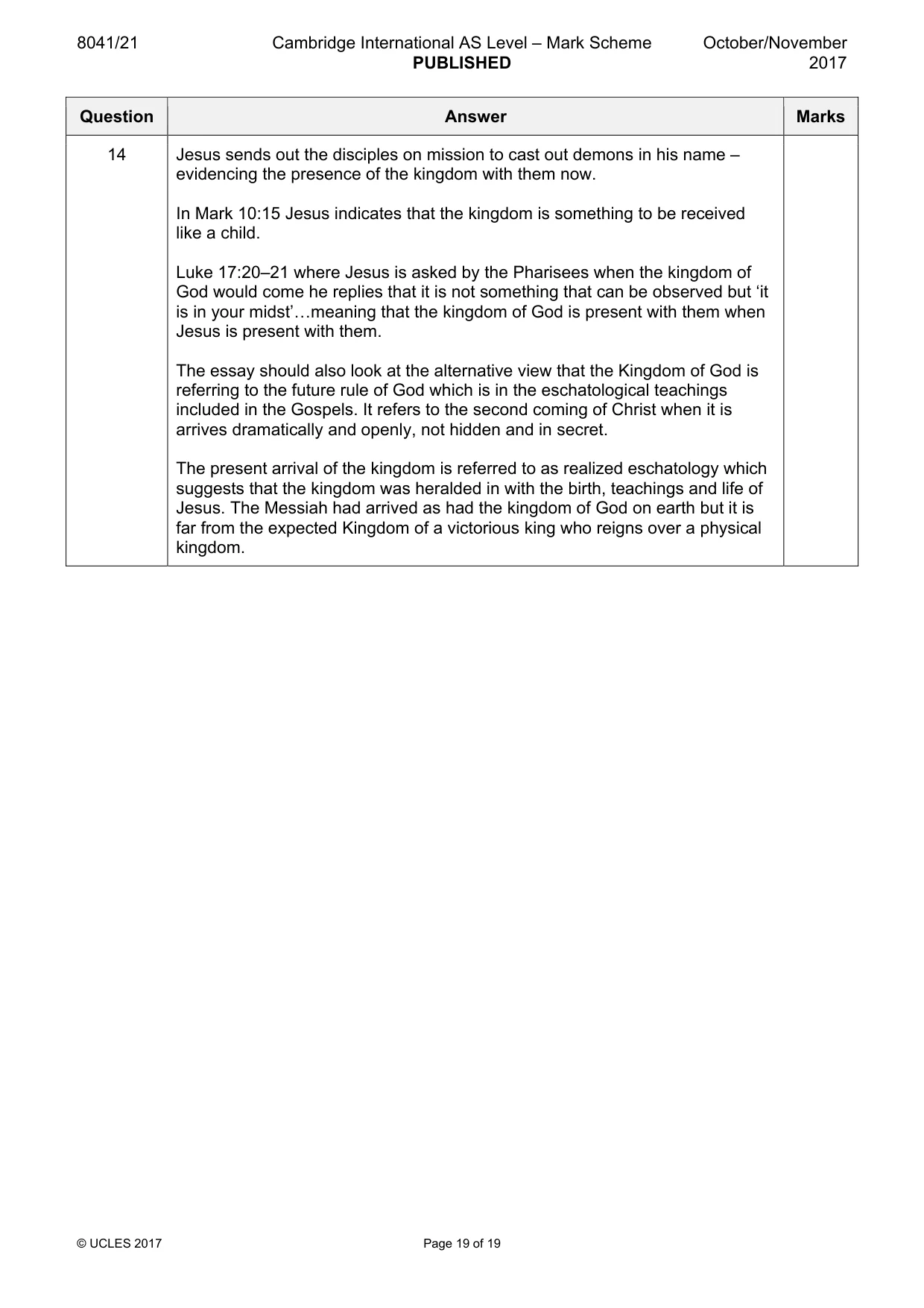
8041/21 Cambridge International AS Level – Mark Scheme PUBLISHED October/November 2017 © UCLES 2017 Page 19 of 19 Question Answer Marks 14 Jesus sends out the disciples on mission to cast out demons in his name – evidencing the presence of the kingdom with them now. In Mark 10:15 Jesus indicates that the kingdom is something to be received like a child. Luke 17:20–21 where Jesus is asked by the Pharisees when the kingdom of God would come he replies that it is not something that can be observed but ‘it is in your midst’«meaning that the kingdom of God is present with them when Jesus is present with them. The essay should also look at the alternative view that the Kingdom of God is referring to the future rule of God which is in the eschatological teachings included in the Gospels. It refers to the second coming of Christ when it is arrives dramatically and openly, not hidden and in secret. The present arrival of the kingdom is referred to as realized eschatology which suggests that the kingdom was heralded in with the birth, teachings and life of Jesus. The Messiah had arrived as had the kingdom of God on earth but it is far from the expected Kingdom of a victorious king who reigns over a physical kingdom.
What you needed in this session
Cambridge’s own grade thresholds for 2017 Oct/Nov, Paper 2 · Variant 1. A higher threshold means an easier paper — the bar moves with how the cohort did.