Cambridge A Level Divinity (AS Level only) 8041 — 2015 Oct/Nov Paper 2 · Variant 2
8041/22/O/N/15 · 100 marks · ≈113 min
The question paper and its mark scheme, free to read here and free to download. This is Cambridge’s own paper, exactly as it was sat.
Question paper4 pages
Mark scheme12 pages
Answers below. Sit the paper first if you are practising.
Paper as text
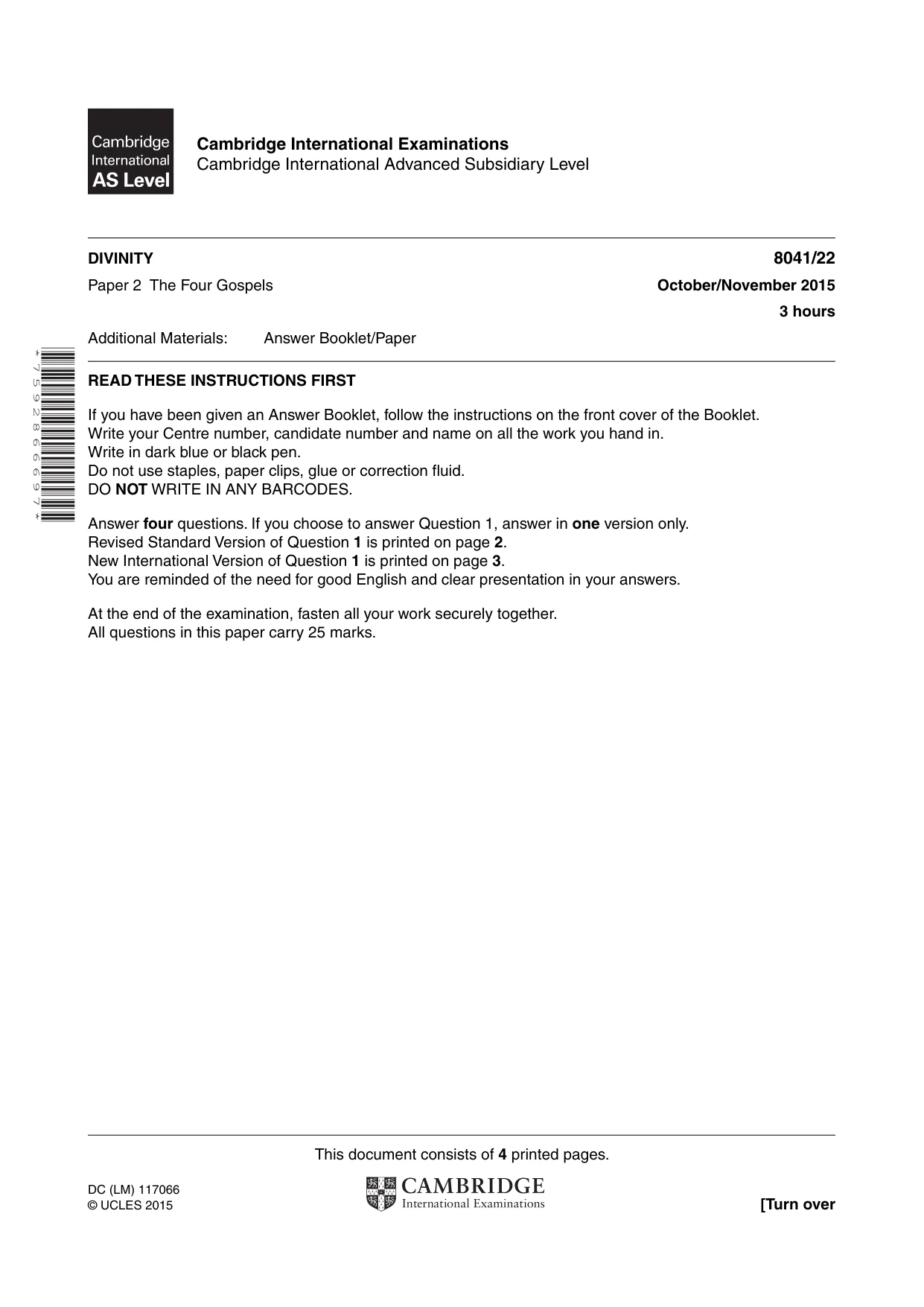
Question paper, page 1
This document consists of 4 printed pages. DC (LM) 117066 © UCLES 2015 [Turn over Cambridge International Examinations Cambridge International Advanced Subsidiary Level * 7 5 9 2 8 6 6 6 9 7 * DIVINITY 8041/22 Paper 2 The Four Gospels October/November 2015 3 hours Additional Materials: Answer Booklet/Paper READ THESE INSTRUCTIONS FIRST If you have been given an Answer Booklet, follow the instructions on the front cover of the Booklet. Write your Centre number, candidate number and name on all the work you hand in. Write in dark blue or black pen. Do not use staples, paper clips, glue or correction fluid. DO NOT WRITE IN ANY BARCODES. Answer four questions. If you choose to answer Question 1, answer in one version only. Revised Standard Version of Question 1 is printed on page 2. New International Version of Question 1 is printed on page 3. You are reminded of the need for good English and clear presentation in your answers. At the end of the examination, fasten all your work securely together. All questions in this paper carry 25 marks.
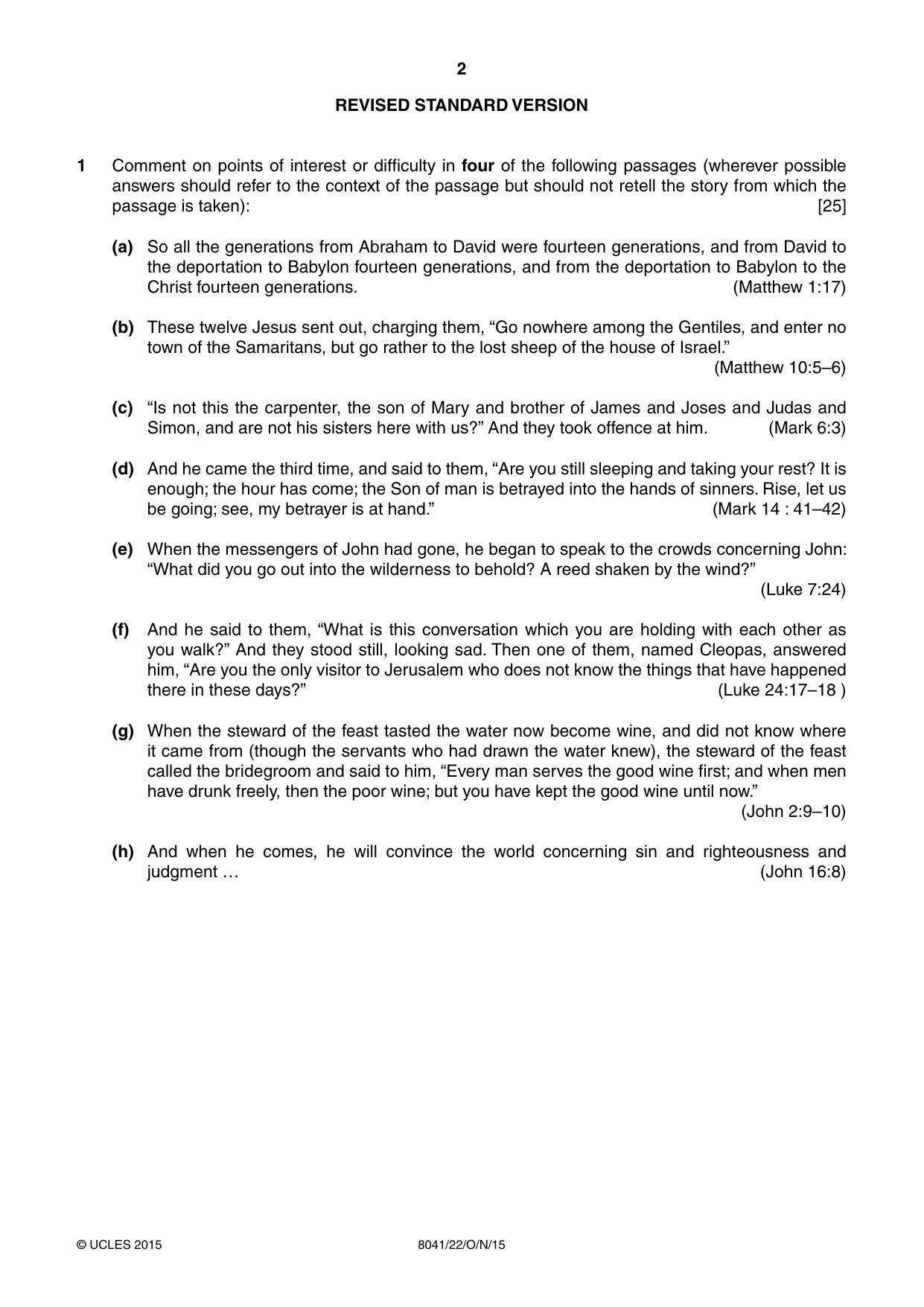
Question paper, page 2
2 8041/22/O/N/15 © UCLES 2015 REVISED STANDARD VERSION 1 Comment on points of interest or difficulty in four of the following passages (wherever possible answers should refer to the context of the passage but should not retell the story from which the passage is taken): [25] (a) So all the generations from Abraham to David were fourteen generations, and from David to the deportation to Babylon fourteen generations, and from the deportation to Babylon to the Christ fourteen generations. (Matthew 1:17) (b) These twelve Jesus sent out, charging them, “Go nowhere among the Gentiles, and enter no town of the Samaritans, but go rather to the lost sheep of the house of Israel.” (Matthew 10:5–6) (c) “Is not this the carpenter, the son of Mary and brother of James and Joses and Judas and Simon, and are not his sisters here with us?” And they took offence at him. (Mark 6:3) (d) And he came the third time, and said to them, “Are you still sleeping and taking your rest? It is enough; the hour has come; the Son of man is betrayed into the hands of sinners. Rise, let us be going; see, my betrayer is at hand.” (Mark 14 : 41–42) (e) When the messengers of John had gone, he began to speak to the crowds concerning John: “What did you go out into the wilderness to behold? A reed shaken by the wind?” (Luke 7:24) (f) And he said to them, “What is this conversation which you are holding with each other as you walk?” And they stood still, looking sad. Then one of them, named Cleopas, answered him, “Are you the only visitor to Jerusalem who does not know the things that have happened there in these days?” (Luke 24:17–18 ) (g) When the steward of the feast tasted the water now become wine, and did not know where it came from (though the servants who had drawn the water knew), the steward of the feast called the bridegroom and said to him, “Every man serves the good wine first; and when men have drunk freely, then the poor wine; but you have kept the good wine until now.” (John 2:9–10) (h) And when he comes, he will convince the world concerning sin and righteousness and judgment … (John 16:8)
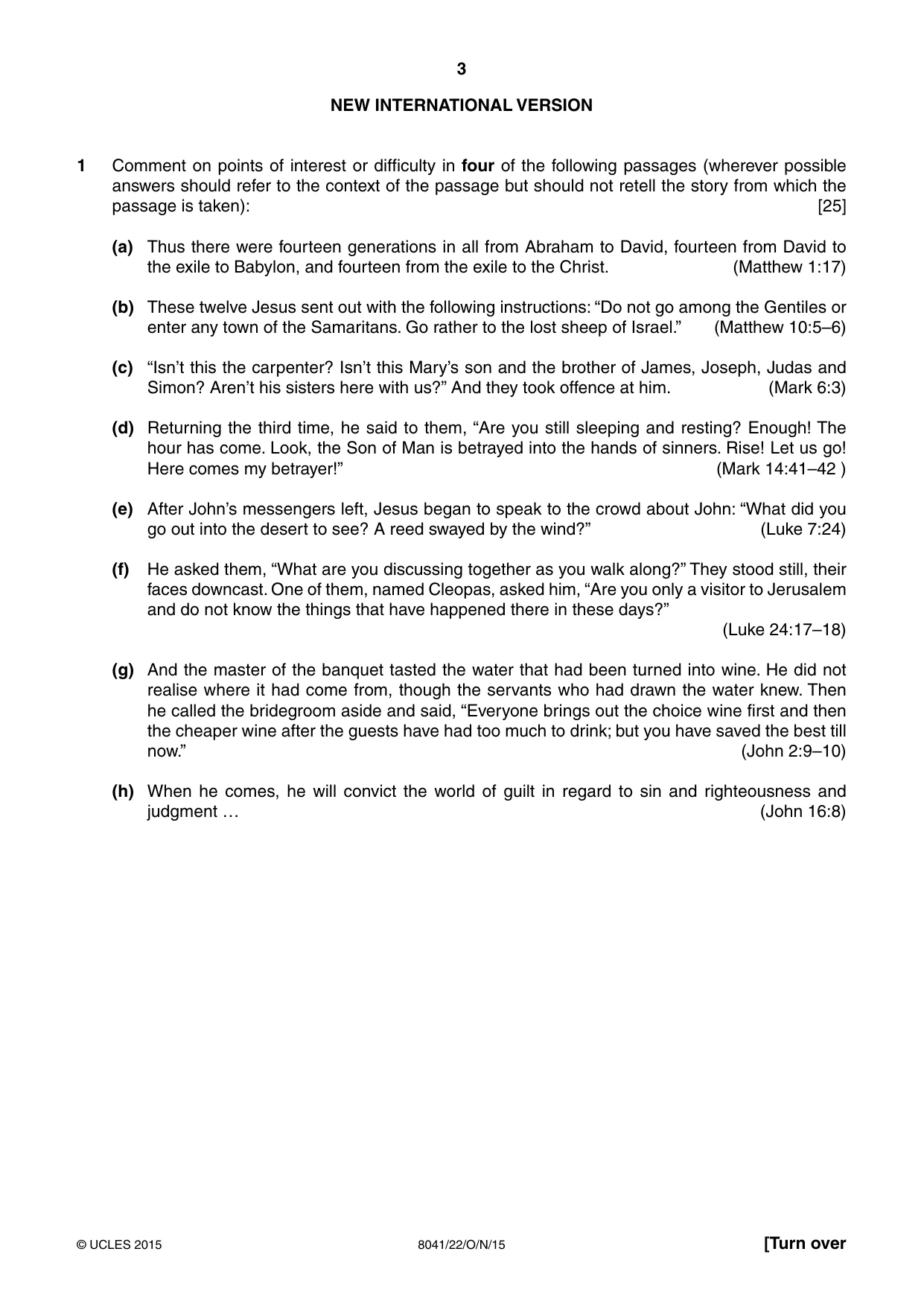
Question paper, page 3
3 8041/22/O/N/15 © UCLES 2015 [Turn over NEW INTERNATIONAL VERSION 1 Comment on points of interest or difficulty in four of the following passages (wherever possible answers should refer to the context of the passage but should not retell the story from which the passage is taken): [25] (a) Thus there were fourteen generations in all from Abraham to David, fourteen from David to the exile to Babylon, and fourteen from the exile to the Christ. (Matthew 1:17) (b) These twelve Jesus sent out with the following instructions: “Do not go among the Gentiles or enter any town of the Samaritans. Go rather to the lost sheep of Israel.” (Matthew 10:5–6) (c) “Isn’t this the carpenter? Isn’t this Mary’s son and the brother of James, Joseph, Judas and Simon? Aren’t his sisters here with us?” And they took offence at him. (Mark 6:3) (d) Returning the third time, he said to them, “Are you still sleeping and resting? Enough! The hour has come. Look, the Son of Man is betrayed into the hands of sinners. Rise! Let us go! Here comes my betrayer!” (Mark 14:41–42 ) (e) After John’s messengers left, Jesus began to speak to the crowd about John: “What did you go out into the desert to see? A reed swayed by the wind?” (Luke 7:24) (f) He asked them, “What are you discussing together as you walk along?” They stood still, their faces downcast. One of them, named Cleopas, asked him, “Are you only a visitor to Jerusalem and do not know the things that have happened there in these days?” (Luke 24:17–18) (g) And the master of the banquet tasted the water that had been turned into wine. He did not realise where it had come from, though the servants who had drawn the water knew. Then he called the bridegroom aside and said, “Everyone brings out the choice wine first and then the cheaper wine after the guests have had too much to drink; but you have saved the best till now.” (John 2:9–10) (h) When he comes, he will convict the world of guilt in regard to sin and righteousness and judgment … (John 16:8)
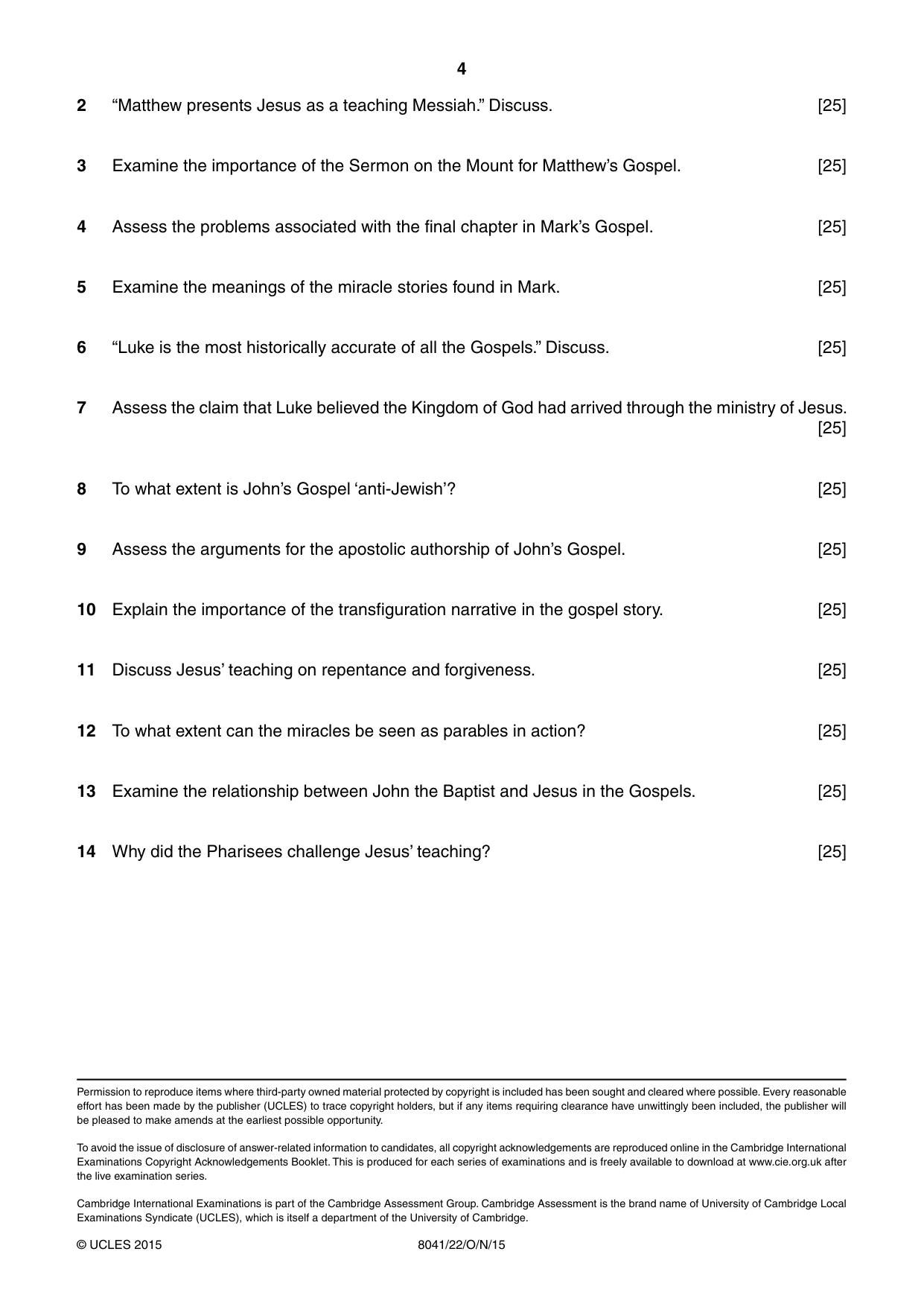
Question paper, page 4
4 8041/22/O/N/15 © UCLES 2015 Permission to reproduce items where third-party owned material protected by copyright is included has been sought and cleared where possible. Every reasonable effort has been made by the publisher (UCLES) to trace copyright holders, but if any items requiring clearance have unwittingly been included, the publisher will be pleased to make amends at the earliest possible opportunity. To avoid the issue of disclosure of answer-related information to candidates, all copyright acknowledgements are reproduced online in the Cambridge International Examinations Copyright Acknowledgements Booklet. This is produced for each series of examinations and is freely available to download at www.cie.org.uk after the live examination series. Cambridge International Examinations is part of the Cambridge Assessment Group. Cambridge Assessment is the brand name of University of Cambridge Local Examinations Syndicate (UCLES), which is itself a department of the University of Cambridge. 2 “Matthew presents Jesus as a teaching Messiah.” Discuss. [25] 3 Examine the importance of the Sermon on the Mount for Matthew’s Gospel. [25] 4 Assess the problems associated with the final chapter in Mark’s Gospel. [25] 5 Examine the meanings of the miracle stories found in Mark. [25] 6 “Luke is the most historically accurate of all the Gospels.” Discuss. [25] 7 Assess the claim that Luke believed the Kingdom of God had arrived through the ministry of Jesus. [25] 8 To what extent is John’s Gospel ‘anti-Jewish’? [25] 9 Assess the arguments for the apostolic authorship of John’s Gospel. [25] 10 Explain the importance of the transfiguration narrative in the gospel story. [25] 11 Discuss Jesus’ teaching on repentance and forgiveness. [25] 12 To what extent can the miracles be seen as parables in action? [25] 13 Examine the relationship between John the Baptist and Jesus in the Gospels. [25] 14 Why did the Pharisees challenge Jesus’ teaching? [25]
Mark scheme, page 1
® IGCSE is the registered trademark of Cambridge International Examinations. CAMBRIDGE INTERNATIONAL EXAMINATIONS Cambridge International Advanced Subsidiary Level MARK SCHEME for the October/November 2015 series 8041 DIVINITY 8041/22 Paper 2 (The Four Gospels), maximum raw mark 100 This mark scheme is published as an aid to teachers and candidates, to indicate the requirements of the examination. It shows the basis on which Examiners were instructed to award marks. It does not indicate the details of the discussions that took place at an Examiners’ meeting before marking began, which would have considered the acceptability of alternative answers. Mark schemes should be read in conjunction with the question paper and the Principal Examiner Report for Teachers. Cambridge will not enter into discussions about these mark schemes. Cambridge is publishing the mark schemes for the October/November 2015 series for most Cambridge IGCSE®, Cambridge International A and AS Level components and some Cambridge O Level components.
Mark scheme, page 2
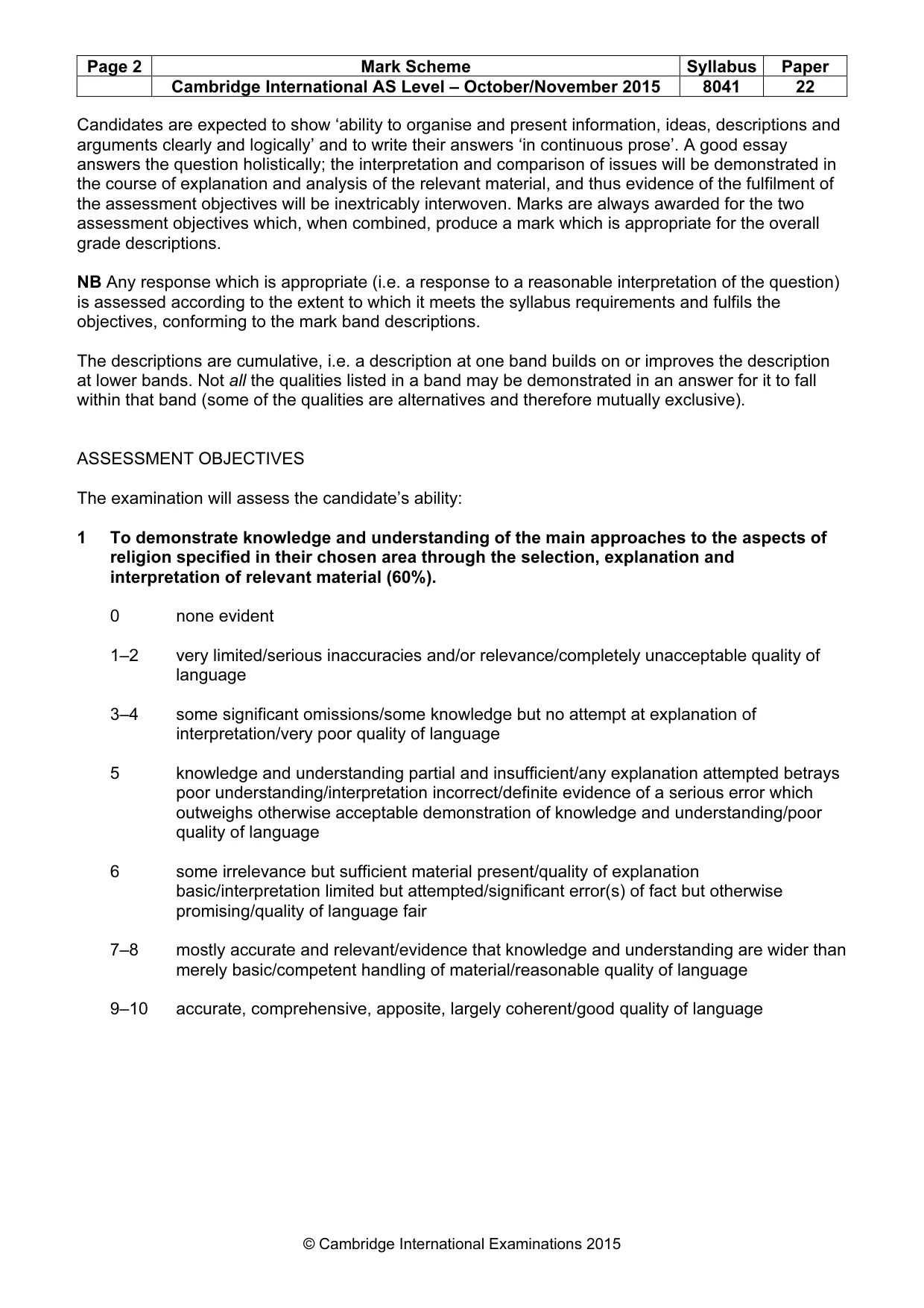
Page 2 Mark Scheme Syllabus Paper Cambridge International AS Level – October/November 2015 8041 22 © Cambridge International Examinations 2015 Candidates are expected to show ‘ability to organise and present information, ideas, descriptions and arguments clearly and logically’ and to write their answers ‘in continuous prose’. A good essay answers the question holistically; the interpretation and comparison of issues will be demonstrated in the course of explanation and analysis of the relevant material, and thus evidence of the fulfilment of the assessment objectives will be inextricably interwoven. Marks are always awarded for the two assessment objectives which, when combined, produce a mark which is appropriate for the overall grade descriptions. NB Any response which is appropriate (i.e. a response to a reasonable interpretation of the question) is assessed according to the extent to which it meets the syllabus requirements and fulfils the objectives, conforming to the mark band descriptions. The descriptions are cumulative, i.e. a description at one band builds on or improves the description at lower bands. Not all the qualities listed in a band may be demonstrated in an answer for it to fall within that band (some of the qualities are alternatives and therefore mutually exclusive). ASSESSMENT OBJECTIVES The examination will assess the candidate’s ability: 1 To demonstrate knowledge and understanding of the main approaches to the aspects of religion specified in their chosen area through the selection, explanation and interpretation of relevant material (60%). 0 none evident 1–2 very limited/serious inaccuracies and/or relevance/completely unacceptable quality of language 3–4 some significant omissions/some knowledge but no attempt at explanation of interpretation/very poor quality of language 5 knowledge and understanding partial and insufficient/any explanation attempted betrays poor understanding/interpretation incorrect/definite evidence of a serious error which outweighs otherwise acceptable demonstration of knowledge and understanding/poor quality of language 6 some irrelevance but sufficient material present/quality of explanation basic/interpretation limited but attempted/significant error(s) of fact but otherwise promising/quality of language fair 7–8 mostly accurate and relevant/evidence that knowledge and understanding are wider than merely basic/competent handling of material/reasonable quality of language 9–10 accurate, comprehensive, apposite, largely coherent/good quality of language
Mark scheme, page 3
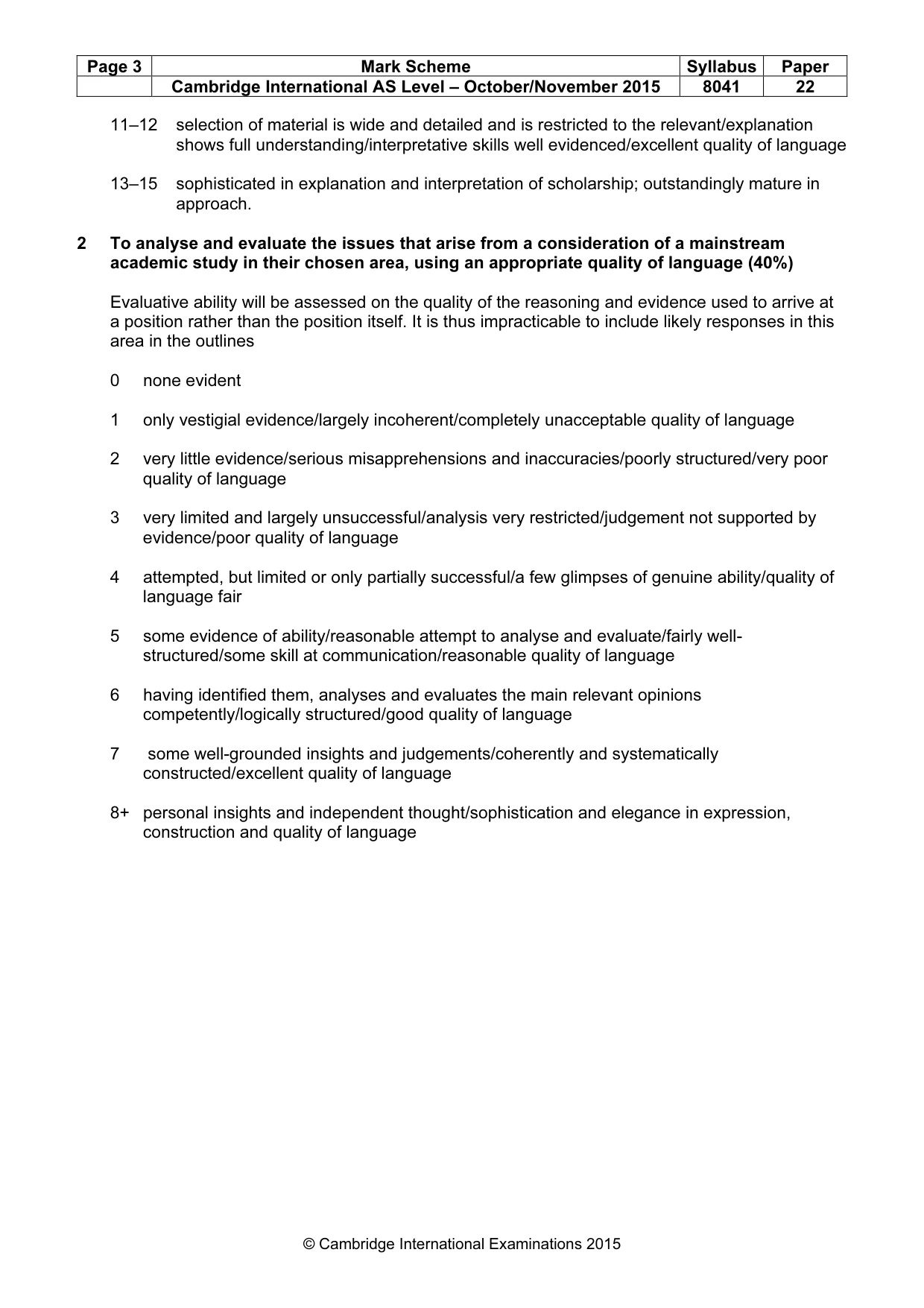
Page 3 Mark Scheme Syllabus Paper Cambridge International AS Level – October/November 2015 8041 22 © Cambridge International Examinations 2015 11–12 selection of material is wide and detailed and is restricted to the relevant/explanation shows full understanding/interpretative skills well evidenced/excellent quality of language 13–15 sophisticated in explanation and interpretation of scholarship; outstandingly mature in approach. 2 To analyse and evaluate the issues that arise from a consideration of a mainstream academic study in their chosen area, using an appropriate quality of language (40%) Evaluative ability will be assessed on the quality of the reasoning and evidence used to arrive at a position rather than the position itself. It is thus impracticable to include likely responses in this area in the outlines 0 none evident 1 only vestigial evidence/largely incoherent/completely unacceptable quality of language 2 very little evidence/serious misapprehensions and inaccuracies/poorly structured/very poor quality of language 3 very limited and largely unsuccessful/analysis very restricted/judgement not supported by evidence/poor quality of language 4 attempted, but limited or only partially successful/a few glimpses of genuine ability/quality of language fair 5 some evidence of ability/reasonable attempt to analyse and evaluate/fairly well- structured/some skill at communication/reasonable quality of language 6 having identified them, analyses and evaluates the main relevant opinions competently/logically structured/good quality of language 7 some well-grounded insights and judgements/coherently and systematically constructed/excellent quality of language 8+ personal insights and independent thought/sophistication and elegance in expression, construction and quality of language
Mark scheme, page 4
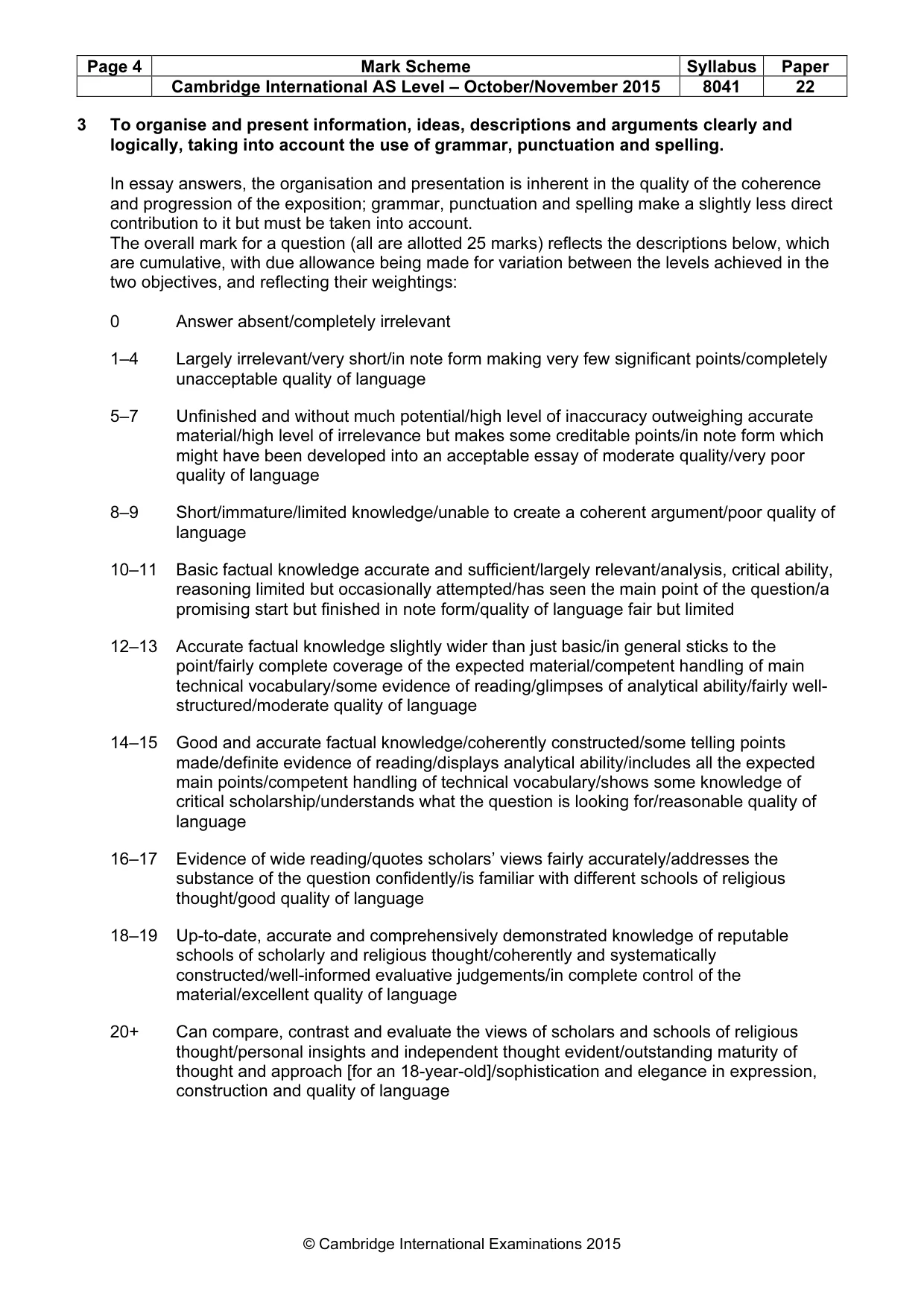
Page 4 Mark Scheme Syllabus Paper Cambridge International AS Level – October/November 2015 8041 22 © Cambridge International Examinations 2015 3 To organise and present information, ideas, descriptions and arguments clearly and logically, taking into account the use of grammar, punctuation and spelling. In essay answers, the organisation and presentation is inherent in the quality of the coherence and progression of the exposition; grammar, punctuation and spelling make a slightly less direct contribution to it but must be taken into account. The overall mark for a question (all are allotted 25 marks) reflects the descriptions below, which are cumulative, with due allowance being made for variation between the levels achieved in the two objectives, and reflecting their weightings: 0 Answer absent/completely irrelevant 1–4 Largely irrelevant/very short/in note form making very few significant points/completely unacceptable quality of language 5–7 Unfinished and without much potential/high level of inaccuracy outweighing accurate material/high level of irrelevance but makes some creditable points/in note form which might have been developed into an acceptable essay of moderate quality/very poor quality of language 8–9 Short/immature/limited knowledge/unable to create a coherent argument/poor quality of language 10–11 Basic factual knowledge accurate and sufficient/largely relevant/analysis, critical ability, reasoning limited but occasionally attempted/has seen the main point of the question/a promising start but finished in note form/quality of language fair but limited 12–13 Accurate factual knowledge slightly wider than just basic/in general sticks to the point/fairly complete coverage of the expected material/competent handling of main technical vocabulary/some evidence of reading/glimpses of analytical ability/fairly well- structured/moderate quality of language 14–15 Good and accurate factual knowledge/coherently constructed/some telling points made/definite evidence of reading/displays analytical ability/includes all the expected main points/competent handling of technical vocabulary/shows some knowledge of critical scholarship/understands what the question is looking for/reasonable quality of language 16–17 Evidence of wide reading/quotes scholars’ views fairly accurately/addresses the substance of the question confidently/is familiar with different schools of religious thought/good quality of language 18–19 Up-to-date, accurate and comprehensively demonstrated knowledge of reputable schools of scholarly and religious thought/coherently and systematically constructed/well-informed evaluative judgements/in complete control of the material/excellent quality of language 20+ Can compare, contrast and evaluate the views of scholars and schools of religious thought/personal insights and independent thought evident/outstanding maturity of thought and approach [for an 18-year-old]/sophistication and elegance in expression, construction and quality of language
Mark scheme, page 5
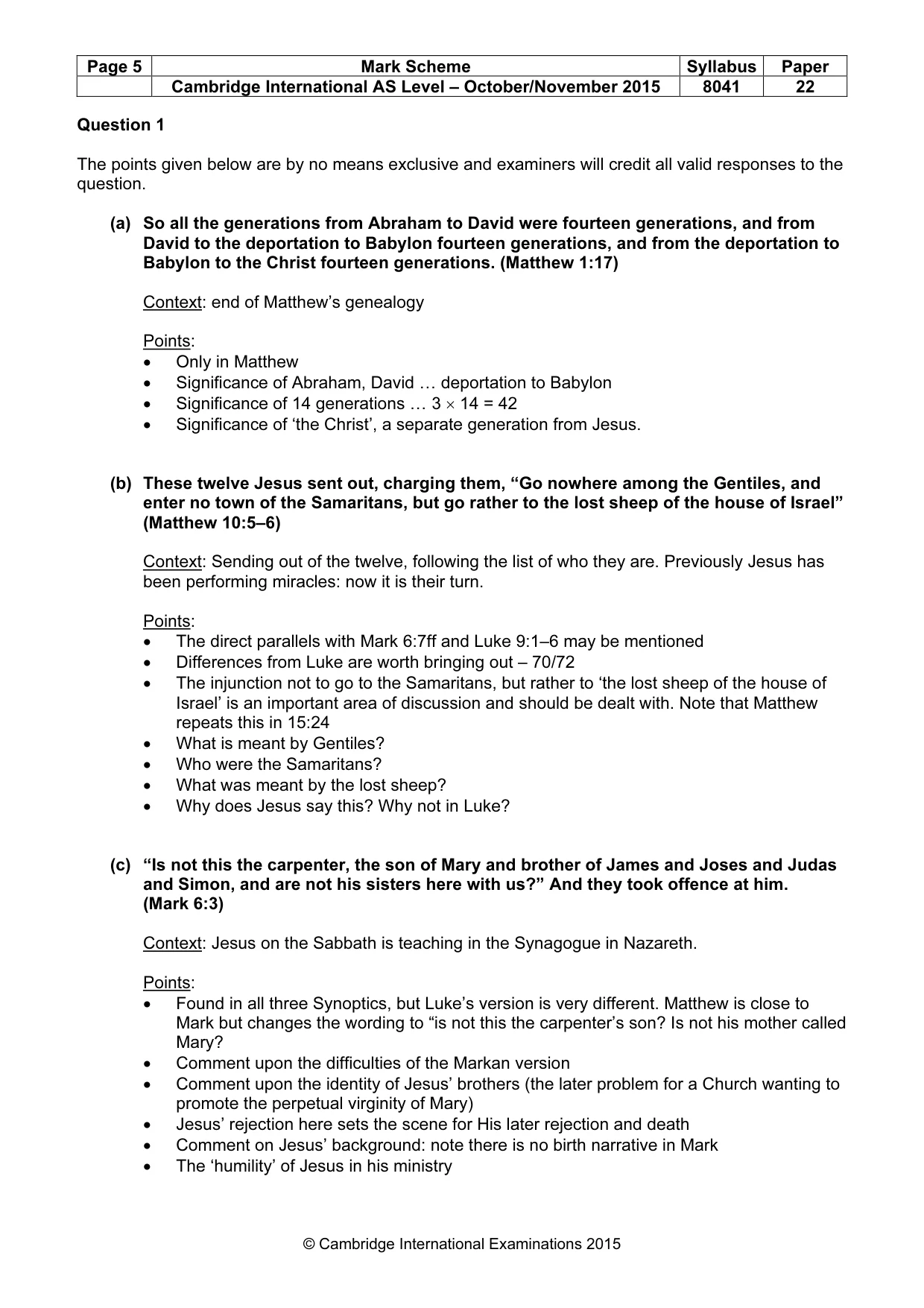
Page 5 Mark Scheme Syllabus Paper Cambridge International AS Level – October/November 2015 8041 22 © Cambridge International Examinations 2015 Question 1 The points given below are by no means exclusive and examiners will credit all valid responses to the question. (a) So all the generations from Abraham to David were fourteen generations, and from David to the deportation to Babylon fourteen generations, and from the deportation to Babylon to the Christ fourteen generations. (Matthew 1:17) Context: end of Matthew’s genealogy Points: • Only in Matthew • Significance of Abraham, David … deportation to Babylon • Significance of 14 generations … 3 × 14 = 42 • Significance of ‘the Christ’, a separate generation from Jesus. (b) These twelve Jesus sent out, charging them, “Go nowhere among the Gentiles, and enter no town of the Samaritans, but go rather to the lost sheep of the house of Israel” (Matthew 10:5–6) Context: Sending out of the twelve, following the list of who they are. Previously Jesus has been performing miracles: now it is their turn. Points: • The direct parallels with Mark 6:7ff and Luke 9:1–6 may be mentioned • Differences from Luke are worth bringing out – 70/72 • The injunction not to go to the Samaritans, but rather to ‘the lost sheep of the house of Israel’ is an important area of discussion and should be dealt with. Note that Matthew repeats this in 15:24 • What is meant by Gentiles? • Who were the Samaritans? • What was meant by the lost sheep? • Why does Jesus say this? Why not in Luke? (c) “Is not this the carpenter, the son of Mary and brother of James and Joses and Judas and Simon, and are not his sisters here with us?” And they took offence at him. (Mark 6:3) Context: Jesus on the Sabbath is teaching in the Synagogue in Nazareth. Points: • Found in all three Synoptics, but Luke’s version is very different. Matthew is close to Mark but changes the wording to “is not this the carpenter’s son? Is not his mother called Mary? • Comment upon the difficulties of the Markan version • Comment upon the identity of Jesus’ brothers (the later problem for a Church wanting to promote the perpetual virginity of Mary) • Jesus’ rejection here sets the scene for His later rejection and death • Comment on Jesus’ background: note there is no birth narrative in Mark • The ‘humility’ of Jesus in his ministry
Mark scheme, page 6
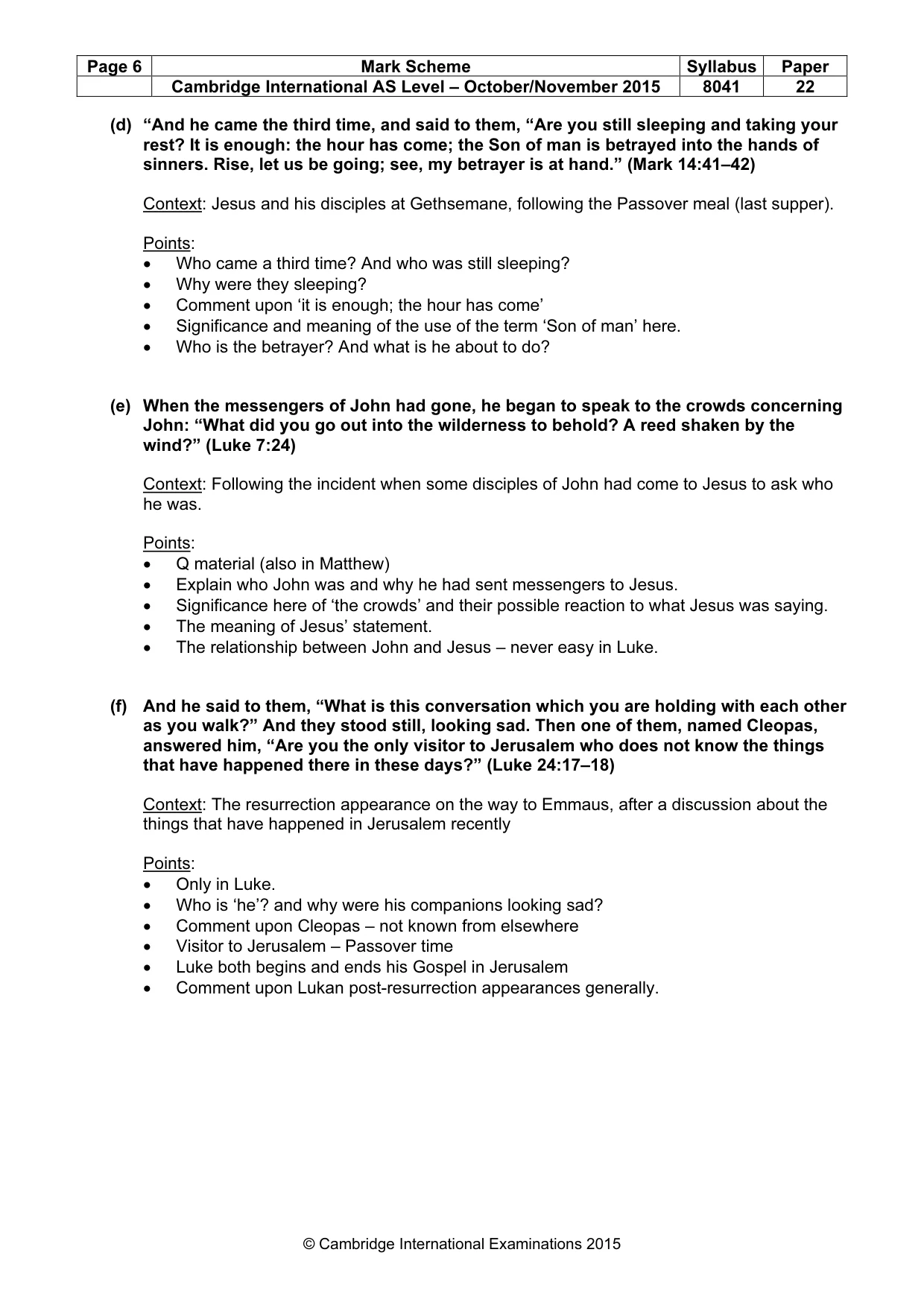
Page 6 Mark Scheme Syllabus Paper Cambridge International AS Level – October/November 2015 8041 22 © Cambridge International Examinations 2015 (d) “And he came the third time, and said to them, “Are you still sleeping and taking your rest? It is enough: the hour has come; the Son of man is betrayed into the hands of sinners. Rise, let us be going; see, my betrayer is at hand.” (Mark 14:41–42) Context: Jesus and his disciples at Gethsemane, following the Passover meal (last supper). Points: • Who came a third time? And who was still sleeping? • Why were they sleeping? • Comment upon ‘it is enough; the hour has come’ • Significance and meaning of the use of the term ‘Son of man’ here. • Who is the betrayer? And what is he about to do? (e) When the messengers of John had gone, he began to speak to the crowds concerning John: “What did you go out into the wilderness to behold? A reed shaken by the wind?” (Luke 7:24) Context: Following the incident when some disciples of John had come to Jesus to ask who he was. Points: • Q material (also in Matthew) • Explain who John was and why he had sent messengers to Jesus. • Significance here of ‘the crowds’ and their possible reaction to what Jesus was saying. • The meaning of Jesus’ statement. • The relationship between John and Jesus – never easy in Luke. (f) And he said to them, “What is this conversation which you are holding with each other as you walk?” And they stood still, looking sad. Then one of them, named Cleopas, answered him, “Are you the only visitor to Jerusalem who does not know the things that have happened there in these days?” (Luke 24:17–18) Context: The resurrection appearance on the way to Emmaus, after a discussion about the things that have happened in Jerusalem recently Points: • Only in Luke. • Who is ‘he’? and why were his companions looking sad? • Comment upon Cleopas – not known from elsewhere • Visitor to Jerusalem – Passover time • Luke both begins and ends his Gospel in Jerusalem • Comment upon Lukan post-resurrection appearances generally.
Mark scheme, page 7
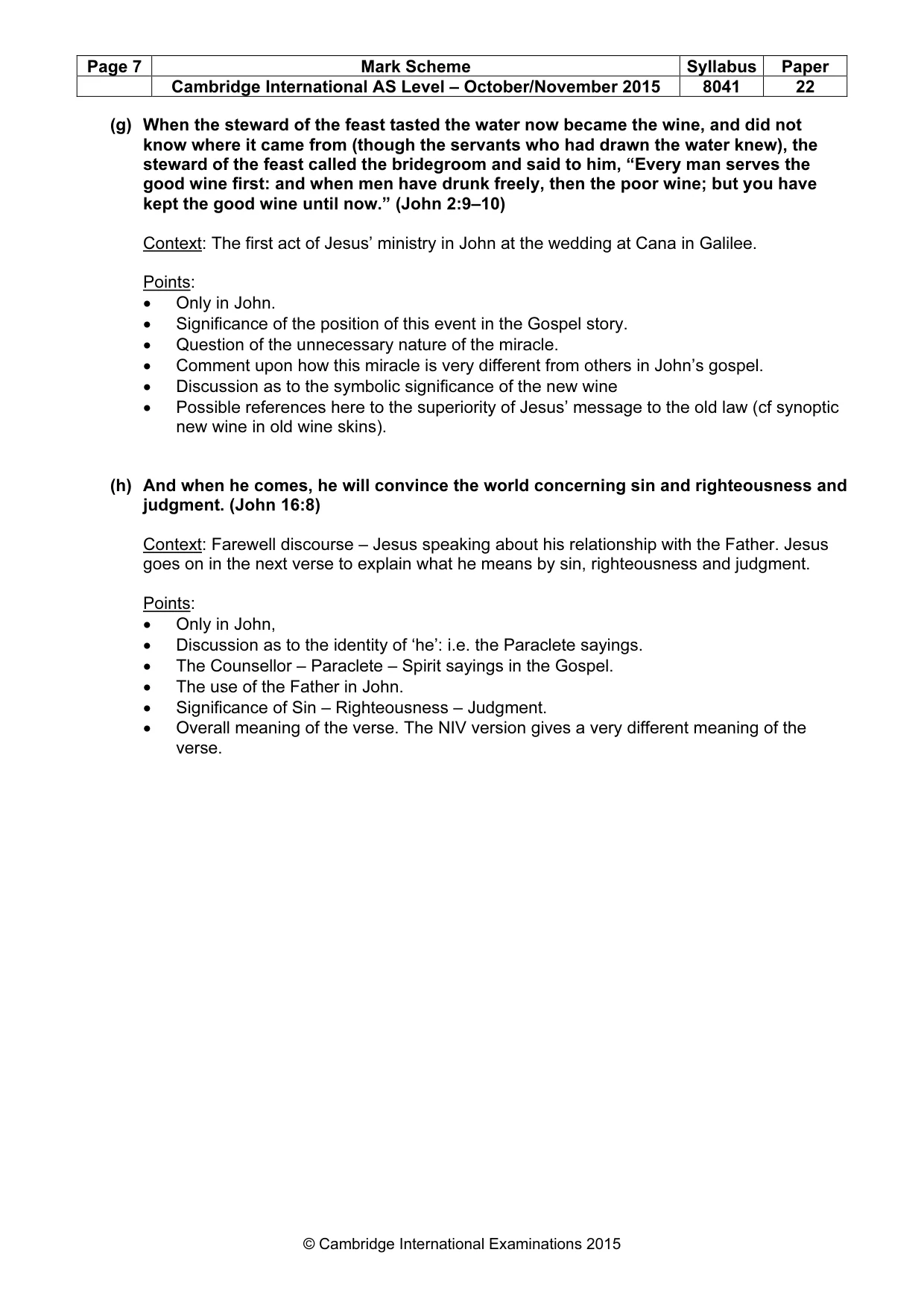
Page 7 Mark Scheme Syllabus Paper Cambridge International AS Level – October/November 2015 8041 22 © Cambridge International Examinations 2015 (g) When the steward of the feast tasted the water now became the wine, and did not know where it came from (though the servants who had drawn the water knew), the steward of the feast called the bridegroom and said to him, “Every man serves the good wine first: and when men have drunk freely, then the poor wine; but you have kept the good wine until now.” (John 2:9–10) Context: The first act of Jesus’ ministry in John at the wedding at Cana in Galilee. Points: • Only in John. • Significance of the position of this event in the Gospel story. • Question of the unnecessary nature of the miracle. • Comment upon how this miracle is very different from others in John’s gospel. • Discussion as to the symbolic significance of the new wine • Possible references here to the superiority of Jesus’ message to the old law (cf synoptic new wine in old wine skins). (h) And when he comes, he will convince the world concerning sin and righteousness and judgment. (John 16:8) Context: Farewell discourse – Jesus speaking about his relationship with the Father. Jesus goes on in the next verse to explain what he means by sin, righteousness and judgment. Points: • Only in John, • Discussion as to the identity of ‘he’: i.e. the Paraclete sayings. • The Counsellor – Paraclete – Spirit sayings in the Gospel. • The use of the Father in John. • Significance of Sin – Righteousness – Judgment. • Overall meaning of the verse. The NIV version gives a very different meaning of the verse.
Mark scheme, page 8
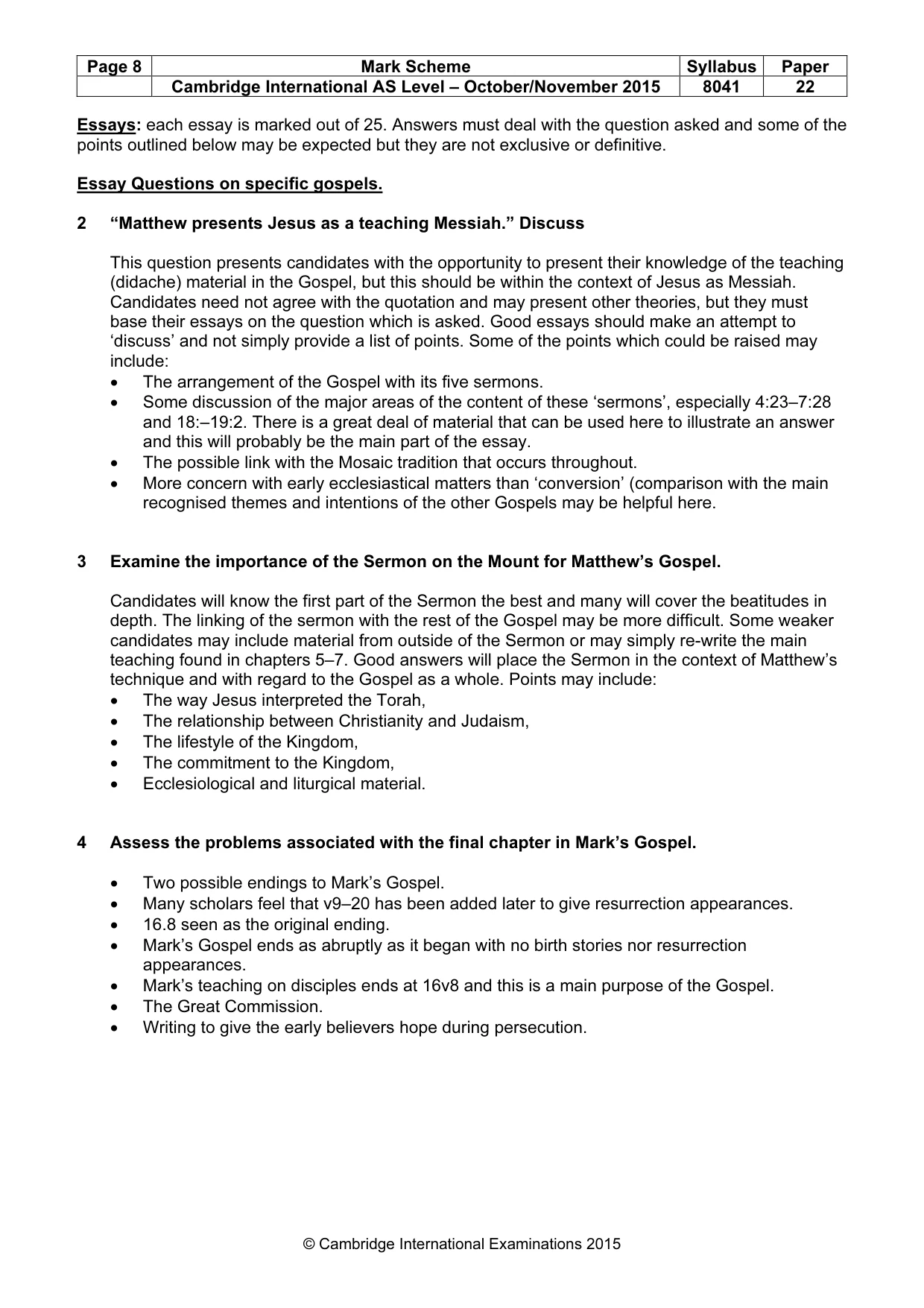
Page 8 Mark Scheme Syllabus Paper Cambridge International AS Level – October/November 2015 8041 22 © Cambridge International Examinations 2015 Essays: each essay is marked out of 25. Answers must deal with the question asked and some of the points outlined below may be expected but they are not exclusive or definitive. Essay Questions on specific gospels. 2 “Matthew presents Jesus as a teaching Messiah.” Discuss This question presents candidates with the opportunity to present their knowledge of the teaching (didache) material in the Gospel, but this should be within the context of Jesus as Messiah. Candidates need not agree with the quotation and may present other theories, but they must base their essays on the question which is asked. Good essays should make an attempt to ‘discuss’ and not simply provide a list of points. Some of the points which could be raised may include: • The arrangement of the Gospel with its five sermons. • Some discussion of the major areas of the content of these ‘sermons’, especially 4:23–7:28 and 18:–19:2. There is a great deal of material that can be used here to illustrate an answer and this will probably be the main part of the essay. • The possible link with the Mosaic tradition that occurs throughout. • More concern with early ecclesiastical matters than ‘conversion’ (comparison with the main recognised themes and intentions of the other Gospels may be helpful here. 3 Examine the importance of the Sermon on the Mount for Matthew’s Gospel. Candidates will know the first part of the Sermon the best and many will cover the beatitudes in depth. The linking of the sermon with the rest of the Gospel may be more difficult. Some weaker candidates may include material from outside of the Sermon or may simply re-write the main teaching found in chapters 5–7. Good answers will place the Sermon in the context of Matthew’s technique and with regard to the Gospel as a whole. Points may include: • The way Jesus interpreted the Torah, • The relationship between Christianity and Judaism, • The lifestyle of the Kingdom, • The commitment to the Kingdom, • Ecclesiological and liturgical material. 4 Assess the problems associated with the final chapter in Mark’s Gospel. • Two possible endings to Mark’s Gospel. • Many scholars feel that v9–20 has been added later to give resurrection appearances. • 16.8 seen as the original ending. • Mark’s Gospel ends as abruptly as it began with no birth stories nor resurrection appearances. • Mark’s teaching on disciples ends at 16v8 and this is a main purpose of the Gospel. • The Great Commission. • Writing to give the early believers hope during persecution.
Mark scheme, page 9
Page 9 Mark Scheme Syllabus Paper Cambridge International AS Level – October/November 2015 8041 22 © Cambridge International Examinations 2015 5 Examine the meanings of the miracle stories found in Mark. The request to ‘analyse and discuss’ means that it should not be simply a list of the main miracles found in Mark. It can be seen as the opportunity to discuss the more ‘human’ side as Jesus compared to the way He is presented in the other Gospels. There are limitations to His power: • The rejection of Jesus at Nazareth (6:1–6) is important, especially when set beside parallel accounts in Matthew and Luke; Jesus is described as the ‘son of Mary’, He ‘could do no mighty works’ and was amazed at their unbelief’; • Mark’s inclusion of 7:31–37 and 8:22–26 (both omitted in Matthew and Luke); he took Simon’s mother-in-law by the hand to help her up … , etc. • Is the Markan Jesus performing more like a traditional shamanistic figure? However Mark definitely sees Jesus as the ‘Son of God’ who is able to perform miracles in nature in which he demonstrates ‘the power of, and over, creation.’ 6 “Luke is the most historically accurate of all the Gospels.” Discuss. This does not require a lot of information by way of comparison with other Gospels but there should be an attempt to make some comparisons. Essays should start with the dedication to Theophilus and then attempt to put the Gospel within the wider historical context of events. Key verses: • 1:5 • 2:1 • 3:1 • 13:4 • There are serious questions as to the historicity when looking at the Birth Narratives and the way the miraculous is heightened from Mark. • Raises the question as to whether Luke is writing ‘theological history’ • Even though Acts is not part of the syllabus, well-informed candidates are likely to mention it as the ‘second part’ of Luke’s work in relation to the historical accuracy of the gospel 7 Assess the claim that Luke believed the Kingdom of God had arrived through the ministry of Jesus. Examiners should make sure that only Lukan material is credited in this question. The specific point of issue is that of the closeness or immediacy. Although the future element remains ch12 and ch21 there are many passages in Luke which refer to the Kingdom ‘having arrived’, the miracles providing the demonstration of its power. • The Magnificat, the Benedictus and the Nunc Dimittis in chapters 1 & 2; • 7:22 to the disciples of John the Baptist; • The time longed for by the prophets and kings (10:23), looked for by crowds (11:9) – all present in the work of Jesus; Satan falling like lightning (10:17); but the signs of the times were not being recognised (11:29–32, 12:54–56).
Mark scheme, page 10
Page 10 Mark Scheme Syllabus Paper Cambridge International AS Level – October/November 2015 8041 22 © Cambridge International Examinations 2015 8 To what extent is John’s Gospel ‘anti-Jewish’? Responses should show the anti-Jewish flavour of John. Possible material includes: • John contains some 70 references to the Jews, many of which seem to be strongly critical or negative, but many Jews come through very strongly and positively (e.g. Nicodemus) • Does the Gospel represent a split between the church and synagogue? Is it generally anti- Semitic or a polemic against the Jewish authorities? He seems to refer to the Jews very much in the third person. • It is useful to discuss the setting of the Gospel as a whole. • The theme of Jesus as the fulfilment of Judaism (1:19–51) and yet also standing in direct contrast to it. • The most relevant examples include: relationship with John the Baptist, water into wine, conversations with Nicodemus and the Samaritan woman, ‘I am’ sayings, confrontations with the Jews (especially in chapter 7, 8 and 9. • The healings of the paralytic in ch. 5 and the blind man in ch. 9. • Jesus is a replacement of the Jewish festivals (Passover, Tabernacles and Dedication). • The cleansing of the Temple and the Passion references. 9 Assess the arguments for the apostolic authorship of John’s Gospel. This essay demands that candidates deal with the question of ‘apostolic authorship’ in their answers. The question asks for balance in the answer, material for and against; there should be a serious attempt to cover both sides of the argument. Possible points may include: • Recognition in the Early Church – despite Irenaeus, there was no immediate or total acceptance of apostolic authorship – really only becoming recognised early in the 3rd century; the problem of Papias’ presbyter John is an interesting addition. • The question of dating with awareness of theories which put John prior to the synoptics – there is quite a lot that can be said on this so long as the candidate uses the arguments to refer to the matter of apostolic authorship (if John is dependent upon the Synoptics, does this necessarily deny apostolic authorship?) • Discussion as to whether the Gospel bears evidence of personal testimony, reminiscences, etc. • The problem of language – Gnostic language? – high Christology? • The Beloved Disciple – specific arguments for and against John the son of Zebedee – alternative suggestions.
Mark scheme, page 11
Page 11 Mark Scheme Syllabus Paper Cambridge International AS Level – October/November 2015 8041 22 © Cambridge International Examinations 2015 10 Explain the importance of the transfiguration narrative in the gospel story. Examiners should expect a good knowledge of the synoptic narratives with some reference to the differences in the specific gospel emphases, especially over the confession of Peter. A number of areas of discussion are listed below but there also must be a clear thread that stresses their importance for the Gospel story – this can be interpreted in three different ways: (1) For the unfolding ministry of Jesus, (2) For the specific Gospels and (3) For Christianity as a whole. Relevant comment would maybe cover the following: • The turning point of the Gospel story in all the Synoptics, though this is very clear in Mark and Luke. • The links with the baptism • The importance and role of the disciples, the inner circle and, especially of Peter. • The Matthean additions to the confession of Peter. • The introduction of suffering (e.g. the Son of Man must …) • Moses and Elijah typology. • The significance of the mountain. 11 Discuss Jesus’ teaching on repentance and forgiveness. For high marks there should be a genuine attempt to discuss and comment upon the texts used, preferably showing awareness of the difficulties of the underlying theology. Examples of material that can be used include: • Luke 24:47, the commission to preach the gospel of ‘repentance for the forgiveness of sins will be preached in His name to all nations, beginning at Jerusalem’; also found at the beginning of the Lucan ministry in 3:8 and 3:3 where He preached a baptism of repentance for the forgiveness of sins (also Mark 1:4); • Forgiving those who repent such as in Matt 8:21 (also in Luke); • Jesus forgiving and healing at the same time (such as the paralysed man) with the ‘Son of Man having authority on earth to forgive sins’; • The parables of the ‘Lost’ in Luke 15; • References to the Eucharistic sayings in Matt 26: ‘the blood of the (new) covenant shed for the forgiveness of sins’. 12 To what extent can the miracles be seen as parables in action? Candidates should seek to examine the way the miracles are used by the evangelists and by Jesus Himself. The material available to use is very wide-ranging. The main part of the discussion should centre on how the Gospel message of salvation and forgiveness in the kingdom of God (heaven) is demonstrated by Jesus’ ‘mighty works’ (synoptics) and ‘Signs’ (John). The best answers will make references to both these areas although it is possible to get a top grade by basing the answer on either tradition.
Mark scheme, page 12
Page 12 Mark Scheme Syllabus Paper Cambridge International AS Level – October/November 2015 8041 22 © Cambridge International Examinations 2015 13 Examine the relationship between John the Baptist and Jesus in the Gospels. Examiners should not expect references to any one Gospel but should look at the way the question is answered as a whole. The majority of the material will probably be taken from the Synoptics but it is possible that a candidate will take additional material from John. Answers will largely focus on: • How John is shown to prepare the way for the Messiah, • Some mention of the physical ties as Jesus and John are related through their mothers • Possible hidden tensions found between them which reflect the current trend between the followers of Jesus and of John in the early church. 14 Why did the Pharisees challenge Jesus’ teaching? Examiners must look for a genuine attempt to ‘assess’ within their answer. Candidates may give evidence to show they have tried to understand the Pharisees views rather that present them in a condemnatory fashion. • They were not entirely hostile i.e. Jesus was invited to eat with them. • He seems to have been at first an enigma and then a direct threat to everything they taught and believed. • Why did Jesus arouse their concern? • His message and actions that offered forgiveness and salvation to everyone went against the whole concept of Pharisaic purity. • Jesus’ own attitude is difficult, despite their hypocrisy He still recognises their authority (Matthew 23:2–3) – is this a Matthean redaction? There are many ‘conflict’ situations that are likely to form the basis of answers: the condemnation of Matt. 23 and Luke 11:37–54 … the charge of hypocrisy; the grain Sabbath incident (Mark 2); the man with the withered hand Sabbath healing (Mark 3); the eating with unwashed hands (Mark 7); the warning against the leaven of the Pharisees (Mark 8:15); the question about taxes (Mark 12); the anointing of the ‘woman of the city’ who was a sinner in the house of Simon the Pharisee (Luke 7:36–50)
What you needed in this session
Cambridge’s own grade thresholds for 2015 Oct/Nov, Paper 2 · Variant 2. A higher threshold means an easier paper — the bar moves with how the cohort did.