Cambridge A Level Divinity (AS Level only) 8041 — 2014 Oct/Nov Paper 2 · Variant 2
8041/22/O/N/14 · 100 marks · ≈113 min
The question paper and its mark scheme, free to read here and free to download. This is Cambridge’s own paper, exactly as it was sat.
Question paper4 pages
Mark scheme12 pages
Answers below. Sit the paper first if you are practising.
Paper as text
Question paper, page 1
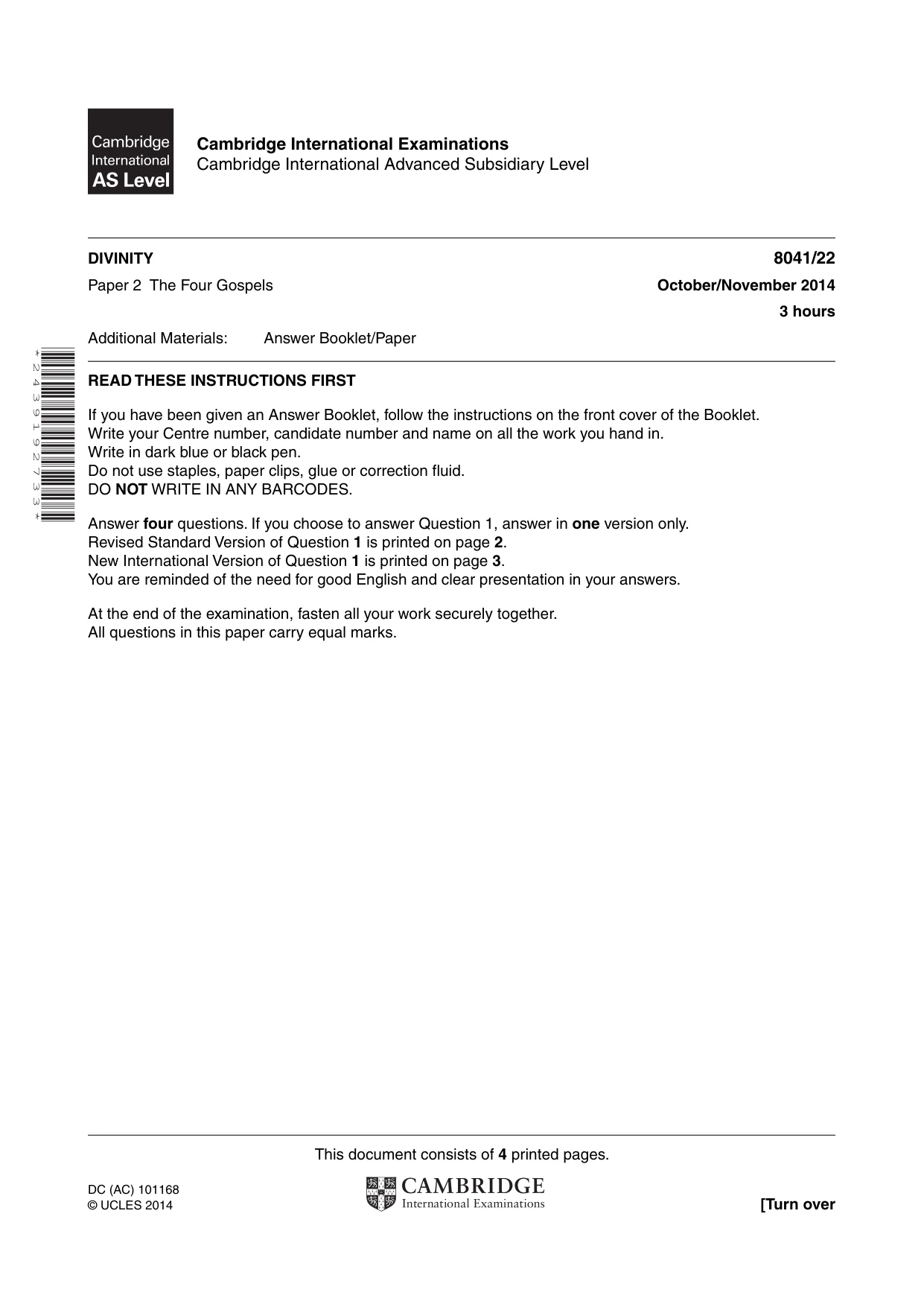
This document consists of 4 printed pages. DC (AC) 101168 © UCLES 2014 [Turn over Cambridge International Examinations Cambridge International Advanced Subsidiary Level * 2 4 3 9 1 9 2 7 3 3 * DIVINITY 8041/22 Paper 2 The Four Gospels October/November 2014 3 hours Additional Materials: Answer Booklet/Paper READ THESE INSTRUCTIONS FIRST If you have been given an Answer Booklet, follow the instructions on the front cover of the Booklet. Write your Centre number, candidate number and name on all the work you hand in. Write in dark blue or black pen. Do not use staples, paper clips, glue or correction fluid. DO NOT WRITE IN ANY BARCODES. Answer four questions. If you choose to answer Question 1, answer in one version only. Revised Standard Version of Question 1 is printed on page 2. New International Version of Question 1 is printed on page 3. You are reminded of the need for good English and clear presentation in your answers. At the end of the examination, fasten all your work securely together. All questions in this paper carry equal marks.
Question paper, page 2
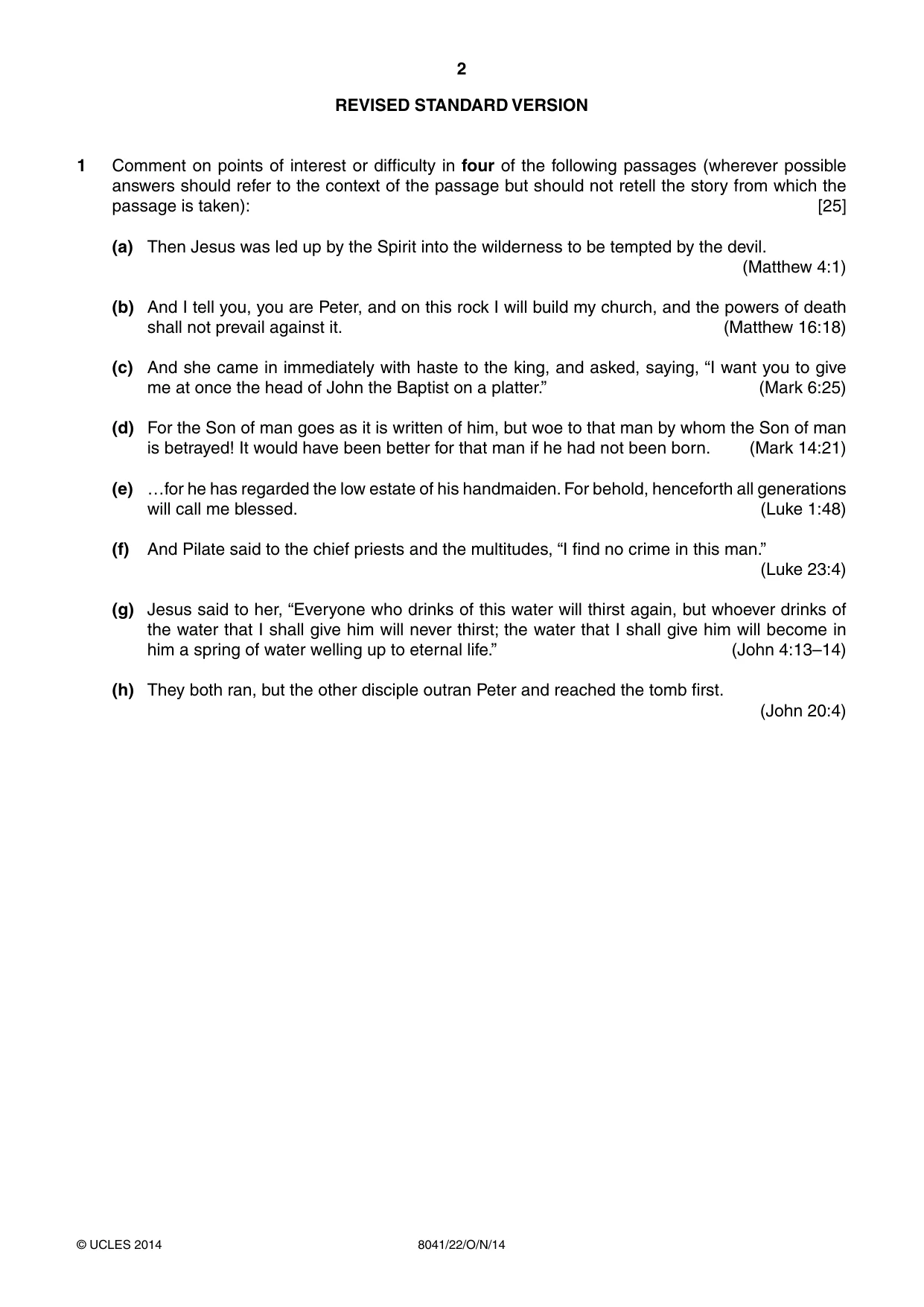
2 8041/22/O/N/14 © UCLES 2014 REVISED STANDARD VERSION 1 Comment on points of interest or difficulty in four of the following passages (wherever possible answers should refer to the context of the passage but should not retell the story from which the passage is taken): [25] (a) Then Jesus was led up by the Spirit into the wilderness to be tempted by the devil. (Matthew 4:1) (b) And I tell you, you are Peter, and on this rock I will build my church, and the powers of death shall not prevail against it. (Matthew 16:18) (c) And she came in immediately with haste to the king, and asked, saying, “I want you to give me at once the head of John the Baptist on a platter.” (Mark 6:25) (d) For the Son of man goes as it is written of him, but woe to that man by whom the Son of man is betrayed! It would have been better for that man if he had not been born. (Mark 14:21) (e) …for he has regarded the low estate of his handmaiden. For behold, henceforth all generations will call me blessed. (Luke 1:48) (f) And Pilate said to the chief priests and the multitudes, “I find no crime in this man.” (Luke 23:4) (g) Jesus said to her, “Everyone who drinks of this water will thirst again, but whoever drinks of the water that I shall give him will never thirst; the water that I shall give him will become in him a spring of water welling up to eternal life.” (John 4:13–14) (h) They both ran, but the other disciple outran Peter and reached the tomb first. (John 20:4)
Question paper, page 3
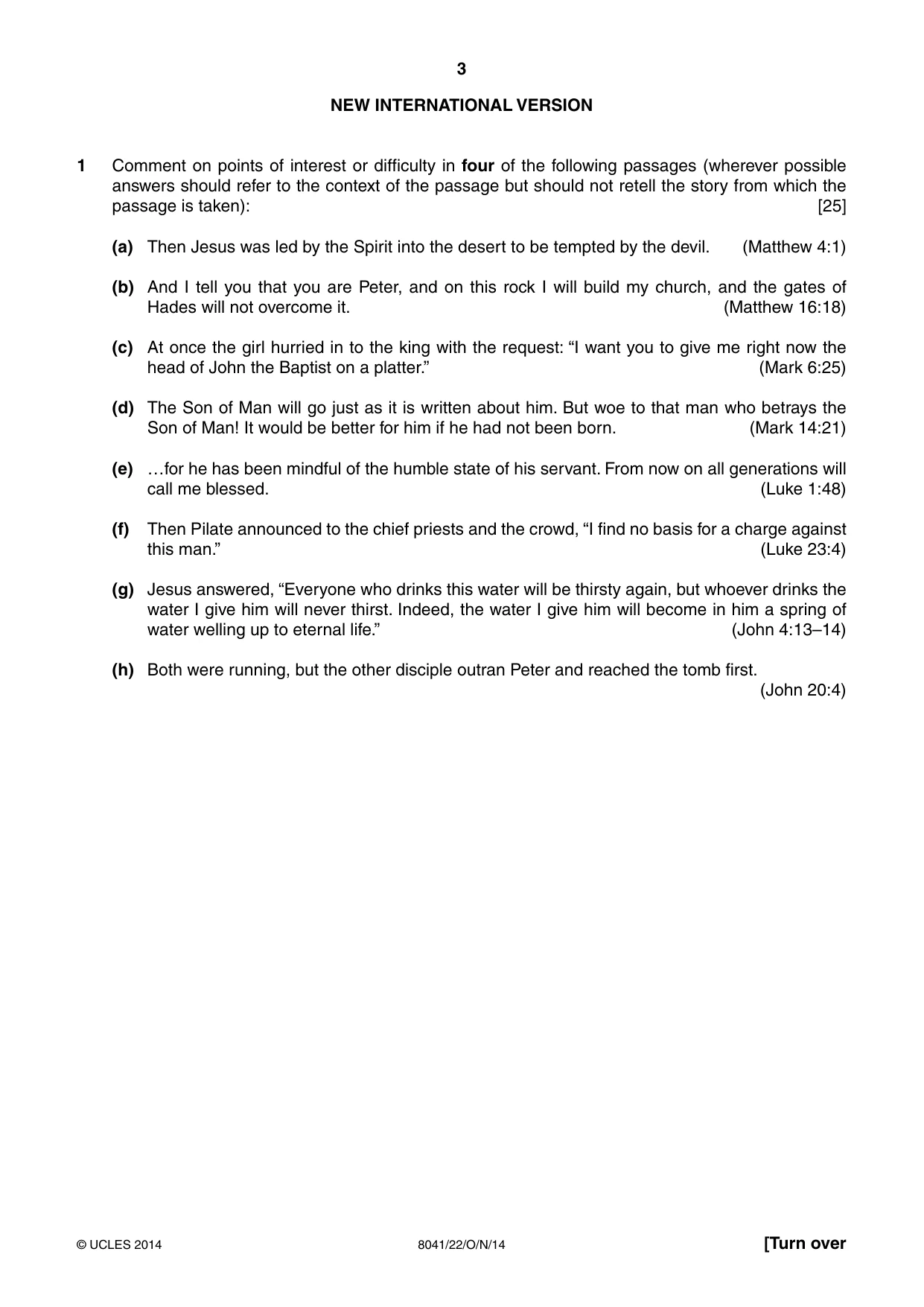
3 8041/22/O/N/14 © UCLES 2014 [Turn over NEW INTERNATIONAL VERSION 1 Comment on points of interest or difficulty in four of the following passages (wherever possible answers should refer to the context of the passage but should not retell the story from which the passage is taken): [25] (a) Then Jesus was led by the Spirit into the desert to be tempted by the devil. (Matthew 4:1) (b) And I tell you that you are Peter, and on this rock I will build my church, and the gates of Hades will not overcome it. (Matthew 16:18) (c) At once the girl hurried in to the king with the request: “I want you to give me right now the head of John the Baptist on a platter.” (Mark 6:25) (d) The Son of Man will go just as it is written about him. But woe to that man who betrays the Son of Man! It would be better for him if he had not been born. (Mark 14:21) (e) …for he has been mindful of the humble state of his servant. From now on all generations will call me blessed. (Luke 1:48) (f) Then Pilate announced to the chief priests and the crowd, “I find no basis for a charge against this man.” (Luke 23:4) (g) Jesus answered, “Everyone who drinks this water will be thirsty again, but whoever drinks the water I give him will never thirst. Indeed, the water I give him will become in him a spring of water welling up to eternal life.” (John 4:13–14) (h) Both were running, but the other disciple outran Peter and reached the tomb first. (John 20:4)
Question paper, page 4
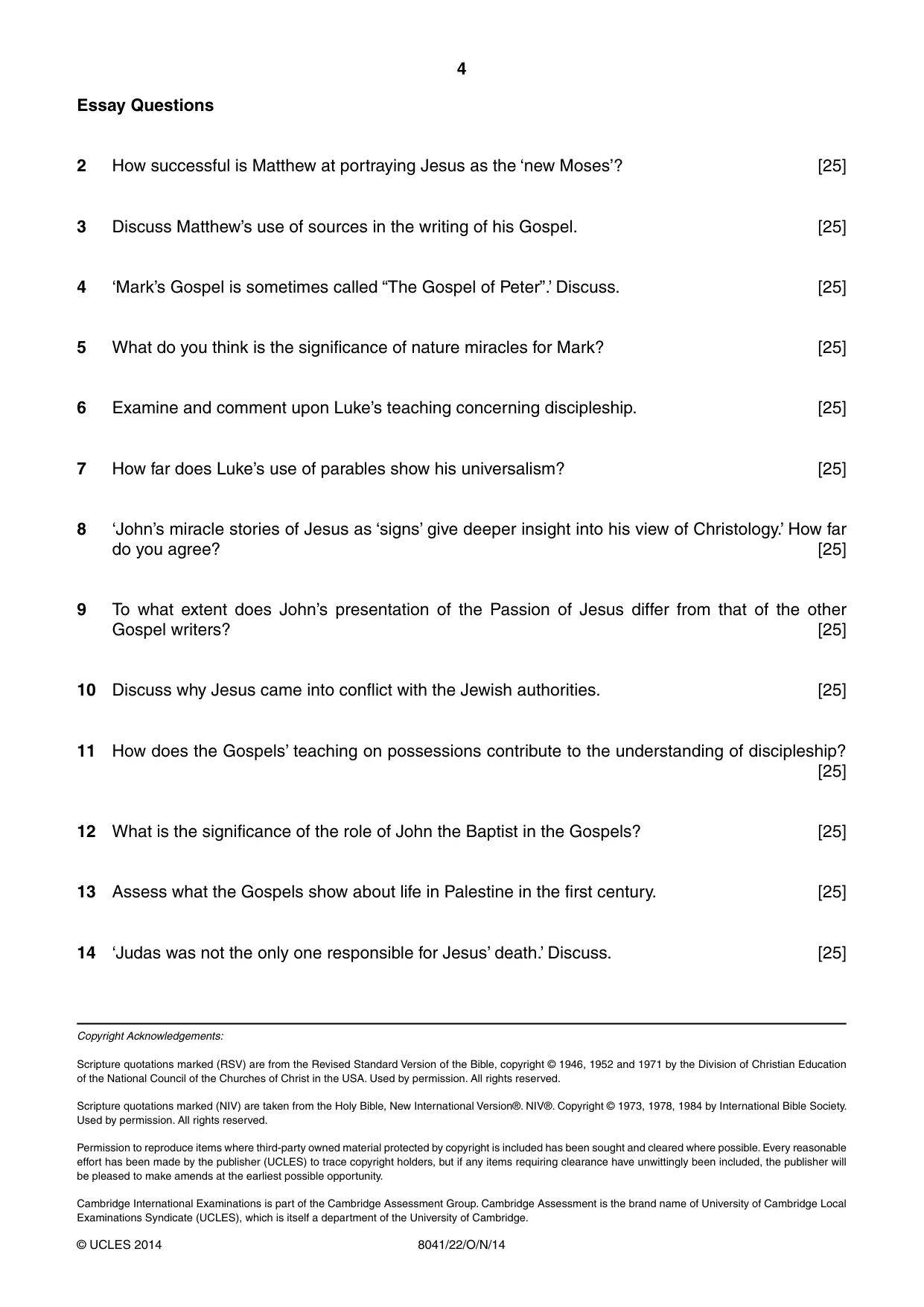
4 8041/22/O/N/14 © UCLES 2014 Essay Questions 2 How successful is Matthew at portraying Jesus as the ‘new Moses’? [25] 3 Discuss Matthew’s use of sources in the writing of his Gospel. [25] 4 ‘Mark’s Gospel is sometimes called “The Gospel of Peter”.’ Discuss. [25] 5 What do you think is the significance of nature miracles for Mark? [25] 6 Examine and comment upon Luke’s teaching concerning discipleship. [25] 7 How far does Luke’s use of parables show his universalism? [25] 8 ‘John’s miracle stories of Jesus as ‘signs’ give deeper insight into his view of Christology.’ How far do you agree? [25] 9 To what extent does John’s presentation of the Passion of Jesus differ from that of the other Gospel writers? [25] 10 Discuss why Jesus came into conflict with the Jewish authorities. [25] 11 How does the Gospels’ teaching on possessions contribute to the understanding of discipleship? [25] 12 What is the significance of the role of John the Baptist in the Gospels? [25] 13 Assess what the Gospels show about life in Palestine in the first century. [25] 14 ‘Judas was not the only one responsible for Jesus’ death.’ Discuss. [25] Copyright Acknowledgements: Scripture quotations marked (RSV) are from the Revised Standard Version of the Bible, copyright © 1946, 1952 and 1971 by the Division of Christian Education of the National Council of the Churches of Christ in the USA. Used by permission. All rights reserved. Scripture quotations marked (NIV) are taken from the Holy Bible, New International Version®. NIV®. Copyright © 1973, 1978, 1984 by International Bible Society. Used by permission. All rights reserved. Permission to reproduce items where third-party owned material protected by copyright is included has been sought and cleared where possible. Every reasonable effort has been made by the publisher (UCLES) to trace copyright holders, but if any items requiring clearance have unwittingly been included, the publisher will be pleased to make amends at the earliest possible opportunity. Cambridge International Examinations is part of the Cambridge Assessment Group. Cambridge Assessment is the brand name of University of Cambridge Local Examinations Syndicate (UCLES), which is itself a department of the University of Cambridge.
Mark scheme, page 1
® IGCSE is the registered trademark of Cambridge International Examinations. CAMBRIDGE INTERNATIONAL EXAMINATIONS Cambridge International Advanced Subsidiary Level MARK SCHEME for the October/November 2014 series 8041 DIVINITY 8041/22 Paper 2 (The Four Gospels), maximum raw mark 100 This mark scheme is published as an aid to teachers and candidates, to indicate the requirements of the examination. It shows the basis on which Examiners were instructed to award marks. It does not indicate the details of the discussions that took place at an Examiners’ meeting before marking began, which would have considered the acceptability of alternative answers. Mark schemes should be read in conjunction with the question paper and the Principal Examiner Report for Teachers. Cambridge will not enter into discussions about these mark schemes. Cambridge is publishing the mark schemes for the October/November 2014 series for most Cambridge IGCSE®, Cambridge International A and AS Level components and some Cambridge O Level components.
Mark scheme, page 2
Page 2 Mark Scheme Syllabus Paper Cambridge International AS Level – October/November 2014 8041 22 © Cambridge International Examinations 2014 Candidates are expected to show ‘ability to organise and present information, ideas, descriptions and arguments clearly and logically’ and to write their answers ‘in continuous prose’. A good essay answers the question holistically; the interpretation and comparison of issues will be demonstrated in the course of explanation and analysis of the relevant material, and thus evidence of the fulfilment of the assessment objectives will be inextricably interwoven. Marks are always awarded for the two assessment objectives which, when combined, produce a mark which is appropriate for the overall grade descriptions. NB. Any response which is appropriate (i.e. a response to a reasonable interpretation of the question) is assessed according to the extent to which it meets the syllabus requirements and fulfils the objectives, conforming to the mark band descriptions. The Examiner’s task is to assess the ability of each answer according to the descriptions provided. The marks are an intermediate stage on the route to assessment of attainment, which is ultimately reported as a grade. The mark for an answer is a true reflection of the candidate’s level of attainment in the assessment objectives for the syllabus according to their weightings, bearing in mind the Syllabus Aims and what may reasonably be expected of an 18-year-old who has studied the syllabus for two years. The descriptions are cumulative, i.e. a description at one band builds on or improves the description at lower bands. Not all the qualities listed in a band may be demonstrated in an answer for it to fall within that band (some of the qualities are alternatives and therefore mutually exclusive).
Mark scheme, page 3
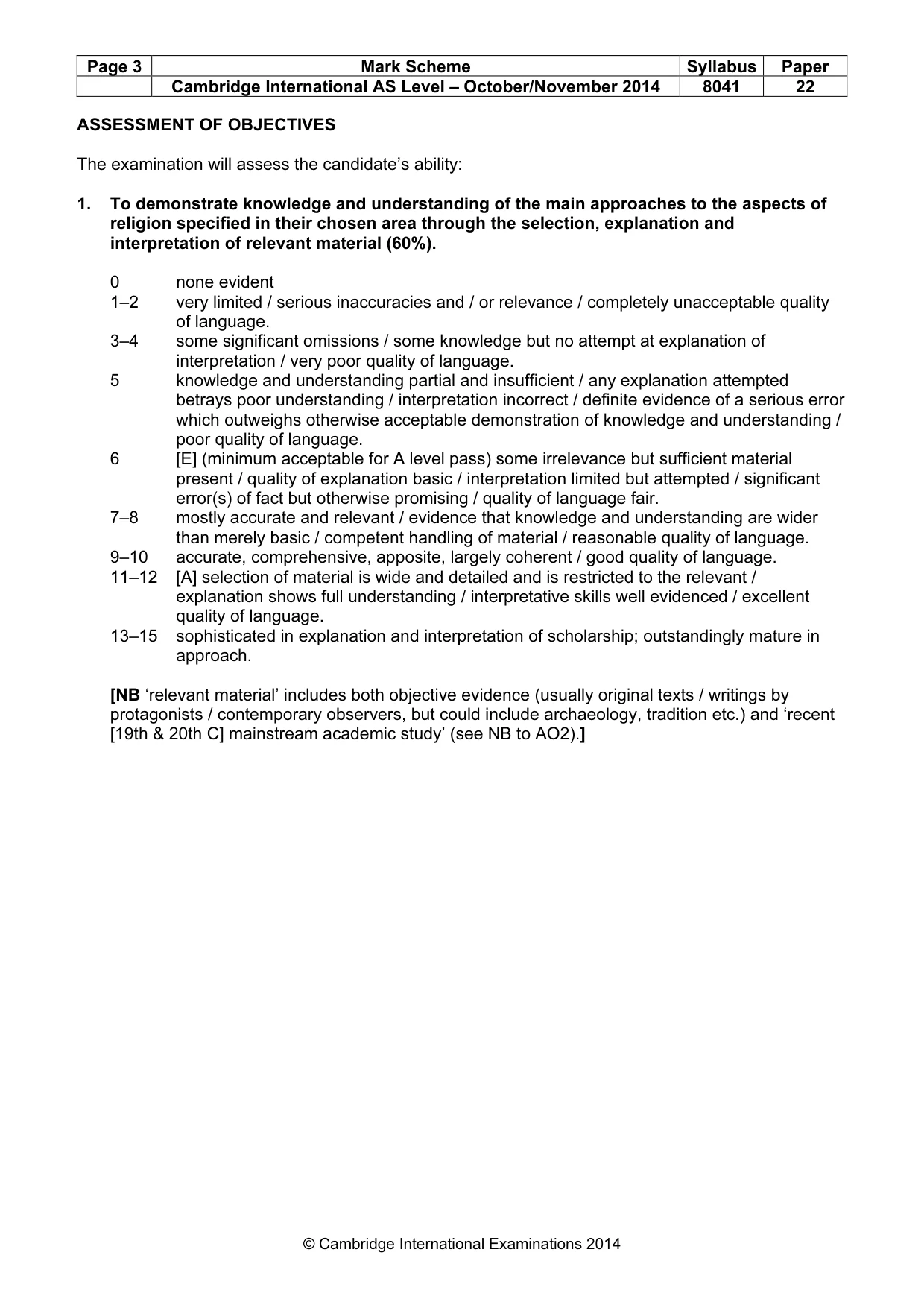
Page 3 Mark Scheme Syllabus Paper Cambridge International AS Level – October/November 2014 8041 22 © Cambridge International Examinations 2014 ASSESSMENT OF OBJECTIVES The examination will assess the candidate’s ability: 1. To demonstrate knowledge and understanding of the main approaches to the aspects of religion specified in their chosen area through the selection, explanation and interpretation of relevant material (60%). 0 none evident 1–2 very limited / serious inaccuracies and / or relevance / completely unacceptable quality of language. 3–4 some significant omissions / some knowledge but no attempt at explanation of interpretation / very poor quality of language. 5 knowledge and understanding partial and insufficient / any explanation attempted betrays poor understanding / interpretation incorrect / definite evidence of a serious error which outweighs otherwise acceptable demonstration of knowledge and understanding / poor quality of language. 6 [E] (minimum acceptable for A level pass) some irrelevance but sufficient material present / quality of explanation basic / interpretation limited but attempted / significant error(s) of fact but otherwise promising / quality of language fair. 7–8 mostly accurate and relevant / evidence that knowledge and understanding are wider than merely basic / competent handling of material / reasonable quality of language. 9–10 accurate, comprehensive, apposite, largely coherent / good quality of language. 11–12 [A] selection of material is wide and detailed and is restricted to the relevant / explanation shows full understanding / interpretative skills well evidenced / excellent quality of language. 13–15 sophisticated in explanation and interpretation of scholarship; outstandingly mature in approach. [NB ‘relevant material’ includes both objective evidence (usually original texts / writings by protagonists / contemporary observers, but could include archaeology, tradition etc.) and ‘recent [19th & 20th C] mainstream academic study’ (see NB to AO2).]
Mark scheme, page 4
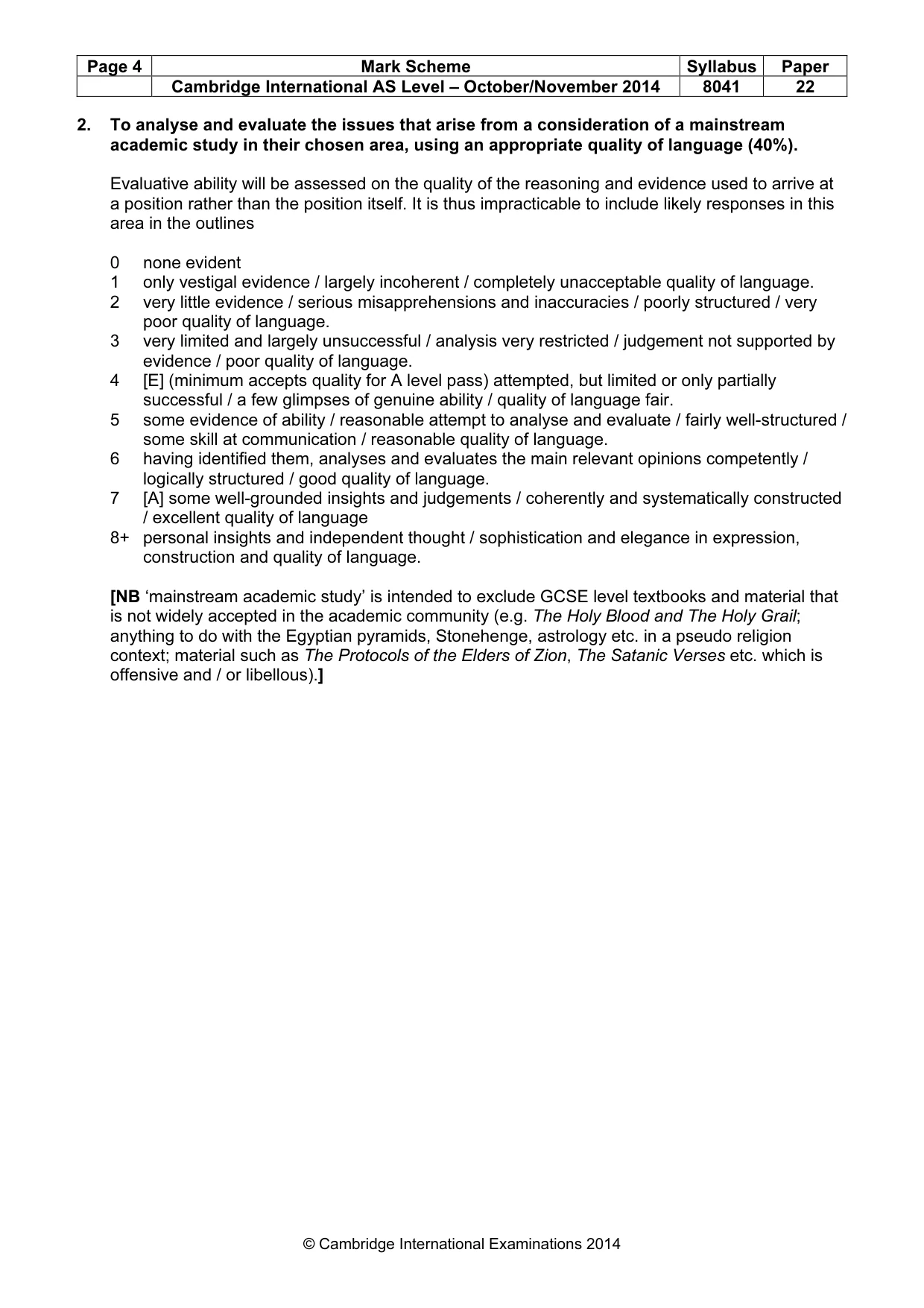
Page 4 Mark Scheme Syllabus Paper Cambridge International AS Level – October/November 2014 8041 22 © Cambridge International Examinations 2014 2. To analyse and evaluate the issues that arise from a consideration of a mainstream academic study in their chosen area, using an appropriate quality of language (40%). Evaluative ability will be assessed on the quality of the reasoning and evidence used to arrive at a position rather than the position itself. It is thus impracticable to include likely responses in this area in the outlines 0 none evident 1 only vestigal evidence / largely incoherent / completely unacceptable quality of language. 2 very little evidence / serious misapprehensions and inaccuracies / poorly structured / very poor quality of language. 3 very limited and largely unsuccessful / analysis very restricted / judgement not supported by evidence / poor quality of language. 4 [E] (minimum accepts quality for A level pass) attempted, but limited or only partially successful / a few glimpses of genuine ability / quality of language fair. 5 some evidence of ability / reasonable attempt to analyse and evaluate / fairly well-structured / some skill at communication / reasonable quality of language. 6 having identified them, analyses and evaluates the main relevant opinions competently / logically structured / good quality of language. 7 [A] some well-grounded insights and judgements / coherently and systematically constructed / excellent quality of language 8+ personal insights and independent thought / sophistication and elegance in expression, construction and quality of language. [NB ‘mainstream academic study’ is intended to exclude GCSE level textbooks and material that is not widely accepted in the academic community (e.g. The Holy Blood and The Holy Grail; anything to do with the Egyptian pyramids, Stonehenge, astrology etc. in a pseudo religion context; material such as The Protocols of the Elders of Zion, The Satanic Verses etc. which is offensive and / or libellous).]
Mark scheme, page 5
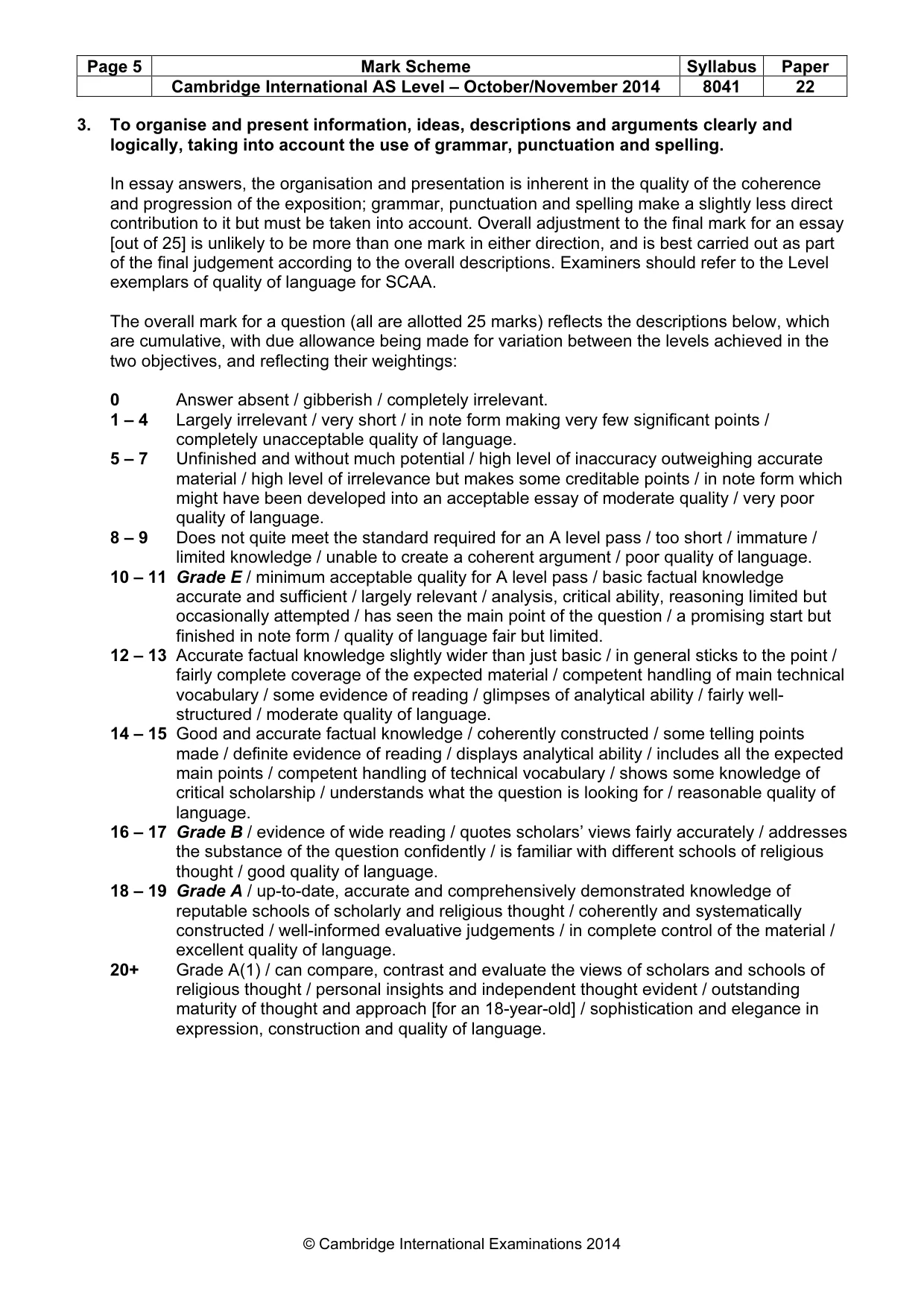
Page 5 Mark Scheme Syllabus Paper Cambridge International AS Level – October/November 2014 8041 22 © Cambridge International Examinations 2014 3. To organise and present information, ideas, descriptions and arguments clearly and logically, taking into account the use of grammar, punctuation and spelling. In essay answers, the organisation and presentation is inherent in the quality of the coherence and progression of the exposition; grammar, punctuation and spelling make a slightly less direct contribution to it but must be taken into account. Overall adjustment to the final mark for an essay [out of 25] is unlikely to be more than one mark in either direction, and is best carried out as part of the final judgement according to the overall descriptions. Examiners should refer to the Level exemplars of quality of language for SCAA. The overall mark for a question (all are allotted 25 marks) reflects the descriptions below, which are cumulative, with due allowance being made for variation between the levels achieved in the two objectives, and reflecting their weightings: 0 Answer absent / gibberish / completely irrelevant. 1 – 4 Largely irrelevant / very short / in note form making very few significant points / completely unacceptable quality of language. 5 – 7 Unfinished and without much potential / high level of inaccuracy outweighing accurate material / high level of irrelevance but makes some creditable points / in note form which might have been developed into an acceptable essay of moderate quality / very poor quality of language. 8 – 9 Does not quite meet the standard required for an A level pass / too short / immature / limited knowledge / unable to create a coherent argument / poor quality of language. 10 – 11 Grade E / minimum acceptable quality for A level pass / basic factual knowledge accurate and sufficient / largely relevant / analysis, critical ability, reasoning limited but occasionally attempted / has seen the main point of the question / a promising start but finished in note form / quality of language fair but limited. 12 – 13 Accurate factual knowledge slightly wider than just basic / in general sticks to the point / fairly complete coverage of the expected material / competent handling of main technical vocabulary / some evidence of reading / glimpses of analytical ability / fairly well- structured / moderate quality of language. 14 – 15 Good and accurate factual knowledge / coherently constructed / some telling points made / definite evidence of reading / displays analytical ability / includes all the expected main points / competent handling of technical vocabulary / shows some knowledge of critical scholarship / understands what the question is looking for / reasonable quality of language. 16 – 17 Grade B / evidence of wide reading / quotes scholars’ views fairly accurately / addresses the substance of the question confidently / is familiar with different schools of religious thought / good quality of language. 18 – 19 Grade A / up-to-date, accurate and comprehensively demonstrated knowledge of reputable schools of scholarly and religious thought / coherently and systematically constructed / well-informed evaluative judgements / in complete control of the material / excellent quality of language. 20+ Grade A(1) / can compare, contrast and evaluate the views of scholars and schools of religious thought / personal insights and independent thought evident / outstanding maturity of thought and approach [for an 18-year-old] / sophistication and elegance in expression, construction and quality of language.
Mark scheme, page 6
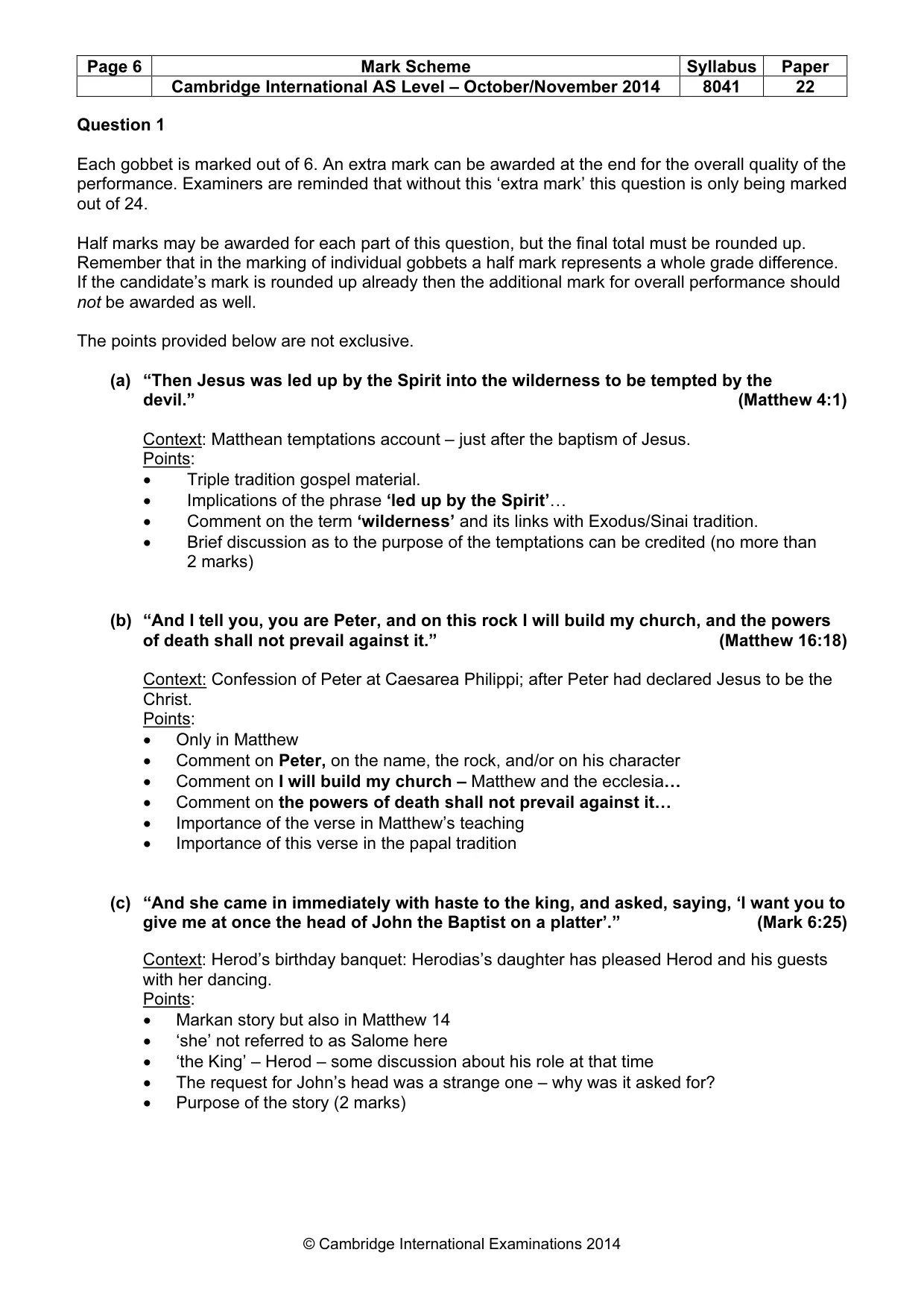
Page 6 Mark Scheme Syllabus Paper Cambridge International AS Level – October/November 2014 8041 22 © Cambridge International Examinations 2014 Question 1 Each gobbet is marked out of 6. An extra mark can be awarded at the end for the overall quality of the performance. Examiners are reminded that without this ‘extra mark’ this question is only being marked out of 24. Half marks may be awarded for each part of this question, but the final total must be rounded up. Remember that in the marking of individual gobbets a half mark represents a whole grade difference. If the candidate’s mark is rounded up already then the additional mark for overall performance should not be awarded as well. The points provided below are not exclusive. (a) “Then Jesus was led up by the Spirit into the wilderness to be tempted by the devil.” (Matthew 4:1) Context: Matthean temptations account – just after the baptism of Jesus. Points: • Triple tradition gospel material. • Implications of the phrase ‘led up by the Spirit’… • Comment on the term ‘wilderness’ and its links with Exodus/Sinai tradition. • Brief discussion as to the purpose of the temptations can be credited (no more than 2 marks) (b) “And I tell you, you are Peter, and on this rock I will build my church, and the powers of death shall not prevail against it.” (Matthew 16:18) Context: Confession of Peter at Caesarea Philippi; after Peter had declared Jesus to be the Christ. Points: • Only in Matthew • Comment on Peter, on the name, the rock, and/or on his character • Comment on I will build my church – Matthew and the ecclesia… • Comment on the powers of death shall not prevail against it… • Importance of the verse in Matthew’s teaching • Importance of this verse in the papal tradition (c) “And she came in immediately with haste to the king, and asked, saying, ‘I want you to give me at once the head of John the Baptist on a platter’.” (Mark 6:25) Context: Herod’s birthday banquet: Herodias’s daughter has pleased Herod and his guests with her dancing. Points: • Markan story but also in Matthew 14 • ‘she’ not referred to as Salome here • ‘the King’ – Herod – some discussion about his role at that time • The request for John’s head was a strange one – why was it asked for? • Purpose of the story (2 marks)
Mark scheme, page 7
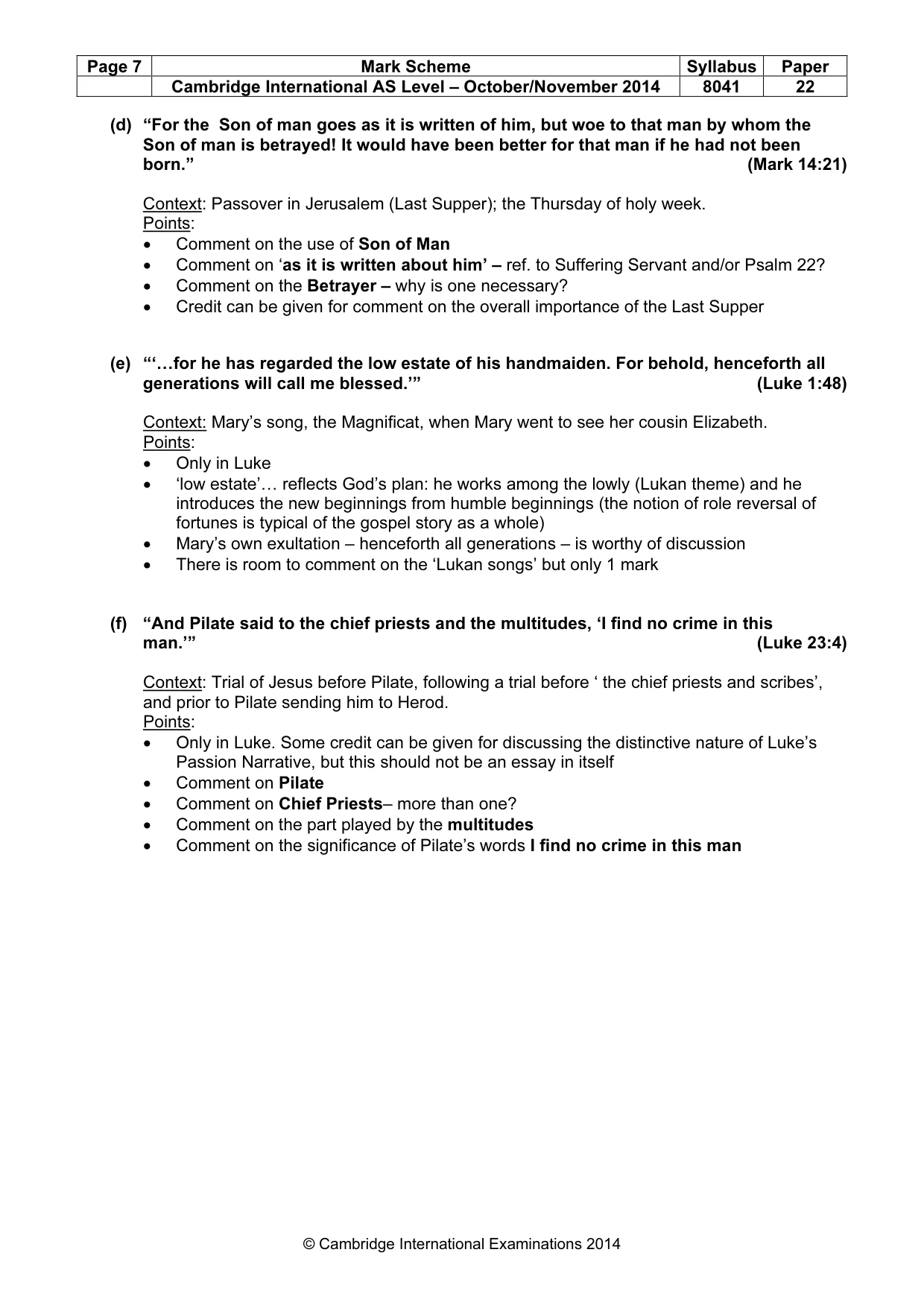
Page 7 Mark Scheme Syllabus Paper Cambridge International AS Level – October/November 2014 8041 22 © Cambridge International Examinations 2014 (d) “For the Son of man goes as it is written of him, but woe to that man by whom the Son of man is betrayed! It would have been better for that man if he had not been born.” (Mark 14:21) Context: Passover in Jerusalem (Last Supper); the Thursday of holy week. Points: • Comment on the use of Son of Man • Comment on ‘as it is written about him’ – ref. to Suffering Servant and/or Psalm 22? • Comment on the Betrayer – why is one necessary? • Credit can be given for comment on the overall importance of the Last Supper (e) “‘…for he has regarded the low estate of his handmaiden. For behold, henceforth all generations will call me blessed.’” (Luke 1:48) Context: Mary’s song, the Magnificat, when Mary went to see her cousin Elizabeth. Points: • Only in Luke • ‘low estate’… reflects God’s plan: he works among the lowly (Lukan theme) and he introduces the new beginnings from humble beginnings (the notion of role reversal of fortunes is typical of the gospel story as a whole) • Mary’s own exultation – henceforth all generations – is worthy of discussion • There is room to comment on the ‘Lukan songs’ but only 1 mark (f) “And Pilate said to the chief priests and the multitudes, ‘I find no crime in this man.’” (Luke 23:4) Context: Trial of Jesus before Pilate, following a trial before ‘ the chief priests and scribes’, and prior to Pilate sending him to Herod. Points: • Only in Luke. Some credit can be given for discussing the distinctive nature of Luke’s Passion Narrative, but this should not be an essay in itself • Comment on Pilate • Comment on Chief Priests– more than one? • Comment on the part played by the multitudes • Comment on the significance of Pilate’s words I find no crime in this man
Mark scheme, page 8
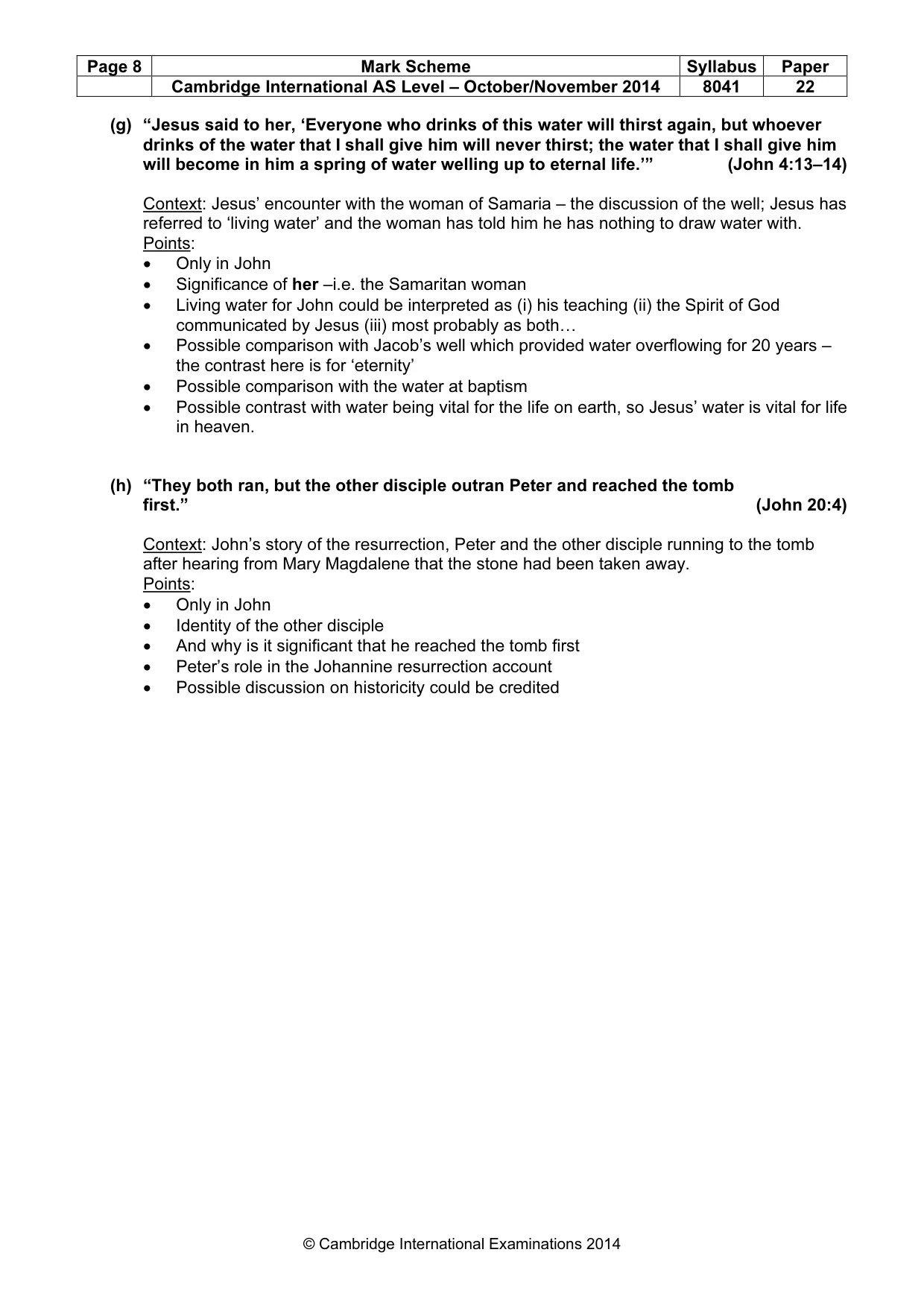
Page 8 Mark Scheme Syllabus Paper Cambridge International AS Level – October/November 2014 8041 22 © Cambridge International Examinations 2014 (g) “Jesus said to her, ‘Everyone who drinks of this water will thirst again, but whoever drinks of the water that I shall give him will never thirst; the water that I shall give him will become in him a spring of water welling up to eternal life.’” (John 4:13–14) Context: Jesus’ encounter with the woman of Samaria – the discussion of the well; Jesus has referred to ‘living water’ and the woman has told him he has nothing to draw water with. Points: • Only in John • Significance of her –i.e. the Samaritan woman • Living water for John could be interpreted as (i) his teaching (ii) the Spirit of God communicated by Jesus (iii) most probably as both… • Possible comparison with Jacob’s well which provided water overflowing for 20 years – the contrast here is for ‘eternity’ • Possible comparison with the water at baptism • Possible contrast with water being vital for the life on earth, so Jesus’ water is vital for life in heaven. (h) “They both ran, but the other disciple outran Peter and reached the tomb first.” (John 20:4) Context: John’s story of the resurrection, Peter and the other disciple running to the tomb after hearing from Mary Magdalene that the stone had been taken away. Points: • Only in John • Identity of the other disciple • And why is it significant that he reached the tomb first • Peter’s role in the Johannine resurrection account • Possible discussion on historicity could be credited
Mark scheme, page 9
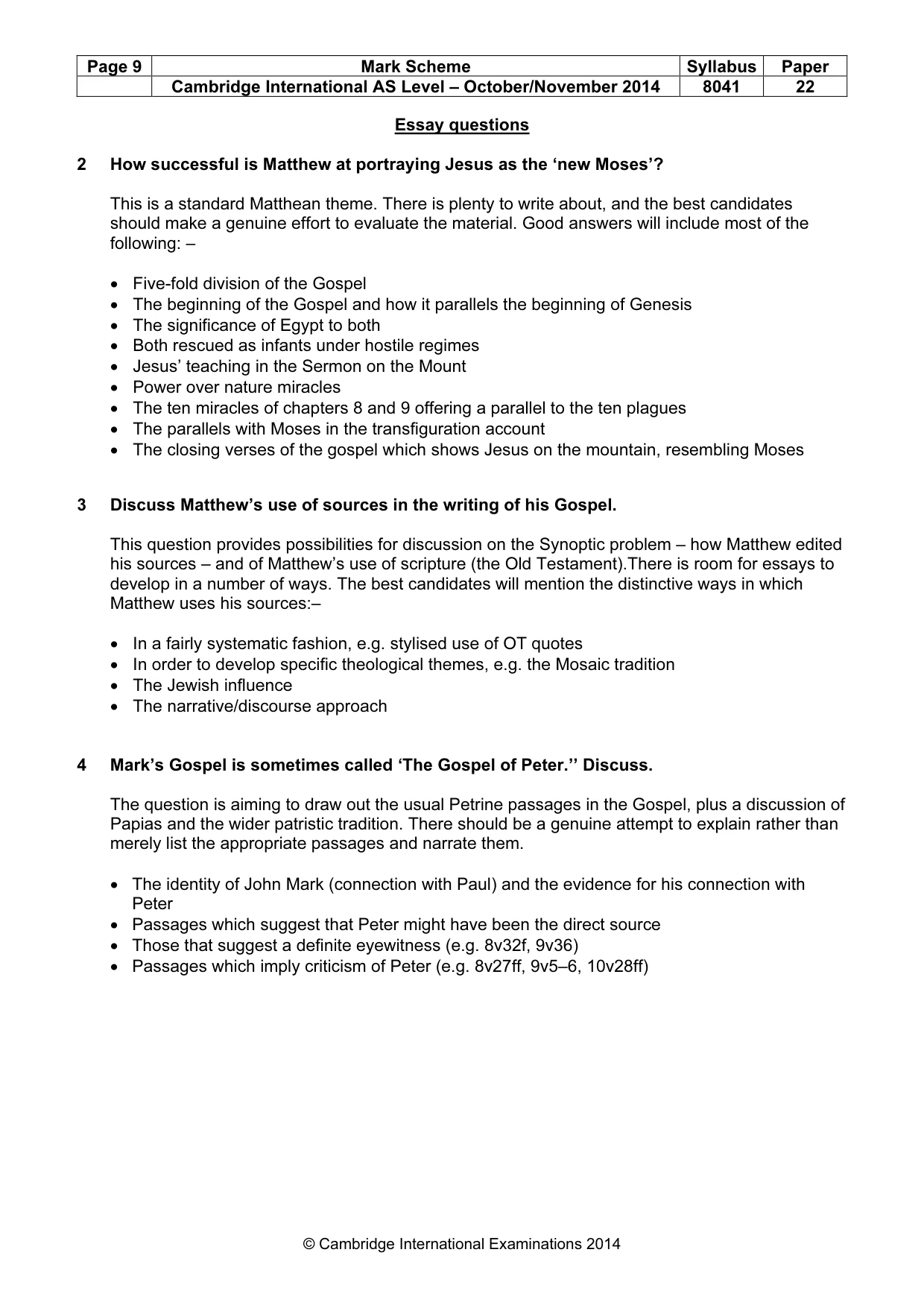
Page 9 Mark Scheme Syllabus Paper Cambridge International AS Level – October/November 2014 8041 22 © Cambridge International Examinations 2014 Essay questions 2 How successful is Matthew at portraying Jesus as the ‘new Moses’? This is a standard Matthean theme. There is plenty to write about, and the best candidates should make a genuine effort to evaluate the material. Good answers will include most of the following: – • Five-fold division of the Gospel • The beginning of the Gospel and how it parallels the beginning of Genesis • The significance of Egypt to both • Both rescued as infants under hostile regimes • Jesus’ teaching in the Sermon on the Mount • Power over nature miracles • The ten miracles of chapters 8 and 9 offering a parallel to the ten plagues • The parallels with Moses in the transfiguration account • The closing verses of the gospel which shows Jesus on the mountain, resembling Moses 3 Discuss Matthew’s use of sources in the writing of his Gospel. This question provides possibilities for discussion on the Synoptic problem – how Matthew edited his sources – and of Matthew’s use of scripture (the Old Testament).There is room for essays to develop in a number of ways. The best candidates will mention the distinctive ways in which Matthew uses his sources:– • In a fairly systematic fashion, e.g. stylised use of OT quotes • In order to develop specific theological themes, e.g. the Mosaic tradition • The Jewish influence • The narrative/discourse approach 4 Mark’s Gospel is sometimes called ‘The Gospel of Peter.’’ Discuss. The question is aiming to draw out the usual Petrine passages in the Gospel, plus a discussion of Papias and the wider patristic tradition. There should be a genuine attempt to explain rather than merely list the appropriate passages and narrate them. • The identity of John Mark (connection with Paul) and the evidence for his connection with Peter • Passages which suggest that Peter might have been the direct source • Those that suggest a definite eyewitness (e.g. 8v32f, 9v36) • Passages which imply criticism of Peter (e.g. 8v27ff, 9v5–6, 10v28ff)
Mark scheme, page 10
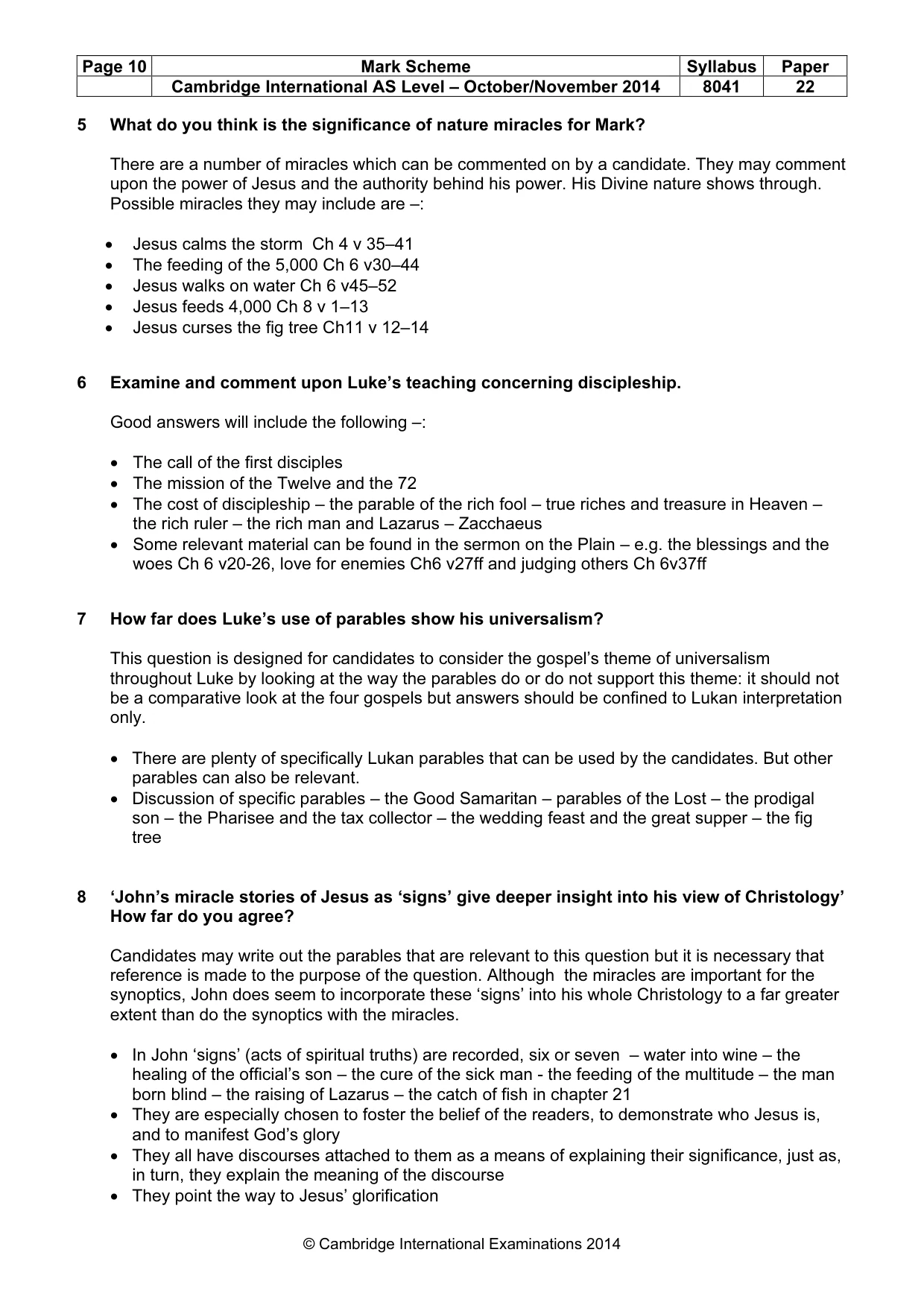
Page 10 Mark Scheme Syllabus Paper Cambridge International AS Level – October/November 2014 8041 22 © Cambridge International Examinations 2014 5 What do you think is the significance of nature miracles for Mark? There are a number of miracles which can be commented on by a candidate. They may comment upon the power of Jesus and the authority behind his power. His Divine nature shows through. Possible miracles they may include are –: • Jesus calms the storm Ch 4 v 35–41 • The feeding of the 5,000 Ch 6 v30–44 • Jesus walks on water Ch 6 v45–52 • Jesus feeds 4,000 Ch 8 v 1–13 • Jesus curses the fig tree Ch11 v 12–14 6 Examine and comment upon Luke’s teaching concerning discipleship. Good answers will include the following –: • The call of the first disciples • The mission of the Twelve and the 72 • The cost of discipleship – the parable of the rich fool – true riches and treasure in Heaven – the rich ruler – the rich man and Lazarus – Zacchaeus • Some relevant material can be found in the sermon on the Plain – e.g. the blessings and the woes Ch 6 v20-26, love for enemies Ch6 v27ff and judging others Ch 6v37ff 7 How far does Luke’s use of parables show his universalism? This question is designed for candidates to consider the gospel’s theme of universalism throughout Luke by looking at the way the parables do or do not support this theme: it should not be a comparative look at the four gospels but answers should be confined to Lukan interpretation only. • There are plenty of specifically Lukan parables that can be used by the candidates. But other parables can also be relevant. • Discussion of specific parables – the Good Samaritan – parables of the Lost – the prodigal son – the Pharisee and the tax collector – the wedding feast and the great supper – the fig tree 8 ‘John’s miracle stories of Jesus as ‘signs’ give deeper insight into his view of Christology’ How far do you agree? Candidates may write out the parables that are relevant to this question but it is necessary that reference is made to the purpose of the question. Although the miracles are important for the synoptics, John does seem to incorporate these ‘signs’ into his whole Christology to a far greater extent than do the synoptics with the miracles. • In John ‘signs’ (acts of spiritual truths) are recorded, six or seven – water into wine – the healing of the official’s son – the cure of the sick man - the feeding of the multitude – the man born blind – the raising of Lazarus – the catch of fish in chapter 21 • They are especially chosen to foster the belief of the readers, to demonstrate who Jesus is, and to manifest God’s glory • They all have discourses attached to them as a means of explaining their significance, just as, in turn, they explain the meaning of the discourse • They point the way to Jesus’ glorification
Mark scheme, page 11
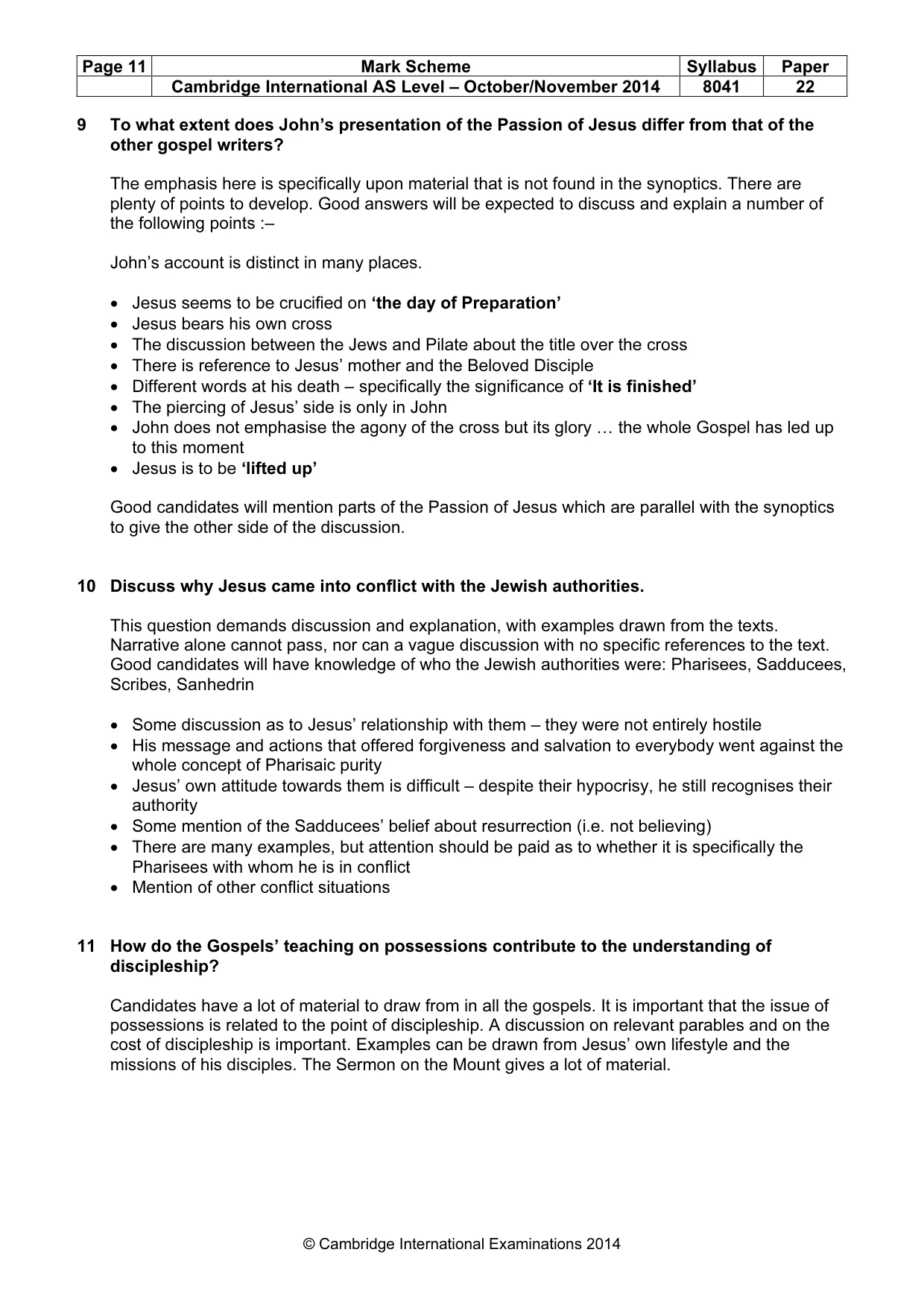
Page 11 Mark Scheme Syllabus Paper Cambridge International AS Level – October/November 2014 8041 22 © Cambridge International Examinations 2014 9 To what extent does John’s presentation of the Passion of Jesus differ from that of the other gospel writers? The emphasis here is specifically upon material that is not found in the synoptics. There are plenty of points to develop. Good answers will be expected to discuss and explain a number of the following points :– John’s account is distinct in many places. • Jesus seems to be crucified on ‘the day of Preparation’ • Jesus bears his own cross • The discussion between the Jews and Pilate about the title over the cross • There is reference to Jesus’ mother and the Beloved Disciple • Different words at his death – specifically the significance of ‘It is finished’ • The piercing of Jesus’ side is only in John • John does not emphasise the agony of the cross but its glory … the whole Gospel has led up to this moment • Jesus is to be ‘lifted up’ Good candidates will mention parts of the Passion of Jesus which are parallel with the synoptics to give the other side of the discussion. 10 Discuss why Jesus came into conflict with the Jewish authorities. This question demands discussion and explanation, with examples drawn from the texts. Narrative alone cannot pass, nor can a vague discussion with no specific references to the text. Good candidates will have knowledge of who the Jewish authorities were: Pharisees, Sadducees, Scribes, Sanhedrin • Some discussion as to Jesus’ relationship with them – they were not entirely hostile • His message and actions that offered forgiveness and salvation to everybody went against the whole concept of Pharisaic purity • Jesus’ own attitude towards them is difficult – despite their hypocrisy, he still recognises their authority • Some mention of the Sadducees’ belief about resurrection (i.e. not believing) • There are many examples, but attention should be paid as to whether it is specifically the Pharisees with whom he is in conflict • Mention of other conflict situations 11 How do the Gospels’ teaching on possessions contribute to the understanding of discipleship? Candidates have a lot of material to draw from in all the gospels. It is important that the issue of possessions is related to the point of discipleship. A discussion on relevant parables and on the cost of discipleship is important. Examples can be drawn from Jesus’ own lifestyle and the missions of his disciples. The Sermon on the Mount gives a lot of material.
Mark scheme, page 12
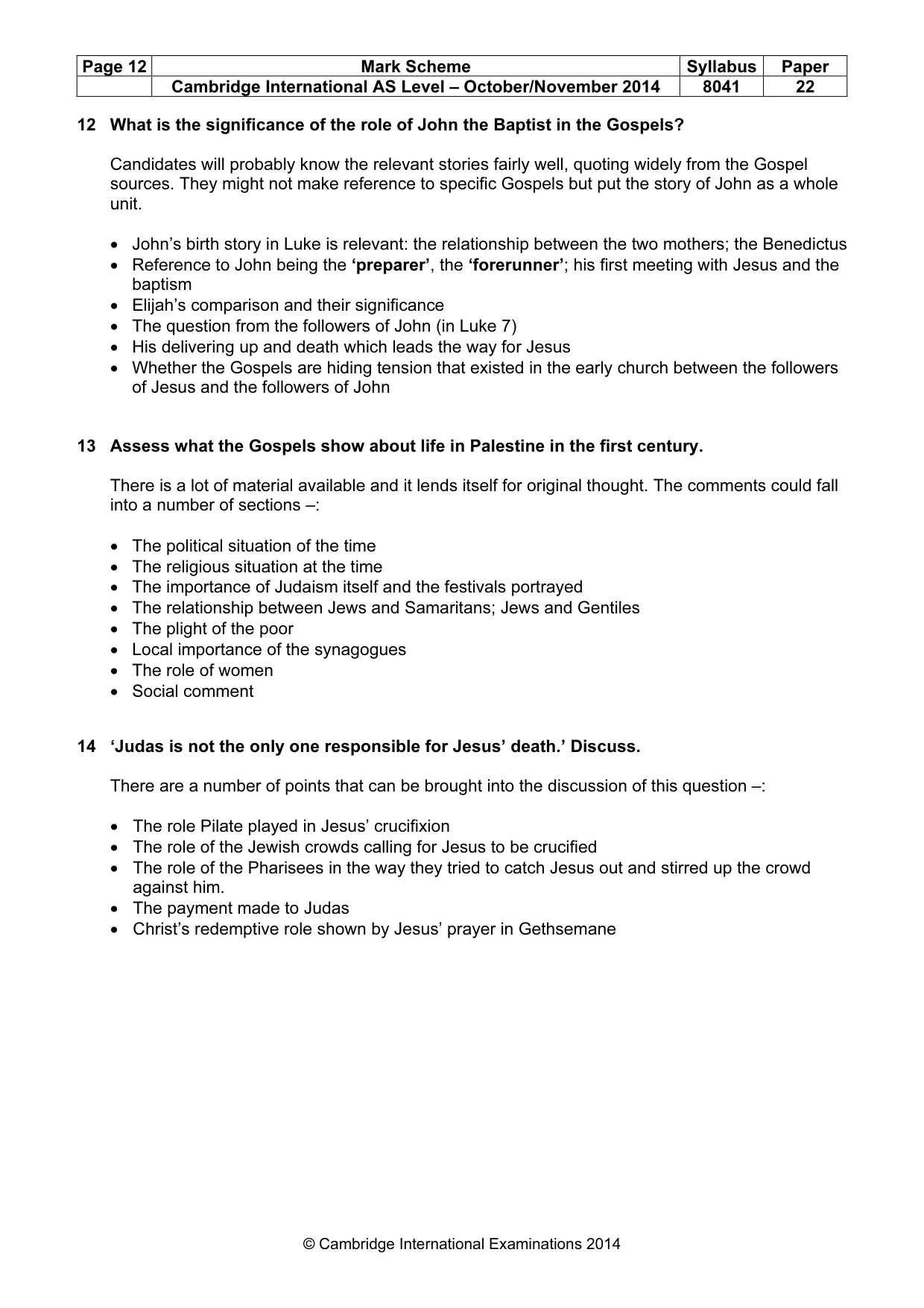
Page 12 Mark Scheme Syllabus Paper Cambridge International AS Level – October/November 2014 8041 22 © Cambridge International Examinations 2014 12 What is the significance of the role of John the Baptist in the Gospels? Candidates will probably know the relevant stories fairly well, quoting widely from the Gospel sources. They might not make reference to specific Gospels but put the story of John as a whole unit. • John’s birth story in Luke is relevant: the relationship between the two mothers; the Benedictus • Reference to John being the ‘preparer’, the ‘forerunner’; his first meeting with Jesus and the baptism • Elijah’s comparison and their significance • The question from the followers of John (in Luke 7) • His delivering up and death which leads the way for Jesus • Whether the Gospels are hiding tension that existed in the early church between the followers of Jesus and the followers of John 13 Assess what the Gospels show about life in Palestine in the first century. There is a lot of material available and it lends itself for original thought. The comments could fall into a number of sections –: • The political situation of the time • The religious situation at the time • The importance of Judaism itself and the festivals portrayed • The relationship between Jews and Samaritans; Jews and Gentiles • The plight of the poor • Local importance of the synagogues • The role of women • Social comment 14 ‘Judas is not the only one responsible for Jesus’ death.’ Discuss. There are a number of points that can be brought into the discussion of this question –: • The role Pilate played in Jesus’ crucifixion • The role of the Jewish crowds calling for Jesus to be crucified • The role of the Pharisees in the way they tried to catch Jesus out and stirred up the crowd against him. • The payment made to Judas • Christ’s redemptive role shown by Jesus’ prayer in Gethsemane
What you needed in this session
Cambridge’s own grade thresholds for 2014 Oct/Nov, Paper 2 · Variant 2. A higher threshold means an easier paper — the bar moves with how the cohort did.