Cambridge A Level Divinity 9011 — 2020 Oct/Nov Paper 3 · Variant 2
9011/32/O/N/20 · 100 marks · ≈113 min
The question paper and its mark scheme, free to read here and free to download. This is Cambridge’s own paper, exactly as it was sat.
Question paper4 pages
Mark scheme15 pages
Answers below. Sit the paper first if you are practising.
Paper as text
Question paper, page 1
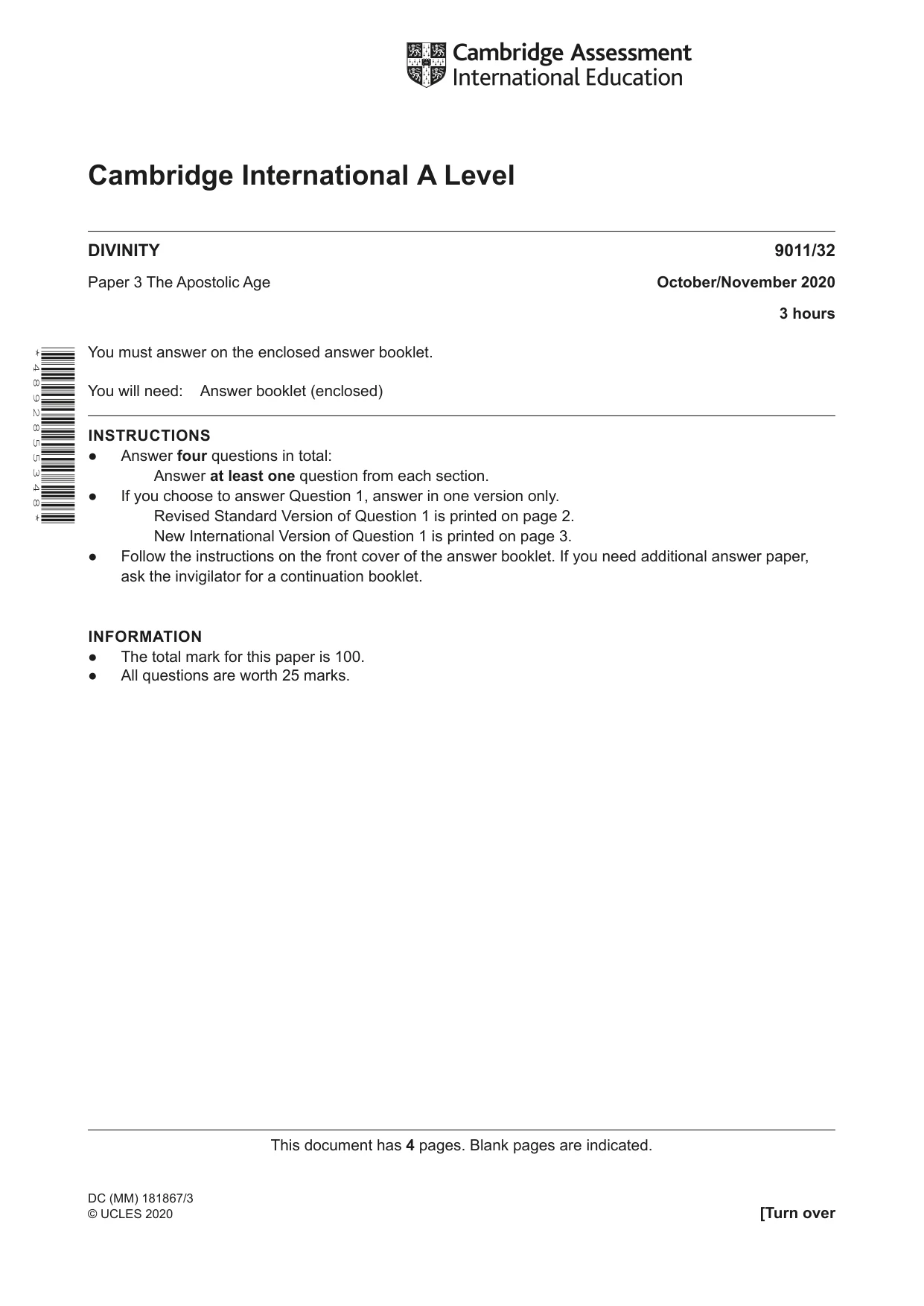
* 4 8 9 2 8 5 5 3 4 8 * Cambridge International A Level DC (MM) 181867/3 © UCLES 2020 [Turn over This document has 4 pages. Blank pages are indicated. DIVINITY 9011/32 Paper 3 The Apostolic Age October/November 2020 3 hours You must answer on the enclosed answer booklet. You will need: Answer booklet (enclosed) INSTRUCTIONS ● Answer four questions in total: Answer at least one question from each section. ● If you choose to answer Question 1, answer in one version only. Revised Standard Version of Question 1 is printed on page 2. New International Version of Question 1 is printed on page 3. ● Follow the instructions on the front cover of the answer booklet. If you need additional answer paper, ask the invigilator for a continuation booklet. INFORMATION ● The total mark for this paper is 100. ● All questions are worth 25 marks.
Question paper, page 2
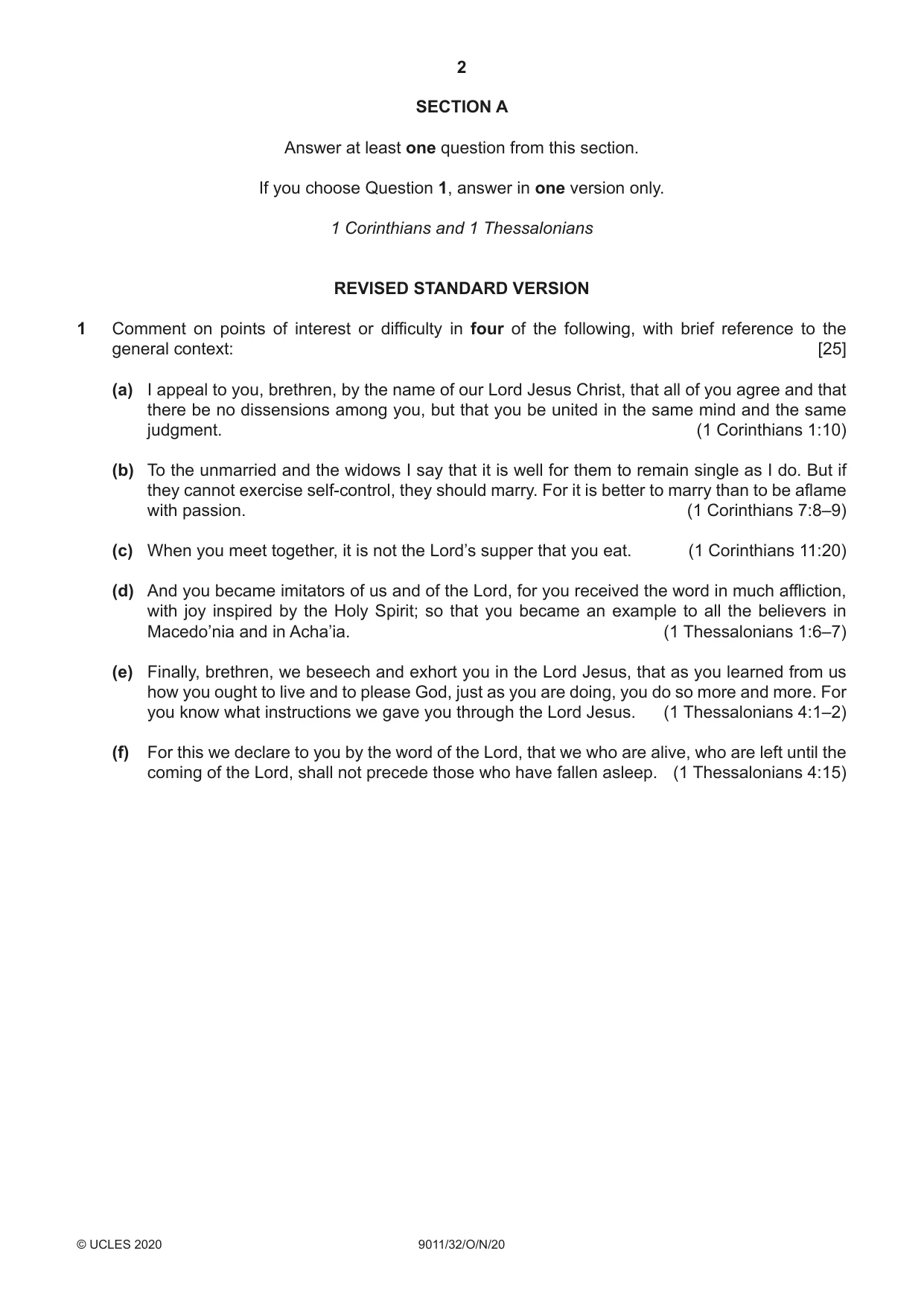
2 9011/32/O/N/20 © UCLES 2020 SECTION A Answer at least one question from this section. If you choose Question 1, answer in one version only. 1 Corinthians and 1 Thessalonians REVISED STANDARD VERSION 1 Comment on points of interest or difficulty in four of the following, with brief reference to the general context: [25] (a) I appeal to you, brethren, by the name of our Lord Jesus Christ, that all of you agree and that there be no dissensions among you, but that you be united in the same mind and the same judgment. (1 Corinthians 1:10) (b) To the unmarried and the widows I say that it is well for them to remain single as I do. But if they cannot exercise self-control, they should marry. For it is better to marry than to be aflame with passion. (1 Corinthians 7:8–9) (c) When you meet together, it is not the Lord’s supper that you eat. (1 Corinthians 11:20) (d) And you became imitators of us and of the Lord, for you received the word in much affliction, with joy inspired by the Holy Spirit; so that you became an example to all the believers in Macedo’nia and in Acha’ia. (1 Thessalonians 1:6–7) (e) Finally, brethren, we beseech and exhort you in the Lord Jesus, that as you learned from us how you ought to live and to please God, just as you are doing, you do so more and more. For you know what instructions we gave you through the Lord Jesus. (1 Thessalonians 4:1–2) (f) For this we declare to you by the word of the Lord, that we who are alive, who are left until the coming of the Lord, shall not precede those who have fallen asleep. (1 Thessalonians 4:15)
Question paper, page 3
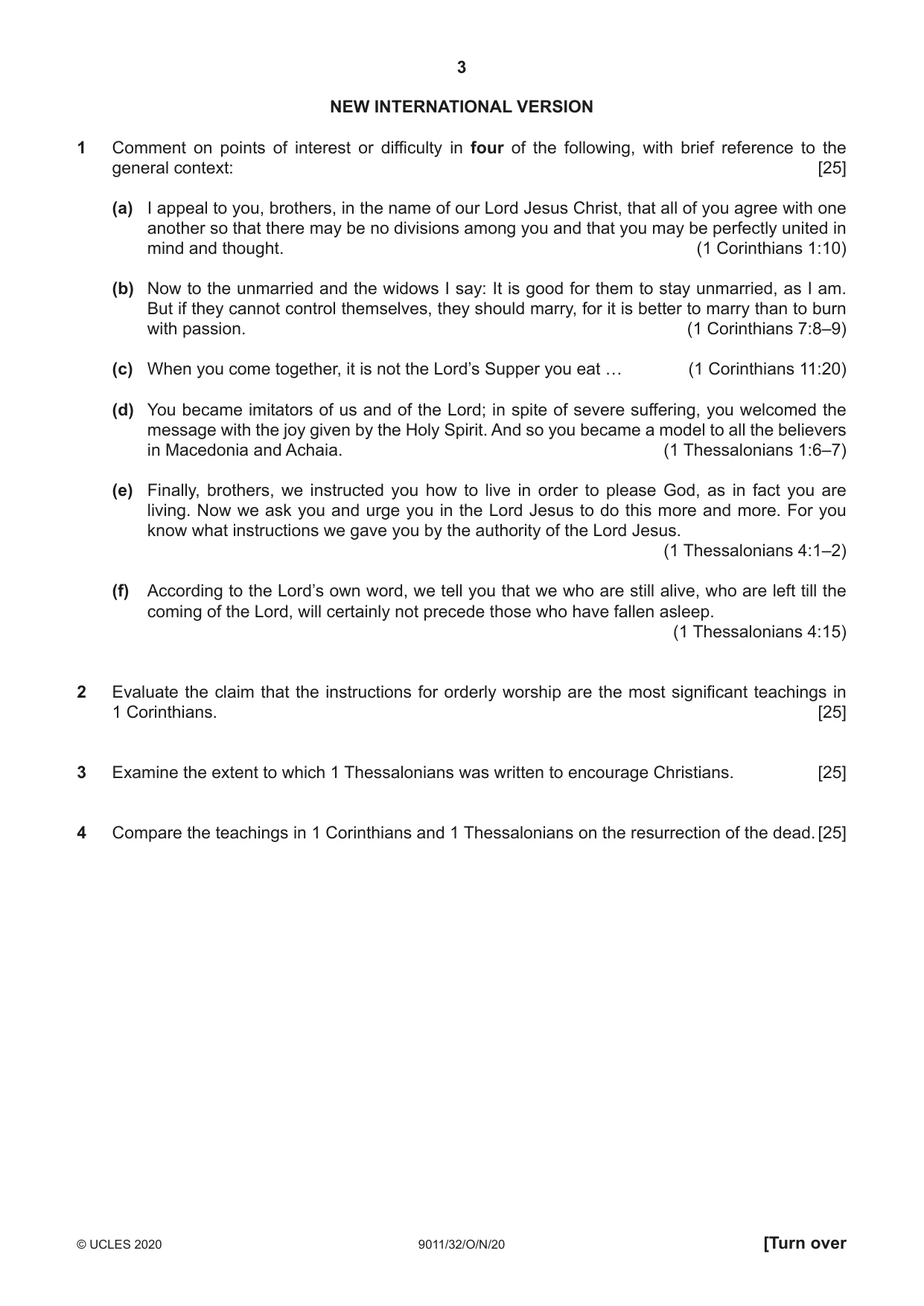
3 9011/32/O/N/20 © UCLES 2020 [Turn over NEW INTERNATIONAL VERSION 1 Comment on points of interest or difficulty in four of the following, with brief reference to the general context: [25] (a) I appeal to you, brothers, in the name of our Lord Jesus Christ, that all of you agree with one another so that there may be no divisions among you and that you may be perfectly united in mind and thought. (1 Corinthians 1:10) (b) Now to the unmarried and the widows I say: It is good for them to stay unmarried, as I am. But if they cannot control themselves, they should marry, for it is better to marry than to burn with passion. (1 Corinthians 7:8–9) (c) When you come together, it is not the Lord’s Supper you eat … (1 Corinthians 11:20) (d) You became imitators of us and of the Lord; in spite of severe suffering, you welcomed the message with the joy given by the Holy Spirit. And so you became a model to all the believers in Macedonia and Achaia. (1 Thessalonians 1:6–7) (e) Finally, brothers, we instructed you how to live in order to please God, as in fact you are living. Now we ask you and urge you in the Lord Jesus to do this more and more. For you know what instructions we gave you by the authority of the Lord Jesus. (1 Thessalonians 4:1–2) (f) According to the Lord’s own word, we tell you that we who are still alive, who are left till the coming of the Lord, will certainly not precede those who have fallen asleep. (1 Thessalonians 4:15) 2 Evaluate the claim that the instructions for orderly worship are the most significant teachings in 1 Corinthians. [25] 3 Examine the extent to which 1 Thessalonians was written to encourage Christians. [25] 4 Compare the teachings in 1 Corinthians and 1 Thessalonians on the resurrection of the dead. [25]
Question paper, page 4
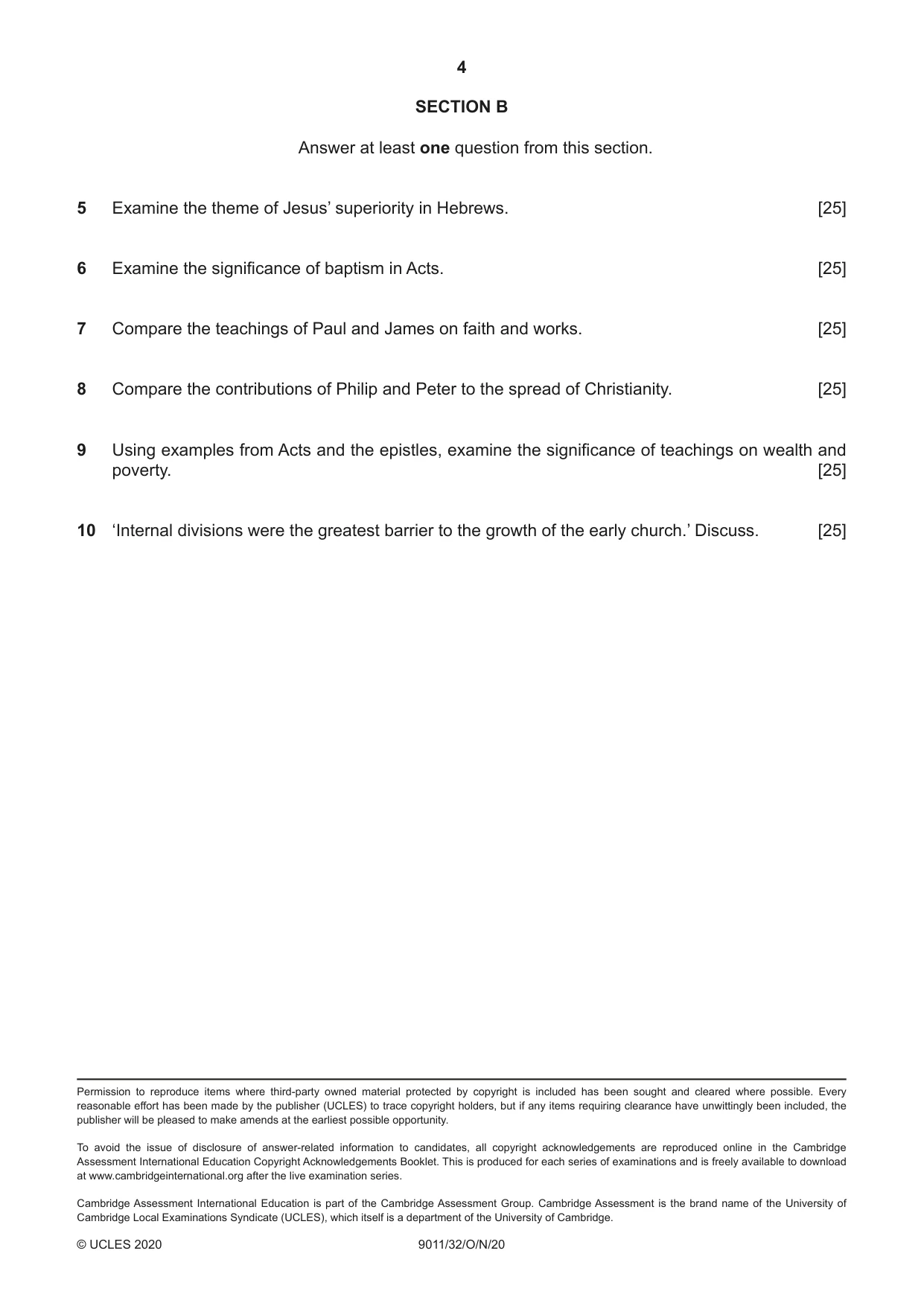
4 9011/32/O/N/20 © UCLES 2020 Permission to reproduce items where third-party owned material protected by copyright is included has been sought and cleared where possible. Every reasonable effort has been made by the publisher (UCLES) to trace copyright holders, but if any items requiring clearance have unwittingly been included, the publisher will be pleased to make amends at the earliest possible opportunity. To avoid the issue of disclosure of answer-related information to candidates, all copyright acknowledgements are reproduced online in the Cambridge Assessment International Education Copyright Acknowledgements Booklet. This is produced for each series of examinations and is freely available to download at www.cambridgeinternational.org after the live examination series. Cambridge Assessment International Education is part of the Cambridge Assessment Group. Cambridge Assessment is the brand name of the University of Cambridge Local Examinations Syndicate (UCLES), which itself is a department of the University of Cambridge. SECTION B Answer at least one question from this section. 5 Examine the theme of Jesus’ superiority in Hebrews. [25] 6 Examine the significance of baptism in Acts. [25] 7 Compare the teachings of Paul and James on faith and works. [25] 8 Compare the contributions of Philip and Peter to the spread of Christianity. [25] 9 Using examples from Acts and the epistles, examine the significance of teachings on wealth and poverty. [25] 10 ‘Internal divisions were the greatest barrier to the growth of the early church.’ Discuss. [25]
Mark scheme, page 1
This document consists of 15 printed pages. © UCLES 2020 [Turn over Cambridge International A Level DIVINITY 9011/32 Paper 3 The Apostolic Age October/November 2020 MARK SCHEME Maximum Mark: 100 Published This mark scheme is published as an aid to teachers and candidates, to indicate the requirements of the examination. It shows the basis on which Examiners were instructed to award marks. It does not indicate the details of the discussions that took place at an Examiners’ meeting before marking began, which would have considered the acceptability of alternative answers. Mark schemes should be read in conjunction with the question paper and the Principal Examiner Report for Teachers. Cambridge International will not enter into discussions about these mark schemes. Cambridge International is publishing the mark schemes for the October/November 2020 series for most Cambridge IGCSE™, Cambridge International A and AS Level and Cambridge Pre-U components, and some Cambridge O Level components.
Mark scheme, page 2
9011/32 Cambridge International A Level – Mark Scheme PUBLISHED October/November 2020 © UCLES 2020 Page 2 of 15 Generic Marking Principles These general marking principles must be applied by all examiners when marking candidate answers. They should be applied alongside the specific content of the mark scheme or generic level descriptors for a question. Each question paper and mark scheme will also comply with these marking principles. GENERIC MARKING PRINCIPLE 1: Marks must be awarded in line with: • the specific content of the mark scheme or the generic level descriptors for the question • the specific skills defined in the mark scheme or in the generic level descriptors for the question • the standard of response required by a candidate as exemplified by the standardisation scripts. GENERIC MARKING PRINCIPLE 2: Marks awarded are always whole marks (not half marks, or other fractions). GENERIC MARKING PRINCIPLE 3: Marks must be awarded positively: • marks are awarded for correct/valid answers, as defined in the mark scheme. However, credit is given for valid answers which go beyond the scope of the syllabus and mark scheme, referring to your Team Leader as appropriate • marks are awarded when candidates clearly demonstrate what they know and can do • marks are not deducted for errors • marks are not deducted for omissions • answers should only be judged on the quality of spelling, punctuation and grammar when these features are specifically assessed by the question as indicated by the mark scheme. The meaning, however, should be unambiguous. GENERIC MARKING PRINCIPLE 4: Rules must be applied consistently, e.g. in situations where candidates have not followed instructions or in the application of generic level descriptors. GENERIC MARKING PRINCIPLE 5: Marks should be awarded using the full range of marks defined in the mark scheme for the question (however; the use of the full mark range may be limited according to the quality of the candidate responses seen). GENERIC MARKING PRINCIPLE 6: Marks awarded are based solely on the requirements as defined in the mark scheme. Marks should not be awarded with grade thresholds or grade descriptors in mind.
Mark scheme, page 3
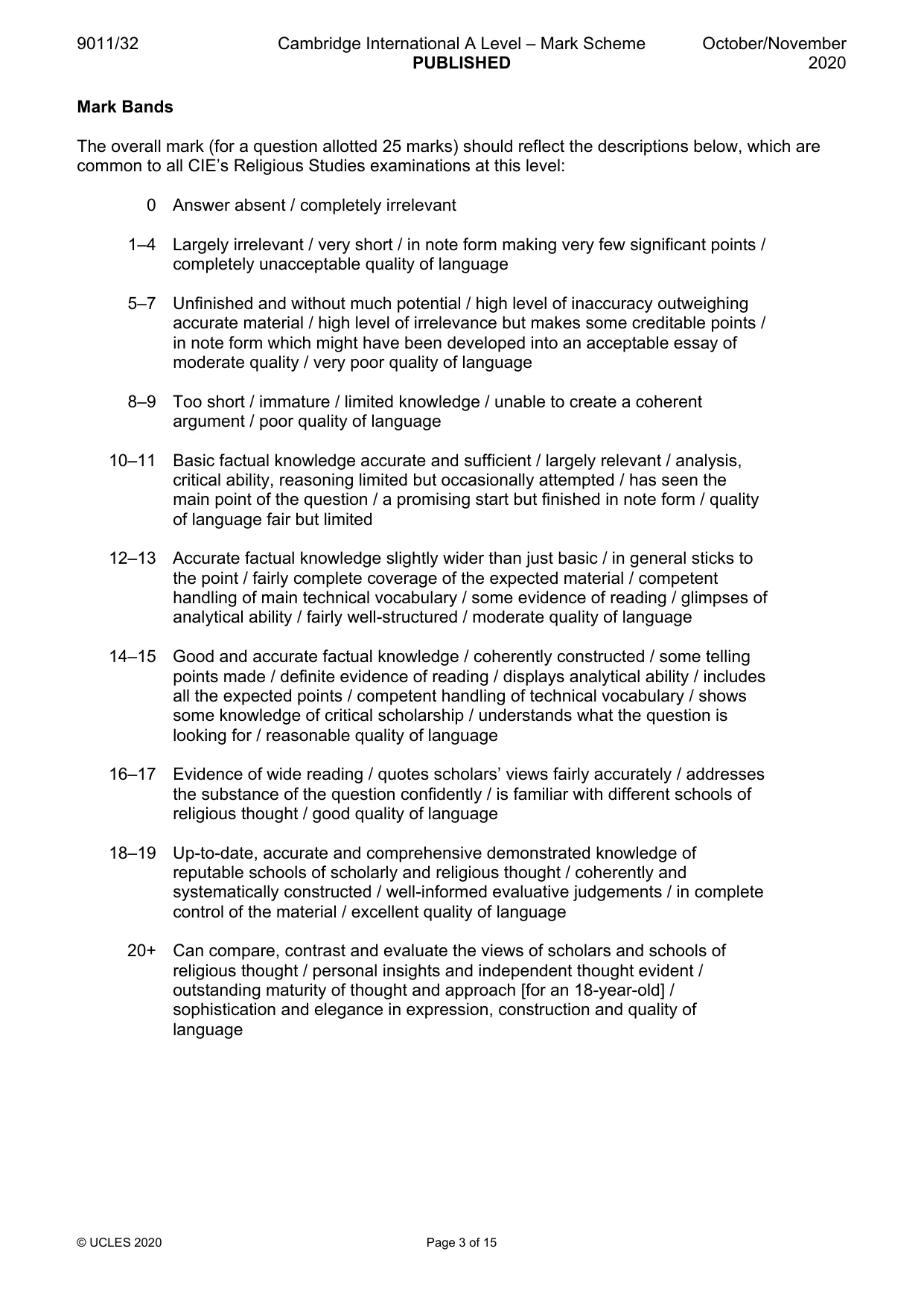
9011/32 Cambridge International A Level – Mark Scheme PUBLISHED October/November 2020 © UCLES 2020 Page 3 of 15 Mark Bands The overall mark (for a question allotted 25 marks) should reflect the descriptions below, which are common to all CIE’s Religious Studies examinations at this level: 0 Answer absent / completely irrelevant 1–4 Largely irrelevant / very short / in note form making very few significant points / completely unacceptable quality of language 5–7 Unfinished and without much potential / high level of inaccuracy outweighing accurate material / high level of irrelevance but makes some creditable points / in note form which might have been developed into an acceptable essay of moderate quality / very poor quality of language 8–9 Too short / immature / limited knowledge / unable to create a coherent argument / poor quality of language 10–11 Basic factual knowledge accurate and sufficient / largely relevant / analysis, critical ability, reasoning limited but occasionally attempted / has seen the main point of the question / a promising start but finished in note form / quality of language fair but limited 12–13 Accurate factual knowledge slightly wider than just basic / in general sticks to the point / fairly complete coverage of the expected material / competent handling of main technical vocabulary / some evidence of reading / glimpses of analytical ability / fairly well-structured / moderate quality of language 14–15 Good and accurate factual knowledge / coherently constructed / some telling points made / definite evidence of reading / displays analytical ability / includes all the expected points / competent handling of technical vocabulary / shows some knowledge of critical scholarship / understands what the question is looking for / reasonable quality of language 16–17 Evidence of wide reading / quotes scholars’ views fairly accurately / addresses the substance of the question confidently / is familiar with different schools of religious thought / good quality of language 18–19 Up-to-date, accurate and comprehensive demonstrated knowledge of reputable schools of scholarly and religious thought / coherently and systematically constructed / well-informed evaluative judgements / in complete control of the material / excellent quality of language 20+ Can compare, contrast and evaluate the views of scholars and schools of religious thought / personal insights and independent thought evident / outstanding maturity of thought and approach [for an 18-year-old] / sophistication and elegance in expression, construction and quality of language
Mark scheme, page 4
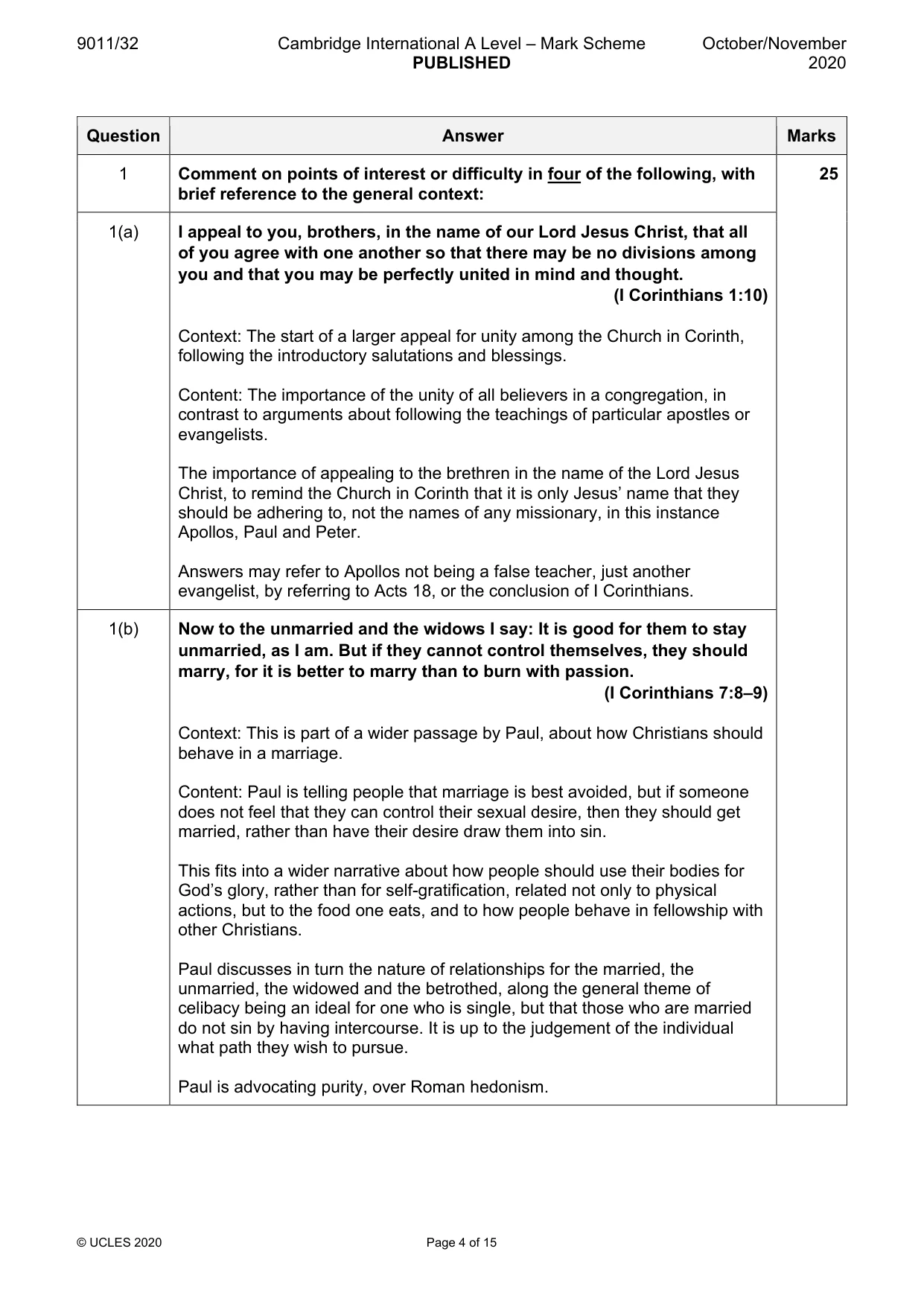
9011/32 Cambridge International A Level – Mark Scheme PUBLISHED October/November 2020 © UCLES 2020 Page 4 of 15 Question Answer Marks 1 Comment on points of interest or difficulty in four of the following, with brief reference to the general context: 25 1(a) I appeal to you, brothers, in the name of our Lord Jesus Christ, that all of you agree with one another so that there may be no divisions among you and that you may be perfectly united in mind and thought. (I Corinthians 1:10) Context: The start of a larger appeal for unity among the Church in Corinth, following the introductory salutations and blessings. Content: The importance of the unity of all believers in a congregation, in contrast to arguments about following the teachings of particular apostles or evangelists. The importance of appealing to the brethren in the name of the Lord Jesus Christ, to remind the Church in Corinth that it is only Jesus’ name that they should be adhering to, not the names of any missionary, in this instance Apollos, Paul and Peter. Answers may refer to Apollos not being a false teacher, just another evangelist, by referring to Acts 18, or the conclusion of I Corinthians. 1(b) Now to the unmarried and the widows I say: It is good for them to stay unmarried, as I am. But if they cannot control themselves, they should marry, for it is better to marry than to burn with passion. (I Corinthians 7:8–9) Context: This is part of a wider passage by Paul, about how Christians should behave in a marriage. Content: Paul is telling people that marriage is best avoided, but if someone does not feel that they can control their sexual desire, then they should get married, rather than have their desire draw them into sin. This fits into a wider narrative about how people should use their bodies for God’s glory, rather than for self-gratification, related not only to physical actions, but to the food one eats, and to how people behave in fellowship with other Christians. Paul discusses in turn the nature of relationships for the married, the unmarried, the widowed and the betrothed, along the general theme of celibacy being an ideal for one who is single, but that those who are married do not sin by having intercourse. It is up to the judgement of the individual what path they wish to pursue. Paul is advocating purity, over Roman hedonism.
Mark scheme, page 5
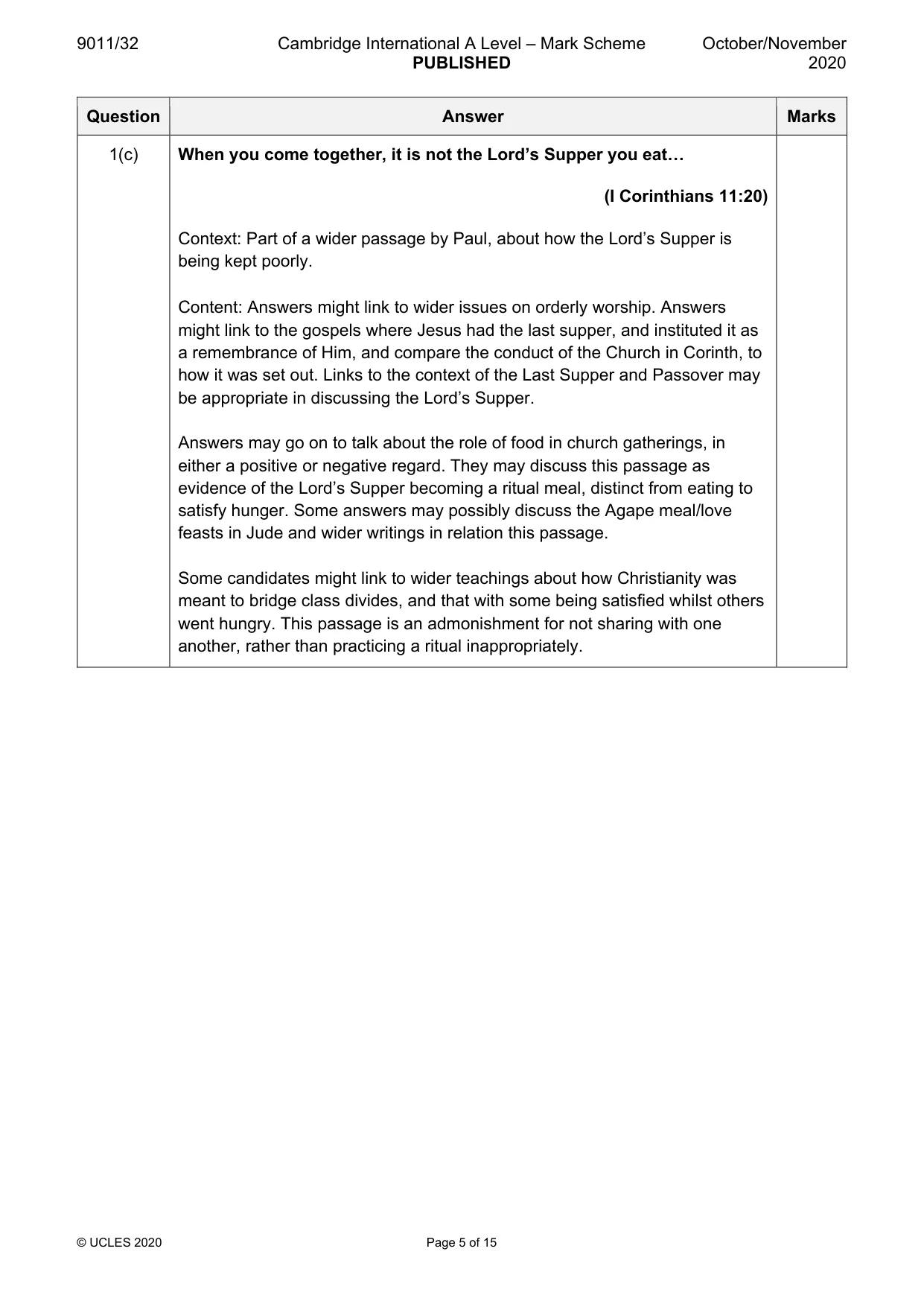
9011/32 Cambridge International A Level – Mark Scheme PUBLISHED October/November 2020 © UCLES 2020 Page 5 of 15 Question Answer Marks 1(c) When you come together, it is not the Lord’s Supper you eat… (I Corinthians 11:20) Context: Part of a wider passage by Paul, about how the Lord’s Supper is being kept poorly. Content: Answers might link to wider issues on orderly worship. Answers might link to the gospels where Jesus had the last supper, and instituted it as a remembrance of Him, and compare the conduct of the Church in Corinth, to how it was set out. Links to the context of the Last Supper and Passover may be appropriate in discussing the Lord’s Supper. Answers may go on to talk about the role of food in church gatherings, in either a positive or negative regard. They may discuss this passage as evidence of the Lord’s Supper becoming a ritual meal, distinct from eating to satisfy hunger. Some answers may possibly discuss the Agape meal/love feasts in Jude and wider writings in relation this passage. Some candidates might link to wider teachings about how Christianity was meant to bridge class divides, and that with some being satisfied whilst others went hungry. This passage is an admonishment for not sharing with one another, rather than practicing a ritual inappropriately.
Mark scheme, page 6
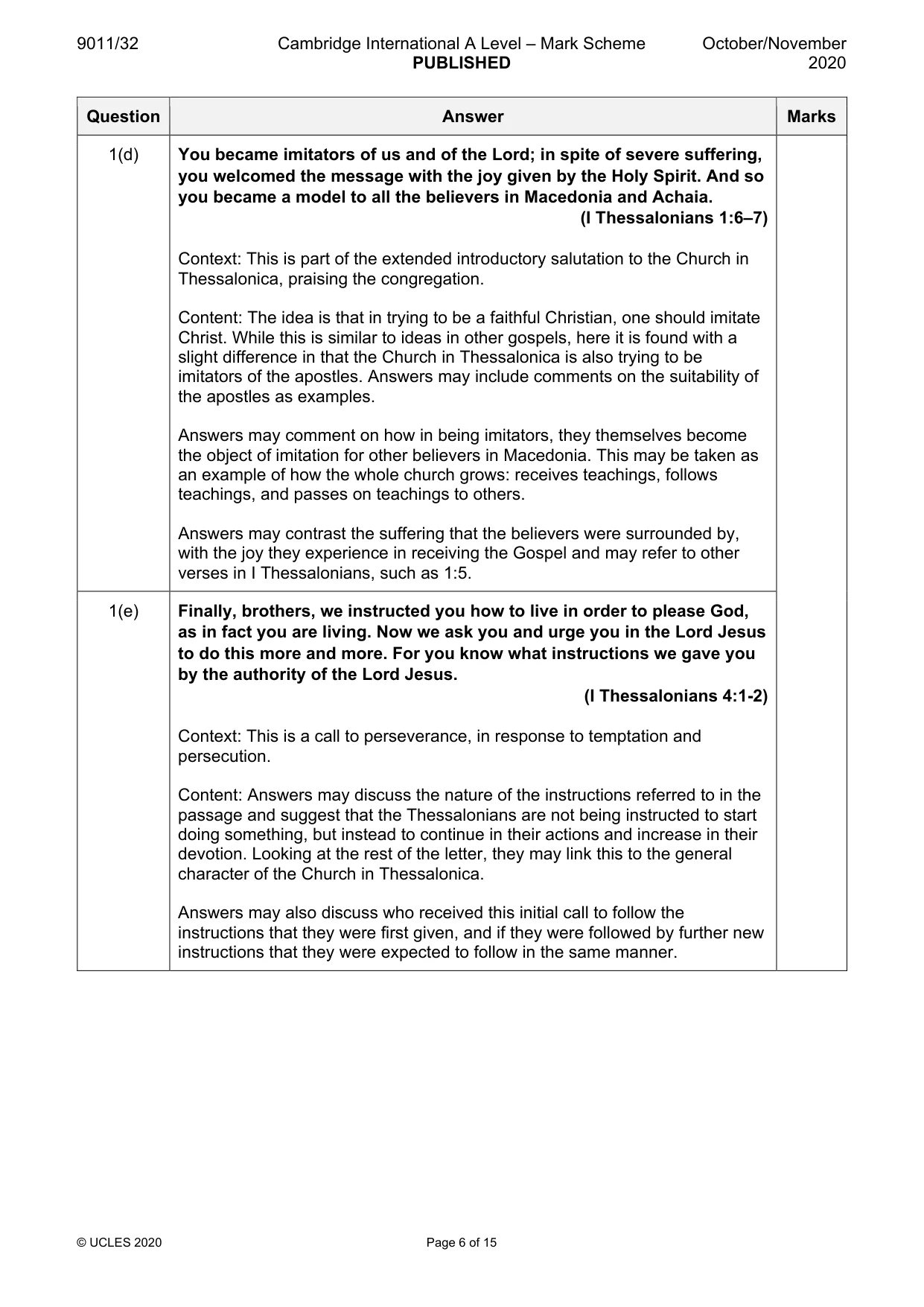
9011/32 Cambridge International A Level – Mark Scheme PUBLISHED October/November 2020 © UCLES 2020 Page 6 of 15 Question Answer Marks 1(d) You became imitators of us and of the Lord; in spite of severe suffering, you welcomed the message with the joy given by the Holy Spirit. And so you became a model to all the believers in Macedonia and Achaia. (I Thessalonians 1:6–7) Context: This is part of the extended introductory salutation to the Church in Thessalonica, praising the congregation. Content: The idea is that in trying to be a faithful Christian, one should imitate Christ. While this is similar to ideas in other gospels, here it is found with a slight difference in that the Church in Thessalonica is also trying to be imitators of the apostles. Answers may include comments on the suitability of the apostles as examples. Answers may comment on how in being imitators, they themselves become the object of imitation for other believers in Macedonia. This may be taken as an example of how the whole church grows: receives teachings, follows teachings, and passes on teachings to others. Answers may contrast the suffering that the believers were surrounded by, with the joy they experience in receiving the Gospel and may refer to other verses in I Thessalonians, such as 1:5. 1(e) Finally, brothers, we instructed you how to live in order to please God, as in fact you are living. Now we ask you and urge you in the Lord Jesus to do this more and more. For you know what instructions we gave you by the authority of the Lord Jesus. (I Thessalonians 4:1-2) Context: This is a call to perseverance, in response to temptation and persecution. Content: Answers may discuss the nature of the instructions referred to in the passage and suggest that the Thessalonians are not being instructed to start doing something, but instead to continue in their actions and increase in their devotion. Looking at the rest of the letter, they may link this to the general character of the Church in Thessalonica. Answers may also discuss who received this initial call to follow the instructions that they were first given, and if they were followed by further new instructions that they were expected to follow in the same manner.
Mark scheme, page 7
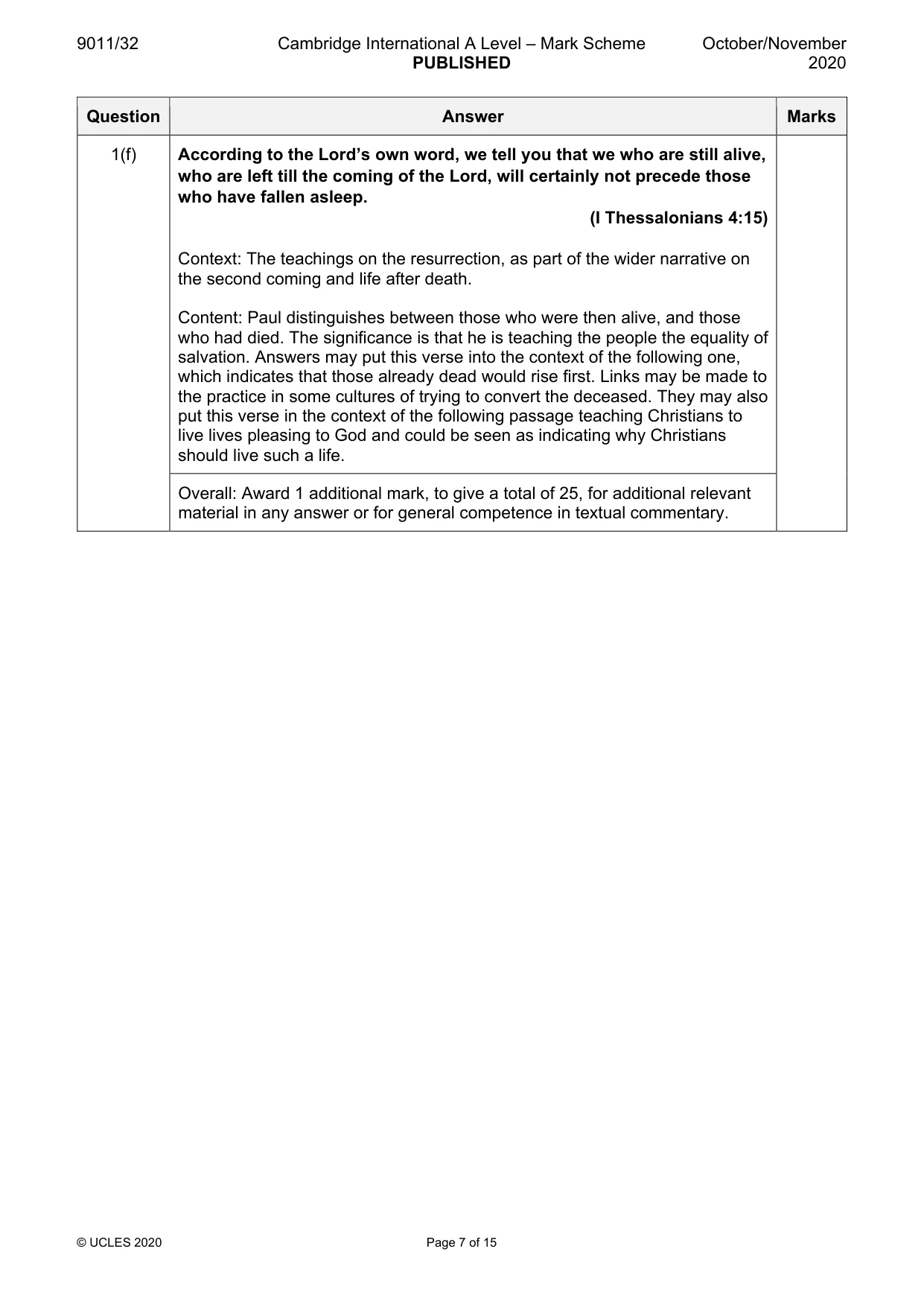
9011/32 Cambridge International A Level – Mark Scheme PUBLISHED October/November 2020 © UCLES 2020 Page 7 of 15 Question Answer Marks 1(f) According to the Lord’s own word, we tell you that we who are still alive, who are left till the coming of the Lord, will certainly not precede those who have fallen asleep. (I Thessalonians 4:15) Context: The teachings on the resurrection, as part of the wider narrative on the second coming and life after death. Content: Paul distinguishes between those who were then alive, and those who had died. The significance is that he is teaching the people the equality of salvation. Answers may put this verse into the context of the following one, which indicates that those already dead would rise first. Links may be made to the practice in some cultures of trying to convert the deceased. They may also put this verse in the context of the following passage teaching Christians to live lives pleasing to God and could be seen as indicating why Christians should live such a life. Overall: Award 1 additional mark, to give a total of 25, for additional relevant material in any answer or for general competence in textual commentary.
Mark scheme, page 8
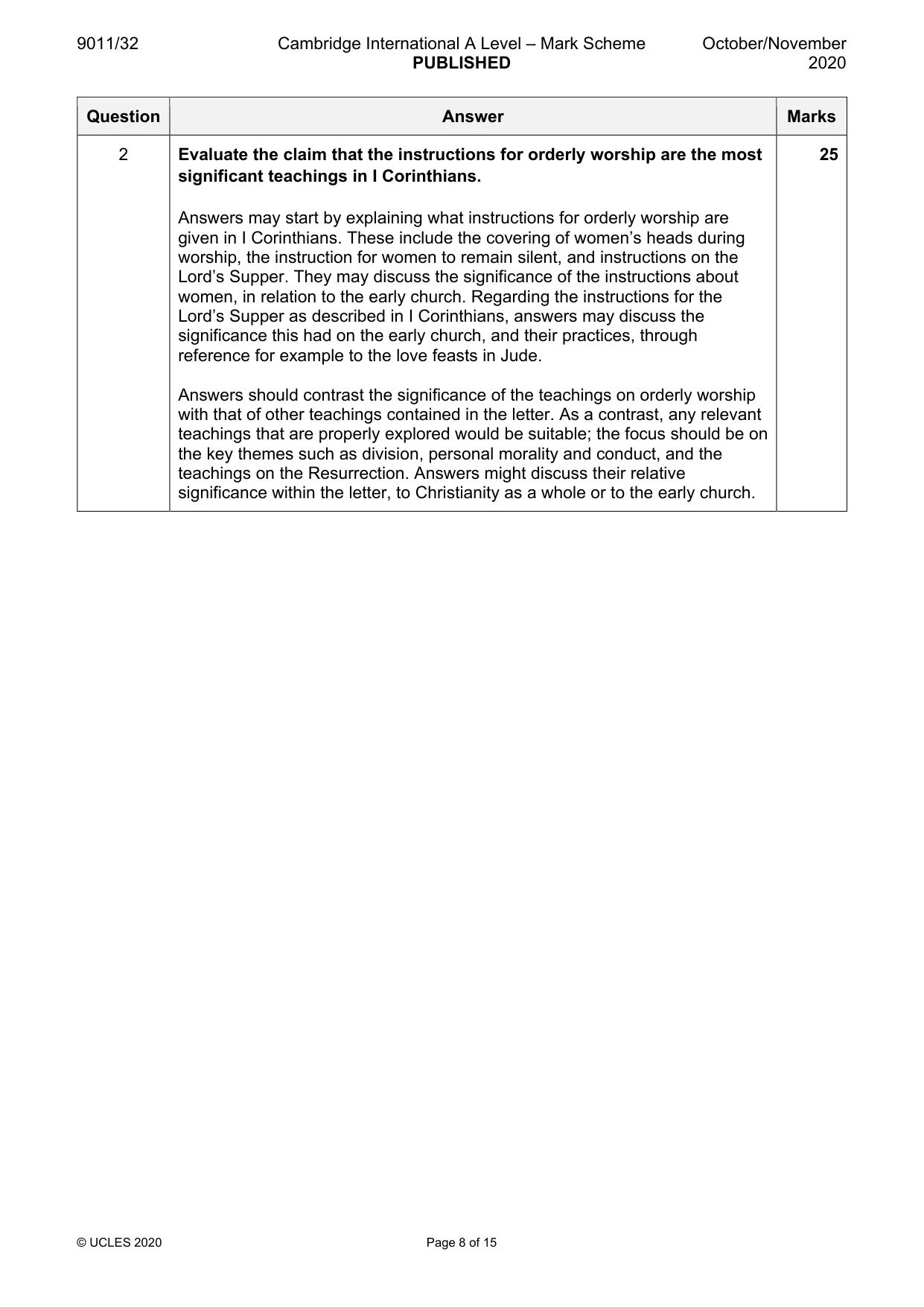
9011/32 Cambridge International A Level – Mark Scheme PUBLISHED October/November 2020 © UCLES 2020 Page 8 of 15 Question Answer Marks 2 Evaluate the claim that the instructions for orderly worship are the most significant teachings in I Corinthians. Answers may start by explaining what instructions for orderly worship are given in I Corinthians. These include the covering of women’s heads during worship, the instruction for women to remain silent, and instructions on the Lord’s Supper. They may discuss the significance of the instructions about women, in relation to the early church. Regarding the instructions for the Lord’s Supper as described in I Corinthians, answers may discuss the significance this had on the early church, and their practices, through reference for example to the love feasts in Jude. Answers should contrast the significance of the teachings on orderly worship with that of other teachings contained in the letter. As a contrast, any relevant teachings that are properly explored would be suitable; the focus should be on the key themes such as division, personal morality and conduct, and the teachings on the Resurrection. Answers might discuss their relative significance within the letter, to Christianity as a whole or to the early church. 25
Mark scheme, page 9
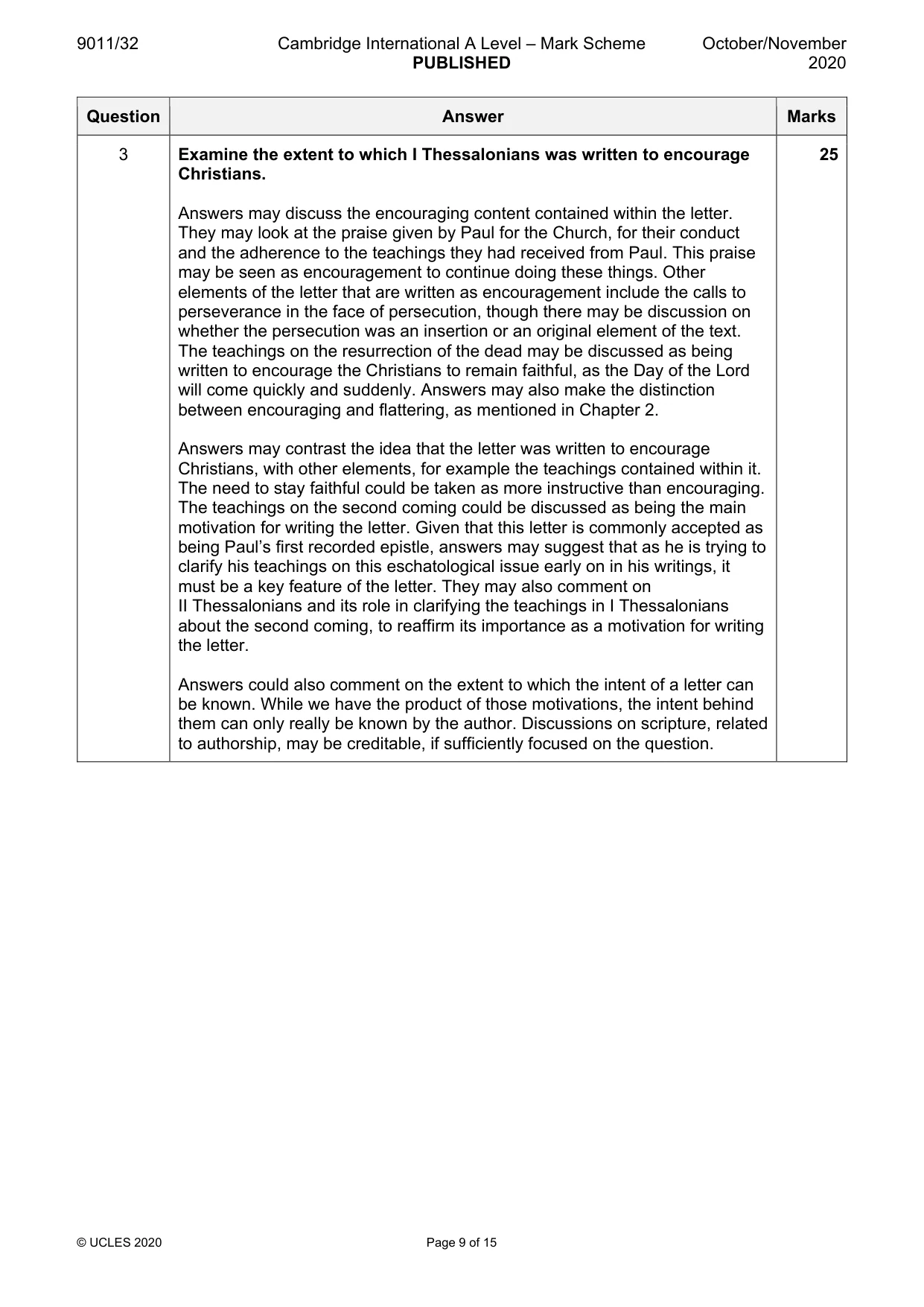
9011/32 Cambridge International A Level – Mark Scheme PUBLISHED October/November 2020 © UCLES 2020 Page 9 of 15 Question Answer Marks 3 Examine the extent to which I Thessalonians was written to encourage Christians. Answers may discuss the encouraging content contained within the letter. They may look at the praise given by Paul for the Church, for their conduct and the adherence to the teachings they had received from Paul. This praise may be seen as encouragement to continue doing these things. Other elements of the letter that are written as encouragement include the calls to perseverance in the face of persecution, though there may be discussion on whether the persecution was an insertion or an original element of the text. The teachings on the resurrection of the dead may be discussed as being written to encourage the Christians to remain faithful, as the Day of the Lord will come quickly and suddenly. Answers may also make the distinction between encouraging and flattering, as mentioned in Chapter 2. Answers may contrast the idea that the letter was written to encourage Christians, with other elements, for example the teachings contained within it. The need to stay faithful could be taken as more instructive than encouraging. The teachings on the second coming could be discussed as being the main motivation for writing the letter. Given that this letter is commonly accepted as being Paul’s first recorded epistle, answers may suggest that as he is trying to clarify his teachings on this eschatological issue early on in his writings, it must be a key feature of the letter. They may also comment on II Thessalonians and its role in clarifying the teachings in I Thessalonians about the second coming, to reaffirm its importance as a motivation for writing the letter. Answers could also comment on the extent to which the intent of a letter can be known. While we have the product of those motivations, the intent behind them can only really be known by the author. Discussions on scripture, related to authorship, may be creditable, if sufficiently focused on the question. 25
Mark scheme, page 10
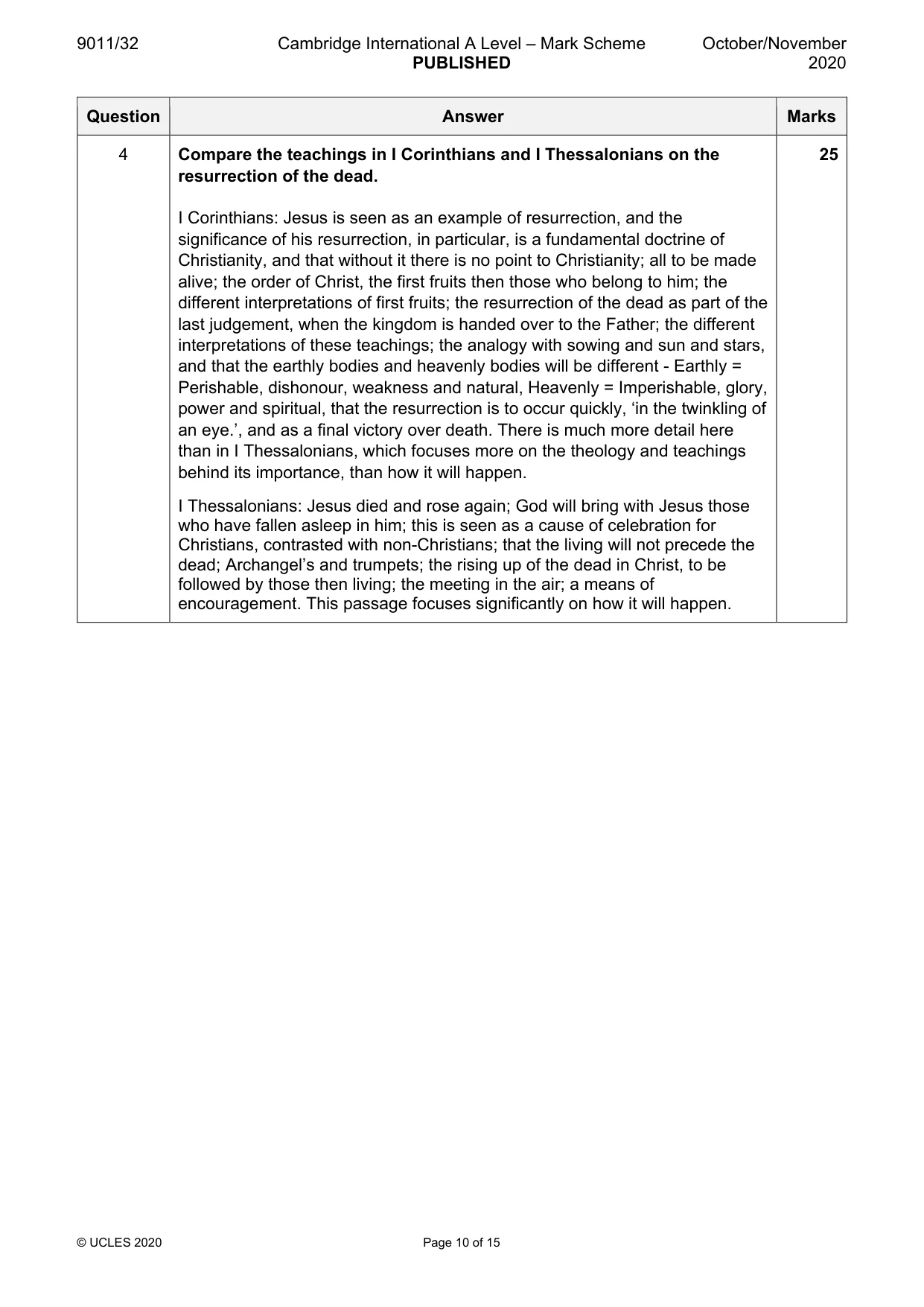
9011/32 Cambridge International A Level – Mark Scheme PUBLISHED October/November 2020 © UCLES 2020 Page 10 of 15 Question Answer Marks 4 Compare the teachings in I Corinthians and I Thessalonians on the resurrection of the dead. I Corinthians: Jesus is seen as an example of resurrection, and the significance of his resurrection, in particular, is a fundamental doctrine of Christianity, and that without it there is no point to Christianity; all to be made alive; the order of Christ, the first fruits then those who belong to him; the different interpretations of first fruits; the resurrection of the dead as part of the last judgement, when the kingdom is handed over to the Father; the different interpretations of these teachings; the analogy with sowing and sun and stars, and that the earthly bodies and heavenly bodies will be different - Earthly = Perishable, dishonour, weakness and natural, Heavenly = Imperishable, glory, power and spiritual, that the resurrection is to occur quickly, ‘in the twinkling of an eye.’, and as a final victory over death. There is much more detail here than in I Thessalonians, which focuses more on the theology and teachings behind its importance, than how it will happen. I Thessalonians: Jesus died and rose again; God will bring with Jesus those who have fallen asleep in him; this is seen as a cause of celebration for Christians, contrasted with non-Christians; that the living will not precede the dead; Archangel’s and trumpets; the rising up of the dead in Christ, to be followed by those then living; the meeting in the air; a means of encouragement. This passage focuses significantly on how it will happen. 25
Mark scheme, page 11
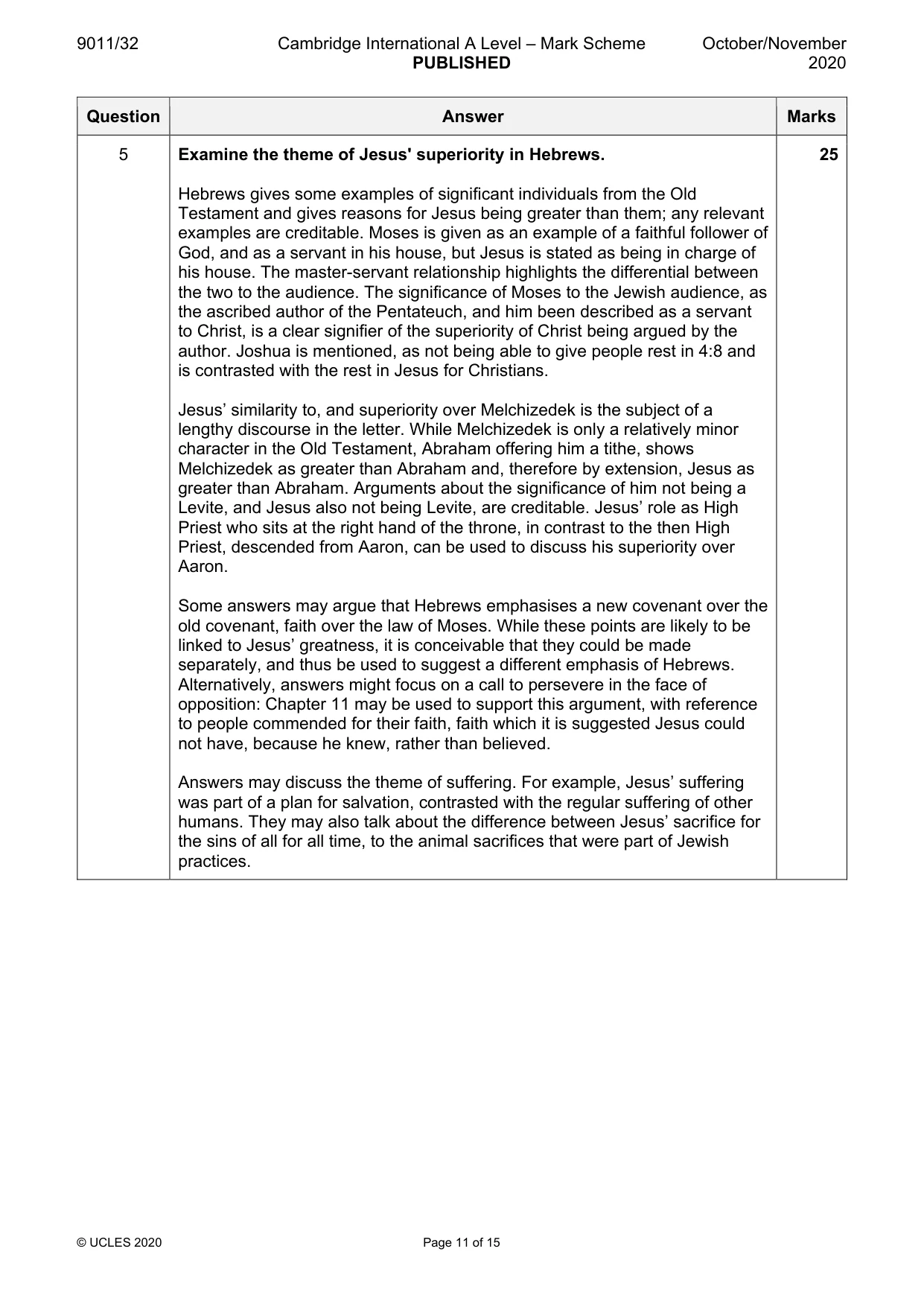
9011/32 Cambridge International A Level – Mark Scheme PUBLISHED October/November 2020 © UCLES 2020 Page 11 of 15 Question Answer Marks 5 Examine the theme of Jesus' superiority in Hebrews. Hebrews gives some examples of significant individuals from the Old Testament and gives reasons for Jesus being greater than them; any relevant examples are creditable. Moses is given as an example of a faithful follower of God, and as a servant in his house, but Jesus is stated as being in charge of his house. The master-servant relationship highlights the differential between the two to the audience. The significance of Moses to the Jewish audience, as the ascribed author of the Pentateuch, and him been described as a servant to Christ, is a clear signifier of the superiority of Christ being argued by the author. Joshua is mentioned, as not being able to give people rest in 4:8 and is contrasted with the rest in Jesus for Christians. Jesus’ similarity to, and superiority over Melchizedek is the subject of a lengthy discourse in the letter. While Melchizedek is only a relatively minor character in the Old Testament, Abraham offering him a tithe, shows Melchizedek as greater than Abraham and, therefore by extension, Jesus as greater than Abraham. Arguments about the significance of him not being a Levite, and Jesus also not being Levite, are creditable. Jesus’ role as High Priest who sits at the right hand of the throne, in contrast to the then High Priest, descended from Aaron, can be used to discuss his superiority over Aaron. Some answers may argue that Hebrews emphasises a new covenant over the old covenant, faith over the law of Moses. While these points are likely to be linked to Jesus’ greatness, it is conceivable that they could be made separately, and thus be used to suggest a different emphasis of Hebrews. Alternatively, answers might focus on a call to persevere in the face of opposition: Chapter 11 may be used to support this argument, with reference to people commended for their faith, faith which it is suggested Jesus could not have, because he knew, rather than believed. Answers may discuss the theme of suffering. For example, Jesus’ suffering was part of a plan for salvation, contrasted with the regular suffering of other humans. They may also talk about the difference between Jesus’ sacrifice for the sins of all for all time, to the animal sacrifices that were part of Jewish practices. 25
Mark scheme, page 12
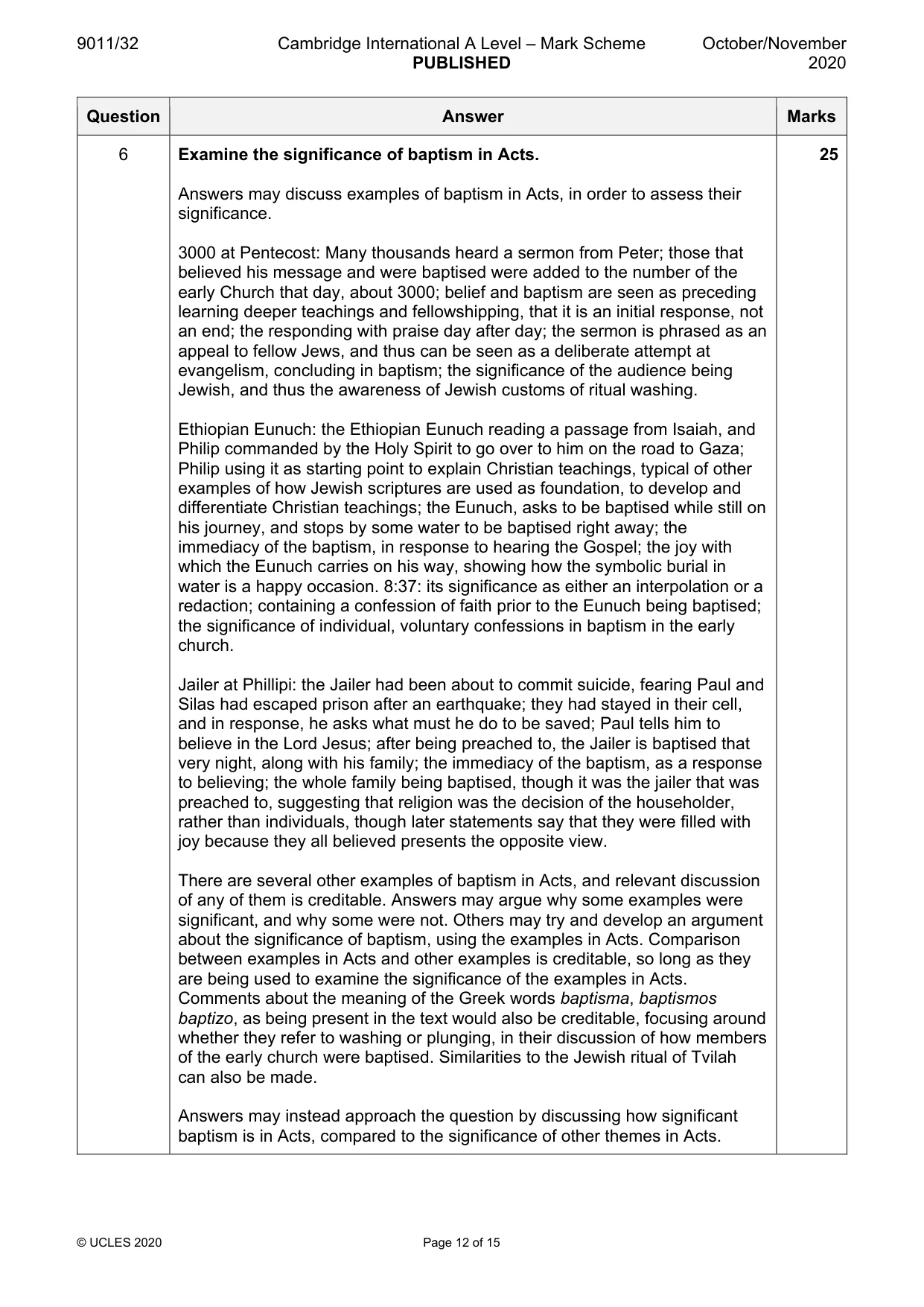
9011/32 Cambridge International A Level – Mark Scheme PUBLISHED October/November 2020 © UCLES 2020 Page 12 of 15 Question Answer Marks 6 Examine the significance of baptism in Acts. Answers may discuss examples of baptism in Acts, in order to assess their significance. 3000 at Pentecost: Many thousands heard a sermon from Peter; those that believed his message and were baptised were added to the number of the early Church that day, about 3000; belief and baptism are seen as preceding learning deeper teachings and fellowshipping, that it is an initial response, not an end; the responding with praise day after day; the sermon is phrased as an appeal to fellow Jews, and thus can be seen as a deliberate attempt at evangelism, concluding in baptism; the significance of the audience being Jewish, and thus the awareness of Jewish customs of ritual washing. Ethiopian Eunuch: the Ethiopian Eunuch reading a passage from Isaiah, and Philip commanded by the Holy Spirit to go over to him on the road to Gaza; Philip using it as starting point to explain Christian teachings, typical of other examples of how Jewish scriptures are used as foundation, to develop and differentiate Christian teachings; the Eunuch, asks to be baptised while still on his journey, and stops by some water to be baptised right away; the immediacy of the baptism, in response to hearing the Gospel; the joy with which the Eunuch carries on his way, showing how the symbolic burial in water is a happy occasion. 8:37: its significance as either an interpolation or a redaction; containing a confession of faith prior to the Eunuch being baptised; the significance of individual, voluntary confessions in baptism in the early church. Jailer at Phillipi: the Jailer had been about to commit suicide, fearing Paul and Silas had escaped prison after an earthquake; they had stayed in their cell, and in response, he asks what must he do to be saved; Paul tells him to believe in the Lord Jesus; after being preached to, the Jailer is baptised that very night, along with his family; the immediacy of the baptism, as a response to believing; the whole family being baptised, though it was the jailer that was preached to, suggesting that religion was the decision of the householder, rather than individuals, though later statements say that they were filled with joy because they all believed presents the opposite view. There are several other examples of baptism in Acts, and relevant discussion of any of them is creditable. Answers may argue why some examples were significant, and why some were not. Others may try and develop an argument about the significance of baptism, using the examples in Acts. Comparison between examples in Acts and other examples is creditable, so long as they are being used to examine the significance of the examples in Acts. Comments about the meaning of the Greek words baptisma, baptismos baptizo, as being present in the text would also be creditable, focusing around whether they refer to washing or plunging, in their discussion of how members of the early church were baptised. Similarities to the Jewish ritual of Tvilah can also be made. Answers may instead approach the question by discussing how significant baptism is in Acts, compared to the significance of other themes in Acts. 25
Mark scheme, page 13
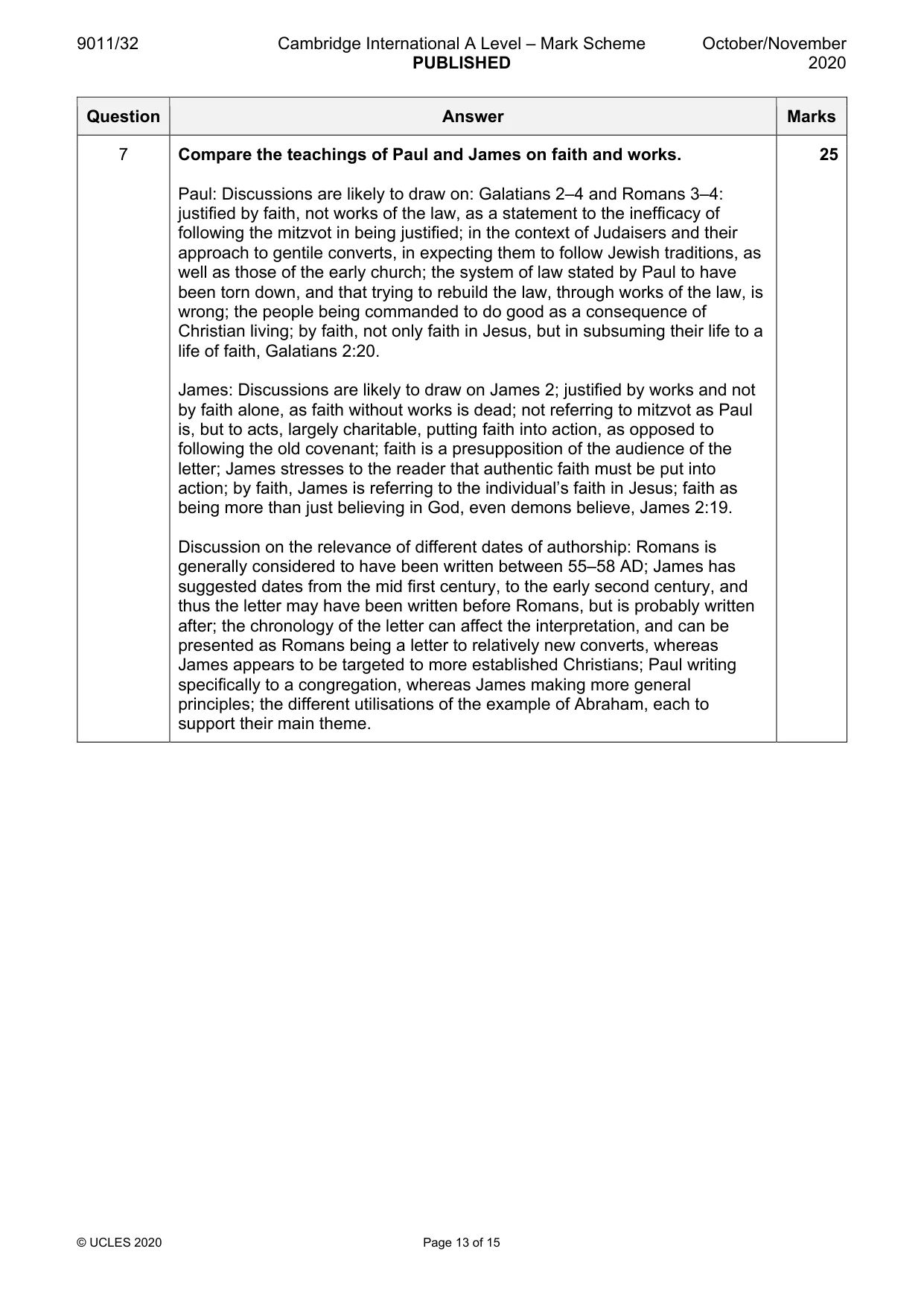
9011/32 Cambridge International A Level – Mark Scheme PUBLISHED October/November 2020 © UCLES 2020 Page 13 of 15 Question Answer Marks 7 Compare the teachings of Paul and James on faith and works. Paul: Discussions are likely to draw on: Galatians 2–4 and Romans 3–4: justified by faith, not works of the law, as a statement to the inefficacy of following the mitzvot in being justified; in the context of Judaisers and their approach to gentile converts, in expecting them to follow Jewish traditions, as well as those of the early church; the system of law stated by Paul to have been torn down, and that trying to rebuild the law, through works of the law, is wrong; the people being commanded to do good as a consequence of Christian living; by faith, not only faith in Jesus, but in subsuming their life to a life of faith, Galatians 2:20. James: Discussions are likely to draw on James 2; justified by works and not by faith alone, as faith without works is dead; not referring to mitzvot as Paul is, but to acts, largely charitable, putting faith into action, as opposed to following the old covenant; faith is a presupposition of the audience of the letter; James stresses to the reader that authentic faith must be put into action; by faith, James is referring to the individual’s faith in Jesus; faith as being more than just believing in God, even demons believe, James 2:19. Discussion on the relevance of different dates of authorship: Romans is generally considered to have been written between 55–58 AD; James has suggested dates from the mid first century, to the early second century, and thus the letter may have been written before Romans, but is probably written after; the chronology of the letter can affect the interpretation, and can be presented as Romans being a letter to relatively new converts, whereas James appears to be targeted to more established Christians; Paul writing specifically to a congregation, whereas James making more general principles; the different utilisations of the example of Abraham, each to support their main theme. 25
Mark scheme, page 14
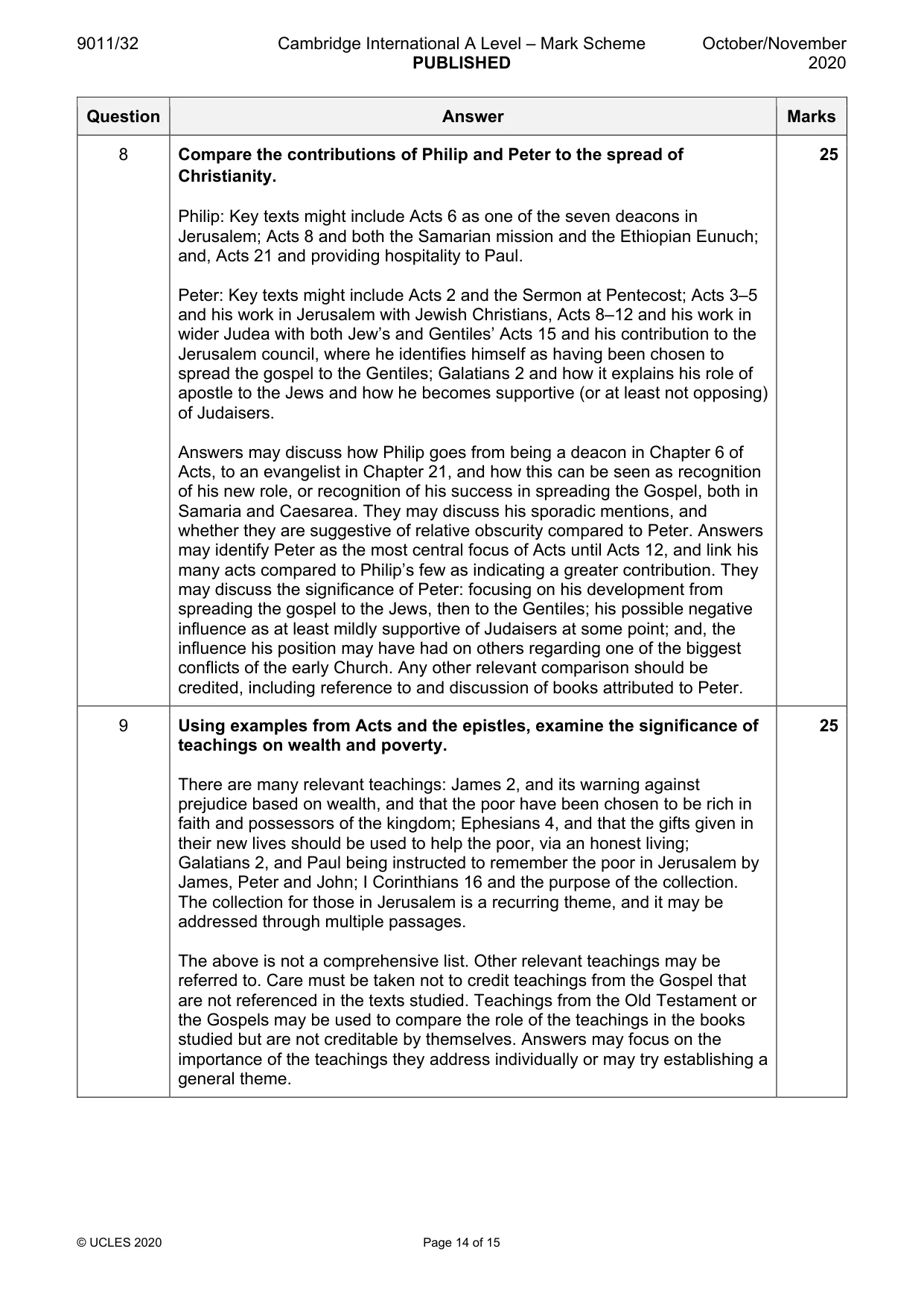
9011/32 Cambridge International A Level – Mark Scheme PUBLISHED October/November 2020 © UCLES 2020 Page 14 of 15 Question Answer Marks 8 Compare the contributions of Philip and Peter to the spread of Christianity. Philip: Key texts might include Acts 6 as one of the seven deacons in Jerusalem; Acts 8 and both the Samarian mission and the Ethiopian Eunuch; and, Acts 21 and providing hospitality to Paul. Peter: Key texts might include Acts 2 and the Sermon at Pentecost; Acts 3–5 and his work in Jerusalem with Jewish Christians, Acts 8–12 and his work in wider Judea with both Jew’s and Gentiles’ Acts 15 and his contribution to the Jerusalem council, where he identifies himself as having been chosen to spread the gospel to the Gentiles; Galatians 2 and how it explains his role of apostle to the Jews and how he becomes supportive (or at least not opposing) of Judaisers. Answers may discuss how Philip goes from being a deacon in Chapter 6 of Acts, to an evangelist in Chapter 21, and how this can be seen as recognition of his new role, or recognition of his success in spreading the Gospel, both in Samaria and Caesarea. They may discuss his sporadic mentions, and whether they are suggestive of relative obscurity compared to Peter. Answers may identify Peter as the most central focus of Acts until Acts 12, and link his many acts compared to Philip’s few as indicating a greater contribution. They may discuss the significance of Peter: focusing on his development from spreading the gospel to the Jews, then to the Gentiles; his possible negative influence as at least mildly supportive of Judaisers at some point; and, the influence his position may have had on others regarding one of the biggest conflicts of the early Church. Any other relevant comparison should be credited, including reference to and discussion of books attributed to Peter. 25 9 Using examples from Acts and the epistles, examine the significance of teachings on wealth and poverty. There are many relevant teachings: James 2, and its warning against prejudice based on wealth, and that the poor have been chosen to be rich in faith and possessors of the kingdom; Ephesians 4, and that the gifts given in their new lives should be used to help the poor, via an honest living; Galatians 2, and Paul being instructed to remember the poor in Jerusalem by James, Peter and John; I Corinthians 16 and the purpose of the collection. The collection for those in Jerusalem is a recurring theme, and it may be addressed through multiple passages. The above is not a comprehensive list. Other relevant teachings may be referred to. Care must be taken not to credit teachings from the Gospel that are not referenced in the texts studied. Teachings from the Old Testament or the Gospels may be used to compare the role of the teachings in the books studied but are not creditable by themselves. Answers may focus on the importance of the teachings they address individually or may try establishing a general theme. 25
Mark scheme, page 15
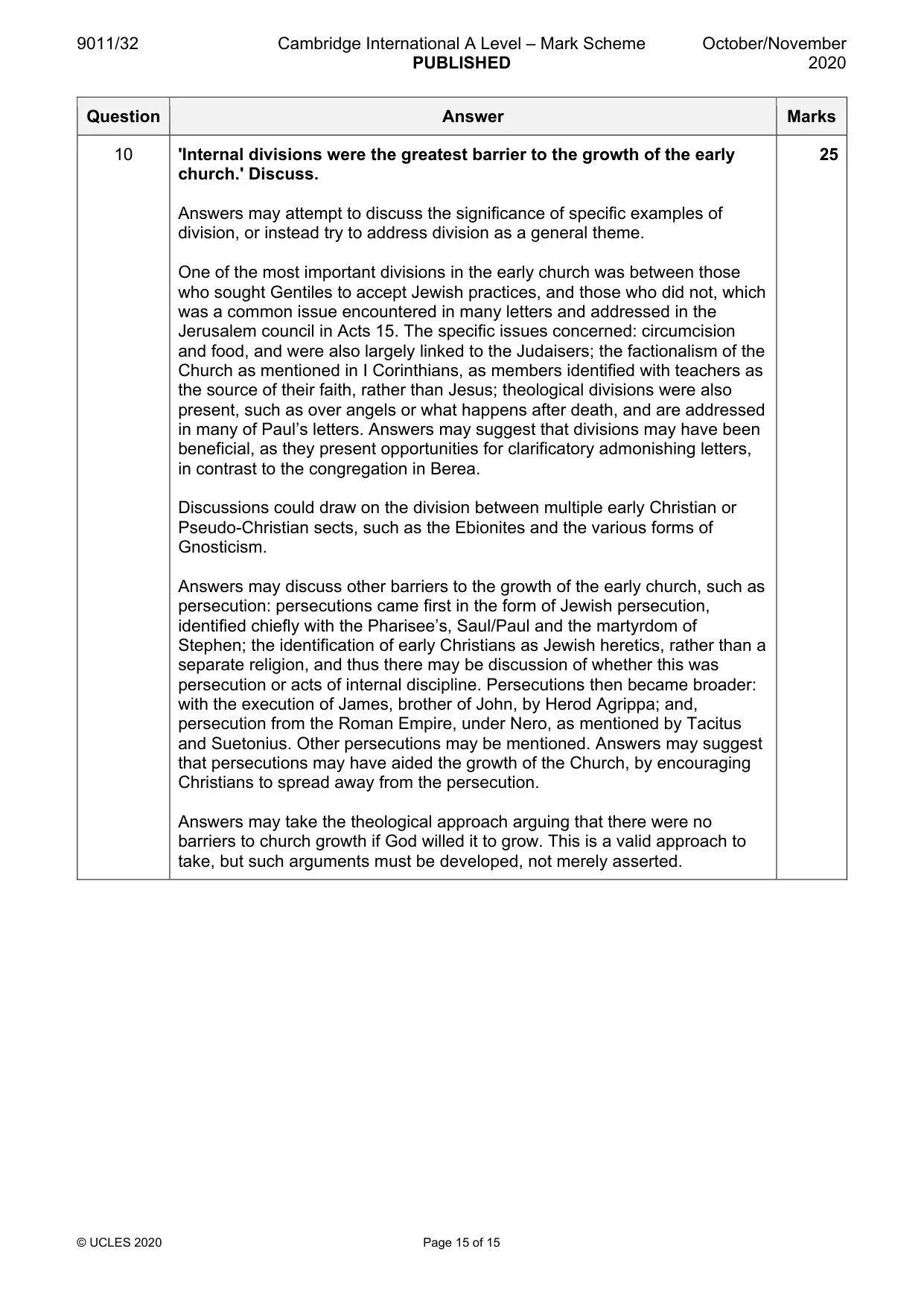
9011/32 Cambridge International A Level – Mark Scheme PUBLISHED October/November 2020 © UCLES 2020 Page 15 of 15 Question Answer Marks 10 'Internal divisions were the greatest barrier to the growth of the early church.' Discuss. Answers may attempt to discuss the significance of specific examples of division, or instead try to address division as a general theme. One of the most important divisions in the early church was between those who sought Gentiles to accept Jewish practices, and those who did not, which was a common issue encountered in many letters and addressed in the Jerusalem council in Acts 15. The specific issues concerned: circumcision and food, and were also largely linked to the Judaisers; the factionalism of the Church as mentioned in I Corinthians, as members identified with teachers as the source of their faith, rather than Jesus; theological divisions were also present, such as over angels or what happens after death, and are addressed in many of Paul’s letters. Answers may suggest that divisions may have been beneficial, as they present opportunities for clarificatory admonishing letters, in contrast to the congregation in Berea. Discussions could draw on the division between multiple early Christian or Pseudo-Christian sects, such as the Ebionites and the various forms of Gnosticism. Answers may discuss other barriers to the growth of the early church, such as persecution: persecutions came first in the form of Jewish persecution, identified chiefly with the Pharisee’s, Saul/Paul and the martyrdom of Stephen; the identification of early Christians as Jewish heretics, rather than a separate religion, and thus there may be discussion of whether this was persecution or acts of internal discipline. Persecutions then became broader: with the execution of James, brother of John, by Herod Agrippa; and, persecution from the Roman Empire, under Nero, as mentioned by Tacitus and Suetonius. Other persecutions may be mentioned. Answers may suggest that persecutions may have aided the growth of the Church, by encouraging Christians to spread away from the persecution. Answers may take the theological approach arguing that there were no barriers to church growth if God willed it to grow. This is a valid approach to take, but such arguments must be developed, not merely asserted. 25
What you needed in this session
Cambridge’s own grade thresholds for 2020 Oct/Nov, Paper 3 · Variant 2. A higher threshold means an easier paper — the bar moves with how the cohort did.