Cambridge A Level Divinity 9011 — 2013 Oct/Nov Paper 1 · Variant 1
9011/11/O/N/13 · 100 marks · ≈113 min
The question paper and its mark scheme, free to read here and free to download. This is Cambridge’s own paper, exactly as it was sat.
Question paper8 pages


Mark scheme15 pages
Answers below. Sit the paper first if you are practising.
Paper as text
Question paper, page 1
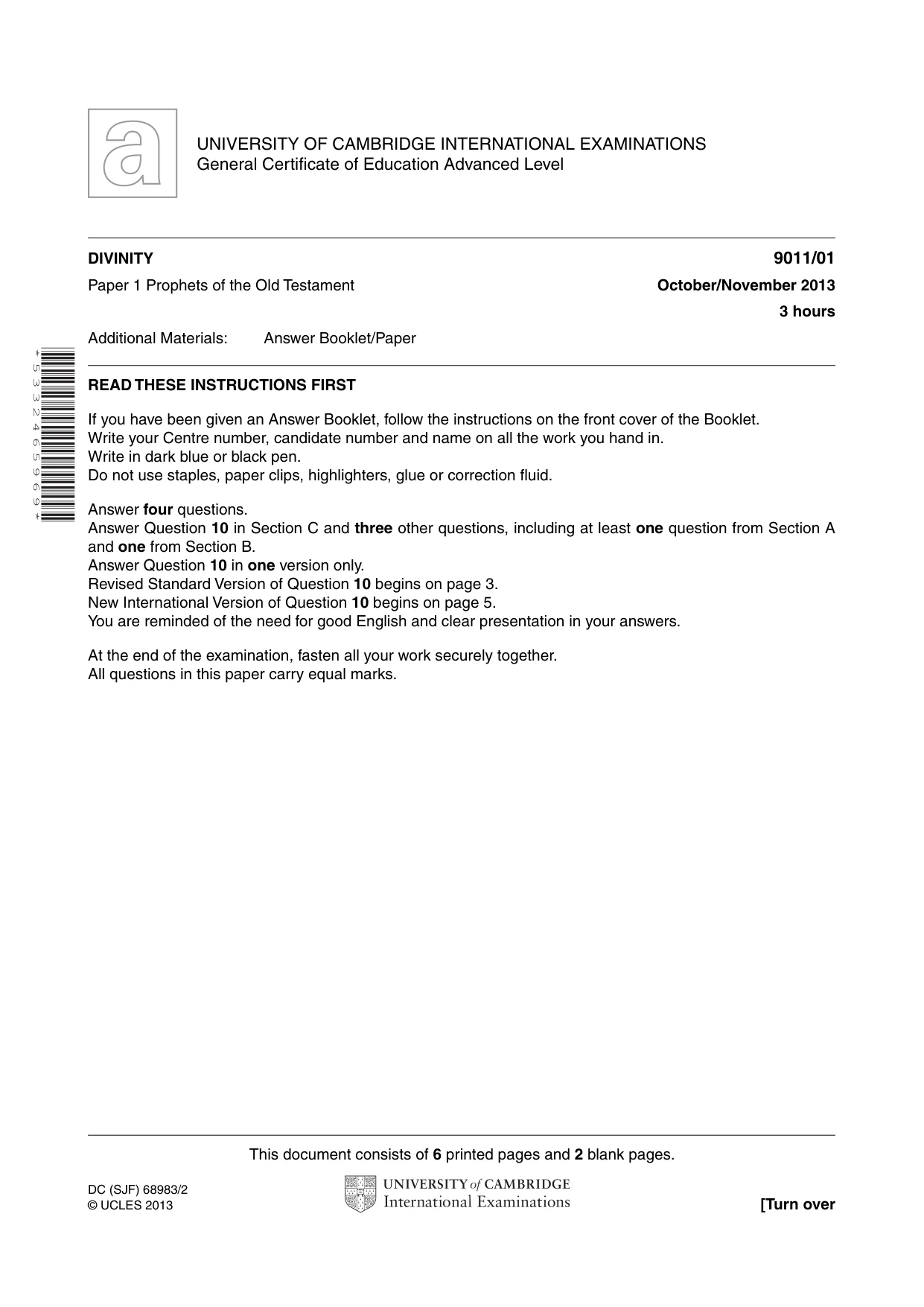
This document consists of 6 printed pages and 2 blank pages. DC (SJF) 68983/2 © UCLES 2013 [Turn over UNIVERSITY OF CAMBRIDGE INTERNATIONAL EXAMINATIONS General Certificate of Education Advanced Level READ THESE INSTRUCTIONS FIRST If you have been given an Answer Booklet, follow the instructions on the front cover of the Booklet. Write your Centre number, candidate number and name on all the work you hand in. Write in dark blue or black pen. Do not use staples, paper clips, highlighters, glue or correction fluid. Answer four questions. Answer Question 10 in Section C and three other questions, including at least one question from Section A and one from Section B. Answer Question 10 in one version only. Revised Standard Version of Question 10 begins on page 3. New International Version of Question 10 begins on page 5. You are reminded of the need for good English and clear presentation in your answers. At the end of the examination, fasten all your work securely together. All questions in this paper carry equal marks. * 5 3 3 2 4 6 5 9 6 9 * DIVINITY 9011/01 Paper 1 Prophets of the Old Testament October/November 2013 3 hours Additional Materials: Answer Booklet/Paper
Question paper, page 2
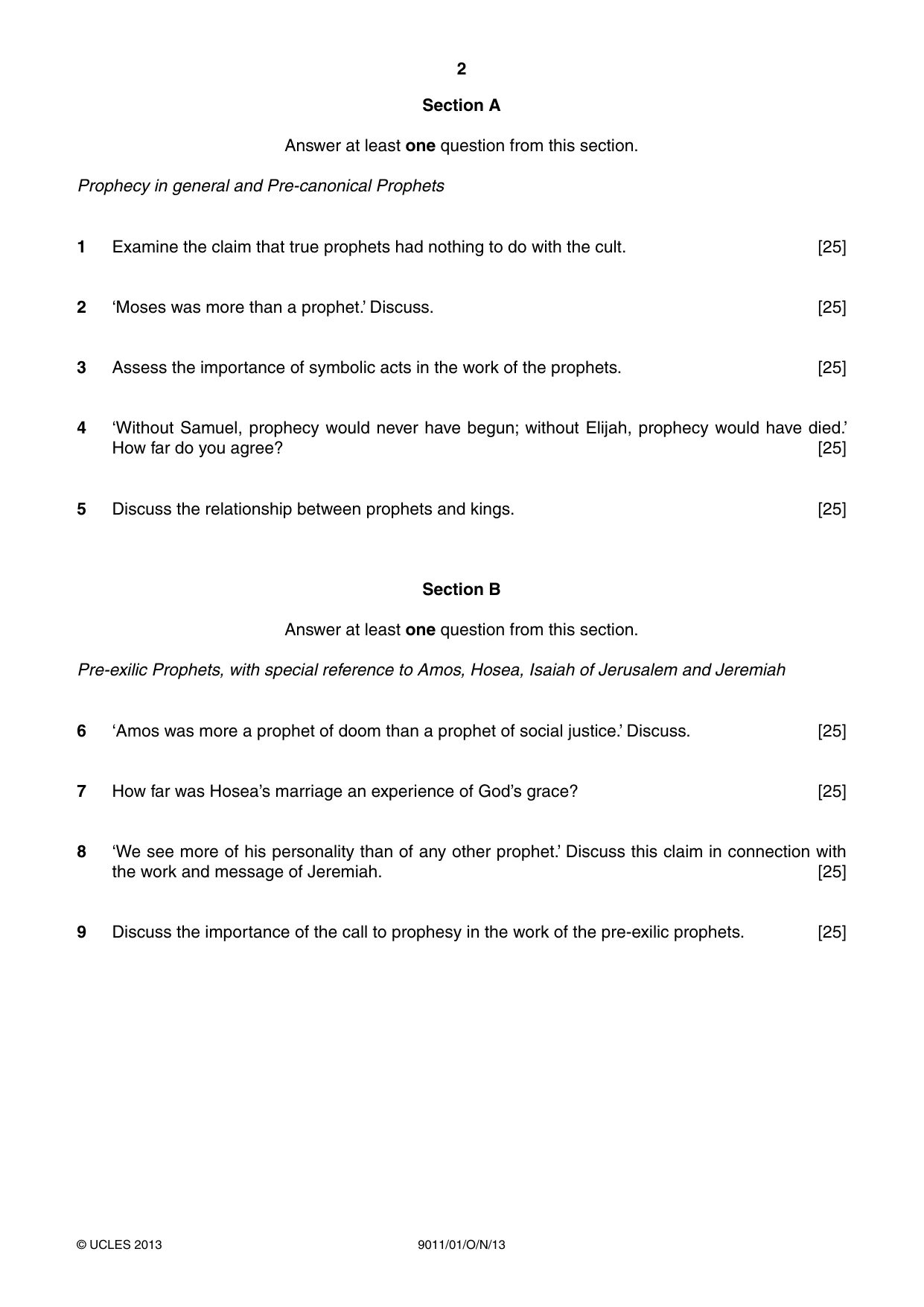
2 9011/01/O/N/13 © UCLES 2013 Section A Answer at least one question from this section. Prophecy in general and Pre-canonical Prophets 1 Examine the claim that true prophets had nothing to do with the cult. [25] 2 ‘Moses was more than a prophet.’ Discuss. [25] 3 Assess the importance of symbolic acts in the work of the prophets. [25] 4 ‘Without Samuel, prophecy would never have begun; without Elijah, prophecy would have died.’ How far do you agree? [25] 5 Discuss the relationship between prophets and kings. [25] Section B Answer at least one question from this section. Pre-exilic Prophets, with special reference to Amos, Hosea, Isaiah of Jerusalem and Jeremiah 6 ‘Amos was more a prophet of doom than a prophet of social justice.’ Discuss. [25] 7 How far was Hosea’s marriage an experience of God’s grace? [25] 8 ‘We see more of his personality than of any other prophet.’ Discuss this claim in connection with the work and message of Jeremiah. [25] 9 Discuss the importance of the call to prophesy in the work of the pre-exilic prophets. [25]
Question paper, page 3
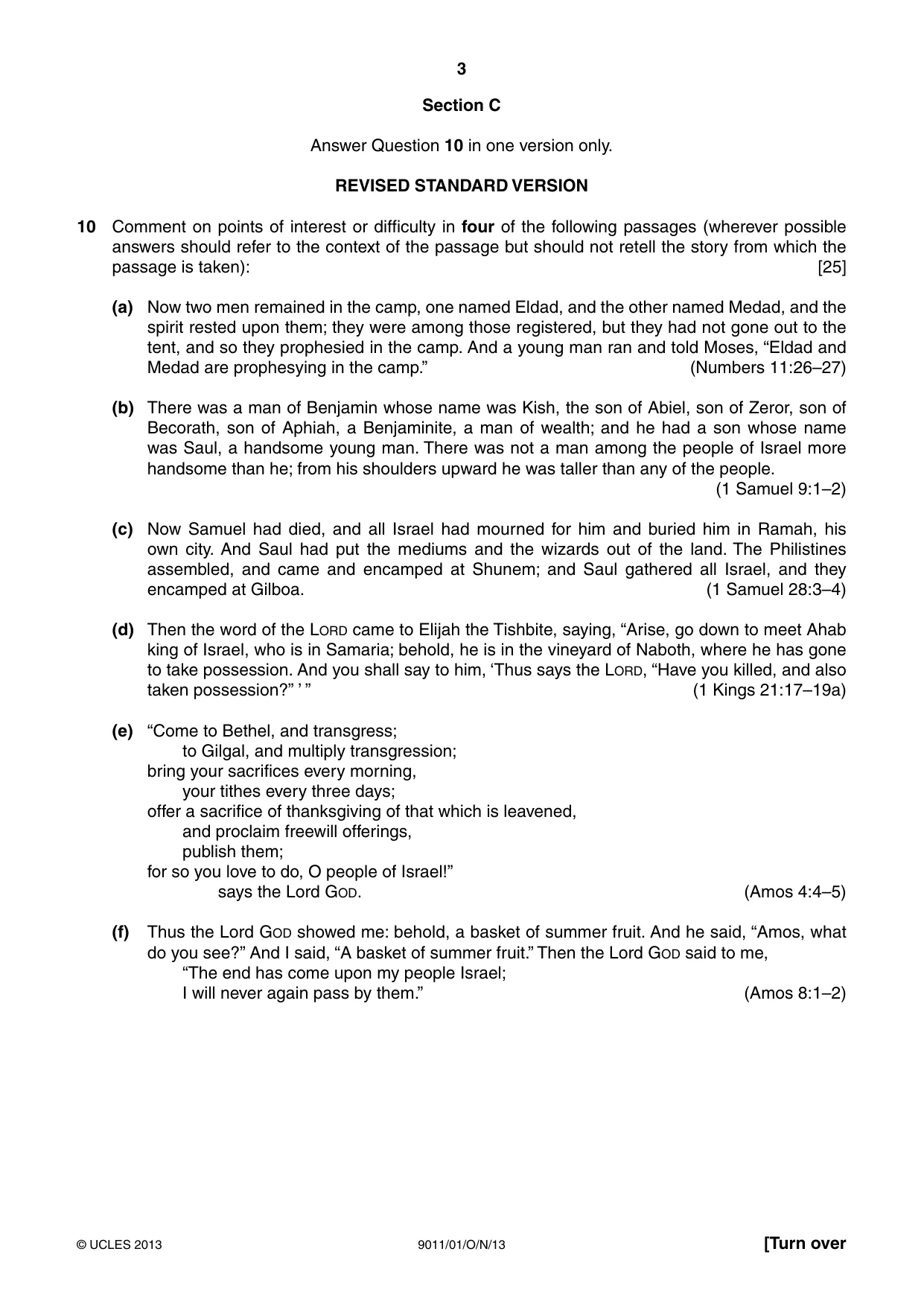
3 9011/01/O/N/13 © UCLES 2013 [Turn over Section C Answer Question 10 in one version only. REVISED STANDARD VERSION 10 Comment on points of interest or difficulty in four of the following passages (wherever possible answers should refer to the context of the passage but should not retell the story from which the passage is taken): [25] (a) Now two men remained in the camp, one named Eldad, and the other named Medad, and the spirit rested upon them; they were among those registered, but they had not gone out to the tent, and so they prophesied in the camp. And a young man ran and told Moses, “Eldad and Medad are prophesying in the camp.” (Numbers 11:26–27) (b) There was a man of Benjamin whose name was Kish, the son of Abiel, son of Zeror, son of Becorath, son of Aphiah, a Benjaminite, a man of wealth; and he had a son whose name was Saul, a handsome young man. There was not a man among the people of Israel more handsome than he; from his shoulders upward he was taller than any of the people. (1 Samuel 9:1–2) (c) Now Samuel had died, and all Israel had mourned for him and buried him in Ramah, his own city. And Saul had put the mediums and the wizards out of the land. The Philistines assembled, and came and encamped at Shunem; and Saul gathered all Israel, and they encamped at Gilboa. (1 Samuel 28:3–4) (d) Then the word of the LORD came to Elijah the Tishbite, saying, “Arise, go down to meet Ahab king of Israel, who is in Samaria; behold, he is in the vineyard of Naboth, where he has gone to take possession. And you shall say to him, ‘Thus says the LORD, “Have you killed, and also taken possession?” ’ ” (1 Kings 21:17–19a) (e) “Come to Bethel, and transgress; to Gilgal, and multiply transgression; bring your sacrifices every morning, your tithes every three days; offer a sacrifice of thanksgiving of that which is leavened, and proclaim freewill offerings, publish them; for so you love to do, O people of Israel!” says the Lord GOD. (Amos 4:4–5) (f) Thus the Lord GOD showed me: behold, a basket of summer fruit. And he said, “Amos, what do you see?” And I said, “A basket of summer fruit.” Then the Lord GOD said to me, “The end has come upon my people Israel; I will never again pass by them.” (Amos 8:1–2)
Question paper, page 4
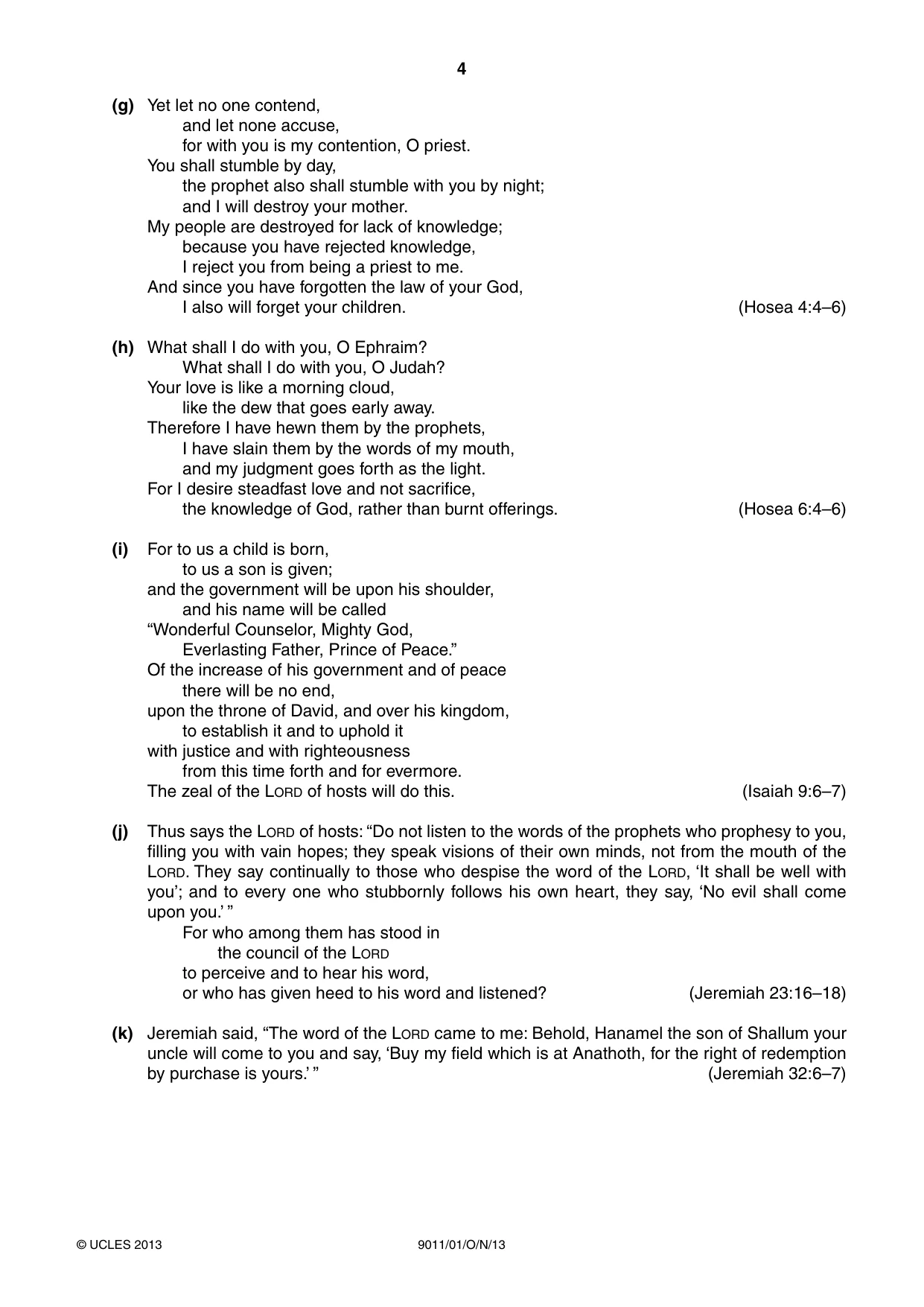
4 9011/01/O/N/13 © UCLES 2013 (g) Yet let no one contend, and let none accuse, for with you is my contention, O priest. You shall stumble by day, the prophet also shall stumble with you by night; and I will destroy your mother. My people are destroyed for lack of knowledge; because you have rejected knowledge, I reject you from being a priest to me. And since you have forgotten the law of your God, I also will forget your children. (Hosea 4:4–6) (h) What shall I do with you, O Ephraim? What shall I do with you, O Judah? Your love is like a morning cloud, like the dew that goes early away. Therefore I have hewn them by the prophets, I have slain them by the words of my mouth, and my judgment goes forth as the light. For I desire steadfast love and not sacrifice, the knowledge of God, rather than burnt offerings. (Hosea 6:4–6) (i) For to us a child is born, to us a son is given; and the government will be upon his shoulder, and his name will be called “Wonderful Counselor, Mighty God, Everlasting Father, Prince of Peace.” Of the increase of his government and of peace there will be no end, upon the throne of David, and over his kingdom, to establish it and to uphold it with justice and with righteousness from this time forth and for evermore. The zeal of the LORD of hosts will do this. (Isaiah 9:6–7) (j) Thus says the LORD of hosts: “Do not listen to the words of the prophets who prophesy to you, filling you with vain hopes; they speak visions of their own minds, not from the mouth of the LORD. They say continually to those who despise the word of the LORD, ‘It shall be well with you’; and to every one who stubbornly follows his own heart, they say, ‘No evil shall come upon you.’ ” For who among them has stood in the council of the LORD to perceive and to hear his word, or who has given heed to his word and listened? (Jeremiah 23:16–18) (k) Jeremiah said, “The word of the LORD came to me: Behold, Hanamel the son of Shallum your uncle will come to you and say, ‘Buy my field which is at Anathoth, for the right of redemption by purchase is yours.’ ” (Jeremiah 32:6–7)
Question paper, page 5
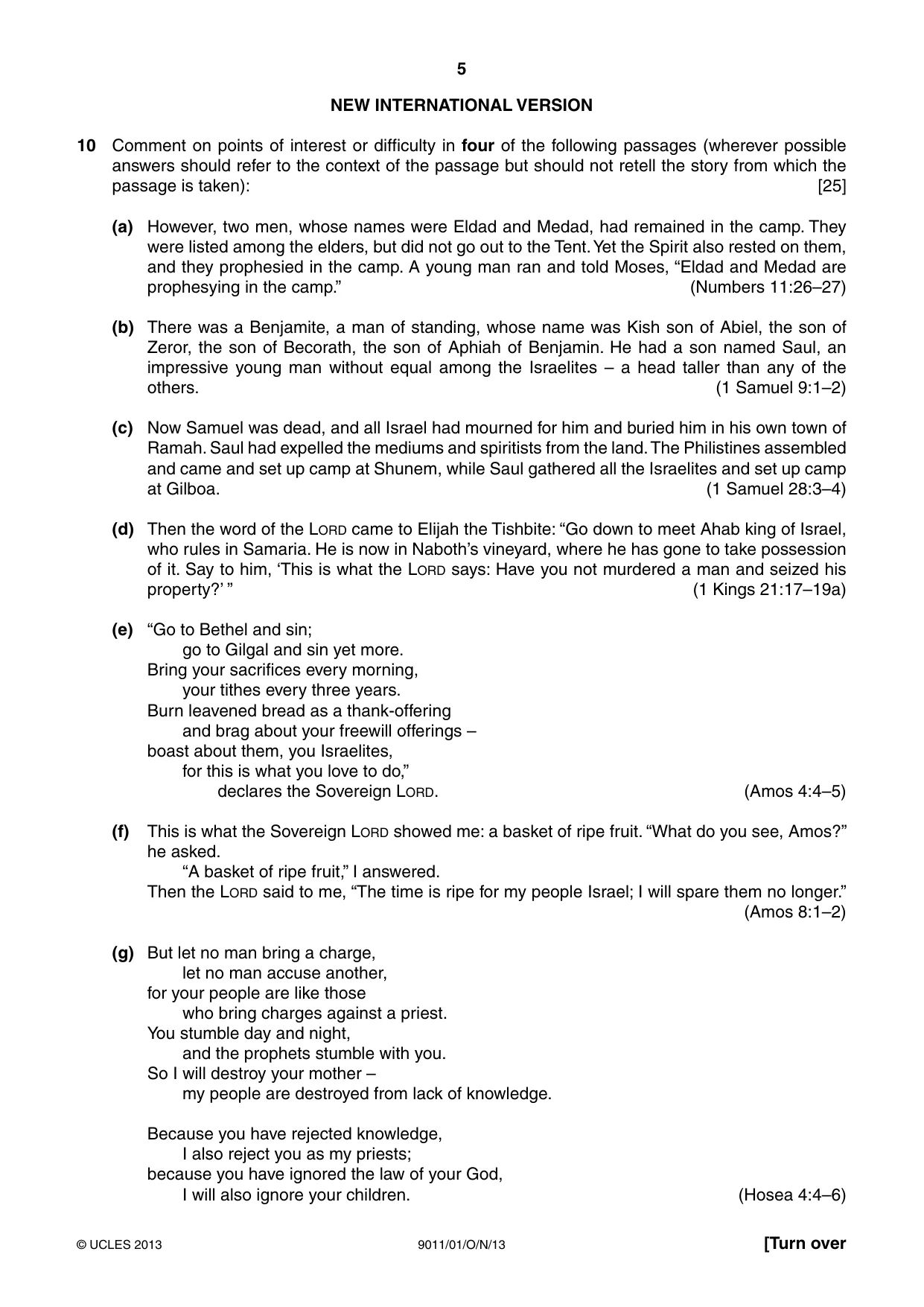
5 9011/01/O/N/13 © UCLES 2013 [Turn over NEW INTERNATIONAL VERSION 10 Comment on points of interest or difficulty in four of the following passages (wherever possible answers should refer to the context of the passage but should not retell the story from which the passage is taken): [25] (a) However, two men, whose names were Eldad and Medad, had remained in the camp. They were listed among the elders, but did not go out to the Tent. Yet the Spirit also rested on them, and they prophesied in the camp. A young man ran and told Moses, “Eldad and Medad are prophesying in the camp.” (Numbers 11:26–27) (b) There was a Benjamite, a man of standing, whose name was Kish son of Abiel, the son of Zeror, the son of Becorath, the son of Aphiah of Benjamin. He had a son named Saul, an impressive young man without equal among the Israelites – a head taller than any of the others. (1 Samuel 9:1–2) (c) Now Samuel was dead, and all Israel had mourned for him and buried him in his own town of Ramah. Saul had expelled the mediums and spiritists from the land. The Philistines assembled and came and set up camp at Shunem, while Saul gathered all the Israelites and set up camp at Gilboa. (1 Samuel 28:3–4) (d) Then the word of the LORD came to Elijah the Tishbite: “Go down to meet Ahab king of Israel, who rules in Samaria. He is now in Naboth’s vineyard, where he has gone to take possession of it. Say to him, ‘This is what the LORD says: Have you not murdered a man and seized his property?’ ” (1 Kings 21:17–19a) (e) “Go to Bethel and sin; go to Gilgal and sin yet more. Bring your sacrifices every morning, your tithes every three years. Burn leavened bread as a thank-offering and brag about your freewill offerings – boast about them, you Israelites, for this is what you love to do,” declares the Sovereign LORD. (Amos 4:4–5) (f) This is what the Sovereign LORD showed me: a basket of ripe fruit. “What do you see, Amos?” he asked. “A basket of ripe fruit,” I answered. Then the LORD said to me, “The time is ripe for my people Israel; I will spare them no longer.” (Amos 8:1–2) (g) But let no man bring a charge, let no man accuse another, for your people are like those who bring charges against a priest. You stumble day and night, and the prophets stumble with you. So I will destroy your mother – my people are destroyed from lack of knowledge. Because you have rejected knowledge, I also reject you as my priests; because you have ignored the law of your God, I will also ignore your children. (Hosea 4:4–6)
Question paper, page 6
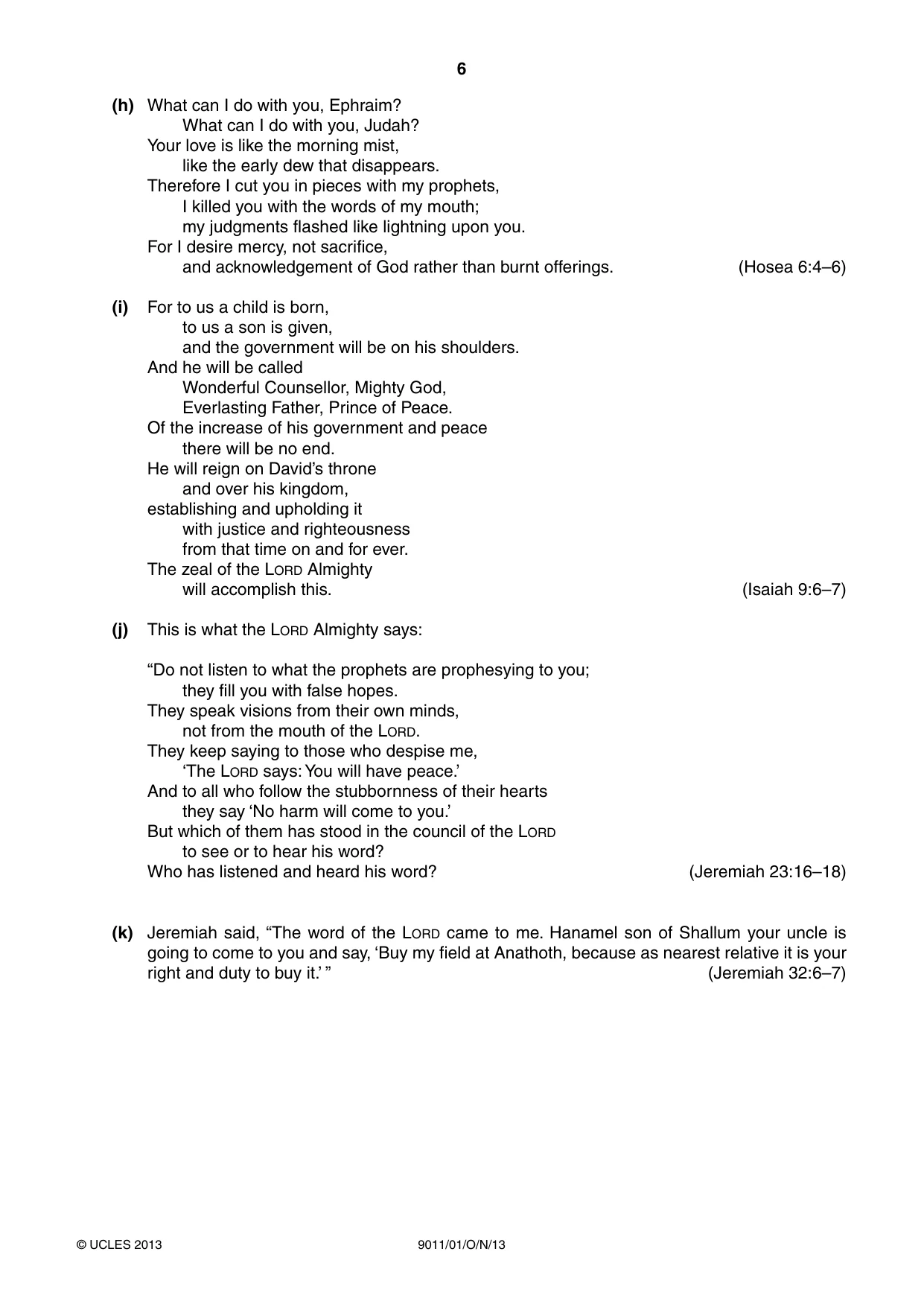
6 9011/01/O/N/13 © UCLES 2013 (h) What can I do with you, Ephraim? What can I do with you, Judah? Your love is like the morning mist, like the early dew that disappears. Therefore I cut you in pieces with my prophets, I killed you with the words of my mouth; my judgments flashed like lightning upon you. For I desire mercy, not sacrifice, and acknowledgement of God rather than burnt offerings. (Hosea 6:4–6) (i) For to us a child is born, to us a son is given, and the government will be on his shoulders. And he will be called Wonderful Counsellor, Mighty God, Everlasting Father, Prince of Peace. Of the increase of his government and peace there will be no end. He will reign on David’s throne and over his kingdom, establishing and upholding it with justice and righteousness from that time on and for ever. The zeal of the LORD Almighty will accomplish this. (Isaiah 9:6–7) (j) This is what the LORD Almighty says: “Do not listen to what the prophets are prophesying to you; they fill you with false hopes. They speak visions from their own minds, not from the mouth of the LORD. They keep saying to those who despise me, ‘The LORD says: You will have peace.’ And to all who follow the stubbornness of their hearts they say ‘No harm will come to you.’ But which of them has stood in the council of the LORD to see or to hear his word? Who has listened and heard his word? (Jeremiah 23:16–18) (k) Jeremiah said, “The word of the LORD came to me. Hanamel son of Shallum your uncle is going to come to you and say, ‘Buy my field at Anathoth, because as nearest relative it is your right and duty to buy it.’ ” (Jeremiah 32:6–7)
Question paper, page 7
7 9011/01/O/N/13 © UCLES 2013 BLANK PAGE
Question paper, page 8
8 9011/01/O/N/13 © UCLES 2013 BLANK PAGE Copyright Acknowledgements: Scripture quotations marked (RSV) are from the Revised Standard Version of the Bible, copyright © 1946, 1952 and 1971 by the Division of Christian Education of the National Council of the Churches of Christ in the USA. Used by permission. All rights reserved. Scripture quotations marked (NIV) are taken from the Holy Bible, New International Version®. NIV®. Copyright © 1973, 1978, 1984 by International Bible Society. Used by permission. All rights reserved. Permission to reproduce items where third-party owned material protected by copyright is included has been sought and cleared where possible. Every reasonable effort has been made by the publisher (UCLES) to trace copyright holders, but if any items requiring clearance have unwittingly been included, the publisher will be pleased to make amends at the earliest possible opportunity. University of Cambridge International Examinations is part of the Cambridge Assessment Group. Cambridge Assessment is the brand name of University of Cambridge Local Examinations Syndicate (UCLES), which is itself a department of the University of Cambridge.
Mark scheme, page 1
CAMBRIDGE INTERNATIONAL EXAMINATIONS GCE Advanced Level MARK SCHEME for the October/November 2013 series 9011 DIVINITY 9011/01 Paper 1 (Prophets of the Old Testament), maximum raw mark 100 This mark scheme is published as an aid to teachers and candidates, to indicate the requirements of the examination. It shows the basis on which Examiners were instructed to award marks. It does not indicate the details of the discussions that took place at an Examiners’ meeting before marking began, which would have considered the acceptability of alternative answers. Mark schemes should be read in conjunction with the question paper and the Principal Examiner Report for Teachers. Cambridge will not enter into discussions about these mark schemes. Cambridge is publishing the mark schemes for the October/November 2013 series for most IGCSE, GCE Advanced Level and Advanced Subsidiary Level components and some Ordinary Level components.
Mark scheme, page 2
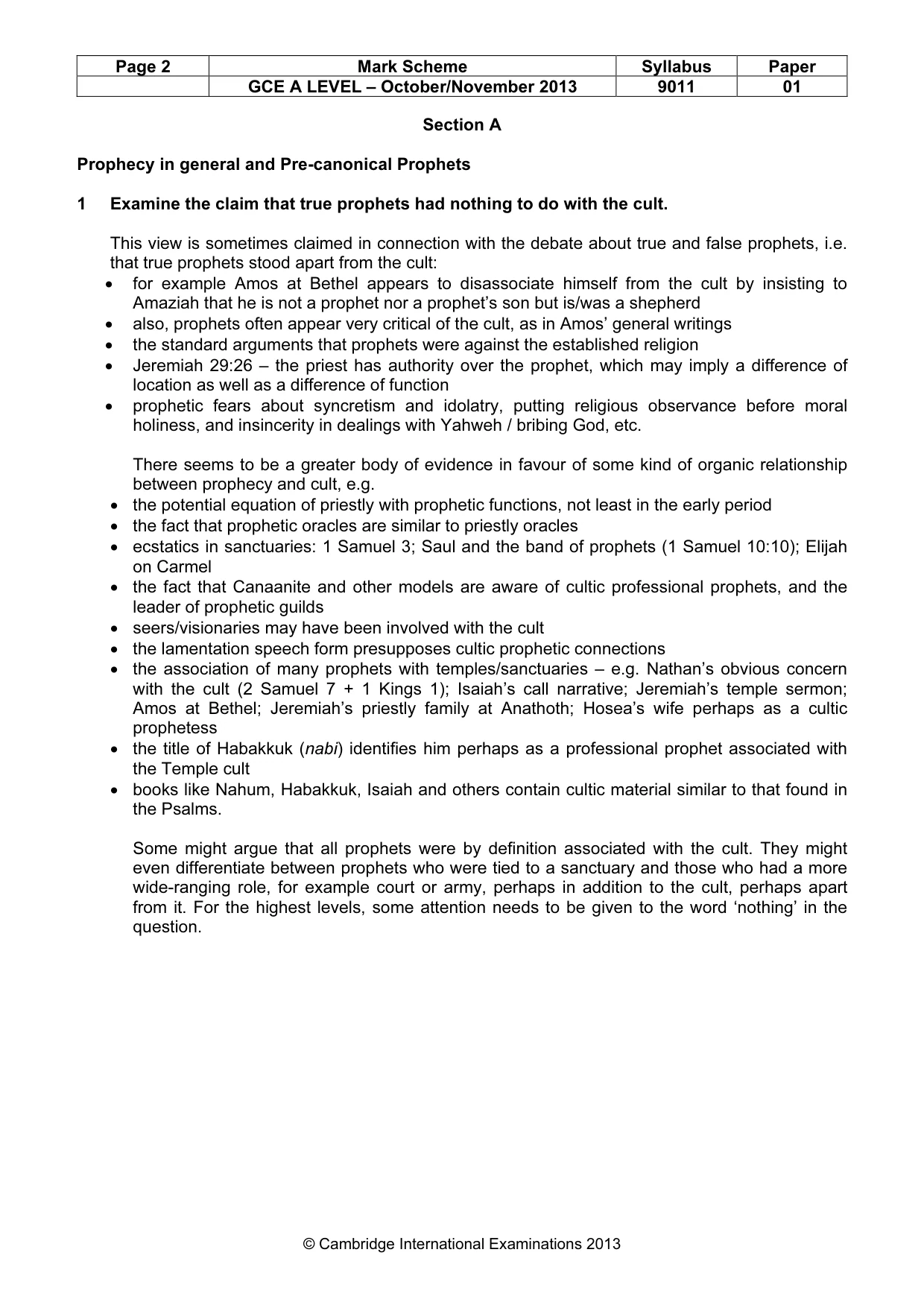
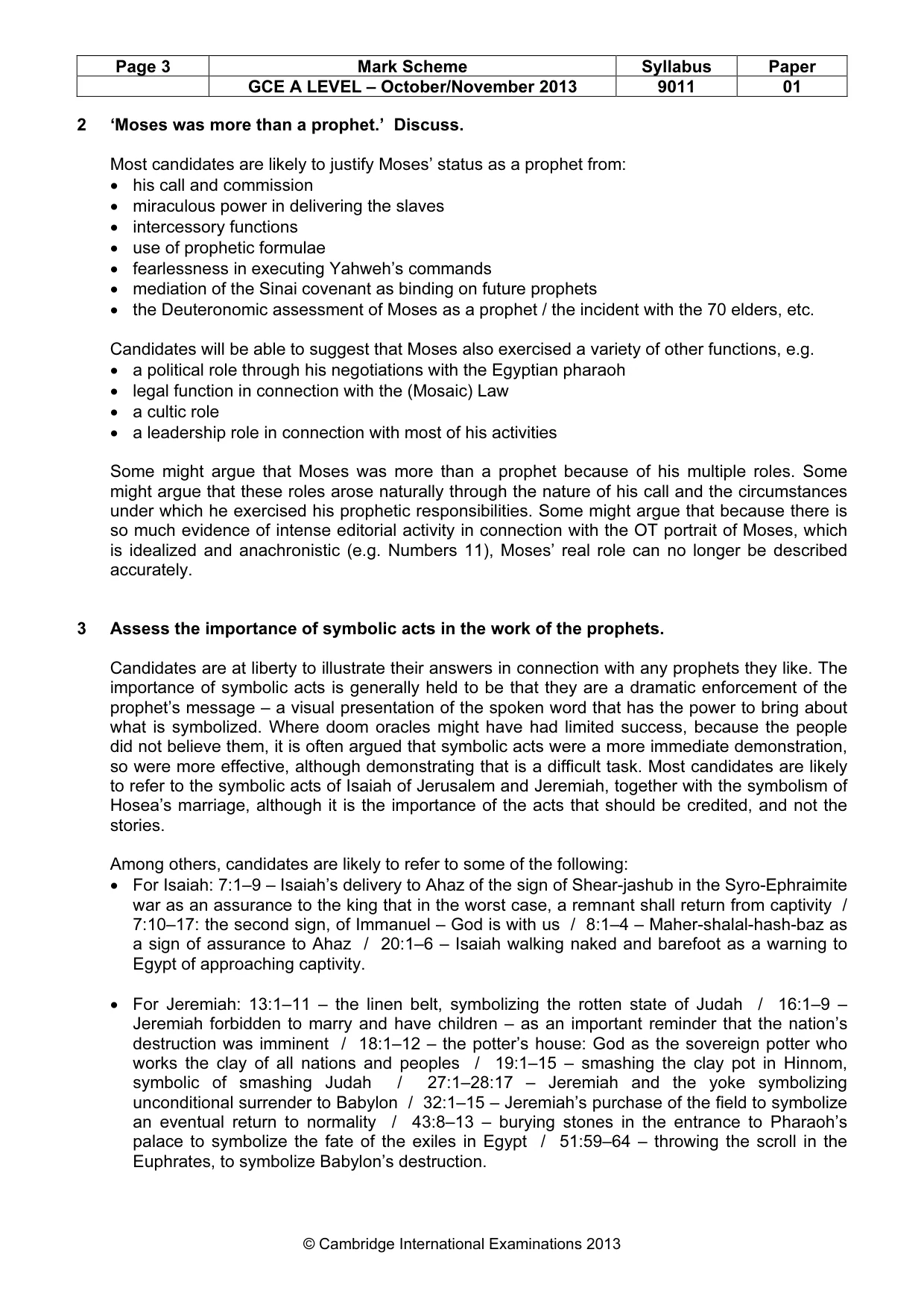
Page 2 Mark Scheme Syllabus Paper GCE A LEVEL – October/November 2013 9011 01 © Cambridge International Examinations 2013 Section A Prophecy in general and Pre-canonical Prophets 1 Examine the claim that true prophets had nothing to do with the cult. This view is sometimes claimed in connection with the debate about true and false prophets, i.e. that true prophets stood apart from the cult: • for example Amos at Bethel appears to disassociate himself from the cult by insisting to Amaziah that he is not a prophet nor a prophet’s son but is/was a shepherd • also, prophets often appear very critical of the cult, as in Amos’ general writings • the standard arguments that prophets were against the established religion • Jeremiah 29:26 – the priest has authority over the prophet, which may imply a difference of location as well as a difference of function • prophetic fears about syncretism and idolatry, putting religious observance before moral holiness, and insincerity in dealings with Yahweh / bribing God, etc. There seems to be a greater body of evidence in favour of some kind of organic relationship between prophecy and cult, e.g. • the potential equation of priestly with prophetic functions, not least in the early period • the fact that prophetic oracles are similar to priestly oracles • ecstatics in sanctuaries: 1 Samuel 3; Saul and the band of prophets (1 Samuel 10:10); Elijah on Carmel • the fact that Canaanite and other models are aware of cultic professional prophets, and the leader of prophetic guilds • seers/visionaries may have been involved with the cult • the lamentation speech form presupposes cultic prophetic connections • the association of many prophets with temples/sanctuaries – e.g. Nathan’s obvious concern with the cult (2 Samuel 7 + 1 Kings 1); Isaiah’s call narrative; Jeremiah’s temple sermon; Amos at Bethel; Jeremiah’s priestly family at Anathoth; Hosea’s wife perhaps as a cultic prophetess • the title of Habakkuk (nabi) identifies him perhaps as a professional prophet associated with the Temple cult • books like Nahum, Habakkuk, Isaiah and others contain cultic material similar to that found in the Psalms. Some might argue that all prophets were by definition associated with the cult. They might even differentiate between prophets who were tied to a sanctuary and those who had a more wide-ranging role, for example court or army, perhaps in addition to the cult, perhaps apart from it. For the highest levels, some attention needs to be given to the word ‘nothing’ in the question.
Mark scheme, page 3
Page 3 Mark Scheme Syllabus Paper GCE A LEVEL – October/November 2013 9011 01 © Cambridge International Examinations 2013 2 ‘Moses was more than a prophet.’ Discuss. Most candidates are likely to justify Moses’ status as a prophet from: • his call and commission • miraculous power in delivering the slaves • intercessory functions • use of prophetic formulae • fearlessness in executing Yahweh’s commands • mediation of the Sinai covenant as binding on future prophets • the Deuteronomic assessment of Moses as a prophet / the incident with the 70 elders, etc. Candidates will be able to suggest that Moses also exercised a variety of other functions, e.g. • a political role through his negotiations with the Egyptian pharaoh • legal function in connection with the (Mosaic) Law • a cultic role • a leadership role in connection with most of his activities Some might argue that Moses was more than a prophet because of his multiple roles. Some might argue that these roles arose naturally through the nature of his call and the circumstances under which he exercised his prophetic responsibilities. Some might argue that because there is so much evidence of intense editorial activity in connection with the OT portrait of Moses, which is idealized and anachronistic (e.g. Numbers 11), Moses’ real role can no longer be described accurately. 3 Assess the importance of symbolic acts in the work of the prophets. Candidates are at liberty to illustrate their answers in connection with any prophets they like. The importance of symbolic acts is generally held to be that they are a dramatic enforcement of the prophet’s message – a visual presentation of the spoken word that has the power to bring about what is symbolized. Where doom oracles might have had limited success, because the people did not believe them, it is often argued that symbolic acts were a more immediate demonstration, so were more effective, although demonstrating that is a difficult task. Most candidates are likely to refer to the symbolic acts of Isaiah of Jerusalem and Jeremiah, together with the symbolism of Hosea’s marriage, although it is the importance of the acts that should be credited, and not the stories. Among others, candidates are likely to refer to some of the following: • For Isaiah: 7:1–9 – Isaiah’s delivery to Ahaz of the sign of Shear-jashub in the Syro-Ephraimite war as an assurance to the king that in the worst case, a remnant shall return from captivity / 7:10–17: the second sign, of Immanuel – God is with us / 8:1–4 – Maher-shalal-hash-baz as a sign of assurance to Ahaz / 20:1–6 – Isaiah walking naked and barefoot as a warning to Egypt of approaching captivity. • For Jeremiah: 13:1–11 – the linen belt, symbolizing the rotten state of Judah / 16:1–9 – Jeremiah forbidden to marry and have children – as an important reminder that the nation’s destruction was imminent / 18:1–12 – the potter’s house: God as the sovereign potter who works the clay of all nations and peoples / 19:1–15 – smashing the clay pot in Hinnom, symbolic of smashing Judah / 27:1–28:17 – Jeremiah and the yoke symbolizing unconditional surrender to Babylon / 32:1–15 – Jeremiah’s purchase of the field to symbolize an eventual return to normality / 43:8–13 – burying stones in the entrance to Pharaoh’s palace to symbolize the fate of the exiles in Egypt / 51:59–64 – throwing the scroll in the Euphrates, to symbolize Babylon’s destruction.
Mark scheme, page 4
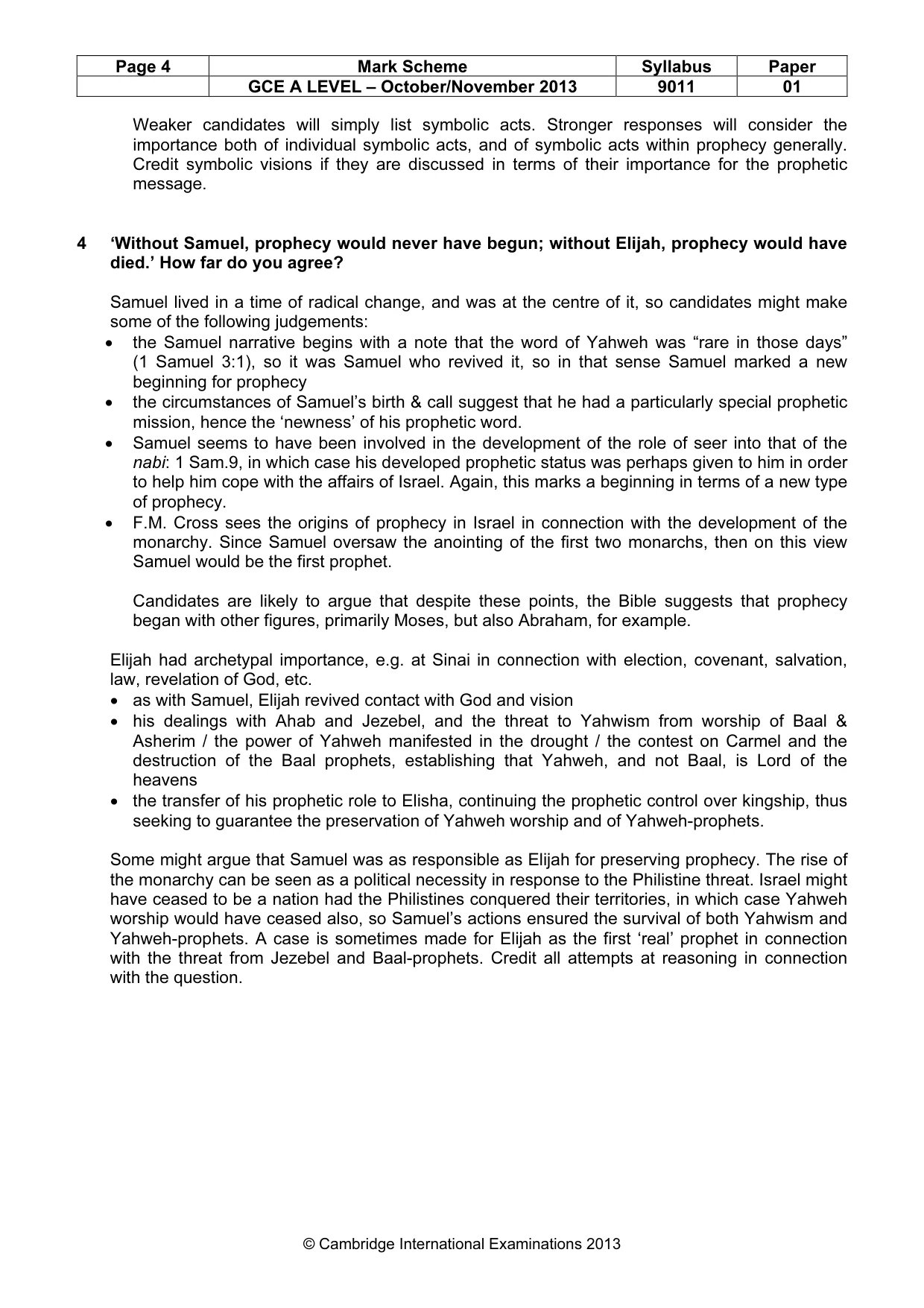
Page 4 Mark Scheme Syllabus Paper GCE A LEVEL – October/November 2013 9011 01 © Cambridge International Examinations 2013 Weaker candidates will simply list symbolic acts. Stronger responses will consider the importance both of individual symbolic acts, and of symbolic acts within prophecy generally. Credit symbolic visions if they are discussed in terms of their importance for the prophetic message. 4 ‘Without Samuel, prophecy would never have begun; without Elijah, prophecy would have died.’ How far do you agree? Samuel lived in a time of radical change, and was at the centre of it, so candidates might make some of the following judgements: • the Samuel narrative begins with a note that the word of Yahweh was “rare in those days” (1 Samuel 3:1), so it was Samuel who revived it, so in that sense Samuel marked a new beginning for prophecy • the circumstances of Samuel’s birth & call suggest that he had a particularly special prophetic mission, hence the ‘newness’ of his prophetic word. • Samuel seems to have been involved in the development of the role of seer into that of the nabi: 1 Sam.9, in which case his developed prophetic status was perhaps given to him in order to help him cope with the affairs of Israel. Again, this marks a beginning in terms of a new type of prophecy. • F.M. Cross sees the origins of prophecy in Israel in connection with the development of the monarchy. Since Samuel oversaw the anointing of the first two monarchs, then on this view Samuel would be the first prophet. Candidates are likely to argue that despite these points, the Bible suggests that prophecy began with other figures, primarily Moses, but also Abraham, for example. Elijah had archetypal importance, e.g. at Sinai in connection with election, covenant, salvation, law, revelation of God, etc. • as with Samuel, Elijah revived contact with God and vision • his dealings with Ahab and Jezebel, and the threat to Yahwism from worship of Baal & Asherim / the power of Yahweh manifested in the drought / the contest on Carmel and the destruction of the Baal prophets, establishing that Yahweh, and not Baal, is Lord of the heavens • the transfer of his prophetic role to Elisha, continuing the prophetic control over kingship, thus seeking to guarantee the preservation of Yahweh worship and of Yahweh-prophets. Some might argue that Samuel was as responsible as Elijah for preserving prophecy. The rise of the monarchy can be seen as a political necessity in response to the Philistine threat. Israel might have ceased to be a nation had the Philistines conquered their territories, in which case Yahweh worship would have ceased also, so Samuel’s actions ensured the survival of both Yahwism and Yahweh-prophets. A case is sometimes made for Elijah as the first ‘real’ prophet in connection with the threat from Jezebel and Baal-prophets. Credit all attempts at reasoning in connection with the question.
Mark scheme, page 5
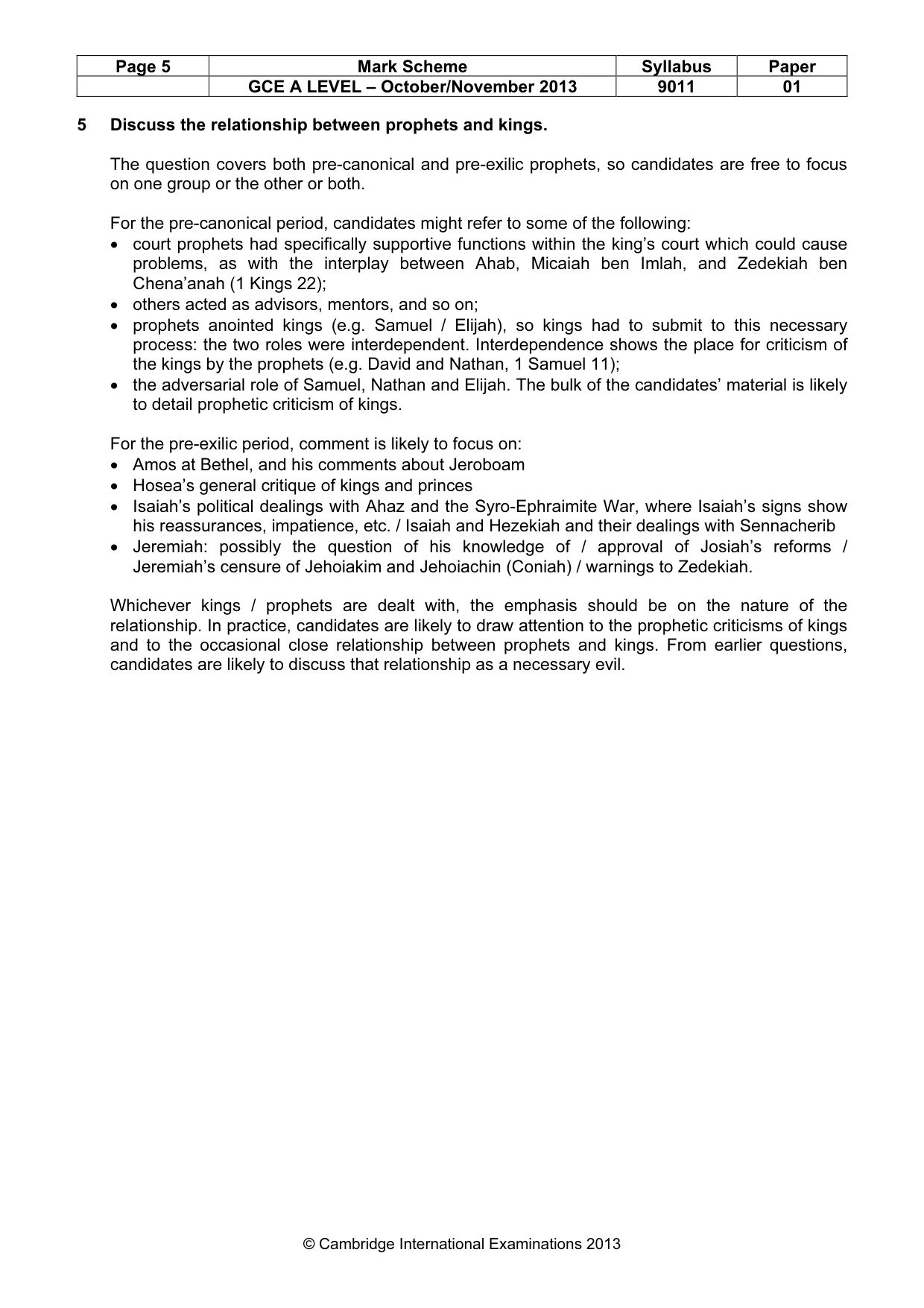
Page 5 Mark Scheme Syllabus Paper GCE A LEVEL – October/November 2013 9011 01 © Cambridge International Examinations 2013 5 Discuss the relationship between prophets and kings. The question covers both pre-canonical and pre-exilic prophets, so candidates are free to focus on one group or the other or both. For the pre-canonical period, candidates might refer to some of the following: • court prophets had specifically supportive functions within the king’s court which could cause problems, as with the interplay between Ahab, Micaiah ben Imlah, and Zedekiah ben Chena’anah (1 Kings 22); • others acted as advisors, mentors, and so on; • prophets anointed kings (e.g. Samuel / Elijah), so kings had to submit to this necessary process: the two roles were interdependent. Interdependence shows the place for criticism of the kings by the prophets (e.g. David and Nathan, 1 Samuel 11); • the adversarial role of Samuel, Nathan and Elijah. The bulk of the candidates’ material is likely to detail prophetic criticism of kings. For the pre-exilic period, comment is likely to focus on: • Amos at Bethel, and his comments about Jeroboam • Hosea’s general critique of kings and princes • Isaiah’s political dealings with Ahaz and the Syro-Ephraimite War, where Isaiah’s signs show his reassurances, impatience, etc. / Isaiah and Hezekiah and their dealings with Sennacherib • Jeremiah: possibly the question of his knowledge of / approval of Josiah’s reforms / Jeremiah’s censure of Jehoiakim and Jehoiachin (Coniah) / warnings to Zedekiah. Whichever kings / prophets are dealt with, the emphasis should be on the nature of the relationship. In practice, candidates are likely to draw attention to the prophetic criticisms of kings and to the occasional close relationship between prophets and kings. From earlier questions, candidates are likely to discuss that relationship as a necessary evil.
Mark scheme, page 6
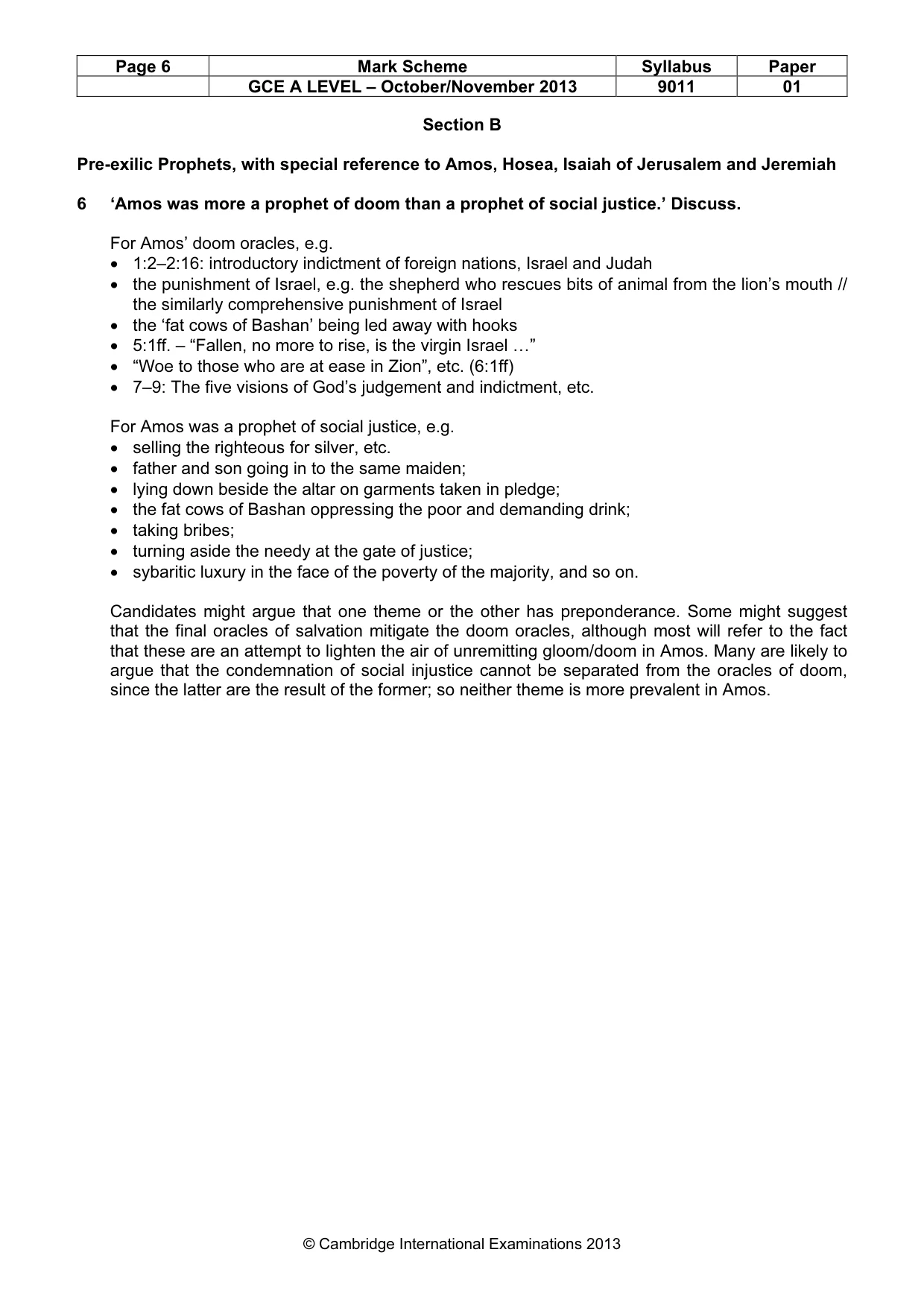
Page 6 Mark Scheme Syllabus Paper GCE A LEVEL – October/November 2013 9011 01 © Cambridge International Examinations 2013 Section B Pre-exilic Prophets, with special reference to Amos, Hosea, Isaiah of Jerusalem and Jeremiah 6 ‘Amos was more a prophet of doom than a prophet of social justice.’ Discuss. For Amos’ doom oracles, e.g. • 1:2–2:16: introductory indictment of foreign nations, Israel and Judah • the punishment of Israel, e.g. the shepherd who rescues bits of animal from the lion’s mouth // the similarly comprehensive punishment of Israel • the ‘fat cows of Bashan’ being led away with hooks • 5:1ff. – “Fallen, no more to rise, is the virgin Israel …” • “Woe to those who are at ease in Zion”, etc. (6:1ff) • 7–9: The five visions of God’s judgement and indictment, etc. For Amos was a prophet of social justice, e.g. • selling the righteous for silver, etc. • father and son going in to the same maiden; • lying down beside the altar on garments taken in pledge; • the fat cows of Bashan oppressing the poor and demanding drink; • taking bribes; • turning aside the needy at the gate of justice; • sybaritic luxury in the face of the poverty of the majority, and so on. Candidates might argue that one theme or the other has preponderance. Some might suggest that the final oracles of salvation mitigate the doom oracles, although most will refer to the fact that these are an attempt to lighten the air of unremitting gloom/doom in Amos. Many are likely to argue that the condemnation of social injustice cannot be separated from the oracles of doom, since the latter are the result of the former; so neither theme is more prevalent in Amos.
Mark scheme, page 7
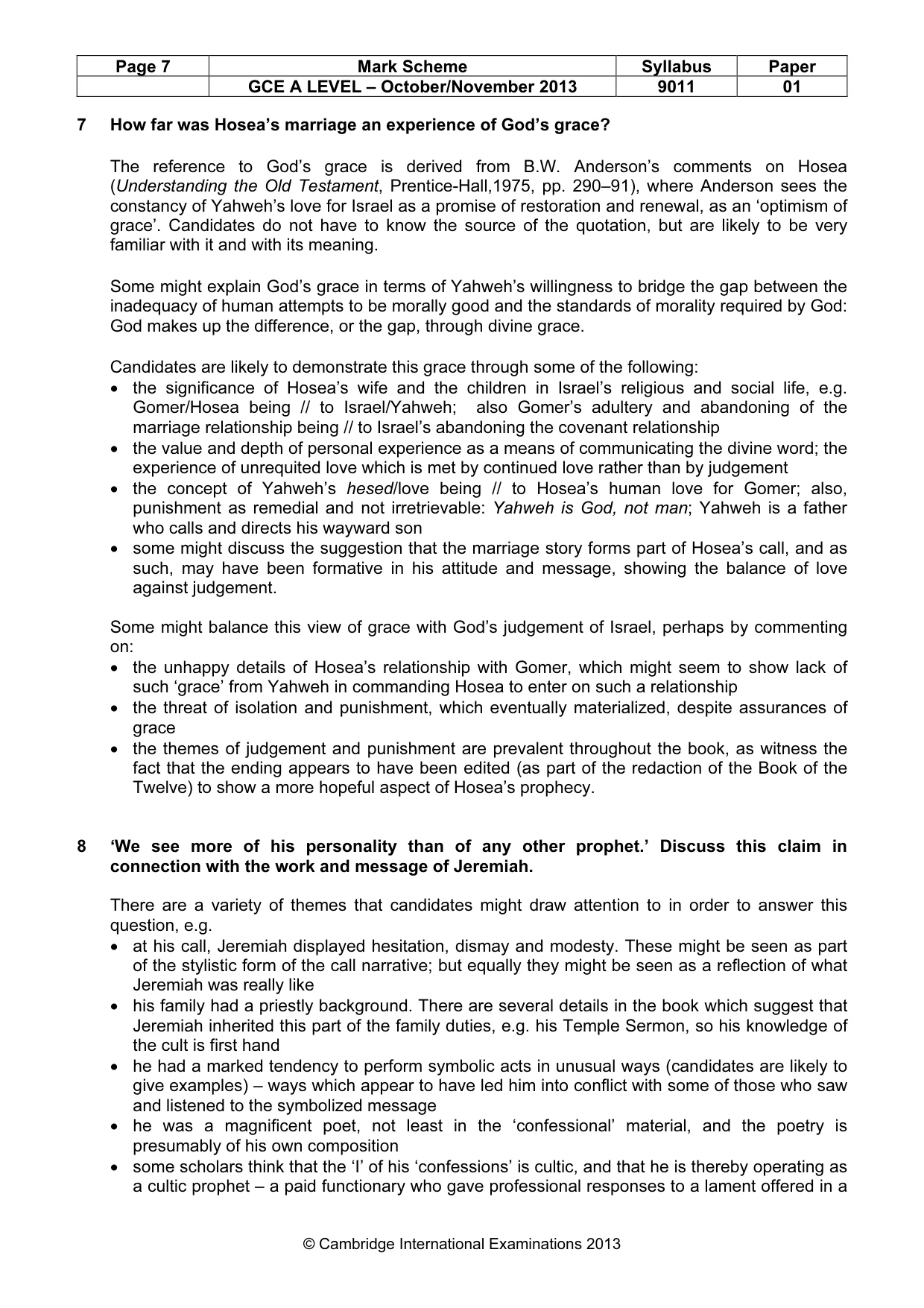
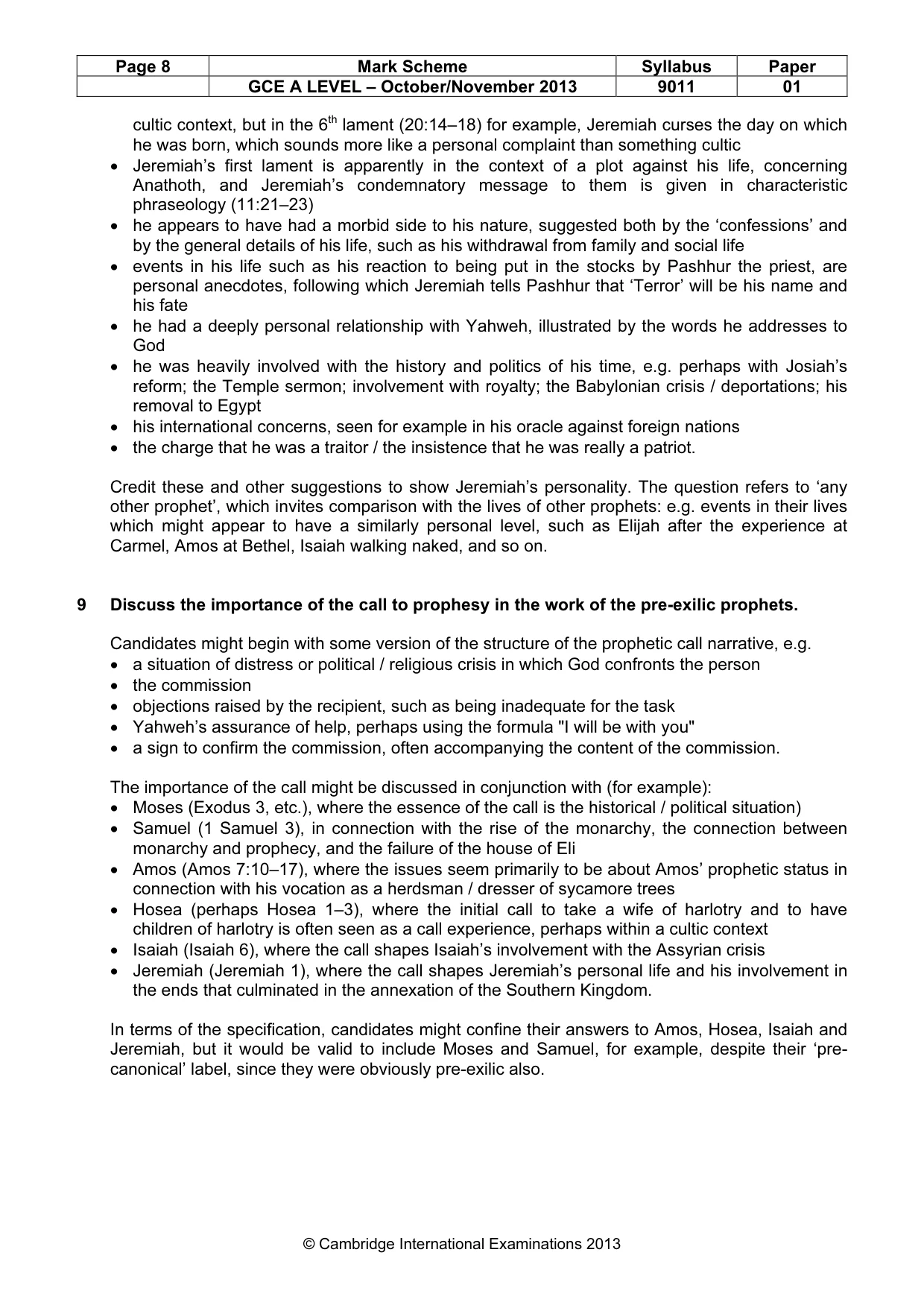
Page 7 Mark Scheme Syllabus Paper GCE A LEVEL – October/November 2013 9011 01 © Cambridge International Examinations 2013 7 How far was Hosea’s marriage an experience of God’s grace? The reference to God’s grace is derived from B.W. Anderson’s comments on Hosea (Understanding the Old Testament, Prentice-Hall,1975, pp. 290–91), where Anderson sees the constancy of Yahweh’s love for Israel as a promise of restoration and renewal, as an ‘optimism of grace’. Candidates do not have to know the source of the quotation, but are likely to be very familiar with it and with its meaning. Some might explain God’s grace in terms of Yahweh’s willingness to bridge the gap between the inadequacy of human attempts to be morally good and the standards of morality required by God: God makes up the difference, or the gap, through divine grace. Candidates are likely to demonstrate this grace through some of the following: • the significance of Hosea’s wife and the children in Israel’s religious and social life, e.g. Gomer/Hosea being // to Israel/Yahweh; also Gomer’s adultery and abandoning of the marriage relationship being // to Israel’s abandoning the covenant relationship • the value and depth of personal experience as a means of communicating the divine word; the experience of unrequited love which is met by continued love rather than by judgement • the concept of Yahweh’s hesed/love being // to Hosea’s human love for Gomer; also, punishment as remedial and not irretrievable: Yahweh is God, not man; Yahweh is a father who calls and directs his wayward son • some might discuss the suggestion that the marriage story forms part of Hosea’s call, and as such, may have been formative in his attitude and message, showing the balance of love against judgement. Some might balance this view of grace with God’s judgement of Israel, perhaps by commenting on: • the unhappy details of Hosea’s relationship with Gomer, which might seem to show lack of such ‘grace’ from Yahweh in commanding Hosea to enter on such a relationship • the threat of isolation and punishment, which eventually materialized, despite assurances of grace • the themes of judgement and punishment are prevalent throughout the book, as witness the fact that the ending appears to have been edited (as part of the redaction of the Book of the Twelve) to show a more hopeful aspect of Hosea’s prophecy. 8 ‘We see more of his personality than of any other prophet.’ Discuss this claim in connection with the work and message of Jeremiah. There are a variety of themes that candidates might draw attention to in order to answer this question, e.g. • at his call, Jeremiah displayed hesitation, dismay and modesty. These might be seen as part of the stylistic form of the call narrative; but equally they might be seen as a reflection of what Jeremiah was really like • his family had a priestly background. There are several details in the book which suggest that Jeremiah inherited this part of the family duties, e.g. his Temple Sermon, so his knowledge of the cult is first hand • he had a marked tendency to perform symbolic acts in unusual ways (candidates are likely to give examples) – ways which appear to have led him into conflict with some of those who saw and listened to the symbolized message • he was a magnificent poet, not least in the ‘confessional’ material, and the poetry is presumably of his own composition • some scholars think that the ‘I’ of his ‘confessions’ is cultic, and that he is thereby operating as a cultic prophet – a paid functionary who gave professional responses to a lament offered in a
Mark scheme, page 8
Page 8 Mark Scheme Syllabus Paper GCE A LEVEL – October/November 2013 9011 01 © Cambridge International Examinations 2013 cultic context, but in the 6th lament (20:14–18) for example, Jeremiah curses the day on which he was born, which sounds more like a personal complaint than something cultic • Jeremiah’s first lament is apparently in the context of a plot against his life, concerning Anathoth, and Jeremiah’s condemnatory message to them is given in characteristic phraseology (11:21–23) • he appears to have had a morbid side to his nature, suggested both by the ‘confessions’ and by the general details of his life, such as his withdrawal from family and social life • events in his life such as his reaction to being put in the stocks by Pashhur the priest, are personal anecdotes, following which Jeremiah tells Pashhur that ‘Terror’ will be his name and his fate • he had a deeply personal relationship with Yahweh, illustrated by the words he addresses to God • he was heavily involved with the history and politics of his time, e.g. perhaps with Josiah’s reform; the Temple sermon; involvement with royalty; the Babylonian crisis / deportations; his removal to Egypt • his international concerns, seen for example in his oracle against foreign nations • the charge that he was a traitor / the insistence that he was really a patriot. Credit these and other suggestions to show Jeremiah’s personality. The question refers to ‘any other prophet’, which invites comparison with the lives of other prophets: e.g. events in their lives which might appear to have a similarly personal level, such as Elijah after the experience at Carmel, Amos at Bethel, Isaiah walking naked, and so on. 9 Discuss the importance of the call to prophesy in the work of the pre-exilic prophets. Candidates might begin with some version of the structure of the prophetic call narrative, e.g. • a situation of distress or political / religious crisis in which God confronts the person • the commission • objections raised by the recipient, such as being inadequate for the task • Yahweh’s assurance of help, perhaps using the formula "I will be with you" • a sign to confirm the commission, often accompanying the content of the commission. The importance of the call might be discussed in conjunction with (for example): • Moses (Exodus 3, etc.), where the essence of the call is the historical / political situation) • Samuel (1 Samuel 3), in connection with the rise of the monarchy, the connection between monarchy and prophecy, and the failure of the house of Eli • Amos (Amos 7:10–17), where the issues seem primarily to be about Amos’ prophetic status in connection with his vocation as a herdsman / dresser of sycamore trees • Hosea (perhaps Hosea 1–3), where the initial call to take a wife of harlotry and to have children of harlotry is often seen as a call experience, perhaps within a cultic context • Isaiah (Isaiah 6), where the call shapes Isaiah’s involvement with the Assyrian crisis • Jeremiah (Jeremiah 1), where the call shapes Jeremiah’s personal life and his involvement in the ends that culminated in the annexation of the Southern Kingdom. In terms of the specification, candidates might confine their answers to Amos, Hosea, Isaiah and Jeremiah, but it would be valid to include Moses and Samuel, for example, despite their ‘pre- canonical’ label, since they were obviously pre-exilic also.
Mark scheme, page 9
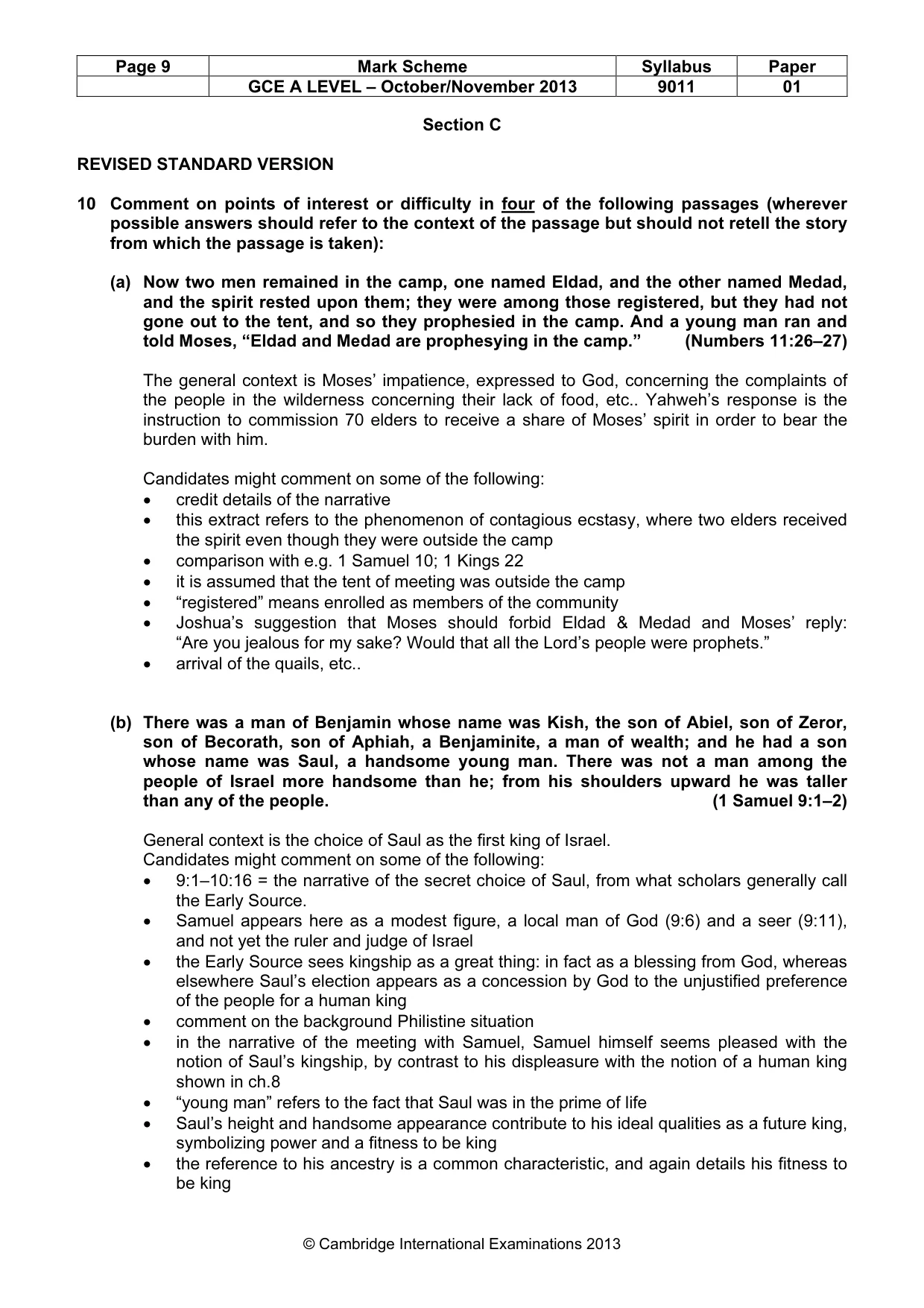
Page 9 Mark Scheme Syllabus Paper GCE A LEVEL – October/November 2013 9011 01 © Cambridge International Examinations 2013 Section C REVISED STANDARD VERSION 10 Comment on points of interest or difficulty in four of the following passages (wherever possible answers should refer to the context of the passage but should not retell the story from which the passage is taken): (a) Now two men remained in the camp, one named Eldad, and the other named Medad, and the spirit rested upon them; they were among those registered, but they had not gone out to the tent, and so they prophesied in the camp. And a young man ran and told Moses, “Eldad and Medad are prophesying in the camp.” (Numbers 11:26–27) The general context is Moses’ impatience, expressed to God, concerning the complaints of the people in the wilderness concerning their lack of food, etc.. Yahweh’s response is the instruction to commission 70 elders to receive a share of Moses’ spirit in order to bear the burden with him. Candidates might comment on some of the following: • credit details of the narrative • this extract refers to the phenomenon of contagious ecstasy, where two elders received the spirit even though they were outside the camp • comparison with e.g. 1 Samuel 10; 1 Kings 22 • it is assumed that the tent of meeting was outside the camp • “registered” means enrolled as members of the community • Joshua’s suggestion that Moses should forbid Eldad & Medad and Moses’ reply: “Are you jealous for my sake? Would that all the Lord’s people were prophets.” • arrival of the quails, etc.. (b) There was a man of Benjamin whose name was Kish, the son of Abiel, son of Zeror, son of Becorath, son of Aphiah, a Benjaminite, a man of wealth; and he had a son whose name was Saul, a handsome young man. There was not a man among the people of Israel more handsome than he; from his shoulders upward he was taller than any of the people. (1 Samuel 9:1–2) General context is the choice of Saul as the first king of Israel. Candidates might comment on some of the following: • 9:1–10:16 = the narrative of the secret choice of Saul, from what scholars generally call the Early Source. • Samuel appears here as a modest figure, a local man of God (9:6) and a seer (9:11), and not yet the ruler and judge of Israel • the Early Source sees kingship as a great thing: in fact as a blessing from God, whereas elsewhere Saul’s election appears as a concession by God to the unjustified preference of the people for a human king • comment on the background Philistine situation • in the narrative of the meeting with Samuel, Samuel himself seems pleased with the notion of Saul’s kingship, by contrast to his displeasure with the notion of a human king shown in ch.8 • “young man” refers to the fact that Saul was in the prime of life • Saul’s height and handsome appearance contribute to his ideal qualities as a future king, symbolizing power and a fitness to be king • the reference to his ancestry is a common characteristic, and again details his fitness to be king
Mark scheme, page 10
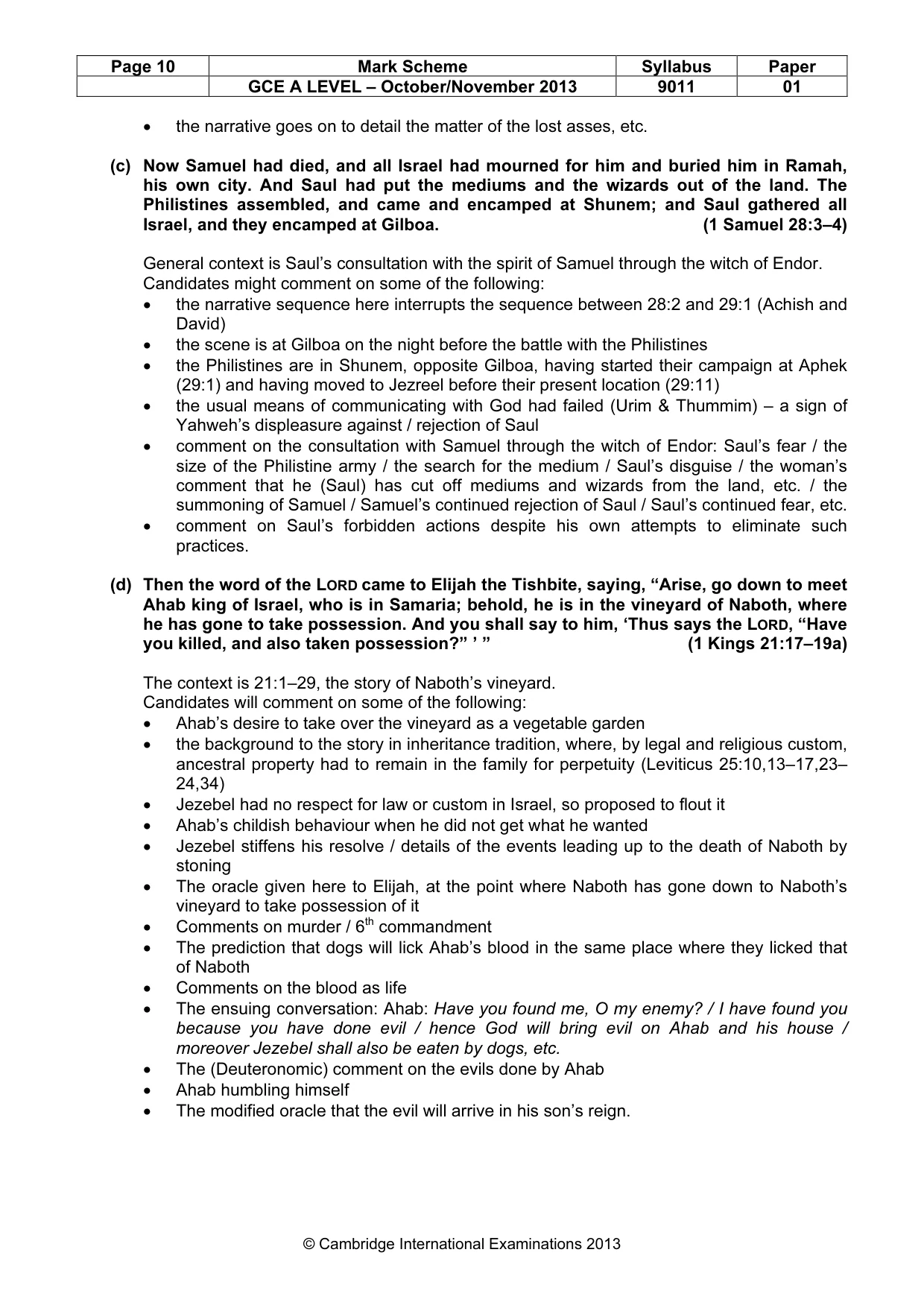
Page 10 Mark Scheme Syllabus Paper GCE A LEVEL – October/November 2013 9011 01 © Cambridge International Examinations 2013 • the narrative goes on to detail the matter of the lost asses, etc. (c) Now Samuel had died, and all Israel had mourned for him and buried him in Ramah, his own city. And Saul had put the mediums and the wizards out of the land. The Philistines assembled, and came and encamped at Shunem; and Saul gathered all Israel, and they encamped at Gilboa. (1 Samuel 28:3–4) General context is Saul’s consultation with the spirit of Samuel through the witch of Endor. Candidates might comment on some of the following: • the narrative sequence here interrupts the sequence between 28:2 and 29:1 (Achish and David) • the scene is at Gilboa on the night before the battle with the Philistines • the Philistines are in Shunem, opposite Gilboa, having started their campaign at Aphek (29:1) and having moved to Jezreel before their present location (29:11) • the usual means of communicating with God had failed (Urim & Thummim) – a sign of Yahweh’s displeasure against / rejection of Saul • comment on the consultation with Samuel through the witch of Endor: Saul’s fear / the size of the Philistine army / the search for the medium / Saul’s disguise / the woman’s comment that he (Saul) has cut off mediums and wizards from the land, etc. / the summoning of Samuel / Samuel’s continued rejection of Saul / Saul’s continued fear, etc. • comment on Saul’s forbidden actions despite his own attempts to eliminate such practices. (d) Then the word of the LORD came to Elijah the Tishbite, saying, “Arise, go down to meet Ahab king of Israel, who is in Samaria; behold, he is in the vineyard of Naboth, where he has gone to take possession. And you shall say to him, ‘Thus says the LORD, “Have you killed, and also taken possession?” ’ ” (1 Kings 21:17–19a) The context is 21:1–29, the story of Naboth’s vineyard. Candidates will comment on some of the following: • Ahab’s desire to take over the vineyard as a vegetable garden • the background to the story in inheritance tradition, where, by legal and religious custom, ancestral property had to remain in the family for perpetuity (Leviticus 25:10,13–17,23– 24,34) • Jezebel had no respect for law or custom in Israel, so proposed to flout it • Ahab’s childish behaviour when he did not get what he wanted • Jezebel stiffens his resolve / details of the events leading up to the death of Naboth by stoning • The oracle given here to Elijah, at the point where Naboth has gone down to Naboth’s vineyard to take possession of it • Comments on murder / 6th commandment • The prediction that dogs will lick Ahab’s blood in the same place where they licked that of Naboth • Comments on the blood as life • The ensuing conversation: Ahab: Have you found me, O my enemy? / I have found you because you have done evil / hence God will bring evil on Ahab and his house / moreover Jezebel shall also be eaten by dogs, etc. • The (Deuteronomic) comment on the evils done by Ahab • Ahab humbling himself • The modified oracle that the evil will arrive in his son’s reign.
Mark scheme, page 11
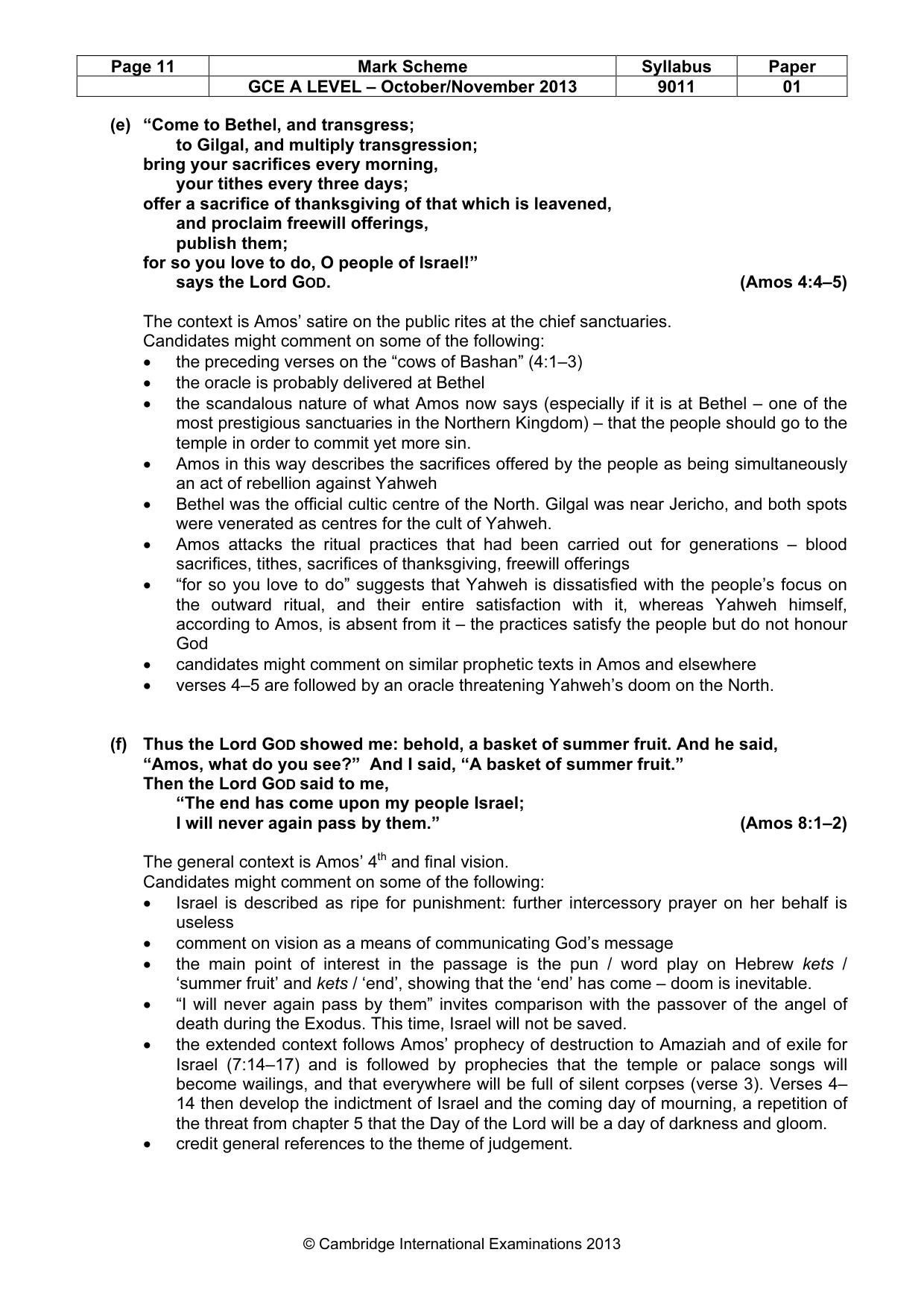
Page 11 Mark Scheme Syllabus Paper GCE A LEVEL – October/November 2013 9011 01 © Cambridge International Examinations 2013 (e) “Come to Bethel, and transgress; to Gilgal, and multiply transgression; bring your sacrifices every morning, your tithes every three days; offer a sacrifice of thanksgiving of that which is leavened, and proclaim freewill offerings, publish them; for so you love to do, O people of Israel!” says the Lord GOD. (Amos 4:4–5) The context is Amos’ satire on the public rites at the chief sanctuaries. Candidates might comment on some of the following: • the preceding verses on the “cows of Bashan” (4:1–3) • the oracle is probably delivered at Bethel • the scandalous nature of what Amos now says (especially if it is at Bethel – one of the most prestigious sanctuaries in the Northern Kingdom) – that the people should go to the temple in order to commit yet more sin. • Amos in this way describes the sacrifices offered by the people as being simultaneously an act of rebellion against Yahweh • Bethel was the official cultic centre of the North. Gilgal was near Jericho, and both spots were venerated as centres for the cult of Yahweh. • Amos attacks the ritual practices that had been carried out for generations – blood sacrifices, tithes, sacrifices of thanksgiving, freewill offerings • “for so you love to do” suggests that Yahweh is dissatisfied with the people’s focus on the outward ritual, and their entire satisfaction with it, whereas Yahweh himself, according to Amos, is absent from it – the practices satisfy the people but do not honour God • candidates might comment on similar prophetic texts in Amos and elsewhere • verses 4–5 are followed by an oracle threatening Yahweh’s doom on the North. (f) Thus the Lord GOD showed me: behold, a basket of summer fruit. And he said, “Amos, what do you see?” And I said, “A basket of summer fruit.” Then the Lord GOD said to me, “The end has come upon my people Israel; I will never again pass by them.” (Amos 8:1–2) The general context is Amos’ 4th and final vision. Candidates might comment on some of the following: • Israel is described as ripe for punishment: further intercessory prayer on her behalf is useless • comment on vision as a means of communicating God’s message • the main point of interest in the passage is the pun / word play on Hebrew kets / ‘summer fruit’ and kets / ‘end’, showing that the ‘end’ has come – doom is inevitable. • “I will never again pass by them” invites comparison with the passover of the angel of death during the Exodus. This time, Israel will not be saved. • the extended context follows Amos’ prophecy of destruction to Amaziah and of exile for Israel (7:14–17) and is followed by prophecies that the temple or palace songs will become wailings, and that everywhere will be full of silent corpses (verse 3). Verses 4– 14 then develop the indictment of Israel and the coming day of mourning, a repetition of the threat from chapter 5 that the Day of the Lord will be a day of darkness and gloom. • credit general references to the theme of judgement.
Mark scheme, page 12
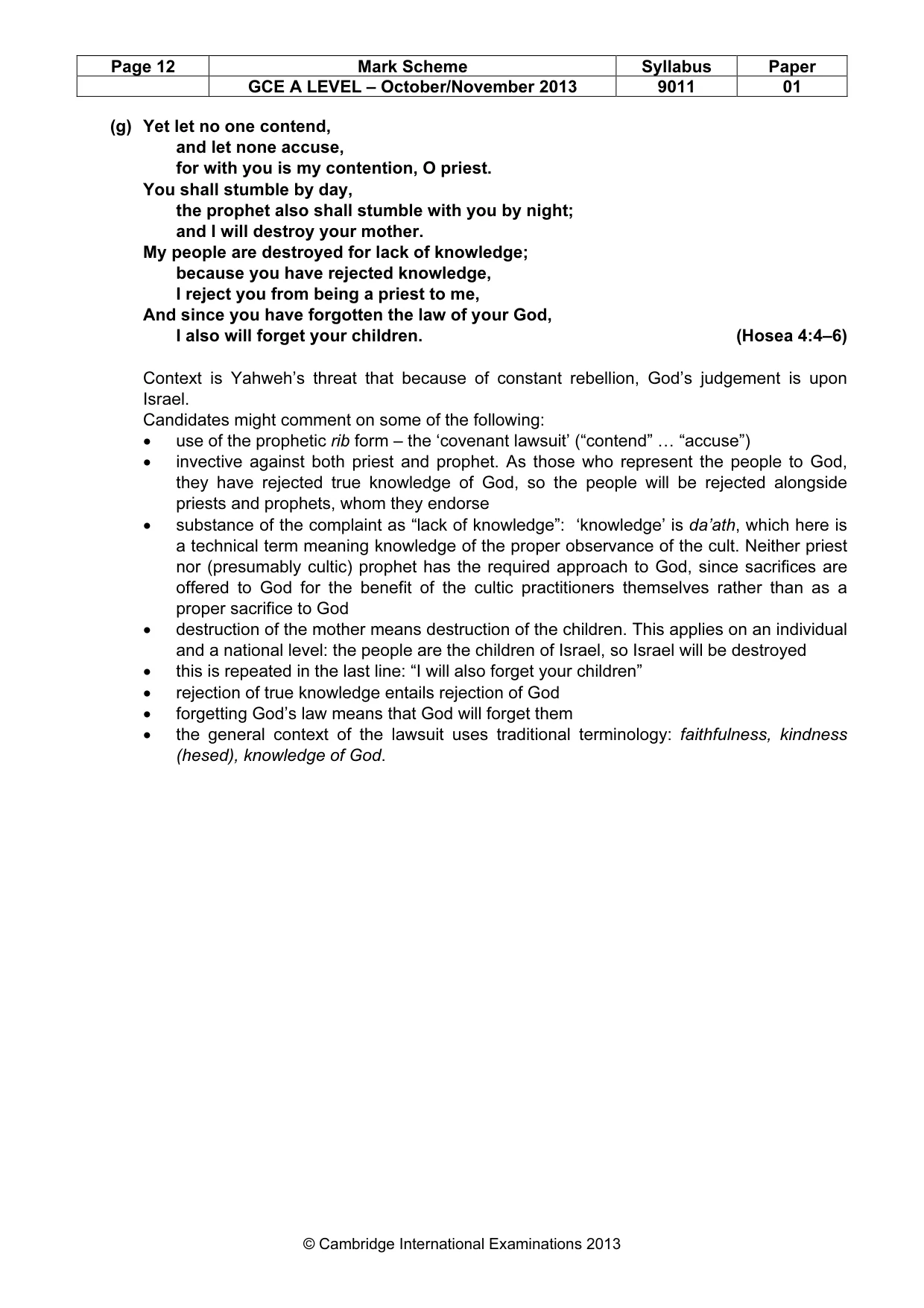
Page 12 Mark Scheme Syllabus Paper GCE A LEVEL – October/November 2013 9011 01 © Cambridge International Examinations 2013 (g) Yet let no one contend, and let none accuse, for with you is my contention, O priest. You shall stumble by day, the prophet also shall stumble with you by night; and I will destroy your mother. My people are destroyed for lack of knowledge; because you have rejected knowledge, I reject you from being a priest to me, And since you have forgotten the law of your God, I also will forget your children. (Hosea 4:4–6) Context is Yahweh’s threat that because of constant rebellion, God’s judgement is upon Israel. Candidates might comment on some of the following: • use of the prophetic rib form – the ‘covenant lawsuit’ (“contend” … “accuse”) • invective against both priest and prophet. As those who represent the people to God, they have rejected true knowledge of God, so the people will be rejected alongside priests and prophets, whom they endorse • substance of the complaint as “lack of knowledge”: ‘knowledge’ is da’ath, which here is a technical term meaning knowledge of the proper observance of the cult. Neither priest nor (presumably cultic) prophet has the required approach to God, since sacrifices are offered to God for the benefit of the cultic practitioners themselves rather than as a proper sacrifice to God • destruction of the mother means destruction of the children. This applies on an individual and a national level: the people are the children of Israel, so Israel will be destroyed • this is repeated in the last line: “I will also forget your children” • rejection of true knowledge entails rejection of God • forgetting God’s law means that God will forget them • the general context of the lawsuit uses traditional terminology: faithfulness, kindness (hesed), knowledge of God.
Mark scheme, page 13
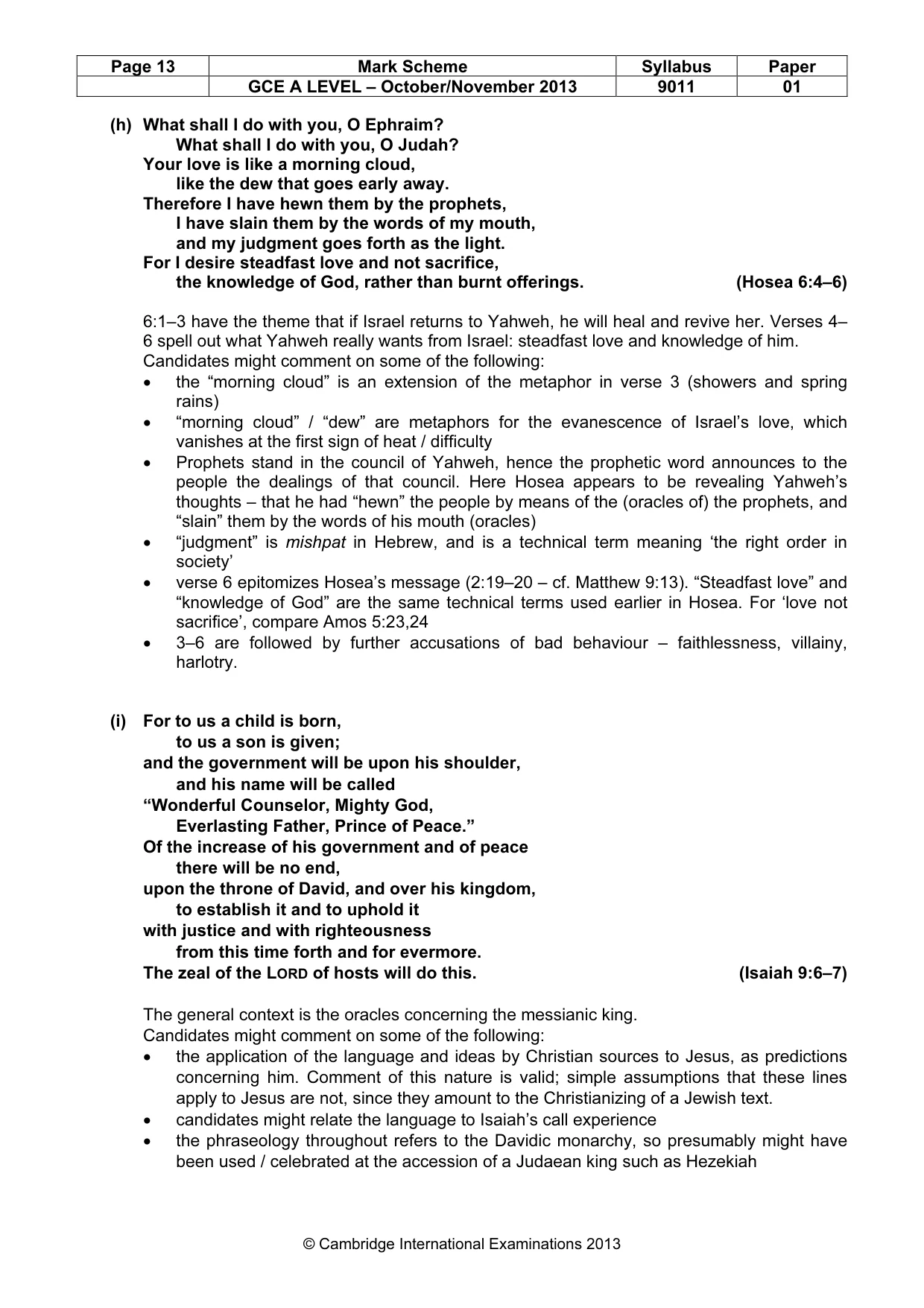
Page 13 Mark Scheme Syllabus Paper GCE A LEVEL – October/November 2013 9011 01 © Cambridge International Examinations 2013 (h) What shall I do with you, O Ephraim? What shall I do with you, O Judah? Your love is like a morning cloud, like the dew that goes early away. Therefore I have hewn them by the prophets, I have slain them by the words of my mouth, and my judgment goes forth as the light. For I desire steadfast love and not sacrifice, the knowledge of God, rather than burnt offerings. (Hosea 6:4–6) 6:1–3 have the theme that if Israel returns to Yahweh, he will heal and revive her. Verses 4– 6 spell out what Yahweh really wants from Israel: steadfast love and knowledge of him. Candidates might comment on some of the following: • the “morning cloud” is an extension of the metaphor in verse 3 (showers and spring rains) • “morning cloud” / “dew” are metaphors for the evanescence of Israel’s love, which vanishes at the first sign of heat / difficulty • Prophets stand in the council of Yahweh, hence the prophetic word announces to the people the dealings of that council. Here Hosea appears to be revealing Yahweh’s thoughts – that he had “hewn” the people by means of the (oracles of) the prophets, and “slain” them by the words of his mouth (oracles) • “judgment” is mishpat in Hebrew, and is a technical term meaning ‘the right order in society’ • verse 6 epitomizes Hosea’s message (2:19–20 – cf. Matthew 9:13). “Steadfast love” and “knowledge of God” are the same technical terms used earlier in Hosea. For ‘love not sacrifice’, compare Amos 5:23,24 • 3–6 are followed by further accusations of bad behaviour – faithlessness, villainy, harlotry. (i) For to us a child is born, to us a son is given; and the government will be upon his shoulder, and his name will be called “Wonderful Counselor, Mighty God, Everlasting Father, Prince of Peace.” Of the increase of his government and of peace there will be no end, upon the throne of David, and over his kingdom, to establish it and to uphold it with justice and with righteousness from this time forth and for evermore. The zeal of the LORD of hosts will do this. (Isaiah 9:6–7) The general context is the oracles concerning the messianic king. Candidates might comment on some of the following: • the application of the language and ideas by Christian sources to Jesus, as predictions concerning him. Comment of this nature is valid; simple assumptions that these lines apply to Jesus are not, since they amount to the Christianizing of a Jewish text. • candidates might relate the language to Isaiah’s call experience • the phraseology throughout refers to the Davidic monarchy, so presumably might have been used / celebrated at the accession of a Judaean king such as Hezekiah
Mark scheme, page 14
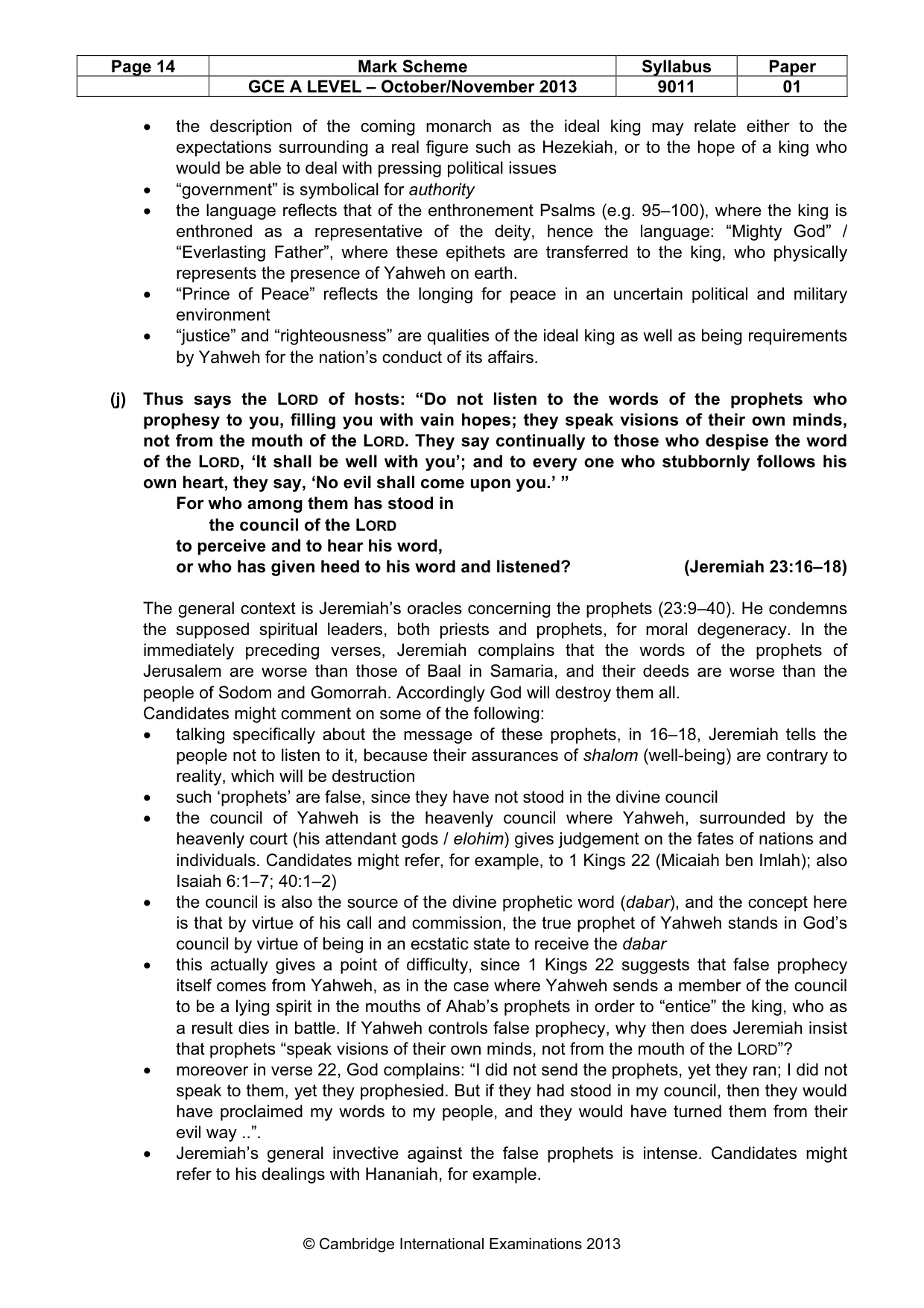
Page 14 Mark Scheme Syllabus Paper GCE A LEVEL – October/November 2013 9011 01 © Cambridge International Examinations 2013 • the description of the coming monarch as the ideal king may relate either to the expectations surrounding a real figure such as Hezekiah, or to the hope of a king who would be able to deal with pressing political issues • “government” is symbolical for authority • the language reflects that of the enthronement Psalms (e.g. 95–100), where the king is enthroned as a representative of the deity, hence the language: “Mighty God” / “Everlasting Father”, where these epithets are transferred to the king, who physically represents the presence of Yahweh on earth. • “Prince of Peace” reflects the longing for peace in an uncertain political and military environment • “justice” and “righteousness” are qualities of the ideal king as well as being requirements by Yahweh for the nation’s conduct of its affairs. (j) Thus says the LORD of hosts: “Do not listen to the words of the prophets who prophesy to you, filling you with vain hopes; they speak visions of their own minds, not from the mouth of the LORD. They say continually to those who despise the word of the LORD, ‘It shall be well with you’; and to every one who stubbornly follows his own heart, they say, ‘No evil shall come upon you.’ ” For who among them has stood in the council of the LORD to perceive and to hear his word, or who has given heed to his word and listened? (Jeremiah 23:16–18) The general context is Jeremiah’s oracles concerning the prophets (23:9–40). He condemns the supposed spiritual leaders, both priests and prophets, for moral degeneracy. In the immediately preceding verses, Jeremiah complains that the words of the prophets of Jerusalem are worse than those of Baal in Samaria, and their deeds are worse than the people of Sodom and Gomorrah. Accordingly God will destroy them all. Candidates might comment on some of the following: • talking specifically about the message of these prophets, in 16–18, Jeremiah tells the people not to listen to it, because their assurances of shalom (well-being) are contrary to reality, which will be destruction • such ‘prophets’ are false, since they have not stood in the divine council • the council of Yahweh is the heavenly council where Yahweh, surrounded by the heavenly court (his attendant gods / elohim) gives judgement on the fates of nations and individuals. Candidates might refer, for example, to 1 Kings 22 (Micaiah ben Imlah); also Isaiah 6:1–7; 40:1–2) • the council is also the source of the divine prophetic word (dabar), and the concept here is that by virtue of his call and commission, the true prophet of Yahweh stands in God’s council by virtue of being in an ecstatic state to receive the dabar • this actually gives a point of difficulty, since 1 Kings 22 suggests that false prophecy itself comes from Yahweh, as in the case where Yahweh sends a member of the council to be a lying spirit in the mouths of Ahab’s prophets in order to “entice” the king, who as a result dies in battle. If Yahweh controls false prophecy, why then does Jeremiah insist that prophets “speak visions of their own minds, not from the mouth of the LORD”? • moreover in verse 22, God complains: “I did not send the prophets, yet they ran; I did not speak to them, yet they prophesied. But if they had stood in my council, then they would have proclaimed my words to my people, and they would have turned them from their evil way ..”. • Jeremiah’s general invective against the false prophets is intense. Candidates might refer to his dealings with Hananiah, for example.
Mark scheme, page 15
Page 15 Mark Scheme Syllabus Paper GCE A LEVEL – October/November 2013 9011 01 © Cambridge International Examinations 2013 (k) Jeremiah said, “The word of the LORD came to me: Behold, Hanamel the son of Shallum your uncle will come to you and say, ‘Buy my field which is at Anathoth, for the right of redemption by purchase is yours.’ ” (Jeremiah 32:6–7) The general context is Jeremiah’s purchase of land in Anathoth. Candidates might comment on some of the following: • Jeremiah’s cousin, Hanamel, offered to sell his land to Jeremiah in order to prevent the loss of family property – an important issue in Israel (e.g. the land-inheritance issue concerning Naboth’s vineyard in the story of Ahab and Naboth). Jeremiah’s purchase is the most detailed account of a business transaction in the Bible (compare Abraham’s purchase of a family burial place, in Genesis 23) • the field is purchased for seventeen shekels of silver (weight, not coins) / the deed was written on papyrus, rolled up and sealed / there was an open copy for easy reference / the deed is stored in an earthenware vessel: several such vessels were dug up at Elephantine in Egypt / Baruch acts as Jeremiah’s secretary and receives the deed of purchase • the function of the earthenware pot in the Jeremiah narrative is symbolic – sealing the deed in the pot is to make it last for a long time (v.14), to show that “houses and fields and vineyards shall again be bought in this land”. Jeremiah thus seals the deed as a symbol of faith in the eventual return from exile and restoration to the land.
What you needed in this session
Cambridge’s own grade thresholds for 2013 Oct/Nov, Paper 1 · Variant 1. A higher threshold means an easier paper — the bar moves with how the cohort did.