Cambridge A Level Computer Science 9618 — 2024 Oct/Nov Paper 3 · Variant 2
9618/32/O/N/24 · 11 questions · 75 marks · ≈84 min
The question paper and its mark scheme, free to read here and free to download. This is Cambridge’s own paper, exactly as it was sat.
Question paper16 pages





Mark scheme15 pages
Answers below. Sit the paper first if you are practising.


Questions as text
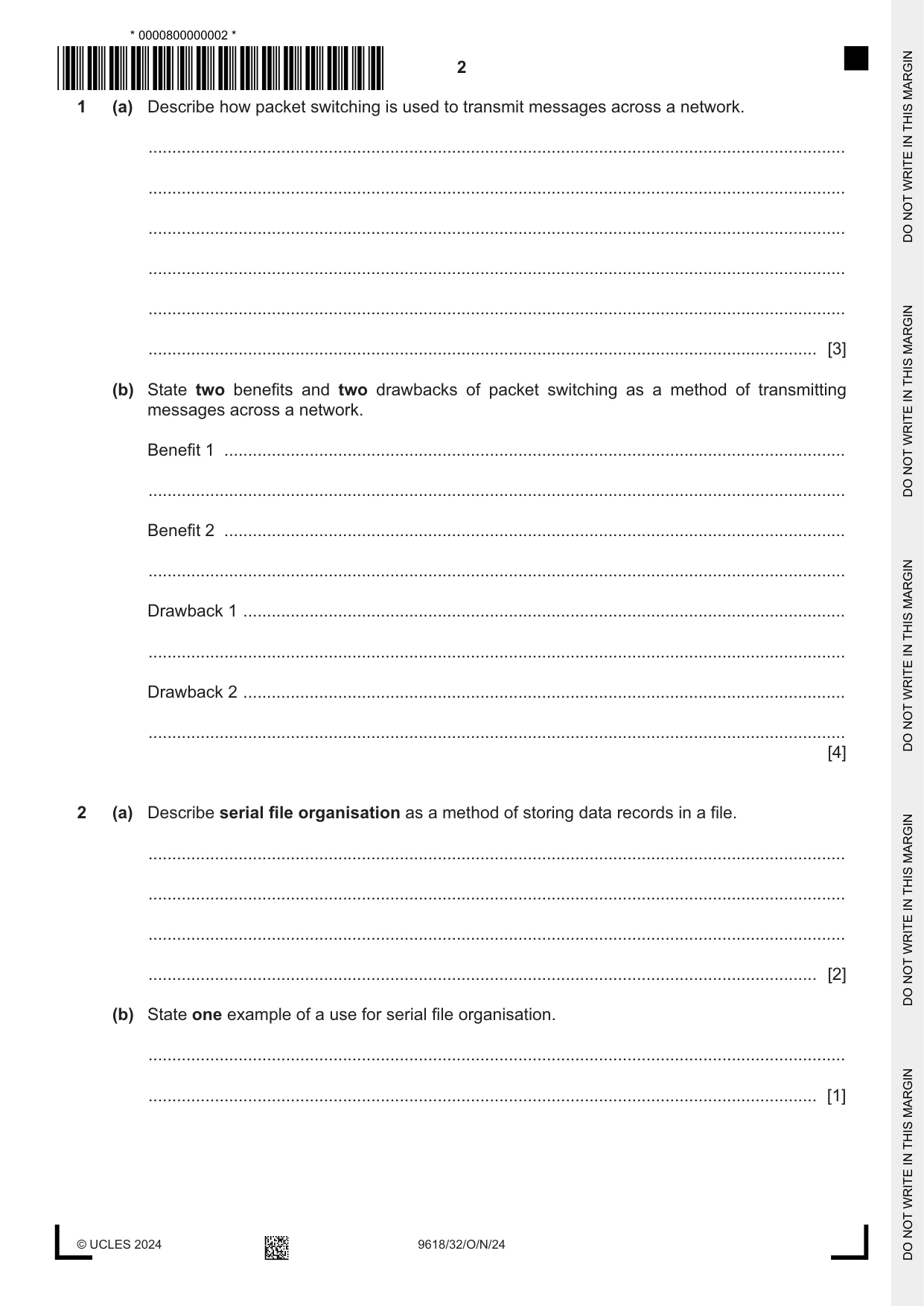
Q1 · Describe how packet switching is used to transmit messages across a network
1 (a) Describe how packet switching is used to transmit messages across a network. ................................................................................................................................................... ................................................................................................................................................... ................................................................................................................................................... ................................................................................................................................................... ................................................................................................................................................... ............................................................................................................................................. [3] (b) State two benefits and two drawbacks of packet switching as a method of transmitting messages across a network. Benefit 1 ................................................................................................................................... ................................................................................................................................................... Benefit 2 ................................................................................................................................... ................................................................................................................................................... Drawback 1 ............................................................................................................................... ................................................................................................................................................... Drawback 2 ............................................................................................................................... ................................................................................................................................................... [4]
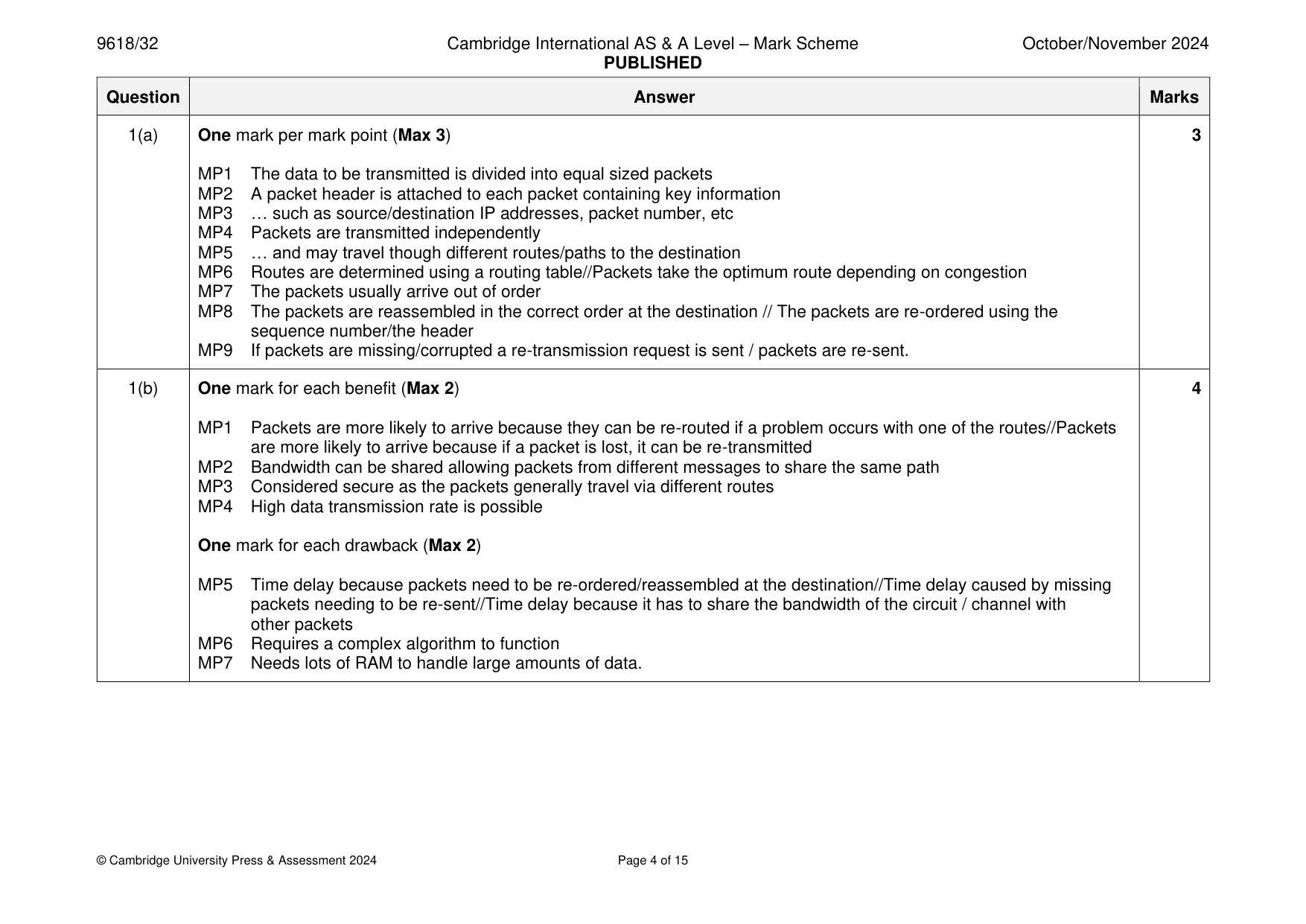
Mark scheme: Question Answer Marks 1(a) One mark per mark point (Max 3) 3 MP1 The data to be transmitted is divided into equal sized packets MP2 A packet header is attached to each packet containing key information MP3 … such as source/destination IP addresses, packet number, etc MP4 Packets are transmitted independently MP5 … and may travel though different routes/paths to the destination MP6 Routes are determined using a routing table//Packets take the optimum route depending on congestion MP7 The packets usually arrive out of order MP8 The packets are reassembled in the correct order at the destination // The packets are re-ordered using the sequence number/the header MP9 If packets are missing/corrupted a re-transmission request is sent / packets are re-sent. 1(b) One mark for each benefit (Max 2) 4 MP1 Packets are more likely to arrive because they can be re-routed if a problem occurs with one of the routes//Packets are more likely to arrive because if a packet is lost, it can be re-transmitted MP2 Bandwidth can be shared allowing packets from different messages to share the same path MP3 Considered secure as the packets generally travel via different routes MP4 High data transmission rate is possible One mark for each drawback (Max 2) MP5 Time delay because packets need to be re-ordered/reassembled at the destination//Time delay caused by missing packets needing to be re-sent//Time delay because it has to share the bandwidth of the circuit / channel with other packets MP6 Requires a complex algorithm to function MP7 Needs lots of RAM to handle large amounts of data.
Q2 · Describe serial file organisation as a method of storing data records in a file
2 (a) Describe serial file organisation as a method of storing data records in a file. ................................................................................................................................................... ................................................................................................................................................... ................................................................................................................................................... ............................................................................................................................................. [2] (b) State one example of a use for serial file organisation. ................................................................................................................................................... ............................................................................................................................................. [1]
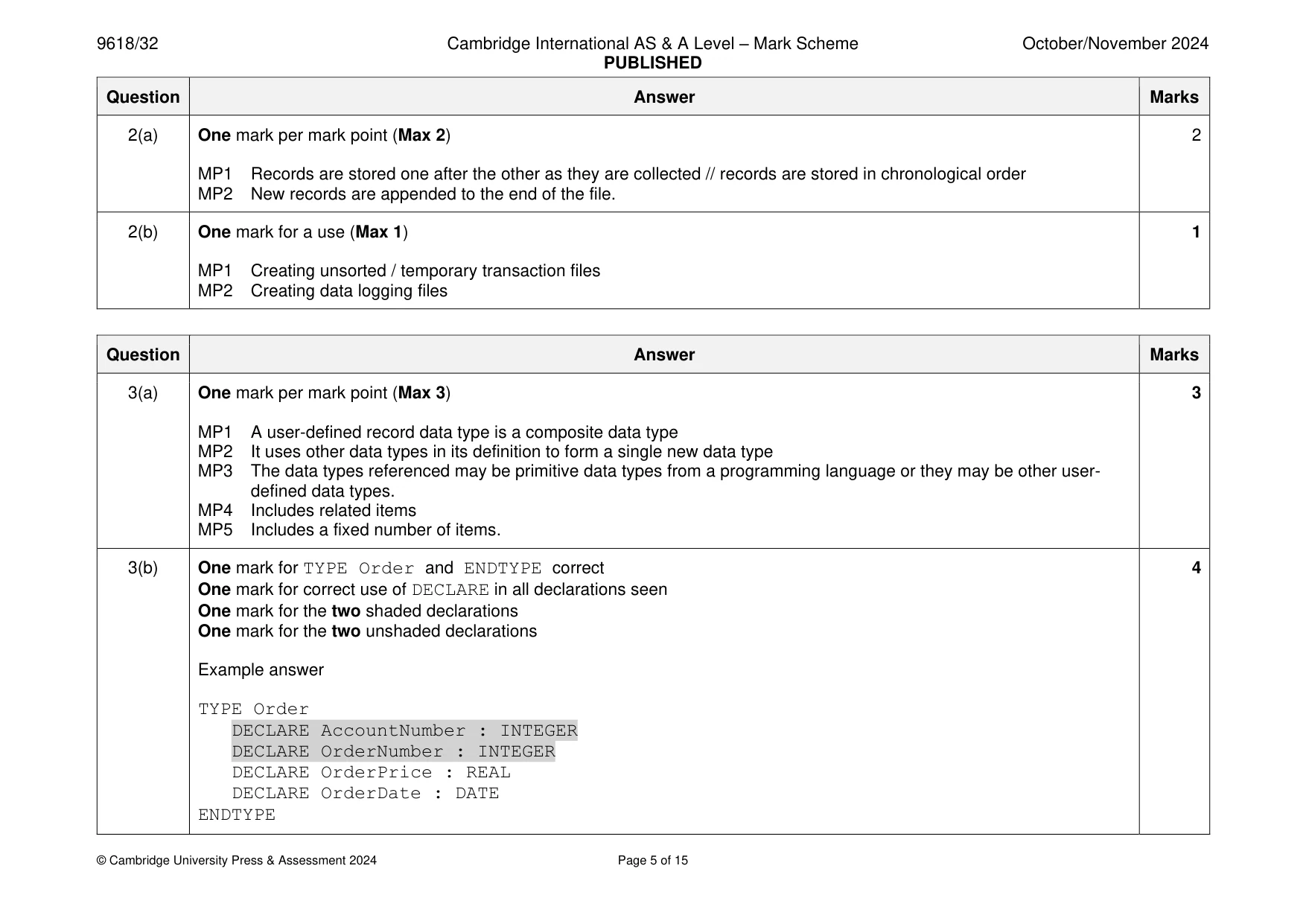
Mark scheme: 2(a) One mark per mark point (Max 2) 2 MP1 Records are stored one after the other as they are collected // records are stored in chronological order MP2 New records are appended to the end of the file. 2(b) One mark for a use (Max 1) 1 MP1 Creating unsorted / temporary transaction files MP2 Creating data logging files
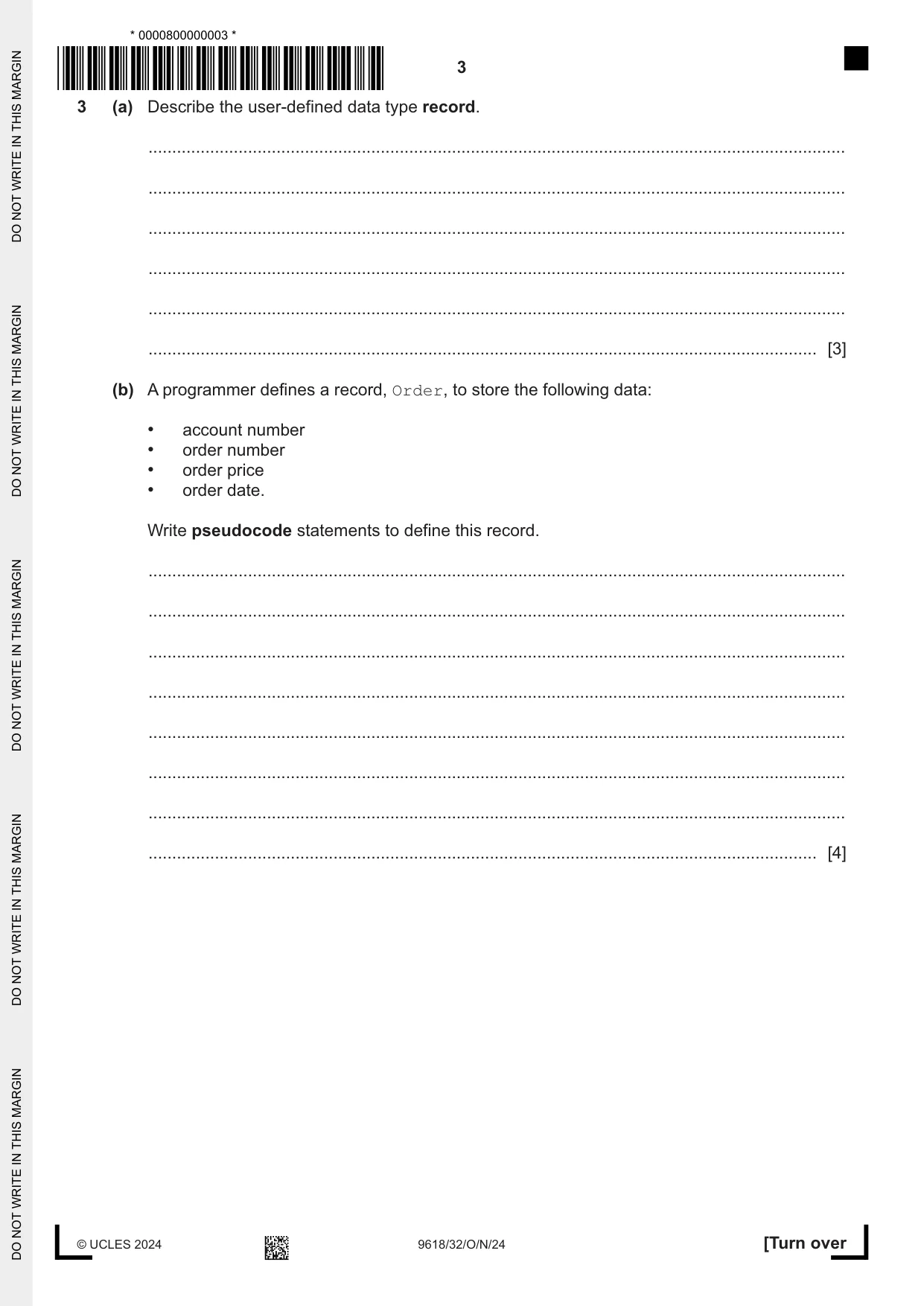
Q3 · Describe the user‑defined data type record
3 (a) Describe the user‑defined data type record. ................................................................................................................................................... ................................................................................................................................................... ................................................................................................................................................... ................................................................................................................................................... ................................................................................................................................................... ............................................................................................................................................. [3] (b) A programmer defines a record, Order, to store the following data: • account number • order number • order price • order date. Write pseudocode statements to define this record. ................................................................................................................................................... ................................................................................................................................................... ................................................................................................................................................... ................................................................................................................................................... ................................................................................................................................................... ................................................................................................................................................... ................................................................................................................................................... ............................................................................................................................................. [4]
Mark scheme: 3(a) One mark per mark point (Max 3) 3 MP1 A user-defined record data type is a composite data type MP2 It uses other data types in its definition to form a single new data type MP3 The data types referenced may be primitive data types from a programming language or they may be other user- defined data types. MP4 Includes related items MP5 Includes a fixed number of items. 3(b) One mark for TYPE Order and ENDTYPE correct 4 One mark for correct use of DECLARE in all declarations seen One mark for the two shaded declarations One mark for the two unshaded declarations Example answer TYPE Order DECLARE AccountNumber : INTEGER DECLARE OrderNumber : INTEGER DECLARE OrderPrice : REAL DECLARE OrderDate : DATE ENDTYPE
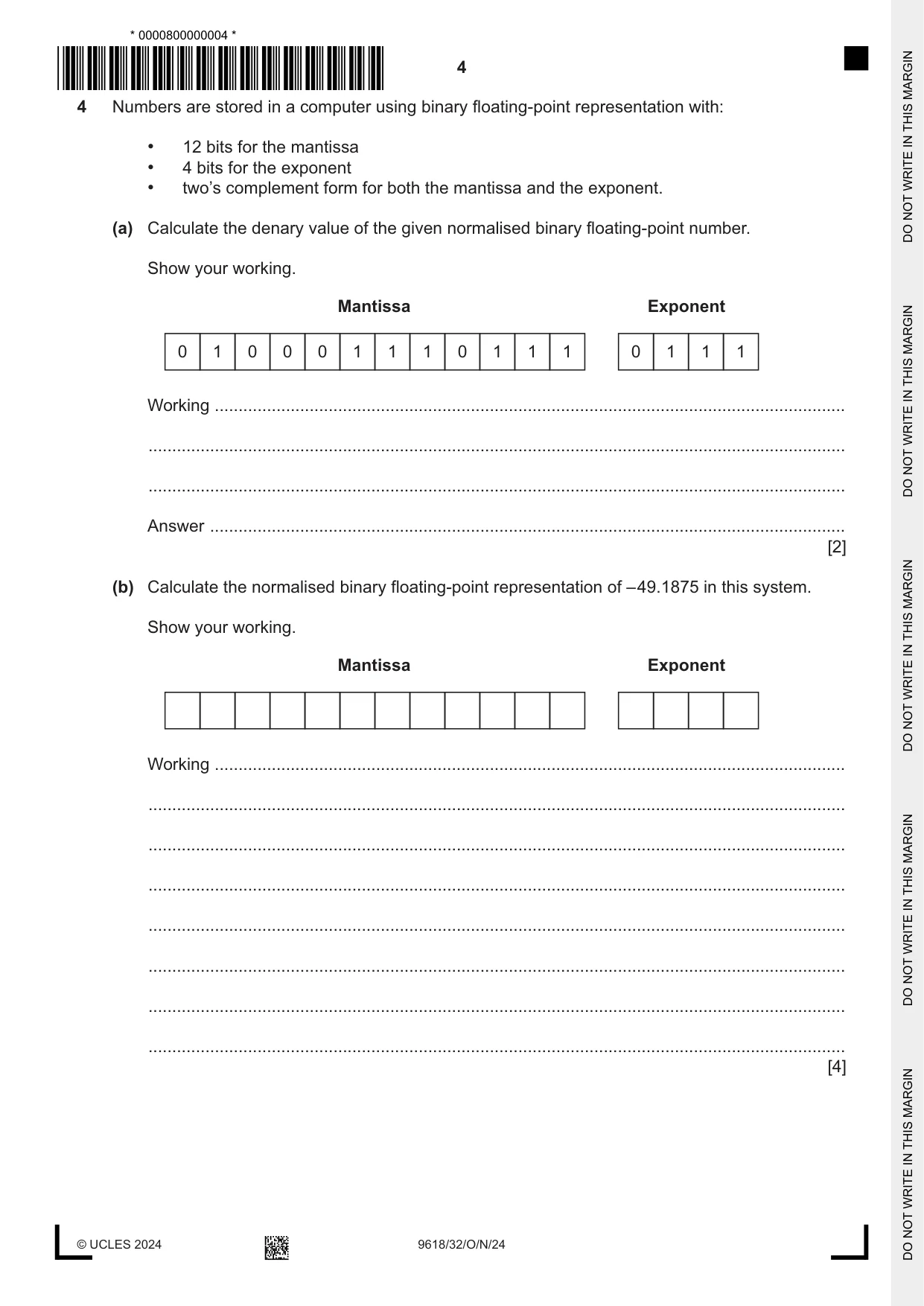
Q4 · Numbers are stored in a computer using binary floating‑point representation with: • 12…
4 Numbers are stored in a computer using binary floating‑point representation with: • 12 bits for the mantissa • 4 bits for the exponent • two’s complement form for both the mantissa and the exponent. (a) Calculate the denary value of the given normalised binary floating‑point number. Show your working. Mantissa Exponent 0 1 0 0 0 1 1 1 0 1 1 1 0 1 1 1 Working ..................................................................................................................................... ................................................................................................................................................... ................................................................................................................................................... Answer ...................................................................................................................................... [2] (b) Calculate the normalised binary floating‑point representation of – 49.1875 in this system. Show your working. Mantissa Exponent Working ..................................................................................................................................... ................................................................................................................................................... ................................................................................................................................................... ................................................................................................................................................... ................................................................................................................................................... ................................................................................................................................................... ................................................................................................................................................... ................................................................................................................................................... [4]
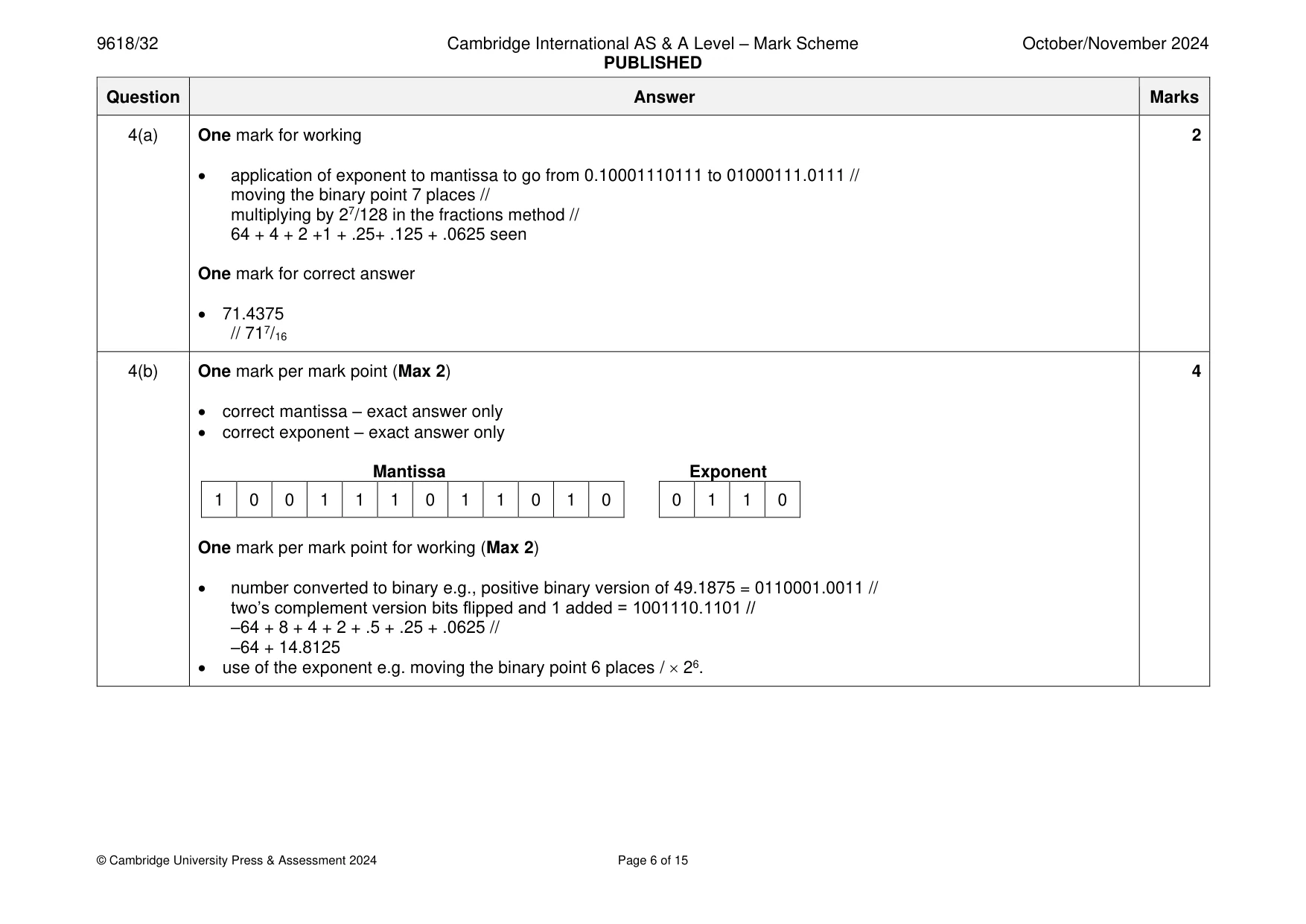
Mark scheme: 4(a) One mark for working 2 • application of exponent to mantissa to go from 0.10001110111 to 01000111.0111 // moving the binary point 7 places // multiplying by 27/128 in the fractions method // 64 + 4 + 2 +1 + .25+ .125 + .0625 seen One mark for correct answer • 71.4375 // 717/16 4(b) One mark per mark point (Max 2) 4 • correct mantissa – exact answer only • correct exponent – exact answer only Mantissa Exponent 1 0 0 1 1 1 0 1 1 0 1 0 0 1 1 0 One mark per mark point for working (Max 2) • number converted to binary e.g., positive binary version of 49.1875 = 0110001.0011 // two’s complement version bits flipped and 1 added = 1001110.1101 // –64 + 8 + 4 + 2 + .5 + .25 + .0625 // –64 + 14.8125 • use of the exponent e.g. moving the binary point 6 places / 26.
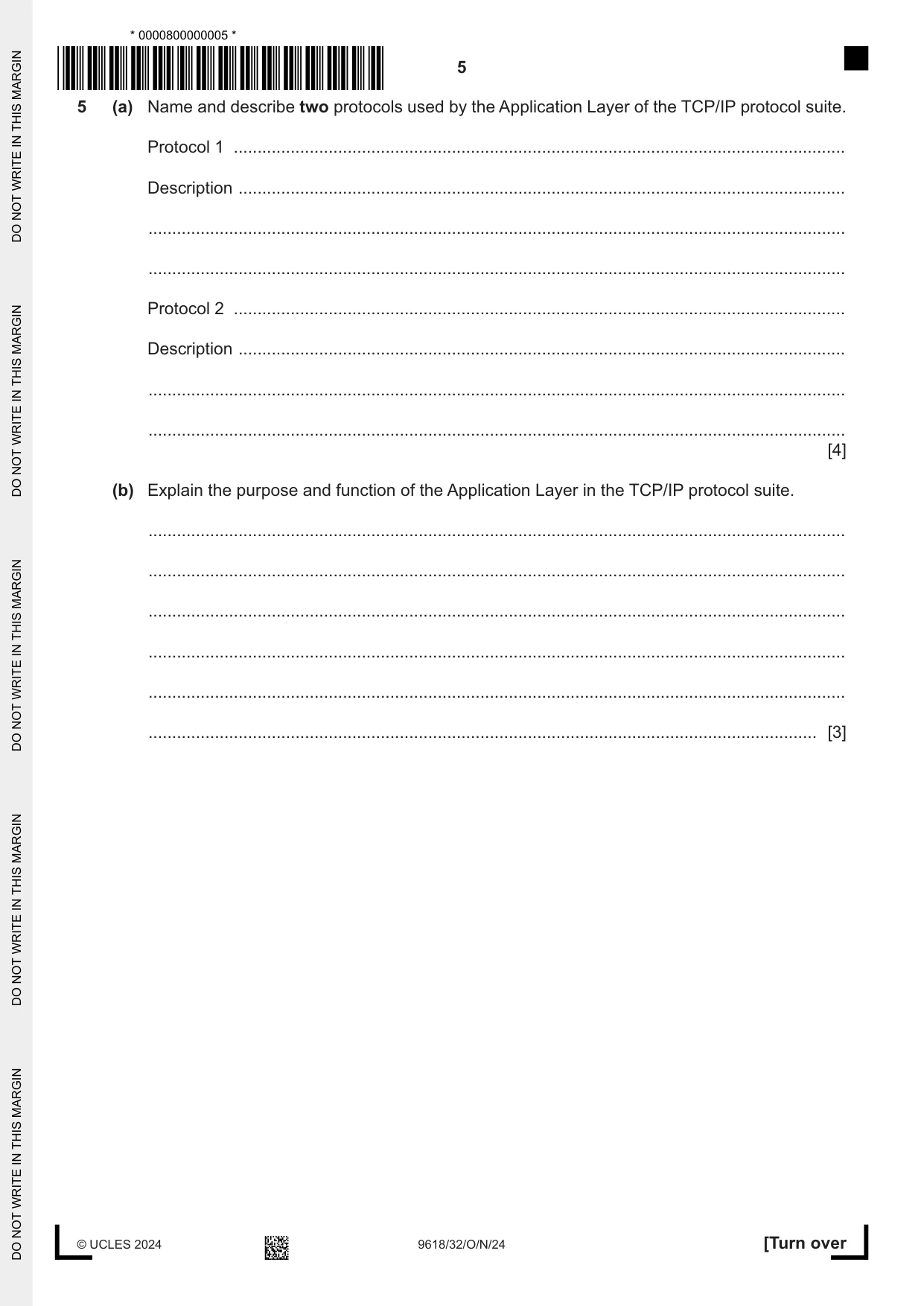
Q5 · Name and describe two protocols used by the Application Layer of the TCP/IP protocol suite
5 (a) Name and describe two protocols used by the Application Layer of the TCP/IP protocol suite. Protocol 1 ................................................................................................................................. Description ................................................................................................................................ ................................................................................................................................................... ................................................................................................................................................... Protocol 2 ................................................................................................................................. Description ................................................................................................................................ ................................................................................................................................................... ................................................................................................................................................... [4] (b) Explain the purpose and function of the Application Layer in the TCP/IP protocol suite. ................................................................................................................................................... ................................................................................................................................................... ................................................................................................................................................... ................................................................................................................................................... ................................................................................................................................................... ............................................................................................................................................. [3]
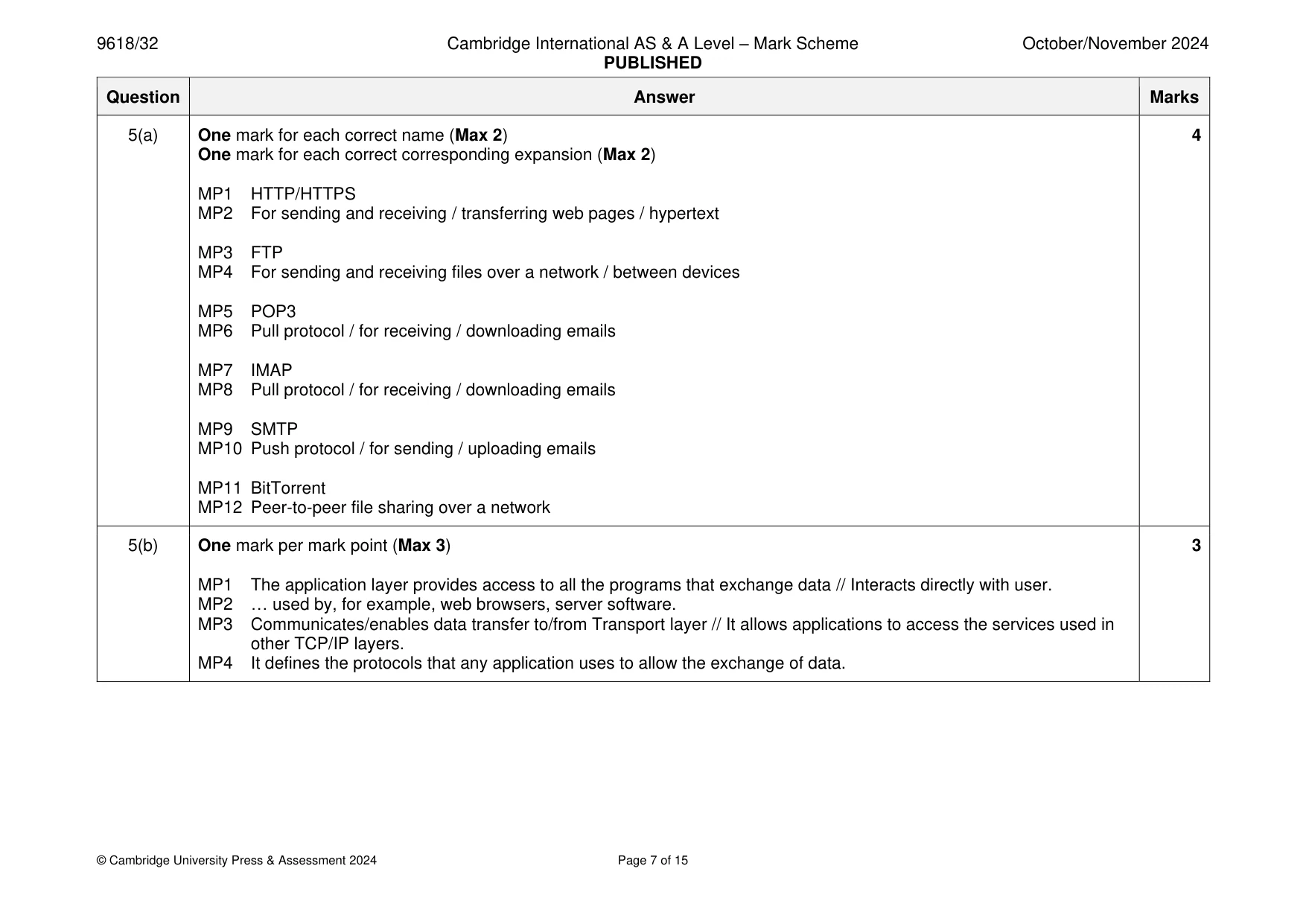
Mark scheme: 5(a) One mark for each correct name (Max 2) 4 One mark for each correct corresponding expansion (Max 2) MP1 HTTP/HTTPS MP2 For sending and receiving / transferring web pages / hypertext MP3 FTP MP4 For sending and receiving files over a network / between devices MP5 POP3 MP6 Pull protocol / for receiving / downloading emails MP7 IMAP MP8 Pull protocol / for receiving / downloading emails MP9 SMTP MP10 Push protocol / for sending / uploading emails MP11 BitTorrent MP12 Peer-to-peer file sharing over a network 5(b) One mark per mark point (Max 3) 3 MP1 The application layer provides access to all the programs that exchange data // Interacts directly with user. MP2 … used by, for example, web browsers, server software. MP3 Communicates/enables data transfer to/from Transport layer // It allows applications to access the services used in other TCP/IP layers. MP4 It defines the protocols that any application uses to allow the exchange of data.
Q6 · The truth table for a logic circuit is shown
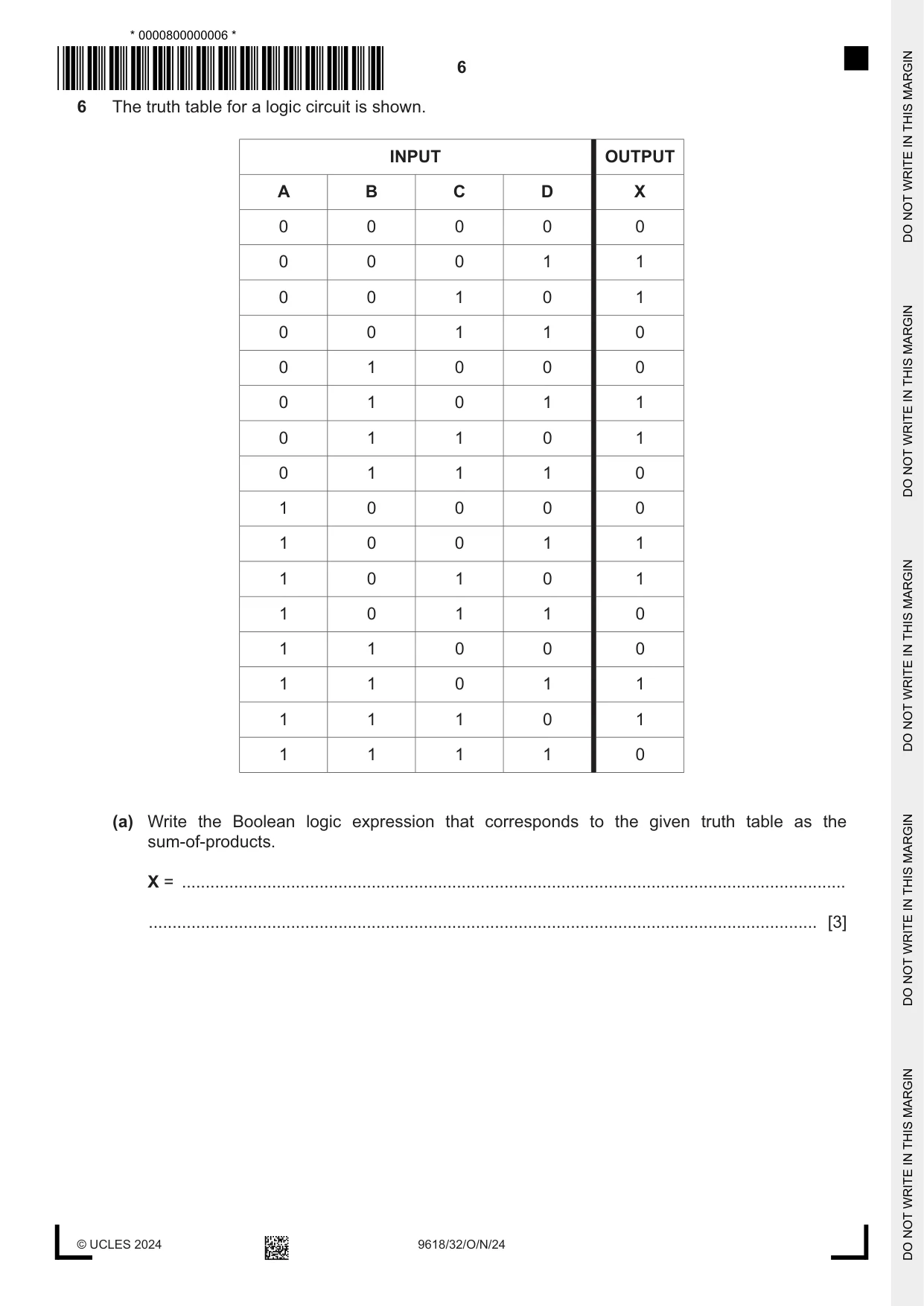
6 The truth table for a logic circuit is shown. INPUT OUTPUT A B C D X 0 0 0 0 0 0 0 0 1 1 0 0 1 0 1 0 0 1 1 0 0 1 0 0 0 0 1 0 1 1 0 1 1 0 1 0 1 1 1 0 1 0 0 0 0 1 0 0 1 1 1 0 1 0 1 1 0 1 1 0 1 1 0 0 0 1 1 0 1 1 1 1 1 0 1 1 1 1 1 0 (a) Write the Boolean logic expression that corresponds to the given truth table as the sum‑of‑products. X = ............................................................................................................................................ ............................................................................................................................................. [3] (b) Complete the Karnaugh map (K‑map) for the given truth table. AB CD 00 01 11 10 00 01 11 10 [2] (c) Draw loop(s) around appropriate group(s) in the K‑map to produce an optimal sum‑of‑products. [2] (d) Write the Boolean logic expression from your answer to part (c) as the simplified sum‑of‑products. X = ............................................................................................................................................ ............................................................................................................................................. [2]
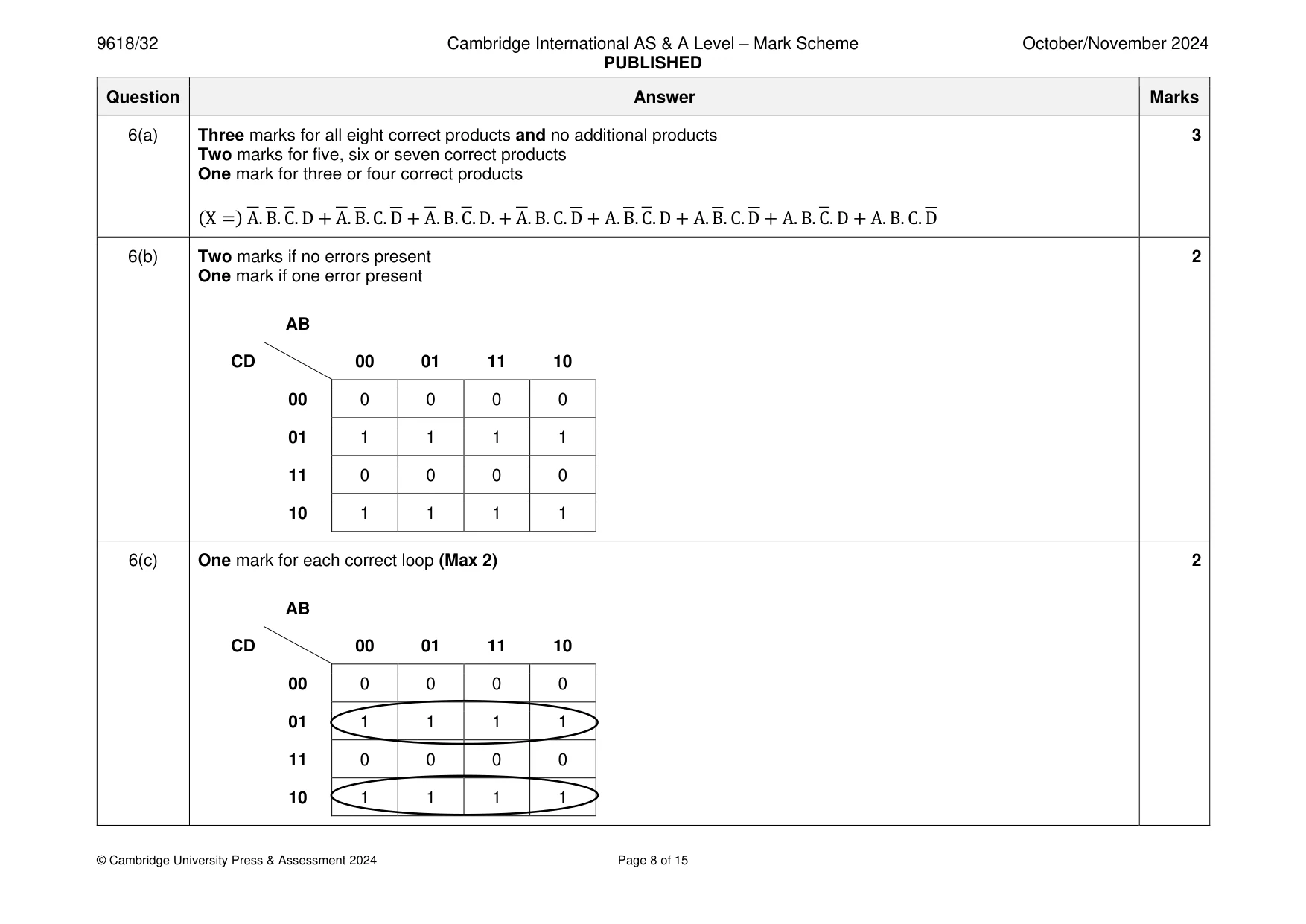
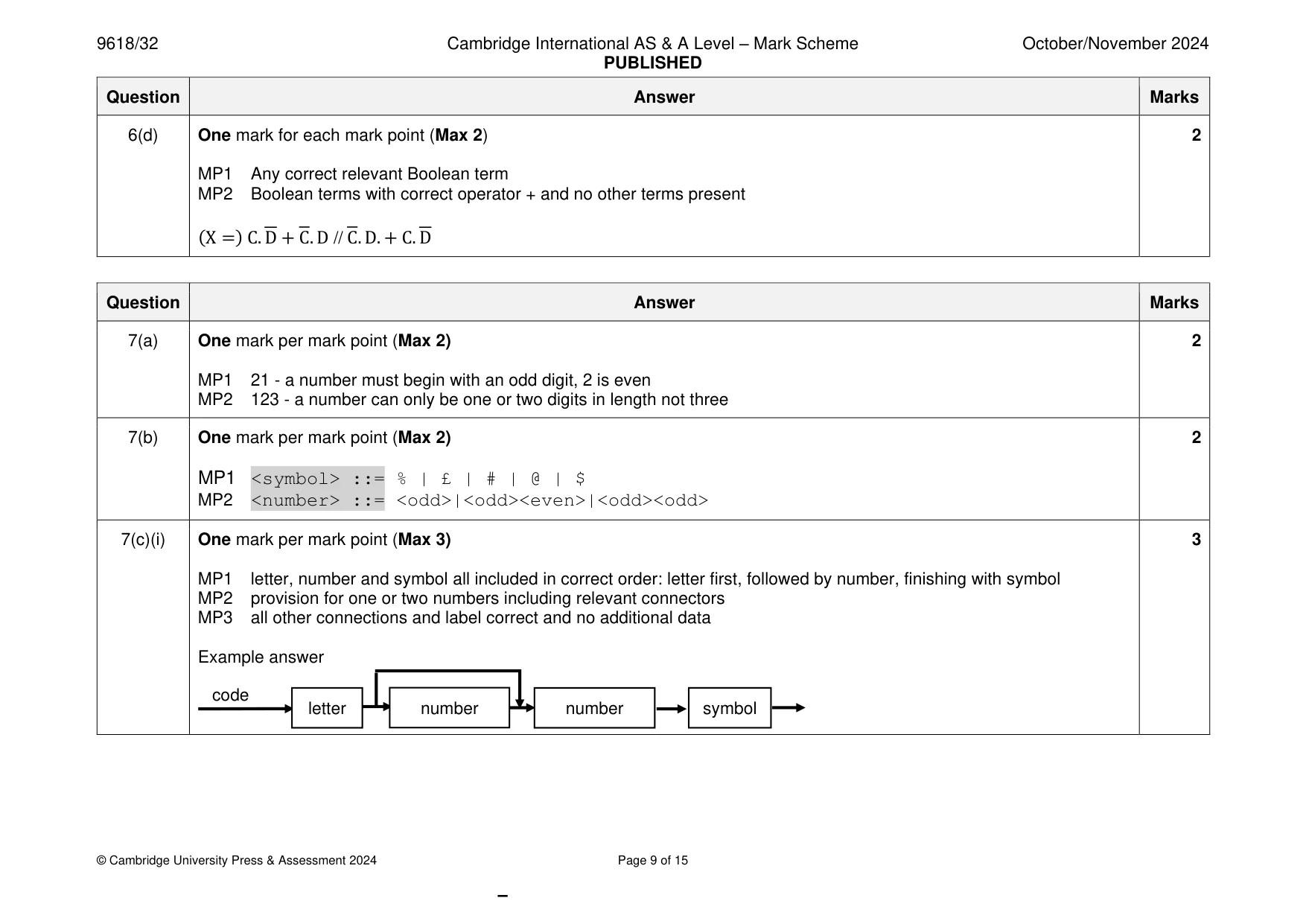
Mark scheme: 6(a) Three marks for all eight correct products and no additional products 3 Two marks for five, six or seven correct products One mark for three or four correct products (X =) A. B. C. D + A. B. C. D + A. B. C. D. + A. B. C. D + A. B. C. D + A. B. C. D + A. B. C. D + A. B. C. D 6(b) Two marks if no errors present 2 One mark if one error present AB CD 00 01 11 10 00 0 0 0 0 01 1 1 1 1 11 0 0 0 0 10 1 1 1 1 6(c) One mark for each correct loop (Max 2) 2 AB CD 00 01 11 10 00 0 0 0 0 01 1 1 1 1 11 0 0 0 0 10 1 1 1 1 6(d) One mark for each mark point (Max 2) 2 MP1 Any correct relevant Boolean term MP2 Boolean terms with correct operator + and no other terms present (X =) C. D + C. D // C. D. + C. D
Q7 · Several syntax diagrams are shown
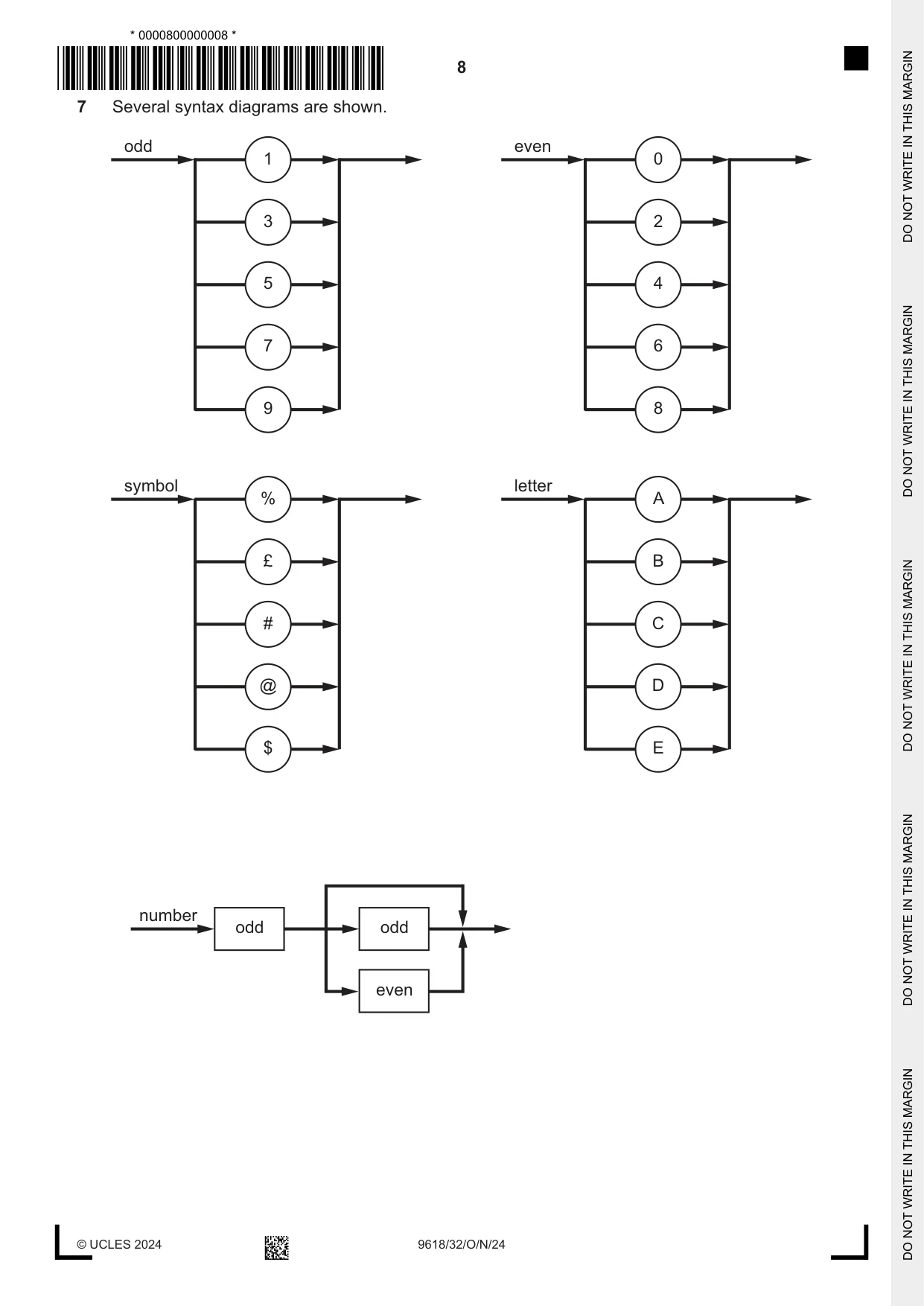
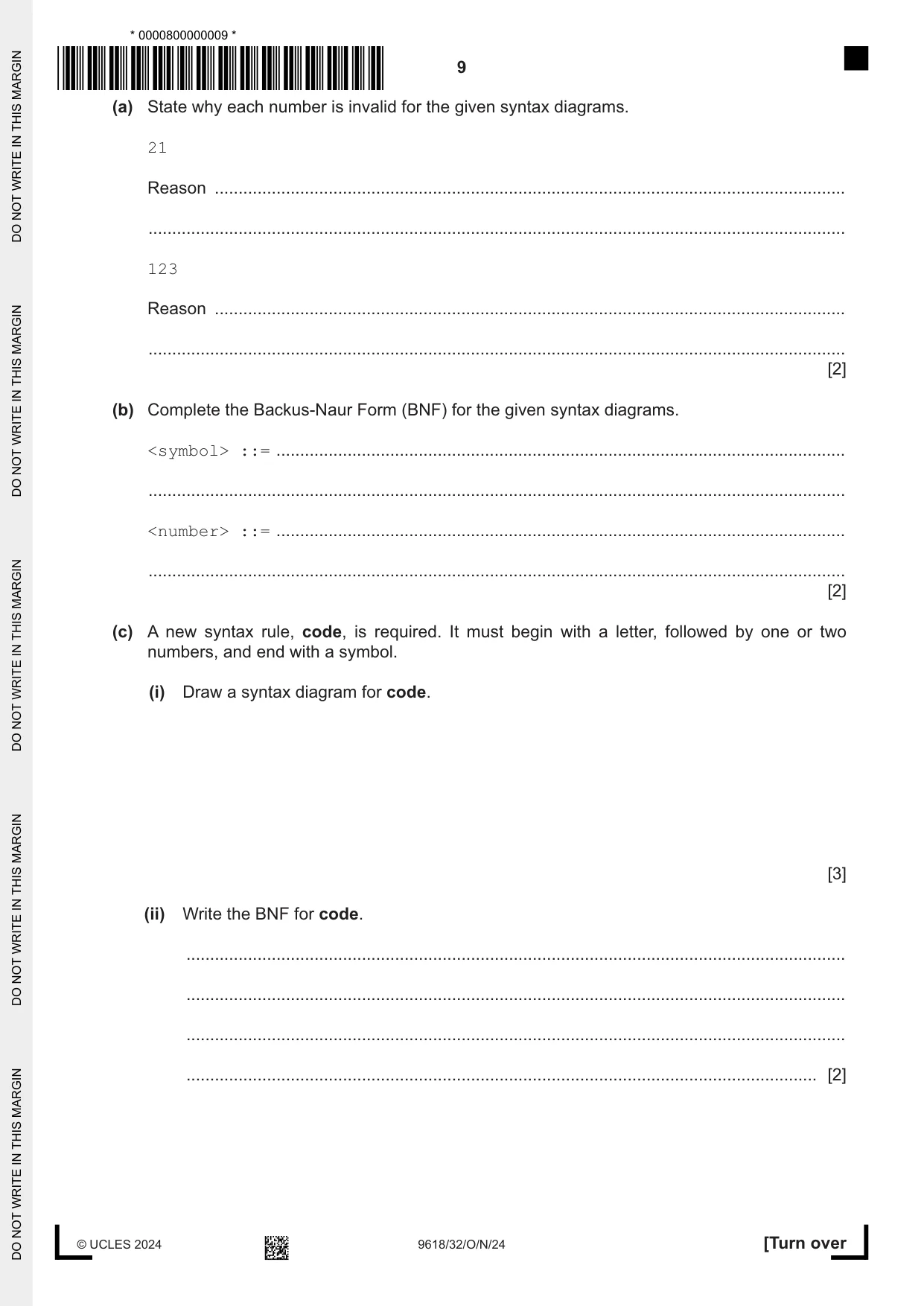
7 Several syntax diagrams are shown. odd even 1 0 3 2 5 4 7 6 9 8 symbol letter % A £ B # C @ D $ E number odd odd even (a) State why each number is invalid for the given syntax diagrams. 21 Reason ..................................................................................................................................... ................................................................................................................................................... 123 Reason ..................................................................................................................................... ................................................................................................................................................... [2] (b) Complete the Backus‑Naur Form (BNF) for the given syntax diagrams. <symbol> ::= ........................................................................................................................ ................................................................................................................................................... <number> ::= ........................................................................................................................ ................................................................................................................................................... [2] (c) A new syntax rule, code, is required. It must begin with a letter, followed by one or two numbers, and end with a symbol. (i) Draw a syntax diagram for code. [3] (ii) Write the BNF for code. ........................................................................................................................................... ........................................................................................................................................... ........................................................................................................................................... ..................................................................................................................................... [2]
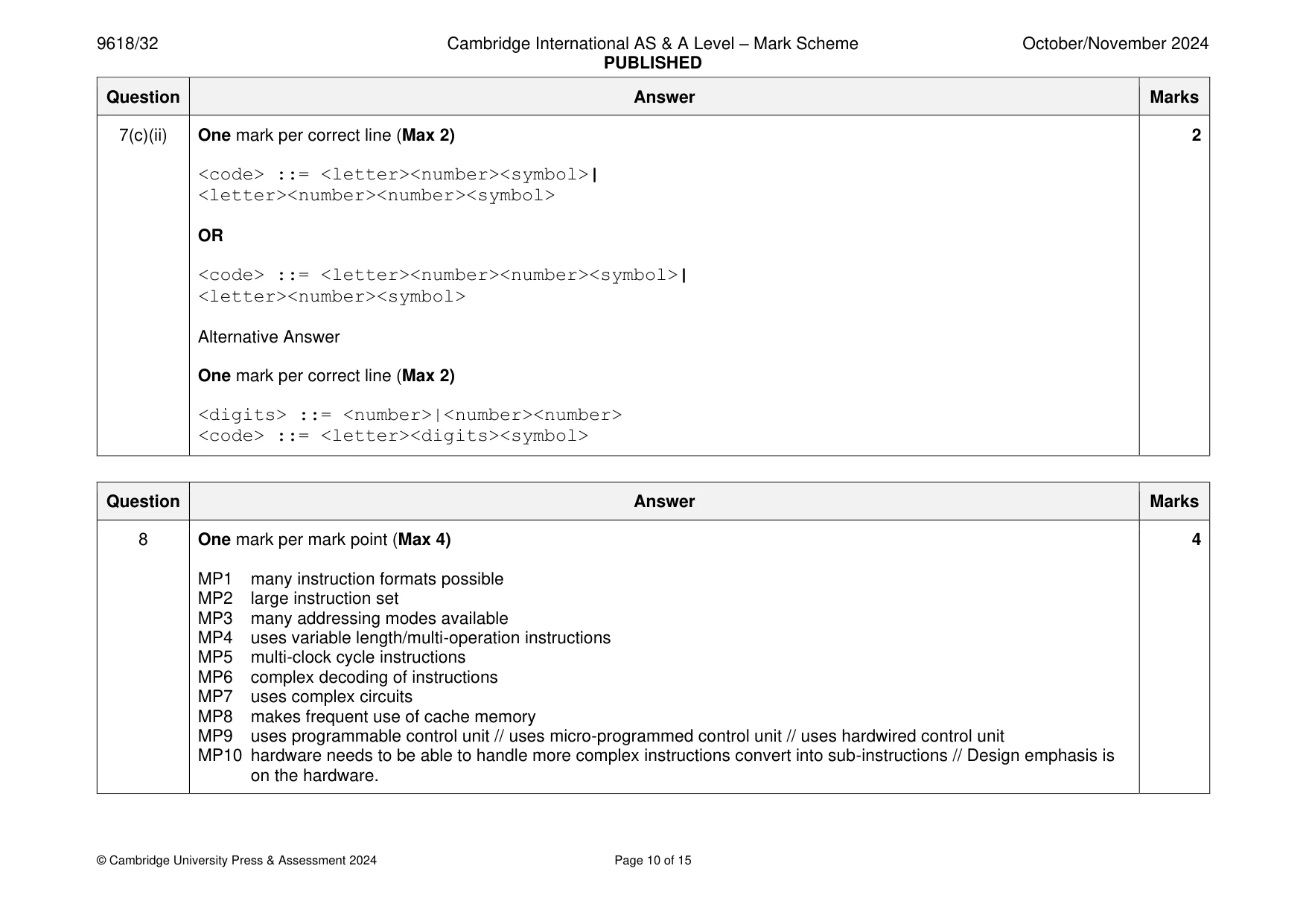
Mark scheme: 7(a) One mark per mark point (Max 2) 2 MP1 21 - a number must begin with an odd digit, 2 is even MP2 123 - a number can only be one or two digits in length not three 7(b) One mark per mark point (Max 2) 2 MP1 <symbol> ::= % | £ | # | @ | $ MP2 <number> ::= <odd>|<odd><even>|<odd><odd> 7(c)(i) One mark per mark point (Max 3) 3 MP1 letter, number and symbol all included in correct order: letter first, followed by number, finishing with symbol MP2 provision for one or two numbers including relevant connectors MP3 all other connections and label correct and no additional data Example answer code letter number number symbol 7(c)(ii) One mark per correct line (Max 2) 2 <code> ::= <letter><number><symbol>| <letter><number><number><symbol> OR <code> ::= <letter><number><number><symbol>| <letter><number><symbol> Alternative Answer One mark per correct line (Max 2) <digits> ::= <number>|<number><number> <code> ::= <letter><digits><symbol>
Q8 · Complex Instruction Set Computer (CISC) is a type of processor
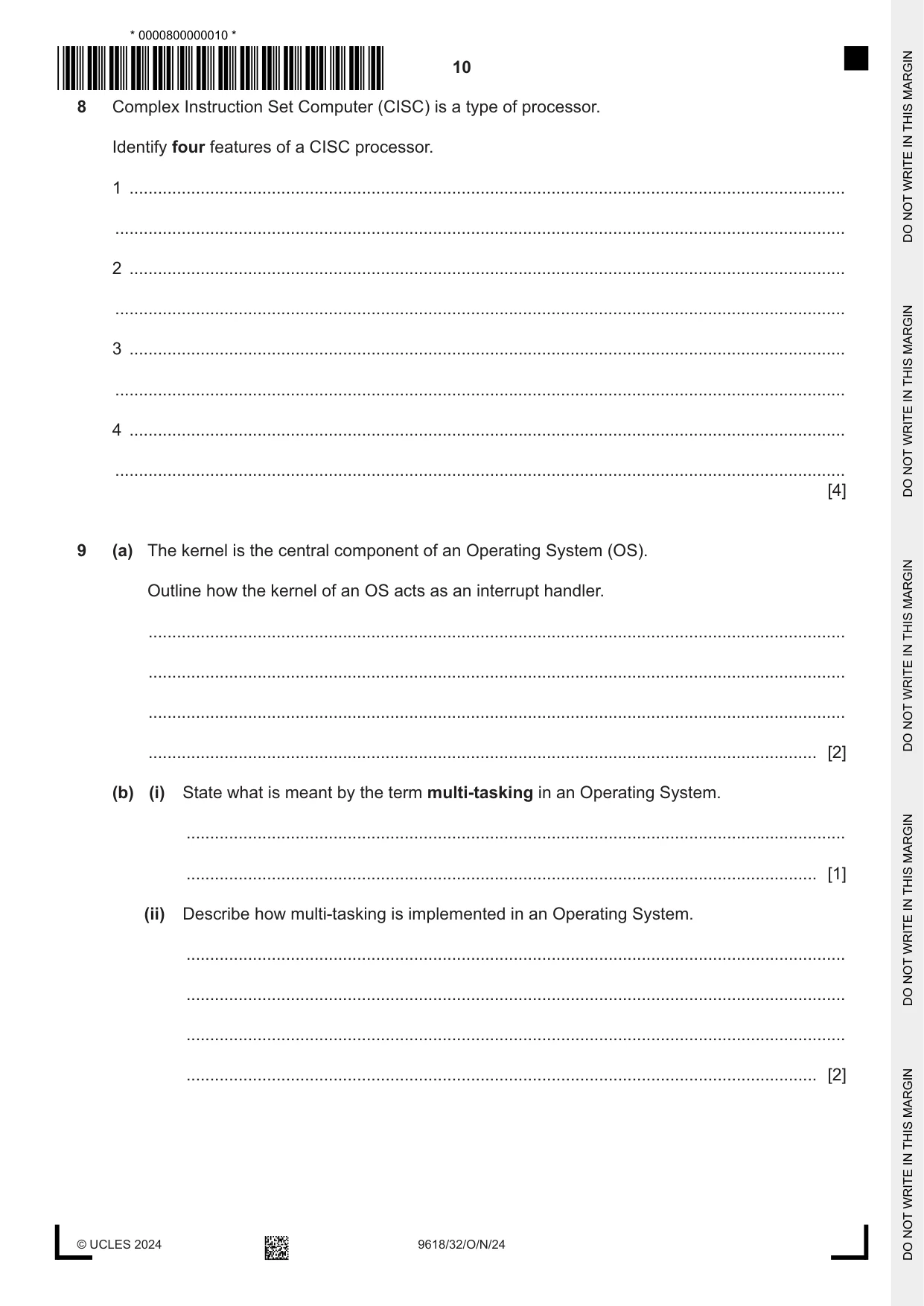
8 Complex Instruction Set Computer (CISC) is a type of processor. Identify four features of a CISC processor. 1 ....................................................................................................................................................... .......................................................................................................................................................... 2 ....................................................................................................................................................... .......................................................................................................................................................... 3 ....................................................................................................................................................... .......................................................................................................................................................... 4 ....................................................................................................................................................... .......................................................................................................................................................... [4]
Mark scheme: 8 One mark per mark point (Max 4) 4 MP1 many instruction formats possible MP2 large instruction set MP3 many addressing modes available MP4 uses variable length/multi-operation instructions MP5 multi-clock cycle instructions MP6 complex decoding of instructions MP7 uses complex circuits MP8 makes frequent use of cache memory MP9 uses programmable control unit // uses micro-programmed control unit // uses hardwired control unit MP10 hardware needs to be able to handle more complex instructions convert into sub-instructions // Design emphasis is on the hardware.
Q9 · The kernel is the central component of an Operating System (OS)
9 (a) The kernel is the central component of an Operating System (OS). Outline how the kernel of an OS acts as an interrupt handler. ................................................................................................................................................... ................................................................................................................................................... ................................................................................................................................................... ............................................................................................................................................. [2] (b) (i) State what is meant by the term multi‑tasking in an Operating System. ........................................................................................................................................... ..................................................................................................................................... [1] (ii) Describe how multi‑tasking is implemented in an Operating System. ........................................................................................................................................... ........................................................................................................................................... ........................................................................................................................................... ..................................................................................................................................... [2]
Mark scheme: 9(a) One mark per mark point (Max 2) 2 MP1 the kernel receives a signal when an interrupt is generated MP2 the kernel checks the priority and reviews the status/priority of the current interrupts MP3 system enters kernel mode if the type of interrupt is of higher priority than the current process MP4 the kernel consults the interrupt dispatch table / IDT MP5 … and saves the state of the interrupted process / contents of the registers on the kernel stack MP6 the kernel restores the process state e.g. contents of registers once the interrupt is serviced 9(b)(i) One mark per mark point (Max 1) 1 MP1 multi-tasking allows computers to carry out / seem to carry out more than one process at a time 9(b)(ii) One mark per mark point (Max 2) 2 MP1 processor time/common hardware and resources is/are shared between tasks MP2 scheduling is used to decide on the processes to be carried out to ensure multi-tasking operates correctly / efficiently / without clashes MP3 one task of a higher priority can interrupt another task that is currently running
Q10 · Objects and classes form the basic structure of Object‑Oriented Programming (OOP)
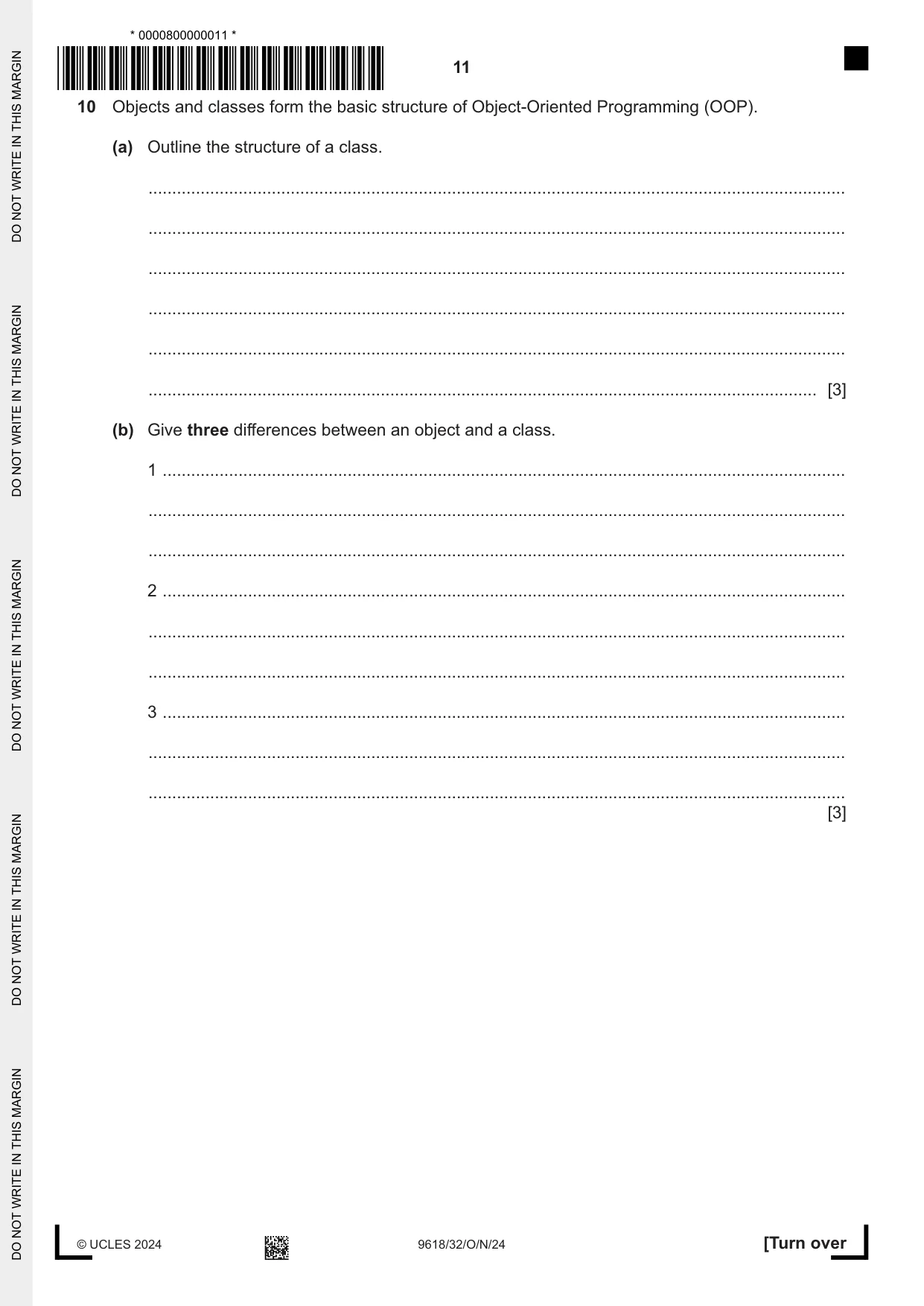
10 Objects and classes form the basic structure of Object‑Oriented Programming (OOP). (a) Outline the structure of a class. ................................................................................................................................................... ................................................................................................................................................... ................................................................................................................................................... ................................................................................................................................................... ................................................................................................................................................... ............................................................................................................................................. [3] (b) Give three differences between an object and a class. 1 ................................................................................................................................................ ................................................................................................................................................... ................................................................................................................................................... 2 ................................................................................................................................................ ................................................................................................................................................... ................................................................................................................................................... 3 ................................................................................................................................................ ................................................................................................................................................... ................................................................................................................................................... [3]
Mark scheme: 10(a) One mark per mark point (Max 3) 3 MP1 Attributes/properties … MP2 … with their data types // … are variables bound to the class MP3 Methods … MP4 … that are subroutines / functions / procedures that act upon the attributes MP5 Getters/setters … MP6 … are methods that can fetch / update the contents of attributes MP7 A constructor … MP8 … that is used to create instances / objects of this class. 10(b) One mark per mark point (Max 3) 3 MP1 A class is only defined once but many objects can be created from that class // A class is a template / blueprint from which objects are created // An object is an instance of a class MP2 No memory is allocated when a class is defined, but objects are allocated memory space whenever they are created MP3 A class cannot be manipulated as it is not available in the memory, but objects can be manipulated MP4 A class is defined but an object is declared / created / instantiated. MP5 A class can use inheritance. An object cannot.
Q11 · This binary tree shows an ordered list of integers
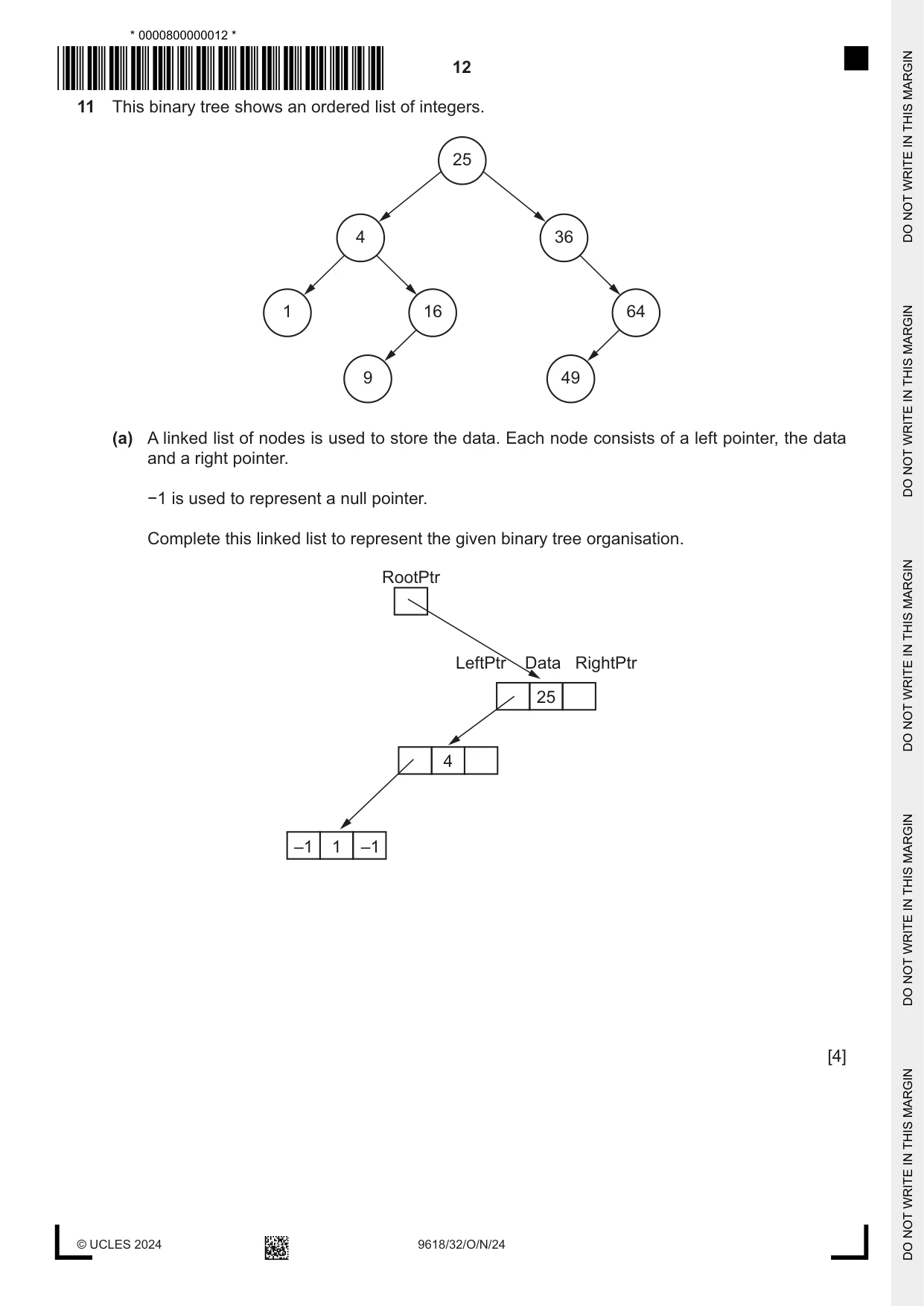
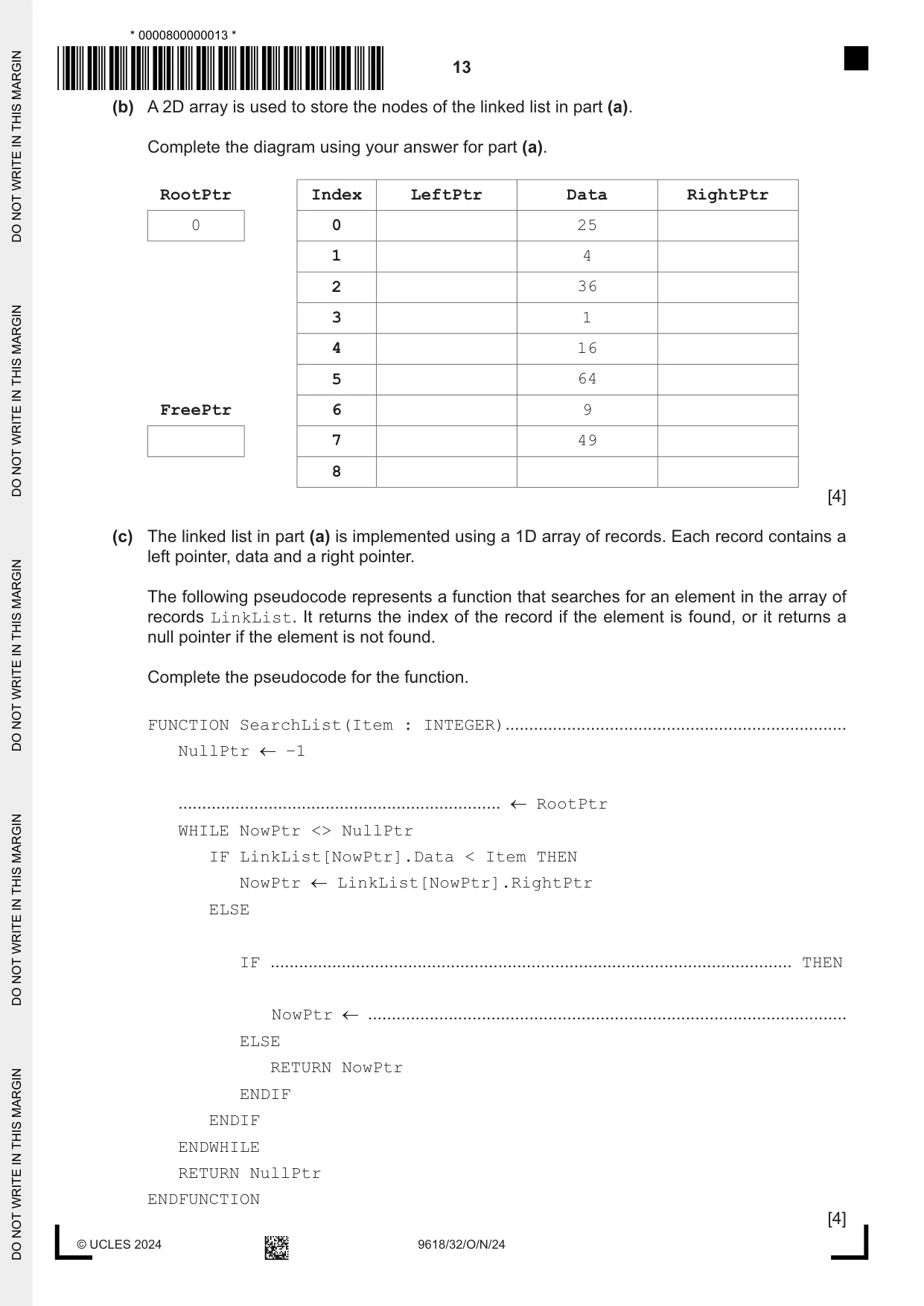
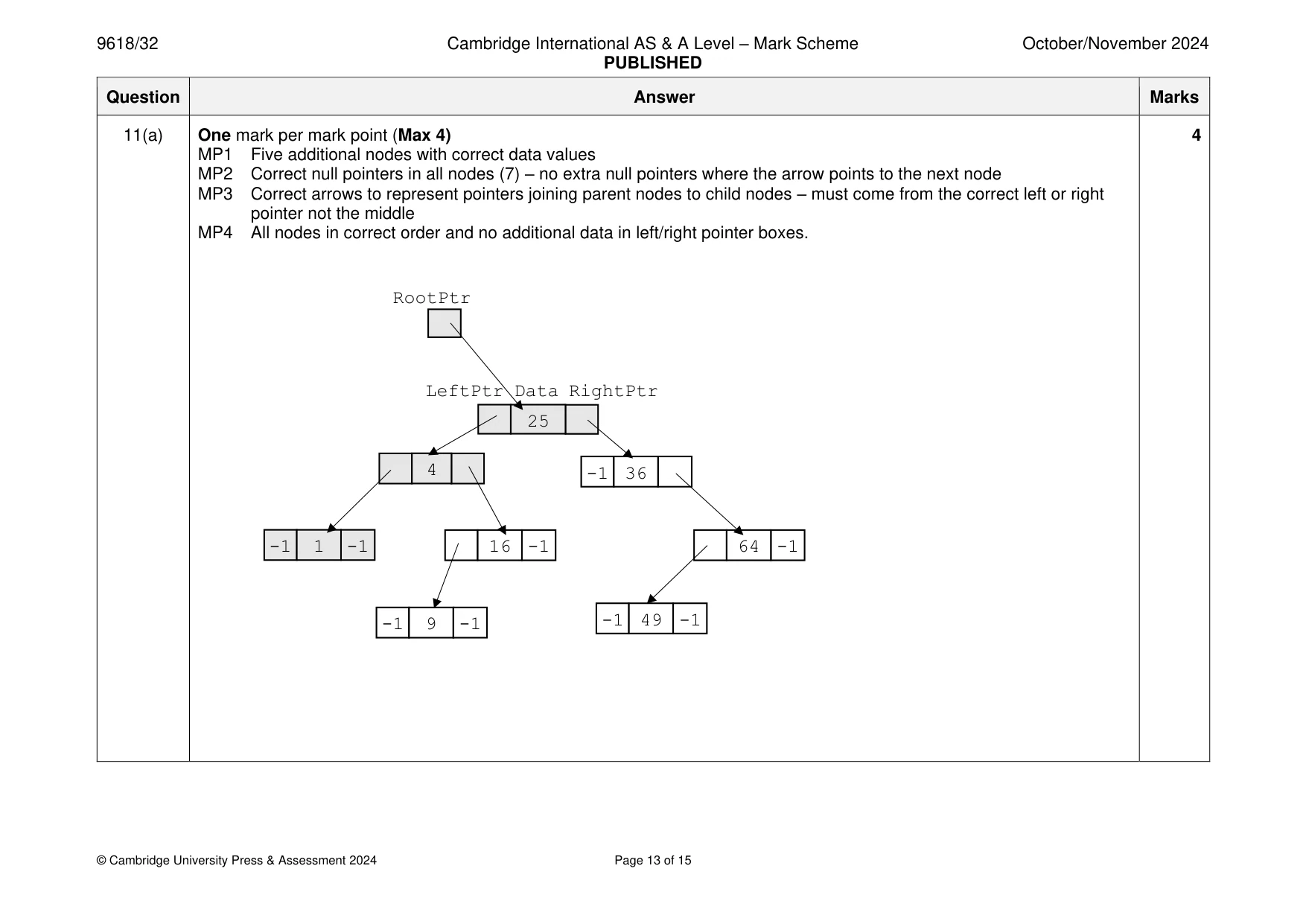
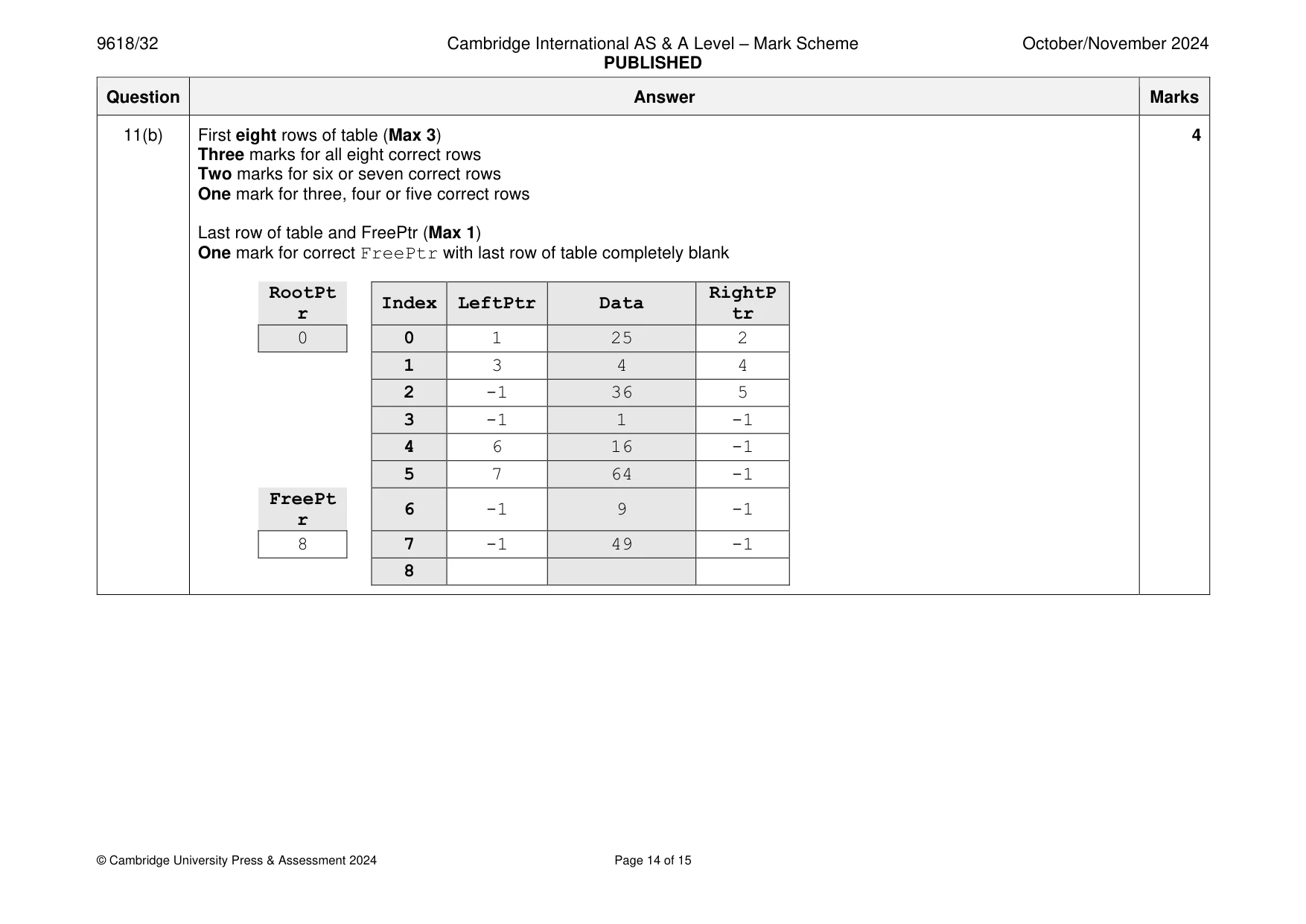
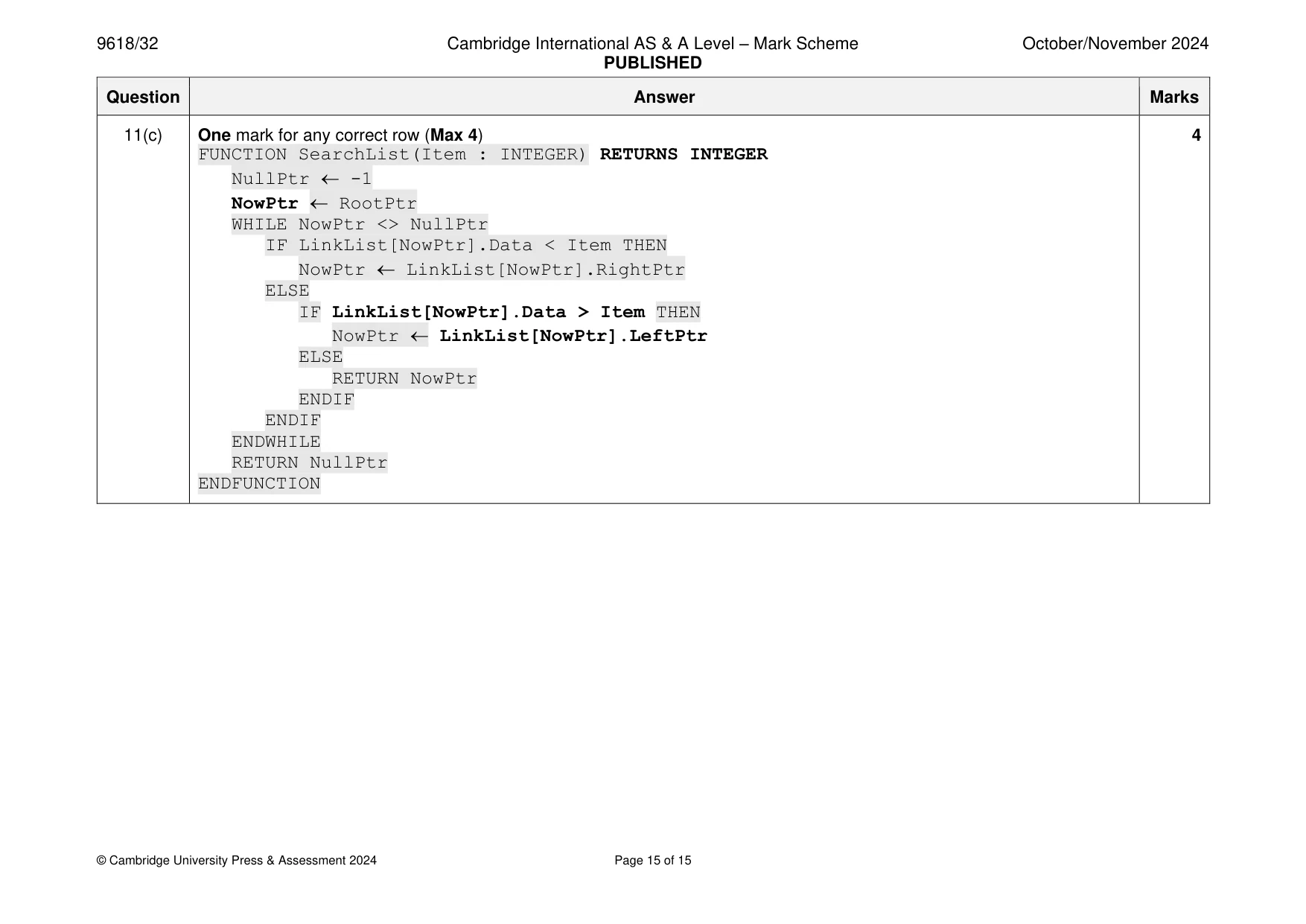
11 This binary tree shows an ordered list of integers. 25 4 36 1 16 64 9 49 (a) A linked list of nodes is used to store the data. Each node consists of a left pointer, the data and a right pointer. −1 is used to represent a null pointer. Complete this linked list to represent the given binary tree organisation. RootPtr LeftPtr Data RightPtr 25 4 –1 1 –1 [4] (b) A 2D array is used to store the nodes of the linked list in part (a). Complete the diagram using your answer for part (a). RootPtr Index LeftPtr Data RightPtr 0 0 25 1 4 2 36 3 1 4 16 5 64 FreePtr 6 9 7 49 8 [4] (c) The linked list in part (a) is implemented using a 1D array of records. Each record contains a left pointer, data and a right pointer. The following pseudocode represents a function that searches for an element in the array of records LinkList. It returns the index of the record if the element is found, or it returns a null pointer if the element is not found. Complete the pseudocode for the function. FUNCTION SearchList(Item : INTEGER)........................................................................ NullPtr −1 .................................................................... RootPtr WHILE NowPtr <> NullPtr IF LinkList[NowPtr].Data < Item THEN NowPtr LinkList[NowPtr].RightPtr ELSE IF .............................................................................................................. THEN NowPtr ..................................................................................................... ELSE RETURN NowPtr ENDIF ENDIF ENDWHILE RETURN NullPtr ENDFUNCTION [4]
Mark scheme: 11(a) One mark per mark point (Max 4) 4 MP1 Five additional nodes with correct data values MP2 Correct null pointers in all nodes (7) – no extra null pointers where the arrow points to the next node MP3 Correct arrows to represent pointers joining parent nodes to child nodes – must come from the correct left or right pointer not the middle MP4 All nodes in correct order and no additional data in left/right pointer boxes. RootPtr LeftPtr Data RightPtr 25 4 -1 36 -1 1 -1 16 -1 64 -1 -1 9 -1 -1 49 -1 11(b) First eight rows of table (Max 3) 4 Three marks for all eight correct rows Two marks for six or seven correct rows One mark for three, four or five correct rows Last row of table and FreePtr (Max 1) One mark for correct FreePtr with last row of table completely blank RootPt RightP Index LeftPtr Data r tr 0 0 1 25 2 1 3 4 4 2 -1 36 5 3 -1 1 -1 4 6 16 -1 5 7 64 -1 FreePt 6 -1 9 -1 r 8 7 -1 49 -1 8 11(c) One mark for any correct row (Max 4) 4 FUNCTION SearchList(Item : INTEGER) RETURNS INTEGER NullPtr -1 NowPtr RootPtr WHILE NowPtr <> NullPtr IF LinkList[NowPtr].Data < Item THEN NowPtr LinkList[NowPtr].RightPtr ELSE IF LinkList[NowPtr].Data > Item THEN NowPtr LinkList[NowPtr].LeftPtr ELSE RETURN NowPtr ENDIF ENDIF ENDWHILE RETURN NullPtr ENDFUNCTION
What you needed in this session
Cambridge’s own grade thresholds for 2024 Oct/Nov, Paper 3 · Variant 2. A higher threshold means an easier paper — the bar moves with how the cohort did.