Cambridge A Level Computer Science 9608 — 2020 Oct/Nov Paper 1 · Variant 1
9608/11/O/N/20 · 75 marks · ≈84 min
The question paper and its mark scheme, free to read here and free to download. This is Cambridge’s own paper, exactly as it was sat.
Question paper16 pages



Mark scheme10 pages
Answers below. Sit the paper first if you are practising.
Paper as text
Question paper, page 1
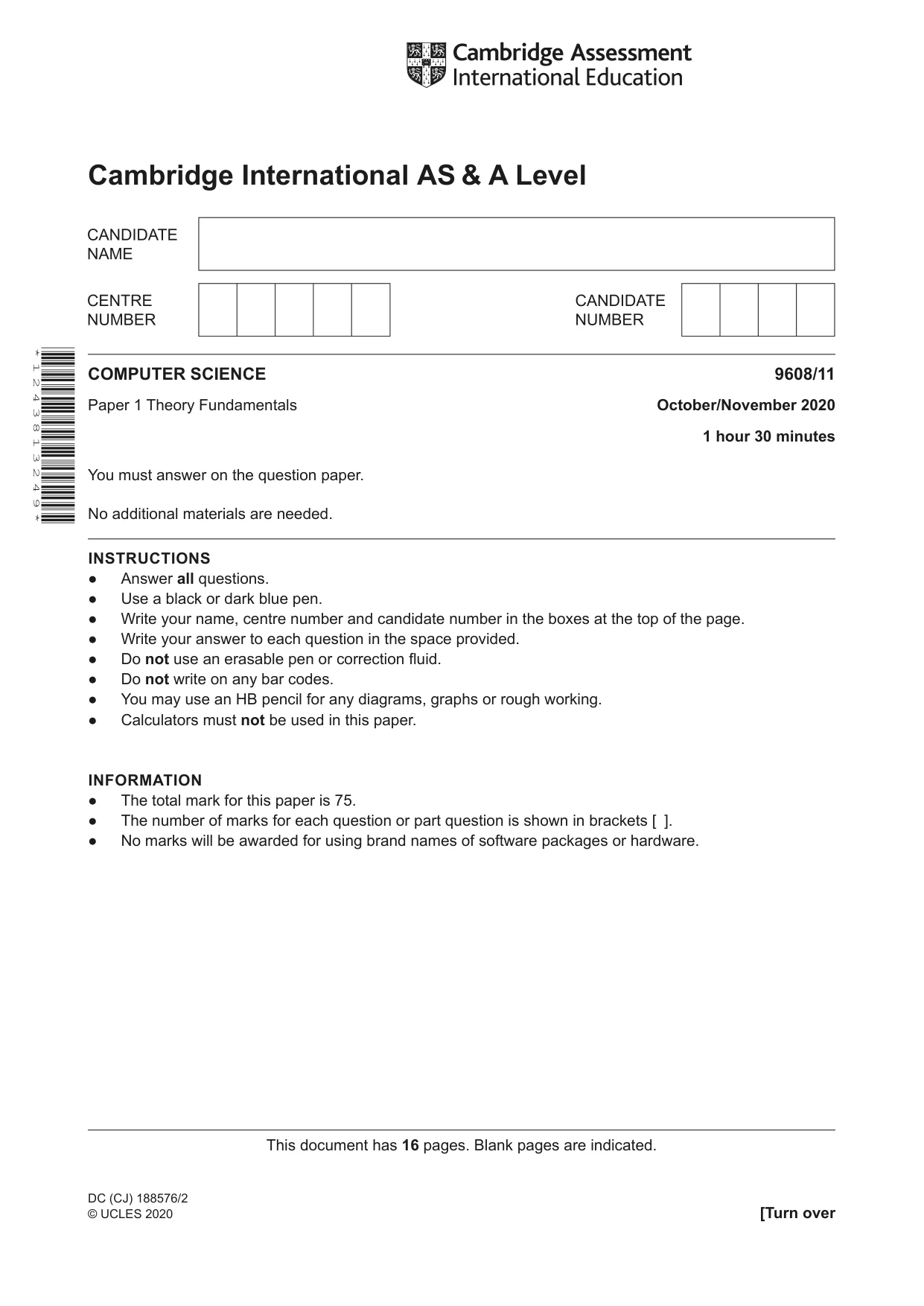
Cambridge International AS & A Level This document has 16 pages. Blank pages are indicated. * 1 2 4 3 8 1 3 2 4 9 * DC (CJ) 188576/2 © UCLES 2020 [Turn over COMPUTER SCIENCE 9608/11 Paper 1 Theory Fundamentals October/November 2020 1 hour 30 minutes You must answer on the question paper. No additional materials are needed. INSTRUCTIONS ● Answer all questions. ● Use a black or dark blue pen. ● Write your name, centre number and candidate number in the boxes at the top of the page. ● Write your answer to each question in the space provided. ● Do not use an erasable pen or correction fluid. ● Do not write on any bar codes. ● You may use an HB pencil for any diagrams, graphs or rough working. ● Calculators must not be used in this paper. INFORMATION ● The total mark for this paper is 75. ● The number of marks for each question or part question is shown in brackets [ ]. ● No marks will be awarded for using brand names of software packages or hardware.
Question paper, page 2
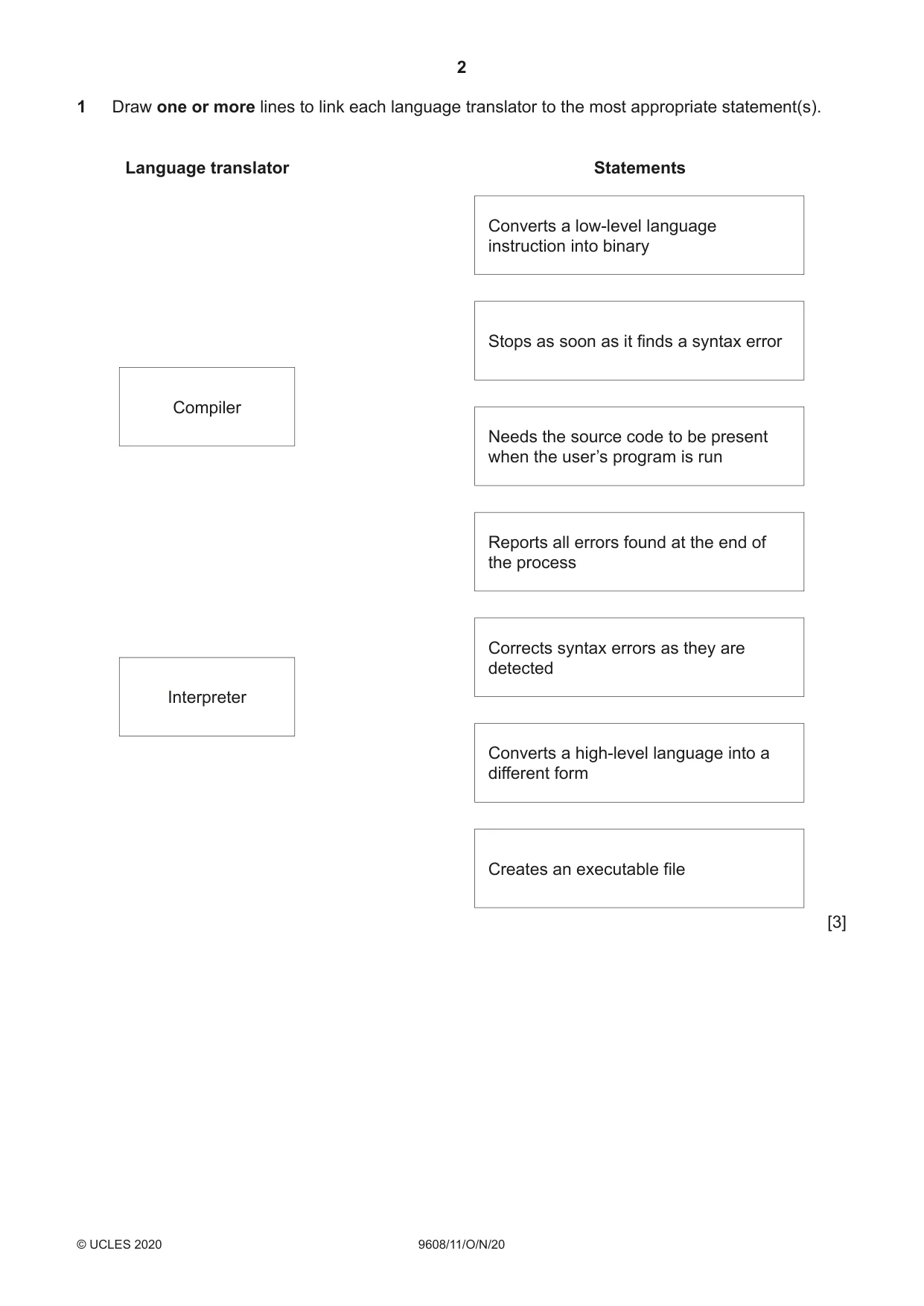
2 9608/11/O/N/20 © UCLES 2020 1 Draw one or more lines to link each language translator to the most appropriate statement(s). Language translator Statements Compiler Interpreter Converts a low-level language instruction into binary Stops as soon as it finds a syntax error Needs the source code to be present when the user’s program is run Reports all errors found at the end of the process Corrects syntax errors as they are detected Converts a high-level language into a different form Creates an executable file [3]
Question paper, page 3
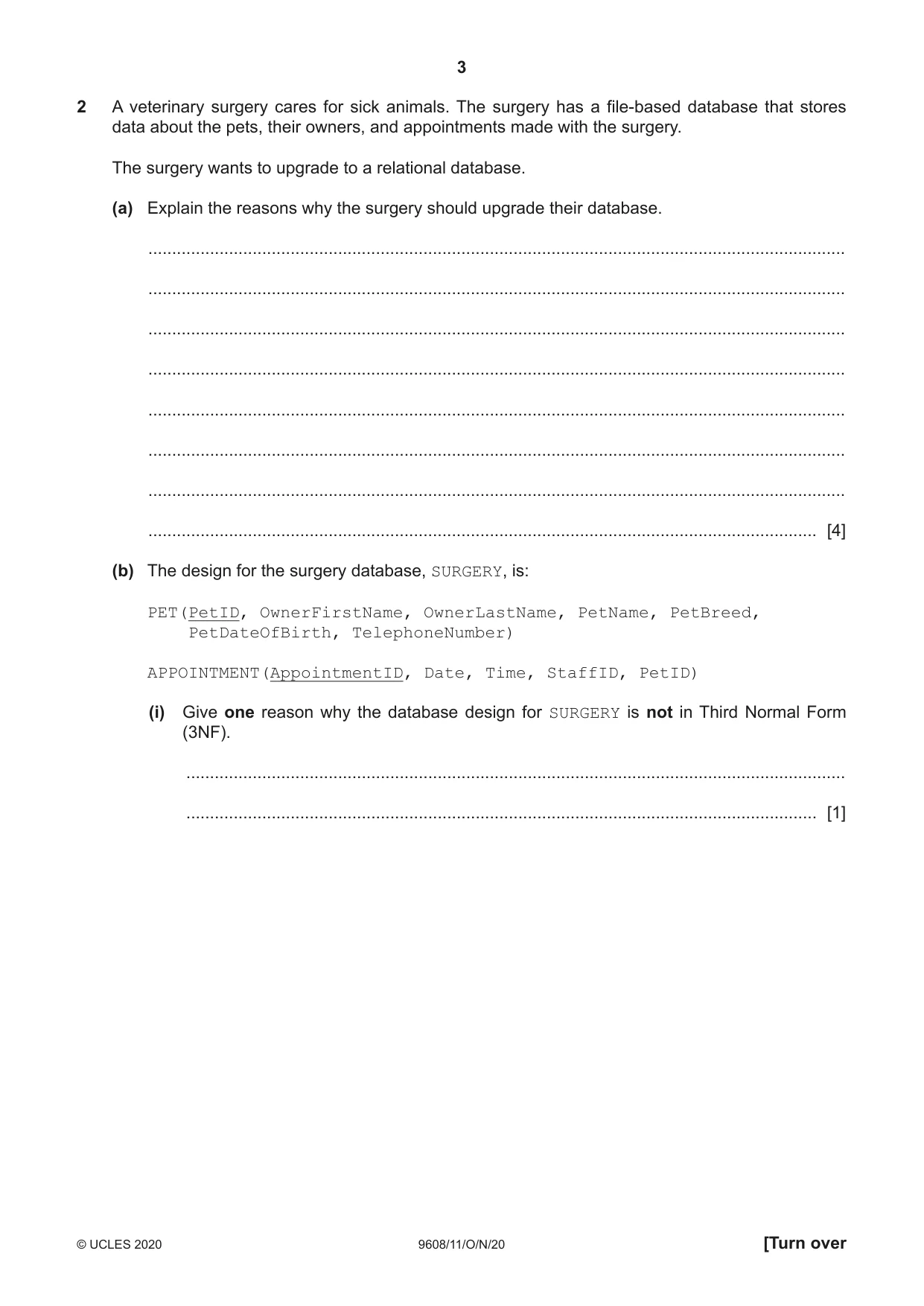
3 9608/11/O/N/20 © UCLES 2020 [Turn over 2 A veterinary surgery cares for sick animals. The surgery has a file-based database that stores data about the pets, their owners, and appointments made with the surgery. The surgery wants to upgrade to a relational database. (a) Explain the reasons why the surgery should upgrade their database. … … … … … … … … [4] (b) The design for the surgery database, SURGERY, is: PET(PetID, OwnerFirstName, OwnerLastName, PetName, PetBreed, PetDateOfBirth, TelephoneNumber) APPOINTMENT(AppointmentID, Date, Time, StaffID, PetID) (i) Give one reason why the database design for SURGERY is not in Third Normal Form (3NF). … … [1]
Question paper, page 4
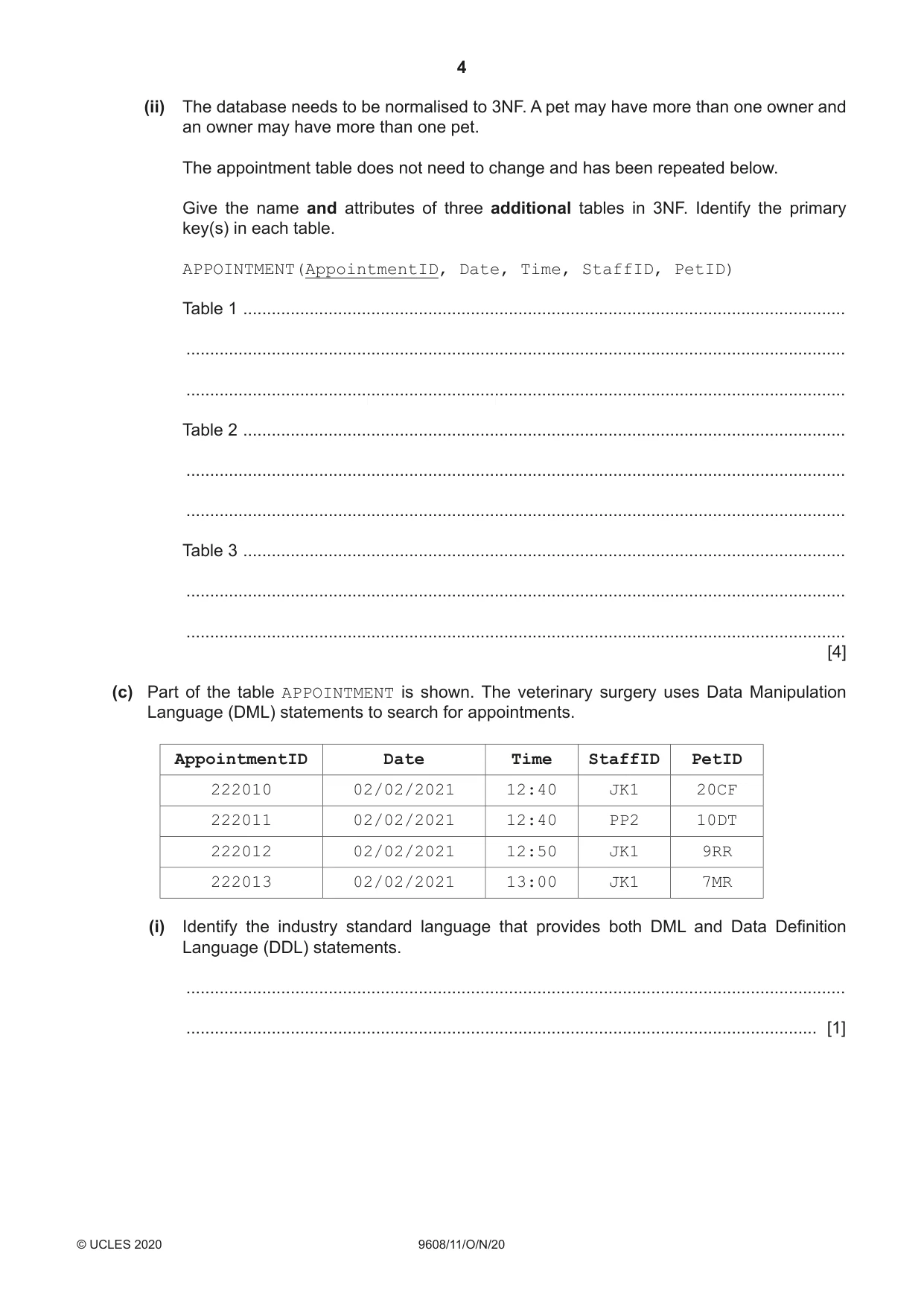
4 9608/11/O/N/20 © UCLES 2020 (ii) The database needs to be normalised to 3NF. A pet may have more than one owner and an owner may have more than one pet. The appointment table does not need to change and has been repeated below. Give the name and attributes of three additional tables in 3NF. Identify the primary key(s) in each table. APPOINTMENT(AppointmentID, Date, Time, StaffID, PetID) Table 1 … … … Table 2 … … … Table 3 … … … [4] (c) Part of the table APPOINTMENT is shown. The veterinary surgery uses Data Manipulation Language (DML) statements to search for appointments. AppointmentID Date Time StaffID PetID 222010 02/02/2021 12:40 JK1 20CF 222011 02/02/2021 12:40 PP2 10DT 222012 02/02/2021 12:50 JK1 9RR 222013 02/02/2021 13:00 JK1 7MR (i) Identify the industry standard language that provides both DML and Data Definition Language (DDL) statements. … … [1]
Question paper, page 5
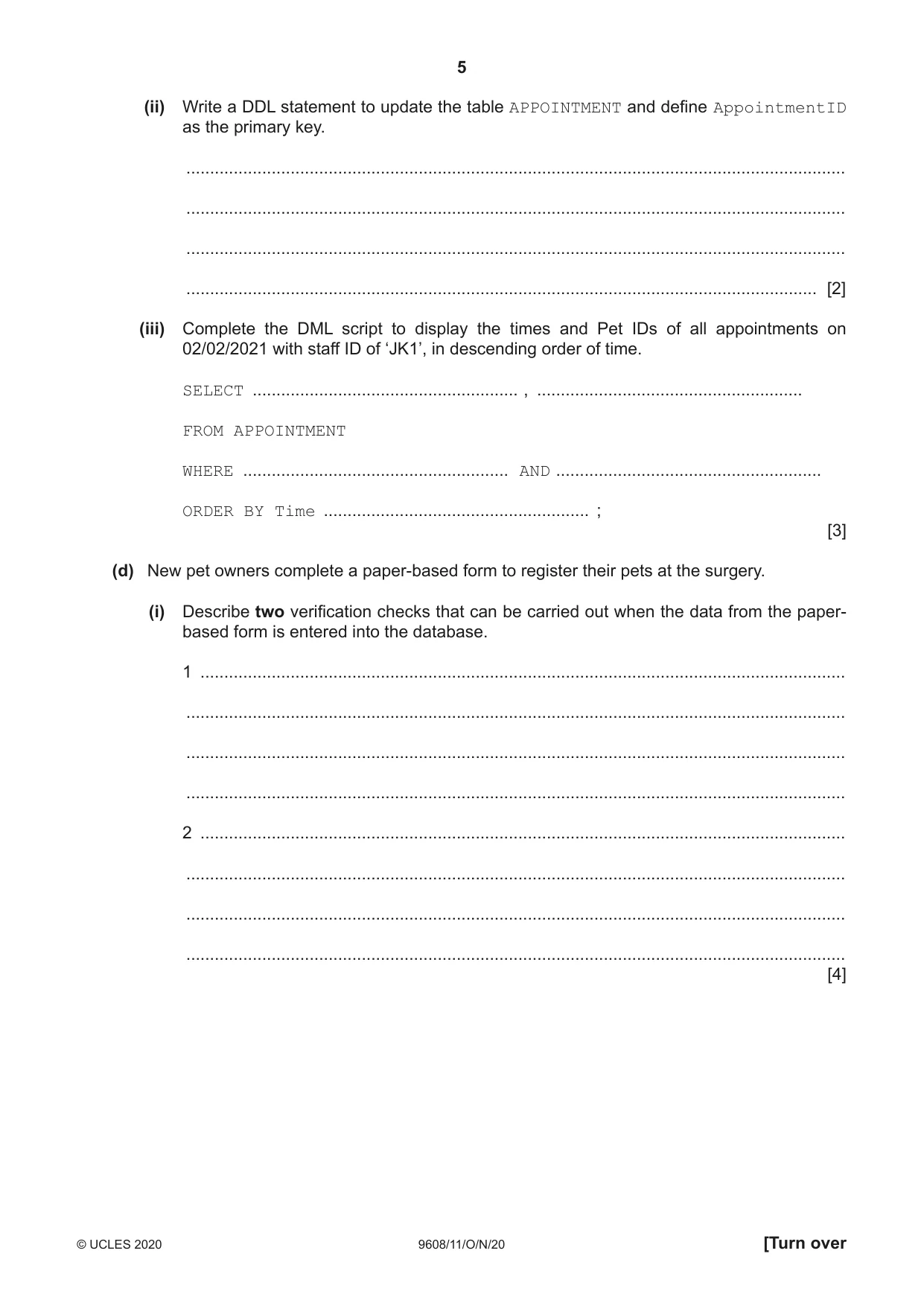
5 9608/11/O/N/20 © UCLES 2020 [Turn over (ii) Write a DDL statement to update the table APPOINTMENT and define AppointmentID as the primary key. … … … … [2] (iii) Complete the DML script to display the times and Pet IDs of all appointments on 02/02/2021 with staff ID of ‘JK1’, in descending order of time. SELECT … , … FROM APPOINTMENT WHERE … AND … ORDER BY Time … ; [3] (d) New pet owners complete a paper-based form to register their pets at the surgery. (i) Describe two verification checks that can be carried out when the data from the paper- based form is entered into the database. 1 … … … … 2 … … … … [4]
Question paper, page 6
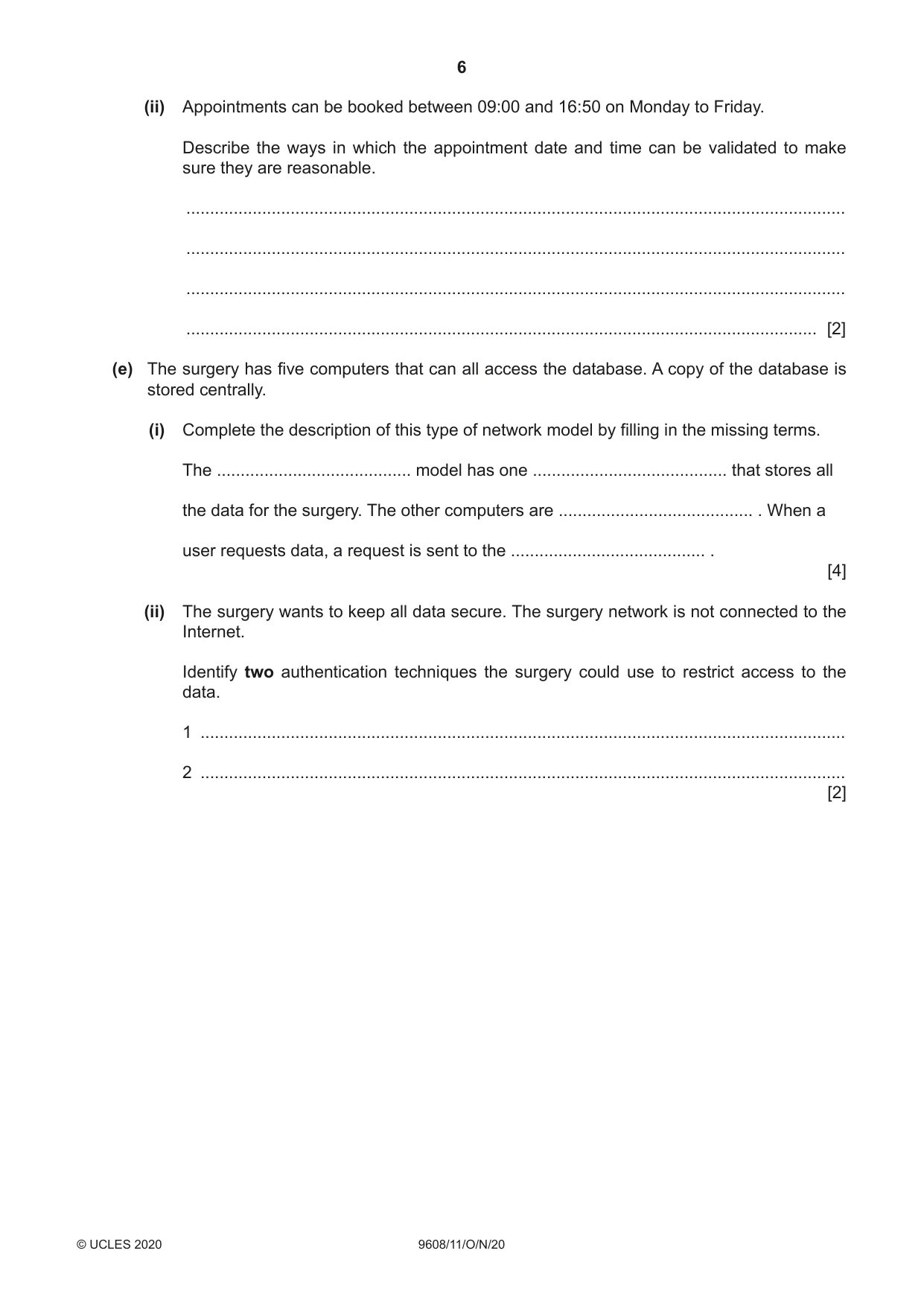
6 9608/11/O/N/20 © UCLES 2020 (ii) Appointments can be booked between 09:00 and 16:50 on Monday to Friday. Describe the ways in which the appointment date and time can be validated to make sure they are reasonable. … … … … [2] (e) The surgery has five computers that can all access the database. A copy of the database is stored centrally. (i) Complete the description of this type of network model by filling in the missing terms. The … model has one … that stores all the data for the surgery. The other computers are … . When a user requests data, a request is sent to the … . [4] (ii) The surgery wants to keep all data secure. The surgery network is not connected to the Internet. Identify two authentication techniques the surgery could use to restrict access to the data. 1 … 2 … [2]
Question paper, page 7
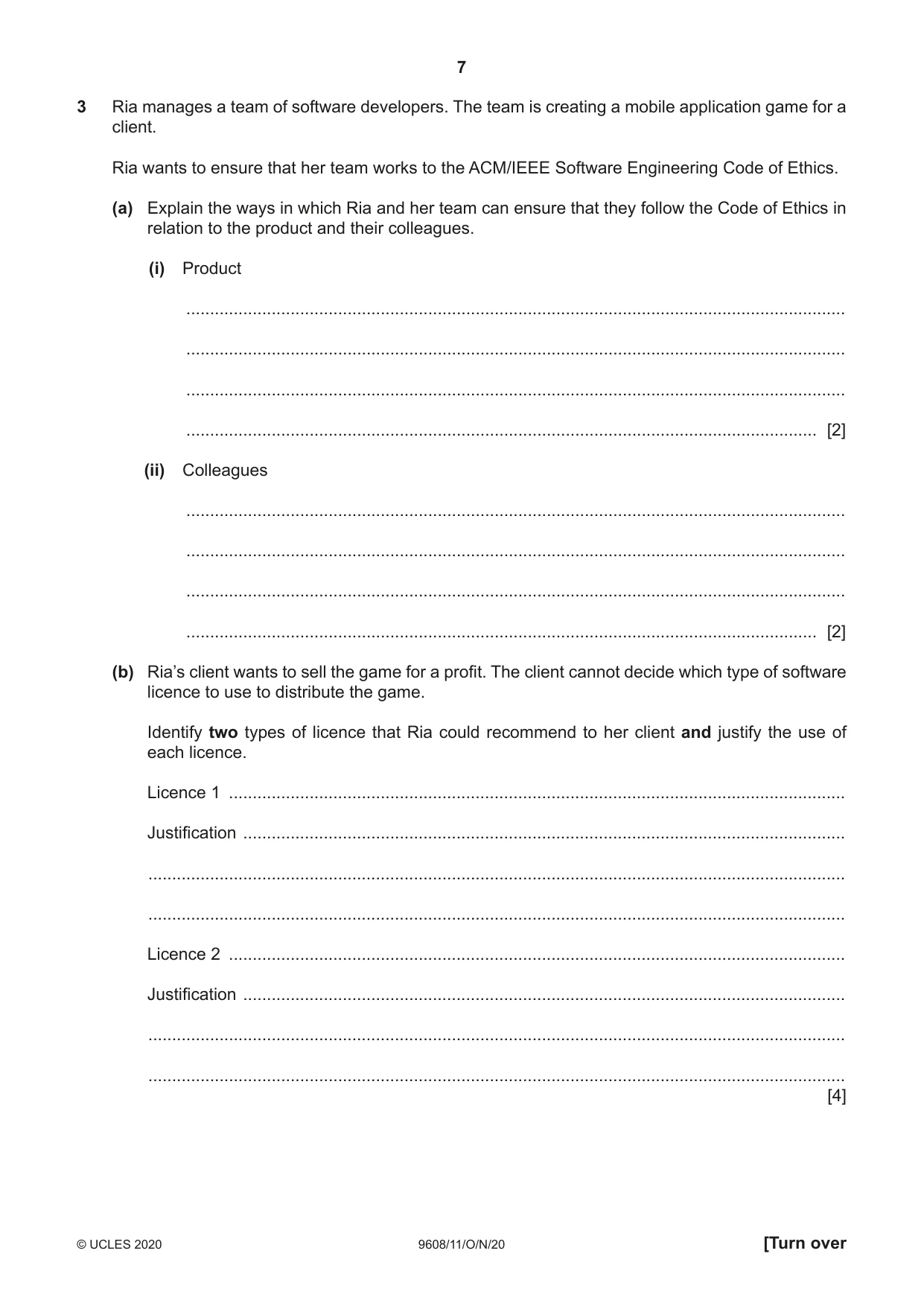
7 9608/11/O/N/20 © UCLES 2020 [Turn over 3 Ria manages a team of software developers. The team is creating a mobile application game for a client. Ria wants to ensure that her team works to the ACM/IEEE Software Engineering Code of Ethics. (a) Explain the ways in which Ria and her team can ensure that they follow the Code of Ethics in relation to the product and their colleagues. (i) Product … … … … [2] (ii) Colleagues … … … … [2] (b) Ria’s client wants to sell the game for a profit. The client cannot decide which type of software licence to use to distribute the game. Identify two types of licence that Ria could recommend to her client and justify the use of each licence. Licence 1 … Justification … … … Licence 2 … Justification … … … [4]
Question paper, page 8
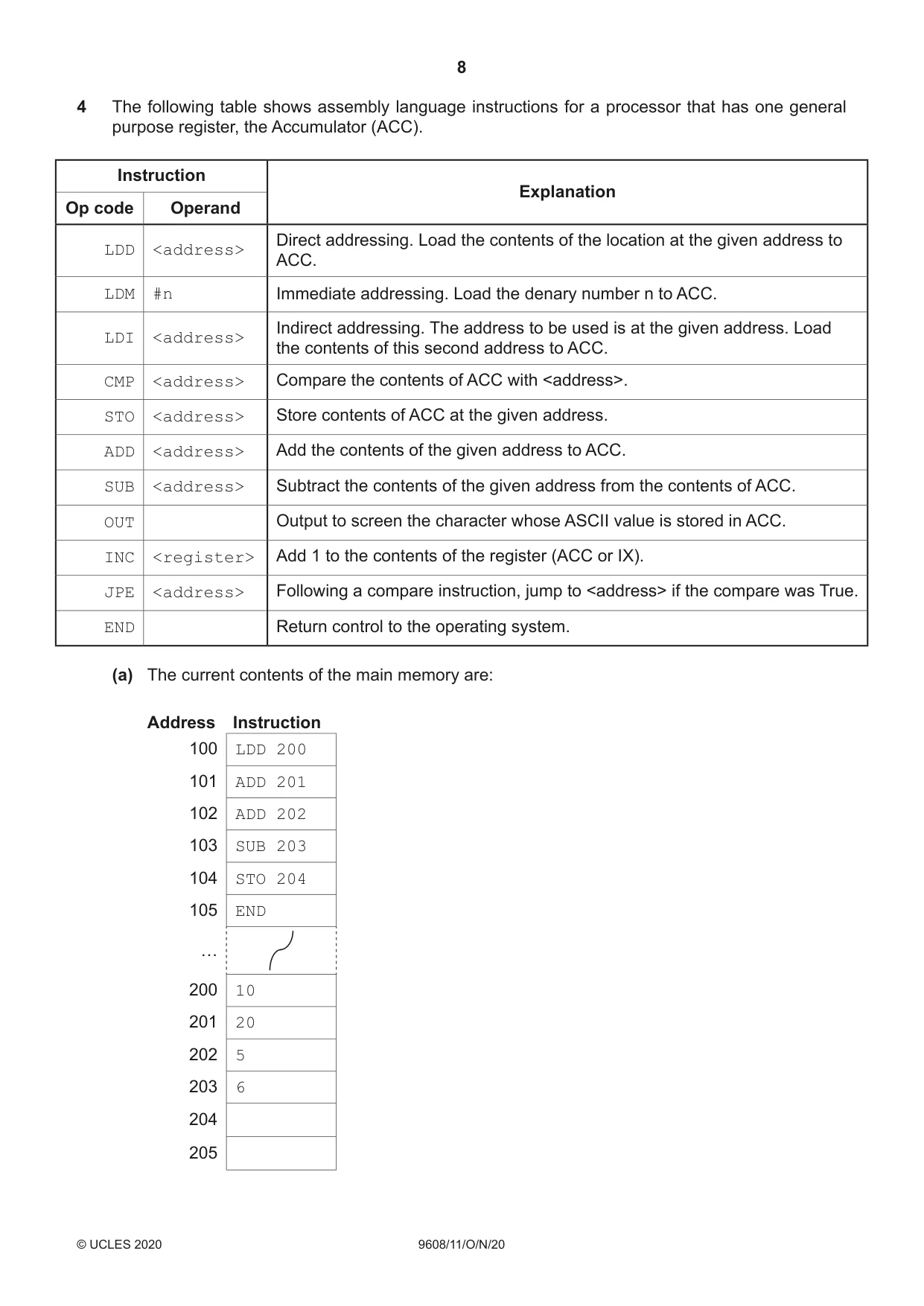
8 9608/11/O/N/20 © UCLES 2020 4 The following table shows assembly language instructions for a processor that has one general purpose register, the Accumulator (ACC). Instruction Explanation Op code Operand LDD <address> Direct addressing. Load the contents of the location at the given address to ACC. LDM #n Immediate addressing. Load the denary number n to ACC. LDI <address> Indirect addressing. The address to be used is at the given address. Load the contents of this second address to ACC. CMP <address> Compare the contents of ACC with <address>. STO <address> Store contents of ACC at the given address. ADD <address> Add the contents of the given address to ACC. SUB <address> Subtract the contents of the given address from the contents of ACC. OUT Output to screen the character whose ASCII value is stored in ACC. INC <register> Add 1 to the contents of the register (ACC or IX). JPE <address> Following a compare instruction, jump to <address> if the compare was True. END Return control to the operating system. (a) The current contents of the main memory are: Address Instruction 100 LDD 200 101 ADD 201 102 ADD 202 103 SUB 203 104 STO 204 105 END … 200 10 201 20 202 5 203 6 204 205
Question paper, page 9
9 9608/11/O/N/20 © UCLES 2020 [Turn over Tick (✓) one box to indicate which one of the following statements is true after program execution. Statements Tick (✓) Memory location 204 contains 400 Memory location 204 contains 41 Memory location 204 contains 231 Memory location 204 contains 29 [1] (b) The current contents of the main memory are: Address Instruction 100 LDM #120 101 ADD 121 102 SUB 122 103 STO 120 104 END … 120 10 121 2 122 4 123 6 124 8 125 10 Tick (✓) one box to indicate which one of the following statements is true after program execution. Statement Tick (✓) Memory location 120 contains 135 Memory location 120 contains 118 Memory location 120 contains 0 Memory location 120 contains 16 [1]
Question paper, page 10
10 9608/11/O/N/20 © UCLES 2020 (c) The current contents of the main memory are: Address Instruction 150 LDI 200 151 ADD 200 152 ADD 201 153 STO 205 154 END … 200 202 201 203 202 201 203 200 204 205 Tick (✓) one box to indicate which one of the following statements is true after program execution. Statement Tick (✓) Memory location 205 contains 607 Memory location 205 contains 601 Memory location 205 contains 603 Memory location 205 contains 606 [1] (d) Identify two modes of addressing that are not used in parts (a), (b) or (c). 1 … 2 … [2]
Question paper, page 11
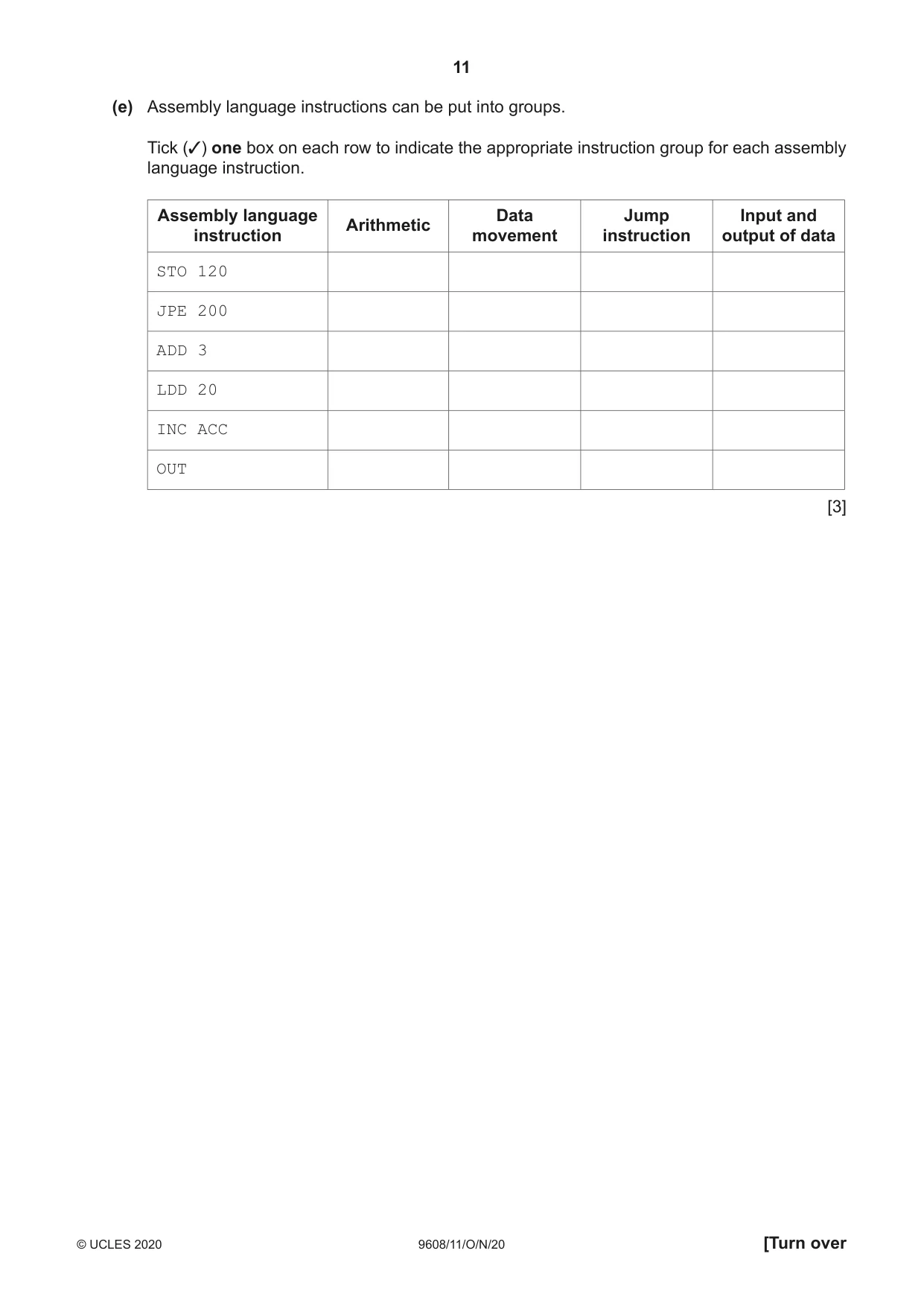
11 9608/11/O/N/20 © UCLES 2020 [Turn over (e) Assembly language instructions can be put into groups. Tick (✓) one box on each row to indicate the appropriate instruction group for each assembly language instruction. Assembly language instruction Arithmetic Data movement Jump instruction Input and output of data STO 120 JPE 200 ADD 3 LDD 20 INC ACC OUT [3]
Question paper, page 12
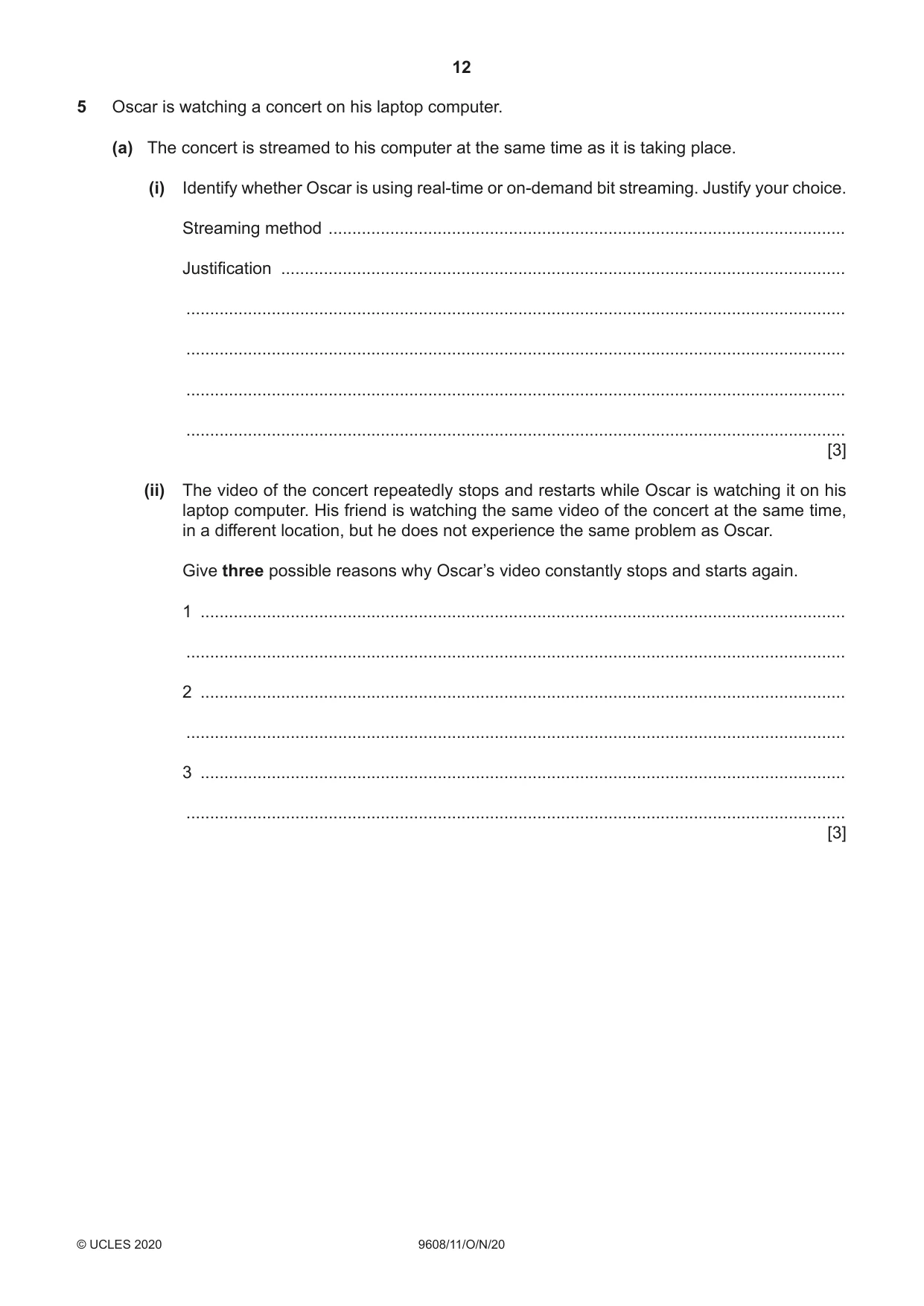
12 9608/11/O/N/20 © UCLES 2020 5 Oscar is watching a concert on his laptop computer. (a) The concert is streamed to his computer at the same time as it is taking place. (i) Identify whether Oscar is using real-time or on-demand bit streaming. Justify your choice. Streaming method … Justification … … … … … [3] (ii) The video of the concert repeatedly stops and restarts while Oscar is watching it on his laptop computer. His friend is watching the same video of the concert at the same time, in a different location, but he does not experience the same problem as Oscar. Give three possible reasons why Oscar’s video constantly stops and starts again. 1 … … 2 … … 3 … … [3]
Question paper, page 13
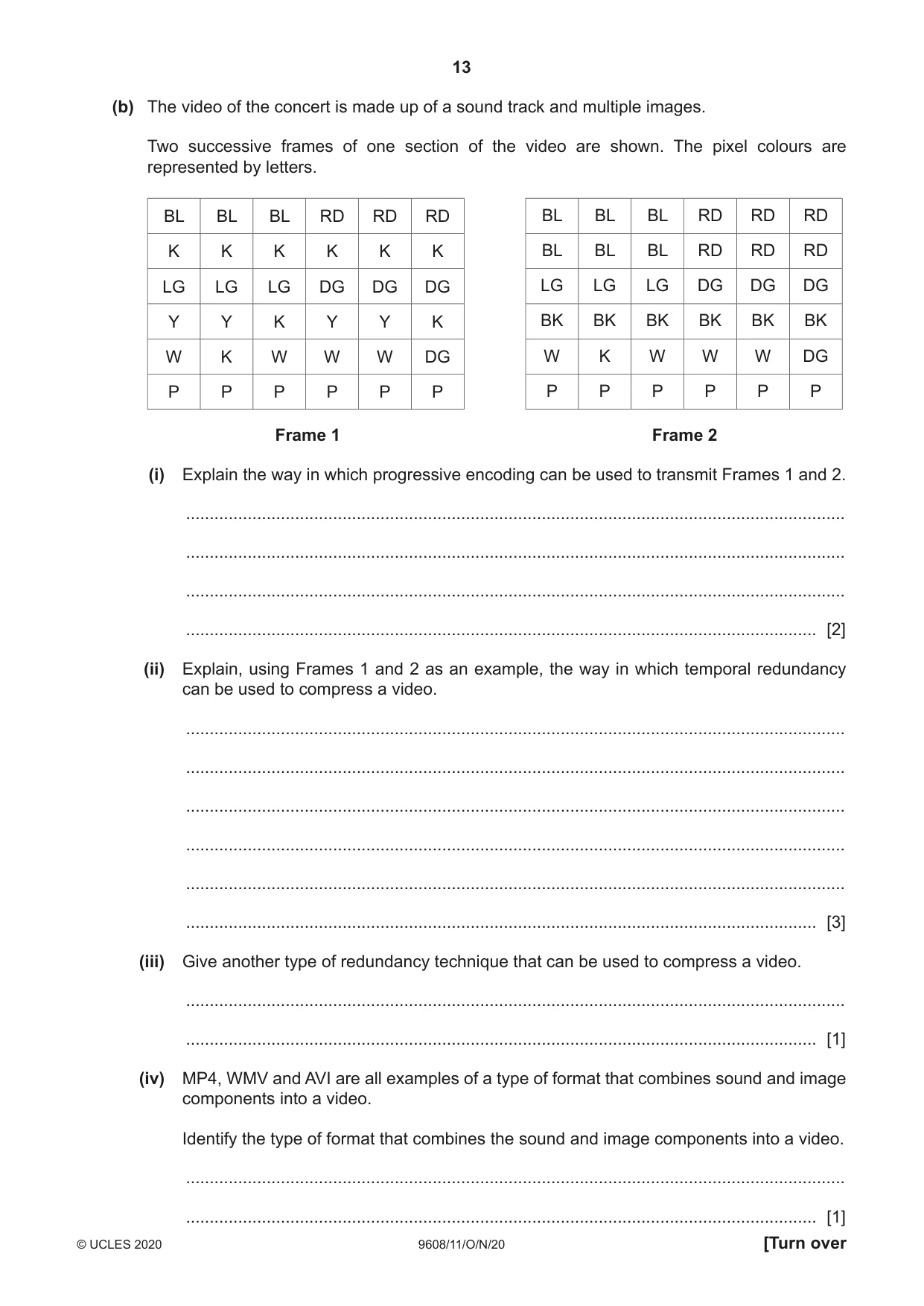
13 9608/11/O/N/20 © UCLES 2020 [Turn over (b) The video of the concert is made up of a sound track and multiple images. Two successive frames of one section of the video are shown. The pixel colours are represented by letters. BL BL BL RD RD RD BL BL BL RD RD RD K K K K K K BL BL BL RD RD RD LG LG LG DG DG DG LG LG LG DG DG DG Y Y K Y Y K BK BK BK BK BK BK W K W W W DG W K W W W DG P P P P P P P P P P P P Frame 1 Frame 2 (i) Explain the way in which progressive encoding can be used to transmit Frames 1 and 2. … … … … [2] (ii) Explain, using Frames 1 and 2 as an example, the way in which temporal redundancy can be used to compress a video. … … … … … … [3] (iii) Give another type of redundancy technique that can be used to compress a video. … … [1] (iv) MP4, WMV and AVI are all examples of a type of format that combines sound and image components into a video. Identify the type of format that combines the sound and image components into a video. … … [1]
Question paper, page 14
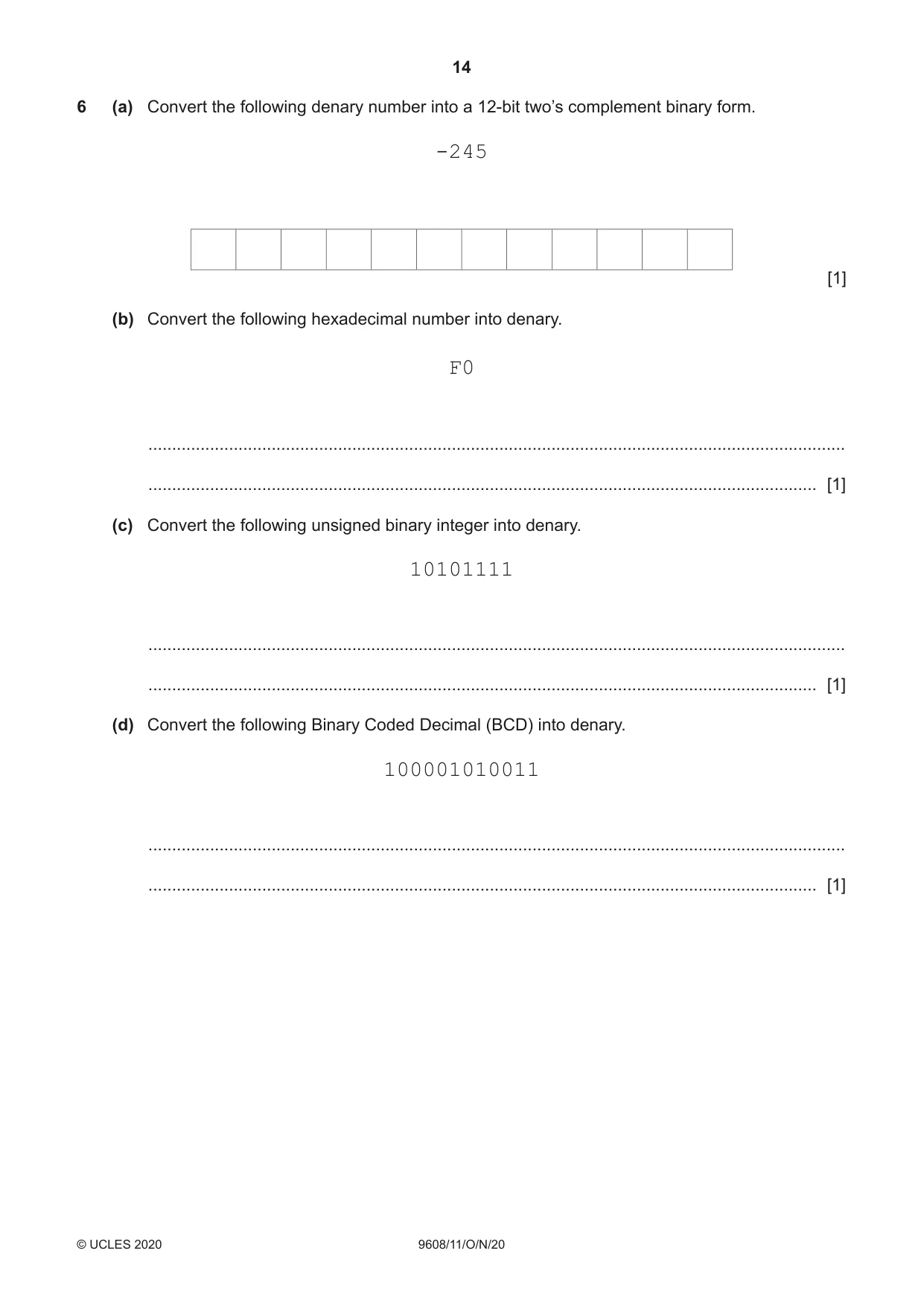
14 9608/11/O/N/20 © UCLES 2020 6 (a) Convert the following denary number into a 12-bit two’s complement binary form. -245 [1] (b) Convert the following hexadecimal number into denary. F0 … … [1] (c) Convert the following unsigned binary integer into denary. 10101111 … … [1] (d) Convert the following Binary Coded Decimal (BCD) into denary. 100001010011 … … [1]
Question paper, page 15
15 9608/11/O/N/20 © UCLES 2020 [Turn over 7 Anne is downloading a sound file from a web server. She had the choice of a sampling rate of 44.1 kHz or 98 kHz before she downloaded the sound file. Explain the differences between the two sound files stored on the server. … … … … … … … … [4]
Question paper, page 16
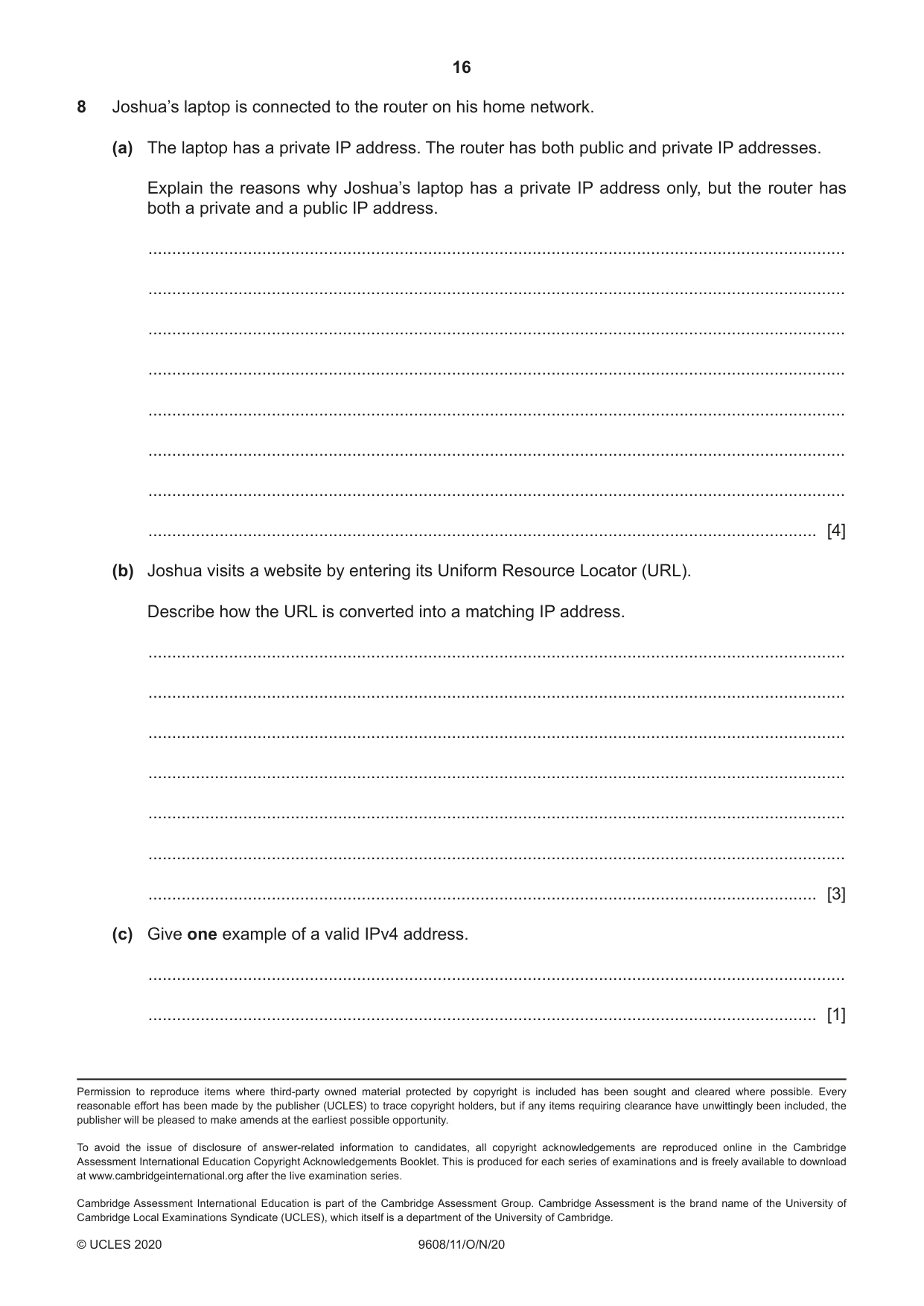
16 9608/11/O/N/20 © UCLES 2020 Permission to reproduce items where third-party owned material protected by copyright is included has been sought and cleared where possible. Every reasonable effort has been made by the publisher (UCLES) to trace copyright holders, but if any items requiring clearance have unwittingly been included, the publisher will be pleased to make amends at the earliest possible opportunity. To avoid the issue of disclosure of answer-related information to candidates, all copyright acknowledgements are reproduced online in the Cambridge Assessment International Education Copyright Acknowledgements Booklet. This is produced for each series of examinations and is freely available to download at www.cambridgeinternational.org after the live examination series. Cambridge Assessment International Education is part of the Cambridge Assessment Group. Cambridge Assessment is the brand name of the University of Cambridge Local Examinations Syndicate (UCLES), which itself is a department of the University of Cambridge. 8 Joshua’s laptop is connected to the router on his home network. (a) The laptop has a private IP address. The router has both public and private IP addresses. Explain the reasons why Joshua’s laptop has a private IP address only, but the router has both a private and a public IP address. … … … … … … … … [4] (b) Joshua visits a website by entering its Uniform Resource Locator (URL). Describe how the URL is converted into a matching IP address. … … … … … … … [3] (c) Give one example of a valid IPv4 address. … … [1]
Mark scheme, page 1
This document consists of 10 printed pages. © UCLES 2020 [Turn over Cambridge International AS & A Level COMPUTER SCIENCE 9608/11 Paper 1 Written Paper October/November 2020 MARK SCHEME Maximum Mark: 75 Published This mark scheme is published as an aid to teachers and candidates, to indicate the requirements of the examination. It shows the basis on which Examiners were instructed to award marks. It does not indicate the details of the discussions that took place at an Examiners’ meeting before marking began, which would have considered the acceptability of alternative answers. Mark schemes should be read in conjunction with the question paper and the Principal Examiner Report for Teachers. Cambridge International will not enter into discussions about these mark schemes. Cambridge International is publishing the mark schemes for the October/November 2020 series for most Cambridge IGCSE™, Cambridge International A and AS Level and Cambridge Pre-U components, and some Cambridge O Level components.
Mark scheme, page 2
9608/11 Cambridge International AS & A Level – Mark Scheme PUBLISHED October/November 2020 © UCLES 2020 Page 2 of 10 Generic Marking Principles These general marking principles must be applied by all examiners when marking candidate answers. They should be applied alongside the specific content of the mark scheme or generic level descriptors for a question. Each question paper and mark scheme will also comply with these marking principles. GENERIC MARKING PRINCIPLE 1: Marks must be awarded in line with: • the specific content of the mark scheme or the generic level descriptors for the question • the specific skills defined in the mark scheme or in the generic level descriptors for the question • the standard of response required by a candidate as exemplified by the standardisation scripts. GENERIC MARKING PRINCIPLE 2: Marks awarded are always whole marks (not half marks, or other fractions). GENERIC MARKING PRINCIPLE 3: Marks must be awarded positively: • marks are awarded for correct/valid answers, as defined in the mark scheme. However, credit is given for valid answers which go beyond the scope of the syllabus and mark scheme, referring to your Team Leader as appropriate • marks are awarded when candidates clearly demonstrate what they know and can do • marks are not deducted for errors • marks are not deducted for omissions • answers should only be judged on the quality of spelling, punctuation and grammar when these features are specifically assessed by the question as indicated by the mark scheme. The meaning, however, should be unambiguous. GENERIC MARKING PRINCIPLE 4: Rules must be applied consistently, e.g. in situations where candidates have not followed instructions or in the application of generic level descriptors. GENERIC MARKING PRINCIPLE 5: Marks should be awarded using the full range of marks defined in the mark scheme for the question (however; the use of the full mark range may be limited according to the quality of the candidate responses seen). GENERIC MARKING PRINCIPLE 6: Marks awarded are based solely on the requirements as defined in the mark scheme. Marks should not be awarded with grade thresholds or grade descriptors in mind.
Mark scheme, page 3
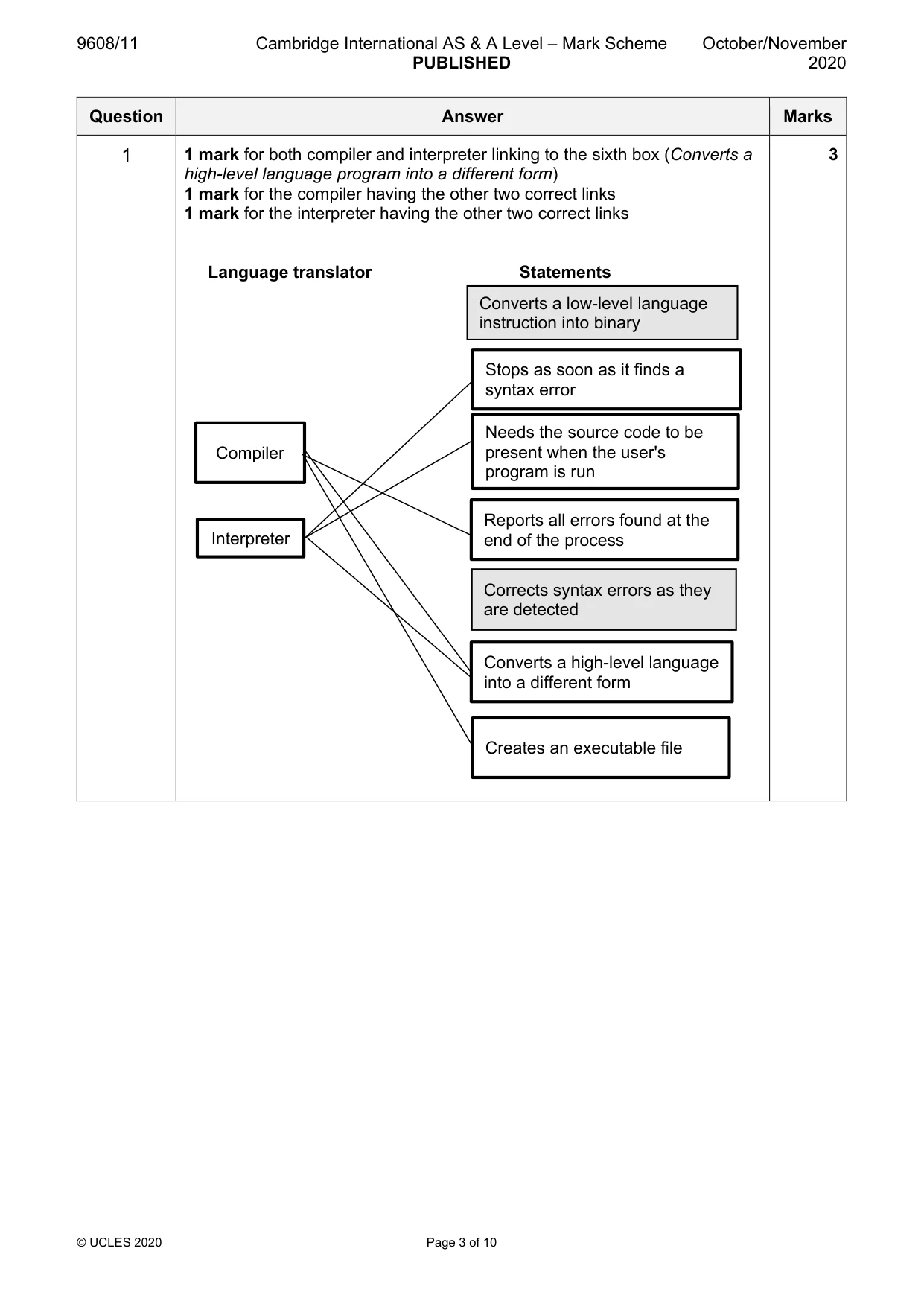
9608/11 Cambridge International AS & A Level – Mark Scheme PUBLISHED October/November 2020 © UCLES 2020 Page 3 of 10 Question Answer Marks 1 1 mark for both compiler and interpreter linking to the sixth box (Converts a high-level language program into a different form) 1 mark for the compiler having the other two correct links 1 mark for the interpreter having the other two correct links Language translator Statements 3 Converts a low-level language instruction into binary Stops as soon as it finds a syntax error Needs the source code to be present when the user's program is run Compiler Reports all errors found at the end of the process Interpreter Corrects syntax errors as they are detected Converts a high-level language into a different form Creates an executable file
Mark scheme, page 4
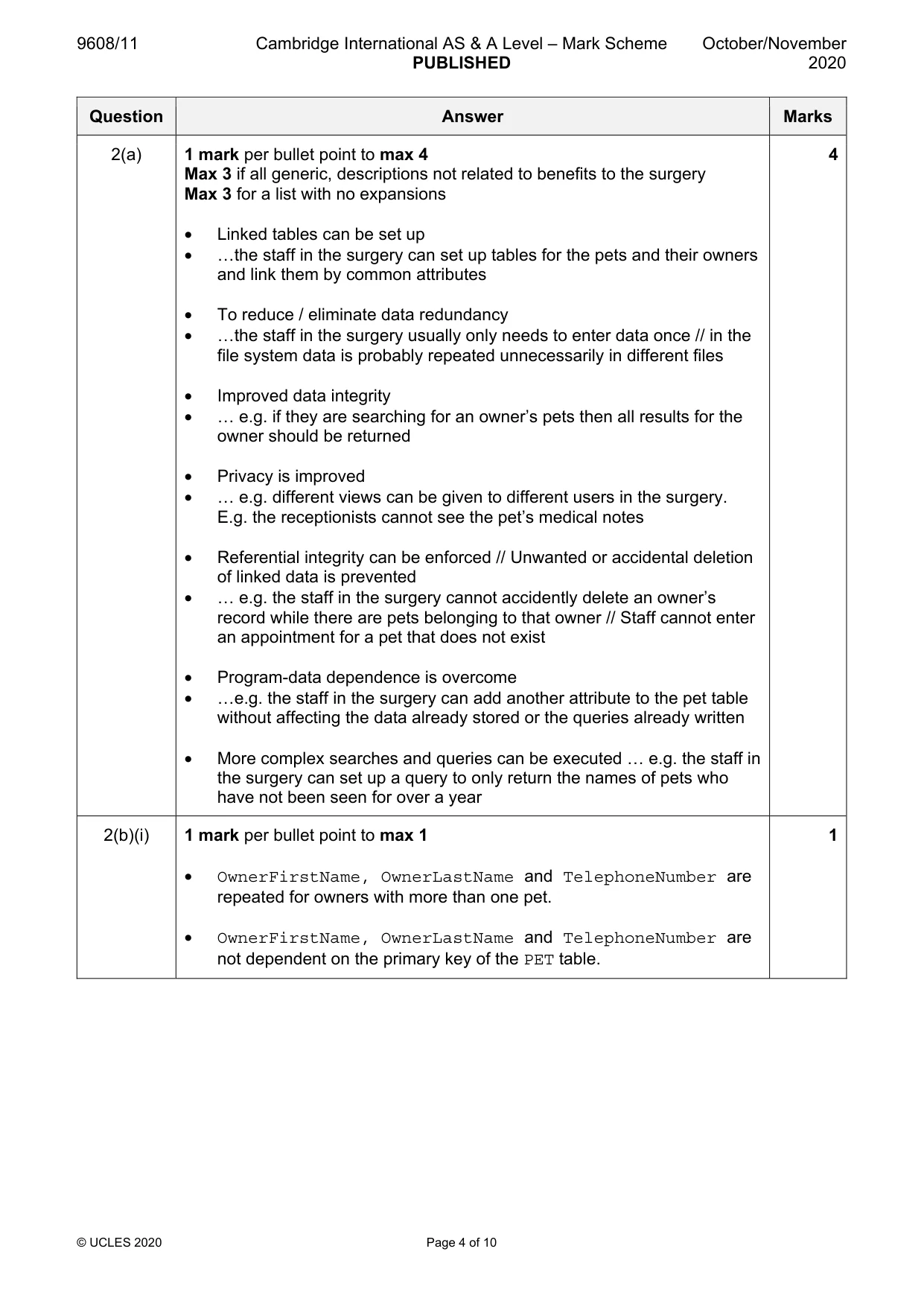
9608/11 Cambridge International AS & A Level – Mark Scheme PUBLISHED October/November 2020 © UCLES 2020 Page 4 of 10 Question Answer Marks 2(a) 1 mark per bullet point to max 4 Max 3 if all generic, descriptions not related to benefits to the surgery Max 3 for a list with no expansions • Linked tables can be set up • …the staff in the surgery can set up tables for the pets and their owners and link them by common attributes • To reduce / eliminate data redundancy • …the staff in the surgery usually only needs to enter data once // in the file system data is probably repeated unnecessarily in different files • Improved data integrity • … e.g. if they are searching for an owner’s pets then all results for the owner should be returned • Privacy is improved • … e.g. different views can be given to different users in the surgery. E.g. the receptionists cannot see the pet’s medical notes • Referential integrity can be enforced // Unwanted or accidental deletion of linked data is prevented • … e.g. the staff in the surgery cannot accidently delete an owner’s record while there are pets belonging to that owner // Staff cannot enter an appointment for a pet that does not exist • Program-data dependence is overcome • …e.g. the staff in the surgery can add another attribute to the pet table without affecting the data already stored or the queries already written • More complex searches and queries can be executed … e.g. the staff in the surgery can set up a query to only return the names of pets who have not been seen for over a year 4 2(b)(i) 1 mark per bullet point to max 1 • OwnerFirstName, OwnerLastName and TelephoneNumber are repeated for owners with more than one pet. • OwnerFirstName, OwnerLastName and TelephoneNumber are not dependent on the primary key of the PET table. 1
Mark scheme, page 5
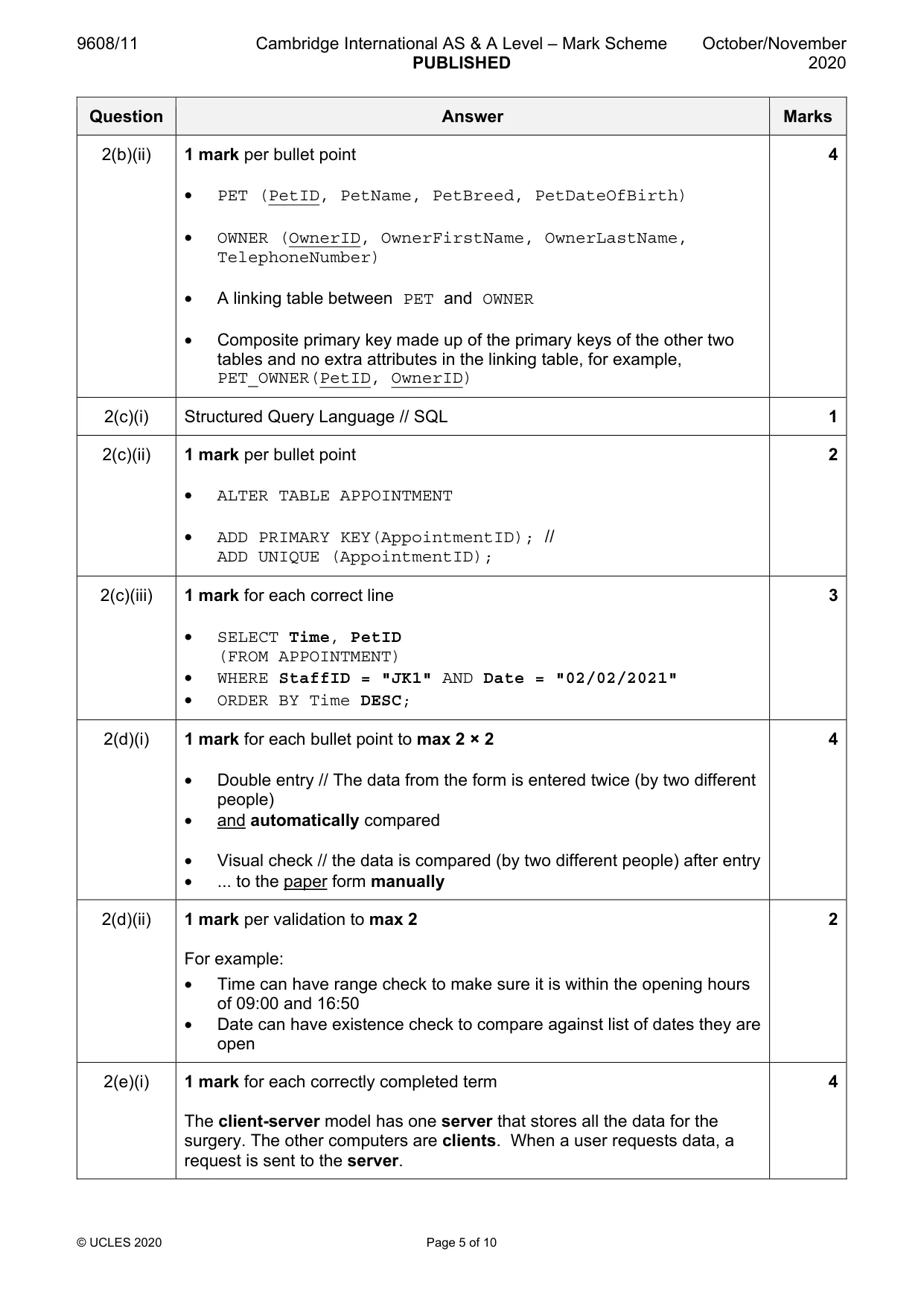
9608/11 Cambridge International AS & A Level – Mark Scheme PUBLISHED October/November 2020 © UCLES 2020 Page 5 of 10 Question Answer Marks 2(b)(ii) 1 mark per bullet point • PET (PetID, PetName, PetBreed, PetDateOfBirth) • OWNER (OwnerID, OwnerFirstName, OwnerLastName, TelephoneNumber) • A linking table between PET and OWNER • Composite primary key made up of the primary keys of the other two tables and no extra attributes in the linking table, for example, PET_OWNER(PetID, OwnerID) 4 2(c)(i) Structured Query Language // SQL 1 2(c)(ii) 1 mark per bullet point • ALTER TABLE APPOINTMENT • ADD PRIMARY KEY(AppointmentID); // ADD UNIQUE (AppointmentID); 2 2(c)(iii) 1 mark for each correct line • SELECT Time, PetID (FROM APPOINTMENT) • WHERE StaffID = "JK1" AND Date = "02/02/2021" • ORDER BY Time DESC; 3 2(d)(i) 1 mark for each bullet point to max 2 × 2 • Double entry // The data from the form is entered twice (by two different people) • and automatically compared • Visual check // the data is compared (by two different people) after entry • ... to the paper form manually 4 2(d)(ii) 1 mark per validation to max 2 For example: • Time can have range check to make sure it is within the opening hours of 09:00 and 16:50 • Date can have existence check to compare against list of dates they are open 2 2(e)(i) 1 mark for each correctly completed term The client-server model has one server that stores all the data for the surgery. The other computers are clients. When a user requests data, a request is sent to the server. 4
Mark scheme, page 6
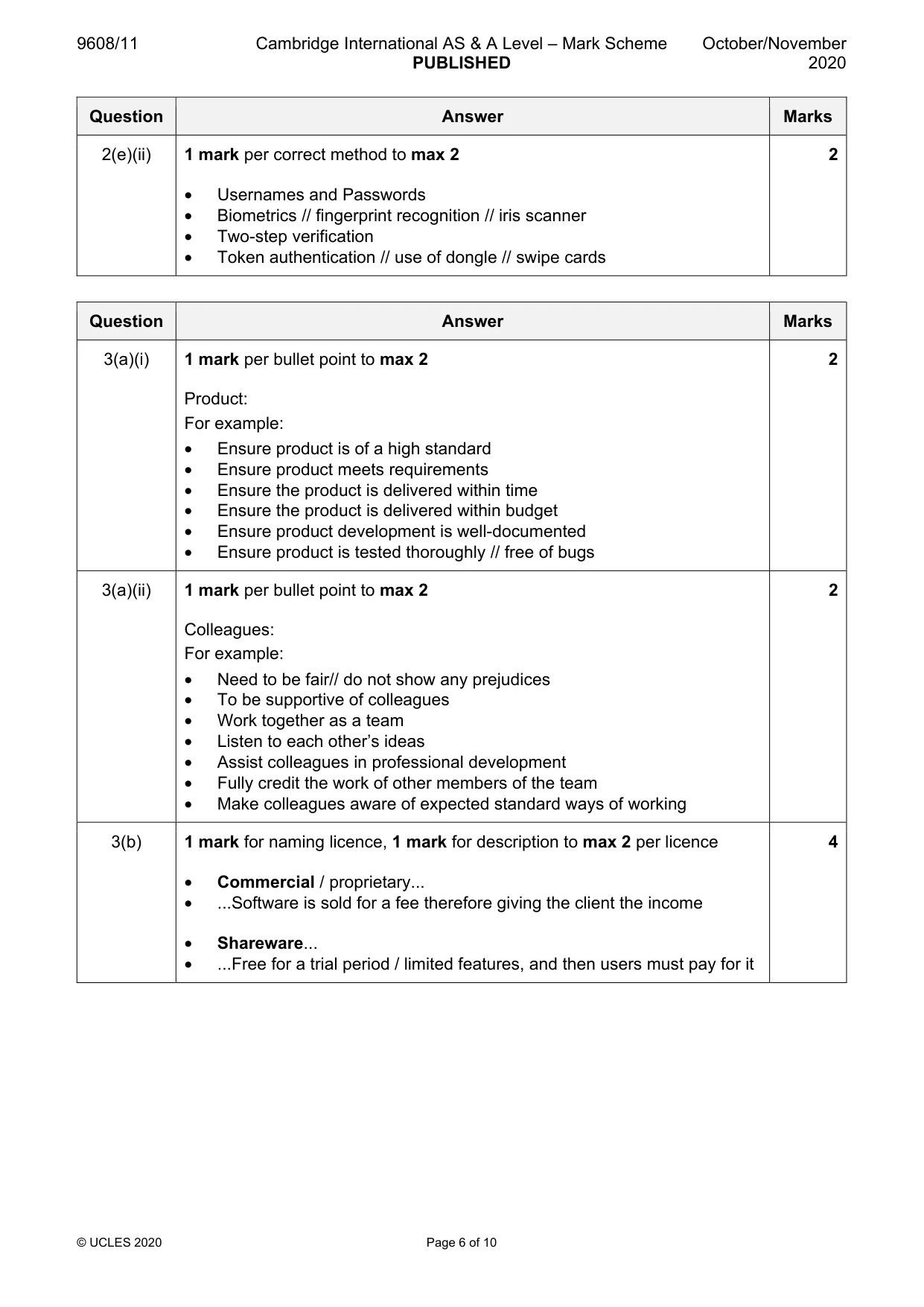
9608/11 Cambridge International AS & A Level – Mark Scheme PUBLISHED October/November 2020 © UCLES 2020 Page 6 of 10 Question Answer Marks 2(e)(ii) 1 mark per correct method to max 2 • Usernames and Passwords • Biometrics // fingerprint recognition // iris scanner • Two-step verification • Token authentication // use of dongle // swipe cards 2 Question Answer Marks 3(a)(i) 1 mark per bullet point to max 2 Product: For example: • Ensure product is of a high standard • Ensure product meets requirements • Ensure the product is delivered within time • Ensure the product is delivered within budget • Ensure product development is well-documented • Ensure product is tested thoroughly // free of bugs 2 3(a)(ii) 1 mark per bullet point to max 2 Colleagues: For example: • Need to be fair// do not show any prejudices • To be supportive of colleagues • Work together as a team • Listen to each other’s ideas • Assist colleagues in professional development • Fully credit the work of other members of the team • Make colleagues aware of expected standard ways of working 2 3(b) 1 mark for naming licence, 1 mark for description to max 2 per licence • Commercial / proprietary... • ...Software is sold for a fee therefore giving the client the income • Shareware... • ...Free for a trial period / limited features, and then users must pay for it 4
Mark scheme, page 7
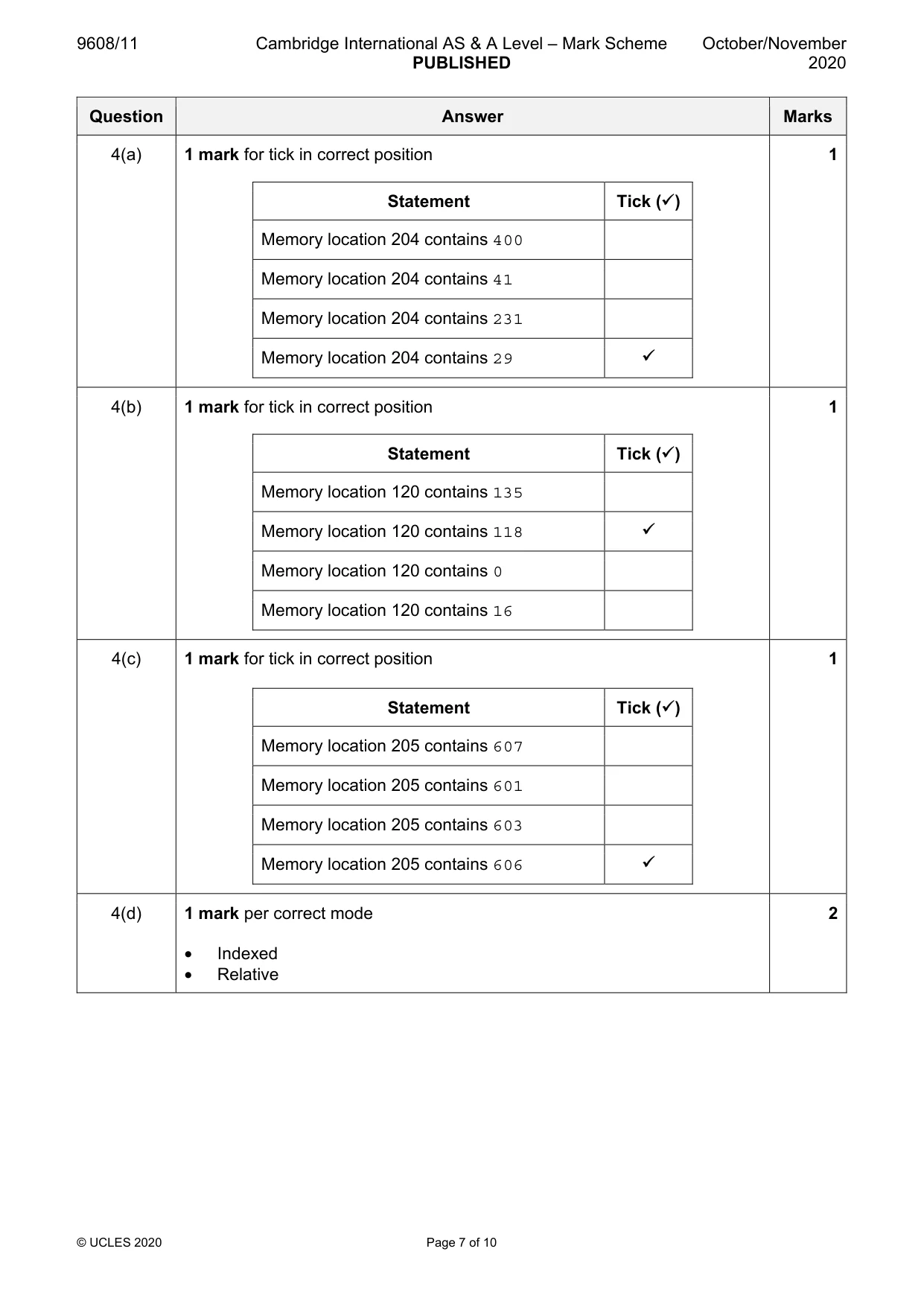
9608/11 Cambridge International AS & A Level – Mark Scheme PUBLISHED October/November 2020 © UCLES 2020 Page 7 of 10 Question Answer Marks 4(a) 1 mark for tick in correct position Statement Tick () Memory location 204 contains 400 Memory location 204 contains 41 Memory location 204 contains 231 Memory location 204 contains 29 1 4(b) 1 mark for tick in correct position Statement Tick () Memory location 120 contains 135 Memory location 120 contains 118 Memory location 120 contains 0 Memory location 120 contains 16 1 4(c) 1 mark for tick in correct position Statement Tick () Memory location 205 contains 607 Memory location 205 contains 601 Memory location 205 contains 603 Memory location 205 contains 606 1 4(d) 1 mark per correct mode • Indexed • Relative 2
Mark scheme, page 8
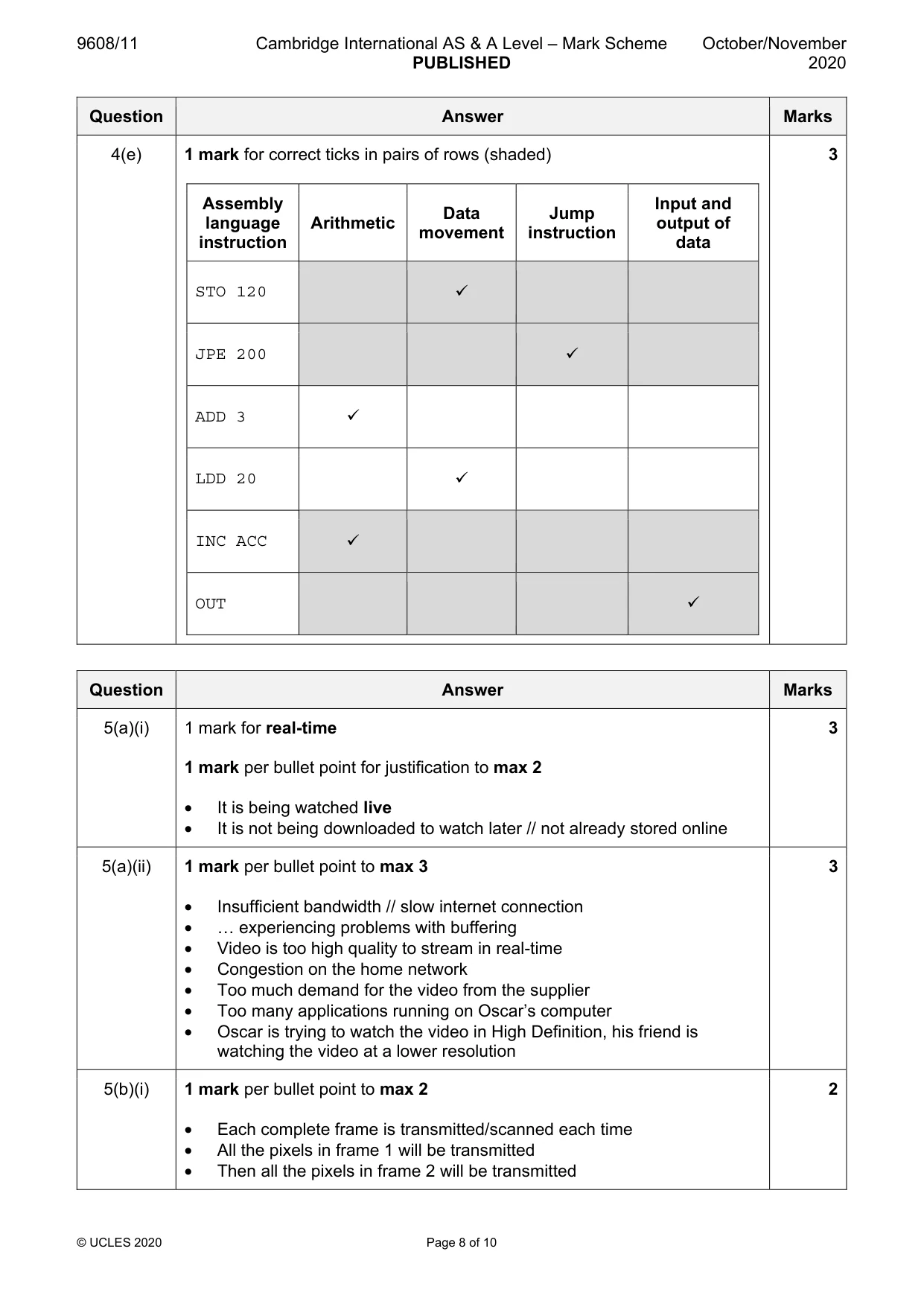
9608/11 Cambridge International AS & A Level – Mark Scheme PUBLISHED October/November 2020 © UCLES 2020 Page 8 of 10 Question Answer Marks 4(e) 1 mark for correct ticks in pairs of rows (shaded) Assembly language instruction Arithmetic Data movement Jump instruction Input and output of data STO 120 JPE 200 ADD 3 LDD 20 INC ACC OUT 3 Question Answer Marks 5(a)(i) 1 mark for real-time 1 mark per bullet point for justification to max 2 • It is being watched live • It is not being downloaded to watch later // not already stored online 3 5(a)(ii) 1 mark per bullet point to max 3 • Insufficient bandwidth // slow internet connection • … experiencing problems with buffering • Video is too high quality to stream in real-time • Congestion on the home network • Too much demand for the video from the supplier • Too many applications running on Oscar’s computer • Oscar is trying to watch the video in High Definition, his friend is watching the video at a lower resolution 3 5(b)(i) 1 mark per bullet point to max 2 • Each complete frame is transmitted/scanned each time • All the pixels in frame 1 will be transmitted • Then all the pixels in frame 2 will be transmitted 2
Mark scheme, page 9
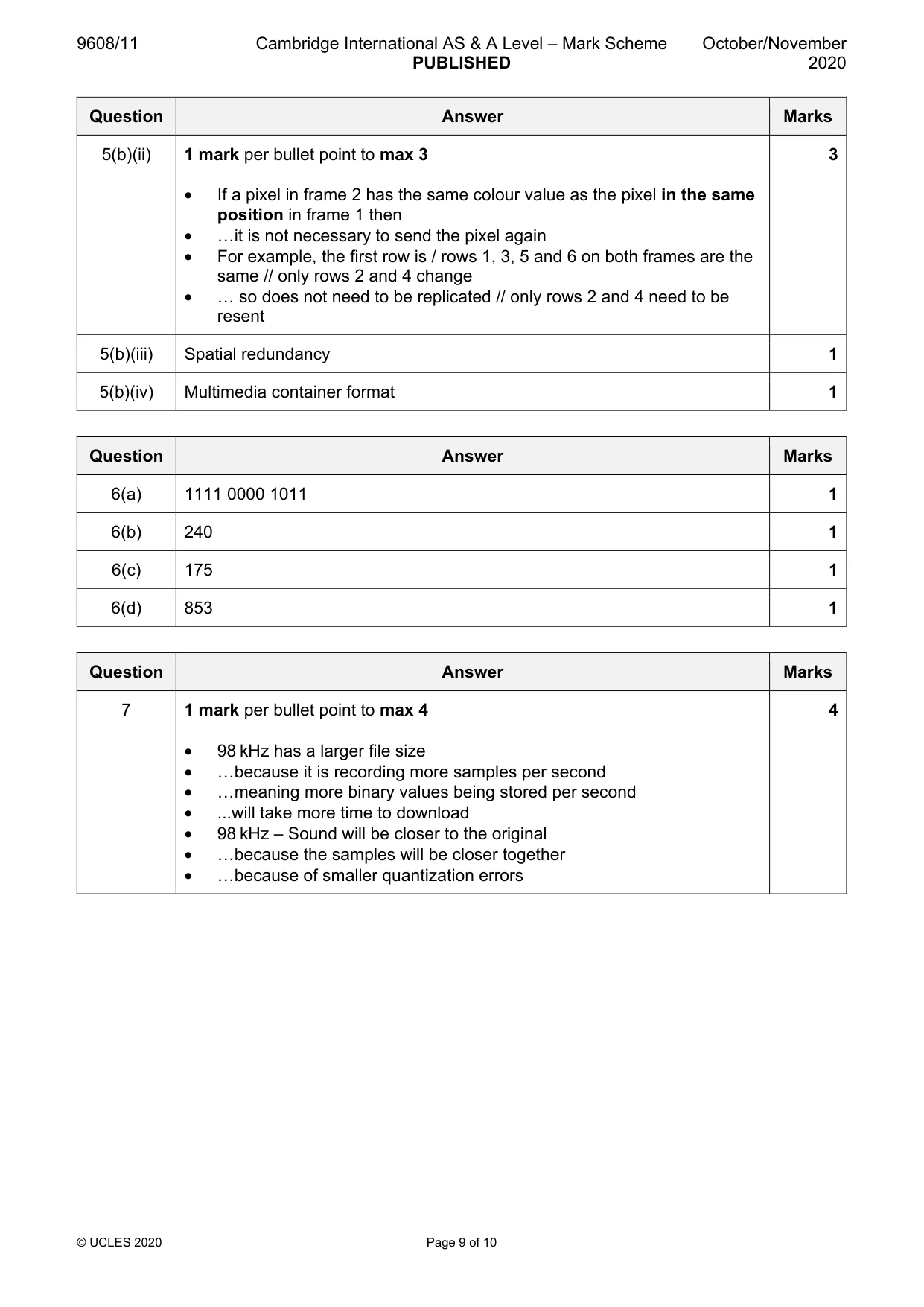
9608/11 Cambridge International AS & A Level – Mark Scheme PUBLISHED October/November 2020 © UCLES 2020 Page 9 of 10 Question Answer Marks 5(b)(ii) 1 mark per bullet point to max 3 • If a pixel in frame 2 has the same colour value as the pixel in the same position in frame 1 then • …it is not necessary to send the pixel again • For example, the first row is / rows 1, 3, 5 and 6 on both frames are the same // only rows 2 and 4 change • … so does not need to be replicated // only rows 2 and 4 need to be resent 3 5(b)(iii) Spatial redundancy 1 5(b)(iv) Multimedia container format 1 Question Answer Marks 6(a) 1111 0000 1011 1 6(b) 240 1 6(c) 175 1 6(d) 853 1 Question Answer Marks 7 1 mark per bullet point to max 4 • 98 kHz has a larger file size • …because it is recording more samples per second • …meaning more binary values being stored per second • ...will take more time to download • 98 kHz – Sound will be closer to the original • …because the samples will be closer together • …because of smaller quantization errors 4
Mark scheme, page 10
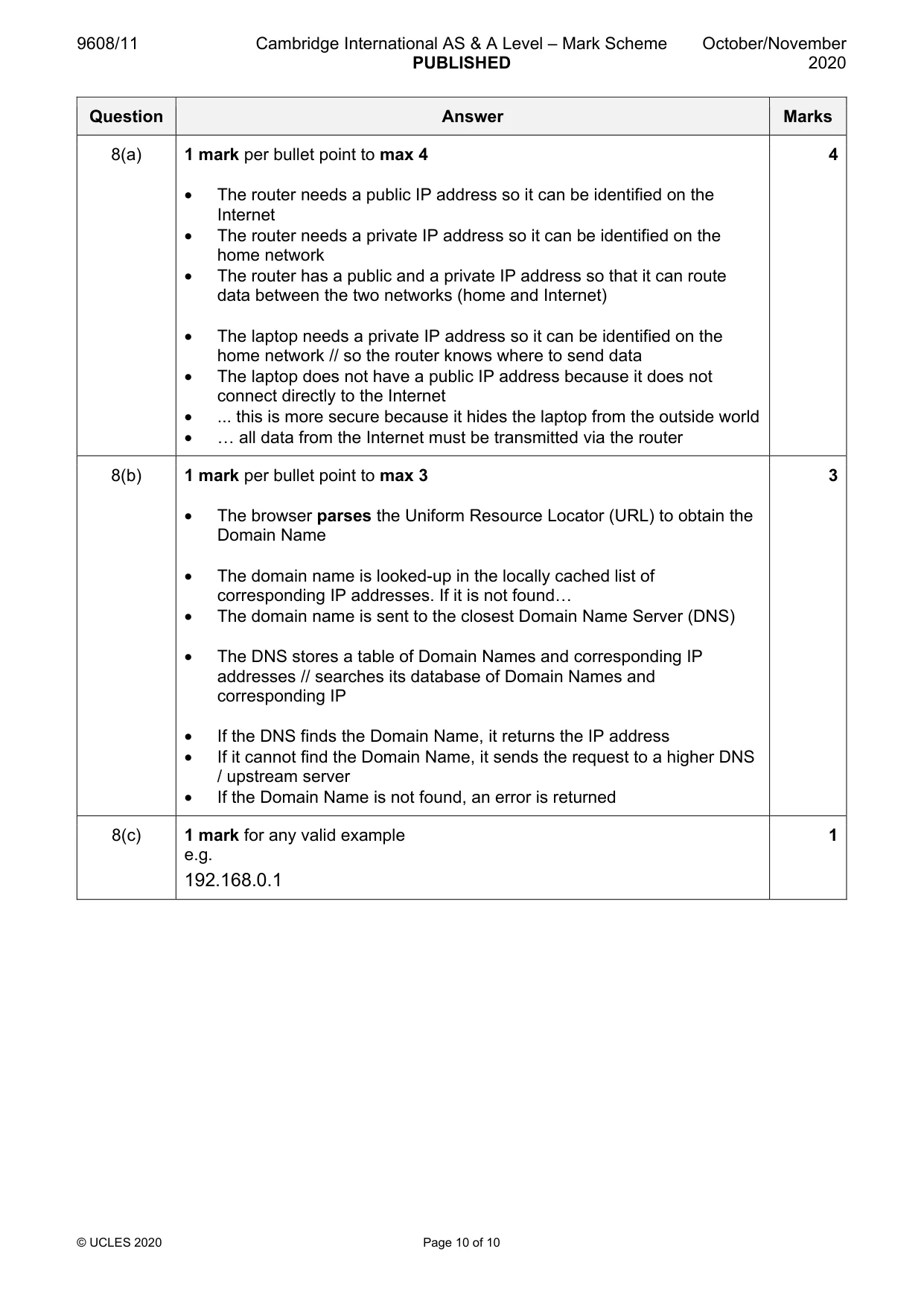
9608/11 Cambridge International AS & A Level – Mark Scheme PUBLISHED October/November 2020 © UCLES 2020 Page 10 of 10 Question Answer Marks 8(a) 1 mark per bullet point to max 4 • The router needs a public IP address so it can be identified on the Internet • The router needs a private IP address so it can be identified on the home network • The router has a public and a private IP address so that it can route data between the two networks (home and Internet) • The laptop needs a private IP address so it can be identified on the home network // so the router knows where to send data • The laptop does not have a public IP address because it does not connect directly to the Internet • ... this is more secure because it hides the laptop from the outside world • … all data from the Internet must be transmitted via the router 4 8(b) 1 mark per bullet point to max 3 • The browser parses the Uniform Resource Locator (URL) to obtain the Domain Name • The domain name is looked-up in the locally cached list of corresponding IP addresses. If it is not found… • The domain name is sent to the closest Domain Name Server (DNS) • The DNS stores a table of Domain Names and corresponding IP addresses // searches its database of Domain Names and corresponding IP • If the DNS finds the Domain Name, it returns the IP address • If it cannot find the Domain Name, it sends the request to a higher DNS / upstream server • If the Domain Name is not found, an error is returned 3 8(c) 1 mark for any valid example e.g. 192.168.0.1 1
What you needed in this session
Cambridge’s own grade thresholds for 2020 Oct/Nov, Paper 1 · Variant 1. A higher threshold means an easier paper — the bar moves with how the cohort did.