Cambridge A Level Computer Science 9608 — 2016 Oct/Nov Paper 3 · Variant 2
9608/32/O/N/16 · 75 marks · ≈84 min
The question paper and its mark scheme, free to read here and free to download. This is Cambridge’s own paper, exactly as it was sat.
Question paper12 pages
Mark scheme7 pages
Answers below. Sit the paper first if you are practising.
Paper as text
Question paper, page 1
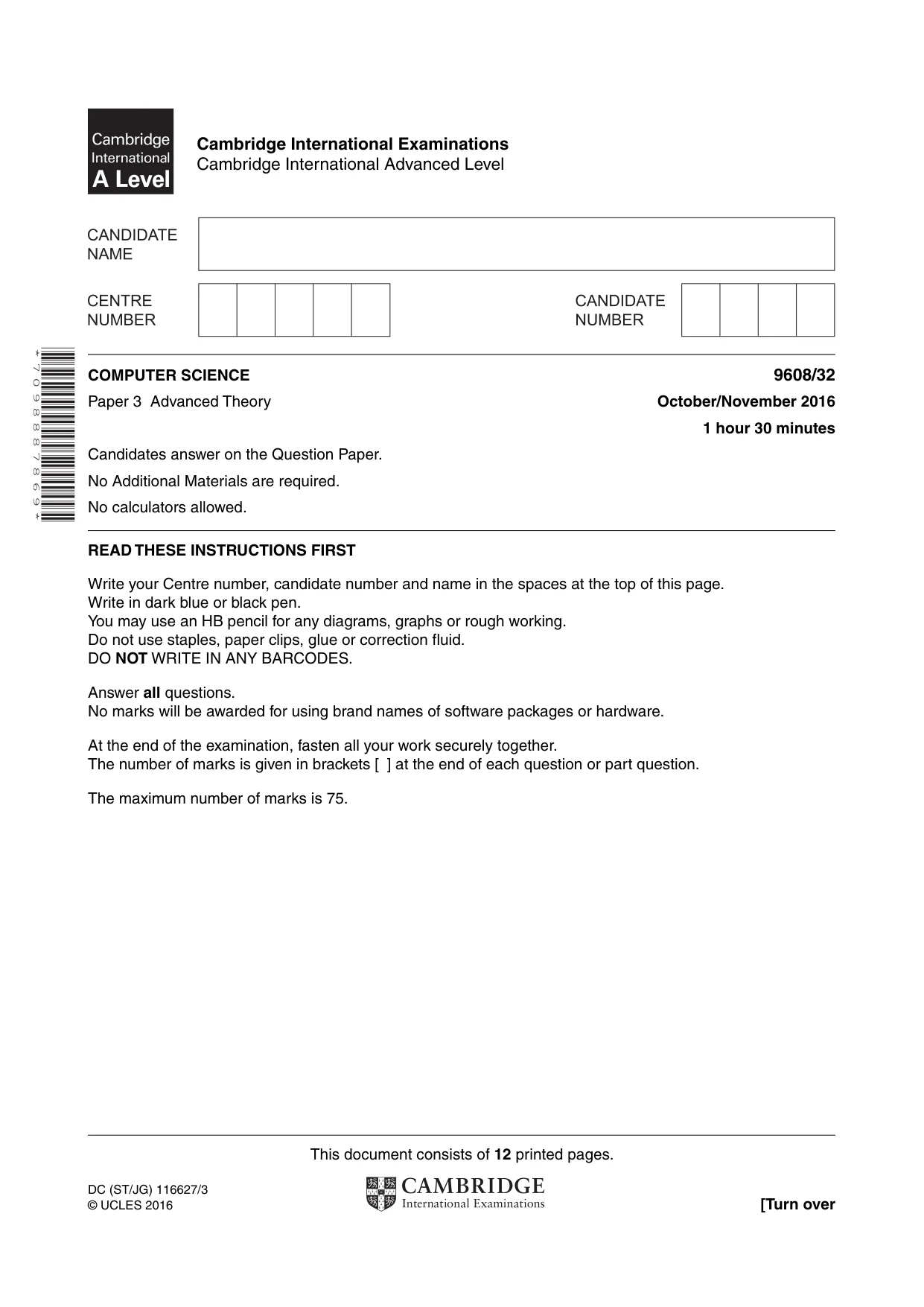
This document consists of 12 printed pages. DC (ST/JG) 116627/3 © UCLES 2016 [Turn over Cambridge International Examinations Cambridge International Advanced Level * 7 0 9 8 8 8 7 8 6 9 * COMPUTER SCIENCE 9608/32 Paper 3 Advanced Theory October/November 2016 1 hour 30 minutes Candidates answer on the Question Paper. No Additional Materials are required. No calculators allowed. READ THESE INSTRUCTIONS FIRST Write your Centre number, candidate number and name in the spaces at the top of this page. Write in dark blue or black pen. You may use an HB pencil for any diagrams, graphs or rough working. Do not use staples, paper clips, glue or correction fluid. DO NOT WRITE IN ANY BARCODES. Answer all questions. No marks will be awarded for using brand names of software packages or hardware. At the end of the examination, fasten all your work securely together. The number of marks is given in brackets [ ] at the end of each question or part question. The maximum number of marks is 75.
Question paper, page 2
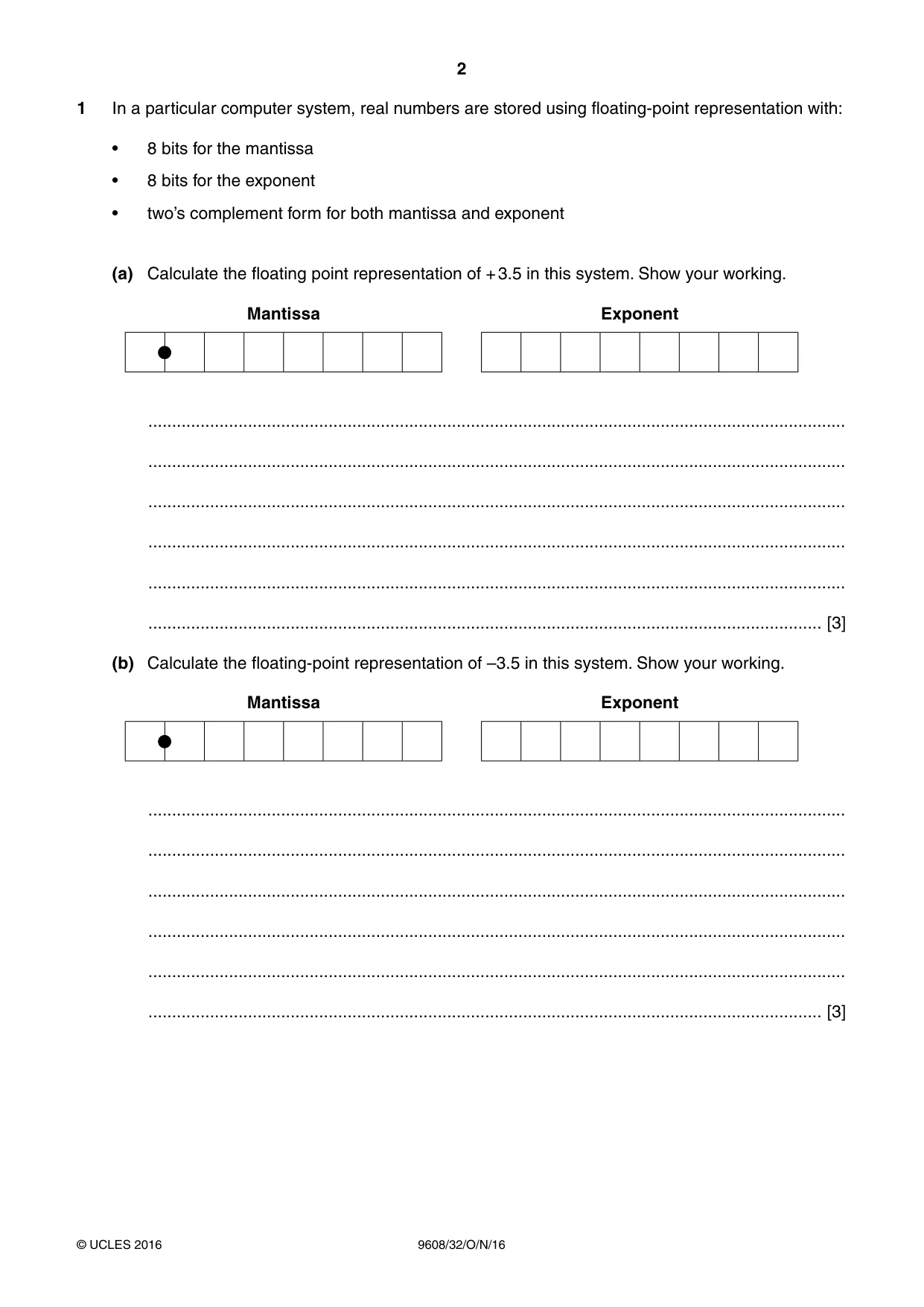
2 9608/32/O/N/16 © UCLES 2016 1 In a particular computer system, real numbers are stored using floating-point representation with: • 8 bits for the mantissa • 8 bits for the exponent • two’s complement form for both mantissa and exponent (a) Calculate the floating point representation of + 3.5 in this system. Show your working. Mantissa Exponent … … … … … … [3] (b) Calculate the floating-point representation of –3.5 in this system. Show your working. Mantissa Exponent … … … … … … [3]
Question paper, page 3
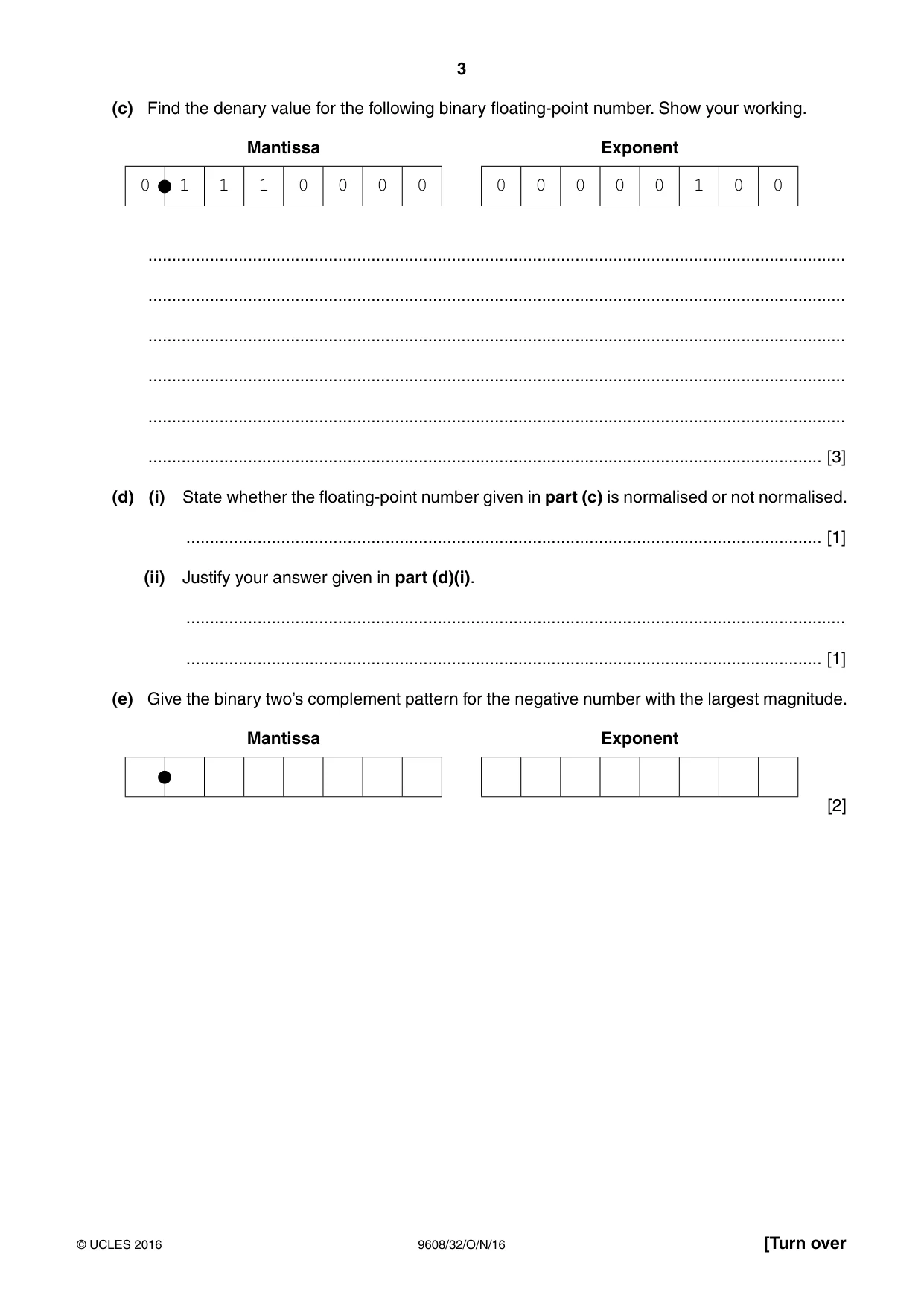
3 9608/32/O/N/16 © UCLES 2016 [Turn over (c) Find the denary value for the following binary floating-point number. Show your working. Mantissa Exponent 0 1 1 1 0 0 0 0 0 0 0 0 0 1 0 0 … … … … … … [3] (d) (i) State whether the floating-point number given in part (c) is normalised or not normalised. … [1] (ii) Justify your answer given in part (d)(i). … … [1] (e) Give the binary two’s complement pattern for the negative number with the largest magnitude. Mantissa Exponent [2]
Question paper, page 4
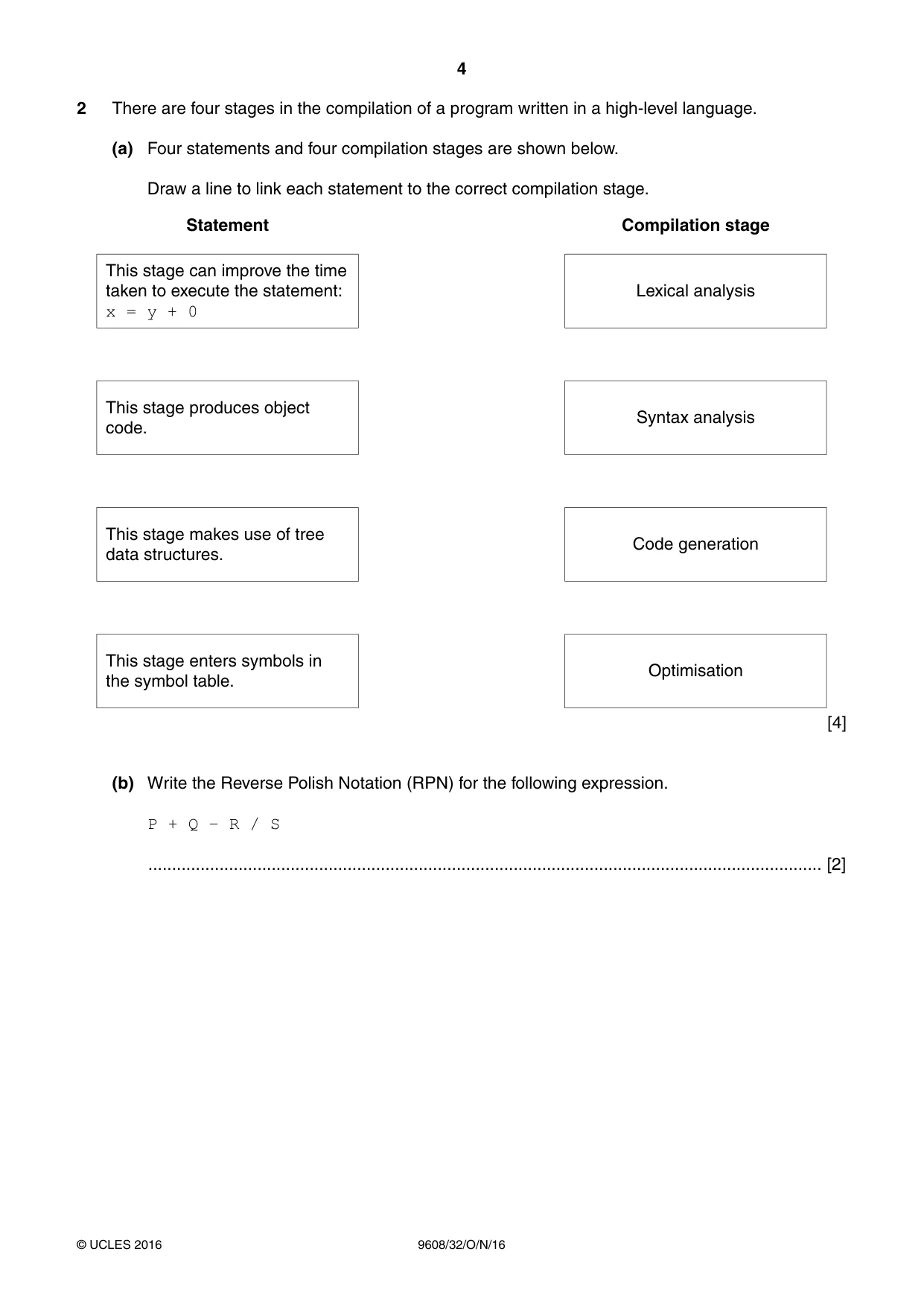
4 9608/32/O/N/16 © UCLES 2016 2 There are four stages in the compilation of a program written in a high-level language. (a) Four statements and four compilation stages are shown below. Draw a line to link each statement to the correct compilation stage. This stage can improve the time taken to execute the statement: x = y + 0 Statement This stage produces object code. This stage makes use of tree data structures. This stage enters symbols in the symbol table. Lexical analysis Compilation stage Syntax analysis Code generation Optimisation [4] (b) Write the Reverse Polish Notation (RPN) for the following expression. P + Q – R / S … [2]
Question paper, page 5
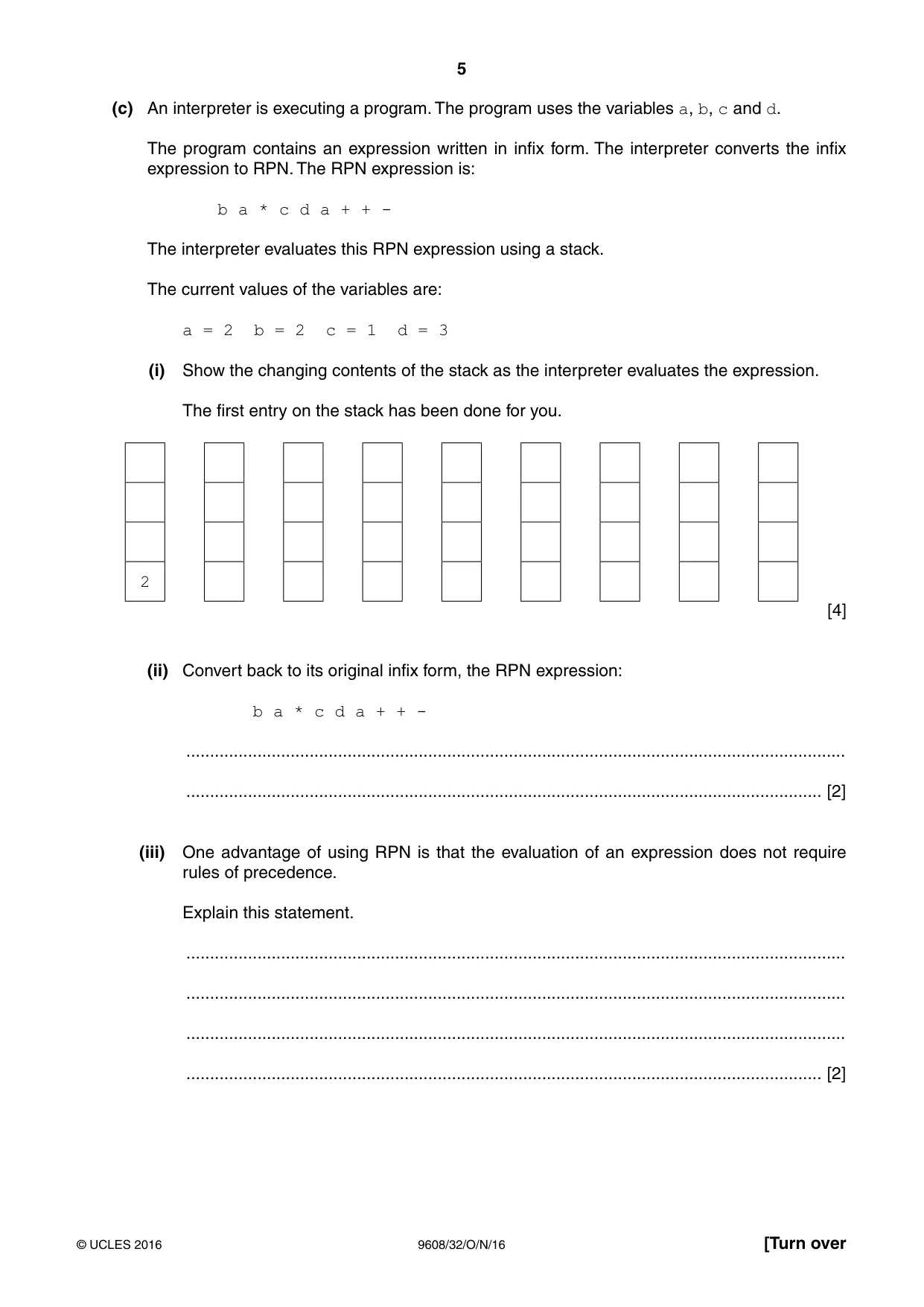
5 9608/32/O/N/16 © UCLES 2016 [Turn over (c) An interpreter is executing a program. The program uses the variables a, b, c and d. The program contains an expression written in infix form. The interpreter converts the infix expression to RPN. The RPN expression is: b a * c d a + + - The interpreter evaluates this RPN expression using a stack. The current values of the variables are: a = 2 b = 2 c = 1 d = 3 (i) Show the changing contents of the stack as the interpreter evaluates the expression. The first entry on the stack has been done for you. 2 [4] (ii) Convert back to its original infix form, the RPN expression: b a * c d a + + - … … [2] (iii) One advantage of using RPN is that the evaluation of an expression does not require rules of precedence. Explain this statement. … … … … [2]
Question paper, page 6
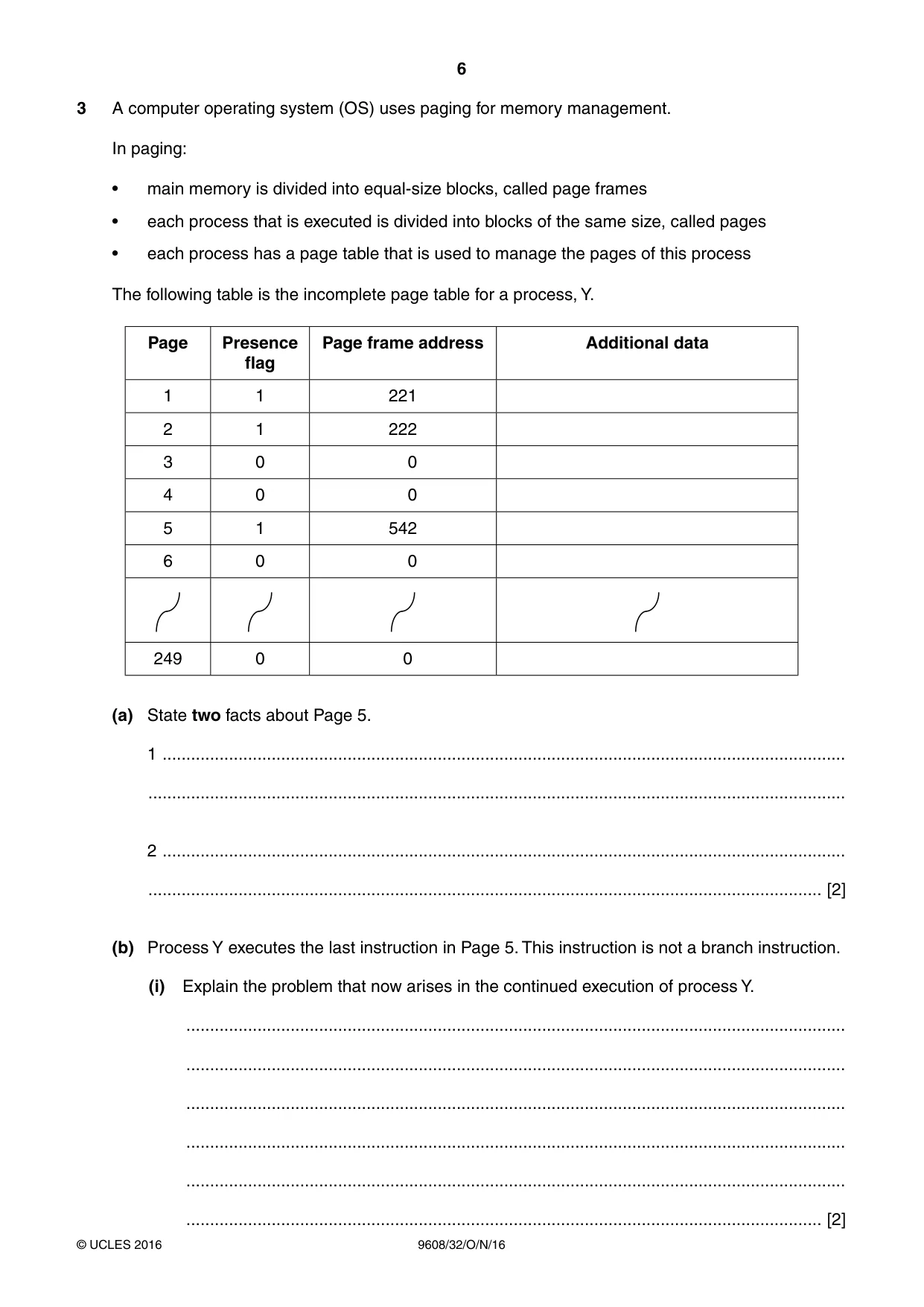
6 9608/32/O/N/16 © UCLES 2016 3 A computer operating system (OS) uses paging for memory management. In paging: • main memory is divided into equal-size blocks, called page frames • each process that is executed is divided into blocks of the same size, called pages • each process has a page table that is used to manage the pages of this process The following table is the incomplete page table for a process, Y. Page Presence flag Page frame address Additional data 1 1 221 2 1 222 3 0 0 4 0 0 5 1 542 6 0 0 249 0 0 (a) State two facts about Page 5. 1 … … 2 … … [2] (b) Process Y executes the last instruction in Page 5. This instruction is not a branch instruction. (i) Explain the problem that now arises in the continued execution of process Y. … … … … … … [2]
Question paper, page 7
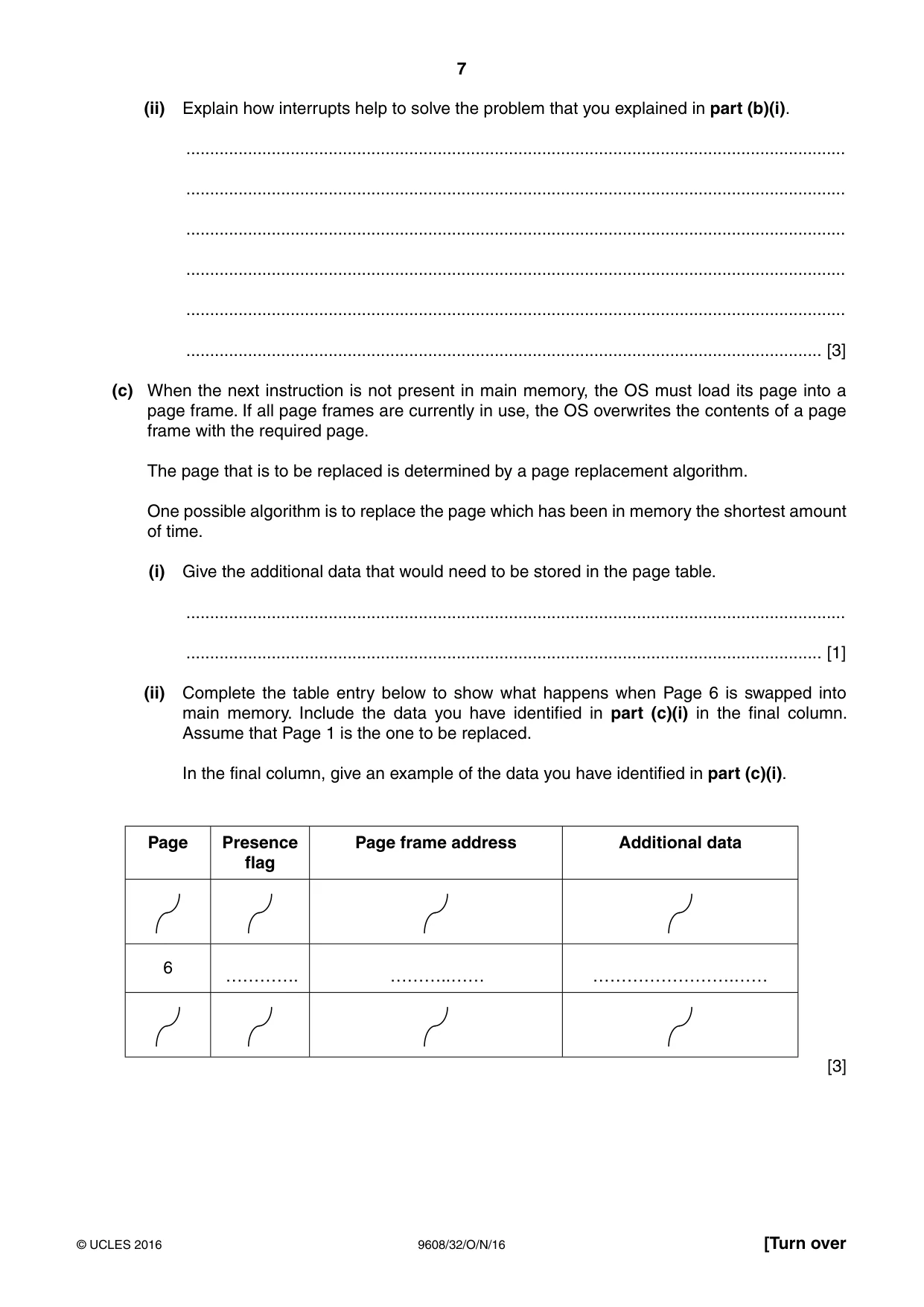
7 9608/32/O/N/16 © UCLES 2016 [Turn over (ii) Explain how interrupts help to solve the problem that you explained in part (b)(i). … … … … … … [3] (c) When the next instruction is not present in main memory, the OS must load its page into a page frame. If all page frames are currently in use, the OS overwrites the contents of a page frame with the required page. The page that is to be replaced is determined by a page replacement algorithm. One possible algorithm is to replace the page which has been in memory the shortest amount of time. (i) Give the additional data that would need to be stored in the page table. … … [1] (ii) Complete the table entry below to show what happens when Page 6 is swapped into main memory. Include the data you have identified in part (c)(i) in the final column. Assume that Page 1 is the one to be replaced. In the final column, give an example of the data you have identified in part (c)(i). Page Presence flag Page frame address Additional data 6 …………. ………..…… …………………….…… [3]
Question paper, page 8
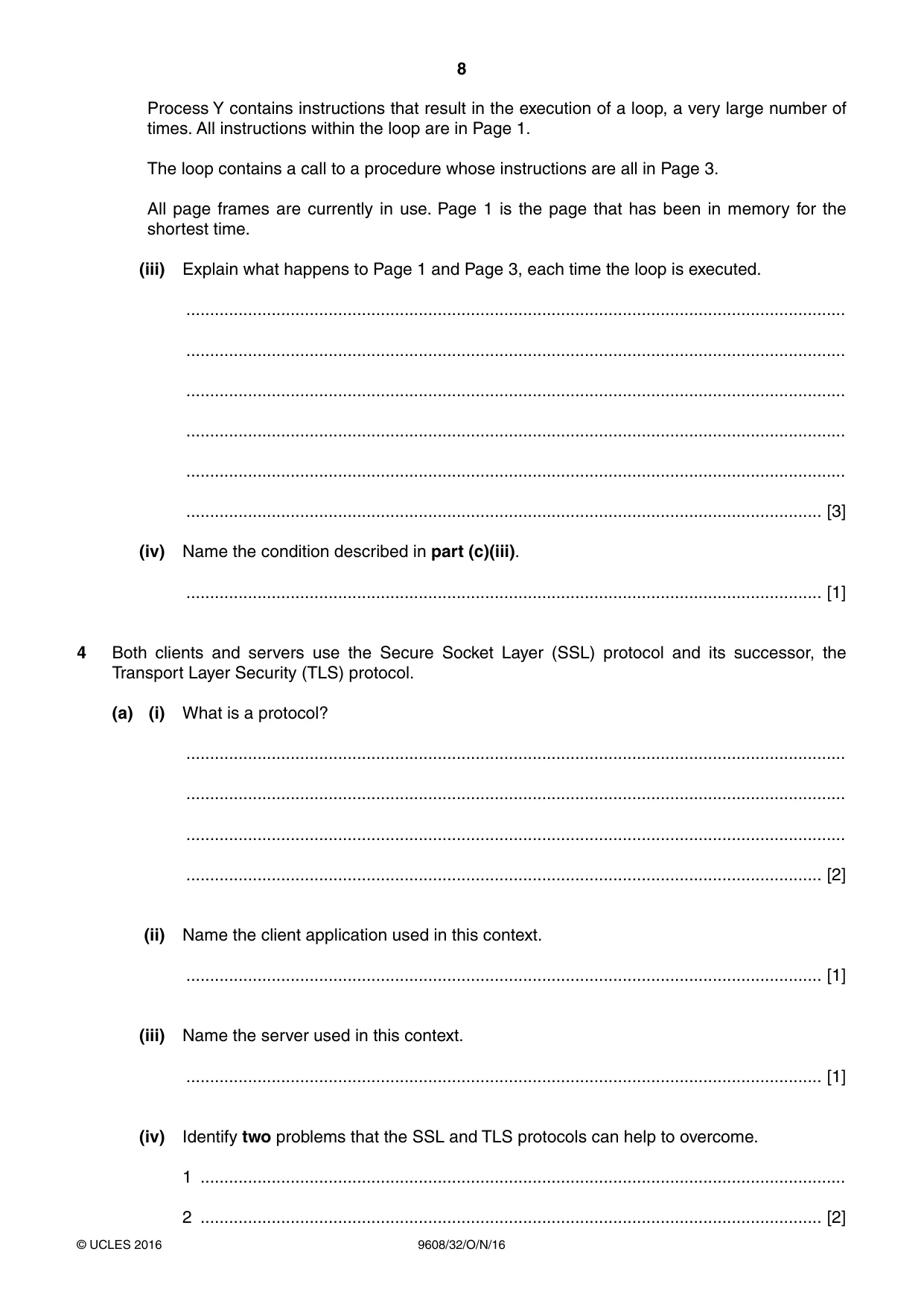
8 9608/32/O/N/16 © UCLES 2016 Process Y contains instructions that result in the execution of a loop, a very large number of times. All instructions within the loop are in Page 1. The loop contains a call to a procedure whose instructions are all in Page 3. All page frames are currently in use. Page 1 is the page that has been in memory for the shortest time. (iii) Explain what happens to Page 1 and Page 3, each time the loop is executed. … … … … … … [3] (iv) Name the condition described in part (c)(iii). … [1] 4 Both clients and servers use the Secure Socket Layer (SSL) protocol and its successor, the Transport Layer Security (TLS) protocol. (a) (i) What is a protocol? … … … … [2] (ii) Name the client application used in this context. … [1] (iii) Name the server used in this context. … [1] (iv) Identify two problems that the SSL and TLS protocols can help to overcome. 1 … 2 … [2]
Question paper, page 9
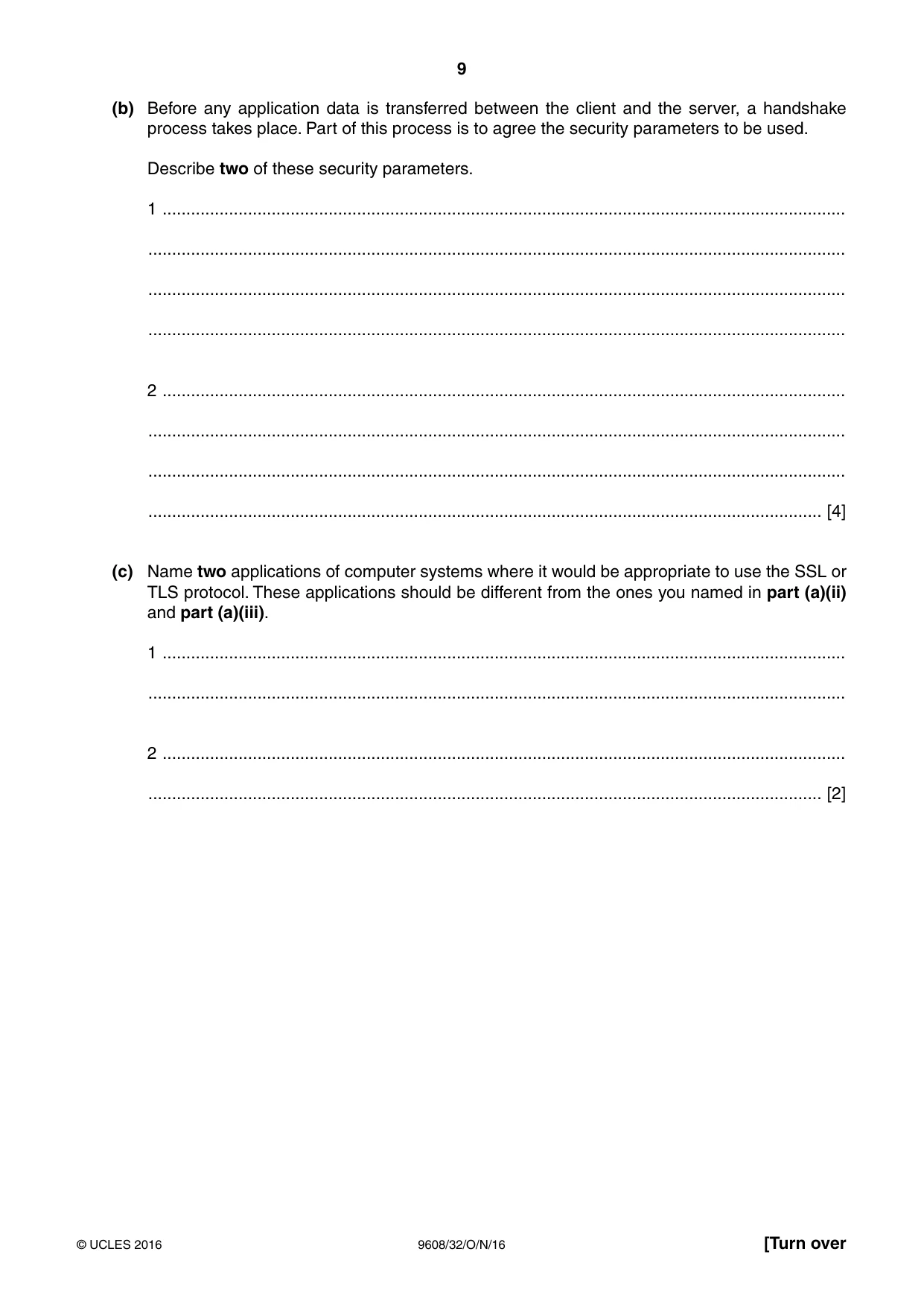
9 9608/32/O/N/16 © UCLES 2016 [Turn over (b) Before any application data is transferred between the client and the server, a handshake process takes place. Part of this process is to agree the security parameters to be used. Describe two of these security parameters. 1 … … … … 2 … … … … [4] (c) Name two applications of computer systems where it would be appropriate to use the SSL or TLS protocol. These applications should be different from the ones you named in part (a)(ii) and part (a)(iii). 1 … … 2 … … [2]
Question paper, page 10
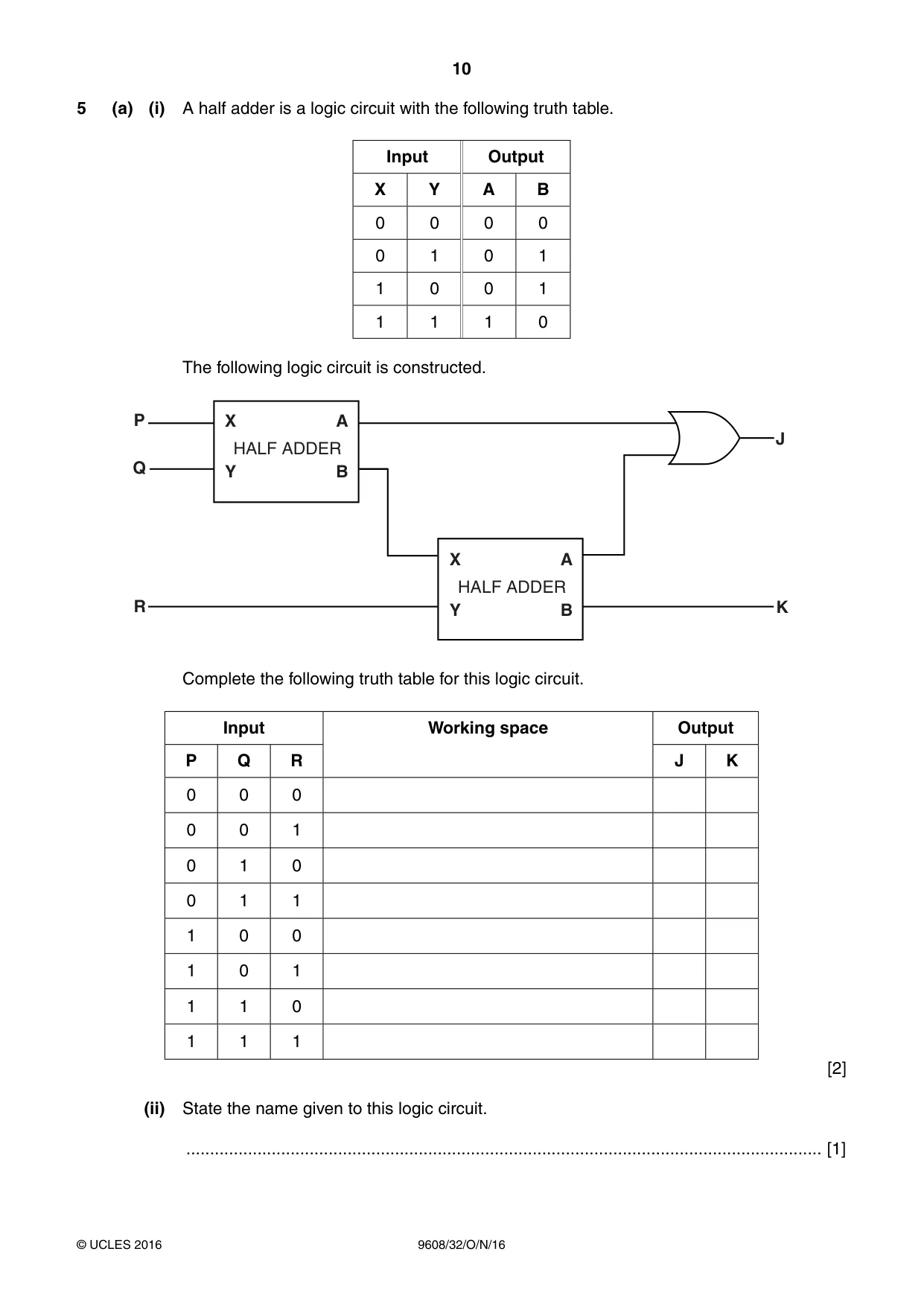
10 9608/32/O/N/16 © UCLES 2016 5 (a) (i) A half adder is a logic circuit with the following truth table. Input Output X Y A B 0 0 0 0 0 1 0 1 1 0 0 1 1 1 1 0 The following logic circuit is constructed. X A Y B HALF ADDER X A Y B HALF ADDER P J K Q R Complete the following truth table for this logic circuit. Input Working space Output P Q R J K 0 0 0 0 0 1 0 1 0 0 1 1 1 0 0 1 0 1 1 1 0 1 1 1 [2] (ii) State the name given to this logic circuit. … [1]
Question paper, page 11
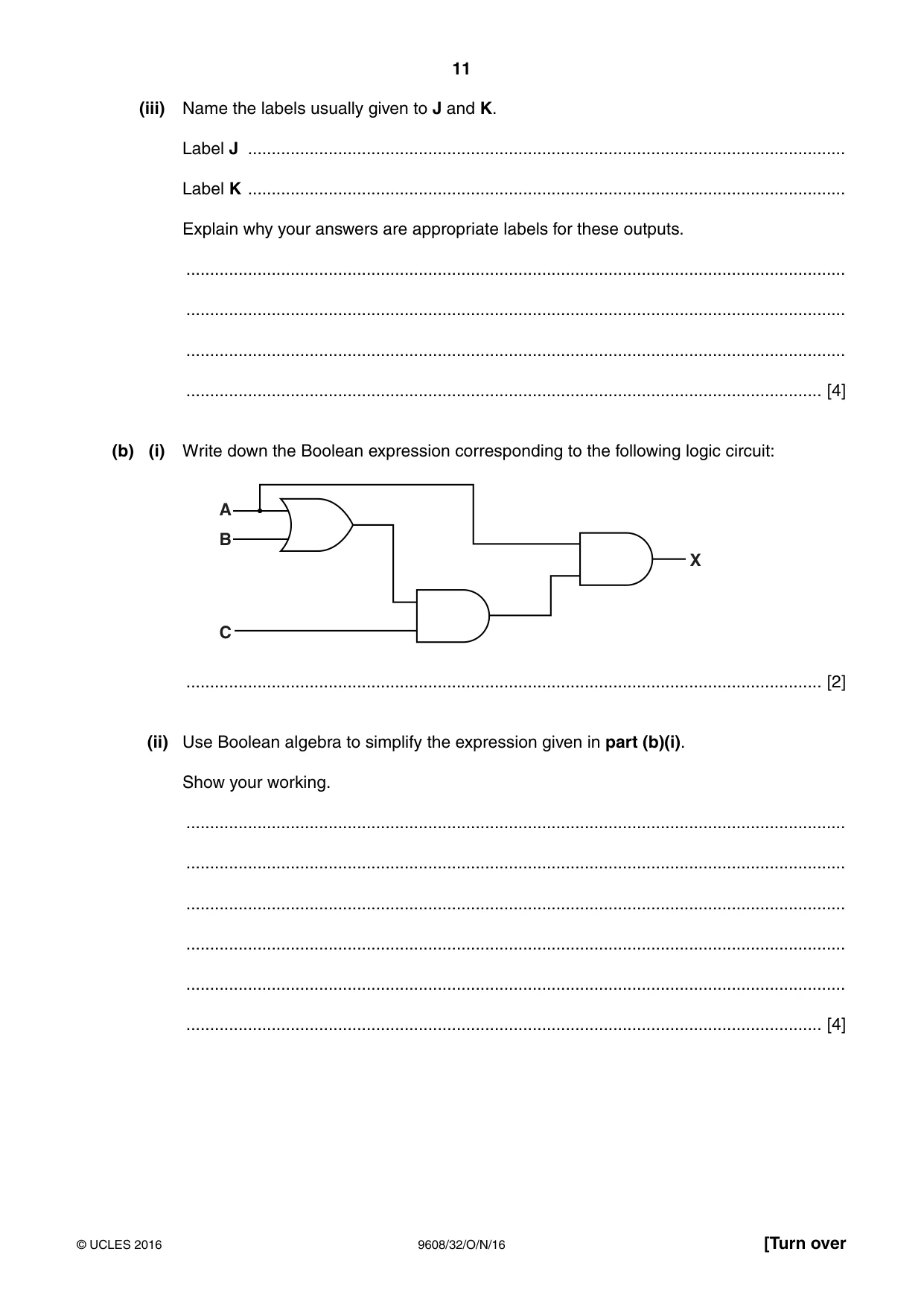
11 9608/32/O/N/16 © UCLES 2016 [Turn over (iii) Name the labels usually given to J and K. Label J … Label K … Explain why your answers are appropriate labels for these outputs. … … … … [4] (b) (i) Write down the Boolean expression corresponding to the following logic circuit: A B C X … [2] (ii) Use Boolean algebra to simplify the expression given in part (b)(i). Show your working. … … … … … … [4]
Question paper, page 12
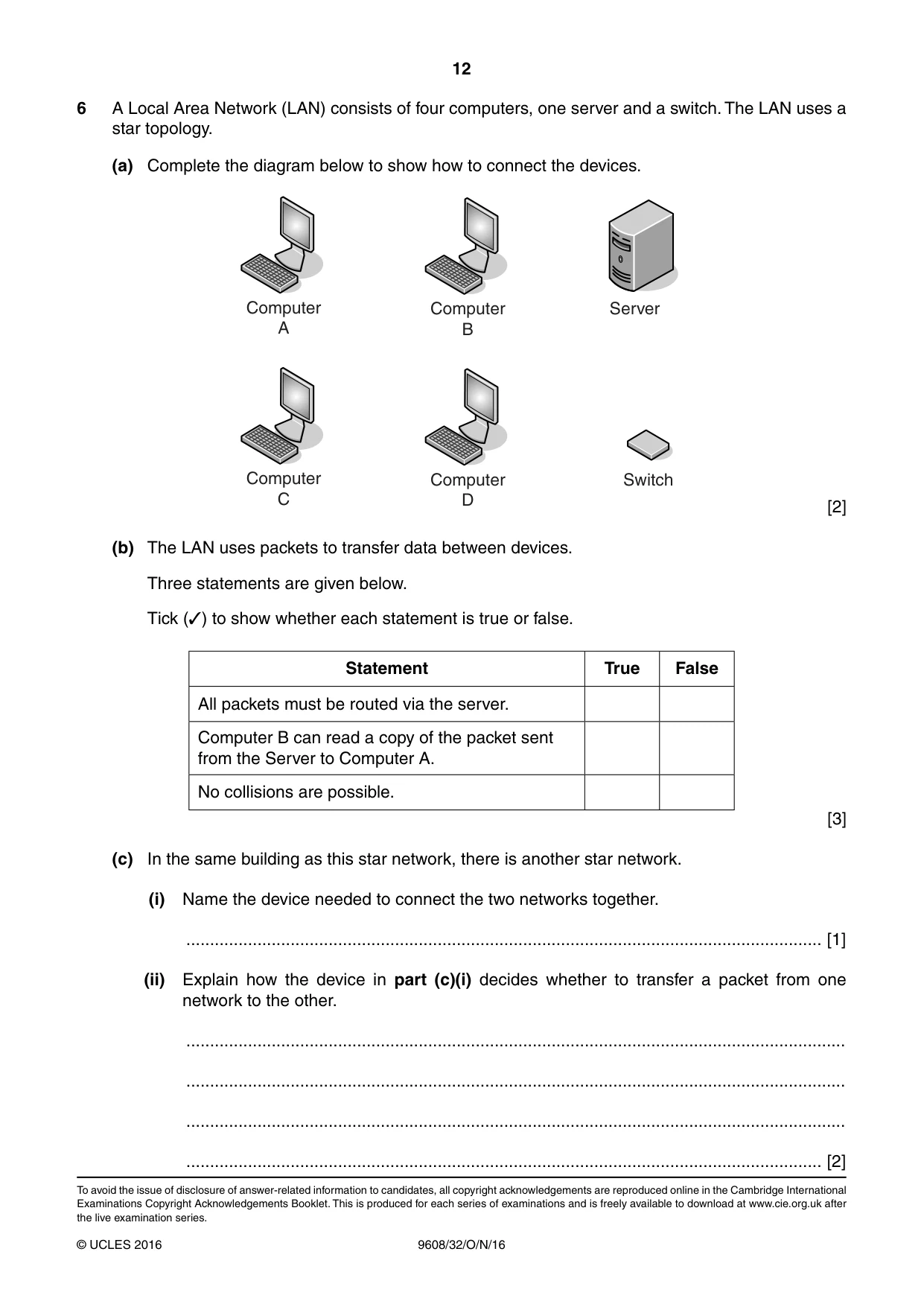
12 9608/32/O/N/16 © UCLES 2016 6 A Local Area Network (LAN) consists of four computers, one server and a switch. The LAN uses a star topology. (a) Complete the diagram below to show how to connect the devices. Server Computer A Computer B Computer C Computer D Switch [2] (b) The LAN uses packets to transfer data between devices. Three statements are given below. Tick (✓) to show whether each statement is true or false. Statement True False All packets must be routed via the server. Computer B can read a copy of the packet sent from the Server to Computer A. No collisions are possible. [3] (c) In the same building as this star network, there is another star network. (i) Name the device needed to connect the two networks together. … [1] (ii) Explain how the device in part (c)(i) decides whether to transfer a packet from one network to the other. … … … … [2] To avoid the issue of disclosure of answer-related information to candidates, all copyright acknowledgements are reproduced online in the Cambridge International Examinations Copyright Acknowledgements Booklet. This is produced for each series of examinations and is freely available to download at www.cie.org.uk after the live examination series.
Mark scheme, page 1
® IGCSE is the registered trademark of Cambridge International Examinations. This document consists of 7 printed pages. © UCLES 2016 [Turn over Cambridge International Examinations Cambridge International Advanced Level COMPUTER SCIENCE 9608/32 Paper 3 Written Paper October/November 2016 MARK SCHEME Maximum Mark: 75 Published This mark scheme is published as an aid to teachers and candidates, to indicate the requirements of the examination. It shows the basis on which Examiners were instructed to award marks. It does not indicate the details of the discussions that took place at an Examiners’ meeting before marking began, which would have considered the acceptability of alternative answers. Mark schemes should be read in conjunction with the question paper and the Principal Examiner Report for Teachers. Cambridge will not enter into discussions about these mark schemes. Cambridge is publishing the mark schemes for the October/November 2016 series for most Cambridge IGCSE®, Cambridge International A and AS Level components and some Cambridge O Level components.
Mark scheme, page 2
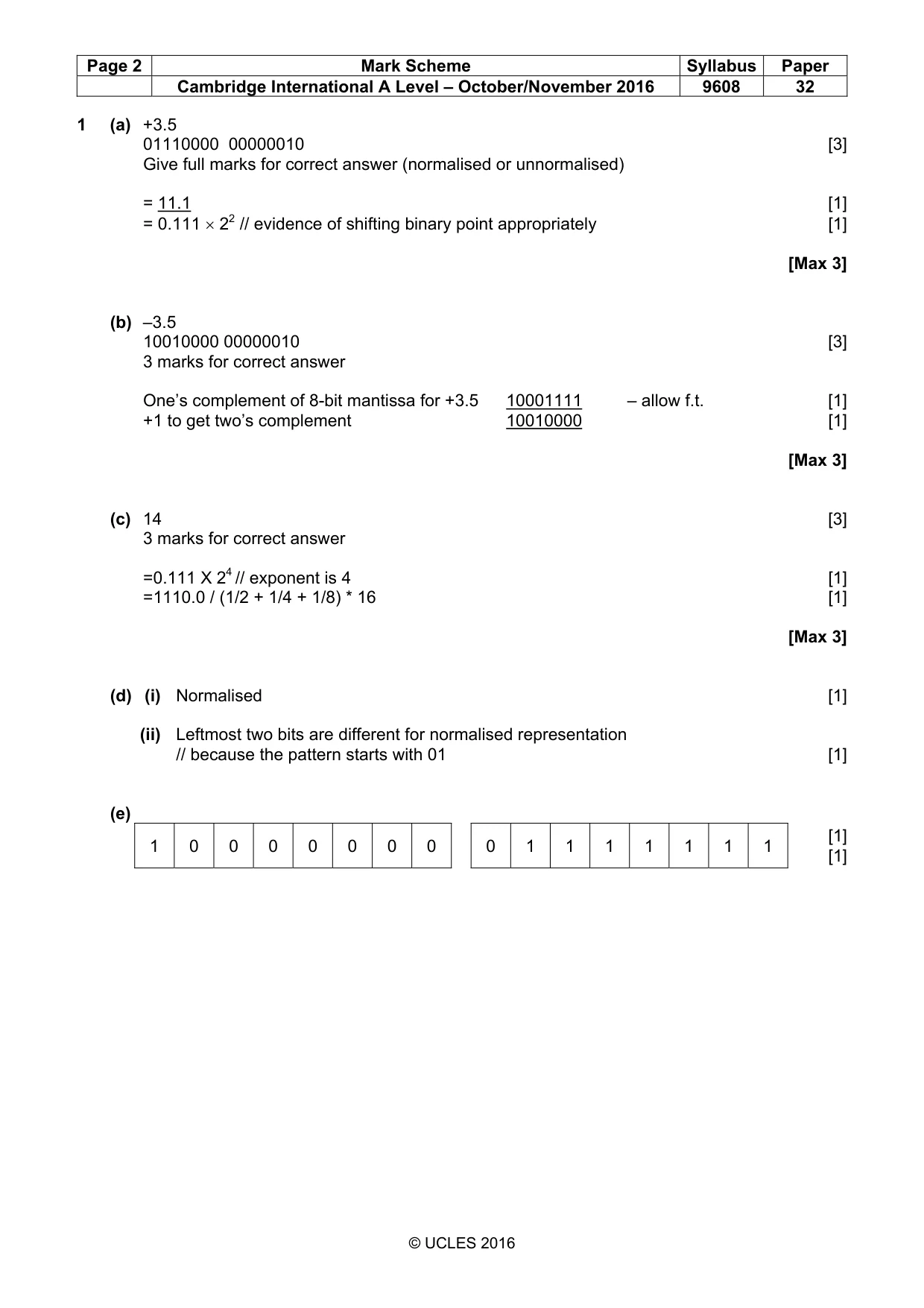
Page 2 Mark Scheme Syllabus Paper Cambridge International A Level – October/November 2016 9608 32 © UCLES 2016 1 (a) +3.5 01110000 00000010 [3] Give full marks for correct answer (normalised or unnormalised) = 11.1 [1] = 0.111 × 22 // evidence of shifting binary point appropriately [1] [Max 3] (b) –3.5 10010000 00000010 [3] 3 marks for correct answer One’s complement of 8-bit mantissa for +3.5 10001111 – allow f.t. [1] +1 to get two’s complement 10010000 [1] [Max 3] (c) 14 [3] 3 marks for correct answer =0.111 X 24 // exponent is 4 [1] =1110.0 / (1/2 + 1/4 + 1/8) * 16 [1] [Max 3] (d) (i) Normalised [1] (ii) Leftmost two bits are different for normalised representation // because the pattern starts with 01 [1] (e) 1 0 0 0 0 0 0 0 0 1 1 1 1 1 1 1 [1] [1]
Mark scheme, page 3
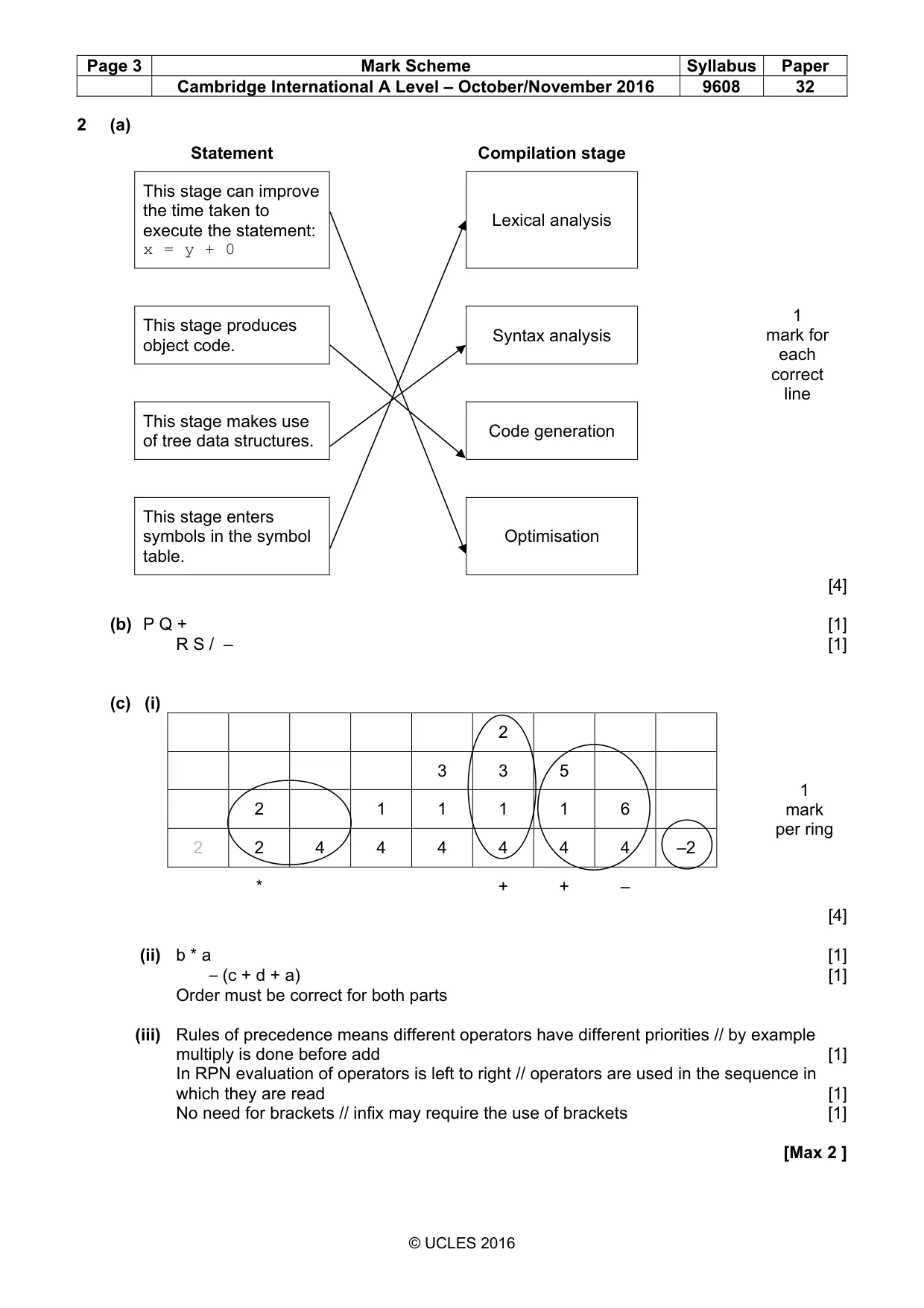
Page 3 Mark Scheme Syllabus Paper Cambridge International A Level – October/November 2016 9608 32 © UCLES 2016 2 (a) Statement Compilation stage 1 mark for each correct line This stage can improve the time taken to execute the statement: x = y + 0 Lexical analysis This stage produces object code. Syntax analysis This stage makes use of tree data structures. Code generation This stage enters symbols in the symbol table. Optimisation [4] (b) P Q + [1] R S / – [1] (c) (i) 2 1 mark per ring 3 3 5 2 1 1 1 1 6 2 2 4 4 4 4 4 4 –2 * + + – [4] (ii) b * a [1] – (c + d + a) [1] Order must be correct for both parts (iii) Rules of precedence means different operators have different priorities // by example multiply is done before add [1] In RPN evaluation of operators is left to right // operators are used in the sequence in which they are read [1] No need for brackets // infix may require the use of brackets [1] [Max 2 ]
Mark scheme, page 4
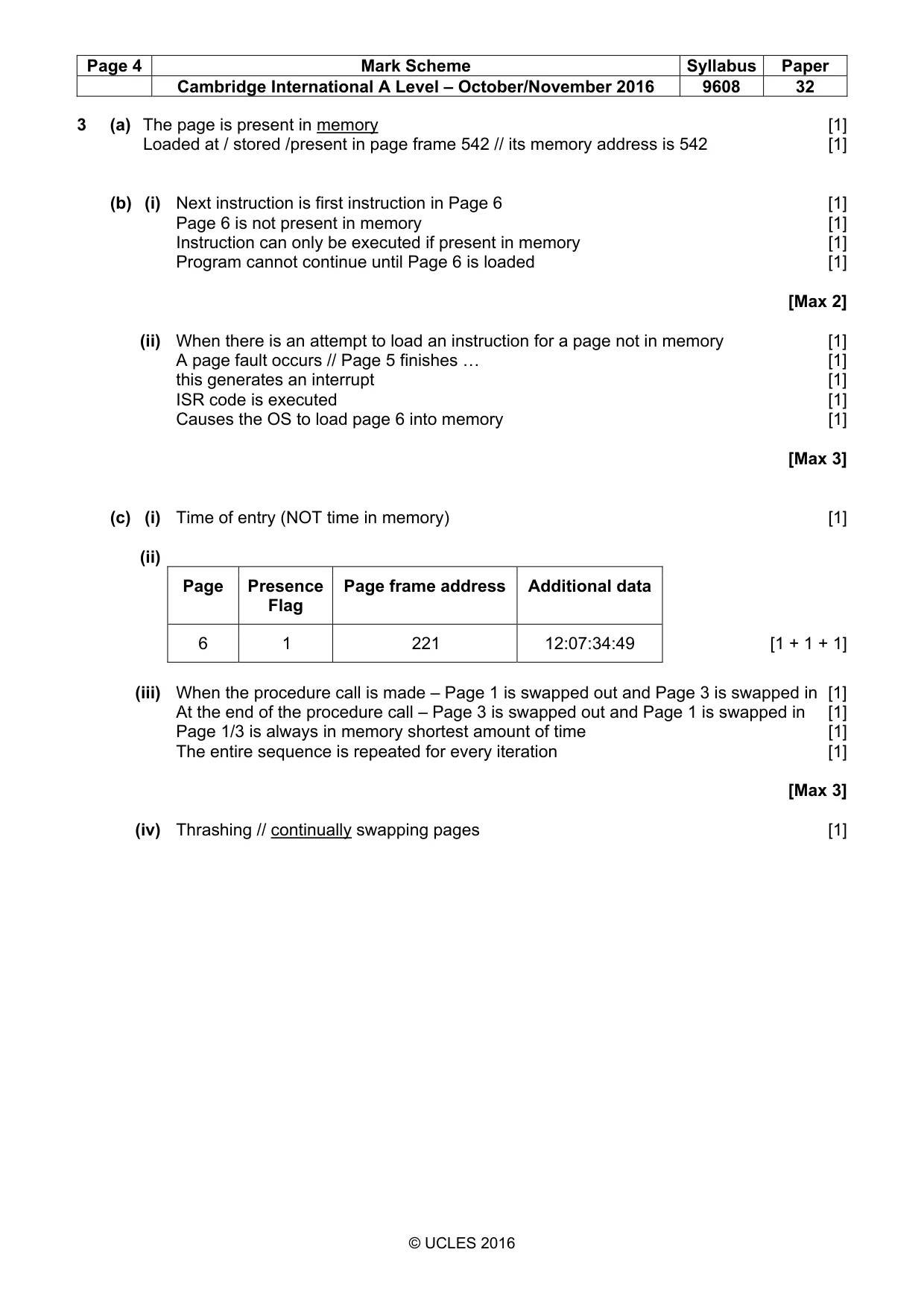
Page 4 Mark Scheme Syllabus Paper Cambridge International A Level – October/November 2016 9608 32 © UCLES 2016 3 (a) The page is present in memory [1] Loaded at / stored /present in page frame 542 // its memory address is 542 [1] (b) (i) Next instruction is first instruction in Page 6 [1] Page 6 is not present in memory [1] Instruction can only be executed if present in memory [1] Program cannot continue until Page 6 is loaded [1] [Max 2] (ii) When there is an attempt to load an instruction for a page not in memory [1] A page fault occurs // Page 5 finishes … [1] this generates an interrupt [1] ISR code is executed [1] Causes the OS to load page 6 into memory [1] [Max 3] (c) (i) Time of entry (NOT time in memory) [1] (ii) Page Presence Flag Page frame address Additional data 6 1 221 12:07:34:49 [1 + 1 + 1] (iii) When the procedure call is made – Page 1 is swapped out and Page 3 is swapped in [1] At the end of the procedure call – Page 3 is swapped out and Page 1 is swapped in [1] Page 1/3 is always in memory shortest amount of time [1] The entire sequence is repeated for every iteration [1] [Max 3] (iv) Thrashing // continually swapping pages [1]
Mark scheme, page 5
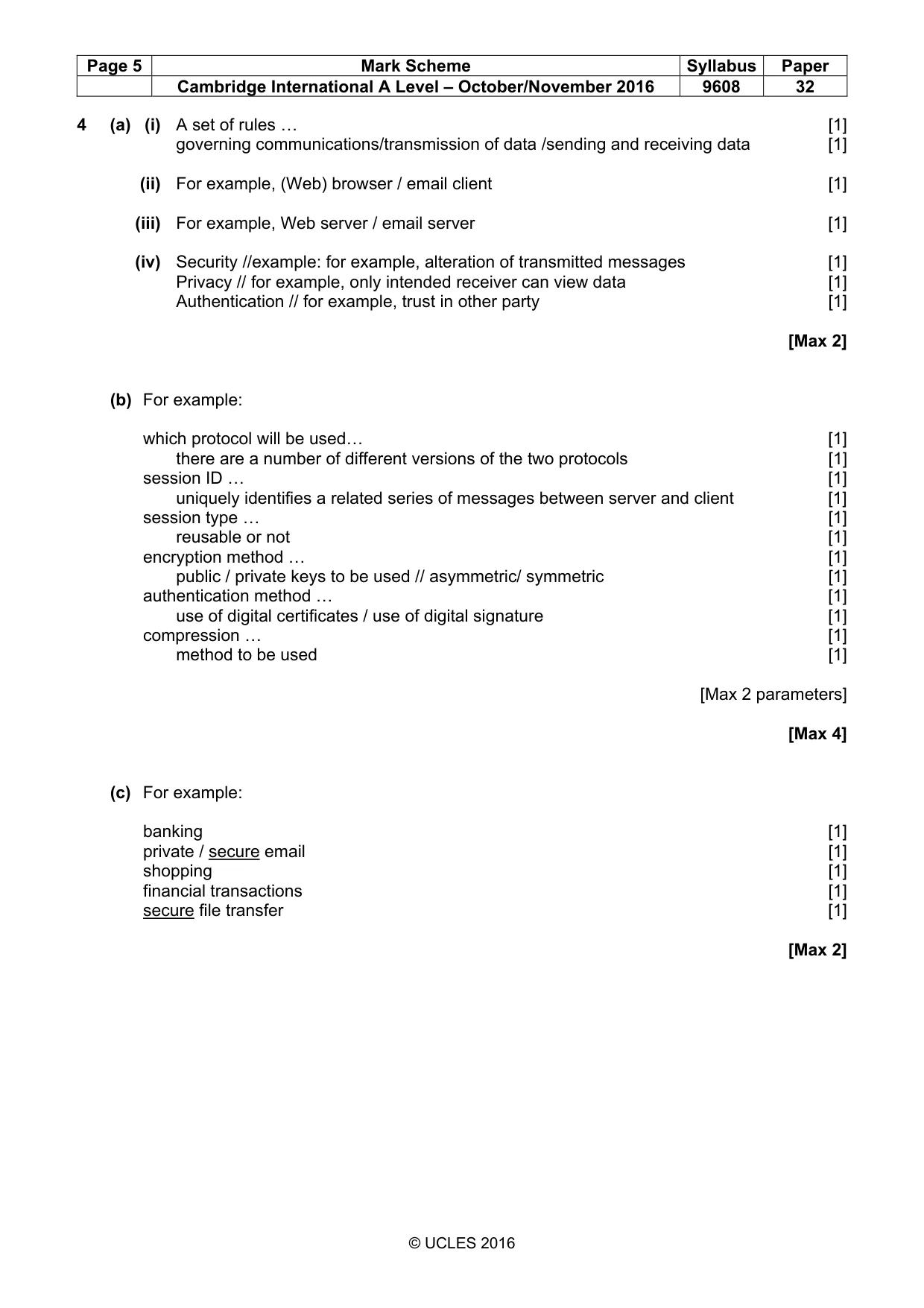
Page 5 Mark Scheme Syllabus Paper Cambridge International A Level – October/November 2016 9608 32 © UCLES 2016 4 (a) (i) A set of rules … [1] governing communications/transmission of data /sending and receiving data [1] (ii) For example, (Web) browser / email client [1] (iii) For example, Web server / email server [1] (iv) Security //example: for example, alteration of transmitted messages [1] Privacy // for example, only intended receiver can view data [1] Authentication // for example, trust in other party [1] [Max 2] (b) For example: which protocol will be used… [1] there are a number of different versions of the two protocols [1] session ID … [1] uniquely identifies a related series of messages between server and client [1] session type … [1] reusable or not [1] encryption method … [1] public / private keys to be used // asymmetric/ symmetric [1] authentication method … [1] use of digital certificates / use of digital signature [1] compression … [1] method to be used [1] [Max 2 parameters] [Max 4] (c) For example: banking [1] private / secure email [1] shopping [1] financial transactions [1] secure file transfer [1] [Max 2]
Mark scheme, page 6
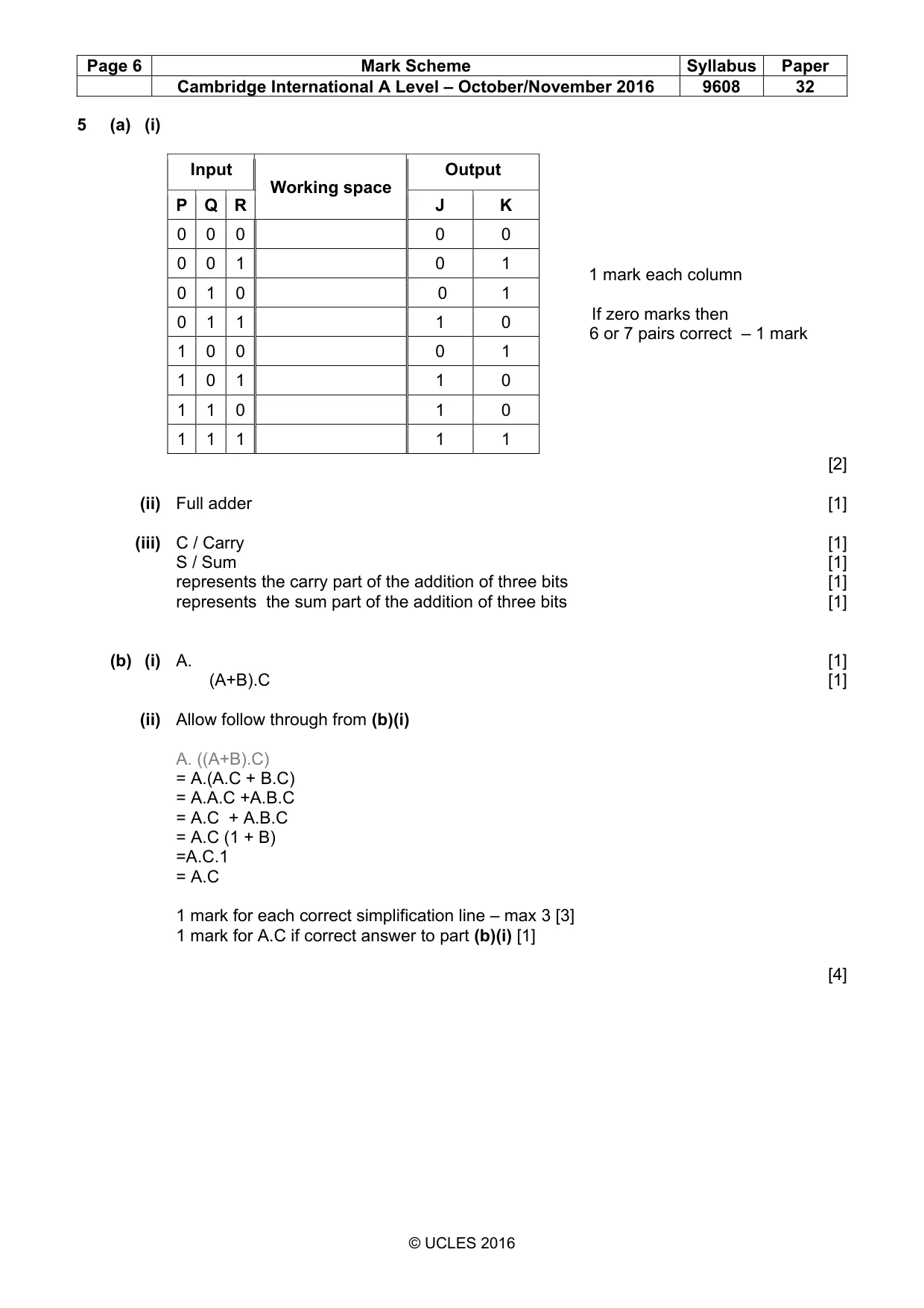
Page 6 Mark Scheme Syllabus Paper Cambridge International A Level – October/November 2016 9608 32 © UCLES 2016 5 (a) (i) Input Working space Output 1 mark each column If zero marks then 6 or 7 pairs correct – 1 mark P Q R J K 0 0 0 0 0 0 0 1 0 1 0 1 0 0 1 0 1 1 1 0 1 0 0 0 1 1 0 1 1 0 1 1 0 1 0 1 1 1 1 1 [2] (ii) Full adder [1] (iii) C / Carry [1] S / Sum [1] represents the carry part of the addition of three bits [1] represents the sum part of the addition of three bits [1] (b) (i) A. [1] (A+B).C [1] (ii) Allow follow through from (b)(i) A. ((A+B).C) = A.(A.C + B.C) = A.A.C +A.B.C = A.C + A.B.C = A.C (1 + B) =A.C.1 = A.C 1 mark for each correct simplification line – max 3 [3] 1 mark for A.C if correct answer to part (b)(i) [1] [4]
Mark scheme, page 7
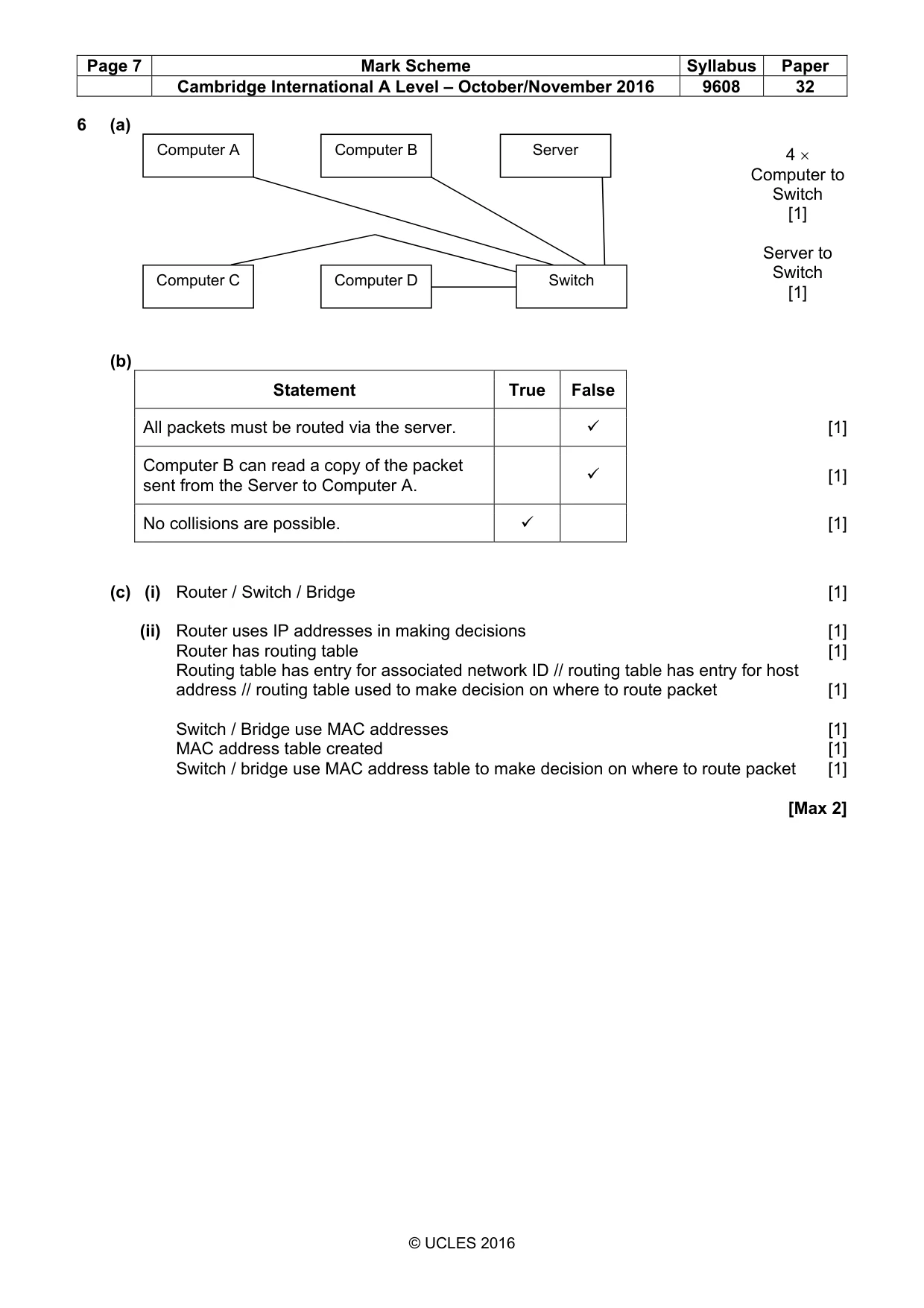
Page 7 Mark Scheme Syllabus Paper Cambridge International A Level – October/November 2016 9608 32 © UCLES 2016 6 (a) 4 × Computer to Switch [1] Server to Switch [1] (b) Statement True False All packets must be routed via the server. 9 [1] Computer B can read a copy of the packet sent from the Server to Computer A. 9 [1] No collisions are possible. 9 [1] (c) (i) Router / Switch / Bridge [1] (ii) Router uses IP addresses in making decisions [1] Router has routing table [1] Routing table has entry for associated network ID // routing table has entry for host address // routing table used to make decision on where to route packet [1] Switch / Bridge use MAC addresses [1] MAC address table created [1] Switch / bridge use MAC address table to make decision on where to route packet [1] [Max 2] Server Computer B Computer D Computer A Computer C Switch
What you needed in this session
Cambridge’s own grade thresholds for 2016 Oct/Nov, Paper 3 · Variant 2. A higher threshold means an easier paper — the bar moves with how the cohort did.