Cambridge A Level Chinese - Language (AS Level only) 8681 — 2020 Oct/Nov Paper 2 · Variant 3
8681/23/O/N/20 · 70 marks · ≈79 min
The question paper and its mark scheme, free to read here and free to download. This is Cambridge’s own paper, exactly as it was sat.
Question paper8 pages
Mark scheme17 pages
Answers below. Sit the paper first if you are practising.
Paper as text
Question paper, page 1
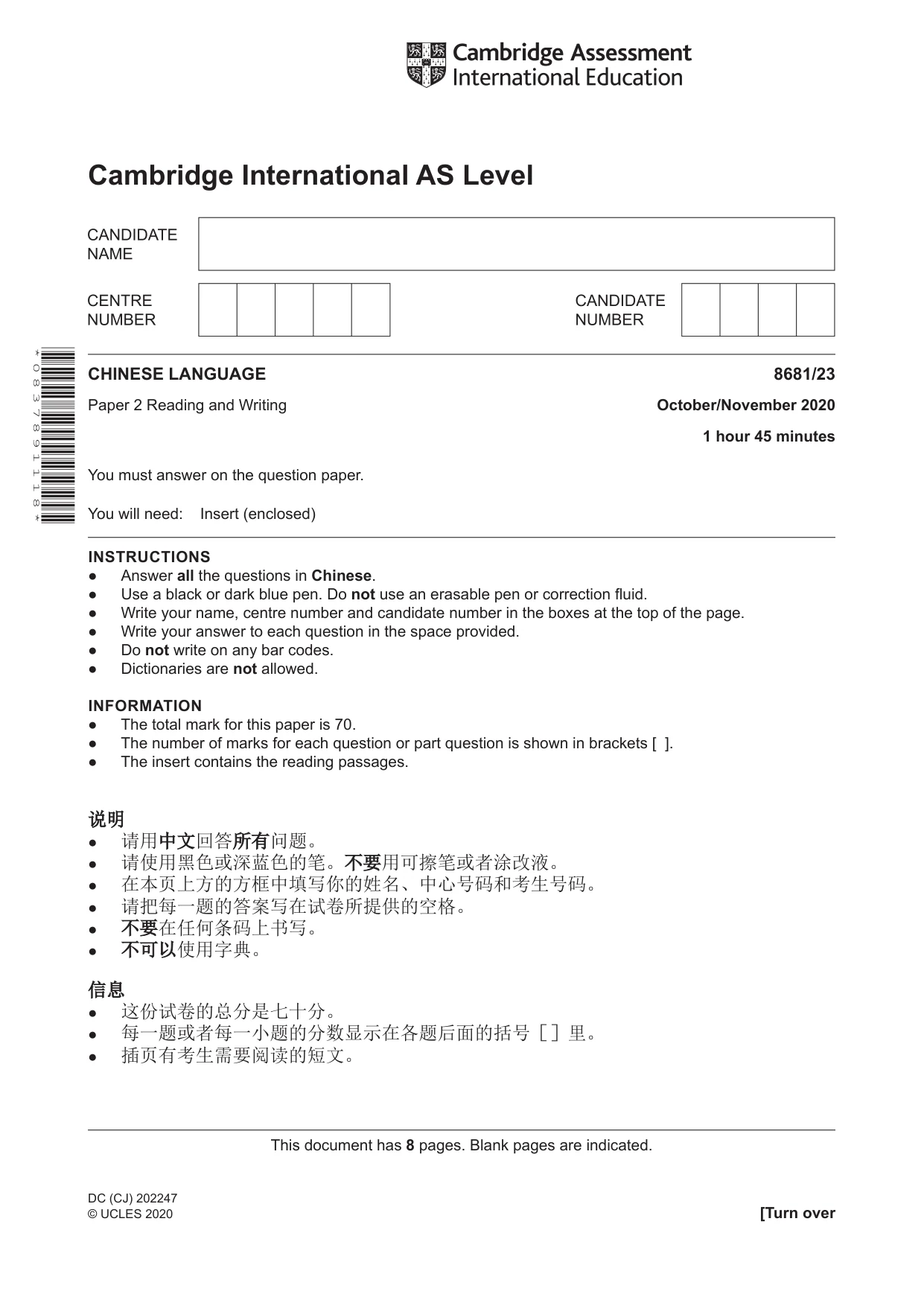
Cambridge International AS Level DC (CJ) 202247 © UCLES 2020 [Turn over This document has 8 pages. Blank pages are indicated. CHINESE LANGUAGE 8681/23 Paper 2 Reading and Writing October/November 2020 1 hour 45 minutes You must answer on the question paper. You will need: Insert (enclosed) INSTRUCTIONS ● Answer all the questions in Chinese. ● Use a black or dark blue pen. Do not use an erasable pen or correction fluid. ● Write your name, centre number and candidate number in the boxes at the top of the page. ● Write your answer to each question in the space provided. ● Do not write on any bar codes. ● Dictionaries are not allowed. INFORMATION ● The total mark for this paper is 70. ● The number of marks for each question or part question is shown in brackets [ ]. ● The insert contains the reading passages. 说明 ● 请用中文回答所有问题。 ● 请使用黑色或深蓝色的笔。不要用可擦笔或者涂改液。 ● 在本页上方的方框中填写你的姓名、中心号码和考生号码。 ● 请把每一题的答案写在试卷所提供的空格。 ● 不要在任何条码上书写。 ● 不可以使用字典。 信息 ● 这份试卷的总分是七十分。 ● 每一题或者每一小题的分数显示在各题后面的括号[]里。 ● 插页有考生需要阅读的短文。 * 0 8 3 7 8 9 1 1 1 8 *
Question paper, page 2
2 8681/23/O/N/20 © UCLES 2020 2 BLANK PAGE
Question paper, page 3
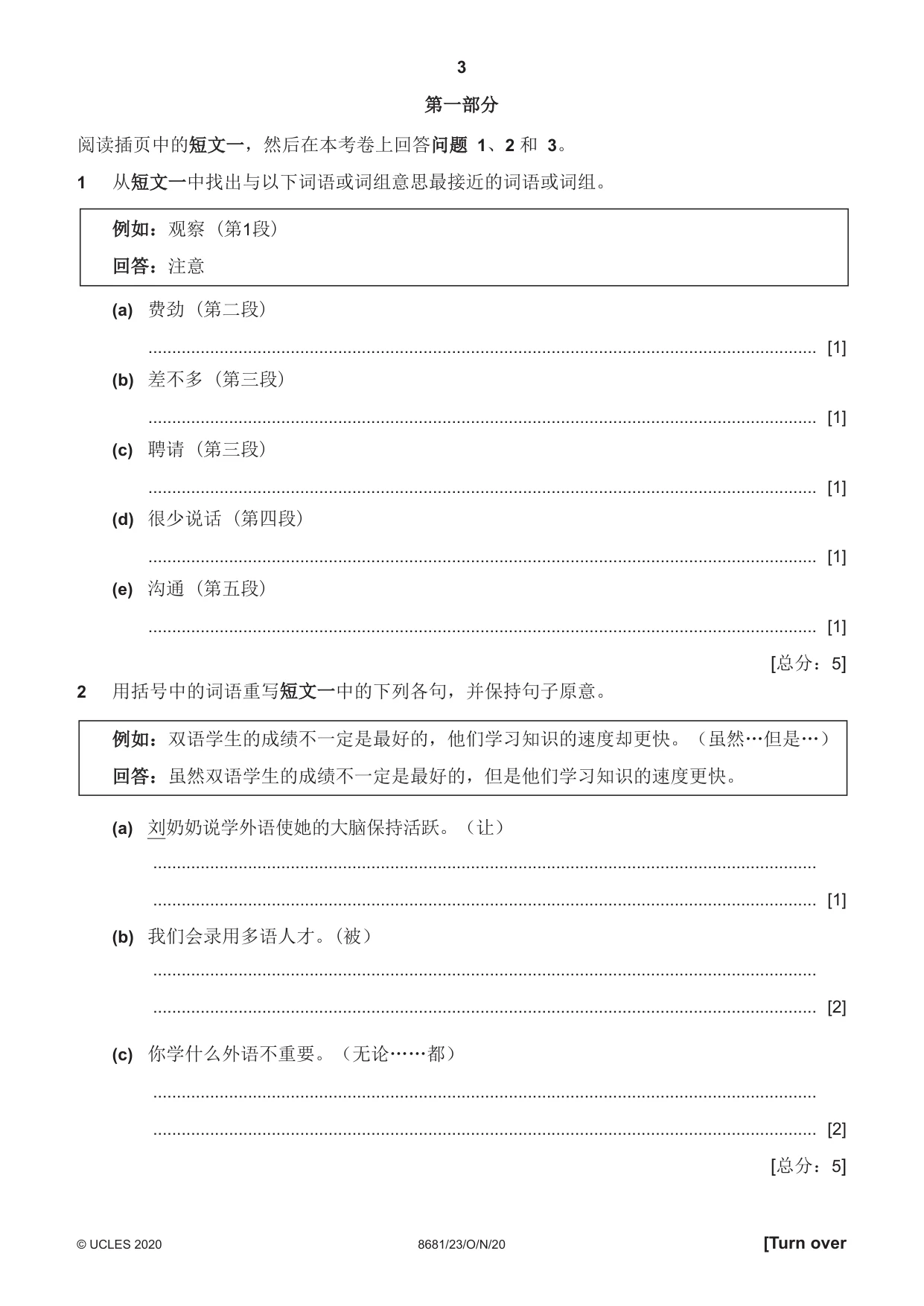
3 8681/23/O/N/20 © UCLES 2020 3 第一部分 阅读插页中的短文一,然后在本考卷上回答问题 1、2 和 3。 1 从短文一中找出与以下词语或词组意思最接近的词语或词组。 例如:观察 (第1段) 回答:注意 (a) 费劲 (第二段) … [1] (b) 差不多 (第三段) … [1] (c) 聘请 (第三段) … [1] (d) 很少说话 (第四段) … [1] (e) 沟通 (第五段) … [1] [总分:5] 2 用括号中的词语重写短文一中的下列各句,并保持句子原意。 例如: 双语学生的成绩不一定是最好的,他们学习知识的速度却更快。(虽然…但是…) 回答: 虽然双语学生的成绩不一定是最好的,但是他们学习知识的速度更快。 (a) 刘奶奶说学外语使她的大脑保持活跃。(让) … [1] … [1] (b) 我们会录用多语人才。(被) … [2] … [2] (c) 你学什么外语不重要。(无论……都) … [2] … [2] [总分:5] [Turn over
Question paper, page 4
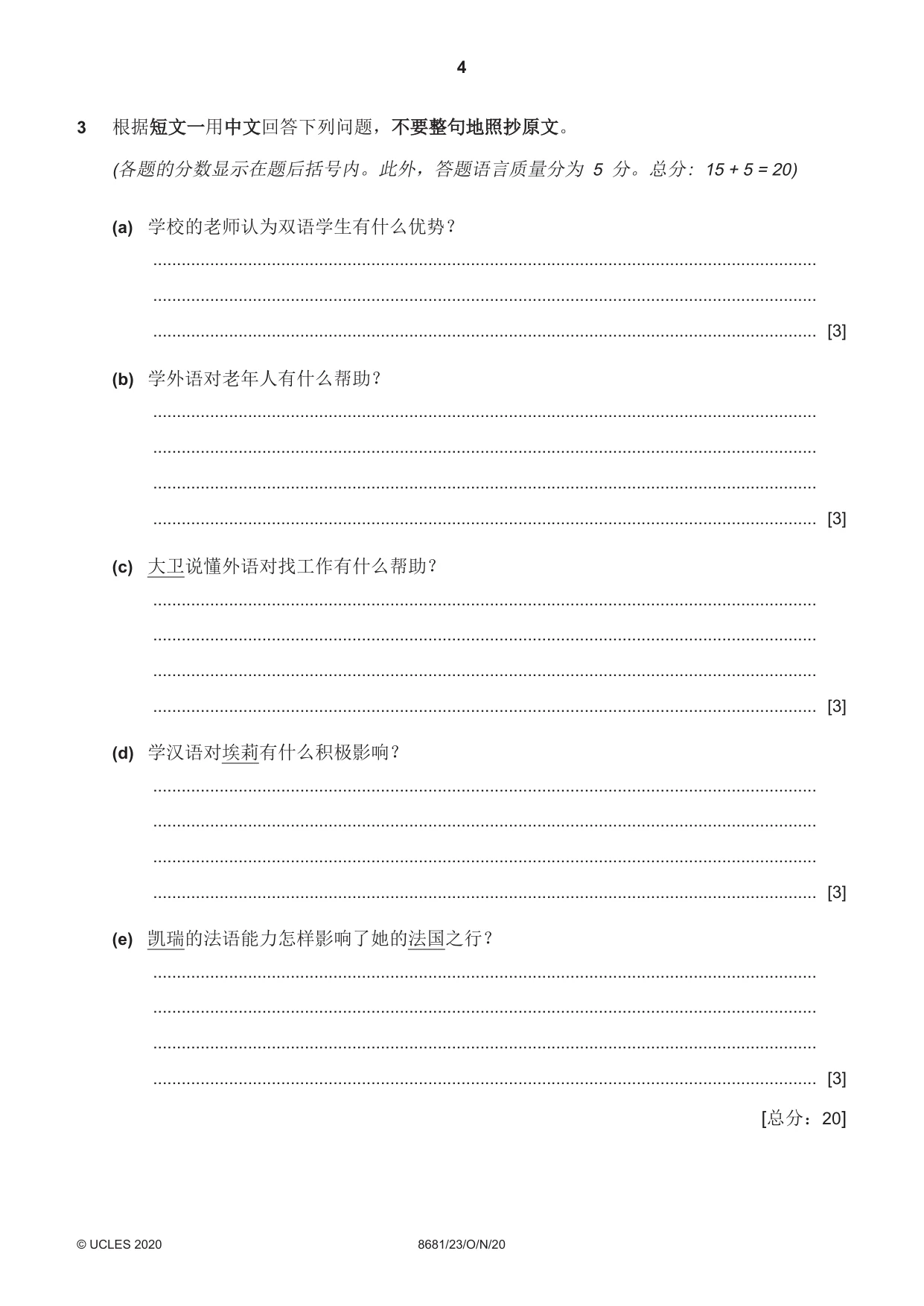
4 8681/23/O/N/20 © UCLES 2020 3 根据短文一用中文回答下列问题,不要整句地照抄原文。 (各题的分数显示在题后括号内。此外,答题语言质量分为 5 分。总分: 15 + 5 = 20) (a) 学校的老师认为双语学生有什么优势? … [3] … [3] … [3] (b) 学外语对老年人有什么帮助? … [2] … [3] … [2] … [3] (c) 大卫说懂外语对找工作有什么帮助? … [3] … [3] … [3] … [3] (d) 学汉语对埃莉有什么积极影响? … [3] … [3] … [3] … [3] (e) 凯瑞的法语能力怎样影响了她的法国之行? … [3] … [3] … [3] … [3] [总分:20]
Question paper, page 5
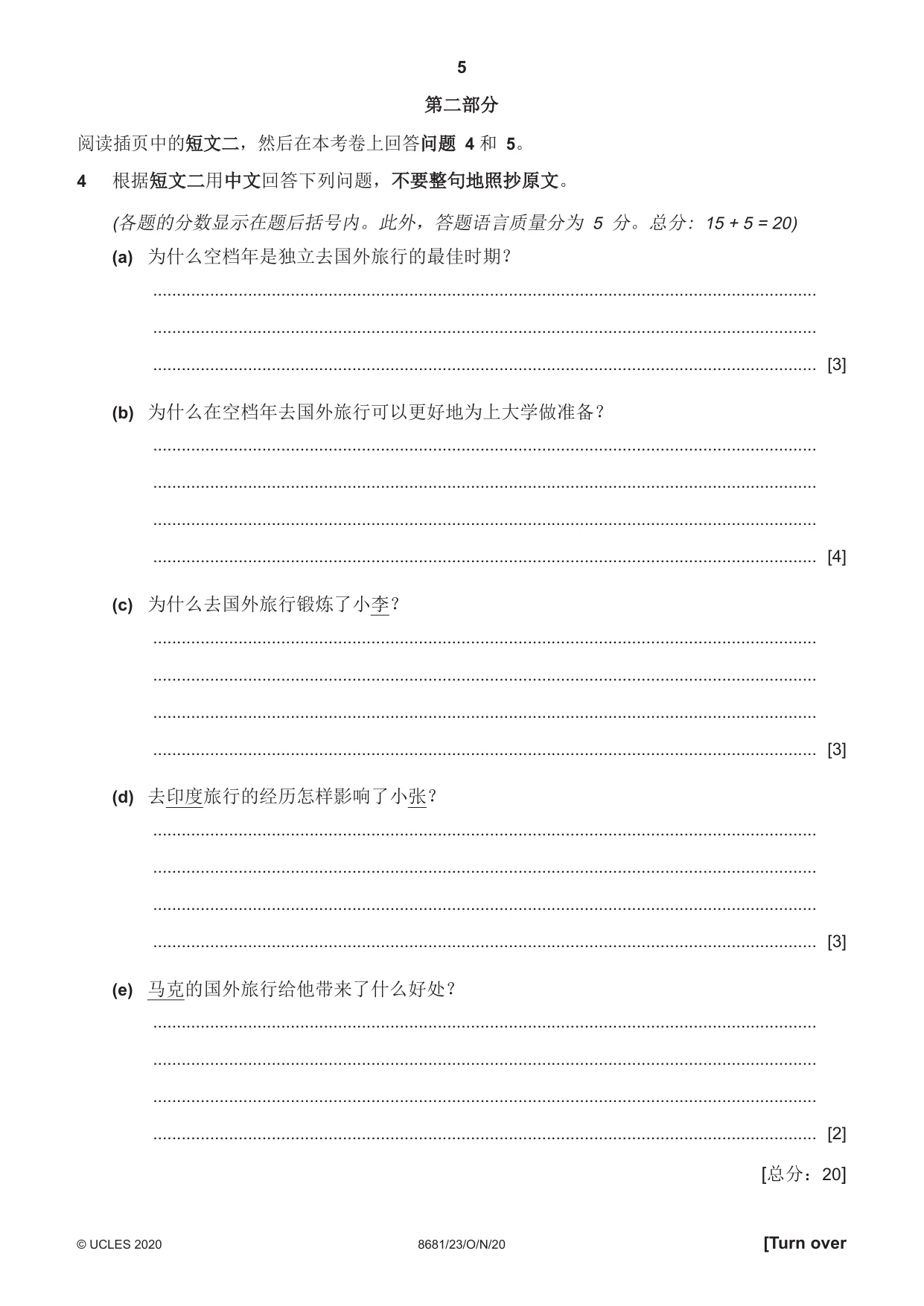
5 8681/23/O/N/20 © UCLES 2020 第二部分 阅读插页中的短文二,然后在本考卷上回答问题 4 和 5。 4 根据短文二用中文回答下列问题,不要整句地照抄原文。 (各题的分数显示在题后括号内。此外,答题语言质量分为 5 分。总分: 15 + 5 = 20) (a) 为什么空档年是独立去国外旅行的最佳时期? … [3] … [3] … [3] (b) 为什么在空档年去国外旅行可以更好地为上大学做准备? … [3] … [3] … [3] … [4] (c) 为什么去国外旅行锻炼了小李? … [3] … [3] … 3] … [3] (d) 去印度旅行的经历怎样影响了小张? … [3] … [3] … 3] … [3] (e) 马克的国外旅行给他带来了什么好处? … [3] … [3] … [3] … [2] [总分:20] [Turn over
Question paper, page 6
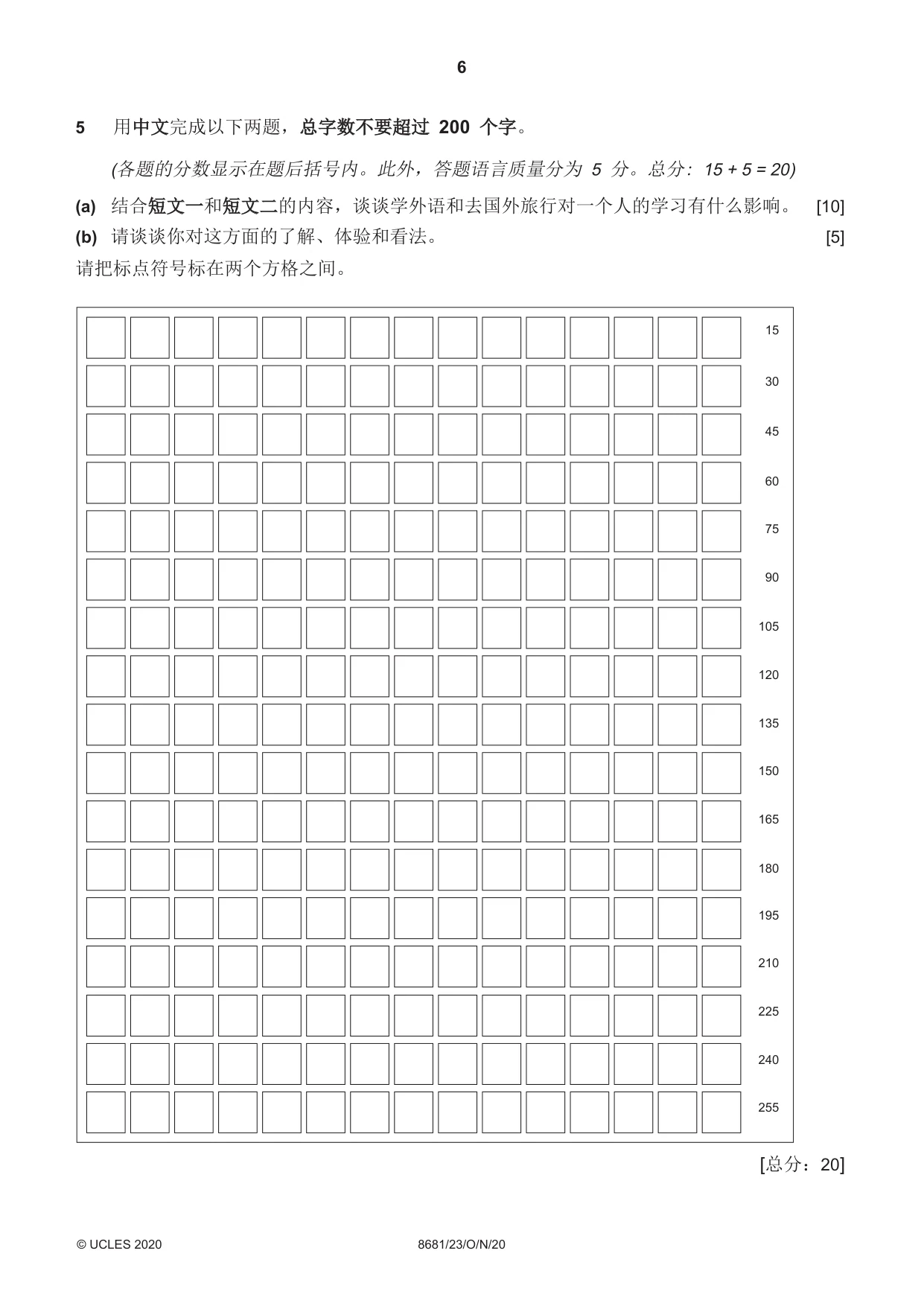
6 8681/23/O/N/20 © UCLES 2020 6 5 用中文完成以下两题,总字数不要超过 200 个字。 (各题的分数显示在题后括号内。此外,答题语言质量分为 5 分。总分: 15 + 5 = 20) (a) 结合短文一和短文二的内容,谈谈学外语和去国外旅行对一个人的学习有什么影响。 [10] (b) 请谈谈你对这方面的了解、体验和看法。 [5] 请把标点符号标在两个方格之间。 [总分:20] 15 30 45 60 75 90 105 120 135 150 165 180 195 210 225 240 255
Question paper, page 7
7 8681/23/O/N/20 © UCLES 2020 BLANK PAGE
Question paper, page 8
8 8681/23/O/N/20 © UCLES 2020 Permission to reproduce items where third-party owned material protected by copyright is included has been sought and cleared where possible. Every reasonable effort has been made by the publisher (UCLES) to trace copyright holders, but if any items requiring clearance have unwittingly been included, the publisher will be pleased to make amends at the earliest possible opportunity. To avoid the issue of disclosure of answer-related information to candidates, all copyright acknowledgements are reproduced online in the Cambridge Assessment International Education Copyright Acknowledgements Booklet. This is produced for each series of examinations and is freely available to download at www.cambridgeinternational.org after the live examination series. Cambridge Assessment International Education is part of the Cambridge Assessment Group. Cambridge Assessment is the brand name of the University of Cambridge Local Examinations Syndicate (UCLES), which itself is a department of the University of Cambridge. BLANK PAGE
Mark scheme, page 1
This document consists of 17 printed pages. © UCLES 2020 [Turn over Cambridge International AS Level CHINESE LANGUAGE 8681/23 Paper 2 Reading and Writing October/November 2020 MARK SCHEME Maximum Mark: 70 Published This mark scheme is published as an aid to teachers and candidates, to indicate the requirements of the examination. It shows the basis on which Examiners were instructed to award marks. It does not indicate the details of the discussions that took place at an Examiners’ meeting before marking began, which would have considered the acceptability of alternative answers. Mark schemes should be read in conjunction with the question paper and the Principal Examiner Report for Teachers. Cambridge International will not enter into discussions about these mark schemes. Cambridge International is publishing the mark schemes for the October/November 2020 series for most Cambridge IGCSE™, Cambridge International A and AS Level and Cambridge Pre-U components, and some Cambridge O Level components.
Mark scheme, page 2
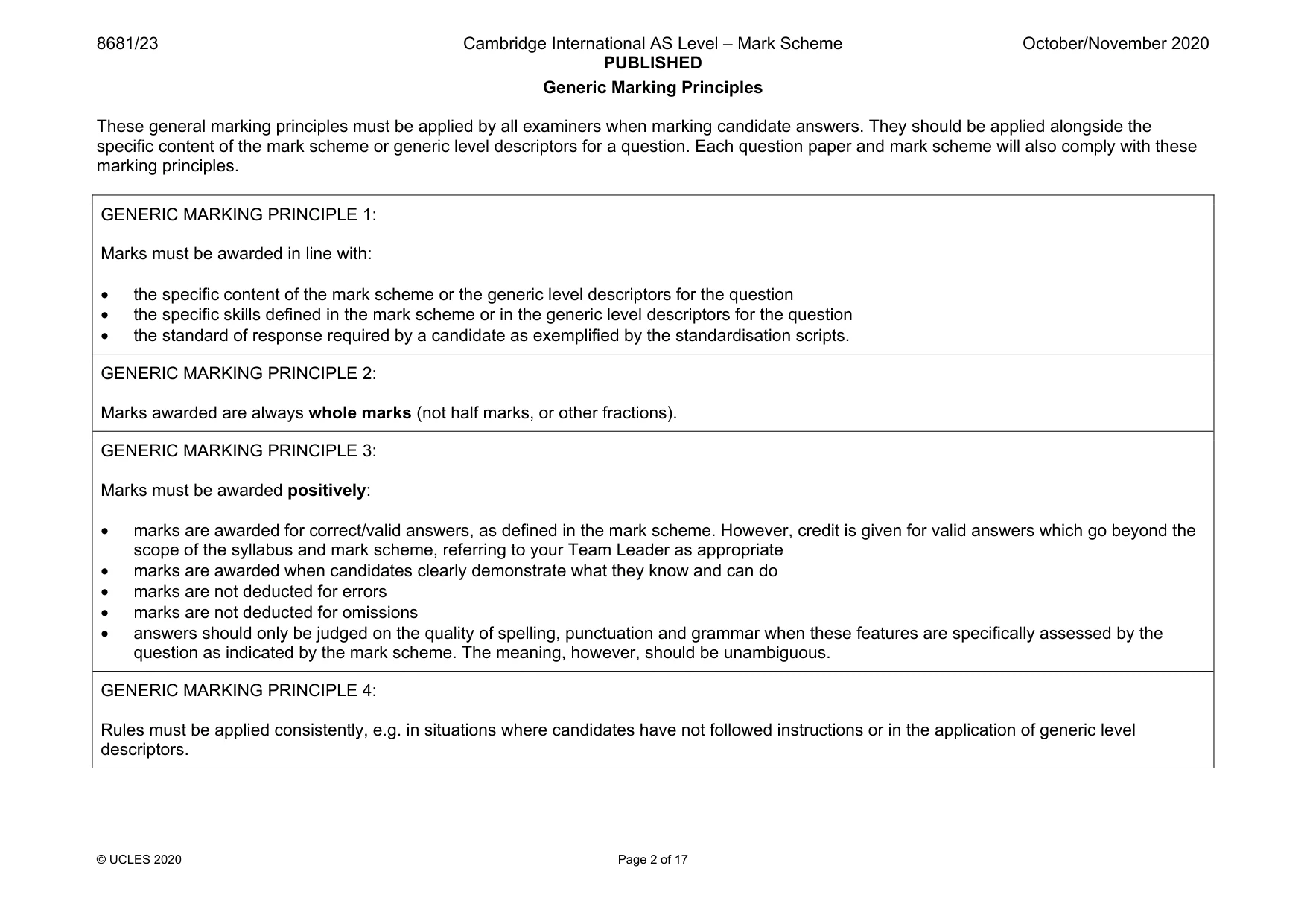
8681/23 Cambridge International AS Level – Mark Scheme PUBLISHED October/November 2020 © UCLES 2020 Page 2 of 17 Generic Marking Principles These general marking principles must be applied by all examiners when marking candidate answers. They should be applied alongside the specific content of the mark scheme or generic level descriptors for a question. Each question paper and mark scheme will also comply with these marking principles. GENERIC MARKING PRINCIPLE 1: Marks must be awarded in line with: • the specific content of the mark scheme or the generic level descriptors for the question • the specific skills defined in the mark scheme or in the generic level descriptors for the question • the standard of response required by a candidate as exemplified by the standardisation scripts. GENERIC MARKING PRINCIPLE 2: Marks awarded are always whole marks (not half marks, or other fractions). GENERIC MARKING PRINCIPLE 3: Marks must be awarded positively: • marks are awarded for correct/valid answers, as defined in the mark scheme. However, credit is given for valid answers which go beyond the scope of the syllabus and mark scheme, referring to your Team Leader as appropriate • marks are awarded when candidates clearly demonstrate what they know and can do • marks are not deducted for errors • marks are not deducted for omissions • answers should only be judged on the quality of spelling, punctuation and grammar when these features are specifically assessed by the question as indicated by the mark scheme. The meaning, however, should be unambiguous. GENERIC MARKING PRINCIPLE 4: Rules must be applied consistently, e.g. in situations where candidates have not followed instructions or in the application of generic level descriptors.
Mark scheme, page 3
8681/23 Cambridge International AS Level – Mark Scheme PUBLISHED October/November 2020 © UCLES 2020 Page 3 of 17 GENERIC MARKING PRINCIPLE 5: Marks should be awarded using the full range of marks defined in the mark scheme for the question (however; the use of the full mark range may be limited according to the quality of the candidate responses seen). GENERIC MARKING PRINCIPLE 6: Marks awarded are based solely on the requirements as defined in the mark scheme. Marks should not be awarded with grade thresholds or grade descriptors in mind.
Mark scheme, page 4
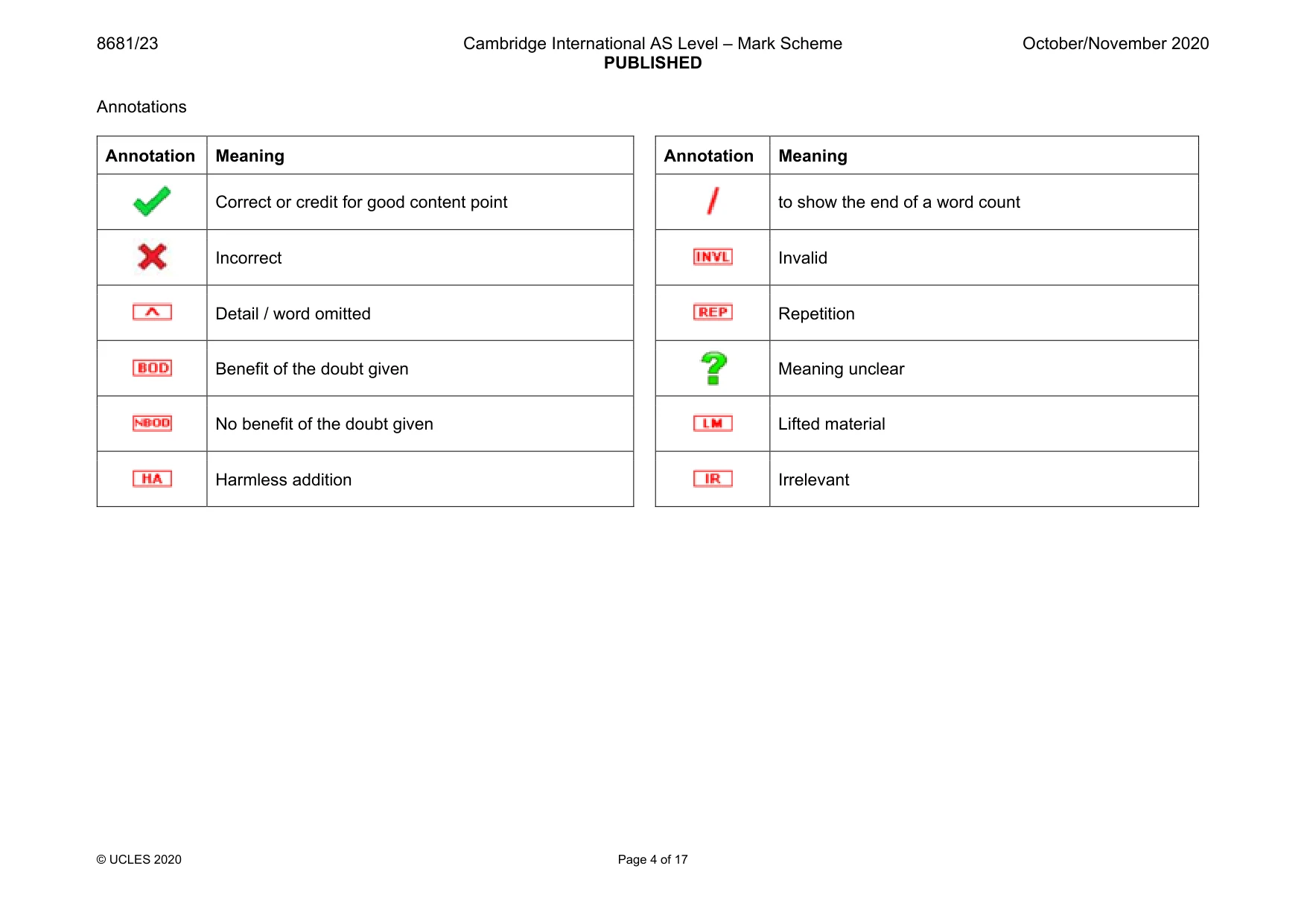
8681/23 Cambridge International AS Level – Mark Scheme PUBLISHED October/November 2020 © UCLES 2020 Page 4 of 17 Annotations Annotation Meaning Annotation Meaning Correct or credit for good content point to show the end of a word count Incorrect Invalid Detail / word omitted Repetition Benefit of the doubt given Meaning unclear No benefit of the doubt given Lifted material Harmless addition Irrelevant
Mark scheme, page 5
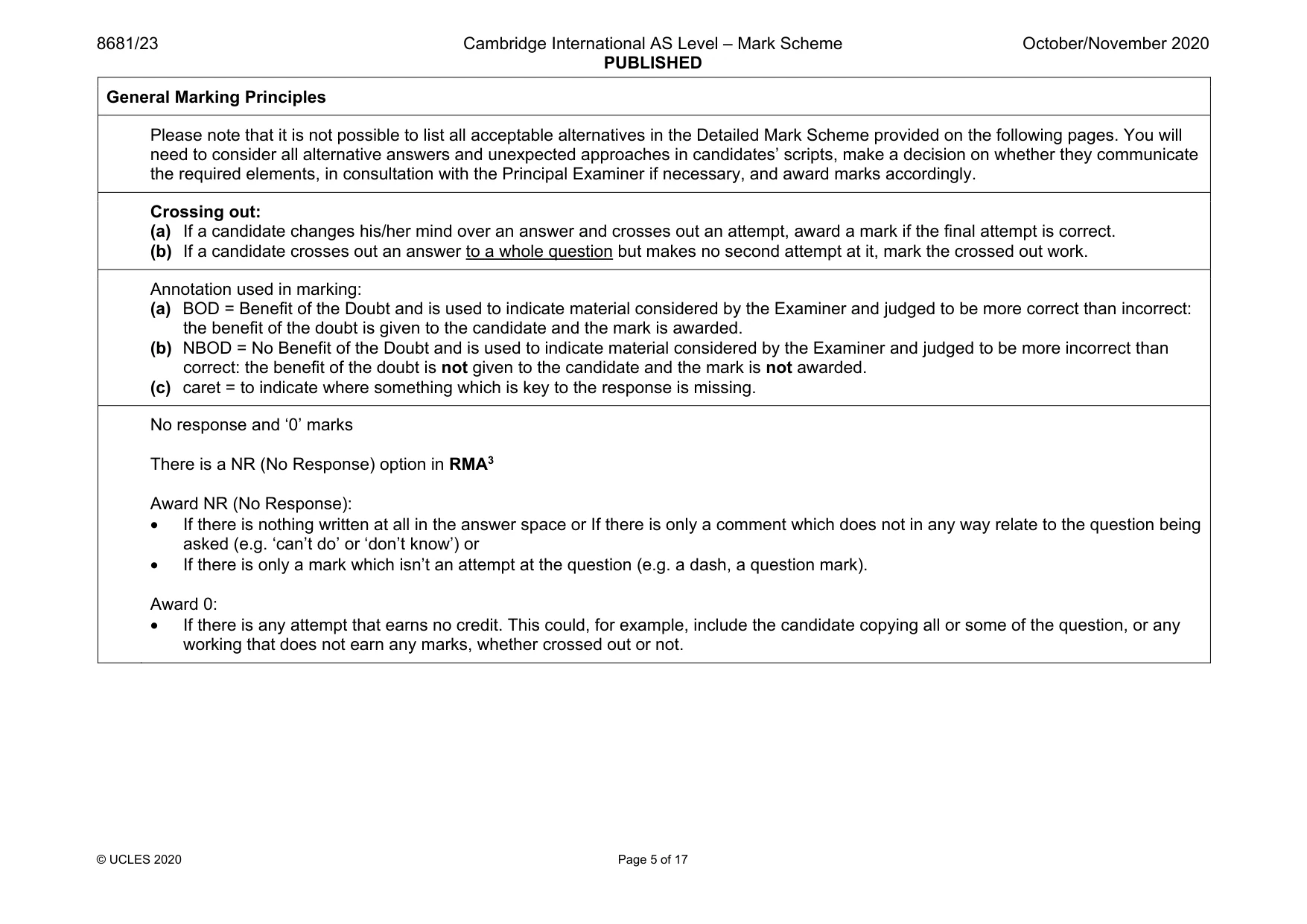
8681/23 Cambridge International AS Level – Mark Scheme PUBLISHED October/November 2020 © UCLES 2020 Page 5 of 17 General Marking Principles Please note that it is not possible to list all acceptable alternatives in the Detailed Mark Scheme provided on the following pages. You will need to consider all alternative answers and unexpected approaches in candidates’ scripts, make a decision on whether they communicate the required elements, in consultation with the Principal Examiner if necessary, and award marks accordingly. Crossing out: (a) If a candidate changes his/her mind over an answer and crosses out an attempt, award a mark if the final attempt is correct. (b) If a candidate crosses out an answer to a whole question but makes no second attempt at it, mark the crossed out work. Annotation used in marking: (a) BOD = Benefit of the Doubt and is used to indicate material considered by the Examiner and judged to be more correct than incorrect: the benefit of the doubt is given to the candidate and the mark is awarded. (b) NBOD = No Benefit of the Doubt and is used to indicate material considered by the Examiner and judged to be more incorrect than correct: the benefit of the doubt is not given to the candidate and the mark is not awarded. (c) caret = to indicate where something which is key to the response is missing. No response and ‘0’ marks There is a NR (No Response) option in RMA3 Award NR (No Response): • If there is nothing written at all in the answer space or If there is only a comment which does not in any way relate to the question being asked (e.g. ‘can’t do’ or ‘don’t know’) or • If there is only a mark which isn’t an attempt at the question (e.g. a dash, a question mark). Award 0: • If there is any attempt that earns no credit. This could, for example, include the candidate copying all or some of the question, or any working that does not earn any marks, whether crossed out or not.
Mark scheme, page 6
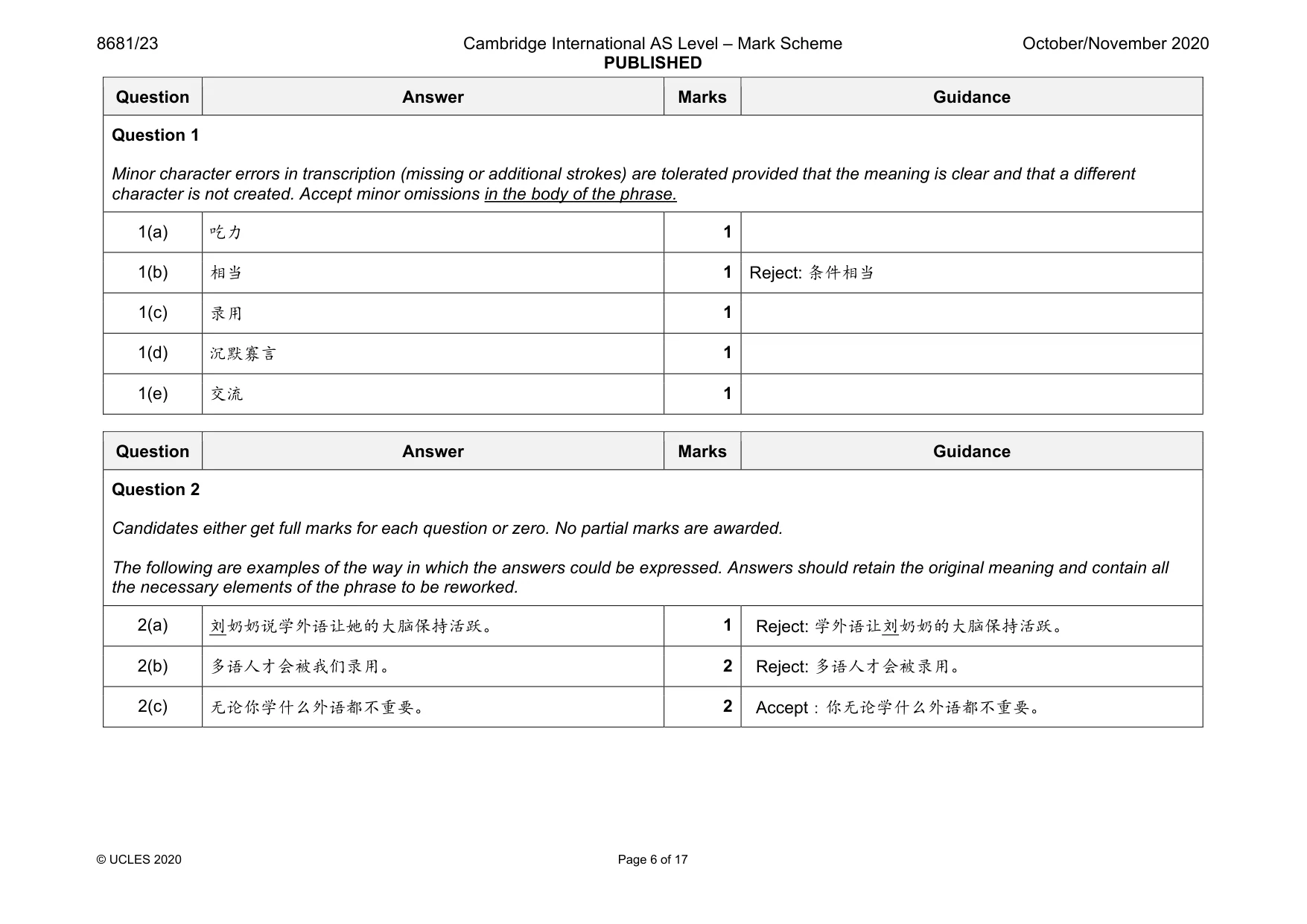
8681/23 Cambridge International AS Level – Mark Scheme PUBLISHED October/November 2020 © UCLES 2020 Page 6 of 17 Question Answer Marks Guidance Question 1 Minor character errors in transcription (missing or additional strokes) are tolerated provided that the meaning is clear and that a different character is not created. Accept minor omissions in the body of the phrase. 1(a) 吃力 1 1(b) 相当 1 Reject: 条件相当 1(c) 录用 1 1(d) 沉默寡言 1 1(e) 交流 1 Question Answer Marks Guidance Question 2 Candidates either get full marks for each question or zero. No partial marks are awarded. The following are examples of the way in which the answers could be expressed. Answers should retain the original meaning and contain all the necessary elements of the phrase to be reworked. 2(a) 刘奶奶说学外语让她的大脑保持活跃。 1 Reject: 学外语让刘奶奶的大脑保持活跃。 2(b) 多语人才会被我们录用。 2 Reject: 多语人才会被录用。 2(c) 无论你学什么外语都不重要。 2 Accept:你无论学什么外语都不重要。
Mark scheme, page 7
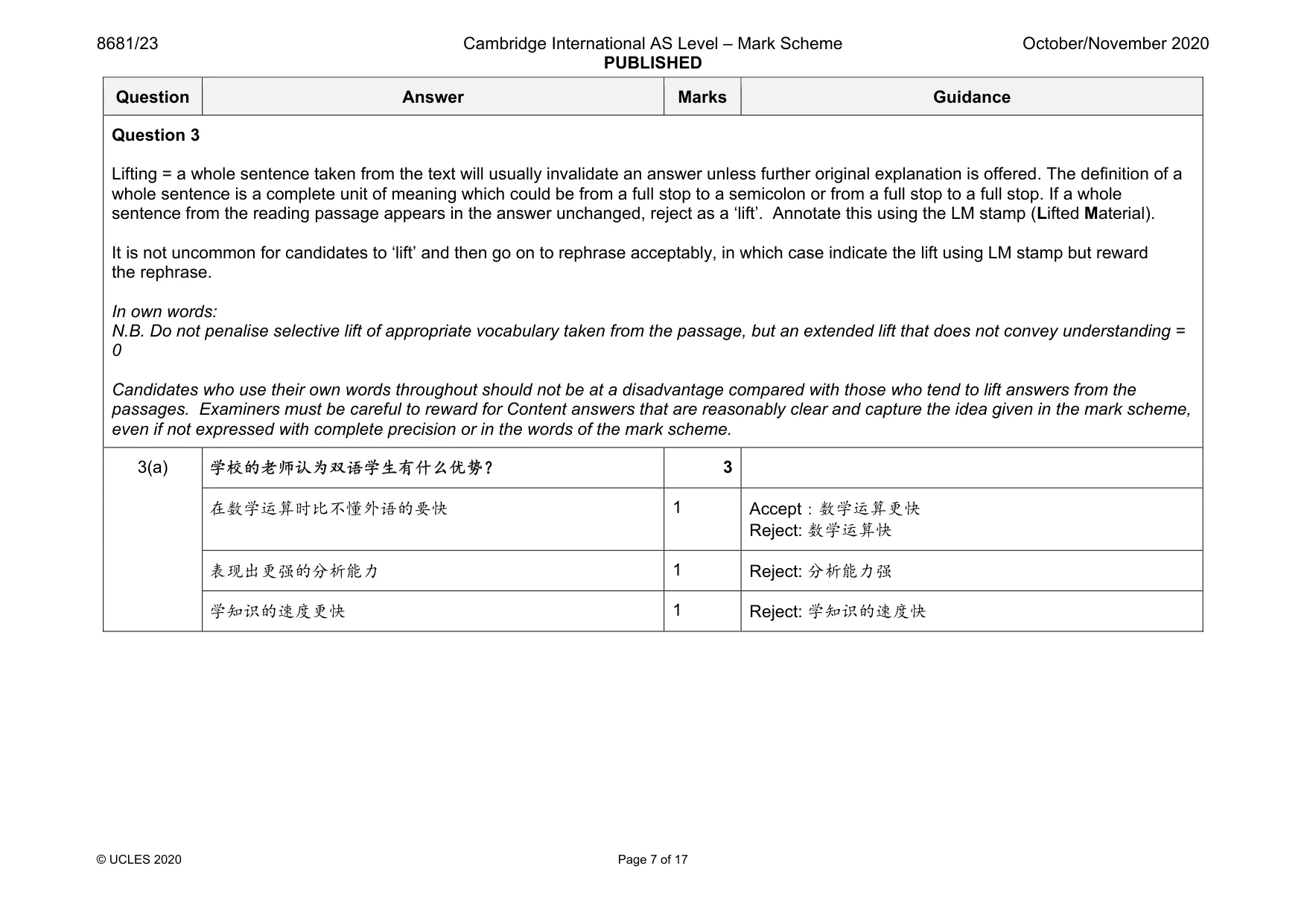
8681/23 Cambridge International AS Level – Mark Scheme PUBLISHED October/November 2020 © UCLES 2020 Page 7 of 17 Question Answer Marks Guidance Question 3 Lifting = a whole sentence taken from the text will usually invalidate an answer unless further original explanation is offered. The definition of a whole sentence is a complete unit of meaning which could be from a full stop to a semicolon or from a full stop to a full stop. If a whole sentence from the reading passage appears in the answer unchanged, reject as a ‘lift’. Annotate this using the LM stamp (Lifted Material). It is not uncommon for candidates to ‘lift’ and then go on to rephrase acceptably, in which case indicate the lift using LM stamp but reward the rephrase. In own words: N.B. Do not penalise selective lift of appropriate vocabulary taken from the passage, but an extended lift that does not convey understanding = 0 Candidates who use their own words throughout should not be at a disadvantage compared with those who tend to lift answers from the passages. Examiners must be careful to reward for Content answers that are reasonably clear and capture the idea given in the mark scheme, even if not expressed with complete precision or in the words of the mark scheme. 3(a) 学校的老师认为双语学生有什么优势? 3 在数学运算时比不懂外语的要快 1 Accept:数学运算更快 Reject: 数学运算快 表现出更强的分析能力 1 Reject: 分析能力强 学知识的速度更快 1 Reject: 学知识的速度快
Mark scheme, page 8
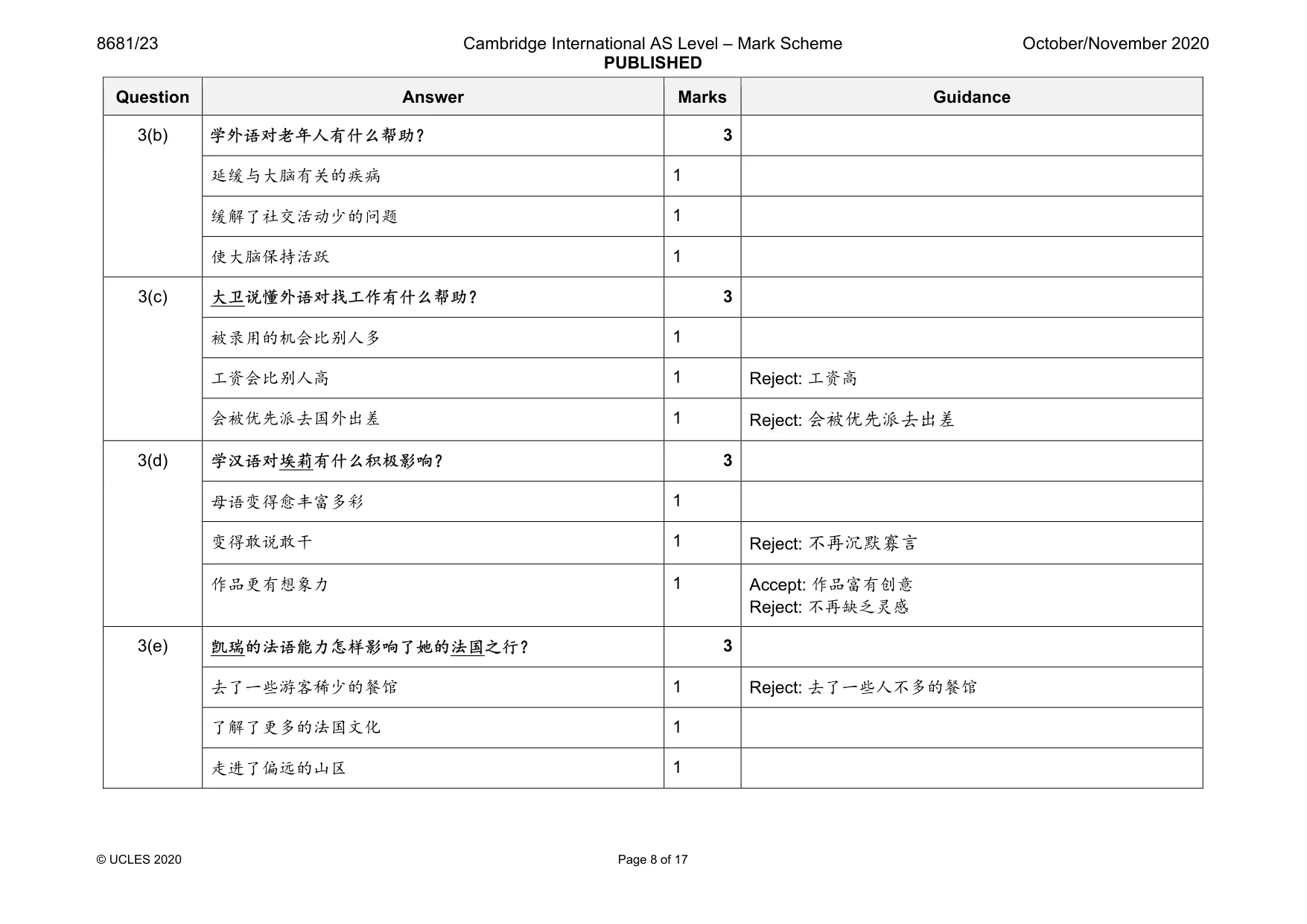
8681/23 Cambridge International AS Level – Mark Scheme PUBLISHED October/November 2020 © UCLES 2020 Page 8 of 17 Question Answer Marks Guidance 3(b) 学外语对老年人有什么帮助? 3 延缓与大脑有关的疾病 1 缓解了社交活动少的问题 1 使大脑保持活跃 1 3(c) 大卫说懂外语对找工作有什么帮助? 3 被录用的机会比别人多 1 工资会比别人高 1 Reject: 工资高 会被优先派去国外出差 1 Reject: 会被优先派去出差 3(d) 学汉语对埃莉有什么积极影响? 3 母语变得愈丰富多彩 1 变得敢说敢干 1 Reject: 不再沉默寡言 作品更有想象力 1 Accept: 作品富有创意 Reject: 不再缺乏灵感 3(e) 凯瑞的法语能力怎样影响了她的法国之行? 3 去了一些游客稀少的餐馆 1 Reject: 去了一些人不多的餐馆 了解了更多的法国文化 1 走进了偏远的山区 1
Mark scheme, page 9
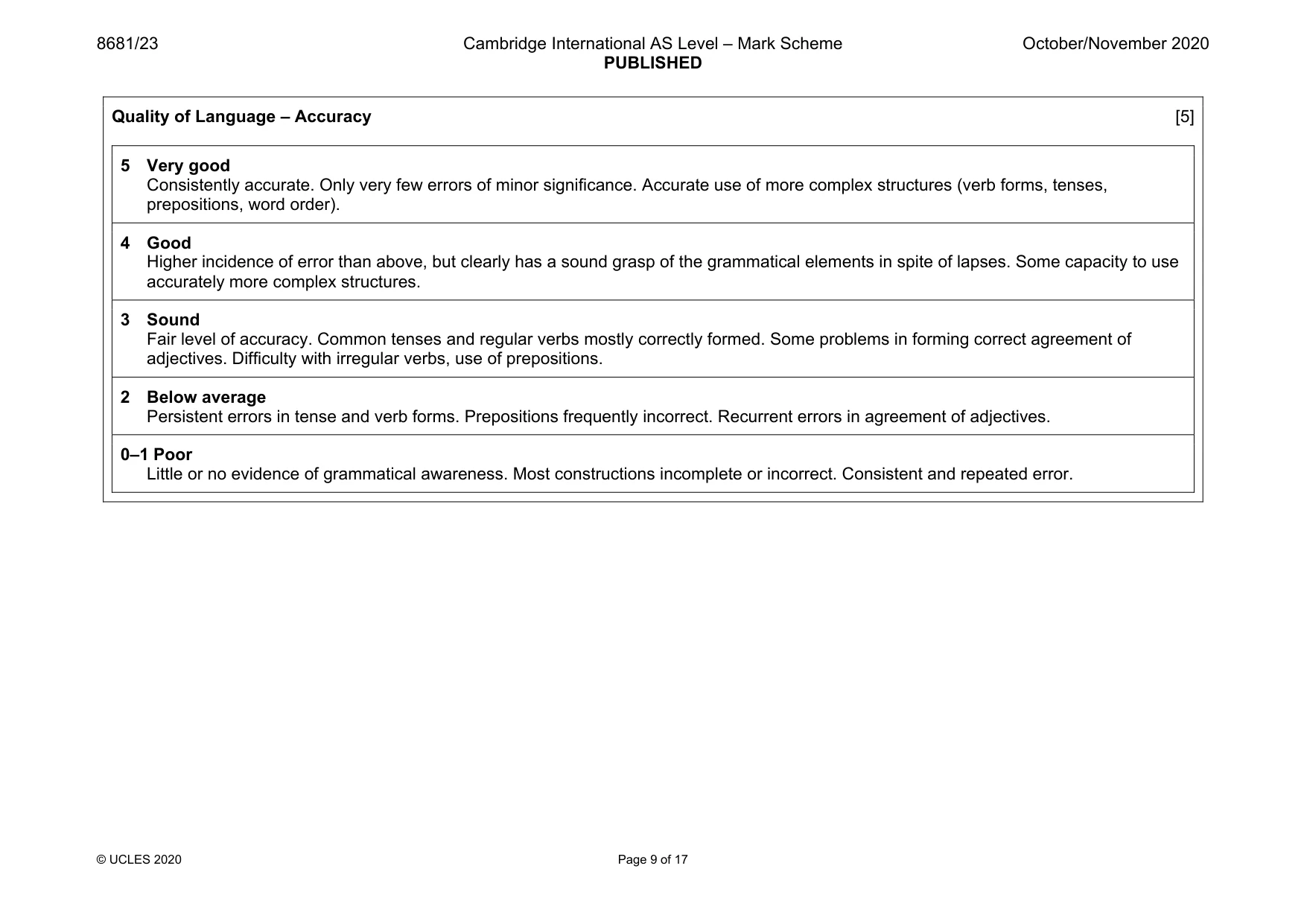
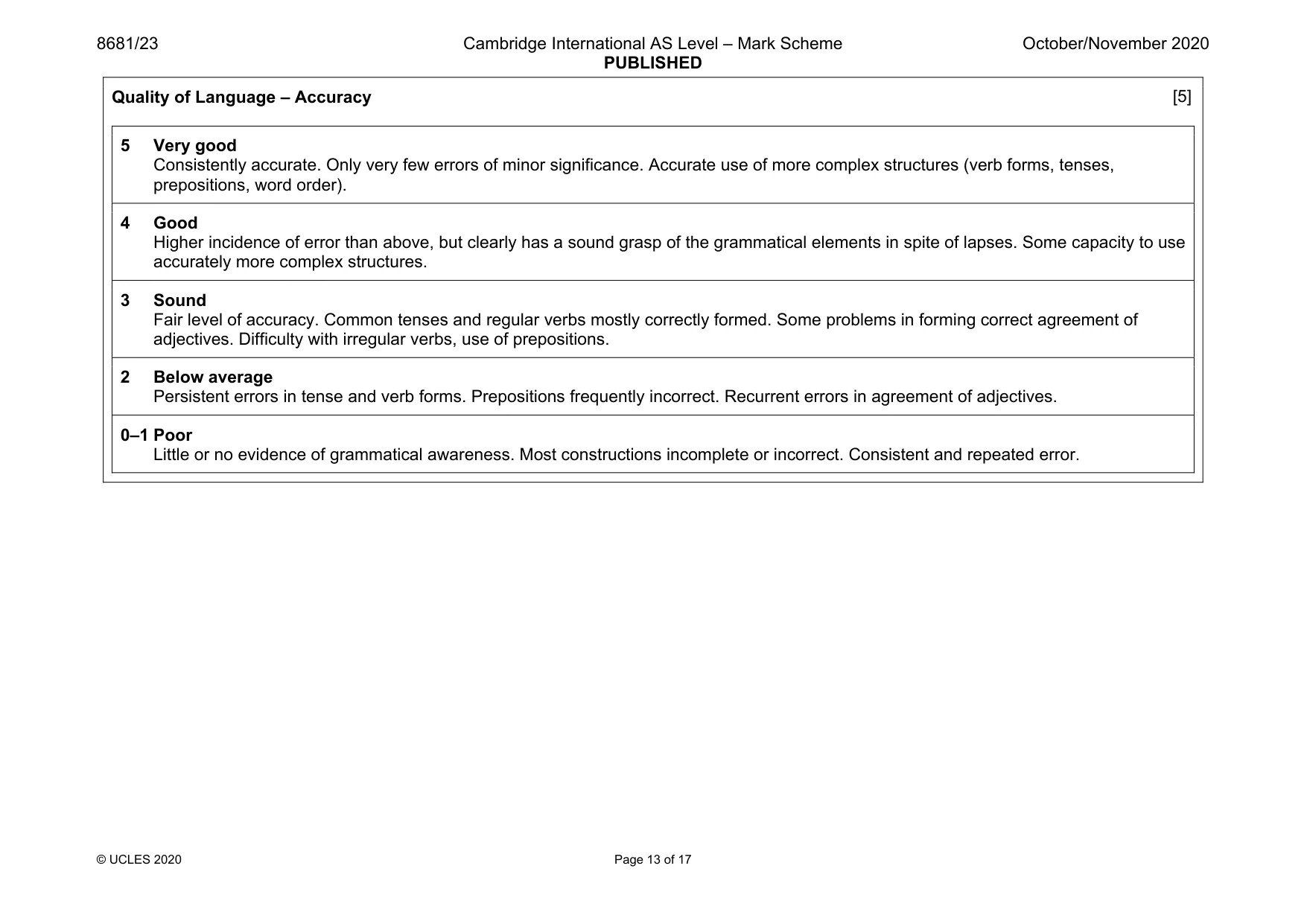
8681/23 Cambridge International AS Level – Mark Scheme PUBLISHED October/November 2020 © UCLES 2020 Page 9 of 17 Quality of Language – Accuracy [5] 5 Very good Consistently accurate. Only very few errors of minor significance. Accurate use of more complex structures (verb forms, tenses, prepositions, word order). 4 Good Higher incidence of error than above, but clearly has a sound grasp of the grammatical elements in spite of lapses. Some capacity to use accurately more complex structures. 3 Sound Fair level of accuracy. Common tenses and regular verbs mostly correctly formed. Some problems in forming correct agreement of adjectives. Difficulty with irregular verbs, use of prepositions. 2 Below average Persistent errors in tense and verb forms. Prepositions frequently incorrect. Recurrent errors in agreement of adjectives. 0–1 Poor Little or no evidence of grammatical awareness. Most constructions incomplete or incorrect. Consistent and repeated error.
Mark scheme, page 10
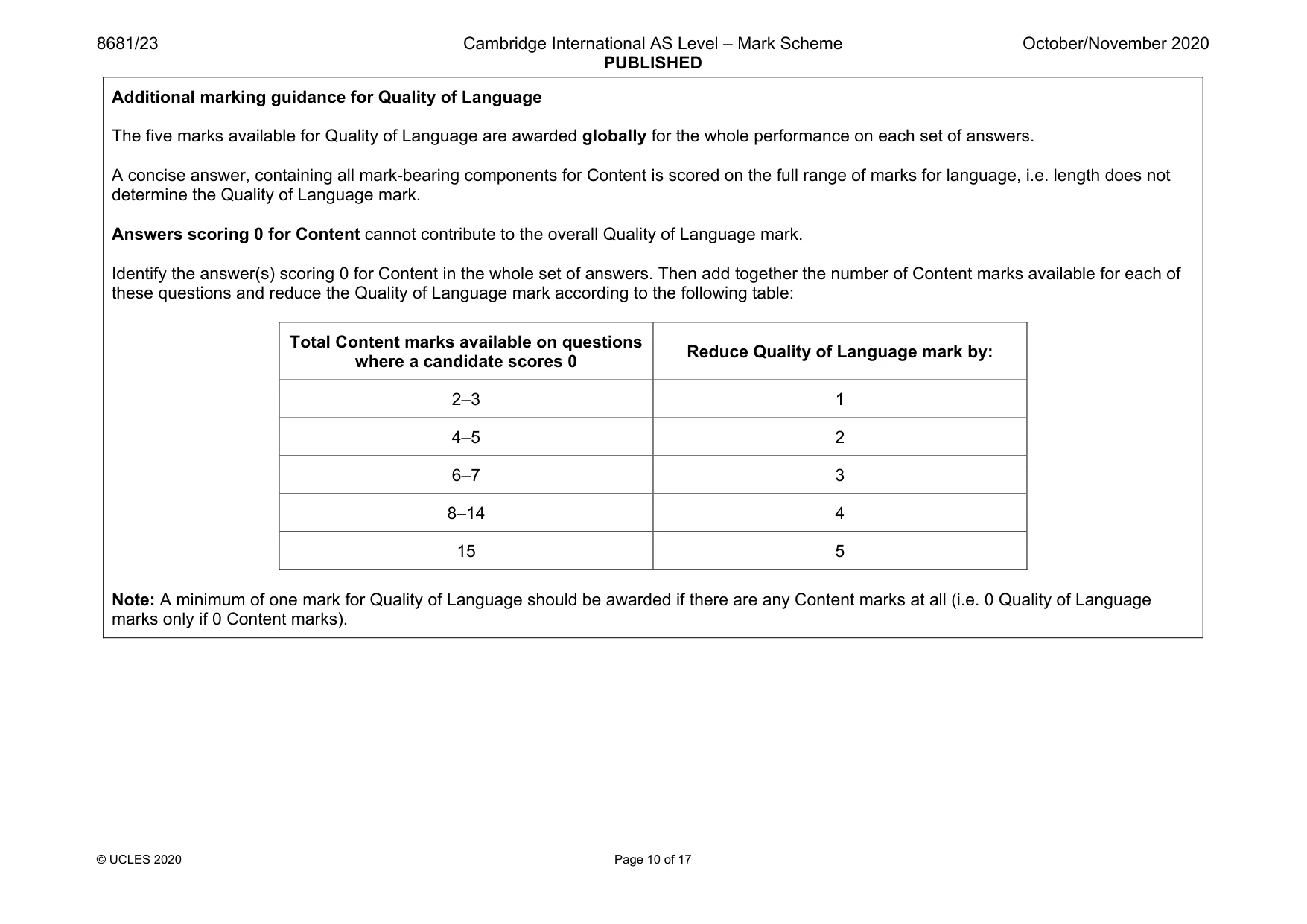
8681/23 Cambridge International AS Level – Mark Scheme PUBLISHED October/November 2020 © UCLES 2020 Page 10 of 17 Additional marking guidance for Quality of Language The five marks available for Quality of Language are awarded globally for the whole performance on each set of answers. A concise answer, containing all mark-bearing components for Content is scored on the full range of marks for language, i.e. length does not determine the Quality of Language mark. Answers scoring 0 for Content cannot contribute to the overall Quality of Language mark. Identify the answer(s) scoring 0 for Content in the whole set of answers. Then add together the number of Content marks available for each of these questions and reduce the Quality of Language mark according to the following table: Total Content marks available on questions where a candidate scores 0 Reduce Quality of Language mark by: 2–3 1 4–5 2 6–7 3 8–14 4 15 5 Note: A minimum of one mark for Quality of Language should be awarded if there are any Content marks at all (i.e. 0 Quality of Language marks only if 0 Content marks).
Mark scheme, page 11
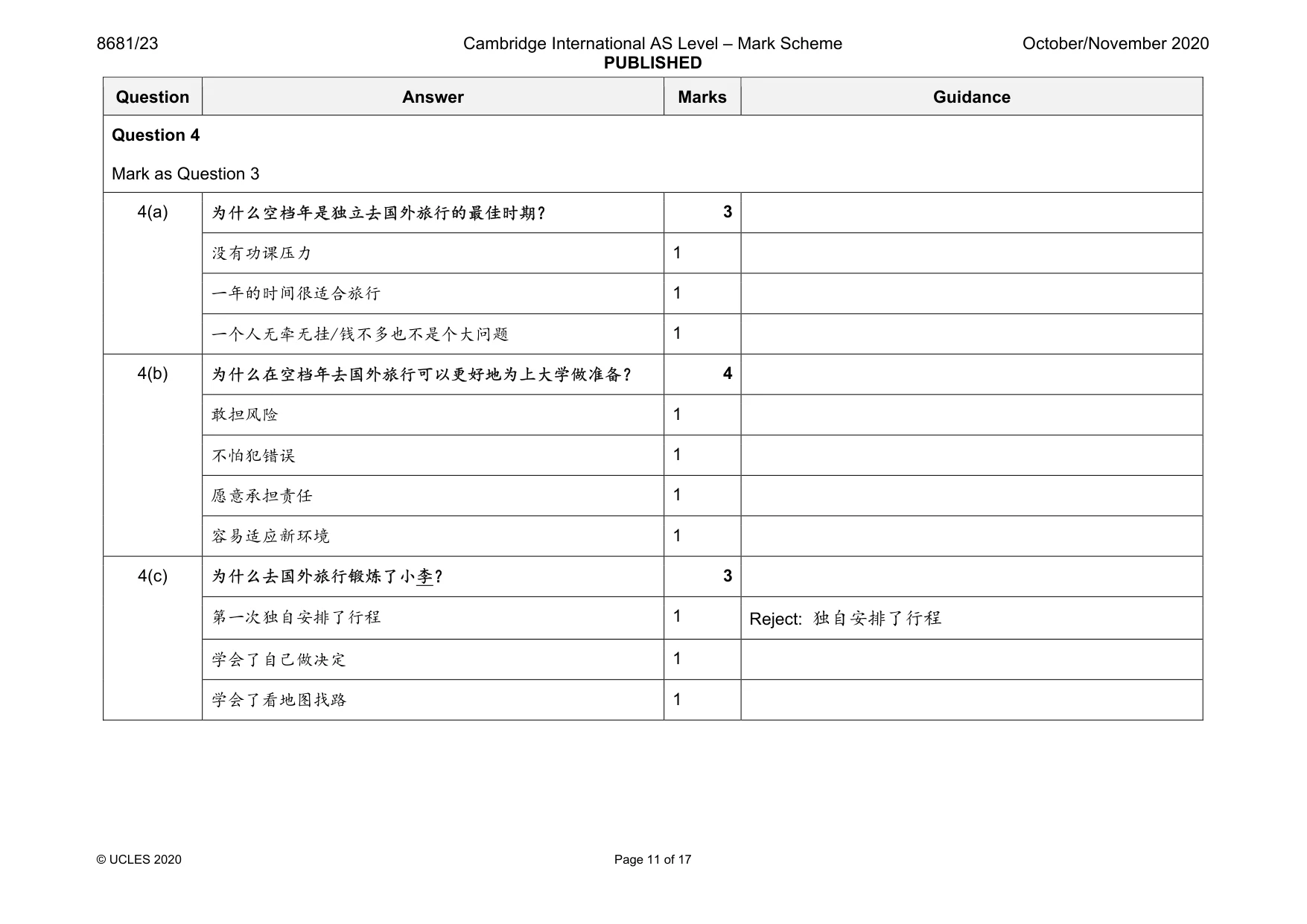
8681/23 Cambridge International AS Level – Mark Scheme PUBLISHED October/November 2020 © UCLES 2020 Page 11 of 17 Question Answer Marks Guidance Question 4 Mark as Question 3 4(a) 为什么空档年是独立去国外旅行的最佳时期? 3 没有功课压力 1 一年的时间很适合旅行 1 一个人无牵无挂/钱不多也不是个大问题 1 4(b) 为什么在空档年去国外旅行可以更好地为上大学做准备? 4 敢担风险 1 不怕犯错误 1 愿意承担责任 1 容易适应新环境 1 4(c) 为什么去国外旅行锻炼了小李? 3 第一次独自安排了行程 1 Reject: 独自安排了行程 学会了自己做决定 1 学会了看地图找路 1
Mark scheme, page 12
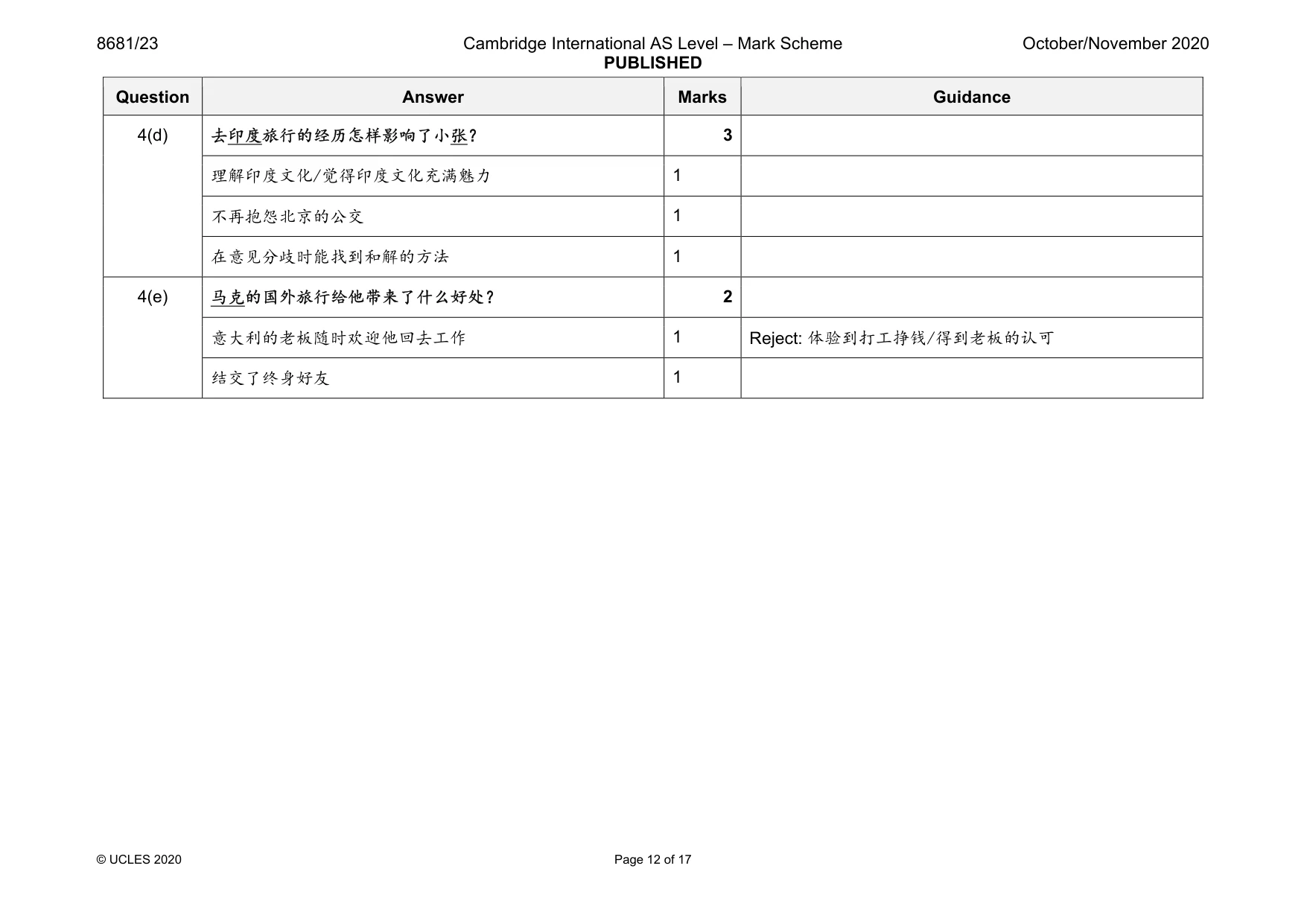
8681/23 Cambridge International AS Level – Mark Scheme PUBLISHED October/November 2020 © UCLES 2020 Page 12 of 17 Question Answer Marks Guidance 4(d) 去印度旅行的经历怎样影响了小张? 3 理解印度文化/觉得印度文化充满魅力 1 不再抱怨北京的公交 1 在意见分歧时能找到和解的方法 1 4(e) 马克的国外旅行给他带来了什么好处? 2 意大利的老板随时欢迎他回去工作 1 Reject: 体验到打工挣钱/得到老板的认可 结交了终身好友 1
Mark scheme, page 13
8681/23 Cambridge International AS Level – Mark Scheme PUBLISHED October/November 2020 © UCLES 2020 Page 13 of 17 Quality of Language – Accuracy [5] 5 Very good Consistently accurate. Only very few errors of minor significance. Accurate use of more complex structures (verb forms, tenses, prepositions, word order). 4 Good Higher incidence of error than above, but clearly has a sound grasp of the grammatical elements in spite of lapses. Some capacity to use accurately more complex structures. 3 Sound Fair level of accuracy. Common tenses and regular verbs mostly correctly formed. Some problems in forming correct agreement of adjectives. Difficulty with irregular verbs, use of prepositions. 2 Below average Persistent errors in tense and verb forms. Prepositions frequently incorrect. Recurrent errors in agreement of adjectives. 0–1 Poor Little or no evidence of grammatical awareness. Most constructions incomplete or incorrect. Consistent and repeated error.
Mark scheme, page 14
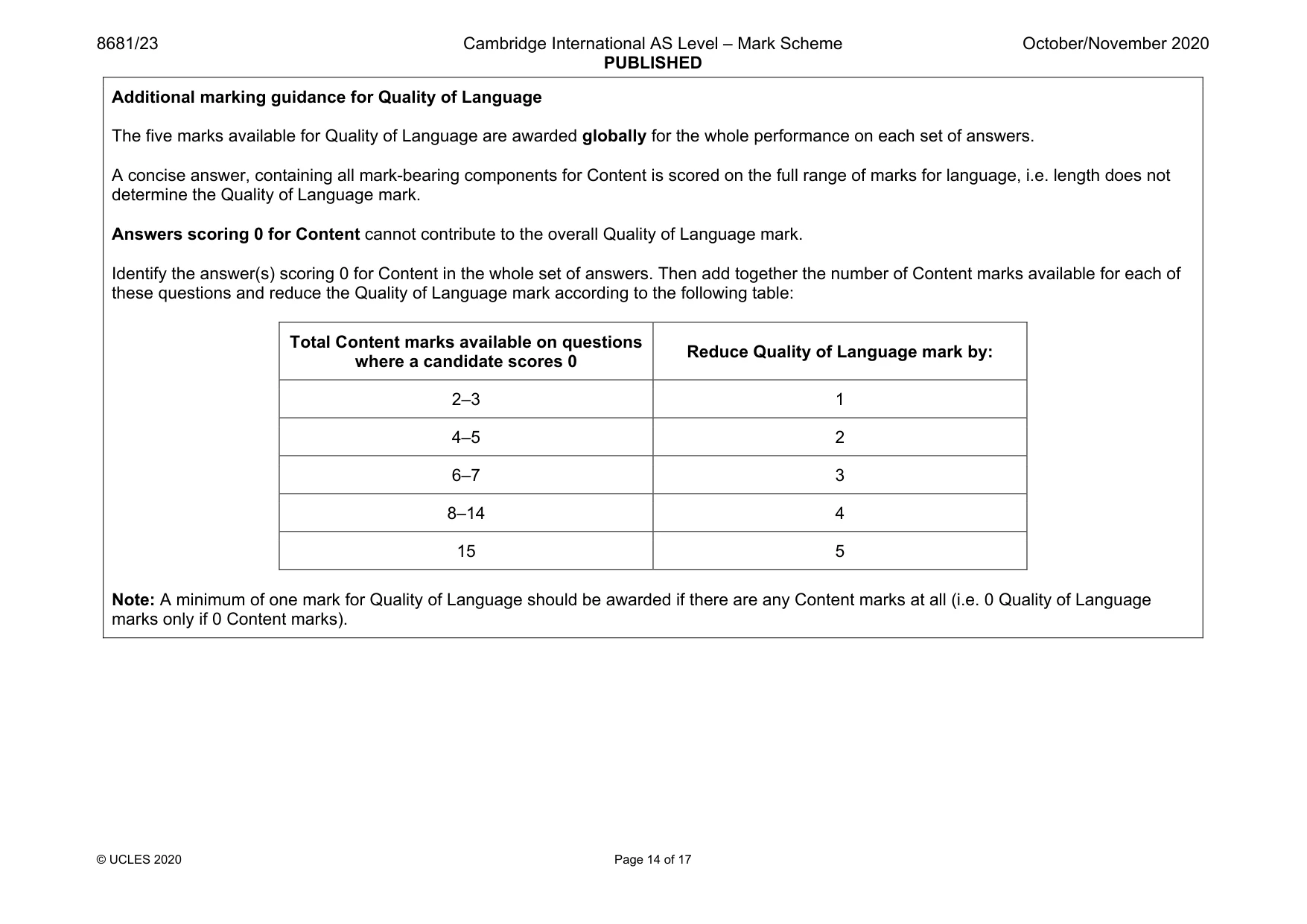
8681/23 Cambridge International AS Level – Mark Scheme PUBLISHED October/November 2020 © UCLES 2020 Page 14 of 17 Additional marking guidance for Quality of Language The five marks available for Quality of Language are awarded globally for the whole performance on each set of answers. A concise answer, containing all mark-bearing components for Content is scored on the full range of marks for language, i.e. length does not determine the Quality of Language mark. Answers scoring 0 for Content cannot contribute to the overall Quality of Language mark. Identify the answer(s) scoring 0 for Content in the whole set of answers. Then add together the number of Content marks available for each of these questions and reduce the Quality of Language mark according to the following table: Total Content marks available on questions where a candidate scores 0 Reduce Quality of Language mark by: 2–3 1 4–5 2 6–7 3 8–14 4 15 5 Note: A minimum of one mark for Quality of Language should be awarded if there are any Content marks at all (i.e. 0 Quality of Language marks only if 0 Content marks).
Mark scheme, page 15
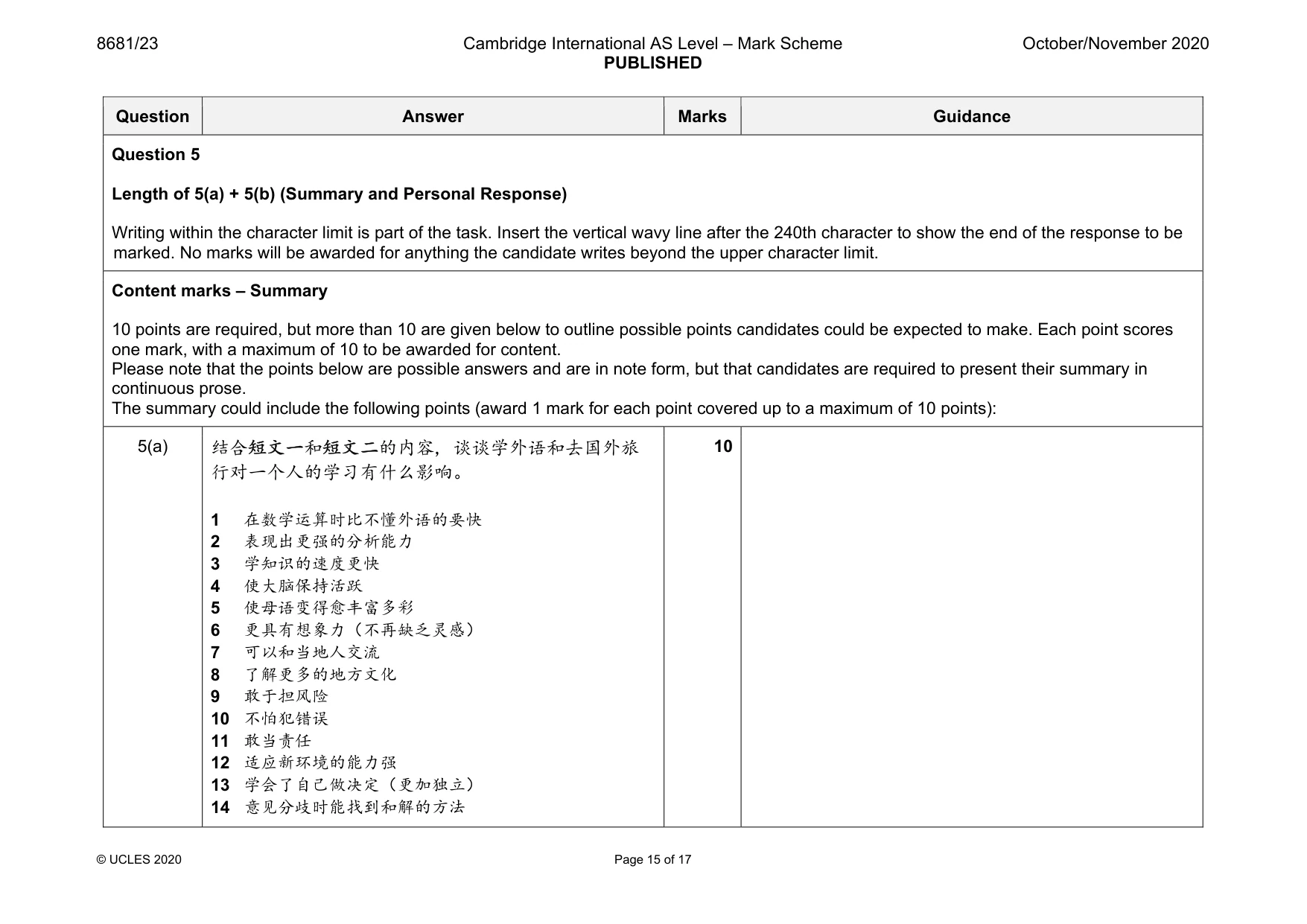
8681/23 Cambridge International AS Level – Mark Scheme PUBLISHED October/November 2020 © UCLES 2020 Page 15 of 17 Question Answer Marks Guidance Question 5 Length of 5(a) + 5(b) (Summary and Personal Response) Writing within the character limit is part of the task. Insert the vertical wavy line after the 240th character to show the end of the response to be marked. No marks will be awarded for anything the candidate writes beyond the upper character limit. Content marks – Summary 10 points are required, but more than 10 are given below to outline possible points candidates could be expected to make. Each point scores one mark, with a maximum of 10 to be awarded for content. Please note that the points below are possible answers and are in note form, but that candidates are required to present their summary in continuous prose. The summary could include the following points (award 1 mark for each point covered up to a maximum of 10 points): 5(a) 结合短文一和短文二的内容, 谈谈学外语和去国外旅 行对一个人的学习有什么影响。 1 在数学运算时比不懂外语的要快 2 表现出更强的分析能力 3 学知识的速度更快 4 使大脑保持活跃 5 使母语变得愈丰富多彩 6 更具有想象力(不再缺乏灵感) 7 可以和当地人交流 8 了解更多的地方文化 9 敢于担风险 10 不怕犯错误 11 敢当责任 12 适应新环境的能力强 13 学会了自己做决定(更加独立) 14 意见分歧时能找到和解的方法 10
Mark scheme, page 16
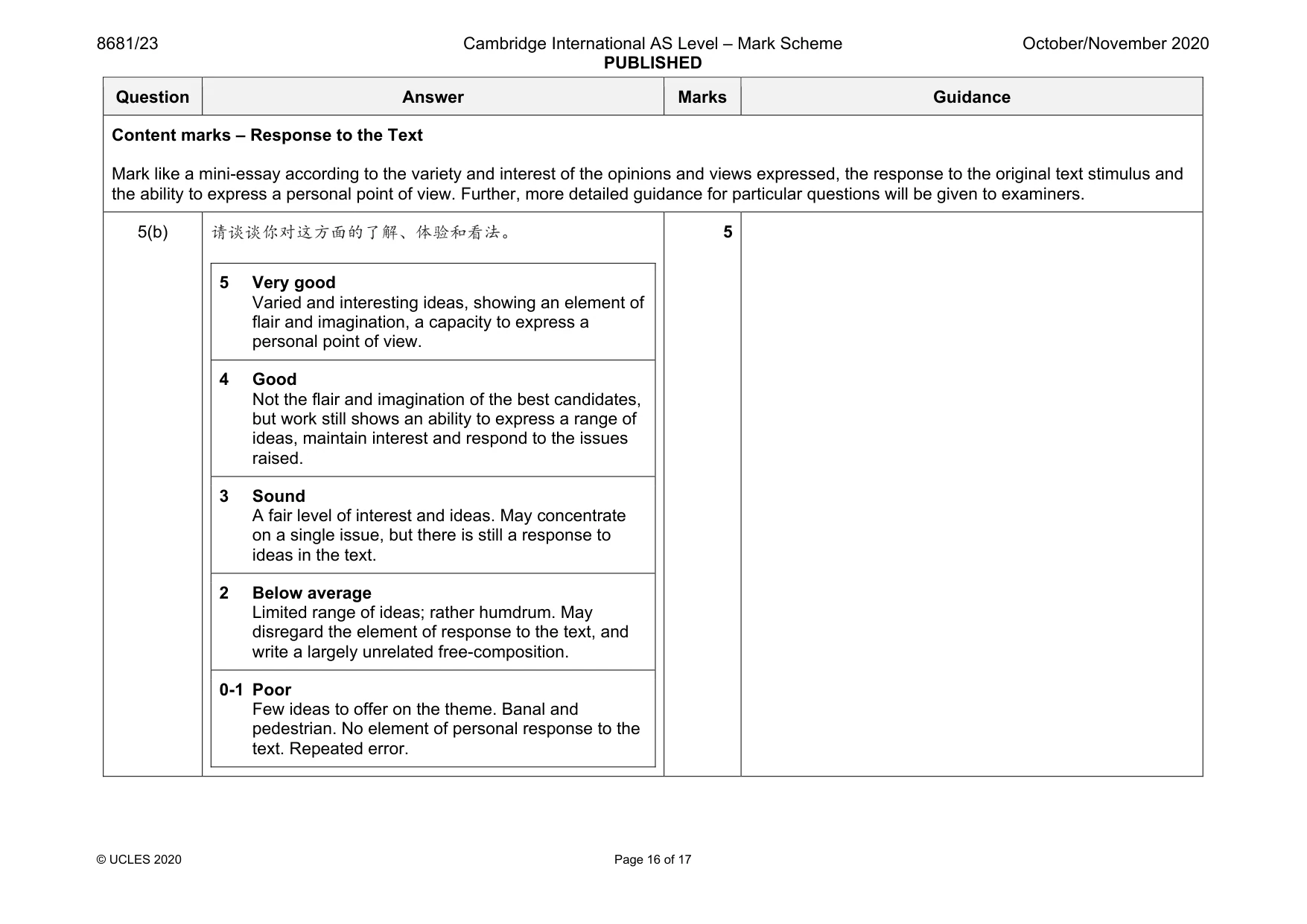
8681/23 Cambridge International AS Level – Mark Scheme PUBLISHED October/November 2020 © UCLES 2020 Page 16 of 17 Question Answer Marks Guidance Content marks – Response to the Text Mark like a mini-essay according to the variety and interest of the opinions and views expressed, the response to the original text stimulus and the ability to express a personal point of view. Further, more detailed guidance for particular questions will be given to examiners. 5(b) 请谈谈你对这方面的了解、体验和看法。 5 Very good Varied and interesting ideas, showing an element of flair and imagination, a capacity to express a personal point of view. 4 Good Not the flair and imagination of the best candidates, but work still shows an ability to express a range of ideas, maintain interest and respond to the issues raised. 3 Sound A fair level of interest and ideas. May concentrate on a single issue, but there is still a response to ideas in the text. 2 Below average Limited range of ideas; rather humdrum. May disregard the element of response to the text, and write a largely unrelated free-composition. 0-1 Poor Few ideas to offer on the theme. Banal and pedestrian. No element of personal response to the text. Repeated error. 5
Mark scheme, page 17
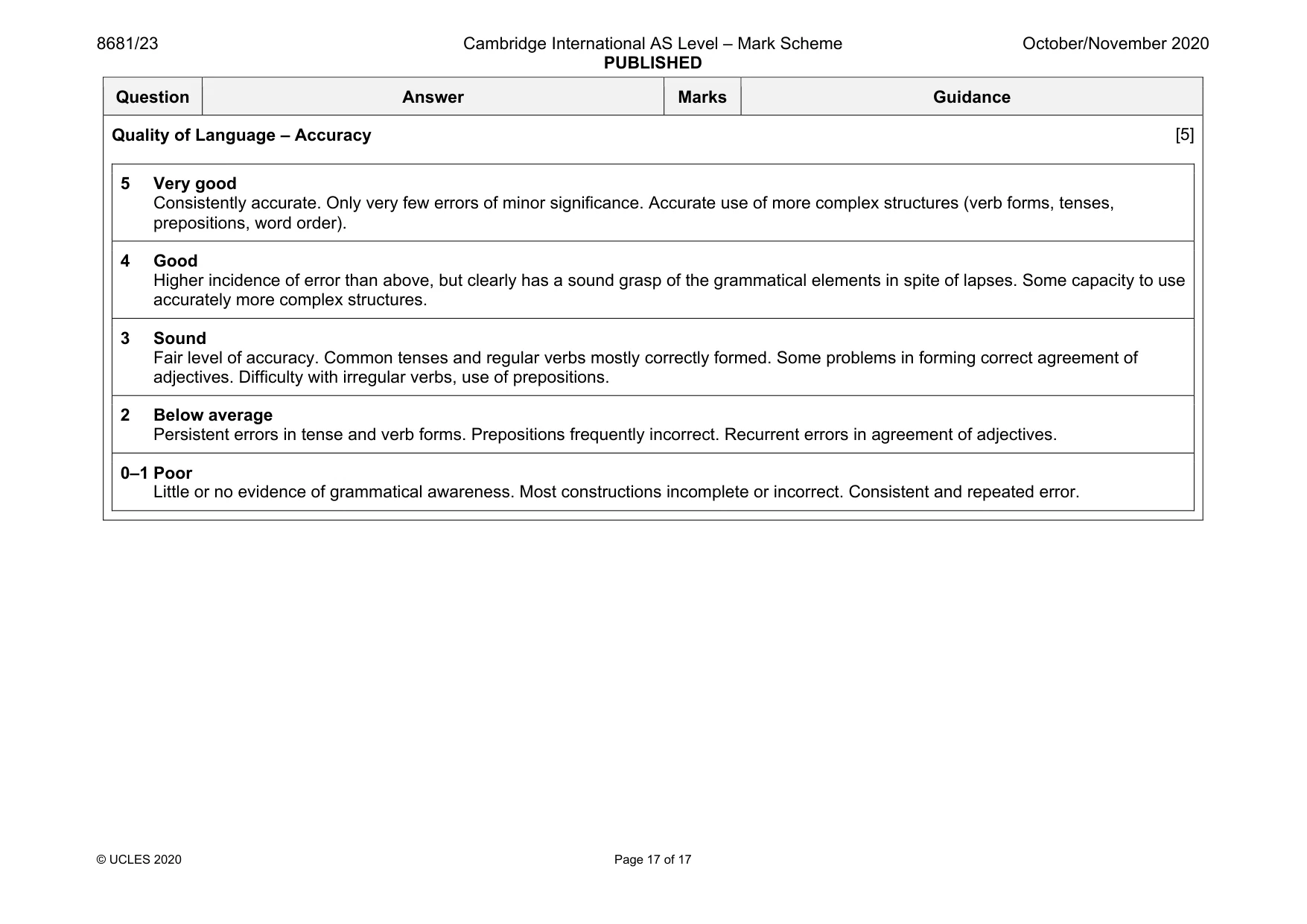
8681/23 Cambridge International AS Level – Mark Scheme PUBLISHED October/November 2020 © UCLES 2020 Page 17 of 17 Question Answer Marks Guidance Quality of Language – Accuracy [5] 5 Very good Consistently accurate. Only very few errors of minor significance. Accurate use of more complex structures (verb forms, tenses, prepositions, word order). 4 Good Higher incidence of error than above, but clearly has a sound grasp of the grammatical elements in spite of lapses. Some capacity to use accurately more complex structures. 3 Sound Fair level of accuracy. Common tenses and regular verbs mostly correctly formed. Some problems in forming correct agreement of adjectives. Difficulty with irregular verbs, use of prepositions. 2 Below average Persistent errors in tense and verb forms. Prepositions frequently incorrect. Recurrent errors in agreement of adjectives. 0–1 Poor Little or no evidence of grammatical awareness. Most constructions incomplete or incorrect. Consistent and repeated error.
What you needed in this session
Cambridge’s own grade thresholds for 2020 Oct/Nov, Paper 2 · Variant 3. A higher threshold means an easier paper — the bar moves with how the cohort did.