Cambridge A Level Chinese (A Level only) 9715 — 2022 Oct/Nov Paper 3 · Variant 1
9715/31/O/N/22 · 40 marks · ≈45 min
The question paper and its mark scheme, free to read here and free to download. This is Cambridge’s own paper, exactly as it was sat.
Question paper4 pages
Mark scheme4 pages
Answers below. Sit the paper first if you are practising.
Paper as text
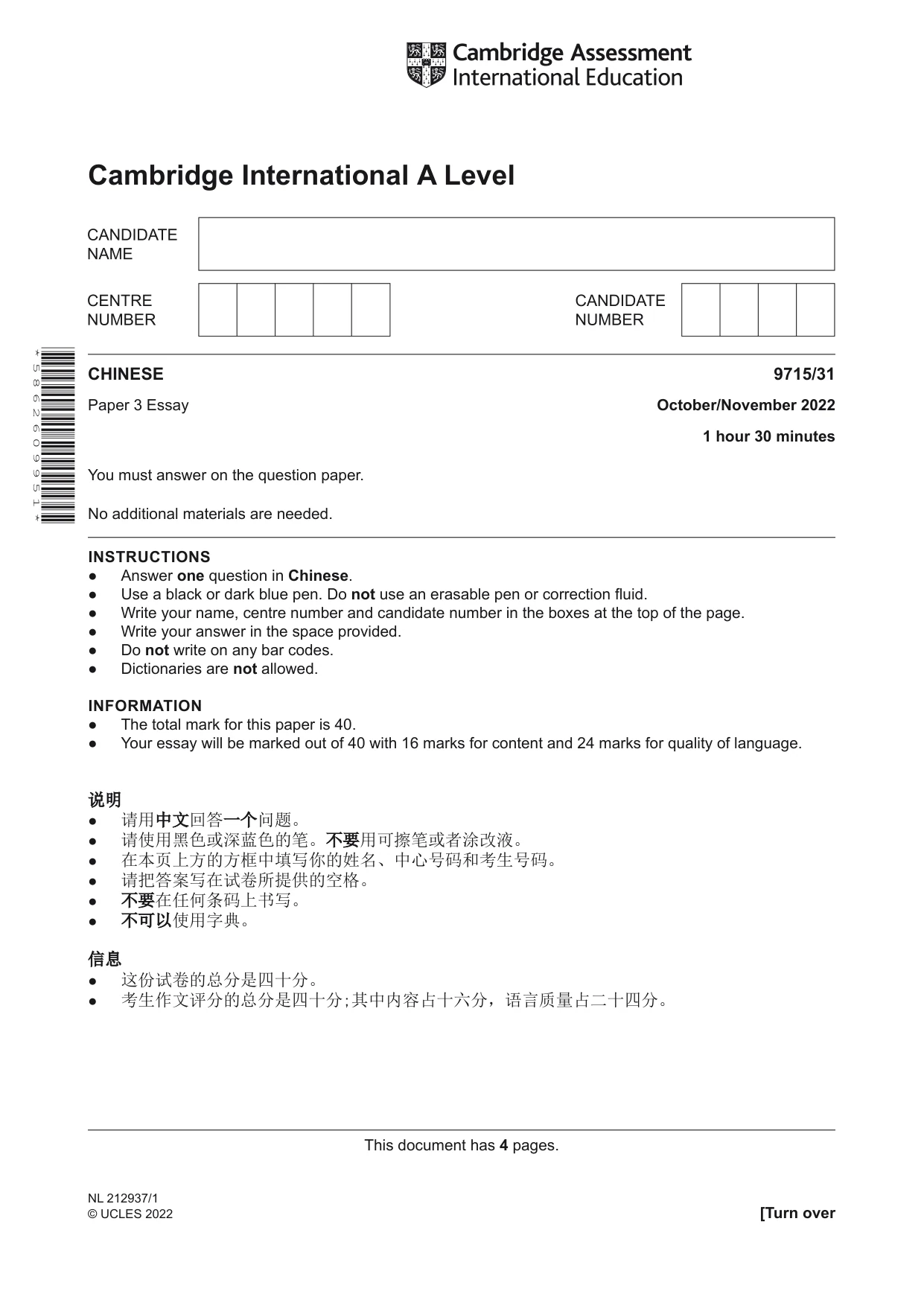
Question paper, page 1
Cambridge International A Level NL 212937/1 © UCLES 2022 [Turn over This document has 4 pages. CHINESE 9715/31 Paper 3 Essay October/November 2022 1 hour 30 minutes You must answer on the question paper. No additional materials are needed. INSTRUCTIONS ● Answer one question in Chinese. ● Use a black or dark blue pen. Do not use an erasable pen or correction fluid. ● Write your name, centre number and candidate number in the boxes at the top of the page. ● Write your answer in the space provided. ● Do not write on any bar codes. ● Dictionaries are not allowed. INFORMATION ● The total mark for this paper is 40. ● Your essay will be marked out of 40 with 16 marks for content and 24 marks for quality of language. 说明 说明 ● 请用中文 中文回答一个 一个问题。 ● 请使用黑色或深蓝色的笔。不要 不要用可擦笔或者涂改液。 ● 在本页上方的方框中填写你的姓名、中心号码和考生号码。 ● 请把答案写在试卷所提供的空格。 ● 不要 不要在任何条码上书写。 ● 不可以 不可以使用字典。 信息 信息 ● 这份试卷的总分是四十分。 ● 考生作文评分的总分是四十分;其中内容占十六分,语言质量占二十四分。 * 5 8 6 2 6 0 9 9 5 1 *
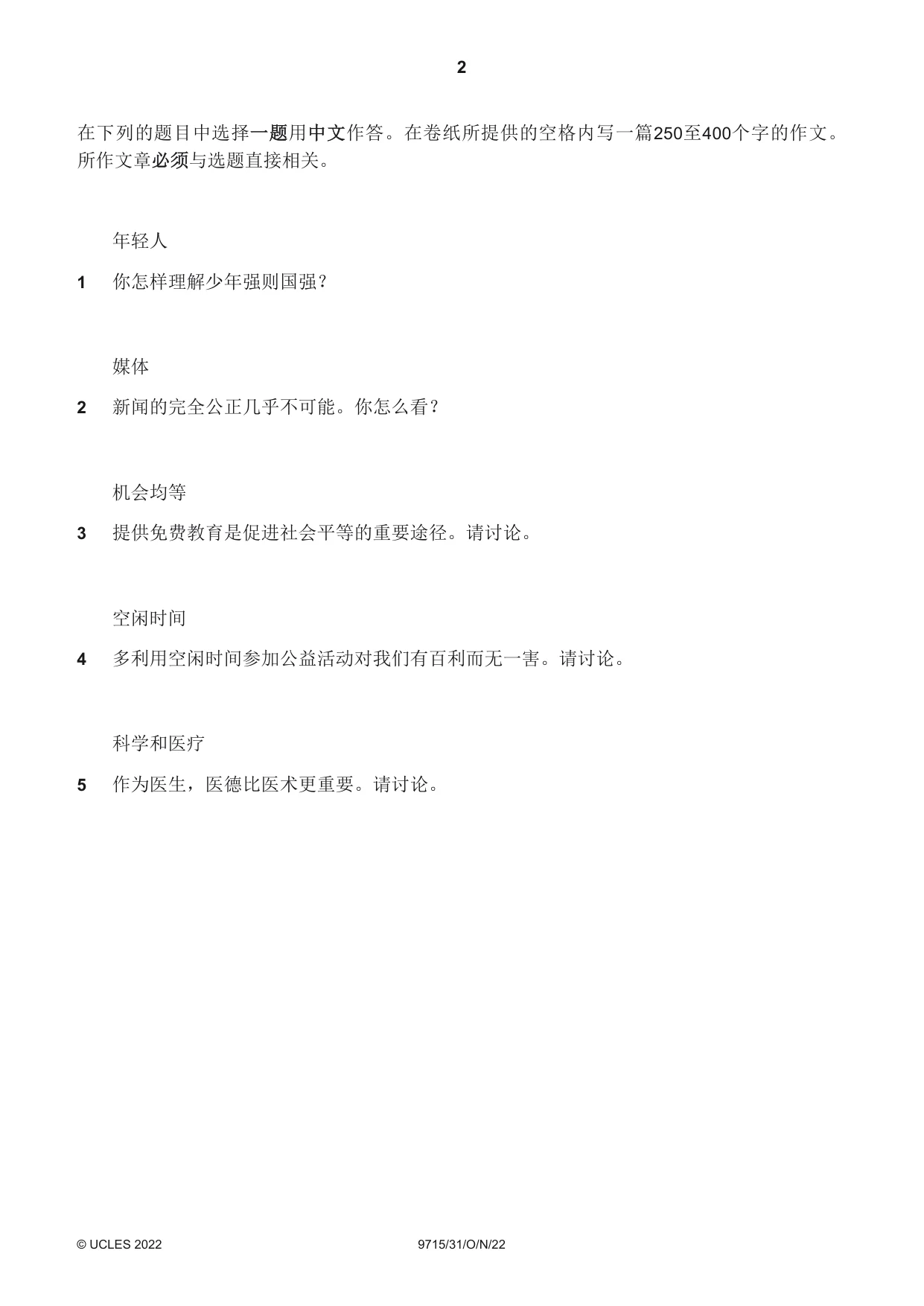
Question paper, page 2
2 9715/31/O/N/22 © UCLES 2022 在下列的题目中选择一题 一题用中文 中文作答。在卷纸所提供的空格内写一篇250至400个字的作文。 所作文章必须 必须与选题直接相关。 年轻人 1 你怎样理解少年强则国强? 媒体 2 新闻的完全公正几乎不可能。你怎么看? 机会均等 3 提供免费教育是促进社会平等的重要途径。请讨论。 空闲时间 4 多利用空闲时间参加公益活动对我们有百利而无一害。请讨论。 科学和医疗 5 作为医生,医德比医术更重要。请讨论。
Question paper, page 3
3 9715/31/O/N/22 © UCLES 2022 [Turn over 请把所选作文题号写在这里: 100 200 300
Question paper, page 4
4 9715/31/O/N/22 © UCLES 2022 400 500 600 700 Permission to reproduce items where third-party owned material protected by copyright is included has been sought and cleared where possible. Every reasonable effort has been made by the publisher (UCLES) to trace copyright holders, but if any items requiring clearance have unwittingly been included, the publisher will be pleased to make amends at the earliest possible opportunity. To avoid the issue of disclosure of answer-related information to candidates, all copyright acknowledgements are reproduced online in the Cambridge Assessment International Education Copyright Acknowledgements Booklet. This is produced for each series of examinations and is freely available to download at www.cambridgeinternational.org after the live examination series. Cambridge Assessment International Education is part of Cambridge Assessment. Cambridge Assessment is the brand name of the University of Cambridge Local Examinations Syndicate (UCLES), which is a department of the University of Cambridge.
Mark scheme, page 1
This document consists of 4 printed pages. © UCLES 2022 [Turn over Cambridge International A Level CHINESE 9715/31 Paper 3 Essay October/November 2022 MARK SCHEME Maximum Mark: 40 Published This mark scheme is published as an aid to teachers and candidates, to indicate the requirements of the examination. It shows the basis on which Examiners were instructed to award marks. It does not indicate the details of the discussions that took place at an Examiners’ meeting before marking began, which would have considered the acceptability of alternative answers. Mark schemes should be read in conjunction with the question paper and the Principal Examiner Report for Teachers. Cambridge International will not enter into discussions about these mark schemes. Cambridge International is publishing the mark schemes for the October/November 2022 series for most Cambridge IGCSE™, Cambridge International A and AS Level components and some Cambridge O Level components.
Mark scheme, page 2
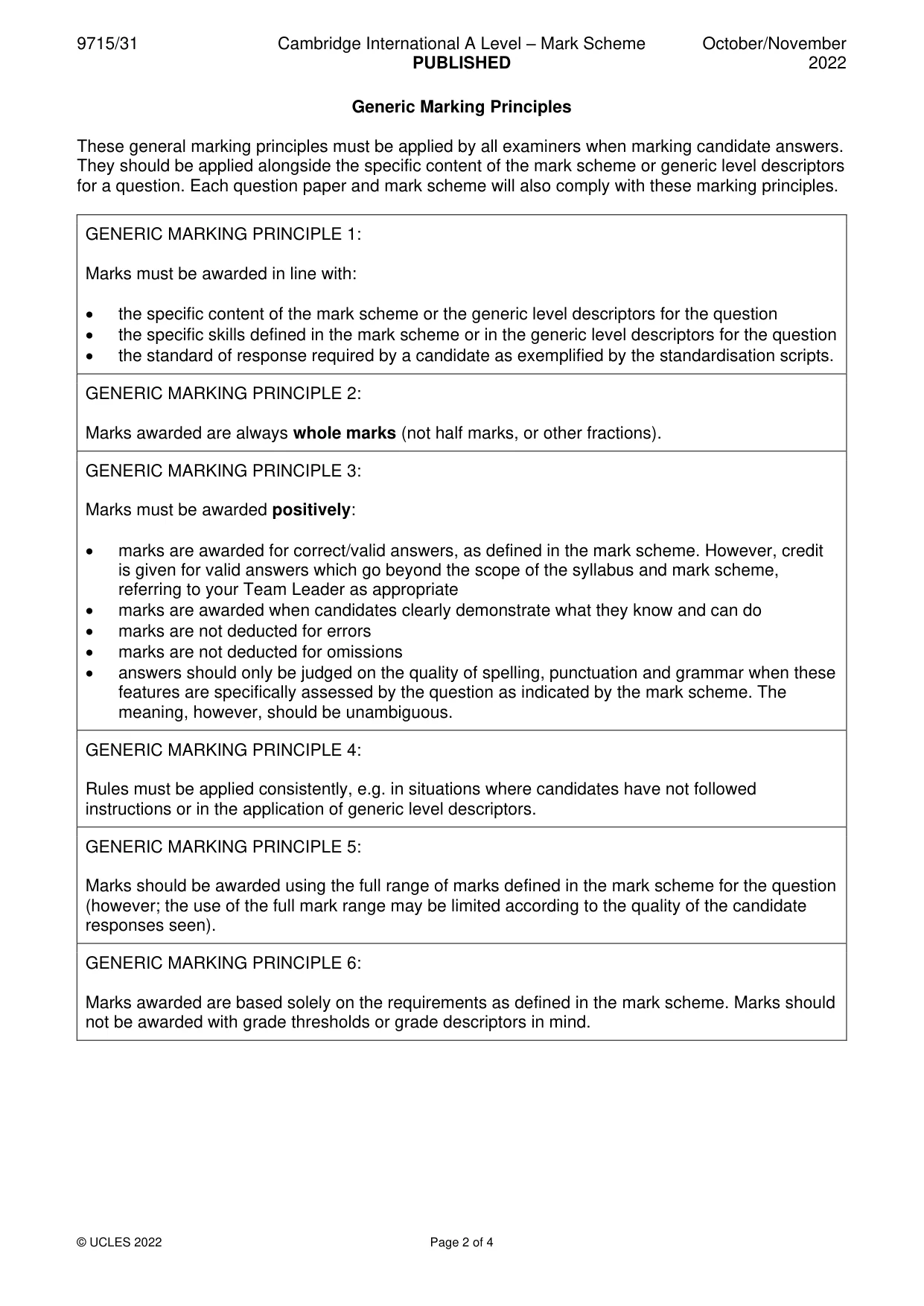
9715/31 Cambridge International A Level – Mark Scheme PUBLISHED October/November 2022 © UCLES 2022 Page 2 of 4 Generic Marking Principles These general marking principles must be applied by all examiners when marking candidate answers. They should be applied alongside the specific content of the mark scheme or generic level descriptors for a question. Each question paper and mark scheme will also comply with these marking principles. GENERIC MARKING PRINCIPLE 1: Marks must be awarded in line with: • the specific content of the mark scheme or the generic level descriptors for the question • the specific skills defined in the mark scheme or in the generic level descriptors for the question • the standard of response required by a candidate as exemplified by the standardisation scripts. GENERIC MARKING PRINCIPLE 2: Marks awarded are always whole marks (not half marks, or other fractions). GENERIC MARKING PRINCIPLE 3: Marks must be awarded positively: • marks are awarded for correct/valid answers, as defined in the mark scheme. However, credit is given for valid answers which go beyond the scope of the syllabus and mark scheme, referring to your Team Leader as appropriate • marks are awarded when candidates clearly demonstrate what they know and can do • marks are not deducted for errors • marks are not deducted for omissions • answers should only be judged on the quality of spelling, punctuation and grammar when these features are specifically assessed by the question as indicated by the mark scheme. The meaning, however, should be unambiguous. GENERIC MARKING PRINCIPLE 4: Rules must be applied consistently, e.g. in situations where candidates have not followed instructions or in the application of generic level descriptors. GENERIC MARKING PRINCIPLE 5: Marks should be awarded using the full range of marks defined in the mark scheme for the question (however; the use of the full mark range may be limited according to the quality of the candidate responses seen). GENERIC MARKING PRINCIPLE 6: Marks awarded are based solely on the requirements as defined in the mark scheme. Marks should not be awarded with grade thresholds or grade descriptors in mind.
Mark scheme, page 3
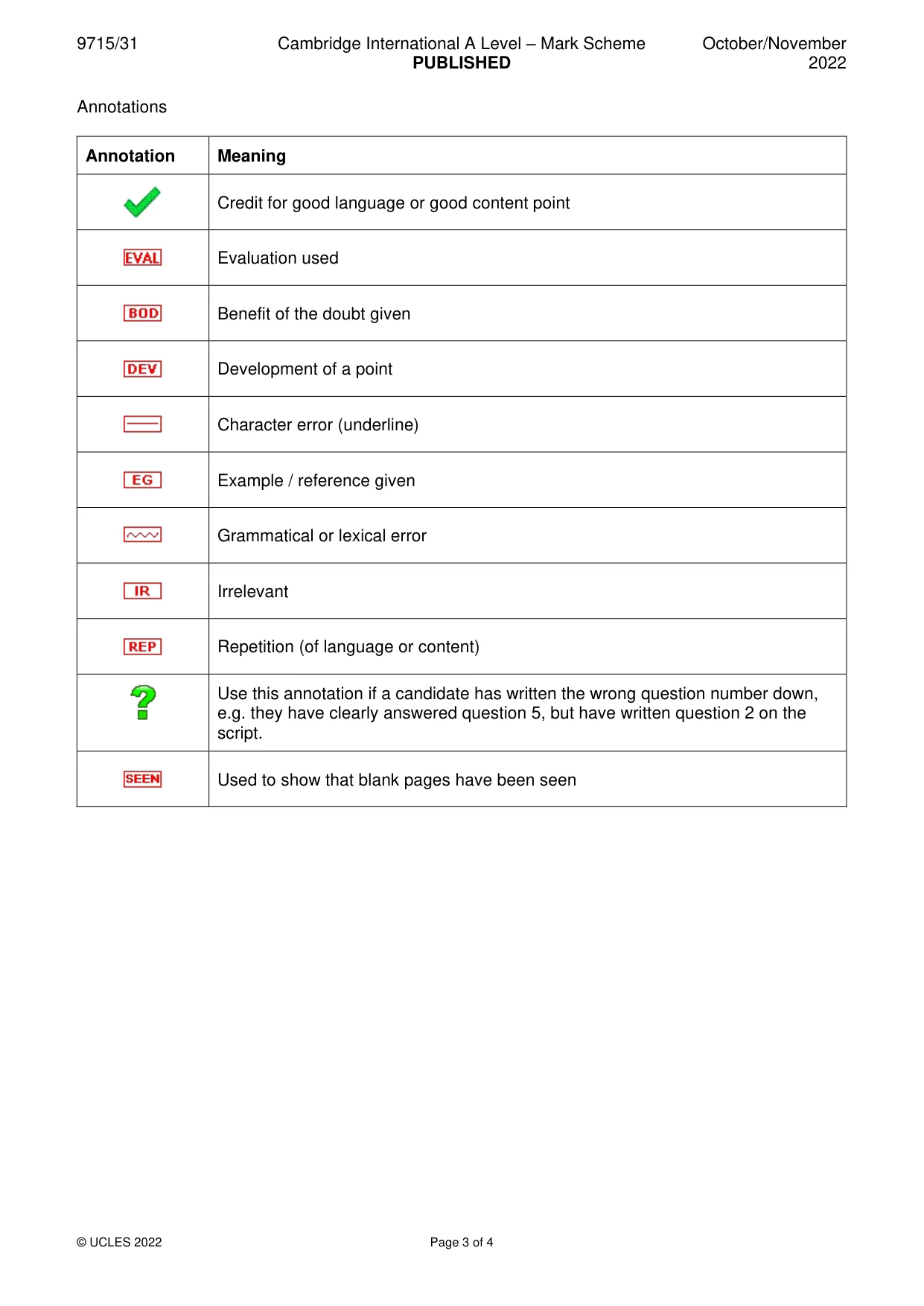
9715/31 Cambridge International A Level – Mark Scheme PUBLISHED October/November 2022 © UCLES 2022 Page 3 of 4 Annotations Annotation Meaning Credit for good language or good content point Evaluation used Benefit of the doubt given Development of a point Character error (underline) Example / reference given Grammatical or lexical error Irrelevant Repetition (of language or content) Use this annotation if a candidate has written the wrong question number down, e.g. they have clearly answered question 5, but have written question 2 on the script. Used to show that blank pages have been seen
Mark scheme, page 4
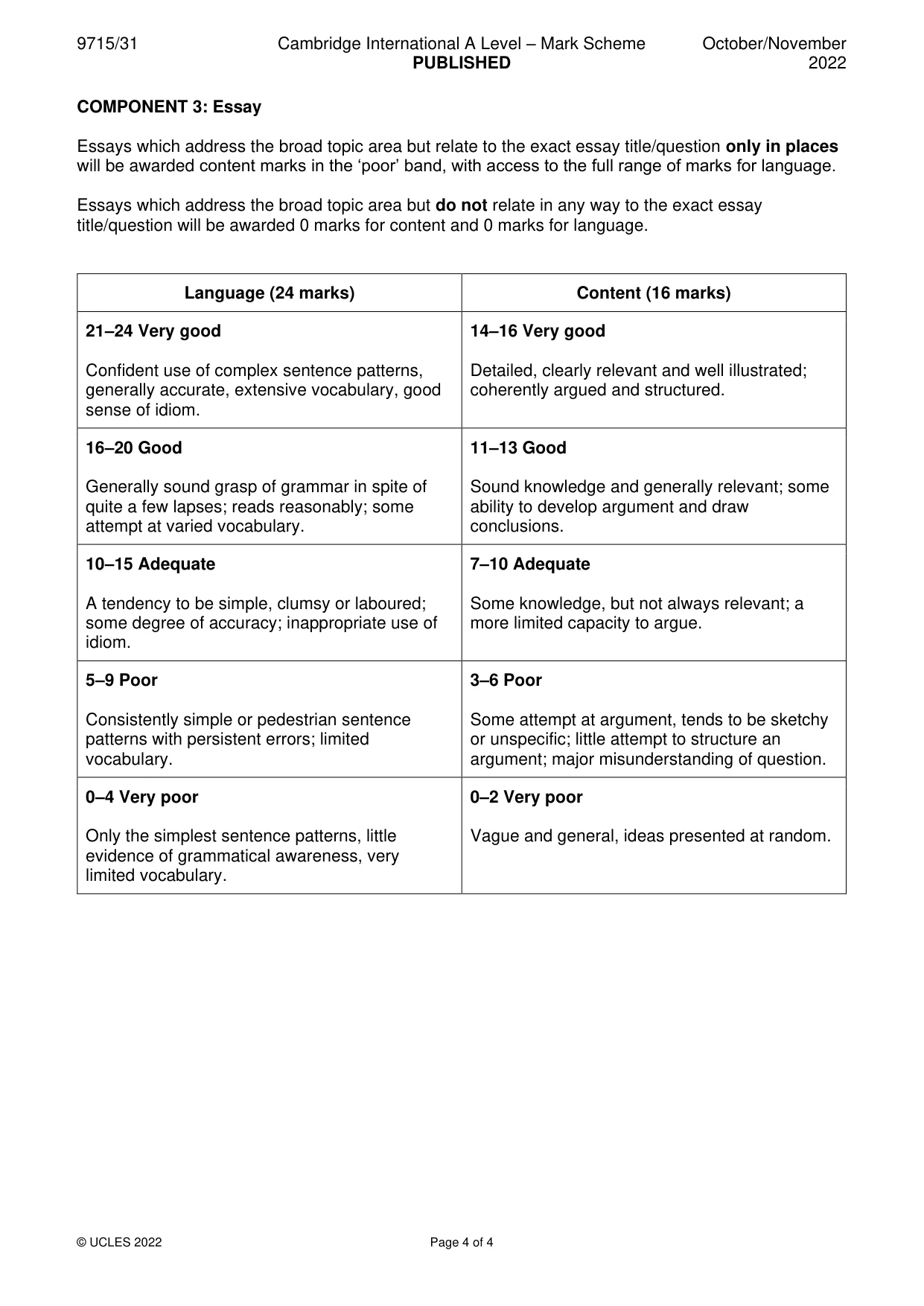
9715/31 Cambridge International A Level – Mark Scheme PUBLISHED October/November 2022 © UCLES 2022 Page 4 of 4 COMPONENT 3: Essay Essays which address the broad topic area but relate to the exact essay title/question only in places will be awarded content marks in the ‘poor’ band, with access to the full range of marks for language. Essays which address the broad topic area but do not relate in any way to the exact essay title/question will be awarded 0 marks for content and 0 marks for language. Language (24 marks) Content (16 marks) 21–24 Very good Confident use of complex sentence patterns, generally accurate, extensive vocabulary, good sense of idiom. 14–16 Very good Detailed, clearly relevant and well illustrated; coherently argued and structured. 16–20 Good Generally sound grasp of grammar in spite of quite a few lapses; reads reasonably; some attempt at varied vocabulary. 11–13 Good Sound knowledge and generally relevant; some ability to develop argument and draw conclusions. 10–15 Adequate A tendency to be simple, clumsy or laboured; some degree of accuracy; inappropriate use of idiom. 7–10 Adequate Some knowledge, but not always relevant; a more limited capacity to argue. 5–9 Poor Consistently simple or pedestrian sentence patterns with persistent errors; limited vocabulary. 3–6 Poor Some attempt at argument, tends to be sketchy or unspecific; little attempt to structure an argument; major misunderstanding of question. 0–4 Very poor Only the simplest sentence patterns, little evidence of grammatical awareness, very limited vocabulary. 0–2 Very poor Vague and general, ideas presented at random.
What you needed in this session
Cambridge’s own grade thresholds for 2022 Oct/Nov, Paper 3 · Variant 1. A higher threshold means an easier paper — the bar moves with how the cohort did.