Cambridge A Level Chinese (A Level only) 9715 — 2020 Oct/Nov Paper 4 · Variant 2
9715/42/O/N/20 · 75 marks · ≈84 min
The question paper and its mark scheme, free to read here and free to download. This is Cambridge’s own paper, exactly as it was sat.
Question paper8 pages
Mark scheme4 pages
Answers below. Sit the paper first if you are practising.
Paper as text
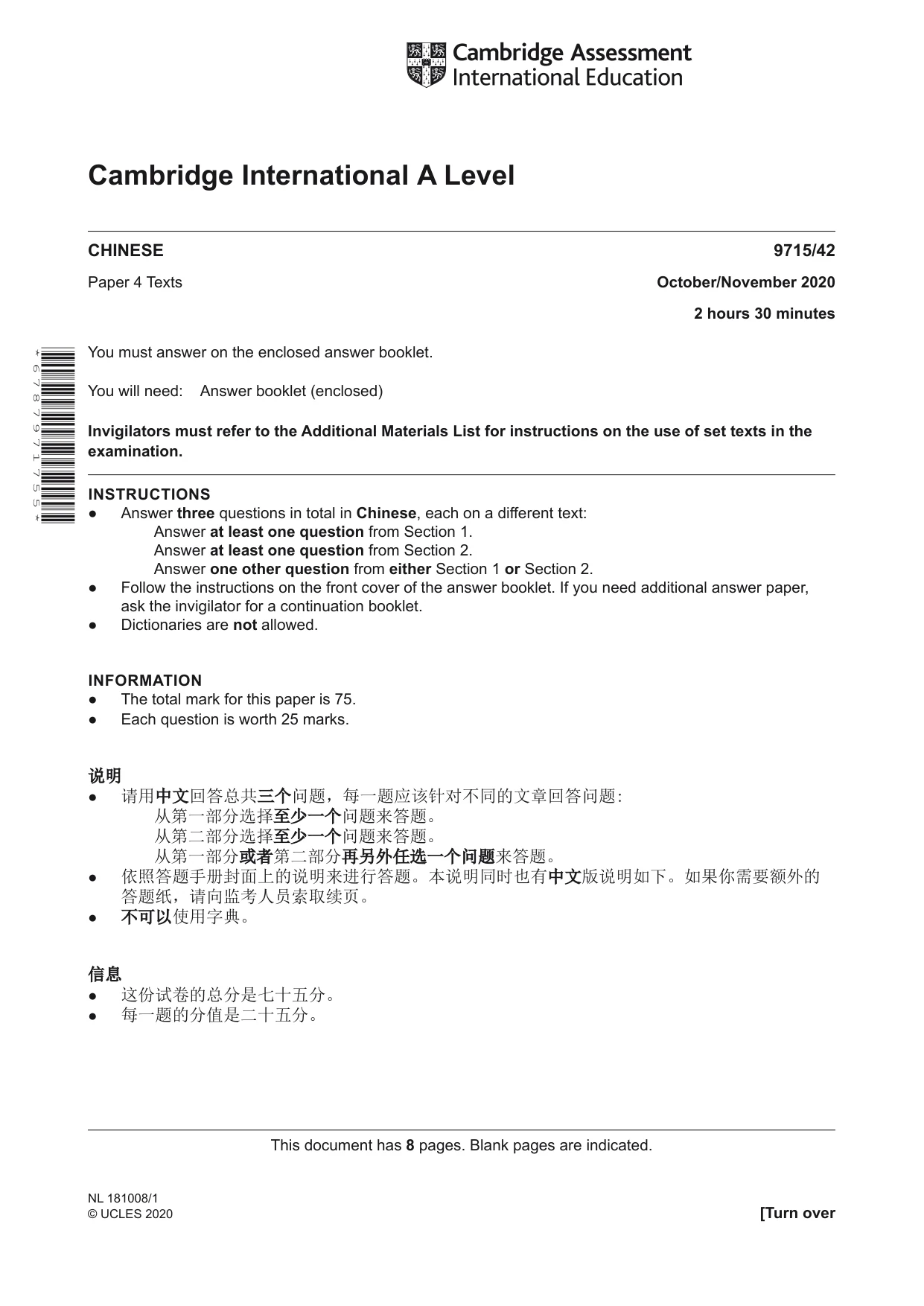
Question paper, page 1
Cambridge International A Level * 6 7 8 7 9 7 1 7 5 5 * NL 181008/1 © UCLES 2020 [Turn over This document has 8 pages. Blank pages are indicated. CHINESE 9715/42 Paper 4 Texts October/November 2020 2 hours 30 minutes You must answer on the enclosed answer booklet. You will need: Answer booklet (enclosed) Invigilators must refer to the Additional Materials List for instructions on the use of set texts in the examination. INSTRUCTIONS ● Answer three questions in total in Chinese, each on a different text: Answer at least one question from Section 1. Answer at least one question from Section 2. Answer one other question from either Section 1 or Section 2. ● Follow the instructions on the front cover of the answer booklet. If you need additional answer paper, ask the invigilator for a continuation booklet. ● Dictionaries are not allowed. INFORMATION ● The total mark for this paper is 75. ● Each question is worth 25 marks. 说明 ● 请用中文回答总共三个问题,每一题应该针对不同的文章回答问题: 从第一部分选择至少一个问题来答题。 从第二部分选择至少一个问题来答题。 从第一部分或者第二部分再另外任选一个问题来答题。 ● 依照答题手册封面上的说明来进行答题。本说明同时也有中文版说明如下。如果你需要额外的 答题纸,请向监考人员索取续页。 ● 不可以使用字典。 信息 ● 这份试卷的总分是七十五分。 ● 每一题的分值是二十五分。
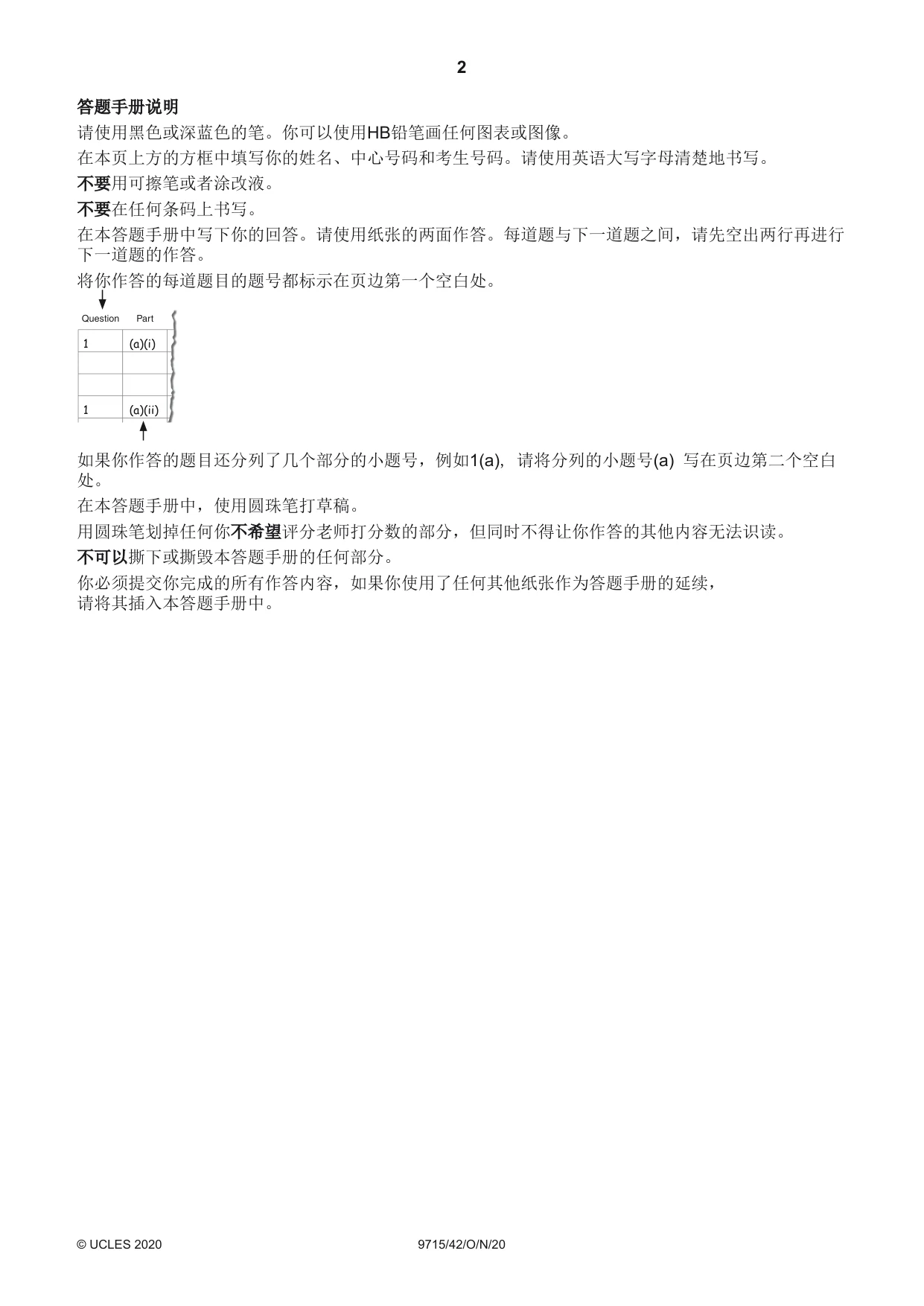
Question paper, page 2
2 9715/42/O/N/20 © UCLES 2020 答题手册说明 请使用黑色或深蓝色的笔。你可以使用HB铅笔画任何图表或图像。 在本页上方的方框中填写你的姓名、中心号码和考生号码。请使用英语大写字母清楚地书写。 不要用可擦笔或者涂改液。 不要在任何条码上书写。 在本答题手册中写下你的回答。请使用纸张的两面作答。每道题与下一道题之间,请先空出两行再进行 下一道题的作答。 将你作答的每道题目的题号都标示在页边第一个空白处。 Question Part 1 1 (a)(i) (a)(ii) 如果你作答的题目还分列了几个部分的小题号,例如1(a), 请将分列的小题号(a) 写在页边第二个空白 处。 在本答题手册中,使用圆珠笔打草稿。 用圆珠笔划掉任何你不希望评分老师打分数的部分,但同时不得让你作答的其他内容无法识读。 不可以撕下或撕毁本答题手册的任何部分。 你必须提交你完成的所有作答内容,如果你使用了任何其他纸张作为答题手册的延续, 请将其插入本答题手册中。
Question paper, page 3
3 9715/42/O/N/20 © UCLES 2020 [Turn over BLANK PAGE
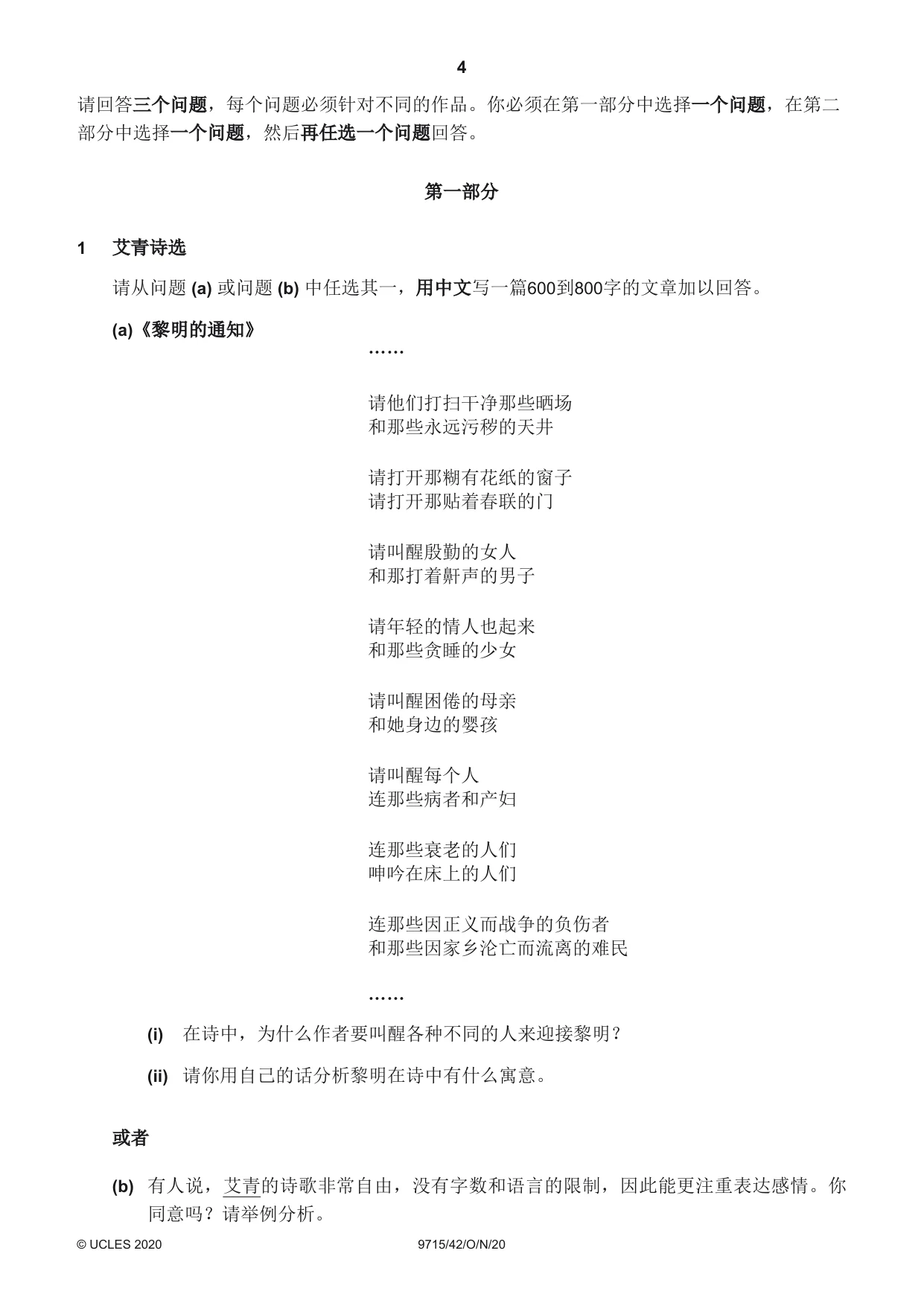
Question paper, page 4
4 9715/42/O/N/20 © UCLES 2020 请回答三个问题,每个问题必须针对不同的作品。你必须在第一部分中选择一个问题,在第二 部分中选择一个问题,然后再任选一个问题回答。 第一部分 1 艾青诗选 请从问题 (a) 或问题 (b) 中任选其一,用中文写一篇600到800字的文章加以回答。 (a)《黎明的通知》 (i) 在诗中,为什么作者要叫醒各种不同的人来迎接黎明? (ii) 请你用自己的话分析黎明在诗中有什么寓意。 或者 (b) 有人说,艾青的诗歌非常自由,没有字数和语言的限制,因此能更注重表达感情。你 同意吗?请举例分析。 …… 请他们打扫干净那些晒场 和那些永远污秽的天井 请打开那糊有花纸的窗子 请打开那贴着春联的门 请叫醒殷勤的女人 和那打着鼾声的男子 请年轻的情人也起来 和那些贪睡的少女 请叫醒困倦的母亲 和她身边的婴孩 请叫醒每个人 连那些病者和产妇 连那些衰老的人们 呻吟在床上的人们 连那些因正义而战争的负伤者 和那些因家乡沦亡而流离的难民 ……
Question paper, page 5
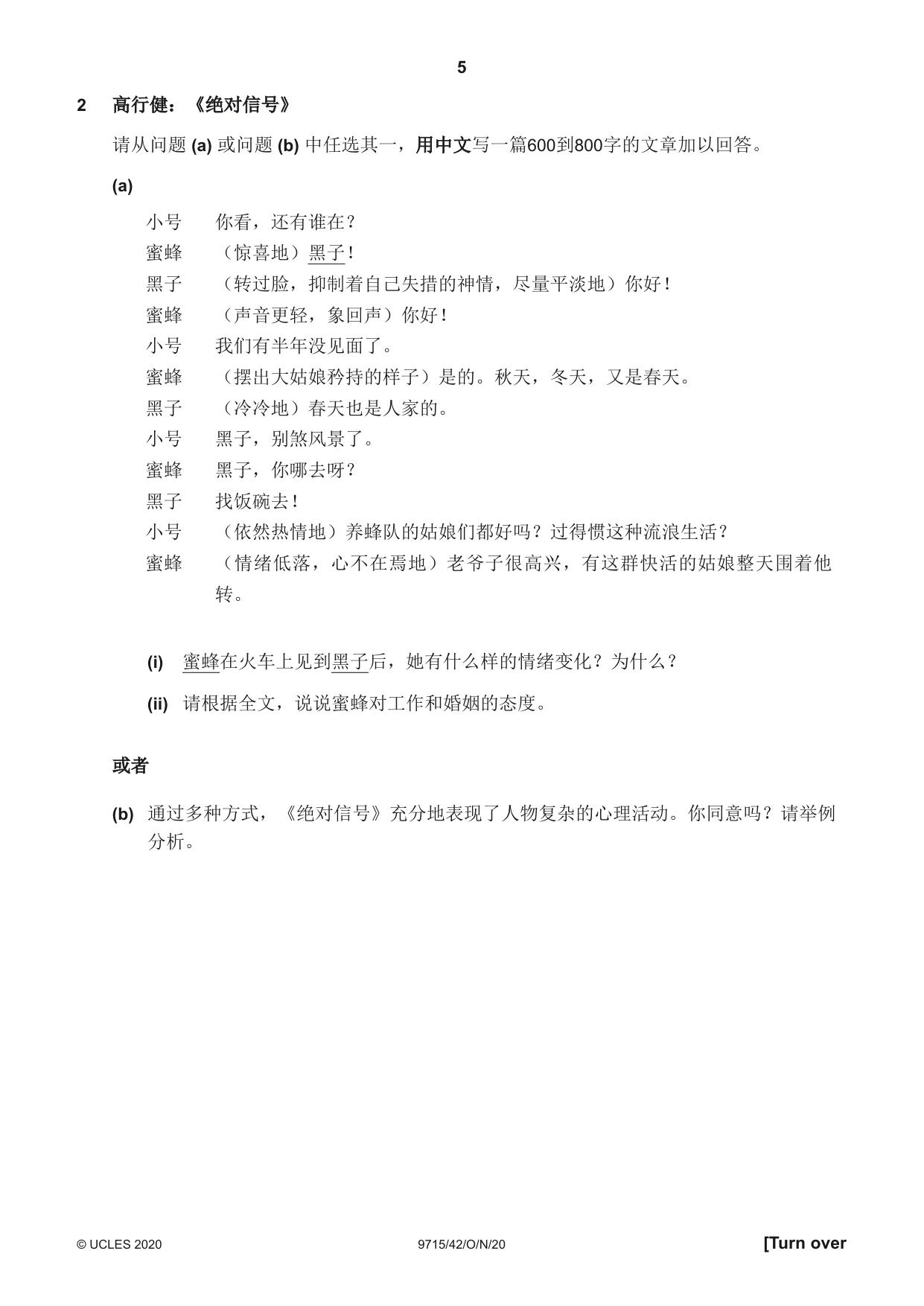
5 9715/42/O/N/20 © UCLES 2020 [Turn over 2 高行健:《绝对信号》 请从问题 (a) 或问题 (b) 中任选其一,用中文写一篇600到800字的文章加以回答。 (a) (i) 蜜蜂在火车上见到黑子后,她有什么样的情绪变化?为什么? (ii) 请根据全文,说说蜜蜂对工作和婚姻的态度。 或者 (b) 通过多种方式,《绝对信号》充分地表现了人物复杂的心理活动。你同意吗?请举例 分析。 小号 你看,还有谁在? 蜜蜂 (惊喜地)黑子! 黑子 (转过脸,抑制着自己失措的神情,尽量平淡地)你好! 蜜蜂 (声音更轻,象回声)你好! 小号 我们有半年没见面了。 蜜蜂 (摆出大姑娘矜持的样子)是的。秋天,冬天,又是春天。 黑子 (冷冷地)春天也是人家的。 小号 黑子,别煞风景了。 蜜蜂 黑子,你哪去呀? 黑子 找饭碗去! 小号 (依然热情地)养蜂队的姑娘们都好吗?过得惯这种流浪生活? 蜜蜂 (情绪低落,心不在焉地)老爷子很高兴,有这群快活的姑娘整天围着他 转。
Question paper, page 6
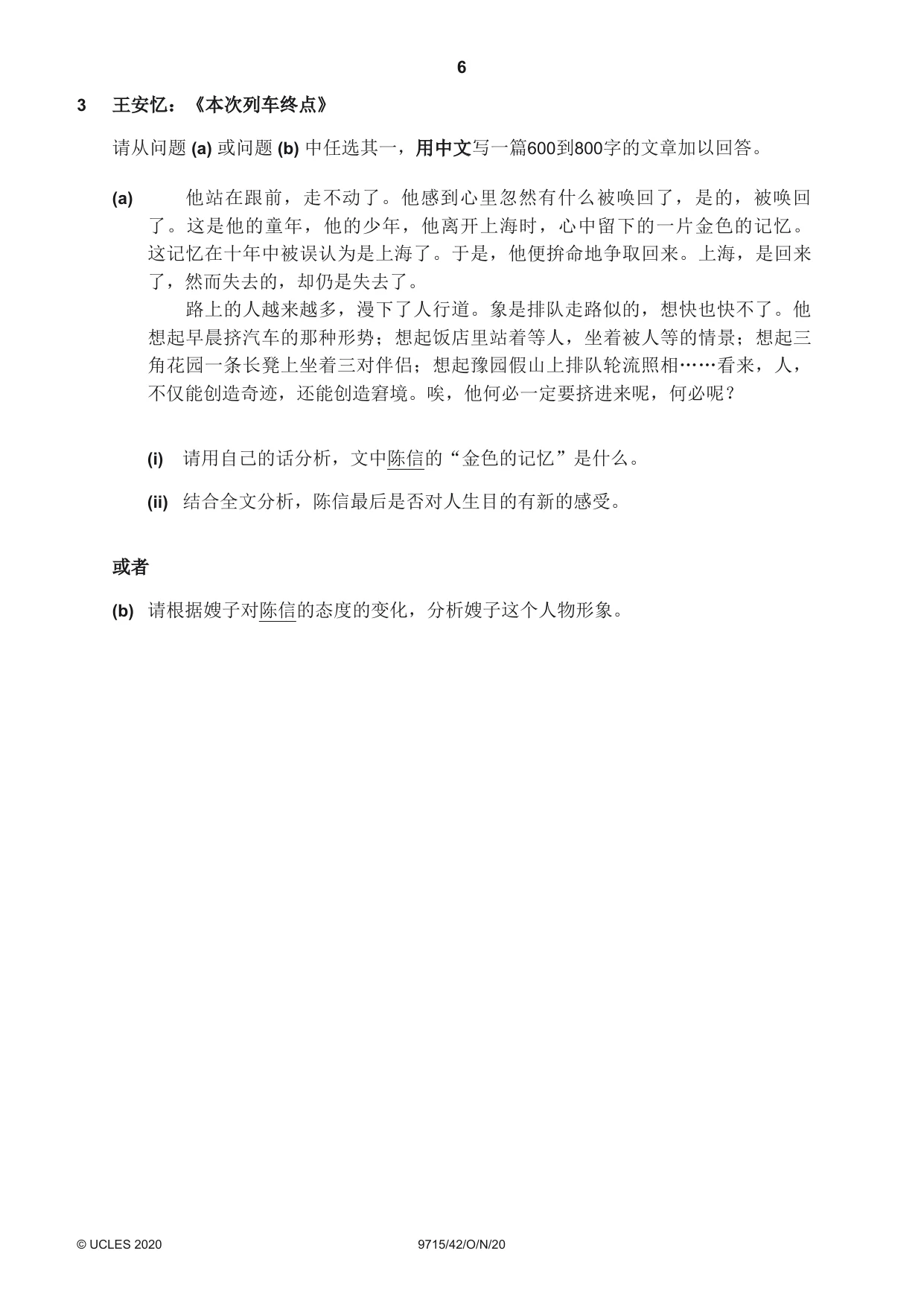
6 9715/42/O/N/20 © UCLES 2020 3 王安忆:《本次列车终点》 请从问题 (a) 或问题 (b) 中任选其一,用中文写一篇600到800字的文章加以回答。 (a) 他站在跟前,走不动了。他感到心里忽然有什么被唤回了,是的,被唤回 了。这是他的童年,他的少年,他离开上海时,心中留下的一片金色的记忆。 这记忆在十年中被误认为是上海了。于是,他便拚命地争取回来。上海,是回来 了,然而失去的,却仍是失去了。 路上的人越来越多,漫下了人行道。象是排队走路似的,想快也快不了。他 想起早晨挤汽车的那种形势;想起饭店里站着等人,坐着被人等的情景;想起三 角花园一条长凳上坐着三对伴侣;想起豫园假山上排队轮流照相……看来,人, 不仅能创造奇迹,还能创造窘境。唉,他何必一定要挤进来呢,何必呢? (i) 请用自己的话分析,文中陈信的“金色的记忆”是什么。 (ii) 结合全文分析,陈信最后是否对人生目的有新的感受。 或者 (b) 请根据嫂子对陈信的态度的变化,分析嫂子这个人物形象。
Question paper, page 7
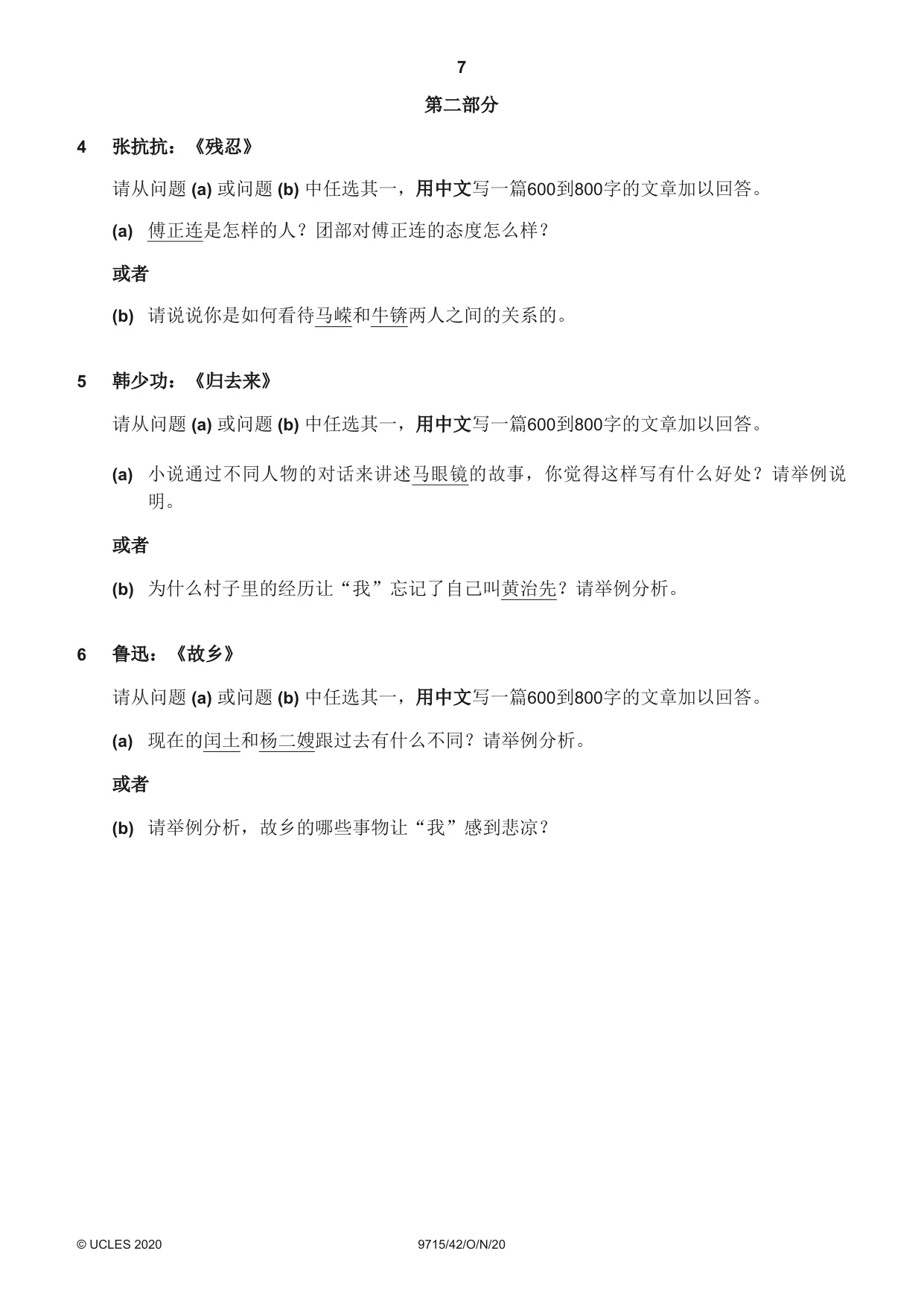
7 9715/42/O/N/20 © UCLES 2020 第二部分 4 张抗抗:《残忍》 请从问题 (a) 或问题 (b) 中任选其一,用中文写一篇600到800字的文章加以回答。 (a) 傅正连是怎样的人?团部对傅正连的态度怎么样? 或者 (b) 请说说你是如何看待马嵘和牛锛两人之间的关系的。 5 韩少功:《归去来》 请从问题 (a) 或问题 (b) 中任选其一,用中文写一篇600到800字的文章加以回答。 (a) 小说通过不同人物的对话来讲述马眼镜的故事,你觉得这样写有什么好处?请举例说 明。 或者 (b) 为什么村子里的经历让“我”忘记了自己叫黄治先?请举例分析。 6 鲁迅:《故乡》 请从问题 (a) 或问题 (b) 中任选其一,用中文写一篇600到800字的文章加以回答。 (a) 现在的闰土和杨二嫂跟过去有什么不同?请举例分析。 或者 (b) 请举例分析,故乡的哪些事物让“我”感到悲凉?
Question paper, page 8
8 9715/42/O/N/20 © UCLES 2020 BLANK PAGE Permission to reproduce items where third-party owned material protected by copyright is included has been sought and cleared where possible. Every reasonable effort has been made by the publisher (UCLES) to trace copyright holders, but if any items requiring clearance have unwittingly been included, the publisher will be pleased to make amends at the earliest possible opportunity. To avoid the issue of disclosure of answer-related information to candidates, all copyright acknowledgements are reproduced online in the Cambridge Assessment International Education Copyright Acknowledgements Booklet. This is produced for each series of examinations and is freely available to download at www.cambridgeinternational.org after the live examination series. Cambridge Assessment International Education is part of the Cambridge Assessment Group. Cambridge Assessment is the brand name of the University of Cambridge Local Examinations Syndicate (UCLES), which itself is a department of the University of Cambridge.
Mark scheme, page 1
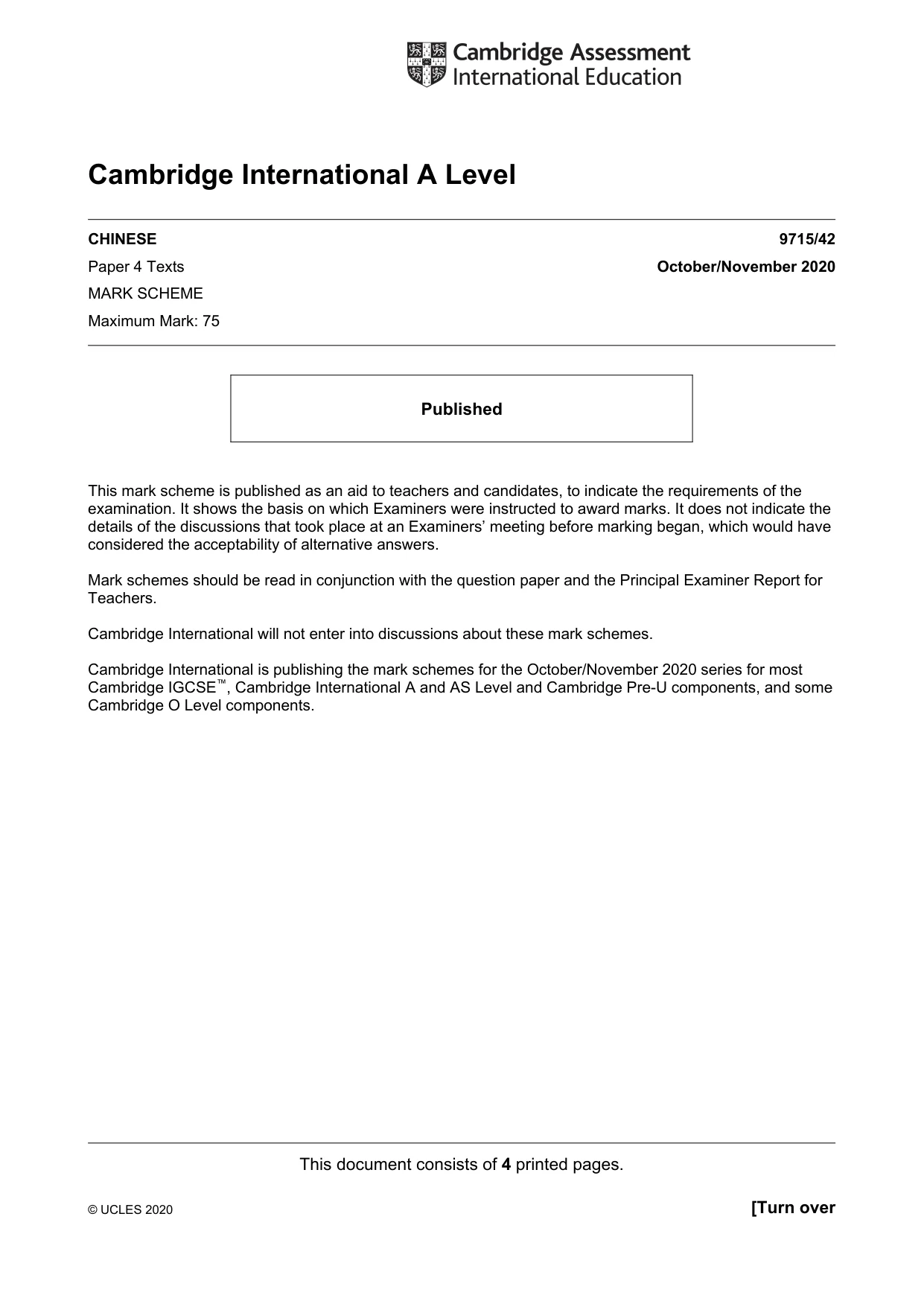
This document consists of 4 printed pages. © UCLES 2020 [Turn over Cambridge International A Level CHINESE 9715/42 Paper 4 Texts October/November 2020 MARK SCHEME Maximum Mark: 75 Published This mark scheme is published as an aid to teachers and candidates, to indicate the requirements of the examination. It shows the basis on which Examiners were instructed to award marks. It does not indicate the details of the discussions that took place at an Examiners’ meeting before marking began, which would have considered the acceptability of alternative answers. Mark schemes should be read in conjunction with the question paper and the Principal Examiner Report for Teachers. Cambridge International will not enter into discussions about these mark schemes. Cambridge International is publishing the mark schemes for the October/November 2020 series for most Cambridge IGCSE™, Cambridge International A and AS Level and Cambridge Pre-U components, and some Cambridge O Level components.
Mark scheme, page 2
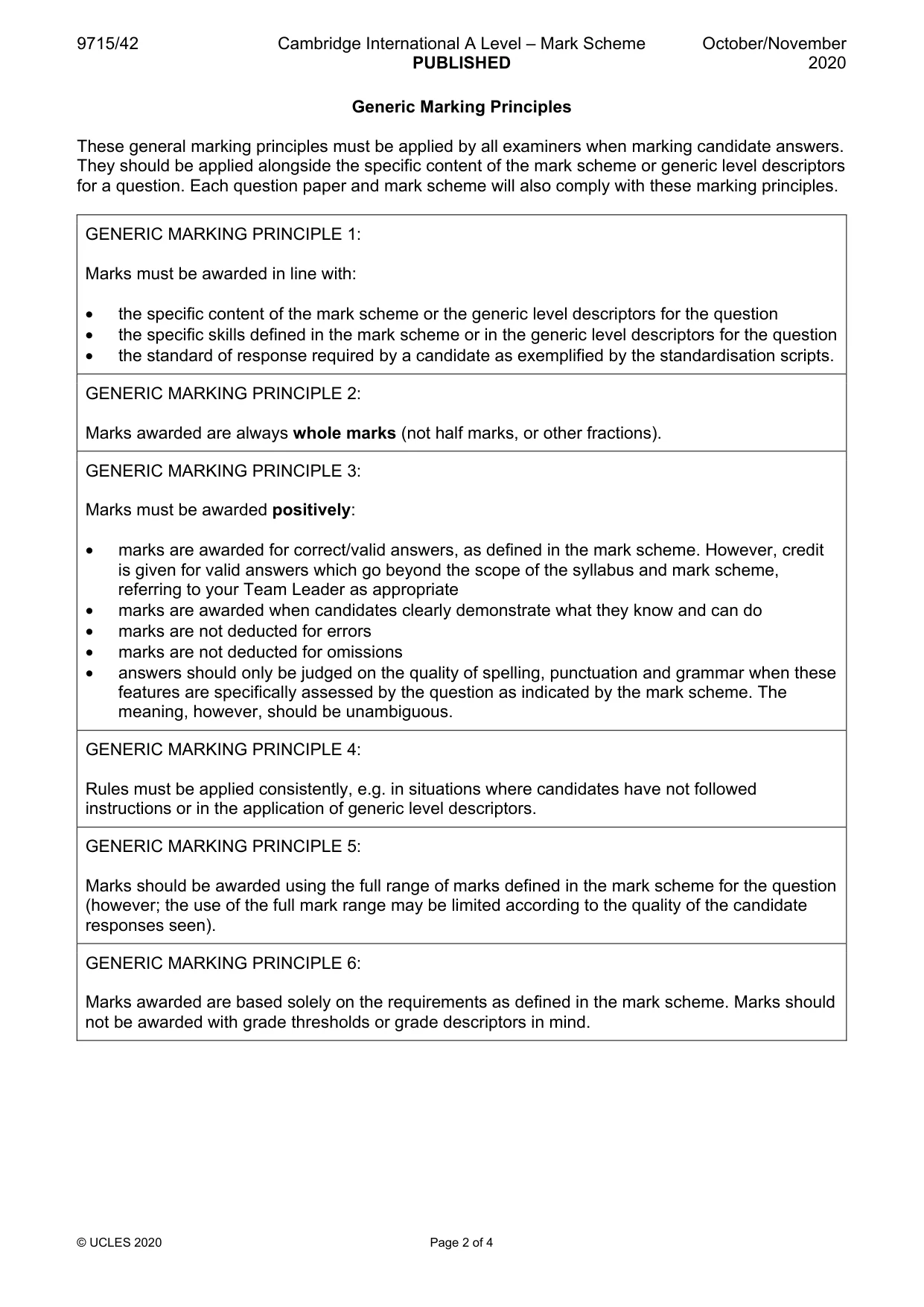
9715/42 Cambridge International A Level – Mark Scheme PUBLISHED October/November 2020 © UCLES 2020 Page 2 of 4 Generic Marking Principles These general marking principles must be applied by all examiners when marking candidate answers. They should be applied alongside the specific content of the mark scheme or generic level descriptors for a question. Each question paper and mark scheme will also comply with these marking principles. GENERIC MARKING PRINCIPLE 1: Marks must be awarded in line with: • the specific content of the mark scheme or the generic level descriptors for the question • the specific skills defined in the mark scheme or in the generic level descriptors for the question • the standard of response required by a candidate as exemplified by the standardisation scripts. GENERIC MARKING PRINCIPLE 2: Marks awarded are always whole marks (not half marks, or other fractions). GENERIC MARKING PRINCIPLE 3: Marks must be awarded positively: • marks are awarded for correct/valid answers, as defined in the mark scheme. However, credit is given for valid answers which go beyond the scope of the syllabus and mark scheme, referring to your Team Leader as appropriate • marks are awarded when candidates clearly demonstrate what they know and can do • marks are not deducted for errors • marks are not deducted for omissions • answers should only be judged on the quality of spelling, punctuation and grammar when these features are specifically assessed by the question as indicated by the mark scheme. The meaning, however, should be unambiguous. GENERIC MARKING PRINCIPLE 4: Rules must be applied consistently, e.g. in situations where candidates have not followed instructions or in the application of generic level descriptors. GENERIC MARKING PRINCIPLE 5: Marks should be awarded using the full range of marks defined in the mark scheme for the question (however; the use of the full mark range may be limited according to the quality of the candidate responses seen). GENERIC MARKING PRINCIPLE 6: Marks awarded are based solely on the requirements as defined in the mark scheme. Marks should not be awarded with grade thresholds or grade descriptors in mind.
Mark scheme, page 3
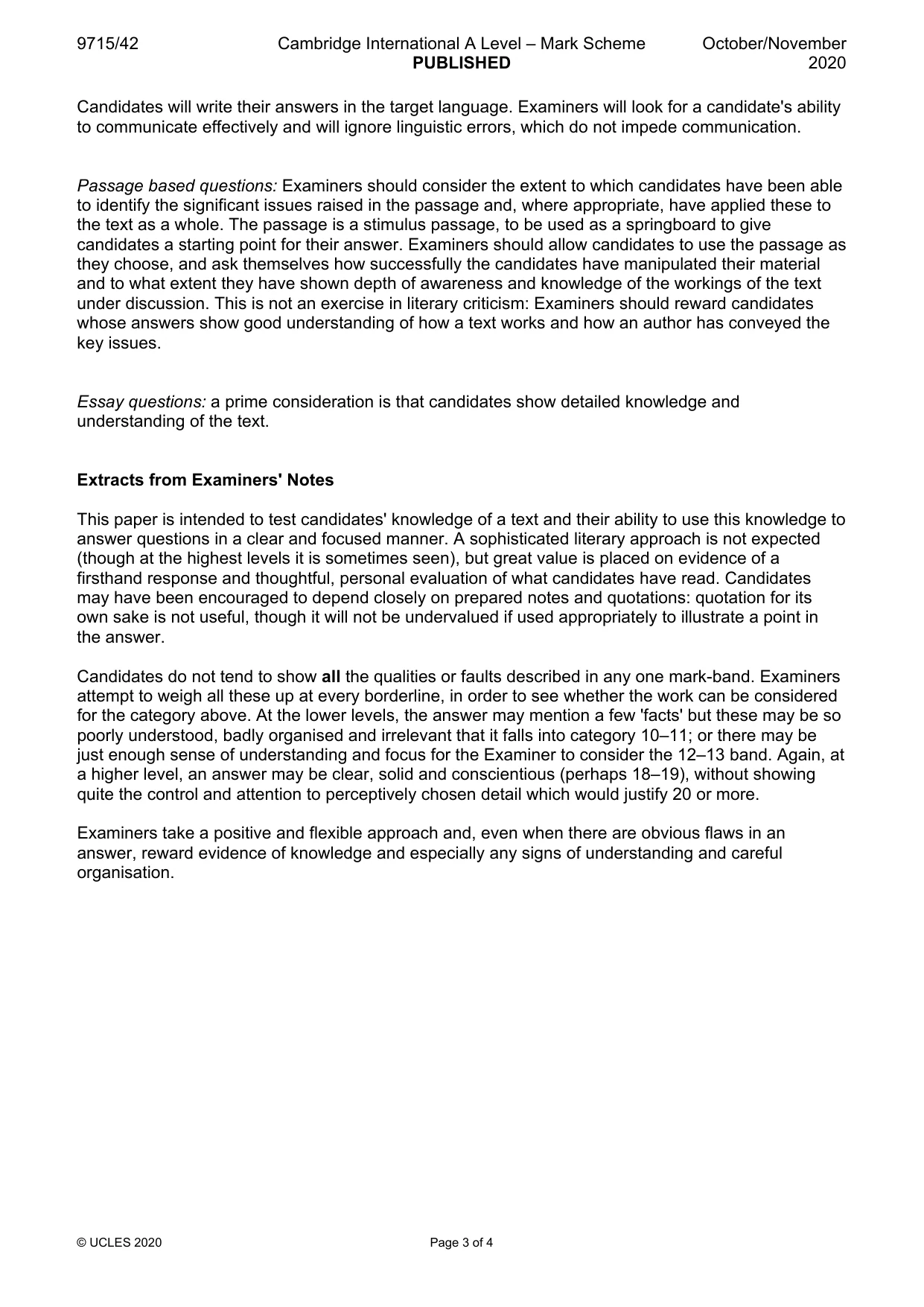
9715/42 Cambridge International A Level – Mark Scheme PUBLISHED October/November 2020 © UCLES 2020 Page 3 of 4 Candidates will write their answers in the target language. Examiners will look for a candidate's ability to communicate effectively and will ignore linguistic errors, which do not impede communication. Passage based questions: Examiners should consider the extent to which candidates have been able to identify the significant issues raised in the passage and, where appropriate, have applied these to the text as a whole. The passage is a stimulus passage, to be used as a springboard to give candidates a starting point for their answer. Examiners should allow candidates to use the passage as they choose, and ask themselves how successfully the candidates have manipulated their material and to what extent they have shown depth of awareness and knowledge of the workings of the text under discussion. This is not an exercise in literary criticism: Examiners should reward candidates whose answers show good understanding of how a text works and how an author has conveyed the key issues. Essay questions: a prime consideration is that candidates show detailed knowledge and understanding of the text. Extracts from Examiners' Notes This paper is intended to test candidates' knowledge of a text and their ability to use this knowledge to answer questions in a clear and focused manner. A sophisticated literary approach is not expected (though at the highest levels it is sometimes seen), but great value is placed on evidence of a firsthand response and thoughtful, personal evaluation of what candidates have read. Candidates may have been encouraged to depend closely on prepared notes and quotations: quotation for its own sake is not useful, though it will not be undervalued if used appropriately to illustrate a point in the answer. Candidates do not tend to show all the qualities or faults described in any one mark-band. Examiners attempt to weigh all these up at every borderline, in order to see whether the work can be considered for the category above. At the lower levels, the answer may mention a few 'facts' but these may be so poorly understood, badly organised and irrelevant that it falls into category 10–11; or there may be just enough sense of understanding and focus for the Examiner to consider the 12–13 band. Again, at a higher level, an answer may be clear, solid and conscientious (perhaps 18–19), without showing quite the control and attention to perceptively chosen detail which would justify 20 or more. Examiners take a positive and flexible approach and, even when there are obvious flaws in an answer, reward evidence of knowledge and especially any signs of understanding and careful organisation.
Mark scheme, page 4
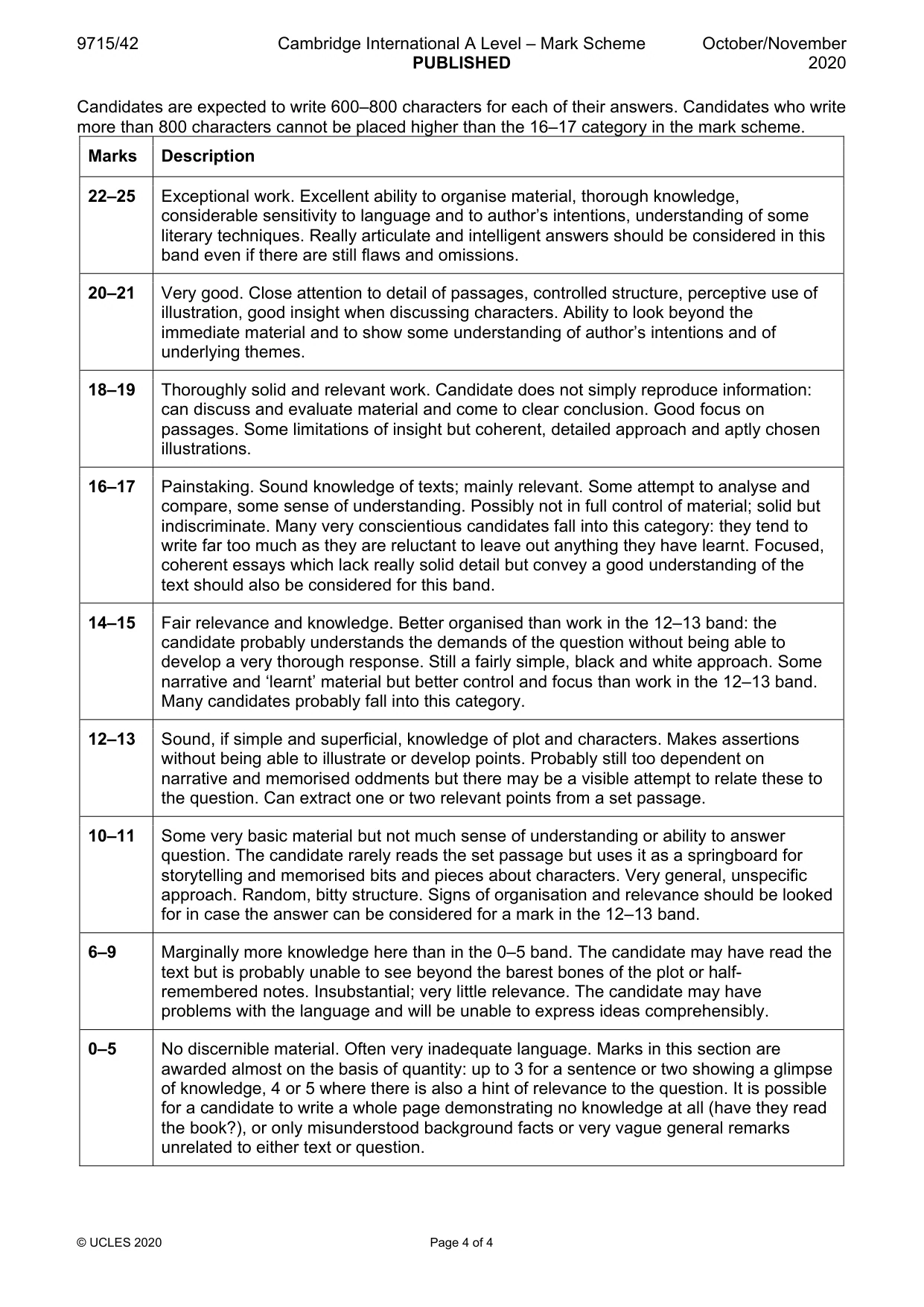
9715/42 Cambridge International A Level – Mark Scheme PUBLISHED October/November 2020 © UCLES 2020 Page 4 of 4 Candidates are expected to write 600–800 characters for each of their answers. Candidates who write more than 800 characters cannot be placed higher than the 16–17 category in the mark scheme. Marks Description 22–25 Exceptional work. Excellent ability to organise material, thorough knowledge, considerable sensitivity to language and to author’s intentions, understanding of some literary techniques. Really articulate and intelligent answers should be considered in this band even if there are still flaws and omissions. 20–21 Very good. Close attention to detail of passages, controlled structure, perceptive use of illustration, good insight when discussing characters. Ability to look beyond the immediate material and to show some understanding of author’s intentions and of underlying themes. 18–19 Thoroughly solid and relevant work. Candidate does not simply reproduce information: can discuss and evaluate material and come to clear conclusion. Good focus on passages. Some limitations of insight but coherent, detailed approach and aptly chosen illustrations. 16–17 Painstaking. Sound knowledge of texts; mainly relevant. Some attempt to analyse and compare, some sense of understanding. Possibly not in full control of material; solid but indiscriminate. Many very conscientious candidates fall into this category: they tend to write far too much as they are reluctant to leave out anything they have learnt. Focused, coherent essays which lack really solid detail but convey a good understanding of the text should also be considered for this band. 14–15 Fair relevance and knowledge. Better organised than work in the 12–13 band: the candidate probably understands the demands of the question without being able to develop a very thorough response. Still a fairly simple, black and white approach. Some narrative and ‘learnt’ material but better control and focus than work in the 12–13 band. Many candidates probably fall into this category. 12–13 Sound, if simple and superficial, knowledge of plot and characters. Makes assertions without being able to illustrate or develop points. Probably still too dependent on narrative and memorised oddments but there may be a visible attempt to relate these to the question. Can extract one or two relevant points from a set passage. 10–11 Some very basic material but not much sense of understanding or ability to answer question. The candidate rarely reads the set passage but uses it as a springboard for storytelling and memorised bits and pieces about characters. Very general, unspecific approach. Random, bitty structure. Signs of organisation and relevance should be looked for in case the answer can be considered for a mark in the 12–13 band. 6–9 Marginally more knowledge here than in the 0–5 band. The candidate may have read the text but is probably unable to see beyond the barest bones of the plot or half- remembered notes. Insubstantial; very little relevance. The candidate may have problems with the language and will be unable to express ideas comprehensibly. 0–5 No discernible material. Often very inadequate language. Marks in this section are awarded almost on the basis of quantity: up to 3 for a sentence or two showing a glimpse of knowledge, 4 or 5 where there is also a hint of relevance to the question. It is possible for a candidate to write a whole page demonstrating no knowledge at all (have they read the book?), or only misunderstood background facts or very vague general remarks unrelated to either text or question.
What you needed in this session
Cambridge’s own grade thresholds for 2020 Oct/Nov, Paper 4 · Variant 2. A higher threshold means an easier paper — the bar moves with how the cohort did.