Cambridge A Level Chinese (A Level only) 9715 — 2016 Oct/Nov Paper 4 · Variant 3
9715/43/O/N/16 · 75 marks · ≈84 min
The question paper and its mark scheme, free to read here and free to download. This is Cambridge’s own paper, exactly as it was sat.
Question paper8 pages
Mark scheme3 pages
Answers below. Sit the paper first if you are practising.
Paper as text
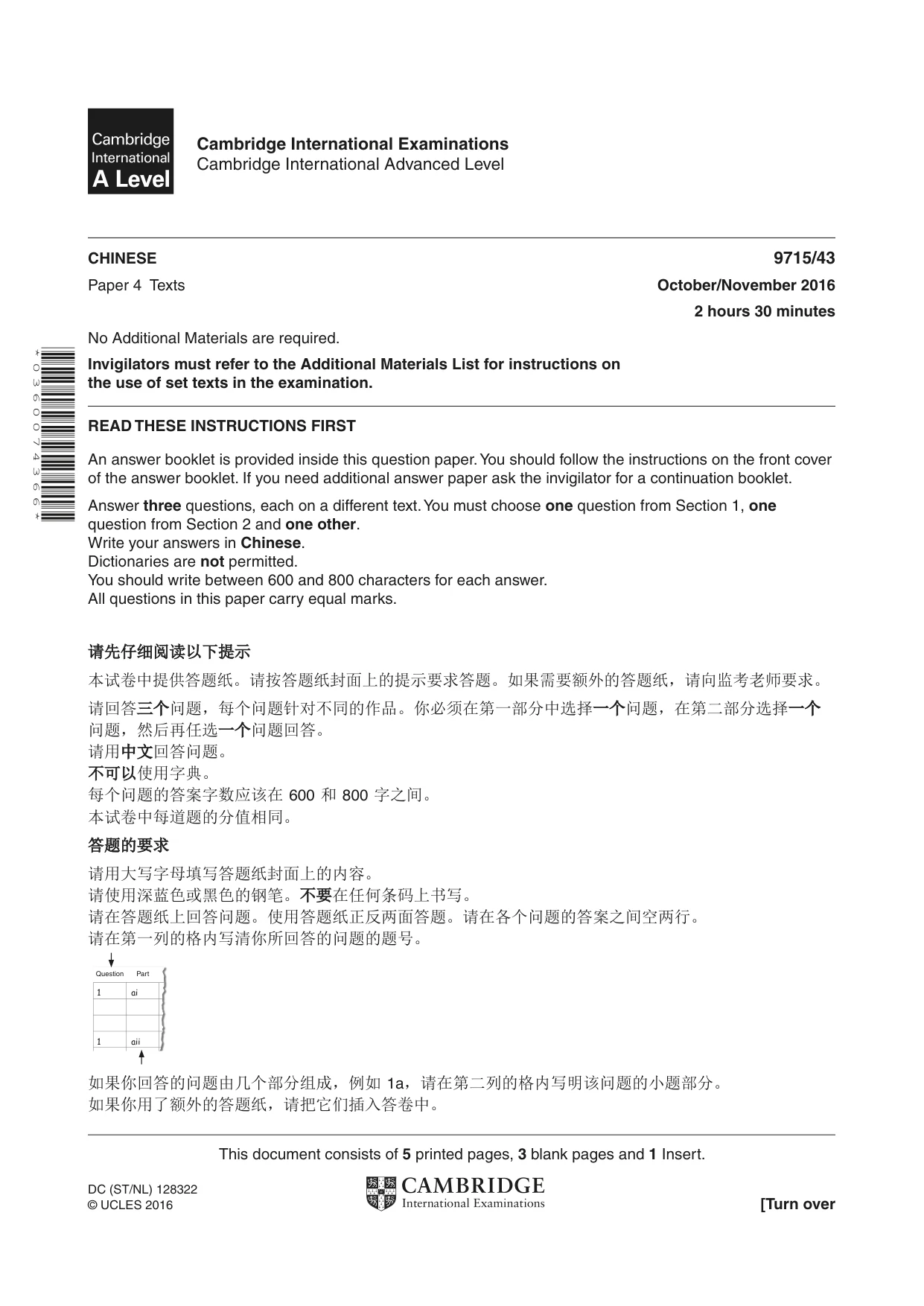
Question paper, page 1
This document consists of 5 printed pages, 3 blank pages and 1 Insert. DC (ST/NL) 128322 © UCLES 2016 [Turn over Cambridge International Examinations Cambridge International Advanced Level * 0 3 6 0 0 7 4 3 6 6 * CHINESE 9715/43 Paper 4 Texts October/November 2016 2 hours 30 minutes No Additional Materials are required. Invigilators must refer to the Additional Materials List for instructions on the use of set texts in the examination. READ THESE INSTRUCTIONS FIRST An answer booklet is provided inside this question paper. You should follow the instructions on the front cover of the answer booklet. If you need additional answer paper ask the invigilator for a continuation booklet. Answer three questions, each on a different text. You must choose one question from Section 1, one question from Section 2 and one other. Write your answers in Chinese. Dictionaries are not permitted. You should write between 600 and 800 characters for each answer. All questions in this paper carry equal marks. 请先仔细阅读以下提示 本试卷中提供答题纸。请按答题纸封面上的提示要求答题。如果需要额外的答题纸,请向监考老师要求。 请回答三个问题,每个问题针对不同的作品。你必须在第一部分中选择一个问题,在第二部分选择一个 问题,然后再任选一个问题回答。 请用中文回答问题。 不可以使用字典。 每个问题的答案字数应该在 600 和 800 字之间。 本试卷中每道题的分值相同。 答题的要求 请用大写字母填写答题纸封面上的内容。 请使用深蓝色或黑色的钢笔。不要在任何条码上书写。 请在答题纸上回答问题。使用答题纸正反两面答题。请在各个问题的答案之间空两行。 请在第一列的格内写清你所回答的问题的题号。 如果你回答的问题由几个部分组成,例如 1a,请在第二列的格内写明该问题的小题部分。 如果你用了额外的答题纸,请把它们插入答卷中。 Question Part 1 1 ai aii
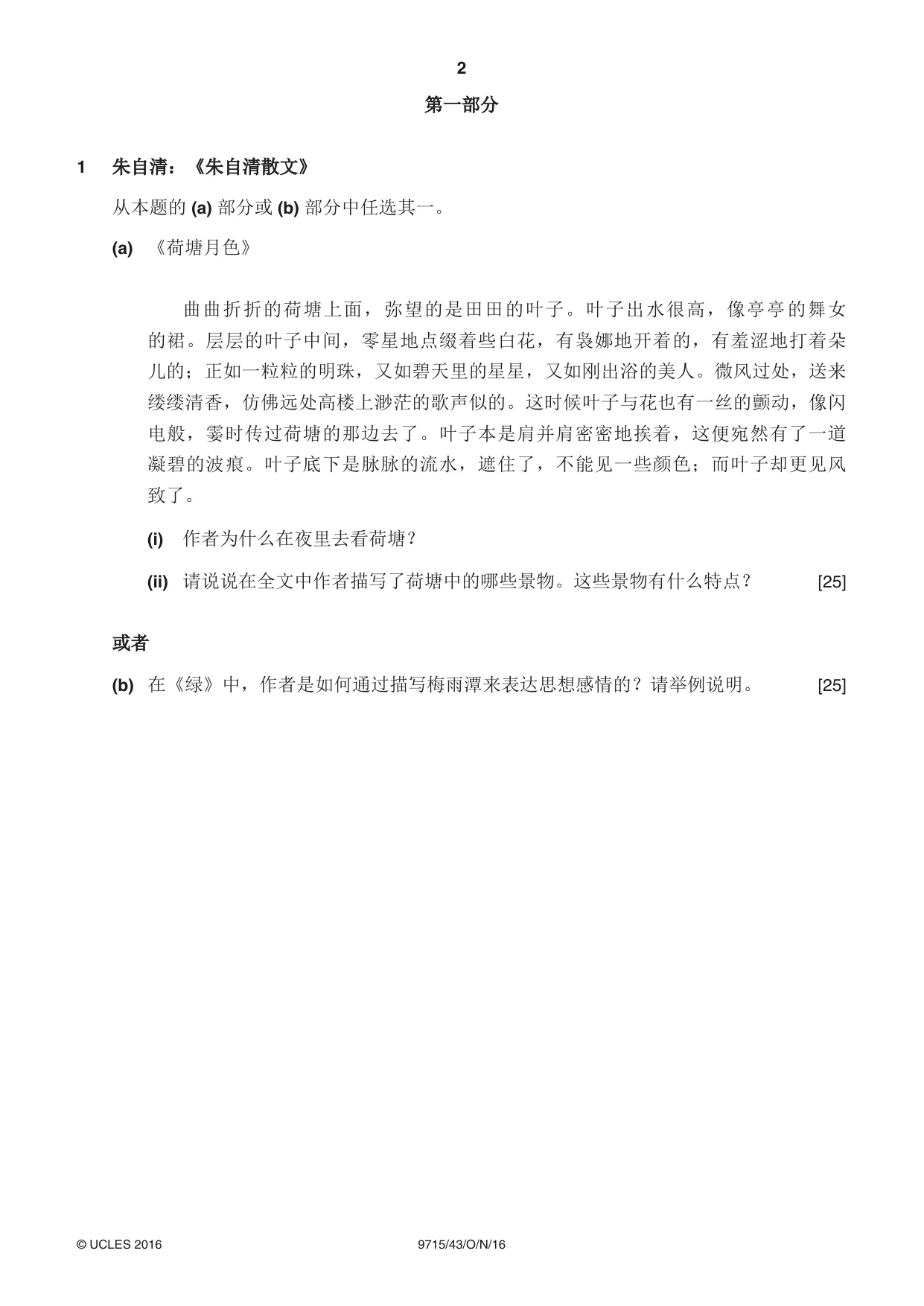
Question paper, page 2
2 9715/43/O/N/16 © UCLES 2016 第一部分 1 朱自清:《朱自清散文》 从本题的 (a) 部分或 (b) 部分中任选其一。 (a) 《荷塘月色》 曲曲折折的荷塘上面,弥望的是田田的叶子。叶子出水很高,像亭亭的舞女 的裙。层层的叶子中间,零星地点缀着些白花,有袅娜地开着的,有羞涩地打着朵 儿的;正如一粒粒的明珠,又如碧天里的星星,又如刚出浴的美人。微风过处,送来 缕缕清香,仿佛远处高楼上渺茫的歌声似的。这时候叶子与花也有一丝的颤动,像闪 电般,霎时传过荷塘的那边去了。叶子本是肩并肩密密地挨着,这便宛然有了一道 凝碧的波痕。叶子底下是脉脉的流水,遮住了,不能见一些颜色;而叶子却更见风 致了。 (i) 作者为什么在夜里去看荷塘? (ii) 请说说在全文中作者描写了荷塘中的哪些景物。这些景物有什么特点? [25] 或者 (b) 在《绿》中,作者是如何通过描写梅雨潭来表达思想感情的?请举例说明。 [25]
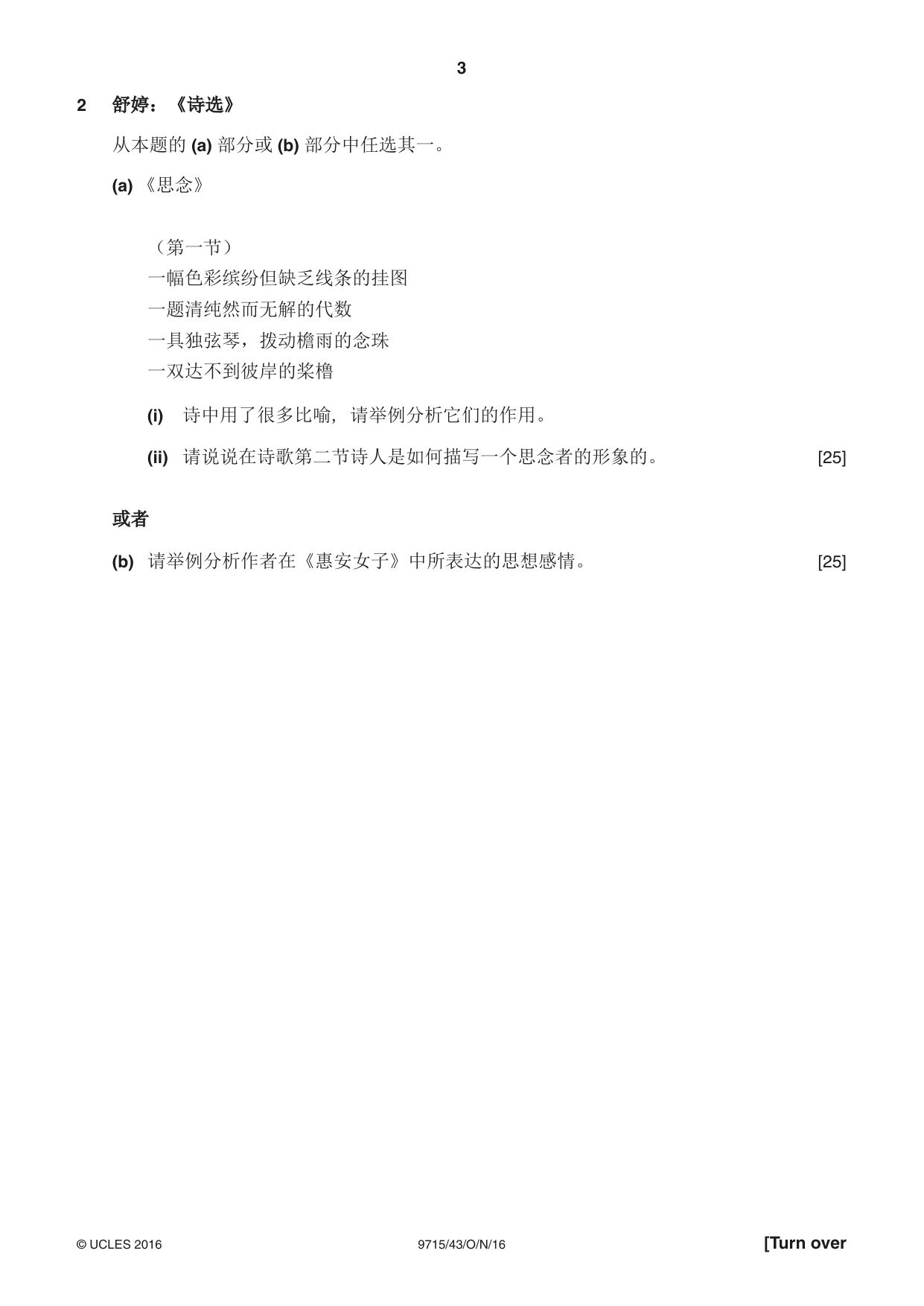
Question paper, page 3
3 9715/43/O/N/16 © UCLES 2016 [Turn over 2 舒婷:《诗选》 从本题的 (a) 部分或 (b) 部分中任选其一。 (a) 《思念》 (第一节) 一幅色彩缤纷但缺乏线条的挂图 一题清纯然而无解的代数 一具独弦琴,拨动檐雨的念珠 一双达不到彼岸的桨橹 (i) 诗中用了很多比喻, 请举例分析它们的作用。 (ii) 请说说在诗歌第二节诗人是如何描写一个思念者的形象的。 [25] 或者 (b) 请举例分析作者在《惠安女子》中所表达的思想感情。 [25]
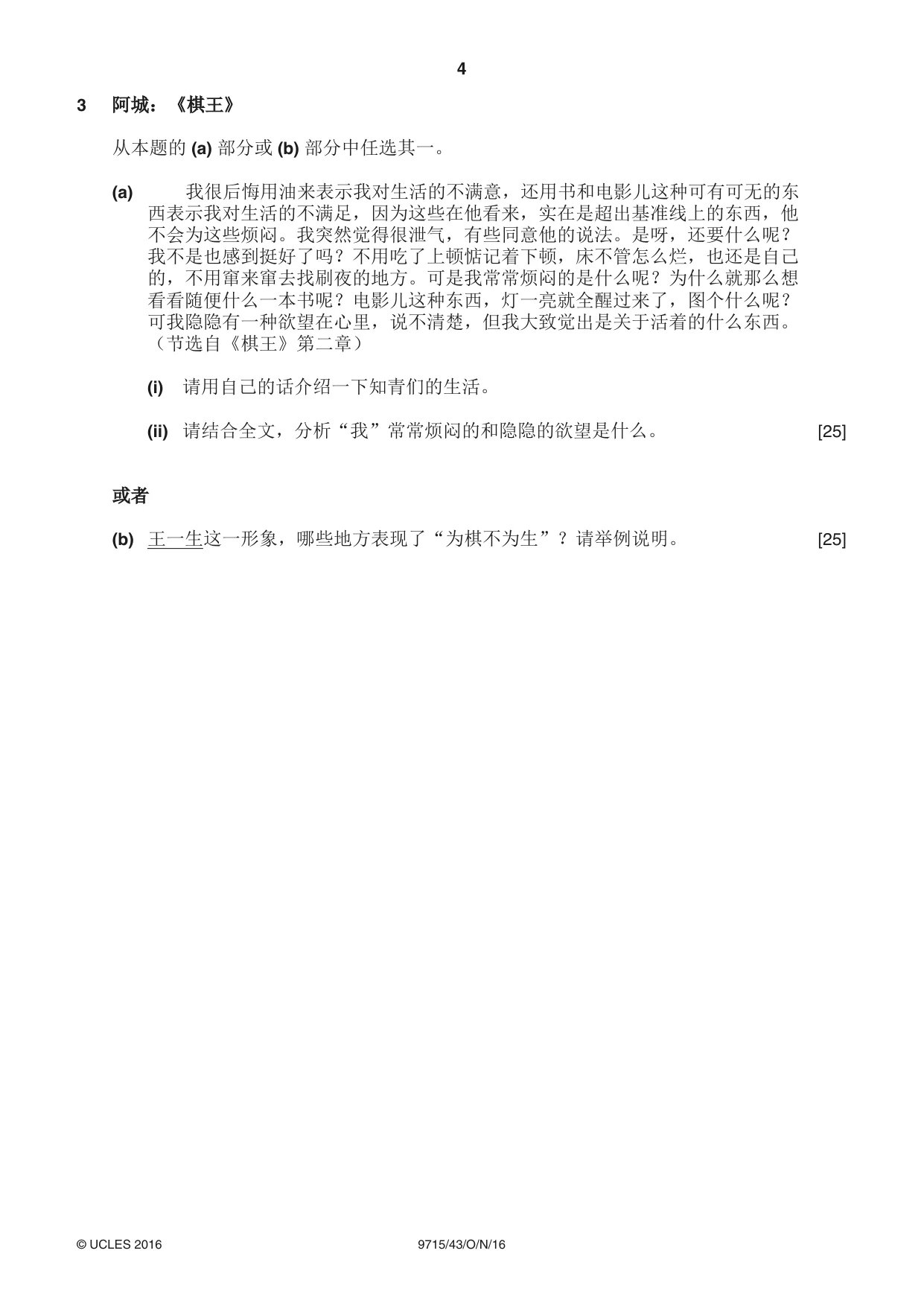
Question paper, page 4
4 9715/43/O/N/16 © UCLES 2016 3 阿城:《棋王》 从本题的 (a) 部分或 (b) 部分中任选其一。 (a) 我很后悔用油来表示我对生活的不满意,还用书和电影儿这种可有可无的东 西表示我对生活的不满足,因为这些在他看来,实在是超出基准线上的东西,他 不会为这些烦闷。我突然觉得很泄气,有些同意他的说法。是呀,还要什么呢? 我不是也感到挺好了吗?不用吃了上顿惦记着下顿,床不管怎么烂,也还是自己 的,不用窜来窜去找刷夜的地方。可是我常常烦闷的是什么呢?为什么就那么想 看看随便什么一本书呢?电影儿这种东西,灯一亮就全醒过来了,图个什么呢? 可我隐隐有一种欲望在心里,说不清楚,但我大致觉出是关于活着的什么东西。 (节选自《棋王》第二章) (i) 请用自己的话介绍一下知青们的生活。 (ii) 请结合全文,分析“我”常常烦闷的和隐隐的欲望是什么。 [25] 或者 (b) 王一生这一形象,哪些地方表现了“为棋不为生”?请举例说明。 [25]
Question paper, page 5
5 9715/43/O/N/16 © UCLES 2016 第二部分 4 铁凝:《哦,香雪》 从本题的 (a) 部分或 (b) 部分中任选其一。 (a) 文章中多次提到铅笔盒。请说说为什么香雪一定要用鸡蛋换铅笔盒。 [25] 或者 (b) 请举例分析凤娇和香雪在性格上的相同和不同的地方。 [25] 5 曹禺:《日出》 从本题的 (a) 部分或 (b) 部分中任选其一。 (a) 请举例分析王福升这个人物。 [25] 或者 (b) 请用剧中的两个人物作为例子,分析这部戏剧是如何揭露社会的黑暗的。 [25] 6 茹志鹃:《百合花》 从本题的 (a) 部分或 (b) 部分中任选其一。 (a) 请用小说中的例子分析这场战争中军民之间的关系。 [25] 或者 (b) 举例分析小通讯员的性格特点。 [25]
Question paper, page 6
6 9715/43/O/N/16 © UCLES 2016 BLANK PAGE
Question paper, page 7
7 9715/43/O/N/16 © UCLES 2016 BLANK PAGE
Question paper, page 8
8 9715/43/O/N/16 © UCLES 2016 Permission to reproduce items where third-party owned material protected by copyright is included has been sought and cleared where possible. Every reasonable effort has been made by the publisher (UCLES) to trace copyright holders, but if any items requiring clearance have unwittingly been included, the publisher will be pleased to make amends at the earliest possible opportunity. To avoid the issue of disclosure of answer-related information to candidates, all copyright acknowledgements are reproduced online in the Cambridge International Examinations Copyright Acknowledgements Booklet. This is produced for each series of examinations and is freely available to download at www.cie.org.uk after the live examination series. Cambridge International Examinations is part of the Cambridge Assessment Group. Cambridge Assessment is the brand name of University of Cambridge Local Examinations Syndicate (UCLES), which is itself a department of the University of Cambridge. BLANK PAGE
Mark scheme, page 1
® IGCSE is the registered trademark of Cambridge International Examinations. This document consists of 3 printed pages. © UCLES 2016 [Turn over Cambridge International Examinations Cambridge International Advanced Level CHINESE 9715/43 Paper 4 Texts October/November 2016 MARK SCHEME Maximum Mark: 75 Published This mark scheme is published as an aid to teachers and candidates, to indicate the requirements of the examination. It shows the basis on which Examiners were instructed to award marks. It does not indicate the details of the discussions that took place at an Examiners’ meeting before marking began, which would have considered the acceptability of alternative answers. Mark schemes should be read in conjunction with the question paper and the Principal Examiner Report for Teachers. Cambridge will not enter into discussions about these mark schemes. Cambridge is publishing the mark schemes for the October/November 2016 series for most Cambridge IGCSE®, Cambridge International A and AS Level components and some Cambridge O Level components.
Mark scheme, page 2
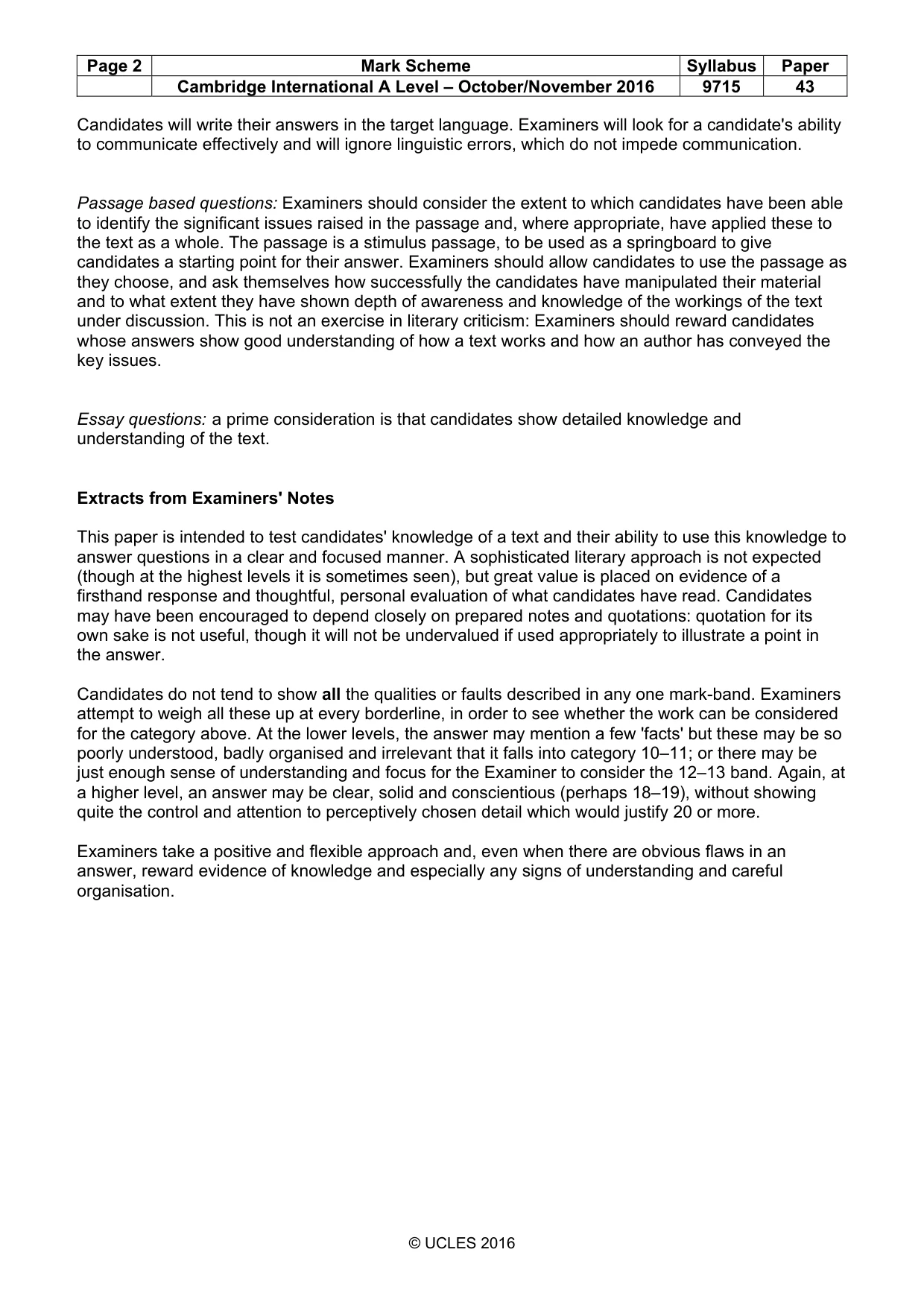
Page 2 Mark Scheme Syllabus Paper Cambridge International A Level – October/November 2016 9715 43 © UCLES 2016 Candidates will write their answers in the target language. Examiners will look for a candidate's ability to communicate effectively and will ignore linguistic errors, which do not impede communication. Passage based questions: Examiners should consider the extent to which candidates have been able to identify the significant issues raised in the passage and, where appropriate, have applied these to the text as a whole. The passage is a stimulus passage, to be used as a springboard to give candidates a starting point for their answer. Examiners should allow candidates to use the passage as they choose, and ask themselves how successfully the candidates have manipulated their material and to what extent they have shown depth of awareness and knowledge of the workings of the text under discussion. This is not an exercise in literary criticism: Examiners should reward candidates whose answers show good understanding of how a text works and how an author has conveyed the key issues. Essay questions: a prime consideration is that candidates show detailed knowledge and understanding of the text. Extracts from Examiners' Notes This paper is intended to test candidates' knowledge of a text and their ability to use this knowledge to answer questions in a clear and focused manner. A sophisticated literary approach is not expected (though at the highest levels it is sometimes seen), but great value is placed on evidence of a firsthand response and thoughtful, personal evaluation of what candidates have read. Candidates may have been encouraged to depend closely on prepared notes and quotations: quotation for its own sake is not useful, though it will not be undervalued if used appropriately to illustrate a point in the answer. Candidates do not tend to show all the qualities or faults described in any one mark-band. Examiners attempt to weigh all these up at every borderline, in order to see whether the work can be considered for the category above. At the lower levels, the answer may mention a few 'facts' but these may be so poorly understood, badly organised and irrelevant that it falls into category 10–11; or there may be just enough sense of understanding and focus for the Examiner to consider the 12–13 band. Again, at a higher level, an answer may be clear, solid and conscientious (perhaps 18–19), without showing quite the control and attention to perceptively chosen detail which would justify 20 or more. Examiners take a positive and flexible approach and, even when there are obvious flaws in an answer, reward evidence of knowledge and especially any signs of understanding and careful organisation.
Mark scheme, page 3
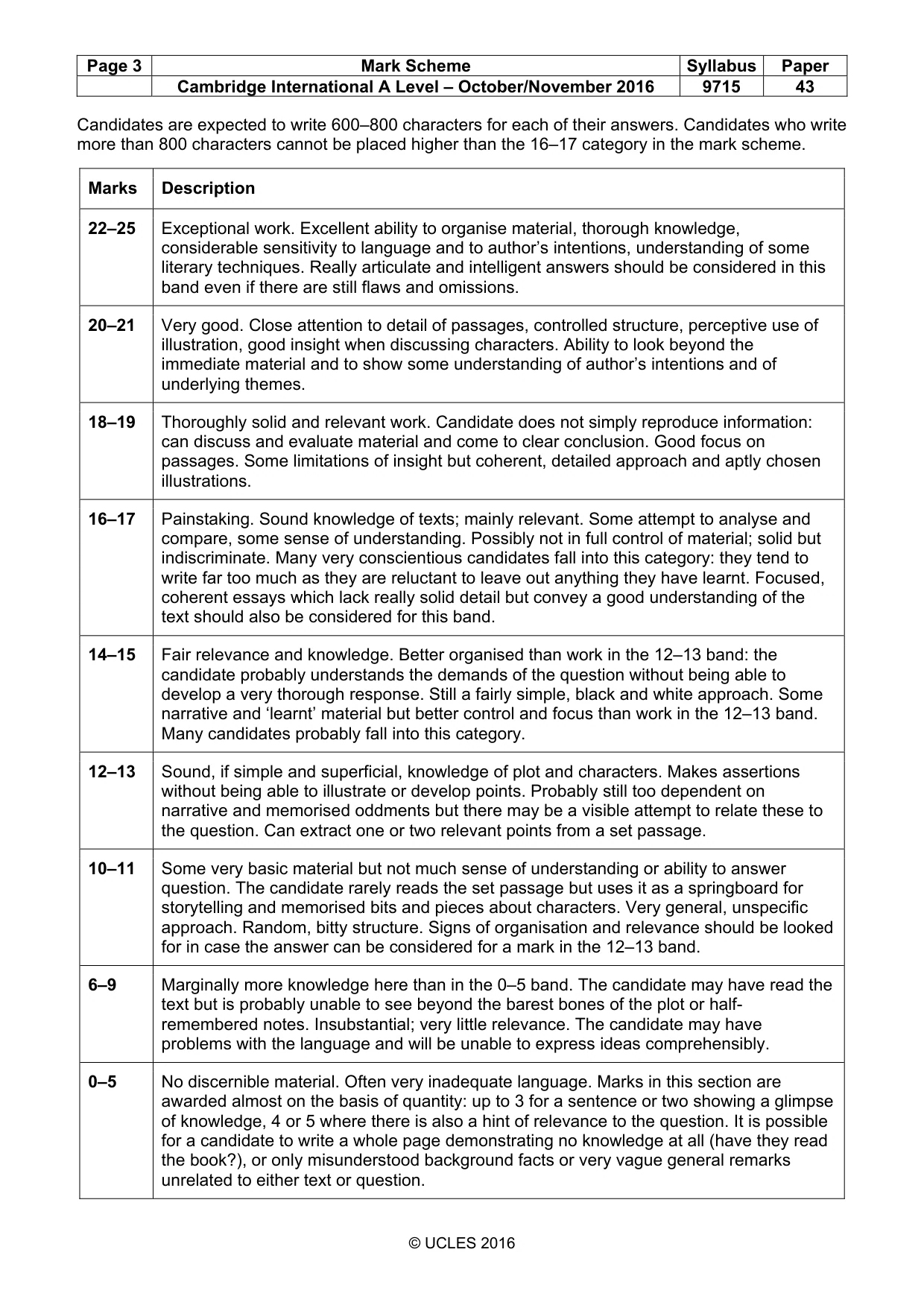
Page 3 Mark Scheme Syllabus Paper Cambridge International A Level – October/November 2016 9715 43 © UCLES 2016 Candidates are expected to write 600–800 characters for each of their answers. Candidates who write more than 800 characters cannot be placed higher than the 16–17 category in the mark scheme. Marks Description 22–25 Exceptional work. Excellent ability to organise material, thorough knowledge, considerable sensitivity to language and to author’s intentions, understanding of some literary techniques. Really articulate and intelligent answers should be considered in this band even if there are still flaws and omissions. 20–21 Very good. Close attention to detail of passages, controlled structure, perceptive use of illustration, good insight when discussing characters. Ability to look beyond the immediate material and to show some understanding of author’s intentions and of underlying themes. 18–19 Thoroughly solid and relevant work. Candidate does not simply reproduce information: can discuss and evaluate material and come to clear conclusion. Good focus on passages. Some limitations of insight but coherent, detailed approach and aptly chosen illustrations. 16–17 Painstaking. Sound knowledge of texts; mainly relevant. Some attempt to analyse and compare, some sense of understanding. Possibly not in full control of material; solid but indiscriminate. Many very conscientious candidates fall into this category: they tend to write far too much as they are reluctant to leave out anything they have learnt. Focused, coherent essays which lack really solid detail but convey a good understanding of the text should also be considered for this band. 14–15 Fair relevance and knowledge. Better organised than work in the 12–13 band: the candidate probably understands the demands of the question without being able to develop a very thorough response. Still a fairly simple, black and white approach. Some narrative and ‘learnt’ material but better control and focus than work in the 12–13 band. Many candidates probably fall into this category. 12–13 Sound, if simple and superficial, knowledge of plot and characters. Makes assertions without being able to illustrate or develop points. Probably still too dependent on narrative and memorised oddments but there may be a visible attempt to relate these to the question. Can extract one or two relevant points from a set passage. 10–11 Some very basic material but not much sense of understanding or ability to answer question. The candidate rarely reads the set passage but uses it as a springboard for storytelling and memorised bits and pieces about characters. Very general, unspecific approach. Random, bitty structure. Signs of organisation and relevance should be looked for in case the answer can be considered for a mark in the 12–13 band. 6–9 Marginally more knowledge here than in the 0–5 band. The candidate may have read the text but is probably unable to see beyond the barest bones of the plot or half- remembered notes. Insubstantial; very little relevance. The candidate may have problems with the language and will be unable to express ideas comprehensibly. 0–5 No discernible material. Often very inadequate language. Marks in this section are awarded almost on the basis of quantity: up to 3 for a sentence or two showing a glimpse of knowledge, 4 or 5 where there is also a hint of relevance to the question. It is possible for a candidate to write a whole page demonstrating no knowledge at all (have they read the book?), or only misunderstood background facts or very vague general remarks unrelated to either text or question.
What you needed in this session
Cambridge’s own grade thresholds for 2016 Oct/Nov, Paper 4 · Variant 3. A higher threshold means an easier paper — the bar moves with how the cohort did.