Cambridge A Level Chemistry 9701 — 2022 Oct/Nov Paper 3 · Variant 4
9701/34/O/N/22 · 3 questions · 40 marks · ≈45 min
The question paper and its mark scheme, free to read here and free to download. This is Cambridge’s own paper, exactly as it was sat.
Question paper12 pages
Mark scheme13 pages
Answers below. Sit the paper first if you are practising.
Questions as text
Q1 · You are to determine the enthalpy change for a metal displacement reaction using a known…
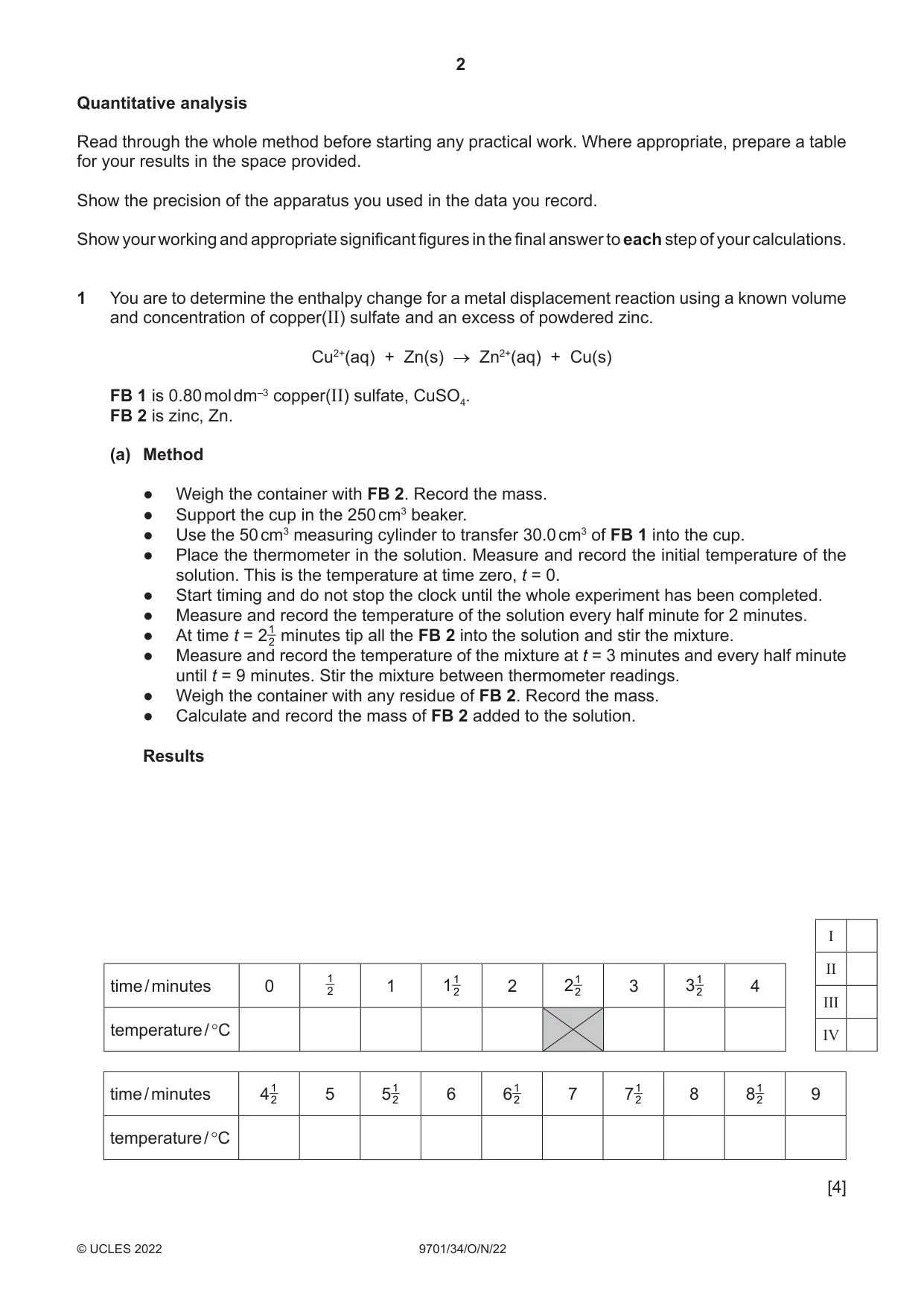
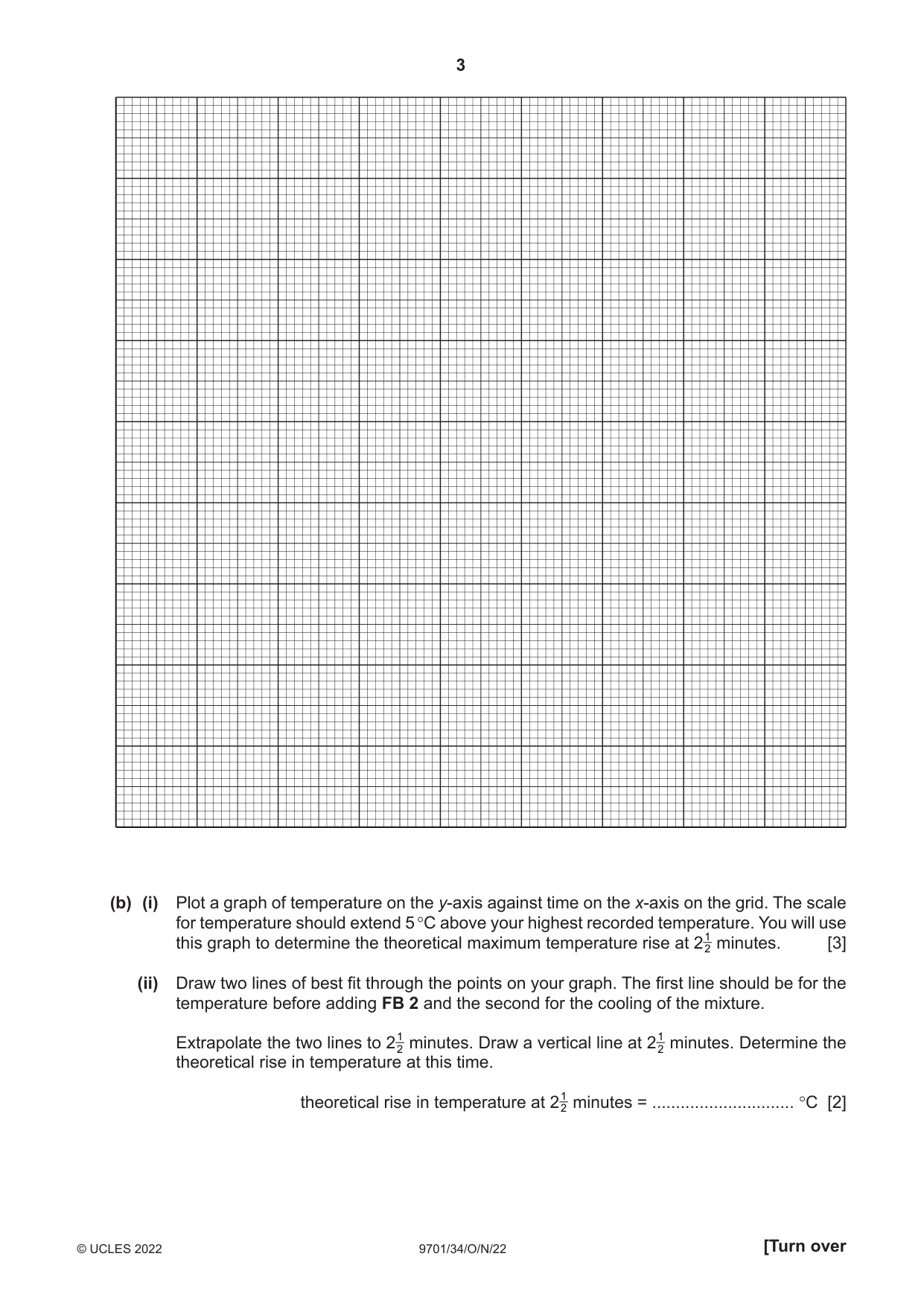
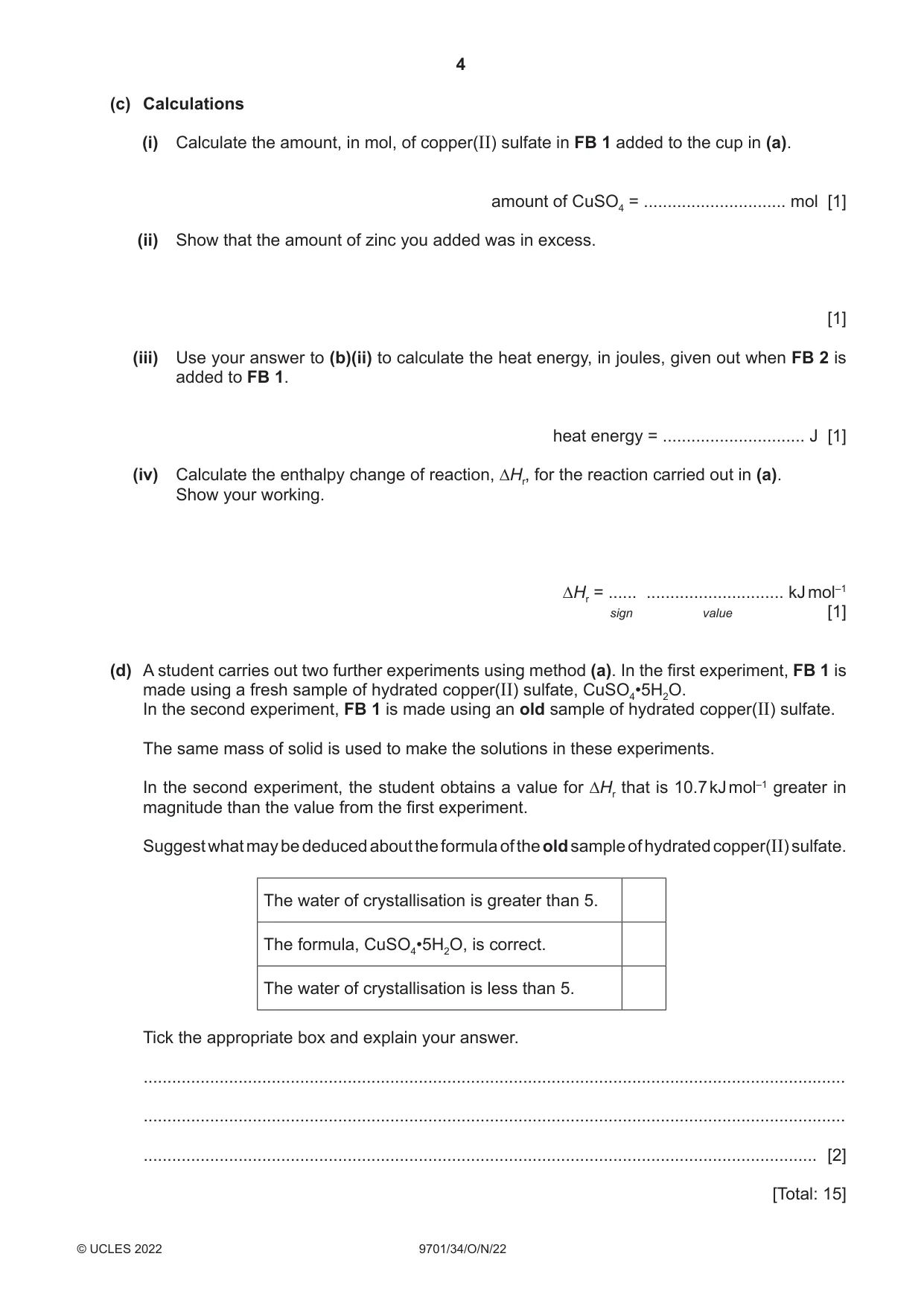
1 You are to determine the enthalpy change for a metal displacement reaction using a known volume and concentration of copper(II) sulfate and an excess of powdered zinc. Cu2+(aq) + Zn(s) → Zn2+(aq) + Cu(s) FB 1 is 0.80 mol dm–3 copper(II) sulfate, CuSO4. FB 2 is zinc, Zn. (a) Method ● Weigh the container with FB 2. Record the mass. ● Support the cup in the 250 cm3 beaker. ● Use the 50 cm3 measuring cylinder to transfer 30.0 cm3 of FB 1 into the cup. ● Place the thermometer in the solution. Measure and record the initial temperature of the solution. This is the temperature at time zero, t = 0. ● Start timing and do not stop the clock until the whole experiment has been completed. ● Measure and record the temperature of the solution every half minute for 2 minutes. ● At time t = 212 minutes tip all the FB 2 into the solution and stir the mixture. ● Measure and record the temperature of the mixture at t = 3 minutes and every half minute until t = 9 minutes. Stir the mixture between thermometer readings. ● Weigh the container with any residue of FB 2. Record the mass. ● Calculate and record the mass of FB 2 added to the solution. Results I II time / minutes 0 12 1 112 2 212 3 312 4 III temperature / °C IV time / minutes 412 5 512 6 612 7 712 8 812 9 temperature / °C [4] (b) (i) Plot a graph of temperature on the y-axis against time on the x-axis on the grid. The scale for temperature should extend 5 °C above your highest recorded temperature. You will use this graph to determine the theoretical maximum temperature rise at 212 minutes. [3] (ii) Draw two lines of best fit through the points on your graph. The first line should be for the temperature before adding FB 2 and the second for the cooling of the mixture. Extrapolate the two lines to 212 minutes. Draw a vertical line at 212 minutes. Determine the theoretical rise in temperature at this time. theoretical rise in temperature at 212 minutes = .............................. °C [2] (c) Calculations (i) Calculate the amount, in mol, of copper(II) sulfate in FB 1 added to the cup in (a). amount of CuSO4 = .............................. mol [1] (ii) Show that the amount of zinc you added was in excess. [1] (iii) Use your answer to (b)(ii) to calculate the heat energy, in joules, given out when FB 2 is added to FB 1. heat energy = .............................. J [1] (iv) Calculate the enthalpy change of reaction, ∆Hr, for the reaction carried out in (a). Show your working. ∆Hr = ...... ............................. kJ mol–1 sign value [1] (d) A student carries out two further experiments using method (a). In the first experiment, FB 1 is made using a fresh sample of hydrated copper(II) sulfate, CuSO4•5H2O. In the second experiment, FB 1 is made using an old sample of hydrated copper(II) sulfate. The same mass of solid is used to make the solutions in these experiments. In the second experiment, the student obtains a value for ∆Hr that is 10.7 kJ mol–1 greater in magnitude than the value from the first experiment. Suggest what may be deduced about the formula of the old sample of hydrated copper(II) sulfate. The water of crystallisation is greater than 5. The formula, CuSO4•5H2O, is correct. The water of crystallisation is less than 5. Tick the appropriate box and explain your answer. .................................................................................................................................................... .................................................................................................................................................... .............................................................................................................................................. [2] [Total: 15]
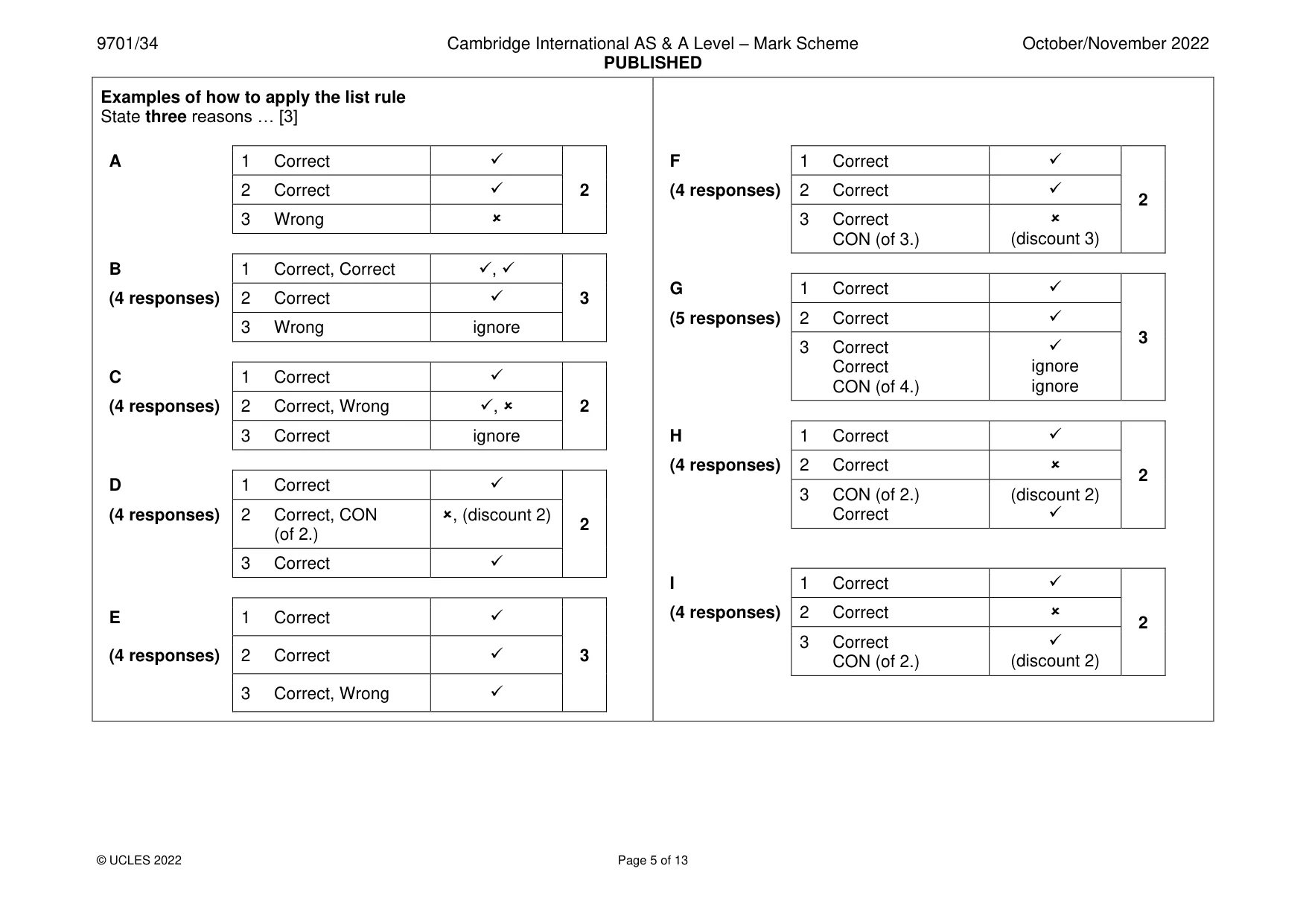
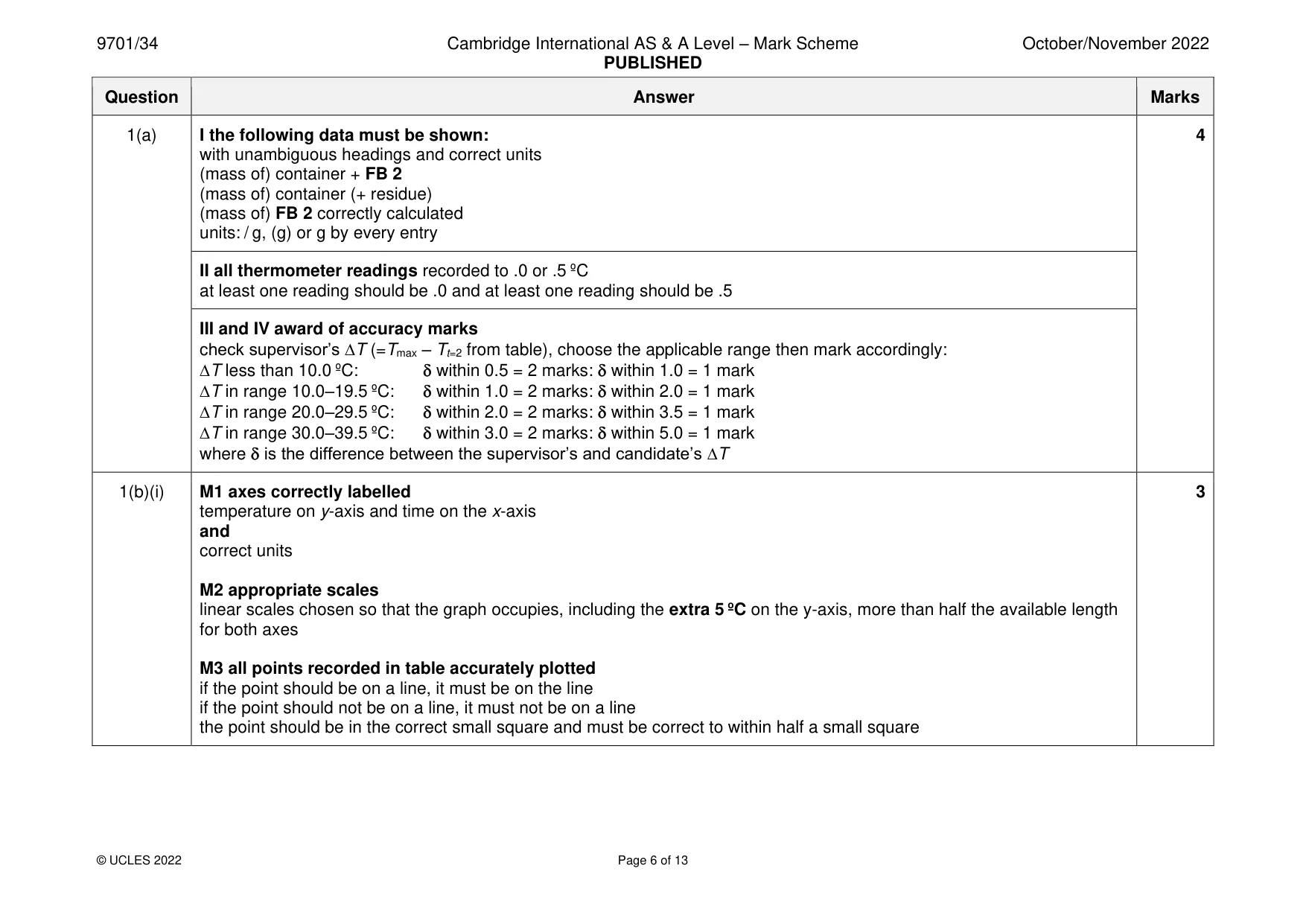
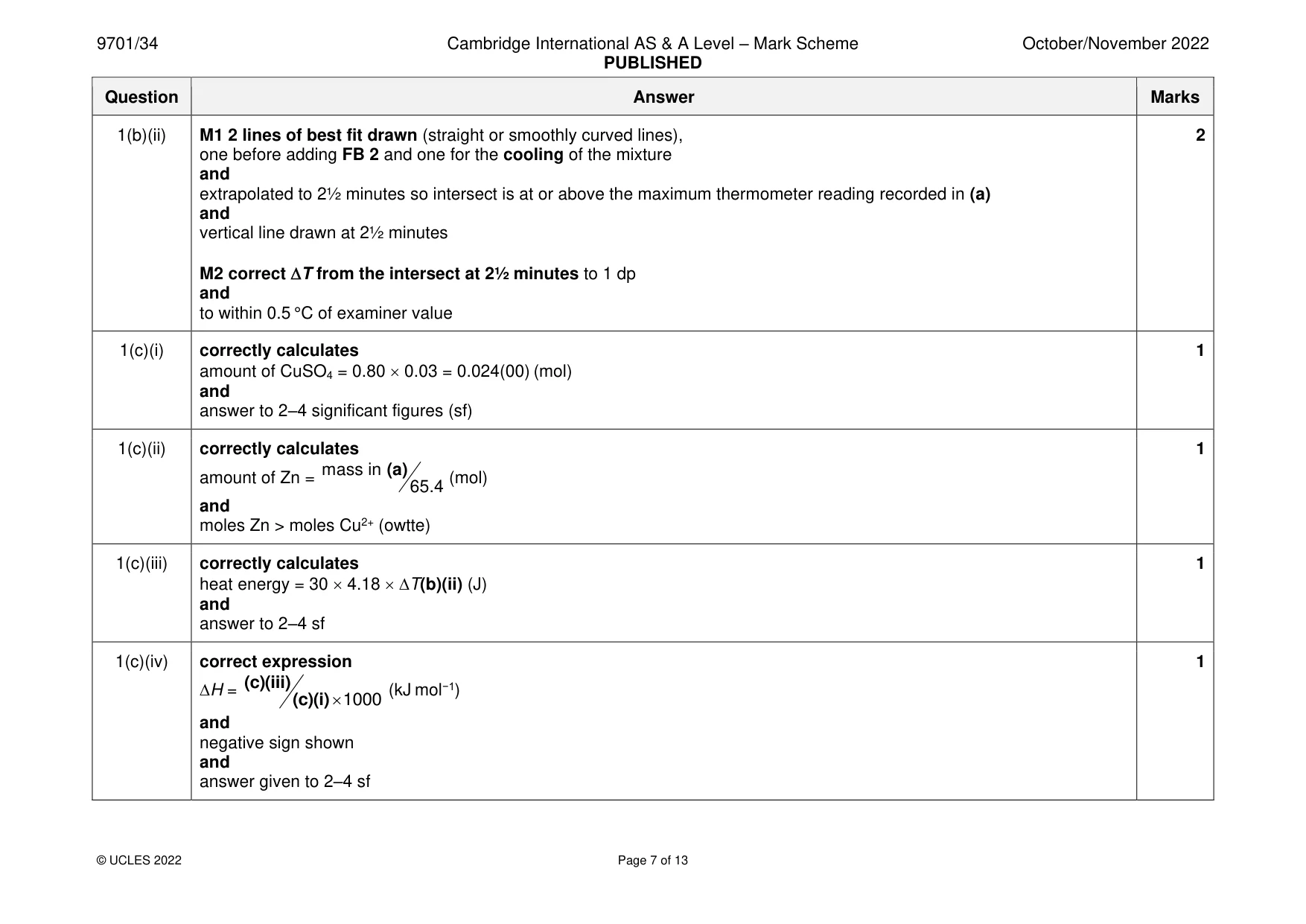
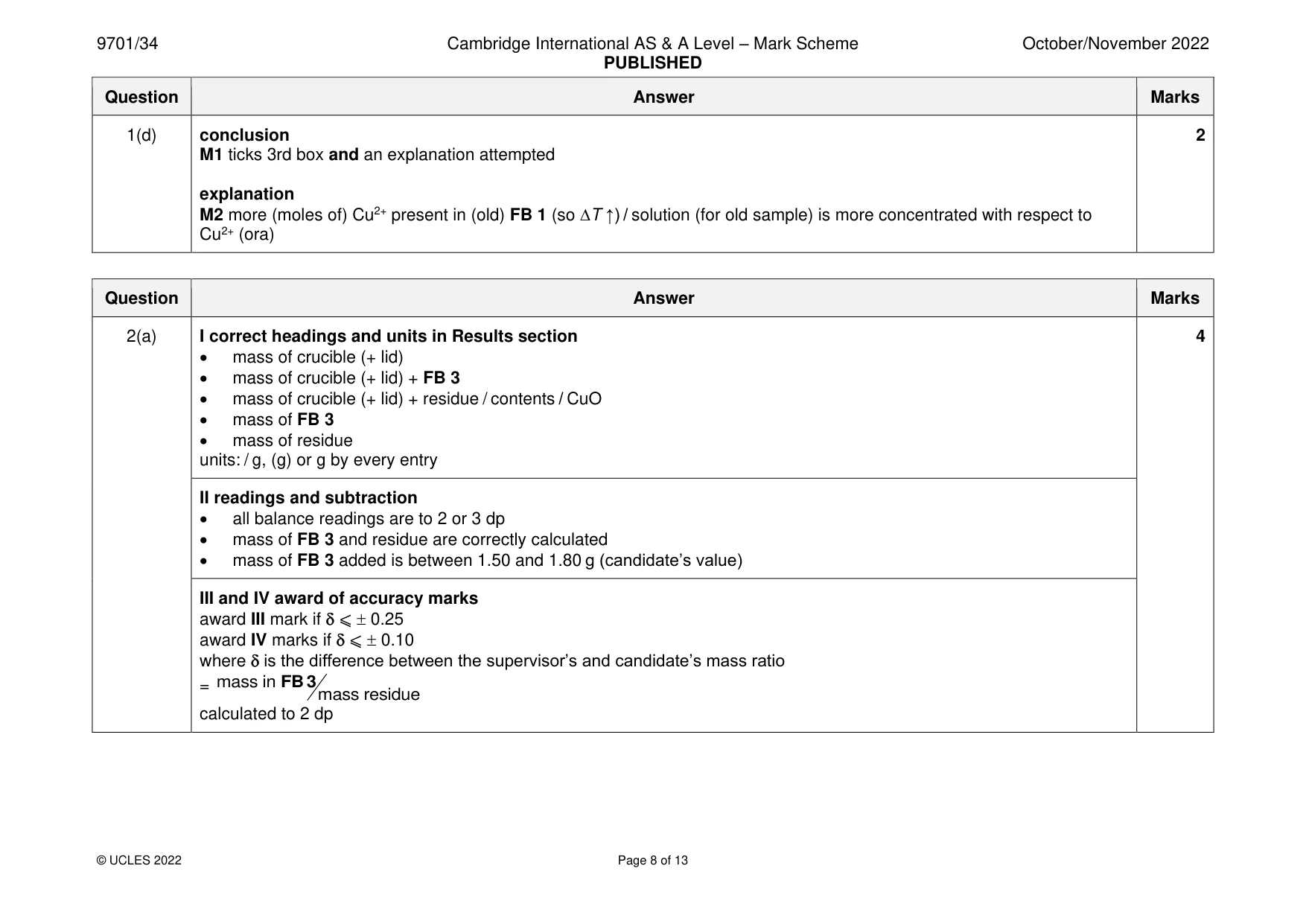
Mark scheme: Question Answer Marks 1(a) I the following data must be shown: 4 with unambiguous headings and correct units (mass of) container + FB 2 (mass of) container (+ residue) (mass of) FB 2 correctly calculated units: / g, (g) or g by every entry II all thermometer readings recorded to .0 or .5 ºC at least one reading should be .0 and at least one reading should be .5 III and IV award of accuracy marks check supervisor’s T (=Tmax – Tt=2 from table), choose the applicable range then mark accordingly: T less than 10.0 ºC: within 0.5 = 2 marks: within 1.0 = 1 mark T in range 10.0–19.5 ºC: within 1.0 = 2 marks: within 2.0 = 1 mark T in range 20.0–29.5 ºC: within 2.0 = 2 marks: within 3.5 = 1 mark T in range 30.0–39.5 ºC: within 3.0 = 2 marks: within 5.0 = 1 mark where is the difference between the supervisor’s and candidate’s T 1(b)(i) M1 axes correctly labelled 3 temperature on y-axis and time on the x-axis and correct units M2 appropriate scales linear scales chosen so that the graph occupies, including the extra 5 ºC on the y-axis, more than half the available length for both axes M3 all points recorded in table accurately plotted if the point should be on a line, it must be on the line if the point should not be on a line, it must not be on a line the point should be in the correct small square and must be correct to within half a small square 1(b)(ii) M1 2 lines of best fit drawn (straight or smoothly curved lines), 2 one before adding FB 2 and one for the cooling of the mixture and extrapolated to 2½ minutes so intersect is at or above the maximum thermometer reading recorded in (a) and vertical line drawn at 2½ minutes M2 correct T from the intersect at 2½ minutes to 1 dp and to within 0.5 °C of examiner value 1(c)(i) correctly calculates 1 amount of CuSO4 = 0.80 0.03 = 0.024(00) (mol) and answer to 2–4 significant figures (sf) 1(c)(ii) correctly calculates 1 mass in (a) amount of Zn = (mol) 65.4 and moles Zn > moles Cu2+ (owtte) 1(c)(iii) correctly calculates 1 heat energy = 30 4.18 T(b)(ii) (J) and answer to 2–4 sf 1(c)(iv) correct expression 1 (c)(iii) H = (kJ mol−1) (c)(i) 1000 and negative sign shown and answer given to 2–4 sf 1(d) conclusion 2 M1 ticks 3rd box and an explanation attempted explanation M2 more (moles of) Cu2+ present in (old) FB 1 (so T ↑) / solution (for old sample) is more concentrated with respect to Cu2+ (ora)
Q2 · Many metal carbonates, such as copper(II) carbonate, exist as basic carbonates
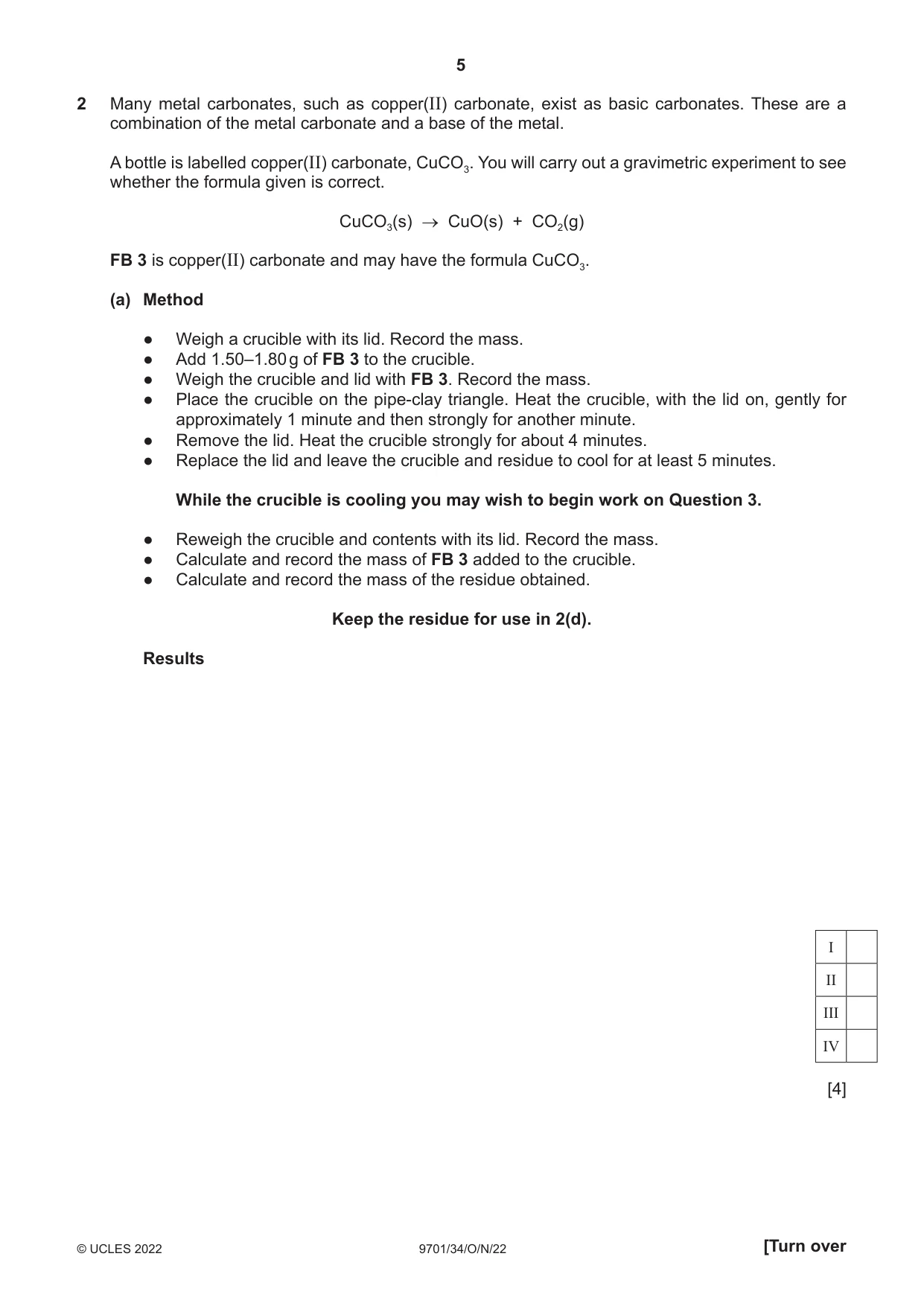
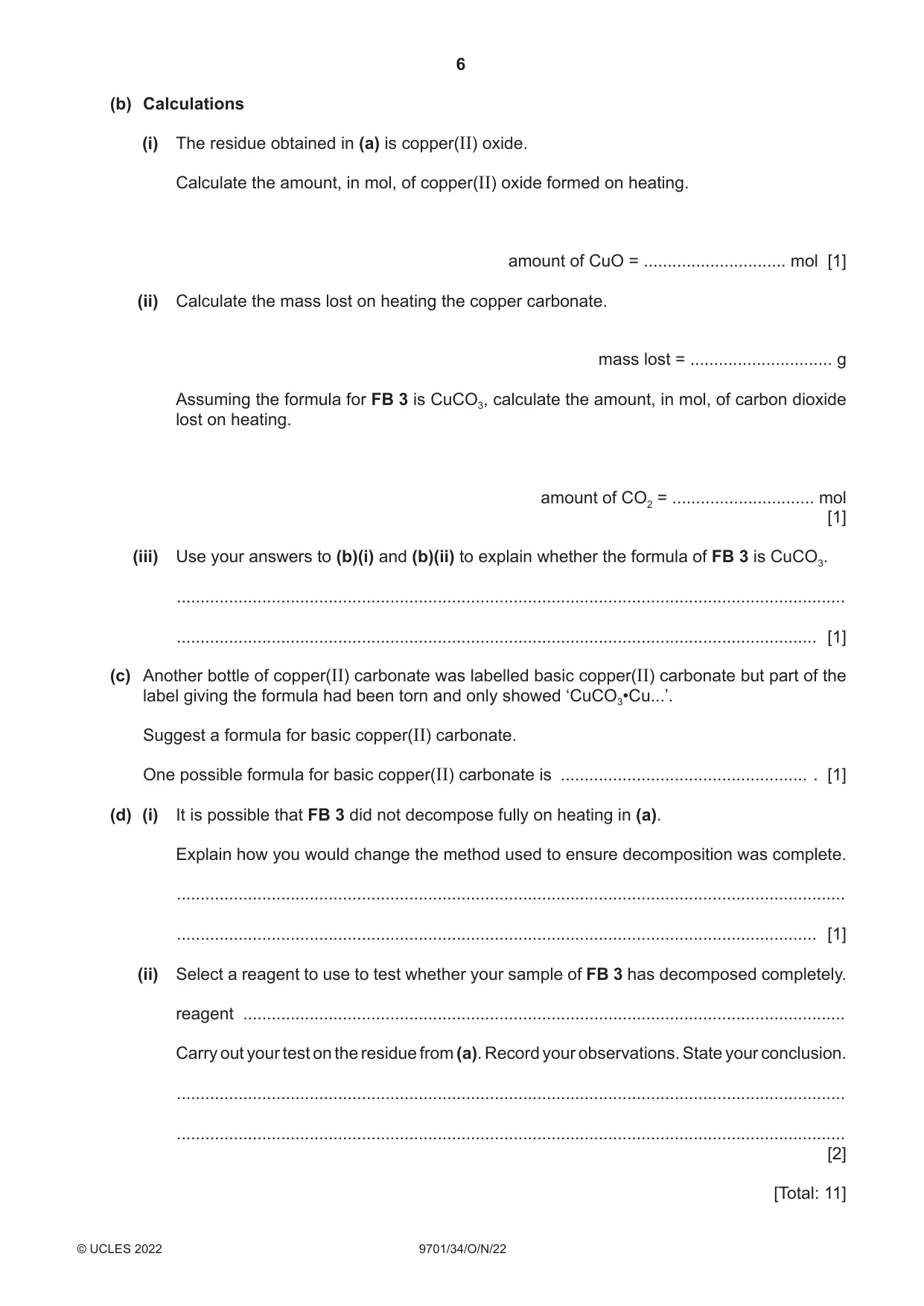
2 Many metal carbonates, such as copper(II) carbonate, exist as basic carbonates. These are a combination of the metal carbonate and a base of the metal. A bottle is labelled copper(II) carbonate, CuCO3. You will carry out a gravimetric experiment to see whether the formula given is correct. CuCO3(s) → CuO(s) + CO2(g) FB 3 is copper(II) carbonate and may have the formula CuCO3. (a) Method ● Weigh a crucible with its lid. Record the mass. ● Add 1.50–1.80 g of FB 3 to the crucible. ● Weigh the crucible and lid with FB 3. Record the mass. ● Place the crucible on the pipe-clay triangle. Heat the crucible, with the lid on, gently for approximately 1 minute and then strongly for another minute. ● Remove the lid. Heat the crucible strongly for about 4 minutes. ● Replace the lid and leave the crucible and residue to cool for at least 5 minutes. While the crucible is cooling you may wish to begin work on Question 3. ● Reweigh the crucible and contents with its lid. Record the mass. ● Calculate and record the mass of FB 3 added to the crucible. ● Calculate and record the mass of the residue obtained. Keep the residue for use in 2(d). Results I II III IV [4] (b) Calculations (i) The residue obtained in (a) is copper(II) oxide. Calculate the amount, in mol, of copper(II) oxide formed on heating. amount of CuO = .............................. mol [1] (ii) Calculate the mass lost on heating the copper carbonate. mass lost = .............................. g Assuming the formula for FB 3 is CuCO3, calculate the amount, in mol, of carbon dioxide lost on heating. amount of CO2 = .............................. mol [1] (iii) Use your answers to (b)(i) and (b)(ii) to explain whether the formula of FB 3 is CuCO3. ............................................................................................................................................. ....................................................................................................................................... [1] (c) Another bottle of copper(II) carbonate was labelled basic copper(II) carbonate but part of the label giving the formula had been torn and only showed ‘CuCO3•Cu...’. Suggest a formula for basic copper(II) carbonate. One possible formula for basic copper(II) carbonate is ���������������������������������������������������� . [1] (d) (i) It is possible that FB 3 did not decompose fully on heating in (a). Explain how you would change the method used to ensure decomposition was complete. ............................................................................................................................................. ....................................................................................................................................... [1] (ii) Select a reagent to use to test whether your sample of FB 3 has decomposed completely. reagent ................................................................................................................................ Carry out your test on the residue from (a). Record your observations. State your conclusion. ............................................................................................................................................. ............................................................................................................................................. [2] [Total: 11] Qualitative analysis For each test you should record all your observations in the spaces provided. Examples of observations include: ● colour changes seen ● the formation of any precipitate and its solubility (where appropriate) in an excess of the reagent added ● the formation of any gas and its identification (where appropriate) by a suitable test. You should record clearly at what stage in a test an observation is made. Where no change is observed you should write ‘no change’. Where reagents are selected for use in a test, the name or correct formula of the element or compound must be given. If any solution is warmed, a boiling tube must be used. Rinse and reuse test-tubes and boiling tubes where possible. No additional tests should be attempted.
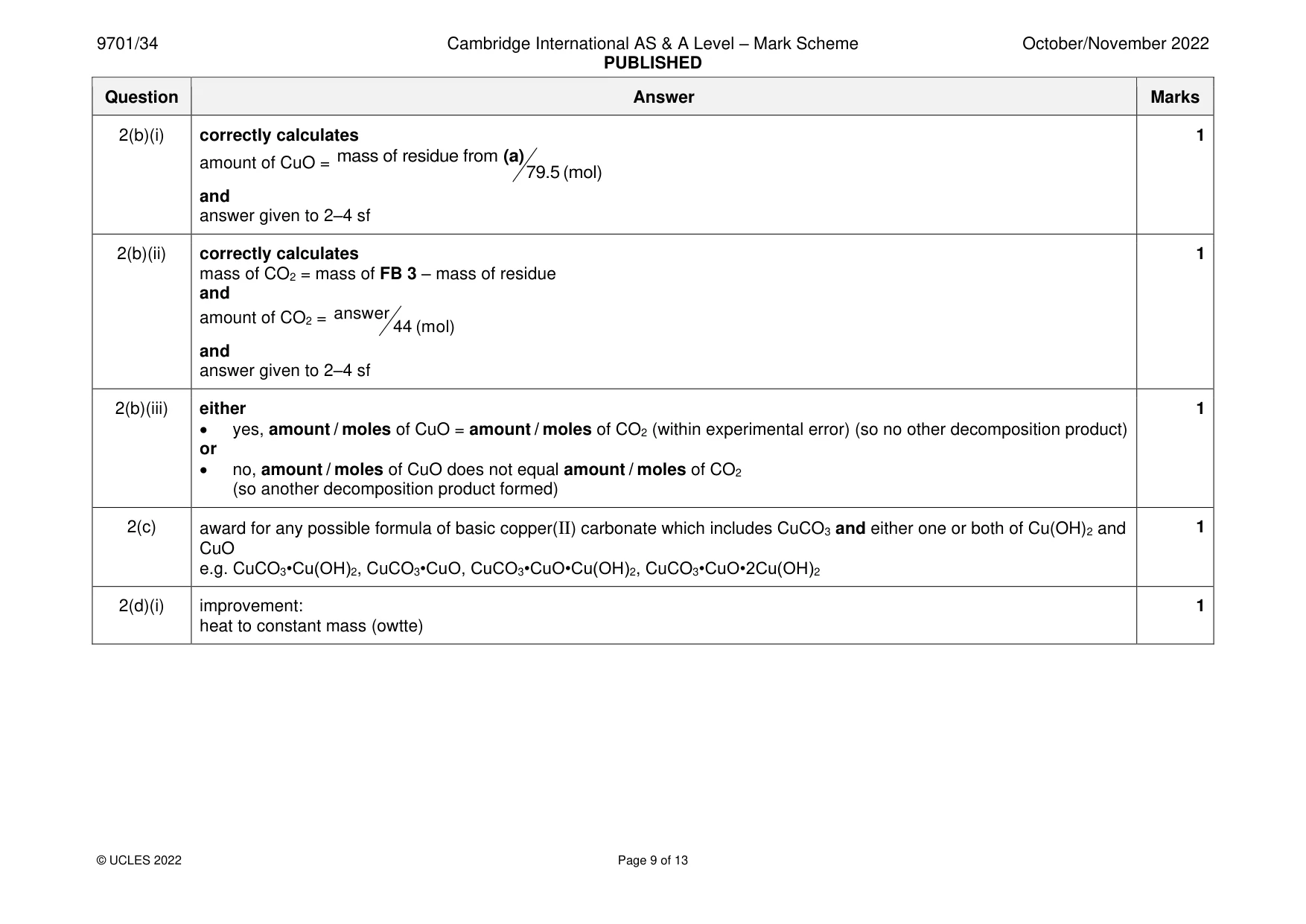
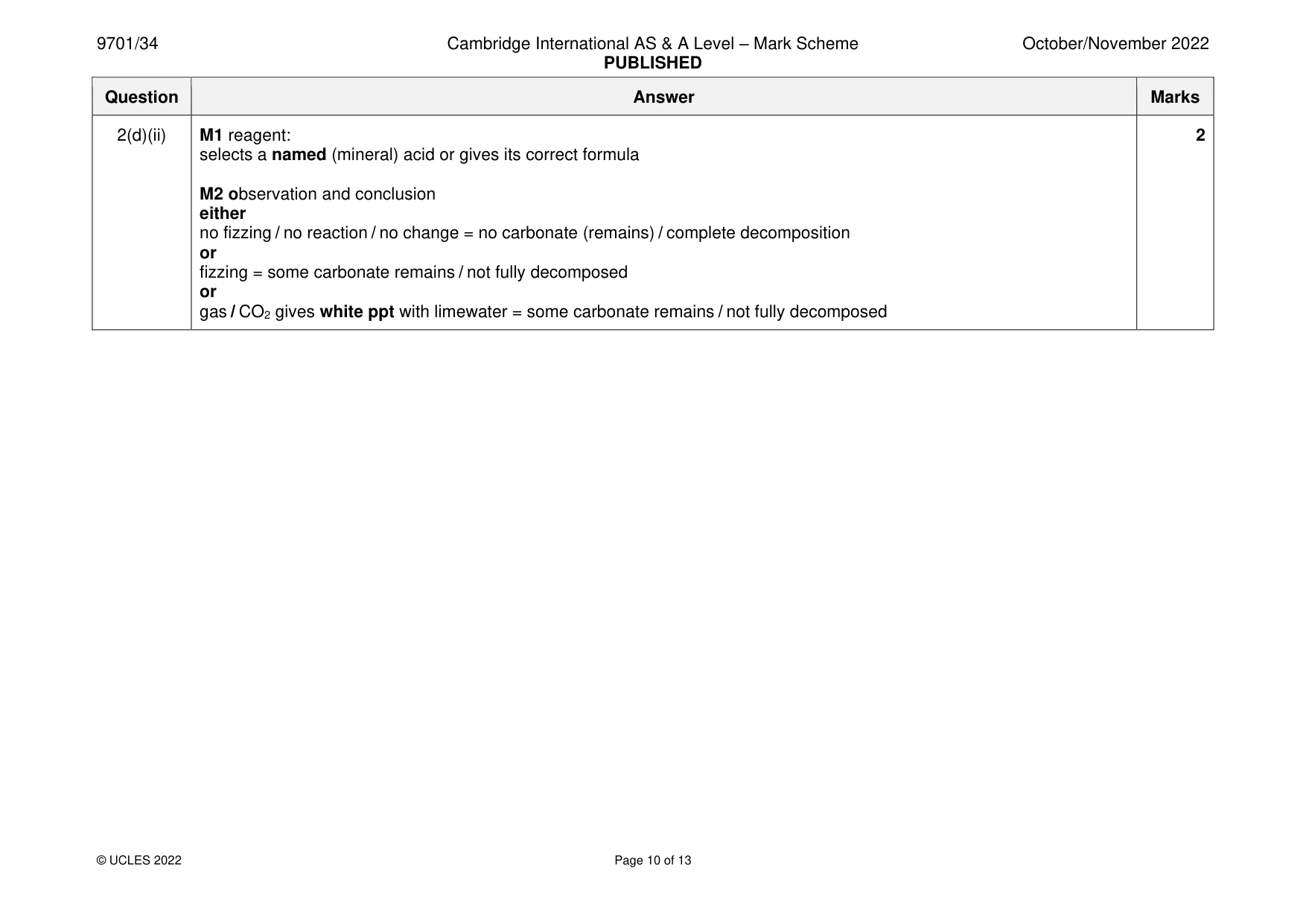
Mark scheme: 2(a) I correct headings and units in Results section 4 • mass of crucible (+ lid) • mass of crucible (+ lid) + FB 3 • mass of crucible (+ lid) + residue / contents / CuO • mass of FB 3 • mass of residue units: / g, (g) or g by every entry II readings and subtraction • all balance readings are to 2 or 3 dp • mass of FB 3 and residue are correctly calculated • mass of FB 3 added is between 1.50 and 1.80 g (candidate’s value) III and IV award of accuracy marks award III mark if ⩽ 0.25 award IV marks if ⩽ 0.10 where is the difference between the supervisor’s and candidate’s mass ratio = mass in FB 3 mass residue calculated to 2 dp 2(b)(i) correctly calculates 1 mass of residue from (a) amount of CuO = 79.5 (mol) and answer given to 2–4 sf 2(b)(ii) correctly calculates 1 mass of CO2 = mass of FB 3 – mass of residue and amount of CO2 = answer 44 (mol) and answer given to 2–4 sf 2(b)(iii) either 1 • yes, amount / moles of CuO = amount / moles of CO2 (within experimental error) (so no other decomposition product) or • no, amount / moles of CuO does not equal amount / moles of CO2 (so another decomposition product formed) 2(c) award for any possible formula of basic copper(II) carbonate which includes CuCO3 and either one or both of Cu(OH)2 and 1 CuO e.g. CuCO3•Cu(OH)2, CuCO3•CuO, CuCO3•CuO•Cu(OH)2, CuCO3•CuO•2Cu(OH)2 2(d)(i) improvement: 1 heat to constant mass (owtte) 2(d)(ii) M1 reagent: 2 selects a named (mineral) acid or gives its correct formula M2 observation and conclusion either no fizzing / no reaction / no change = no carbonate (remains) / complete decomposition or fizzing = some carbonate remains / not fully decomposed or gas / CO2 gives white ppt with limewater = some carbonate remains / not fully decomposed
More questions on Reacting masses and volumes (of solutions and gases)
Q3 · Half-fill the 250 cm3 beaker with water and place it on a tripod and gauze
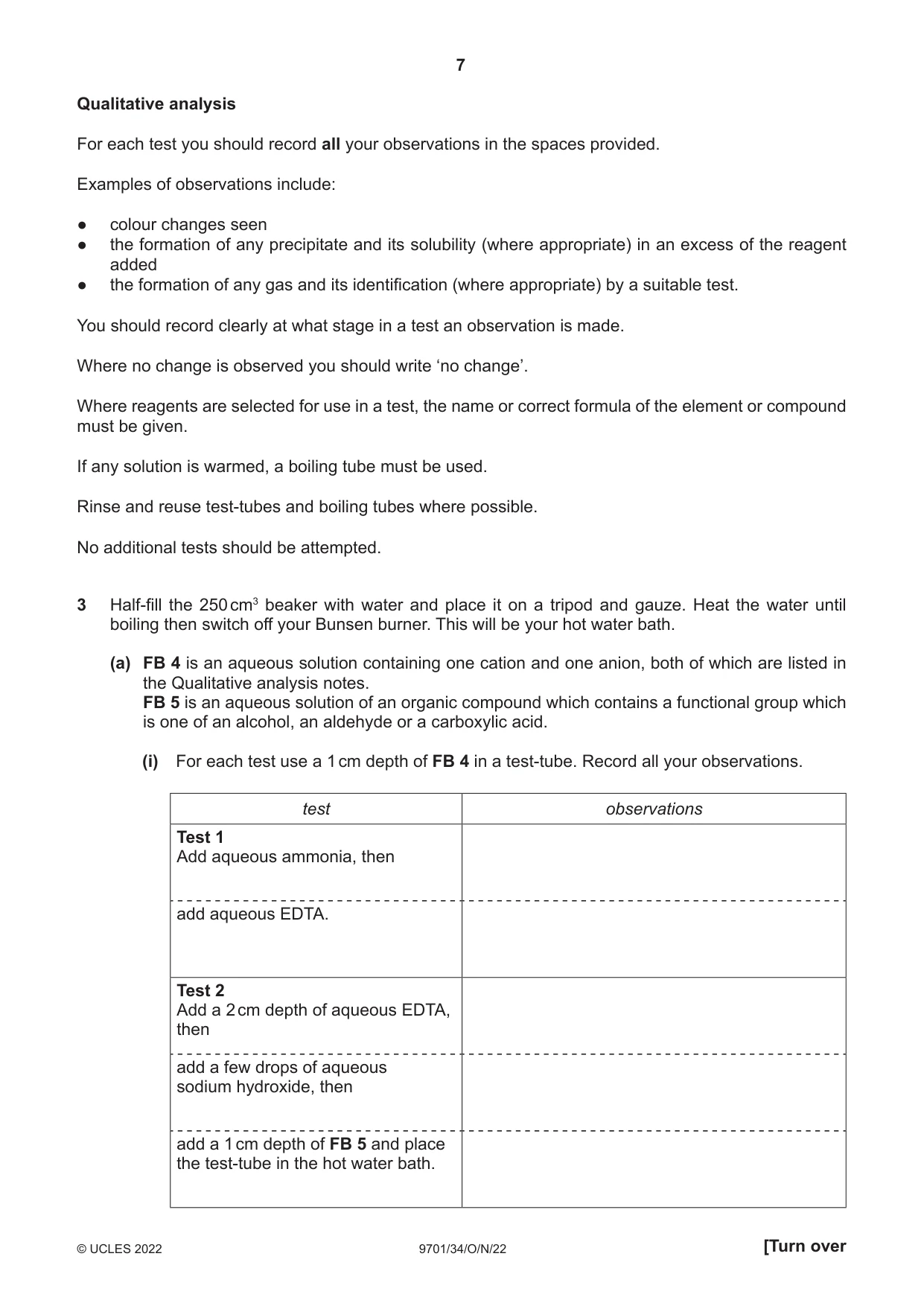
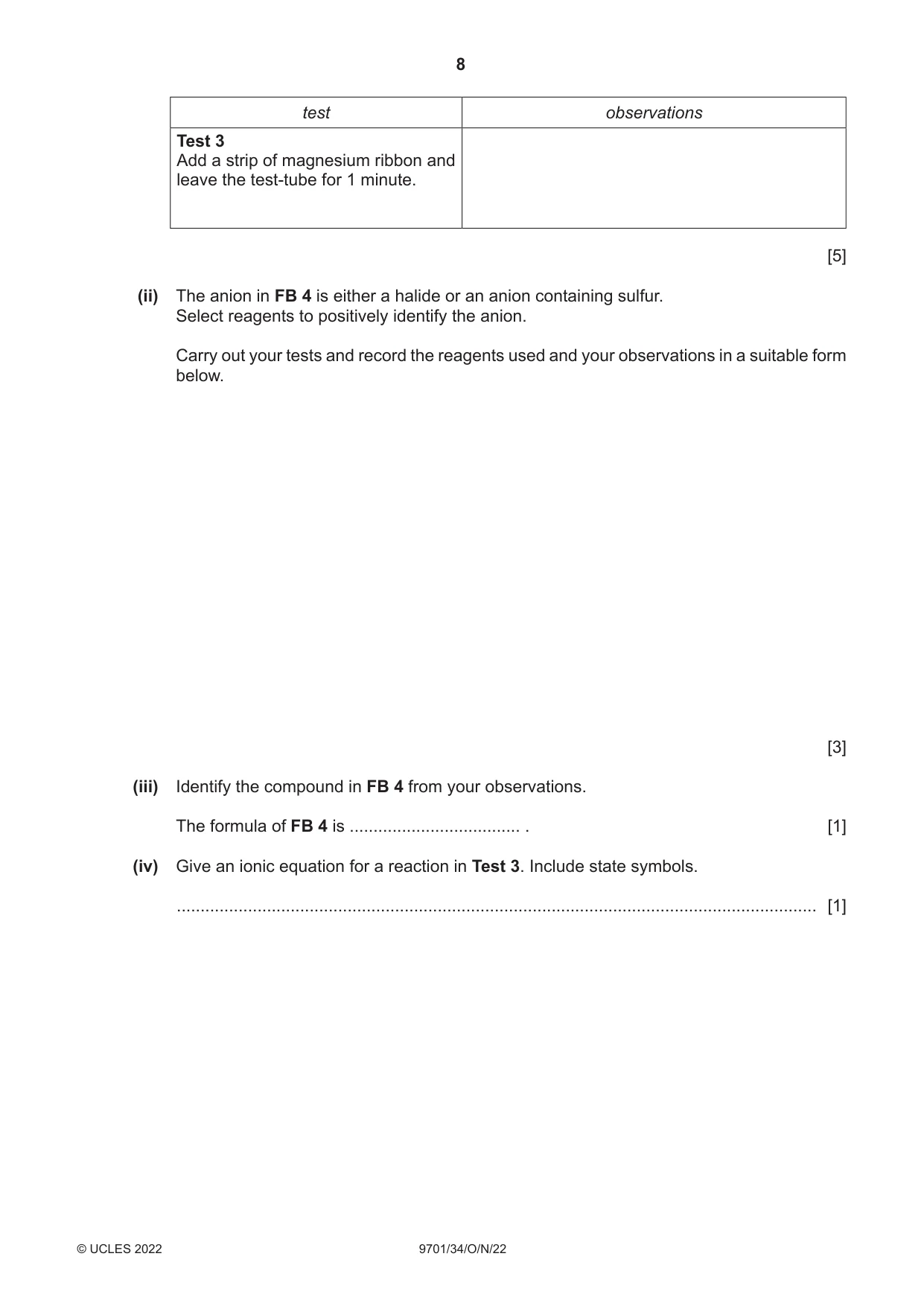
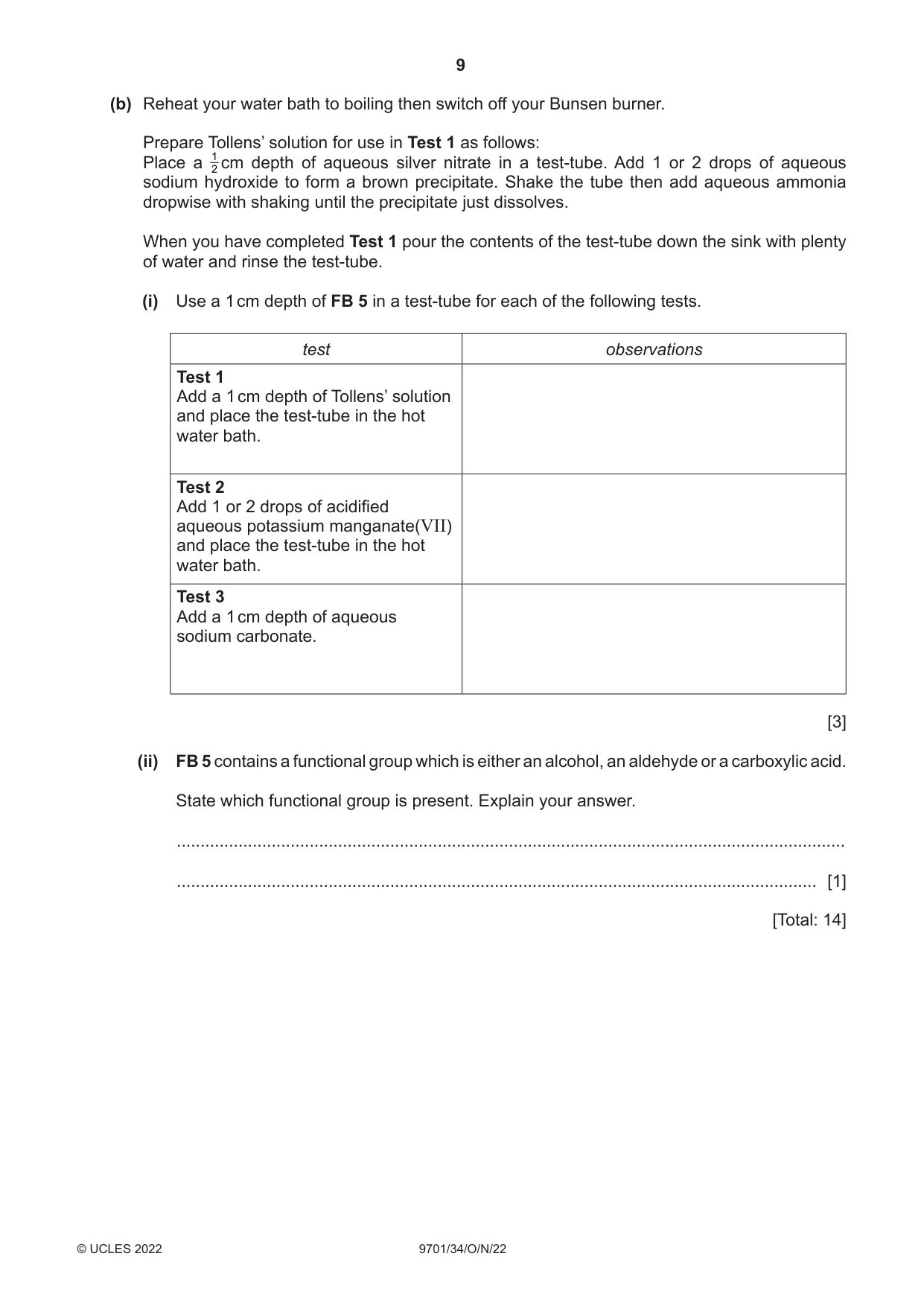
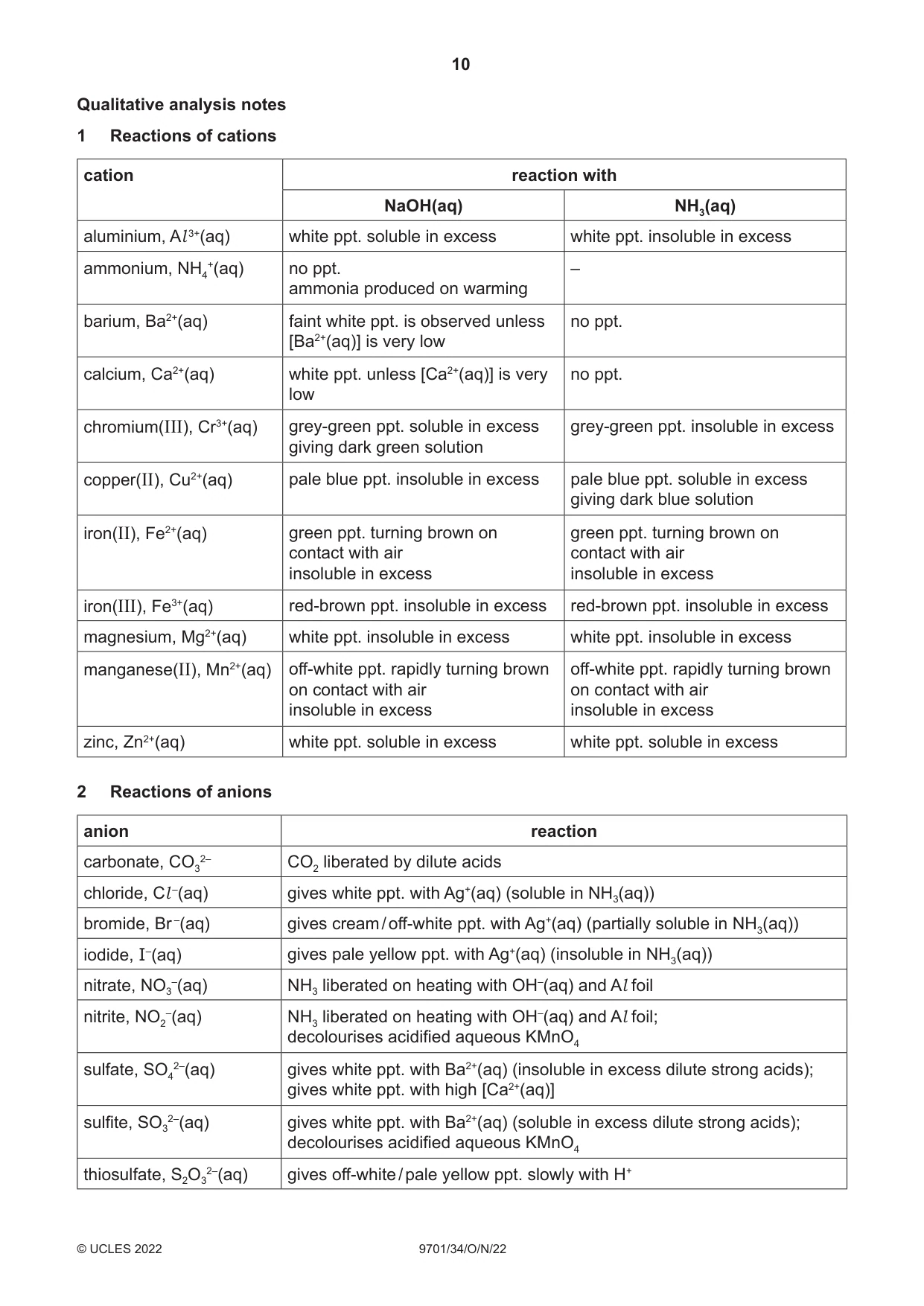
3 Half-fill the 250 cm3 beaker with water and place it on a tripod and gauze. Heat the water until boiling then switch off your Bunsen burner. This will be your hot water bath. (a) FB 4 is an aqueous solution containing one cation and one anion, both of which are listed in the Qualitative analysis notes. FB 5 is an aqueous solution of an organic compound which contains a functional group which is one of an alcohol, an aldehyde or a carboxylic acid. (i) For each test use a 1 cm depth of FB 4 in a test-tube. Record all your observations. test observations Test 1 Add aqueous ammonia, then add aqueous EDTA. Test 2 Add a 2 cm depth of aqueous EDTA, then add a few drops of aqueous sodium hydroxide, then add a 1 cm depth of FB 5 and place the test-tube in the hot water bath. test observations Test 3 Add a strip of magnesium ribbon and leave the test-tube for 1 minute. [5] (ii) The anion in FB 4 is either a halide or an anion containing sulfur. Select reagents to positively identify the anion. Carry out your tests and record the reagents used and your observations in a suitable form below. [3] (iii) Identify the compound in FB 4 from your observations. The formula of FB 4 is .................................... . [1] (iv) Give an ionic equation for a reaction in Test 3. Include state symbols. ....................................................................................................................................... [1] (b) Reheat your water bath to boiling then switch off your Bunsen burner. Prepare Tollens’ solution for use in Test 1 as follows: Place a 12 cm depth of aqueous silver nitrate in a test-tube. Add 1 or 2 drops of aqueous sodium hydroxide to form a brown precipitate. Shake the tube then add aqueous ammonia dropwise with shaking until the precipitate just dissolves. When you have completed Test 1 pour the contents of the test-tube down the sink with plenty of water and rinse the test-tube. (i) Use a 1 cm depth of FB 5 in a test-tube for each of the following tests. test observations Test 1 Add a 1 cm depth of Tollens’ solution and place the test-tube in the hot water bath. Test 2 Add 1 or 2 drops of acidified aqueous potassium manganate(VII) and place the test-tube in the hot water bath. Test 3 Add a 1 cm depth of aqueous sodium carbonate. [3] (ii) FB 5 contains a functional group which is either an alcohol, an aldehyde or a carboxylic acid. State which functional group is present. Explain your answer. ............................................................................................................................................. ....................................................................................................................................... [1] [Total: 14]
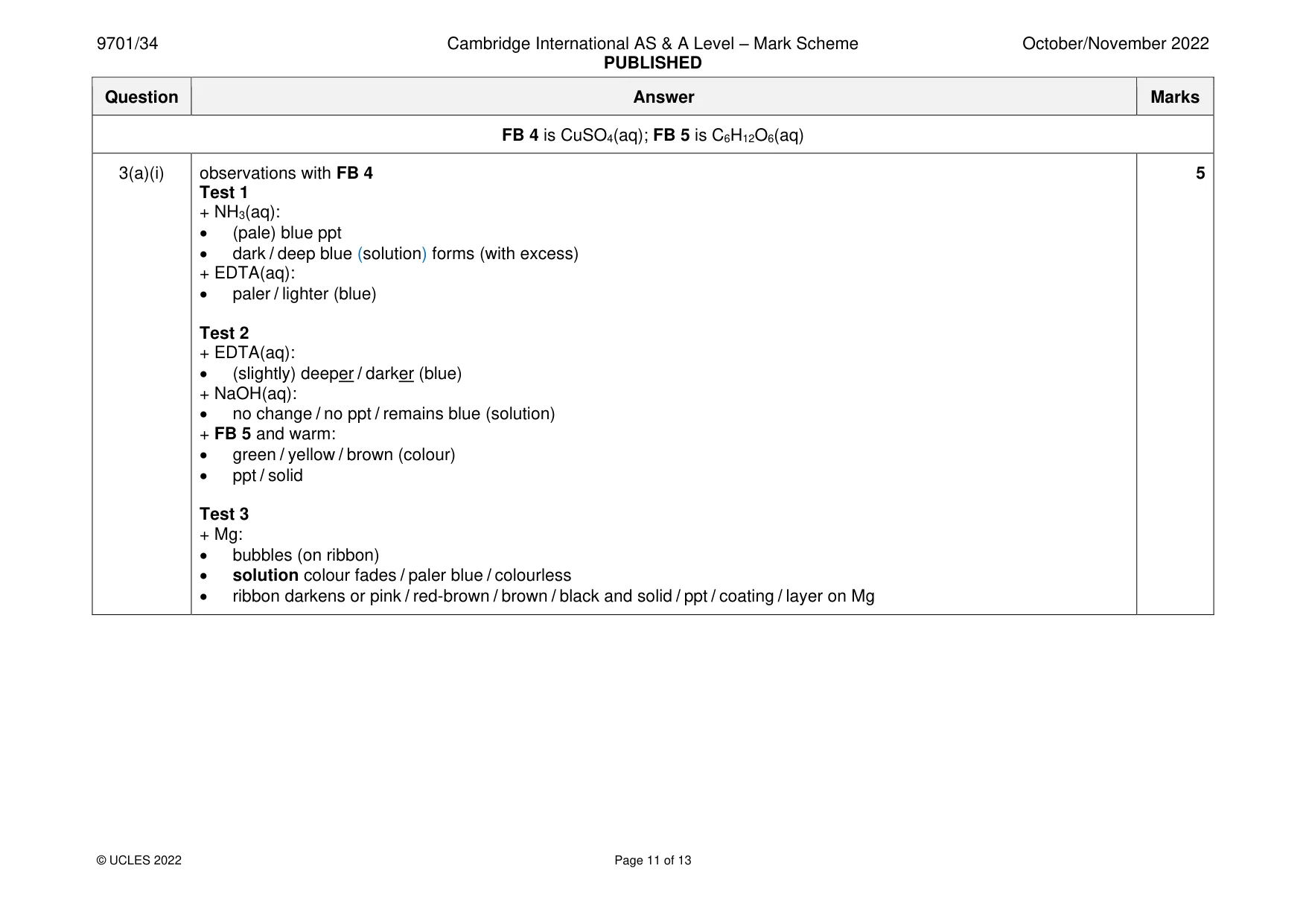
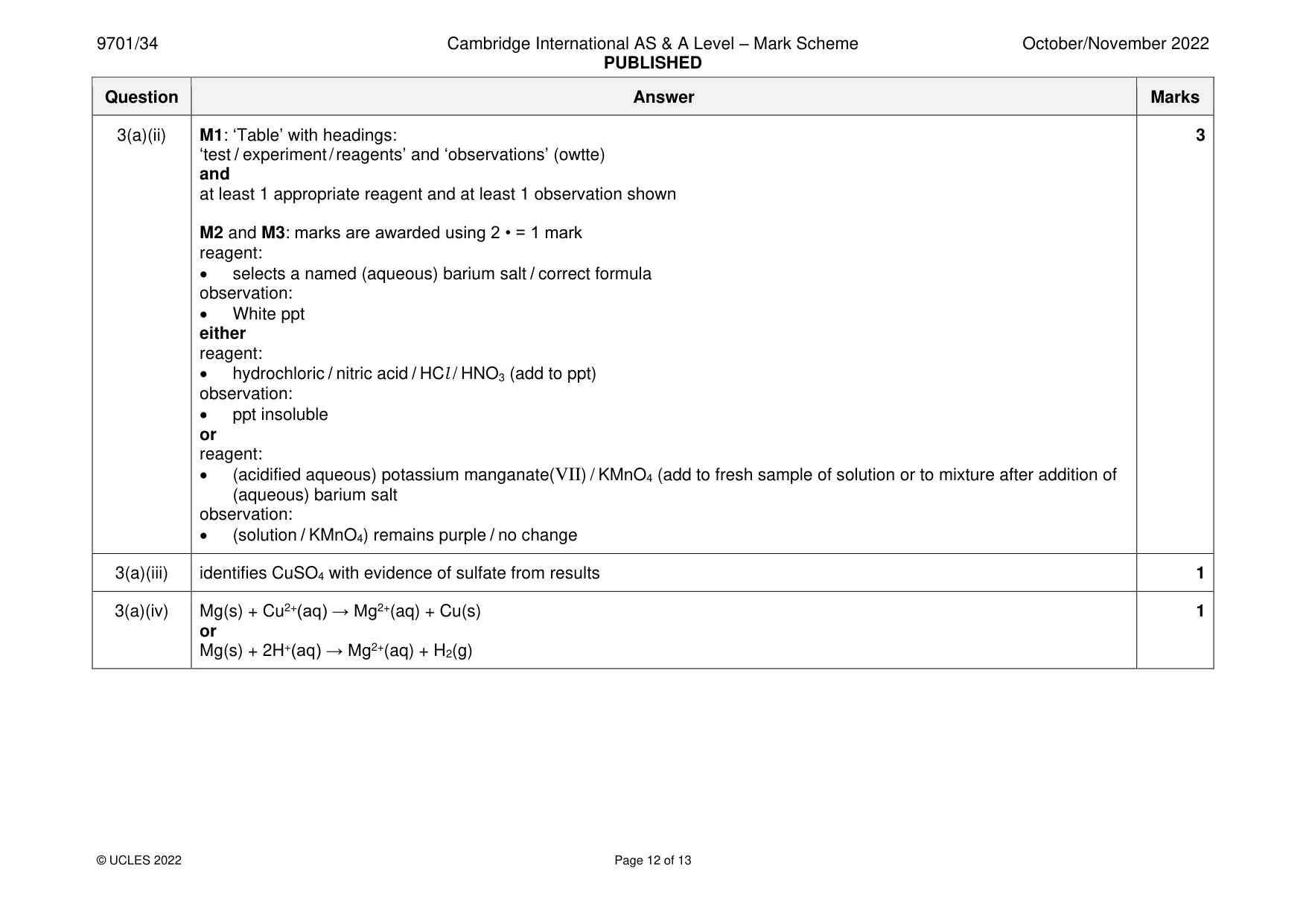
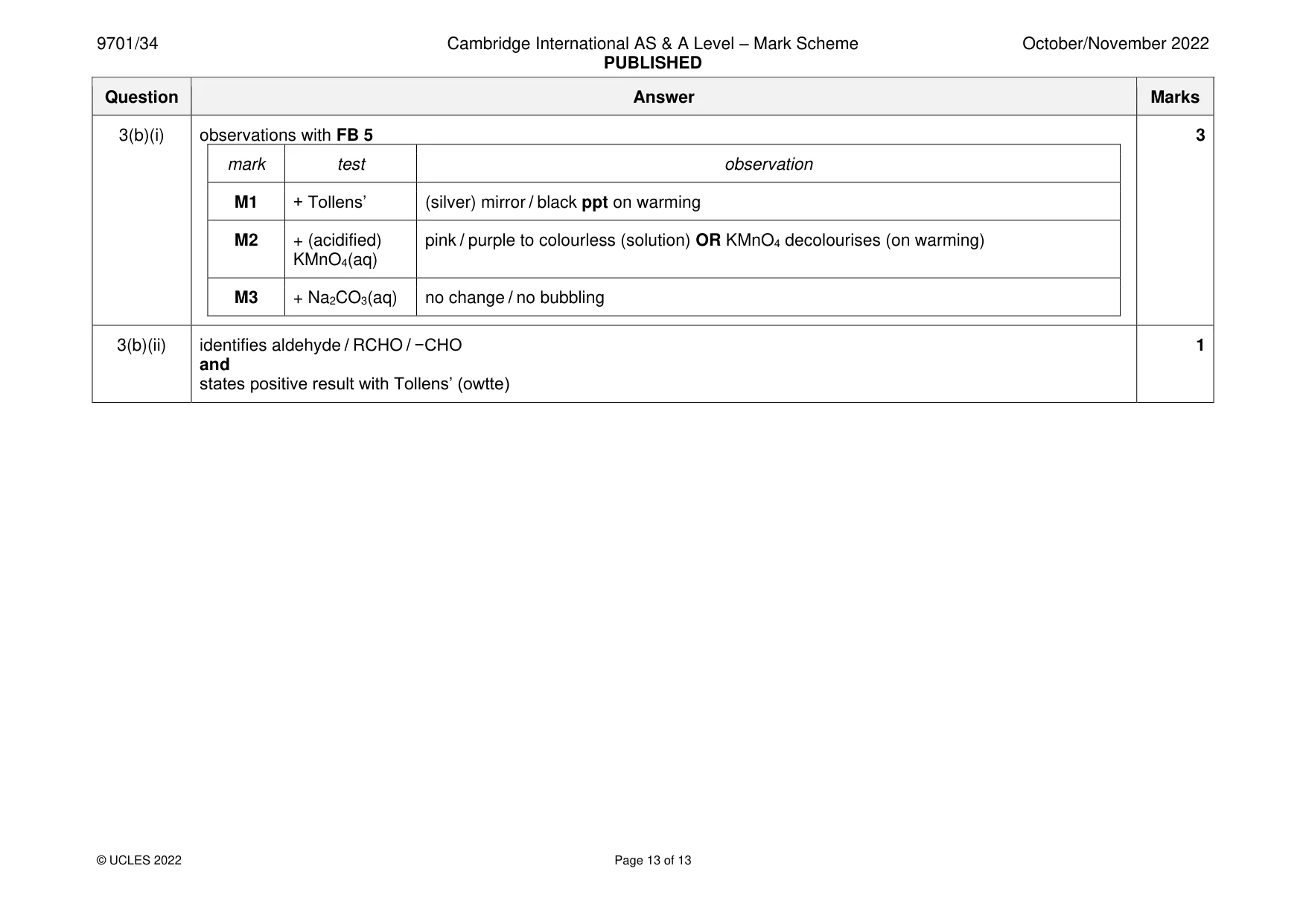
Mark scheme: 3(a)(i) observations with FB 4 5 Test 1 + NH3(aq): • (pale) blue ppt • dark / deep blue (solution) forms (with excess) + EDTA(aq): • paler / lighter (blue) Test 2 + EDTA(aq): • (slightly) deeper / darker (blue) + NaOH(aq): • no change / no ppt / remains blue (solution) + FB 5 and warm: • green / yellow / brown (colour) • ppt / solid Test 3 + Mg: • bubbles (on ribbon) • solution colour fades / paler blue / colourless • ribbon darkens or pink / red-brown / brown / black and solid / ppt / coating / layer on Mg 3(a)(ii) M1: ‘Table’ with headings: 3 ‘test / experiment / reagents’ and ‘observations’ (owtte) and at least 1 appropriate reagent and at least 1 observation shown M2 and M3: marks are awarded using 2 • = 1 mark reagent: • selects a named (aqueous) barium salt / correct formula observation: • White ppt either reagent: • hydrochloric / nitric acid / HCl / HNO3 (add to ppt) observation: • ppt insoluble or reagent: • (acidified aqueous) potassium manganate(VII) / KMnO4 (add to fresh sample of solution or to mixture after addition of (aqueous) barium salt observation: • (solution / KMnO4) remains purple / no change 3(a)(iii) identifies CuSO4 with evidence of sulfate from results 1 3(a)(iv) Mg(s) + Cu2+(aq) → Mg2+(aq) + Cu(s) 1 or Mg(s) + 2H+(aq) → Mg2+(aq) + H2(g) 3(b)(i) observations with FB 5 3 mark test observation M1 + Tollens’ (silver) mirror / black ppt on warming M2 + (acidified) pink / purple to colourless (solution) OR KMnO4 decolourises (on warming) KMnO4(aq) M3 + Na2CO3(aq) no change / no bubbling 3(b)(ii) identifies aldehyde / RCHO / −CHO 1 and states positive result with Tollens’ (owtte)
What was in this paper
The subtopics covered by these 3 questions, and how many questions each got. Open one in a new tab to see every Cambridge question on it.
What you needed in this session
Cambridge’s own grade thresholds for 2022 Oct/Nov, Paper 3 · Variant 4. A higher threshold means an easier paper — the bar moves with how the cohort did.