Cambridge A Level Chemistry 9701 — 2021 Oct/Nov Paper 4 · Variant 3
9701/43/O/N/21 · 10 questions · 100 marks · ≈113 min
The question paper and its mark scheme, free to read here and free to download. This is Cambridge’s own paper, exactly as it was sat.
Question paper20 pages

Mark scheme16 pages
Answers below. Sit the paper first if you are practising.
Questions as text
Q1 · When dilute sulfuric acid is electrolysed, water is split into hydrogen and oxygen
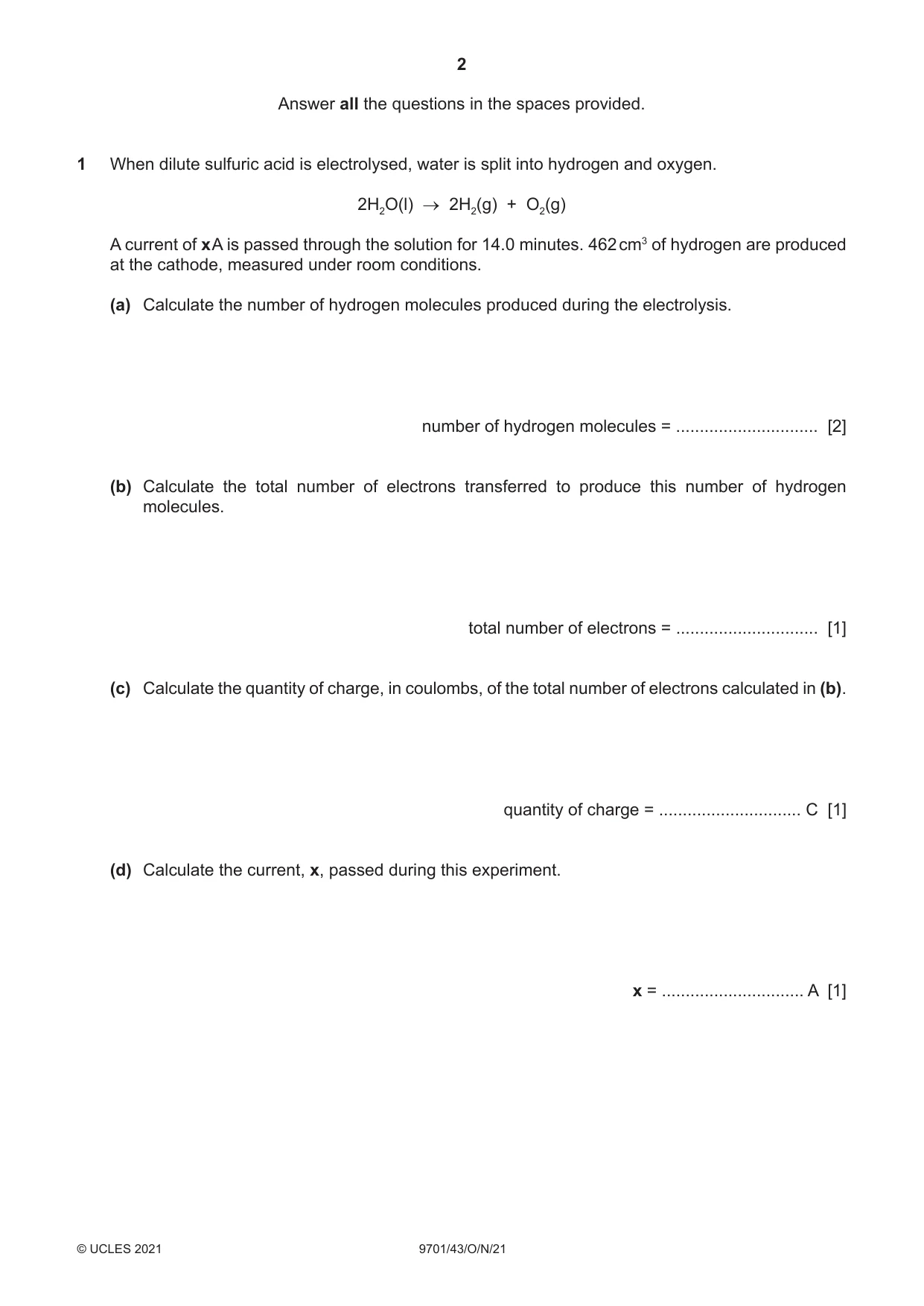
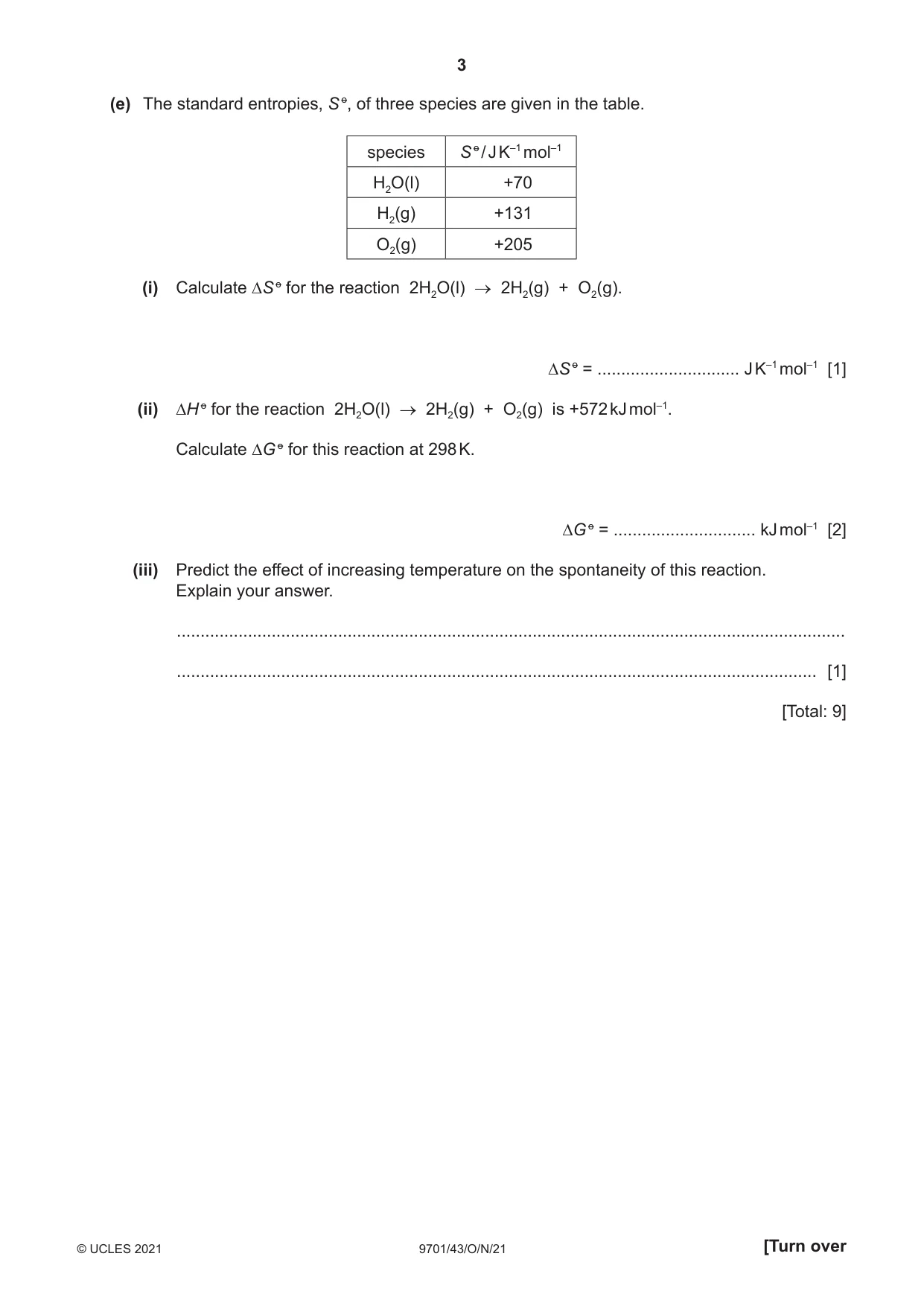
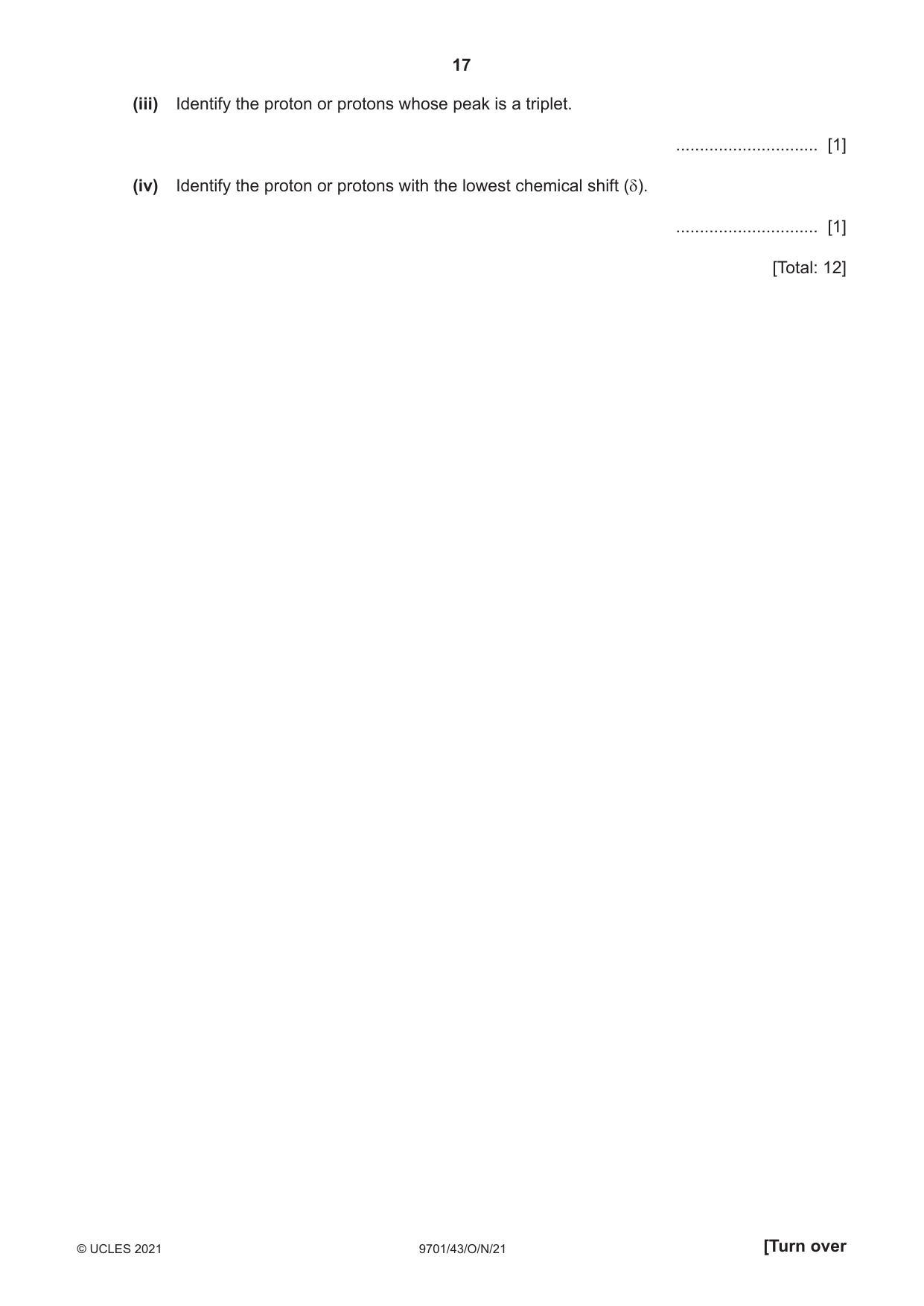
1 When dilute sulfuric acid is electrolysed, water is split into hydrogen and oxygen. 2H2O(l) → 2H2(g) + O2(g) A current of x A is passed through the solution for 14.0 minutes. 462 cm3 of hydrogen are produced at the cathode, measured under room conditions. (a) Calculate the number of hydrogen molecules produced during the electrolysis. number of hydrogen molecules = .............................. [2] (b) Calculate the total number of electrons transferred to produce this number of hydrogen molecules. total number of electrons = .............................. [1] (c) Calculate the quantity of charge, in coulombs, of the total number of electrons calculated in (b). quantity of charge = .............................. C [1] (d) Calculate the current, x, passed during this experiment. x = .............................. A [1] (e) The standard entropies, S o, of three species are given in the table. species S o / J K–1 mol–1 H2O(l) +70 H2(g) +131 O2(g) +205 (i) Calculate ∆S o for the reaction 2H2O(l) → 2H2(g) + O2(g). ∆S o = .............................. J K–1 mol–1 [1] (ii) ∆H o for the reaction 2H2O(l) → 2H2(g) + O2(g) is +572 kJ mol–1. Calculate ∆G o for this reaction at 298 K. ∆G o = .............................. kJ mol–1 [2] (iii) Predict the effect of increasing temperature on the spontaneity of this reaction. Explain your answer. ............................................................................................................................................. ....................................................................................................................................... [1] [Total: 9]
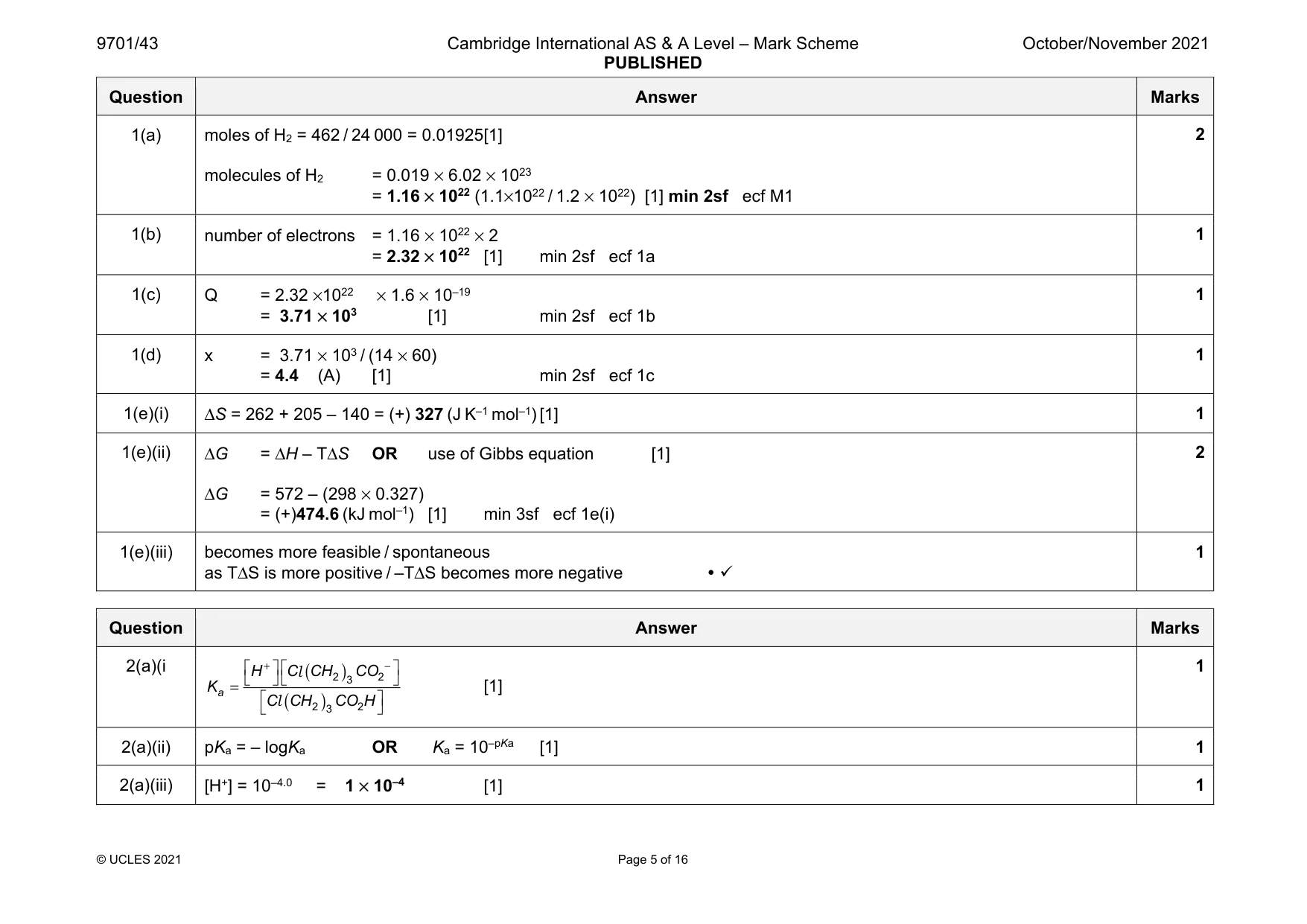
Mark scheme: 1(a) moles of H2 = 462 / 24 000 = 0.01925 [1] molecules of H2 = 0.019 × 6.02 × 1023 = 1.16 × 10²² (1.1×10²² / 1.2 × 10²²) [1] min 2sf ecf M1 1(b) number of electrons = 1.16 × 1022 × 2 = 2.32 × 10²² [1] min 2sf ecf 1a 1 1(c) Q = 2.32 ×1022 × 1.6 × 10–19 = 3.71 × 10³ [1] min 2sf ecf 1b 1 1(d) x = 3.71 × 10³ / (14 × 60) = 4.4 (A) [1] min 2sf ecf 1c 1 1(e)(i) ΔS = 262 + 205 – 140 = (+) 327 (J K–1 mol–1) [1] 1 1(e)(ii) ΔG = ΔH – TΔS OR use of Gibbs equation [1] ΔG = 572 – (298 × 0.327) = (+)474.6 (kJ mol–1) [1] min 3sf ecf 1e(i) 2 1(e)(iii) becomes more feasible / spontaneous as TΔS is more positive / –TΔS becomes more negative 1
Q2 · Solution Y is hydrochloric acid, HCl (aq)
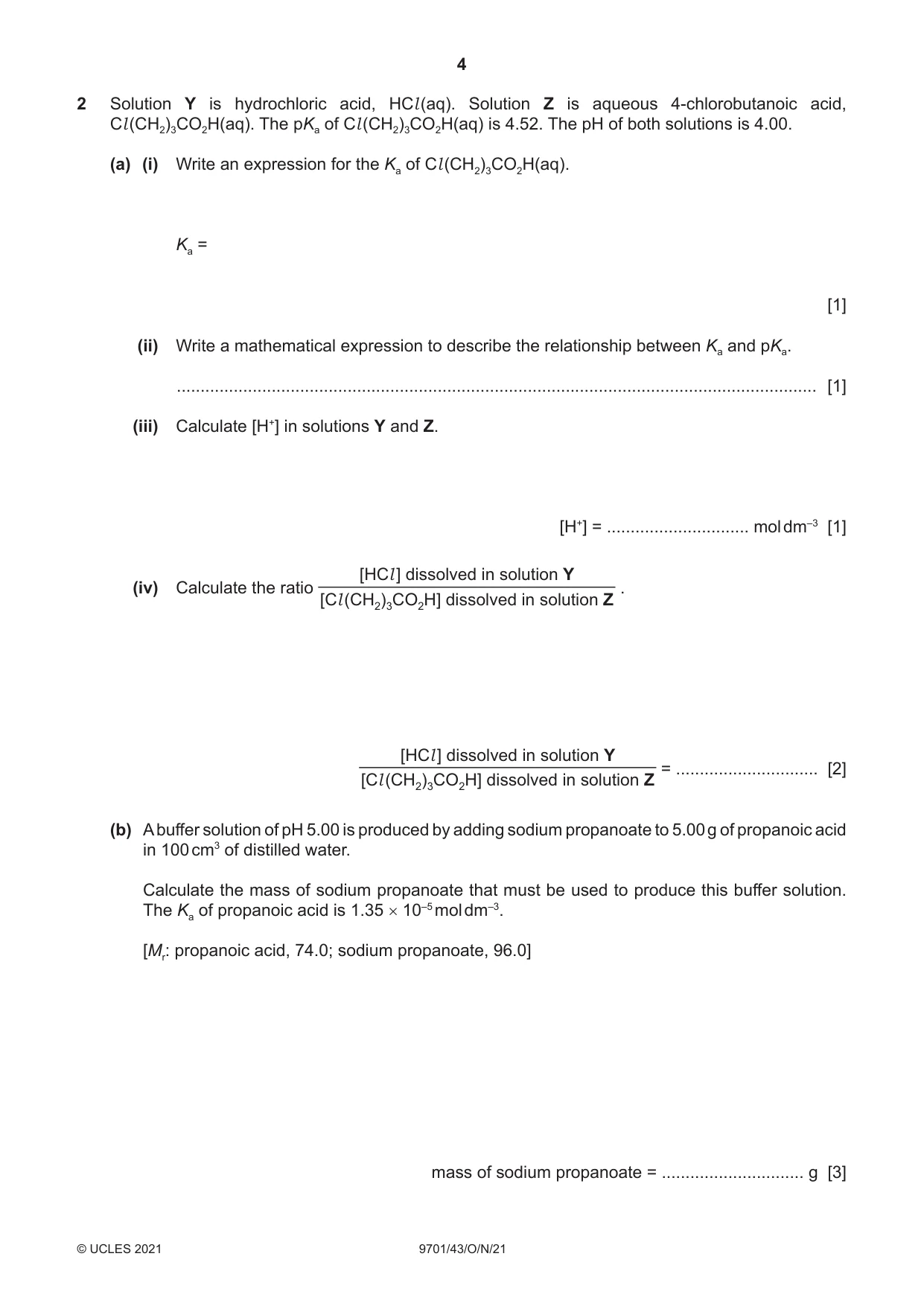
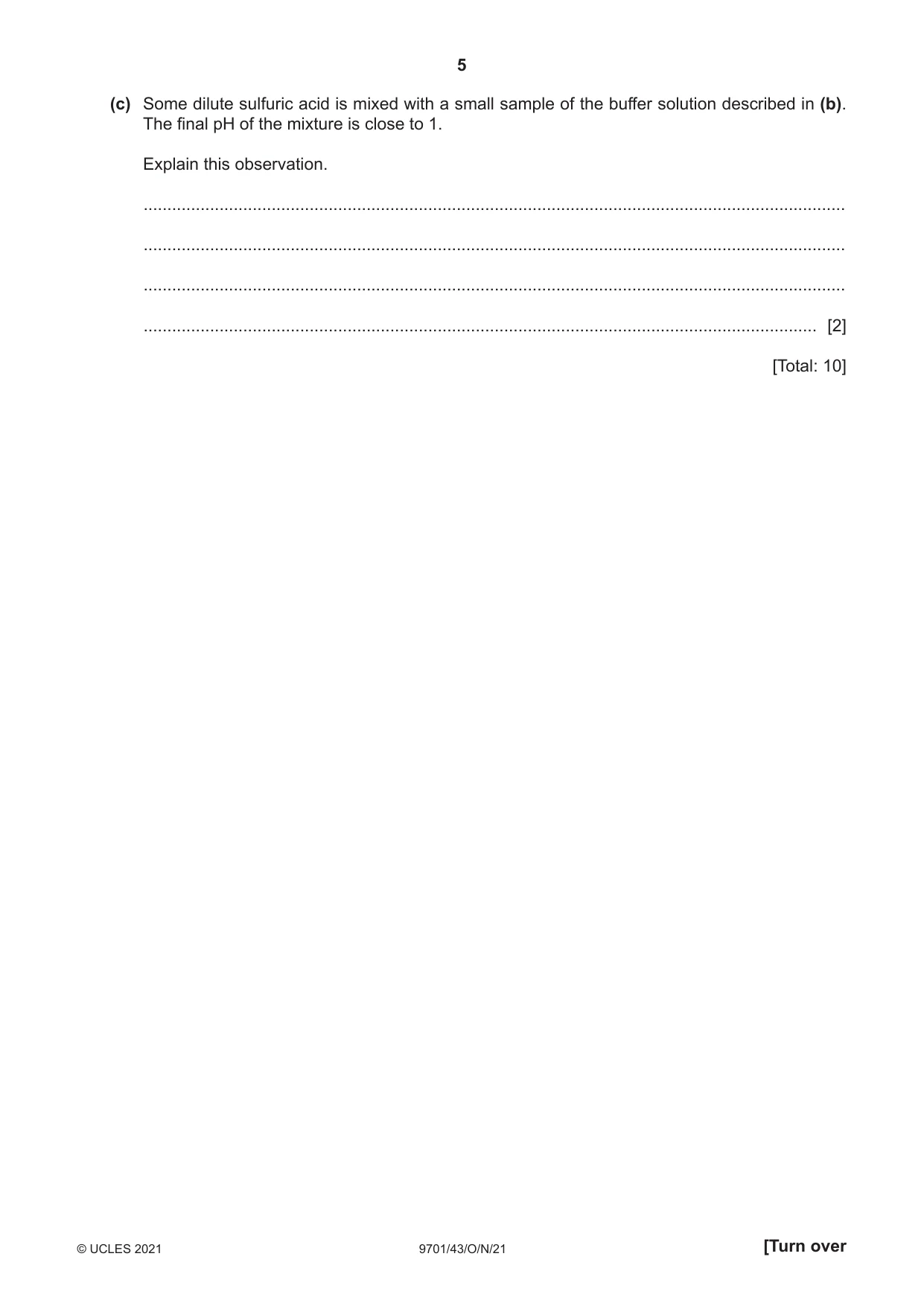
2 Solution Y is hydrochloric acid, HCl (aq). Solution Z is aqueous 4-chlorobutanoic acid, Cl (CH2)3CO2H(aq). The pKa of Cl (CH2)3CO2H(aq) is 4.52. The pH of both solutions is 4.00. (a) (i) Write an expression for the Ka of Cl (CH2)3CO2H(aq). Ka = [1] (ii) Write a mathematical expression to describe the relationship between Ka and pKa. ....................................................................................................................................... [1] (iii) Calculate [H+] in solutions Y and Z. [H+] = .............................. mol dm–3 [1] [HCl ] dissolved in solution Y (iv) Calculate the ratio . [Cl (CH2)3CO2H] dissolved in solution Z [HCl ] dissolved in solution Y = .............................. [2] [Cl (CH2)3CO2H] dissolved in solution Z (b) A buffer solution of pH 5.00 is produced by adding sodium propanoate to 5.00 g of propanoic acid in 100 cm3 of distilled water. Calculate the mass of sodium propanoate that must be used to produce this buffer solution. The Ka of propanoic acid is 1.35 × 10⁻⁵ mol dm–3. [Mr: propanoic acid, 74.0; sodium propanoate, 96.0] mass of sodium propanoate = .............................. g [3] (c) Some dilute sulfuric acid is mixed with a small sample of the buffer solution described in (b). The final pH of the mixture is close to 1. Explain this observation. .................................................................................................................................................... .................................................................................................................................................... .................................................................................................................................................... .............................................................................................................................................. [2] [Total: 10]
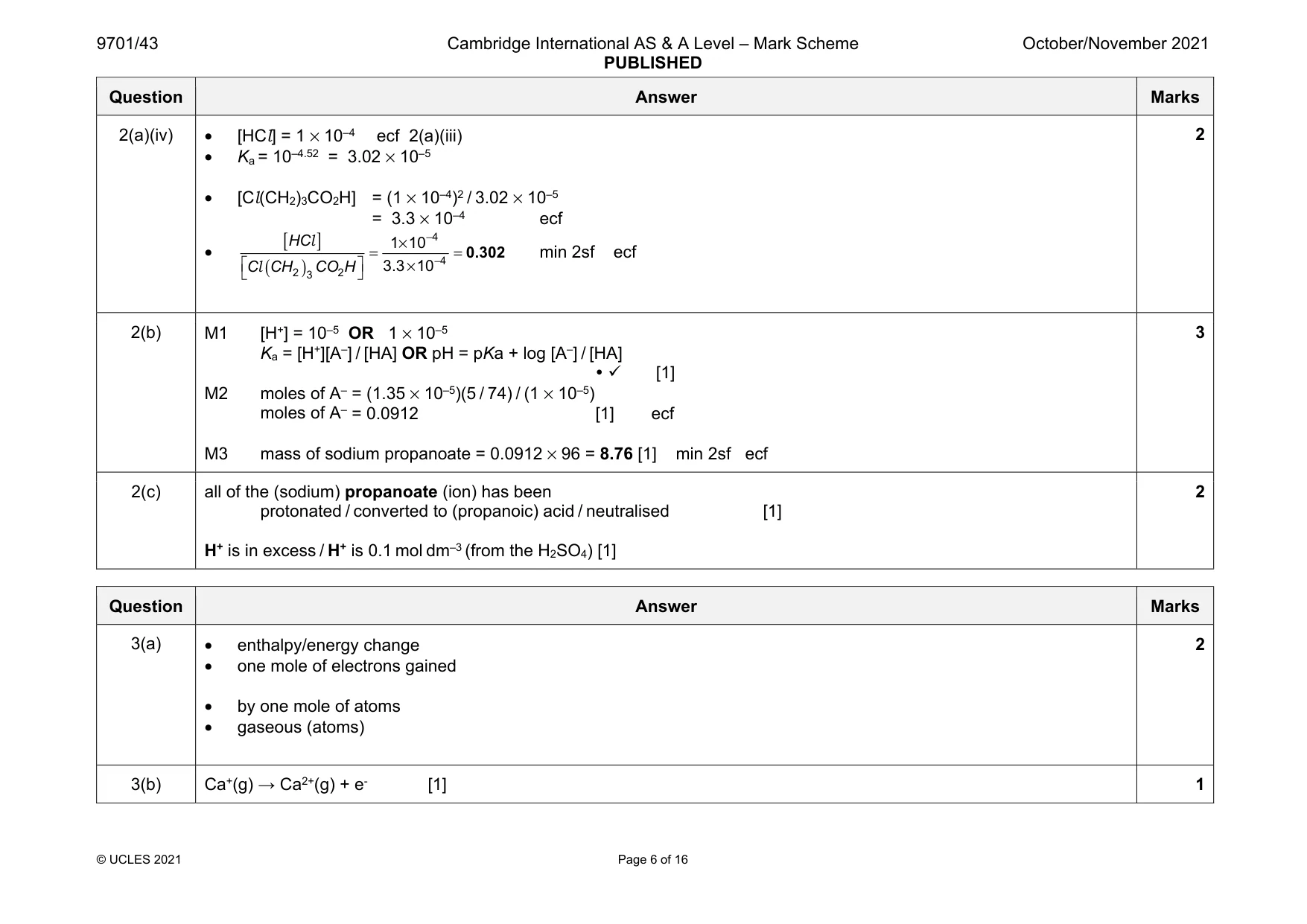
Mark scheme: 2(a)(i ( ) ( ) 2 2 3 2 2 3 a H C CH CO K C CH CO H + − = l l [1] 2(a)(ii) pKa = – logKa OR Ka = 10–pKa [1] 1 2(a)(iii) [H+] = 10–4.0 = 1 × 10⁻⁴ [1] 1 Question Answer Marks 2(a)(iv) • [HCl] = 1 × 10⁻⁴ ecf 2(a)(iii) • Ka = 10–4.52 = 3.02 × 10⁻⁵ • [Cl(CH2)3CO2H] = (1 × 10⁻⁴)2 / 3.02 × 10–5 = 3.3 × 10⁻⁴ ecf • [ ] ( ) 4 4 2 2 3 1 10 3.3 10 HC C CH CO H − − × = = × 0.302 l l min 2sf ecf 2 2(b) M1 [H+] = 10–5 OR 1 × 10⁻⁵ Ka = [H+][A–] / [HA] OR pH = pKa + log [A–] / [HA] [1] M2 moles of A– = (1.35 × 10⁻⁵)(5 / 74) / (1 × 10⁻⁵) moles of A– = 0.0912 [1] ecf M3 mass of sodium propanoate = 0.0912 × 96 = 8.76 [1] min 2sf ecf 3 2(c) all of the (sodium) propanoate (ion) has been protonated / converted to (propanoic) acid / neutralised [1] H+ is in excess / H+ is 0.1 mol dm–3 (from the H2SO4) [1] 2
Q3 · Define the term electron affinity
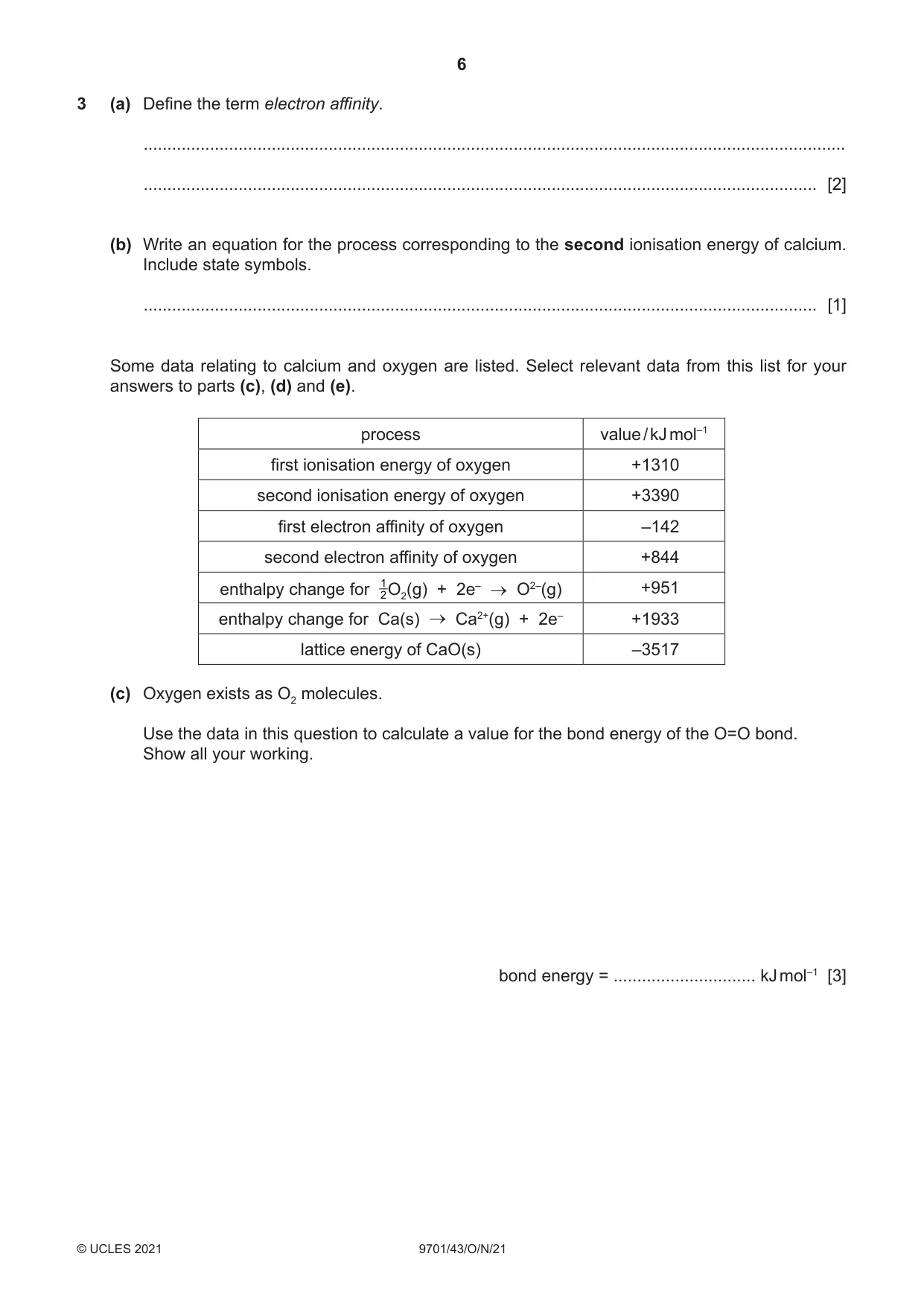
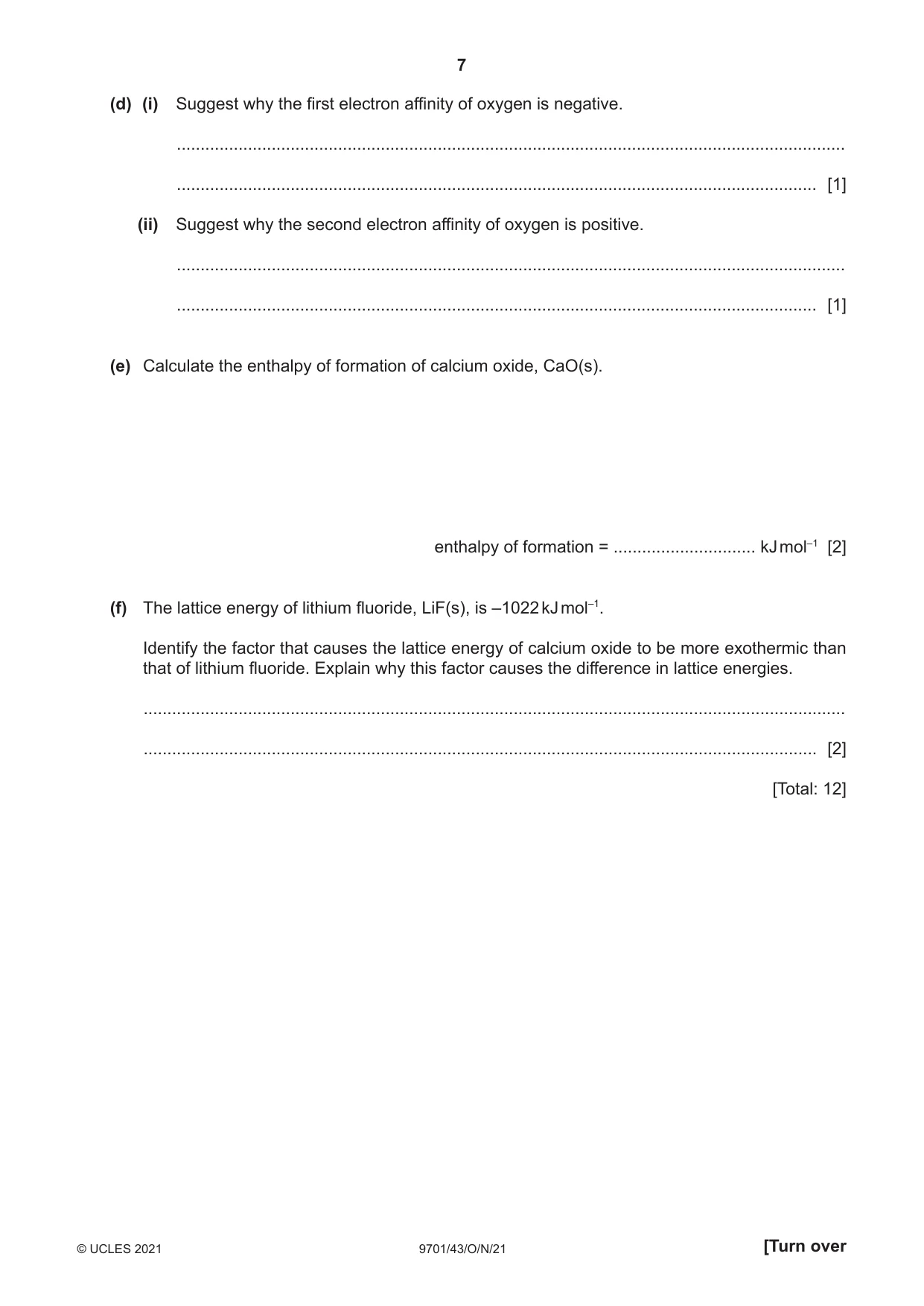
3 (a) Define the term electron affinity. .................................................................................................................................................... .............................................................................................................................................. [2] (b) Write an equation for the process corresponding to the second ionisation energy of calcium. Include state symbols. .............................................................................................................................................. [1] Some data relating to calcium and oxygen are listed. Select relevant data from this list for your answers to parts (c), (d) and (e). process value / kJ mol–1 first ionisation energy of oxygen +1310 second ionisation energy of oxygen +3390 first electron affinity of oxygen –142 second electron affinity of oxygen +844 enthalpy change for 12O2(g) + 2e– → O2–(g) +951 enthalpy change for Ca(s) → Ca2+(g) + 2e– +1933 lattice energy of CaO(s) –3517 (c) Oxygen exists as O2 molecules. Use the data in this question to calculate a value for the bond energy of the O=O bond. Show all your working. bond energy = .............................. kJ mol–1 [3] (d) (i) Suggest why the first electron affinity of oxygen is negative. ............................................................................................................................................. ....................................................................................................................................... [1] (ii) Suggest why the second electron affinity of oxygen is positive. ............................................................................................................................................. ....................................................................................................................................... [1] (e) Calculate the enthalpy of formation of calcium oxide, CaO(s). enthalpy of formation = .............................. kJ mol–1 [2] (f) The lattice energy of lithium fluoride, LiF(s), is –1022 kJ mol–1. Identify the factor that causes the lattice energy of calcium oxide to be more exothermic than that of lithium fluoride. Explain why this factor causes the difference in lattice energies. .................................................................................................................................................... .............................................................................................................................................. [2] [Total: 12]
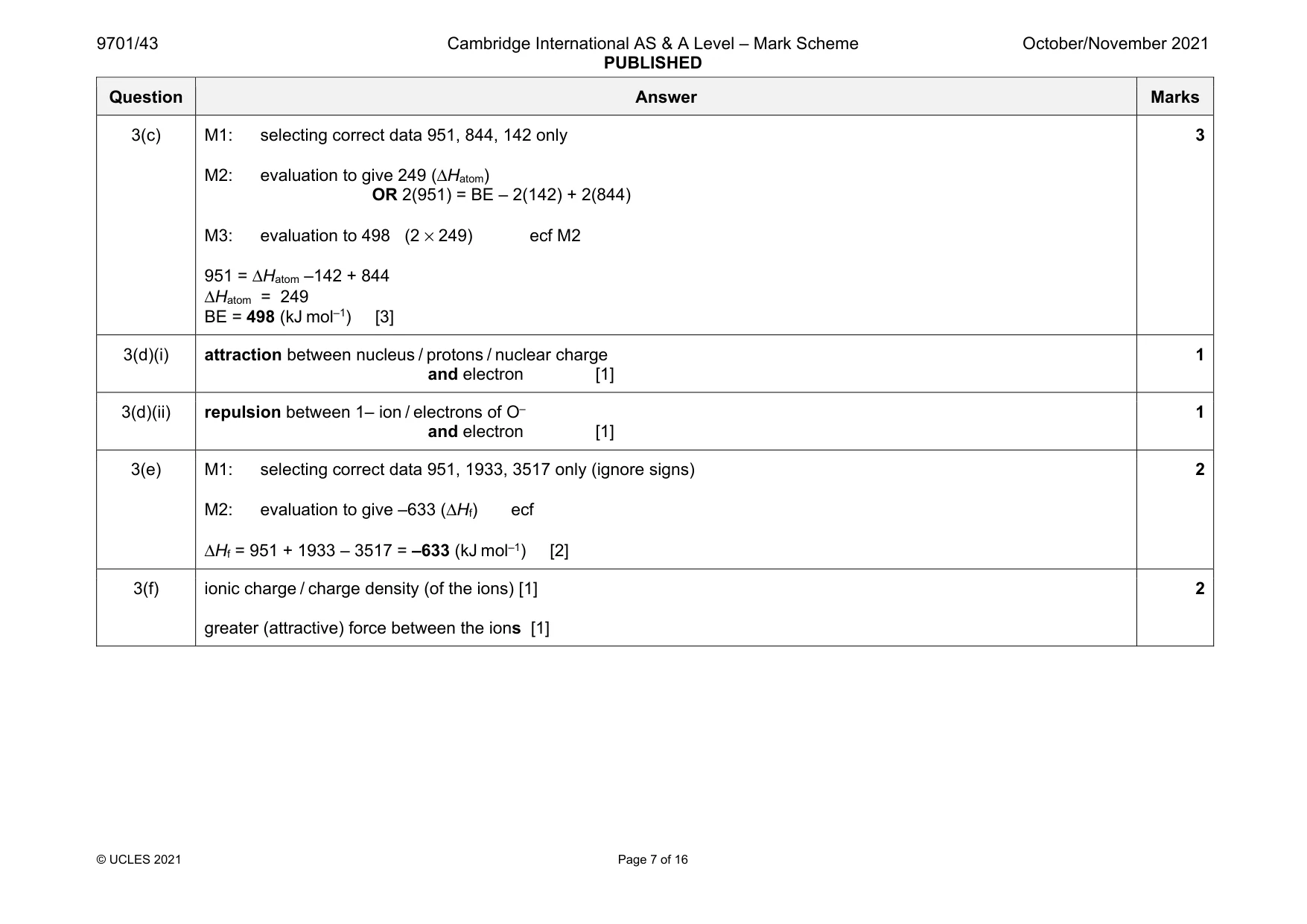
Mark scheme: 3(a) • enthalpy/energy change • one mole of electrons gained • by one mole of atoms • gaseous (atoms) 2 3(b) Ca+(g) → Ca2+(g) + e- [1] 1 Question Answer Marks 3(c) M1: selecting correct data 951, 844, 142 only M2: evaluation to give 249 (ΔHatom) OR 2(951) = BE – 2(142) + 2(844) M3: evaluation to 498 (2 × 249) ecf M2 951 = ΔHatom –142 + 844 ΔHatom = 249 BE = 498 (kJ mol–1) [3] 3 3(d)(i) attraction between nucleus / protons / nuclear charge and electron [1] 1 3(d)(ii) repulsion between 1– ion / electrons of O– and electron [1] 1 3(e) M1: selecting correct data 951, 1933, 3517 only (ignore signs) M2: evaluation to give –633 (ΔHf) ecf ΔHf = 951 + 1933 – 3517 = –633 (kJ mol–1) [2] 2 3(f) ionic charge / charge density (of the ions) [1] greater (attractive) force between the ions [1] 2
Q4 · Separate samples of 0.02 mol of calcium carbonate and 0.02 mol of barium carbonate are…
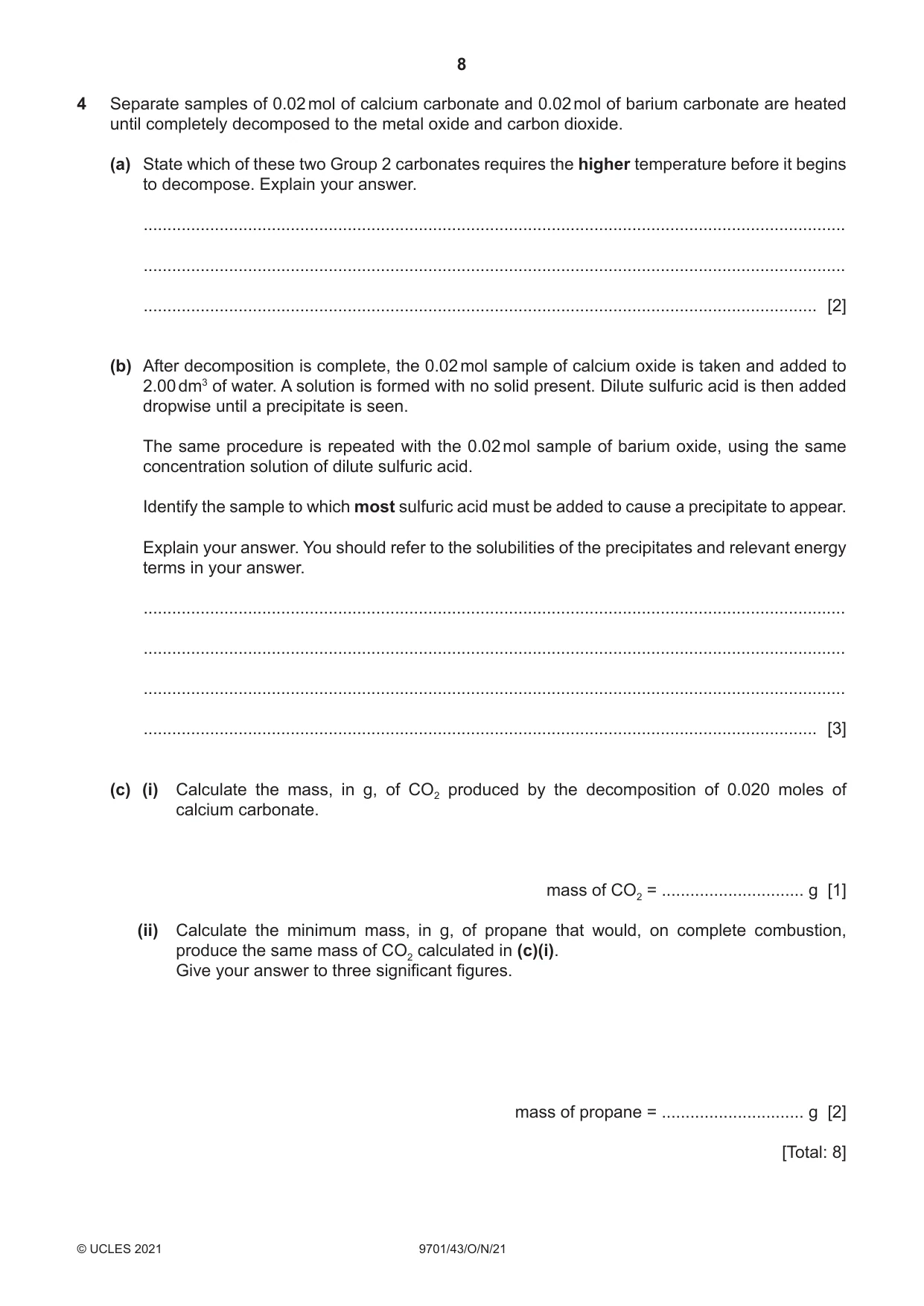
4 Separate samples of 0.02 mol of calcium carbonate and 0.02 mol of barium carbonate are heated until completely decomposed to the metal oxide and carbon dioxide. (a) State which of these two Group 2 carbonates requires the higher temperature before it begins to decompose. Explain your answer. .................................................................................................................................................... .................................................................................................................................................... .............................................................................................................................................. [2] (b) After decomposition is complete, the 0.02 mol sample of calcium oxide is taken and added to 2.00 dm3 of water. A solution is formed with no solid present. Dilute sulfuric acid is then added dropwise until a precipitate is seen. The same procedure is repeated with the 0.02 mol sample of barium oxide, using the same concentration solution of dilute sulfuric acid. Identify the sample to which most sulfuric acid must be added to cause a precipitate to appear. Explain your answer. You should refer to the solubilities of the precipitates and relevant energy terms in your answer. .................................................................................................................................................... .................................................................................................................................................... .................................................................................................................................................... .............................................................................................................................................. [3] (c) (i) Calculate the mass, in g, of CO2 produced by the decomposition of 0.020 moles of calcium carbonate. mass of CO2 = .............................. g [1] (ii) Calculate the minimum mass, in g, of propane that would, on complete combustion, produce the same mass of CO2 calculated in (c)(i). Give your answer to three significant figures. mass of propane = .............................. g [2] [Total: 8]
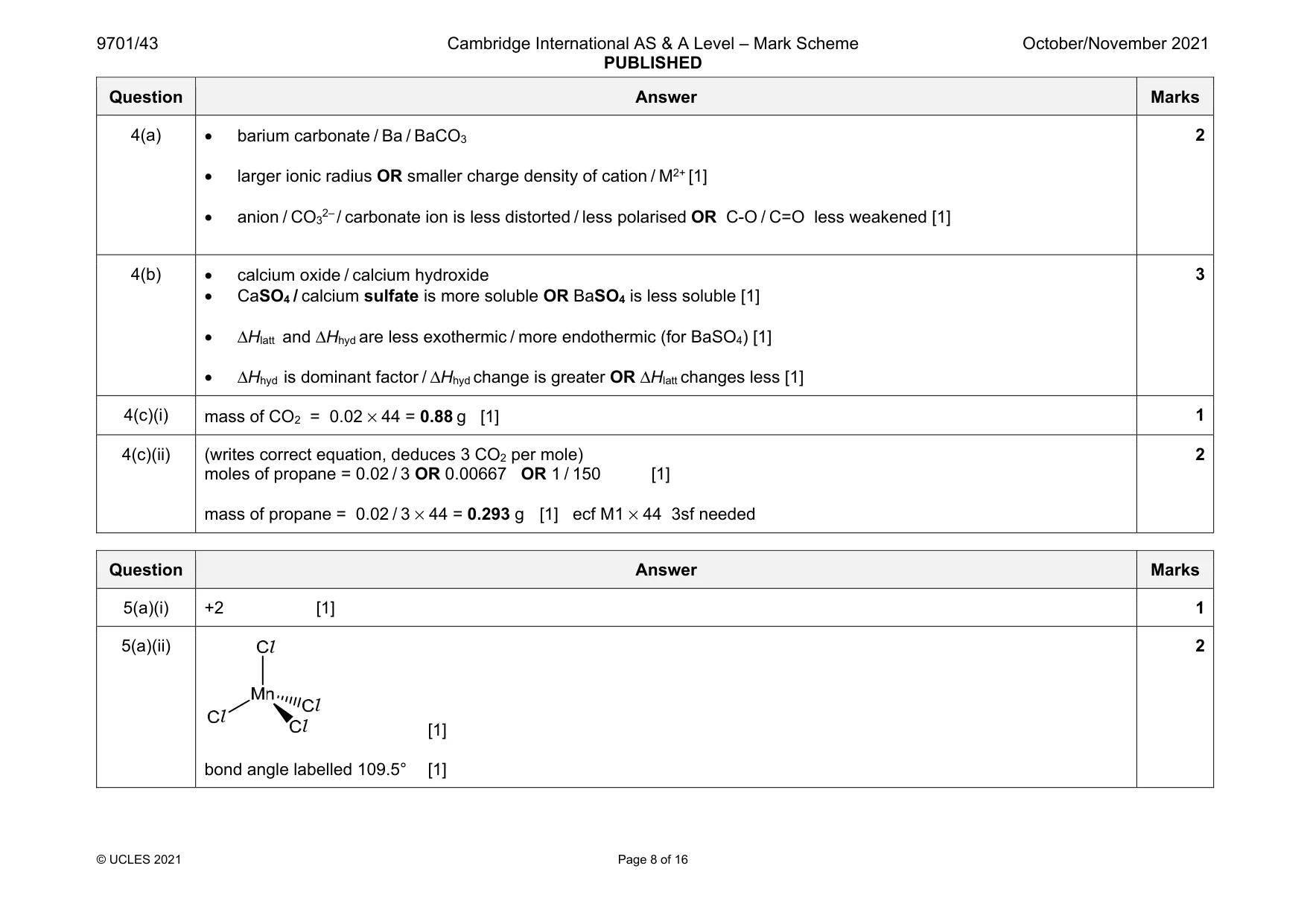
Mark scheme: 4(a) • barium carbonate / Ba / BaCO3 • larger ionic radius OR smaller charge density of cation / M2+ [1] • anion / CO32– / carbonate ion is less distorted / less polarised OR C-O / C=O less weakened [1] 2 4(b) • calcium oxide / calcium hydroxide • CaSO4 / calcium sulfate is more soluble OR BaSO4 is less soluble [1] • ΔHlatt and ΔHhyd are less exothermic / more endothermic (for BaSO4) [1] • ΔHhyd is dominant factor / ΔHhyd change is greater OR ΔHlatt changes less [1] 3 4(c)(i) mass of CO2 = 0.02 × 44 = 0.88 g [1] 1 4(c)(ii) (writes correct equation, deduces 3 CO2 per mole) moles of propane = 0.02 / 3 OR 0.00667 OR 1 / 150 [1] mass of propane = 0.02 / 3 × 44 = 0.293 g [1] ecf M1 × 44 3sf needed 2
Q5 · [MnCl 4]2– is a complex ion
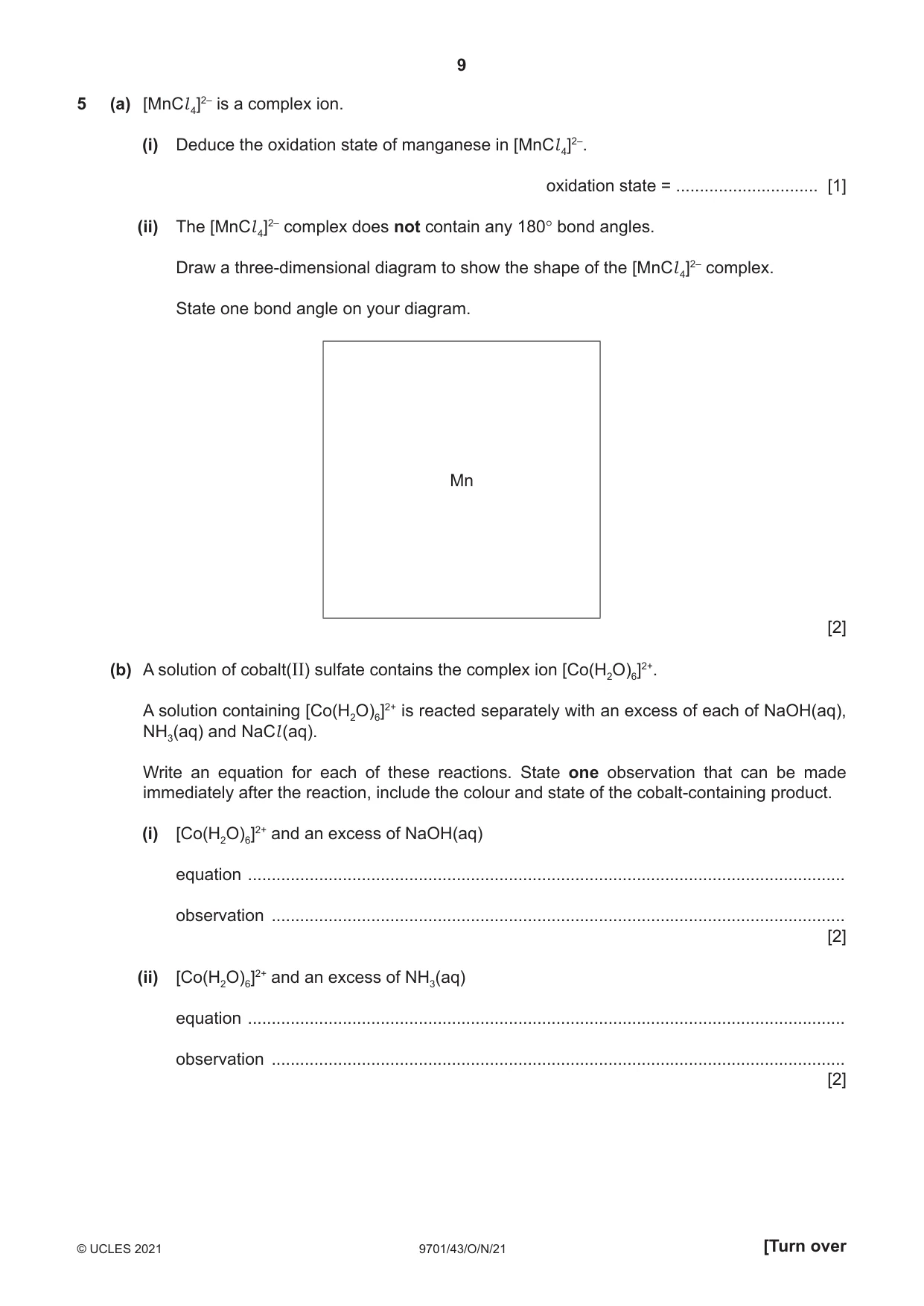
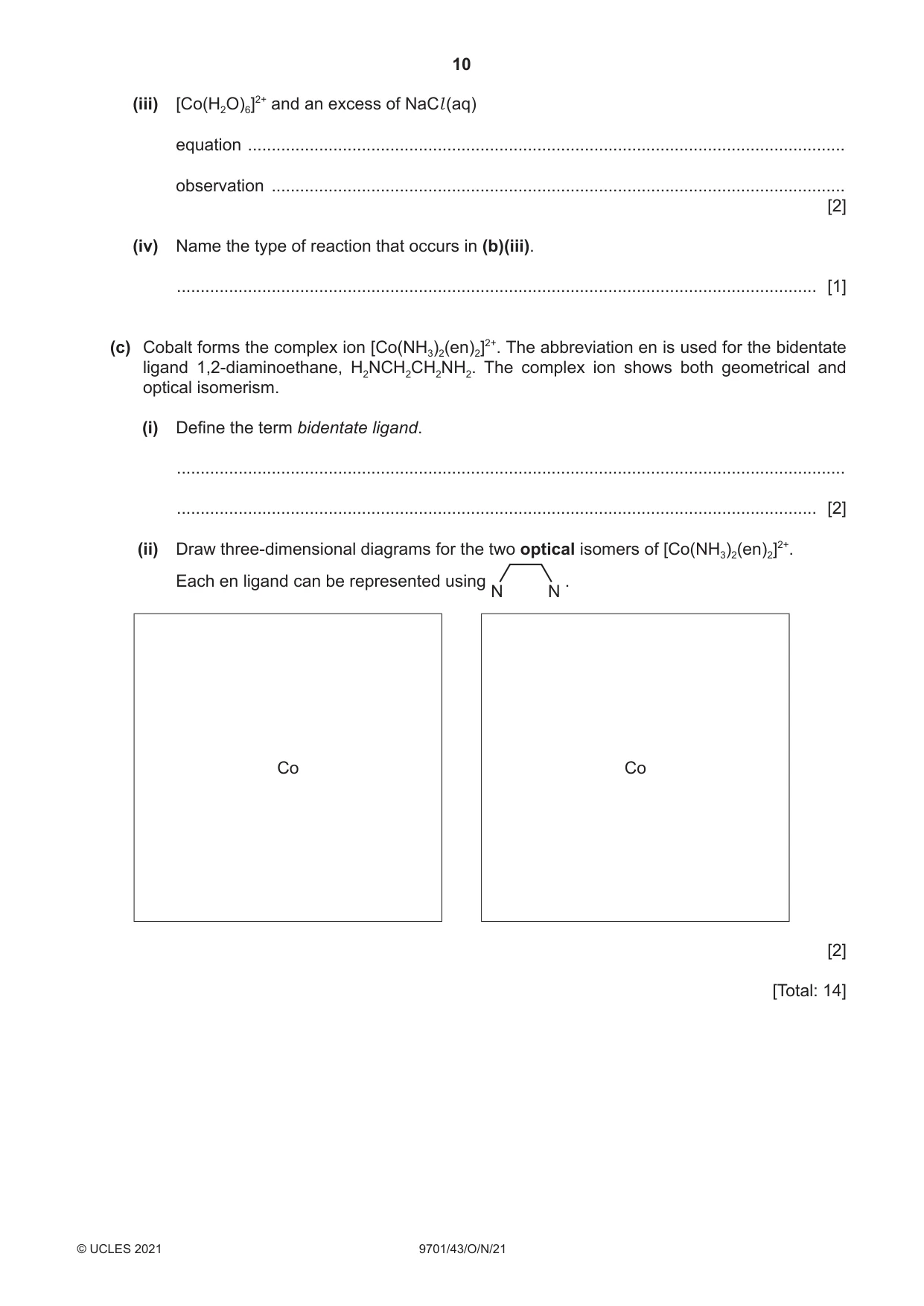
5 (a) [MnCl 4]2– is a complex ion. (i) Deduce the oxidation state of manganese in [MnCl 4]2–. oxidation state = .............................. [1] (ii) The [MnCl 4]2– complex does not contain any 180° bond angles. Draw a three-dimensional diagram to show the shape of the [MnCl 4]2– complex. State one bond angle on your diagram. Mn [2] (b) A solution of cobalt(II) sulfate contains the complex ion [Co(H2O)6]2+. A solution containing [Co(H2O)6]2+ is reacted separately with an excess of each of NaOH(aq), NH3(aq) and NaCl (aq). Write an equation for each of these reactions. State one observation that can be made immediately after the reaction, include the colour and state of the cobalt-containing product. (i) [Co(H2O)6]2+ and an excess of NaOH(aq) equation .............................................................................................................................. observation .......................................................................................................................... [2] (ii) [Co(H2O)6]2+ and an excess of NH3(aq) equation .............................................................................................................................. observation .......................................................................................................................... [2] (iii) [Co(H2O)6]2+ and an excess of NaCl (aq) equation .............................................................................................................................. observation .......................................................................................................................... [2] (iv) Name the type of reaction that occurs in (b)(iii). ....................................................................................................................................... [1] (c) Cobalt forms the complex ion [Co(NH3)2(en)2]2+. The abbreviation en is used for the bidentate ligand 1,2-diaminoethane, H2NCH2CH2NH2. The complex ion shows both geometrical and optical isomerism. (i) Define the term bidentate ligand. ............................................................................................................................................. ....................................................................................................................................... [2] (ii) Draw three-dimensional diagrams for the two optical isomers of [Co(NH3)2(en)2]2+. Each en ligand can be represented using . N N Co Co [2] [Total: 14]
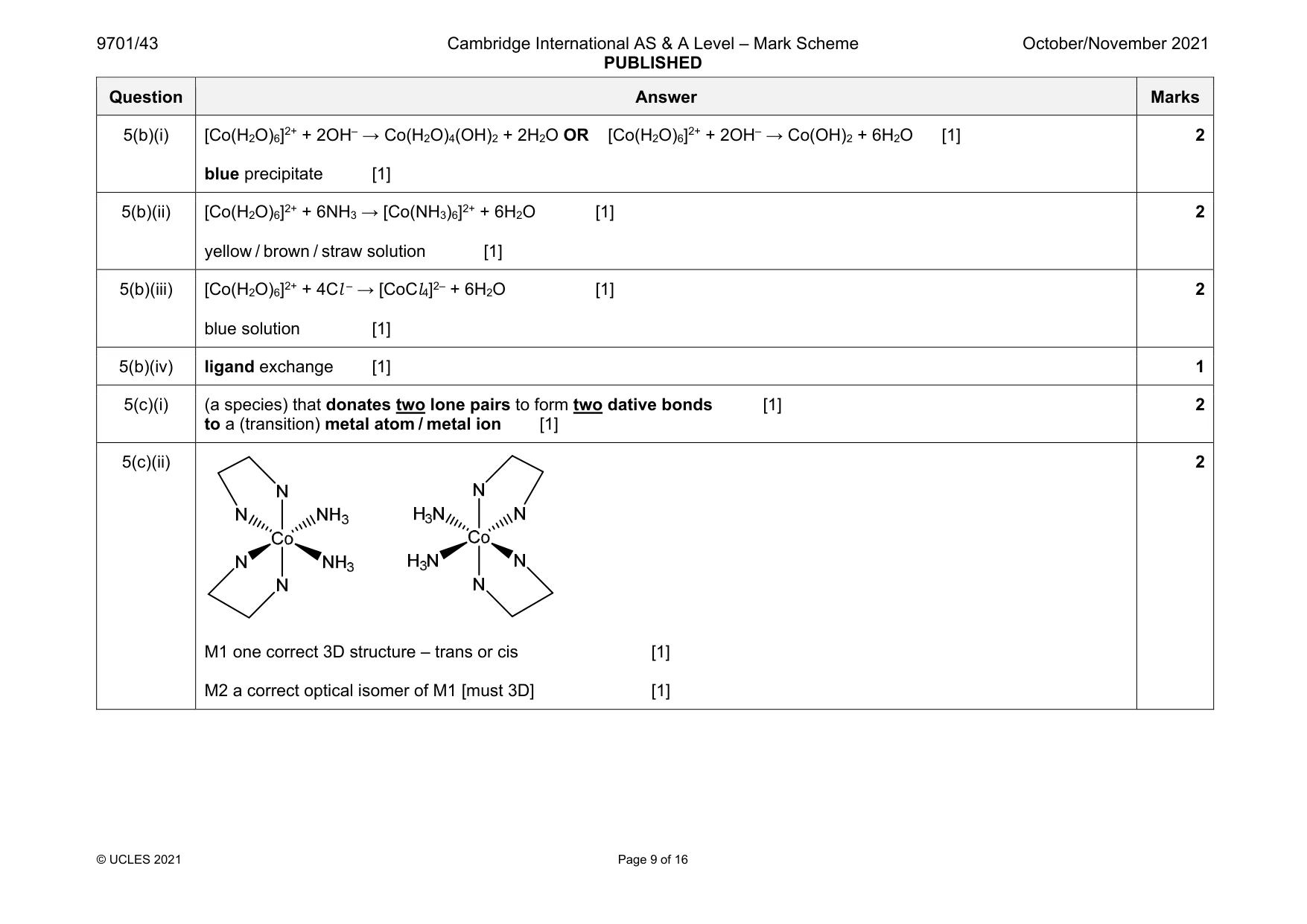
Mark scheme: 5(a)(i) +2 [1] 1 5(a)(ii) [1] bond angle labelled 109.5° [1] 2 Question Answer Marks 5(b)(i) [Co(H2O)6]2+ + 2OH– → Co(H2O)4(OH)2 + 2H2O OR [Co(H2O)6]2+ + 2OH– → Co(OH)2 + 6H2O [1] blue precipitate [1] 2 5(b)(ii) [Co(H2O)6]2+ + 6NH3 → [Co(NH3)6]2+ + 6H2O [1] yellow / brown / straw solution [1] 2 5(b)(iii) [Co(H2O)6]2+ + 4Cl – → [CoCl4]2– + 6H2O [1] blue solution [1] 2 5(b)(iv) ligand exchange [1] 1 5(c)(i) (a species) that donates two lone pairs to form two dative bonds [1] to a (transition) metal atom / metal ion [1] 2 5(c)(ii) M1 one correct 3D structure – trans or cis [1] M2 a correct optical isomer of M1 [must 3D] [1] 2
Q6 · An excess of sodium iodide is added to a solution of copper(II) sulfate
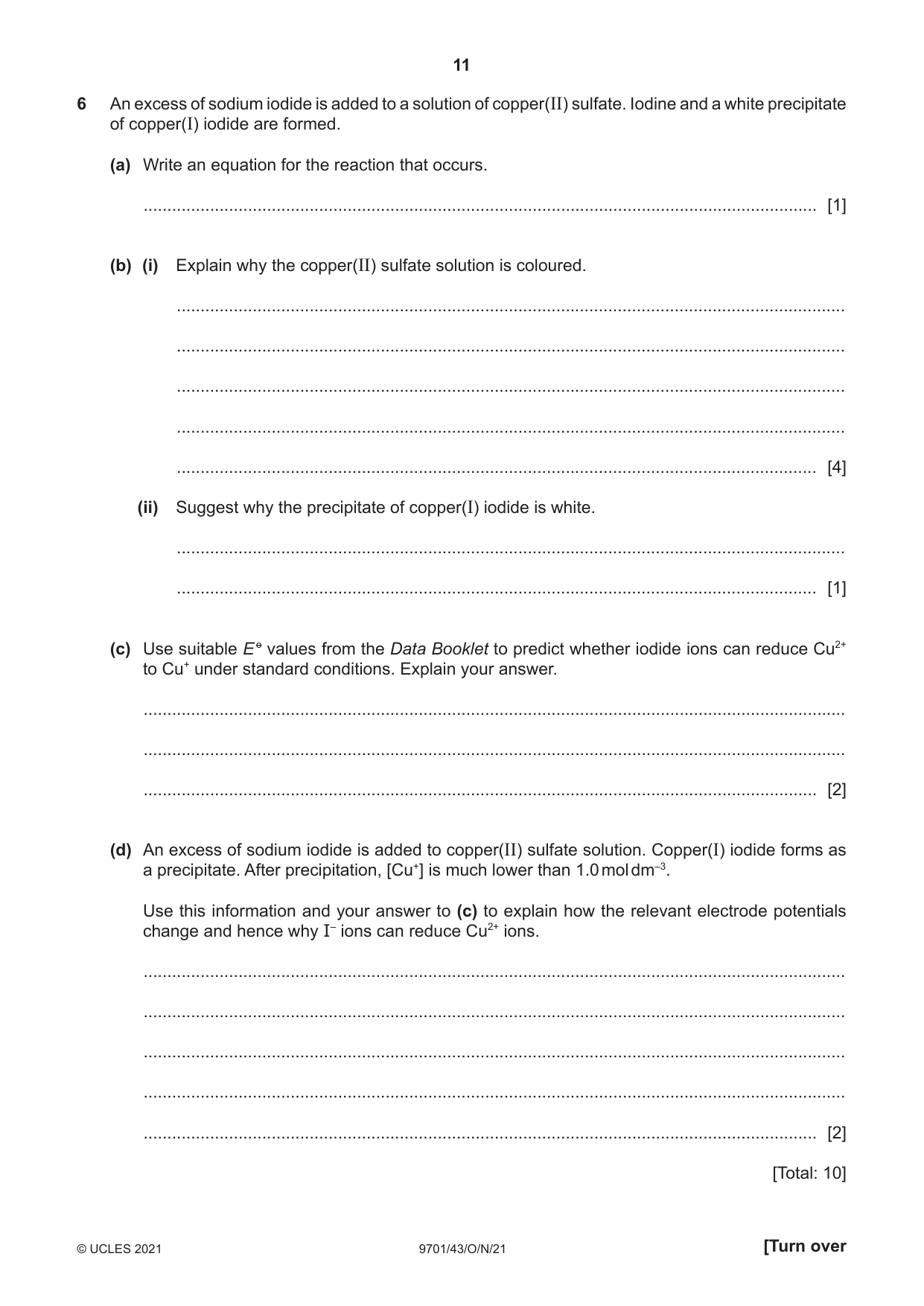
6 An excess of sodium iodide is added to a solution of copper(II) sulfate. Iodine and a white precipitate of copper(I) iodide are formed. (a) Write an equation for the reaction that occurs. .............................................................................................................................................. [1] (b) (i) Explain why the copper(II) sulfate solution is coloured. ............................................................................................................................................. ............................................................................................................................................. ............................................................................................................................................. ............................................................................................................................................. ....................................................................................................................................... [4] (ii) Suggest why the precipitate of copper(I) iodide is white. ............................................................................................................................................. ....................................................................................................................................... [1] (c) Use suitable E o values from the Data Booklet to predict whether iodide ions can reduce Cu2+ to Cu+ under standard conditions. Explain your answer. .................................................................................................................................................... .................................................................................................................................................... .............................................................................................................................................. [2] (d) An excess of sodium iodide is added to copper(II) sulfate solution. Copper(I) iodide forms as a precipitate. After precipitation, [Cu+] is much lower than 1.0 mol dm–3. Use this information and your answer to (c) to explain how the relevant electrode potentials change and hence why I– ions can reduce Cu2+ ions. .................................................................................................................................................... .................................................................................................................................................... .................................................................................................................................................... .................................................................................................................................................... .............................................................................................................................................. [2] [Total: 10]
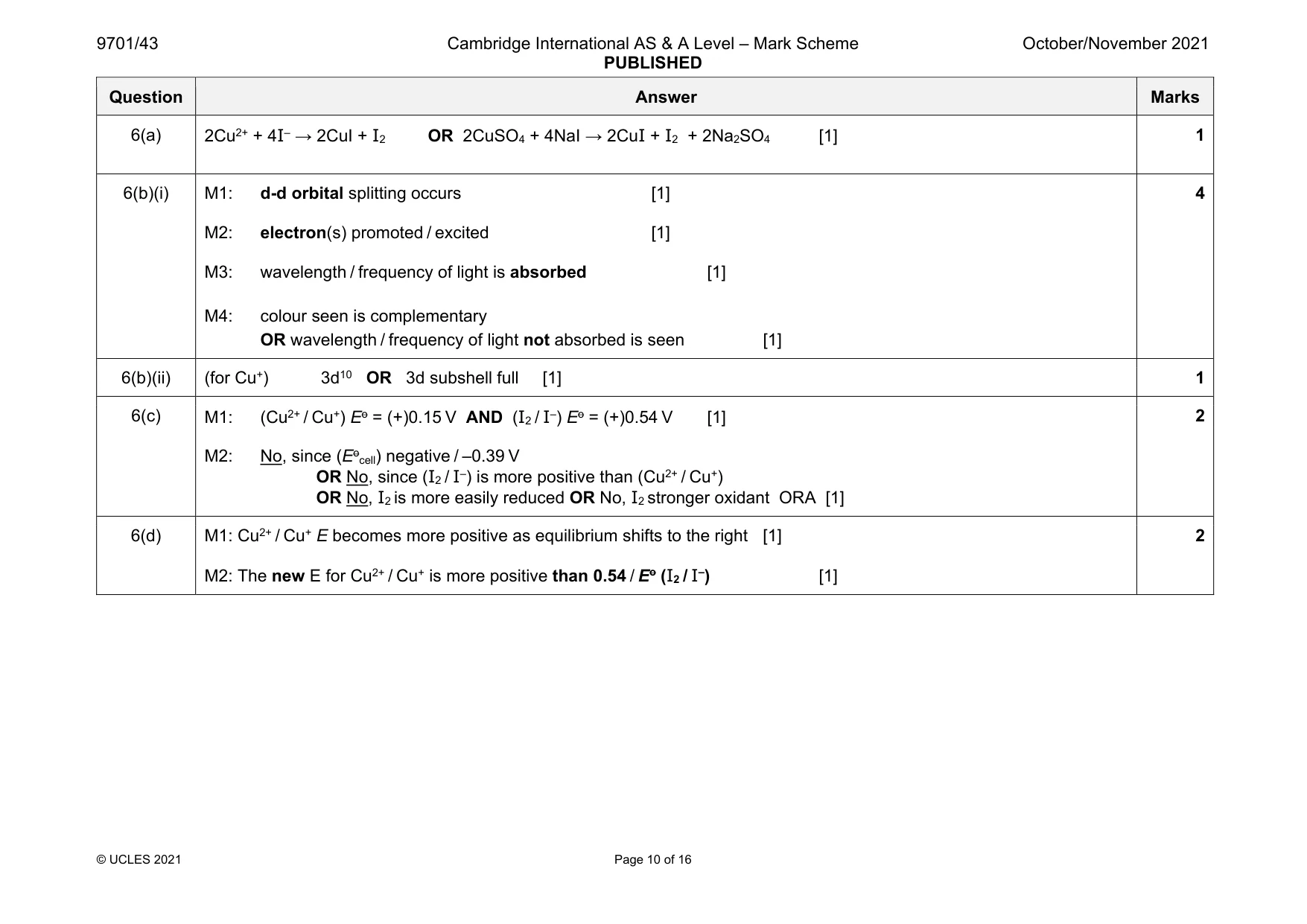
Mark scheme: 6(a) [1] 1 6(b)(i) M1: d-d orbital splitting occurs [1] M2: electron(s) promoted / excited [1] M3: wavelength / frequency of light is absorbed [1] M4: colour seen is complementary OR wavelength / frequency of light not absorbed is seen [1] 4 6(b)(ii) (for Cu+) 3d10 OR 3d subshell full [1] 1 6(c) M1: (Cu2+ / Cu+) Eo = (+)0.15 V AND (I2 / I–) Eo = (+)0.54 V [1] M2: No, since (Eocell) negative / –0.39 V OR No, since (I2 / I–) is more positive than (Cu2+ / Cu+) OR No, I2 is more easily reduced OR No, I2 stronger oxidant ORA [1] 2 6(d) M1: Cu2+ / Cu+ E becomes more positive as equilibrium shifts to the right [1] M2: The new E for Cu2+ / Cu+ is more positive than 0.54 / Eo (I2 / I–) [1] 2
Q7 · The structure of phenylethanoic acid is shown
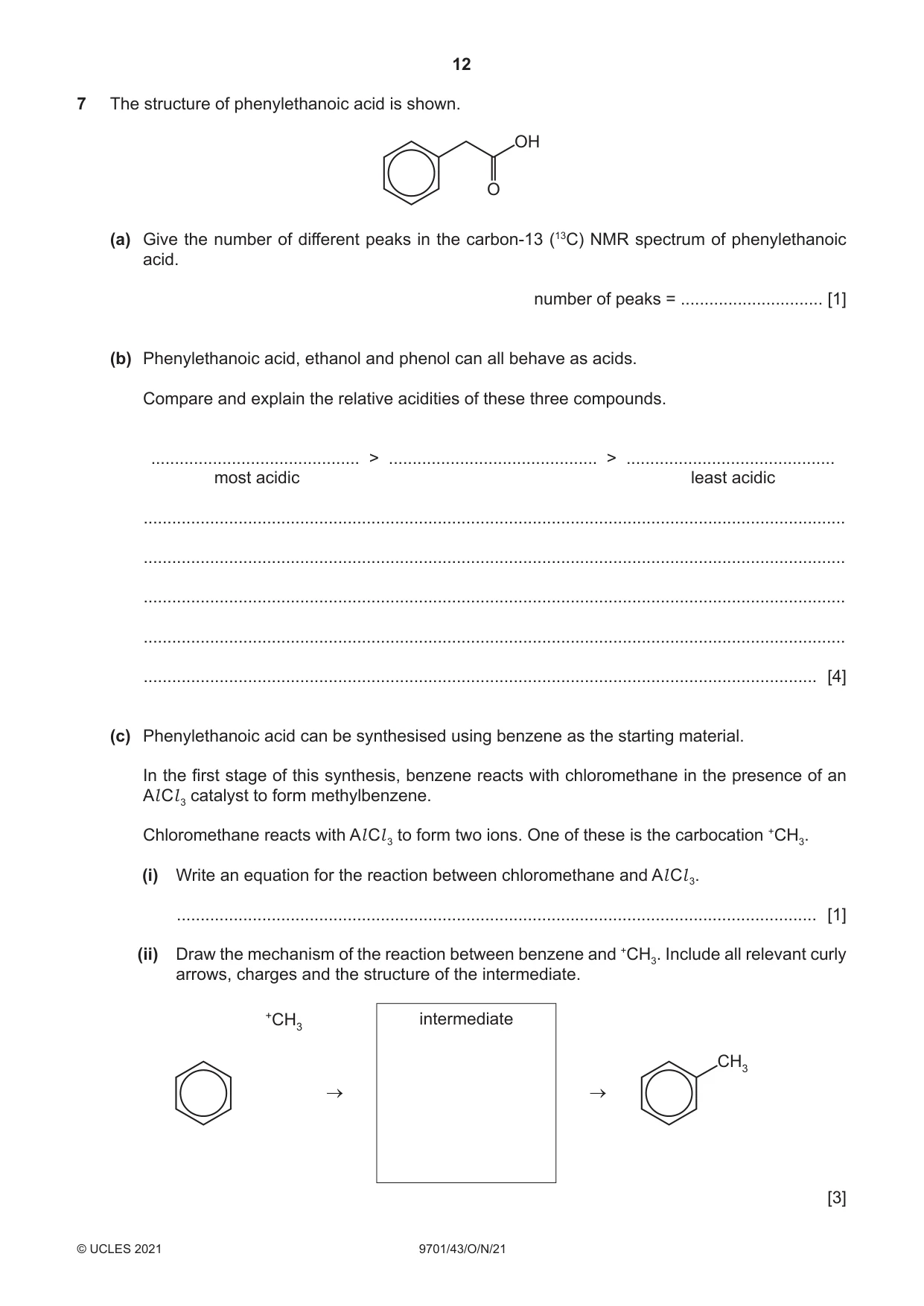
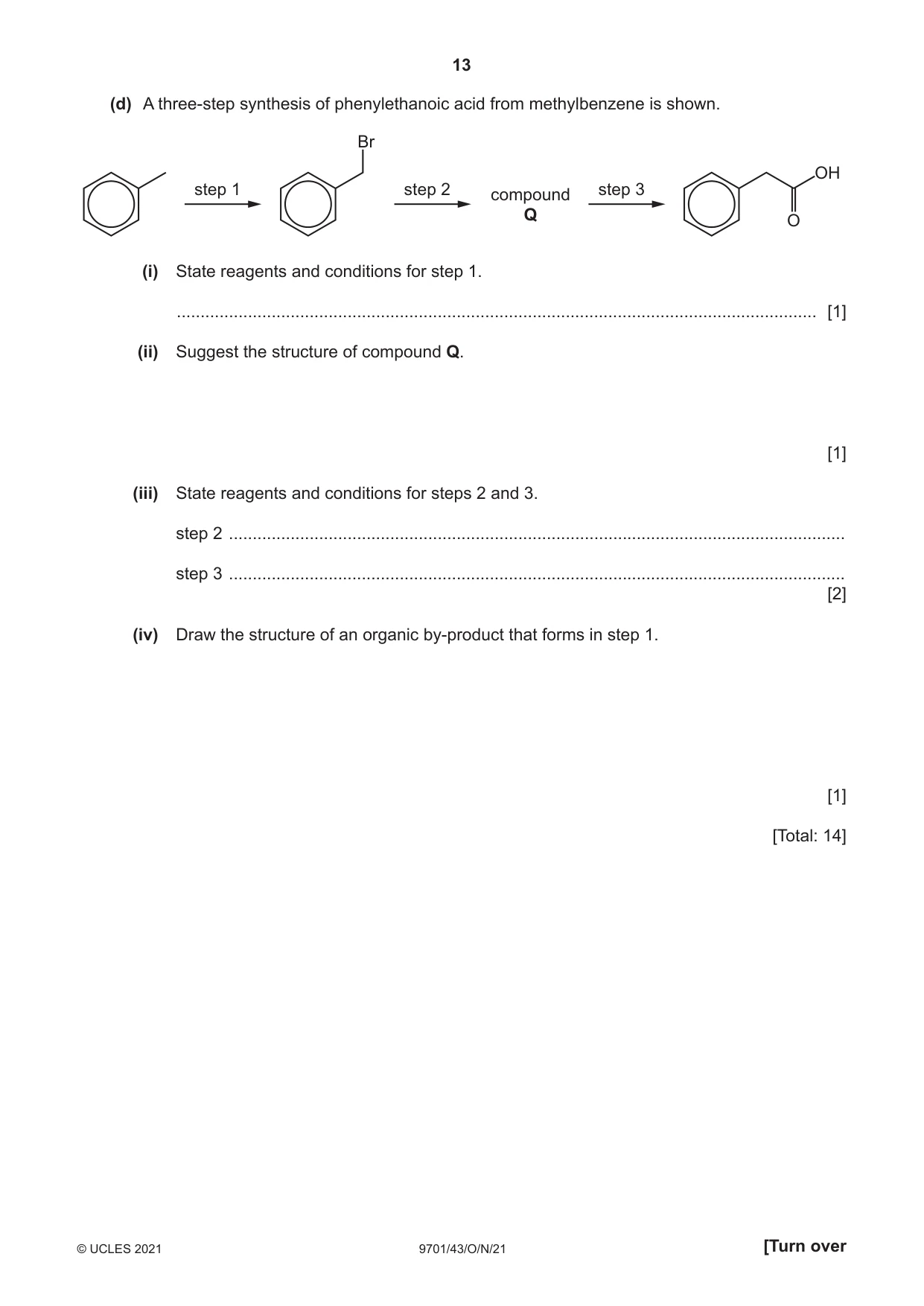
7 The structure of phenylethanoic acid is shown. OH O (a) Give the number of different peaks in the carbon-13 (13C) NMR spectrum of phenylethanoic acid. number of peaks = .............................. [1] (b) Phenylethanoic acid, ethanol and phenol can all behave as acids. Compare and explain the relative acidities of these three compounds. ............................................ > ............................................ > ............................................ most acidic least acidic .................................................................................................................................................... .................................................................................................................................................... .................................................................................................................................................... .................................................................................................................................................... .............................................................................................................................................. [4] (c) Phenylethanoic acid can be synthesised using benzene as the starting material. In the first stage of this synthesis, benzene reacts with chloromethane in the presence of an Al Cl 3 catalyst to form methylbenzene. Chloromethane reacts with Al Cl 3 to form two ions. One of these is the carbocation +CH3. (i) Write an equation for the reaction between chloromethane and Al Cl 3. ....................................................................................................................................... [1] (ii) Draw the mechanism of the reaction between benzene and +CH3. Include all relevant curly arrows, charges and the structure of the intermediate. +CH3 intermediate CH3 [3] (d) A three-step synthesis of phenylethanoic acid from methylbenzene is shown. Br OH step 1 step 2 step 3 compound Q O (i) State reagents and conditions for step 1. ....................................................................................................................................... [1] (ii) Suggest the structure of compound Q. [1] (iii) State reagents and conditions for steps 2 and 3. step 2 .................................................................................................................................. step 3 .................................................................................................................................. [2] (iv) Draw the structure of an organic by-product that forms in step 1. [1] [Total: 14]
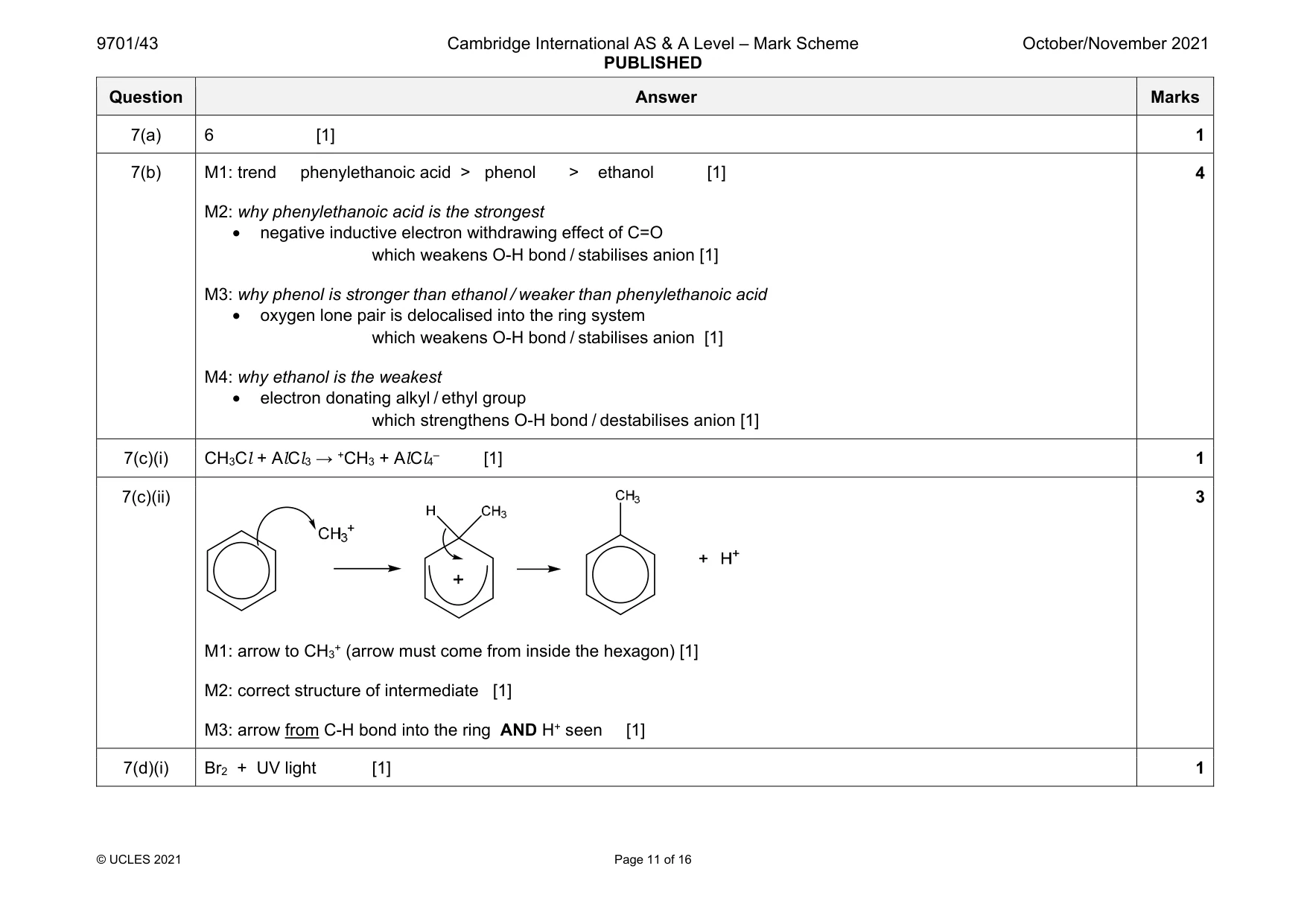
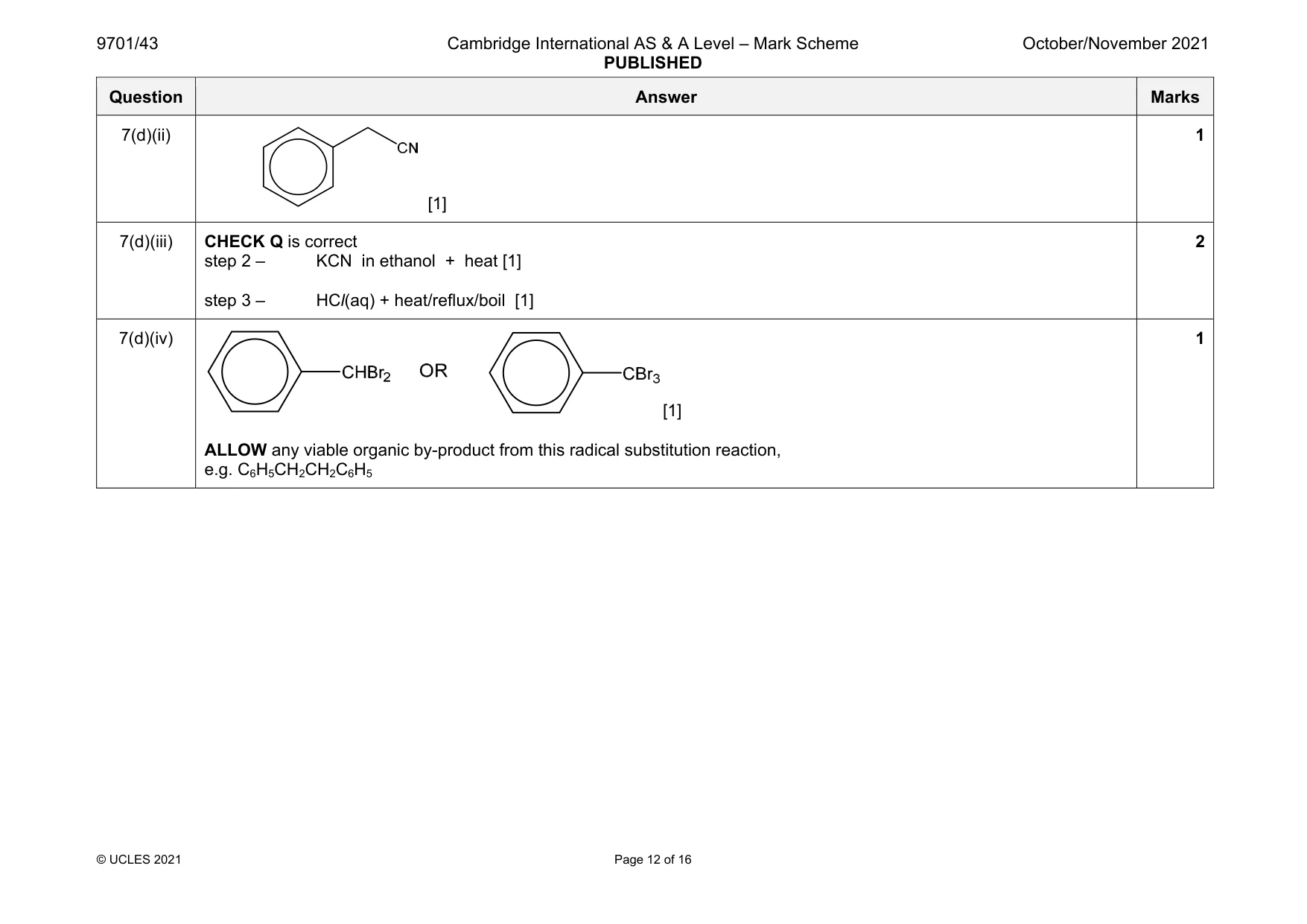
Mark scheme: 7(a) 6 [1] 1 7(b) M1: trend phenylethanoic acid > phenol > ethanol [1] M2: why phenylethanoic acid is the strongest • negative inductive electron withdrawing effect of C=O which weakens O-H bond / stabilises anion [1] M3: why phenol is stronger than ethanol / weaker than phenylethanoic acid • oxygen lone pair is delocalised into the ring system which weakens O-H bond / stabilises anion [1] M4: why ethanol is the weakest • electron donating alkyl / ethyl group which strengthens O-H bond / destabilises anion [1] 4 7(c)(i) CH3Cl + AlCl3 → +CH3 + AlCl4– [1] 1 7(c)(ii) M1: arrow to CH3+ (arrow must come from inside the hexagon) [1] M2: correct structure of intermediate [1] M3: arrow from C-H bond into the ring AND H+ seen [1] 3 7(d)(i) Br2 + UV light [1] 1 Question Answer Marks 7(d)(ii) [1] 1 7(d)(iii) CHECK Q is correct step 2 – KCN in ethanol + heat [1] step 3 – HCl(aq) + heat/reflux/boil [1] 2 7(d)(iv) [1] ALLOW any viable organic by-product from this radical substitution reaction, e.g. C6H5CH2CH2C6H5 1
Q8 · Phenylamine, C6H5NH2, and ethylamine, C2H5NH2, can be distinguished by adding aqueous…
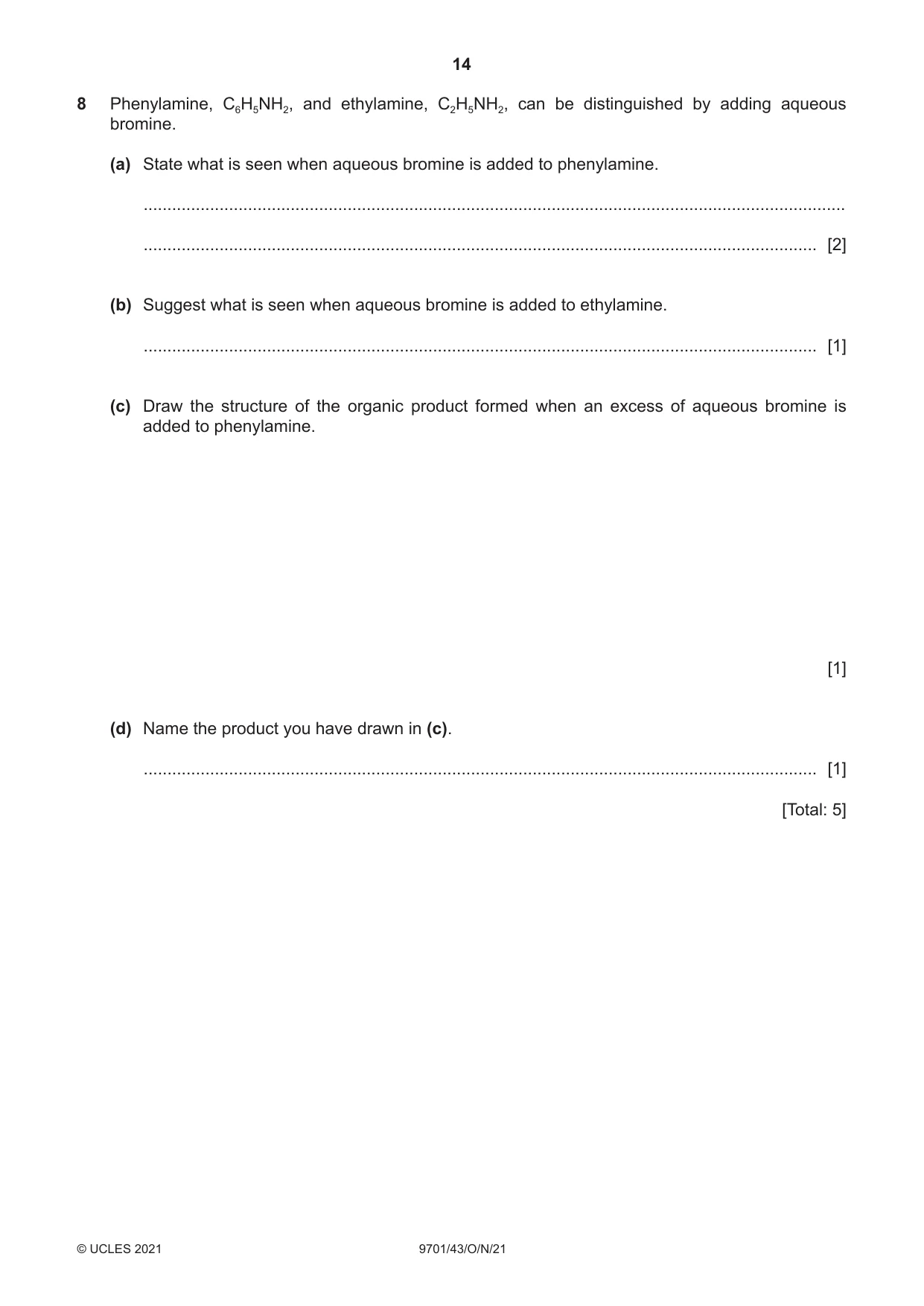
8 Phenylamine, C6H5NH2, and ethylamine, C2H5NH2, can be distinguished by adding aqueous bromine. (a) State what is seen when aqueous bromine is added to phenylamine. .................................................................................................................................................... .............................................................................................................................................. [2] (b) Suggest what is seen when aqueous bromine is added to ethylamine. .............................................................................................................................................. [1] (c) Draw the structure of the organic product formed when an excess of aqueous bromine is added to phenylamine. [1] (d) Name the product you have drawn in (c). .............................................................................................................................................. [1] [Total: 5]
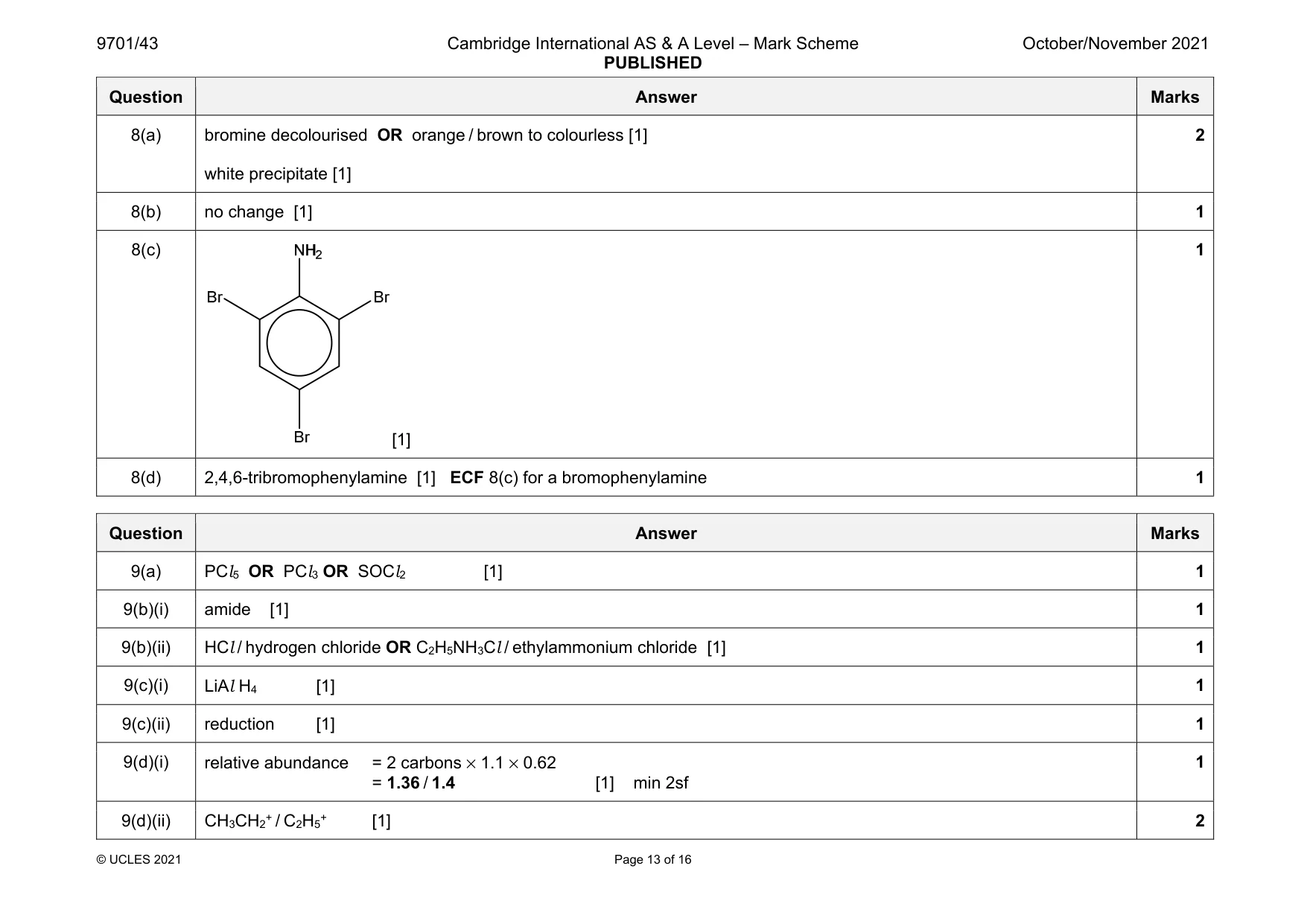
Mark scheme: 8(a) bromine decolourised OR orange / brown to colourless [1] white precipitate [1] 2 8(b) no change [1] 1 8(c) [1] 1 8(d) 2,4,6-tribromophenylamine [1] ECF 8(c) for a bromophenylamine 1
Q9 · Compound T is made by a three-stage synthesis
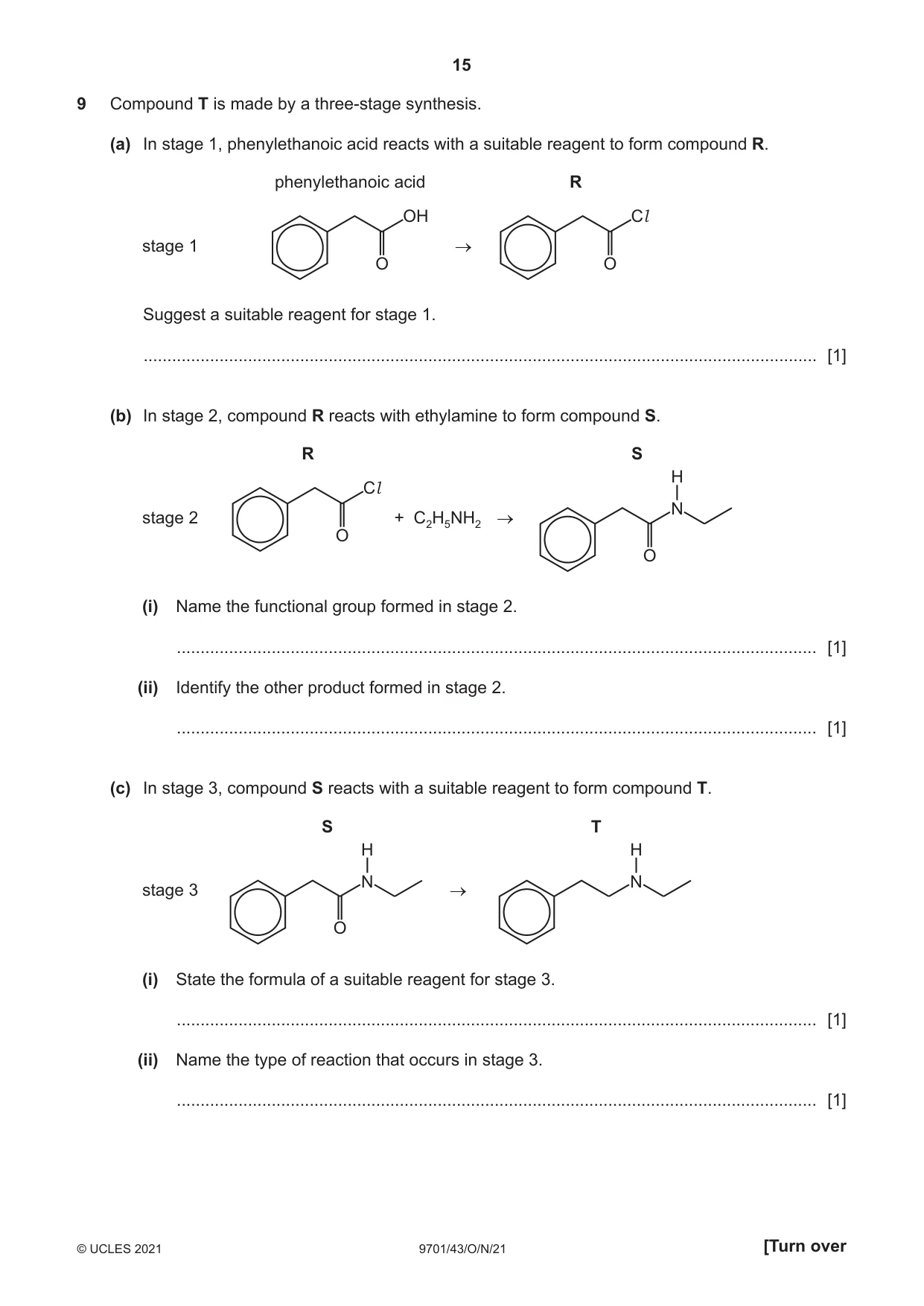
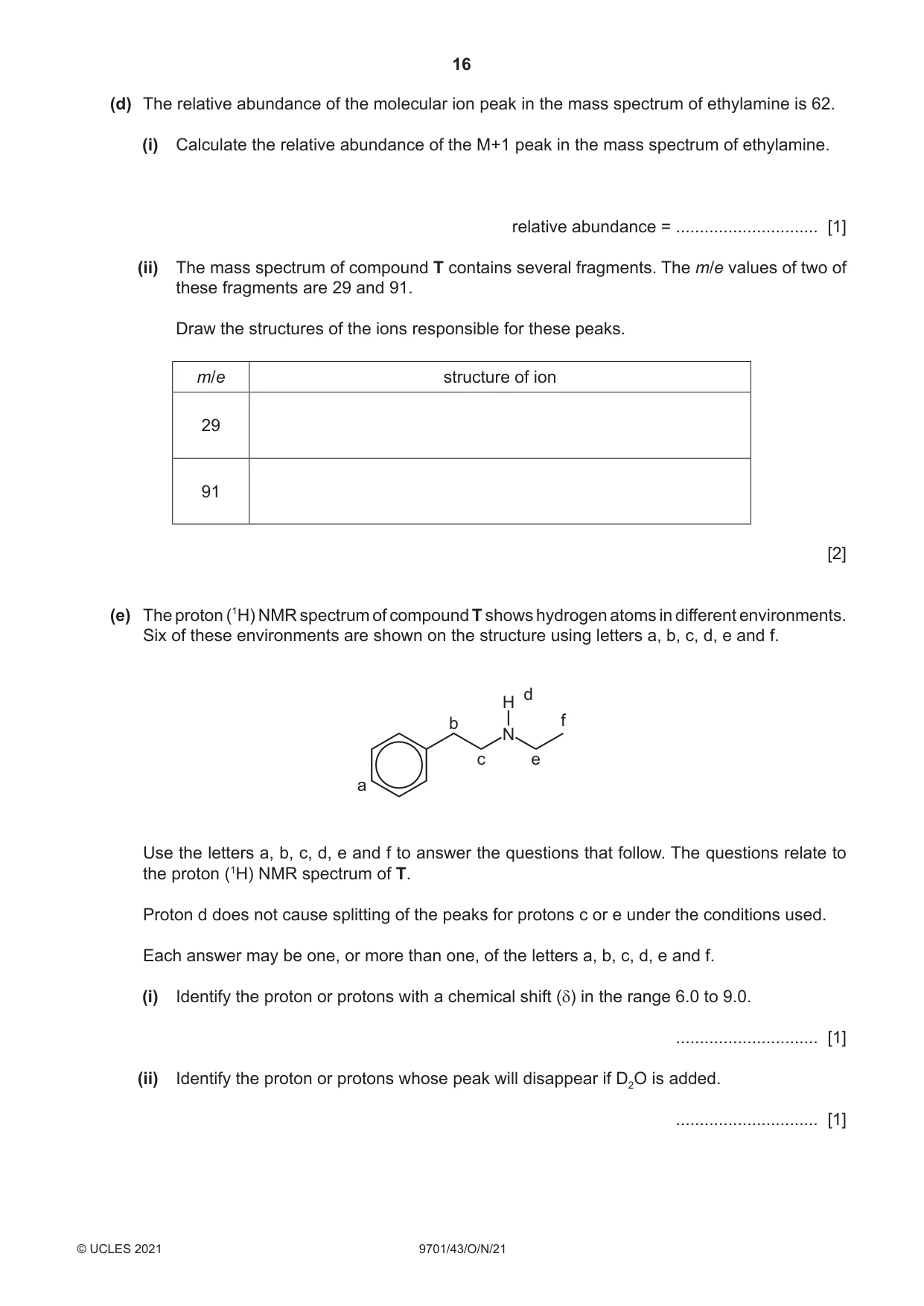
9 Compound T is made by a three-stage synthesis. (a) In stage 1, phenylethanoic acid reacts with a suitable reagent to form compound R. phenylethanoic acid R OH Cl stage 1 O O Suggest a suitable reagent for stage 1. .............................................................................................................................................. [1] (b) In stage 2, compound R reacts with ethylamine to form compound S. R S H Cl N stage 2 + C2H5NH2 O O (i) Name the functional group formed in stage 2. ....................................................................................................................................... [1] (ii) Identify the other product formed in stage 2. ....................................................................................................................................... [1] (c) In stage 3, compound S reacts with a suitable reagent to form compound T. S T H H N N stage 3 O (i) State the formula of a suitable reagent for stage 3. ....................................................................................................................................... [1] (ii) Name the type of reaction that occurs in stage 3. ....................................................................................................................................... [1] (d) The relative abundance of the molecular ion peak in the mass spectrum of ethylamine is 62. (i) Calculate the relative abundance of the M+1 peak in the mass spectrum of ethylamine. relative abundance = .............................. [1] (ii) The mass spectrum of compound T contains several fragments. The m/e values of two of these fragments are 29 and 91. Draw the structures of the ions responsible for these peaks. m/e structure of ion 29 91 [2] (e) The proton (1H) NMR spectrum of compound T shows hydrogen atoms in different environments. Six of these environments are shown on the structure using letters a, b, c, d, e and f. d H b f N c e a Use the letters a, b, c, d, e and f to answer the questions that follow. The questions relate to the proton (1H) NMR spectrum of T. Proton d does not cause splitting of the peaks for protons c or e under the conditions used. Each answer may be one, or more than one, of the letters a, b, c, d, e and f. (i) Identify the proton or protons with a chemical shift (δ) in the range 6.0 to 9.0. .............................. [1] (ii) Identify the proton or protons whose peak will disappear if D2O is added. .............................. [1] (iv) Identify the proton or protons with the lowest chemical shift (δ). .............................. [1] [Total: 12]
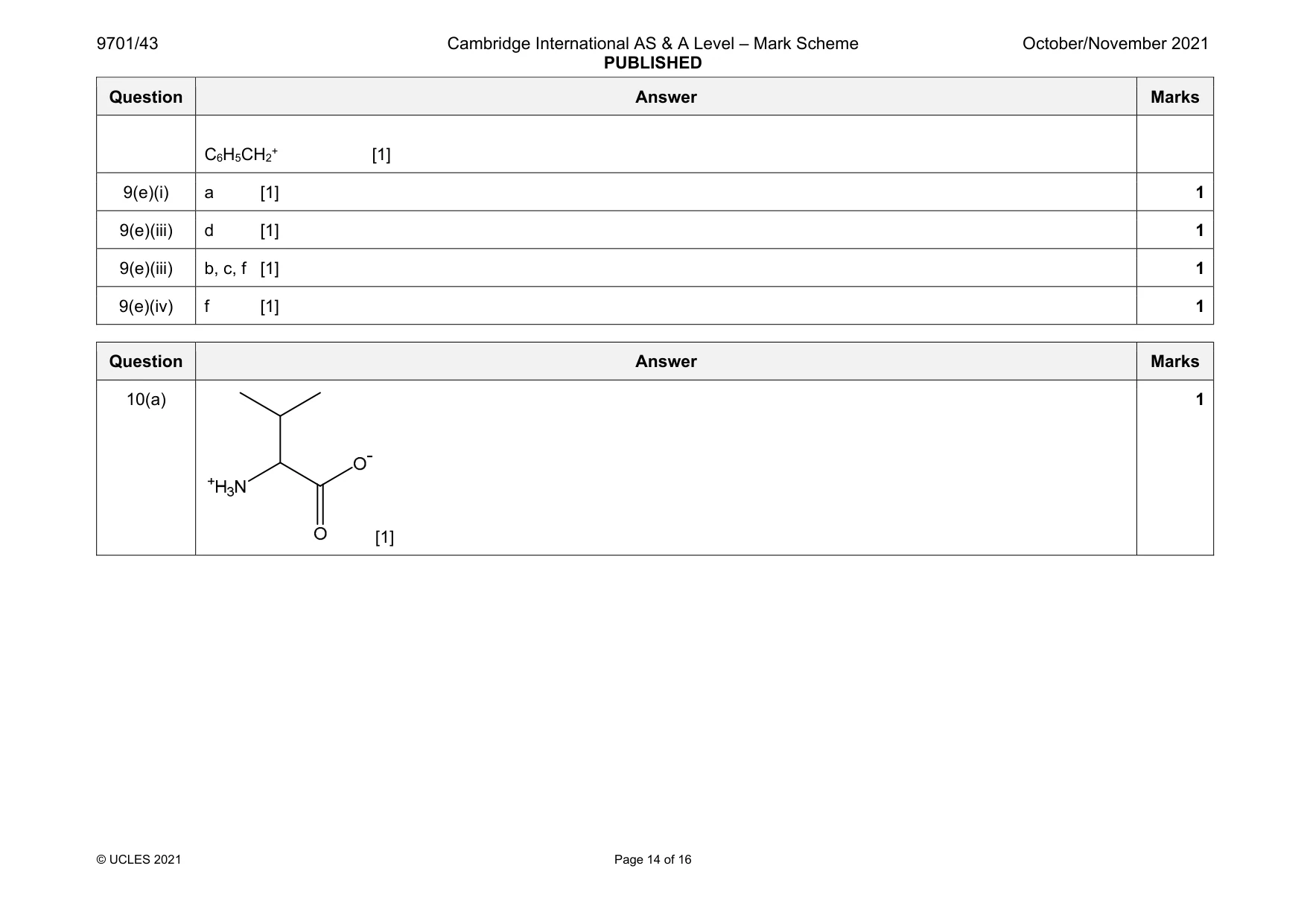
Mark scheme: 9(a) [1] 9(b)(i) amide [1] 1 9(b)(ii) HCl / hydrogen chloride OR C2H5NH3Cl / ethylammonium chloride [1] 1 9(c)(i) LiAl H4 [1] 1 9(c)(ii) reduction [1] 1 9(d)(i) relative abundance = 2 carbons × 1.1 × 0.62 = 1.36 / 1.4 [1] min 2sf 1 9(d)(ii) CH3CH2+ / C2H5+ [1] 2 Question Answer Marks C6H5CH2+ [1] 9(e)(i) a [1] 1 9(e)(iii) d [1] 1 9(e)(iii) b, c, f [1] 1 9(e)(iv) f [1] 1
Q10 · Valine (Val) and lysine (Lys) are amino acids
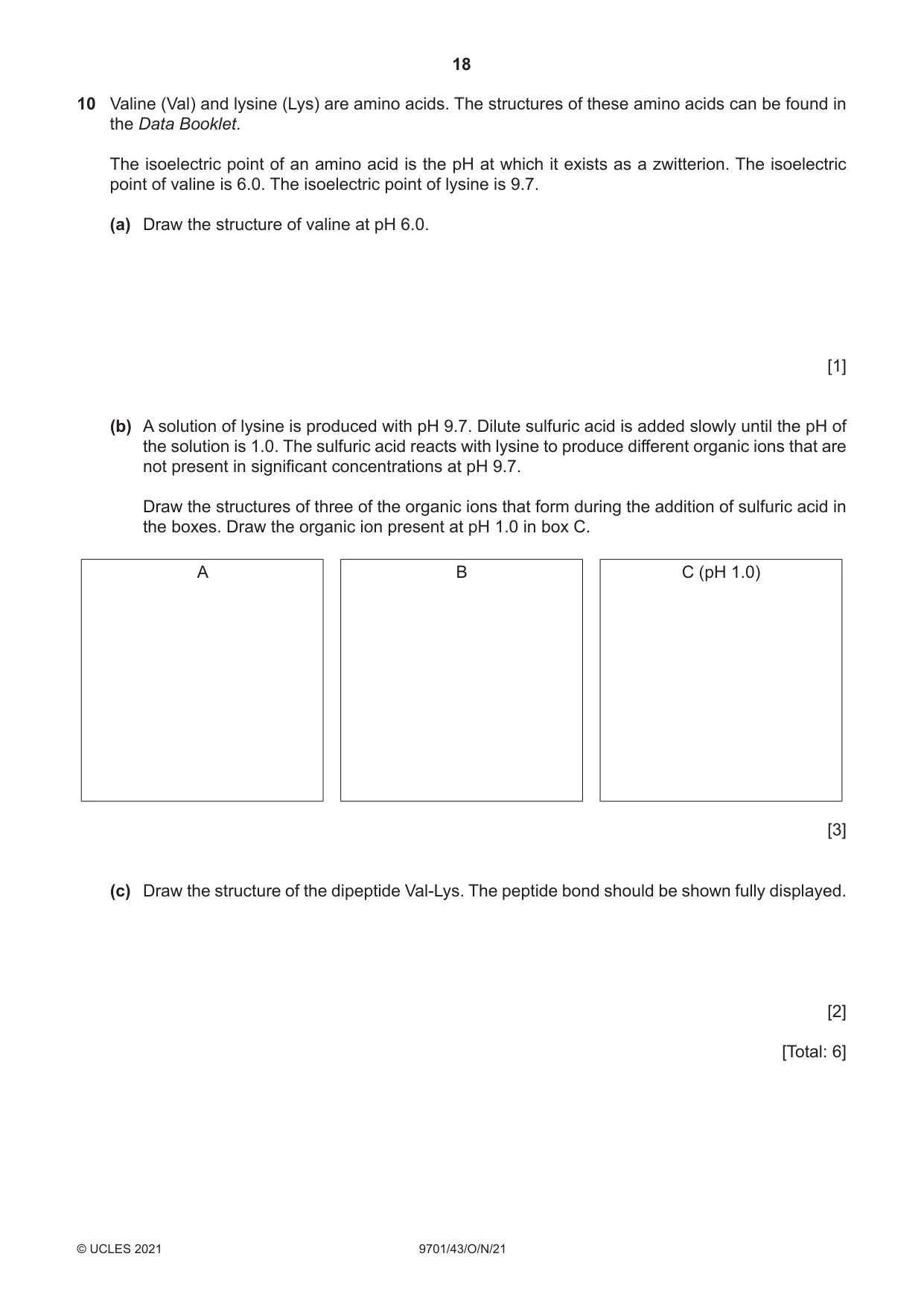
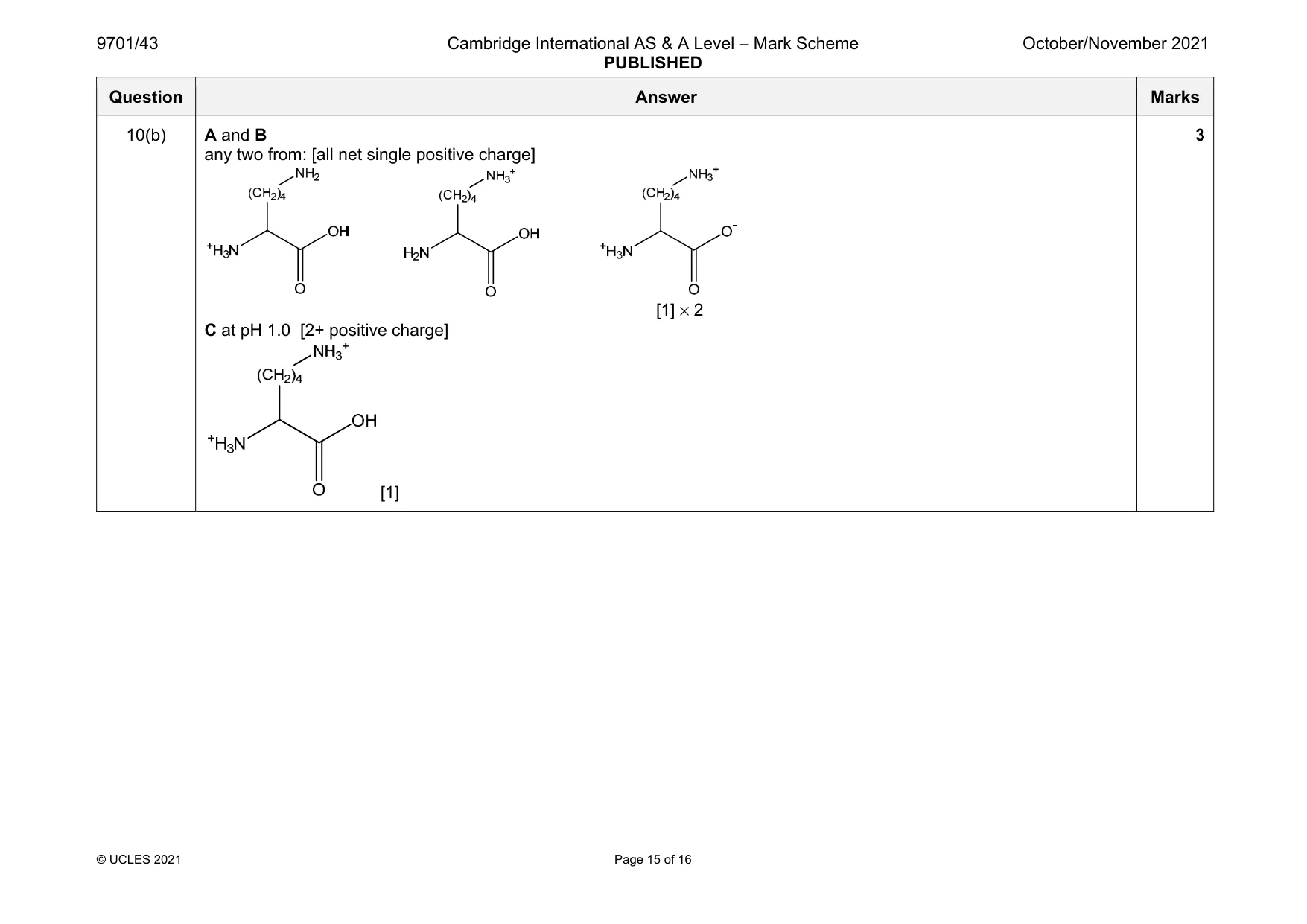
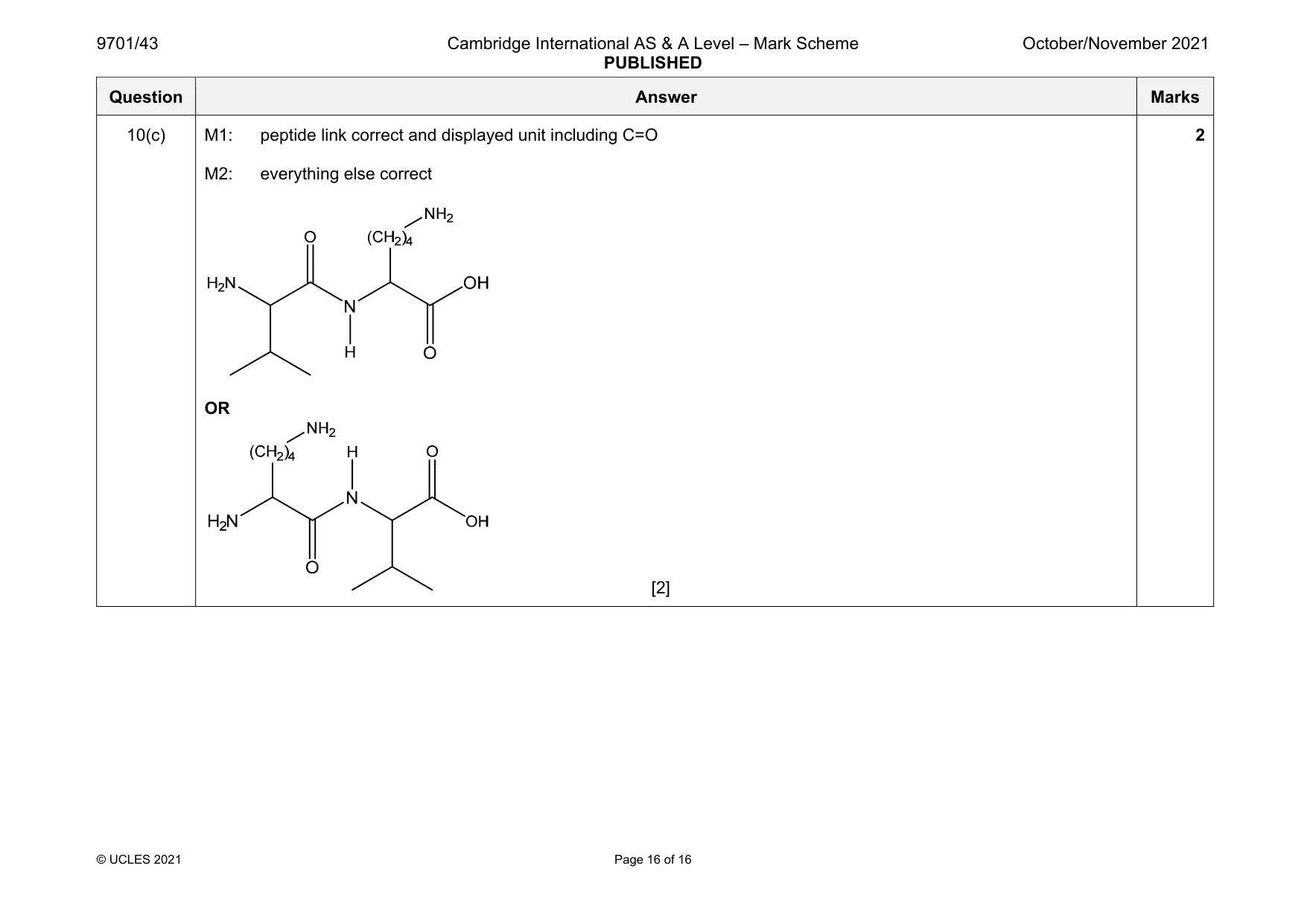
10 Valine (Val) and lysine (Lys) are amino acids. The structures of these amino acids can be found in the Data Booklet. The isoelectric point of an amino acid is the pH at which it exists as a zwitterion. The isoelectric point of valine is 6.0. The isoelectric point of lysine is 9.7. (a) Draw the structure of valine at pH 6.0. [1] (b) A solution of lysine is produced with pH 9.7. Dilute sulfuric acid is added slowly until the pH of the solution is 1.0. The sulfuric acid reacts with lysine to produce different organic ions that are not present in significant concentrations at pH 9.7. Draw the structures of three of the organic ions that form during the addition of sulfuric acid in the boxes. Draw the organic ion present at pH 1.0 in box C. A B C (pH 1.0) [3] (c) Draw the structure of the dipeptide Val-Lys. The peptide bond should be shown fully displayed. [2] [Total: 6]
Mark scheme: 10(a) [1] 1 Question Answer Marks 10(b) A and B any two from: [all net single positive charge] [1] × 2 C at pH 1.0 [2+ positive charge] [1] 3 Question Answer Marks 10(c) M1: peptide link correct and displayed unit including C=O M2: everything else correct OR [2] 2
What was in this paper
The subtopics covered by these 10 questions, and how many questions each got. Open one in a new tab to see every Cambridge question on it.
2Acids and bases1Amino acids1Colour of complexes1General characteristic chemical properties of the first set of transition elements, titanium to copper1Gibbs free energy change, ΔG1Lattice energy and Born-Haber cycles1Phenylamine and azo compounds1Similarities and trends in the properties of the Group 2 metals, magnesium to barium, and their compounds1What you needed in this session
Cambridge’s own grade thresholds for 2021 Oct/Nov, Paper 4 · Variant 3. A higher threshold means an easier paper — the bar moves with how the cohort did.