Cambridge A Level Chemistry 9701 — 2021 Oct/Nov Paper 3 · Variant 1
9701/31/O/N/21 · 3 questions · 40 marks · ≈45 min
The question paper and its mark scheme, free to read here and free to download. This is Cambridge’s own paper, exactly as it was sat.
Question paper12 pages
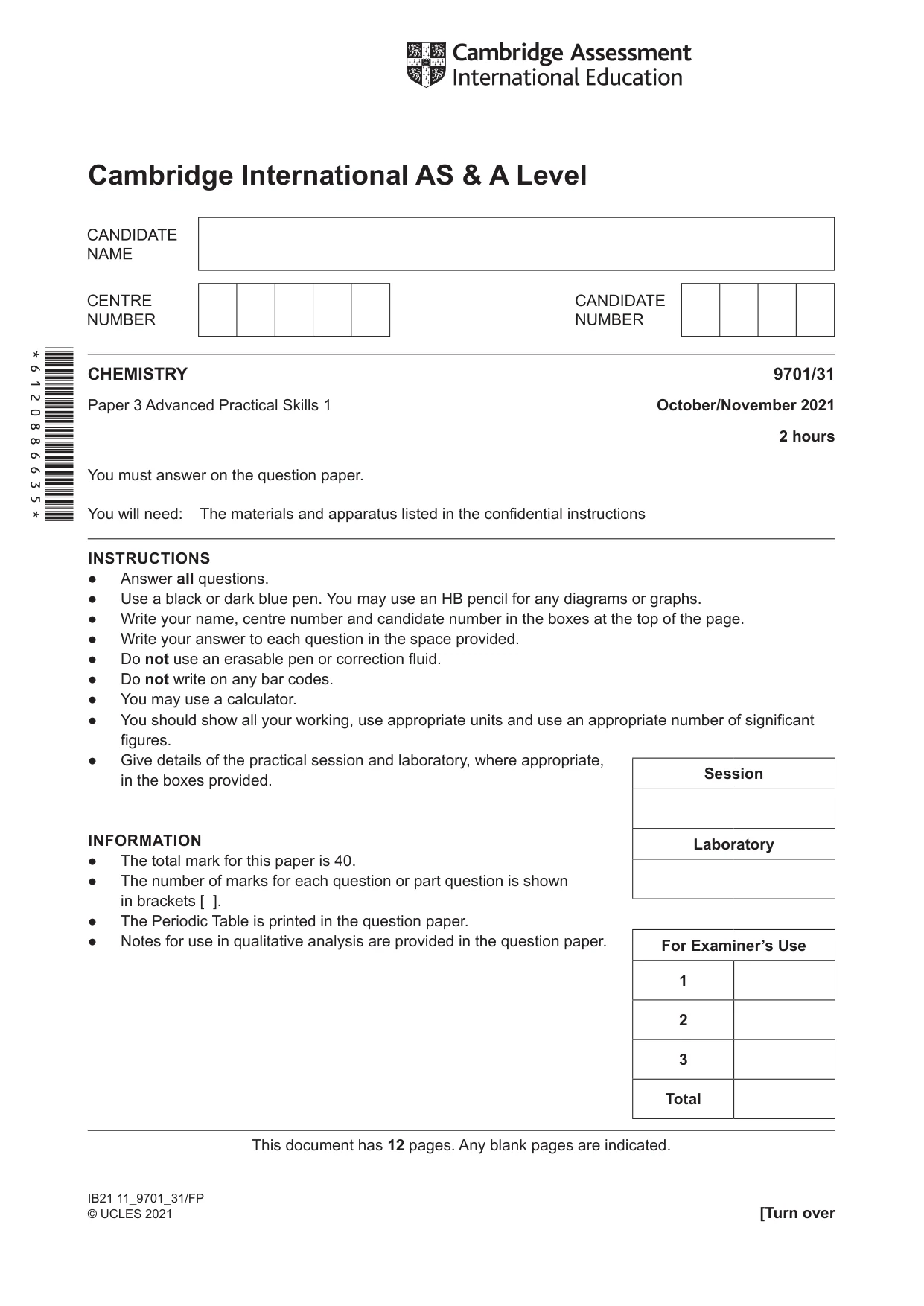
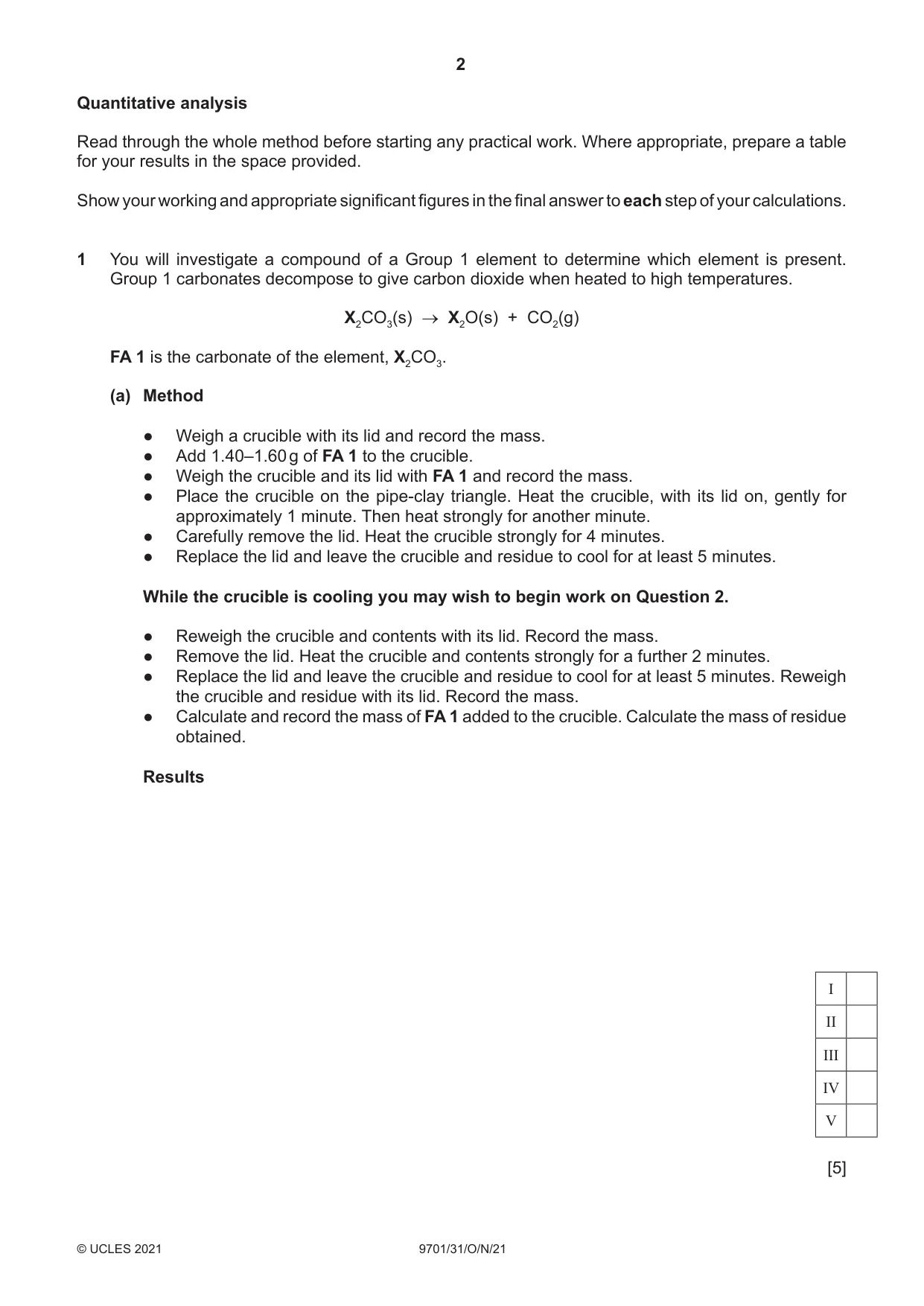
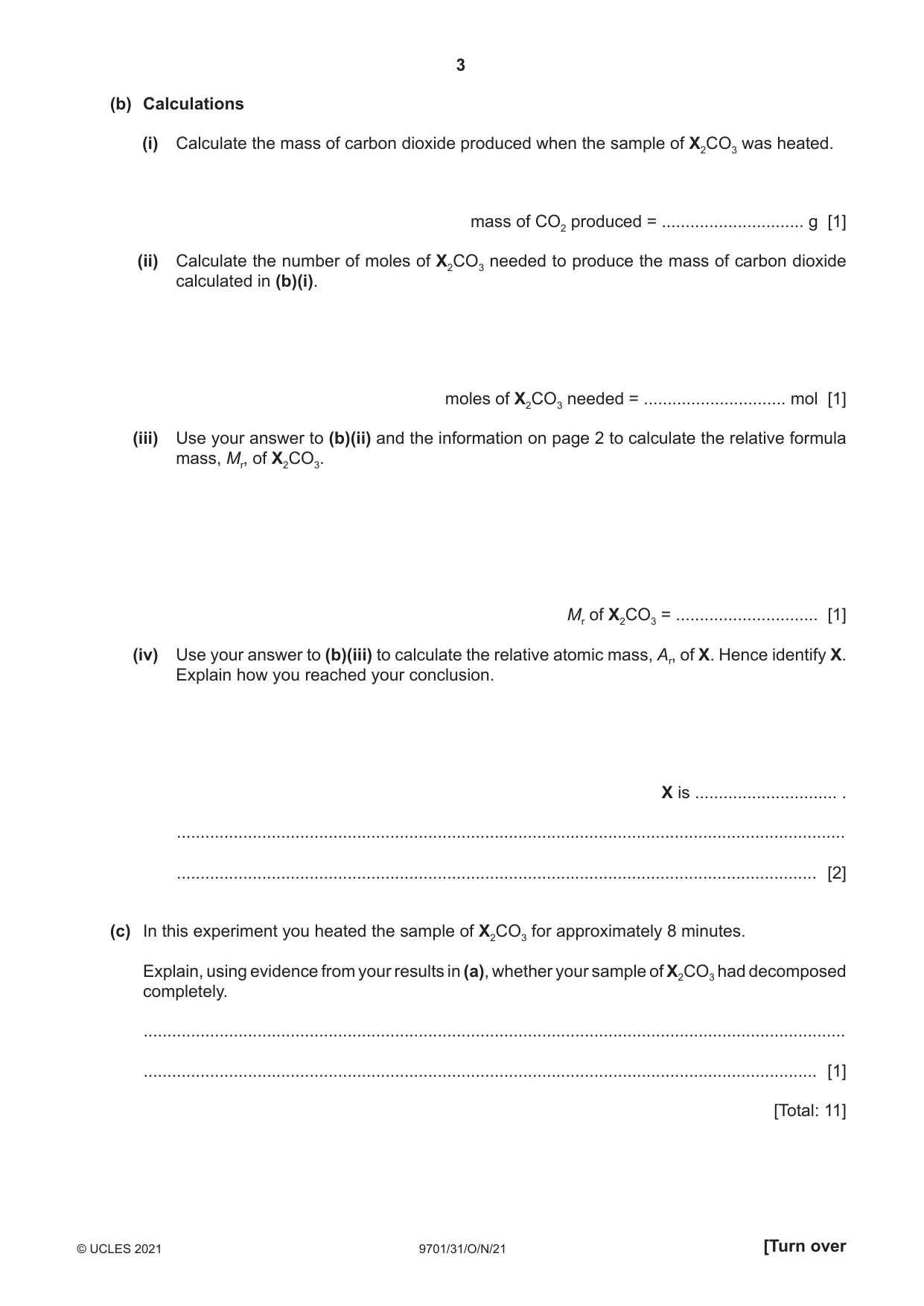
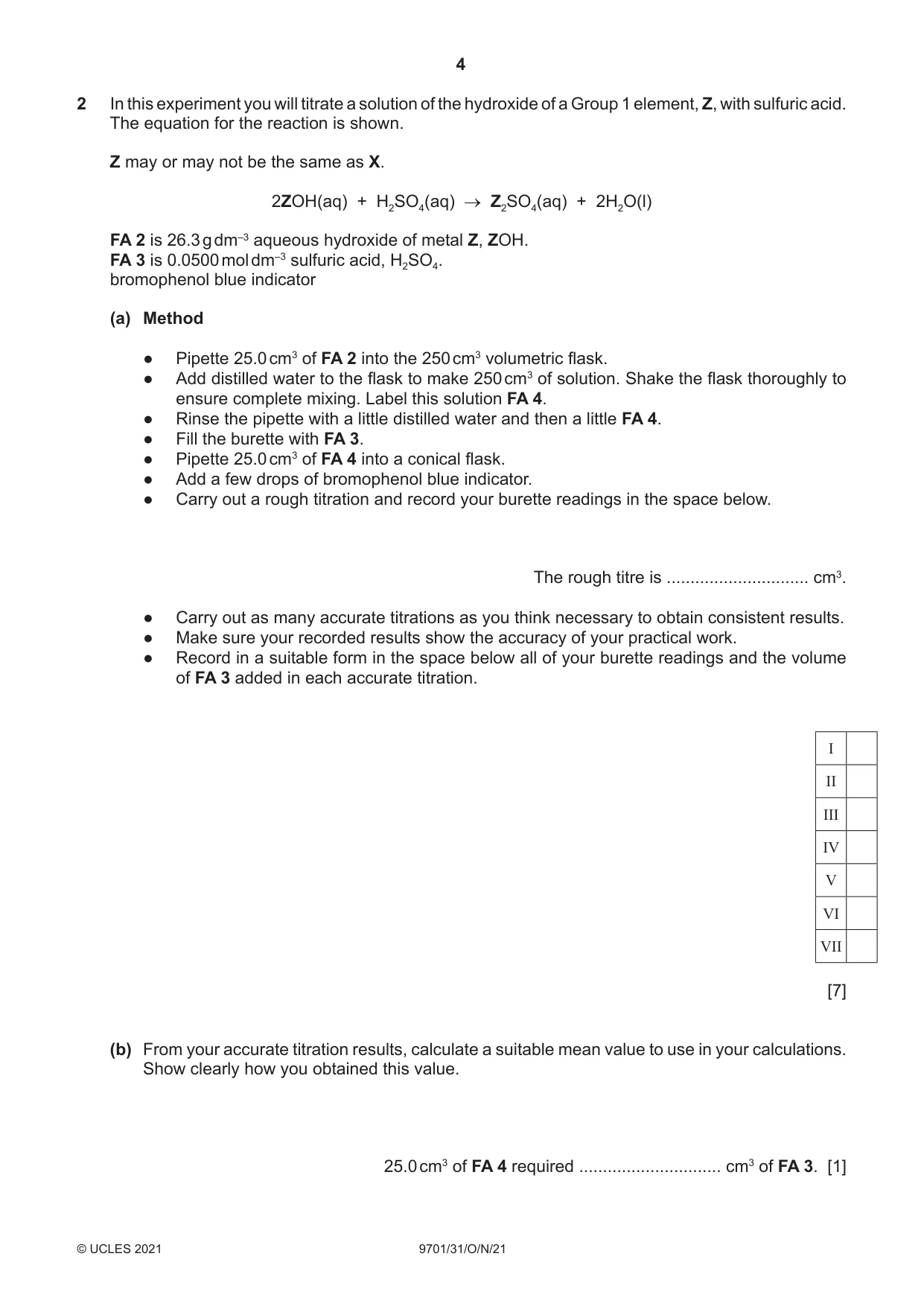

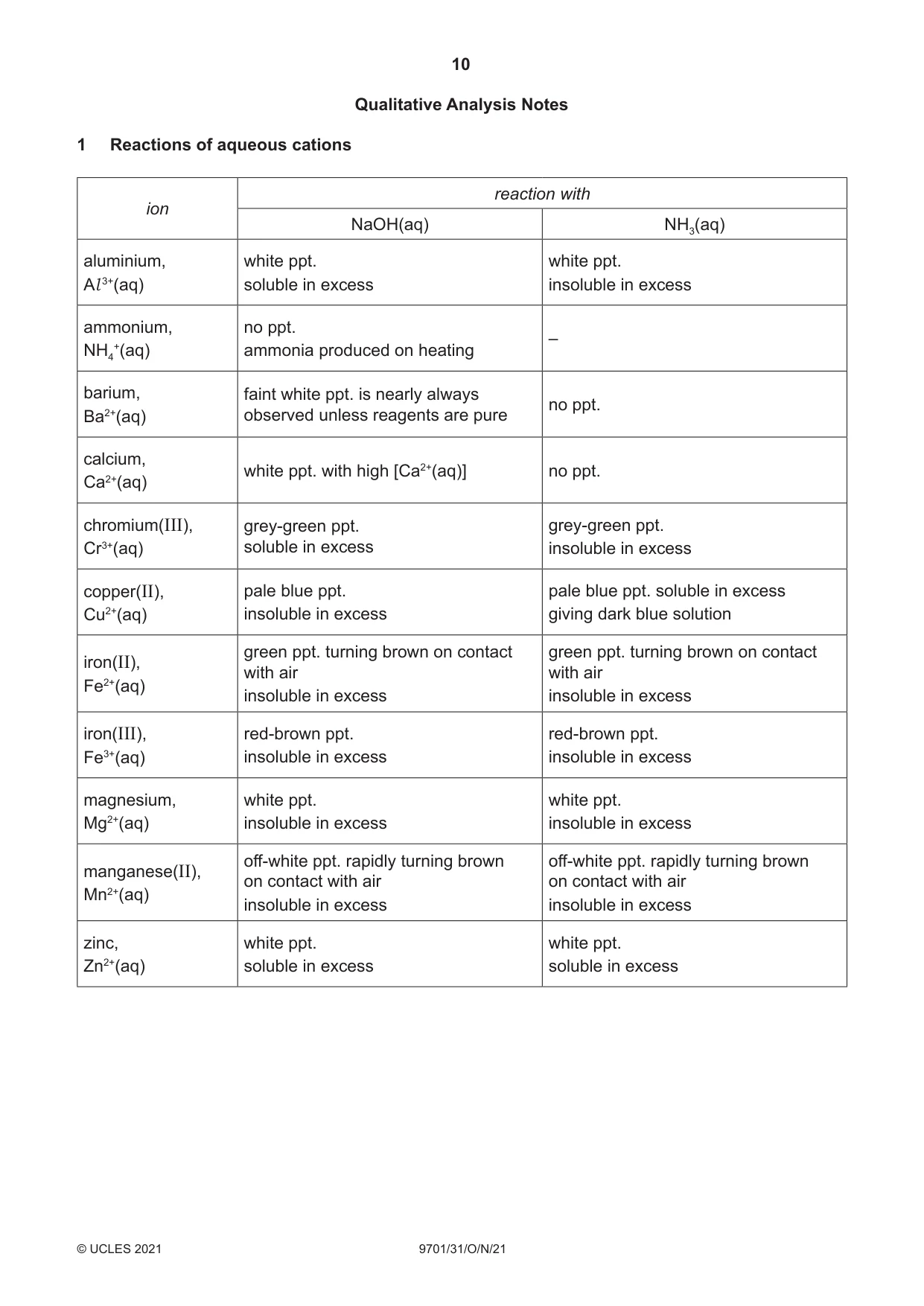
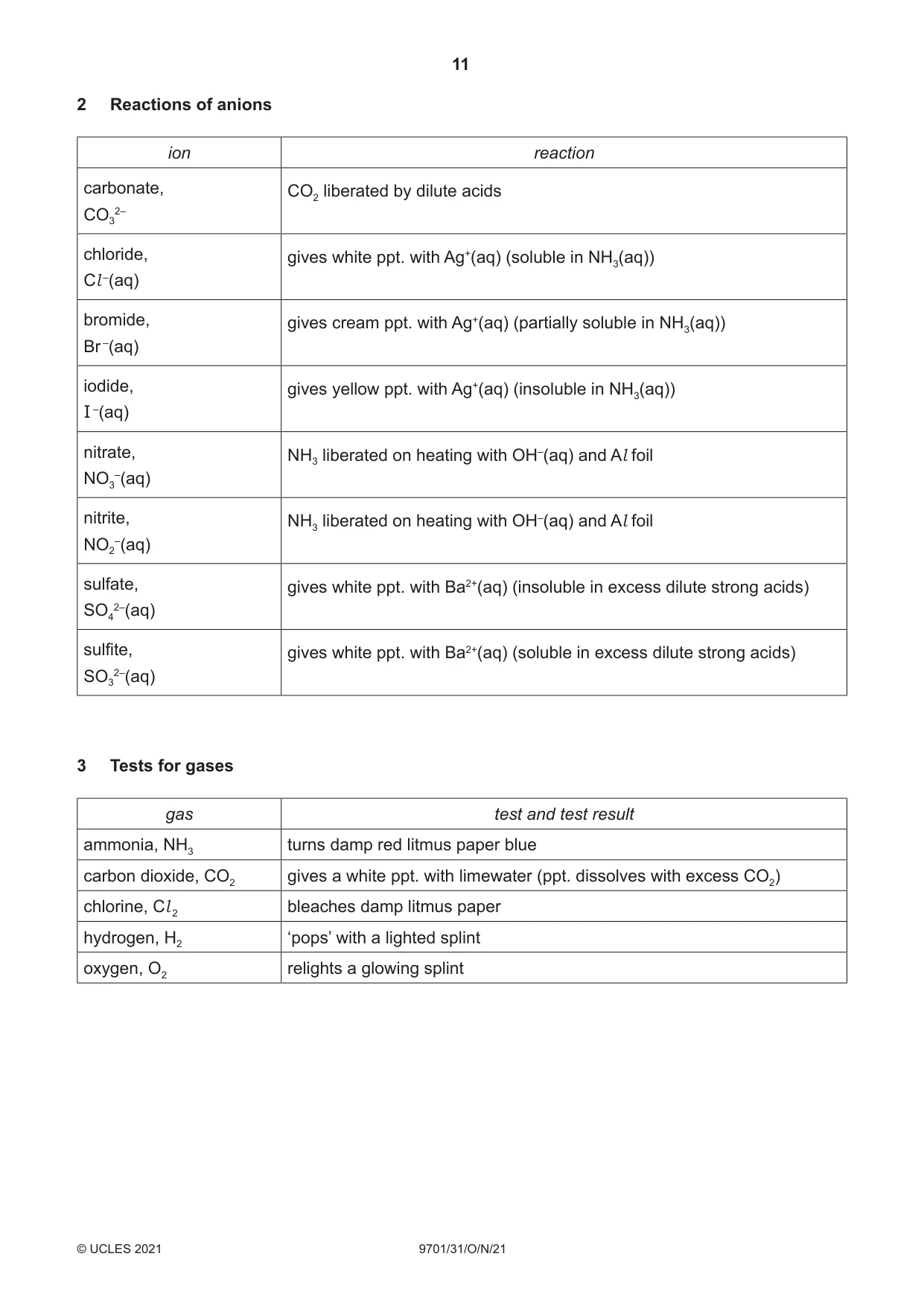
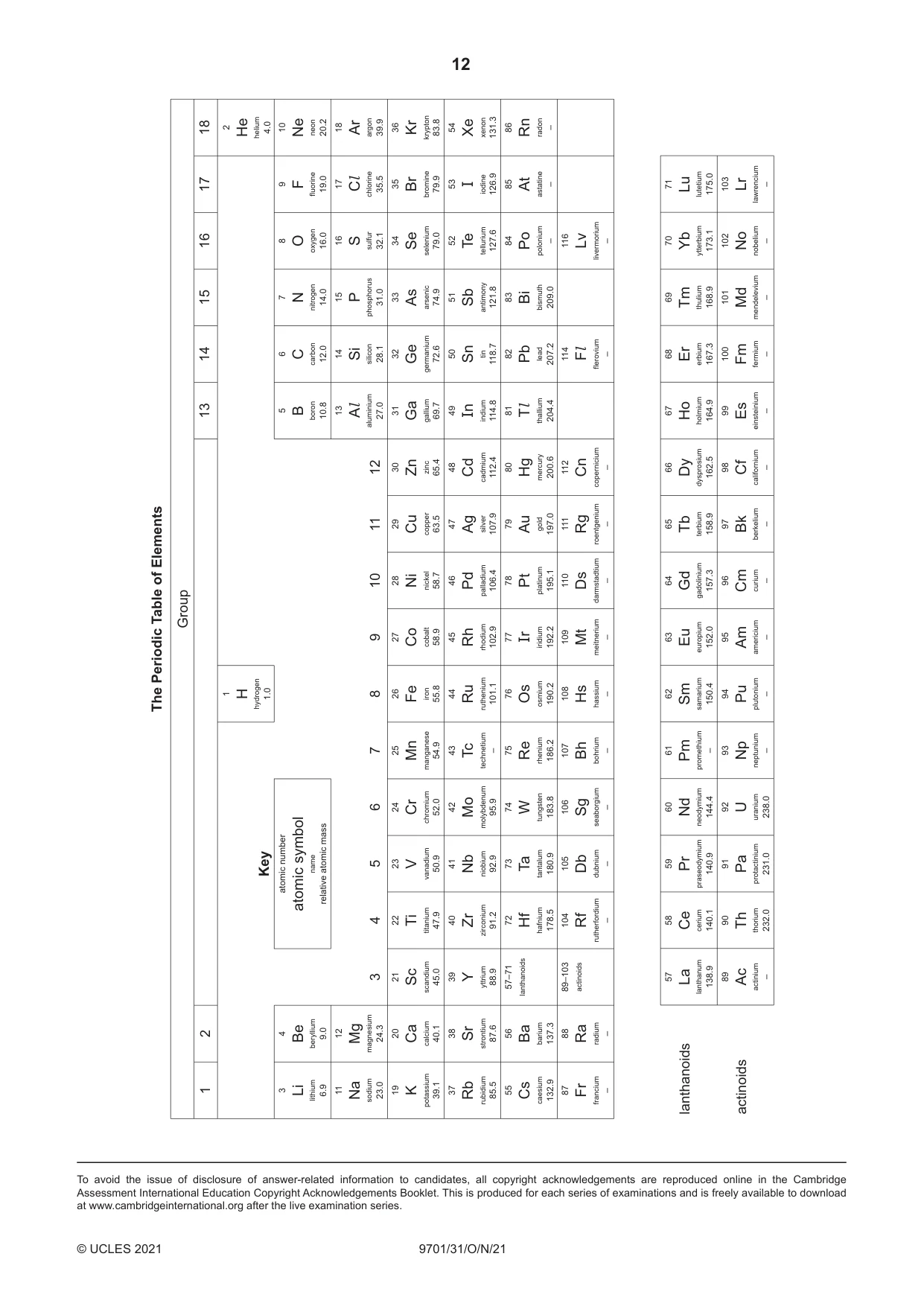
Mark scheme10 pages
Answers below. Sit the paper first if you are practising.
Questions as text
Q1 · You will investigate a compound of a Group 1 element to determine which element is present
1 You will investigate a compound of a Group 1 element to determine which element is present. Group 1 carbonates decompose to give carbon dioxide when heated to high temperatures. X2CO3(s) → X2O(s) + CO2(g) FA 1 is the carbonate of the element, X2CO3. (a) Method ● Weigh a crucible with its lid and record the mass. ● Add 1.40–1.60 g of FA 1 to the crucible. ● Weigh the crucible and its lid with FA 1 and record the mass. ● Place the crucible on the pipe-clay triangle. Heat the crucible, with its lid on, gently for approximately 1 minute. Then heat strongly for another minute. ● Carefully remove the lid. Heat the crucible strongly for 4 minutes. ● Replace the lid and leave the crucible and residue to cool for at least 5 minutes. While the crucible is cooling you may wish to begin work on Question 2. ● Reweigh the crucible and contents with its lid. Record the mass. ● Remove the lid. Heat the crucible and contents strongly for a further 2 minutes. ● Replace the lid and leave the crucible and residue to cool for at least 5 minutes. Reweigh the crucible and residue with its lid. Record the mass. ● Calculate and record the mass of FA 1 added to the crucible. Calculate the mass of residue obtained. Results I II III IV V [5] (b) Calculations (i) Calculate the mass of carbon dioxide produced when the sample of X2CO3 was heated. mass of CO2 produced = .............................. g [1] (ii) Calculate the number of moles of X2CO3 needed to produce the mass of carbon dioxide calculated in (b)(i). moles of X2CO3 needed = .............................. mol [1] (iii) Use your answer to (b)(ii) and the information on page 2 to calculate the relative formula mass, Mr, of X2CO3. Mr of X2CO3 = .............................. [1] (iv) Use your answer to (b)(iii) to calculate the relative atomic mass, Ar, of X. Hence identify X. Explain how you reached your conclusion. X is .............................. . ............................................................................................................................................. ....................................................................................................................................... [2] (c) In this experiment you heated the sample of X2CO3 for approximately 8 minutes. Explain, using evidence from your results in (a), whether your sample of X2CO3 had decomposed completely. .................................................................................................................................................... .............................................................................................................................................. [1] [Total: 11]
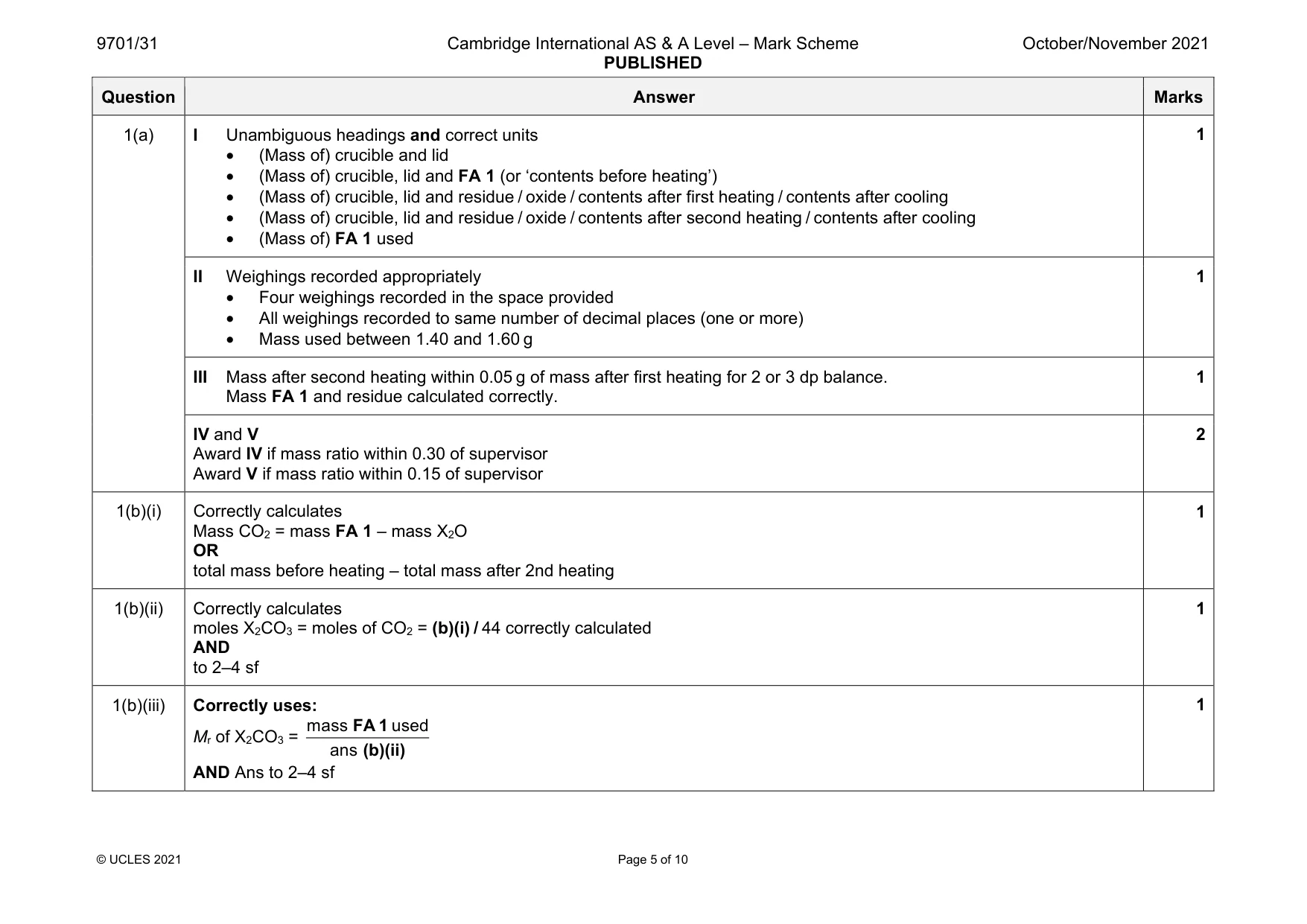
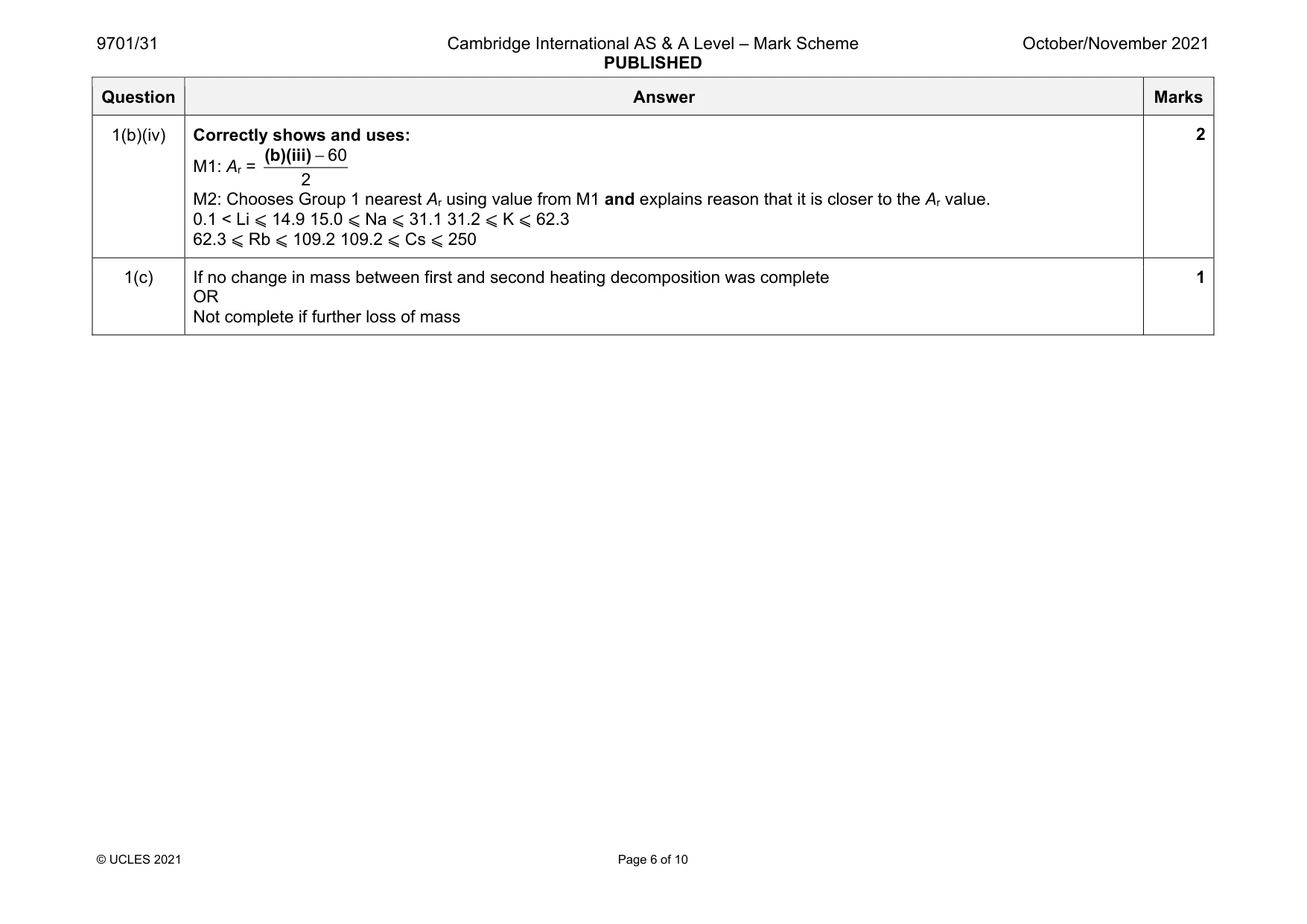
Mark scheme: 1(a) I Unambiguous headings and correct units • (Mass of) crucible and lid • (Mass of) crucible, lid and FA 1 (or ‘contents before heating’) • (Mass of) crucible, lid and residue / oxide / contents after first heating / contents after cooling • (Mass of) crucible, lid and residue / oxide / contents after second heating / contents after cooling • (Mass of) FA 1 used II Weighings recorded appropriately • Four weighings recorded in the space provided • All weighings recorded to same number of decimal places (one or more) • Mass used between 1.40 and 1.60 g 1 III Mass after second heating within 0.05 g of mass after first heating for 2 or 3 dp balance. Mass FA 1 and residue calculated correctly. 1 IV and V Award IV if mass ratio within 0.30 of supervisor Award V if mass ratio within 0.15 of supervisor 2 1(b)(i) Correctly calculates Mass CO2 = mass FA 1 – mass X2O OR total mass before heating – total mass after 2nd heating 1 1(b)(ii) Correctly calculates moles X2CO3 = moles of CO2 = (b)(i) / 44 correctly calculated AND to 2–4 sf 1 1(b)(iii) Correctly uses: Mr of X2CO3 = mass used ans FA 1 (b)(ii) AND Ans to 2–4 sf 1 Question Answer Marks 1(b)(iv) Correctly shows and uses: M1: Ar = −60 2 (b)(iii) M2: Chooses Group 1 nearest Ar using value from M1 and explains reason that it is closer to the Ar value. 0.1 < Li ⩽ 14.9 15.0 ⩽ Na ⩽ 31.1 31.2 ⩽ K ⩽ 62.3 62.3 ⩽ Rb ⩽ 109.2 109.2 ⩽ Cs ⩽ 250 2 1(c) If no change in mass between first and second heating decomposition was complete OR Not complete if further loss of mass 1
More questions on Reacting masses and volumes (of solutions and gases)
Q2 · In this experiment you will titrate a solution of the hydroxide of a Group 1 element, Z…
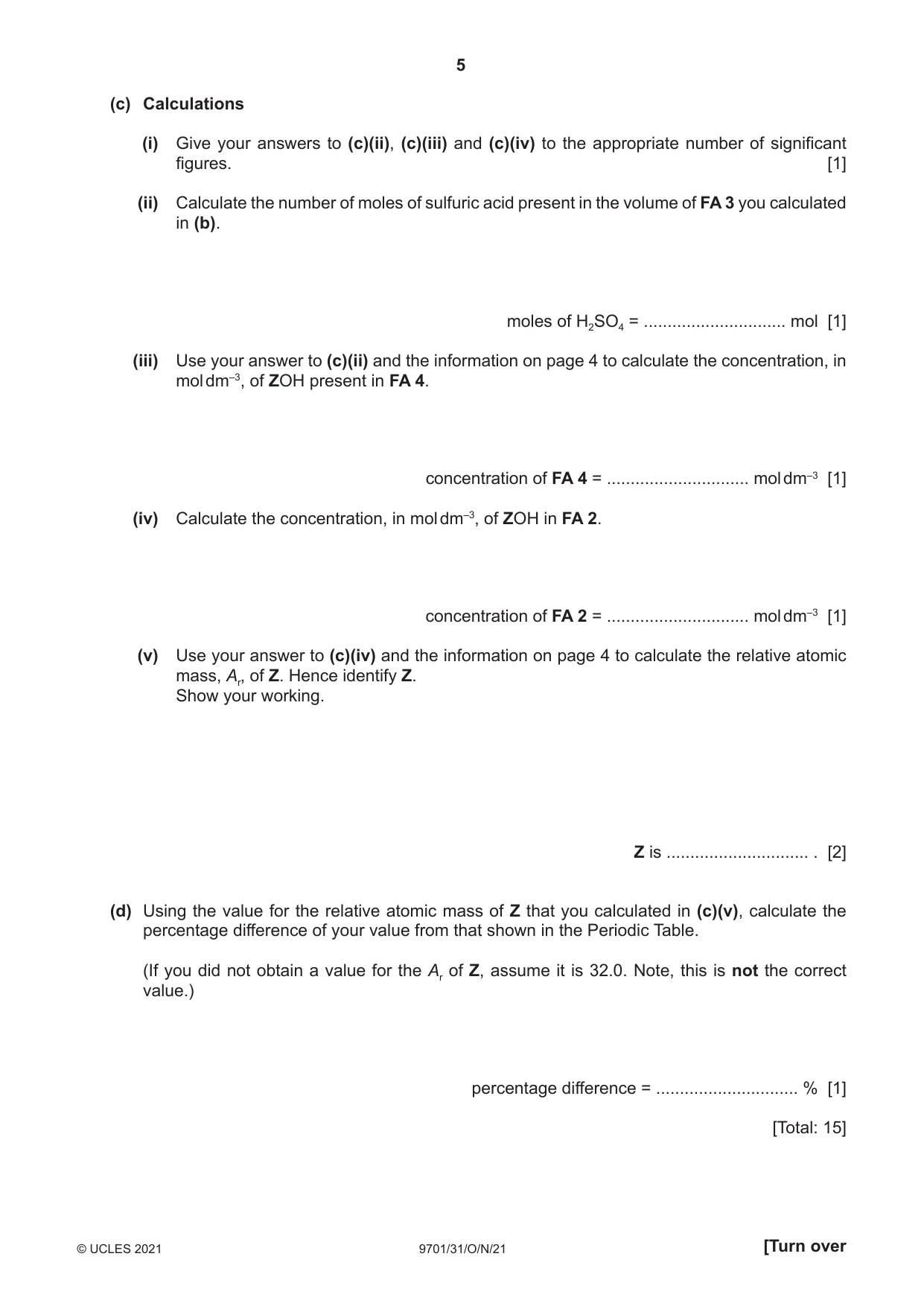
2 In this experiment you will titrate a solution of the hydroxide of a Group 1 element, Z, with sulfuric acid. The equation for the reaction is shown. Z may or may not be the same as X. 2ZOH(aq) + H2SO4(aq) → Z2SO4(aq) + 2H2O(l) FA 2 is 26.3 g dm–3 aqueous hydroxide of metal Z, ZOH. FA 3 is 0.0500 mol dm–3 sulfuric acid, H2SO4. bromophenol blue indicator (a) Method ● Pipette 25.0 cm3 of FA 2 into the 250 cm3 volumetric flask. ● Add distilled water to the flask to make 250 cm3 of solution. Shake the flask thoroughly to ensure complete mixing. Label this solution FA 4. ● Rinse the pipette with a little distilled water and then a little FA 4. ● Fill the burette with FA 3. ● Pipette 25.0 cm3 of FA 4 into a conical flask. ● Add a few drops of bromophenol blue indicator. ● Carry out a rough titration and record your burette readings in the space below. The rough titre is .............................. cm3. ● Carry out as many accurate titrations as you think necessary to obtain consistent results. ● Make sure your recorded results show the accuracy of your practical work. ● Record in a suitable form in the space below all of your burette readings and the volume of FA 3 added in each accurate titration. I II III IV V VI VII [7] (b) From your accurate titration results, calculate a suitable mean value to use in your calculations. Show clearly how you obtained this value. 25.0 cm3 of FA 4 required .............................. cm3 of FA 3. [1] (c) Calculations (i) Give your answers to (c)(ii), (c)(iii) and (c)(iv) to the appropriate number of significant figures. [1] (ii) Calculate the number of moles of sulfuric acid present in the volume of FA 3 you calculated in (b). moles of H2SO4 = .............................. mol [1] (iii) Use your answer to (c)(ii) and the information on page 4 to calculate the concentration, in mol dm–3, of ZOH present in FA 4. concentration of FA 4 = .............................. mol dm–3 [1] (iv) Calculate the concentration, in mol dm–3, of ZOH in FA 2. concentration of FA 2 = .............................. mol dm–3 [1] (v) Use your answer to (c)(iv) and the information on page 4 to calculate the relative atomic mass, Ar, of Z. Hence identify Z. Show your working. Z is .............................. . [2] (d) Using the value for the relative atomic mass of Z that you calculated in (c)(v), calculate the percentage difference of your value from that shown in the Periodic Table. (If you did not obtain a value for the Ar of Z, assume it is 32.0. Note, this is not the correct value.) percentage difference = .............................. % [1] [Total: 15] Qualitative analysis Where reagents are selected for use in a test, the name or correct formula of the element or compound must be given. At each stage of any test you are to record details of the following: ● colour changes seen ● the formation of any precipitate and its solubility in an excess of the reagent added ● the formation of any gas and its identification by a suitable test. You should indicate clearly at what stage in a test a change occurs. If any solution is warmed, a boiling tube must be used. Rinse and reuse test-tubes and boiling tubes where possible. No additional tests for ions present should be attempted.
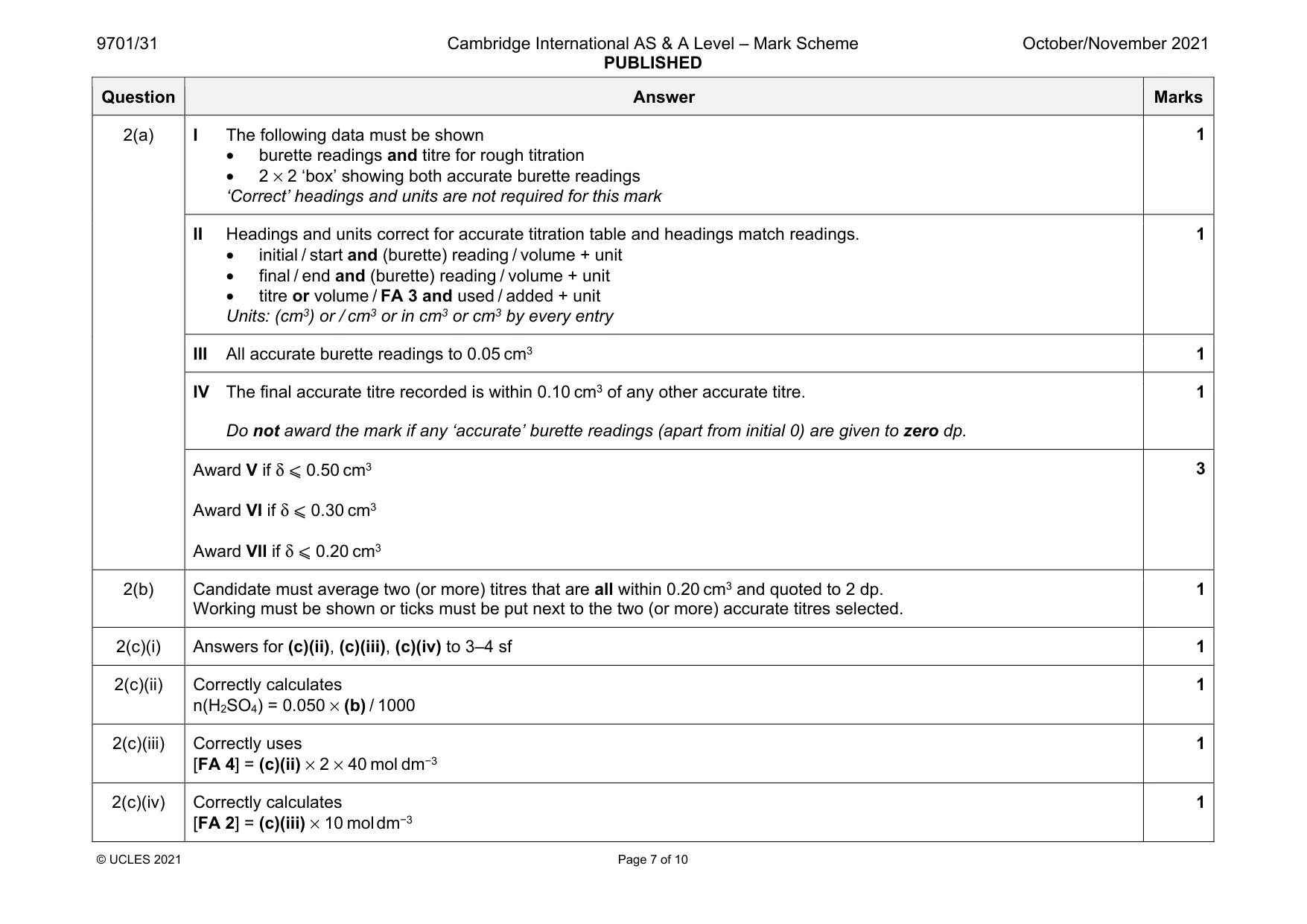
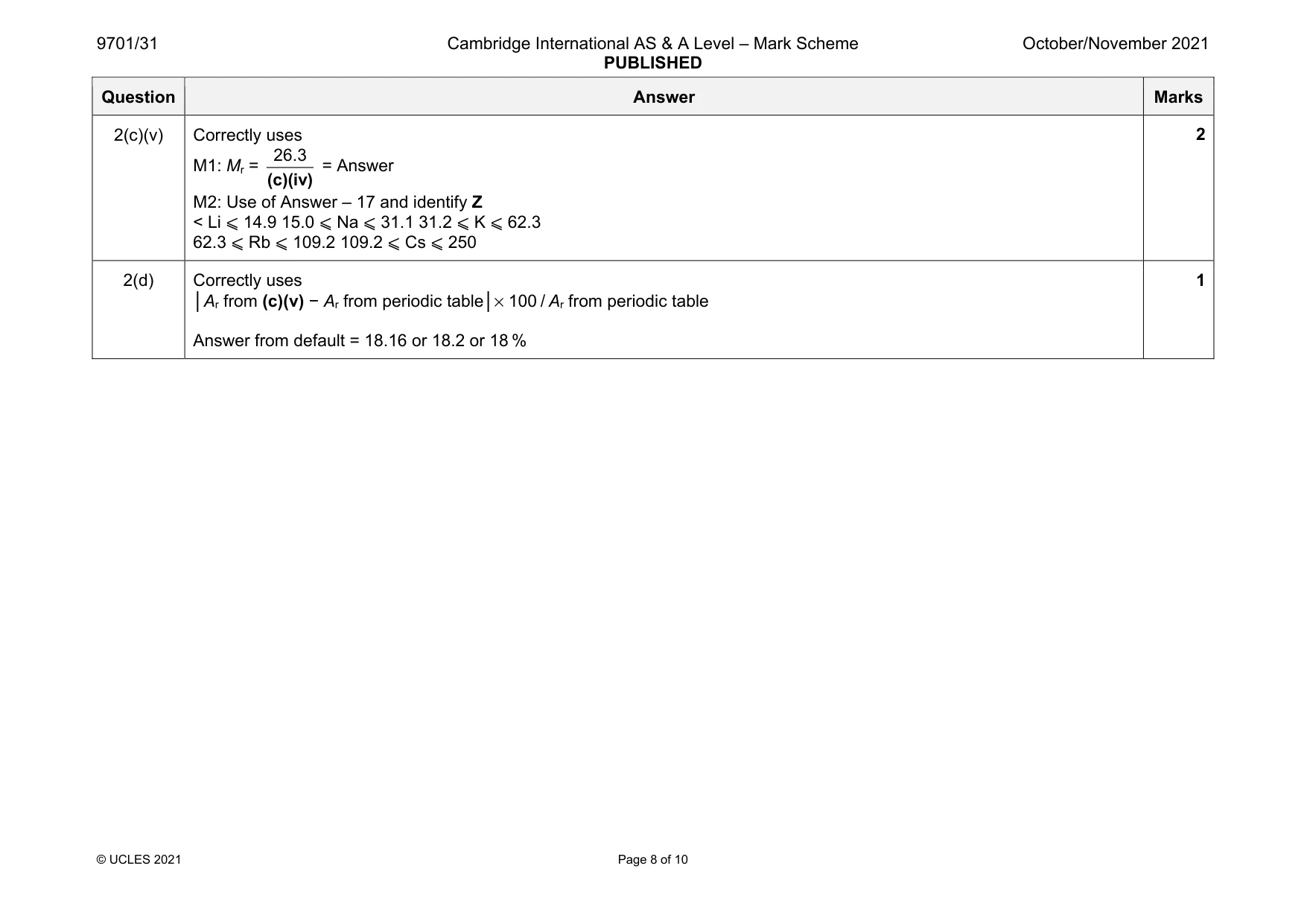
Mark scheme: 2(a) I The following data must be shown • burette readings and titre for rough titration • 2 × 2 ‘box’ showing both accurate burette readings ‘Correct’ headings and units are not required for this mark II Headings and units correct for accurate titration table and headings match readings. • initial / start and (burette) reading / volume + unit • final / end and (burette) reading / volume + unit • titre or volume / FA 3 and used / added + unit Units: (cm3) or / cm3 or in cm3 or cm3 by every entry 1 III All accurate burette readings to 0.05 cm3 1 IV The final accurate titre recorded is within 0.10 cm3 of any other accurate titre. Do not award the mark if any ‘accurate’ burette readings (apart from initial 0) are given to zero dp. 1 Award V if δ ⩽ 0.50 cm3 Award VI if δ ⩽ 0.30 cm3 Award VII if δ ⩽ 0.20 cm3 3 2(b) Candidate must average two (or more) titres that are all within 0.20 cm3 and quoted to 2 dp. Working must be shown or ticks must be put next to the two (or more) accurate titres selected. 1 2(c)(i) Answers for (c)(ii), (c)(iii), (c)(iv) to 3–4 sf 1 2(c)(ii) Correctly calculates n(H2SO4) = 0.050 × (b) / 1000 1 2(c)(iii) Correctly uses [FA 4] = (c)(ii) × 2 × 40 mol dm−3 1 2(c)(iv) Correctly calculates [FA 2] = (c)(iii) × 10 moldm−3 1 Question Answer Marks 2(c)(v) Correctly uses M1: Mr = 26.3 (c)(iv) = Answer M2: Use of Answer – 17 and identify Z < Li ⩽ 14.9 15.0 ⩽ Na ⩽ 31.1 31.2 ⩽ K ⩽ 62.3 62.3 ⩽ Rb ⩽ 109.2 109.2 ⩽ Cs ⩽ 250 2 2(d) Correctly uses │Ar from (c)(v) − Ar from periodic table│× 100 / Ar from periodic table Answer from default = 18.16 or 18.2 or 18 % 1
More questions on Reacting masses and volumes (of solutions and gases)
Q3 · Half-fill the 250 cm3 beaker with water and place it on a tripod and gauze above a…
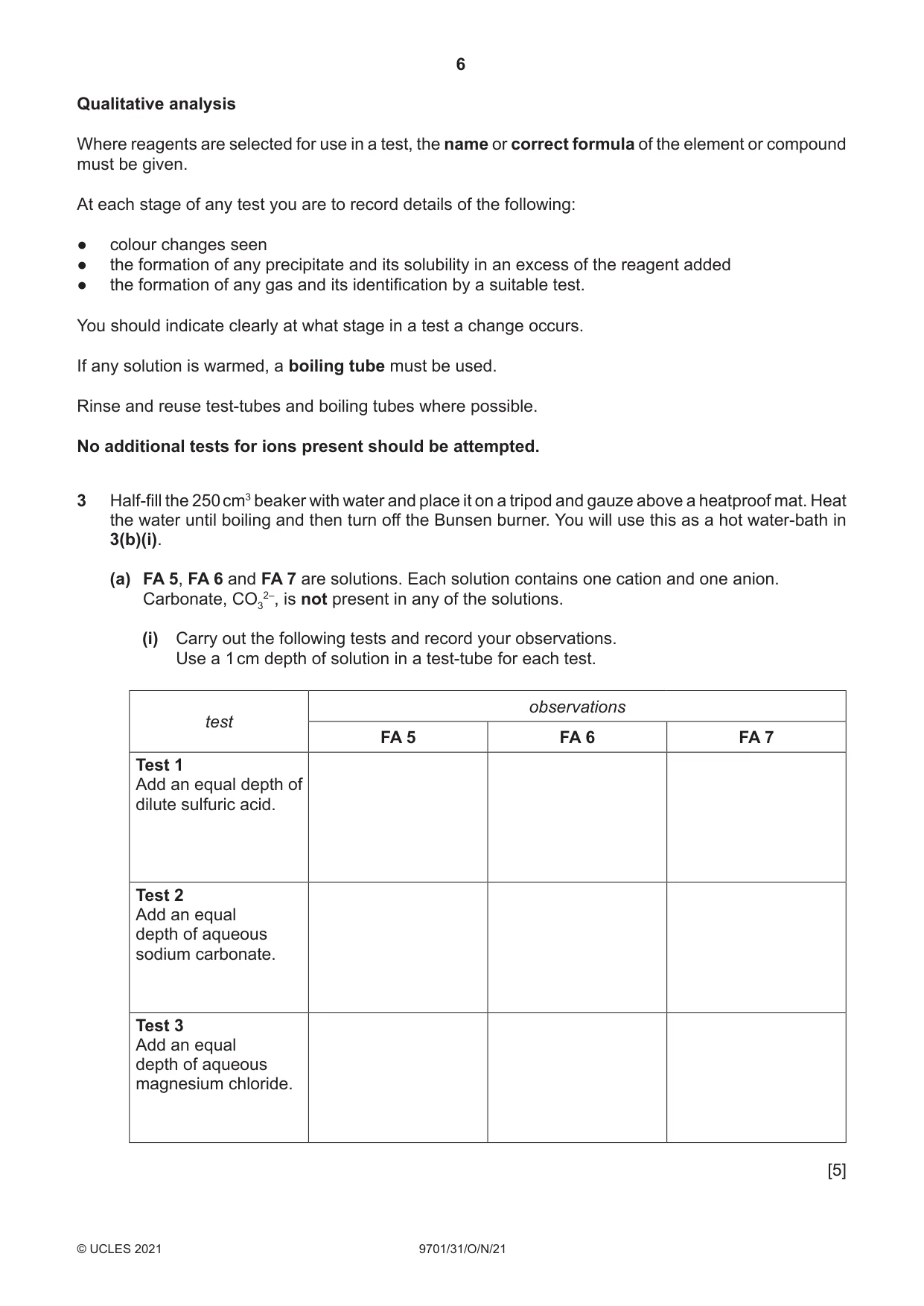
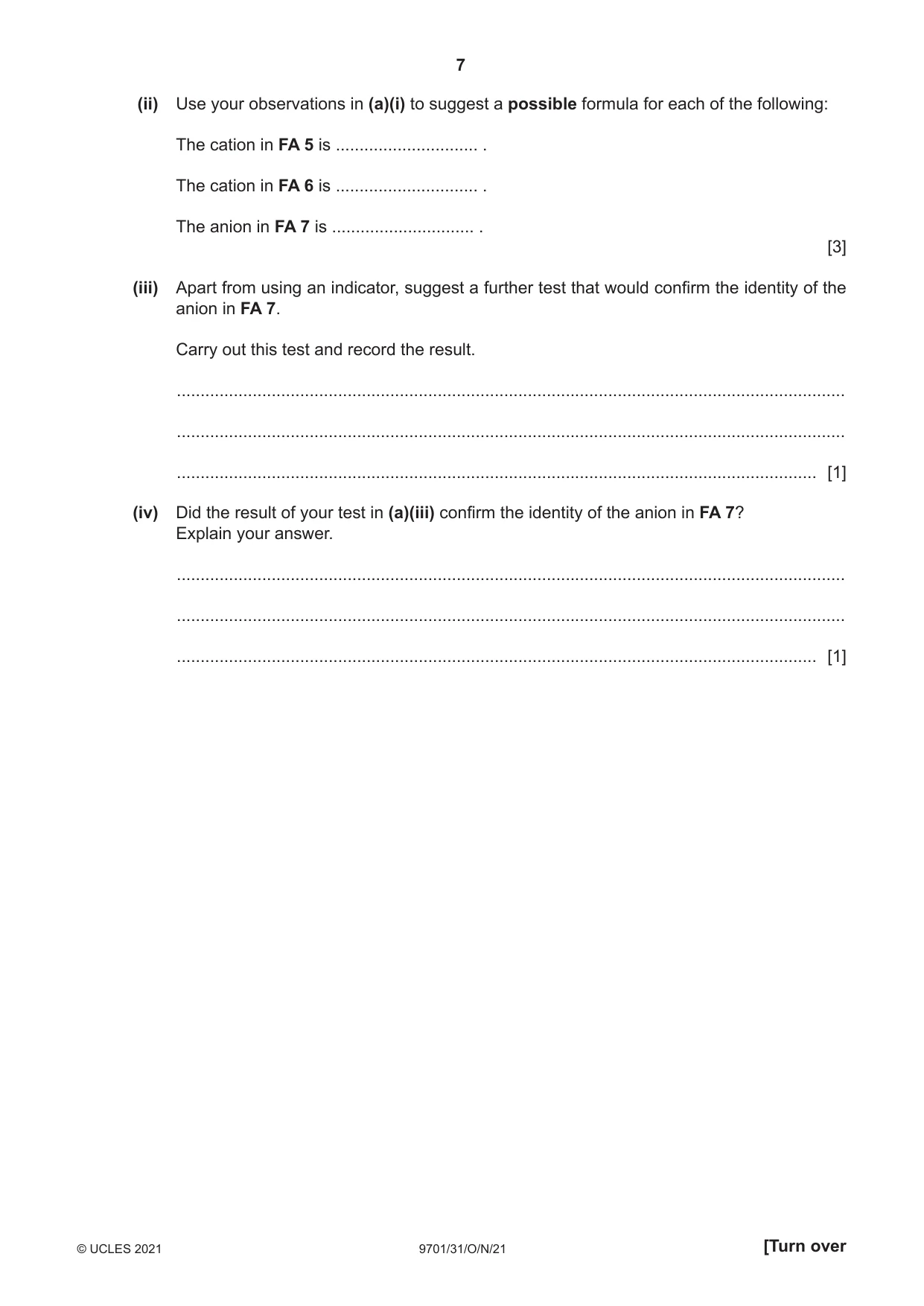
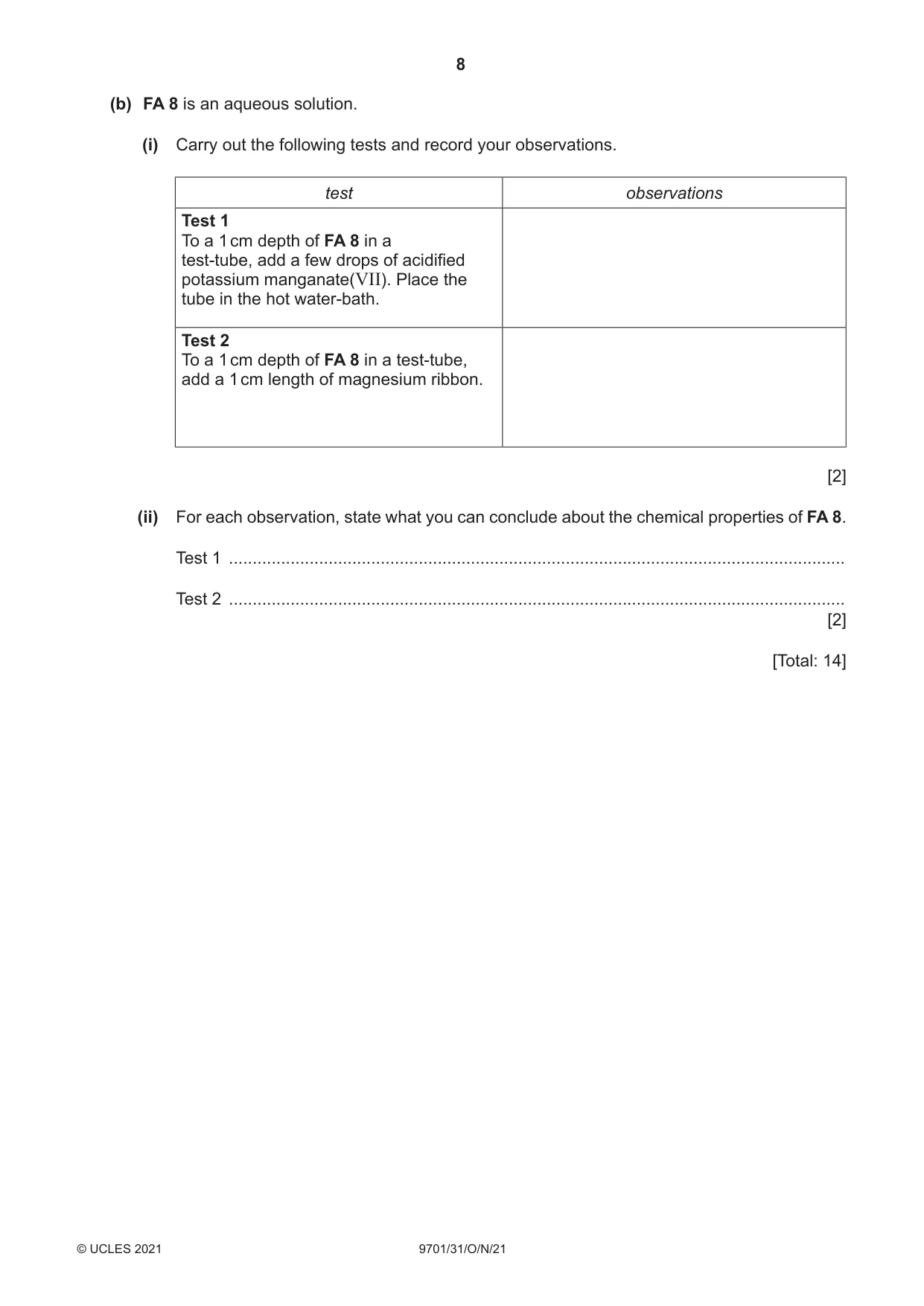
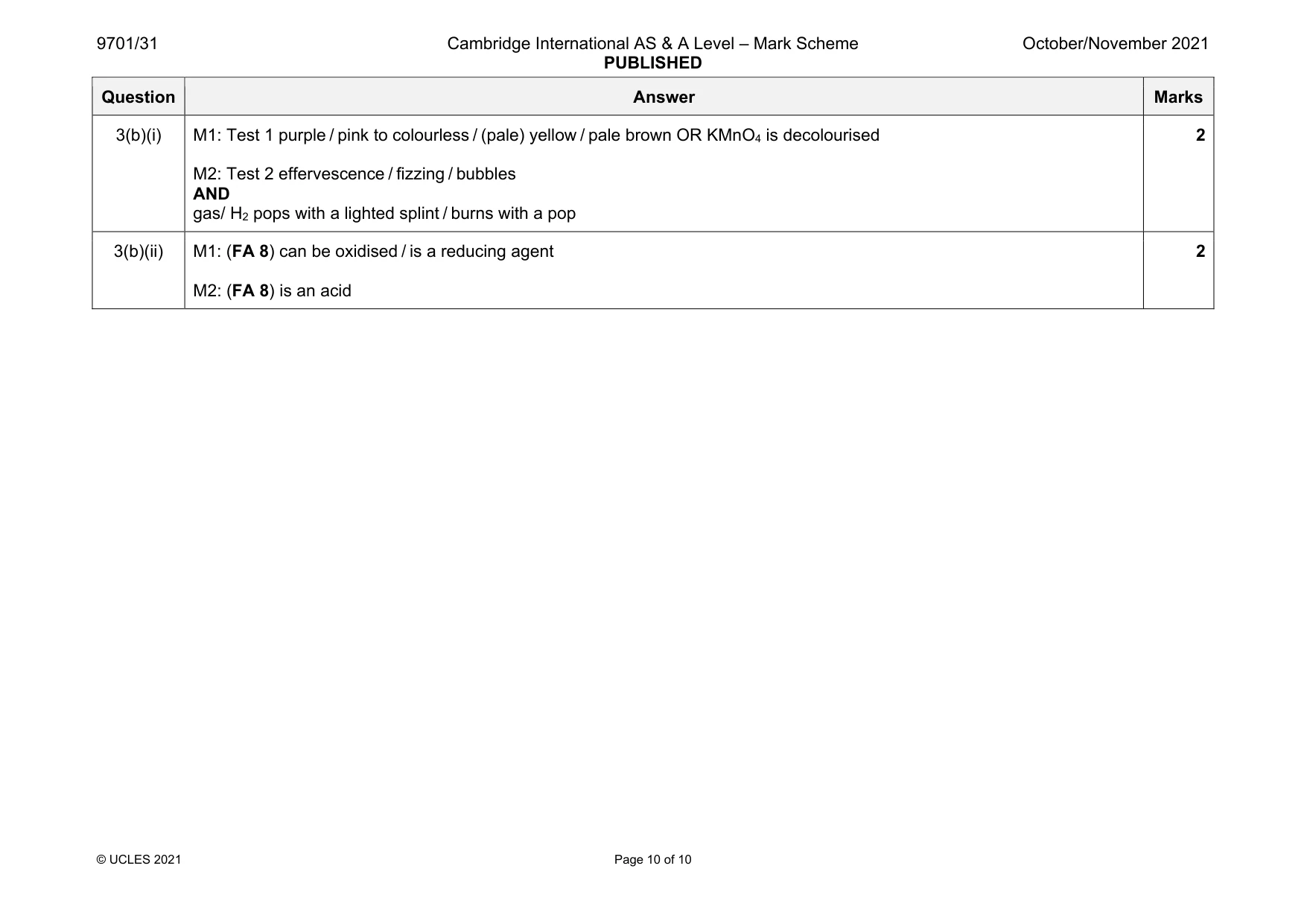
3 Half-fill the 250 cm3 beaker with water and place it on a tripod and gauze above a heatproof mat. Heat the water until boiling and then turn off the Bunsen burner. You will use this as a hot water‑bath in 3(b)(i). (a) FA 5, FA 6 and FA 7 are solutions. Each solution contains one cation and one anion. Carbonate, CO32–, is not present in any of the solutions. (i) Carry out the following tests and record your observations. Use a 1 cm depth of solution in a test-tube for each test. observations test FA 5 FA 6 FA 7 Test 1 Add an equal depth of dilute sulfuric acid. Test 2 Add an equal depth of aqueous sodium carbonate. Test 3 Add an equal depth of aqueous magnesium chloride. [5] (ii) Use your observations in (a)(i) to suggest a possible formula for each of the following: The cation in FA 5 is .............................. . The cation in FA 6 is .............................. . The anion in FA 7 is .............................. . [3] (iii) Apart from using an indicator, suggest a further test that would confirm the identity of the anion in FA 7. Carry out this test and record the result. ............................................................................................................................................. ............................................................................................................................................. ....................................................................................................................................... [1] (iv) Did the result of your test in (a)(iii) confirm the identity of the anion in FA 7? Explain your answer. ............................................................................................................................................. ............................................................................................................................................. ....................................................................................................................................... [1] (b) FA 8 is an aqueous solution. (i) Carry out the following tests and record your observations. test observations Test 1 To a 1 cm depth of FA 8 in a test‑tube, add a few drops of acidified potassium manganate(VII). Place the tube in the hot water-bath. Test 2 To a 1 cm depth of FA 8 in a test‑tube, add a 1 cm length of magnesium ribbon. [2] (ii) For each observation, state what you can conclude about the chemical properties of FA 8. Test 1 ................................................................................................................................... Test 2 ................................................................................................................................... [2] [Total: 14]
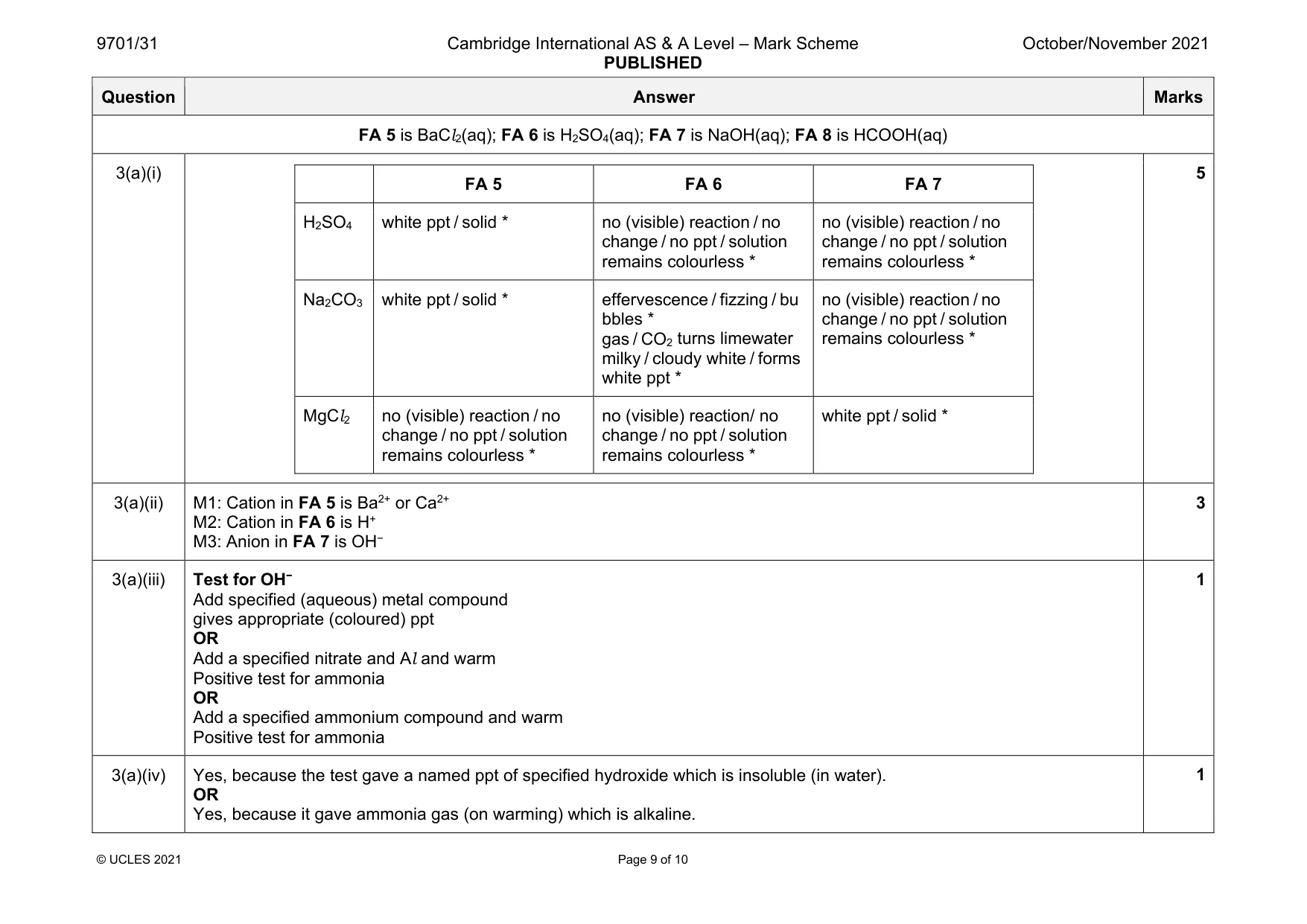
Mark scheme: 3(a)(i) FA 5 FA 6 FA 7 H2SO4 white ppt / solid * no (visible) reaction / no change / no ppt / solution remains colourless * no (visible) reaction / no change / no ppt / solution remains colourless * Na2CO3 white ppt / solid * effervescence / fizzing / bu bbles * gas / CO2 turns limewater milky / cloudy white / forms white ppt * no (visible) reaction / no change / no ppt / solution remains colourless * MgCl2 no (visible) reaction / no change / no ppt / solution remains colourless * no (visible) reaction/ no change / no ppt / solution remains colourless * white ppt / solid * 5 3(a)(ii) M1: Cation in FA 5 is Ba2+ or Ca2+ M2: Cation in FA 6 is H+ M3: Anion in FA 7 is OH− 3 3(a)(iii) Test for OH− Add specified (aqueous) metal compound gives appropriate (coloured) ppt OR Add a specified nitrate and Al and warm Positive test for ammonia OR Add a specified ammonium compound and warm Positive test for ammonia 1 3(a)(iv) Yes, because the test gave a named ppt of specified hydroxide which is insoluble (in water). OR Yes, because it gave ammonia gas (on warming) which is alkaline. 1 Question Answer Marks 3(b)(i) M1: Test 1 purple / pink to colourless / (pale) yellow / pale brown OR KMnO4 is decolourised M2: Test 2 effervescence / fizzing / bubbles AND gas/ H2 pops with a lighted splint / burns with a pop 2 3(b)(ii) M1: (FA 8) can be oxidised / is a reducing agent M2: (FA 8) is an acid 2
What was in this paper
The subtopics covered by these 3 questions, and how many questions each got. Open one in a new tab to see every Cambridge question on it.
What you needed in this session
Cambridge’s own grade thresholds for 2021 Oct/Nov, Paper 3 · Variant 1. A higher threshold means an easier paper — the bar moves with how the cohort did.