Cambridge A Level Chemistry 9701 — 2021 May/June Paper 4 · Variant 3
9701/43/M/J/21 · 9 questions · 100 marks · ≈113 min
The question paper and its mark scheme, free to read here and free to download. This is Cambridge’s own paper, exactly as it was sat.
Question paper24 pages




Mark scheme17 pages
Answers below. Sit the paper first if you are practising.
Questions as text
Q1 · The carbonates and hydroxides of Group 2 elements show similar trends in thermal stability
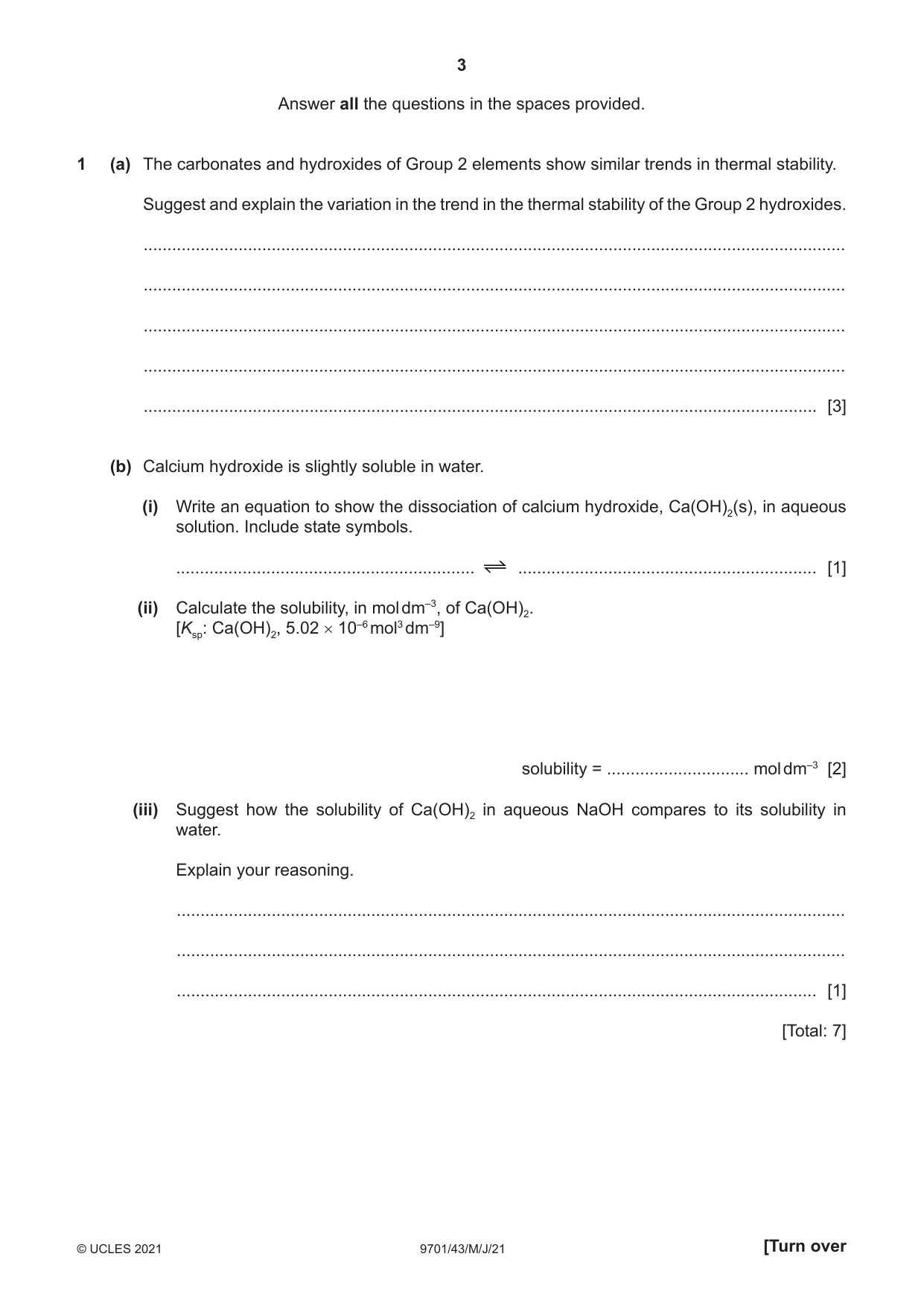
1 (a) The carbonates and hydroxides of Group 2 elements show similar trends in thermal stability. Suggest and explain the variation in the trend in the thermal stability of the Group 2 hydroxides. .................................................................................................................................................... .................................................................................................................................................... .................................................................................................................................................... .................................................................................................................................................... .............................................................................................................................................. [3] (b) Calcium hydroxide is slightly soluble in water. (i) Write an equation to show the dissociation of calcium hydroxide, Ca(OH)2(s), in aqueous solution. Include state symbols. ............................................................... (ii) Calculate the solubility, in mol dm–3, of Ca(OH)2. [Ksp: Ca(OH)2, 5.02 × 10⁻⁶ mol3 dm–9] solubility = .............................. mol dm–3 [2] (iii) Suggest how the solubility of Ca(OH)2 in aqueous NaOH compares to its solubility in water. Explain your reasoning. ............................................................................................................................................. ............................................................................................................................................. ....................................................................................................................................... [1] [Total: 7]
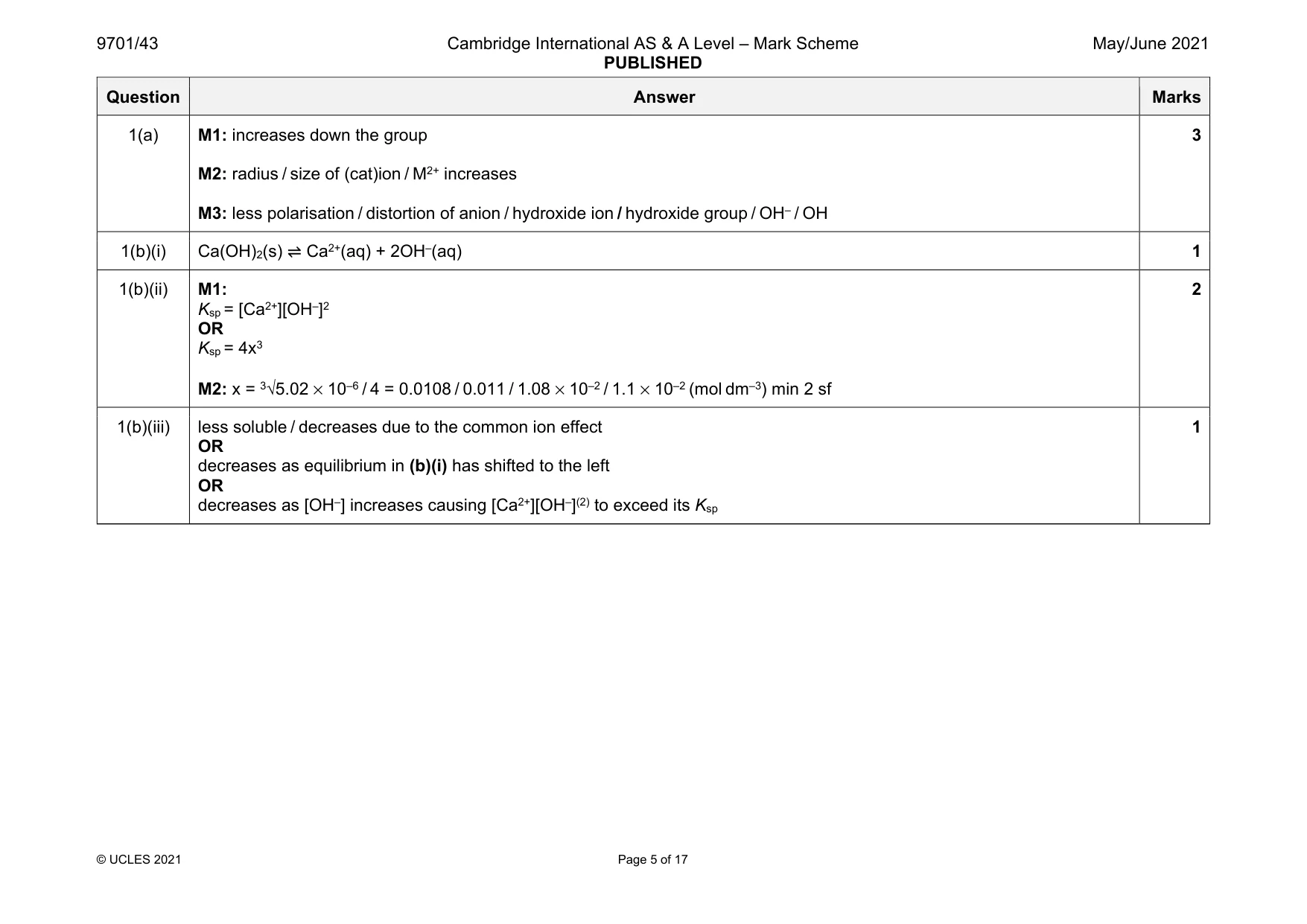
Mark scheme: 1(a) M1: increases down the group M2: radius / size of (cat)ion / M2+ increases M3: less polarisation / distortion of anion / hydroxide ion / hydroxide group / OH– / OH 3 1(b)(i) Ca(OH)2(s) ⇌ Ca2+(aq) + 2OH–(aq) 1 1(b)(ii) M1: Ksp = [Ca2+][OH–]2 OR Ksp = 4x3 M2: x = 3√5.02 × 10⁻⁶ / 4 = 0.0108 / 0.011 / 1.08 × 10⁻² / 1.1 × 10⁻² (mol dm–3) min 2 sf 2 1(b)(iii) less soluble / decreases due to the common ion effect OR decreases as equilibrium in (b)(i) has shifted to the left OR decreases as [OH–] increases causing [Ca2+][OH–](2) to exceed its Ksp 1
Q2 · Explain why chromium complexes are coloured
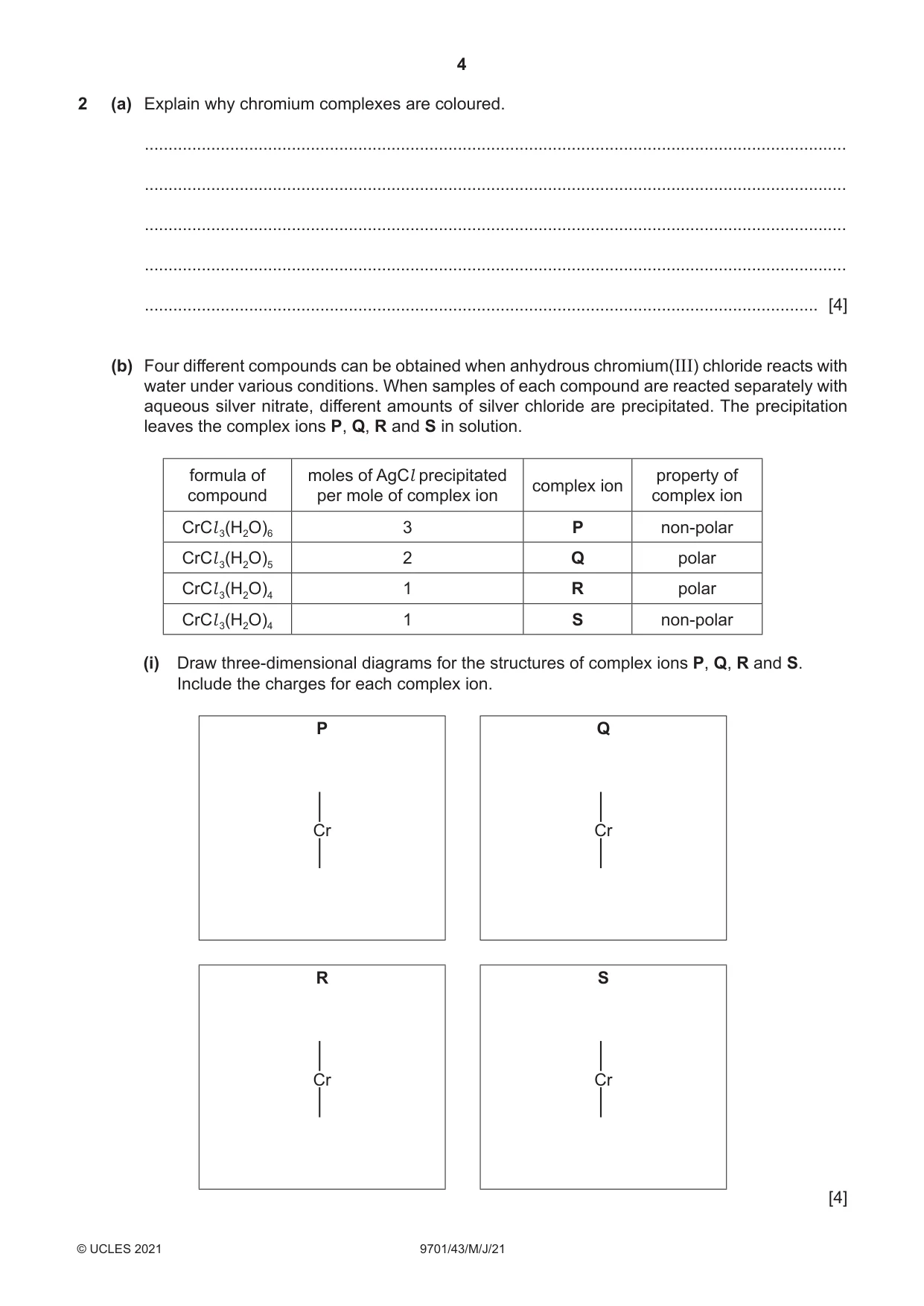
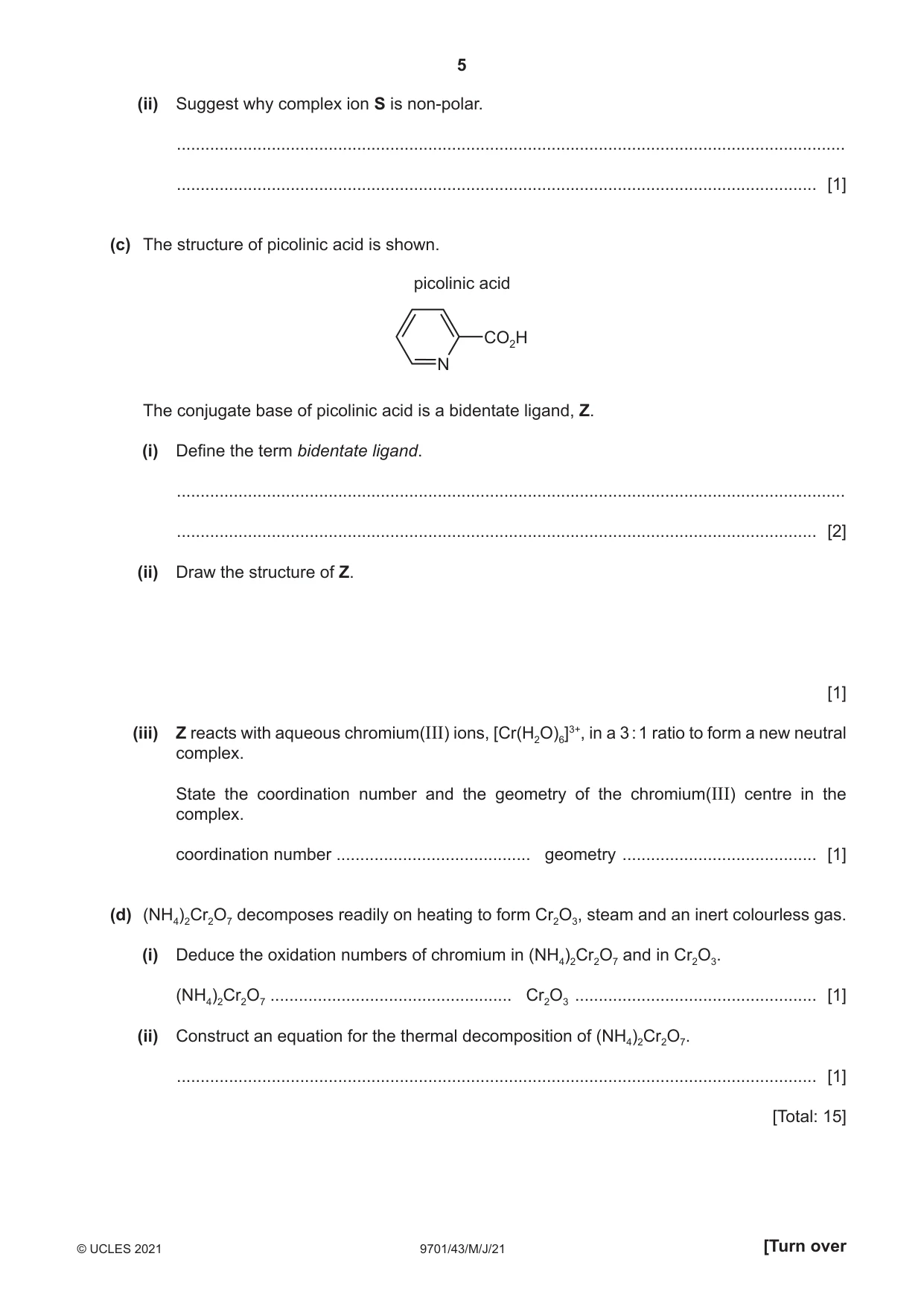
2 (a) Explain why chromium complexes are coloured. .................................................................................................................................................... .................................................................................................................................................... .................................................................................................................................................... .................................................................................................................................................... .............................................................................................................................................. [4] (b) Four different compounds can be obtained when anhydrous chromium(III) chloride reacts with water under various conditions. When samples of each compound are reacted separately with aqueous silver nitrate, different amounts of silver chloride are precipitated. The precipitation leaves the complex ions P, Q, R and S in solution. formula of moles of AgCl precipitated property of complex ion compound per mole of complex ion complex ion CrCl 3(H2O)6 3 P non-polar CrCl 3(H2O)5 2 Q polar CrCl 3(H2O)4 1 R polar CrCl 3(H2O)4 1 S non-polar (i) Draw three-dimensional diagrams for the structures of complex ions P, Q, R and S. Include the charges for each complex ion. P Q Cr Cr R S Cr Cr [4] (ii) Suggest why complex ion S is non-polar. ............................................................................................................................................. ....................................................................................................................................... [1] (c) The structure of picolinic acid is shown. picolinic acid CO2H N The conjugate base of picolinic acid is a bidentate ligand, Z. (i) Define the term bidentate ligand. ............................................................................................................................................. ....................................................................................................................................... [2] (ii) Draw the structure of Z. [1] (iii) Z reacts with aqueous chromium(III) ions, [Cr(H2O)6]3+, in a 3 : 1 ratio to form a new neutral complex. State the coordination number and the geometry of the chromium(III) centre in the complex. coordination number ......................................... geometry ����������������������������������������� [1] (d) (NH4)2Cr2O7 decomposes readily on heating to form Cr2O3, steam and an inert colourless gas. (i) Deduce the oxidation numbers of chromium in (NH4)2Cr2O7 and in Cr2O3. (NH4)2Cr2O7 ................................................... Cr2O3 ��������������������������������������������������� [1] (ii) Construct an equation for the thermal decomposition of (NH4)2Cr2O7. ....................................................................................................................................... [1] [Total: 15]
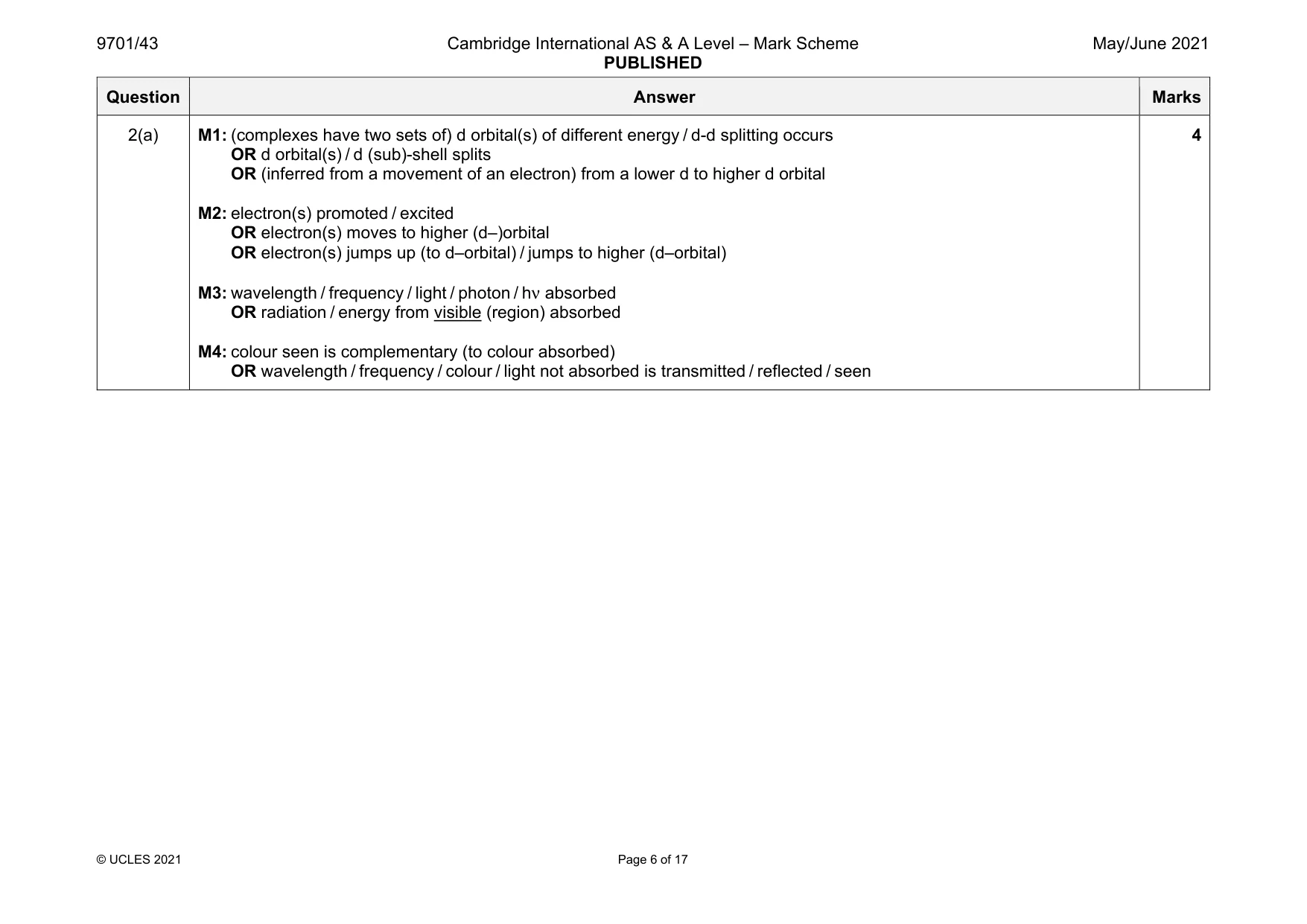
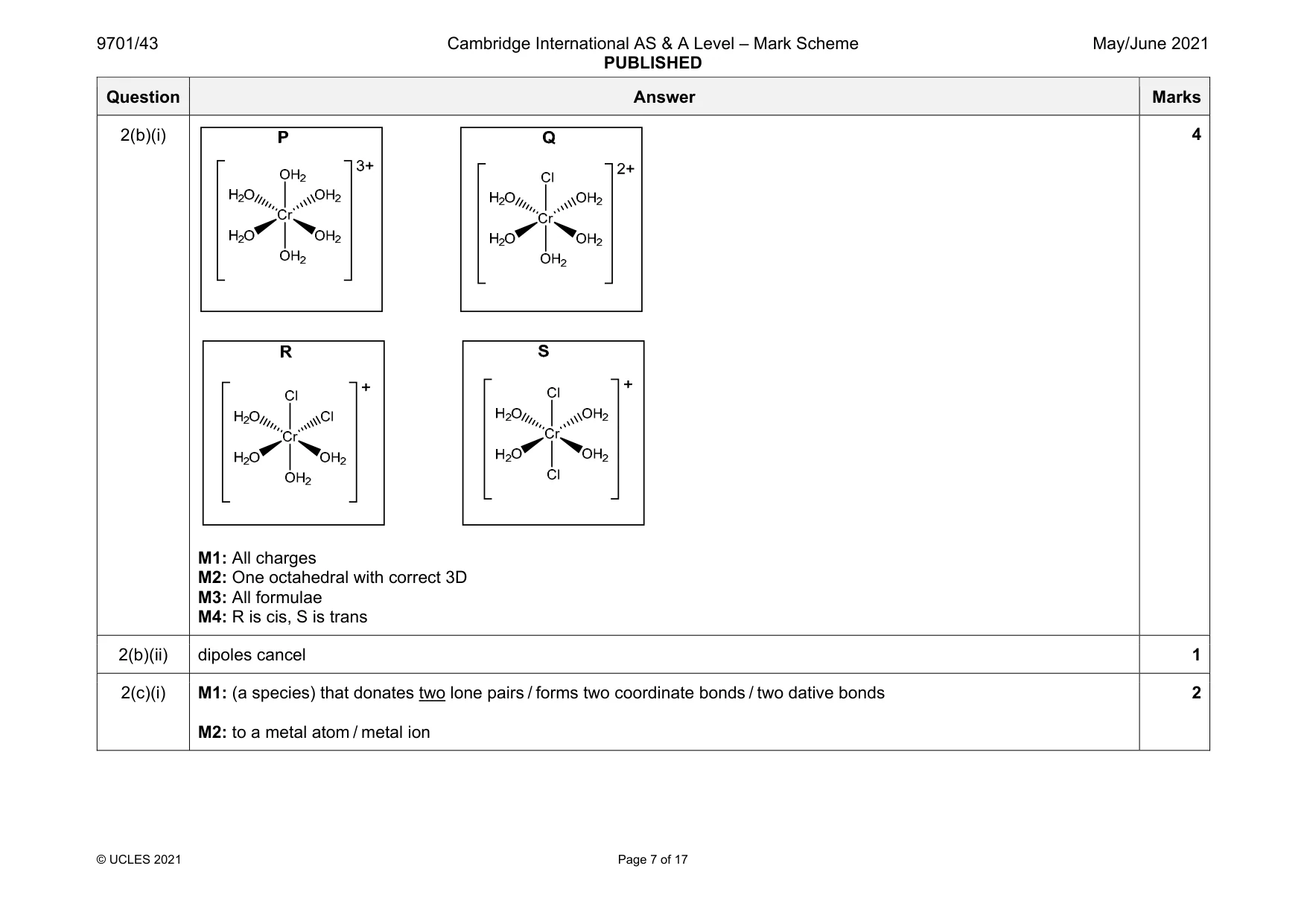
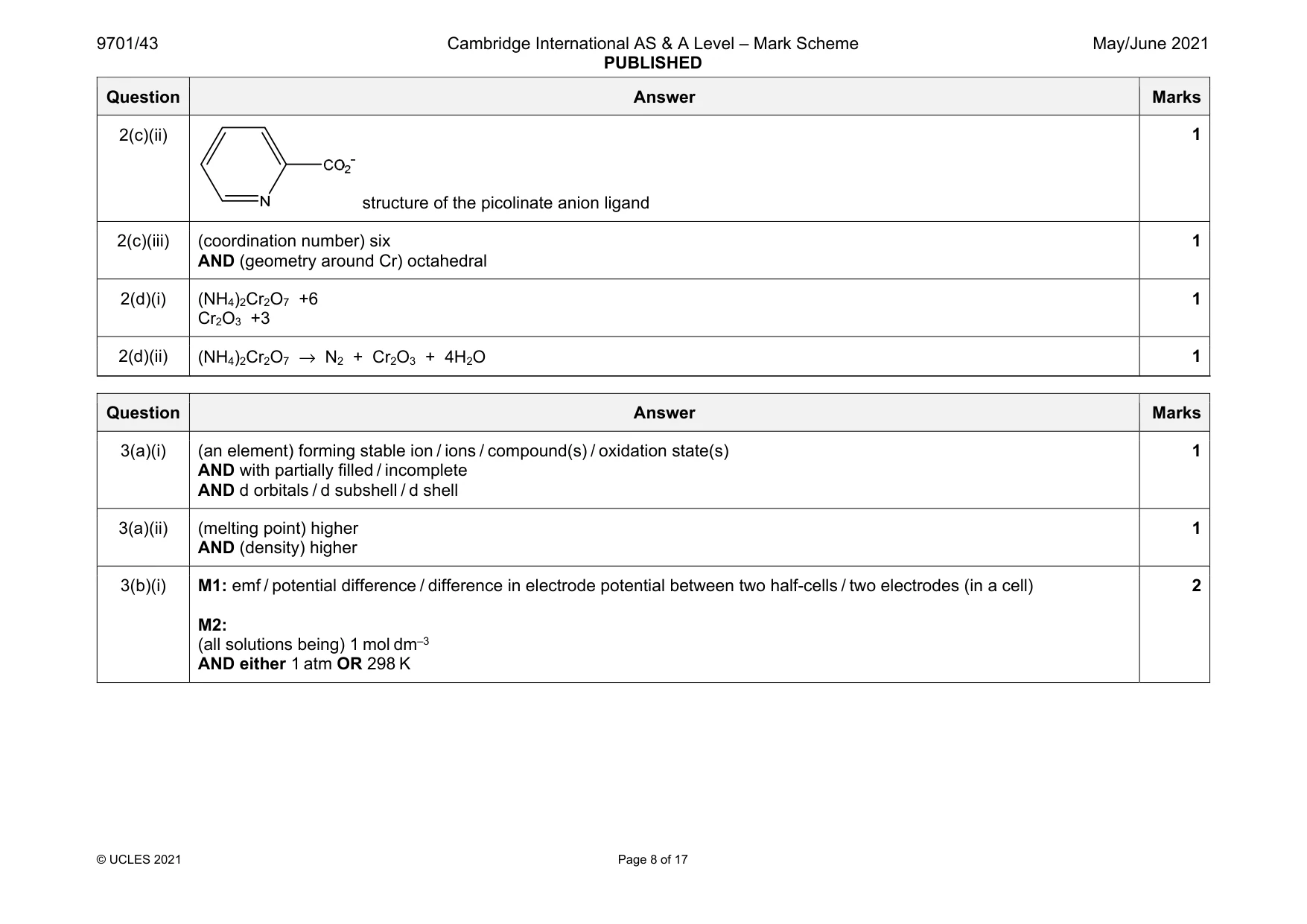
Mark scheme: 2(a) M1: (complexes have two sets of) d orbital(s) of different energy / d-d splitting occurs OR d orbital(s) / d (sub)-shell splits OR (inferred from a movement of an electron) from a lower d to higher d orbital M2: electron(s) promoted / excited OR electron(s) moves to higher (d–)orbital OR electron(s) jumps up (to d–orbital) / jumps to higher (d–orbital) M3: wavelength / frequency / light / photon / hν absorbed OR radiation / energy from visible (region) absorbed M4: colour seen is complementary (to colour absorbed) OR wavelength / frequency / colour / light not absorbed is transmitted / reflected / seen 4 Question Answer Marks 2(b)(i) M1: All charges M2: One octahedral with correct 3D M3: All formulae M4: R is cis, S is trans 4 2(b)(ii) dipoles cancel 1 2(c)(i) M1: (a species) that donates two lone pairs / forms two coordinate bonds / two dative bonds M2: to a metal atom / metal ion 2 Question Answer Marks 2(c)(ii) structure of the picolinate anion ligand 1 2(c)(iii) (coordination number) six AND (geometry around Cr) octahedral 1 2(d)(i) (NH4)2Cr2O7 +6 Cr2O3 +3 1 2(d)(ii) (NH4)2Cr2O7 → N2 + Cr2O3 + 4H2O 1
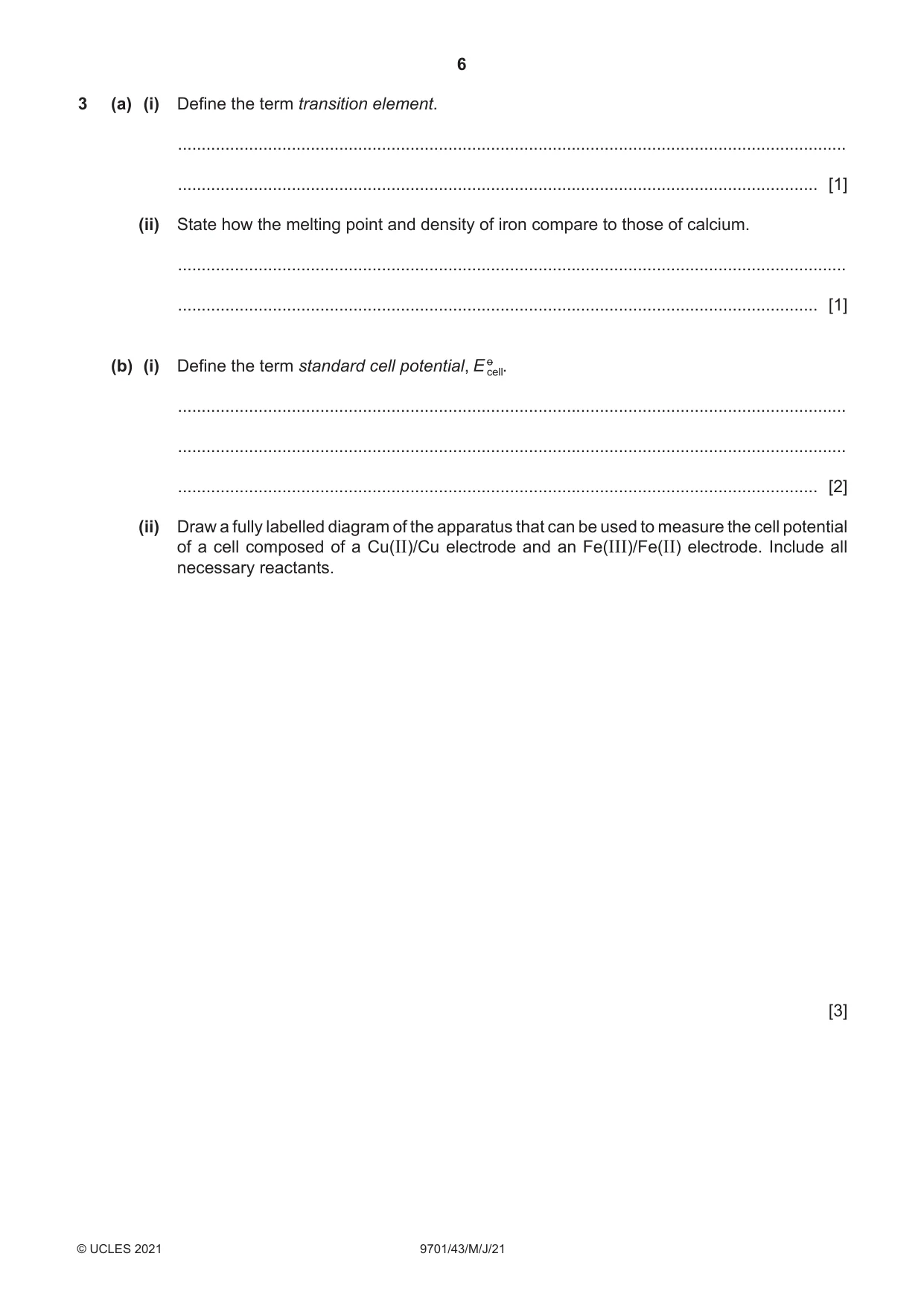
Q3 · Define the term transition element
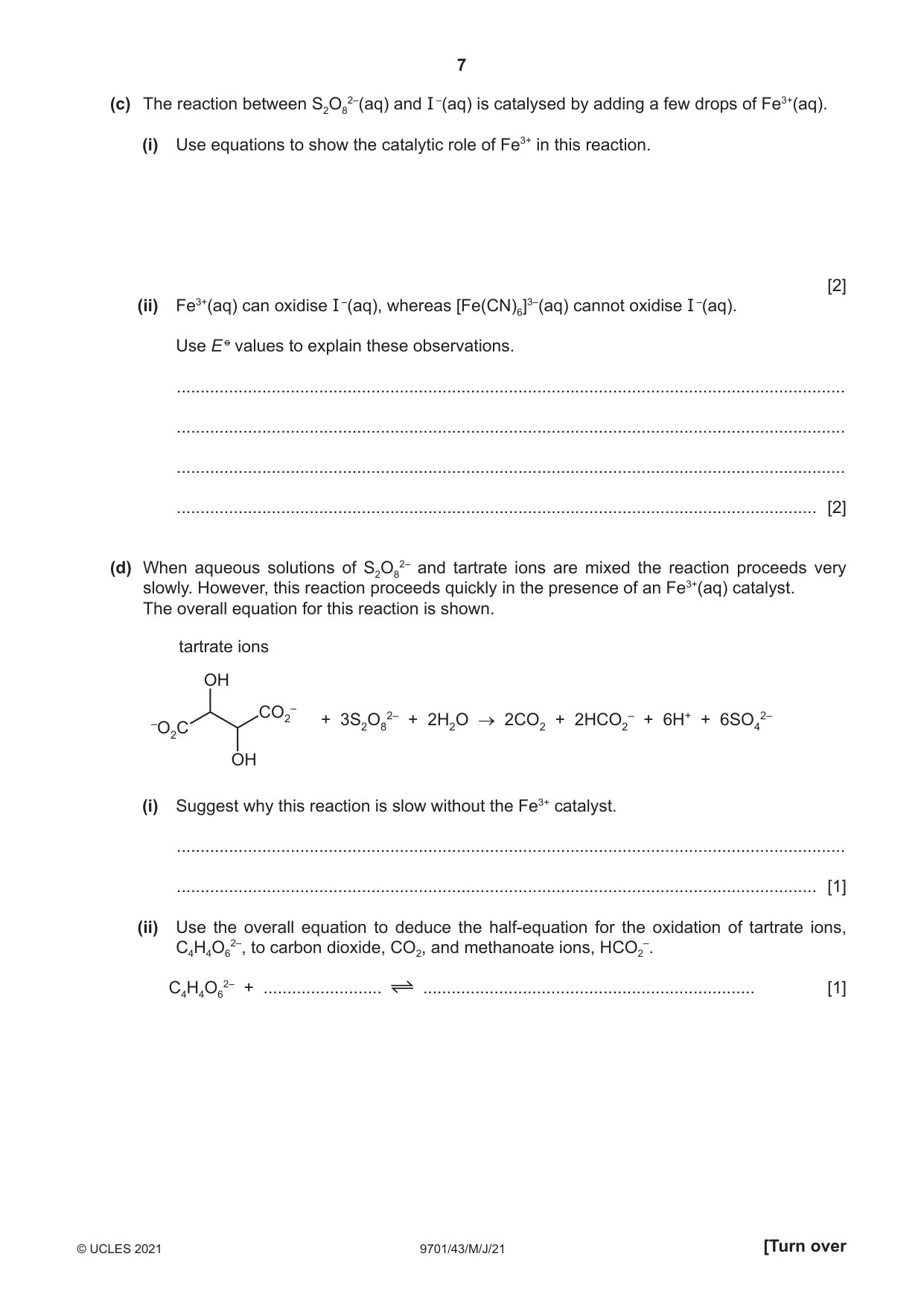
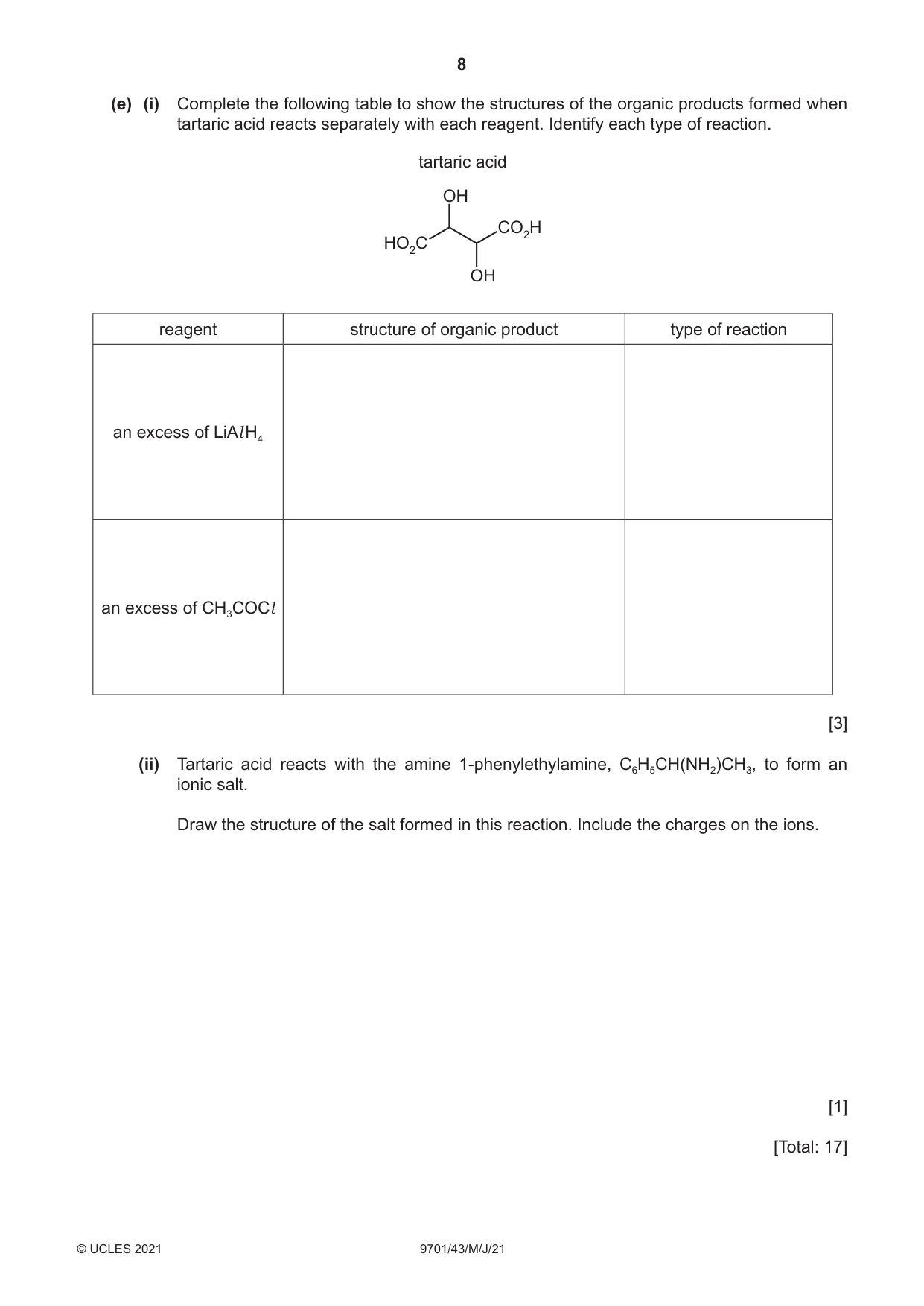
3 (a) (i) Define the term transition element. ............................................................................................................................................. ....................................................................................................................................... [1] (ii) State how the melting point and density of iron compare to those of calcium. ............................................................................................................................................. ....................................................................................................................................... [1] (b) (i) Define the term standard cell potential, . ............................................................................................................................................. ............................................................................................................................................. ....................................................................................................................................... [2] (ii) Draw a fully labelled diagram of the apparatus that can be used to measure the cell potential of a cell composed of a Cu(II)/Cu electrode and an Fe(III)/Fe(II) electrode. Include all necessary reactants. [3] (c) The reaction between S2O82–(aq) and I –(aq) is catalysed by adding a few drops of Fe3+(aq). (i) Use equations to show the catalytic role of Fe3+ in this reaction. [2] (ii) Fe3+(aq) can oxidise I –(aq), whereas [Fe(CN)6]3–(aq) cannot oxidise I –(aq). Use E o values to explain these observations. ............................................................................................................................................. ............................................................................................................................................. ............................................................................................................................................. ....................................................................................................................................... [2] (d) When aqueous solutions of S2O82– and tartrate ions are mixed the reaction proceeds very slowly. However, this reaction proceeds quickly in the presence of an Fe3+(aq) catalyst. The overall equation for this reaction is shown. tartrate ions OH CO2– 2– – 2– + 3S2O8 + 2H2O 2CO2 + 2HCO2 + 6H+ + 6SO4 –O2C OH (i) Suggest why this reaction is slow without the Fe3+ catalyst. ............................................................................................................................................. ....................................................................................................................................... [1] (ii) Use the overall equation to deduce the half-equation for the oxidation of tartrate ions, C4H4O62–, to carbon dioxide, CO2, and methanoate ions, HCO2–. C4H4O62– + ......................... ...................................................................... [1] (e) (i) Complete the following table to show the structures of the organic products formed when tartaric acid reacts separately with each reagent. Identify each type of reaction. tartaric acid OH CO2H HO2C OH reagent structure of organic product type of reaction an excess of LiAl H4 an excess of CH3COCl [3] (ii) Tartaric acid reacts with the amine 1-phenylethylamine, C6H5CH(NH2)CH3, to form an ionic salt. Draw the structure of the salt formed in this reaction. Include the charges on the ions. [1] [Total: 17]
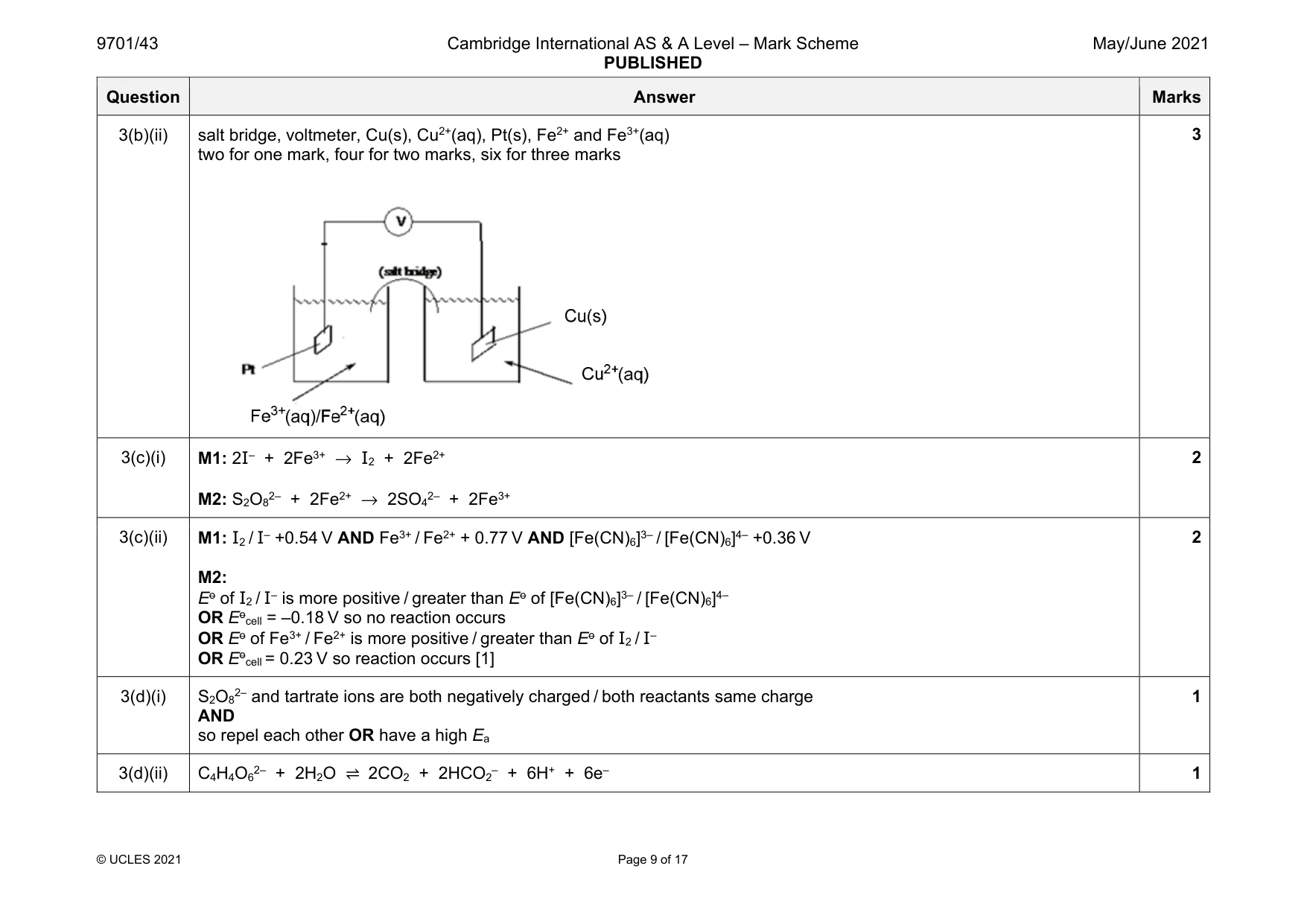
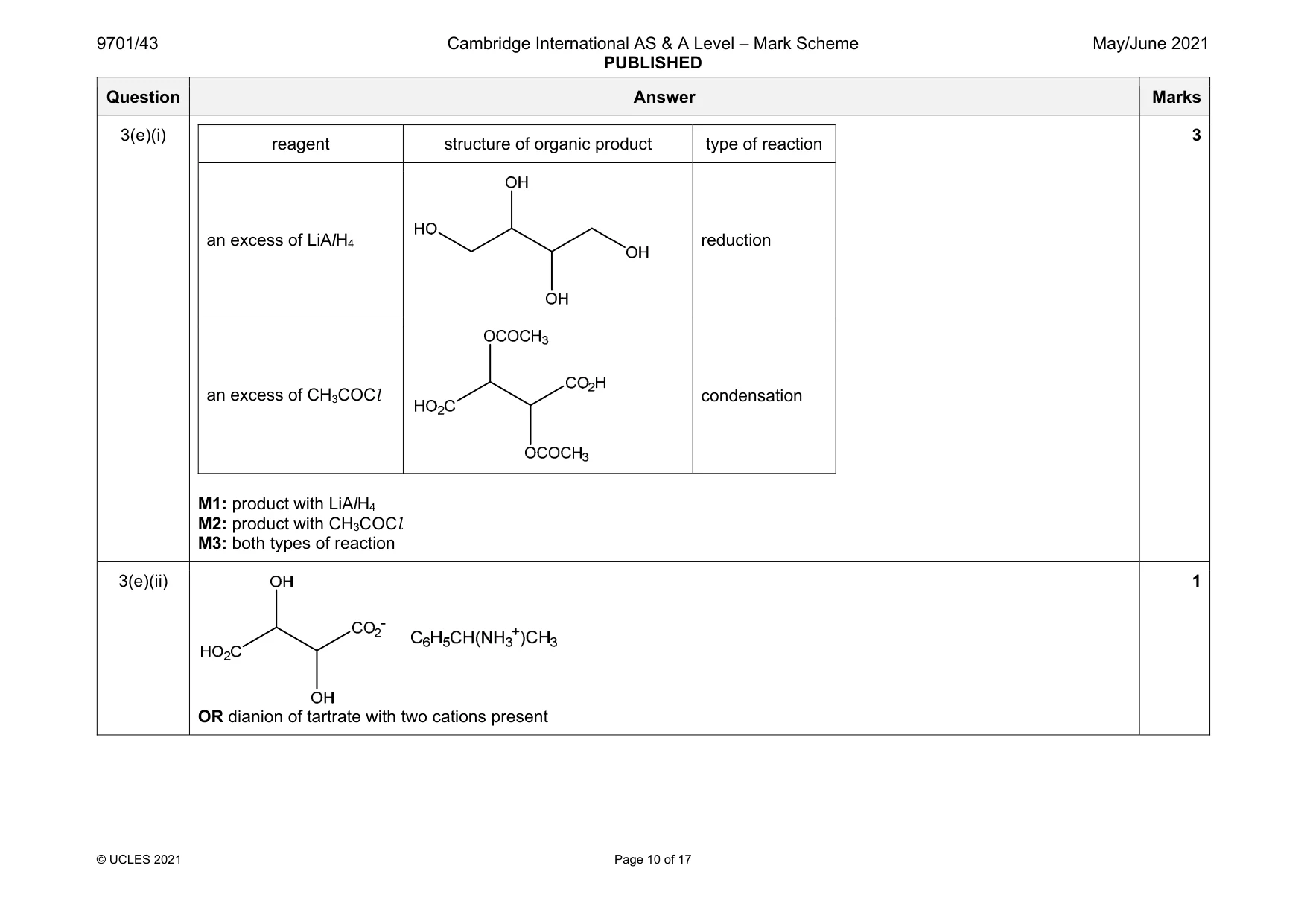
Mark scheme: 3(a)(i) (an element) forming stable ion / ions / compound(s) / oxidation state(s) AND with partially filled / incomplete AND d orbitals / d subshell / d shell 1 3(a)(ii) (melting point) higher AND (density) higher 1 3(b)(i) M1: emf / potential difference / difference in electrode potential between two half-cells / two electrodes (in a cell) M2: (all solutions being) 1 mol dm–3 AND either 1 atm OR 298 K 2 Question Answer Marks 3(b)(ii) salt bridge, voltmeter, Cu(s), Cu2+(aq), Pt(s), Fe2+ and Fe3+(aq) two for one mark, four for two marks, six for three marks 3 3(c)(i) M1: 2I– + 2Fe3+ → I2 + 2Fe2+ M2: S2O82– + 2Fe2+ → 2SO42– + 2Fe3+ 2 3(c)(ii) M1: I2 / I– +0.54 V AND Fe3+ / Fe2+ + 0.77 V AND [Fe(CN)6]3– / [Fe(CN)6]4– +0.36 V M2: Eo of I2 / I– is more positive / greater than Eo of [Fe(CN)6]3– / [Fe(CN)6]4– OR Eocell = –0.18 V so no reaction occurs OR Eo of Fe3+ / Fe2+ is more positive / greater than Eo of I2 / I– OR Eocell = 0.23 V so reaction occurs [1] 2 3(d)(i) S2O82– and tartrate ions are both negatively charged / both reactants same charge AND so repel each other OR have a high Ea 1 3(d)(ii) C4H4O62– + 2H2O ⇌ 2CO2 + 2HCO2– + 6H+ + 6e– 1 Question Answer Marks 3(e)(i) reagent structure of organic product type of reaction an excess of LiAlH4 reduction an excess of CH3COCl condensation M1: product with LiAlH4 M2: product with CH3COCl M3: both types of reaction 3 3(e)(ii) OR dianion of tartrate with two cations present 1
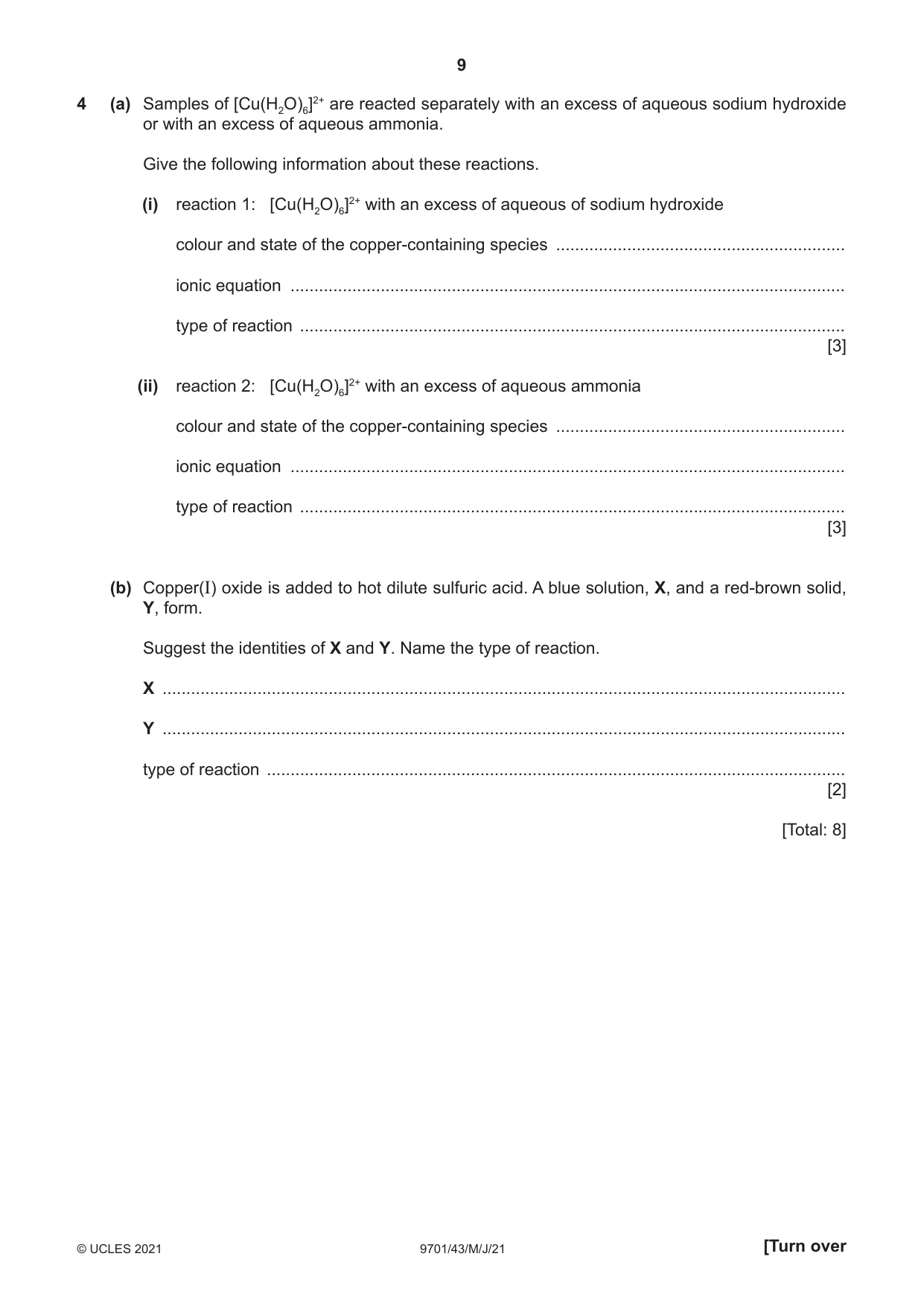
Q4 · Samples of [Cu(H2O)6]2+ are reacted separately with an excess of aqueous sodium hydroxide…
4 (a) Samples of [Cu(H2O)6]2+ are reacted separately with an excess of aqueous sodium hydroxide or with an excess of aqueous ammonia. Give the following information about these reactions. (i) reaction 1: [Cu(H2O)6]2+ with an excess of aqueous of sodium hydroxide colour and state of the copper-containing species .............................................................. ionic equation ...................................................................................................................... type of reaction .................................................................................................................... [3] (ii) reaction 2: [Cu(H2O)6]2+ with an excess of aqueous ammonia colour and state of the copper-containing species .............................................................. ionic equation ...................................................................................................................... type of reaction .................................................................................................................... [3] (b) Copper(I) oxide is added to hot dilute sulfuric acid. A blue solution, X, and a red-brown solid, Y, form. Suggest the identities of X and Y. Name the type of reaction. X ................................................................................................................................................. Y ................................................................................................................................................. type of reaction ........................................................................................................................... [2] [Total: 8]
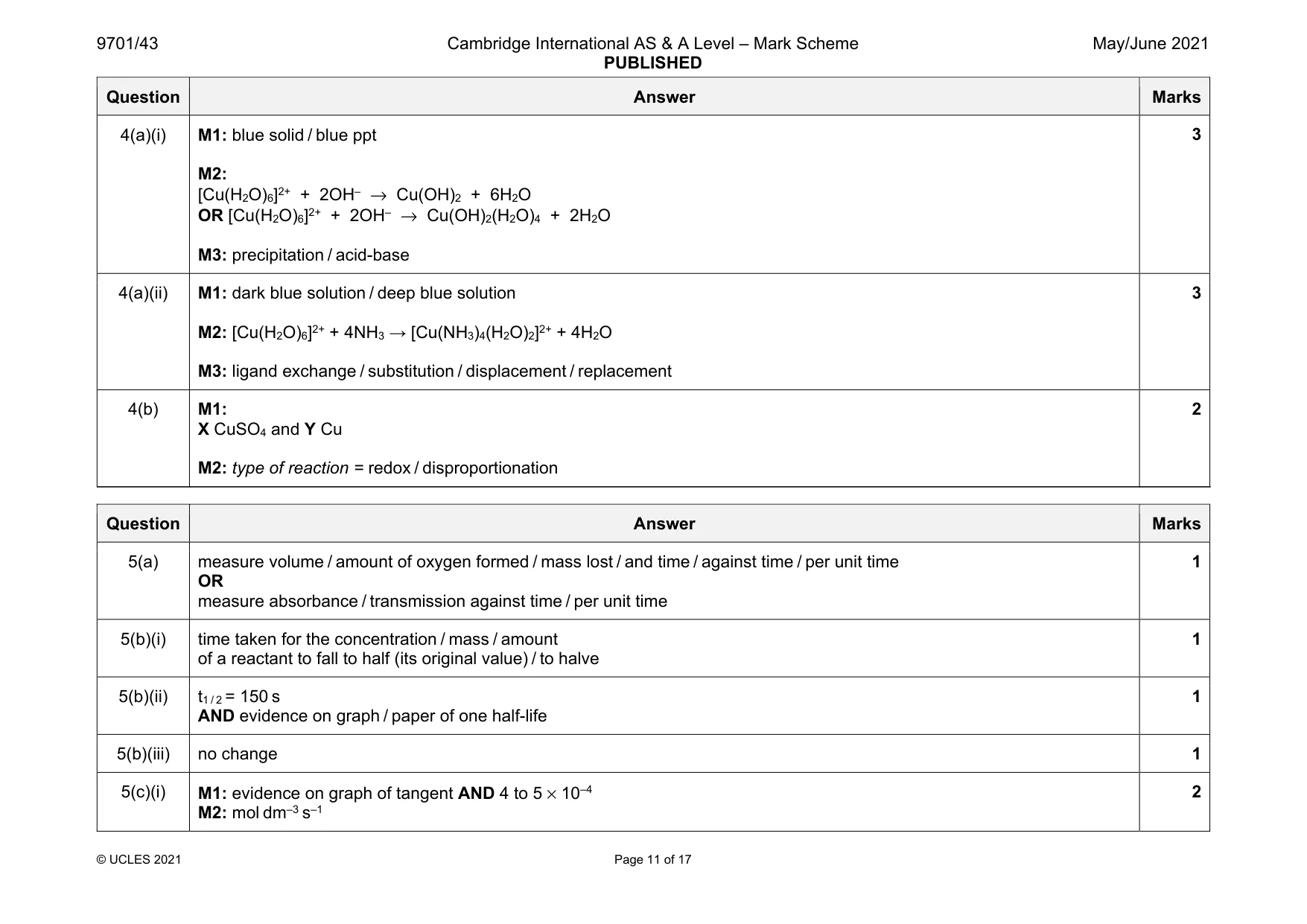
Mark scheme: 4(a)(i) M1: blue solid / blue ppt M2: [Cu(H2O)6]2+ + 2OH– → Cu(OH)2 + 6H2O OR [Cu(H2O)6]2+ + 2OH– → Cu(OH)2(H2O)4 + 2H2O M3: precipitation / acid-base 4(a)(ii) M1: dark blue solution / deep blue solution M2: [Cu(H2O)6]2+ + 4NH3 → [Cu(NH3)4(H2O)2]2+ + 4H2O M3: ligand exchange / substitution / displacement / replacement 3 4(b) M1: X CuSO4 and Y Cu M2: type of reaction = redox / disproportionation 2
Q5 · Dinitrogen pentoxide, N2O5, is dissolved in an inert solvent (solv) and the rate of…
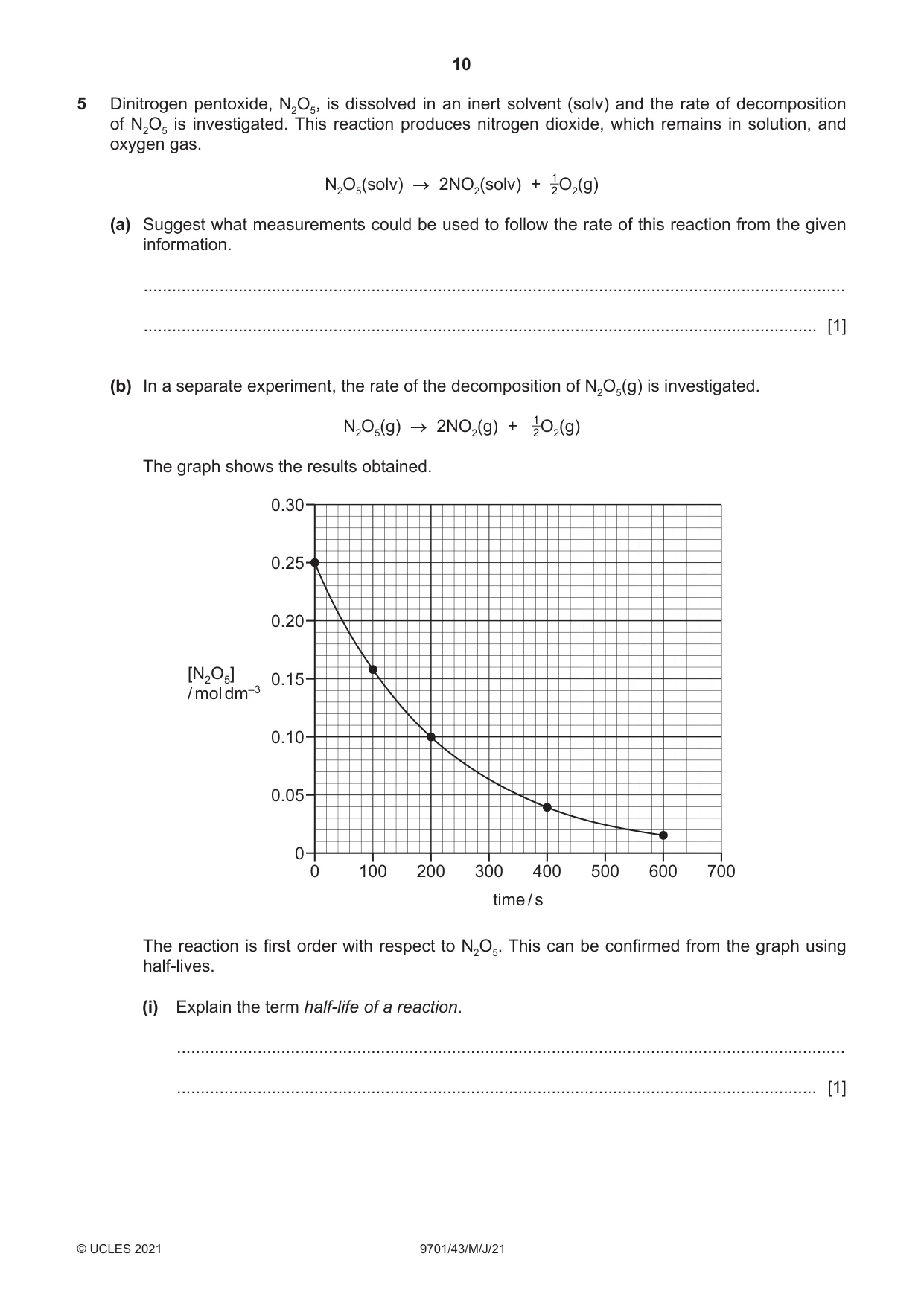
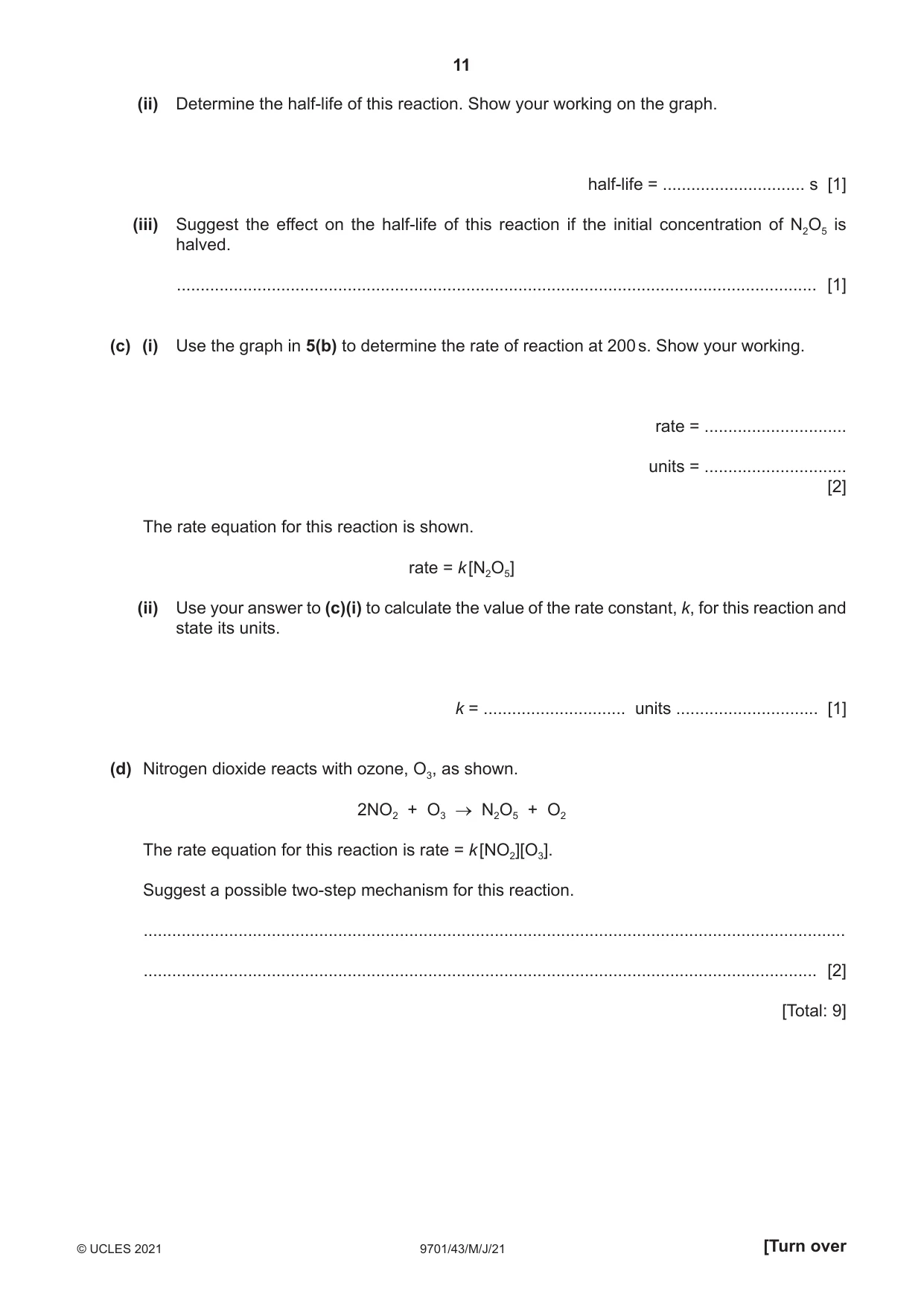
5 Dinitrogen pentoxide, N2O5, is dissolved in an inert solvent (solv) and the rate of decomposition of N2O5 is investigated. This reaction produces nitrogen dioxide, which remains in solution, and oxygen gas. N2O5(solv) → 2NO2(solv) + 12O2(g) (a) Suggest what measurements could be used to follow the rate of this reaction from the given information. .................................................................................................................................................... .............................................................................................................................................. [1] (b) In a separate experiment, the rate of the decomposition of N2O5(g) is investigated. N2O5(g) → 2NO2(g) + 12O2(g) The graph shows the results obtained. 0.30 0.25 0.20 [N2O5] 0.15 / mol dm–3 0.10 0.05 0 0 100 200 300 400 500 600 700 time / s The reaction is first order with respect to N2O5. This can be confirmed from the graph using half‑lives. (i) Explain the term half-life of a reaction. ............................................................................................................................................. ....................................................................................................................................... [1] (iii) Suggest the effect on the half-life of this reaction if the initial concentration of N2O5 is halved. ....................................................................................................................................... [1] (c) (i) Use the graph in 5(b) to determine the rate of reaction at 200 s. Show your working. rate = .............................. units = .............................. [2] The rate equation for this reaction is shown. rate = k [N2O5] (ii) Use your answer to (c)(i) to calculate the value of the rate constant, k, for this reaction and state its units. k = .............................. units .............................. [1] (d) Nitrogen dioxide reacts with ozone, O3, as shown. 2NO2 + O3 → N2O5 + O2 The rate equation for this reaction is rate = k [NO2][O3]. Suggest a possible two-step mechanism for this reaction. .................................................................................................................................................... .............................................................................................................................................. [2] [Total: 9]
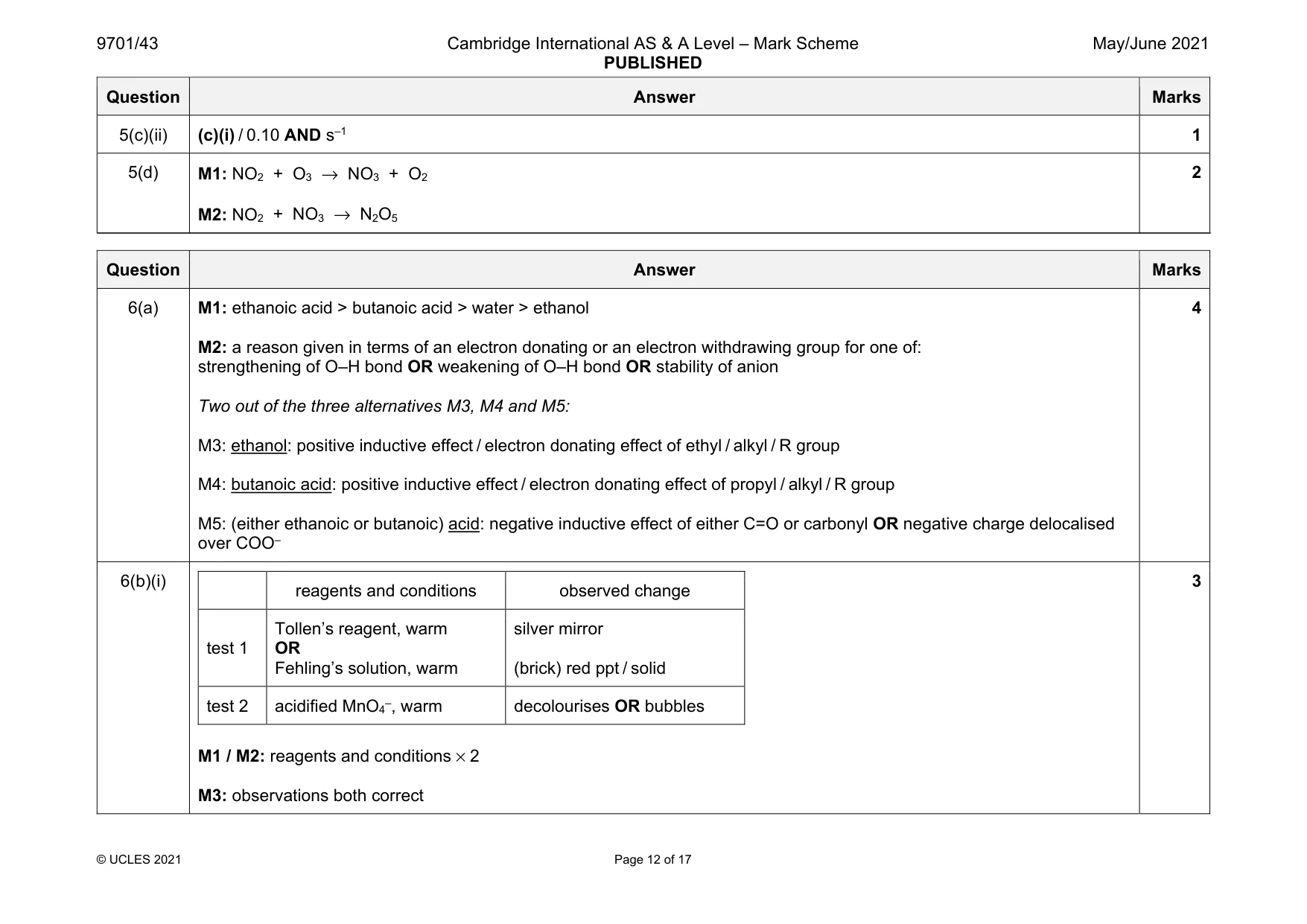
Mark scheme: 5(a) measure volume / amount of oxygen formed / mass lost / and time / against time / per unit time OR measure absorbance / transmission against time / per unit time 1 5(b)(i) time taken for the concentration / mass / amount of a reactant to fall to half (its original value) / to halve 1 5(b)(ii) t1 / 2 = 150 s AND evidence on graph / paper of one half-life 1 5(b)(iii) no change 1 5(c)(i) M1: evidence on graph of tangent AND 4 to 5 × 10⁻⁴ M2: mol dm–3 s–1 2 Question Answer Marks 5(c)(ii) (c)(i) / 0.10 AND s–1 1 5(d) M1: NO2 + O3 → NO3 + O2 M2: NO2 + NO3 → N2O5 2
Q6 · Compare and explain the relative acidities of butanoic acid, ethanol, ethanoic acid and…
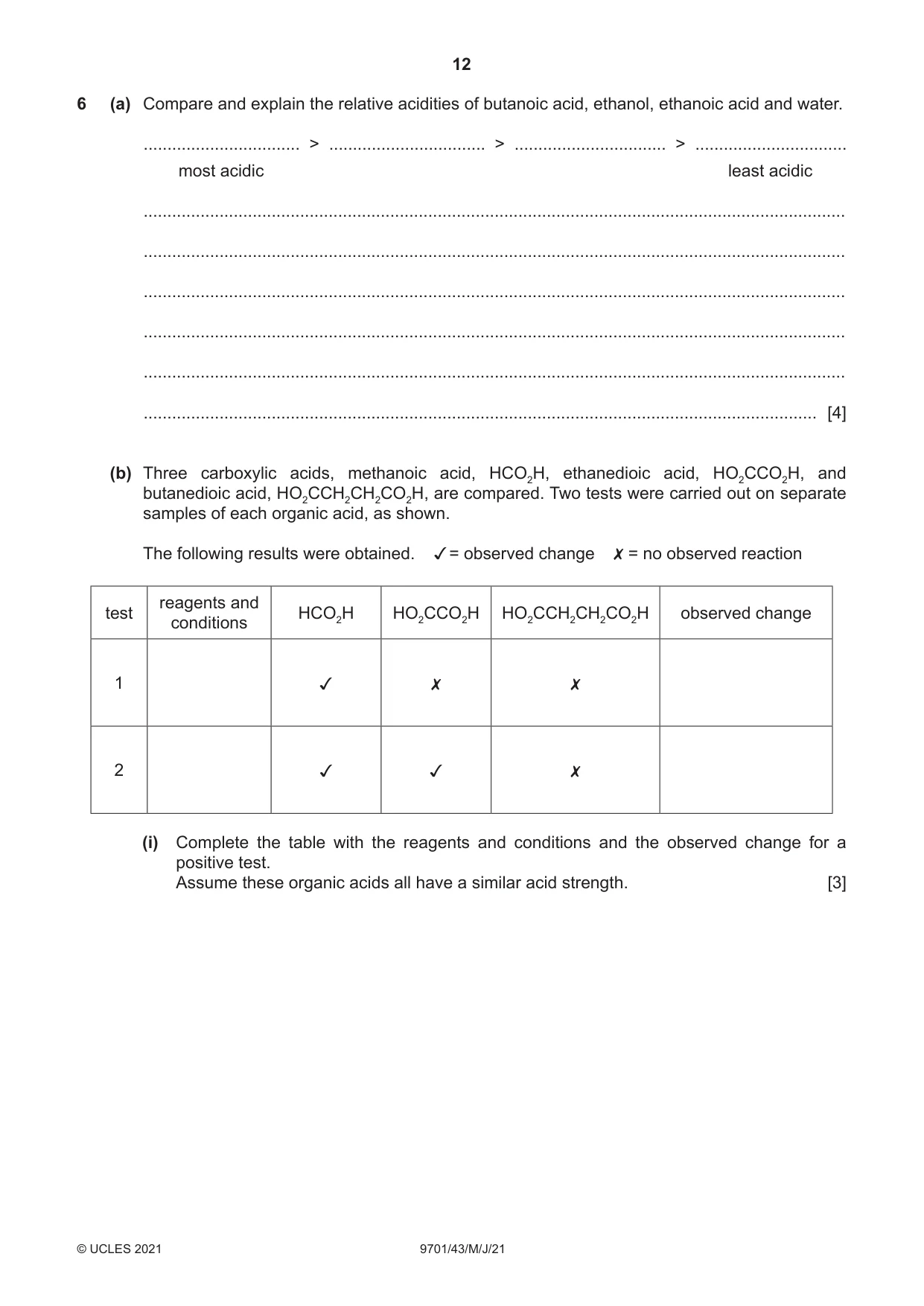
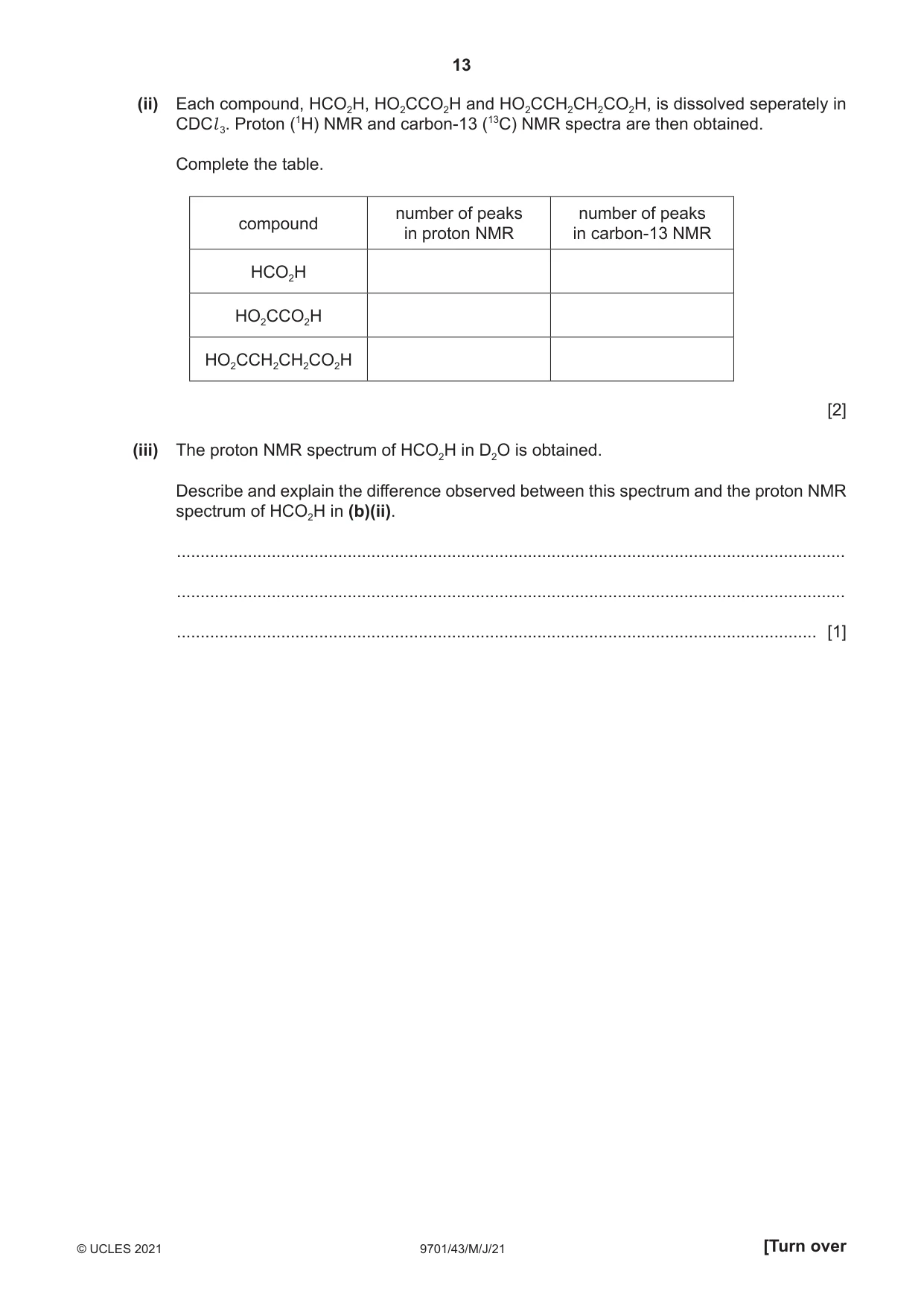
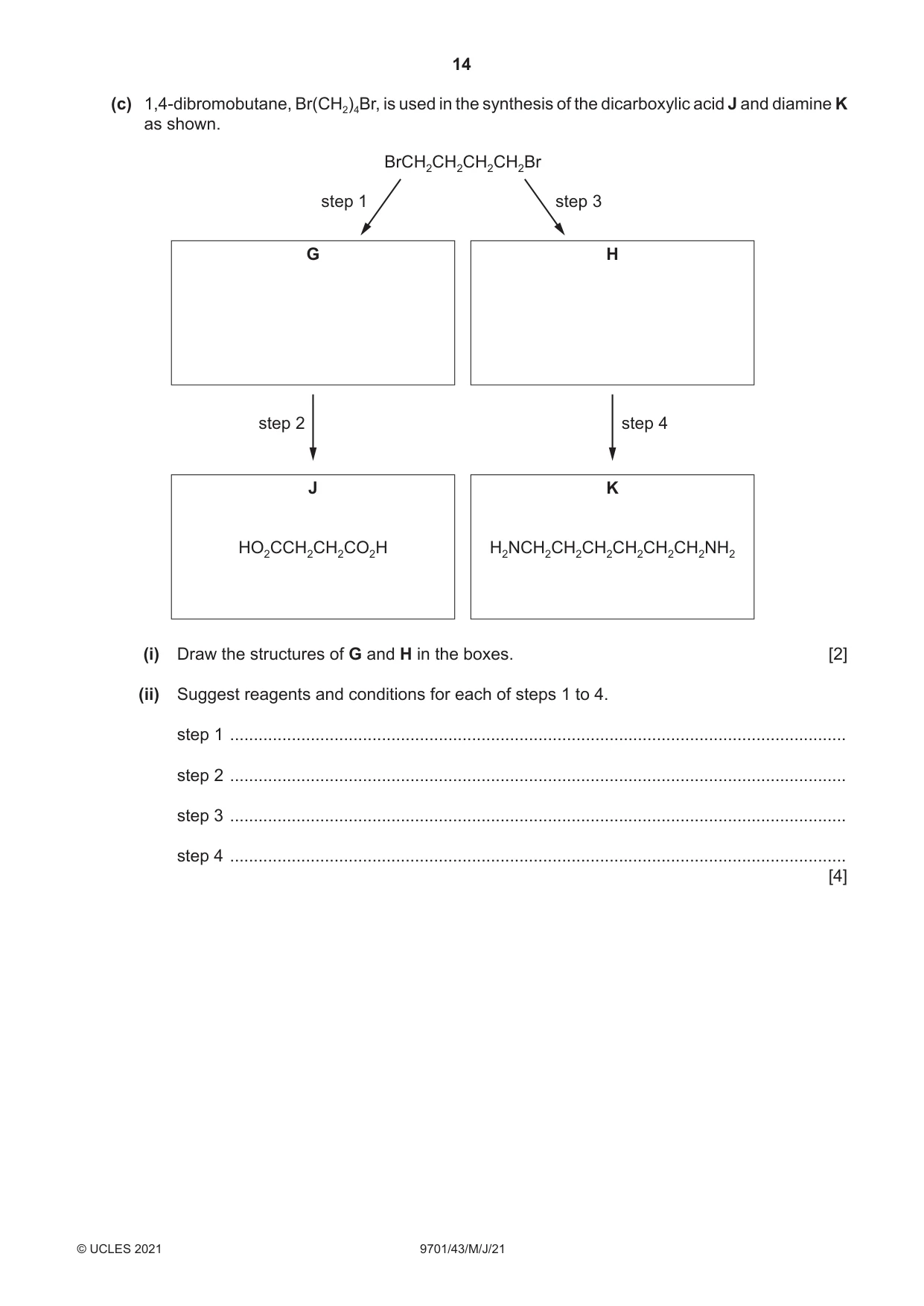
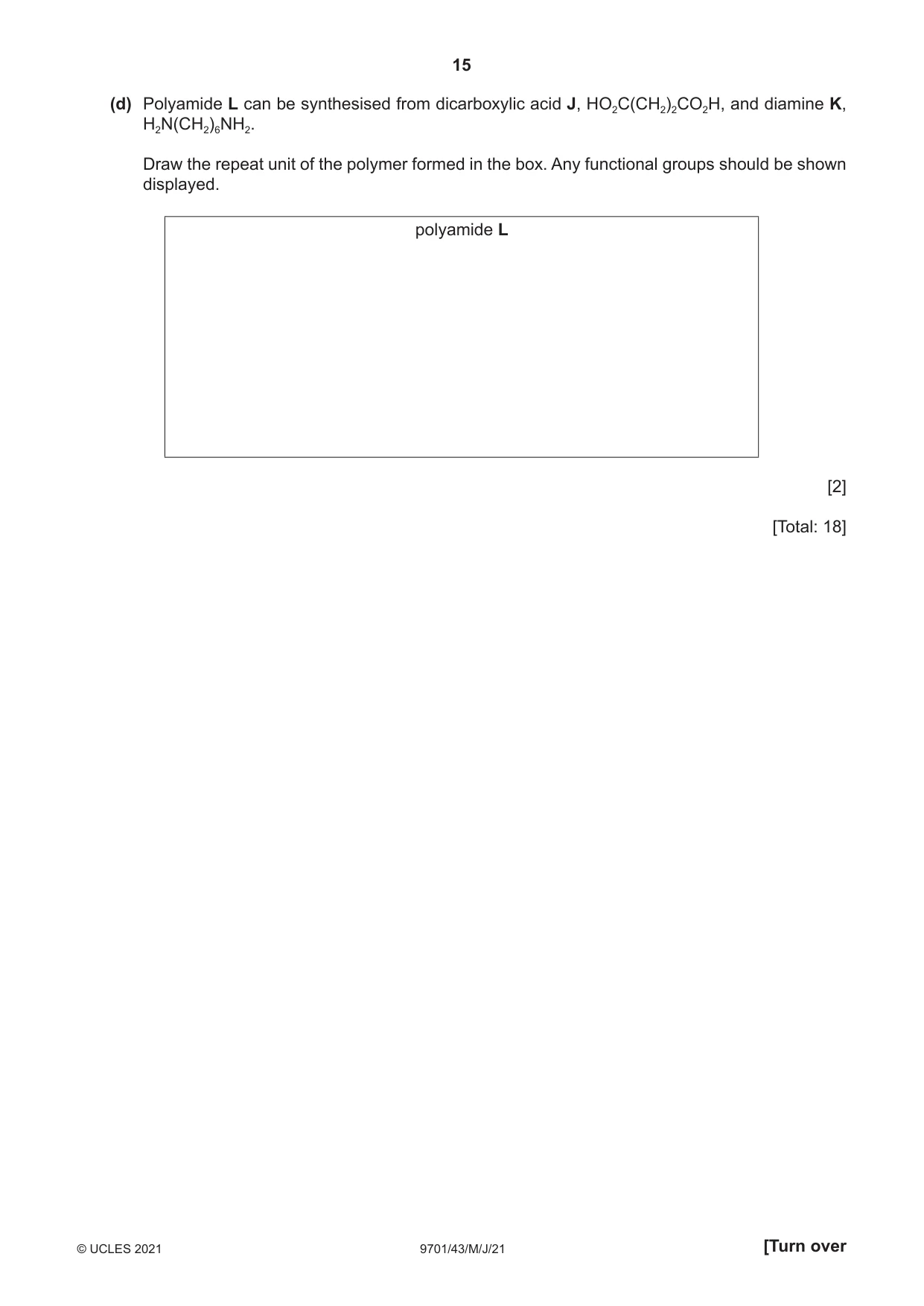
6 (a) Compare and explain the relative acidities of butanoic acid, ethanol, ethanoic acid and water. ................................. > ................................. > ................................ > ................................ most acidic least acidic .................................................................................................................................................... .................................................................................................................................................... .................................................................................................................................................... .................................................................................................................................................... .................................................................................................................................................... .............................................................................................................................................. [4] (b) Three carboxylic acids, methanoic acid, HCO2H, ethanedioic acid, HO2CCO2H, and butanedioic acid, HO2CCH2CH2CO2H, are compared. Two tests were carried out on separate samples of each organic acid, as shown. The following results were obtained. = observed change = no observed reaction reagents and test HCO2H HO2CCO2H HO2CCH2CH2CO2H observed change conditions 1 2 (i) Complete the table with the reagents and conditions and the observed change for a positive test. Assume these organic acids all have a similar acid strength. [3] (ii) Each compound, HCO2H, HO2CCO2H and HO2CCH2CH2CO2H, is dissolved seperately in CDCl 3. Proton (1H) NMR and carbon‑13 (13C) NMR spectra are then obtained. Complete the table. number of peaks number of peaks compound in proton NMR in carbon-13 NMR HCO2H HO2CCO2H HO2CCH2CH2CO2H [2] (iii) The proton NMR spectrum of HCO2H in D2O is obtained. Describe and explain the difference observed between this spectrum and the proton NMR spectrum of HCO2H in (b)(ii). ............................................................................................................................................. ............................................................................................................................................. ....................................................................................................................................... [1] (c) 1,4-dibromobutane, Br(CH2)4Br, is used in the synthesis of the dicarboxylic acid J and diamine K as shown. BrCH2CH2CH2CH2Br step 1 step 3 G H step 2 step 4 J K HO2CCH2CH2CO2H H2NCH2CH2CH2CH2CH2CH2NH2 (i) Draw the structures of G and H in the boxes. [2] (ii) Suggest reagents and conditions for each of steps 1 to 4. step 1 .................................................................................................................................. step 2 .................................................................................................................................. step 3 .................................................................................................................................. step 4 .................................................................................................................................. [4] (d) Polyamide L can be synthesised from dicarboxylic acid J, HO2C(CH2)2CO2H, and diamine K, H2N(CH2)6NH2. Draw the repeat unit of the polymer formed in the box. Any functional groups should be shown displayed. polyamide L [2] [Total: 18]
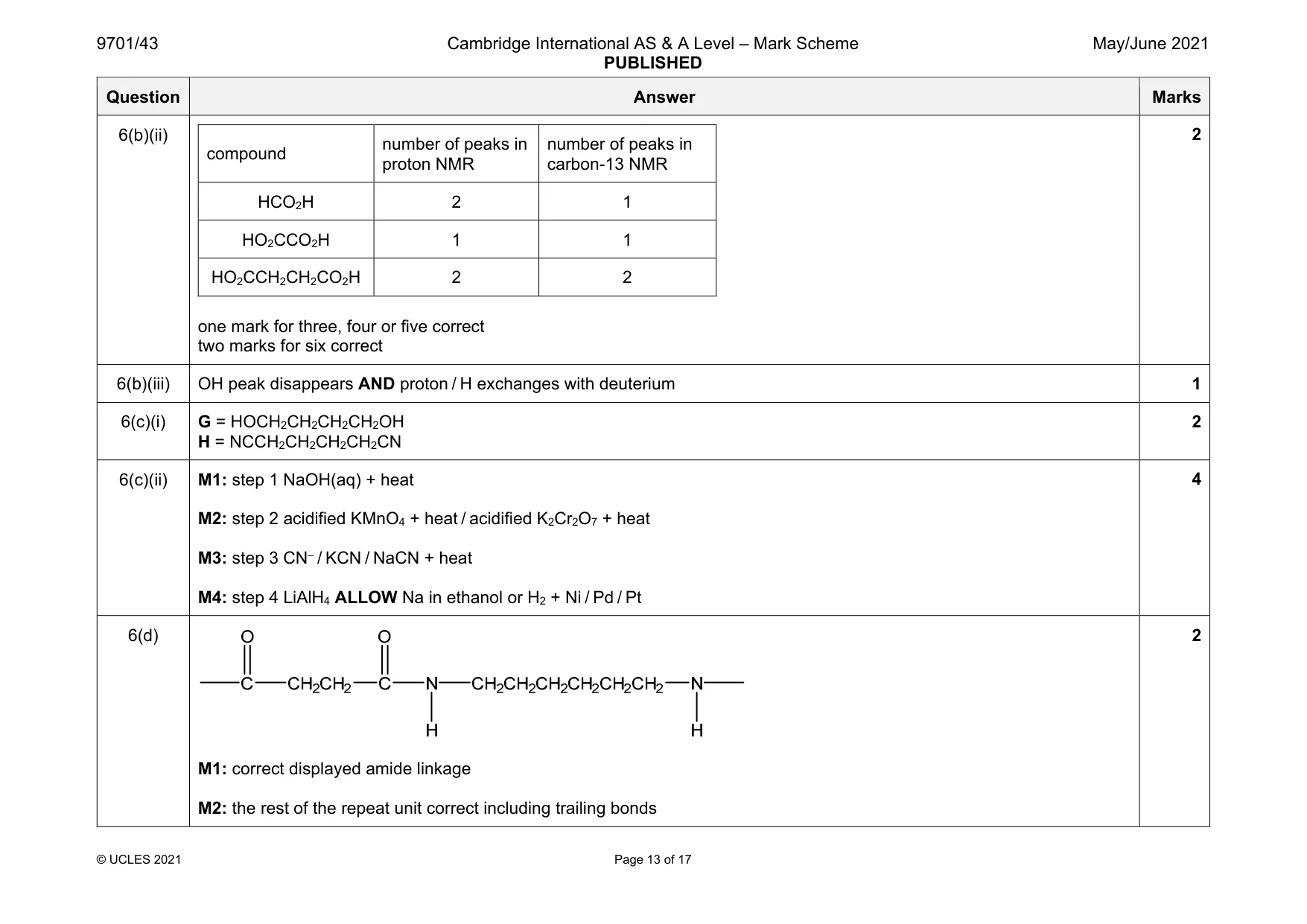
Mark scheme: 6(a) M1: ethanoic acid > butanoic acid > water > ethanol M2: a reason given in terms of an electron donating or an electron withdrawing group for one of: strengthening of O–H bond OR weakening of O–H bond OR stability of anion Two out of the three alternatives M3, M4 and M5: M3: ethanol: positive inductive effect / electron donating effect of ethyl / alkyl / R group M4: butanoic acid: positive inductive effect / electron donating effect of propyl / alkyl / R group M5: (either ethanoic or butanoic) acid: negative inductive effect of either C=O or carbonyl OR negative charge delocalised over COO– 4 6(b)(i) reagents and conditions observed change test 1 Tollen’s reagent, warm OR Fehling’s solution, warm silver mirror (brick) red ppt / solid test 2 acidified MnO4–, warm decolourises OR bubbles M1 / M2: reagents and conditions × 2 M3: observations both correct 3 Question Answer Marks 6(b)(ii) compound number of peaks in proton NMR number of peaks in carbon-13 NMR HCO2H 2 1 HO2CCO2H 1 1 HO2CCH2CH2CO2H 2 2 one mark for three, four or five correct two marks for six correct 2 6(b)(iii) OH peak disappears AND proton / H exchanges with deuterium 1 6(c)(i) G = HOCH2CH2CH2CH2OH H = NCCH2CH2CH2CH2CN 2 6(c)(ii) M1: step 1 NaOH(aq) + heat M2: step 2 acidified KMnO4 + heat / acidified K2Cr2O7 + heat M3: step 3 CN– / KCN / NaCN + heat M4: step 4 LiAlH4 ALLOW Na in ethanol or H2 + Ni / Pd / Pt 4 6(d) M1: correct displayed amide linkage M2: the rest of the repeat unit correct including trailing bonds 2
Q7 · 3-aminobenzoic acid can be synthesised from methylbenzene in three steps
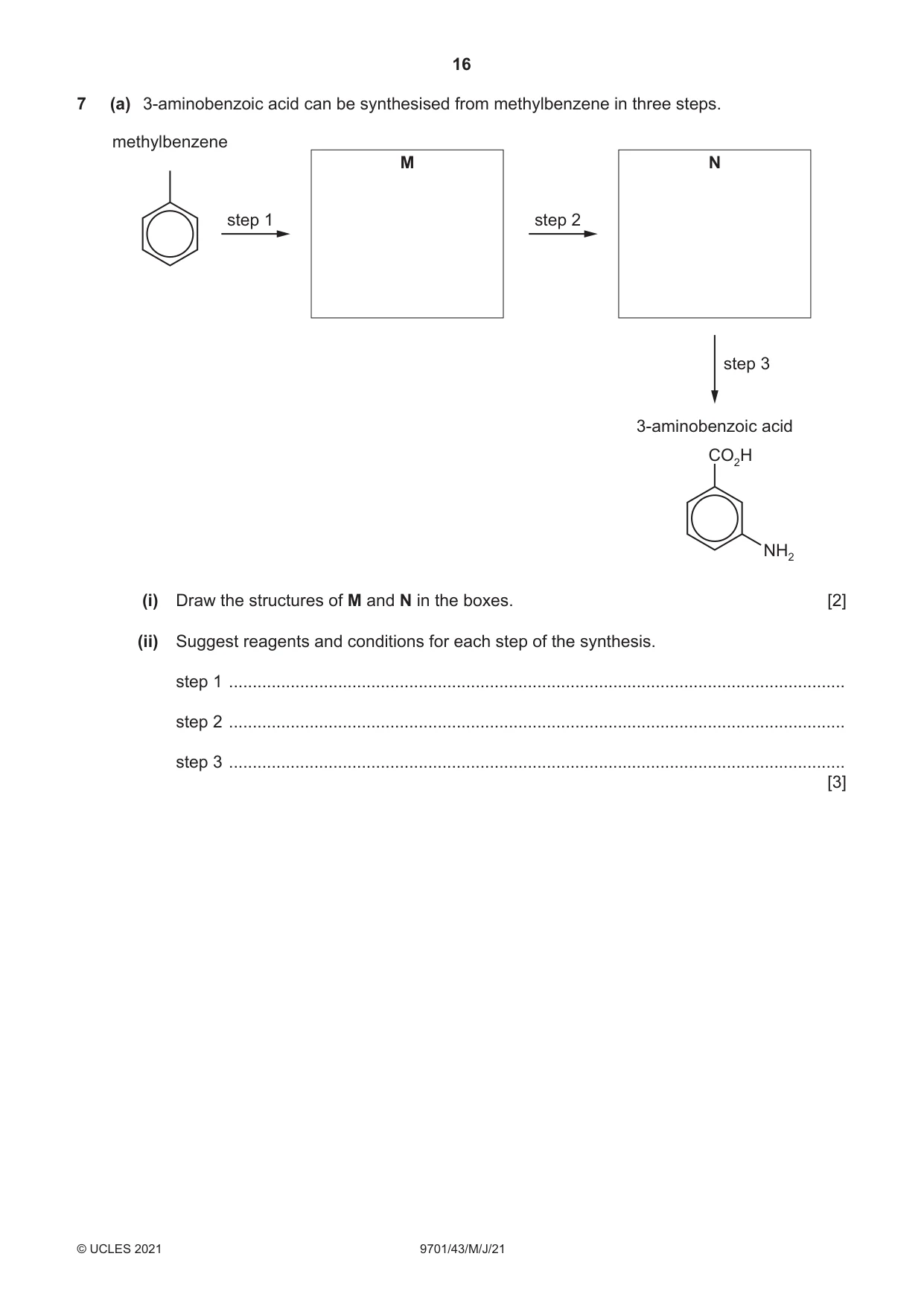
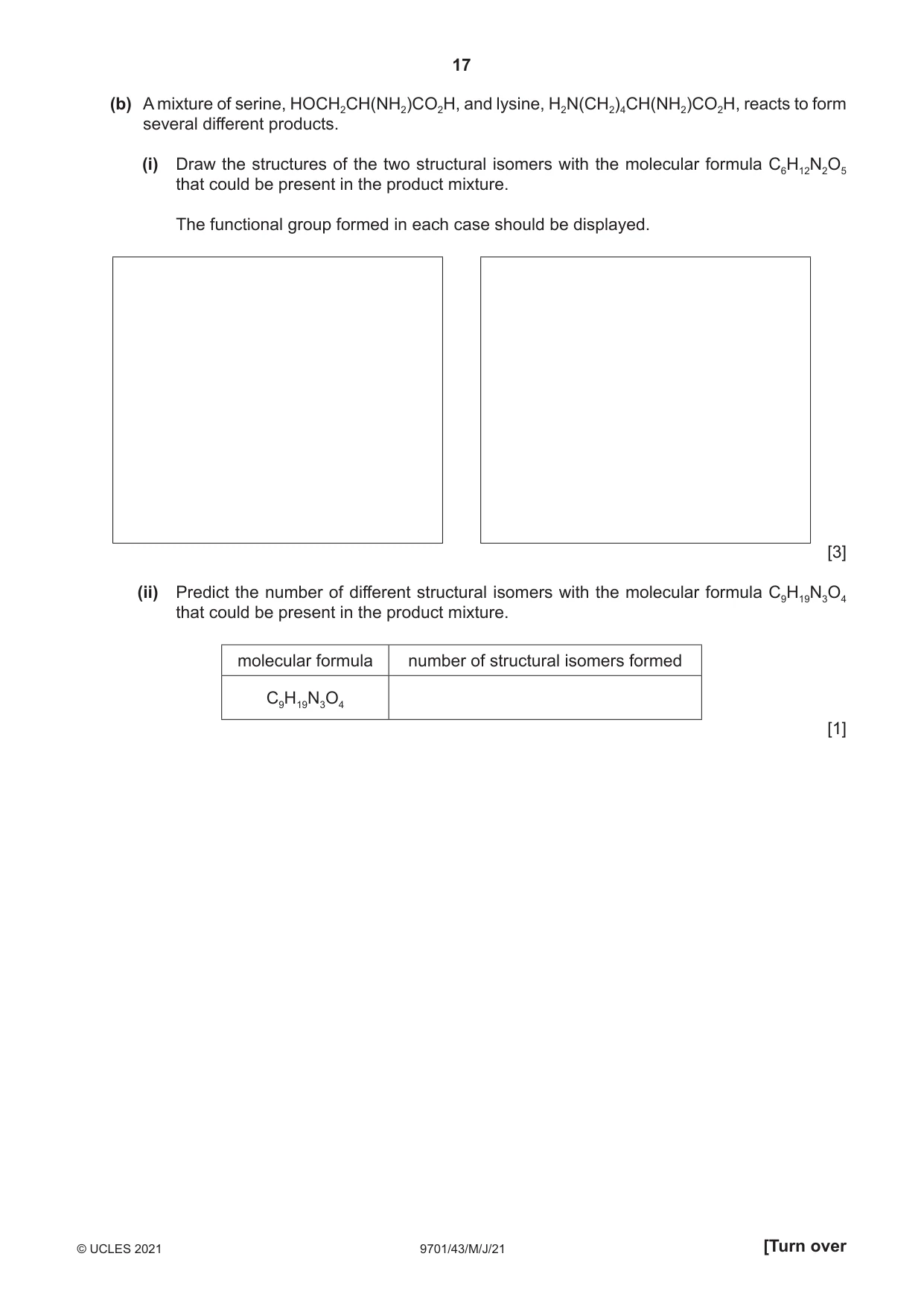
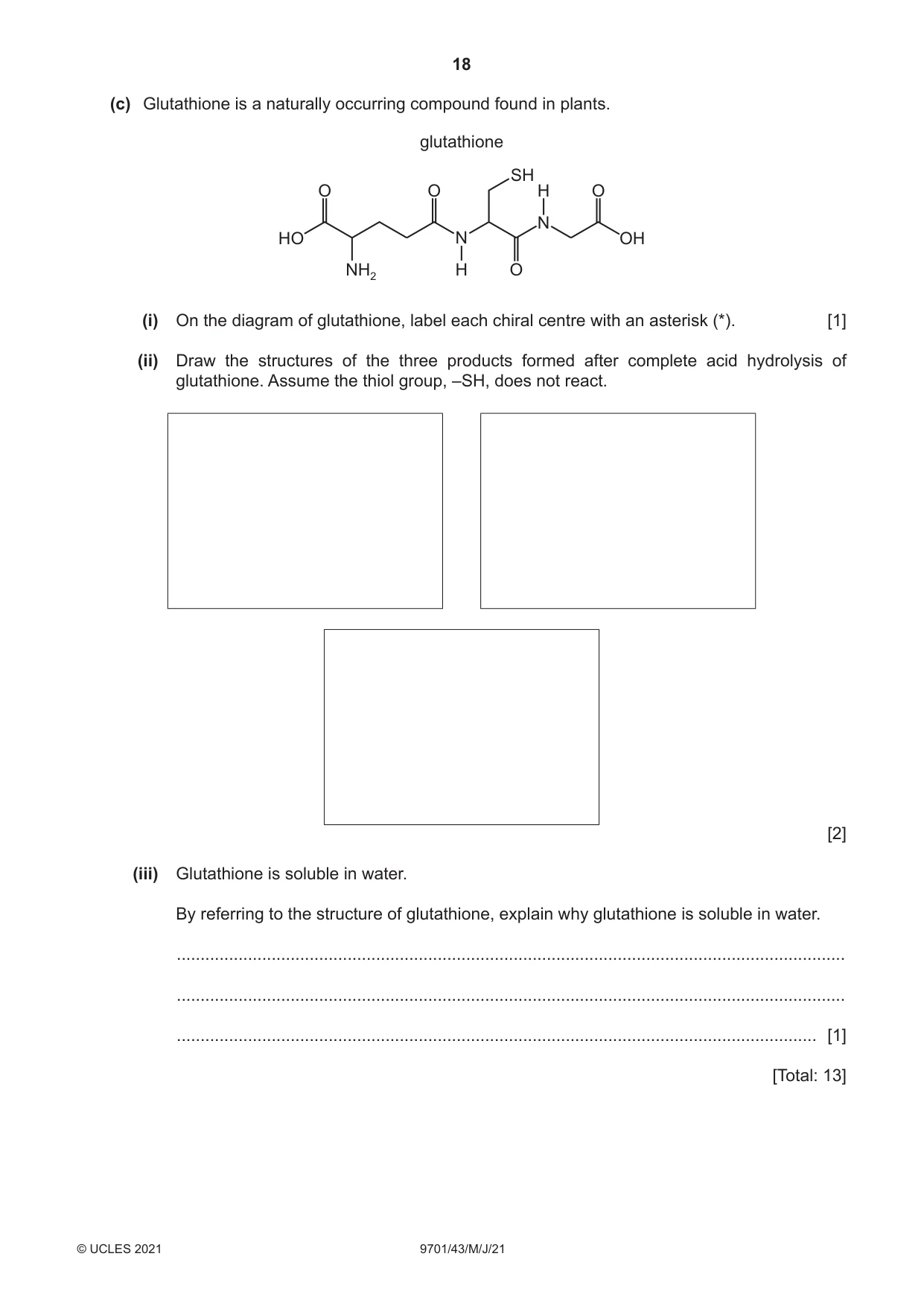
7 (a) 3-aminobenzoic acid can be synthesised from methylbenzene in three steps. methylbenzene M N step 1 step 2 step 3 3-aminobenzoic acid CO2H NH2 (i) Draw the structures of M and N in the boxes. [2] (ii) Suggest reagents and conditions for each step of the synthesis. step 1 .................................................................................................................................. step 2 .................................................................................................................................. step 3 .................................................................................................................................. [3] (b) A mixture of serine, HOCH2CH(NH2)CO2H, and lysine, H2N(CH2)4CH(NH2)CO2H, reacts to form several different products. (i) Draw the structures of the two structural isomers with the molecular formula C6H12N2O5 that could be present in the product mixture. The functional group formed in each case should be displayed. [3] (ii) Predict the number of different structural isomers with the molecular formula C9H19N3O4 that could be present in the product mixture. molecular formula number of structural isomers formed C9H19N3O4 [1] (c) Glutathione is a naturally occurring compound found in plants. glutathione SH O O H O N HO N OH NH2 H O (i) On the diagram of glutathione, label each chiral centre with an asterisk (*). [1] (ii) Draw the structures of the three products formed after complete acid hydrolysis of glutathione. Assume the thiol group, –SH, does not react. [2] (iii) Glutathione is soluble in water. By referring to the structure of glutathione, explain why glutathione is soluble in water. ............................................................................................................................................. ............................................................................................................................................. ....................................................................................................................................... [1] [Total: 13]
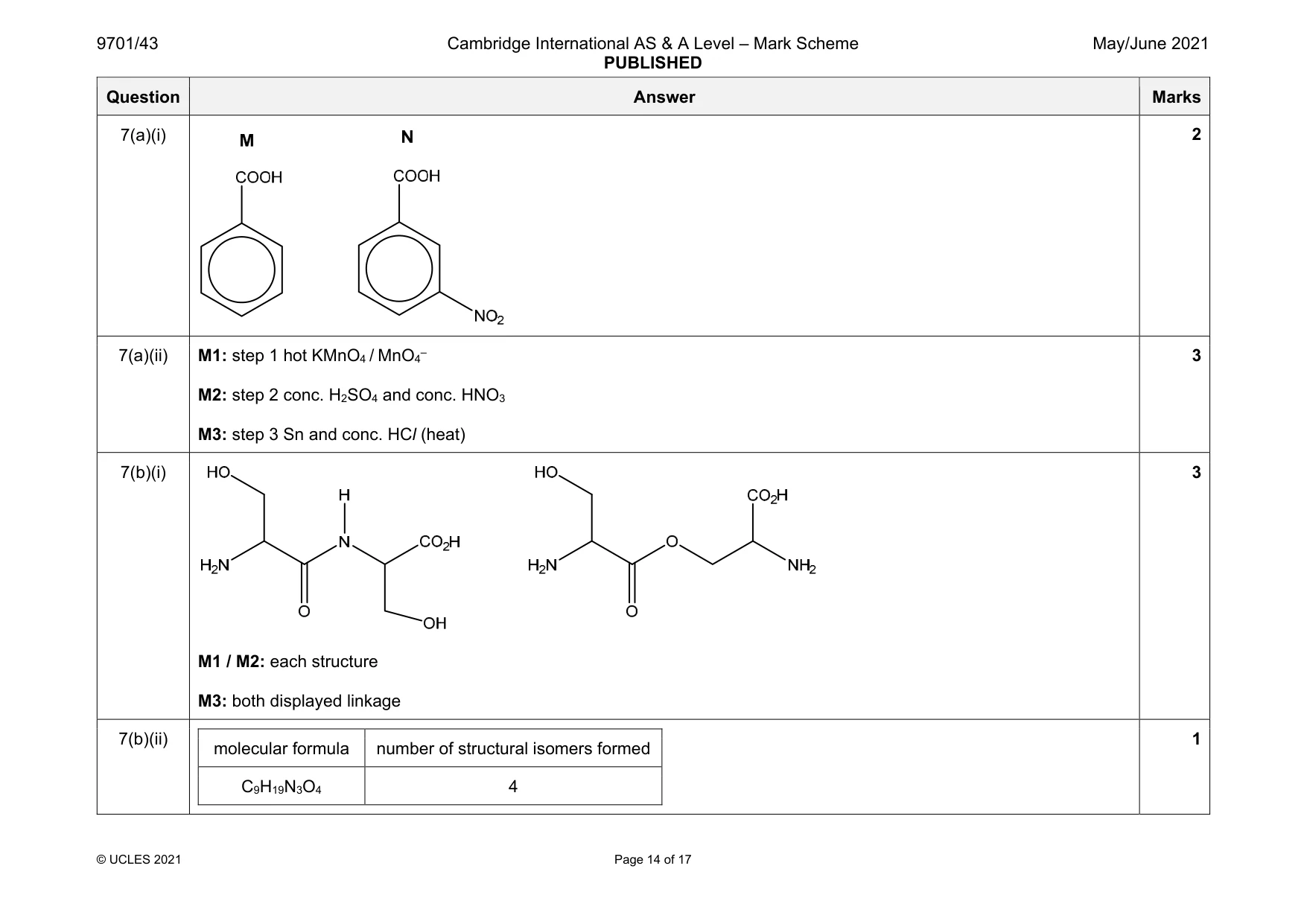
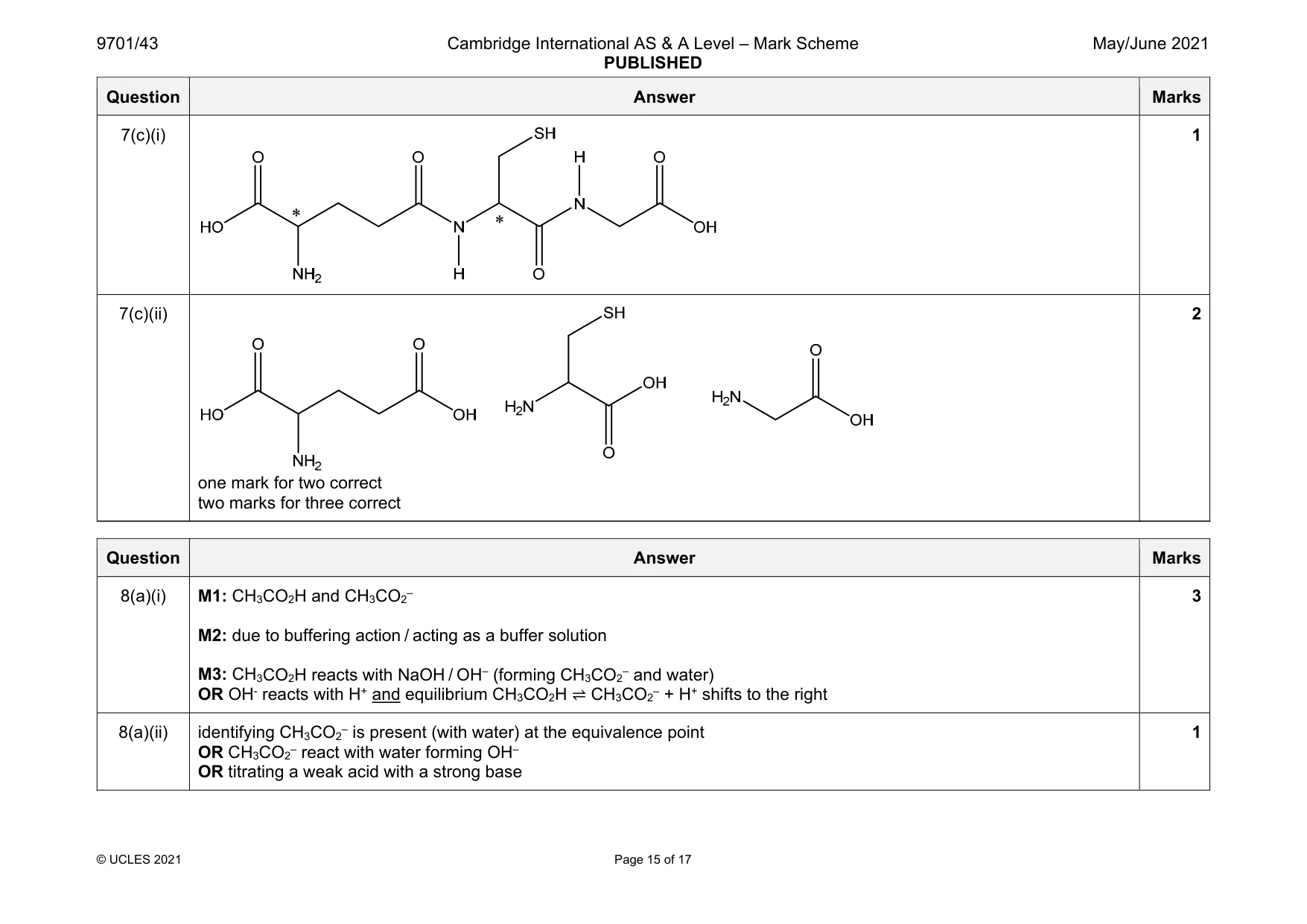
Mark scheme: 7(a)(i) 7(a)(ii) M1: step 1 hot KMnO4 / MnO4– M2: step 2 conc. H2SO4 and conc. HNO3 M3: step 3 Sn and conc. HCl (heat) 3 7(b)(i) M1 / M2: each structure M3: both displayed linkage 3 7(b)(ii) molecular formula number of structural isomers formed C9H19N3O4 4 1 Question Answer Marks 7(c)(i) 1 7(c)(ii) one mark for two correct two marks for three correct 2
Q8 · The sketch graph for the titration of ethanoic acid, CH3CO2H, with sodium hydroxide is…
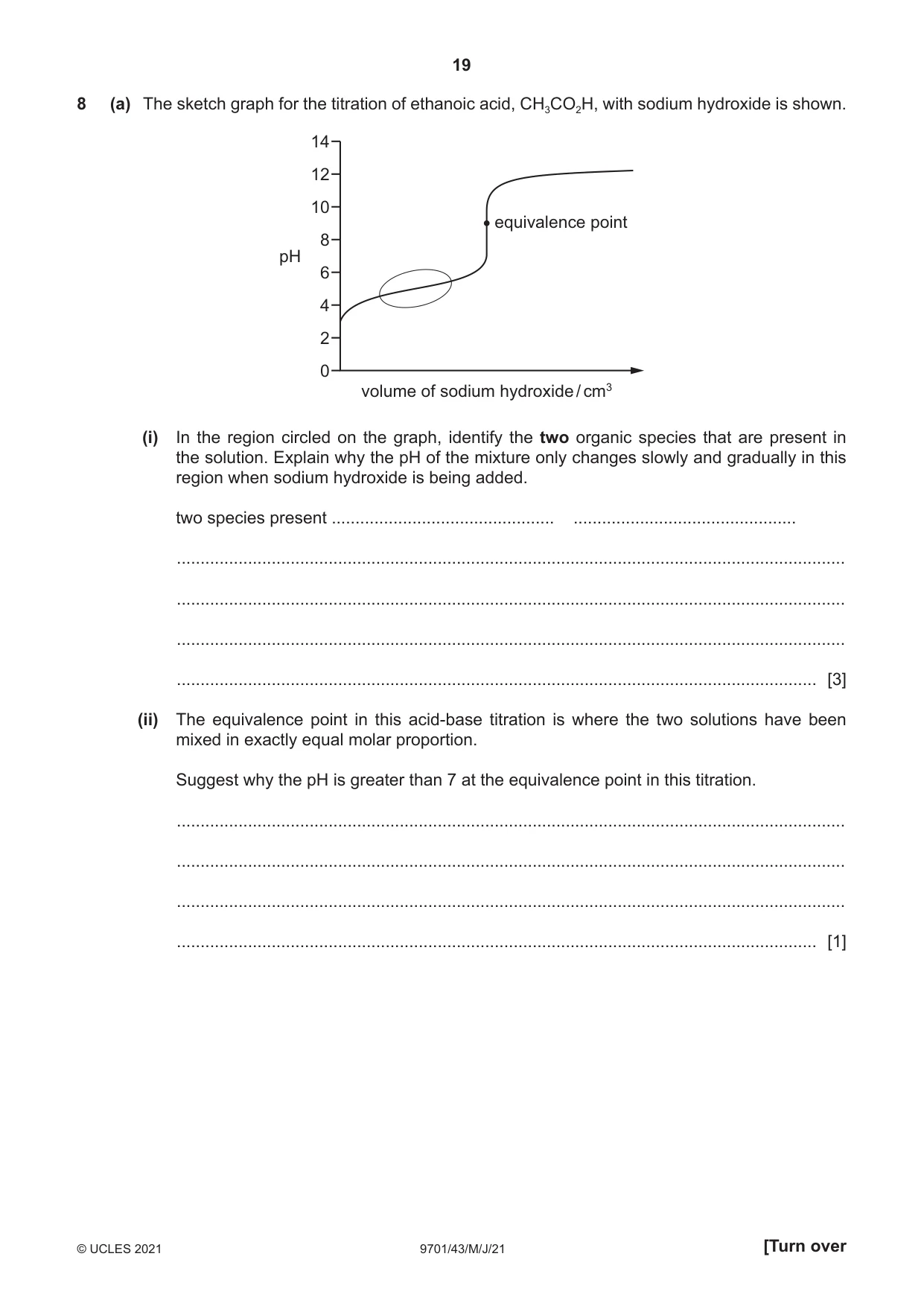
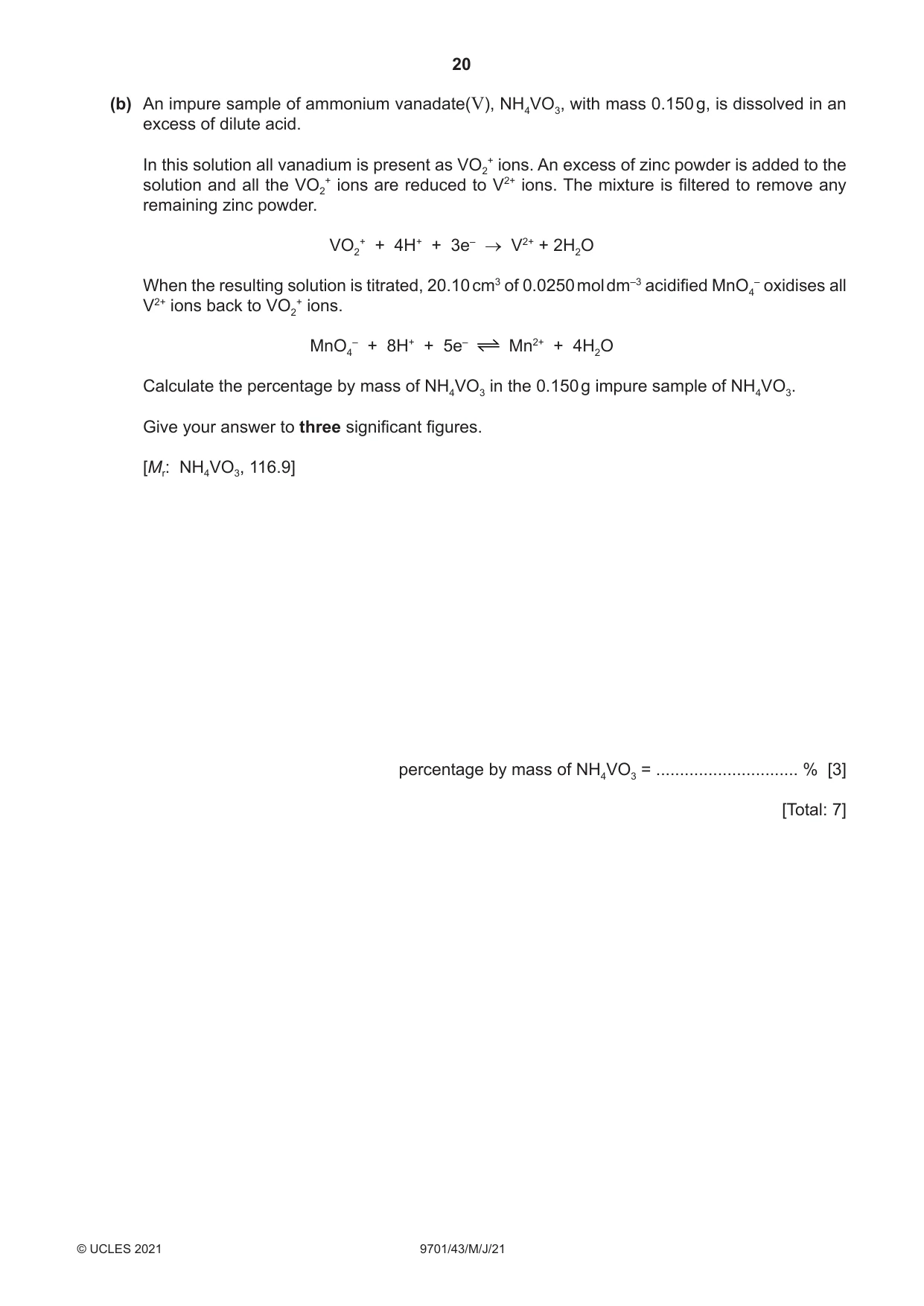
8 (a) The sketch graph for the titration of ethanoic acid, CH3CO2H, with sodium hydroxide is shown. 14 12 10 equivalence point 8 pH 6 4 2 0 volume of sodium hydroxide / cm3 (i) In the region circled on the graph, identify the two organic species that are present in the solution. Explain why the pH of the mixture only changes slowly and gradually in this region when sodium hydroxide is being added. two species present ............................................... ............................................... ............................................................................................................................................. ............................................................................................................................................. ............................................................................................................................................. ....................................................................................................................................... [3] (ii) The equivalence point in this acid-base titration is where the two solutions have been mixed in exactly equal molar proportion. Suggest why the pH is greater than 7 at the equivalence point in this titration. ............................................................................................................................................. ............................................................................................................................................. ............................................................................................................................................. ....................................................................................................................................... [1] (b) An impure sample of ammonium vanadate(V), NH4VO3, with mass 0.150 g, is dissolved in an excess of dilute acid. In this solution all vanadium is present as VO2+ ions. An excess of zinc powder is added to the solution and all the VO2+ ions are reduced to V2+ ions. The mixture is filtered to remove any remaining zinc powder. VO2+ + 4H+ + 3e– → V2+ + 2H2O When the resulting solution is titrated, 20.10 cm3 of 0.0250 mol dm–3 acidified MnO4– oxidises all V2+ ions back to VO2+ ions. MnO4– + 8H+ + 5e– Mn2+ + 4H2O Calculate the percentage by mass of NH4VO3 in the 0.150 g impure sample of NH4VO3. Give your answer to three significant figures. [Mr: NH4VO3, 116.9] percentage by mass of NH4VO3 = .............................. % [3] [Total: 7]
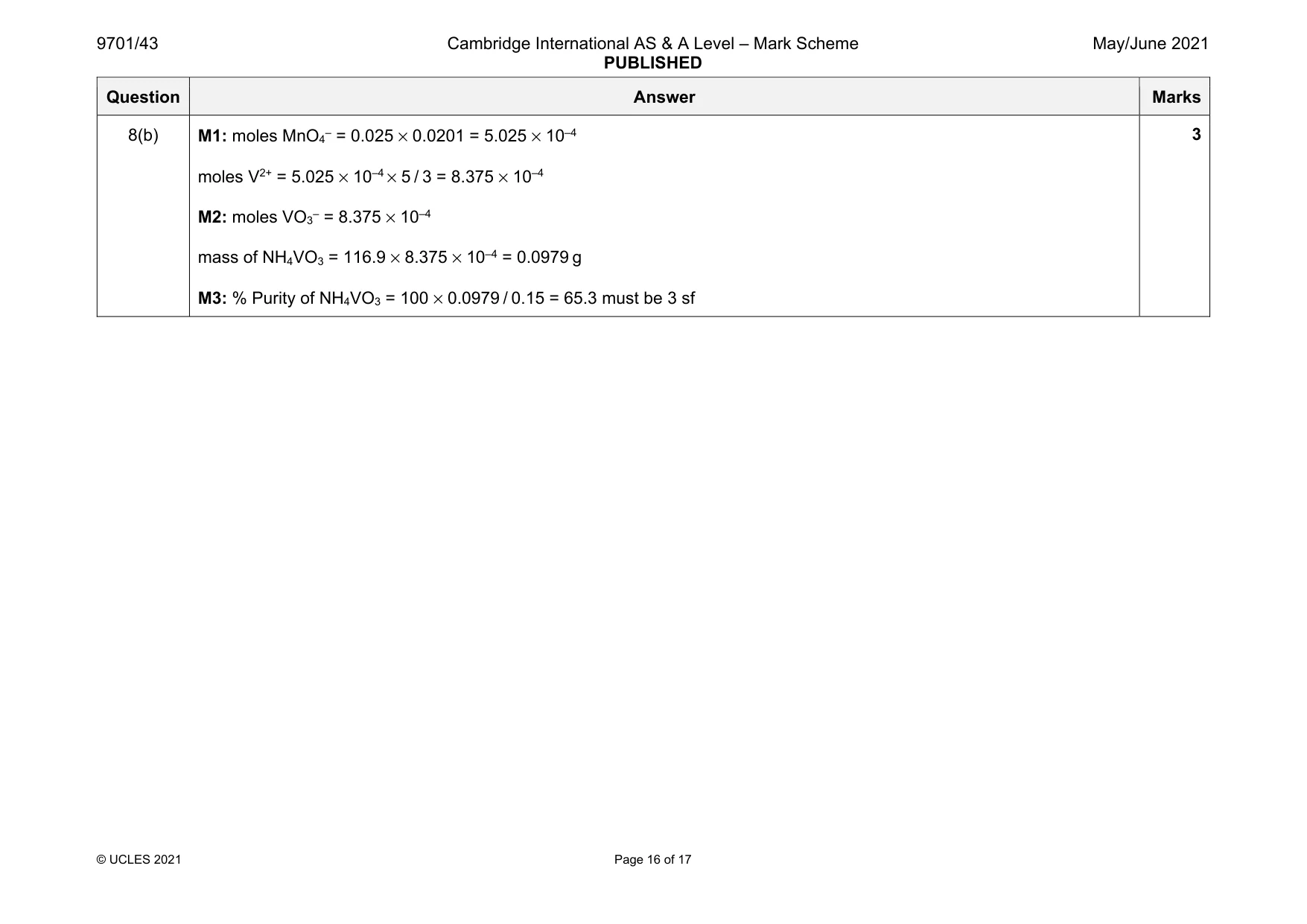
Mark scheme: 8(a)(i) M1: CH3CO2H and CH3CO2– M2: due to buffering action / acting as a buffer solution M3: CH3CO2H reacts with NaOH / OH– (forming CH3CO2– and water) OR OH- reacts with H+ and equilibrium CH3CO2H ⇌ CH3CO2– + H+ shifts to the right 3 8(a)(ii) identifying CH3CO2– is present (with water) at the equivalence point OR CH3CO2– react with water forming OH– OR titrating a weak acid with a strong base 1 Question Answer Marks 8(b) M1: moles MnO4– = 0.025 × 0.0201 = 5.025 × 10⁻⁴ moles V2+ = 5.025 × 10–4 × 5 / 3 = 8.375 × 10⁻⁴ M2: moles VO3– = 8.375 × 10⁻⁴ mass of NH4VO3 = 116.9 × 8.375 × 10–4 = 0.0979 g M3: % Purity of NH4VO3 = 100 × 0.0979 / 0.15 = 65.3 must be 3 sf 3
Q9 · The carbon-13 (13C) NMR spectrum of compound A, C8H8O2, contains six peaks
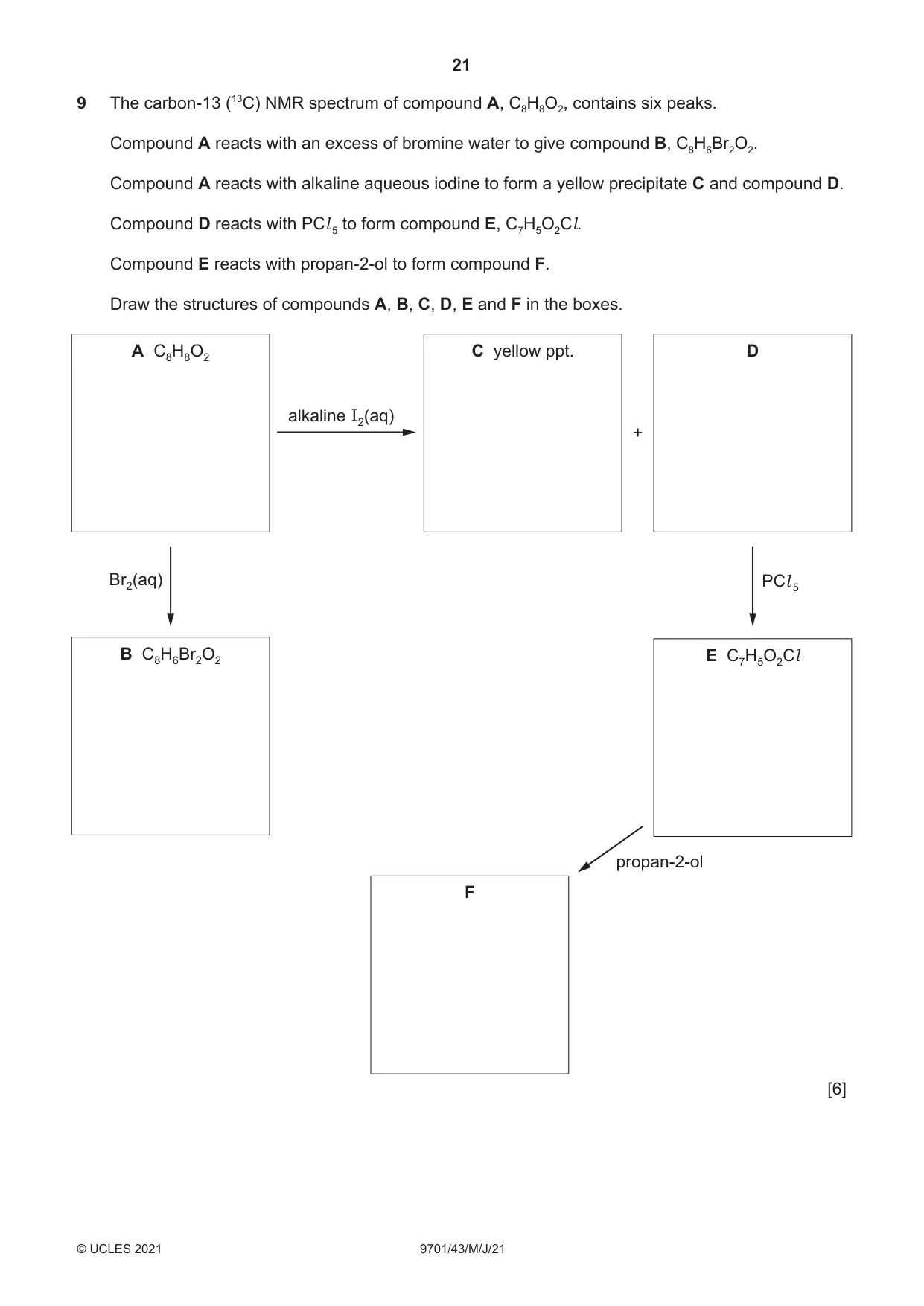
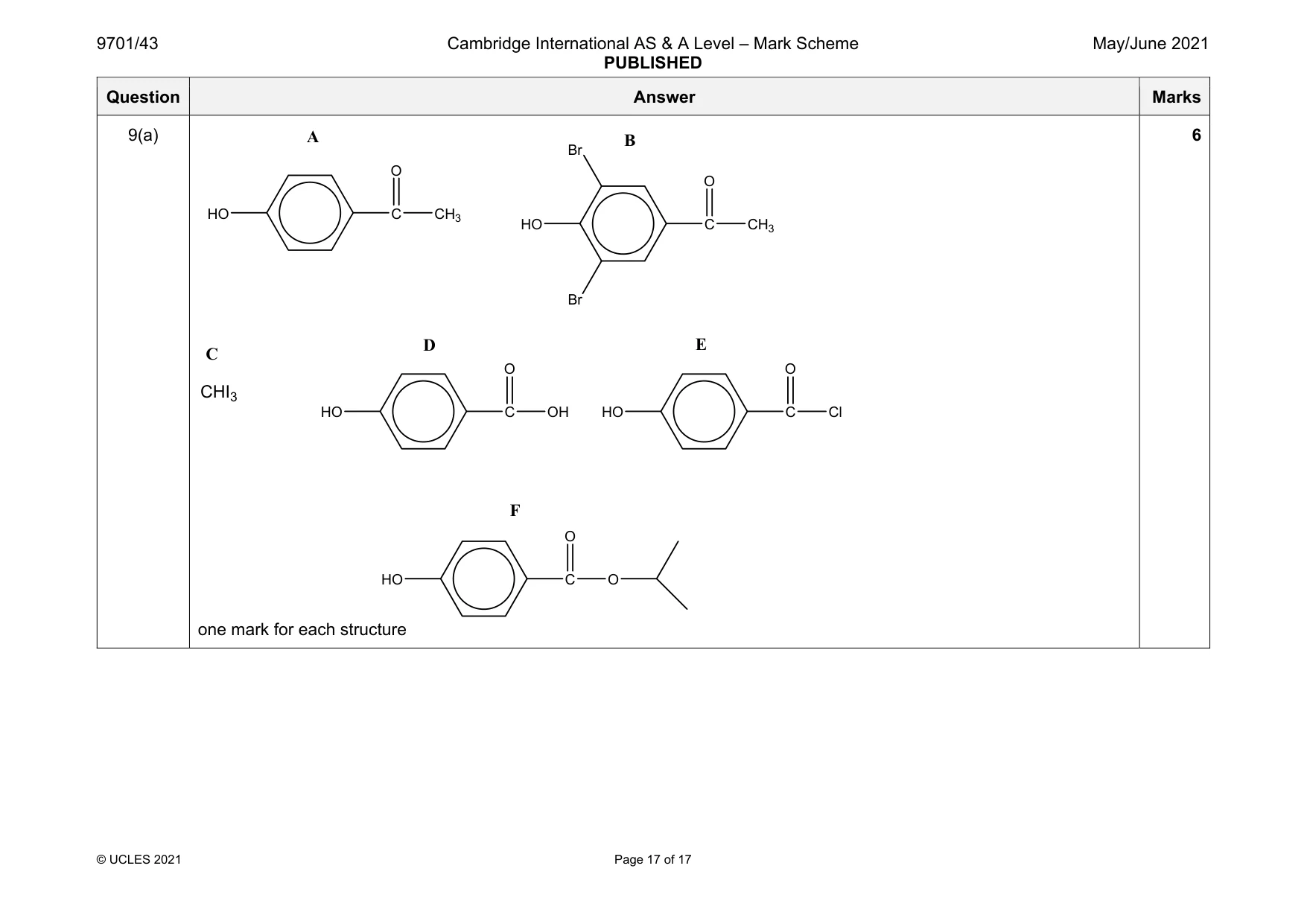
9 The carbon-13 (13C) NMR spectrum of compound A, C8H8O2, contains six peaks. Compound A reacts with an excess of bromine water to give compound B, C8H6Br2O2. Compound A reacts with alkaline aqueous iodine to form a yellow precipitate C and compound D. Compound D reacts with PCl 5 to form compound E, C7H5O2Cl. Compound E reacts with propan-2-ol to form compound F. Draw the structures of compounds A, B, C, D, E and F in the boxes. A C8H8O2 C yellow ppt. D alkaline I2(aq) + Br2(aq) PCl 5 B C8H6Br2O2 E C7H5O2Cl propan-2-ol F [6]
Mark scheme: 9(a) HO C O CH3 A HO C O CH3 Br Br B HO C O OH HO C O Cl D E C CHI3 HO C O O F one mark for each structure 6
What was in this paper
The subtopics covered by these 9 questions, and how many questions each got. Open one in a new tab to see every Cambridge question on it.
What you needed in this session
Cambridge’s own grade thresholds for 2021 May/June, Paper 4 · Variant 3. A higher threshold means an easier paper — the bar moves with how the cohort did.