Cambridge A Level Chemistry 9701 — 2017 Feb/March Paper 3 · Variant 3
9701/33/F/M/17 · 3 questions · 40 marks · ≈45 min
The question paper and its mark scheme, free to read here and free to download. This is Cambridge’s own paper, exactly as it was sat.
Question paper12 pages
Mark scheme5 pages
Answers below. Sit the paper first if you are practising.
Questions as text
Q1 · The concentration of hydrogen peroxide may be given in mol dm–3 or as ‘volume strength’
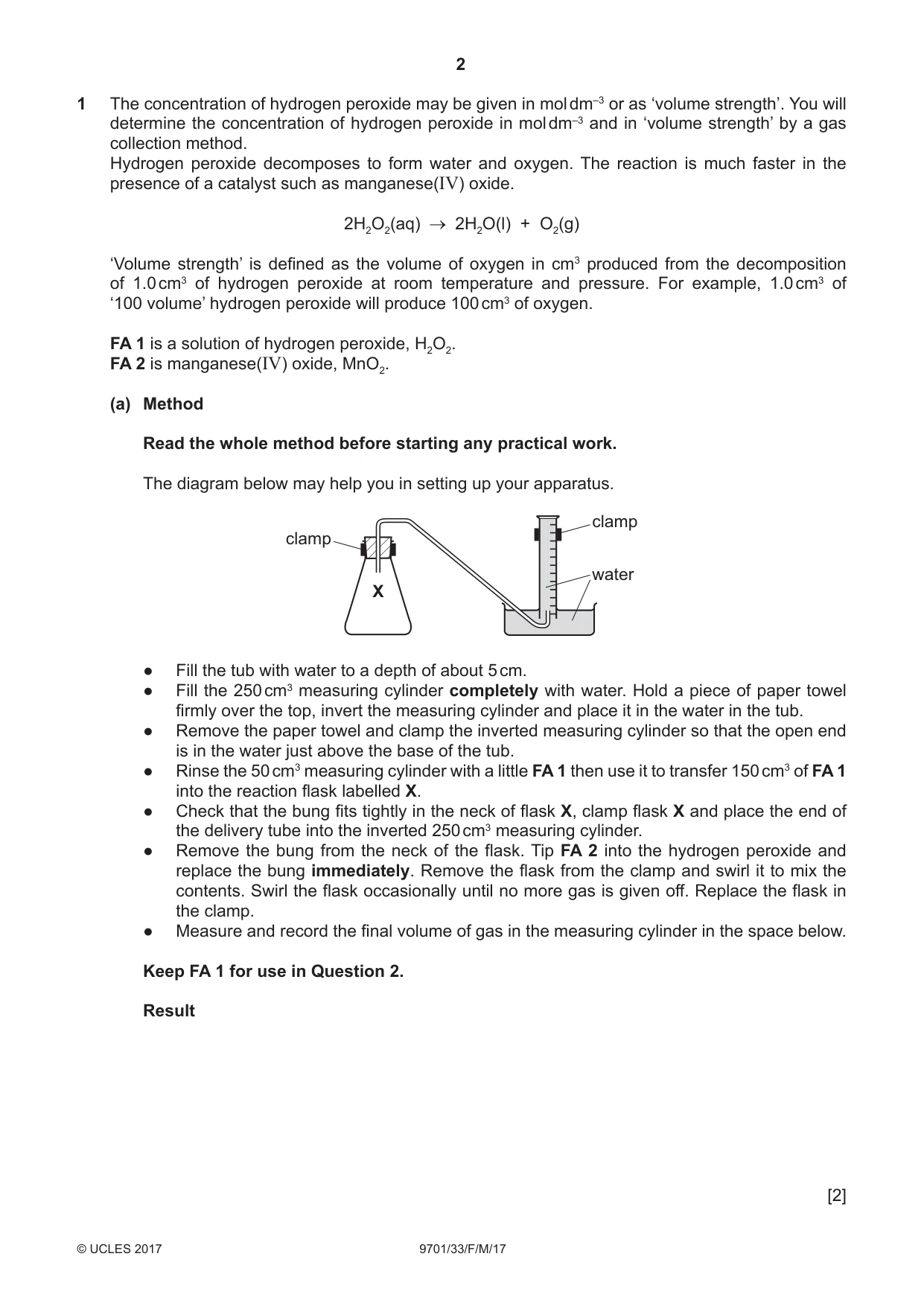
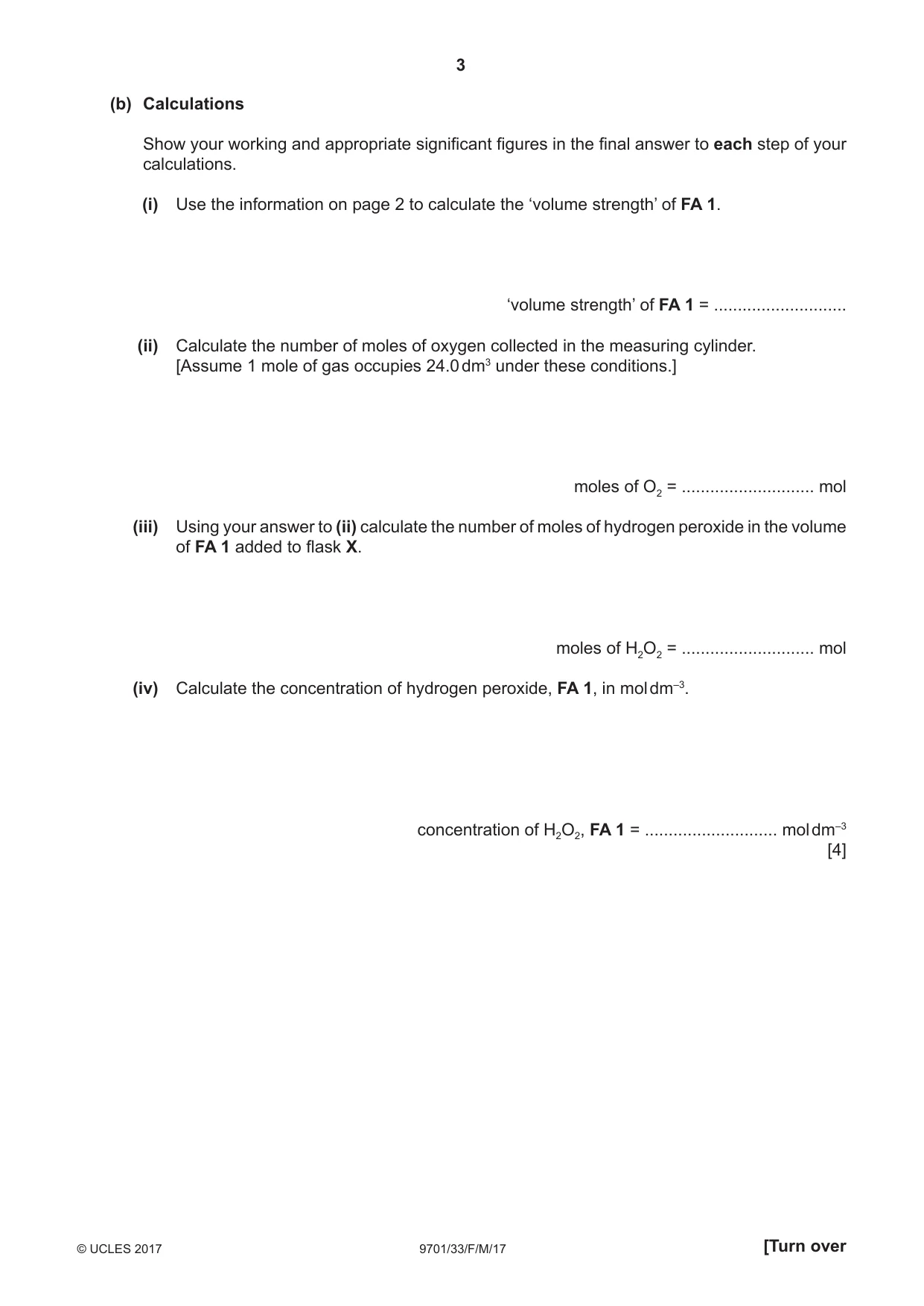
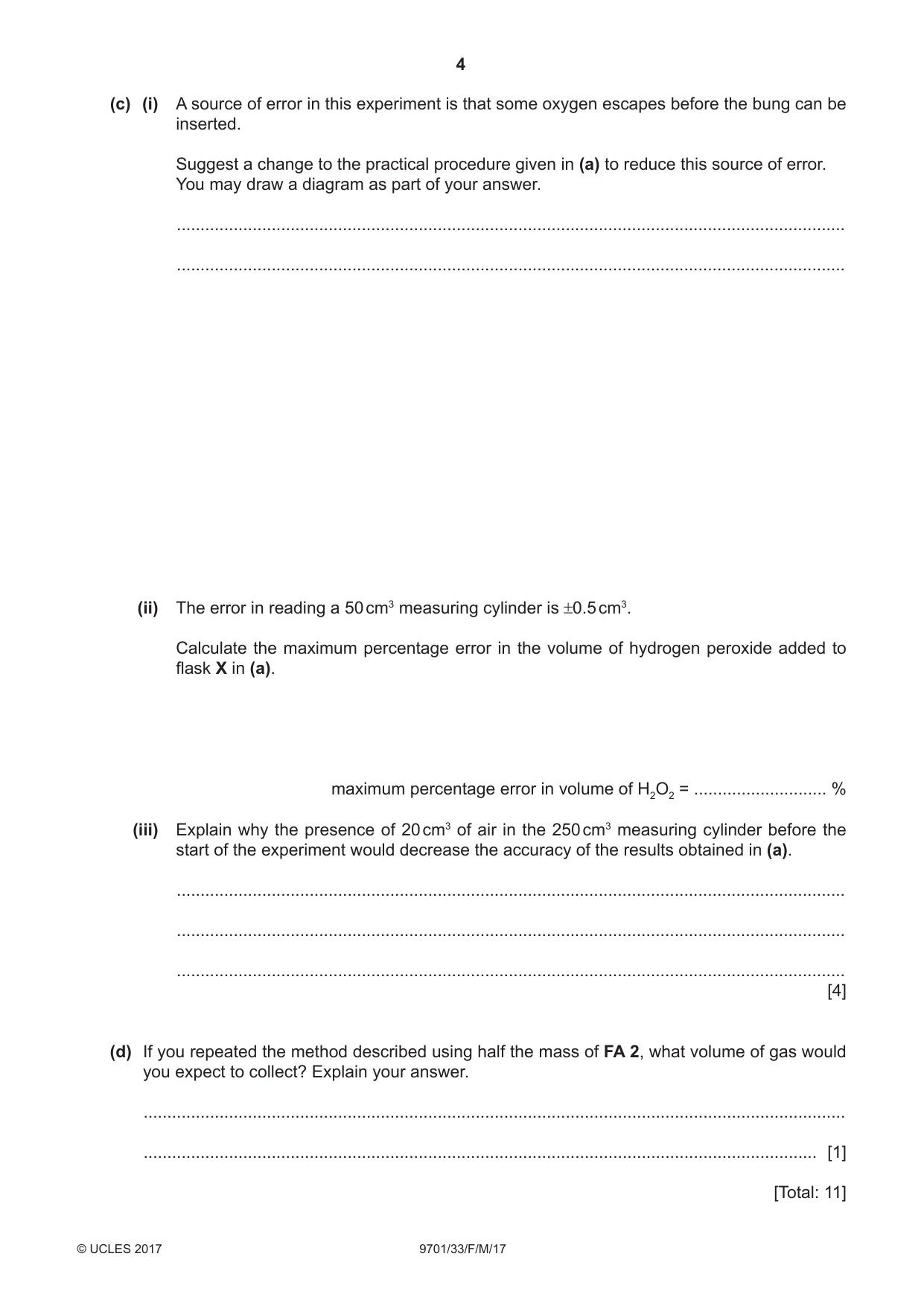
1 The concentration of hydrogen peroxide may be given in mol dm–3 or as ‘volume strength’. You will determine the concentration of hydrogen peroxide in mol dm–3 and in ‘volume strength’ by a gas collection method. Hydrogen peroxide decomposes to form water and oxygen. The reaction is much faster in the presence of a catalyst such as manganese(IV) oxide. 2H2O2(aq) 2H2O(l) + O2(g) ‘Volume strength’ is defined as the volume of oxygen in cm3 produced from the decomposition of 1.0 cm3 of hydrogen peroxide at room temperature and pressure. For example, 1.0 cm3 of ‘100 volume’ hydrogen peroxide will produce 100 cm3 of oxygen. FA 1 is a solution of hydrogen peroxide, H2O2. FA 2 is manganese(IV) oxide, MnO2. (a) Method Read the whole method before starting any practical work. The diagram below may help you in setting up your apparatus. clamp clamp water X ● Fill the tub with water to a depth of about 5 cm. ● Fill the 250 cm3 measuring cylinder completely with water. Hold a piece of paper towel firmly over the top, invert the measuring cylinder and place it in the water in the tub. ● Remove the paper towel and clamp the inverted measuring cylinder so that the open end is in the water just above the base of the tub. ● Rinse the 50 cm3 measuring cylinder with a little FA 1 then use it to transfer 150 cm3 of FA 1 into the reaction flask labelled X. ● Check that the bung fits tightly in the neck of flask X, clamp flask X and place the end of the delivery tube into the inverted 250 cm3 measuring cylinder. ● Remove the bung from the neck of the flask. Tip FA 2 into the hydrogen peroxide and replace the bung immediately. Remove the flask from the clamp and swirl it to mix the contents. Swirl the flask occasionally until no more gas is given off. Replace the flask in the clamp. ● Measure and record the final volume of gas in the measuring cylinder in the space below. Keep FA 1 for use in Question 2. Result [2] (b) Calculations Show your working and appropriate significant figures in the final answer to each step of your calculations. (i) Use the information on page 2 to calculate the ‘volume strength’ of FA 1. ‘volume strength’ of FA 1 = ............................ (ii) Calculate the number of moles of oxygen collected in the measuring cylinder. [Assume 1 mole of gas occupies 24.0 dm3 under these conditions.] moles of O2 = ............................ mol (iii) Using your answer to (ii) calculate the number of moles of hydrogen peroxide in the volume of FA 1 added to flask X. moles of H2O2 = ............................ mol (iv) Calculate the concentration of hydrogen peroxide, FA 1, in mol dm–3. concentration of H2O2, FA 1 = ............................ mol dm–3 [4] (c) (i) A source of error in this experiment is that some oxygen escapes before the bung can be inserted. Suggest a change to the practical procedure given in (a) to reduce this source of error. You may draw a diagram as part of your answer. ............................................................................................................................................. ............................................................................................................................................. (ii) The error in reading a 50 cm3 measuring cylinder is 0.5 cm3. Calculate the maximum percentage error in the volume of hydrogen peroxide added to flask X in (a). maximum percentage error in volume of H2O2 = ............................ % (iii) Explain why the presence of 20 cm3 of air in the 250 cm3 measuring cylinder before the start of the experiment would decrease the accuracy of the results obtained in (a). ............................................................................................................................................. ............................................................................................................................................. ............................................................................................................................................. [4] (d) If you repeated the method described using half the mass of FA 2, what volume of gas would you expect to collect? Explain your answer. .................................................................................................................................................... .............................................................................................................................................. [1] [Total: 11]
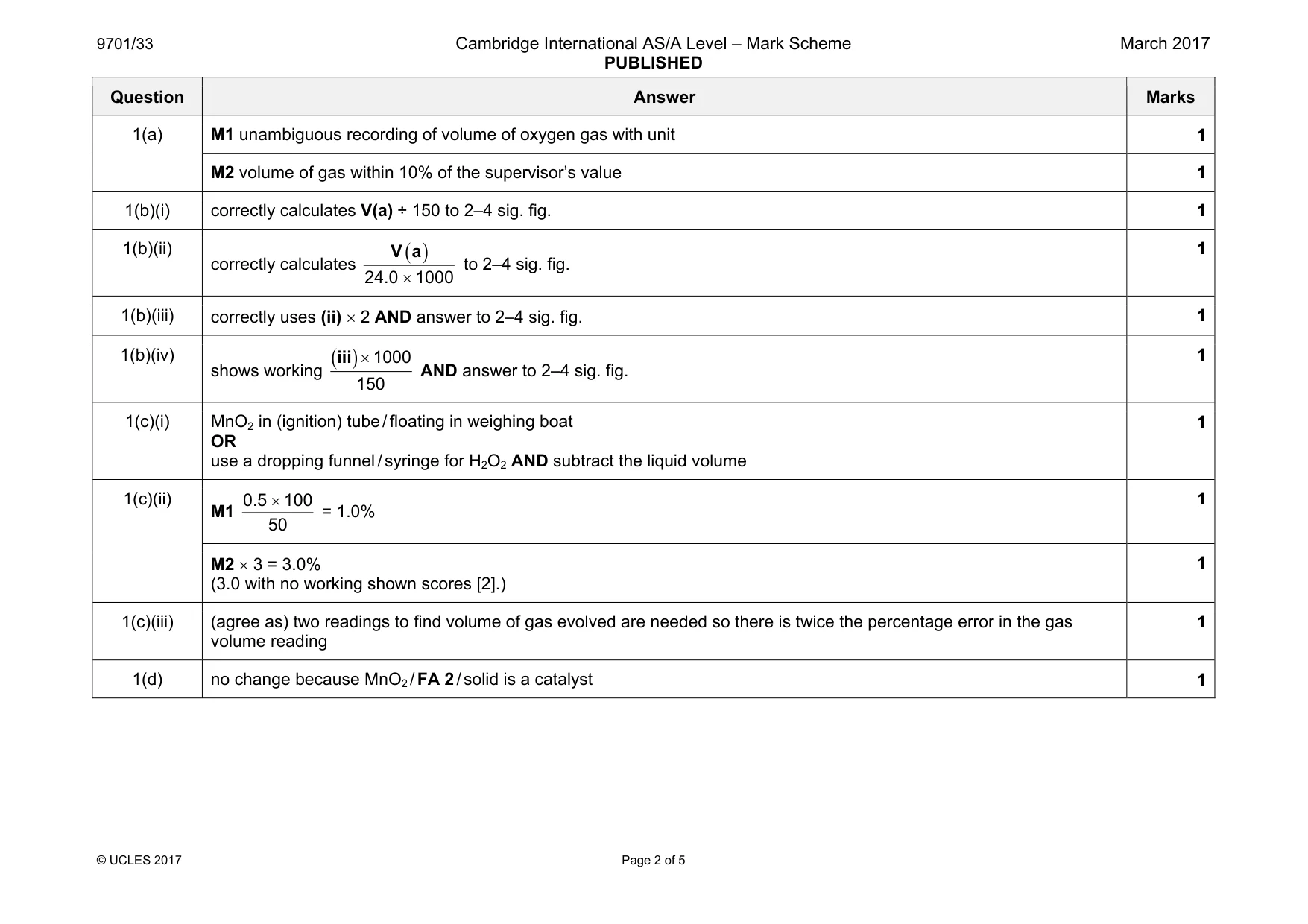
Mark scheme: 1(a) M1 unambiguous recording of volume of oxygen gas with unit 1 M2 volume of gas within 10% of the supervisor’s value 1 1(b)(i) correctly calculates V(a) ÷ 150 to 2–4 sig. fig. 1 1(b)(ii) correctly calculates ( ) 24.0 1 000 × V a to 2–4 sig. fig. 1 1(b)(iii) correctly uses (ii) × 2 AND answer to 2–4 sig. fig. 1 1(b)(iv) shows working ( ) 1 000 150 × iii AND answer to 2–4 sig. fig. 1 1(c)(i) MnO2 in (ignition) tube / floating in weighing boat OR use a dropping funnel / syringe for H2O2 AND subtract the liquid volume 1 1(c)(ii) M1 0.5 1 00 50 × = 1.0% 1 M2 × 3 = 3.0% (3.0 with no working shown scores [2].) 1 1(c)(iii) (agree as) two readings to find volume of gas evolved are needed so there is twice the percentage error in the gas volume reading 1 1(d) no change because MnO2 / FA 2 / solid is a catalyst 1
More questions on Reacting masses and volumes (of solutions and gases)
Q2 · You will carry out a second experiment to determine the concentration of hydrogen…
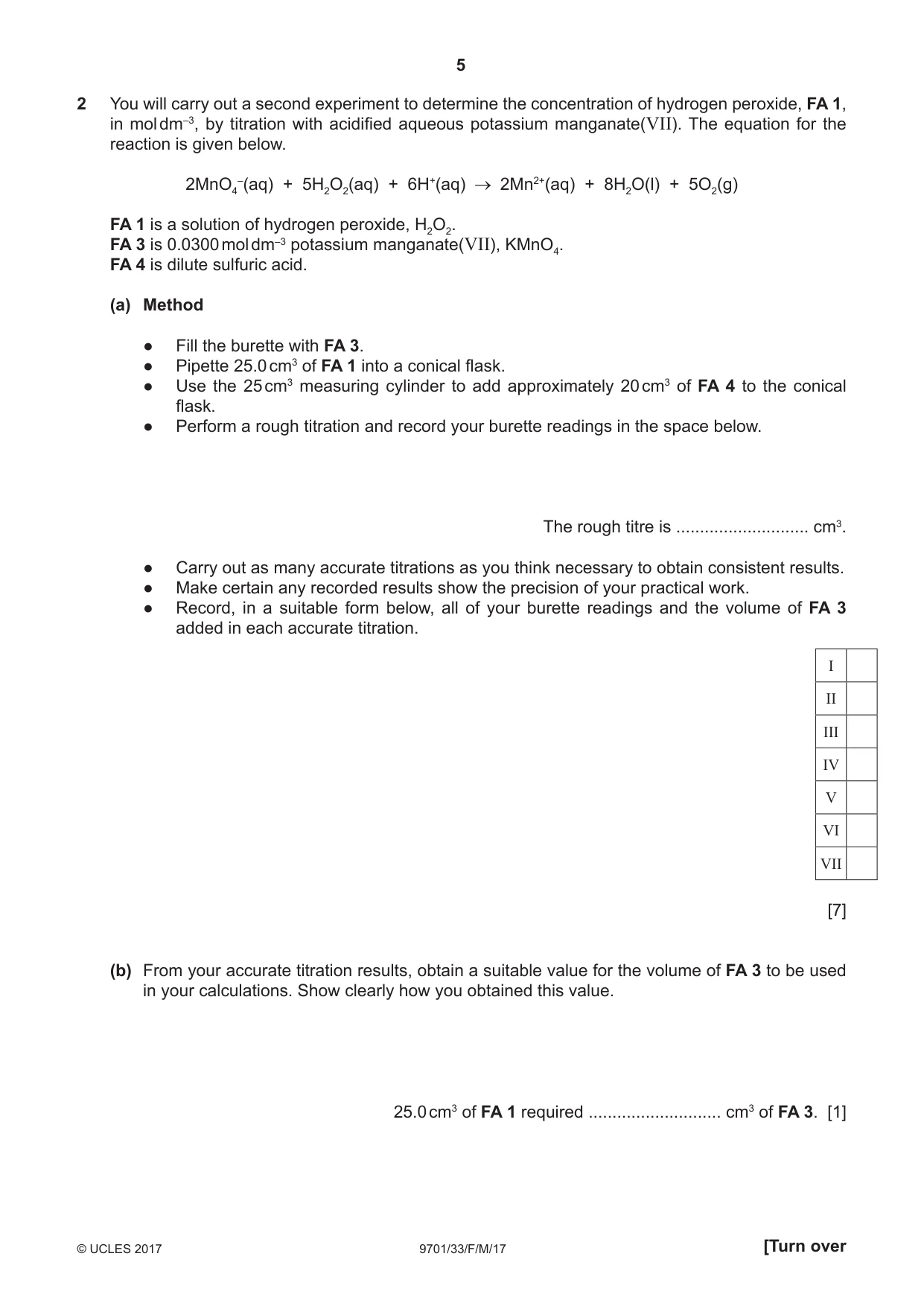
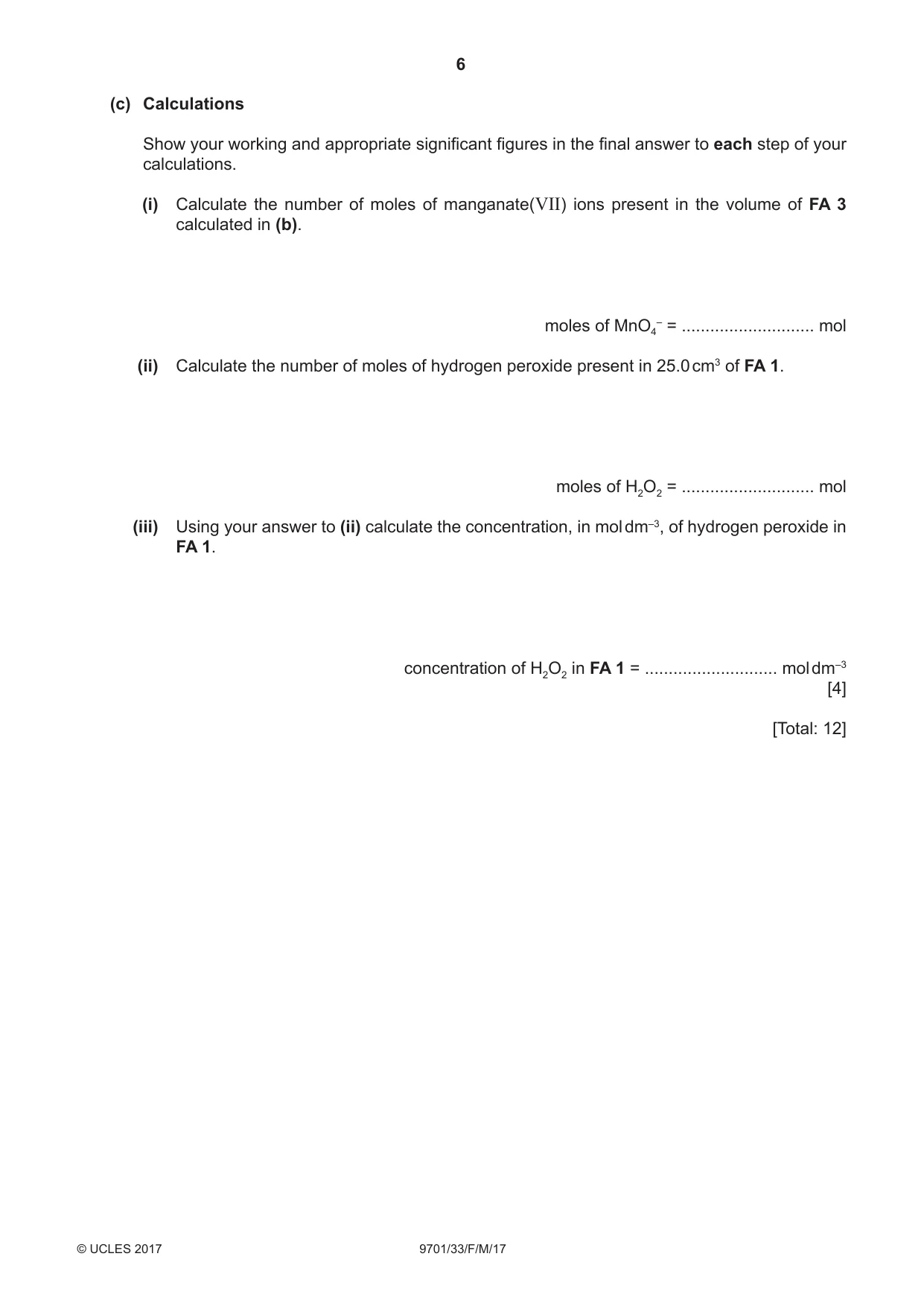
2 You will carry out a second experiment to determine the concentration of hydrogen peroxide, FA 1, in mol dm–3, by titration with acidified aqueous potassium manganate(VII). The equation for the reaction is given below. 2MnO4–(aq) + 5H2O2(aq) + 6H+(aq) 2Mn2+(aq) + 8H2O(l) + 5O2(g) FA 1 is a solution of hydrogen peroxide, H2O2. FA 3 is 0.0300 mol dm–3 potassium manganate(VII), KMnO4. FA 4 is dilute sulfuric acid. (a) Method ● Fill the burette with FA 3. ● Pipette 25.0 cm3 of FA 1 into a conical flask. ● Use the 25 cm3 measuring cylinder to add approximately 20 cm3 of FA 4 to the conical flask. ● Perform a rough titration and record your burette readings in the space below. The rough titre is ............................ cm3. ● Carry out as many accurate titrations as you think necessary to obtain consistent results. ● Make certain any recorded results show the precision of your practical work. ● Record, in a suitable form below, all of your burette readings and the volume of FA 3 added in each accurate titration. I II III IV V VI VII [7] (b) From your accurate titration results, obtain a suitable value for the volume of FA 3 to be used in your calculations. Show clearly how you obtained this value. 25.0 cm3 of FA 1 required ............................ cm3 of FA 3. [1] (c) Calculations Show your working and appropriate significant figures in the final answer to each step of your calculations. (i) Calculate the number of moles of manganate(VII) ions present in the volume of FA 3 calculated in (b). moles of MnO4– = ............................ mol (ii) Calculate the number of moles of hydrogen peroxide present in 25.0 cm3 of FA 1. moles of H2O2 = ............................ mol (iii) Using your answer to (ii) calculate the concentration, in mol dm–3, of hydrogen peroxide in FA 1. concentration of H2O2 in FA 1 = ............................ mol dm–3 [4] [Total: 12]
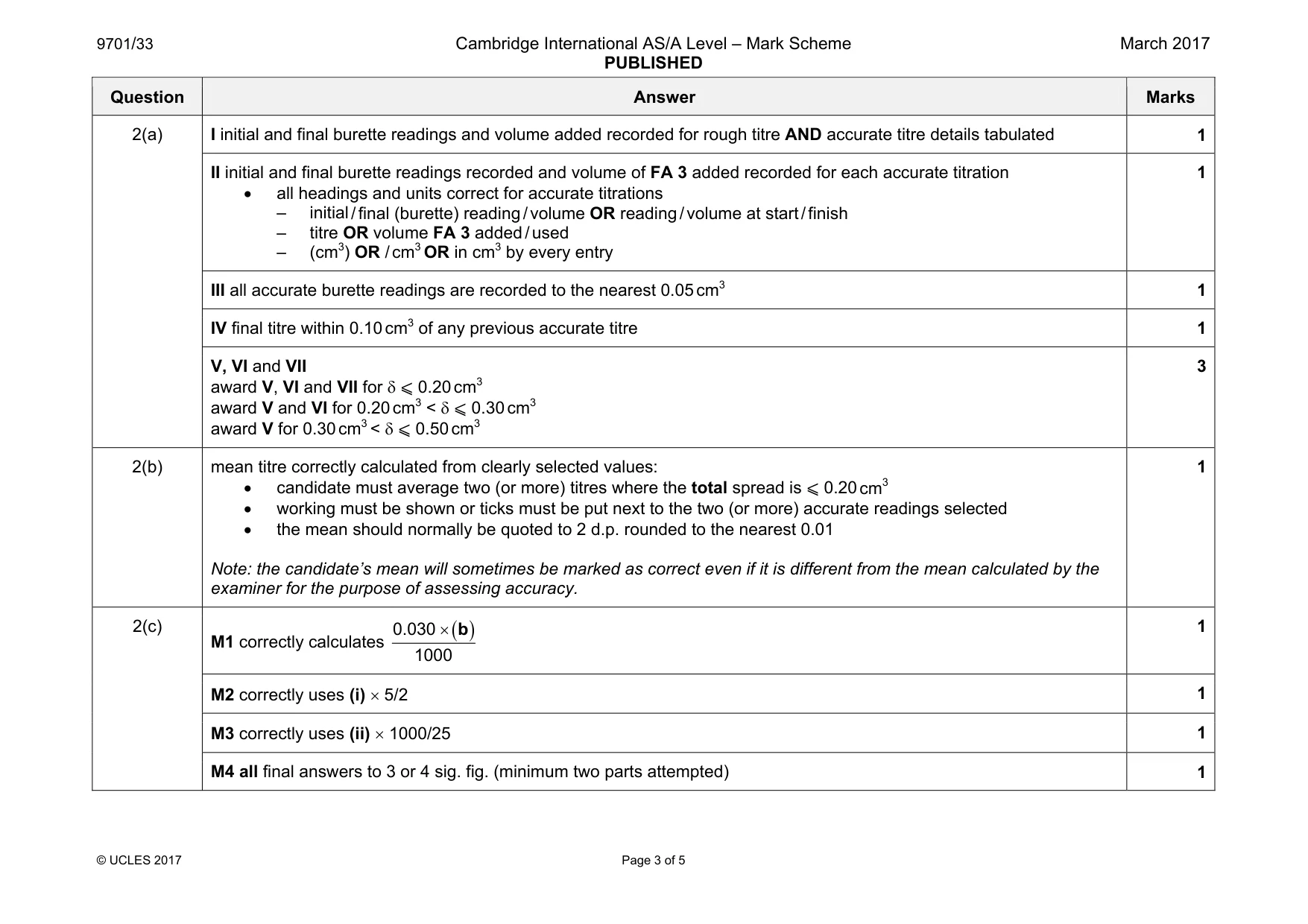
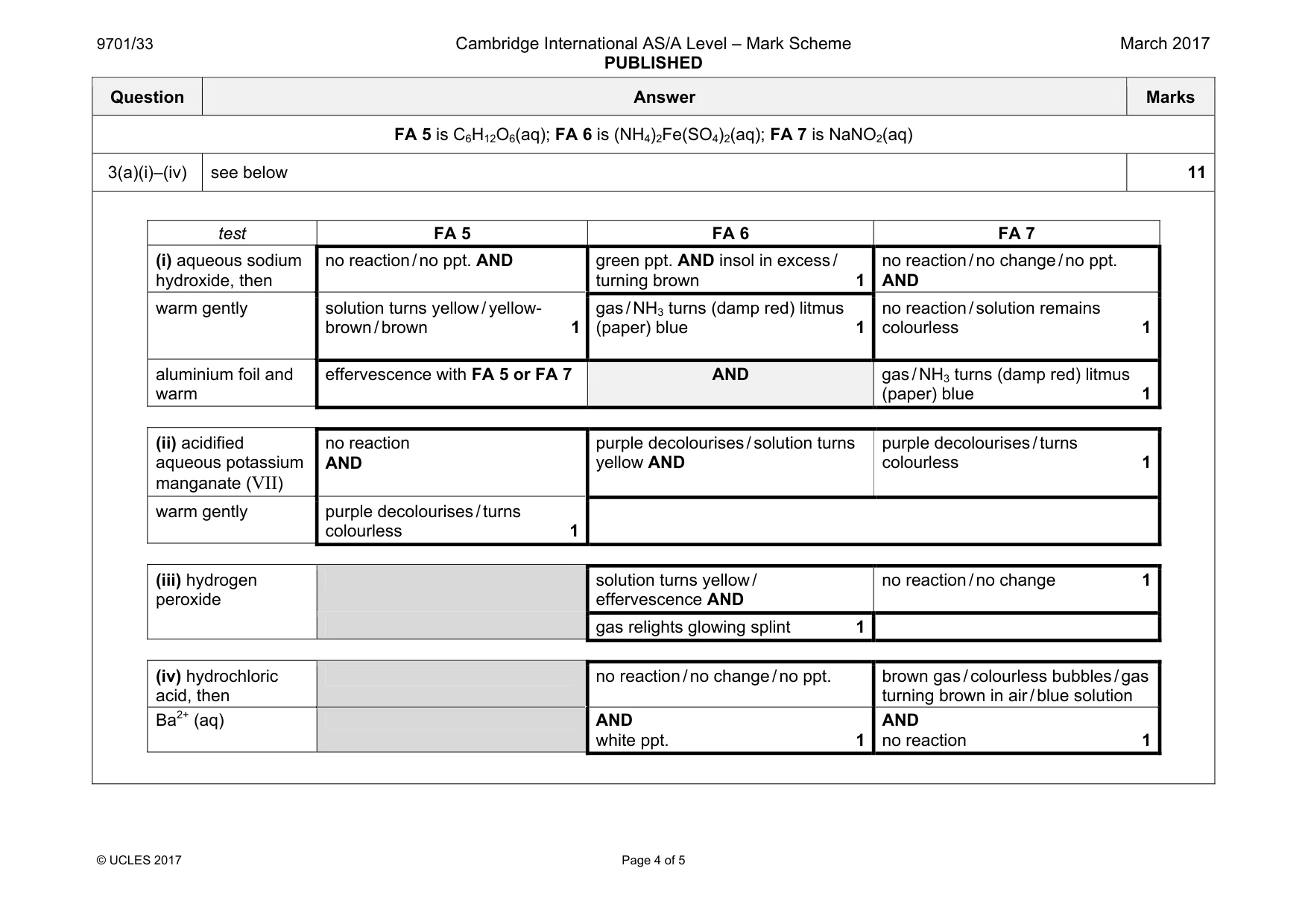
Mark scheme: 2(a) I initial and final burette readings and volume added recorded for rough titre AND accurate titre details tabulated 1 II initial and final burette readings recorded and volume of FA 3 added recorded for each accurate titration • all headings and units correct for accurate titrations – initial / final (burette) reading / volume OR reading / volume at start / finish – titre OR volume FA 3 added / used – (cm3) OR / cm3 OR in cm3 by every entry 1 III all accurate burette readings are recorded to the nearest 0.05 cm3 1 IV final titre within 0.10 cm3 of any previous accurate titre 1 V, VI and VII award V, VI and VII for δ ⩽ 0.20 cm3 award V and VI for 0.20 cm3 < δ ⩽ 0.30 cm3 award V for 0.30 cm3 < δ ⩽ 0.50 cm3 3 2(b) mean titre correctly calculated from clearly selected values: • candidate must average two (or more) titres where the total spread is ⩽ 0.20 cm3 • working must be shown or ticks must be put next to the two (or more) accurate readings selected • the mean should normally be quoted to 2 d.p. rounded to the nearest 0.01 Note: the candidate’s mean will sometimes be marked as correct even if it is different from the mean calculated by the examiner for the purpose of assessing accuracy. 1 2(c) M1 correctly calculates ( ) 0.030 1000 × b 1 M2 correctly uses (i) × 5/2 1 M3 correctly uses (ii) × 1000/25 1 M4 all final answers to 3 or 4 sig. fig. (minimum two parts attempted) 1 Question Answer Marks FA 5 is C6H12O6(aq); FA 6 is (NH4)2Fe(SO4)2(aq); FA 7 is NaNO2(aq) 3(a)(i)–(iv) see below 11 test FA 5 FA 6 FA 7 (i) aqueous sodium hydroxide, then no reaction / no ppt. AND green ppt. AND insol in excess / turning brown 1 no reaction / no change / no ppt. AND warm gently solution turns yellow / yellow- brown / brown 1 gas / NH3 turns (damp red) litmus (paper) blue 1 no reaction / solution remains colourless 1 aluminium foil and warm effervescence with FA 5 or FA 7 AND gas / NH3 turns (damp red) litmus (paper) blue 1 (ii) acidified aqueous potassium manganate (VII) no reaction AND purple decolourises / solution turns yellow AND purple decolourises / turns colourless 1 warm gently purple decolourises / turns colourless 1 (iii) hydrogen peroxide solution turns yellow / effervescence AND no reaction / no change 1 gas relights glowing splint 1 (iv) hydrochloric acid, then no reaction / no change / no ppt. brown gas / colourless bubbles / gas turning brown in air / blue solution Ba2+ (aq) AND white ppt. 1 AND no reaction 1
More questions on Reacting masses and volumes (of solutions and gases)
Q3 · Qualitative Analysis At each stage of any test you are to record details of the following
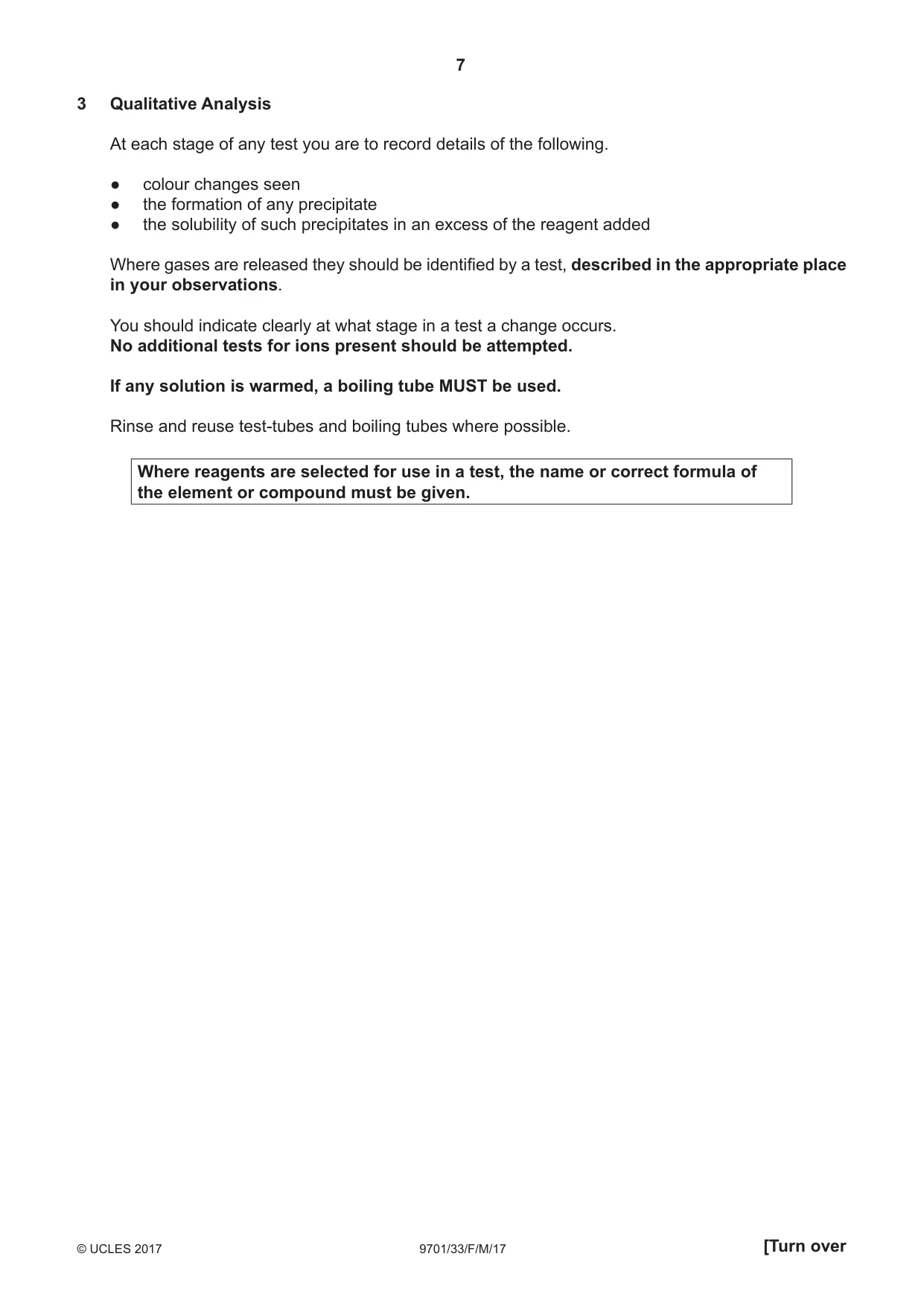
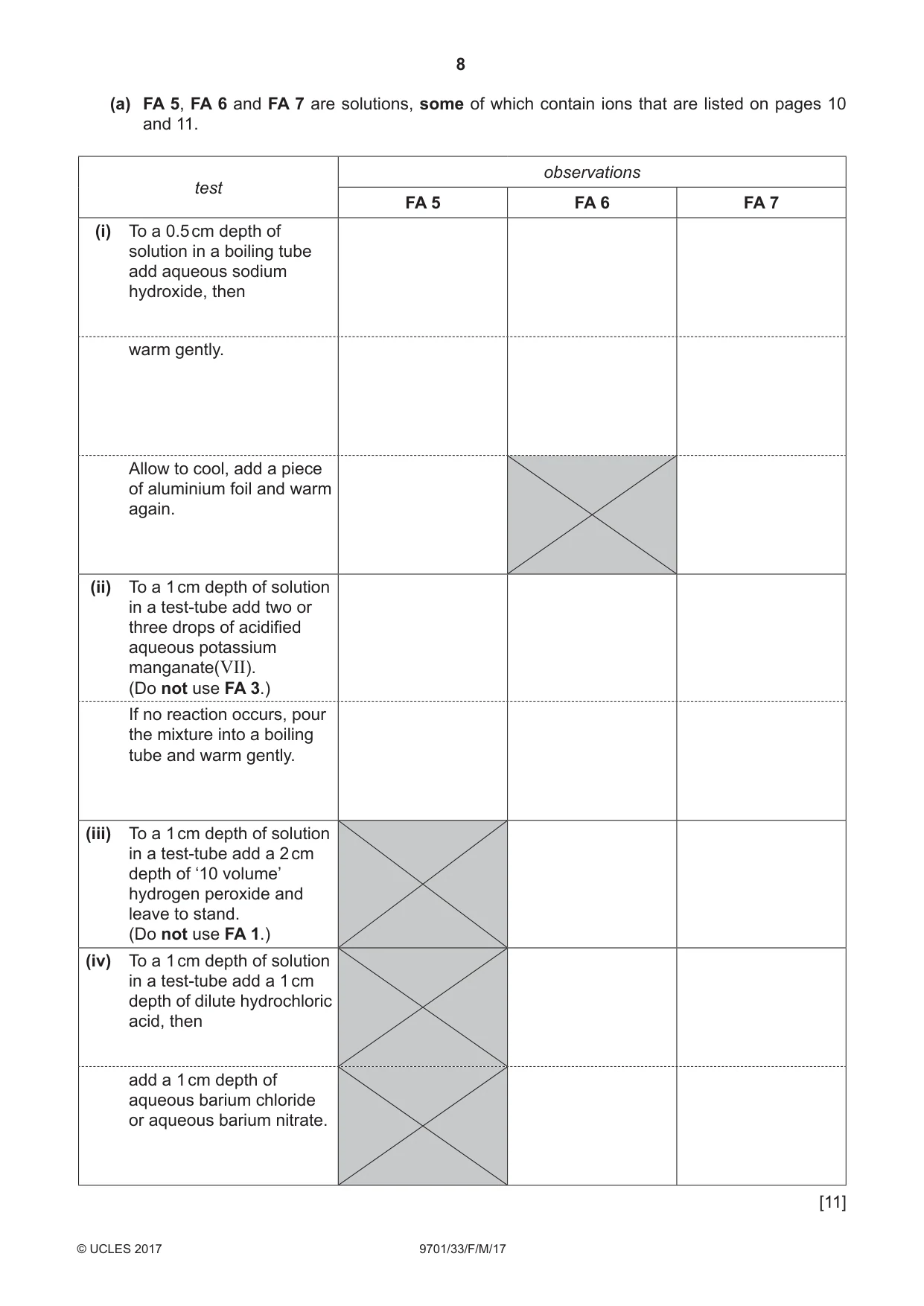
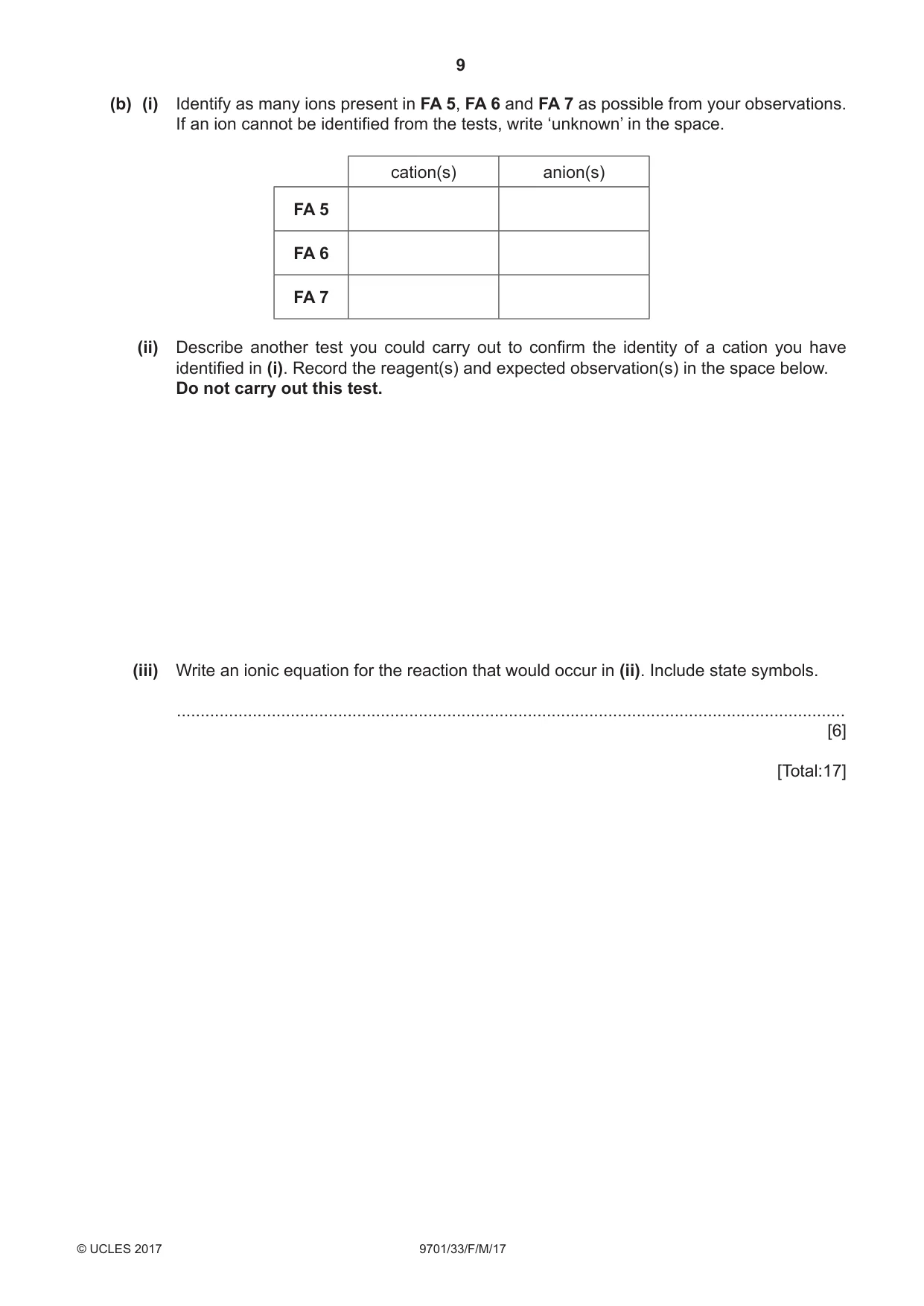
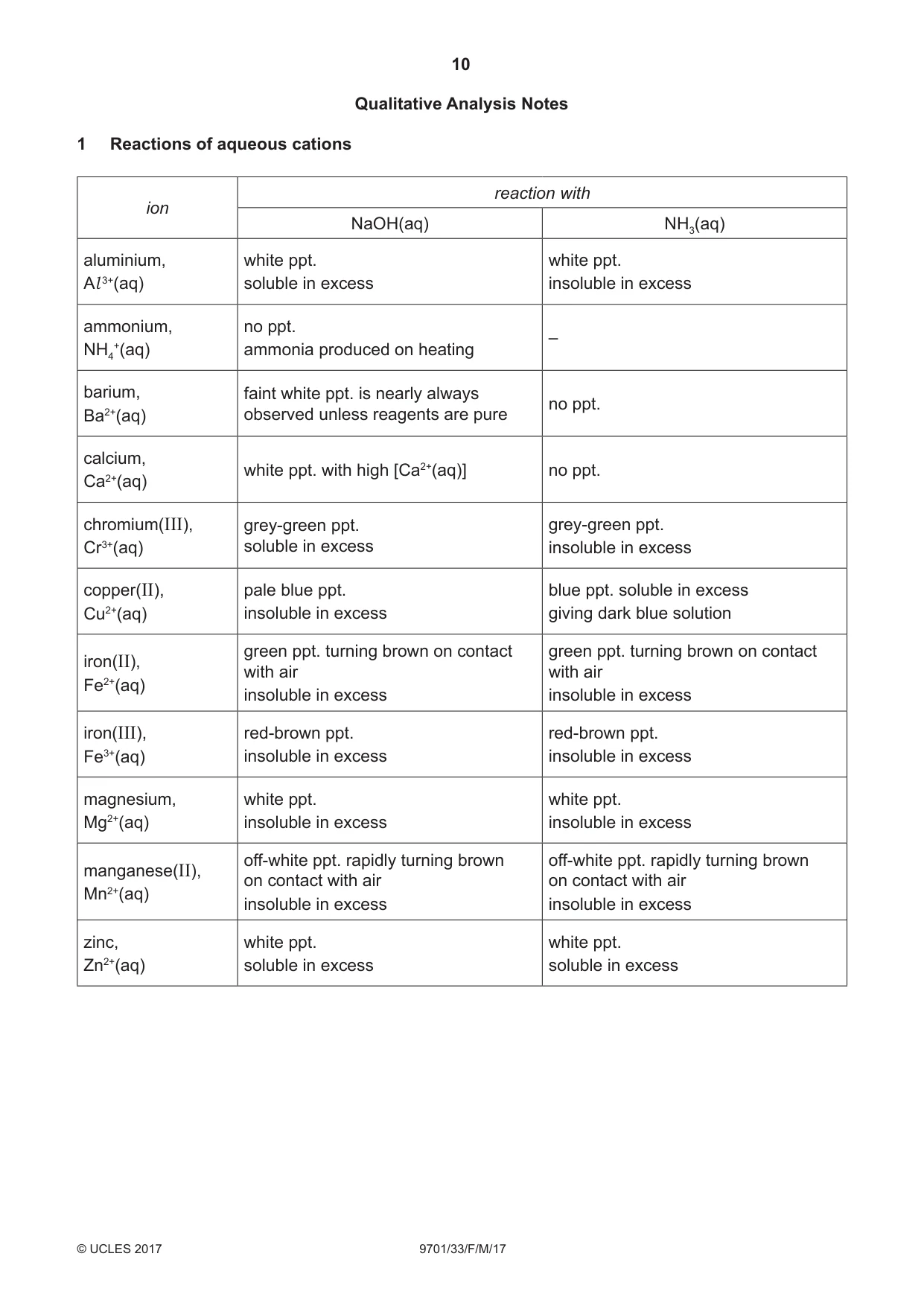
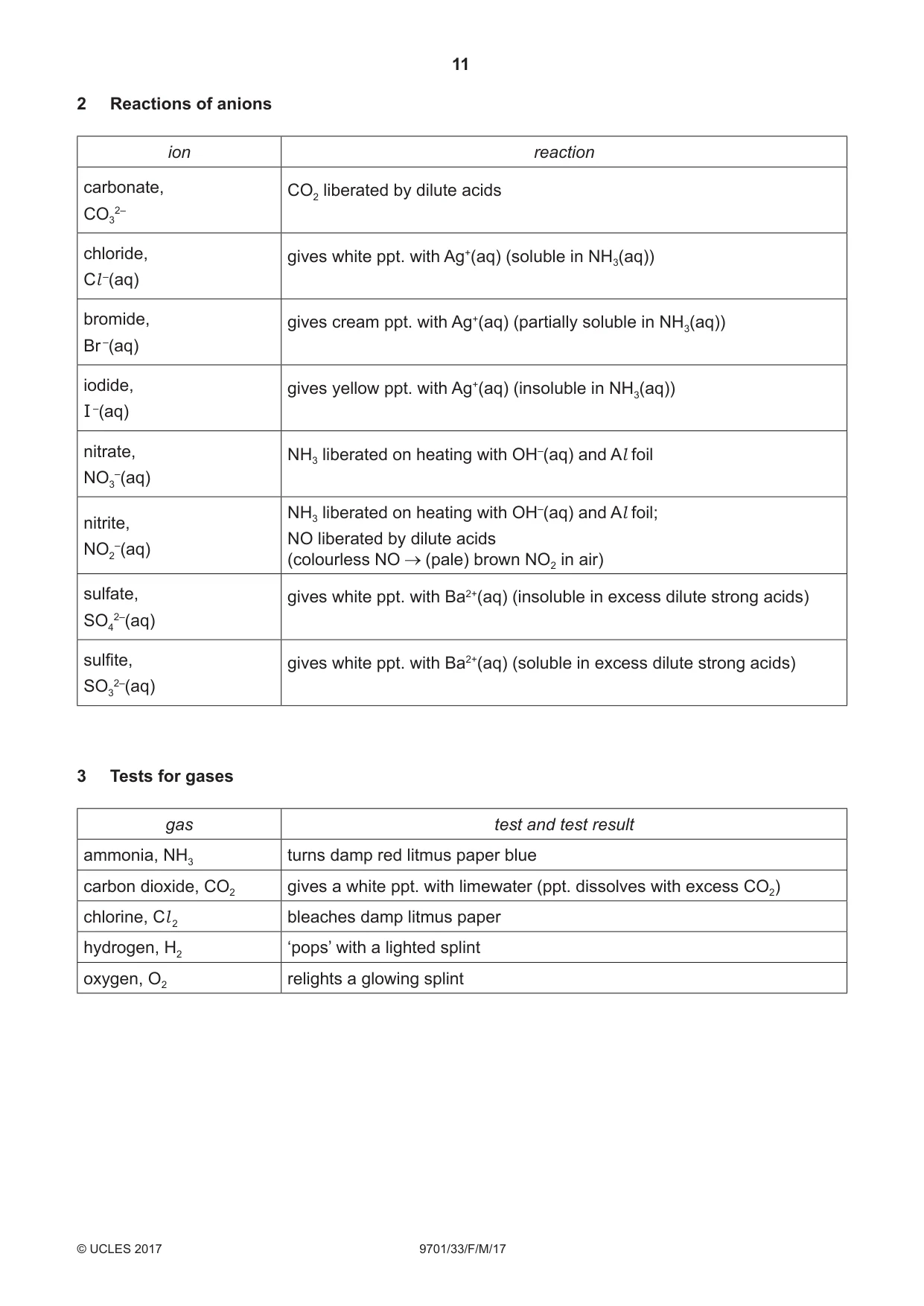
3 Qualitative Analysis At each stage of any test you are to record details of the following. ● colour changes seen ● the formation of any precipitate ● the solubility of such precipitates in an excess of the reagent added Where gases are released they should be identified by a test, described in the appropriate place in your observations. You should indicate clearly at what stage in a test a change occurs. No additional tests for ions present should be attempted. If any solution is warmed, a boiling tube MUST be used. Rinse and reuse test-tubes and boiling tubes where possible. Where reagents are selected for use in a test, the name or correct formula of the element or compound must be given. (a) FA 5, FA 6 and FA 7 are solutions, some of which contain ions that are listed on pages 10 and 11. observations test FA 5 FA 6 FA 7 (i) To a 0.5 cm depth of solution in a boiling tube add aqueous sodium hydroxide, then warm gently. Allow to cool, add a piece of aluminium foil and warm again. (ii) To a 1 cm depth of solution in a test-tube add two or three drops of acidified aqueous potassium manganate(VII). (Do not use FA 3.) If no reaction occurs, pour the mixture into a boiling tube and warm gently. (iii) To a 1 cm depth of solution in a test-tube add a 2 cm depth of ‘10 volume’ hydrogen peroxide and leave to stand. (Do not use FA 1.) (iv) To a 1 cm depth of solution in a test-tube add a 1 cm depth of dilute hydrochloric acid, then add a 1 cm depth of aqueous barium chloride or aqueous barium nitrate. [11] (b) (i) Identify as many ions present in FA 5, FA 6 and FA 7 as possible from your observations. If an ion cannot be identified from the tests, write ‘unknown’ in the space. cation(s) anion(s) FA 5 FA 6 FA 7 (ii) Describe another test you could carry out to confirm the identity of a cation you have identified in (i). Record the reagent(s) and expected observation(s) in the space below. Do not carry out this test. (iii) Write an ionic equation for the reaction that would occur in (ii). Include state symbols. ............................................................................................................................................. [6] [Total:17]
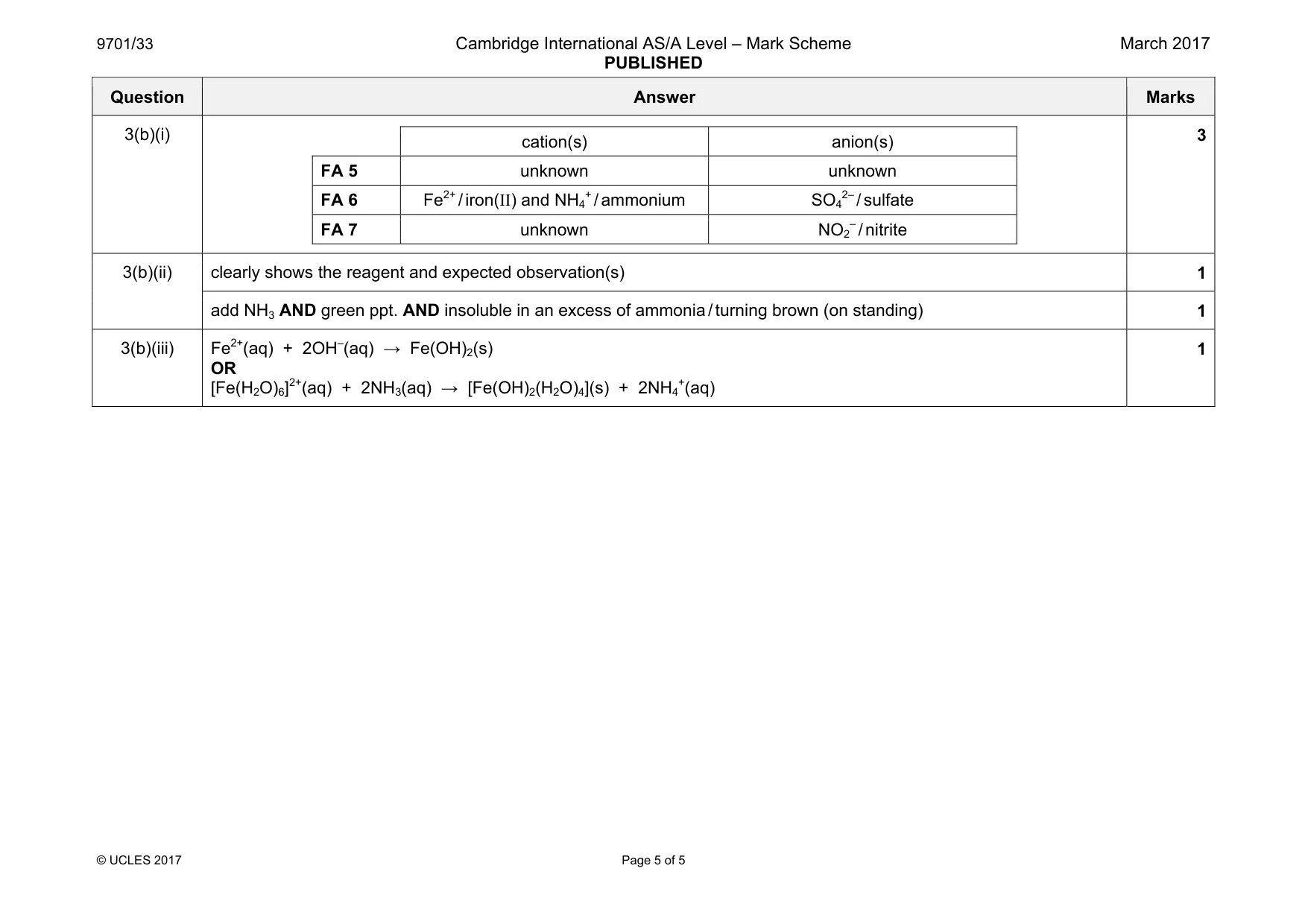
Mark scheme: 3(b)(i) cation(s) anion(s) FA 5 unknown unknown FA 6 Fe2+ / iron(II) and NH4 + / ammonium SO4 2– / sulfate FA 7 unknown NO2 – / nitrite 3 3(b)(ii) clearly shows the reagent and expected observation(s) 1 add NH3 AND green ppt. AND insoluble in an excess of ammonia / turning brown (on standing) 1 3(b)(iii) Fe2+(aq) + 2OH–(aq) → Fe(OH)2(s) OR [Fe(H2O)6]2+(aq) + 2NH3(aq) → [Fe(OH)2(H2O)4](s) + 2NH4 +(aq) 1
More questions on Periodicity of chemical properties of the elements in Period 3
What was in this paper
The subtopics covered by these 3 questions, and how many questions each got. Open one in a new tab to see every Cambridge question on it.
What you needed in this session
Cambridge’s own grade thresholds for 2017 Feb/March, Paper 3 · Variant 3. A higher threshold means an easier paper — the bar moves with how the cohort did.