Cambridge A Level Chemistry 9701 — 2015 Oct/Nov Paper 3 · Variant 4
9701/34/O/N/15 · 40 marks · ≈45 min
The question paper and its mark scheme, free to read here and free to download. This is Cambridge’s own paper, exactly as it was sat.
Question paper12 pages
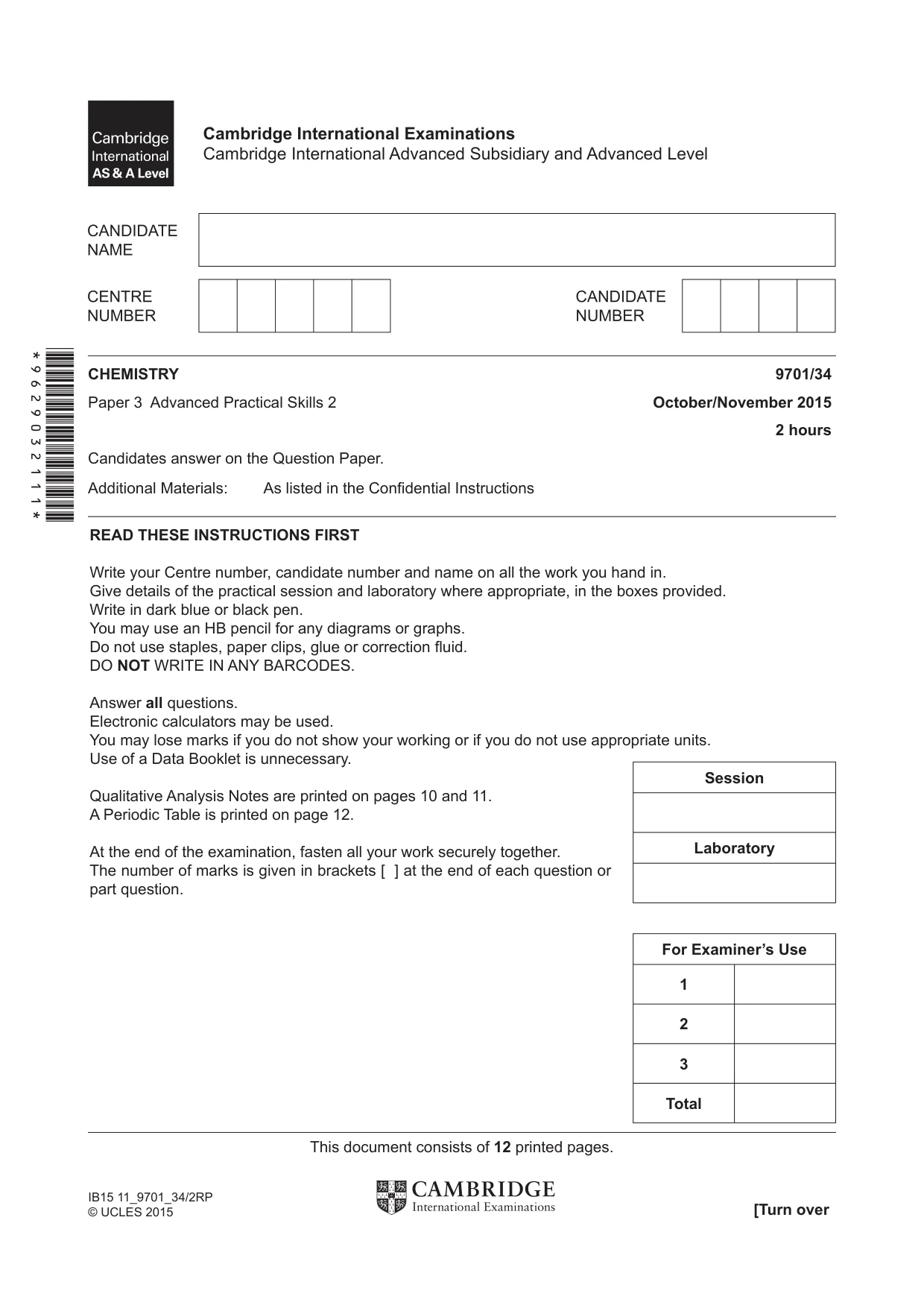
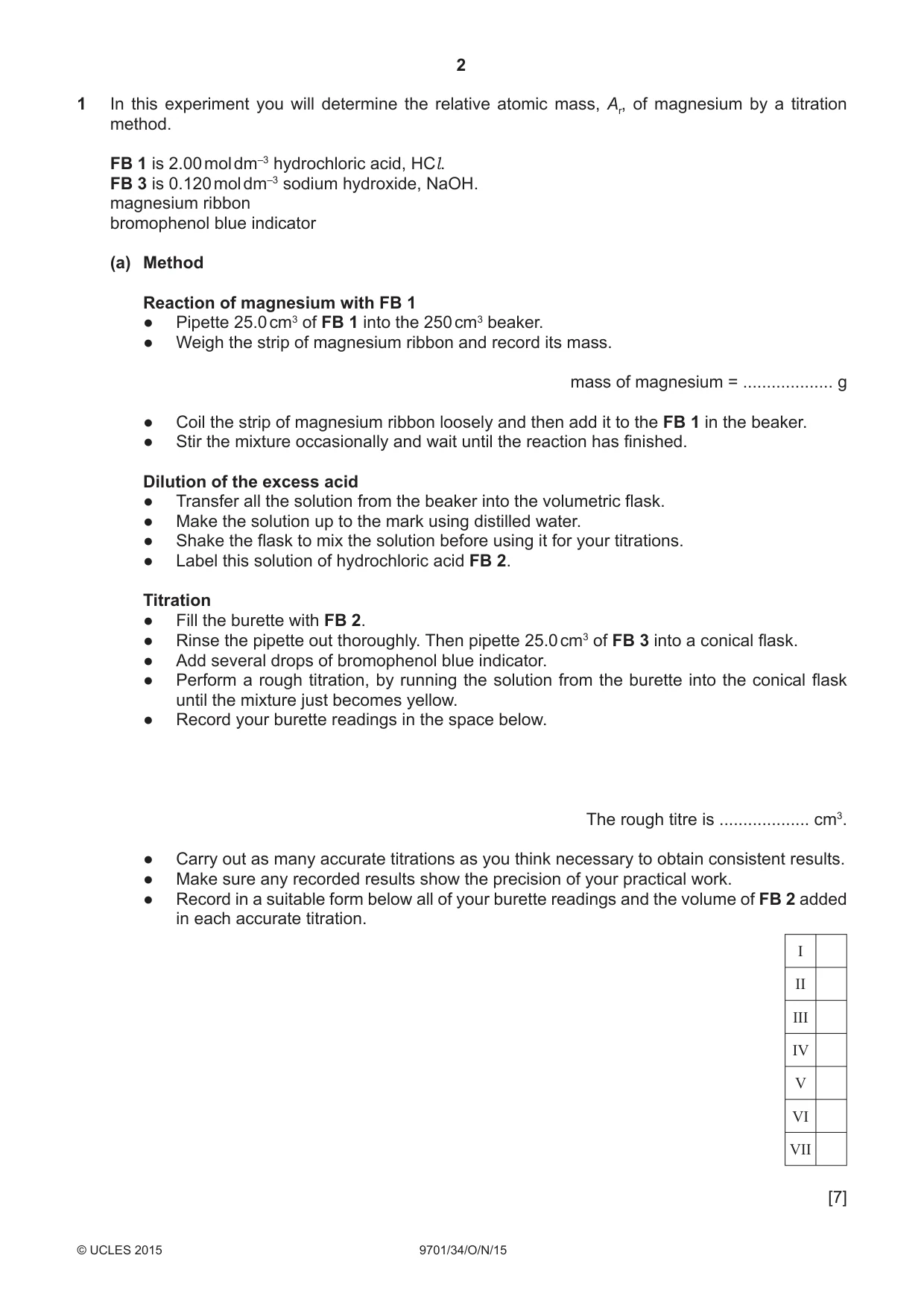
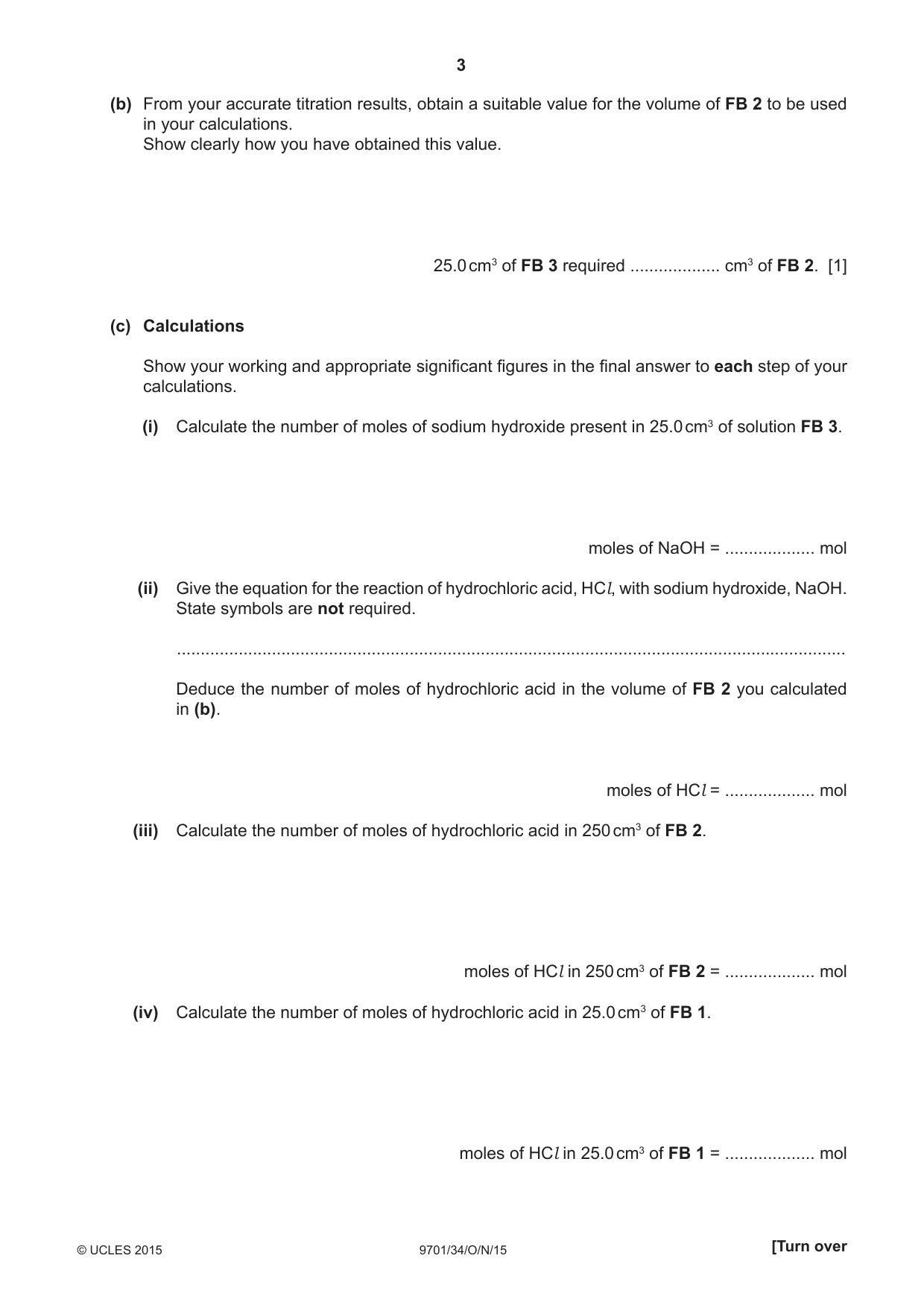
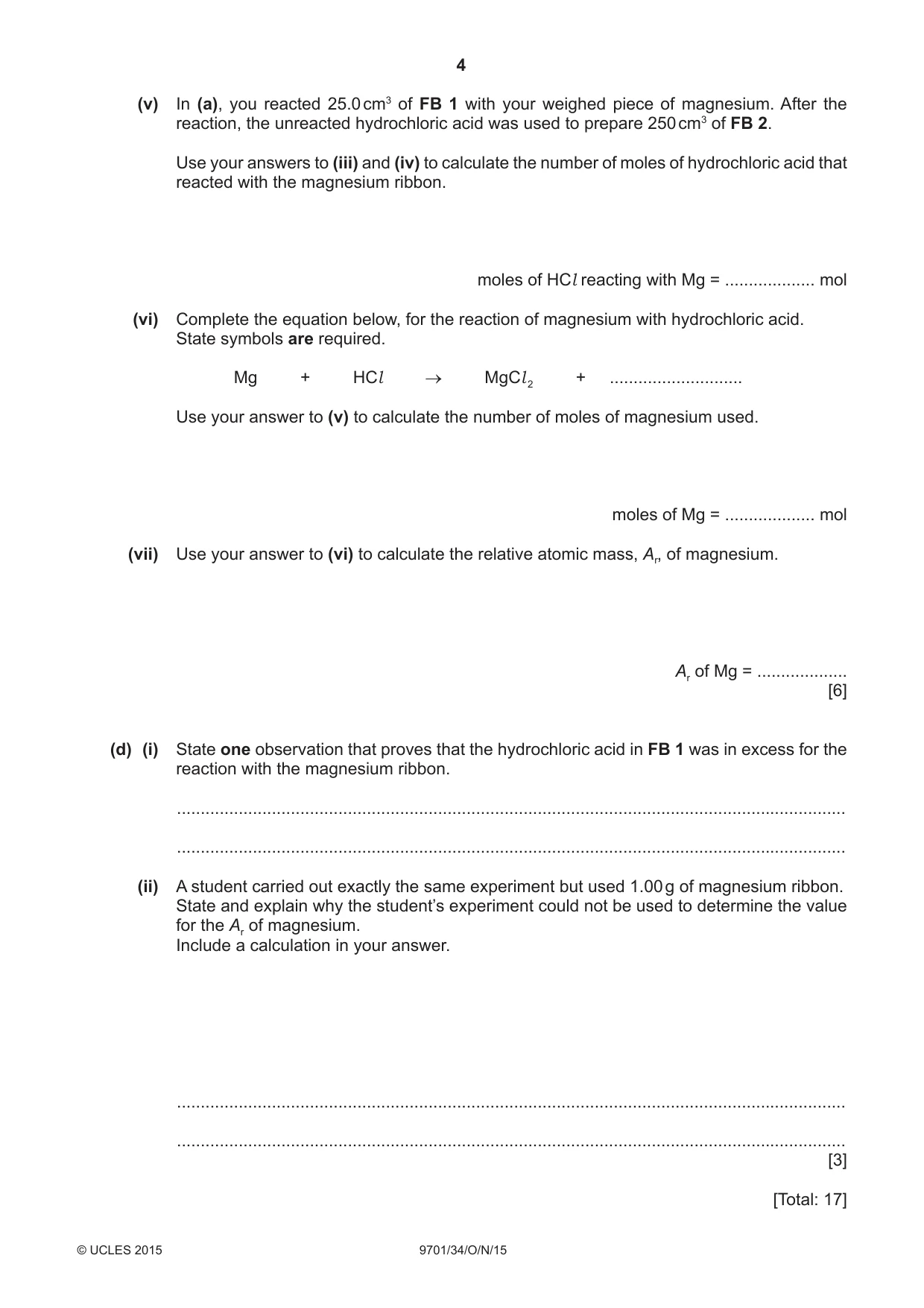
Mark scheme7 pages
Answers below. Sit the paper first if you are practising.
Paper as text
Question paper, page 1
READ THESE INSTRUCTIONS FIRST Write your Centre number, candidate number and name on all the work you hand in. Give details of the practical session and laboratory where appropriate, in the boxes provided. Write in dark blue or black pen. You may use an HB pencil for any diagrams or graphs. Do not use staples, paper clips, glue or correction fl uid. DO NOT WRITE IN ANY BARCODES. Answer all questions. Electronic calculators may be used. You may lose marks if you do not show your working or if you do not use appropriate units. Use of a Data Booklet is unnecessary. Qualitative Analysis Notes are printed on pages 10 and 11. A Periodic Table is printed on page 12. At the end of the examination, fasten all your work securely together. The number of marks is given in brackets [ ] at the end of each question or part question. CHEMISTRY 9701/34 Paper 3 Advanced Practical Skills 2 October/November 2015 2 hours Candidates answer on the Question Paper. Additional Materials: As listed in the Confi dential Instructions Cambridge International Examinations Cambridge International Advanced Subsidiary and Advanced Level This document consists of 12 printed pages. [Turn over IB15 11_9701_34/2RP © UCLES 2015 *9629032111* Session Laboratory For Examiner’s Use 1 2 3 Total
Question paper, page 2
2 9701/34/O/N/15 © UCLES 2015 I II III IV V VI VII 1 In this experiment you will determine the relative atomic mass, Ar, of magnesium by a titration method. FB 1 is 2.00 mol dm–3 hydrochloric acid, HCl. FB 3 is 0.120 mol dm–3 sodium hydroxide, NaOH. magnesium ribbon bromophenol blue indicator (a) Method Reaction of magnesium with FB 1 ● Pipette 25.0 cm3 of FB 1 into the 250 cm3 beaker. ● Weigh the strip of magnesium ribbon and record its mass. mass of magnesium = … g ● Coil the strip of magnesium ribbon loosely and then add it to the FB 1 in the beaker. ● Stir the mixture occasionally and wait until the reaction has finished. Dilution of the excess acid ● Transfer all the solution from the beaker into the volumetric flask. ● Make the solution up to the mark using distilled water. ● Shake the flask to mix the solution before using it for your titrations. ● Label this solution of hydrochloric acid FB 2. Titration ● Fill the burette with FB 2. ● Rinse the pipette out thoroughly. Then pipette 25.0 cm3 of FB 3 into a conical fl ask. ● Add several drops of bromophenol blue indicator. ● Perform a rough titration, by running the solution from the burette into the conical fl ask until the mixture just becomes yellow. ● Record your burette readings in the space below. The rough titre is … cm3. ● Carry out as many accurate titrations as you think necessary to obtain consistent results. ● Make sure any recorded results show the precision of your practical work. ● Record in a suitable form below all of your burette readings and the volume of FB 2 added in each accurate titration. [7]
Question paper, page 3
3 9701/34/O/N/15 © UCLES 2015 [Turn over (b) From your accurate titration results, obtain a suitable value for the volume of FB 2 to be used in your calculations. Show clearly how you have obtained this value. 25.0 cm3 of FB 3 required … cm3 of FB 2. [1] (c) Calculations Show your working and appropriate signifi cant fi gures in the fi nal answer to each step of your calculations. (i) Calculate the number of moles of sodium hydroxide present in 25.0 cm3 of solution FB 3. moles of NaOH = … mol (ii) Give the equation for the reaction of hydrochloric acid, HCl, with sodium hydroxide, NaOH. State symbols are not required. … Deduce the number of moles of hydrochloric acid in the volume of FB 2 you calculated in (b). moles of HCl = … mol (iii) Calculate the number of moles of hydrochloric acid in 250 cm3 of FB 2. moles of HCl in 250 cm3 of FB 2 = … mol (iv) Calculate the number of moles of hydrochloric acid in 25.0 cm3 of FB 1. moles of HCl in 25.0 cm3 of FB 1 = … mol
Question paper, page 4
4 9701/34/O/N/15 © UCLES 2015 (v) In (a), you reacted 25.0 cm3 of FB 1 with your weighed piece of magnesium. After the reaction, the unreacted hydrochloric acid was used to prepare 250 cm3 of FB 2. Use your answers to (iii) and (iv) to calculate the number of moles of hydrochloric acid that reacted with the magnesium ribbon. moles of HCl reacting with Mg = … mol (vi) Complete the equation below, for the reaction of magnesium with hydrochloric acid. State symbols are required. Mg + HCl → MgCl 2 + … Use your answer to (v) to calculate the number of moles of magnesium used. moles of Mg = … mol (vii) Use your answer to (vi) to calculate the relative atomic mass, Ar, of magnesium. Ar of Mg = … [6] (d) (i) State one observation that proves that the hydrochloric acid in FB 1 was in excess for the reaction with the magnesium ribbon. … … (ii) A student carried out exactly the same experiment but used 1.00 g of magnesium ribbon. State and explain why the student’s experiment could not be used to determine the value for the Ar of magnesium. Include a calculation in your answer. … … [3] [Total: 17]
Question paper, page 5
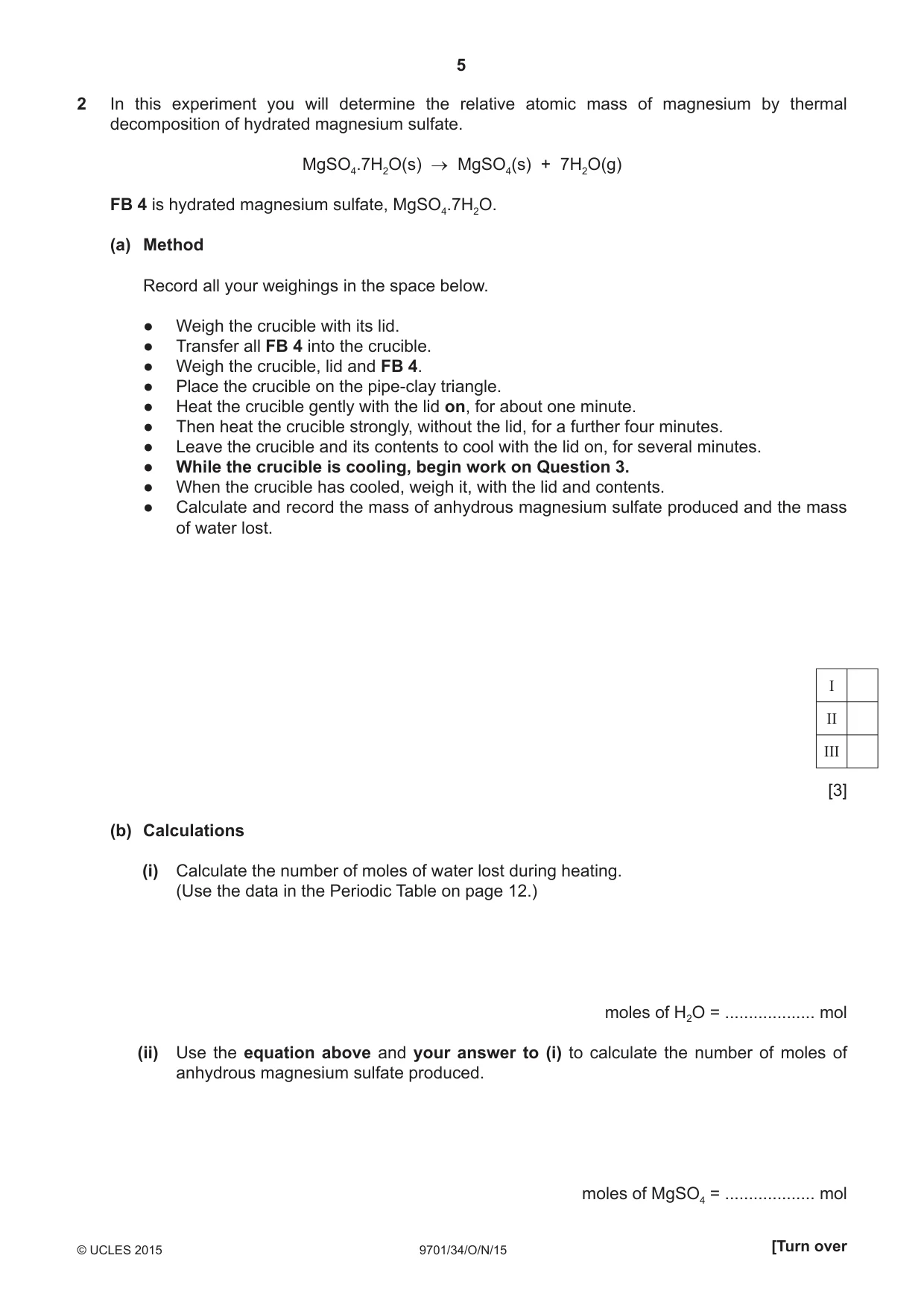
5 9701/34/O/N/15 © UCLES 2015 [Turn over 2 In this experiment you will determine the relative atomic mass of magnesium by thermal decomposition of hydrated magnesium sulfate. MgSO4.7H2O(s) → MgSO4(s) + 7H2O(g) FB 4 is hydrated magnesium sulfate, MgSO4.7H2O. (a) Method Record all your weighings in the space below. ● Weigh the crucible with its lid. ● Transfer all FB 4 into the crucible. ● Weigh the crucible, lid and FB 4. ● Place the crucible on the pipe-clay triangle. ● Heat the crucible gently with the lid on, for about one minute. ● Then heat the crucible strongly, without the lid, for a further four minutes. ● Leave the crucible and its contents to cool with the lid on, for several minutes. ● While the crucible is cooling, begin work on Question 3. ● When the crucible has cooled, weigh it, with the lid and contents. ● Calculate and record the mass of anhydrous magnesium sulfate produced and the mass of water lost. [3] (b) Calculations (i) Calculate the number of moles of water lost during heating. (Use the data in the Periodic Table on page 12.) moles of H2O = … mol (ii) Use the equation above and your answer to (i) to calculate the number of moles of anhydrous magnesium sulfate produced. moles of MgSO4 = … mol I II III
Question paper, page 6
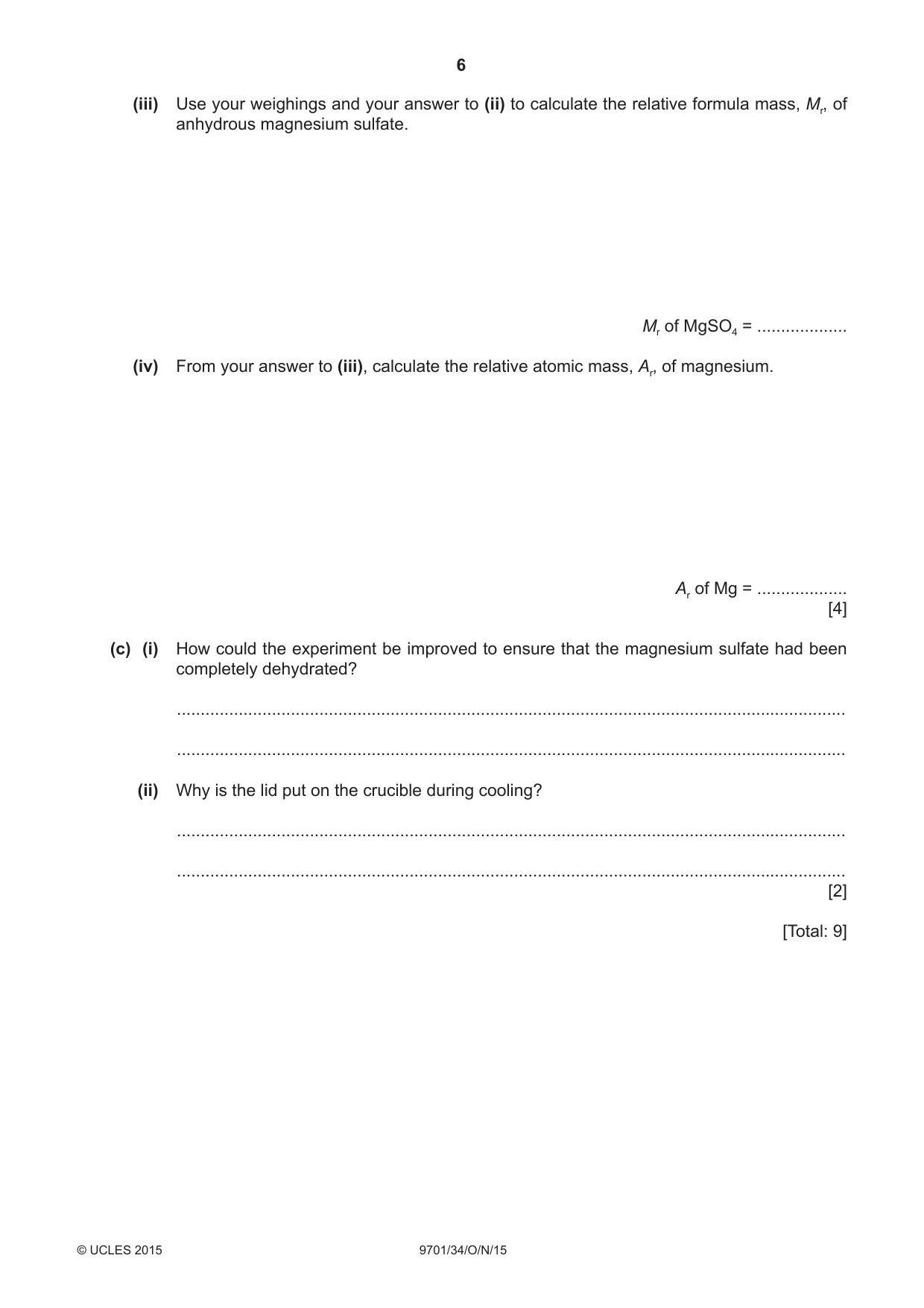
6 9701/34/O/N/15 © UCLES 2015 (iii) Use your weighings and your answer to (ii) to calculate the relative formula mass, Mr, of anhydrous magnesium sulfate. Mr of MgSO4 = … (iv) From your answer to (iii), calculate the relative atomic mass, Ar, of magnesium. Ar of Mg = … [4] (c) (i) How could the experiment be improved to ensure that the magnesium sulfate had been completely dehydrated? … … (ii) Why is the lid put on the crucible during cooling? … … [2] [Total: 9]
Question paper, page 7
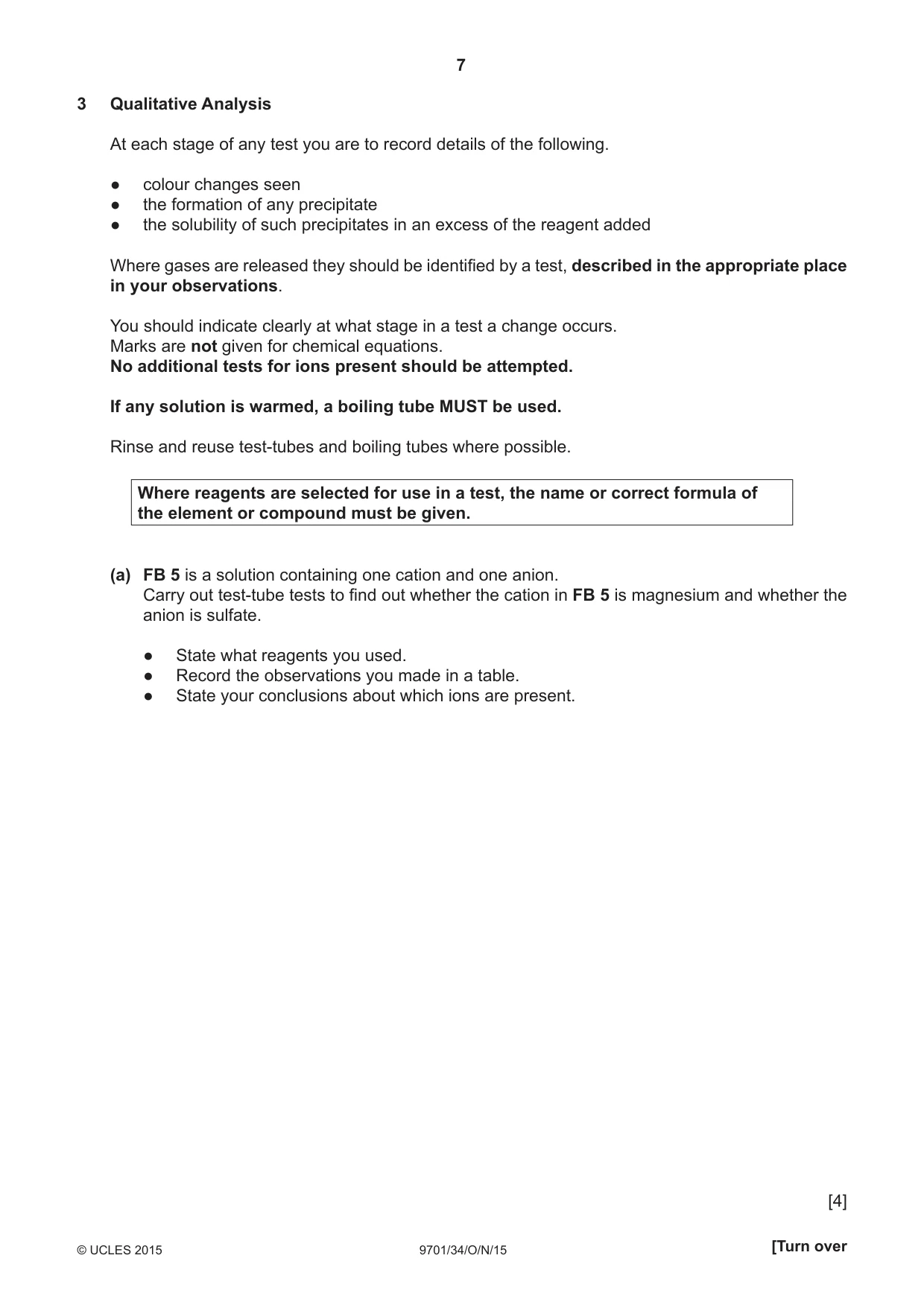
7 9701/34/O/N/15 © UCLES 2015 [Turn over 3 Qualitative Analysis At each stage of any test you are to record details of the following. ● colour changes seen ● the formation of any precipitate ● the solubility of such precipitates in an excess of the reagent added Where gases are released they should be identifi ed by a test, described in the appropriate place in your observations. You should indicate clearly at what stage in a test a change occurs. Marks are not given for chemical equations. No additional tests for ions present should be attempted. If any solution is warmed, a boiling tube MUST be used. Rinse and reuse test-tubes and boiling tubes where possible. Where reagents are selected for use in a test, the name or correct formula of the element or compound must be given. (a) FB 5 is a solution containing one cation and one anion. Carry out test-tube tests to fi nd out whether the cation in FB 5 is magnesium and whether the anion is sulfate. ● State what reagents you used. ● Record the observations you made in a table. ● State your conclusions about which ions are present. [4]
Question paper, page 8
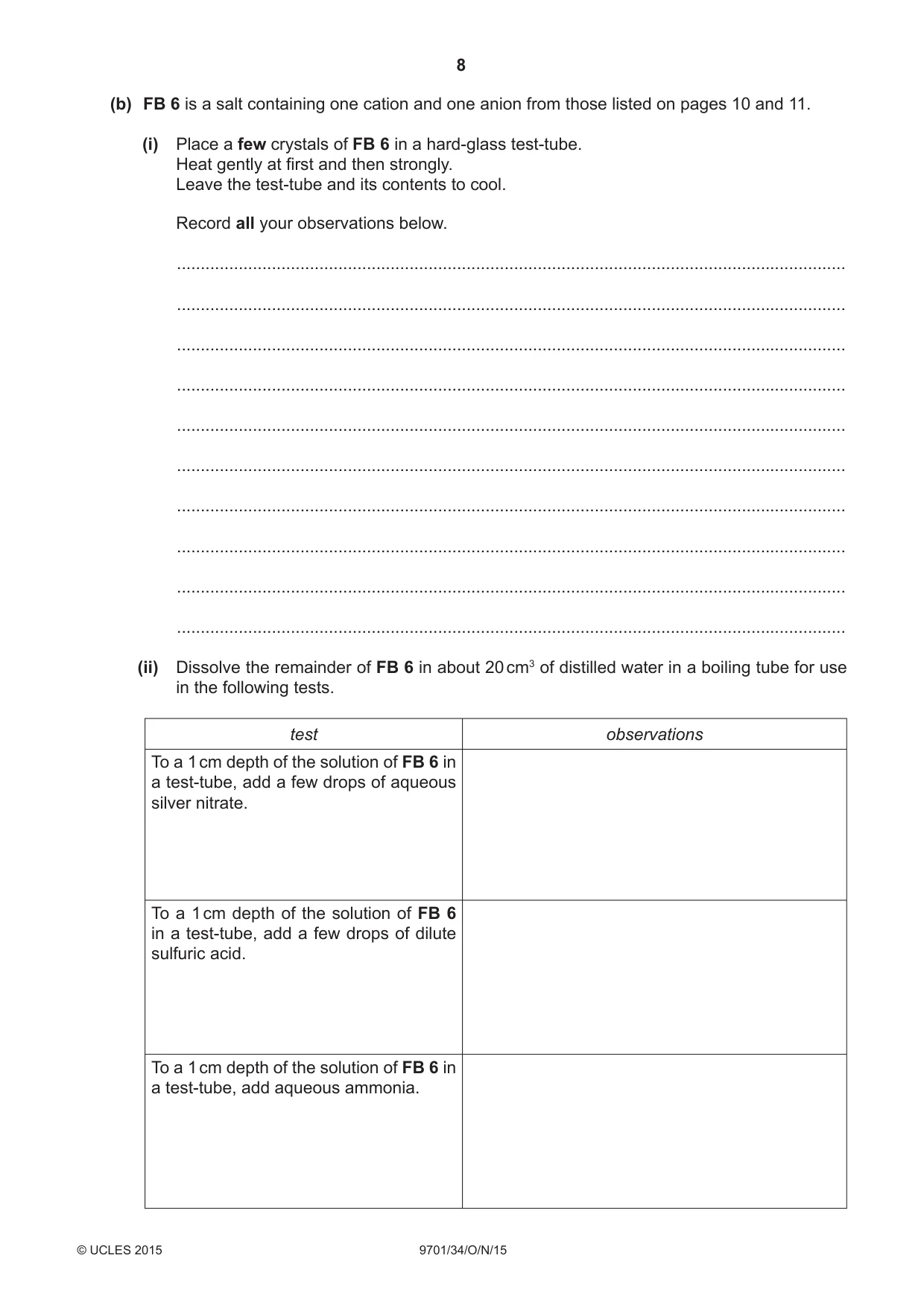
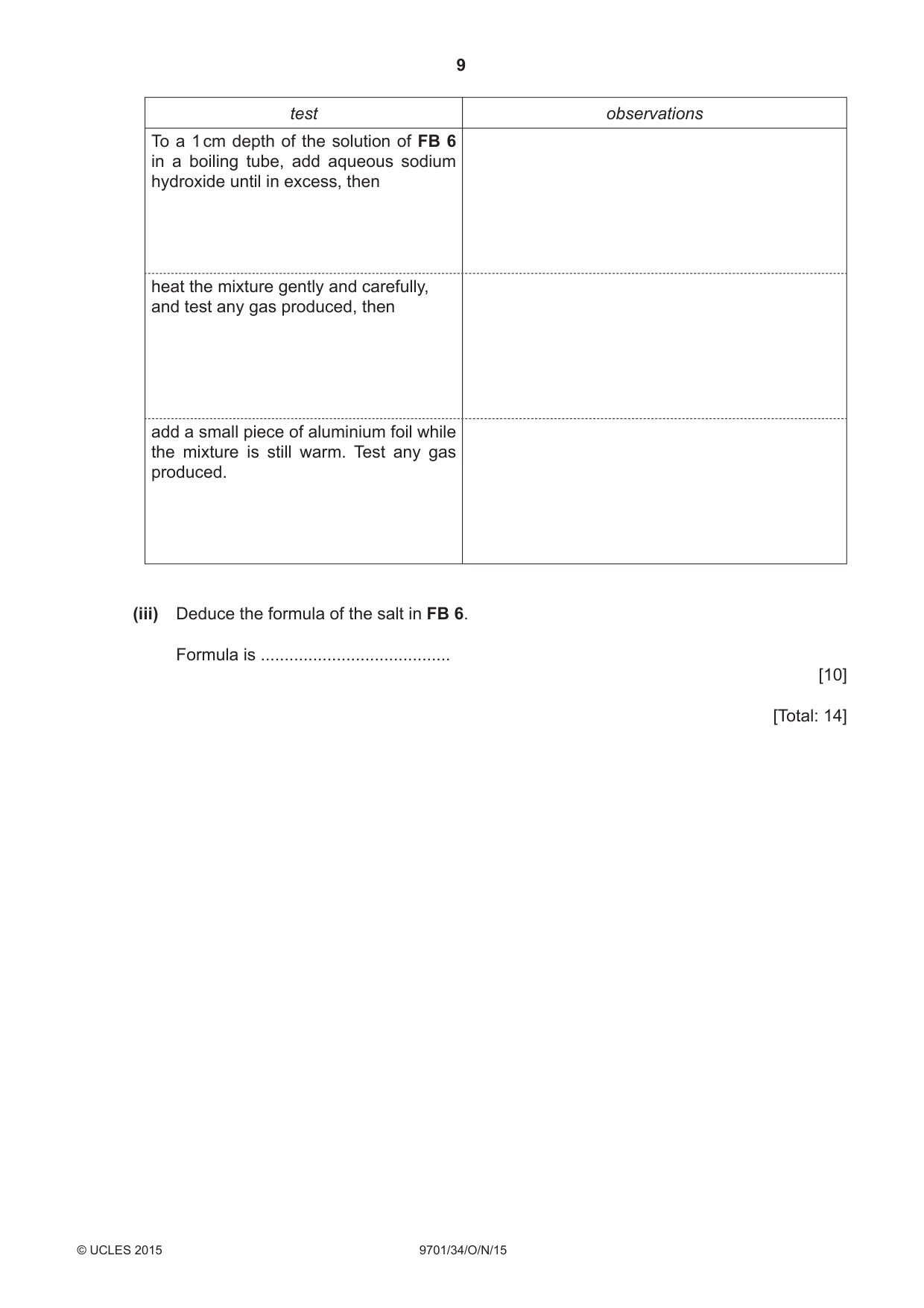
8 9701/34/O/N/15 © UCLES 2015 (b) FB 6 is a salt containing one cation and one anion from those listed on pages 10 and 11. (i) Place a few crystals of FB 6 in a hard-glass test-tube. Heat gently at fi rst and then strongly. Leave the test-tube and its contents to cool. Record all your observations below. … … … … … … … … … … (ii) Dissolve the remainder of FB 6 in about 20 cm3 of distilled water in a boiling tube for use in the following tests. test observations To a 1 cm depth of the solution of FB 6 in a test-tube, add a few drops of aqueous silver nitrate. To a 1 cm depth of the solution of FB 6 in a test-tube, add a few drops of dilute sulfuric acid. To a 1 cm depth of the solution of FB 6 in a test-tube, add aqueous ammonia.
Question paper, page 9
9 9701/34/O/N/15 © UCLES 2015 [Turn over test observations To a 1 cm depth of the solution of FB 6 in a boiling tube, add aqueous sodium hydroxide until in excess, then heat the mixture gently and carefully, and test any gas produced, then add a small piece of aluminium foil while the mixture is still warm. Test any gas produced. (iii) Deduce the formula of the salt in FB 6. Formula is … [10] [Total: 14]
Question paper, page 10
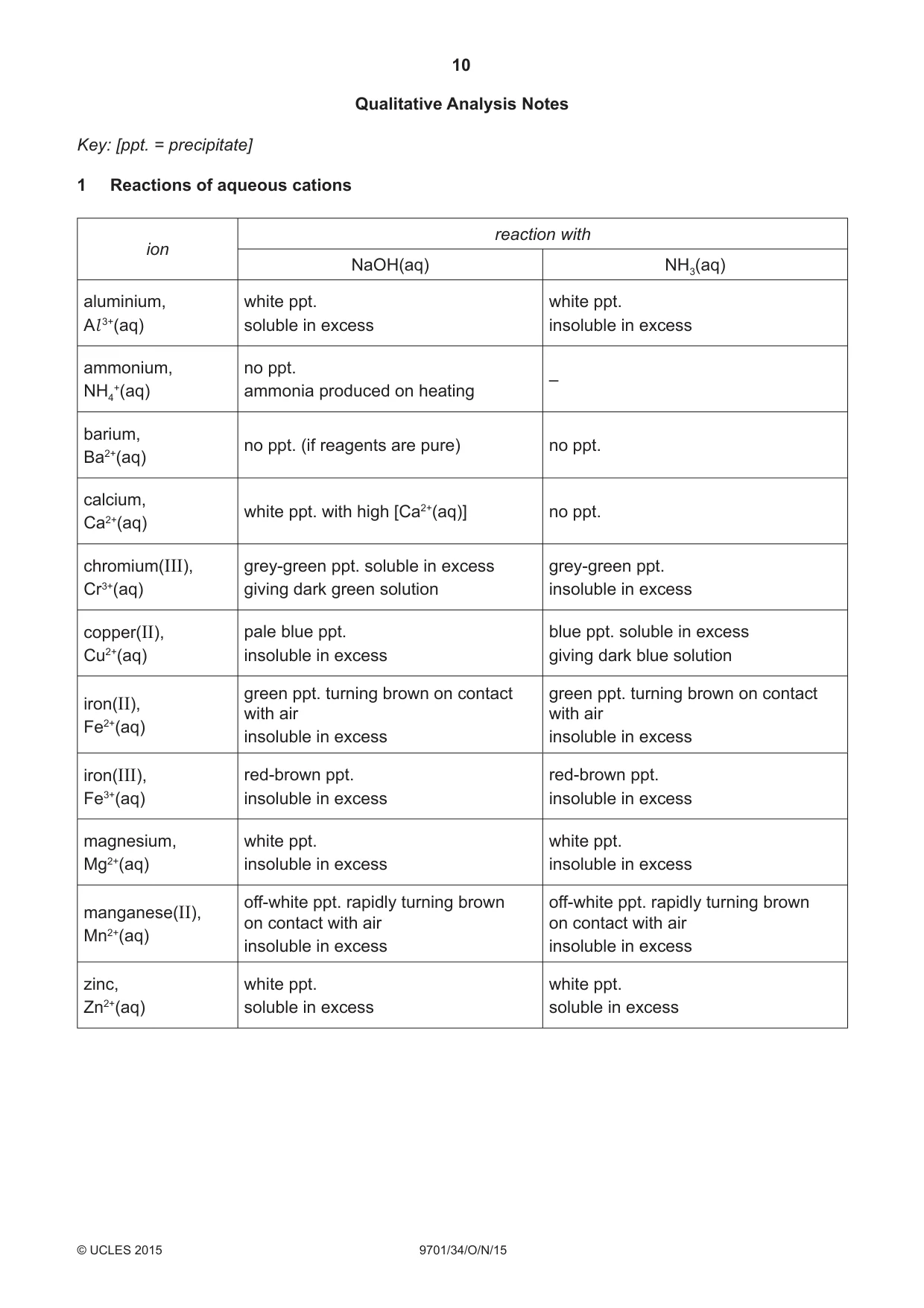
10 9701/34/O/N/15 © UCLES 2015 Qualitative Analysis Notes Key: [ppt. = precipitate] 1 Reactions of aqueous cations ion reaction with NaOH(aq) NH3(aq) aluminium, Al 3+(aq) white ppt. soluble in excess white ppt. insoluble in excess ammonium, NH4 +(aq) no ppt. ammonia produced on heating – barium, Ba2+(aq) no ppt. (if reagents are pure) no ppt. calcium, Ca2+(aq) white ppt. with high [Ca2+(aq)] no ppt. chromium(III), Cr3+(aq) grey-green ppt. soluble in excess giving dark green solution grey-green ppt. insoluble in excess copper(II), Cu2+(aq) pale blue ppt. insoluble in excess blue ppt. soluble in excess giving dark blue solution iron(II), Fe2+(aq) green ppt. turning brown on contact with air insoluble in excess green ppt. turning brown on contact with air insoluble in excess iron(III), Fe3+(aq) red-brown ppt. insoluble in excess red-brown ppt. insoluble in excess magnesium, Mg2+(aq) white ppt. insoluble in excess white ppt. insoluble in excess manganese(II), Mn2+(aq) off-white ppt. rapidly turning brown on contact with air insoluble in excess off-white ppt. rapidly turning brown on contact with air insoluble in excess zinc, Zn2+(aq) white ppt. soluble in excess white ppt. soluble in excess
Question paper, page 11
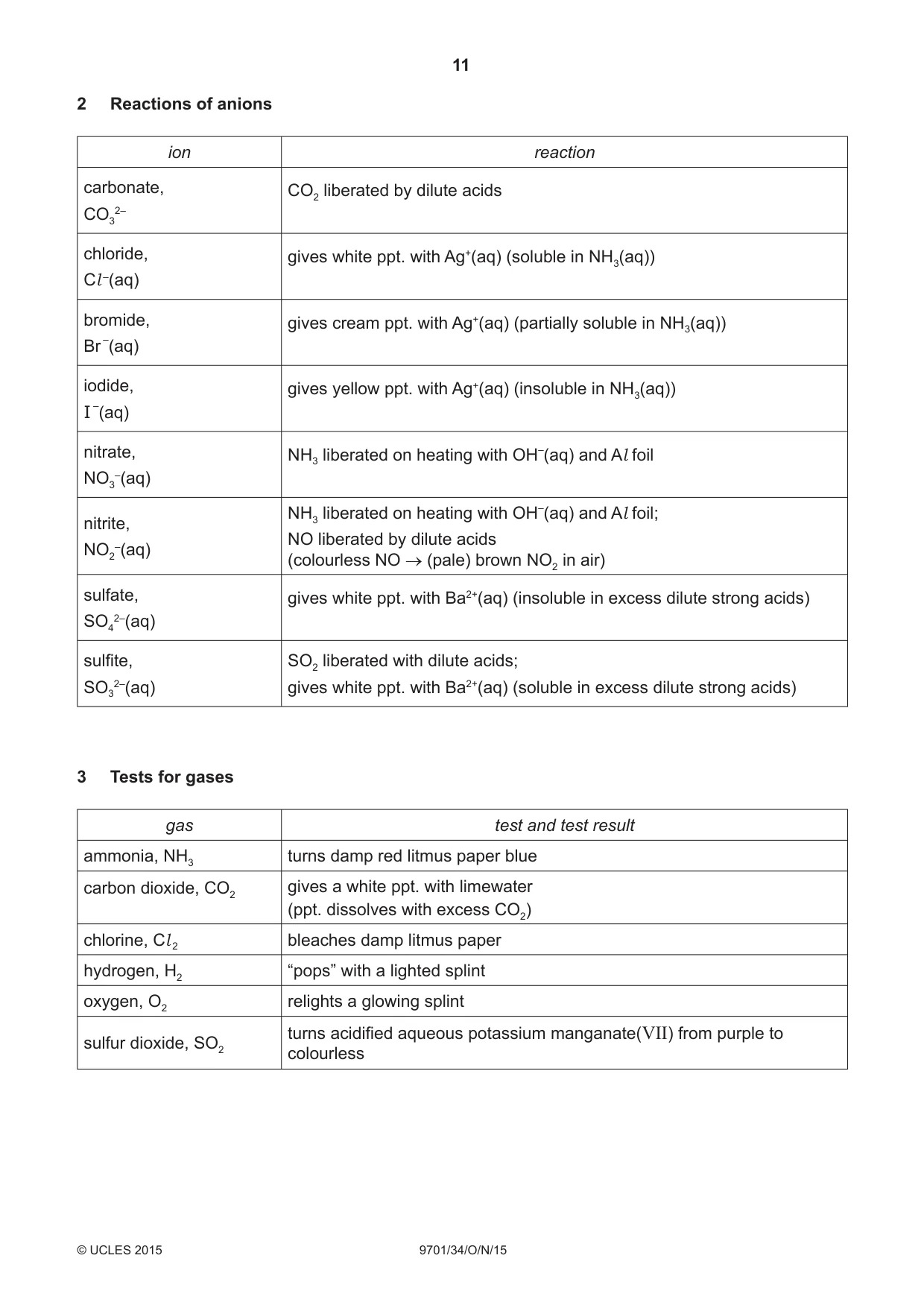
11 9701/34/O/N/15 © UCLES 2015 2 Reactions of anions ion reaction carbonate, CO3 2– CO2 liberated by dilute acids chloride, Cl –(aq) gives white ppt. with Ag+(aq) (soluble in NH3(aq)) bromide, Br –(aq) gives cream ppt. with Ag+(aq) (partially soluble in NH3(aq)) iodide, I –(aq) gives yellow ppt. with Ag+(aq) (insoluble in NH3(aq)) nitrate, NO3 –(aq) NH3 liberated on heating with OH–(aq) and Al foil nitrite, NO2 –(aq) NH3 liberated on heating with OH–(aq) and Al foil; NO liberated by dilute acids (colourless NO → (pale) brown NO2 in air) sulfate, SO4 2–(aq) gives white ppt. with Ba2+(aq) (insoluble in excess dilute strong acids) sulfi te, SO3 2–(aq) SO2 liberated with dilute acids; gives white ppt. with Ba2+(aq) (soluble in excess dilute strong acids) 3 Tests for gases gas test and test result ammonia, NH3 turns damp red litmus paper blue carbon dioxide, CO2 gives a white ppt. with limewater (ppt. dissolves with excess CO2) chlorine, Cl 2 bleaches damp litmus paper hydrogen, H2 “pops” with a lighted splint oxygen, O2 relights a glowing splint sulfur dioxide, SO2 turns acidifi ed aqueous potassium manganate(VII) from purple to colourless
Question paper, page 12
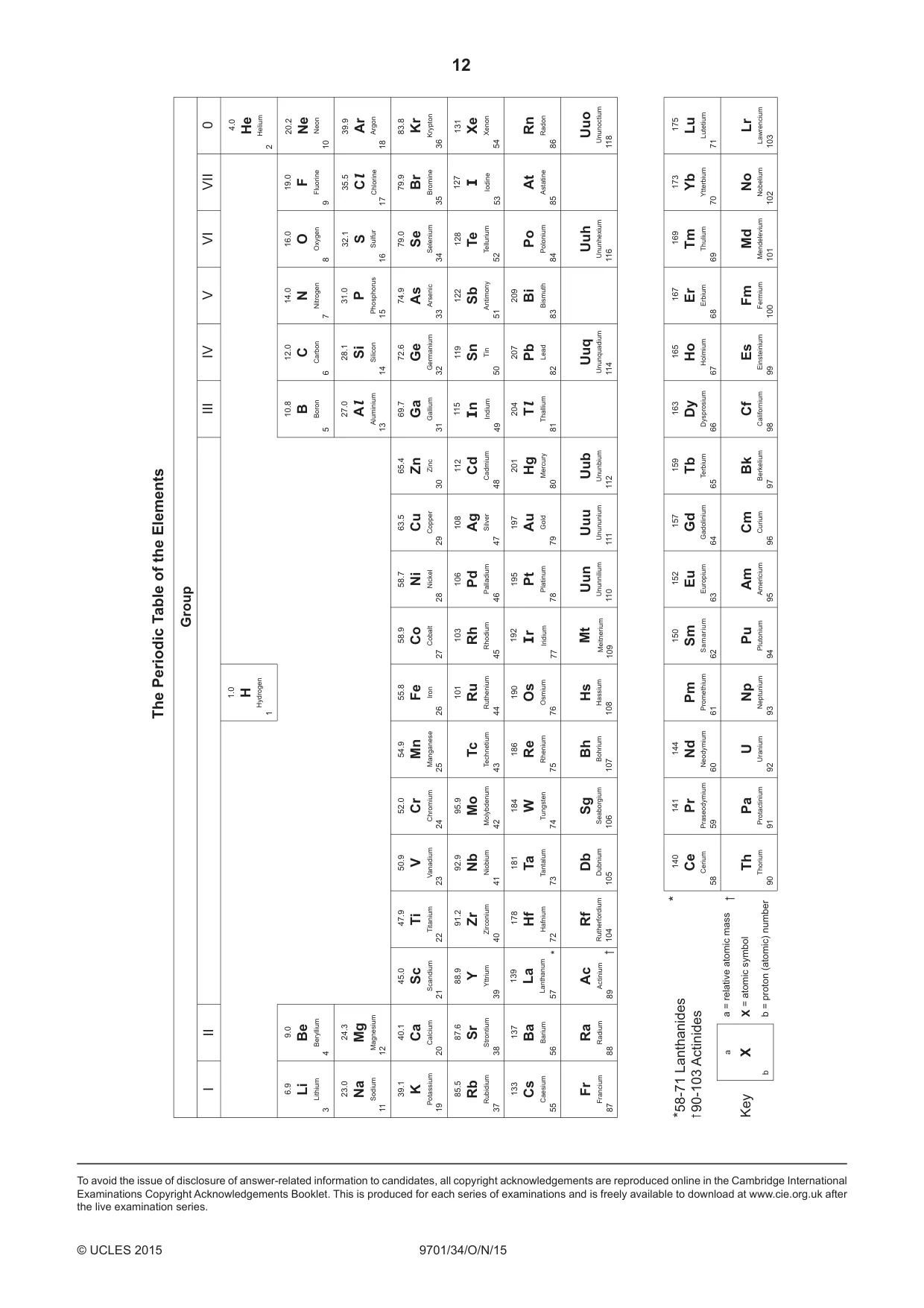
12 9701/34/O/N/15 © UCLES 2015 To avoid the issue of disclosure of answer-related information to candidates, all copyright acknowledgements are reproduced online in the Cambridge International Examinations Copyright Acknowledgements Booklet. This is produced for each series of examinations and is freely available to download at www.cie.org.uk after the live examination series. Group 140 Ce Cerium 58 141 Pr Praseodymium 59 144 Nd Neodymium 60 Pm Promethium 61 150 Sm Samarium 62 152 Eu Europium 63 157 Gd Gadolinium 64 159 Tb Terbium 65 163 Dy Dysprosium 66 165 Ho Holmium 67 167 Er Erbium 68 169 Tm Thulium 69 173 Yb Ytterbium 70 175 Lu Lutetium 71 Th Thorium 90 Pa Protactinium 91 U Uranium 92 Np Neptunium 93 Pu Plutonium 94 Am Americium 95 Cm Curium 96 Bk Berkelium 97 Cf Californium 98 Es Einsteinium 99 Fm Fermium 100 Md Mendelevium 101 No Nobelium 102 Lr Lawrencium 103 1.0 H Hydrogen 1 6.9 Li Lithium 3 23.0 Na Sodium 11 24.3 Mg Magnesium 12 40.1 Ca Calcium 20 45.0 Sc Scandium 21 47.9 Ti Titanium 22 50.9 V Vanadium 23 52.0 Cr Chromium 24 54.9 Mn Manganese 25 55.8 Fe Iron 26 58.9 Co Cobalt 27 58.7 Ni Nickel 28 63.5 Cu Copper 29 65.4 Zn Zinc 30 69.7 Ga Gallium 31 27.0 Al Aluminium 13 10.8 B Boron 5 12.0 C Carbon 6 14.0 N Nitrogen 7 16.0 O Oxygen 8 19.0 F Fluorine 9 28.1 Si Silicon 14 31.0 P Phosphorus 15 32.1 S Sulfur 16 35.5 Cl Chlorine 17 39.9 Ar Argon 18 20.2 Ne Neon 10 4.0 He Helium 2 72.6 Ge Germanium 32 74.9 As Arsenic 33 79.0 Se Selenium 34 79.9 Br Bromine 35 83.8 Kr Krypton 36 39.1 K Potassium 19 87.6 Sr Strontium 38 88.9 Y Yttrium 39 91.2 Zr Zirconium 40 92.9 Nb Niobium 41 95.9 Mo Molybdenum 42 Tc Technetium 43 101 Ru Ruthenium 44 103 Rh Rhodium 45 106 Pd Palladium 46 108 Ag Silver 47 112 Cd Cadmium 48 115 In Indium 49 119 Sn Tin 50 122 Sb Antimony 51 128 Te Tellurium 52 127 I Iodine 53 131 Xe Xenon 54 137 Ba Barium 56 139 La Lanthanum 57 * 178 Hf Hafnium 72 181 Ta Tantalum 73 184 W Tungsten 74 186 Re Rhenium 75 190 Os Osmium 76 192 Ir Iridium 77 195 Pt Platinum 78 197 Au Gold 79 201 Hg Mercury 80 204 Tl Thallium 81 207 Pb Lead 82 209 Bi Bismuth 83 Po Polonium 84 At Astatine 85 Rn Radon 86 Rf Rutherfordium 104 Db Dubnium 105 Sg Seaborgium 106 Bh Bohrium 107 Hs Hassium 108 Mt Meitnerium 109 Uun Ununnilium 110 Uuu Unununium 111 Uub Ununbium 112 Uuq Ununquadium 114 Uuh Ununhexium 116 Uuo Ununoctium 118 Fr Francium 87 Ac Actinium 89 9.0 Be Beryllium 4 I II III IV V VI VII 0 85.5 Rb Rubidium 37 133 Cs Caesium 55 Ra Radium 88 a X b a = relative atomic mass X = atomic symbol b = proton (atomic) number Key *58-71 Lanthanides 90-103 Actinides The Periodic Table of the Elements *
Mark scheme, page 1
® IGCSE is the registered trademark of Cambridge International Examinations. CAMBRIDGE INTERNATIONAL EXAMINATIONS Cambridge International Advanced Subsidiary and Advanced Level MARK SCHEME for the October/November 2015 series 9701 CHEMISTRY 9701/34 Paper 3 (Advanced Practical Skills 2), maximum raw mark 40 This mark scheme is published as an aid to teachers and candidates, to indicate the requirements of the examination. It shows the basis on which Examiners were instructed to award marks. It does not indicate the details of the discussions that took place at an Examiners’ meeting before marking began, which would have considered the acceptability of alternative answers. Mark schemes should be read in conjunction with the question paper and the Principal Examiner Report for Teachers. Cambridge will not enter into discussions about these mark schemes. Cambridge is publishing the mark schemes for the October/November 2015 series for most Cambridge IGCSE®, Cambridge International A and AS Level components and some Cambridge O Level components.
Mark scheme, page 2
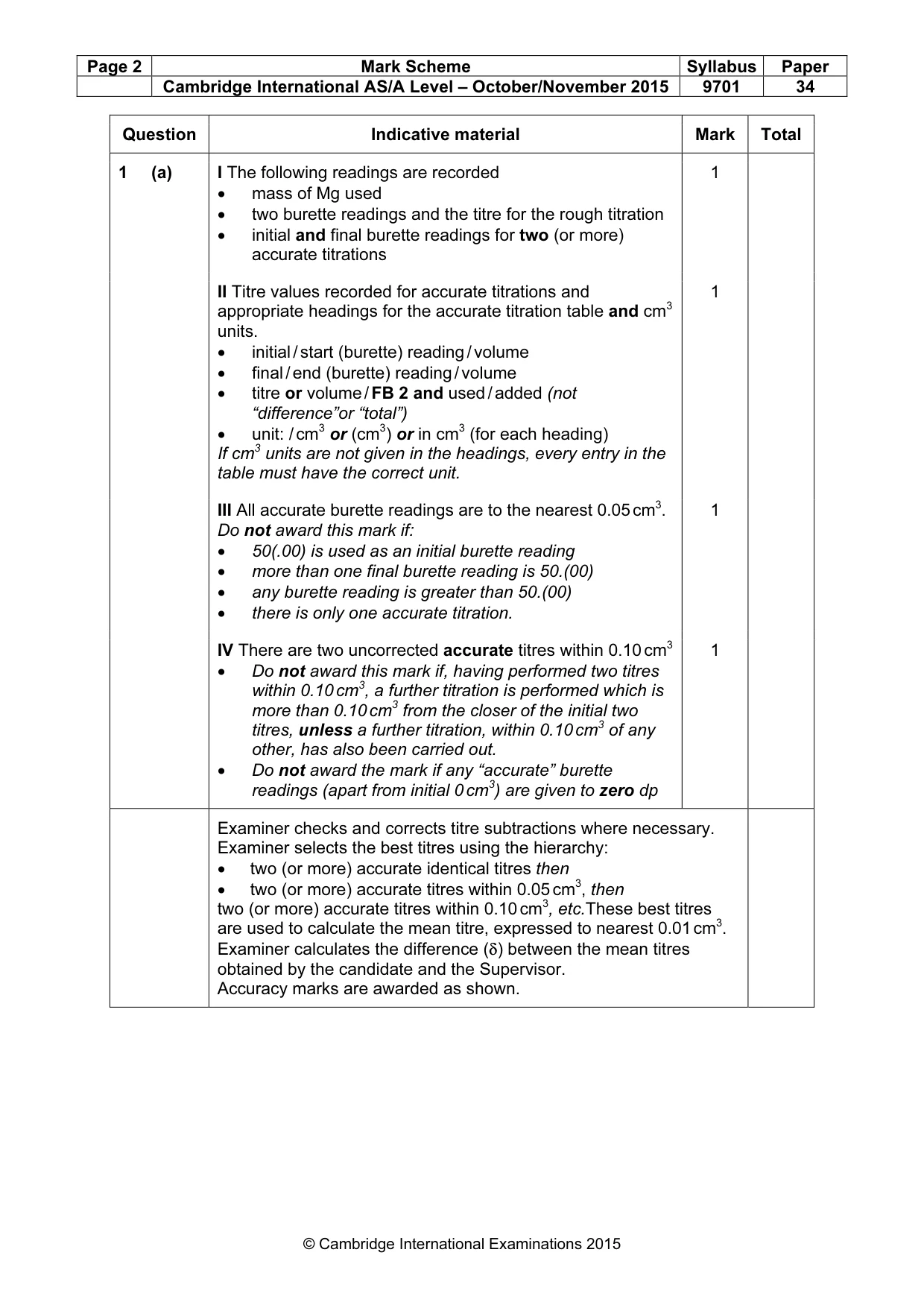
Page 2 Mark Scheme Syllabus Paper Cambridge International AS/A Level – October/November 2015 9701 34 © Cambridge International Examinations 2015 Question Indicative material Mark Total 1 (a) I The following readings are recorded • mass of Mg used • two burette readings and the titre for the rough titration • initial and final burette readings for two (or more) accurate titrations 1 II Titre values recorded for accurate titrations and appropriate headings for the accurate titration table and cm3 units. • initial / start (burette) reading / volume • final / end (burette) reading / volume • titre or volume / FB 2 and used / added (not “difference”or “total”) • unit: / cm3 or (cm3) or in cm3 (for each heading) If cm3 units are not given in the headings, every entry in the table must have the correct unit. 1 III All accurate burette readings are to the nearest 0.05 cm3. Do not award this mark if: • 50(.00) is used as an initial burette reading • more than one final burette reading is 50.(00) • any burette reading is greater than 50.(00) • there is only one accurate titration. 1 IV There are two uncorrected accurate titres within 0.10 cm3 • Do not award this mark if, having performed two titres within 0.10 cm3, a further titration is performed which is more than 0.10 cm3 from the closer of the initial two titres, unless a further titration, within 0.10 cm3 of any other, has also been carried out. • Do not award the mark if any “accurate” burette readings (apart from initial 0 cm3) are given to zero dp 1 Examiner checks and corrects titre subtractions where necessary. Examiner selects the best titres using the hierarchy: • two (or more) accurate identical titres then • two (or more) accurate titres within 0.05 cm3, then two (or more) accurate titres within 0.10 cm3, etc.These best titres are used to calculate the mean titre, expressed to nearest 0.01 cm3. Examiner calculates the difference (δ) between the mean titres obtained by the candidate and the Supervisor. Accuracy marks are awarded as shown.
Mark scheme, page 3
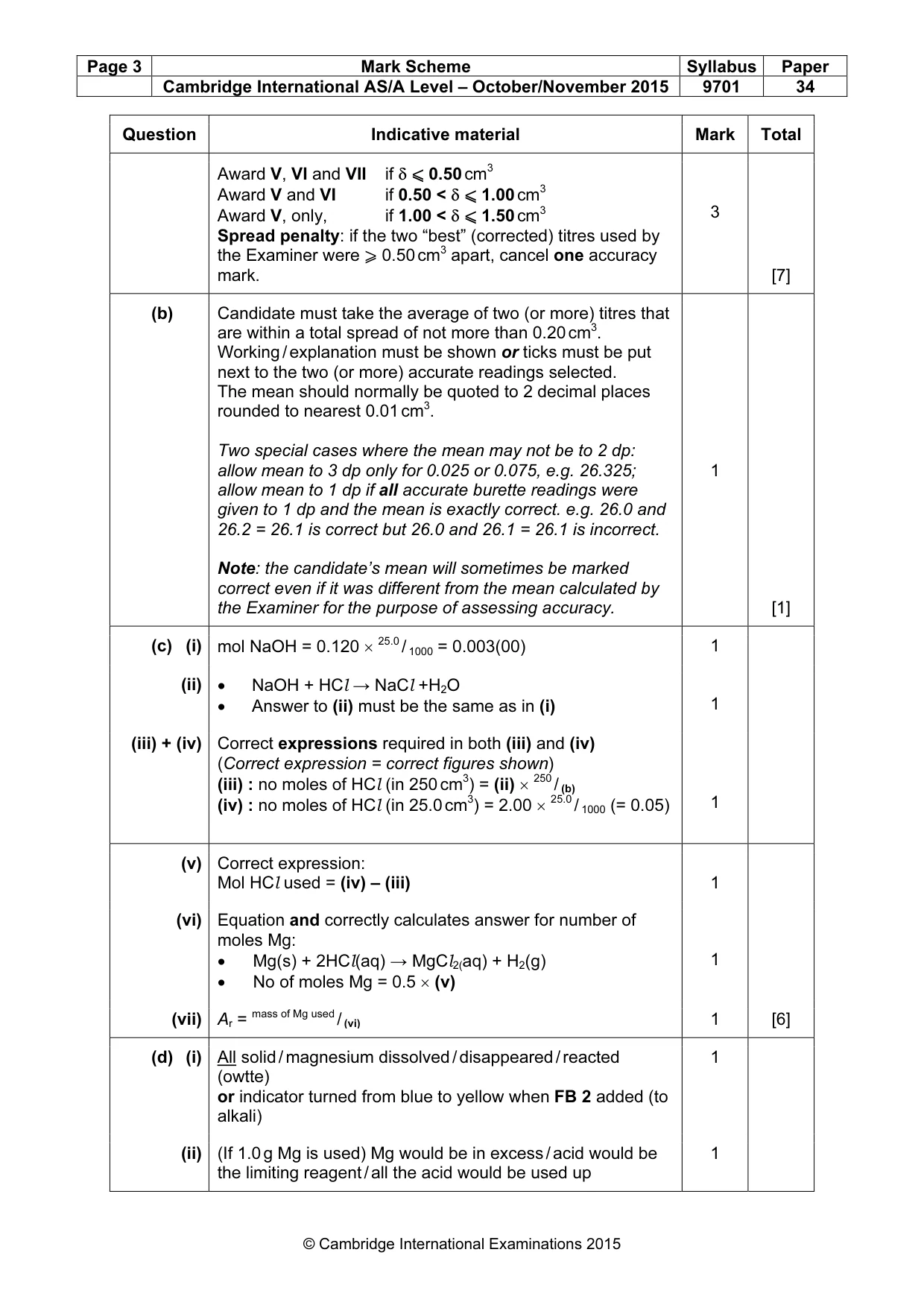
Page 3 Mark Scheme Syllabus Paper Cambridge International AS/A Level – October/November 2015 9701 34 © Cambridge International Examinations 2015 Question Indicative material Mark Total Award V, VI and VII if δ ⩽ 0.50 cm3 Award V and VI if 0.50 < δ ⩽ 1.00 cm3 Award V, only, if 1.00 < δ ⩽ 1.50 cm3 Spread penalty: if the two “best” (corrected) titres used by the Examiner were ⩾ 0.50 cm3 apart, cancel one accuracy mark. 3 [7] (b) Candidate must take the average of two (or more) titres that are within a total spread of not more than 0.20 cm3. Working / explanation must be shown or ticks must be put next to the two (or more) accurate readings selected. The mean should normally be quoted to 2 decimal places rounded to nearest 0.01 cm3. Two special cases where the mean may not be to 2 dp: allow mean to 3 dp only for 0.025 or 0.075, e.g. 26.325; allow mean to 1 dp if all accurate burette readings were given to 1 dp and the mean is exactly correct. e.g. 26.0 and 26.2 = 26.1 is correct but 26.0 and 26.1 = 26.1 is incorrect. Note: the candidate’s mean will sometimes be marked correct even if it was different from the mean calculated by the Examiner for the purpose of assessing accuracy. 1 [1] (c) (i) mol NaOH = 0.120 × 25.0 / 1000 = 0.003(00) 1 (ii) • NaOH + HCl → NaCl +H2O • Answer to (ii) must be the same as in (i) 1 (iii) + (iv) Correct expressions required in both (iii) and (iv) (Correct expression = correct figures shown) (iii) : no moles of HCl (in 250 cm3) = (ii) × 250 / (b) (iv) : no moles of HCl (in 25.0 cm3) = 2.00 × 25.0 / 1000 (= 0.05) 1 (v) Correct expression: Mol HCl used = (iv) – (iii) 1 (vi) Equation and correctly calculates answer for number of moles Mg: • Mg(s) + 2HCl(aq) → MgCl2(aq) + H2(g) • No of moles Mg = 0.5 × (v) 1 (vii) Ar = mass of Mg used / (vi) 1 [6] (d) (i) All solid / magnesium dissolved / disappeared / reacted (owtte) or indicator turned from blue to yellow when FB 2 added (to alkali) 1 (ii) (If 1.0 g Mg is used) Mg would be in excess / acid would be the limiting reagent / all the acid would be used up 1
Mark scheme, page 4
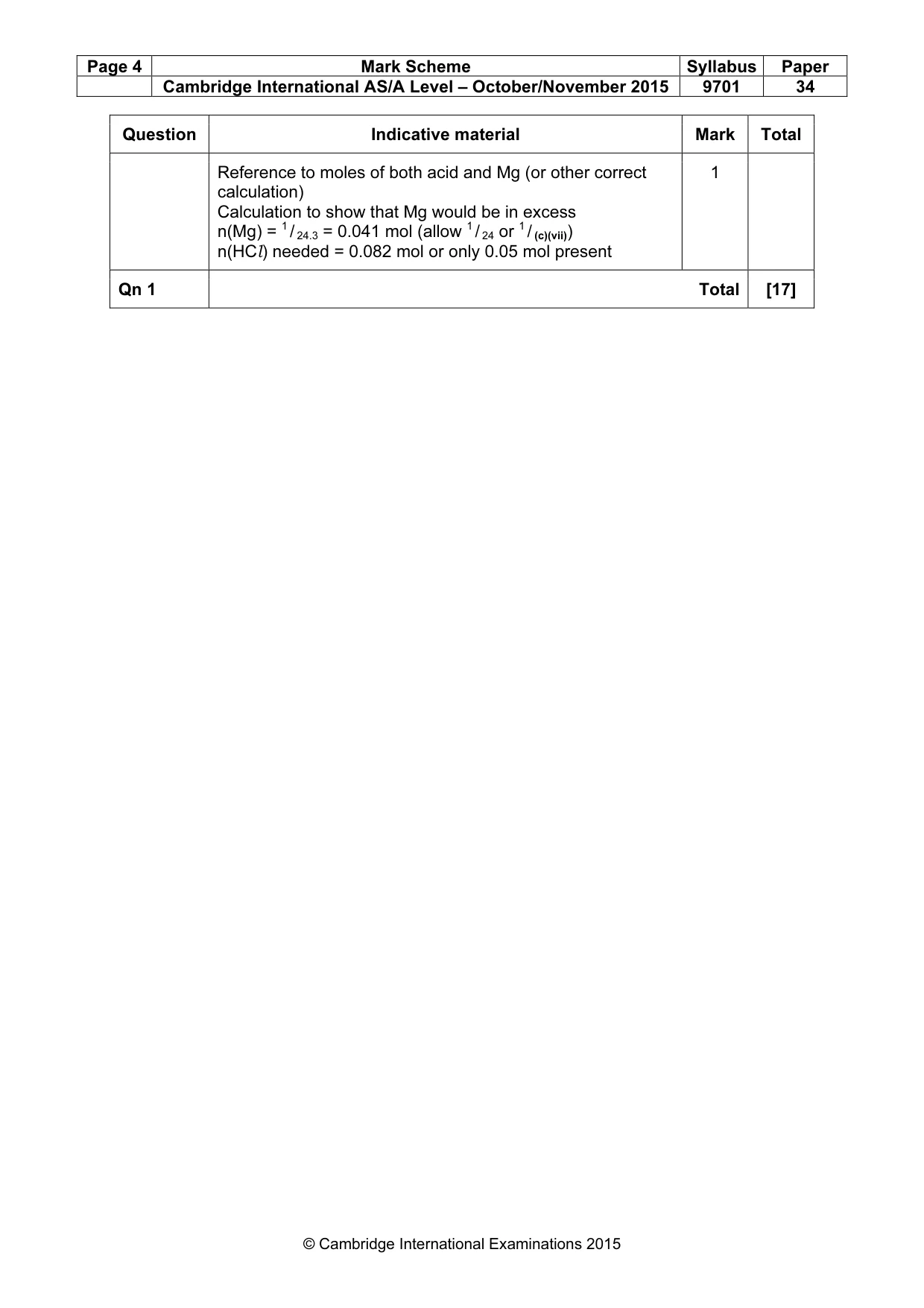
Page 4 Mark Scheme Syllabus Paper Cambridge International AS/A Level – October/November 2015 9701 34 © Cambridge International Examinations 2015 Question Indicative material Mark Total Reference to moles of both acid and Mg (or other correct calculation) Calculation to show that Mg would be in excess n(Mg) = 1 / 24.3 = 0.041 mol (allow 1 / 24 or 1 / (c)(vii)) n(HCl) needed = 0.082 mol or only 0.05 mol present 1 Qn 1 Total [17]
Mark scheme, page 5
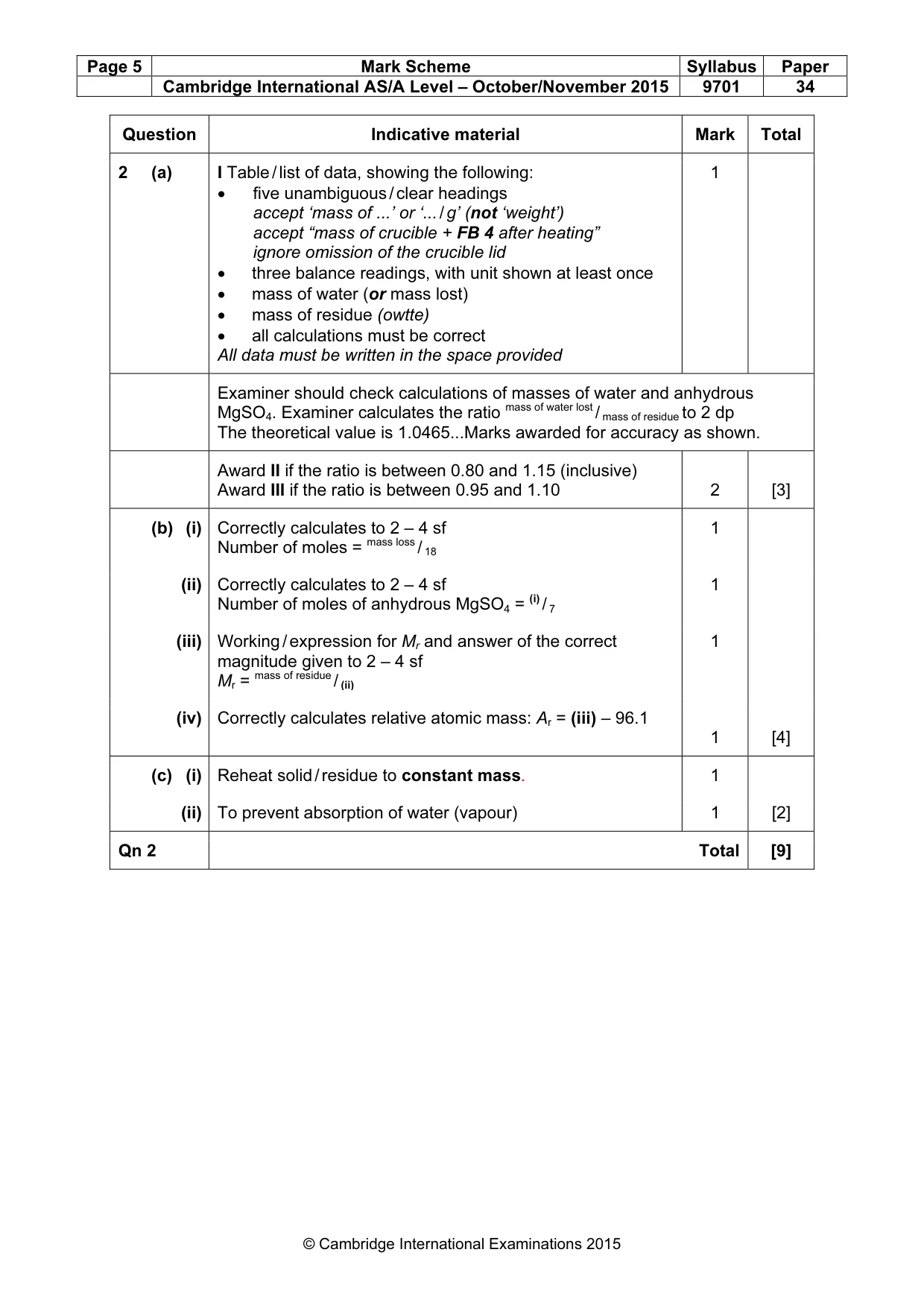
Page 5 Mark Scheme Syllabus Paper Cambridge International AS/A Level – October/November 2015 9701 34 © Cambridge International Examinations 2015 Question Indicative material Mark Total 2 (a) I Table / list of data, showing the following: • five unambiguous / clear headings accept ‘mass of ...’ or ‘... / g’ (not ‘weight’) accept “mass of crucible + FB 4 after heating” ignore omission of the crucible lid • three balance readings, with unit shown at least once • mass of water (or mass lost) • mass of residue (owtte) • all calculations must be correct All data must be written in the space provided 1 Examiner should check calculations of masses of water and anhydrous MgSO4. Examiner calculates the ratio mass of water lost / mass of residue to 2 dp The theoretical value is 1.0465...Marks awarded for accuracy as shown. Award II if the ratio is between 0.80 and 1.15 (inclusive) Award III if the ratio is between 0.95 and 1.10 2 [3] (b) (i) Correctly calculates to 2 – 4 sf Number of moles = mass loss / 18 1 (ii) Correctly calculates to 2 – 4 sf Number of moles of anhydrous MgSO4 = (i) / 7 1 (iii) Working / expression for Mr and answer of the correct magnitude given to 2 – 4 sf Mr = mass of residue / (ii) 1 (iv) Correctly calculates relative atomic mass: Ar = (iii) – 96.1 1 [4] (c) (i) Reheat solid / residue to constant mass. 1 (ii) To prevent absorption of water (vapour) 1 [2] Qn 2 Total [9]
Mark scheme, page 6
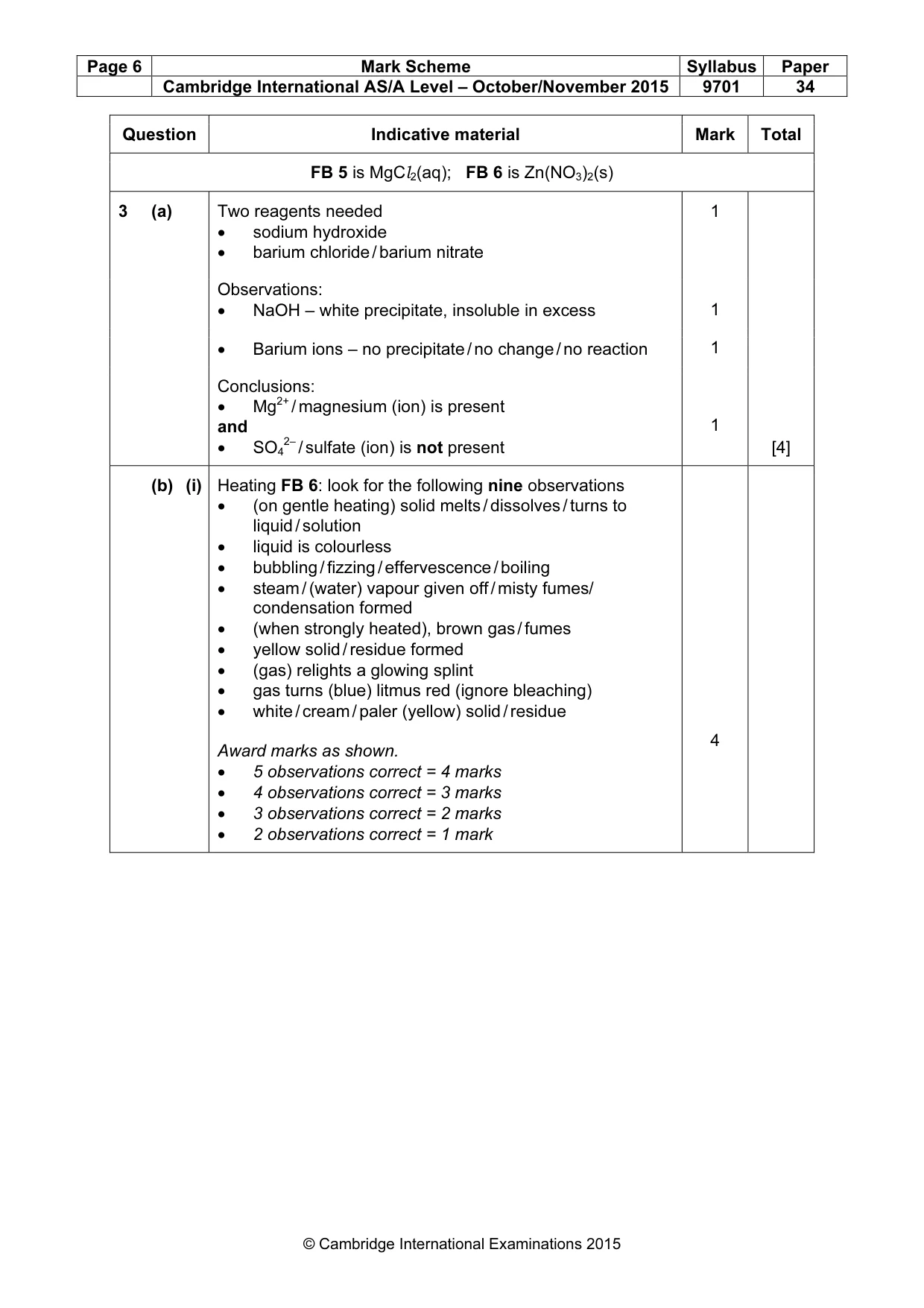
Page 6 Mark Scheme Syllabus Paper Cambridge International AS/A Level – October/November 2015 9701 34 © Cambridge International Examinations 2015 Question Indicative material Mark Total FB 5 is MgCl2(aq); FB 6 is Zn(NO3)2(s) 3 (a) Two reagents needed • sodium hydroxide • barium chloride / barium nitrate 1 Observations: • NaOH – white precipitate, insoluble in excess 1 • Barium ions – no precipitate / no change / no reaction 1 Conclusions: • Mg2+ / magnesium (ion) is present and • SO4 2– / sulfate (ion) is not present 1 [4] (b) (i) Heating FB 6: look for the following nine observations • (on gentle heating) solid melts / dissolves / turns to liquid / solution • liquid is colourless • bubbling / fizzing / effervescence / boiling • steam / (water) vapour given off / misty fumes/ condensation formed • (when strongly heated), brown gas / fumes • yellow solid / residue formed • (gas) relights a glowing splint • gas turns (blue) litmus red (ignore bleaching) • white / cream / paler (yellow) solid / residue Award marks as shown. • 5 observations correct = 4 marks • 4 observations correct = 3 marks • 3 observations correct = 2 marks • 2 observations correct = 1 mark 4
Mark scheme, page 7
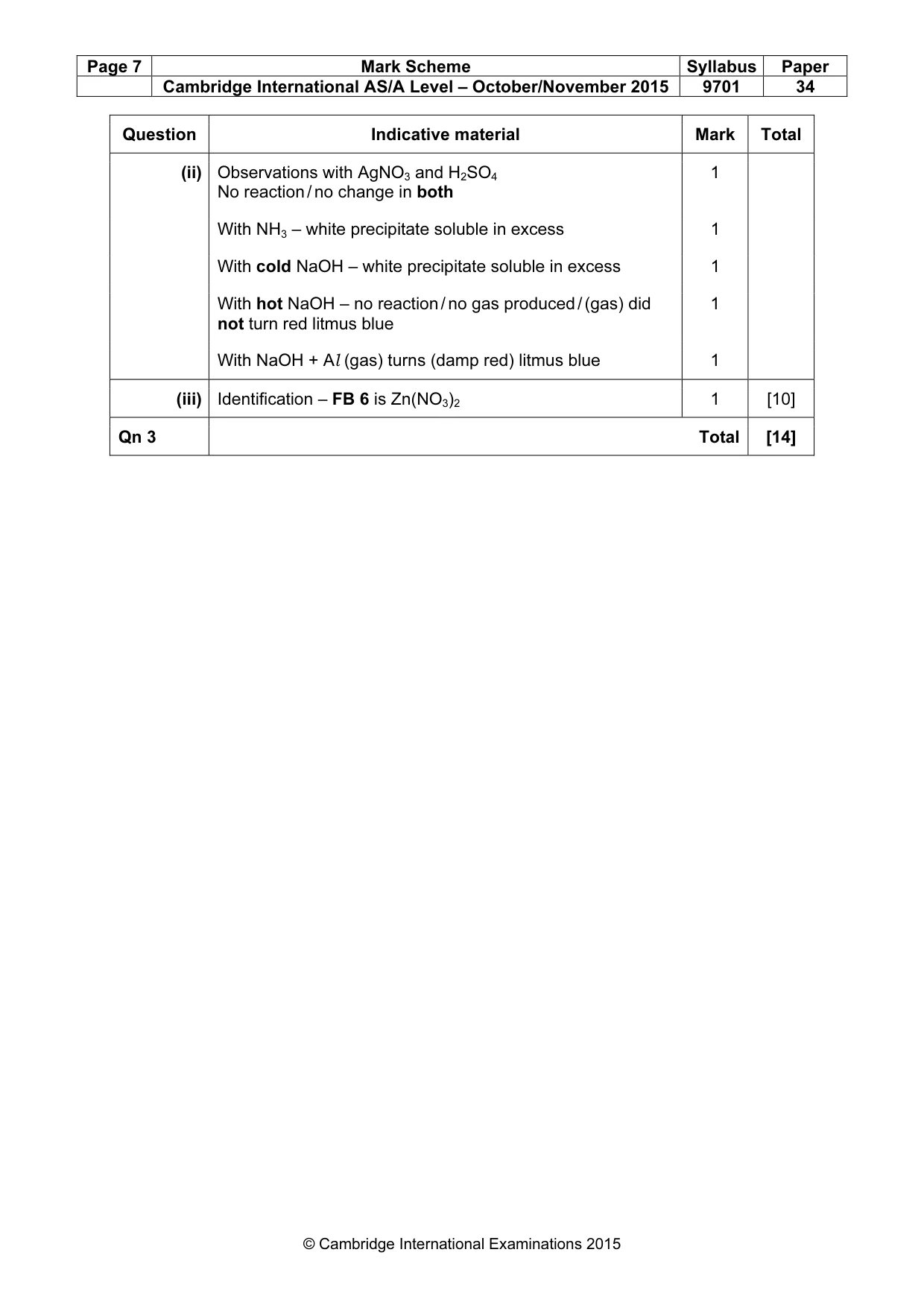
Page 7 Mark Scheme Syllabus Paper Cambridge International AS/A Level – October/November 2015 9701 34 © Cambridge International Examinations 2015 Question Indicative material Mark Total (ii) Observations with AgNO3 and H2SO4 No reaction / no change in both 1 With NH3 – white precipitate soluble in excess 1 With cold NaOH – white precipitate soluble in excess 1 With hot NaOH – no reaction / no gas produced / (gas) did not turn red litmus blue 1 With NaOH + Al (gas) turns (damp red) litmus blue 1 (iii) Identification – FB 6 is Zn(NO3)2 1 [10] Qn 3 Total [14]
What you needed in this session
Cambridge’s own grade thresholds for 2015 Oct/Nov, Paper 3 · Variant 4. A higher threshold means an easier paper — the bar moves with how the cohort did.