Cambridge A Level Chemistry 9701 — 2015 May/June Paper 4 · Variant 3
9701/43/M/J/15 · 100 marks · ≈113 min
The question paper and its mark scheme, free to read here and free to download. This is Cambridge’s own paper, exactly as it was sat.
Question paper20 pages

Mark scheme9 pages
Answers below. Sit the paper first if you are practising.
Paper as text
Question paper, page 1
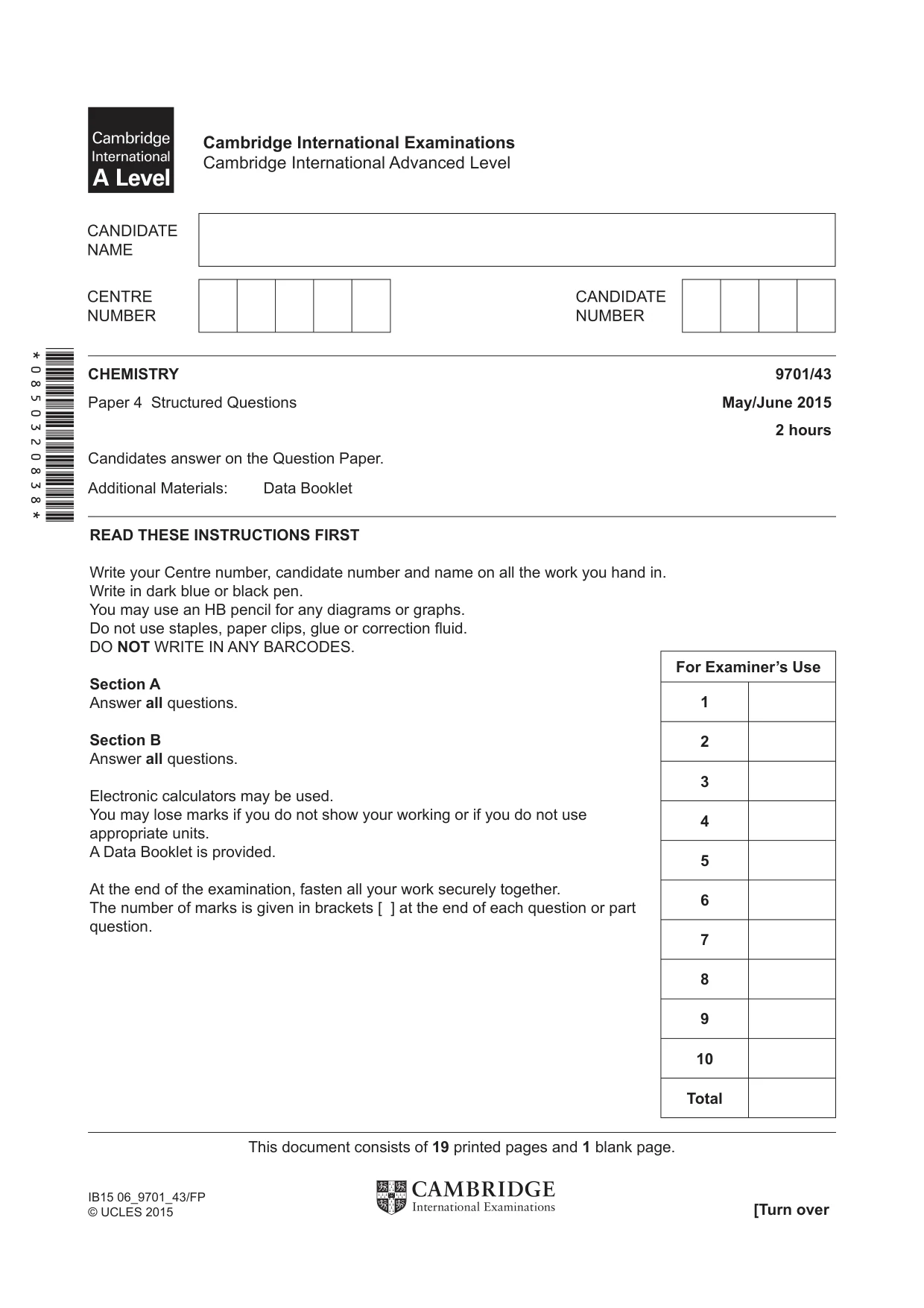
READ THESE INSTRUCTIONS FIRST Write your Centre number, candidate number and name on all the work you hand in. Write in dark blue or black pen. You may use an HB pencil for any diagrams or graphs. Do not use staples, paper clips, glue or correction fl uid. DO NOT WRITE IN ANY BARCODES. Section A Answer all questions. Section B Answer all questions. Electronic calculators may be used. You may lose marks if you do not show your working or if you do not use appropriate units. A Data Booklet is provided. At the end of the examination, fasten all your work securely together. The number of marks is given in brackets [ ] at the end of each question or part question. CHEMISTRY 9701/43 Paper 4 Structured Questions May/June 2015 2 hours Candidates answer on the Question Paper. Additional Materials: Data Booklet Cambridge International Examinations Cambridge International Advanced Level This document consists of 19 printed pages and 1 blank page. [Turn over IB15 06_9701_43/FP © UCLES 2015 *0850320838* For Examiner’s Use 1 2 3 4 5 6 7 8 9 10 Total
Question paper, page 2
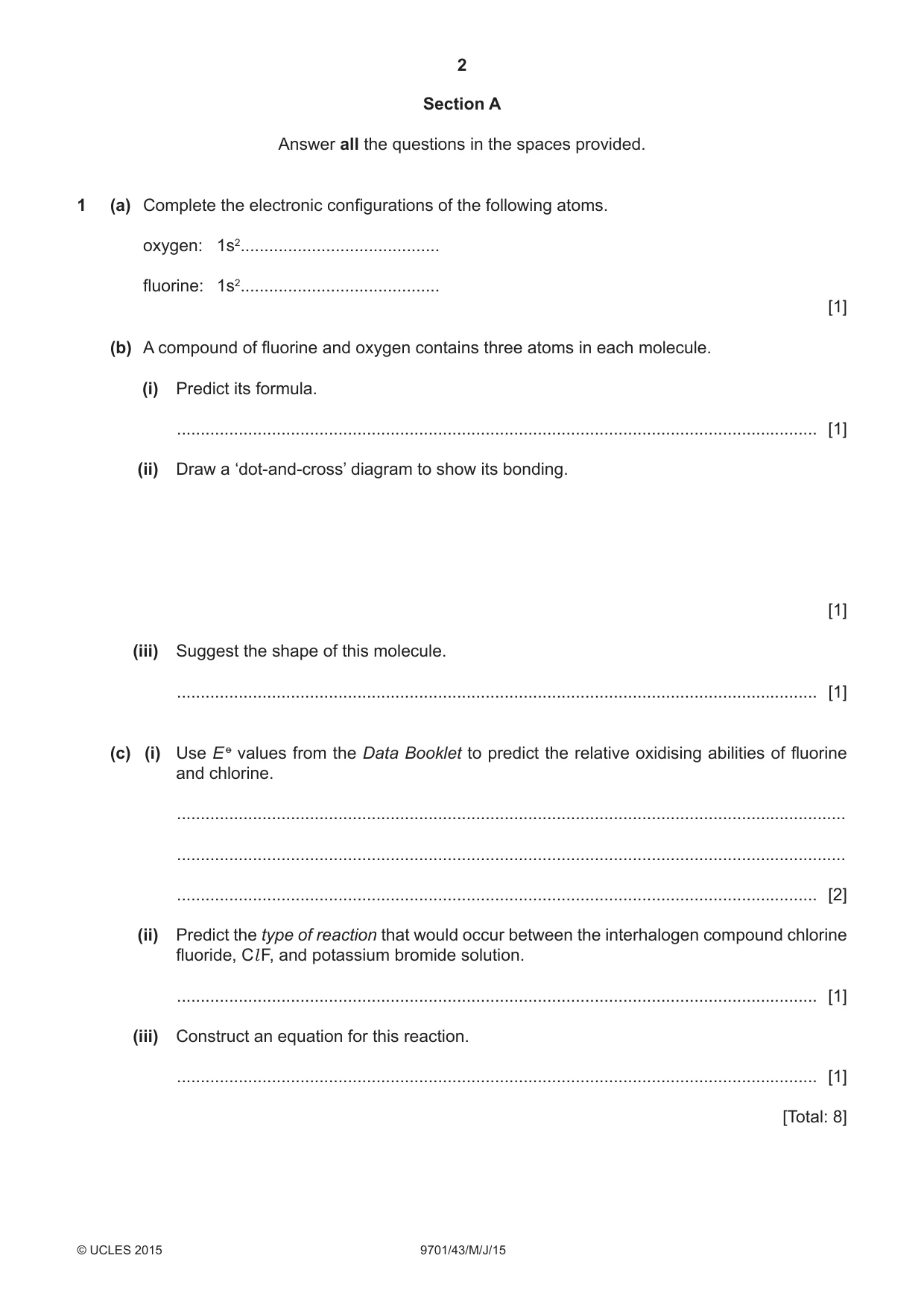
2 9701/43/M/J/15 © UCLES 2015 Section A Answer all the questions in the spaces provided. 1 (a) Complete the electronic confi gurations of the following atoms. oxygen: 1s2… fl uorine: 1s2… [1] (b) A compound of fl uorine and oxygen contains three atoms in each molecule. (i) Predict its formula. … [1] (ii) Draw a ‘dot-and-cross’ diagram to show its bonding. [1] (iii) Suggest the shape of this molecule. … [1] (c) (i) Use E o values from the Data Booklet to predict the relative oxidising abilities of fl uorine and chlorine. … … … [2] (ii) Predict the type of reaction that would occur between the interhalogen compound chlorine fl uoride, Cl F, and potassium bromide solution. … [1] (iii) Construct an equation for this reaction. … [1] [Total: 8]
Question paper, page 3
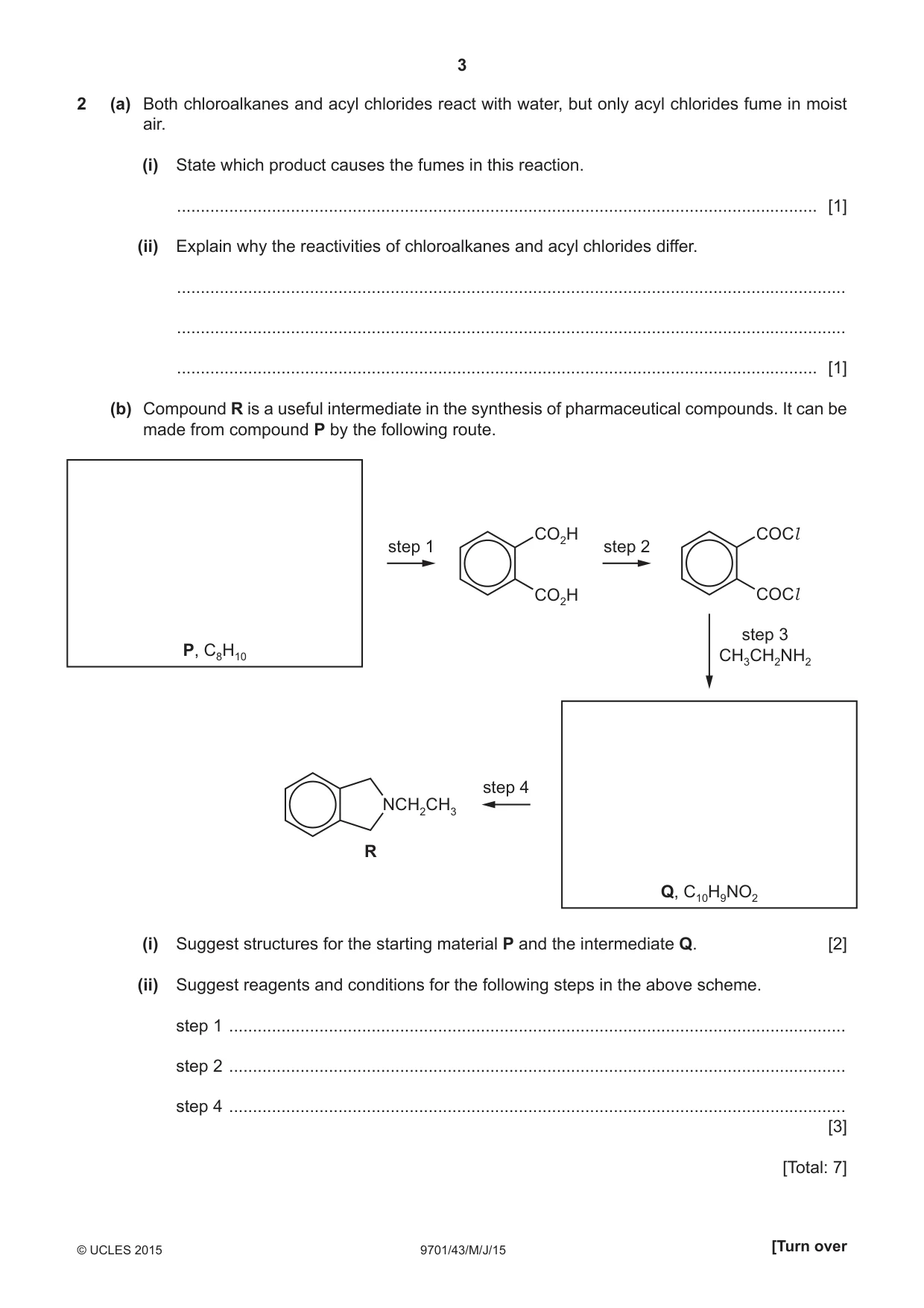
3 9701/43/M/J/15 © UCLES 2015 [Turn over 2 (a) Both chloroalkanes and acyl chlorides react with water, but only acyl chlorides fume in moist air. (i) State which product causes the fumes in this reaction. … [1] (ii) Explain why the reactivities of chloroalkanes and acyl chlorides differ. … … … [1] (b) Compound R is a useful intermediate in the synthesis of pharmaceutical compounds. It can be made from compound P by the following route. CO2H CO2H COCl COCl step 1 step 2 step 4 step 3 CH3CH2NH2 NCH2CH3 P, C8H10 Q, C10H9NO2 R (i) Suggest structures for the starting material P and the intermediate Q. [2] (ii) Suggest reagents and conditions for the following steps in the above scheme. step 1 … step 2 … step 4 … [3] [Total: 7]
Question paper, page 4
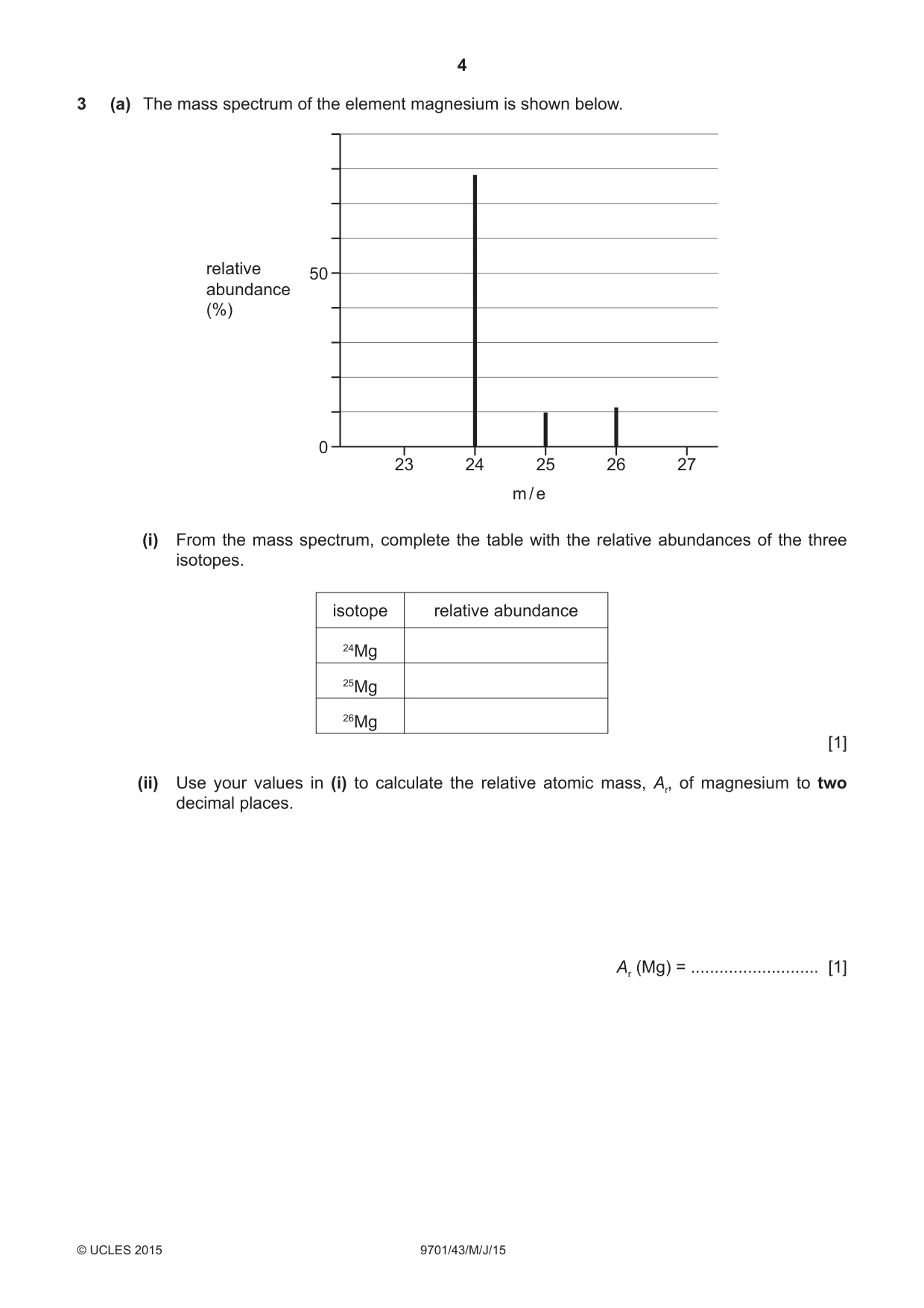
4 9701/43/M/J/15 © UCLES 2015 3 (a) The mass spectrum of the element magnesium is shown below. 50 0 23 24 25 m / e 26 27 relative abundance (%) (i) From the mass spectrum, complete the table with the relative abundances of the three isotopes. isotope relative abundance 24Mg 25Mg 26Mg [1] (ii) Use your values in (i) to calculate the relative atomic mass, Ar, of magnesium to two decimal places. Ar (Mg) = … [1]
Question paper, page 5
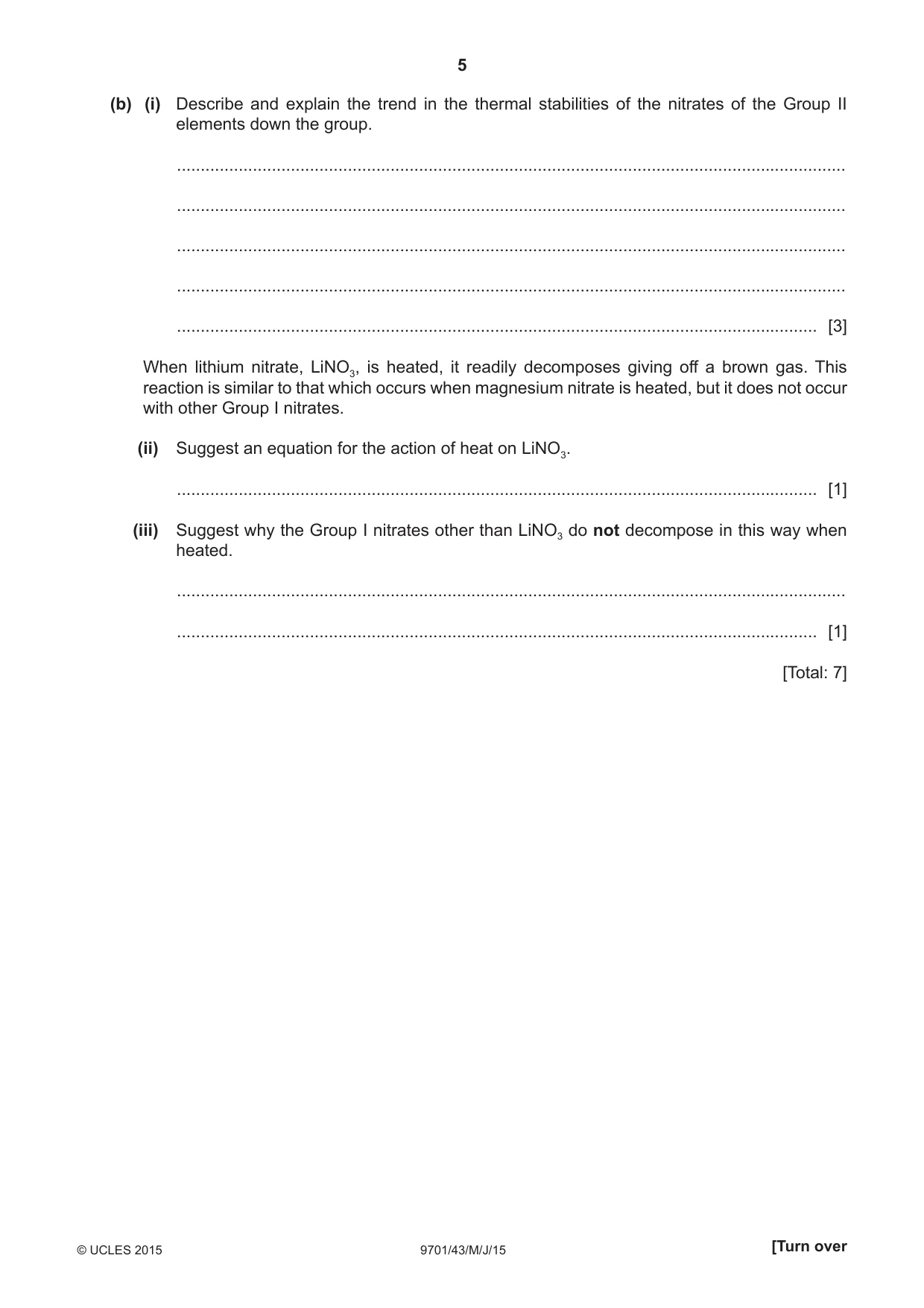
5 9701/43/M/J/15 © UCLES 2015 [Turn over (b) (i) Describe and explain the trend in the thermal stabilities of the nitrates of the Group II elements down the group. … … … … … [3] When lithium nitrate, LiNO3, is heated, it readily decomposes giving off a brown gas. This reaction is similar to that which occurs when magnesium nitrate is heated, but it does not occur with other Group I nitrates. (ii) Suggest an equation for the action of heat on LiNO3. … [1] (iii) Suggest why the Group I nitrates other than LiNO3 do not decompose in this way when heated. … … [1] [Total: 7]
Question paper, page 6
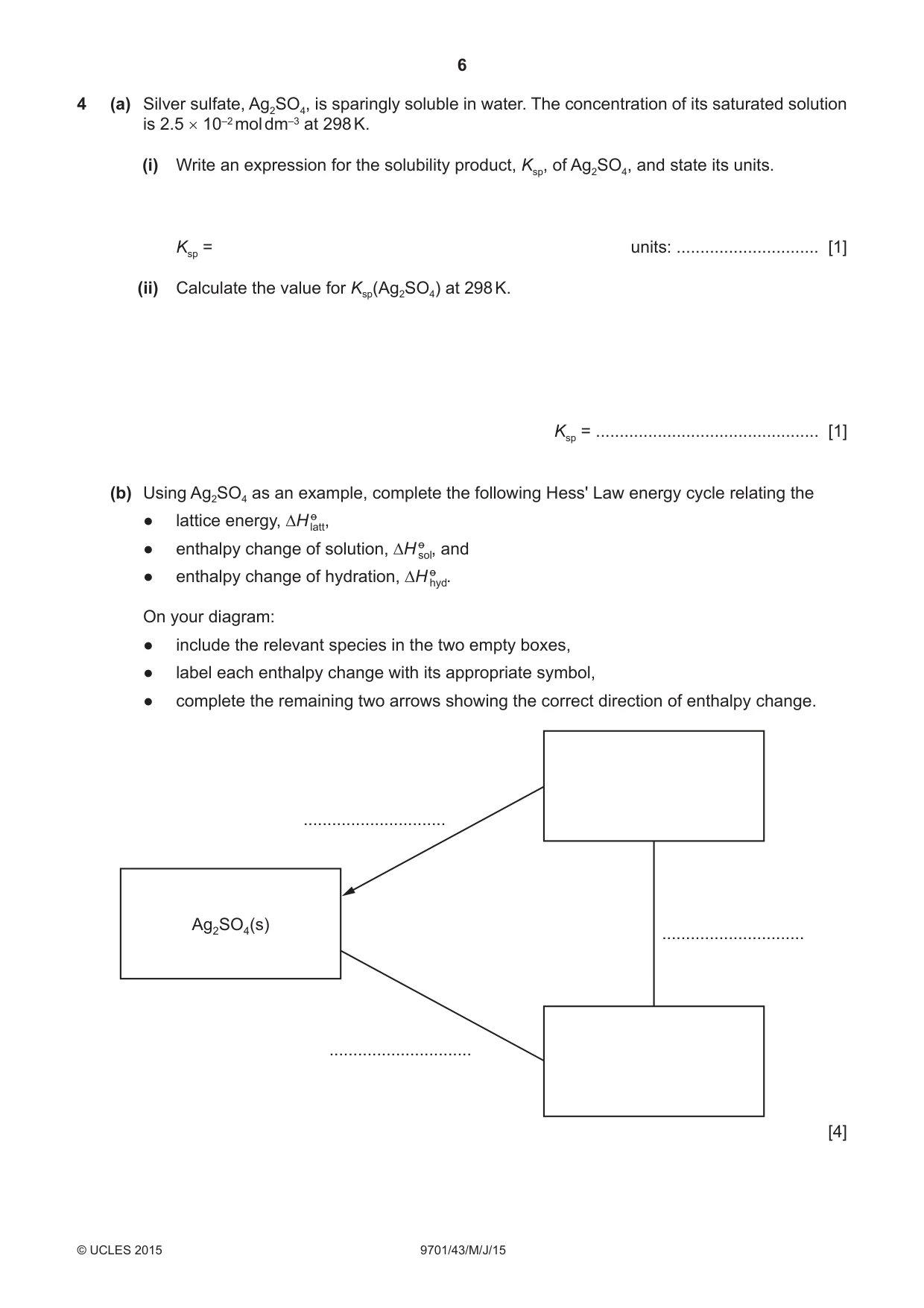
6 9701/43/M/J/15 © UCLES 2015 4 (a) Silver sulfate, Ag2SO4, is sparingly soluble in water. The concentration of its saturated solution is 2.5 × 10⁻² mol dm–3 at 298 K. (i) Write an expression for the solubility product, Ksp, of Ag2SO4, and state its units. Ksp = units: … [1] (ii) Calculate the value for Ksp(Ag2SO4) at 298 K. Ksp = … [1] (b) Using Ag2SO4 as an example, complete the following Hess' Law energy cycle relating the ● lattice energy, , ● enthalpy change of solution, , and ● enthalpy change of hydration, . On your diagram: ● include the relevant species in the two empty boxes, ● label each enthalpy change with its appropriate symbol, ● complete the remaining two arrows showing the correct direction of enthalpy change. … … … Ag2SO4(s) [4]
Question paper, page 7
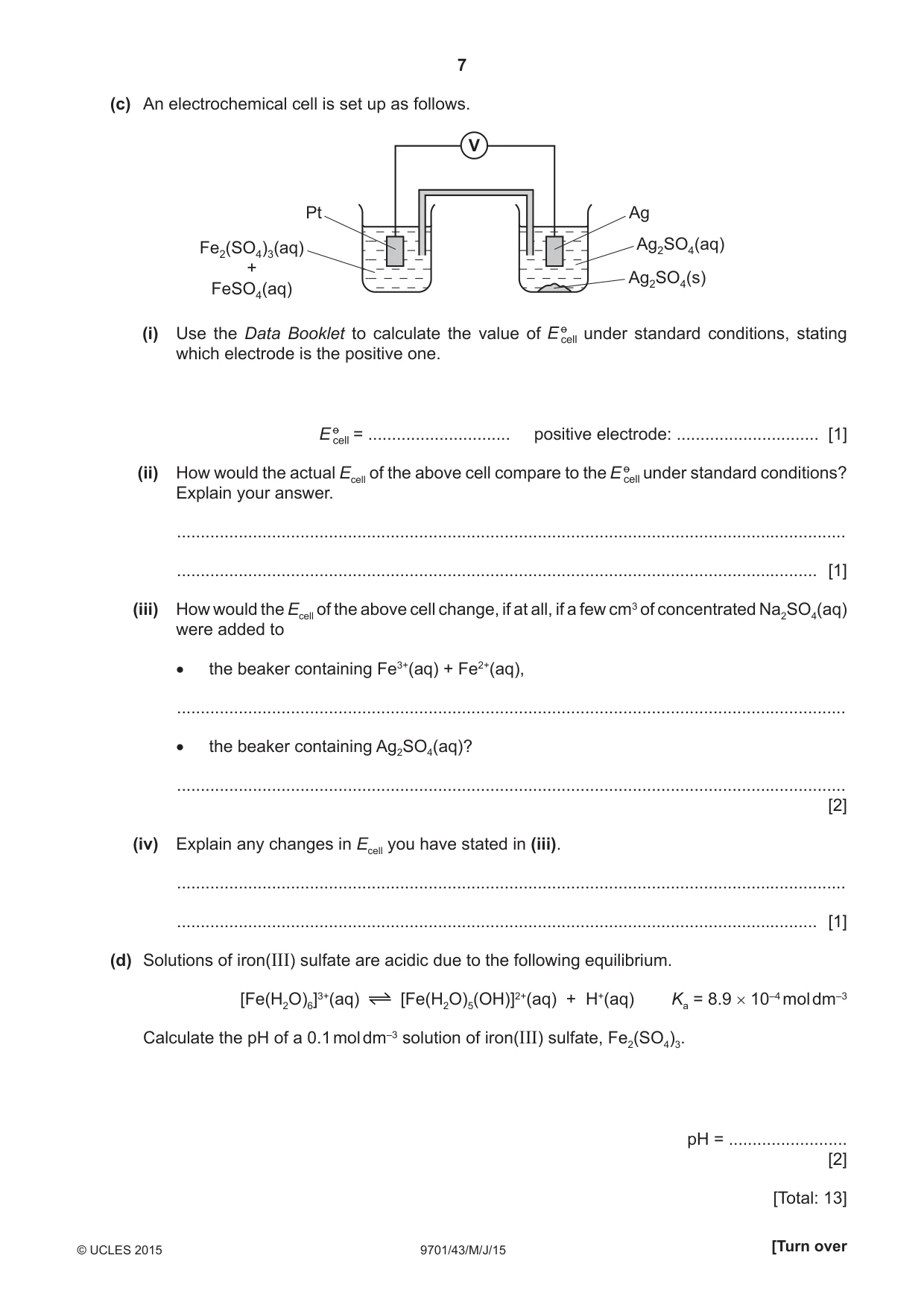
7 9701/43/M/J/15 © UCLES 2015 [Turn over (c) An electrochemical cell is set up as follows. V Ag2SO4(s) Fe2(SO4)3(aq) + FeSO4(aq) Ag2SO4(aq) Pt Ag (i) Use the Data Booklet to calculate the value of under standard conditions, stating which electrode is the positive one. = … positive electrode: … [1] (ii) How would the actual Ecell of the above cell compare to the under standard conditions? Explain your answer. … … [1] (iii) How would the Ecell of the above cell change, if at all, if a few cm3 of concentrated Na2SO4(aq) were added to • the beaker containing Fe3+(aq) + Fe2+(aq), … • the beaker containing Ag2SO4(aq)? … [2] (iv) Explain any changes in Ecell you have stated in (iii). … … [1] (d) Solutions of iron(III) sulfate are acidic due to the following equilibrium. [Fe(H2O)6]3+(aq) [Fe(H2O)5(OH)]2+(aq) + H+(aq) Ka = 8.9 × 10⁻⁴ mol dm–3 Calculate the pH of a 0.1 mol dm–3 solution of iron(III) sulfate, Fe2(SO4)3. pH = … [2] [Total: 13]
Question paper, page 8
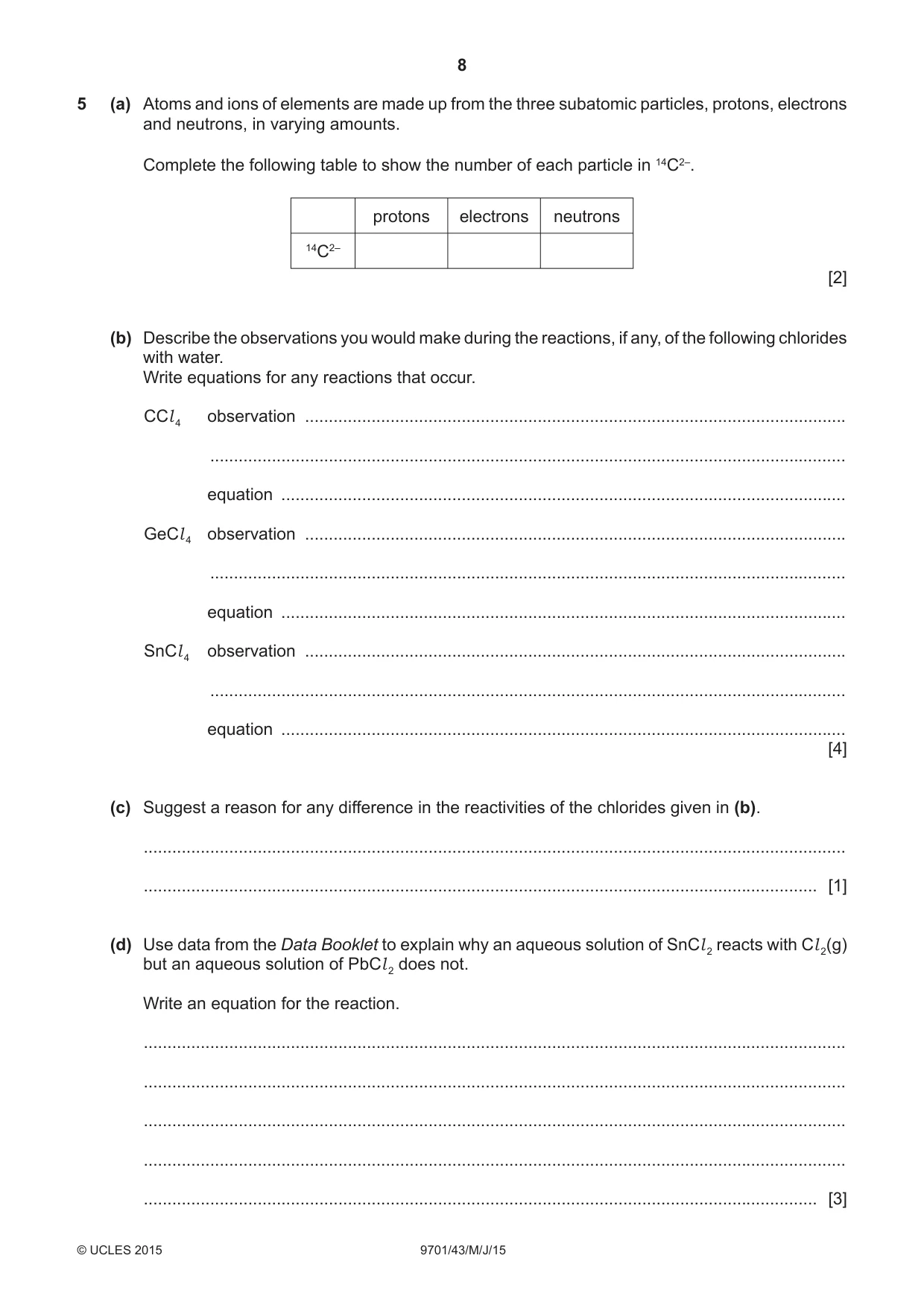
8 9701/43/M/J/15 © UCLES 2015 5 (a) Atoms and ions of elements are made up from the three subatomic particles, protons, electrons and neutrons, in varying amounts. Complete the following table to show the number of each particle in 14C2–. protons electrons neutrons 14C2– [2] (b) Describe the observations you would make during the reactions, if any, of the following chlorides with water. Write equations for any reactions that occur. CCl 4 observation … … equation … GeCl 4 observation … … equation … SnCl 4 observation … … equation … [4] (c) Suggest a reason for any difference in the reactivities of the chlorides given in (b). … … [1] (d) Use data from the Data Booklet to explain why an aqueous solution of SnCl 2 reacts with Cl 2(g) but an aqueous solution of PbCl 2 does not. Write an equation for the reaction. … … … … … [3]
Question paper, page 9
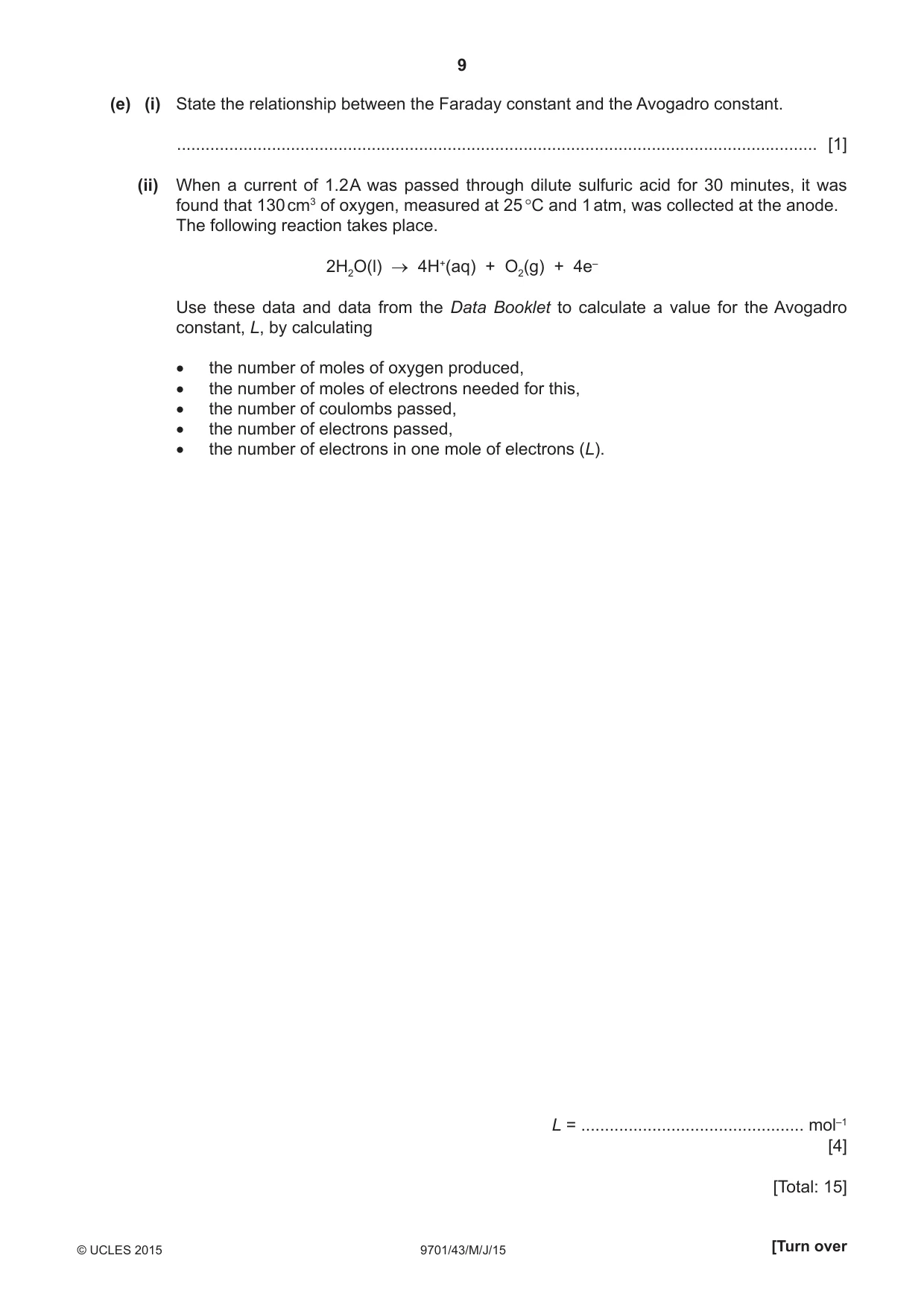
9 9701/43/M/J/15 © UCLES 2015 [Turn over (e) (i) State the relationship between the Faraday constant and the Avogadro constant. … [1] (ii) When a current of 1.2 A was passed through dilute sulfuric acid for 30 minutes, it was found that 130 cm3 of oxygen, measured at 25 °C and 1 atm, was collected at the anode. The following reaction takes place. 2H2O(l) → 4H+(aq) + O2(g) + 4e– Use these data and data from the Data Booklet to calculate a value for the Avogadro constant, L, by calculating • the number of moles of oxygen produced, • the number of moles of electrons needed for this, • the number of coulombs passed, • the number of electrons passed, • the number of electrons in one mole of electrons (L). L = … mol–1 [4] [Total: 15]
Question paper, page 10
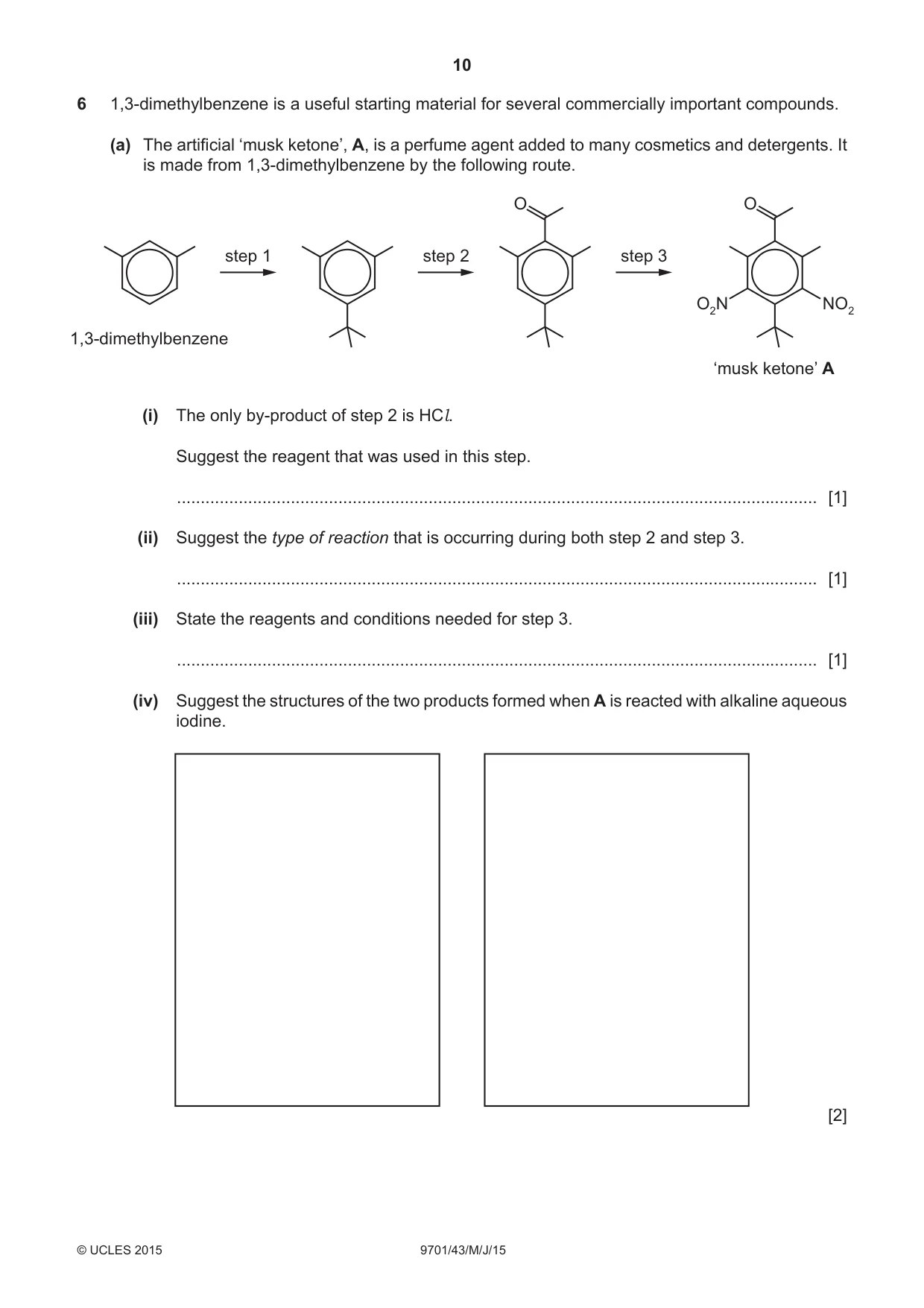
10 9701/43/M/J/15 © UCLES 2015 6 1,3-dimethylbenzene is a useful starting material for several commercially important compounds. (a) The artifi cial ‘musk ketone’, A, is a perfume agent added to many cosmetics and detergents. It is made from 1,3-dimethylbenzene by the following route. 1,3-dimethylbenzene ‘musk ketone’ A step 1 step 2 step 3 O O O2N NO2 (i) The only by-product of step 2 is HCl. Suggest the reagent that was used in this step. … [1] (ii) Suggest the type of reaction that is occurring during both step 2 and step 3. … [1] (iii) State the reagents and conditions needed for step 3. … [1] (iv) Suggest the structures of the two products formed when A is reacted with alkaline aqueous iodine. [2]
Question paper, page 11
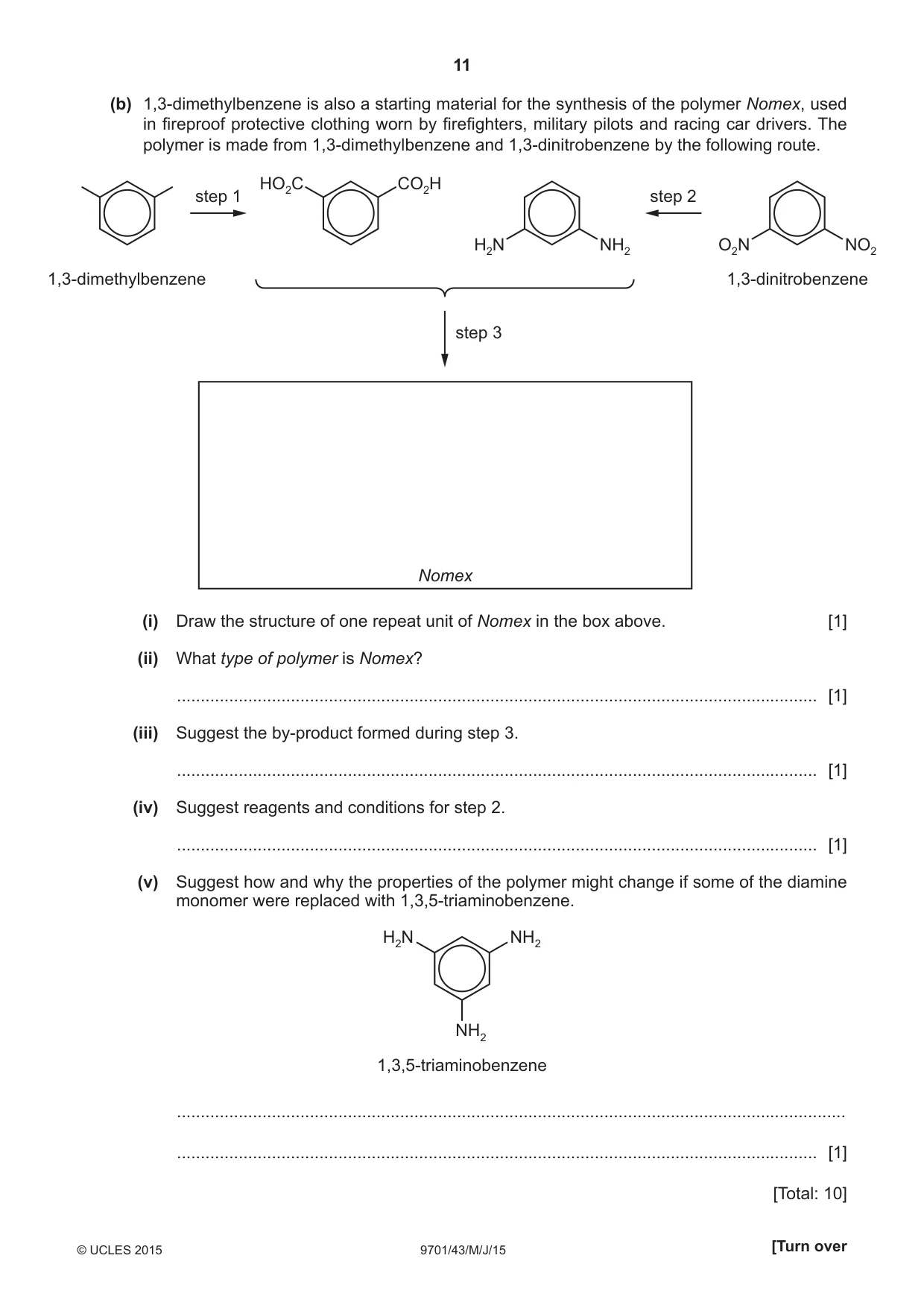
11 9701/43/M/J/15 © UCLES 2015 [Turn over (b) 1,3-dimethylbenzene is also a starting material for the synthesis of the polymer Nomex, used in fi reproof protective clothing worn by fi refi ghters, military pilots and racing car drivers. The polymer is made from 1,3-dimethylbenzene and 1,3-dinitrobenzene by the following route. 1,3-dimethylbenzene 1,3-dinitrobenzene step 1 step 3 Nomex step 2 HO2C H2N NH2 O2N NO2 CO2H (i) Draw the structure of one repeat unit of Nomex in the box above. [1] (ii) What type of polymer is Nomex? … [1] (iii) Suggest the by-product formed during step 3. … [1] (iv) Suggest reagents and conditions for step 2. … [1] (v) Suggest how and why the properties of the polymer might change if some of the diamine monomer were replaced with 1,3,5-triaminobenzene. NH2 NH2 1,3,5-triaminobenzene H2N … … [1] [Total: 10]
Question paper, page 12
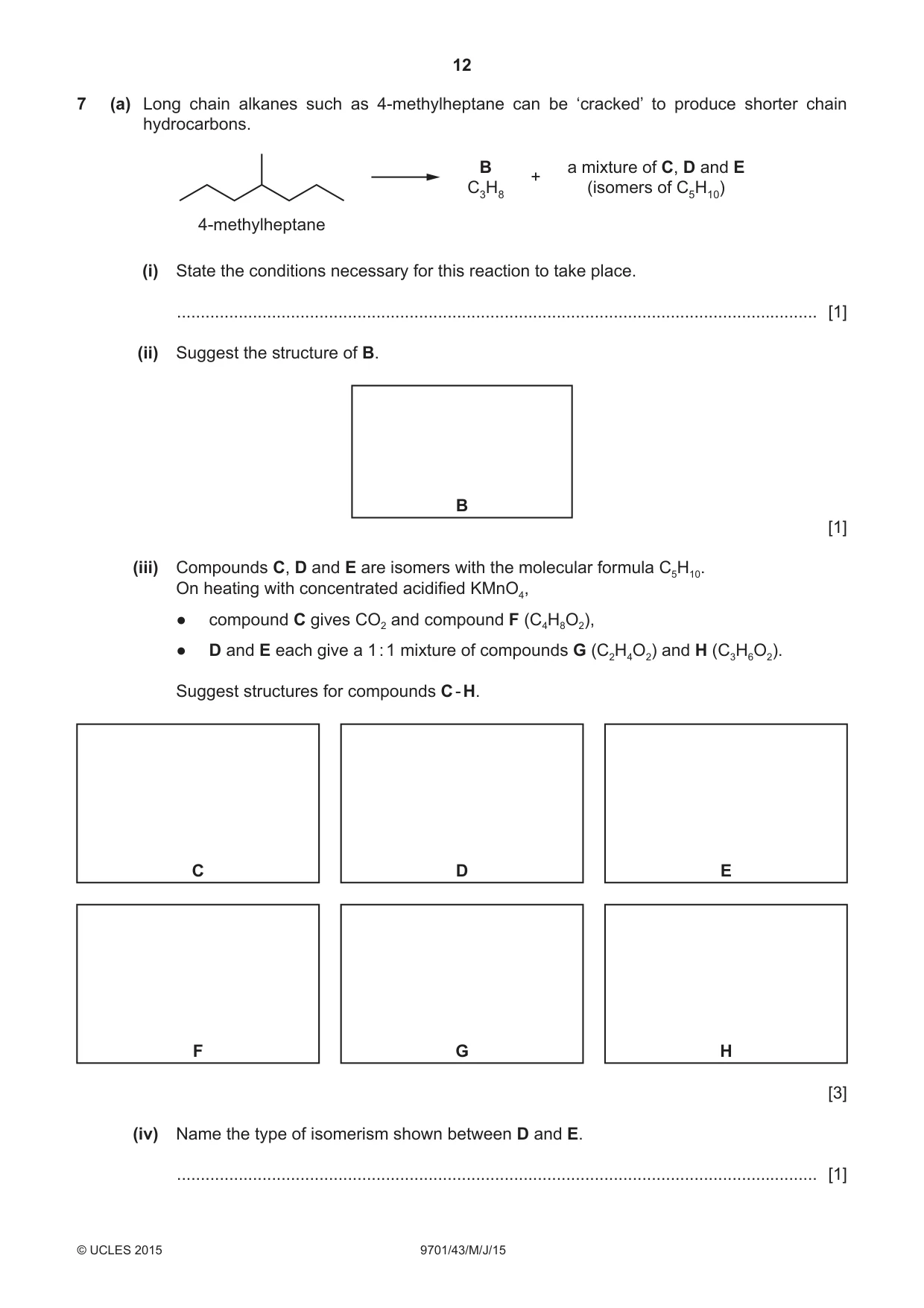
12 9701/43/M/J/15 © UCLES 2015 7 (a) Long chain alkanes such as 4-methylheptane can be ‘cracked’ to produce shorter chain hydrocarbons. 4-methylheptane B C3H8 a mixture of C, D and E (isomers of C5H10) + (i) State the conditions necessary for this reaction to take place. … [1] (ii) Suggest the structure of B. B [1] (iii) Compounds C, D and E are isomers with the molecular formula C5H10. On heating with concentrated acidifi ed KMnO4, ● compound C gives CO2 and compound F (C4H8O2), ● D and E each give a 1 : 1 mixture of compounds G (C2H4O2) and H (C3H6O2). Suggest structures for compounds C - H. C D E F G H [3] (iv) Name the type of isomerism shown between D and E. … [1]
Question paper, page 13
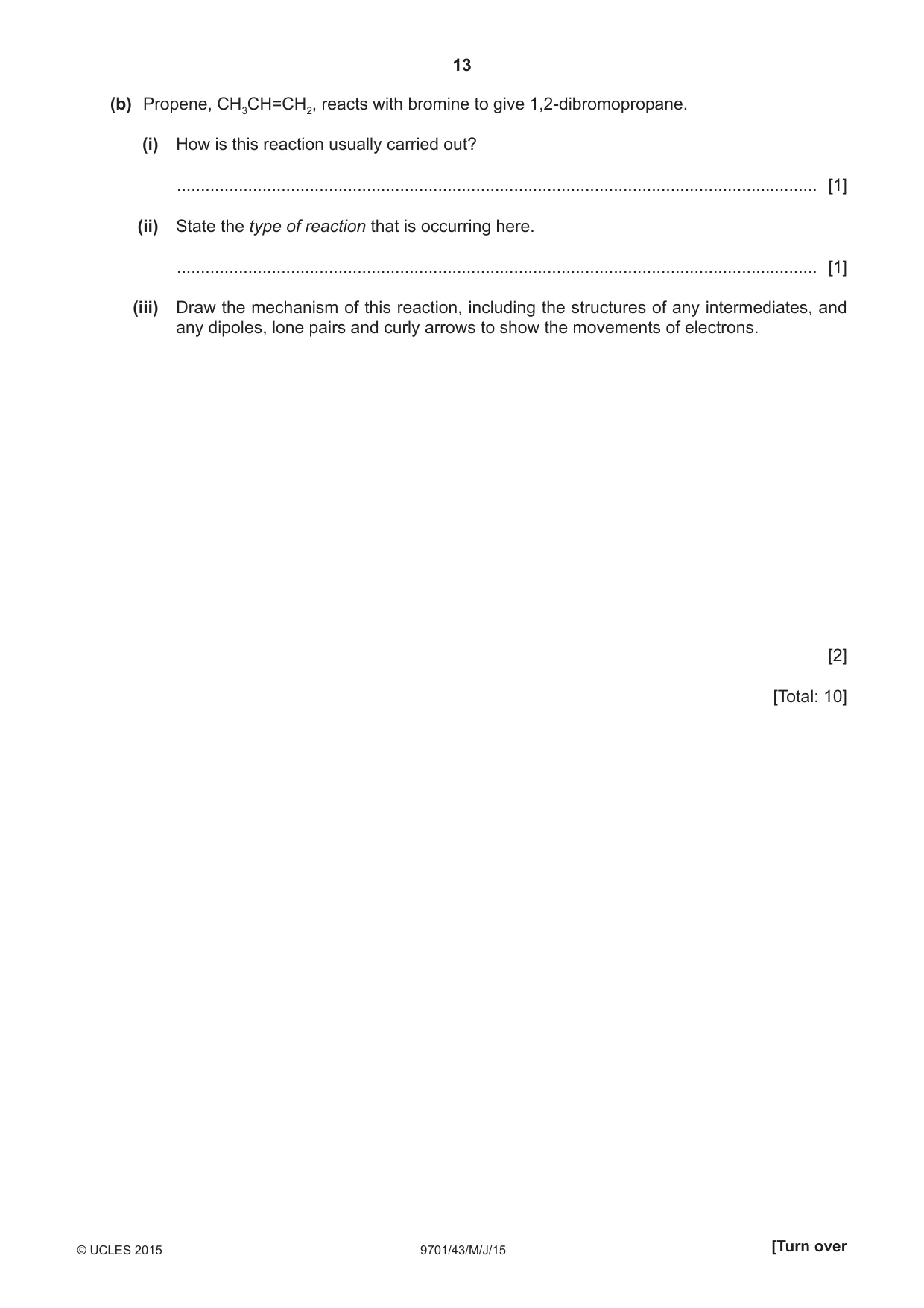
13 9701/43/M/J/15 © UCLES 2015 [Turn over (b) Propene, CH3CH=CH2, reacts with bromine to give 1,2-dibromopropane. (i) How is this reaction usually carried out? … [1] (ii) State the type of reaction that is occurring here. … [1] (iii) Draw the mechanism of this reaction, including the structures of any intermediates, and any dipoles, lone pairs and curly arrows to show the movements of electrons. [2] [Total: 10]
Question paper, page 14
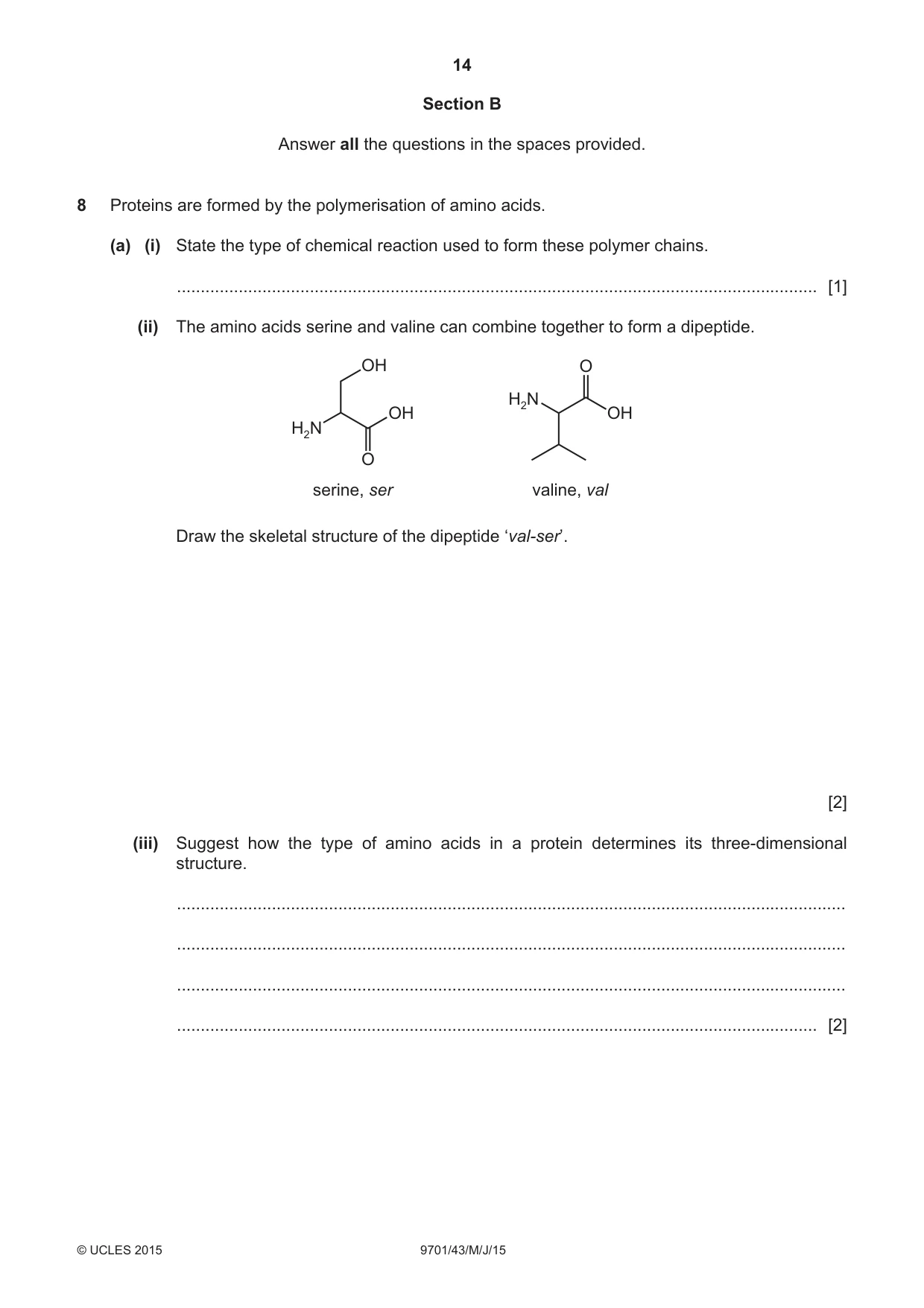
14 9701/43/M/J/15 © UCLES 2015 Section B Answer all the questions in the spaces provided. 8 Proteins are formed by the polymerisation of amino acids. (a) (i) State the type of chemical reaction used to form these polymer chains. … [1] (ii) The amino acids serine and valine can combine together to form a dipeptide. serine, ser OH O H2N OH valine, val H2N OH O Draw the skeletal structure of the dipeptide ‘val-ser’. [2] (iii) Suggest how the type of amino acids in a protein determines its three-dimensional structure. … … … … [2]
Question paper, page 15
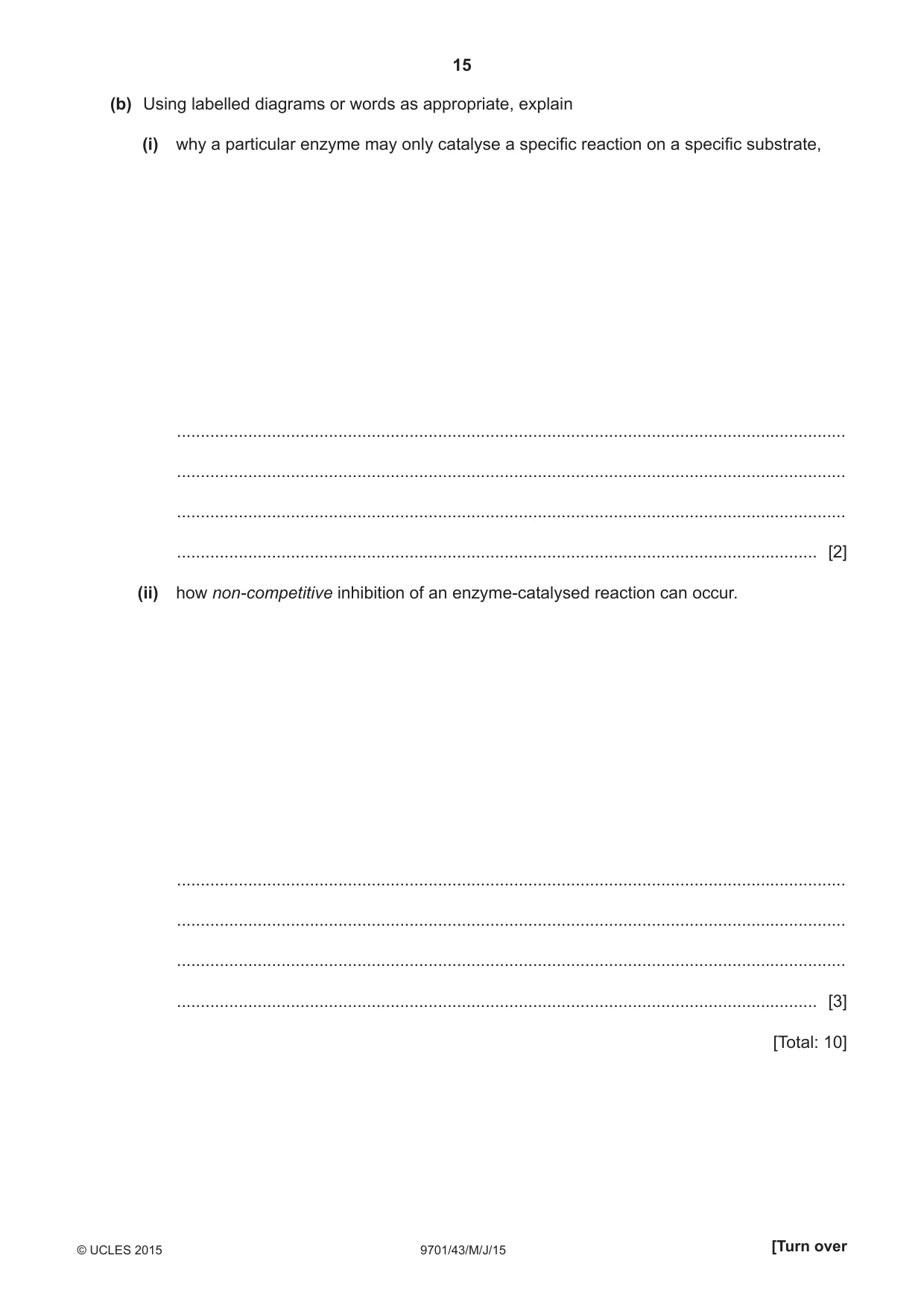
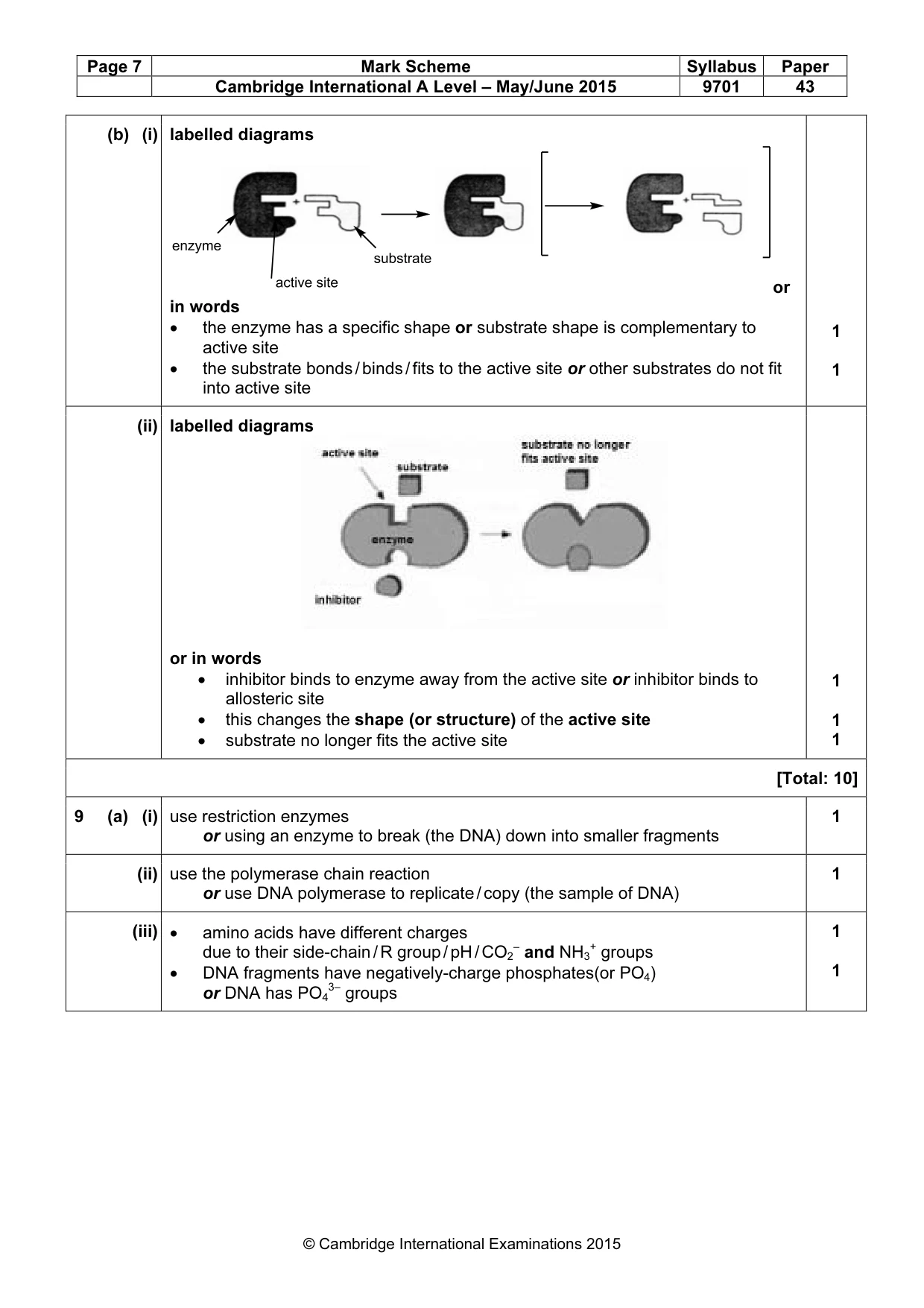
15 9701/43/M/J/15 © UCLES 2015 [Turn over (b) Using labelled diagrams or words as appropriate, explain (i) why a particular enzyme may only catalyse a specifi c reaction on a specifi c substrate, … … … … [2] (ii) how non-competitive inhibition of an enzyme-catalysed reaction can occur. … … … … [3] [Total: 10]
Question paper, page 16
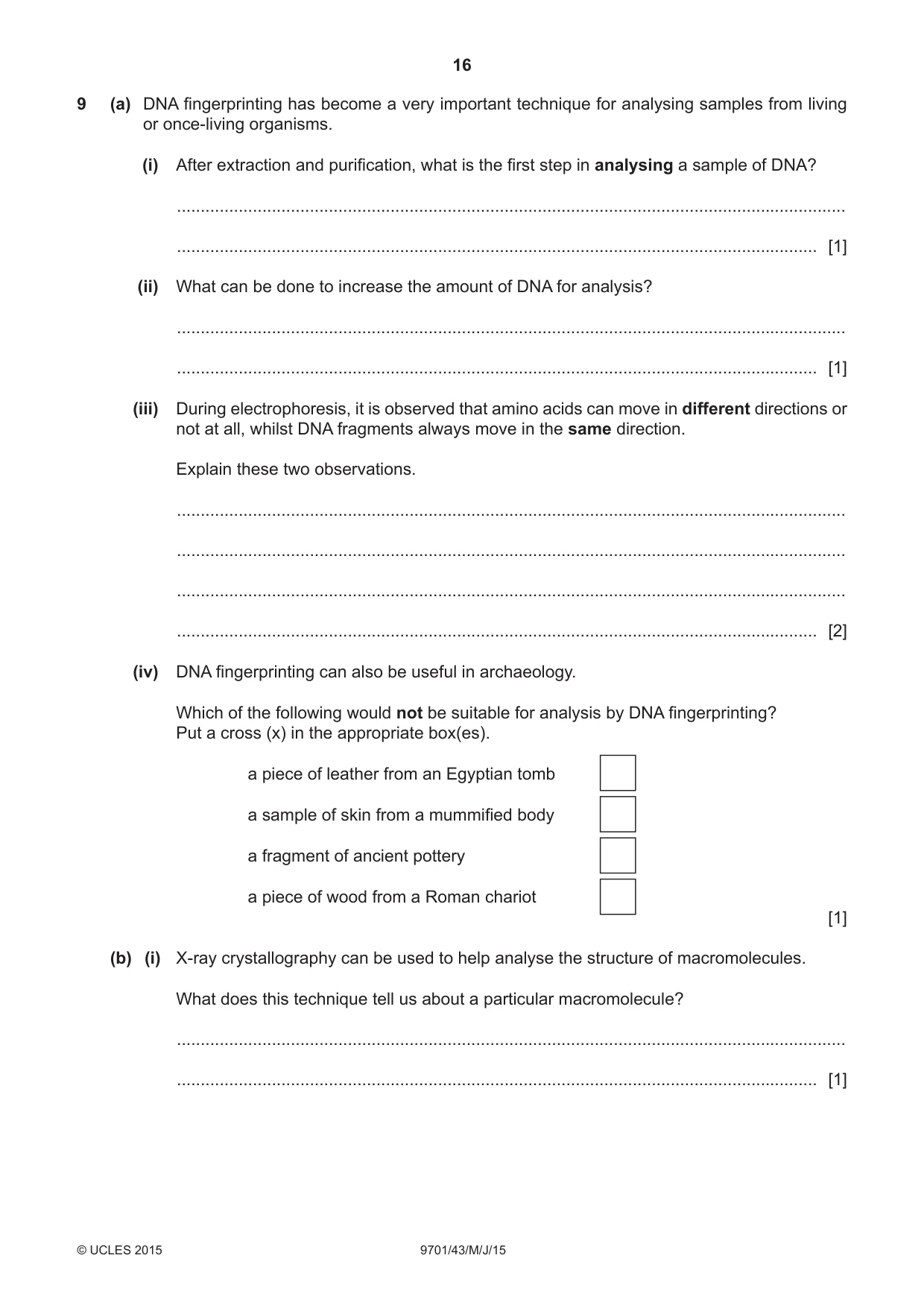
16 9701/43/M/J/15 © UCLES 2015 9 (a) DNA fi ngerprinting has become a very important technique for analysing samples from living or once-living organisms. (i) After extraction and purifi cation, what is the fi rst step in analysing a sample of DNA? … … [1] (ii) What can be done to increase the amount of DNA for analysis? … … [1] (iii) During electrophoresis, it is observed that amino acids can move in different directions or not at all, whilst DNA fragments always move in the same direction. Explain these two observations. … … … … [2] (iv) DNA fi ngerprinting can also be useful in archaeology. Which of the following would not be suitable for analysis by DNA fi ngerprinting? Put a cross (x) in the appropriate box(es). a piece of leather from an Egyptian tomb a sample of skin from a mummifi ed body a fragment of ancient pottery a piece of wood from a Roman chariot [1] (b) (i) X-ray crystallography can be used to help analyse the structure of macromolecules. What does this technique tell us about a particular macromolecule? … … [1]
Question paper, page 17
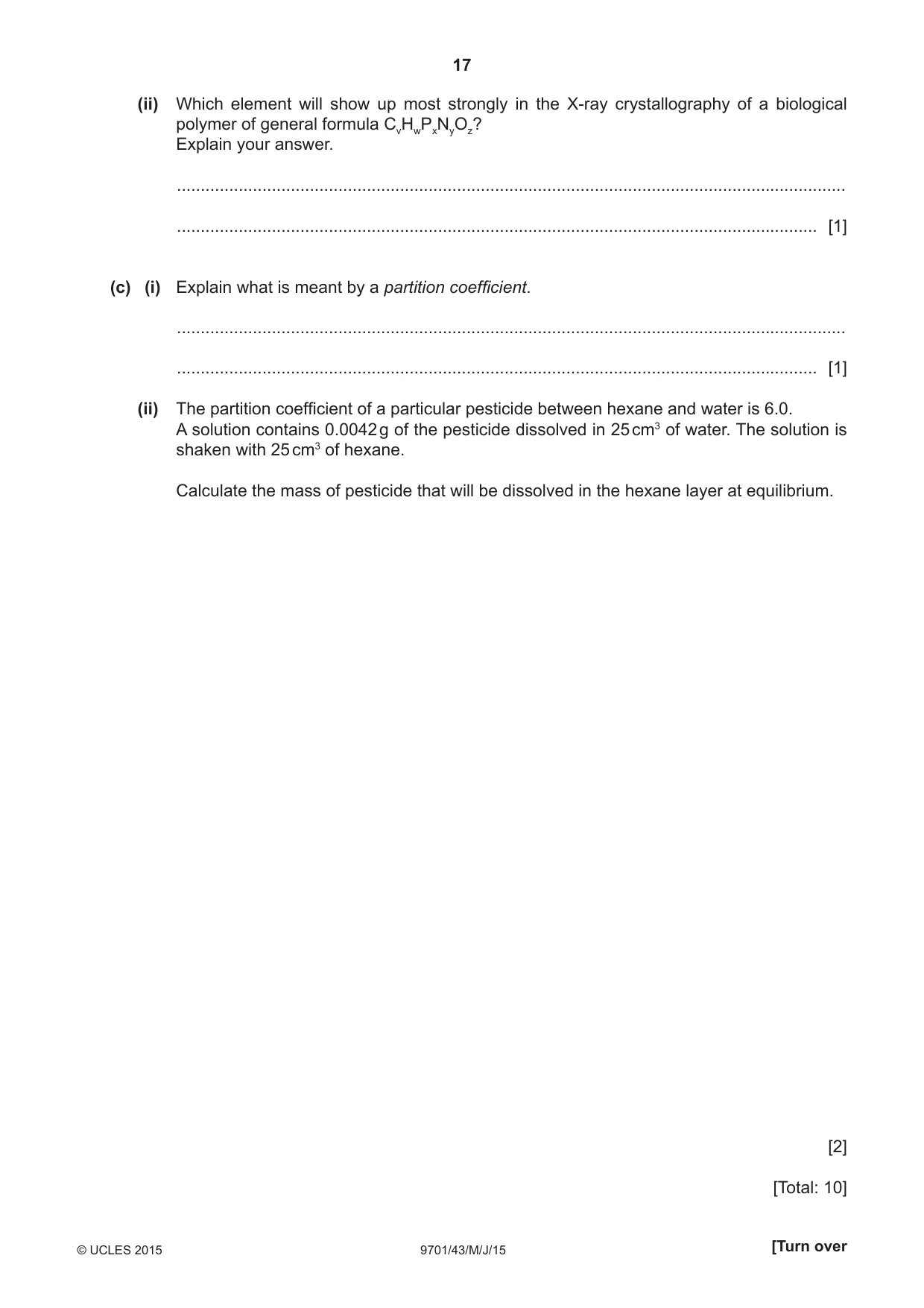
17 9701/43/M/J/15 © UCLES 2015 [Turn over (ii) Which element will show up most strongly in the X-ray crystallography of a biological polymer of general formula CvHwPxNyOz? Explain your answer. … … [1] (c) (i) Explain what is meant by a partition coeffi cient. … … [1] (ii) The partition coeffi cient of a particular pesticide between hexane and water is 6.0. A solution contains 0.0042 g of the pesticide dissolved in 25 cm3 of water. The solution is shaken with 25 cm3 of hexane. Calculate the mass of pesticide that will be dissolved in the hexane layer at equilibrium. [2] [Total: 10]
Question paper, page 18
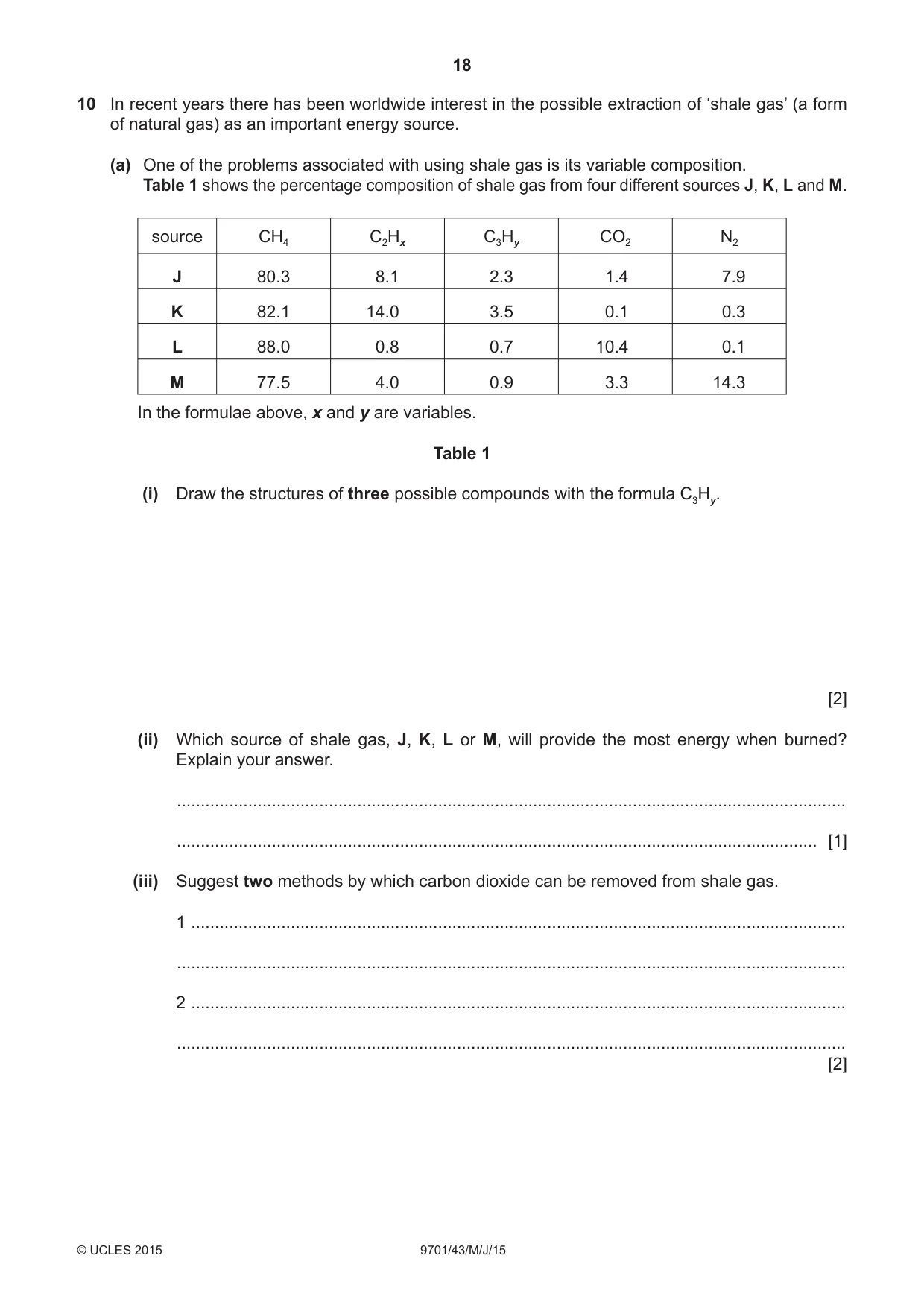
18 9701/43/M/J/15 © UCLES 2015 10 In recent years there has been worldwide interest in the possible extraction of ‘shale gas’ (a form of natural gas) as an important energy source. (a) One of the problems associated with using shale gas is its variable composition. Table 1 shows the percentage composition of shale gas from four different sources J, K, L and M. source CH4 C2Hx C3Hy CO2 N2 J 80.3 8.1 2.3 1.4 7.9 K 82.1 14.0 3.5 0.1 0.3 L 88.0 0.8 0.7 10.4 0.1 M 77.5 4.0 0.9 3.3 14.3 In the formulae above, x and y are variables. Table 1 (i) Draw the structures of three possible compounds with the formula C3Hy. [2] (ii) Which source of shale gas, J, K, L or M, will provide the most energy when burned? Explain your answer. … … [1] (iii) Suggest two methods by which carbon dioxide can be removed from shale gas. 1 … … 2 … … [2]
Question paper, page 19
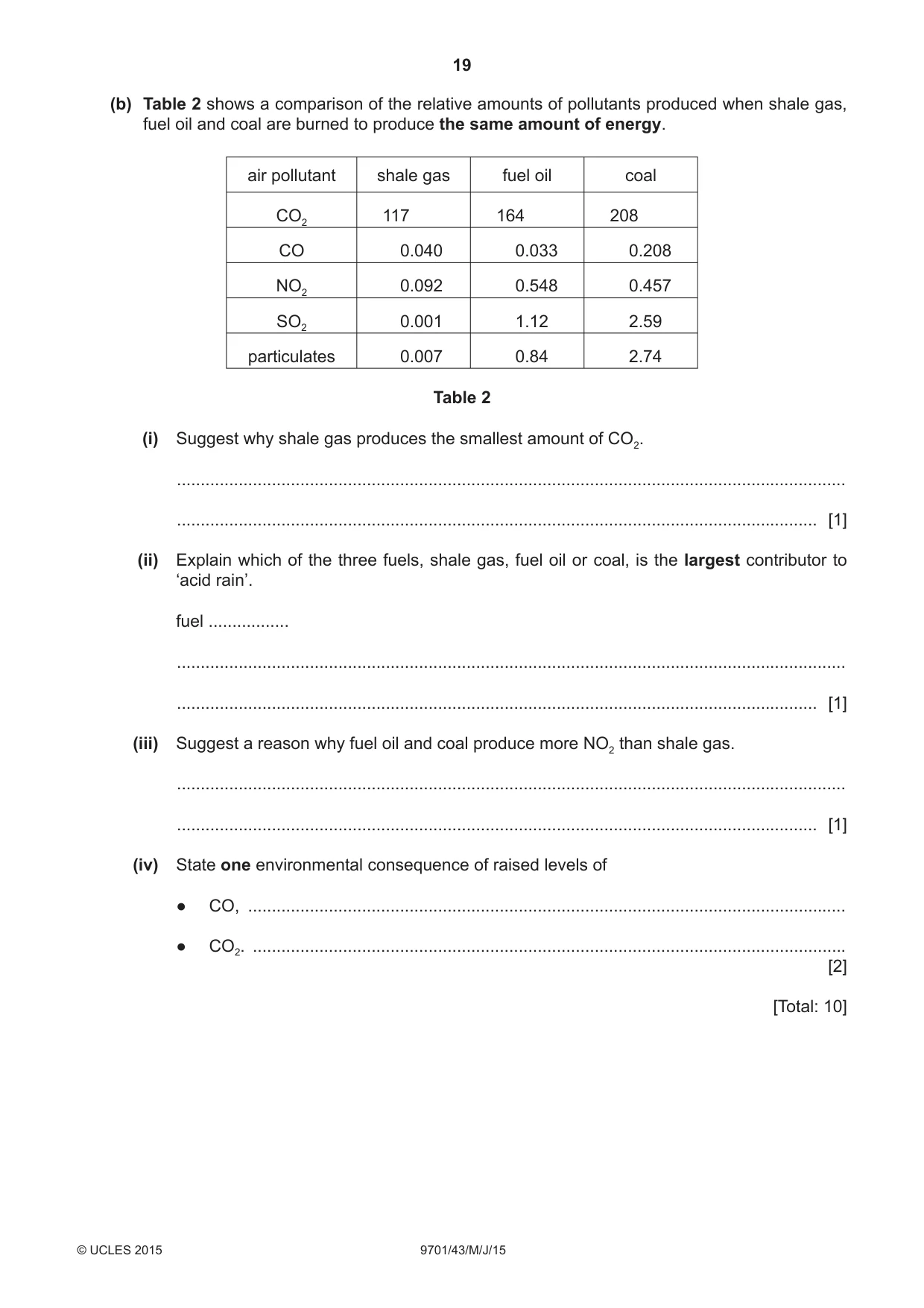
19 9701/43/M/J/15 © UCLES 2015 [Turn over (b) Table 2 shows a comparison of the relative amounts of pollutants produced when shale gas, fuel oil and coal are burned to produce the same amount of energy. air pollutant shale gas fuel oil coal CO2 117 164 208 CO 0.040 0.033 0.208 NO2 0.092 0.548 0.457 SO2 0.001 1.12 2.59 particulates 0.007 0.84 2.74 Table 2 (i) Suggest why shale gas produces the smallest amount of CO2. … … [1] (ii) Explain which of the three fuels, shale gas, fuel oil or coal, is the largest contributor to ‘acid rain’. fuel … … … [1] (iii) Suggest a reason why fuel oil and coal produce more NO2 than shale gas. … … [1] (iv) State one environmental consequence of raised levels of ● CO, … ● CO2. … [2] [Total: 10]
Question paper, page 20
20 9701/43/M/J/15 © UCLES 2015 BLANK PAGE Permission to reproduce items where third-party owned material protected by copyright is included has been sought and cleared where possible. Every reasonable effort has been made by the publisher (UCLES) to trace copyright holders, but if any items requiring clearance have unwittingly been included, the publisher will be pleased to make amends at the earliest possible opportunity. To avoid the issue of disclosure of answer-related information to candidates, all copyright acknowledgements are reproduced online in the Cambridge International Examinations Copyright Acknowledgements Booklet. This is produced for each series of examinations and is freely available to download at www.cie.org.uk after the live examination series. Cambridge International Examinations is part of the Cambridge Assessment Group. Cambridge Assessment is the brand name of University of Cambridge Local Examinations Syndicate (UCLES), which is itself a department of the University of Cambridge.
Mark scheme, page 1
® IGCSE is the registered trademark of Cambridge International Examinations. CAMBRIDGE INTERNATIONAL EXAMINATIONS Cambridge International Advanced Level MARK SCHEME for the May/June 2015 series 9701 CHEMISTRY 9701/43 Paper 4 (Structured Questions), maximum raw mark 100 This mark scheme is published as an aid to teachers and candidates, to indicate the requirements of the examination. It shows the basis on which Examiners were instructed to award marks. It does not indicate the details of the discussions that took place at an Examiners’ meeting before marking began, which would have considered the acceptability of alternative answers. Mark schemes should be read in conjunction with the question paper and the Principal Examiner Report for Teachers. Cambridge will not enter into discussions about these mark schemes. Cambridge is publishing the mark schemes for the May/June 2015 series for most Cambridge IGCSE®, Cambridge International A and AS Level components and some Cambridge O Level components.
Mark scheme, page 2
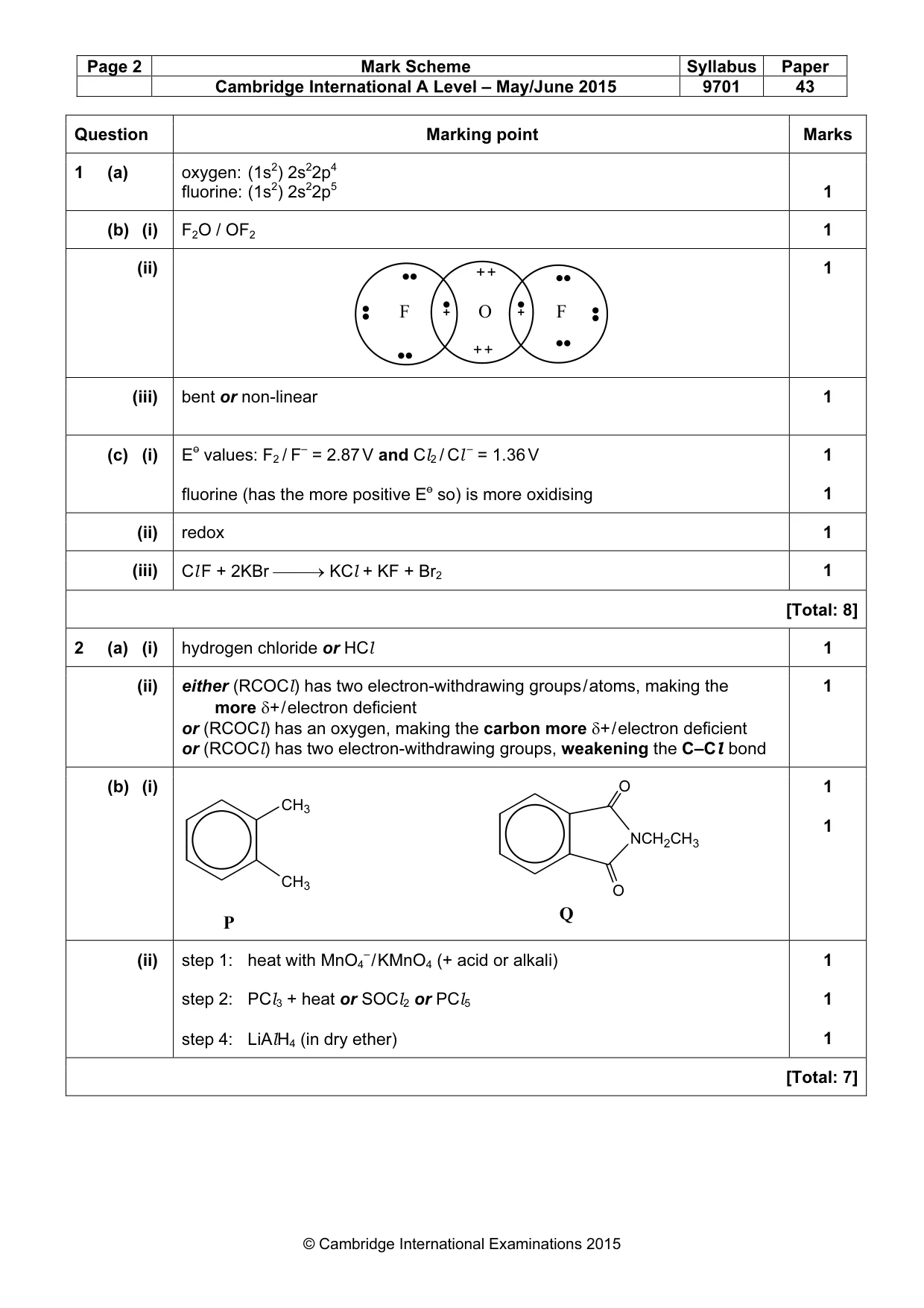
Page 2 Mark Scheme Syllabus Paper Cambridge International A Level – May/June 2015 9701 43 © Cambridge International Examinations 2015 Question Marking point Marks 1 (a) oxygen: (1s2) 2s22p4 fluorine: (1s2) 2s22p5 1 (b) (i) F2O / OF2 1 (ii) F O F 1 (iii) bent or non-linear 1 (c) (i) Eo values: F2 / F– = 2.87 V and Cl2 / Cl – = 1.36 V fluorine (has the more positive Eo so) is more oxidising 1 1 (ii) redox 1 (iii) Cl F + 2KBr → KCl + KF + Br2 1 [Total: 8] 2 (a) (i) hydrogen chloride or HCl 1 (ii) either (RCOCl) has two electron-withdrawing groups / atoms, making the more δ+ / electron deficient or (RCOCl) has an oxygen, making the carbon more δ+ / electron deficient or (RCOCl) has two electron-withdrawing groups, weakening the C–Cl bond 1 (b) (i) CH3 CH3 P Q NCH2CH3 O O 1 1 (ii) step 1: heat with MnO4 – / KMnO4 (+ acid or alkali) step 2: PCl3 + heat or SOCl2 or PCl5 step 4: LiAlH4 (in dry ether) 1 1 1 [Total: 7]
Mark scheme, page 3
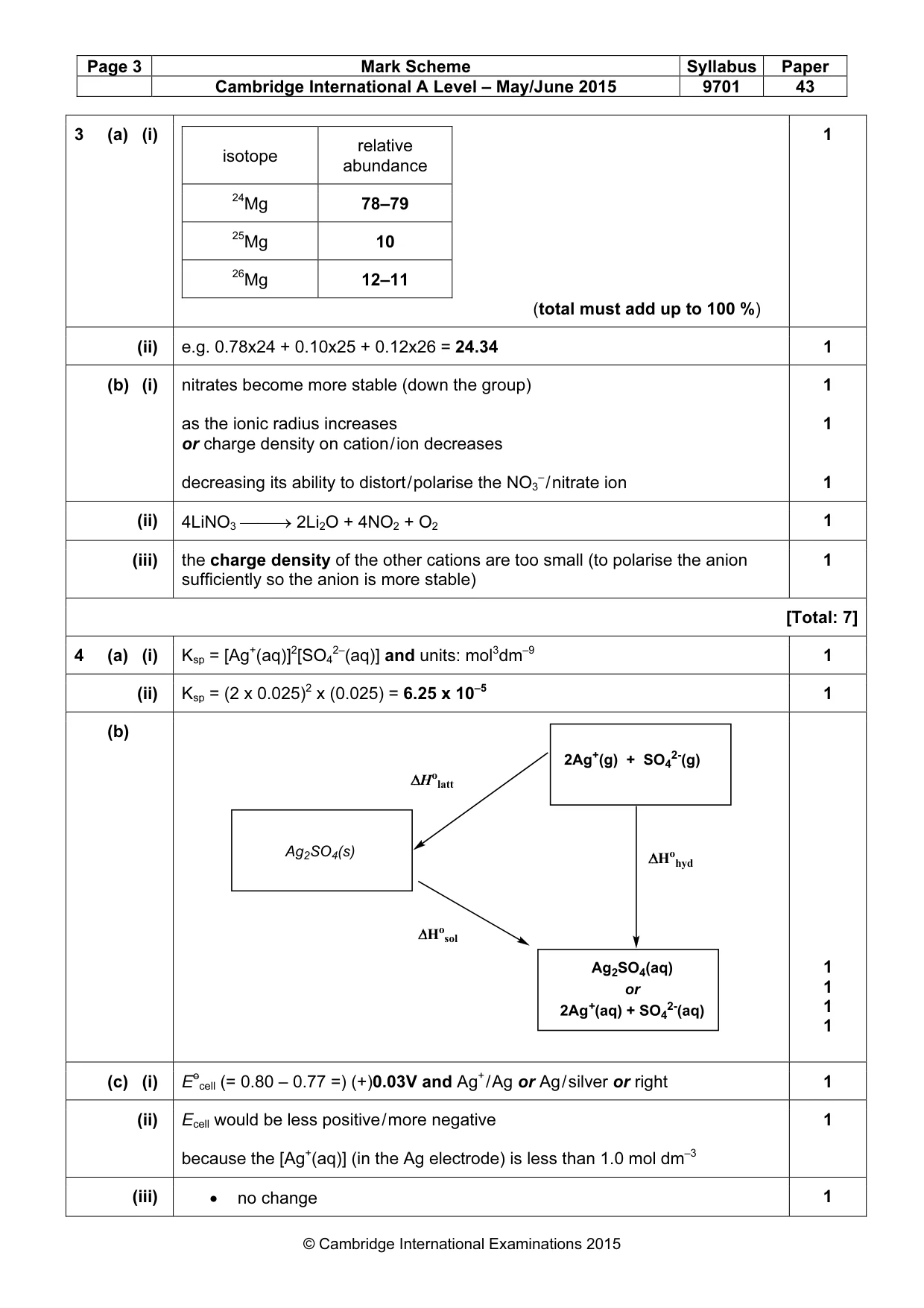
Page 3 Mark Scheme Syllabus Paper Cambridge International A Level – May/June 2015 9701 43 © Cambridge International Examinations 2015 3 (a) (i) isotope relative abundance 24Mg 78–79 25Mg 10 26Mg 12–11 (total must add up to 100 %) 1 (ii) e.g. 0.78x24 + 0.10x25 + 0.12x26 = 24.34 1 (b) (i) nitrates become more stable (down the group) as the ionic radius increases or charge density on cation / ion decreases decreasing its ability to distort / polarise the NO3 – / nitrate ion 1 1 1 (ii) 4LiNO3 → 2Li2O + 4NO2 + O2 1 (iii) the charge density of the other cations are too small (to polarise the anion sufficiently so the anion is more stable) 1 [Total: 7] 4 (a) (i) Ksp = [Ag+(aq)]2[SO4 2–(aq)] and units: mol3dm–9 1 (ii) Ksp = (2 x 0.025)2 x (0.025) = 6.25 x 10⁻⁵ 1 (b) Ag2SO4(s) 2 4 or + 4 2- + 4 2- Ho latt o sol o hyd 1 1 1 1 (c) (i) Eo cell (= 0.80 – 0.77 =) (+)0.03V and Ag+ / Ag or Ag / silver or right 1 (ii) Ecell would be less positive / more negative because the [Ag+(aq)] (in the Ag electrode) is less than 1.0 mol dm–3 1 (iii) • no change 1
Mark scheme, page 4
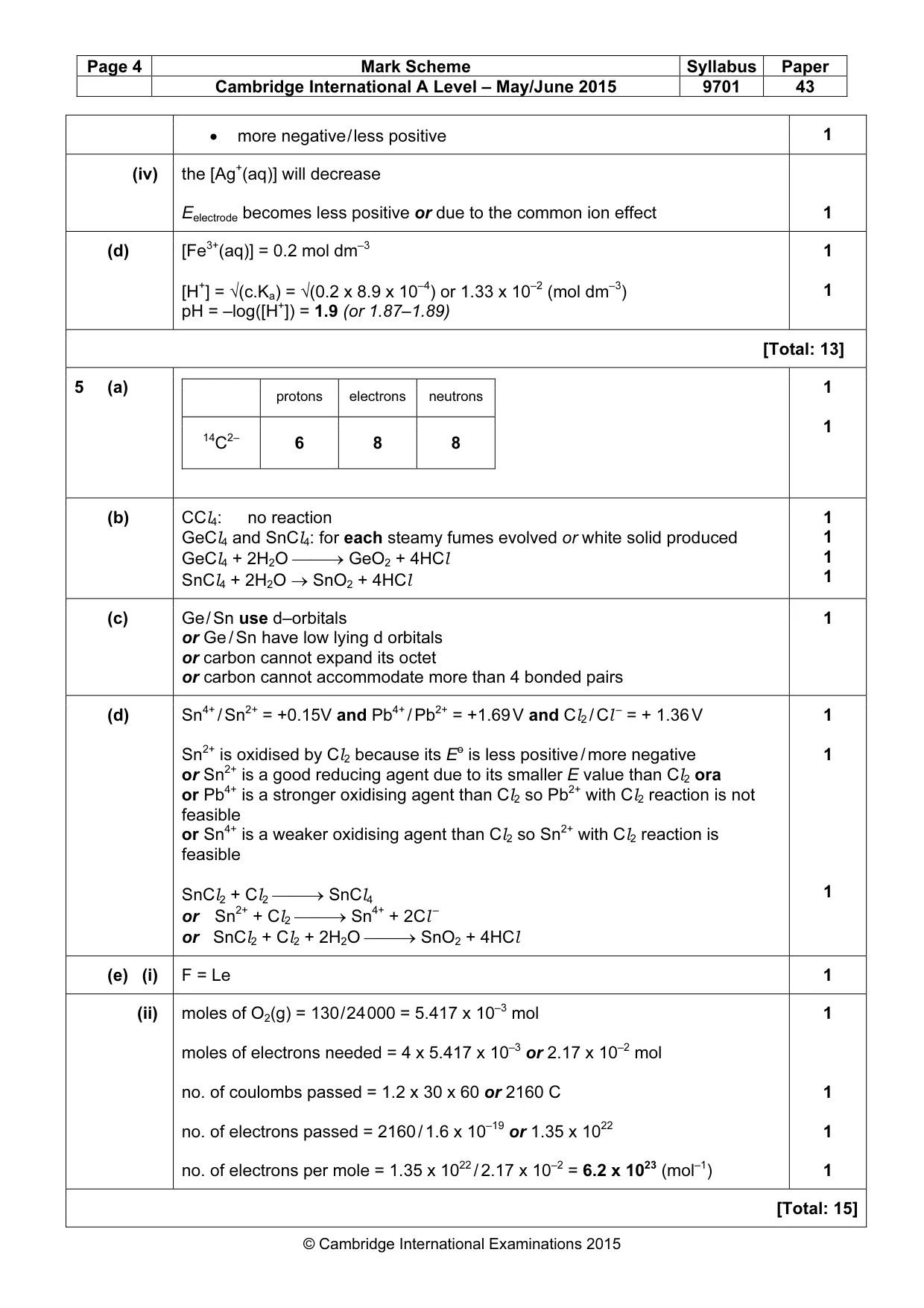
Page 4 Mark Scheme Syllabus Paper Cambridge International A Level – May/June 2015 9701 43 © Cambridge International Examinations 2015 • more negative / less positive 1 (iv) the [Ag+(aq)] will decrease Eelectrode becomes less positive or due to the common ion effect 1 (d) [Fe3+(aq)] = 0.2 mol dm–3 [H+] = √(c.Ka) = √(0.2 x 8.9 x 10–4) or 1.33 x 10⁻² (mol dm–3) pH = –log([H+]) = 1.9 (or 1.87–1.89) 1 1 [Total: 13] 5 (a) protons electrons neutrons 14C2– 6 8 8 1 1 (b) CCl4: no reaction GeCl4 and SnCl4: for each steamy fumes evolved or white solid produced GeCl4 + 2H2O → GeO2 + 4HCl SnCl4 + 2H2O → SnO2 + 4HCl 1 1 1 1 (c) Ge / Sn use d–orbitals or Ge / Sn have low lying d orbitals or carbon cannot expand its octet or carbon cannot accommodate more than 4 bonded pairs 1 (d) Sn4+ / Sn2+ = +0.15V and Pb4+ / Pb2+ = +1.69 V and Cl2 / Cl – = + 1.36 V Sn2+ is oxidised by Cl2 because its Eo is less positive / more negative or Sn2+ is a good reducing agent due to its smaller E value than Cl2 ora or Pb4+ is a stronger oxidising agent than Cl2 so Pb2+ with Cl2 reaction is not feasible or Sn4+ is a weaker oxidising agent than Cl2 so Sn2+ with Cl2 reaction is feasible SnCl2 + Cl2 → SnCl4 or Sn2+ + Cl2 → Sn4+ + 2Cl – or SnCl2 + Cl2 + 2H2O → SnO2 + 4HCl 1 1 1 (e) (i) F = Le 1 (ii) moles of O2(g) = 130 / 24 000 = 5.417 x 10⁻³ mol moles of electrons needed = 4 x 5.417 x 10–3 or 2.17 x 10⁻² mol no. of coulombs passed = 1.2 x 30 x 60 or 2160 C no. of electrons passed = 2160 / 1.6 x 10⁻¹⁹ or 1.35 x 10²² no. of electrons per mole = 1.35 x 10²² / 2.17 x 10–2 = 6.2 x 10²³ (mol–1) 1 1 1 1 [Total: 15]
Mark scheme, page 5
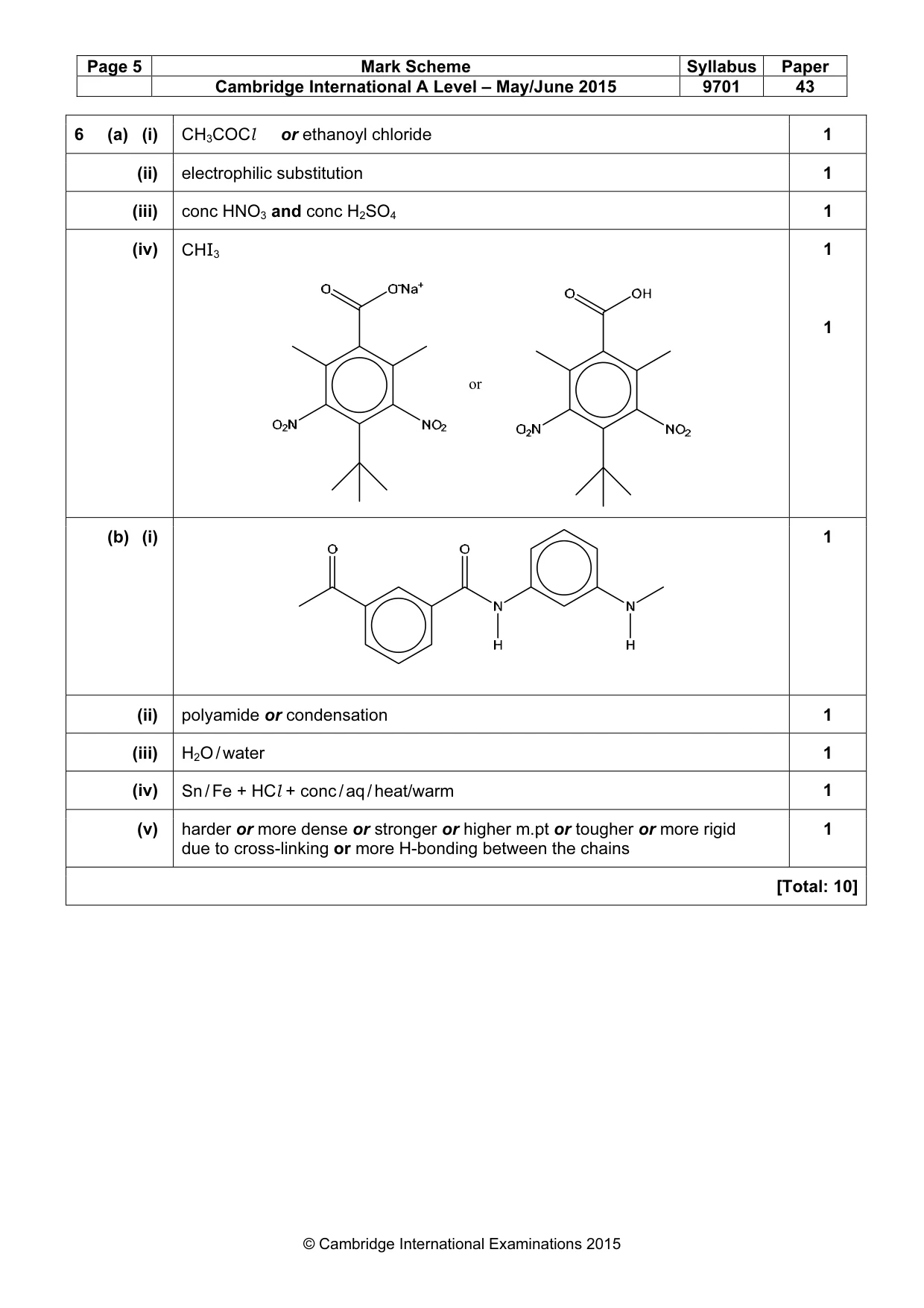
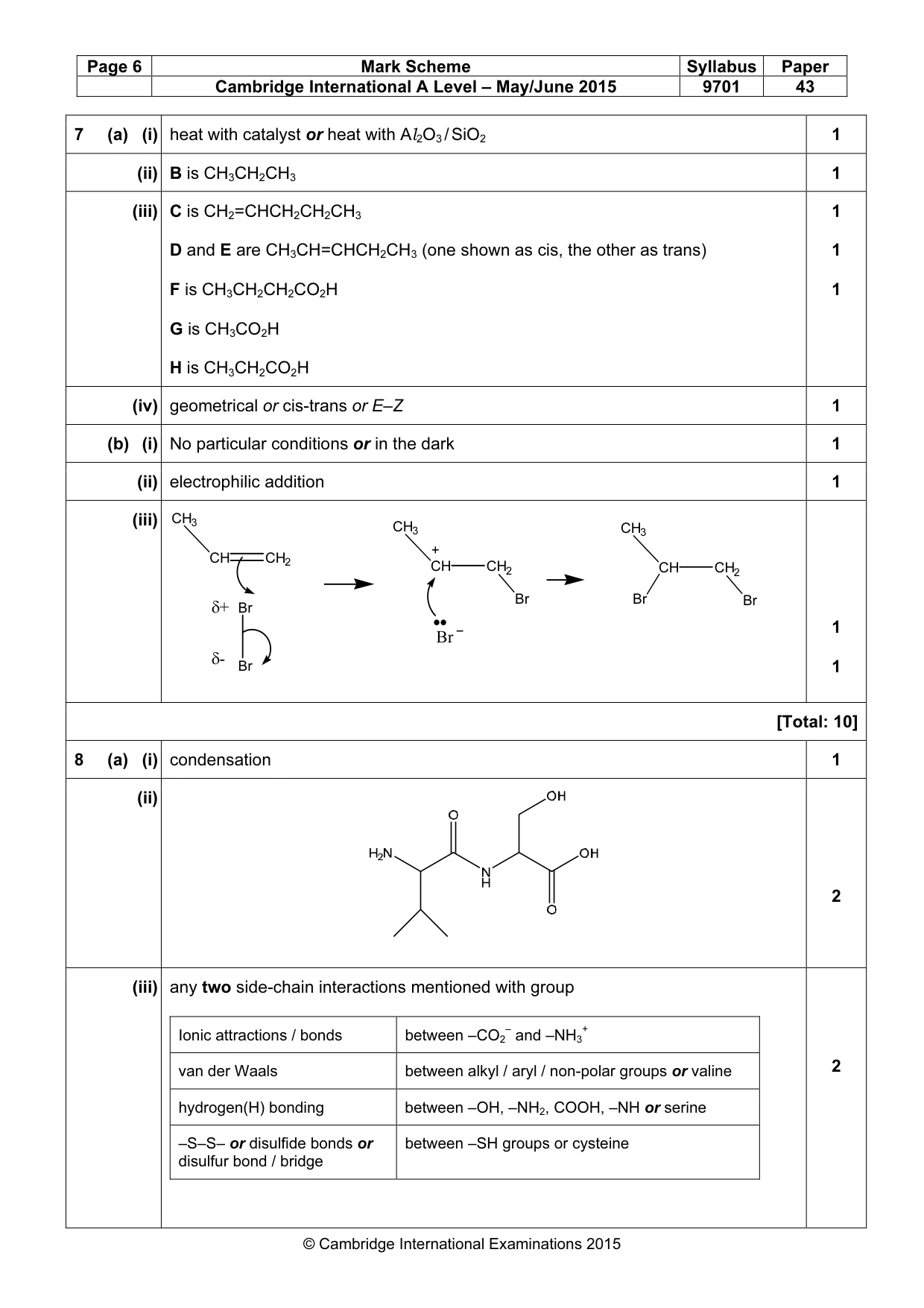
Page 5 Mark Scheme Syllabus Paper Cambridge International A Level – May/June 2015 9701 43 © Cambridge International Examinations 2015 6 (a) (i) CH3COCl or ethanoyl chloride 1 (ii) electrophilic substitution 1 (iii) conc HNO3 and conc H2SO4 1 (iv) CHI3 1 1 (b) (i) 1 (ii) polyamide or condensation 1 (iii) H2O / water 1 (iv) Sn / Fe + HCl + conc / aq / heat/warm 1 (v) harder or more dense or stronger or higher m.pt or tougher or more rigid due to cross-linking or more H-bonding between the chains 1 [Total: 10]
Mark scheme, page 6
Page 6 Mark Scheme Syllabus Paper Cambridge International A Level – May/June 2015 9701 43 © Cambridge International Examinations 2015 7 (a) (i) heat with catalyst or heat with Al2O3 / SiO2 1 (ii) B is CH3CH2CH3 1 (iii) C is CH2=CHCH2CH2CH3 D and E are CH3CH=CHCH2CH3 (one shown as cis, the other as trans) F is CH3CH2CH2CO2H G is CH3CO2H H is CH3CH2CO2H 1 1 1 (iv) geometrical or cis-trans or E–Z 1 (b) (i) No particular conditions or in the dark 1 (ii) electrophilic addition 1 (iii) CH3 CH CH2 Br Br δ+ δ- CH3 CH CH2 Br Br CH3 CH CH2 Br Br 1 1 [Total: 10] 8 (a) (i) condensation 1 (ii) 2 (iii) any two side-chain interactions mentioned with group Ionic attractions / bonds between –CO2 – and –NH3 + van der Waals between alkyl / aryl / non-polar groups or valine hydrogen(H) bonding between –OH, –NH2, COOH, –NH or serine –S–S– or disulfide bonds or disulfur bond / bridge between –SH groups or cysteine 2
Mark scheme, page 7
Page 7 Mark Scheme Syllabus Paper Cambridge International A Level – May/June 2015 9701 43 © Cambridge International Examinations 2015 (b) (i) labelled diagrams or in words • the enzyme has a specific shape or substrate shape is complementary to active site • the substrate bonds / binds / fits to the active site or other substrates do not fit into active site 1 1 (ii) labelled diagrams or in words • inhibitor binds to enzyme away from the active site or inhibitor binds to allosteric site • this changes the shape (or structure) of the active site • substrate no longer fits the active site 1 1 1 [Total: 10] 9 (a) (i) use restriction enzymes or using an enzyme to break (the DNA) down into smaller fragments 1 (ii) use the polymerase chain reaction or use DNA polymerase to replicate / copy (the sample of DNA) 1 (iii) • amino acids have different charges due to their side-chain / R group / pH / CO2 – and NH3 + groups • DNA fragments have negatively-charge phosphates(or PO4) or DNA has PO4 3– groups 1 1
Mark scheme, page 8
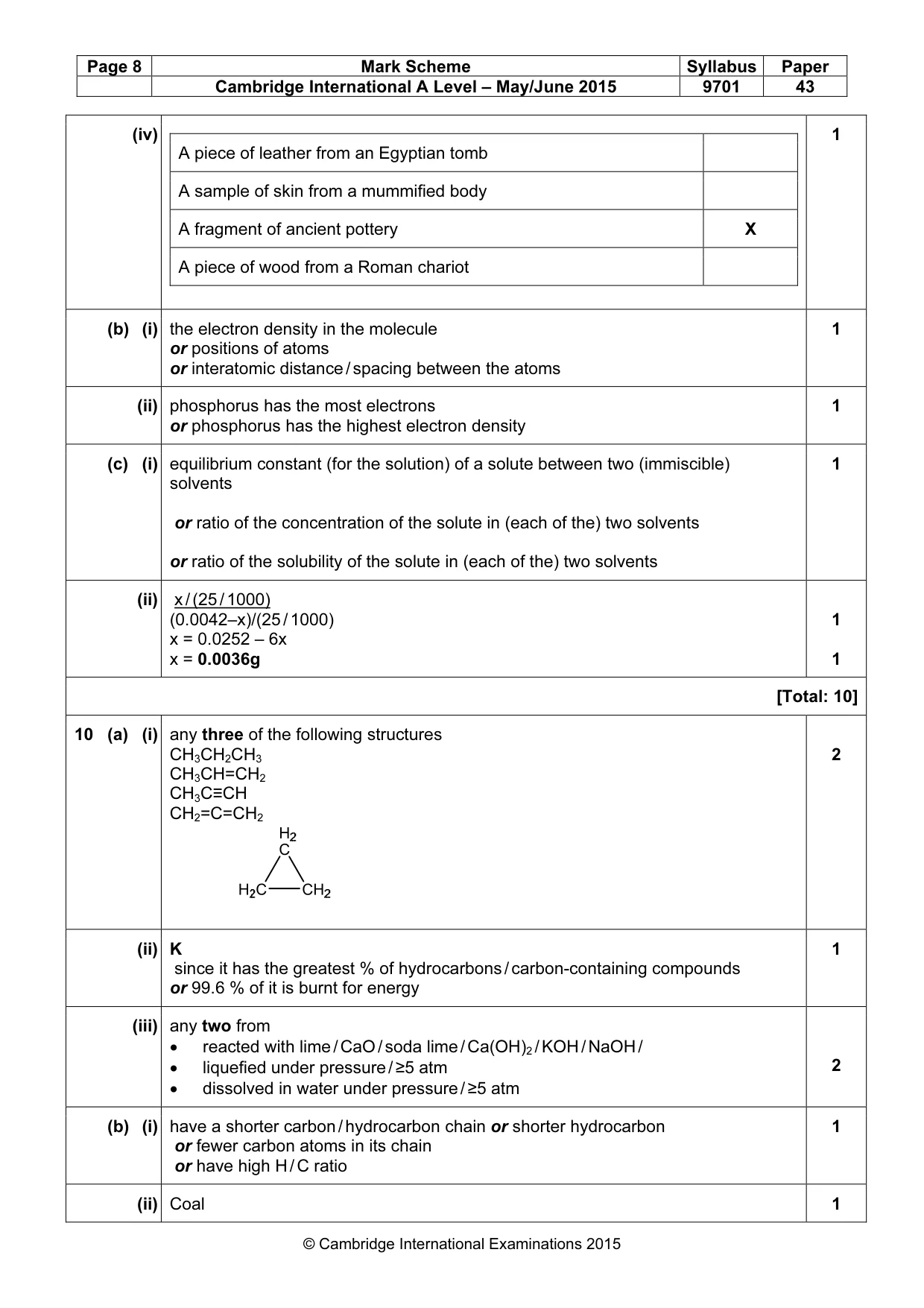
Page 8 Mark Scheme Syllabus Paper Cambridge International A Level – May/June 2015 9701 43 © Cambridge International Examinations 2015 (iv) A piece of leather from an Egyptian tomb A sample of skin from a mummified body A fragment of ancient pottery X A piece of wood from a Roman chariot 1 (b) (i) the electron density in the molecule or positions of atoms or interatomic distance / spacing between the atoms 1 (ii) phosphorus has the most electrons or phosphorus has the highest electron density 1 (c) (i) equilibrium constant (for the solution) of a solute between two (immiscible) solvents or ratio of the concentration of the solute in (each of the) two solvents or ratio of the solubility of the solute in (each of the) two solvents 1 (ii) x / (25 / 1000) (0.0042–x)/(25 / 1000) x = 0.0252 – 6x x = 0.0036g 1 1 [Total: 10] 10 (a) (i) any three of the following structures CH3CH2CH3 CH3CH=CH2 CH3C≡CH CH2=C=CH2 2 (ii) K since it has the greatest % of hydrocarbons / carbon-containing compounds or 99.6 % of it is burnt for energy 1 (iii) any two from • reacted with lime / CaO / soda lime / Ca(OH)2 / KOH / NaOH / • liquefied under pressure / ≥5 atm • dissolved in water under pressure / ≥5 atm 2 (b) (i) have a shorter carbon / hydrocarbon chain or shorter hydrocarbon or fewer carbon atoms in its chain or have high H / C ratio 1 (ii) Coal 1
Mark scheme, page 9
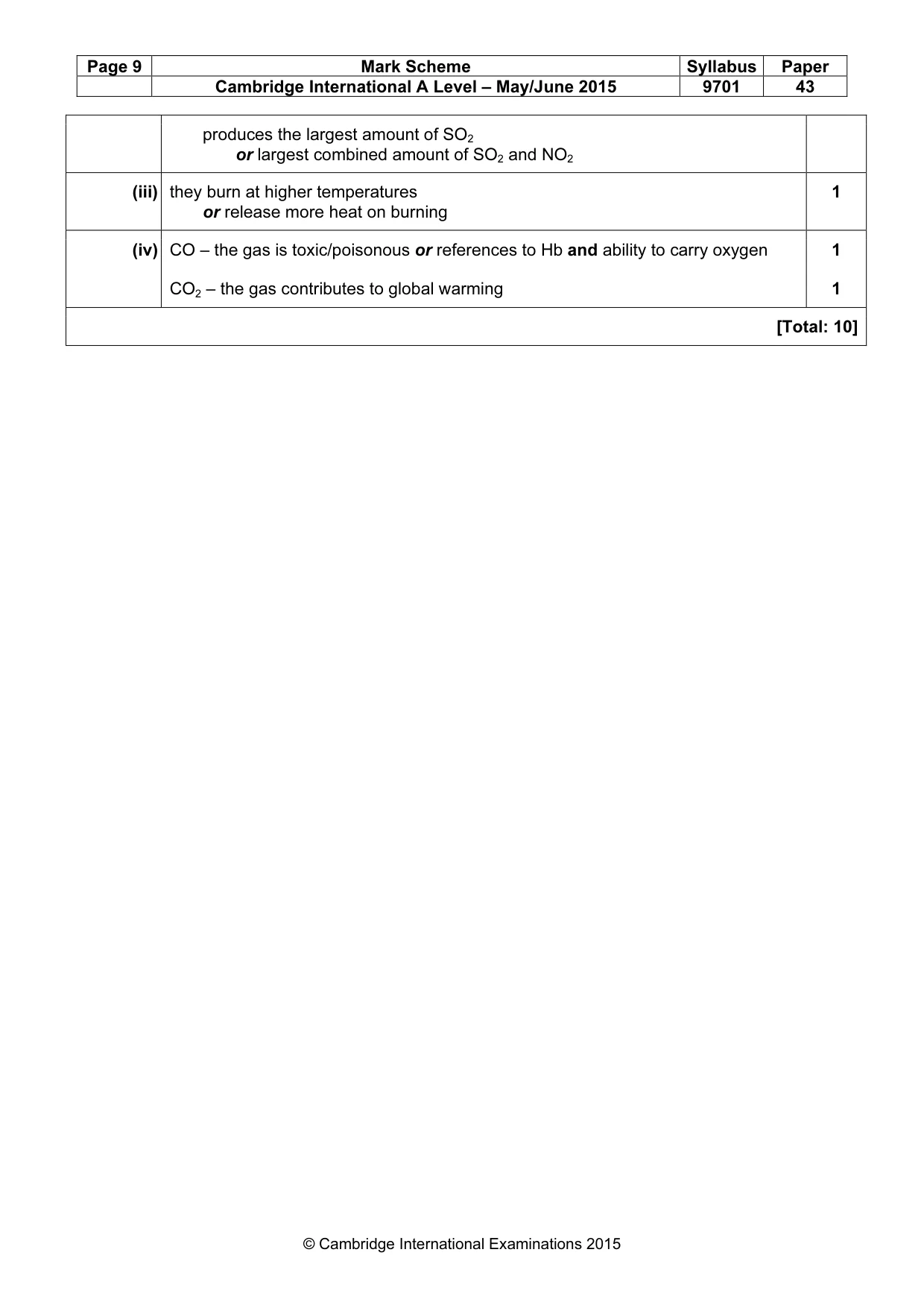
Page 9 Mark Scheme Syllabus Paper Cambridge International A Level – May/June 2015 9701 43 © Cambridge International Examinations 2015 produces the largest amount of SO2 or largest combined amount of SO2 and NO2 (iii) they burn at higher temperatures or release more heat on burning 1 (iv) CO – the gas is toxic/poisonous or references to Hb and ability to carry oxygen CO2 – the gas contributes to global warming 1 1 [Total: 10]
What you needed in this session
Cambridge’s own grade thresholds for 2015 May/June, Paper 4 · Variant 3. A higher threshold means an easier paper — the bar moves with how the cohort did.