Cambridge A Level Chemistry 9701 — 2015 May/June Paper 3 · Variant 1
9701/31/M/J/15 · 40 marks · ≈45 min
The question paper and its mark scheme, free to read here and free to download. This is Cambridge’s own paper, exactly as it was sat.
Question paper12 pages

Mark scheme5 pages
Answers below. Sit the paper first if you are practising.
Paper as text
Question paper, page 1
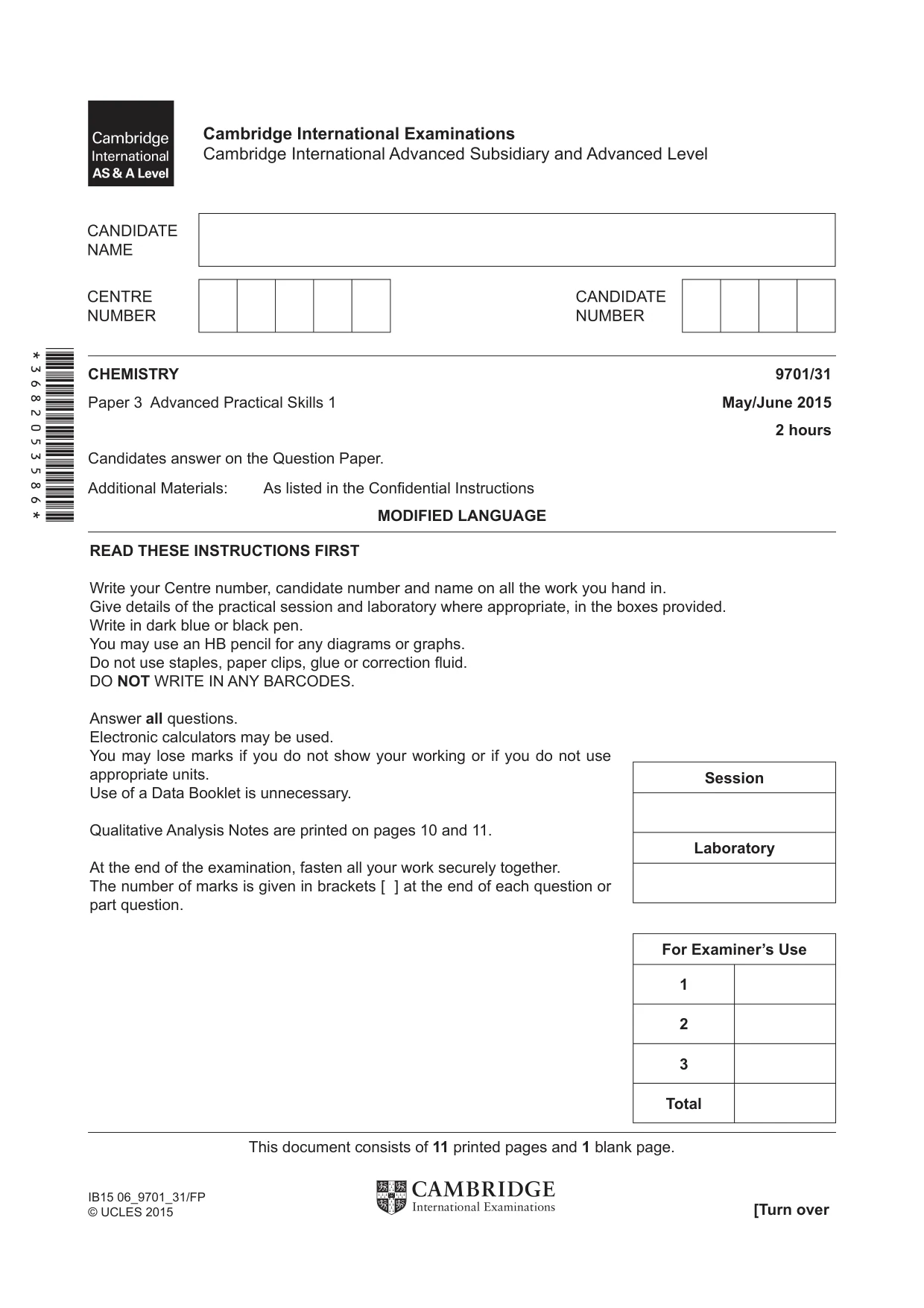
READ THESE INSTRUCTIONS FIRST Write your Centre number, candidate number and name on all the work you hand in. Give details of the practical session and laboratory where appropriate, in the boxes provided. Write in dark blue or black pen. You may use an HB pencil for any diagrams or graphs. Do not use staples, paper clips, glue or correction fl uid. DO NOT WRITE IN ANY BARCODES. Answer all questions. Electronic calculators may be used. You may lose marks if you do not show your working or if you do not use appropriate units. Use of a Data Booklet is unnecessary. Qualitative Analysis Notes are printed on pages 10 and 11. At the end of the examination, fasten all your work securely together. The number of marks is given in brackets [ ] at the end of each question or part question. CHEMISTRY 9701/31 Paper 3 Advanced Practical Skills 1 May/June 2015 2 hours Candidates answer on the Question Paper. Additional Materials: As listed in the Confi dential Instructions MODIFIED LANGUAGE Cambridge International Examinations Cambridge International Advanced Subsidiary and Advanced Level This document consists of 11 printed pages and 1 blank page. [Turn over IB15 06_9701_31/FP © UCLES 2015 *3682053586* Session Laboratory For Examiner’s Use 1 2 3 Total
Question paper, page 2
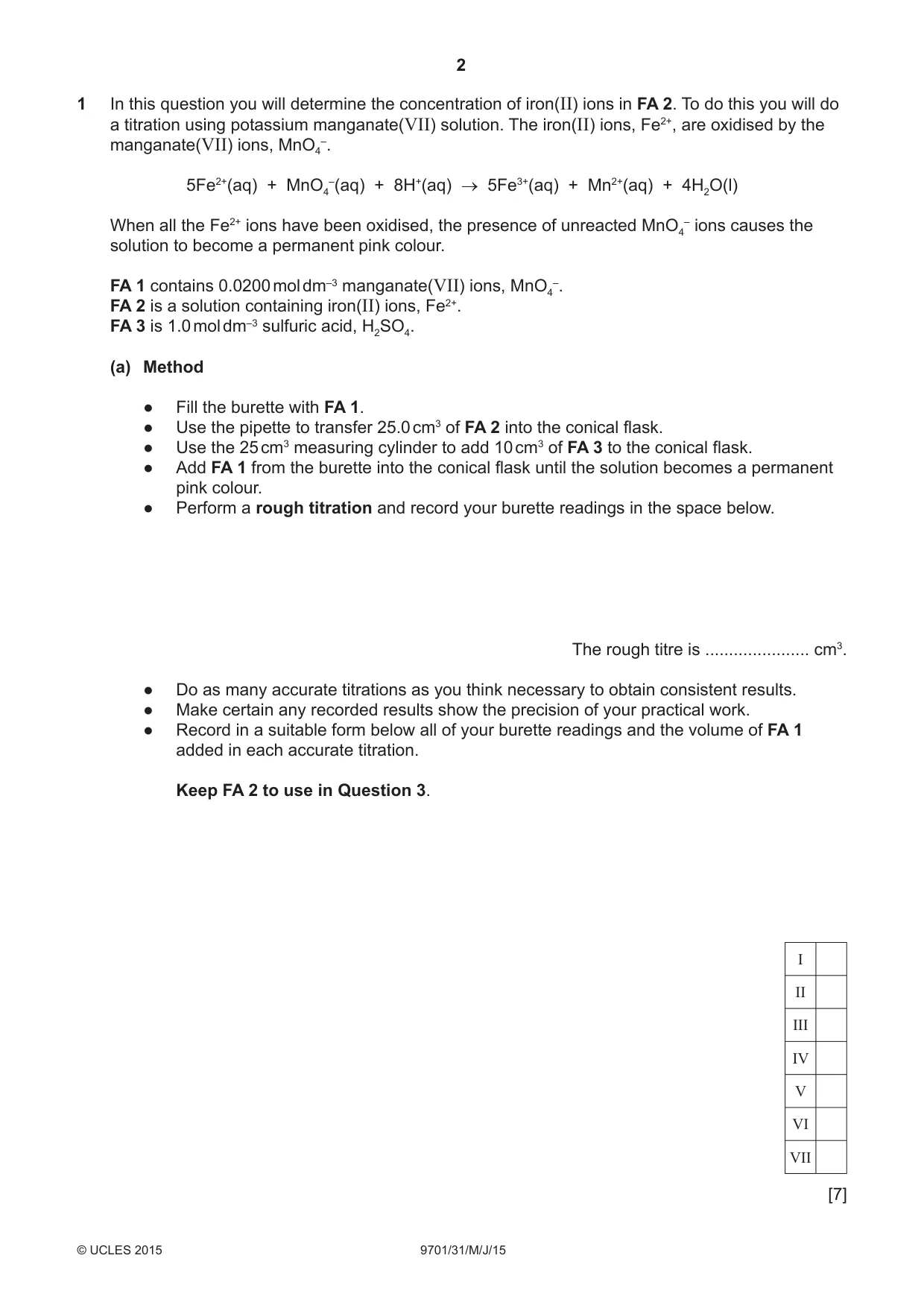
2 9701/31/M/J/15 © UCLES 2015 1 In this question you will determine the concentration of iron(II) ions in FA 2. To do this you will do a titration using potassium manganate(VII) solution. The iron(II) ions, Fe2+, are oxidised by the manganate(VII) ions, MnO4 –. 5Fe2+(aq) + MnO4 –(aq) + 8H+(aq) → 5Fe3+(aq) + Mn2+(aq) + 4H2O(l) When all the Fe2+ ions have been oxidised, the presence of unreacted MnO4 – ions causes the solution to become a permanent pink colour. FA 1 contains 0.0200 mol dm–3 manganate(VII) ions, MnO4 –. FA 2 is a solution containing iron(II) ions, Fe2+. FA 3 is 1.0 mol dm–3 sulfuric acid, H2SO4. (a) Method ● Fill the burette with FA 1. ● Use the pipette to transfer 25.0 cm3 of FA 2 into the conical flask. ● Use the 25 cm3 measuring cylinder to add 10 cm3 of FA 3 to the conical flask. ● Add FA 1 from the burette into the conical flask until the solution becomes a permanent pink colour. ● Perform a rough titration and record your burette readings in the space below. The rough titre is … cm3. ● Do as many accurate titrations as you think necessary to obtain consistent results. ● Make certain any recorded results show the precision of your practical work. ● Record in a suitable form below all of your burette readings and the volume of FA 1 added in each accurate titration. Keep FA 2 to use in Question 3. [7] I II III IV V VI VII
Question paper, page 3
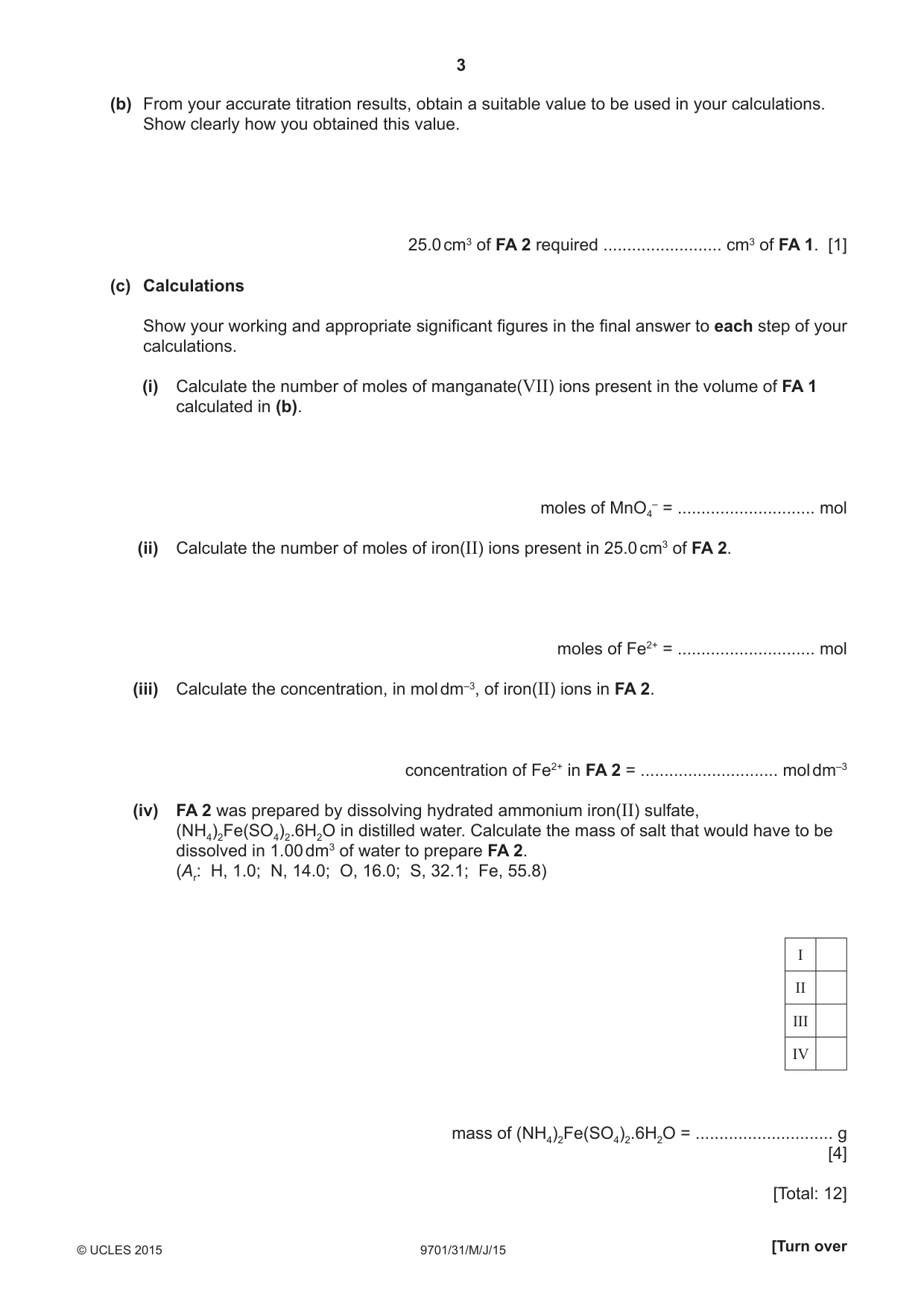
3 9701/31/M/J/15 © UCLES 2015 [Turn over I II III IV (b) From your accurate titration results, obtain a suitable value to be used in your calculations. Show clearly how you obtained this value. 25.0 cm3 of FA 2 required … cm3 of FA 1. [1] (c) Calculations Show your working and appropriate signifi cant fi gures in the fi nal answer to each step of your calculations. (i) Calculate the number of moles of manganate(VII) ions present in the volume of FA 1 calculated in (b). moles of MnO4 – = … mol (ii) Calculate the number of moles of iron(II) ions present in 25.0 cm3 of FA 2. moles of Fe2+ = … mol (iii) Calculate the concentration, in mol dm–3, of iron(II) ions in FA 2. concentration of Fe2+ in FA 2 = … mol dm–3 (iv) FA 2 was prepared by dissolving hydrated ammonium iron(II) sulfate, (NH4)2Fe(SO4)2.6H2O in distilled water. Calculate the mass of salt that would have to be dissolved in 1.00 dm3 of water to prepare FA 2. (Ar: H, 1.0; N, 14.0; O, 16.0; S, 32.1; Fe, 55.8) mass of (NH4)2Fe(SO4)2.6H2O = … g [4] [Total: 12]
Question paper, page 4
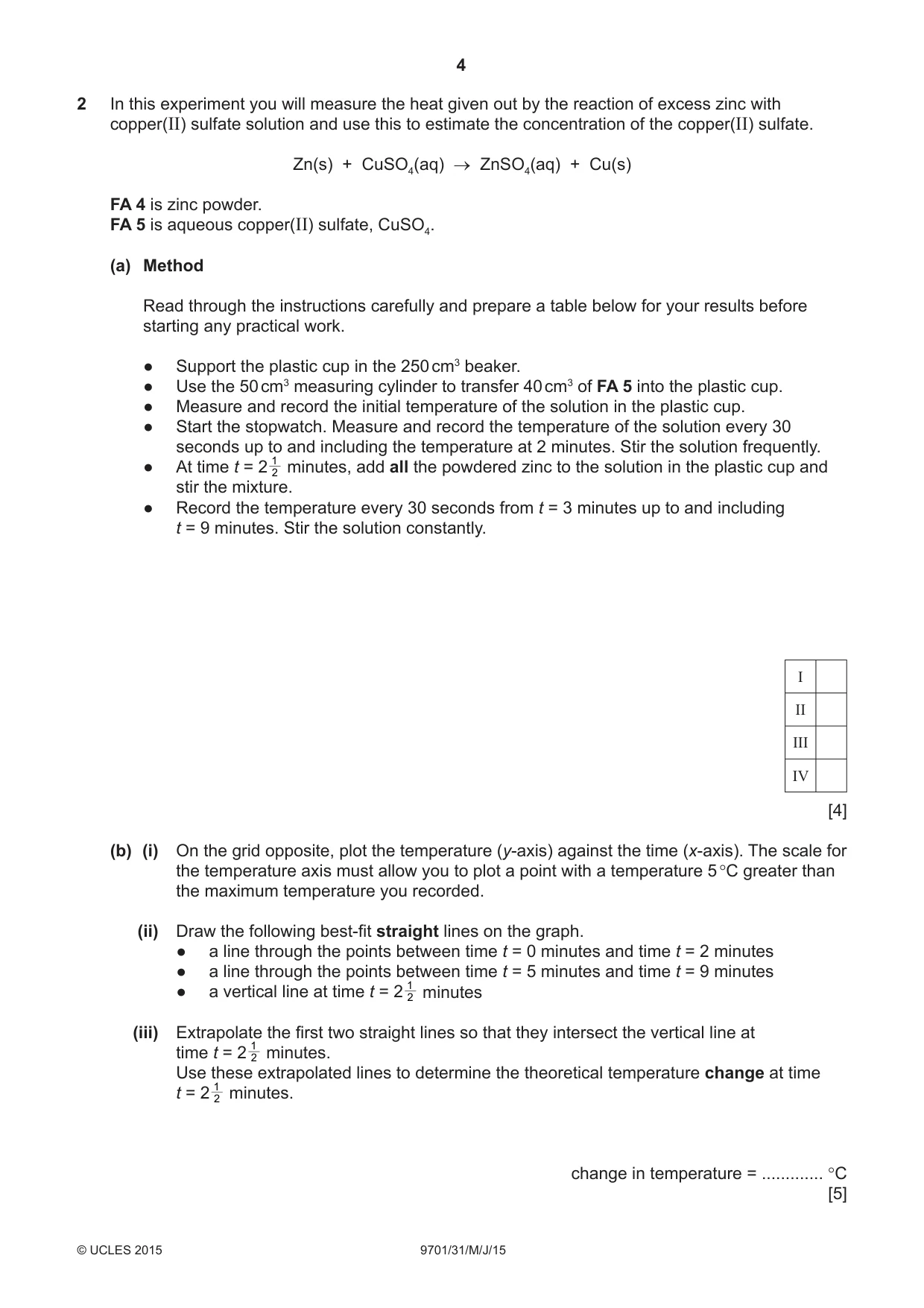
4 9701/31/M/J/15 © UCLES 2015 2 In this experiment you will measure the heat given out by the reaction of excess zinc with copper(II) sulfate solution and use this to estimate the concentration of the copper(II) sulfate. Zn(s) + CuSO4(aq) → ZnSO4(aq) + Cu(s) FA 4 is zinc powder. FA 5 is aqueous copper(II) sulfate, CuSO4. (a) Method Read through the instructions carefully and prepare a table below for your results before starting any practical work. ● Support the plastic cup in the 250 cm3 beaker. ● Use the 50 cm3 measuring cylinder to transfer 40 cm3 of FA 5 into the plastic cup. ● Measure and record the initial temperature of the solution in the plastic cup. ● Start the stopwatch. Measure and record the temperature of the solution every 30 seconds up to and including the temperature at 2 minutes. Stir the solution frequently. ● At time t = 2 2 1 minutes, add all the powdered zinc to the solution in the plastic cup and stir the mixture. ● Record the temperature every 30 seconds from t = 3 minutes up to and including t = 9 minutes. Stir the solution constantly. [4] (b) (i) On the grid opposite, plot the temperature (y-axis) against the time (x-axis). The scale for the temperature axis must allow you to plot a point with a temperature 5 °C greater than the maximum temperature you recorded. (ii) Draw the following best-fi t straight lines on the graph. ● a line through the points between time t = 0 minutes and time t = 2 minutes ● a line through the points between time t = 5 minutes and time t = 9 minutes ● a vertical line at time t = 2 2 1 minutes (iii) Extrapolate the fi rst two straight lines so that they intersect the vertical line at time t = 2 2 1 minutes. Use these extrapolated lines to determine the theoretical temperature change at time t = 2 2 1 minutes. change in temperature = … °C [5] I II III IV
Question paper, page 5
5 9701/31/M/J/15 © UCLES 2015 [Turn over
Question paper, page 6
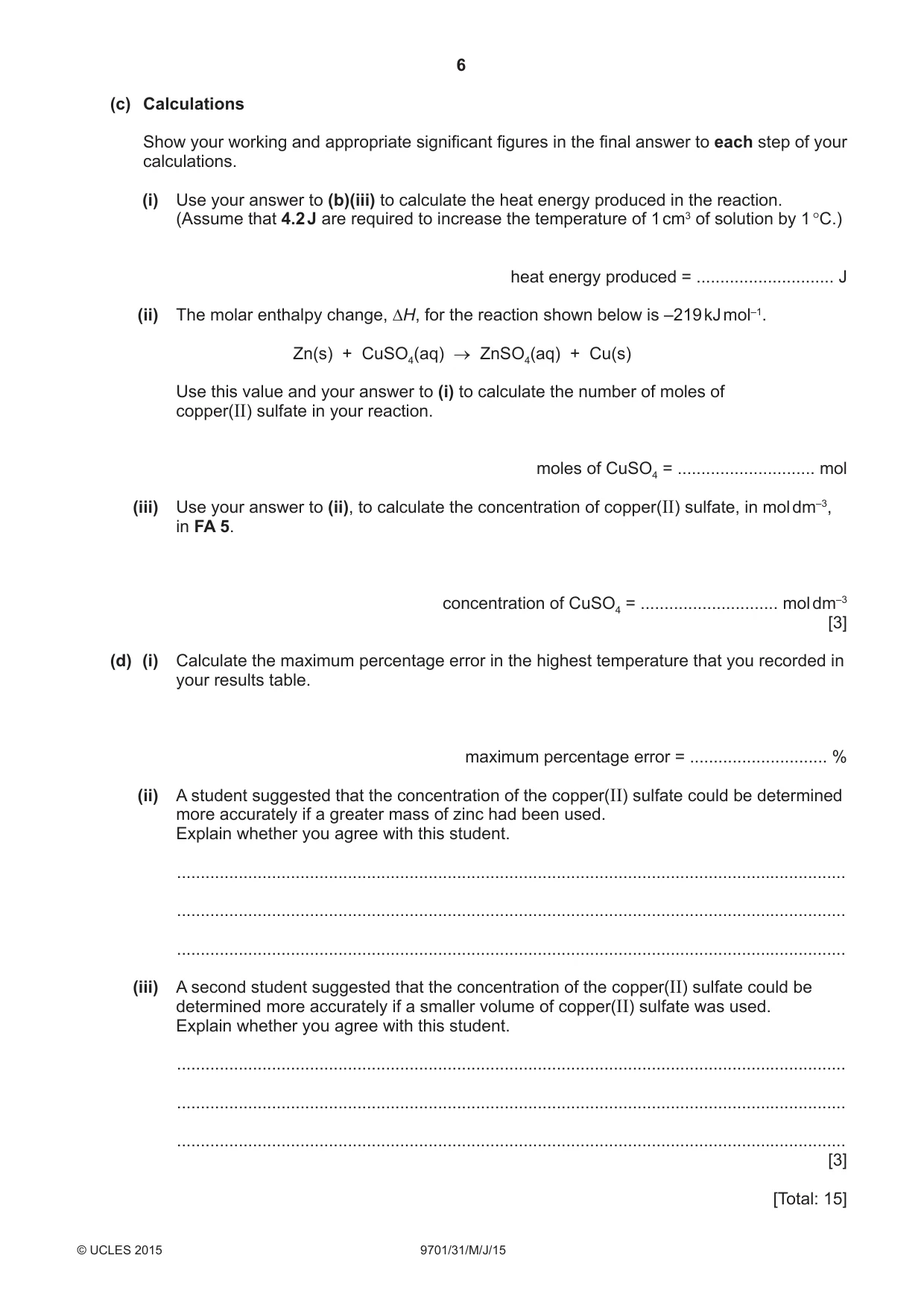
6 9701/31/M/J/15 © UCLES 2015 (c) Calculations Show your working and appropriate signifi cant fi gures in the fi nal answer to each step of your calculations. (i) Use your answer to (b)(iii) to calculate the heat energy produced in the reaction. (Assume that 4.2 J are required to increase the temperature of 1 cm3 of solution by 1 °C.) heat energy produced = … J (ii) The molar enthalpy change, ∆H, for the reaction shown below is –219 kJ mol–1. Zn(s) + CuSO4(aq) → ZnSO4(aq) + Cu(s) Use this value and your answer to (i) to calculate the number of moles of copper(II) sulfate in your reaction. moles of CuSO4 = … mol (iii) Use your answer to (ii), to calculate the concentration of copper(II) sulfate, in mol dm–3, in FA 5. concentration of CuSO4 = … mol dm–3 [3] (d) (i) Calculate the maximum percentage error in the highest temperature that you recorded in your results table. maximum percentage error = … % (ii) A student suggested that the concentration of the copper(II) sulfate could be determined more accurately if a greater mass of zinc had been used. Explain whether you agree with this student. … … … (iii) A second student suggested that the concentration of the copper(II) sulfate could be determined more accurately if a smaller volume of copper(II) sulfate was used. Explain whether you agree with this student. … … … [3] [Total: 15]
Question paper, page 7
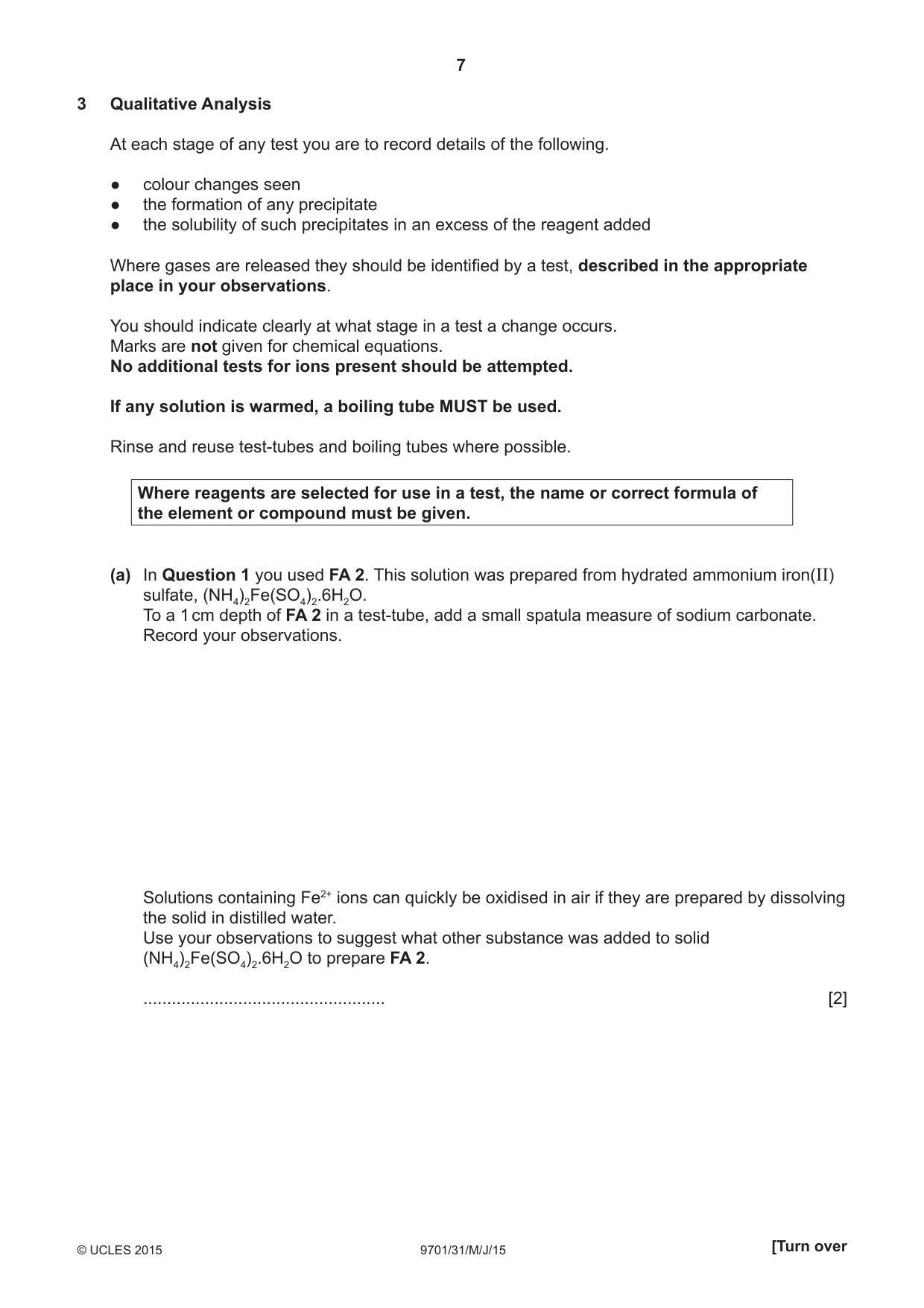
7 9701/31/M/J/15 © UCLES 2015 [Turn over 3 Qualitative Analysis At each stage of any test you are to record details of the following. ● colour changes seen ● the formation of any precipitate ● the solubility of such precipitates in an excess of the reagent added Where gases are released they should be identifi ed by a test, described in the appropriate place in your observations. You should indicate clearly at what stage in a test a change occurs. Marks are not given for chemical equations. No additional tests for ions present should be attempted. If any solution is warmed, a boiling tube MUST be used. Rinse and reuse test-tubes and boiling tubes where possible. Where reagents are selected for use in a test, the name or correct formula of the element or compound must be given. (a) In Question 1 you used FA 2. This solution was prepared from hydrated ammonium iron(II) sulfate, (NH4)2Fe(SO4)2.6H2O. To a 1 cm depth of FA 2 in a test-tube, add a small spatula measure of sodium carbonate. Record your observations. Solutions containing Fe2+ ions can quickly be oxidised in air if they are prepared by dissolving the solid in distilled water. Use your observations to suggest what other substance was added to solid (NH4)2Fe(SO4)2.6H2O to prepare FA 2. … [2]
Question paper, page 8
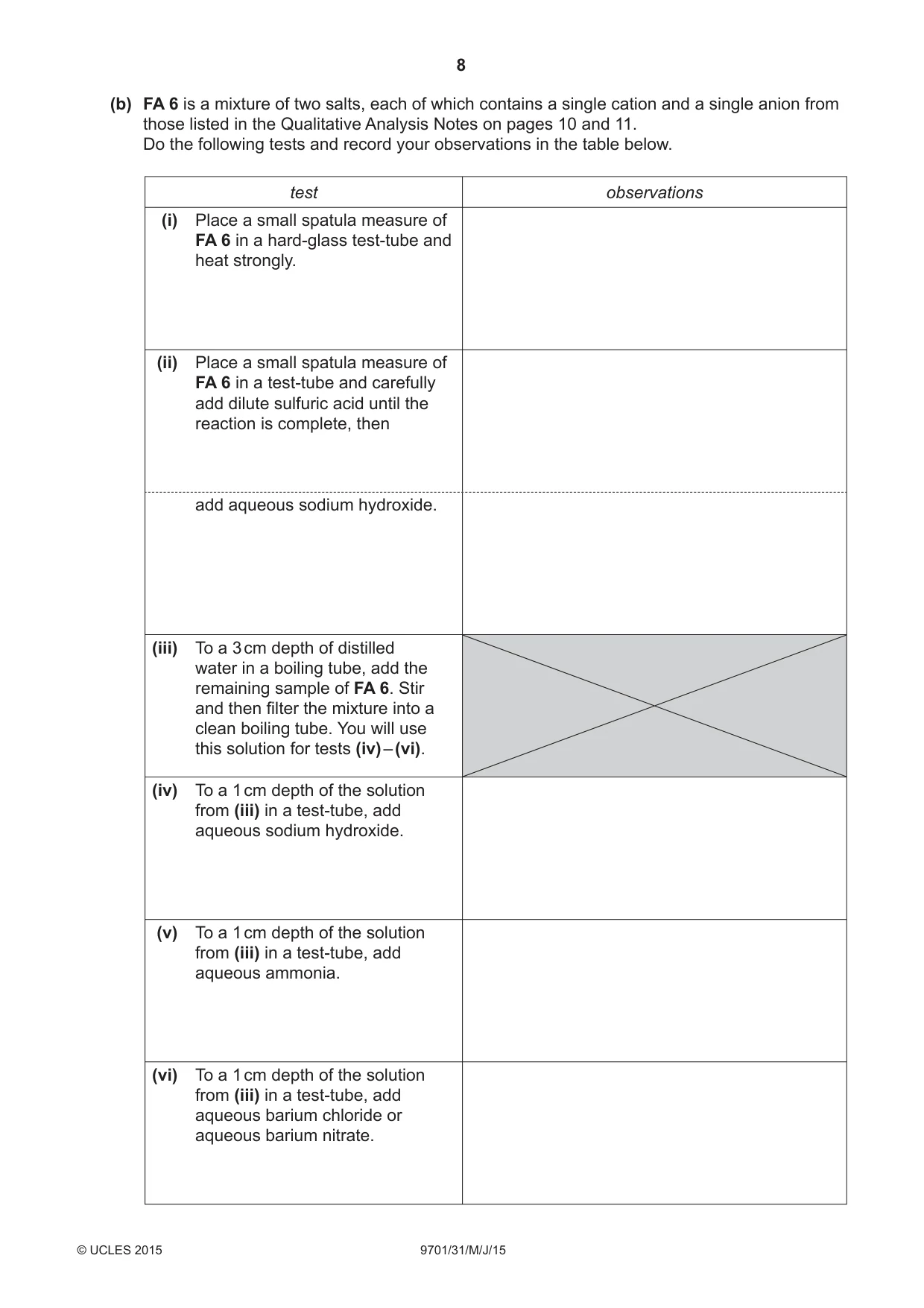
8 9701/31/M/J/15 © UCLES 2015 (b) FA 6 is a mixture of two salts, each of which contains a single cation and a single anion from those listed in the Qualitative Analysis Notes on pages 10 and 11. Do the following tests and record your observations in the table below. test observations (i) Place a small spatula measure of FA 6 in a hard-glass test-tube and heat strongly. (ii) Place a small spatula measure of FA 6 in a test-tube and carefully add dilute sulfuric acid until the reaction is complete, then add aqueous sodium hydroxide. (iii) To a 3 cm depth of distilled water in a boiling tube, add the remaining sample of FA 6. Stir and then fi lter the mixture into a clean boiling tube. You will use this solution for tests (iv) – (vi). (iv) To a 1 cm depth of the solution from (iii) in a test-tube, add aqueous sodium hydroxide. (v) To a 1 cm depth of the solution from (iii) in a test-tube, add aqueous ammonia. (vi) To a 1 cm depth of the solution from (iii) in a test-tube, add aqueous barium chloride or aqueous barium nitrate.
Question paper, page 9
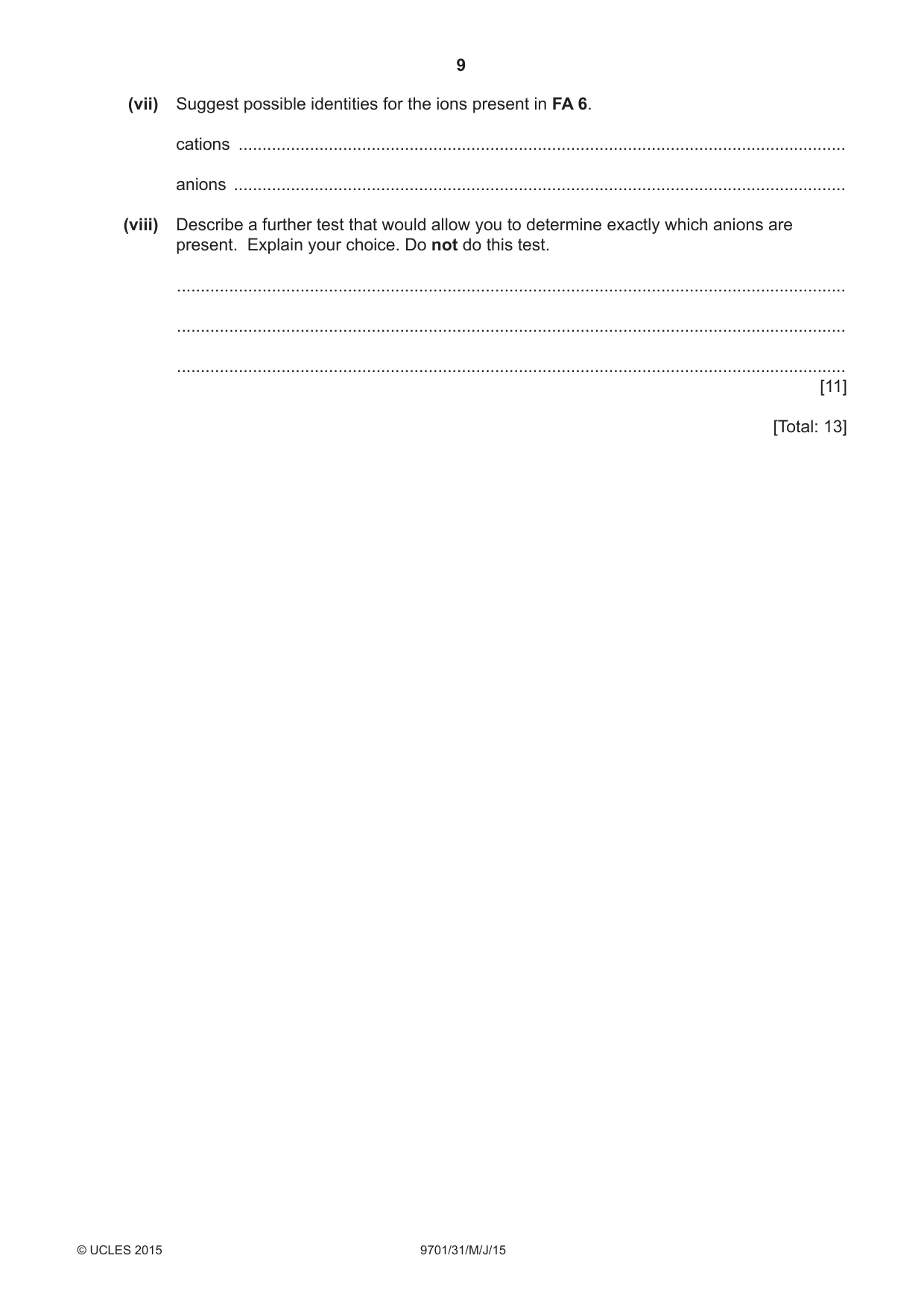
9 9701/31/M/J/15 © UCLES 2015 [Turn over (vii) Suggest possible identities for the ions present in FA 6. cations … anions … (viii) Describe a further test that would allow you to determine exactly which anions are present. Explain your choice. Do not do this test. … … … [11] [Total: 13]
Question paper, page 10
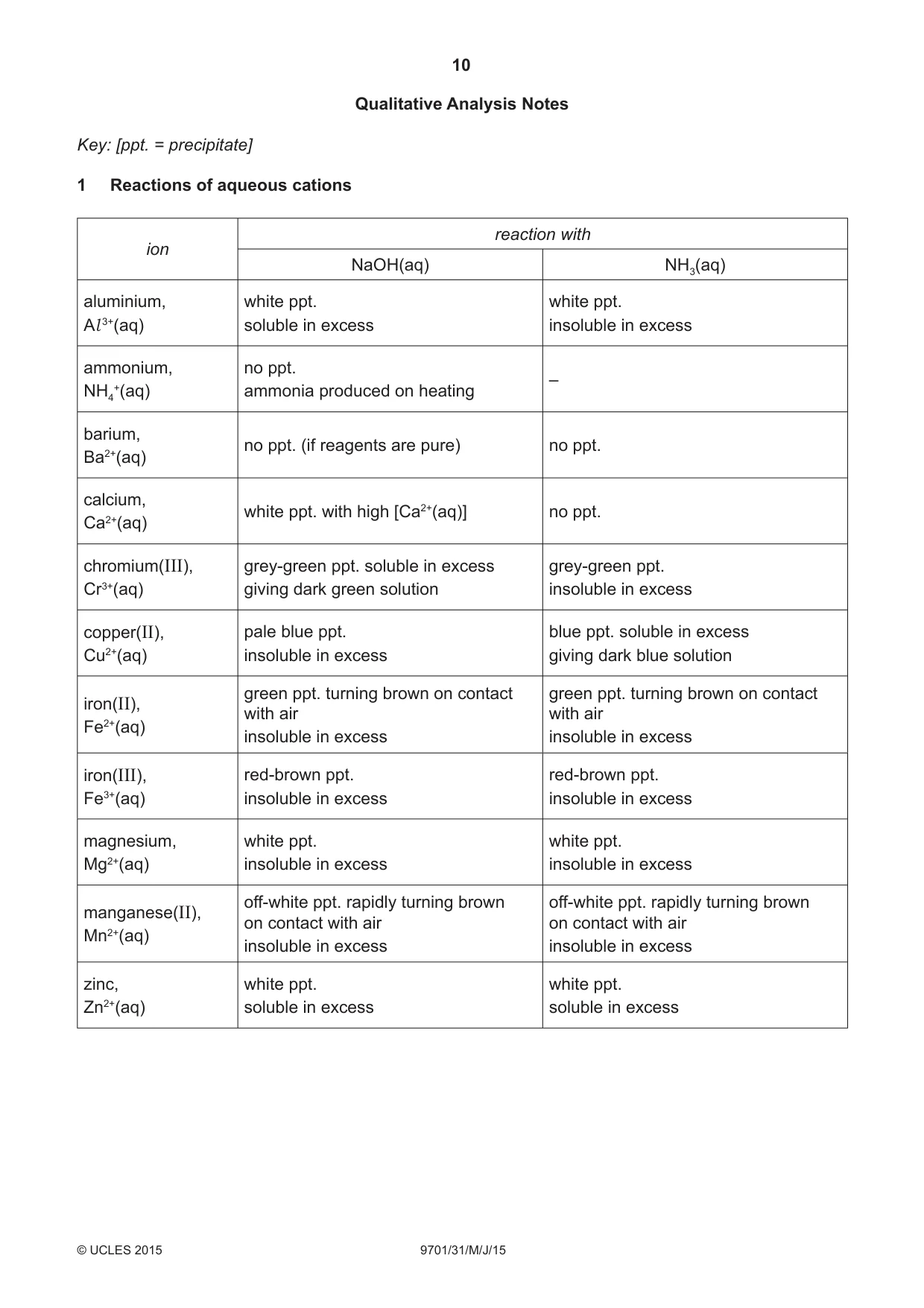
10 9701/31/M/J/15 © UCLES 2015 Qualitative Analysis Notes Key: [ppt. = precipitate] 1 Reactions of aqueous cations ion reaction with NaOH(aq) NH3(aq) aluminium, Al 3+(aq) white ppt. soluble in excess white ppt. insoluble in excess ammonium, NH4 +(aq) no ppt. ammonia produced on heating – barium, Ba2+(aq) no ppt. (if reagents are pure) no ppt. calcium, Ca2+(aq) white ppt. with high [Ca2+(aq)] no ppt. chromium(III), Cr3+(aq) grey-green ppt. soluble in excess giving dark green solution grey-green ppt. insoluble in excess copper(II), Cu2+(aq) pale blue ppt. insoluble in excess blue ppt. soluble in excess giving dark blue solution iron(II), Fe2+(aq) green ppt. turning brown on contact with air insoluble in excess green ppt. turning brown on contact with air insoluble in excess iron(III), Fe3+(aq) red-brown ppt. insoluble in excess red-brown ppt. insoluble in excess magnesium, Mg2+(aq) white ppt. insoluble in excess white ppt. insoluble in excess manganese(II), Mn2+(aq) off-white ppt. rapidly turning brown on contact with air insoluble in excess off-white ppt. rapidly turning brown on contact with air insoluble in excess zinc, Zn2+(aq) white ppt. soluble in excess white ppt. soluble in excess
Question paper, page 11
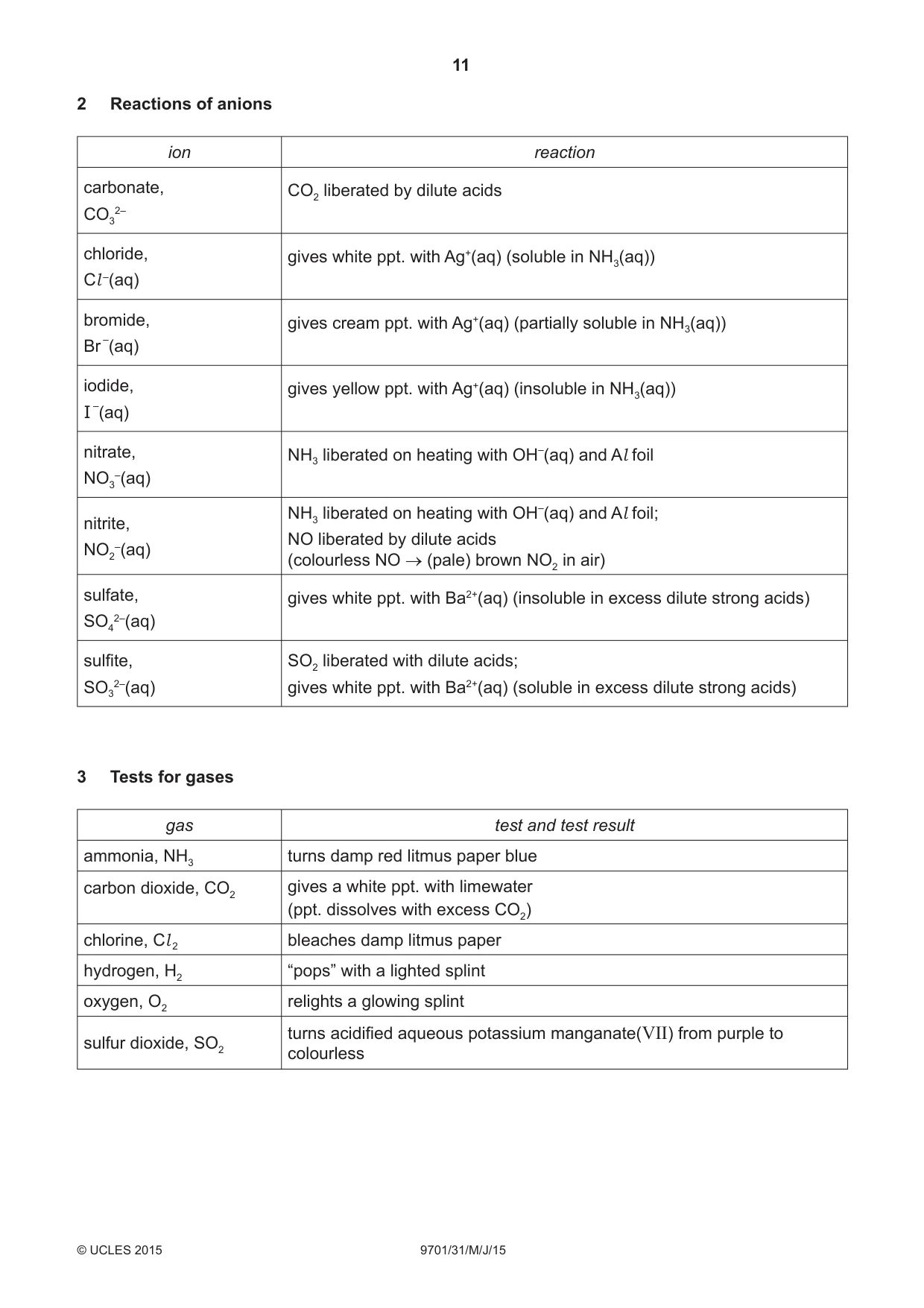
11 9701/31/M/J/15 © UCLES 2015 2 Reactions of anions ion reaction carbonate, CO3 2– CO2 liberated by dilute acids chloride, Cl –(aq) gives white ppt. with Ag+(aq) (soluble in NH3(aq)) bromide, Br –(aq) gives cream ppt. with Ag+(aq) (partially soluble in NH3(aq)) iodide, I –(aq) gives yellow ppt. with Ag+(aq) (insoluble in NH3(aq)) nitrate, NO3 –(aq) NH3 liberated on heating with OH–(aq) and Al foil nitrite, NO2 –(aq) NH3 liberated on heating with OH–(aq) and Al foil; NO liberated by dilute acids (colourless NO → (pale) brown NO2 in air) sulfate, SO4 2–(aq) gives white ppt. with Ba2+(aq) (insoluble in excess dilute strong acids) sulfi te, SO3 2–(aq) SO2 liberated with dilute acids; gives white ppt. with Ba2+(aq) (soluble in excess dilute strong acids) 3 Tests for gases gas test and test result ammonia, NH3 turns damp red litmus paper blue carbon dioxide, CO2 gives a white ppt. with limewater (ppt. dissolves with excess CO2) chlorine, Cl 2 bleaches damp litmus paper hydrogen, H2 “pops” with a lighted splint oxygen, O2 relights a glowing splint sulfur dioxide, SO2 turns acidifi ed aqueous potassium manganate(VII) from purple to colourless
Question paper, page 12
12 9701/31/M/J/15 © UCLES 2015 BLANK PAGE Permission to reproduce items where third-party owned material protected by copyright is included has been sought and cleared where possible. Every reasonable effort has been made by the publisher (UCLES) to trace copyright holders, but if any items requiring clearance have unwittingly been included, the publisher will be pleased to make amends at the earliest possible opportunity. To avoid the issue of disclosure of answer-related information to candidates, all copyright acknowledgements are reproduced online in the Cambridge International Examinations Copyright Acknowledgements Booklet. This is produced for each series of examinations and is freely available to download at www.cie.org.uk after the live examination series. Cambridge International Examinations is part of the Cambridge Assessment Group. Cambridge Assessment is the brand name of University of Cambridge Local Examinations Syndicate (UCLES), which is itself a department of the University of Cambridge.
Mark scheme, page 1
® IGCSE is the registered trademark of Cambridge International Examinations. CAMBRIDGE INTERNATIONAL EXAMINATIONS Cambridge International Advanced Subsidiary and Advanced Level MARK SCHEME for the May/June 2015 series 9701 CHEMISTRY 9701/31 Paper 3 (Advanced Practical Skills 1), maximum raw mark 40 This mark scheme is published as an aid to teachers and candidates, to indicate the requirements of the examination. It shows the basis on which Examiners were instructed to award marks. It does not indicate the details of the discussions that took place at an Examiners’ meeting before marking began, which would have considered the acceptability of alternative answers. Mark schemes should be read in conjunction with the question paper and the Principal Examiner Report for Teachers. Cambridge will not enter into discussions about these mark schemes. Cambridge is publishing the mark schemes for the May/June 2015 series for most Cambridge IGCSE®, Cambridge International A and AS Level components and some Cambridge O Level components.
Mark scheme, page 2
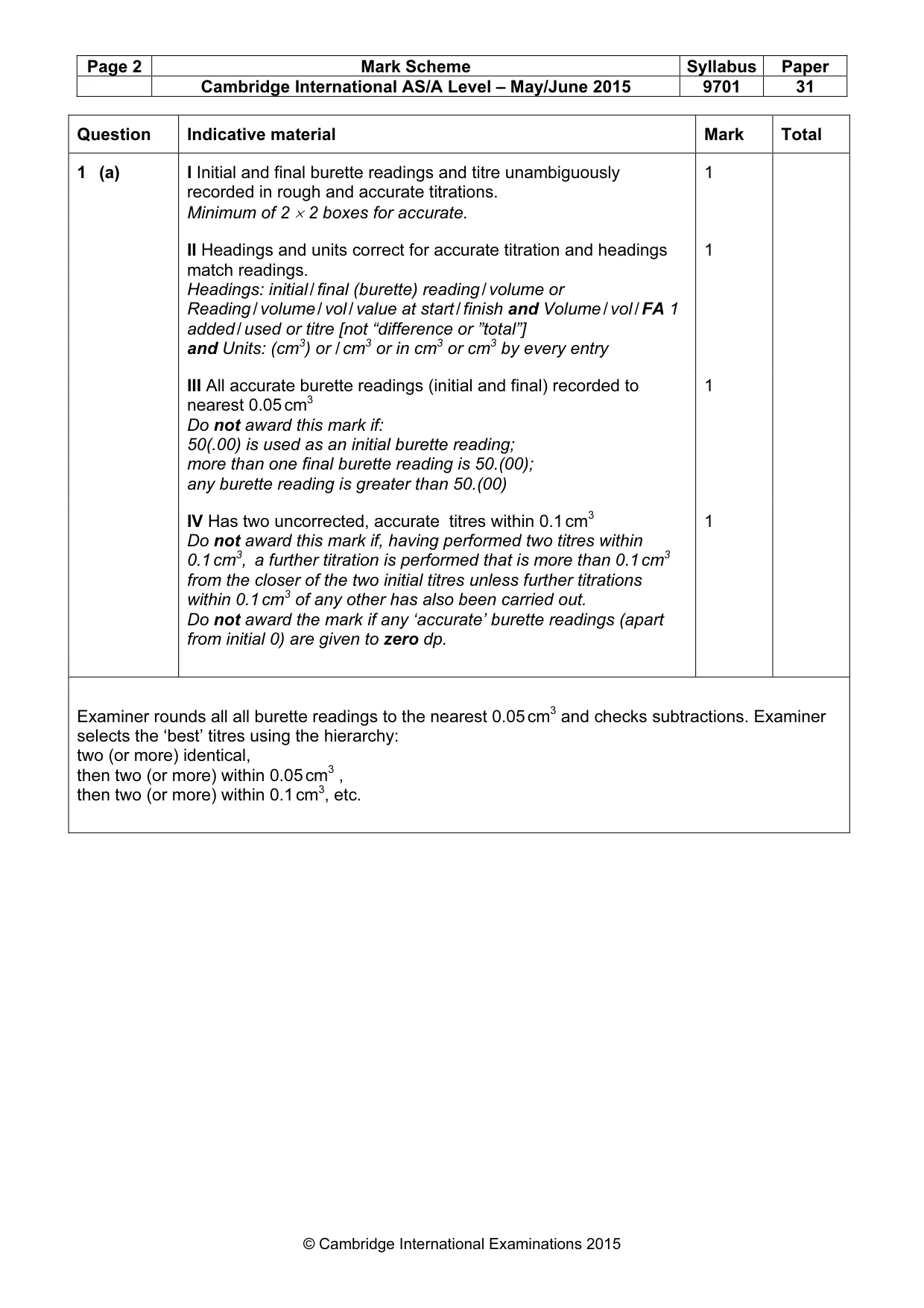
Page 2 Mark Scheme Syllabus Paper Cambridge International AS/A Level – May/June 2015 9701 31 © Cambridge International Examinations 2015 Question Indicative material Mark Total 1 (a) I Initial and final burette readings and titre unambiguously recorded in rough and accurate titrations. Minimum of 2 × 2 boxes for accurate. 1 II Headings and units correct for accurate titration and headings match readings. Headings: initial / final (burette) reading / volume or Reading / volume / vol / value at start / finish and Volume / vol / FA 1 added / used or titre [not “difference or ”total”] and Units: (cm3) or / cm3 or in cm3 or cm3 by every entry 1 III All accurate burette readings (initial and final) recorded to nearest 0.05 cm3 Do not award this mark if: 50(.00) is used as an initial burette reading; more than one final burette reading is 50.(00); any burette reading is greater than 50.(00) 1 IV Has two uncorrected, accurate titres within 0.1 cm3 Do not award this mark if, having performed two titres within 0.1 cm3, a further titration is performed that is more than 0.1 cm3 from the closer of the two initial titres unless further titrations within 0.1 cm3 of any other has also been carried out. Do not award the mark if any ‘accurate’ burette readings (apart from initial 0) are given to zero dp. 1 Examiner rounds all all burette readings to the nearest 0.05 cm3 and checks subtractions. Examiner selects the ‘best’ titres using the hierarchy: two (or more) identical, then two (or more) within 0.05 cm3 , then two (or more) within 0.1 cm3, etc.
Mark scheme, page 3
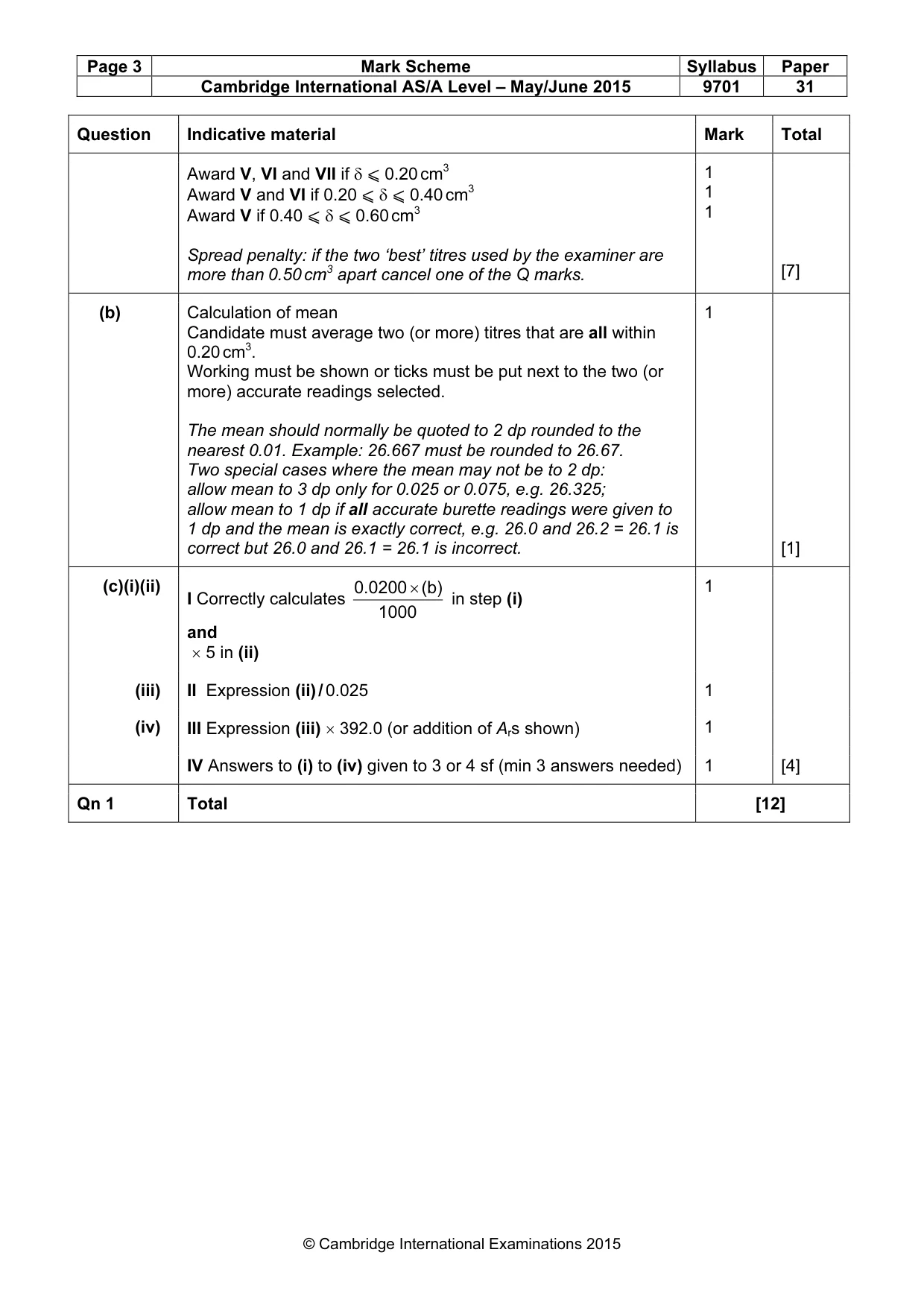
Page 3 Mark Scheme Syllabus Paper Cambridge International AS/A Level – May/June 2015 9701 31 © Cambridge International Examinations 2015 Question Indicative material Mark Total Award V, VI and VII if δ ⩽ 0.20 cm3 Award V and VI if 0.20 ⩽ δ ⩽ 0.40 cm3 Award V if 0.40 ⩽ δ ⩽ 0.60 cm3 Spread penalty: if the two ‘best’ titres used by the examiner are more than=0.50 cm3 apart cancel one of the Q marks. 1 1 1 [7] (b) Calculation of mean Candidate must average two (or more) titres that are all within 0.20 cm3. Working must be shown or ticks must be put next to the two (or more) accurate readings selected. The mean should normally be quoted to 2 dp rounded to the nearest 0.01. Example: 26.667 must be rounded to 26.67. Two special cases where the mean may not be to 2 dp: allow mean to 3 dp only for 0.025 or 0.075, e.g. 26.325; allow mean to 1 dp if all accurate burette readings were given to 1 dp and the mean is exactly correct, e.g. 26.0 and 26.2 = 26.1 is correct but 26.0 and 26.1 = 26.1 is incorrect. 1 [1] (c)(i)(ii) I Correctly calculates 1000 (b) 0.0200× in step (i) and × 5 in (ii) 1 (iii) II Expression (ii) / 0.025 1 (iv) III Expression (iii) × 392.0 (or addition of Ars shown) 1 IV Answers to (i) to (iv) given to 3 or 4 sf (min 3 answers needed) 1 [4] Qn 1 Total [12]
Mark scheme, page 4
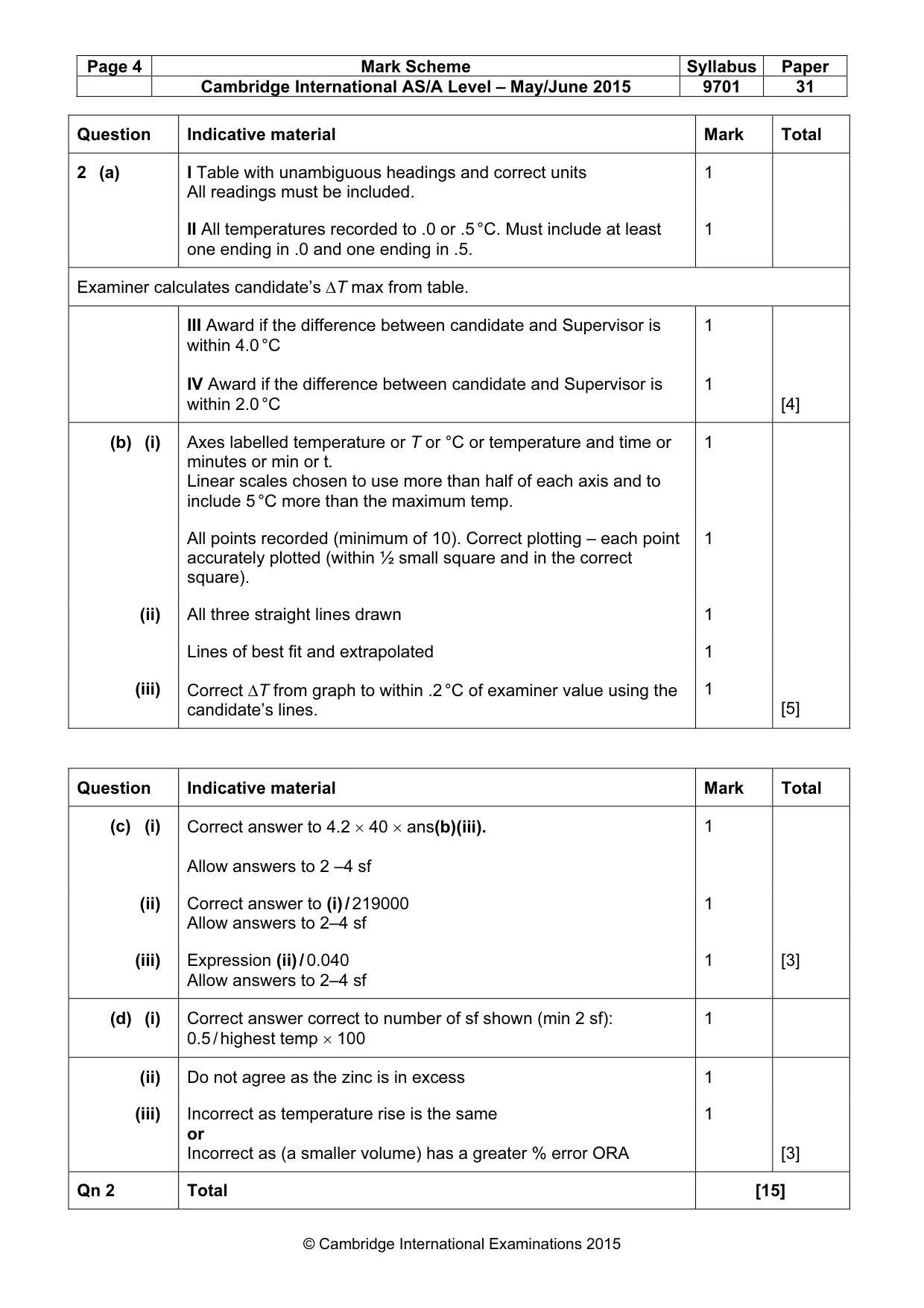
Page 4 Mark Scheme Syllabus Paper Cambridge International AS/A Level – May/June 2015 9701 31 © Cambridge International Examinations 2015 Question Indicative material Mark Total 2 (a) I Table with unambiguous headings and correct units All readings must be included. 1 II All temperatures recorded to .0 or .5 °C. Must include at least one ending in .0 and one ending in .5. 1 Examiner calculates candidate’s ∆T max from table. III Award if the difference between candidate and Supervisor is within 4.0 °C IV Award if the difference between candidate and Supervisor is within 2.0 °C 1 1 [4] (b) (i) Axes labelled temperature or T or °C or temperature and time or minutes or min or t. Linear scales chosen to use more than half of each axis and to include 5 °C more than the maximum temp. 1 All points recorded (minimum of 10). Correct plotting – each point accurately plotted (within ½ small square and in the correct square). 1 (ii) All three straight lines drawn 1 Lines of best fit and extrapolated 1 (iii) Correct ∆T from graph to within .2 °C of examiner value using the candidate’s lines. 1 [5] Question Indicative material Mark Total (c) (i) Correct answer to 4.2 × 40 × ans(b)(iii). Allow answers to 2 –4 sf 1 (ii) Correct answer to (i) / 219000 Allow answers to 2–4 sf 1 (iii) Expression (ii) / 0.040 Allow answers to 2–4 sf 1 [3] (d) (i) Correct answer correct to number of sf shown (min 2 sf): 0.5 / highest temp × 100 1 (ii) Do not agree as the zinc is in excess 1 (iii) Incorrect as temperature rise is the same or Incorrect as (a smaller volume) has a greater % error ORA 1 [3] Qn 2 Total [15]
Mark scheme, page 5
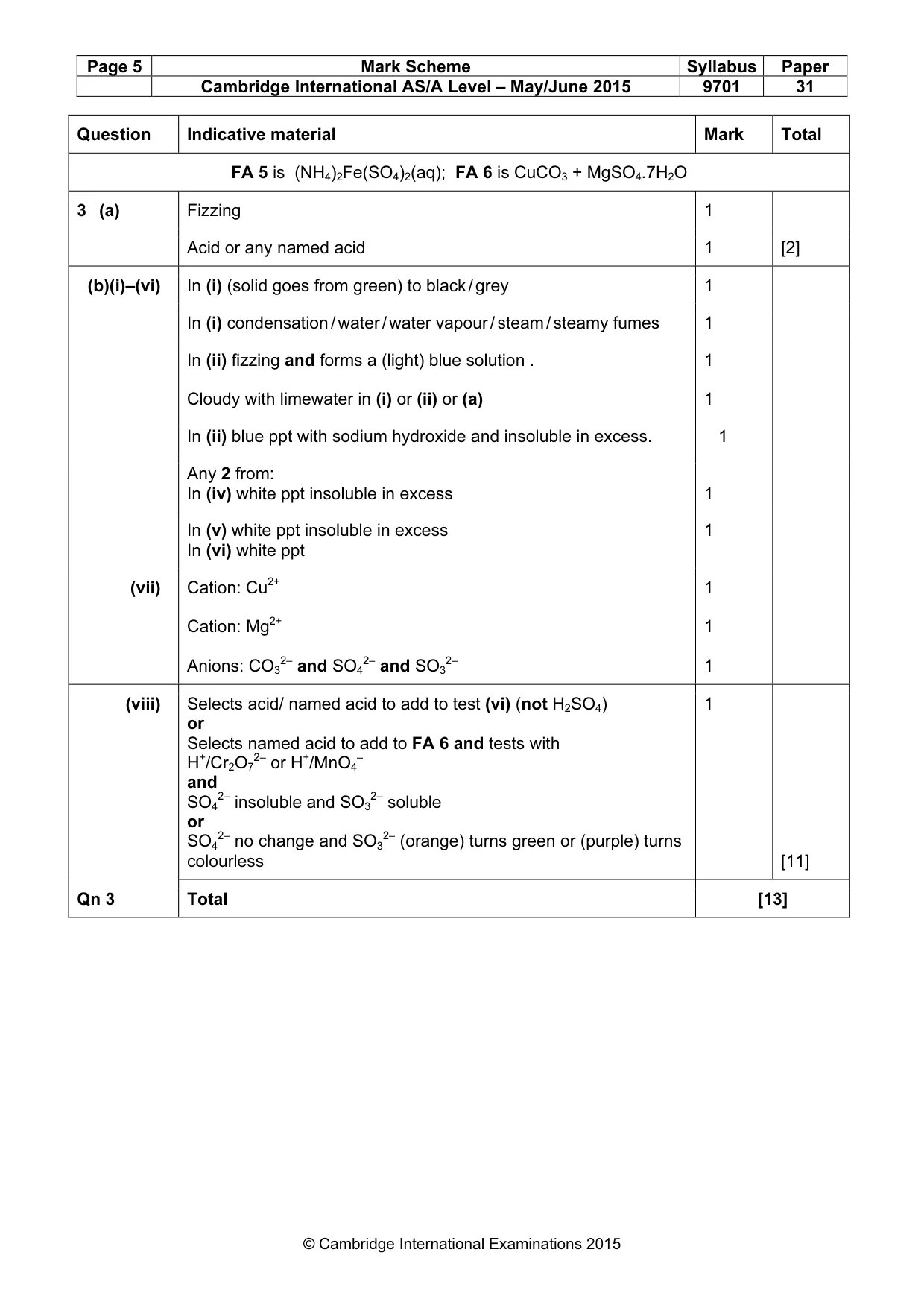
Page 5 Mark Scheme Syllabus Paper Cambridge International AS/A Level – May/June 2015 9701 31 © Cambridge International Examinations 2015 Question Indicative material Mark Total FA 5 is (NH4)2Fe(SO4)2(aq); FA 6 is CuCO3 + MgSO4.7H2O 3 (a) Fizzing 1 Acid or any named acid 1 [2] (b)(i)–(vi) In (i) (solid goes from green) to black / grey 1 In (i) condensation / water / water vapour / steam / steamy fumes 1 In (ii) fizzing and forms a (light) blue solution . Cloudy with limewater in (i) or (ii) or (a) 1 1 In (ii) blue ppt with sodium hydroxide and insoluble in excess. 1 Any 2 from: In (iv) white ppt insoluble in excess 1 In (v) white ppt insoluble in excess In (vi) white ppt 1 (vii) Cation: Cu2+ Cation: Mg2+ Anions: CO3 2– and SO4 2– and SO3 2– 1 1 1 (viii) Selects acid/ named acid to add to test (vi) (not H2SO4) or Selects named acid to add to FA 6 and tests with H+/Cr2O7 2– or H+/MnO4 – and SO4 2– insoluble and SO3 2– soluble or SO4 2– no change and SO3 2– (orange) turns green or (purple) turns colourless 1 [11] Qn 3 Total [13]
What you needed in this session
Cambridge’s own grade thresholds for 2015 May/June, Paper 3 · Variant 1. A higher threshold means an easier paper — the bar moves with how the cohort did.