Cambridge A Level Chemistry 9701 — 2013 May/June Paper 3 · Variant 3
9701/33/M/J/13 · 40 marks · ≈45 min
The question paper and its mark scheme, free to read here and free to download. This is Cambridge’s own paper, exactly as it was sat.
Question paper16 pages


Mark scheme7 pages
Answers below. Sit the paper first if you are practising.
Paper as text
Question paper, page 1
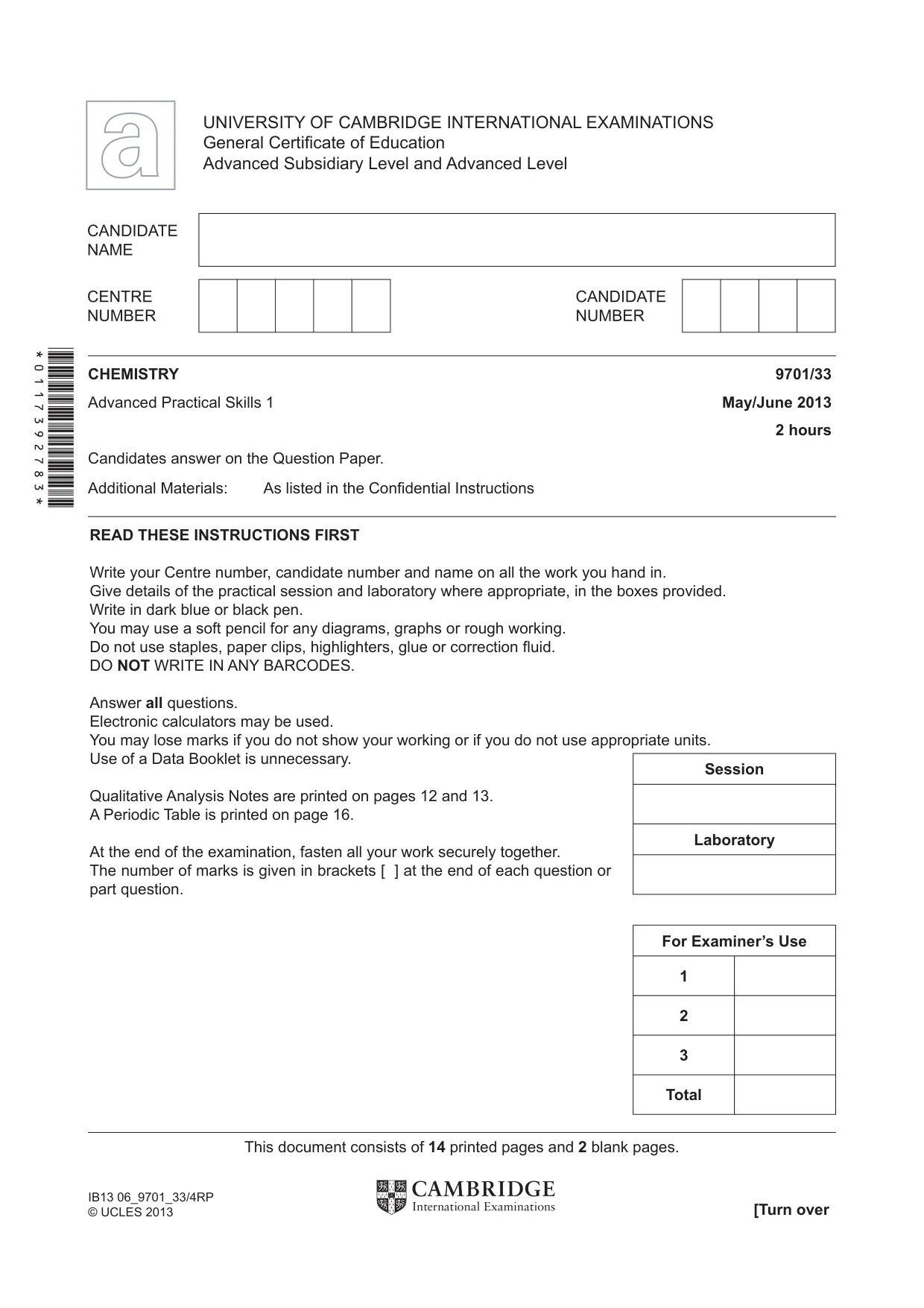
READ THESE INSTRUCTIONS FIRST Write your Centre number, candidate number and name on all the work you hand in. Give details of the practical session and laboratory where appropriate, in the boxes provided. Write in dark blue or black pen. You may use a soft pencil for any diagrams, graphs or rough working. Do not use staples, paper clips, highlighters, glue or correction fl uid. DO NOT WRITE IN ANY BARCODES. Answer all questions. Electronic calculators may be used. You may lose marks if you do not show your working or if you do not use appropriate units. Use of a Data Booklet is unnecessary. Qualitative Analysis Notes are printed on pages 12 and 13. A Periodic Table is printed on page 16. At the end of the examination, fasten all your work securely together. The number of marks is given in brackets [ ] at the end of each question or part question. CHEMISTRY 9701/33 Advanced Practical Skills 1 May/June 2013 2 hours Candidates answer on the Question Paper. Additional Materials: As listed in the Confi dential Instructions UNIVERSITY OF CAMBRIDGE INTERNATIONAL EXAMINATIONS General Certifi cate of Education Advanced Subsidiary Level and Advanced Level This document consists of 14 printed pages and 2 blank pages. [Turn over IB13 06_9701_33/4RP © UCLES 2013 *0117392783* Session Laboratory For Examiner’s Use 1 2 3 Total
Question paper, page 2
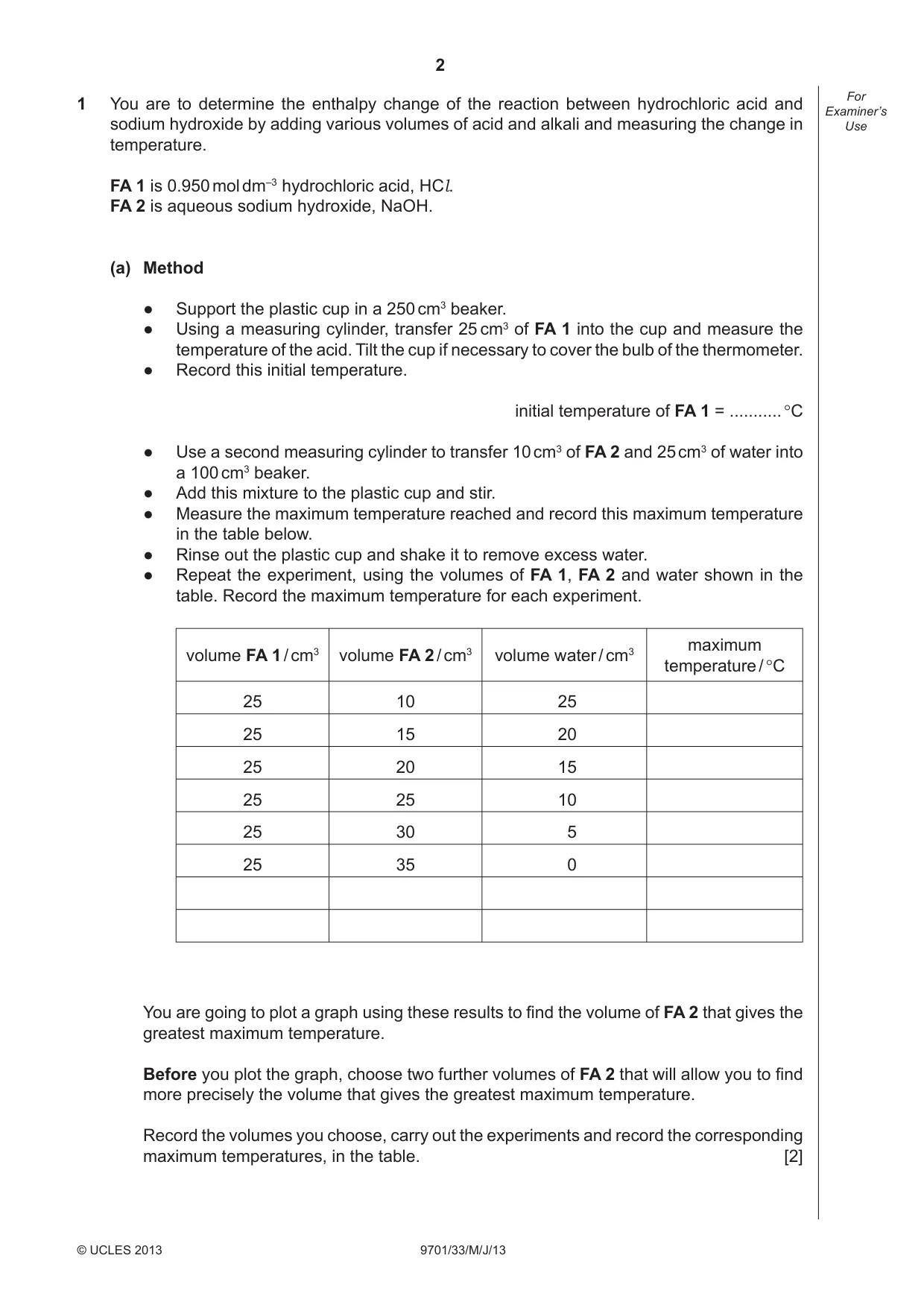
2 9701/33/M/J/13 © UCLES 2013 For Examiner’s Use 1 You are to determine the enthalpy change of the reaction between hydrochloric acid and sodium hydroxide by adding various volumes of acid and alkali and measuring the change in temperature. FA 1 is 0.950 mol dm–3 hydrochloric acid, HCl. FA 2 is aqueous sodium hydroxide, NaOH. (a) Method ● Support the plastic cup in a 250 cm3 beaker. ● Using a measuring cylinder, transfer 25 cm3 of FA 1 into the cup and measure the temperature of the acid. Tilt the cup if necessary to cover the bulb of the thermometer. ● Record this initial temperature. initial temperature of FA 1 = … °C ● Use a second measuring cylinder to transfer 10 cm3 of FA 2 and 25 cm3 of water into a 100 cm3 beaker. ● Add this mixture to the plastic cup and stir. ● Measure the maximum temperature reached and record this maximum temperature in the table below. ● Rinse out the plastic cup and shake it to remove excess water. ● Repeat the experiment, using the volumes of FA 1, FA 2 and water shown in the table. Record the maximum temperature for each experiment. volume FA 1 / cm3 volume FA 2 / cm3 volume water / cm3 maximum temperature / °C 25 10 25 25 15 20 25 20 15 25 25 10 25 30 5 25 35 0 You are going to plot a graph using these results to fi nd the volume of FA 2 that gives the greatest maximum temperature. Before you plot the graph, choose two further volumes of FA 2 that will allow you to fi nd more precisely the volume that gives the greatest maximum temperature. Record the volumes you choose, carry out the experiments and record the corresponding maximum temperatures, in the table. [2]
Question paper, page 3
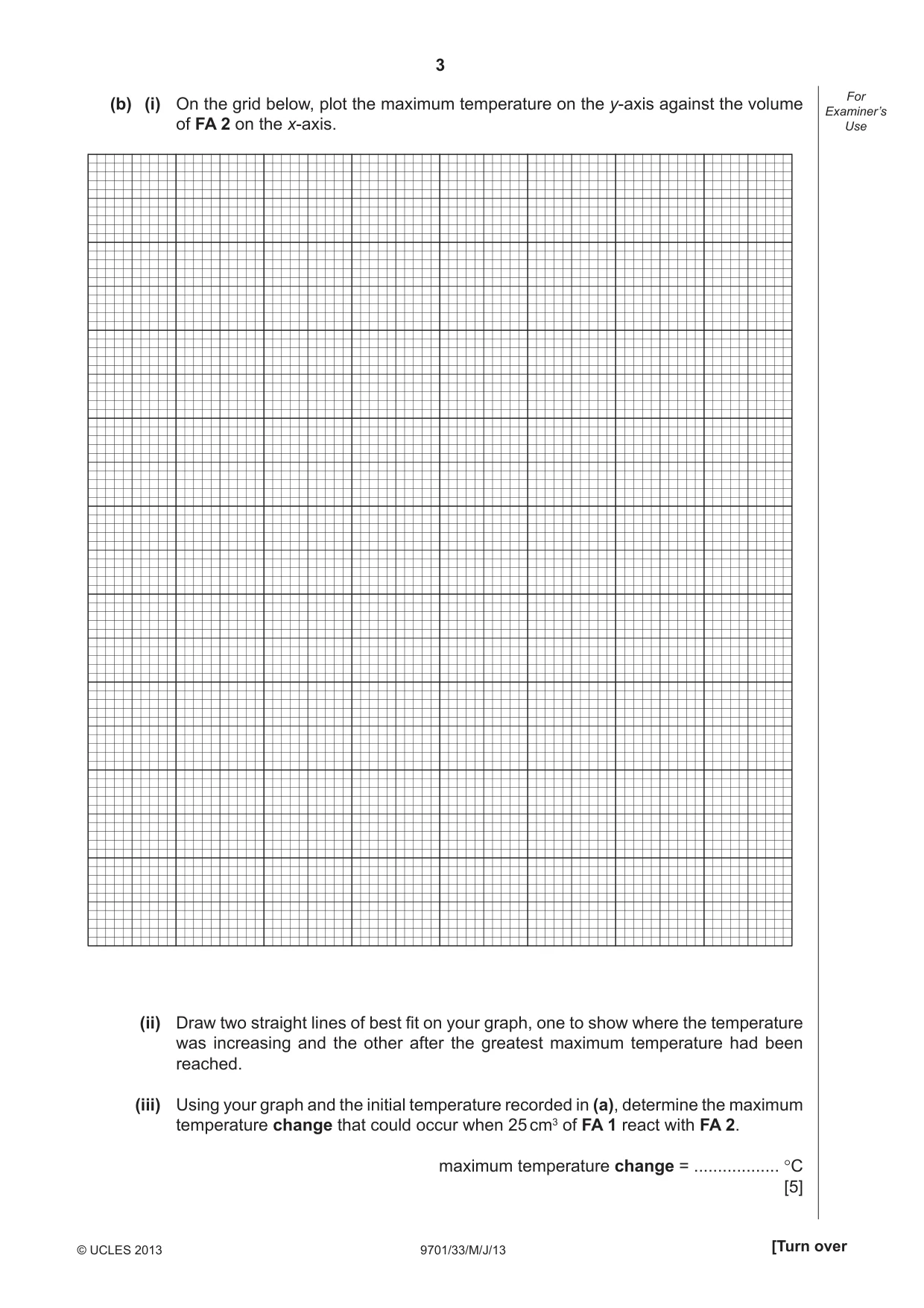
3 9701/33/M/J/13 © UCLES 2013 [Turn over For Examiner’s Use (b) (i) On the grid below, plot the maximum temperature on the y-axis against the volume of FA 2 on the x-axis. (ii) Draw two straight lines of best fi t on your graph, one to show where the temperature was increasing and the other after the greatest maximum temperature had been reached. (iii) Using your graph and the initial temperature recorded in (a), determine the maximum temperature change that could occur when 25 cm3 of FA 1 react with FA 2. maximum temperature change = … °C [5]
Question paper, page 4
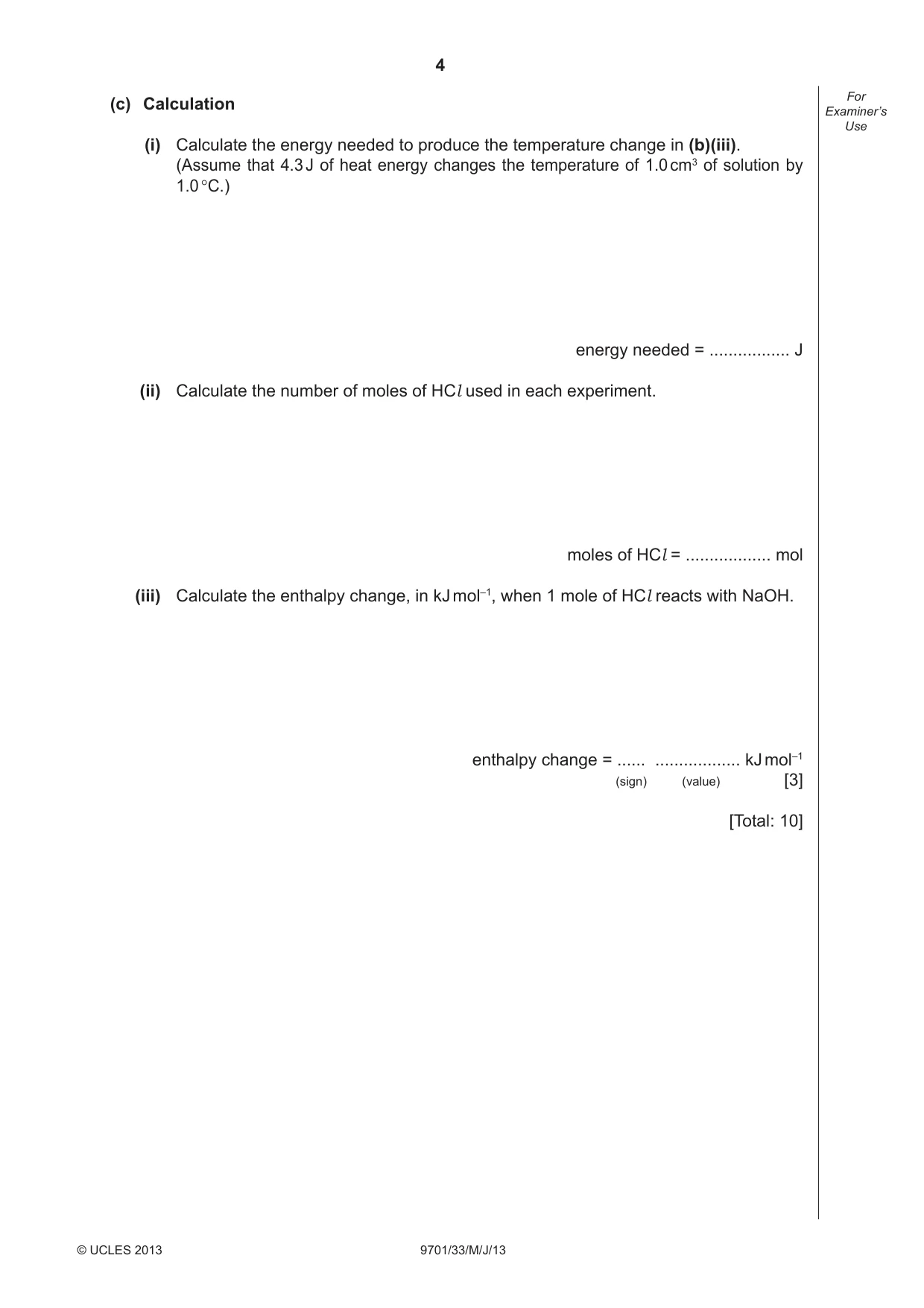
4 9701/33/M/J/13 © UCLES 2013 For Examiner’s Use (c) Calculation (i) Calculate the energy needed to produce the temperature change in (b)(iii). (Assume that 4.3 J of heat energy changes the temperature of 1.0 cm3 of solution by 1.0 °C.) energy needed = … J (ii) Calculate the number of moles of HCl used in each experiment. moles of HCl = … mol (iii) Calculate the enthalpy change, in kJ mol–1, when 1 mole of HCl reacts with NaOH. enthalpy change = … … kJ mol–1 (sign) (value) [3] [Total: 10]
Question paper, page 5
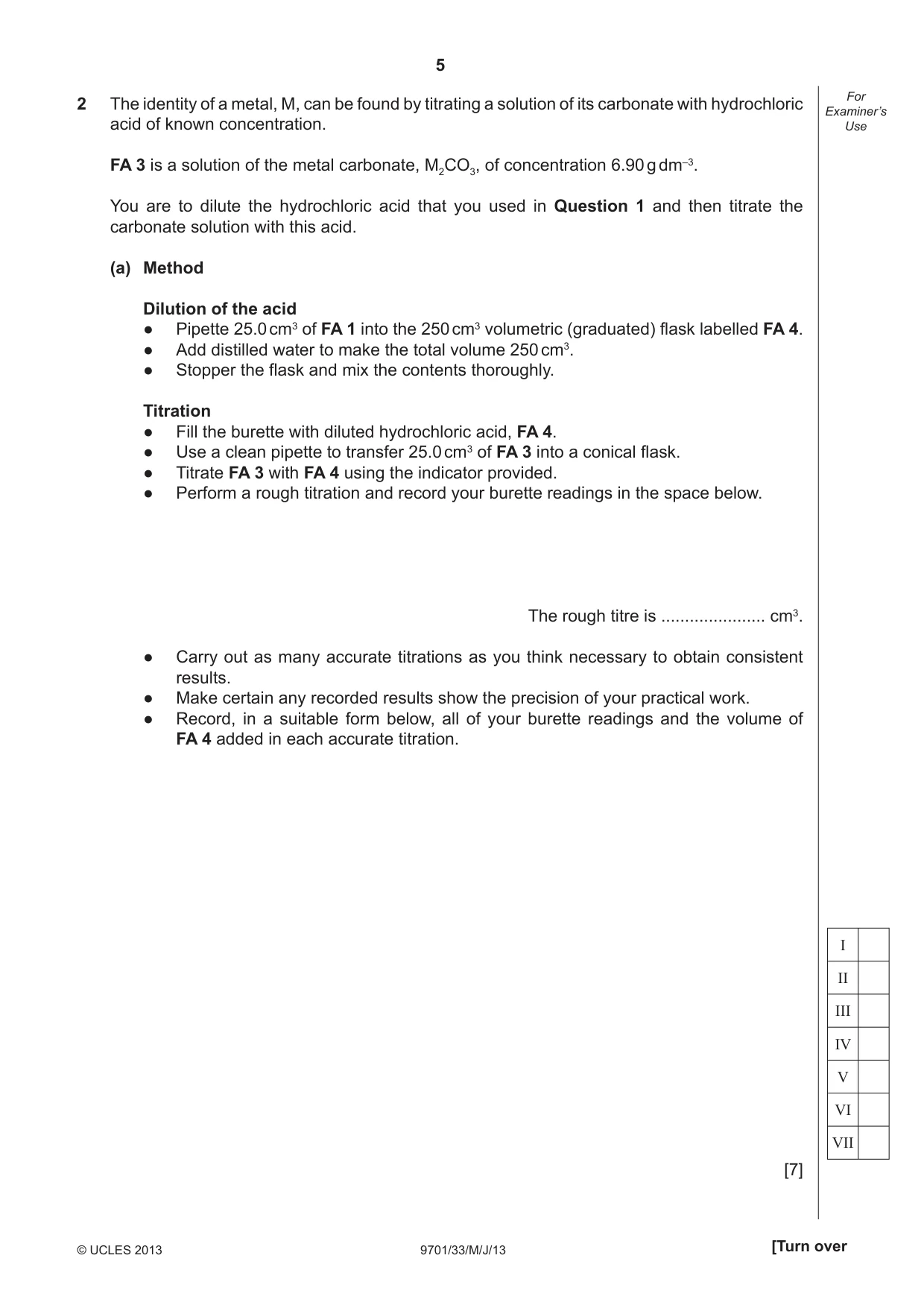
5 9701/33/M/J/13 © UCLES 2013 [Turn over For Examiner’s Use I II III IV V VI VII 2 The identity of a metal, M, can be found by titrating a solution of its carbonate with hydrochloric acid of known concentration. FA 3 is a solution of the metal carbonate, M2CO3, of concentration 6.90 g dm–3. You are to dilute the hydrochloric acid that you used in Question 1 and then titrate the carbonate solution with this acid. (a) Method Dilution of the acid ● Pipette 25.0 cm3 of FA 1 into the 250 cm3 volumetric (graduated) flask labelled FA 4. ● Add distilled water to make the total volume 250 cm3. ● Stopper the flask and mix the contents thoroughly. Titration ● Fill the burette with diluted hydrochloric acid, FA 4. ● Use a clean pipette to transfer 25.0 cm3 of FA 3 into a conical flask. ● Titrate FA 3 with FA 4 using the indicator provided. ● Perform a rough titration and record your burette readings in the space below. The rough titre is … cm3. ● Carry out as many accurate titrations as you think necessary to obtain consistent results. ● Make certain any recorded results show the precision of your practical work. ● Record, in a suitable form below, all of your burette readings and the volume of FA 4 added in each accurate titration. [7]
Question paper, page 6
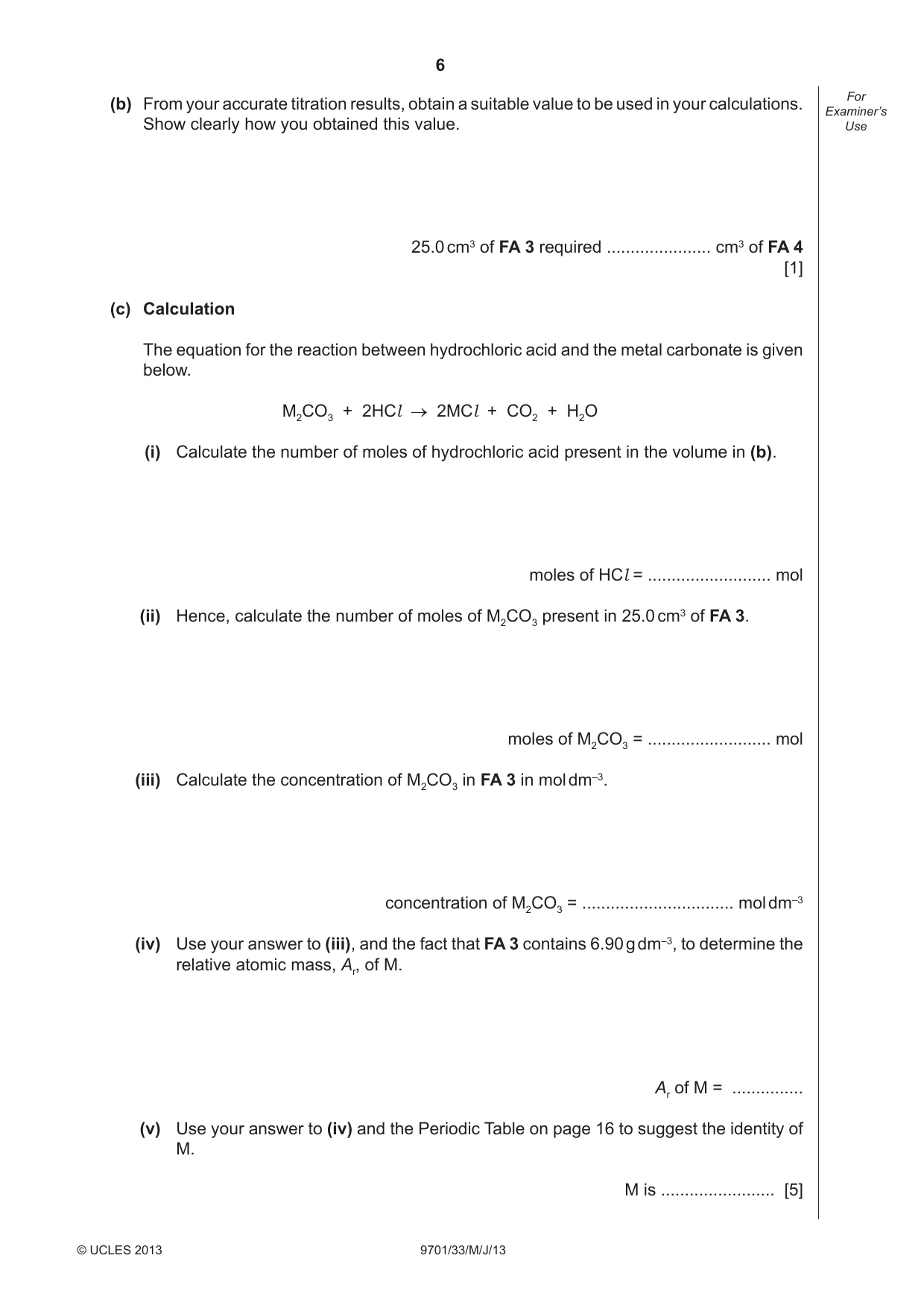
6 9701/33/M/J/13 © UCLES 2013 For Examiner’s Use (b) From your accurate titration results, obtain a suitable value to be used in your calculations. Show clearly how you obtained this value. 25.0 cm3 of FA 3 required … cm3 of FA 4 [1] (c) Calculation The equation for the reaction between hydrochloric acid and the metal carbonate is given below. M2CO3 + 2HCl → 2MCl + CO2 + H2O (i) Calculate the number of moles of hydrochloric acid present in the volume in (b). moles of HCl = … mol (ii) Hence, calculate the number of moles of M2CO3 present in 25.0 cm3 of FA 3. moles of M2CO3 = … mol (iii) Calculate the concentration of M2CO3 in FA 3 in mol dm–3. concentration of M2CO3 = … mol dm–3 (iv) Use your answer to (iii), and the fact that FA 3 contains 6.90 g dm–3, to determine the relative atomic mass, Ar, of M. Ar of M = … (v) Use your answer to (iv) and the Periodic Table on page 16 to suggest the identity of M. M is … [5]
Question paper, page 7
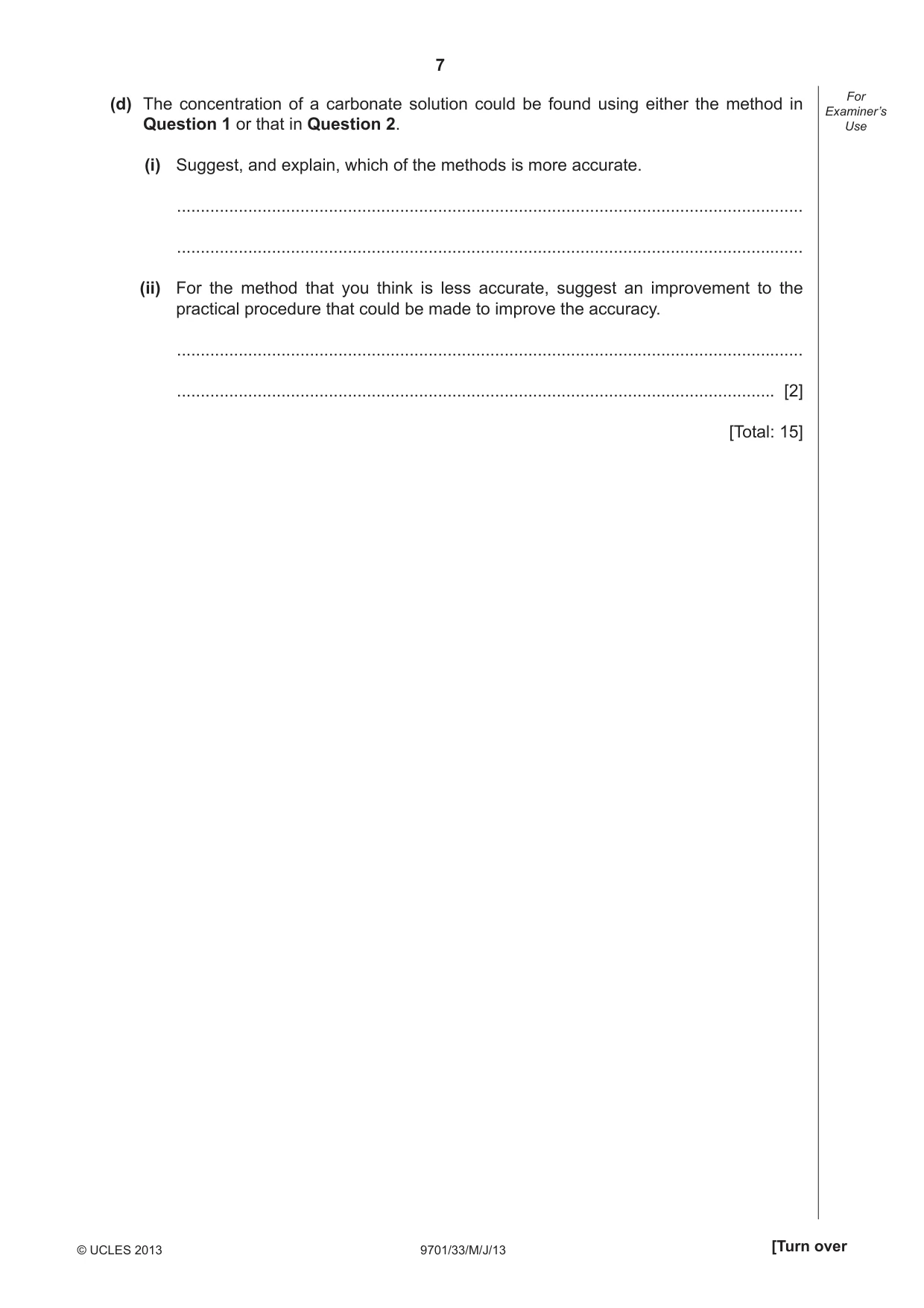
7 9701/33/M/J/13 © UCLES 2013 [Turn over For Examiner’s Use (d) The concentration of a carbonate solution could be found using either the method in Question 1 or that in Question 2. (i) Suggest, and explain, which of the methods is more accurate. … … (ii) For the method that you think is less accurate, suggest an improvement to the practical procedure that could be made to improve the accuracy. … … [2] [Total: 15]
Question paper, page 8
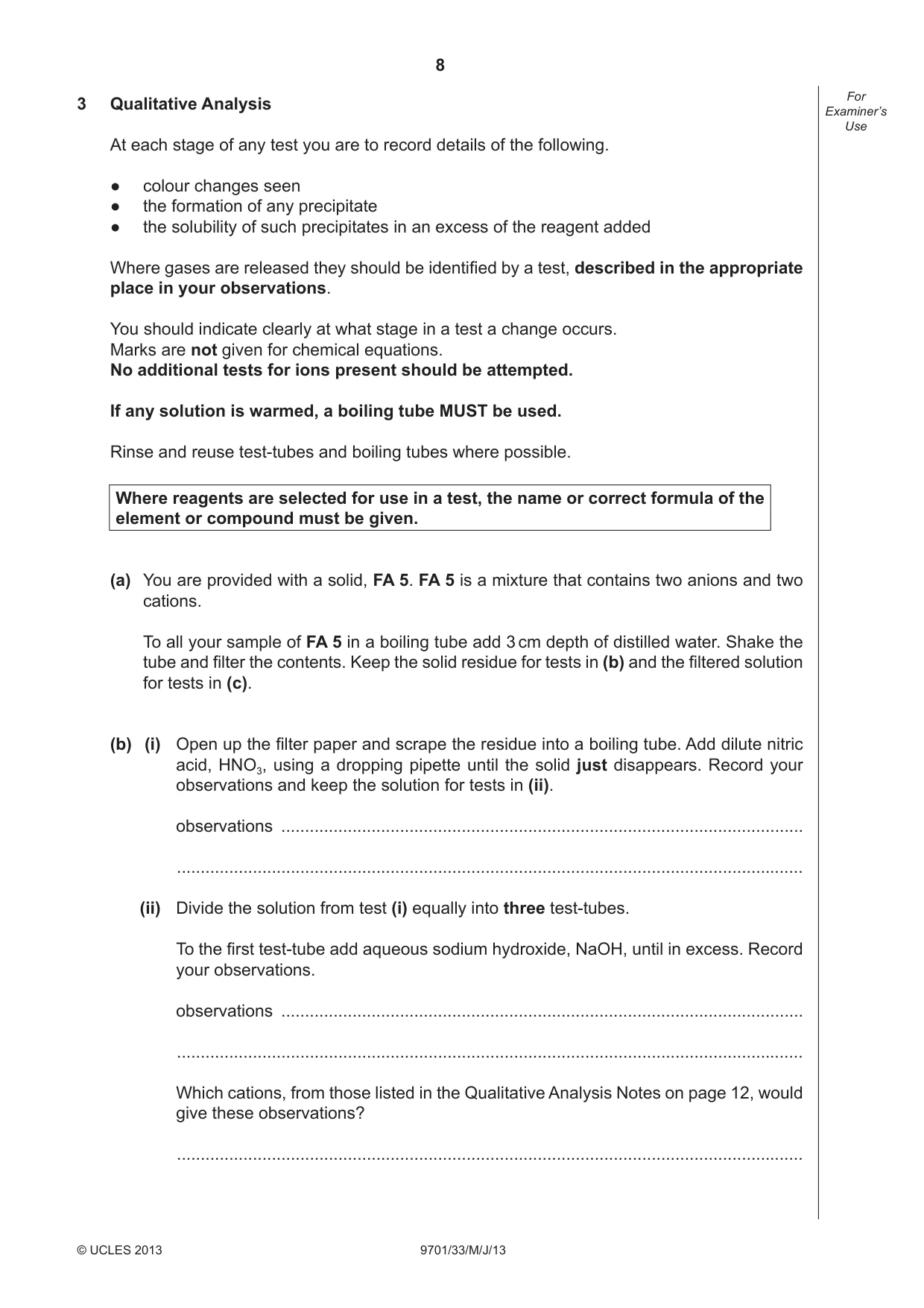
8 9701/33/M/J/13 © UCLES 2013 For Examiner’s Use 3 Qualitative Analysis At each stage of any test you are to record details of the following. ● colour changes seen ● the formation of any precipitate ● the solubility of such precipitates in an excess of the reagent added Where gases are released they should be identifi ed by a test, described in the appropriate place in your observations. You should indicate clearly at what stage in a test a change occurs. Marks are not given for chemical equations. No additional tests for ions present should be attempted. If any solution is warmed, a boiling tube MUST be used. Rinse and reuse test-tubes and boiling tubes where possible. Where reagents are selected for use in a test, the name or correct formula of the element or compound must be given. (a) You are provided with a solid, FA 5. FA 5 is a mixture that contains two anions and two cations. To all your sample of FA 5 in a boiling tube add 3 cm depth of distilled water. Shake the tube and fi lter the contents. Keep the solid residue for tests in (b) and the fi ltered solution for tests in (c). (b) (i) Open up the fi lter paper and scrape the residue into a boiling tube. Add dilute nitric acid, HNO3, using a dropping pipette until the solid just disappears. Record your observations and keep the solution for tests in (ii). observations … … (ii) Divide the solution from test (i) equally into three test-tubes. To the fi rst test-tube add aqueous sodium hydroxide, NaOH, until in excess. Record your observations. observations … … Which cations, from those listed in the Qualitative Analysis Notes on page 12, would give these observations? …
Question paper, page 9
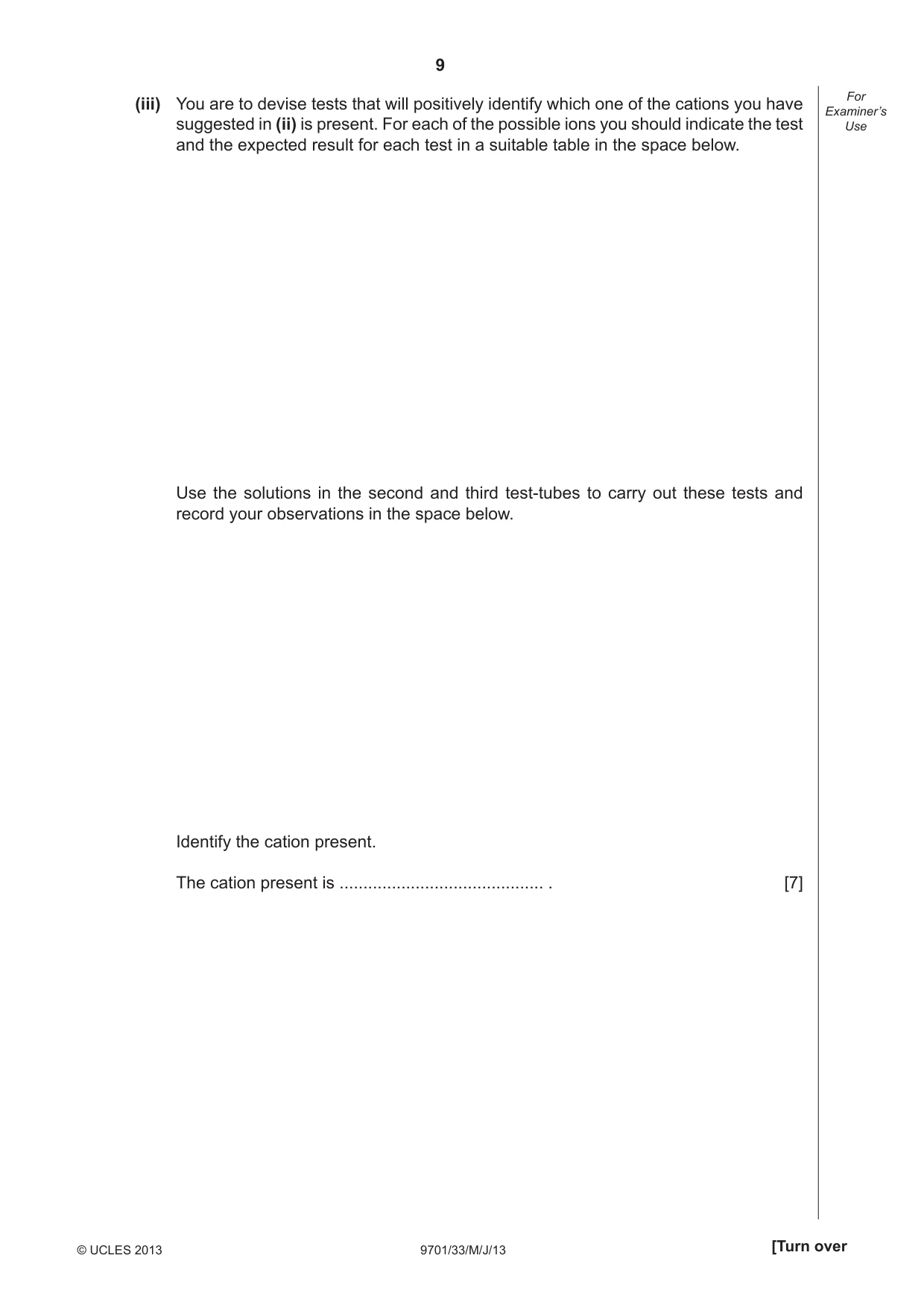
9 9701/33/M/J/13 © UCLES 2013 [Turn over For Examiner’s Use (iii) You are to devise tests that will positively identify which one of the cations you have suggested in (ii) is present. For each of the possible ions you should indicate the test and the expected result for each test in a suitable table in the space below. Use the solutions in the second and third test-tubes to carry out these tests and record your observations in the space below. Identify the cation present. The cation present is … . [7]
Question paper, page 10
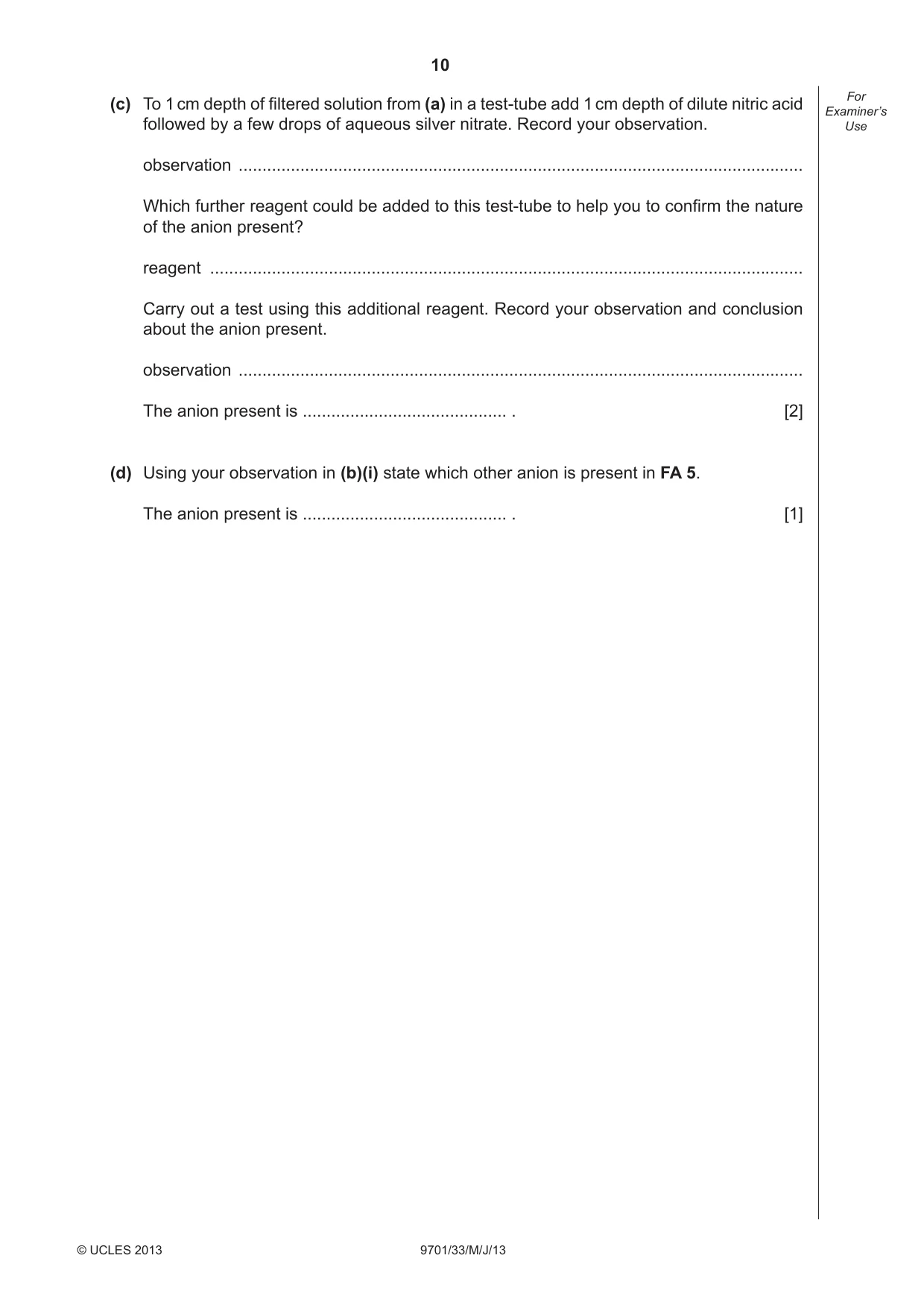
10 9701/33/M/J/13 © UCLES 2013 For Examiner’s Use (c) To 1 cm depth of fi ltered solution from (a) in a test-tube add 1 cm depth of dilute nitric acid followed by a few drops of aqueous silver nitrate. Record your observation. observation … Which further reagent could be added to this test-tube to help you to confi rm the nature of the anion present? reagent … Carry out a test using this additional reagent. Record your observation and conclusion about the anion present. observation … The anion present is … . [2] (d) Using your observation in (b)(i) state which other anion is present in FA 5. The anion present is … . [1]
Question paper, page 11
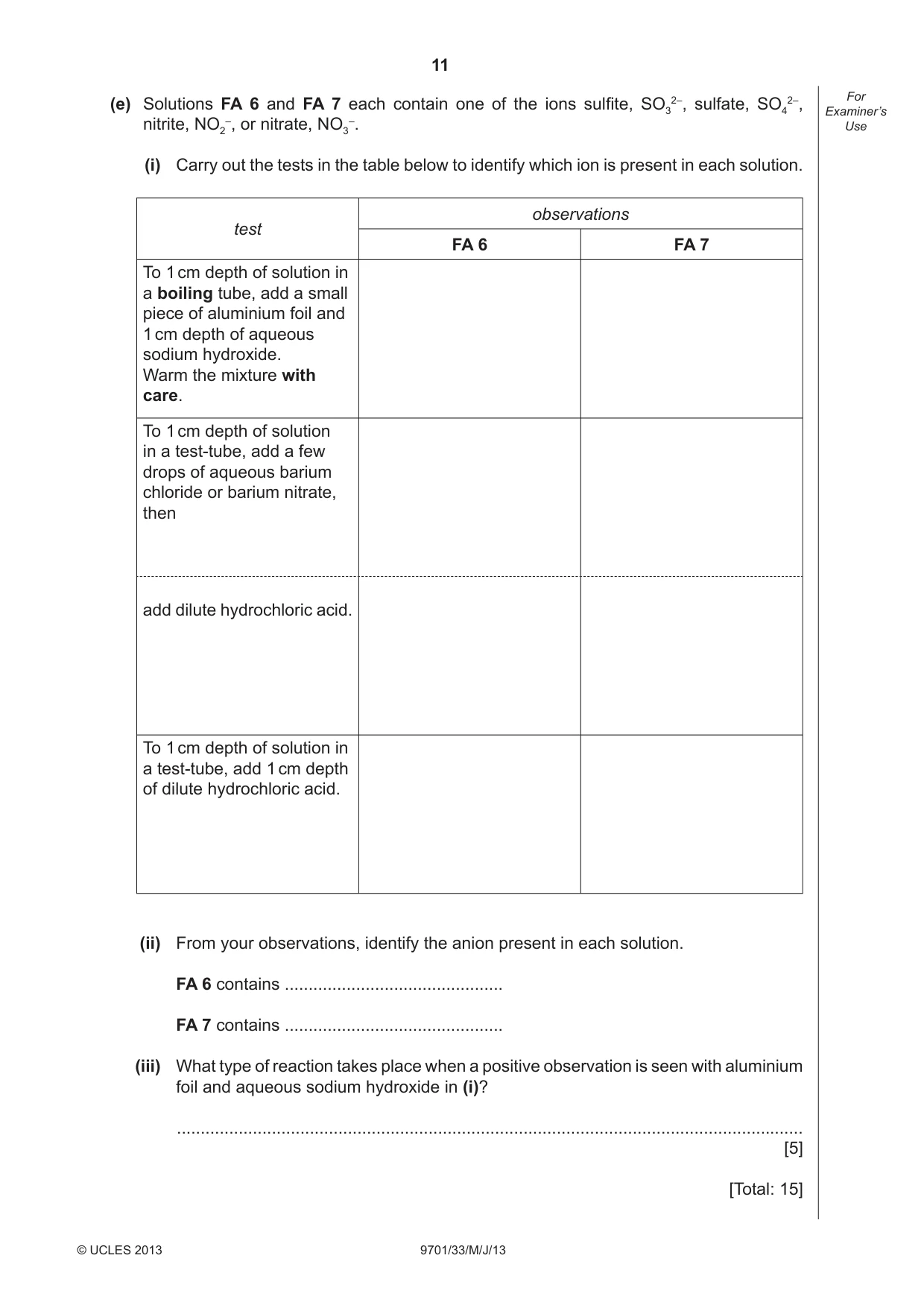
11 9701/33/M/J/13 © UCLES 2013 [Turn over For Examiner’s Use (e) Solutions FA 6 and FA 7 each contain one of the ions sulfi te, SO3 2–, sulfate, SO4 2–, nitrite, NO2 –, or nitrate, NO3 –. (i) Carry out the tests in the table below to identify which ion is present in each solution. test observations FA 6 FA 7 To 1 cm depth of solution in a boiling tube, add a small piece of aluminium foil and 1 cm depth of aqueous sodium hydroxide. Warm the mixture with care. To 1 cm depth of solution in a test-tube, add a few drops of aqueous barium chloride or barium nitrate, then add dilute hydrochloric acid. To 1 cm depth of solution in a test-tube, add 1 cm depth of dilute hydrochloric acid. (ii) From your observations, identify the anion present in each solution. FA 6 contains … FA 7 contains … (iii) What type of reaction takes place when a positive observation is seen with aluminium foil and aqueous sodium hydroxide in (i)? … [5] [Total: 15]
Question paper, page 12
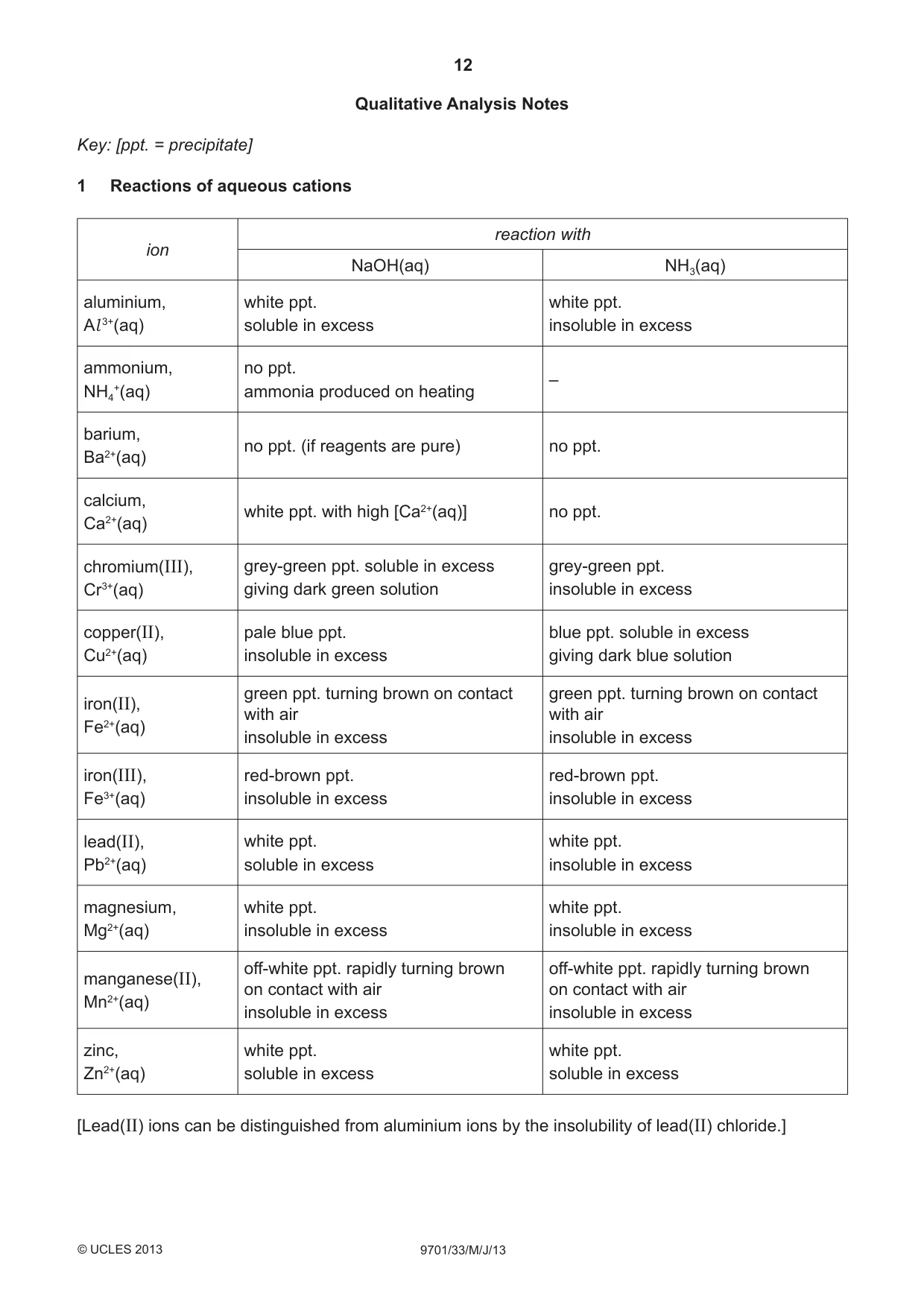
12 9701/33/M/J/13 © UCLES 2013 Qualitative Analysis Notes Key: [ppt. = precipitate] 1 Reactions of aqueous cations ion reaction with NaOH(aq) NH3(aq) aluminium, Al 3+(aq) white ppt. soluble in excess white ppt. insoluble in excess ammonium, NH4 +(aq) no ppt. ammonia produced on heating – barium, Ba2+(aq) no ppt. (if reagents are pure) no ppt. calcium, Ca2+(aq) white ppt. with high [Ca2+(aq)] no ppt. chromium(III), Cr3+(aq) grey-green ppt. soluble in excess giving dark green solution grey-green ppt. insoluble in excess copper(II), Cu2+(aq) pale blue ppt. insoluble in excess blue ppt. soluble in excess giving dark blue solution iron(II), Fe2+(aq) green ppt. turning brown on contact with air insoluble in excess green ppt. turning brown on contact with air insoluble in excess iron(III), Fe3+(aq) red-brown ppt. insoluble in excess red-brown ppt. insoluble in excess lead(II), Pb2+(aq) white ppt. soluble in excess white ppt. insoluble in excess magnesium, Mg2+(aq) white ppt. insoluble in excess white ppt. insoluble in excess manganese(II), Mn2+(aq) off-white ppt. rapidly turning brown on contact with air insoluble in excess off-white ppt. rapidly turning brown on contact with air insoluble in excess zinc, Zn2+(aq) white ppt. soluble in excess white ppt. soluble in excess [Lead(II) ions can be distinguished from aluminium ions by the insolubility of lead(II) chloride.]
Question paper, page 13
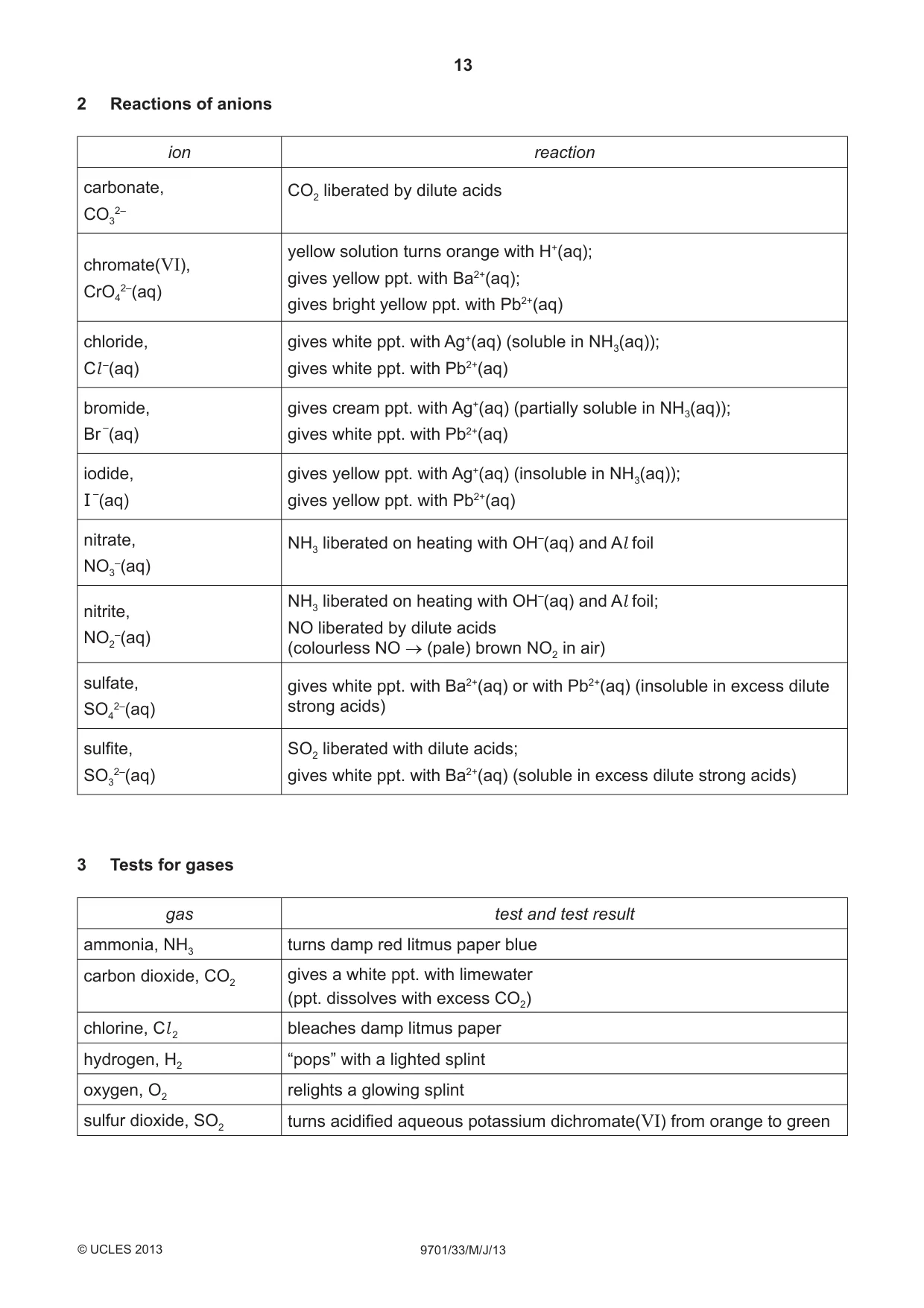
13 9701/33/M/J/13 © UCLES 2013 2 Reactions of anions ion reaction carbonate, CO3 2– CO2 liberated by dilute acids chromate(VI), CrO4 2–(aq) yellow solution turns orange with H+(aq); gives yellow ppt. with Ba2+(aq); gives bright yellow ppt. with Pb2+(aq) chloride, Cl –(aq) gives white ppt. with Ag+(aq) (soluble in NH3(aq)); gives white ppt. with Pb2+(aq) bromide, Br –(aq) gives cream ppt. with Ag+(aq) (partially soluble in NH3(aq)); gives white ppt. with Pb2+(aq) iodide, I –(aq) gives yellow ppt. with Ag+(aq) (insoluble in NH3(aq)); gives yellow ppt. with Pb2+(aq) nitrate, NO3 –(aq) NH3 liberated on heating with OH–(aq) and Al foil nitrite, NO2 –(aq) NH3 liberated on heating with OH–(aq) and Al foil; NO liberated by dilute acids (colourless NO → (pale) brown NO2 in air) sulfate, SO4 2–(aq) gives white ppt. with Ba2+(aq) or with Pb2+(aq) (insoluble in excess dilute strong acids) sulfi te, SO3 2–(aq) SO2 liberated with dilute acids; gives white ppt. with Ba2+(aq) (soluble in excess dilute strong acids) 3 Tests for gases gas test and test result ammonia, NH3 turns damp red litmus paper blue carbon dioxide, CO2 gives a white ppt. with limewater (ppt. dissolves with excess CO2) chlorine, Cl 2 bleaches damp litmus paper hydrogen, H2 “pops” with a lighted splint oxygen, O2 relights a glowing splint sulfur dioxide, SO2 turns acidifi ed aqueous potassium dichromate(VI) from orange to green
Question paper, page 14
14 9701/33/M/J/13 BLANK PAGE © UCLES 2013
Question paper, page 15
15 9701/33/M/J/13 BLANK PAGE © UCLES 2013
Question paper, page 16
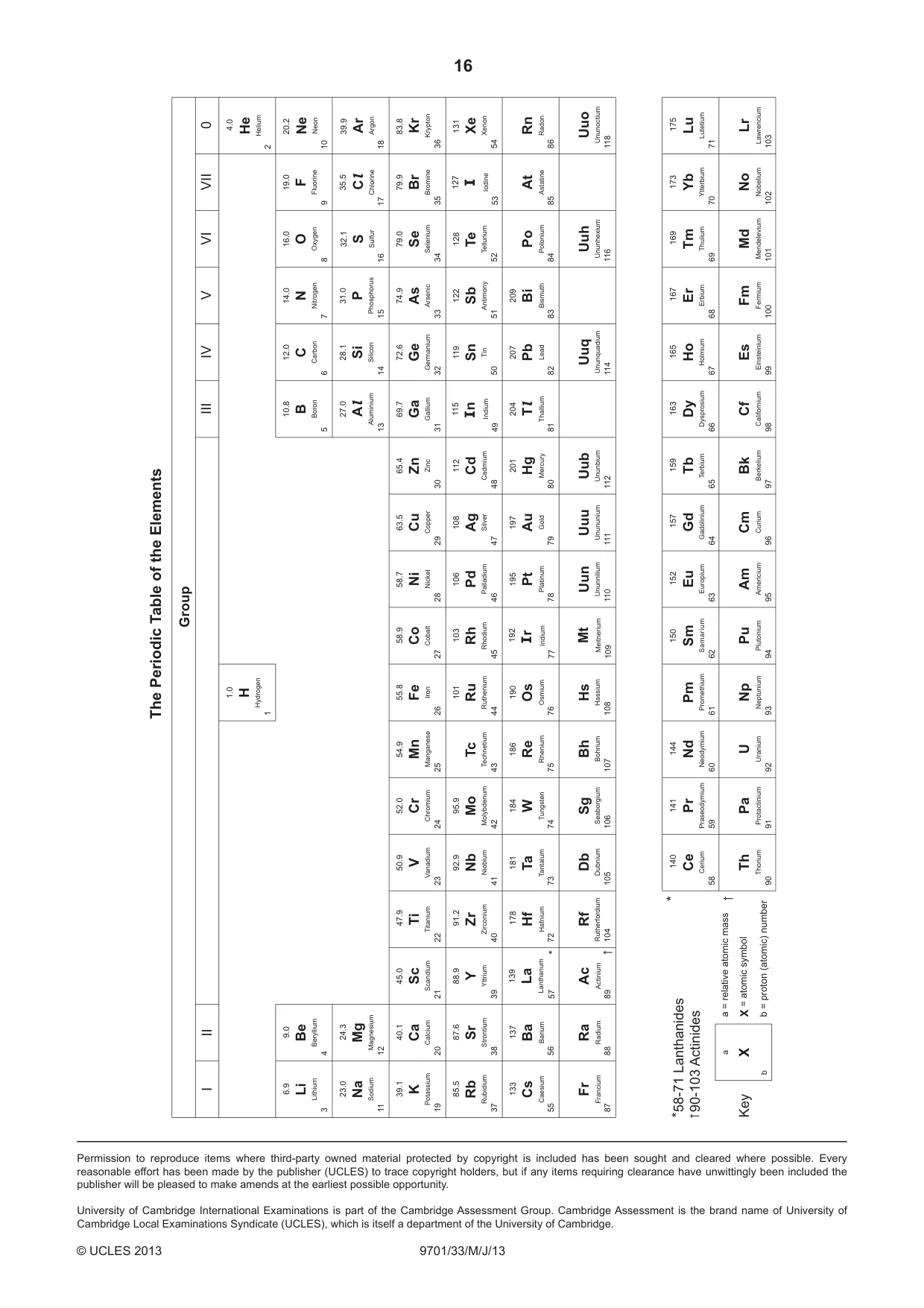
16 Permission to reproduce items where third-party owned material protected by copyright is included has been sought and cleared where possible. Every reasonable effort has been made by the publisher (UCLES) to trace copyright holders, but if any items requiring clearance have unwittingly been included the publisher will be pleased to make amends at the earliest possible opportunity. University of Cambridge International Examinations is part of the Cambridge Assessment Group. Cambridge Assessment is the brand name of University of Cambridge Local Examinations Syndicate (UCLES), which is itself a department of the University of Cambridge. 9701/33/M/J/13 © UCLES 2013 Group 140 Ce Cerium 58 141 Pr Praseodymium 59 144 Nd Neodymium 60 Pm Promethium 61 150 Sm Samarium 62 152 Eu Europium 63 157 Gd Gadolinium 64 159 Tb Terbium 65 163 Dy Dysprosium 66 165 Ho Holmium 67 167 Er Erbium 68 169 Tm Thulium 69 173 Yb Ytterbium 70 175 Lu Lutetium 71 Th Thorium 90 Pa Protactinium 91 U Uranium 92 Np Neptunium 93 Pu Plutonium 94 Am Americium 95 Cm Curium 96 Bk Berkelium 97 Cf Californium 98 Es Einsteinium 99 Fm Fermium 100 Md Mendelevium 101 No Nobelium 102 Lr Lawrencium 103 1.0 H Hydrogen 1 6.9 Li Lithium 3 23.0 Na Sodium 11 24.3 Mg Magnesium 12 40.1 Ca Calcium 20 45.0 Sc Scandium 21 47.9 Ti Titanium 22 50.9 V Vanadium 23 52.0 Cr Chromium 24 54.9 Mn Manganese 25 55.8 Fe Iron 26 58.9 Co Cobalt 27 58.7 Ni Nickel 28 63.5 Cu Copper 29 65.4 Zn Zinc 30 69.7 Ga Gallium 31 27.0 Al Aluminium 13 10.8 B Boron 5 12.0 C Carbon 6 14.0 N Nitrogen 7 16.0 O Oxygen 8 19.0 F Fluorine 9 28.1 Si Silicon 14 31.0 P Phosphorus 15 32.1 S Sulfur 16 35.5 Cl Chlorine 17 39.9 Ar Argon 18 20.2 Ne Neon 10 4.0 He Helium 2 72.6 Ge Germanium 32 74.9 As Arsenic 33 79.0 Se Selenium 34 79.9 Br Bromine 35 83.8 Kr Krypton 36 39.1 K Potassium 19 87.6 Sr Strontium 38 88.9 Y Yttrium 39 91.2 Zr Zirconium 40 92.9 Nb Niobium 41 95.9 Mo Molybdenum 42 Tc Technetium 43 101 Ru Ruthenium 44 103 Rh Rhodium 45 106 Pd Palladium 46 108 Ag Silver 47 112 Cd Cadmium 48 115 In Indium 49 119 Sn Tin 50 122 Sb Antimony 51 128 Te Tellurium 52 127 I Iodine 53 131 Xe Xenon 54 137 Ba Barium 56 139 La Lanthanum 57 * 178 Hf Hafnium 72 181 Ta Tantalum 73 184 W Tungsten 74 186 Re Rhenium 75 190 Os Osmium 76 192 Ir Iridium 77 195 Pt Platinum 78 197 Au Gold 79 201 Hg Mercury 80 204 Tl Thallium 81 207 Pb Lead 82 209 Bi Bismuth 83 Po Polonium 84 At Astatine 85 Rn Radon 86 Rf Rutherfordium 104 Db Dubnium 105 Sg Seaborgium 106 Bh Bohrium 107 Hs Hassium 108 Mt Meitnerium 109 Uun Ununnilium 110 Uuu Unununium 111 Uub Ununbium 112 Uuq Ununquadium 114 Uuh Ununhexium 116 Uuo Ununoctium 118 Fr Francium 87 Ac Actinium 89 9.0 Be Beryllium 4 I II III IV V VI VII 0 85.5 Rb Rubidium 37 133 Cs Caesium 55 Ra Radium 88 a X b a = relative atomic mass X = atomic symbol b = proton (atomic) number Key *58-71 Lanthanides 90-103 Actinides The Periodic Table of the Elements *
Mark scheme, page 1
CAMBRIDGE INTERNATIONAL EXAMINATIONS GCE Advanced Subsidiary Level and GCE Advanced Level MARK SCHEME for the May/June 2013 series 9701 CHEMISTRY 9701/33 Paper 33 (Advanced Practical Skills), maximum raw mark 40 This mark scheme is published as an aid to teachers and candidates, to indicate the requirements of the examination. It shows the basis on which Examiners were instructed to award marks. It does not indicate the details of the discussions that took place at an Examiners’ meeting before marking began, which would have considered the acceptability of alternative answers. Mark schemes should be read in conjunction with the question paper and the Principal Examiner Report for Teachers. Cambridge will not enter into discussions about these mark schemes. Cambridge is publishing the mark schemes for the May/June 2013 series for most IGCSE, GCE Advanced Level and Advanced Subsidiary Level components and some Ordinary Level components.
Mark scheme, page 2
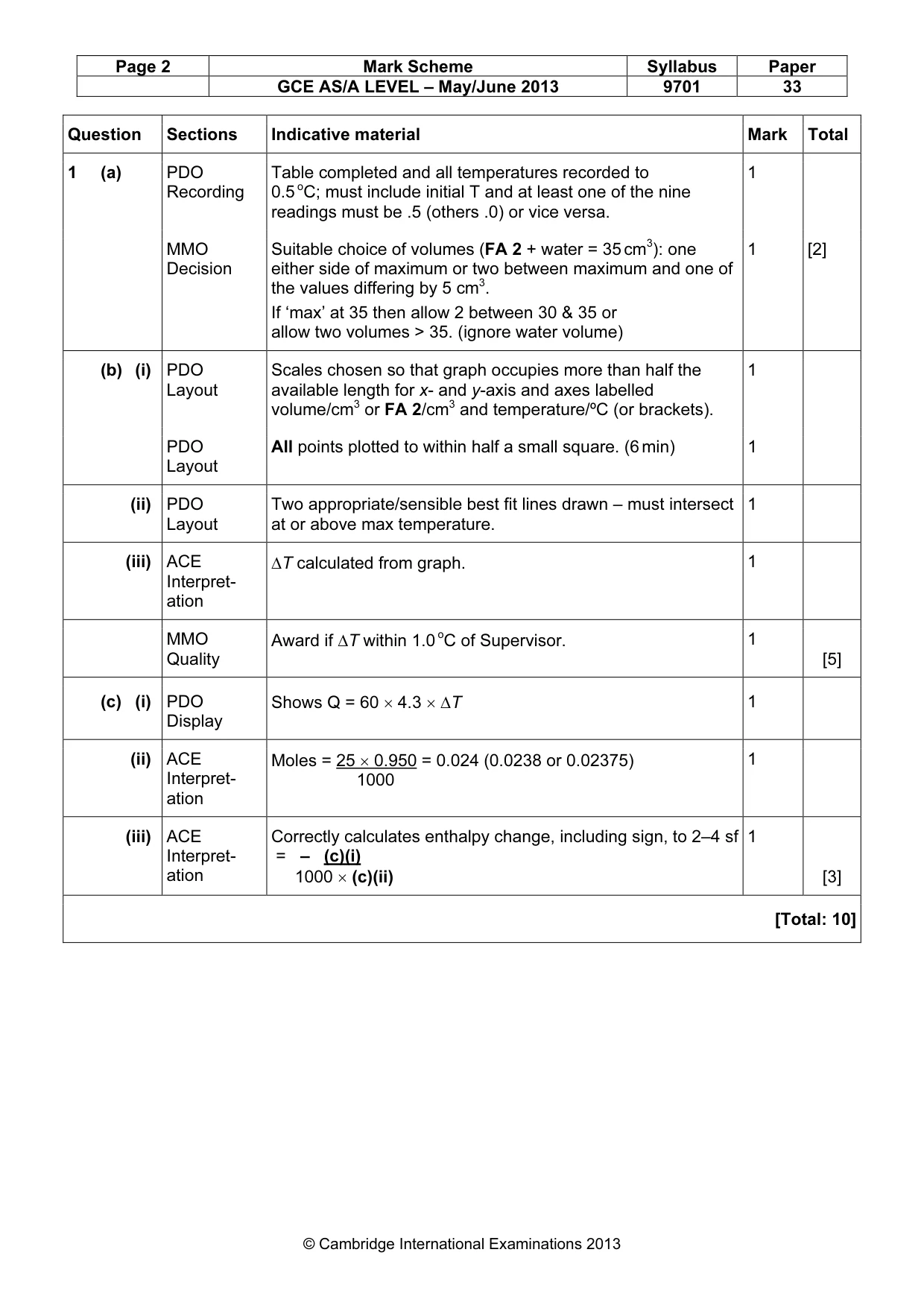
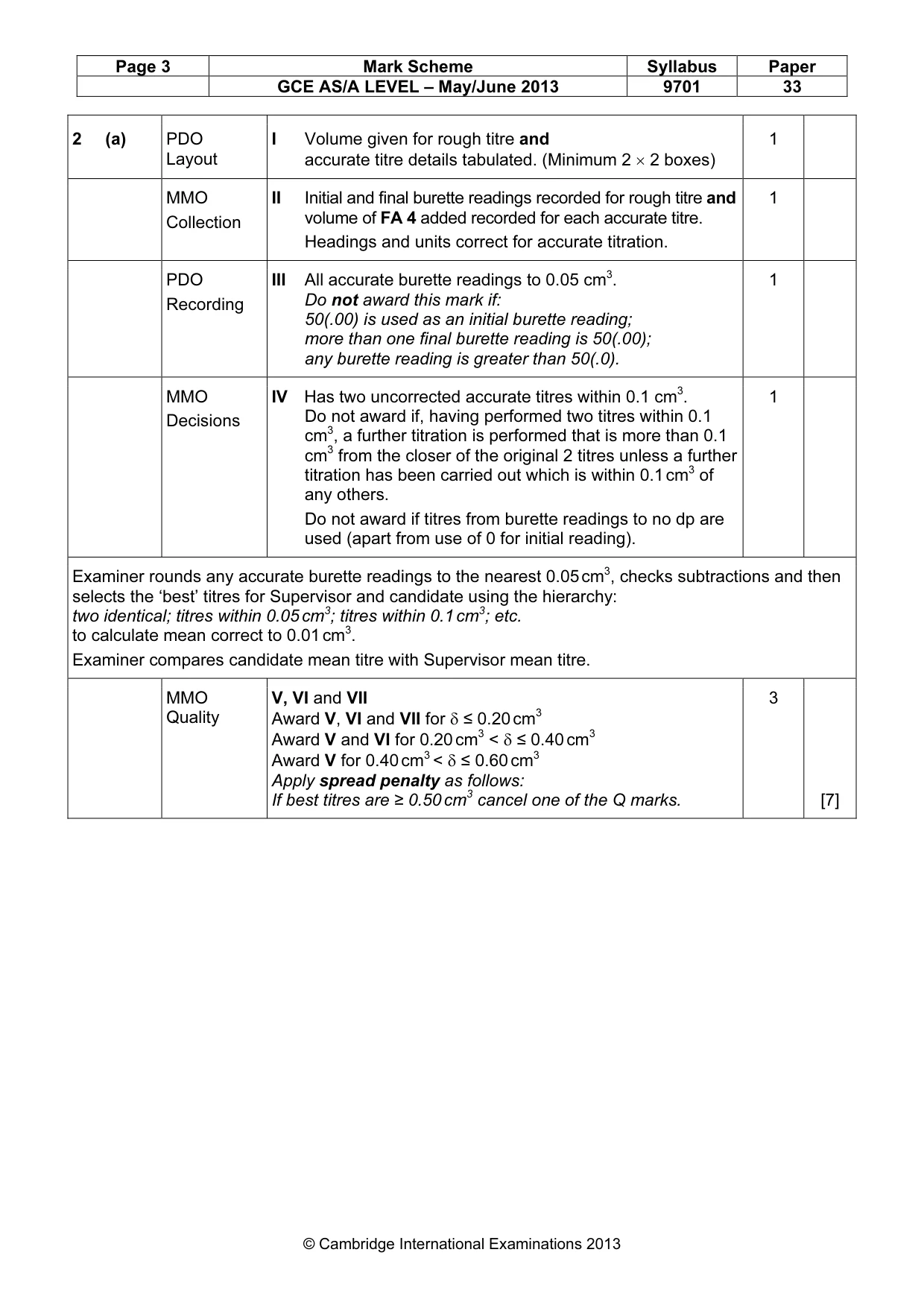
Page 2 Mark Scheme Syllabus Paper GCE AS/A LEVEL – May/June 2013 9701 33 © Cambridge International Examinations 2013 Question Sections Indicative material Mark Total 1 (a) PDO Recording Table completed and all temperatures recorded to 0.5 oC; must include initial T and at least one of the nine readings must be .5 (others .0) or vice versa. 1 MMO Decision Suitable choice of volumes (FA 2 + water = 35 cm3): one either side of maximum or two between maximum and one of the values differing by 5 cm3. If ‘max’ at 35 then allow 2 between 30 & 35 or allow two volumes > 35. (ignore water volume) 1 [2] (b) (i) PDO Layout Scales chosen so that graph occupies more than half the available length for x- and y-axis and axes labelled volume/cm3 or FA 2/cm3 and temperature/ºC (or brackets). 1 PDO Layout All points plotted to within half a small square. (6 min) 1 (ii) PDO Layout Two appropriate/sensible best fit lines drawn – must intersect at or above max temperature. 1 (iii) ACE Interpret- ation ∆T calculated from graph. 1 MMO Quality Award if ∆T within 1.0 oC of Supervisor. 1 [5] (c) (i) PDO Display Shows Q = 60 × 4.3 × ∆T 1 (ii) ACE Interpret- ation Moles = 25 × 0.950 = 0.024 (0.0238 or 0.02375) 1000 1 (iii) ACE Interpret- ation Correctly calculates enthalpy change, including sign, to 2–4 sf = – (c)(i) 1000 × (c)(ii) 1 [3] [Total: 10]
Mark scheme, page 3
Page 3 Mark Scheme Syllabus Paper GCE AS/A LEVEL – May/June 2013 9701 33 © Cambridge International Examinations 2013 2 (a) PDO Layout I Volume given for rough titre and accurate titre details tabulated. (Minimum 2 × 2 boxes) 1 MMO Collection II Initial and final burette readings recorded for rough titre and volume of FA 4 added recorded for each accurate titre. Headings and units correct for accurate titration. 1 PDO Recording III All accurate burette readings to 0.05 cm3. Do not award this mark if: 50(.00) is used as an initial burette reading; more than one final burette reading is 50(.00); any burette reading is greater than 50(.0). 1 MMO Decisions IV Has two uncorrected accurate titres within 0.1 cm3. Do not award if, having performed two titres within 0.1 cm3, a further titration is performed that is more than 0.1 cm3 from the closer of the original 2 titres unless a further titration has been carried out which is within 0.1 cm3 of any others. Do not award if titres from burette readings to no dp are used (apart from use of 0 for initial reading). 1 Examiner rounds any accurate burette readings to the nearest 0.05 cm3, checks subtractions and then selects the ‘best’ titres for Supervisor and candidate using the hierarchy: two identical; titres within 0.05 cm3; titres within 0.1 cm3; etc. to calculate mean correct to 0.01 cm3. Examiner compares candidate mean titre with Supervisor mean titre. MMO Quality V, VI and VII Award V, VI and VII for δ ≤ 0.20 cm3 Award V and VI for 0.20 cm3 < δ ≤ 0.40 cm3 Award V for 0.40 cm3 < δ ≤ 0.60 cm3 Apply spread penalty as follows: If best titres are ≥ 0.50 cm3 cancel one of the Q marks. 3 [7]
Mark scheme, page 4
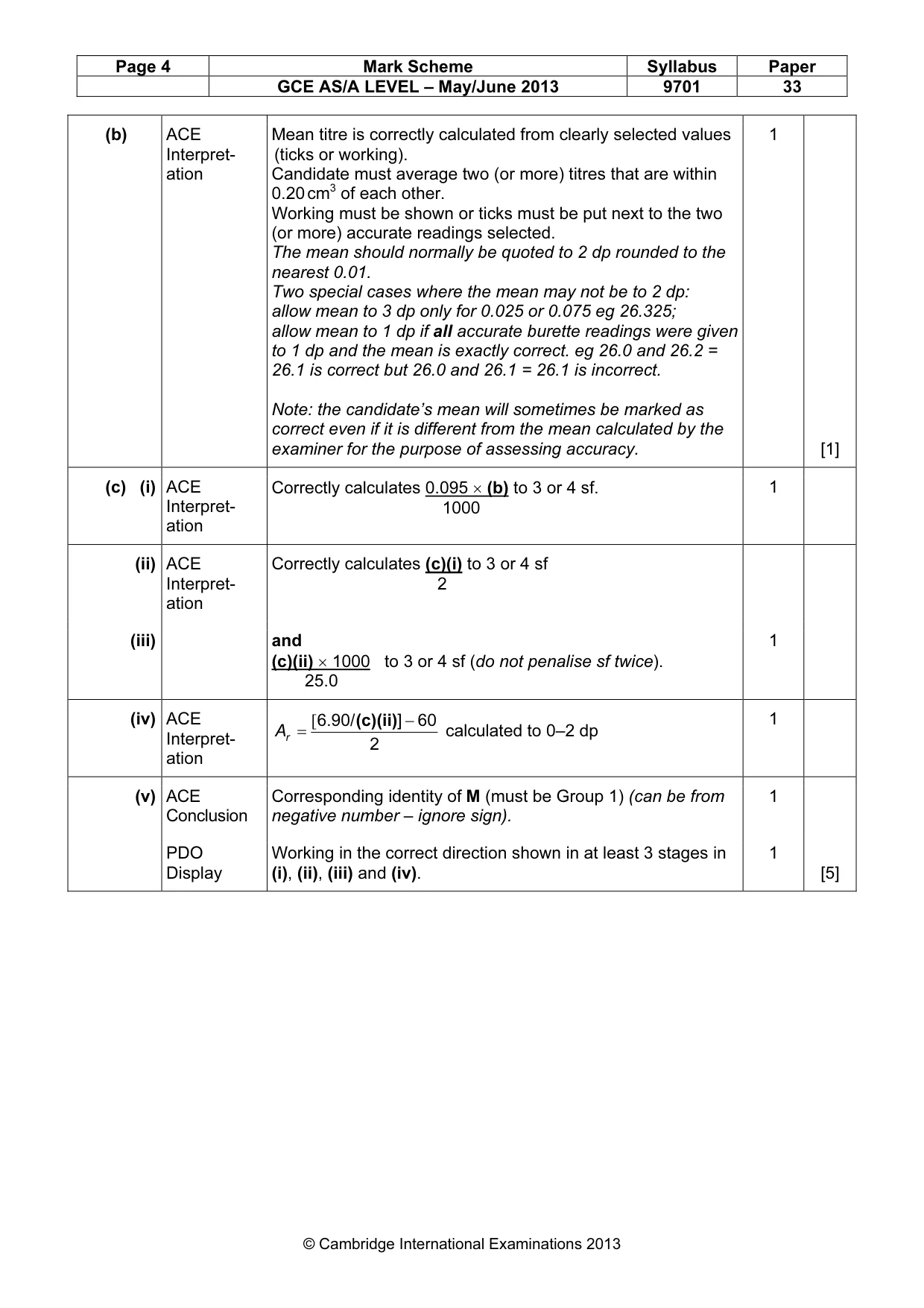
Page 4 Mark Scheme Syllabus Paper GCE AS/A LEVEL – May/June 2013 9701 33 © Cambridge International Examinations 2013 (b) ACE Interpret- ation Mean titre is correctly calculated from clearly selected values (ticks or working). Candidate must average two (or more) titres that are within 0.20 cm3 of each other. Working must be shown or ticks must be put next to the two (or more) accurate readings selected. The mean should normally be quoted to 2 dp rounded to the nearest 0.01. Two special cases where the mean may not be to 2 dp: allow mean to 3 dp only for 0.025 or 0.075 eg 26.325; allow mean to 1 dp if all accurate burette readings were given to 1 dp and the mean is exactly correct. eg 26.0 and 26.2 = 26.1 is correct but 26.0 and 26.1 = 26.1 is incorrect. Note: the candidate’s mean will sometimes be marked as correct even if it is different from the mean calculated by the examiner for the purpose of assessing accuracy. 1 [1] (c) (i) ACE Interpret- ation Correctly calculates 0.095 × (b) to 3 or 4 sf. 1000 1 (ii) ACE Interpret- ation Correctly calculates (c)(i) to 3 or 4 sf 2 (iii) and (c)(ii) × 1000 to 3 or 4 sf (do not penalise sf twice). 25.0 1 (iv) ACE Interpret- ation 2 60 ] 6.90/ − = (c)(ii) [ r A calculated to 0–2 dp 1 (v) ACE Conclusion Corresponding identity of M (must be Group 1) (can be from negative number – ignore sign). 1 PDO Display Working in the correct direction shown in at least 3 stages in (i), (ii), (iii) and (iv). 1 [5]
Mark scheme, page 5
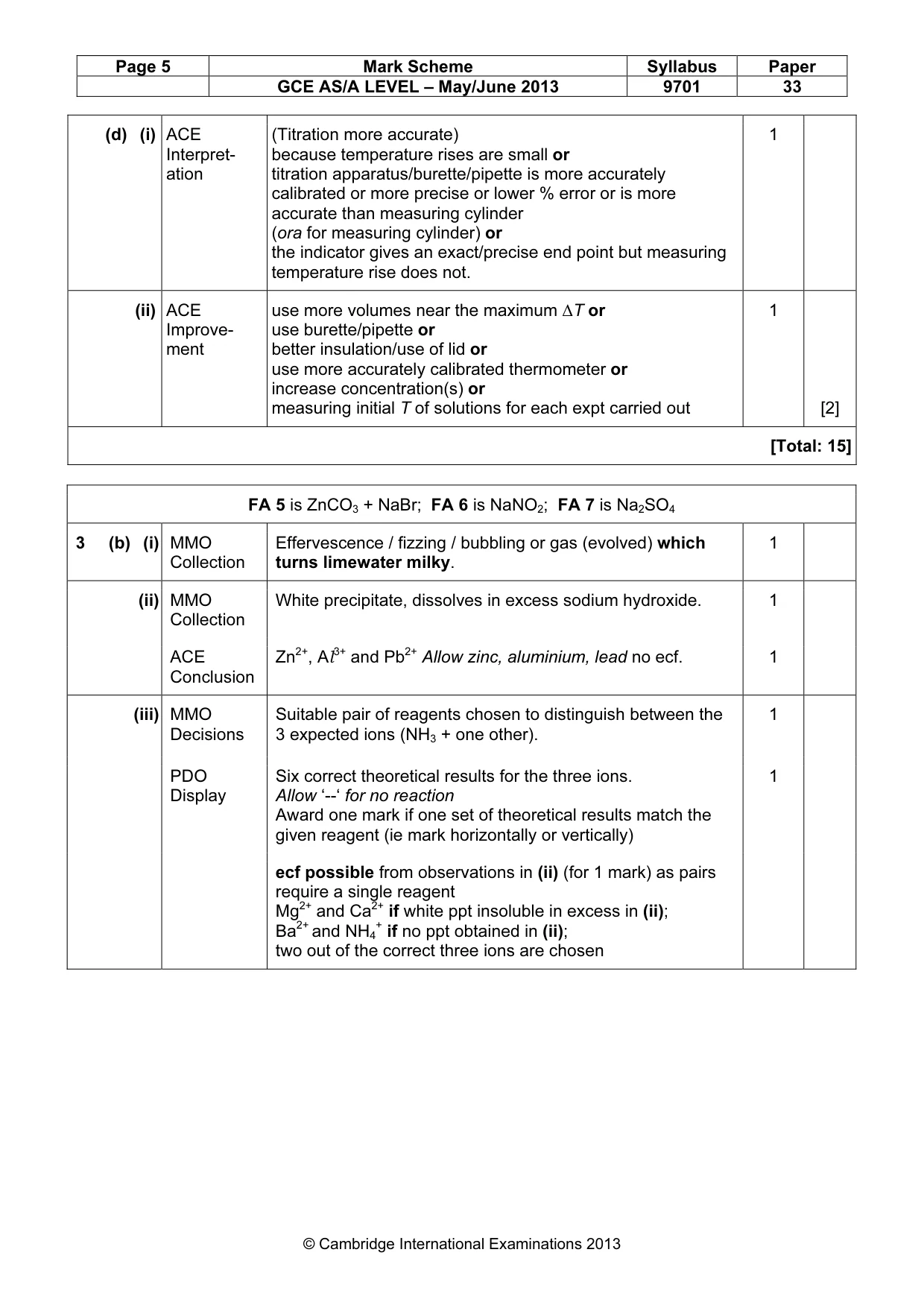
Page 5 Mark Scheme Syllabus Paper GCE AS/A LEVEL – May/June 2013 9701 33 © Cambridge International Examinations 2013 (d) (i) ACE Interpret- ation (Titration more accurate) because temperature rises are small or titration apparatus/burette/pipette is more accurately calibrated or more precise or lower % error or is more accurate than measuring cylinder (ora for measuring cylinder) or the indicator gives an exact/precise end point but measuring temperature rise does not. 1 (ii) ACE Improve- ment use more volumes near the maximum ∆T or use burette/pipette or better insulation/use of lid or use more accurately calibrated thermometer or increase concentration(s) or measuring initial T of solutions for each expt carried out 1 [2] [Total: 15] FA 5 is ZnCO3 + NaBr; FA 6 is NaNO2; FA 7 is Na2SO4 3 (b) (i) MMO Collection Effervescence / fizzing / bubbling or gas (evolved) which turns limewater milky. 1 (ii) MMO Collection White precipitate, dissolves in excess sodium hydroxide. 1 ACE Conclusion Zn2+, Al3+ and Pb2+ Allow zinc, aluminium, lead no ecf. 1 (iii) MMO Decisions Suitable pair of reagents chosen to distinguish between the 3 expected ions (NH3 + one other). 1 PDO Display Six correct theoretical results for the three ions. Allow ‘--‘ for no reaction Award one mark if one set of theoretical results match the given reagent (ie mark horizontally or vertically) 1 ecf possible from observations in (ii) (for 1 mark) as pairs require a single reagent Mg2+ and Ca2+ if white ppt insoluble in excess in (ii); Ba2+ and NH4 + if no ppt obtained in (ii); two out of the correct three ions are chosen
Mark scheme, page 6
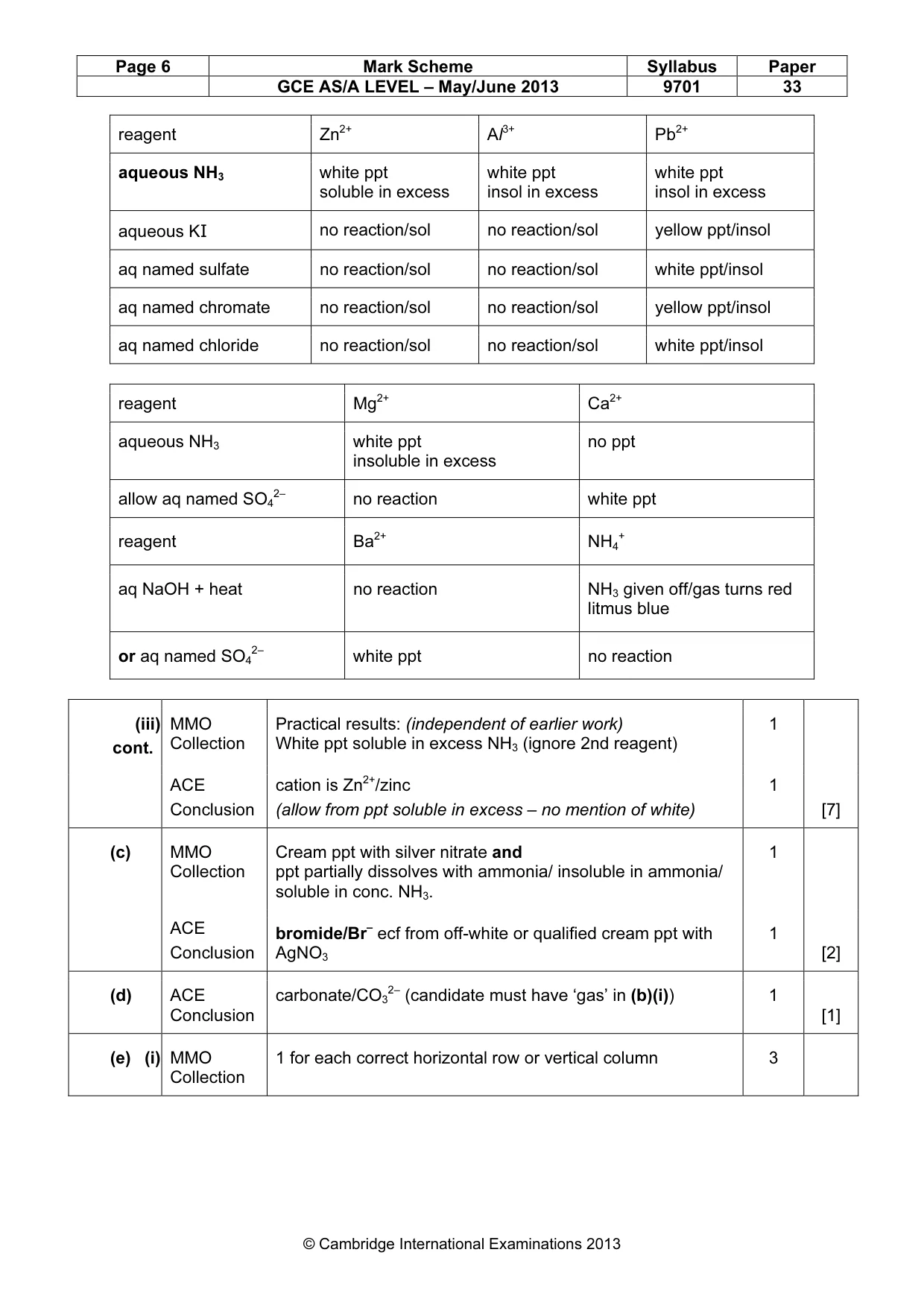
Page 6 Mark Scheme Syllabus Paper GCE AS/A LEVEL – May/June 2013 9701 33 © Cambridge International Examinations 2013 reagent Zn2+ Al3+ Pb2+ aqueous NH3 white ppt soluble in excess white ppt insol in excess white ppt insol in excess aqueous KI no reaction/sol no reaction/sol yellow ppt/insol aq named sulfate no reaction/sol no reaction/sol white ppt/insol aq named chromate no reaction/sol no reaction/sol yellow ppt/insol aq named chloride no reaction/sol no reaction/sol white ppt/insol reagent Mg2+ Ca2+ aqueous NH3 white ppt insoluble in excess no ppt allow aq named SO4 2– no reaction white ppt reagent Ba2+ NH4 + aq NaOH + heat no reaction NH3 given off/gas turns red litmus blue or aq named SO4 2– white ppt no reaction (iii) cont. MMO Collection Practical results: (independent of earlier work) White ppt soluble in excess NH3 (ignore 2nd reagent) 1 ACE Conclusion cation is Zn2+/zinc (allow from ppt soluble in excess – no mention of white) 1 [7] (c) MMO Collection Cream ppt with silver nitrate and ppt partially dissolves with ammonia/ insoluble in ammonia/ soluble in conc. NH3. 1 ACE Conclusion bromide/Br– ecf from off-white or qualified cream ppt with AgNO3 1 [2] (d) ACE Conclusion carbonate/CO3 2– (candidate must have ‘gas’ in (b)(i)) 1 [1] (e) (i) MMO Collection 1 for each correct horizontal row or vertical column 3
Mark scheme, page 7
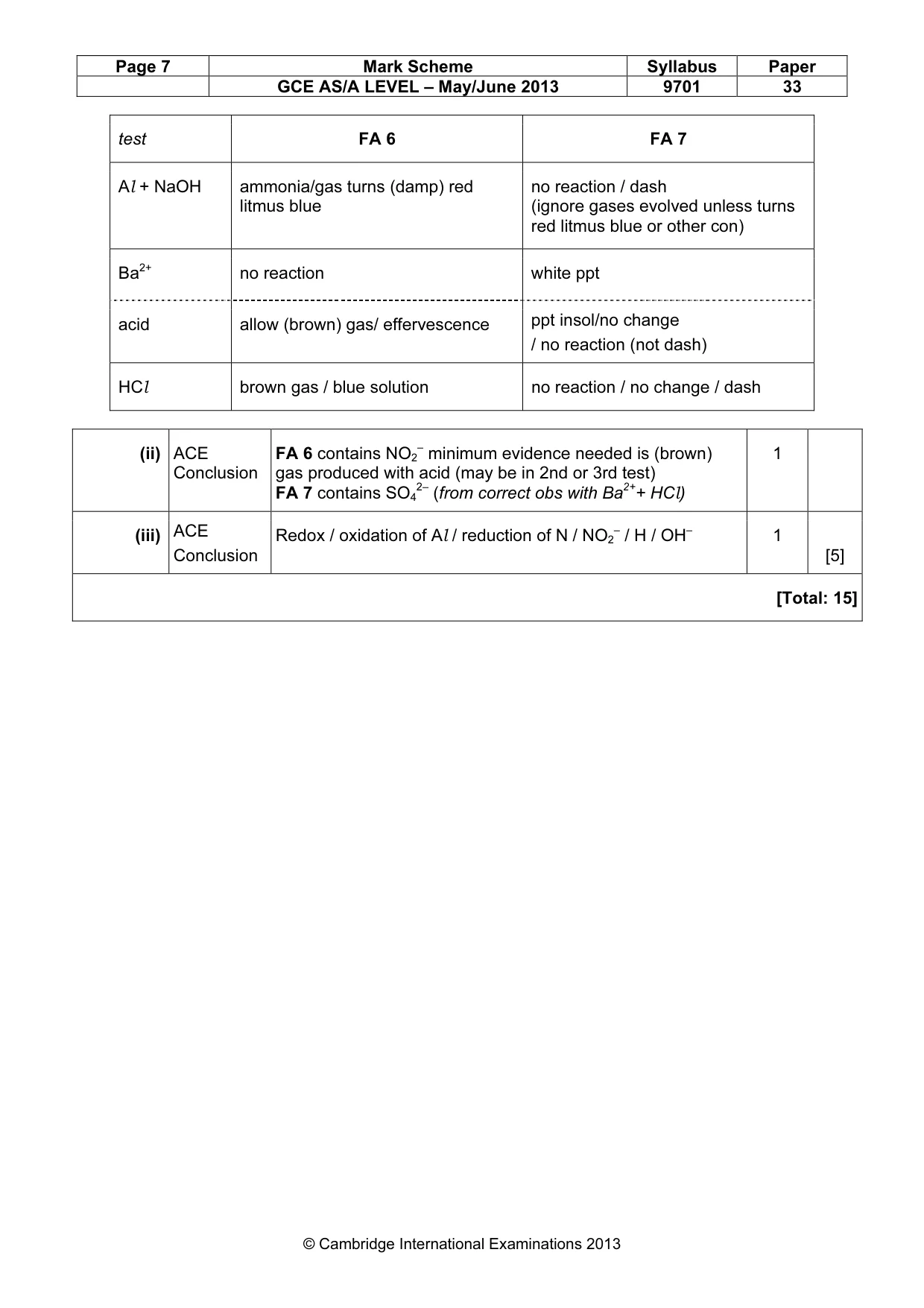
Page 7 Mark Scheme Syllabus Paper GCE AS/A LEVEL – May/June 2013 9701 33 © Cambridge International Examinations 2013 test FA 6 FA 7 Al + NaOH ammonia/gas turns (damp) red litmus blue no reaction / dash (ignore gases evolved unless turns red litmus blue or other con) Ba2+ no reaction white ppt acid allow (brown) gas/ effervescence ppt insol/no change / no reaction (not dash) HCl brown gas / blue solution no reaction / no change / dash (ii) ACE Conclusion FA 6 contains NO2 – minimum evidence needed is (brown) gas produced with acid (may be in 2nd or 3rd test) FA 7 contains SO4 2– (from correct obs with Ba2++ HCl) 1 (iii) ACE Conclusion Redox / oxidation of Al / reduction of N / NO2 – / H / OH– 1 [5] [Total: 15]
What you needed in this session
Cambridge’s own grade thresholds for 2013 May/June, Paper 3 · Variant 3. A higher threshold means an easier paper — the bar moves with how the cohort did.