Cambridge A Level Chemistry 9701 — 2008 Oct/Nov Paper 3 · Variant 1
9701/31/O/N/08 · 40 marks · ≈45 min
The question paper and its mark scheme, free to read here and free to download. This is Cambridge’s own paper, exactly as it was sat.
Question paper12 pages

Mark scheme12 pages
Answers below. Sit the paper first if you are practising.
Paper as text
Question paper, page 1
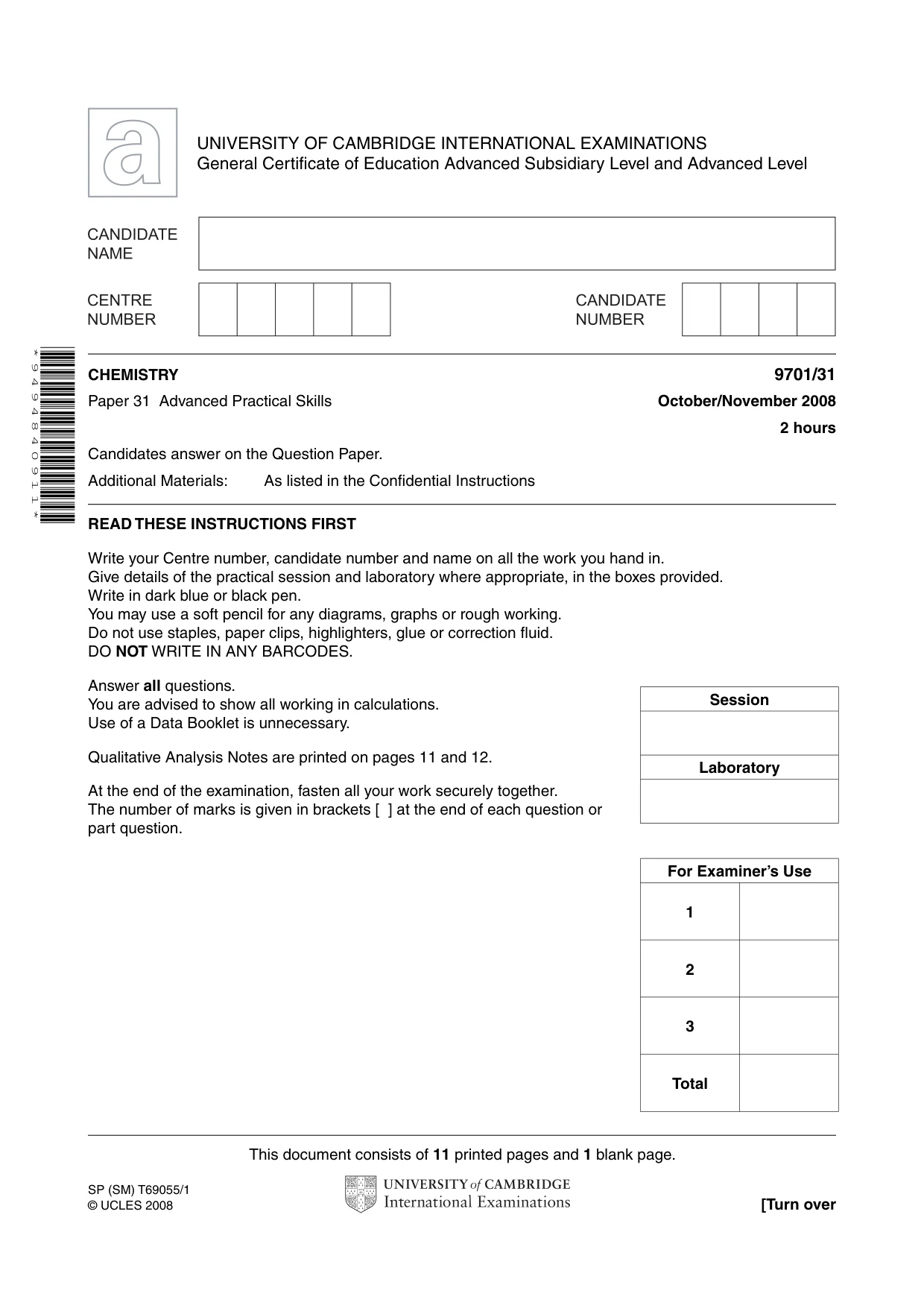
This document consists of 11 printed pages and 1 blank page. SP (SM) T69055/1 © UCLES 2008 [Turn over UNIVERSITY OF CAMBRIDGE INTERNATIONAL EXAMINATIONS General Certificate of Education Advanced Subsidiary Level and Advanced Level READ THESE INSTRUCTIONS FIRST Write your Centre number, candidate number and name on all the work you hand in. Give details of the practical session and laboratory where appropriate, in the boxes provided. Write in dark blue or black pen. You may use a soft pencil for any diagrams, graphs or rough working. Do not use staples, paper clips, highlighters, glue or correction fluid. DO NOT WRITE IN ANY BARCODES. Answer all questions. You are advised to show all working in calculations. Use of a Data Booklet is unnecessary. Qualitative Analysis Notes are printed on pages 11 and 12. At the end of the examination, fasten all your work securely together. The number of marks is given in brackets [ ] at the end of each question or part question. * 9 4 9 4 8 4 0 9 1 1 * CHEMISTRY 9701/31 Paper 31 Advanced Practical Skills October/November 2008 2 hours Candidates answer on the Question Paper. Additional Materials: As listed in the Confidential Instructions For Examiner’s Use 1 2 3 Total Session Laboratory
Question paper, page 2
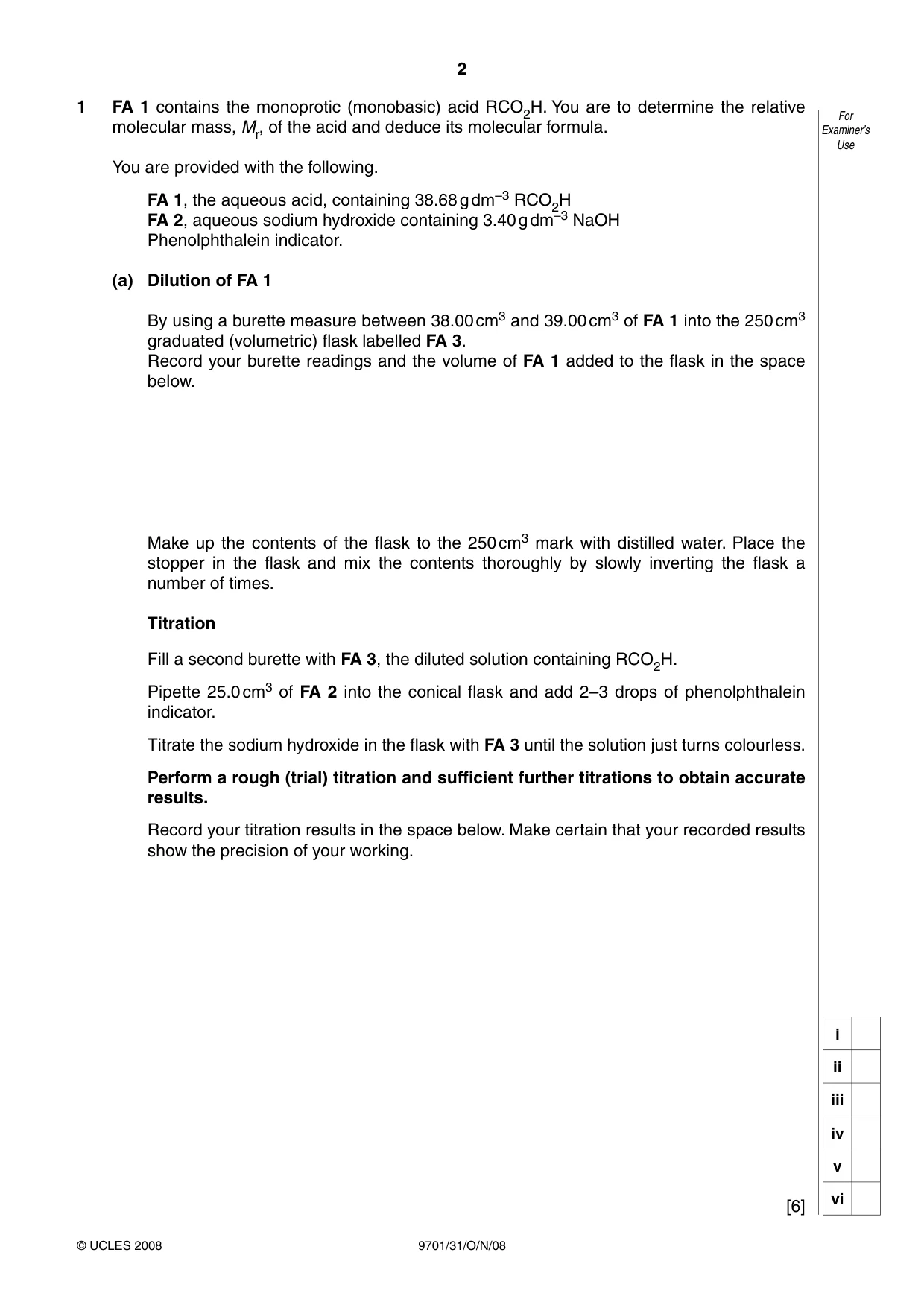
2 9701/31/O/N/08 © UCLES 2008 For Examiner’s Use 1 FA 1 contains the monoprotic (monobasic) acid RCO2H. You are to determine the relative molecular mass, Mr, of the acid and deduce its molecular formula. You are provided with the following. FA 1, the aqueous acid, containing 38.68 g dm–3 RCO2H FA 2, aqueous sodium hydroxide containing 3.40 g dm–3 NaOH Phenolphthalein indicator. (a) Dilution of FA 1 By using a burette measure between 38.00 cm3 and 39.00 cm3 of FA 1 into the 250 cm3 graduated (volumetric) flask labelled FA 3. Record your burette readings and the volume of FA 1 added to the flask in the space below. Make up the contents of the flask to the 250 cm3 mark with distilled water. Place the stopper in the flask and mix the contents thoroughly by slowly inverting the flask a number of times. Titration Fill a second burette with FA 3, the diluted solution containing RCO2H. Pipette 25.0 cm3 of FA 2 into the conical flask and add 2–3 drops of phenolphthalein indicator. Titrate the sodium hydroxide in the flask with FA 3 until the solution just turns colourless. Perform a rough (trial) titration and sufficient further titrations to obtain accurate results. Record your titration results in the space below. Make certain that your recorded results show the precision of your working. [6] i ii iii iv v vi
Question paper, page 3
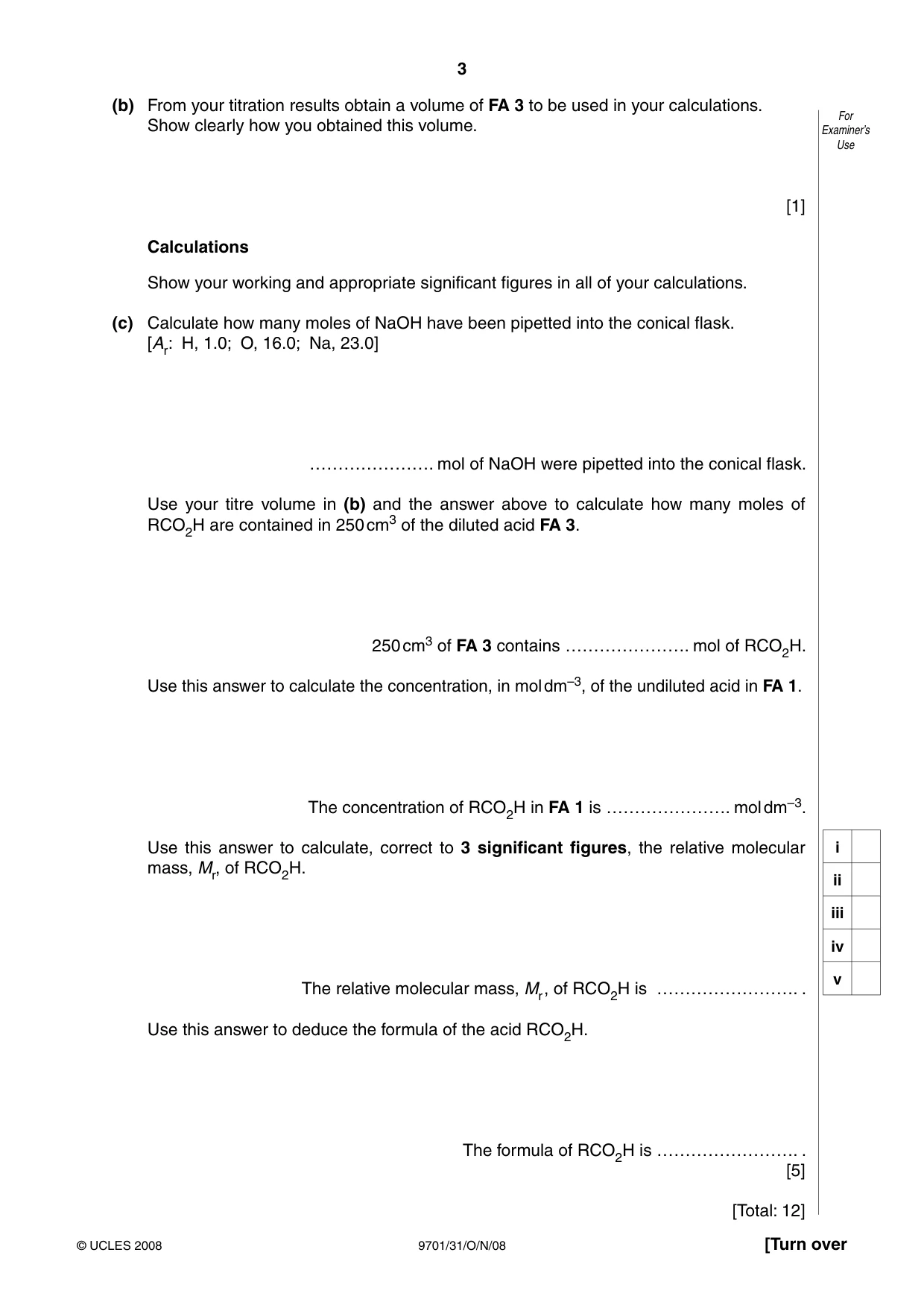
3 9701/31/O/N/08 [Turn over © UCLES 2008 For Examiner’s Use (b) From your titration results obtain a volume of FA 3 to be used in your calculations. Show clearly how you obtained this volume. [1] Calculations Show your working and appropriate significant figures in all of your calculations. (c) Calculate how many moles of NaOH have been pipetted into the conical flask. [Ar: H, 1.0; O, 16.0; Na, 23.0] …………………. mol of NaOH were pipetted into the conical flask. Use your titre volume in (b) and the answer above to calculate how many moles of RCO2H are contained in 250 cm3 of the diluted acid FA 3. 250 cm3 of FA 3 contains …………………. mol of RCO2H. Use this answer to calculate the concentration, in mol dm–3, of the undiluted acid in FA 1. The concentration of RCO2H in FA 1 is …………………. mol dm–3. Use this answer to calculate, correct to 3 significant figures, the relative molecular mass, Mr, of RCO2H. The relative molecular mass, Mr , of RCO2H is ……………………. . Use this answer to deduce the formula of the acid RCO2H. The formula of RCO2H is ……………………. . [5] [Total: 12] i ii iii iv v
Question paper, page 4
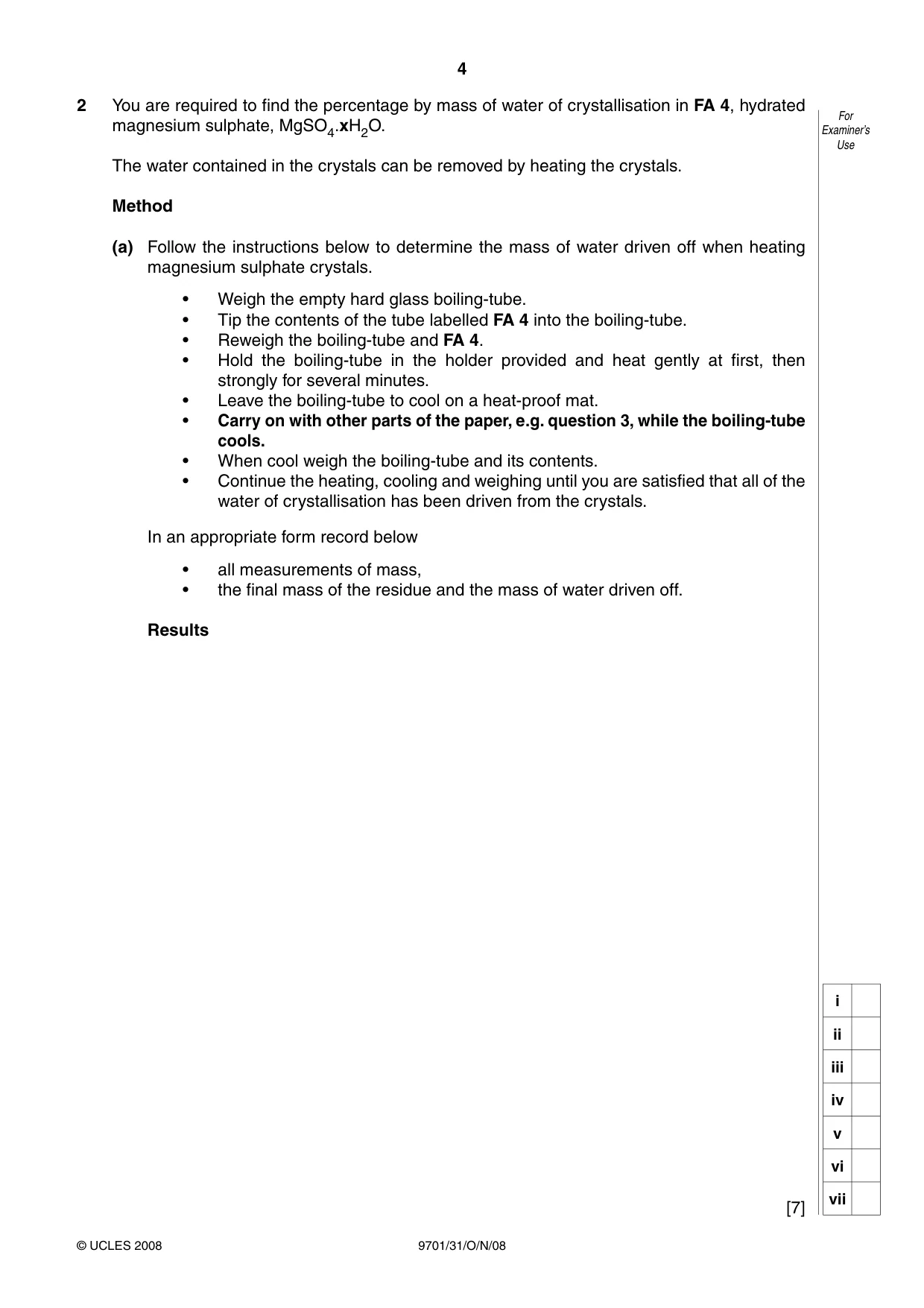
4 9701/31/O/N/08 © UCLES 2008 For Examiner’s Use 2 You are required to find the percentage by mass of water of crystallisation in FA 4, hydrated magnesium sulphate, MgSO4.xH2O. The water contained in the crystals can be removed by heating the crystals. Method (a) Follow the instructions below to determine the mass of water driven off when heating magnesium sulphate crystals. • Weigh the empty hard glass boiling-tube. • Tip the contents of the tube labelled FA 4 into the boiling-tube. • Reweigh the boiling-tube and FA 4. • Hold the boiling-tube in the holder provided and heat gently at first, then strongly for several minutes. • Leave the boiling-tube to cool on a heat-proof mat. • Carry on with other parts of the paper, e.g. question 3, while the boiling-tube cools. • When cool weigh the boiling-tube and its contents. • Continue the heating, cooling and weighing until you are satisfied that all of the water of crystallisation has been driven from the crystals. In an appropriate form record below • all measurements of mass, • the final mass of the residue and the mass of water driven off. Results [7] i ii iii iv v vi vii
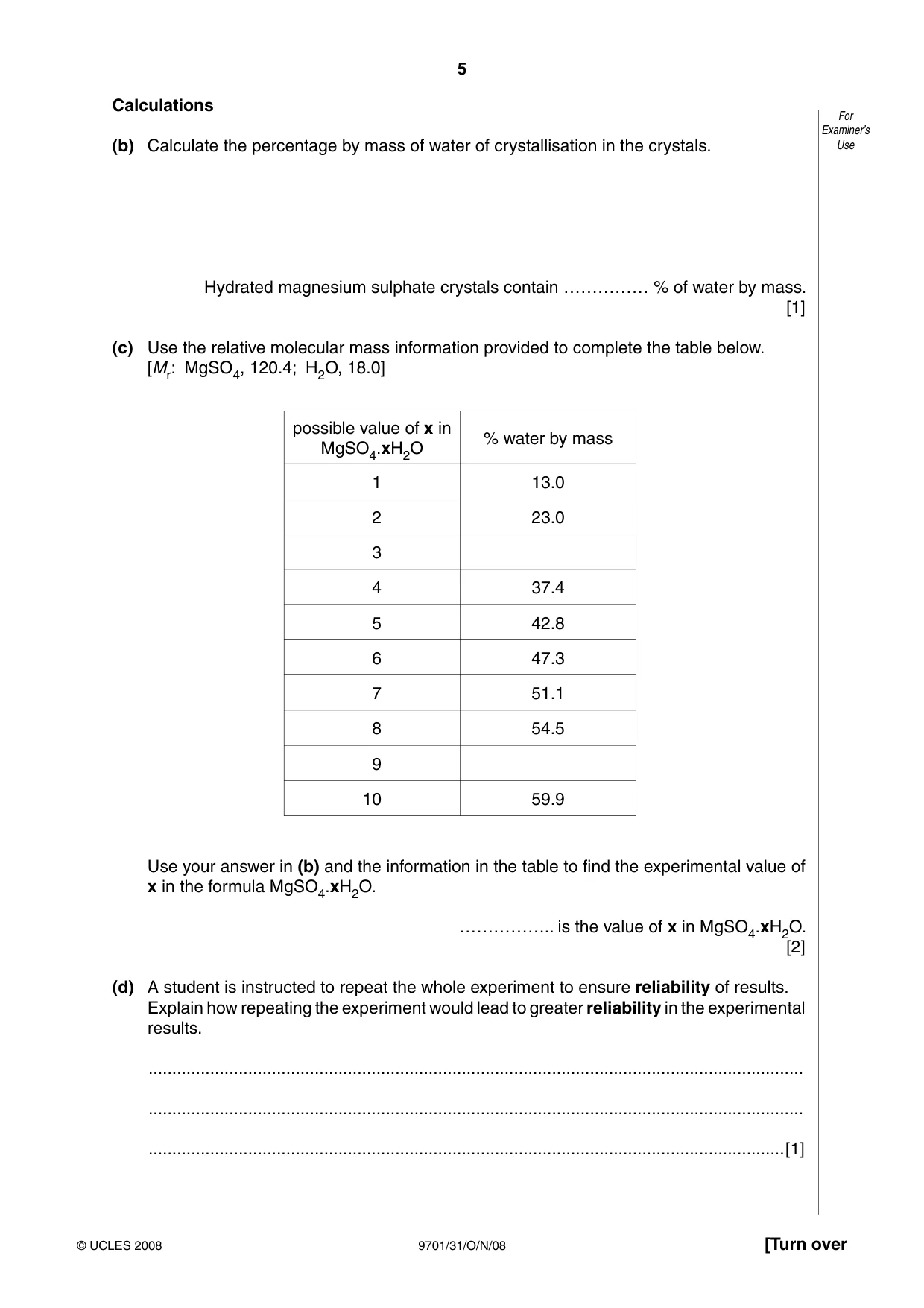
Question paper, page 5
5 9701/31/O/N/08 [Turn over © UCLES 2008 For Examiner’s Use Calculations (b) Calculate the percentage by mass of water of crystallisation in the crystals. Hydrated magnesium sulphate crystals contain …………… % of water by mass. [1] (c) Use the relative molecular mass information provided to complete the table below. [Mr: MgSO4, 120.4; H2O, 18.0] possible value of x in MgSO4.xH2O % water by mass 1 13.0 2 23.0 3 4 37.4 5 42.8 6 47.3 7 51.1 8 54.5 9 10 59.9 Use your answer in (b) and the information in the table to find the experimental value of x in the formula MgSO4.xH2O. …………….. is the value of x in MgSO4.xH2O. [2] (d) A student is instructed to repeat the whole experiment to ensure reliability of results. Explain how repeating the experiment would lead to greater reliability in the experimental results. … … …[1]
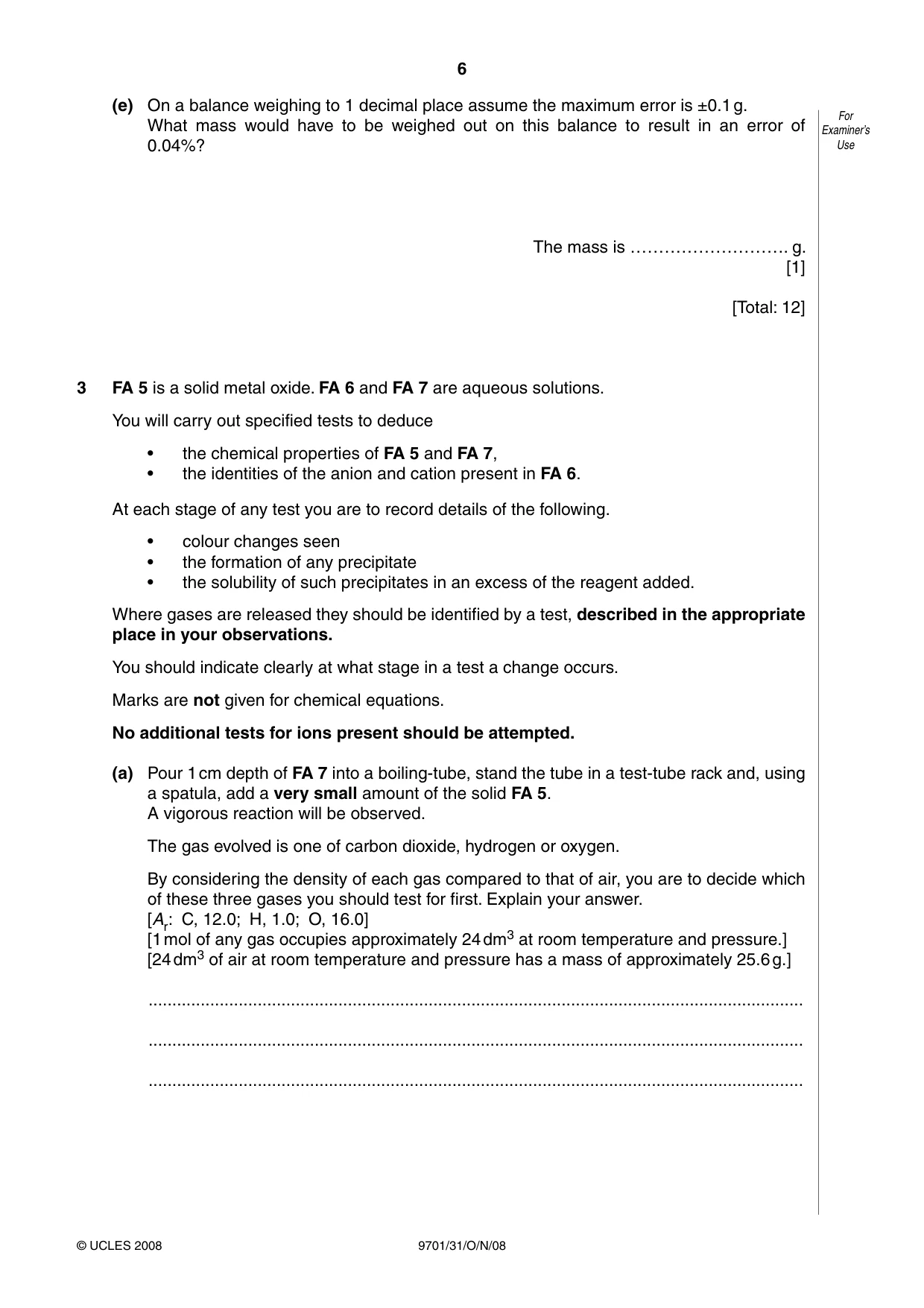
Question paper, page 6
6 9701/31/O/N/08 © UCLES 2008 For Examiner’s Use (e) On a balance weighing to 1 decimal place assume the maximum error is ±0.1 g. What mass would have to be weighed out on this balance to result in an error of 0.04%? The mass is ………………………. g. [1] [Total: 12] 3 FA 5 is a solid metal oxide. FA 6 and FA 7 are aqueous solutions. You will carry out specified tests to deduce • the chemical properties of FA 5 and FA 7, • the identities of the anion and cation present in FA 6. At each stage of any test you are to record details of the following. • colour changes seen • the formation of any precipitate • the solubility of such precipitates in an excess of the reagent added. Where gases are released they should be identified by a test, described in the appropriate place in your observations. You should indicate clearly at what stage in a test a change occurs. Marks are not given for chemical equations. No additional tests for ions present should be attempted. (a) Pour 1 cm depth of FA 7 into a boiling-tube, stand the tube in a test-tube rack and, using a spatula, add a very small amount of the solid FA 5. A vigorous reaction will be observed. The gas evolved is one of carbon dioxide, hydrogen or oxygen. By considering the density of each gas compared to that of air, you are to decide which of these three gases you should test for first. Explain your answer. [Ar: C, 12.0; H, 1.0; O, 16.0] [1 mol of any gas occupies approximately 24 dm3 at room temperature and pressure.] [24 dm3 of air at room temperature and pressure has a mass of approximately 25.6 g.] … … …
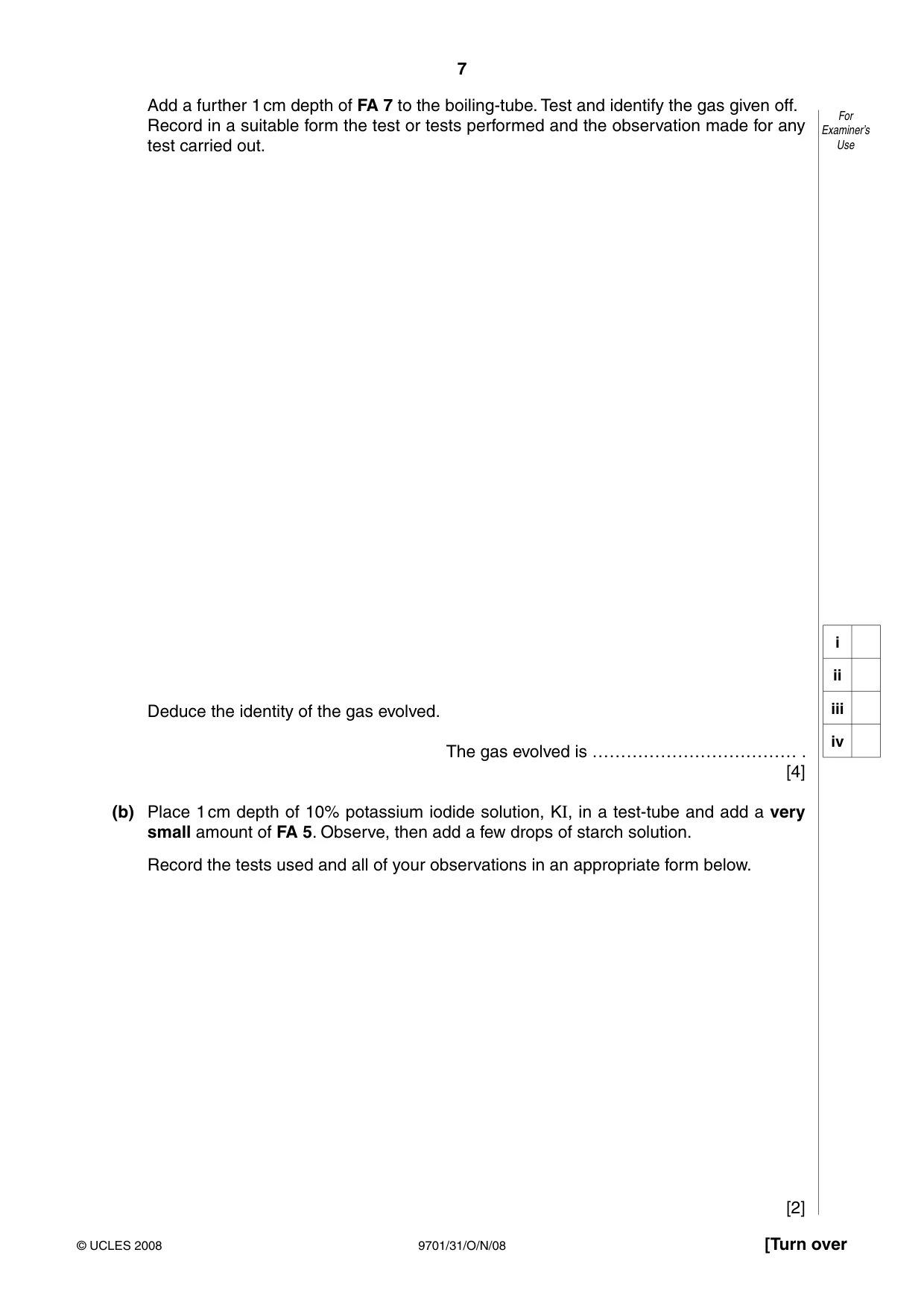
Question paper, page 7
7 9701/31/O/N/08 [Turn over © UCLES 2008 For Examiner’s Use Add a further 1 cm depth of FA 7 to the boiling-tube. Test and identify the gas given off. Record in a suitable form the test or tests performed and the observation made for any test carried out. Deduce the identity of the gas evolved. The gas evolved is ……………………………… . [4] (b) Place 1 cm depth of 10% potassium iodide solution, KI, in a test-tube and add a very small amount of FA 5. Observe, then add a few drops of starch solution. Record the tests used and all of your observations in an appropriate form below. [2] i ii iii iv
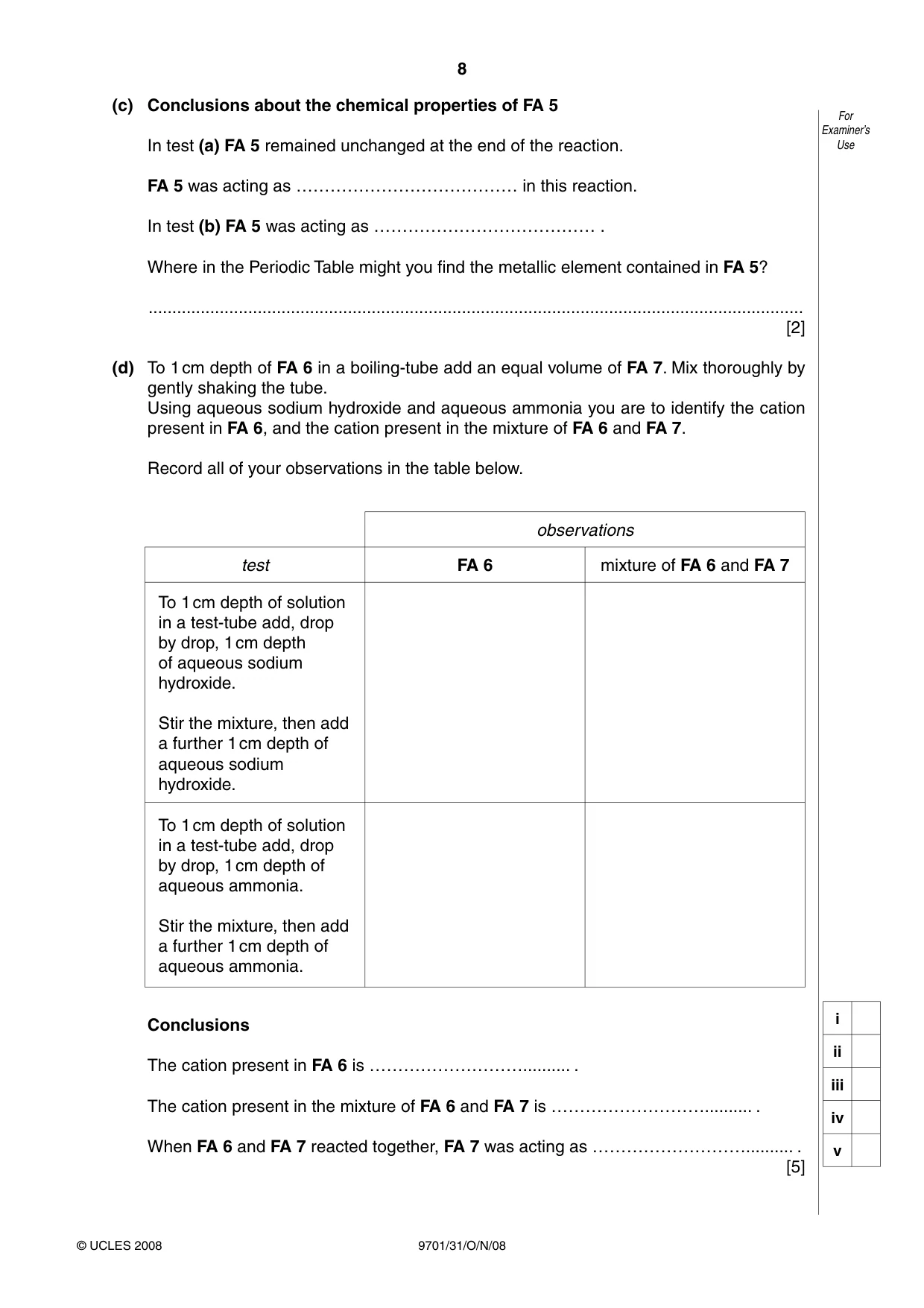
Question paper, page 8
8 9701/31/O/N/08 © UCLES 2008 For Examiner’s Use (c) Conclusions about the chemical properties of FA 5 In test (a) FA 5 remained unchanged at the end of the reaction. FA 5 was acting as ………………………………… in this reaction. In test (b) FA 5 was acting as ………………………………… . Where in the Periodic Table might you find the metallic element contained in FA 5? … [2] (d) To 1 cm depth of FA 6 in a boiling-tube add an equal volume of FA 7. Mix thoroughly by gently shaking the tube. Using aqueous sodium hydroxide and aqueous ammonia you are to identify the cation present in FA 6, and the cation present in the mixture of FA 6 and FA 7. Record all of your observations in the table below. observations test FA 6 mixture of FA 6 and FA 7 To 1 cm depth of solution in a test-tube add, drop by drop, 1 cm depth of aqueous sodium hydroxide. Stir the mixture, then add a further 1 cm depth of aqueous sodium hydroxide. To 1 cm depth of solution in a test-tube add, drop by drop, 1 cm depth of aqueous ammonia. Stir the mixture, then add a further 1 cm depth of aqueous ammonia. Conclusions The cation present in FA 6 is ………………………… . The cation present in the mixture of FA 6 and FA 7 is ………………………… . When FA 6 and FA 7 reacted together, FA 7 was acting as ………………………… . [5] i ii iii iv v
Question paper, page 9
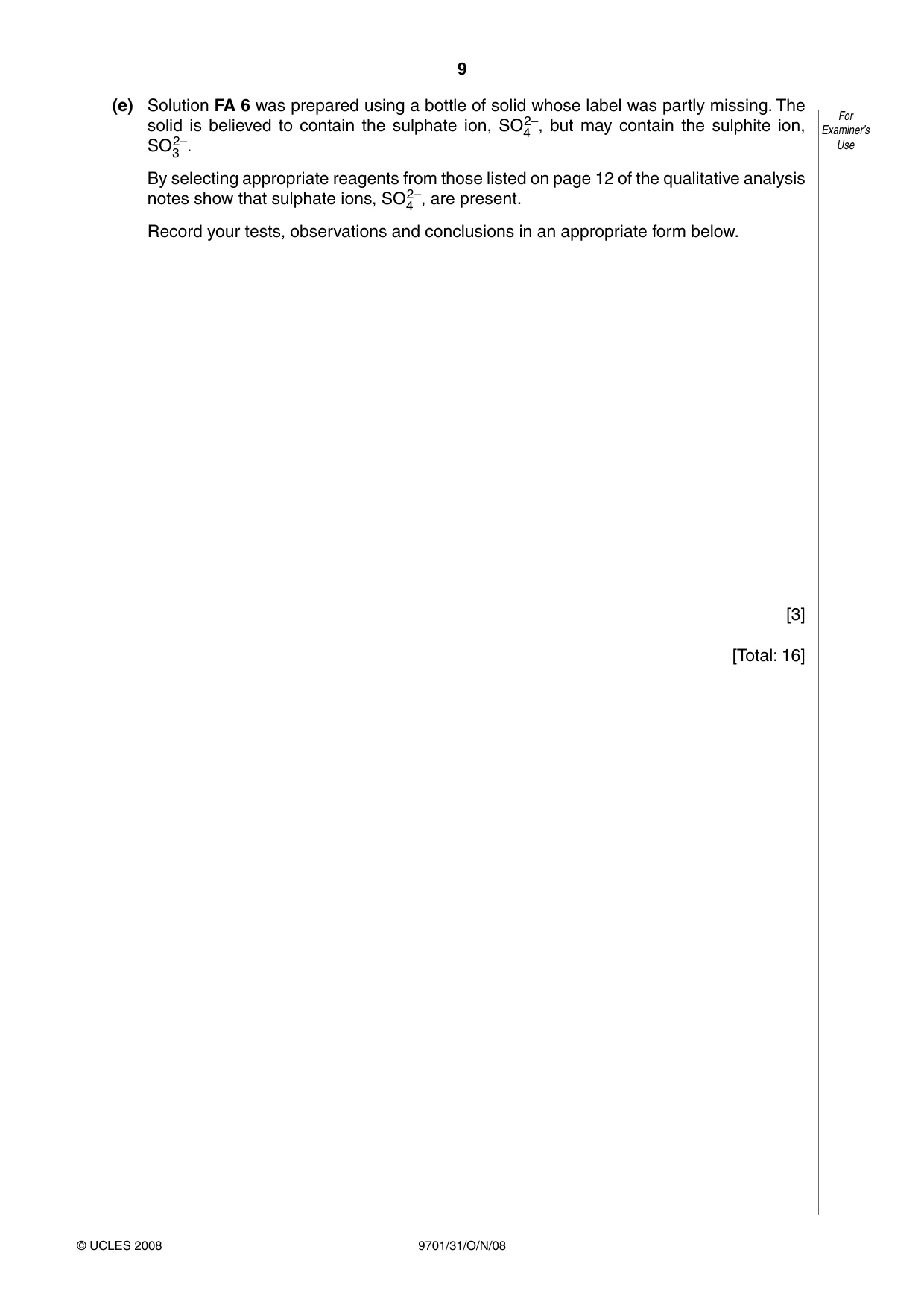
9 9701/31/O/N/08 © UCLES 2008 For Examiner’s Use (e) Solution FA 6 was prepared using a bottle of solid whose label was partly missing. The solid is believed to contain the sulphate ion, SO4 2–, but may contain the sulphite ion, SO3 2–. By selecting appropriate reagents from those listed on page 12 of the qualitative analysis notes show that sulphate ions, SO4 2–, are present. Record your tests, observations and conclusions in an appropriate form below. [3] [Total: 16]
Question paper, page 11
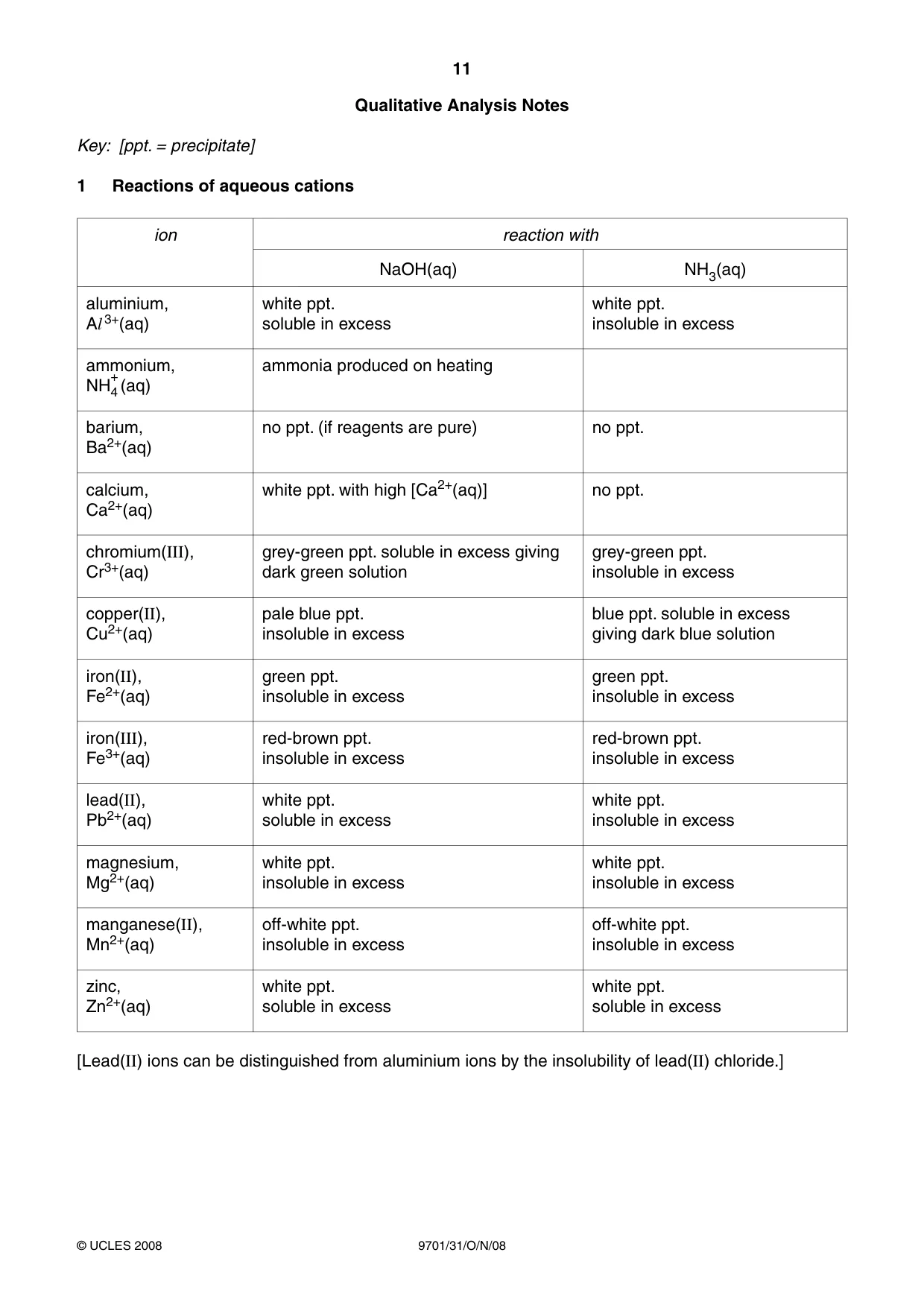
11 9701/31/O/N/08 © UCLES 2008 Qualitative Analysis Notes Key: [ppt. = precipitate] 1 Reactions of aqueous cations ion reaction with NaOH(aq) NH3(aq) aluminium, Al 3+(aq) white ppt. soluble in excess white ppt. insoluble in excess ammonium, NH + 4(aq) ammonia produced on heating barium, Ba2+(aq) no ppt. (if reagents are pure) no ppt. calcium, Ca2+(aq) white ppt. with high [Ca2+(aq)] no ppt. chromium(III), Cr3+(aq) grey-green ppt. soluble in excess giving dark green solution grey-green ppt. insoluble in excess copper(II), Cu2+(aq) pale blue ppt. insoluble in excess blue ppt. soluble in excess giving dark blue solution iron(II), Fe2+(aq) green ppt. insoluble in excess green ppt. insoluble in excess iron(III), Fe3+(aq) red-brown ppt. insoluble in excess red-brown ppt. insoluble in excess lead(II), Pb2+(aq) white ppt. soluble in excess white ppt. insoluble in excess magnesium, Mg2+(aq) white ppt. insoluble in excess white ppt. insoluble in excess manganese(II), Mn2+(aq) off-white ppt. insoluble in excess off-white ppt. insoluble in excess zinc, Zn2+(aq) white ppt. soluble in excess white ppt. soluble in excess [Lead(II) ions can be distinguished from aluminium ions by the insolubility of lead(II) chloride.]
Question paper, page 12
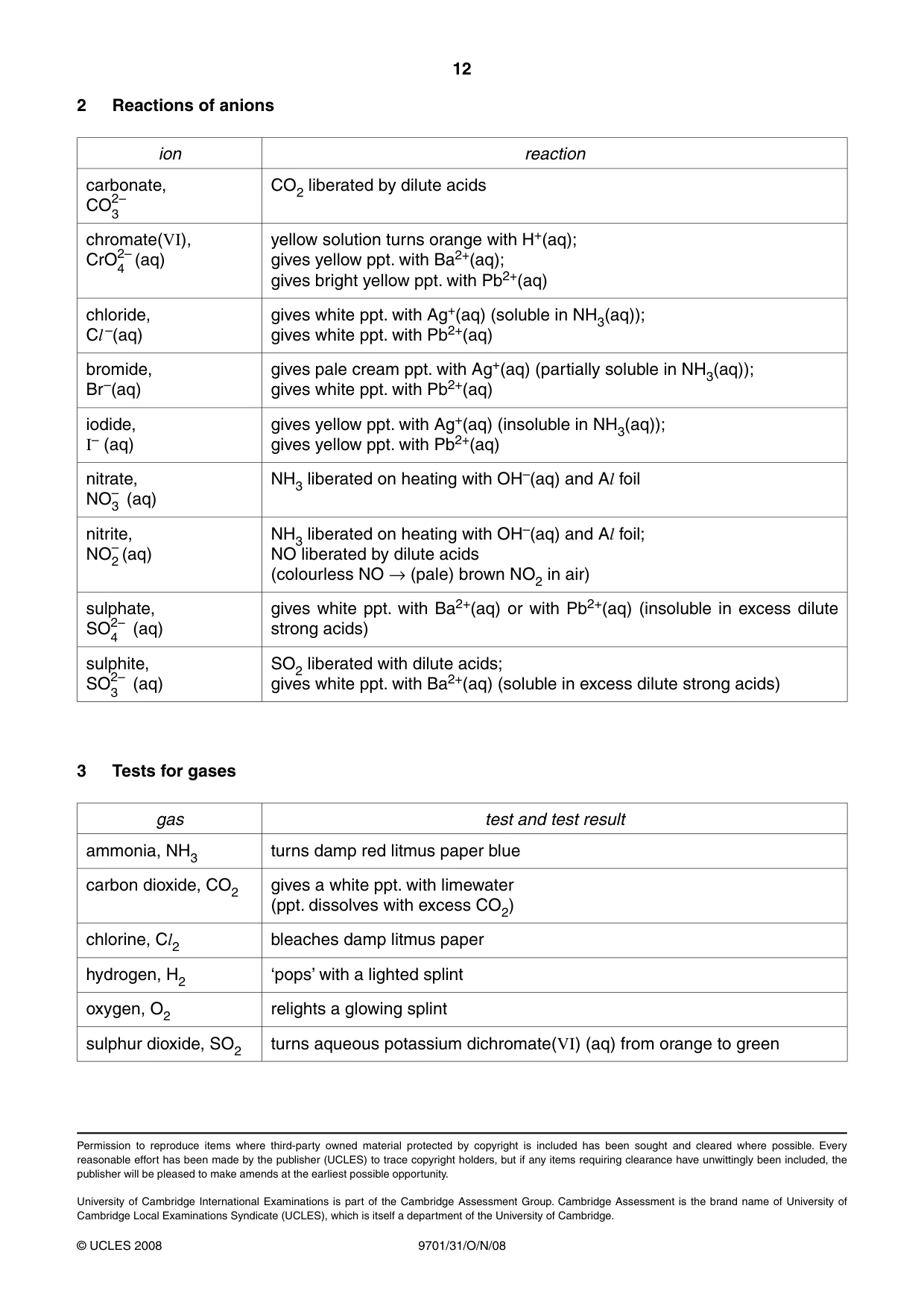
12 9701/31/O/N/08 © UCLES 2008 2 Reactions of anions ion reaction carbonate, CO2– 3 CO2 liberated by dilute acids chromate(VI), CrO2– 4 (aq) yellow solution turns orange with H+(aq); gives yellow ppt. with Ba2+(aq); gives bright yellow ppt. with Pb2+(aq) chloride, Cl –(aq) gives white ppt. with Ag+(aq) (soluble in NH3(aq)); gives white ppt. with Pb2+(aq) bromide, Br –(aq) gives pale cream ppt. with Ag+(aq) (partially soluble in NH3(aq)); gives white ppt. with Pb2+(aq) iodide, I– (aq) gives yellow ppt. with Ag+(aq) (insoluble in NH3(aq)); gives yellow ppt. with Pb2+(aq) nitrate, NO– 3 (aq) NH3 liberated on heating with OH–(aq) and Al foil nitrite, NO– 2 (aq) NH3 liberated on heating with OH–(aq) and Al foil; NO liberated by dilute acids (colourless NO → (pale) brown NO2 in air) sulphate, SO2– 4 (aq) gives white ppt. with Ba2+(aq) or with Pb2+(aq) (insoluble in excess dilute strong acids) sulphite, SO2– 3 (aq) SO2 liberated with dilute acids; gives white ppt. with Ba2+(aq) (soluble in excess dilute strong acids) 3 Tests for gases gas test and test result ammonia, NH3 turns damp red litmus paper blue carbon dioxide, CO2 gives a white ppt. with limewater (ppt. dissolves with excess CO2) chlorine, Cl2 bleaches damp litmus paper hydrogen, H2 ‘pops’ with a lighted splint oxygen, O2 relights a glowing splint sulphur dioxide, SO2 turns aqueous potassium dichromate(VI) (aq) from orange to green Permission to reproduce items where third-party owned material protected by copyright is included has been sought and cleared where possible. Every reasonable effort has been made by the publisher (UCLES) to trace copyright holders, but if any items requiring clearance have unwittingly been included, the publisher will be pleased to make amends at the earliest possible opportunity. University of Cambridge International Examinations is part of the Cambridge Assessment Group. Cambridge Assessment is the brand name of University of Cambridge Local Examinations Syndicate (UCLES), which is itself a department of the University of Cambridge.
Mark scheme, page 1
UNIVERSITY OF CAMBRIDGE INTERNATIONAL EXAMINATIONS GCE Advanced Subsidiary Level and GCE Advanced Level MARK SCHEME for the October/November 2008 question paper 9701 CHEMISTRY 9701/31 Paper 31 (Practical 1), maximum raw mark 40 This mark scheme is published as an aid to teachers and candidates, to indicate the requirements of the examination. It shows the basis on which Examiners were instructed to award marks. It does not indicate the details of the discussions that took place at an Examiners’ meeting before marking began. All Examiners are instructed that alternative correct answers and unexpected approaches in candidates’ scripts must be given marks that fairly reflect the relevant knowledge and skills demonstrated. Mark schemes must be read in conjunction with the question papers and the report on the examination. • CIE will not enter into discussions or correspondence in connection with these mark schemes. CIE is publishing the mark schemes for the October/November 2008 question papers for most IGCSE, GCE Advanced Level and Advanced Subsidiary Level syllabuses and some Ordinary Level syllabuses.
Mark scheme, page 2
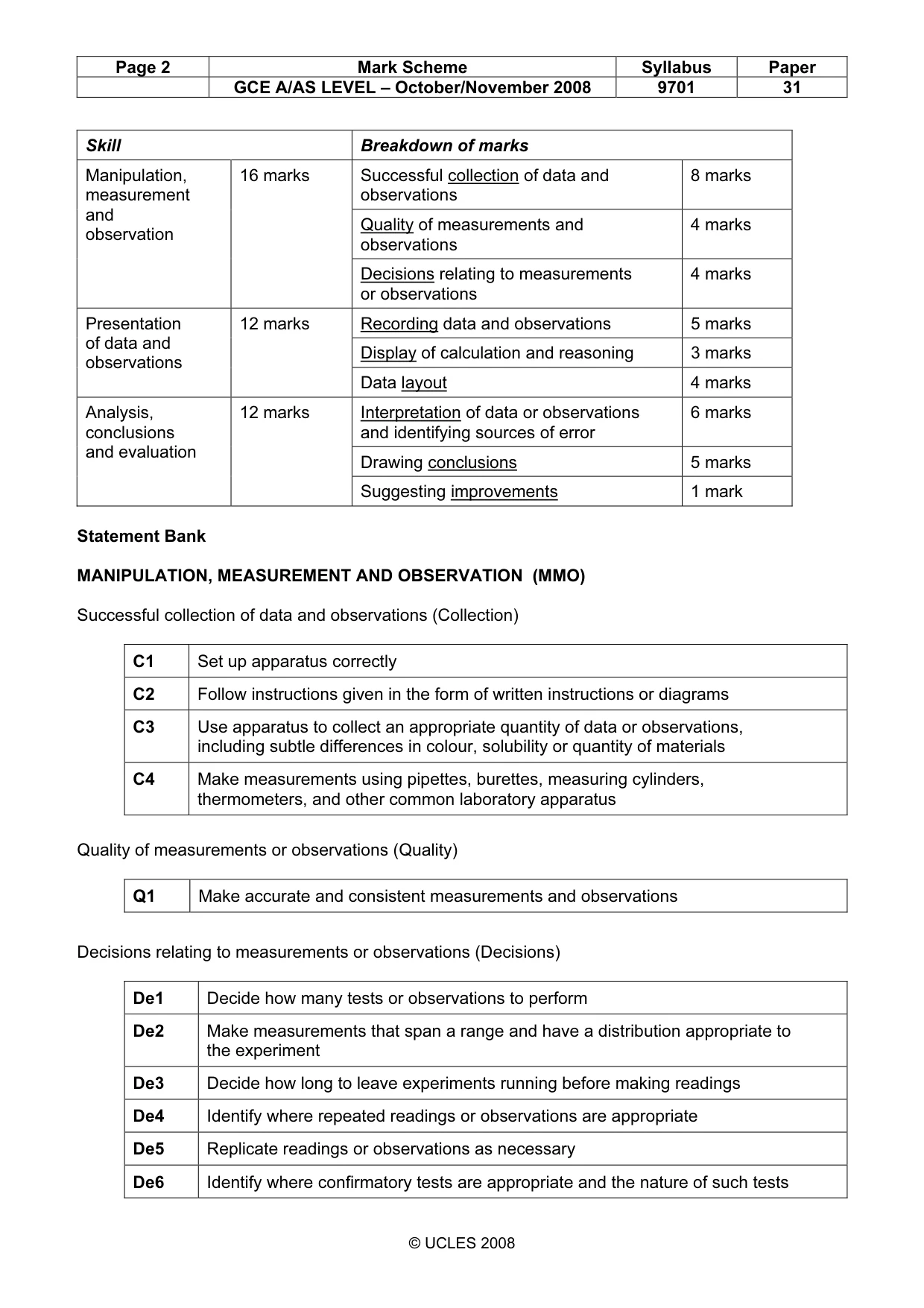
Page 2 Mark Scheme Syllabus Paper GCE A/AS LEVEL – October/November 2008 9701 31 © UCLES 2008 Skill Breakdown of marks Successful collection of data and observations 8 marks Quality of measurements and observations 4 marks Manipulation, measurement and observation 16 marks Decisions relating to measurements or observations 4 marks Recording data and observations 5 marks Display of calculation and reasoning 3 marks Presentation of data and observations 12 marks Data layout 4 marks Interpretation of data or observations and identifying sources of error 6 marks Drawing conclusions 5 marks Analysis, conclusions and evaluation 12 marks Suggesting improvements 1 mark Statement Bank MANIPULATION, MEASUREMENT AND OBSERVATION (MMO) Successful collection of data and observations (Collection) C1 Set up apparatus correctly C2 Follow instructions given in the form of written instructions or diagrams C3 Use apparatus to collect an appropriate quantity of data or observations, including subtle differences in colour, solubility or quantity of materials C4 Make measurements using pipettes, burettes, measuring cylinders, thermometers, and other common laboratory apparatus Quality of measurements or observations (Quality) Q1 Make accurate and consistent measurements and observations Decisions relating to measurements or observations (Decisions) De1 Decide how many tests or observations to perform De2 Make measurements that span a range and have a distribution appropriate to the experiment De3 Decide how long to leave experiments running before making readings De4 Identify where repeated readings or observations are appropriate De5 Replicate readings or observations as necessary De6 Identify where confirmatory tests are appropriate and the nature of such tests
Mark scheme, page 3
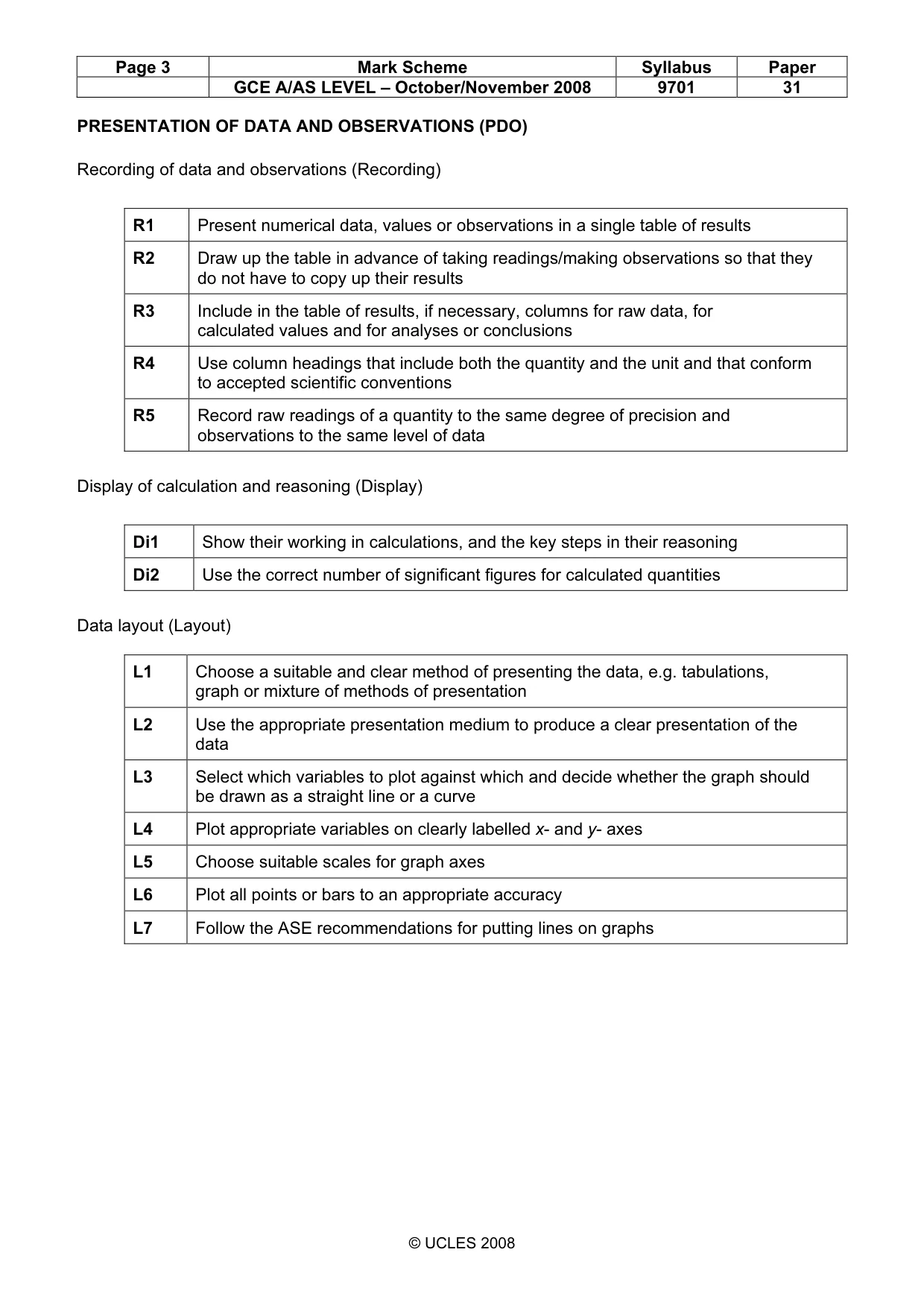
Page 3 Mark Scheme Syllabus Paper GCE A/AS LEVEL – October/November 2008 9701 31 © UCLES 2008 PRESENTATION OF DATA AND OBSERVATIONS (PDO) Recording of data and observations (Recording) R1 Present numerical data, values or observations in a single table of results R2 Draw up the table in advance of taking readings/making observations so that they do not have to copy up their results R3 Include in the table of results, if necessary, columns for raw data, for calculated values and for analyses or conclusions R4 Use column headings that include both the quantity and the unit and that conform to accepted scientific conventions R5 Record raw readings of a quantity to the same degree of precision and observations to the same level of data Display of calculation and reasoning (Display) Di1 Show their working in calculations, and the key steps in their reasoning Di2 Use the correct number of significant figures for calculated quantities Data layout (Layout) L1 Choose a suitable and clear method of presenting the data, e.g. tabulations, graph or mixture of methods of presentation L2 Use the appropriate presentation medium to produce a clear presentation of the data L3 Select which variables to plot against which and decide whether the graph should be drawn as a straight line or a curve L4 Plot appropriate variables on clearly labelled x- and y- axes L5 Choose suitable scales for graph axes L6 Plot all points or bars to an appropriate accuracy L7 Follow the ASE recommendations for putting lines on graphs
Mark scheme, page 4
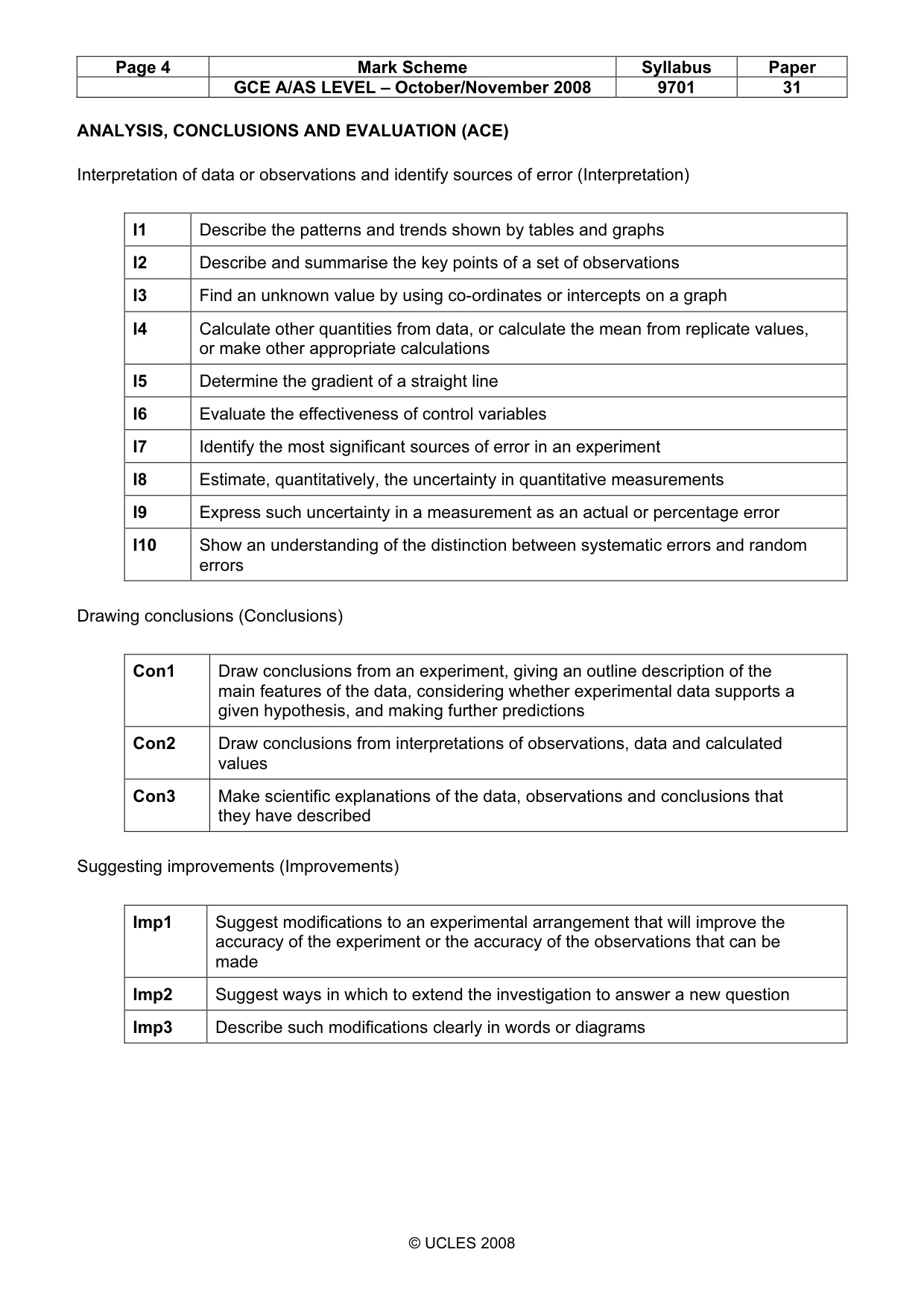
Page 4 Mark Scheme Syllabus Paper GCE A/AS LEVEL – October/November 2008 9701 31 © UCLES 2008 ANALYSIS, CONCLUSIONS AND EVALUATION (ACE) Interpretation of data or observations and identify sources of error (Interpretation) I1 Describe the patterns and trends shown by tables and graphs I2 Describe and summarise the key points of a set of observations I3 Find an unknown value by using co-ordinates or intercepts on a graph I4 Calculate other quantities from data, or calculate the mean from replicate values, or make other appropriate calculations I5 Determine the gradient of a straight line I6 Evaluate the effectiveness of control variables I7 Identify the most significant sources of error in an experiment I8 Estimate, quantitatively, the uncertainty in quantitative measurements I9 Express such uncertainty in a measurement as an actual or percentage error I10 Show an understanding of the distinction between systematic errors and random errors Drawing conclusions (Conclusions) Con1 Draw conclusions from an experiment, giving an outline description of the main features of the data, considering whether experimental data supports a given hypothesis, and making further predictions Con2 Draw conclusions from interpretations of observations, data and calculated values Con3 Make scientific explanations of the data, observations and conclusions that they have described Suggesting improvements (Improvements) Imp1 Suggest modifications to an experimental arrangement that will improve the accuracy of the experiment or the accuracy of the observations that can be made Imp2 Suggest ways in which to extend the investigation to answer a new question Imp3 Describe such modifications clearly in words or diagrams
Mark scheme, page 5
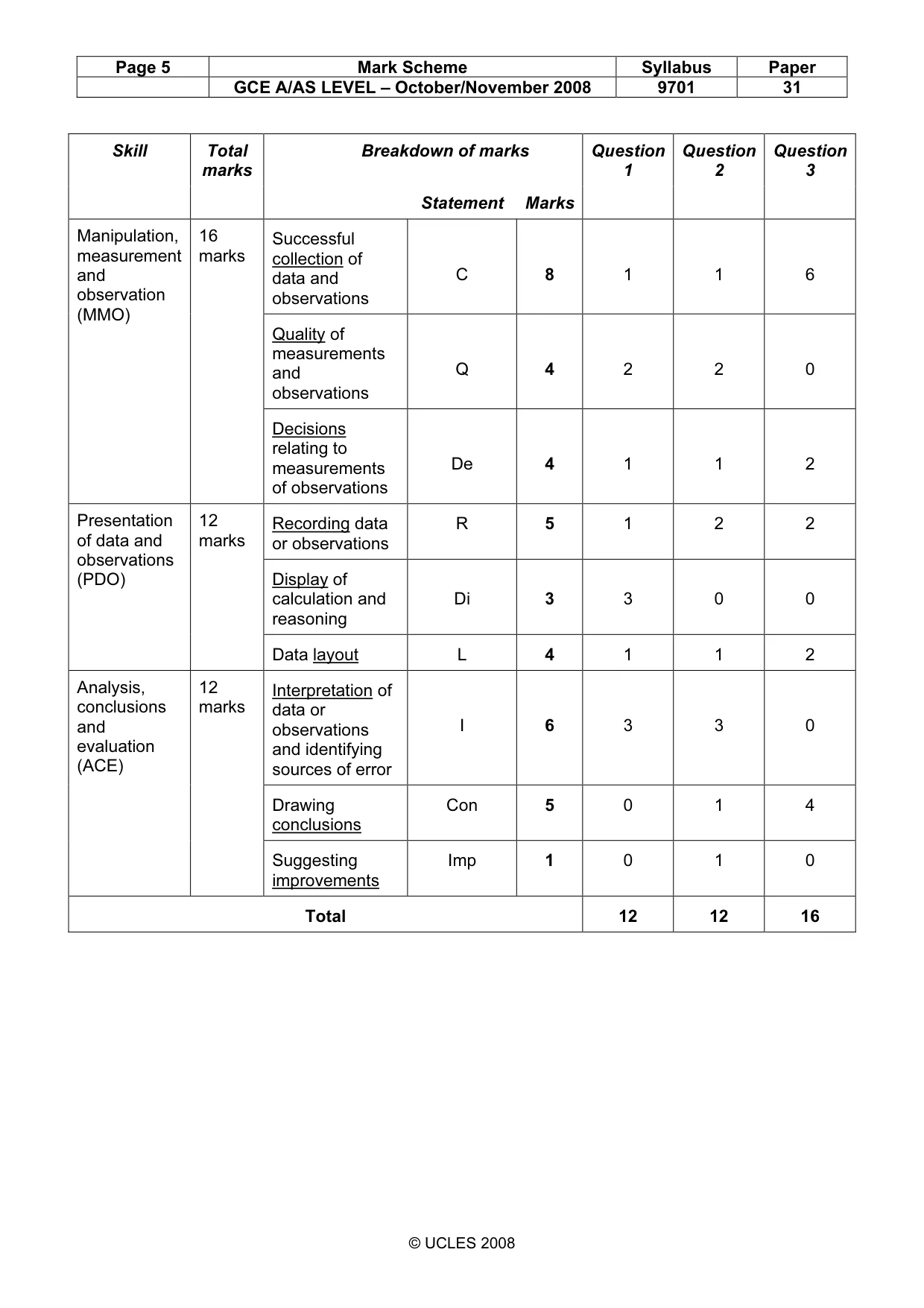
Page 5 Mark Scheme Syllabus Paper GCE A/AS LEVEL – October/November 2008 9701 31 © UCLES 2008 Breakdown of marks Question 1 Question 2 Question 3 Skill Total marks Statement Marks Successful collection of data and observations C 8 1 1 6 Quality of measurements and observations Q 4 2 2 0 Manipulation, measurement and observation (MMO) 16 marks Decisions relating to measurements of observations De 4 1 1 2 Recording data or observations R 5 1 2 2 Display of calculation and reasoning Di 3 3 0 0 Presentation of data and observations (PDO) 12 marks Data layout L 4 1 1 2 Interpretation of data or observations and identifying sources of error I 6 3 3 0 Drawing conclusions Con 5 0 1 4 Analysis, conclusions and evaluation (ACE) 12 marks Suggesting improvements Imp 1 0 1 0 Total 12 12 16
Mark scheme, page 6
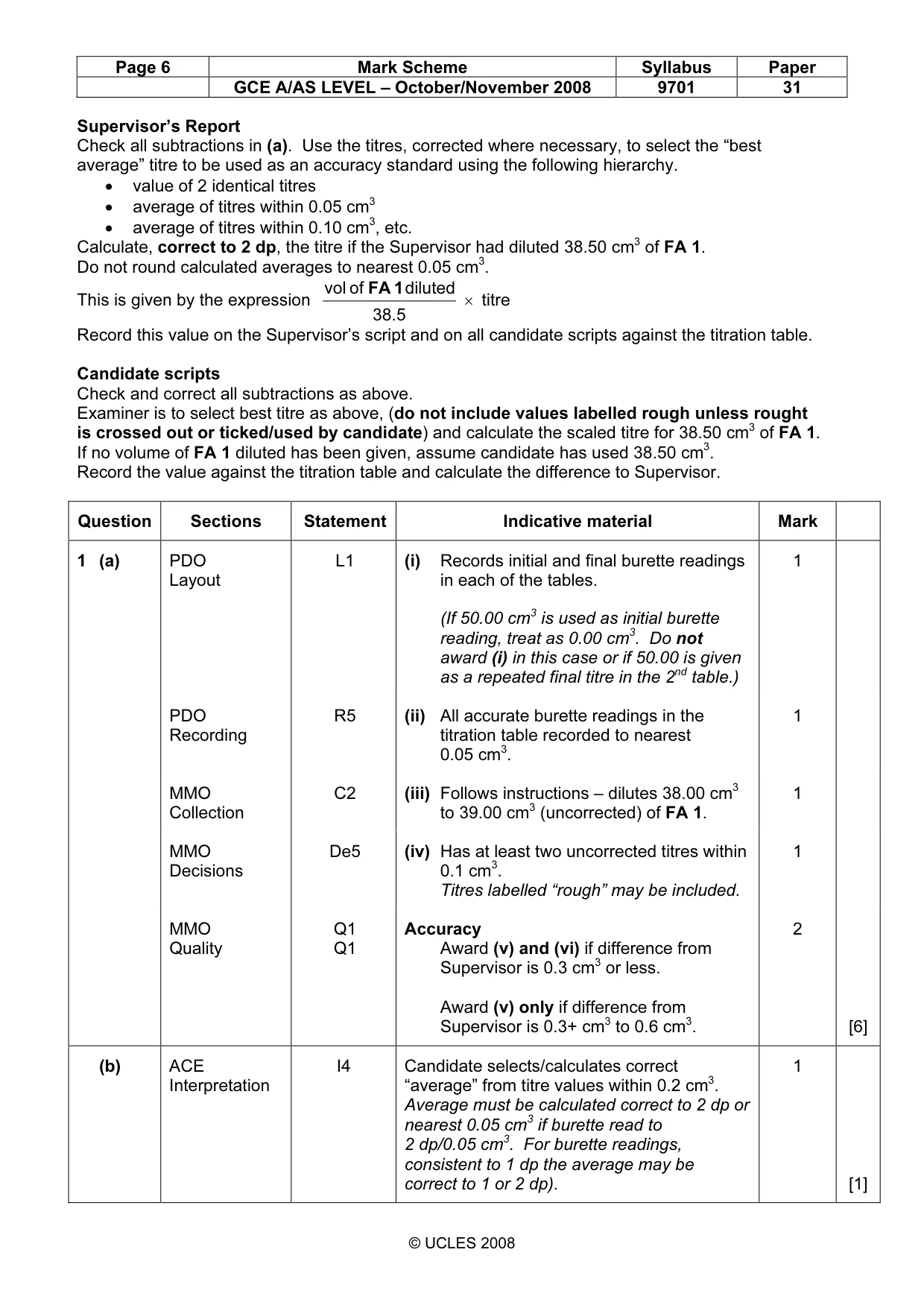
Page 6 Mark Scheme Syllabus Paper GCE A/AS LEVEL – October/November 2008 9701 31 © UCLES 2008 Supervisor’s Report Check all subtractions in (a). Use the titres, corrected where necessary, to select the “best average” titre to be used as an accuracy standard using the following hierarchy. • value of 2 identical titres • average of titres within 0.05 cm3 • average of titres within 0.10 cm3, etc. Calculate, correct to 2 dp, the titre if the Supervisor had diluted 38.50 cm3 of FA 1. Do not round calculated averages to nearest 0.05 cm3. This is given by the expression titre 38.5 diluted of vol 1 FA × Record this value on the Supervisor’s script and on all candidate scripts against the titration table. Candidate scripts Check and correct all subtractions as above. Examiner is to select best titre as above, (do not include values labelled rough unless rought is crossed out or ticked/used by candidate) and calculate the scaled titre for 38.50 cm3 of FA 1. If no volume of FA 1 diluted has been given, assume candidate has used 38.50 cm3. Record the value against the titration table and calculate the difference to Supervisor. Question Sections Statement Indicative material Mark 1 (a) PDO Layout L1 (i) Records initial and final burette readings in each of the tables. (If 50.00 cm3 is used as initial burette reading, treat as 0.00 cm3. Do not award (i) in this case or if 50.00 is given as a repeated final titre in the 2nd table.) 1 PDO Recording R5 (ii) All accurate burette readings in the titration table recorded to nearest 0.05 cm3. 1 MMO Collection C2 (iii) Follows instructions – dilutes 38.00 cm3 to 39.00 cm3 (uncorrected) of FA 1. 1 MMO Decisions De5 (iv) Has at least two uncorrected titres within 0.1 cm3. Titres labelled “rough” may be included. 1 MMO Quality Q1 Q1 Accuracy Award (v) and (vi) if difference from Supervisor is 0.3 cm3 or less. Award (v) only if difference from Supervisor is 0.3+ cm3 to 0.6 cm3. 2 [6] (b) ACE Interpretation I4 Candidate selects/calculates correct “average” from titre values within 0.2 cm3. Average must be calculated correct to 2 dp or nearest 0.05 cm3 if burette read to 2 dp/0.05 cm3. For burette readings, consistent to 1 dp the average may be correct to 1 or 2 dp). 1 [1]
Mark scheme, page 7
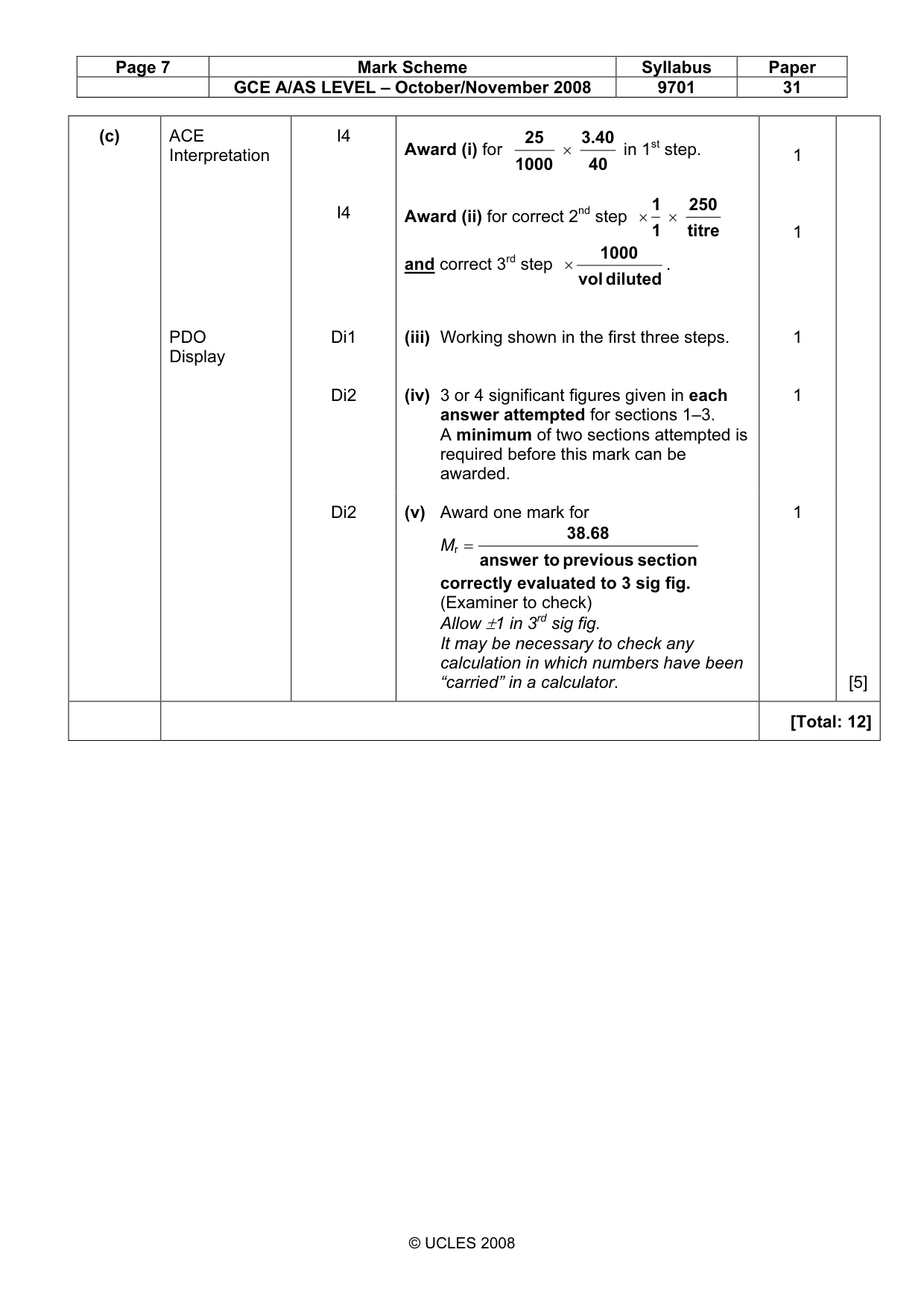
Page 7 Mark Scheme Syllabus Paper GCE A/AS LEVEL – October/November 2008 9701 31 © UCLES 2008 (c) ACE Interpretation I4 I4 Award (i) for 40 3.40 1000 25 × in 1st step. Award (ii) for correct 2nd step titre 250 1 1 × × and correct 3rd step diluted vol 1000 × . 1 1 PDO Display Di1 (iii) Working shown in the first three steps. 1 Di2 (iv) 3 or 4 significant figures given in each answer attempted for sections 1–3. A minimum of two sections attempted is required before this mark can be awarded. 1 Di2 (v) Award one mark for Mr section previous to answer 38.68 = correctly evaluated to 3 sig fig. (Examiner to check) Allow ±1 in 3rd sig fig. It may be necessary to check any calculation in which numbers have been “carried” in a calculator. 1 [5] [Total: 12]
Mark scheme, page 8
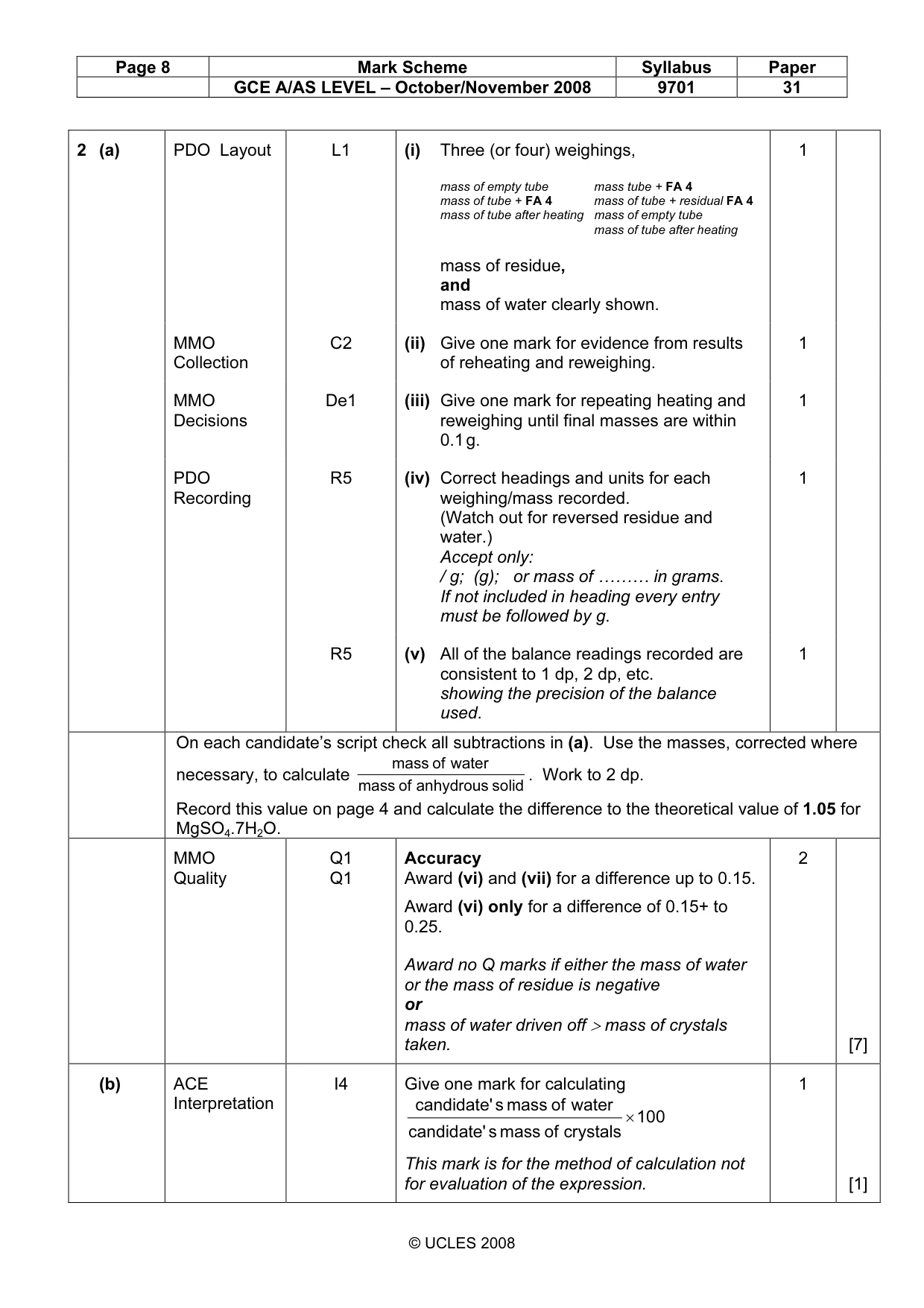
Page 8 Mark Scheme Syllabus Paper GCE A/AS LEVEL – October/November 2008 9701 31 © UCLES 2008 2 (a) PDO Layout L1 (i) Three (or four) weighings, mass of empty tube mass tube + FA 4 mass of tube + FA 4 mass of tube + residual FA 4 mass of tube after heating mass of empty tube mass of tube after heating mass of residue, and mass of water clearly shown. 1 MMO Collection C2 (ii) Give one mark for evidence from results of reheating and reweighing. 1 MMO Decisions De1 (iii) Give one mark for repeating heating and reweighing until final masses are within 0.1 g. 1 PDO Recording R5 (iv) Correct headings and units for each weighing/mass recorded. (Watch out for reversed residue and water.) Accept only: / g; (g); or mass of ……… in grams. If not included in heading every entry must be followed by g. 1 R5 (v) All of the balance readings recorded are consistent to 1 dp, 2 dp, etc. showing the precision of the balance used. 1 On each candidate’s script check all subtractions in (a). Use the masses, corrected where necessary, to calculate solid anhydrous of mass water of mass . Work to 2 dp. Record this value on page 4 and calculate the difference to the theoretical value of 1.05 for MgSO4.7H2O. MMO Quality Q1 Q1 Accuracy Award (vi) and (vii) for a difference up to 0.15. Award (vi) only for a difference of 0.15+ to 0.25. Award no Q marks if either the mass of water or the mass of residue is negative or mass of water driven off > mass of crystals taken. 2 [7] (b) ACE Interpretation I4 Give one mark for calculating 100 crystals of mass s candidate' water of mass s candidate' × This mark is for the method of calculation not for evaluation of the expression. 1 [1]
Mark scheme, page 9
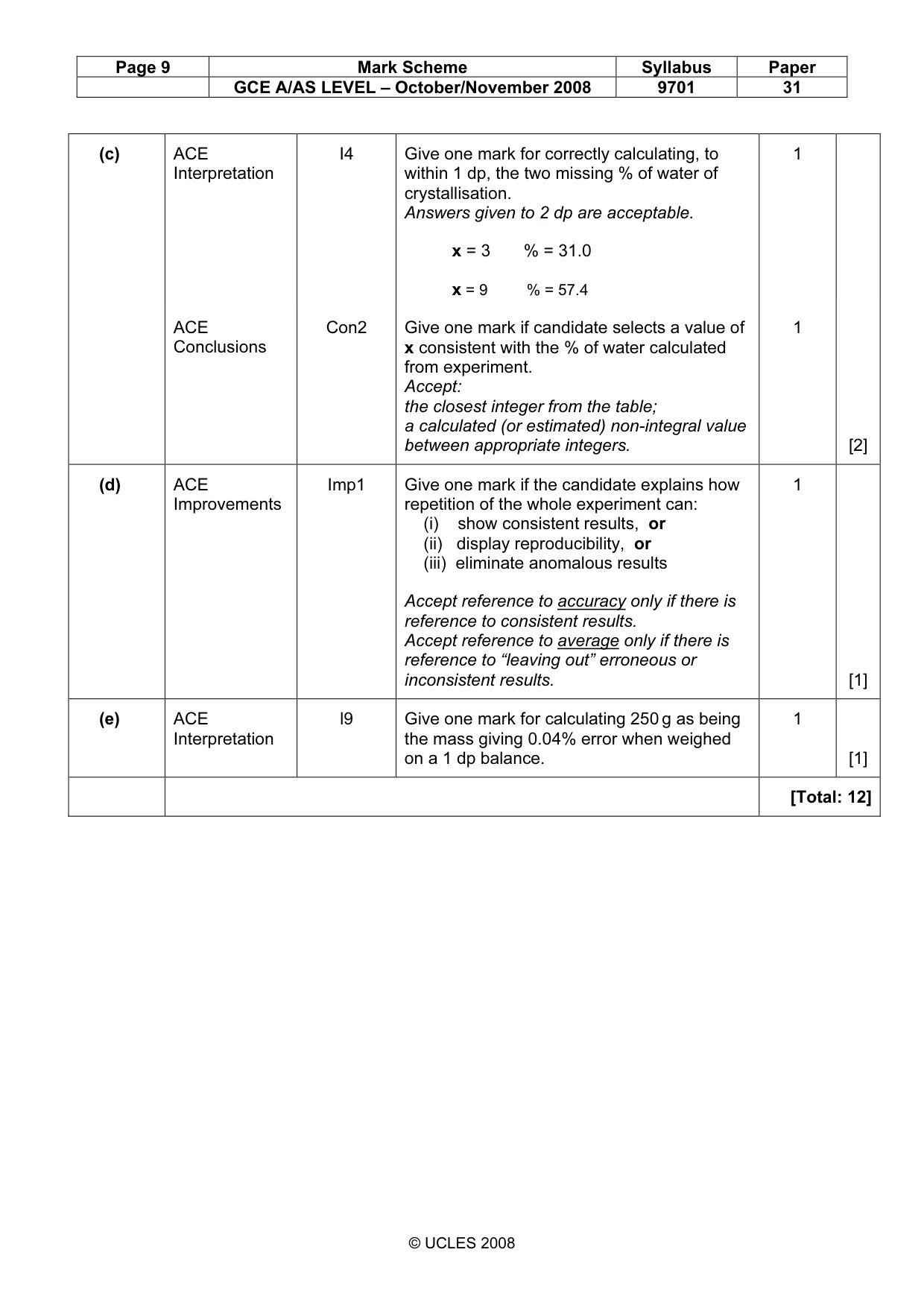
Page 9 Mark Scheme Syllabus Paper GCE A/AS LEVEL – October/November 2008 9701 31 © UCLES 2008 (c) ACE Interpretation I4 Give one mark for correctly calculating, to within 1 dp, the two missing % of water of crystallisation. Answers given to 2 dp are acceptable. x = 3 % = 31.0 x = 9 % = 57.4 1 ACE Conclusions Con2 Give one mark if candidate selects a value of x consistent with the % of water calculated from experiment. Accept: the closest integer from the table; a calculated (or estimated) non-integral value between appropriate integers. 1 [2] (d) ACE Improvements Imp1 Give one mark if the candidate explains how repetition of the whole experiment can: (i) show consistent results, or (ii) display reproducibility, or (iii) eliminate anomalous results Accept reference to accuracy only if there is reference to consistent results. Accept reference to average only if there is reference to “leaving out” erroneous or inconsistent results. 1 [1] (e) ACE Interpretation l9 Give one mark for calculating 250 g as being the mass giving 0.04% error when weighed on a 1 dp balance. 1 [1] [Total: 12]
Mark scheme, page 10
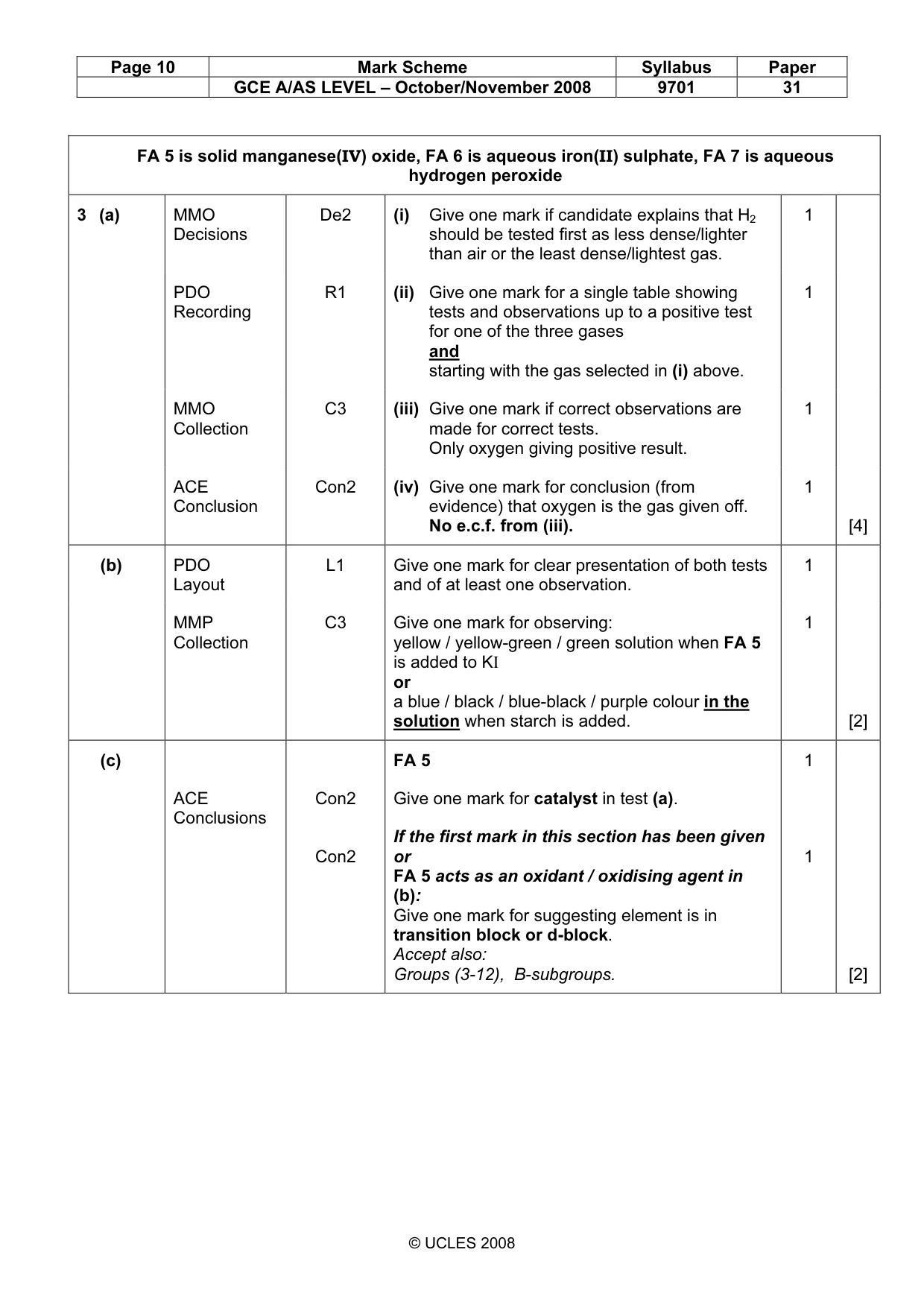
Page 10 Mark Scheme Syllabus Paper GCE A/AS LEVEL – October/November 2008 9701 31 © UCLES 2008 FA 5 is solid manganese(IV) oxide, FA 6 is aqueous iron(II) sulphate, FA 7 is aqueous hydrogen peroxide 3 (a) MMO Decisions De2 (i) Give one mark if candidate explains that H2 should be tested first as less dense/lighter than air or the least dense/lightest gas. 1 PDO Recording R1 (ii) Give one mark for a single table showing tests and observations up to a positive test for one of the three gases and starting with the gas selected in (i) above. 1 MMO Collection C3 (iii) Give one mark if correct observations are made for correct tests. Only oxygen giving positive result. 1 ACE Conclusion Con2 (iv) Give one mark for conclusion (from evidence) that oxygen is the gas given off. No e.c.f. from (iii). 1 [4] (b) PDO Layout L1 Give one mark for clear presentation of both tests and of at least one observation. 1 MMP Collection C3 Give one mark for observing: yellow / yellow-green / green solution when FA 5 is added to KI or a blue / black / blue-black / purple colour in the solution when starch is added. 1 [2] (c) ACE Conclusions Con2 Con2 FA 5 Give one mark for catalyst in test (a). If the first mark in this section has been given or FA 5 acts as an oxidant / oxidising agent in (b): Give one mark for suggesting element is in transition block or d-block. Accept also: Groups (3-12), B-subgroups. 1 1 [2]
Mark scheme, page 11
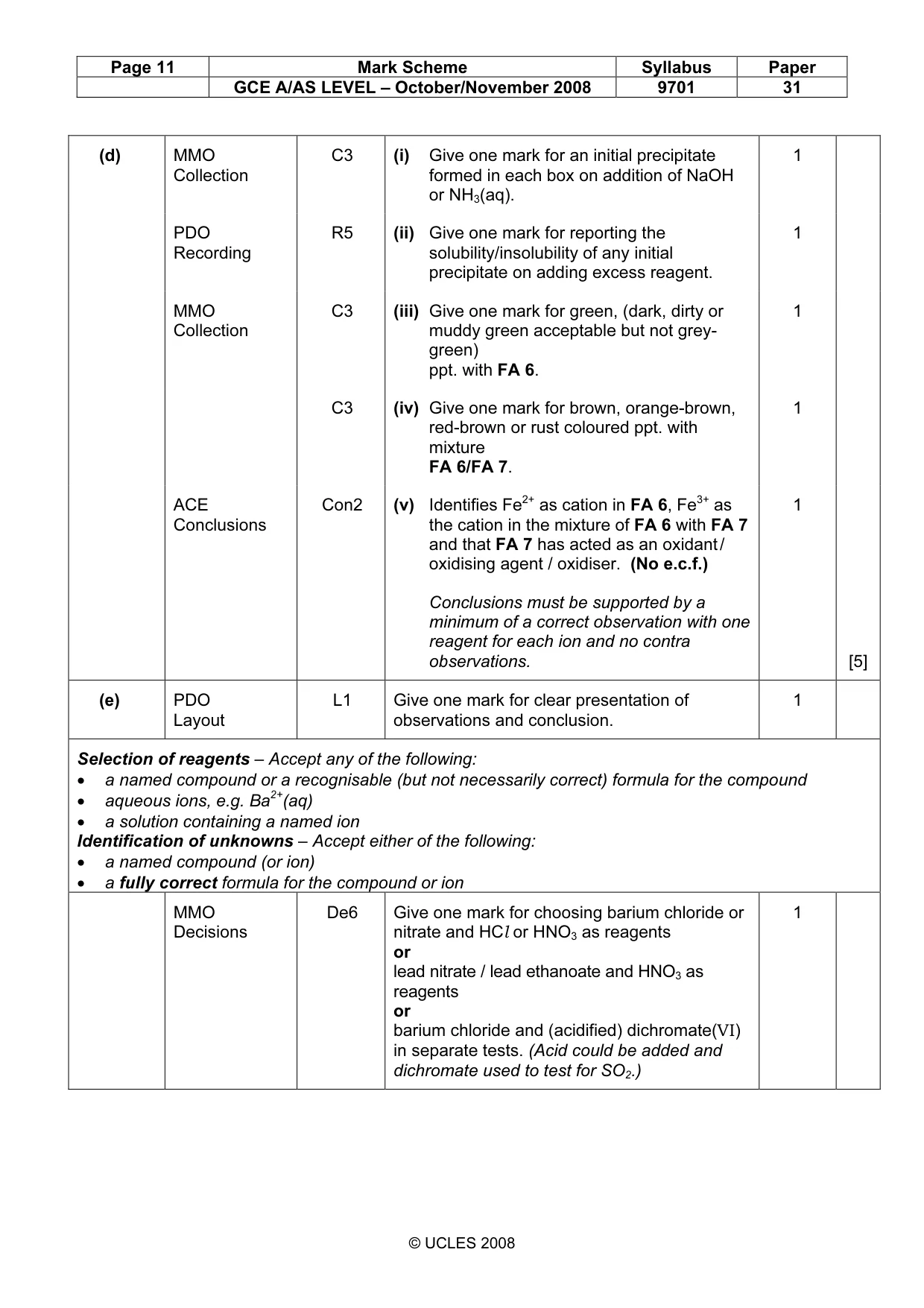
Page 11 Mark Scheme Syllabus Paper GCE A/AS LEVEL – October/November 2008 9701 31 © UCLES 2008 (d) MMO Collection C3 (i) Give one mark for an initial precipitate formed in each box on addition of NaOH or NH3(aq). 1 PDO Recording R5 (ii) Give one mark for reporting the solubility/insolubility of any initial precipitate on adding excess reagent. 1 MMO Collection C3 (iii) Give one mark for green, (dark, dirty or muddy green acceptable but not grey- green) ppt. with FA 6. 1 C3 (iv) Give one mark for brown, orange-brown, red-brown or rust coloured ppt. with mixture FA 6/FA 7. 1 ACE Conclusions Con2 (v) Identifies Fe2+ as cation in FA 6, Fe3+ as the cation in the mixture of FA 6 with FA 7 and that FA 7 has acted as an oxidant / oxidising agent / oxidiser. (No e.c.f.) Conclusions must be supported by a minimum of a correct observation with one reagent for each ion and no contra observations. 1 [5] (e) PDO Layout L1 Give one mark for clear presentation of observations and conclusion. 1 Selection of reagents – Accept any of the following: • a named compound or a recognisable (but not necessarily correct) formula for the compound • aqueous ions, e.g. Ba2+(aq) • a solution containing a named ion Identification of unknowns – Accept either of the following: • a named compound (or ion) • a fully correct formula for the compound or ion MMO Decisions De6 Give one mark for choosing barium chloride or nitrate and HCl or HNO3 as reagents or lead nitrate / lead ethanoate and HNO3 as reagents or barium chloride and (acidified) dichromate(VI) in separate tests. (Acid could be added and dichromate used to test for SO2.) 1
Mark scheme, page 12
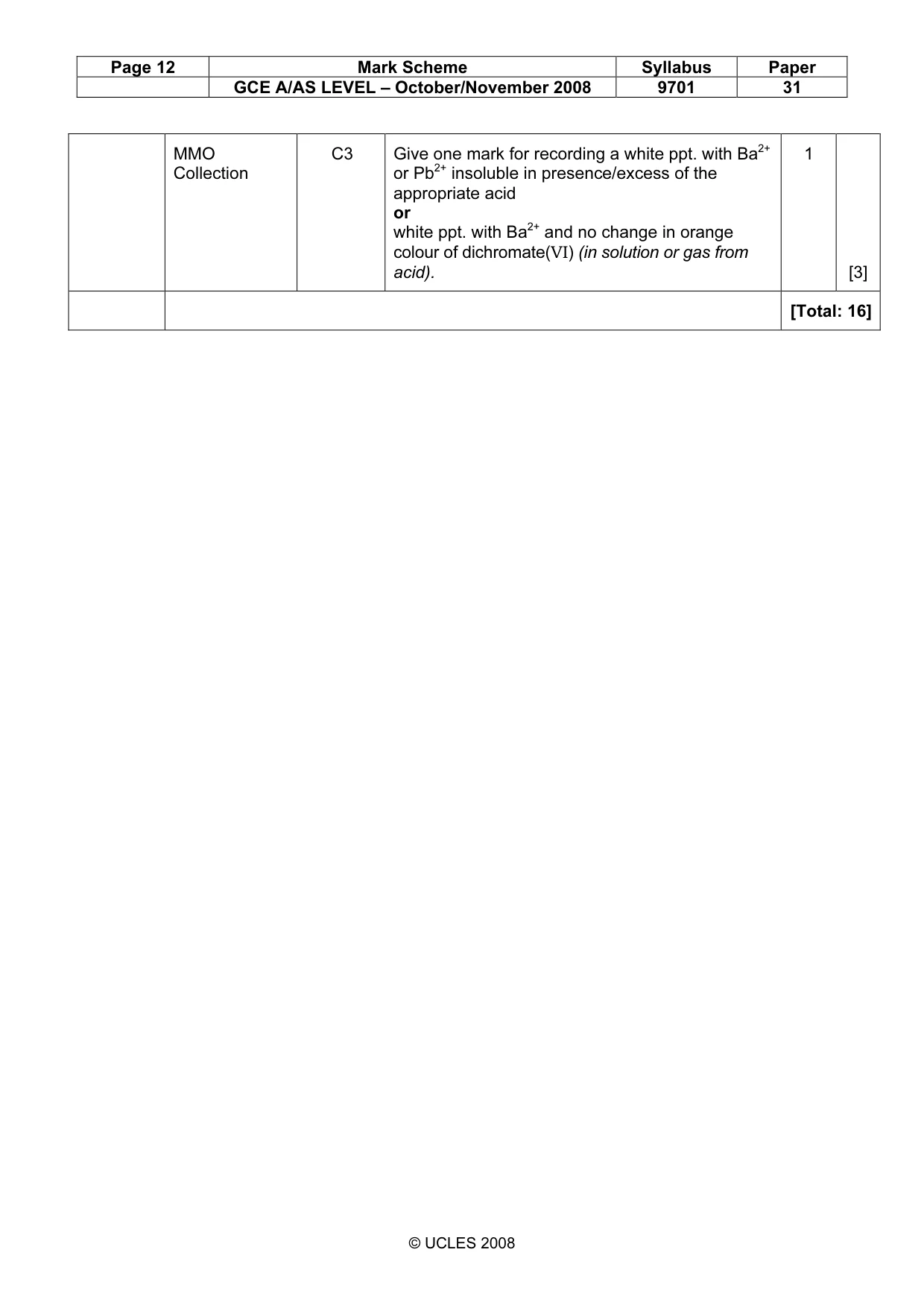
Page 12 Mark Scheme Syllabus Paper GCE A/AS LEVEL – October/November 2008 9701 31 © UCLES 2008 MMO Collection C3 Give one mark for recording a white ppt. with Ba2+ or Pb2+ insoluble in presence/excess of the appropriate acid or white ppt. with Ba2+ and no change in orange colour of dichromate(VI) (in solution or gas from acid). 1 [3] [Total: 16]
What you needed in this session
Cambridge’s own grade thresholds for 2008 Oct/Nov, Paper 3 · Variant 1. A higher threshold means an easier paper — the bar moves with how the cohort did.