Cambridge A Level Chemistry 9701 — 2006 May/June Paper 3 · Variant 1
9701/31/M/J/06 · 25 marks · ≈28 min
The question paper and its mark scheme, free to read here and free to download. This is Cambridge’s own paper, exactly as it was sat.
Question paper8 pages

Mark scheme5 pages
Answers below. Sit the paper first if you are practising.
Paper as text
Question paper, page 1
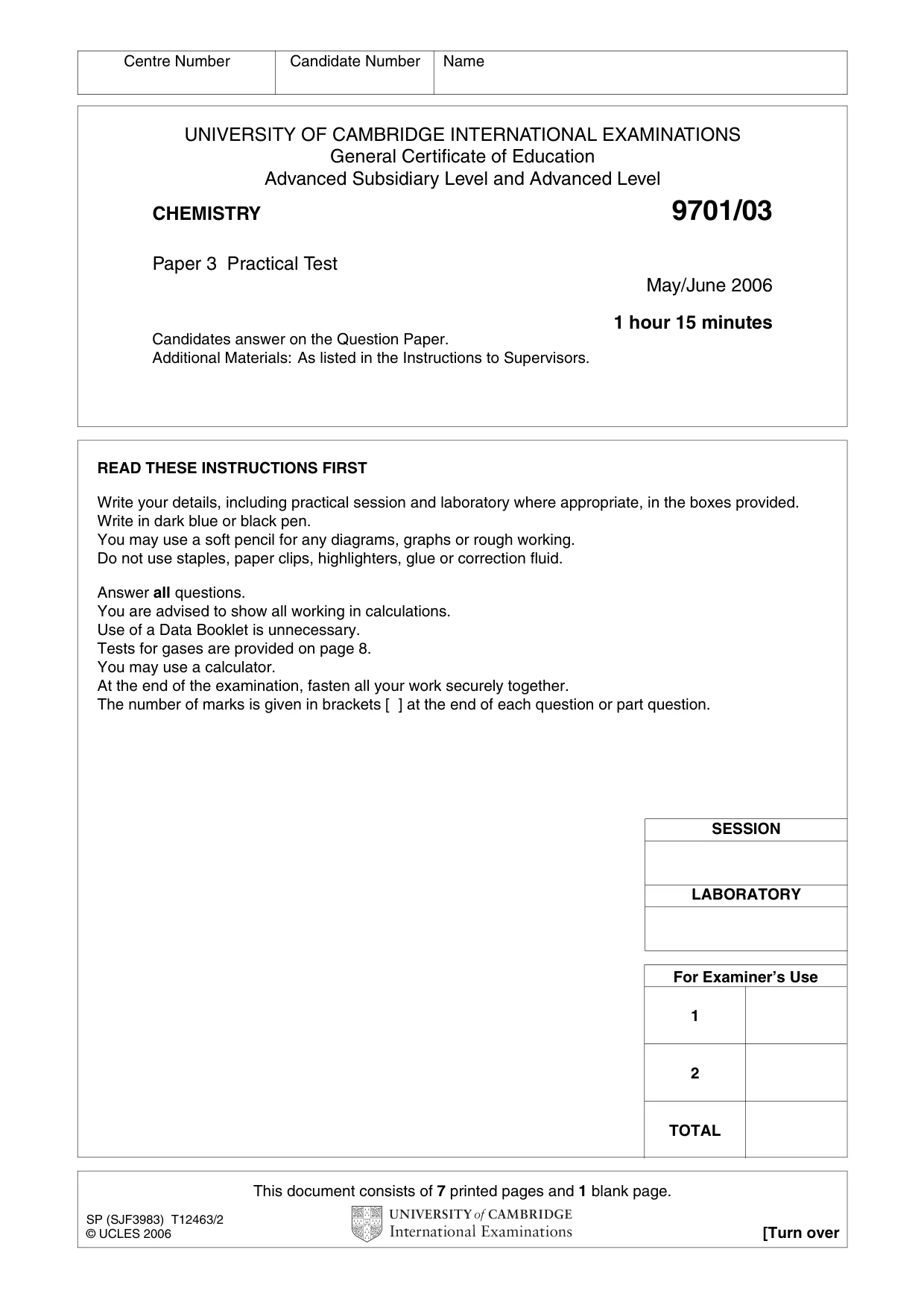
This document consists of 7 printed pages and 1 blank page. SP (SJF3983) T12463/2 © UCLES 2006 [Turn over UNIVERSITY OF CAMBRIDGE INTERNATIONAL EXAMINATIONS General Certificate of Education Advanced Subsidiary Level and Advanced Level CHEMISTRY 9701/03 Paper 3 Practical Test May/June 2006 1 hour 15 minutes Candidates answer on the Question Paper. Additional Materials: As listed in the Instructions to Supervisors. READ THESE INSTRUCTIONS FIRST Write your details, including practical session and laboratory where appropriate, in the boxes provided. Write in dark blue or black pen. You may use a soft pencil for any diagrams, graphs or rough working. Do not use staples, paper clips, highlighters, glue or correction fluid. Answer all questions. You are advised to show all working in calculations. Use of a Data Booklet is unnecessary. Tests for gases are provided on page 8. You may use a calculator. At the end of the examination, fasten all your work securely together. The number of marks is given in brackets [ ] at the end of each question or part question. Centre Number Candidate Number Name For Examiner’s Use 1 2 TOTAL SESSION LABORATORY
Question paper, page 2
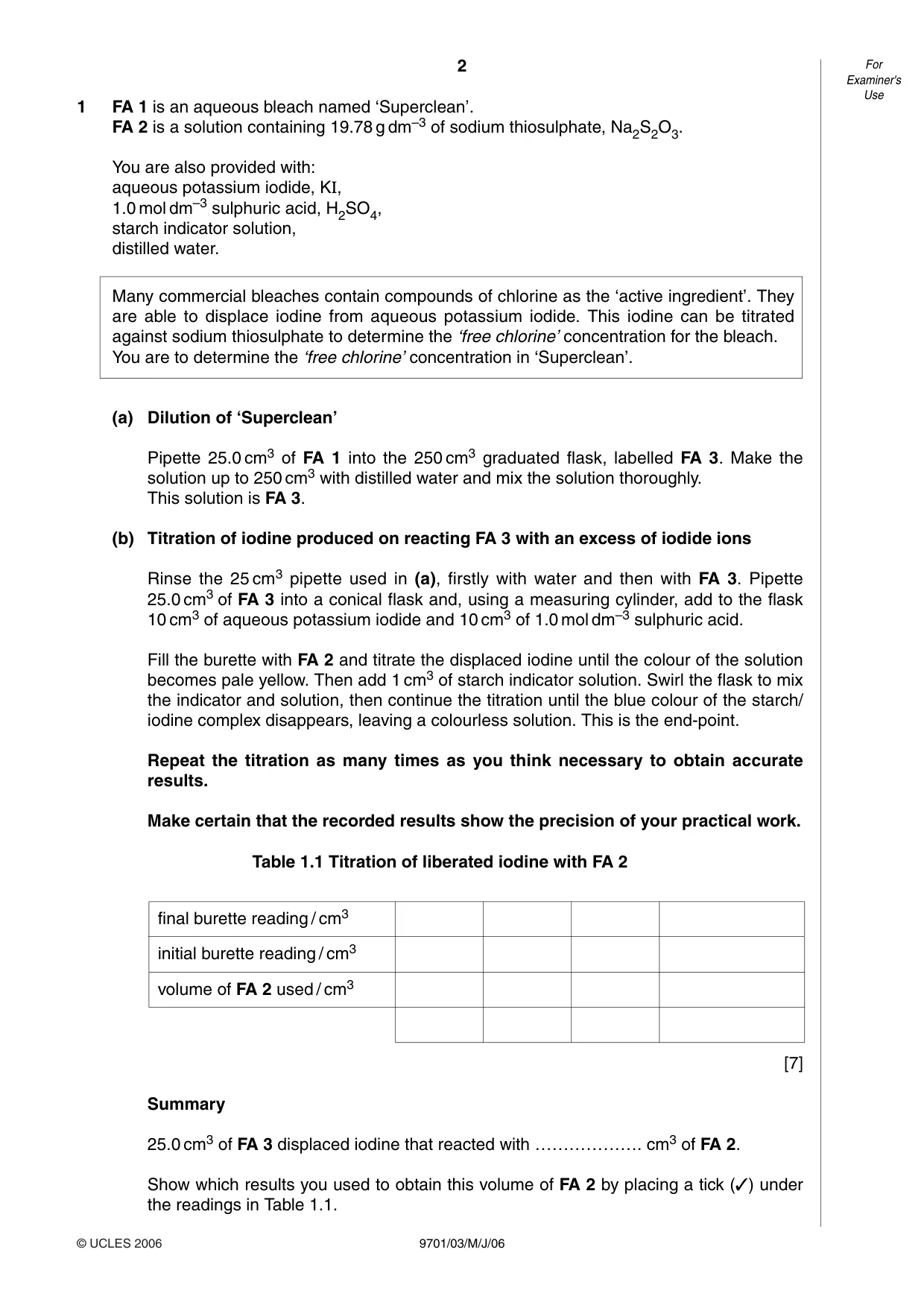
© UCLES 2006 2 9701/03/M/J/06 For Examiner's Use 1 FA 1 is an aqueous bleach named ‘Superclean’. FA 2 is a solution containing 19.78 g dm–3 of sodium thiosulphate, Na2S2O3. You are also provided with: aqueous potassium iodide, KI, 1.0 mol dm–3 sulphuric acid, H2SO4, starch indicator solution, distilled water. Many commercial bleaches contain compounds of chlorine as the ‘active ingredient’. They are able to displace iodine from aqueous potassium iodide. This iodine can be titrated against sodium thiosulphate to determine the ‘free chlorine’ concentration for the bleach. You are to determine the ‘free chlorine’ concentration in ‘Superclean’. (a) Dilution of ‘Superclean’ Pipette 25.0 cm3 of FA 1 into the 250 cm3 graduated flask, labelled FA 3. Make the solution up to 250 cm3 with distilled water and mix the solution thoroughly. This solution is FA 3. (b) Titration of iodine produced on reacting FA 3 with an excess of iodide ions Rinse the 25 cm3 pipette used in (a), firstly with water and then with FA 3. Pipette 25.0 cm3 of FA 3 into a conical flask and, using a measuring cylinder, add to the flask 10 cm3 of aqueous potassium iodide and 10 cm3 of 1.0 mol dm–3 sulphuric acid. Fill the burette with FA 2 and titrate the displaced iodine until the colour of the solution becomes pale yellow. Then add 1 cm3 of starch indicator solution. Swirl the flask to mix the indicator and solution, then continue the titration until the blue colour of the starch/ iodine complex disappears, leaving a colourless solution. This is the end-point. Repeat the titration as many times as you think necessary to obtain accurate results. Make certain that the recorded results show the precision of your practical work. Table 1.1 Titration of liberated iodine with FA 2 [7] Summary 25.0 cm3 of FA 3 displaced iodine that reacted with ………………. cm3 of FA 2. Show which results you used to obtain this volume of FA 2 by placing a tick (✓) under the readings in Table 1.1. final burette reading / cm3 initial burette reading / cm3 volume of FA 2 used / cm3
Question paper, page 3
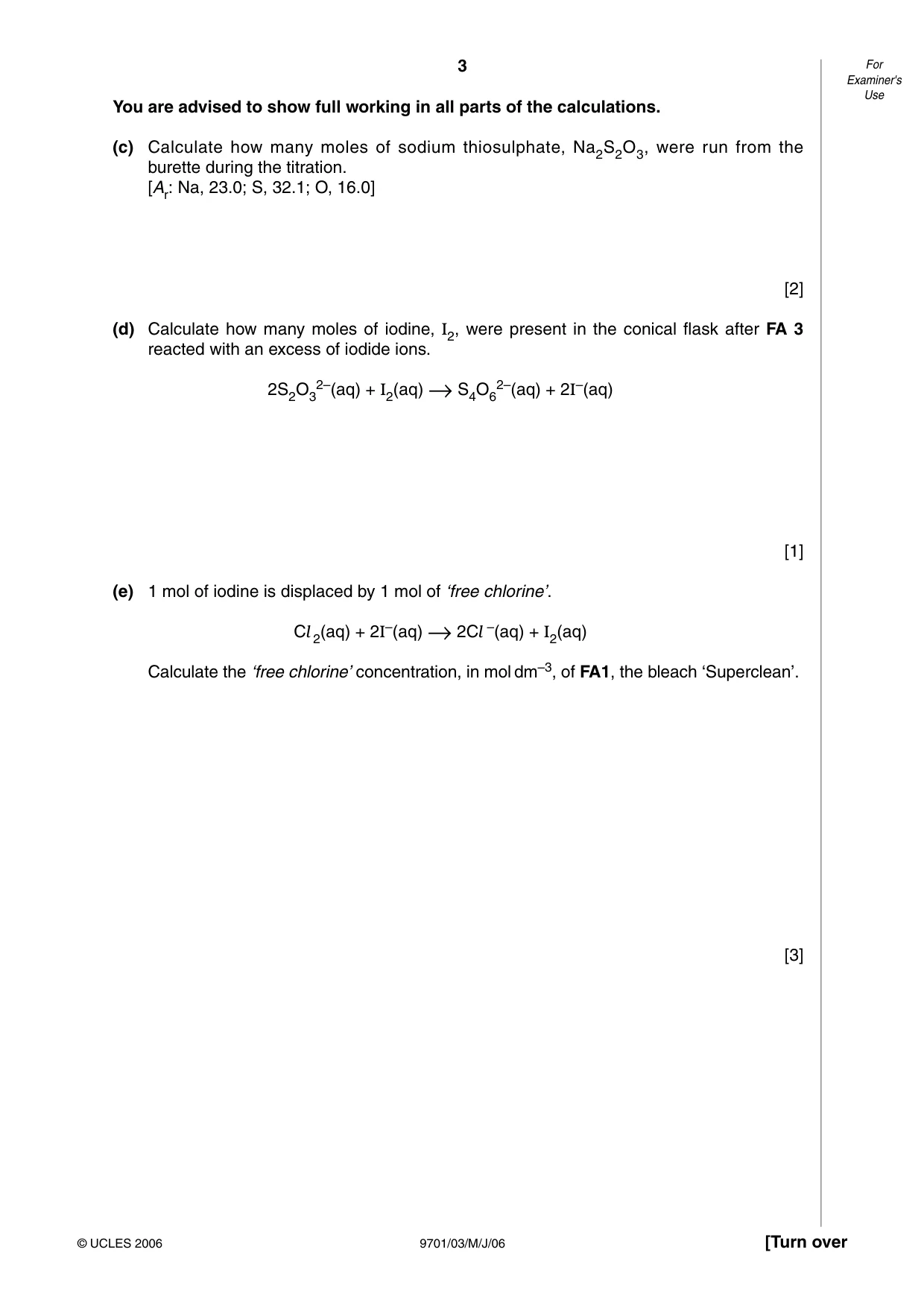
You are advised to show full working in all parts of the calculations. (c) Calculate how many moles of sodium thiosulphate, Na2S2O3, were run from the burette during the titration. [Ar: Na, 23.0; S, 32.1; O, 16.0] [2] (d) Calculate how many moles of iodine, I2, were present in the conical flask after FA 3 reacted with an excess of iodide ions. 2S2O3 2–(aq) + I2(aq) →S4O6 2–(aq) + 2I–(aq) [1] (e) 1 mol of iodine is displaced by 1 mol of ‘free chlorine’. Cl 2(aq) + 2I–(aq) →2Cl –(aq) + I2(aq) Calculate the ‘free chlorine’ concentration, in mol dm–3, of FA1, the bleach ‘Superclean’. [3] 3 9701/03/M/J/06 [Turn over For Examiner's Use © UCLES 2006
Question paper, page 4
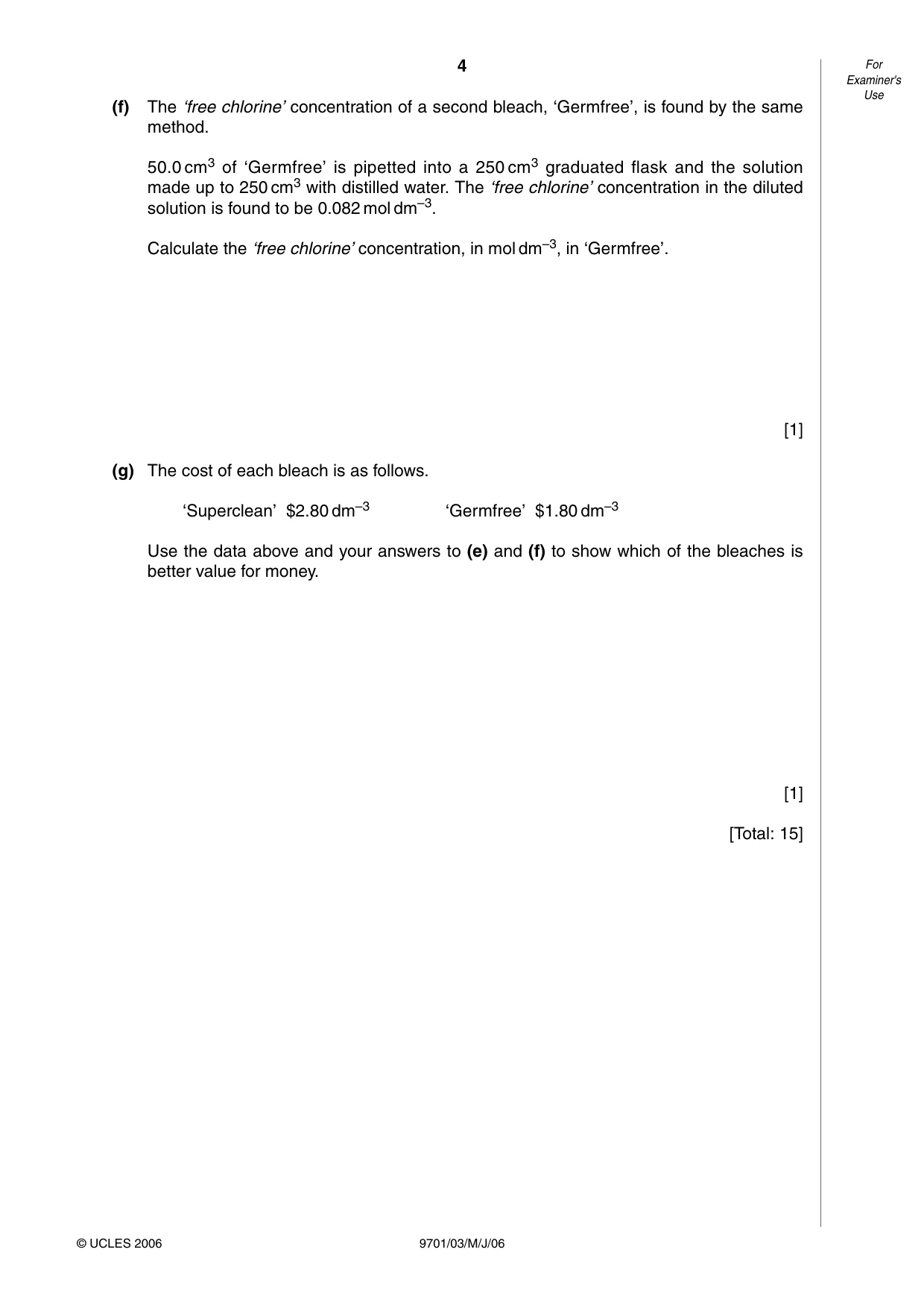
(f) The ‘free chlorine’ concentration of a second bleach, ‘Germfree’, is found by the same method. 50.0 cm3 of ‘Germfree’ is pipetted into a 250 cm3 graduated flask and the solution made up to 250 cm3 with distilled water. The ‘free chlorine’ concentration in the diluted solution is found to be 0.082 mol dm–3. Calculate the ‘free chlorine’ concentration, in mol dm–3, in ‘Germfree’. [1] (g) The cost of each bleach is as follows. ‘Superclean’ $2.80 dm–3 ‘Germfree’ $1.80 dm–3 Use the data above and your answers to (e) and (f) to show which of the bleaches is better value for money. [1] [Total: 15] 4 9701/03/M/J/06 For Examiner's Use © UCLES 2006
Question paper, page 6
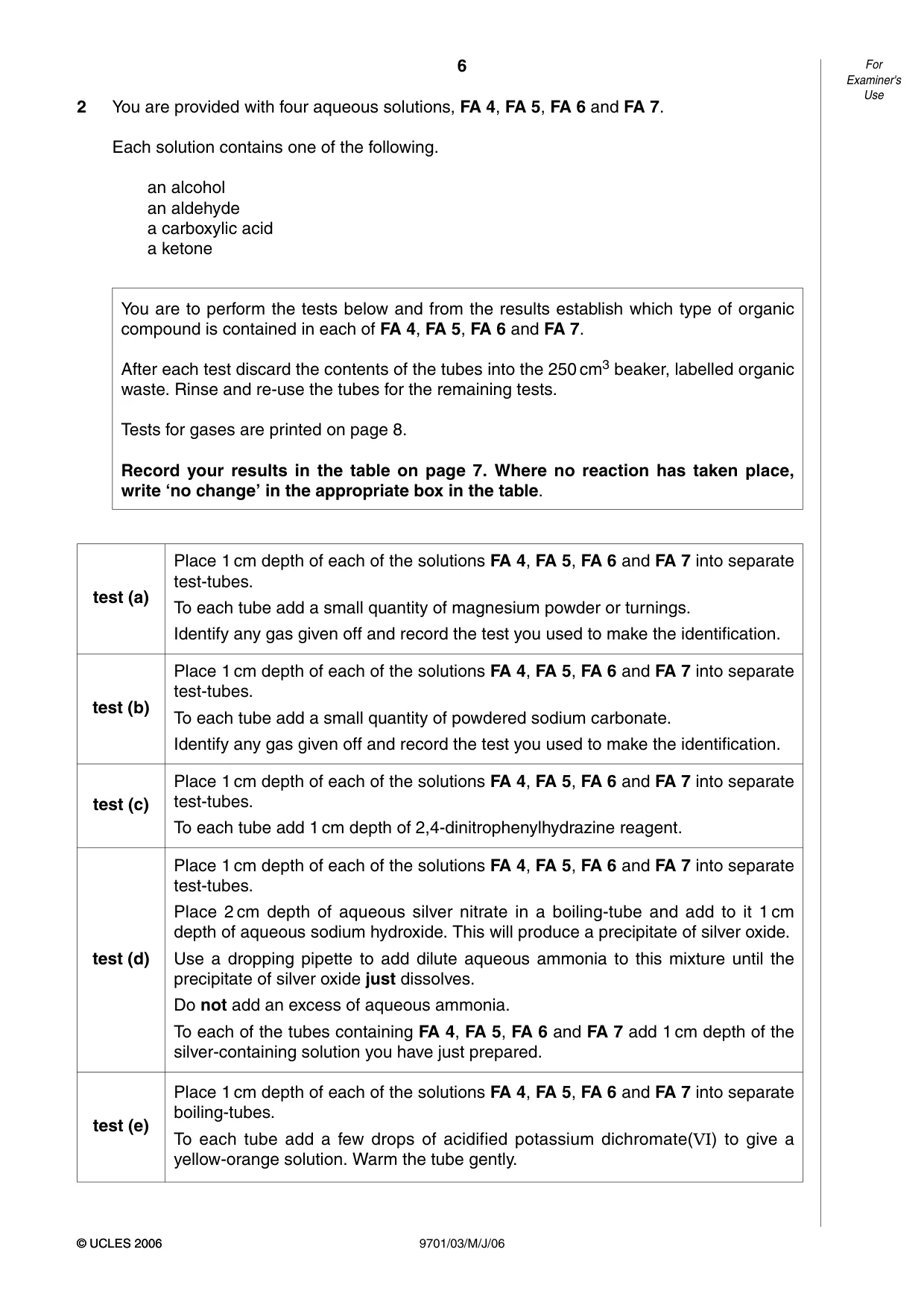
6 9701/03/M/J/06 For Examiner's Use © UCLES 2006 © UCLES 2006 2 You are provided with four aqueous solutions, FA 4, FA 5, FA 6 and FA 7. Each solution contains one of the following. an alcohol an aldehyde a carboxylic acid a ketone You are to perform the tests below and from the results establish which type of organic compound is contained in each of FA 4, FA 5, FA 6 and FA 7. After each test discard the contents of the tubes into the 250 cm3 beaker, labelled organic waste. Rinse and re-use the tubes for the remaining tests. Tests for gases are printed on page 8. Record your results in the table on page 7. Where no reaction has taken place, write ‘no change’ in the appropriate box in the table. test (a) test (b) test (c) test (d) test (e) Place 1 cm depth of each of the solutions FA 4, FA 5, FA 6 and FA 7 into separate test-tubes. To each tube add a small quantity of magnesium powder or turnings. Identify any gas given off and record the test you used to make the identification. Place 1 cm depth of each of the solutions FA 4, FA 5, FA 6 and FA 7 into separate test-tubes. To each tube add a small quantity of powdered sodium carbonate. Identify any gas given off and record the test you used to make the identification. Place 1 cm depth of each of the solutions FA 4, FA 5, FA 6 and FA 7 into separate test-tubes. To each tube add 1 cm depth of 2,4-dinitrophenylhydrazine reagent. Place 1 cm depth of each of the solutions FA 4, FA 5, FA 6 and FA 7 into separate test-tubes. Place 2 cm depth of aqueous silver nitrate in a boiling-tube and add to it 1 cm depth of aqueous sodium hydroxide. This will produce a precipitate of silver oxide. Use a dropping pipette to add dilute aqueous ammonia to this mixture until the precipitate of silver oxide just dissolves. Do not add an excess of aqueous ammonia. To each of the tubes containing FA 4, FA 5, FA 6 and FA 7 add 1 cm depth of the silver-containing solution you have just prepared. Place 1 cm depth of each of the solutions FA 4, FA 5, FA 6 and FA 7 into separate boiling-tubes. To each tube add a few drops of acidified potassium dichromate(VI) to give a yellow-orange solution. Warm the tube gently.
Question paper, page 7
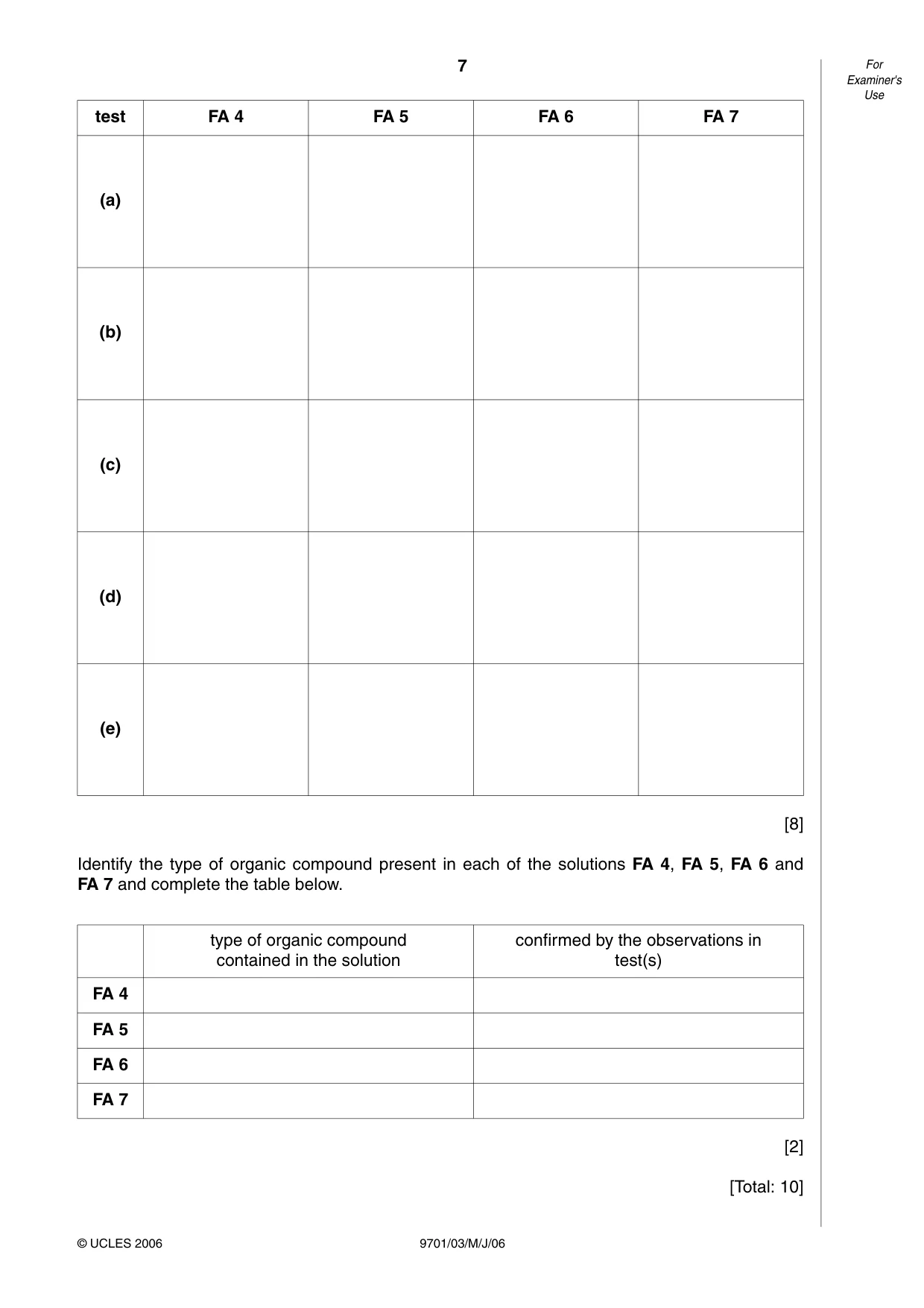
7 9701/03/M/J/06 For Examiner's Use © UCLES 2006 [8] Identify the type of organic compound present in each of the solutions FA 4, FA 5, FA 6 and FA 7 and complete the table below. [2] [Total: 10] test (a) (b) (c) (d) (e) FA 4 FA 5 FA 6 FA 7 FA 4 type of organic compound contained in the solution confirmed by the observations in test(s) FA 5 FA 6 FA 7
Question paper, page 8
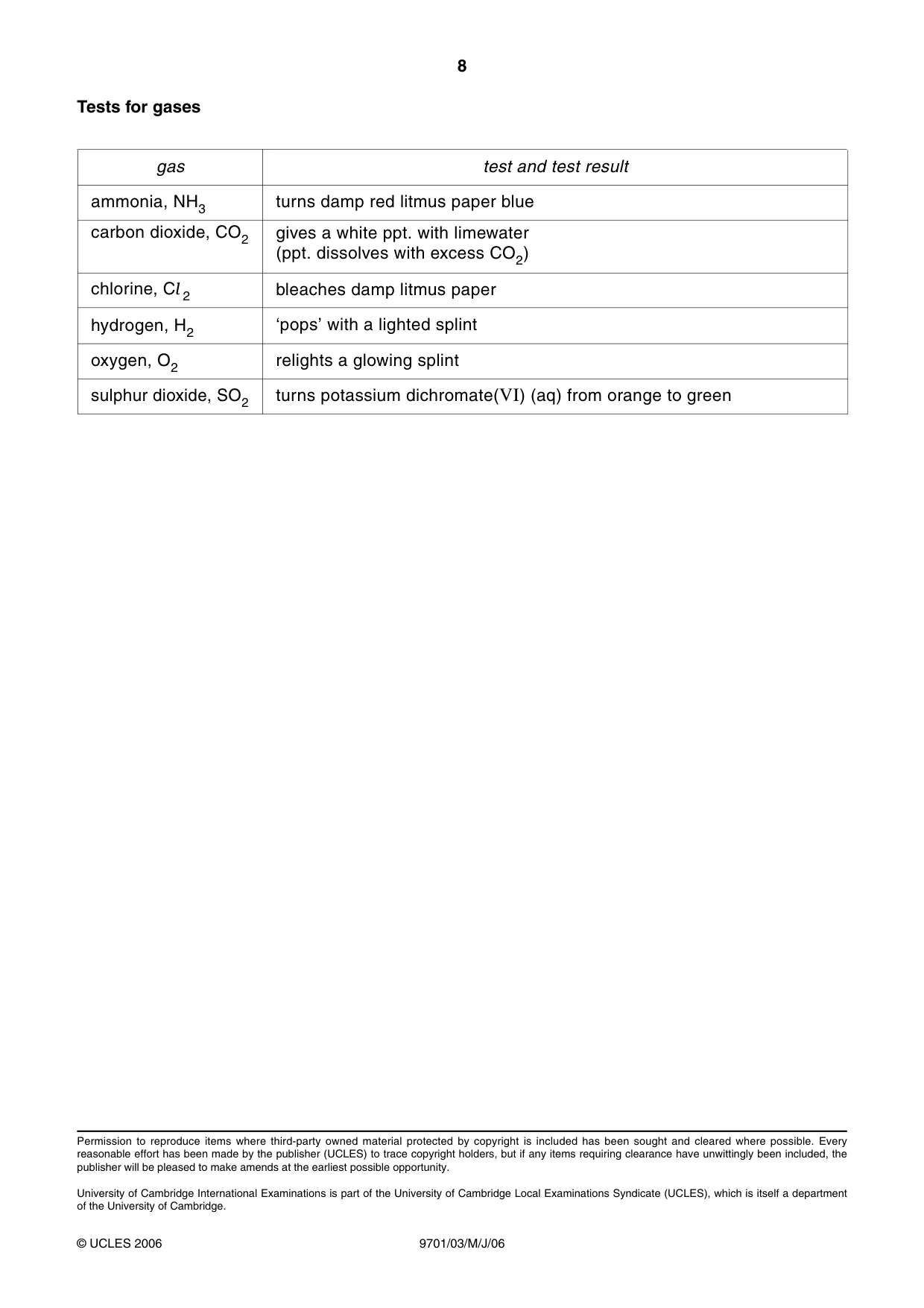
Tests for gases 8 9701/03/M/J/06 © UCLES 2006 gas test and test result turns damp red litmus paper blue gives a white ppt. with limewater (ppt. dissolves with excess CO2) bleaches damp litmus paper ‘pops’ with a lighted splint relights a glowing splint turns potassium dichromate(VI) (aq) from orange to green ammonia, NH3 carbon dioxide, CO2 chlorine, Cl 2 hydrogen, H2 oxygen, O2 sulphur dioxide, SO2 Permission to reproduce items where third-party owned material protected by copyright is included has been sought and cleared where possible. Every reasonable effort has been made by the publisher (UCLES) to trace copyright holders, but if any items requiring clearance have unwittingly been included, the publisher will be pleased to make amends at the earliest possible opportunity. University of Cambridge International Examinations is part of the University of Cambridge Local Examinations Syndicate (UCLES), which is itself a department of the University of Cambridge.
Mark scheme, page 1
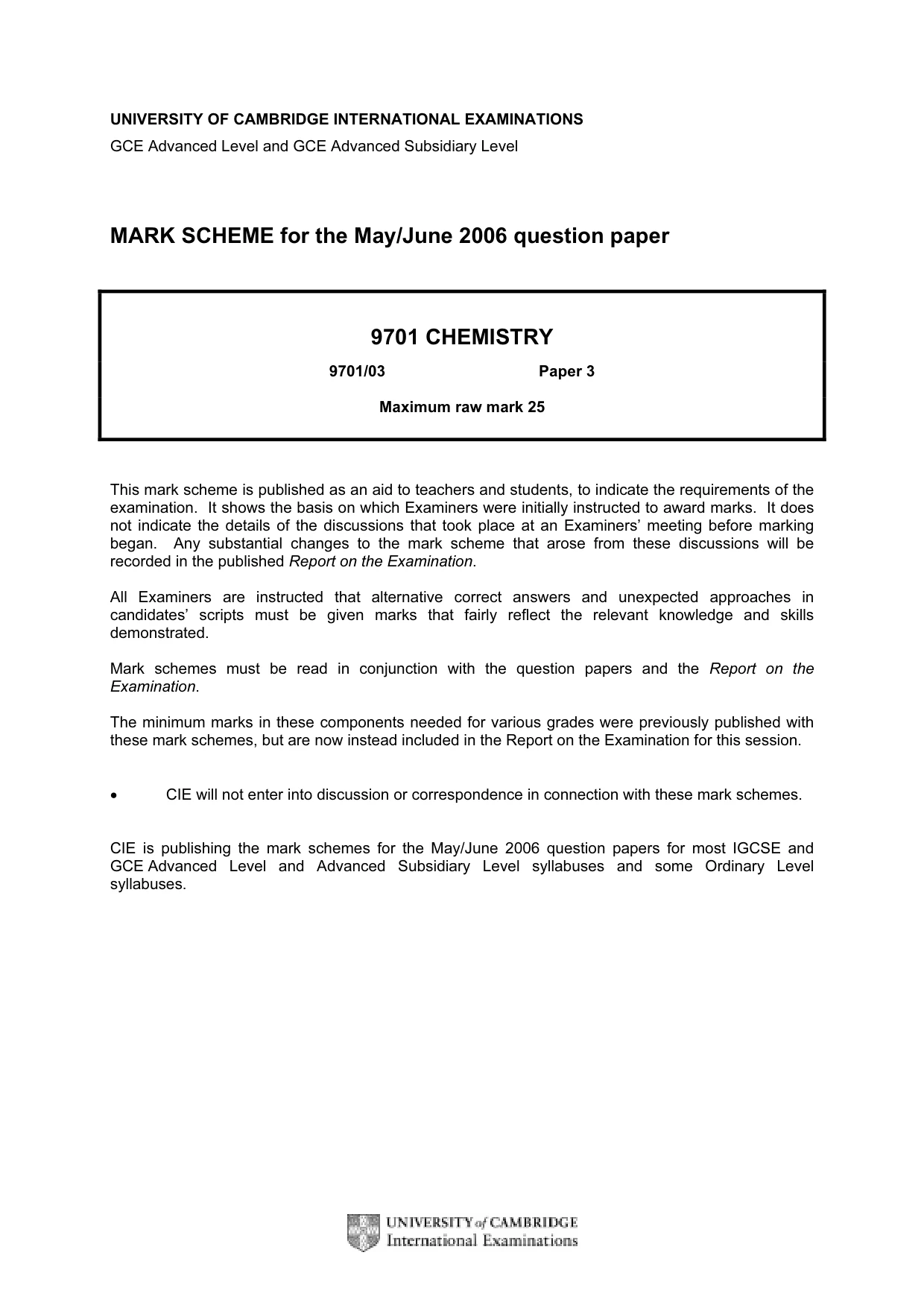
UNIVERSITY OF CAMBRIDGE INTERNATIONAL EXAMINATIONS GCE Advanced Level and GCE Advanced Subsidiary Level MARK SCHEME for the May/June 2006 question paper 9701 CHEMISTRY 9701/03 Paper 3 Maximum raw mark 25 This mark scheme is published as an aid to teachers and students, to indicate the requirements of the examination. It shows the basis on which Examiners were initially instructed to award marks. It does not indicate the details of the discussions that took place at an Examiners’ meeting before marking began. Any substantial changes to the mark scheme that arose from these discussions will be recorded in the published Report on the Examination. All Examiners are instructed that alternative correct answers and unexpected approaches in candidates’ scripts must be given marks that fairly reflect the relevant knowledge and skills demonstrated. Mark schemes must be read in conjunction with the question papers and the Report on the Examination. The minimum marks in these components needed for various grades were previously published with these mark schemes, but are now instead included in the Report on the Examination for this session. • CIE will not enter into discussion or correspondence in connection with these mark schemes. CIE is publishing the mark schemes for the May/June 2006 question papers for most IGCSE and GCE Advanced Level and Advanced Subsidiary Level syllabuses and some Ordinary Level syllabuses.
Mark scheme, page 2
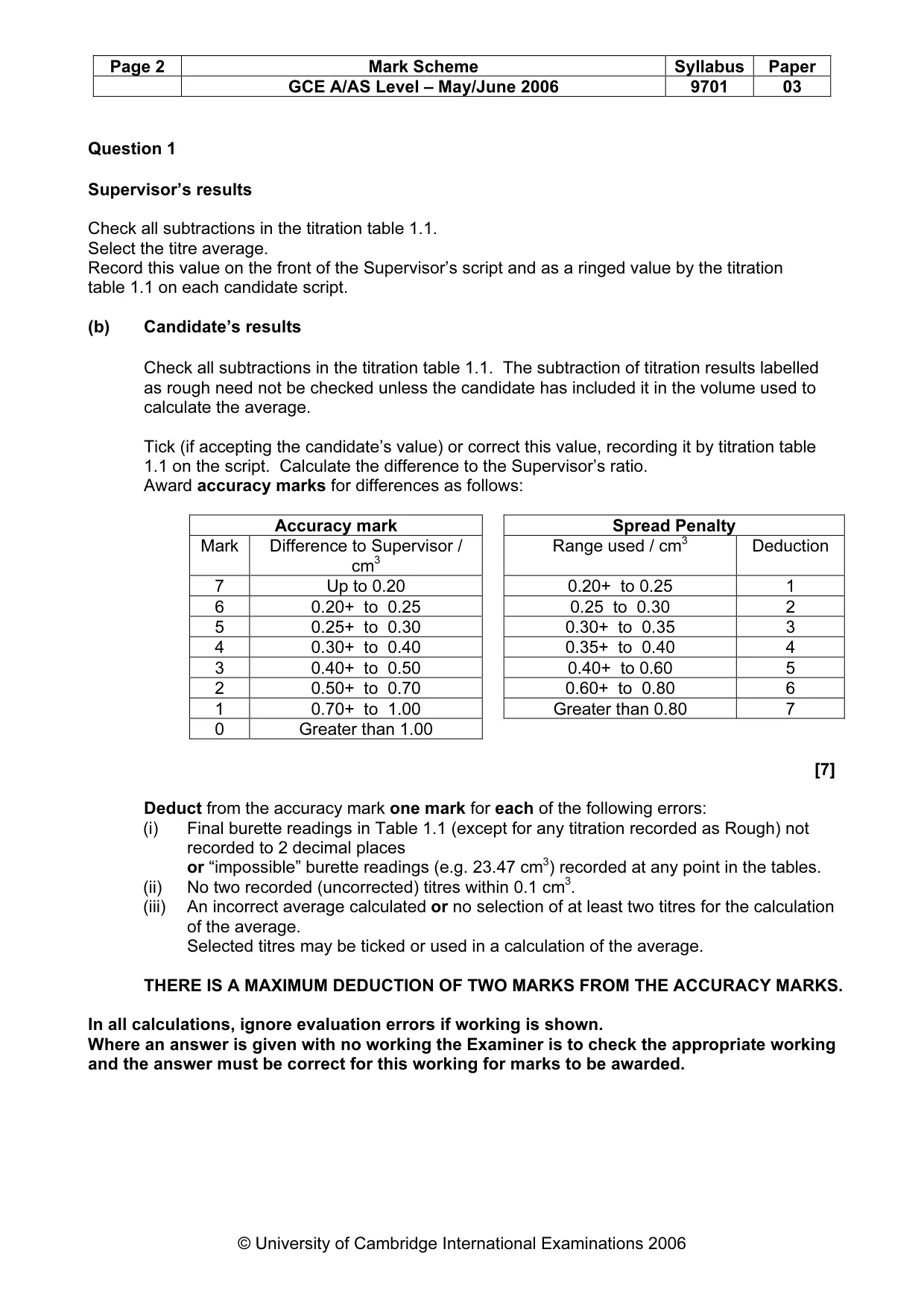
Page 2 Mark Scheme Syllabus Paper GCE A/AS Level – May/June 2006 9701 03 © University of Cambridge International Examinations 2006 Question 1 Supervisor’s results Check all subtractions in the titration table 1.1. Select the titre average. Record this value on the front of the Supervisor’s script and as a ringed value by the titration table 1.1 on each candidate script. (b) Candidate’s results Check all subtractions in the titration table 1.1. The subtraction of titration results labelled as rough need not be checked unless the candidate has included it in the volume used to calculate the average. Tick (if accepting the candidate’s value) or correct this value, recording it by titration table 1.1 on the script. Calculate the difference to the Supervisor’s ratio. Award accuracy marks for differences as follows: Accuracy mark Spread Penalty Mark Difference to Supervisor / cm3 Range used / cm3 Deduction 7 Up to 0.20 0.20+ to 0.25 1 6 0.20+ to 0.25 0.25 to 0.30 2 5 0.25+ to 0.30 0.30+ to 0.35 3 4 0.30+ to 0.40 0.35+ to 0.40 4 3 0.40+ to 0.50 0.40+ to 0.60 5 2 0.50+ to 0.70 0.60+ to 0.80 6 1 0.70+ to 1.00 Greater than 0.80 7 0 Greater than 1.00 [7] Deduct from the accuracy mark one mark for each of the following errors: (i) Final burette readings in Table 1.1 (except for any titration recorded as Rough) not recorded to 2 decimal places or “impossible” burette readings (e.g. 23.47 cm3) recorded at any point in the tables. (ii) No two recorded (uncorrected) titres within 0.1 cm3. (iii) An incorrect average calculated or no selection of at least two titres for the calculation of the average. Selected titres may be ticked or used in a calculation of the average. THERE IS A MAXIMUM DEDUCTION OF TWO MARKS FROM THE ACCURACY MARKS. In all calculations, ignore evaluation errors if working is shown. Where an answer is given with no working the Examiner is to check the appropriate working and the answer must be correct for this working for marks to be awarded.
Mark scheme, page 3
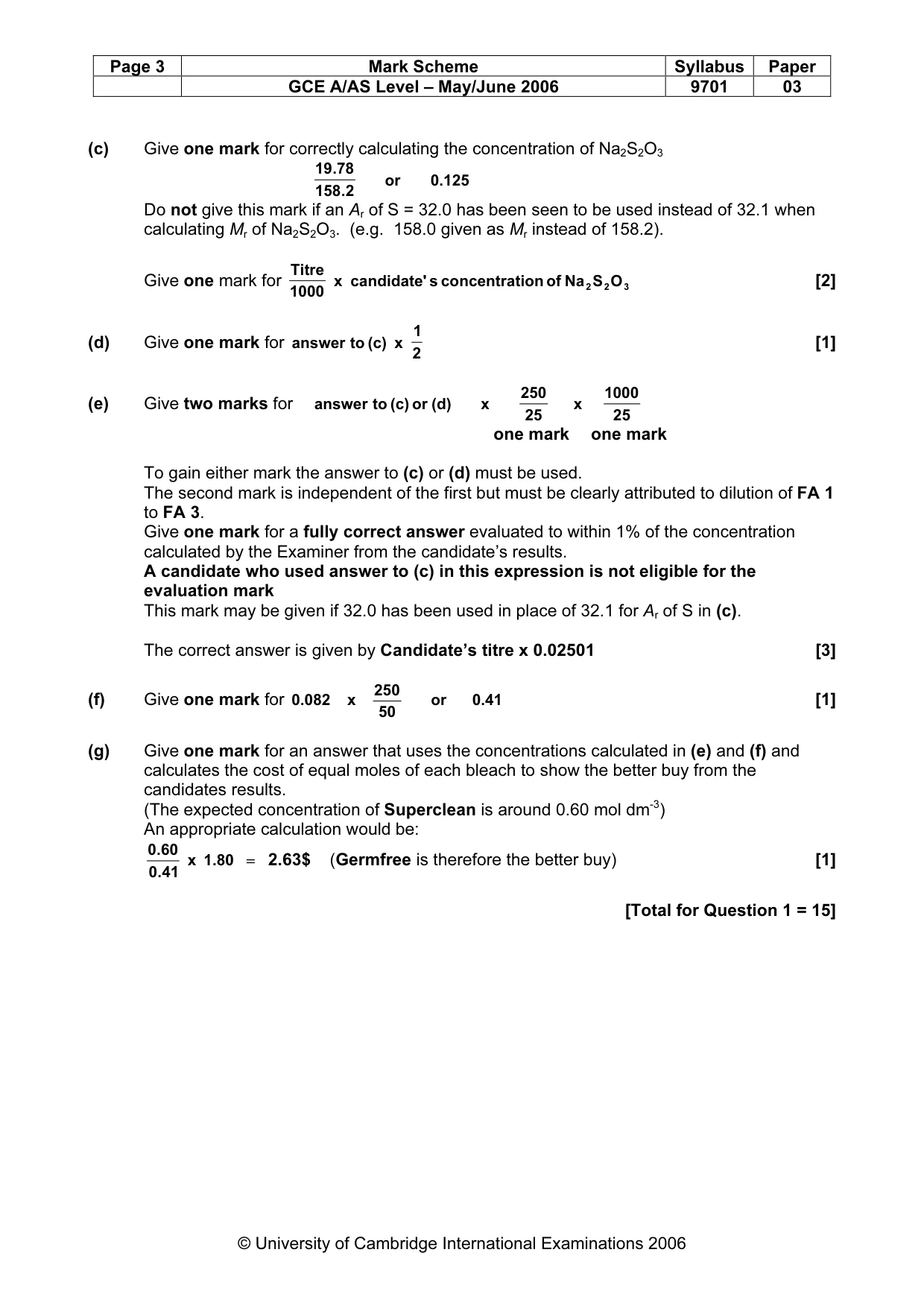
Page 3 Mark Scheme Syllabus Paper GCE A/AS Level – May/June 2006 9701 03 © University of Cambridge International Examinations 2006 (c) Give one mark for correctly calculating the concentration of Na2S2O3 0.125 or 2 . 158 78 . 19 Do not give this mark if an Ar of S = 32.0 has been seen to be used instead of 32.1 when calculating Mr of Na2S2O3. (e.g. 158.0 given as Mr instead of 158.2). Give one mark for 3 2 2 O S Na of ion concentrat s candidate' x 1000 Titre [2] (d) Give one mark for 2 1 x (c) to answer [1] (e) Give two marks for 25 1000 x 25 250 x (d) or (c) to answer one mark one mark To gain either mark the answer to (c) or (d) must be used. The second mark is independent of the first but must be clearly attributed to dilution of FA 1 to FA 3. Give one mark for a fully correct answer evaluated to within 1% of the concentration calculated by the Examiner from the candidate’s results. A candidate who used answer to (c) in this expression is not eligible for the evaluation mark This mark may be given if 32.0 has been used in place of 32.1 for Ar of S in (c). The correct answer is given by Candidate’s titre x 0.02501 [3] (f) Give one mark for 0.41 or 50 250 x 0.082 [1] (g) Give one mark for an answer that uses the concentrations calculated in (e) and (f) and calculates the cost of equal moles of each bleach to show the better buy from the candidates results. (The expected concentration of Superclean is around 0.60 mol dm-3) An appropriate calculation would be: 1.80 x 41 . 0 60 . 0 = 2.63$ (Germfree is therefore the better buy) [1] [Total for Question 1 = 15]
Mark scheme, page 4
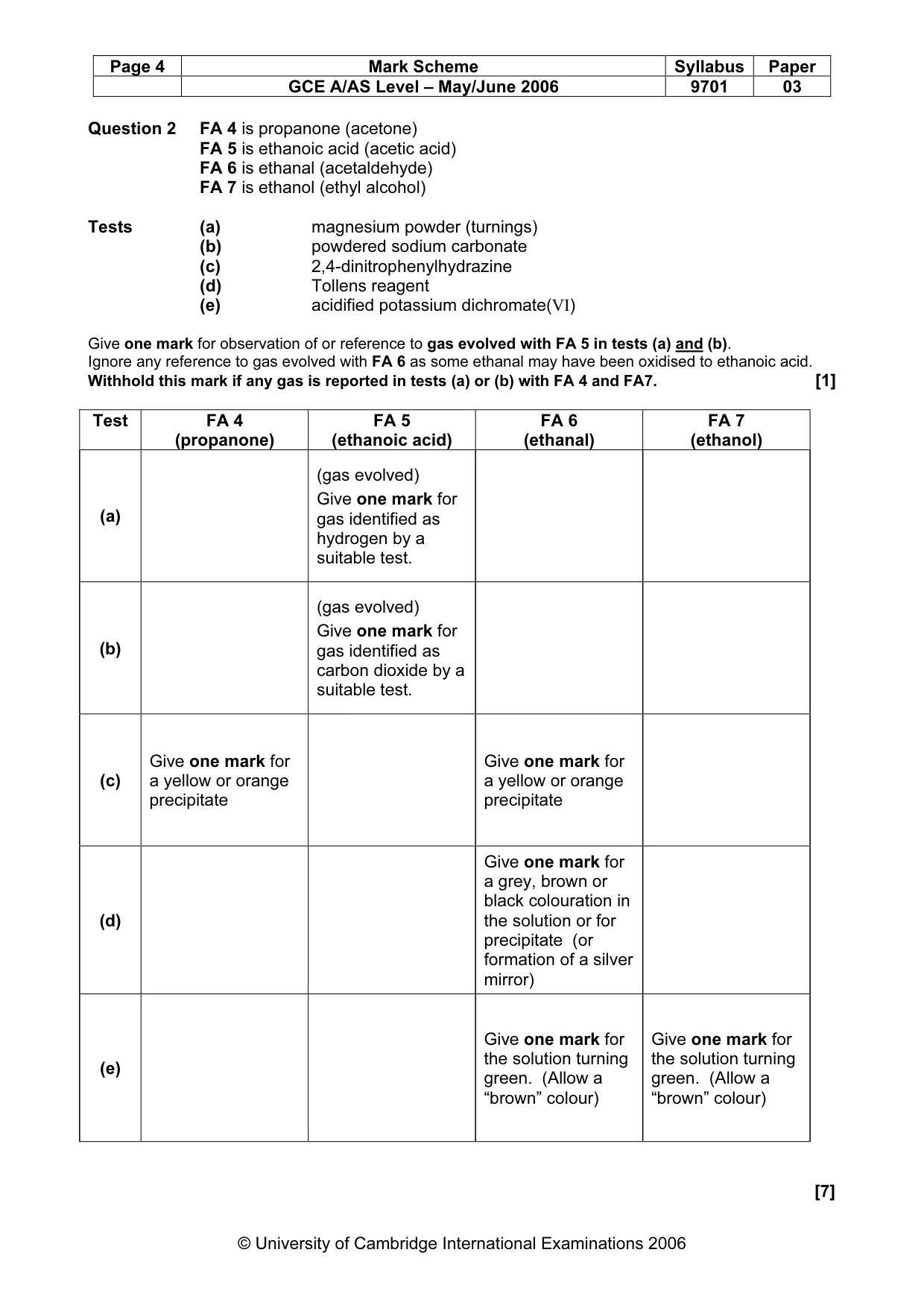
Page 4 Mark Scheme Syllabus Paper GCE A/AS Level – May/June 2006 9701 03 © University of Cambridge International Examinations 2006 Question 2 FA 4 is propanone (acetone) FA 5 is ethanoic acid (acetic acid) FA 6 is ethanal (acetaldehyde) FA 7 is ethanol (ethyl alcohol) Tests (a) magnesium powder (turnings) (b) powdered sodium carbonate (c) 2,4-dinitrophenylhydrazine (d) Tollens reagent (e) acidified potassium dichromate(VI) Give one mark for observation of or reference to gas evolved with FA 5 in tests (a) and (b). Ignore any reference to gas evolved with FA 6 as some ethanal may have been oxidised to ethanoic acid. Withhold this mark if any gas is reported in tests (a) or (b) with FA 4 and FA7. [1] Test FA 4 (propanone) FA 5 (ethanoic acid) FA 6 (ethanal) FA 7 (ethanol) (a) (gas evolved) Give one mark for gas identified as hydrogen by a suitable test. (b) (gas evolved) Give one mark for gas identified as carbon dioxide by a suitable test. (c) Give one mark for a yellow or orange precipitate Give one mark for a yellow or orange precipitate (d) Give one mark for a grey, brown or black colouration in the solution or for precipitate (or formation of a silver mirror) (e) Give one mark for the solution turning green. (Allow a “brown” colour) Give one mark for the solution turning green. (Allow a “brown” colour) [7]
Mark scheme, page 5
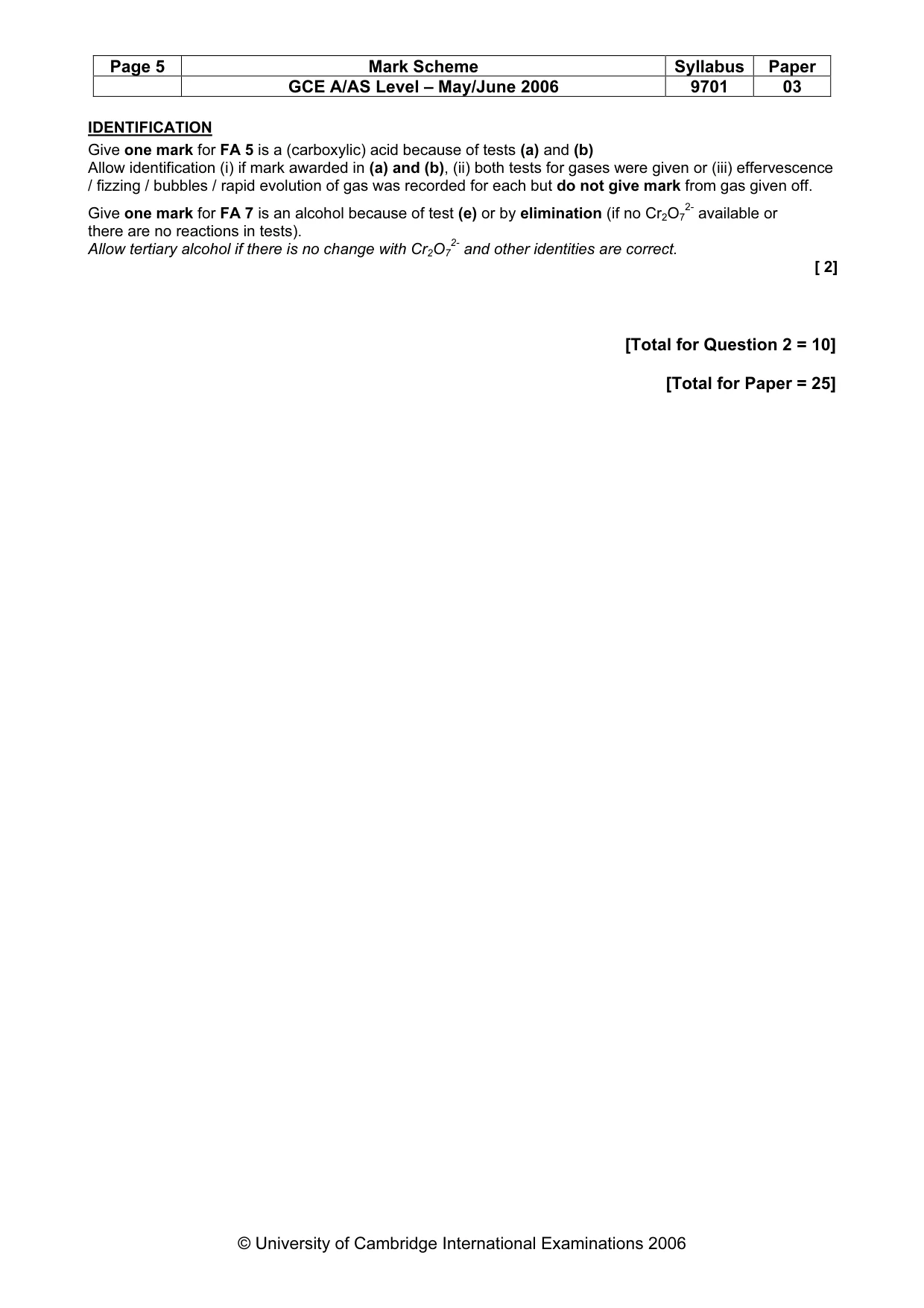
Page 5 Mark Scheme Syllabus Paper GCE A/AS Level – May/June 2006 9701 03 © University of Cambridge International Examinations 2006 IDENTIFICATION Give one mark for FA 5 is a (carboxylic) acid because of tests (a) and (b) Allow identification (i) if mark awarded in (a) and (b), (ii) both tests for gases were given or (iii) effervescence / fizzing / bubbles / rapid evolution of gas was recorded for each but do not give mark from gas given off. Give one mark for FA 7 is an alcohol because of test (e) or by elimination (if no Cr2O7 2- available or there are no reactions in tests). Allow tertiary alcohol if there is no change with Cr2O7 2- and other identities are correct. [ 2] [Total for Question 2 = 10] [Total for Paper = 25]
What you needed in this session
Cambridge’s own grade thresholds for 2006 May/June, Paper 3 · Variant 1. A higher threshold means an easier paper — the bar moves with how the cohort did.