Cambridge A Level Chemistry 9701 — 2005 May/June Paper 3 · Variant 1
9701/31/M/J/05
The question paper and its mark scheme, free to read here and free to download. This is Cambridge’s own paper, exactly as it was sat.
Question paper8 pages
Mark scheme9 pages
Answers below. Sit the paper first if you are practising.
Paper as text
Question paper, page 1
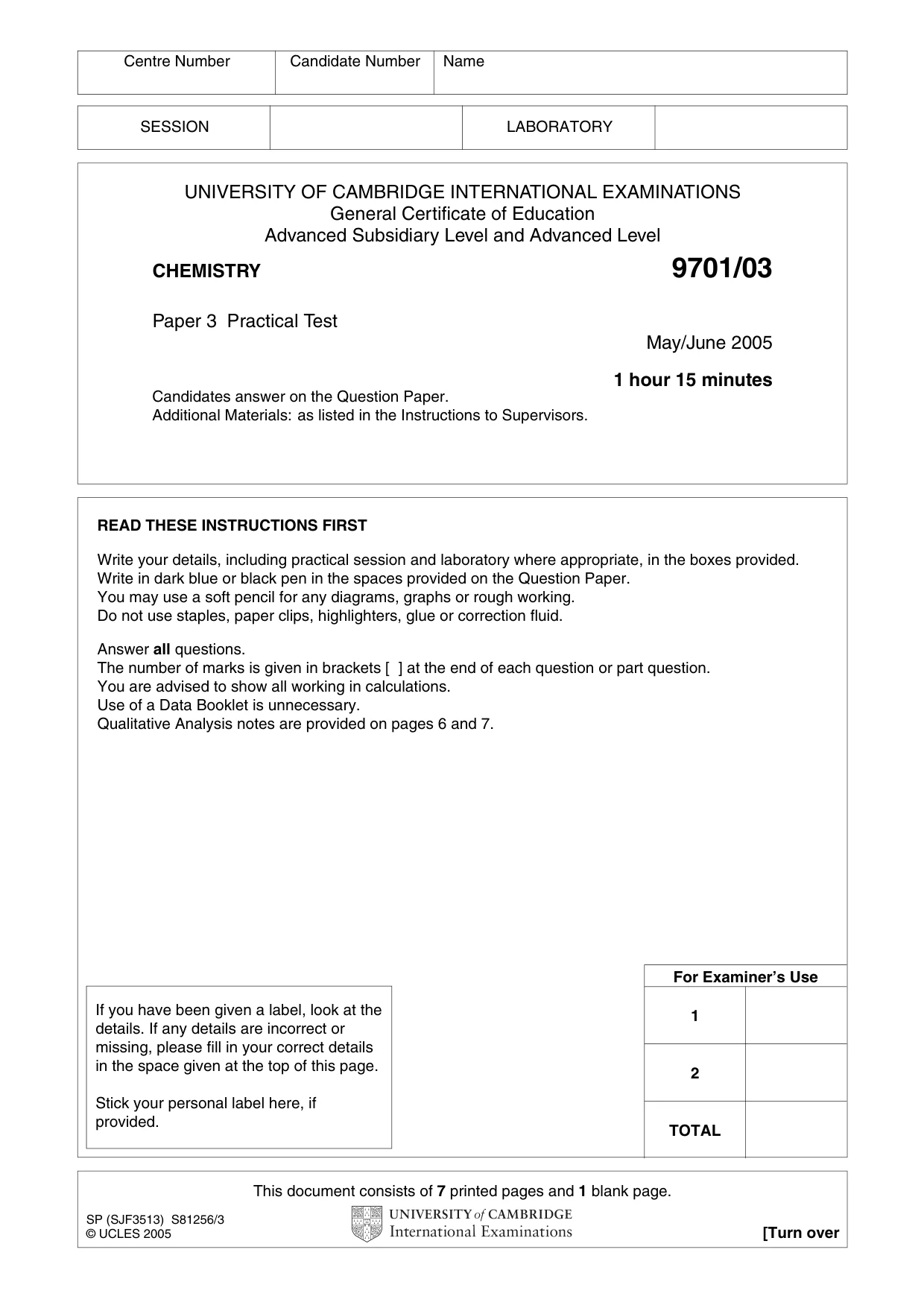
This document consists of 7 printed pages and 1 blank page. SP (SJF3513) S81256/3 © UCLES 2005 [Turn over UNIVERSITY OF CAMBRIDGE INTERNATIONAL EXAMINATIONS General Certificate of Education Advanced Subsidiary Level and Advanced Level CHEMISTRY 9701/03 Paper 3 Practical Test May/June 2005 1 hour 15 minutes Candidates answer on the Question Paper. Additional Materials: as listed in the Instructions to Supervisors. READ THESE INSTRUCTIONS FIRST Write your details, including practical session and laboratory where appropriate, in the boxes provided. Write in dark blue or black pen in the spaces provided on the Question Paper. You may use a soft pencil for any diagrams, graphs or rough working. Do not use staples, paper clips, highlighters, glue or correction fluid. Answer all questions. The number of marks is given in brackets [ ] at the end of each question or part question. You are advised to show all working in calculations. Use of a Data Booklet is unnecessary. Qualitative Analysis notes are provided on pages 6 and 7. Centre Number Candidate Number Name SESSION LABORATORY If you have been given a label, look at the details. If any details are incorrect or missing, please fill in your correct details in the space given at the top of this page. Stick your personal label here, if provided. For Examiner’s Use 1 2 TOTAL
Question paper, page 2
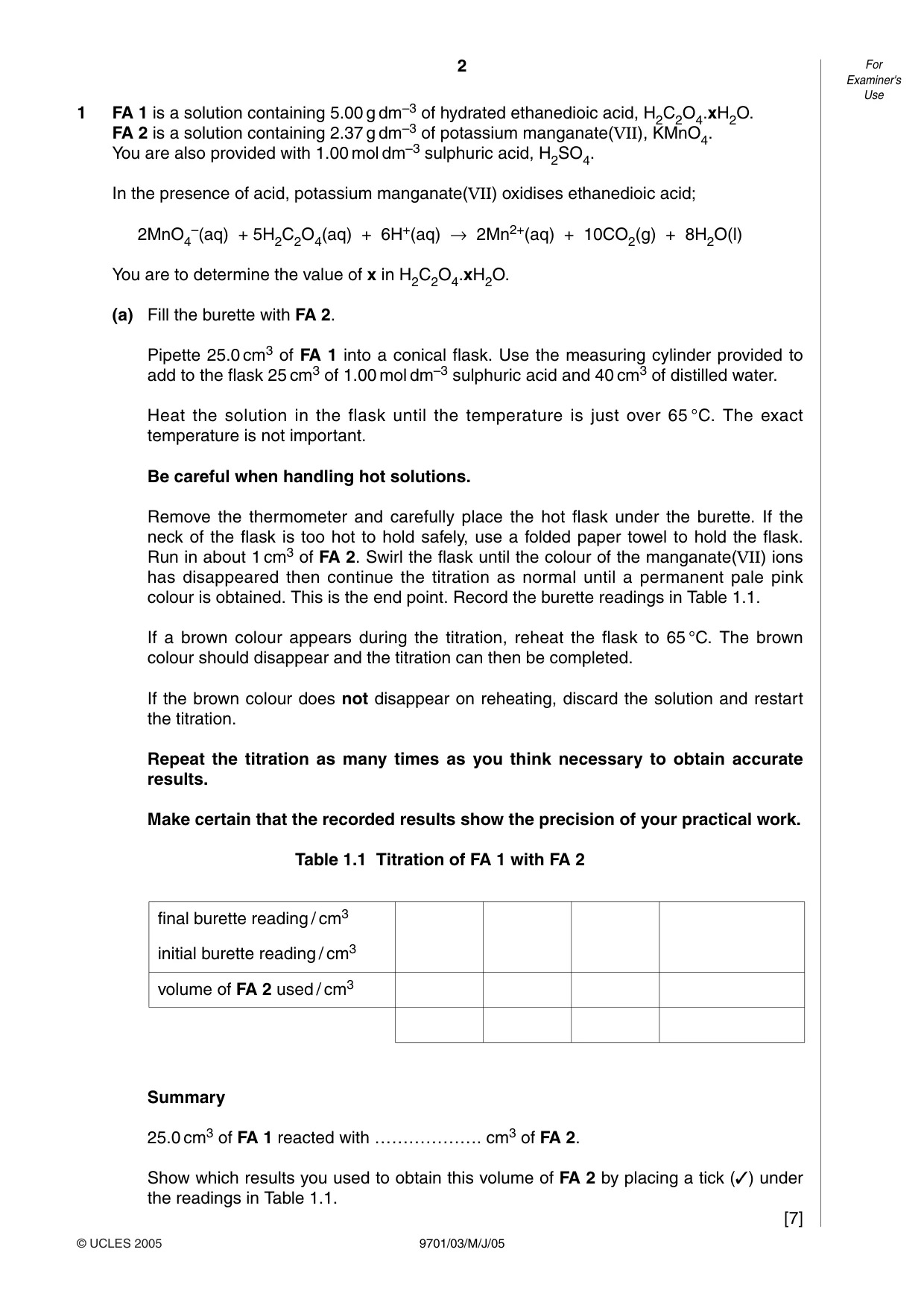
© UCLES 2005 2 9701/03/M/J/05 For Examiner's Use 1 FA 1 is a solution containing 5.00 g dm–3 of hydrated ethanedioic acid, H2C2O4.xH2O. FA 2 is a solution containing 2.37 g dm–3 of potassium manganate(VII), KMnO4. You are also provided with 1.00 mol dm–3 sulphuric acid, H2SO4. In the presence of acid, potassium manganate(VII) oxidises ethanedioic acid; 2MnO4 –(aq) + 5H2C2O4(aq) + 6H+(aq) →2Mn2+(aq) + 10CO2(g) + 8H2O(l) You are to determine the value of x in H2C2O4.xH2O. (a) Fill the burette with FA 2. Pipette 25.0 cm3 of FA 1 into a conical flask. Use the measuring cylinder provided to add to the flask 25 cm3 of 1.00 mol dm–3 sulphuric acid and 40 cm3 of distilled water. Heat the solution in the flask until the temperature is just over 65 °C. The exact temperature is not important. Be careful when handling hot solutions. Remove the thermometer and carefully place the hot flask under the burette. If the neck of the flask is too hot to hold safely, use a folded paper towel to hold the flask. Run in about 1 cm3 of FA 2. Swirl the flask until the colour of the manganate(VII) ions has disappeared then continue the titration as normal until a permanent pale pink colour is obtained. This is the end point. Record the burette readings in Table 1.1. If a brown colour appears during the titration, reheat the flask to 65 °C. The brown colour should disappear and the titration can then be completed. If the brown colour does not disappear on reheating, discard the solution and restart the titration. Repeat the titration as many times as you think necessary to obtain accurate results. Make certain that the recorded results show the precision of your practical work. Table 1.1 Titration of FA 1 with FA 2 Summary 25.0 cm3 of FA 1 reacted with ………………. cm3 of FA 2. Show which results you used to obtain this volume of FA 2 by placing a tick (✓) under the readings in Table 1.1. [7] final burette reading / cm3 initial burette reading / cm3 volume of FA 2 used / cm3
Question paper, page 3
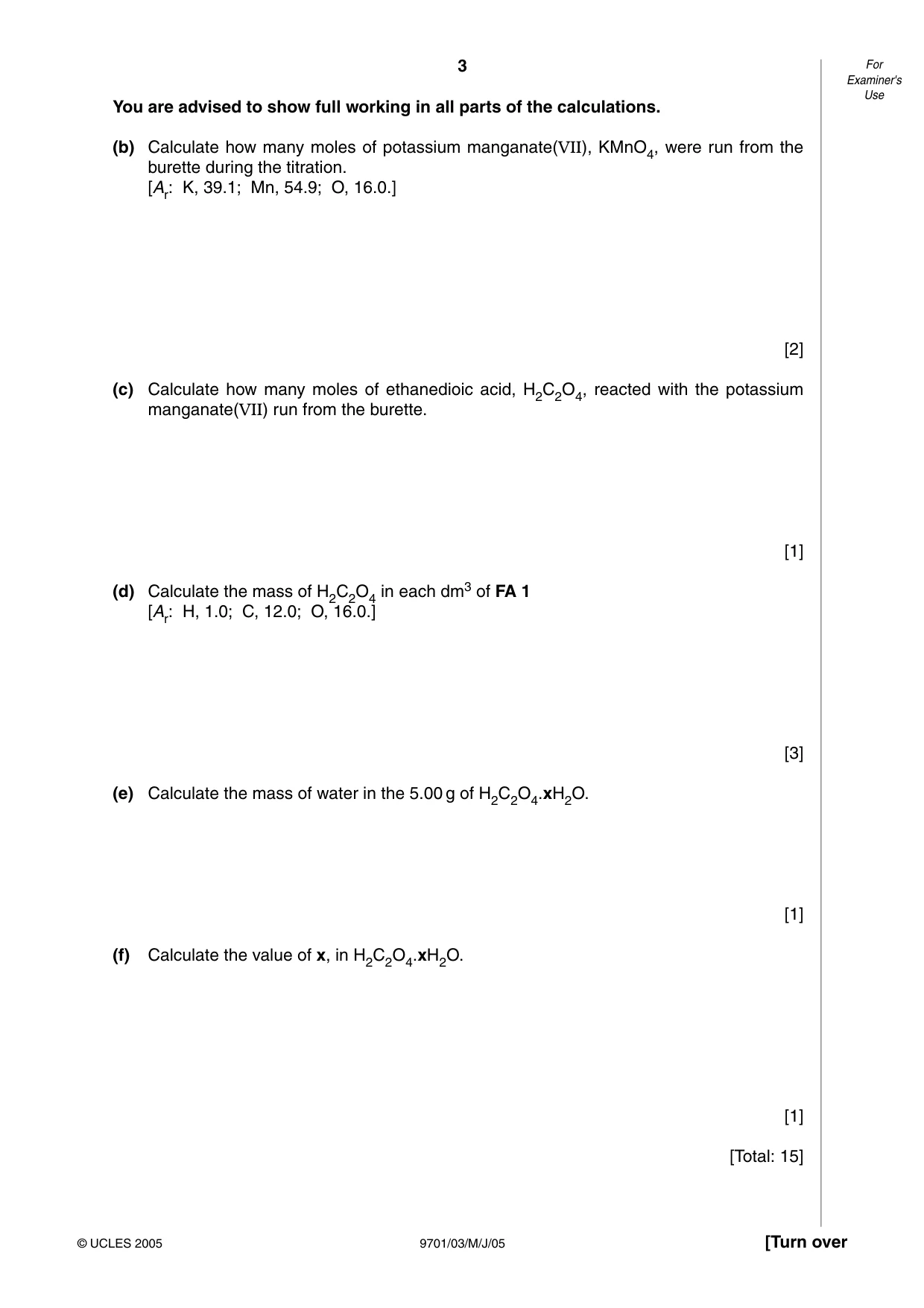
You are advised to show full working in all parts of the calculations. (b) Calculate how many moles of potassium manganate(VII), KMnO4, were run from the burette during the titration. [Ar: K, 39.1; Mn, 54.9; O, 16.0.] [2] (c) Calculate how many moles of ethanedioic acid, H2C2O4, reacted with the potassium manganate(VII) run from the burette. [1] (d) Calculate the mass of H2C2O4 in each dm3 of FA 1 [Ar: H, 1.0; C, 12.0; O, 16.0.] [3] (e) Calculate the mass of water in the 5.00 g of H2C2O4.xH2O. [1] (f) Calculate the value of x, in H2C2O4.xH2O. [1] [Total: 15] 3 9701/03/M/J/05 [Turn over For Examiner's Use © UCLES 2005
Question paper, page 4
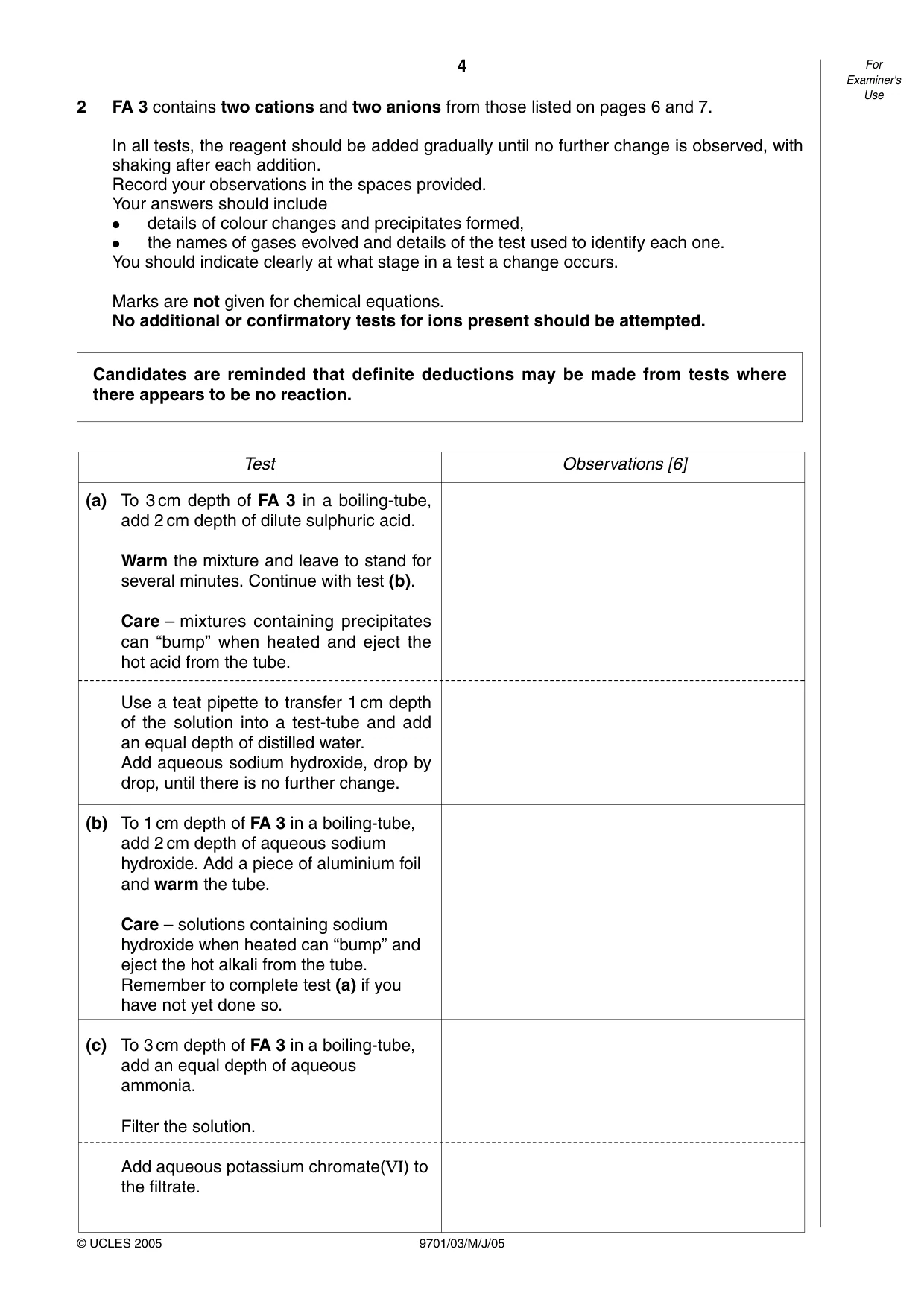
2 FA 3 contains two cations and two anions from those listed on pages 6 and 7. In all tests, the reagent should be added gradually until no further change is observed, with shaking after each addition. Record your observations in the spaces provided. Your answers should include • details of colour changes and precipitates formed, • the names of gases evolved and details of the test used to identify each one. You should indicate clearly at what stage in a test a change occurs. Marks are not given for chemical equations. No additional or confirmatory tests for ions present should be attempted. 4 9701/03/M/J/05 For Examiner's Use © UCLES 2005 Test Observations [6] Candidates are reminded that definite deductions may be made from tests where there appears to be no reaction. (a) To 3 cm depth of FA 3 in a boiling-tube, add 2 cm depth of dilute sulphuric acid. Warm the mixture and leave to stand for several minutes. Continue with test (b). Care – mixtures containing precipitates can “bump” when heated and eject the hot acid from the tube. Use a teat pipette to transfer 1 cm depth of the solution into a test-tube and add an equal depth of distilled water. Add aqueous sodium hydroxide, drop by drop, until there is no further change. (b) To 1 cm depth of FA 3 in a boiling-tube, add 2 cm depth of aqueous sodium hydroxide. Add a piece of aluminium foil and warm the tube. Care – solutions containing sodium hydroxide when heated can “bump” and eject the hot alkali from the tube. Remember to complete test (a) if you have not yet done so. (c) To 3 cm depth of FA 3 in a boiling-tube, add an equal depth of aqueous ammonia. Filter the solution. Add aqueous potassium chromate(VI) to the filtrate.
Question paper, page 5
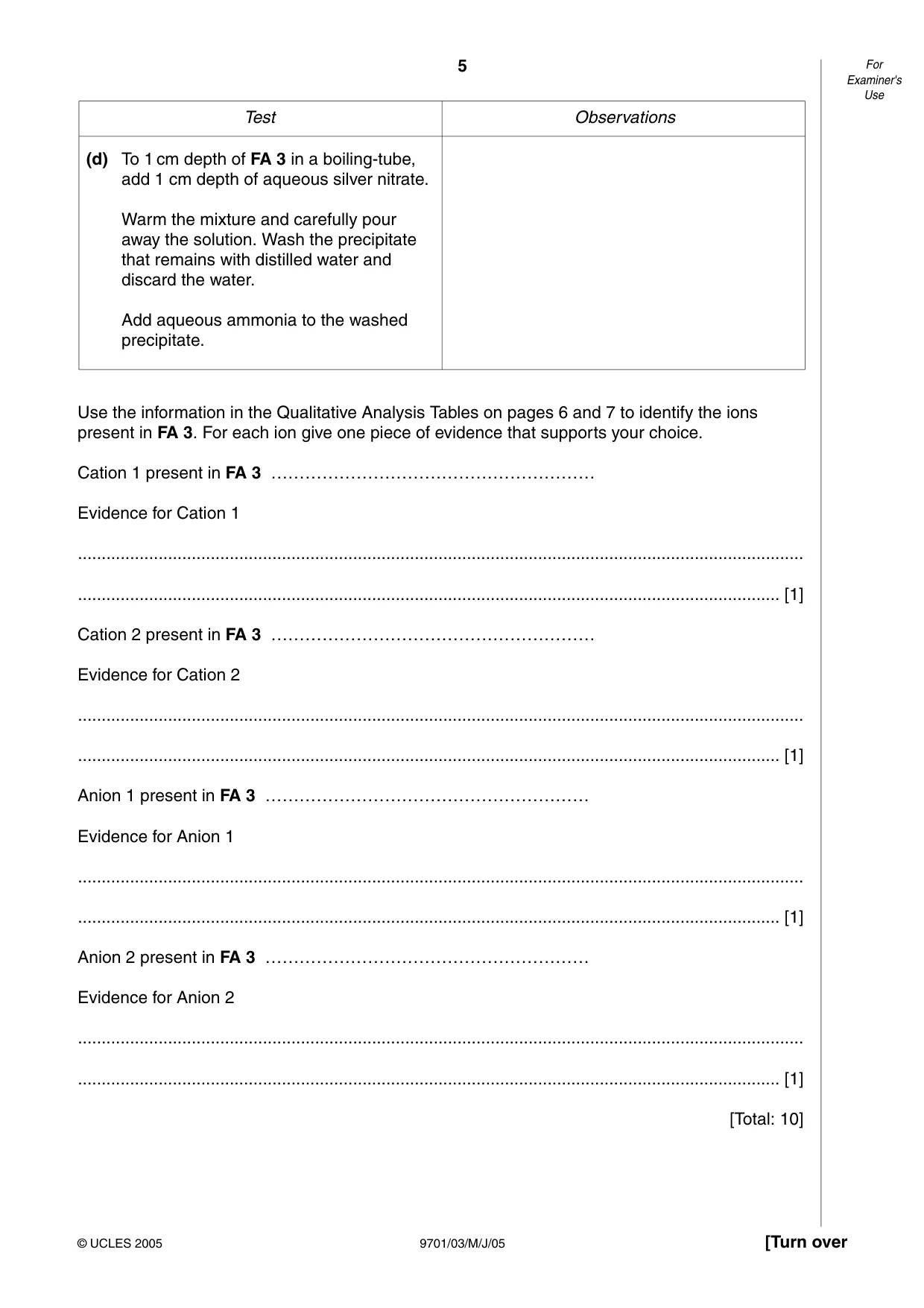
(d) To 1 cm depth of FA 3 in a boiling-tube, add 1 cm depth of aqueous silver nitrate. Warm the mixture and carefully pour away the solution. Wash the precipitate that remains with distilled water and discard the water. Add aqueous ammonia to the washed precipitate. 5 9701/03/M/J/05 [Turn over For Examiner's Use © UCLES 2005 Test Observations Use the information in the Qualitative Analysis Tables on pages 6 and 7 to identify the ions present in FA 3. For each ion give one piece of evidence that supports your choice. Cation 1 present in FA 3 ………………………………………………… Evidence for Cation 1 … … [1] Cation 2 present in FA 3 ………………………………………………… Evidence for Cation 2 … … [1] Anion 1 present in FA 3 ………………………………………………… Evidence for Anion 1 … … [1] Anion 2 present in FA 3 ………………………………………………… Evidence for Anion 2 … … [1] [Total: 10]
Question paper, page 6
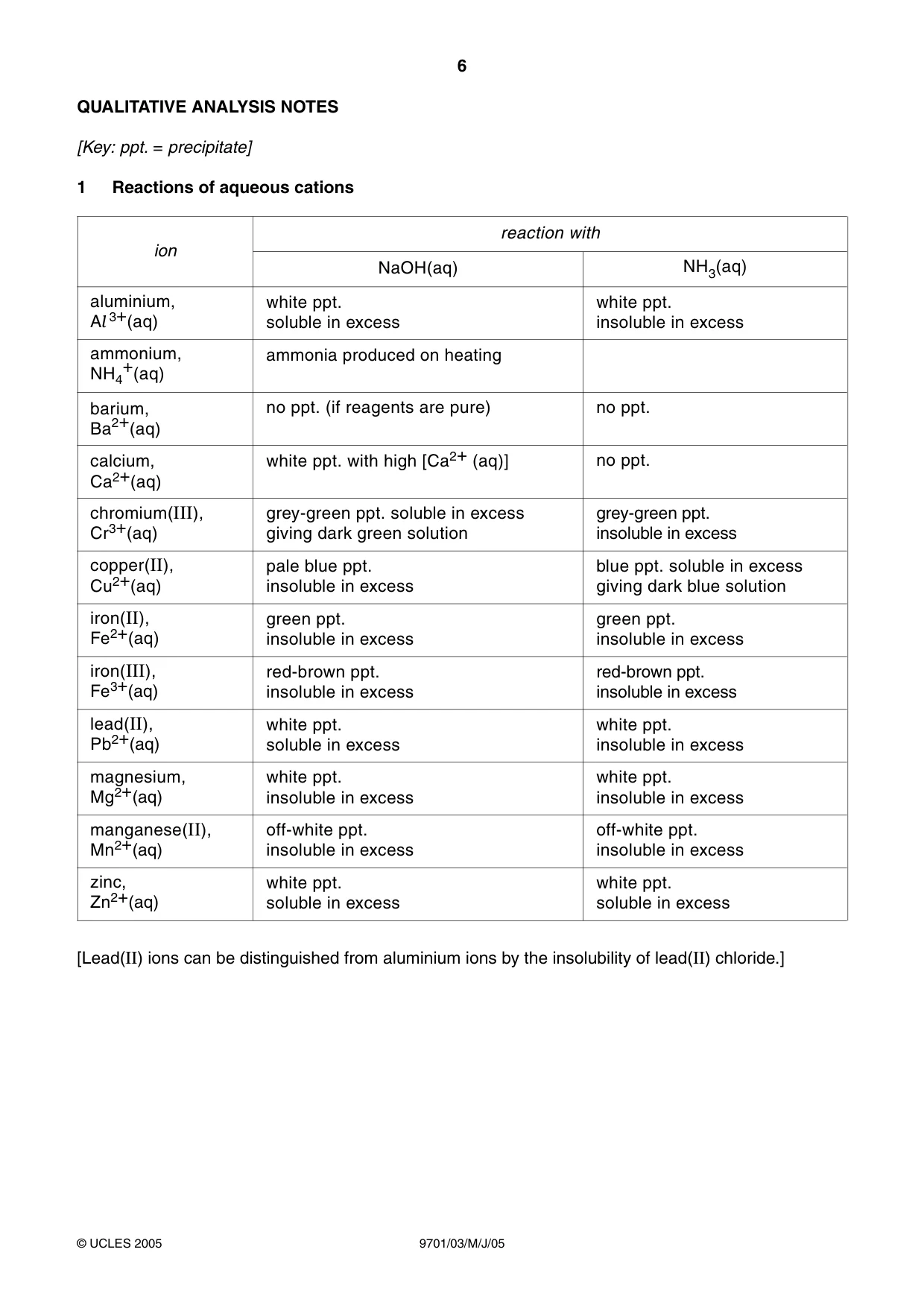
QUALITATIVE ANALYSIS NOTES [Key: ppt. = precipitate] 1 Reactions of aqueous cations [Lead(II) ions can be distinguished from aluminium ions by the insolubility of lead(II) chloride.] 6 9701/03/M/J/05 © UCLES 2005 aluminium, Al 3+(aq) ammonium, NH4+(aq) barium, Ba2+(aq) calcium, Ca2+(aq) chromium(III), Cr3+(aq) zinc, Zn2+(aq) copper(II), Cu2+(aq) iron(II), Fe2+(aq) iron(III), Fe3+(aq) lead(II), Pb2+(aq) magnesium, Mg2+(aq) manganese(II), Mn2+(aq) reaction with NaOH(aq) NH3(aq) white ppt. soluble in excess ammonia produced on heating no ppt. (if reagents are pure) green ppt. insoluble in excess green ppt. insoluble in excess white ppt. with high [Ca2+ (aq)] pale blue ppt. insoluble in excess blue ppt. soluble in excess giving dark blue solution white ppt. soluble in excess white ppt. insoluble in excess white ppt. insoluble in excess white ppt. insoluble in excess white ppt. soluble in excess white ppt. soluble in excess grey-green ppt. soluble in excess giving dark green solution red-brown ppt. insoluble in excess off-white ppt. insoluble in excess off-white ppt. insoluble in excess white ppt. insoluble in excess no ppt. no ppt. grey-green ppt. insoluble in excess red-brown ppt. insoluble in excess ion
Question paper, page 7
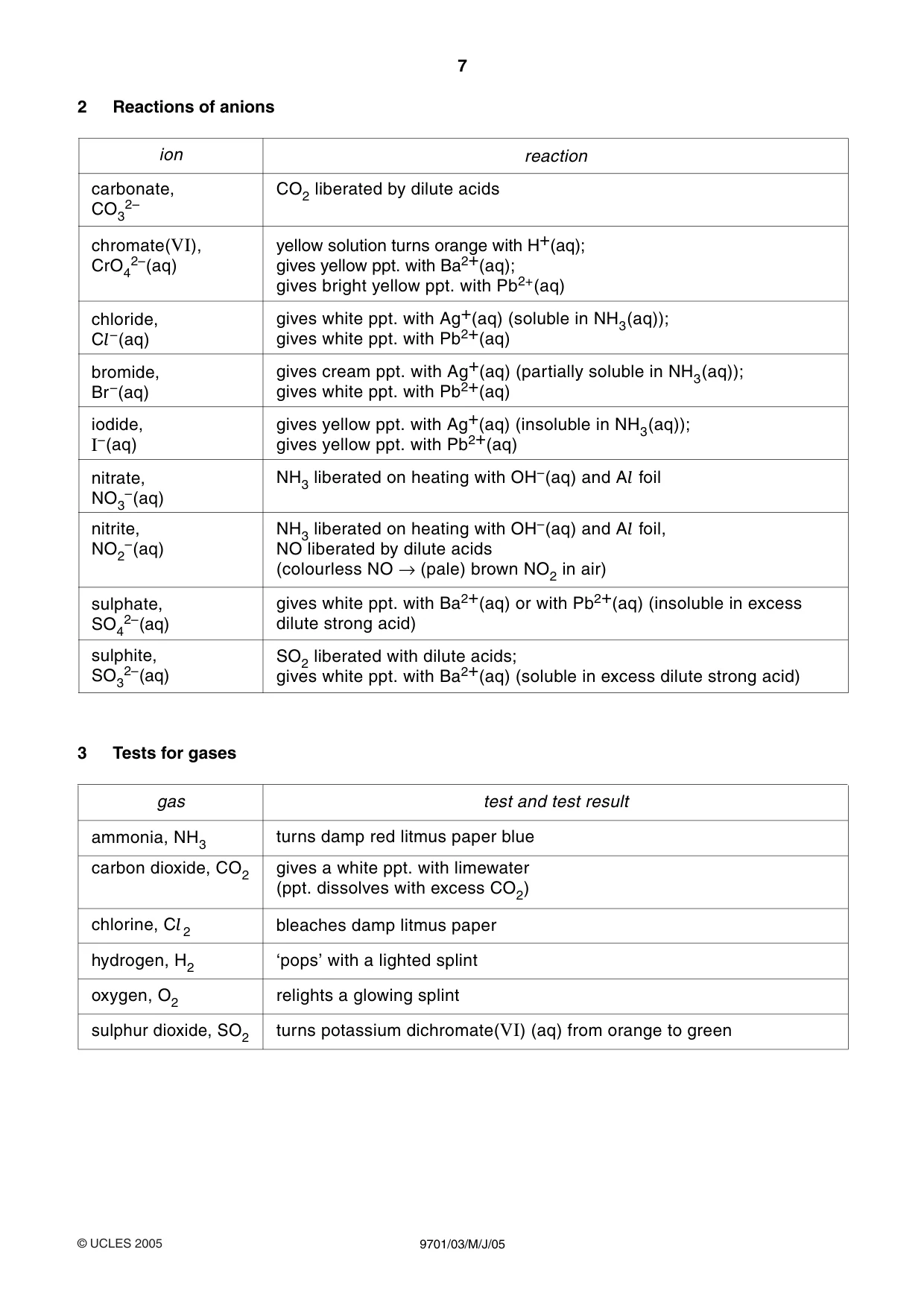
© UCLES 2005 2 Reactions of anions 3 Tests for gases 7 9701/03/M/J/05 carbonate, CO3 2– chromate(VI), CrO4 2–(aq) chloride, Cl–(aq) bromide, Br–(aq) iodide, I–(aq) nitrate, NO3 –(aq) nitrite, NO2 –(aq) sulphate, SO4 2–(aq) sulphite, SO3 2–(aq) ion reaction CO2 liberated by dilute acids yellow solution turns orange with H+(aq); gives yellow ppt. with Ba2+(aq); gives bright yellow ppt. with Pb2+(aq) gives white ppt. with Ag+(aq) (soluble in NH3(aq)); gives white ppt. with Pb2+(aq) NH3 liberated on heating with OH–(aq) and Al foil, NO liberated by dilute acids (colourless NO →(pale) brown NO2 in air) gives cream ppt. with Ag+(aq) (partially soluble in NH3(aq)); gives white ppt. with Pb2+(aq) NH3 liberated on heating with OH–(aq) and Al foil SO2 liberated with dilute acids; gives white ppt. with Ba2+(aq) (soluble in excess dilute strong acid) gives yellow ppt. with Ag+(aq) (insoluble in NH3(aq)); gives yellow ppt. with Pb2+(aq) gives white ppt. with Ba2+(aq) or with Pb2+(aq) (insoluble in excess dilute strong acid) gas test and test result turns damp red litmus paper blue gives a white ppt. with limewater (ppt. dissolves with excess CO2) bleaches damp litmus paper ‘pops’ with a lighted splint relights a glowing splint turns potassium dichromate(VI) (aq) from orange to green ammonia, NH3 carbon dioxide, CO2 chlorine, Cl 2 hydrogen, H2 oxygen, O2 sulphur dioxide, SO2
Question paper, page 8
BLANK PAGE 8 9701/03/M/J/05 Permission to reproduce items where third-party owned material protected by copyright is included has been sought and cleared where possible. Every reasonable effort has been made by the publisher (UCLES) to trace copyright holders, but if any items requiring clearance have unwittingly been included, the publisher will be pleased to make amends at the earliest possible opportunity. University of Cambridge International Examinations is part of the University of Cambridge Local Examinations Syndicate (UCLES), which is itself a department of the University of Cambridge.
Mark scheme, page 1
UNIVERSITY OF CAMBRIDGE INTERNATIONAL EXAMINATIONS GCE Advanced Subsidiary and Advanced Level MARK SCHEME for the June 2005 question paper 9701 CHEMISTRY 9701/03 Paper 3 (Practical Test), maximum raw mark 25 This mark scheme is published as an aid to teachers and students, to indicate the requirements of the examination. It shows the basis on which Examiners were initially instructed to award marks. It does not indicate the details of the discussions that took place at an Examiners’ meeting before marking began. Any substantial changes to the mark scheme that arose from these discussions will be recorded in the published Report on the Examination. All Examiners are instructed that alternative correct answers and unexpected approaches in candidates’ scripts must be given marks that fairly reflect the relevant knowledge and skills demonstrated. Mark schemes must be read in conjunction with the question papers and the Report on the Examination. • CIE will not enter into discussion or correspondence in connection with these mark schemes. CIE is publishing the mark schemes for the June 2005 question papers for most IGCSE and GCE Advanced Level and Advanced Subsidiary Level syllabuses and some Ordinary Level syllabuses.
Mark scheme, page 2
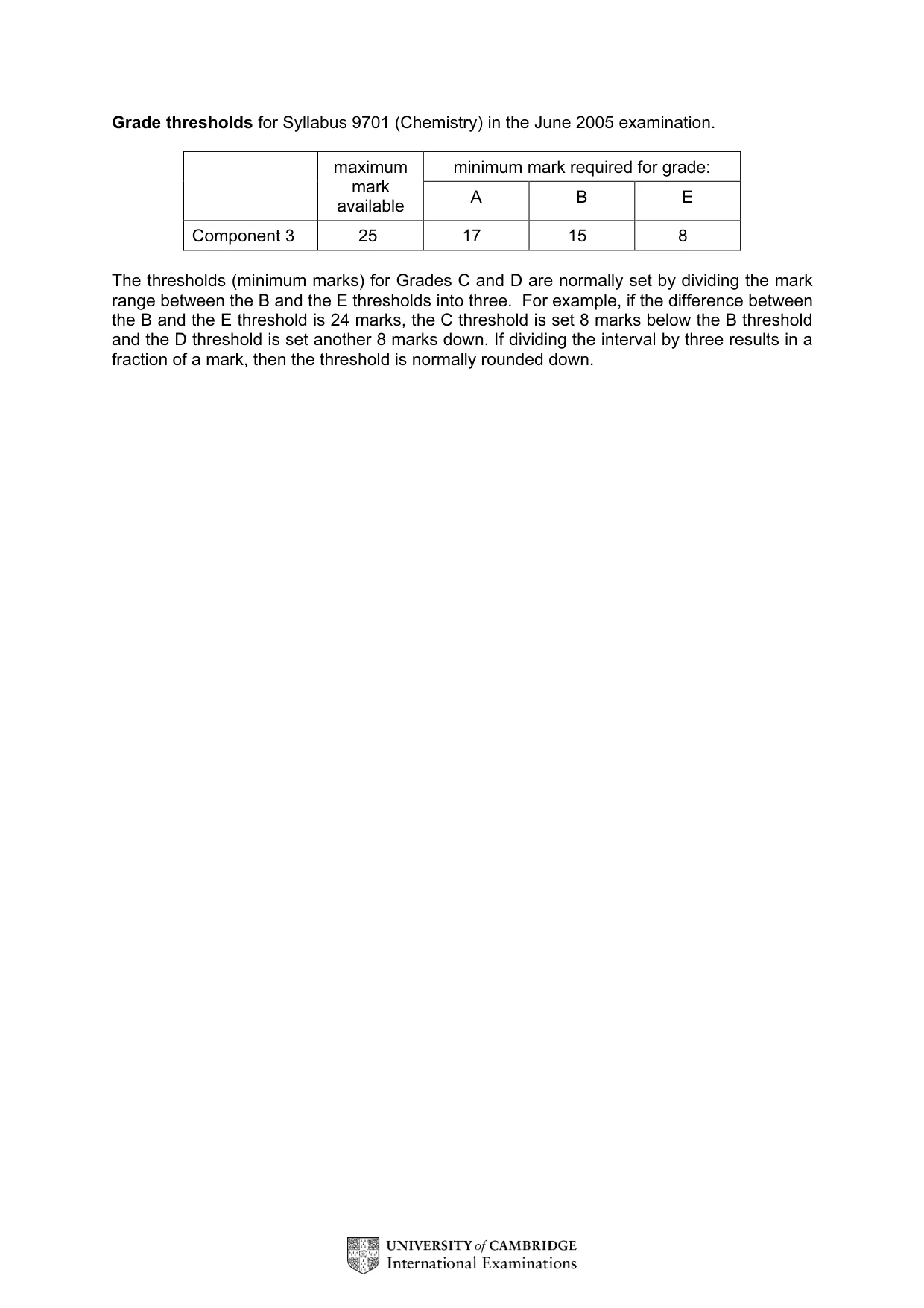
Grade thresholds for Syllabus 9701 (Chemistry) in the June 2005 examination. minimum mark required for grade: maximum mark available A B E Component 3 25 17 15 8 The thresholds (minimum marks) for Grades C and D are normally set by dividing the mark range between the B and the E thresholds into three. For example, if the difference between the B and the E threshold is 24 marks, the C threshold is set 8 marks below the B threshold and the D threshold is set another 8 marks down. If dividing the interval by three results in a fraction of a mark, then the threshold is normally rounded down.
Mark scheme, page 3
June 2005 GCE A AND AS LEVEL MARK SCHEME MAXIMUM MARK: 25 SYLLABUS/COMPONENT: 9701/03 CHEMISTRY Paper 3 (Practical Test)
Mark scheme, page 4
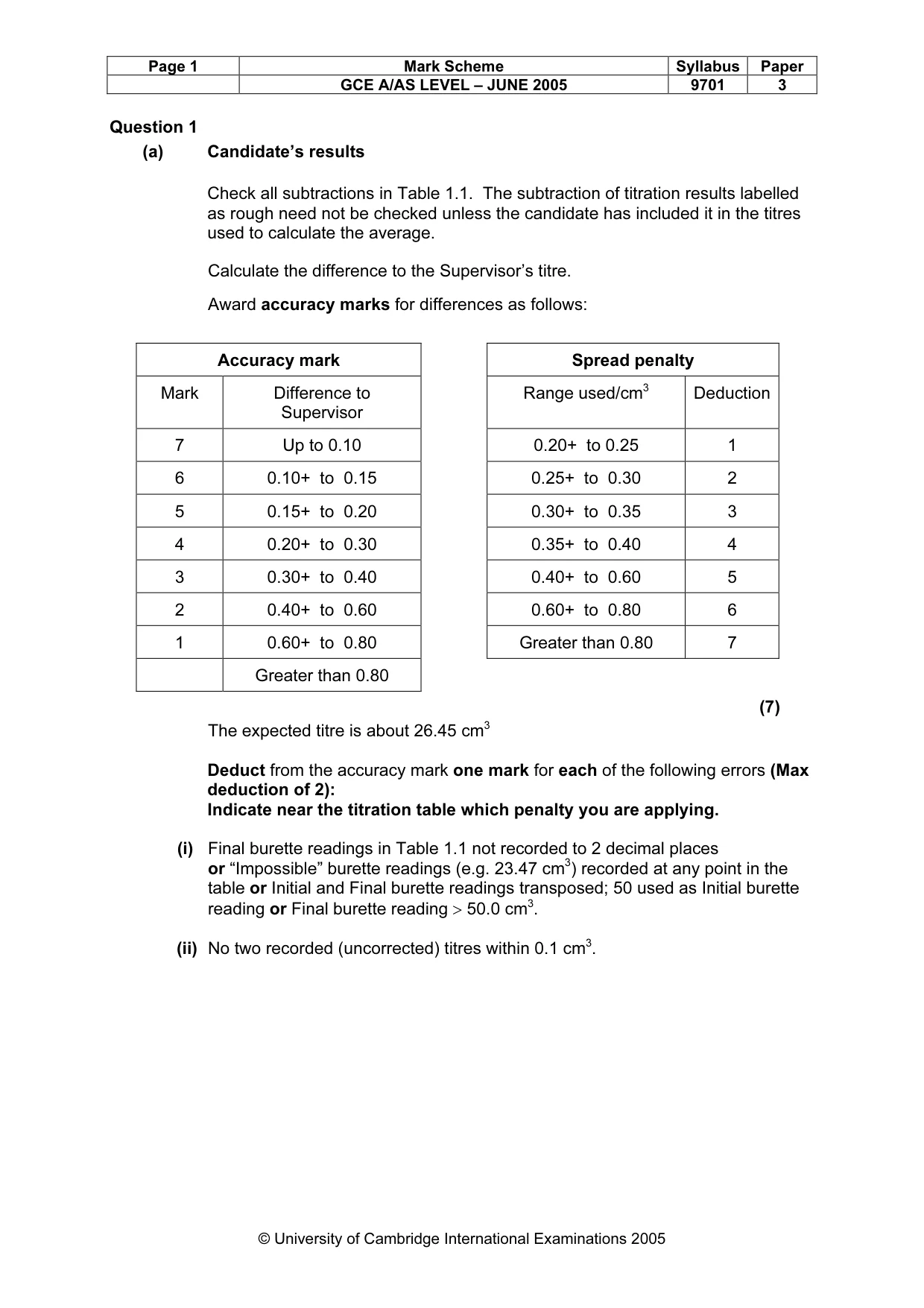
Page 1 Mark Scheme Syllabus Paper GCE A/AS LEVEL – JUNE 2005 9701 3 © University of Cambridge International Examinations 2005 Question 1 (a) Candidate’s results Check all subtractions in Table 1.1. The subtraction of titration results labelled as rough need not be checked unless the candidate has included it in the titres used to calculate the average. Calculate the difference to the Supervisor’s titre. Award accuracy marks for differences as follows: Accuracy mark Spread penalty Mark Difference to Supervisor Range used/cm3 Deduction 7 Up to 0.10 0.20+ to 0.25 1 6 0.10+ to 0.15 0.25+ to 0.30 2 5 0.15+ to 0.20 0.30+ to 0.35 3 4 0.20+ to 0.30 0.35+ to 0.40 4 3 0.30+ to 0.40 0.40+ to 0.60 5 2 0.40+ to 0.60 0.60+ to 0.80 6 1 0.60+ to 0.80 Greater than 0.80 7 Greater than 0.80 (7) The expected titre is about 26.45 cm3 Deduct from the accuracy mark one mark for each of the following errors (Max deduction of 2): Indicate near the titration table which penalty you are applying. (i) Final burette readings in Table 1.1 not recorded to 2 decimal places or “Impossible” burette readings (e.g. 23.47 cm3) recorded at any point in the table or Initial and Final burette readings transposed; 50 used as Initial burette reading or Final burette reading > 50.0 cm3. (ii) No two recorded (uncorrected) titres within 0.1 cm3.
Mark scheme, page 5
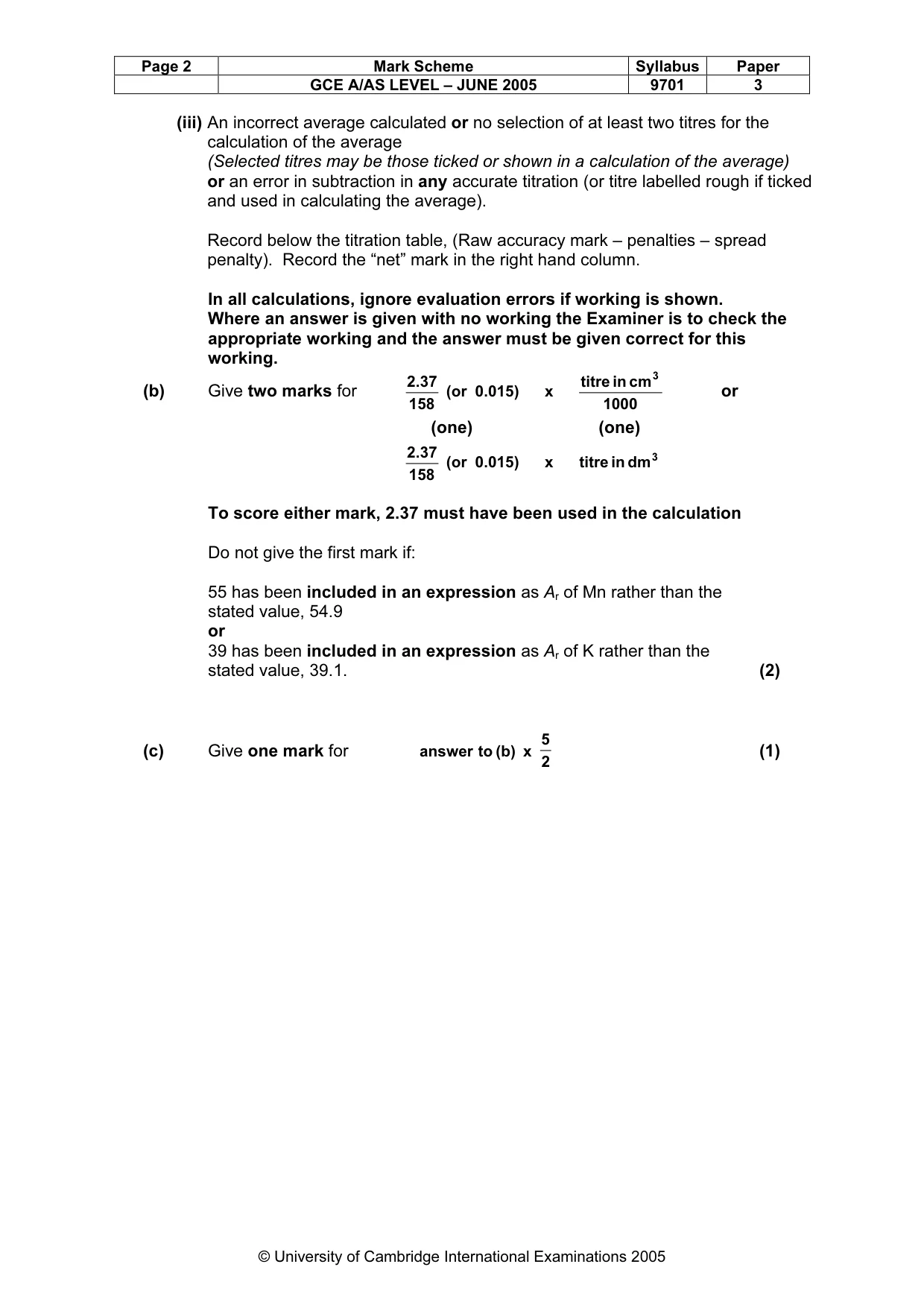
Page 2 Mark Scheme Syllabus Paper GCE A/AS LEVEL – JUNE 2005 9701 3 © University of Cambridge International Examinations 2005 (iii) An incorrect average calculated or no selection of at least two titres for the calculation of the average (Selected titres may be those ticked or shown in a calculation of the average) or an error in subtraction in any accurate titration (or titre labelled rough if ticked and used in calculating the average). Record below the titration table, (Raw accuracy mark – penalties – spread penalty). Record the “net” mark in the right hand column. In all calculations, ignore evaluation errors if working is shown. Where an answer is given with no working the Examiner is to check the appropriate working and the answer must be given correct for this working. (b) Give two marks for 1000 cm in titre x 0.015) (or 158 37 . 2 3 or (one) (one) 3 dm in titre x 0.015) (or 158 37 . 2 To score either mark, 2.37 must have been used in the calculation Do not give the first mark if: 55 has been included in an expression as Ar of Mn rather than the stated value, 54.9 or 39 has been included in an expression as Ar of K rather than the stated value, 39.1. (2) (c) Give one mark for 2 5 x (b) to answer (1)
Mark scheme, page 6
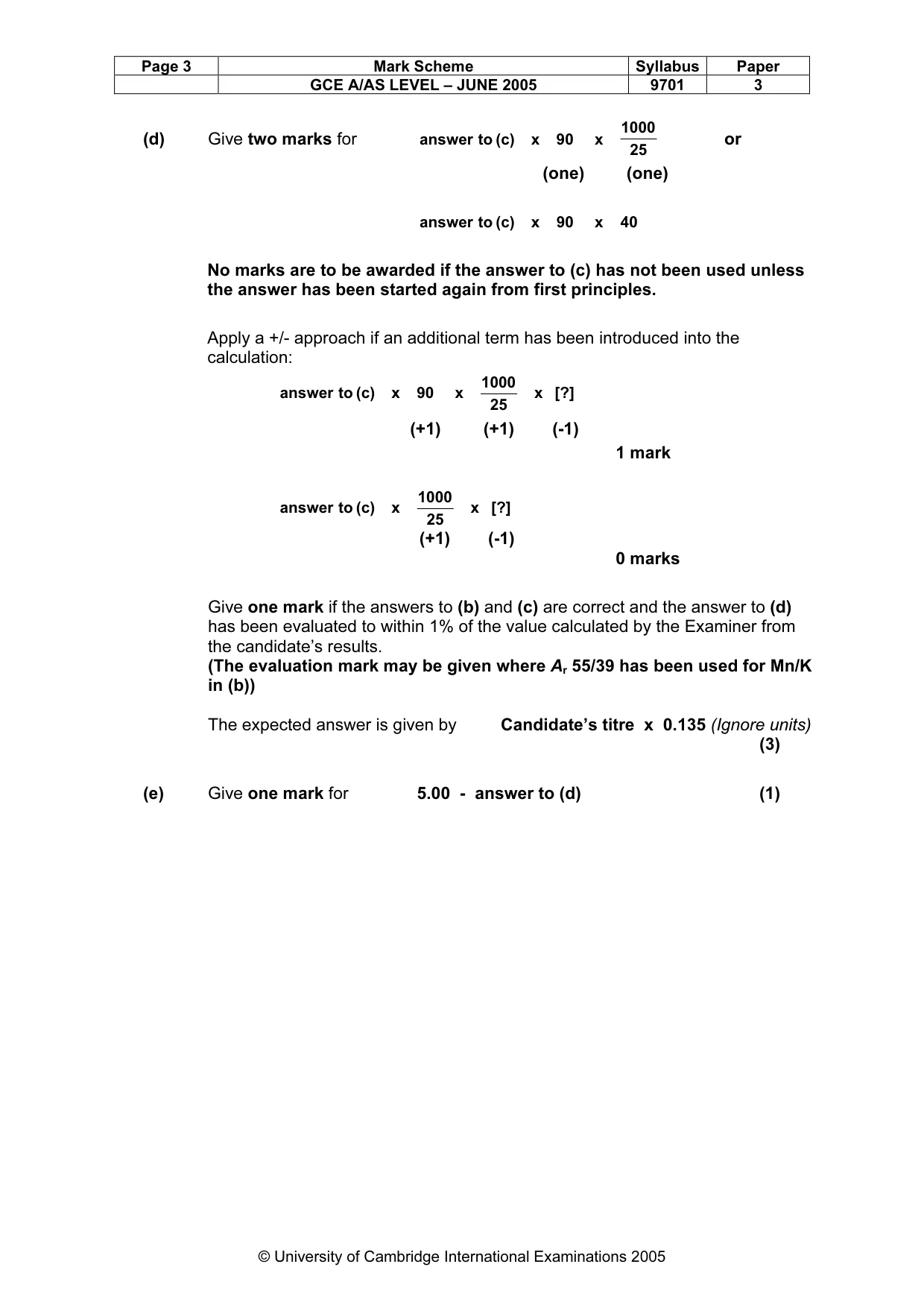
Page 3 Mark Scheme Syllabus Paper GCE A/AS LEVEL – JUNE 2005 9701 3 © University of Cambridge International Examinations 2005 (d) Give two marks for 25 1000 x 90 x (c) to answer or (one) (one) 40 x 90 x (c) to answer No marks are to be awarded if the answer to (c) has not been used unless the answer has been started again from first principles. Apply a +/- approach if an additional term has been introduced into the calculation: [?] x 25 1000 x 90 x (c) to answer (+1) (+1) (-1) 1 mark [?] x 25 1000 x (c) to answer (+1) (-1) 0 marks Give one mark if the answers to (b) and (c) are correct and the answer to (d) has been evaluated to within 1% of the value calculated by the Examiner from the candidate’s results. (The evaluation mark may be given where Ar 55/39 has been used for Mn/K in (b)) The expected answer is given by Candidate’s titre x 0.135 (Ignore units) (3) (e) Give one mark for 5.00 - answer to (d) (1)
Mark scheme, page 7
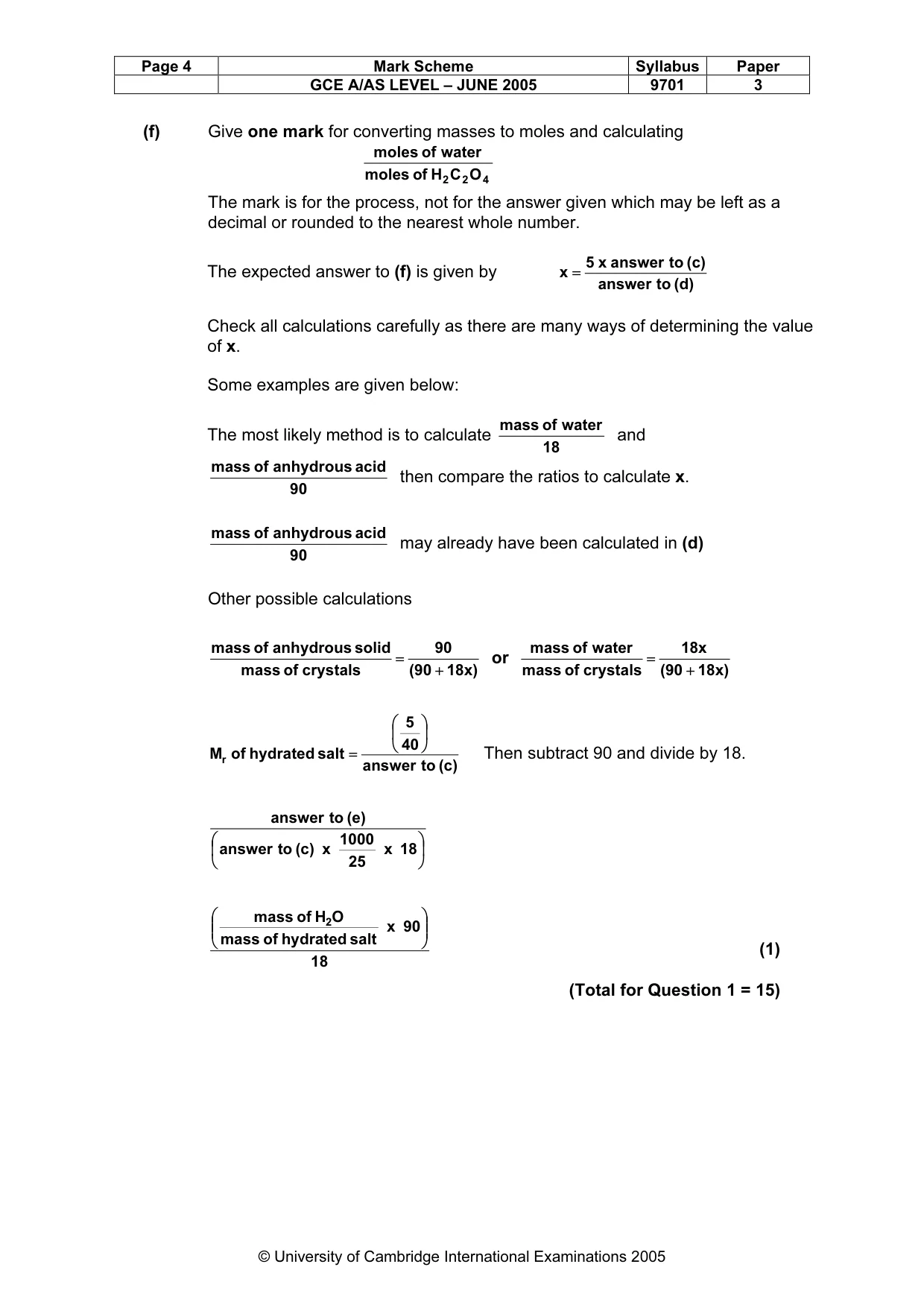
Page 4 Mark Scheme Syllabus Paper GCE A/AS LEVEL – JUNE 2005 9701 3 © University of Cambridge International Examinations 2005 (f) Give one mark for converting masses to moles and calculating 4 2 2 O C H of moles water of moles The mark is for the process, not for the answer given which may be left as a decimal or rounded to the nearest whole number. The expected answer to (f) is given by (d) to answer (c) to answer x 5 x = Check all calculations carefully as there are many ways of determining the value of x. Some examples are given below: The most likely method is to calculate 18 water of mass and 90 acid anhydrous of mass then compare the ratios to calculate x. 90 acid anhydrous of mass may already have been calculated in (d) Other possible calculations 18x) (90 90 crystals of mass solid anhydrous of mass + = or 18x) (90 18x crystals of mass water of mass + = (c) to answer 40 5 salt hydrated of Mr = Then subtract 90 and divide by 18. 18 x 25 1000 x (c) to answer (e) to answer 18 90 x salt hydrated of mass O H of mass 2 (1) (Total for Question 1 = 15)
Mark scheme, page 8
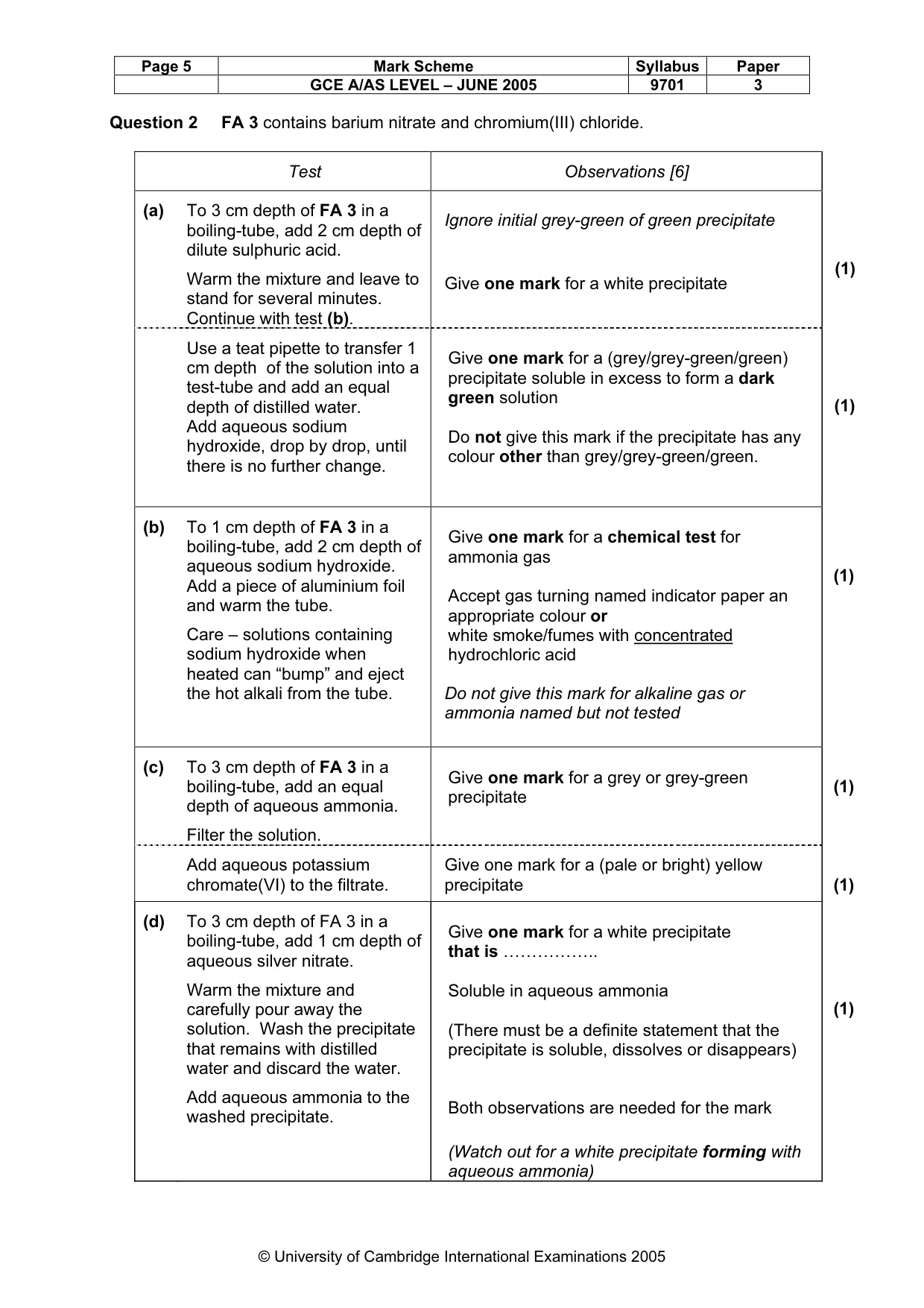
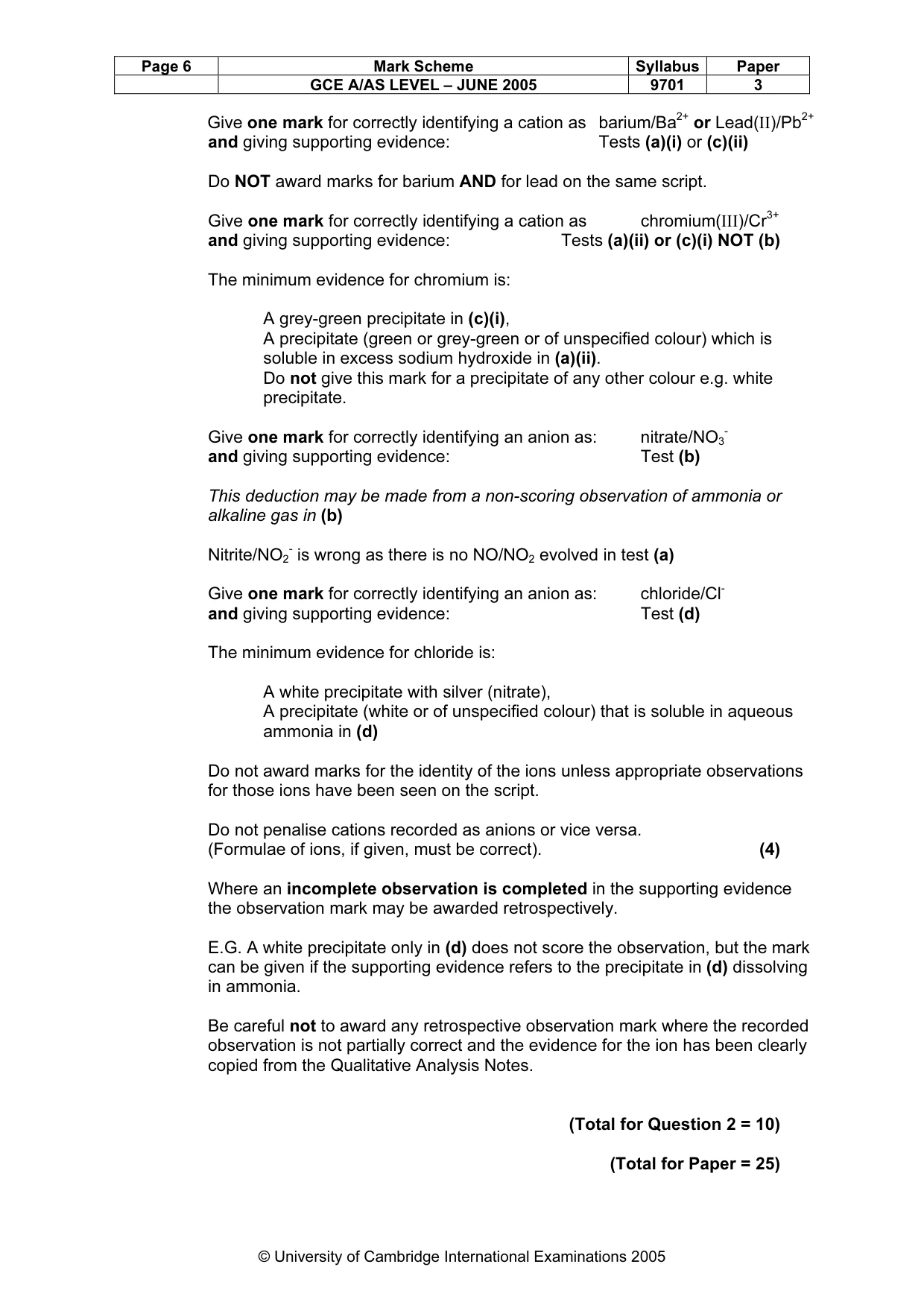
Page 5 Mark Scheme Syllabus Paper GCE A/AS LEVEL – JUNE 2005 9701 3 © University of Cambridge International Examinations 2005 Question 2 FA 3 contains barium nitrate and chromium(III) chloride. Test Observations [6] (a) To 3 cm depth of FA 3 in a boiling-tube, add 2 cm depth of dilute sulphuric acid. Warm the mixture and leave to stand for several minutes. Continue with test (b). Ignore initial grey-green of green precipitate Give one mark for a white precipitate (1) Use a teat pipette to transfer 1 cm depth of the solution into a test-tube and add an equal depth of distilled water. Add aqueous sodium hydroxide, drop by drop, until there is no further change. Give one mark for a (grey/grey-green/green) precipitate soluble in excess to form a dark green solution Do not give this mark if the precipitate has any colour other than grey/grey-green/green. (1) (b) To 1 cm depth of FA 3 in a boiling-tube, add 2 cm depth of aqueous sodium hydroxide. Add a piece of aluminium foil and warm the tube. Care – solutions containing sodium hydroxide when heated can “bump” and eject the hot alkali from the tube. Give one mark for a chemical test for ammonia gas Accept gas turning named indicator paper an appropriate colour or white smoke/fumes with concentrated hydrochloric acid Do not give this mark for alkaline gas or ammonia named but not tested (1) (c) To 3 cm depth of FA 3 in a boiling-tube, add an equal depth of aqueous ammonia. Filter the solution. Give one mark for a grey or grey-green precipitate (1) Add aqueous potassium chromate(VI) to the filtrate. Give one mark for a (pale or bright) yellow precipitate (1) (d) To 3 cm depth of FA 3 in a boiling-tube, add 1 cm depth of aqueous silver nitrate. Warm the mixture and carefully pour away the solution. Wash the precipitate that remains with distilled water and discard the water. Add aqueous ammonia to the washed precipitate. Give one mark for a white precipitate that is …………….. Soluble in aqueous ammonia (There must be a definite statement that the precipitate is soluble, dissolves or disappears) Both observations are needed for the mark (Watch out for a white precipitate forming with aqueous ammonia) (1)
Mark scheme, page 9
Page 6 Mark Scheme Syllabus Paper GCE A/AS LEVEL – JUNE 2005 9701 3 © University of Cambridge International Examinations 2005 Give one mark for correctly identifying a cation as barium/Ba2+ or Lead(II)/Pb2+ and giving supporting evidence: Tests (a)(i) or (c)(ii) Do NOT award marks for barium AND for lead on the same script. Give one mark for correctly identifying a cation as chromium(III)/Cr3+ and giving supporting evidence: Tests (a)(ii) or (c)(i) NOT (b) The minimum evidence for chromium is: A grey-green precipitate in (c)(i), A precipitate (green or grey-green or of unspecified colour) which is soluble in excess sodium hydroxide in (a)(ii). Do not give this mark for a precipitate of any other colour e.g. white precipitate. Give one mark for correctly identifying an anion as: nitrate/NO3 - and giving supporting evidence: Test (b) This deduction may be made from a non-scoring observation of ammonia or alkaline gas in (b) Nitrite/NO2 - is wrong as there is no NO/NO2 evolved in test (a) Give one mark for correctly identifying an anion as: chloride/Cl- and giving supporting evidence: Test (d) The minimum evidence for chloride is: A white precipitate with silver (nitrate), A precipitate (white or of unspecified colour) that is soluble in aqueous ammonia in (d) Do not award marks for the identity of the ions unless appropriate observations for those ions have been seen on the script. Do not penalise cations recorded as anions or vice versa. (Formulae of ions, if given, must be correct). (4) Where an incomplete observation is completed in the supporting evidence the observation mark may be awarded retrospectively. E.G. A white precipitate only in (d) does not score the observation, but the mark can be given if the supporting evidence refers to the precipitate in (d) dissolving in ammonia. Be careful not to award any retrospective observation mark where the recorded observation is not partially correct and the evidence for the ion has been clearly copied from the Qualitative Analysis Notes. (Total for Question 2 = 10) (Total for Paper = 25)