Cambridge A Level Chemistry 9701 — 2003 Oct/Nov Paper 3 · Variant 1
9701/31/O/N/03
The question paper and its mark scheme, free to read here and free to download. This is Cambridge’s own paper, exactly as it was sat.
Question paper8 pages
Mark scheme
No mark scheme is in the library for this paper.
Paper as text
Question paper, page 1
This document consists of 5 printed pages and 3 blank pages. SP (AT) S39107/4 © UCLES 2003 [Turn over CAMBRIDGE INTERNATIONAL EXAMINATIONS General Certificate of Education Advanced Subsidiary Level and Advanced Level CHEMISTRY 9701/03 Paper 3 Practical Test October/November 2003 1 hour 15 minutes Candidates answer on the Question Paper. Additional materials: as listed in Instructions to Supervisors. READ THESE INSTRUCTIONS FIRST Write your name and details, including examination session and laboratory where appropriate, in the boxes provided. Write in dark blue or black pen in the spaces provided on the Question Paper. You may use a pencil for any diagrams, graphs, or rough working. Do not use staples, paper clips, highlighters, glue or correction fluid. Answer all questions. The number of marks is given in brackets [ ] at the end of each question or part question. You are advised to show all working in calculations. Use of a Data Booklet is unnecessary. Centre Number Candidate Number Name For Examiner’s Use 1 2 TOTAL If you have been given a label, look at the details. If any details are incorrect or missing, please fill in your correct details in the space given at the top of this page. Stick your personal label here, if provided. SESSION LABORATORY
Question paper, page 2
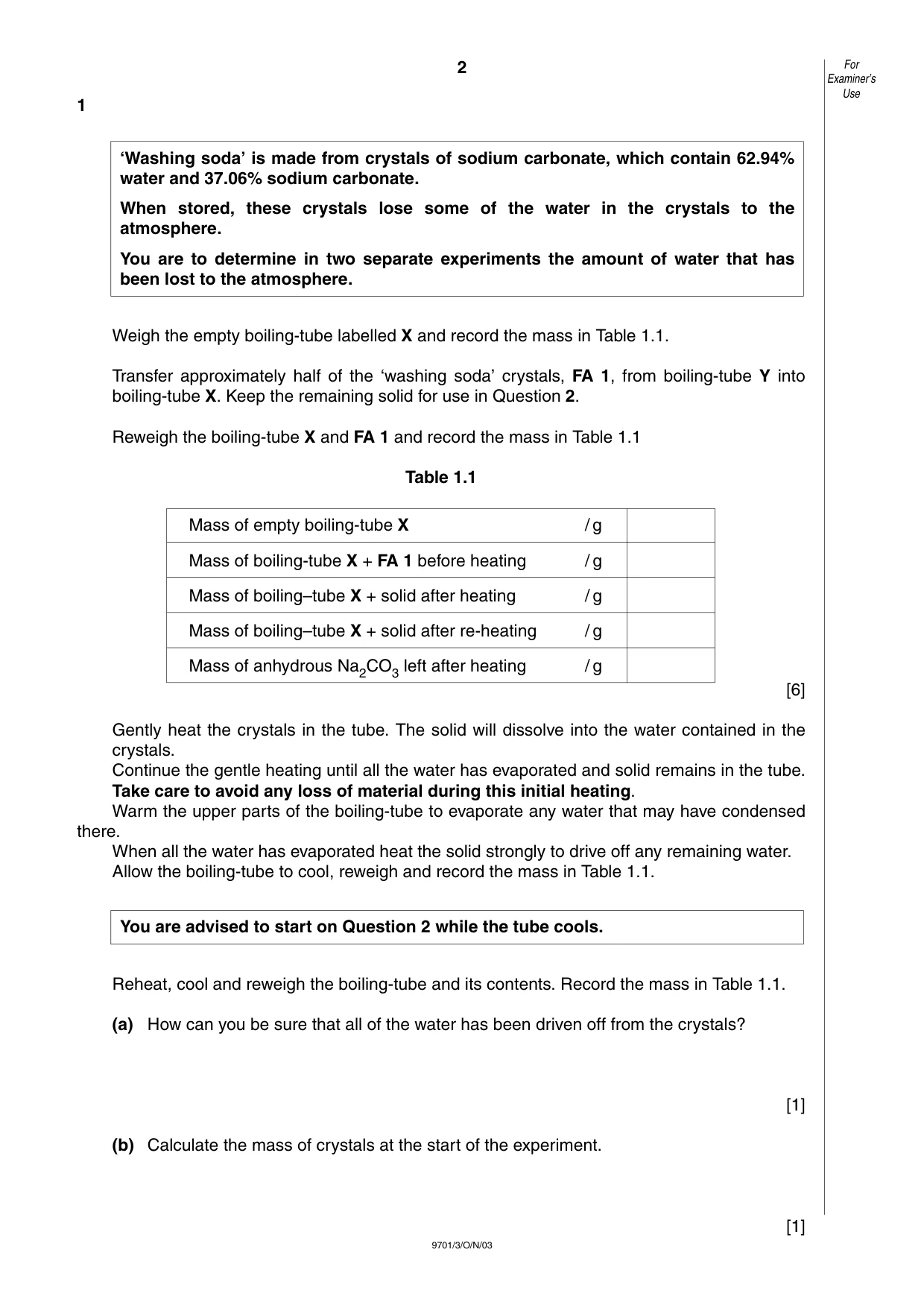
2 9701/3/O/N/03 1 Weigh the empty boiling-tube labelled X and record the mass in Table 1.1. Transfer approximately half of the ‘washing soda’ crystals, FA 1, from boiling-tube Y into boiling-tube X. Keep the remaining solid for use in Question 2. Reweigh the boiling-tube X and FA 1 and record the mass in Table 1.1 Table 1.1 [6] Gently heat the crystals in the tube. The solid will dissolve into the water contained in the crystals. Continue the gentle heating until all the water has evaporated and solid remains in the tube. Take care to avoid any loss of material during this initial heating. Warm the upper parts of the boiling-tube to evaporate any water that may have condensed there. When all the water has evaporated heat the solid strongly to drive off any remaining water. Allow the boiling-tube to cool, reweigh and record the mass in Table 1.1. Reheat, cool and reweigh the boiling-tube and its contents. Record the mass in Table 1.1. (a) How can you be sure that all of the water has been driven off from the crystals? [1] (b) Calculate the mass of crystals at the start of the experiment. [1] You are advised to start on Question 2 while the tube cools. ‘Washing soda’ is made from crystals of sodium carbonate, which contain 62.94% water and 37.06% sodium carbonate. When stored, these crystals lose some of the water in the crystals to the atmosphere. You are to determine in two separate experiments the amount of water that has been lost to the atmosphere. For Examiner’s Use Mass of empty boiling-tube X / g Mass of boiling-tube X + FA 1 before heating / g Mass of boiling–tube X + solid after heating / g Mass of boiling–tube X + solid after re-heating / g Mass of anhydrous Na2CO3 left after heating / g
Question paper, page 3
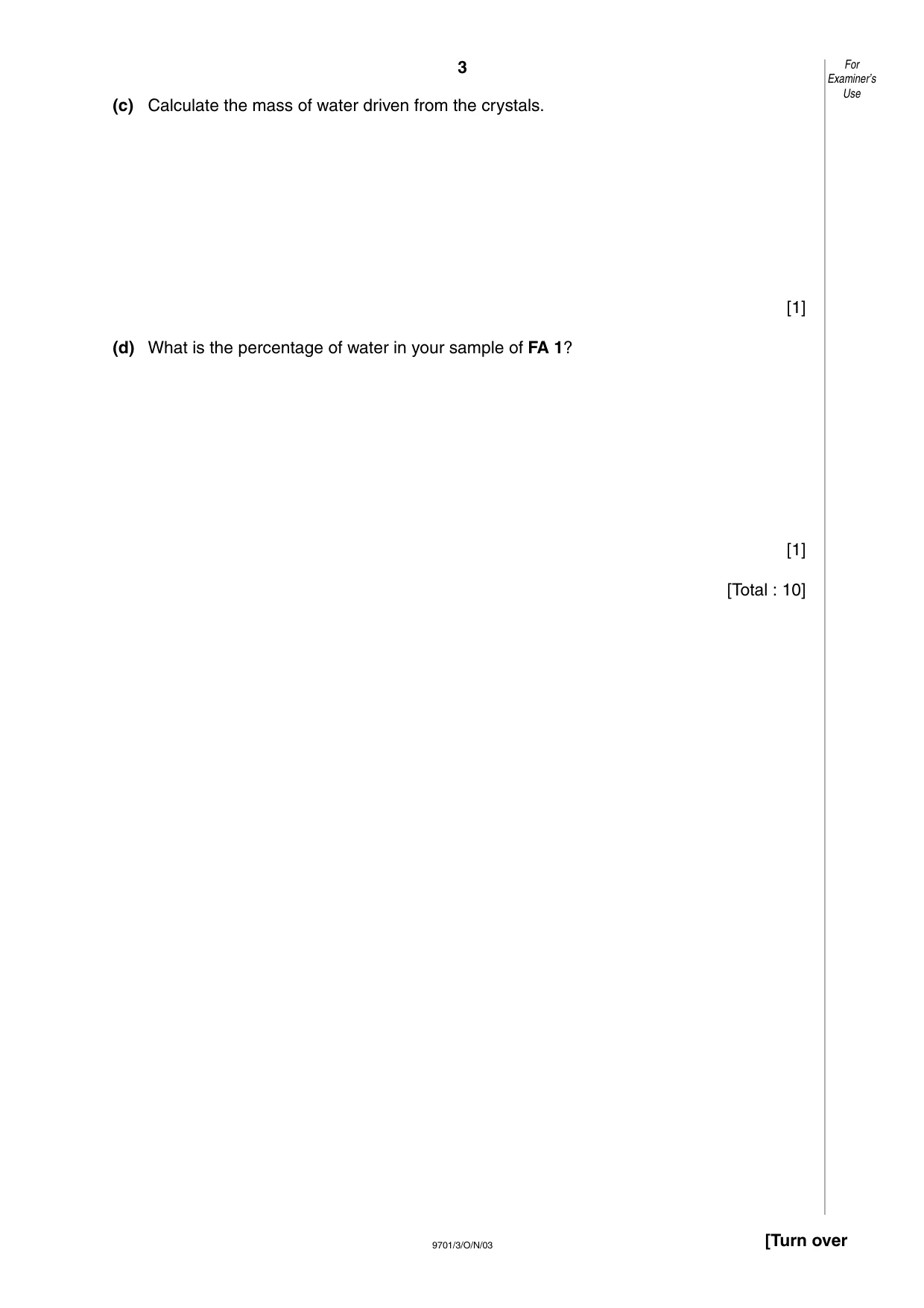
3 9701/3/O/N/03 [Turn over (c) Calculate the mass of water driven from the crystals. [1] (d) What is the percentage of water in your sample of FA 1? [1] [Total : 10] For Examiner’s Use
Question paper, page 4
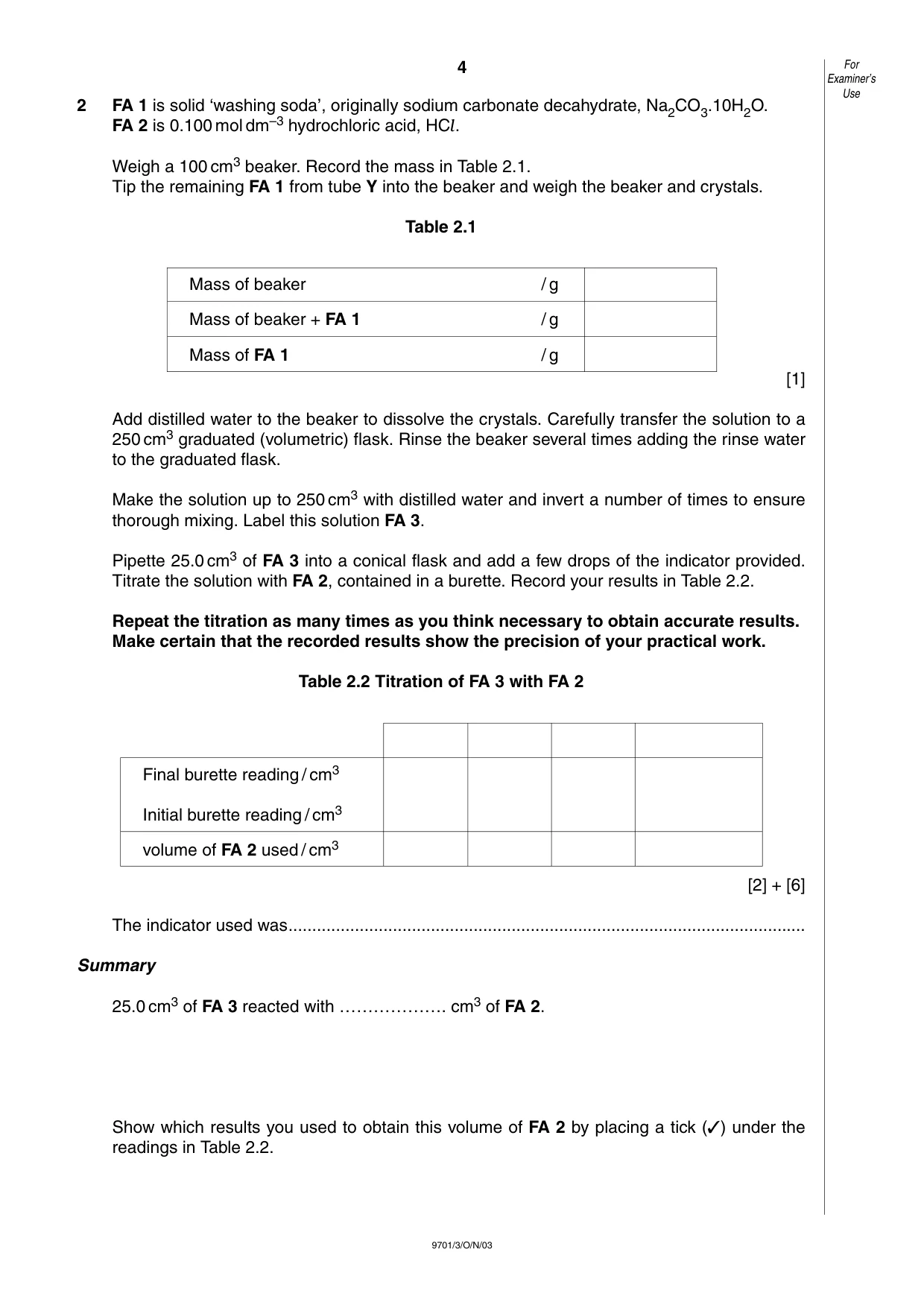
4 9701/3/O/N/03 2 FA 1 is solid ‘washing soda’, originally sodium carbonate decahydrate, Na2CO3.10H2O. FA 2 is 0.100 mol dm–3 hydrochloric acid, HCl. Weigh a 100 cm3 beaker. Record the mass in Table 2.1. Tip the remaining FA 1 from tube Y into the beaker and weigh the beaker and crystals. Table 2.1 [1] Add distilled water to the beaker to dissolve the crystals. Carefully transfer the solution to a 250 cm3 graduated (volumetric) flask. Rinse the beaker several times adding the rinse water to the graduated flask. Make the solution up to 250 cm3 with distilled water and invert a number of times to ensure thorough mixing. Label this solution FA 3. Pipette 25.0 cm3 of FA 3 into a conical flask and add a few drops of the indicator provided. Titrate the solution with FA 2, contained in a burette. Record your results in Table 2.2. Repeat the titration as many times as you think necessary to obtain accurate results. Make certain that the recorded results show the precision of your practical work. Table 2.2 Titration of FA 3 with FA 2 [2] + [6] The indicator used was… Summary 25.0 cm3 of FA 3 reacted with ………………. cm3 of FA 2. Show which results you used to obtain this volume of FA 2 by placing a tick (✓) under the readings in Table 2.2. For Examiner’s Use Mass of beaker / g Mass of beaker + FA 1 / g Mass of FA 1 / g Final burette reading / cm3 Initial burette reading / cm3 volume of FA 2 used / cm3
Question paper, page 5
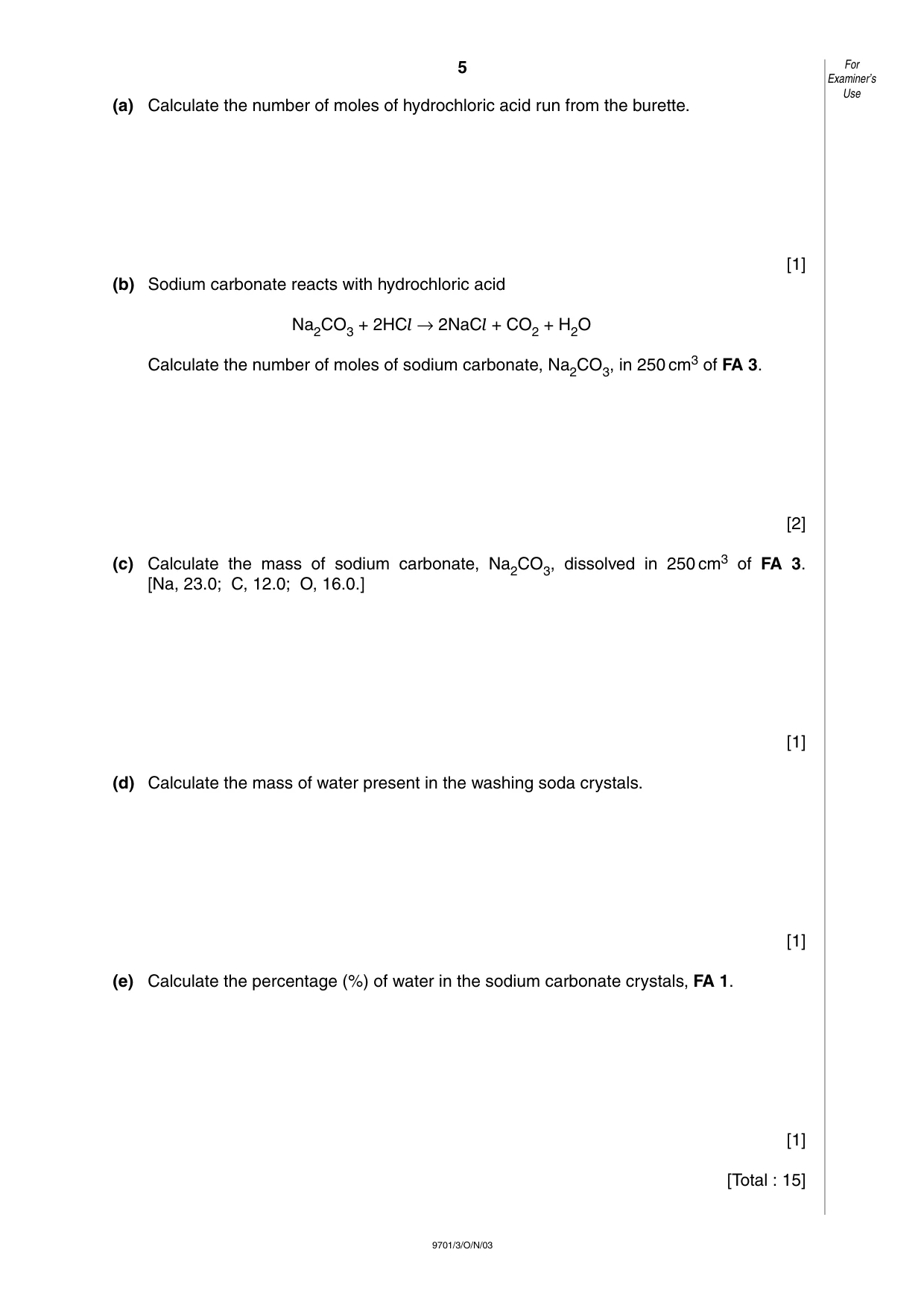
5 9701/3/O/N/03 (a) Calculate the number of moles of hydrochloric acid run from the burette. [1] (b) Sodium carbonate reacts with hydrochloric acid Na2CO3 + 2HCl →2NaCl + CO2 + H2O Calculate the number of moles of sodium carbonate, Na2CO3, in 250 cm3 of FA 3. [2] (c) Calculate the mass of sodium carbonate, Na2CO3, dissolved in 250 cm3 of FA 3. [Na, 23.0; C, 12.0; O, 16.0.] [1] (d) Calculate the mass of water present in the washing soda crystals. [1] (e) Calculate the percentage (%) of water in the sodium carbonate crystals, FA 1. [1] [Total : 15] For Examiner’s Use