Cambridge A Level Chemistry 9701 — 2003 May/June Paper 3 · Variant 1
9701/31/M/J/03
The question paper and its mark scheme, free to read here and free to download. This is Cambridge’s own paper, exactly as it was sat.
Question paper8 pages
Mark scheme
No mark scheme is in the library for this paper.
Paper as text
Question paper, page 1
This document consists of 8 printed pages and an insert. SP (NF/SLC) S39116/3 © CIE 2003 [Turn over CAMBRIDGE INTERNATIONAL EXAMINATIONS General Certificate of Education Advanced Subsidiary Level and Advanced Level CHEMISTRY 9701/03 Paper 3 Practical Test May/June 2003 1 hour 15 minutes Candidates answer on the Question Paper. Additional materials: As listed in the Instructions to Supervisors. Insert READ THESE INSTRUCTIONS FIRST Write your details, including examination session and laboratory where appropriate, in the boxes provided. Write in dark blue or black pen in the spaces provided on the Question Paper. You may use a pencil for any diagrams, graphs, or rough working. Do not use staples, paper clips, highlighters, glue or correction fluid. Answer all questions. At the end of the examination, fasten all your work securely together. The number of marks is given in brackets [ ] at the end of each question or part question. You are advised to show all working in calculations. Use of a Data Booklet is unnecessary. Qualtitative Analysis notes are provided on pages 7 and 8. An Insert is provided for question 1. Centre Number Candidate Number Name For Examiner’s Use If you have been given a label, look at the details. If any details are incorrect or missing, please fill in your correct details in the space given at the top of this page. Stick your personal label here, if provided. 1 2 TOTAL SESSION LABORATORY
Question paper, page 2
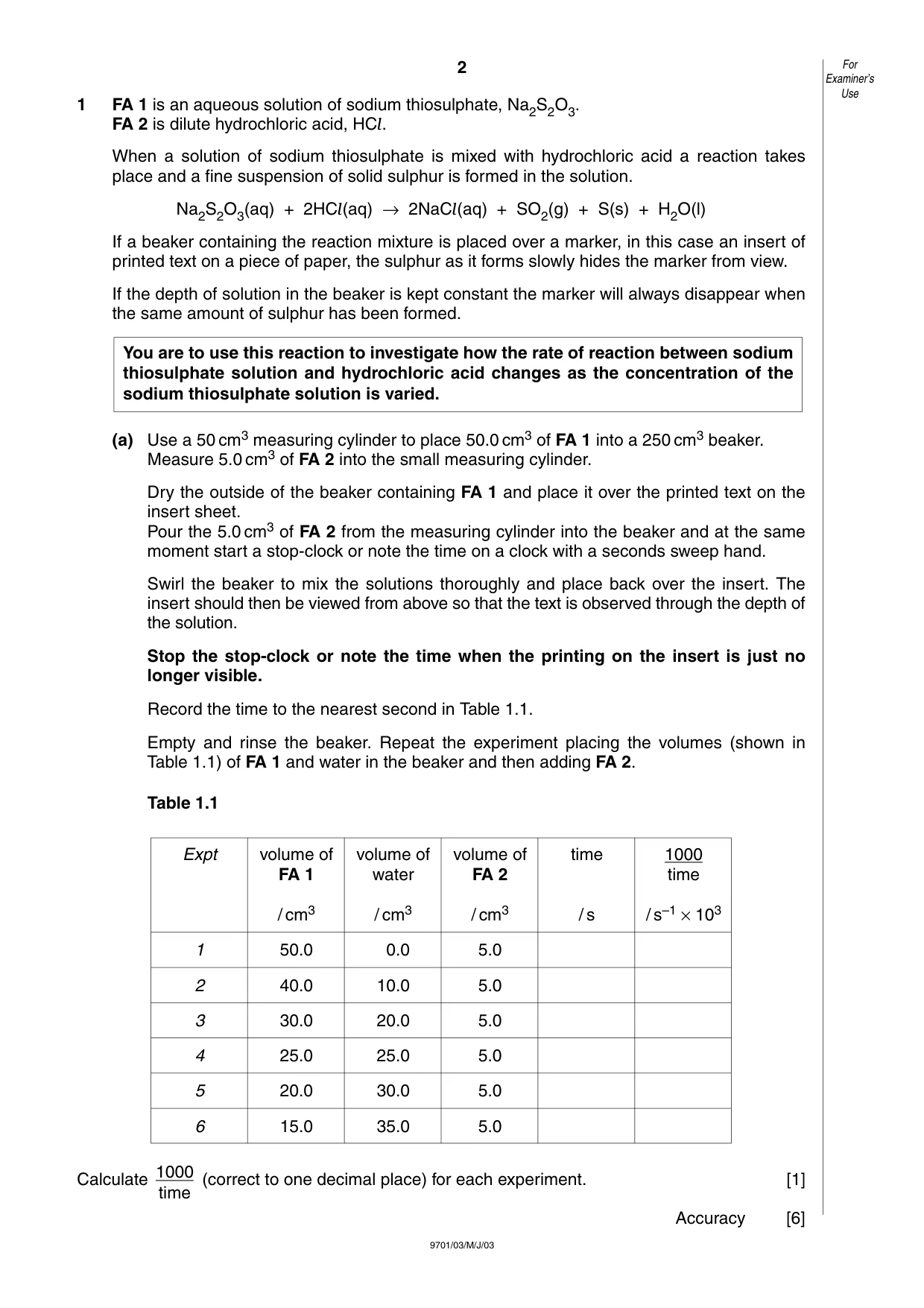
2 9701/03/M/J/03 1 FA 1 is an aqueous solution of sodium thiosulphate, Na2S2O3. FA 2 is dilute hydrochloric acid, HCl. When a solution of sodium thiosulphate is mixed with hydrochloric acid a reaction takes place and a fine suspension of solid sulphur is formed in the solution. Na2S2O3(aq) + 2HCl(aq) →2NaCl(aq) + SO2(g) + S(s) + H2O(l) If a beaker containing the reaction mixture is placed over a marker, in this case an insert of printed text on a piece of paper, the sulphur as it forms slowly hides the marker from view. If the depth of solution in the beaker is kept constant the marker will always disappear when the same amount of sulphur has been formed. (a) Use a 50 cm3 measuring cylinder to place 50.0 cm3 of FA 1 into a 250 cm3 beaker. Measure 5.0 cm3 of FA 2 into the small measuring cylinder. Dry the outside of the beaker containing FA 1 and place it over the printed text on the insert sheet. Pour the 5.0 cm3 of FA 2 from the measuring cylinder into the beaker and at the same moment start a stop-clock or note the time on a clock with a seconds sweep hand. Swirl the beaker to mix the solutions thoroughly and place back over the insert. The insert should then be viewed from above so that the text is observed through the depth of the solution. Stop the stop-clock or note the time when the printing on the insert is just no longer visible. Record the time to the nearest second in Table 1.1. Empty and rinse the beaker. Repeat the experiment placing the volumes (shown in Table 1.1) of FA 1 and water in the beaker and then adding FA 2. Table 1.1 Calculate (correct to one decimal place) for each experiment. [1] Accuracy [6] 1000 time You are to use this reaction to investigate how the rate of reaction between sodium thiosulphate solution and hydrochloric acid changes as the concentration of the sodium thiosulphate solution is varied. For Examiner’s Use Expt volume of volume of volume of time FA 1 water FA 2 / cm3 / cm3 / cm3 / s / s–1 × 10³ 1 50.0 0.0 5.0 2 40.0 10.0 5.0 3 30.0 20.0 5.0 4 25.0 25.0 5.0 5 20.0 30.0 5.0 6 15.0 35.0 5.0 1000 time
Question paper, page 3
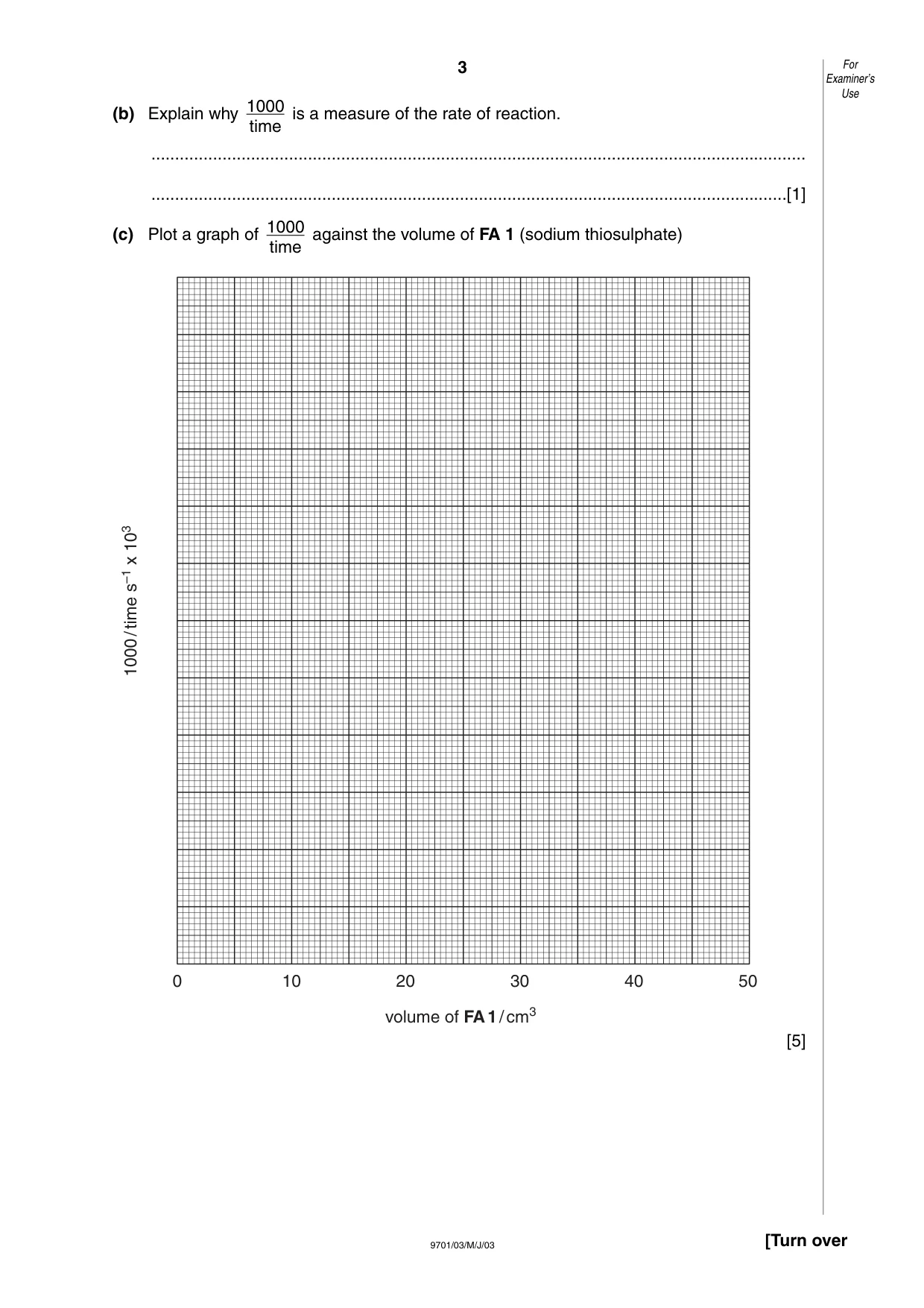
3 9701/03/M/J/03 [Turn over (b) Explain why is a measure of the rate of reaction. … …[1] (c) Plot a graph of against the volume of FA 1 (sodium thiosulphate) [5] 0 10 20 volume of FA1/cm3 1000/time s–1 x 10³ 30 40 50 1000 time 1000 time For Examiner’s Use
Question paper, page 4
(d) How is the rate of reaction related to the concentration of sodium thiosulphate solution? … … … …[1] (e) Explain why the total volume of solution used in each experiment is kept constant. … … … …[1] [Total 15] 4 9701/03/M/J/03 For Examiner’s Use
Question paper, page 5
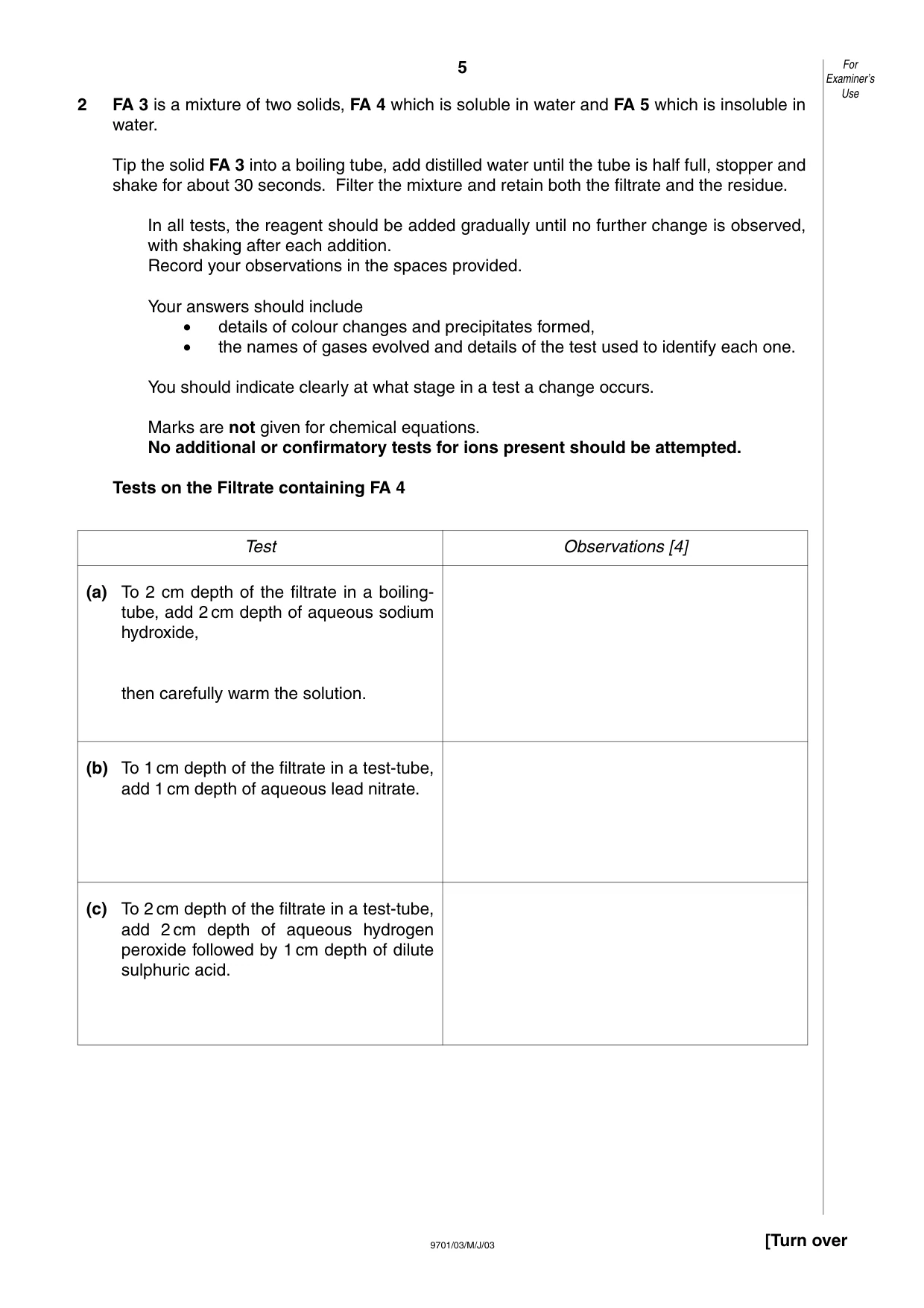
5 9701/03/M/J/03 [Turn over 2 FA 3 is a mixture of two solids, FA 4 which is soluble in water and FA 5 which is insoluble in water. Tip the solid FA 3 into a boiling tube, add distilled water until the tube is half full, stopper and shake for about 30 seconds. Filter the mixture and retain both the filtrate and the residue. In all tests, the reagent should be added gradually until no further change is observed, with shaking after each addition. Record your observations in the spaces provided. Your answers should include • details of colour changes and precipitates formed, • the names of gases evolved and details of the test used to identify each one. You should indicate clearly at what stage in a test a change occurs. Marks are not given for chemical equations. No additional or confirmatory tests for ions present should be attempted. Tests on the Filtrate containing FA 4 For Examiner’s Use Test Observations [4] (a) To 2 cm depth of the filtrate in a boiling- tube, add 2 cm depth of aqueous sodium hydroxide, then carefully warm the solution. (b) To 1 cm depth of the filtrate in a test-tube, add 1 cm depth of aqueous lead nitrate. (c) To 2 cm depth of the filtrate in a test-tube, add 2 cm depth of aqueous hydrogen peroxide followed by 1 cm depth of dilute sulphuric acid.
Question paper, page 6
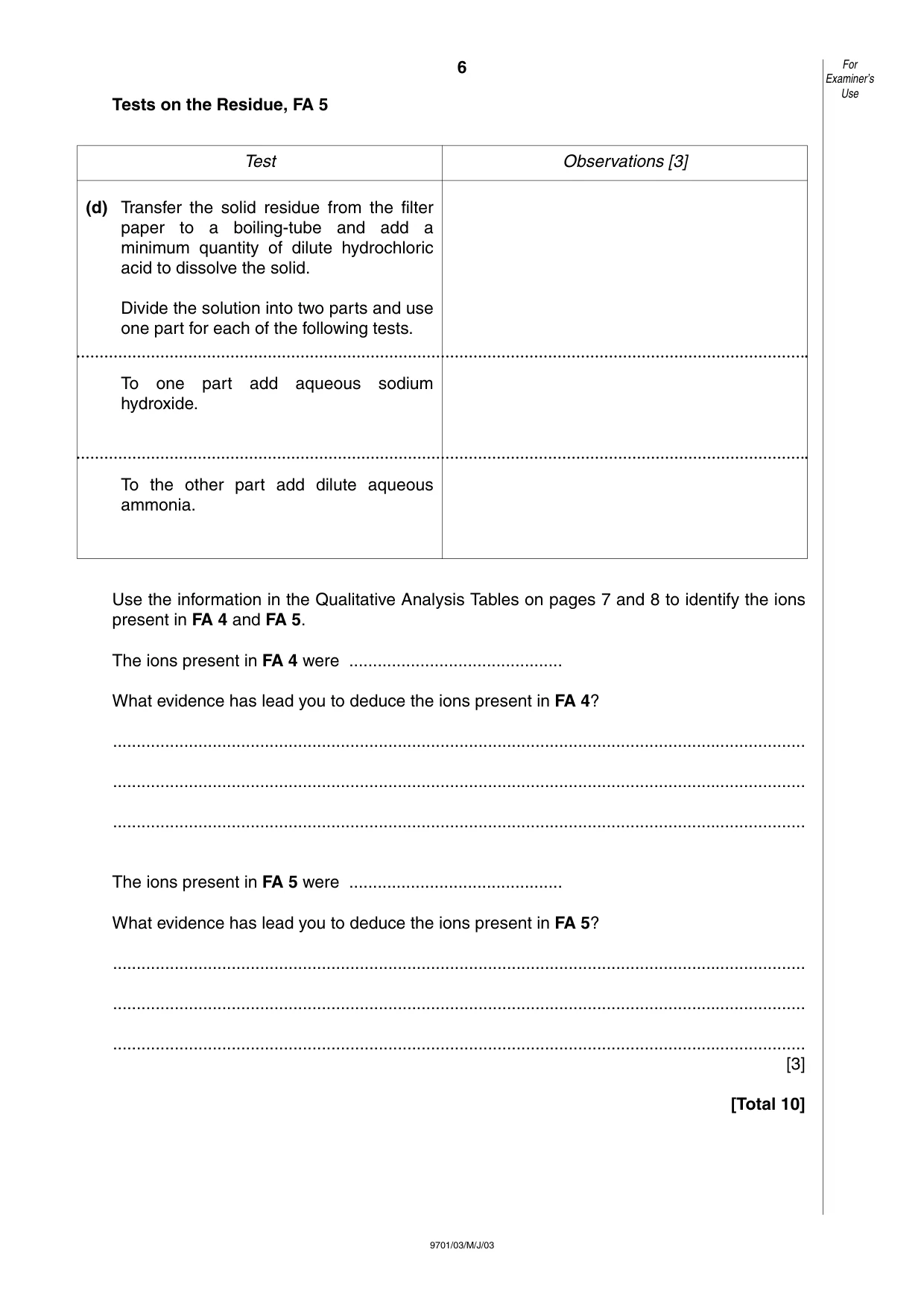
6 9701/03/M/J/03 Tests on the Residue, FA 5 Use the information in the Qualitative Analysis Tables on pages 7 and 8 to identify the ions present in FA 4 and FA 5. The ions present in FA 4 were … What evidence has lead you to deduce the ions present in FA 4? … … … The ions present in FA 5 were … What evidence has lead you to deduce the ions present in FA 5? … … … [3] [Total 10] For Examiner’s Use Test Observations [3] (d) Transfer the solid residue from the filter paper to a boiling-tube and add a minimum quantity of dilute hydrochloric acid to dissolve the solid. Divide the solution into two parts and use one part for each of the following tests. To one part add aqueous sodium hydroxide. To the other part add dilute aqueous ammonia.
Question paper, page 7
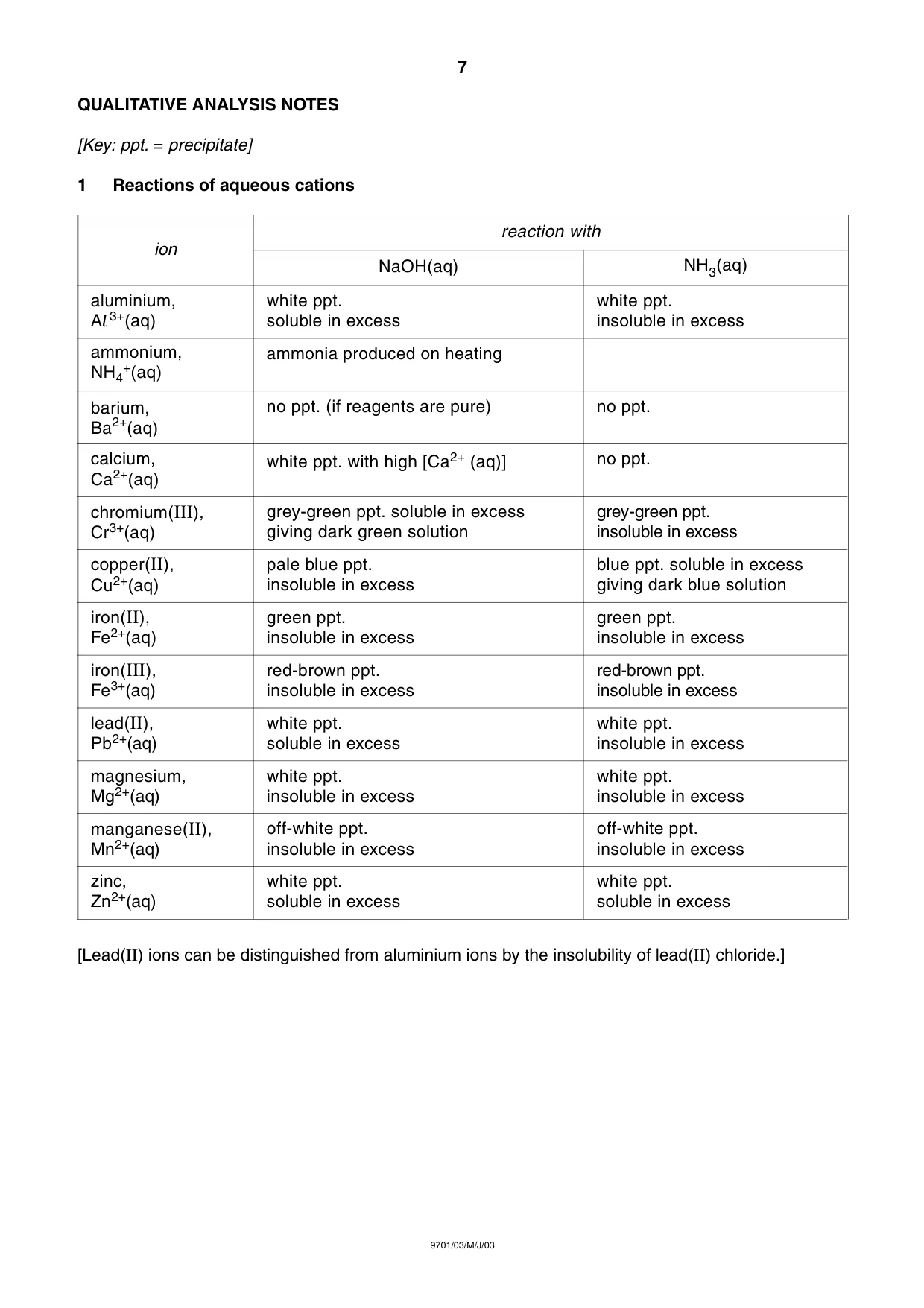
7 9701/03/M/J/03 QUALITATIVE ANALYSIS NOTES [Key: ppt. = precipitate] 1 Reactions of aqueous cations [Lead(II) ions can be distinguished from aluminium ions by the insolubility of lead(II) chloride.] aluminium, Al 3+(aq) ammonium, NH4 +(aq) barium, Ba2+(aq) calcium, Ca2+(aq) chromium(III), Cr3+(aq) zinc, Zn2+(aq) copper(II), Cu2+(aq) iron(II), Fe2+(aq) iron(III), Fe3+(aq) lead(II), Pb2+(aq) magnesium, Mg2+(aq) manganese(II), Mn2+(aq) reaction with NaOH(aq) NH3(aq) white ppt. soluble in excess ammonia produced on heating no ppt. (if reagents are pure) green ppt. insoluble in excess green ppt. insoluble in excess white ppt. with high [Ca2+ (aq)] pale blue ppt. insoluble in excess blue ppt. soluble in excess giving dark blue solution white ppt. soluble in excess white ppt. insoluble in excess white ppt. insoluble in excess white ppt. insoluble in excess white ppt. soluble in excess white ppt. soluble in excess grey-green ppt. soluble in excess giving dark green solution red-brown ppt. insoluble in excess off-white ppt. insoluble in excess off-white ppt. insoluble in excess white ppt. insoluble in excess no ppt. no ppt. grey-green ppt. insoluble in excess red-brown ppt. insoluble in excess ion
Question paper, page 8
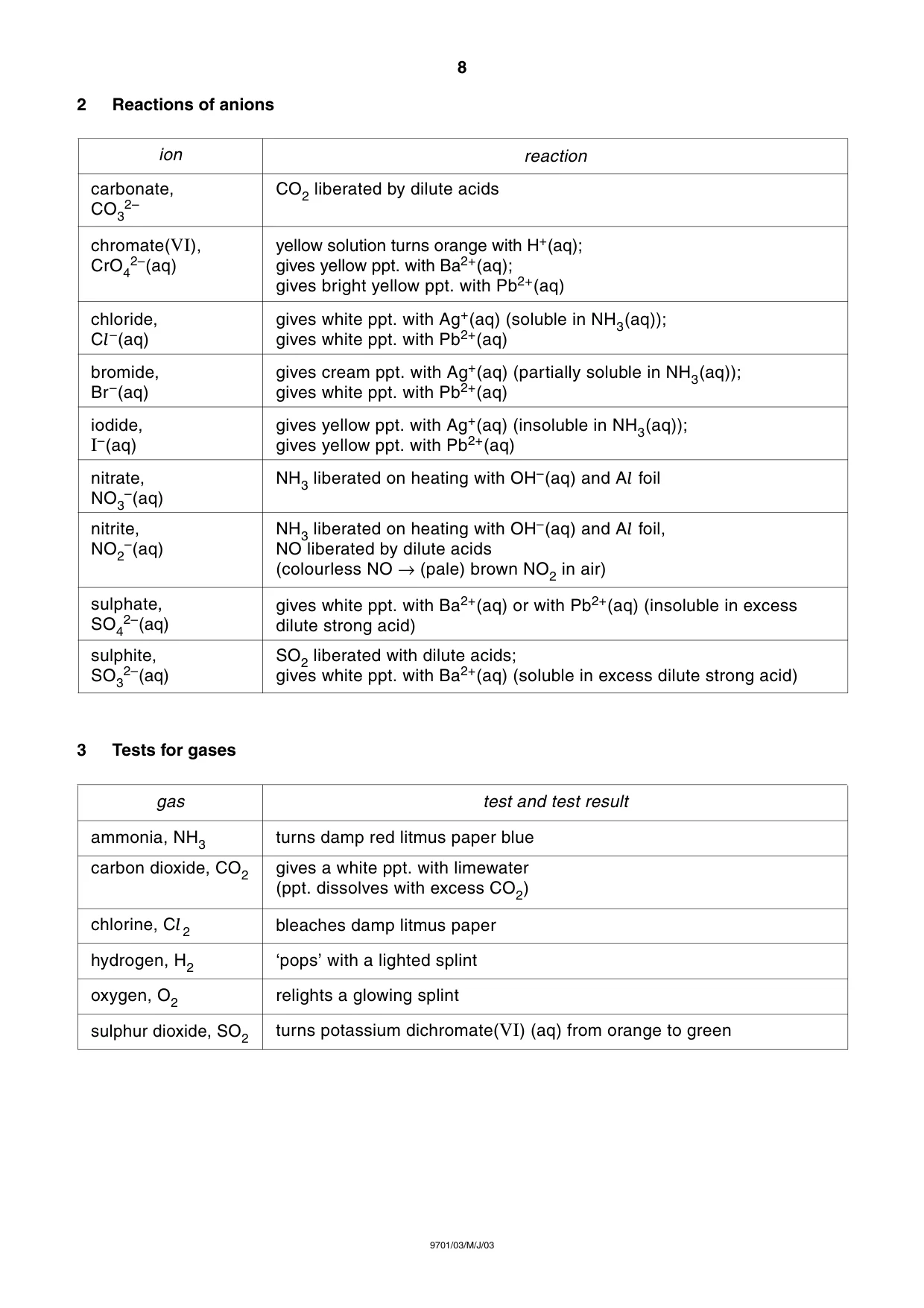
8 9701/03/M/J/03 2 Reactions of anions 3 Tests for gases carbonate, CO3 2– chromate(VI), CrO4 2–(aq) chloride, Cl–(aq) bromide, Br–(aq) iodide, I–(aq) nitrate, NO3 –(aq) nitrite, NO2 –(aq) sulphate, SO4 2–(aq) sulphite, SO3 2–(aq) ion reaction CO2 liberated by dilute acids yellow solution turns orange with H+(aq); gives yellow ppt. with Ba2+(aq); gives bright yellow ppt. with Pb2+(aq) gives white ppt. with Ag+(aq) (soluble in NH3(aq)); gives white ppt. with Pb2+(aq) NH3 liberated on heating with OH–(aq) and Al foil, NO liberated by dilute acids (colourless NO →(pale) brown NO2 in air) gives cream ppt. with Ag+(aq) (partially soluble in NH3(aq)); gives white ppt. with Pb2+(aq) NH3 liberated on heating with OH–(aq) and Al foil SO2 liberated with dilute acids; gives white ppt. with Ba2+(aq) (soluble in excess dilute strong acid) gives yellow ppt. with Ag+(aq) (insoluble in NH3(aq)); gives yellow ppt. with Pb2+(aq) gives white ppt. with Ba2+(aq) or with Pb2+(aq) (insoluble in excess dilute strong acid) gas test and test result turns damp red litmus paper blue gives a white ppt. with limewater (ppt. dissolves with excess CO2) bleaches damp litmus paper ‘pops’ with a lighted splint relights a glowing splint turns potassium dichromate(VI) (aq) from orange to green ammonia, NH3 carbon dioxide, CO2 chlorine, Cl 2 hydrogen, H2 oxygen, O2 sulphur dioxide, SO2