Cambridge A Level Chemistry 9701 — 2002 May/June Paper 3 · Variant 1
9701/31/M/J/02
The question paper and its mark scheme, free to read here and free to download. This is Cambridge’s own paper, exactly as it was sat.
Question paper8 pages

Mark scheme5 pages
Answers below. Sit the paper first if you are practising.
Paper as text
Question paper, page 1
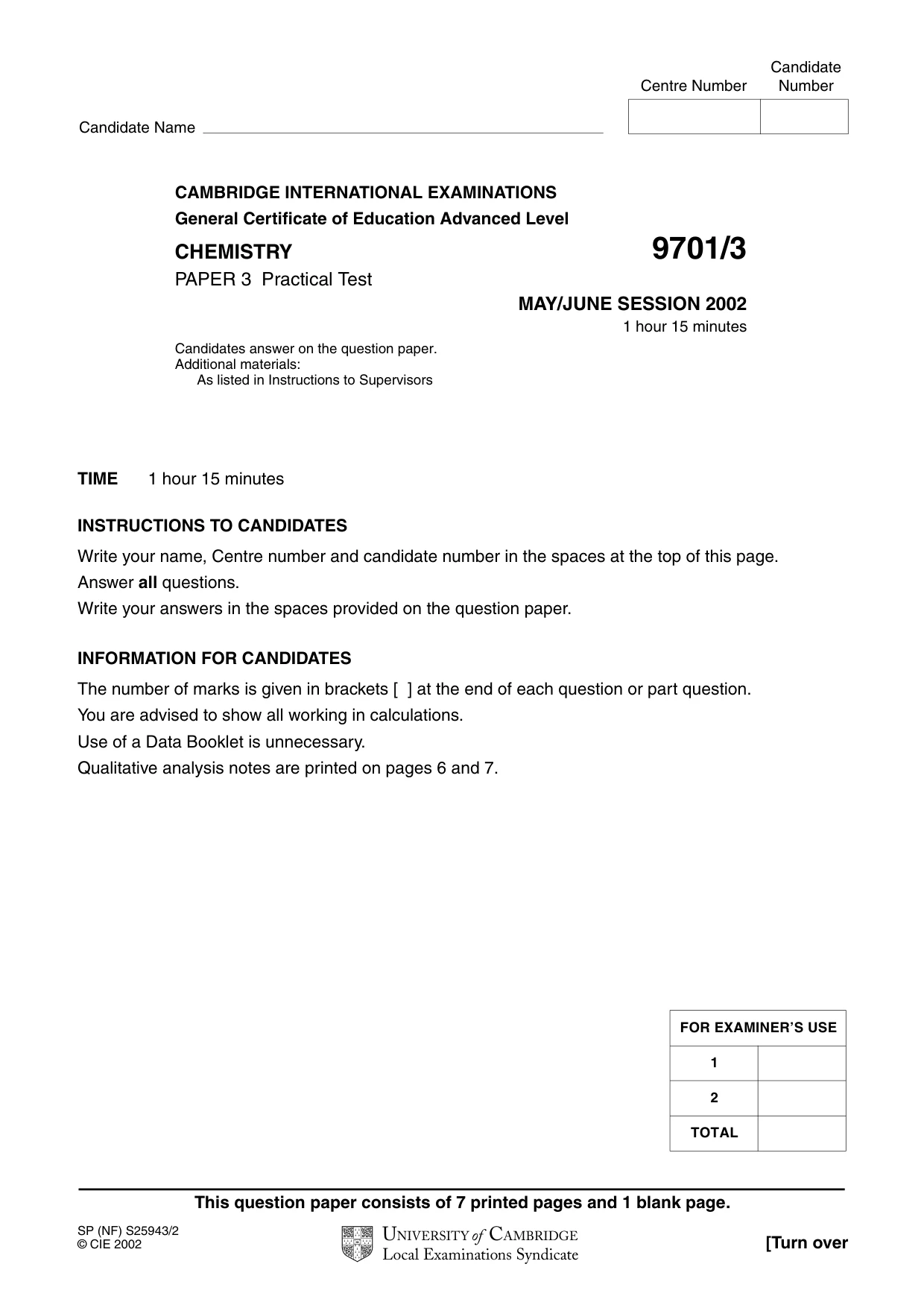
This question paper consists of 7 printed pages and 1 blank page. SP (NF) S25943/2 © CIE 2002 [Turn over CAMBRIDGE INTERNATIONAL EXAMINATIONS General Certificate of Education Advanced Level CHEMISTRY 9701/3 PAPER 3 Practical Test MAY/JUNE SESSION 2002 1 hour 15 minutes Candidates answer on the question paper. Additional materials: As listed in Instructions to Supervisors TIME 1 hour 15 minutes INSTRUCTIONS TO CANDIDATES Write your name, Centre number and candidate number in the spaces at the top of this page. Answer all questions. Write your answers in the spaces provided on the question paper. INFORMATION FOR CANDIDATES The number of marks is given in brackets [ ] at the end of each question or part question. You are advised to show all working in calculations. Use of a Data Booklet is unnecessary. Qualitative analysis notes are printed on pages 6 and 7. FOR EXAMINER’S USE 1 2 TOTAL Candidate Centre Number Number Candidate Name
Question paper, page 2
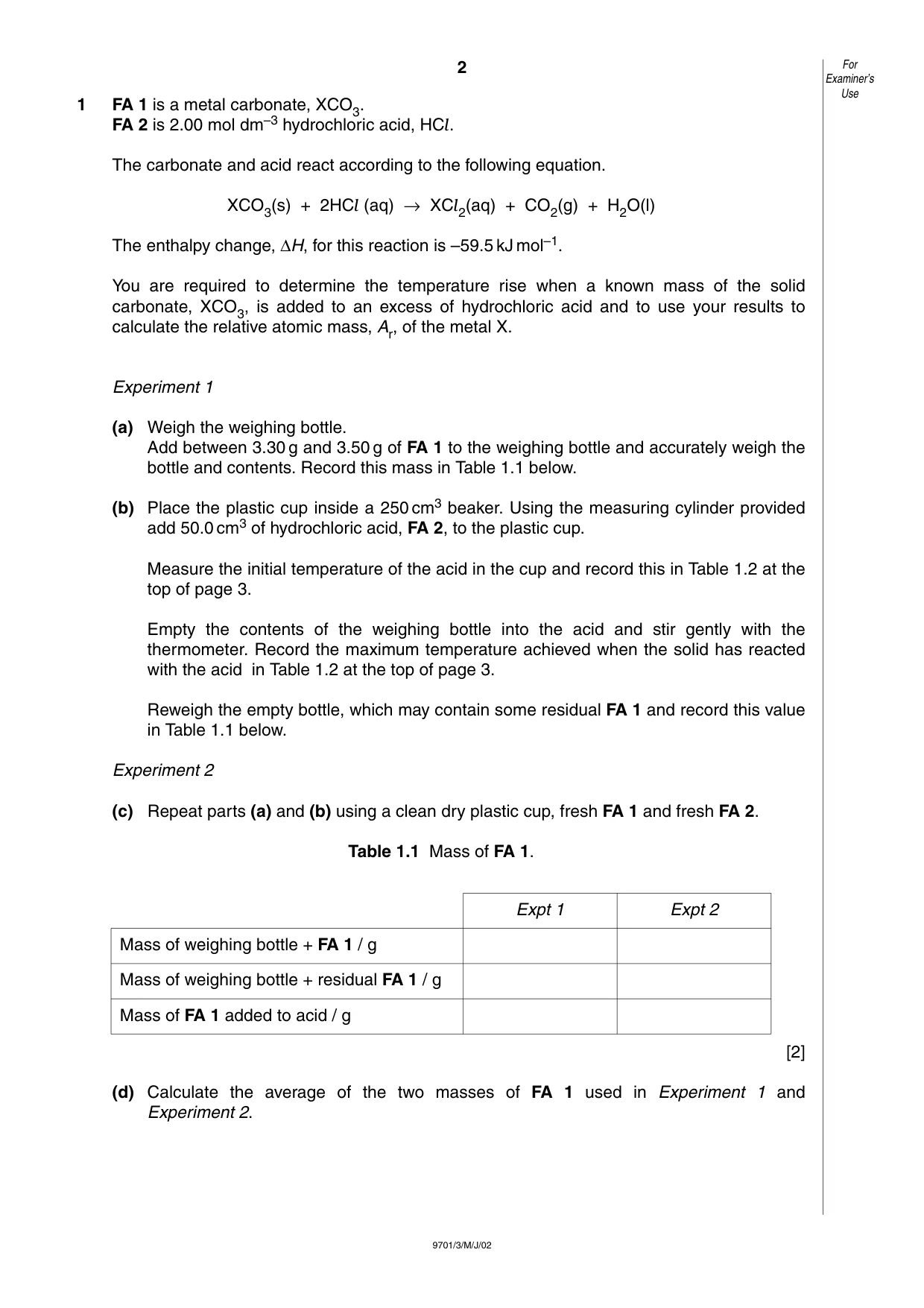
2 9701/3/M/J/02 1 FA 1 is a metal carbonate, XCO3. FA 2 is 2.00 mol dm–3 hydrochloric acid, HCl. The carbonate and acid react according to the following equation. XCO3(s) + 2HCl (aq) →XCl2(aq) + CO2(g) + H2O(l) The enthalpy change, ∆H, for this reaction is –59.5 kJ mol–1. You are required to determine the temperature rise when a known mass of the solid carbonate, XCO3, is added to an excess of hydrochloric acid and to use your results to calculate the relative atomic mass, Ar, of the metal X. Experiment 1 (a) Weigh the weighing bottle. Add between 3.30 g and 3.50 g of FA 1 to the weighing bottle and accurately weigh the bottle and contents. Record this mass in Table 1.1 below. (b) Place the plastic cup inside a 250 cm3 beaker. Using the measuring cylinder provided add 50.0 cm3 of hydrochloric acid, FA 2, to the plastic cup. Measure the initial temperature of the acid in the cup and record this in Table 1.2 at the top of page 3. Empty the contents of the weighing bottle into the acid and stir gently with the thermometer. Record the maximum temperature achieved when the solid has reacted with the acid in Table 1.2 at the top of page 3. Reweigh the empty bottle, which may contain some residual FA 1 and record this value in Table 1.1 below. Experiment 2 (c) Repeat parts (a) and (b) using a clean dry plastic cup, fresh FA 1 and fresh FA 2. Table 1.1 Mass of FA 1. [2] (d) Calculate the average of the two masses of FA 1 used in Experiment 1 and Experiment 2. For Examiner’s Use Expt 1 Expt 2 Mass of weighing bottle + FA 1 / g Mass of weighing bottle + residual FA 1 / g Mass of FA 1 added to acid / g
Question paper, page 3
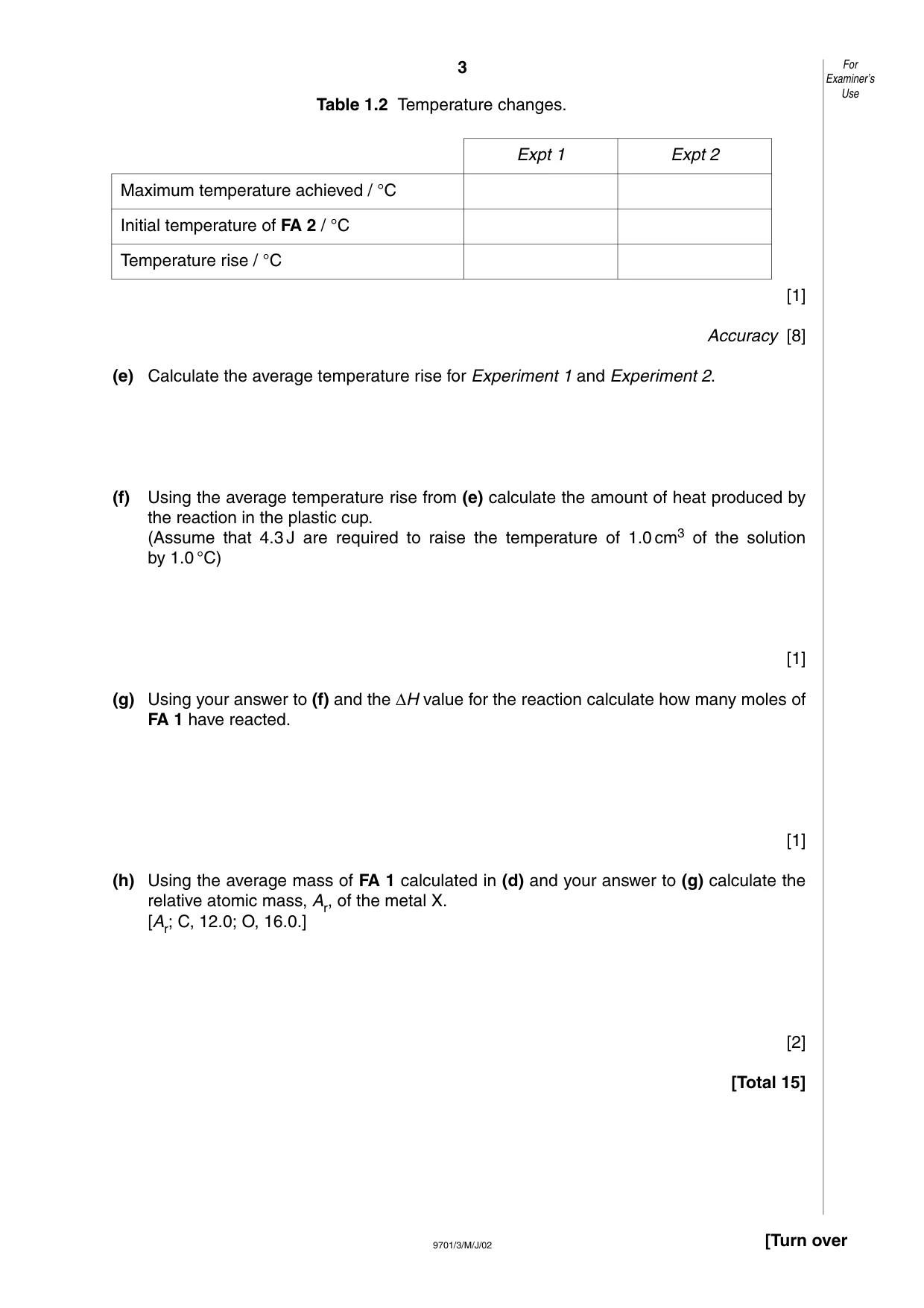
3 9701/3/M/J/02 [Turn over Table 1.2 Temperature changes. [1] Accuracy [8] (e) Calculate the average temperature rise for Experiment 1 and Experiment 2. (f) Using the average temperature rise from (e) calculate the amount of heat produced by the reaction in the plastic cup. (Assume that 4.3 J are required to raise the temperature of 1.0 cm3 of the solution by 1.0 °C) [1] (g) Using your answer to (f) and the ∆H value for the reaction calculate how many moles of FA 1 have reacted. [1] (h) Using the average mass of FA 1 calculated in (d) and your answer to (g) calculate the relative atomic mass, Ar, of the metal X. [Ar; C, 12.0; O, 16.0.] [2] [Total 15] For Examiner’s Use Expt 1 Expt 2 Maximum temperature achieved / °C Initial temperature of FA 2 / °C Temperature rise / °C
Question paper, page 4
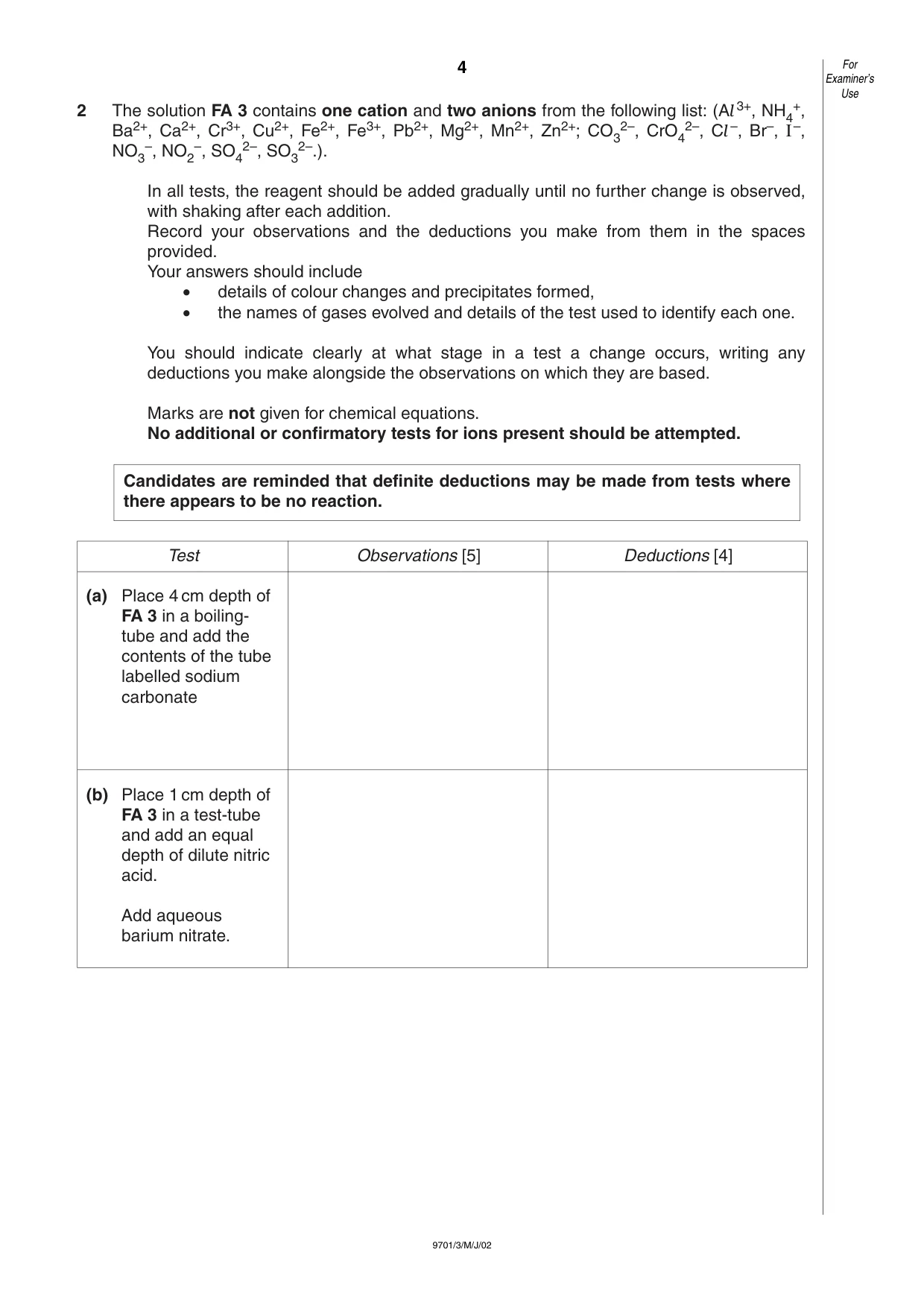
2 The solution FA 3 contains one cation and two anions from the following list: (Al 3+, NH4 +, Ba2+, Ca2+, Cr3+, Cu2+, Fe2+, Fe3+, Pb2+, Mg2+, Mn2+, Zn2+; CO3 2–, CrO4 2–, Cl –, Br–, I–, NO3 –, NO2 –, SO4 2–, SO3 2–.). In all tests, the reagent should be added gradually until no further change is observed, with shaking after each addition. Record your observations and the deductions you make from them in the spaces provided. Your answers should include • details of colour changes and precipitates formed, • the names of gases evolved and details of the test used to identify each one. You should indicate clearly at what stage in a test a change occurs, writing any deductions you make alongside the observations on which they are based. Marks are not given for chemical equations. No additional or confirmatory tests for ions present should be attempted. Candidates are reminded that definite deductions may be made from tests where there appears to be no reaction. Test Observations [5] Deductions [4] (a) Place 4 cm depth of FA 3 in a boiling- tube and add the contents of the tube labelled sodium carbonate (b) Place 1 cm depth of FA 3 in a test-tube and add an equal depth of dilute nitric acid. Add aqueous barium nitrate. 4 9701/3/M/J/02 For Examiner’s Use
Question paper, page 5
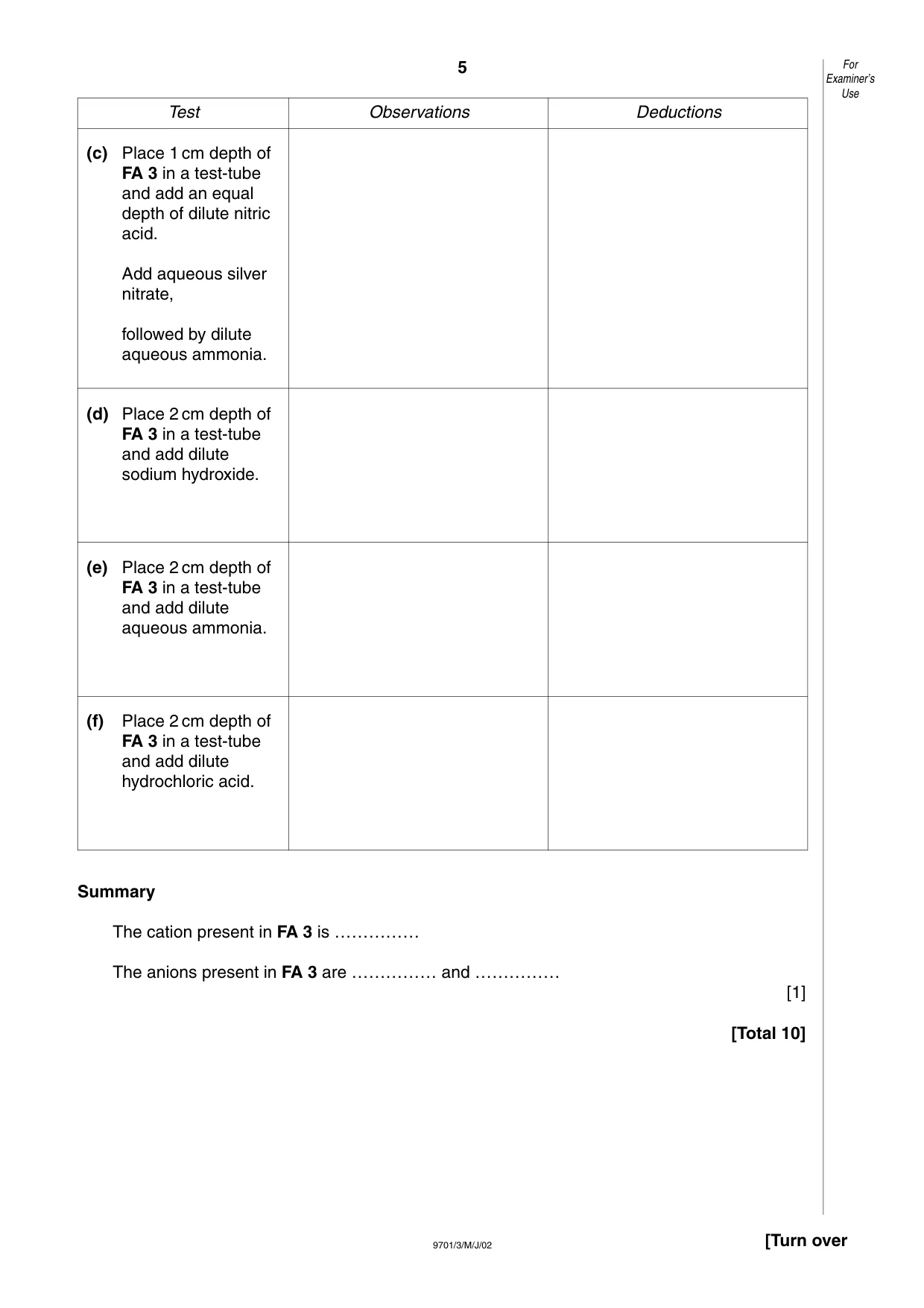
5 9701/3/M/J/02 [Turn over Summary The cation present in FA 3 is …………… The anions present in FA 3 are …………… and …………… [1] [Total 10] For Examiner’s Use Test Observations Deductions (c) Place 1 cm depth of FA 3 in a test-tube and add an equal depth of dilute nitric acid. Add aqueous silver nitrate, followed by dilute aqueous ammonia. (d) Place 2 cm depth of FA 3 in a test-tube and add dilute sodium hydroxide. (e) Place 2 cm depth of FA 3 in a test-tube and add dilute aqueous ammonia. (f) Place 2 cm depth of FA 3 in a test-tube and add dilute hydrochloric acid.
Question paper, page 6
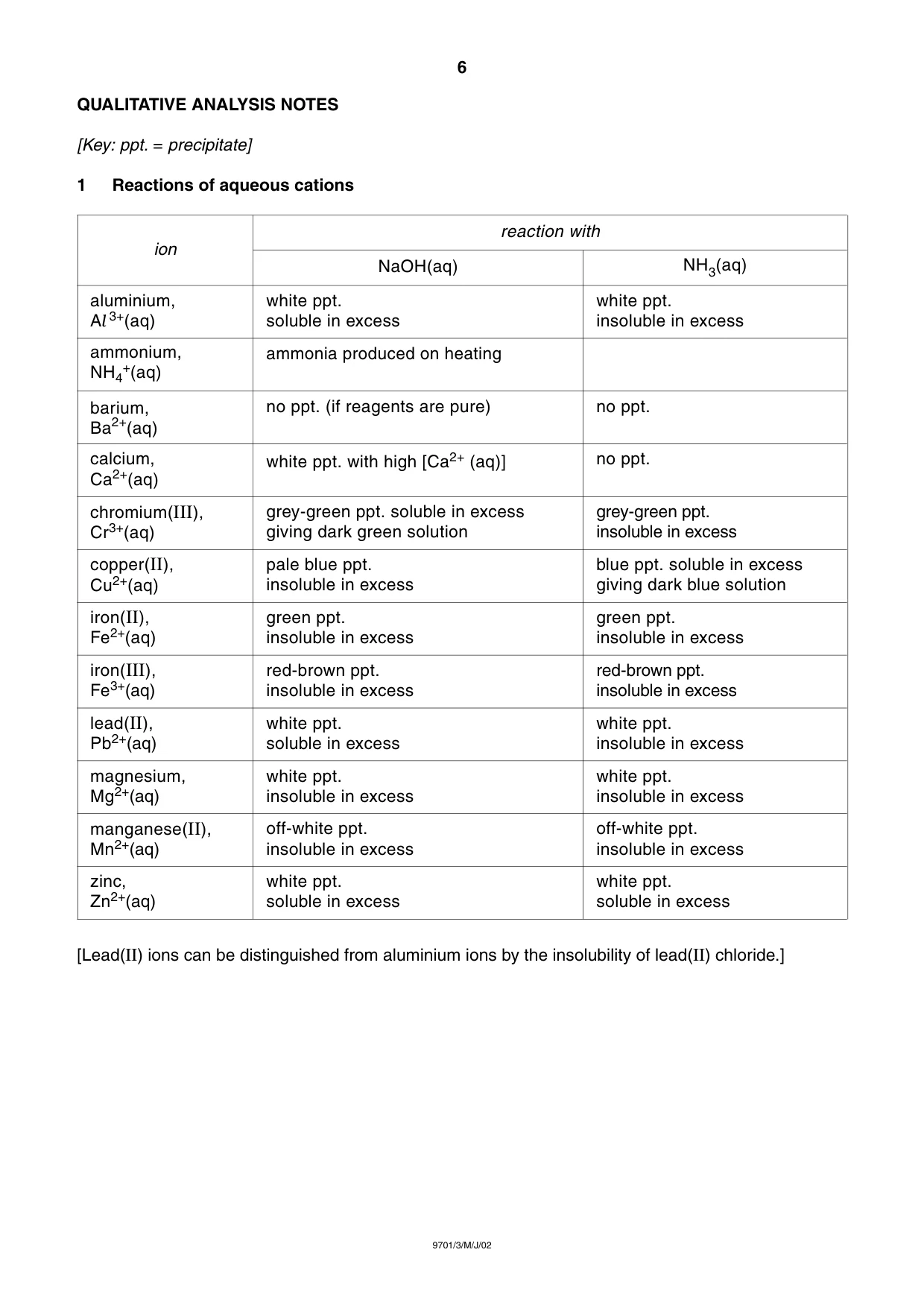
6 9701/3/M/J/02 QUALITATIVE ANALYSIS NOTES [Key: ppt. = precipitate] 1 Reactions of aqueous cations [Lead(II) ions can be distinguished from aluminium ions by the insolubility of lead(II) chloride.] aluminium, Al 3+(aq) ammonium, NH4 +(aq) barium, Ba2+(aq) calcium, Ca2+(aq) chromium(III), Cr3+(aq) zinc, Zn2+(aq) copper(II), Cu2+(aq) iron(II), Fe2+(aq) iron(III), Fe3+(aq) lead(II), Pb2+(aq) magnesium, Mg2+(aq) manganese(II), Mn2+(aq) reaction with NaOH(aq) NH3(aq) white ppt. soluble in excess ammonia produced on heating no ppt. (if reagents are pure) green ppt. insoluble in excess green ppt. insoluble in excess white ppt. with high [Ca2+ (aq)] pale blue ppt. insoluble in excess blue ppt. soluble in excess giving dark blue solution white ppt. soluble in excess white ppt. insoluble in excess white ppt. insoluble in excess white ppt. insoluble in excess white ppt. soluble in excess white ppt. soluble in excess grey-green ppt. soluble in excess giving dark green solution red-brown ppt. insoluble in excess off-white ppt. insoluble in excess off-white ppt. insoluble in excess white ppt. insoluble in excess no ppt. no ppt. grey-green ppt. insoluble in excess red-brown ppt. insoluble in excess ion
Question paper, page 7
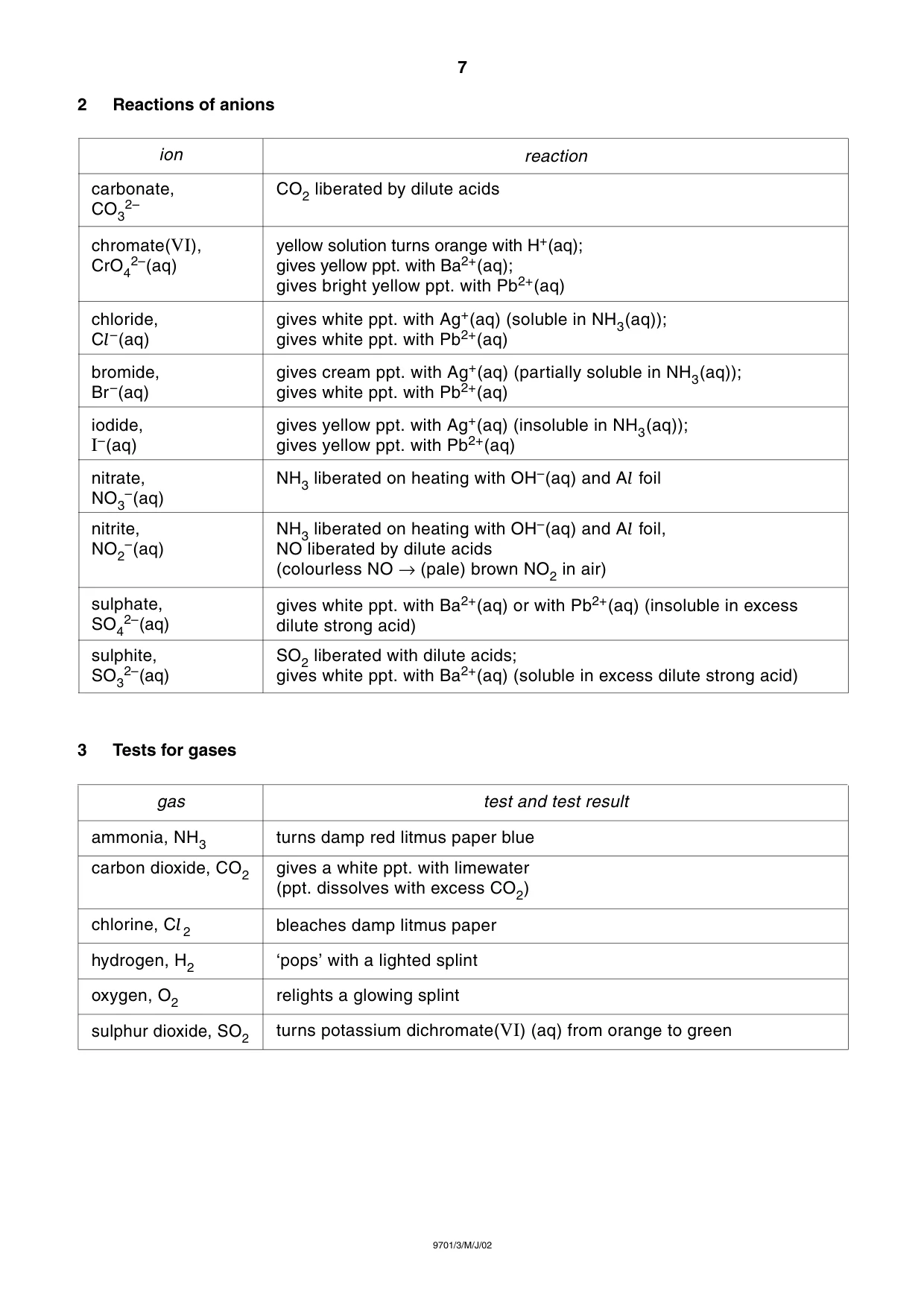
7 9701/3/M/J/02 2 Reactions of anions 3 Tests for gases carbonate, CO3 2– chromate(VI), CrO4 2–(aq) chloride, Cl–(aq) bromide, Br–(aq) iodide, I–(aq) nitrate, NO3 –(aq) nitrite, NO2 –(aq) sulphate, SO4 2–(aq) sulphite, SO3 2–(aq) ion reaction CO2 liberated by dilute acids yellow solution turns orange with H+(aq); gives yellow ppt. with Ba2+(aq); gives bright yellow ppt. with Pb2+(aq) gives white ppt. with Ag+(aq) (soluble in NH3(aq)); gives white ppt. with Pb2+(aq) NH3 liberated on heating with OH–(aq) and Al foil, NO liberated by dilute acids (colourless NO →(pale) brown NO2 in air) gives cream ppt. with Ag+(aq) (partially soluble in NH3(aq)); gives white ppt. with Pb2+(aq) NH3 liberated on heating with OH–(aq) and Al foil SO2 liberated with dilute acids; gives white ppt. with Ba2+(aq) (soluble in excess dilute strong acid) gives yellow ppt. with Ag+(aq) (insoluble in NH3(aq)); gives yellow ppt. with Pb2+(aq) gives white ppt. with Ba2+(aq) or with Pb2+(aq) (insoluble in excess dilute strong acid) gas test and test result turns damp red litmus paper blue gives a white ppt. with limewater (ppt. dissolves with excess CO2) bleaches damp litmus paper ‘pops’ with a lighted splint relights a glowing splint turns potassium dichromate(VI) (aq) from orange to green ammonia, NH3 carbon dioxide, CO2 chlorine, Cl 2 hydrogen, H2 oxygen, O2 sulphur dioxide, SO2
Mark scheme, page 1
CAMBRIDGE INTERNATIONAL EXAMINATIONS JUNE 2002 GCE Advanced Subsidiary Level MARK SCHEME MAXIMUM MARK : 25 SYLLABUS/COMPONENT :9701 /3 CHEMISTRY (PRACTICAL (AS)) fe UNiversiry of CAMBRIDGE 43% Local Examinations Syndicate
Mark scheme, page 2
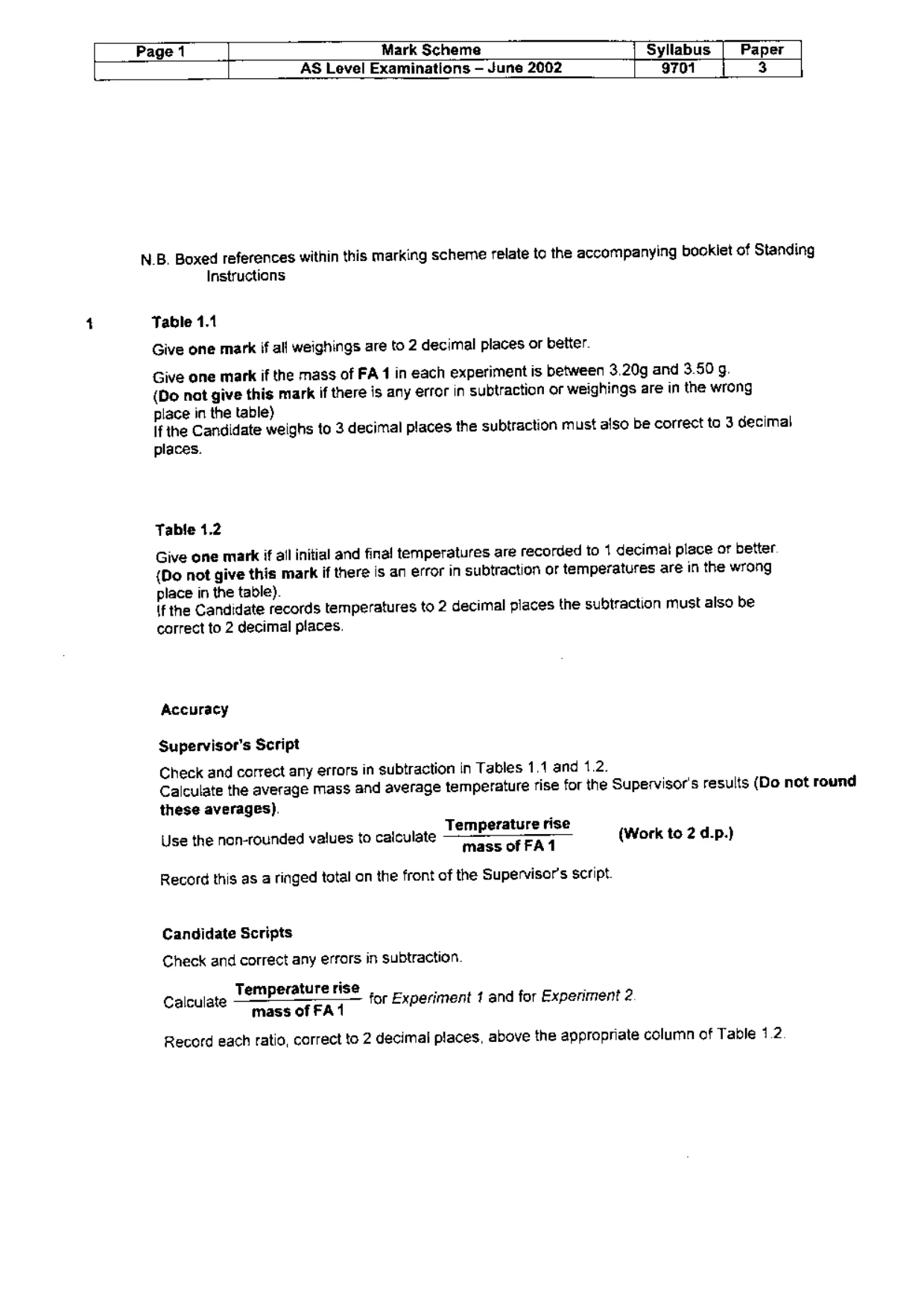
Page 1 | Mark Scheme Syllabus | Paper [ AS Level Examinations — June 2002 9701 3 N.B. Boxed references within this marking scheme relate to the accompanying bookiet of Standing Instructions Table 1.1 Give one mark if all weighings are to 2 decimal places or better. Give one mark if the mass of FA 1 in each experiment is between 3.20g and 3.50 g. (Do not give this mark if there is any error in subtraction or weighings are in the wrong place in the table) If the Candidate weighs to 3 decimal places the subtraction must afso be correct to 3 decimal places. Table 1.2 Give one mark if all initial and fina! temperatures are recorded to 1 decimat place or better. {Do not give this mark if there is an error in subtraction or temperatures are in the wrong place in the table). (f the Candidate records temperatures to 2 decimal piaces the subtraction must also be correct to 2 decimal places. Accuracy Supervisor's Script Check and correct any errors in subtraction in Tables 1.1 and 1.2. Calculate the average mass and average temperature rise for the Supervisor's results (Do not round these averages). Temperature rise 1 0 calcul: Use the non-rounded values to calculate mass of FA1 (Work to 2 d.p.) Record this as a ringed total on the front of the Supervisor's script. Candidate Scripts Check and correct any errors in subtraction. Temperature rise Calculate mass of FA1 for Experiment 7 and for Experiment 2 Record each ratio, correct to 2 decimal places, above the appropriate column of Table 1.2
Mark scheme, page 3
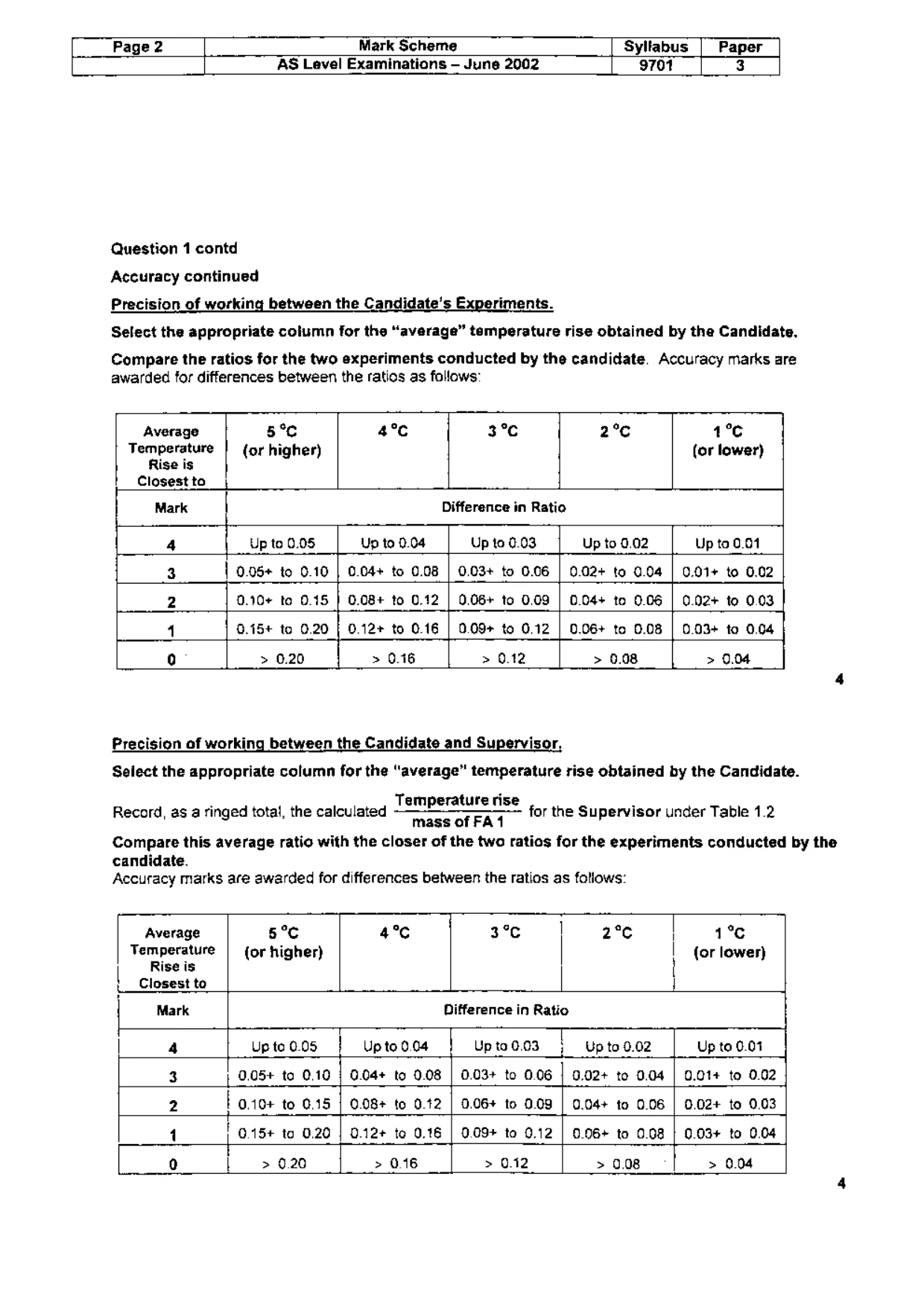
Page 2 Mark Scheme Syllabus [Paper | AS Level Examinations — June 2002 9701 | 3 | Question 1 contd Accuracy continued Precision of working between the Candidate's Experiments. Select the appropriate column for the “average” temperature rise obtained by the Candidate. Compare the ratios for the two experiments conducted by the candidate. Accuracy marks are awarded for differences between the ratios as follows: Average 5°C 4°c 3°c 2°C 1°C Temperature | (or higher) (or lower) Rise is Closest to Mark Difference in Ratio Up to 0.05 Up to 0.04 Up to 0.03 Up to 0.02 Up to 0.01 0.05+ to 0.10 | 0.04+ to 0.08 | 0.03+ to 0.06 | 0.02+ to 0.04 | 0.01+ to 0.02 = 0.10+ to 0.15 } 0.08+ to 0.12 | 0.06+ to 0.09 | 0.04+ to 0.06 | 0.02+ to 0.03 + 0.15+ to 0.20 | 0.12+ to 0.16 | 0.09% to 0.12 | 0.06+ to 0.08 | 0.03+ to 0.04 © |= In [wo ja > 0.20 > 0.16 > 0.12 > 0.08 > 0.04 Precision of working between the Candidate and Supervisor, Select the appropriate column for the “average” temperature rise obtained by the Candidate. Temperature rise mass of FA 1 Compare this average ratio with the closer of the two ratios for the experiments conducted by the candidate. Accuracy marks are awarded for differences between the ratios as follows: Record, as a ringed tota!, the calculated for the Supervisor under Table 1.2 Average §°C 4% | 3°C 2° I 1°C Temperature | (or higher) (or lower) Rise is {Closest to } Mark Difference in Ratio T a 4 Up to 0.05 ! Up to 0.04 t Upto0.03 j; Upto 0.02 Up to 0.01 3 0,05+ ta 0.10 | 0.04+ to 0.08 | 0.03+ to 0.06 | 0.02+ to 0.04 | 0.014 to 0.02 2 I 0,10+ to 0.15 | 0.084 to 0.12 | 0.06+ to 0.09 | 0.04+ to 0.06 | 0.02+ to 0.03 t+ 1 | 0.154 to 0.20 | 0.124 to 0.16 | 0.094 to 0.12 | 0.06+ to 0.08 | 0.034 to 0.04 Q > 0.20 > 0.16 > 0.12 > 0.08 i > 0.04
Mark scheme, page 4
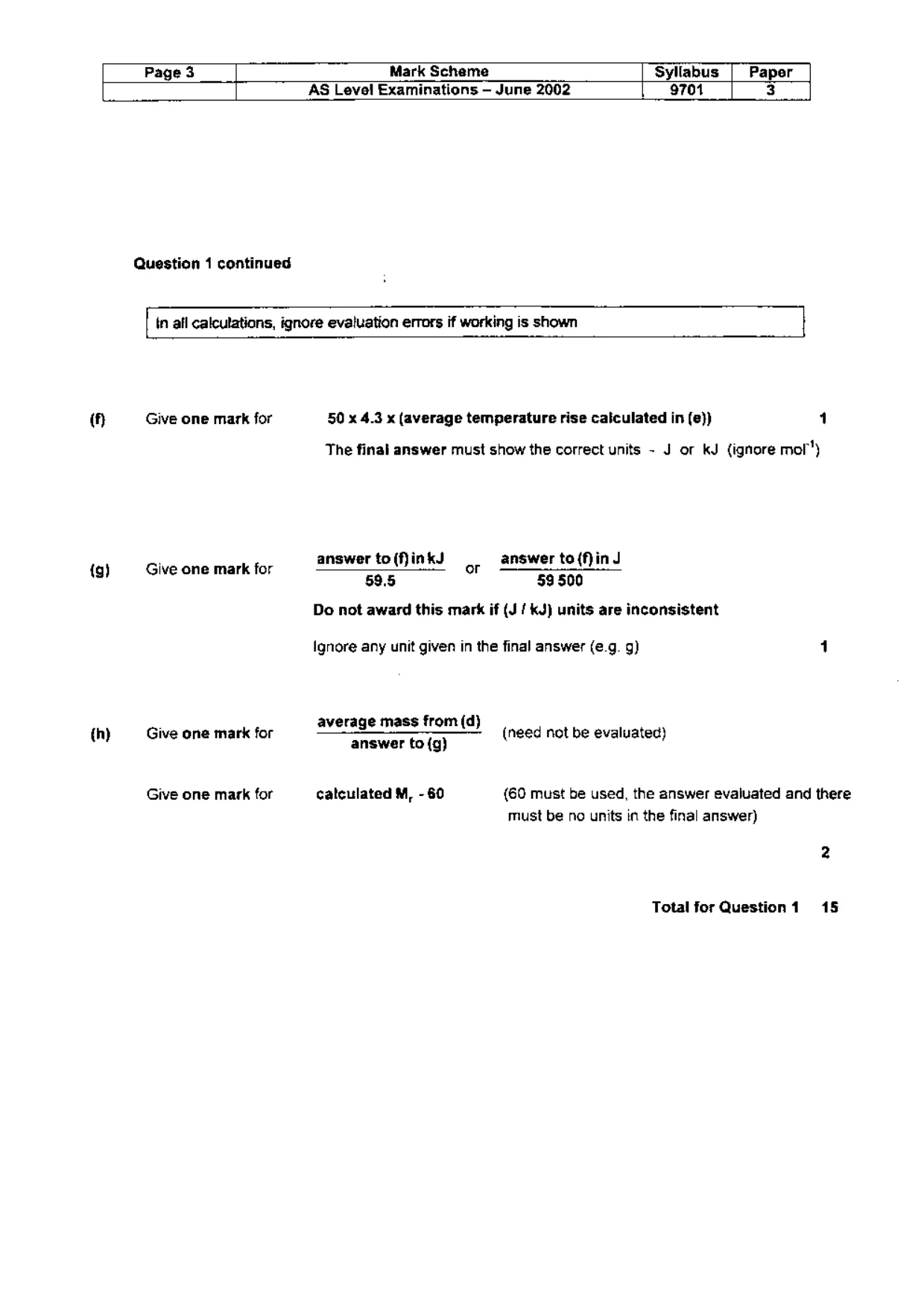
Page 3 Mark Scheme AS Level Examinations — June 2002 9701 Syllabus Paper 3 G) {g) (hy Question 1 continued tn afl calculations, ignore evaluation errors if working is shown Give one mark for Give one mark for Give one mark for Give one mark for 50 x 4.3 x (average temperature rise calculated in (e)) 1 The final answer must show the correct units - J or kJ (ignore mol") answer to (fJinkJ answer to(ffin J 59.5 59500 Do not award this mark if (J / kJ) units are inconsistent Ignore any unit given in the final answer (e.g. 9) 1 average mass from (d) answer to (g} calculated M, - 80 (need not be evaluated) (60 must be used, the answer evaluated and there must be no units in the final answer) Total for Question1 15
Mark scheme, page 5
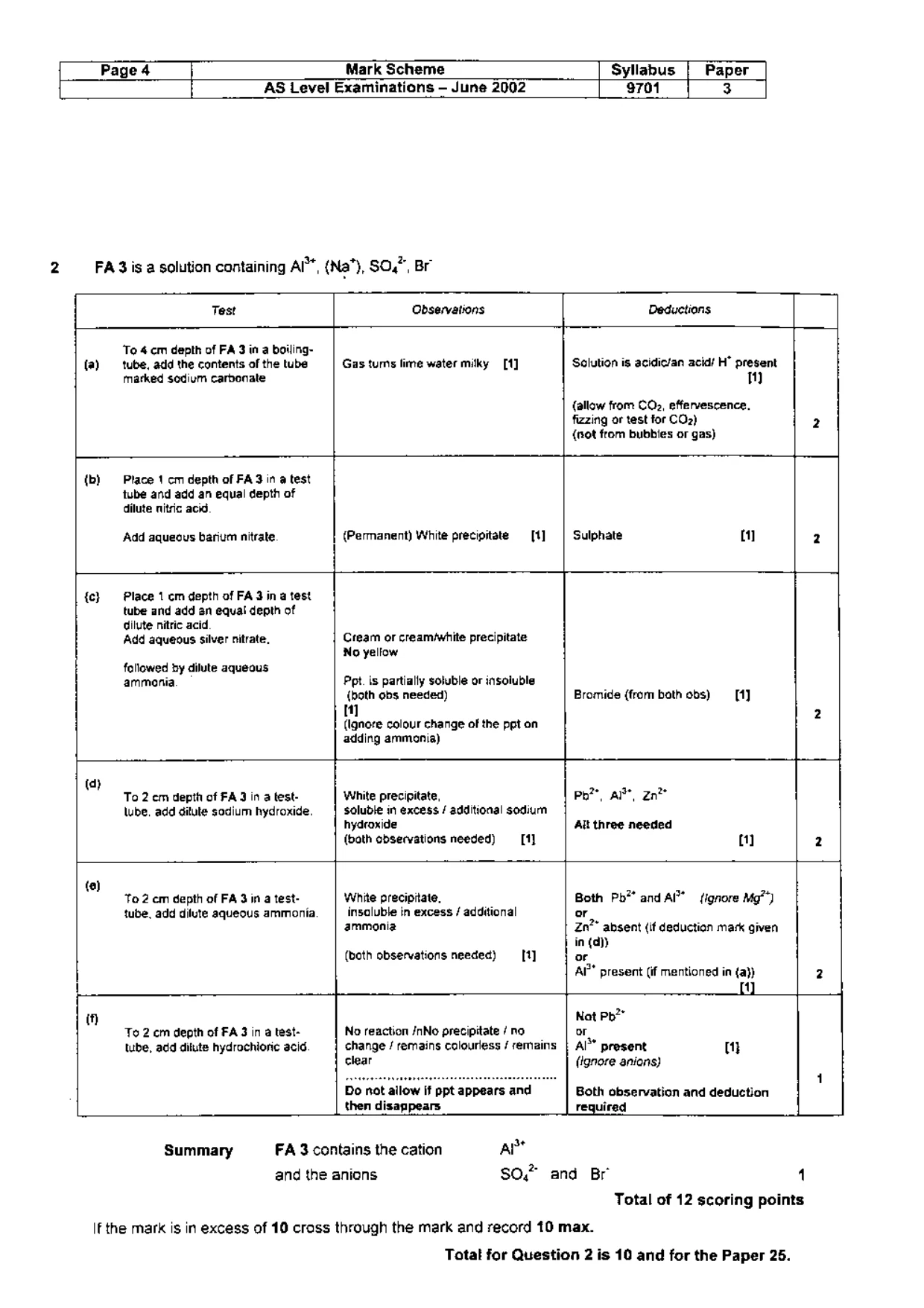
2 Page 4 Mark Scheme Syllabus [| Paper | AS Level Examinations — June 2002 9701 3. FA 3's a solution containing Al’, {Na*), SO,”, Br Test Observaiions Deductions To 4 cm depth of FA 3 in a boiling- (a) tube, add the contents of the tube marked sodium carbonate Gas tums lime water mitky [1] {b) Place 1 cm depth of FA 3 ina test tube and add an equal depth of dilute nitric acid Add aqueous barium nitrate. (Permanent) White precipitate [1] {c} Place 1 cm depth of FA 3 ina test tube and add an equal depth of Gilute nitric acid. Add aqueous silver nitrate, followed by dilute aqueous ammonia Solution is acidic/an acid/ H” present {allow from COp, effervescence, fizzing or test for CO2) {not from bubbies or gas) Sulphate (1) Cream or creams+hite precipitate No yellow Pot. is partially soluble or insoluble {both obs needed) 4 {Ignore colour change of the ppt on adding ammonia) Bromide (from both obs) [1] id @ To 2 cm depth of FA 3 in a test- White precipitate, Pe?" al’, Zn? lube, add ditule sodium hydroxide. | soluble in excess / additional sodium hydroxide Ait three needed (both observations needed) — [1] (1) (e) 2 oe " To 2 cm depth of FA 3 in a test- White precipitate, Both Pb” and AI” {ignore Mg”) tube, add dilute aqueous ammonia. insaluble in excess / additional or. ammonia Zn?" absent {if deduction mark given in (a) (both observations needed) — [1] or AI’ present (if mentioned in {a}} —[] if Nat Pb?” To 2 cm depth of FA 3 in a test- No reaction /nNo precipitate / no or, lube, add difute hydrochioric acid. change / remains colourless / remains ra present ( clear (ignore anions) Do not allow if ppt appears and then disappears Summary FA 3 contains the cation and the anions Ay Both observation and deduction required SO,7 and Br 1 Total of 12 scoring points If the mark is in excess of 10 cross through the mark and record 10 max. Total for Question 2 is 10 and for the Paper 25.