Cambridge A Level Chemistry 9701 — 2001 Oct/Nov Paper 3 · Variant 1
9701/31/O/N/01 · 1 question · 2 marks · ≈2 min
The question paper and its mark scheme, free to read here and free to download. This is Cambridge’s own paper, exactly as it was sat.
Question paper8 pages

Mark scheme4 pages
Answers below. Sit the paper first if you are practising.
Paper as text
Question paper, page 1
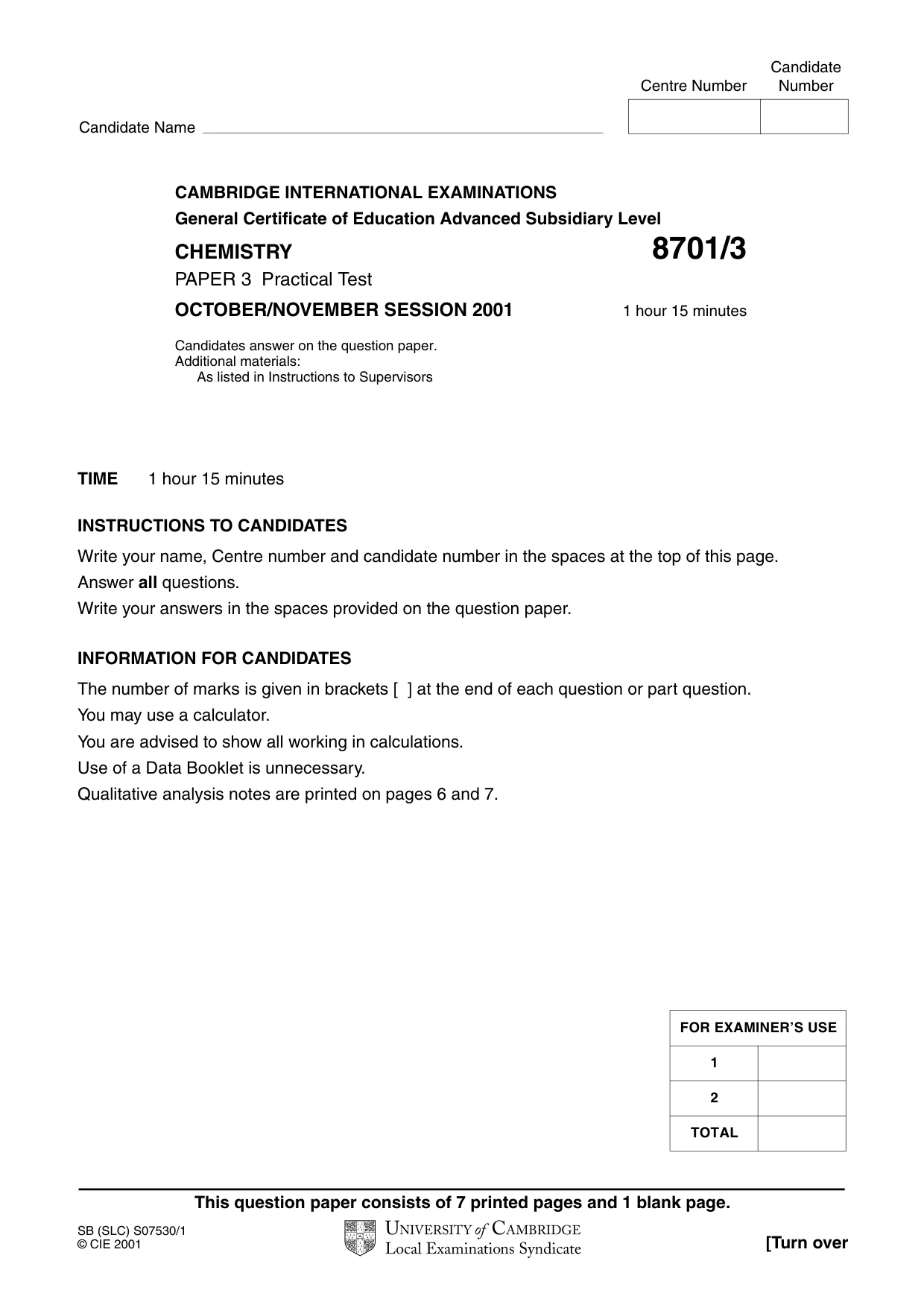
This question paper consists of 7 printed pages and 1 blank page. SB (SLC) S07530/1 © CIE 2001 [Turn over CAMBRIDGE INTERNATIONAL EXAMINATIONS General Certificate of Education Advanced Subsidiary Level CHEMISTRY 8701/3 PAPER 3 Practical Test OCTOBER/NOVEMBER SESSION 2001 1 hour 15 minutes Candidates answer on the question paper. Additional materials: As listed in Instructions to Supervisors TIME 1 hour 15 minutes INSTRUCTIONS TO CANDIDATES Write your name, Centre number and candidate number in the spaces at the top of this page. Answer all questions. Write your answers in the spaces provided on the question paper. INFORMATION FOR CANDIDATES The number of marks is given in brackets [ ] at the end of each question or part question. You may use a calculator. You are advised to show all working in calculations. Use of a Data Booklet is unnecessary. Qualitative analysis notes are printed on pages 6 and 7. FOR EXAMINER’S USE 1 2 TOTAL Candidate Centre Number Number Candidate Name
Question paper, page 2
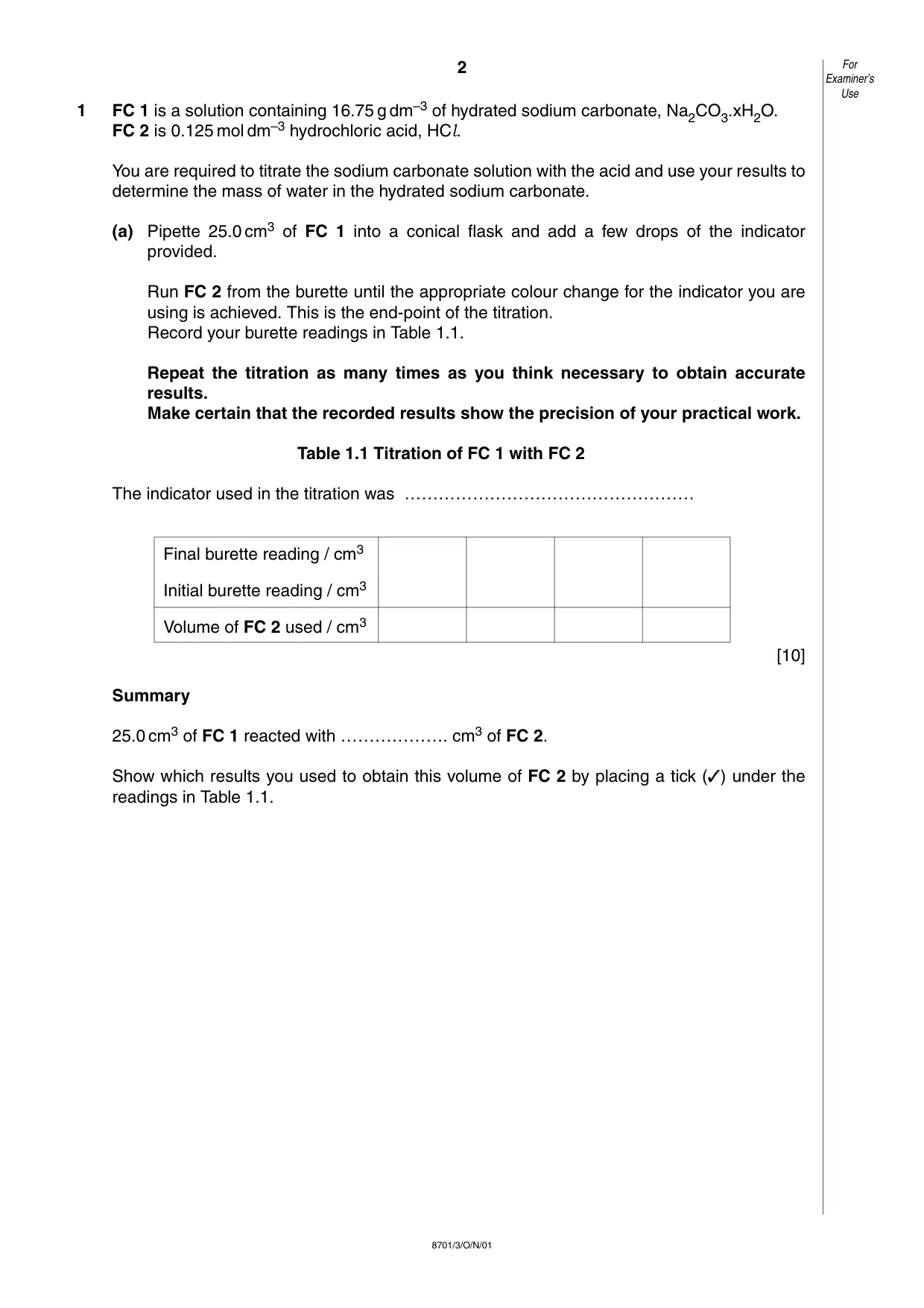
2 8701/3/O/N/01 1 FC 1 is a solution containing 16.75 g dm–3 of hydrated sodium carbonate, Na2CO3.xH2O. FC 2 is 0.125 mol dm–3 hydrochloric acid, HCl. You are required to titrate the sodium carbonate solution with the acid and use your results to determine the mass of water in the hydrated sodium carbonate. (a) Pipette 25.0 cm3 of FC 1 into a conical flask and add a few drops of the indicator provided. Run FC 2 from the burette until the appropriate colour change for the indicator you are using is achieved. This is the end-point of the titration. Record your burette readings in Table 1.1. Repeat the titration as many times as you think necessary to obtain accurate results. Make certain that the recorded results show the precision of your practical work. Table 1.1 Titration of FC 1 with FC 2 The indicator used in the titration was …………………………………………… [10] Summary 25.0 cm3 of FC 1 reacted with ………………. cm3 of FC 2. Show which results you used to obtain this volume of FC 2 by placing a tick (✓) under the readings in Table 1.1. For Examiner’s Use Final burette reading / cm3 Initial burette reading / cm3 Volume of FC 2 used / cm3
Question paper, page 3
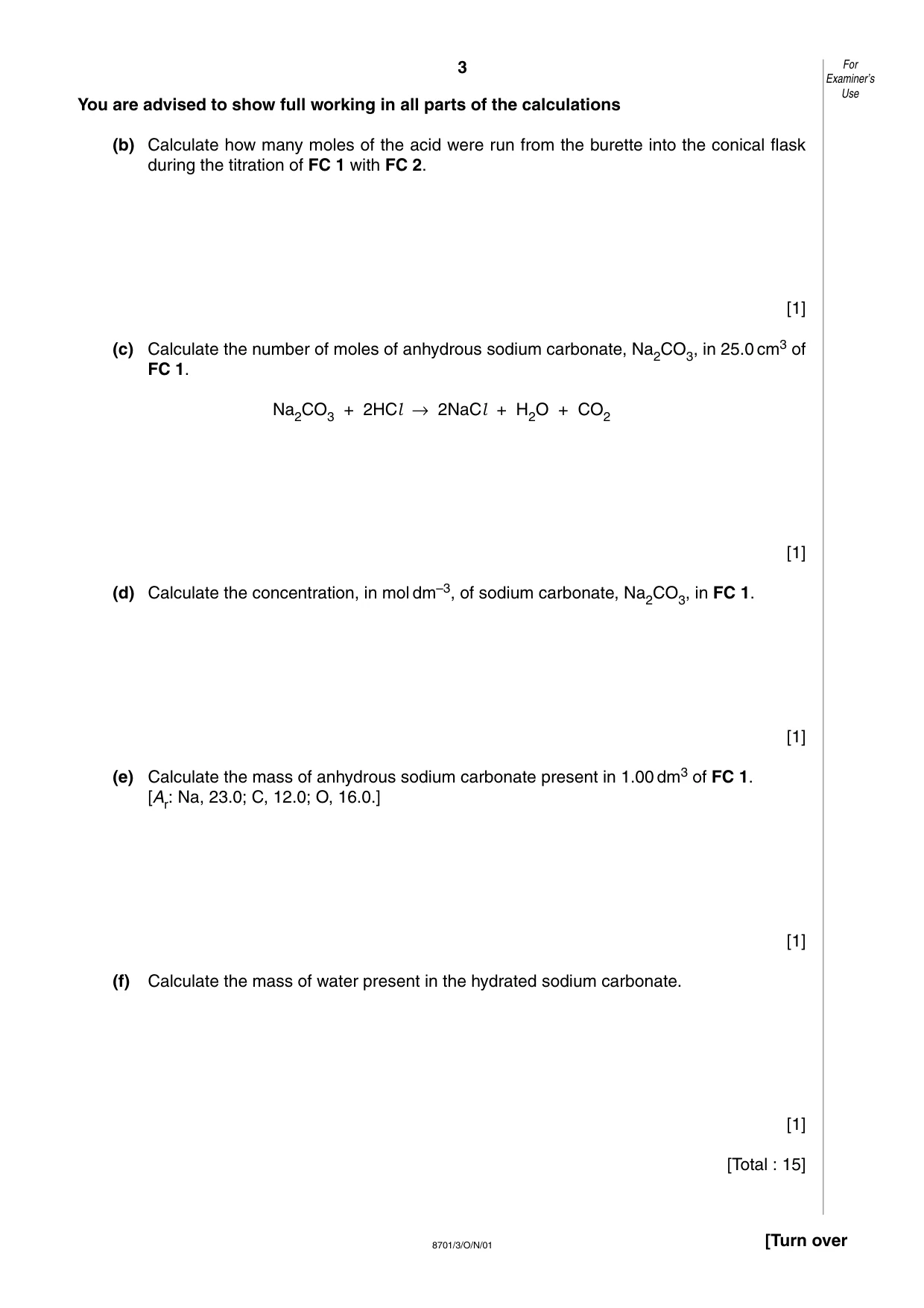
3 8701/3/O/N/01 [Turn over You are advised to show full working in all parts of the calculations (b) Calculate how many moles of the acid were run from the burette into the conical flask during the titration of FC 1 with FC 2. [1] (c) Calculate the number of moles of anhydrous sodium carbonate, Na2CO3, in 25.0 cm3 of FC 1. Na2CO3 + 2HCl →2NaCl + H2O + CO2 [1] (d) Calculate the concentration, in mol dm–3, of sodium carbonate, Na2CO3, in FC 1. [1] (e) Calculate the mass of anhydrous sodium carbonate present in 1.00 dm3 of FC 1. [Ar: Na, 23.0; C, 12.0; O, 16.0.] [1] (f) Calculate the mass of water present in the hydrated sodium carbonate. [1] [Total : 15] For Examiner’s Use
Question paper, page 4
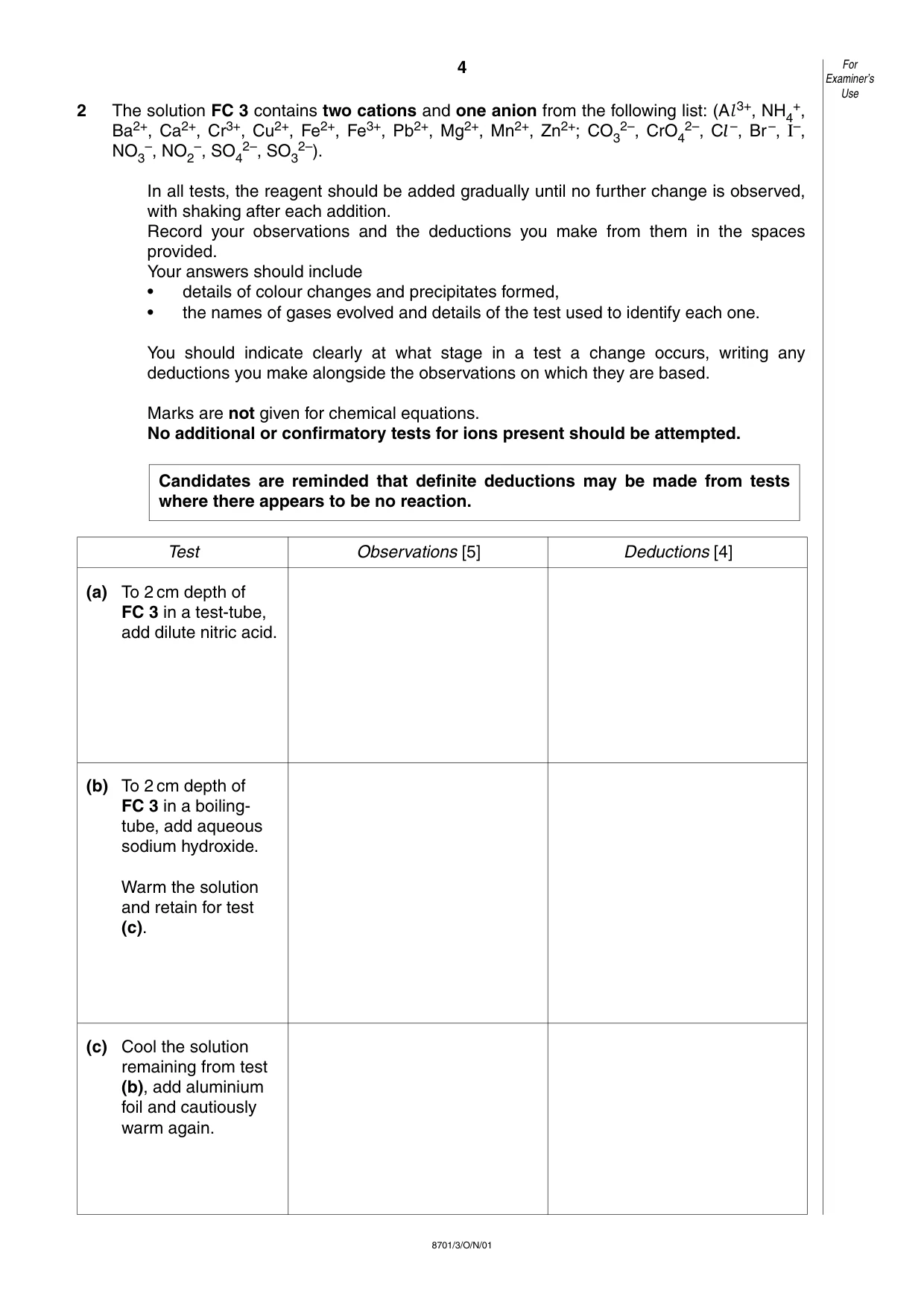
4 8701/3/O/N/01 2 The solution FC 3 contains two cations and one anion from the following list: (Al 3+, NH4 +, Ba2+, Ca2+, Cr3+, Cu2+, Fe2+, Fe3+, Pb2+, Mg2+, Mn2+, Zn2+; CO3 2–, CrO4 2–, Cl –, Br–, I–, NO3 –, NO2 –, SO4 2–, SO3 2–). In all tests, the reagent should be added gradually until no further change is observed, with shaking after each addition. Record your observations and the deductions you make from them in the spaces provided. Your answers should include • details of colour changes and precipitates formed, • the names of gases evolved and details of the test used to identify each one. You should indicate clearly at what stage in a test a change occurs, writing any deductions you make alongside the observations on which they are based. Marks are not given for chemical equations. No additional or confirmatory tests for ions present should be attempted. Candidates are reminded that definite deductions may be made from tests where there appears to be no reaction. For Examiner’s Use Test Observations [5] Deductions [4] (a) To 2 cm depth of FC 3 in a test-tube, add dilute nitric acid. (b) To 2 cm depth of FC 3 in a boiling- tube, add aqueous sodium hydroxide. Warm the solution and retain for test (c). (c) Cool the solution remaining from test (b), add aluminium foil and cautiously warm again.
Question paper, page 5
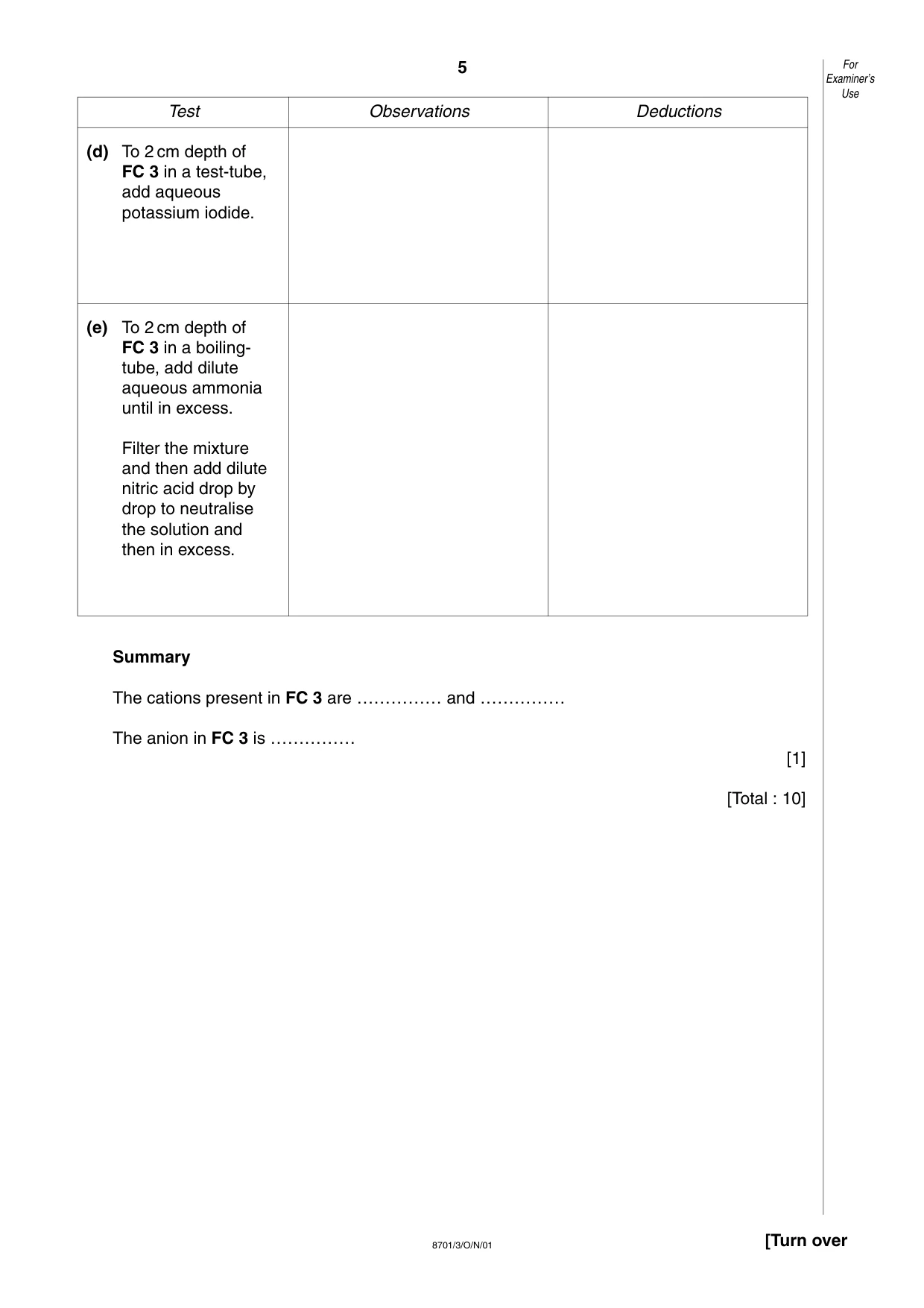
5 8701/3/O/N/01 [Turn over Summary The cations present in FC 3 are …………… and …………… The anion in FC 3 is …………… [1] [Total : 10] For Examiner’s Use Test Observations Deductions (d) To 2 cm depth of FC 3 in a test-tube, add aqueous potassium iodide. (e) To 2 cm depth of FC 3 in a boiling- tube, add dilute aqueous ammonia until in excess. Filter the mixture and then add dilute nitric acid drop by drop to neutralise the solution and then in excess.
Question paper, page 6
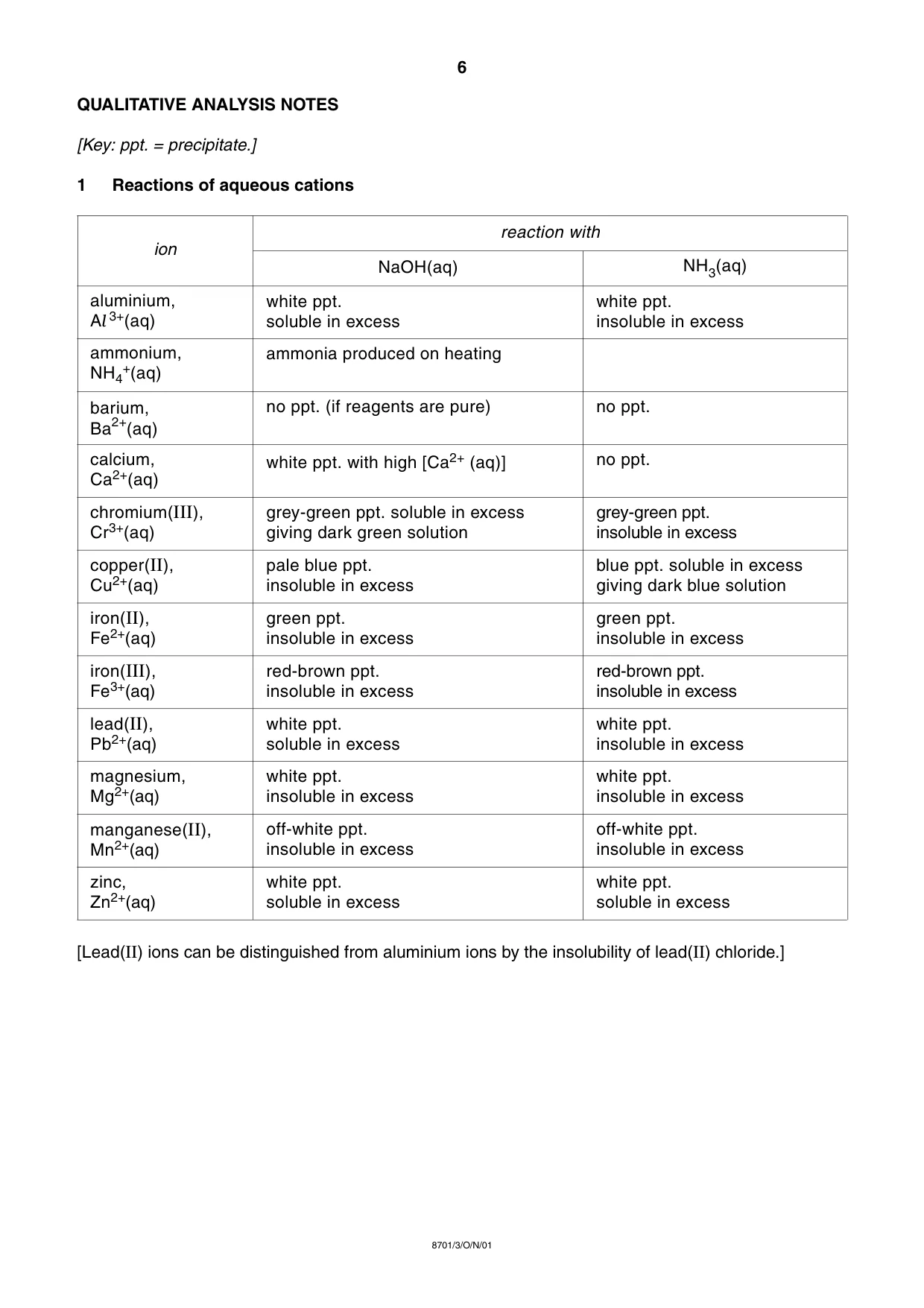
6 8701/3/O/N/01 QUALITATIVE ANALYSIS NOTES [Key: ppt. = precipitate.] 1 Reactions of aqueous cations [Lead(II) ions can be distinguished from aluminium ions by the insolubility of lead(II) chloride.] aluminium, Al 3+(aq) ammonium, NH4 +(aq) barium, Ba2+(aq) calcium, Ca2+(aq) chromium(III), Cr3+(aq) zinc, Zn2+(aq) copper(II), Cu2+(aq) iron(II), Fe2+(aq) iron(III), Fe3+(aq) lead(II), Pb2+(aq) magnesium, Mg2+(aq) manganese(II), Mn2+(aq) reaction with NaOH(aq) NH3(aq) white ppt. soluble in excess ammonia produced on heating no ppt. (if reagents are pure) green ppt. insoluble in excess green ppt. insoluble in excess white ppt. with high [Ca2+ (aq)] pale blue ppt. insoluble in excess blue ppt. soluble in excess giving dark blue solution white ppt. soluble in excess white ppt. insoluble in excess white ppt. insoluble in excess white ppt. insoluble in excess white ppt. soluble in excess white ppt. soluble in excess grey-green ppt. soluble in excess giving dark green solution red-brown ppt. insoluble in excess off-white ppt. insoluble in excess off-white ppt. insoluble in excess white ppt. insoluble in excess no ppt. no ppt. grey-green ppt. insoluble in excess red-brown ppt. insoluble in excess ion
Question paper, page 7
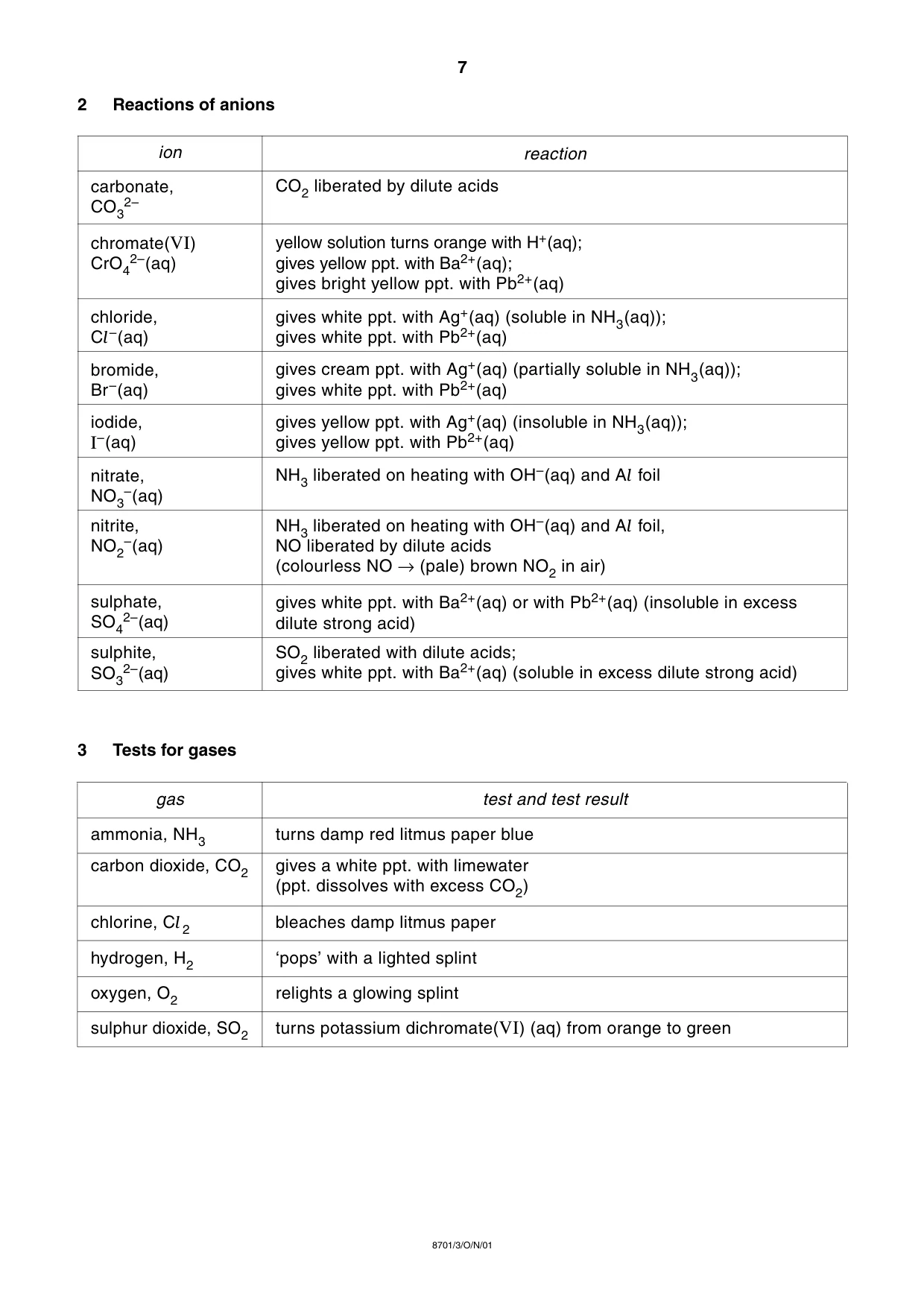
7 8701/3/O/N/01 2 Reactions of anions 3 Tests for gases carbonate, CO3 2– chromate(VI) CrO4 2–(aq) chloride, Cl–(aq) bromide, Br–(aq) iodide, I–(aq) nitrate, NO3 –(aq) nitrite, NO2 –(aq) sulphate, SO4 2–(aq) sulphite, SO3 2–(aq) ion reaction CO2 liberated by dilute acids yellow solution turns orange with H+(aq); gives yellow ppt. with Ba2+(aq); gives bright yellow ppt. with Pb2+(aq) gives white ppt. with Ag+(aq) (soluble in NH3(aq)); gives white ppt. with Pb2+(aq) NH3 liberated on heating with OH–(aq) and Al foil, NO liberated by dilute acids (colourless NO →(pale) brown NO2 in air) gives cream ppt. with Ag+(aq) (partially soluble in NH3(aq)); gives white ppt. with Pb2+(aq) NH3 liberated on heating with OH–(aq) and Al foil SO2 liberated with dilute acids; gives white ppt. with Ba2+(aq) (soluble in excess dilute strong acid) gives yellow ppt. with Ag+(aq) (insoluble in NH3(aq)); gives yellow ppt. with Pb2+(aq) gives white ppt. with Ba2+(aq) or with Pb2+(aq) (insoluble in excess dilute strong acid) gas test and test result turns damp red litmus paper blue gives a white ppt. with limewater (ppt. dissolves with excess CO2) bleaches damp litmus paper ‘pops’ with a lighted splint relights a glowing splint turns potassium dichromate(VI) (aq) from orange to green ammonia, NH3 carbon dioxide, CO2 chlorine, Cl 2 hydrogen, H2 oxygen, O2 sulphur dioxide, SO2
Mark scheme, page 1
NOVEMBER 2001 ADVANCED SUBSIDIARY LEVEL MARK SCHEME MAXIMUM MARK : 25 SYLLABUS/COMPONENT : 8701/3 CHEMISTRY (Extended)
Mark scheme, page 2
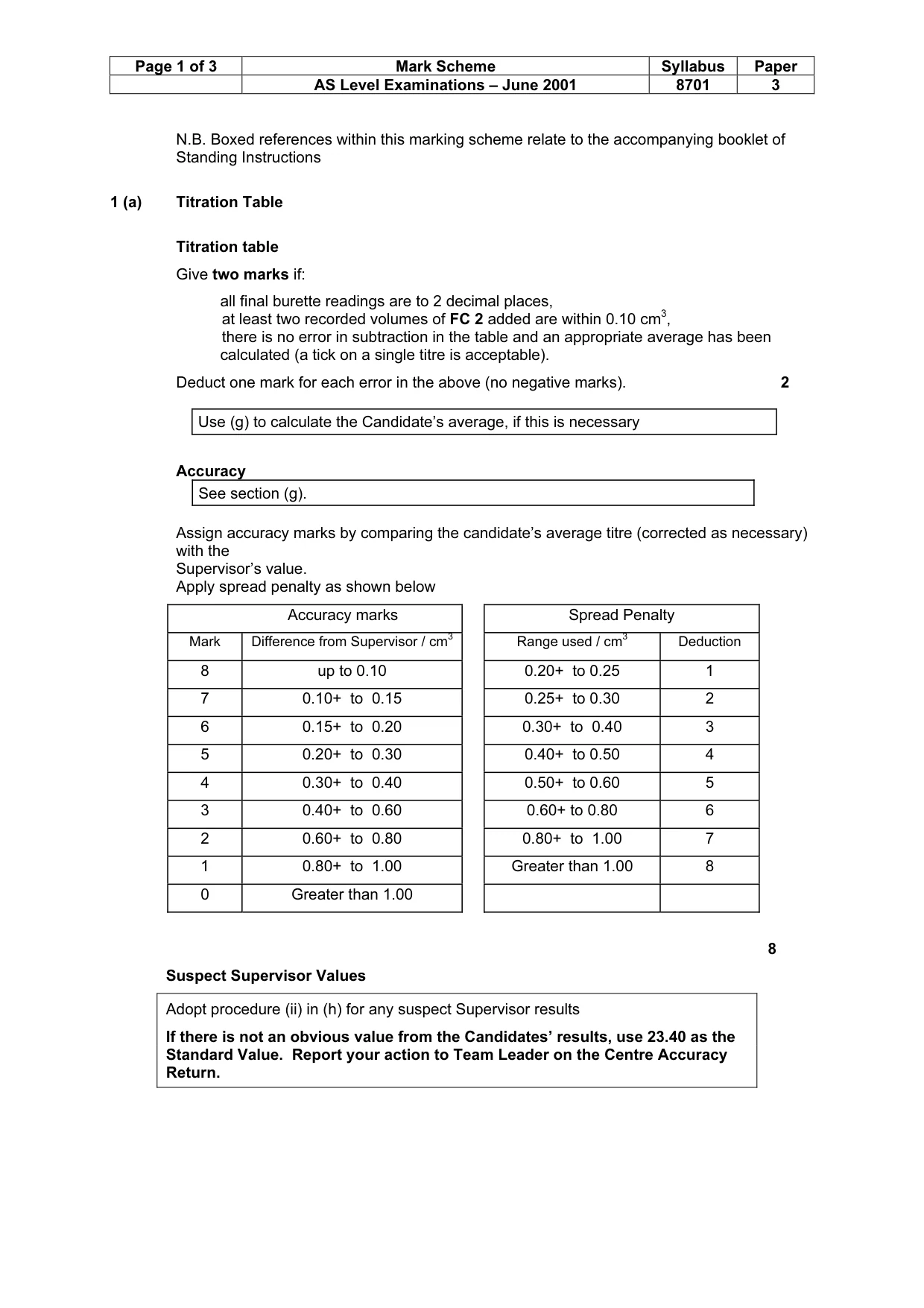
Page 1 of 3 Mark Scheme Syllabus Paper AS Level Examinations – June 2001 8701 3 N.B. Boxed references within this marking scheme relate to the accompanying booklet of Standing Instructions 1 (a) Titration Table Titration table Give two marks if: all final burette readings are to 2 decimal places, at least two recorded volumes of FC 2 added are within 0.10 cm3, there is no error in subtraction in the table and an appropriate average has been calculated (a tick on a single titre is acceptable). Deduct one mark for each error in the above (no negative marks). 2 Use (g) to calculate the Candidate’s average, if this is necessary Accuracy See section (g). Assign accuracy marks by comparing the candidate’s average titre (corrected as necessary) with the Supervisor’s value. Apply spread penalty as shown below Accuracy marks Spread Penalty Mark Difference from Supervisor / cm3 Range used / cm3 Deduction 8 up to 0.10 0.20+ to 0.25 1 7 0.10+ to 0.15 0.25+ to 0.30 2 6 0.15+ to 0.20 0.30+ to 0.40 3 5 0.20+ to 0.30 0.40+ to 0.50 4 4 0.30+ to 0.40 0.50+ to 0.60 5 3 0.40+ to 0.60 0.60+ to 0.80 6 2 0.60+ to 0.80 0.80+ to 1.00 7 1 0.80+ to 1.00 Greater than 1.00 8 0 Greater than 1.00 8 Suspect Supervisor Values Adopt procedure (ii) in (h) for any suspect Supervisor results If there is not an obvious value from the Candidates’ results, use 23.40 as the Standard Value. Report your action to Team Leader on the Centre Accuracy Return.
Mark scheme, page 3
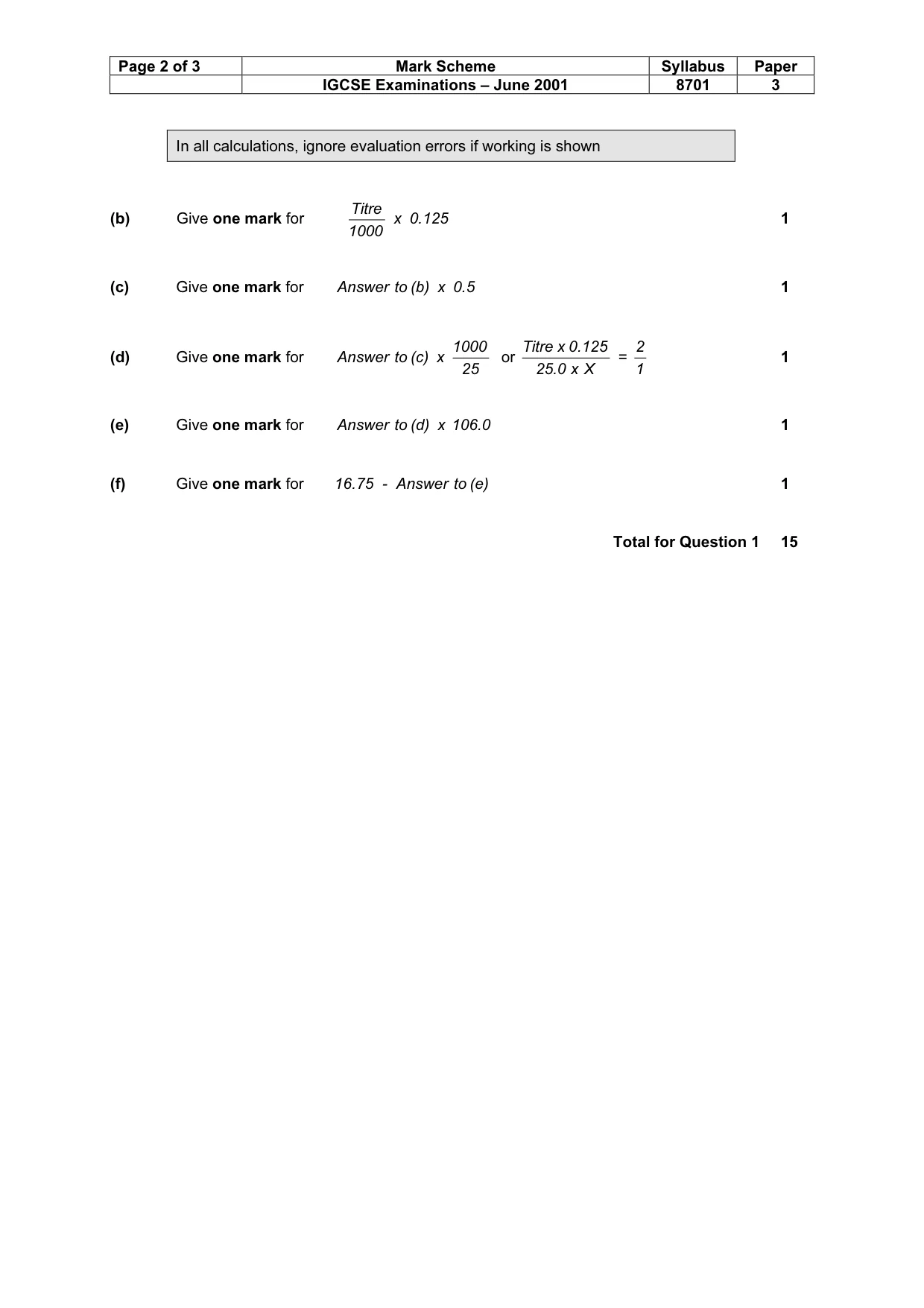
Page 2 of 3 Mark Scheme Syllabus Paper IGCSE Examinations – June 2001 8701 3 In all calculations, ignore evaluation errors if working is shown (b) Give one mark for 0.125 x 1000 Titre 1 (c) Give one mark for 0.5 x (b) to Answer 1 (d) Give one mark for 25 1000 x (c) to Answer or X x 25.0 0.125 x Titre = 1 2 1 (e) Give one mark for 106.0 x (d) to Answer 1 (f) Give one mark for (e) to Answer - 75 . 16 1 Total for Question 1 15
Mark scheme, page 4
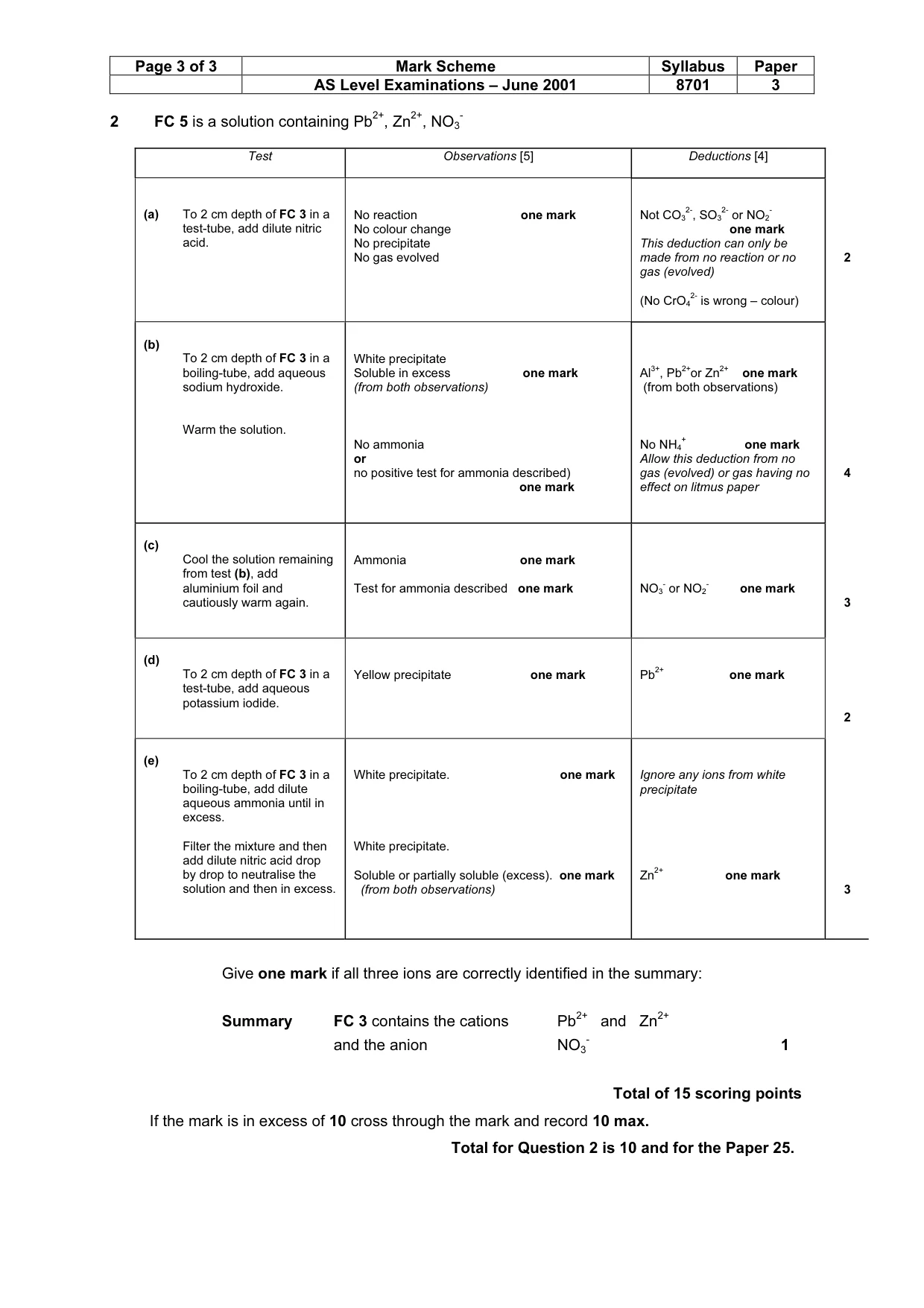
Page 3 of 3 Mark Scheme Syllabus Paper AS Level Examinations – June 2001 8701 3 2 FC 5 is a solution containing Pb2+, Zn2+, NO3 - Test Observations [5] Deductions [4] (a) To 2 cm depth of FC 3 in a test-tube, add dilute nitric acid. No reaction one mark No colour change No precipitate No gas evolved Not CO3 2-, SO3 2- or NO2 - one mark This deduction can only be made from no reaction or no gas (evolved) (No CrO4 2- is wrong – colour) 2 (b) To 2 cm depth of FC 3 in a boiling-tube, add aqueous sodium hydroxide. Warm the solution. White precipitate Soluble in excess one mark (from both observations) No ammonia or no positive test for ammonia described) one mark Al 3+, Pb 2+or Zn 2+ one mark (from both observations) No NH4 + one mark Allow this deduction from no gas (evolved) or gas having no effect on litmus paper 4 (c) Cool the solution remaining from test (b), add aluminium foil and cautiously warm again. Ammonia one mark Test for ammonia described one mark NO3 - or NO2 - one mark 3 (d) To 2 cm depth of FC 3 in a test-tube, add aqueous potassium iodide. Yellow precipitate one mark Pb 2+ one mark 2 (e) To 2 cm depth of FC 3 in a boiling-tube, add dilute aqueous ammonia until in excess. Filter the mixture and then add dilute nitric acid drop by drop to neutralise the solution and then in excess. White precipitate. one mark White precipitate. Soluble or partially soluble (excess). one mark (from both observations) Ignore any ions from white precipitate Zn 2+ one mark 3 Give one mark if all three ions are correctly identified in the summary: Summary FC 3 contains the cations Pb2+ and Zn2+ and the anion NO3 - 1 Total of 15 scoring points If the mark is in excess of 10 cross through the mark and record 10 max. Total for Question 2 is 10 and for the Paper 25.
What was in this paper
The subtopics covered by these 1 questions, and how many questions each got. Open one in a new tab to see every Cambridge question on it.