Cambridge A Level Business (for first examination in 2016) 9609 — 2022 May/June Paper 3 · Variant 1
9609/31/M/J/22 · 100 marks · ≈113 min
The question paper and its mark scheme, free to read here and free to download. This is Cambridge’s own paper, exactly as it was sat.
Question paper20 pages
















Mark scheme24 pages
Answers below. Sit the paper first if you are practising.


Paper as text
Question paper, page 1
This document has 20 pages. [Turn over DC (RW) 302947/1 © UCLES 2022 * 6 8 6 0 3 5 4 4 8 0 * BUSINESS 9609/31 Paper 3 Case Study May/June 2022 3 hours You must answer on the question paper. You will need: Insert (enclosed) INSTRUCTIONS ● Section A: answer all questions. ● Section B: answer one question. ● Use a black or dark blue pen. ● Write your name, centre number and candidate number in the boxes at the top of the page. ● Write your answer to each question in the space provided. ● Do not use an erasable pen or correction fluid. ● Do not write on any bar codes. ● You may use an HB pencil for any diagrams, graphs or rough working. INFORMATION ● The total mark for this paper is 100. ● The number of marks for each question or part question is shown in brackets [ ]. ● The insert contains the case study. Cambridge International AS & A Level
Question paper, page 2
2 9609/31/M/J/22 © UCLES 2022 Answer all questions in Section A and answer one question in Section B. You are advised to spend no more than 40 minutes on Section B. Section A Answer all questions in this section 1 Analyse two benefits to HD of increasing its focus on corporate social responsibility (CSR). … … … … … … … … … … … … … … … … … … … … … … …
Question paper, page 3
3 9609/31/M/J/22 © UCLES 2022 [Turn over … … … … … … … … … … … … … … … … … … … … … … … … … … … … [10]
Question paper, page 4
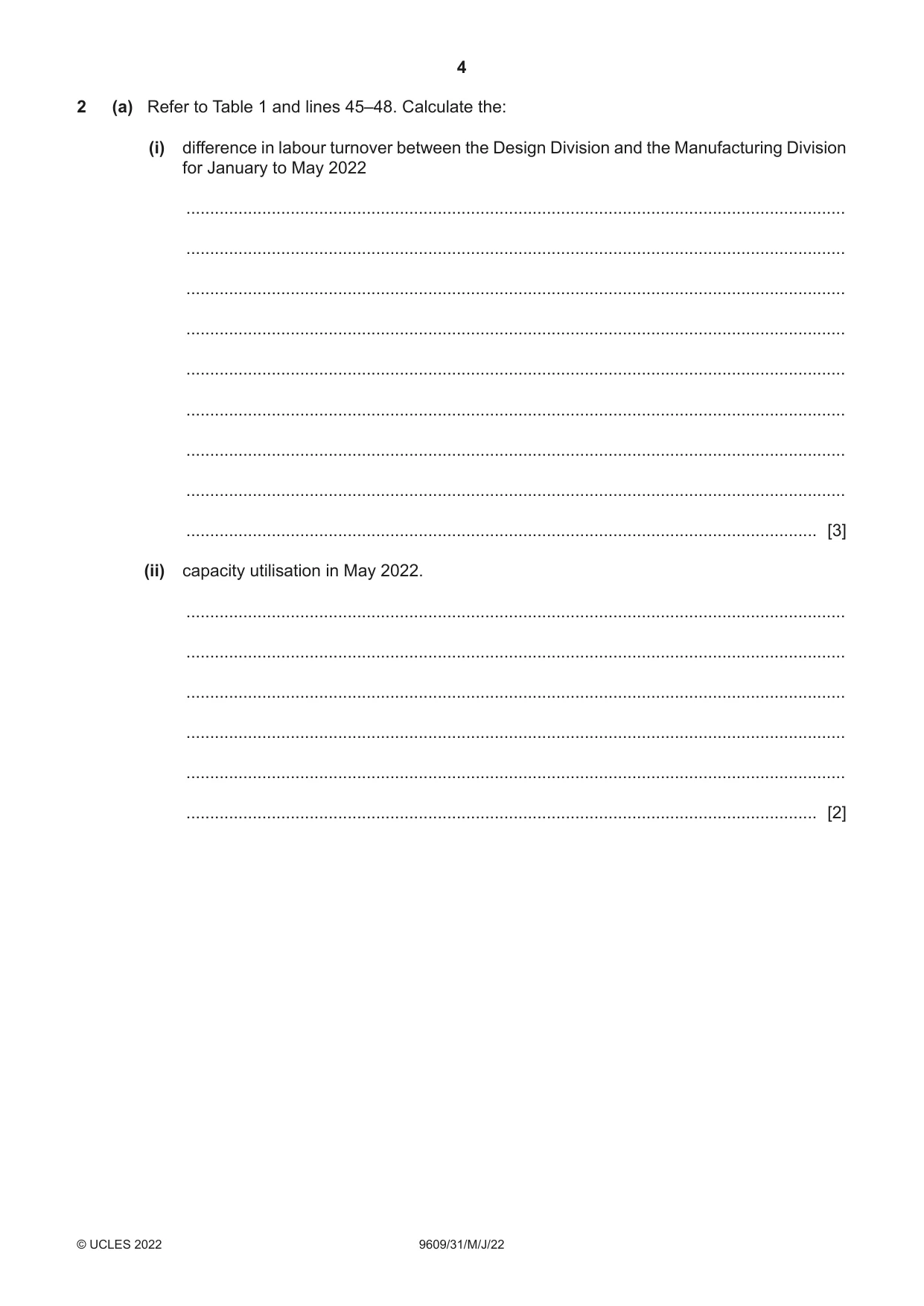
4 9609/31/M/J/22 © UCLES 2022 2 (a) Refer to Table 1 and lines 45–48. Calculate the: (i) difference in labour turnover between the Design Division and the Manufacturing Division for January to May 2022 … … … … … … … … … [3] (ii) capacity utilisation in May 2022. … … … … … … [2]
Question paper, page 5
5 9609/31/M/J/22 © UCLES 2022 [Turn over (b) You may refer to your answer to 2(a) and other information. Recommend how HD could solve the problem of operating over maximum capacity. Justify your recommendation. … … … … … … … … … … … … … … … … … … … … … … … … … … …
Question paper, page 6
6 9609/31/M/J/22 © UCLES 2022 … … … … … … … … … … … … … … … … … … … … … … … … … … … … [12]
Question paper, page 7
7 9609/31/M/J/22 © UCLES 2022 [Turn over 3 Evaluate the extent to which the organisational structure of the Design Division contributes to the success of HD. … … … … … … … … … … … … … … … … … … … … … … … … … … …
Question paper, page 8
8 9609/31/M/J/22 © UCLES 2022 … … … … … … … … … … … … … … … … … … … … … … … … … … … …
Question paper, page 9
9 9609/31/M/J/22 © UCLES 2022 [Turn over … … … … … … … … … … … … … … … … … … … … … … … … … … … … [16]
Question paper, page 10
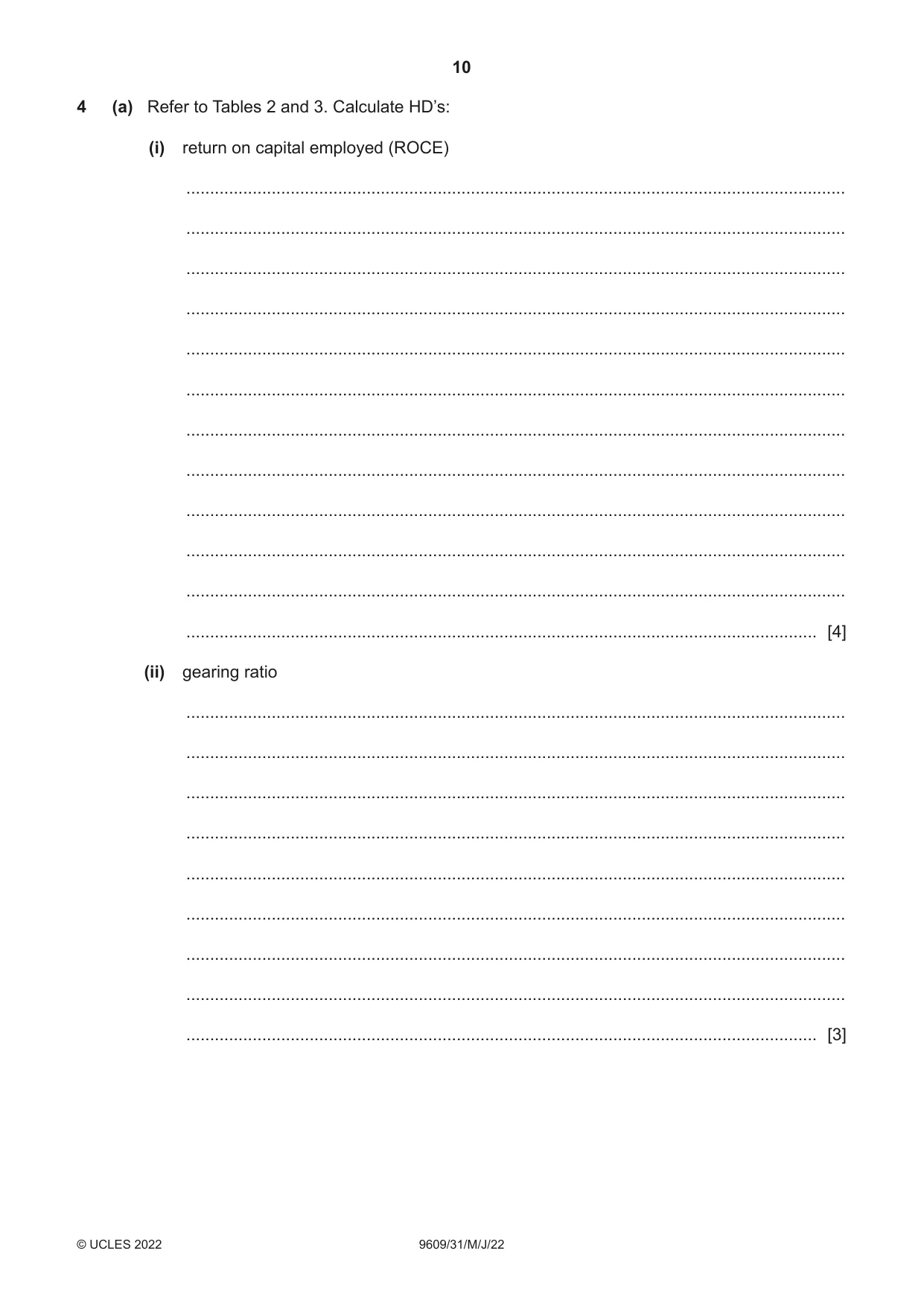
10 9609/31/M/J/22 © UCLES 2022 4 (a) Refer to Tables 2 and 3. Calculate HD’s: (i) return on capital employed (ROCE) … … … … … … … … … … … … [4] (ii) gearing ratio … … … … … … … … … [3]
Question paper, page 11
11 9609/31/M/J/22 © UCLES 2022 [Turn over (iii) dividend cover. … … … … … … [2]
Question paper, page 12
12 9609/31/M/J/22 © UCLES 2022 (b) You may refer to your answer to 4(a) and other information. Recommend whether the directors of HD should accept MW’s joint venture offer. Justify your recommendation. … … … … … … … … … … … … … … … … … … … … … … … … … … …
Question paper, page 13
13 9609/31/M/J/22 © UCLES 2022 [Turn over … … … … … … … … … … … … … … … … … … … … … … … … … … … … [12]
Question paper, page 14
14 9609/31/M/J/22 © UCLES 2022 5 Evaluate the changes HD should make to the marketing of its products in response to the website manager’s market report (lines 85–94). … … … … … … … … … … … … … … … … … … … … … … … … … … …
Question paper, page 15
15 9609/31/M/J/22 © UCLES 2022 [Turn over … … … … … … … … … … … … … … … … … … … … … … … … … … … …
Question paper, page 16
16 9609/31/M/J/22 © UCLES 2022 … … … … … … … … … … … … … … … … … … … … … … … … … … … … [16]
Question paper, page 17
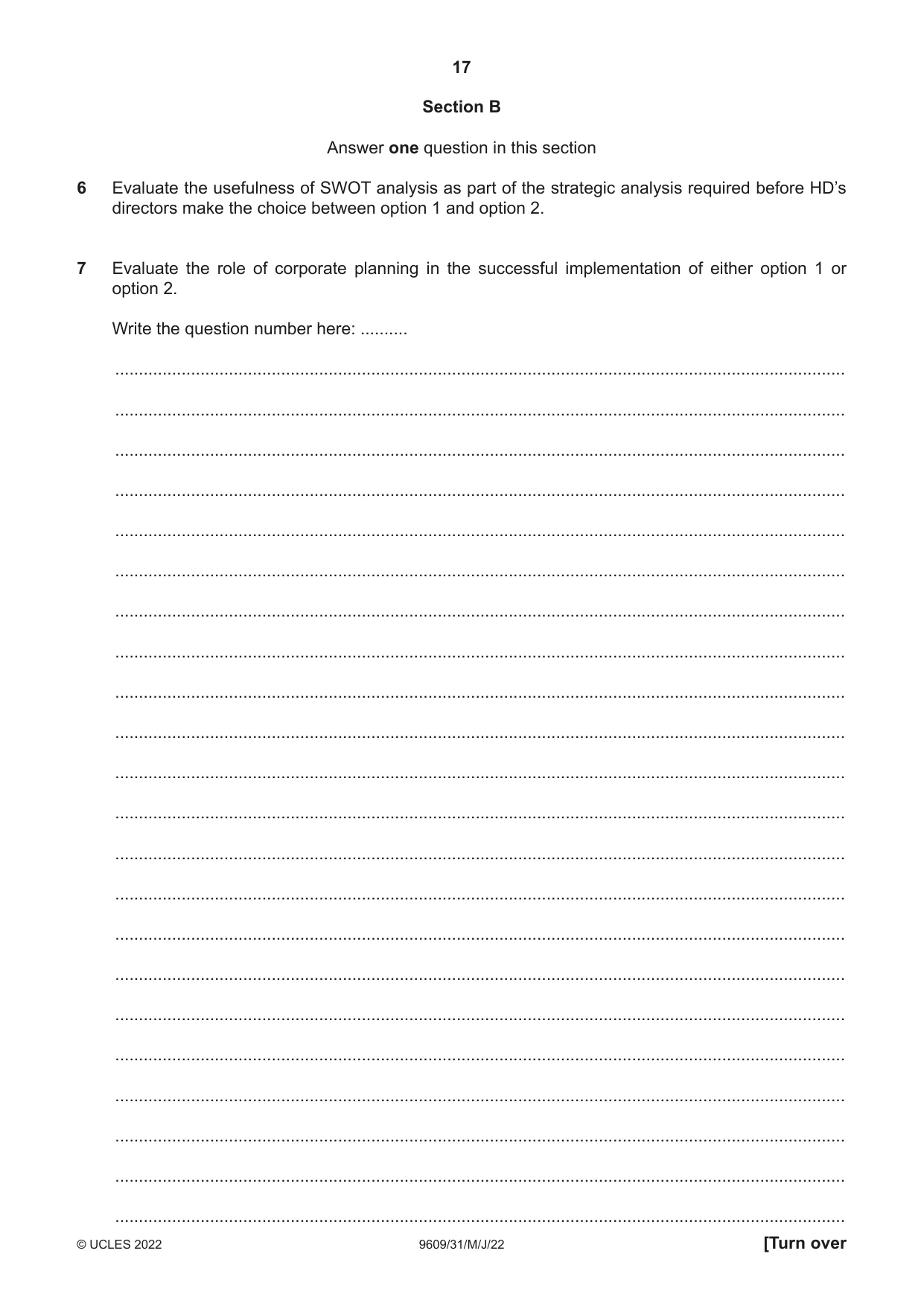
17 9609/31/M/J/22 © UCLES 2022 [Turn over Section B Answer one question in this section 6 Evaluate the usefulness of SWOT analysis as part of the strategic analysis required before HD’s directors make the choice between option 1 and option 2. 7 Evaluate the role of corporate planning in the successful implementation of either option 1 or option 2. Write the question number here: … … … … … … … … … … … … … … … … … … … … … … …
Question paper, page 18
18 9609/31/M/J/22 © UCLES 2022 … … … … … … … … … … … … … … … … … … … … … … … … … … … …
Question paper, page 19
19 9609/31/M/J/22 © UCLES 2022 [Turn over … … … … … … … … … … … … … … … … … … … … … … … … … … … …
Question paper, page 20
20 9609/31/M/J/22 © UCLES 2022 Permission to reproduce items where third-party owned material protected by copyright is included has been sought and cleared where possible. Every reasonable effort has been made by the publisher (UCLES) to trace copyright holders, but if any items requiring clearance have unwittingly been included, the publisher will be pleased to make amends at the earliest possible opportunity. To avoid the issue of disclosure of answer-related information to candidates, all copyright acknowledgements are reproduced online in the Cambridge Assessment International Education Copyright Acknowledgements Booklet. This is produced for each series of examinations and is freely available to download at www.cambridgeinternational.org after the live examination series. Cambridge Assessment International Education is part of Cambridge Assessment. Cambridge Assessment is the brand name of the University of Cambridge Local Examinations Syndicate (UCLES), which is a department of the University of Cambridge. … … … … … … … … … … … … … … … … … … … … … … … … [20]
Mark scheme, page 1
This document consists of 24 printed pages. © UCLES 2022 [Turn over Cambridge International AS & A Level BUSINESS 9609/31 Paper 3 Case Study May/June 2022 MARK SCHEME Maximum Mark: 100 Published This mark scheme is published as an aid to teachers and candidates, to indicate the requirements of the examination. It shows the basis on which Examiners were instructed to award marks. It does not indicate the details of the discussions that took place at an Examiners’ meeting before marking began, which would have considered the acceptability of alternative answers. Mark schemes should be read in conjunction with the question paper and the Principal Examiner Report for teachers. Cambridge International will not enter into discussions about these mark schemes. Cambridge International is publishing the mark schemes for the May/June 2022 series for most Cambridge IGCSE, Cambridge International A and AS Level and Cambridge Pre-U components, and some Cambridge O Level components.
Mark scheme, page 2
9609/31 Cambridge International AS & A Level – Mark Scheme PUBLISHED May/June 2022 © UCLES 2022 Page 2 of 24 Generic Marking Principles These general marking principles must be applied by all examiners when marking candidate answers. They should be applied alongside the specific content of the mark scheme or generic level descriptors for a question. Each question paper and mark scheme will also comply with these marking principles. GENERIC MARKING PRINCIPLE 1: Marks must be awarded in line with: the specific content of the mark scheme or the generic level descriptors for the question the specific skills defined in the mark scheme or in the generic level descriptors for the question the standard of response required by a candidate as exemplified by the standardisation scripts. GENERIC MARKING PRINCIPLE 2: Marks awarded are always whole marks (not half marks, or other fractions). GENERIC MARKING PRINCIPLE 3: Marks must be awarded positively: marks are awarded for correct/valid answers, as defined in the mark scheme. However, credit is given for valid answers which go beyond the scope of the syllabus and mark scheme, referring to your Team Leader as appropriate marks are awarded when candidates clearly demonstrate what they know and can do marks are not deducted for errors marks are not deducted for omissions answers should only be judged on the quality of spelling, punctuation and grammar when these features are specifically assessed by the question as indicated by the mark scheme. The meaning, however, should be unambiguous. GENERIC MARKING PRINCIPLE 4: Rules must be applied consistently, e.g. in situations where candidates have not followed instructions or in the application of generic level descriptors. GENERIC MARKING PRINCIPLE 5: Marks should be awarded using the full range of marks defined in the mark scheme for the question (however; the use of the full mark range may be limited according to the quality of the candidate responses seen). GENERIC MARKING PRINCIPLE 6: Marks awarded are based solely on the requirements as defined in the mark scheme. Marks should not be awarded with grade thresholds or grade descriptors in mind.
Mark scheme, page 3
9609/31 Cambridge International AS & A Level – Mark Scheme PUBLISHED May/June 2022 © UCLES 2022 Page 3 of 24 Social Science-Specific Marking Principles (for point-based marking) 1 Components using point-based marking: Point marking is often used to reward knowledge, understanding and application of skills. We give credit where the candidate’s answer shows relevant knowledge, understanding and application of skills in answering the question. We do not give credit where the answer shows confusion. From this it follows that we: a DO credit answers which are worded differently from the mark scheme if they clearly convey the same meaning (unless the mark scheme requires a specific term) b DO credit alternative answers/examples which are not written in the mark scheme if they are correct c DO credit answers where candidates give more than one correct answer in one prompt/numbered/scaffolded space where extended writing is required rather than list-type answers. For example, questions that require n reasons (e.g. State two reasons …). d DO NOT credit answers simply for using a ‘key term’ unless that is all that is required. (Check for evidence it is understood and not used wrongly.) e DO NOT credit answers which are obviously self-contradicting or trying to cover all possibilities f DO NOT give further credit for what is effectively repetition of a correct point already credited unless the language itself is being tested. This applies equally to ‘mirror statements’ (i.e. polluted/not polluted). g DO NOT require spellings to be correct, unless this is part of the test. However spellings of syllabus terms must allow for clear and unambiguous separation from other syllabus terms with which they may be confused (e.g. Corrasion/Corrosion) 2 Presentation of mark scheme: Slashes (/) or the word ‘or’ separate alternative ways of making the same point. Semi colons (;) bullet points (•) or figures in brackets (1) separate different points. Content in the answer column in brackets is for examiner information/context to clarify the marking but is not required to earn the mark (except Accounting syllabuses where they indicate negative numbers). 3 Calculation questions: The mark scheme will show the steps in the most likely correct method(s), the mark for each step, the correct answer(s) and the mark for each answer If working/explanation is considered essential for full credit, this will be indicated in the question paper and in the mark scheme. In all other instances, the correct answer to a calculation should be given full credit, even if no supporting working is shown. Where the candidate uses a valid method which is not covered by the mark scheme, award equivalent marks for reaching equivalent stages. Where an answer makes use of a candidate’s own incorrect figure from previous working, the ‘own figure rule’ applies: full marks will be given if a correct and complete method is used. Further guidance will be included in the mark scheme where necessary and any exceptions to this general principle will be noted.
Mark scheme, page 4
9609/31 Cambridge International AS & A Level – Mark Scheme PUBLISHED May/June 2022 © UCLES 2022 Page 4 of 24 4 Annotation: For point marking, ticks can be used to indicate correct answers and crosses can be used to indicate wrong answers. There is no direct relationship between ticks and marks. Ticks have no defined meaning for levels of response marking. For levels of response marking, the level awarded should be annotated on the script. Other annotations will be used by examiners as agreed during standardisation, and the meaning will be understood by all examiners who marked that paper.
Mark scheme, page 5
9609/31 Cambridge International AS & A Level – Mark Scheme PUBLISHED May/June 2022 © UCLES 2022 Page 5 of 24 PREPARATION FOR MARKING 1 Make sure that you have completed the relevant training and have access to the RM Assessor Guide. 2 Make sure that you have read and understand the question paper, which you can download from https://support.rm.com/ca 3 Log in to RM Assessor then mark and submit the required number of practice and standardisation scripts. You will need to mark the standardisation scripts to the required accuracy in order to be approved for marking live scripts. You may be asked to re-mark them, or to mark a second sample, if you do not meet the required accuracy on your first attempt. MARKING PROCESS 1 Mark strictly to the FINAL mark scheme, applying the criteria consistently and the general marking principles outlined on the previous page. 2 If you are in doubt about applying the mark scheme, consult your Team Leader. 3 Mark at a steady rate through the marking period. Do not rush, and do not leave too much until the end. If you anticipate a problem in meeting the deadline, contact your Team Leader immediately and the Examiners’ Helpdesk. 4 Examiners will prepare a brief report on the performance of candidates to send to their Team Leader via email by the end of the marking period. The Examiner should note strengths seen in answers and common errors or weaknesses. Constructive comments on the question paper, mark scheme or procedures are also appreciated. MARKING SPECIFICS Crossed out work 1 All of a candidate’s answers, crossed out or not, optional or not, must be marked. 2 The only response not to be marked is one that has been crossed out and replaced by another response for that exact same question. 3 Consequently, if a candidate has crossed out their response to an optional question and gone on to answer a different optional question then both attempts must be marked. The higher mark will be awarded by the system according to the rubric. 0 (zero) marks or NR (no response) 1 Award NR if there is nothing at all written in answer to that question (often the case for optional questions). 2 Award NR if there is a comment which is not an attempt at the question (e.g. ‘can’t do it’ or ‘don’t know’ etc.) 3 Award NR if there is a symbol which is not an attempt at the question, such as a dash or question mark. 4 Award 0 (zero) if there is any attempt at the question which does not score marks. This includes copying the question onto an Answer Booklet. Annotation 1 Every question must have at least one annotation e.g. <NAQ> if it is an NR and <X> or <seen> if 0 marks are awarded. 2 Every page of a script must have at least one annotation e.g. <BP> for a blank page.
Mark scheme, page 6
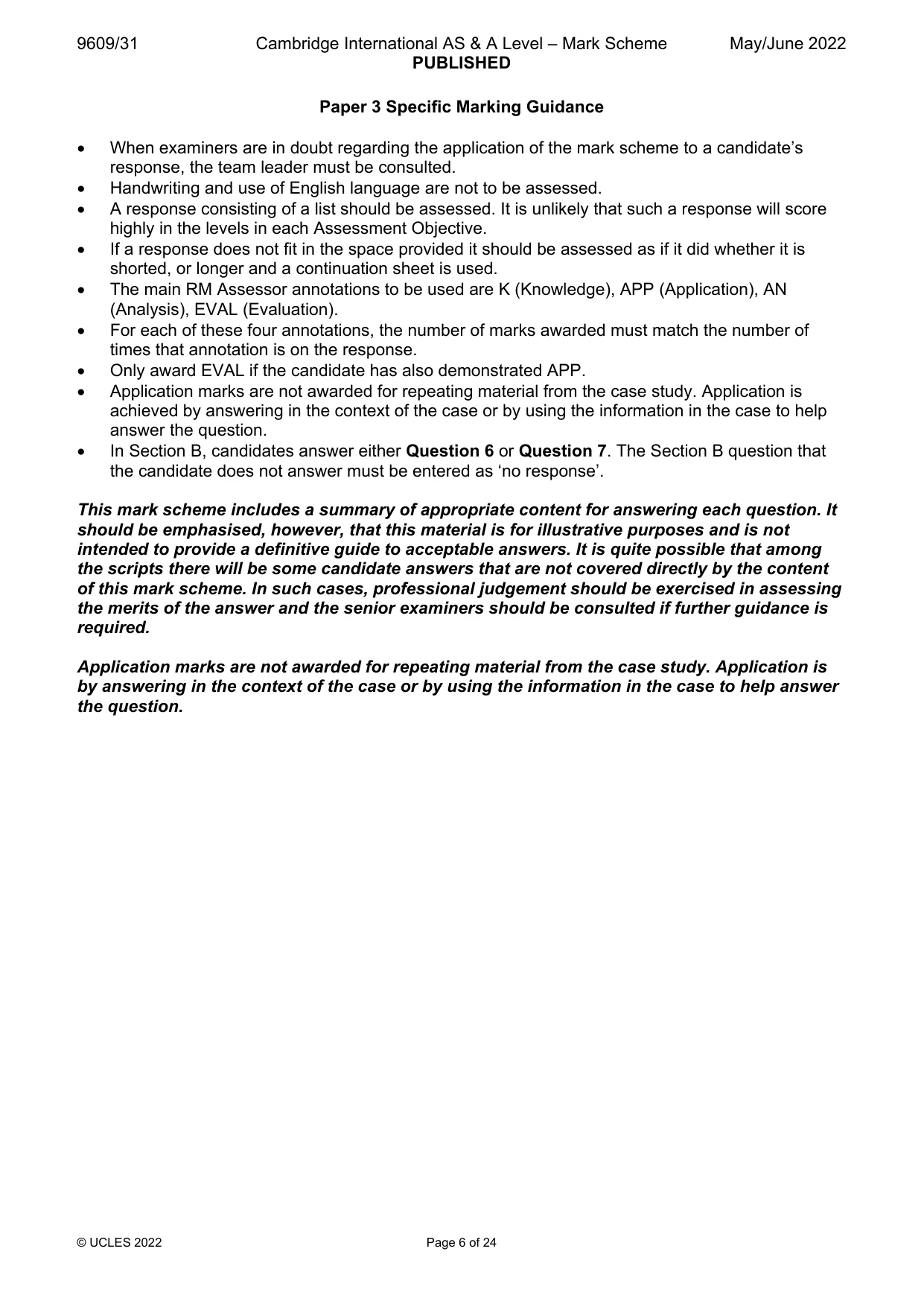
9609/31 Cambridge International AS & A Level – Mark Scheme PUBLISHED May/June 2022 © UCLES 2022 Page 6 of 24 Paper 3 Specific Marking Guidance When examiners are in doubt regarding the application of the mark scheme to a candidate’s response, the team leader must be consulted. Handwriting and use of English language are not to be assessed. A response consisting of a list should be assessed. It is unlikely that such a response will score highly in the levels in each Assessment Objective. If a response does not fit in the space provided it should be assessed as if it did whether it is shorted, or longer and a continuation sheet is used. The main RM Assessor annotations to be used are K (Knowledge), APP (Application), AN (Analysis), EVAL (Evaluation). For each of these four annotations, the number of marks awarded must match the number of times that annotation is on the response. Only award EVAL if the candidate has also demonstrated APP. Application marks are not awarded for repeating material from the case study. Application is achieved by answering in the context of the case or by using the information in the case to help answer the question. In Section B, candidates answer either Question 6 or Question 7. The Section B question that the candidate does not answer must be entered as ‘no response’. This mark scheme includes a summary of appropriate content for answering each question. It should be emphasised, however, that this material is for illustrative purposes and is not intended to provide a definitive guide to acceptable answers. It is quite possible that among the scripts there will be some candidate answers that are not covered directly by the content of this mark scheme. In such cases, professional judgement should be exercised in assessing the merits of the answer and the senior examiners should be consulted if further guidance is required. Application marks are not awarded for repeating material from the case study. Application is by answering in the context of the case or by using the information in the case to help answer the question.
Mark scheme, page 7
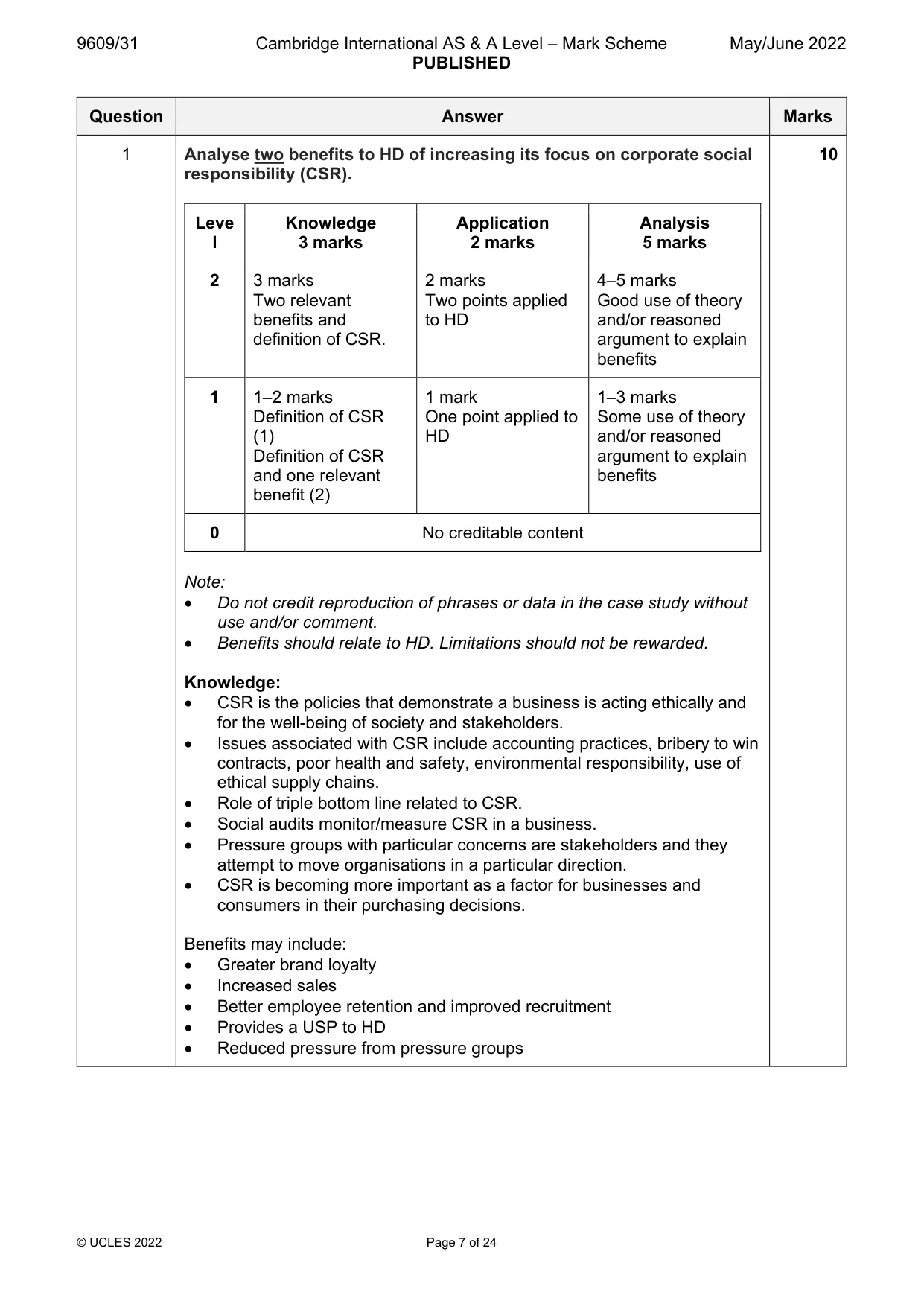
9609/31 Cambridge International AS & A Level – Mark Scheme PUBLISHED May/June 2022 © UCLES 2022 Page 7 of 24 Question Answer Marks 1 Analyse two benefits to HD of increasing its focus on corporate social responsibility (CSR). Leve l Knowledge 3 marks Application 2 marks Analysis 5 marks 2 3 marks Two relevant benefits and definition of CSR. 2 marks Two points applied to HD 4–5 marks Good use of theory and/or reasoned argument to explain benefits 1 1–2 marks Definition of CSR (1) Definition of CSR and one relevant benefit (2) 1 mark One point applied to HD 1–3 marks Some use of theory and/or reasoned argument to explain benefits 0 No creditable content Note: Do not credit reproduction of phrases or data in the case study without use and/or comment. Benefits should relate to HD. Limitations should not be rewarded. Knowledge: CSR is the policies that demonstrate a business is acting ethically and for the well-being of society and stakeholders. Issues associated with CSR include accounting practices, bribery to win contracts, poor health and safety, environmental responsibility, use of ethical supply chains. Role of triple bottom line related to CSR. Social audits monitor/measure CSR in a business. Pressure groups with particular concerns are stakeholders and they attempt to move organisations in a particular direction. CSR is becoming more important as a factor for businesses and consumers in their purchasing decisions. Benefits may include: Greater brand loyalty Increased sales Better employee retention and improved recruitment Provides a USP to HD Reduced pressure from pressure groups 10
Mark scheme, page 8
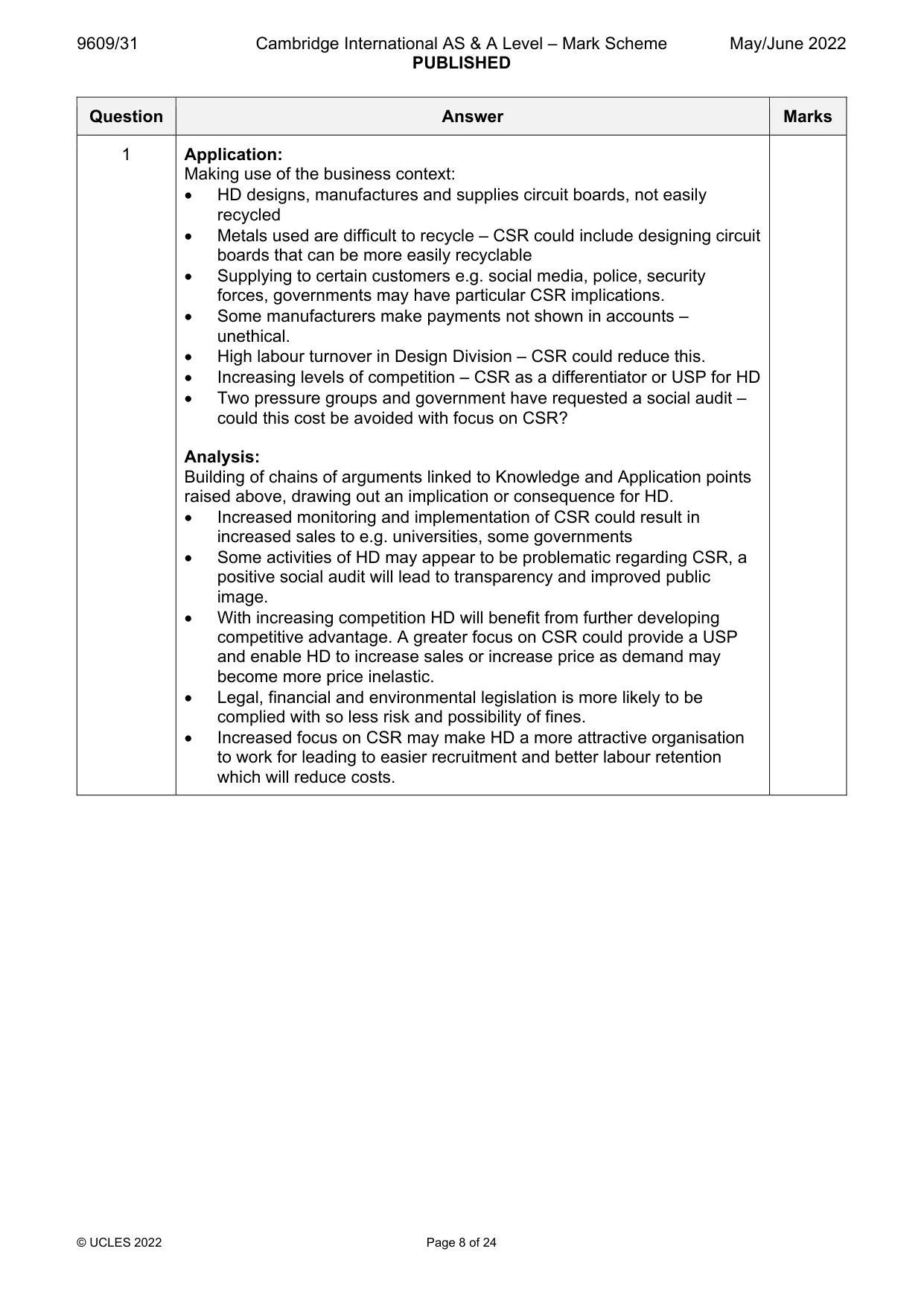
9609/31 Cambridge International AS & A Level – Mark Scheme PUBLISHED May/June 2022 © UCLES 2022 Page 8 of 24 Question Answer Marks 1 Application: Making use of the business context: HD designs, manufactures and supplies circuit boards, not easily recycled Metals used are difficult to recycle – CSR could include designing circuit boards that can be more easily recyclable Supplying to certain customers e.g. social media, police, security forces, governments may have particular CSR implications. Some manufacturers make payments not shown in accounts – unethical. High labour turnover in Design Division – CSR could reduce this. Increasing levels of competition – CSR as a differentiator or USP for HD Two pressure groups and government have requested a social audit – could this cost be avoided with focus on CSR? Analysis: Building of chains of arguments linked to Knowledge and Application points raised above, drawing out an implication or consequence for HD. Increased monitoring and implementation of CSR could result in increased sales to e.g. universities, some governments Some activities of HD may appear to be problematic regarding CSR, a positive social audit will lead to transparency and improved public image. With increasing competition HD will benefit from further developing competitive advantage. A greater focus on CSR could provide a USP and enable HD to increase sales or increase price as demand may become more price inelastic. Legal, financial and environmental legislation is more likely to be complied with so less risk and possibility of fines. Increased focus on CSR may make HD a more attractive organisation to work for leading to easier recruitment and better labour retention which will reduce costs.
Mark scheme, page 9
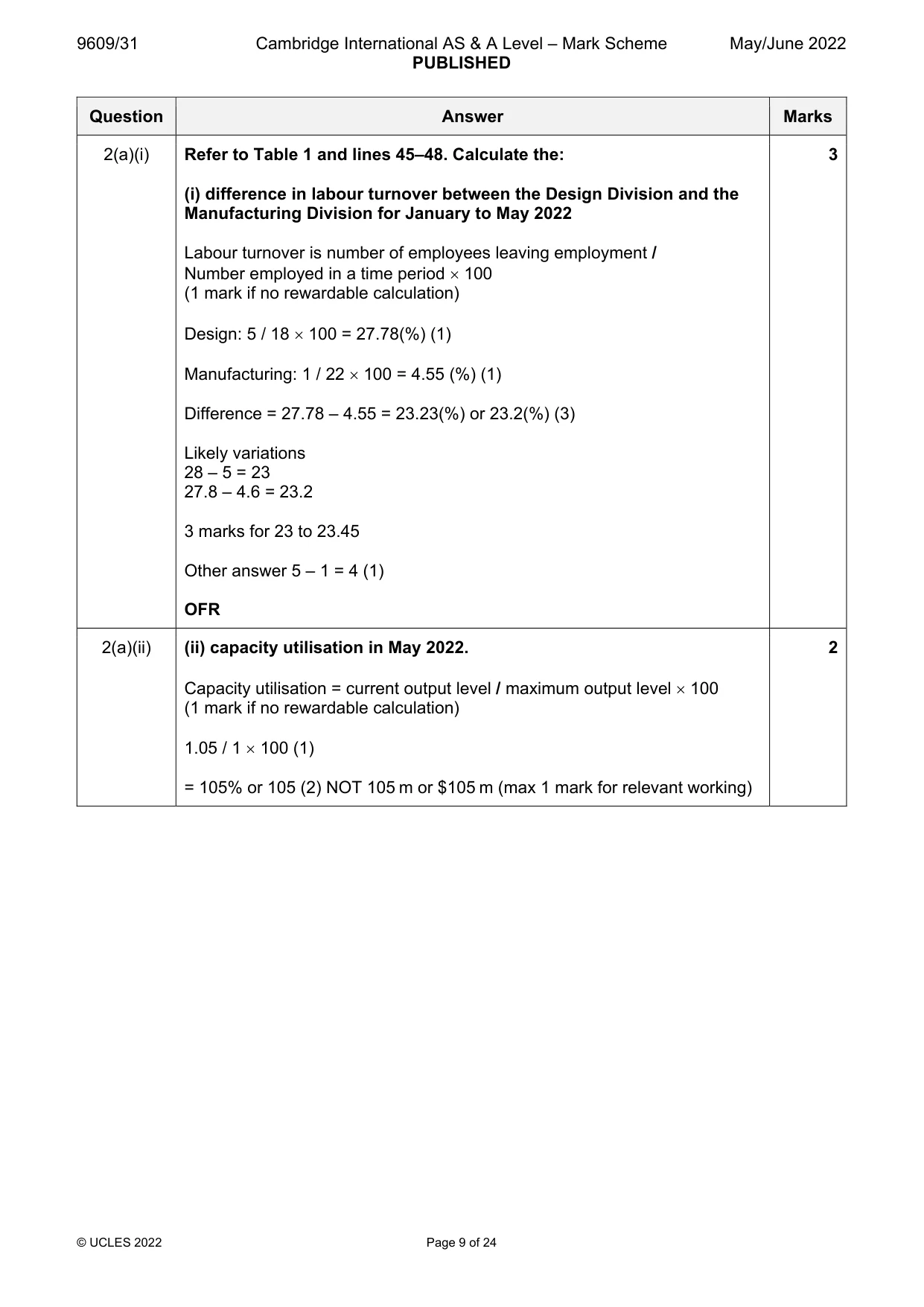
9609/31 Cambridge International AS & A Level – Mark Scheme PUBLISHED May/June 2022 © UCLES 2022 Page 9 of 24 Question Answer Marks 2(a)(i) Refer to Table 1 and lines 45–48. Calculate the: (i) difference in labour turnover between the Design Division and the Manufacturing Division for January to May 2022 Labour turnover is number of employees leaving employment / Number employed in a time period 100 (1 mark if no rewardable calculation) Design: 5 / 18 100 = 27.78(%) (1) Manufacturing: 1 / 22 100 = 4.55 (%) (1) Difference = 27.78 – 4.55 = 23.23(%) or 23.2(%) (3) Likely variations 28 – 5 = 23 27.8 – 4.6 = 23.2 3 marks for 23 to 23.45 Other answer 5 – 1 = 4 (1) OFR 3 2(a)(ii) (ii) capacity utilisation in May 2022. Capacity utilisation = current output level / maximum output level 100 (1 mark if no rewardable calculation) 1.05 / 1 100 (1) = 105% or 105 (2) NOT 105 m or $105 m (max 1 mark for relevant working) 2
Mark scheme, page 10
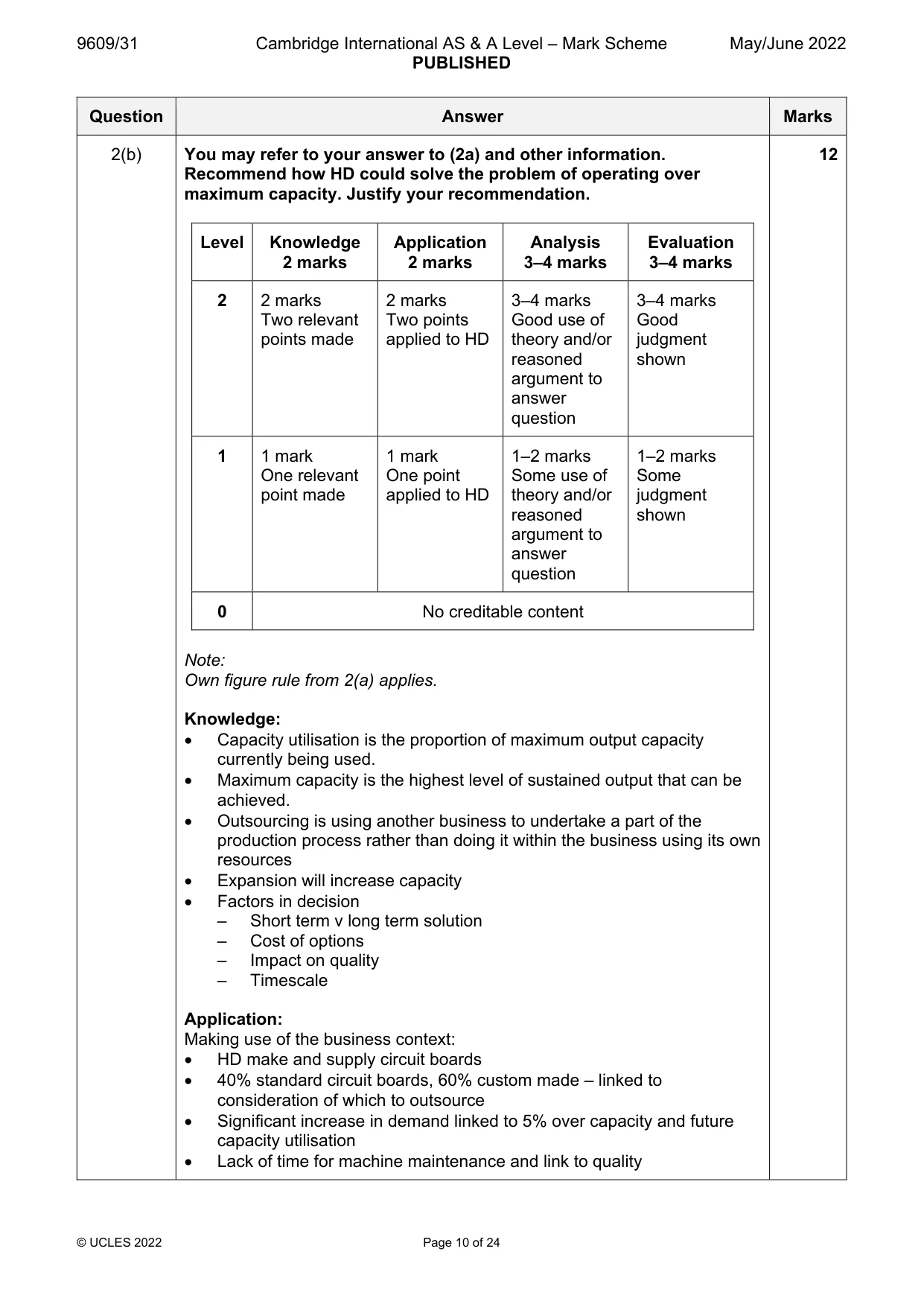
9609/31 Cambridge International AS & A Level – Mark Scheme PUBLISHED May/June 2022 © UCLES 2022 Page 10 of 24 Question Answer Marks 2(b) You may refer to your answer to (2a) and other information. Recommend how HD could solve the problem of operating over maximum capacity. Justify your recommendation. Level Knowledge 2 marks Application 2 marks Analysis 3–4 marks Evaluation 3–4 marks 2 2 marks Two relevant points made 2 marks Two points applied to HD 3–4 marks Good use of theory and/or reasoned argument to answer question 3–4 marks Good judgment shown 1 1 mark One relevant point made 1 mark One point applied to HD 1–2 marks Some use of theory and/or reasoned argument to answer question 1–2 marks Some judgment shown 0 No creditable content Note: Own figure rule from 2(a) applies. Knowledge: Capacity utilisation is the proportion of maximum output capacity currently being used. Maximum capacity is the highest level of sustained output that can be achieved. Outsourcing is using another business to undertake a part of the production process rather than doing it within the business using its own resources Expansion will increase capacity Factors in decision – Short term v long term solution – Cost of options – Impact on quality – Timescale Application: Making use of the business context: HD make and supply circuit boards 40% standard circuit boards, 60% custom made – linked to consideration of which to outsource Significant increase in demand linked to 5% over capacity and future capacity utilisation Lack of time for machine maintenance and link to quality 12
Mark scheme, page 11
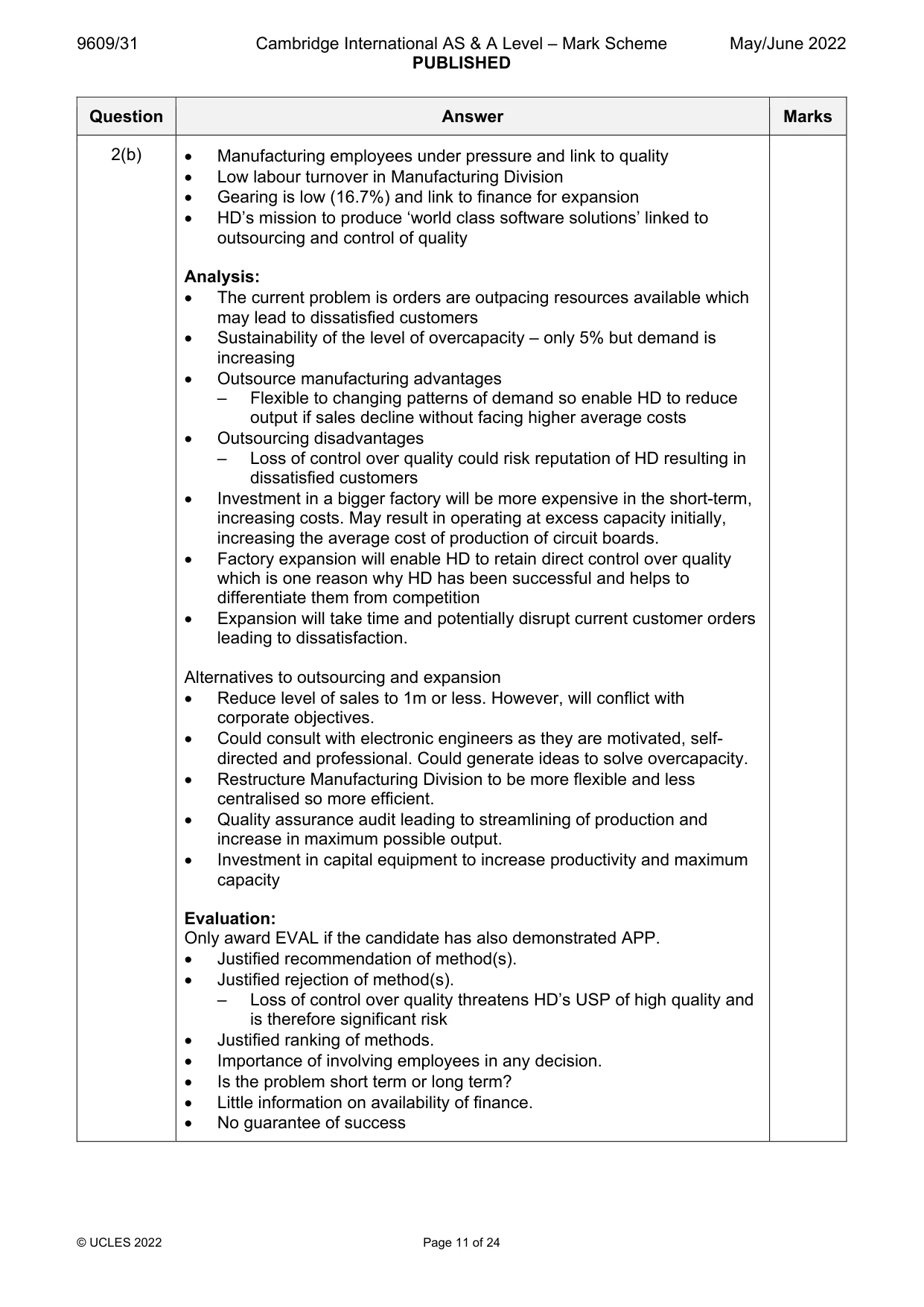
9609/31 Cambridge International AS & A Level – Mark Scheme PUBLISHED May/June 2022 © UCLES 2022 Page 11 of 24 Question Answer Marks 2(b) Manufacturing employees under pressure and link to quality Low labour turnover in Manufacturing Division Gearing is low (16.7%) and link to finance for expansion HD’s mission to produce ‘world class software solutions’ linked to outsourcing and control of quality Analysis: The current problem is orders are outpacing resources available which may lead to dissatisfied customers Sustainability of the level of overcapacity – only 5% but demand is increasing Outsource manufacturing advantages – Flexible to changing patterns of demand so enable HD to reduce output if sales decline without facing higher average costs Outsourcing disadvantages – Loss of control over quality could risk reputation of HD resulting in dissatisfied customers Investment in a bigger factory will be more expensive in the short-term, increasing costs. May result in operating at excess capacity initially, increasing the average cost of production of circuit boards. Factory expansion will enable HD to retain direct control over quality which is one reason why HD has been successful and helps to differentiate them from competition Expansion will take time and potentially disrupt current customer orders leading to dissatisfaction. Alternatives to outsourcing and expansion Reduce level of sales to 1m or less. However, will conflict with corporate objectives. Could consult with electronic engineers as they are motivated, self- directed and professional. Could generate ideas to solve overcapacity. Restructure Manufacturing Division to be more flexible and less centralised so more efficient. Quality assurance audit leading to streamlining of production and increase in maximum possible output. Investment in capital equipment to increase productivity and maximum capacity Evaluation: Only award EVAL if the candidate has also demonstrated APP. Justified recommendation of method(s). Justified rejection of method(s). – Loss of control over quality threatens HD’s USP of high quality and is therefore significant risk Justified ranking of methods. Importance of involving employees in any decision. Is the problem short term or long term? Little information on availability of finance. No guarantee of success
Mark scheme, page 12
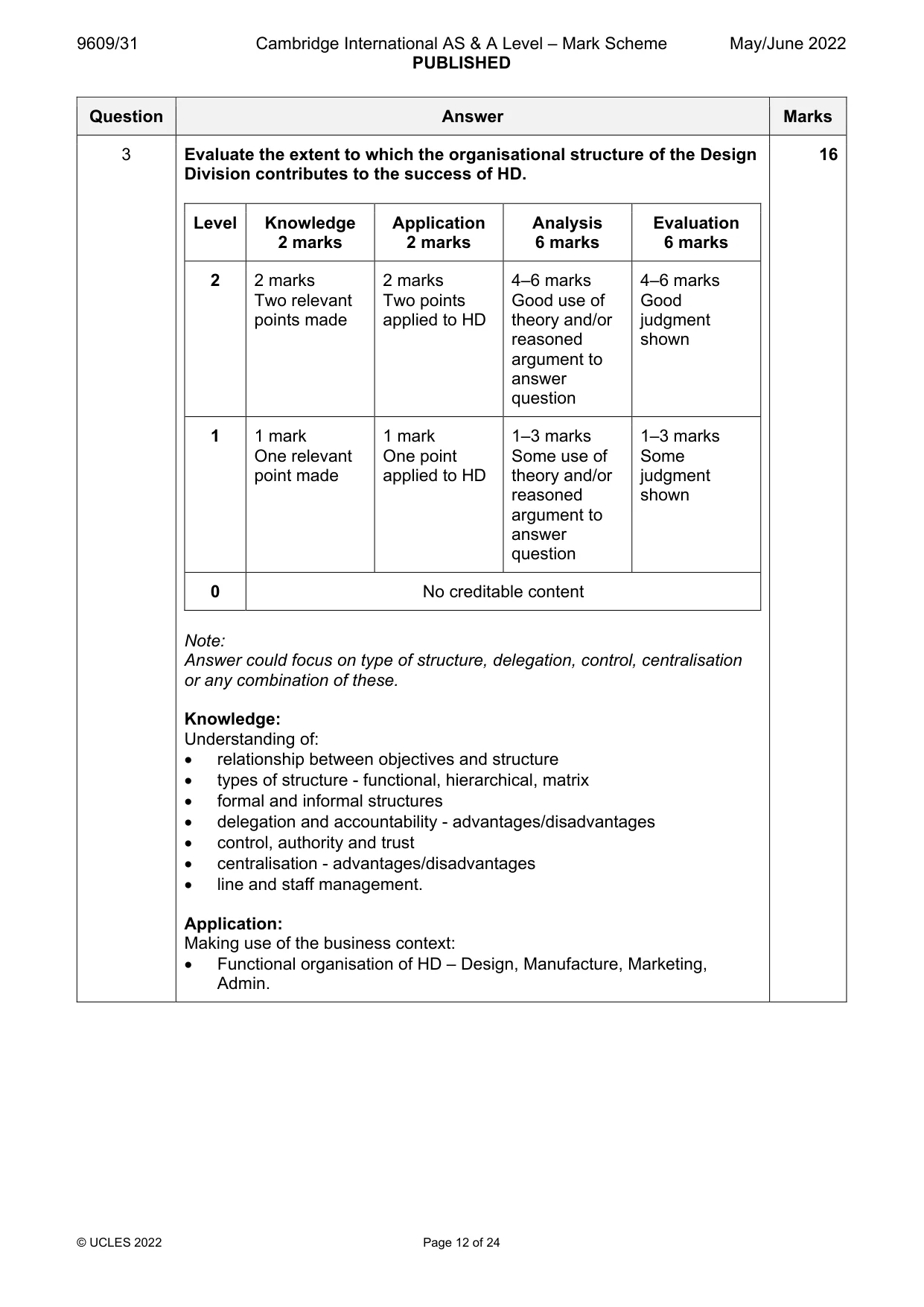
9609/31 Cambridge International AS & A Level – Mark Scheme PUBLISHED May/June 2022 © UCLES 2022 Page 12 of 24 Question Answer Marks 3 Evaluate the extent to which the organisational structure of the Design Division contributes to the success of HD. Level Knowledge 2 marks Application 2 marks Analysis 6 marks Evaluation 6 marks 2 2 marks Two relevant points made 2 marks Two points applied to HD 4–6 marks Good use of theory and/or reasoned argument to answer question 4–6 marks Good judgment shown 1 1 mark One relevant point made 1 mark One point applied to HD 1–3 marks Some use of theory and/or reasoned argument to answer question 1–3 marks Some judgment shown 0 No creditable content Note: Answer could focus on type of structure, delegation, control, centralisation or any combination of these. Knowledge: Understanding of: relationship between objectives and structure types of structure - functional, hierarchical, matrix formal and informal structures delegation and accountability - advantages/disadvantages control, authority and trust centralisation - advantages/disadvantages line and staff management. Application: Making use of the business context: Functional organisation of HD – Design, Manufacture, Marketing, Admin. 16
Mark scheme, page 13
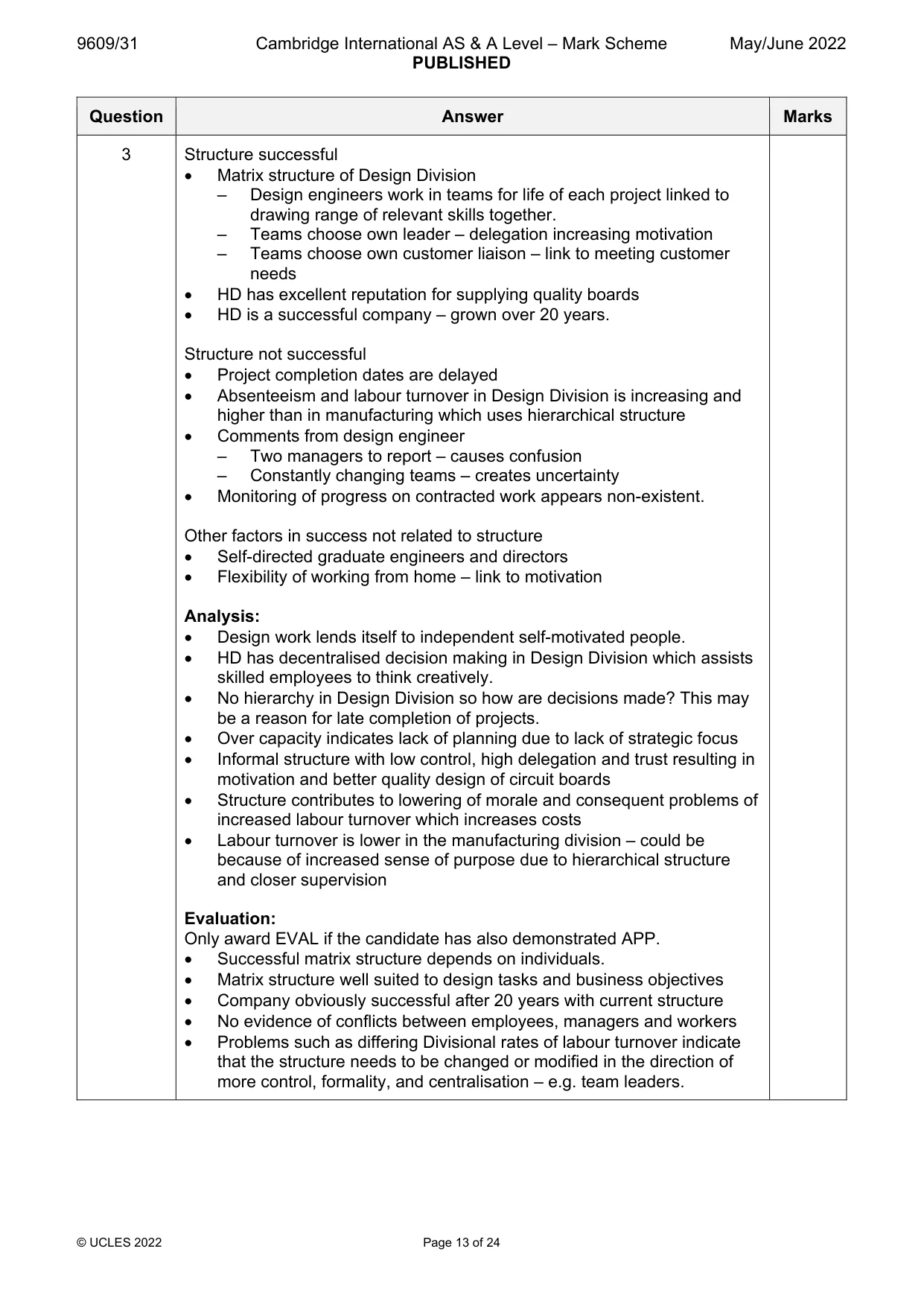
9609/31 Cambridge International AS & A Level – Mark Scheme PUBLISHED May/June 2022 © UCLES 2022 Page 13 of 24 Question Answer Marks 3 Structure successful Matrix structure of Design Division – Design engineers work in teams for life of each project linked to drawing range of relevant skills together. – Teams choose own leader – delegation increasing motivation – Teams choose own customer liaison – link to meeting customer needs HD has excellent reputation for supplying quality boards HD is a successful company – grown over 20 years. Structure not successful Project completion dates are delayed Absenteeism and labour turnover in Design Division is increasing and higher than in manufacturing which uses hierarchical structure Comments from design engineer – Two managers to report – causes confusion – Constantly changing teams – creates uncertainty Monitoring of progress on contracted work appears non-existent. Other factors in success not related to structure Self-directed graduate engineers and directors Flexibility of working from home – link to motivation Analysis: Design work lends itself to independent self-motivated people. HD has decentralised decision making in Design Division which assists skilled employees to think creatively. No hierarchy in Design Division so how are decisions made? This may be a reason for late completion of projects. Over capacity indicates lack of planning due to lack of strategic focus Informal structure with low control, high delegation and trust resulting in motivation and better quality design of circuit boards Structure contributes to lowering of morale and consequent problems of increased labour turnover which increases costs Labour turnover is lower in the manufacturing division – could be because of increased sense of purpose due to hierarchical structure and closer supervision Evaluation: Only award EVAL if the candidate has also demonstrated APP. Successful matrix structure depends on individuals. Matrix structure well suited to design tasks and business objectives Company obviously successful after 20 years with current structure No evidence of conflicts between employees, managers and workers Problems such as differing Divisional rates of labour turnover indicate that the structure needs to be changed or modified in the direction of more control, formality, and centralisation – e.g. team leaders.
Mark scheme, page 14
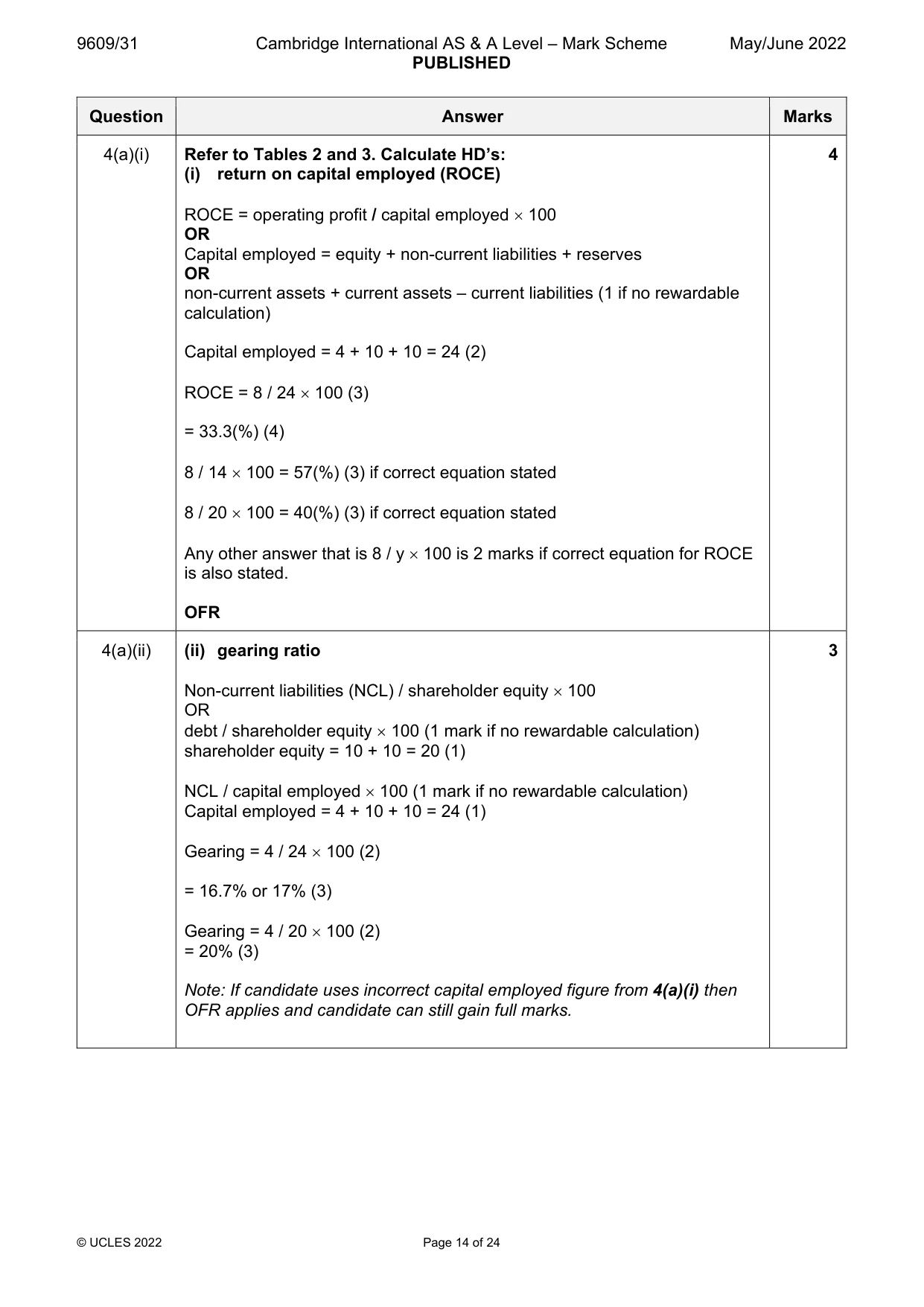
9609/31 Cambridge International AS & A Level – Mark Scheme PUBLISHED May/June 2022 © UCLES 2022 Page 14 of 24 Question Answer Marks 4(a)(i) Refer to Tables 2 and 3. Calculate HD’s: (i) return on capital employed (ROCE) ROCE = operating profit / capital employed 100 OR Capital employed = equity + non-current liabilities + reserves OR non-current assets + current assets – current liabilities (1 if no rewardable calculation) Capital employed = 4 + 10 + 10 = 24 (2) ROCE = 8 / 24 100 (3) = 33.3(%) (4) 8 / 14 100 = 57(%) (3) if correct equation stated 8 / 20 100 = 40(%) (3) if correct equation stated Any other answer that is 8 / y 100 is 2 marks if correct equation for ROCE is also stated. OFR 4 4(a)(ii) (ii) gearing ratio Non-current liabilities (NCL) / shareholder equity 100 OR debt / shareholder equity 100 (1 mark if no rewardable calculation) shareholder equity = 10 + 10 = 20 (1) NCL / capital employed 100 (1 mark if no rewardable calculation) Capital employed = 4 + 10 + 10 = 24 (1) Gearing = 4 / 24 100 (2) = 16.7% or 17% (3) Gearing = 4 / 20 100 (2) = 20% (3) Note: If candidate uses incorrect capital employed figure from 4(a)(i) then OFR applies and candidate can still gain full marks. 3
Mark scheme, page 15
9609/31 Cambridge International AS & A Level – Mark Scheme PUBLISHED May/June 2022 © UCLES 2022 Page 15 of 24 Question Answer Marks 4(a)(iii) (iii) dividend cover Maximum of 1 mark for any of the following Profit after tax / dividends payable Profit after tax = 8 – 4 = 4 Dividend cover = 8 – 4 / 4 = 4 / 4 Two marks for dividend cover = 1 Other answer Operating profit / Dividends paid: 8 / 4 = 2 (1) 2
Mark scheme, page 16
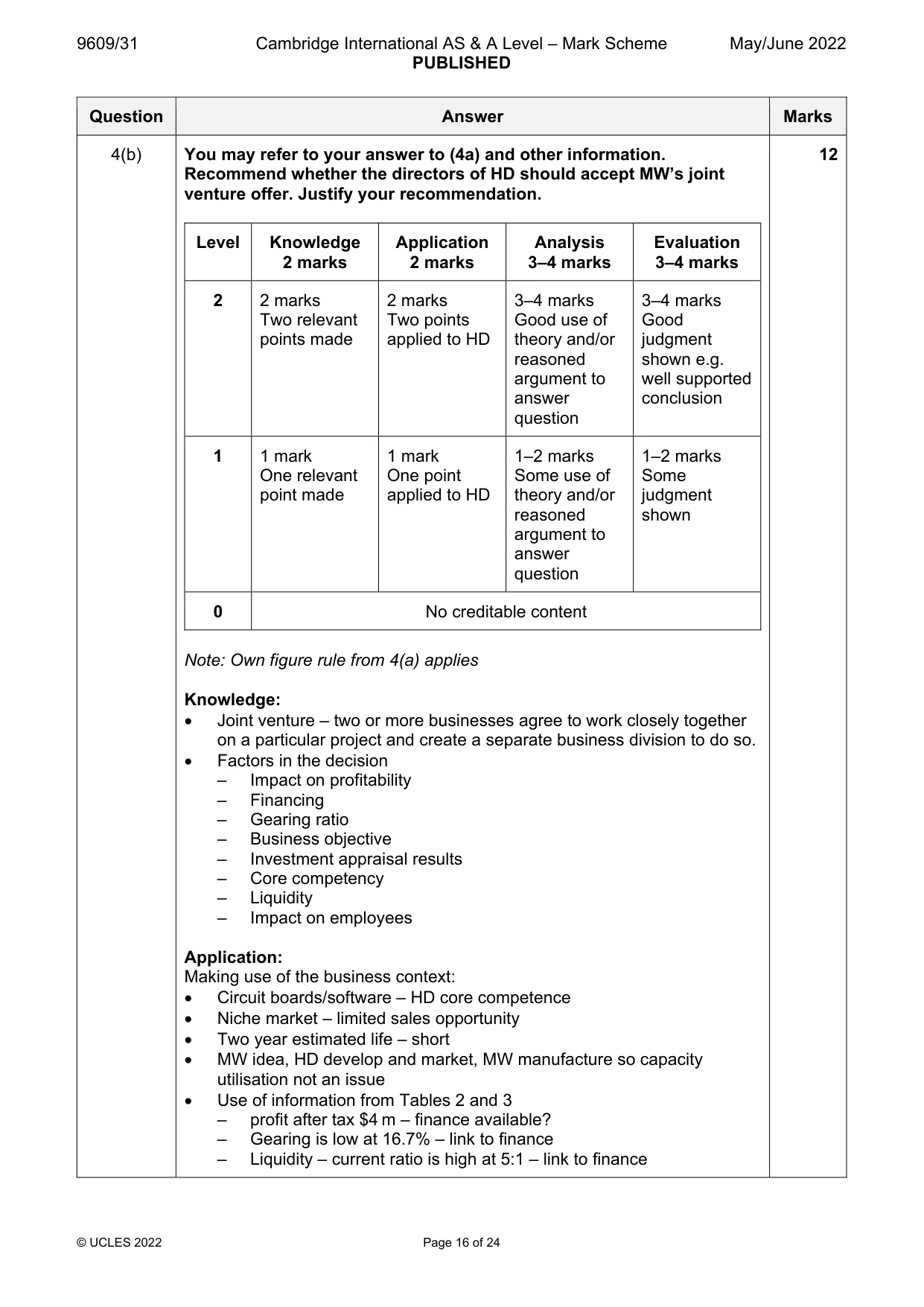
9609/31 Cambridge International AS & A Level – Mark Scheme PUBLISHED May/June 2022 © UCLES 2022 Page 16 of 24 Question Answer Marks 4(b) You may refer to your answer to (4a) and other information. Recommend whether the directors of HD should accept MW’s joint venture offer. Justify your recommendation. Level Knowledge 2 marks Application 2 marks Analysis 3–4 marks Evaluation 3–4 marks 2 2 marks Two relevant points made 2 marks Two points applied to HD 3–4 marks Good use of theory and/or reasoned argument to answer question 3–4 marks Good judgment shown e.g. well supported conclusion 1 1 mark One relevant point made 1 mark One point applied to HD 1–2 marks Some use of theory and/or reasoned argument to answer question 1–2 marks Some judgment shown 0 No creditable content Note: Own figure rule from 4(a) applies Knowledge: Joint venture – two or more businesses agree to work closely together on a particular project and create a separate business division to do so. Factors in the decision – Impact on profitability – Financing – Gearing ratio – Business objective – Investment appraisal results – Core competency – Liquidity – Impact on employees Application: Making use of the business context: Circuit boards/software – HD core competence Niche market – limited sales opportunity Two year estimated life – short MW idea, HD develop and market, MW manufacture so capacity utilisation not an issue Use of information from Tables 2 and 3 – profit after tax $4 m – finance available? – Gearing is low at 16.7% – link to finance – Liquidity – current ratio is high at 5:1 – link to finance 12
Mark scheme, page 17
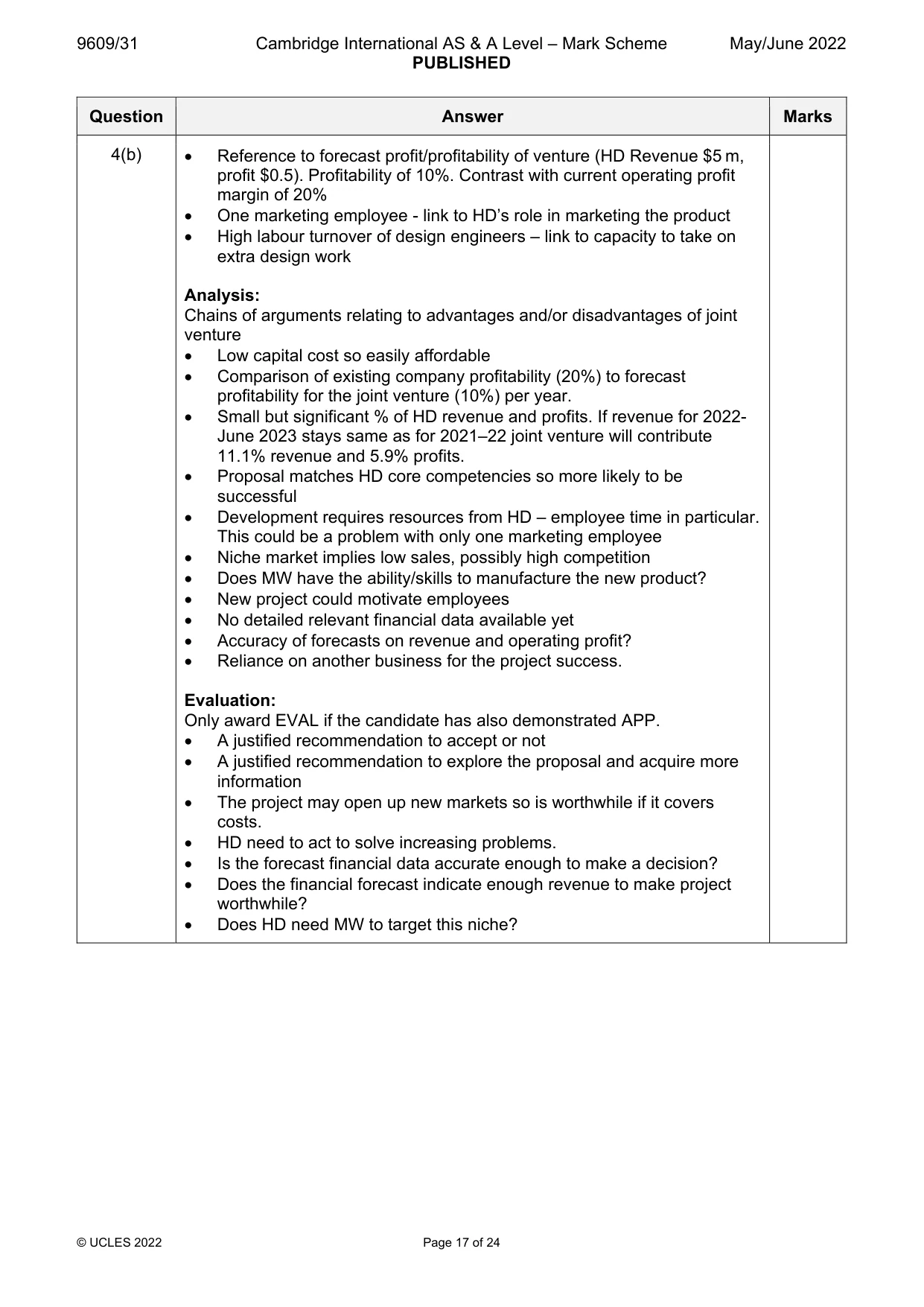
9609/31 Cambridge International AS & A Level – Mark Scheme PUBLISHED May/June 2022 © UCLES 2022 Page 17 of 24 Question Answer Marks 4(b) Reference to forecast profit/profitability of venture (HD Revenue $5 m, profit $0.5). Profitability of 10%. Contrast with current operating profit margin of 20% One marketing employee - link to HD’s role in marketing the product High labour turnover of design engineers – link to capacity to take on extra design work Analysis: Chains of arguments relating to advantages and/or disadvantages of joint venture Low capital cost so easily affordable Comparison of existing company profitability (20%) to forecast profitability for the joint venture (10%) per year. Small but significant % of HD revenue and profits. If revenue for 2022- June 2023 stays same as for 2021–22 joint venture will contribute 11.1% revenue and 5.9% profits. Proposal matches HD core competencies so more likely to be successful Development requires resources from HD – employee time in particular. This could be a problem with only one marketing employee Niche market implies low sales, possibly high competition Does MW have the ability/skills to manufacture the new product? New project could motivate employees No detailed relevant financial data available yet Accuracy of forecasts on revenue and operating profit? Reliance on another business for the project success. Evaluation: Only award EVAL if the candidate has also demonstrated APP. A justified recommendation to accept or not A justified recommendation to explore the proposal and acquire more information The project may open up new markets so is worthwhile if it covers costs. HD need to act to solve increasing problems. Is the forecast financial data accurate enough to make a decision? Does the financial forecast indicate enough revenue to make project worthwhile? Does HD need MW to target this niche?
Mark scheme, page 18
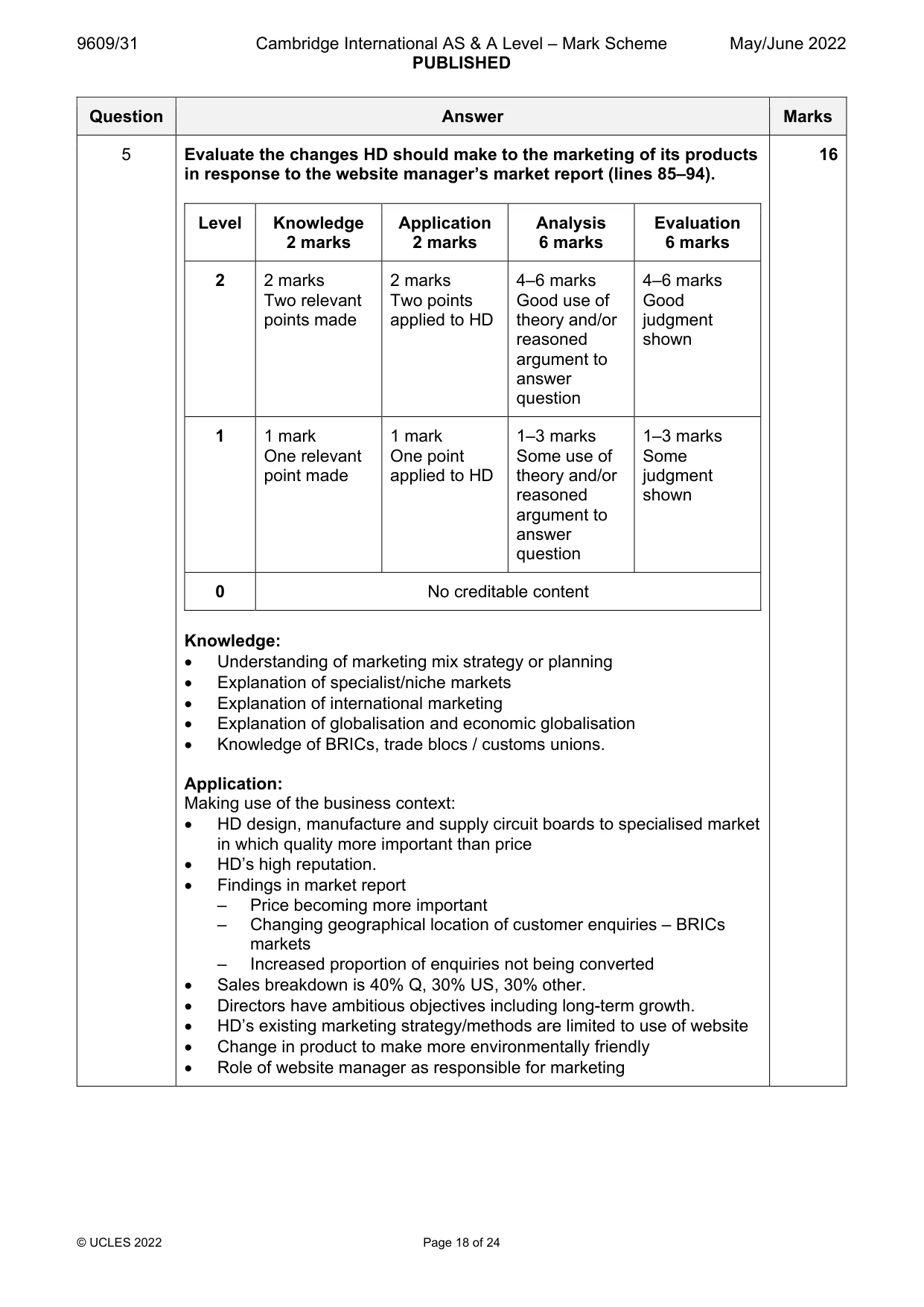
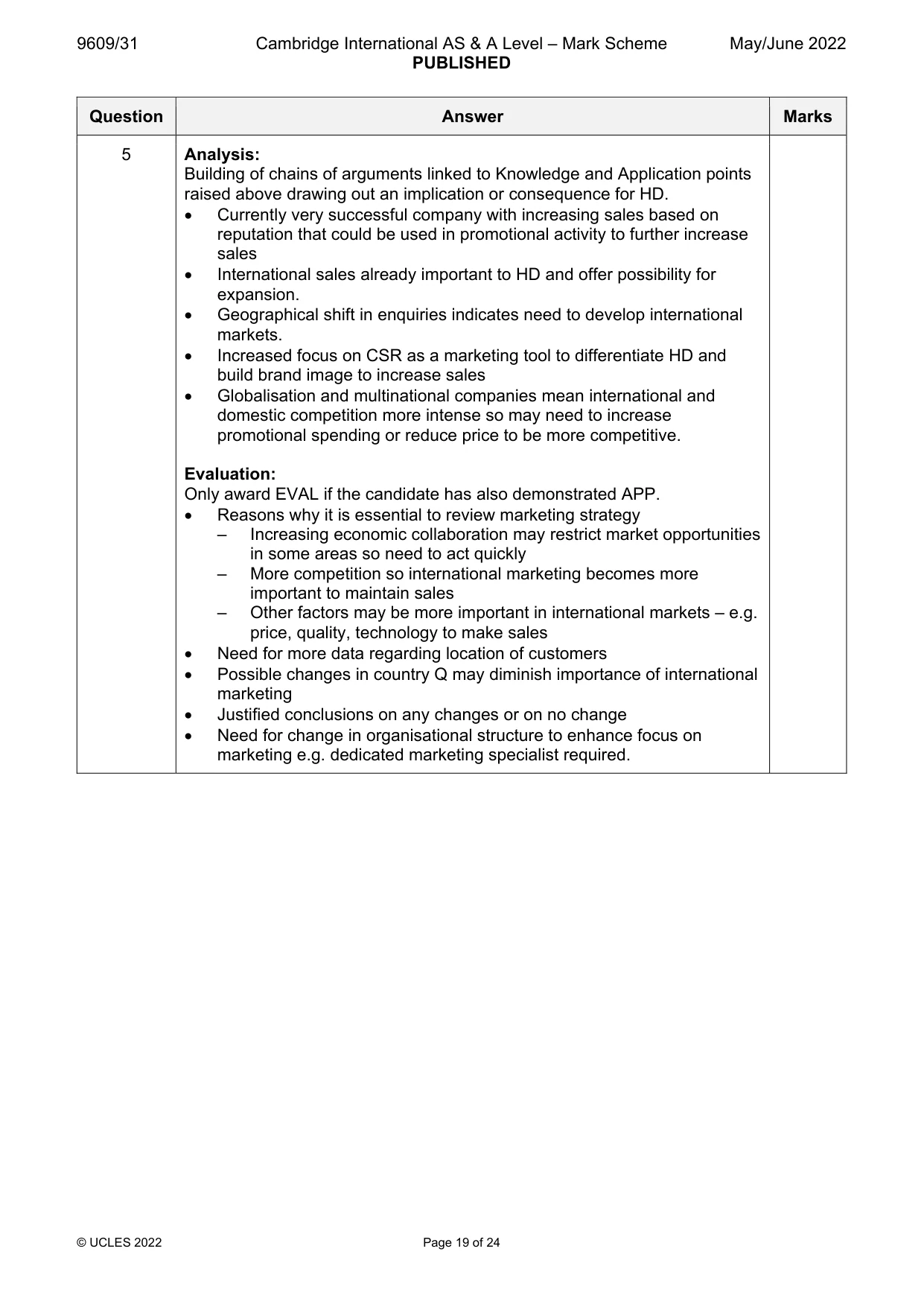
9609/31 Cambridge International AS & A Level – Mark Scheme PUBLISHED May/June 2022 © UCLES 2022 Page 18 of 24 Question Answer Marks 5 Evaluate the changes HD should make to the marketing of its products in response to the website manager’s market report (lines 85–94). Level Knowledge 2 marks Application 2 marks Analysis 6 marks Evaluation 6 marks 2 2 marks Two relevant points made 2 marks Two points applied to HD 4–6 marks Good use of theory and/or reasoned argument to answer question 4–6 marks Good judgment shown 1 1 mark One relevant point made 1 mark One point applied to HD 1–3 marks Some use of theory and/or reasoned argument to answer question 1–3 marks Some judgment shown 0 No creditable content Knowledge: Understanding of marketing mix strategy or planning Explanation of specialist/niche markets Explanation of international marketing Explanation of globalisation and economic globalisation Knowledge of BRICs, trade blocs / customs unions. Application: Making use of the business context: HD design, manufacture and supply circuit boards to specialised market in which quality more important than price HD’s high reputation. Findings in market report – Price becoming more important – Changing geographical location of customer enquiries – BRICs markets – Increased proportion of enquiries not being converted Sales breakdown is 40% Q, 30% US, 30% other. Directors have ambitious objectives including long-term growth. HD’s existing marketing strategy/methods are limited to use of website Change in product to make more environmentally friendly Role of website manager as responsible for marketing 16
Mark scheme, page 19
9609/31 Cambridge International AS & A Level – Mark Scheme PUBLISHED May/June 2022 © UCLES 2022 Page 19 of 24 Question Answer Marks 5 Analysis: Building of chains of arguments linked to Knowledge and Application points raised above drawing out an implication or consequence for HD. Currently very successful company with increasing sales based on reputation that could be used in promotional activity to further increase sales International sales already important to HD and offer possibility for expansion. Geographical shift in enquiries indicates need to develop international markets. Increased focus on CSR as a marketing tool to differentiate HD and build brand image to increase sales Globalisation and multinational companies mean international and domestic competition more intense so may need to increase promotional spending or reduce price to be more competitive. Evaluation: Only award EVAL if the candidate has also demonstrated APP. Reasons why it is essential to review marketing strategy – Increasing economic collaboration may restrict market opportunities in some areas so need to act quickly – More competition so international marketing becomes more important to maintain sales – Other factors may be more important in international markets – e.g. price, quality, technology to make sales Need for more data regarding location of customers Possible changes in country Q may diminish importance of international marketing Justified conclusions on any changes or on no change Need for change in organisational structure to enhance focus on marketing e.g. dedicated marketing specialist required.
Mark scheme, page 20
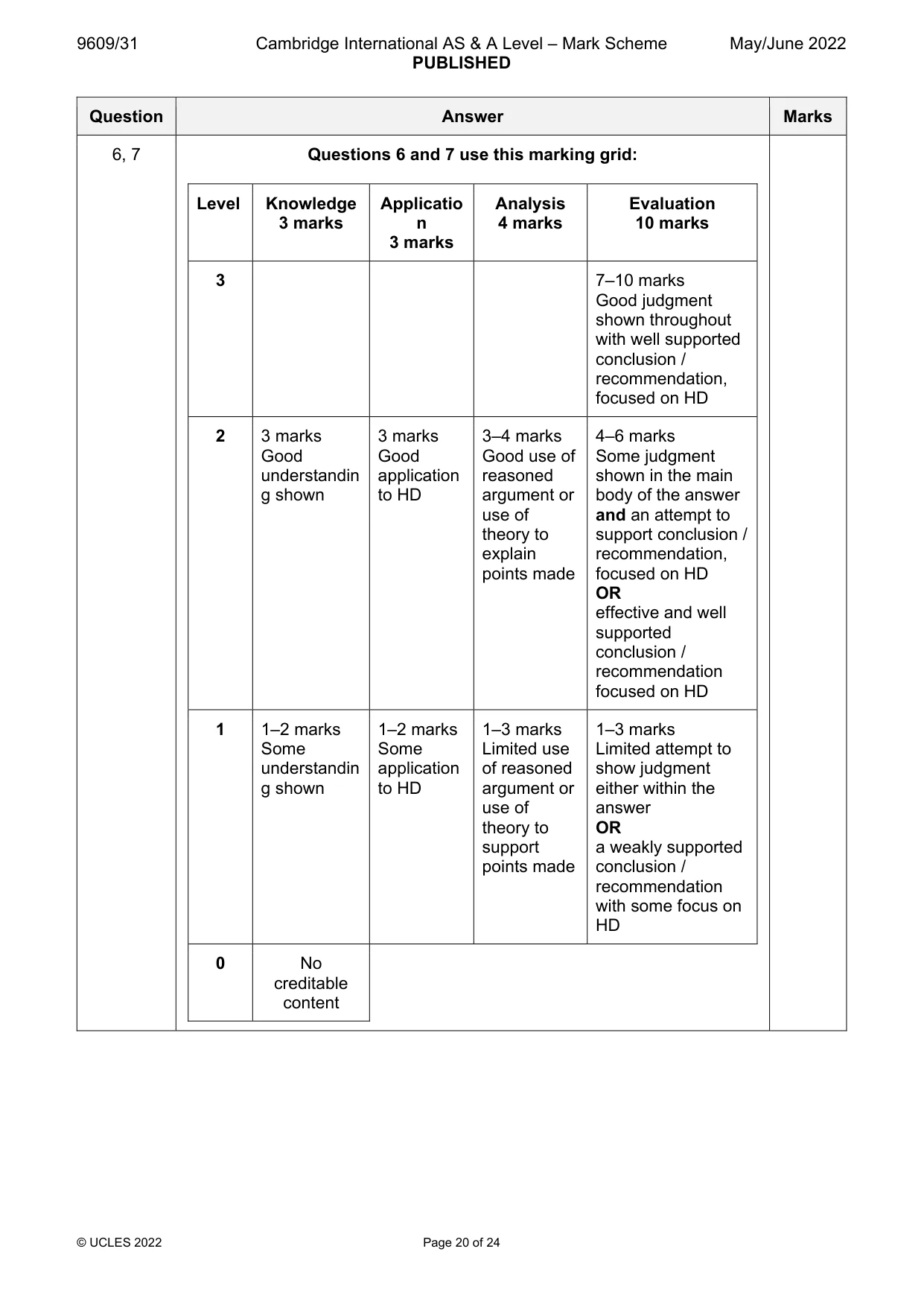
9609/31 Cambridge International AS & A Level – Mark Scheme PUBLISHED May/June 2022 © UCLES 2022 Page 20 of 24 Question Answer Marks 6, 7 Questions 6 and 7 use this marking grid: Level Knowledge 3 marks Applicatio n 3 marks Analysis 4 marks Evaluation 10 marks 3 7–10 marks Good judgment shown throughout with well supported conclusion / recommendation, focused on HD 2 3 marks Good understandin g shown 3 marks Good application to HD 3–4 marks Good use of reasoned argument or use of theory to explain points made 4–6 marks Some judgment shown in the main body of the answer and an attempt to support conclusion / recommendation, focused on HD OR effective and well supported conclusion / recommendation focused on HD 1 1–2 marks Some understandin g shown 1–2 marks Some application to HD 1–3 marks Limited use of reasoned argument or use of theory to support points made 1–3 marks Limited attempt to show judgment either within the answer OR a weakly supported conclusion / recommendation with some focus on HD 0 No creditable content
Mark scheme, page 21
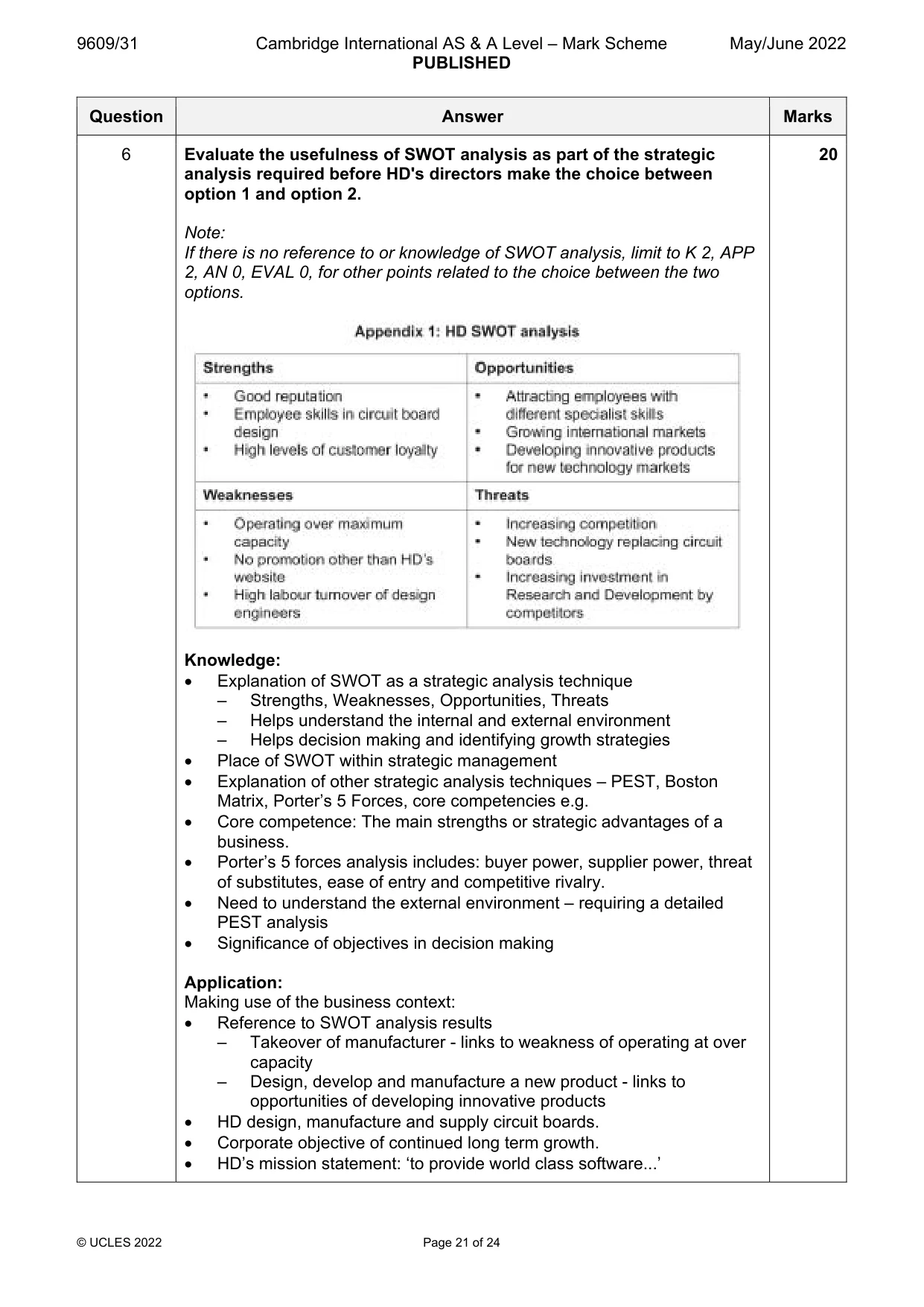
9609/31 Cambridge International AS & A Level – Mark Scheme PUBLISHED May/June 2022 © UCLES 2022 Page 21 of 24 Question Answer Marks 6 Evaluate the usefulness of SWOT analysis as part of the strategic analysis required before HD's directors make the choice between option 1 and option 2. Note: If there is no reference to or knowledge of SWOT analysis, limit to K 2, APP 2, AN 0, EVAL 0, for other points related to the choice between the two options. Knowledge: Explanation of SWOT as a strategic analysis technique – Strengths, Weaknesses, Opportunities, Threats – Helps understand the internal and external environment – Helps decision making and identifying growth strategies Place of SWOT within strategic management Explanation of other strategic analysis techniques – PEST, Boston Matrix, Porter’s 5 Forces, core competencies e.g. Core competence: The main strengths or strategic advantages of a business. Porter’s 5 forces analysis includes: buyer power, supplier power, threat of substitutes, ease of entry and competitive rivalry. Need to understand the external environment – requiring a detailed PEST analysis Significance of objectives in decision making Application: Making use of the business context: Reference to SWOT analysis results – Takeover of manufacturer - links to weakness of operating at over capacity – Design, develop and manufacture a new product - links to opportunities of developing innovative products HD design, manufacture and supply circuit boards. Corporate objective of continued long term growth. HD’s mission statement: ‘to provide world class software...’ 20
Mark scheme, page 22
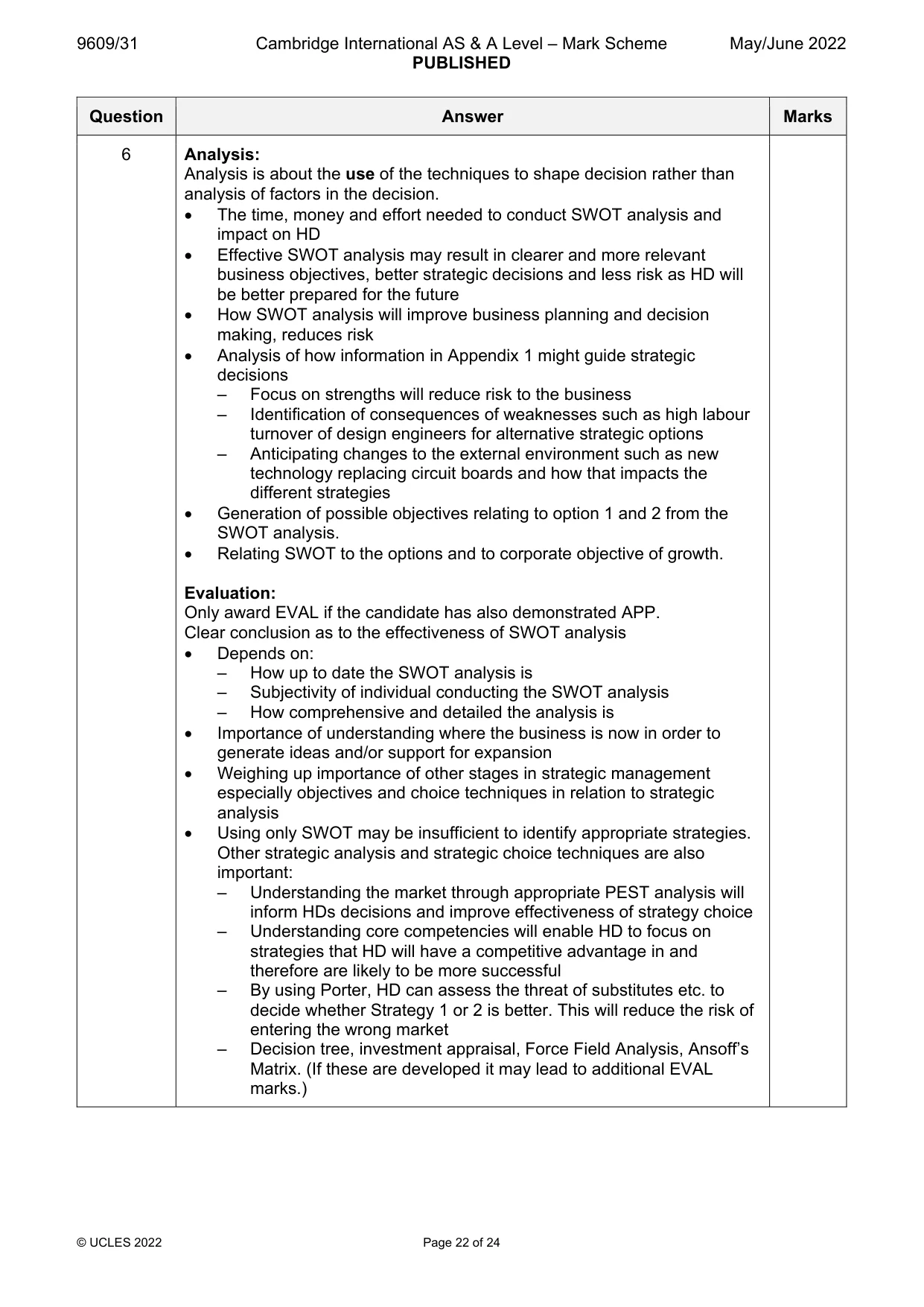
9609/31 Cambridge International AS & A Level – Mark Scheme PUBLISHED May/June 2022 © UCLES 2022 Page 22 of 24 Question Answer Marks 6 Analysis: Analysis is about the use of the techniques to shape decision rather than analysis of factors in the decision. The time, money and effort needed to conduct SWOT analysis and impact on HD Effective SWOT analysis may result in clearer and more relevant business objectives, better strategic decisions and less risk as HD will be better prepared for the future How SWOT analysis will improve business planning and decision making, reduces risk Analysis of how information in Appendix 1 might guide strategic decisions – Focus on strengths will reduce risk to the business – Identification of consequences of weaknesses such as high labour turnover of design engineers for alternative strategic options – Anticipating changes to the external environment such as new technology replacing circuit boards and how that impacts the different strategies Generation of possible objectives relating to option 1 and 2 from the SWOT analysis. Relating SWOT to the options and to corporate objective of growth. Evaluation: Only award EVAL if the candidate has also demonstrated APP. Clear conclusion as to the effectiveness of SWOT analysis Depends on: – How up to date the SWOT analysis is – Subjectivity of individual conducting the SWOT analysis – How comprehensive and detailed the analysis is Importance of understanding where the business is now in order to generate ideas and/or support for expansion Weighing up importance of other stages in strategic management especially objectives and choice techniques in relation to strategic analysis Using only SWOT may be insufficient to identify appropriate strategies. Other strategic analysis and strategic choice techniques are also important: – Understanding the market through appropriate PEST analysis will inform HDs decisions and improve effectiveness of strategy choice – Understanding core competencies will enable HD to focus on strategies that HD will have a competitive advantage in and therefore are likely to be more successful – By using Porter, HD can assess the threat of substitutes etc. to decide whether Strategy 1 or 2 is better. This will reduce the risk of entering the wrong market – Decision tree, investment appraisal, Force Field Analysis, Ansoff’s Matrix. (If these are developed it may lead to additional EVAL marks.)
Mark scheme, page 23
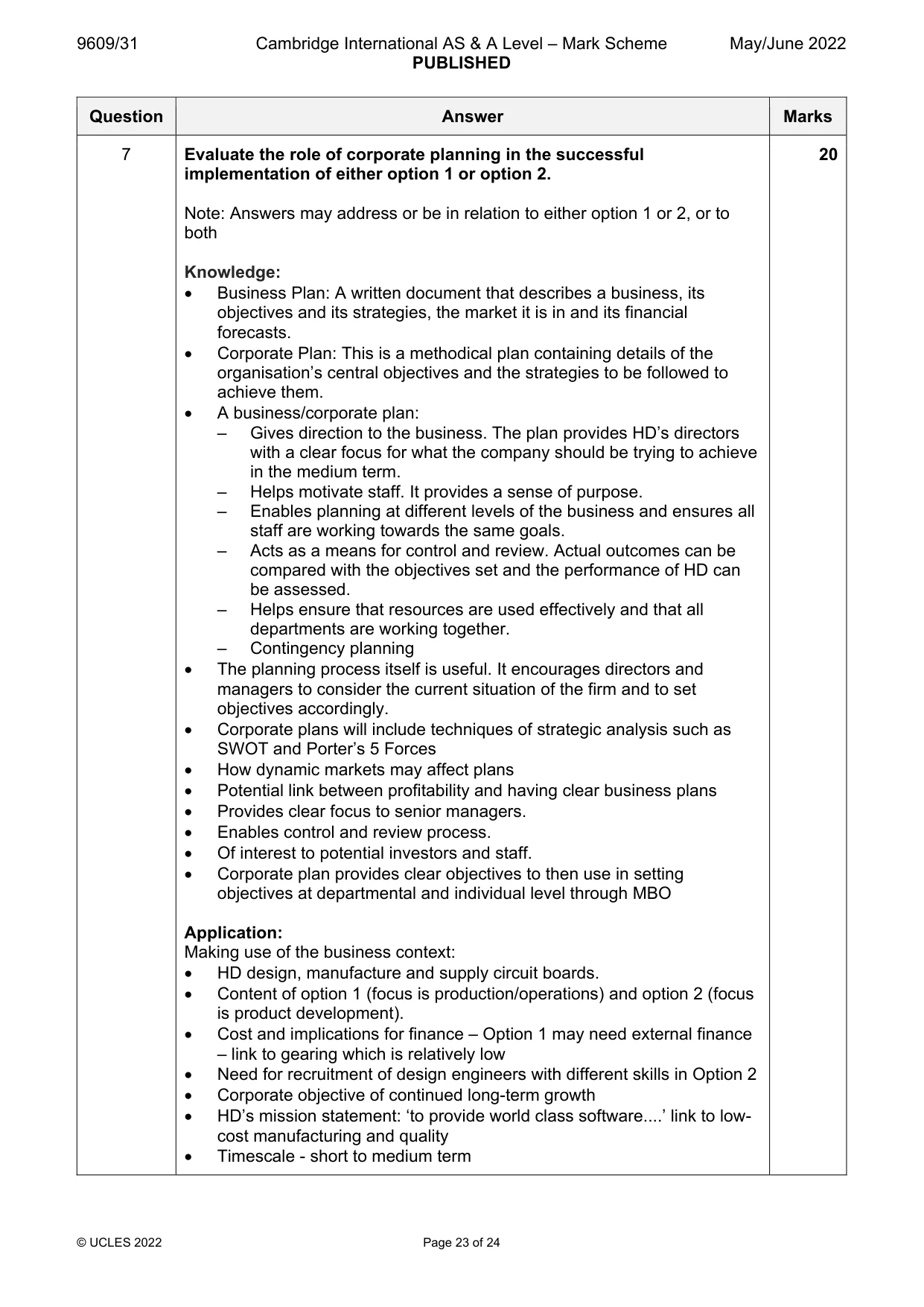
9609/31 Cambridge International AS & A Level – Mark Scheme PUBLISHED May/June 2022 © UCLES 2022 Page 23 of 24 Question Answer Marks 7 Evaluate the role of corporate planning in the successful implementation of either option 1 or option 2. Note: Answers may address or be in relation to either option 1 or 2, or to both Knowledge: Business Plan: A written document that describes a business, its objectives and its strategies, the market it is in and its financial forecasts. Corporate Plan: This is a methodical plan containing details of the organisation’s central objectives and the strategies to be followed to achieve them. A business/corporate plan: – Gives direction to the business. The plan provides HD’s directors with a clear focus for what the company should be trying to achieve in the medium term. – Helps motivate staff. It provides a sense of purpose. – Enables planning at different levels of the business and ensures all staff are working towards the same goals. – Acts as a means for control and review. Actual outcomes can be compared with the objectives set and the performance of HD can be assessed. – Helps ensure that resources are used effectively and that all departments are working together. – Contingency planning The planning process itself is useful. It encourages directors and managers to consider the current situation of the firm and to set objectives accordingly. Corporate plans will include techniques of strategic analysis such as SWOT and Porter’s 5 Forces How dynamic markets may affect plans Potential link between profitability and having clear business plans Provides clear focus to senior managers. Enables control and review process. Of interest to potential investors and staff. Corporate plan provides clear objectives to then use in setting objectives at departmental and individual level through MBO Application: Making use of the business context: HD design, manufacture and supply circuit boards. Content of option 1 (focus is production/operations) and option 2 (focus is product development). Cost and implications for finance – Option 1 may need external finance – link to gearing which is relatively low Need for recruitment of design engineers with different skills in Option 2 Corporate objective of continued long-term growth HD’s mission statement: ‘to provide world class software…’ link to low- cost manufacturing and quality Timescale - short to medium term 20
Mark scheme, page 24
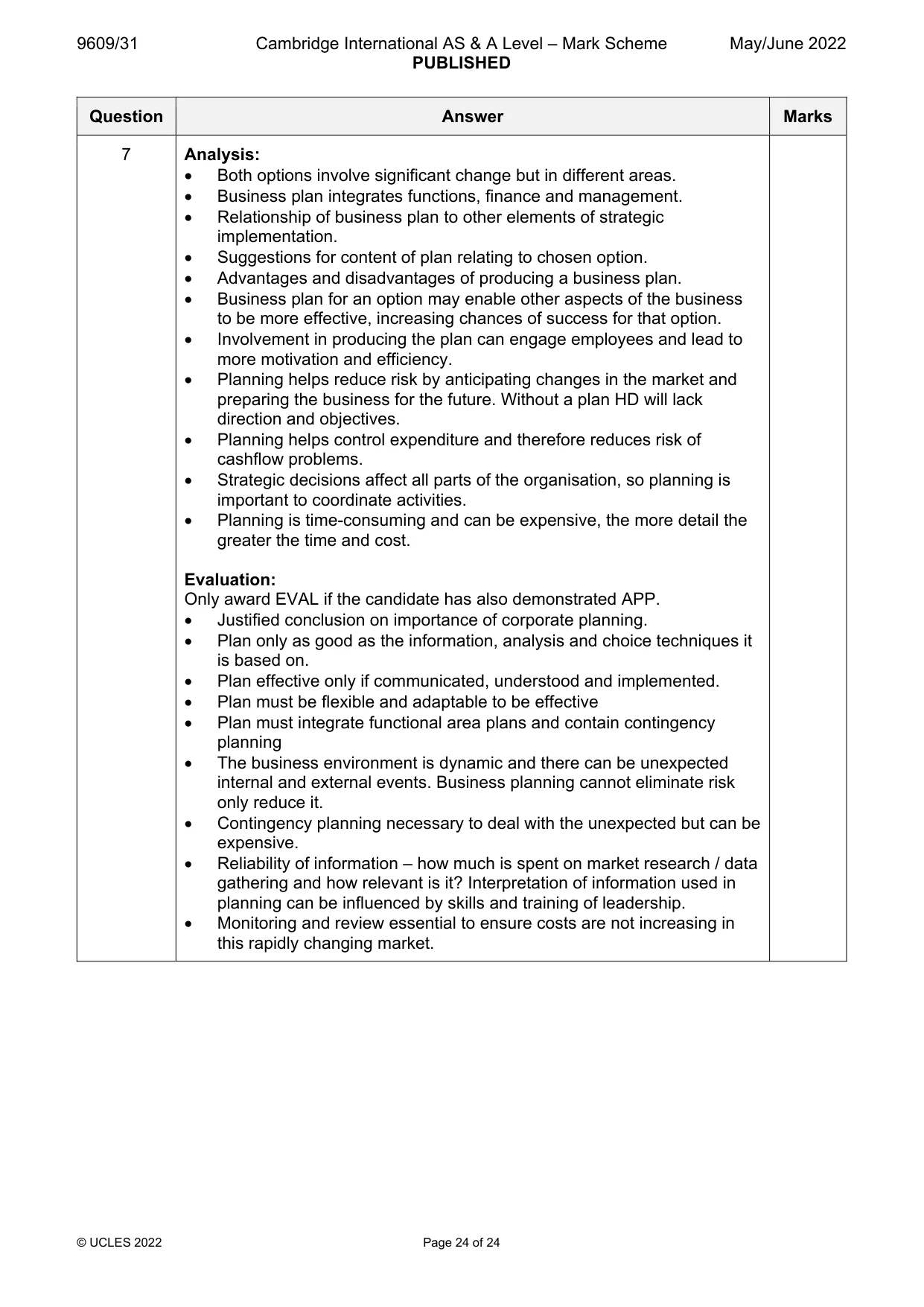
9609/31 Cambridge International AS & A Level – Mark Scheme PUBLISHED May/June 2022 © UCLES 2022 Page 24 of 24 Question Answer Marks 7 Analysis: Both options involve significant change but in different areas. Business plan integrates functions, finance and management. Relationship of business plan to other elements of strategic implementation. Suggestions for content of plan relating to chosen option. Advantages and disadvantages of producing a business plan. Business plan for an option may enable other aspects of the business to be more effective, increasing chances of success for that option. Involvement in producing the plan can engage employees and lead to more motivation and efficiency. Planning helps reduce risk by anticipating changes in the market and preparing the business for the future. Without a plan HD will lack direction and objectives. Planning helps control expenditure and therefore reduces risk of cashflow problems. Strategic decisions affect all parts of the organisation, so planning is important to coordinate activities. Planning is time-consuming and can be expensive, the more detail the greater the time and cost. Evaluation: Only award EVAL if the candidate has also demonstrated APP. Justified conclusion on importance of corporate planning. Plan only as good as the information, analysis and choice techniques it is based on. Plan effective only if communicated, understood and implemented. Plan must be flexible and adaptable to be effective Plan must integrate functional area plans and contain contingency planning The business environment is dynamic and there can be unexpected internal and external events. Business planning cannot eliminate risk only reduce it. Contingency planning necessary to deal with the unexpected but can be expensive. Reliability of information – how much is spent on market research / data gathering and how relevant is it? Interpretation of information used in planning can be influenced by skills and training of leadership. Monitoring and review essential to ensure costs are not increasing in this rapidly changing market.
What you needed in this session
Cambridge’s own grade thresholds for 2022 May/June, Paper 3 · Variant 1. A higher threshold means an easier paper — the bar moves with how the cohort did.