Cambridge A Level Biblical Studies 9484 — 2024 Oct/Nov Paper 2 · Variant 1
9484/21/O/N/24 · 4 questions · 50 marks · 90 min
The question paper and its mark scheme, free to read here and free to download. This is Cambridge’s own paper, exactly as it was sat.
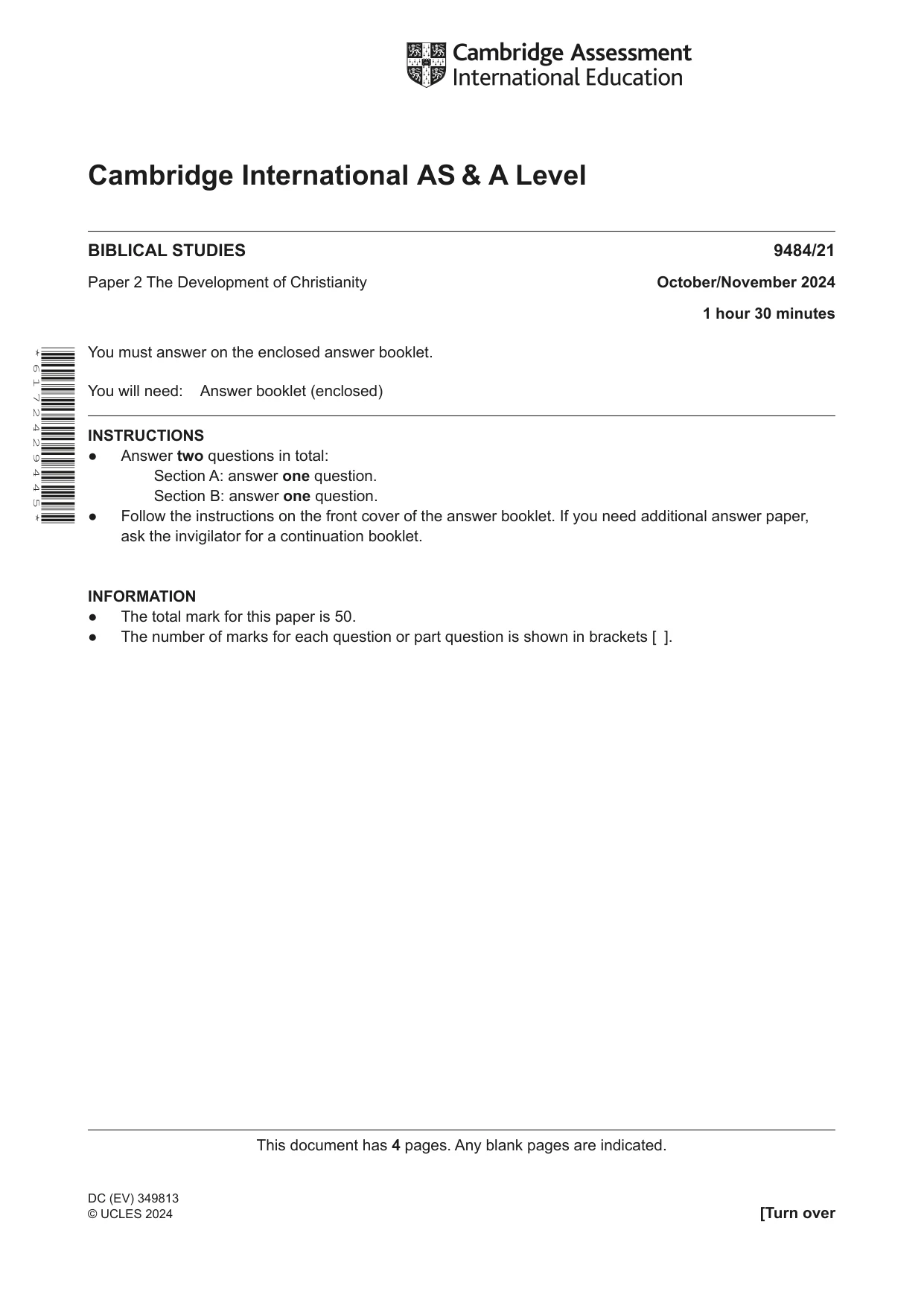
Question paper4 pages
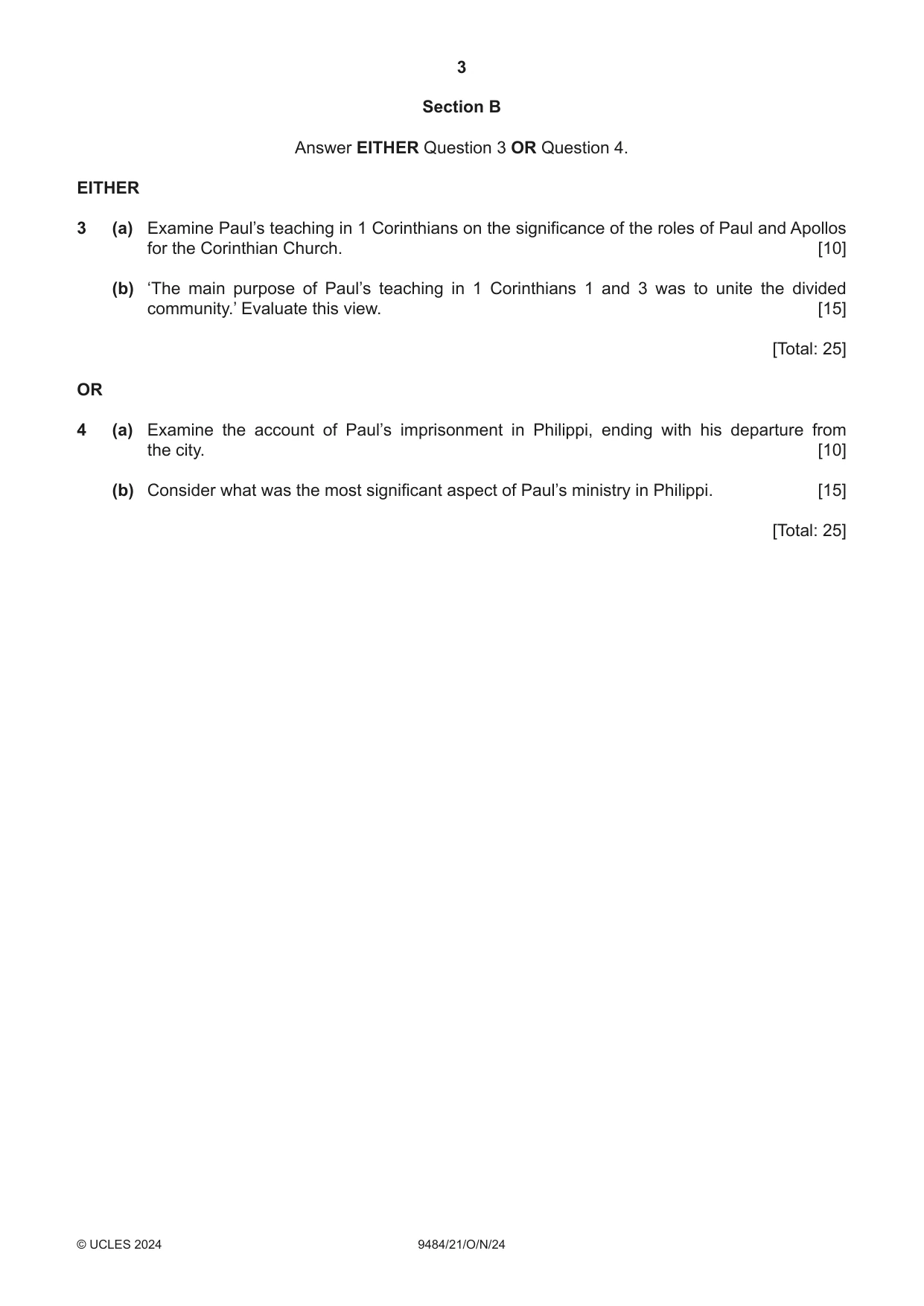

Mark scheme16 pages
Answers below. Sit the paper first if you are practising.
Questions as text
Q1 · Describe the healing that took place in Lystra after Barnabas and Paul left Iconium
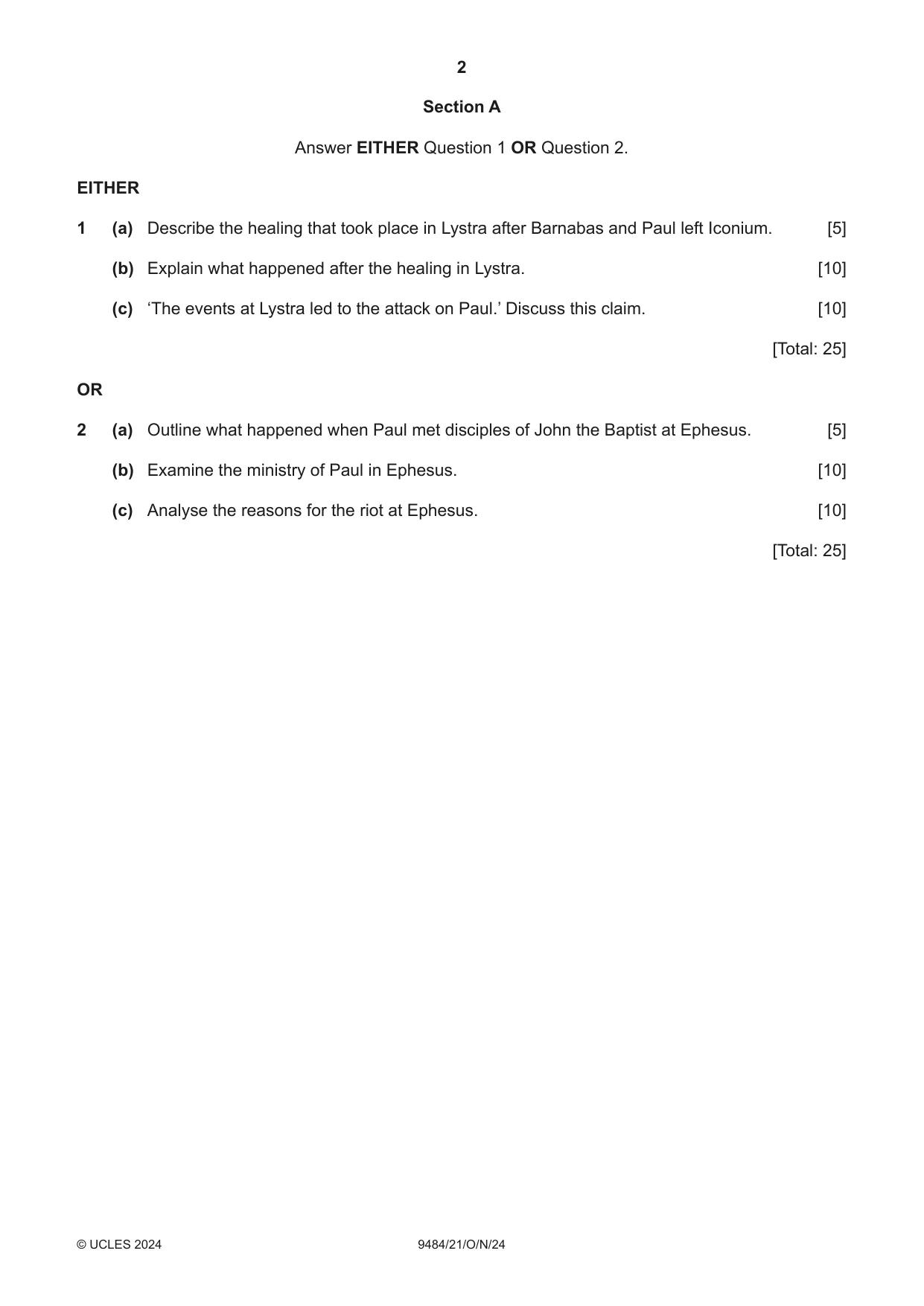
1 (a) Describe the healing that took place in Lystra after Barnabas and Paul left Iconium. [5] (b) Explain what happened after the healing in Lystra. [10] (c) ‘The events at Lystra led to the attack on Paul.’ Discuss this claim. [10] [Total: 25] OR
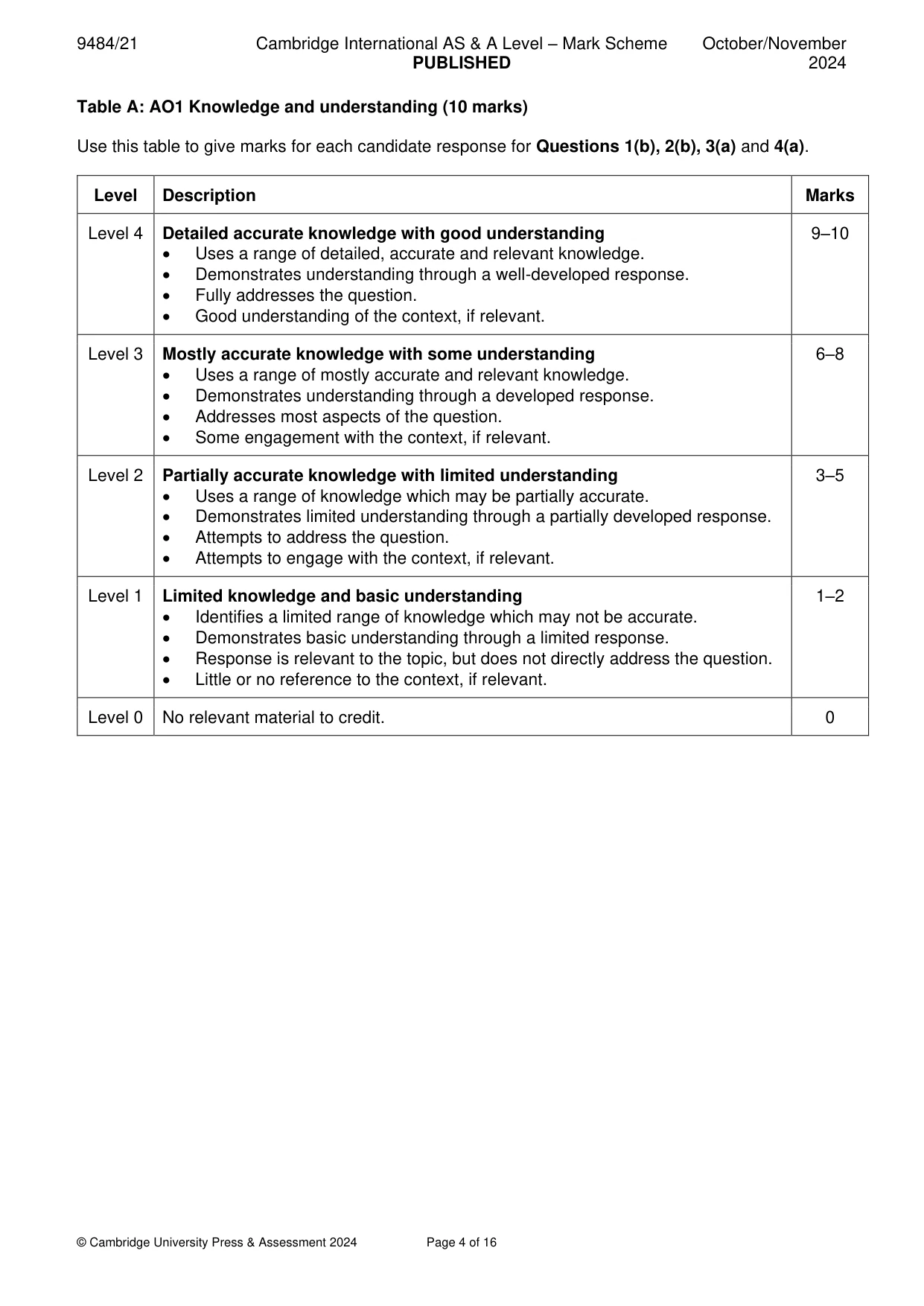
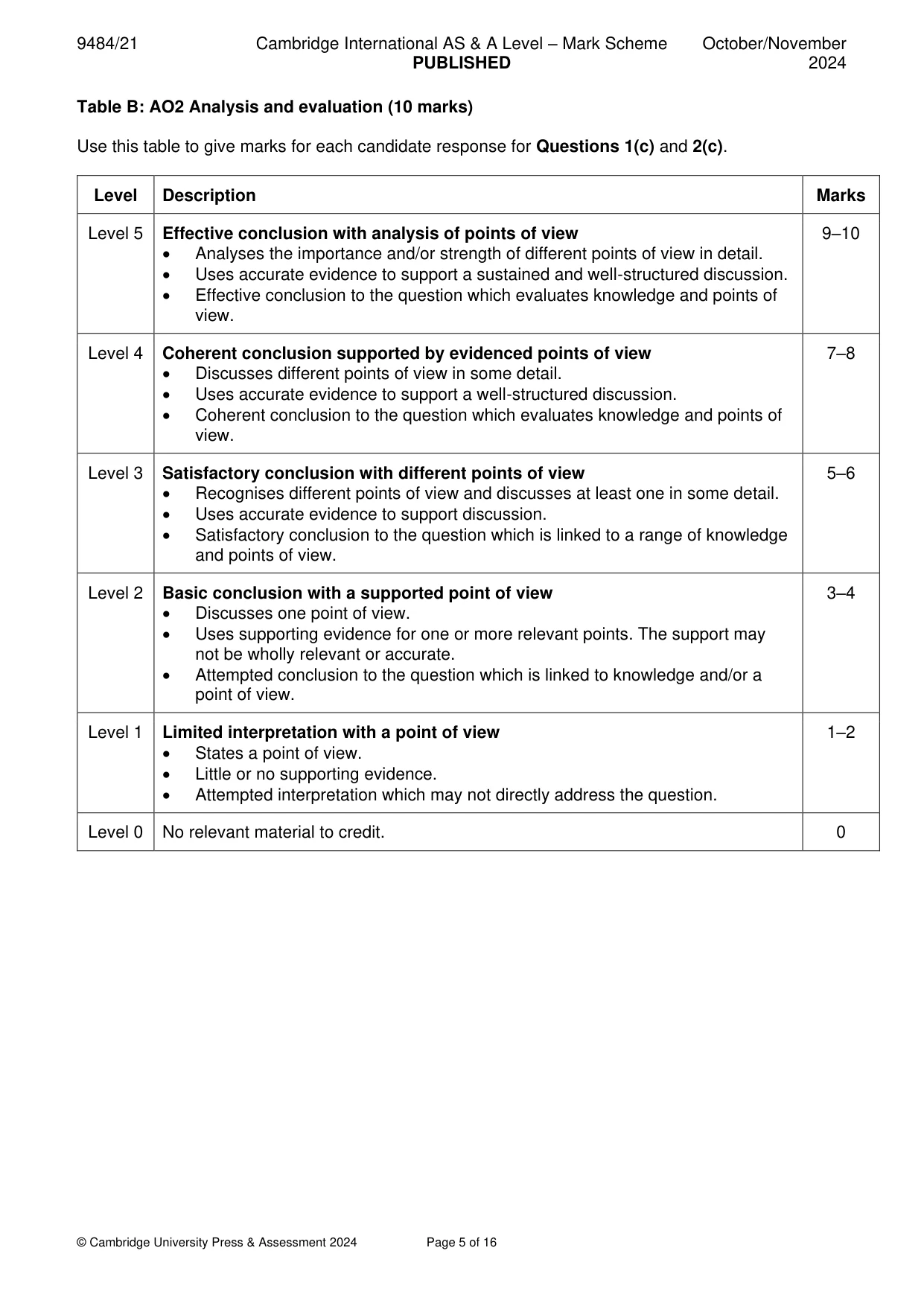
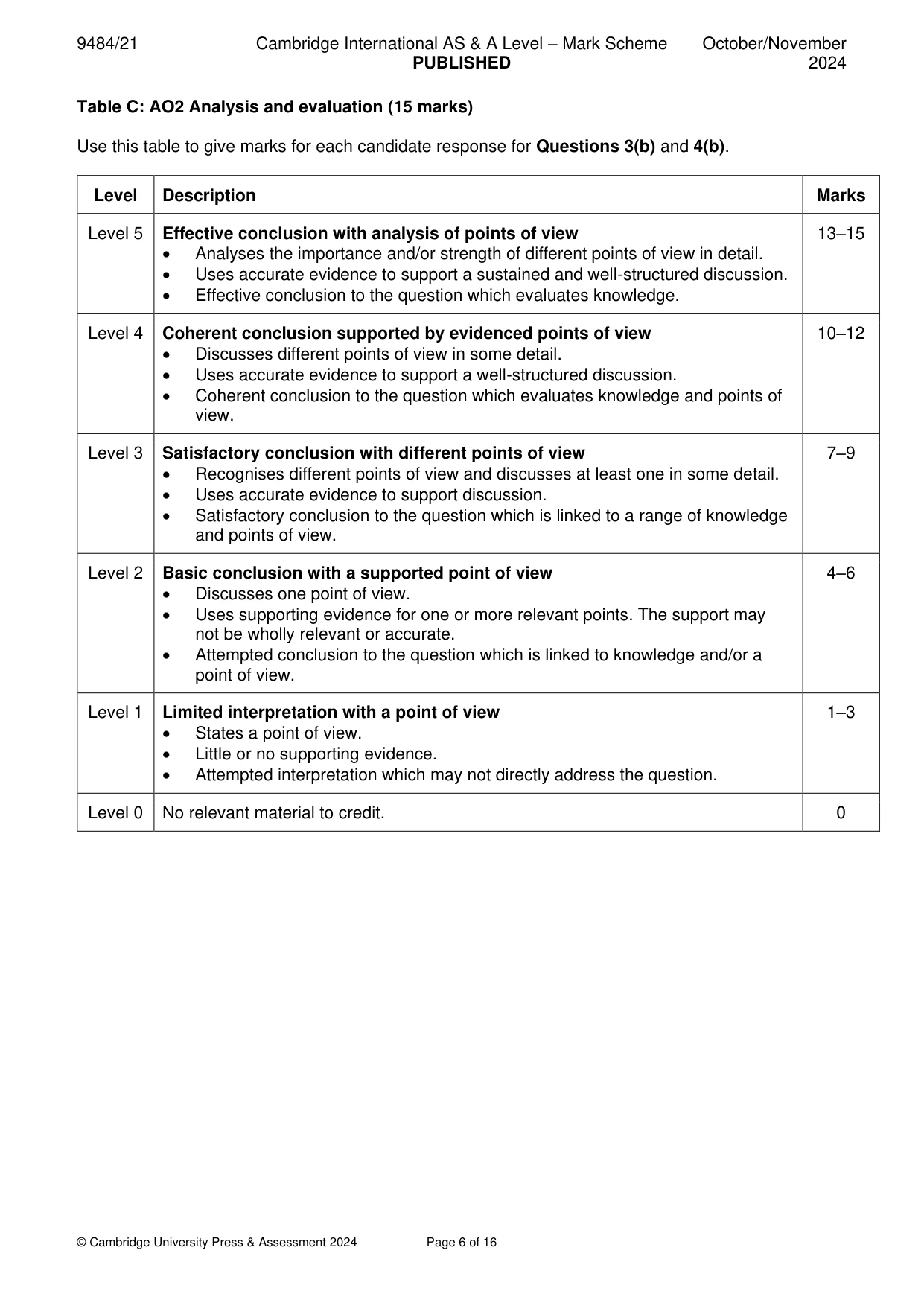
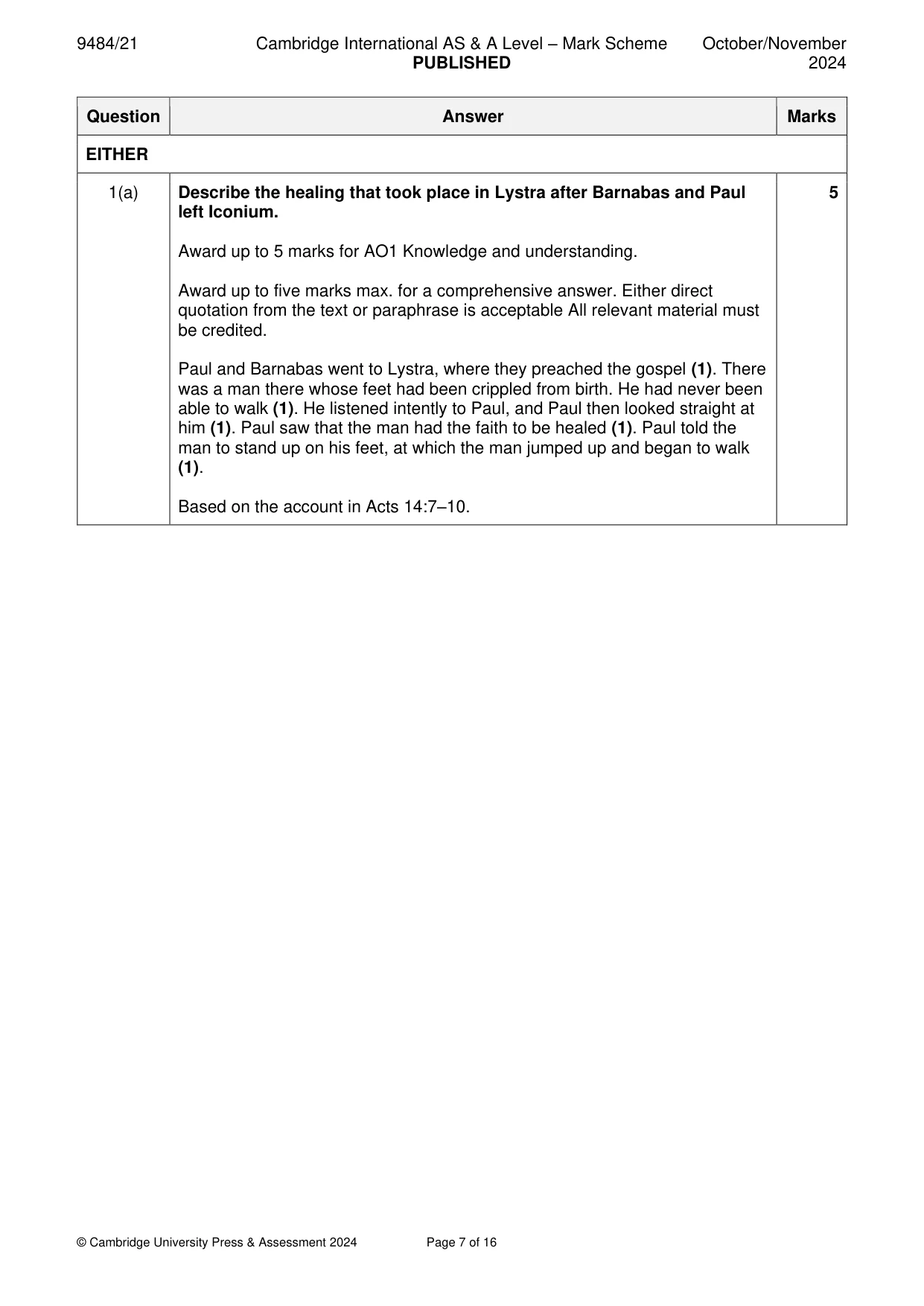
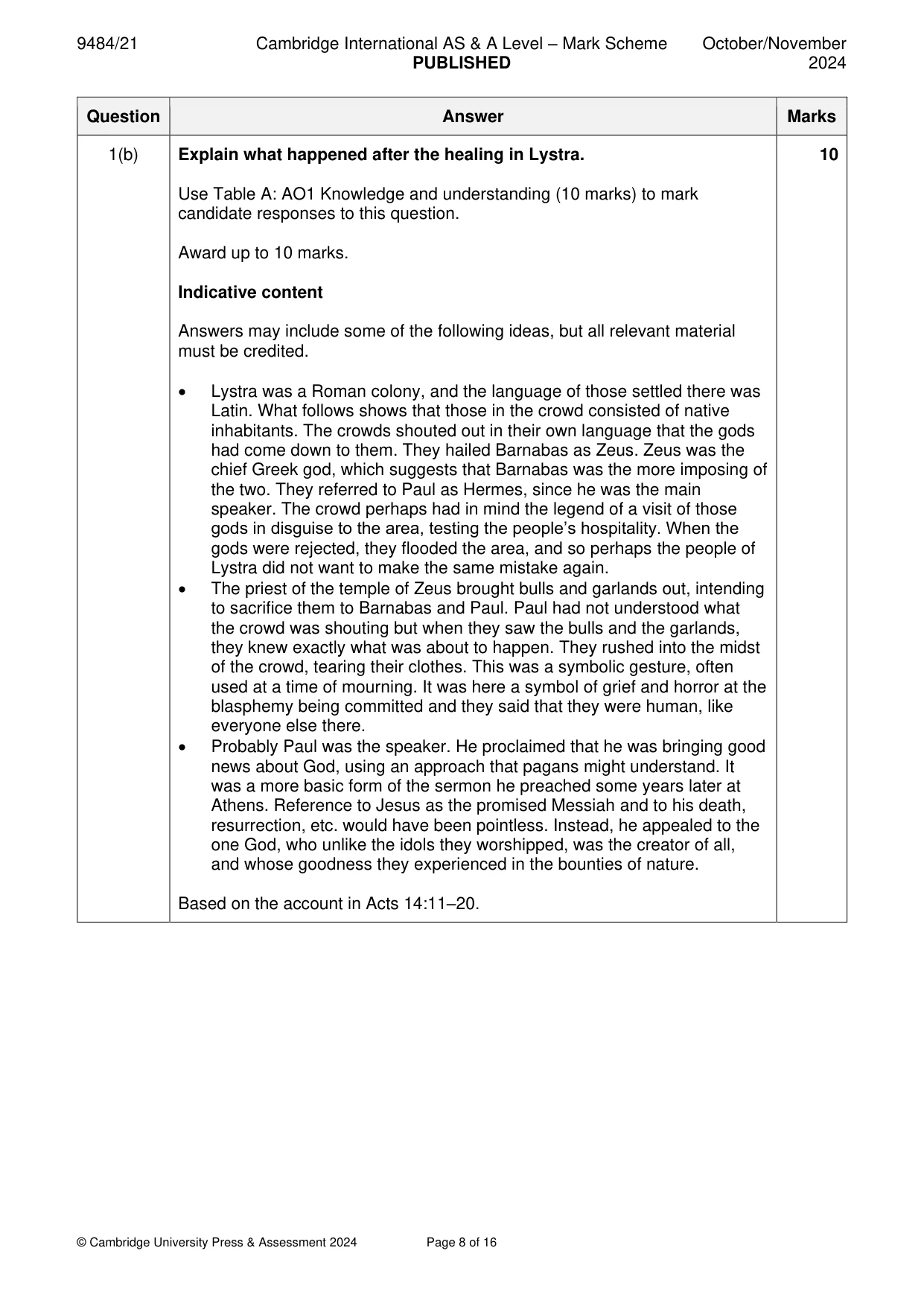
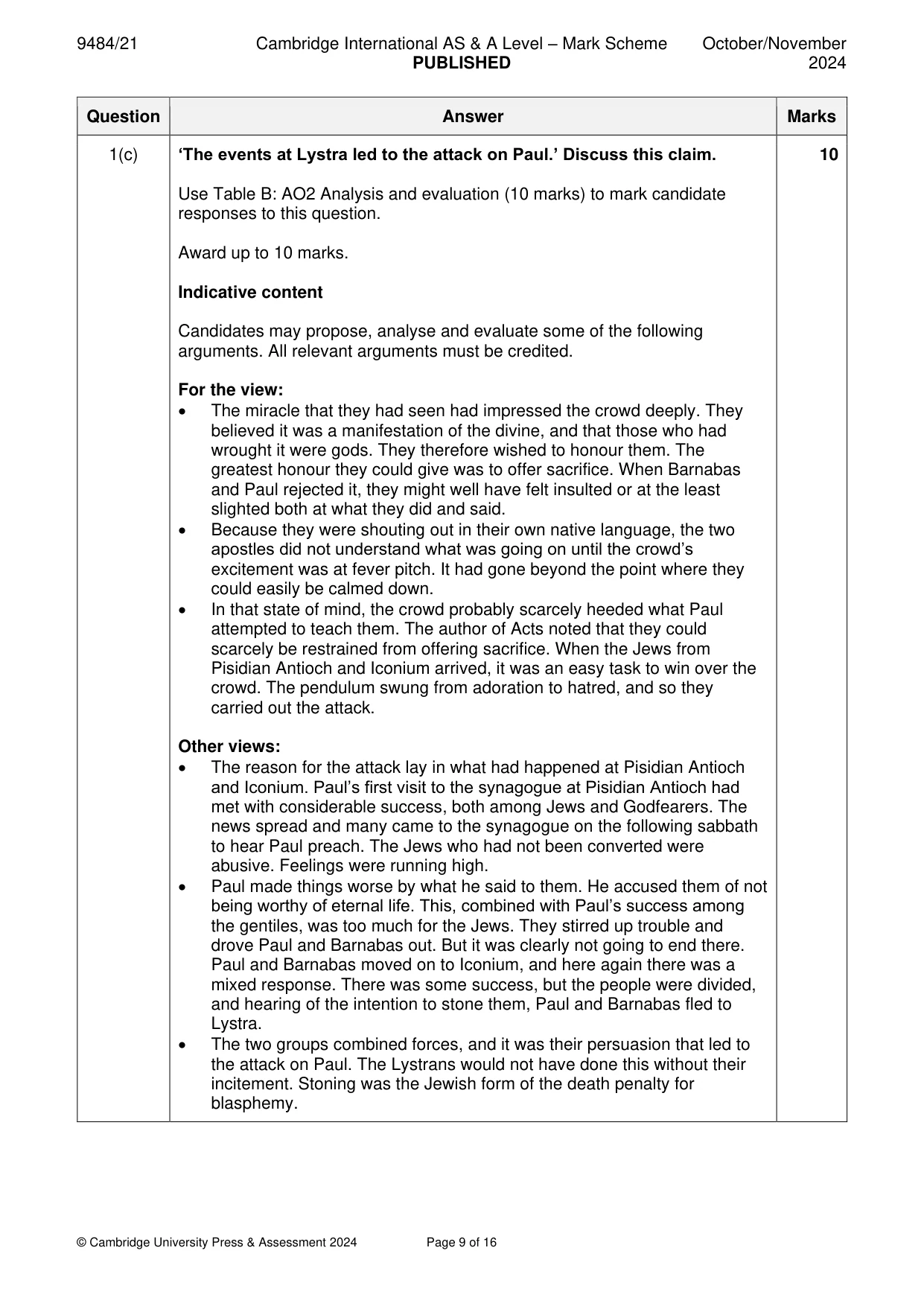
Mark scheme: Question Answer Marks EITHER 1(a) Describe the healing that took place in Lystra after Barnabas and Paul 5 left Iconium. Award up to 5 marks for AO1 Knowledge and understanding. Award up to five marks max. for a comprehensive answer. Either direct quotation from the text or paraphrase is acceptable All relevant material must be credited. Paul and Barnabas went to Lystra, where they preached the gospel (1). There was a man there whose feet had been crippled from birth. He had never been able to walk (1). He listened intently to Paul, and Paul then looked straight at him (1). Paul saw that the man had the faith to be healed (1). Paul told the man to stand up on his feet, at which the man jumped up and began to walk (1). Based on the account in Acts 14:7–10. 1(b) Explain what happened after the healing in Lystra. 10 Use Table A: AO1 Knowledge and understanding (10 marks) to mark candidate responses to this question. Award up to 10 marks. Indicative content Answers may include some of the following ideas, but all relevant material must be credited. • Lystra was a Roman colony, and the language of those settled there was Latin. What follows shows that those in the crowd consisted of native inhabitants. The crowds shouted out in their own language that the gods had come down to them. They hailed Barnabas as Zeus. Zeus was the chief Greek god, which suggests that Barnabas was the more imposing of the two. They referred to Paul as Hermes, since he was the main speaker. The crowd perhaps had in mind the legend of a visit of those gods in disguise to the area, testing the people’s hospitality. When the gods were rejected, they flooded the area, and so perhaps the people of Lystra did not want to make the same mistake again. • The priest of the temple of Zeus brought bulls and garlands out, intending to sacrifice them to Barnabas and Paul. Paul had not understood what the crowd was shouting but when they saw the bulls and the garlands, they knew exactly what was about to happen. They rushed into the midst of the crowd, tearing their clothes. This was a symbolic gesture, often used at a time of mourning. It was here a symbol of grief and horror at the blasphemy being committed and they said that they were human, like everyone else there. • Probably Paul was the speaker. He proclaimed that he was bringing good news about God, using an approach that pagans might understand. It was a more basic form of the sermon he preached some years later at Athens. Reference to Jesus as the promised Messiah and to his death, resurrection, etc. would have been pointless. Instead, he appealed to the one God, who unlike the idols they worshipped, was the creator of all, and whose goodness they experienced in the bounties of nature. Based on the account in Acts 14:11–20. 1(c) ‘The events at Lystra led to the attack on Paul.’ Discuss this claim. 10 Use Table B: AO2 Analysis and evaluation (10 marks) to mark candidate responses to this question. Award up to 10 marks. Indicative content Candidates may propose, analyse and evaluate some of the following arguments. All relevant arguments must be credited. For the view: • The miracle that they had seen had impressed the crowd deeply. They believed it was a manifestation of the divine, and that those who had wrought it were gods. They therefore wished to honour them. The greatest honour they could give was to offer sacrifice. When Barnabas and Paul rejected it, they might well have felt insulted or at the least slighted both at what they did and said. • Because they were shouting out in their own native language, the two apostles did not understand what was going on until the crowd’s excitement was at fever pitch. It had gone beyond the point where they could easily be calmed down. • In that state of mind, the crowd probably scarcely heeded what Paul attempted to teach them. The author of Acts noted that they could scarcely be restrained from offering sacrifice. When the Jews from Pisidian Antioch and Iconium arrived, it was an easy task to win over the crowd. The pendulum swung from adoration to hatred, and so they carried out the attack. Other views: • The reason for the attack lay in what had happened at Pisidian Antioch and Iconium. Paul’s first visit to the synagogue at Pisidian Antioch had met with considerable success, both among Jews and Godfearers. The news spread and many came to the synagogue on the following sabbath to hear Paul preach. The Jews who had not been converted were abusive. Feelings were running high. • Paul made things worse by what he said to them. He accused them of not being worthy of eternal life. This, combined with Paul’s success among the gentiles, was too much for the Jews. They stirred up trouble and drove Paul and Barnabas out. But it was clearly not going to end there. Paul and Barnabas moved on to Iconium, and here again there was a mixed response. There was some success, but the people were divided, and hearing of the intention to stone them, Paul and Barnabas fled to Lystra. • The two groups combined forces, and it was their persuasion that led to the attack on Paul. The Lystrans would not have done this without their incitement. Stoning was the Jewish form of the death penalty for blasphemy.
Q2 · Outline what happened when Paul met disciples of John the Baptist at Ephesus
2 (a) Outline what happened when Paul met disciples of John the Baptist at Ephesus. [5] (b) Examine the ministry of Paul in Ephesus. [10] (c) Analyse the reasons for the riot at Ephesus. [10] [Total: 25]
Mark scheme: 2(a) Outline what happened when Paul met disciples of John the Baptist at 5 Ephesus. Award up to 5 marks for AO1 Knowledge and understanding. Award up to five marks max. for a comprehensive answer. Either direct quotation from the text or paraphrase is acceptable. All relevant material must be credited. When Paul asked if they had received the Holy Spirit, they said that they had not, and that they had not even heard of the Holy Spirit (1). Paul told them that John’s baptism was one of repentance. John had told people to believe in the one coming after him, who was Jesus (1). When the men heard this, they were baptised into the name of the Lord Jesus (1). Paul laid his hands on them, and they received the Holy Spirit (1). They spoke in tongues and prophesied. (1). Based on the account in Acts 19:1–6. 2(b) Examine the ministry of Paul in Ephesus. 10 Use Table A: AO1 Knowledge and understanding (10 marks) to mark candidate responses to this question. Award up to 10 marks. Indicative content Answers may include some of the following ideas, but all relevant material must be credited. • As was his practice, Paul first preached in the synagogue and had some success. His daily preaching over a period of three months gained some converts. Eventually there was opposition, and so he and his converts left the synagogue. For two years he preached the gospel in the hall of Tyrannus. His preaching could thus be heard more widely, though the claim that it reached Jews and gentiles throughout the Roman province of Asia was an exaggeration. This followed a similar pattern to his ministry in Corinth. • Like the apostles in the early church in Jerusalem, Paul performed many miracles, with the same superstitious reactions. In Jerusalem, people laid their sick relatives on mats in the street so that the apostles’ shadow might fall on them. Here in Ephesus, they took back to those who were sick the sweat bands and aprons that Paul would have used in his work. All Jewish rabbis supported themselves with a manual occupation, and following in that tradition, Paul was a leatherworker. • Exorcism was widely practised in the pagan world, and there were many itinerant exorcists. It was common for exorcists to add to the lists of the names used in order to make their exorcisms more potent. One group consisted of the sons of Sceva, whose claim to be a Jewish high priest would have increased his prestige amongst the superstitious pagans. They included the names of Jesus and Paul in their rituals, but their attempt backfired on them, when apparently the evil spirit being exorcised turned on them and beat them. • Ephesus was famous throughout the empire not just for the temple to Artemis, but for the practice of magic. People went there to buy amulets containing scrolls with spells to cure all kinds of disease, enable pregnancy, etc. Archaeologists have found such scrolls in Europe and North Africa. The news of what had happened to the sons of Sceva spread, and some of those involved in writing spells were terrified. They brought their scrolls and, despite their value, burned them in public. Based on the account in Acts 19:1–20. 2(c) Analyse the reasons for the riot at Ephesus. 10 Use Table B: AO2 Analysis and evaluation (10 marks) to mark candidate responses to this question. Award up to 10 marks. Indicative content Candidates may propose, analyse and evaluate some of the following arguments. All relevant arguments must be credited. • The destruction of the books of spells would have angered those involved in the industry of creating and selling such spells. Some of these were very valuable and would have taken years to put together. There might have been a considerable loss of income. • Those who sold spells and the metalworkers who sold statues of Artemis to the thousands of pilgrims who came to Ephesus stood to lose income because of Paul’s preaching of monotheism. They feared a downturn in trade. • The temple officials would also have been faced with a loss of income. Fertility rituals were central to worship at the temple of Artemis, and this involved cultic prostitution. • The threat to income was not the only reason. There was a spirit of religious openness in the Roman Empire, and the apparent exclusiveness of Christians went against this. Jews also were exclusive, but they did not on the whole actively proselytise. Paul and his companions, however, actively sought to convert people. • The temple officials would no doubt have seen Paul’s preaching as a challenge to their authority. • The metalworkers and other people saw the proclamation of monotheism as an insult to the temple and to Artemis. Both were being discredited.
Q3 · Examine Paul’s teaching in 1 Corinthians on the significance of the roles of Paul and…
3 (a) Examine Paul’s teaching in 1 Corinthians on the significance of the roles of Paul and Apollos for the Corinthian Church. [10] (b) ‘The main purpose of Paul’s teaching in 1 Corinthians 1 and 3 was to unite the divided community.’ Evaluate this view. [15] [Total: 25] OR
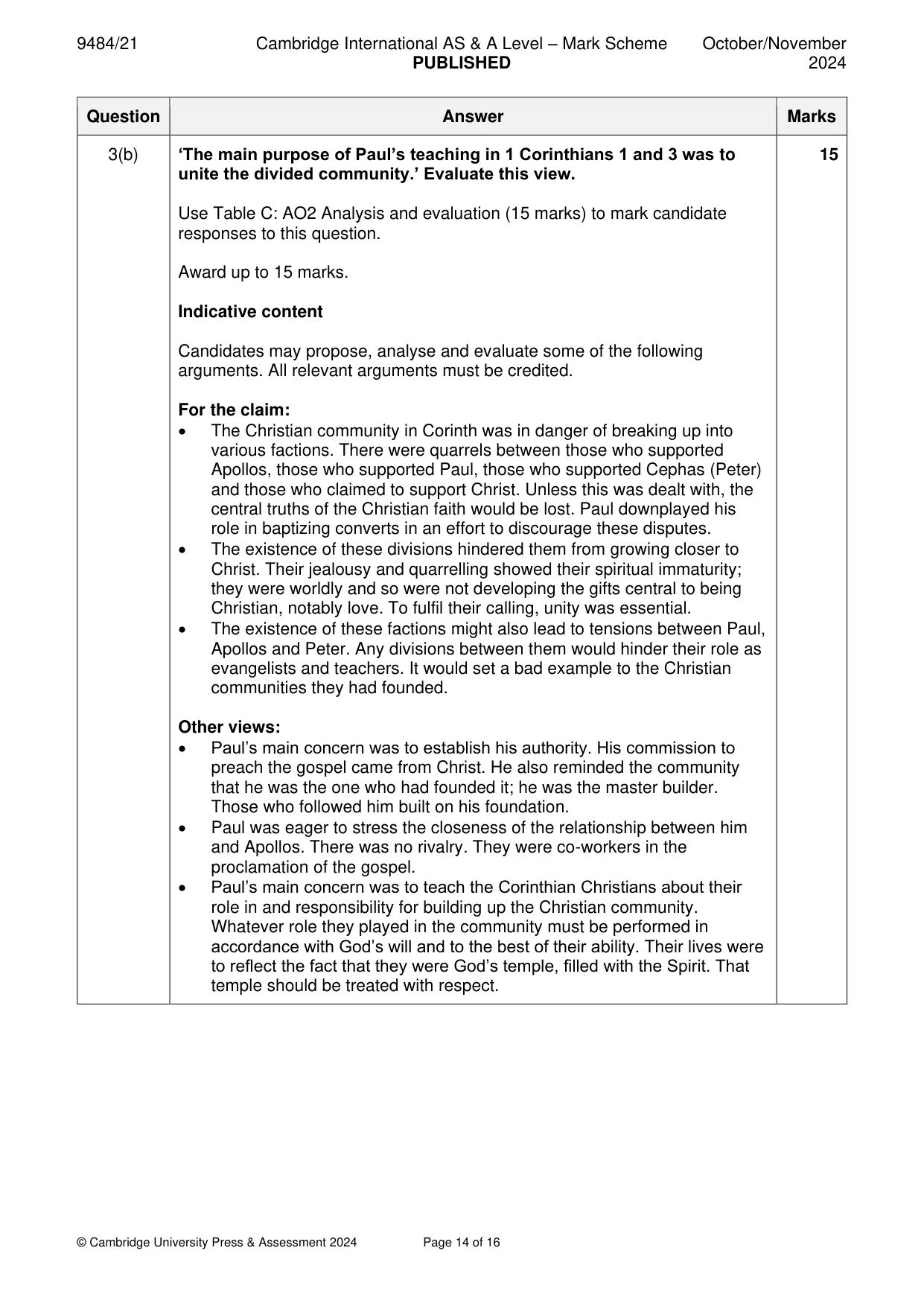
Mark scheme: 3(a) Examine Paul’s teaching in 1 Corinthians on the significance of the roles 10 of Paul and Apollos for the Corinthian Church. Use Table A: AO1 Knowledge and understanding (10 marks) to mark candidate responses to this question. Award up to 10 marks. Indicative content Answers may include some of the following ideas, but all relevant material must be credited. • The context was the squabbling among different factions in the Christian community as to whom they should support: Paul, Apollos, Cephas or Christ. Paul saw this as a sign of immaturity and justified the more basic level of his instruction in the past as having been required by their inability to cope with anything more spiritually challenging. • Paul was particularly concerned to put a stop to the rivalry between those who supported him and those who supported Apollos. Apollos was a Jew from Alexandria so was probably an expert in oratory and intellectual debate. He spent some time in Ephesus, but before Paul arrived at Ephesus, he went with a letter of commendation to Corinth, where he had a fruitful ministry. Apollos’ style of preaching apparently appealed to those of the Corinthian Church who prided themselves on their knowledge and wisdom. • Paul set out their roles, using the metaphors of agriculture and building. He was the founder of the community, planting the seed and laying the foundations. Apollos reinforced Paul’s work, watering the seed and building on the foundations. They were God’s fellow-workers, for it was God who was the source of the establishment and development of the Corinthian Church. Paul made it clear that there was no rivalry between him and Apollos. • Paul warned the community against building on the foundations with flawed materials. Their work would be subject to God’s judgement. He emphasised the seriousness of abandoning his teaching for something else, for to lead the community astray was to destroy God’s temple. They should seek the wisdom of God rather than the so-called wisdom of the world, which was empty. • At the start of chapter 4, he asserted that he and Apollos should be esteemed as God’s servants, who had been entrusted with special insight. Paul stated that the only judgement he was concerned with was that of God, and so the Corinthian Christians should not pass judgement. 3(b) ‘The main purpose of Paul’s teaching in 1 Corinthians 1 and 3 was to 15 unite the divided community.’ Evaluate this view. Use Table C: AO2 Analysis and evaluation (15 marks) to mark candidate responses to this question. Award up to 15 marks. Indicative content Candidates may propose, analyse and evaluate some of the following arguments. All relevant arguments must be credited. For the claim: • The Christian community in Corinth was in danger of breaking up into various factions. There were quarrels between those who supported Apollos, those who supported Paul, those who supported Cephas (Peter) and those who claimed to support Christ. Unless this was dealt with, the central truths of the Christian faith would be lost. Paul downplayed his role in baptizing converts in an effort to discourage these disputes. • The existence of these divisions hindered them from growing closer to Christ. Their jealousy and quarrelling showed their spiritual immaturity; they were worldly and so were not developing the gifts central to being Christian, notably love. To fulfil their calling, unity was essential. • The existence of these factions might also lead to tensions between Paul, Apollos and Peter. Any divisions between them would hinder their role as evangelists and teachers. It would set a bad example to the Christian communities they had founded. Other views: • Paul’s main concern was to establish his authority. His commission to preach the gospel came from Christ. He also reminded the community that he was the one who had founded it; he was the master builder. Those who followed him built on his foundation. • Paul was eager to stress the closeness of the relationship between him and Apollos. There was no rivalry. They were co-workers in the proclamation of the gospel. • Paul’s main concern was to teach the Corinthian Christians about their role in and responsibility for building up the Christian community. Whatever role they played in the community must be performed in accordance with God’s will and to the best of their ability. Their lives were to reflect the fact that they were God’s temple, filled with the Spirit. That temple should be treated with respect.
Q4 · Examine the account of Paul’s imprisonment in Philippi, ending with his departure from…
4 (a) Examine the account of Paul’s imprisonment in Philippi, ending with his departure from the city. [10] (b) Consider what was the most significant aspect of Paul’s ministry in Philippi. [15] [Total: 25]
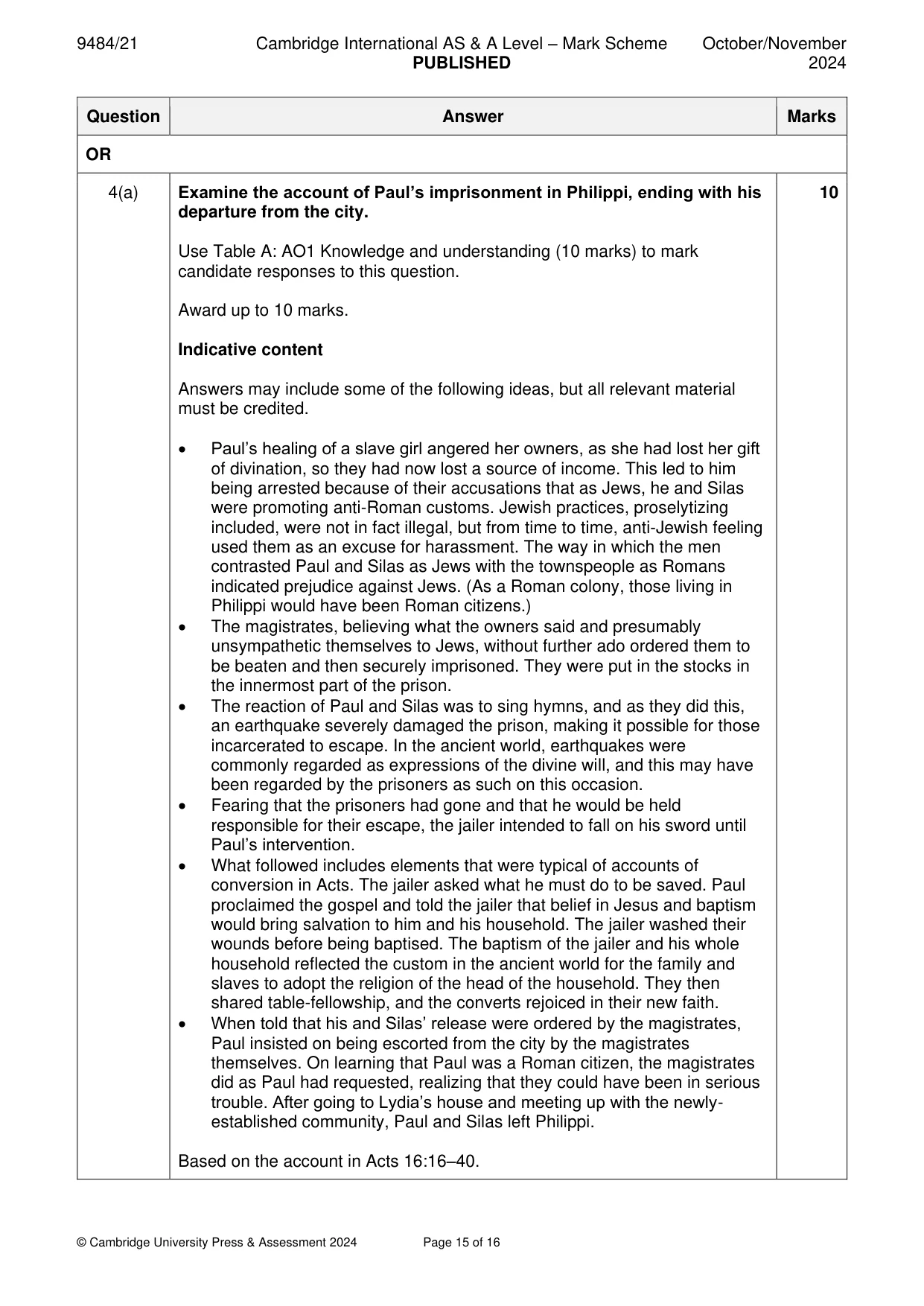
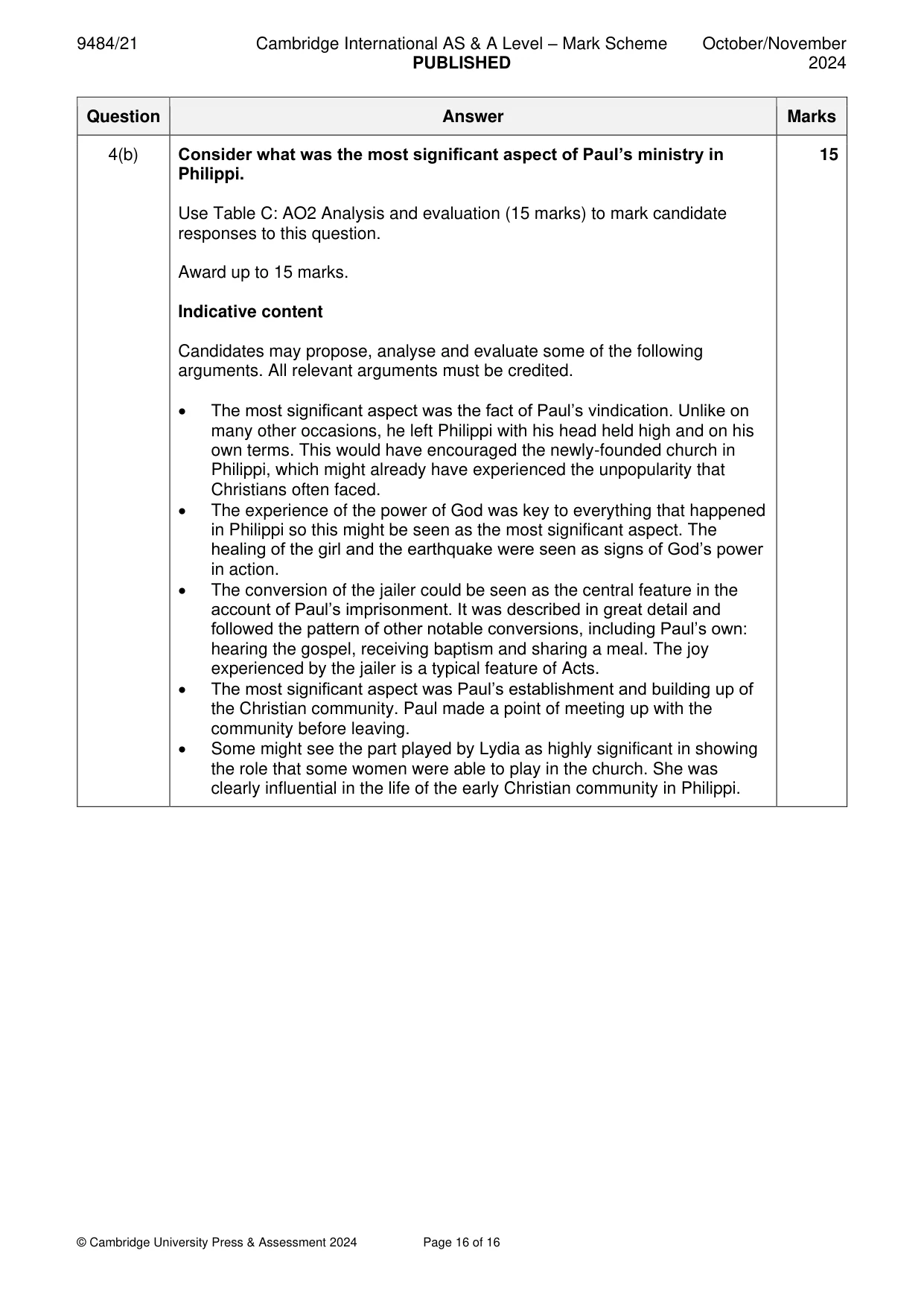
Mark scheme: 4(a) Examine the account of Paul’s imprisonment in Philippi, ending with his 10 departure from the city. Use Table A: AO1 Knowledge and understanding (10 marks) to mark candidate responses to this question. Award up to 10 marks. Indicative content Answers may include some of the following ideas, but all relevant material must be credited. • Paul’s healing of a slave girl angered her owners, as she had lost her gift of divination, so they had now lost a source of income. This led to him being arrested because of their accusations that as Jews, he and Silas were promoting anti-Roman customs. Jewish practices, proselytizing included, were not in fact illegal, but from time to time, anti-Jewish feeling used them as an excuse for harassment. The way in which the men contrasted Paul and Silas as Jews with the townspeople as Romans indicated prejudice against Jews. (As a Roman colony, those living in Philippi would have been Roman citizens.) • The magistrates, believing what the owners said and presumably unsympathetic themselves to Jews, without further ado ordered them to be beaten and then securely imprisoned. They were put in the stocks in the innermost part of the prison. • The reaction of Paul and Silas was to sing hymns, and as they did this, an earthquake severely damaged the prison, making it possible for those incarcerated to escape. In the ancient world, earthquakes were commonly regarded as expressions of the divine will, and this may have been regarded by the prisoners as such on this occasion. • Fearing that the prisoners had gone and that he would be held responsible for their escape, the jailer intended to fall on his sword until Paul’s intervention. • What followed includes elements that were typical of accounts of conversion in Acts. The jailer asked what he must do to be saved. Paul proclaimed the gospel and told the jailer that belief in Jesus and baptism would bring salvation to him and his household. The jailer washed their wounds before being baptised. The baptism of the jailer and his whole household reflected the custom in the ancient world for the family and slaves to adopt the religion of the head of the household. They then shared table-fellowship, and the converts rejoiced in their new faith. • When told that his and Silas’ release were ordered by the magistrates, Paul insisted on being escorted from the city by the magistrates themselves. On learning that Paul was a Roman citizen, the magistrates did as Paul had requested, realizing that they could have been in serious trouble. After going to Lydia’s house and meeting up with the newly- established community, Paul and Silas left Philippi. Based on the account in Acts 16:16–40. 4(b) Consider what was the most significant aspect of Paul’s ministry in 15 Philippi. Use Table C: AO2 Analysis and evaluation (15 marks) to mark candidate responses to this question. Award up to 15 marks. Indicative content Candidates may propose, analyse and evaluate some of the following arguments. All relevant arguments must be credited. • The most significant aspect was the fact of Paul’s vindication. Unlike on many other occasions, he left Philippi with his head held high and on his own terms. This would have encouraged the newly-founded church in Philippi, which might already have experienced the unpopularity that Christians often faced. • The experience of the power of God was key to everything that happened in Philippi so this might be seen as the most significant aspect. The healing of the girl and the earthquake were seen as signs of God’s power in action. • The conversion of the jailer could be seen as the central feature in the account of Paul’s imprisonment. It was described in great detail and followed the pattern of other notable conversions, including Paul’s own: hearing the gospel, receiving baptism and sharing a meal. The joy experienced by the jailer is a typical feature of Acts. • The most significant aspect was Paul’s establishment and building up of the Christian community. Paul made a point of meeting up with the community before leaving. • Some might see the part played by Lydia as highly significant in showing the role that some women were able to play in the church. She was clearly influential in the life of the early Christian community in Philippi.
What was in this paper
The subtopics covered by these 4 questions, and how many questions each got. Open one in a new tab to see every Cambridge question on it.
What you needed in this session
Cambridge’s own grade thresholds for 2024 Oct/Nov, Paper 2 · Variant 1. A higher threshold means an easier paper — the bar moves with how the cohort did.