Cambridge A Level Biblical Studies 9484 — 2024 Oct/Nov Paper 1 · Variant 3
9484/13/O/N/24 · 50 marks · 90 min
The question paper and its mark scheme, free to read here and free to download. This is Cambridge’s own paper, exactly as it was sat.
Question paper4 pages

Mark scheme19 pages
Answers below. Sit the paper first if you are practising.
Paper as text
Question paper, page 1
[Turn over Cambridge International AS & A Level This document has 4 pages. Any blank pages are indicated. * 0 4 4 2 2 2 3 1 0 0 * DC (EV) 349816 © UCLES 2024 BIBLICAL STUDIES 9484/13 Paper 1 The Four Gospels October/November 2024 1 hour 30 minutes You must answer on the enclosed answer booklet. You will need: Answer booklet (enclosed) INSTRUCTIONS ● Answer five questions in total: Section A: answer three questions. Section B: answer Question 5. Section C: answer one question. ● Follow the instructions on the front cover of the answer booklet. If you need additional answer paper, ask the invigilator for a continuation booklet. INFORMATION ● The total mark for this paper is 50. ● The number of marks for each question or part question is shown in brackets [ ].
Question paper, page 2
2 9484/13/O/N/24 © UCLES 2024 Section A Answer three of the following four questions. Answers should refer to the context of the passage wherever possible. Answers should not retell the story from which the passage is taken. 1 Outline points of interest or difficulty in the following passage. Matthew 9:32–34, NRSVA After they had gone away, a demoniac who was mute was brought to him. And when the demon had been cast out, the one who had been mute spoke; and the crowds were amazed and said, ‘Never has anything like this been seen in Israel.’ But the Pharisees said, ‘By the ruler of the demons he casts out the demons.’ [5] 2 Outline points of interest or difficulty in the following passage. Luke 2:8–11, NRSVA In that region there were shepherds living in the fields, keeping watch over their flock by night. Then an angel of the Lord stood before them, and the glory of the Lord shone around them, and they were terrified. But the angel said to them, ‘Do not be afraid; for see—I am bringing you good news of great joy for all the people: to you is born this day in the city of David a Saviour, who is the Messiah, the Lord.’ [5] 3 Outline points of interest or difficulty in the following passage. Luke 15:8–10, NRSVA ‘Or what woman having ten silver coins, if she loses one of them, does not light a lamp, sweep the house, and search carefully until she finds it? When she has found it, she calls together her friends and neighbours, saying, “Rejoice with me, for I have found the coin that I had lost.” Just so, I tell you, there is joy in the presence of the angels of God over one sinner who repents.’ [5] 4 Outline points of interest or difficulty in the following passage. John 2:13–16, NRSVA The Passover of the Jews was near, and Jesus went up to Jerusalem. In the temple he found people selling cattle, sheep, and doves, and the money-changers seated at their tables. Making a whip of cords, he drove all of them out of the temple, both the sheep and the cattle. He also poured out the coins of the money-changers and overturned their tables. He told those who were selling the doves, ‘Take these things out of here! Stop making my Father’s house a market-place!’ [5]
Question paper, page 3
3 9484/13/O/N/24 © UCLES 2024 Section B Answer Question 5. 5 Read the following passage and then answer the question below: John 1:6–9, 14–15, NRSVA There was a man sent from God, whose name was John. He came as a witness to testify to the light, so that all might believe through him. He himself was not the light, but he came to testify to the light. The true light, which enlightens everyone, was coming into the world… …And the Word became flesh and lived among us, and we have seen his glory, the glory as of a father’s only son, full of grace and truth. (John testified to him and cried out, ‘This was he of whom I said, “He who comes after me ranks ahead of me because he was before me.”’) ‘John the Baptist successfully prepared the way for the Messiah.’ Assess the truth of this statement. Refer to the passage above and other passages you have studied. [10] Section C Answer EITHER Question 6 OR Question 7. EITHER 6 (a) Examine the concept of the kingdom as given in the Sermon on the Mount in Matthew. [10] (b) ‘The kingdom of God has come near to you.’ (Luke 10:9b) Discuss this statement. Refer to other passages you have studied. [15] OR 7 (a) Compare the accounts of Jesus’ Last Supper in the Gospels of Luke and John. [10] (b) Analyse the part played by the disciples in the events between the Last Supper and the crucifixion. [15] [Total: 25]
Question paper, page 4
4 9484/13/O/N/24 © UCLES 2024 Permission to reproduce items where third-party owned material protected by copyright is included has been sought and cleared where possible. Every reasonable effort has been made by the publisher (UCLES) to trace copyright holders, but if any items requiring clearance have unwittingly been included, the publisher will be pleased to make amends at the earliest possible opportunity. To avoid the issue of disclosure of answer-related information to candidates, all copyright acknowledgements are reproduced online in the Cambridge Assessment International Education Copyright Acknowledgements Booklet. This is produced for each series of examinations and is freely available to download at www.cambridgeinternational.org after the live examination series. Cambridge Assessment International Education is part of Cambridge Assessment. Cambridge Assessment is the brand name of the University of Cambridge Local Examinations Syndicate (UCLES), which is a department of the University of Cambridge. BLANK PAGE
Mark scheme, page 1
This document consists of 19 printed pages. © Cambridge University Press & Assessment 2024 [Turn over Cambridge International AS & A Level BIBLICAL STUDIES 9484/13 Paper 1 The Four Gospels October/November 2024 MARK SCHEME Maximum Mark: 50 Published This mark scheme is published as an aid to teachers and candidates, to indicate the requirements of the examination. It shows the basis on which Examiners were instructed to award marks. It does not indicate the details of the discussions that took place at an Examiners’ meeting before marking began, which would have considered the acceptability of alternative answers. Mark schemes should be read in conjunction with the question paper and the Principal Examiner Report for Teachers. Cambridge International will not enter into discussions about these mark schemes. Cambridge International is publishing the mark schemes for the October/November 2024 series for most Cambridge IGCSE, Cambridge International A and AS Level components, and some Cambridge O Level components.
Mark scheme, page 2
9484/13 Cambridge International AS & A Level – Mark Scheme PUBLISHED October/November 2024 © Cambridge University Press & Assessment 2024 Page 2 of 19 Generic Marking Principles These general marking principles must be applied by all examiners when marking candidate answers. They should be applied alongside the specific content of the mark scheme or generic level descriptions for a question. Each question paper and mark scheme will also comply with these marking principles. GENERIC MARKING PRINCIPLE 1: Marks must be awarded in line with: • the specific content of the mark scheme or the generic level descriptors for the question • the specific skills defined in the mark scheme or in the generic level descriptors for the question • the standard of response required by a candidate as exemplified by the standardisation scripts. GENERIC MARKING PRINCIPLE 2: Marks awarded are always whole marks (not half marks, or other fractions). GENERIC MARKING PRINCIPLE 3: Marks must be awarded positively: • marks are awarded for correct/valid answers, as defined in the mark scheme. However, credit is given for valid answers which go beyond the scope of the syllabus and mark scheme, referring to your Team Leader as appropriate • marks are awarded when candidates clearly demonstrate what they know and can do • marks are not deducted for errors • marks are not deducted for omissions • answers should only be judged on the quality of spelling, punctuation and grammar when these features are specifically assessed by the question as indicated by the mark scheme. The meaning, however, should be unambiguous. GENERIC MARKING PRINCIPLE 4: Rules must be applied consistently, e.g. in situations where candidates have not followed instructions or in the application of generic level descriptors. GENERIC MARKING PRINCIPLE 5: Marks should be awarded using the full range of marks defined in the mark scheme for the question (however; the use of the full mark range may be limited according to the quality of the candidate responses seen). GENERIC MARKING PRINCIPLE 6: Marks awarded are based solely on the requirements as defined in the mark scheme. Marks should not be awarded with grade thresholds or grade descriptors in mind.
Mark scheme, page 3
9484/13 Cambridge International AS & A Level – Mark Scheme PUBLISHED October/November 2024 © Cambridge University Press & Assessment 2024 Page 3 of 19 Guidance on using levels-based mark schemes Marking of work should be positive, rewarding achievement where possible, but clearly differentiating across the whole range of marks, where appropriate. The marker should look at the work and then make a judgement about which level statement is the best fit. In practice, work does not always match one level statement precisely so a judgement may need to be made between two or more level statements. Once a best-fit level statement has been identified, use the following guidance to decide on a specific mark: • If the candidate’s work convincingly meets the level statement, award the highest mark. • If the candidate’s work adequately meets the level statement, award the most appropriate mark in the middle of the range (where middle marks are available). • If the candidate’s work just meets the level statement, award the lowest mark. Annotation: • For levels of response marking, the level awarded should be annotated on the script. • Ticks have no defined meaning for levels of response marking. • Other annotations will be used by examiners as agreed during standardisation, and the meaning will be understood by all examiners who marked that paper. Assessment objectives AO1 Knowledge and understanding Demonstrate knowledge and understanding of specified texts and Christian teachings, beliefs and practices as recorded in the Bible. AO2 Analysis and evaluation Analyse, evaluate and discuss evidence, points of view and issues in Christianity.
Mark scheme, page 4
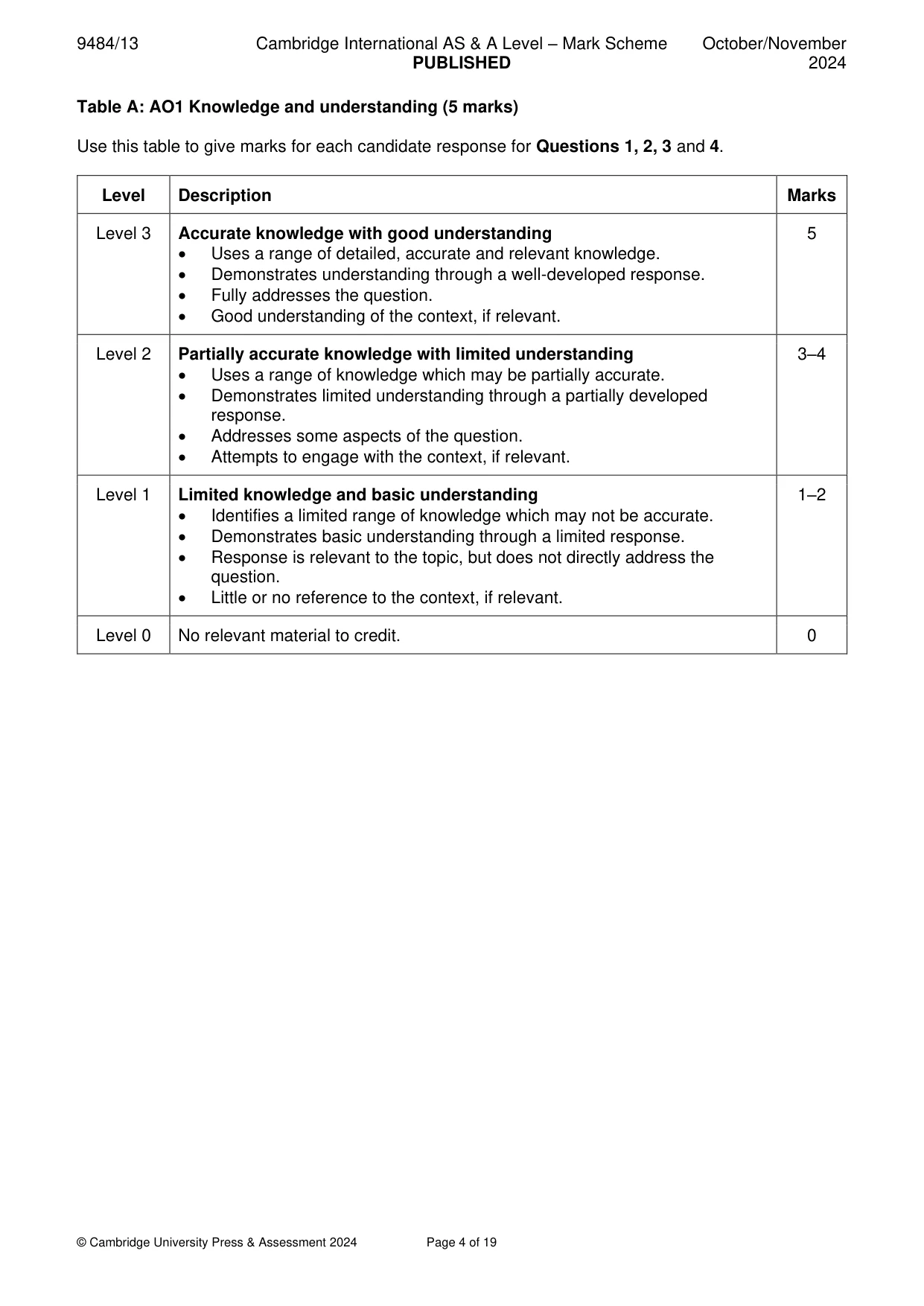
9484/13 Cambridge International AS & A Level – Mark Scheme PUBLISHED October/November 2024 © Cambridge University Press & Assessment 2024 Page 4 of 19 Table A: AO1 Knowledge and understanding (5 marks) Use this table to give marks for each candidate response for Questions 1, 2, 3 and 4. Level Description Marks Level 3 Accurate knowledge with good understanding • Uses a range of detailed, accurate and relevant knowledge. • Demonstrates understanding through a well-developed response. • Fully addresses the question. • Good understanding of the context, if relevant. 5 Level 2 Partially accurate knowledge with limited understanding • Uses a range of knowledge which may be partially accurate. • Demonstrates limited understanding through a partially developed response. • Addresses some aspects of the question. • Attempts to engage with the context, if relevant. 3–4 Level 1 Limited knowledge and basic understanding • Identifies a limited range of knowledge which may not be accurate. • Demonstrates basic understanding through a limited response. • Response is relevant to the topic, but does not directly address the question. • Little or no reference to the context, if relevant. 1–2 Level 0 No relevant material to credit. 0
Mark scheme, page 5
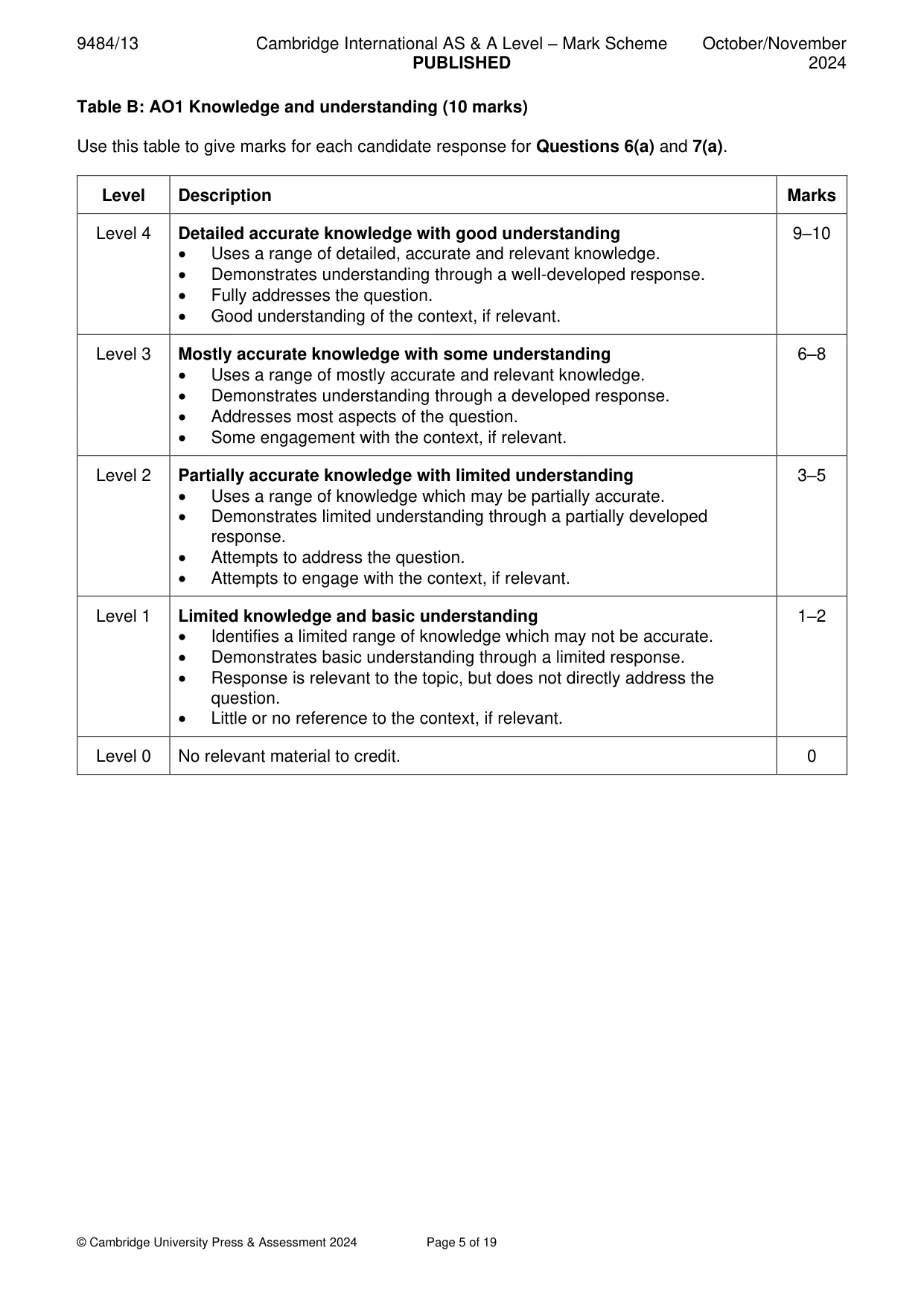
9484/13 Cambridge International AS & A Level – Mark Scheme PUBLISHED October/November 2024 © Cambridge University Press & Assessment 2024 Page 5 of 19 Table B: AO1 Knowledge and understanding (10 marks) Use this table to give marks for each candidate response for Questions 6(a) and 7(a). Level Description Marks Level 4 Detailed accurate knowledge with good understanding • Uses a range of detailed, accurate and relevant knowledge. • Demonstrates understanding through a well-developed response. • Fully addresses the question. • Good understanding of the context, if relevant. 9–10 Level 3 Mostly accurate knowledge with some understanding • Uses a range of mostly accurate and relevant knowledge. • Demonstrates understanding through a developed response. • Addresses most aspects of the question. • Some engagement with the context, if relevant. 6–8 Level 2 Partially accurate knowledge with limited understanding • Uses a range of knowledge which may be partially accurate. • Demonstrates limited understanding through a partially developed response. • Attempts to address the question. • Attempts to engage with the context, if relevant. 3–5 Level 1 Limited knowledge and basic understanding • Identifies a limited range of knowledge which may not be accurate. • Demonstrates basic understanding through a limited response. • Response is relevant to the topic, but does not directly address the question. • Little or no reference to the context, if relevant. 1–2 Level 0 No relevant material to credit. 0
Mark scheme, page 6
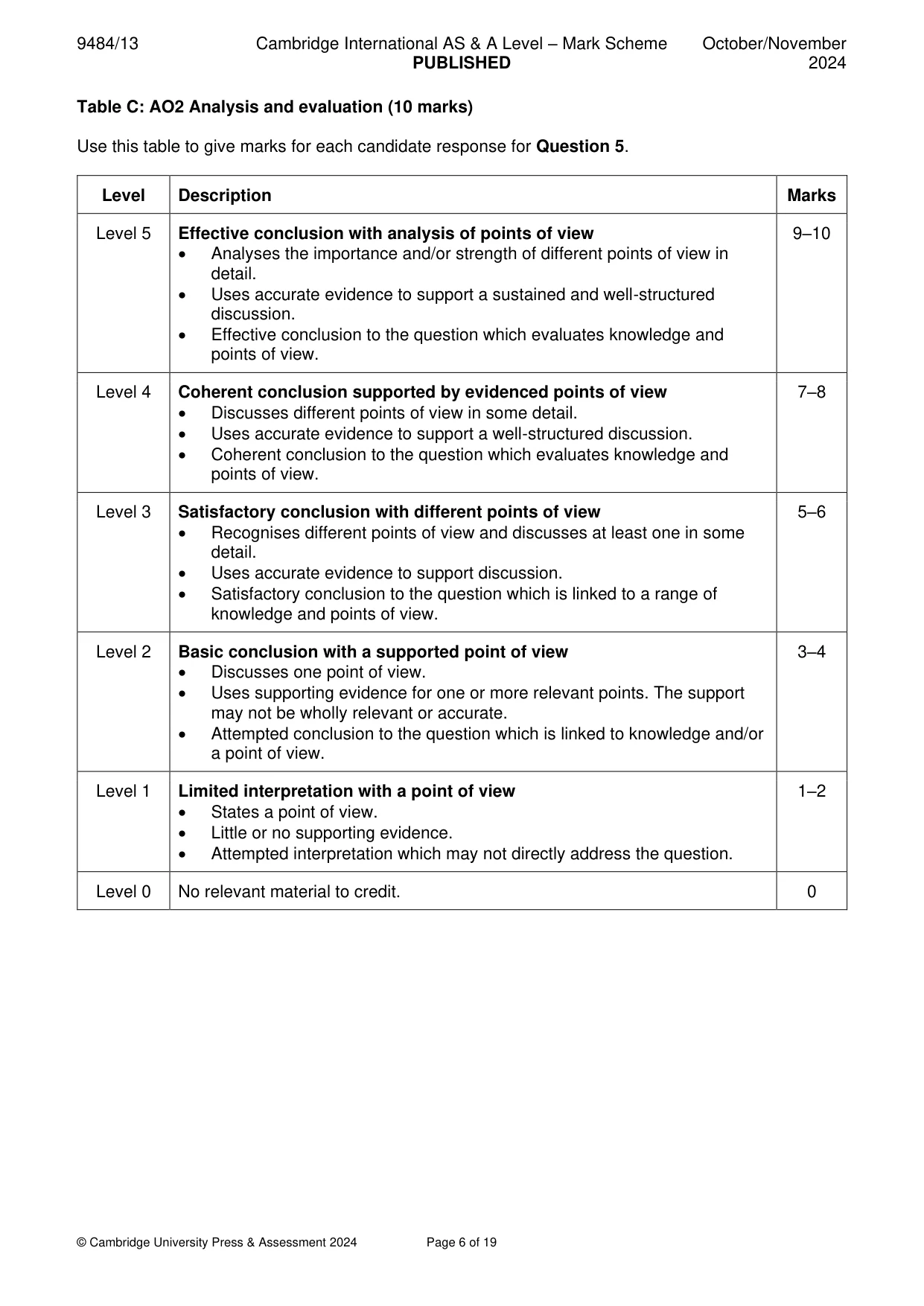
9484/13 Cambridge International AS & A Level – Mark Scheme PUBLISHED October/November 2024 © Cambridge University Press & Assessment 2024 Page 6 of 19 Table C: AO2 Analysis and evaluation (10 marks) Use this table to give marks for each candidate response for Question 5. Level Description Marks Level 5 Effective conclusion with analysis of points of view • Analyses the importance and/or strength of different points of view in detail. • Uses accurate evidence to support a sustained and well-structured discussion. • Effective conclusion to the question which evaluates knowledge and points of view. 9–10 Level 4 Coherent conclusion supported by evidenced points of view • Discusses different points of view in some detail. • Uses accurate evidence to support a well-structured discussion. • Coherent conclusion to the question which evaluates knowledge and points of view. 7–8 Level 3 Satisfactory conclusion with different points of view • Recognises different points of view and discusses at least one in some detail. • Uses accurate evidence to support discussion. • Satisfactory conclusion to the question which is linked to a range of knowledge and points of view. 5–6 Level 2 Basic conclusion with a supported point of view • Discusses one point of view. • Uses supporting evidence for one or more relevant points. The support may not be wholly relevant or accurate. • Attempted conclusion to the question which is linked to knowledge and/or a point of view. 3–4 Level 1 Limited interpretation with a point of view • States a point of view. • Little or no supporting evidence. • Attempted interpretation which may not directly address the question. 1–2 Level 0 No relevant material to credit. 0
Mark scheme, page 7
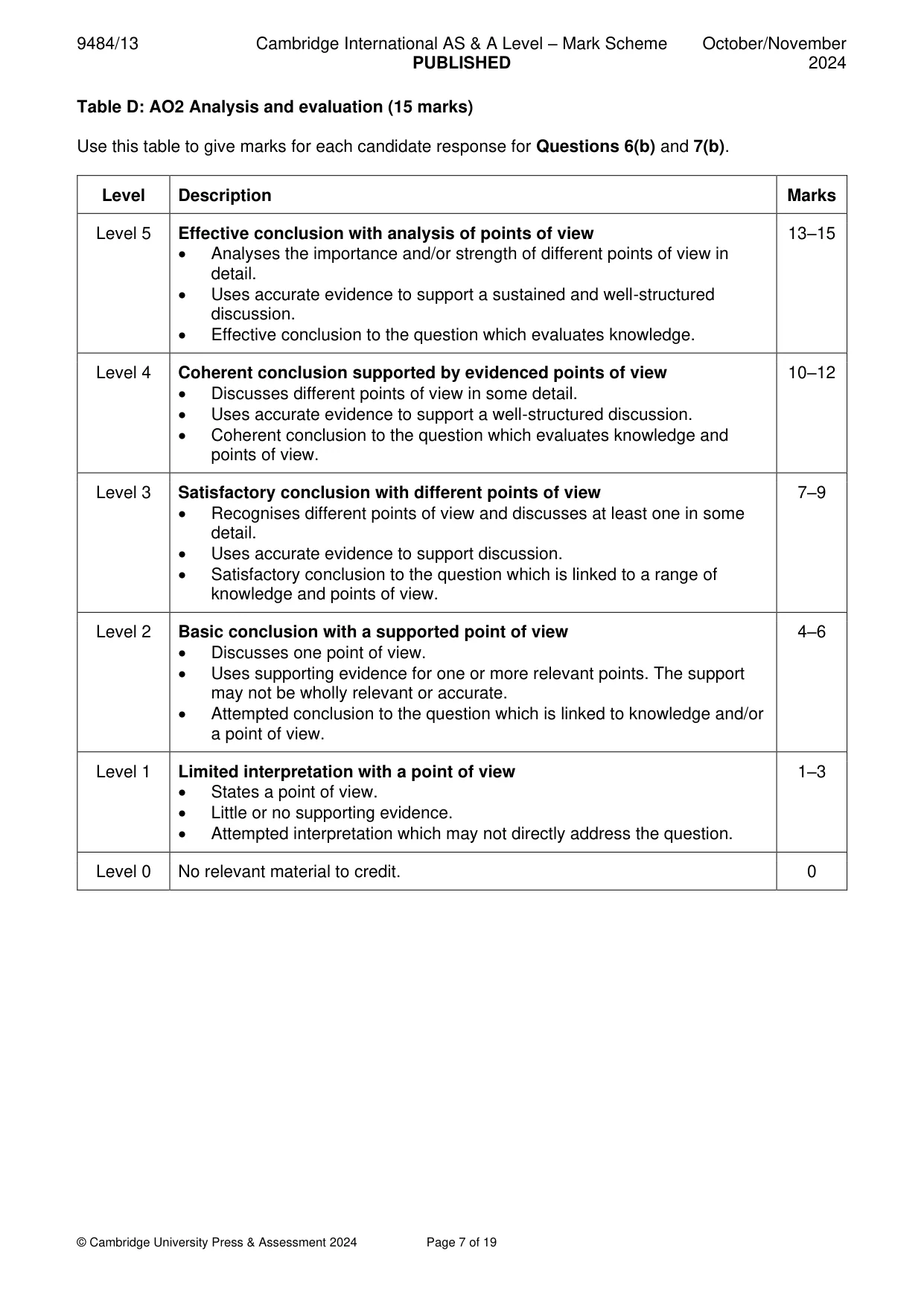
9484/13 Cambridge International AS & A Level – Mark Scheme PUBLISHED October/November 2024 © Cambridge University Press & Assessment 2024 Page 7 of 19 Table D: AO2 Analysis and evaluation (15 marks) Use this table to give marks for each candidate response for Questions 6(b) and 7(b). Level Description Marks Level 5 Effective conclusion with analysis of points of view • Analyses the importance and/or strength of different points of view in detail. • Uses accurate evidence to support a sustained and well-structured discussion. • Effective conclusion to the question which evaluates knowledge. 13–15 Level 4 Coherent conclusion supported by evidenced points of view • Discusses different points of view in some detail. • Uses accurate evidence to support a well-structured discussion. • Coherent conclusion to the question which evaluates knowledge and points of view. 10–12 Level 3 Satisfactory conclusion with different points of view • Recognises different points of view and discusses at least one in some detail. • Uses accurate evidence to support discussion. • Satisfactory conclusion to the question which is linked to a range of knowledge and points of view. 7–9 Level 2 Basic conclusion with a supported point of view • Discusses one point of view. • Uses supporting evidence for one or more relevant points. The support may not be wholly relevant or accurate. • Attempted conclusion to the question which is linked to knowledge and/or a point of view. 4–6 Level 1 Limited interpretation with a point of view • States a point of view. • Little or no supporting evidence. • Attempted interpretation which may not directly address the question. 1–3 Level 0 No relevant material to credit. 0
Mark scheme, page 8
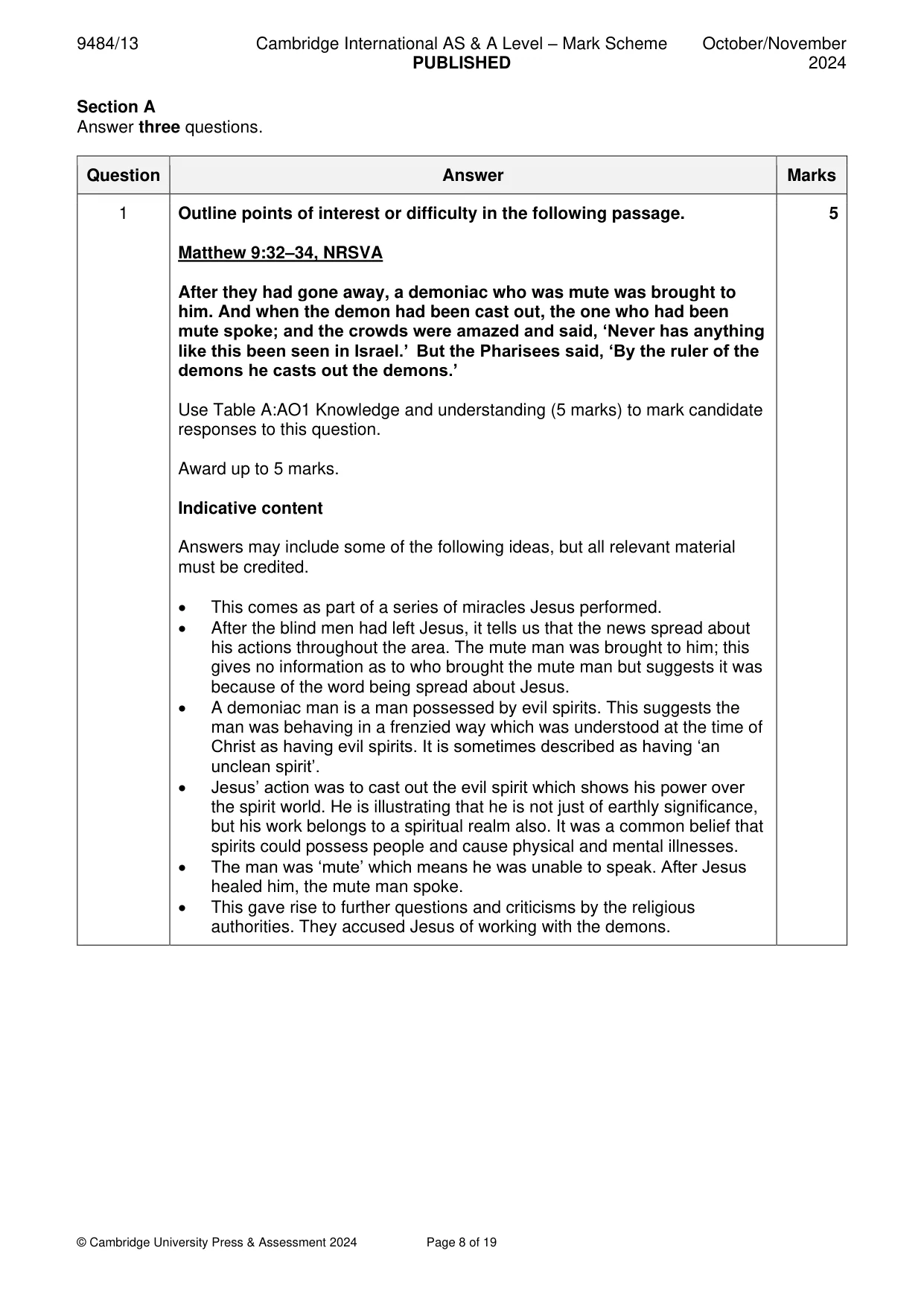
9484/13 Cambridge International AS & A Level – Mark Scheme PUBLISHED October/November 2024 © Cambridge University Press & Assessment 2024 Page 8 of 19 Section A Answer three questions. Question Answer Marks 1 Outline points of interest or difficulty in the following passage. Matthew 9:32–34, NRSVA After they had gone away, a demoniac who was mute was brought to him. And when the demon had been cast out, the one who had been mute spoke; and the crowds were amazed and said, ‘Never has anything like this been seen in Israel.’ But the Pharisees said, ‘By the ruler of the demons he casts out the demons.’ Use Table A:AO1 Knowledge and understanding (5 marks) to mark candidate responses to this question. Award up to 5 marks. Indicative content Answers may include some of the following ideas, but all relevant material must be credited. • This comes as part of a series of miracles Jesus performed. • After the blind men had left Jesus, it tells us that the news spread about his actions throughout the area. The mute man was brought to him; this gives no information as to who brought the mute man but suggests it was because of the word being spread about Jesus. • A demoniac man is a man possessed by evil spirits. This suggests the man was behaving in a frenzied way which was understood at the time of Christ as having evil spirits. It is sometimes described as having ‘an unclean spirit’. • Jesus’ action was to cast out the evil spirit which shows his power over the spirit world. He is illustrating that he is not just of earthly significance, but his work belongs to a spiritual realm also. It was a common belief that spirits could possess people and cause physical and mental illnesses. • The man was ‘mute’ which means he was unable to speak. After Jesus healed him, the mute man spoke. • This gave rise to further questions and criticisms by the religious authorities. They accused Jesus of working with the demons. 5
Mark scheme, page 9
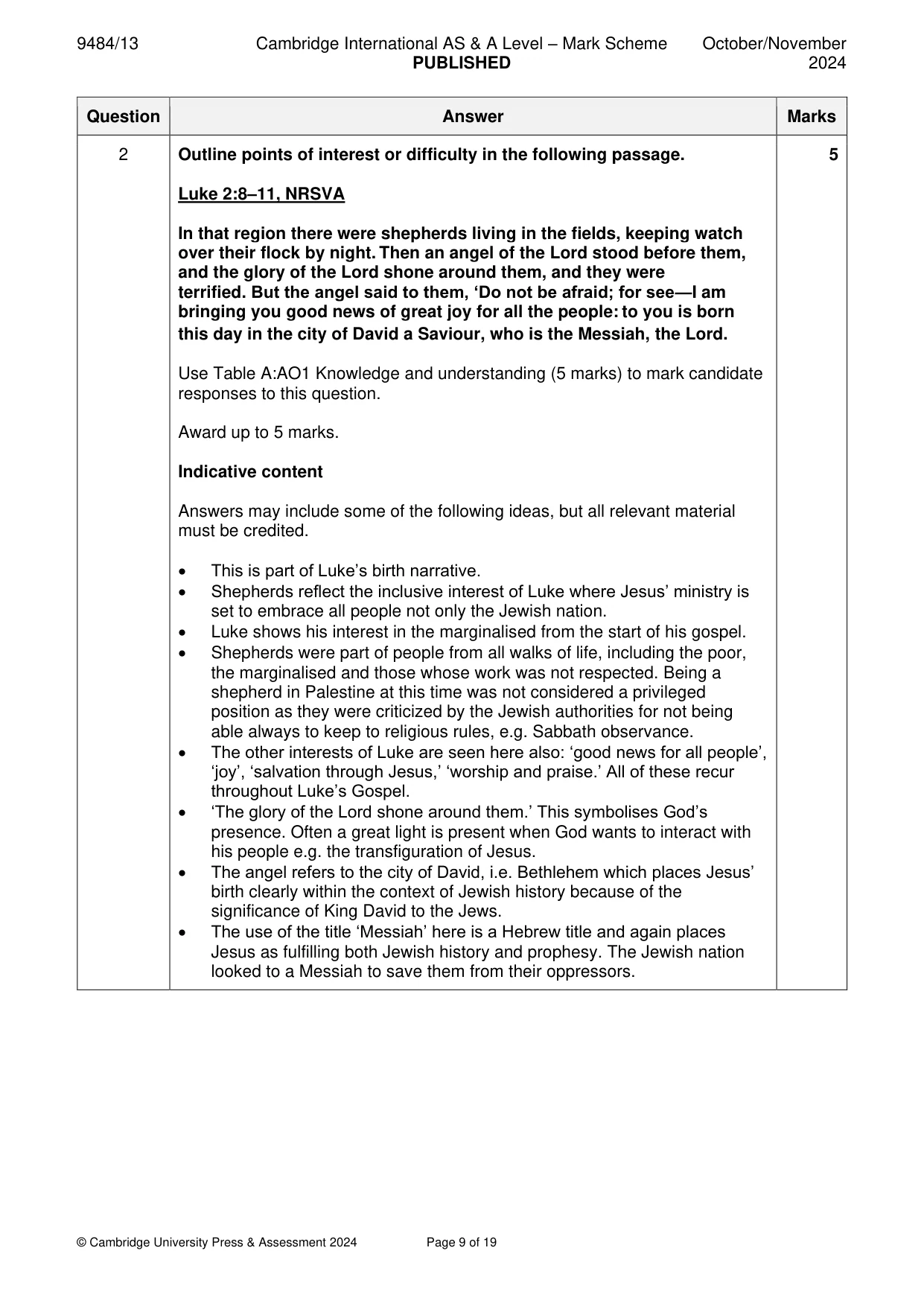
9484/13 Cambridge International AS & A Level – Mark Scheme PUBLISHED October/November 2024 © Cambridge University Press & Assessment 2024 Page 9 of 19 Question Answer Marks 2 Outline points of interest or difficulty in the following passage. Luke 2:8–11, NRSVA In that region there were shepherds living in the fields, keeping watch over their flock by night. Then an angel of the Lord stood before them, and the glory of the Lord shone around them, and they were terrified. But the angel said to them, ‘Do not be afraid; for see—I am bringing you good news of great joy for all the people: to you is born this day in the city of David a Saviour, who is the Messiah, the Lord. Use Table A:AO1 Knowledge and understanding (5 marks) to mark candidate responses to this question. Award up to 5 marks. Indicative content Answers may include some of the following ideas, but all relevant material must be credited. • This is part of Luke’s birth narrative. • Shepherds reflect the inclusive interest of Luke where Jesus’ ministry is set to embrace all people not only the Jewish nation. • Luke shows his interest in the marginalised from the start of his gospel. • Shepherds were part of people from all walks of life, including the poor, the marginalised and those whose work was not respected. Being a shepherd in Palestine at this time was not considered a privileged position as they were criticized by the Jewish authorities for not being able always to keep to religious rules, e.g. Sabbath observance. • The other interests of Luke are seen here also: ‘good news for all people’, ‘joy’, ‘salvation through Jesus,’ ‘worship and praise.’ All of these recur throughout Luke’s Gospel. • ‘The glory of the Lord shone around them.’ This symbolises God’s presence. Often a great light is present when God wants to interact with his people e.g. the transfiguration of Jesus. • The angel refers to the city of David, i.e. Bethlehem which places Jesus’ birth clearly within the context of Jewish history because of the significance of King David to the Jews. • The use of the title ‘Messiah’ here is a Hebrew title and again places Jesus as fulfilling both Jewish history and prophesy. The Jewish nation looked to a Messiah to save them from their oppressors. 5
Mark scheme, page 10
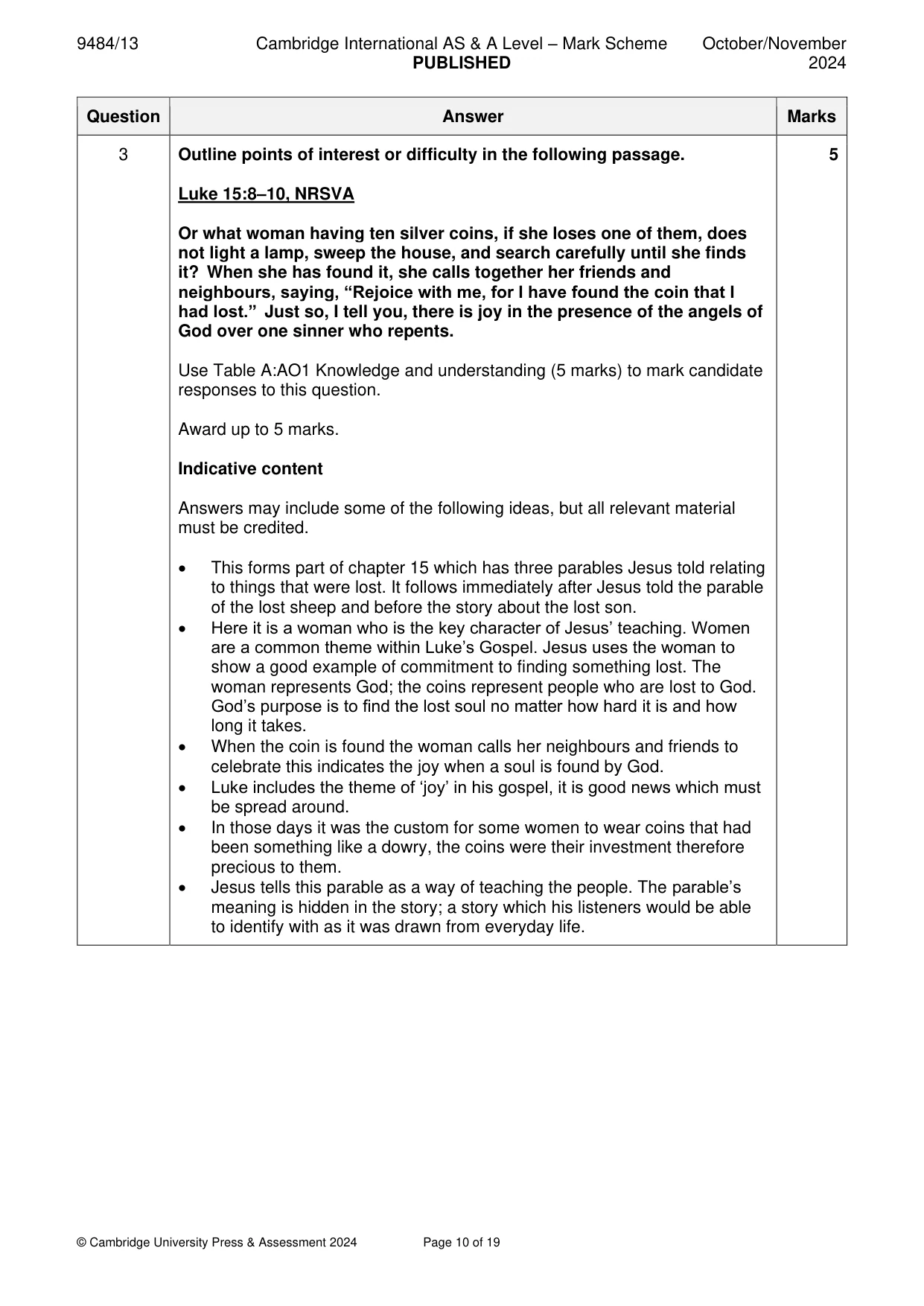
9484/13 Cambridge International AS & A Level – Mark Scheme PUBLISHED October/November 2024 © Cambridge University Press & Assessment 2024 Page 10 of 19 Question Answer Marks 3 Outline points of interest or difficulty in the following passage. Luke 15:8–10, NRSVA Or what woman having ten silver coins, if she loses one of them, does not light a lamp, sweep the house, and search carefully until she finds it? When she has found it, she calls together her friends and neighbours, saying, “Rejoice with me, for I have found the coin that I had lost.” Just so, I tell you, there is joy in the presence of the angels of God over one sinner who repents. Use Table A:AO1 Knowledge and understanding (5 marks) to mark candidate responses to this question. Award up to 5 marks. Indicative content Answers may include some of the following ideas, but all relevant material must be credited. • This forms part of chapter 15 which has three parables Jesus told relating to things that were lost. It follows immediately after Jesus told the parable of the lost sheep and before the story about the lost son. • Here it is a woman who is the key character of Jesus’ teaching. Women are a common theme within Luke’s Gospel. Jesus uses the woman to show a good example of commitment to finding something lost. The woman represents God; the coins represent people who are lost to God. God’s purpose is to find the lost soul no matter how hard it is and how long it takes. • When the coin is found the woman calls her neighbours and friends to celebrate this indicates the joy when a soul is found by God. • Luke includes the theme of ‘joy’ in his gospel, it is good news which must be spread around. • In those days it was the custom for some women to wear coins that had been something like a dowry, the coins were their investment therefore precious to them. • Jesus tells this parable as a way of teaching the people. The parable’s meaning is hidden in the story; a story which his listeners would be able to identify with as it was drawn from everyday life. 5
Mark scheme, page 11
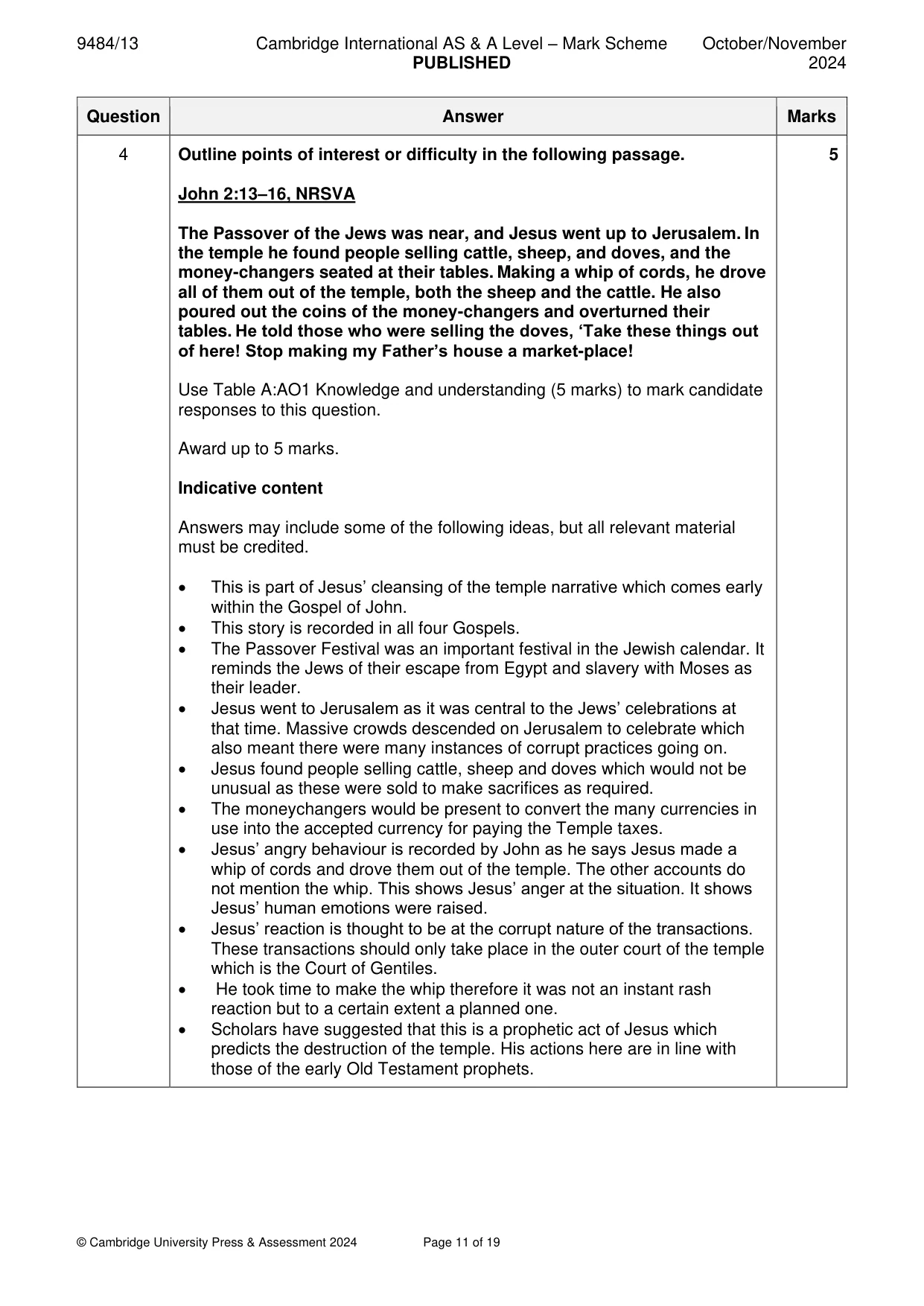
9484/13 Cambridge International AS & A Level – Mark Scheme PUBLISHED October/November 2024 © Cambridge University Press & Assessment 2024 Page 11 of 19 Question Answer Marks 4 Outline points of interest or difficulty in the following passage. John 2:13–16, NRSVA The Passover of the Jews was near, and Jesus went up to Jerusalem. In the temple he found people selling cattle, sheep, and doves, and the money-changers seated at their tables. Making a whip of cords, he drove all of them out of the temple, both the sheep and the cattle. He also poured out the coins of the money-changers and overturned their tables. He told those who were selling the doves, ‘Take these things out of here! Stop making my Father’s house a market-place! Use Table A:AO1 Knowledge and understanding (5 marks) to mark candidate responses to this question. Award up to 5 marks. Indicative content Answers may include some of the following ideas, but all relevant material must be credited. • This is part of Jesus’ cleansing of the temple narrative which comes early within the Gospel of John. • This story is recorded in all four Gospels. • The Passover Festival was an important festival in the Jewish calendar. It reminds the Jews of their escape from Egypt and slavery with Moses as their leader. • Jesus went to Jerusalem as it was central to the Jews’ celebrations at that time. Massive crowds descended on Jerusalem to celebrate which also meant there were many instances of corrupt practices going on. • Jesus found people selling cattle, sheep and doves which would not be unusual as these were sold to make sacrifices as required. • The moneychangers would be present to convert the many currencies in use into the accepted currency for paying the Temple taxes. • Jesus’ angry behaviour is recorded by John as he says Jesus made a whip of cords and drove them out of the temple. The other accounts do not mention the whip. This shows Jesus’ anger at the situation. It shows Jesus’ human emotions were raised. • Jesus’ reaction is thought to be at the corrupt nature of the transactions. These transactions should only take place in the outer court of the temple which is the Court of Gentiles. • He took time to make the whip therefore it was not an instant rash reaction but to a certain extent a planned one. • Scholars have suggested that this is a prophetic act of Jesus which predicts the destruction of the temple. His actions here are in line with those of the early Old Testament prophets. 5
Mark scheme, page 12
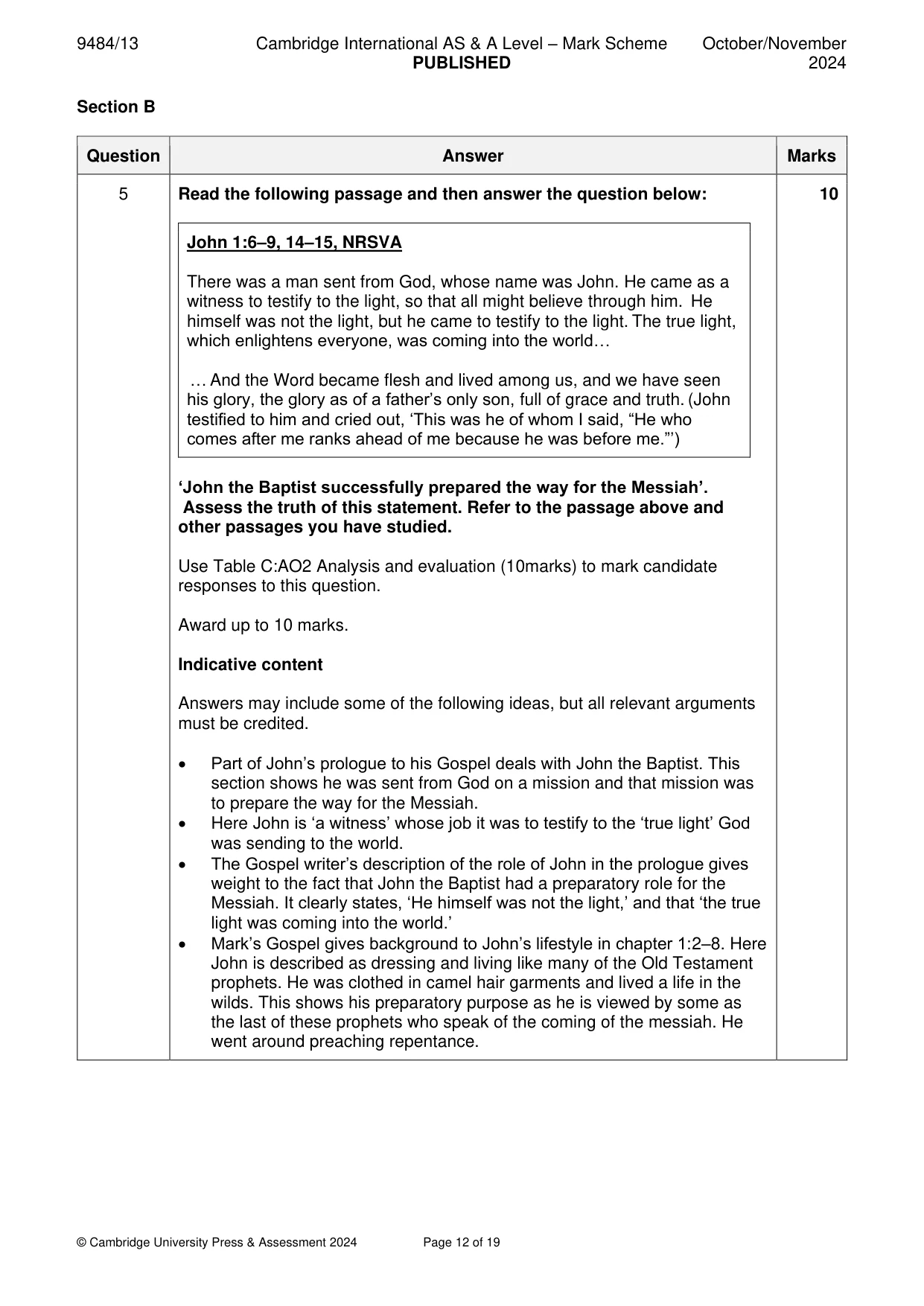
9484/13 Cambridge International AS & A Level – Mark Scheme PUBLISHED October/November 2024 © Cambridge University Press & Assessment 2024 Page 12 of 19 Section B Question Answer Marks 5 Read the following passage and then answer the question below: John 1:6–9, 14–15, NRSVA There was a man sent from God, whose name was John. He came as a witness to testify to the light, so that all might believe through him. He himself was not the light, but he came to testify to the light. The true light, which enlightens everyone, was coming into the world… … And the Word became flesh and lived among us, and we have seen his glory, the glory as of a father’s only son, full of grace and truth. (John testified to him and cried out, ‘This was he of whom I said, “He who comes after me ranks ahead of me because he was before me.”’) ‘John the Baptist successfully prepared the way for the Messiah’. Assess the truth of this statement. Refer to the passage above and other passages you have studied. Use Table C:AO2 Analysis and evaluation (10marks) to mark candidate responses to this question. Award up to 10 marks. Indicative content Answers may include some of the following ideas, but all relevant arguments must be credited. • Part of John’s prologue to his Gospel deals with John the Baptist. This section shows he was sent from God on a mission and that mission was to prepare the way for the Messiah. • Here John is ‘a witness’ whose job it was to testify to the ‘true light’ God was sending to the world. • The Gospel writer’s description of the role of John in the prologue gives weight to the fact that John the Baptist had a preparatory role for the Messiah. It clearly states, ‘He himself was not the light,’ and that ‘the true light was coming into the world.’ • Mark’s Gospel gives background to John’s lifestyle in chapter 1:2–8. Here John is described as dressing and living like many of the Old Testament prophets. He was clothed in camel hair garments and lived a life in the wilds. This shows his preparatory purpose as he is viewed by some as the last of these prophets who speak of the coming of the messiah. He went around preaching repentance. 10
Mark scheme, page 13
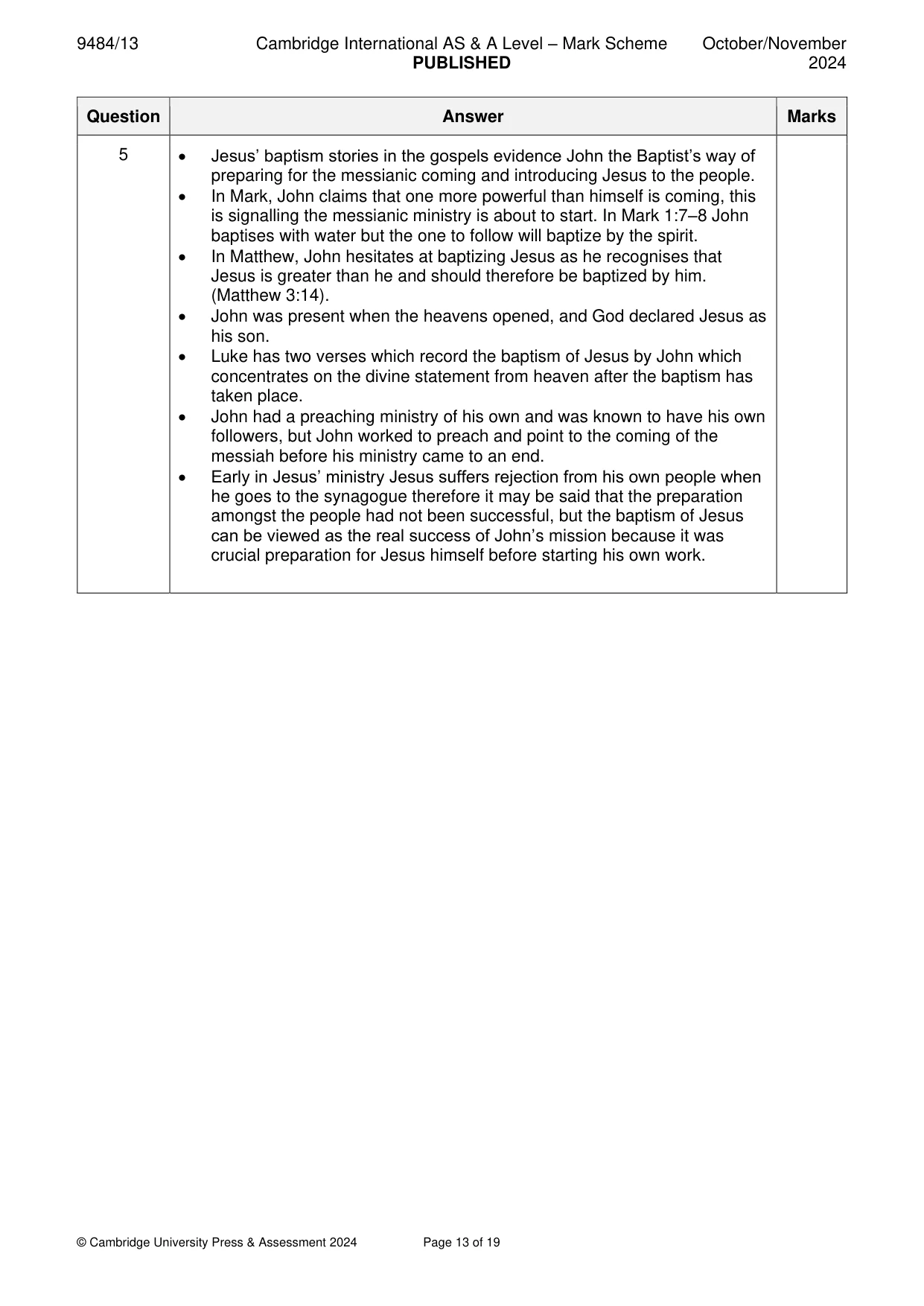
9484/13 Cambridge International AS & A Level – Mark Scheme PUBLISHED October/November 2024 © Cambridge University Press & Assessment 2024 Page 13 of 19 Question Answer Marks 5 • Jesus’ baptism stories in the gospels evidence John the Baptist’s way of preparing for the messianic coming and introducing Jesus to the people. • In Mark, John claims that one more powerful than himself is coming, this is signalling the messianic ministry is about to start. In Mark 1:7–8 John baptises with water but the one to follow will baptize by the spirit. • In Matthew, John hesitates at baptizing Jesus as he recognises that Jesus is greater than he and should therefore be baptized by him. (Matthew 3:14). • John was present when the heavens opened, and God declared Jesus as his son. • Luke has two verses which record the baptism of Jesus by John which concentrates on the divine statement from heaven after the baptism has taken place. • John had a preaching ministry of his own and was known to have his own followers, but John worked to preach and point to the coming of the messiah before his ministry came to an end. • Early in Jesus’ ministry Jesus suffers rejection from his own people when he goes to the synagogue therefore it may be said that the preparation amongst the people had not been successful, but the baptism of Jesus can be viewed as the real success of John’s mission because it was crucial preparation for Jesus himself before starting his own work.
Mark scheme, page 14
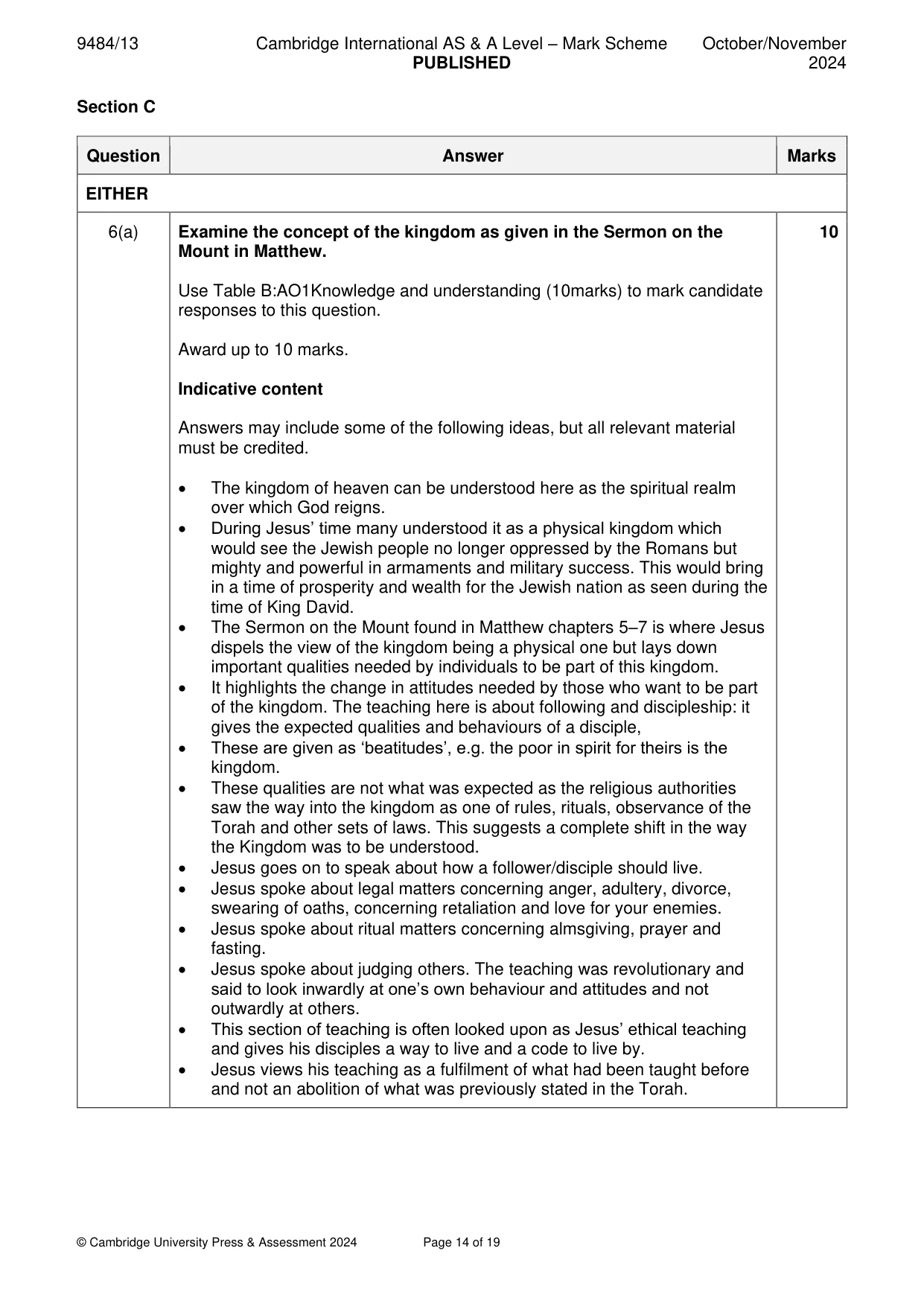
9484/13 Cambridge International AS & A Level – Mark Scheme PUBLISHED October/November 2024 © Cambridge University Press & Assessment 2024 Page 14 of 19 Section C Question Answer Marks EITHER 6(a) Examine the concept of the kingdom as given in the Sermon on the Mount in Matthew. Use Table B:AO1Knowledge and understanding (10marks) to mark candidate responses to this question. Award up to 10 marks. Indicative content Answers may include some of the following ideas, but all relevant material must be credited. • The kingdom of heaven can be understood here as the spiritual realm over which God reigns. • During Jesus’ time many understood it as a physical kingdom which would see the Jewish people no longer oppressed by the Romans but mighty and powerful in armaments and military success. This would bring in a time of prosperity and wealth for the Jewish nation as seen during the time of King David. • The Sermon on the Mount found in Matthew chapters 5–7 is where Jesus dispels the view of the kingdom being a physical one but lays down important qualities needed by individuals to be part of this kingdom. • It highlights the change in attitudes needed by those who want to be part of the kingdom. The teaching here is about following and discipleship: it gives the expected qualities and behaviours of a disciple, • These are given as ‘beatitudes’, e.g. the poor in spirit for theirs is the kingdom. • These qualities are not what was expected as the religious authorities saw the way into the kingdom as one of rules, rituals, observance of the Torah and other sets of laws. This suggests a complete shift in the way the Kingdom was to be understood. • Jesus goes on to speak about how a follower/disciple should live. • Jesus spoke about legal matters concerning anger, adultery, divorce, swearing of oaths, concerning retaliation and love for your enemies. • Jesus spoke about ritual matters concerning almsgiving, prayer and fasting. • Jesus spoke about judging others. The teaching was revolutionary and said to look inwardly at one’s own behaviour and attitudes and not outwardly at others. • This section of teaching is often looked upon as Jesus’ ethical teaching and gives his disciples a way to live and a code to live by. • Jesus views his teaching as a fulfilment of what had been taught before and not an abolition of what was previously stated in the Torah. 10
Mark scheme, page 15
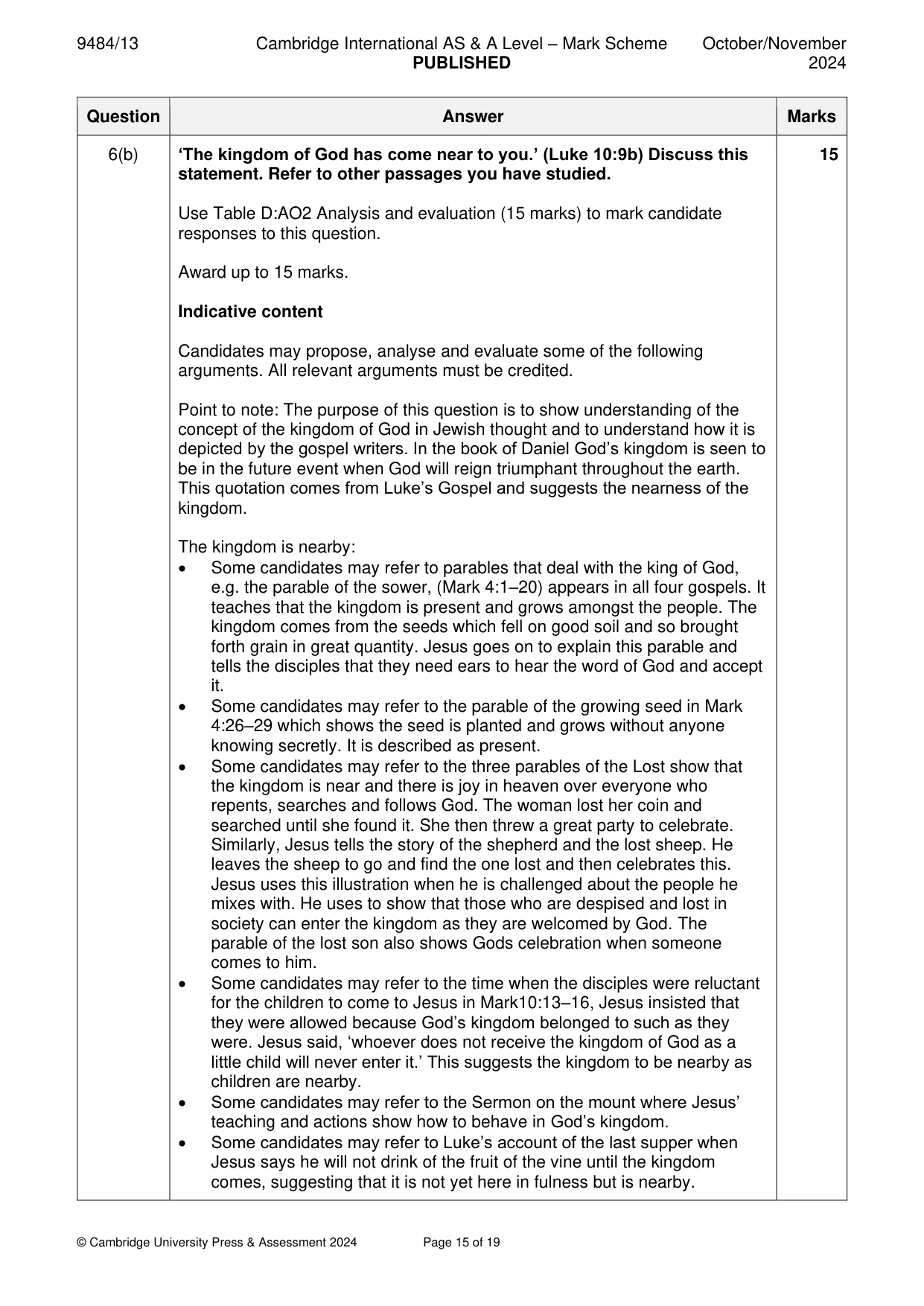
9484/13 Cambridge International AS & A Level – Mark Scheme PUBLISHED October/November 2024 © Cambridge University Press & Assessment 2024 Page 15 of 19 Question Answer Marks 6(b) ‘The kingdom of God has come near to you.’ (Luke 10:9b) Discuss this statement. Refer to other passages you have studied. Use Table D:AO2 Analysis and evaluation (15 marks) to mark candidate responses to this question. Award up to 15 marks. Indicative content Candidates may propose, analyse and evaluate some of the following arguments. All relevant arguments must be credited. Point to note: The purpose of this question is to show understanding of the concept of the kingdom of God in Jewish thought and to understand how it is depicted by the gospel writers. In the book of Daniel God’s kingdom is seen to be in the future event when God will reign triumphant throughout the earth. This quotation comes from Luke’s Gospel and suggests the nearness of the kingdom. The kingdom is nearby: • Some candidates may refer to parables that deal with the king of God, e.g. the parable of the sower, (Mark 4:1–20) appears in all four gospels. It teaches that the kingdom is present and grows amongst the people. The kingdom comes from the seeds which fell on good soil and so brought forth grain in great quantity. Jesus goes on to explain this parable and tells the disciples that they need ears to hear the word of God and accept it. • Some candidates may refer to the parable of the growing seed in Mark 4:26–29 which shows the seed is planted and grows without anyone knowing secretly. It is described as present. • Some candidates may refer to the three parables of the Lost show that the kingdom is near and there is joy in heaven over everyone who repents, searches and follows God. The woman lost her coin and searched until she found it. She then threw a great party to celebrate. Similarly, Jesus tells the story of the shepherd and the lost sheep. He leaves the sheep to go and find the one lost and then celebrates this. Jesus uses this illustration when he is challenged about the people he mixes with. He uses to show that those who are despised and lost in society can enter the kingdom as they are welcomed by God. The parable of the lost son also shows Gods celebration when someone comes to him. • Some candidates may refer to the time when the disciples were reluctant for the children to come to Jesus in Mark10:13–16, Jesus insisted that they were allowed because God’s kingdom belonged to such as they were. Jesus said, ‘whoever does not receive the kingdom of God as a little child will never enter it.’ This suggests the kingdom to be nearby as children are nearby. • Some candidates may refer to the Sermon on the mount where Jesus’ teaching and actions show how to behave in God’s kingdom. • Some candidates may refer to Luke’s account of the last supper when Jesus says he will not drink of the fruit of the vine until the kingdom comes, suggesting that it is not yet here in fulness but is nearby. 15
Mark scheme, page 16
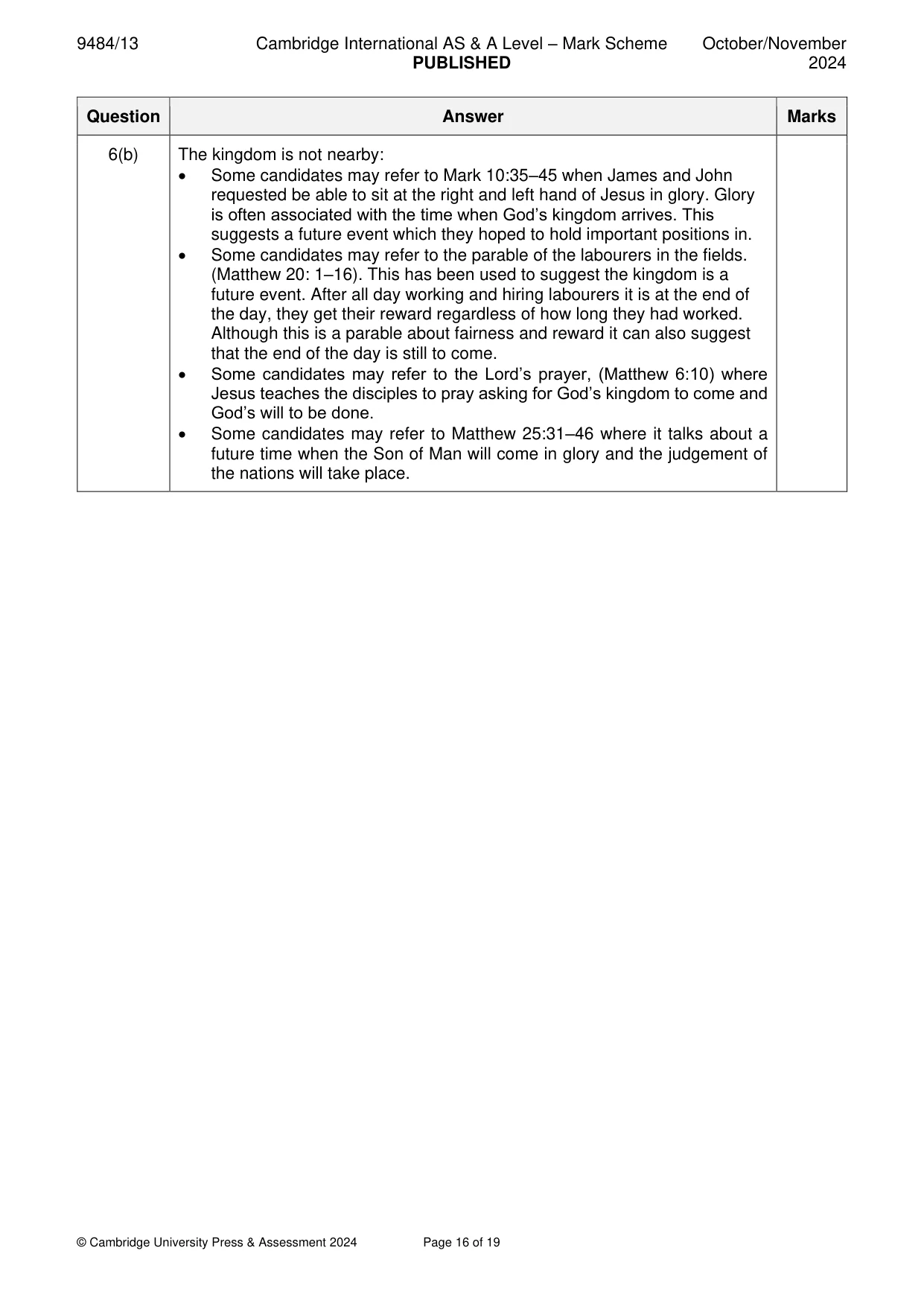
9484/13 Cambridge International AS & A Level – Mark Scheme PUBLISHED October/November 2024 © Cambridge University Press & Assessment 2024 Page 16 of 19 Question Answer Marks 6(b) The kingdom is not nearby: • Some candidates may refer to Mark 10:35–45 when James and John requested be able to sit at the right and left hand of Jesus in glory. Glory is often associated with the time when God’s kingdom arrives. This suggests a future event which they hoped to hold important positions in. • Some candidates may refer to the parable of the labourers in the fields. (Matthew 20: 1–16). This has been used to suggest the kingdom is a future event. After all day working and hiring labourers it is at the end of the day, they get their reward regardless of how long they had worked. Although this is a parable about fairness and reward it can also suggest that the end of the day is still to come. • Some candidates may refer to the Lord’s prayer, (Matthew 6:10) where Jesus teaches the disciples to pray asking for God’s kingdom to come and God’s will to be done. • Some candidates may refer to Matthew 25:31–46 where it talks about a future time when the Son of Man will come in glory and the judgement of the nations will take place.
Mark scheme, page 17
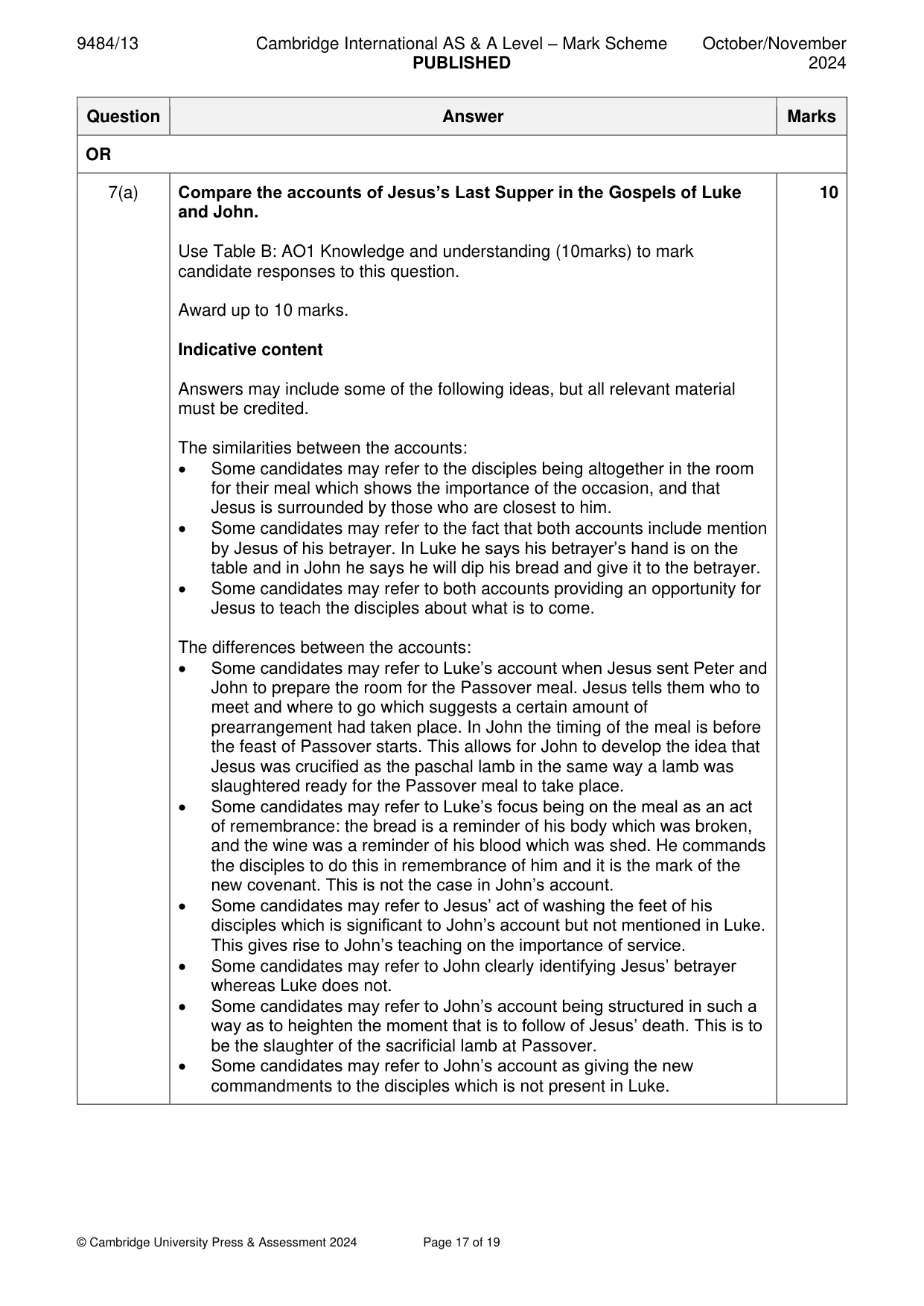
9484/13 Cambridge International AS & A Level – Mark Scheme PUBLISHED October/November 2024 © Cambridge University Press & Assessment 2024 Page 17 of 19 Question Answer Marks OR 7(a) Compare the accounts of Jesus’s Last Supper in the Gospels of Luke and John. Use Table B: AO1 Knowledge and understanding (10marks) to mark candidate responses to this question. Award up to 10 marks. Indicative content Answers may include some of the following ideas, but all relevant material must be credited. The similarities between the accounts: • Some candidates may refer to the disciples being altogether in the room for their meal which shows the importance of the occasion, and that Jesus is surrounded by those who are closest to him. • Some candidates may refer to the fact that both accounts include mention by Jesus of his betrayer. In Luke he says his betrayer’s hand is on the table and in John he says he will dip his bread and give it to the betrayer. • Some candidates may refer to both accounts providing an opportunity for Jesus to teach the disciples about what is to come. The differences between the accounts: • Some candidates may refer to Luke’s account when Jesus sent Peter and John to prepare the room for the Passover meal. Jesus tells them who to meet and where to go which suggests a certain amount of prearrangement had taken place. In John the timing of the meal is before the feast of Passover starts. This allows for John to develop the idea that Jesus was crucified as the paschal lamb in the same way a lamb was slaughtered ready for the Passover meal to take place. • Some candidates may refer to Luke’s focus being on the meal as an act of remembrance: the bread is a reminder of his body which was broken, and the wine was a reminder of his blood which was shed. He commands the disciples to do this in remembrance of him and it is the mark of the new covenant. This is not the case in John’s account. • Some candidates may refer to Jesus’ act of washing the feet of his disciples which is significant to John’s account but not mentioned in Luke. This gives rise to John’s teaching on the importance of service. • Some candidates may refer to John clearly identifying Jesus’ betrayer whereas Luke does not. • Some candidates may refer to John’s account being structured in such a way as to heighten the moment that is to follow of Jesus’ death. This is to be the slaughter of the sacrificial lamb at Passover. • Some candidates may refer to John’s account as giving the new commandments to the disciples which is not present in Luke. 10
Mark scheme, page 18
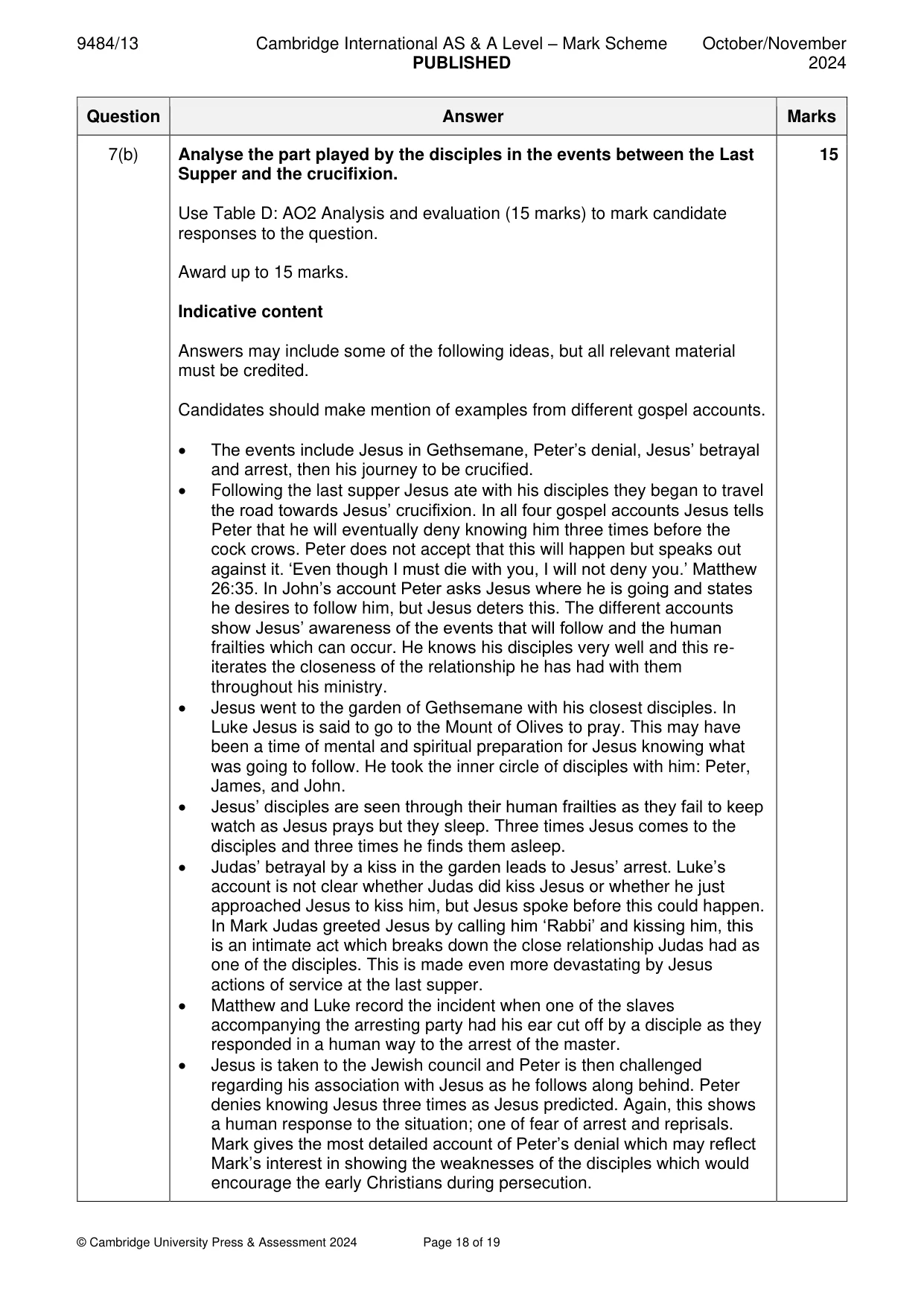
9484/13 Cambridge International AS & A Level – Mark Scheme PUBLISHED October/November 2024 © Cambridge University Press & Assessment 2024 Page 18 of 19 Question Answer Marks 7(b) Analyse the part played by the disciples in the events between the Last Supper and the crucifixion. Use Table D: AO2 Analysis and evaluation (15 marks) to mark candidate responses to the question. Award up to 15 marks. Indicative content Answers may include some of the following ideas, but all relevant material must be credited. Candidates should make mention of examples from different gospel accounts. • The events include Jesus in Gethsemane, Peter’s denial, Jesus’ betrayal and arrest, then his journey to be crucified. • Following the last supper Jesus ate with his disciples they began to travel the road towards Jesus’ crucifixion. In all four gospel accounts Jesus tells Peter that he will eventually deny knowing him three times before the cock crows. Peter does not accept that this will happen but speaks out against it. ‘Even though I must die with you, I will not deny you.’ Matthew 26:35. In John’s account Peter asks Jesus where he is going and states he desires to follow him, but Jesus deters this. The different accounts show Jesus’ awareness of the events that will follow and the human frailties which can occur. He knows his disciples very well and this re- iterates the closeness of the relationship he has had with them throughout his ministry. • Jesus went to the garden of Gethsemane with his closest disciples. In Luke Jesus is said to go to the Mount of Olives to pray. This may have been a time of mental and spiritual preparation for Jesus knowing what was going to follow. He took the inner circle of disciples with him: Peter, James, and John. • Jesus’ disciples are seen through their human frailties as they fail to keep watch as Jesus prays but they sleep. Three times Jesus comes to the disciples and three times he finds them asleep. • Judas’ betrayal by a kiss in the garden leads to Jesus’ arrest. Luke’s account is not clear whether Judas did kiss Jesus or whether he just approached Jesus to kiss him, but Jesus spoke before this could happen. In Mark Judas greeted Jesus by calling him ‘Rabbi’ and kissing him, this is an intimate act which breaks down the close relationship Judas had as one of the disciples. This is made even more devastating by Jesus actions of service at the last supper. • Matthew and Luke record the incident when one of the slaves accompanying the arresting party had his ear cut off by a disciple as they responded in a human way to the arrest of the master. • Jesus is taken to the Jewish council and Peter is then challenged regarding his association with Jesus as he follows along behind. Peter denies knowing Jesus three times as Jesus predicted. Again, this shows a human response to the situation; one of fear of arrest and reprisals. Mark gives the most detailed account of Peter’s denial which may reflect Mark’s interest in showing the weaknesses of the disciples which would encourage the early Christians during persecution. 15
Mark scheme, page 19
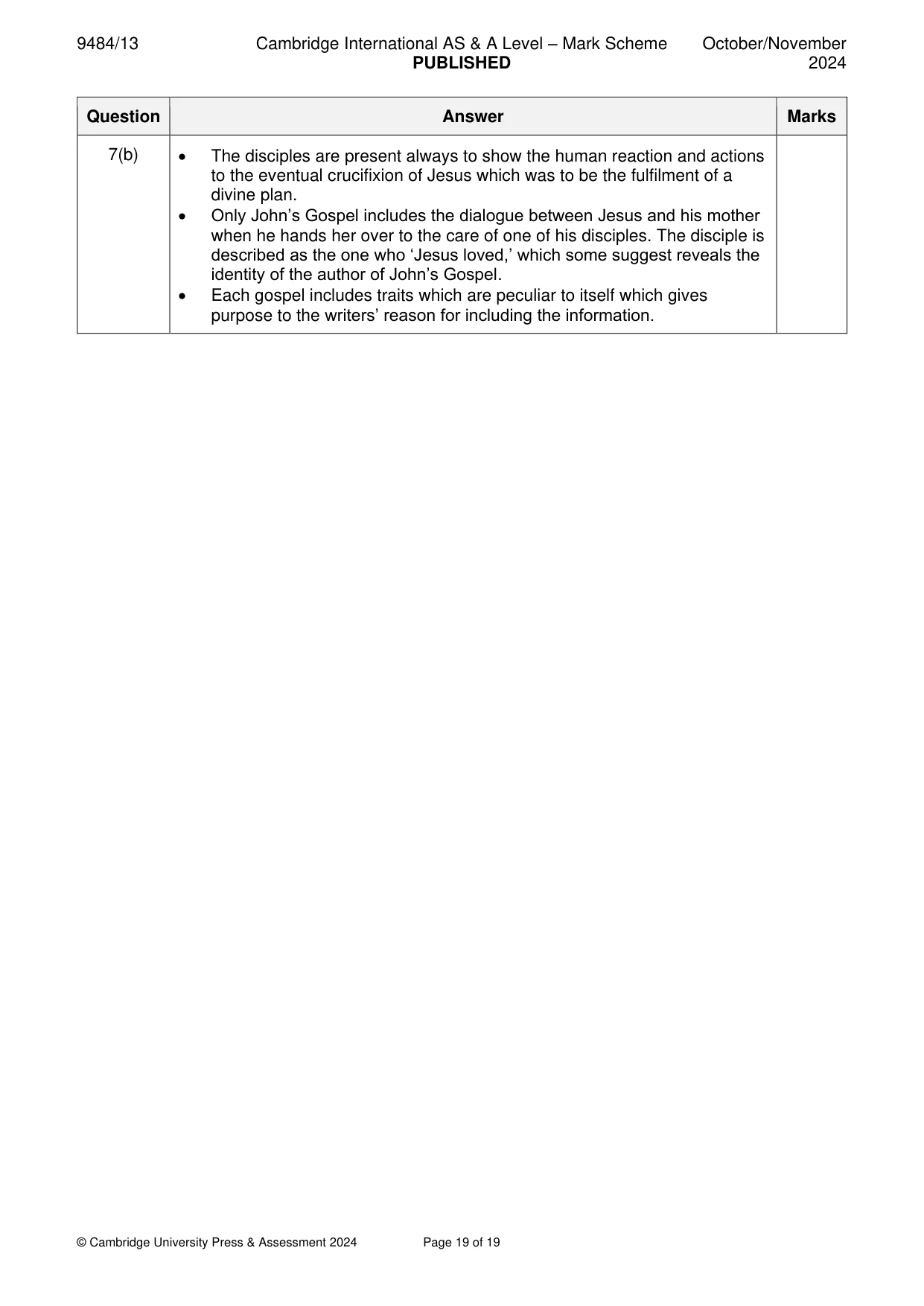
9484/13 Cambridge International AS & A Level – Mark Scheme PUBLISHED October/November 2024 © Cambridge University Press & Assessment 2024 Page 19 of 19 Question Answer Marks 7(b) • The disciples are present always to show the human reaction and actions to the eventual crucifixion of Jesus which was to be the fulfilment of a divine plan. • Only John’s Gospel includes the dialogue between Jesus and his mother when he hands her over to the care of one of his disciples. The disciple is described as the one who ‘Jesus loved,’ which some suggest reveals the identity of the author of John’s Gospel. • Each gospel includes traits which are peculiar to itself which gives purpose to the writers’ reason for including the information.
What you needed in this session
Cambridge’s own grade thresholds for 2024 Oct/Nov, Paper 1 · Variant 3. A higher threshold means an easier paper — the bar moves with how the cohort did.