Cambridge A Level Art and Design 9704 — 2019 Oct/Nov Paper 1 · Variant 1
9704/11/O/N/19 · 100 marks · ≈113 min
The question paper and its mark scheme, free to read here and free to download. This is Cambridge’s own paper, exactly as it was sat.
Question paper4 pages
Mark scheme3 pages
Answers below. Sit the paper first if you are practising.
Paper as text
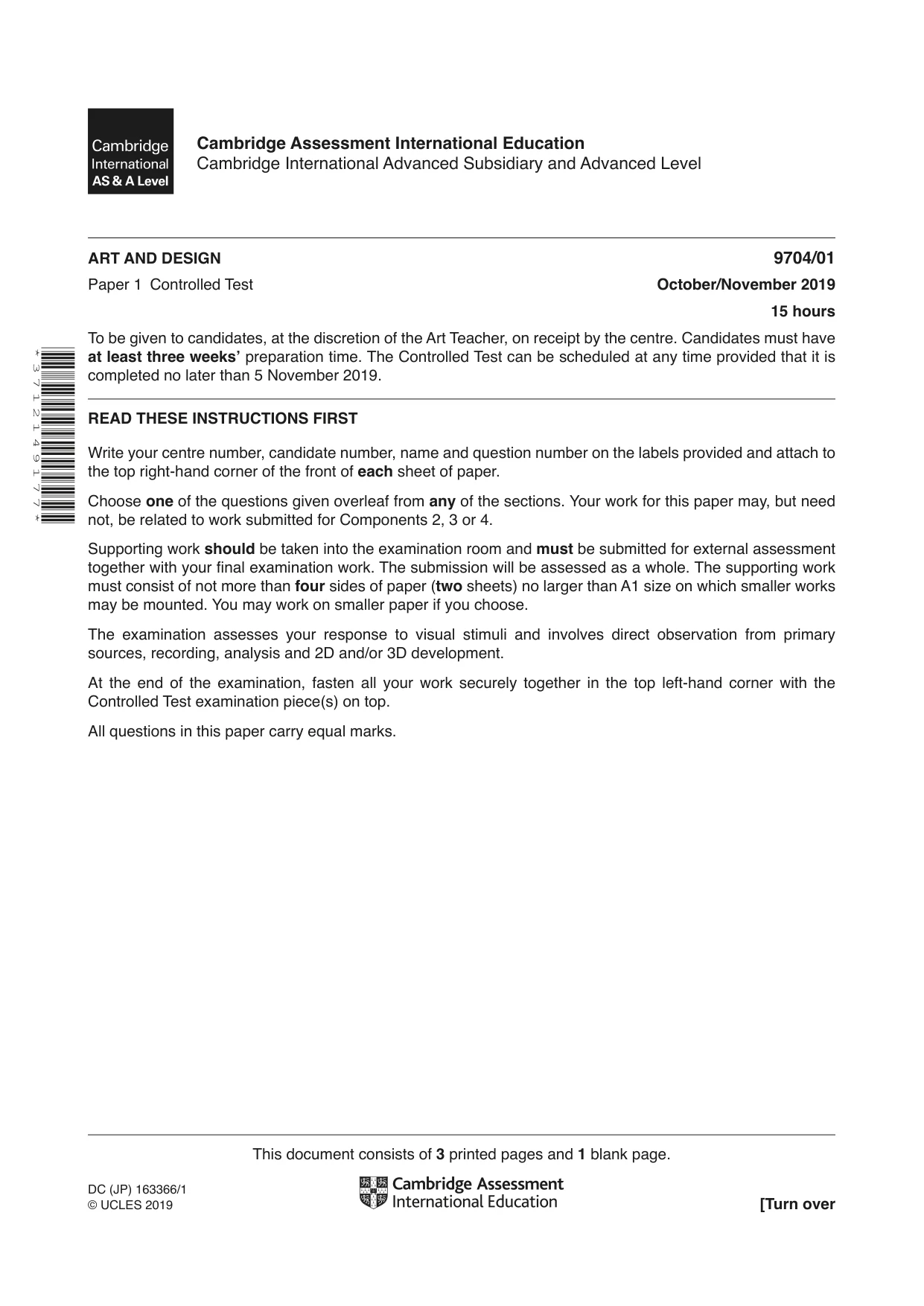
Question paper, page 1
This document consists of 3 printed pages and 1 blank page. DC (JP) 163366/1 © UCLES 2019 [Turn over Cambridge Assessment International Education Cambridge International Advanced Subsidiary and Advanced Level * 3 7 1 2 1 4 9 1 7 7 * ART AND DESIGN 9704/01 Paper 1 Controlled Test October/November 2019 15 hours To be given to candidates, at the discretion of the Art Teacher, on receipt by the centre. Candidates must have at least three weeks’ preparation time. The Controlled Test can be scheduled at any time provided that it is completed no later than 5 November 2019. READ THESE INSTRUCTIONS FIRST Write your centre number, candidate number, name and question number on the labels provided and attach to the top right-hand corner of the front of each sheet of paper. Choose one of the questions given overleaf from any of the sections. Your work for this paper may, but need not, be related to work submitted for Components 2, 3 or 4. Supporting work should be taken into the examination room and must be submitted for external assessment together with your final examination work. The submission will be assessed as a whole. The supporting work must consist of not more than four sides of paper (two sheets) no larger than A1 size on which smaller works may be mounted. You may work on smaller paper if you choose. The examination assesses your response to visual stimuli and involves direct observation from primary sources, recording, analysis and 2D and/or 3D development. At the end of the examination, fasten all your work securely together in the top left-hand corner with the Controlled Test examination piece(s) on top. All questions in this paper carry equal marks.
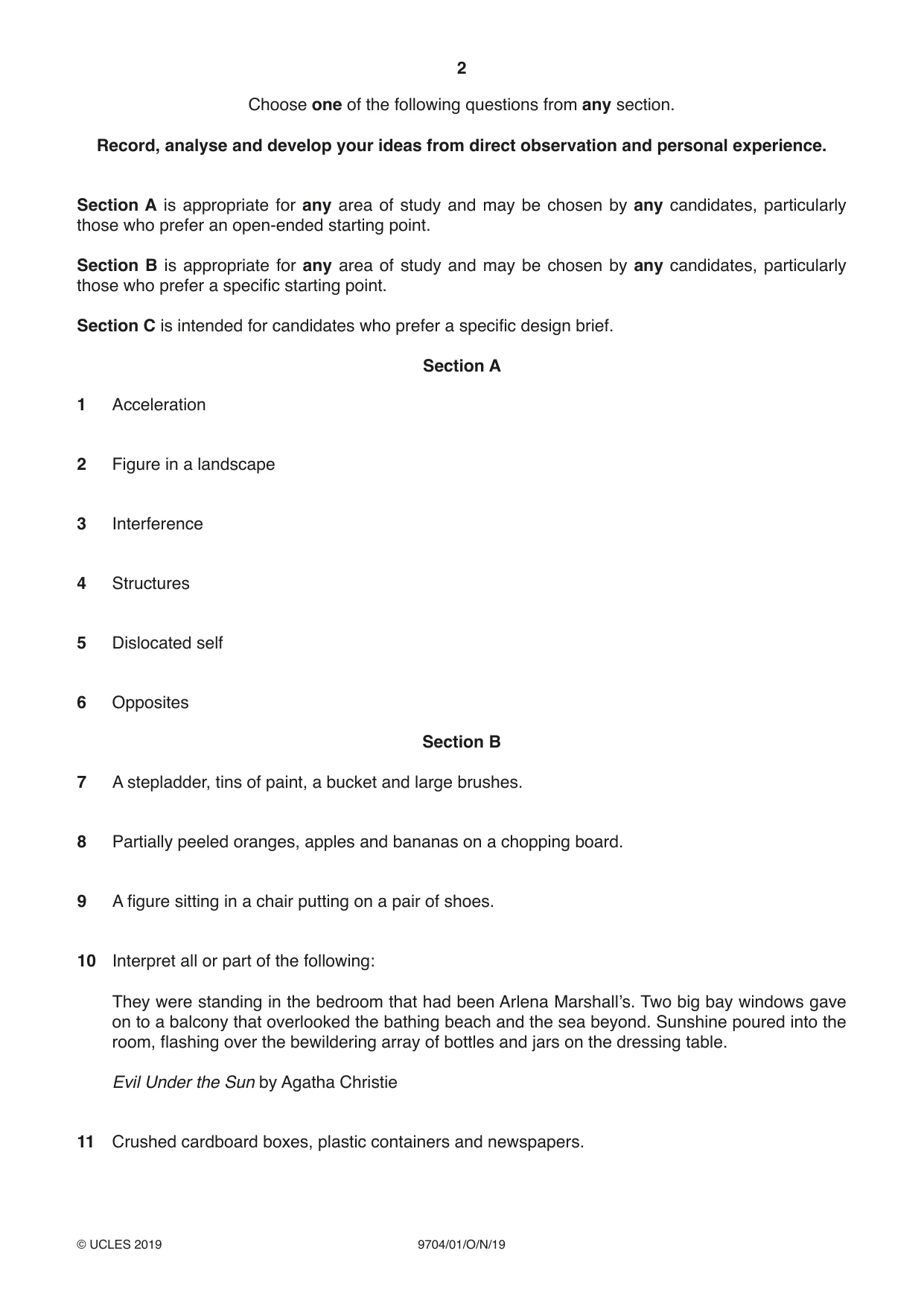
Question paper, page 2
2 9704/01/O/N/19 © UCLES 2019 Choose one of the following questions from any section. Record, analyse and develop your ideas from direct observation and personal experience. Section A is appropriate for any area of study and may be chosen by any candidates, particularly those who prefer an open-ended starting point. Section B is appropriate for any area of study and may be chosen by any candidates, particularly those who prefer a specific starting point. Section C is intended for candidates who prefer a specific design brief. Section A 1 Acceleration 2 Figure in a landscape 3 Interference 4 Structures 5 Dislocated self 6 Opposites Section B 7 A stepladder, tins of paint, a bucket and large brushes. 8 Partially peeled oranges, apples and bananas on a chopping board. 9 A figure sitting in a chair putting on a pair of shoes. 10 Interpret all or part of the following: They were standing in the bedroom that had been Arlena Marshall’s. Two big bay windows gave on to a balcony that overlooked the bathing beach and the sea beyond. Sunshine poured into the room, flashing over the bewildering array of bottles and jars on the dressing table. Evil Under the Sun by Agatha Christie 11 Crushed cardboard boxes, plastic containers and newspapers.
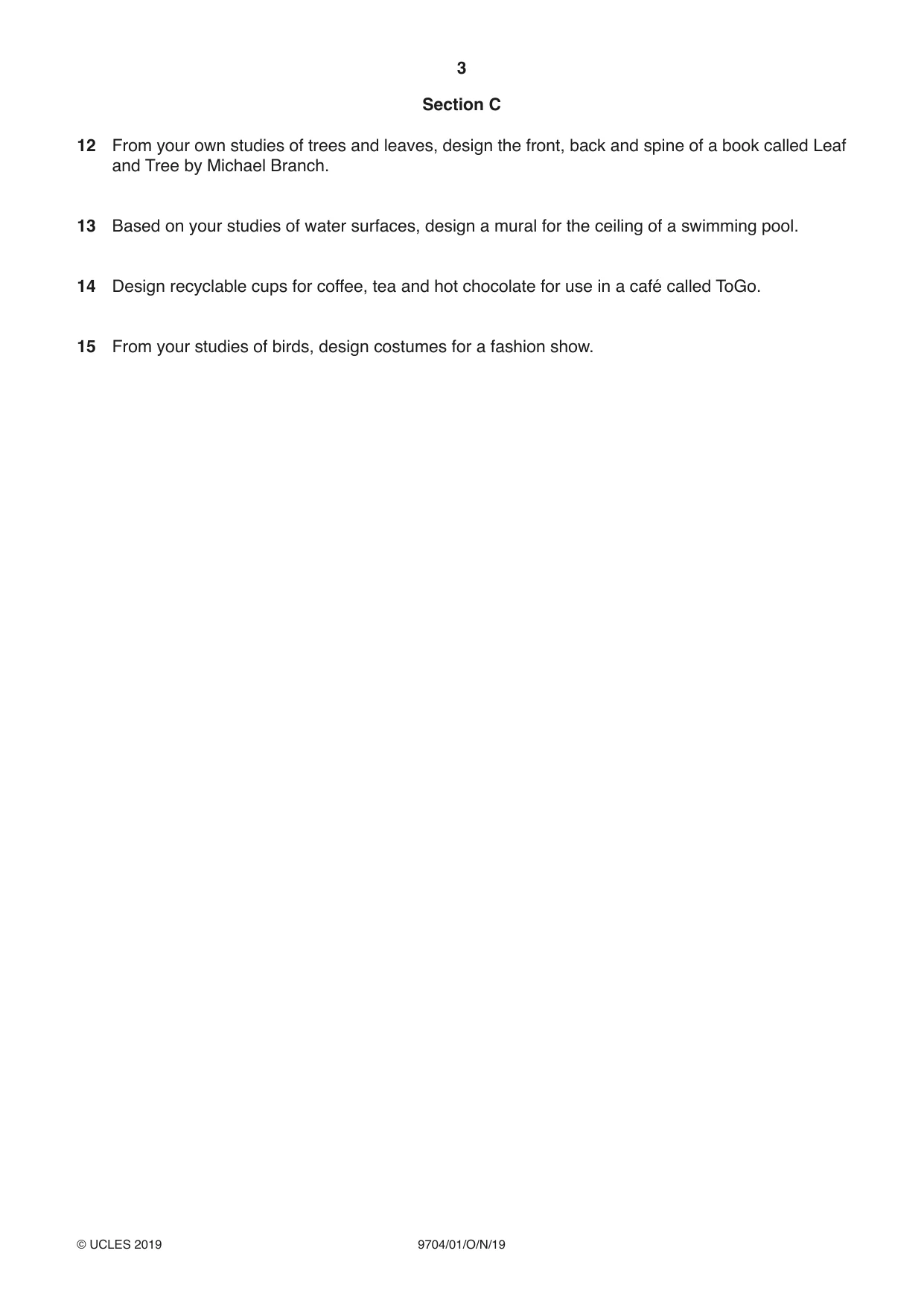
Question paper, page 3
3 9704/01/O/N/19 © UCLES 2019 Section C 12 From your own studies of trees and leaves, design the front, back and spine of a book called Leaf and Tree by Michael Branch. 13 Based on your studies of water surfaces, design a mural for the ceiling of a swimming pool. 14 Design recyclable cups for coffee, tea and hot chocolate for use in a café called ToGo. 15 From your studies of birds, design costumes for a fashion show.
Question paper, page 4
4 9704/01/O/N/19 © UCLES 2019 BLANK PAGE Permission to reproduce items where third-party owned material protected by copyright is included has been sought and cleared where possible. Every reasonable effort has been made by the publisher (UCLES) to trace copyright holders, but if any items requiring clearance have unwittingly been included, the publisher will be pleased to make amends at the earliest possible opportunity. To avoid the issue of disclosure of answer-related information to candidates, all copyright acknowledgements are reproduced online in the Cambridge Assessment International Education Copyright Acknowledgements Booklet. This is produced for each series of examinations and is freely available to download at www.cambridgeinternational.org after the live examination series. Cambridge Assessment International Education is part of the Cambridge Assessment Group. Cambridge Assessment is the brand name of the University of Cambridge Local Examinations Syndicate (UCLES), which itself is a department of the University of Cambridge.
Mark scheme, page 1
This document consists of 3 printed pages. © UCLES 2019 [Turn over Cambridge Assessment International Education Cambridge International Advanced Subsidiary and Advanced Level ART AND DESIGN 9704/01 Paper 1 Controlled Test October/November 2019 MARK SCHEME Maximum Mark: 100 Published This mark scheme is published as an aid to teachers and candidates, to indicate the requirements of the examination. It shows the basis on which Examiners were instructed to award marks. It does not indicate the details of the discussions that took place at an Examiners’ meeting before marking began, which would have considered the acceptability of alternative answers. Mark schemes should be read in conjunction with the question paper and the Principal Examiner Report for Teachers. Cambridge International will not enter into discussions about these mark schemes. Cambridge International is publishing the mark schemes for the October/November 2019 series for most Cambridge IGCSE™, Cambridge International A and AS Level components and some Cambridge O Level components.
Mark scheme, page 2
9704/01 Cambridge International AS/A Level – Mark Scheme PUBLISHED October/November 2019 © UCLES 2019 Page 2 of 3 Generic Marking Principles These general marking principles must be applied by all examiners when marking candidate answers. They should be applied alongside the specific content of the mark scheme or generic level descriptors for a question. Each question paper and mark scheme will also comply with these marking principles. GENERIC MARKING PRINCIPLE 1: Marks must be awarded in line with: • the specific content of the mark scheme or the generic level descriptors for the question • the specific skills defined in the mark scheme or in the generic level descriptors for the question • the standard of response required by a candidate as exemplified by the standardisation scripts. GENERIC MARKING PRINCIPLE 2: Marks awarded are always whole marks (not half marks, or other fractions). GENERIC MARKING PRINCIPLE 3: Marks must be awarded positively: • marks are awarded for correct/valid answers, as defined in the mark scheme. However, credit is given for valid answers which go beyond the scope of the syllabus and mark scheme, referring to your Team Leader as appropriate • marks are awarded when candidates clearly demonstrate what they know and can do • marks are not deducted for errors • marks are not deducted for omissions • answers should only be judged on the quality of spelling, punctuation and grammar when these features are specifically assessed by the question as indicated by the mark scheme. The meaning, however, should be unambiguous. GENERIC MARKING PRINCIPLE 4: Rules must be applied consistently e.g. in situations where candidates have not followed instructions or in the application of generic level descriptors. GENERIC MARKING PRINCIPLE 5: Marks should be awarded using the full range of marks defined in the mark scheme for the question (however; the use of the full mark range may be limited according to the quality of the candidate responses seen). GENERIC MARKING PRINCIPLE 6: Marks awarded are based solely on the requirements as defined in the mark scheme. Marks should not be awarded with grade thresholds or grade descriptors in mind.
Mark scheme, page 3
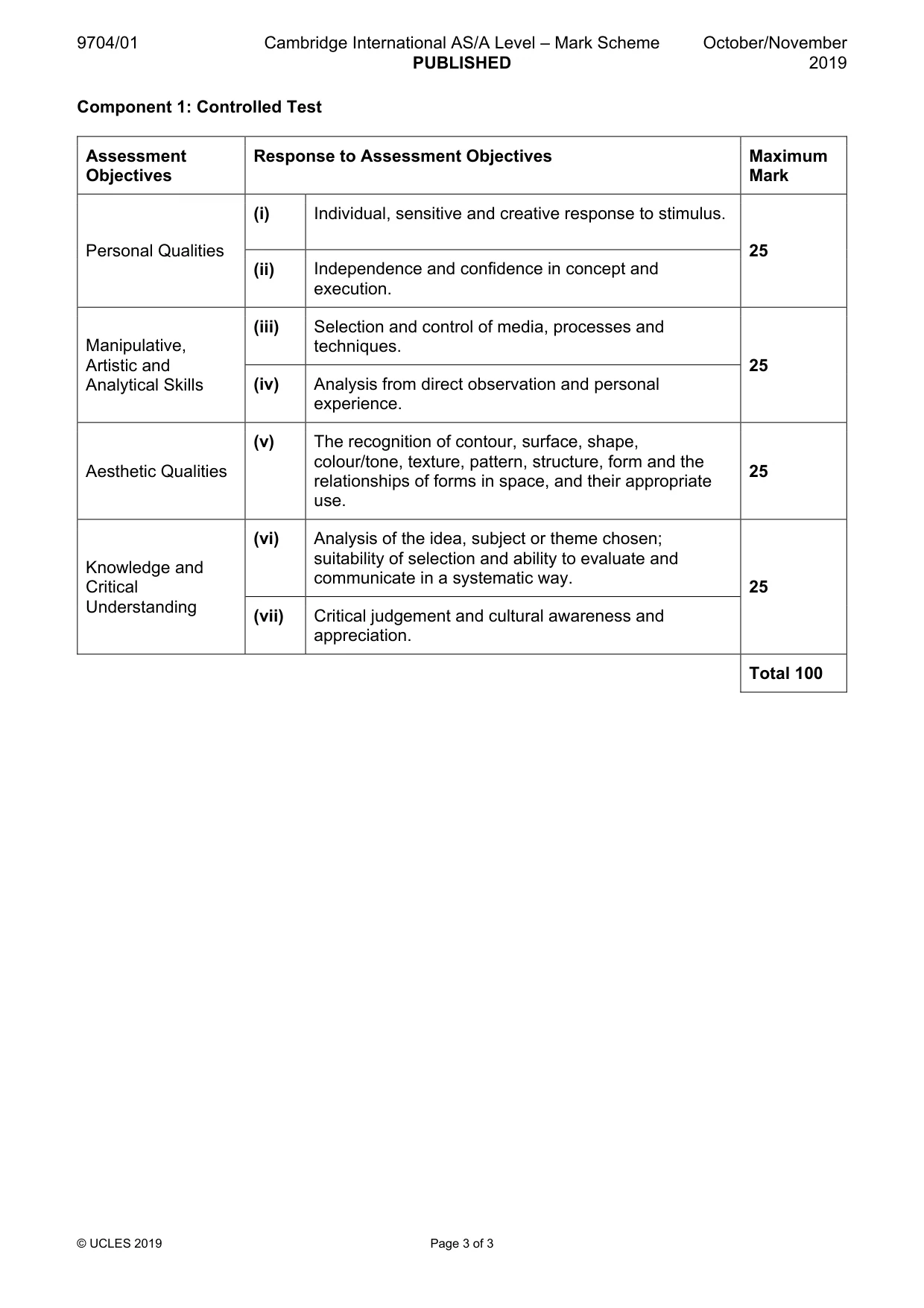
9704/01 Cambridge International AS/A Level – Mark Scheme PUBLISHED October/November 2019 © UCLES 2019 Page 3 of 3 Component 1: Controlled Test Assessment Objectives Response to Assessment Objectives Maximum Mark Personal Qualities (i) Individual, sensitive and creative response to stimulus. 25 (ii) Independence and confidence in concept and execution. Manipulative, Artistic and Analytical Skills (iii) Selection and control of media, processes and techniques. 25 (iv) Analysis from direct observation and personal experience. Aesthetic Qualities (v) The recognition of contour, surface, shape, colour/tone, texture, pattern, structure, form and the relationships of forms in space, and their appropriate use. 25 Knowledge and Critical Understanding (vi) Analysis of the idea, subject or theme chosen; suitability of selection and ability to evaluate and communicate in a systematic way. 25 (vii) Critical judgement and cultural awareness and appreciation. Total 100
What you needed in this session
Cambridge’s own grade thresholds for 2019 Oct/Nov, Paper 1 · Variant 1. A higher threshold means an easier paper — the bar moves with how the cohort did.