Cambridge A Level Arabic - Language (AS Level only) 8680 — 2020 Oct/Nov Paper 3 · Variant 1
8680/31/O/N/20 · 40 marks · ≈45 min
The question paper and its mark scheme, free to read here and free to download. This is Cambridge’s own paper, exactly as it was sat.
Question paper2 pages
Mark scheme3 pages
Answers below. Sit the paper first if you are practising.
Paper as text
Question paper, page 1
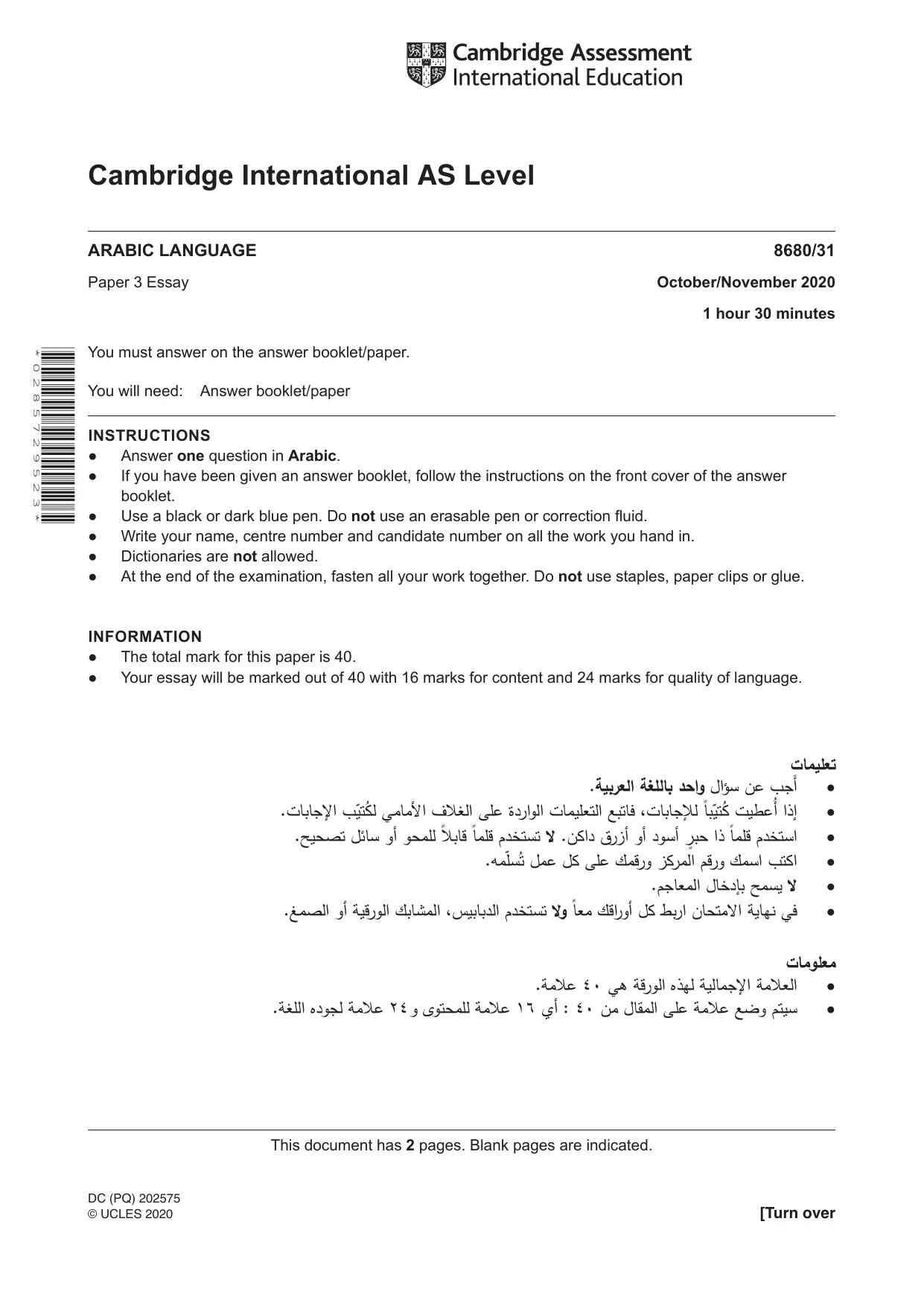
This document has 2 pages. Blank pages are indicated. Cambridge International AS Level ARABIC LANGUAGE 8680/31 Paper 3 Essay October/November 2020 1 hour 30 minutes You must answer on the answer booklet/paper. You will need: Answer booklet/paper INSTRUCTIONS ● Answer one question in Arabic. ● If you have been given an answer booklet, follow the instructions on the front cover of the answer booklet. ● Use a black or dark blue pen. Do not use an erasable pen or correction fluid. ● Write your name, centre number and candidate number on all the work you hand in. ● Dictionaries are not allowed. ● At the end of the examination, fasten all your work together. Do not use staples, paper clips or glue. INFORMATION ● The total mark for this paper is 40. ● Your essay will be marked out of 40 with 16 marks for content and 24 marks for quality of language. تعليمات .● أَجب عن سؤال واحد باللغة العربية ● إذا أُعطيت كُتيّباً لإلجابات، فاتبع التعليمات الواردة على الغالف األمامي لكُتيّب اإلجابات. ● استخدم قلماً ذا حبرٍ أسود أو أزرق داكن. ال تستخدم قلماً قابالً للمحو أو سائل تصحيح. ● اكتب اسمك ورقم المركز ورقمك على كل عمل تُسلّمه. ● ال يسمح بإدخال المعاجم. ● في نهاية االمتحان اربط كل أوراقك معاً وال تستخدم الدبابيس، المشابك الورقية أو الصمغ. معلومات عالمة.40 ● العالمة اإلجمالية لهذه الورقة هي عالمة لجوده اللغة.24 عالمة للمحتوى و16 : أي40 ● سيتم وضع عالمة على المقال من * 0 2 8 5 7 2 9 5 2 3 * DC (PQ) 202575 © UCLES 2020 [Turn over
Question paper, page 2
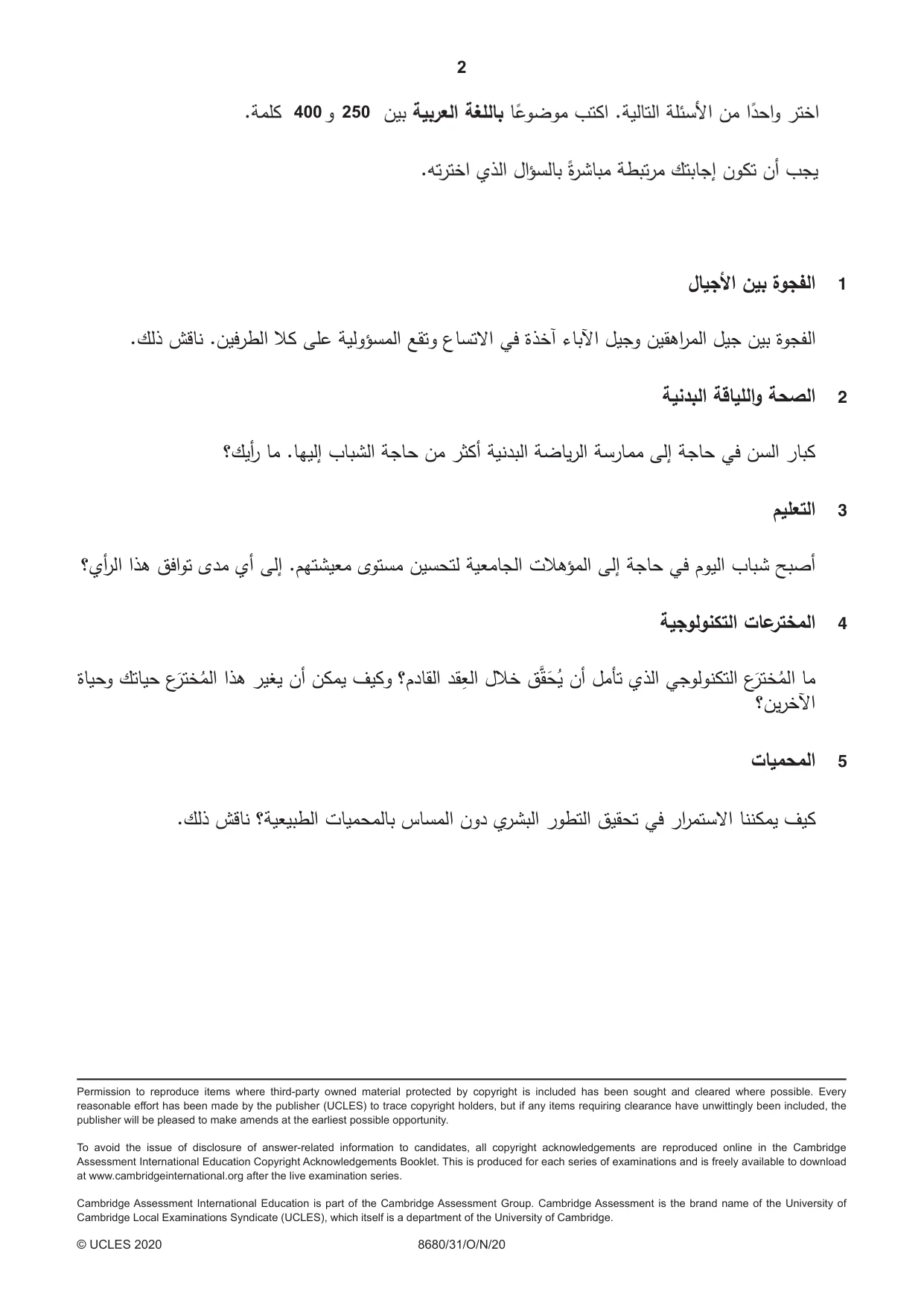
2 8680/31/O/N/20 © UCLES 2020 Permission to reproduce items where third-party owned material protected by copyright is included has been sought and cleared where possible. Every reasonable effort has been made by the publisher (UCLES) to trace copyright holders, but if any items requiring clearance have unwittingly been included, the publisher will be pleased to make amends at the earliest possible opportunity. To avoid the issue of disclosure of answer-related information to candidates, all copyright acknowledgements are reproduced online in the Cambridge Assessment International Education Copyright Acknowledgements Booklet. This is produced for each series of examinations and is freely available to download at www.cambridgeinternational.org after the live examination series. Cambridge Assessment International Education is part of the Cambridge Assessment Group. Cambridge Assessment is the brand name of the University of Cambridge Local Examinations Syndicate (UCLES), which itself is a department of the University of Cambridge. 400 250 الفجوة بين األجيال 1 .الفجوة بين جيل المراهقين وجيل اآلباء آخذة في االتساع وتقع المسؤولية على كال الطرفين. ناقش ذلك الصحة واللياقة البدنية 2 كبار السن في حاجة إلى ممارسة الرياضة البدنية أكثر من حاجة الشباب إليها. ما رأيك؟ التعليم 3 أصبح شباب اليوم في حاجة إلى المؤهالت الجامعية لتحسين مستوى معيشتهم. إلى أي مدى توافق هذا الرأي؟ المخترعات التكنولوجية 4 ما المُخترَع التكنولوجي الذي تأمل أن يُحَقَّق خالل العِقد القادم؟ وكيف يمكن أن يغير هذا المُخترَع حياتك وحياة اآلخرين؟ المحميات 5 .كيف يمكننا االستمرار في تحقيق التطور البشري دون المساس بالمحميات الطبيعية؟ ناقش ذلك
Mark scheme, page 1
This document consists of 3 printed pages. © UCLES 2020 [Turn over Cambridge International AS Level ARABIC LANGUAGE 8680/31 Paper 3 Essay October/November 2020 MARK SCHEME Maximum Mark: 40 Published This mark scheme is published as an aid to teachers and candidates, to indicate the requirements of the examination. It shows the basis on which Examiners were instructed to award marks. It does not indicate the details of the discussions that took place at an Examiners’ meeting before marking began, which would have considered the acceptability of alternative answers. Mark schemes should be read in conjunction with the question paper and the Principal Examiner Report for Teachers. Cambridge International will not enter into discussions about these mark schemes. Cambridge International is publishing the mark schemes for the October/November 2020 series for most Cambridge IGCSE™, Cambridge International A and AS Level and Cambridge Pre-U components, and some Cambridge O Level components.
Mark scheme, page 2
8680/31 Cambridge International AS Level – Mark Scheme PUBLISHED October/November 2020 © UCLES 2020 Page 2 of 3 Generic Marking Principles These general marking principles must be applied by all examiners when marking candidate answers. They should be applied alongside the specific content of the mark scheme or generic level descriptors for a question. Each question paper and mark scheme will also comply with these marking principles. GENERIC MARKING PRINCIPLE 1: Marks must be awarded in line with: • the specific content of the mark scheme or the generic level descriptors for the question • the specific skills defined in the mark scheme or in the generic level descriptors for the question • the standard of response required by a candidate as exemplified by the standardisation scripts. GENERIC MARKING PRINCIPLE 2: Marks awarded are always whole marks (not half marks, or other fractions). GENERIC MARKING PRINCIPLE 3: Marks must be awarded positively: • marks are awarded for correct/valid answers, as defined in the mark scheme. However, credit is given for valid answers which go beyond the scope of the syllabus and mark scheme, referring to your Team Leader as appropriate • marks are awarded when candidates clearly demonstrate what they know and can do • marks are not deducted for errors • marks are not deducted for omissions • answers should only be judged on the quality of spelling, punctuation and grammar when these features are specifically assessed by the question as indicated by the mark scheme. The meaning, however, should be unambiguous. GENERIC MARKING PRINCIPLE 4: Rules must be applied consistently, e.g. in situations where candidates have not followed instructions or in the application of generic level descriptors. GENERIC MARKING PRINCIPLE 5: Marks should be awarded using the full range of marks defined in the mark scheme for the question (however; the use of the full mark range may be limited according to the quality of the candidate responses seen). GENERIC MARKING PRINCIPLE 6: Marks awarded are based solely on the requirements as defined in the mark scheme. Marks should not be awarded with grade thresholds or grade descriptors in mind.
Mark scheme, page 3
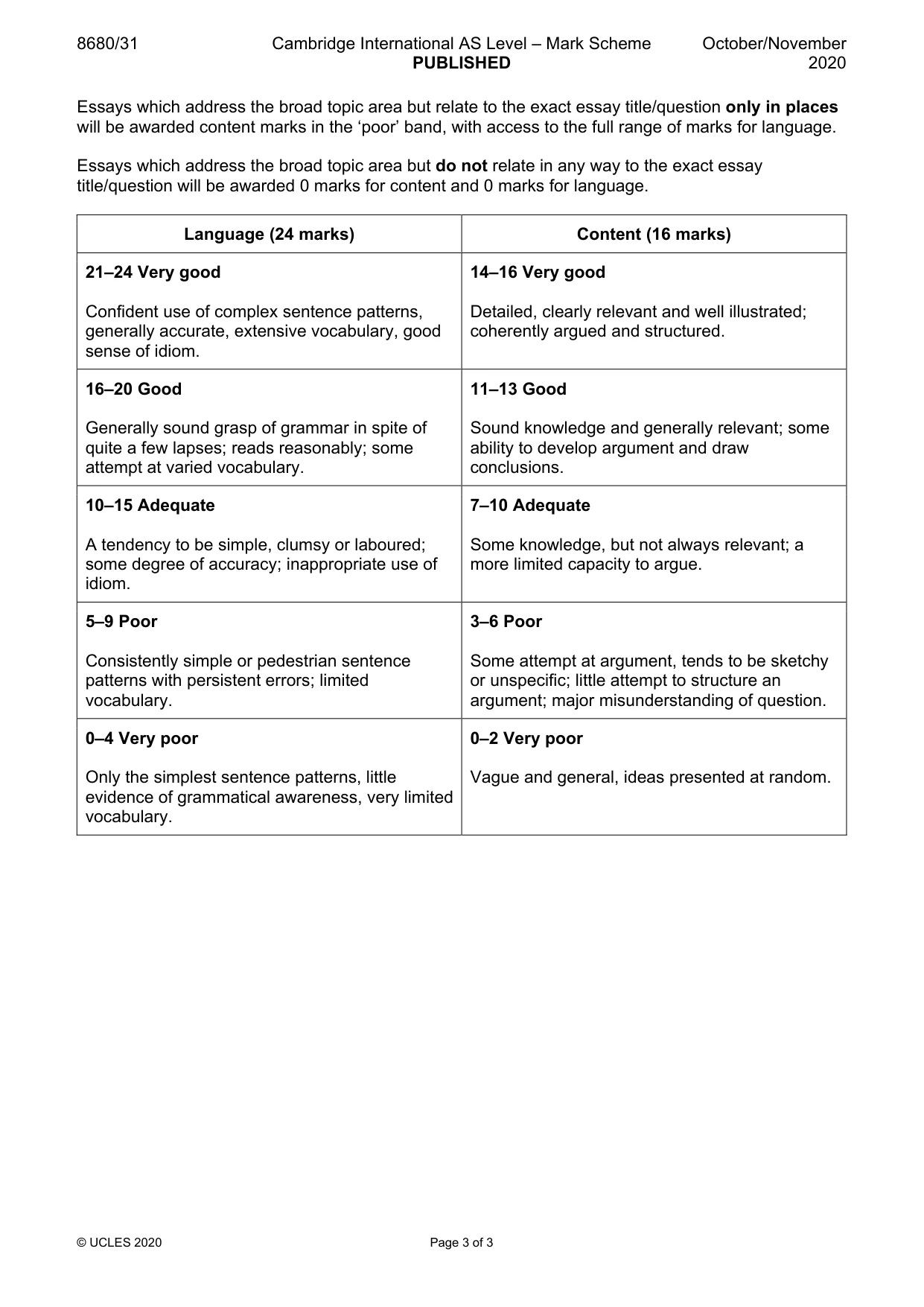
8680/31 Cambridge International AS Level – Mark Scheme PUBLISHED October/November 2020 © UCLES 2020 Page 3 of 3 Essays which address the broad topic area but relate to the exact essay title/question only in places will be awarded content marks in the ‘poor’ band, with access to the full range of marks for language. Essays which address the broad topic area but do not relate in any way to the exact essay title/question will be awarded 0 marks for content and 0 marks for language. Language (24 marks) Content (16 marks) 21–24 Very good Confident use of complex sentence patterns, generally accurate, extensive vocabulary, good sense of idiom. 14–16 Very good Detailed, clearly relevant and well illustrated; coherently argued and structured. 16–20 Good Generally sound grasp of grammar in spite of quite a few lapses; reads reasonably; some attempt at varied vocabulary. 11–13 Good Sound knowledge and generally relevant; some ability to develop argument and draw conclusions. 10–15 Adequate A tendency to be simple, clumsy or laboured; some degree of accuracy; inappropriate use of idiom. 7–10 Adequate Some knowledge, but not always relevant; a more limited capacity to argue. 5–9 Poor Consistently simple or pedestrian sentence patterns with persistent errors; limited vocabulary. 3–6 Poor Some attempt at argument, tends to be sketchy or unspecific; little attempt to structure an argument; major misunderstanding of question. 0–4 Very poor Only the simplest sentence patterns, little evidence of grammatical awareness, very limited vocabulary. 0–2 Very poor Vague and general, ideas presented at random.
What you needed in this session
Cambridge’s own grade thresholds for 2020 Oct/Nov, Paper 3 · Variant 1. A higher threshold means an easier paper — the bar moves with how the cohort did.