Cambridge A Level Accounting 9706 — 2022 Oct/Nov Paper 3 · Variant 2
9706/32/O/N/22 · 150 marks · ≈169 min
The question paper and its mark scheme, free to read here and free to download. This is Cambridge’s own paper, exactly as it was sat.
Question paper20 pages


Mark scheme22 pages
Answers below. Sit the paper first if you are practising.
Paper as text
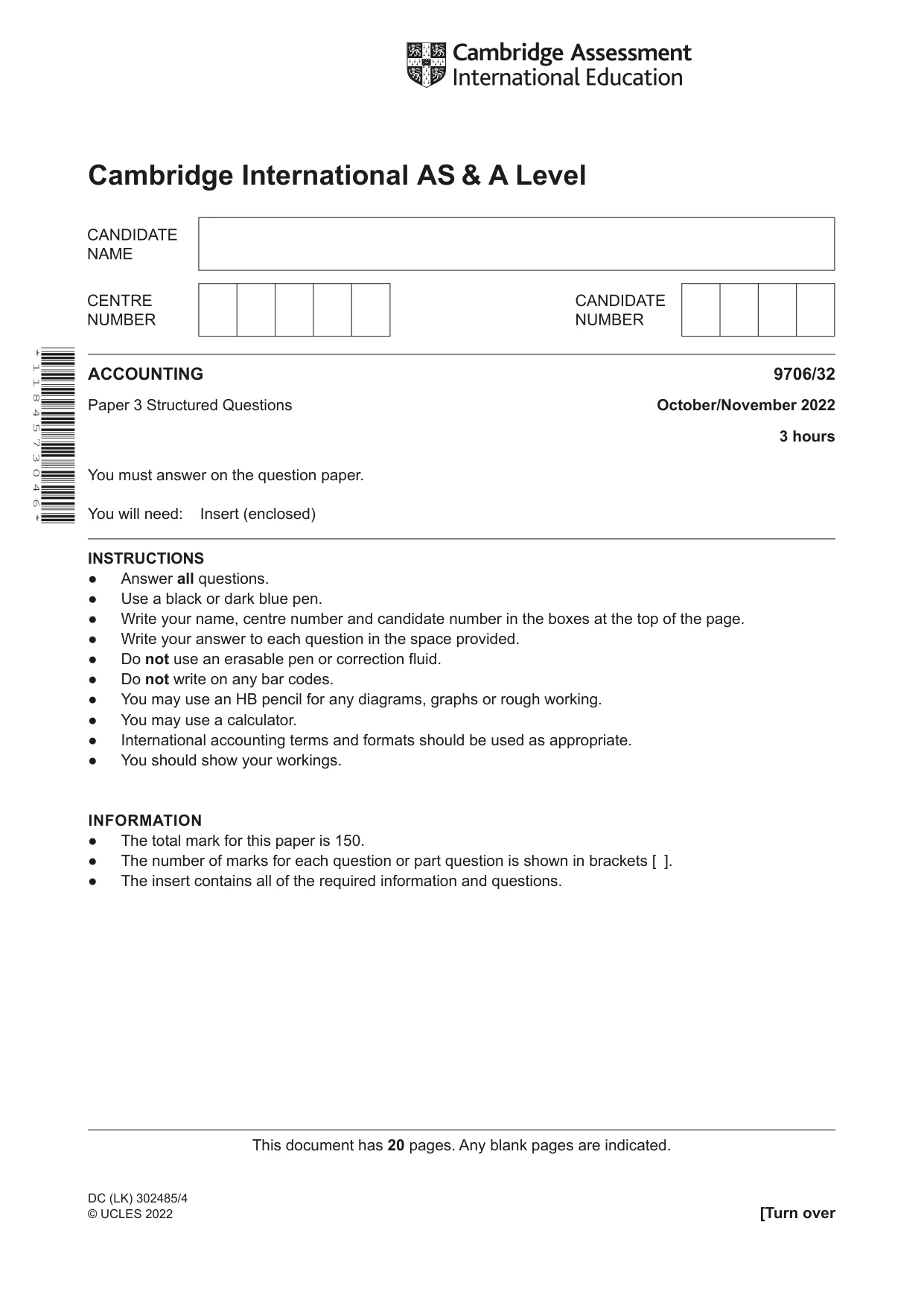
Question paper, page 1
This document has 20 pages. Any blank pages are indicated. [Turn over Cambridge International AS & A Level DC (LK) 302485/4 © UCLES 2022 ACCOUNTING 9706/32 Paper 3 Structured Questions October/November 2022 3 hours You must answer on the question paper. You will need: Insert (enclosed) INSTRUCTIONS ● Answer all questions. ● Use a black or dark blue pen. ● Write your name, centre number and candidate number in the boxes at the top of the page. ● Write your answer to each question in the space provided. ● Do not use an erasable pen or correction fluid. ● Do not write on any bar codes. ● You may use an HB pencil for any diagrams, graphs or rough working. ● You may use a calculator. ● International accounting terms and formats should be used as appropriate. ● You should show your workings. INFORMATION ● The total mark for this paper is 150. ● The number of marks for each question or part question is shown in brackets [ ]. ● The insert contains all of the required information and questions. * 1 1 8 4 5 7 3 0 4 6 *
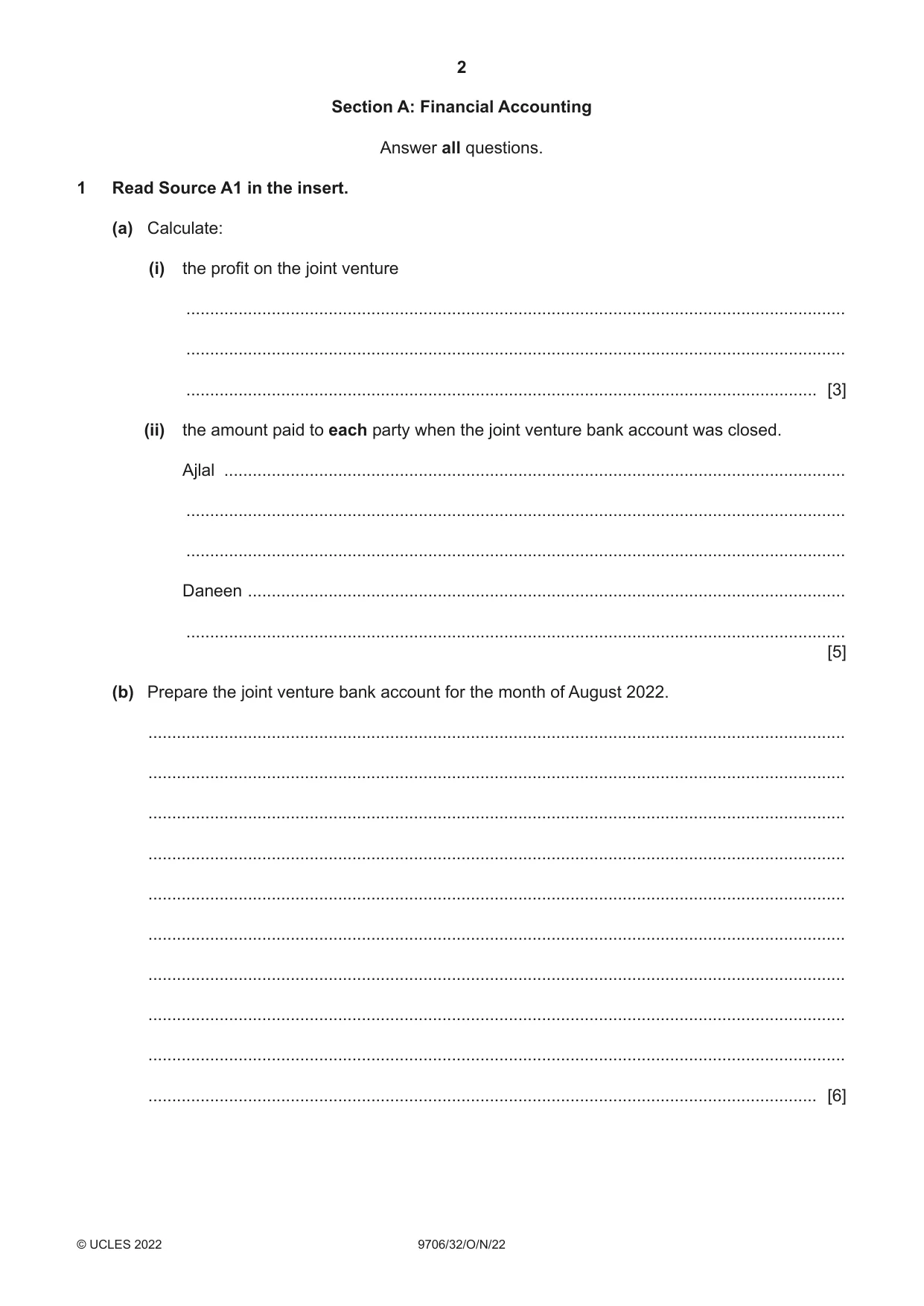
Question paper, page 2
2 9706/32/O/N/22 © UCLES 2022 Section A: Financial Accounting Answer all questions. 1 Read Source A1 in the insert. (a) Calculate: (i) the profit on the joint venture … … … [3] (ii) the amount paid to each party when the joint venture bank account was closed. Ajlal … … … Daneen … … [5] (b) Prepare the joint venture bank account for the month of August 2022. … … … … … … … … … … [6]
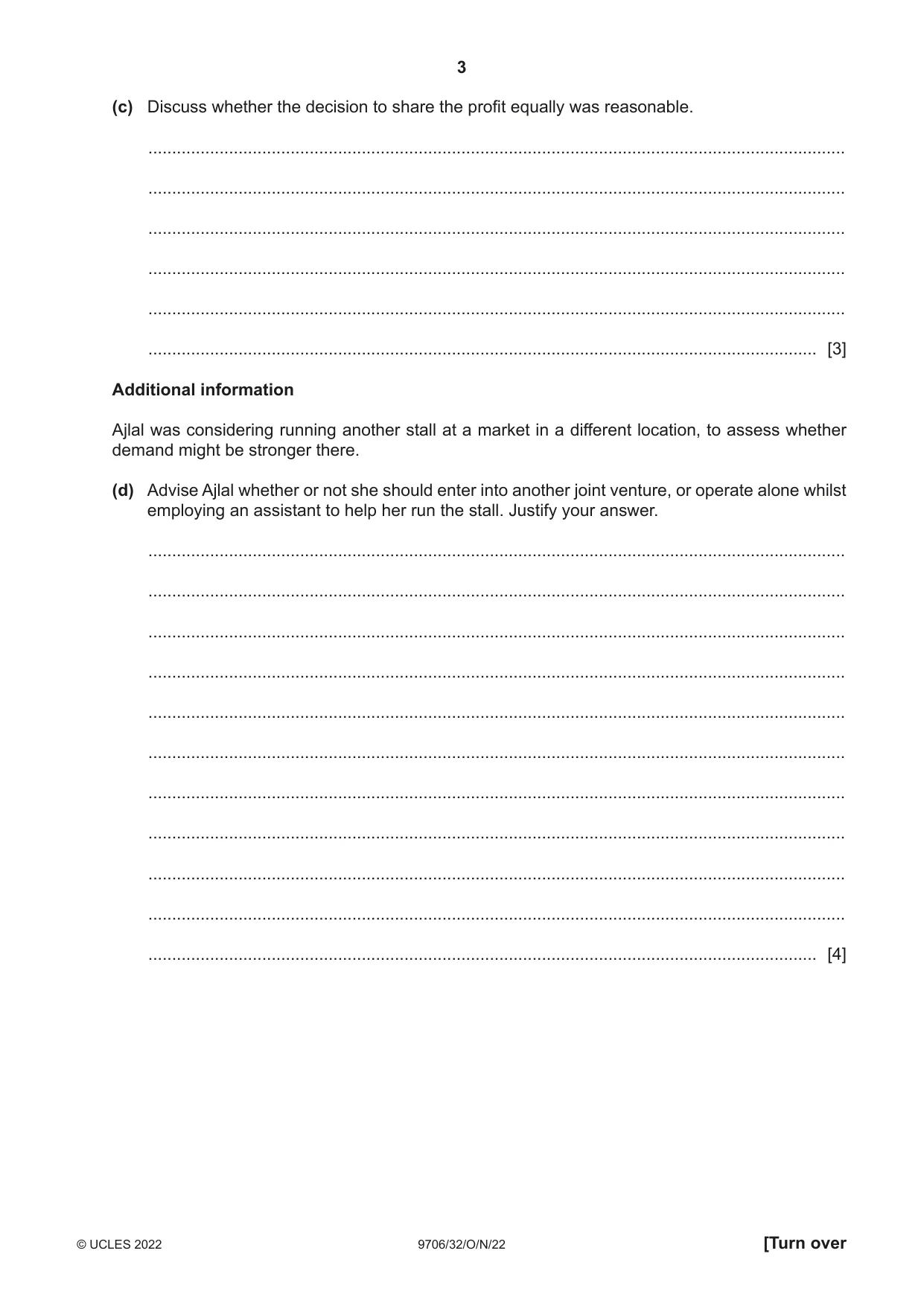
Question paper, page 3
3 9706/32/O/N/22 © UCLES 2022 [Turn over (c) Discuss whether the decision to share the profit equally was reasonable. … … … … … … [3] Additional information Ajlal was considering running another stall at a market in a different location, to assess whether demand might be stronger there. (d) Advise Ajlal whether or not she should enter into another joint venture, or operate alone whilst employing an assistant to help her run the stall. Justify your answer. … … … … … … … … … … … [4]
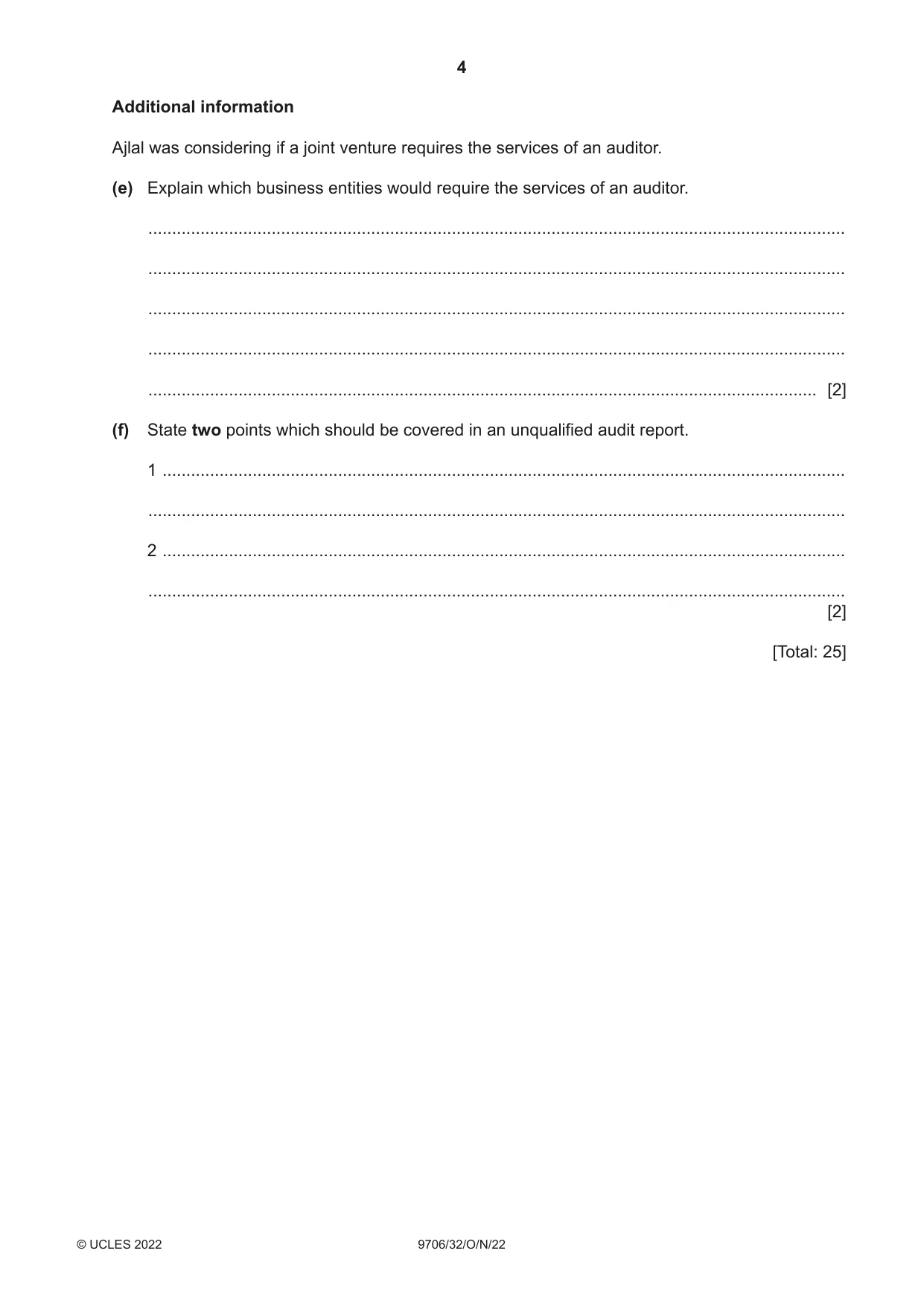
Question paper, page 4
4 9706/32/O/N/22 © UCLES 2022 Additional information Ajlal was considering if a joint venture requires the services of an auditor. (e) Explain which business entities would require the services of an auditor. … … … … … [2] (f) State two points which should be covered in an unqualified audit report. 1 … … 2 … … [2] [Total: 25]
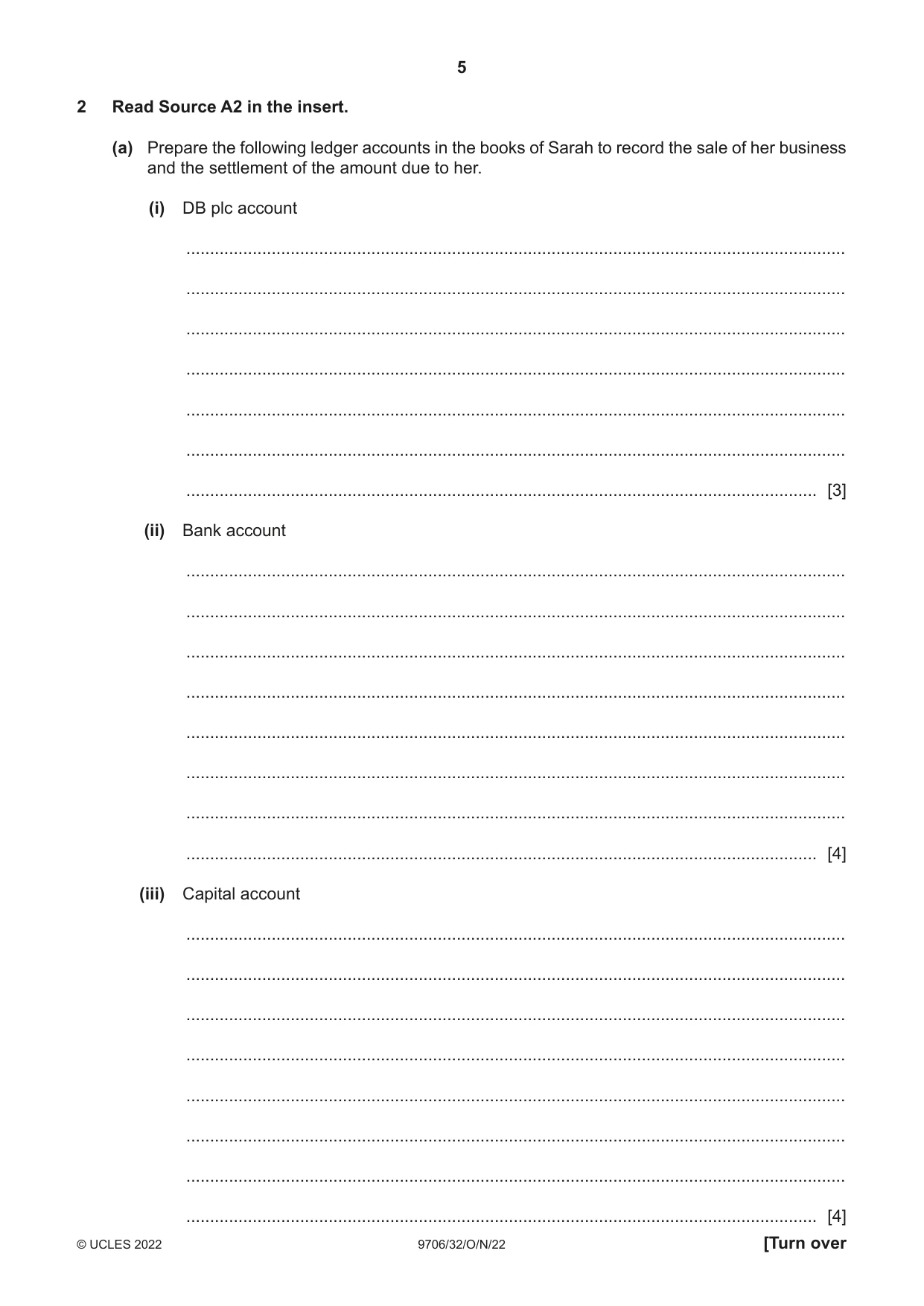
Question paper, page 5
5 9706/32/O/N/22 © UCLES 2022 [Turn over 2 Read Source A2 in the insert. (a) Prepare the following ledger accounts in the books of Sarah to record the sale of her business and the settlement of the amount due to her. (i) DB plc account … … … … … … … [3] (ii) Bank account … … … … … … … … [4] (iii) Capital account … … … … … … … … [4]
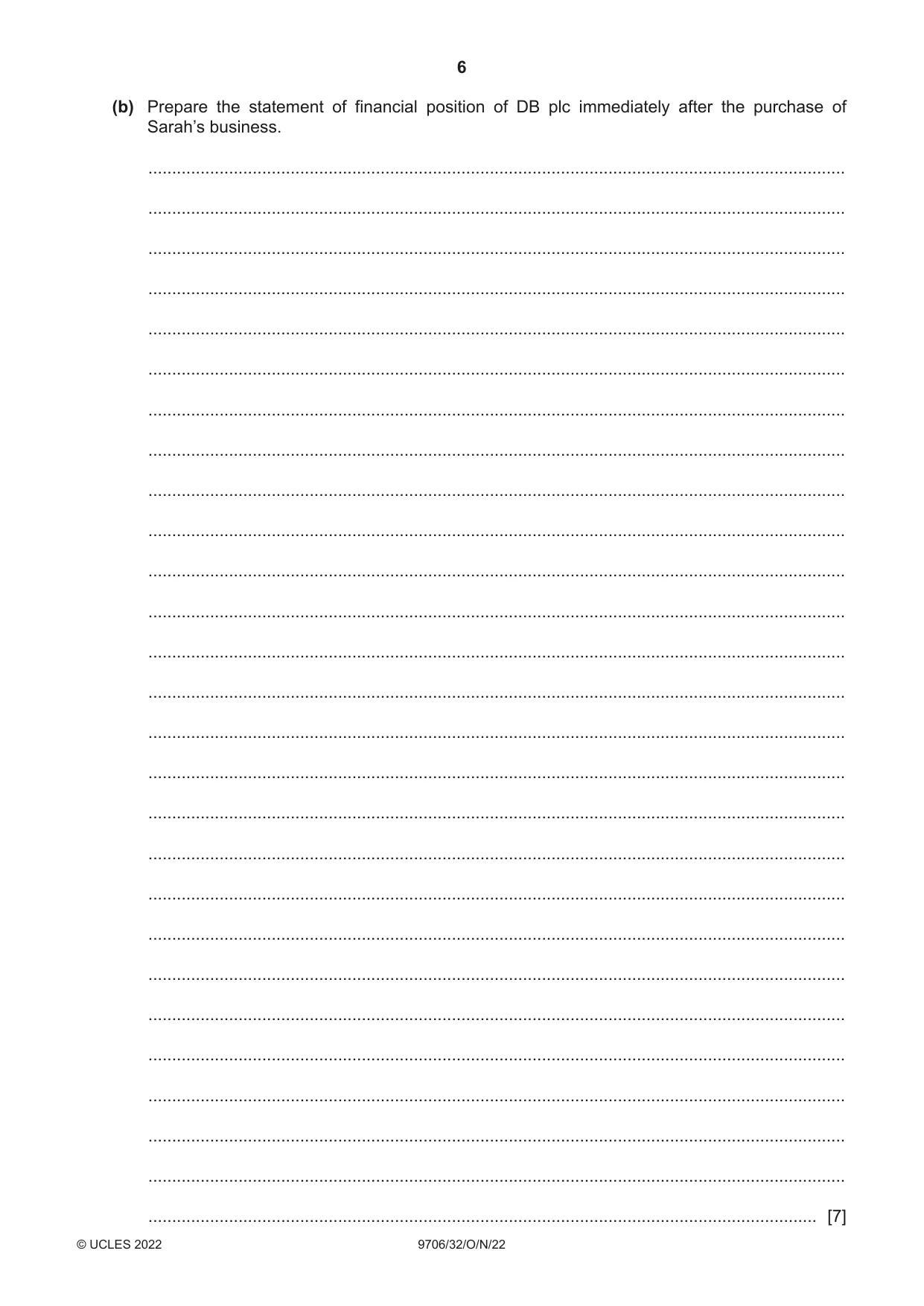
Question paper, page 6
6 9706/32/O/N/22 © UCLES 2022 (b) Prepare the statement of financial position of DB plc immediately after the purchase of Sarah’s business. … … … … … … … … … … … … … … … … … … … … … … … … … … … [7]
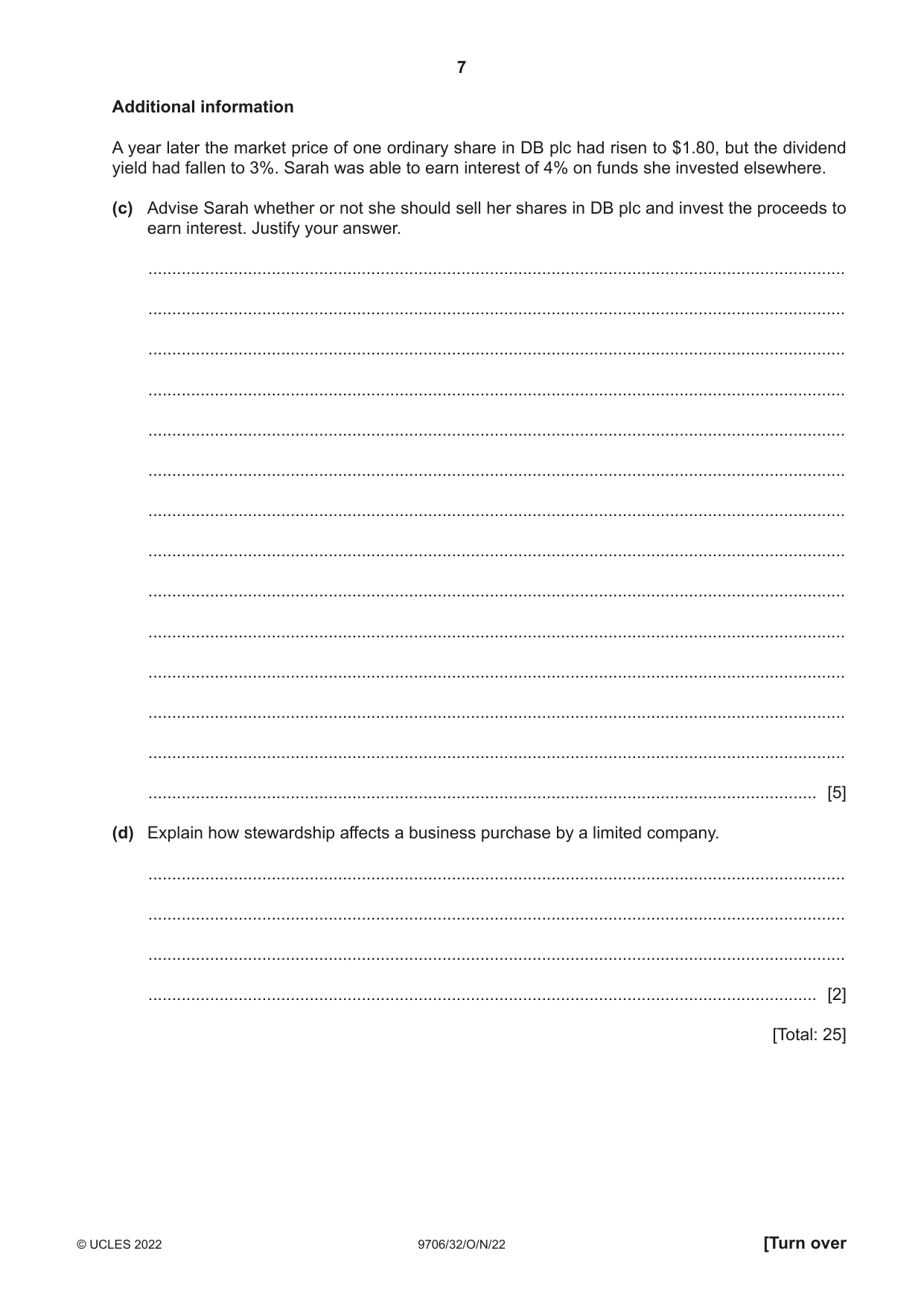
Question paper, page 7
7 9706/32/O/N/22 © UCLES 2022 [Turn over Additional information A year later the market price of one ordinary share in DB plc had risen to $1.80, but the dividend yield had fallen to 3%. Sarah was able to earn interest of 4% on funds she invested elsewhere. (c) Advise Sarah whether or not she should sell her shares in DB plc and invest the proceeds to earn interest. Justify your answer. … … … … … … … … … … … … … … [5] (d) Explain how stewardship affects a business purchase by a limited company. … … … … [2] [Total: 25]
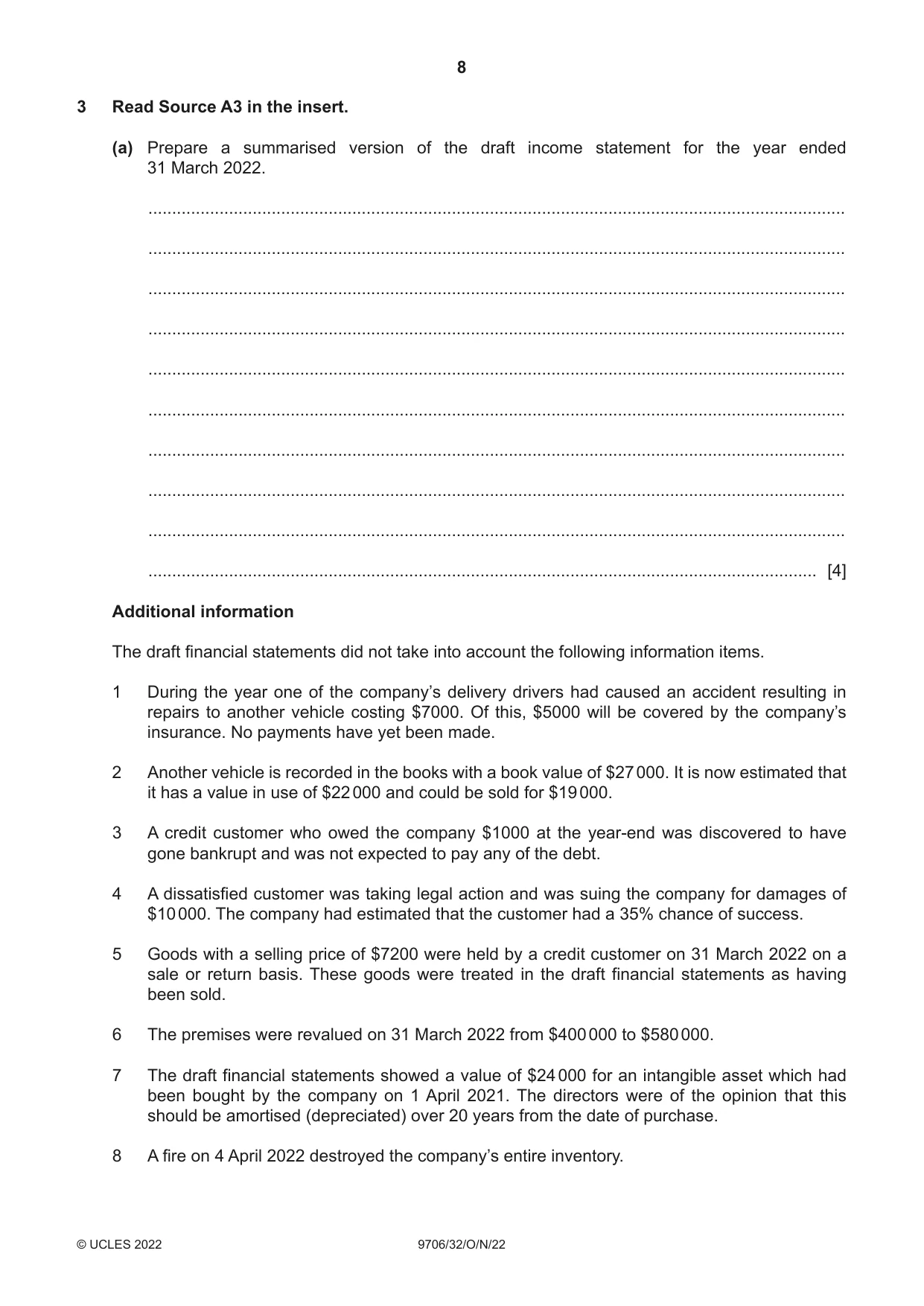
Question paper, page 8
8 9706/32/O/N/22 © UCLES 2022 3 Read Source A3 in the insert. (a) Prepare a summarised version of the draft income statement for the year ended 31 March 2022. … … … … … … … … … … [4] Additional information The draft financial statements did not take into account the following information items. 1 During the year one of the company’s delivery drivers had caused an accident resulting in repairs to another vehicle costing $7000. Of this, $5000 will be covered by the company’s insurance. No payments have yet been made. 2 Another vehicle is recorded in the books with a book value of $27 000. It is now estimated that it has a value in use of $22 000 and could be sold for $19 000. 3 A credit customer who owed the company $1000 at the year-end was discovered to have gone bankrupt and was not expected to pay any of the debt. 4 A dissatisfied customer was taking legal action and was suing the company for damages of $10 000. The company had estimated that the customer had a 35% chance of success. 5 Goods with a selling price of $7200 were held by a credit customer on 31 March 2022 on a sale or return basis. These goods were treated in the draft financial statements as having been sold. 6 The premises were revalued on 31 March 2022 from $400 000 to $580 000. 7 The draft financial statements showed a value of $24 000 for an intangible asset which had been bought by the company on 1 April 2021. The directors were of the opinion that this should be amortised (depreciated) over 20 years from the date of purchase. 8 A fire on 4 April 2022 destroyed the company’s entire inventory.
Question paper, page 9
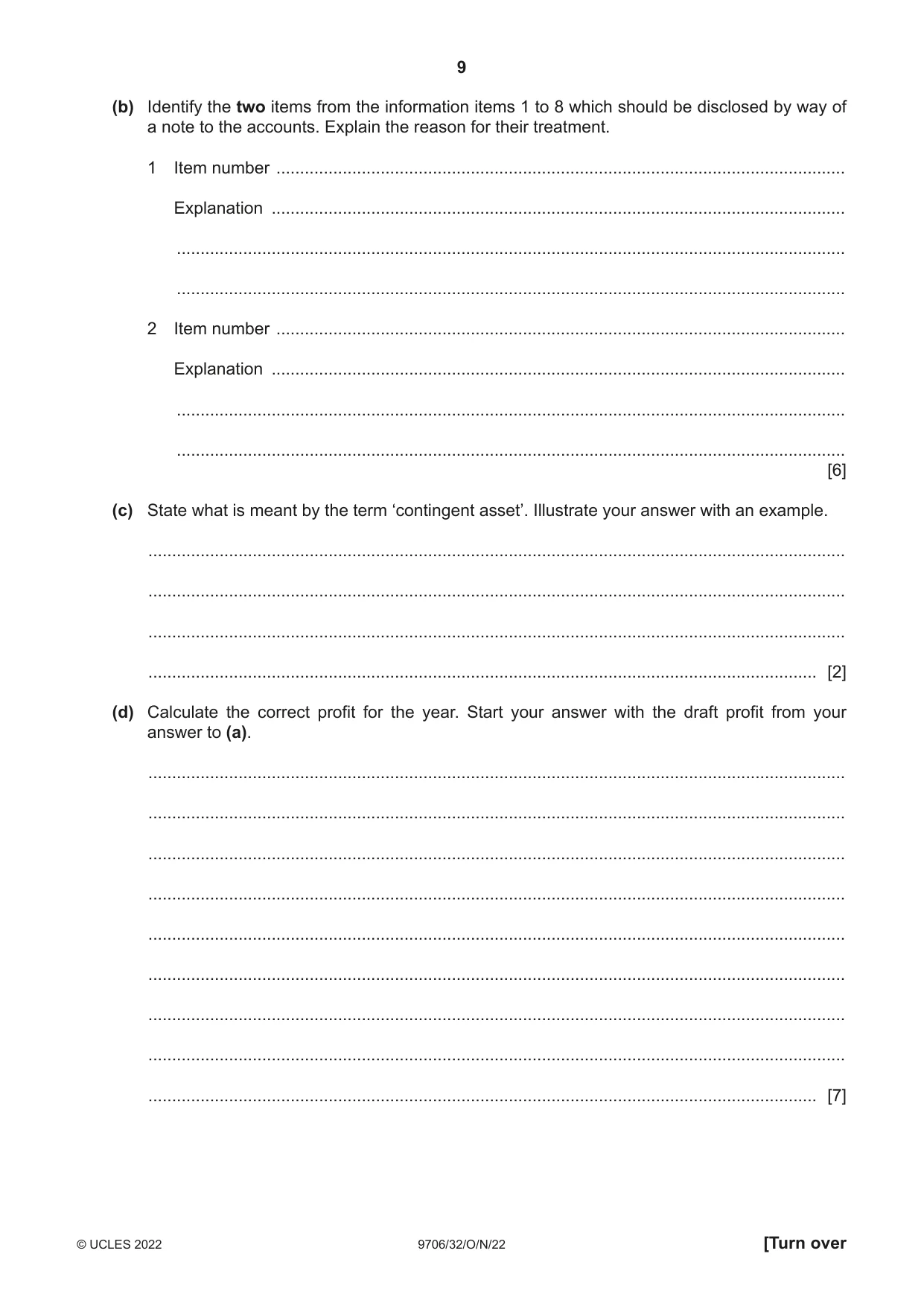
9 9706/32/O/N/22 © UCLES 2022 [Turn over (b) Identify the two items from the information items 1 to 8 which should be disclosed by way of a note to the accounts. Explain the reason for their treatment. 1 Item number … Explanation … … … 2 Item number … Explanation … … … [6] (c) State what is meant by the term ‘contingent asset’. Illustrate your answer with an example. … … … … [2] (d) Calculate the correct profit for the year. Start your answer with the draft profit from your answer to (a). … … … … … … … … … [7]
Question paper, page 10
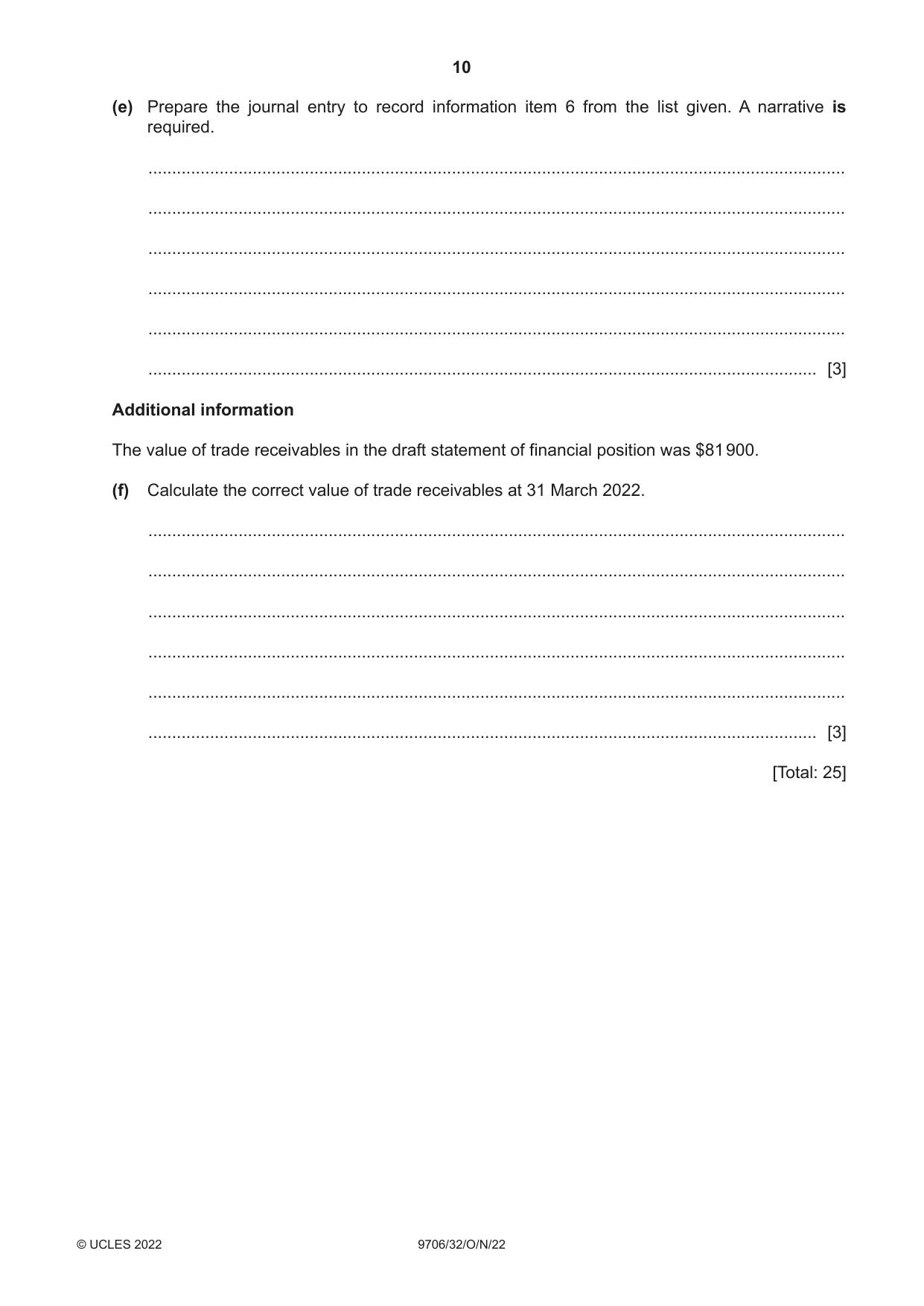
10 9706/32/O/N/22 © UCLES 2022 (e) Prepare the journal entry to record information item 6 from the list given. A narrative is required. … … … … … … [3] Additional information The value of trade receivables in the draft statement of financial position was $81 900. (f) Calculate the correct value of trade receivables at 31 March 2022. … … … … … … [3] [Total: 25]
Question paper, page 11
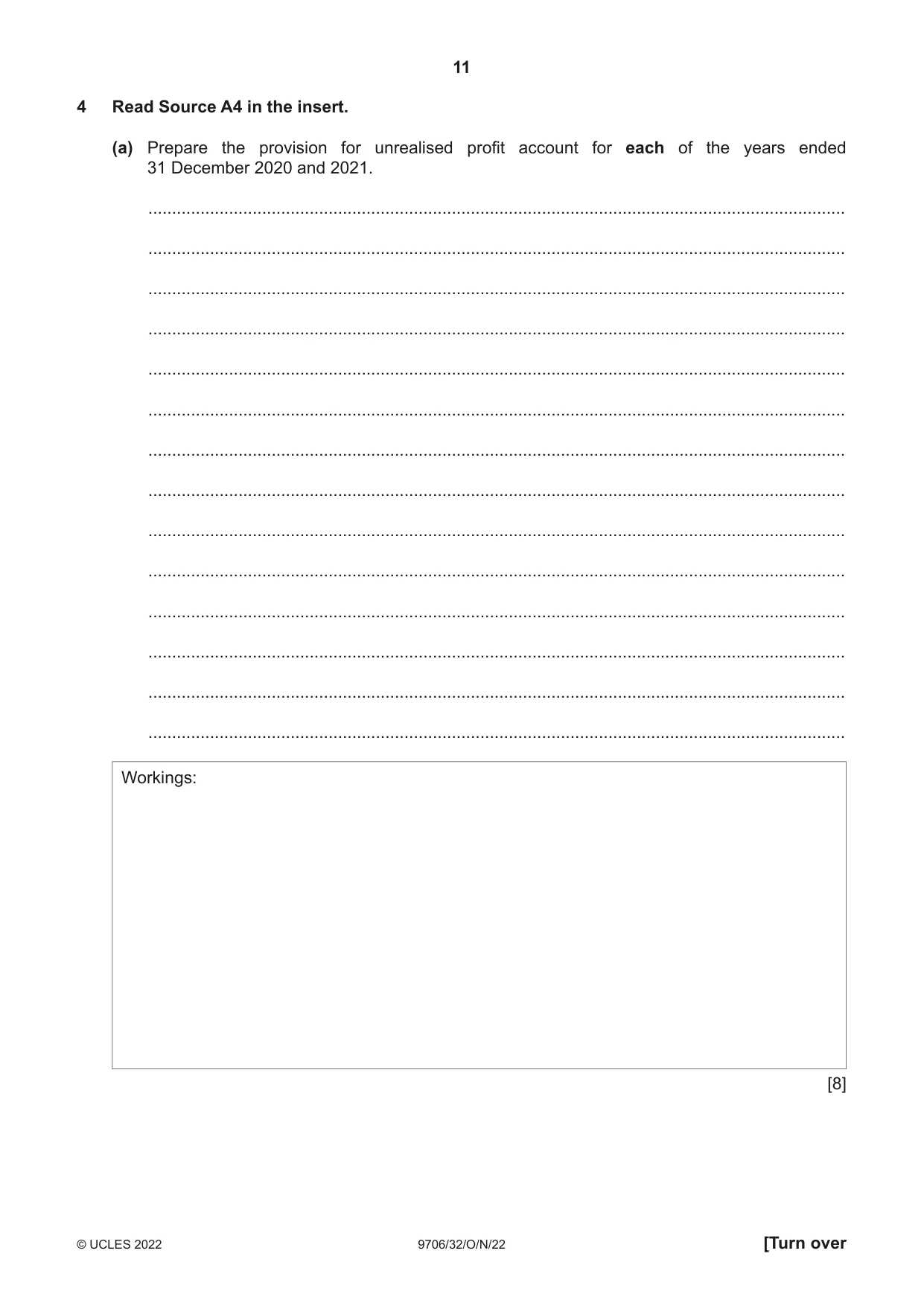
11 9706/32/O/N/22 © UCLES 2022 [Turn over 4 Read Source A4 in the insert. (a) Prepare the provision for unrealised profit account for each of the years ended 31 December 2020 and 2021. … … … … … … … … … … … … … … Workings: [8]
Question paper, page 12
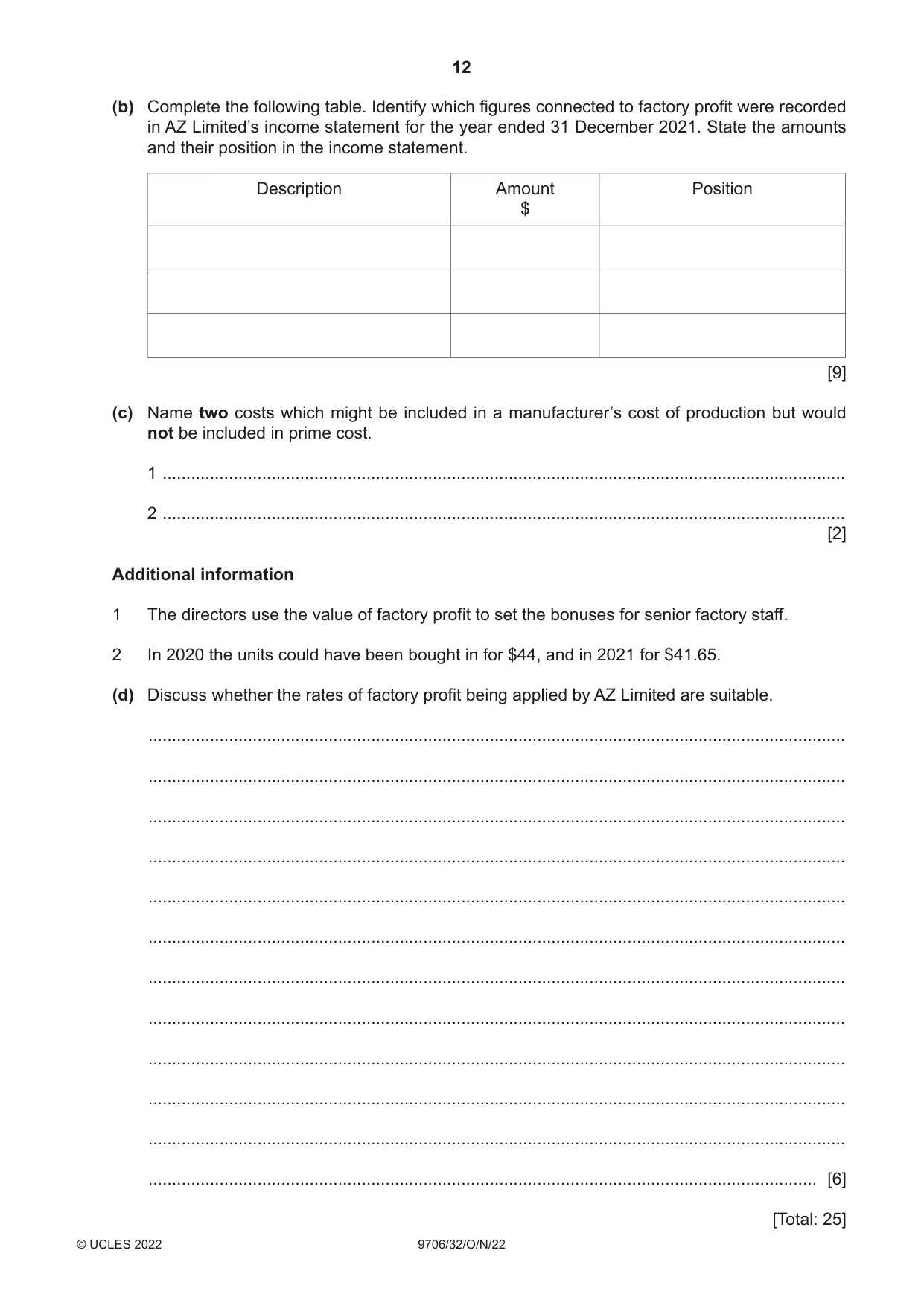
12 9706/32/O/N/22 © UCLES 2022 (b) Complete the following table. Identify which figures connected to factory profit were recorded in AZ Limited’s income statement for the year ended 31 December 2021. State the amounts and their position in the income statement. Description Amount $ Position [9] (c) Name two costs which might be included in a manufacturer’s cost of production but would not be included in prime cost. 1 … 2 … [2] Additional information 1 The directors use the value of factory profit to set the bonuses for senior factory staff. 2 In 2020 the units could have been bought in for $44, and in 2021 for $41.65. (d) Discuss whether the rates of factory profit being applied by AZ Limited are suitable. … … … … … … … … … … … … [6] [Total: 25]
Question paper, page 13
13 9706/32/O/N/22 © UCLES 2022 [Turn over Section B: Cost and Management Accounting Answer all questions. 5 Read Source B1 in the insert. (a) Prepare the labour wages budget for each of the months June, July and August. … … … … … … … … … [4] (b) Prepare extracts from the cash budget showing entries relating to sales and labour for each of the months June, July and August. … … … … … … … … … … … … … … … [13]
Question paper, page 14
14 9706/32/O/N/22 © UCLES 2022 (c) State two advantages to a business of preparing a cash budget. 1 … … 2 … … [2] Additional information One of the directors has suggested adding a fixed amount of profit per unit when calculating the selling price so that profit is not affected by changes in production cost. (d) Advise the directors whether or not they should adopt this suggestion. Justify your answer. … … … … … … … … … … [4] (e) Name two budgets which would be affected by the creation of a provision for doubtful debts. 1 … 2 … [2] [Total: 25]
Question paper, page 15
15 9706/32/O/N/22 © UCLES 2022 [Turn over PLEASE TURN OVER
Question paper, page 16
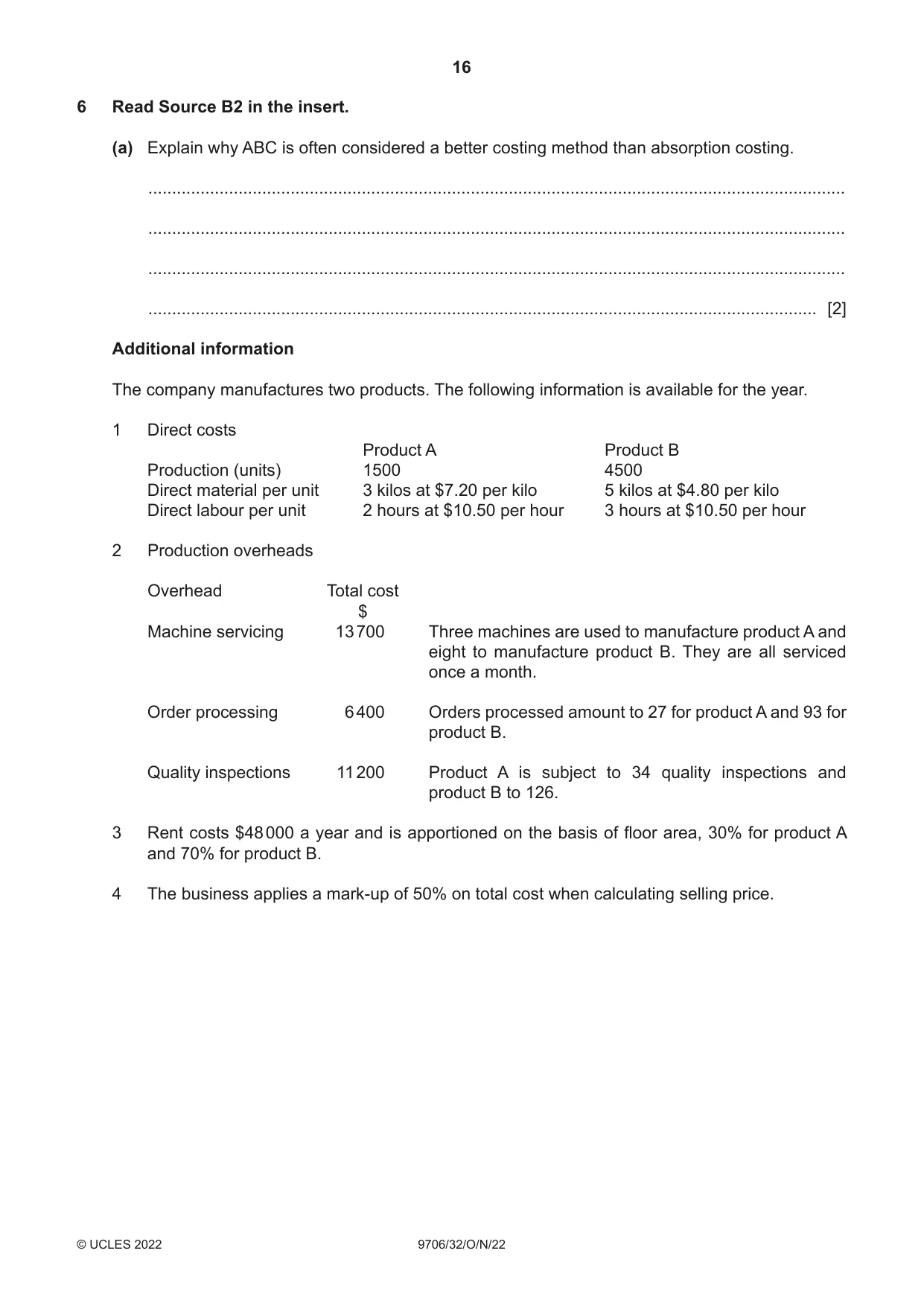
16 9706/32/O/N/22 © UCLES 2022 6 Read Source B2 in the insert. (a) Explain why ABC is often considered a better costing method than absorption costing. … … … … [2] Additional information The company manufactures two products. The following information is available for the year. 1 Direct costs Product A Product B Production (units) 1500 4500 Direct material per unit 3 kilos at $7.20 per kilo 5 kilos at $4.80 per kilo Direct labour per unit 2 hours at $10.50 per hour 3 hours at $10.50 per hour 2 Production overheads Overhead Total cost $ Machine servicing 13 700 Three machines are used to manufacture product A and eight to manufacture product B. They are all serviced once a month. Order processing 6 400 Orders processed amount to 27 for product A and 93 for product B. Quality inspections 11 200 Product A is subject to 34 quality inspections and product B to 126. 3 Rent costs $48 000 a year and is apportioned on the basis of floor area, 30% for product A and 70% for product B. 4 The business applies a mark-up of 50% on total cost when calculating selling price.
Question paper, page 17
17 9706/32/O/N/22 © UCLES 2022 [Turn over (b) Calculate the selling price of one unit for each product. … … … … … … … … … … … … … … … … … … … … … … … … … … … [12]
Question paper, page 18
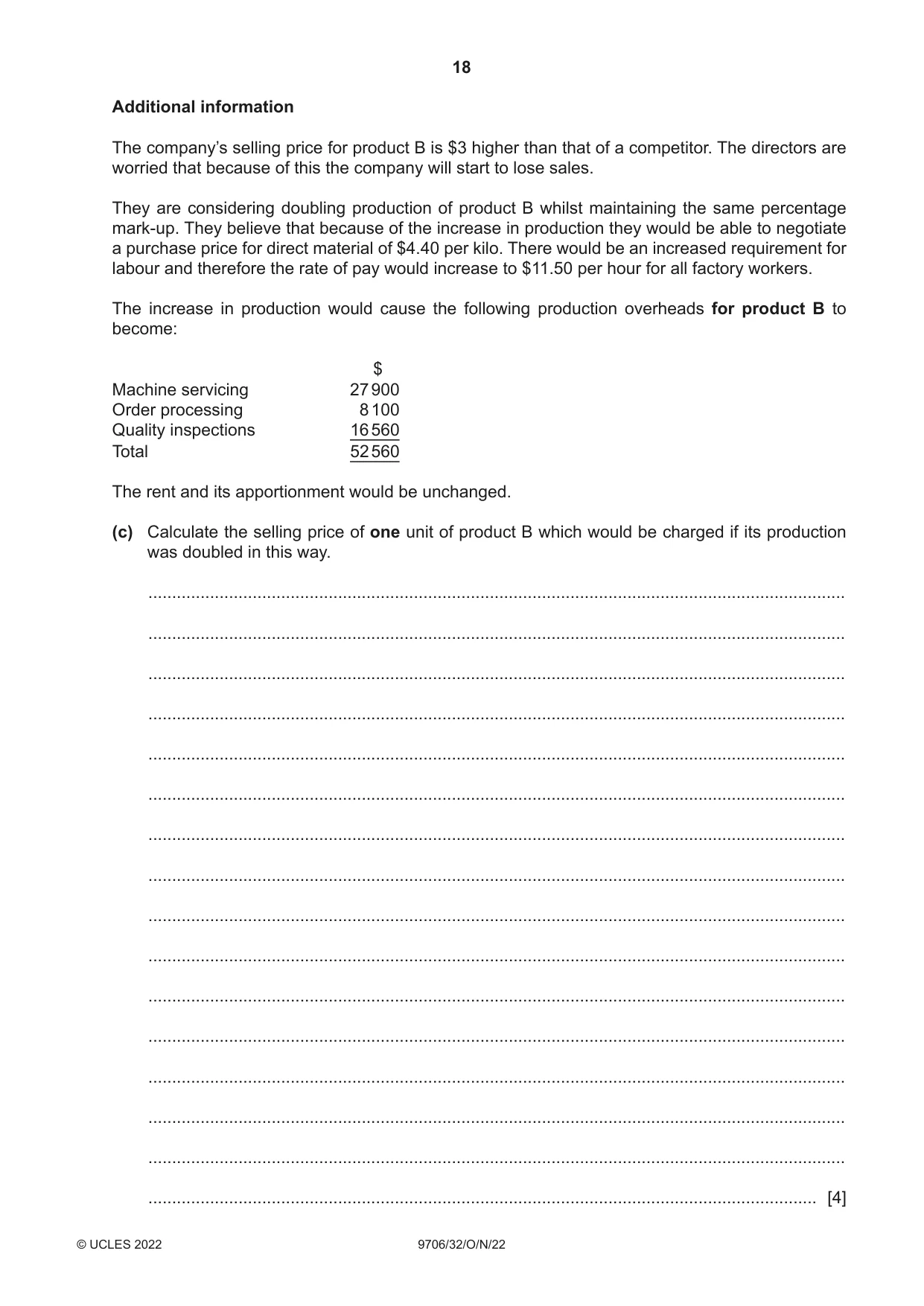
18 9706/32/O/N/22 © UCLES 2022 Additional information The company’s selling price for product B is $3 higher than that of a competitor. The directors are worried that because of this the company will start to lose sales. They are considering doubling production of product B whilst maintaining the same percentage mark-up. They believe that because of the increase in production they would be able to negotiate a purchase price for direct material of $4.40 per kilo. There would be an increased requirement for labour and therefore the rate of pay would increase to $11.50 per hour for all factory workers. The increase in production would cause the following production overheads for product B to become: $ Machine servicing 27 900 Order processing 8 100 Quality inspections 16 560 Total 52 560 The rent and its apportionment would be unchanged. (c) Calculate the selling price of one unit of product B which would be charged if its production was doubled in this way. … … … … … … … … … … … … … … … … [4]
Question paper, page 19
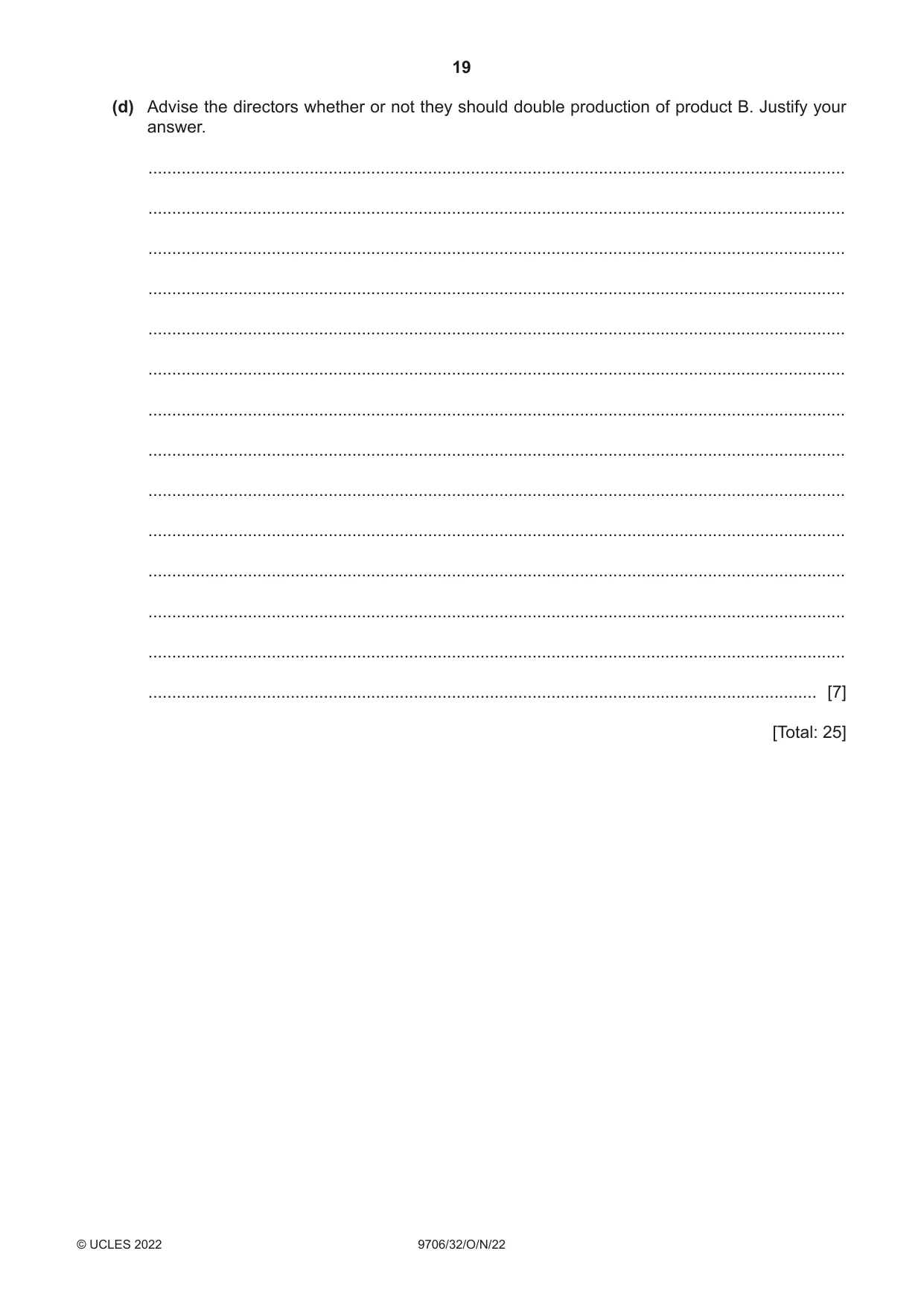
19 9706/32/O/N/22 © UCLES 2022 (d) Advise the directors whether or not they should double production of product B. Justify your answer. … … … … … … … … … … … … … … [7] [Total: 25]
Question paper, page 20
20 9706/32/O/N/22 © UCLES 2022 Permission to reproduce items where third-party owned material protected by copyright is included has been sought and cleared where possible. Every reasonable effort has been made by the publisher (UCLES) to trace copyright holders, but if any items requiring clearance have unwittingly been included, the publisher will be pleased to make amends at the earliest possible opportunity. To avoid the issue of disclosure of answer-related information to candidates, all copyright acknowledgements are reproduced online in the Cambridge Assessment International Education Copyright Acknowledgements Booklet. This is produced for each series of examinations and is freely available to download at www.cambridgeinternational.org after the live examination series. Cambridge Assessment International Education is part of Cambridge Assessment. Cambridge Assessment is the brand name of the University of Cambridge Local Examinations Syndicate (UCLES), which is a department of the University of Cambridge. BLANK PAGE
Mark scheme, page 1
This document consists of 22 printed pages. © UCLES 2022 [Turn over Cambridge International AS & A Level ACCOUNTING 9706/32 Paper 3 Structured Questions October/November 2022 MARK SCHEME Maximum Mark: 150 Published This mark scheme is published as an aid to teachers and candidates, to indicate the requirements of the examination. It shows the basis on which Examiners were instructed to award marks. It does not indicate the details of the discussions that took place at an Examiners’ meeting before marking began, which would have considered the acceptability of alternative answers. Mark schemes should be read in conjunction with the question paper and the Principal Examiner Report for Teachers. Cambridge International will not enter into discussions about these mark schemes. Cambridge International is publishing the mark schemes for the October/November 2022 series for most Cambridge IGCSE™, Cambridge International A and AS Level components and some Cambridge O Level components.
Mark scheme, page 2
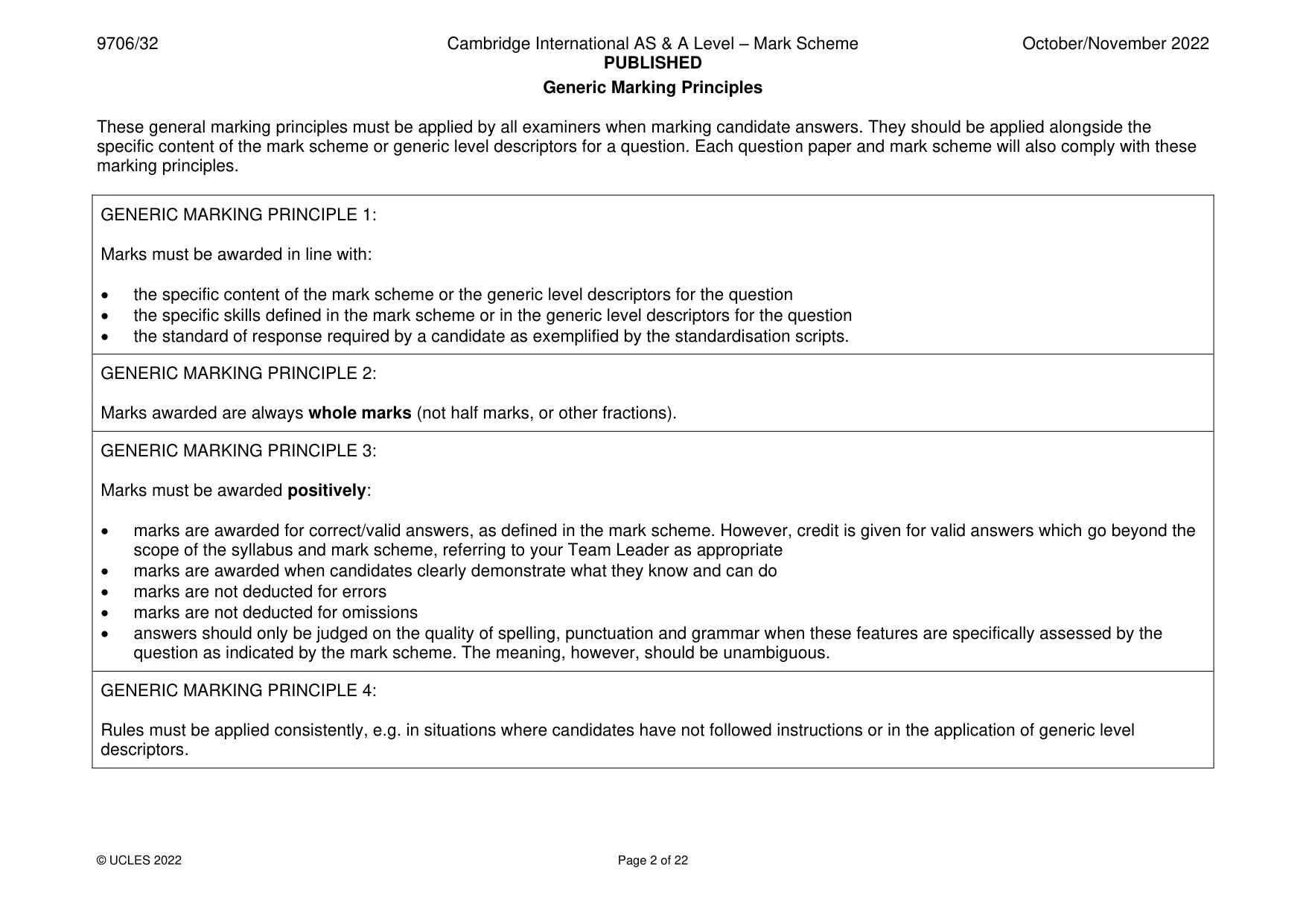
9706/32 Cambridge International AS & A Level – Mark Scheme PUBLISHED October/November 2022 © UCLES 2022 Page 2 of 22 Generic Marking Principles These general marking principles must be applied by all examiners when marking candidate answers. They should be applied alongside the specific content of the mark scheme or generic level descriptors for a question. Each question paper and mark scheme will also comply with these marking principles. GENERIC MARKING PRINCIPLE 1: Marks must be awarded in line with: • the specific content of the mark scheme or the generic level descriptors for the question • the specific skills defined in the mark scheme or in the generic level descriptors for the question • the standard of response required by a candidate as exemplified by the standardisation scripts. GENERIC MARKING PRINCIPLE 2: Marks awarded are always whole marks (not half marks, or other fractions). GENERIC MARKING PRINCIPLE 3: Marks must be awarded positively: • marks are awarded for correct/valid answers, as defined in the mark scheme. However, credit is given for valid answers which go beyond the scope of the syllabus and mark scheme, referring to your Team Leader as appropriate • marks are awarded when candidates clearly demonstrate what they know and can do • marks are not deducted for errors • marks are not deducted for omissions • answers should only be judged on the quality of spelling, punctuation and grammar when these features are specifically assessed by the question as indicated by the mark scheme. The meaning, however, should be unambiguous. GENERIC MARKING PRINCIPLE 4: Rules must be applied consistently, e.g. in situations where candidates have not followed instructions or in the application of generic level descriptors.
Mark scheme, page 3
9706/32 Cambridge International AS & A Level – Mark Scheme PUBLISHED October/November 2022 © UCLES 2022 Page 3 of 22 GENERIC MARKING PRINCIPLE 5: Marks should be awarded using the full range of marks defined in the mark scheme for the question (however; the use of the full mark range may be limited according to the quality of the candidate responses seen). GENERIC MARKING PRINCIPLE 6: Marks awarded are based solely on the requirements as defined in the mark scheme. Marks should not be awarded with grade thresholds or grade descriptors in mind.
Mark scheme, page 4
9706/32 Cambridge International AS & A Level – Mark Scheme PUBLISHED October/November 2022 © UCLES 2022 Page 4 of 22 Social Science-Specific Marking Principles (for point-based marking) 1 Components using point-based marking: • Point marking is often used to reward knowledge, understanding and application of skills. We give credit where the candidate’s answer shows relevant knowledge, understanding and application of skills in answering the question. We do not give credit where the answer shows confusion. From this it follows that we: a DO credit answers which are worded differently from the mark scheme if they clearly convey the same meaning (unless the mark scheme requires a specific term) b DO credit alternative answers/examples which are not written in the mark scheme if they are correct c DO credit answers where candidates give more than one correct answer in one prompt/numbered/scaffolded space where extended writing is required rather than list-type answers. For example, questions that require n reasons (e.g. State two reasons …). d DO NOT credit answers simply for using a ‘key term’ unless that is all that is required. (Check for evidence it is understood and not used wrongly.) e DO NOT credit answers which are obviously self-contradicting or trying to cover all possibilities f DO NOT give further credit for what is effectively repetition of a correct point already credited unless the language itself is being tested. This applies equally to ‘mirror statements’ (i.e. polluted/not polluted). g DO NOT require spellings to be correct, unless this is part of the test. However spellings of syllabus terms must allow for clear and unambiguous separation from other syllabus terms with which they may be confused (e.g. Corrasion/Corrosion) 2 Presentation of mark scheme: • Slashes (/) or the word ‘or’ separate alternative ways of making the same point. • Semi colons (;) bullet points (•) or figures in brackets (1) separate different points. • Content in the answer column in brackets is for examiner information/context to clarify the marking but is not required to earn the mark (except Accounting syllabuses where they indicate negative numbers).
Mark scheme, page 5
9706/32 Cambridge International AS & A Level – Mark Scheme PUBLISHED October/November 2022 © UCLES 2022 Page 5 of 22 3 Calculation questions: • The mark scheme will show the steps in the most likely correct method(s), the mark for each step, the correct answer(s) and the mark for each answer • If working/explanation is considered essential for full credit, this will be indicated in the question paper and in the mark scheme. In all other instances, the correct answer to a calculation should be given full credit, even if no supporting working is shown. • Where the candidate uses a valid method which is not covered by the mark scheme, award equivalent marks for reaching equivalent stages. • Where an answer makes use of a candidate’s own incorrect figure from previous working, the ‘own figure rule’ applies: full marks will be given if a correct and complete method is used. Further guidance will be included in the mark scheme where necessary and any exceptions to this general principle will be noted. 4 Annotation: • For point marking, ticks can be used to indicate correct answers and crosses can be used to indicate wrong answers. There is no direct relationship between ticks and marks. Ticks have no defined meaning for levels of response marking. • For levels of response marking, the level awarded should be annotated on the script. • Other annotations will be used by examiners as agreed during standardisation, and the meaning will be understood by all examiners who marked that paper.
Mark scheme, page 6
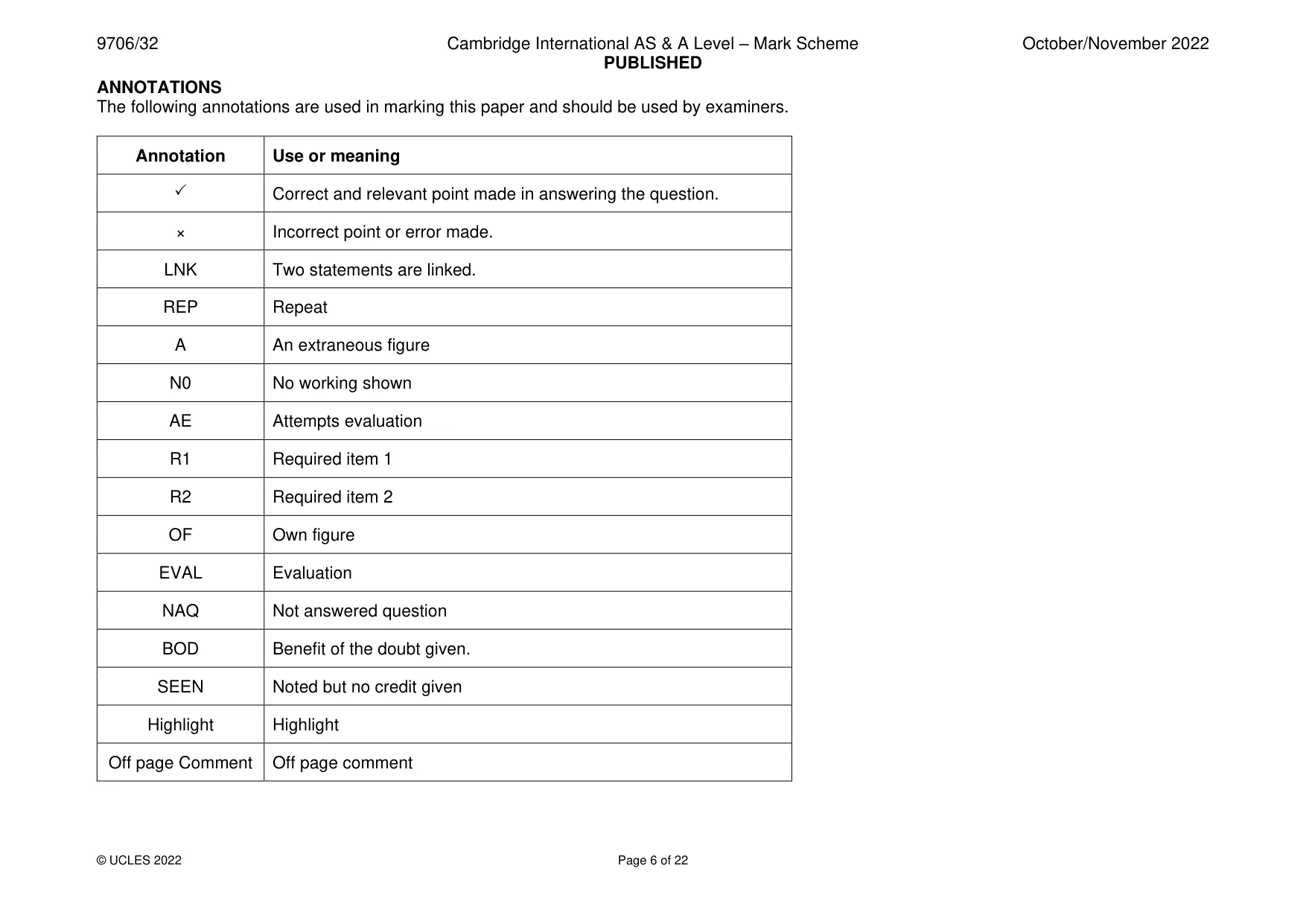
9706/32 Cambridge International AS & A Level – Mark Scheme PUBLISHED October/November 2022 © UCLES 2022 Page 6 of 22 ANNOTATIONS The following annotations are used in marking this paper and should be used by examiners. Annotation Use or meaning Correct and relevant point made in answering the question. × Incorrect point or error made. LNK Two statements are linked. REP Repeat A An extraneous figure N0 No working shown AE Attempts evaluation R1 Required item 1 R2 Required item 2 OF Own figure EVAL Evaluation NAQ Not answered question BOD Benefit of the doubt given. SEEN Noted but no credit given Highlight Highlight Off page Comment Off page comment
Mark scheme, page 7
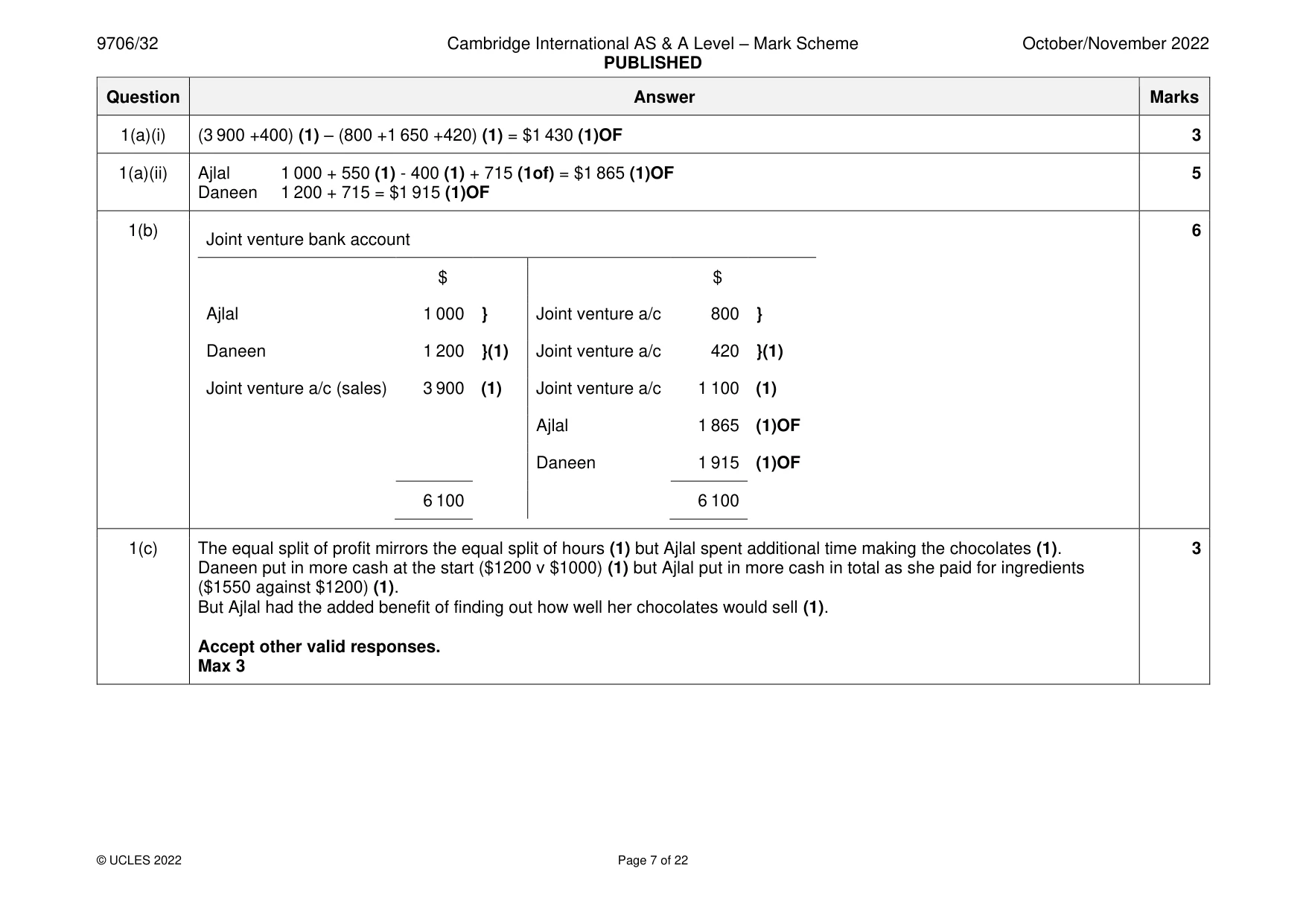
9706/32 Cambridge International AS & A Level – Mark Scheme PUBLISHED October/November 2022 © UCLES 2022 Page 7 of 22 Question Answer Marks 1(a)(i) (3 900 +400) (1) – (800 +1 650 +420) (1) = $1 430 (1)OF 3 1(a)(ii) Ajlal 1 000 + 550 (1) - 400 (1) + 715 (1of) = $1 865 (1)OF Daneen 1 200 + 715 = $1 915 (1)OF 5 1(b) Joint venture bank account $ $ Ajlal 1 000 } Joint venture a/c 800 } Daneen 1 200 }(1) Joint venture a/c 420 }(1) Joint venture a/c (sales) 3 900 (1) Joint venture a/c 1 100 (1) Ajlal 1 865 (1)OF Daneen 1 915 (1)OF 6 100 6 100 6 1(c) The equal split of profit mirrors the equal split of hours (1) but Ajlal spent additional time making the chocolates (1). Daneen put in more cash at the start ($1200 v $1000) (1) but Ajlal put in more cash in total as she paid for ingredients ($1550 against $1200) (1). But Ajlal had the added benefit of finding out how well her chocolates would sell (1). Accept other valid responses. Max 3 3
Mark scheme, page 8
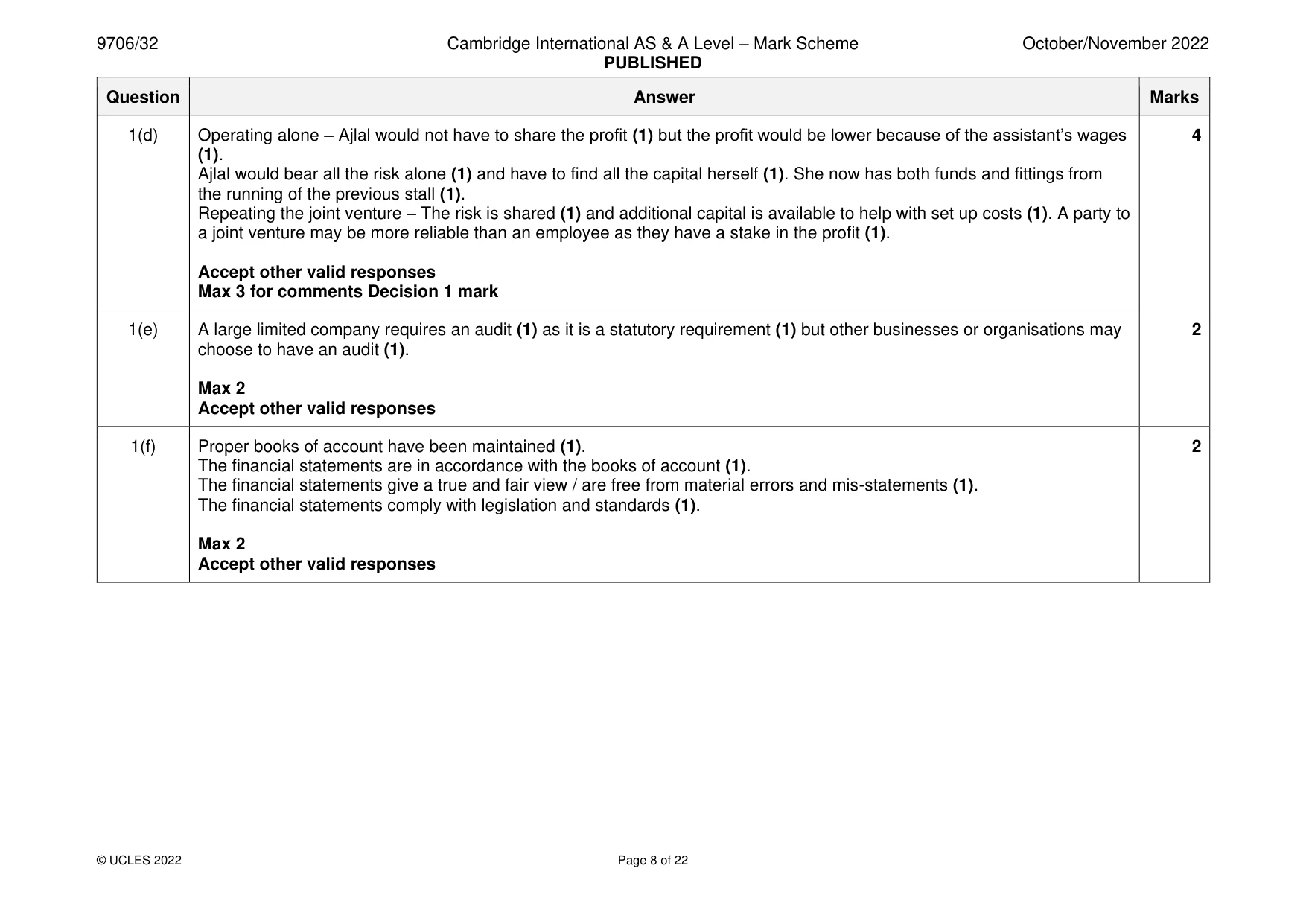
9706/32 Cambridge International AS & A Level – Mark Scheme PUBLISHED October/November 2022 © UCLES 2022 Page 8 of 22 Question Answer Marks 1(d) Operating alone – Ajlal would not have to share the profit (1) but the profit would be lower because of the assistant’s wages (1). Ajlal would bear all the risk alone (1) and have to find all the capital herself (1). She now has both funds and fittings from the running of the previous stall (1). Repeating the joint venture – The risk is shared (1) and additional capital is available to help with set up costs (1). A party to a joint venture may be more reliable than an employee as they have a stake in the profit (1). Accept other valid responses Max 3 for comments Decision 1 mark 4 1(e) A large limited company requires an audit (1) as it is a statutory requirement (1) but other businesses or organisations may choose to have an audit (1). Max 2 Accept other valid responses 2 1(f) Proper books of account have been maintained (1). The financial statements are in accordance with the books of account (1). The financial statements give a true and fair view / are free from material errors and mis-statements (1). The financial statements comply with legislation and standards (1). Max 2 Accept other valid responses 2
Mark scheme, page 9
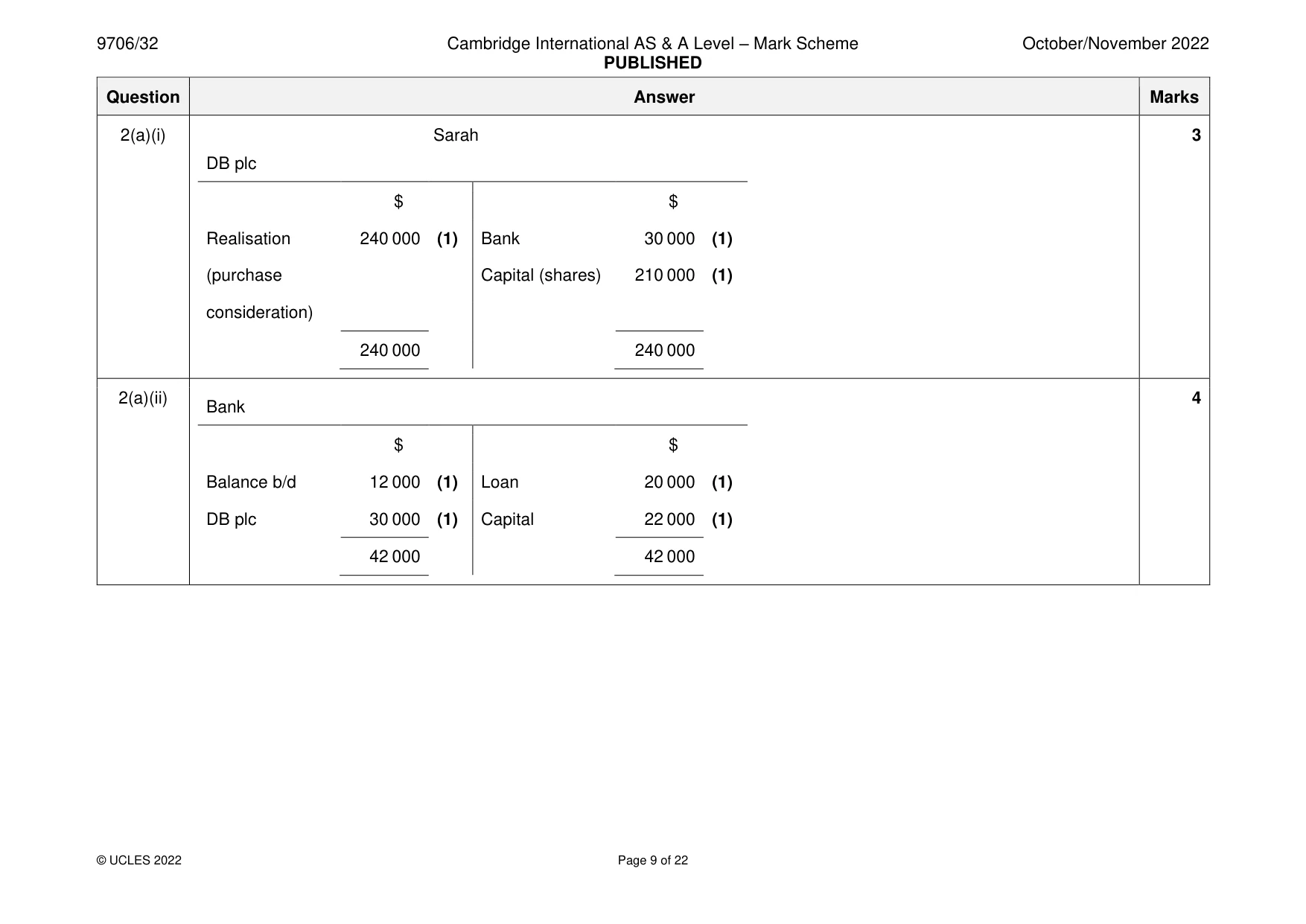
9706/32 Cambridge International AS & A Level – Mark Scheme PUBLISHED October/November 2022 © UCLES 2022 Page 9 of 22 Question Answer Marks 2(a)(i) Sarah DB plc $ $ Realisation 240 000 (1) Bank 30 000 (1) (purchase Capital (shares) 210 000 (1) consideration) 240 000 240 000 3 2(a)(ii) Bank $ $ Balance b/d 12 000 (1) Loan 20 000 (1) DB plc 30 000 (1) Capital 22 000 (1) 42 000 42 000 4
Mark scheme, page 10
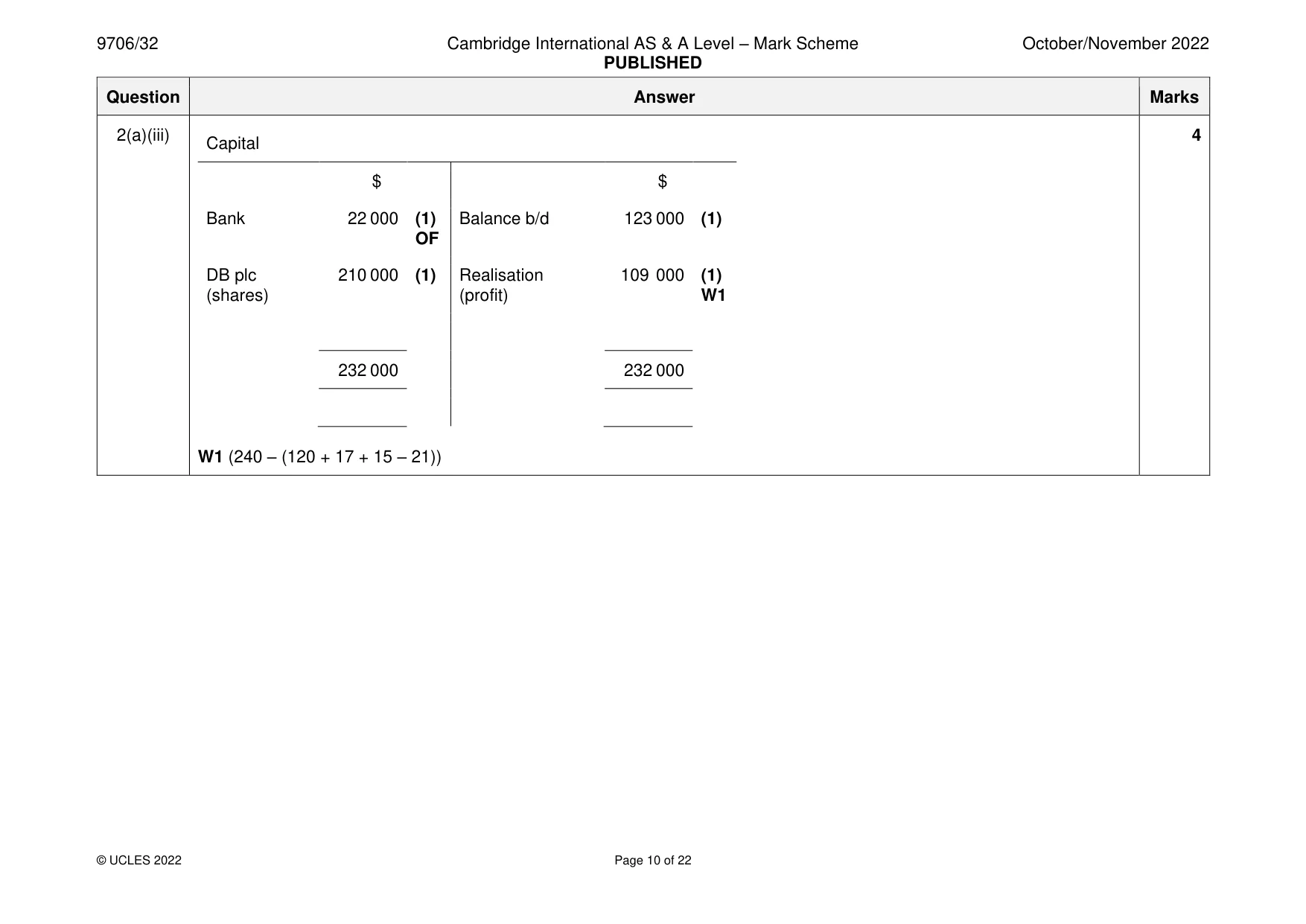
9706/32 Cambridge International AS & A Level – Mark Scheme PUBLISHED October/November 2022 © UCLES 2022 Page 10 of 22 Question Answer Marks 2(a)(iii) Capital $ $ Bank 22 000 (1) OF Balance b/d 123 000 (1) DB plc (shares) 210 000 (1) Realisation (profit) 109 000 (1) W1 232 000 232 000 W1 (240 – (120 + 17 + 15 – 21)) 4
Mark scheme, page 11
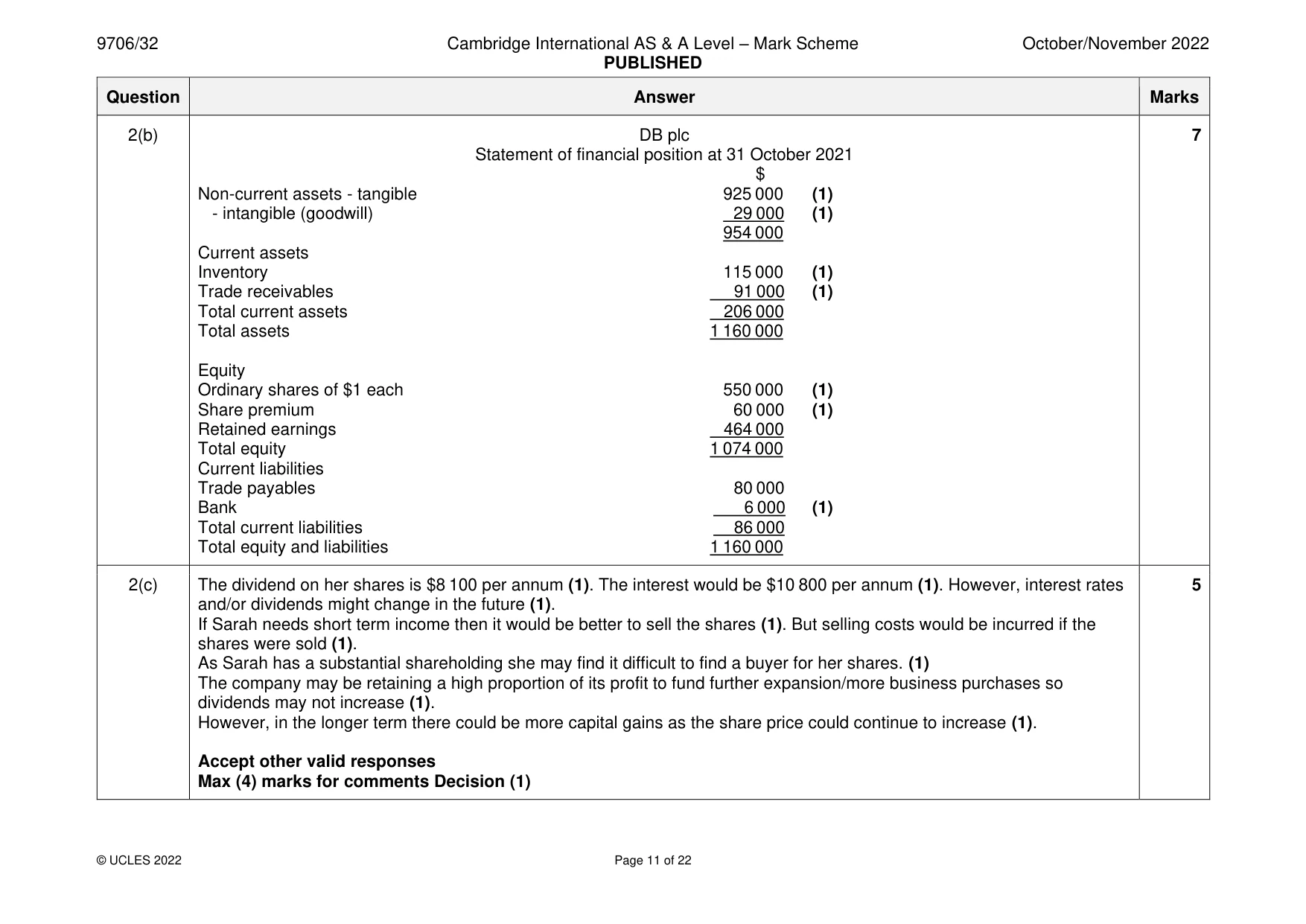
9706/32 Cambridge International AS & A Level – Mark Scheme PUBLISHED October/November 2022 © UCLES 2022 Page 11 of 22 Question Answer Marks 2(b) DB plc Statement of financial position at 31 October 2021 $ Non-current assets - tangible 925 000 (1) - intangible (goodwill) 29 000 (1) 954 000 Current assets Inventory 115 000 (1) Trade receivables 91 000 (1) Total current assets 206 000 Total assets 1 160 000 Equity Ordinary shares of $1 each 550 000 (1) Share premium 60 000 (1) Retained earnings 464 000 Total equity 1 074 000 Current liabilities Trade payables 80 000 Bank 6 000 (1) Total current liabilities 86 000 Total equity and liabilities 1 160 000 7 2(c) The dividend on her shares is $8 100 per annum (1). The interest would be $10 800 per annum (1). However, interest rates and/or dividends might change in the future (1). If Sarah needs short term income then it would be better to sell the shares (1). But selling costs would be incurred if the shares were sold (1). As Sarah has a substantial shareholding she may find it difficult to find a buyer for her shares. (1) The company may be retaining a high proportion of its profit to fund further expansion/more business purchases so dividends may not increase (1). However, in the longer term there could be more capital gains as the share price could continue to increase (1). Accept other valid responses Max (4) marks for comments Decision (1) 5
Mark scheme, page 12
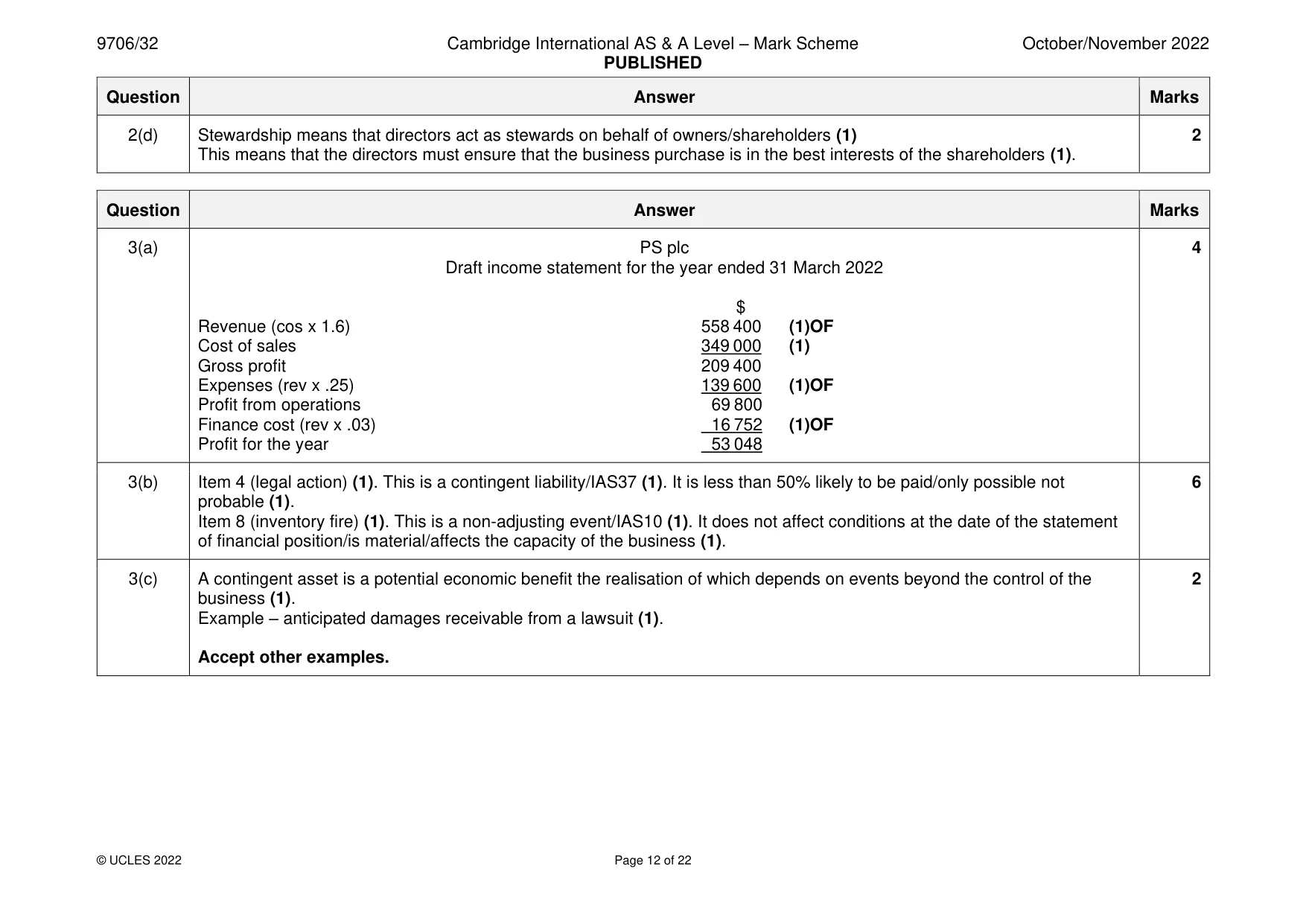
9706/32 Cambridge International AS & A Level – Mark Scheme PUBLISHED October/November 2022 © UCLES 2022 Page 12 of 22 Question Answer Marks 2(d) Stewardship means that directors act as stewards on behalf of owners/shareholders (1) This means that the directors must ensure that the business purchase is in the best interests of the shareholders (1). 2 Question Answer Marks 3(a) PS plc Draft income statement for the year ended 31 March 2022 $ Revenue (cos x 1.6) 558 400 (1)OF Cost of sales 349 000 (1) Gross profit 209 400 Expenses (rev x .25) 139 600 (1)OF Profit from operations 69 800 Finance cost (rev x .03) 16 752 (1)OF Profit for the year 53 048 4 3(b) Item 4 (legal action) (1). This is a contingent liability/IAS37 (1). It is less than 50% likely to be paid/only possible not probable (1). Item 8 (inventory fire) (1). This is a non-adjusting event/IAS10 (1). It does not affect conditions at the date of the statement of financial position/is material/affects the capacity of the business (1). 6 3(c) A contingent asset is a potential economic benefit the realisation of which depends on events beyond the control of the business (1). Example – anticipated damages receivable from a lawsuit (1). Accept other examples. 2
Mark scheme, page 13
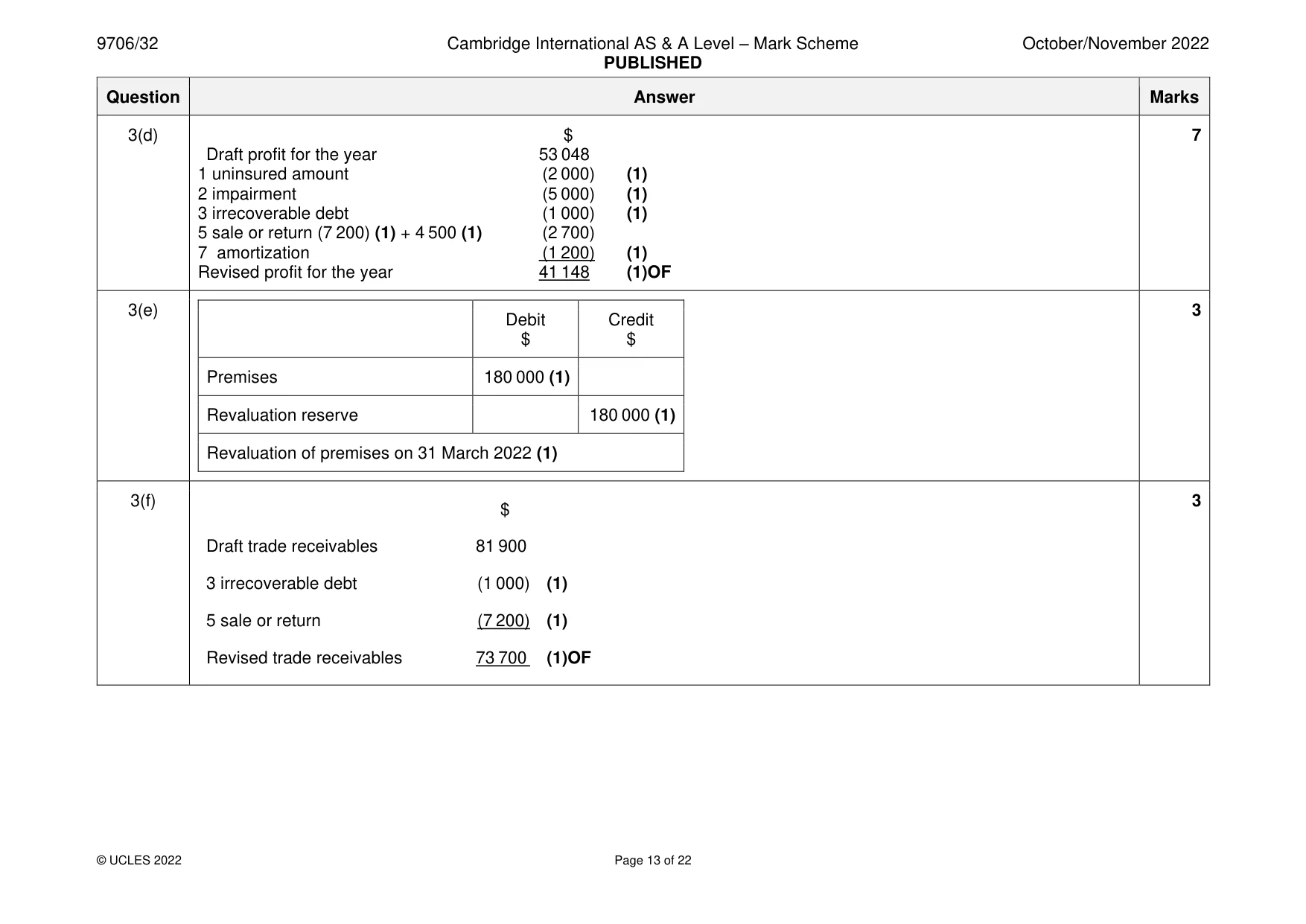
9706/32 Cambridge International AS & A Level – Mark Scheme PUBLISHED October/November 2022 © UCLES 2022 Page 13 of 22 Question Answer Marks 3(d) $ Draft profit for the year 53 048 1 uninsured amount (2 000) (1) 2 impairment (5 000) (1) 3 irrecoverable debt (1 000) (1) 5 sale or return (7 200) (1) + 4 500 (1) (2 700) 7 amortization (1 200) (1) Revised profit for the year 41 148 (1)OF 7 3(e) Debit $ Credit $ Premises 180 000 (1) Revaluation reserve 180 000 (1) Revaluation of premises on 31 March 2022 (1) 3 3(f) $ Draft trade receivables 81 900 3 irrecoverable debt (1 000) (1) 5 sale or return (7 200) (1) Revised trade receivables 73 700 (1)OF 3
Mark scheme, page 14
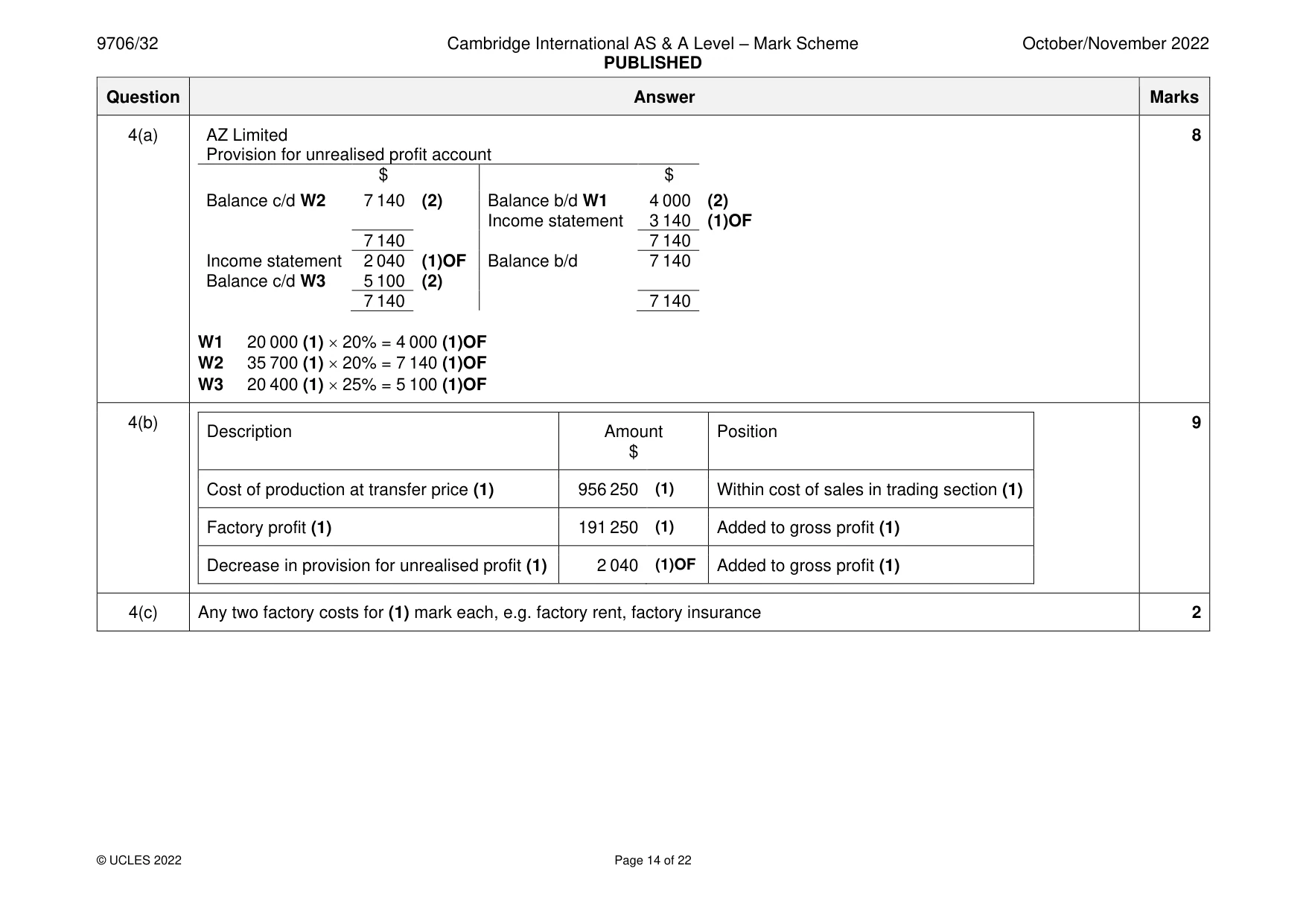
9706/32 Cambridge International AS & A Level – Mark Scheme PUBLISHED October/November 2022 © UCLES 2022 Page 14 of 22 Question Answer Marks 4(a) AZ Limited Provision for unrealised profit account $ $ Balance c/d W2 7 140 (2) Balance b/d W1 4 000 (2) Income statement 3 140 (1)OF 7 140 7 140 Income statement 2 040 (1)OF Balance b/d 7 140 Balance c/d W3 5 100 (2) 7 140 7 140 W1 20 000 (1) 20% = 4 000 (1)OF W2 35 700 (1) 20% = 7 140 (1)OF W3 20 400 (1) 25% = 5 100 (1)OF 8 4(b) Description Amount $ Position Cost of production at transfer price (1) 956 250 (1) Within cost of sales in trading section (1) Factory profit (1) 191 250 (1) Added to gross profit (1) Decrease in provision for unrealised profit (1) 2 040 (1)OF Added to gross profit (1) 9 4(c) Any two factory costs for (1) mark each, e.g. factory rent, factory insurance 2
Mark scheme, page 15
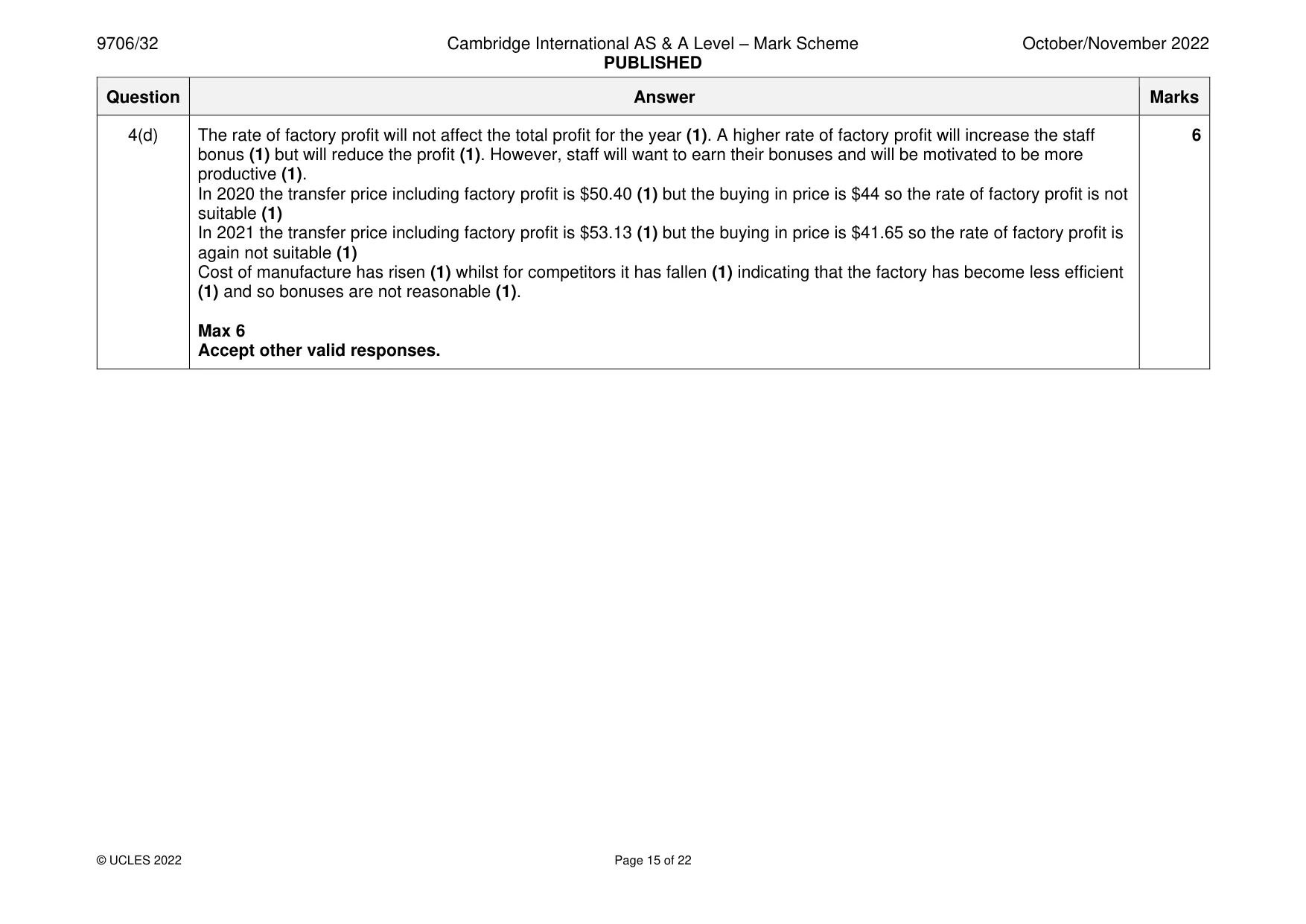
9706/32 Cambridge International AS & A Level – Mark Scheme PUBLISHED October/November 2022 © UCLES 2022 Page 15 of 22 Question Answer Marks 4(d) The rate of factory profit will not affect the total profit for the year (1). A higher rate of factory profit will increase the staff bonus (1) but will reduce the profit (1). However, staff will want to earn their bonuses and will be motivated to be more productive (1). In 2020 the transfer price including factory profit is $50.40 (1) but the buying in price is $44 so the rate of factory profit is not suitable (1) In 2021 the transfer price including factory profit is $53.13 (1) but the buying in price is $41.65 so the rate of factory profit is again not suitable (1) Cost of manufacture has risen (1) whilst for competitors it has fallen (1) indicating that the factory has become less efficient (1) and so bonuses are not reasonable (1). Max 6 Accept other valid responses. 6
Mark scheme, page 16
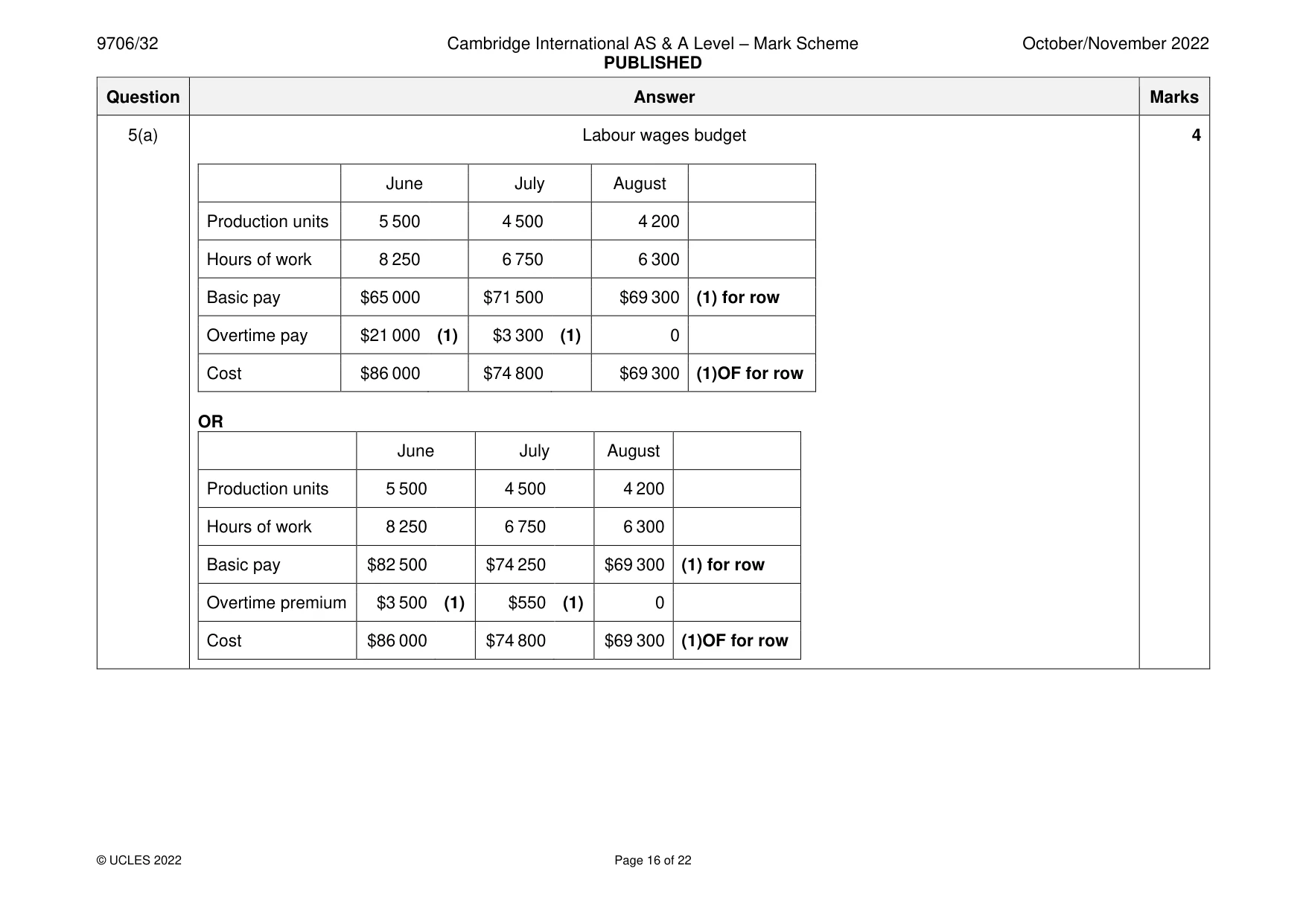
9706/32 Cambridge International AS & A Level – Mark Scheme PUBLISHED October/November 2022 © UCLES 2022 Page 16 of 22 Question Answer Marks 5(a) Labour wages budget June July August Production units 5 500 4 500 4 200 Hours of work 8 250 6 750 6 300 Basic pay $65 000 $71 500 $69 300 (1) for row Overtime pay $21 000 (1) $3 300 (1) 0 Cost $86 000 $74 800 $69 300 (1)OF for row OR June July August Production units 5 500 4 500 4 200 Hours of work 8 250 6 750 6 300 Basic pay $82 500 $74 250 $69 300 (1) for row Overtime premium $3 500 (1) $550 (1) 0 Cost $86 000 $74 800 $69 300 (1)OF for row 4
Mark scheme, page 17
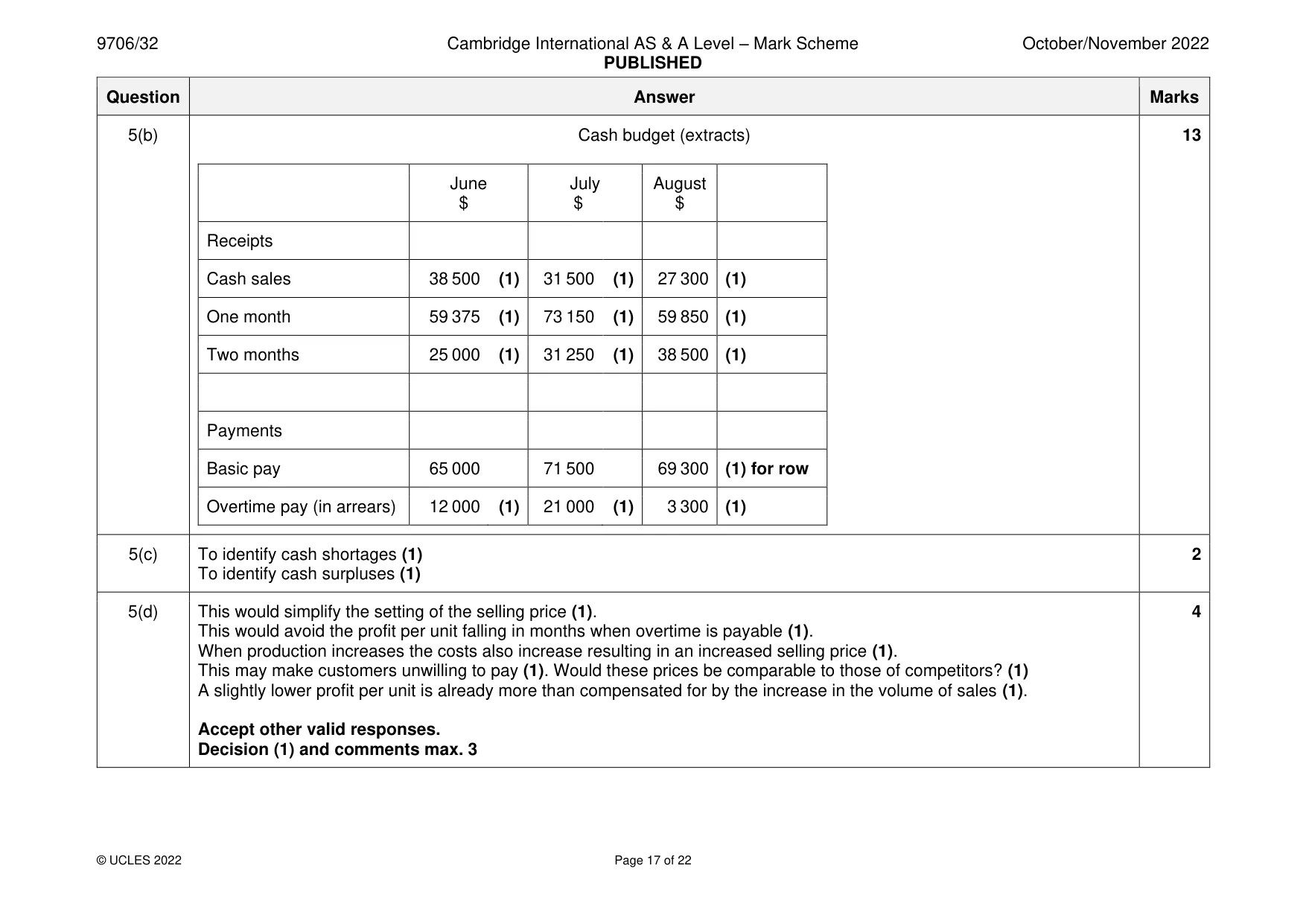
9706/32 Cambridge International AS & A Level – Mark Scheme PUBLISHED October/November 2022 © UCLES 2022 Page 17 of 22 Question Answer Marks 5(b) Cash budget (extracts) June $ July $ August $ Receipts Cash sales 38 500 (1) 31 500 (1) 27 300 (1) One month 59 375 (1) 73 150 (1) 59 850 (1) Two months 25 000 (1) 31 250 (1) 38 500 (1) Payments Basic pay 65 000 71 500 69 300 (1) for row Overtime pay (in arrears) 12 000 (1) 21 000 (1) 3 300 (1) 13 5(c) To identify cash shortages (1) To identify cash surpluses (1) 2 5(d) This would simplify the setting of the selling price (1). This would avoid the profit per unit falling in months when overtime is payable (1). When production increases the costs also increase resulting in an increased selling price (1). This may make customers unwilling to pay (1). Would these prices be comparable to those of competitors? (1) A slightly lower profit per unit is already more than compensated for by the increase in the volume of sales (1). Accept other valid responses. Decision (1) and comments max. 3 4
Mark scheme, page 18
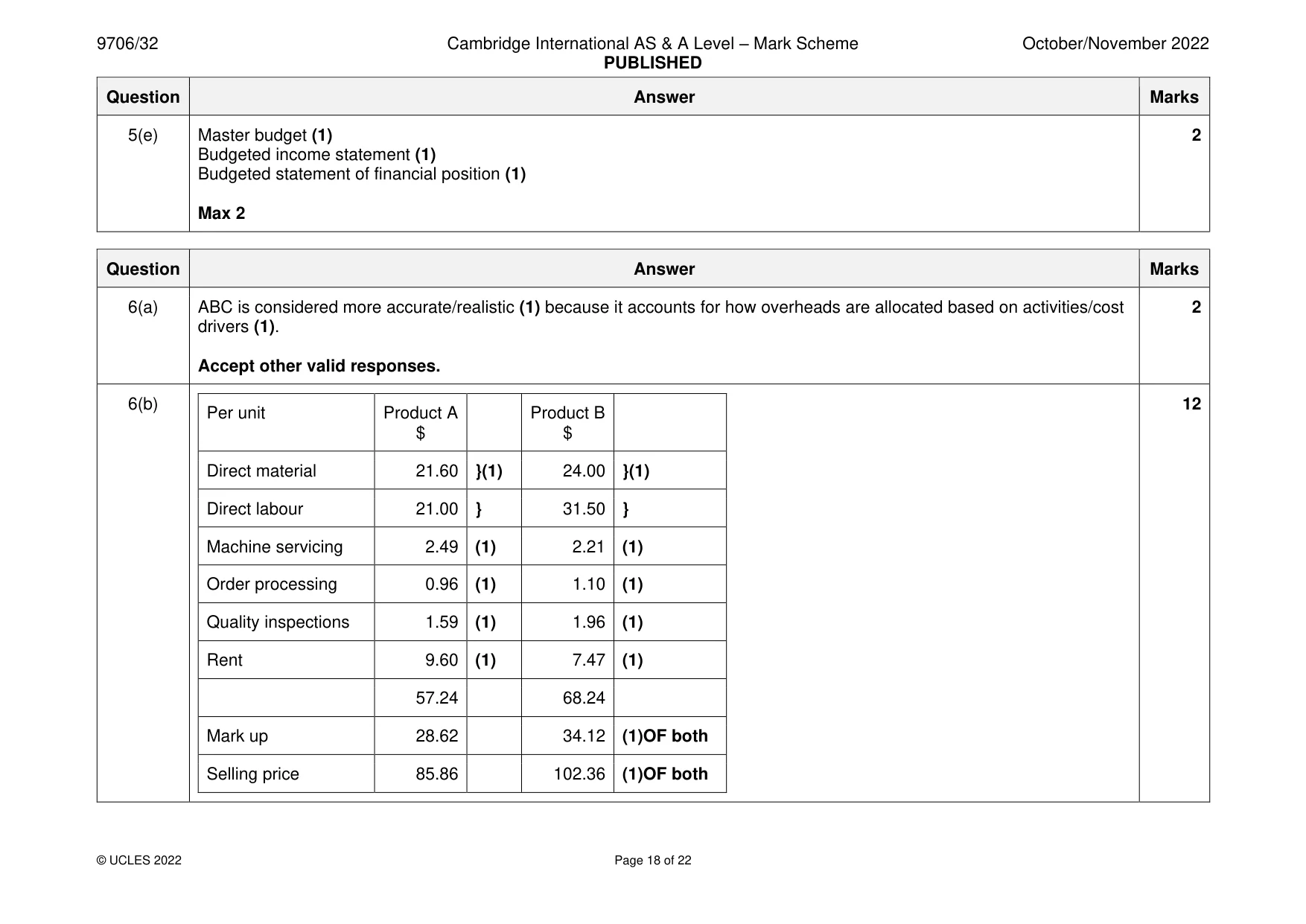
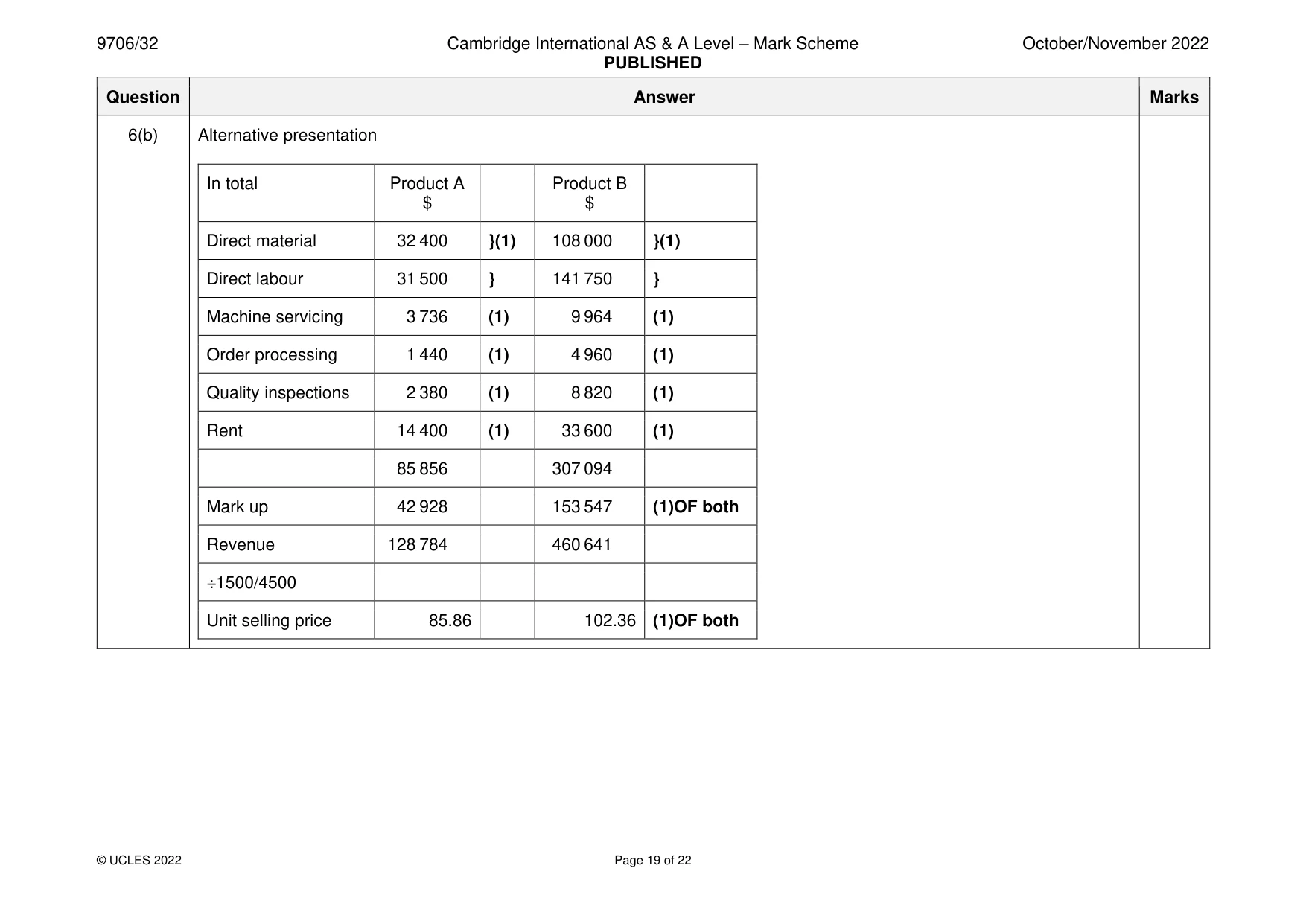
9706/32 Cambridge International AS & A Level – Mark Scheme PUBLISHED October/November 2022 © UCLES 2022 Page 18 of 22 Question Answer Marks 5(e) Master budget (1) Budgeted income statement (1) Budgeted statement of financial position (1) Max 2 2 Question Answer Marks 6(a) ABC is considered more accurate/realistic (1) because it accounts for how overheads are allocated based on activities/cost drivers (1). Accept other valid responses. 2 6(b) Per unit Product A $ Product B $ Direct material 21.60 }(1) 24.00 }(1) Direct labour 21.00 } 31.50 } Machine servicing 2.49 (1) 2.21 (1) Order processing 0.96 (1) 1.10 (1) Quality inspections 1.59 (1) 1.96 (1) Rent 9.60 (1) 7.47 (1) 57.24 68.24 Mark up 28.62 34.12 (1)OF both Selling price 85.86 102.36 (1)OF both 12
Mark scheme, page 19
9706/32 Cambridge International AS & A Level – Mark Scheme PUBLISHED October/November 2022 © UCLES 2022 Page 19 of 22 Question Answer Marks 6(b) Alternative presentation In total Product A $ Product B $ Direct material 32 400 }(1) 108 000 }(1) Direct labour 31 500 } 141 750 } Machine servicing 3 736 (1) 9 964 (1) Order processing 1 440 (1) 4 960 (1) Quality inspections 2 380 (1) 8 820 (1) Rent 14 400 (1) 33 600 (1) 85 856 307 094 Mark up 42 928 153 547 (1)OF both Revenue 128 784 460 641 ÷1500/4500 Unit selling price 85.86 102.36 (1)OF both
Mark scheme, page 20
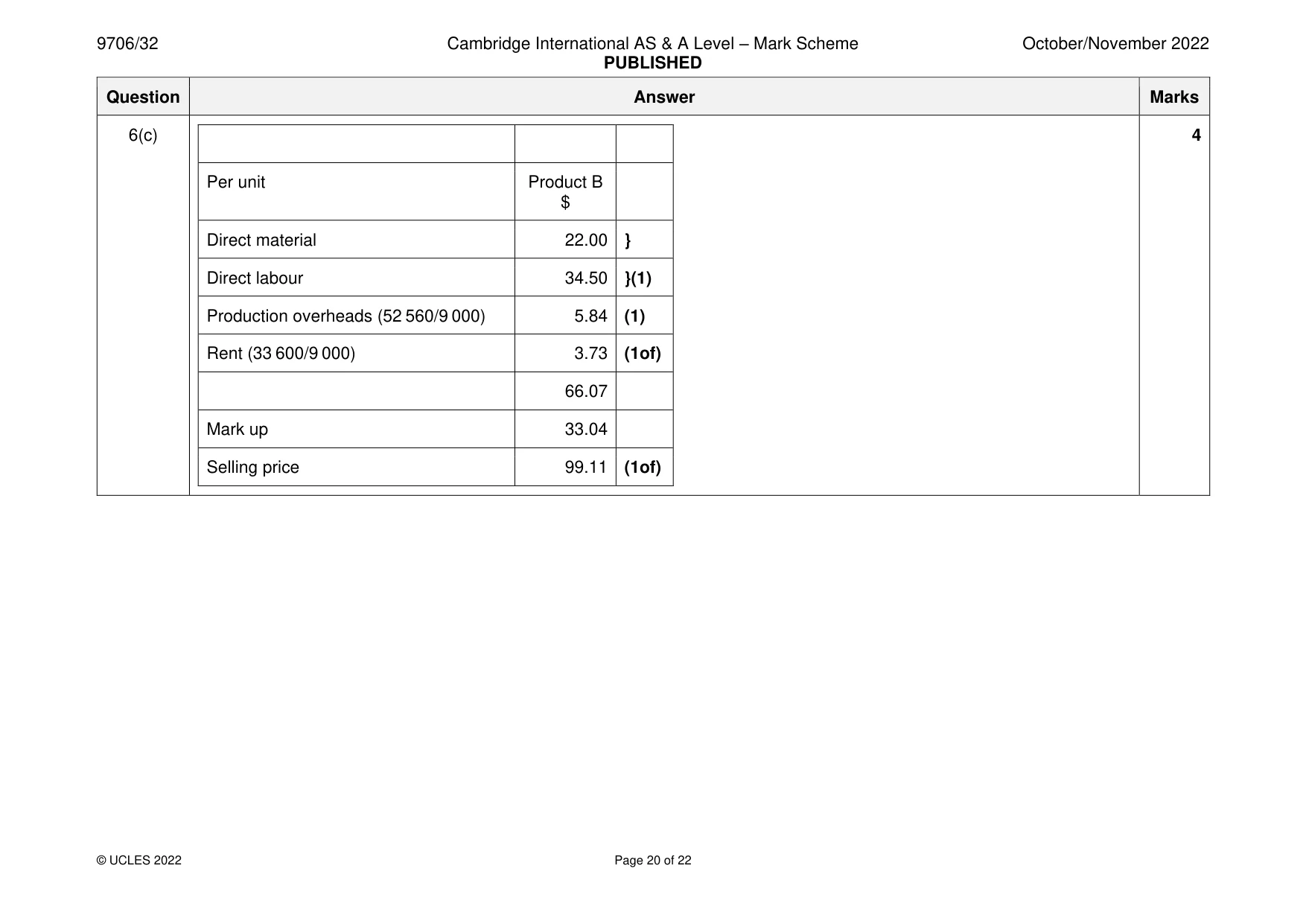
9706/32 Cambridge International AS & A Level – Mark Scheme PUBLISHED October/November 2022 © UCLES 2022 Page 20 of 22 Question Answer Marks 6(c) Per unit Product B $ Direct material 22.00 } Direct labour 34.50 }(1) Production overheads (52 560/9 000) 5.84 (1) Rent (33 600/9 000) 3.73 (1of) 66.07 Mark up 33.04 Selling price 99.11 (1of) 4
Mark scheme, page 21
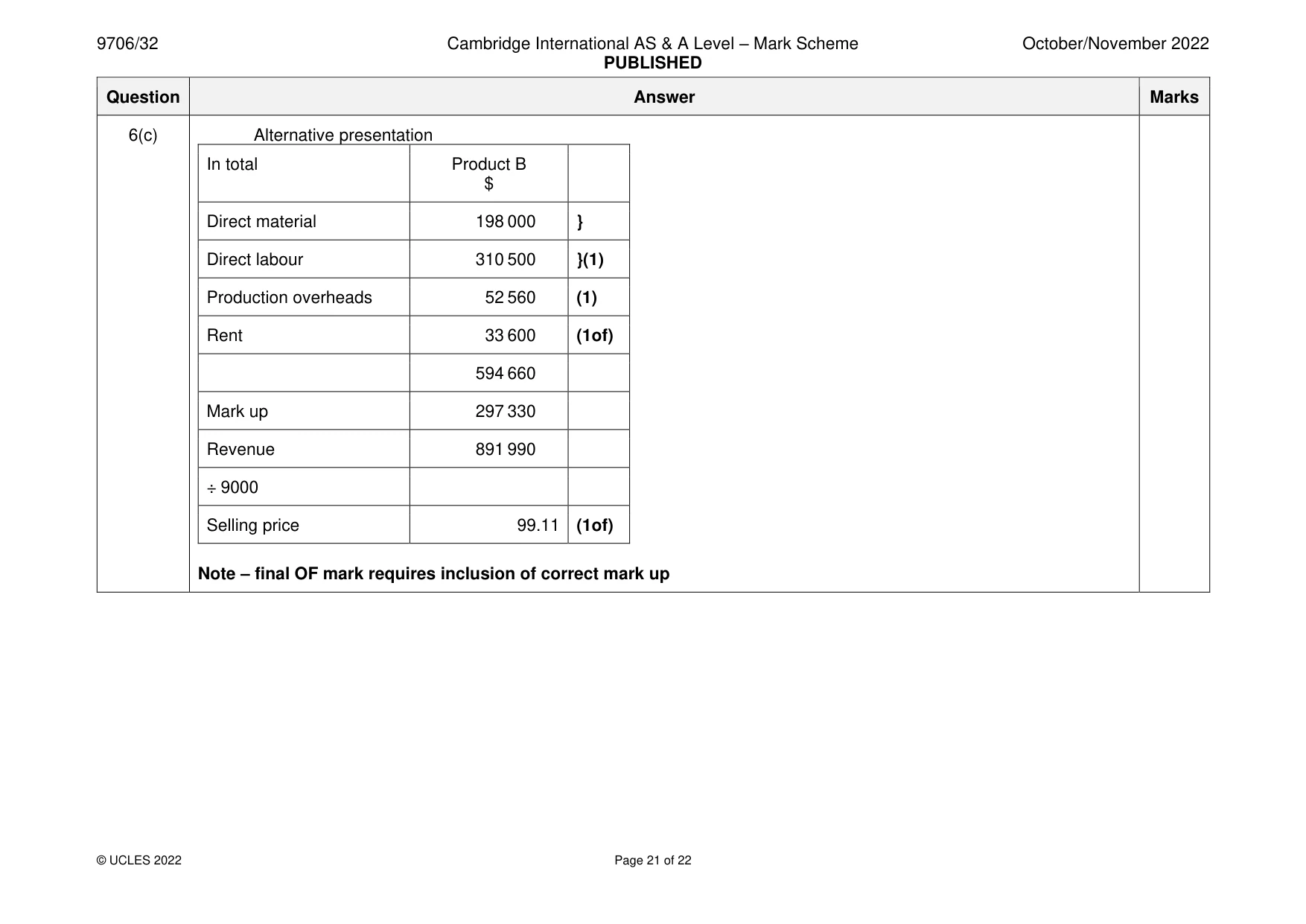
9706/32 Cambridge International AS & A Level – Mark Scheme PUBLISHED October/November 2022 © UCLES 2022 Page 21 of 22 Question Answer Marks 6(c) Alternative presentation In total Product B $ Direct material 198 000 } Direct labour 310 500 }(1) Production overheads 52 560 (1) Rent 33 600 (1of) 594 660 Mark up 297 330 Revenue 891 990 ÷ 9000 Selling price 99.11 (1of) Note – final OF mark requires inclusion of correct mark up
Mark scheme, page 22
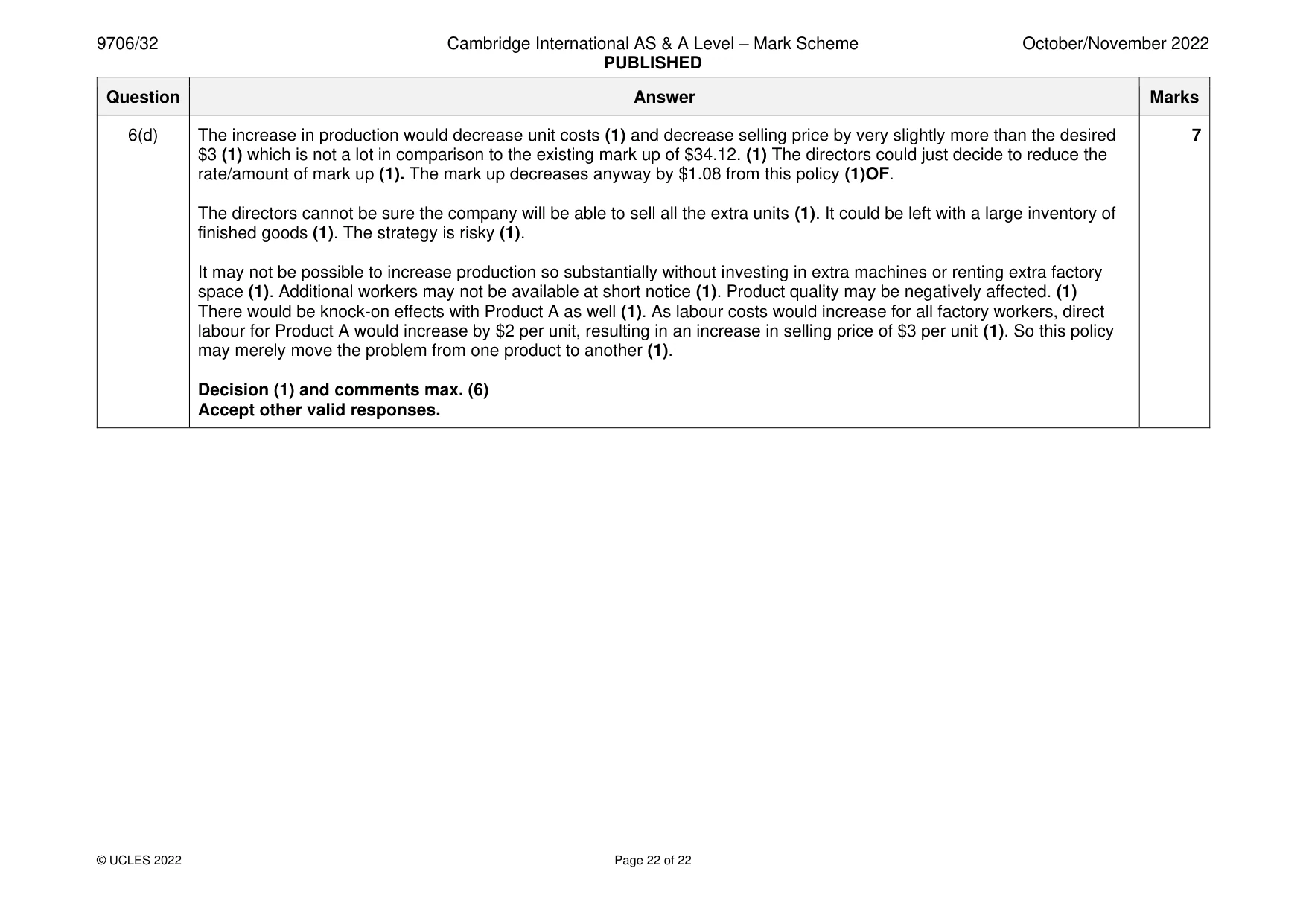
9706/32 Cambridge International AS & A Level – Mark Scheme PUBLISHED October/November 2022 © UCLES 2022 Page 22 of 22 Question Answer Marks 6(d) The increase in production would decrease unit costs (1) and decrease selling price by very slightly more than the desired $3 (1) which is not a lot in comparison to the existing mark up of $34.12. (1) The directors could just decide to reduce the rate/amount of mark up (1). The mark up decreases anyway by $1.08 from this policy (1)OF. The directors cannot be sure the company will be able to sell all the extra units (1). It could be left with a large inventory of finished goods (1). The strategy is risky (1). It may not be possible to increase production so substantially without investing in extra machines or renting extra factory space (1). Additional workers may not be available at short notice (1). Product quality may be negatively affected. (1) There would be knock-on effects with Product A as well (1). As labour costs would increase for all factory workers, direct labour for Product A would increase by $2 per unit, resulting in an increase in selling price of $3 per unit (1). So this policy may merely move the problem from one product to another (1). Decision (1) and comments max. (6) Accept other valid responses. 7
What you needed in this session
Cambridge’s own grade thresholds for 2022 Oct/Nov, Paper 3 · Variant 2. A higher threshold means an easier paper — the bar moves with how the cohort did.