Cambridge A Level Accounting 9706 — 2022 May/June Paper 3 · Variant 2
9706/32/M/J/22 · 150 marks · ≈169 min
The question paper and its mark scheme, free to read here and free to download. This is Cambridge’s own paper, exactly as it was sat.
Question paper24 pages



Mark scheme19 pages
Answers below. Sit the paper first if you are practising.
Paper as text
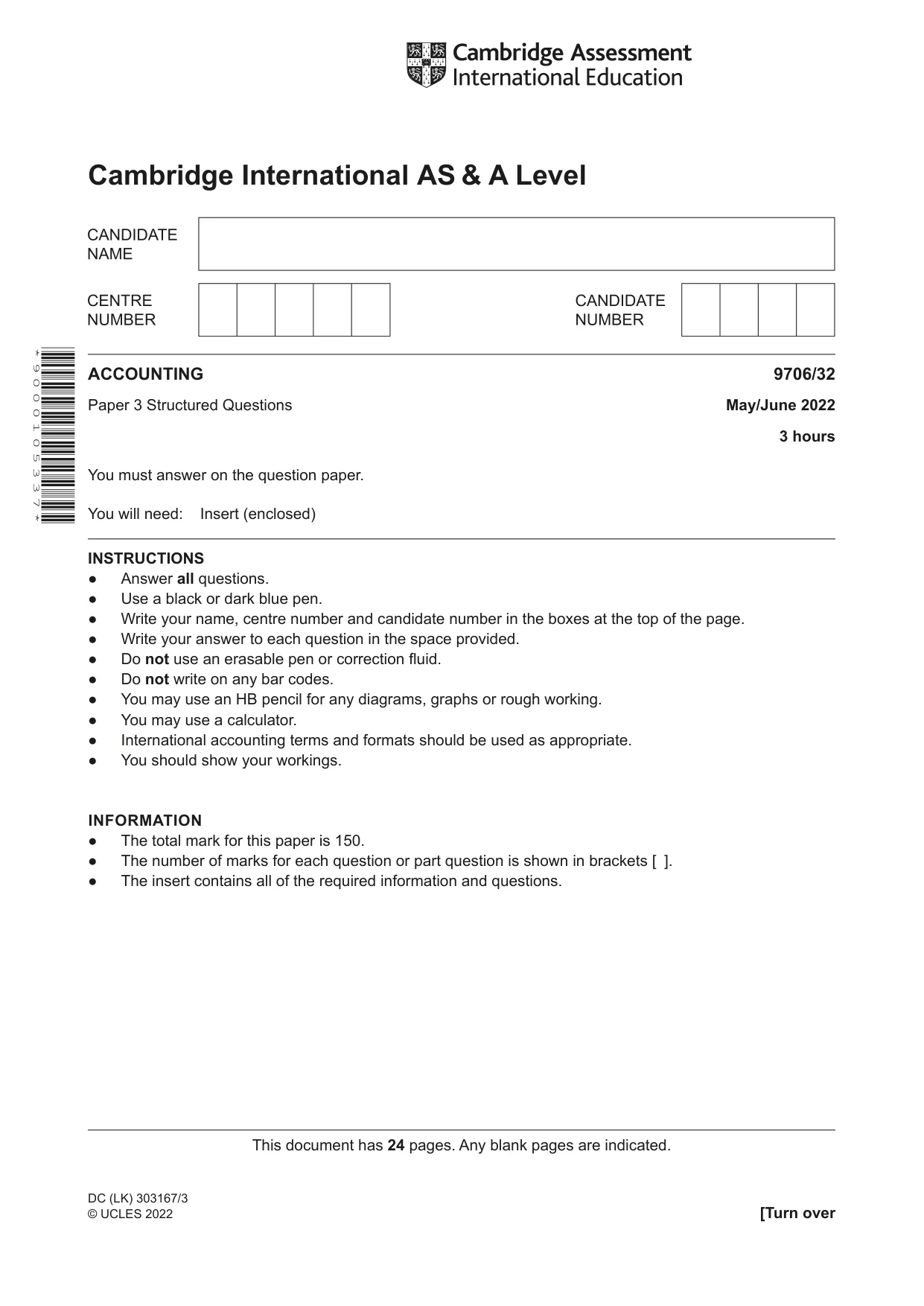
Question paper, page 1
This document has 24 pages. Any blank pages are indicated. [Turn over Cambridge International AS & A Level DC (LK) 303167/3 © UCLES 2022 ACCOUNTING 9706/32 Paper 3 Structured Questions May/June 2022 3 hours You must answer on the question paper. You will need: Insert (enclosed) INSTRUCTIONS ● Answer all questions. ● Use a black or dark blue pen. ● Write your name, centre number and candidate number in the boxes at the top of the page. ● Write your answer to each question in the space provided. ● Do not use an erasable pen or correction fluid. ● Do not write on any bar codes. ● You may use an HB pencil for any diagrams, graphs or rough working. ● You may use a calculator. ● International accounting terms and formats should be used as appropriate. ● You should show your workings. INFORMATION ● The total mark for this paper is 150. ● The number of marks for each question or part question is shown in brackets [ ]. ● The insert contains all of the required information and questions. * 9 0 0 0 1 0 5 3 3 7 *
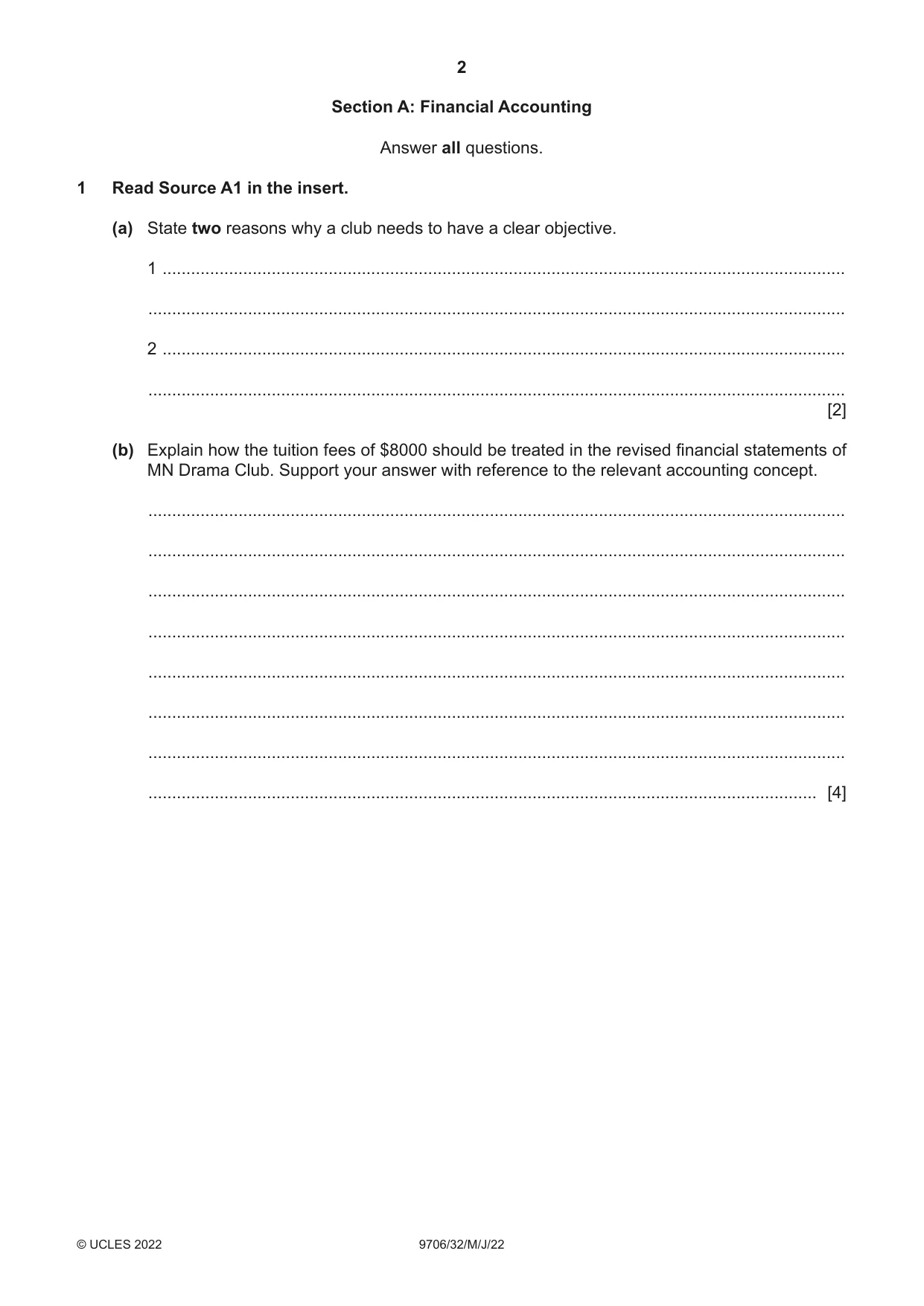
Question paper, page 2
2 9706/32/M/J/22 © UCLES 2022 Section A: Financial Accounting Answer all questions. 1 Read Source A1 in the insert. (a) State two reasons why a club needs to have a clear objective. 1 … … 2 … … [2] (b) Explain how the tuition fees of $8000 should be treated in the revised financial statements of MN Drama Club. Support your answer with reference to the relevant accounting concept. … … … … … … … … [4]
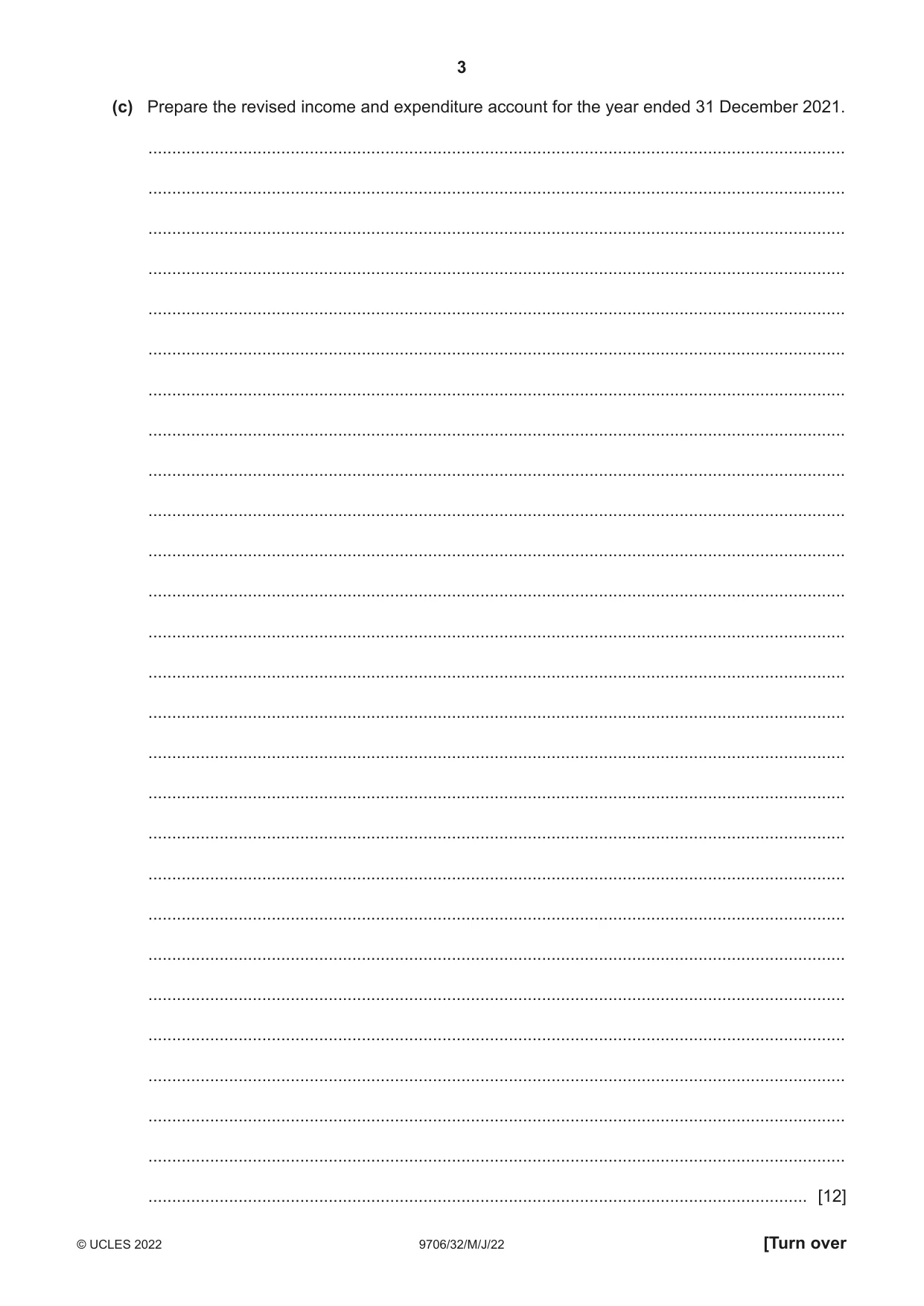
Question paper, page 3
3 9706/32/M/J/22 © UCLES 2022 [Turn over (c) Prepare the revised income and expenditure account for the year ended 31 December 2021. … … … … … … … … … … … … … … … … … … … … … … … … … … … [12]
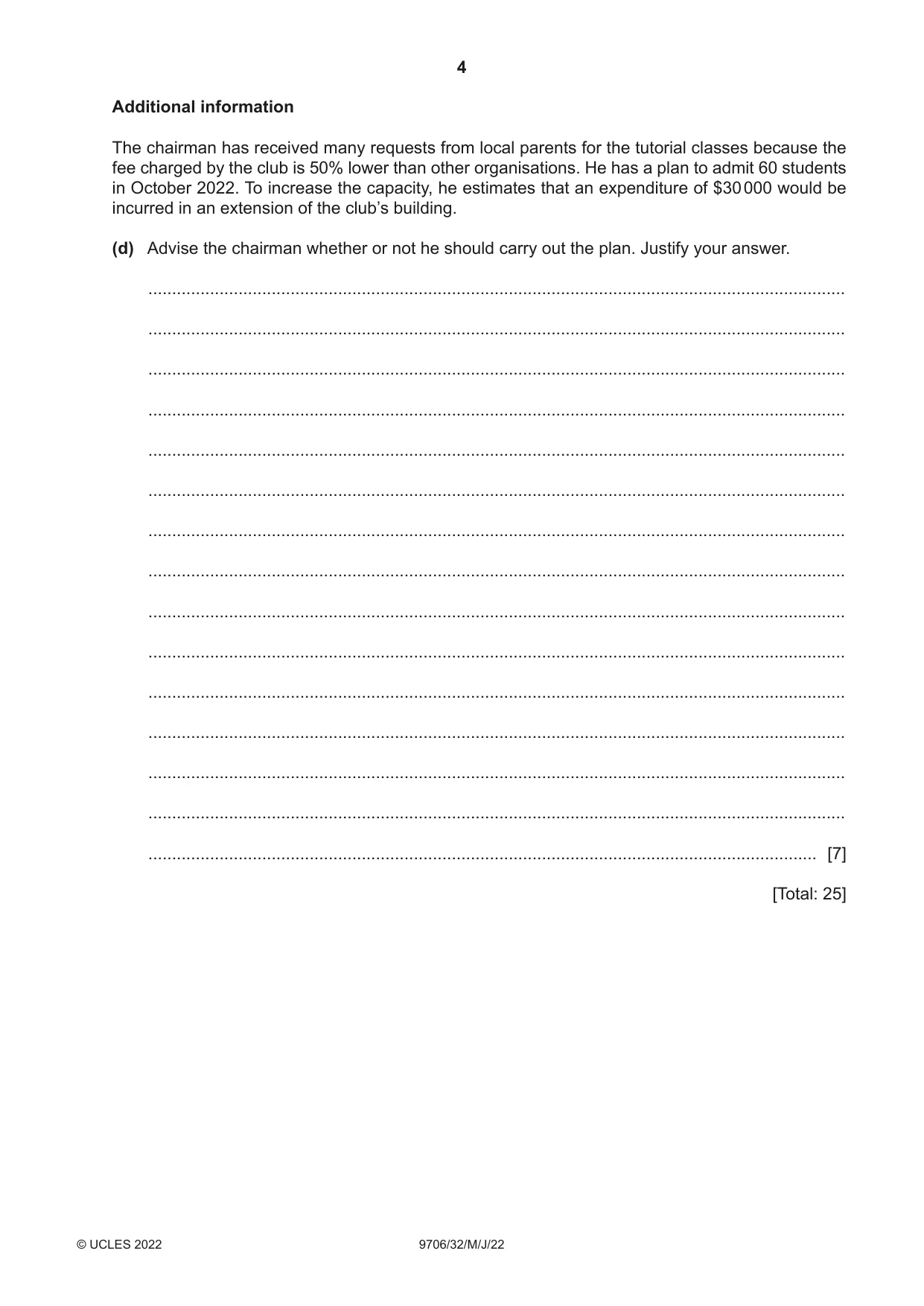
Question paper, page 4
4 9706/32/M/J/22 © UCLES 2022 Additional information The chairman has received many requests from local parents for the tutorial classes because the fee charged by the club is 50% lower than other organisations. He has a plan to admit 60 students in October 2022. To increase the capacity, he estimates that an expenditure of $30 000 would be incurred in an extension of the club’s building. (d) Advise the chairman whether or not he should carry out the plan. Justify your answer. … … … … … … … … … … … … … … … [7] [Total: 25]
Question paper, page 5
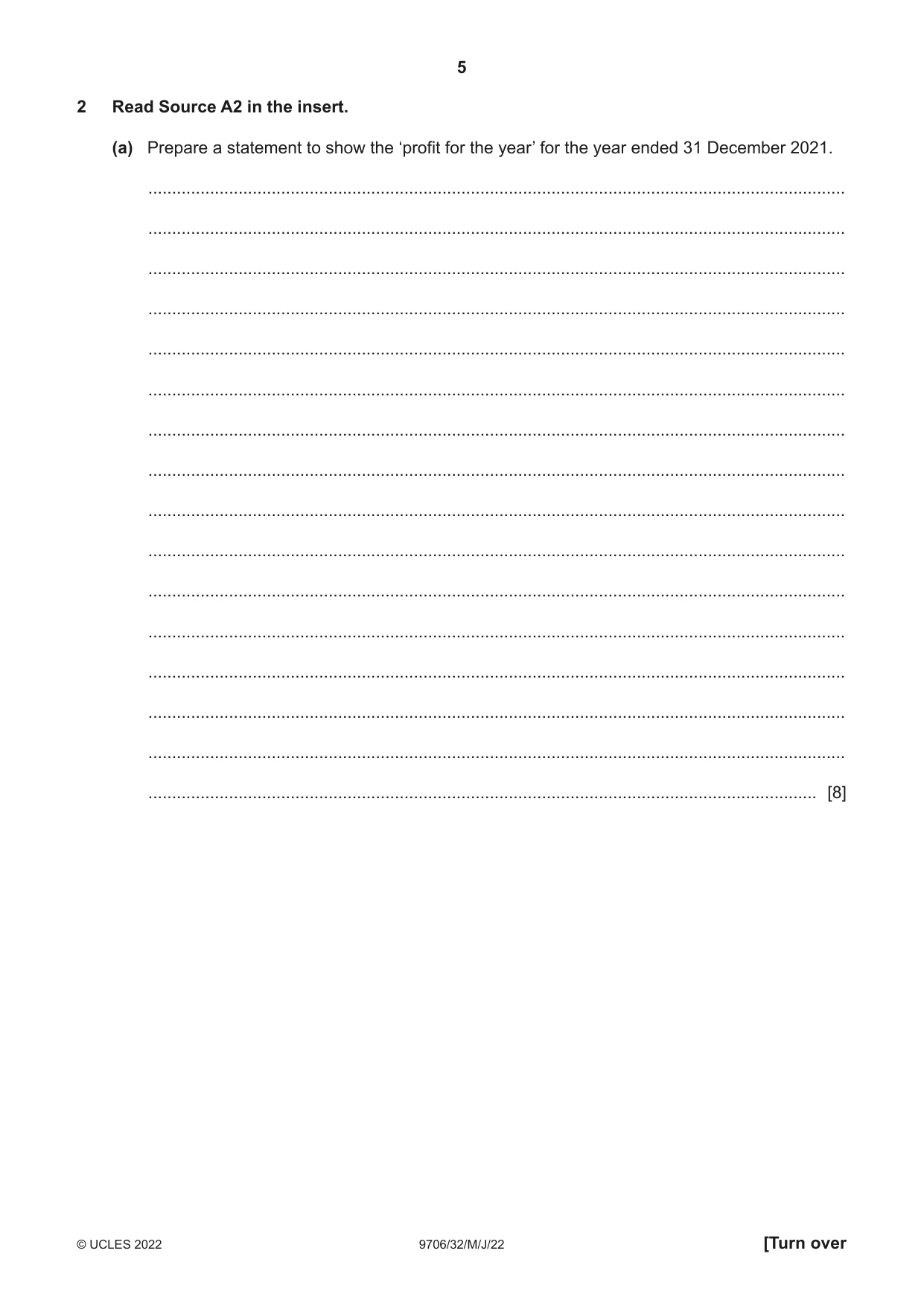
5 9706/32/M/J/22 © UCLES 2022 [Turn over 2 Read Source A2 in the insert. (a) Prepare a statement to show the ‘profit for the year’ for the year ended 31 December 2021. … … … … … … … … … … … … … … … … [8]
Question paper, page 6
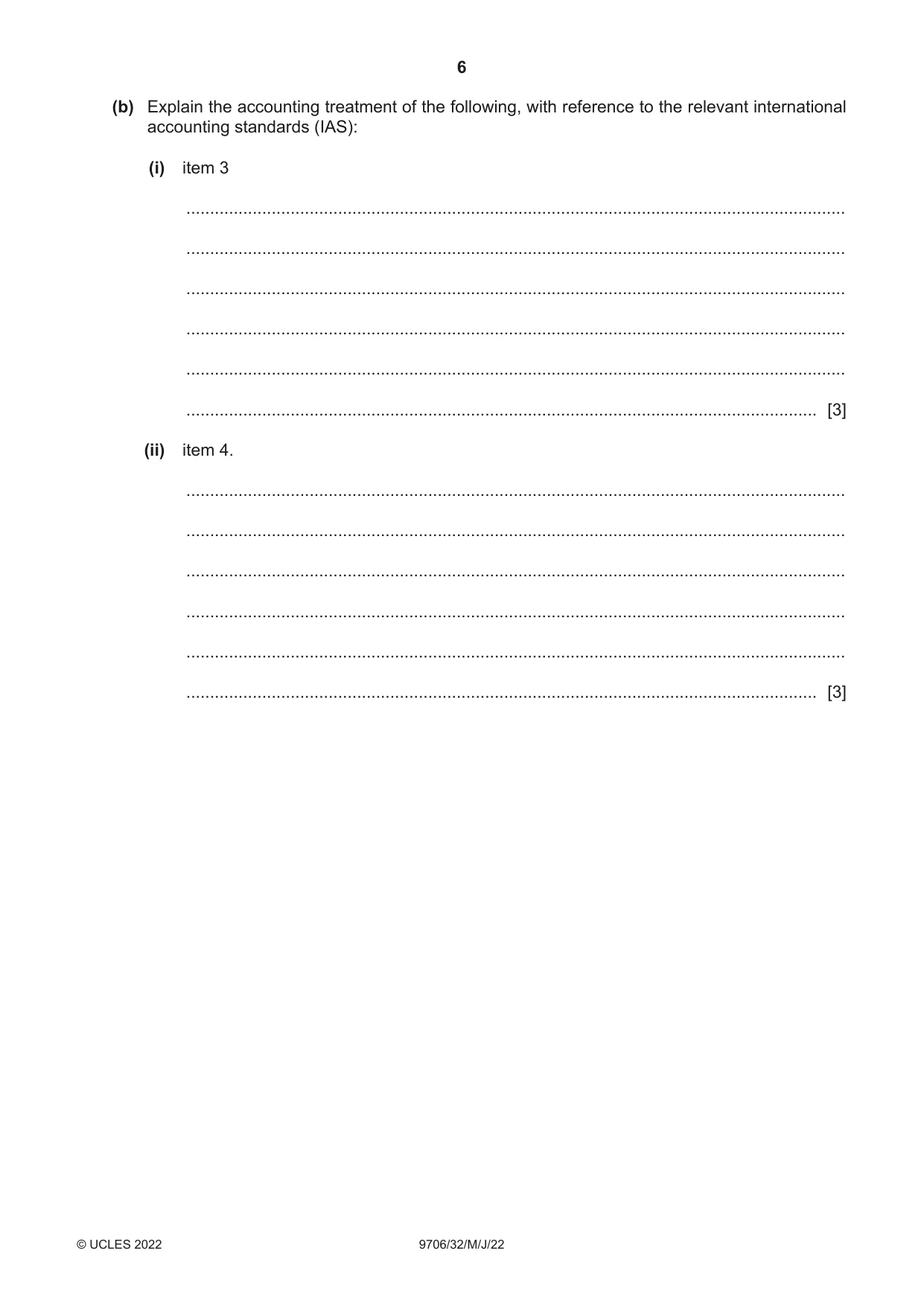
6 9706/32/M/J/22 © UCLES 2022 (b) Explain the accounting treatment of the following, with reference to the relevant international accounting standards (IAS): (i) item 3 … … … … … … [3] (ii) item 4. … … … … … … [3]
Question paper, page 7
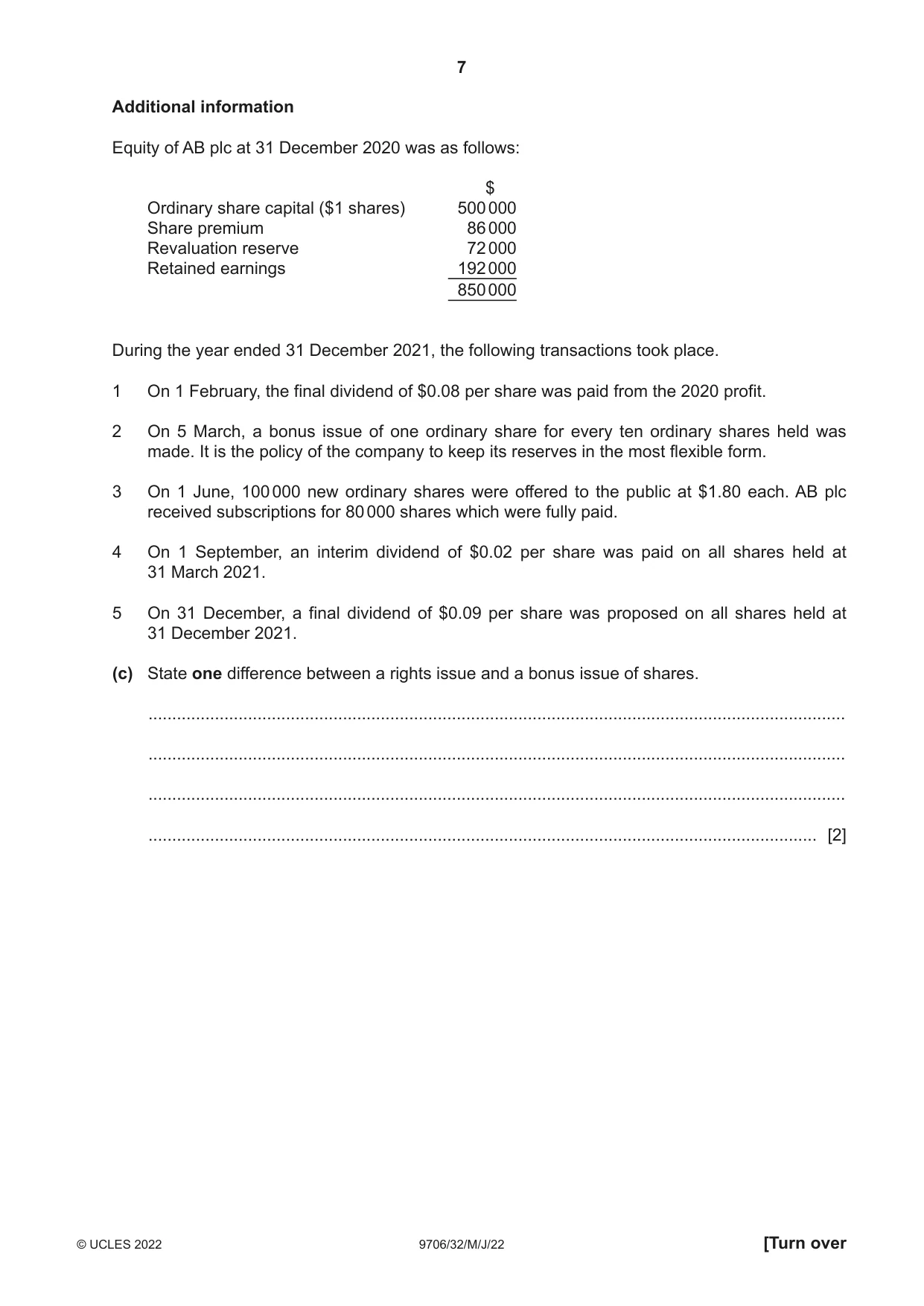
7 9706/32/M/J/22 © UCLES 2022 [Turn over Additional information Equity of AB plc at 31 December 2020 was as follows: $ Ordinary share capital ($1 shares) 500 000 Share premium 86 000 Revaluation reserve 72 000 Retained earnings 192 000 850 000 During the year ended 31 December 2021, the following transactions took place. 1 On 1 February, the final dividend of $0.08 per share was paid from the 2020 profit. 2 On 5 March, a bonus issue of one ordinary share for every ten ordinary shares held was made. It is the policy of the company to keep its reserves in the most flexible form. 3 On 1 June, 100 000 new ordinary shares were offered to the public at $1.80 each. AB plc received subscriptions for 80 000 shares which were fully paid. 4 On 1 September, an interim dividend of $0.02 per share was paid on all shares held at 31 March 2021. 5 On 31 December, a final dividend of $0.09 per share was proposed on all shares held at 31 December 2021. (c) State one difference between a rights issue and a bonus issue of shares. … … … … [2]
Question paper, page 8
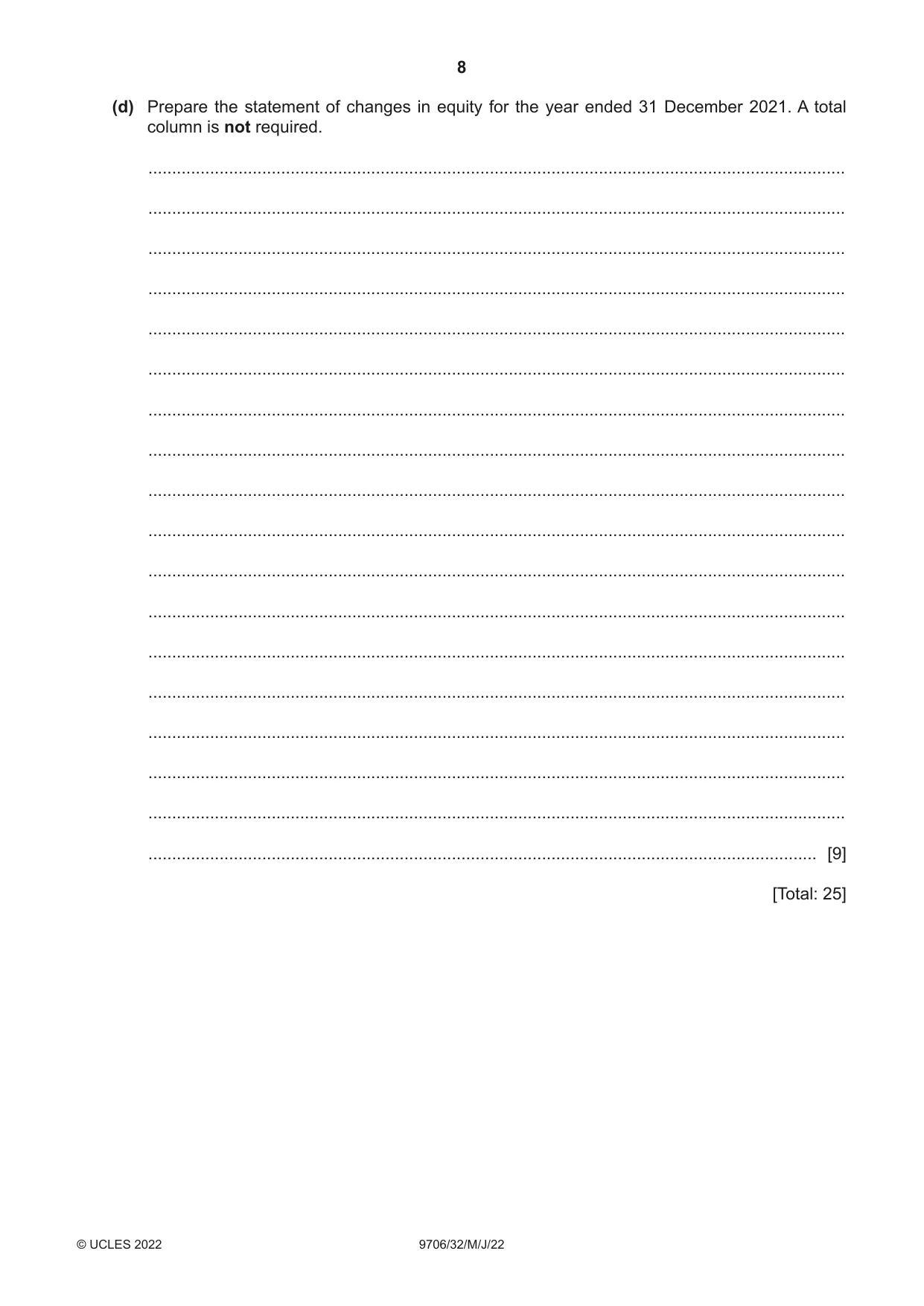
8 9706/32/M/J/22 © UCLES 2022 (d) Prepare the statement of changes in equity for the year ended 31 December 2021. A total column is not required. … … … … … … … … … … … … … … … … … … [9] [Total: 25]
Question paper, page 9
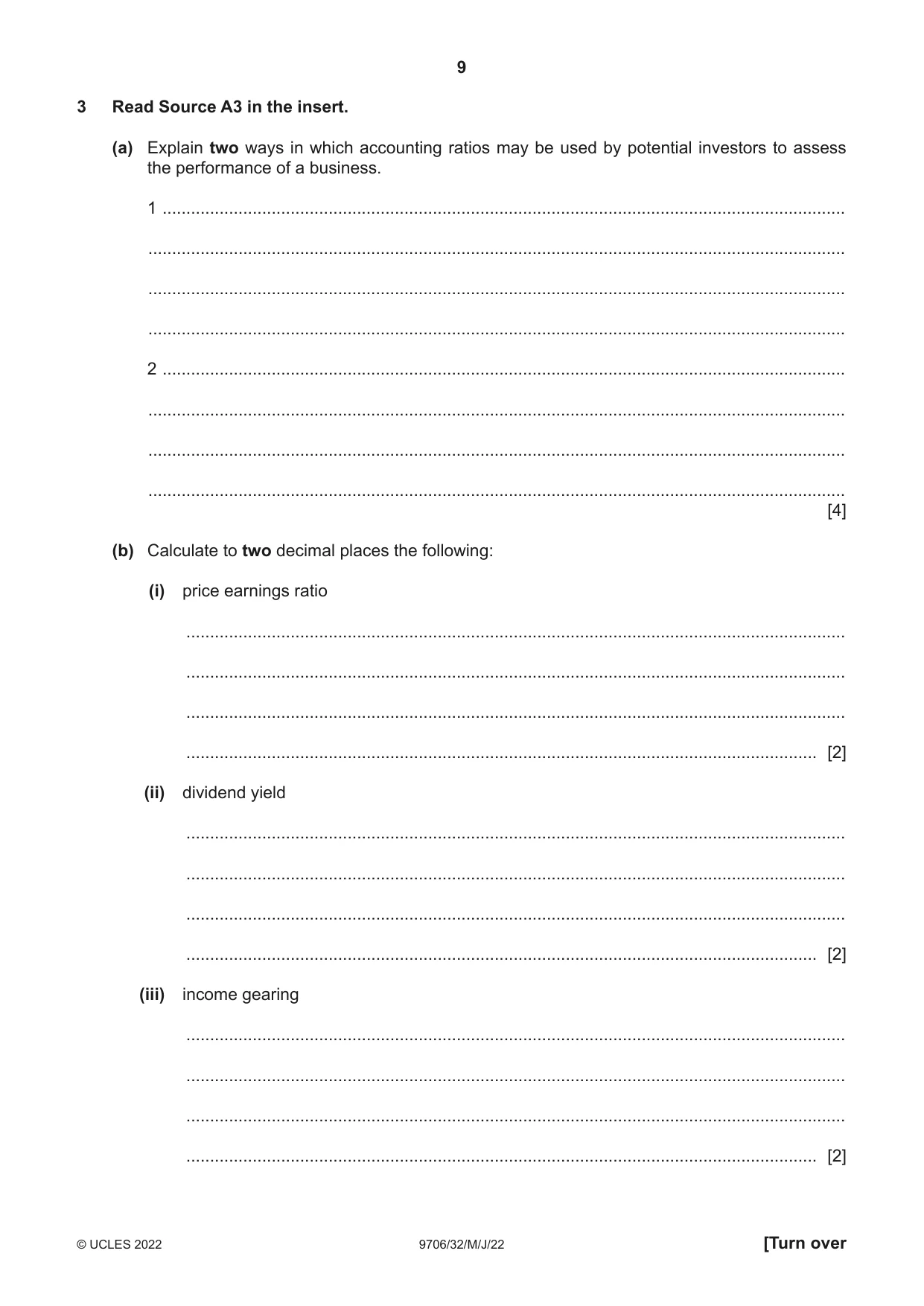
9 9706/32/M/J/22 © UCLES 2022 [Turn over 3 Read Source A3 in the insert. (a) Explain two ways in which accounting ratios may be used by potential investors to assess the performance of a business. 1 … … … … 2 … … … … [4] (b) Calculate to two decimal places the following: (i) price earnings ratio … … … … [2] (ii) dividend yield … … … … [2] (iii) income gearing … … … … [2]
Question paper, page 10
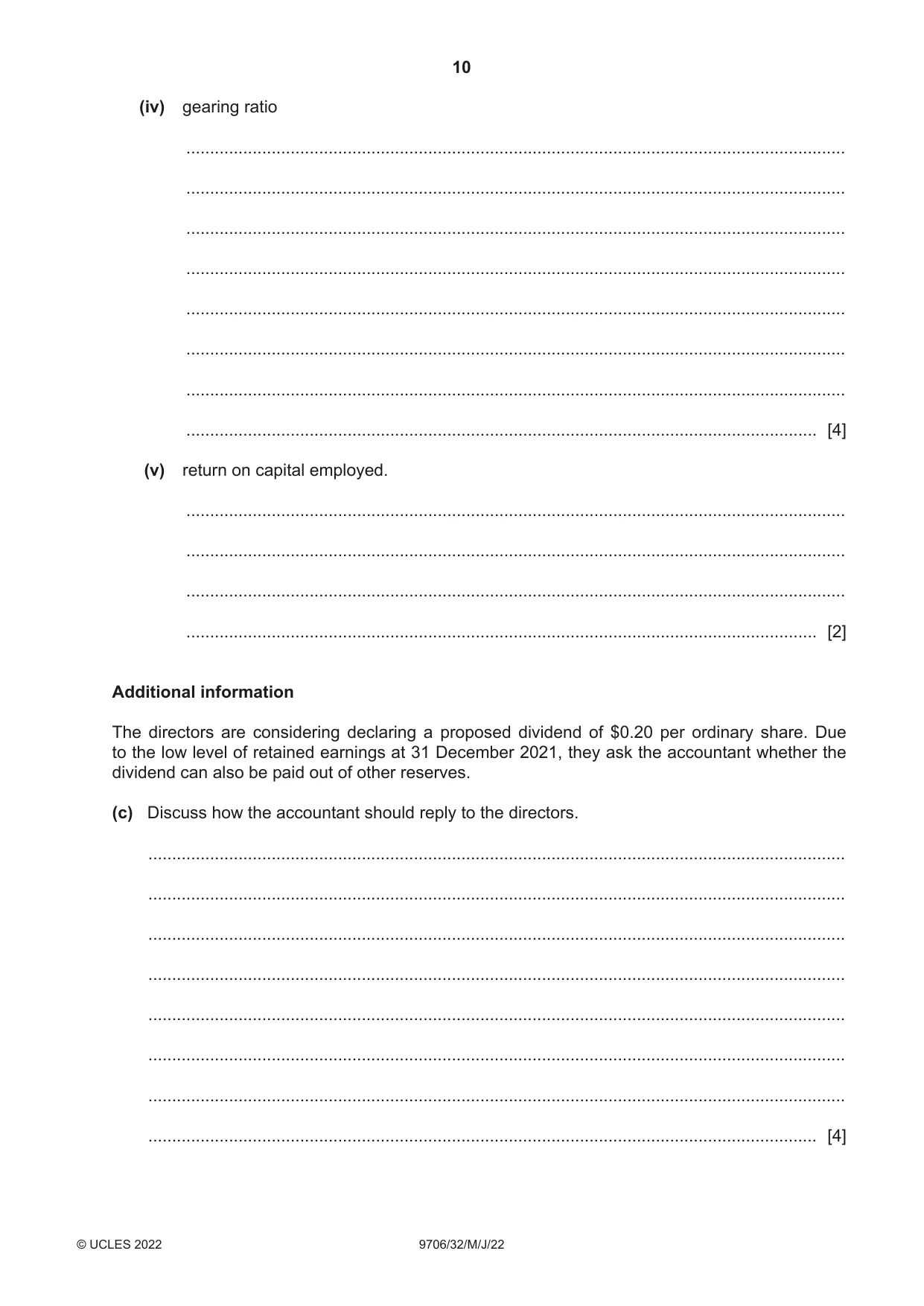
10 9706/32/M/J/22 © UCLES 2022 (iv) gearing ratio … … … … … … … … [4] (v) return on capital employed. … … … … [2] Additional information The directors are considering declaring a proposed dividend of $0.20 per ordinary share. Due to the low level of retained earnings at 31 December 2021, they ask the accountant whether the dividend can also be paid out of other reserves. (c) Discuss how the accountant should reply to the directors. … … … … … … … … [4]
Question paper, page 11
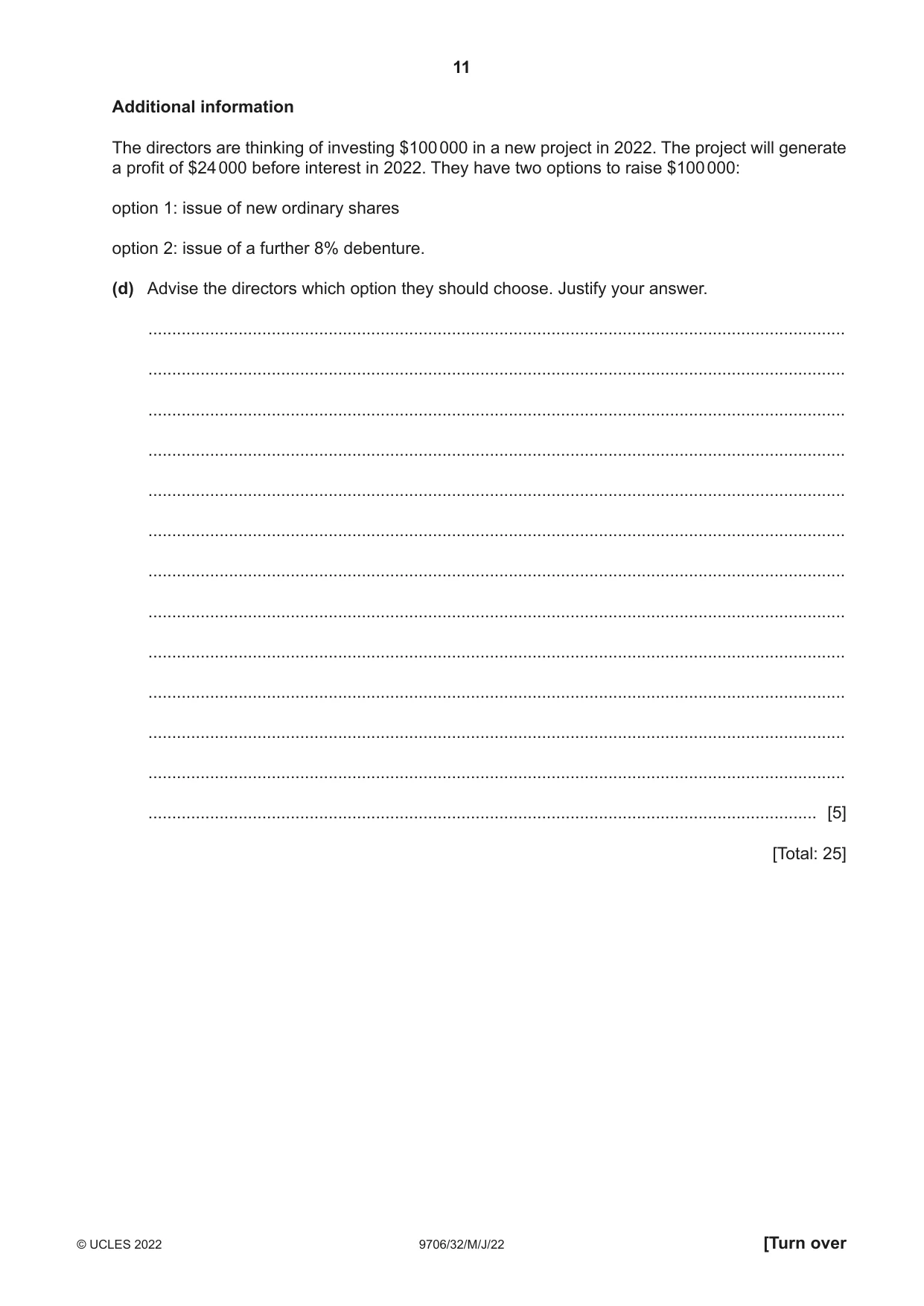
11 9706/32/M/J/22 © UCLES 2022 [Turn over Additional information The directors are thinking of investing $100 000 in a new project in 2022. The project will generate a profit of $24 000 before interest in 2022. They have two options to raise $100 000: option 1: issue of new ordinary shares option 2: issue of a further 8% debenture. (d) Advise the directors which option they should choose. Justify your answer. … … … … … … … … … … … … … [5] [Total: 25]
Question paper, page 12
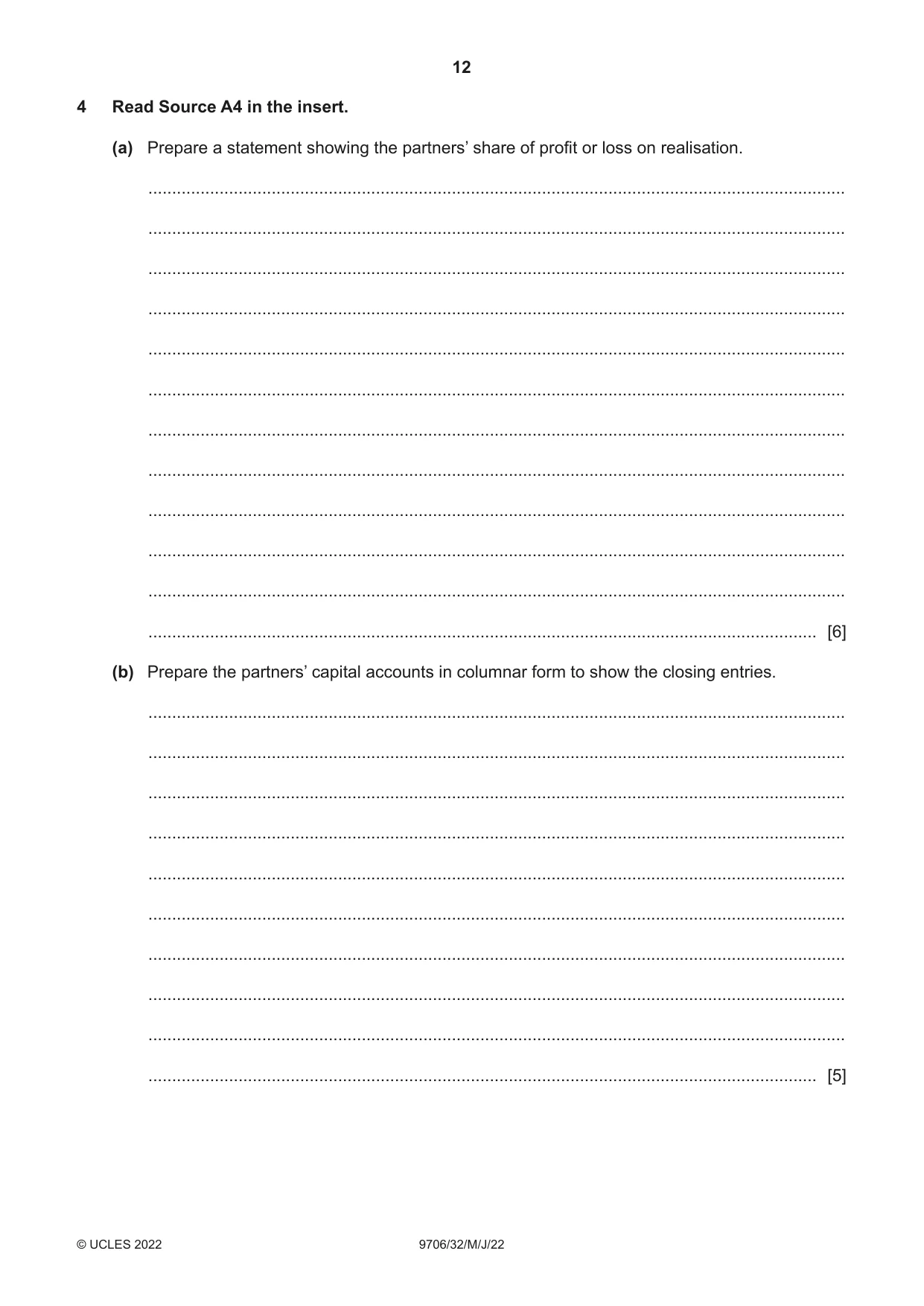
12 9706/32/M/J/22 © UCLES 2022 4 Read Source A4 in the insert. (a) Prepare a statement showing the partners’ share of profit or loss on realisation. … … … … … … … … … … … … [6] (b) Prepare the partners’ capital accounts in columnar form to show the closing entries. … … … … … … … … … … [5]
Question paper, page 13
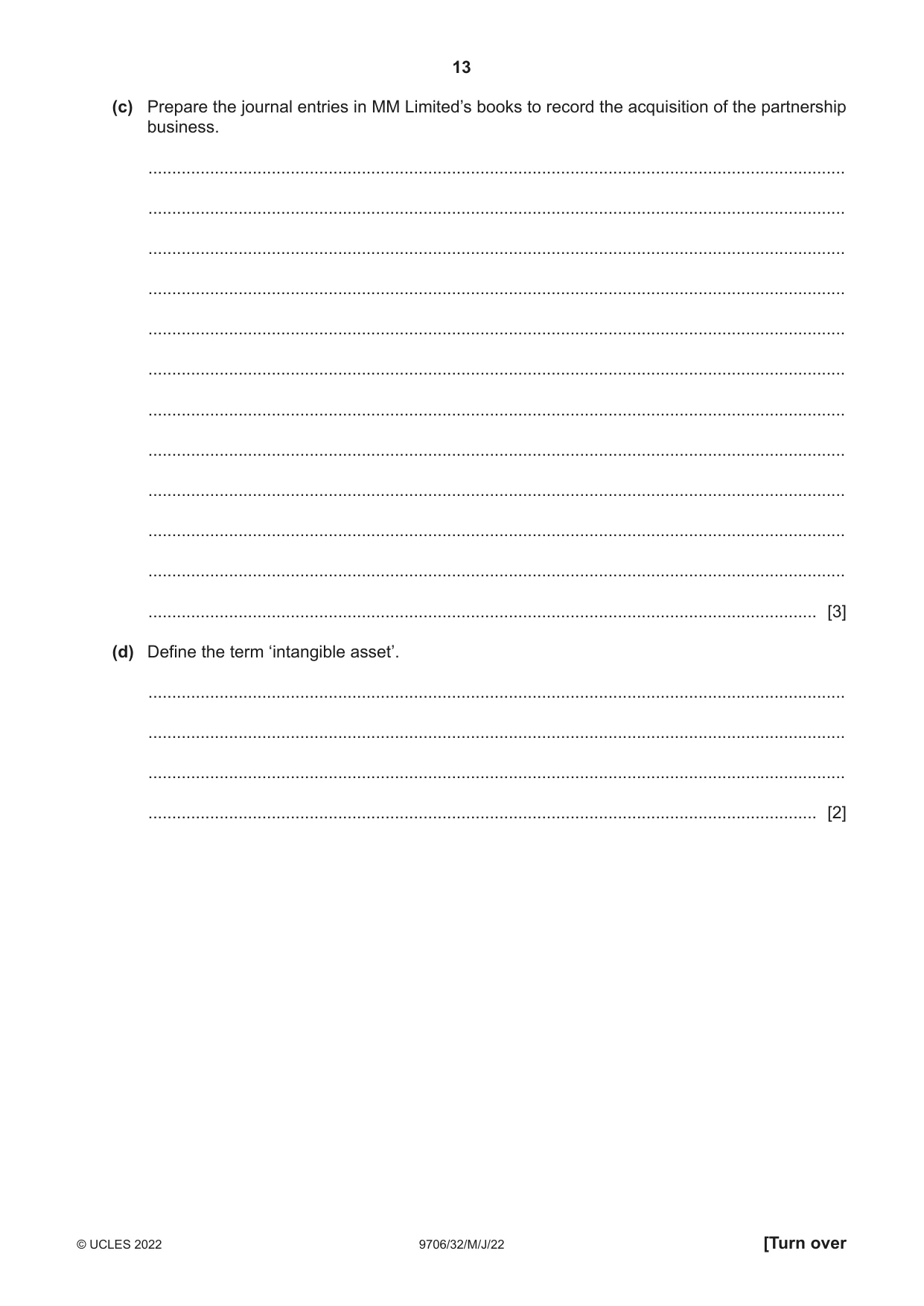
13 9706/32/M/J/22 © UCLES 2022 [Turn over (c) Prepare the journal entries in MM Limited’s books to record the acquisition of the partnership business. … … … … … … … … … … … … [3] (d) Define the term ‘intangible asset’. … … … … [2]
Question paper, page 14
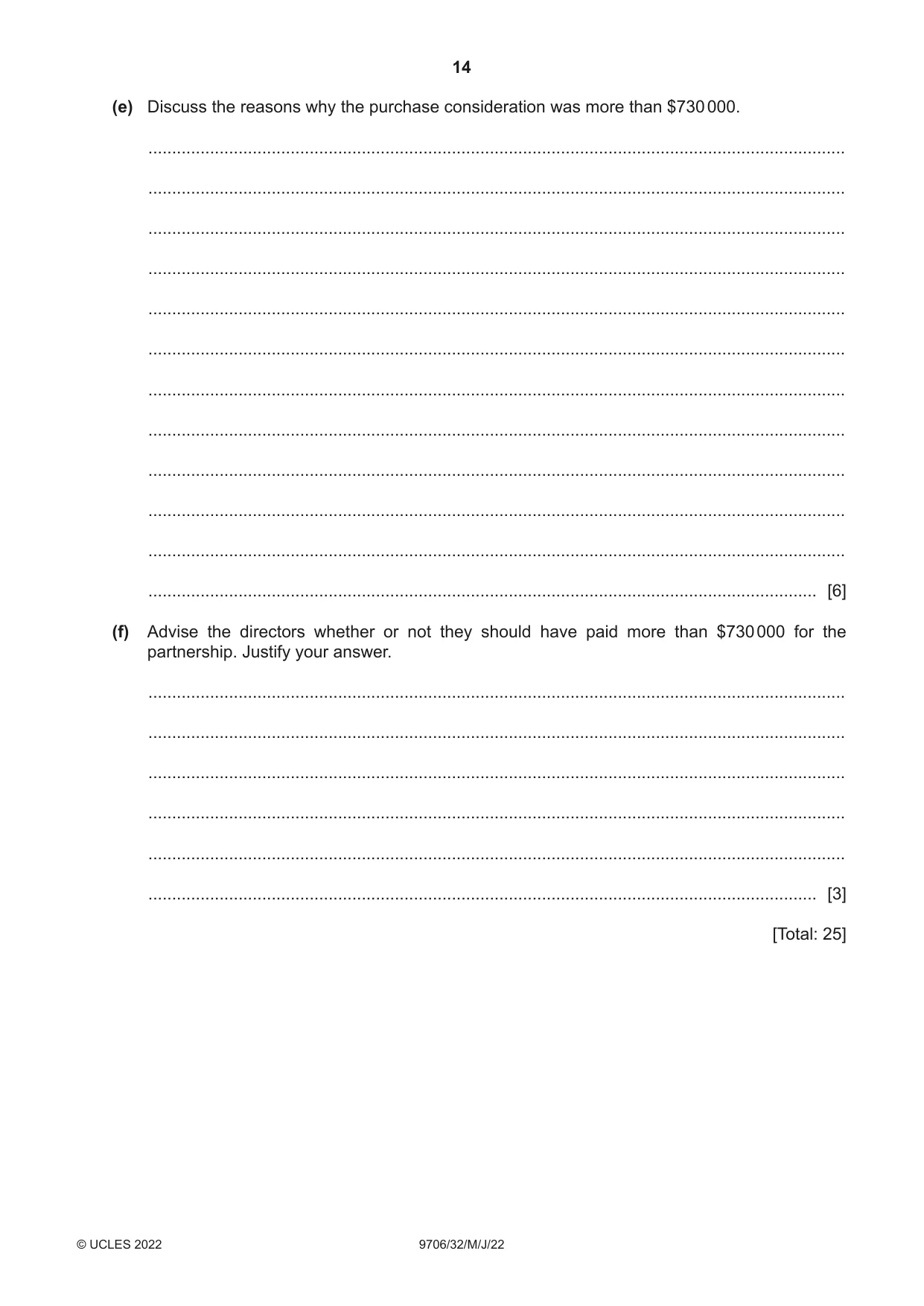
14 9706/32/M/J/22 © UCLES 2022 (e) Discuss the reasons why the purchase consideration was more than $730 000. … … … … … … … … … … … … [6] (f) Advise the directors whether or not they should have paid more than $730 000 for the partnership. Justify your answer. … … … … … … [3] [Total: 25]
Question paper, page 15
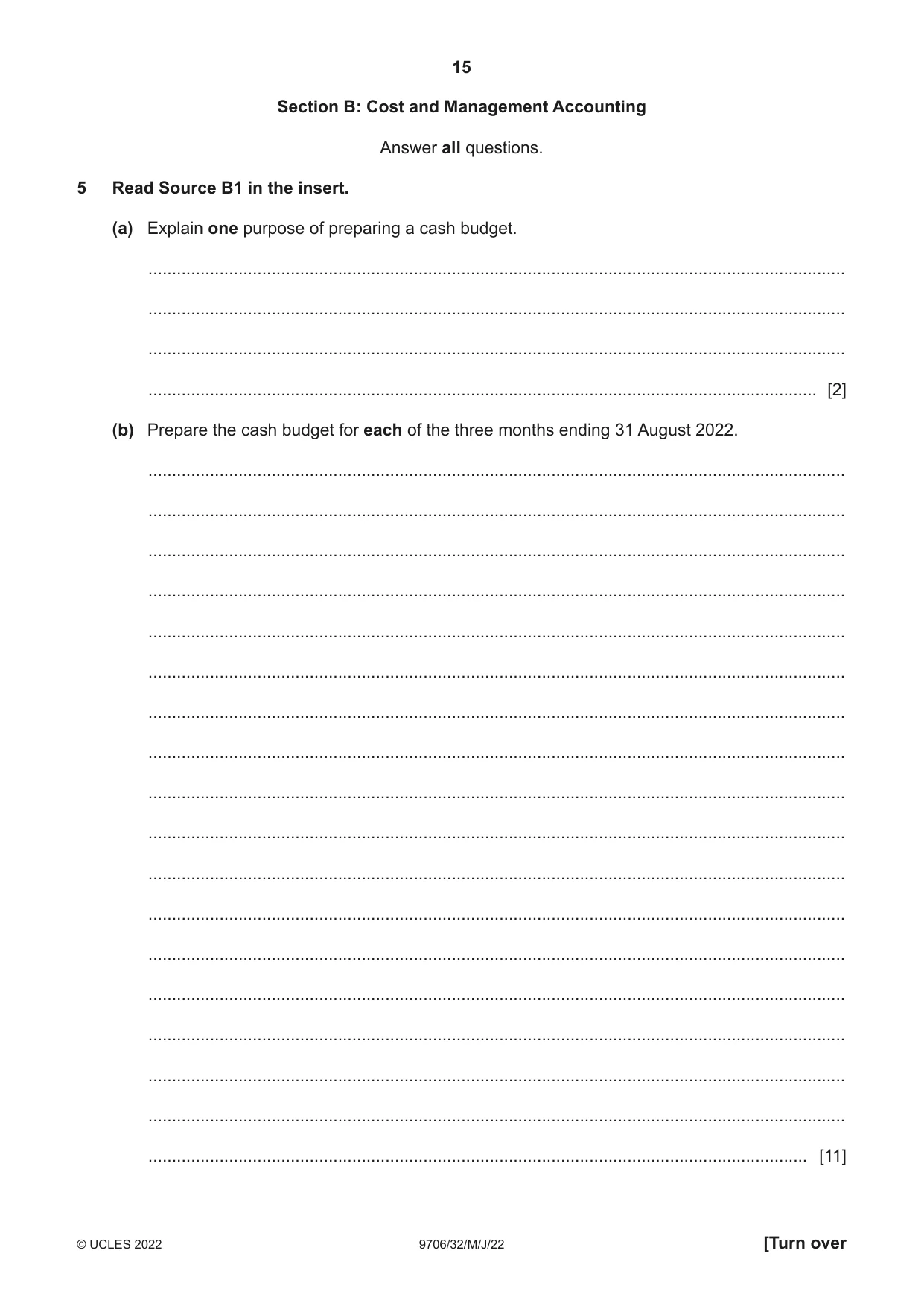
15 9706/32/M/J/22 © UCLES 2022 [Turn over Section B: Cost and Management Accounting Answer all questions. 5 Read Source B1 in the insert. (a) Explain one purpose of preparing a cash budget. … … … … [2] (b) Prepare the cash budget for each of the three months ending 31 August 2022. … … … … … … … … … … … … … … … … … … [11]
Question paper, page 16
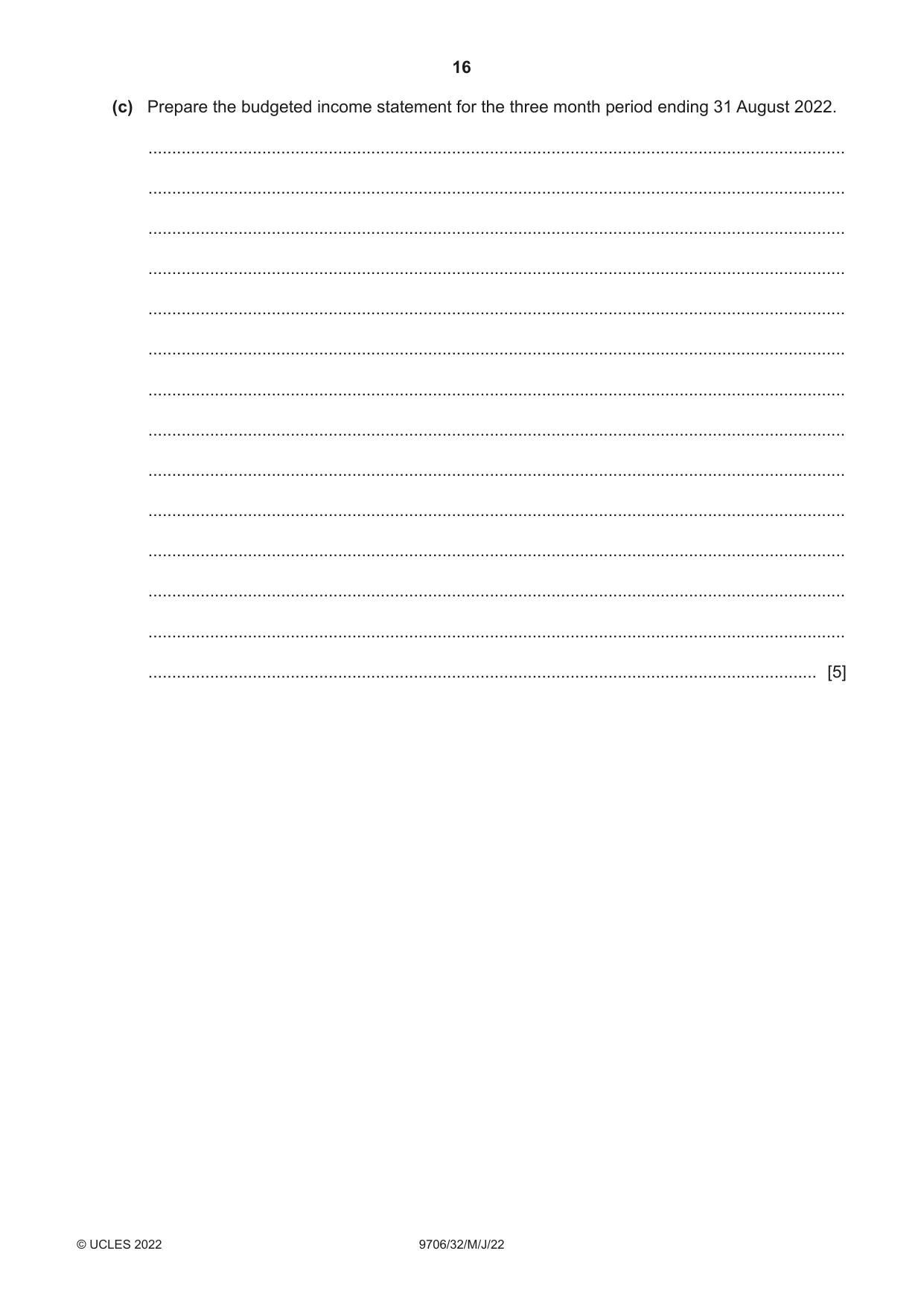
16 9706/32/M/J/22 © UCLES 2022 (c) Prepare the budgeted income statement for the three month period ending 31 August 2022. … … … … … … … … … … … … … … [5]
Question paper, page 17
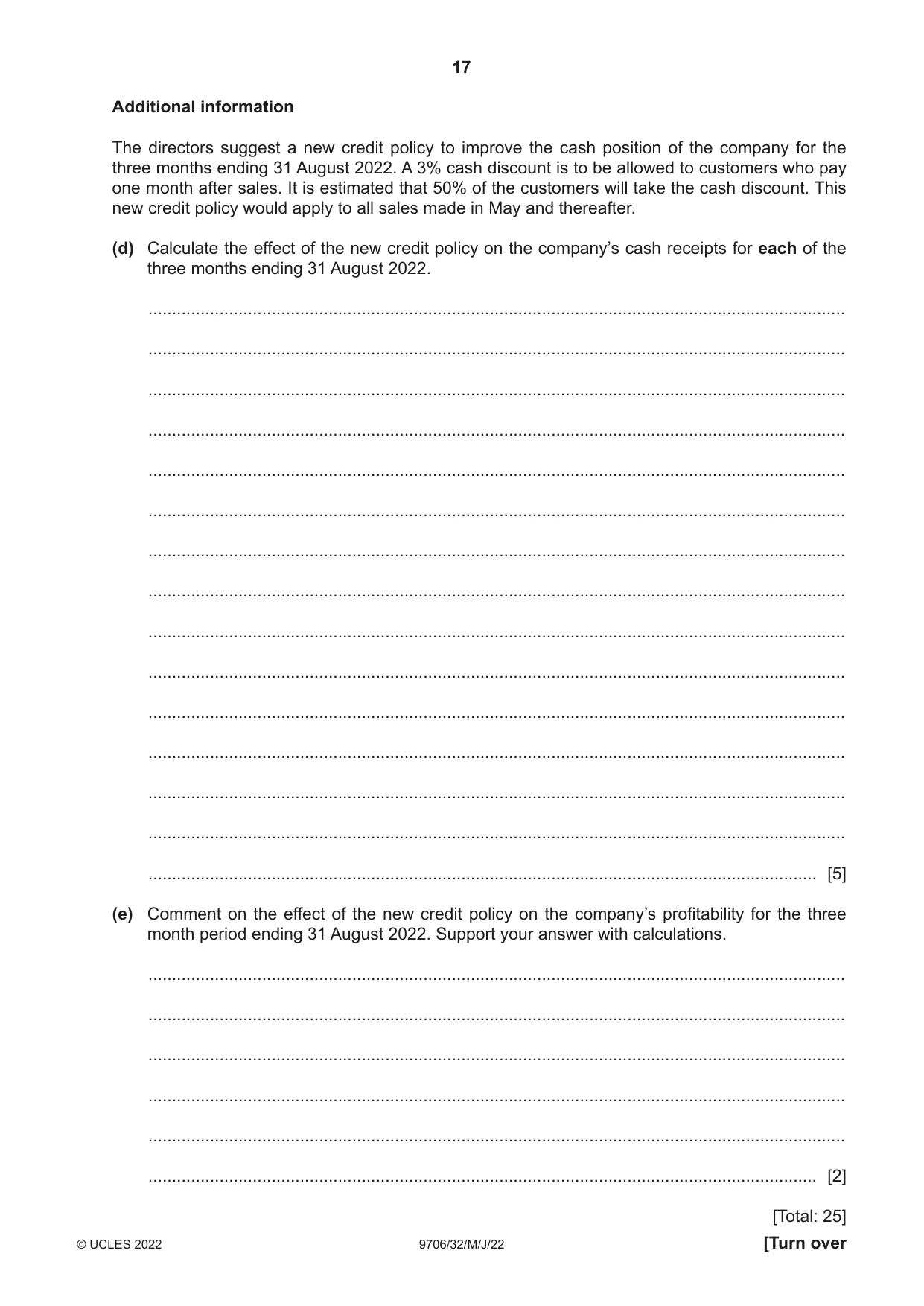
17 9706/32/M/J/22 © UCLES 2022 [Turn over Additional information The directors suggest a new credit policy to improve the cash position of the company for the three months ending 31 August 2022. A 3% cash discount is to be allowed to customers who pay one month after sales. It is estimated that 50% of the customers will take the cash discount. This new credit policy would apply to all sales made in May and thereafter. (d) Calculate the effect of the new credit policy on the company’s cash receipts for each of the three months ending 31 August 2022. … … … … … … … … … … … … … … … [5] (e) Comment on the effect of the new credit policy on the company’s profitability for the three month period ending 31 August 2022. Support your answer with calculations. … … … … … … [2] [Total: 25]
Question paper, page 18
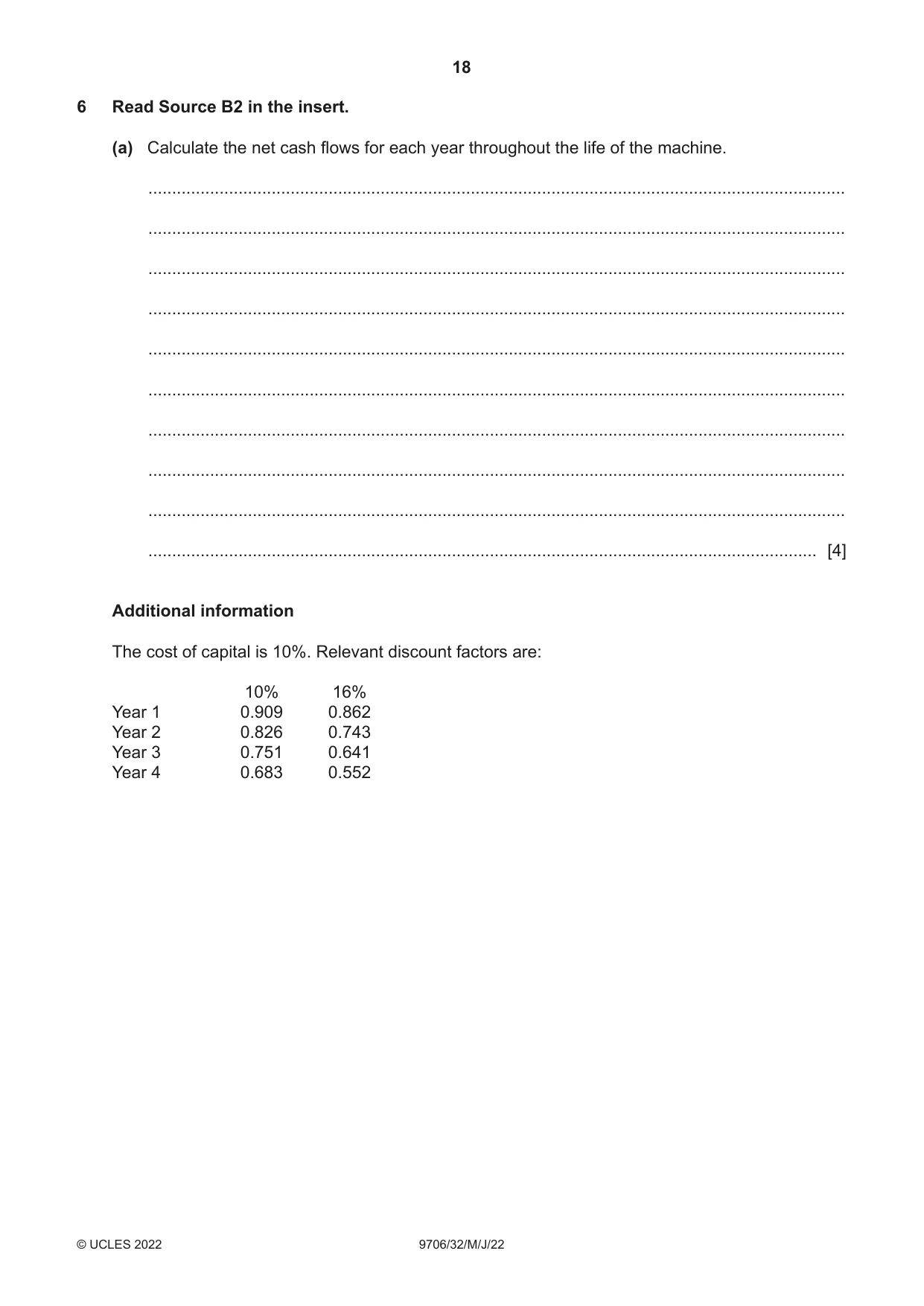
18 9706/32/M/J/22 © UCLES 2022 6 Read Source B2 in the insert. (a) Calculate the net cash flows for each year throughout the life of the machine. … … … … … … … … … … [4] Additional information The cost of capital is 10%. Relevant discount factors are: 10% 16% Year 1 0.909 0.862 Year 2 0.826 0.743 Year 3 0.751 0.641 Year 4 0.683 0.552
Question paper, page 19
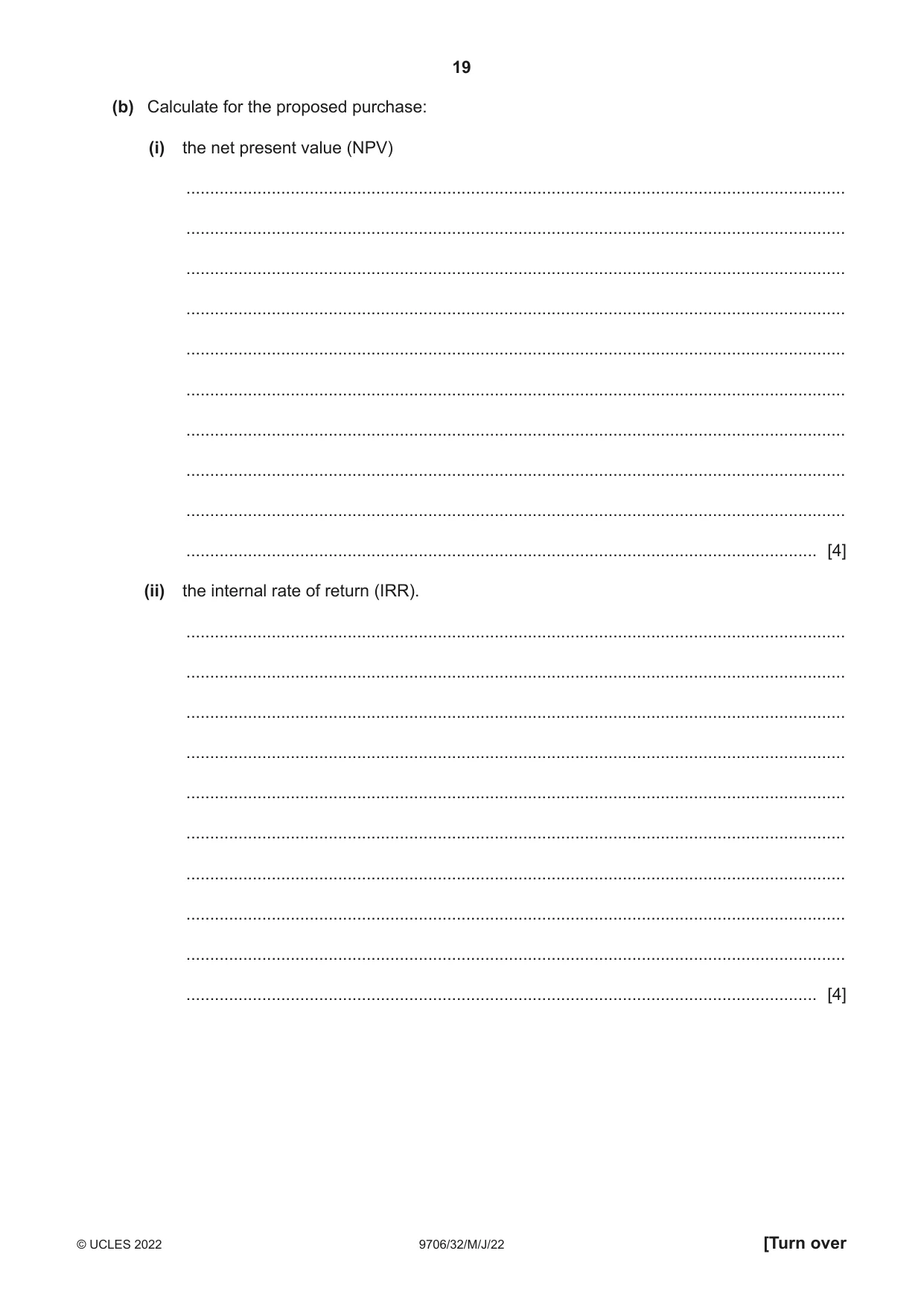
19 9706/32/M/J/22 © UCLES 2022 [Turn over (b) Calculate for the proposed purchase: (i) the net present value (NPV) … … … … … … … … … … [4] (ii) the internal rate of return (IRR). … … … … … … … … … … [4]
Question paper, page 20
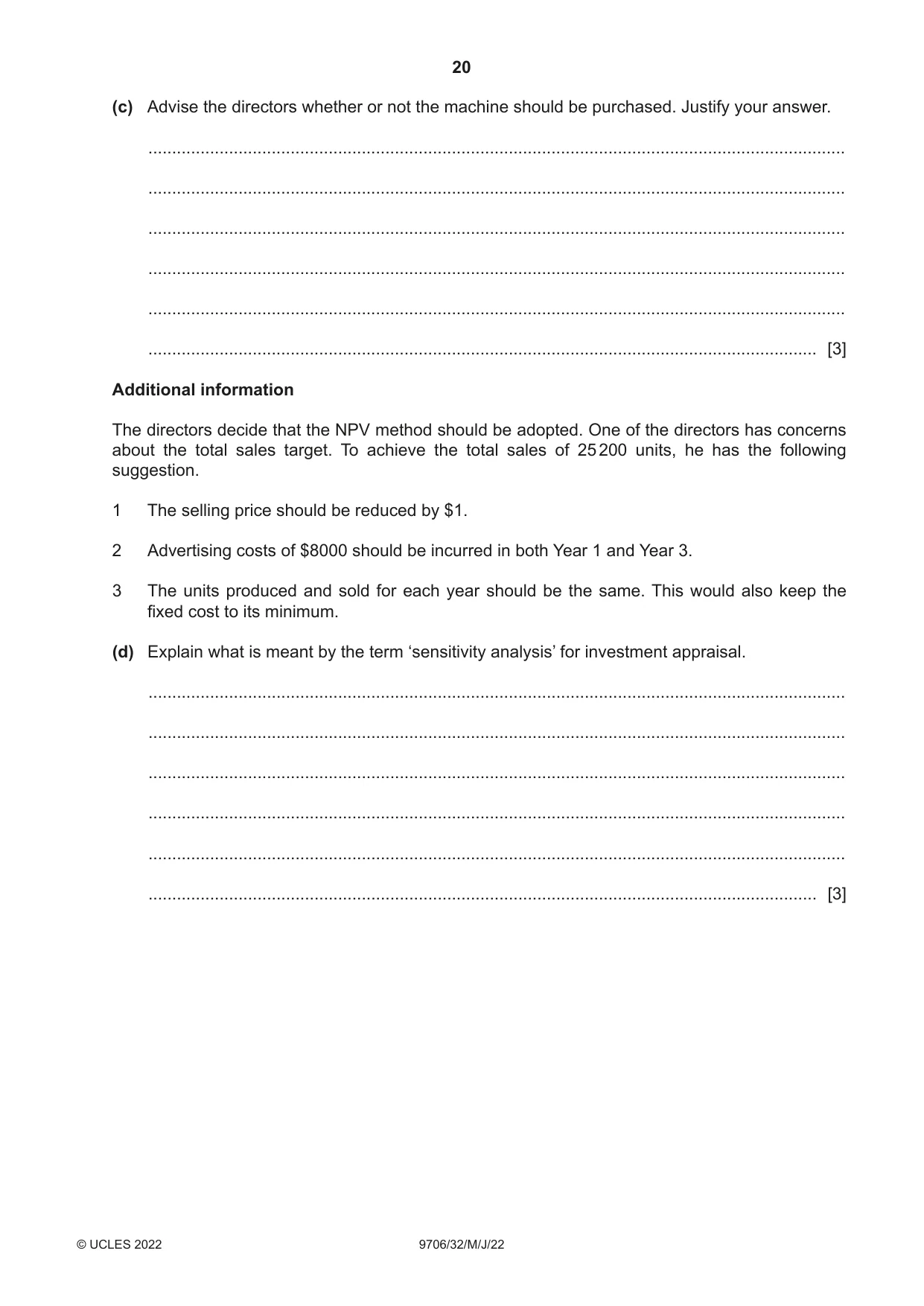
20 9706/32/M/J/22 © UCLES 2022 (c) Advise the directors whether or not the machine should be purchased. Justify your answer. … … … … … … [3] Additional information The directors decide that the NPV method should be adopted. One of the directors has concerns about the total sales target. To achieve the total sales of 25 200 units, he has the following suggestion. 1 The selling price should be reduced by $1. 2 Advertising costs of $8000 should be incurred in both Year 1 and Year 3. 3 The units produced and sold for each year should be the same. This would also keep the fixed cost to its minimum. (d) Explain what is meant by the term ‘sensitivity analysis’ for investment appraisal. … … … … … … [3]
Question paper, page 21
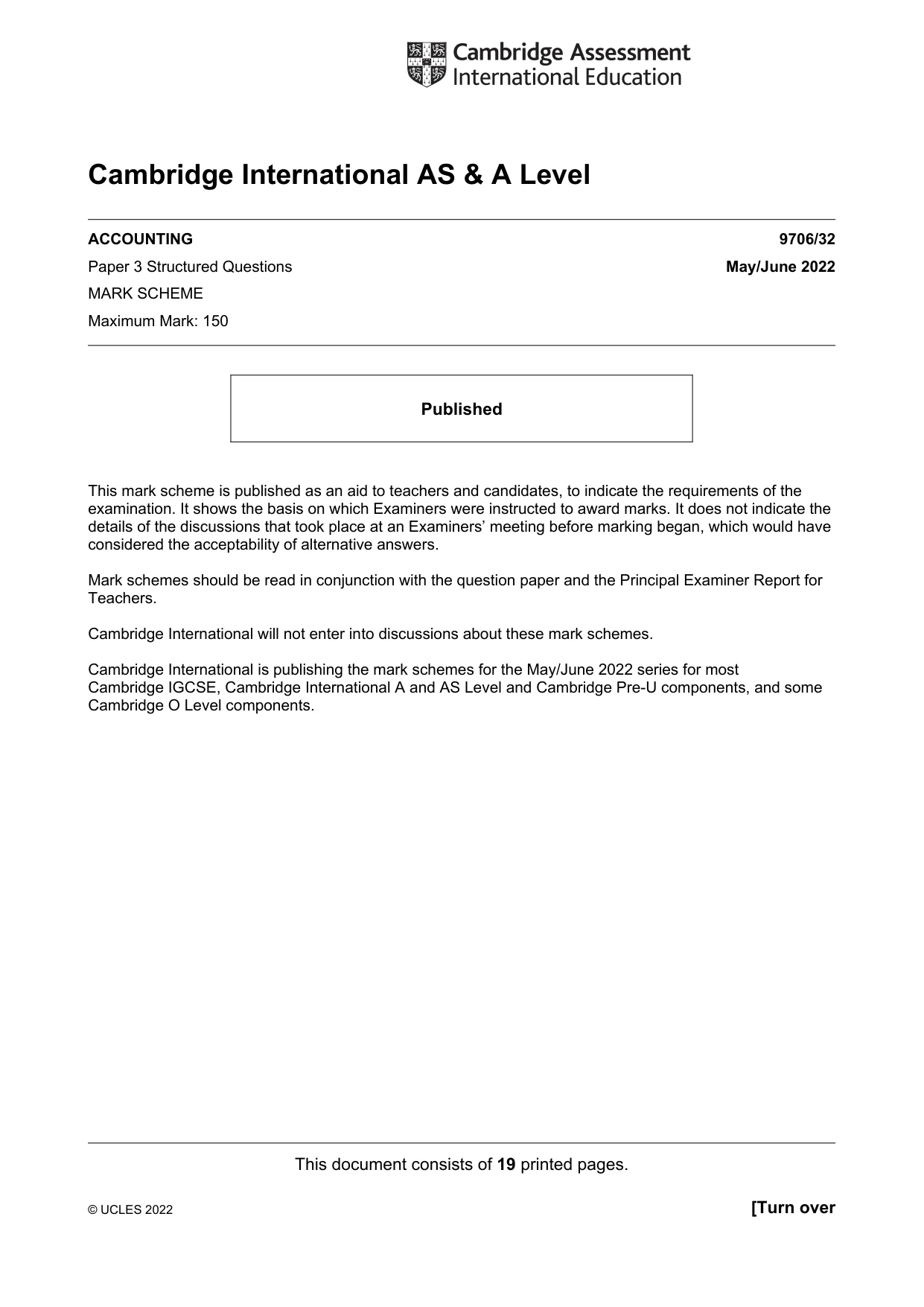
21 9706/32/M/J/22 © UCLES 2022 (e) Assess the impact of the director’s suggestion on the decision to buy the new machine. Support your answer with calculations. … … … … … … … … … … … … … … [7] [Total: 25]
Question paper, page 22
22 9706/32/M/J/22 © UCLES 2022 BLANK PAGE
Question paper, page 23
23 9706/32/M/J/22 © UCLES 2022 BLANK PAGE
Question paper, page 24
24 9706/32/M/J/22 © UCLES 2022 Permission to reproduce items where third-party owned material protected by copyright is included has been sought and cleared where possible. Every reasonable effort has been made by the publisher (UCLES) to trace copyright holders, but if any items requiring clearance have unwittingly been included, the publisher will be pleased to make amends at the earliest possible opportunity. To avoid the issue of disclosure of answer-related information to candidates, all copyright acknowledgements are reproduced online in the Cambridge Assessment International Education Copyright Acknowledgements Booklet. This is produced for each series of examinations and is freely available to download at www.cambridgeinternational.org after the live examination series. Cambridge Assessment International Education is part of Cambridge Assessment. Cambridge Assessment is the brand name of the University of Cambridge Local Examinations Syndicate (UCLES), which is a department of the University of Cambridge. BLANK PAGE
Mark scheme, page 1
This document consists of 19 printed pages. © UCLES 2022 [Turn over Cambridge International AS & A Level ACCOUNTING 9706/32 Paper 3 Structured Questions May/June 2022 MARK SCHEME Maximum Mark: 150 Published This mark scheme is published as an aid to teachers and candidates, to indicate the requirements of the examination. It shows the basis on which Examiners were instructed to award marks. It does not indicate the details of the discussions that took place at an Examiners’ meeting before marking began, which would have considered the acceptability of alternative answers. Mark schemes should be read in conjunction with the question paper and the Principal Examiner Report for Teachers. Cambridge International will not enter into discussions about these mark schemes. Cambridge International is publishing the mark schemes for the May/June 2022 series for most Cambridge IGCSE, Cambridge International A and AS Level and Cambridge Pre-U components, and some Cambridge O Level components.
Mark scheme, page 2
9706/32 Cambridge International AS & A Level – Mark Scheme PUBLISHED May/June 2022 © UCLES 2022 Page 2 of 19 Generic Marking Principles These general marking principles must be applied by all examiners when marking candidate answers. They should be applied alongside the specific content of the mark scheme or generic level descriptors for a question. Each question paper and mark scheme will also comply with these marking principles. GENERIC MARKING PRINCIPLE 1: Marks must be awarded in line with: the specific content of the mark scheme or the generic level descriptors for the question the specific skills defined in the mark scheme or in the generic level descriptors for the question the standard of response required by a candidate as exemplified by the standardisation scripts. GENERIC MARKING PRINCIPLE 2: Marks awarded are always whole marks (not half marks, or other fractions). GENERIC MARKING PRINCIPLE 3: Marks must be awarded positively: marks are awarded for correct/valid answers, as defined in the mark scheme. However, credit is given for valid answers which go beyond the scope of the syllabus and mark scheme, referring to your Team Leader as appropriate marks are awarded when candidates clearly demonstrate what they know and can do marks are not deducted for errors marks are not deducted for omissions answers should only be judged on the quality of spelling, punctuation and grammar when these features are specifically assessed by the question as indicated by the mark scheme. The meaning, however, should be unambiguous. GENERIC MARKING PRINCIPLE 4: Rules must be applied consistently, e.g. in situations where candidates have not followed instructions or in the application of generic level descriptors.
Mark scheme, page 3
9706/32 Cambridge International AS & A Level – Mark Scheme PUBLISHED May/June 2022 © UCLES 2022 Page 3 of 19 GENERIC MARKING PRINCIPLE 5: Marks should be awarded using the full range of marks defined in the mark scheme for the question (however; the use of the full mark range may be limited according to the quality of the candidate responses seen). GENERIC MARKING PRINCIPLE 6: Marks awarded are based solely on the requirements as defined in the mark scheme. Marks should not be awarded with grade thresholds or grade descriptors in mind.
Mark scheme, page 4
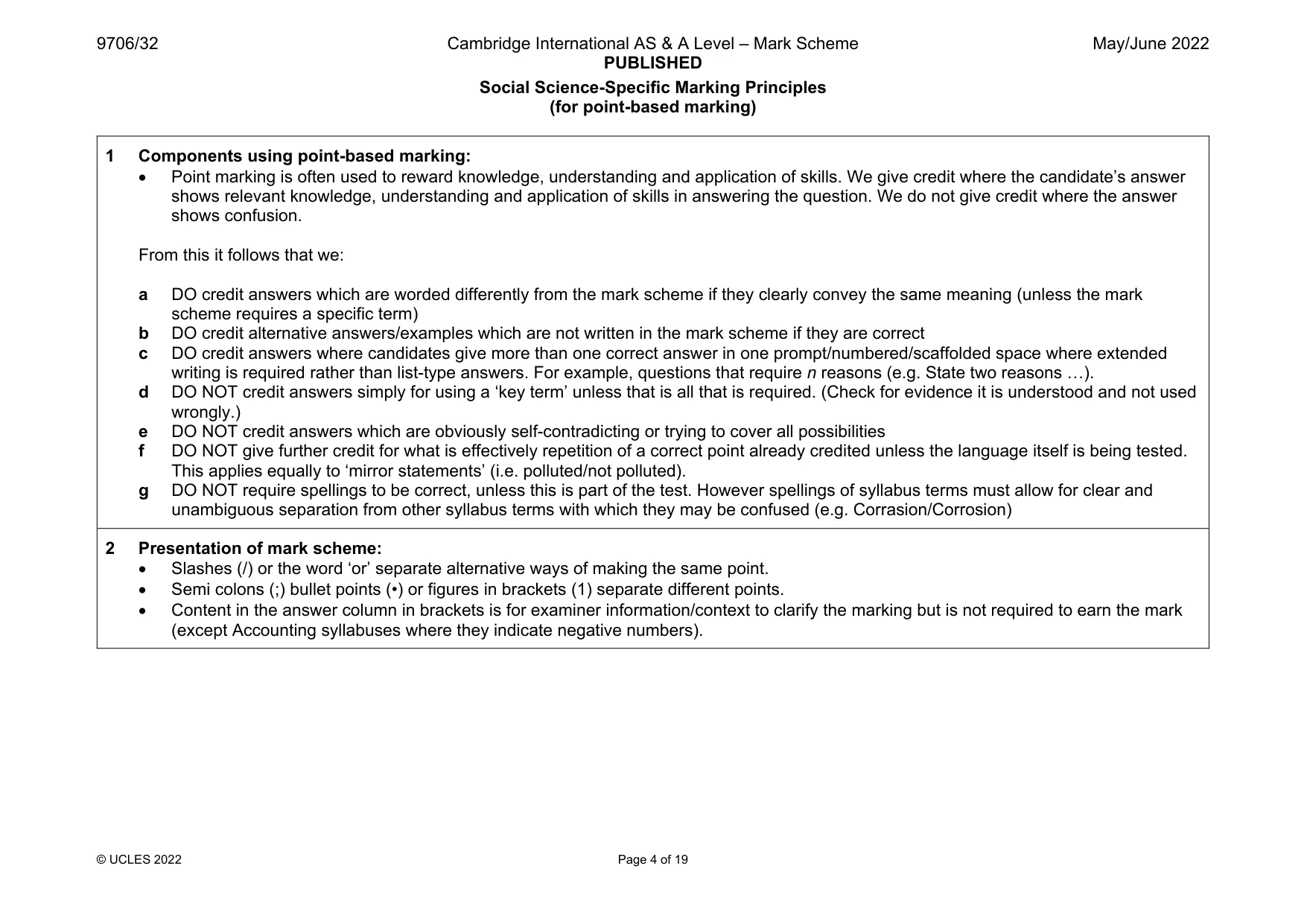
9706/32 Cambridge International AS & A Level – Mark Scheme PUBLISHED May/June 2022 © UCLES 2022 Page 4 of 19 Social Science-Specific Marking Principles (for point-based marking) 1 Components using point-based marking: Point marking is often used to reward knowledge, understanding and application of skills. We give credit where the candidate’s answer shows relevant knowledge, understanding and application of skills in answering the question. We do not give credit where the answer shows confusion. From this it follows that we: a DO credit answers which are worded differently from the mark scheme if they clearly convey the same meaning (unless the mark scheme requires a specific term) b DO credit alternative answers/examples which are not written in the mark scheme if they are correct c DO credit answers where candidates give more than one correct answer in one prompt/numbered/scaffolded space where extended writing is required rather than list-type answers. For example, questions that require n reasons (e.g. State two reasons …). d DO NOT credit answers simply for using a ‘key term’ unless that is all that is required. (Check for evidence it is understood and not used wrongly.) e DO NOT credit answers which are obviously self-contradicting or trying to cover all possibilities f DO NOT give further credit for what is effectively repetition of a correct point already credited unless the language itself is being tested. This applies equally to ‘mirror statements’ (i.e. polluted/not polluted). g DO NOT require spellings to be correct, unless this is part of the test. However spellings of syllabus terms must allow for clear and unambiguous separation from other syllabus terms with which they may be confused (e.g. Corrasion/Corrosion) 2 Presentation of mark scheme: Slashes (/) or the word ‘or’ separate alternative ways of making the same point. Semi colons (;) bullet points (•) or figures in brackets (1) separate different points. Content in the answer column in brackets is for examiner information/context to clarify the marking but is not required to earn the mark (except Accounting syllabuses where they indicate negative numbers).
Mark scheme, page 5
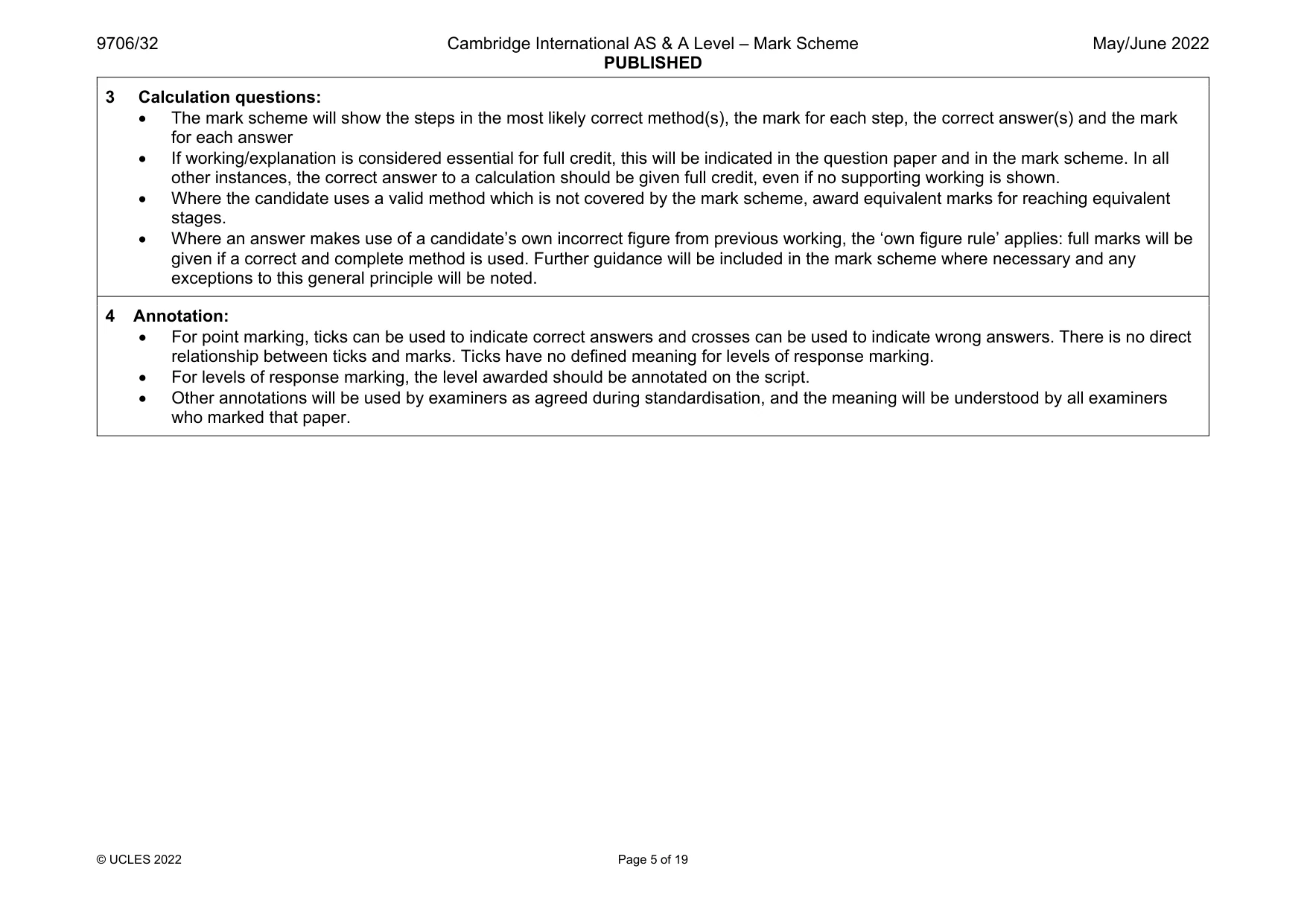
9706/32 Cambridge International AS & A Level – Mark Scheme PUBLISHED May/June 2022 © UCLES 2022 Page 5 of 19 3 Calculation questions: The mark scheme will show the steps in the most likely correct method(s), the mark for each step, the correct answer(s) and the mark for each answer If working/explanation is considered essential for full credit, this will be indicated in the question paper and in the mark scheme. In all other instances, the correct answer to a calculation should be given full credit, even if no supporting working is shown. Where the candidate uses a valid method which is not covered by the mark scheme, award equivalent marks for reaching equivalent stages. Where an answer makes use of a candidate’s own incorrect figure from previous working, the ‘own figure rule’ applies: full marks will be given if a correct and complete method is used. Further guidance will be included in the mark scheme where necessary and any exceptions to this general principle will be noted. 4 Annotation: For point marking, ticks can be used to indicate correct answers and crosses can be used to indicate wrong answers. There is no direct relationship between ticks and marks. Ticks have no defined meaning for levels of response marking. For levels of response marking, the level awarded should be annotated on the script. Other annotations will be used by examiners as agreed during standardisation, and the meaning will be understood by all examiners who marked that paper.
Mark scheme, page 6
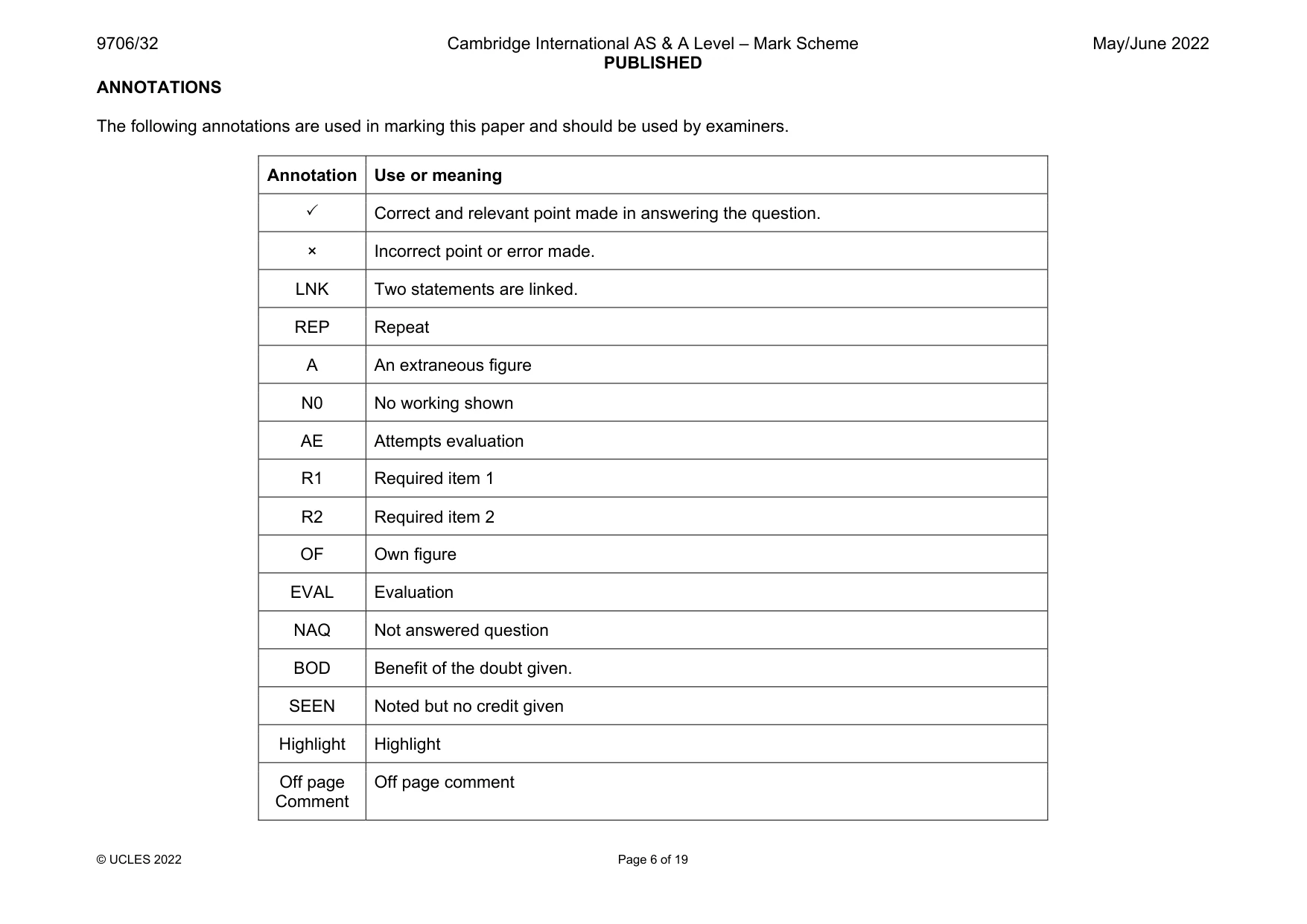
9706/32 Cambridge International AS & A Level – Mark Scheme PUBLISHED May/June 2022 © UCLES 2022 Page 6 of 19 ANNOTATIONS The following annotations are used in marking this paper and should be used by examiners. Annotation Use or meaning Correct and relevant point made in answering the question. × Incorrect point or error made. LNK Two statements are linked. REP Repeat A An extraneous figure N0 No working shown AE Attempts evaluation R1 Required item 1 R2 Required item 2 OF Own figure EVAL Evaluation NAQ Not answered question BOD Benefit of the doubt given. SEEN Noted but no credit given Highlight Highlight Off page Comment Off page comment
Mark scheme, page 7
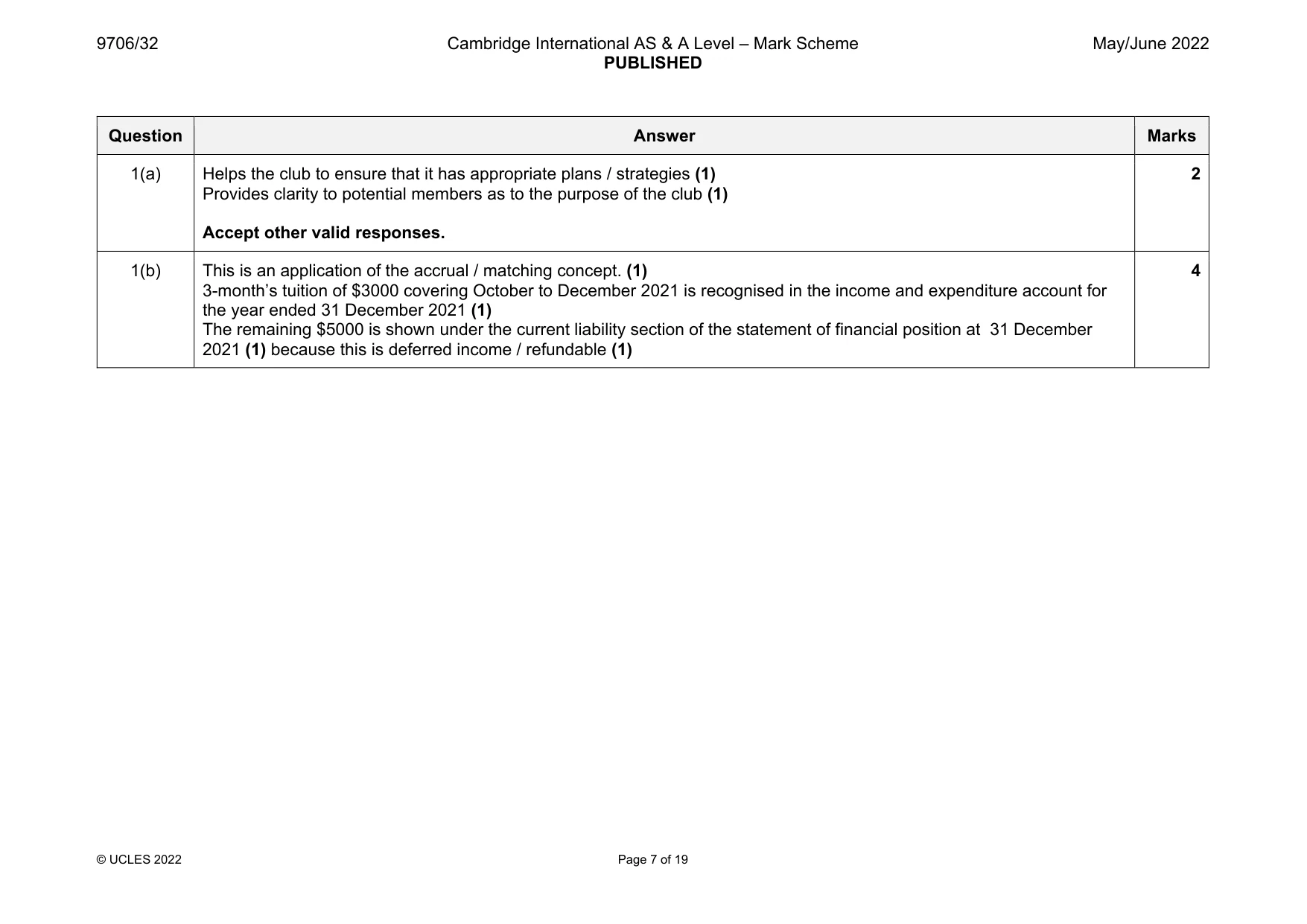
9706/32 Cambridge International AS & A Level – Mark Scheme PUBLISHED May/June 2022 © UCLES 2022 Page 7 of 19 Question Answer Marks 1(a) Helps the club to ensure that it has appropriate plans / strategies (1) Provides clarity to potential members as to the purpose of the club (1) Accept other valid responses. 2 1(b) This is an application of the accrual / matching concept. (1) 3-month’s tuition of $3000 covering October to December 2021 is recognised in the income and expenditure account for the year ended 31 December 2021 (1) The remaining $5000 is shown under the current liability section of the statement of financial position at 31 December 2021 (1) because this is deferred income / refundable (1) 4
Mark scheme, page 8
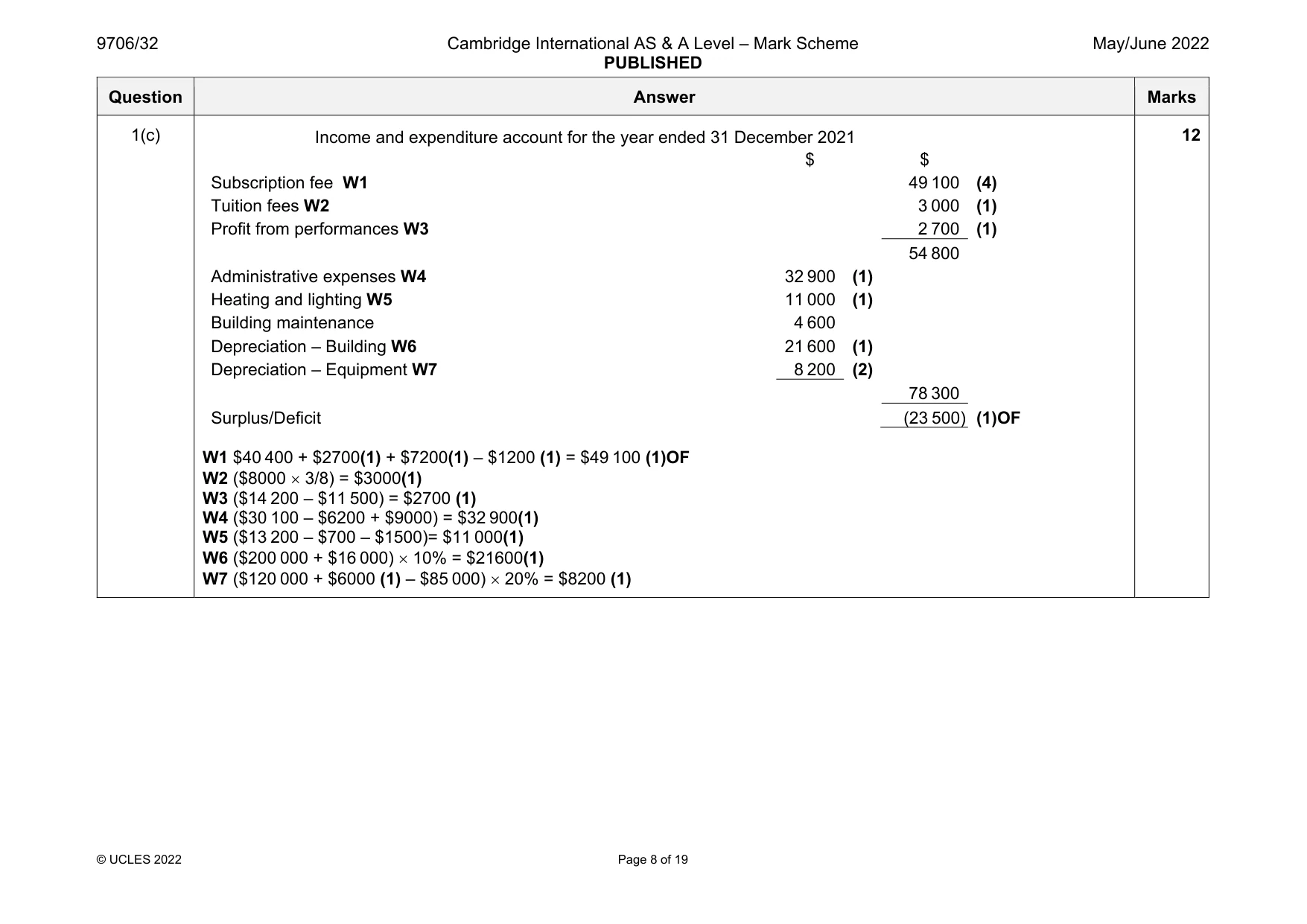
9706/32 Cambridge International AS & A Level – Mark Scheme PUBLISHED May/June 2022 © UCLES 2022 Page 8 of 19 Question Answer Marks 1(c) Income and expenditure account for the year ended 31 December 2021 $ $ Subscription fee W1 49 100 (4) Tuition fees W2 3 000 (1) Profit from performances W3 2 700 (1) 54 800 Administrative expenses W4 32 900 (1) Heating and lighting W5 11 000 (1) Building maintenance 4 600 Depreciation – Building W6 21 600 (1) Depreciation – Equipment W7 8 200 (2) 78 300 Surplus/Deficit (23 500) (1)OF W1 $40 400 + $2700(1) + $7200(1) – $1200 (1) = $49 100 (1)OF W2 ($8000 3/8) = $3000(1) W3 ($14 200 – $11 500) = $2700 (1) W4 ($30 100 – $6200 + $9000) = $32 900(1) W5 ($13 200 – $700 – $1500)= $11 000(1) W6 ($200 000 + $16 000) 10% = $21600(1) W7 ($120 000 + $6000 (1) – $85 000) 20% = $8200 (1) 12
Mark scheme, page 9
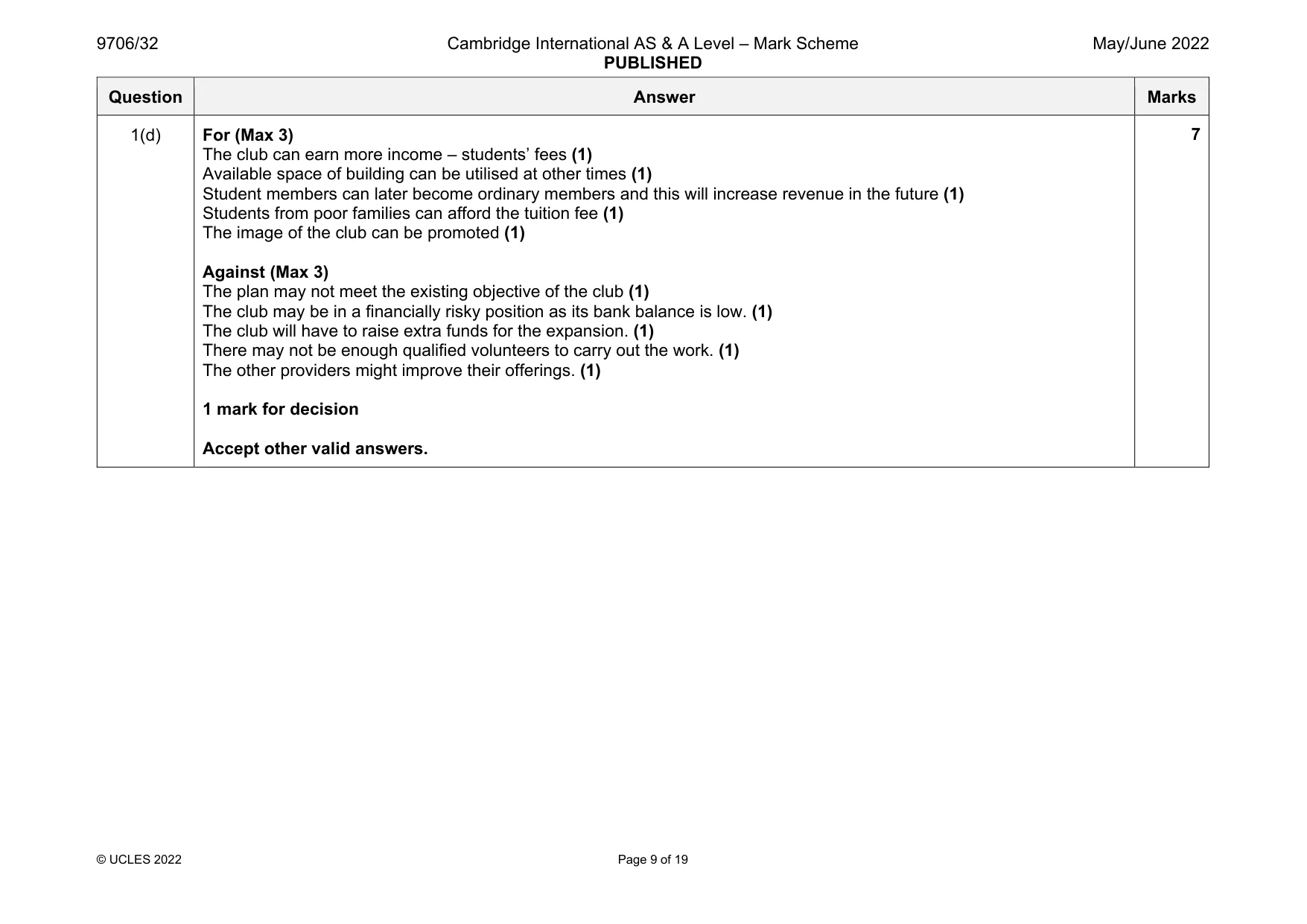
9706/32 Cambridge International AS & A Level – Mark Scheme PUBLISHED May/June 2022 © UCLES 2022 Page 9 of 19 Question Answer Marks 1(d) For (Max 3) The club can earn more income – students’ fees (1) Available space of building can be utilised at other times (1) Student members can later become ordinary members and this will increase revenue in the future (1) Students from poor families can afford the tuition fee (1) The image of the club can be promoted (1) Against (Max 3) The plan may not meet the existing objective of the club (1) The club may be in a financially risky position as its bank balance is low. (1) The club will have to raise extra funds for the expansion. (1) There may not be enough qualified volunteers to carry out the work. (1) The other providers might improve their offerings. (1) 1 mark for decision Accept other valid answers. 7
Mark scheme, page 10
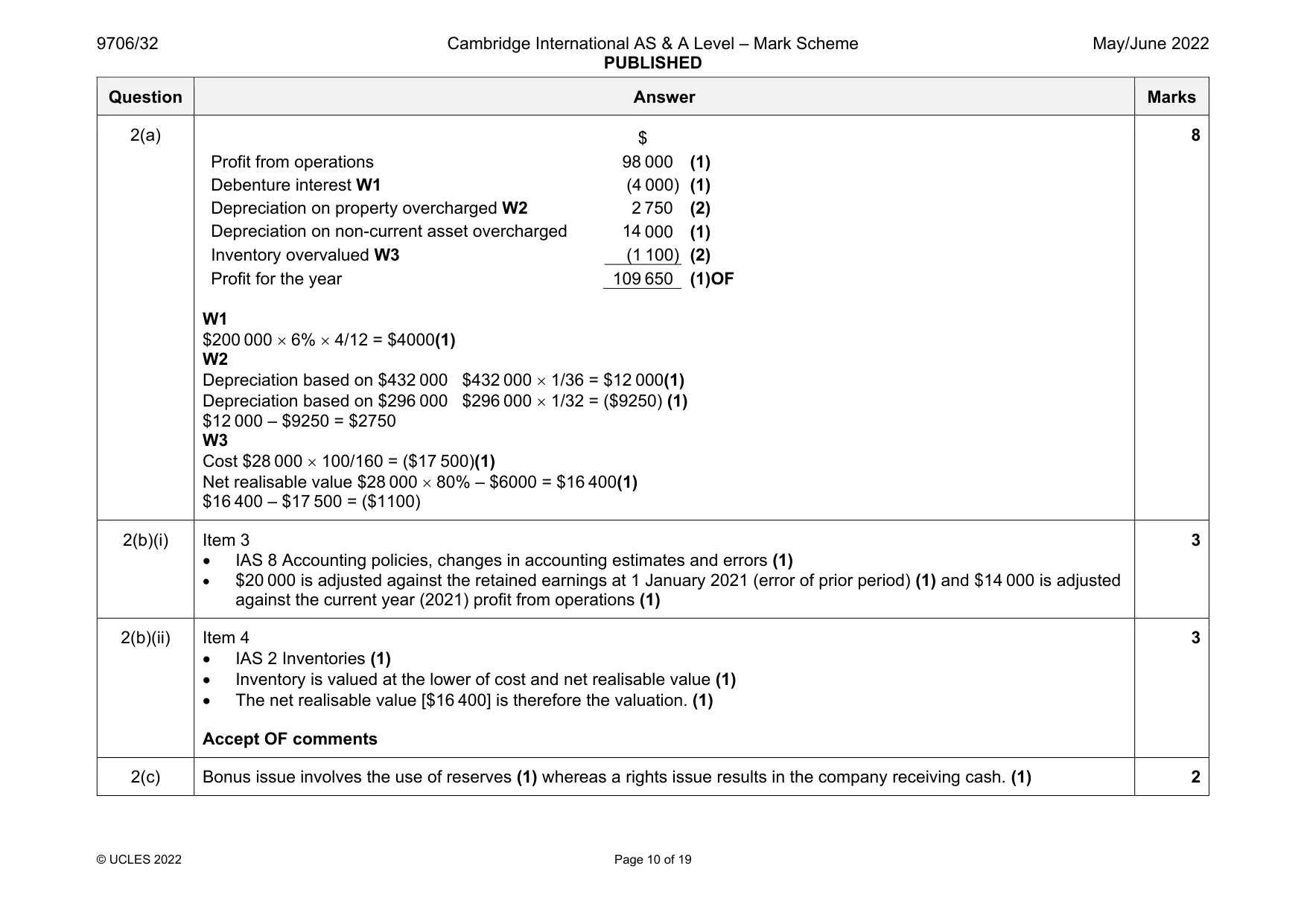
9706/32 Cambridge International AS & A Level – Mark Scheme PUBLISHED May/June 2022 © UCLES 2022 Page 10 of 19 Question Answer Marks 2(a) $ Profit from operations 98 000 (1) Debenture interest W1 (4 000) (1) Depreciation on property overcharged W2 2 750 (2) Depreciation on non-current asset overcharged 14 000 (1) Inventory overvalued W3 (1 100) (2) Profit for the year 109 650 (1)OF W1 $200 000 6% 4/12 = $4000(1) W2 Depreciation based on $432 000 $432 000 1/36 = $12 000(1) Depreciation based on $296 000 $296 000 1/32 = ($9250) (1) $12 000 – $9250 = $2750 W3 Cost $28 000 100/160 = ($17 500)(1) Net realisable value $28 000 80% – $6000 = $16 400(1) $16 400 – $17 500 = ($1100) 8 2(b)(i) Item 3 IAS 8 Accounting policies, changes in accounting estimates and errors (1) $20 000 is adjusted against the retained earnings at 1 January 2021 (error of prior period) (1) and $14 000 is adjusted against the current year (2021) profit from operations (1) 3 2(b)(ii) Item 4 IAS 2 Inventories (1) Inventory is valued at the lower of cost and net realisable value (1) The net realisable value [$16 400] is therefore the valuation. (1) Accept OF comments 3 2(c) Bonus issue involves the use of reserves (1) whereas a rights issue results in the company receiving cash. (1) 2
Mark scheme, page 11
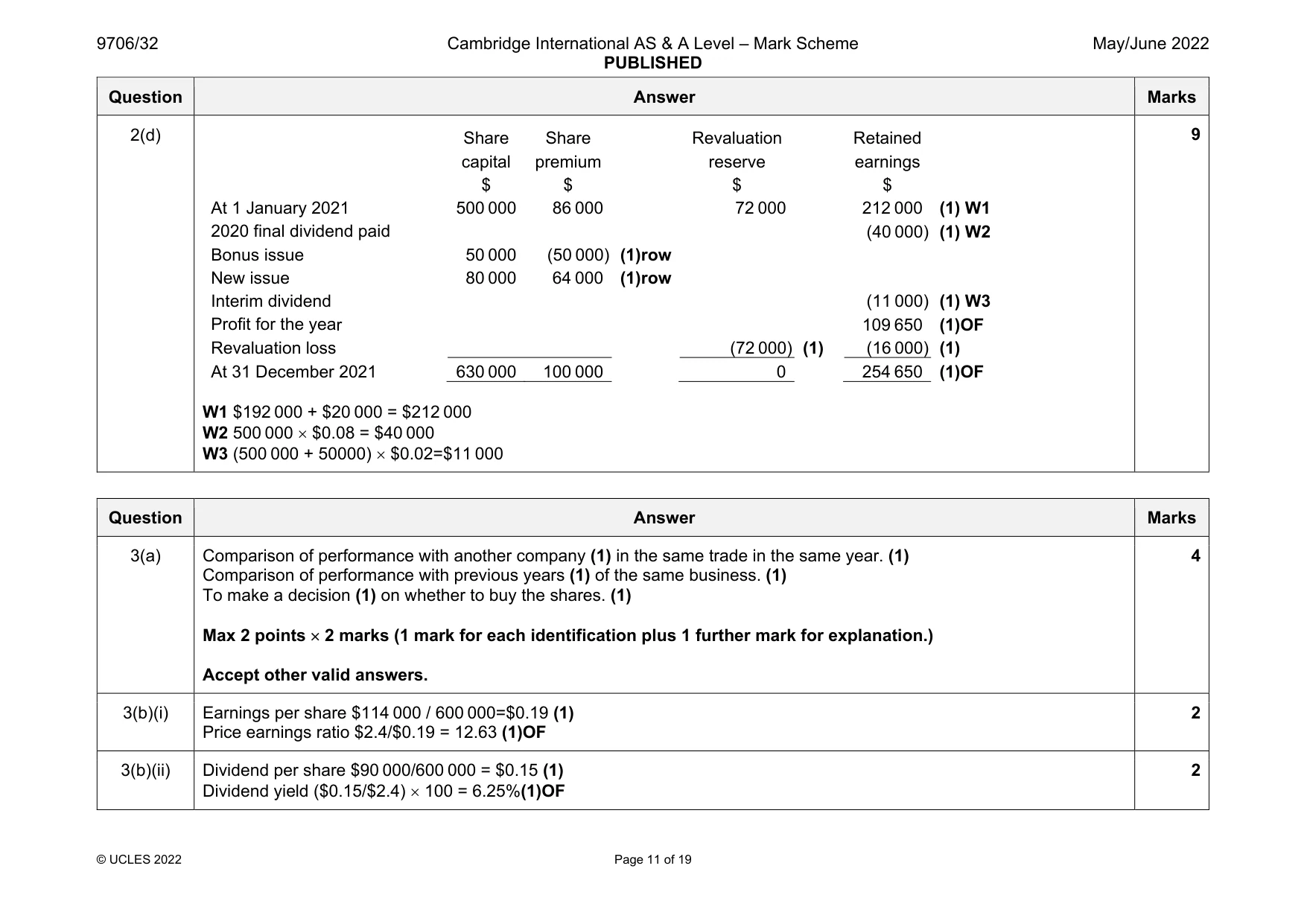
9706/32 Cambridge International AS & A Level – Mark Scheme PUBLISHED May/June 2022 © UCLES 2022 Page 11 of 19 Question Answer Marks 2(d) Share Share Revaluation Retained capital premium reserve earnings $ $ $ $ At 1 January 2021 500 000 86 000 72 000 212 000 (1) W1 2020 final dividend paid (40 000) (1) W2 Bonus issue 50 000 (50 000) (1)row New issue 80 000 64 000 (1)row Interim dividend (11 000) (1) W3 Profit for the year 109 650 (1)OF Revaluation loss (72 000) (1) (16 000) (1) At 31 December 2021 630 000 100 000 0 254 650 (1)OF W1 $192 000 + $20 000 = $212 000 W2 500 000 $0.08 = $40 000 W3 (500 000 + 50000) $0.02=$11 000 9 Question Answer Marks 3(a) Comparison of performance with another company (1) in the same trade in the same year. (1) Comparison of performance with previous years (1) of the same business. (1) To make a decision (1) on whether to buy the shares. (1) Max 2 points 2 marks (1 mark for each identification plus 1 further mark for explanation.) Accept other valid answers. 4 3(b)(i) Earnings per share $114 000 / 600 000=$0.19 (1) Price earnings ratio $2.4/$0.19 = 12.63 (1)OF 2 3(b)(ii) Dividend per share $90 000/600 000 = $0.15 (1) Dividend yield ($0.15/$2.4) 100 = 6.25%(1)OF 2
Mark scheme, page 12
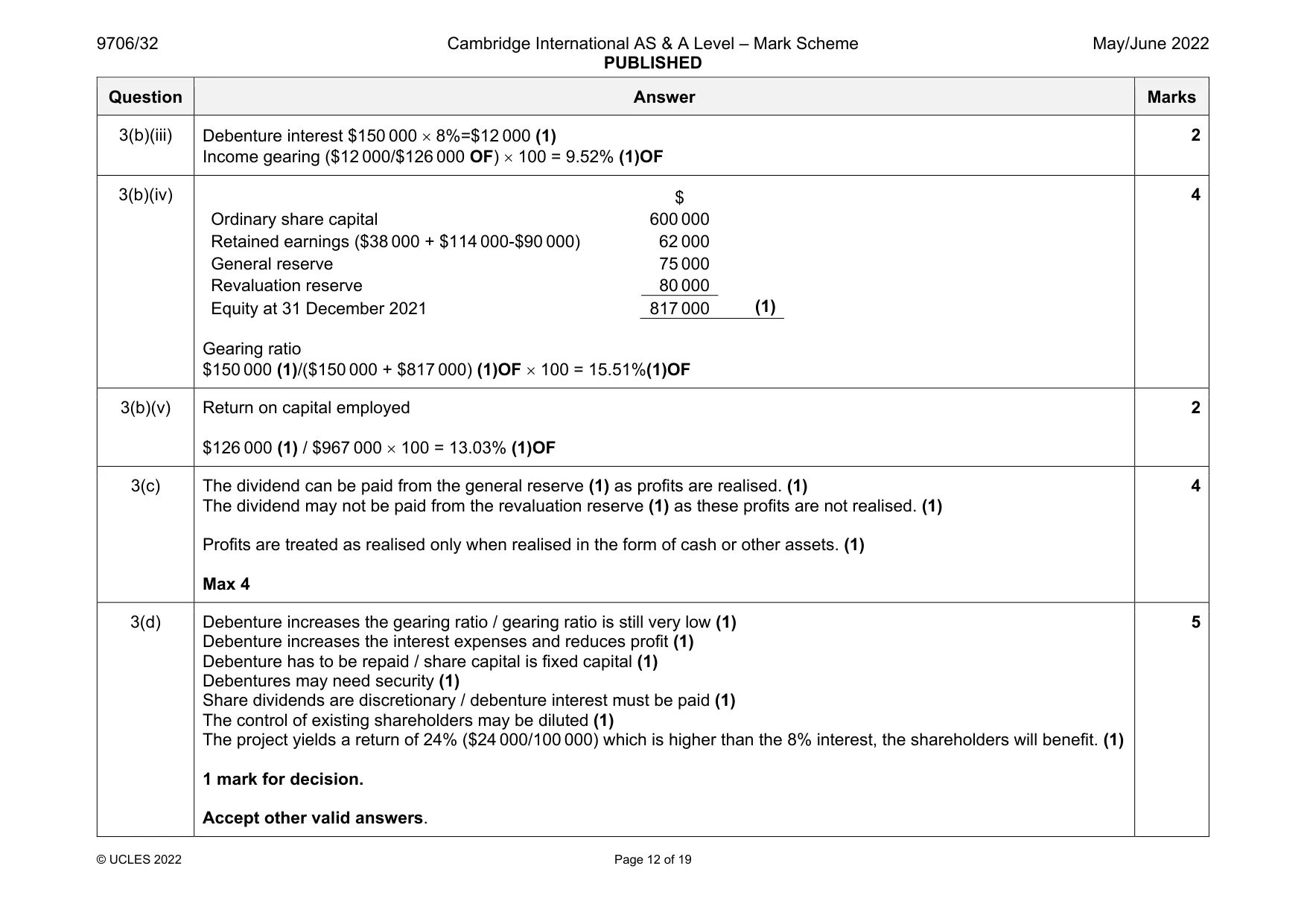
9706/32 Cambridge International AS & A Level – Mark Scheme PUBLISHED May/June 2022 © UCLES 2022 Page 12 of 19 Question Answer Marks 3(b)(iii) Debenture interest $150 000 8%=$12 000 (1) Income gearing ($12 000/$126 000 OF) 100 = 9.52% (1)OF 2 3(b)(iv) $ Ordinary share capital 600 000 Retained earnings ($38 000 + $114 000-$90 000) 62 000 General reserve 75 000 Revaluation reserve 80 000 Equity at 31 December 2021 817 000 (1) Gearing ratio $150 000 (1)/($150 000 + $817 000) (1)OF 100 = 15.51%(1)OF 4 3(b)(v) Return on capital employed $126 000 (1) / $967 000 100 = 13.03% (1)OF 2 3(c) The dividend can be paid from the general reserve (1) as profits are realised. (1) The dividend may not be paid from the revaluation reserve (1) as these profits are not realised. (1) Profits are treated as realised only when realised in the form of cash or other assets. (1) Max 4 4 3(d) Debenture increases the gearing ratio / gearing ratio is still very low (1) Debenture increases the interest expenses and reduces profit (1) Debenture has to be repaid / share capital is fixed capital (1) Debentures may need security (1) Share dividends are discretionary / debenture interest must be paid (1) The control of existing shareholders may be diluted (1) The project yields a return of 24% ($24 000/100 000) which is higher than the 8% interest, the shareholders will benefit. (1) 1 mark for decision. Accept other valid answers. 5
Mark scheme, page 13
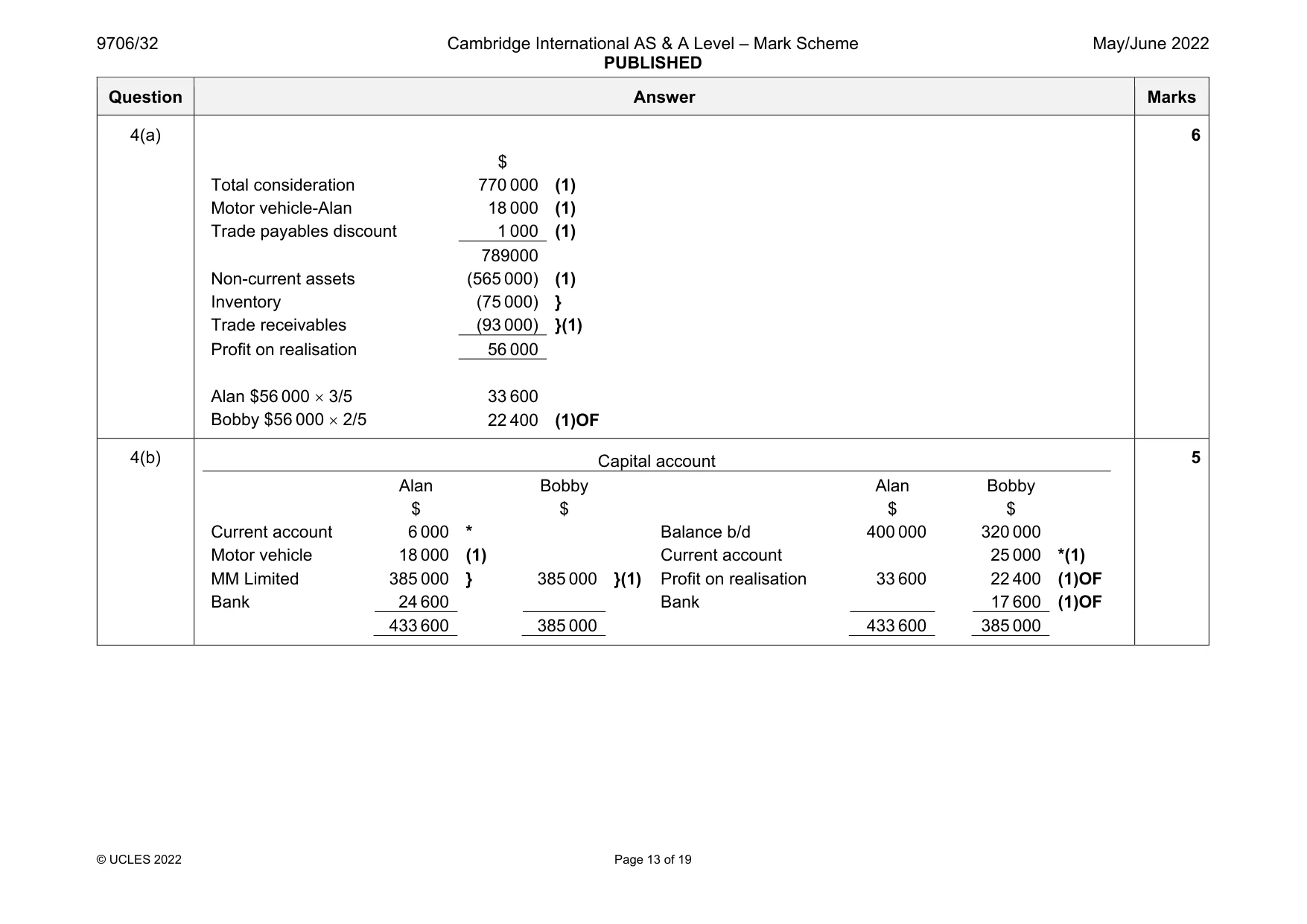
9706/32 Cambridge International AS & A Level – Mark Scheme PUBLISHED May/June 2022 © UCLES 2022 Page 13 of 19 Question Answer Marks 4(a) $ Total consideration 770 000 (1) Motor vehicle-Alan 18 000 (1) Trade payables discount 1 000 (1) 789000 Non-current assets (565 000) (1) Inventory (75 000) } Trade receivables (93 000) }(1) Profit on realisation 56 000 Alan $56 000 3/5 33 600 Bobby $56 000 2/5 22 400 (1)OF 6 4(b) Capital account Alan Bobby Alan Bobby $ $ $ $ Current account 6 000 * Balance b/d 400 000 320 000 Motor vehicle 18 000 (1) Current account 25 000 *(1) MM Limited 385 000 } 385 000 }(1) Profit on realisation 33 600 22 400 (1)OF Bank 24 600 Bank 17 600 (1)OF 433 600 385 000 433 600 385 000 5
Mark scheme, page 14
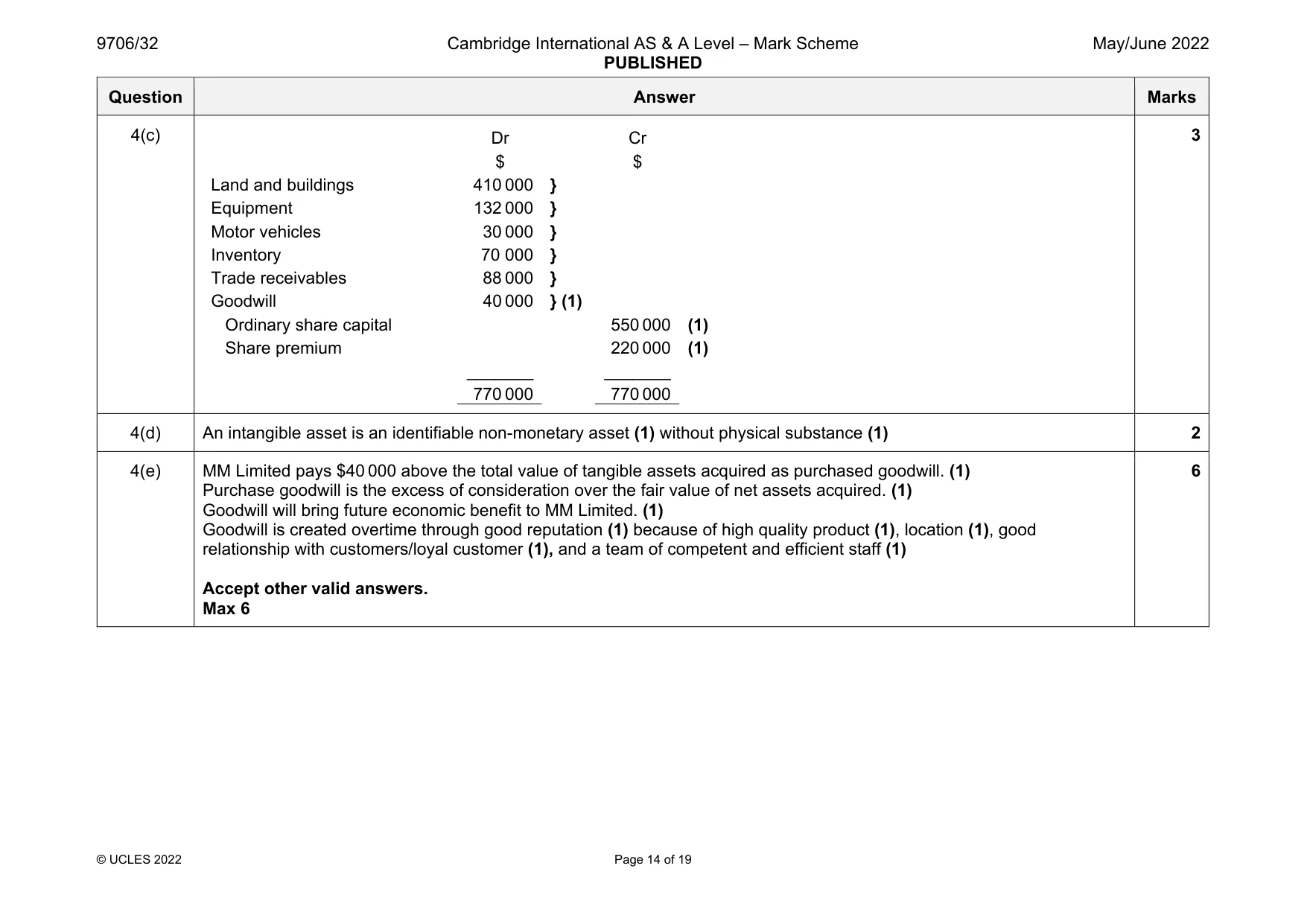
9706/32 Cambridge International AS & A Level – Mark Scheme PUBLISHED May/June 2022 © UCLES 2022 Page 14 of 19 Question Answer Marks 4(c) Dr Cr $ $ Land and buildings 410 000 } Equipment 132 000 } Motor vehicles 30 000 } Inventory 70 000 } Trade receivables 88 000 } Goodwill 40 000 } (1) Ordinary share capital 550 000 (1) Share premium 220 000 (1) _______ _______ 770 000 770 000 3 4(d) An intangible asset is an identifiable non-monetary asset (1) without physical substance (1) 2 4(e) MM Limited pays $40 000 above the total value of tangible assets acquired as purchased goodwill. (1) Purchase goodwill is the excess of consideration over the fair value of net assets acquired. (1) Goodwill will bring future economic benefit to MM Limited. (1) Goodwill is created overtime through good reputation (1) because of high quality product (1), location (1), good relationship with customers/loyal customer (1), and a team of competent and efficient staff (1) Accept other valid answers. Max 6 6
Mark scheme, page 15
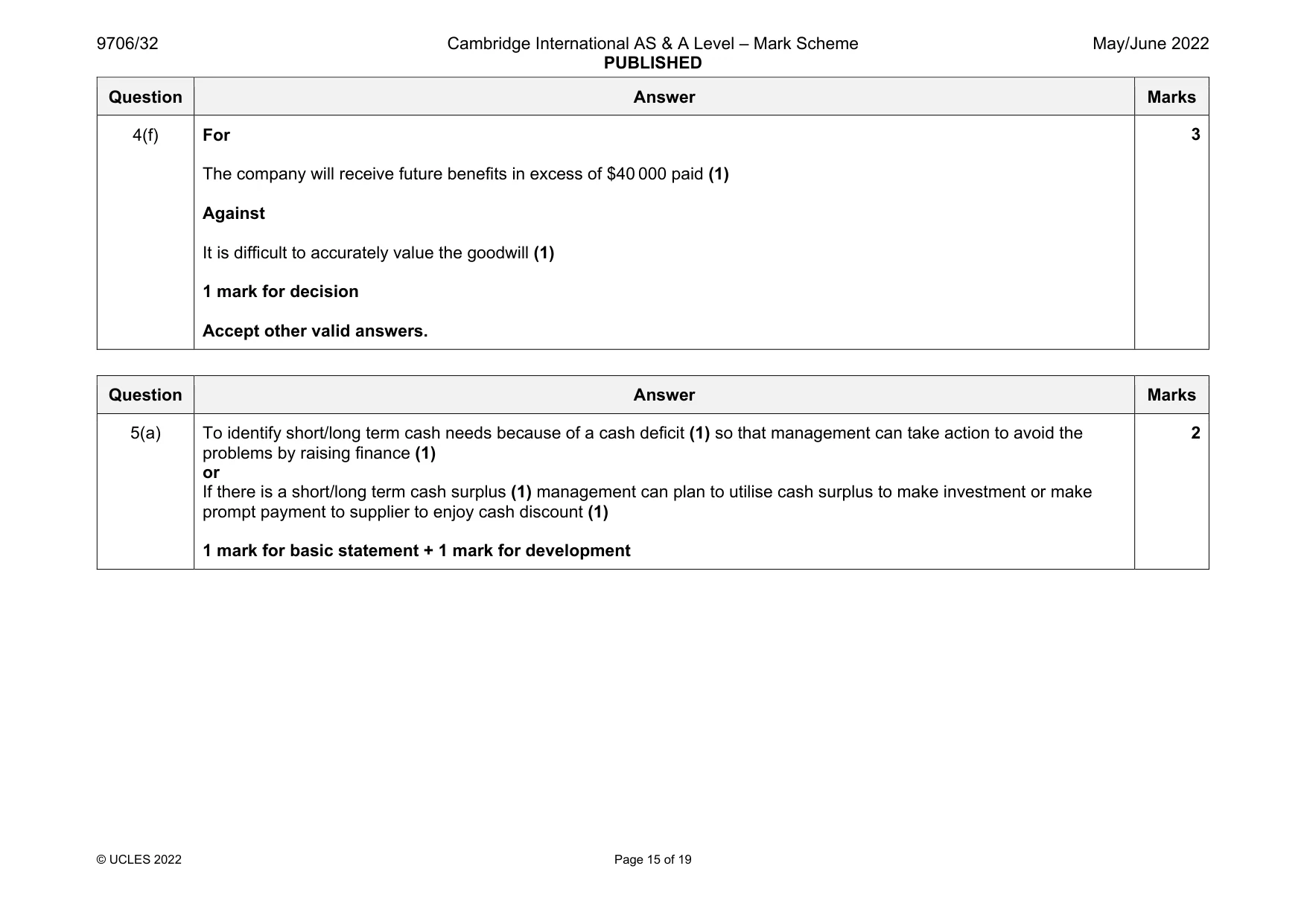
9706/32 Cambridge International AS & A Level – Mark Scheme PUBLISHED May/June 2022 © UCLES 2022 Page 15 of 19 Question Answer Marks 4(f) For The company will receive future benefits in excess of $40 000 paid (1) Against It is difficult to accurately value the goodwill (1) 1 mark for decision Accept other valid answers. 3 Question Answer Marks 5(a) To identify short/long term cash needs because of a cash deficit (1) so that management can take action to avoid the problems by raising finance (1) or If there is a short/long term cash surplus (1) management can plan to utilise cash surplus to make investment or make prompt payment to supplier to enjoy cash discount (1) 1 mark for basic statement + 1 mark for development 2
Mark scheme, page 16
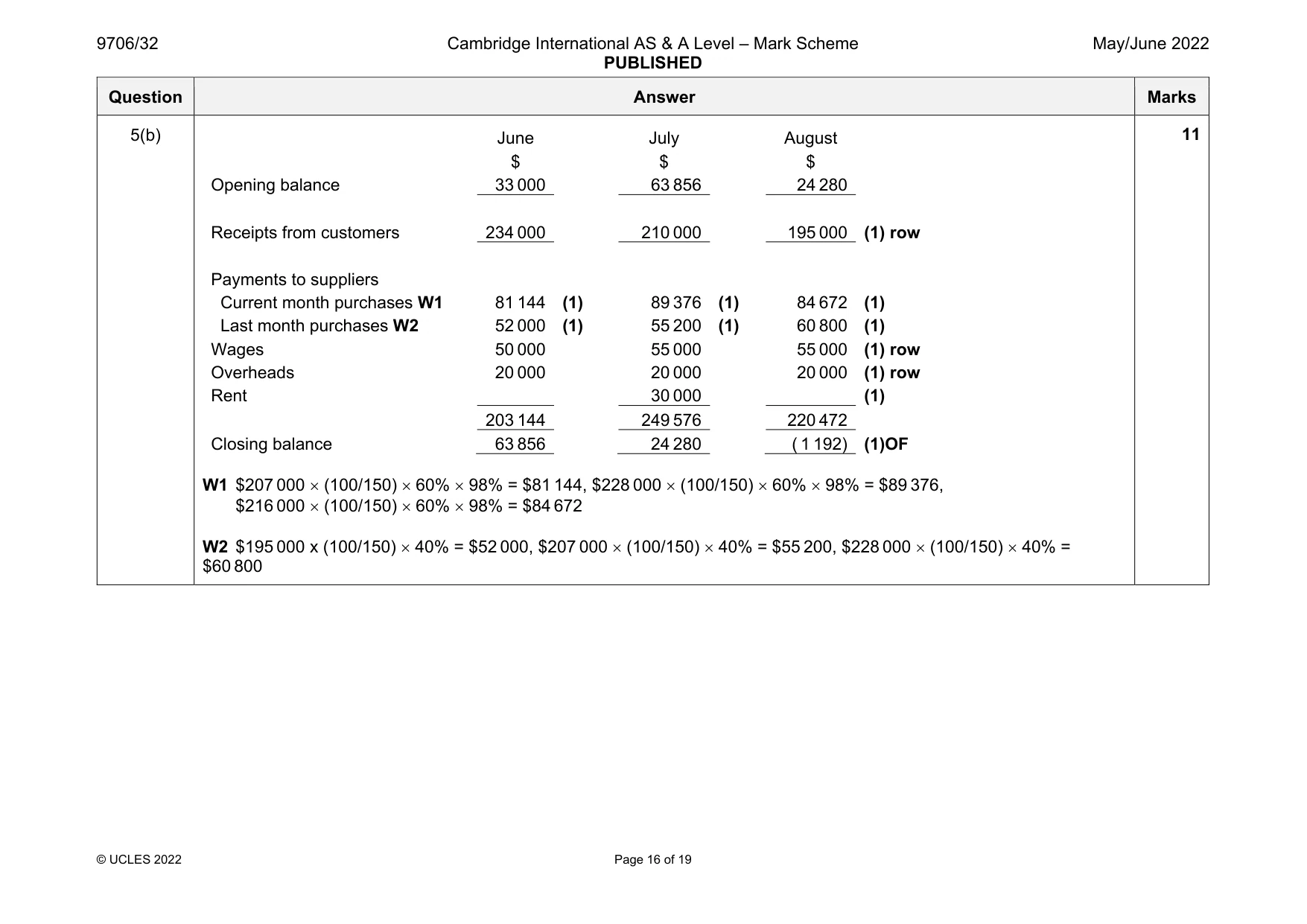
9706/32 Cambridge International AS & A Level – Mark Scheme PUBLISHED May/June 2022 © UCLES 2022 Page 16 of 19 Question Answer Marks 5(b) June July August $ $ $ Opening balance 33 000 63 856 24 280 Receipts from customers 234 000 210 000 195 000 (1) row Payments to suppliers Current month purchases W1 81 144 (1) 89 376 (1) 84 672 (1) Last month purchases W2 52 000 (1) 55 200 (1) 60 800 (1) Wages 50 000 55 000 55 000 (1) row Overheads 20 000 20 000 20 000 (1) row Rent 30 000 (1) 203 144 249 576 220 472 Closing balance 63 856 24 280 ( 1 192) (1)OF W1 $207 000 (100/150) 60% 98% = $81 144, $228 000 (100/150) 60% 98% = $89 376, $216 000 (100/150) 60% 98% = $84 672 W2 $195 000 x (100/150) 40% = $52 000, $207 000 (100/150) 40% = $55 200, $228 000 (100/150) 40% = $60 800 11
Mark scheme, page 17
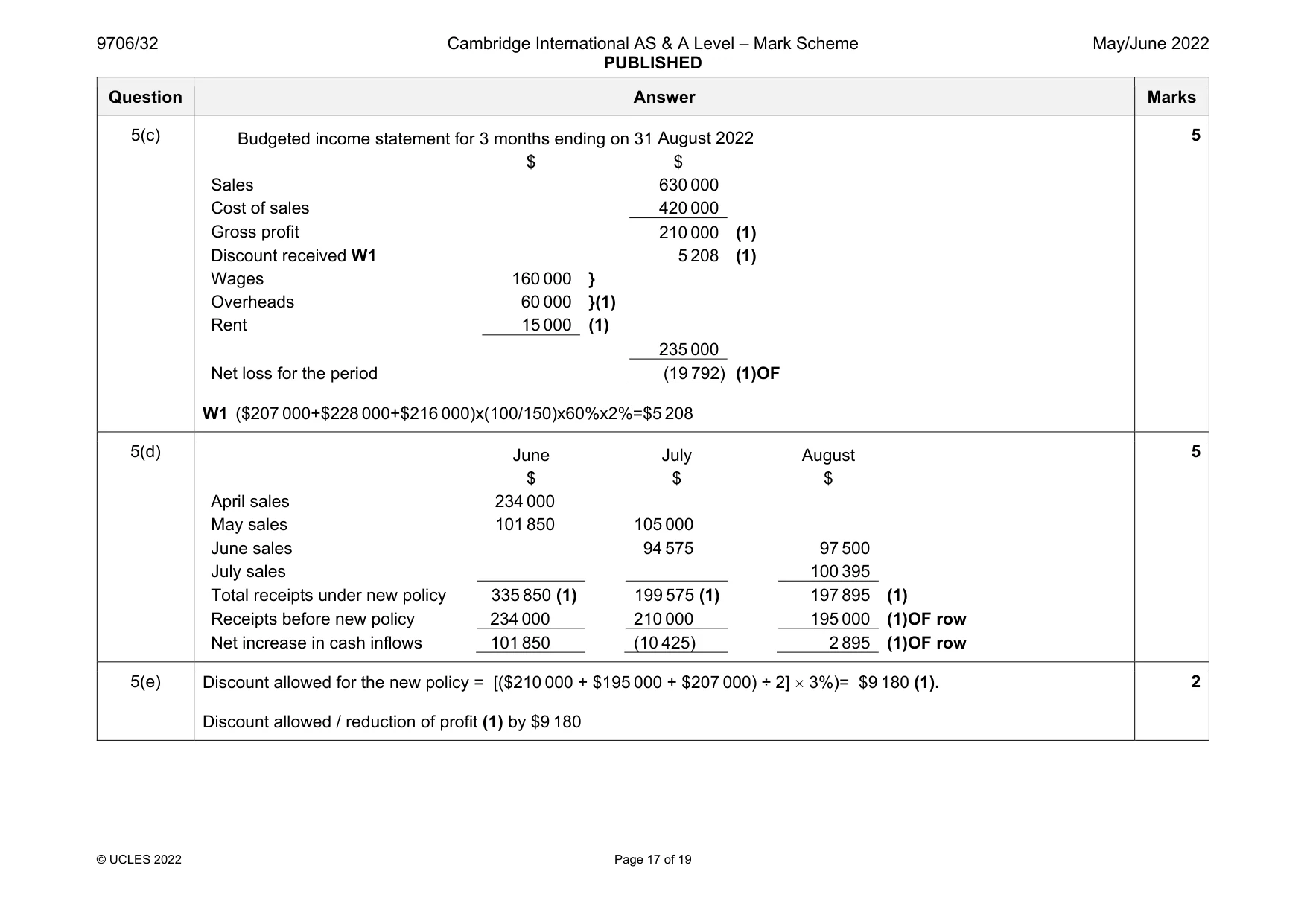
9706/32 Cambridge International AS & A Level – Mark Scheme PUBLISHED May/June 2022 © UCLES 2022 Page 17 of 19 Question Answer Marks 5(c) Budgeted income statement for 3 months ending on 31 August 2022 $ $ Sales 630 000 Cost of sales 420 000 Gross profit 210 000 (1) Discount received W1 5 208 (1) Wages 160 000 } Overheads 60 000 }(1) Rent 15 000 (1) 235 000 Net loss for the period (19 792) (1)OF W1 ($207 000+$228 000+$216 000)x(100/150)x60%x2%=$5 208 5 5(d) June July August $ $ $ April sales 234 000 May sales 101 850 105 000 June sales 94 575 97 500 July sales 100 395 Total receipts under new policy 335 850 (1) 199 575 (1) 197 895 (1) Receipts before new policy 234 000 210 000 195 000 (1)OF row Net increase in cash inflows 101 850 (10 425) 2 895 (1)OF row 5 5(e) Discount allowed for the new policy = [($210 000 + $195 000 + $207 000) ÷ 2] 3%)= $9 180 (1). Discount allowed / reduction of profit (1) by $9 180 2
Mark scheme, page 18
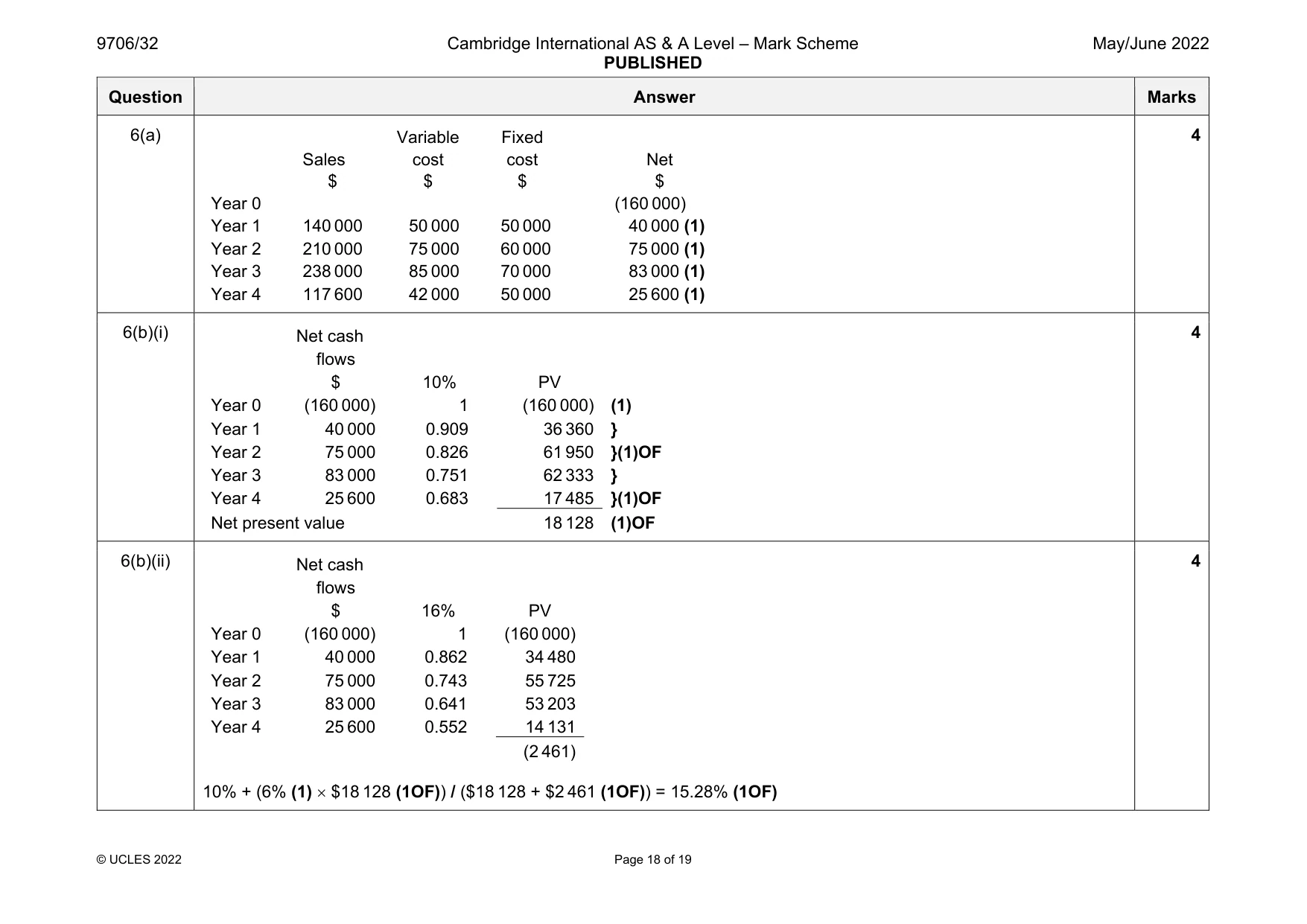
9706/32 Cambridge International AS & A Level – Mark Scheme PUBLISHED May/June 2022 © UCLES 2022 Page 18 of 19 Question Answer Marks 6(a) Variable Fixed Sales cost cost Net $ $ $ $ Year 0 (160 000) Year 1 140 000 50 000 50 000 40 000 (1) Year 2 210 000 75 000 60 000 75 000 (1) Year 3 238 000 85 000 70 000 83 000 (1) Year 4 117 600 42 000 50 000 25 600 (1) 4 6(b)(i) Net cash flows $ 10% PV Year 0 (160 000) 1 (160 000) (1) Year 1 40 000 0.909 36 360 } Year 2 75 000 0.826 61 950 }(1)OF Year 3 83 000 0.751 62 333 } Year 4 25 600 0.683 17 485 }(1)OF Net present value 18 128 (1)OF 4 6(b)(ii) Net cash flows $ 16% PV Year 0 (160 000) 1 (160 000) Year 1 40 000 0.862 34 480 Year 2 75 000 0.743 55 725 Year 3 83 000 0.641 53 203 Year 4 25 600 0.552 14 131 (2 461) 10% + (6% (1) $18 128 (1OF)) / ($18 128 + $2 461 (1OF)) = 15.28% (1OF) 4
Mark scheme, page 19
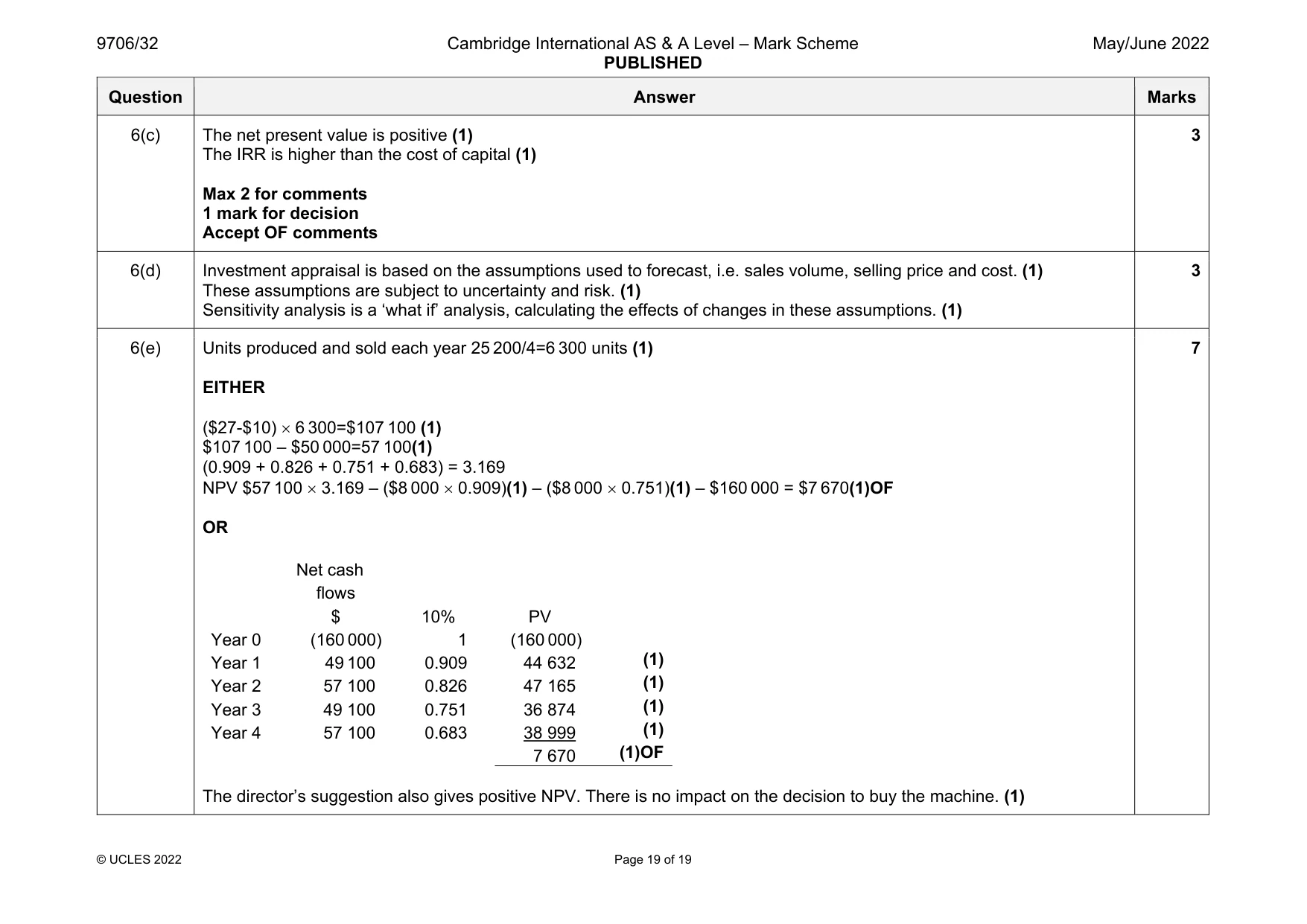
9706/32 Cambridge International AS & A Level – Mark Scheme PUBLISHED May/June 2022 © UCLES 2022 Page 19 of 19 Question Answer Marks 6(c) The net present value is positive (1) The IRR is higher than the cost of capital (1) Max 2 for comments 1 mark for decision Accept OF comments 3 6(d) Investment appraisal is based on the assumptions used to forecast, i.e. sales volume, selling price and cost. (1) These assumptions are subject to uncertainty and risk. (1) Sensitivity analysis is a ‘what if’ analysis, calculating the effects of changes in these assumptions. (1) 3 6(e) Units produced and sold each year 25 200/4=6 300 units (1) EITHER ($27-$10) 6 300=$107 100 (1) $107 100 – $50 000=57 100(1) (0.909 + 0.826 + 0.751 + 0.683) = 3.169 NPV $57 100 3.169 – ($8 000 0.909)(1) – ($8 000 0.751)(1) – $160 000 = $7 670(1)OF OR Net cash flows $ 10% PV Year 0 (160 000) 1 (160 000) Year 1 49 100 0.909 44 632 (1) Year 2 57 100 0.826 47 165 (1) Year 3 49 100 0.751 36 874 (1) Year 4 57 100 0.683 38 999 (1) 7 670 (1)OF The director’s suggestion also gives positive NPV. There is no impact on the decision to buy the machine. (1) 7
What you needed in this session
Cambridge’s own grade thresholds for 2022 May/June, Paper 3 · Variant 2. A higher threshold means an easier paper — the bar moves with how the cohort did.