Cambridge A Level Accounting 9706 — 2021 Oct/Nov Paper 3 · Variant 2
9706/32/O/N/21 · 150 marks · ≈169 min
The question paper and its mark scheme, free to read here and free to download. This is Cambridge’s own paper, exactly as it was sat.
Question paper24 pages

Mark scheme15 pages
Answers below. Sit the paper first if you are practising.
Paper as text
Question paper, page 1
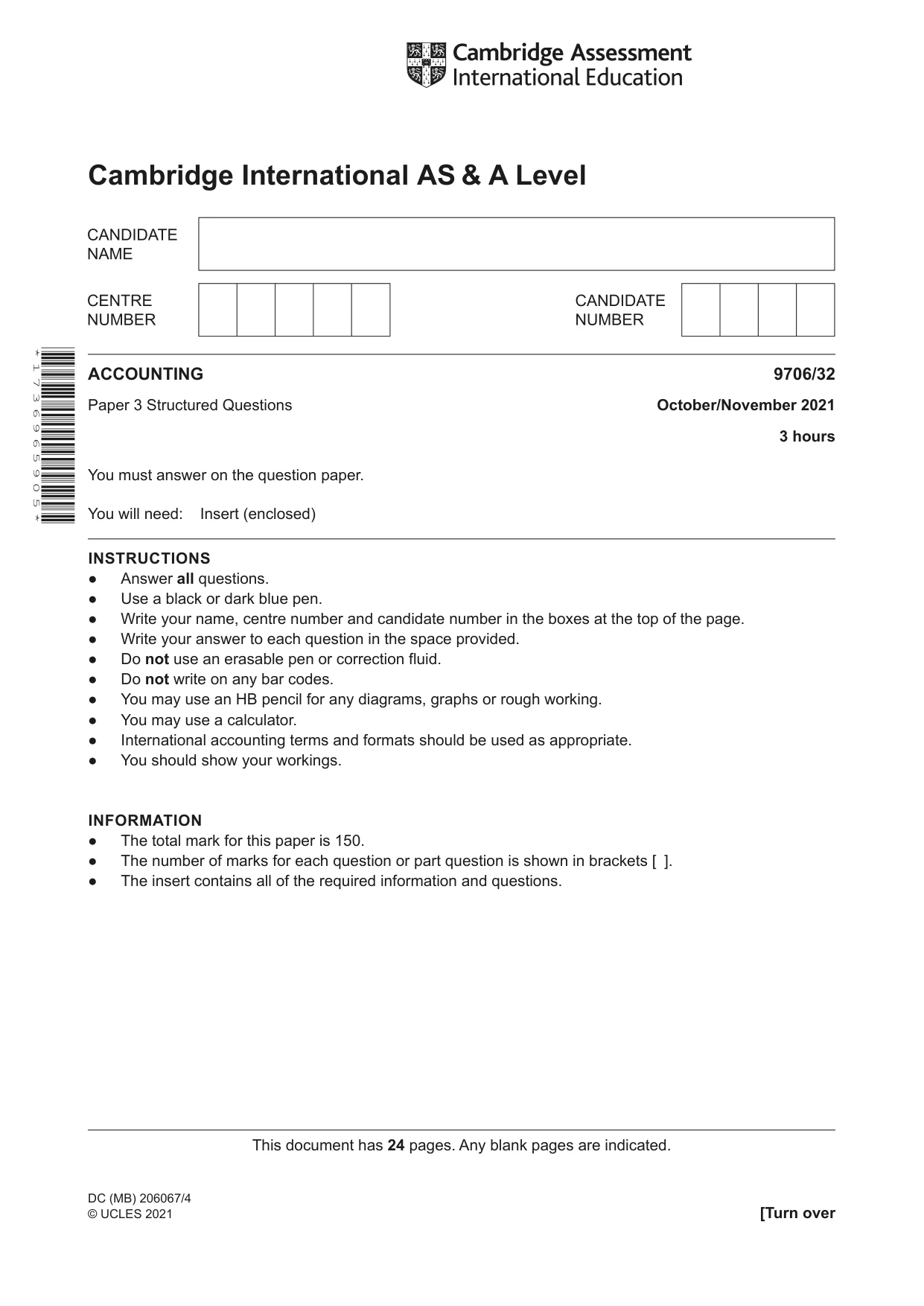
This document has 24 pages. Any blank pages are indicated. Cambridge International AS & A Level ACCOUNTING 9706/32 Paper 3 Structured Questions October/November 2021 3 hours You must answer on the question paper. You will need: Insert (enclosed) INSTRUCTIONS ● Answer all questions. ● Use a black or dark blue pen. ● Write your name, centre number and candidate number in the boxes at the top of the page. ● Write your answer to each question in the space provided. ● Do not use an erasable pen or correction fluid. ● Do not write on any bar codes. ● You may use an HB pencil for any diagrams, graphs or rough working. ● You may use a calculator. ● International accounting terms and formats should be used as appropriate. ● You should show your workings. INFORMATION ● The total mark for this paper is 150. ● The number of marks for each question or part question is shown in brackets [ ]. ● The insert contains all of the required information and questions. DC (MB) 206067/4 © UCLES 2021 [Turn over * 1 7 3 6 9 6 5 9 0 5 *
Question paper, page 2
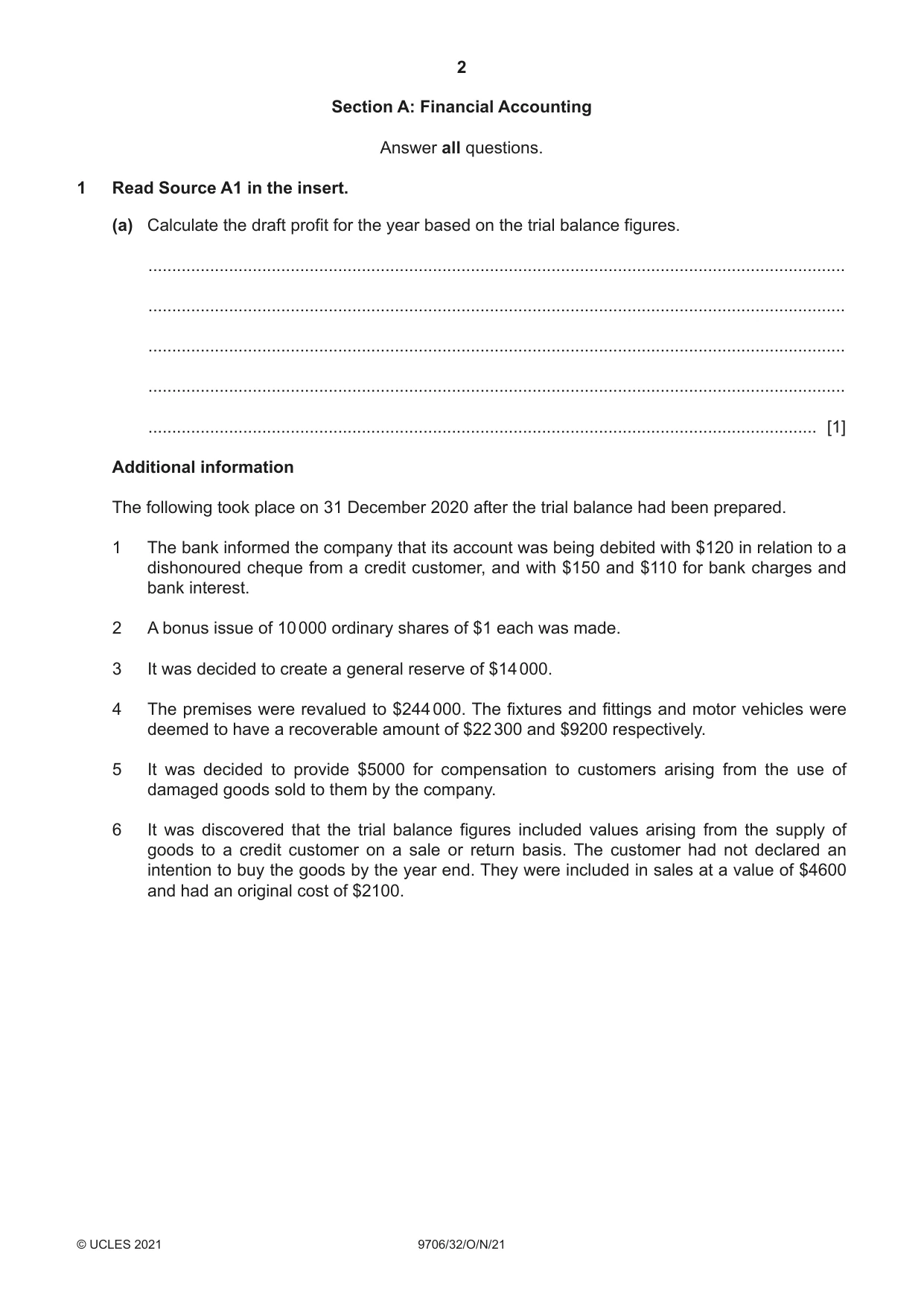
2 9706/32/O/N/21 © UCLES 2021 Section A: Financial Accounting Answer all questions. 1 Read Source A1 in the insert. (a) Calculate the draft profit for the year based on the trial balance figures. … … … … … [1] Additional information The following took place on 31 December 2020 after the trial balance had been prepared. 1 The bank informed the company that its account was being debited with $120 in relation to a dishonoured cheque from a credit customer, and with $150 and $110 for bank charges and bank interest. 2 A bonus issue of 10 000 ordinary shares of $1 each was made. 3 It was decided to create a general reserve of $14 000. 4 The premises were revalued to $244 000. The fixtures and fittings and motor vehicles were deemed to have a recoverable amount of $22 300 and $9200 respectively. 5 It was decided to provide $5000 for compensation to customers arising from the use of damaged goods sold to them by the company. 6 It was discovered that the trial balance figures included values arising from the supply of goods to a credit customer on a sale or return basis. The customer had not declared an intention to buy the goods by the year end. They were included in sales at a value of $4600 and had an original cost of $2100.
Question paper, page 3
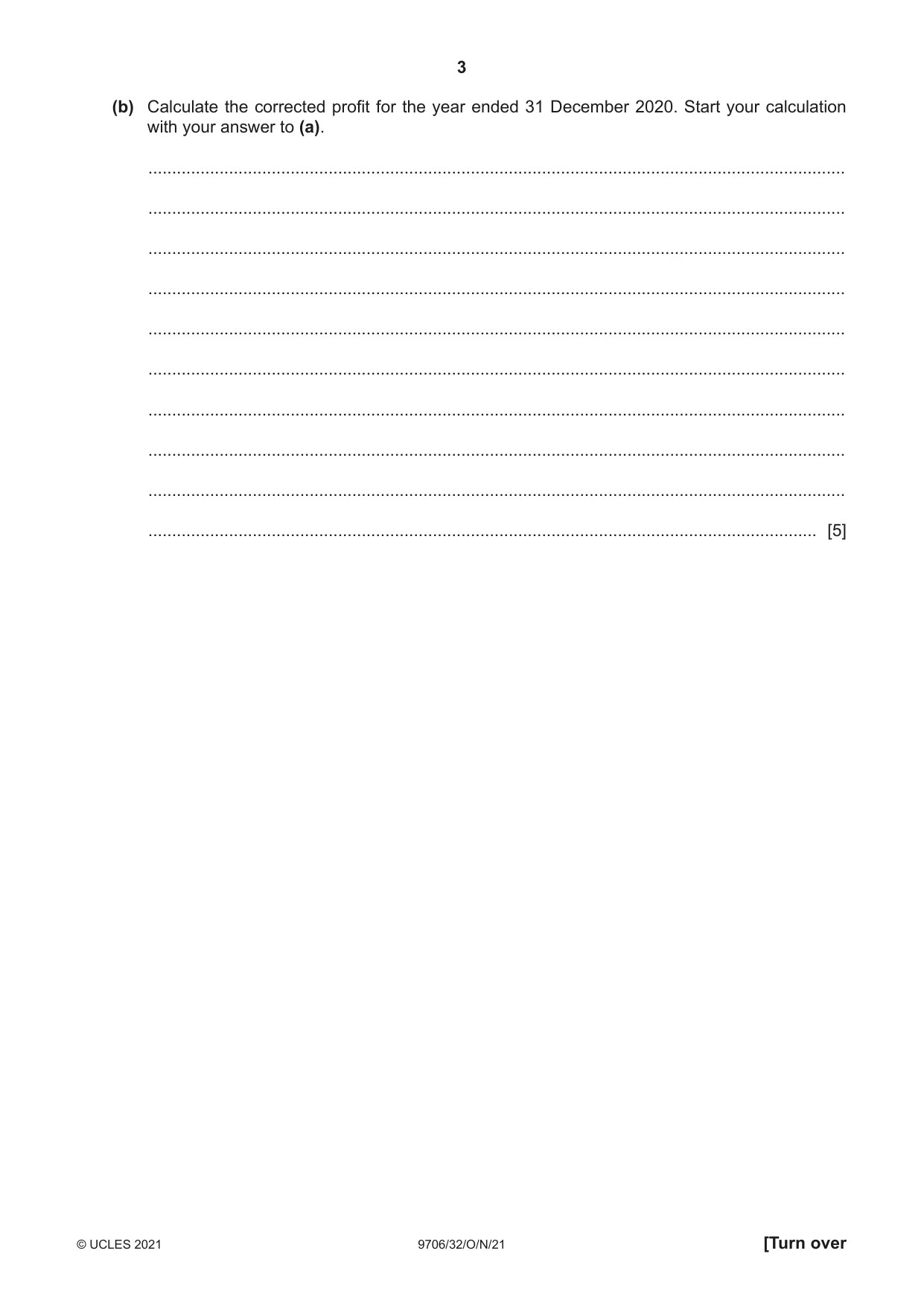
3 9706/32/O/N/21 © UCLES 2021 [Turn over (b) Calculate the corrected profit for the year ended 31 December 2020. Start your calculation with your answer to (a). … … … … … … … … … … [5]
Question paper, page 4
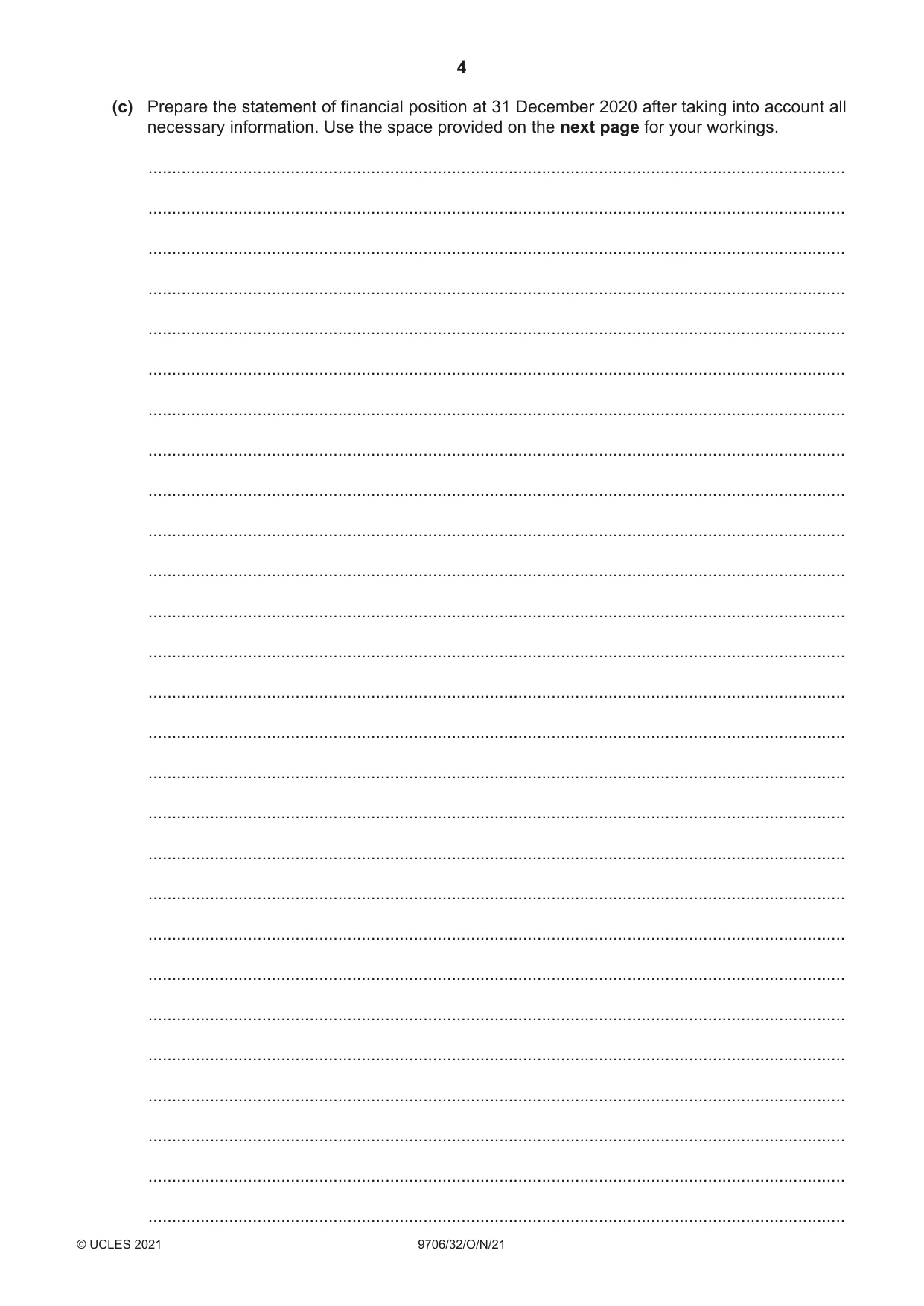
4 9706/32/O/N/21 © UCLES 2021 (c) Prepare the statement of financial position at 31 December 2020 after taking into account all necessary information. Use the space provided on the next page for your workings. … … … … … … … … … … … … … … … … … … … … … … … … … … …
Question paper, page 5
5 9706/32/O/N/21 © UCLES 2021 [Turn over Workings: [17] (d) Explain how your treatment of the bonus issue might have been different if the trial balance had contained a balance of $8000 on a share premium account. … … … … [2] [Total: 25]
Question paper, page 6
6 9706/32/O/N/21 © UCLES 2021 2 Read Source A2 in the insert. (a) Calculate the profit from the vending machines for the year ended 30 June 2021. … … … … … … … … … … … … [5] (b) Calculate for the year ended 30 June 2021: (i) the value of subscriptions received and banked … … … … … … [3]
Question paper, page 7
7 9706/32/O/N/21 © UCLES 2021 [Turn over (ii) cash takings banked … … … … … … … … [4] (iii) club expenses paid by cash. … … … … … … … … [4]
Question paper, page 8
8 9706/32/O/N/21 © UCLES 2021 (c) Prepare the income and expenditure account for the year ended 30 June 2021. … … … … … … … … … … … … … … … [6] Additional information It has been suggested to the managing committee that the club starts to rent a third vending machine selling soft drinks. (d) Advise the committee whether or not to start renting a third vending machine. Justify your answer. … … … … … … … … [3] [Total: 25]
Question paper, page 9
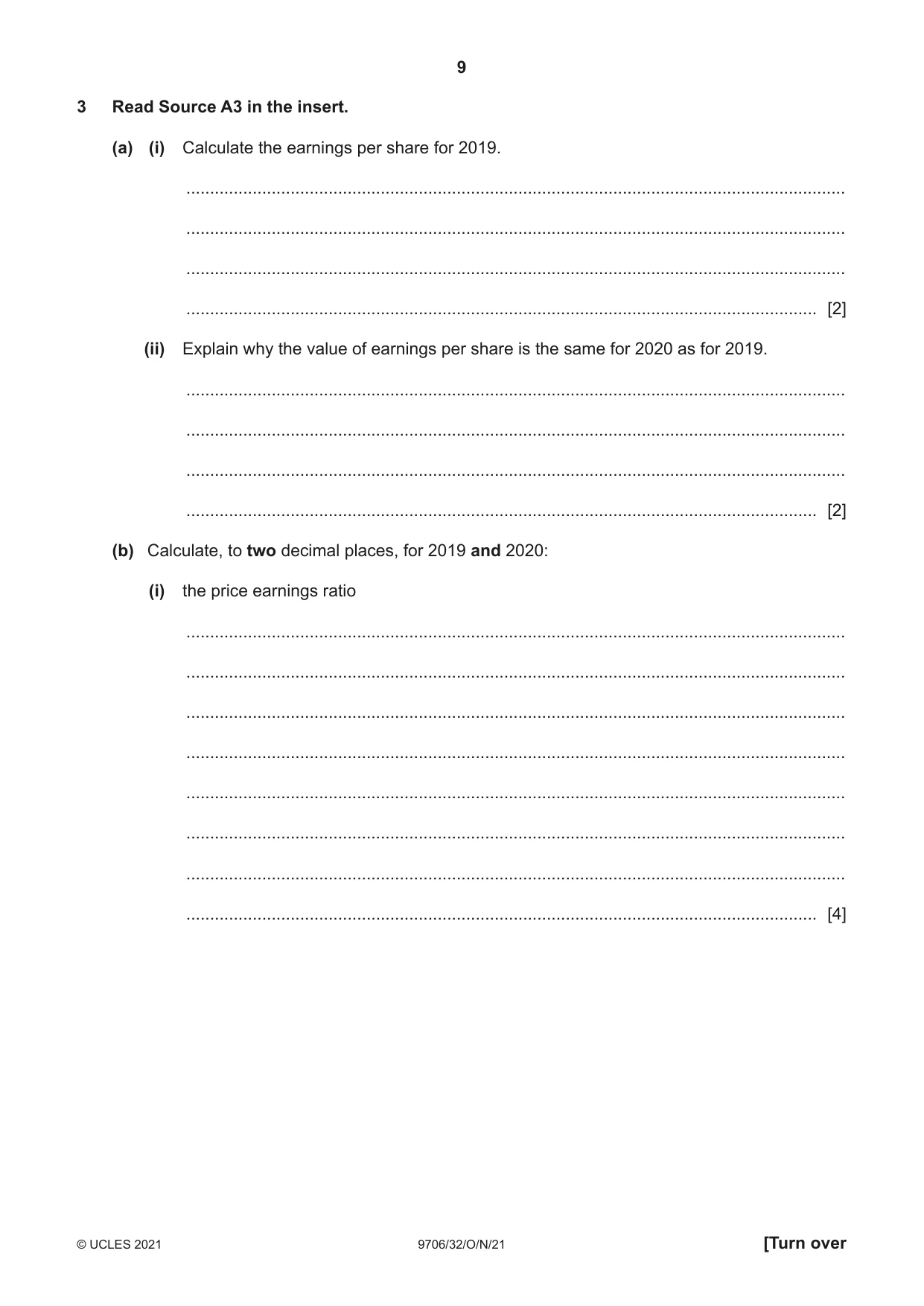
9 9706/32/O/N/21 © UCLES 2021 [Turn over 3 Read Source A3 in the insert. (a) (i) Calculate the earnings per share for 2019. … … … … [2] (ii) Explain why the value of earnings per share is the same for 2020 as for 2019. … … … … [2] (b) Calculate, to two decimal places, for 2019 and 2020: (i) the price earnings ratio … … … … … … … … [4]
Question paper, page 10
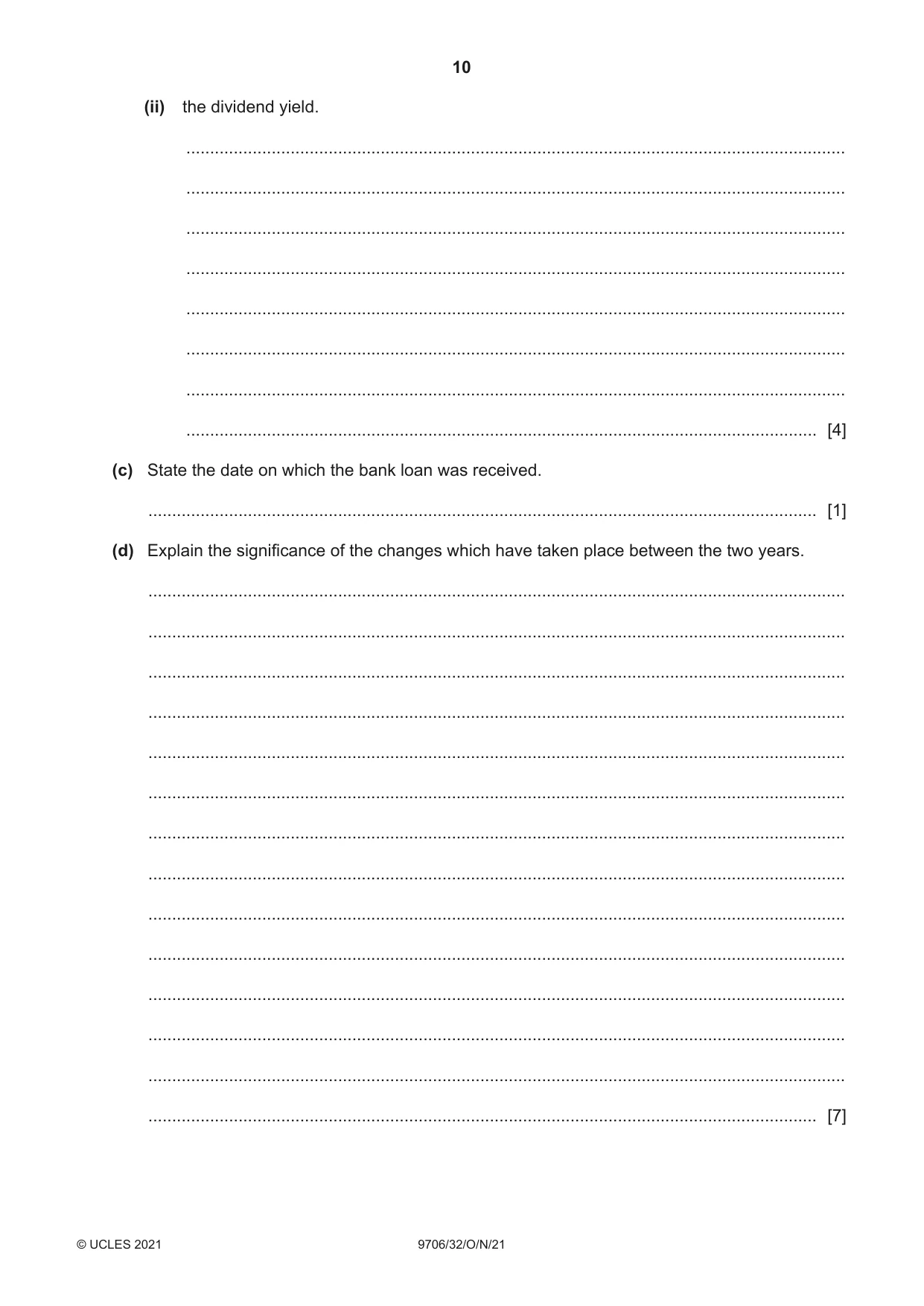
10 9706/32/O/N/21 © UCLES 2021 (ii) the dividend yield. … … … … … … … … [4] (c) State the date on which the bank loan was received. … [1] (d) Explain the significance of the changes which have taken place between the two years. … … … … … … … … … … … … … … [7]
Question paper, page 11
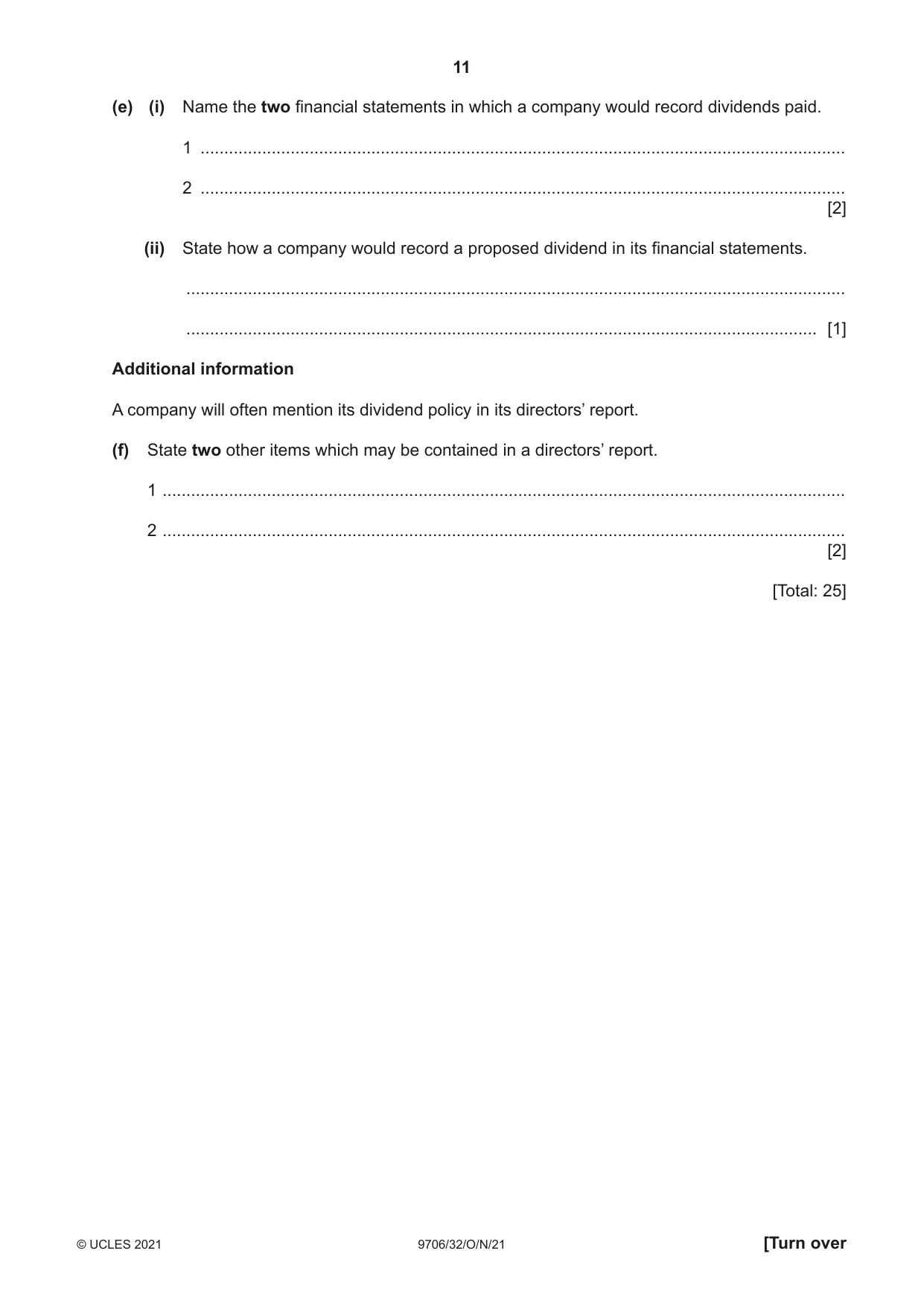
11 9706/32/O/N/21 © UCLES 2021 [Turn over (e) (i) Name the two financial statements in which a company would record dividends paid. 1 … 2 … [2] (ii) State how a company would record a proposed dividend in its financial statements. … … [1] Additional information A company will often mention its dividend policy in its directors’ report. (f) State two other items which may be contained in a directors’ report. 1 … 2 … [2] [Total: 25]
Question paper, page 12
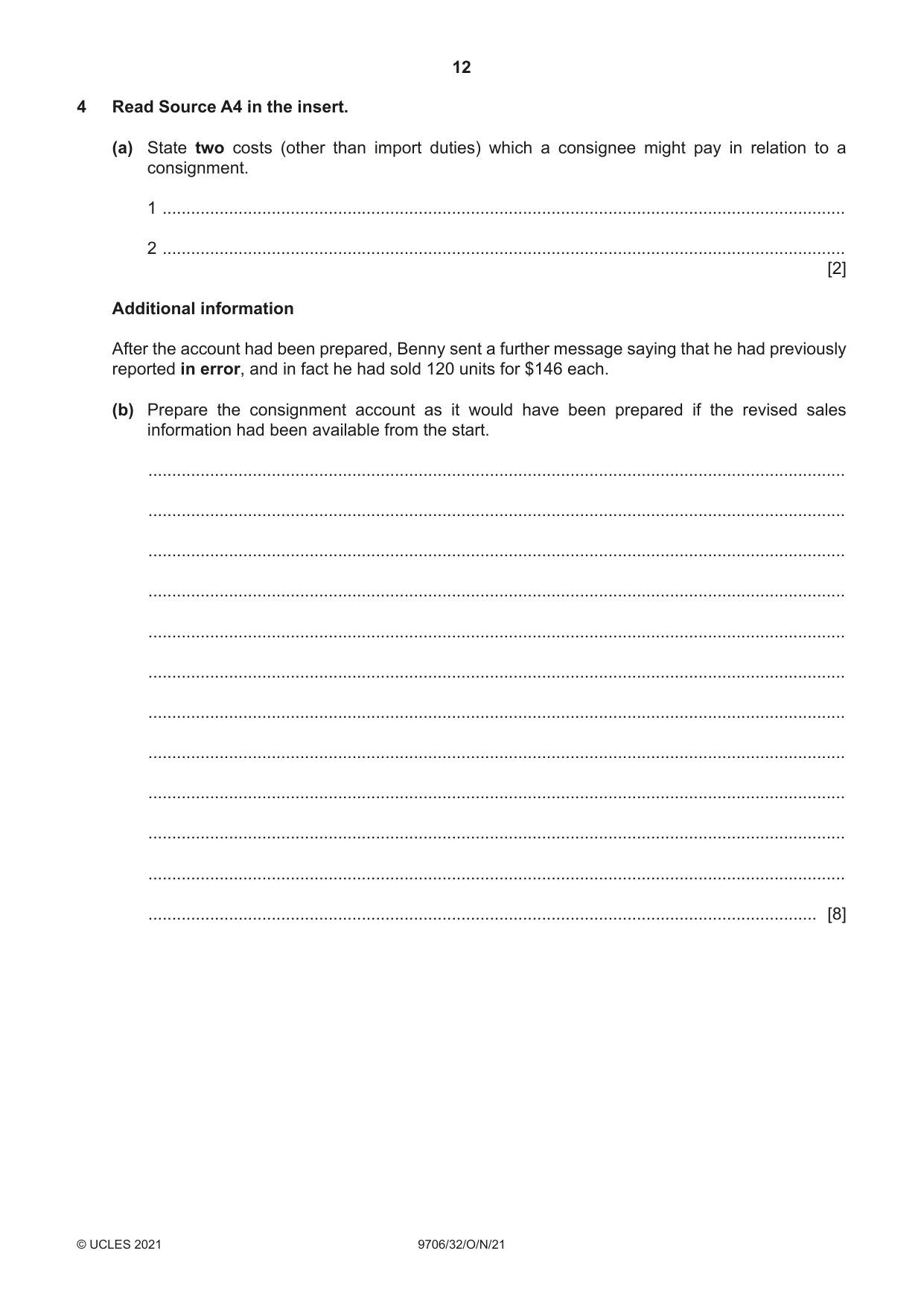
12 9706/32/O/N/21 © UCLES 2021 4 Read Source A4 in the insert. (a) State two costs (other than import duties) which a consignee might pay in relation to a consignment. 1 … 2 … [2] Additional information After the account had been prepared, Benny sent a further message saying that he had previously reported in error, and in fact he had sold 120 units for $146 each. (b) Prepare the consignment account as it would have been prepared if the revised sales information had been available from the start. … … … … … … … … … … … … [8]
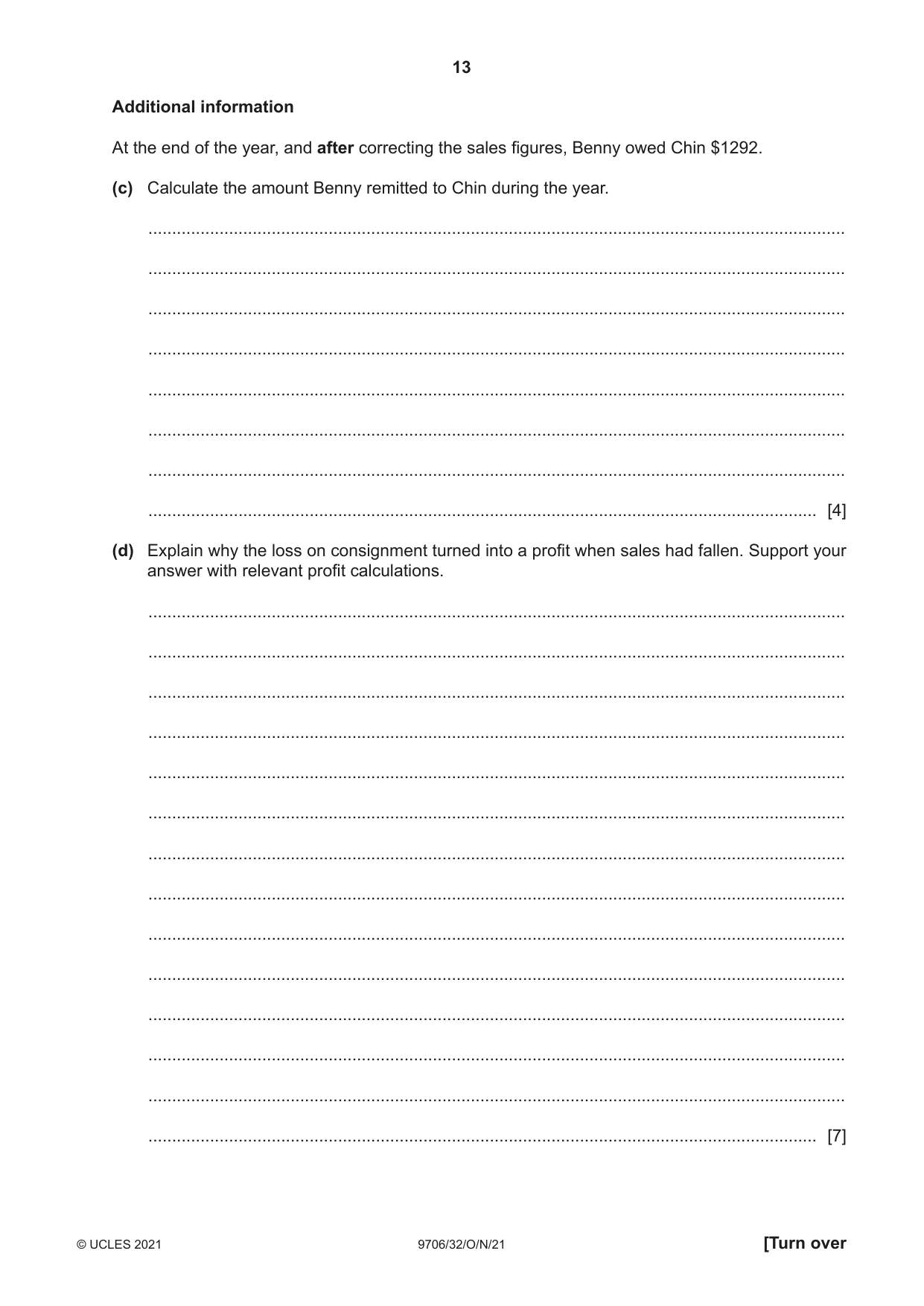
Question paper, page 13
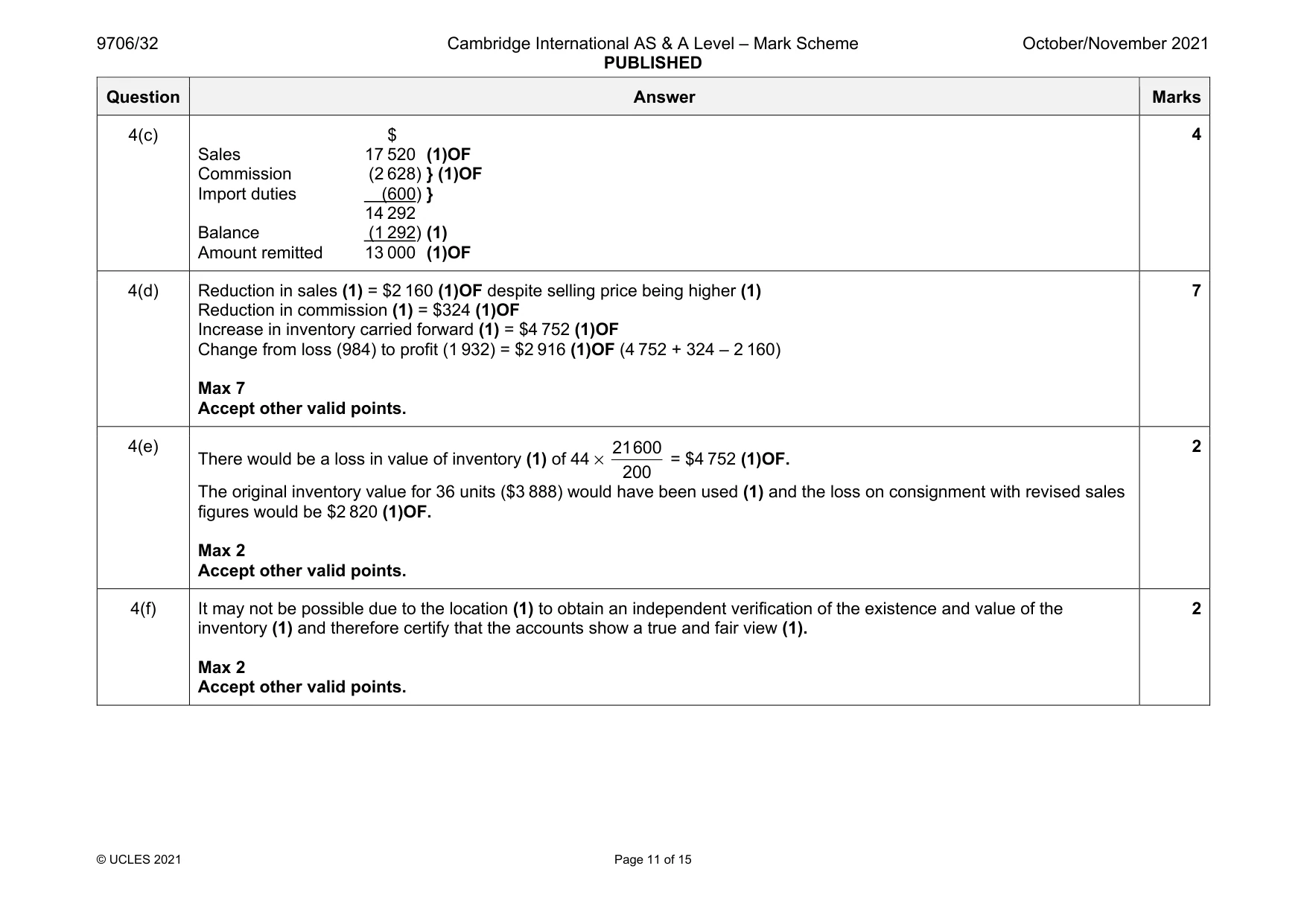
13 9706/32/O/N/21 © UCLES 2021 [Turn over Additional information At the end of the year, and after correcting the sales figures, Benny owed Chin $1292. (c) Calculate the amount Benny remitted to Chin during the year. … … … … … … … … [4] (d) Explain why the loss on consignment turned into a profit when sales had fallen. Support your answer with relevant profit calculations. … … … … … … … … … … … … … … [7]
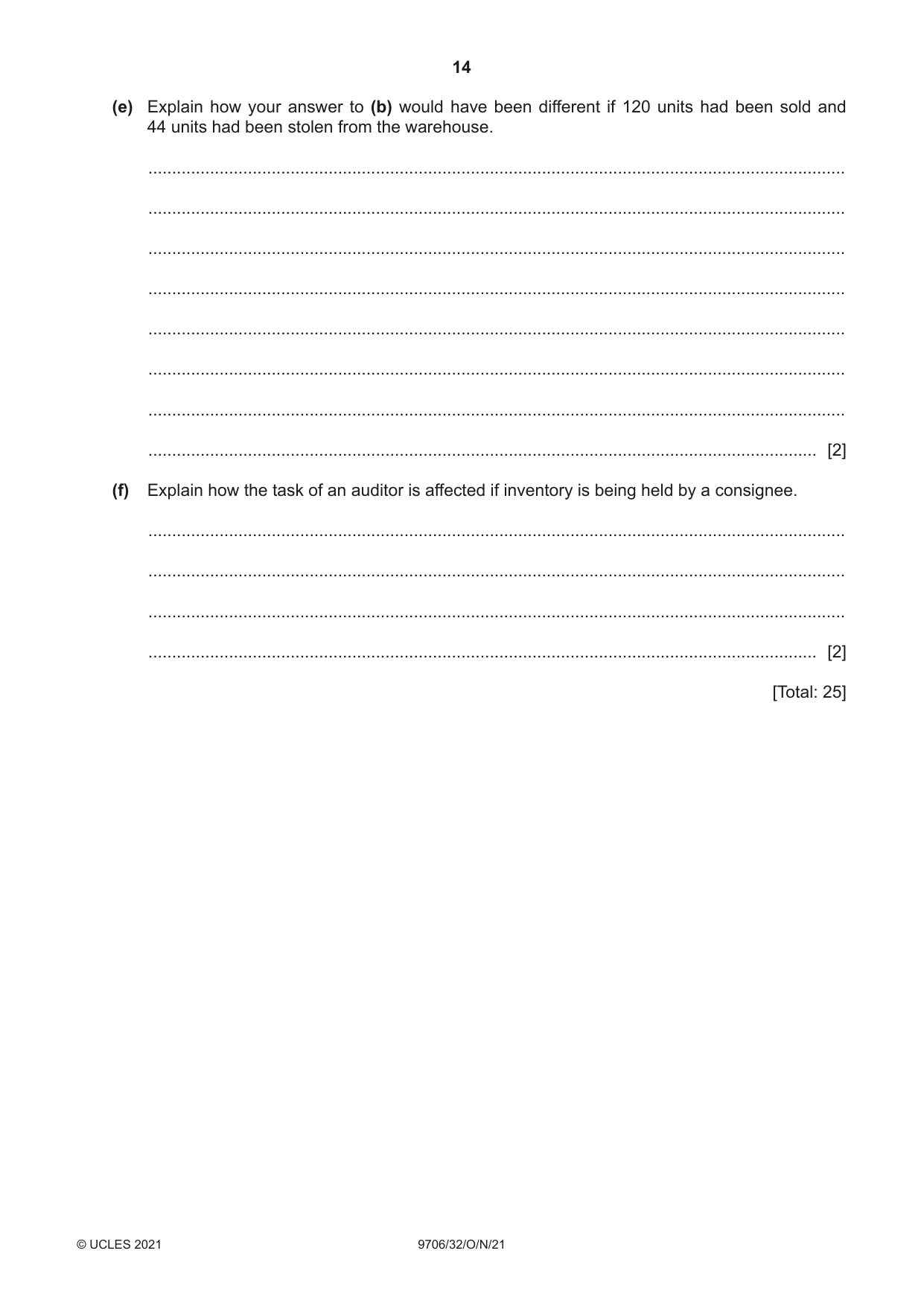
Question paper, page 14
14 9706/32/O/N/21 © UCLES 2021 (e) Explain how your answer to (b) would have been different if 120 units had been sold and 44 units had been stolen from the warehouse. … … … … … … … … [2] (f) Explain how the task of an auditor is affected if inventory is being held by a consignee. … … … … [2] [Total: 25]
Question paper, page 15
15 9706/32/O/N/21 © UCLES 2021 [Turn over PLEASE TURN OVER
Question paper, page 16
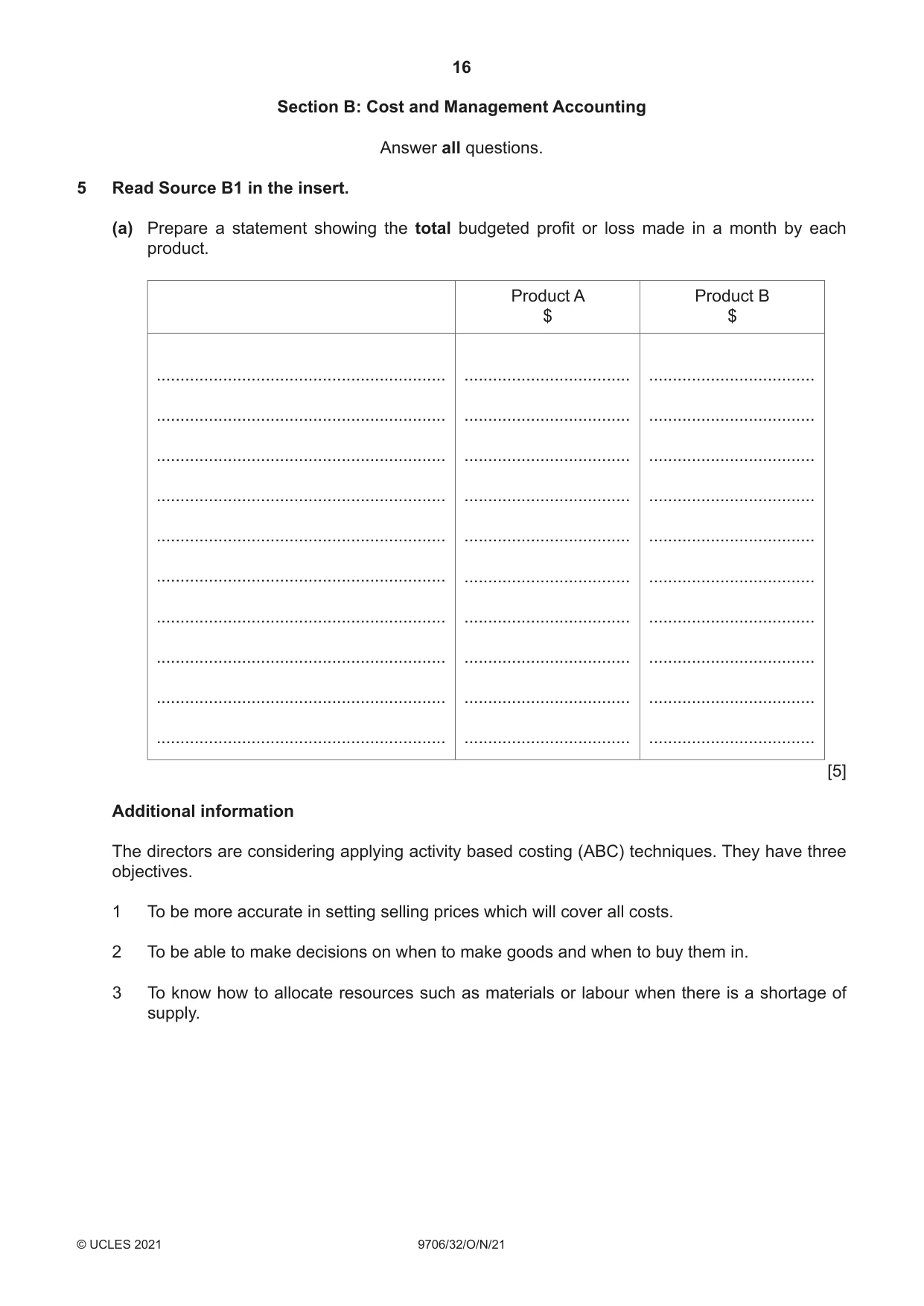
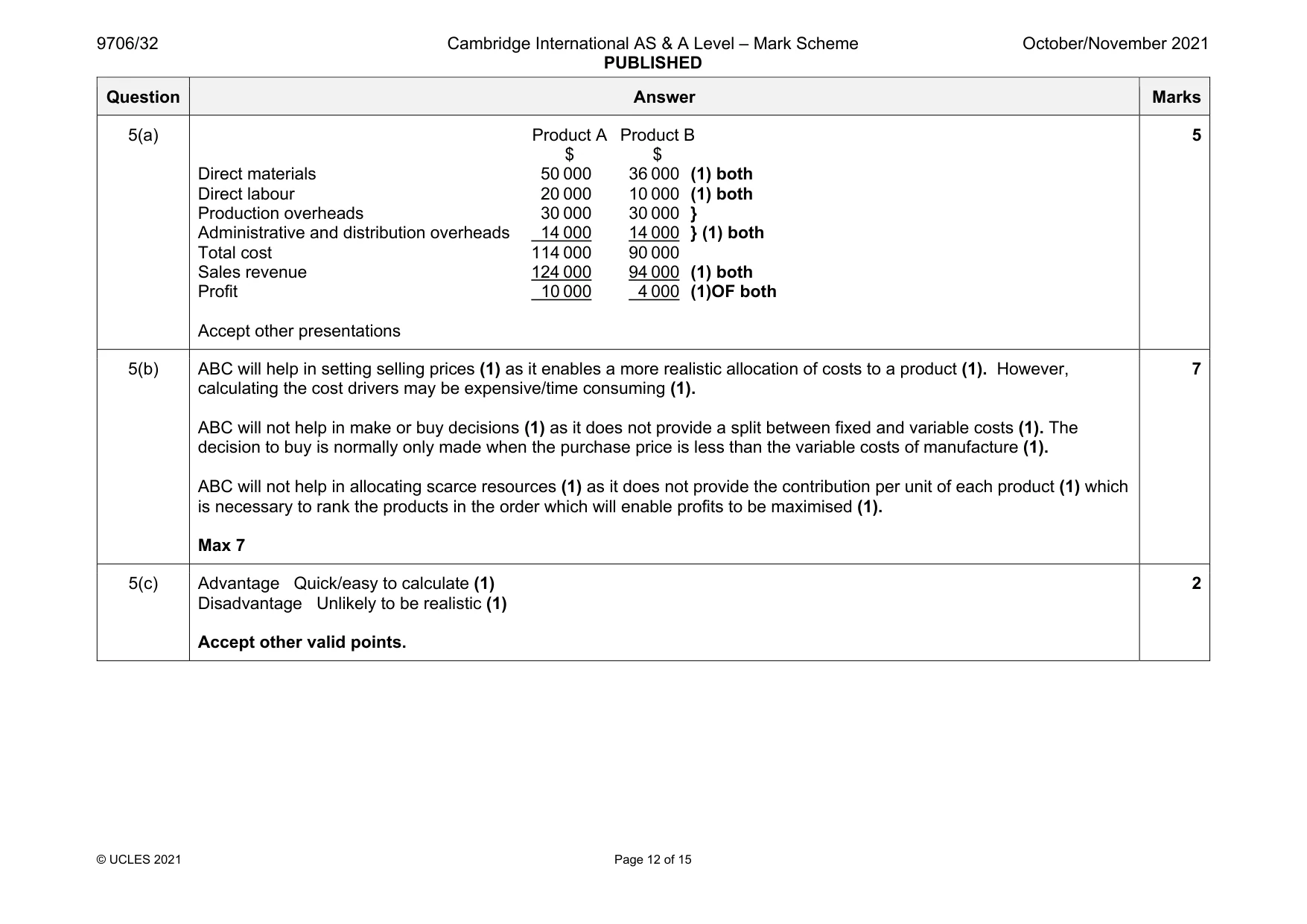
16 9706/32/O/N/21 © UCLES 2021 Section B: Cost and Management Accounting Answer all questions. 5 Read Source B1 in the insert. (a) Prepare a statement showing the total budgeted profit or loss made in a month by each product. Product A $ Product B $ … … … … … … … … … … … … … … … … … … … … … … … … … … … … … … [5] Additional information The directors are considering applying activity based costing (ABC) techniques. They have three objectives. 1 To be more accurate in setting selling prices which will cover all costs. 2 To be able to make decisions on when to make goods and when to buy them in. 3 To know how to allocate resources such as materials or labour when there is a shortage of supply.
Question paper, page 17
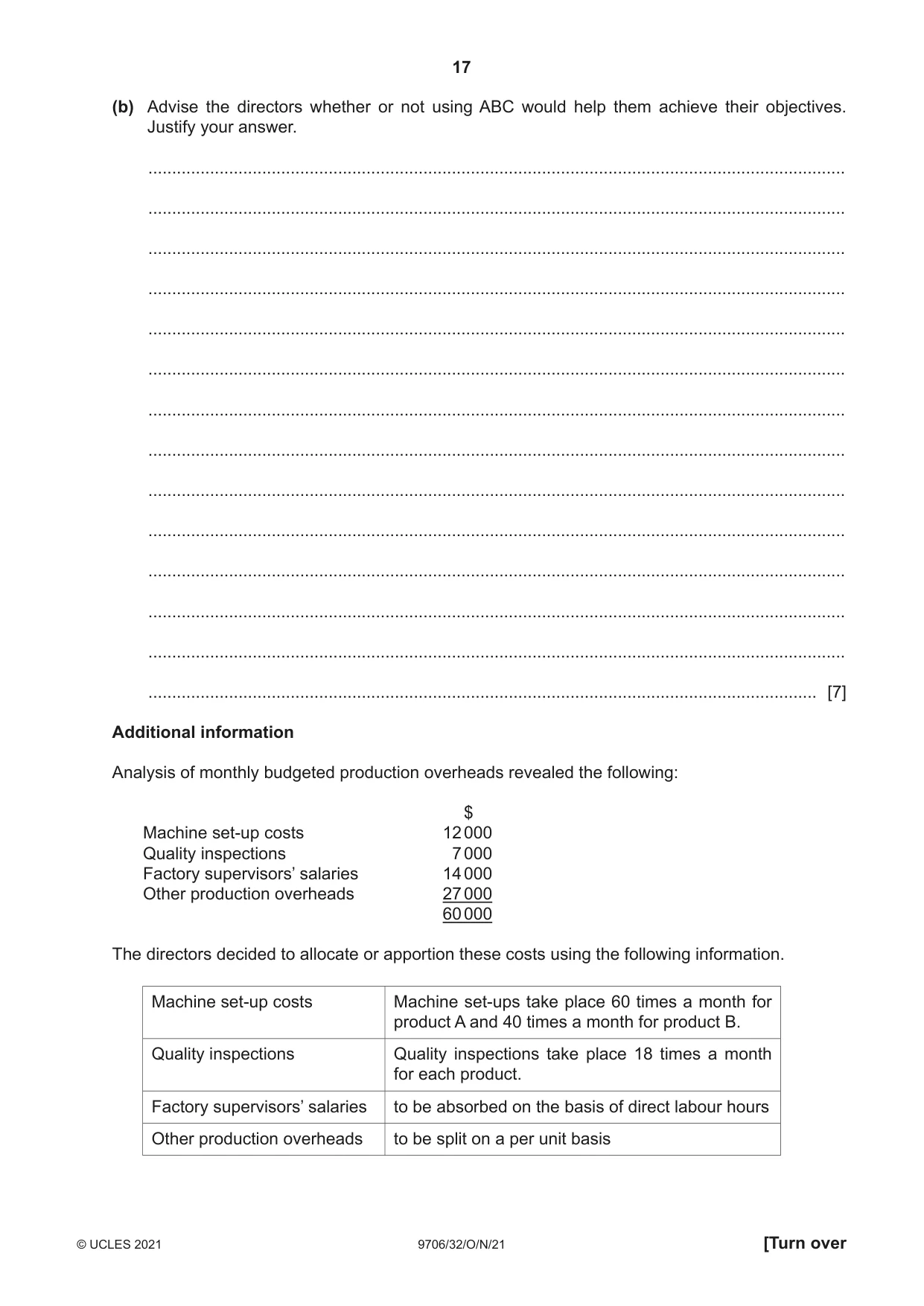
17 9706/32/O/N/21 © UCLES 2021 [Turn over (b) Advise the directors whether or not using ABC would help them achieve their objectives. Justify your answer. … … … … … … … … … … … … … … [7] Additional information Analysis of monthly budgeted production overheads revealed the following: $ Machine set-up costs 12 000 Quality inspections 7 000 Factory supervisors’ salaries 14 000 Other production overheads 27 000 60 000 The directors decided to allocate or apportion these costs using the following information. Machine set-up costs Machine set-ups take place 60 times a month for product A and 40 times a month for product B. Quality inspections Quality inspections take place 18 times a month for each product. Factory supervisors’ salaries to be absorbed on the basis of direct labour hours Other production overheads to be split on a per unit basis
Question paper, page 18
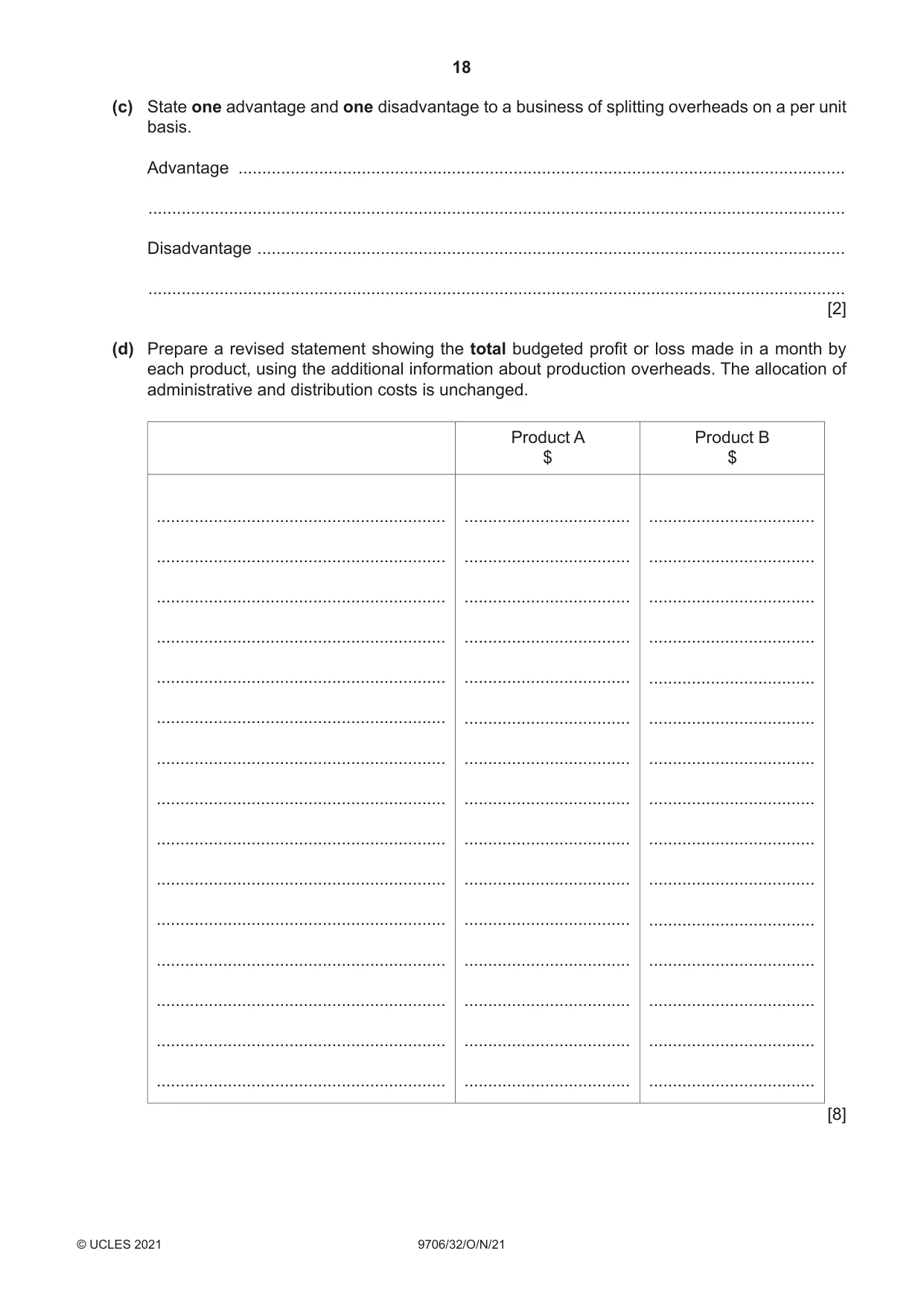
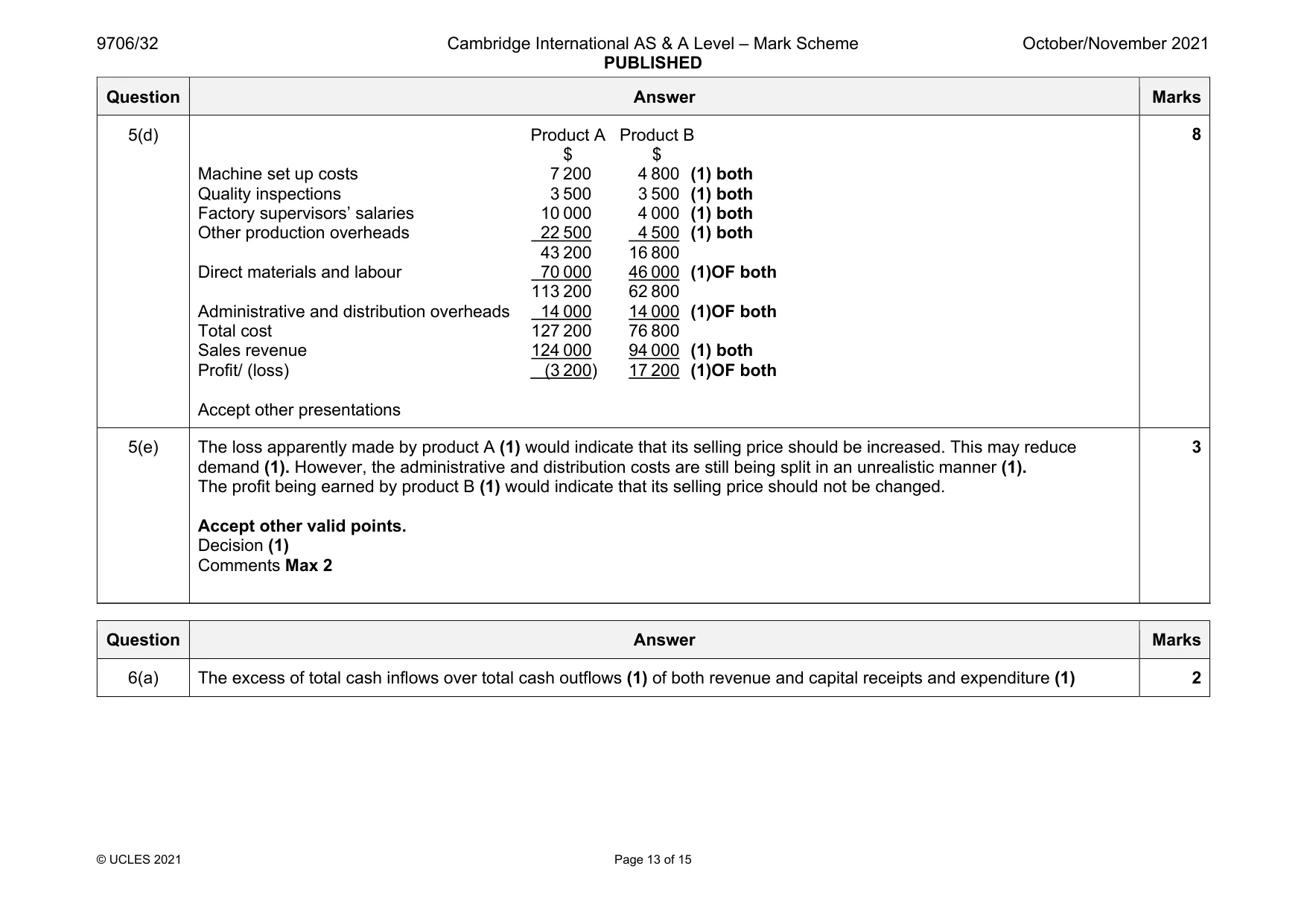
18 9706/32/O/N/21 © UCLES 2021 (c) State one advantage and one disadvantage to a business of splitting overheads on a per unit basis. Advantage … … Disadvantage … … [2] (d) Prepare a revised statement showing the total budgeted profit or loss made in a month by each product, using the additional information about production overheads. The allocation of administrative and distribution costs is unchanged. Product A $ Product B $ … … … … … … … … … … … … … … … … … … … … … … … … … … … … … … … … … … … … … … … … … … … … … [8]
Question paper, page 19
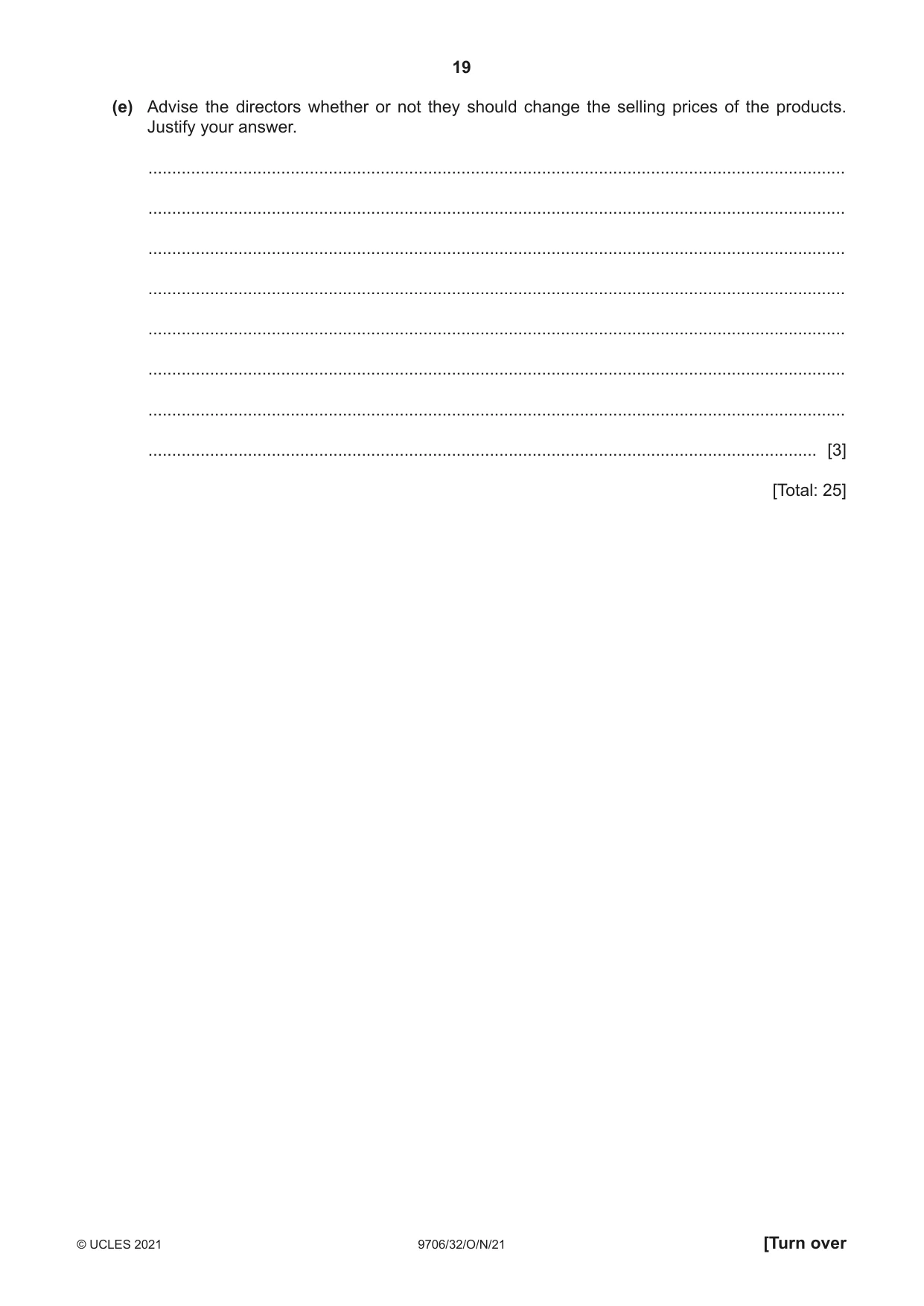
19 9706/32/O/N/21 © UCLES 2021 [Turn over (e) Advise the directors whether or not they should change the selling prices of the products. Justify your answer. … … … … … … … … [3] [Total: 25]
Question paper, page 20
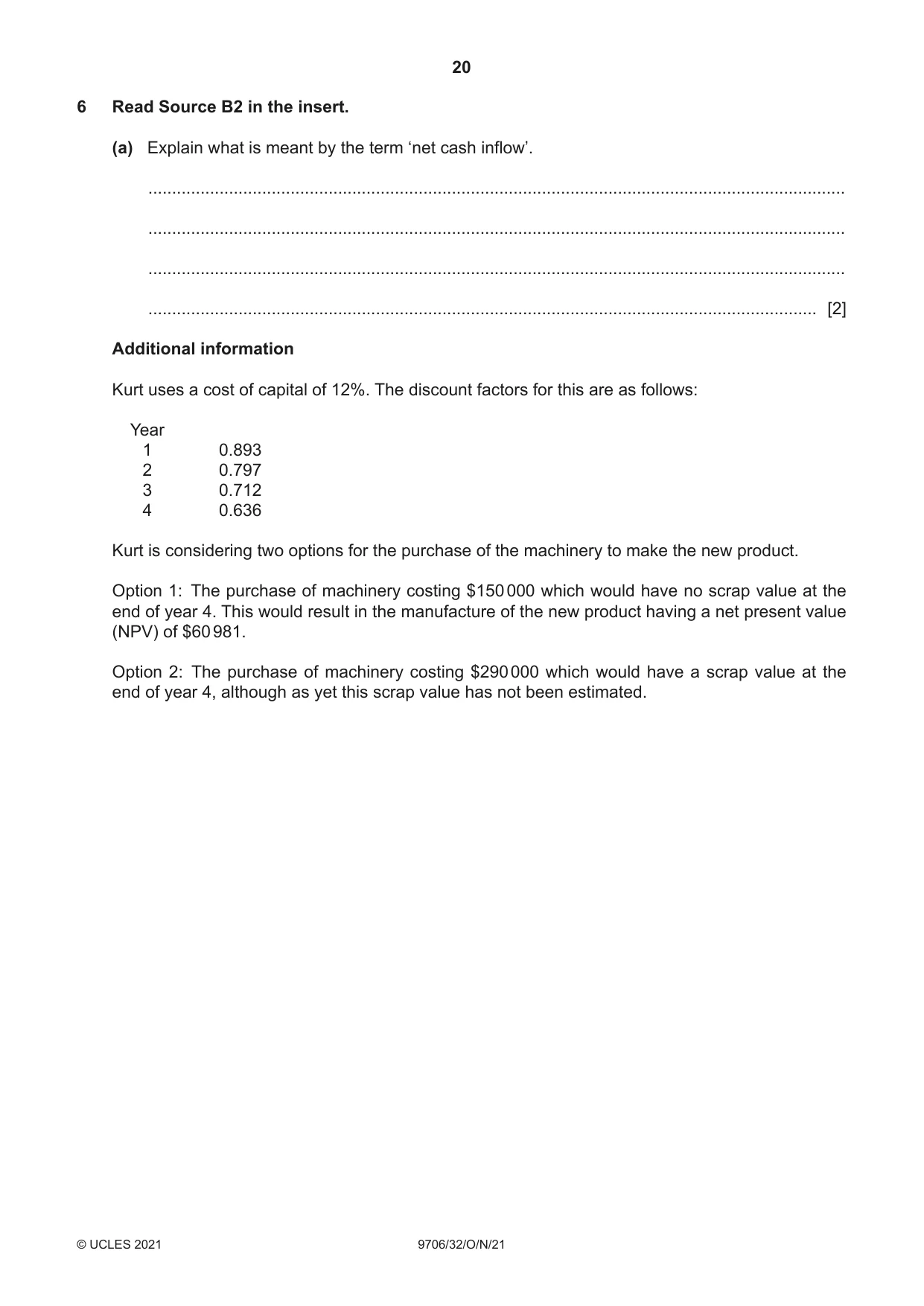
20 9706/32/O/N/21 © UCLES 2021 6 Read Source B2 in the insert. (a) Explain what is meant by the term ‘net cash inflow’. … … … … [2] Additional information Kurt uses a cost of capital of 12%. The discount factors for this are as follows: Year 1 0.893 2 0.797 3 0.712 4 0.636 Kurt is considering two options for the purchase of the machinery to make the new product. Option 1: The purchase of machinery costing $150 000 which would have no scrap value at the end of year 4. This would result in the manufacture of the new product having a net present value (NPV) of $60 981. Option 2: The purchase of machinery costing $290 000 which would have a scrap value at the end of year 4, although as yet this scrap value has not been estimated.
Question paper, page 21
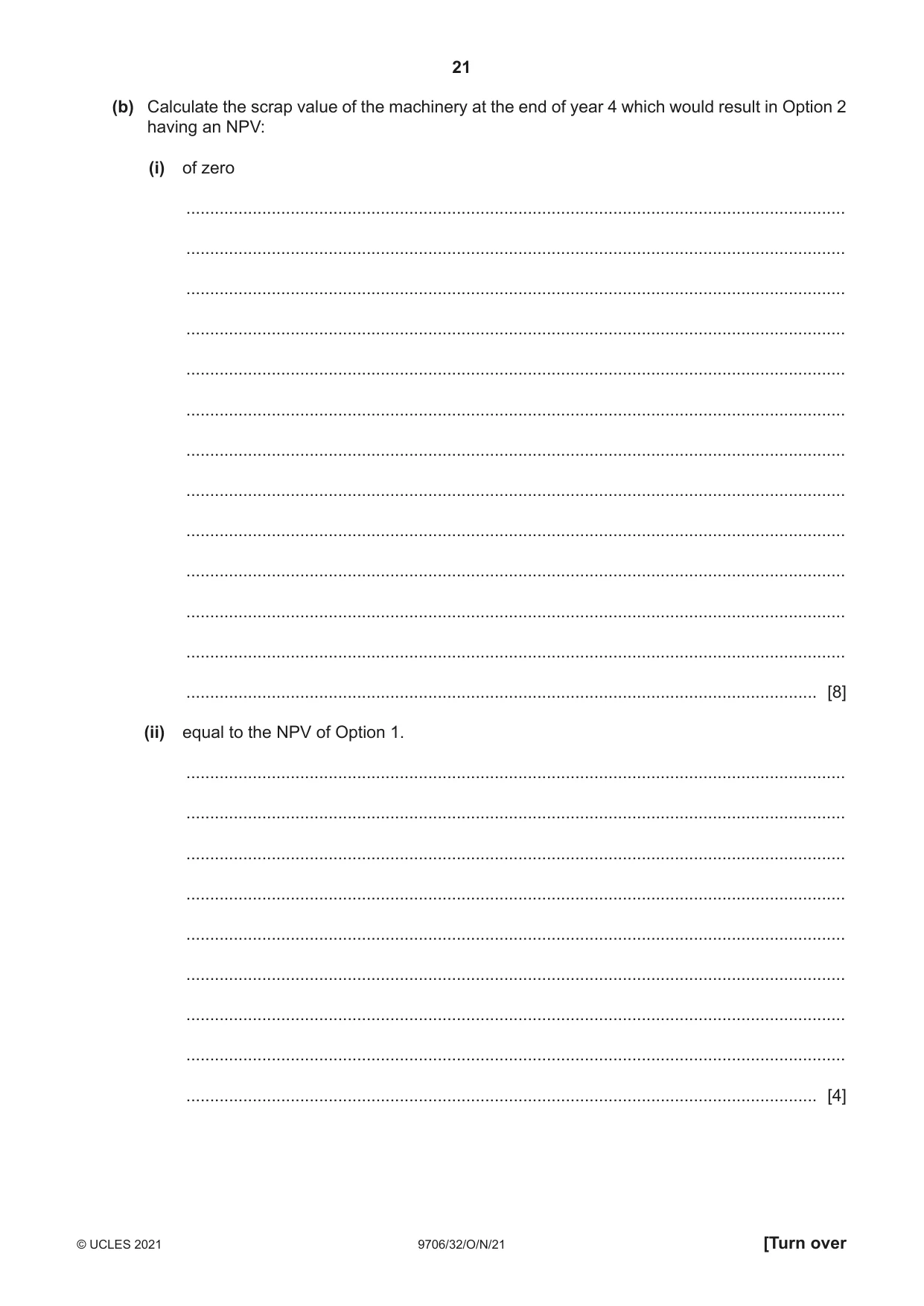
21 9706/32/O/N/21 © UCLES 2021 [Turn over (b) Calculate the scrap value of the machinery at the end of year 4 which would result in Option 2 having an NPV: (i) of zero … … … … … … … … … … … … … [8] (ii) equal to the NPV of Option 1. … … … … … … … … … [4]
Question paper, page 22
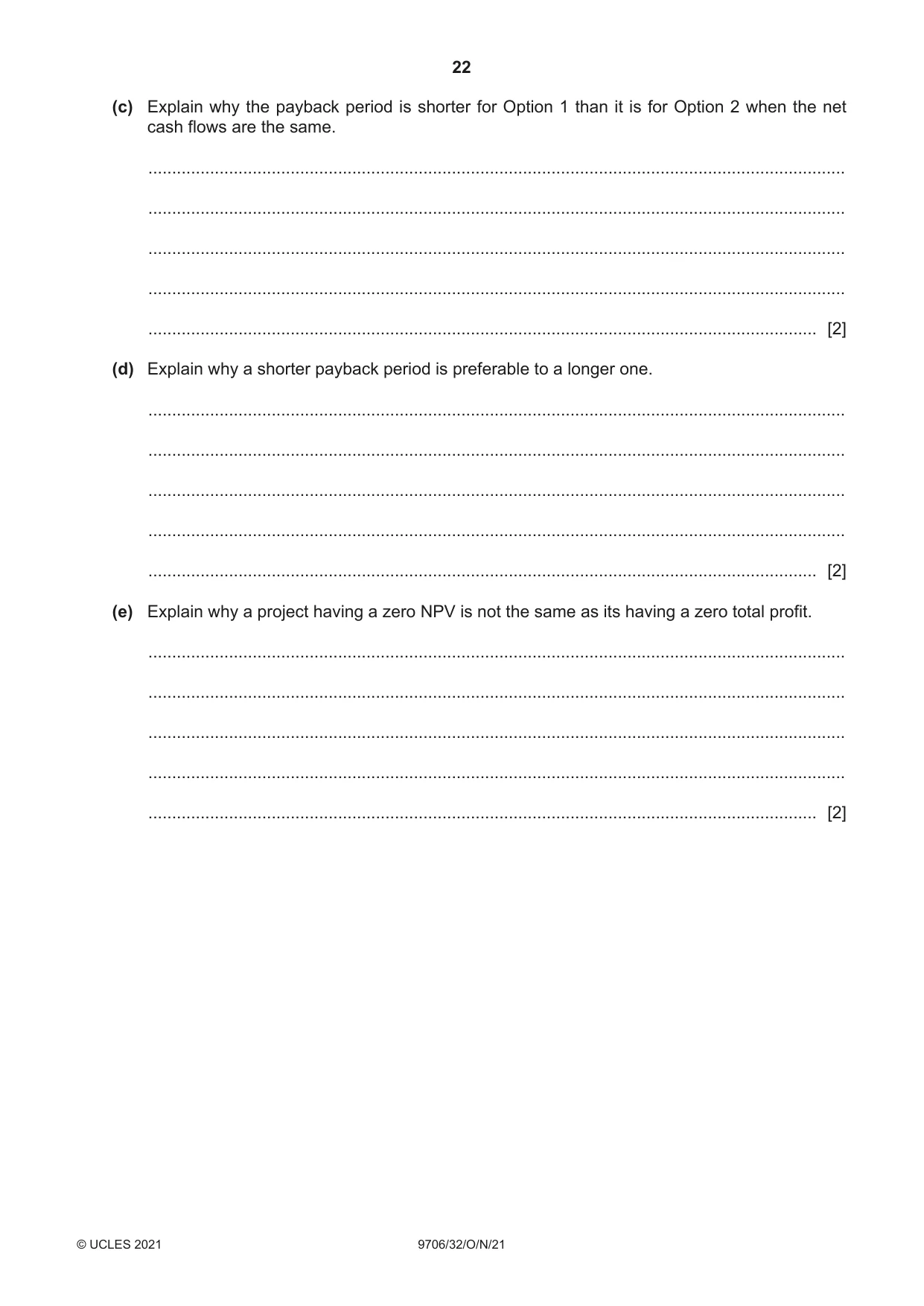
22 9706/32/O/N/21 © UCLES 2021 (c) Explain why the payback period is shorter for Option 1 than it is for Option 2 when the net cash flows are the same. … … … … … [2] (d) Explain why a shorter payback period is preferable to a longer one. … … … … … [2] (e) Explain why a project having a zero NPV is not the same as its having a zero total profit. … … … … … [2]
Question paper, page 23
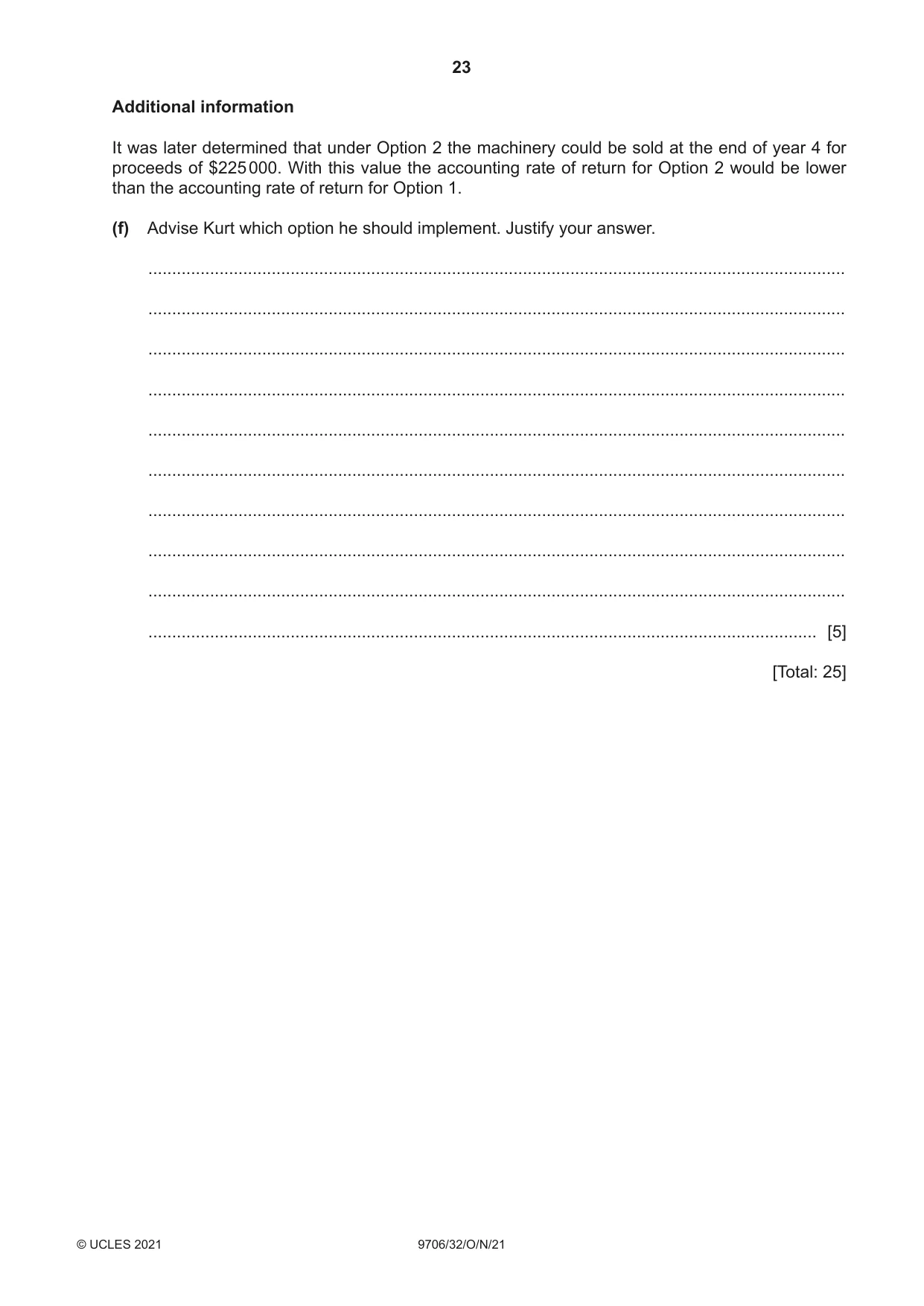
23 9706/32/O/N/21 © UCLES 2021 Additional information It was later determined that under Option 2 the machinery could be sold at the end of year 4 for proceeds of $225 000. With this value the accounting rate of return for Option 2 would be lower than the accounting rate of return for Option 1. (f) Advise Kurt which option he should implement. Justify your answer. … … … … … … … … … … [5] [Total: 25]
Question paper, page 24
24 9706/32/O/N/21 © UCLES 2021 Permission to reproduce items where third-party owned material protected by copyright is included has been sought and cleared where possible. Every reasonable effort has been made by the publisher (UCLES) to trace copyright holders, but if any items requiring clearance have unwittingly been included, the publisher will be pleased to make amends at the earliest possible opportunity. To avoid the issue of disclosure of answer-related information to candidates, all copyright acknowledgements are reproduced online in the Cambridge Assessment International Education Copyright Acknowledgements Booklet. This is produced for each series of examinations and is freely available to download at www.cambridgeinternational.org after the live examination series. Cambridge Assessment International Education is part of the Cambridge Assessment Group. Cambridge Assessment is the brand name of the University of Cambridge Local Examinations Syndicate (UCLES), which itself is a department of the University of Cambridge. BLANK PAGE
Mark scheme, page 1
This document consists of 15 printed pages. © UCLES 2021 [Turn over Cambridge International AS & A Level ACCOUNTING 9706/32 Paper 3 Structured Questions October/November 2021 MARK SCHEME Maximum Mark: 150 Published This mark scheme is published as an aid to teachers and candidates, to indicate the requirements of the examination. It shows the basis on which Examiners were instructed to award marks. It does not indicate the details of the discussions that took place at an Examiners’ meeting before marking began, which would have considered the acceptability of alternative answers. Mark schemes should be read in conjunction with the question paper and the Principal Examiner Report for Teachers. Cambridge International will not enter into discussions about these mark schemes. Cambridge International is publishing the mark schemes for the October/November 2021 series for most Cambridge IGCSE™, Cambridge International A and AS Level components and some Cambridge O Level components.
Mark scheme, page 2
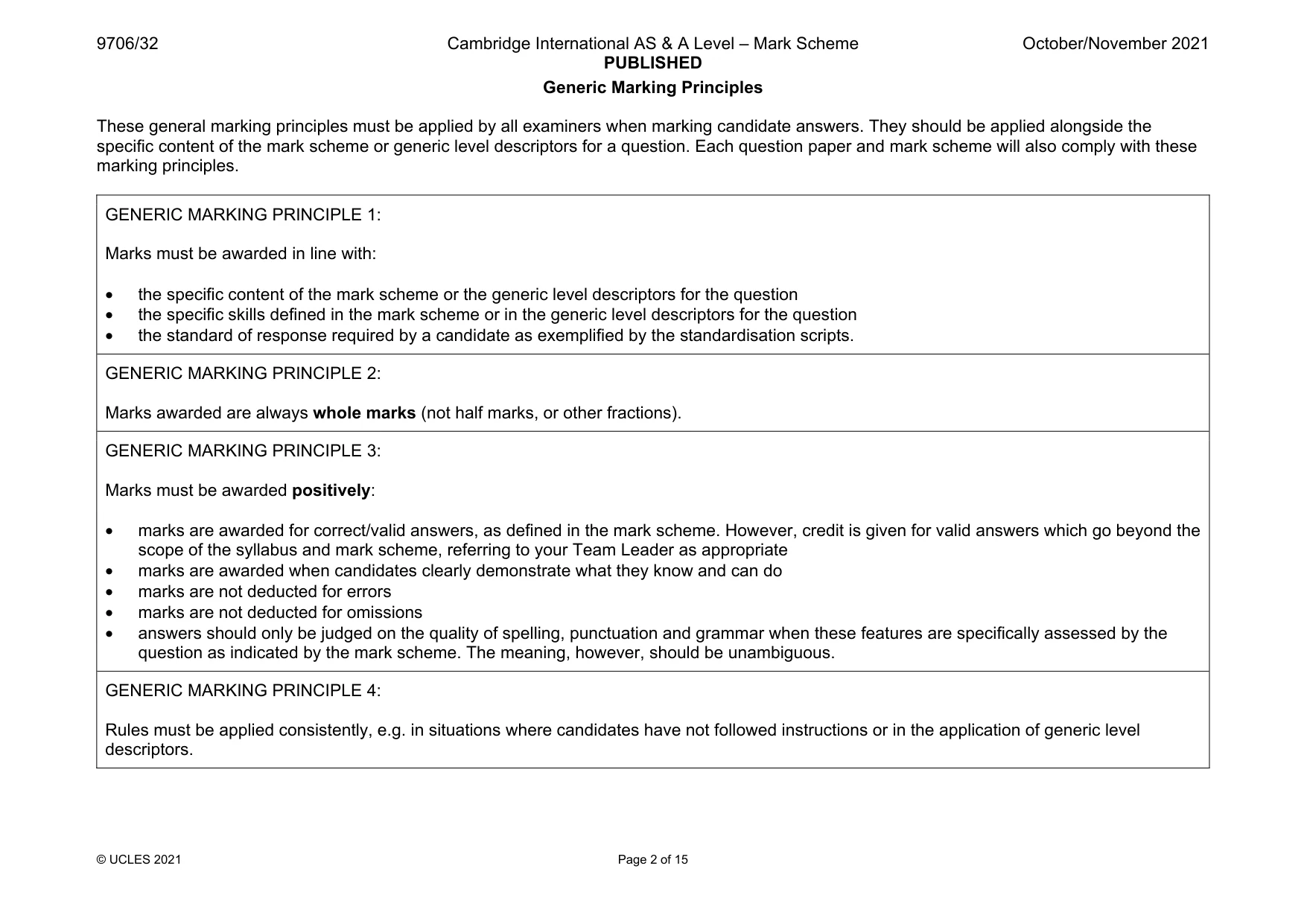
9706/32 Cambridge International AS & A Level – Mark Scheme PUBLISHED October/November 2021 © UCLES 2021 Page 2 of 15 Generic Marking Principles These general marking principles must be applied by all examiners when marking candidate answers. They should be applied alongside the specific content of the mark scheme or generic level descriptors for a question. Each question paper and mark scheme will also comply with these marking principles. GENERIC MARKING PRINCIPLE 1: Marks must be awarded in line with: • the specific content of the mark scheme or the generic level descriptors for the question • the specific skills defined in the mark scheme or in the generic level descriptors for the question • the standard of response required by a candidate as exemplified by the standardisation scripts. GENERIC MARKING PRINCIPLE 2: Marks awarded are always whole marks (not half marks, or other fractions). GENERIC MARKING PRINCIPLE 3: Marks must be awarded positively: • marks are awarded for correct/valid answers, as defined in the mark scheme. However, credit is given for valid answers which go beyond the scope of the syllabus and mark scheme, referring to your Team Leader as appropriate • marks are awarded when candidates clearly demonstrate what they know and can do • marks are not deducted for errors • marks are not deducted for omissions • answers should only be judged on the quality of spelling, punctuation and grammar when these features are specifically assessed by the question as indicated by the mark scheme. The meaning, however, should be unambiguous. GENERIC MARKING PRINCIPLE 4: Rules must be applied consistently, e.g. in situations where candidates have not followed instructions or in the application of generic level descriptors.
Mark scheme, page 3
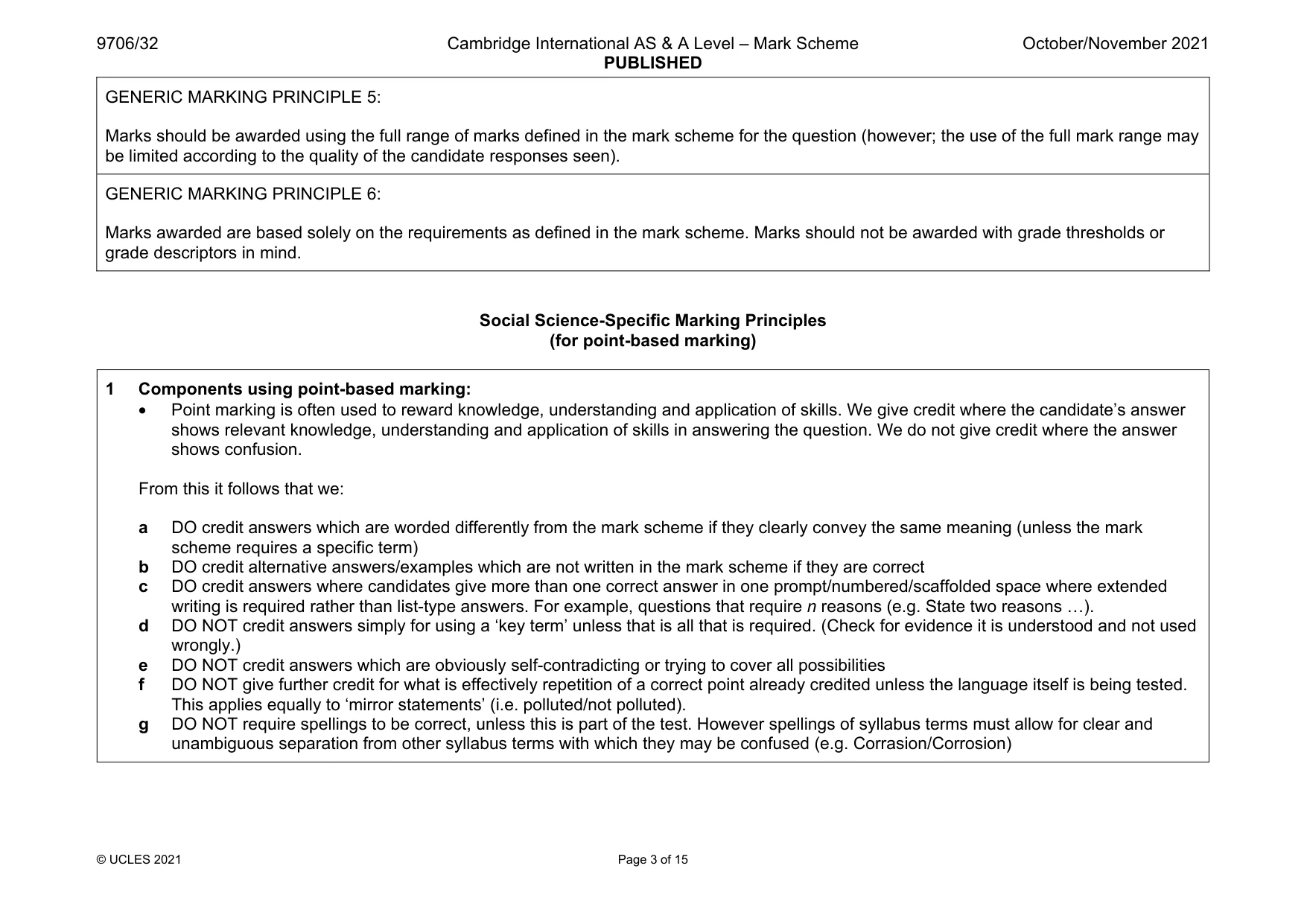
9706/32 Cambridge International AS & A Level – Mark Scheme PUBLISHED October/November 2021 © UCLES 2021 Page 3 of 15 GENERIC MARKING PRINCIPLE 5: Marks should be awarded using the full range of marks defined in the mark scheme for the question (however; the use of the full mark range may be limited according to the quality of the candidate responses seen). GENERIC MARKING PRINCIPLE 6: Marks awarded are based solely on the requirements as defined in the mark scheme. Marks should not be awarded with grade thresholds or grade descriptors in mind. Social Science-Specific Marking Principles (for point-based marking) 1 Components using point-based marking: • Point marking is often used to reward knowledge, understanding and application of skills. We give credit where the candidate’s answer shows relevant knowledge, understanding and application of skills in answering the question. We do not give credit where the answer shows confusion. From this it follows that we: a DO credit answers which are worded differently from the mark scheme if they clearly convey the same meaning (unless the mark scheme requires a specific term) b DO credit alternative answers/examples which are not written in the mark scheme if they are correct c DO credit answers where candidates give more than one correct answer in one prompt/numbered/scaffolded space where extended writing is required rather than list-type answers. For example, questions that require n reasons (e.g. State two reasons …). d DO NOT credit answers simply for using a ‘key term’ unless that is all that is required. (Check for evidence it is understood and not used wrongly.) e DO NOT credit answers which are obviously self-contradicting or trying to cover all possibilities f DO NOT give further credit for what is effectively repetition of a correct point already credited unless the language itself is being tested. This applies equally to ‘mirror statements’ (i.e. polluted/not polluted). g DO NOT require spellings to be correct, unless this is part of the test. However spellings of syllabus terms must allow for clear and unambiguous separation from other syllabus terms with which they may be confused (e.g. Corrasion/Corrosion)
Mark scheme, page 4
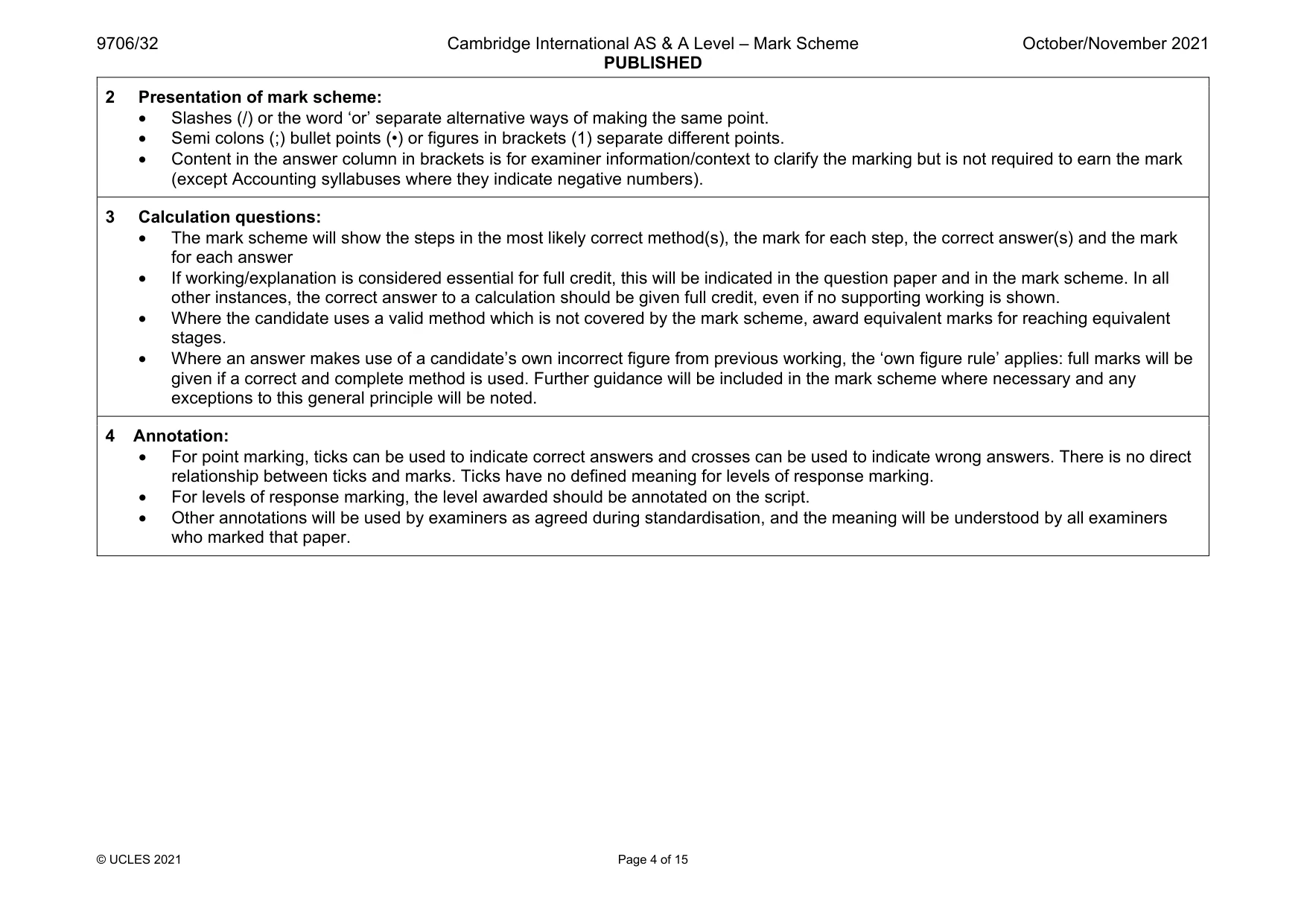
9706/32 Cambridge International AS & A Level – Mark Scheme PUBLISHED October/November 2021 © UCLES 2021 Page 4 of 15 2 Presentation of mark scheme: • Slashes (/) or the word ‘or’ separate alternative ways of making the same point. • Semi colons (;) bullet points (•) or figures in brackets (1) separate different points. • Content in the answer column in brackets is for examiner information/context to clarify the marking but is not required to earn the mark (except Accounting syllabuses where they indicate negative numbers). 3 Calculation questions: • The mark scheme will show the steps in the most likely correct method(s), the mark for each step, the correct answer(s) and the mark for each answer • If working/explanation is considered essential for full credit, this will be indicated in the question paper and in the mark scheme. In all other instances, the correct answer to a calculation should be given full credit, even if no supporting working is shown. • Where the candidate uses a valid method which is not covered by the mark scheme, award equivalent marks for reaching equivalent stages. • Where an answer makes use of a candidate’s own incorrect figure from previous working, the ‘own figure rule’ applies: full marks will be given if a correct and complete method is used. Further guidance will be included in the mark scheme where necessary and any exceptions to this general principle will be noted. 4 Annotation: • For point marking, ticks can be used to indicate correct answers and crosses can be used to indicate wrong answers. There is no direct relationship between ticks and marks. Ticks have no defined meaning for levels of response marking. • For levels of response marking, the level awarded should be annotated on the script. • Other annotations will be used by examiners as agreed during standardisation, and the meaning will be understood by all examiners who marked that paper.
Mark scheme, page 5
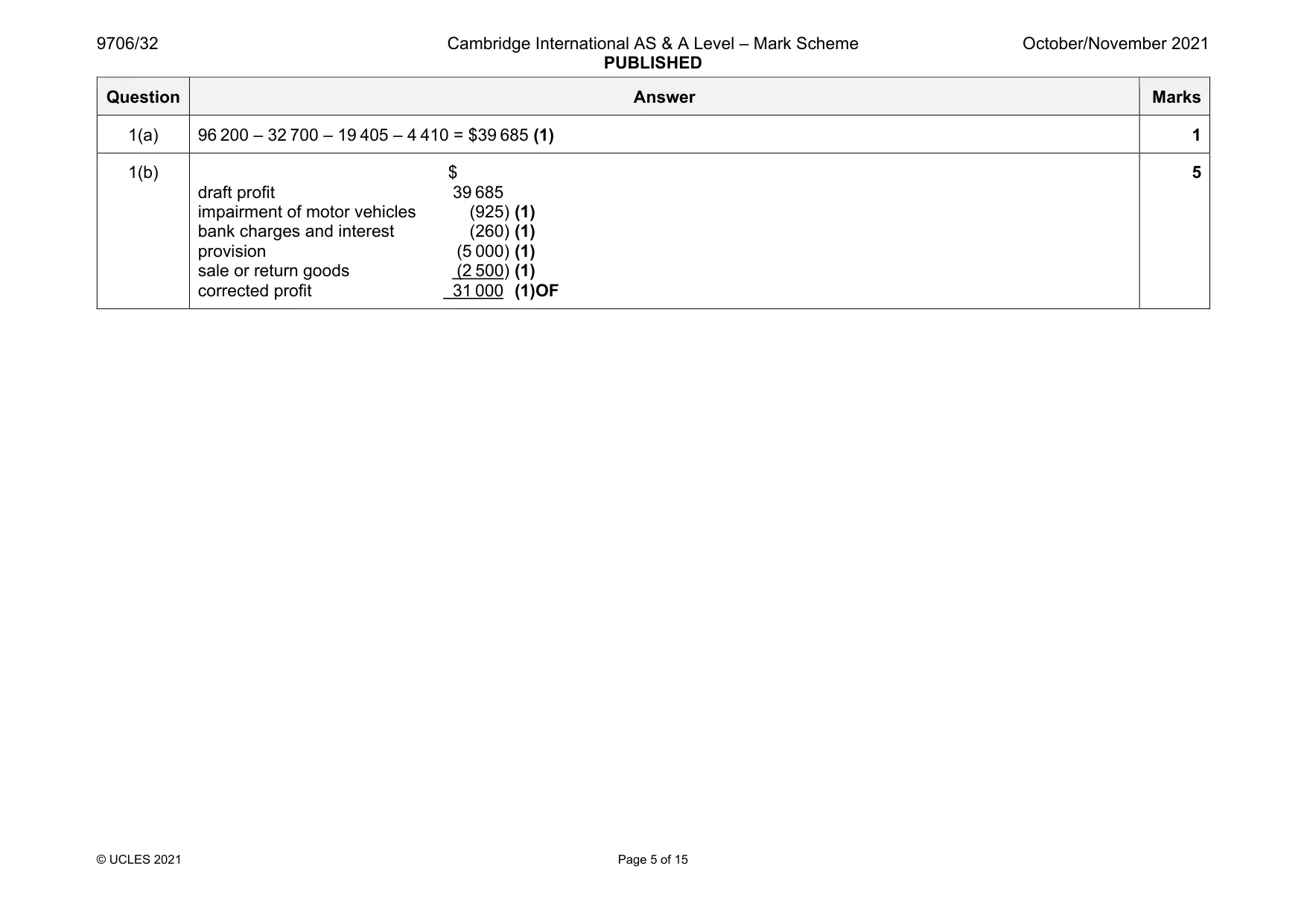
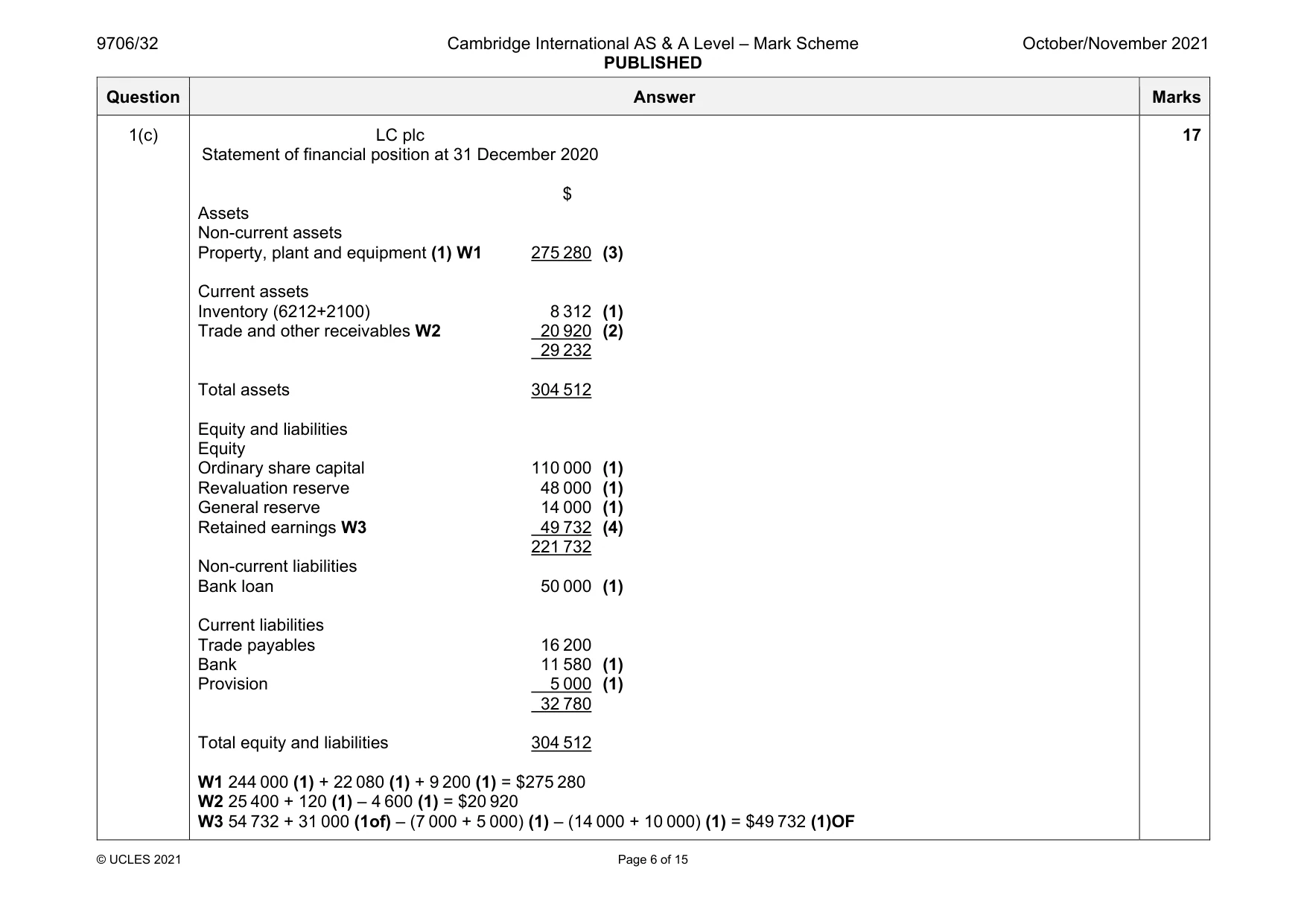
9706/32 Cambridge International AS & A Level – Mark Scheme PUBLISHED October/November 2021 © UCLES 2021 Page 5 of 15 Question Answer Marks 1(a) 96 200 – 32 700 – 19 405 – 4 410 = $39 685 (1) 1 1(b) $ draft profit 39 685 impairment of motor vehicles (925) (1) bank charges and interest (260) (1) provision (5 000) (1) sale or return goods (2 500) (1) corrected profit 31 000 (1)OF 5
Mark scheme, page 6
9706/32 Cambridge International AS & A Level – Mark Scheme PUBLISHED October/November 2021 © UCLES 2021 Page 6 of 15 Question Answer Marks 1(c) LC plc Statement of financial position at 31 December 2020 $ Assets Non-current assets Property, plant and equipment (1) W1 275 280 (3) Current assets Inventory (6212+2100) 8 312 (1) Trade and other receivables W2 20 920 (2) 29 232 Total assets 304 512 Equity and liabilities Equity Ordinary share capital 110 000 (1) Revaluation reserve 48 000 (1) General reserve 14 000 (1) Retained earnings W3 49 732 (4) 221 732 Non-current liabilities Bank loan 50 000 (1) Current liabilities Trade payables 16 200 Bank 11 580 (1) Provision 5 000 (1) 32 780 Total equity and liabilities 304 512 W1 244 000 (1) + 22 080 (1) + 9 200 (1) = $275 280 W2 25 400 + 120 (1) – 4 600 (1) = $20 920 W3 54 732 + 31 000 (1of) – (7 000 + 5 000) (1) – (14 000 + 10 000) (1) = $49 732 (1)OF 17
Mark scheme, page 7
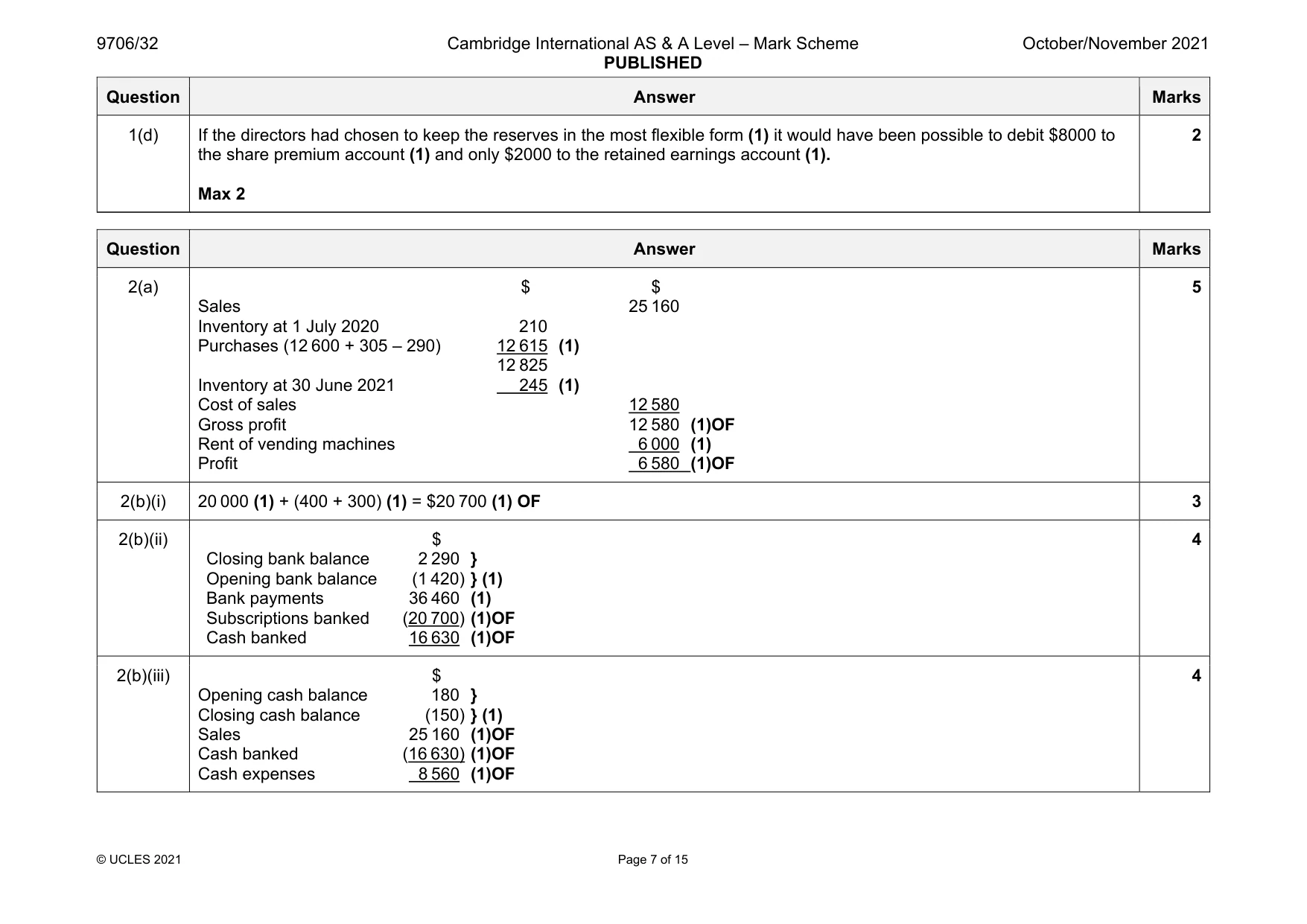
9706/32 Cambridge International AS & A Level – Mark Scheme PUBLISHED October/November 2021 © UCLES 2021 Page 7 of 15 Question Answer Marks 1(d) If the directors had chosen to keep the reserves in the most flexible form (1) it would have been possible to debit $8000 to the share premium account (1) and only $2000 to the retained earnings account (1). Max 2 2 Question Answer Marks 2(a) $ $ Sales 25 160 Inventory at 1 July 2020 210 Purchases (12 600 + 305 – 290) 12 615 (1) 12 825 Inventory at 30 June 2021 245 (1) Cost of sales 12 580 Gross profit 12 580 (1)OF Rent of vending machines 6 000 (1) Profit 6 580 (1)OF 5 2(b)(i) 20 000 (1) + (400 + 300) (1) = $20 700 (1) OF 3 2(b)(ii) $ Closing bank balance 2 290 } Opening bank balance (1 420) } (1) Bank payments 36 460 (1) Subscriptions banked (20 700) (1)OF Cash banked 16 630 (1)OF 4 2(b)(iii) $ Opening cash balance 180 } Closing cash balance (150) } (1) Sales 25 160 (1)OF Cash banked (16 630) (1)OF Cash expenses 8 560 (1)OF 4
Mark scheme, page 8
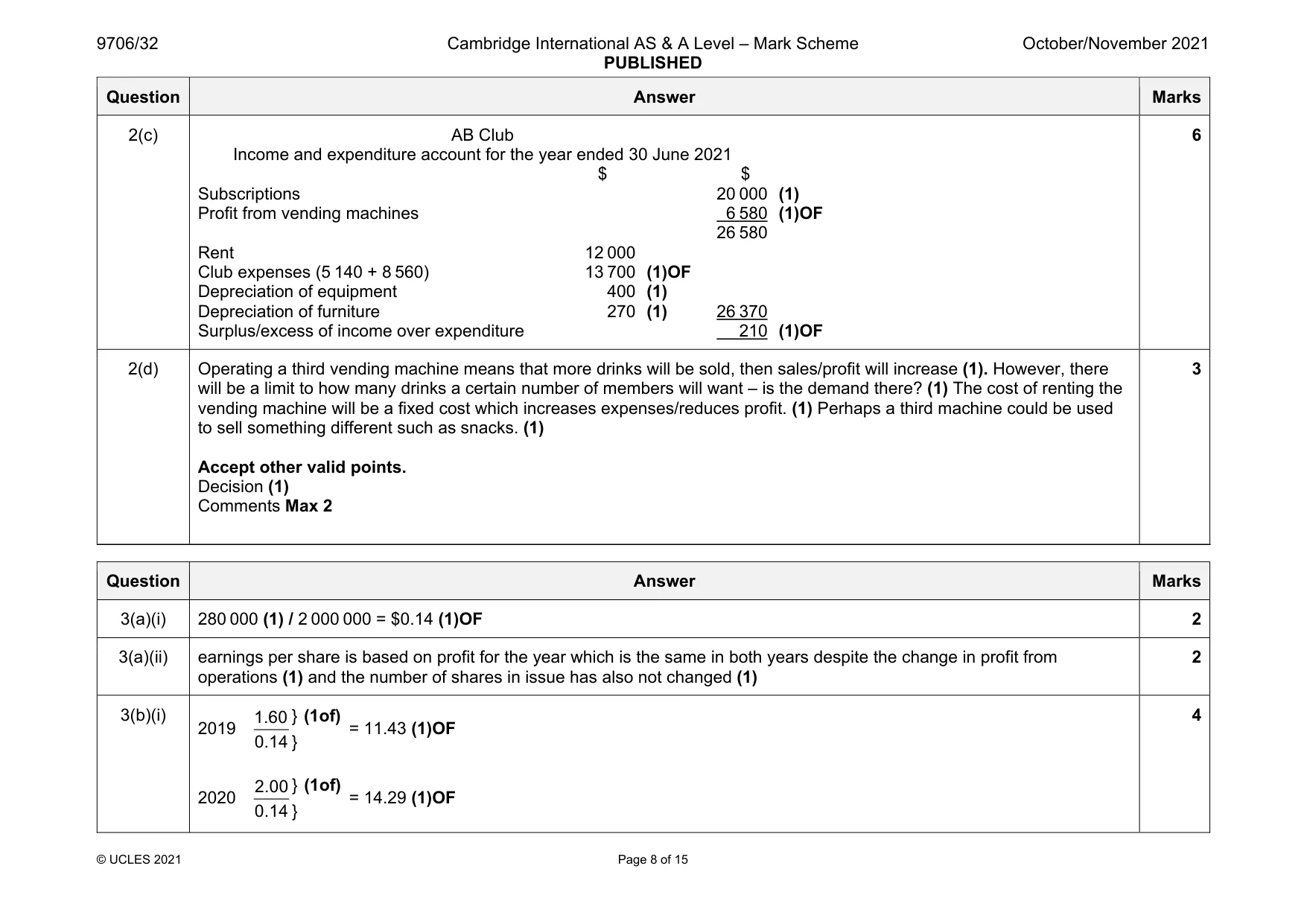
9706/32 Cambridge International AS & A Level – Mark Scheme PUBLISHED October/November 2021 © UCLES 2021 Page 8 of 15 Question Answer Marks 2(c) AB Club Income and expenditure account for the year ended 30 June 2021 $ $ Subscriptions 20 000 (1) Profit from vending machines 6 580 (1)OF 26 580 Rent 12 000 Club expenses (5 140 + 8 560) 13 700 (1)OF Depreciation of equipment 400 (1) Depreciation of furniture 270 (1) 26 370 Surplus/excess of income over expenditure 210 (1)OF 6 2(d) Operating a third vending machine means that more drinks will be sold, then sales/profit will increase (1). However, there will be a limit to how many drinks a certain number of members will want – is the demand there? (1) The cost of renting the vending machine will be a fixed cost which increases expenses/reduces profit. (1) Perhaps a third machine could be used to sell something different such as snacks. (1) Accept other valid points. Decision (1) Comments Max 2 3 Question Answer Marks 3(a)(i) 280 000 (1) / 2 000 000 = $0.14 (1)OF 2 3(a)(ii) earnings per share is based on profit for the year which is the same in both years despite the change in profit from operations (1) and the number of shares in issue has also not changed (1) 2 3(b)(i) 2019 } 1.60 } 0.14 (1of) = 11.43 (1)OF 2020 } 2.00 } 0.14 (1of) = 14.29 (1)OF 4
Mark scheme, page 9
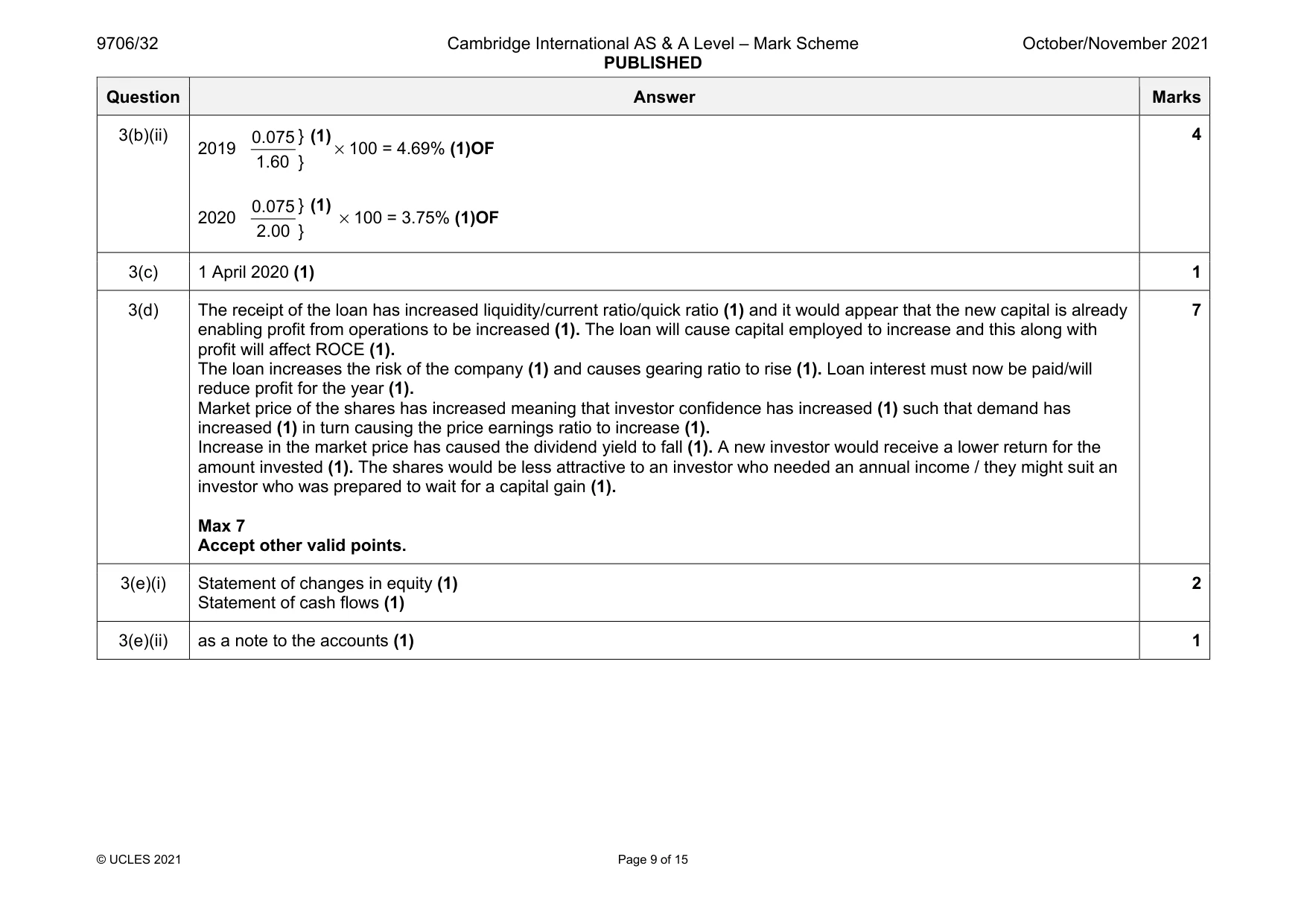
9706/32 Cambridge International AS & A Level – Mark Scheme PUBLISHED October/November 2021 © UCLES 2021 Page 9 of 15 Question Answer Marks 3(b)(ii) 2019 } 0.075 } 1.60 (1) × 100 = 4.69% (1)OF 2020 } 0.075 } 2.00 (1) × 100 = 3.75% (1)OF 4 3(c) 1 April 2020 (1) 1 3(d) The receipt of the loan has increased liquidity/current ratio/quick ratio (1) and it would appear that the new capital is already enabling profit from operations to be increased (1). The loan will cause capital employed to increase and this along with profit will affect ROCE (1). The loan increases the risk of the company (1) and causes gearing ratio to rise (1). Loan interest must now be paid/will reduce profit for the year (1). Market price of the shares has increased meaning that investor confidence has increased (1) such that demand has increased (1) in turn causing the price earnings ratio to increase (1). Increase in the market price has caused the dividend yield to fall (1). A new investor would receive a lower return for the amount invested (1). The shares would be less attractive to an investor who needed an annual income / they might suit an investor who was prepared to wait for a capital gain (1). Max 7 Accept other valid points. 7 3(e)(i) Statement of changes in equity (1) Statement of cash flows (1) 2 3(e)(ii) as a note to the accounts (1) 1
Mark scheme, page 10
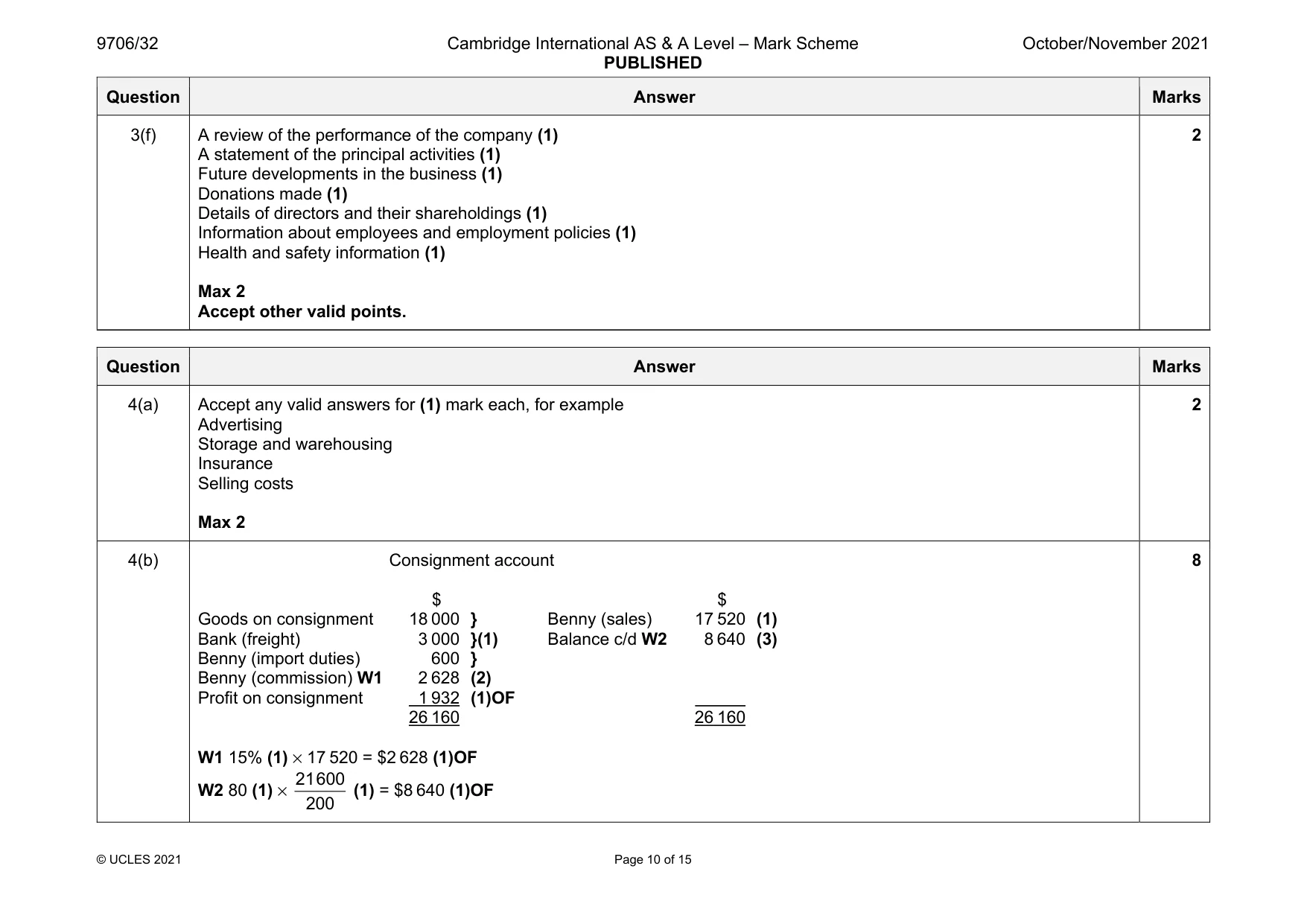
9706/32 Cambridge International AS & A Level – Mark Scheme PUBLISHED October/November 2021 © UCLES 2021 Page 10 of 15 Question Answer Marks 3(f) A review of the performance of the company (1) A statement of the principal activities (1) Future developments in the business (1) Donations made (1) Details of directors and their shareholdings (1) Information about employees and employment policies (1) Health and safety information (1) Max 2 Accept other valid points. 2 Question Answer Marks 4(a) Accept any valid answers for (1) mark each, for example Advertising Storage and warehousing Insurance Selling costs Max 2 2 4(b) Consignment account $ $ Goods on consignment 18 000 } Benny (sales) 17 520 (1) Bank (freight) 3 000 }(1) Balance c/d W2 8 640 (3) Benny (import duties) 600 } Benny (commission) W1 2 628 (2) Profit on consignment 1 932 (1)OF 26 160 26 160 W1 15% (1) × 17 520 = $2 628 (1)OF W2 80 (1) × 21600 200 (1) = $8 640 (1)OF 8
Mark scheme, page 11
9706/32 Cambridge International AS & A Level – Mark Scheme PUBLISHED October/November 2021 © UCLES 2021 Page 11 of 15 Question Answer Marks 4(c) $ Sales 17 520 (1)OF Commission (2 628) } (1)OF Import duties (600) } 14 292 Balance (1 292) (1) Amount remitted 13 000 (1)OF 4 4(d) Reduction in sales (1) = $2 160 (1)OF despite selling price being higher (1) Reduction in commission (1) = $324 (1)OF Increase in inventory carried forward (1) = $4 752 (1)OF Change from loss (984) to profit (1 932) = $2 916 (1)OF (4 752 + 324 – 2 160) Max 7 Accept other valid points. 7 4(e) There would be a loss in value of inventory (1) of 44 × 21600 200 = $4 752 (1)OF. The original inventory value for 36 units ($3 888) would have been used (1) and the loss on consignment with revised sales figures would be $2 820 (1)OF. Max 2 Accept other valid points. 2 4(f) It may not be possible due to the location (1) to obtain an independent verification of the existence and value of the inventory (1) and therefore certify that the accounts show a true and fair view (1). Max 2 Accept other valid points. 2
Mark scheme, page 12
9706/32 Cambridge International AS & A Level – Mark Scheme PUBLISHED October/November 2021 © UCLES 2021 Page 12 of 15 Question Answer Marks 5(a) Product A Product B $ $ Direct materials 50 000 36 000 (1) both Direct labour 20 000 10 000 (1) both Production overheads 30 000 30 000 } Administrative and distribution overheads 14 000 14 000 } (1) both Total cost 114 000 90 000 Sales revenue 124 000 94 000 (1) both Profit 10 000 4 000 (1)OF both Accept other presentations 5 5(b) ABC will help in setting selling prices (1) as it enables a more realistic allocation of costs to a product (1). However, calculating the cost drivers may be expensive/time consuming (1). ABC will not help in make or buy decisions (1) as it does not provide a split between fixed and variable costs (1). The decision to buy is normally only made when the purchase price is less than the variable costs of manufacture (1). ABC will not help in allocating scarce resources (1) as it does not provide the contribution per unit of each product (1) which is necessary to rank the products in the order which will enable profits to be maximised (1). Max 7 7 5(c) Advantage Quick/easy to calculate (1) Disadvantage Unlikely to be realistic (1) Accept other valid points. 2
Mark scheme, page 13
9706/32 Cambridge International AS & A Level – Mark Scheme PUBLISHED October/November 2021 © UCLES 2021 Page 13 of 15 Question Answer Marks 5(d) Product A Product B $ $ Machine set up costs 7 200 4 800 (1) both Quality inspections 3 500 3 500 (1) both Factory supervisors’ salaries 10 000 4 000 (1) both Other production overheads 22 500 4 500 (1) both 43 200 16 800 Direct materials and labour 70 000 46 000 (1)OF both 113 200 62 800 Administrative and distribution overheads 14 000 14 000 (1)OF both Total cost 127 200 76 800 Sales revenue 124 000 94 000 (1) both Profit/ (loss) (3 200) 17 200 (1)OF both Accept other presentations 8 5(e) The loss apparently made by product A (1) would indicate that its selling price should be increased. This may reduce demand (1). However, the administrative and distribution costs are still being split in an unrealistic manner (1). The profit being earned by product B (1) would indicate that its selling price should not be changed. Accept other valid points. Decision (1) Comments Max 2 3 Question Answer Marks 6(a) The excess of total cash inflows over total cash outflows (1) of both revenue and capital receipts and expenditure (1) 2
Mark scheme, page 14
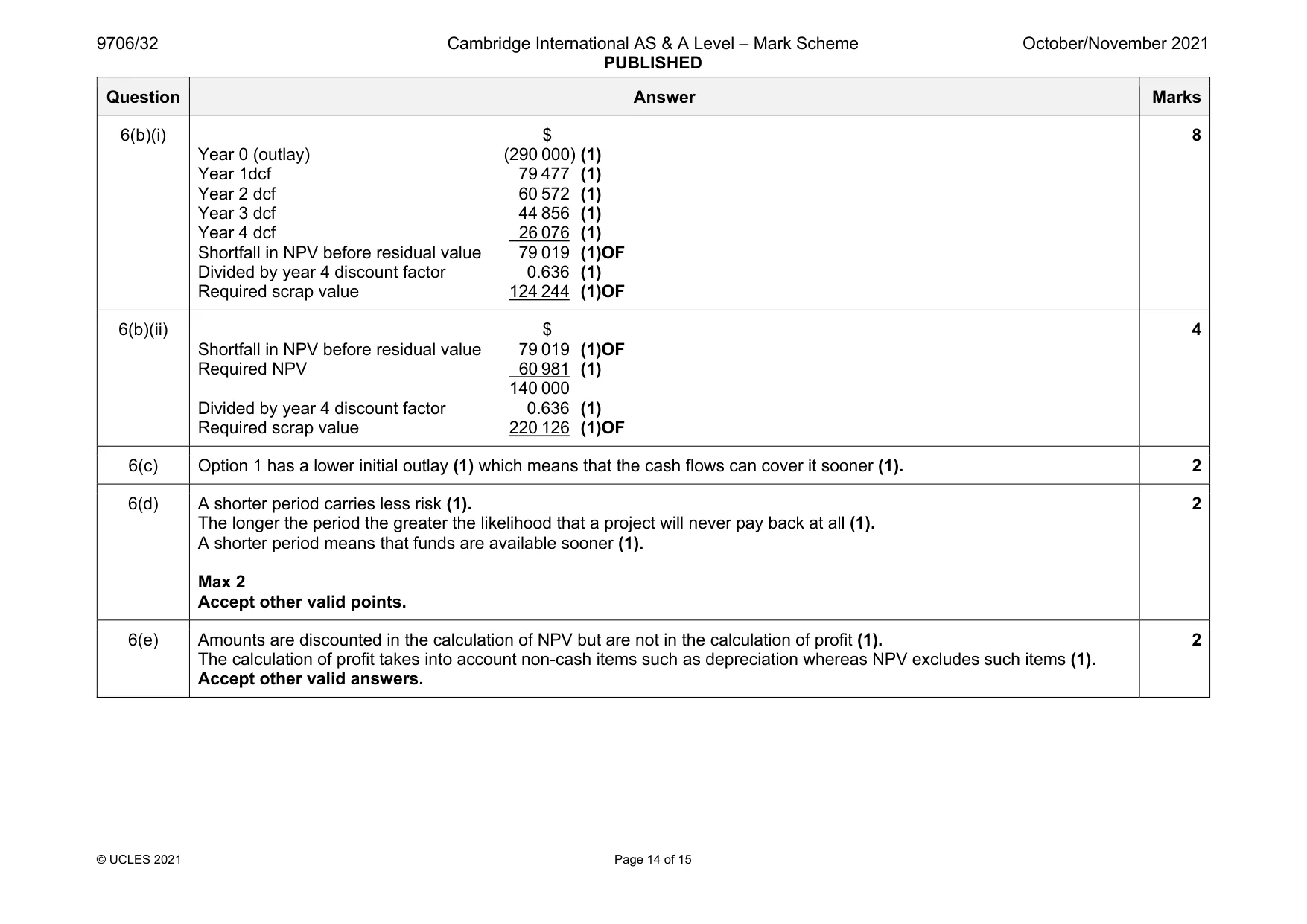
9706/32 Cambridge International AS & A Level – Mark Scheme PUBLISHED October/November 2021 © UCLES 2021 Page 14 of 15 Question Answer Marks 6(b)(i) $ Year 0 (outlay) (290 000) (1) Year 1dcf 79 477 (1) Year 2 dcf 60 572 (1) Year 3 dcf 44 856 (1) Year 4 dcf 26 076 (1) Shortfall in NPV before residual value 79 019 (1)OF Divided by year 4 discount factor 0.636 (1) Required scrap value 124 244 (1)OF 8 6(b)(ii) $ Shortfall in NPV before residual value 79 019 (1)OF Required NPV 60 981 (1) 140 000 Divided by year 4 discount factor 0.636 (1) Required scrap value 220 126 (1)OF 4 6(c) Option 1 has a lower initial outlay (1) which means that the cash flows can cover it sooner (1). 2 6(d) A shorter period carries less risk (1). The longer the period the greater the likelihood that a project will never pay back at all (1). A shorter period means that funds are available sooner (1). Max 2 Accept other valid points. 2 6(e) Amounts are discounted in the calculation of NPV but are not in the calculation of profit (1). The calculation of profit takes into account non-cash items such as depreciation whereas NPV excludes such items (1). Accept other valid answers. 2
Mark scheme, page 15
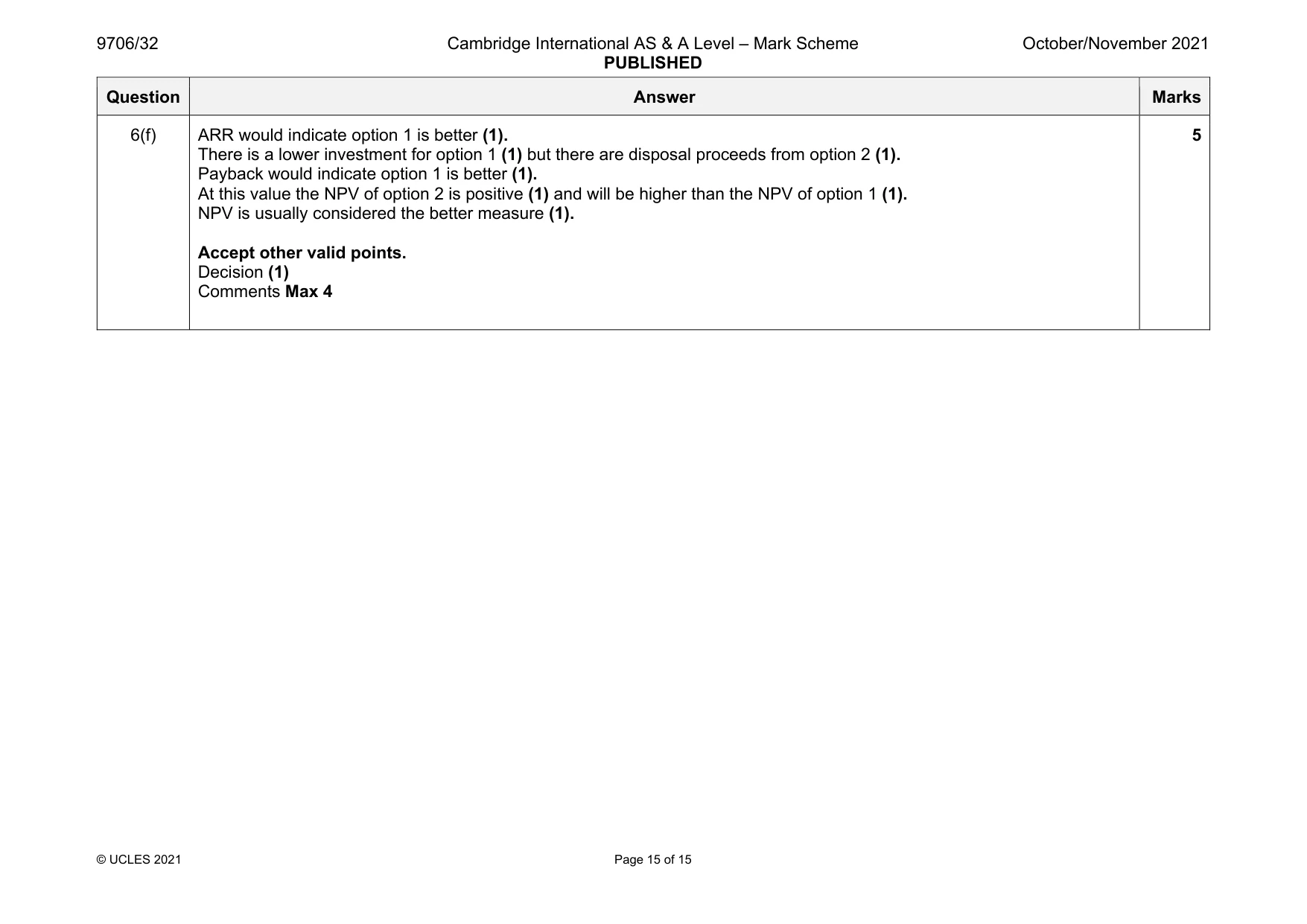
9706/32 Cambridge International AS & A Level – Mark Scheme PUBLISHED October/November 2021 © UCLES 2021 Page 15 of 15 Question Answer Marks 6(f) ARR would indicate option 1 is better (1). There is a lower investment for option 1 (1) but there are disposal proceeds from option 2 (1). Payback would indicate option 1 is better (1). At this value the NPV of option 2 is positive (1) and will be higher than the NPV of option 1 (1). NPV is usually considered the better measure (1). Accept other valid points. Decision (1) Comments Max 4 5
What you needed in this session
Cambridge’s own grade thresholds for 2021 Oct/Nov, Paper 3 · Variant 2. A higher threshold means an easier paper — the bar moves with how the cohort did.