Cambridge A Level Accounting 9706 — 2019 May/June Paper 3 · Variant 1
9706/31/M/J/19 · 150 marks · ≈169 min
The question paper and its mark scheme, free to read here and free to download. This is Cambridge’s own paper, exactly as it was sat.
Question paper12 pages

Mark scheme16 pages
Answers below. Sit the paper first if you are practising.
Paper as text
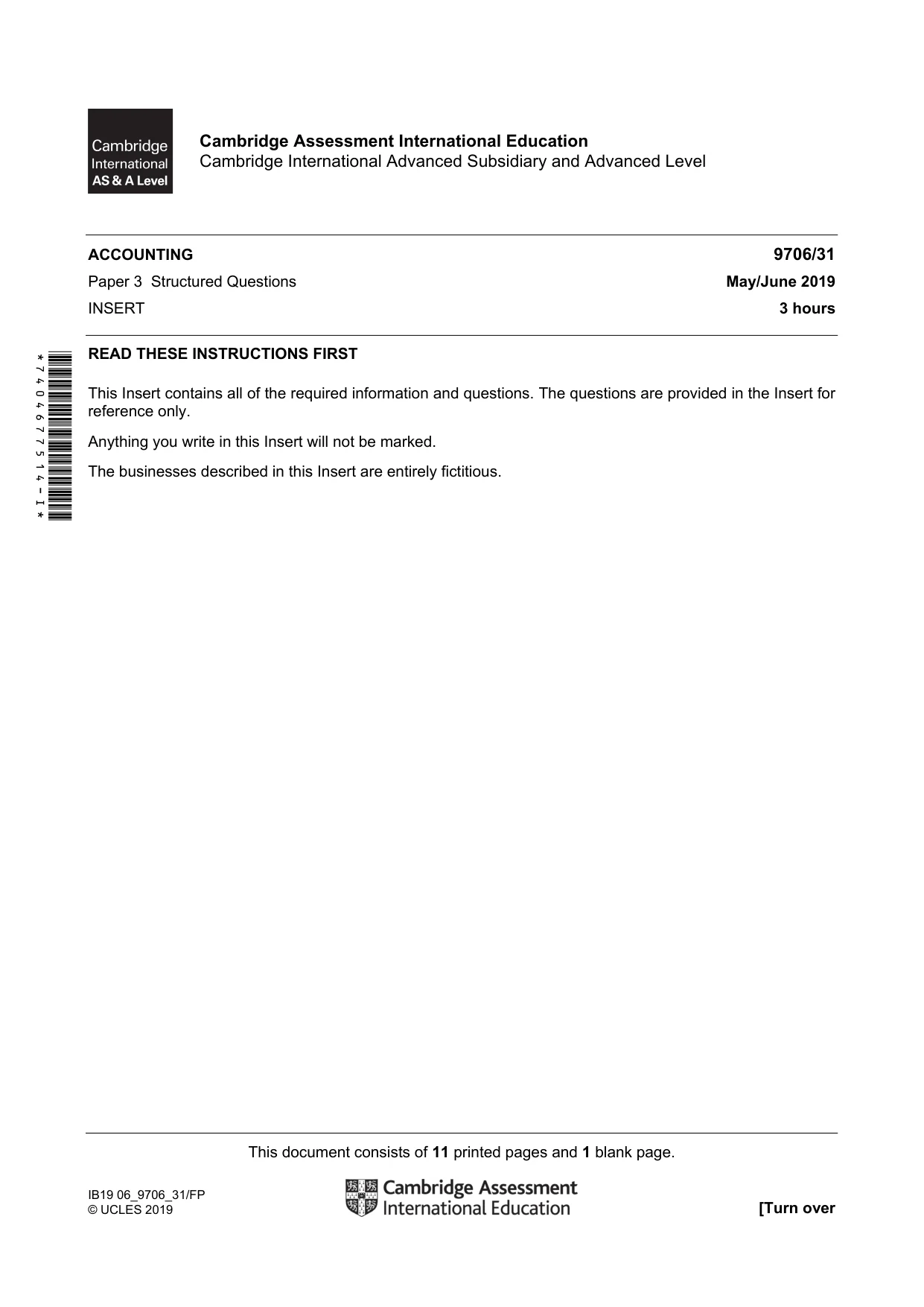
Question paper, page 1
This document consists of 11 printed pages and 1 blank page. IB19 06_9706_31/FP © UCLES 2019 [Turn over Cambridge Assessment International Education Cambridge International Advanced Subsidiary and Advanced Level ACCOUNTING 9706/31 Paper 3 Structured Questions May/June 2019 INSERT 3 hours READ THESE INSTRUCTIONS FIRST This Insert contains all of the required information and questions. The questions are provided in the Insert for reference only. Anything you write in this Insert will not be marked. The businesses described in this Insert are entirely fictitious.
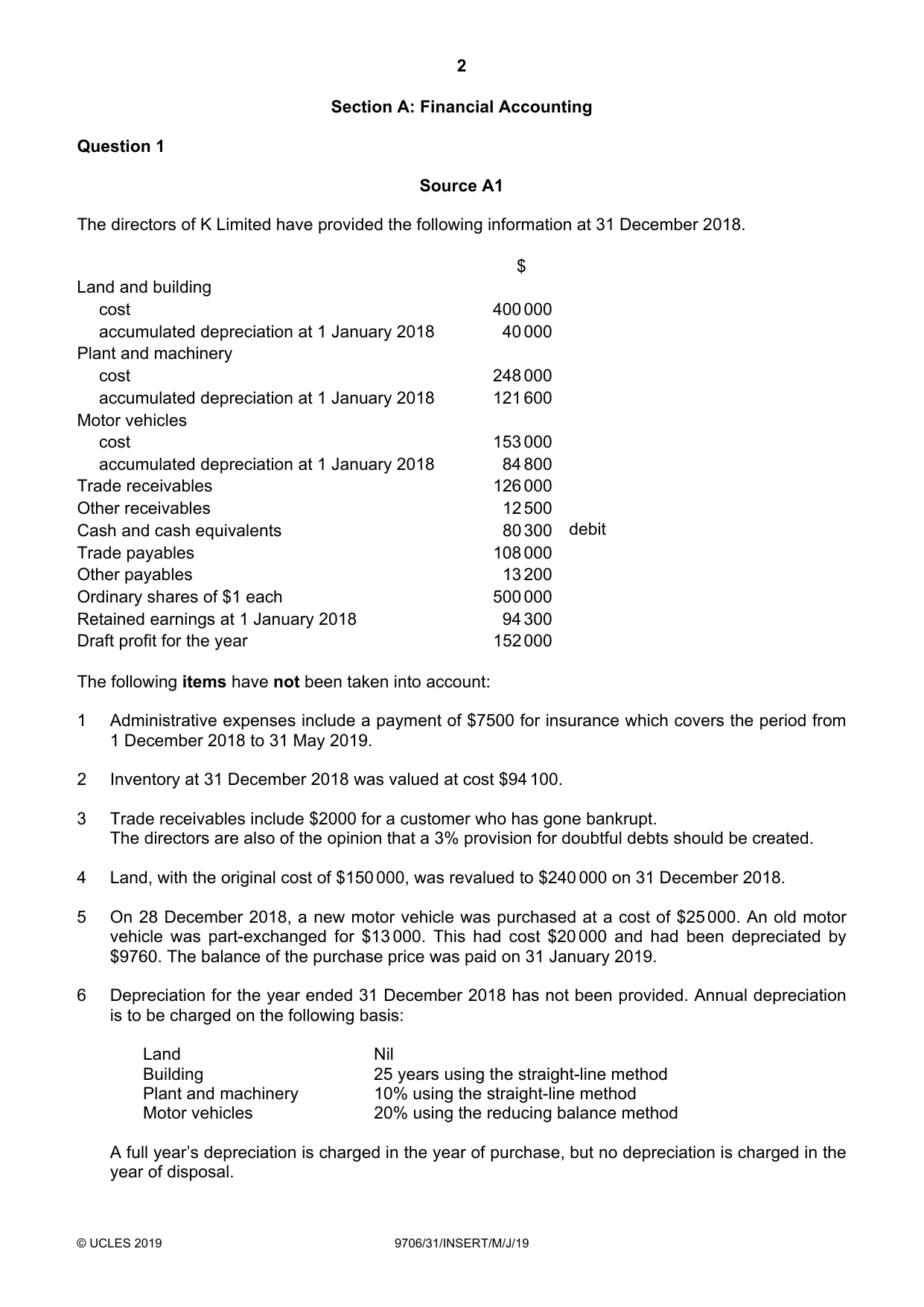
Question paper, page 2
2 © UCLES 2019 9706/31/INSERT/M/J/19 Section A: Financial Accounting Question 1 Source A1 The directors of K Limited have provided the following information at 31 December 2018. $ Land and building cost 400 000 accumulated depreciation at 1 January 2018 40 000 Plant and machinery cost 248 000 accumulated depreciation at 1 January 2018 121 600 Motor vehicles cost 153 000 accumulated depreciation at 1 January 2018 84 800 Trade receivables 126 000 Other receivables 12 500 Cash and cash equivalents 80 300 debit Trade payables 108 000 Other payables 13 200 Ordinary shares of $1 each 500 000 Retained earnings at 1 January 2018 94 300 Draft profit for the year 152 000 The following items have not been taken into account: 1 Administrative expenses include a payment of $7500 for insurance which covers the period from 1 December 2018 to 31 May 2019. 2 Inventory at 31 December 2018 was valued at cost $94 100. 3 Trade receivables include $2000 for a customer who has gone bankrupt. The directors are also of the opinion that a 3% provision for doubtful debts should be created. 4 Land, with the original cost of $150 000, was revalued to $240 000 on 31 December 2018. 5 On 28 December 2018, a new motor vehicle was purchased at a cost of $25 000. An old motor vehicle was part-exchanged for $13 000. This had cost $20 000 and had been depreciated by $9760. The balance of the purchase price was paid on 31 January 2019. 6 Depreciation for the year ended 31 December 2018 has not been provided. Annual depreciation is to be charged on the following basis: Land Nil Building 25 years using the straight-line method Plant and machinery 10% using the straight-line method Motor vehicles 20% using the reducing balance method A full year’s depreciation is charged in the year of purchase, but no depreciation is charged in the year of disposal.
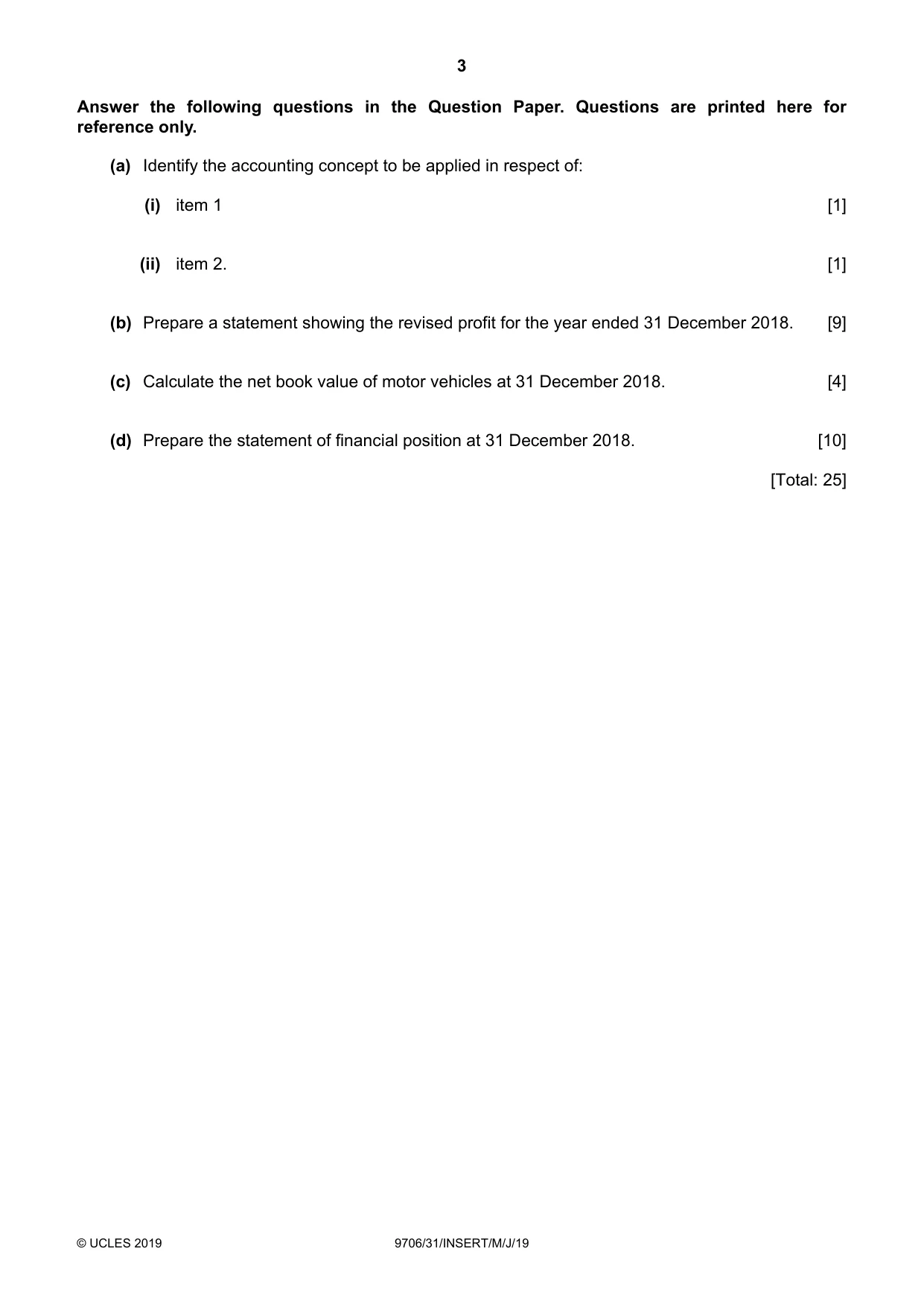
Question paper, page 3
3 © UCLES 2019 9706/31/INSERT/M/J/19 Answer the following questions in the Question Paper. Questions are printed here for reference only. (a) Identify the accounting concept to be applied in respect of: (i) item 1 [1] (ii) item 2. [1] (b) Prepare a statement showing the revised profit for the year ended 31 December 2018. [9] (c) Calculate the net book value of motor vehicles at 31 December 2018. [4] (d) Prepare the statement of financial position at 31 December 2018. [10] [Total: 25]
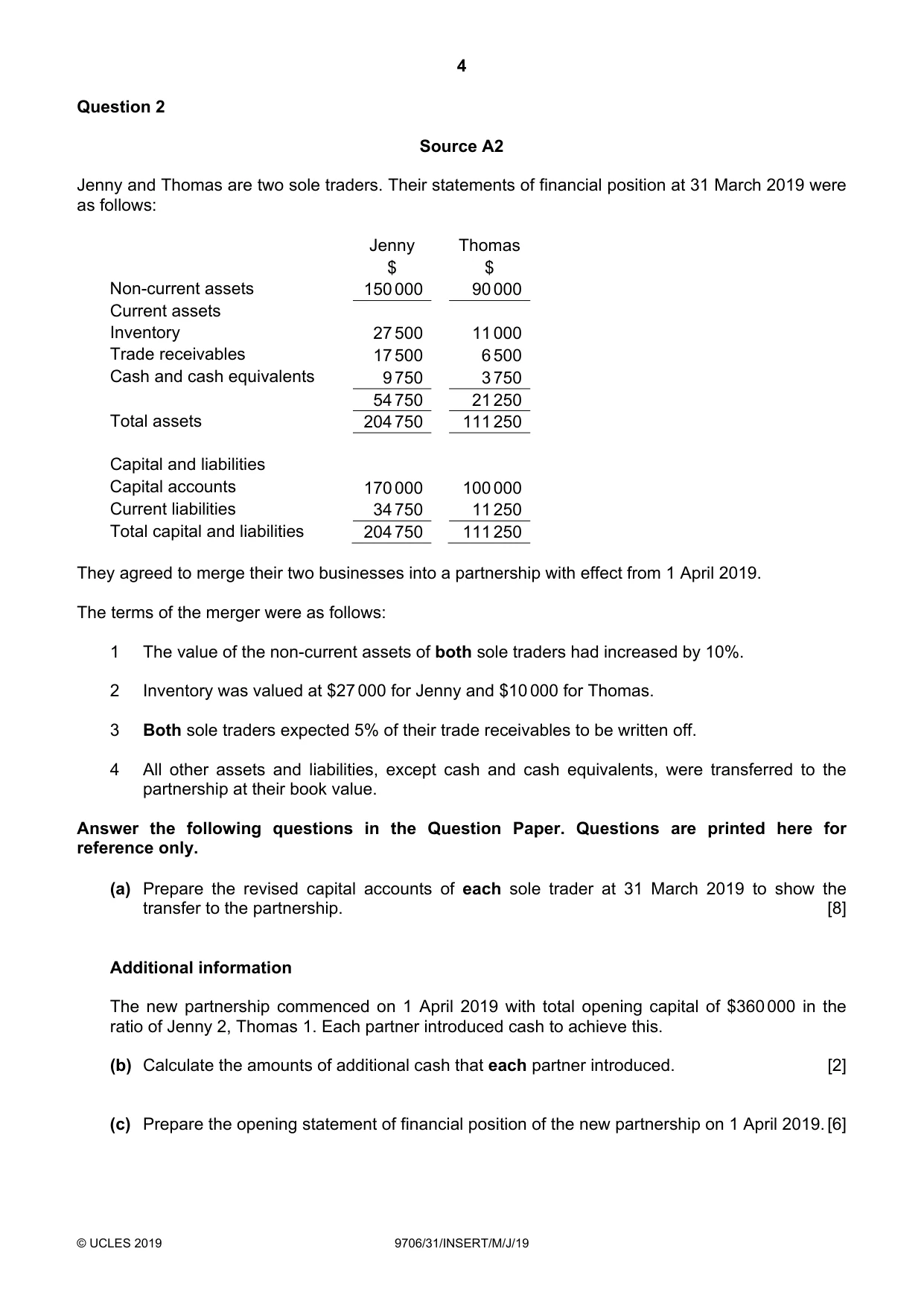
Question paper, page 4
4 © UCLES 2019 9706/31/INSERT/M/J/19 Question 2 Source A2 Jenny and Thomas are two sole traders. Their statements of financial position at 31 March 2019 were as follows: Jenny Thomas $ $ Non-current assets 150 000 90 000 Current assets Inventory 27 500 11 000 Trade receivables 17 500 6 500 Cash and cash equivalents 9 750 3 750 54 750 21 250 Total assets 204 750 111 250 Capital and liabilities Capital accounts 170 000 100 000 Current liabilities 34 750 11 250 Total capital and liabilities 204 750 111 250 They agreed to merge their two businesses into a partnership with effect from 1 April 2019. The terms of the merger were as follows: 1 The value of the non-current assets of both sole traders had increased by 10%. 2 Inventory was valued at $27 000 for Jenny and $10 000 for Thomas. 3 Both sole traders expected 5% of their trade receivables to be written off. 4 All other assets and liabilities, except cash and cash equivalents, were transferred to the partnership at their book value. Answer the following questions in the Question Paper. Questions are printed here for reference only. (a) Prepare the revised capital accounts of each sole trader at 31 March 2019 to show the transfer to the partnership. [8] Additional information The new partnership commenced on 1 April 2019 with total opening capital of $360 000 in the ratio of Jenny 2, Thomas 1. Each partner introduced cash to achieve this. (b) Calculate the amounts of additional cash that each partner introduced. [2] (c) Prepare the opening statement of financial position of the new partnership on 1 April 2019. [6]
Question paper, page 5
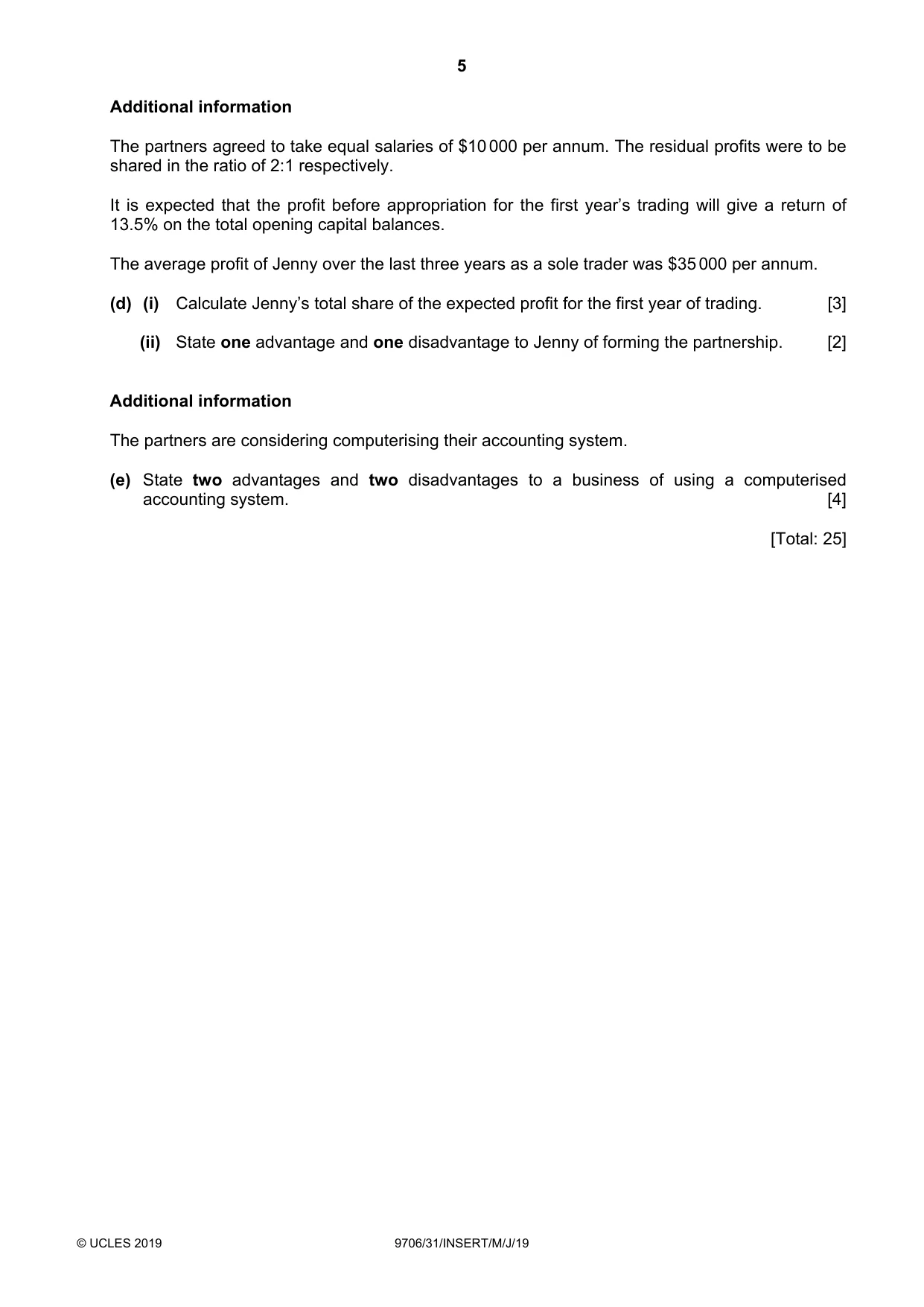
5 © UCLES 2019 9706/31/INSERT/M/J/19 Additional information The partners agreed to take equal salaries of $10 000 per annum. The residual profits were to be shared in the ratio of 2:1 respectively. It is expected that the profit before appropriation for the first year’s trading will give a return of 13.5% on the total opening capital balances. The average profit of Jenny over the last three years as a sole trader was $35 000 per annum. (d) (i) Calculate Jenny’s total share of the expected profit for the first year of trading. [3] (ii) State one advantage and one disadvantage to Jenny of forming the partnership. [2] Additional information The partners are considering computerising their accounting system. (e) State two advantages and two disadvantages to a business of using a computerised accounting system. [4] [Total: 25]
Question paper, page 6
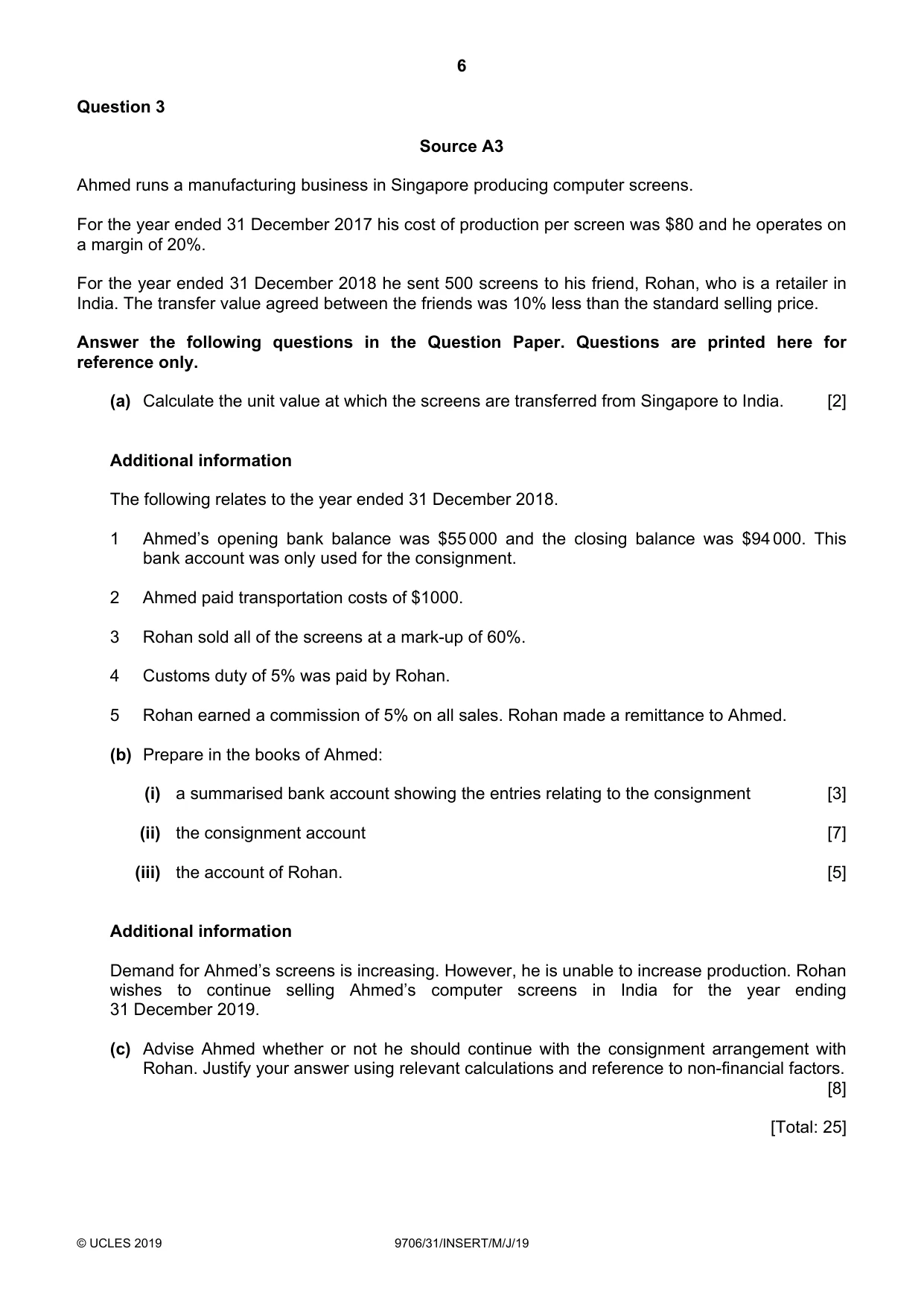
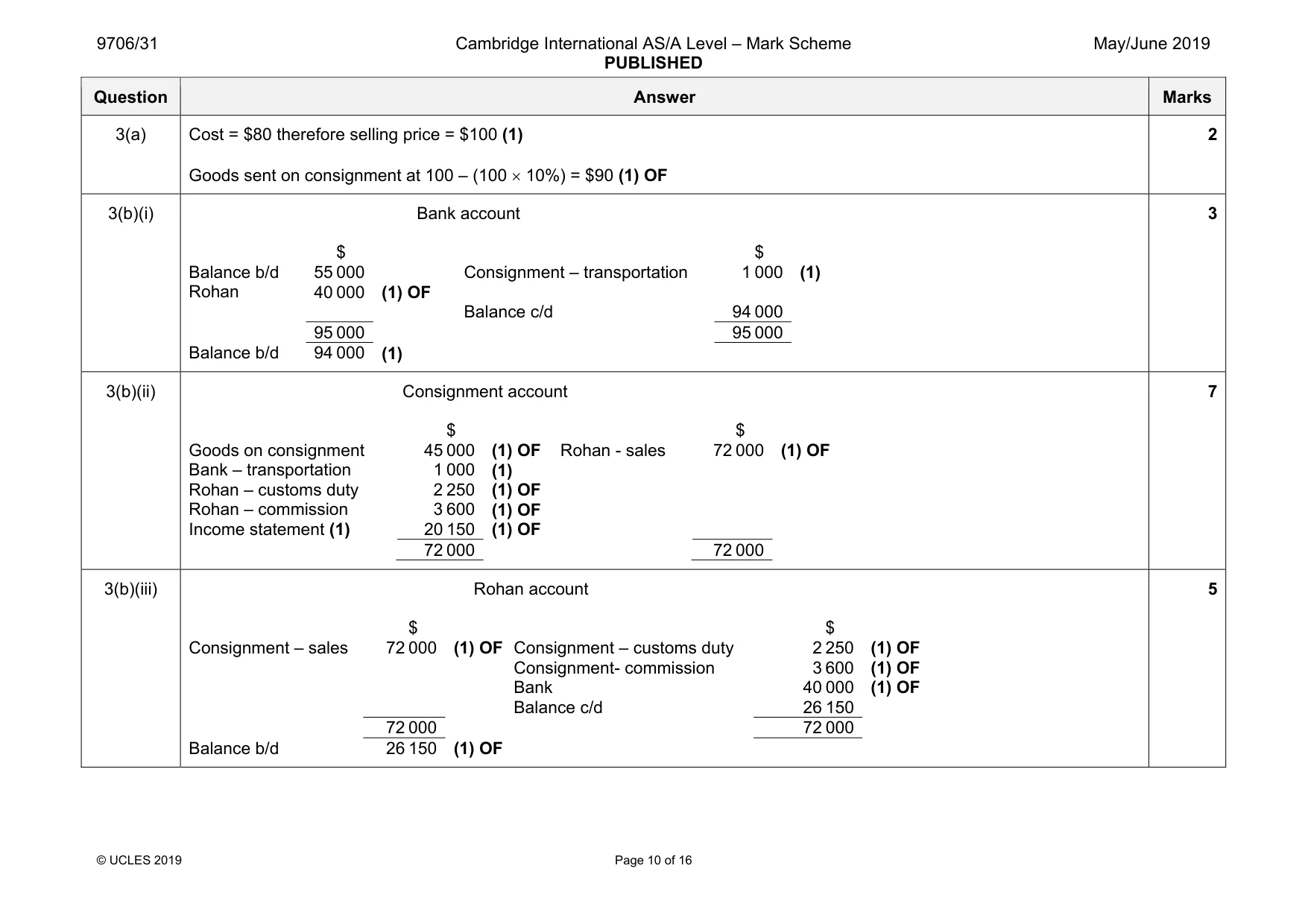
6 © UCLES 2019 9706/31/INSERT/M/J/19 Question 3 Source A3 Ahmed runs a manufacturing business in Singapore producing computer screens. For the year ended 31 December 2017 his cost of production per screen was $80 and he operates on a margin of 20%. For the year ended 31 December 2018 he sent 500 screens to his friend, Rohan, who is a retailer in India. The transfer value agreed between the friends was 10% less than the standard selling price. Answer the following questions in the Question Paper. Questions are printed here for reference only. (a) Calculate the unit value at which the screens are transferred from Singapore to India. [2] Additional information The following relates to the year ended 31 December 2018. 1 Ahmed’s opening bank balance was $55 000 and the closing balance was $94 000. This bank account was only used for the consignment. 2 Ahmed paid transportation costs of $1000. 3 Rohan sold all of the screens at a mark-up of 60%. 4 Customs duty of 5% was paid by Rohan. 5 Rohan earned a commission of 5% on all sales. Rohan made a remittance to Ahmed. (b) Prepare in the books of Ahmed: (i) a summarised bank account showing the entries relating to the consignment [3] (ii) the consignment account [7] (iii) the account of Rohan. [5] Additional information Demand for Ahmed’s screens is increasing. However, he is unable to increase production. Rohan wishes to continue selling Ahmed’s computer screens in India for the year ending 31 December 2019. (c) Advise Ahmed whether or not he should continue with the consignment arrangement with Rohan. Justify your answer using relevant calculations and reference to non-financial factors. [8] [Total: 25]
Question paper, page 7
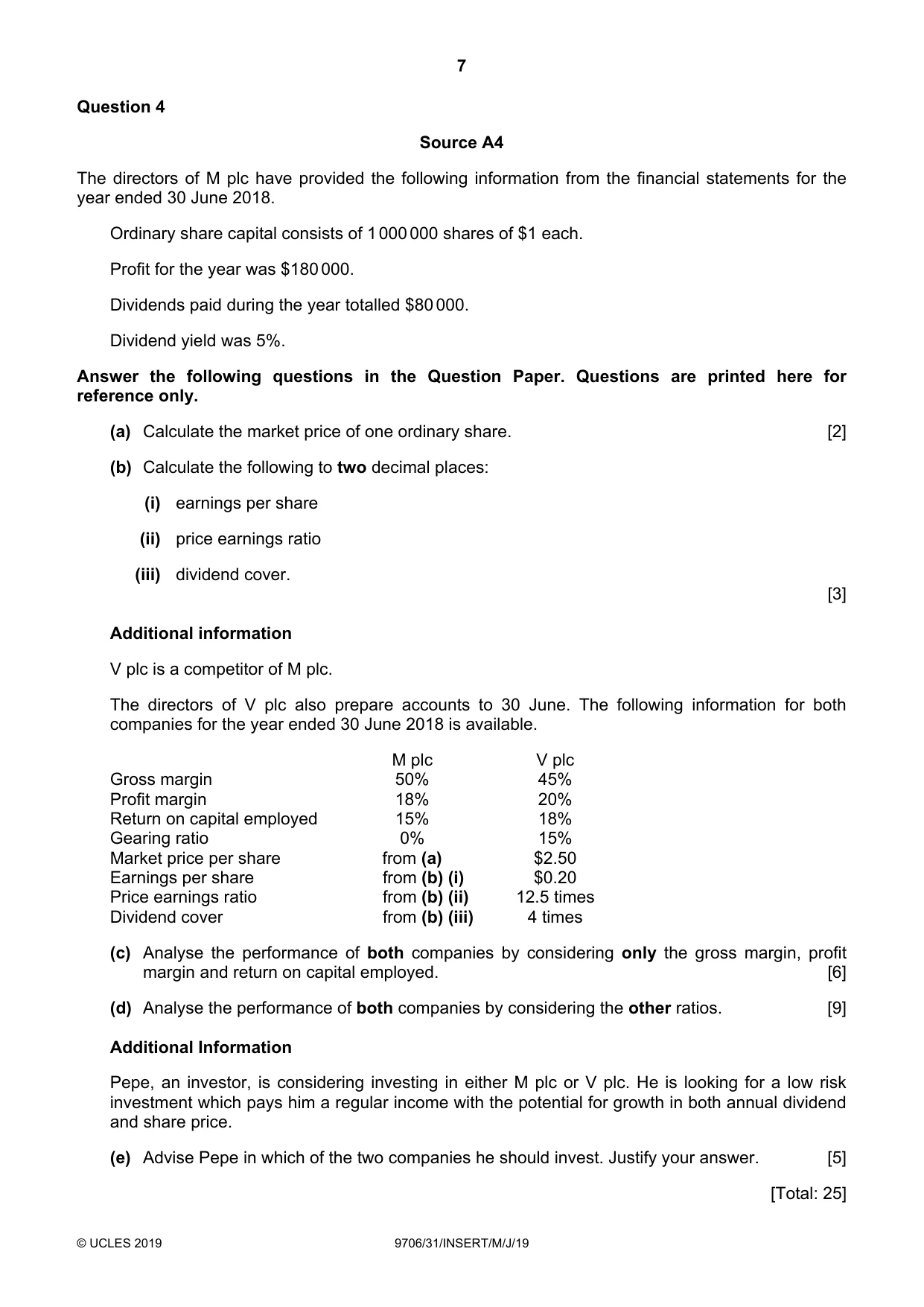
7 © UCLES 2019 9706/31/INSERT/M/J/19 Question 4 Source A4 The directors of M plc have provided the following information from the financial statements for the year ended 30 June 2018. Ordinary share capital consists of 1 000 000 shares of $1 each. Profit for the year was $180 000. Dividends paid during the year totalled $80 000. Dividend yield was 5%. Answer the following questions in the Question Paper. Questions are printed here for reference only. (a) Calculate the market price of one ordinary share. [2] (b) Calculate the following to two decimal places: (i) earnings per share (ii) price earnings ratio (iii) dividend cover. [3] Additional information V plc is a competitor of M plc. The directors of V plc also prepare accounts to 30 June. The following information for both companies for the year ended 30 June 2018 is available. M plc V plc Gross margin 50% 45% Profit margin 18% 20% Return on capital employed 15% 18% Gearing ratio 0% 15% Market price per share from (a) $2.50 Earnings per share from (b) (i) $0.20 Price earnings ratio from (b) (ii) 12.5 times Dividend cover from (b) (iii) 4 times (c) Analyse the performance of both companies by considering only the gross margin, profit margin and return on capital employed. [6] (d) Analyse the performance of both companies by considering the other ratios. [9] Additional Information Pepe, an investor, is considering investing in either M plc or V plc. He is looking for a low risk investment which pays him a regular income with the potential for growth in both annual dividend and share price. (e) Advise Pepe in which of the two companies he should invest. Justify your answer. [5] [Total: 25]
Question paper, page 8
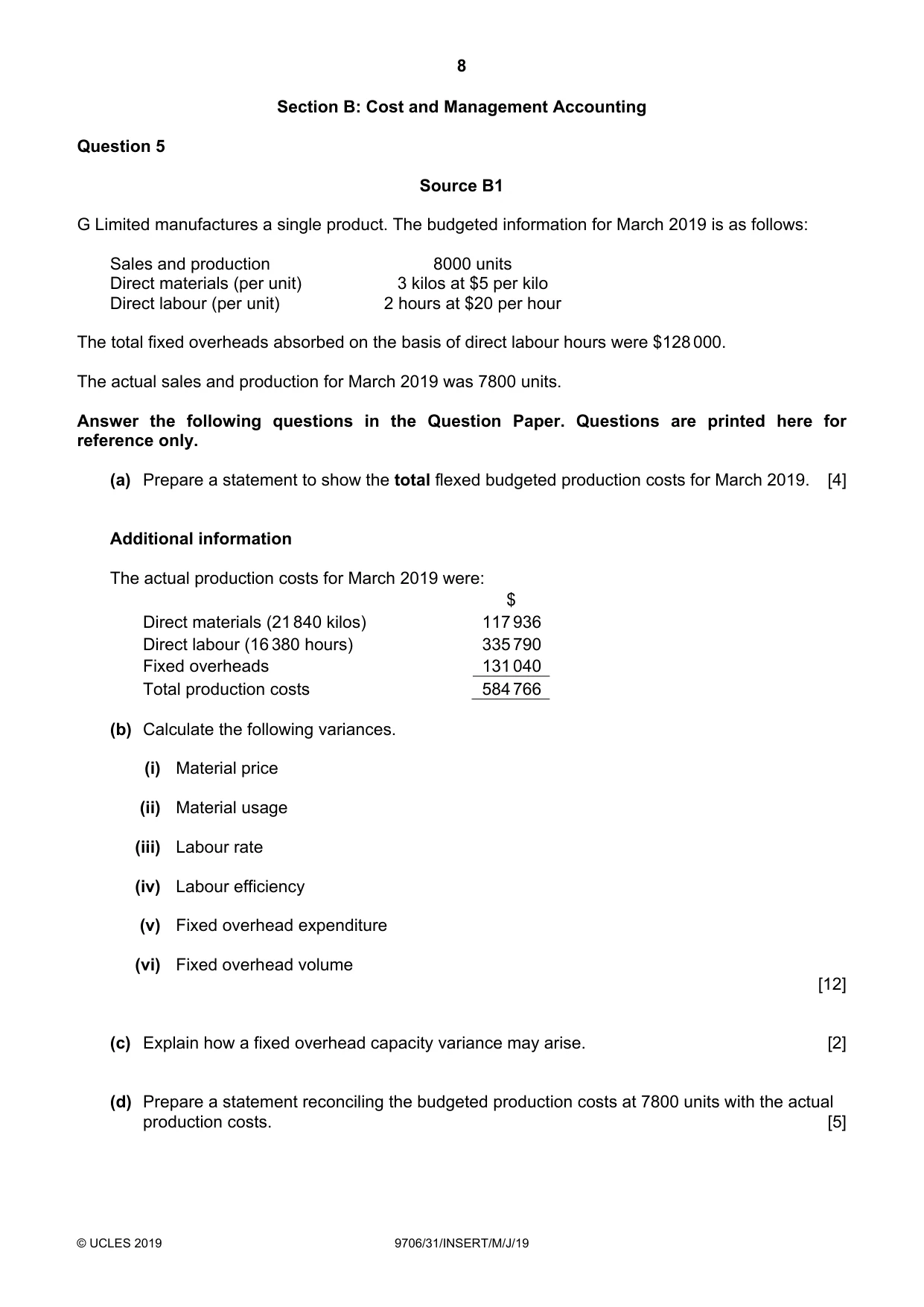
8 © UCLES 2019 9706/31/INSERT/M/J/19 Section B: Cost and Management Accounting Question 5 Source B1 G Limited manufactures a single product. The budgeted information for March 2019 is as follows: Sales and production 8000 units Direct materials (per unit) 3 kilos at $5 per kilo Direct labour (per unit) 2 hours at $20 per hour The total fixed overheads absorbed on the basis of direct labour hours were $128 000. The actual sales and production for March 2019 was 7800 units. Answer the following questions in the Question Paper. Questions are printed here for reference only. (a) Prepare a statement to show the total flexed budgeted production costs for March 2019. [4] Additional information The actual production costs for March 2019 were: $ Direct materials (21 840 kilos) 117 936 Direct labour (16 380 hours) 335 790 Fixed overheads 131 040 Total production costs 584 766 (b) Calculate the following variances. (i) Material price (ii) Material usage (iii) Labour rate (iv) Labour efficiency (v) Fixed overhead expenditure (vi) Fixed overhead volume [12] (c) Explain how a fixed overhead capacity variance may arise. [2] (d) Prepare a statement reconciling the budgeted production costs at 7800 units with the actual production costs. [5]
Question paper, page 9
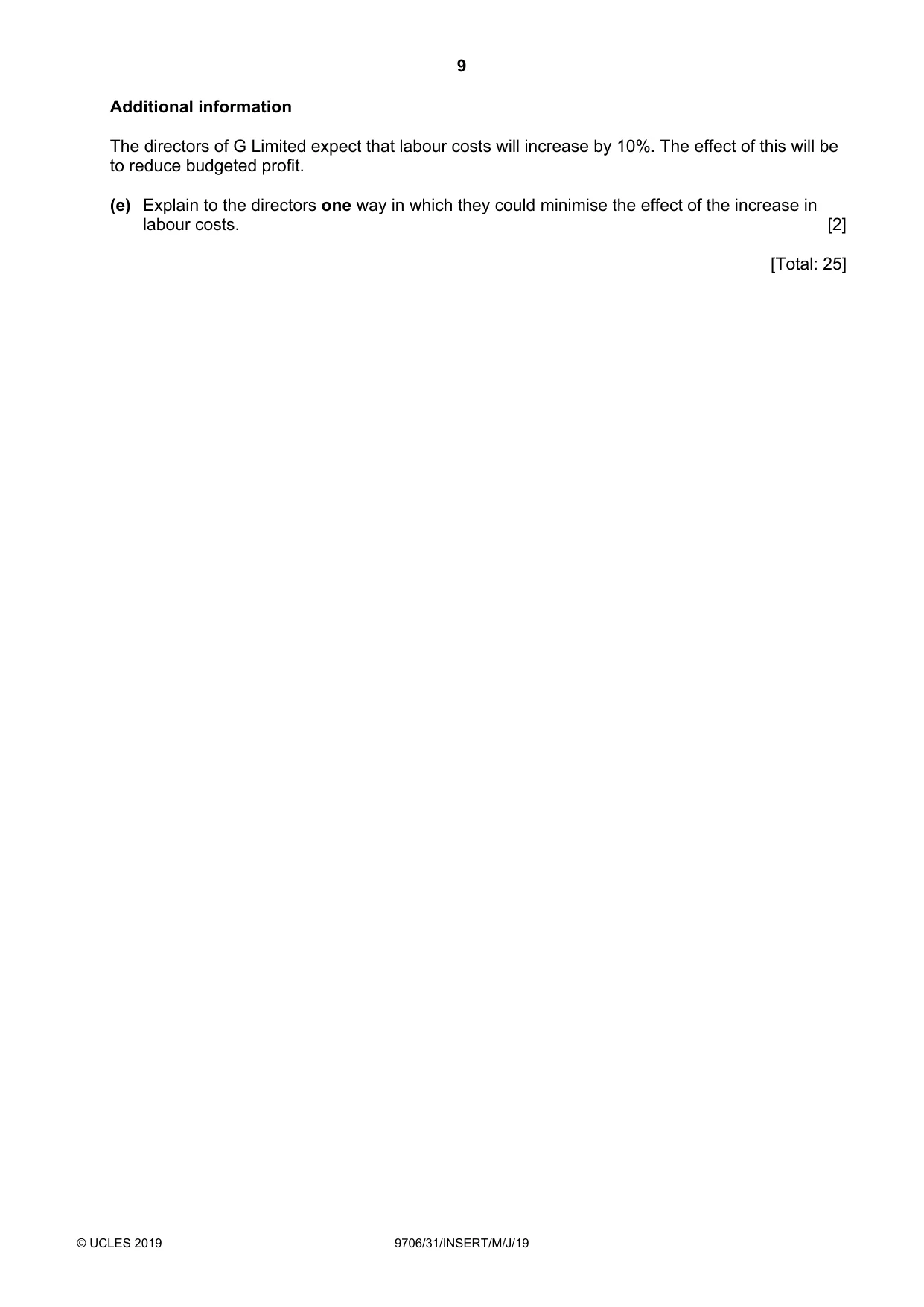
9 © UCLES 2019 9706/31/INSERT/M/J/19 Additional information The directors of G Limited expect that labour costs will increase by 10%. The effect of this will be to reduce budgeted profit. (e) Explain to the directors one way in which they could minimise the effect of the increase in labour costs. [2] [Total: 25]
Question paper, page 10
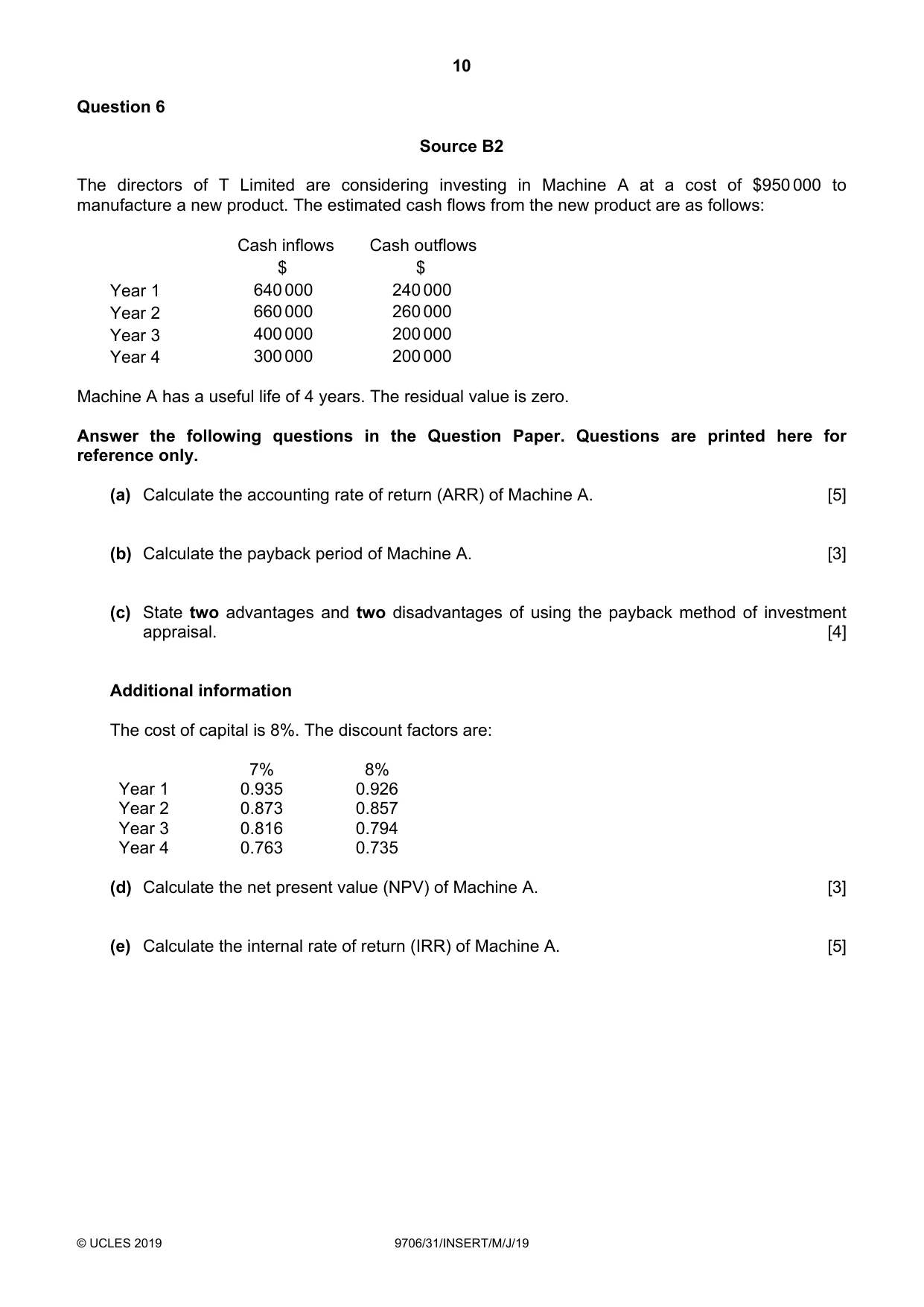
10 © UCLES 2019 9706/31/INSERT/M/J/19 Question 6 Source B2 The directors of T Limited are considering investing in Machine A at a cost of $950 000 to manufacture a new product. The estimated cash flows from the new product are as follows: Cash inflows Cash outflows $ $ Year 1 640 000 240 000 Year 2 660 000 260 000 Year 3 400 000 200 000 Year 4 300 000 200 000 Machine A has a useful life of 4 years. The residual value is zero. Answer the following questions in the Question Paper. Questions are printed here for reference only. (a) Calculate the accounting rate of return (ARR) of Machine A. [5] (b) Calculate the payback period of Machine A. [3] (c) State two advantages and two disadvantages of using the payback method of investment appraisal. [4] Additional information The cost of capital is 8%. The discount factors are: 7% 8% Year 1 0.935 0.926 Year 2 0.873 0.857 Year 3 0.816 0.794 Year 4 0.763 0.735 (d) Calculate the net present value (NPV) of Machine A. [3] (e) Calculate the internal rate of return (IRR) of Machine A. [5]
Question paper, page 11
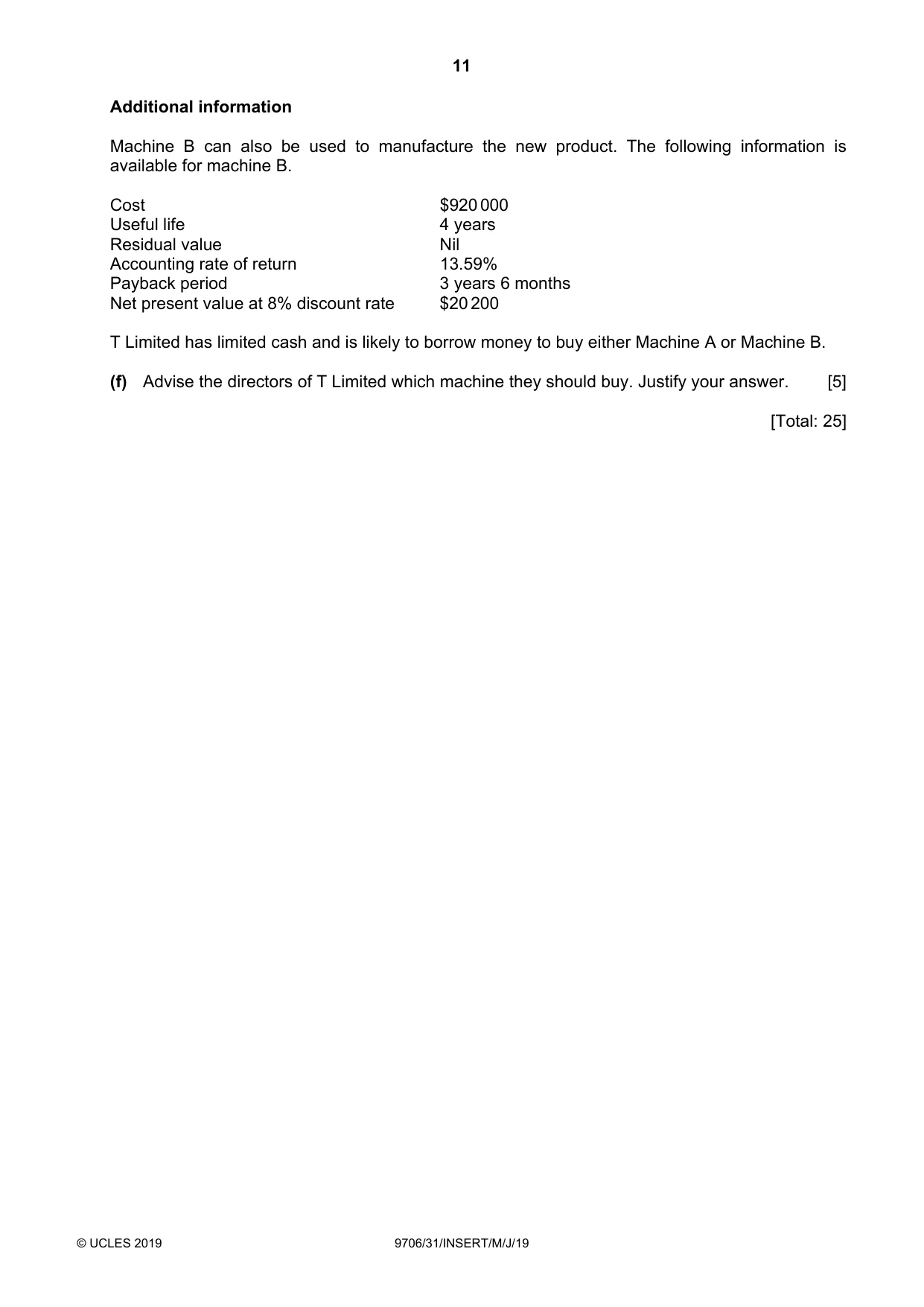
11 © UCLES 2019 9706/31/INSERT/M/J/19 Additional information Machine B can also be used to manufacture the new product. The following information is available for machine B. Cost $920 000 Useful life 4 years Residual value Nil Accounting rate of return 13.59% Payback period 3 years 6 months Net present value at 8% discount rate $20 200 T Limited has limited cash and is likely to borrow money to buy either Machine A or Machine B. (f) Advise the directors of T Limited which machine they should buy. Justify your answer. [5] [Total: 25]
Question paper, page 12
12 Permission to reproduce items where third-party owned material protected by copyright is included has been sought and cleared where possible. Every reasonable effort has been made by the publisher (UCLES) to trace copyright holders, but if any items requiring clearance have unwittingly been included, the publisher will be pleased to make amends at the earliest possible opportunity. To avoid the issue of disclosure of answer-related information to candidates, all copyright acknowledgements are reproduced online in the Cambridge Assessment International Education Copyright Acknowledgements Booklet. This is produced for each series of examinations and is freely available to download at www.cambridgeinternational.org after the live examination series. Cambridge Assessment International Education is part of the Cambridge Assessment Group. Cambridge Assessment is the brand name of the University of Cambridge Local Examinations Syndicate (UCLES), which itself is a department of the University of Cambridge. © UCLES 2019 9706/31/INSERT/M/J/19 BLANK PAGE
Mark scheme, page 1
This document consists of 16 printed pages. © UCLES 2019 [Turn over Cambridge Assessment International Education Cambridge International Advanced Subsidiary and Advanced Level ACCOUNTING 9706/31 Paper 3 Structured Questions May/June 2019 MARK SCHEME Maximum Mark: 150 Published This mark scheme is published as an aid to teachers and candidates, to indicate the requirements of the examination. It shows the basis on which Examiners were instructed to award marks. It does not indicate the details of the discussions that took place at an Examiners’ meeting before marking began, which would have considered the acceptability of alternative answers. Mark schemes should be read in conjunction with the question paper and the Principal Examiner Report for Teachers. Cambridge International will not enter into discussions about these mark schemes. Cambridge International is publishing the mark schemes for the May/June 2019 series for most Cambridge IGCSE™, Cambridge International A and AS Level and Cambridge Pre-U components, and some Cambridge O Level components.
Mark scheme, page 2
9706/31 Cambridge International AS/A Level – Mark Scheme PUBLISHED May/June 2019 © UCLES 2019 Page 2 of 16 Generic Marking Principles These general marking principles must be applied by all examiners when marking candidate answers. They should be applied alongside the specific content of the mark scheme or generic level descriptors for a question. Each question paper and mark scheme will also comply with these marking principles. GENERIC MARKING PRINCIPLE 1: Marks must be awarded in line with: • the specific content of the mark scheme or the generic level descriptors for the question • the specific skills defined in the mark scheme or in the generic level descriptors for the question • the standard of response required by a candidate as exemplified by the standardisation scripts. GENERIC MARKING PRINCIPLE 2: Marks awarded are always whole marks (not half marks, or other fractions). GENERIC MARKING PRINCIPLE 3: Marks must be awarded positively: • marks are awarded for correct/valid answers, as defined in the mark scheme. However, credit is given for valid answers which go beyond the scope of the syllabus and mark scheme, referring to your Team Leader as appropriate • marks are awarded when candidates clearly demonstrate what they know and can do • marks are not deducted for errors • marks are not deducted for omissions • answers should only be judged on the quality of spelling, punctuation and grammar when these features are specifically assessed by the question as indicated by the mark scheme. The meaning, however, should be unambiguous. GENERIC MARKING PRINCIPLE 4: Rules must be applied consistently e.g. in situations where candidates have not followed instructions or in the application of generic level descriptors. GENERIC MARKING PRINCIPLE 5: Marks should be awarded using the full range of marks defined in the mark scheme for the question (however; the use of the full mark range may be limited according to the quality of the candidate responses seen).
Mark scheme, page 3
9706/31 Cambridge International AS/A Level – Mark Scheme PUBLISHED May/June 2019 © UCLES 2019 Page 3 of 16 GENERIC MARKING PRINCIPLE 6: Marks awarded are based solely on the requirements as defined in the mark scheme. Marks should not be awarded with grade thresholds or grade descriptors in mind.
Mark scheme, page 4
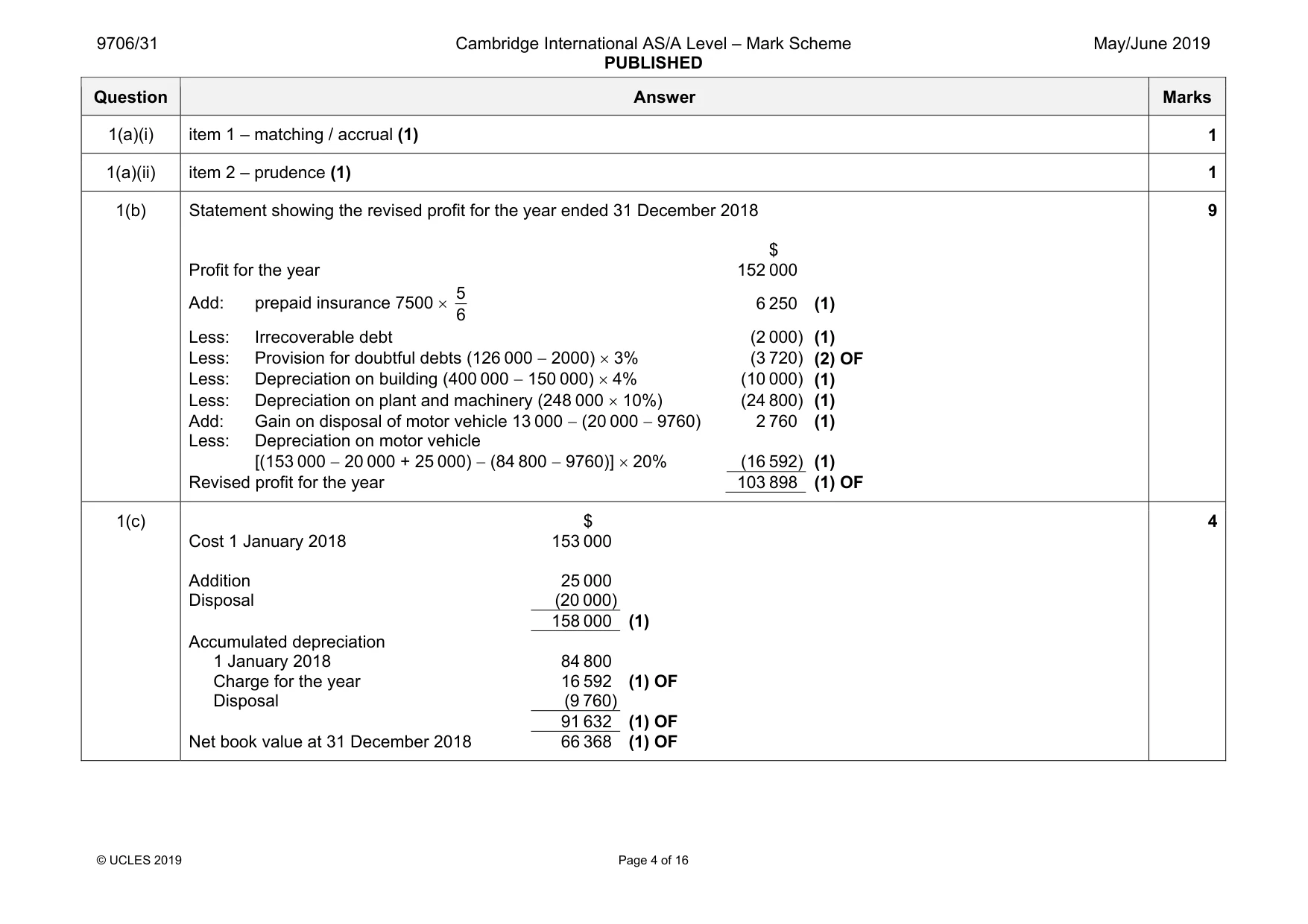
9706/31 Cambridge International AS/A Level – Mark Scheme PUBLISHED May/June 2019 © UCLES 2019 Page 4 of 16 Question Answer Marks 1(a)(i) item 1 – matching / accrual (1) 1 1(a)(ii) item 2 – prudence (1) 1 1(b) Statement showing the revised profit for the year ended 31 December 2018 $00 Profit for the year 152 000 Add: prepaid insurance 7500 × 6 5 6 250 (1) Less: Irrecoverable debt (2 000) (1) Less: Provision for doubtful debts (126 000 − 2000) × 3% (3 720) (2) OF Less: Depreciation on building (400 000 − 150 000) × 4% (10 000) (1) Less: Depreciation on plant and machinery (248 000 × 10%) (24 800) (1) Add: Gain on disposal of motor vehicle 13 000 − (20 000 − 9760) 2 760 (1) Less: Depreciation on motor vehicle [(153 000 − 20 000 + 25 000) − (84 800 − 9760)] × 20% (16 592) (1) Revised profit for the year 103 898 (1) OF 9 1(c) $00 Cost 1 January 2018 153 000 Addition 25 000 Disposal (20 000) 158 000 (1) Accumulated depreciation 1 January 2018 84 800 Charge for the year 16 592 (1) OF Disposal (9 760) 91 632 (1) OF Net book value at 31 December 2018 66 368 (1) OF 4
Mark scheme, page 5
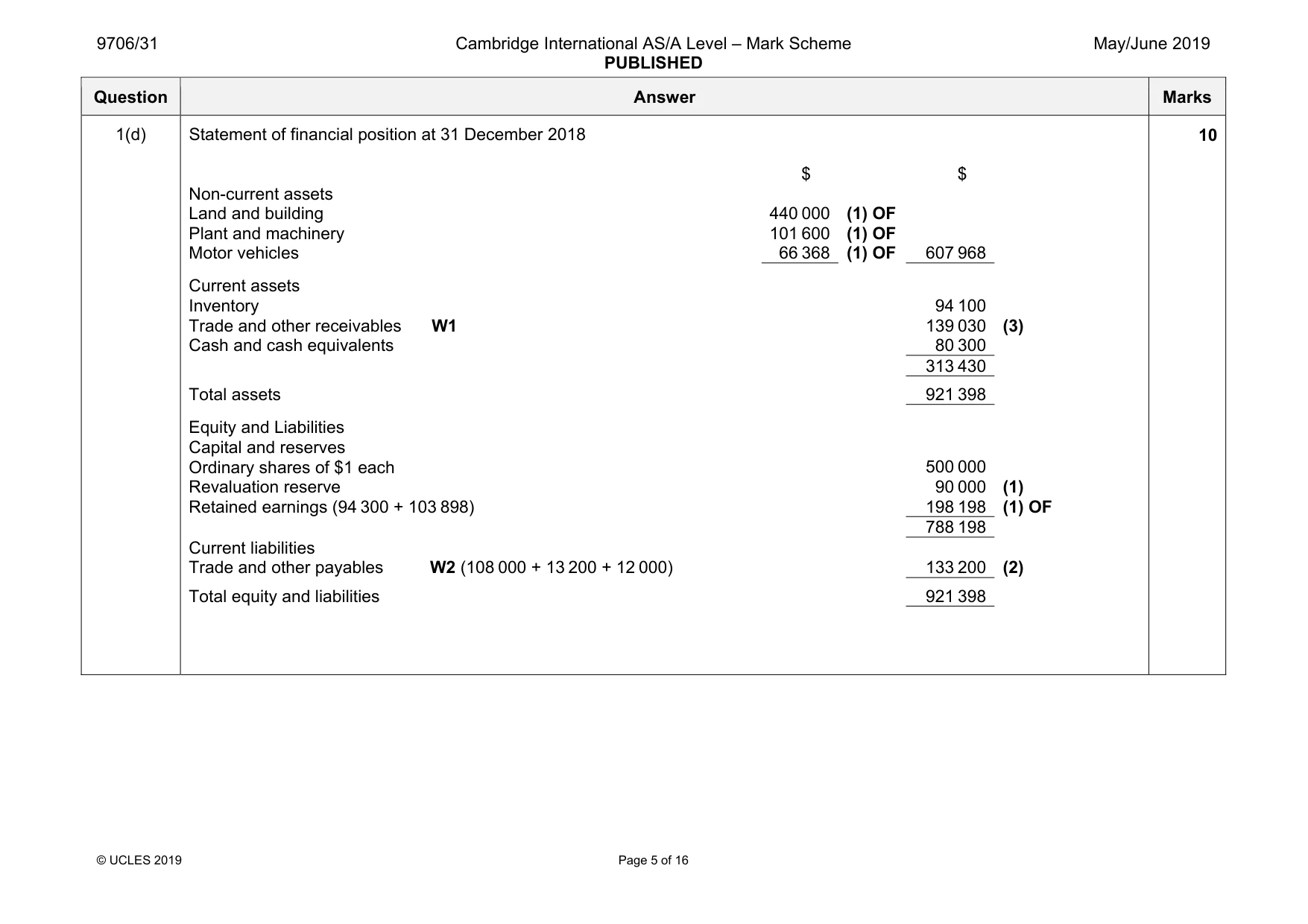
9706/31 Cambridge International AS/A Level – Mark Scheme PUBLISHED May/June 2019 © UCLES 2019 Page 5 of 16 Question Answer Marks 1(d) Statement of financial position at 31 December 2018 $00 $00 Non-current assets Land and building 440 000 (1) OF Plant and machinery 101 600 (1) OF Motor vehicles 66 368 (1) OF 607 968 Current assets Inventory 94 100 Trade and other receivables W1 139 030 (3) Cash and cash equivalents 80 300 313 430 Total assets 921 398 Equity and Liabilities Capital and reserves Ordinary shares of $1 each 500 000 Revaluation reserve 90 000 (1) Retained earnings (94 300 + 103 898) 198 198 (1) OF 788 198 Current liabilities Trade and other payables W2 (108 000 + 13 200 + 12 000) 133 200 (2) Total equity and liabilities 921 398 10
Mark scheme, page 6
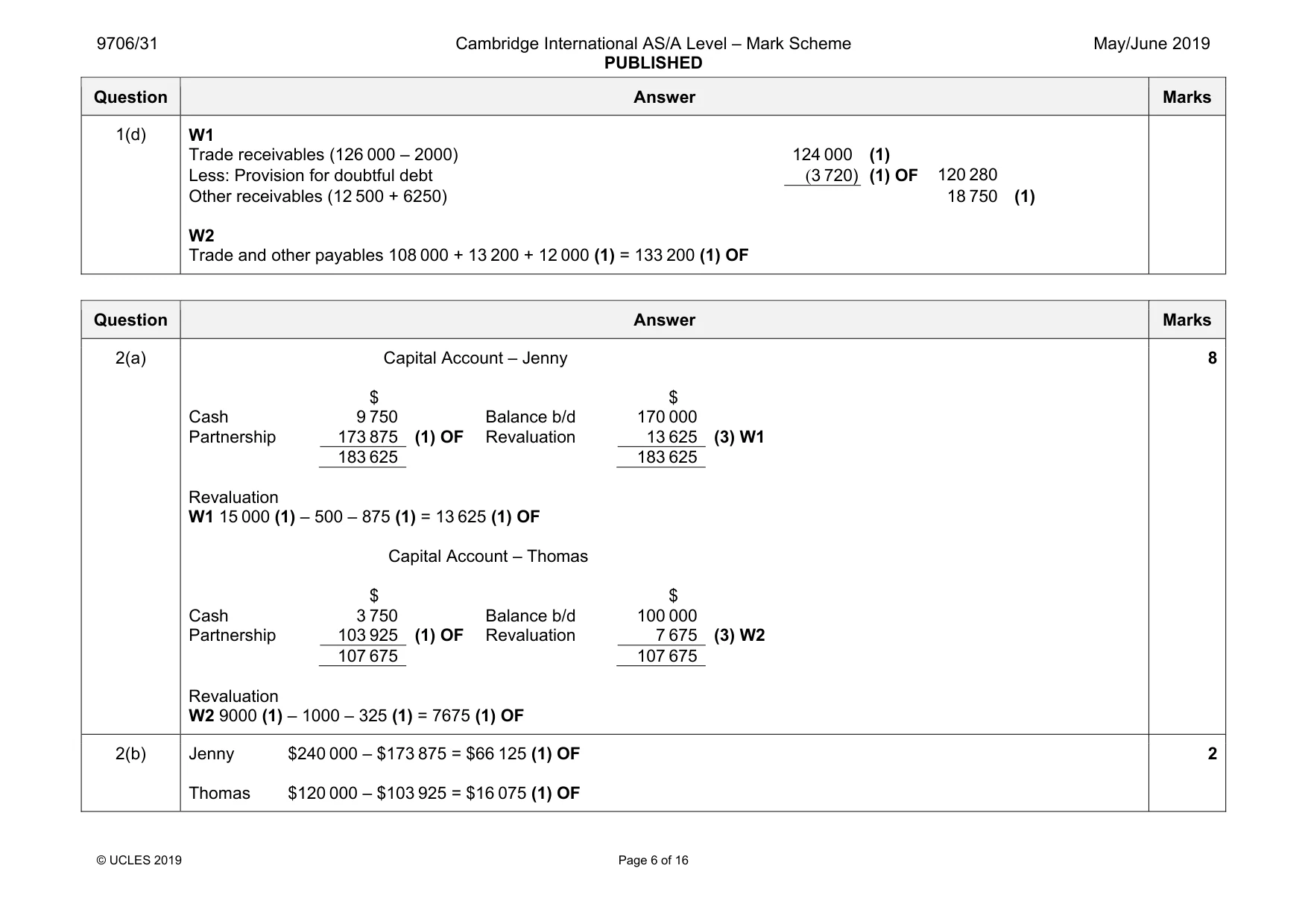
9706/31 Cambridge International AS/A Level – Mark Scheme PUBLISHED May/June 2019 © UCLES 2019 Page 6 of 16 Question Answer Marks 1(d) W1 Trade receivables (126 000 – 2000) 124 000 (1) Less: Provision for doubtful debt (3 720) (1) OF 120 280 Other receivables (12 500 + 6250) 18 750 (1) W2 Trade and other payables 108 000 + 13 200 + 12 000 (1) = 133 200 (1) OF Question Answer Marks 2(a) Capital Account – Jenny $00 $00 Cash 9 750 Balance b/d 170 000 Partnership 173 875 (1) OF Revaluation 13 625 (3) W1 183 625 183 625 Revaluation W1 15 000 (1) – 500 – 875 (1) = 13 625 (1) OF Capital Account – Thomas $00 $00 Cash 3 750 Balance b/d 100 000 Partnership 103 925 (1) OF Revaluation 7 675 (3) W2 107 675 107 675 Revaluation W2 9000 (1) – 1000 – 325 (1) = 7675 (1) OF 8 2(b) Jenny $240 000 – $173 875 = $66 125 (1) OF Thomas $120 000 – $103 925 = $16 075 (1) OF 2
Mark scheme, page 7
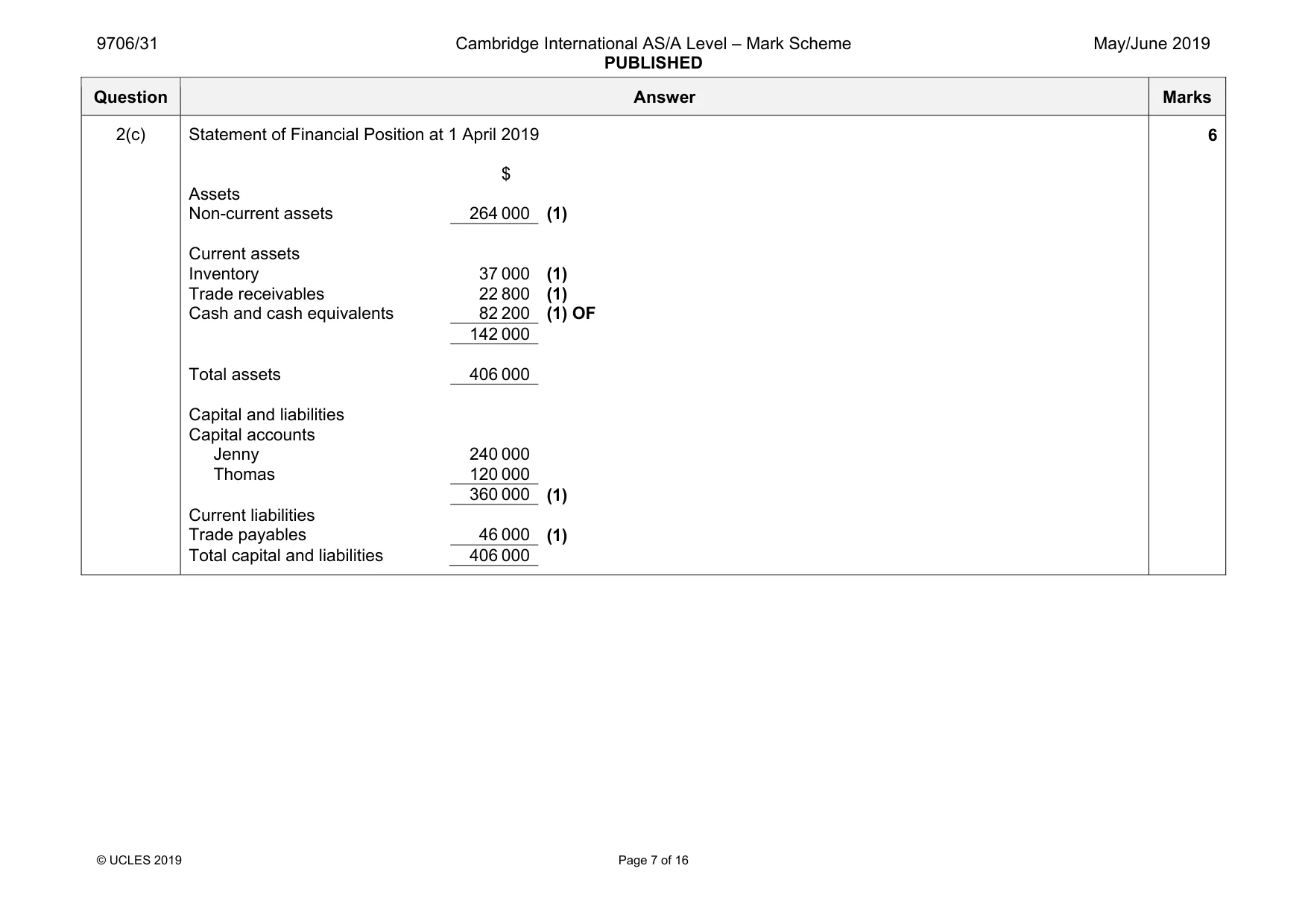
9706/31 Cambridge International AS/A Level – Mark Scheme PUBLISHED May/June 2019 © UCLES 2019 Page 7 of 16 Question Answer Marks 2(c) Statement of Financial Position at 1 April 2019 $00 Assets Non-current assets 264 000 (1) Current assets Inventory 37 000 (1) Trade receivables 22 800 (1) Cash and cash equivalents 82 200 (1) OF 142 000 Total assets 406 000 Capital and liabilities Capital accounts Jenny 240 000 Thomas 120 000 360 000 (1) Current liabilities Trade payables 46 000 (1) Total capital and liabilities 406 000 6
Mark scheme, page 8
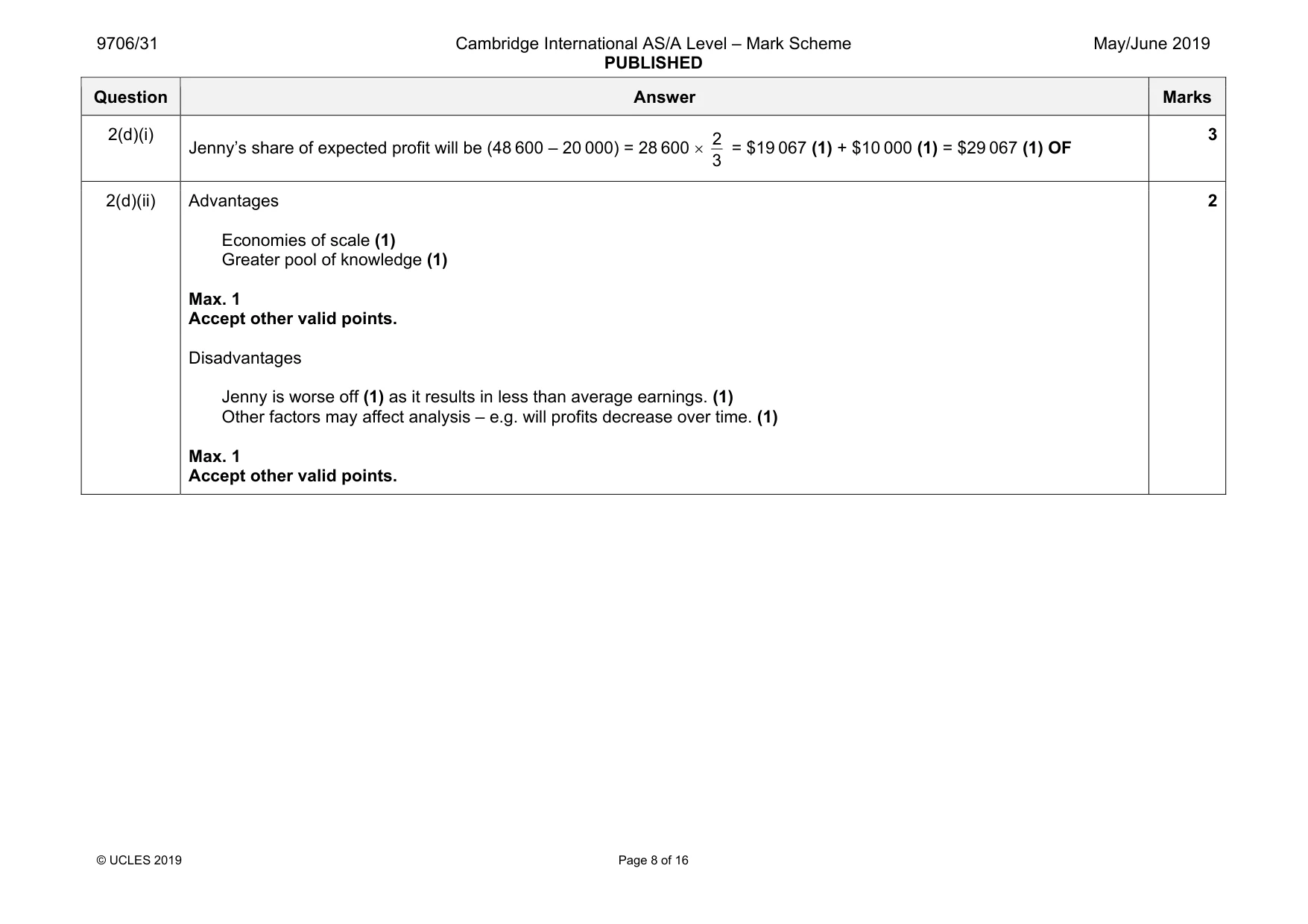
9706/31 Cambridge International AS/A Level – Mark Scheme PUBLISHED May/June 2019 © UCLES 2019 Page 8 of 16 Question Answer Marks 2(d)(i) Jenny’s share of expected profit will be (48 600 – 20 000) = 28 600 × 3 2 = $19 067 (1) + $10 000 (1) = $29 067 (1) OF 3 2(d)(ii) Advantages Economies of scale (1) Greater pool of knowledge (1) Max. 1 Accept other valid points. Disadvantages Jenny is worse off (1) as it results in less than average earnings. (1) Other factors may affect analysis – e.g. will profits decrease over time. (1) Max. 1 Accept other valid points. 2
Mark scheme, page 9
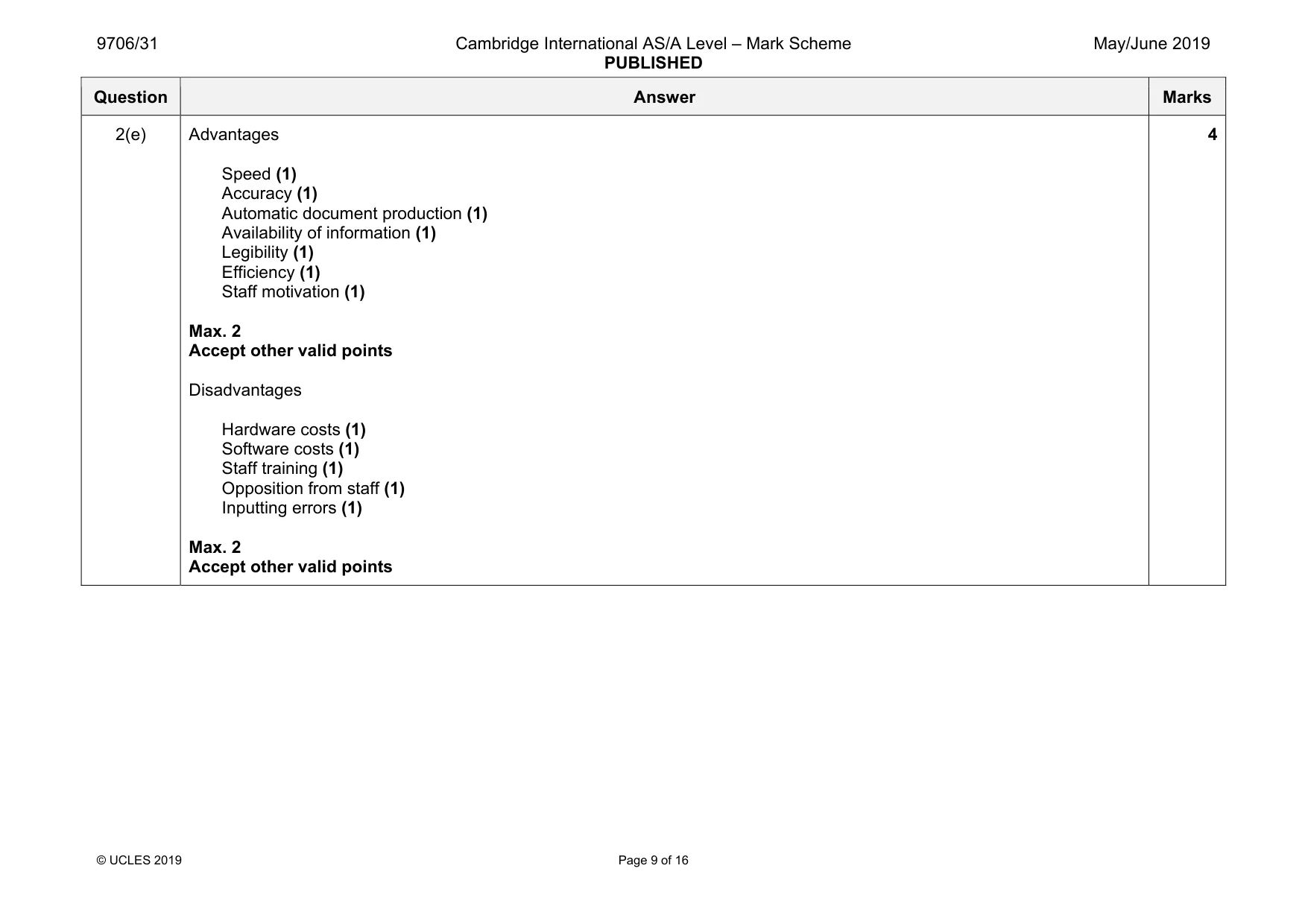
9706/31 Cambridge International AS/A Level – Mark Scheme PUBLISHED May/June 2019 © UCLES 2019 Page 9 of 16 Question Answer Marks 2(e) Advantages Speed (1) Accuracy (1) Automatic document production (1) Availability of information (1) Legibility (1) Efficiency (1) Staff motivation (1) Max. 2 Accept other valid points Disadvantages Hardware costs (1) Software costs (1) Staff training (1) Opposition from staff (1) Inputting errors (1) Max. 2 Accept other valid points 4
Mark scheme, page 10
9706/31 Cambridge International AS/A Level – Mark Scheme PUBLISHED May/June 2019 © UCLES 2019 Page 10 of 16 Question Answer Marks 3(a) Cost = $80 therefore selling price = $100 (1) Goods sent on consignment at 100 – (100 × 10%) = $90 (1) OF 2 3(b)(i) Bank account $00 $00 Balance b/d 55 000 Consignment – transportation 1 000 (1) Rohan 40 000 (1) OF Balance c/d 94 000 95 000 95 000 Balance b/d 94 000 (1) 3 3(b)(ii) Consignment account $00 $00 Goods on consignment 45 000 (1) OF Rohan - sales 72 000 (1) OF Bank – transportation 1 000 (1) Rohan – customs duty 2 250 (1) OF Rohan – commission 3 600 (1) OF Income statement (1) 20 150 (1) OF 72 000 72 000 7 3(b)(iii) Rohan account $00 $00 Consignment – sales 72 000 (1) OF Consignment – customs duty 2 250 (1) OF Consignment- commission 3 600 (1) OF Bank 40 000 (1) OF Balance c/d 26 150 72 000 72 000 Balance b/d 26 150 (1) OF 5
Mark scheme, page 11
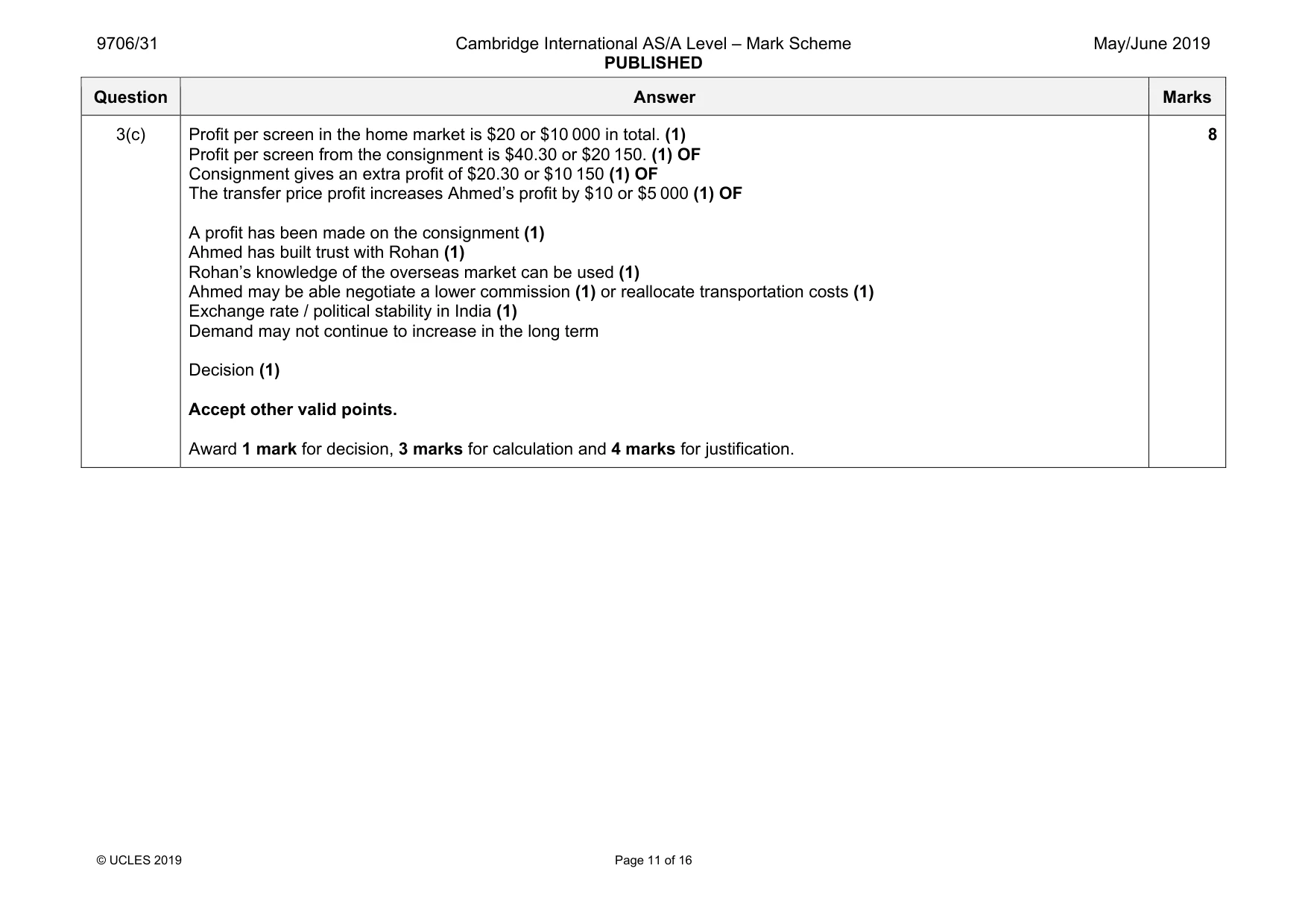
9706/31 Cambridge International AS/A Level – Mark Scheme PUBLISHED May/June 2019 © UCLES 2019 Page 11 of 16 Question Answer Marks 3(c) Profit per screen in the home market is $20 or $10 000 in total. (1) Profit per screen from the consignment is $40.30 or $20 150. (1) OF Consignment gives an extra profit of $20.30 or $10 150 (1) OF The transfer price profit increases Ahmed’s profit by $10 or $5 000 (1) OF A profit has been made on the consignment (1) Ahmed has built trust with Rohan (1) Rohan’s knowledge of the overseas market can be used (1) Ahmed may be able negotiate a lower commission (1) or reallocate transportation costs (1) Exchange rate / political stability in India (1) Demand may not continue to increase in the long term Decision (1) Accept other valid points. Award 1 mark for decision, 3 marks for calculation and 4 marks for justification. 8
Mark scheme, page 12
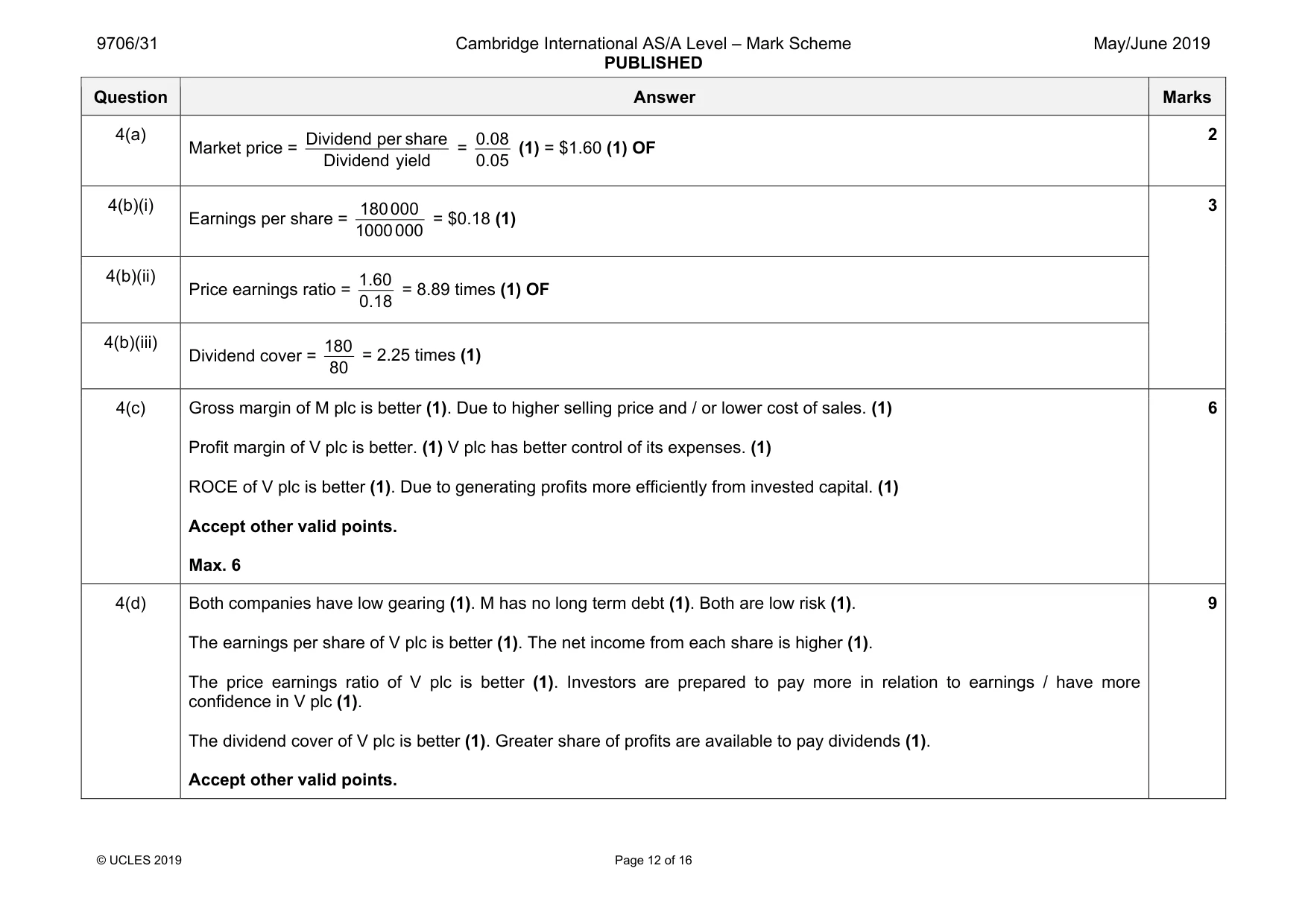
9706/31 Cambridge International AS/A Level – Mark Scheme PUBLISHED May/June 2019 © UCLES 2019 Page 12 of 16 Question Answer Marks 4(a) Market price = yield Dividend share per Dividend = 0.05 0.08 (1) = $1.60 (1) OF 2 4(b)(i) Earnings per share = 000 000 1 000 180 = $0.18 (1) 3 4(b)(ii) Price earnings ratio = 0.18 1.60 = 8.89 times (1) OF 4(b)(iii) Dividend cover = 80 180 = 2.25 times (1) 4(c) Gross margin of M plc is better (1). Due to higher selling price and / or lower cost of sales. (1) Profit margin of V plc is better. (1) V plc has better control of its expenses. (1) ROCE of V plc is better (1). Due to generating profits more efficiently from invested capital. (1) Accept other valid points. Max. 6 6 4(d) Both companies have low gearing (1). M has no long term debt (1). Both are low risk (1). The earnings per share of V plc is better (1). The net income from each share is higher (1). The price earnings ratio of V plc is better (1). Investors are prepared to pay more in relation to earnings / have more confidence in V plc (1). The dividend cover of V plc is better (1). Greater share of profits are available to pay dividends (1). Accept other valid points. 9
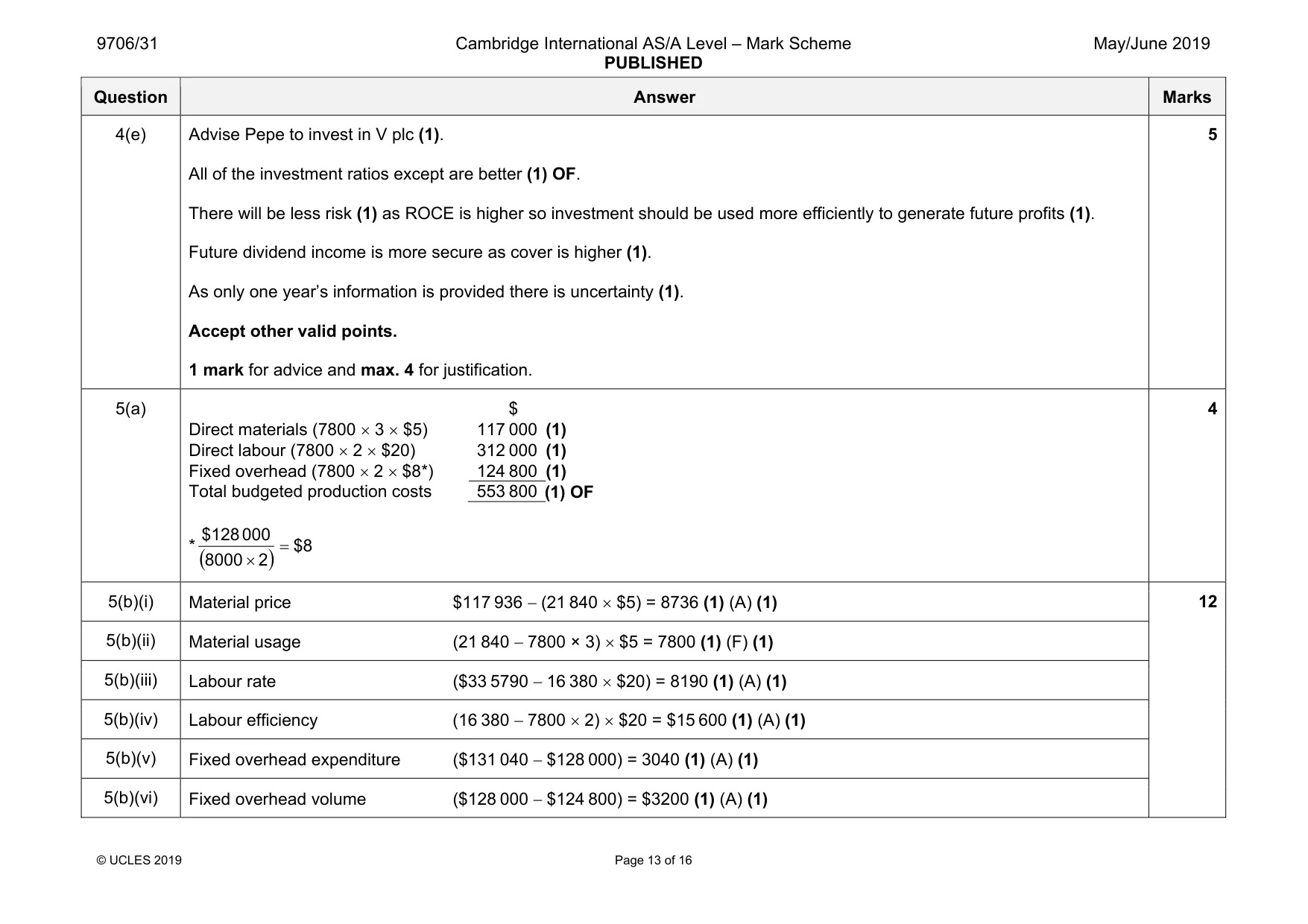
Mark scheme, page 13
9706/31 Cambridge International AS/A Level – Mark Scheme PUBLISHED May/June 2019 © UCLES 2019 Page 13 of 16 Question Answer Marks 4(e) Advise Pepe to invest in V plc (1). All of the investment ratios except are better (1) OF. There will be less risk (1) as ROCE is higher so investment should be used more efficiently to generate future profits (1). Future dividend income is more secure as cover is higher (1). As only one year’s information is provided there is uncertainty (1). Accept other valid points. 1 mark for advice and max. 4 for justification. 5 5(a) $00 Direct materials (7800 × 3 × $5) 117 000 (1) Direct labour (7800 × 2 × $20) 312 000 (1) Fixed overhead (7800 × 2 × $8*) 124 800 (1) Total budgeted production costs 553 800 (1) OF * ( ) $8 2 8000 000 $128 = × 4 5(b)(i) Material price $117 936 − (21 840 × $5) = 8736 (1) (A) (1) 12 5(b)(ii) Material usage (21 840 − 7800 × 3) × $5 = 7800 (1) (F) (1) 5(b)(iii) Labour rate ($33 5790 − 16 380 × $20) = 8190 (1) (A) (1) 5(b)(iv) Labour efficiency (16 380 − 7800 × 2) × $20 = $15 600 (1) (A) (1) 5(b)(v) Fixed overhead expenditure ($131 040 − $128 000) = 3040 (1) (A) (1) 5(b)(vi) Fixed overhead volume ($128 000 − $124 800) = $3200 (1) (A) (1)
Mark scheme, page 14
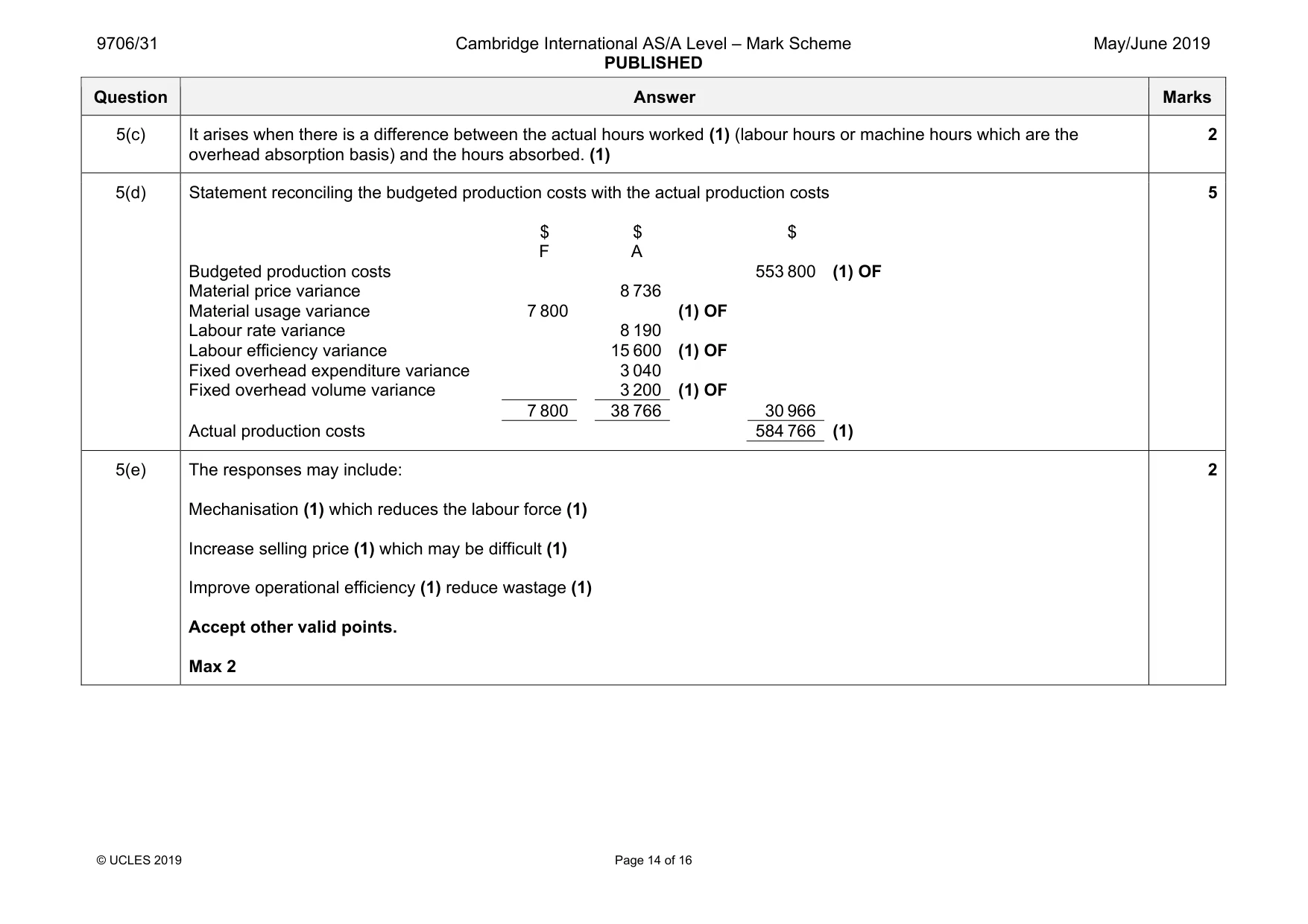
9706/31 Cambridge International AS/A Level – Mark Scheme PUBLISHED May/June 2019 © UCLES 2019 Page 14 of 16 Question Answer Marks 5(c) It arises when there is a difference between the actual hours worked (1) (labour hours or machine hours which are the overhead absorption basis) and the hours absorbed. (1) 2 5(d) Statement reconciling the budgeted production costs with the actual production costs $00 $00 $00 F00 A00 Budgeted production costs 553 800 (1) OF Material price variance 8 736 Material usage variance 7 800 (1) OF Labour rate variance 8 190 Labour efficiency variance 15 600 (1) OF Fixed overhead expenditure variance 3 040 Fixed overhead volume variance 3 200 (1) OF 7 800 38 766 30 966 Actual production costs 584 766 (1) 5 5(e) The responses may include: Mechanisation (1) which reduces the labour force (1) Increase selling price (1) which may be difficult (1) Improve operational efficiency (1) reduce wastage (1) Accept other valid points. Max 2 2
Mark scheme, page 15
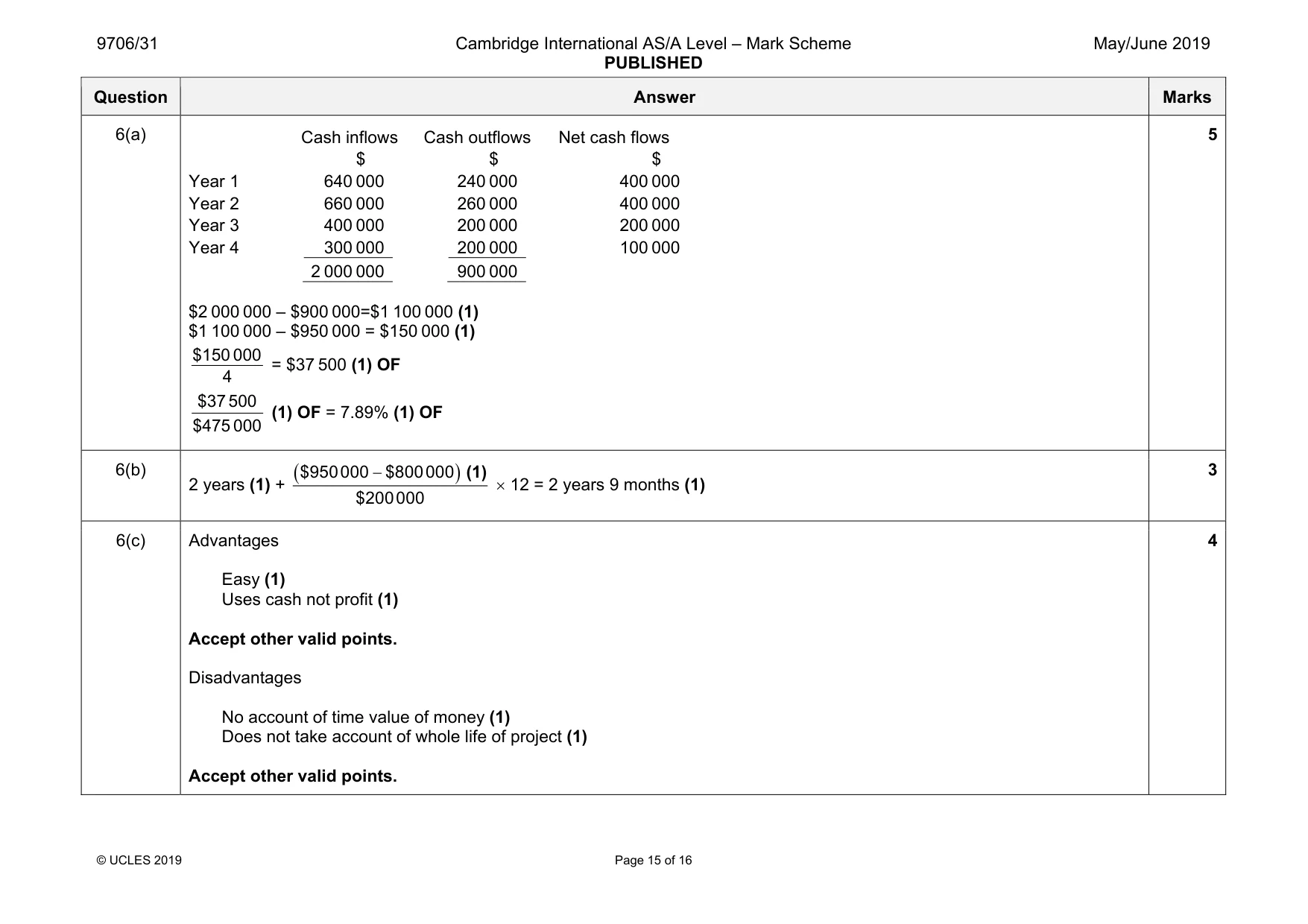
9706/31 Cambridge International AS/A Level – Mark Scheme PUBLISHED May/June 2019 © UCLES 2019 Page 15 of 16 Question Answer Marks 6(a) Cash inflows Cash outflows Net cash flows $00 $00 $00 Year 1 640 000 240 000 400 000 Year 2 660 000 260 000 400 000 Year 3 400 000 200 000 200 000 Year 4 300 000 200 000 100 000 2 000 000 900 000 $2 000 000 – $900 000=$1 100 000 (1) $1 100 000 – $950 000 = $150 000 (1) 4 000 $150 = $37 500 (1) OF 000 $475 500 $37 (1) OF = 7.89% (1) OF 5 6(b) 2 years (1) + ( ) $950000 $800000 $200000 − (1) × 12 = 2 years 9 months (1) 3 6(c) Advantages Easy (1) Uses cash not profit (1) Accept other valid points. Disadvantages No account of time value of money (1) Does not take account of whole life of project (1) Accept other valid points. 4
Mark scheme, page 16
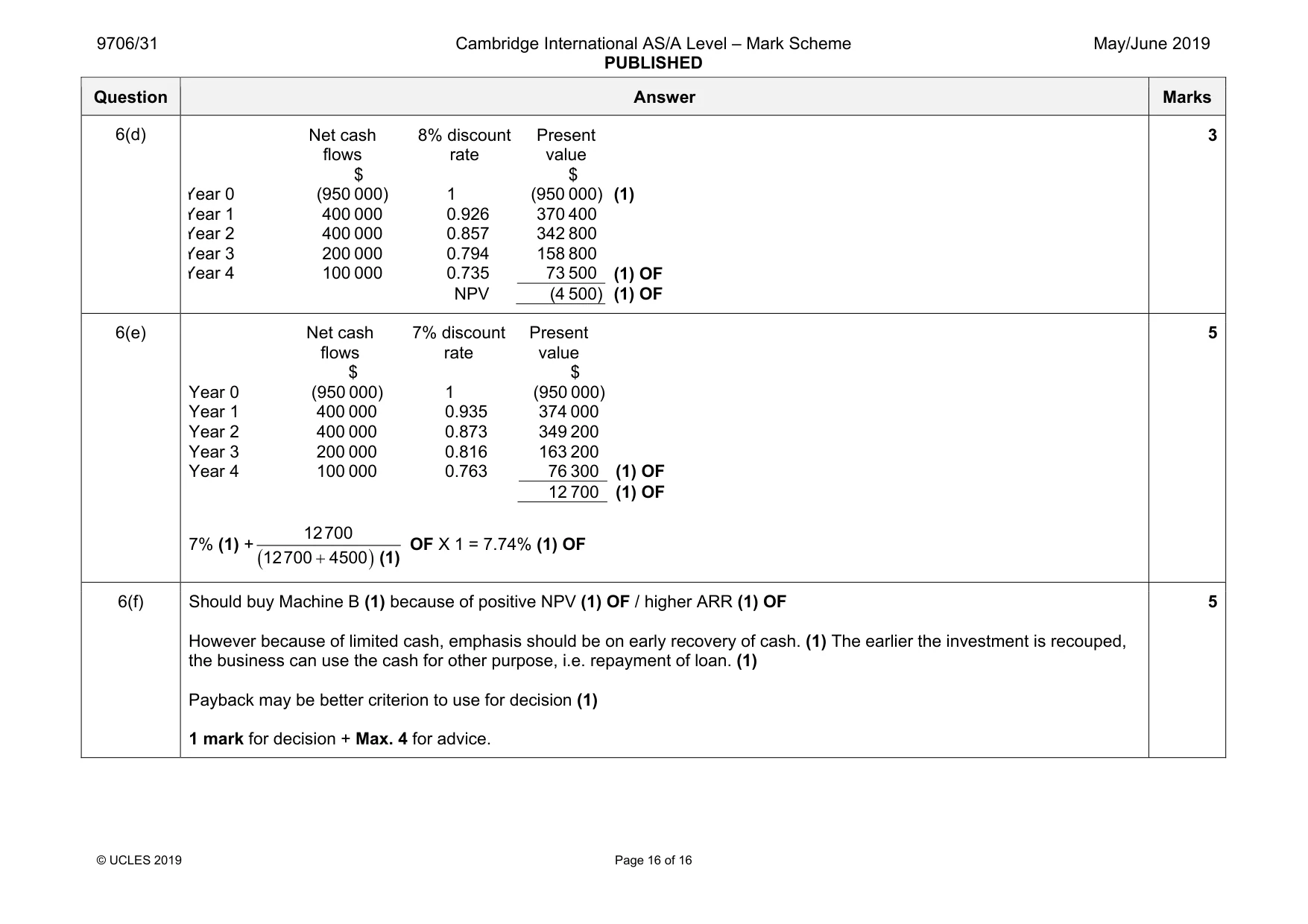
9706/31 Cambridge International AS/A Level – Mark Scheme PUBLISHED May/June 2019 © UCLES 2019 Page 16 of 16 Question Answer Marks 6(d) Net cash flows 8% discount rate Present value $00 $00 Year 0 (950 000) 1.000 (950 000) (1) Year 1 400 000 0.926 370 400 Year 2 400 000 0.857 342 800 Year 3 200 000 0.794 158 800 Year 4 100 000 0.735 73 500 (1) OF NPV (4 500) (1) OF 3 6(e) Net cash flows 7% discount rate Present value $00 $00 Year 0 (950 000) 1.000 (950 000) Year 1 400 000 0.935 374 000 Year 2 400 000 0.873 349 200 Year 3 200 000 0.816 163 200 Year 4 100 000 0.763 76 300 (1) OF 12 700 (1) OF 7% (1) + ( ) 12700 12700 4500 + (1) OF X 1 = 7.74% (1) OF 5 6(f) Should buy Machine B (1) because of positive NPV (1) OF / higher ARR (1) OF However because of limited cash, emphasis should be on early recovery of cash. (1) The earlier the investment is recouped, the business can use the cash for other purpose, i.e. repayment of loan. (1) Payback may be better criterion to use for decision (1) 1 mark for decision + Max. 4 for advice. 5
What you needed in this session
Cambridge’s own grade thresholds for 2019 May/June, Paper 3 · Variant 1. A higher threshold means an easier paper — the bar moves with how the cohort did.