Cambridge A Level Accounting 9706 — 2018 Feb/March Paper 3 · Variant 2
9706/32/F/M/18 · 150 marks · ≈169 min
The question paper and its mark scheme, free to read here and free to download. This is Cambridge’s own paper, exactly as it was sat.
Question paper24 pages








Mark scheme14 pages
Answers below. Sit the paper first if you are practising.
Paper as text
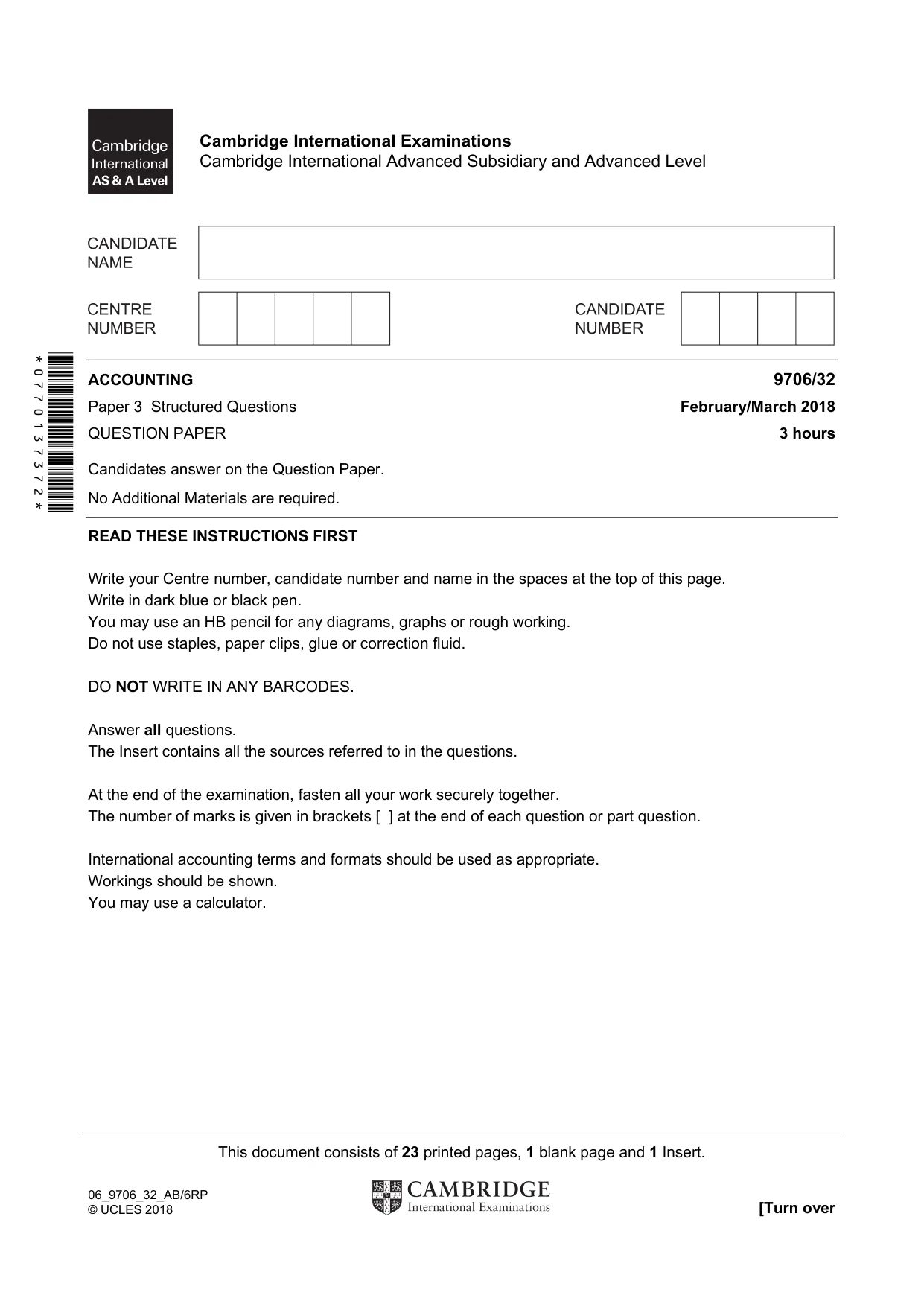
Question paper, page 1
This document consists of 23 printed pages, 1 blank page and 1 Insert. 06_9706_32_AB/6RP © UCLES 2018 [Turn over Cambridge International Examinations Cambridge International Advanced Subsidiary and Advanced Level ACCOUNTING 9706/32 Paper 3 Structured Questions February/March 2018 QUESTION PAPER 3 hours Candidates answer on the Question Paper. No Additional Materials are required. READ THESE INSTRUCTIONS FIRST Write your Centre number, candidate number and name in the spaces at the top of this page. Write in dark blue or black pen. You may use an HB pencil for any diagrams, graphs or rough working. Do not use staples, paper clips, glue or correction fluid. DO NOT WRITE IN ANY BARCODES. Answer all questions. The Insert contains all the sources referred to in the questions. At the end of the examination, fasten all your work securely together. The number of marks is given in brackets [ ] at the end of each question or part question. International accounting terms and formats should be used as appropriate. Workings should be shown. You may use a calculator.
Question paper, page 2
2 © UCLES 2018 9706/32/F/M/2018 Section A: Financial Accounting Answer all questions Question 1 Read Source A1 in the Insert. (a) Prepare the manufacturing account for Marco for the year ended 31 January 2018.
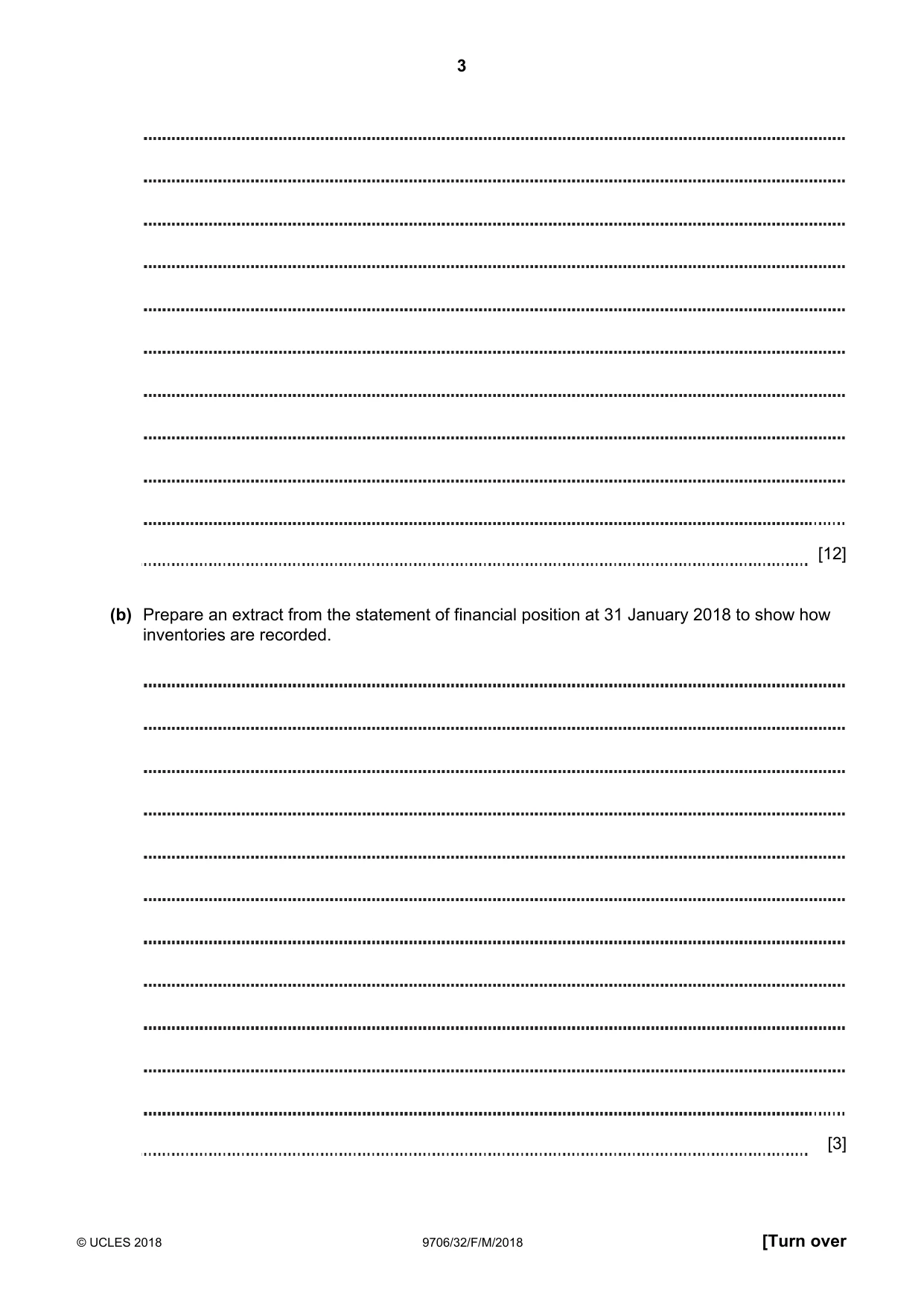
Question paper, page 3
3 © UCLES 2018 9706/32/F/M/2018 [Turn over [12] (b) Prepare an extract from the statement of financial position at 31 January 2018 to show how inventories are recorded. [3]
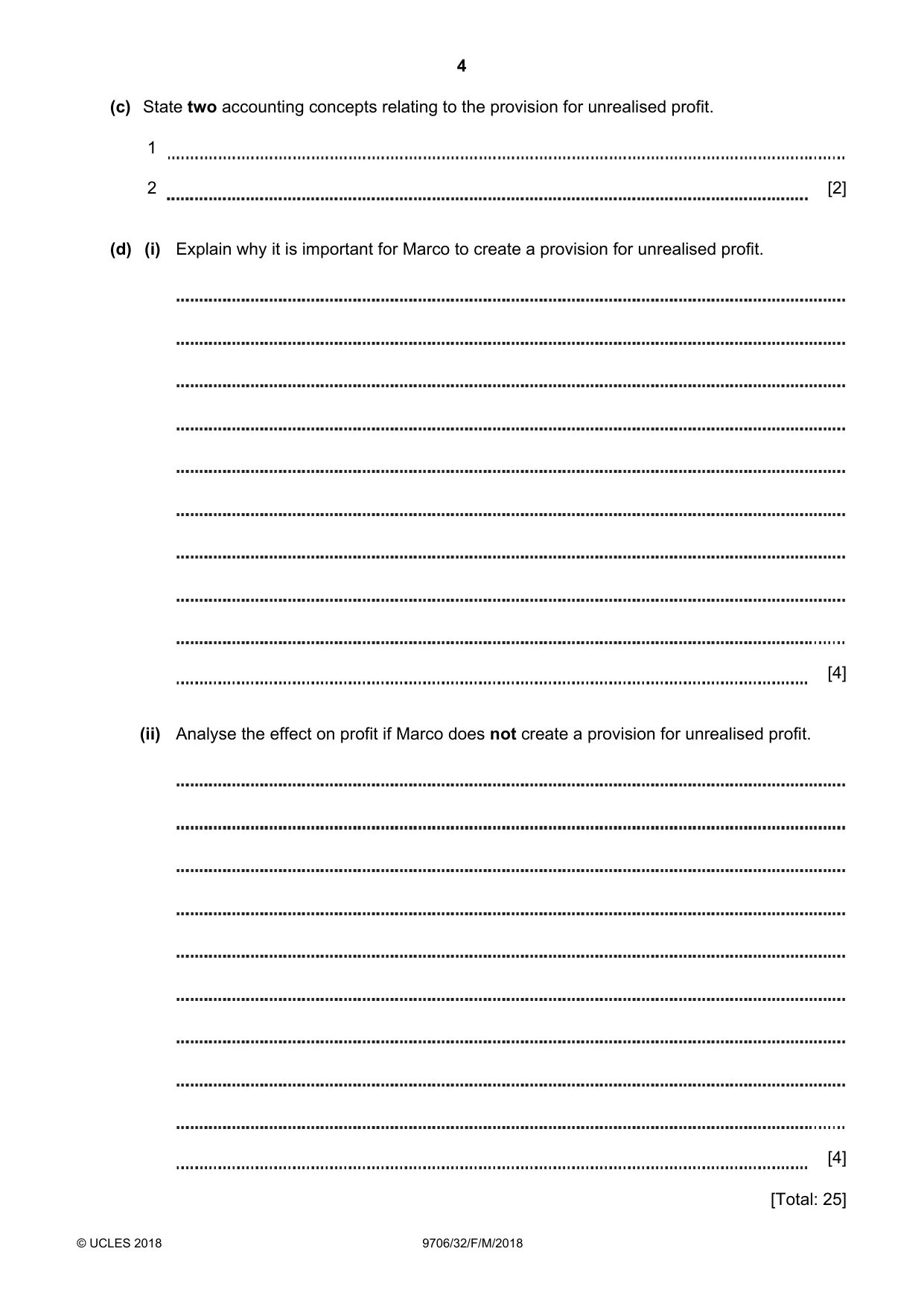
Question paper, page 4
4 © UCLES 2018 9706/32/F/M/2018 (c) State two accounting concepts relating to the provision for unrealised profit. 1 2 [2] (d) (i) Explain why it is important for Marco to create a provision for unrealised profit. [4] (ii) Analyse the effect on profit if Marco does not create a provision for unrealised profit. [4] [Total: 25]
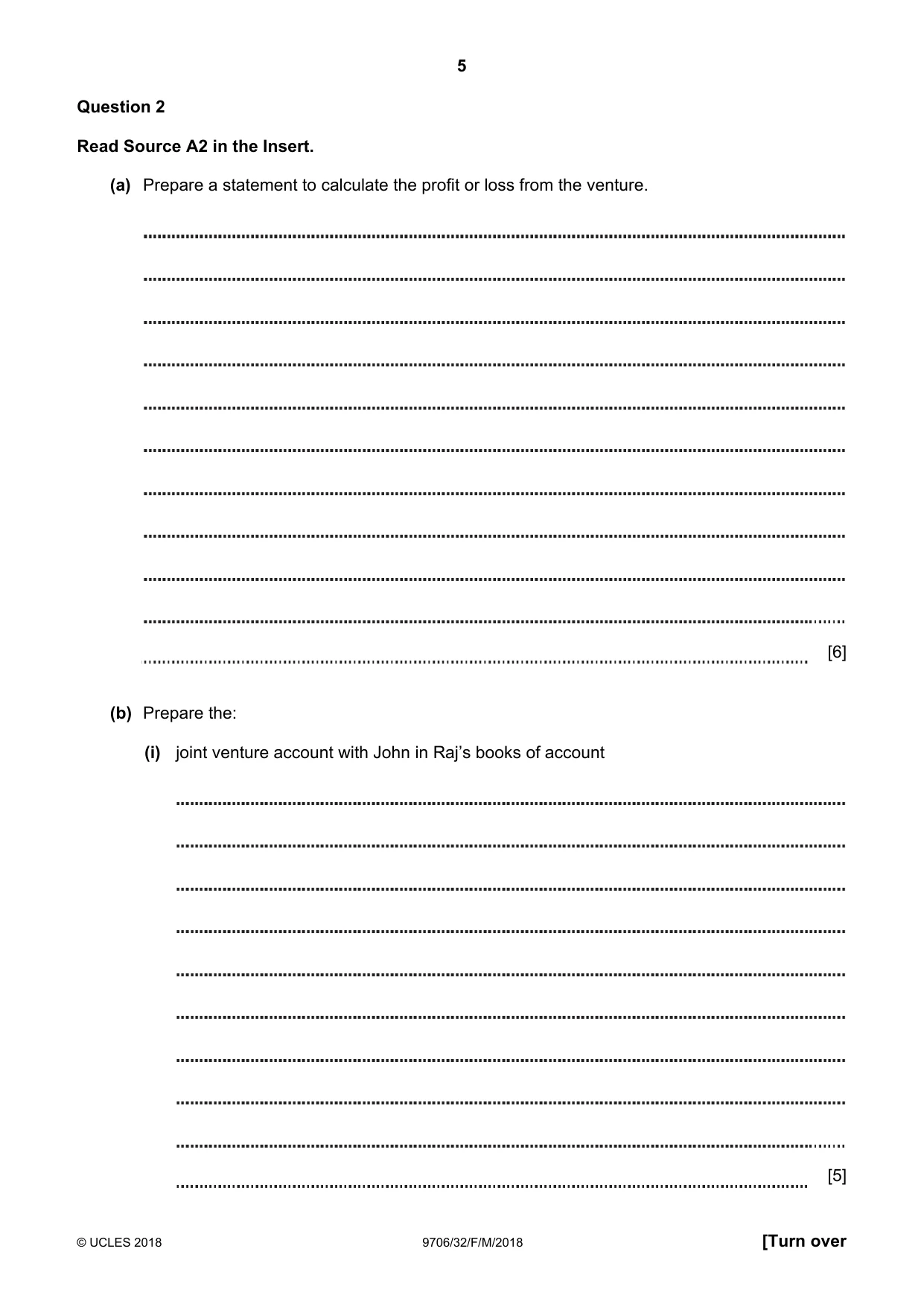
Question paper, page 5
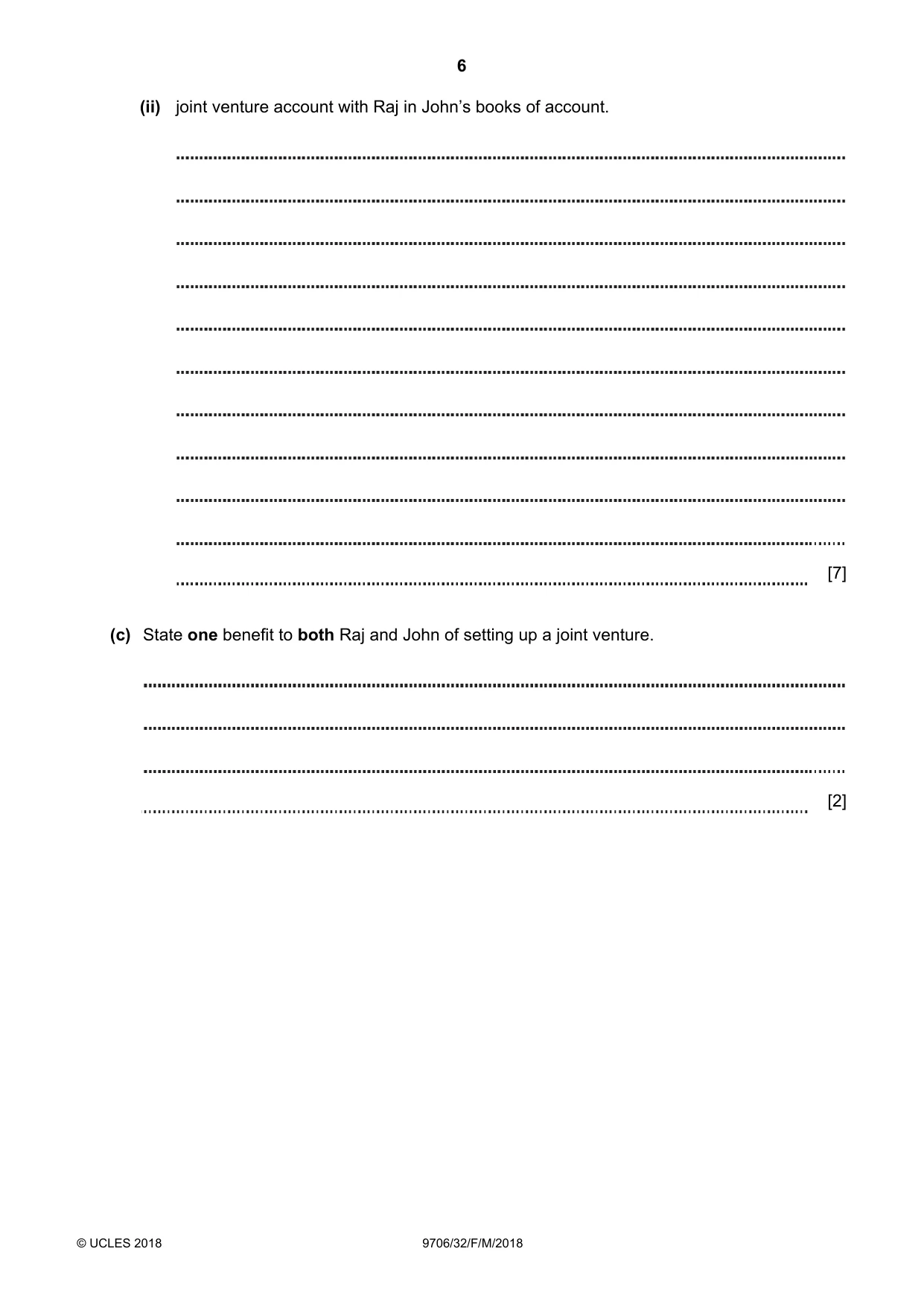
5 © UCLES 2018 9706/32/F/M/2018 [Turn over Question 2 Read Source A2 in the Insert. (a) Prepare a statement to calculate the profit or loss from the venture. [6] (b) Prepare the: (i) joint venture account with John in Raj’s books of account [5]
Question paper, page 6
6 © UCLES 2018 9706/32/F/M/2018 (ii) joint venture account with Raj in John’s books of account. [7] (c) State one benefit to both Raj and John of setting up a joint venture. [2]
Question paper, page 7
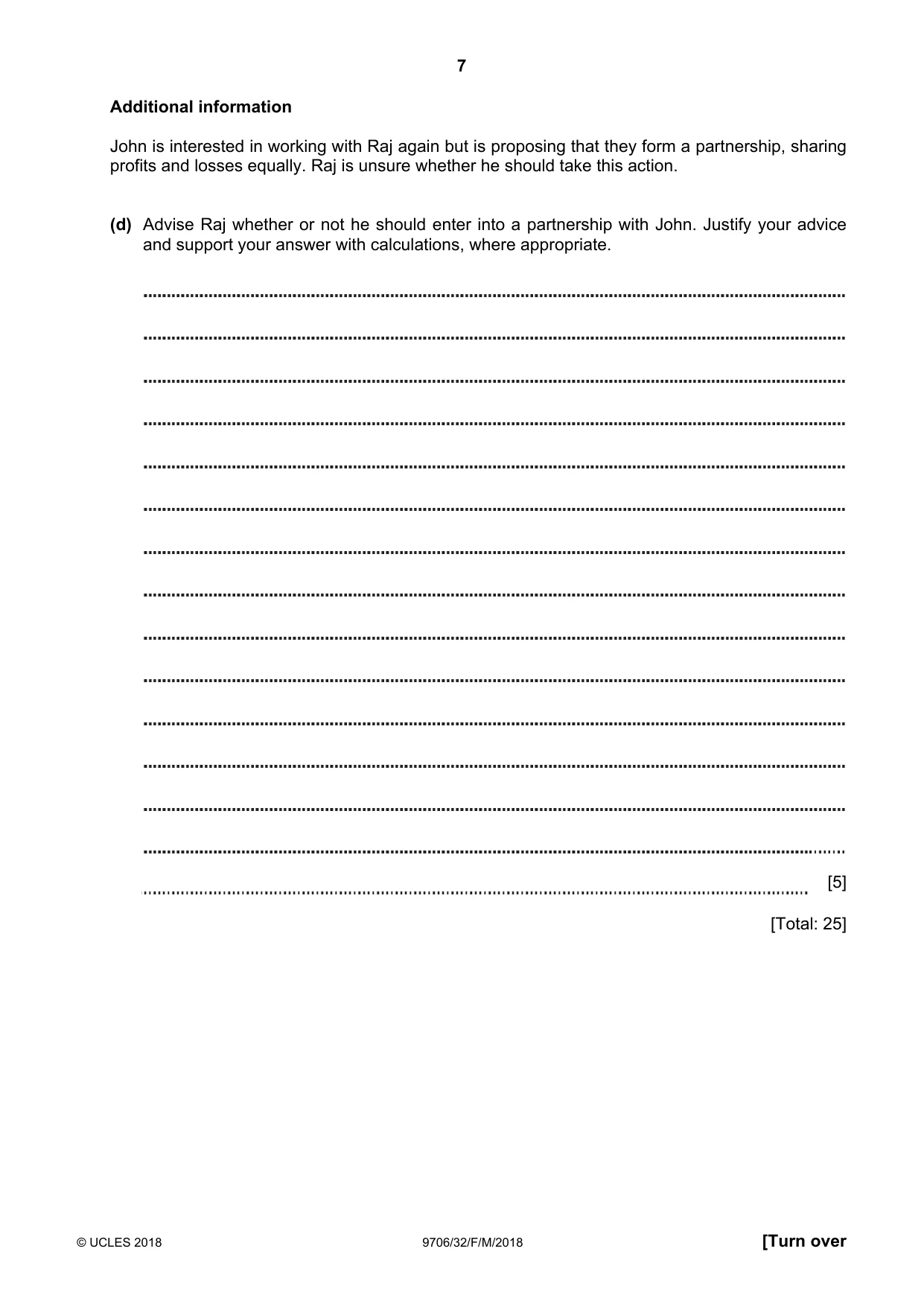
7 © UCLES 2018 9706/32/F/M/2018 [Turn over Additional information John is interested in working with Raj again but is proposing that they form a partnership, sharing profits and losses equally. Raj is unsure whether he should take this action. (d) Advise Raj whether or not he should enter into a partnership with John. Justify your advice and support your answer with calculations, where appropriate. [5] [Total: 25]
Question paper, page 8
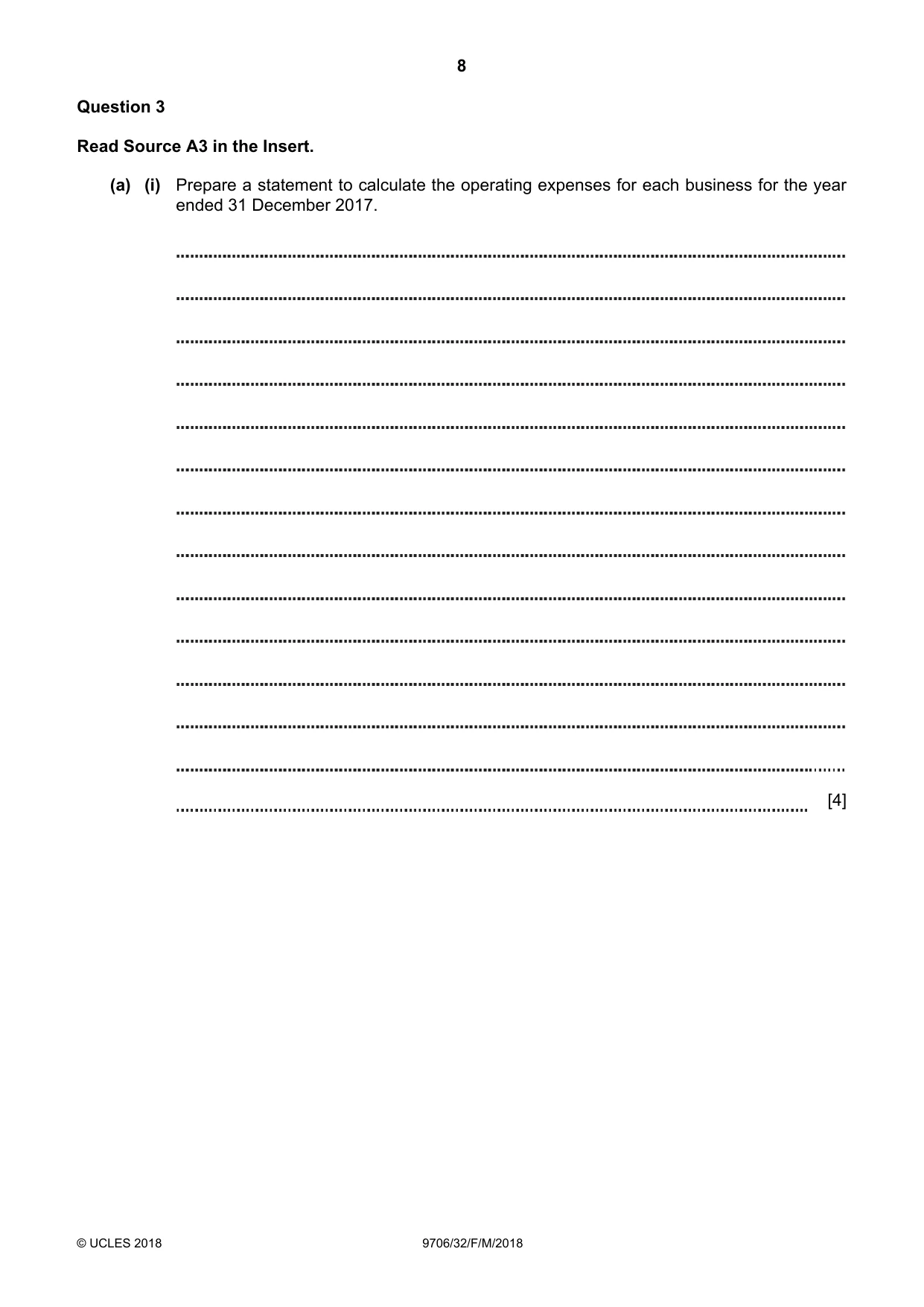
8 © UCLES 2018 9706/32/F/M/2018 Question 3 Read Source A3 in the Insert. (a) (i) Prepare a statement to calculate the operating expenses for each business for the year ended 31 December 2017. [4]
Question paper, page 9
9 © UCLES 2018 9706/32/F/M/2018 [Turn over (ii) Prepare a statement to calculate the expected additional profit R Limited will make for the year ended 31 December 2018 if it buys Joe Tu’s business. [4]
Question paper, page 10
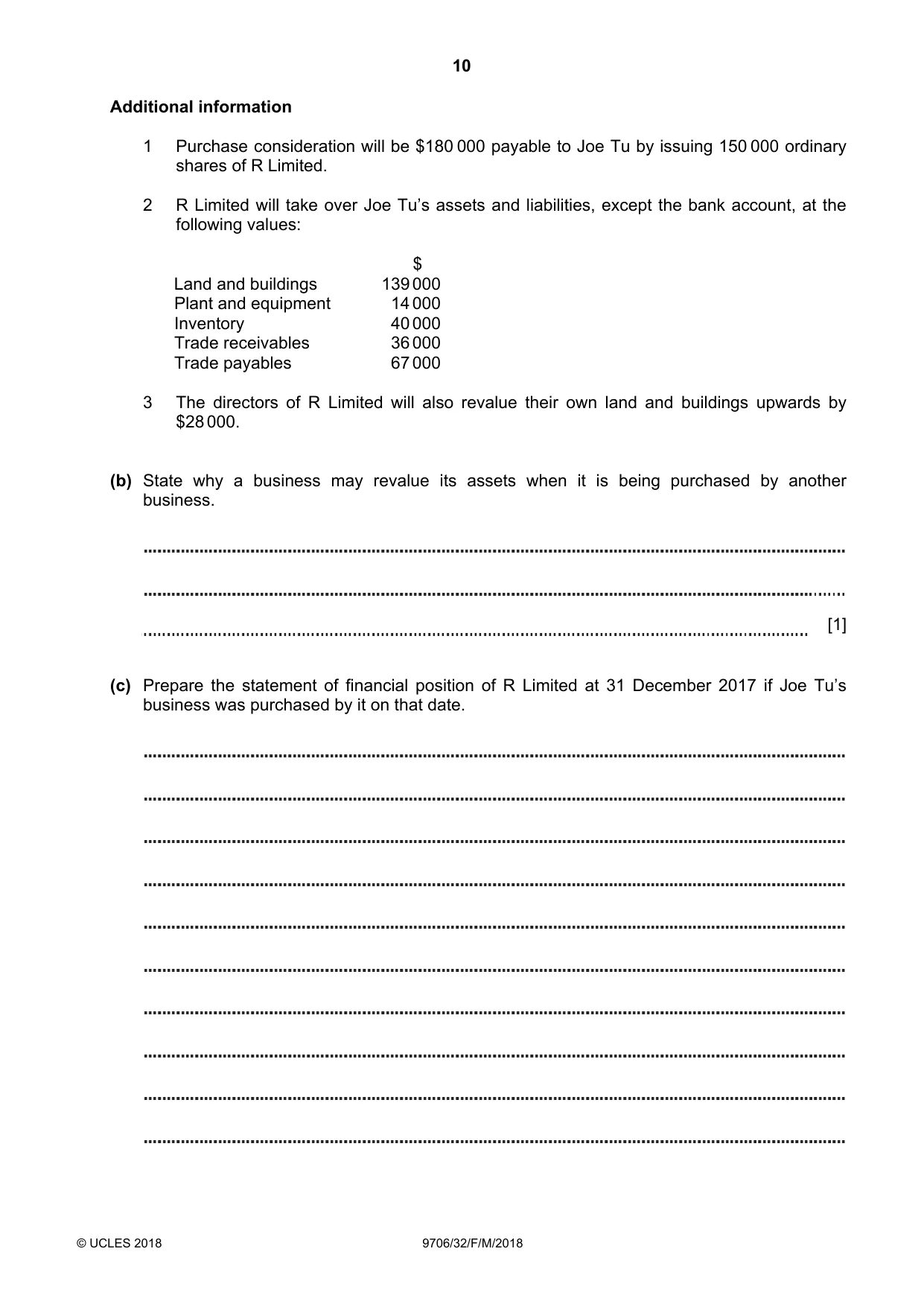
10 © UCLES 2018 9706/32/F/M/2018 Additional information 1 Purchase consideration will be $180 000 payable to Joe Tu by issuing 150 000 ordinary shares of R Limited. 2 R Limited will take over Joe Tu’s assets and liabilities, except the bank account, at the following values: $ Land and buildings 139 000 Plant and equipment 14 000 Inventory 40 000 Trade receivables 36 000 Trade payables 67 000 3 The directors of R Limited will also revalue their own land and buildings upwards by $28 000. (b) State why a business may revalue its assets when it is being purchased by another business. [1] (c) Prepare the statement of financial position of R Limited at 31 December 2017 if Joe Tu’s business was purchased by it on that date.
Question paper, page 11
11 © UCLES 2018 9706/32/F/M/2018 [Turn over
Question paper, page 13
13 © UCLES 2018 9706/32/F/M/2018 [Turn over (d) Advise Robert and Paul whether or not they should buy Joe Tu’s business. Justify your answer by discussing the non-financial advantages and disadvantages of this action. [5] [Total: 25]
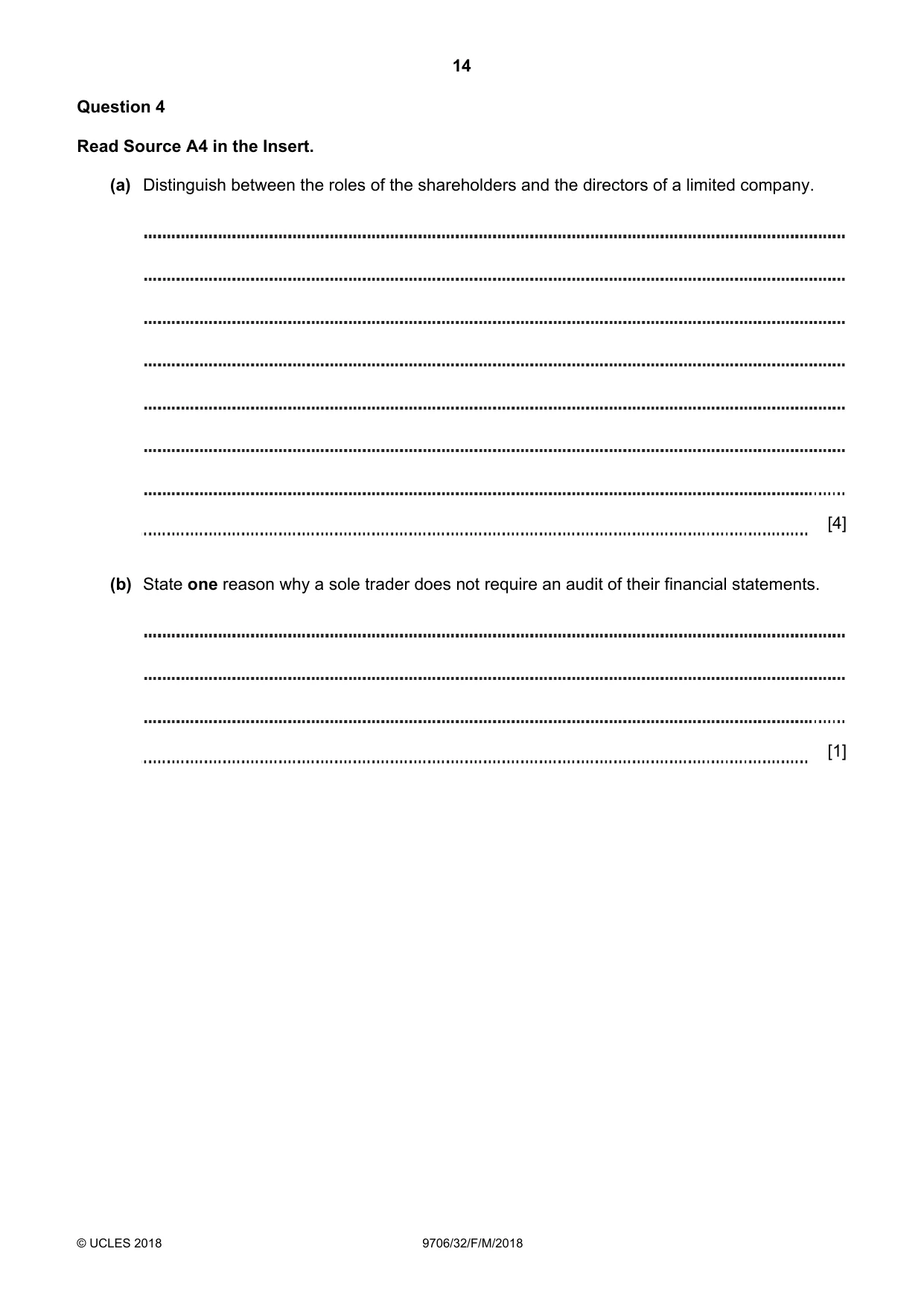
Question paper, page 14
14 © UCLES 2018 9706/32/F/M/2018 Question 4 Read Source A4 in the Insert. (a) Distinguish between the roles of the shareholders and the directors of a limited company. [4] (b) State one reason why a sole trader does not require an audit of their financial statements. [1]
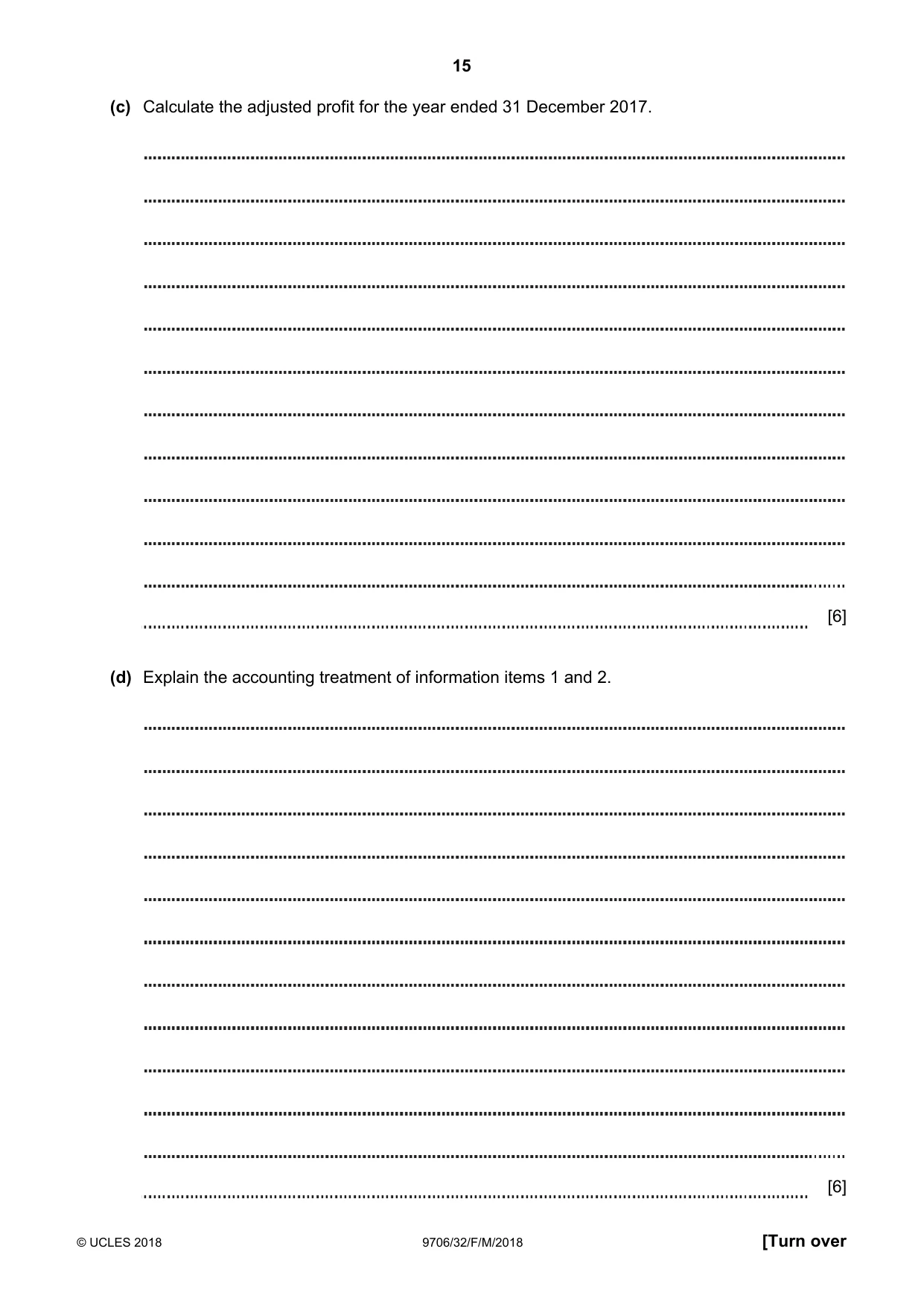
Question paper, page 15
15 © UCLES 2018 9706/32/F/M/2018 [Turn over (c) Calculate the adjusted profit for the year ended 31 December 2017. [6] (d) Explain the accounting treatment of information items 1 and 2. [6]
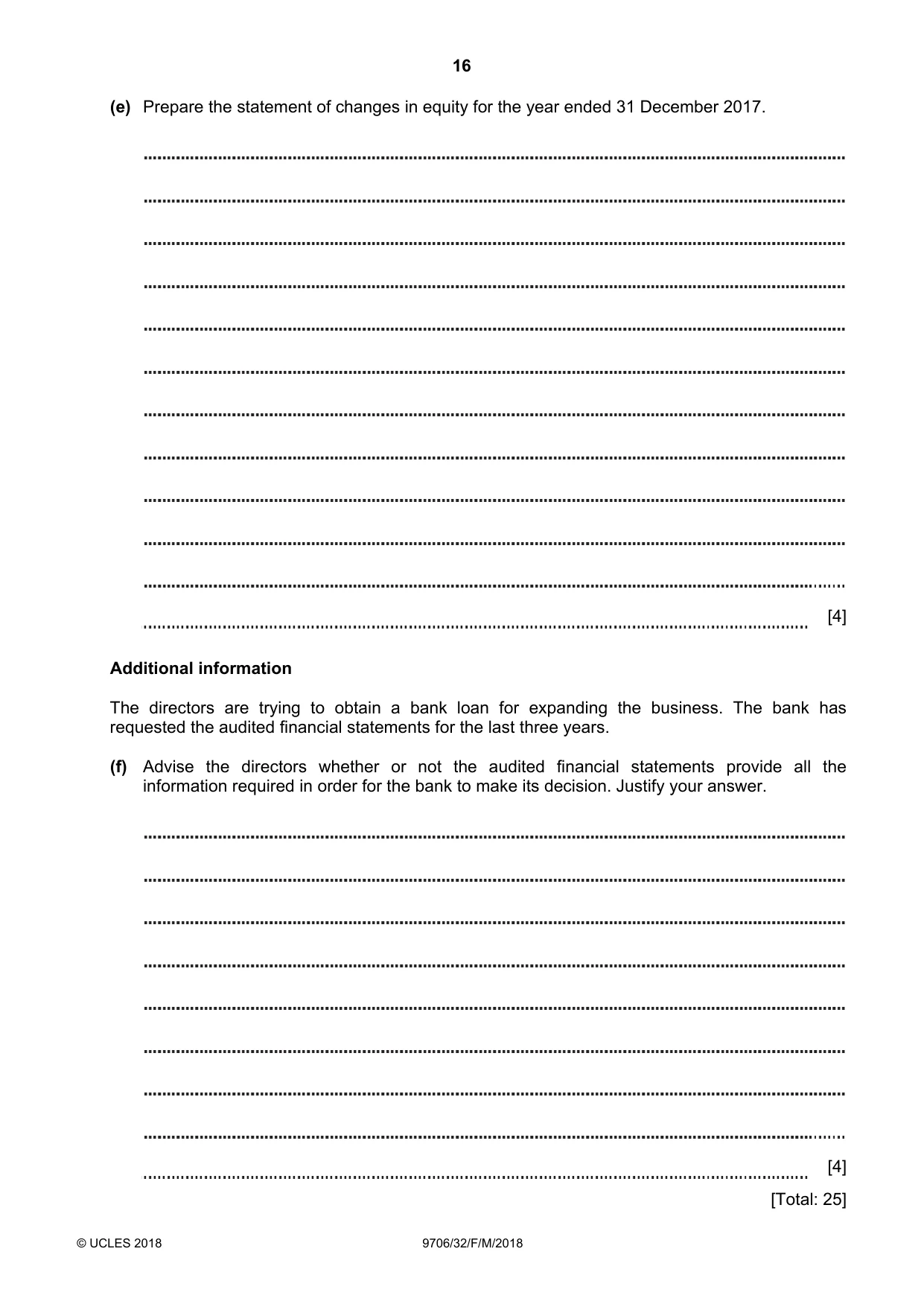
Question paper, page 16
16 © UCLES 2018 9706/32/F/M/2018 (e) Prepare the statement of changes in equity for the year ended 31 December 2017. [4] Additional information The directors are trying to obtain a bank loan for expanding the business. The bank has requested the audited financial statements for the last three years. (f) Advise the directors whether or not the audited financial statements provide all the information required in order for the bank to make its decision. Justify your answer. [4] [Total: 25]
Question paper, page 17
17 © UCLES 2018 9706/32/F/M/2018 [Turn over Section B: Cost and Management Accounting Answer all questions Question 5 Read Source B1 in the Insert. (a) Explain what is meant by the term ‘budgetary control’. [2] (b) Prepare the labour budget for the year ending 31 January 2018. Clearly show the number of labour hours, the number of employees and the annual labour cost for each department.
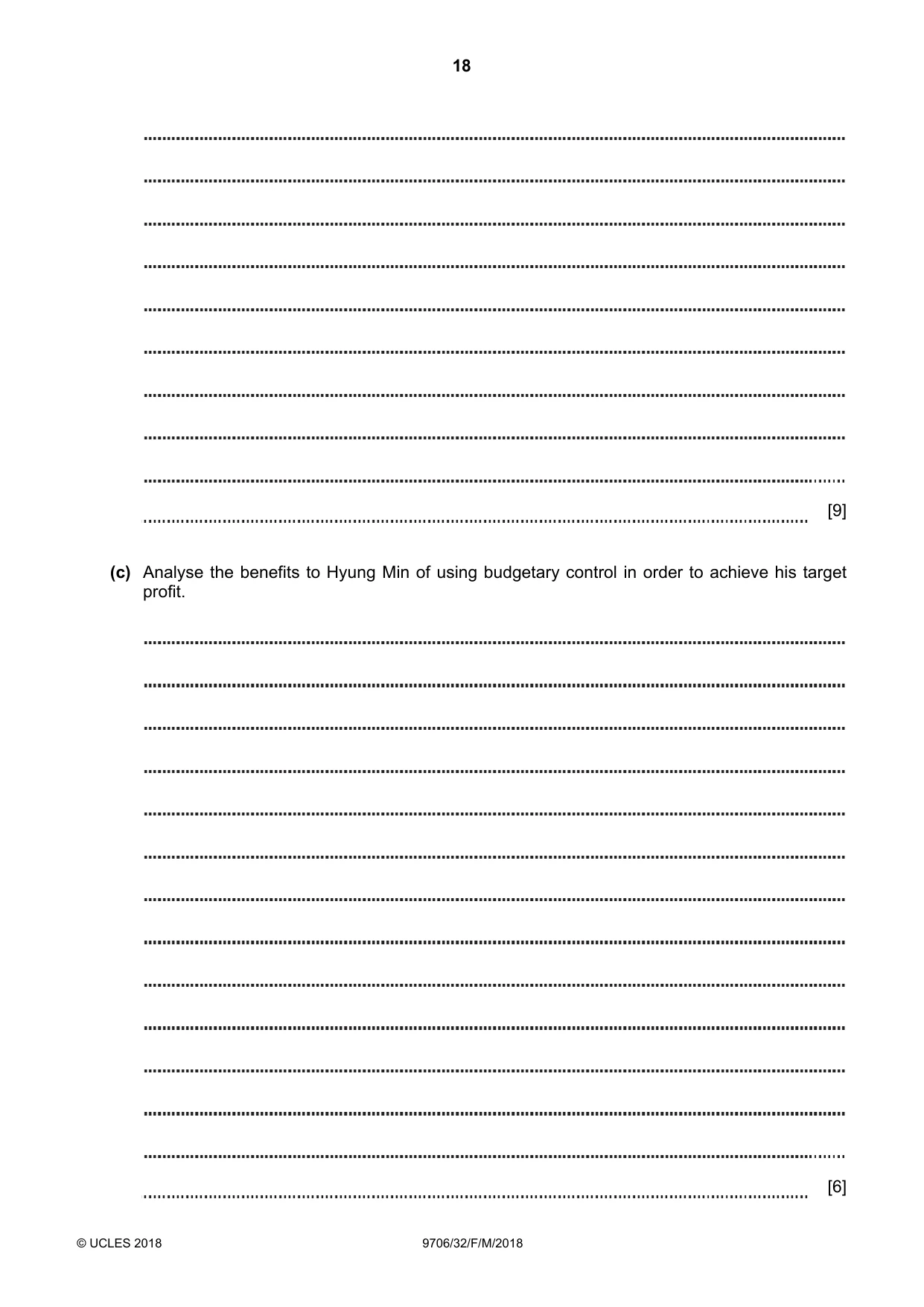
Question paper, page 18
18 © UCLES 2018 9706/32/F/M/2018 [9] (c) Analyse the benefits to Hyung Min of using budgetary control in order to achieve his target profit. [6]
Question paper, page 19
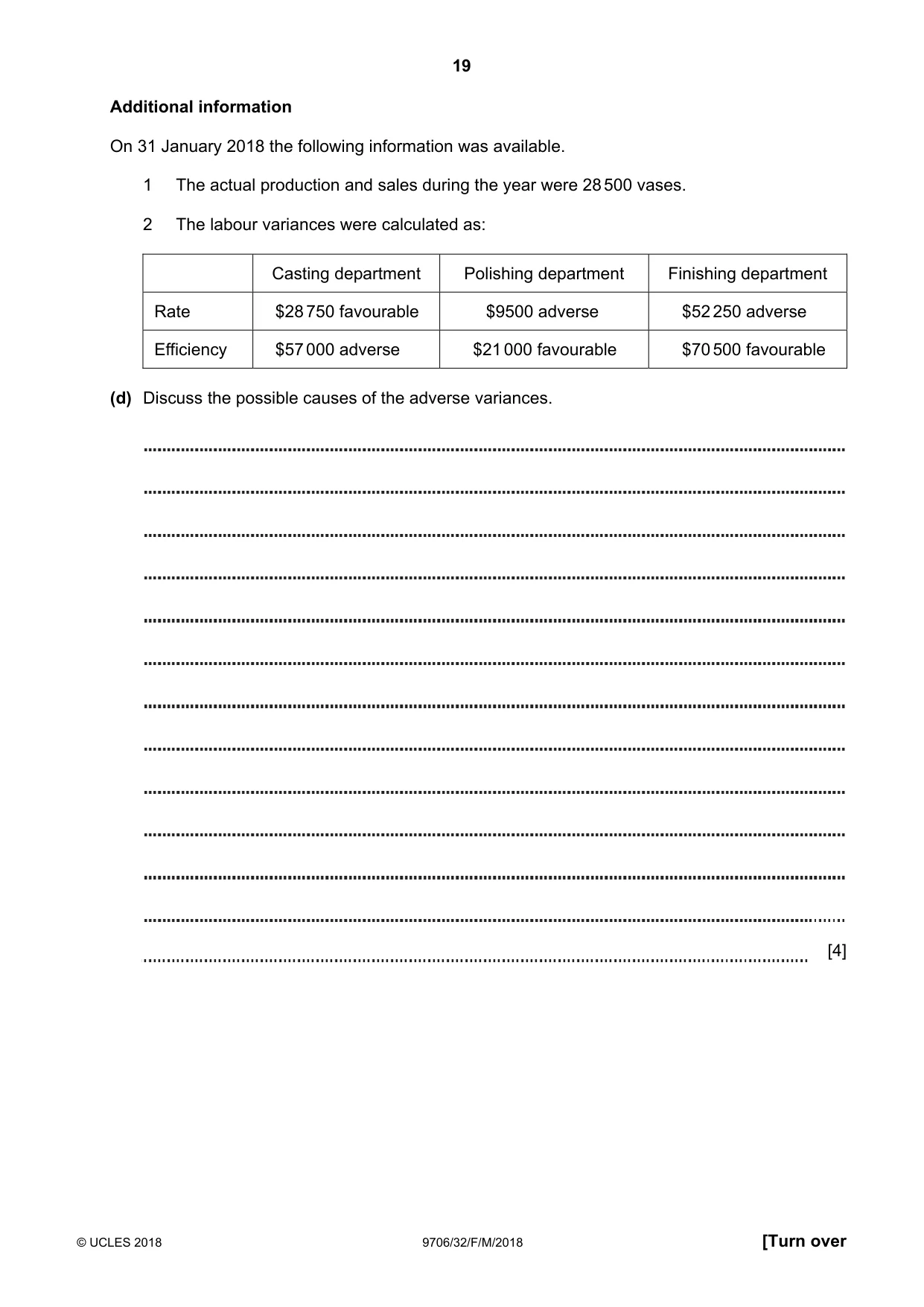
19 © UCLES 2018 9706/32/F/M/2018 [Turn over Additional information On 31 January 2018 the following information was available. 1 The actual production and sales during the year were 28 500 vases. 2 The labour variances were calculated as: Casting department Polishing department Finishing department Rate $28 750 favourable $9500 adverse $52 250 adverse Efficiency $57 000 adverse $21 000 favourable $70 500 favourable (d) Discuss the possible causes of the adverse variances. [4]
Question paper, page 20
20 © UCLES 2018 9706/32/F/M/2018 (e) Advise Hyung Min whether or not he should be concerned about labour variances. Justify your answer. [4] [Total: 25]
Question paper, page 21
21 © UCLES 2018 9706/32/F/M/2018 [Turn over Question 6 Read Source B2 in the Insert. (a) Explain the difference between the net present value and payback methods of investment appraisal. [4] (b) Calculate: (i) the payback period for Machine B [2]
Question paper, page 22
22 © UCLES 2018 9706/32/F/M/2018 (ii) the net present value for Machine A [8]
Question paper, page 23
23 © UCLES 2018 9706/32/F/M/2018 (iii) the average rate of return for both machines. [6] (c) Advise Daniyar which machine he should purchase. Justify your decision. [5] [Total: 25]
Question paper, page 24
24 Permission to reproduce items where third-party owned material protected by copyright is included has been sought and cleared where possible. Every reasonable effort has been made by the publisher (UCLES) to trace copyright holders, but if any items requiring clearance have unwittingly been included, the publisher will be pleased to make amends at the earliest possible opportunity. Cambridge International Examinations is part of the Cambridge Assessment Group. Cambridge Assessment is the brand name of University of Cambridge Local Examinations Syndicate (UCLES), which is itself a department of the University of Cambridge. © UCLES 2018 9706/32/F/M/2018 BLANK PAGE
Mark scheme, page 1
® IGCSE is a registered trademark. This document consists of 14 printed pages. © UCLES 2018 [Turn over Cambridge Assessment International Education Cambridge International Advanced Subsidiary and Advanced Level ACCOUNTING 9706/32 Paper 3 A Level Structured Questions March 2018 MARK SCHEME Maximum Mark: 150 Published This mark scheme is published as an aid to teachers and candidates, to indicate the requirements of the examination. It shows the basis on which Examiners were instructed to award marks. It does not indicate the details of the discussions that took place at an Examiners’ meeting before marking began, which would have considered the acceptability of alternative answers. Mark schemes should be read in conjunction with the question paper and the Principal Examiner Report for Teachers. Cambridge International will not enter into discussions about these mark schemes. Cambridge International is publishing the mark schemes for the March 2018 series for most Cambridge IGCSE®, Cambridge International A and AS Level components and some Cambridge O Level components.
Mark scheme, page 2
9706/32 Cambridge International AS/A Level – Mark Scheme PUBLISHED March 2018 © UCLES 2018 Page 2 of 14 Generic Marking Principles These general marking principles must be applied by all examiners when marking candidate answers. They should be applied alongside the specific content of the mark scheme or generic level descriptors for a question. Each question paper and mark scheme will also comply with these marking principles. GENERIC MARKING PRINCIPLE 1: Marks must be awarded in line with: • the specific content of the mark scheme or the generic level descriptors for the question • the specific skills defined in the mark scheme or in the generic level descriptors for the question • the standard of response required by a candidate as exemplified by the standardisation scripts. GENERIC MARKING PRINCIPLE 2: Marks awarded are always whole marks (not half marks, or other fractions). GENERIC MARKING PRINCIPLE 3: Marks must be awarded positively: • marks are awarded for correct/valid answers, as defined in the mark scheme. However, credit is given for valid answers which go beyond the scope of the syllabus and mark scheme, referring to your Team Leader as appropriate • marks are awarded when candidates clearly demonstrate what they know and can do • marks are not deducted for errors • marks are not deducted for omissions • answers should only be judged on the quality of spelling, punctuation and grammar when these features are specifically assessed by the question as indicated by the mark scheme. The meaning, however, should be unambiguous. GENERIC MARKING PRINCIPLE 4: Rules must be applied consistently e.g. in situations where candidates have not followed instructions or in the application of generic level descriptors.
Mark scheme, page 3
9706/32 Cambridge International AS/A Level – Mark Scheme PUBLISHED March 2018 © UCLES 2018 Page 3 of 14 GENERIC MARKING PRINCIPLE 5: Marks should be awarded using the full range of marks defined in the mark scheme for the question (however; the use of the full mark range may be limited according to the quality of the candidate responses seen). GENERIC MARKING PRINCIPLE 6: Marks awarded are based solely on the requirements as defined in the mark scheme. Marks should not be awarded with grade thresholds or grade descriptors in mind.
Mark scheme, page 4
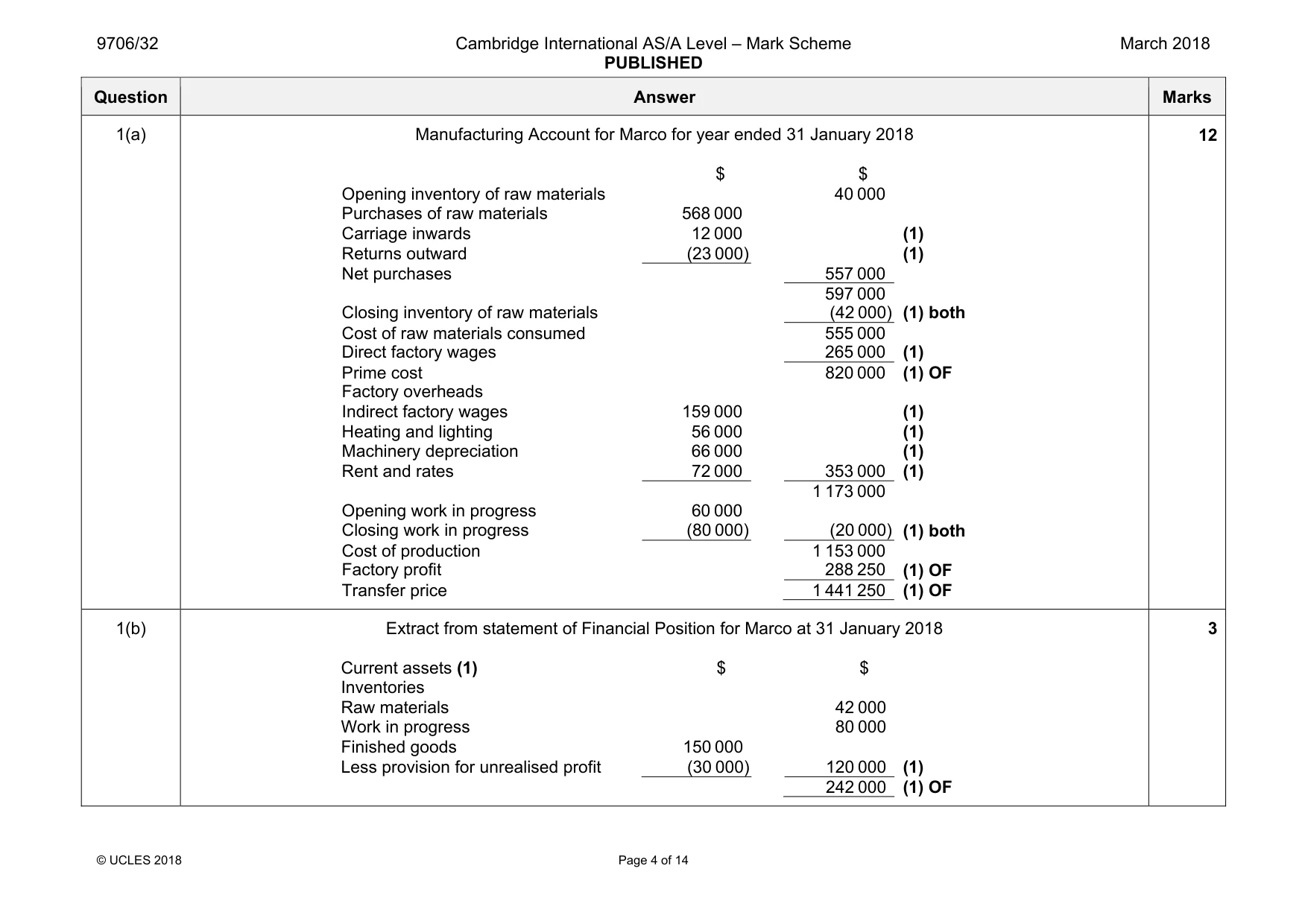
9706/32 Cambridge International AS/A Level – Mark Scheme PUBLISHED March 2018 © UCLES 2018 Page 4 of 14 Question Answer Marks 1(a) Manufacturing Account for Marco for year ended 31 January 2018 $ $ Opening inventory of raw materials 40 000 Purchases of raw materials 568 000 Carriage inwards 12 000 (1) Returns outward (23 000) (1) Net purchases 557 000 597 000 Closing inventory of raw materials (42 000) (1) both Cost of raw materials consumed 555 000 Direct factory wages 265 000 (1) Prime cost 820 000 (1) OF Factory overheads Indirect factory wages 159 000 (1) Heating and lighting 56 000 (1) Machinery depreciation 66 000 (1) Rent and rates 72 000 353 000 (1) 1 173 000 Opening work in progress 60 000 Closing work in progress (80 000) (20 000) (1) both Cost of production 1 153 000 Factory profit 288 250 (1) OF Transfer price 1 441 250 (1) OF 12 1(b) Extract from statement of Financial Position for Marco at 31 January 2018 Current assets (1) $ $ Inventories Raw materials 42 000 Work in progress 80 000 Finished goods 150 000 Less provision for unrealised profit (30 000) 120 000 (1) 242 000 (1) OF 3
Mark scheme, page 5
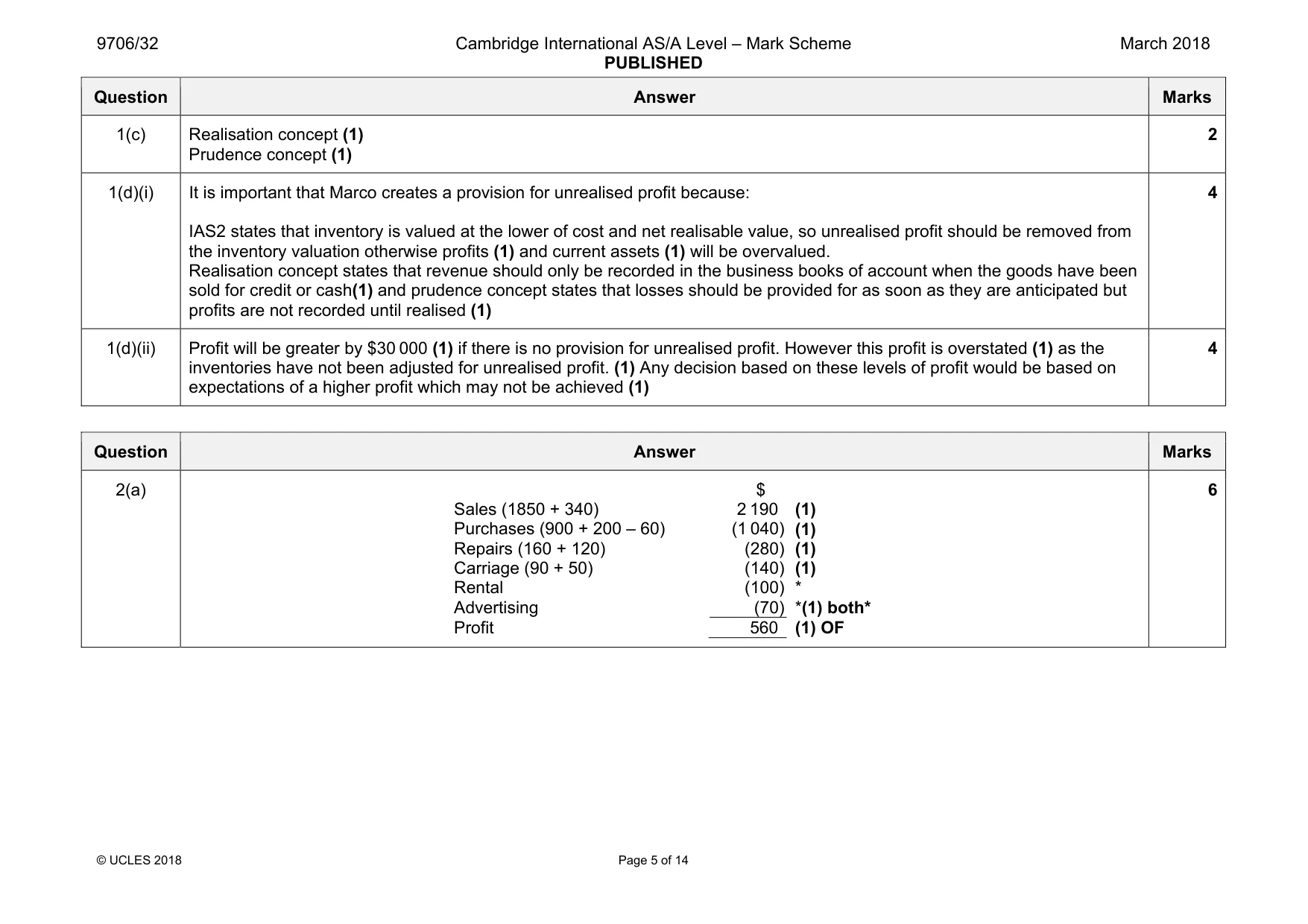
9706/32 Cambridge International AS/A Level – Mark Scheme PUBLISHED March 2018 © UCLES 2018 Page 5 of 14 Question Answer Marks 1(c) Realisation concept (1) Prudence concept (1) 2 1(d)(i) It is important that Marco creates a provision for unrealised profit because: IAS2 states that inventory is valued at the lower of cost and net realisable value, so unrealised profit should be removed from the inventory valuation otherwise profits (1) and current assets (1) will be overvalued. Realisation concept states that revenue should only be recorded in the business books of account when the goods have been sold for credit or cash(1) and prudence concept states that losses should be provided for as soon as they are anticipated but profits are not recorded until realised (1) 4 1(d)(ii) Profit will be greater by $30 000 (1) if there is no provision for unrealised profit. However this profit is overstated (1) as the inventories have not been adjusted for unrealised profit. (1) Any decision based on these levels of profit would be based on expectations of a higher profit which may not be achieved (1) 4 Question Answer Marks 2(a) $ Sales (1850 + 340) 2 190 (1) Purchases (900 + 200 – 60) (1 040) (1) Repairs (160 + 120) (280) (1) Carriage (90 + 50) (140) (1) Rental (100) * Advertising (70) *(1) both* Profit 560 (1) OF 6
Mark scheme, page 6
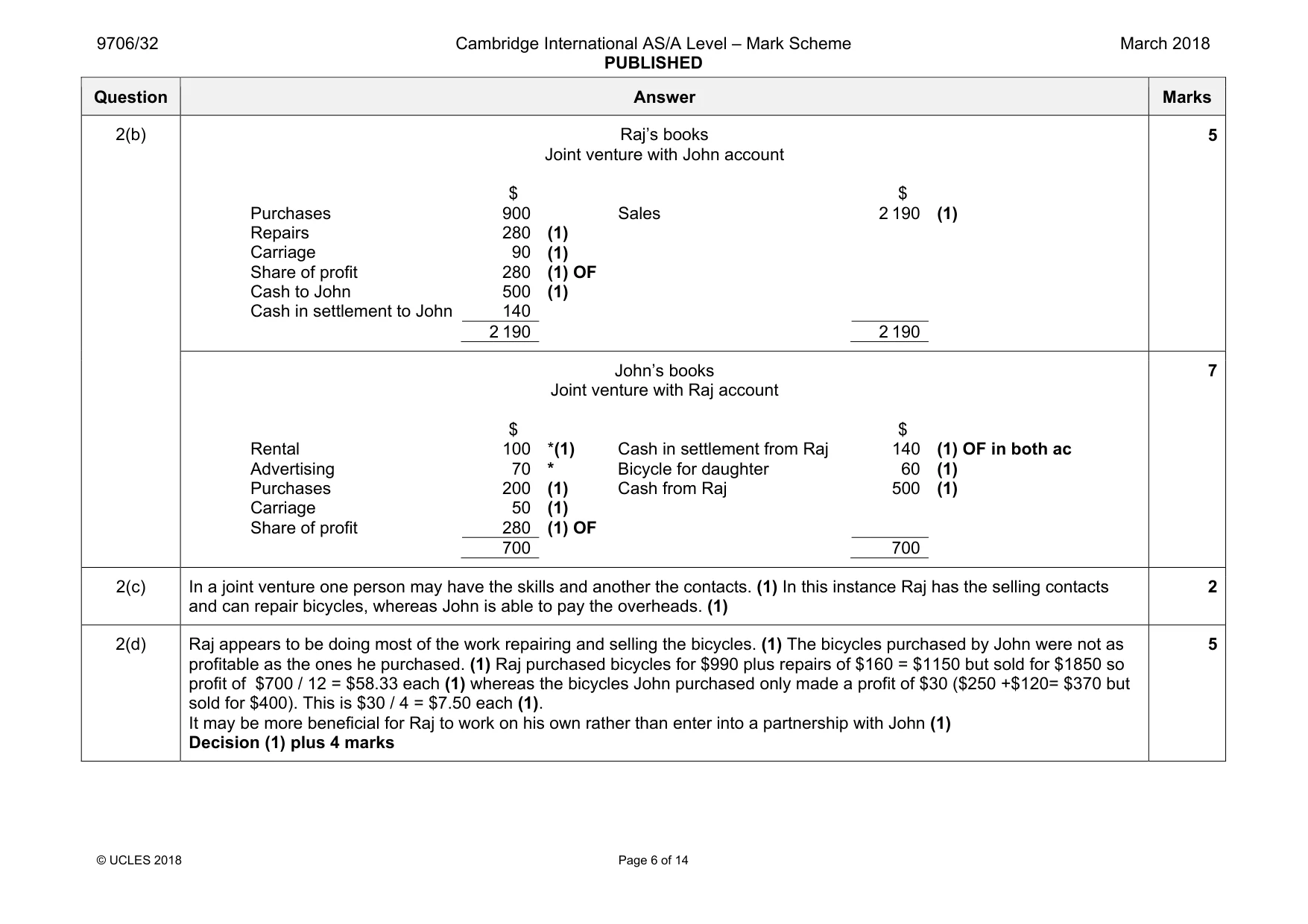
9706/32 Cambridge International AS/A Level – Mark Scheme PUBLISHED March 2018 © UCLES 2018 Page 6 of 14 Question Answer Marks 2(b) Raj’s books Joint venture with John account $ $ Purchases 900 Sales 2 190 (1) Repairs 280 (1) Carriage 90 (1) Share of profit 280 (1) OF Cash to John 500 (1) Cash in settlement to John 140 2 190 2 190 5 John’s books Joint venture with Raj account $ $ Rental 100 *(1) Cash in settlement from Raj 140 (1) OF in both ac Advertising 70 * Bicycle for daughter 60 (1) Purchases 200 (1) Cash from Raj 500 (1) Carriage 50 (1) Share of profit 280 (1) OF 700 700 7 2(c) In a joint venture one person may have the skills and another the contacts. (1) In this instance Raj has the selling contacts and can repair bicycles, whereas John is able to pay the overheads. (1) 2 2(d) Raj appears to be doing most of the work repairing and selling the bicycles. (1) The bicycles purchased by John were not as profitable as the ones he purchased. (1) Raj purchased bicycles for $990 plus repairs of $160 = $1150 but sold for $1850 so profit of $700 / 12 = $58.33 each (1) whereas the bicycles John purchased only made a profit of $30 ($250 +$120= $370 but sold for $400). This is $30 / 4 = $7.50 each (1). It may be more beneficial for Raj to work on his own rather than enter into a partnership with John (1) Decision (1) plus 4 marks 5
Mark scheme, page 7
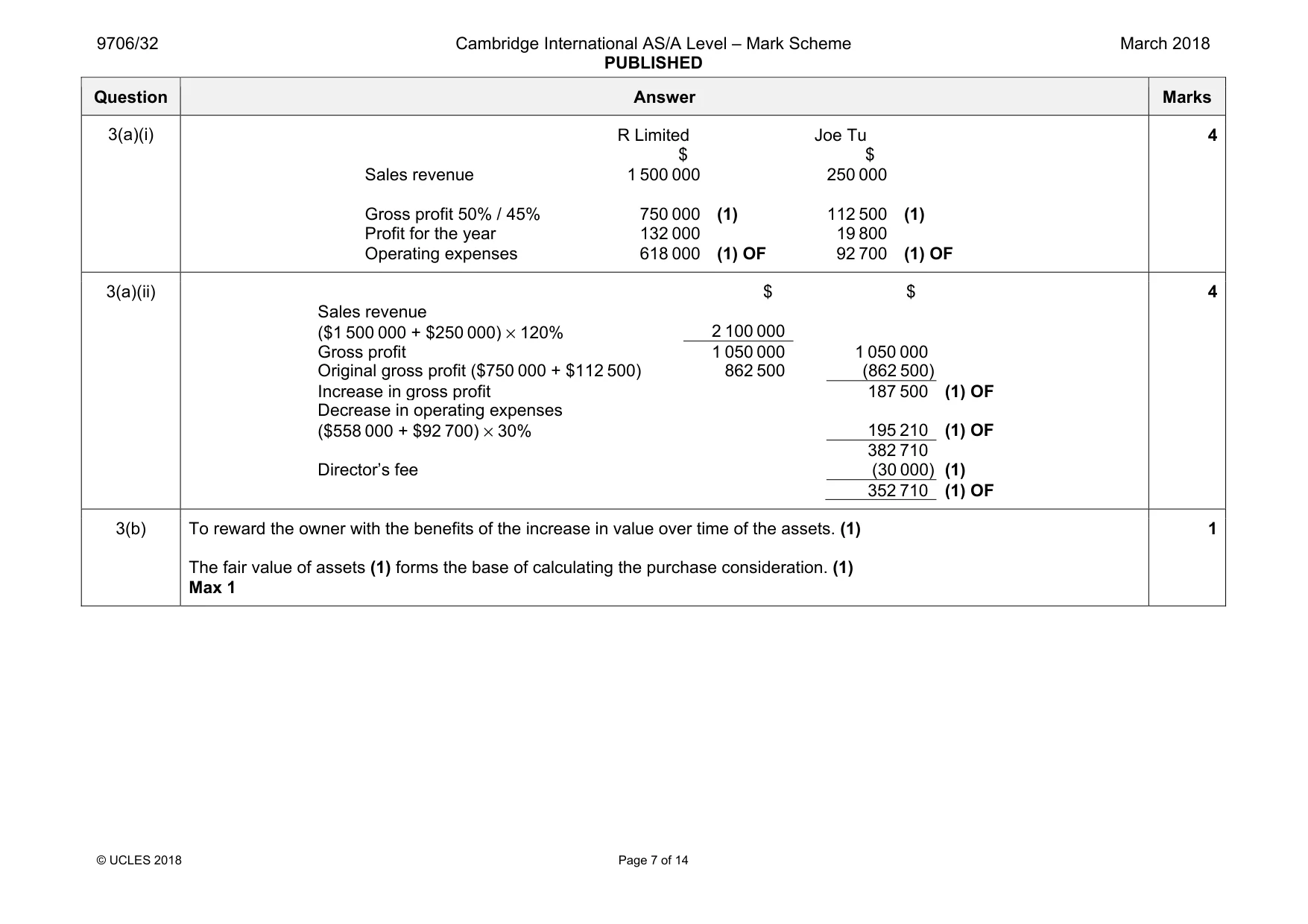
9706/32 Cambridge International AS/A Level – Mark Scheme PUBLISHED March 2018 © UCLES 2018 Page 7 of 14 Question Answer Marks 3(a)(i) R Limited Joe Tu $ $ Sales revenue 1 500 000 250 000 Gross profit 50% / 45% 750 000 (1) 112 500 (1) Profit for the year 132 000 19 800 Operating expenses 618 000 (1) OF 92 700 (1) OF 4 3(a)(ii) $ $ Sales revenue ($1 500 000 + $250 000) × 120% 2 100 000 Gross profit 1 050 000 1 050 000 Original gross profit ($750 000 + $112 500) 862 500 (862 500) Increase in gross profit 187 500 (1) OF Decrease in operating expenses ($558 000 + $92 700) × 30% 195 210 (1) OF 382 710 Director’s fee (30 000) (1) 352 710 (1) OF 4 3(b) To reward the owner with the benefits of the increase in value over time of the assets. (1) The fair value of assets (1) forms the base of calculating the purchase consideration. (1) Max 1 1
Mark scheme, page 8
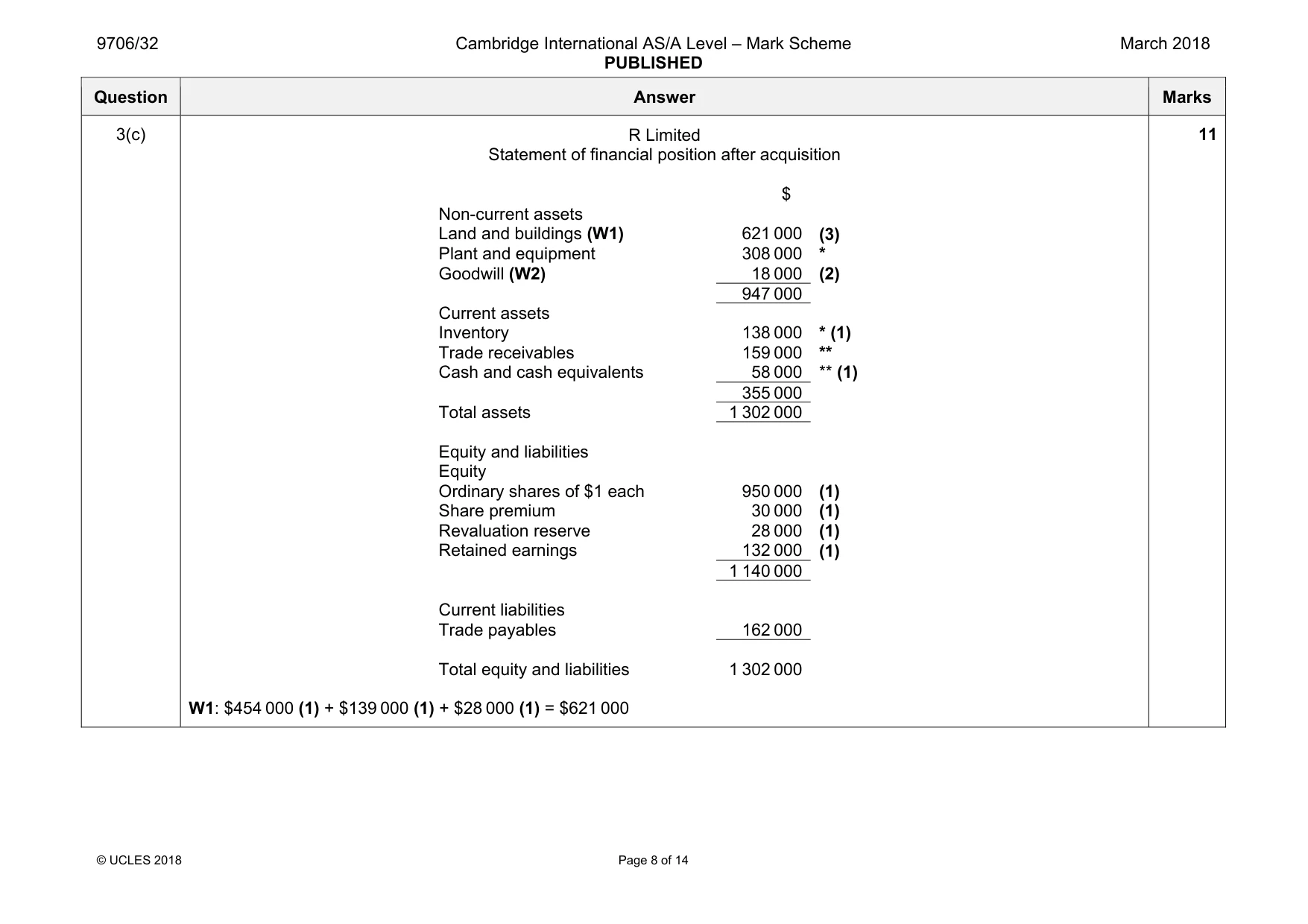
9706/32 Cambridge International AS/A Level – Mark Scheme PUBLISHED March 2018 © UCLES 2018 Page 8 of 14 Question Answer Marks 3(c) R Limited Statement of financial position after acquisition $ Non-current assets Land and buildings (W1) 621 000 (3) Plant and equipment 308 000 * Goodwill (W2) 18 000 (2) 947 000 Current assets Inventory 138 000 * (1) Trade receivables 159 000 ** Cash and cash equivalents 58 000 ** (1) 355 000 Total assets 1 302 000 Equity and liabilities Equity Ordinary shares of $1 each 950 000 (1) Share premium 30 000 (1) Revaluation reserve 28 000 (1) Retained earnings 132 000 (1) 1 140 000 Current liabilities Trade payables 162 000 Total equity and liabilities 1 302 000 W1: $454 000 (1) + $139 000 (1) + $28 000 (1) = $621 000 11
Mark scheme, page 9
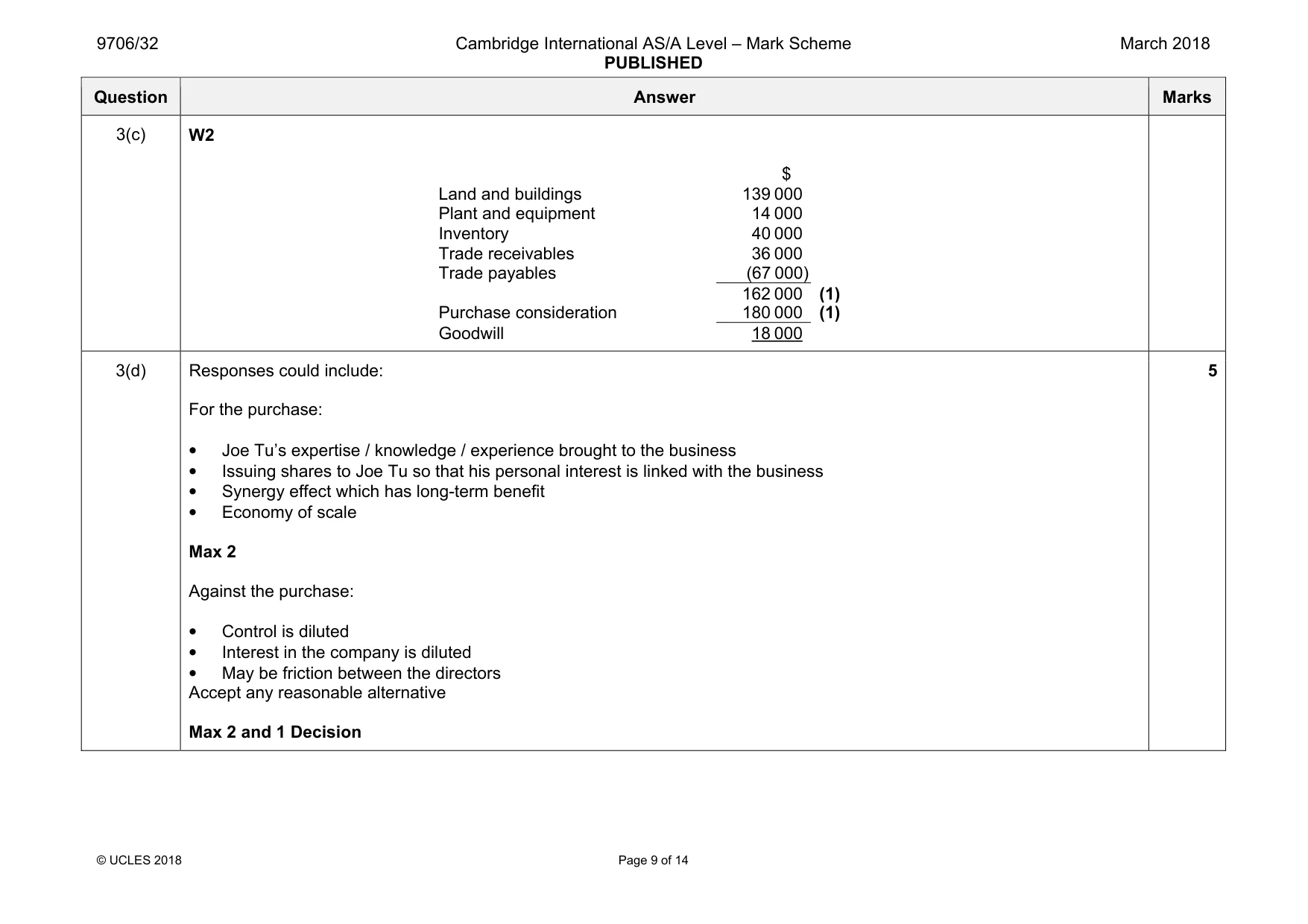
9706/32 Cambridge International AS/A Level – Mark Scheme PUBLISHED March 2018 © UCLES 2018 Page 9 of 14 Question Answer Marks 3(c) W2 $ Land and buildings 139 000 Plant and equipment 14 000 Inventory 40 000 Trade receivables 36 000 Trade payables (67 000) 162 000 (1) Purchase consideration 180 000 (1) Goodwill 18 000 3(d) Responses could include: For the purchase: • Joe Tu’s expertise / knowledge / experience brought to the business • Issuing shares to Joe Tu so that his personal interest is linked with the business • Synergy effect which has long-term benefit • Economy of scale Max 2 Against the purchase: • Control is diluted • Interest in the company is diluted • May be friction between the directors Accept any reasonable alternative Max 2 and 1 Decision 5
Mark scheme, page 10
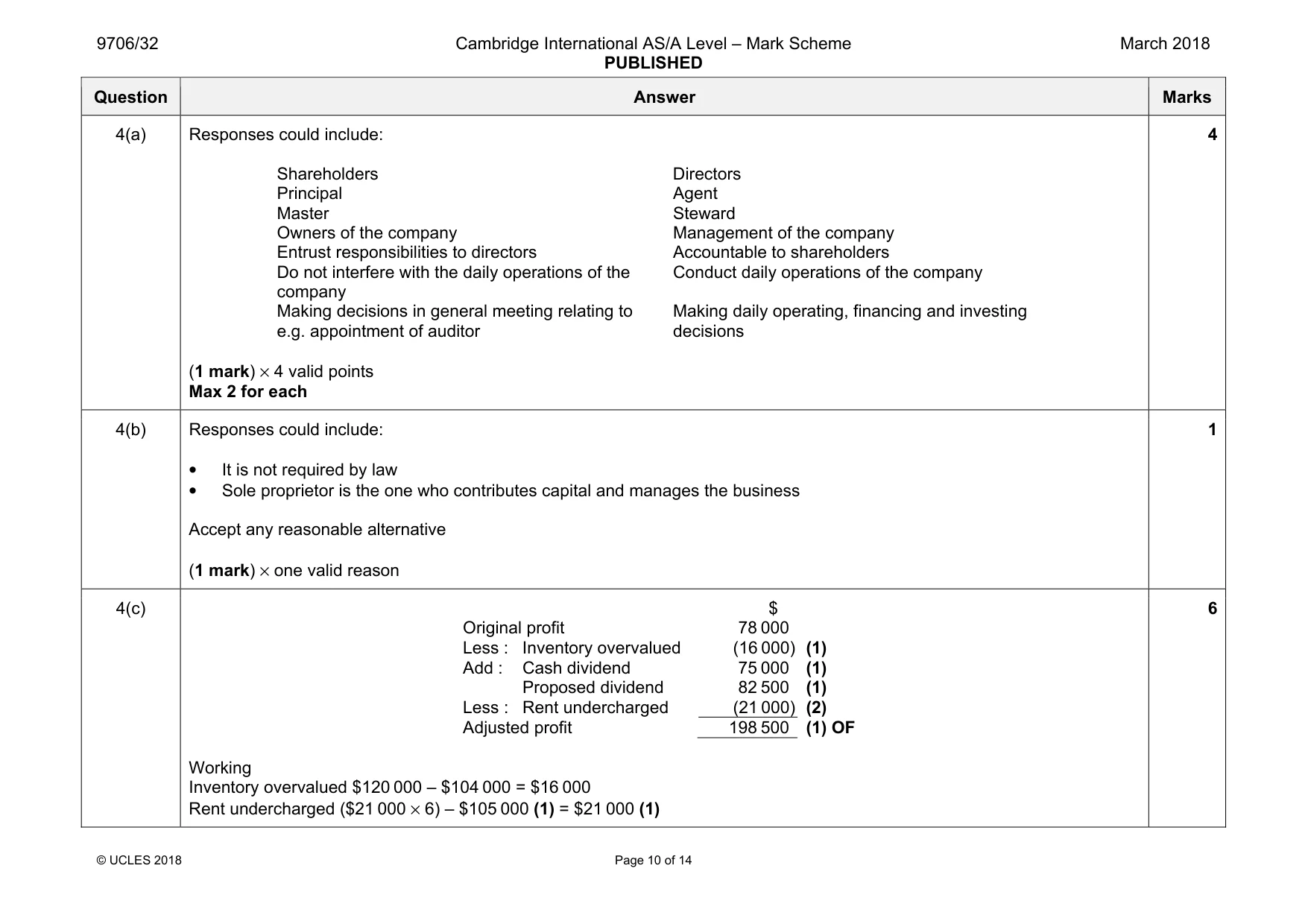
9706/32 Cambridge International AS/A Level – Mark Scheme PUBLISHED March 2018 © UCLES 2018 Page 10 of 14 Question Answer Marks 4(a) Responses could include: Shareholders Directors Principal Agent Master Steward Owners of the company Management of the company Entrust responsibilities to directors Accountable to shareholders Do not interfere with the daily operations of the company Conduct daily operations of the company Making decisions in general meeting relating to e.g. appointment of auditor Making daily operating, financing and investing decisions (1 mark) × 4 valid points Max 2 for each 4 4(b) Responses could include: • It is not required by law • Sole proprietor is the one who contributes capital and manages the business Accept any reasonable alternative (1 mark) × one valid reason 1 4(c) $ Original profit 78 000 Less : Inventory overvalued (16 000) (1) Add : Cash dividend 75 000 (1) Proposed dividend 82 500 (1) Less : Rent undercharged (21 000) (2) Adjusted profit 198 500 (1) OF Working Inventory overvalued $120 000 – $104 000 = $16 000 Rent undercharged ($21 000 × 6) – $105 000 (1) = $21 000 (1) 6
Mark scheme, page 11
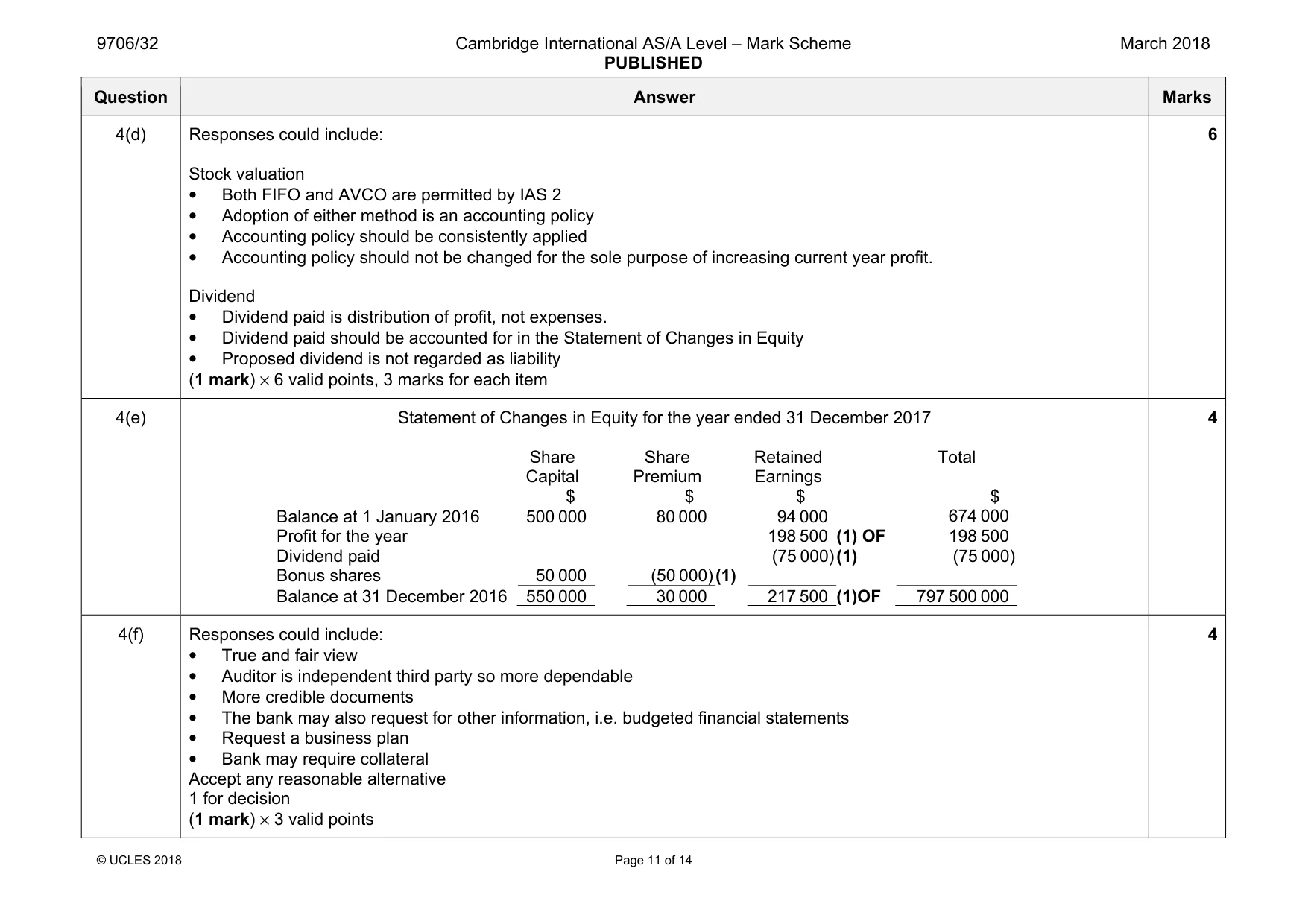
9706/32 Cambridge International AS/A Level – Mark Scheme PUBLISHED March 2018 © UCLES 2018 Page 11 of 14 Question Answer Marks 4(d) Responses could include: Stock valuation • Both FIFO and AVCO are permitted by IAS 2 • Adoption of either method is an accounting policy • Accounting policy should be consistently applied • Accounting policy should not be changed for the sole purpose of increasing current year profit. Dividend • Dividend paid is distribution of profit, not expenses. • Dividend paid should be accounted for in the Statement of Changes in Equity • Proposed dividend is not regarded as liability (1 mark) × 6 valid points, 3 marks for each item 6 4(e) Statement of Changes in Equity for the year ended 31 December 2017 Share Share Retained Total Capital Premium Earnings $ $ $ $ Balance at 1 January 2016 500 000 80 000 94 000 674 000 Profit for the year 198 500 (1) OF 198 500 Dividend paid (75 000)(1) (75 000) Bonus shares 50 000 (50 000)(1) Balance at 31 December 2016 550 000 30 000 217 500 (1)OF 797 500 000 4 4(f) Responses could include: • True and fair view • Auditor is independent third party so more dependable • More credible documents • The bank may also request for other information, i.e. budgeted financial statements • Request a business plan • Bank may require collateral Accept any reasonable alternative 1 for decision (1 mark) × 3 valid points 4
Mark scheme, page 12
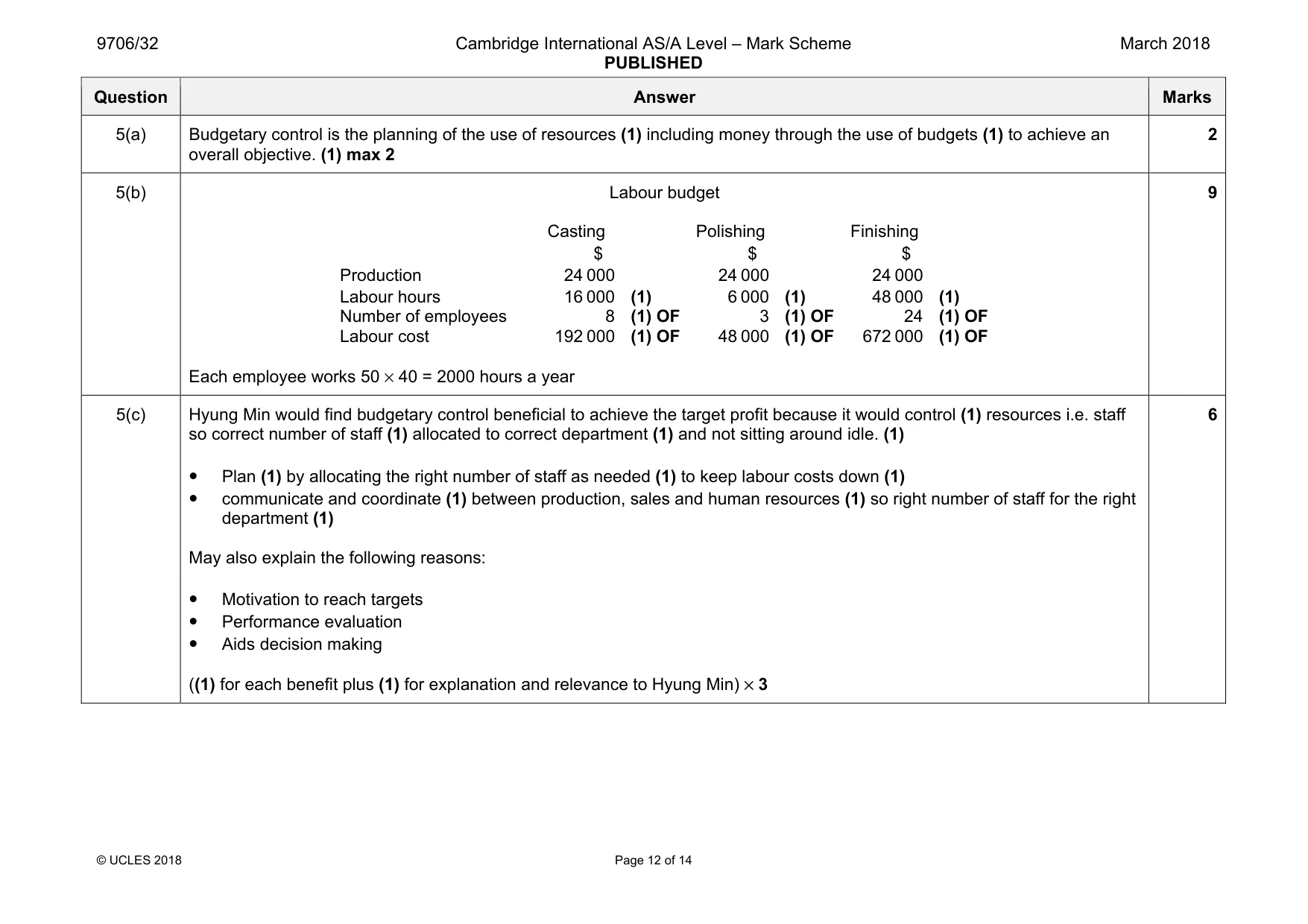
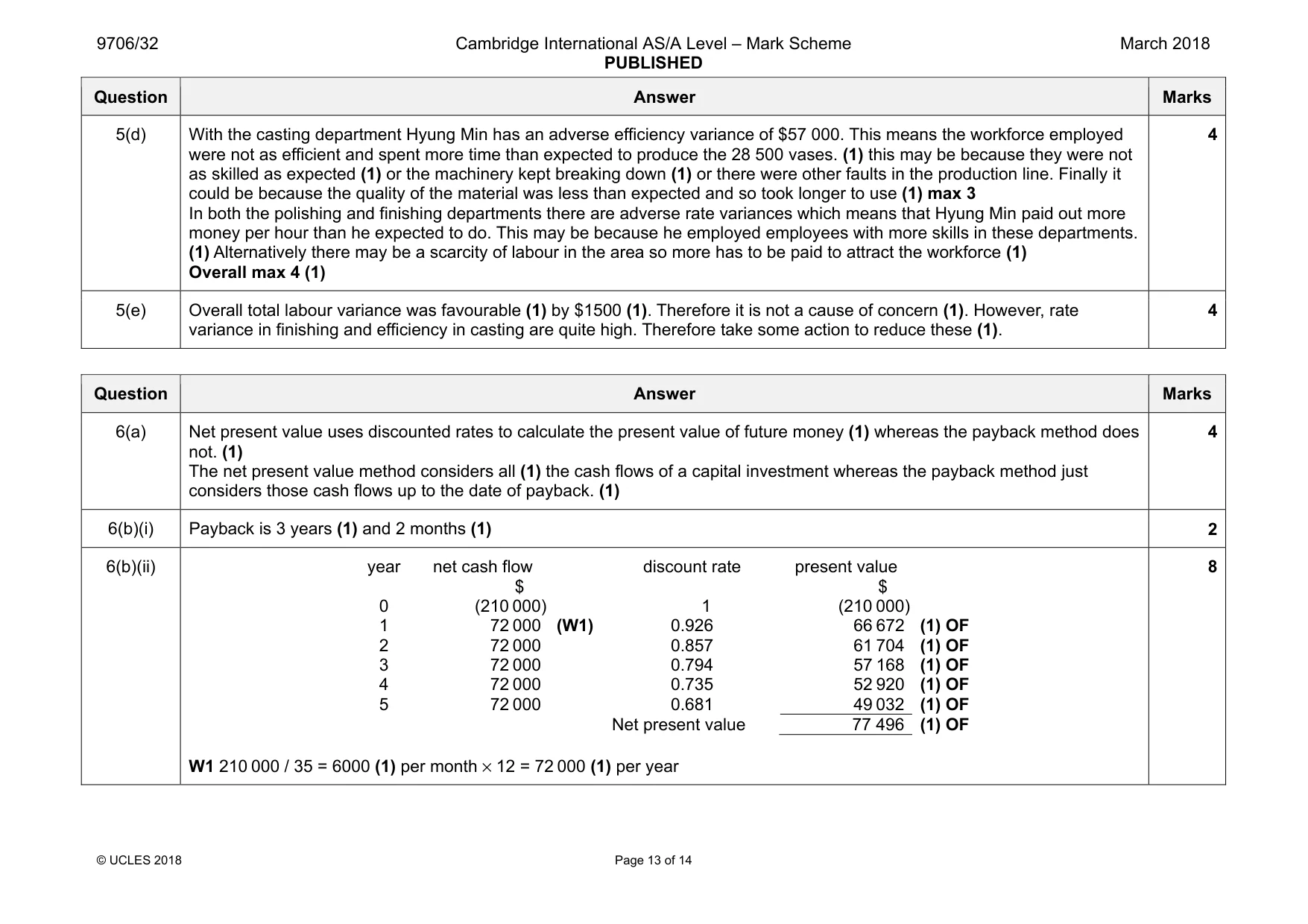
9706/32 Cambridge International AS/A Level – Mark Scheme PUBLISHED March 2018 © UCLES 2018 Page 12 of 14 Question Answer Marks 5(a) Budgetary control is the planning of the use of resources (1) including money through the use of budgets (1) to achieve an overall objective. (1) max 2 2 5(b) Labour budget Casting Polishing Finishing $ $ $ Production 24 000 24 000 24 000 Labour hours 16 000 (1) 6 000 (1) 48 000 (1) Number of employees 8 (1) OF 3 (1) OF 24 (1) OF Labour cost 192 000 (1) OF 48 000 (1) OF 672 000 (1) OF Each employee works 50 × 40 = 2000 hours a year 9 5(c) Hyung Min would find budgetary control beneficial to achieve the target profit because it would control (1) resources i.e. staff so correct number of staff (1) allocated to correct department (1) and not sitting around idle. (1) • Plan (1) by allocating the right number of staff as needed (1) to keep labour costs down (1) • communicate and coordinate (1) between production, sales and human resources (1) so right number of staff for the right department (1) May also explain the following reasons: • Motivation to reach targets • Performance evaluation • Aids decision making ((1) for each benefit plus (1) for explanation and relevance to Hyung Min) × 3 6
Mark scheme, page 13
9706/32 Cambridge International AS/A Level – Mark Scheme PUBLISHED March 2018 © UCLES 2018 Page 13 of 14 Question Answer Marks 5(d) With the casting department Hyung Min has an adverse efficiency variance of $57 000. This means the workforce employed were not as efficient and spent more time than expected to produce the 28 500 vases. (1) this may be because they were not as skilled as expected (1) or the machinery kept breaking down (1) or there were other faults in the production line. Finally it could be because the quality of the material was less than expected and so took longer to use (1) max 3 In both the polishing and finishing departments there are adverse rate variances which means that Hyung Min paid out more money per hour than he expected to do. This may be because he employed employees with more skills in these departments. (1) Alternatively there may be a scarcity of labour in the area so more has to be paid to attract the workforce (1) Overall max 4 (1) 4 5(e) Overall total labour variance was favourable (1) by $1500 (1). Therefore it is not a cause of concern (1). However, rate variance in finishing and efficiency in casting are quite high. Therefore take some action to reduce these (1). 4 Question Answer Marks 6(a) Net present value uses discounted rates to calculate the present value of future money (1) whereas the payback method does not. (1) The net present value method considers all (1) the cash flows of a capital investment whereas the payback method just considers those cash flows up to the date of payback. (1) 4 6(b)(i) Payback is 3 years (1) and 2 months (1) 2 6(b)(ii) year net cash flow $ discount rate present value $ 0 (210 000) 1 (210 000) 1 72 000 (W1) 0.926 66 672 (1) OF 2 72 000 0.857 61 704 (1) OF 3 72 000 0.794 57 168 (1) OF 4 72 000 0.735 52 920 (1) OF 5 72 000 0.681 49 032 (1) OF Net present value 77 496 (1) OF W1 210 000 / 35 = 6000 (1) per month × 12 = 72 000 (1) per year 8
Mark scheme, page 14
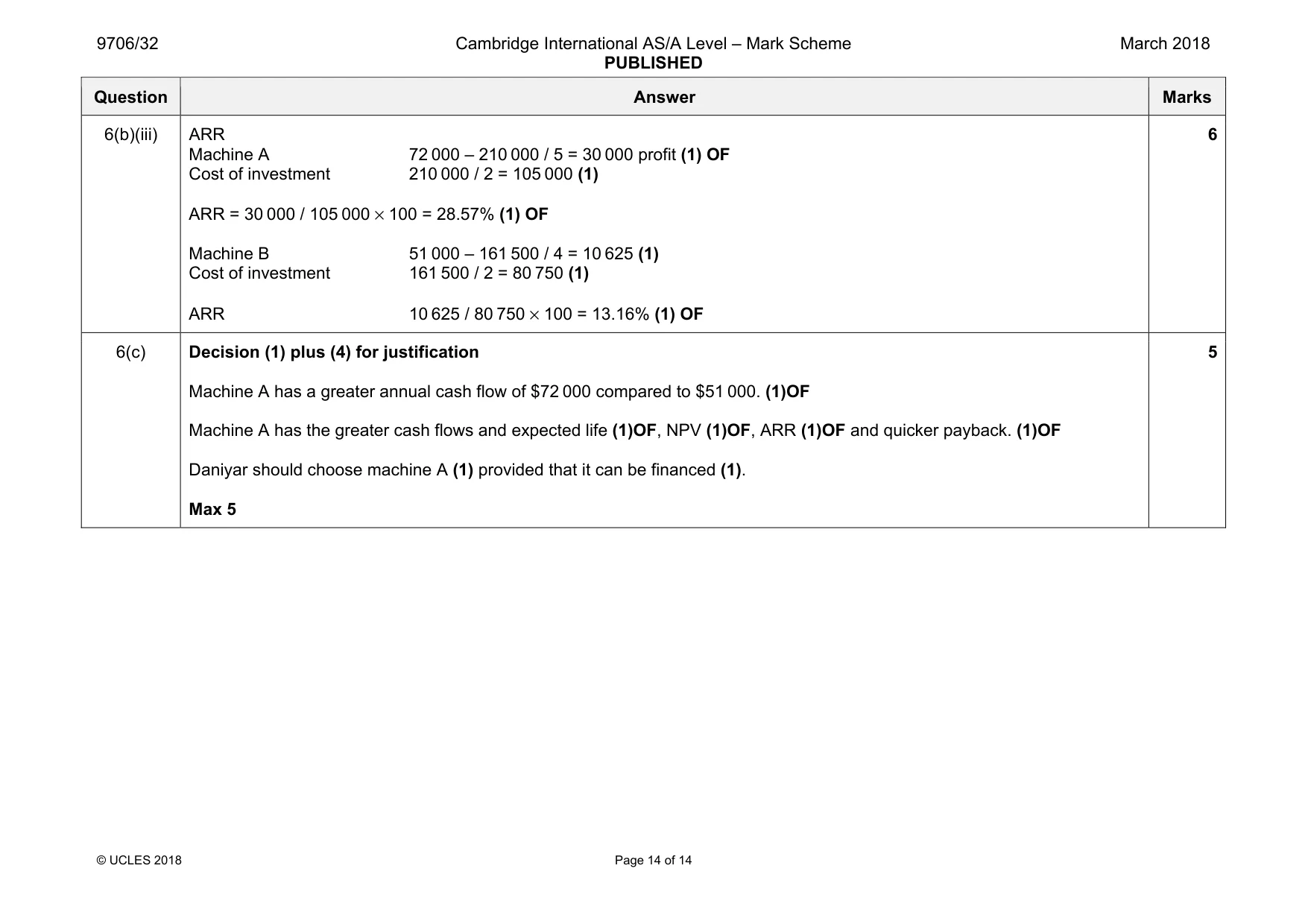
9706/32 Cambridge International AS/A Level – Mark Scheme PUBLISHED March 2018 © UCLES 2018 Page 14 of 14 Question Answer Marks 6(b)(iii) ARR Machine A 72 000 – 210 000 / 5 = 30 000 profit (1) OF Cost of investment 210 000 / 2 = 105 000 (1) ARR = 30 000 / 105 000 × 100 = 28.57% (1) OF Machine B 51 000 – 161 500 / 4 = 10 625 (1) Cost of investment 161 500 / 2 = 80 750 (1) ARR 10 625 / 80 750 × 100 = 13.16% (1) OF 6 6(c) Decision (1) plus (4) for justification Machine A has a greater annual cash flow of $72 000 compared to $51 000. (1)OF Machine A has the greater cash flows and expected life (1)OF, NPV (1)OF, ARR (1)OF and quicker payback. (1)OF Daniyar should choose machine A (1) provided that it can be financed (1). Max 5 5
What you needed in this session
Cambridge’s own grade thresholds for 2018 Feb/March, Paper 3 · Variant 2. A higher threshold means an easier paper — the bar moves with how the cohort did.