Cambridge A Level Accounting 9706 — 2017 Feb/March Paper 3 · Variant 2
9706/32/F/M/17 · 150 marks · ≈169 min
The question paper and its mark scheme, free to read here and free to download. This is Cambridge’s own paper, exactly as it was sat.
Question paper12 pages
Mark scheme16 pages
Answers below. Sit the paper first if you are practising.
Paper as text
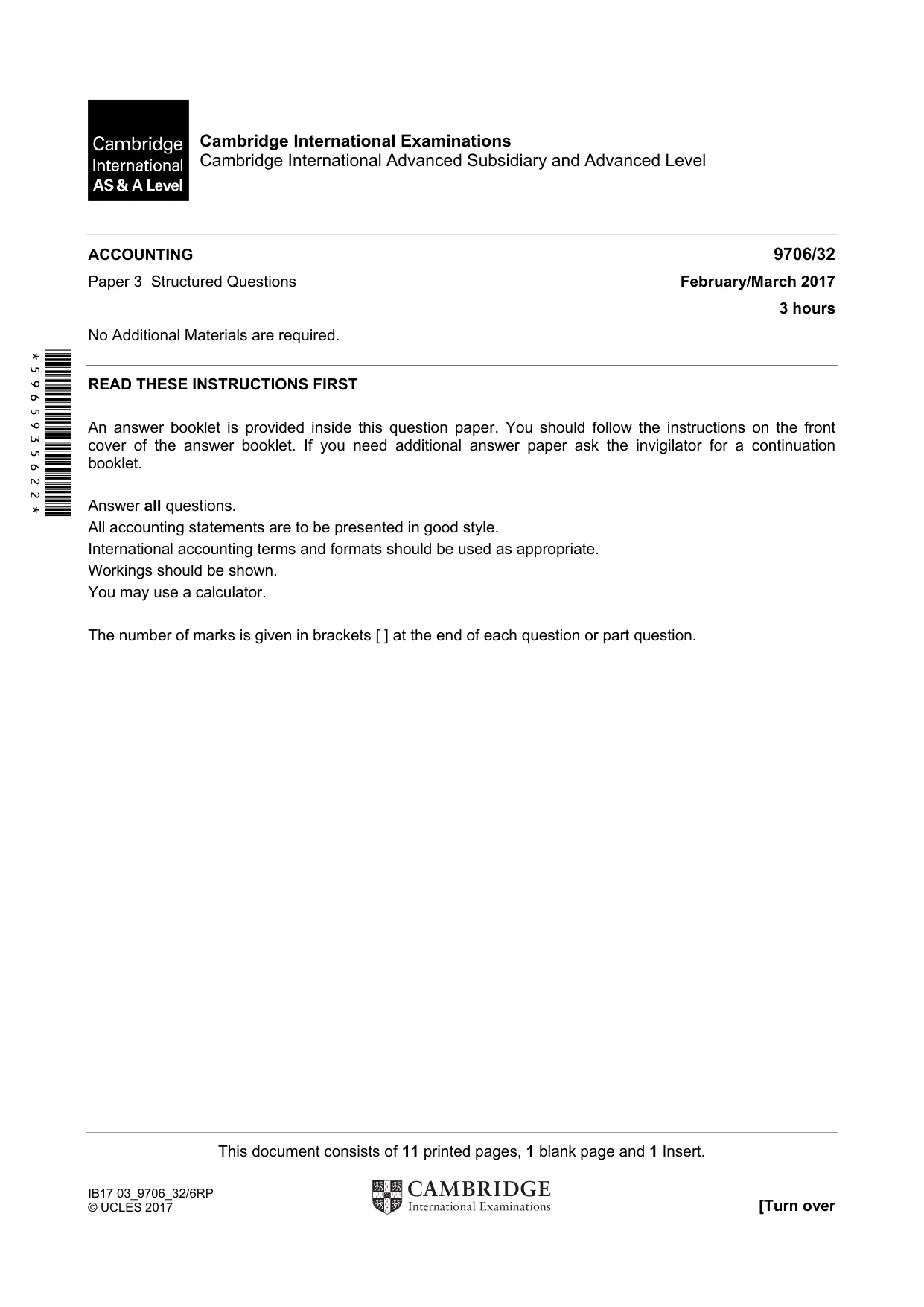
Question paper, page 1
This document consists of 11 printed pages, 1 blank page and 1 Insert. IB17 03_9706_32/6RP © UCLES 2017 [Turn over Cambridge International Examinations Cambridge International Advanced Subsidiary and Advanced Level ACCOUNTING 9706/32 Paper 3 Structured Questions February/March 2017 3 hours No Additional Materials are required. READ THESE INSTRUCTIONS FIRST An answer booklet is provided inside this question paper. You should follow the instructions on the front cover of the answer booklet. If you need additional answer paper ask the invigilator for a continuation booklet. Answer all questions. All accounting statements are to be presented in good style. International accounting terms and formats should be used as appropriate. Workings should be shown. You may use a calculator. The number of marks is given in brackets [ ] at the end of each question or part question.
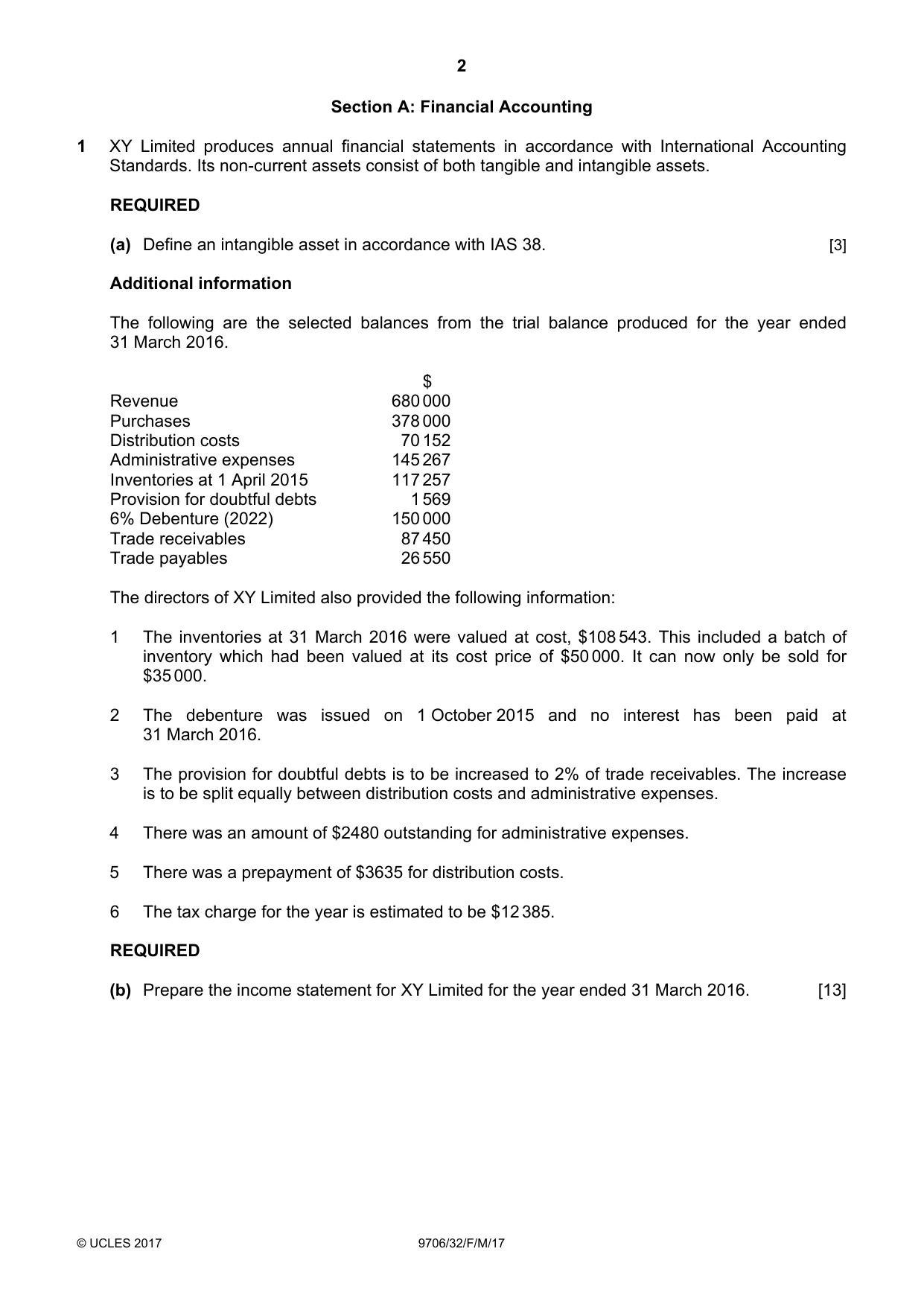
Question paper, page 2
2 © UCLES 2017 9706/32/F/M/17 Section A: Financial Accounting 1 XY Limited produces annual financial statements in accordance with International Accounting Standards. Its non-current assets consist of both tangible and intangible assets. REQUIRED (a) Define an intangible asset in accordance with IAS 38. [3] Additional information The following are the selected balances from the trial balance produced for the year ended 31 March 2016. $ Revenue 680 000 Purchases 378 000 Distribution costs 70 152 Administrative expenses 145 267 Inventories at 1 April 2015 117 257 Provision for doubtful debts 1 569 6% Debenture (2022) 150 000 Trade receivables 87 450 Trade payables 26 550 The directors of XY Limited also provided the following information: 1 The inventories at 31 March 2016 were valued at cost, $108 543. This included a batch of inventory which had been valued at its cost price of $50 000. It can now only be sold for $35 000. 2 The debenture was issued on 1 October 2015 and no interest has been paid at 31 March 2016. 3 The provision for doubtful debts is to be increased to 2% of trade receivables. The increase is to be split equally between distribution costs and administrative expenses. 4 There was an amount of $2480 outstanding for administrative expenses. 5 There was a prepayment of $3635 for distribution costs. 6 The tax charge for the year is estimated to be $12 385. REQUIRED (b) Prepare the income statement for XY Limited for the year ended 31 March 2016. [13]
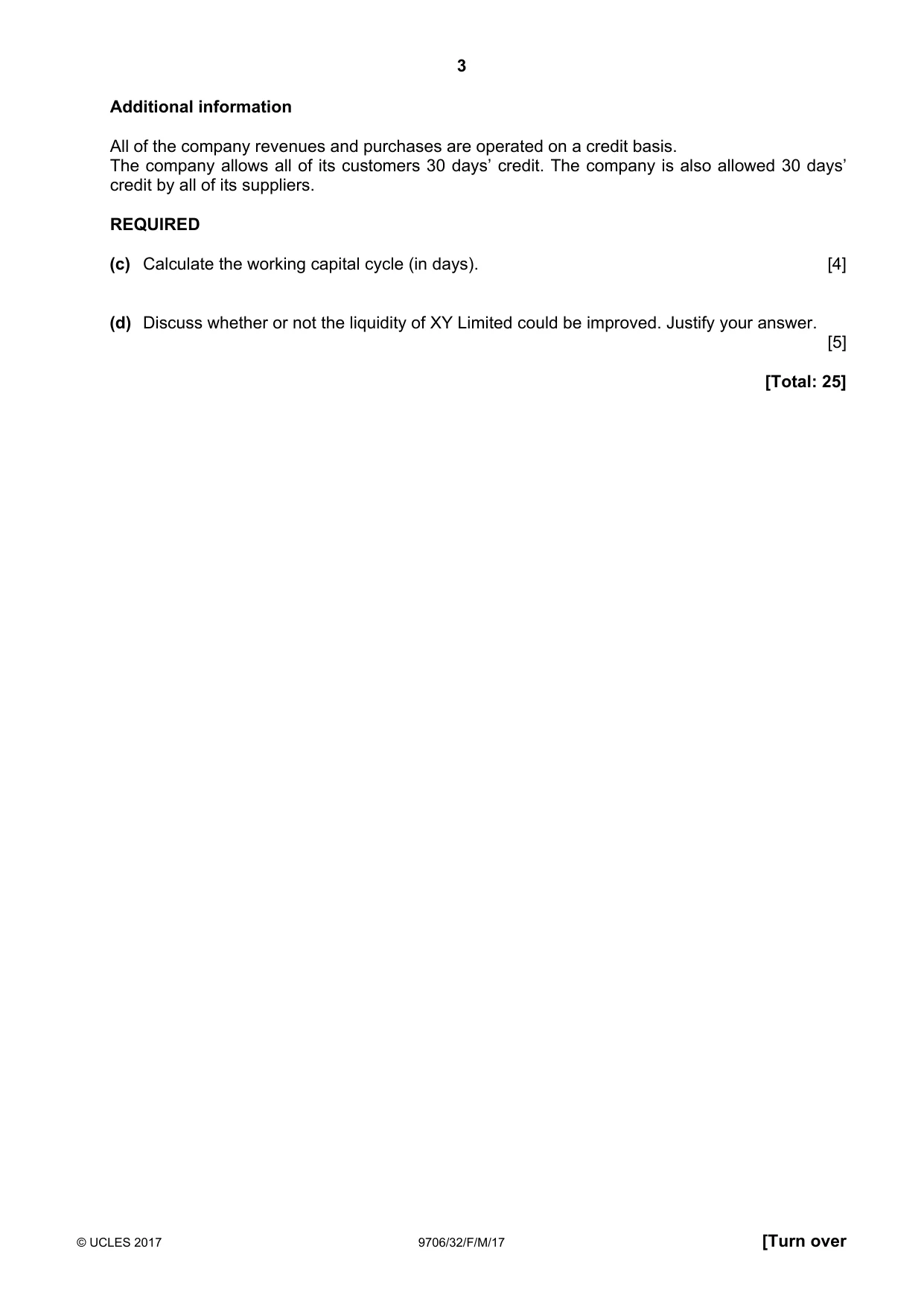
Question paper, page 3
3 © UCLES 2017 9706/32/F/M/17 [Turn over Additional information All of the company revenues and purchases are operated on a credit basis. The company allows all of its customers 30 days’ credit. The company is also allowed 30 days’ credit by all of its suppliers. REQUIRED (c) Calculate the working capital cycle (in days). [4] (d) Discuss whether or not the liquidity of XY Limited could be improved. Justify your answer. [5] [Total: 25]
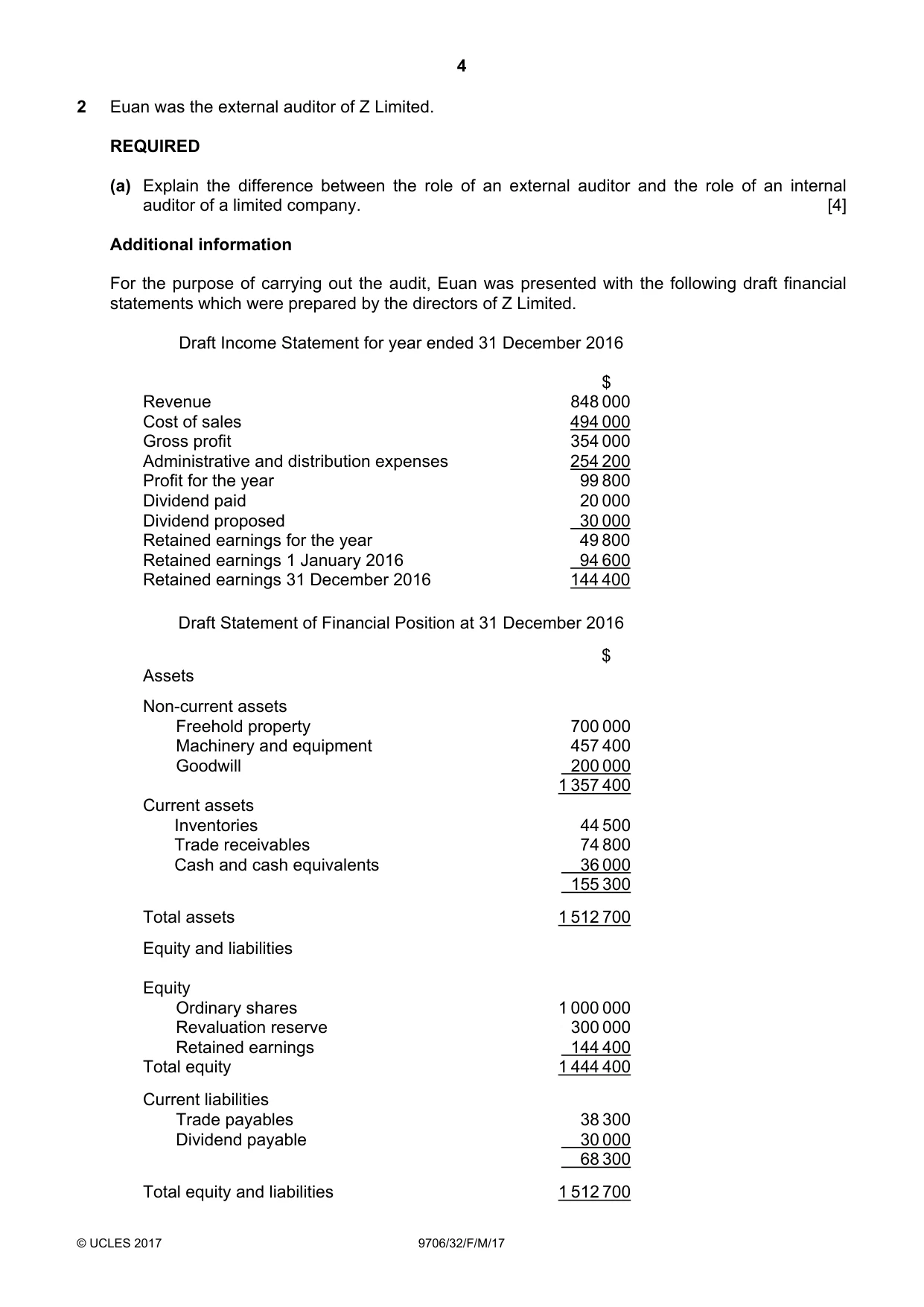
Question paper, page 4
4 © UCLES 2017 9706/32/F/M/17 2 Euan was the external auditor of Z Limited. REQUIRED (a) Explain the difference between the role of an external auditor and the role of an internal auditor of a limited company. [4] Additional information For the purpose of carrying out the audit, Euan was presented with the following draft financial statements which were prepared by the directors of Z Limited. Draft Income Statement for year ended 31 December 2016 $ Revenue 848 000 Cost of sales 494 000 Gross profit 354 000 Administrative and distribution expenses 254 200 Profit for the year 99 800 Dividend paid 20 000 Dividend proposed 30 000 Retained earnings for the year 49 800 Retained earnings 1 January 2016 94 600 Retained earnings 31 December 2016 144 400 Draft Statement of Financial Position at 31 December 2016 $ Assets Non-current assets Freehold property 700 000 Machinery and equipment 457 400 Goodwill 200 000 1 357 400 Current assets Inventories 44 500 Trade receivables 74 800 Cash and cash equivalents 36 000 155 300 Total assets 1 512 700 Equity and liabilities Equity Ordinary shares 1 000 000 Revaluation reserve 300 000 Retained earnings 144 400 Total equity 1 444 400 Current liabilities Trade payables 38 300 Dividend payable 30 000 68 300 Total equity and liabilities 1 512 700
Question paper, page 5
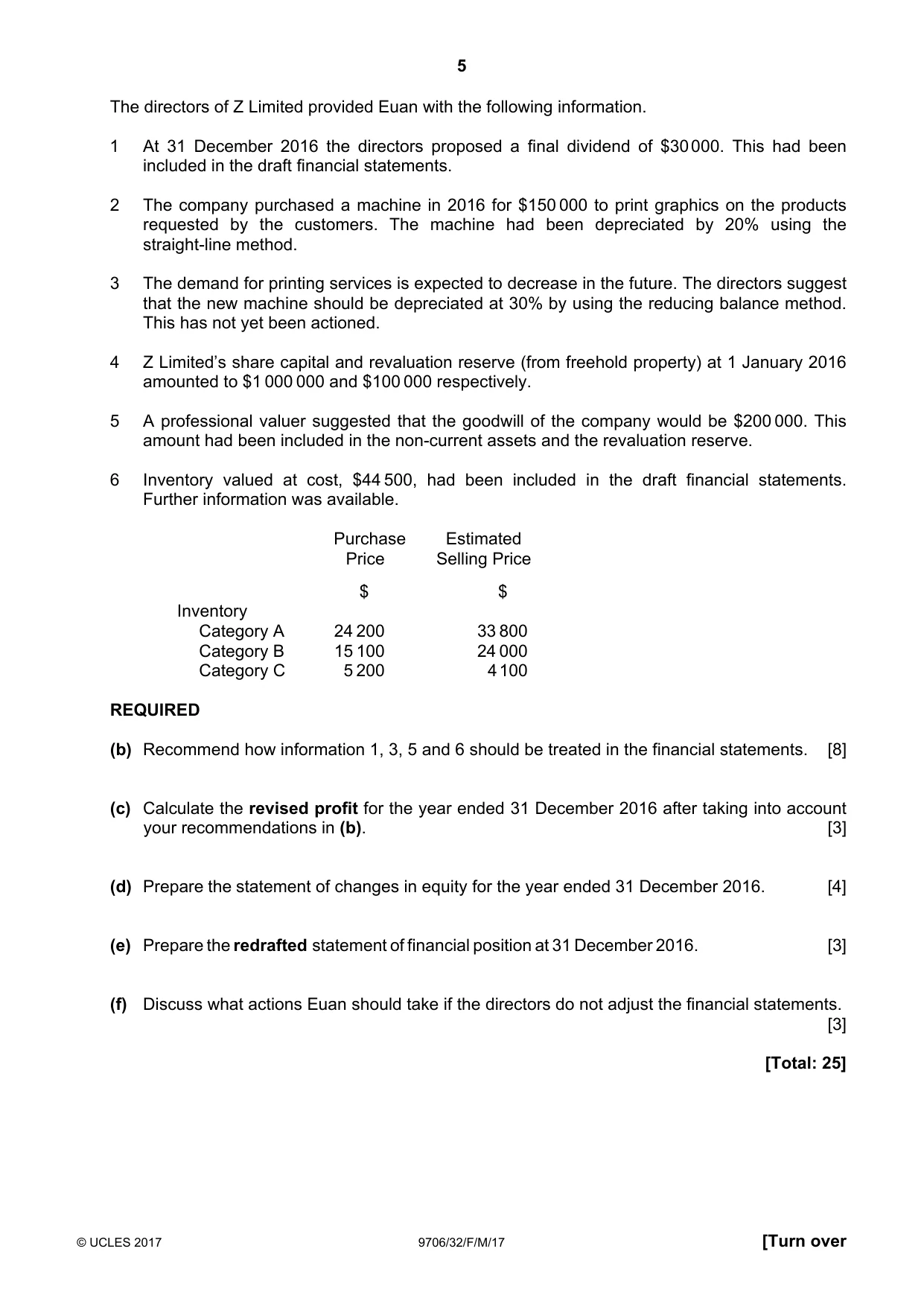
5 © UCLES 2017 9706/32/F/M/17 [Turn over The directors of Z Limited provided Euan with the following information. 1 At 31 December 2016 the directors proposed a final dividend of $30 000. This had been included in the draft financial statements. 2 The company purchased a machine in 2016 for $150 000 to print graphics on the products requested by the customers. The machine had been depreciated by 20% using the straight-line method. 3 The demand for printing services is expected to decrease in the future. The directors suggest that the new machine should be depreciated at 30% by using the reducing balance method. This has not yet been actioned. 4 Z Limited’s share capital and revaluation reserve (from freehold property) at 1 January 2016 amounted to $1 000 000 and $100 000 respectively. 5 A professional valuer suggested that the goodwill of the company would be $200 000. This amount had been included in the non-current assets and the revaluation reserve. 6 Inventory valued at cost, $44 500, had been included in the draft financial statements. Further information was available. Purchase Estimated Price Selling Price $ $ Inventory Category A 24 200 33 800 Category B 15 100 24 000 Category C 5 200 4 100 REQUIRED (b) Recommend how information 1, 3, 5 and 6 should be treated in the financial statements. [8] (c) Calculate the revised profit for the year ended 31 December 2016 after taking into account your recommendations in (b). [3] (d) Prepare the statement of changes in equity for the year ended 31 December 2016. [4] (e) Prepare the redrafted statement of financial position at 31 December 2016. [3] (f) Discuss what actions Euan should take if the directors do not adjust the financial statements. [3] [Total: 25]
Question paper, page 6
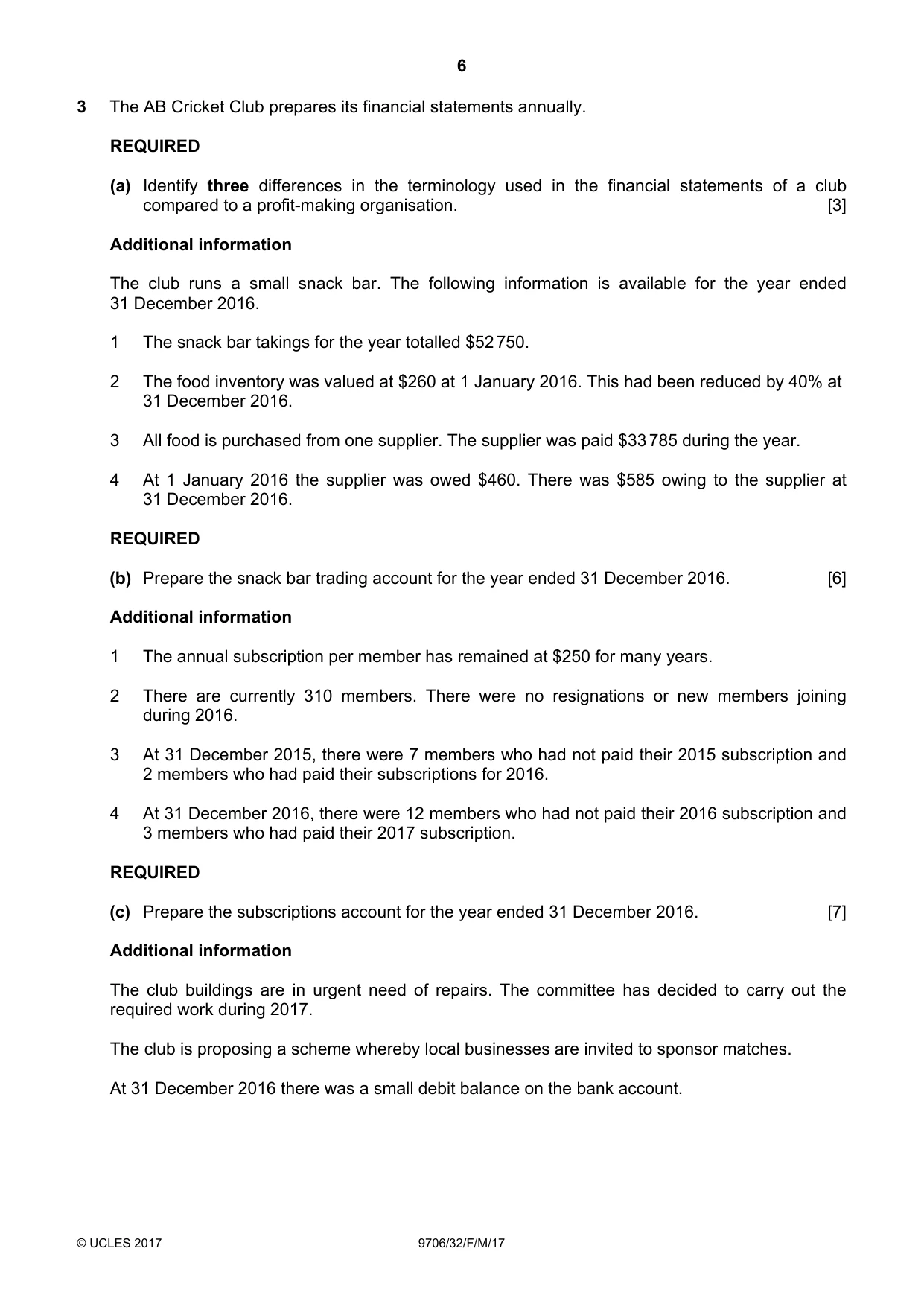
6 © UCLES 2017 9706/32/F/M/17 3 The AB Cricket Club prepares its financial statements annually. REQUIRED (a) Identify three differences in the terminology used in the financial statements of a club compared to a profit-making organisation. [3] Additional information The club runs a small snack bar. The following information is available for the year ended 31 December 2016. 1 The snack bar takings for the year totalled $52 750. 2 The food inventory was valued at $260 at 1 January 2016. This had been reduced by 40% at 31 December 2016. 3 All food is purchased from one supplier. The supplier was paid $33 785 during the year. 4 At 1 January 2016 the supplier was owed $460. There was $585 owing to the supplier at 31 December 2016. REQUIRED (b) Prepare the snack bar trading account for the year ended 31 December 2016. [6] Additional information 1 The annual subscription per member has remained at $250 for many years. 2 There are currently 310 members. There were no resignations or new members joining during 2016. 3 At 31 December 2015, there were 7 members who had not paid their 2015 subscription and 2 members who had paid their subscriptions for 2016. 4 At 31 December 2016, there were 12 members who had not paid their 2016 subscription and 3 members who had paid their 2017 subscription. REQUIRED (c) Prepare the subscriptions account for the year ended 31 December 2016. [7] Additional information The club buildings are in urgent need of repairs. The committee has decided to carry out the required work during 2017. The club is proposing a scheme whereby local businesses are invited to sponsor matches. At 31 December 2016 there was a small debit balance on the bank account.
Question paper, page 7
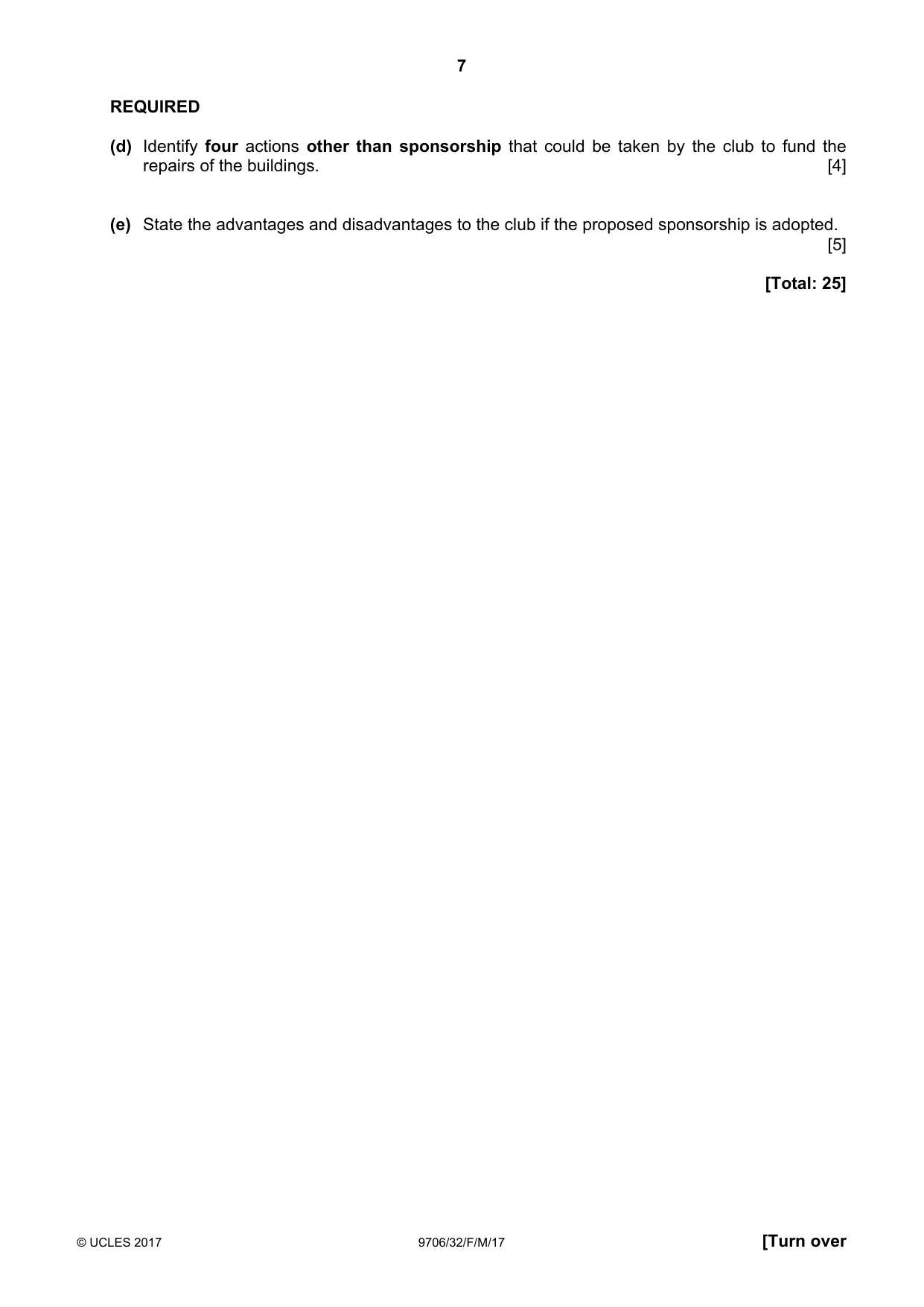
7 © UCLES 2017 9706/32/F/M/17 [Turn over REQUIRED (d) Identify four actions other than sponsorship that could be taken by the club to fund the repairs of the buildings. [4] (e) State the advantages and disadvantages to the club if the proposed sponsorship is adopted. [5] [Total: 25]
Question paper, page 8
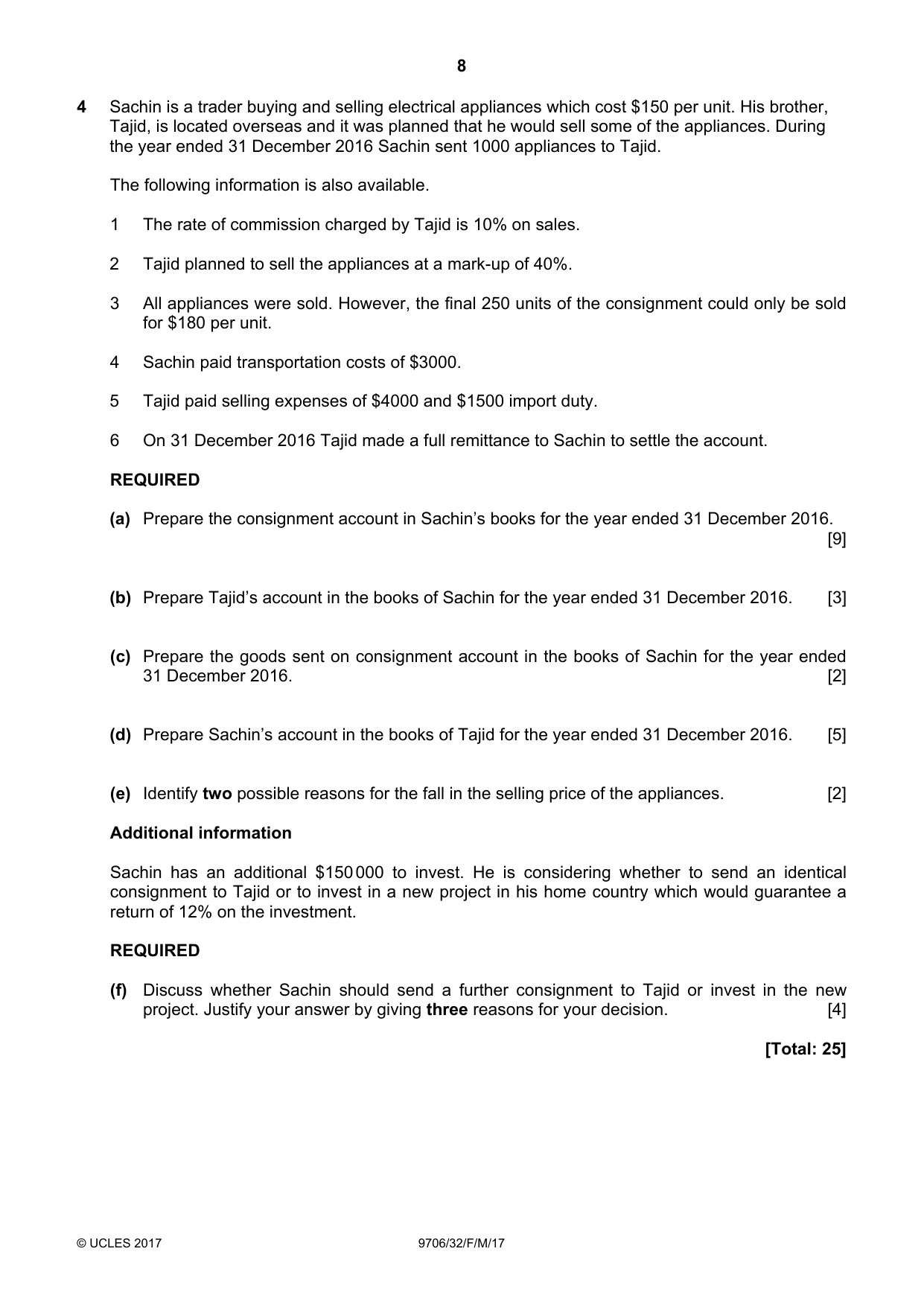
8 © UCLES 2017 9706/32/F/M/17 4 Sachin is a trader buying and selling electrical appliances which cost $150 per unit. His brother, Tajid, is located overseas and it was planned that he would sell some of the appliances. During the year ended 31 December 2016 Sachin sent 1000 appliances to Tajid. The following information is also available. 1 The rate of commission charged by Tajid is 10% on sales. 2 Tajid planned to sell the appliances at a mark-up of 40%. 3 All appliances were sold. However, the final 250 units of the consignment could only be sold for $180 per unit. 4 Sachin paid transportation costs of $3000. 5 Tajid paid selling expenses of $4000 and $1500 import duty. 6 On 31 December 2016 Tajid made a full remittance to Sachin to settle the account. REQUIRED (a) Prepare the consignment account in Sachin’s books for the year ended 31 December 2016. [9] (b) Prepare Tajid’s account in the books of Sachin for the year ended 31 December 2016. [3] (c) Prepare the goods sent on consignment account in the books of Sachin for the year ended 31 December 2016. [2] (d) Prepare Sachin’s account in the books of Tajid for the year ended 31 December 2016. [5] (e) Identify two possible reasons for the fall in the selling price of the appliances. [2] Additional information Sachin has an additional $150 000 to invest. He is considering whether to send an identical consignment to Tajid or to invest in a new project in his home country which would guarantee a return of 12% on the investment. REQUIRED (f) Discuss whether Sachin should send a further consignment to Tajid or invest in the new project. Justify your answer by giving three reasons for your decision. [4] [Total: 25]
Question paper, page 9
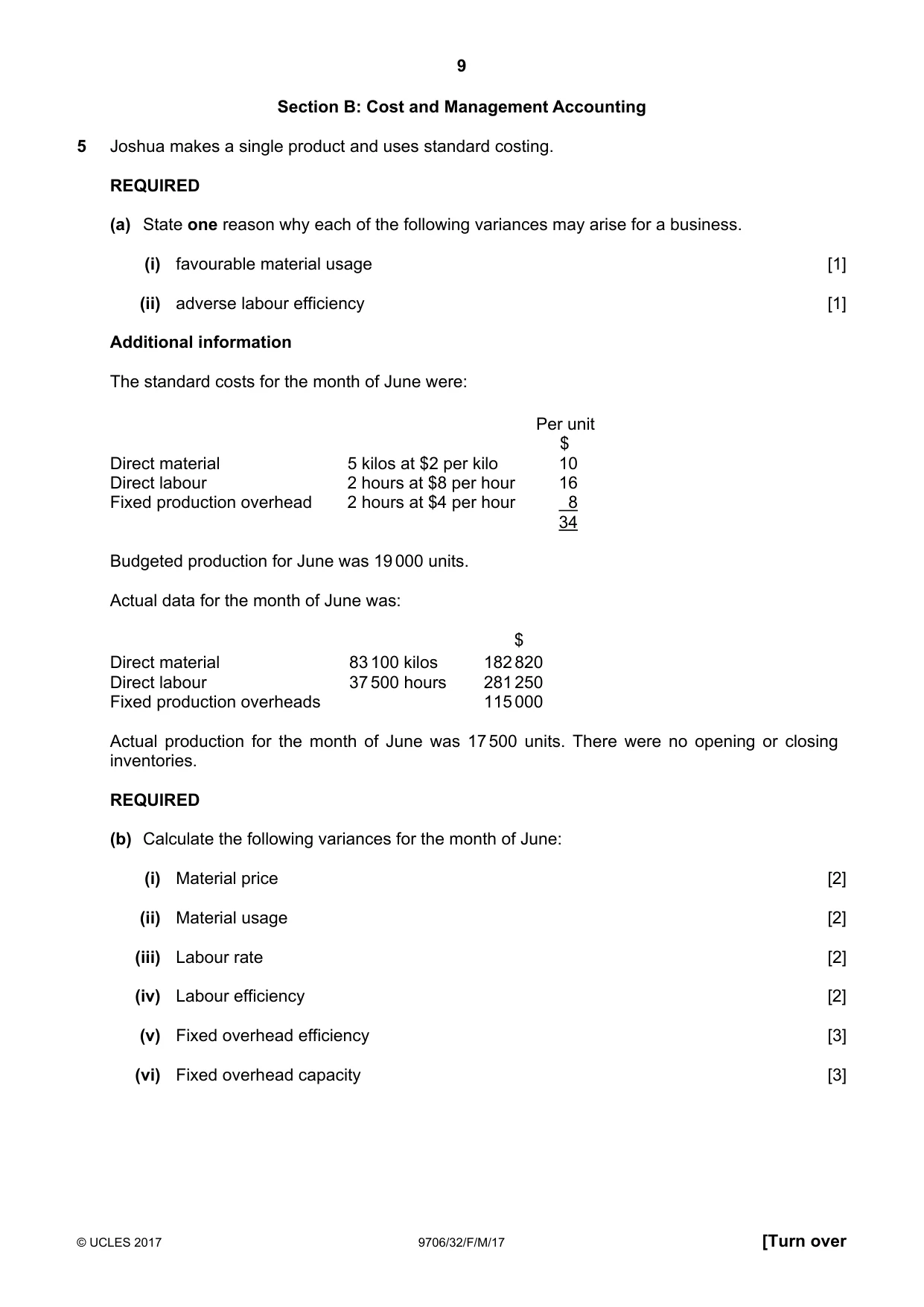
9 © UCLES 2017 9706/32/F/M/17 [Turn over Section B: Cost and Management Accounting 5 Joshua makes a single product and uses standard costing. REQUIRED (a) State one reason why each of the following variances may arise for a business. (i) favourable material usage [1] (ii) adverse labour efficiency [1] Additional information The standard costs for the month of June were: Per unit $ Direct material 5 kilos at $2 per kilo 10 Direct labour 2 hours at $8 per hour 16 Fixed production overhead 2 hours at $4 per hour 8 34 Budgeted production for June was 19 000 units. Actual data for the month of June was: $ Direct material 83 100 kilos 182 820 Direct labour 37 500 hours 281 250 Fixed production overheads 115 000 Actual production for the month of June was 17 500 units. There were no opening or closing inventories. REQUIRED (b) Calculate the following variances for the month of June: (i) Material price [2] (ii) Material usage [2] (iii) Labour rate [2] (iv) Labour efficiency [2] (v) Fixed overhead efficiency [3] (vi) Fixed overhead capacity [3]
Question paper, page 10
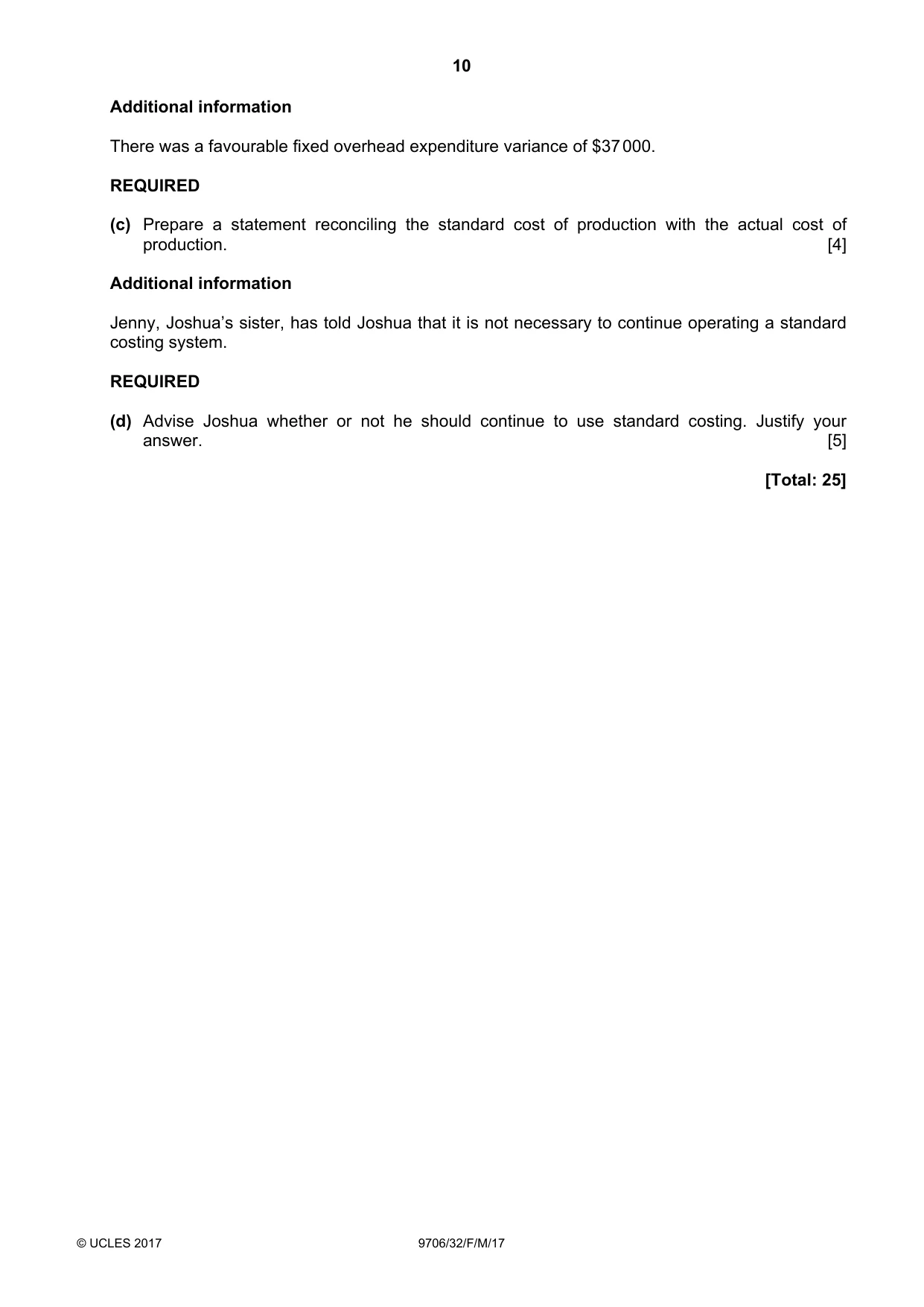
10 © UCLES 2017 9706/32/F/M/17 Additional information There was a favourable fixed overhead expenditure variance of $37 000. REQUIRED (c) Prepare a statement reconciling the standard cost of production with the actual cost of production. [4] Additional information Jenny, Joshua’s sister, has told Joshua that it is not necessary to continue operating a standard costing system. REQUIRED (d) Advise Joshua whether or not he should continue to use standard costing. Justify your answer. [5] [Total: 25]
Question paper, page 11
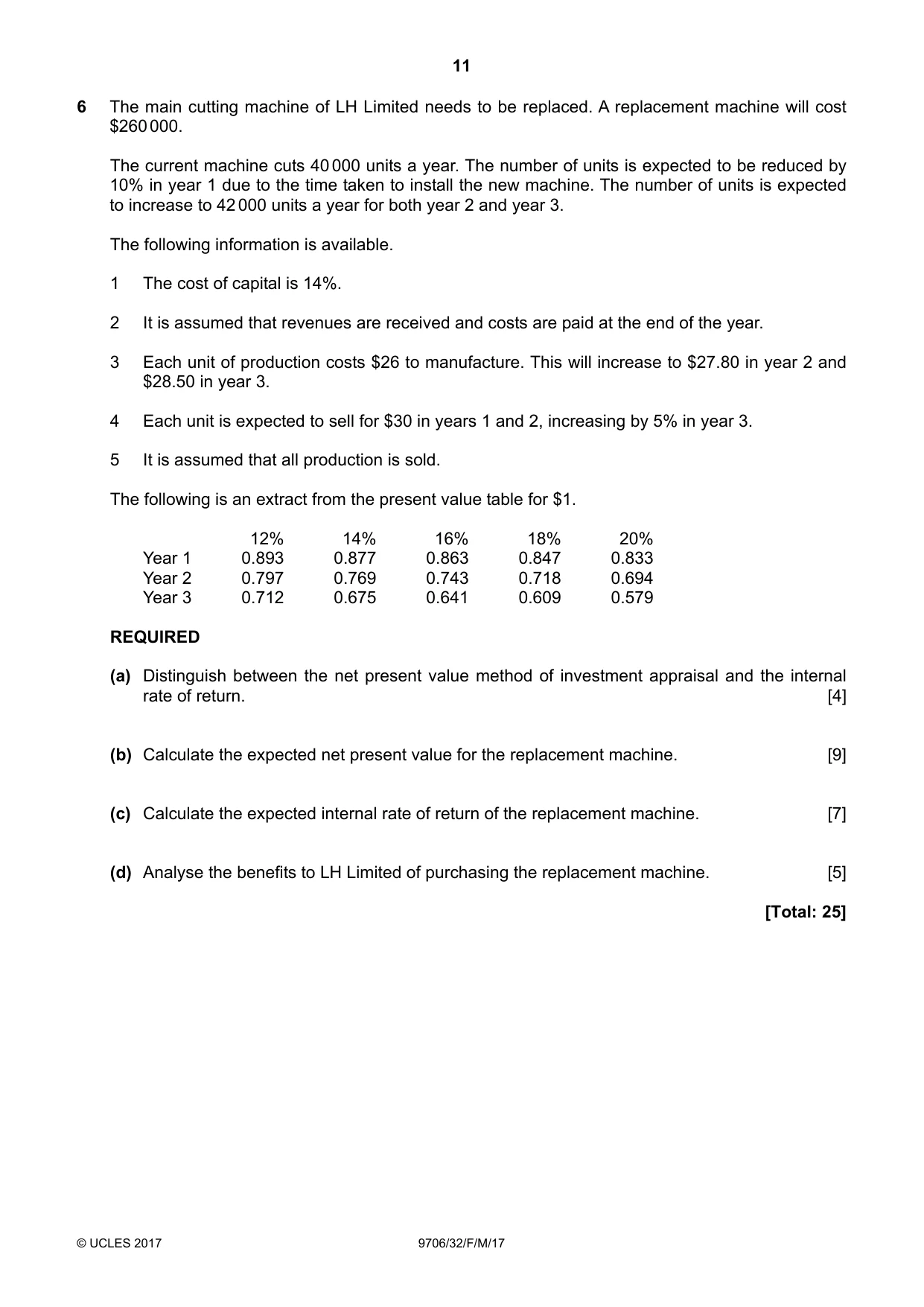
11 © UCLES 2017 9706/32/F/M/17 6 The main cutting machine of LH Limited needs to be replaced. A replacement machine will cost $260 000. The current machine cuts 40 000 units a year. The number of units is expected to be reduced by 10% in year 1 due to the time taken to install the new machine. The number of units is expected to increase to 42 000 units a year for both year 2 and year 3. The following information is available. 1 The cost of capital is 14%. 2 It is assumed that revenues are received and costs are paid at the end of the year. 3 Each unit of production costs $26 to manufacture. This will increase to $27.80 in year 2 and $28.50 in year 3. 4 Each unit is expected to sell for $30 in years 1 and 2, increasing by 5% in year 3. 5 It is assumed that all production is sold. The following is an extract from the present value table for $1. 12% 14% 16% 18% 20% Year 1 0.893 0.877 0.863 0.847 0.833 Year 2 0.797 0.769 0.743 0.718 0.694 Year 3 0.712 0.675 0.641 0.609 0.579 REQUIRED (a) Distinguish between the net present value method of investment appraisal and the internal rate of return. [4] (b) Calculate the expected net present value for the replacement machine. [9] (c) Calculate the expected internal rate of return of the replacement machine. [7] (d) Analyse the benefits to LH Limited of purchasing the replacement machine. [5] [Total: 25]
Question paper, page 12
12 Permission to reproduce items where third-party owned material protected by copyright is included has been sought and cleared where possible. Every reasonable effort has been made by the publisher (UCLES) to trace copyright holders, but if any items requiring clearance have unwittingly been included, the publisher will be pleased to make amends at the earliest possible opportunity. To avoid the issue of disclosure of answer-related information to candidates, all copyright acknowledgements are reproduced online in the Cambridge International Examinations Copyright Acknowledgements Booklet. This is produced for each series of examinations and is freely available to download at www.cie.org.uk after the live examination series. Cambridge International Examinations is part of the Cambridge Assessment Group. Cambridge Assessment is the brand name of University of Cambridge Local Examinations Syndicate (UCLES), which is itself a department of the University of Cambridge. © UCLES 2017 9706/32/F/M/17 BLANK PAGE
Mark scheme, page 1
® IGCSE is a registered trademark. This document consists of 16 printed pages. © UCLES 2017 [Turn over Cambridge International Examinations Cambridge International Advanced Subsidiary and Advanced Level ACCOUNTING 9706/32 Paper 3 A Level Structured Questions March 2017 MARK SCHEME Maximum Mark: 150 Published This mark scheme is published as an aid to teachers and candidates, to indicate the requirements of the examination. It shows the basis on which Examiners were instructed to award marks. It does not indicate the details of the discussions that took place at an Examiners’ meeting before marking began, which would have considered the acceptability of alternative answers. Mark schemes should be read in conjunction with the question paper and the Principal Examiner Report for Teachers. Cambridge will not enter into discussions about these mark schemes. Cambridge is publishing the mark schemes for the March 2017 series for most Cambridge IGCSE®, Cambridge International A and AS Level components and some Cambridge O Level components.
Mark scheme, page 2
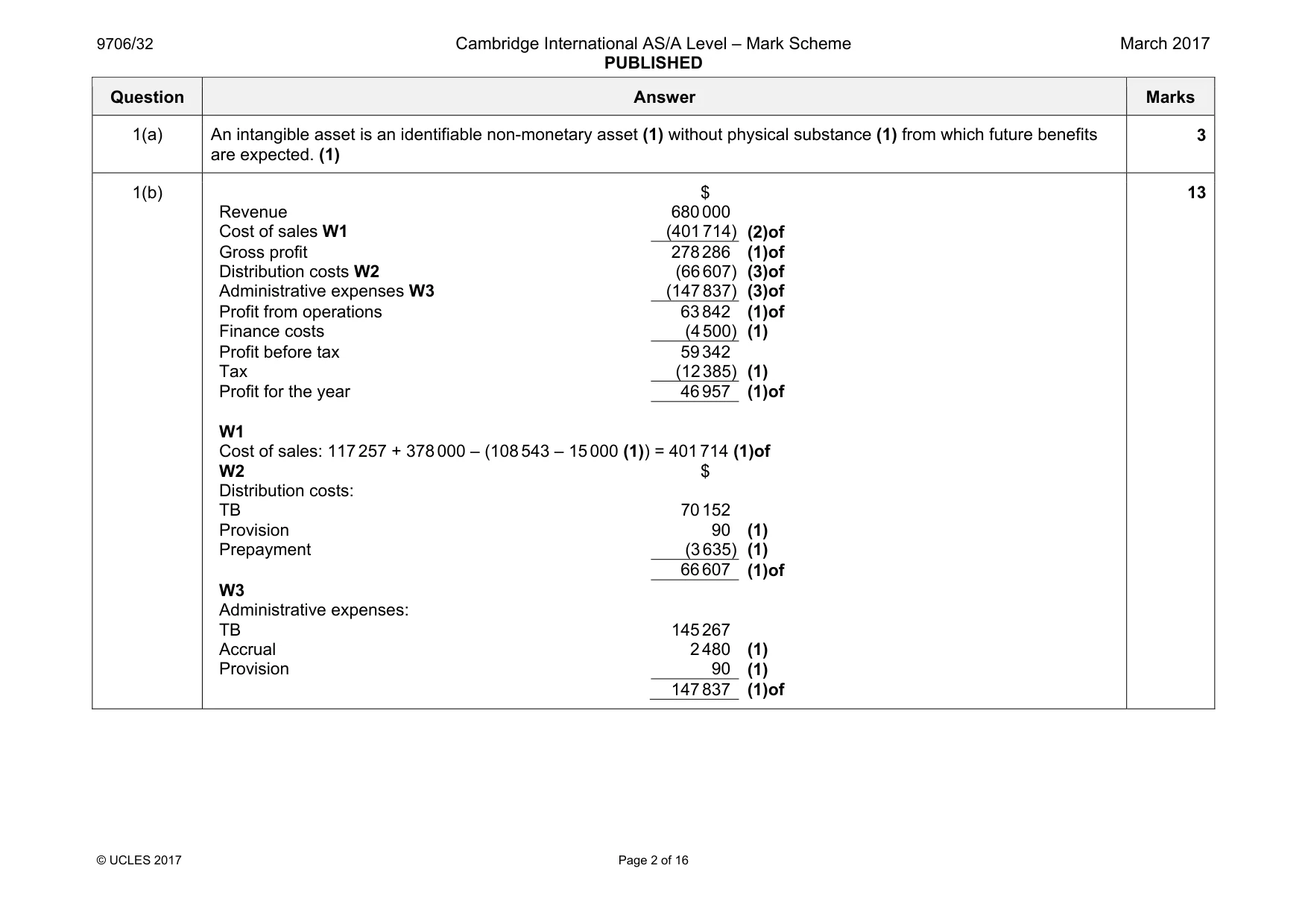
9706/32 Cambridge International AS/A Level – Mark Scheme PUBLISHED March 2017 © UCLES 2017 Page 2 of 16 Question Answer Marks 1(a) An intangible asset is an identifiable non-monetary asset (1) without physical substance (1) from which future benefits are expected. (1) 3 1(b) $ Revenue 680 000 Cost of sales W1 (401 714) (2)of Gross profit 278 286 (1)of Distribution costs W2 (66 607) (3)of Administrative expenses W3 (147 837) (3)of Profit from operations 63 842 (1)of Finance costs (4 500) (1) Profit before tax 59 342 Tax (12 385) (1) Profit for the year 46 957 (1)of W1 Cost of sales: 117 257 + 378 000 – (108 543 – 15 000 (1)) = 401 714 (1)of W2 Distribution costs: $ TB 70 152 Provision 90 (1) Prepayment (3 635) (1) 66 607 (1)of W3 Administrative expenses: TB 145 267 Accrual 2 480 (1) Provision 90 (1) 147 837 (1)of 13
Mark scheme, page 3
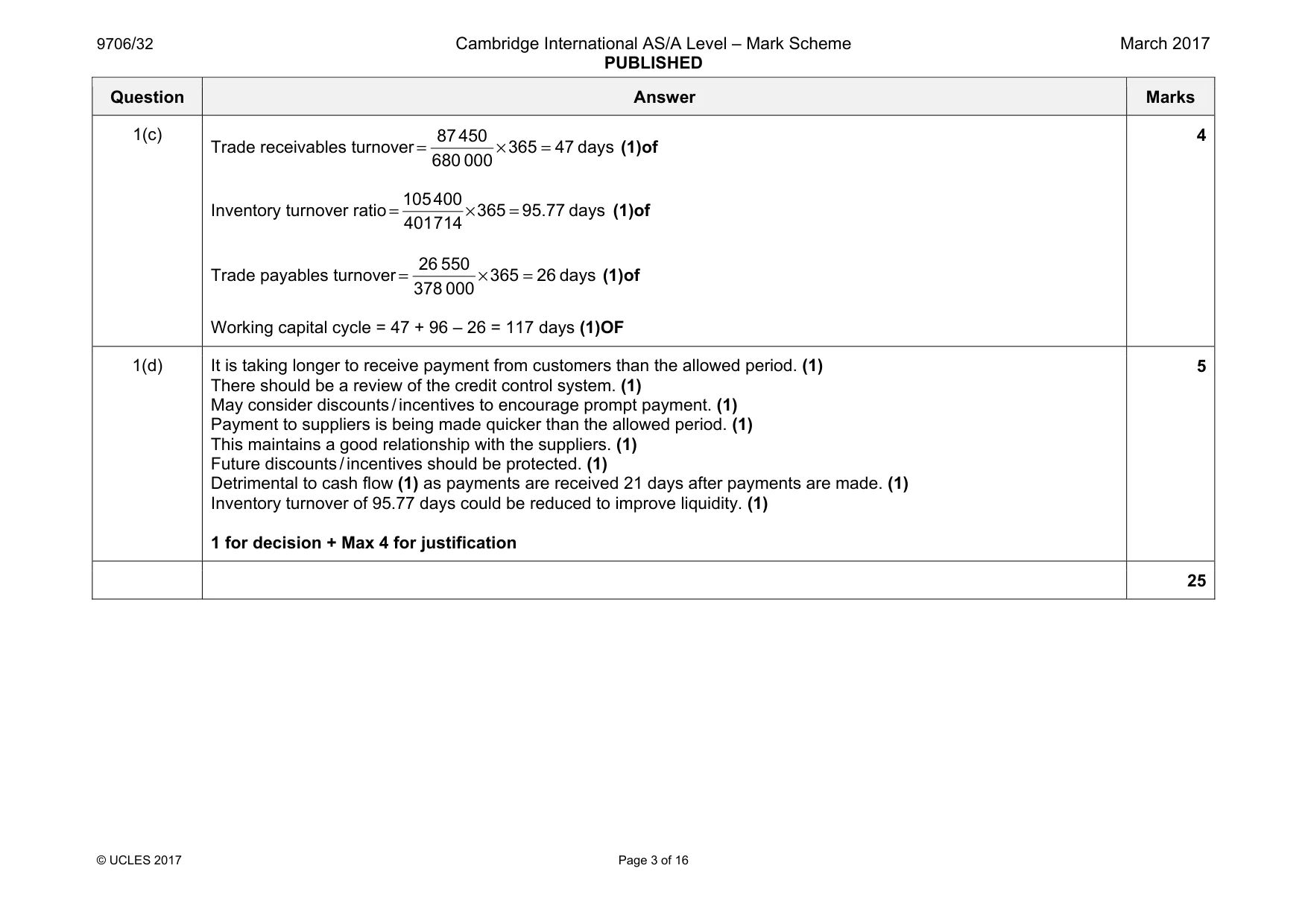
9706/32 Cambridge International AS/A Level – Mark Scheme PUBLISHED March 2017 © UCLES 2017 Page 3 of 16 Question Answer Marks 1(c) Trade receivables turnover days 47 365 000 680 450 87 = × = (1)of Inventory turnover ratio days 95.77 365 714 401 400 105 = × = (1)of Trade payables turnover days 26 365 000 378 550 26 = × = (1)of Working capital cycle = 47 + 96 – 26 = 117 days (1)OF 4 1(d) It is taking longer to receive payment from customers than the allowed period. (1) There should be a review of the credit control system. (1) May consider discounts / incentives to encourage prompt payment. (1) Payment to suppliers is being made quicker than the allowed period. (1) This maintains a good relationship with the suppliers. (1) Future discounts / incentives should be protected. (1) Detrimental to cash flow (1) as payments are received 21 days after payments are made. (1) Inventory turnover of 95.77 days could be reduced to improve liquidity. (1) 1 for decision + Max 4 for justification 5 25
Mark scheme, page 4
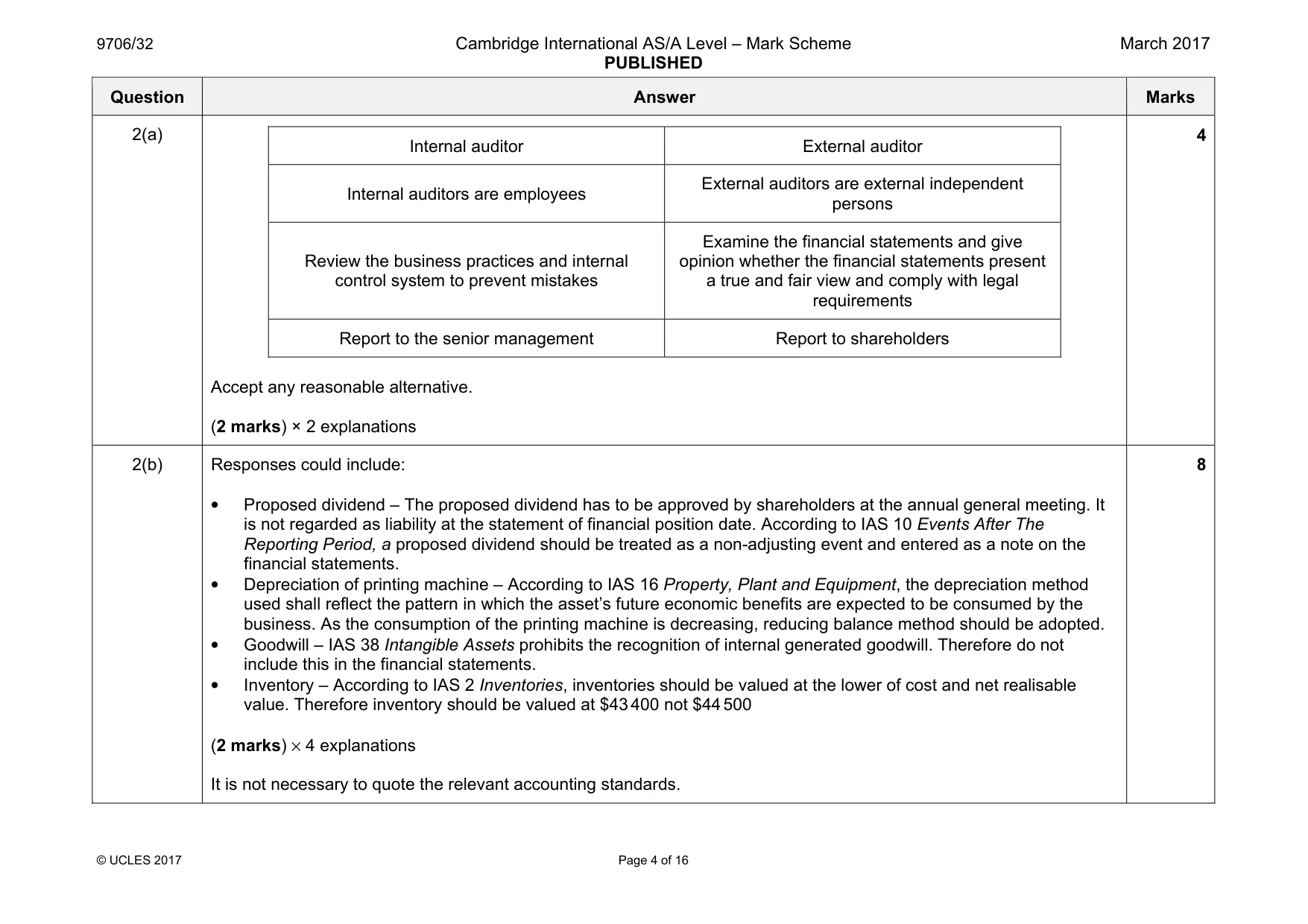
9706/32 Cambridge International AS/A Level – Mark Scheme PUBLISHED March 2017 © UCLES 2017 Page 4 of 16 Question Answer Marks 2(a) Internal auditor External auditor Internal auditors are employees External auditors are external independent persons Review the business practices and internal control system to prevent mistakes Examine the financial statements and give opinion whether the financial statements present a true and fair view and comply with legal requirements Report to the senior management Report to shareholders Accept any reasonable alternative. (2 marks) × 2 explanations 4 2(b) Responses could include: • Proposed dividend – The proposed dividend has to be approved by shareholders at the annual general meeting. It is not regarded as liability at the statement of financial position date. According to IAS 10 Events After The Reporting Period, a proposed dividend should be treated as a non-adjusting event and entered as a note on the financial statements. • Depreciation of printing machine – According to IAS 16 Property, Plant and Equipment, the depreciation method used shall reflect the pattern in which the asset’s future economic benefits are expected to be consumed by the business. As the consumption of the printing machine is decreasing, reducing balance method should be adopted. • Goodwill – IAS 38 Intangible Assets prohibits the recognition of internal generated goodwill. Therefore do not include this in the financial statements. • Inventory – According to IAS 2 Inventories, inventories should be valued at the lower of cost and net realisable value. Therefore inventory should be valued at $43 400 not $44 500 (2 marks) × 4 explanations It is not necessary to quote the relevant accounting standards. 8
Mark scheme, page 5
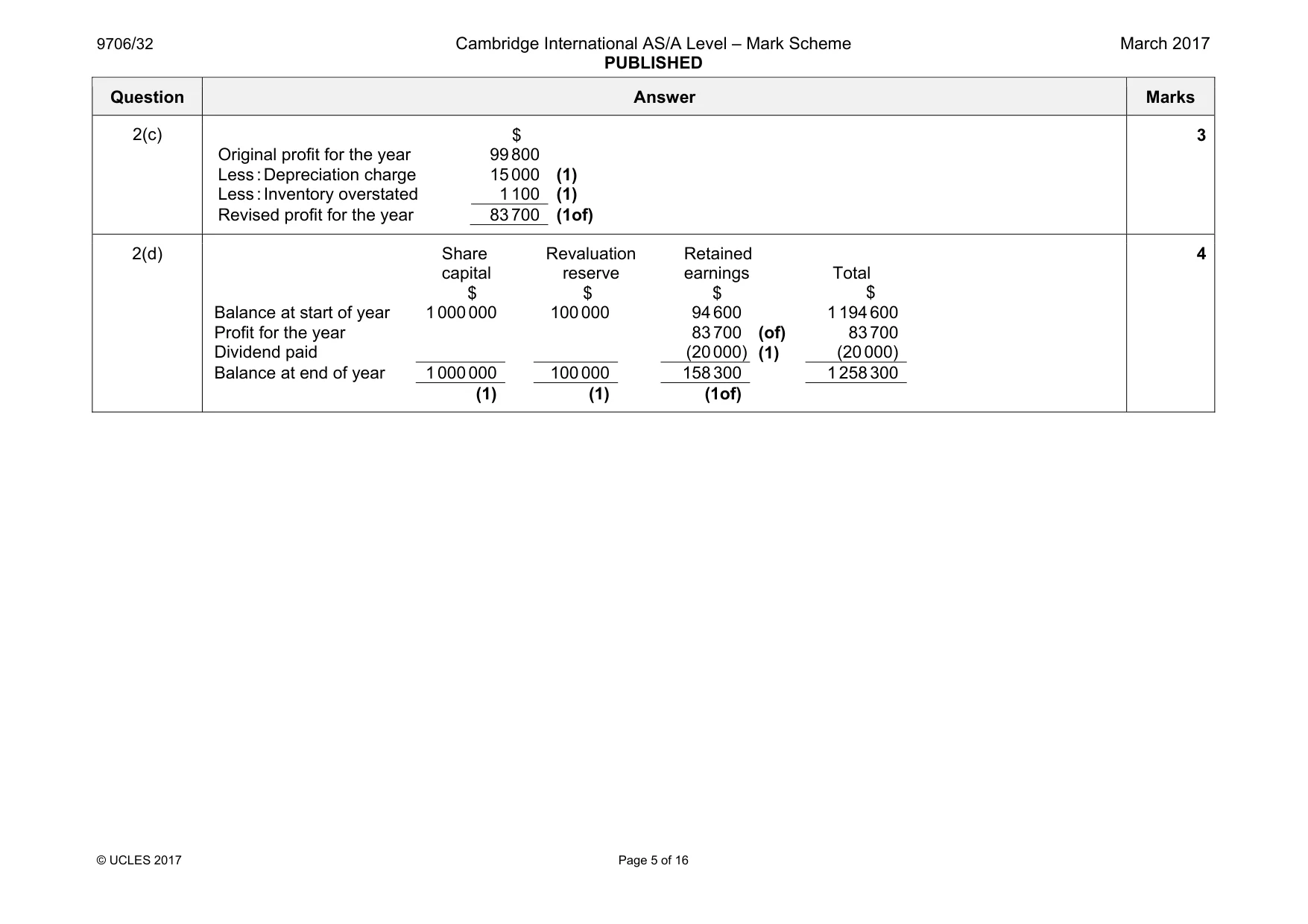
9706/32 Cambridge International AS/A Level – Mark Scheme PUBLISHED March 2017 © UCLES 2017 Page 5 of 16 Question Answer Marks 2(c) $ Original profit for the year 99 800 Less : Depreciation charge 15 000 (1) Less : Inventory overstated 1 100 (1) Revised profit for the year 83 700 (1of) 3 2(d) Share capital Revaluation reserve Retained earnings Total $ $ $ $ Balance at start of year 1 000 000 100 000 94 600 1 194 600 Profit for the year 83 700 (of) 83 700 Dividend paid (20 000) (1) (20 000) Balance at end of year 1 000 000 100 000 158 300 1 258 300 (1) (1) (1of) 4
Mark scheme, page 6
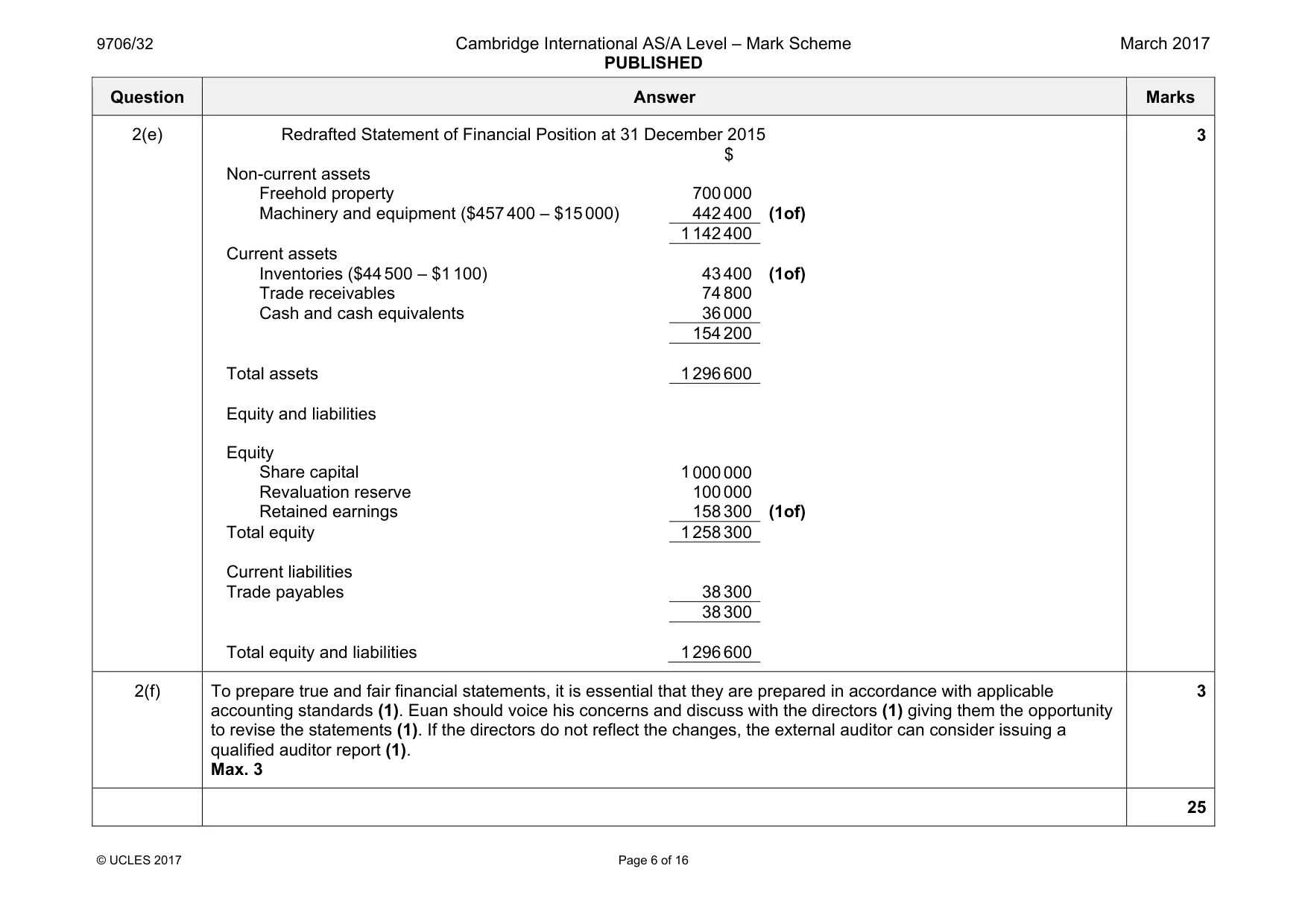
9706/32 Cambridge International AS/A Level – Mark Scheme PUBLISHED March 2017 © UCLES 2017 Page 6 of 16 Question Answer Marks 2(e) Redrafted Statement of Financial Position at 31 December 2015 $ Non-current assets Freehold property 700 000 Machinery and equipment ($457 400 – $15 000) 442 400 (1of) 1 142 400 Current assets Inventories ($44 500 – $1 100) 43 400 (1of) Trade receivables 74 800 Cash and cash equivalents 36 000 154 200 Total assets 1 296 600 Equity and liabilities Equity Share capital 1 000 000 Revaluation reserve 100 000 Retained earnings 158 300 (1of) Total equity 1 258 300 Current liabilities Trade payables 38 300 38 300 Total equity and liabilities 1 296 600 3 2(f) To prepare true and fair financial statements, it is essential that they are prepared in accordance with applicable accounting standards (1). Euan should voice his concerns and discuss with the directors (1) giving them the opportunity to revise the statements (1). If the directors do not reflect the changes, the external auditor can consider issuing a qualified auditor report (1). Max. 3 3 25
Mark scheme, page 7
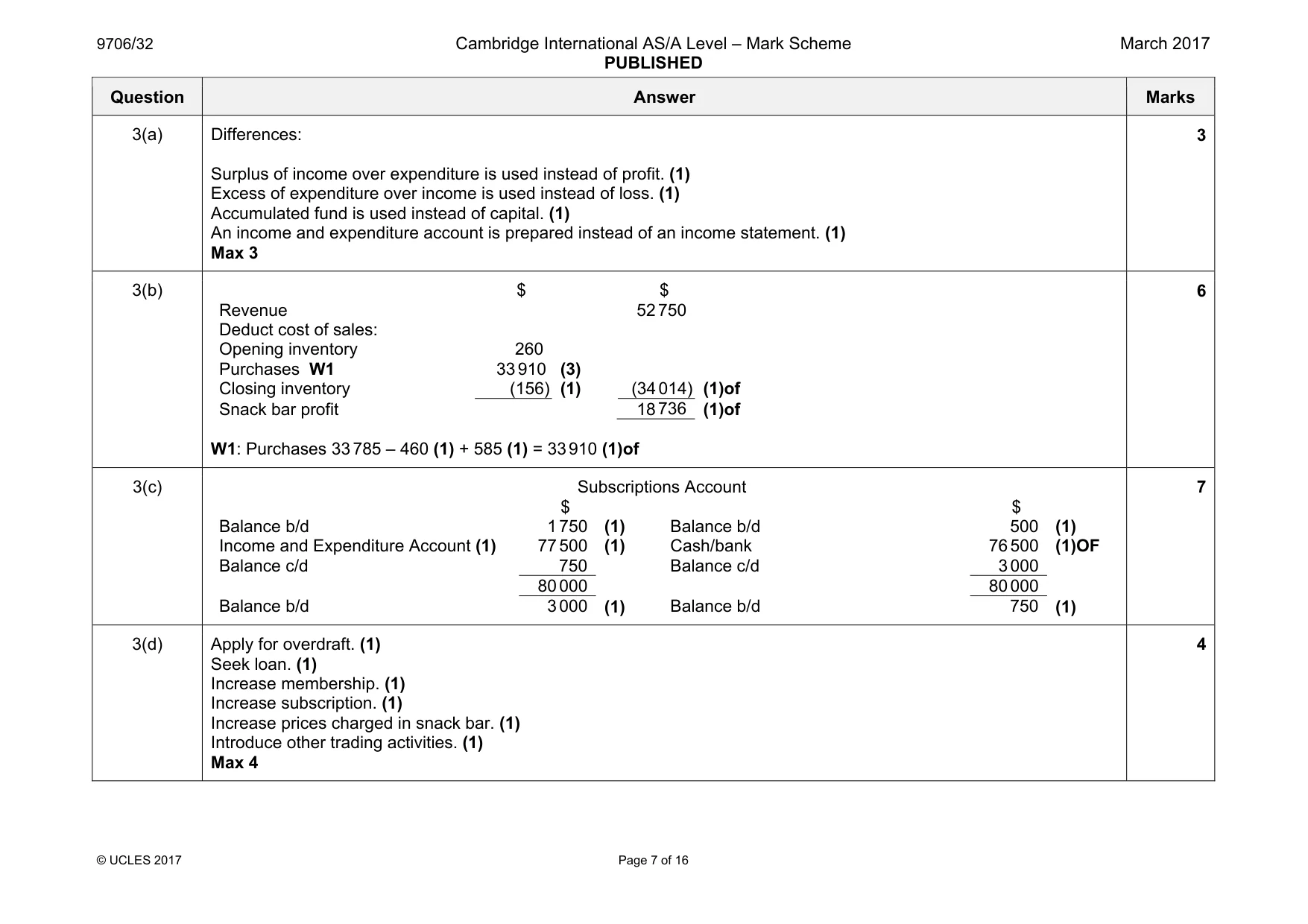
9706/32 Cambridge International AS/A Level – Mark Scheme PUBLISHED March 2017 © UCLES 2017 Page 7 of 16 Question Answer Marks 3(a) Differences: Surplus of income over expenditure is used instead of profit. (1) Excess of expenditure over income is used instead of loss. (1) Accumulated fund is used instead of capital. (1) An income and expenditure account is prepared instead of an income statement. (1) Max 3 3 3(b) $ $ Revenue 52 750 Deduct cost of sales: Opening inventory 260 Purchases W1 33 910 (3) Closing inventory (156) (1) (34 014) (1)of Snack bar profit 18 736 (1)of W1: Purchases 33 785 – 460 (1) + 585 (1) = 33 910 (1)of 6 3(c) Subscriptions Account $ $ Balance b/d 1 750 (1) Balance b/d 500 (1) Income and Expenditure Account (1) 77 500 (1) Cash/bank 76 500 (1)OF Balance c/d 750 Balance c/d 3 000 80 000 80 000 Balance b/d 3 000 (1) Balance b/d 750 (1) 7 3(d) Apply for overdraft. (1) Seek loan. (1) Increase membership. (1) Increase subscription. (1) Increase prices charged in snack bar. (1) Introduce other trading activities. (1) Max 4 4
Mark scheme, page 8
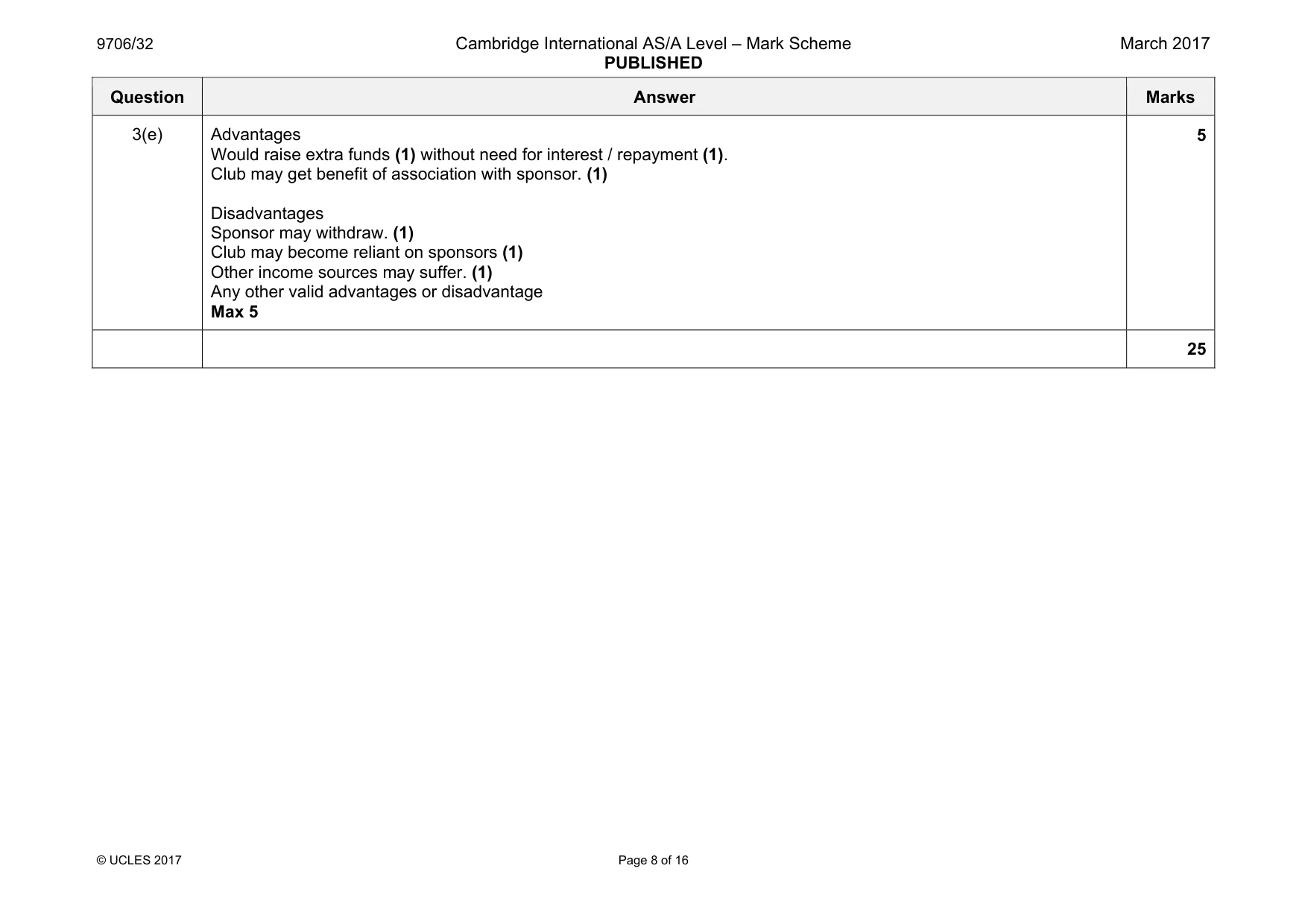
9706/32 Cambridge International AS/A Level – Mark Scheme PUBLISHED March 2017 © UCLES 2017 Page 8 of 16 Question Answer Marks 3(e) Advantages Would raise extra funds (1) without need for interest / repayment (1). Club may get benefit of association with sponsor. (1) Disadvantages Sponsor may withdraw. (1) Club may become reliant on sponsors (1) Other income sources may suffer. (1) Any other valid advantages or disadvantage Max 5 5 25
Mark scheme, page 9
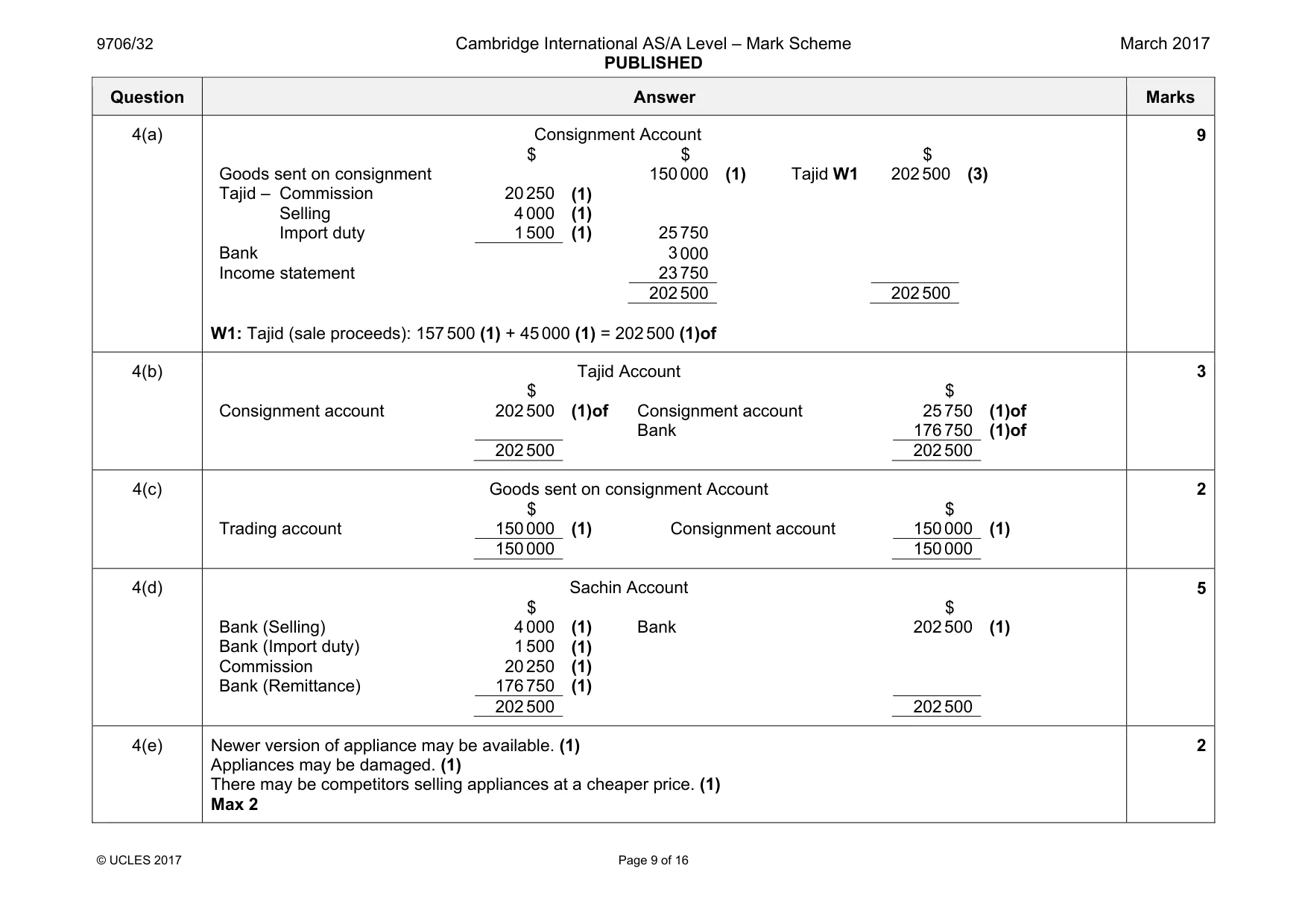
9706/32 Cambridge International AS/A Level – Mark Scheme PUBLISHED March 2017 © UCLES 2017 Page 9 of 16 Question Answer Marks 4(a) Consignment Account $ $ $ Goods sent on consignment 150 000 (1) Tajid W1 202 500 (3) Tajid – Commission 20 250 (1) Selling 4 000 (1) Import duty 1 500 (1) 25 750 Bank 3 000 Income statement 23 750 202 500 202 500 W1: Tajid (sale proceeds): 157 500 (1) + 45 000 (1) = 202 500 (1)of 9 4(b) Tajid Account $ $ Consignment account 202 500 (1)of Consignment account 25 750 (1)of Bank 176 750 (1)of 202 500 202 500 3 4(c) Goods sent on consignment Account $ $ Trading account 150 000 (1) Consignment account 150 000 (1) 150 000 150 000 2 4(d) Sachin Account $ $ Bank (Selling) 4 000 (1) Bank 202 500 (1) Bank (Import duty) 1 500 (1) Commission 20 250 (1) Bank (Remittance) 176 750 (1) 202 500 202 500 5 4(e) Newer version of appliance may be available. (1) Appliances may be damaged. (1) There may be competitors selling appliances at a cheaper price. (1) Max 2 2
Mark scheme, page 10
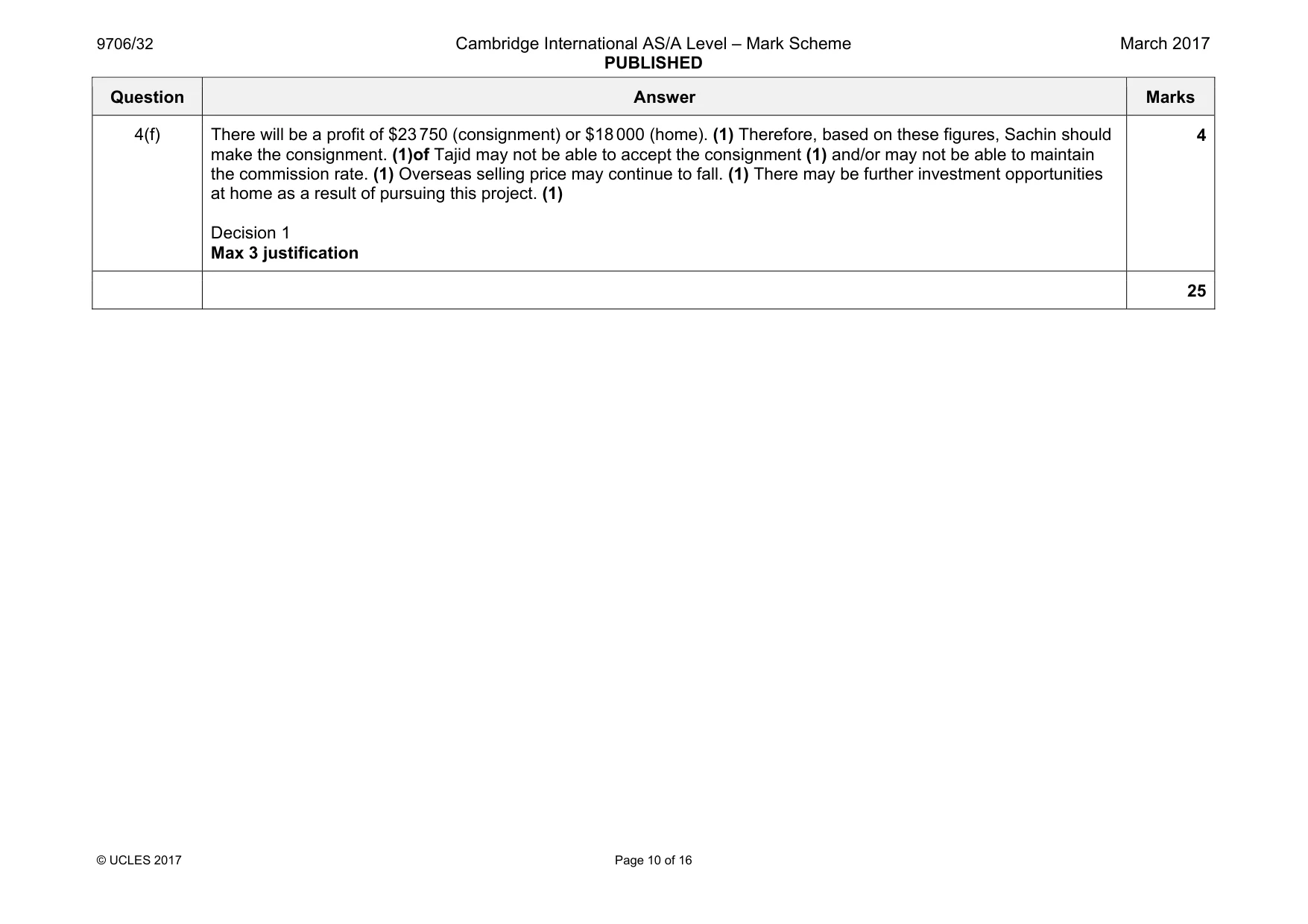
9706/32 Cambridge International AS/A Level – Mark Scheme PUBLISHED March 2017 © UCLES 2017 Page 10 of 16 Question Answer Marks 4(f) There will be a profit of $23 750 (consignment) or $18 000 (home). (1) Therefore, based on these figures, Sachin should make the consignment. (1)of Tajid may not be able to accept the consignment (1) and/or may not be able to maintain the commission rate. (1) Overseas selling price may continue to fall. (1) There may be further investment opportunities at home as a result of pursuing this project. (1) Decision 1 Max 3 justification 4 25
Mark scheme, page 11
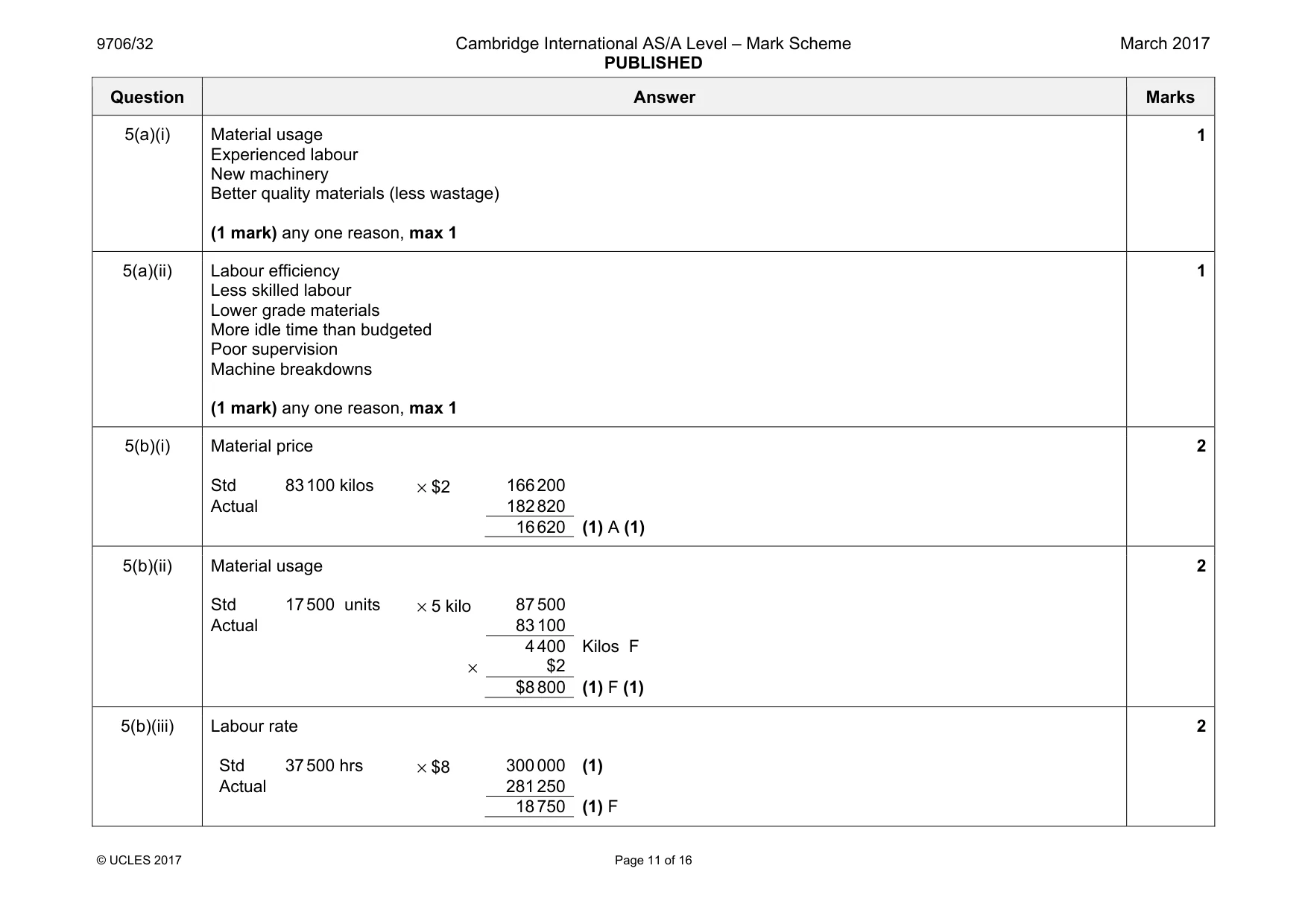
9706/32 Cambridge International AS/A Level – Mark Scheme PUBLISHED March 2017 © UCLES 2017 Page 11 of 16 Question Answer Marks 5(a)(i) Material usage Experienced labour New machinery Better quality materials (less wastage) (1 mark) any one reason, max 1 1 5(a)(ii) Labour efficiency Less skilled labour Lower grade materials More idle time than budgeted Poor supervision Machine breakdowns (1 mark) any one reason, max 1 1 5(b)(i) Material price Std 83 100 kilos × $2 166 200 Actual 182 820 16 620 (1) A (1) 2 5(b)(ii) Material usage Std 17 500 units × 5 kilo 87 500 Actual 83 100 4 400 Kilos F × $2 $8 800 (1) F (1) 2 5(b)(iii) Labour rate Std 37 500 hrs × $8 300 000 (1) Actual 281 250 18 750 (1) F 2
Mark scheme, page 12
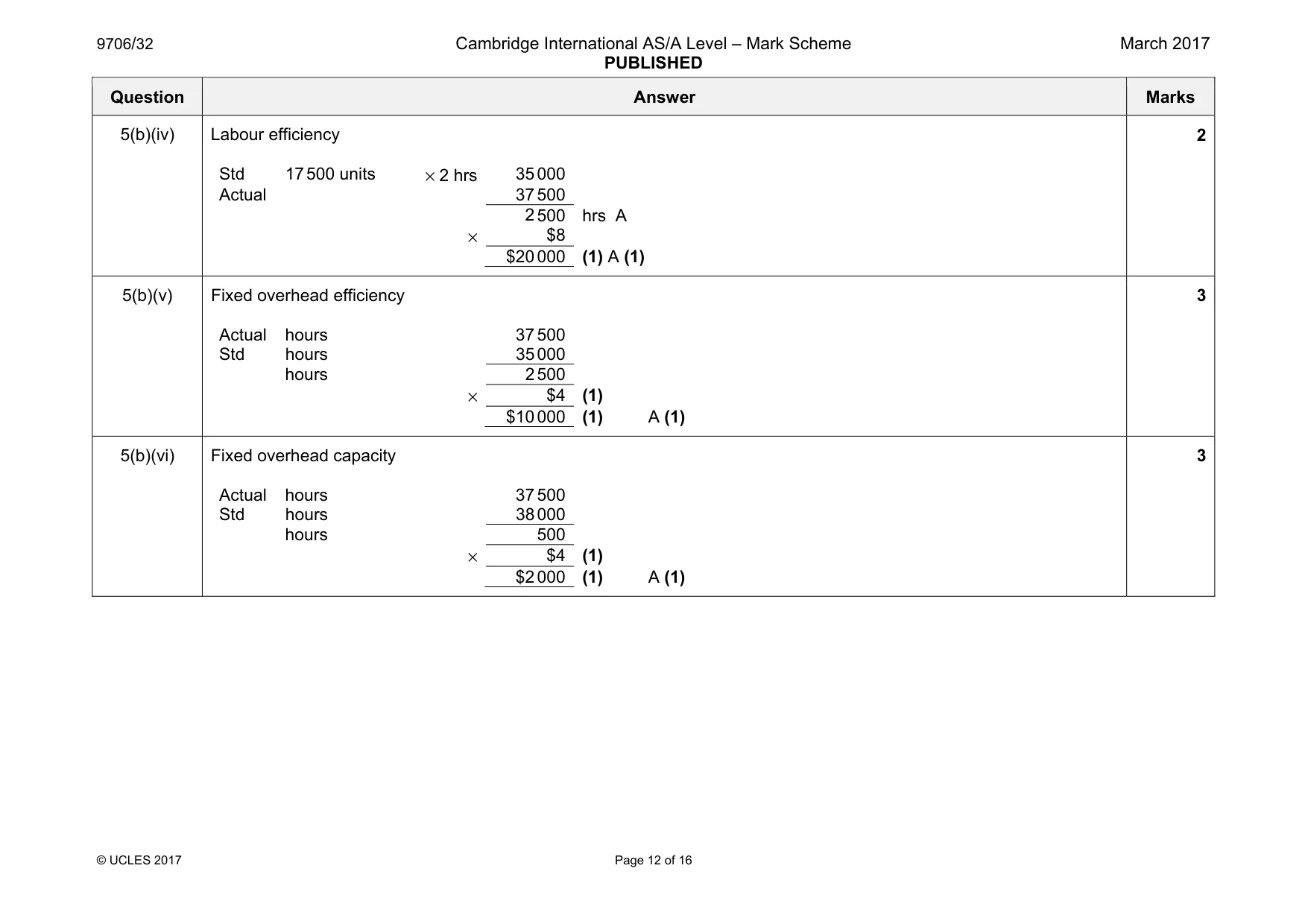
9706/32 Cambridge International AS/A Level – Mark Scheme PUBLISHED March 2017 © UCLES 2017 Page 12 of 16 Question Answer Marks 5(b)(iv) Labour efficiency Std 17 500 units × 2 hrs 35 000 Actual 37 500 2 500 hrs A × $8 $20 000 (1) A (1) 2 5(b)(v) Fixed overhead efficiency Actual hours 37 500 Std hours 35 000 hours 2 500 × $4 (1) $10 000 (1) A (1) 3 5(b)(vi) Fixed overhead capacity Actual hours 37 500 Std hours 38 000 hours 500 × $4 (1) $2 000 (1) A (1) 3
Mark scheme, page 13
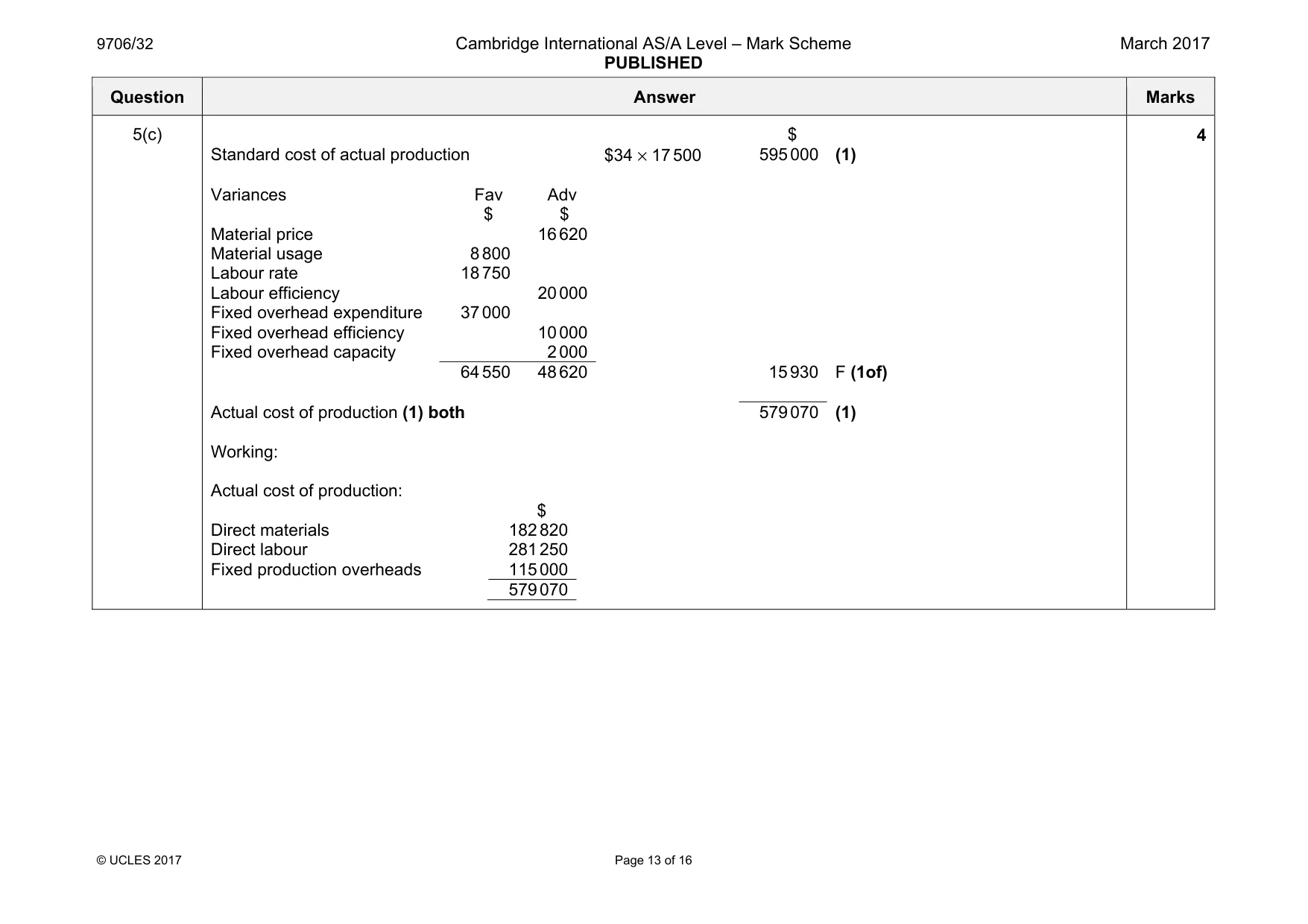
9706/32 Cambridge International AS/A Level – Mark Scheme PUBLISHED March 2017 © UCLES 2017 Page 13 of 16 Question Answer Marks 5(c) $ Standard cost of actual production $34 × 17 500 595 000 (1) Variances Fav Adv $ $ Material price 16 620 Material usage 8 800 Labour rate 18 750 Labour efficiency 20 000 Fixed overhead expenditure 37 000 Fixed overhead efficiency 10 000 Fixed overhead capacity 2 000 64 550 48 620 15 930 F (1of) Actual cost of production (1) both 579 070 (1) Working: Actual cost of production: $ Direct materials 182 820 Direct labour 281 250 Fixed production overheads 115 000 579 070 4
Mark scheme, page 14
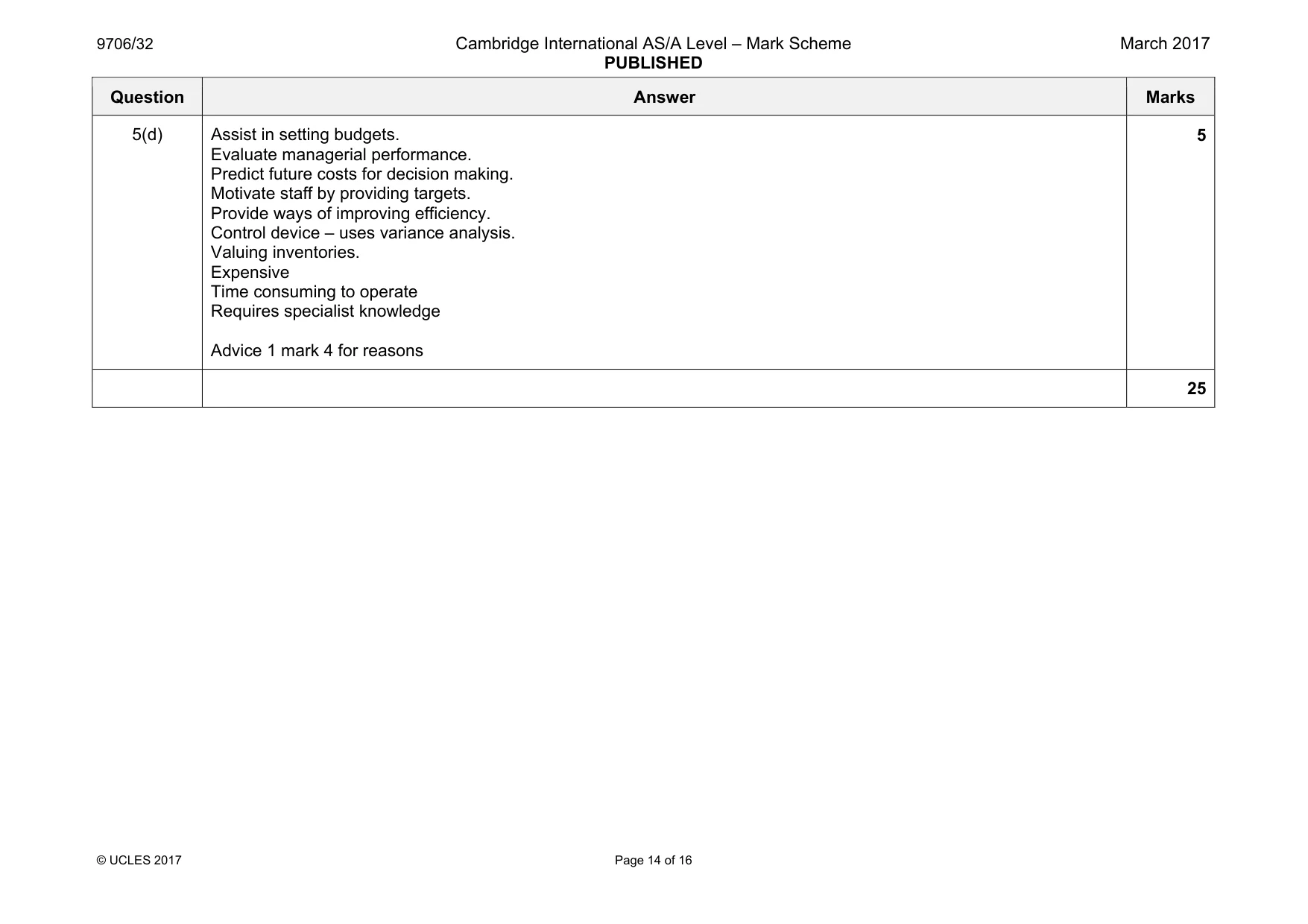
9706/32 Cambridge International AS/A Level – Mark Scheme PUBLISHED March 2017 © UCLES 2017 Page 14 of 16 Question Answer Marks 5(d) Assist in setting budgets. Evaluate managerial performance. Predict future costs for decision making. Motivate staff by providing targets. Provide ways of improving efficiency. Control device – uses variance analysis. Valuing inventories. Expensive Time consuming to operate Requires specialist knowledge Advice 1 mark 4 for reasons 5 25
Mark scheme, page 15
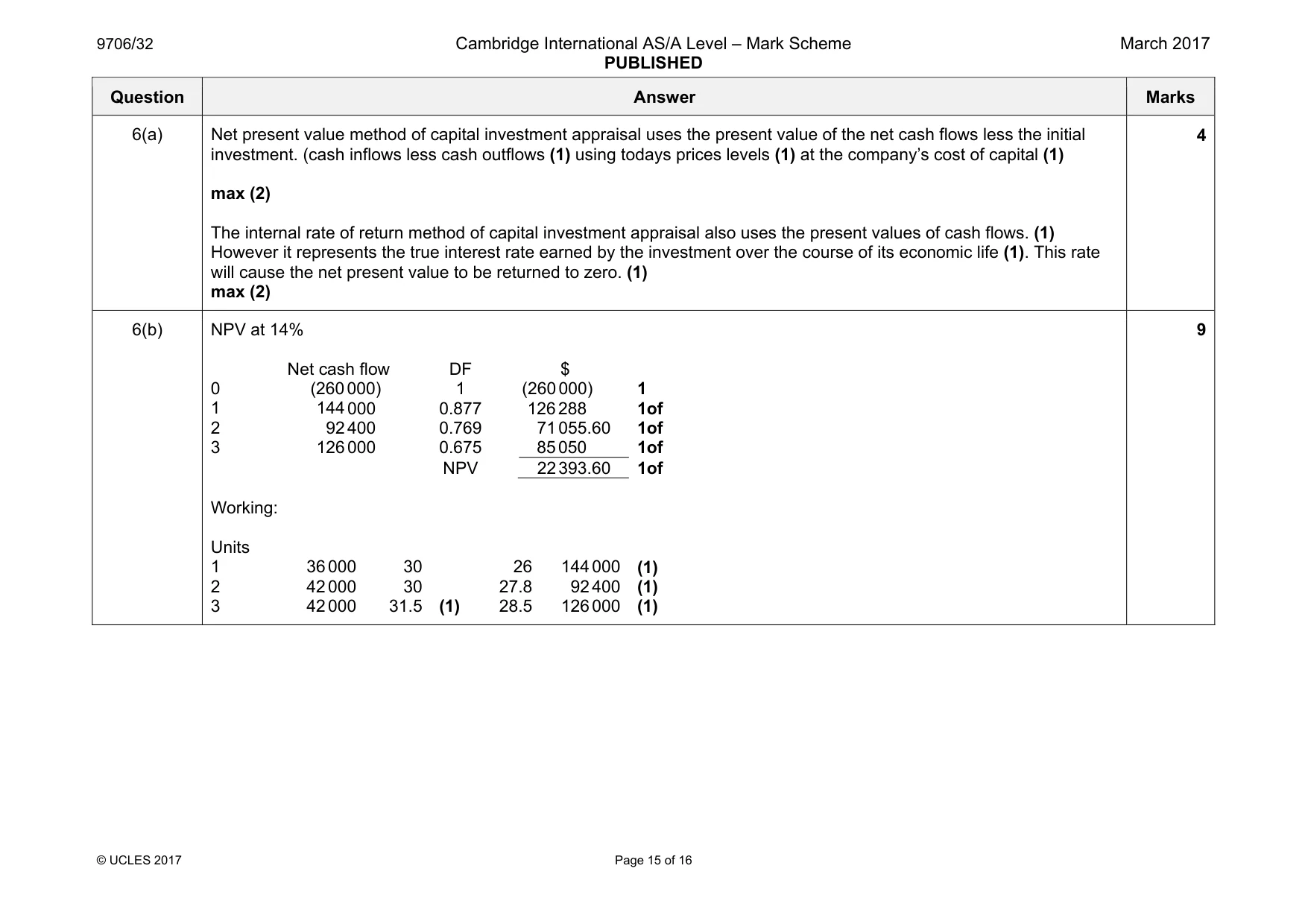
9706/32 Cambridge International AS/A Level – Mark Scheme PUBLISHED March 2017 © UCLES 2017 Page 15 of 16 Question Answer Marks 6(a) Net present value method of capital investment appraisal uses the present value of the net cash flows less the initial investment. (cash inflows less cash outflows (1) using todays prices levels (1) at the company’s cost of capital (1) max (2) The internal rate of return method of capital investment appraisal also uses the present values of cash flows. (1) However it represents the true interest rate earned by the investment over the course of its economic life (1). This rate will cause the net present value to be returned to zero. (1) max (2) 4 6(b) NPV at 14% Net cash flow DF $ 0 (260 000) 1 (260 000) 1 1 144 000 0.877 126 288 1of 2 92 400 0.769 71 055.60 1of 3 126 000 0.675 85 050 1of NPV 22 393.60 1of Working: Units 1 36 000 30 26 144 000 (1) 2 42 000 30 27.8 92 400 (1) 3 42 000 31.5 (1) 28.5 126 000 (1) 9
Mark scheme, page 16
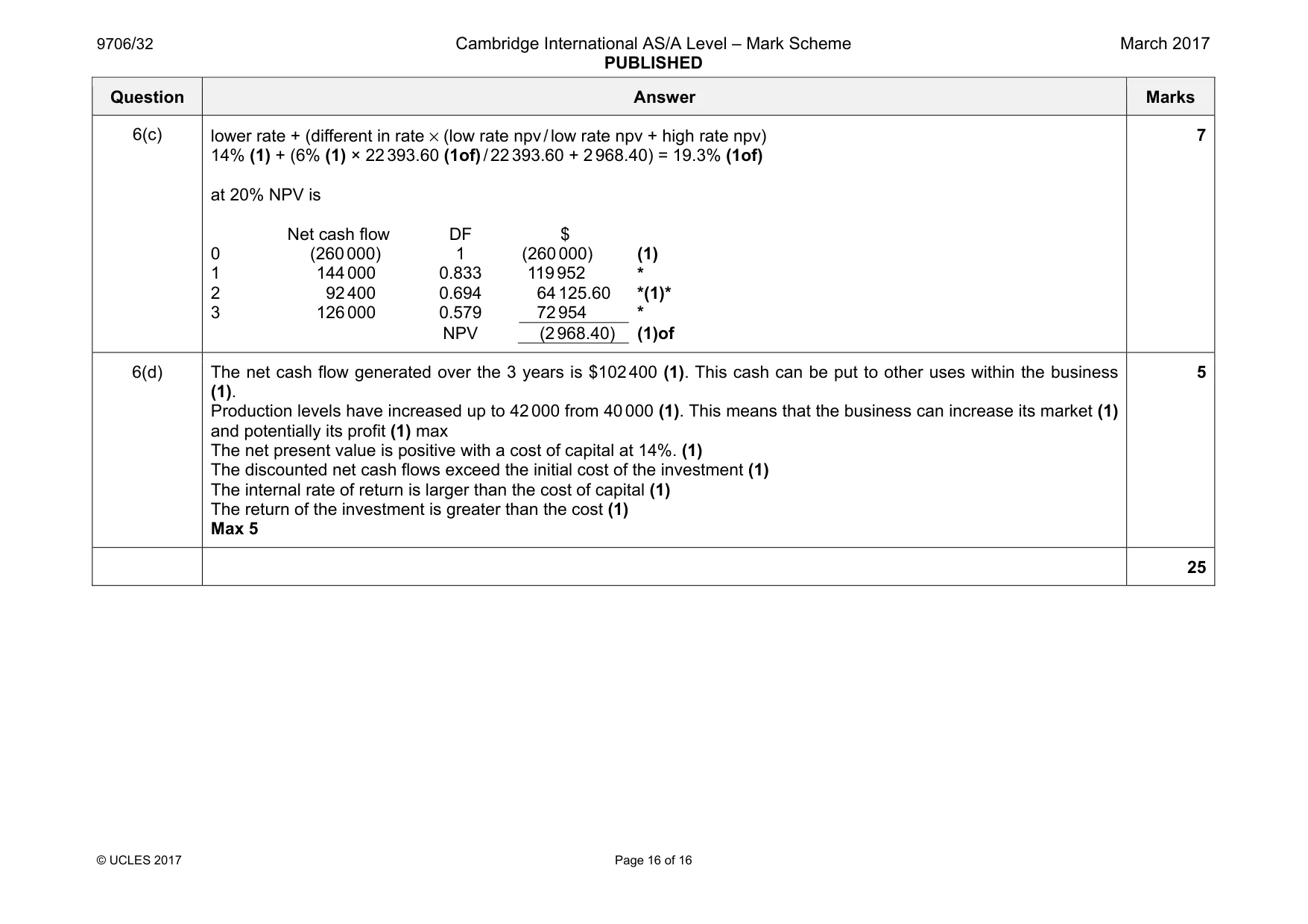
9706/32 Cambridge International AS/A Level – Mark Scheme PUBLISHED March 2017 © UCLES 2017 Page 16 of 16 Question Answer Marks 6(c) lower rate + (different in rate × (low rate npv / low rate npv + high rate npv) 14% (1) + (6% (1) × 22 393.60 (1of) / 22 393.60 + 2 968.40) = 19.3% (1of) at 20% NPV is Net cash flow DF $ 0 (260 000) 1 (260 000) (1) 1 144 000 0.833 119 952 * 2 92 400 0.694 64 125.60 *(1)* 3 126 000 0.579 72 954 * NPV (2 968.40) (1)of 7 6(d) The net cash flow generated over the 3 years is $102 400 (1). This cash can be put to other uses within the business (1). Production levels have increased up to 42 000 from 40 000 (1). This means that the business can increase its market (1) and potentially its profit (1) max The net present value is positive with a cost of capital at 14%. (1) The discounted net cash flows exceed the initial cost of the investment (1) The internal rate of return is larger than the cost of capital (1) The return of the investment is greater than the cost (1) Max 5 5 25
What you needed in this session
Cambridge’s own grade thresholds for 2017 Feb/March, Paper 3 · Variant 2. A higher threshold means an easier paper — the bar moves with how the cohort did.