Cambridge A Level Accounting 9706 — 2016 Feb/March Paper 3 · Variant 2
9706/32/F/M/16 · 150 marks · ≈169 min
The question paper and its mark scheme, free to read here and free to download. This is Cambridge’s own paper, exactly as it was sat.
Question paper12 pages

Mark scheme10 pages
Answers below. Sit the paper first if you are practising.
Paper as text
Question paper, page 1
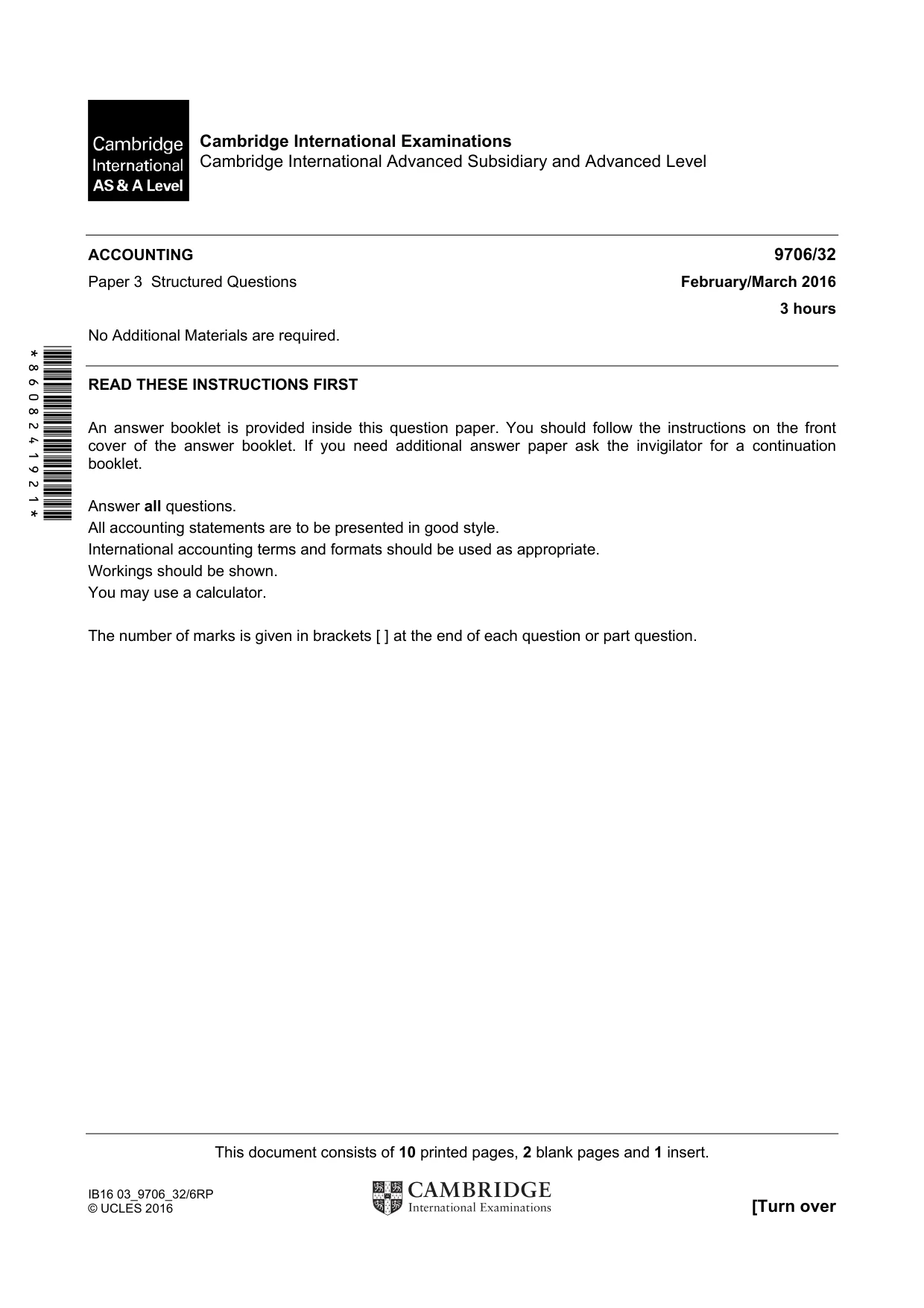
This document consists of 10 printed pages, 2 blank pages and 1 insert. IB16 03_9706_32/6RP © UCLES 2016 [Turn over *8608241921* Cambridge International Examinations Cambridge International Advanced Subsidiary and Advanced Level ACCOUNTING 9706/32 Paper 3 Structured Questions February/March 2016 3 hours No Additional Materials are required. READ THESE INSTRUCTIONS FIRST An answer booklet is provided inside this question paper. You should follow the instructions on the front cover of the answer booklet. If you need additional answer paper ask the invigilator for a continuation booklet. Answer all questions. All accounting statements are to be presented in good style. International accounting terms and formats should be used as appropriate. Workings should be shown. You may use a calculator. The number of marks is given in brackets [ ] at the end of each question or part question.
Question paper, page 2
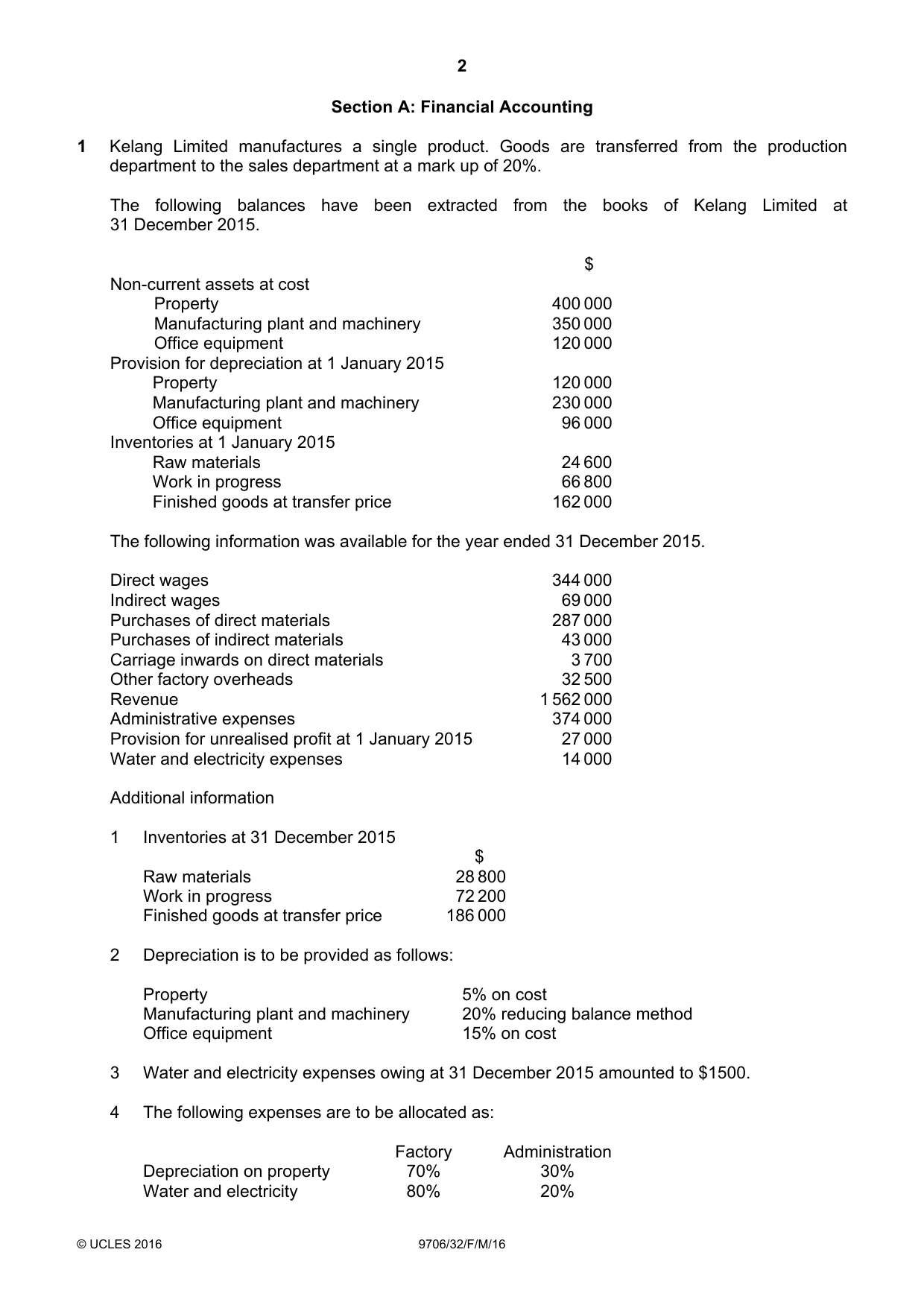
2 © UCLES 2016 9706/32/F/M/16 Section A: Financial Accounting 1 Kelang Limited manufactures a single product. Goods are transferred from the production department to the sales department at a mark up of 20%. The following balances have been extracted from the books of Kelang Limited at 31 December 2015. $ Non-current assets at cost Property 400 000 Manufacturing plant and machinery 350 000 Office equipment 120 000 Provision for depreciation at 1 January 2015 Property 120 000 Manufacturing plant and machinery 230 000 Office equipment 96 000 Inventories at 1 January 2015 Raw materials 24 600 Work in progress 66 800 Finished goods at transfer price 162 000 The following information was available for the year ended 31 December 2015. Direct wages 344 000 Indirect wages 69 000 Purchases of direct materials 287 000 Purchases of indirect materials 43 000 Carriage inwards on direct materials 3 700 Other factory overheads 32 500 Revenue 1 562 000 Administrative expenses 374 000 Provision for unrealised profit at 1 January 2015 27 000 Water and electricity expenses 14 000 Additional information 1 Inventories at 31 December 2015 $ Raw materials 28 800 Work in progress 72 200 Finished goods at transfer price 186 000 2 Depreciation is to be provided as follows: Property 5% on cost Manufacturing plant and machinery 20% reducing balance method Office equipment 15% on cost 3 Water and electricity expenses owing at 31 December 2015 amounted to $1500. 4 The following expenses are to be allocated as: Factory Administration Depreciation on property 70% 30% Water and electricity 80% 20%
Question paper, page 3
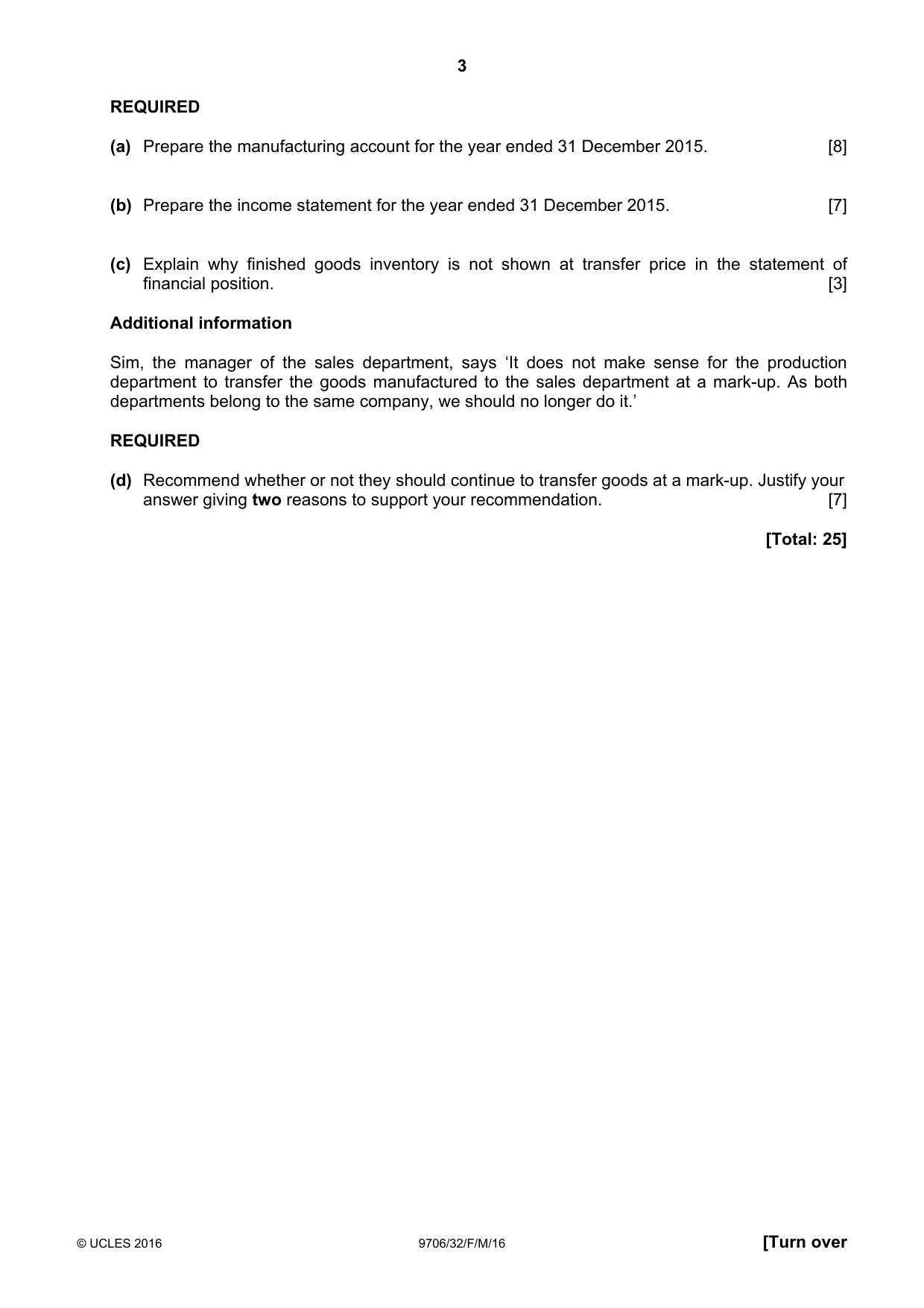
3 © UCLES 2016 9706/32/F/M/16 [Turn over REQUIRED (a) Prepare the manufacturing account for the year ended 31 December 2015. [8] (b) Prepare the income statement for the year ended 31 December 2015. [7] (c) Explain why finished goods inventory is not shown at transfer price in the statement of financial position. [3] Additional information Sim, the manager of the sales department, says ‘It does not make sense for the production department to transfer the goods manufactured to the sales department at a mark-up. As both departments belong to the same company, we should no longer do it.’ REQUIRED (d) Recommend whether or not they should continue to transfer goods at a mark-up. Justify your answer giving two reasons to support your recommendation. [7] [Total: 25]
Question paper, page 4
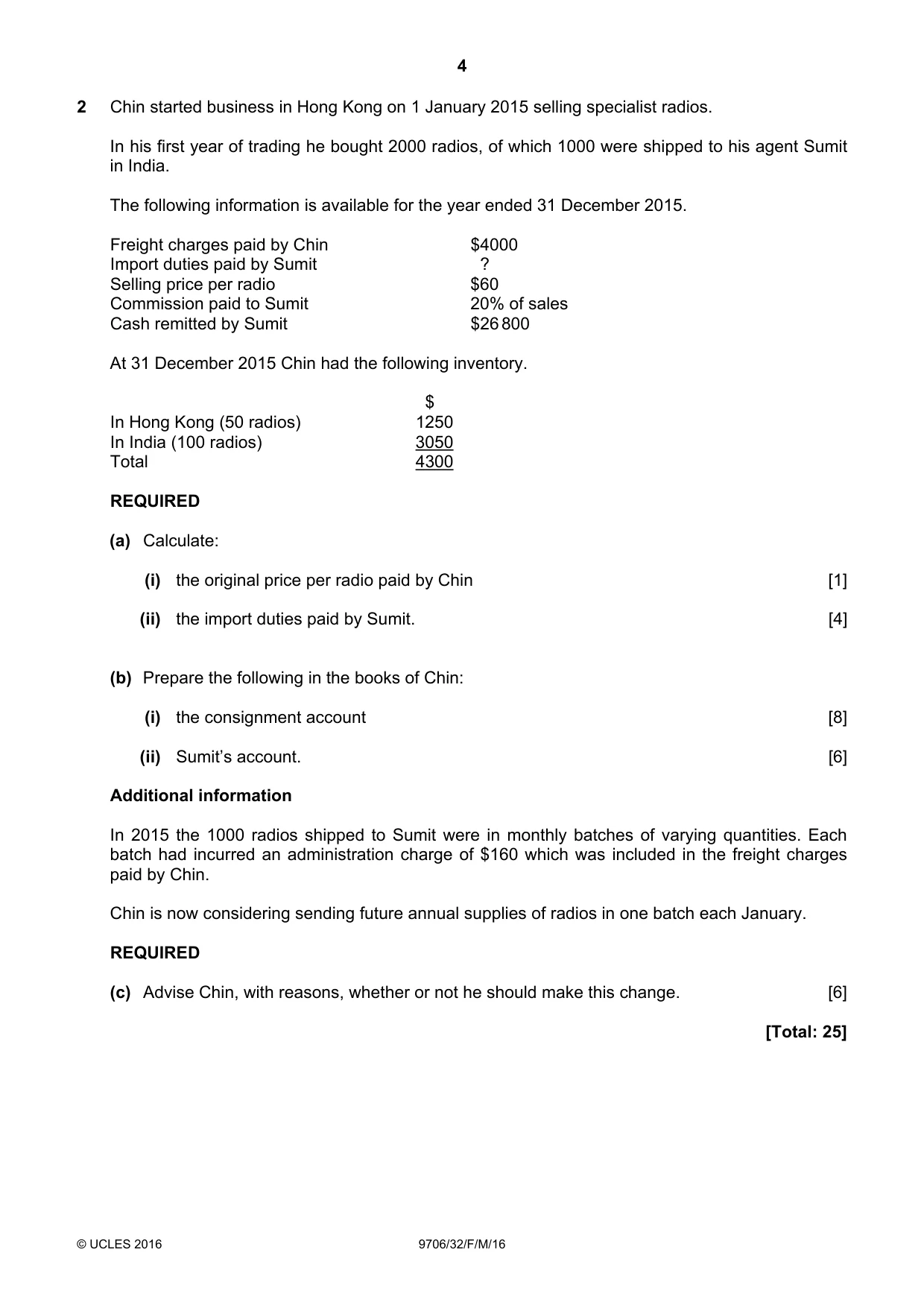
4 © UCLES 2016 9706/32/F/M/16 2 Chin started business in Hong Kong on 1 January 2015 selling specialist radios. In his first year of trading he bought 2000 radios, of which 1000 were shipped to his agent Sumit in India. The following information is available for the year ended 31 December 2015. Freight charges paid by Chin $4000 Import duties paid by Sumit ? Selling price per radio $60 Commission paid to Sumit 20% of sales Cash remitted by Sumit $26 800 At 31 December 2015 Chin had the following inventory. $ In Hong Kong (50 radios) 1250 In India (100 radios) 3050 Total 4300 REQUIRED (a) Calculate: (i) the original price per radio paid by Chin [1] (ii) the import duties paid by Sumit. [4] (b) Prepare the following in the books of Chin: (i) the consignment account [8] (ii) Sumit’s account. [6] Additional information In 2015 the 1000 radios shipped to Sumit were in monthly batches of varying quantities. Each batch had incurred an administration charge of $160 which was included in the freight charges paid by Chin. Chin is now considering sending future annual supplies of radios in one batch each January. REQUIRED (c) Advise Chin, with reasons, whether or not he should make this change. [6] [Total: 25]
Question paper, page 5
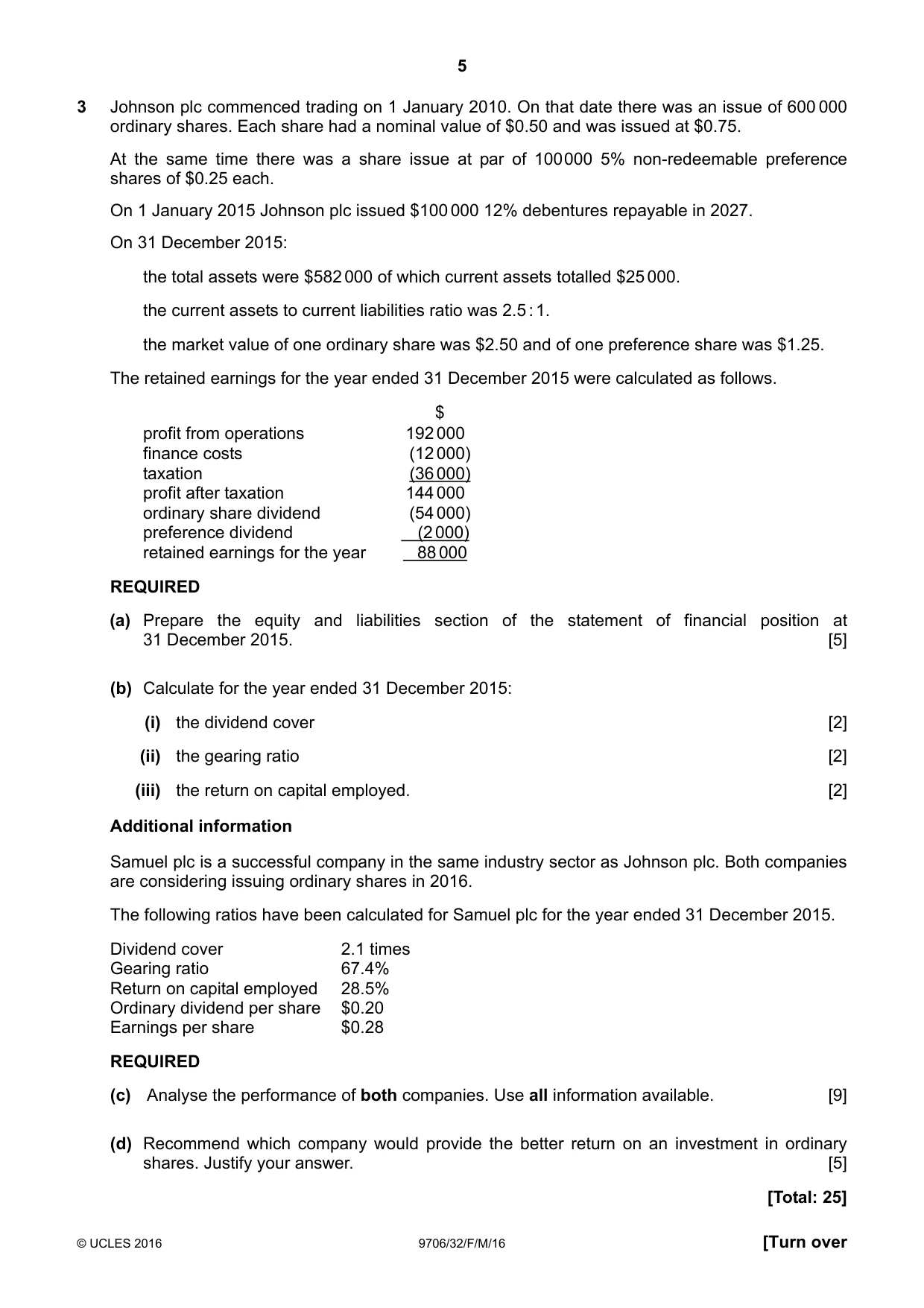
5 © UCLES 2016 9706/32/F/M/16 [Turn over 3 Johnson plc commenced trading on 1 January 2010. On that date there was an issue of 600 000 ordinary shares. Each share had a nominal value of $0.50 and was issued at $0.75. At the same time there was a share issue at par of 100 000 5% non-redeemable preference shares of $0.25 each. On 1 January 2015 Johnson plc issued $100 000 12% debentures repayable in 2027. On 31 December 2015: the total assets were $582 000 of which current assets totalled $25 000. the current assets to current liabilities ratio was 2.5 : 1. the market value of one ordinary share was $2.50 and of one preference share was $1.25. The retained earnings for the year ended 31 December 2015 were calculated as follows. $ profit from operations 192 000 finance costs (12 000) taxation (36 000) profit after taxation 144 000 ordinary share dividend (54 000) preference dividend (2 000) retained earnings for the year 88 000 REQUIRED (a) Prepare the equity and liabilities section of the statement of financial position at 31 December 2015. [5] (b) Calculate for the year ended 31 December 2015: (i) the dividend cover [2] (ii) the gearing ratio [2] (iii) the return on capital employed. [2] Additional information Samuel plc is a successful company in the same industry sector as Johnson plc. Both companies are considering issuing ordinary shares in 2016. The following ratios have been calculated for Samuel plc for the year ended 31 December 2015. Dividend cover 2.1 times Gearing ratio 67.4% Return on capital employed 28.5% Ordinary dividend per share $0.20 Earnings per share $0.28 REQUIRED (c) Analyse the performance of both companies. Use all information available. [9] (d) Recommend which company would provide the better return on an investment in ordinary shares. Justify your answer. [5] [Total: 25]
Question paper, page 6
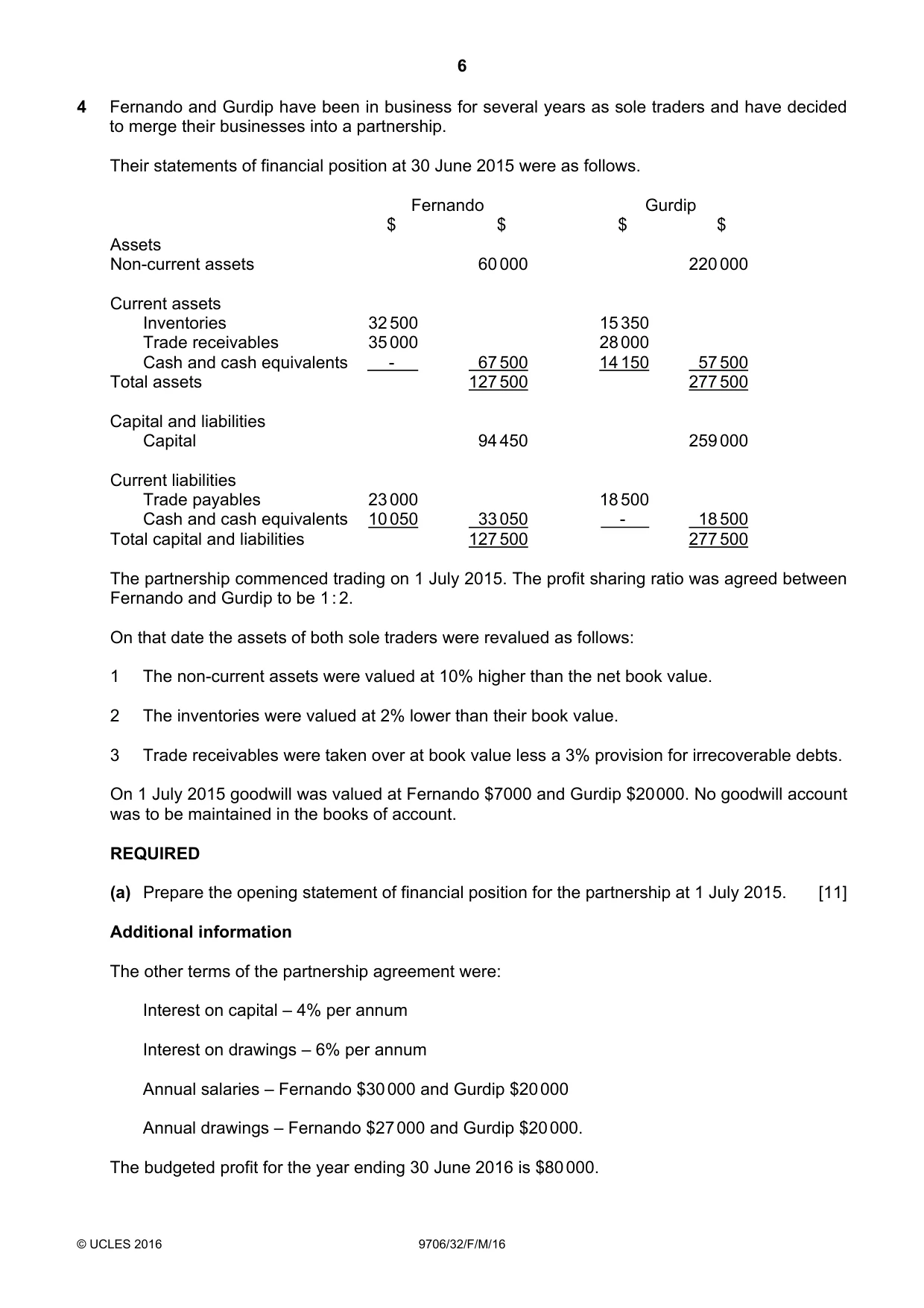
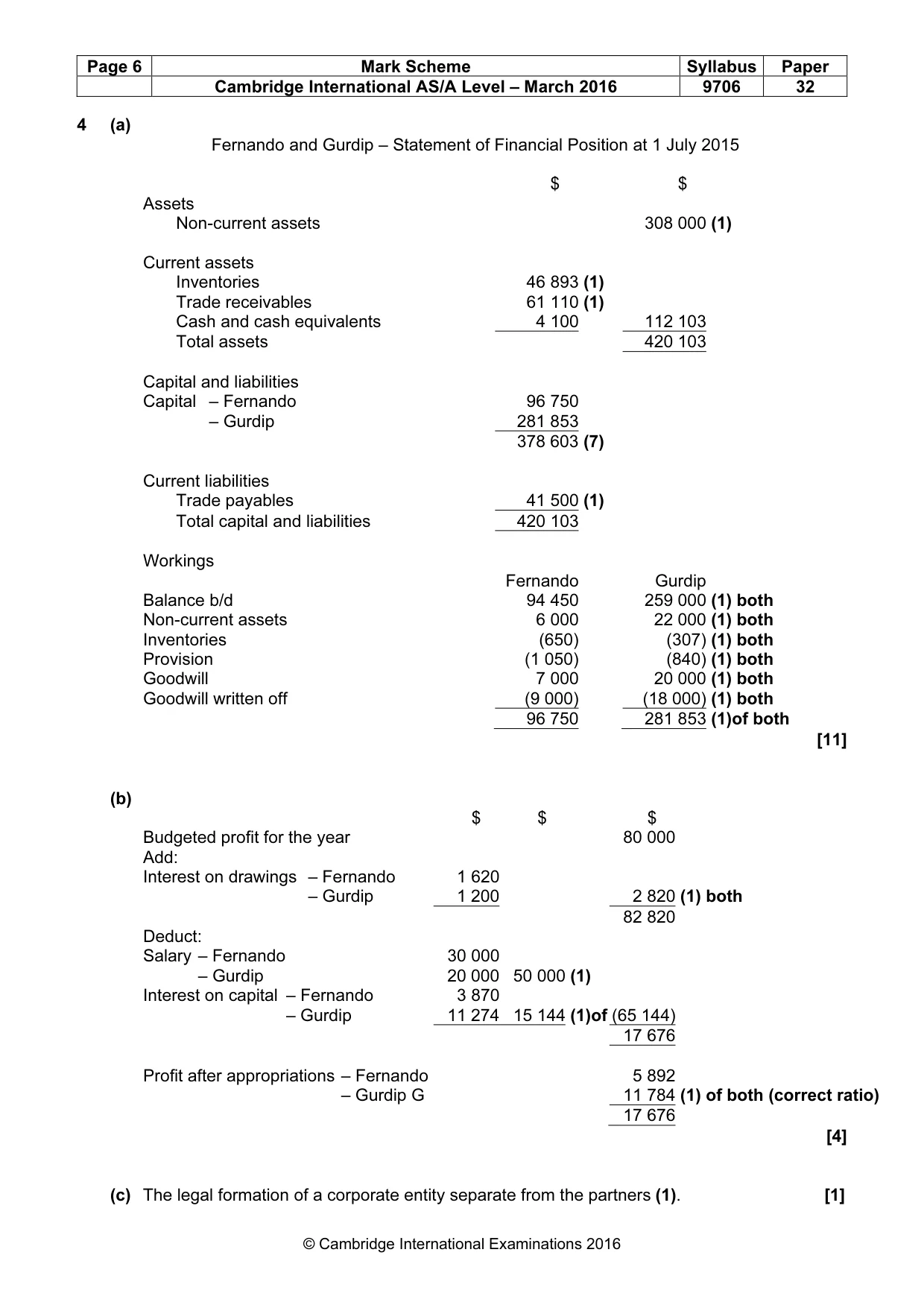
6 © UCLES 2016 9706/32/F/M/16 4 Fernando and Gurdip have been in business for several years as sole traders and have decided to merge their businesses into a partnership. Their statements of financial position at 30 June 2015 were as follows. Fernando Gurdip $ $ $ $ Assets Non-current assets 60 000 220 000 Current assets Inventories 32 500 15 350 Trade receivables 35 000 28 000 Cash and cash equivalents - 67 500 14 150 57 500 Total assets 127 500 277 500 Capital and liabilities Capital 94 450 259 000 Current liabilities Trade payables 23 000 18 500 Cash and cash equivalents 10 050 33 050 - 18 500 Total capital and liabilities 127 500 277 500 The partnership commenced trading on 1 July 2015. The profit sharing ratio was agreed between Fernando and Gurdip to be 1 : 2. On that date the assets of both sole traders were revalued as follows: 1 The non-current assets were valued at 10% higher than the net book value. 2 The inventories were valued at 2% lower than their book value. 3 Trade receivables were taken over at book value less a 3% provision for irrecoverable debts. On 1 July 2015 goodwill was valued at Fernando $7000 and Gurdip $20 000. No goodwill account was to be maintained in the books of account. REQUIRED (a) Prepare the opening statement of financial position for the partnership at 1 July 2015. [11] Additional information The other terms of the partnership agreement were: Interest on capital – 4% per annum Interest on drawings – 6% per annum Annual salaries – Fernando $30 000 and Gurdip $20 000 Annual drawings – Fernando $27 000 and Gurdip $20 000. The budgeted profit for the year ending 30 June 2016 is $80 000.
Question paper, page 7
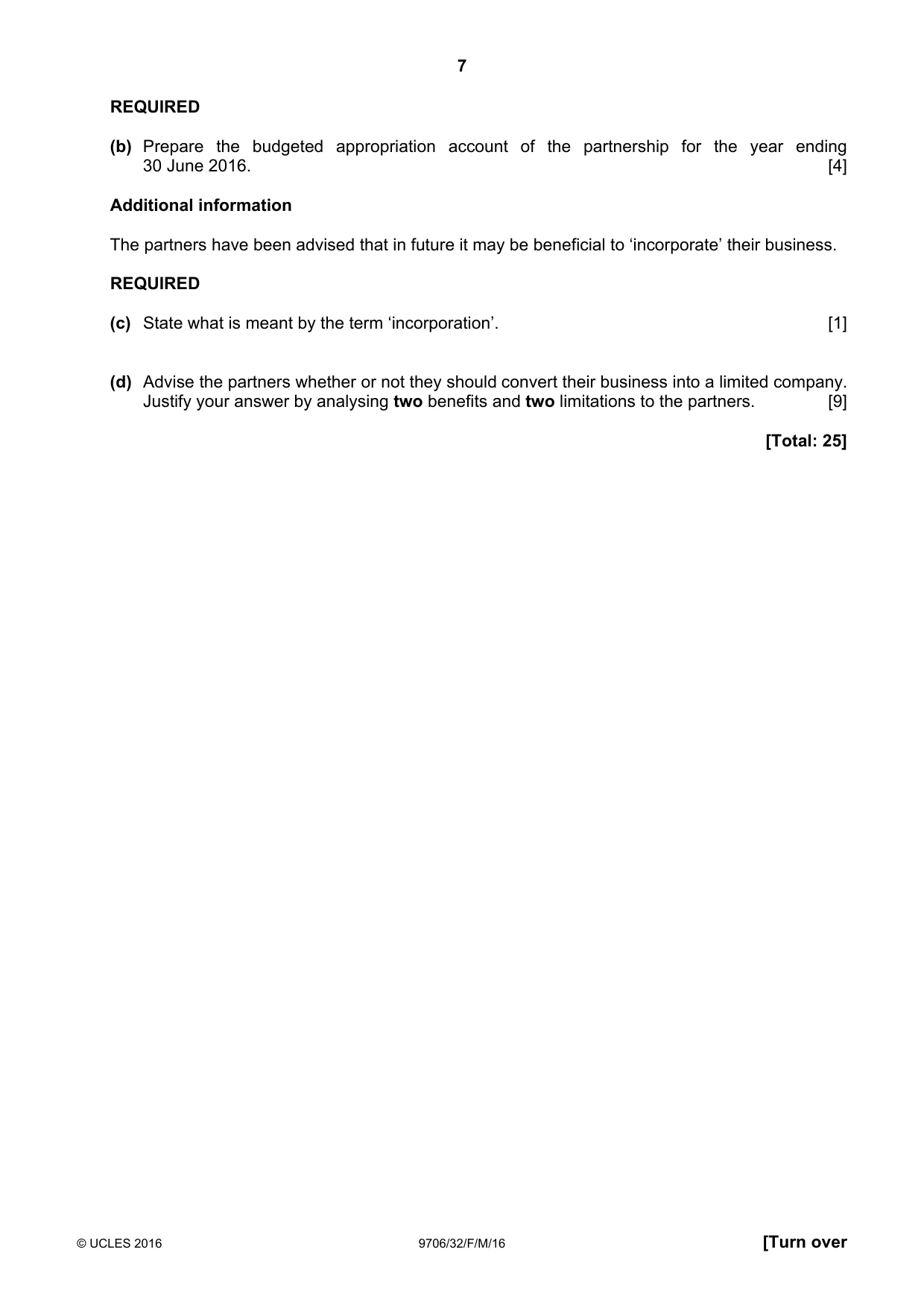
7 © UCLES 2016 9706/32/F/M/16 [Turn over REQUIRED (b) Prepare the budgeted appropriation account of the partnership for the year ending 30 June 2016. [4] Additional information The partners have been advised that in future it may be beneficial to ‘incorporate’ their business. REQUIRED (c) State what is meant by the term ‘incorporation’. [1] (d) Advise the partners whether or not they should convert their business into a limited company. Justify your answer by analysing two benefits and two limitations to the partners. [9] [Total: 25]
Question paper, page 8
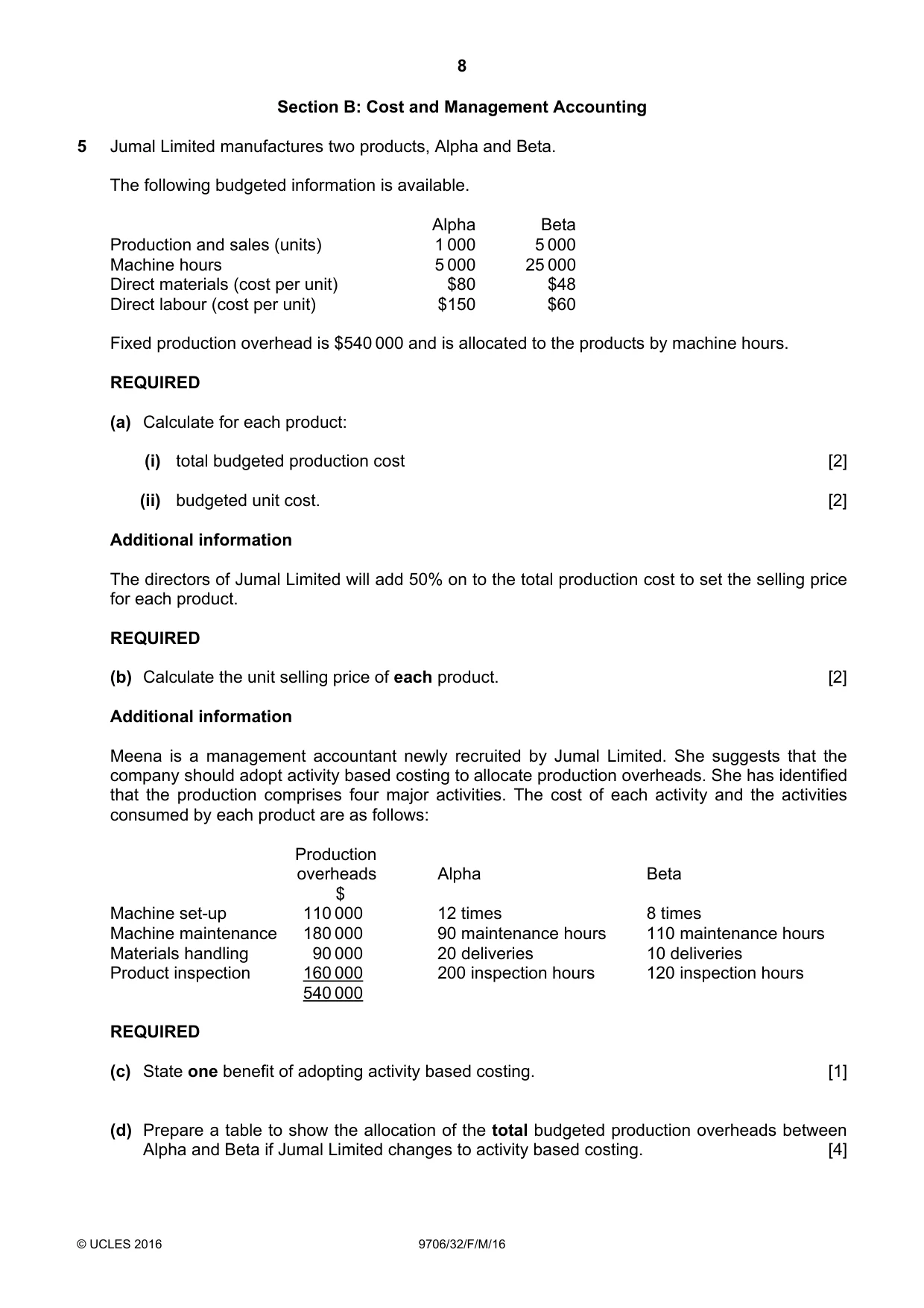
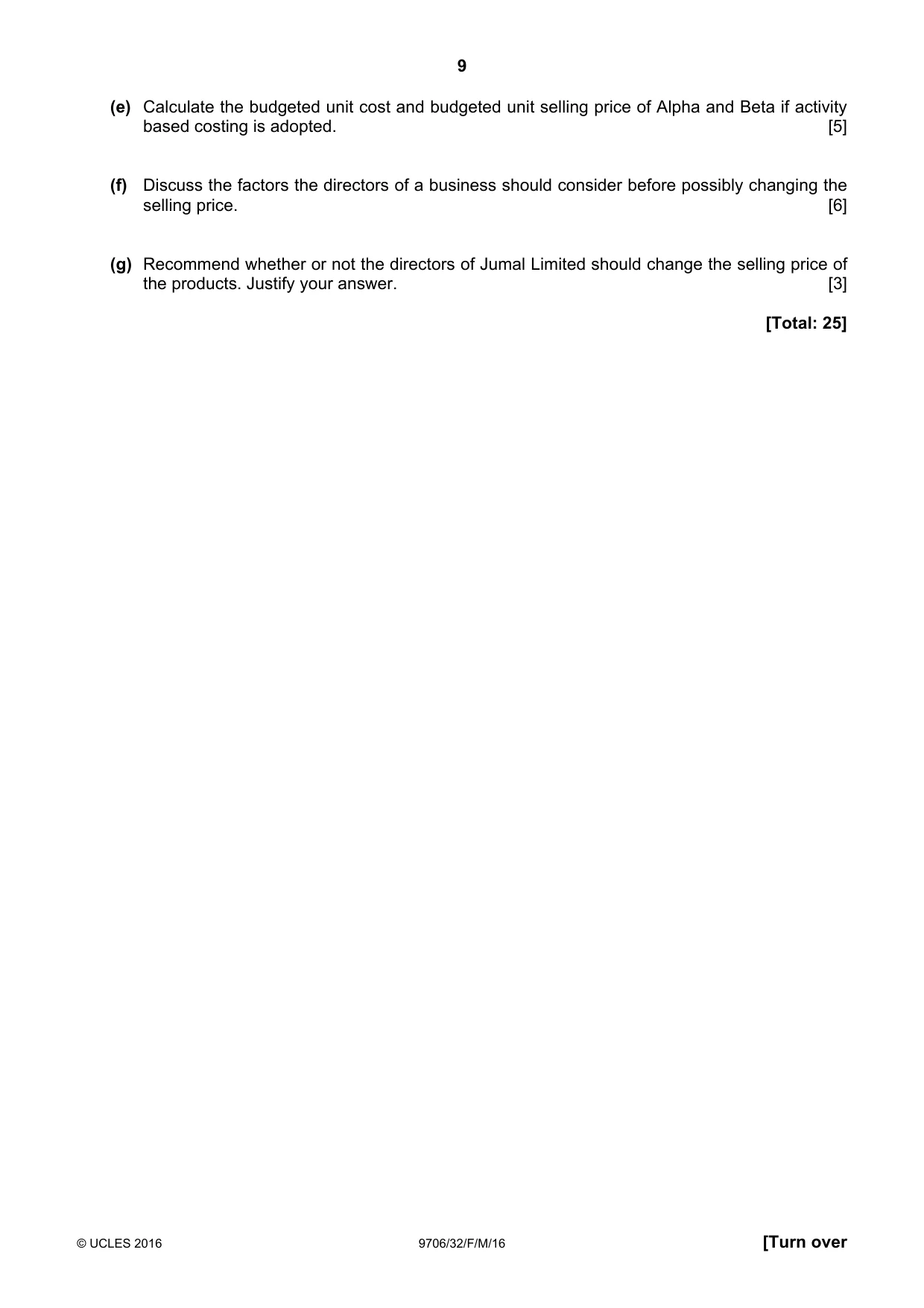
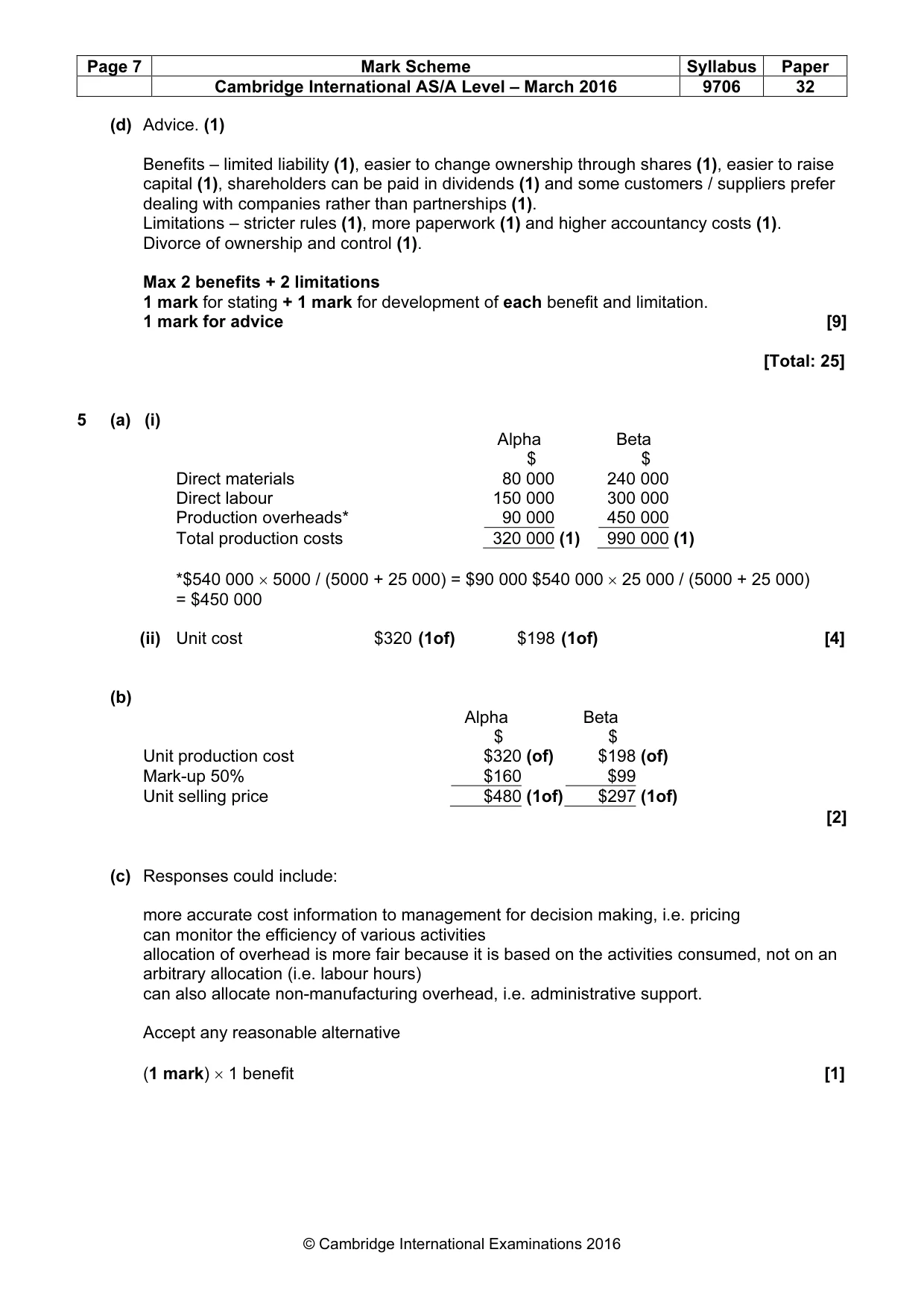
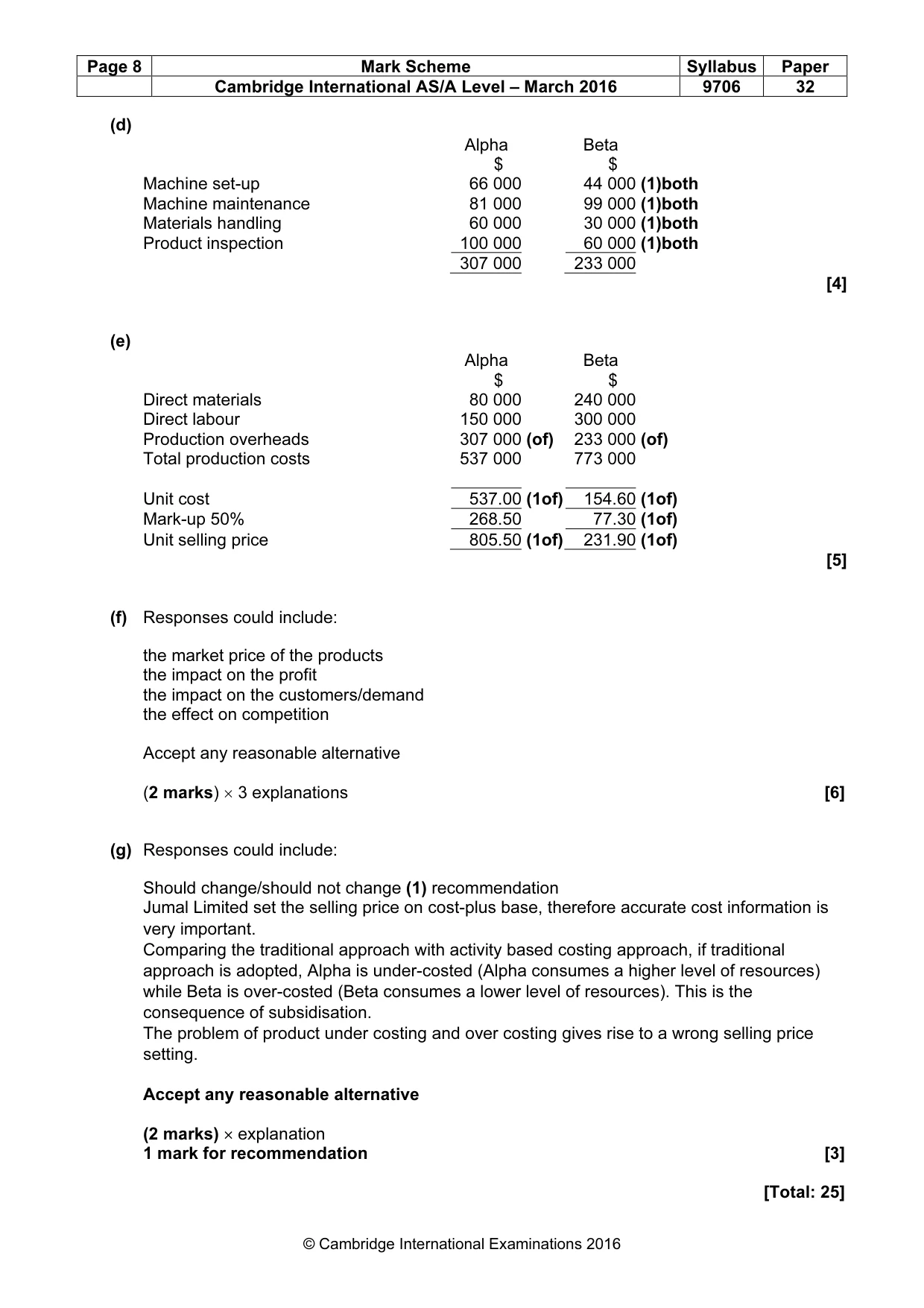
8 © UCLES 2016 9706/32/F/M/16 Section B: Cost and Management Accounting 5 Jumal Limited manufactures two products, Alpha and Beta. The following budgeted information is available. Alpha Beta Production and sales (units) 1 000 5 000 Machine hours 5 000 25 000 Direct materials (cost per unit) $80 $48 Direct labour (cost per unit) $150 $60 Fixed production overhead is $540 000 and is allocated to the products by machine hours. REQUIRED (a) Calculate for each product: (i) total budgeted production cost [2] (ii) budgeted unit cost. [2] Additional information The directors of Jumal Limited will add 50% on to the total production cost to set the selling price for each product. REQUIRED (b) Calculate the unit selling price of each product. [2] Additional information Meena is a management accountant newly recruited by Jumal Limited. She suggests that the company should adopt activity based costing to allocate production overheads. She has identified that the production comprises four major activities. The cost of each activity and the activities consumed by each product are as follows: Production overheads Alpha Beta $ Machine set-up 110 000 12 times 8 times Machine maintenance 180 000 90 maintenance hours 110 maintenance hours Materials handling 90 000 20 deliveries 10 deliveries Product inspection 160 000 200 inspection hours 120 inspection hours 540 000 REQUIRED (c) State one benefit of adopting activity based costing. [1] (d) Prepare a table to show the allocation of the total budgeted production overheads between Alpha and Beta if Jumal Limited changes to activity based costing. [4]
Question paper, page 9
9 © UCLES 2016 9706/32/F/M/16 [Turn over (e) Calculate the budgeted unit cost and budgeted unit selling price of Alpha and Beta if activity based costing is adopted. [5] (f) Discuss the factors the directors of a business should consider before possibly changing the selling price. [6] (g) Recommend whether or not the directors of Jumal Limited should change the selling price of the products. Justify your answer. [3] [Total: 25]
Question paper, page 10
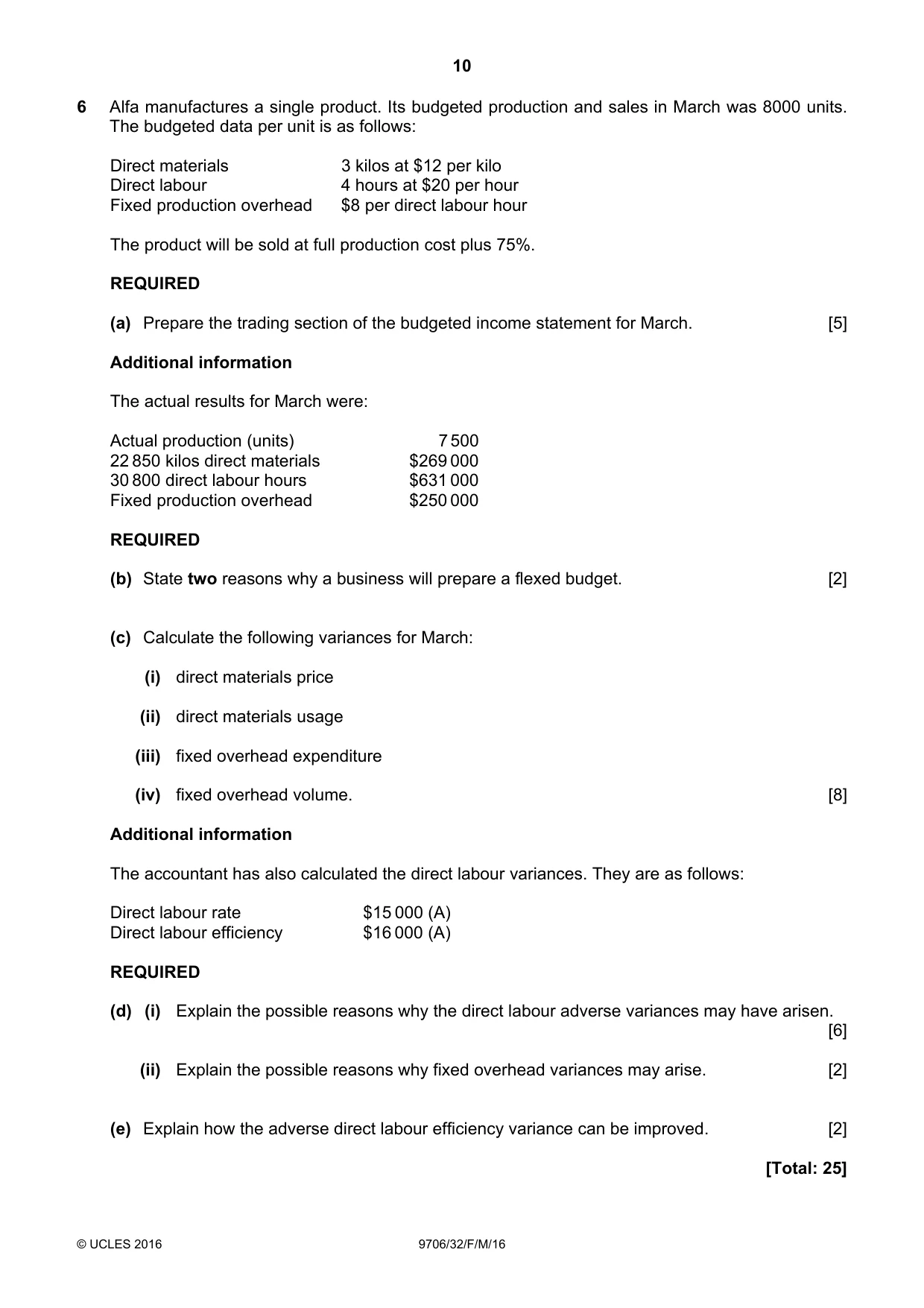
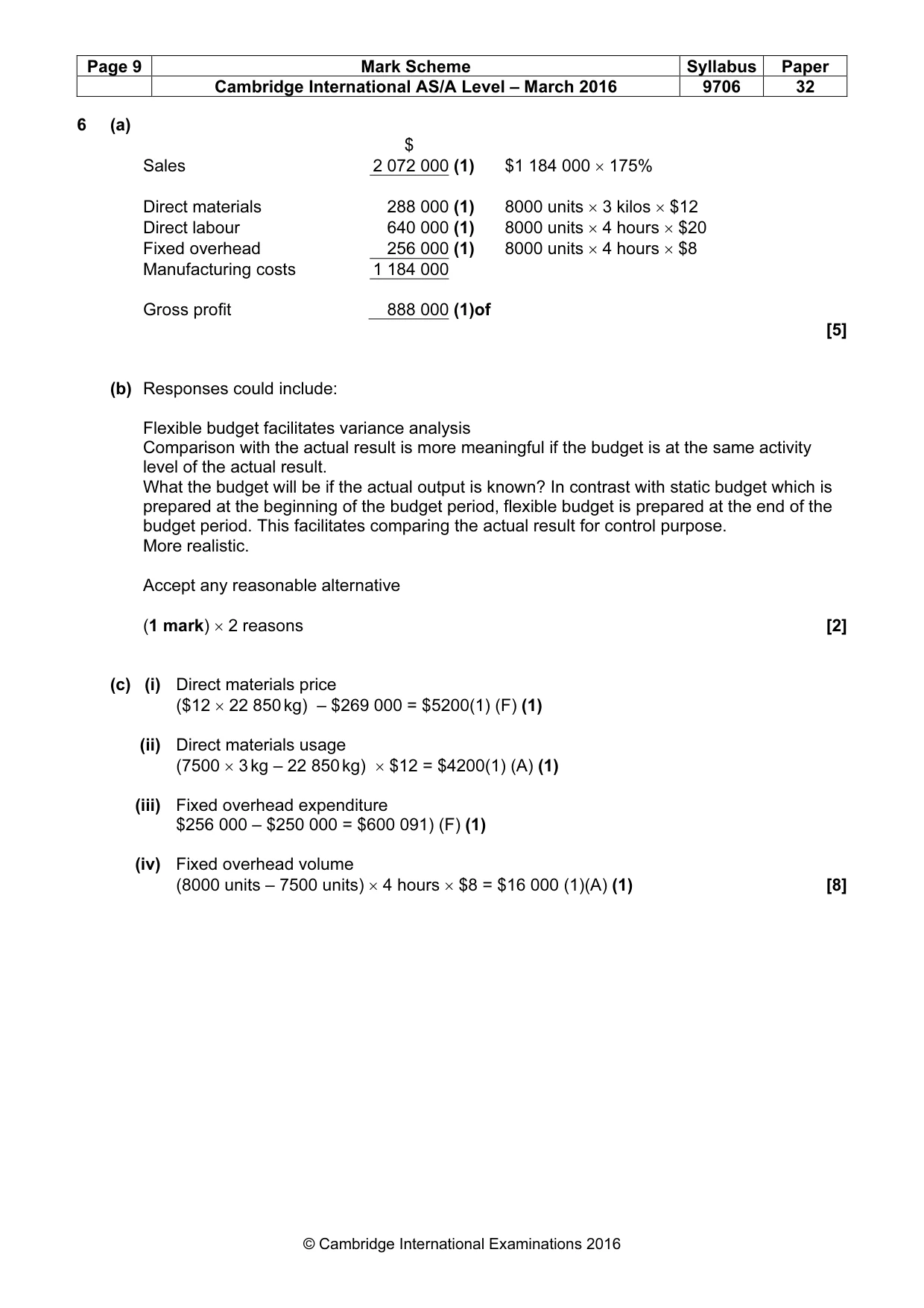
10 © UCLES 2016 9706/32/F/M/16 6 Alfa manufactures a single product. Its budgeted production and sales in March was 8000 units. The budgeted data per unit is as follows: Direct materials 3 kilos at $12 per kilo Direct labour 4 hours at $20 per hour Fixed production overhead $8 per direct labour hour The product will be sold at full production cost plus 75%. REQUIRED (a) Prepare the trading section of the budgeted income statement for March. [5] Additional information The actual results for March were: Actual production (units) 7 500 22 850 kilos direct materials $269 000 30 800 direct labour hours $631 000 Fixed production overhead $250 000 REQUIRED (b) State two reasons why a business will prepare a flexed budget. [2] (c) Calculate the following variances for March: (i) direct materials price (ii) direct materials usage (iii) fixed overhead expenditure (iv) fixed overhead volume. [8] Additional information The accountant has also calculated the direct labour variances. They are as follows: Direct labour rate $15 000 (A) Direct labour efficiency $16 000 (A) REQUIRED (d) (i) Explain the possible reasons why the direct labour adverse variances may have arisen. [6] (ii) Explain the possible reasons why fixed overhead variances may arise. [2] (e) Explain how the adverse direct labour efficiency variance can be improved. [2] [Total: 25]
Question paper, page 11
11 © UCLES 2016 9706/32/F/M/16 BLANK PAGE
Question paper, page 12
12 Permission to reproduce items where third-party owned material protected by copyright is included has been sought and cleared where possible. Every reasonable effort has been made by the publisher (UCLES) to trace copyright holders, but if any items requiring clearance have unwittingly been included, the publisher will be pleased to make amends at the earliest possible opportunity. To avoid the issue of disclosure of answer-related information to candidates, all copyright acknowledgements are reproduced online in the Cambridge International Examinations Copyright Acknowledgements Booklet. This is produced for each series of examinations and is freely available to download at www.cie.org.uk after the live examination series. Cambridge International Examinations is part of the Cambridge Assessment Group. Cambridge Assessment is the brand name of University of Cambridge Local Examinations Syndicate (UCLES), which is itself a department of the University of Cambridge. © UCLES 2016 9706/32/F/M/16 BLANK PAGE
Mark scheme, page 1
® IGCSE is the registered trademark of Cambridge International Examinations. CAMBRIDGE INTERNATIONAL EXAMINATIONS Cambridge International Advanced Subsidiary and Advanced Level MARK SCHEME for the March 2016 series 9706 ACCOUNTING 9706/32 Paper 3 (A Level Structured Questions), maximum raw mark 150 This mark scheme is published as an aid to teachers and candidates, to indicate the requirements of the examination. It shows the basis on which Examiners were instructed to award marks. It does not indicate the details of the discussions that took place at an Examiners’ meeting before marking began, which would have considered the acceptability of alternative answers. Mark schemes should be read in conjunction with the question paper and the Principal Examiner Report for Teachers. Cambridge will not enter into discussions about these mark schemes. Cambridge is publishing the mark schemes for the March 2016 series for most Cambridge IGCSE® and Cambridge International A and AS Level components.
Mark scheme, page 2
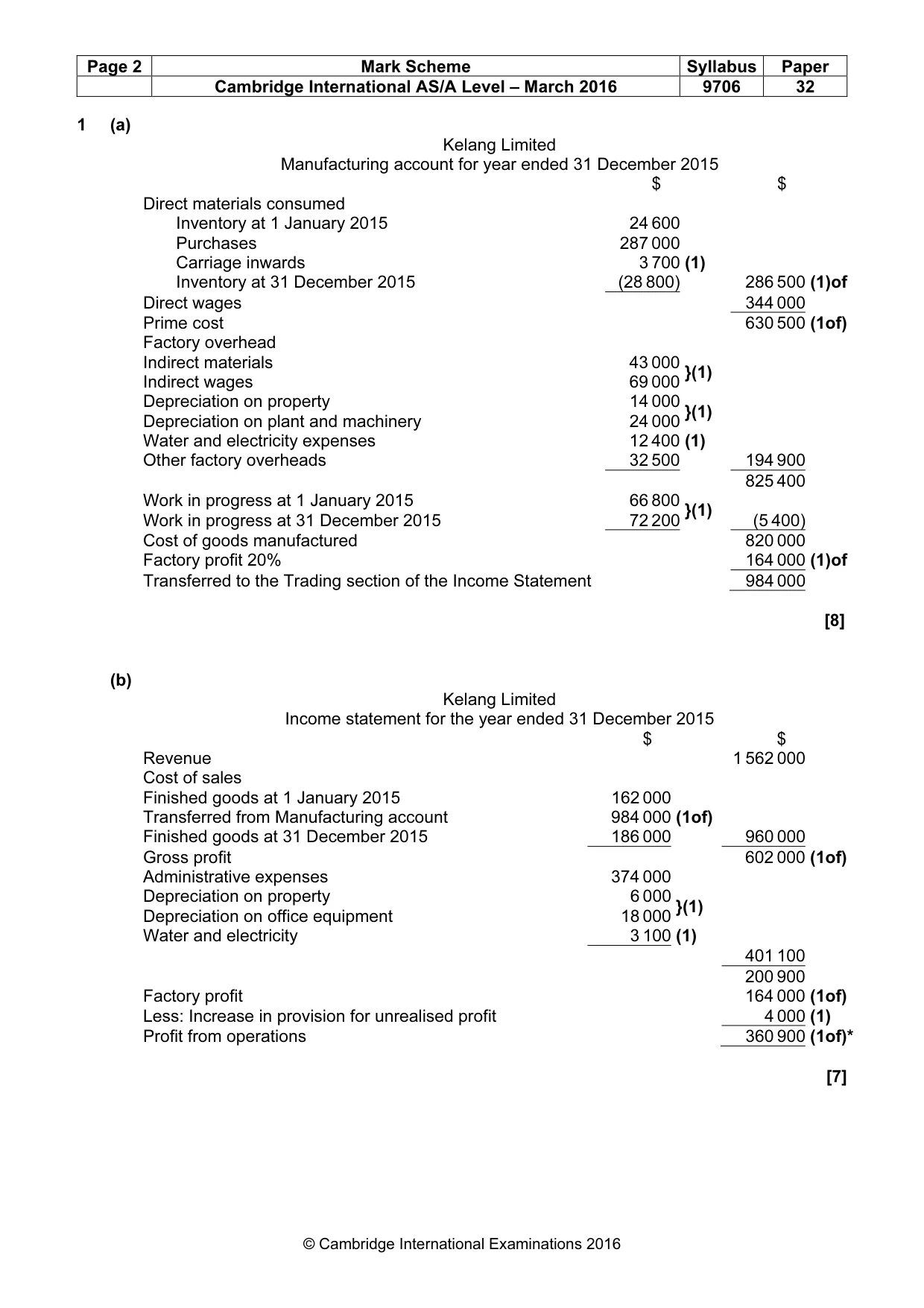
Page 2 Mark Scheme Syllabus Paper Cambridge International AS/A Level – March 2016 9706 32 © Cambridge International Examinations 2016 1 (a) Kelang Limited Manufacturing account for year ended 31 December 2015 $ $ Direct materials consumed Inventory at 1 January 2015 24 600 Purchases 287 000 Carriage inwards 3 700 (1) Inventory at 31 December 2015 (28 800) 286 500 (1)of Direct wages 344 000 Prime cost 630 500 (1of) Factory overhead Indirect materials 43 000 }(1) Indirect wages 69 000 Depreciation on property 14 000 }(1) Depreciation on plant and machinery 24 000 Water and electricity expenses 12 400 (1) Other factory overheads 32 500 194 900 825 400 Work in progress at 1 January 2015 66 800 }(1) Work in progress at 31 December 2015 72 200 (5 400) Cost of goods manufactured 820 000 Factory profit 20% 164 000 (1)of Transferred to the Trading section of the Income Statement 984 000 [8] (b) Kelang Limited Income statement for the year ended 31 December 2015 $ $ Revenue 1 562 000 Cost of sales Finished goods at 1 January 2015 162 000 Transferred from Manufacturing account 984 000 (1of) Finished goods at 31 December 2015 186 000 960 000 Gross profit 602 000 (1of) Administrative expenses 374 000 Depreciation on property 6 000 }(1) Depreciation on office equipment 18 000 Water and electricity 3 100 (1) 401 100 200 900 Factory profit 164 000 (1of) Less: Increase in provision for unrealised profit 4 000 (1) Profit from operations 360 900 (1of)* [7]
Mark scheme, page 3
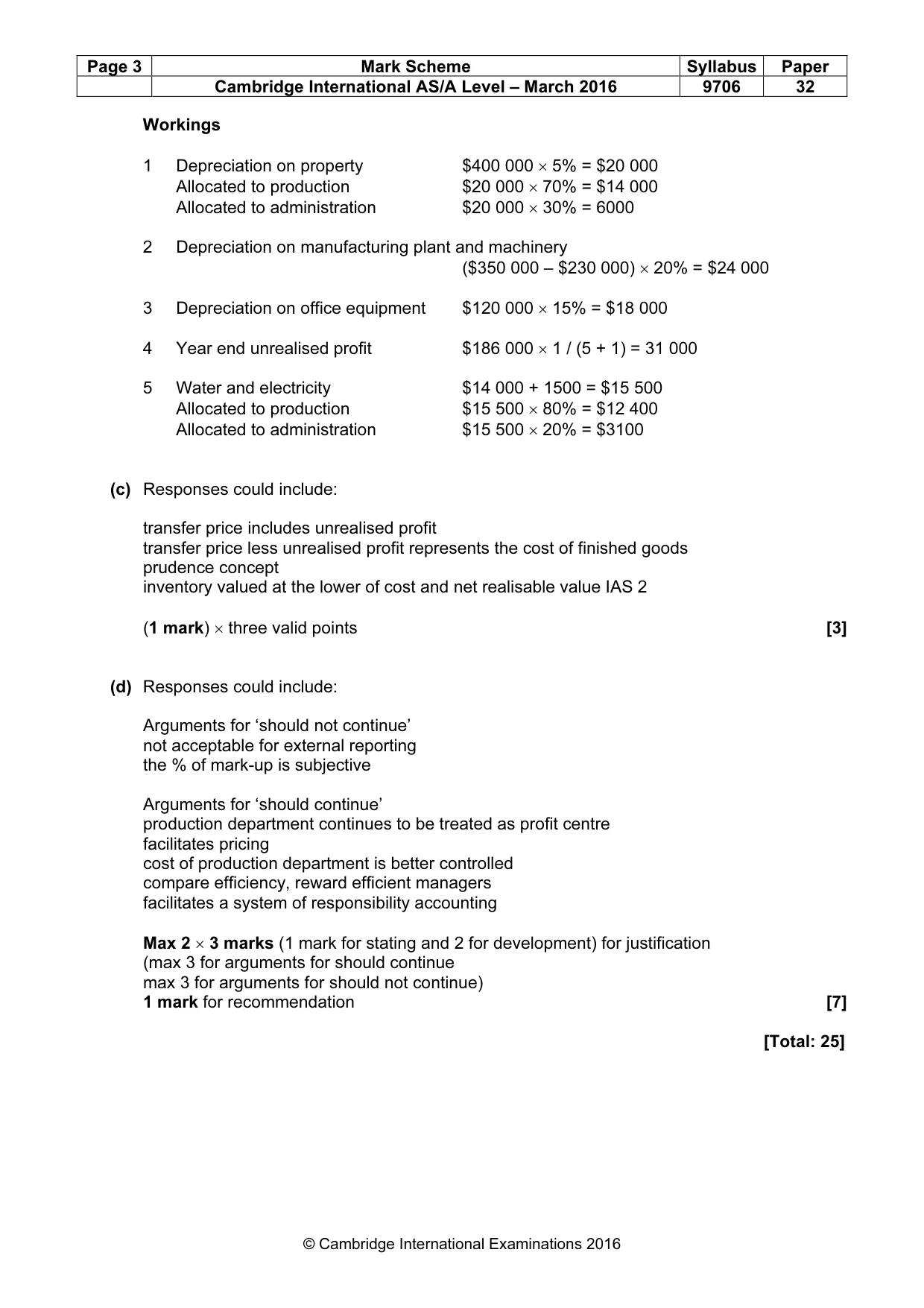
Page 3 Mark Scheme Syllabus Paper Cambridge International AS/A Level – March 2016 9706 32 © Cambridge International Examinations 2016 Workings 1 Depreciation on property $400 000 × 5% = $20 000 Allocated to production $20 000 × 70% = $14 000 Allocated to administration $20 000 × 30% = 6000 2 Depreciation on manufacturing plant and machinery ($350 000 – $230 000) × 20% = $24 000 3 Depreciation on office equipment $120 000 × 15% = $18 000 4 Year end unrealised profit $186 000 × 1 / (5 + 1) = 31 000 5 Water and electricity $14 000 + 1500 = $15 500 Allocated to production $15 500 × 80% = $12 400 Allocated to administration $15 500 × 20% = $3100 (c) Responses could include: transfer price includes unrealised profit transfer price less unrealised profit represents the cost of finished goods prudence concept inventory valued at the lower of cost and net realisable value IAS 2 (1 mark) × three valid points [3] (d) Responses could include: Arguments for ‘should not continue’ not acceptable for external reporting the % of mark-up is subjective Arguments for ‘should continue’ production department continues to be treated as profit centre facilitates pricing cost of production department is better controlled compare efficiency, reward efficient managers facilitates a system of responsibility accounting Max 2 × 3 marks (1 mark for stating and 2 for development) for justification (max 3 for arguments for should continue max 3 for arguments for should not continue) 1 mark for recommendation [7] [Total: 25]
Mark scheme, page 4
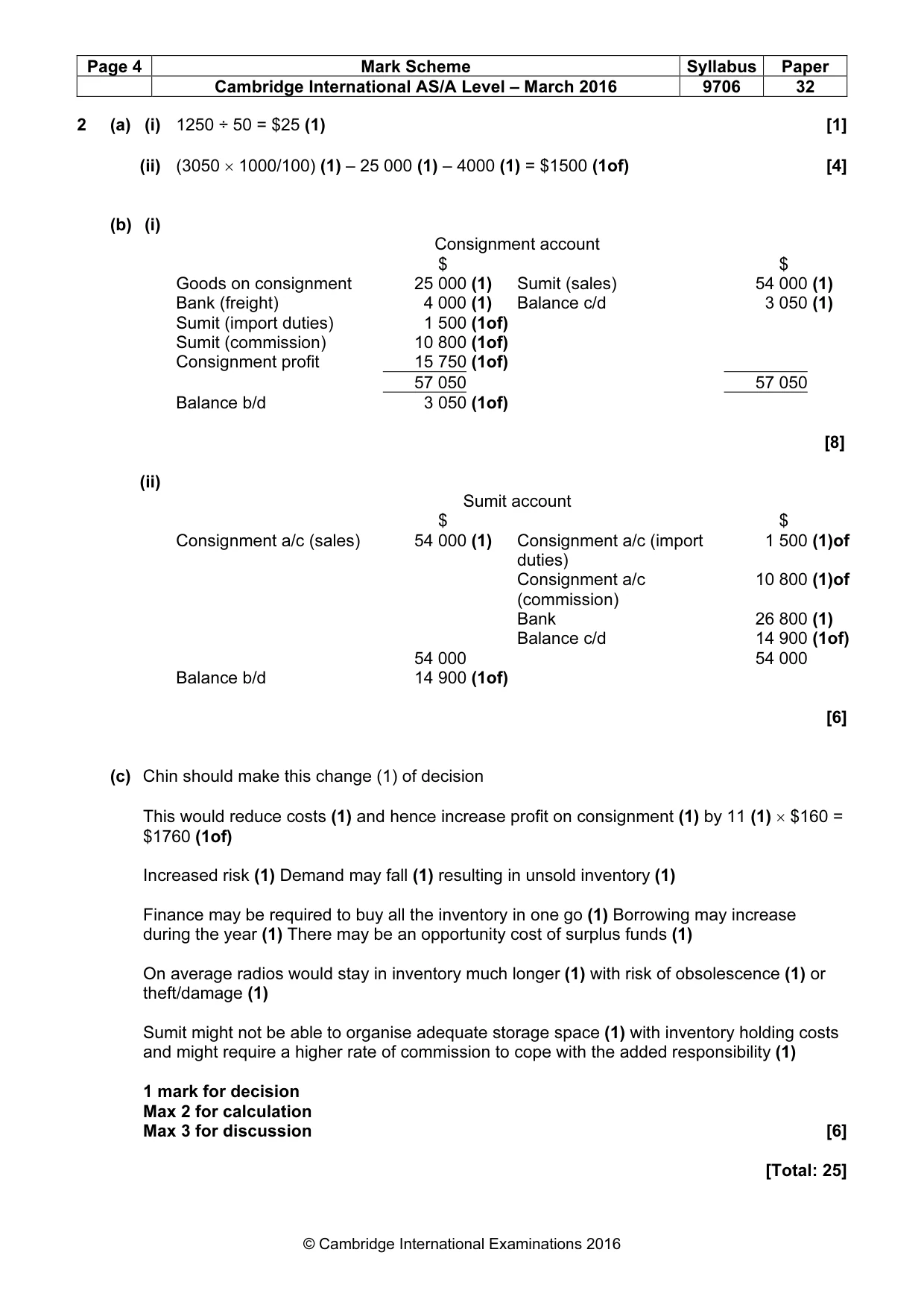
Page 4 Mark Scheme Syllabus Paper Cambridge International AS/A Level – March 2016 9706 32 © Cambridge International Examinations 2016 2 (a) (i) 1250 ÷ 50 = $25 (1) [1] (ii) (3050 × 1000/100) (1) – 25 000 (1) – 4000 (1) = $1500 (1of) [4] (b) (i) Consignment account $ $ Goods on consignment 25 000 (1) Sumit (sales) 54 000 (1) Bank (freight) 4 000 (1) Balance c/d 3 050 (1) Sumit (import duties) 1 500 (1of) Sumit (commission) 10 800 (1of) Consignment profit 15 750 (1of) 57 050 57 050 Balance b/d 3 050 (1of) [8] (ii) Sumit account $ $ Consignment a/c (sales) 54 000 (1) Consignment a/c (import duties) 1 500 (1)of Consignment a/c (commission) 10 800 (1)of Bank 26 800 (1) Balance c/d 14 900 (1of) 54 000 54 000 Balance b/d 14 900 (1of) [6] (c) Chin should make this change (1) of decision This would reduce costs (1) and hence increase profit on consignment (1) by 11 (1) × $160 = $1760 (1of) Increased risk (1) Demand may fall (1) resulting in unsold inventory (1) Finance may be required to buy all the inventory in one go (1) Borrowing may increase during the year (1) There may be an opportunity cost of surplus funds (1) On average radios would stay in inventory much longer (1) with risk of obsolescence (1) or theft/damage (1) Sumit might not be able to organise adequate storage space (1) with inventory holding costs and might require a higher rate of commission to cope with the added responsibility (1) 1 mark for decision Max 2 for calculation Max 3 for discussion [6] [Total: 25]
Mark scheme, page 5
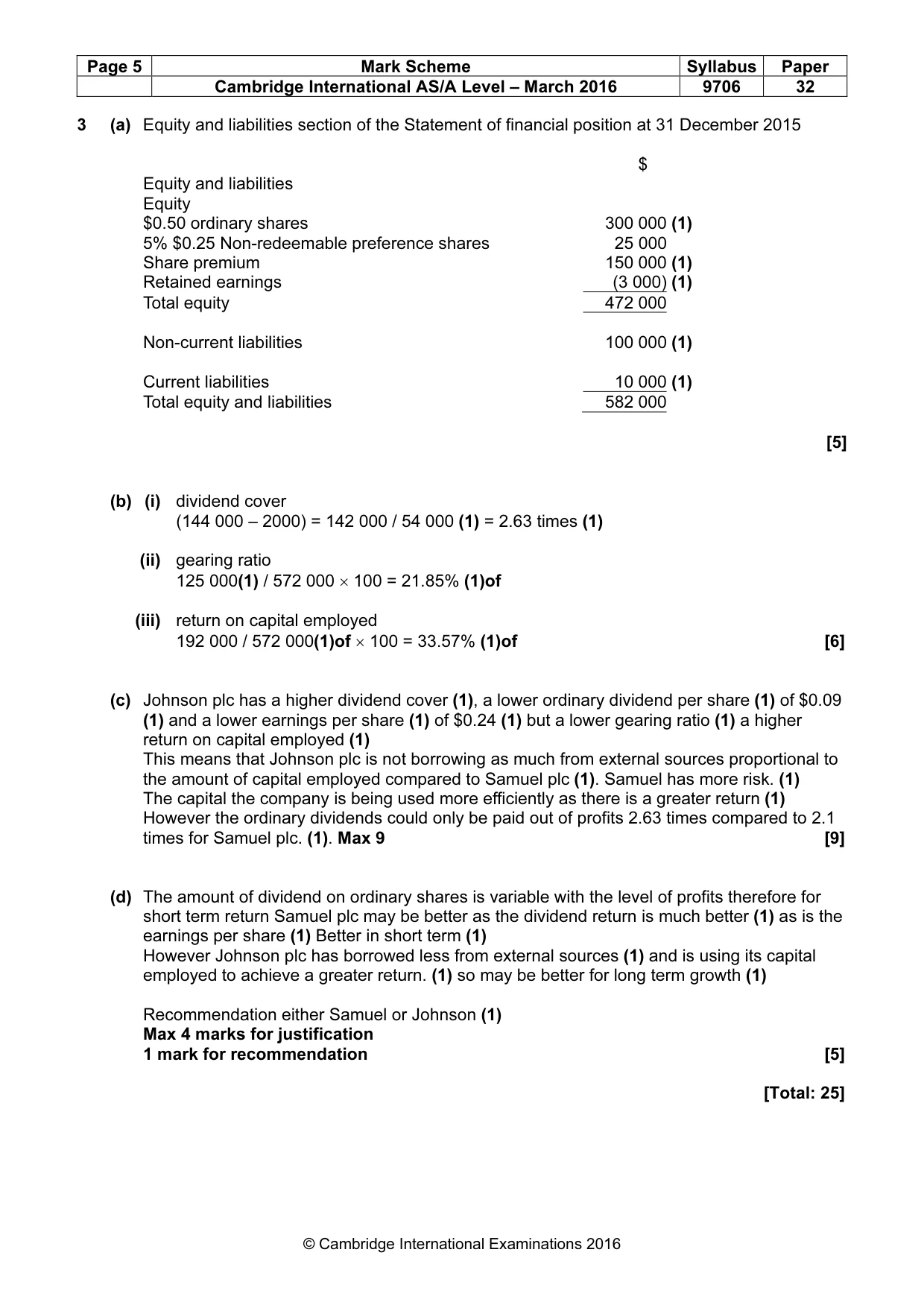
Page 5 Mark Scheme Syllabus Paper Cambridge International AS/A Level – March 2016 9706 32 © Cambridge International Examinations 2016 3 (a) Equity and liabilities section of the Statement of financial position at 31 December 2015 $ Equity and liabilities Equity $0.50 ordinary shares 300 000 (1) 5% $0.25 Non-redeemable preference shares 25 000 Share premium 150 000 (1) Retained earnings (3 000) (1) Total equity 472 000 Non-current liabilities 100 000 (1) Current liabilities 10 000 (1) Total equity and liabilities 582 000 [5] (b) (i) dividend cover (144 000 – 2000) = 142 000 / 54 000 (1) = 2.63 times (1) (ii) gearing ratio 125 000(1) / 572 000 × 100 = 21.85% (1)of (iii) return on capital employed 192 000 / 572 000(1)of × 100 = 33.57% (1)of [6] (c) Johnson plc has a higher dividend cover (1), a lower ordinary dividend per share (1) of $0.09 (1) and a lower earnings per share (1) of $0.24 (1) but a lower gearing ratio (1) a higher return on capital employed (1) This means that Johnson plc is not borrowing as much from external sources proportional to the amount of capital employed compared to Samuel plc (1). Samuel has more risk. (1) The capital the company is being used more efficiently as there is a greater return (1) However the ordinary dividends could only be paid out of profits 2.63 times compared to 2.1 times for Samuel plc. (1). Max 9 [9] (d) The amount of dividend on ordinary shares is variable with the level of profits therefore for short term return Samuel plc may be better as the dividend return is much better (1) as is the earnings per share (1) Better in short term (1) However Johnson plc has borrowed less from external sources (1) and is using its capital employed to achieve a greater return. (1) so may be better for long term growth (1) Recommendation either Samuel or Johnson (1) Max 4 marks for justification 1 mark for recommendation [5] [Total: 25]
Mark scheme, page 6
Page 6 Mark Scheme Syllabus Paper Cambridge International AS/A Level – March 2016 9706 32 © Cambridge International Examinations 2016 4 (a) Fernando and Gurdip – Statement of Financial Position at 1 July 2015 $ $ Assets Non-current assets 308 000 (1) Current assets Inventories 46 893 (1) Trade receivables 61 110 (1) Cash and cash equivalents 4 100 112 103 Total assets 420 103 Capital and liabilities Capital – Fernando 96 750 – Gurdip 281 853 378 603 (7) Current liabilities Trade payables 41 500 (1) Total capital and liabilities 420 103 Workings Fernando Gurdip Balance b/d 94 450 259 000 (1) both Non-current assets 6 000 22 000 (1) both Inventories (650) (307) (1) both Provision (1 050) (840) (1) both Goodwill 7 000 20 000 (1) both Goodwill written off (9 000) (18 000) (1) both 96 750 281 853 (1)of both [11] (b) $ $ $ Budgeted profit for the year 80 000 Add: Interest on drawings – Fernando 1 620 – Gurdip 1 200 2 820 (1) both 82 820 Deduct: Salary – Fernando 30 000 – Gurdip 20 000 50 000 (1) Interest on capital – Fernando 3 870 – Gurdip 11 274 15 144 (1)of (65 144) 17 676 Profit after appropriations – Fernando 5 892 – Gurdip G 11 784 (1) of both (correct ratio) 17 676 [4] (c) The legal formation of a corporate entity separate from the partners (1). [1]
Mark scheme, page 7
Page 7 Mark Scheme Syllabus Paper Cambridge International AS/A Level – March 2016 9706 32 © Cambridge International Examinations 2016 (d) Advice. (1) Benefits – limited liability (1), easier to change ownership through shares (1), easier to raise capital (1), shareholders can be paid in dividends (1) and some customers / suppliers prefer dealing with companies rather than partnerships (1). Limitations – stricter rules (1), more paperwork (1) and higher accountancy costs (1). Divorce of ownership and control (1). Max 2 benefits + 2 limitations 1 mark for stating + 1 mark for development of each benefit and limitation. 1 mark for advice [9] [Total: 25] 5 (a) (i) Alpha Beta $ $ Direct materials 80 000 240 000 Direct labour 150 000 300 000 Production overheads* 90 000 450 000 Total production costs 320 000 (1) 990 000 (1) *$540 000 × 5000 / (5000 + 25 000) = $90 000 $540 000 × 25 000 / (5000 + 25 000) = $450 000 (ii) Unit cost $320 (1of) $198 (1of) [4] (b) Alpha Beta $ $ Unit production cost $320 (of) $198 (of) Mark-up 50% $160 $99 Unit selling price $480 (1of) $297 (1of) [2] (c) Responses could include: more accurate cost information to management for decision making, i.e. pricing can monitor the efficiency of various activities allocation of overhead is more fair because it is based on the activities consumed, not on an arbitrary allocation (i.e. labour hours) can also allocate non-manufacturing overhead, i.e. administrative support. Accept any reasonable alternative (1 mark) × 1 benefit [1]
Mark scheme, page 8
Page 8 Mark Scheme Syllabus Paper Cambridge International AS/A Level – March 2016 9706 32 © Cambridge International Examinations 2016 (d) Alpha Beta $ $ Machine set-up 66 000 44 000 (1)both Machine maintenance 81 000 99 000 (1)both Materials handling 60 000 30 000 (1)both Product inspection 100 000 60 000 (1)both 307 000 233 000 [4] (e) Alpha Beta $ $ Direct materials 80 000 240 000 Direct labour 150 000 300 000 Production overheads 307 000 (of) 233 000 (of) Total production costs 537 000 773 000 Unit cost 537.00 (1of) 154.60 (1of) Mark-up 50% 268.50 77.30 (1of) Unit selling price 805.50 (1of) 231.90 (1of) [5] (f) Responses could include: the market price of the products the impact on the profit the impact on the customers/demand the effect on competition Accept any reasonable alternative (2 marks) × 3 explanations [6] (g) Responses could include: Should change/should not change (1) recommendation Jumal Limited set the selling price on cost-plus base, therefore accurate cost information is very important. Comparing the traditional approach with activity based costing approach, if traditional approach is adopted, Alpha is under-costed (Alpha consumes a higher level of resources) while Beta is over-costed (Beta consumes a lower level of resources). This is the consequence of subsidisation. The problem of product under costing and over costing gives rise to a wrong selling price setting. Accept any reasonable alternative (2 marks) × explanation 1 mark for recommendation [3] [Total: 25]
Mark scheme, page 9
Page 9 Mark Scheme Syllabus Paper Cambridge International AS/A Level – March 2016 9706 32 © Cambridge International Examinations 2016 6 (a) $ Sales 2 072 000 (1) $1 184 000 × 175% Direct materials 288 000 (1) 8000 units × 3 kilos × $12 Direct labour 640 000 (1) 8000 units × 4 hours × $20 Fixed overhead 256 000 (1) 8000 units × 4 hours × $8 Manufacturing costs 1 184 000 Gross profit 888 000 (1)of [5] (b) Responses could include: Flexible budget facilitates variance analysis Comparison with the actual result is more meaningful if the budget is at the same activity level of the actual result. What the budget will be if the actual output is known? In contrast with static budget which is prepared at the beginning of the budget period, flexible budget is prepared at the end of the budget period. This facilitates comparing the actual result for control purpose. More realistic. Accept any reasonable alternative (1 mark) × 2 reasons [2] (c) (i) Direct materials price ($12 × 22 850 kg) – $269 000 = $5200(1) (F) (1) (ii) Direct materials usage (7500 × 3 kg – 22 850 kg) × $12 = $4200(1) (A) (1) (iii) Fixed overhead expenditure $256 000 – $250 000 = $600 091) (F) (1) (iv) Fixed overhead volume (8000 units – 7500 units) × 4 hours × $8 = $16 000 (1)(A) (1) [8]
Mark scheme, page 10
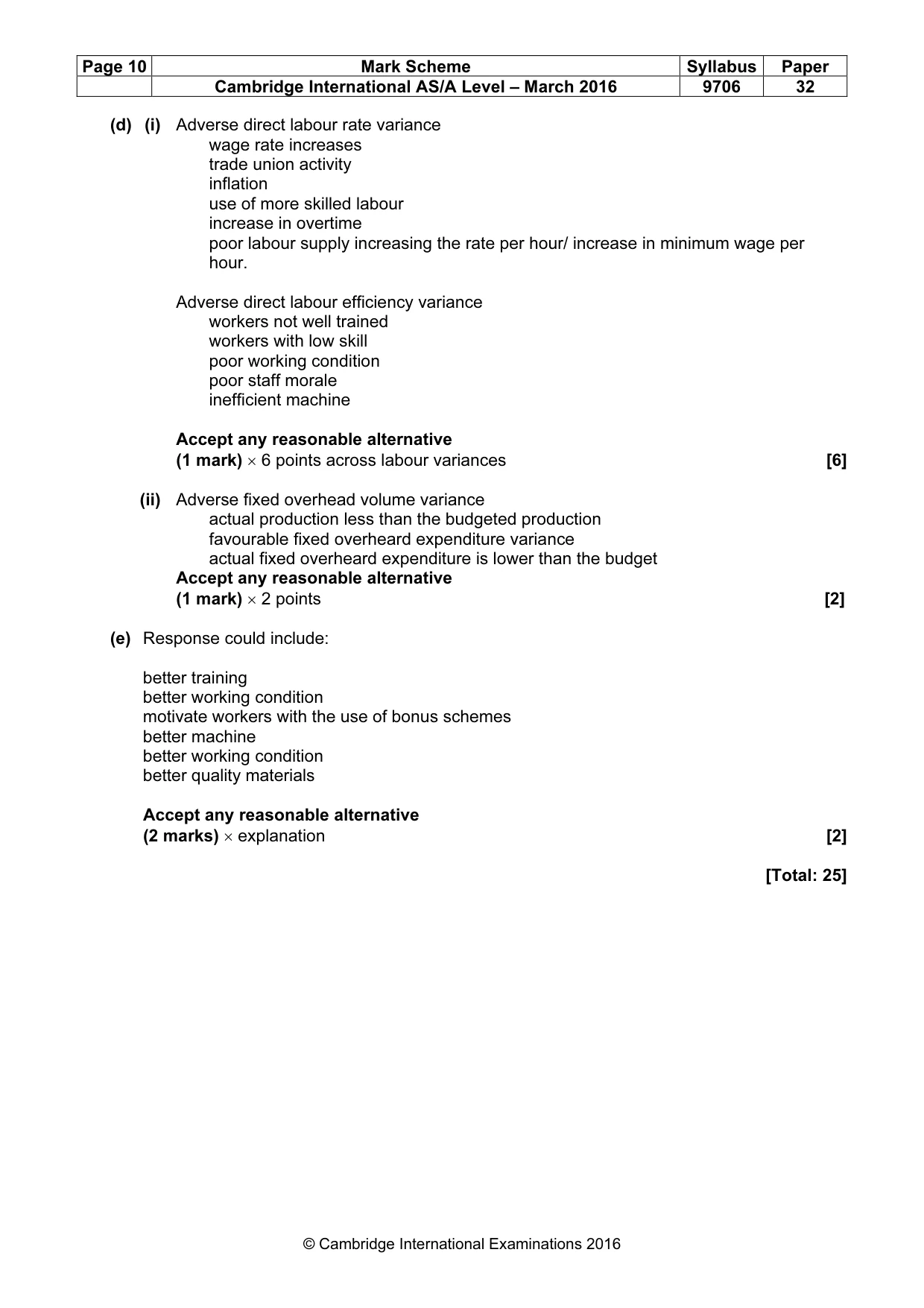
Page 10 Mark Scheme Syllabus Paper Cambridge International AS/A Level – March 2016 9706 32 © Cambridge International Examinations 2016 (d) (i) Adverse direct labour rate variance wage rate increases trade union activity inflation use of more skilled labour increase in overtime poor labour supply increasing the rate per hour/ increase in minimum wage per hour. Adverse direct labour efficiency variance workers not well trained workers with low skill poor working condition poor staff morale inefficient machine Accept any reasonable alternative (1 mark) × 6 points across labour variances [6] (ii) Adverse fixed overhead volume variance actual production less than the budgeted production favourable fixed overheard expenditure variance actual fixed overheard expenditure is lower than the budget Accept any reasonable alternative (1 mark) × 2 points [2] (e) Response could include: better training better working condition motivate workers with the use of bonus schemes better machine better working condition better quality materials Accept any reasonable alternative (2 marks) × explanation [2] [Total: 25]
What you needed in this session
Cambridge’s own grade thresholds for 2016 Feb/March, Paper 3 · Variant 2. A higher threshold means an easier paper — the bar moves with how the cohort did.