Cambridge A Level Accounting 9706 — 2004 Oct/Nov Paper 3 · Variant 1
9706/31/O/N/04
The question paper and its mark scheme, free to read here and free to download. This is Cambridge’s own paper, exactly as it was sat.
Question paper12 pages
Mark scheme4 pages
Answers below. Sit the paper first if you are practising.
Paper as text
Question paper, page 1
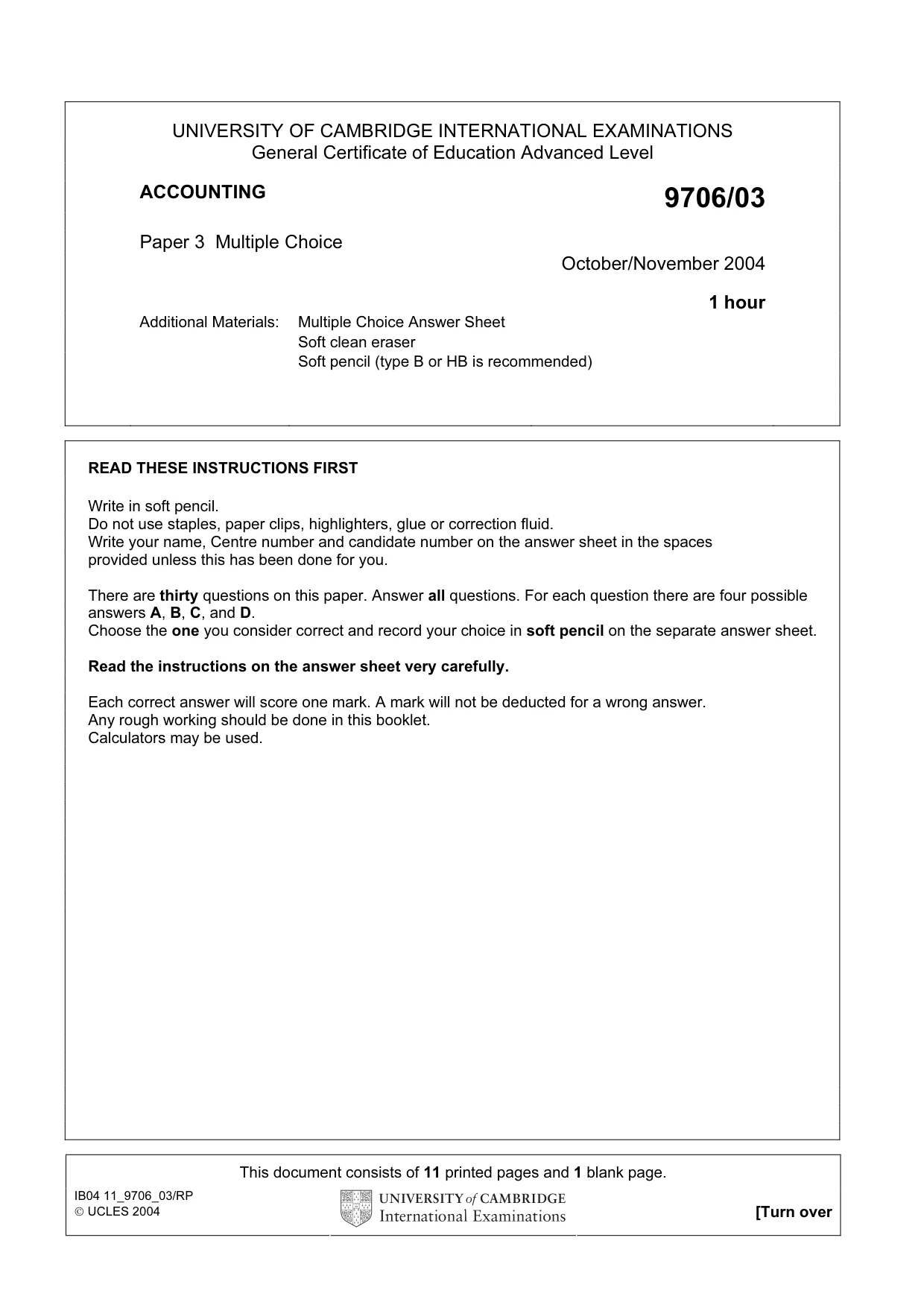
UNIVERSITY OF CAMBRIDGE INTERNATIONAL EXAMINATIONS General Certificate of Education Advanced Level ACCOUNTING 9706/03 Paper 3 Multiple Choice October/November 2004 1 hour Additional Materials: Multiple Choice Answer Sheet Soft clean eraser Soft pencil (type B or HB is recommended) READ THESE INSTRUCTIONS FIRST Write in soft pencil. Do not use staples, paper clips, highlighters, glue or correction fluid. Write your name, Centre number and candidate number on the answer sheet in the spaces provided unless this has been done for you. There are thirty questions on this paper. Answer all questions. For each question there are four possible answers A, B, C, and D. Choose the one you consider correct and record your choice in soft pencil on the separate answer sheet. Read the instructions on the answer sheet very carefully. Each correct answer will score one mark. A mark will not be deducted for a wrong answer. Any rough working should be done in this booklet. Calculators may be used. This document consists of 11 printed pages and 1 blank page. IB04 11_9706_03/RP UCLES 2004 [Turn over
Question paper, page 2
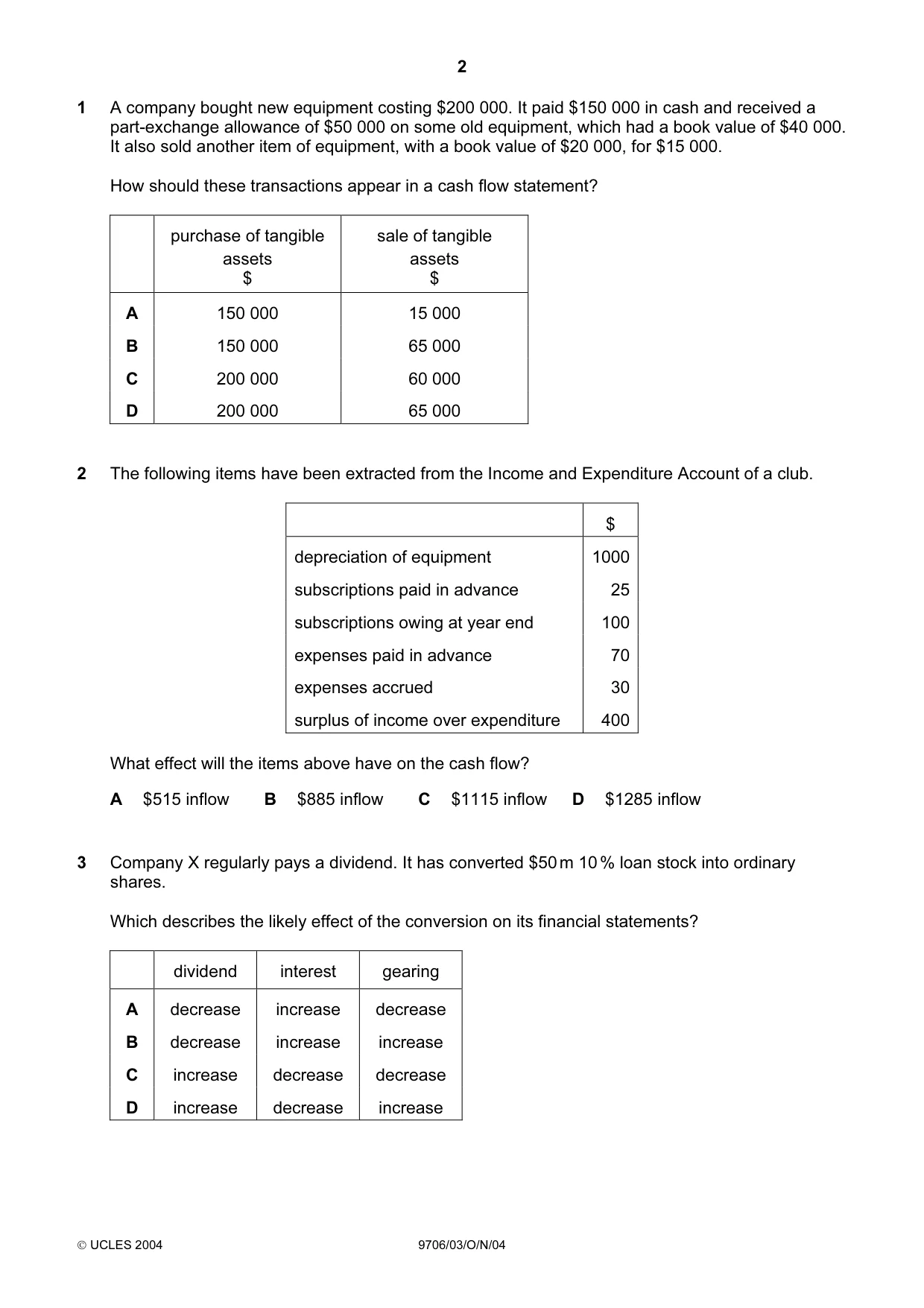
2 UCLES 2004 9706/03/O/N/04 1 A company bought new equipment costing $200 000. It paid $150 000 in cash and received a part-exchange allowance of $50 000 on some old equipment, which had a book value of $40 000. It also sold another item of equipment, with a book value of $20 000, for $15 000. How should these transactions appear in a cash flow statement? purchase of tangible assets $ sale of tangible assets $ A 150 000 15 000 B 150 000 65 000 C 200 000 60 000 D 200 000 65 000 2 The following items have been extracted from the Income and Expenditure Account of a club. $ depreciation of equipment 1000 subscriptions paid in advance 25 subscriptions owing at year end 100 expenses paid in advance 70 expenses accrued 30 surplus of income over expenditure 400 What effect will the items above have on the cash flow? A $515 inflow B $885 inflow C $1115 inflow D $1285 inflow 3 Company X regularly pays a dividend. It has converted $50 m 10 % loan stock into ordinary shares. Which describes the likely effect of the conversion on its financial statements? dividend interest gearing A decrease increase decrease B decrease increase increase C increase decrease decrease D increase decrease increase
Question paper, page 3
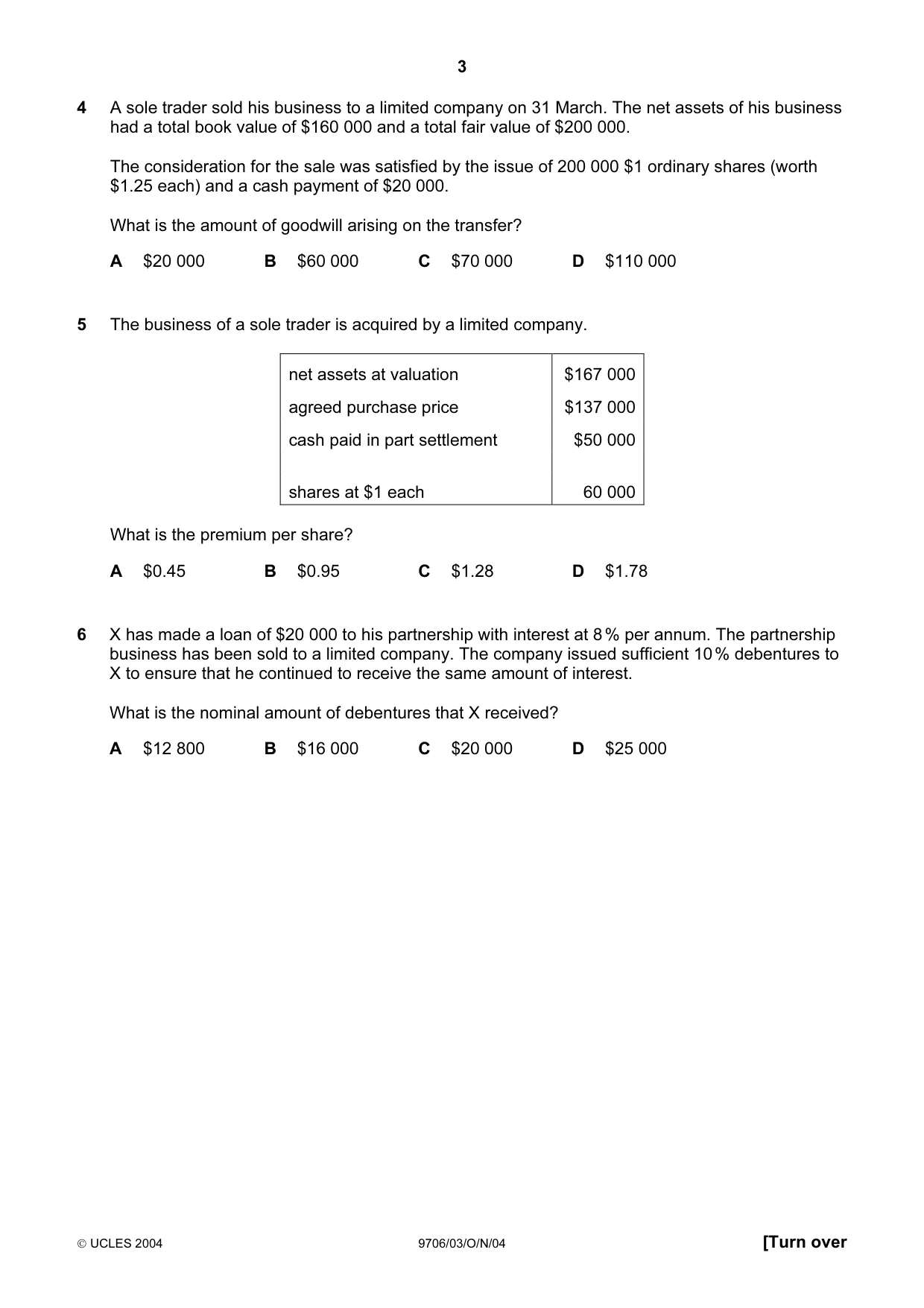
3 UCLES 2004 9706/03/O/N/04 [Turn over 4 A sole trader sold his business to a limited company on 31 March. The net assets of his business had a total book value of $160 000 and a total fair value of $200 000. The consideration for the sale was satisfied by the issue of 200 000 $1 ordinary shares (worth $1.25 each) and a cash payment of $20 000. What is the amount of goodwill arising on the transfer? A $20 000 B $60 000 C $70 000 D $110 000 5 The business of a sole trader is acquired by a limited company. net assets at valuation $167 000 agreed purchase price $137 000 cash paid in part settlement $50 000 shares at $1 each 60 000 What is the premium per share? A $0.45 B $0.95 C $1.28 D $1.78 6 X has made a loan of $20 000 to his partnership with interest at 8 % per annum. The partnership business has been sold to a limited company. The company issued sufficient 10 % debentures to X to ensure that he continued to receive the same amount of interest. What is the nominal amount of debentures that X received? A $12 800 B $16 000 C $20 000 D $25 000
Question paper, page 4
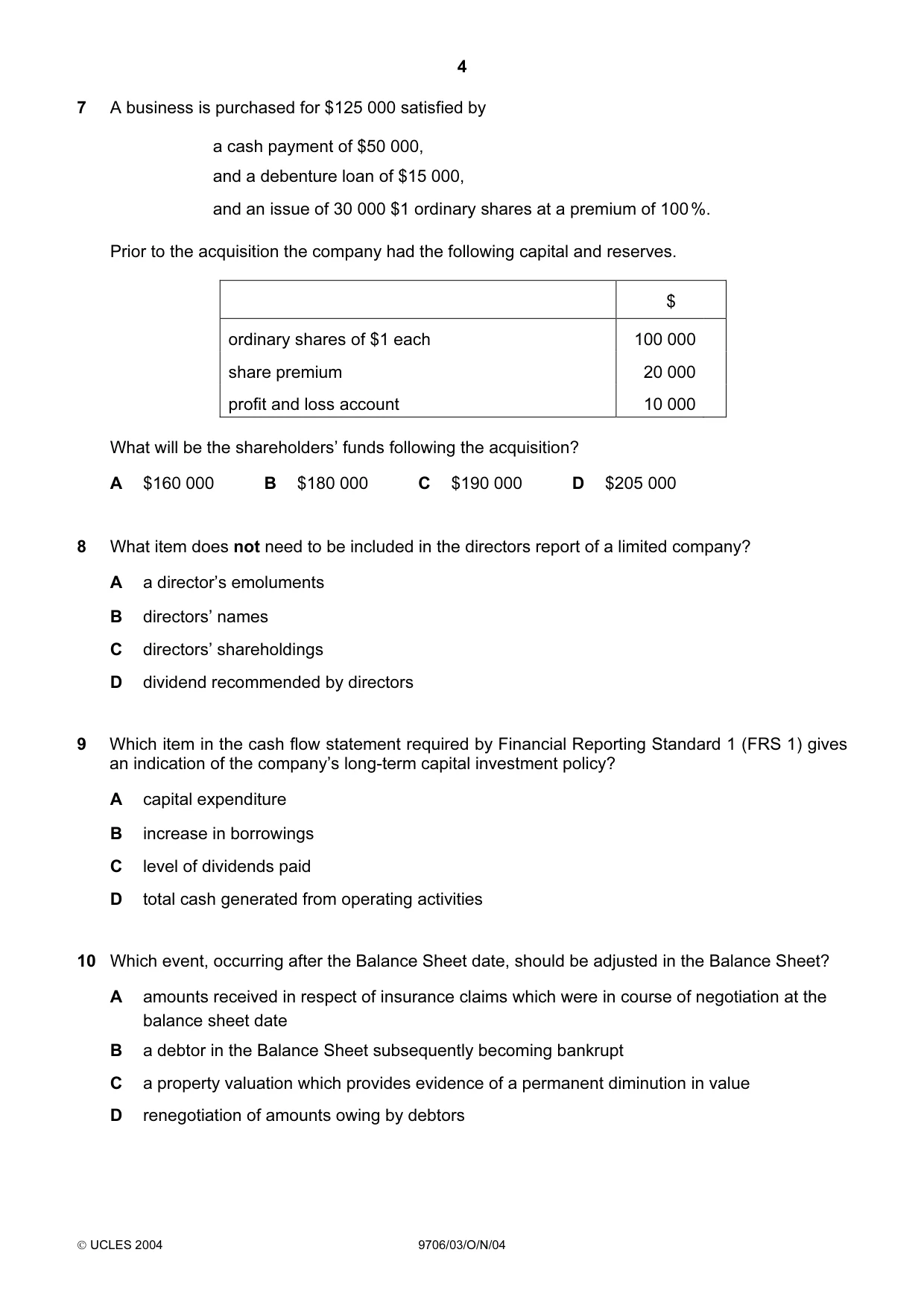
4 UCLES 2004 9706/03/O/N/04 7 A business is purchased for $125 000 satisfied by a cash payment of $50 000, and a debenture loan of $15 000, and an issue of 30 000 $1 ordinary shares at a premium of 100 %. Prior to the acquisition the company had the following capital and reserves. $ ordinary shares of $1 each 100 000 share premium 20 000 profit and loss account 10 000 What will be the shareholders’ funds following the acquisition? A $160 000 B $180 000 C $190 000 D $205 000 8 What item does not need to be included in the directors report of a limited company? A a director’s emoluments B directors’ names C directors’ shareholdings D dividend recommended by directors 9 Which item in the cash flow statement required by Financial Reporting Standard 1 (FRS 1) gives an indication of the company’s long-term capital investment policy? A capital expenditure B increase in borrowings C level of dividends paid D total cash generated from operating activities 10 Which event, occurring after the Balance Sheet date, should be adjusted in the Balance Sheet? A amounts received in respect of insurance claims which were in course of negotiation at the balance sheet date B a debtor in the Balance Sheet subsequently becoming bankrupt C a property valuation which provides evidence of a permanent diminution in value D renegotiation of amounts owing by debtors
Question paper, page 5
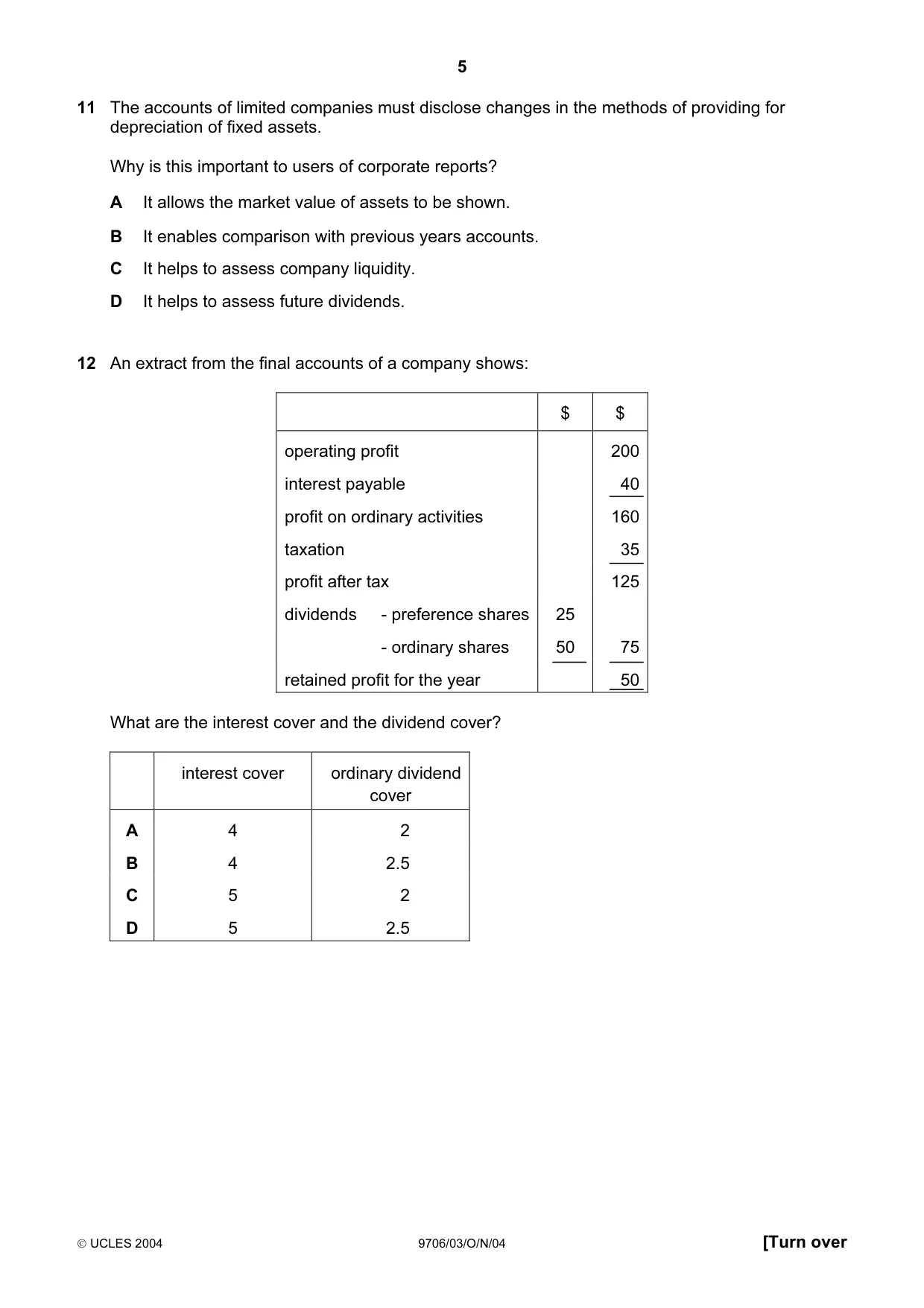
5 UCLES 2004 9706/03/O/N/04 [Turn over 11 The accounts of limited companies must disclose changes in the methods of providing for depreciation of fixed assets. Why is this important to users of corporate reports? A It allows the market value of assets to be shown. B It enables comparison with previous years accounts. C It helps to assess company liquidity. D It helps to assess future dividends. 12 An extract from the final accounts of a company shows: $ $ operating profit 200 interest payable 40 profit on ordinary activities 160 taxation 35 profit after tax 125 dividends - preference shares 25 - ordinary shares 50 75 retained profit for the year 50 What are the interest cover and the dividend cover? interest cover ordinary dividend cover A 4 2 B 4 2.5 C 5 2 D 5 2.5
Question paper, page 6
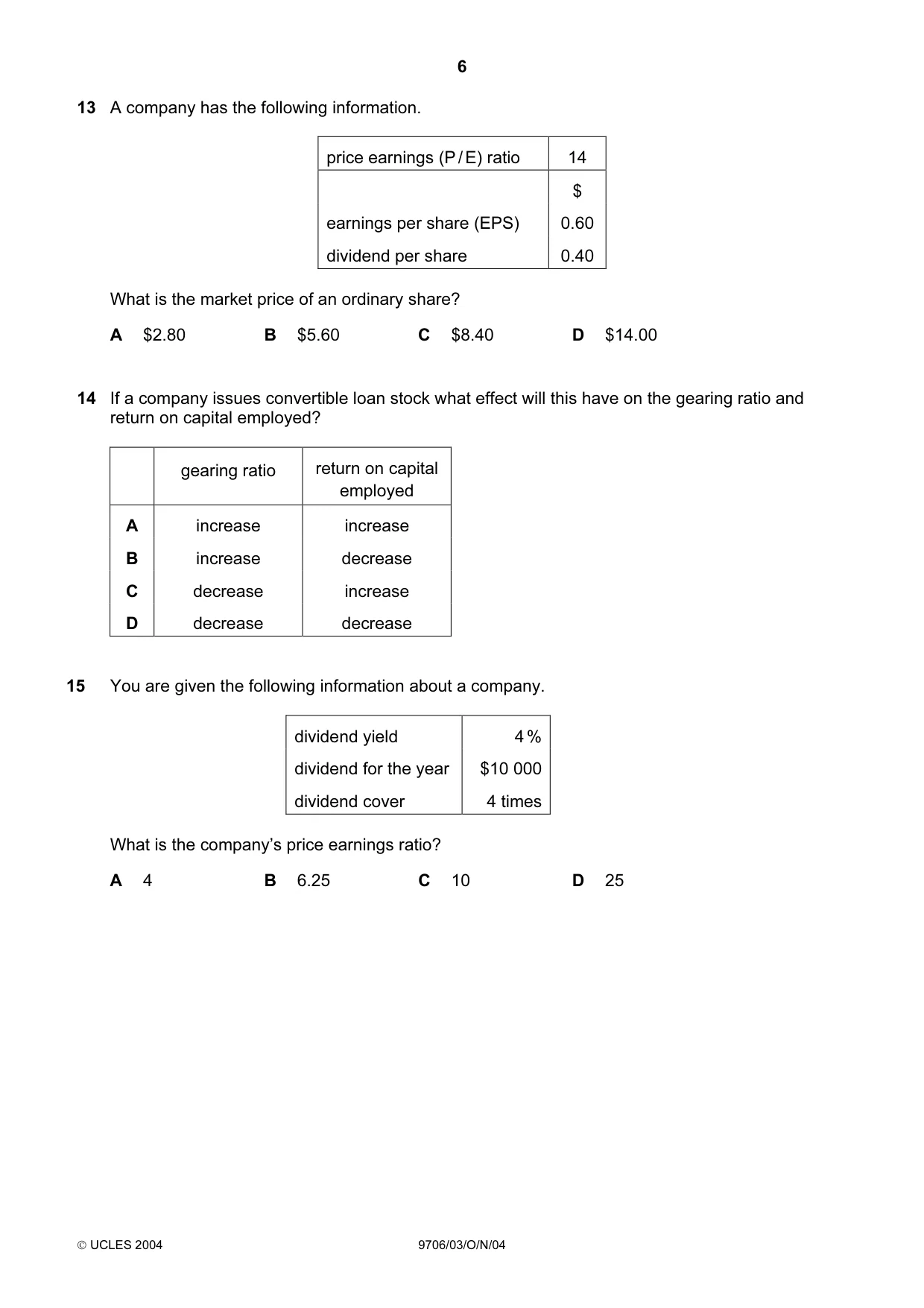
6 UCLES 2004 9706/03/O/N/04 13 A company has the following information. price earnings (P / E) ratio 14 $ earnings per share (EPS) 0.60 dividend per share 0.40 What is the market price of an ordinary share? A $2.80 B $5.60 C $8.40 D $14.00 14 If a company issues convertible loan stock what effect will this have on the gearing ratio and return on capital employed? gearing ratio return on capital employed A increase increase B increase decrease C decrease increase D decrease decrease 15 You are given the following information about a company. dividend yield 4 % dividend for the year $10 000 dividend cover 4 times What is the company’s price earnings ratio? A 4 B 6.25 C 10 D 25
Question paper, page 7
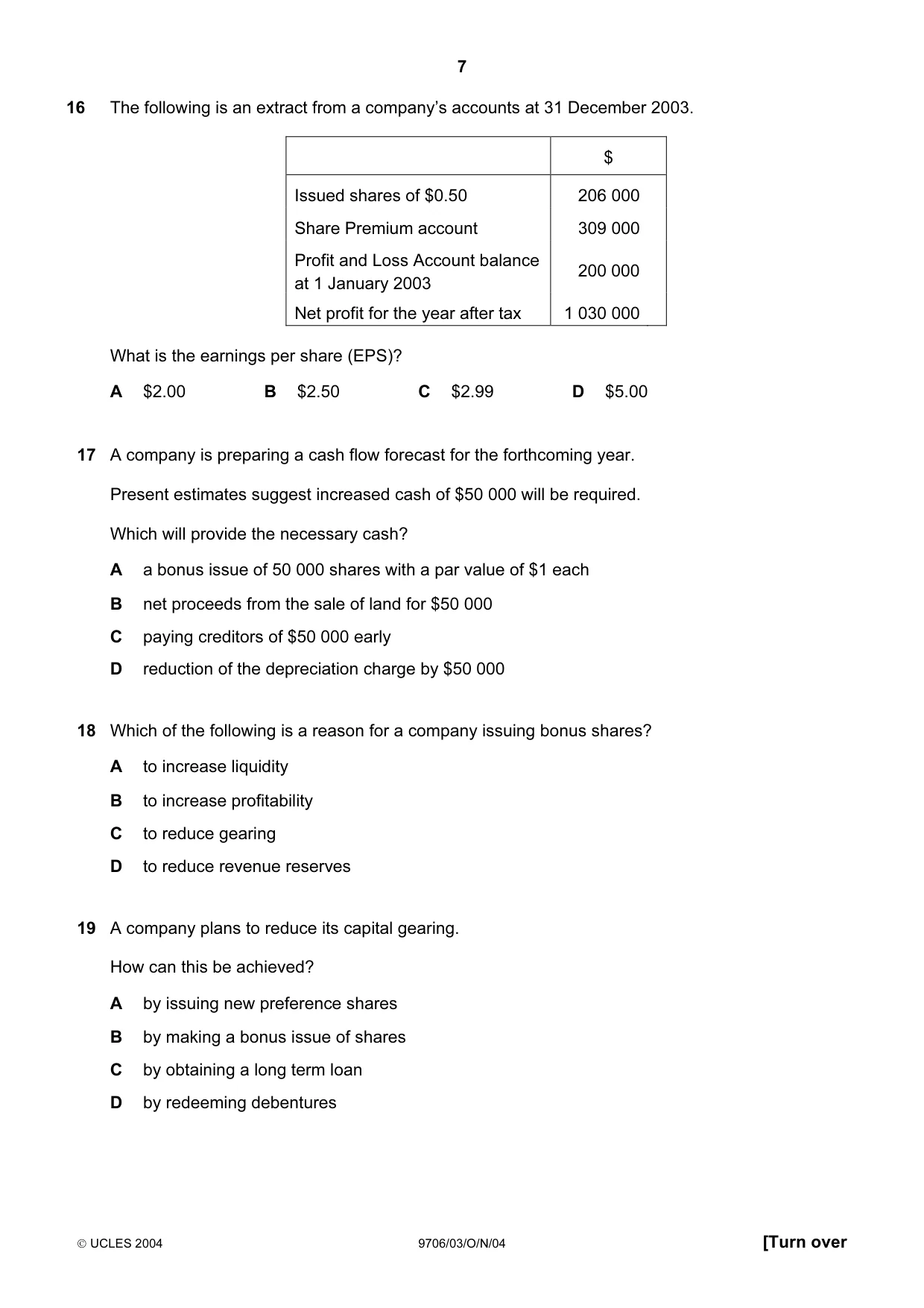
7 UCLES 2004 9706/03/O/N/04 [Turn over 16 The following is an extract from a company’s accounts at 31 December 2003. $ Issued shares of $0.50 206 000 Share Premium account 309 000 Profit and Loss Account balance at 1 January 2003 200 000 Net profit for the year after tax 1 030 000 What is the earnings per share (EPS)? A $2.00 B $2.50 C $2.99 D $5.00 17 A company is preparing a cash flow forecast for the forthcoming year. Present estimates suggest increased cash of $50 000 will be required. Which will provide the necessary cash? A a bonus issue of 50 000 shares with a par value of $1 each B net proceeds from the sale of land for $50 000 C paying creditors of $50 000 early D reduction of the depreciation charge by $50 000 18 Which of the following is a reason for a company issuing bonus shares? A to increase liquidity B to increase profitability C to reduce gearing D to reduce revenue reserves 19 A company plans to reduce its capital gearing. How can this be achieved? A by issuing new preference shares B by making a bonus issue of shares C by obtaining a long term loan D by redeeming debentures
Question paper, page 8
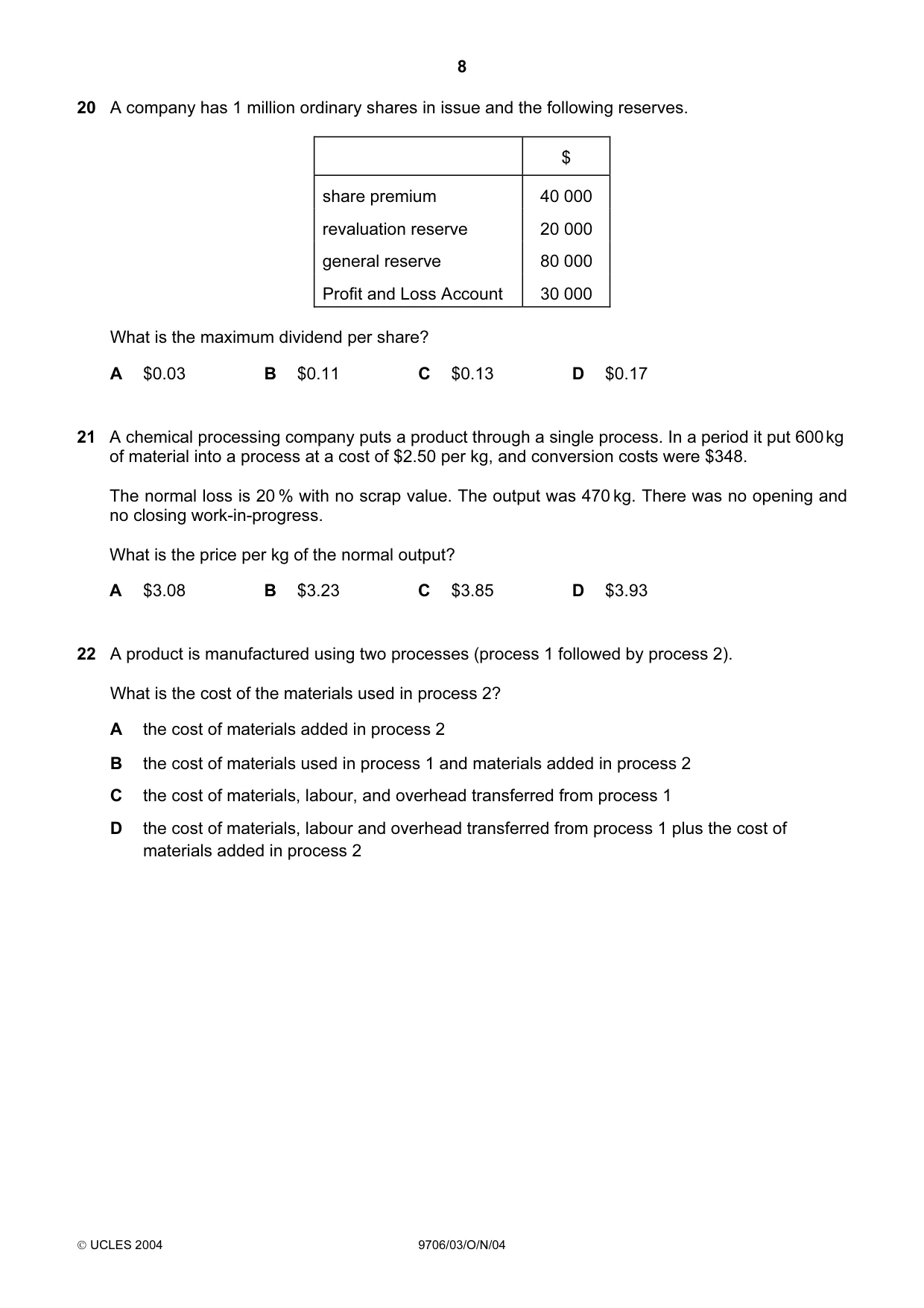
8 UCLES 2004 9706/03/O/N/04 20 A company has 1 million ordinary shares in issue and the following reserves. $ share premium 40 000 revaluation reserve 20 000 general reserve 80 000 Profit and Loss Account 30 000 What is the maximum dividend per share? A $0.03 B $0.11 C $0.13 D $0.17 21 A chemical processing company puts a product through a single process. In a period it put 600 kg of material into a process at a cost of $2.50 per kg, and conversion costs were $348. The normal loss is 20 % with no scrap value. The output was 470 kg. There was no opening and no closing work-in-progress. What is the price per kg of the normal output? A $3.08 B $3.23 C $3.85 D $3.93 22 A product is manufactured using two processes (process 1 followed by process 2). What is the cost of the materials used in process 2? A the cost of materials added in process 2 B the cost of materials used in process 1 and materials added in process 2 C the cost of materials, labour, and overhead transferred from process 1 D the cost of materials, labour and overhead transferred from process 1 plus the cost of materials added in process 2
Question paper, page 9
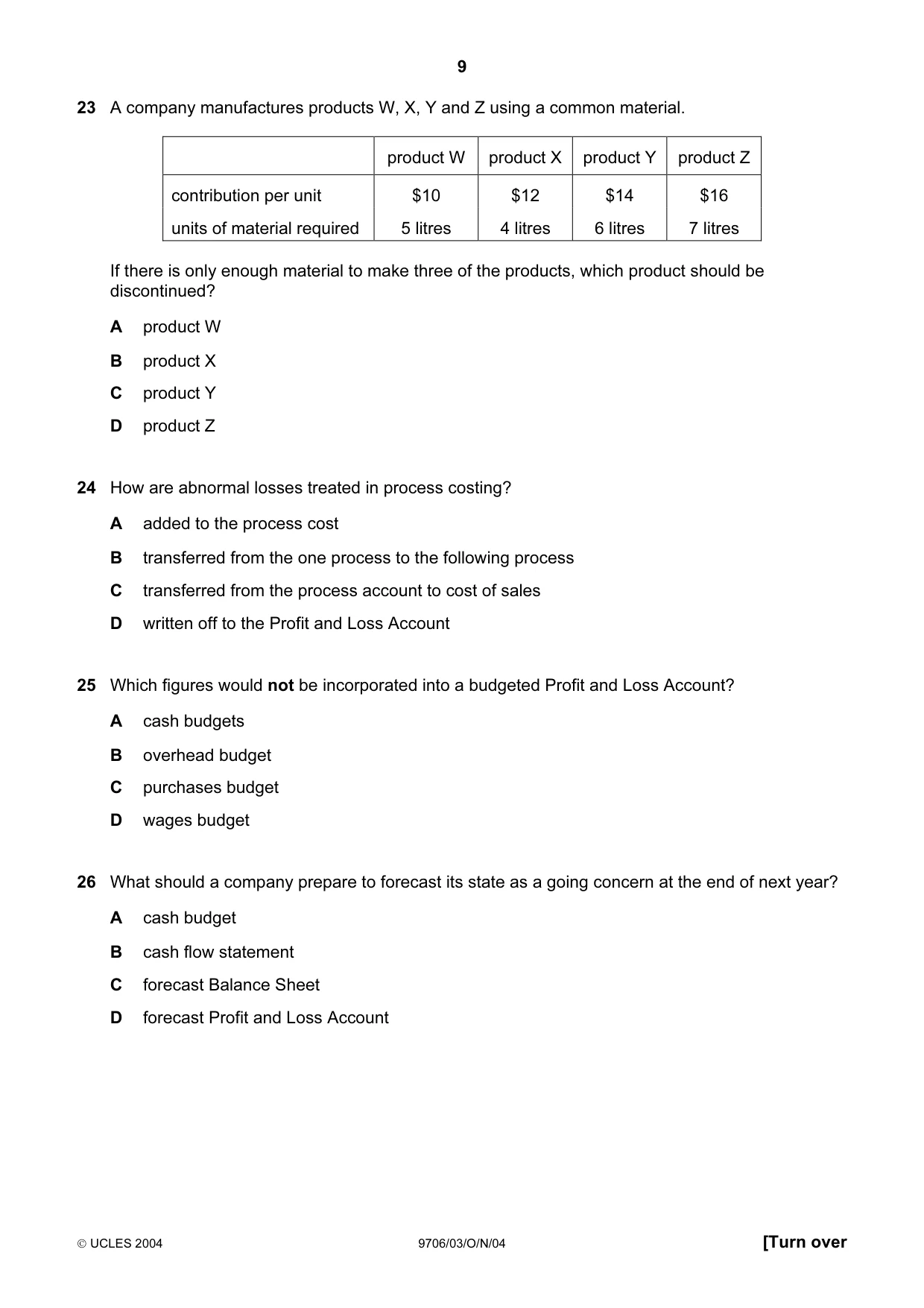
9 UCLES 2004 9706/03/O/N/04 [Turn over 23 A company manufactures products W, X, Y and Z using a common material. product W product X product Y product Z contribution per unit $10 $12 $14 $16 units of material required 5 litres 4 litres 6 litres 7 litres If there is only enough material to make three of the products, which product should be discontinued? A product W B product X C product Y D product Z 24 How are abnormal losses treated in process costing? A added to the process cost B transferred from the one process to the following process C transferred from the process account to cost of sales D written off to the Profit and Loss Account 25 Which figures would not be incorporated into a budgeted Profit and Loss Account? A cash budgets B overhead budget C purchases budget D wages budget 26 What should a company prepare to forecast its state as a going concern at the end of next year? A cash budget B cash flow statement C forecast Balance Sheet D forecast Profit and Loss Account
Question paper, page 10
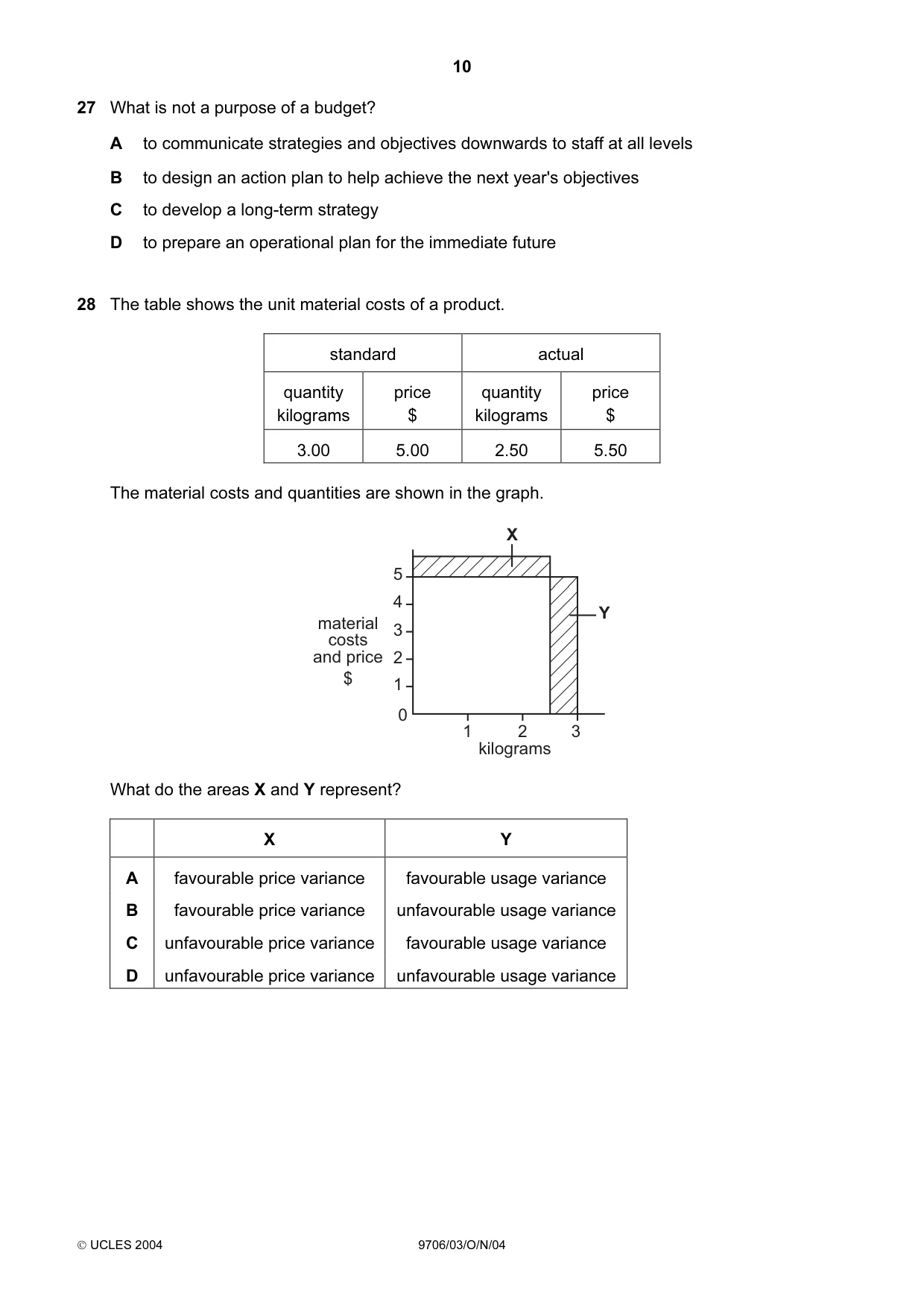
10 UCLES 2004 9706/03/O/N/04 27 What is not a purpose of a budget? A to communicate strategies and objectives downwards to staff at all levels B to design an action plan to help achieve the next year's objectives C to develop a long-term strategy D to prepare an operational plan for the immediate future 28 The table shows the unit material costs of a product. standard actual quantity kilograms price $ quantity kilograms price $ 3.00 5.00 2.50 5.50 The material costs and quantities are shown in the graph. 5 4 3 2 1 0 1 2 3 material costs and price $ kilograms X Y What do the areas X and Y represent? X Y A favourable price variance favourable usage variance B favourable price variance unfavourable usage variance C unfavourable price variance favourable usage variance D unfavourable price variance unfavourable usage variance
Question paper, page 11
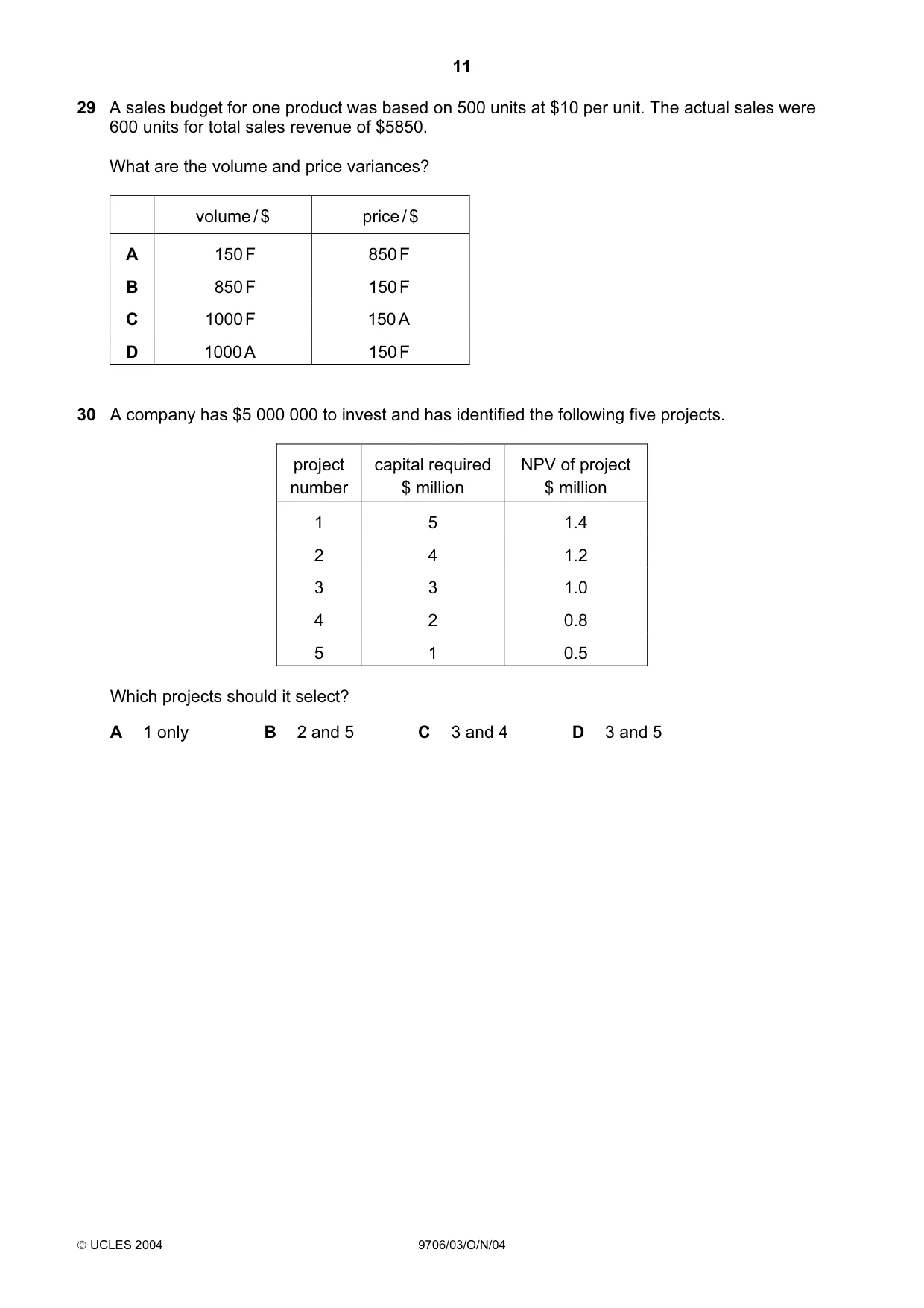
11 UCLES 2004 9706/03/O/N/04 29 A sales budget for one product was based on 500 units at $10 per unit. The actual sales were 600 units for total sales revenue of $5850. What are the volume and price variances? volume / $ price / $ A 150 F 850 F B 850 F 150 F C 1000 F 150 A D 1000 A 150 F 30 A company has $5 000 000 to invest and has identified the following five projects. project number capital required $ million NPV of project $ million 1 5 1.4 2 4 1.2 3 3 1.0 4 2 0.8 5 1 0.5 Which projects should it select? A 1 only B 2 and 5 C 3 and 4 D 3 and 5
Question paper, page 12
12 University of Cambridge International Examinations is part of the University of Cambridge Local Examinations Syndicate (UCLES), which is itself a department of the University of Cambridge. 9706/03/O/N/04 BLANK PAGE
Mark scheme, page 1
UNIVERSITY OF CAMBRIDGE INTERNATIONAL EXAMINATIONS GCE Advanced Level MARK SCHEME for the November 2004 question paper 9706 ACCOUNTING 9706/03 Paper 3 (Multiple Choice (supplement)), maximum raw mark 30 Mark schemes must be read in conjunction with the question papers and the Report on the Examination. • CIE will not enter into discussion or correspondence in connection with these mark schemes. CIE is publishing the mark schemes for the November 2004 question papers for most IGCSE and GCE Advanced Level syllabuses.
Mark scheme, page 2
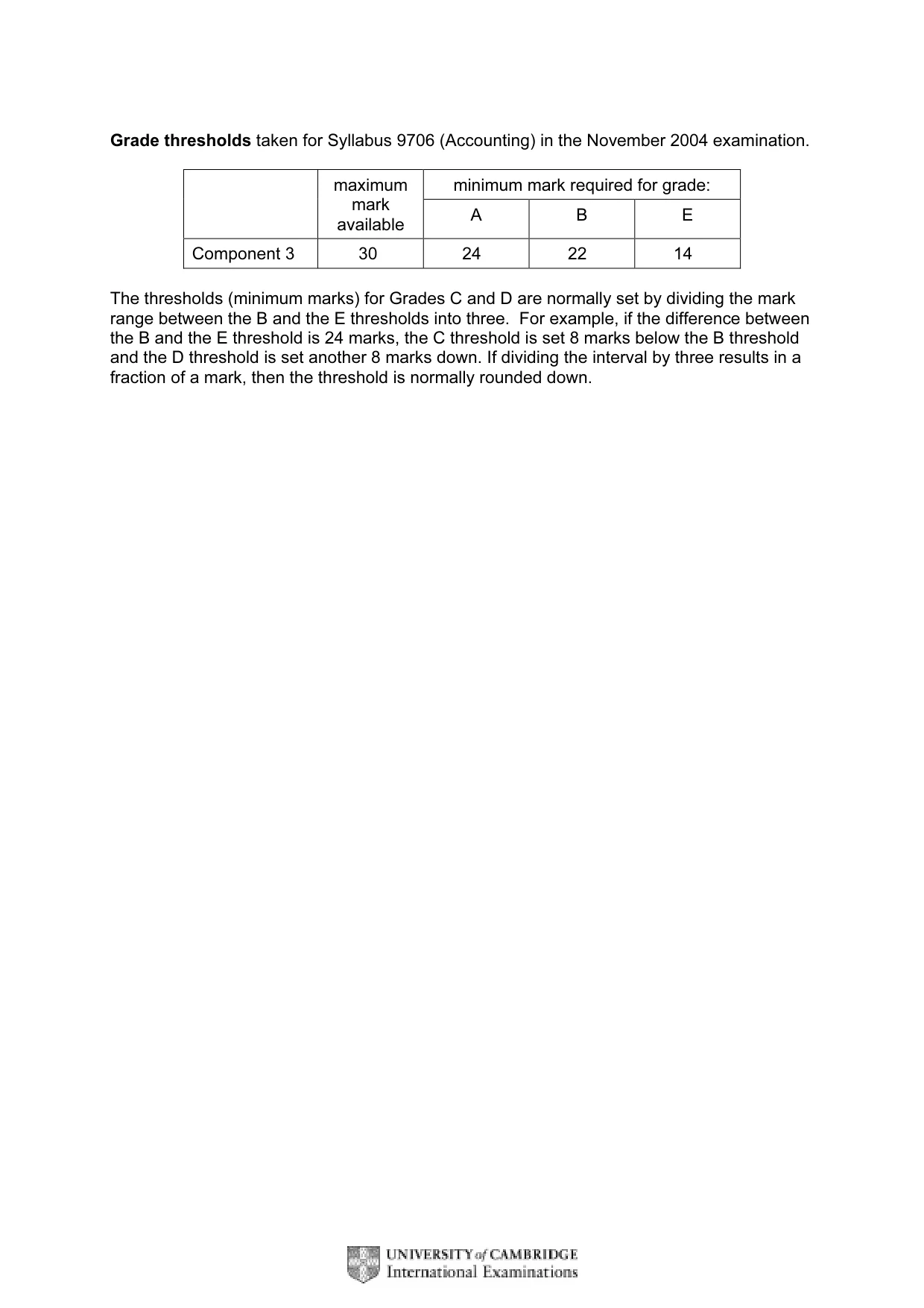
Grade thresholds taken for Syllabus 9706 (Accounting) in the November 2004 examination. minimum mark required for grade: maximum mark available A B E Component 3 30 24 22 14 The thresholds (minimum marks) for Grades C and D are normally set by dividing the mark range between the B and the E thresholds into three. For example, if the difference between the B and the E threshold is 24 marks, the C threshold is set 8 marks below the B threshold and the D threshold is set another 8 marks down. If dividing the interval by three results in a fraction of a mark, then the threshold is normally rounded down.
Mark scheme, page 3
NOVEMBER 2004 GCE A LEVEL MARK SCHEME MAXIMUM MARK: 30 SYLLABUS/COMPONENT: 9706/03 ACCOUNTING Paper 3 (Multiple Choice (supplement))
Mark scheme, page 4
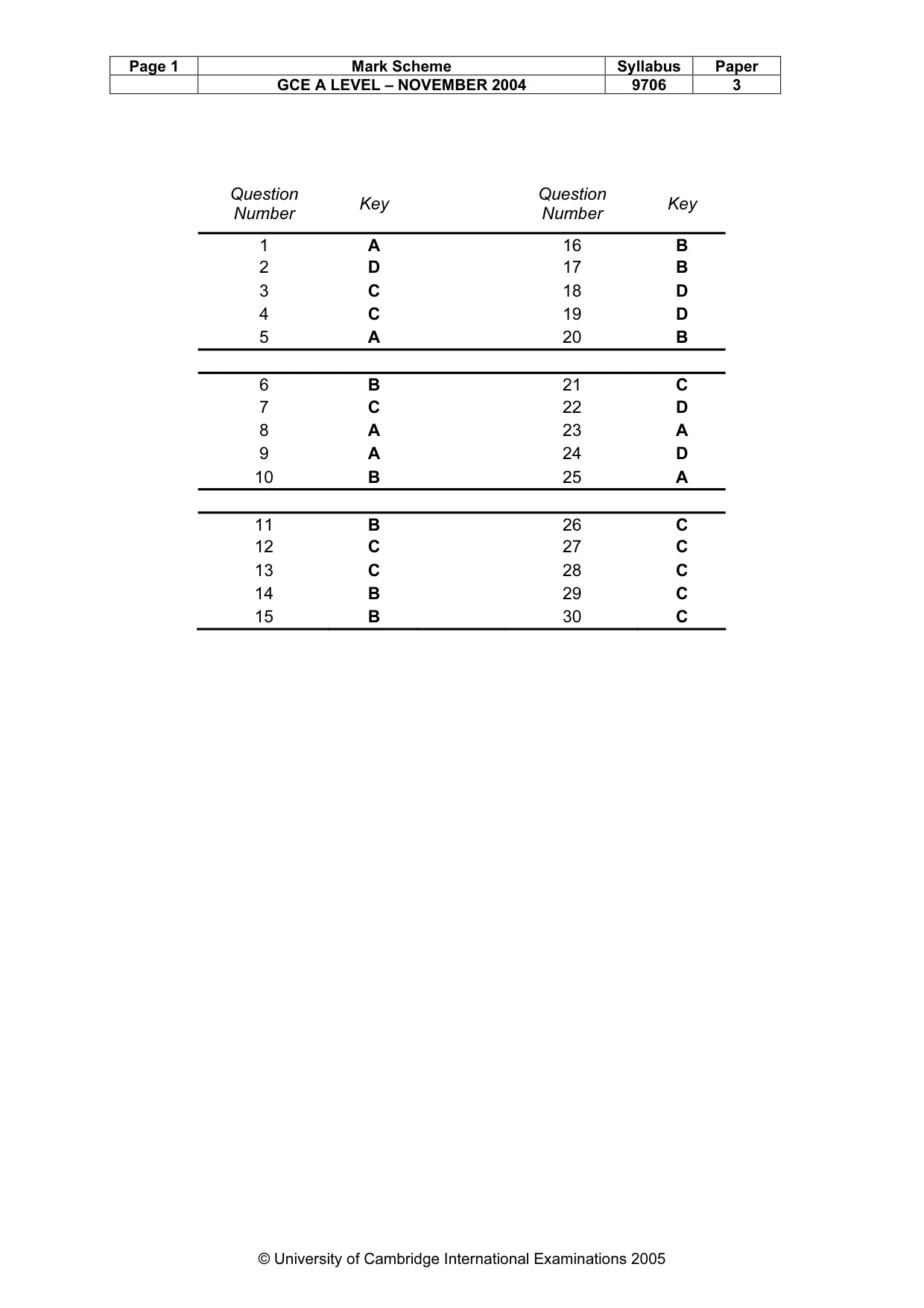
Page 1 Mark Scheme Syllabus Paper GCE A LEVEL – NOVEMBER 2004 9706 3 © University of Cambridge International Examinations 2005 Question Number Key Question Number Key 1 A 16 B 2 D 17 B 3 C 18 D 4 C 19 D 5 A 20 B 6 B 21 C 7 C 22 D 8 A 23 A 9 A 24 D 10 B 25 A 11 B 26 C 12 C 27 C 13 C 28 C 14 B 29 C 15 B 30 C